HARVARD COLLEGE LIBRARY ntOH THB BSQUBST OP & PRICE GREENLEAF OP QUINCr. MASSACHUSBTTS
I I I I i
K.ING'S AMERICAN DISPENSATORY BY HARVEY WICKES fELTER, M. D. ADJUNCT PROFESSOR OF CHKMIHTRV, PHARMACY, AND TOXICOLOGY, AND PROPESBOR OF ANATOMY, IN THE ECLECTIC MEDICAL INSTITL'TE, CINCINNATI, OHIO; EDITOR OP LOCKb's 8YLLABDB OF MATERIA MRDICA AND THRRAPEUTICS; BX-PRBSIDBNT OF THE OHIO STATE ETLECTIC HBDICAL A8BOCIATIOH, ETC., ETC., ETC. AND JOHN URi LLOYD, PHR.M., Ph. D. PROFESSOR OP CHEMISTRY, PHARMACY, AND TOXirOLOQY, IN THE KXBCTIC MEDICAL INSTITITTB, CINCI-NNATI.OHIO; FORMERLY PROFESSOR OP CHEMISTRY ANJ> PHARMACY IN THE CINCINNATI COLLEGE OF PHARMACY; BX-PRBSIDBNT OF THE AMERICAN PHARMACEUTICAL ASSOCTATION; AUTHOR OP THE CHEMISTRY OF MEDICINES; DBUOS AND MEDICINES OF NORTH AMERICA; A STUDY IN PHARMACY; BTIDOBHFA, ETC,, ETC., ETC. KNTIRELY REWRITTEN AND ENLARGED. NINETEENTH EDITION. THIRD REVISION. IN TWO VOLUMES. VOL. L CINCINNATI: THE OHIO VALLEY COMPANY, 317^321 RACE STREET. 1906.
AUTHORIZATION. Kesolution passed by the National Eclectic Medical Aaaociation at the annual meeting, in Cleveland, Ohio, June 19,1879: J2esolved. That this Association adopt The Ahkkicam DispknsaTOBY aa ita stasdahp authobity. Albxandbr Wilder, M. D., Secretary. "AuTHiJRiTY to use for comment the Pfuirmacopceia of tite United Statetqf America (1890), Seventh Decennial Revision, has been granted by the Committee of Beviaion and Publication." Authobity to print selections from the National Formulary, has been granted by the Council of the American Pharmaceutical Association. COPYRIGHTS. Entered according to Act of Congrcn, In the ywr 1854. by MOORE, WIL8TACH A KKYS, In the Clerk'a Office of the Dlatrlct Court of the United States, for Ihe BoDthem Dlntrtct of Ohto. ■Entered aocordlng to Act of Congren, la the fear USV, by HOOKS, WILSTACH, KEYH A CO. I - Uie Clerk's Office of the Dlatrlct Court of the Tnlted Btetea, for the Southern District of Ohio. KDteml according to Act of Congress, In the year 18H, by MOORE. WILBTACH A BALDWIN', In the Clerk's Office of the I>lstrlot Conrt of the United States, for the Southern District of Ohio. Botered aooordlng to Act »( Congreas. in the yean IftTO and 1880, by WlfiSTACH. BALDWIN & f». In the Office of the Librarian of Conrrvss, at Washington Copyright, liftiS, • THE OHIO V ALLEY " v. ' Copyright, ■ ' THE OHIO VALi.". ' ' V. I PMNTEO AND WMIND THE OHIO VALLCY OOMRANY, OlfKMHUTI.
PREFACE. When the undersigned, in 1880, promised his venerable friend, Prof. King, to revise the pharmaceutical and chemical sections of the American Dispensatory if it became necessary, he did not underrate the magnitude of the undertaking, and when the publishers finally decided to issue the new edition he approached the task with apprehension. It soon became evident that the work was even greater than he had anticipated, and that the pharmacy and chemistry of the book could not be revised, but must be rewritten. In consequence, in addition to his own labors, almost the entire time of Dr. Sigmund Waldbott, Librarian of the Lloyd Library, has &r a long period been devoted to bibliographical r^arch. Had it not been for the care and patience of this gentleman and the books of reference at his command, the efforts of the undersigned would have been sadly ineffectual especially in the matter of foreign chemical and historical data. The writer can not forbear adding that monetary considerations could not have induced him to undertake this enterprise, and that no material return whatever accrues to him from this publication. The exacting researches necessary have been undertaken on his |Murt altogether as a work of love, his uttermost desire being to fulfil his promise and to credit the memory of Prof. King. If these objects have been attained, and the pharmaceutical and medical professiona are also benefited by his efforts, he will be amply repaid. J.U.L. In addition to the entire medical section of this work, the undersigned has undertaken the portion embracing botany, botanical history, and botanical description. Most of the material pertaining to the older Eclectic practice, found in former editions of this work, has I Jen properly credited and reteined. Many of the personal stetements, and all of the uses, ascribed to special formulae of the late author, Prof. John King, M. D., have been retained intact; in a few cases, where personality demanded, his initial (K.), or the fall name (John King), have been appended. The aim, however, has been to modernize the therapy of the book, and with this object special pains have been taken, whenever possible, to give fully and clearly the specific indications and uses of each remedy. A dispensatory must of neceAsity be largely a compilation. The uses of a remedy that is not approved by the compiler, but which is indorsed by many physicians, may consequently demand recognition which might properly be excluded from a work on materia medica intended to voice only the author^s experience. The aim has been to avoid commending excessive doses, though, in order to conform to the views of some authorities, large doses of some remedies (iii)
iv ACKNOWLEDGMENTS. have been recorded. This is especially true of many compounds used according to old-style practice. The influx of a large number oi new remedies, synthetic or otherwise, has necessitated reference to some of their reputed therapeutic properties. We have therefore ascribed to them such values- as have been reported by physicians through periodicals, pamphlets, and other works. In this connection it may be stated that we have not neglected to record the oses of many semi-professional proprietary compounds and the patented chemicals now in considerable &vor with many physicians, especially of the regular school. Concerning these remedies, our remarks, however, have been necessarily very conservative. Liberal use has been made of the various Eclectic Journals, State and National Transactions, and Eclectic Annuals. We have drawn freely from Webster's Dynamical Therapeutics; Scudder's Specific Medication, Specific Diagnoaitt, and Diseaae* of Children; Locke's Syllabus of Materia Medica and Therapeutics (Felter); and Watkins' Compendium of the Practice of Medicine. We also wish to acknowledge our especial obligations to the editorials of Prof. Bloyer, in the JBdeetic Medical Journal and the Edeciic Medical Gleanei'; the contributions of Profs. Freeman, Thorous, and Wintermute; the editorials of- Prof. Ellingwood in the Chicago Medical Timetf and the contributions of Prof. Fearn and others in the California Medical Journal. To these and all others who have directly and indirectly assisted in the therapy of the book, the writer herewith extends his sincere tiianks. H. W. F. ACKNOWLEDGMENTS. The authors of the present revision of King's American Dispensatory take pleasure in extending the following especial acknowledgments and thanks: To the Committee of Revision and Publication of the PharniacopcBia of the United Statetf for permission (through Dr. Charles Kice) to use the United States Pharmacopoeia for comment; to the Council of the American Pharmaceutical Association (through Messrs. W. S. Thompson and G. W. Kennedy) for permission to use fbrmnlsB of the National ^hrmulai'y; to Messrs. Fritzsche Bros, for the use of Powers' Essential Oils and Schimmel's Reports; to Prof. Attiield (Chairman of Committee), for permission to abstract from the British Pharmaoopceia; to Mr. Curtis G. Lloyd, for permission to use article on CotTee. For illustrative cuts credit is due William Wood & Co. (Johnson's Medwal Botany of NoHh Americd); Messrs. Parke, Davis & Co; (Pharmacology of the Newer Materia Medica); D. Aj>pleton & Co. (American Cyclopeedia); Messrs. Eli Lilly & Co. (Lilly's BuUetin)} Messrs. Funk & Wagnalls (Standard DuUionary); Messrs. Johnson & Johnson (Belladonna, by Dr. F, B. Kilmer); Messrs. Frederick Stearns & Co. {JUustrated Catalogue); Dr. John King Scudder (EcleiUic Medieal Jourruil); J. U. and C. G. Lloyd (Dntgs and Medicines of North America),
ACKN0WLED0MENT8. T and Messrs. Boerioke & Tafel and Dr. Charles F. Millspaugh (Millapaugh's Ameriean Medicinal PUmts). With deep appreciation do we recall the cordial fa manner in which the late Prof. FlUckiger extended the privilege of his publi11^^ catioDSj a &vor we gladly accepted and freely used. It would be impractical to i3L> attempt to mention herein all the journals and standard works, both foreign and American, that have been consulted in the preparation of this publication; ''Oi- these when drawn from are especially credited iu the text, but we can not forbear lY"! naming a few to which we are especially indebted: Dif Prof. S. P. Sadtler, Handbook of Industrial Organie Oiemidry. Husemann & Hilger, Fjianzenstoffet etc. ad Prof. Henry Trimble, The Tatmina, The American and English PharmaoeuUoal Jourwila. ■^K Archiv der Pharmatne. tiri Jahreabericht <f«r Pharmade (Beckarts). i^t Pharmaoeidisehe (^ntralhaUe. i(Jt 10(1 er; tl; it fi il 1. d r 1 ' I
LIST OF ILLUSTRATIONS. 1. Achillea Standard Dictionary (Funk & Wagnalls), 19 2. Aconitum napellus Drawn from plate in Woodville's Medical Botany (1790), 101 3. Aconite flower (crosB-section) Lloyd's Dfurb and Medicines of North America, 102 4. Aconitum Fischeri Lloyd's Drugs and Medicines of North America, 107 5. Boot of Aconitum Fischeri Lloyd's Drugs and Medicines of North America, 107 6. Fruit of Acttea alba Lloyd's Drugs and Medicines of North America, 108 7. Fruit of Actsa spicata var. rubra — Lloyd's Drugs and Medicines of North America, 110 8. AdiantUDi pedatum Standard Dictionary (F. & W.). IH 9. Adiantuin capitluB Veneris Standard Dictionary (F. & W.), 114 10. Adonis autumnalis; Standard Dictionary (F. & W.), 116 11..(EflcaluB glabra Standard Dictionary (F. <fe W.), 118 12. Apparatus for preparation of Ethylene bichloride Sup. to American Dispensatory, 127 13. Agrimonla Standard Dictionary (F. & W.), 129 14. Aletrie farinoea Supplement to American Dispensatory, 142 15. Buk of Alstonia conatricta Supplement to American Dispensatory, 163 16. Bark of Alstonia scbolaria...Supplement to American DiKpensatory, 156 17. Apparatus for preparation of Ammonium nitrate... Sap. to American Dispensatory, 181 18. Ampelopsis quinquefolia Standard Dictionan- (F. & W.), 184 19. Prunus Amygdalus Standard Dictionary (F. & W.), 185 20. Cashew-nut Supplement to Auierican Dispensatory, 195 21. Anemone nemorosa Lloyd's Drugs and Me<licines of North America, 199 22. Crystals of Anemonin IJovd's Drugs and Medicines of North America, 199 23. Anemone patens var. Nuttalliana (with fruit) Lloyd's D. and M. of X. A., 201 24. Flower of Anemone patens var. Mnttalliana Lloyd's D. and M. of N. A., 201 25. Pimpiuella Anisum Standard Dictionary (F. & W.), 210 26. Anthemis nobilis Standard Dictionary (F. & W.), 211 27. Apo<-ynnm cannabinum Supplement to American Difpensatory, 226 28. Apocynum androeeemifolium Supplement to American Dispensatory, 228 29. Arnica montana Standard Dictionary (F. A W.), 278 30. Arissema triphyllum Standard Dictionary (F. & W.j, 283 31. Ferula fcetida The American Cvclopwdia (D. Applcton & Co.), 285 32. Asarum canadense Standard Dictionary (F. & W.), 287 38. Asclepias tuberosa Drawn by H. W. Felter, M. D.; plant from Dr. G. K. Davis, 289 34. Asclepias, fresh root Drawn by H. W. Felter, M. I>.; plant from Dr. (i. E. Davis, 290 35. Asimina triloba Lloyd's Drugsand Medicinesof North America, 298 36. Cry8talKofA(-imiuinefay(Irocfalorate...Lloyd'8Drug>i and Medicines of North America, 298 37. Citrus Aurantium Standiml dictionary (F. & W.),;110 38. Baptisia tinctoria. H. W. Fcltcr, M. D., 324 39. Atropa Belladonna, flowering branch and fresh root Belladonna (Kilmer), J. & J., 331 40. Belladonna leaf (croBs-section) Belladonna (Kilmer), Johnson «& Johnj^on, 332 41. Belladonna leaf (surface-section) Belladonna (Kilmer), Johnson & Jolinson, 333 42. Mealy Belladonna root (cross-aection) Belladonna (Kilmer), Johnson & Johnson, 333 43. Horu-like Belladonna root fcroBS-section) Belladonna (Kilmer), J. A J., 333 44. Woody Belladonna loot (cross-section) Belladonna (Kilmer*, J. & J., 334 45. Belladonna root (croBSHsection) '.Belladonna (Kilmer), Johnson & Johnson, 334 46. Berberis vulgaris........... '.Standard Dictionary (F. & W. ), 346 47. Leavi-B of Berberis aquifoliam Berberidacete, bv J. U. & "C. G. IJoyd, 346 48. Bidens frondosa StandanI dictionary (F. & W.), 361 49. Leaf of Feumns Boldus Supplement to American Disi>enBatory, 359 50. Bryonia dioica The American (Jycioptedia ( D. A. & Co.'), 367 51. Bucbu leaves Frederick StearnH & Co**- Catalc^e, 371 52. Cactus grandiflorus The American Cvi-lopawlia (D. A. & Co.), 374 53. Coffeaarabica Standard Dictionary iF. & W.), 378 54. Cannabis sativa Frederick Steams & Co.'s Catalogue, 423 55. Capsella Bursa-pastoris Supplement to American Dispensatory, 432 56. Fruit of Capeelfa Supplement to American Diepenpatory, 432 57. CarduUB mariana StandanI Dictionary (F.&W.), 447 58. CarthamuB tinctoriuB The American Cycloptedia (D. A. & Co.), 452 69. Bugeniaaromatica Frederick Stearns <& Co.'s ( atalngue, 454 (vii)
nil LIST OF ILLUSTRATIONS. FIG. NAME. tlOrRCE. PAGE. 60. Cassia raarilandica Standard Dictionary (F. &. W.), 457 61. Caatanea dentata The American Cyclopaedia (D. A. & Co.), 4S8 62. Caulophyllum tbalictroides. Lloyd's Drusa and Medicines of North America, 468 63. Ceanothua americana Frederick Stearns & Co.'s Catalogue, 472 64. Cclastrua scandens Standard Dictionary (F. & W.), 473 65. Cetraria islandica The American Cyclopsedia (D. A. & Co.), 486 66^ ChamseUrium luteum, Happlement to American Dispensatory, 488 67. Chelidonium majus The American Cyclopaidia (D. A. & Co.), 492 68. Chelone glabra H. W. Felter, M. D., 494 69. Chimaphila unibellata H. W. Felter, M. D., 496 70. Chionanthus virginicus The Americsn Cvclopasdia (D. A. & Co.), 500 71. Cimicifiiga raceinosa (branch) Lloyd's Drugs and Medicines of North America, 529 72. Cimicifuga raceinosa (fresh root) Lloyd's Drugs and Medicines of North America, 529 73. Cinchona Calisaya Standard Dictionary (F. & W'.), 534 74. Cinnamon j)lant" (branch and bark) Standard Dictionary (F. & W.), 558 76. Olvmatis virginiana Lloyd's Drues and Medicines of North America, 561 76. Cocaine crystals...Pharmacology of the Kewer Materia Mcdica (Parke, Davis&Co.), 565 77. Cocaine hydrobrouiate crjrstals Pharm. of the Newer Mat. Med. (P., D. & Co.), 665 78. Cocaine hydrochlorate crystals Pharm. of the Newer Mat. Med. (P., D. & Co.), 668 79. Coccus cacti The American Cyclopaedia (D. A.& Co.), 673 80. Colchicum autumnale Standanl Dictionary (F. «jj W.), 578 81. Fruit of Citrullns Coiocynthis Frederick Stearns & Co. s Catalogue, 585 82. Conium maculatum The American Cyclopcedia (D. A. & Co.), 592 83. Convallaria inajalis iStautlanl Dictionary (F. &. W.), 596 {2: v°^^rSm'lT""' \ ■ f'*'-"'^ * 85. Coptis trifolia Lloyd's Drugs and Medicines of North America, 603 86. Corallorbiza odontorhisa '. Frederick Steams & Co.'s Catalogue, 604 87. Comus tiorida The American Cvclopfedia (D. A. & Co'}, 608 88. Maruta Cotula The American Cyclopsedia (D A. & Co.), 613 89. Crocus aativus (style with stigmas) Frederick Stearns & Co.'s Catalogue, 619 90. Turmeric (long and short) The American Cyclopa^lia (D. A. & Co ), ti35 91. Cyclamen europseum Standard Dictionan' (F. & W.), 639 92. Diamiaua..Sup. to Amer. Disp. (From Mr. Wellcome's Hgares in Chicago Pharmaciat), 645 93. Tumera aphrodisiaca... Supplement to American Dispensatory, 645 94. California damiana Supplement to American Dispensatory, 645 95. Aplopappus disroideuB Supplement to American Dispensatory, 646 96. Digitalis purpurea Standard Dictionary (F. & W.), 652 \ 2: dK"« allies;! supplement to American Dispe„.„.„ry, 659 98. Dracontium foetidum The American Cyclopaedia (D. A. & Co.), 663 99. Drosera rotuudifoiia The American Cyclopeedia (D. A. & Co.), 664 100. Solannm Dulcamara Frederick Steams & Co.'s Catalogue, 667 101. Echinacea (leaf) Eclectic Medical Journal, 671 102. Echinacea (dried root) Eclectic Medical Journal, 673 103. Kpipearepens The American Cyclopfledia (D. A. & Co.), 710 104. Epilobiuui anguatifolium Standard Dictionary (F. A; W.l, 711 106. Erechtitea hieracifolia Lloyd's Drugs and Medicines of North America, 714 il. Ear of rye, with ei^t, ) 2. Ergot, \ The American Cycloptedia (D. A. & Co.), 716 3. Ergotized rye, ) 107. Eriodictyon glutinosum Supplement to American Diapensatorv, 728 108. Eucalyptus globulus (leaves and fruit) Supplement to American Dispensatory, 734 109. Eupatorium perfoliatum The American CyciopBedia (D. A. & Co.), 738 110. Euphorbia Ipecacuanha Standard I^ictionary (F. & AV,), 749 111. Euphorbia pilulifera Pharmacology of the Newer Materia Medica (P., D. & Co.), 751 112. Percolator Supplement to American Dispensatory, 756 113. Cork Supplement to American Dispensatory, 756 114. Fabiana imbricata Pharmacology of the Newer Materia Medica (P., D. & Co.), 846 115. Fucus veeicuIoflUB. Standard Dictionary (F. & W.), 902
ABBREVIATIONS Endeavor has been made to extend full credit in the text by meana of abbreviationa, most of which are self-c-xplanatory. The following selective list may aasiBt some readen: A. J. P., American Journal of Pharmacy. A. P. A, American Pharmaceutical Asaociation. A. P. A. Proc., American Pharmaceutical ABBOciation Proceedings. Am. Horn. Pharm., American Homceopathic Pharmacopoeia. ^m«r.^om., Americun Hom<eopathist. Amtr. Med. Plants, Millspaugb's American Medicinal Plants, ^nn. de Chim. et Phnrm., Annales de Chlmie et de Pharmacie. Ann. (ter Chan, und Pharm.^ Annalen der Ghemie nnd Pharmacie (Liebig'a Annalen). Arch, der Pharm., Arehiv der Pharmacie. Attfieid, Atttield'8 Chemifitry. Av., Avoirdupois. B., Bigelow'B Vetjetable Materia Medica and American Medical Botany. B, A. A. S., Hritish Aesociation for the Advancement of Science. Bar., Barton's V'egetjible Materia Medica of Ihe United States. Ber. d. d. Vhem. (ieii., Berichte der Deutschen ChemiHcheu Geaellachaft. Bot. Req., Kotanical Segiater. Br., British Phannacopifila. Br. Phar., British Pharmacopoeia. Bxichner'n Rep., Bnchner's Repertorium fur die Pharmacie. Bachner'a Neues Repert., Bnchner's Neues Bepertorium fur Pharmacie. C, Christison'B Dispensatory. "C., Degree Centifirade. Cc, Cubic Centimeter. Cm.. Centimeter. Chem. Centralhl., Ghemisches Gentralblatt Chem. ChemikerZeitung. Cohlentz, Coblentz'e Kewer Remedies. Com. Diet, of Inorganic Solubilitifg, A. M. Gomey, Dictionary of Inorganic Solubilities, 189ft. Compt. Reivi., Comptes Itendus. Coxe, Coxe's Dispensatory. D, David Don, I^iiin^n Transactions and Philosophical Magazine. D. and M. oj N. A., Lloyd's Drugs and Medicines of North America. Dub., Dublm Pharmacopoaiu. Dumock, Dymock's Vegetable Materia Medica of Western India. V.y 1'Mwards and Vavassenr, Manual of Materia Medica, tr. byTongo and Darand. Ed., Edinburgh DisjKnsatory. Ed. Med. Jmr.. Edinburyh ' Medical Journal. Ed. Duncan, Duncan's &iinbui^h Diapenaatory, 1830. Ed. E. M. J., Ivlitorial, Eclectic Medical Jonrnal. "F., Degree Fahrenheit. F. Sylv., Michaux's North American Svlva. FoUz, Dr. Kent O. Foltz in Webster's Jjynamical Therapeutics. O.f Gray's Botany of the Northern States. Om., Gramme. Gen, Genesis (Bible). Ger. Pharm.. German Pharmacoposia. Imp., Imperial measure. Jahresb. der Pharm., Jahresbericht der Pharmacie. Jour, de Chim. Med., Journal de Chimie M^dicale de Pharmacie et de Toxicologle. Jour, de Pharm., Journal de Pharmacie et de Chimie. K., Prof. John King, M. D. L., Lindley's Medical Flora. £te&. Annal., Liebig's Annalen (Ann. d. Chem. and Pharm.). Lodte, Locke's Syllabus of Materia Medica and Theirapeutics. By Felter. Land., London Pharmacopoeia. Land. Diua., Thomson's London Dispensatory. ifan. of Bot., Eaton's Manaal pf Botany. (ix)
ABBREVIATIONS. Mat. Med. Wntem India, Dymock's Vegetable Materia Medica of Western India. Matt., Matthew (Bible). Med. Flora, Rafinesque's Medical Flora. Mm., Millimeter. N. F., National Formulary. Nai. Form., National Formalary. Nat. Ord., Natural Order. P., Pareira's Materia Medica and Therapeutics. P. J. Tr., PhariuaceuticA) Jourual and Transactions (Britisb). P. J. Proc., Pliannaceutical Journal and Proceedings. Par. Cod., Parisian Codex. Pharm. 1880, United States Pharmacopceia of 1880. Pharm. Centratfi., Pharm aceutiBcho Centralhalle. Pharm. India, Pharmacopoeia of India. Pharm. Jour., Pharmareutioal Journal and Transactions (BritiBh). Phil. Tram., Philosophical Tranaactione. H., Kafineaque's Medical Flora. £. (fe >S., Roacoe and Schorlemmcr's Treatise on Chemistry. Spec. Diag., Scudder's Spedfic Dif^oeia. &>ec. Med., Sondder's Specific Medication. Syllah. of Mat. Med., Locke's Syllabus of Eclectic Materia Medica and ^erapentics. By Felter. Sylva, Miehaux's North American Sylva. T., Thomson's Chemistry of Organi<; Bodies and Inorganic Chemistry. T. S., Phannacopoeial Test Solution. Taylor, Tavlor's Sledical Jurisprndence. V. S., United States. U. fi. P., United States Pharmacopoeia. V. fS., Pharmacopoeial Volumetric Solution. Var.j variety (botany). W., Wood's Class Book of Botany. WebOfr, Webster's Dynamical Therapeutics. IVtK., Wittstein's Practical Pharmaceutical Chemistry and Wittstein's Organic Gonstitaents of Plants. Wo., Woodville's Medical Botany.
THE AMERICAN DISPENSATORY, ABIES 0AHADBN8IB.— HehLOOK SPBUOS. The bark and tike prepared rednoiu exudate of the Abiea ecmadevuia, Michauz. (Piniu eanadetuWf Linn^; Picea canadenatBy Link; Tntga canadmsUf Carri^re). Nat. Ord. — Conifene. CoUHON Names. — Hemlock, Hemlock epruce. BotanuMd Source. — This common forest tree seldom riaea above 75 feet, with the trunk large in proportion, straight, and covered with a rough bark. The branches are brittle and nearly horizontal, with pubescent twigs. The leaves are about half an inch in length, linear, obscurely fine-toothed, glaucous beneath, in two opposite rows. The cones or strobiles are very small, ovoid, terminal, and drooping, with a few rounded, entire scales. The folia^ of this tree is delicatei bright-green above and silvery-white underneath; ita timber ia very coarsegrained—(G. W.). History and Ohemical Oompositioii.— The Hemlock spruce is a well-known indigenous tree, abounding in the forests of the Northern StatM and Canada. The tree is found in the same latitudes and elevations as the A. balaamea. It flowers in Mar. The juice or oleoresin, known as CaTiada pitch, or incorrectly as Oum hemlock (for a description of which see Pix Canadensis), oozes from the tree, without any incisions being made, and concretes upon iis external surface; the bark is removed from the tree, cut into large fragments, and boiled in water. As the resin ascends to float upon the water, it is removed by skimming and thrown into cold water. It is then placed in a coarse linen bag, and boiled a second time, to remove its impurities — {Jour. Phil. Col. Pharm., Vol. II, p. 20). It is also collected by cutting into the live tree small cotyloid depressions, into which the oleoresin exudes and from which it may be easily collected. The bark contains a large amount of tannic acid, and on tnis account is extensively employed by tanners, who also use an aqueous extract of the bark known aa " exfrru^ of hemlock bark." It containa also a volatile oil, known commercially aa oil of henuoek or oU of epnice, which may be obtained by boiling the boughs in water. This oil from the leaves, known also aa pine-needle ou, has, according to Schimmd & Co. iSemi-Annual Report, Oct., 1893), a specific gravity of 0.907 at IS^C. (59« F.), and an optical rotation of — 20 54'; and its known constituents are pinene, bom^l acetate, and cadinene. Two preparations now largely used are Kennedy's White Pinus Oanadenais and Kennedy's Concentrated Extract of Pinus Canadensis. Tne latter is red, and is used both externally and internally; -the former is white, does not stain, contains alum and zinc sulphate, and is designed for external use only. ActioB, Medical Uses, and Dosage. — A strong decoction of the bark of this tree is beneficial in leucorrhoea, prolapsus uteri, prolapstts ani, diarrh<aij etc., administered internally, and used in enema; it is likewise of service as a local application in gangrene, and in aphthous, and other oral ulurations. The essential oil of this tree, the oil of hemlock, has occasionally been used by pregnant females to cause miscarriage, but serious eflfects are apt to follow therefirom. As a liniment this oil has been used in crwpf rhevmatwm, and otiier affections requiring a stimulating local application. Toe essence (oil) of hemlock is diuretic and highly stimulant. Dr. W. K. Bverson states it to be a 1
1 ASHES KIGRA.— ABRra. •apeiior remedy in gutric irritation to alUjTomiting in cholera morbus, etc The dflse is 5 or 10 drops in water, every 10 or 20 minutes, until relief is afibrded. The alcoholic prBparations of this drag usually pass under the name of iVmiff coTUidervfU. Buch pxc^Huations are of much value where a mild stimulant and astringent is required, and especially in eatarrhal dimrtiers of the mucous tissues, with marked pallidi^ and relaxation. It is likewise of vtXne in pattiee hemorrhage, and is useful U^ically in koISm and burnt. Tincture, 5 to 30 drops; qtecific Piioa eanadentis, 2 to 10 drops, pivfenbly in equal parts of water and ^ycnin; the oil, 2 to 5 drops. Specific Twdfeatimii and Vwi.— General asthenic state, with feeble di^ tion, Tascular weakness, and pale mucous membnuies; broncho-pnlmonary irritation, with profose secretions; coughs and colds; renal torpor; pyrosis and gastric irritation, with vomiting and diarrhcea; Bome cutaneous affections. Never to be used in inflammatory or sthenic conditions. ABIES nOftA.— BLACK SFBVOB. The fafaikdMS of the AbU$ n^^ro, Hichaux, and the essence obtained from the same. NaL Orl— Coniferse. CoHHOH Names. — Black spruce, Double aprvre. BoUaical Source ud Historj. — This tree grows in the northern parts of this continent and in elevated situations in the Middle States, especially in the woods of mountainous districts. It is a pyramidal tree and attains the height of from 40 to 80 feetw having short, erect, ngid, very dark-^reen leaves. The cooes are 1 or 2 inches long, ovate, reddish-lnown in color, with their scales rounded, entire wavy, and toothed at the apex. Action sad llediol Hies.— An aoueous decoction of the young branches, stauned and concentrated, forms the well-known Essence of Spruce, which enters into the formation of Spruce Beer, an agreeable and salutarv summer beverage, possessing diuretic and antlHSCorbntic properties, and valuable on boArd ships. Spruce Beer may be made as follows: Take of ginger, sassafras bark, and guaia* cum shaviugs, each, 2 ounces: hops, 4 ounces; essence of spruce, 10 ounces: water, 4 gallons; mix them and! bou for 10 or 15 minutes, then strain. Add 10 gallons of warm water^ quarts of molasses, and 12 fluid ounces of TOast, and allow it to ferment. While fermentation is going on, put the fluia in strong bottles and cork them well. Essence op Spbdcb is a viscid, molmmw like liquid, having a somewhat sour and bitterish, astringent taste. ABBV8.— ABBOS. The seeds and root of the Abrut preeotornw, Linn£, NcU. Ord. — LegaminoBfe. CoHHOH Names. — Wild liquorice, Indian liauoriee, JequM^ Illustration: Bentley and Trimen, Med. Pbints, 77. Botanical Source. — A twining ebrab, bearing roBe-colored papilionaceous flowers, clustered in long, one-sided racemes. The ^irub attains a height of from 10 to 15 feet. The leaves are compound, abruptly pinnate, bome on a short petiole, and are divided into from 20 to 30 linear or oblong leaflets of a pale-green color, glabrooi^ entire and obtuse. The fruit is a long, oblong, rhomboid legume, containing from 4 to 6 seeds. The pod is a little over an inch in length, and terminates in a short beak. Histonr. — In India the root is oflScial as a substitute for liauoriee root, though Dymock {Mat Med. Western India) denies the statement made by Ainslie and others that the root exactly coincides with that of common liquorice, and that it is sold for that dms in the Bengal basaars. He states that the root bcwrs but little resemblance to the^iquorice root, but that the leaves are sweeter and may ^ield a fairly good extract. He further says that true liquorice root can be bo easily collected and is so abundant as an article of commerce in Bombay that the substitutica of abnis for that dmg would be both inexpedient and expensive. This plant
ABRVa 8 is known in Bengal as pun/, gunja, goorUch, hunch, and gurgoi^e, and is called ratti in Hindustan. Though varviug slightly in weight, the seeds are used by the Indian goldsmiths as stondara weiehta, 1 gunja heme equal to aboat 1.84 gr.Troy. According to Dutt a mmja is equal to 2 grains of wheat. 8 of Wleyi 4 of rice, or 18 mustard seeds. Abrus seeds are the agents by which the Chami^ or "Native Skinner" caste of India carry on the felonious poisoning of cattle for the purpose of securing their bides. This is done by means of small spikes, called mi (needles) or sutari (awls), which are prepared by soaking the awl in a thin paste of the water-soaked, pounded seeds, and then drying the weapon in the sun, after which it is oiled and sharpened upon stone, affixed in a handle, and then used to puncture the skin of the animaL Abrus has been used for centuries by the Hindus, who employ the seeds as an external application in skin affections, ulcers, and to excite artificial inflammation in fistula. Sanskrit authors mention both the white and red seeds, and describe the root as an emetic Mahometan writers speak of its aphrodisiac qualities. As early as 1692 Aipinus found the Egyptians using the seeds for beads, and occasionallv eating them, though they considered them nnwholesome as food. It is asserted that Indian singers chew the leaves of the white^eeded variety for the cure of hoarseness. The seeds, under the native na.me of jequiriH ox gtbequirif were introduced into modem medicine from Brazil, where they have ' long been in use among the natives as a remedy for pannus and trachoma. The shrub is indigenous to India and Brazil, and is naturalized largely throughout the tropics. The drug was introdiiced into England in 18^ where it excited but little attention until revived by DeWecker in 1882. Description — Semen Abri. — Crab's eye, Prayer beads. Jumble beads. Jequir^ ity seeds are about one-fifth inch long, subspherical, hard, and of a dLossy-scarlet color, with the exception of a black spot surrounding the hilum. They have a taste somewhat resembling common beans and are wiuiout odor. Dymock mentions white, purple, yellow, and blue seeds, of which only the white is common. Rauiz Abbi. — ^llie loot is twisted, long, and cylindrical, varying from ^ to 1 inch in thickness; reddish-brown externally, the internal or woody portion being yellowish. It is porous and breaks with a short, fibrous fracture. The bark £ thin. The root has but little odor, that being somewhat disagreeable at first, but is bitter and acrid to the taste, afterward aligntly Bweetish, resembling, to a slight extent, that of common liquorice root. Obemical 0ompO8ition.~According to Berzelius, a substance closely resembling glycyrrhizin may be obtained from the leaves and branches. The root contains both this principle and sugar. By treating the seeds with boiling alcohol Warden (1882) obtained an inert, white, crystalline body, slightly soluble in cold water, which has been named ahric acid (Cu Hj* N, 0). A mixture of proteid principles, of a light slate color, called abrin, was also obtained by Warden, of Calcutta, which, according to Buffalini (1886), is a violent cardiac poison. This body is found also in the root and stems. Rigaud and Dusart (1883) succeeded in getting an alkaloid from the seeds (thought, however, to be a decomposition product), which contain also a fixed oil, lecithin, and cholesterin. No imitating principle has yet been isolated from the seeds unless it should prove that two proteid bodies, one a parajg^obulin, the other an albumose, are the active agents. According to Sattlerthe violent action of jequirity depends upon a "pathogenic micro-oi^nism," developed in the infusion, which has the physiological property of vegetating upoji the conjunctiva, thereby developing a ferment which is capable of producing the artificial inflammation. Warden and Waddell, however, believe the activity to be due, not to a bacillus, but to a soluble ferment embodied in ahrin, as the^ have found the latter substance to be much more active than the seeds. Abrin is probably the same body as Bruylant's and Vinneman's (1885) jequiritin. Moist beat is said to render it inactive. Whatever may be the exciting agent, it is known that the infusion used must be at least a day old, as the freshlymade preparation is totally incapable of producing the purulent condition known as "jequirity ophthalmia. Action and Medical Uses. — The seeds when taken into the stomach of man are said to be wholly inert. Large Quantities of them are eaten b^ the Hindus to prerent fecundity. Half a seed rubbed in a little water, thrown into the thigh of
4 ABSDTTHIUlf. a cat, caused the death of the animal in leBS than 24 houra (Warden). Jequirity kills the lower animals, acting somewhat like septicsemia, not unlike that produced hy serpent venom. An infusion of the stren^h of 1 to 20 instilled into the eye of a rabbit produced a violent inflammation, resulting in complete destruction of that organ and gangrene of the lids. A false membrane was created with much oedema and corneal ulceration. The salivary glands became swollen, destructive suppuration of the maxillary glands taking place. Hypodermatically injected under the skin of animals^ it produced gangrenous abscesses, and when thrown into the hlood induced " virulent tonicalphenomena " (Camu and Berlioz, 1883). The infusion applied to the human eye several times a day will in a few hours produce an active conjunctival irritation, followed within 20 hours by severe inflammatory action, accompanied with such great swelling and oedema that the lids can not be voluntarily separated. This is accompanied with pain and rise of temperature. On about the third day suppuration ensues and continues copiously until about the eighth dav, when it begins to subside. The whole period of action covers about two weeks, leaving the cornea somewhat hazy. Abrus is a dangerous dru^, and is employed only in eye disorders requiring the substitutive action of a violent drug inflammation to overcome the existing pathological inflammation. For this purpose it is employed in ecrojulotta pannus and granular (mhtkalmia or trachoma. In the latter disease it should only be used in old cases. It should, however, be very cautiously used, and only after all other means have been exhausted, for it not only provokes violent conjunctival inflammation, but is likely to destroy the corneal structures. It has been used successfully in tUcera and corneal absxsies. I^ricture of the nasal duet has been reported by Murrell from the use of this drug. It is contraindicated, according to Dr. Kent O. Poltz (^Dynamical Therapeutics), in recent granular conjttnctivUia exhibiting velvety surfaces or having but slight secretion, or when there is a corneal slough; also in dacro-cystUia and phlegmonous injlammations of the tear-pasaages. An emulsion prepared from the red hutis of 200 decorticated jequirity beans macerated in a small quantity of water for 24 hours and then triturated to a finished product, was found of service by Shoemaker in the treatment of ulcerSf lupus, and epUheliomaiaus growths. The emulsion was applied with a brush. Several modes of preparation of the seeds for use in ocular therapeutics are given, one of which is to rub in a mortar 9 seeds in an ounce of cold water, after which an ounce of hot water is added. Allow the solution to stand 24 hours and cool, and then filter. At Will's Eye Hospital, Philadelphia, 9 grains to the ounce are employed, with the addition of 4 grains of boric acid to prevent decomposition. Some oculists prefer to use abrus seeds in an impalpable powder. Related Drag.— Cawia Ahmt, lAraa.6, famishefl flattisH, shinin^-blaclc, ovate-oblong seed?, which have been used in India like jequirity. A plaster prepared from them is used on woundt and toret particularly of the penis. For ^urvlmt conjunclivUit, the seeds are prepared bv enveloping them in doush and placing within an onion and baking. One grain is employed. I}r. G. Smith, of the Madras Eye Infirmary, declares it a dfmgerous and painful application to granidar lidt and other ophihalmiaa (Dyuiock). The flowering tops and leaves of the ArtemisiaAhsinthium, LinnL {Absinthium vulgare, Lamarck). Nat, Ord. — CompoeitCB. COHHON NAHE.— ironniixKKl. Illustration: Bentley and Trimen, Med. Hants, 166; WoodviUe, Msd. Bot., 22; Willdenow, Sp. Plant. III., 1844: Botanical Source and Description.— Wormwood is a perennial plant, sending up in the spring, from a stout rootstock, several bushy, herbaceous stems, somewhat woody at the base and from 1 to 4 feet in height. These die down as winter approaches, but the strong, woody base (above the root) remains several years, each year giving off new shoots. There are two kinds of leaves — radical and stem leaves; the former heing from 6 to 8 inches long, the latter firom 1 to 8 inehce. The stem leaves aie nearly orbicular in outline and deeply incised, giving smooth water to make 800 grains of the ABSINTHIUM (U. S. P.)— ABBINTHnTH.
AB8IKTHIUH. 5 ziae to that form of leaf knova botanically as bi- or tri-])innatifid. The flowers are borne in a paniculate raceme, are tubular, hemispherical, pale-yellow or buior in color, numerons and nodding. The whole plant, except the woody portions, ia covered with a whitishj silky pubescence, giving to it a beautiful silver-gray color. To the touch it is exceedingly soft and velvety. The odor is strongly aromatic, being intensified when the herb is bruised; and to the taste the plant is intensely bitter, with a persistently bitter aftertaste. Cultivation renders it milder to the taste and less disagreeable to the sense of smell. The U. S. P. thus describes this drug: "Leaves about 5 Cm. [1.97 in,] long, hoary, silky-pubescent, petiolate, roundish-triangular in outline; pinnately two- or three-cleft, with the segments lanceolate, the terminal one spatulate; bracts three-cleft or entire; heads numerous, about 3 Mm. [0.12 in.] long, subglobose, with numerous small, paleyellow florets, all tubular and without pappus; odor aromatic; taste persistently bitter"— (t/. 5. P.). History. — Wormwood is distributed throughout various parts of Europe (being plentiful in the Crimea), Siberia, and the highlands and mountainous districts of Barbary. It is found also in Newfoundland and the United States, being naturalized throughout the mountainous elevations of the New England States. It is cultivated in gardens both in this country and on the continent. In Germany it is employed as a substitute for hops in the making of Wermuth beer^ and used by the French in preparing the liquor absinthS, an alcoholic cordial containing the oil of wormwooa and other aromatics, as melissa, anise, marjoram and angelica, in the form either of oils or extracts. The plant should be gathered dnring its flowering period, which is from June to September, the best time probably being throughout July and August. The *woody stalks should be rejected. The dried herb fully retains its virtues, which are imparted to both alcohol and water. Wormwood steeped in vinegar and water nas long been popular among the laity as a local ap'ilication for injuries. Ohemicol Oompontifni.— BracoAnot (1815) found in this plant two azotized substances, one intensely bitter, the other insipid; a volatile oil, an intensely bitter resin, a green resin (probably chlorophyll), albumen, woody fibre, starch, potassium absinthate and nitrate, and absvnlhic acid, which, however^ subsequently proved to be mccinic acid. The plant also contains acetic and malic acids. The odor of wormwood is due mainly to a dark-green (sometimes yellowish or brown) oil, of an acrid taste, and possessing in a high degree the odor of the plant. It is known in commerce as Oleum Absinthii, or oil of wormwood. This oil consists principally of abaiiUhol (Cio Hi, O), which yields cyreime, water, and a resinous body when heated with chloride of zinc or phosphorus pentasulphide (Wright). A la^er quantity of oil is obtained from the dried than the green plant, the amount being also diminished by circumstances of growth, yielding a lesser quantity when the plant is cultivated or when grown in warm regions (Zeller). proper means it may be obtained colorless, and should be protected from the light and the atmosphere, which impart to it a darker hue and render it somewhat syrupy and viscid. The peculiar bitterness of wormwood is due to absvnihin (Cu H10U41 Sengen 1892), a substance isolated in an.impure form by Caventou in 1^8. Mein (1834) obtained it in white prismatic crystals. AbainUlin. — Preparation: Precipitate a decoction of Artemisia Absinthium with tannic acid in slight excess. Wash the precipitate in cold water and then digest with excess of litharge. Dry the mixture and exhaust the powder with boiling alcohol, filter, treat with animal charcoal, filter again and evaporate. The residue assumes a crystalline form in time. If not pure it can be obtained nearly white by dissolving in alcohol, treating with animal charcoal, filtering and evaporating again. Action, Medical Uses, and Dosage. — Physiologically both oil of wormwood and extract of absinth act upon man as nerve depressants. Less than drachm doses produced in rabbits ana dogB tremors, spasmodic muscular action of a clonic character, intoxication, and loss of sensibility. Larger doses (Arom 1 to 2 drachms) prodiK«d violent epileptoid seizures, in some instances resulting &tally. Small doses administered to man act as a gentle stimulant, larger doses produce headache, while still larger doses induce cerebral disturbances and clonic hysteroidal oonrolsions (Lancereaux). Victims of absinthism are subject to disturbed rest,
6 ABsnn'HiuM. yriih dieagreesble dreams, awakening in the morning with rickneas and vomiting. A dhronio intoxication coiaufls that is mora feaifnl in its efiects than that resnlV ing from the abase of alcoholics. A conspicnous fiBatare is the tendency to epileptoid attacks. Both physical and mental power is serionsi^ impured and tne sexnal system weakened to such an extent that virile power is lost in the male, while a premature menopause is a common resnlt in the female. It is also said to produce a peculiar hypereestheeia, most marked in the int^ument of the hypogastoium. Absinthium possesBes decided medicinal qualities, acting with considerable force upon the cerebrum and the Hympathetic nervous system. It has been emploved with success for the expulsion of the intestinal parasitea — euearu vemxicvJaris and, htmbricoides. Previous to the introduction of cinchona it was largely employed in malarial irUermitieTUs, and was at one time a popular remedy for jaundice. In small doses it is a stimulant tonic, improves the appetite, and is useful in atonic states of the gastro-inteetinai tract, as atonic dytpetma^ especially when due to alcoholic excesses, in fxUulent cUie^ and in cbstinaU diarrhoea. Large doses are apt to irritate the stomach and increase the action of the heart and arteries. It has been employed with good resalts in ammorrhaa and feuoorrAva when due to debility. It is principally used, however, as a warm fomentation for sprains^ bruises,and local inflammations. For this purpose it may be steeped in water, or better in vinegar and water, and applied as not as can be borne. It has also been advised as an external application in chronic affections of the abdominal viscera, either in the form of tincture, infusion, or poultice. Its tonic properties are marked. Combined with a fixed alkaline salt, it is said to prove powerruUy diuretic. The oil is narcotic. Of the infusion (Si to Oj), 1 to 2 fluid ounces; of the oil, from 1 to 5 drops; the powder, 10 to 20 grains. Belated Spedes.— ^. tridaOata, Kutt.; Sage brush. Hab. U. 8., from Rocky Mountains westward. The wild sage is deserving of notice. In the western states it ia reputed by physiciaiM to be a good emmenagogue, and is in common use by the people as a remedy for putrid angina, arthrUic rheumaiwn, and diphtheria. The oil, mixed with otive oil to form a Imiment, ia largely employed by them in erysipelus, ronttmom, tpraim, and suviUngt (Ed. E. M. J., 1877, p. 237). According to Dr. Roberts {E. M. J., 1877, p. 4i5) the oil is a valued remedy in fiatuletd colic, and the leaves used as a fomentation for oMcesiet promote the rapid formation o' pua and impart such a healthy tone to the parts that the disease is quickly brought to a termination wiuk the least possible destruction of tissue. An infusion ia used by the Indians for cMs, headache, and to expel veUaivnal parasUet (Palmer). A. trifida, Nutttul, and A. artnucida are dwuf species having like properties. A. filifolia, Torrey. — Called Southern wood in its habitat, U. fi. west of Hocky Mountains. Used by the Indiana for tumffacthtw and bnmes. Contains an essential oil valuable for lini* menta (Palmer). A. Ludoviciana, Nuttall; Western muj^uwt.— N. W. U. S., from Great I-Akes to Pacific Oceaa and southward. The fruit of this and the next species used by the Indiana as an article of food. This species in infusion is supposed to promote the growth of the hair, and is employed by the Fah Utes to facilitate bibor, and as a remedy for epittana (Maiscb, Amer. Jour. Pharm.. Vol, LILp. 69). A, lhacunevMdet, Forsh. — Illinois to Pacific coast northward to British dominions, and soatiiward to Arizona and Arkansas. Fruit used as food by the Indians. The braised plants act as a topical irritant, and an infusion of them produces diaphoresis. A. DraneuneuhiA, Linn^; Tarragon. — Cultivated in southern Europe, Tartary, and Siberia. A bitterish, aromatic, anise-odorous plant, the volatile oil of which ia cnlefl^anetbol (Cx^hO). A. Maratitna var. •Stechmanniana, Beseer; H'onnwed.— Europe and Asia. In saline BOils^ along seacoasts and in salty marshes. Source of Santonin [PhannaeograjAia). A. Abrotanum, Linn^; Southernwood; (Hdman. — Hab. southern Europe and western Asia. Cultivated in gardens in North America. An aromatic bitter, with the odor of lemons, and is said to contain abrotitu, a cryatallixable alkaloid (Craven). A. vulgnrit, Linn4; Mugwort.—Enwfe, northern Asia and northern Africa. Natnraliaed and cultiviUed in the United States. The root, which contains volatile oil, tannin, and an acrid resin, is used for medicinal purposes in Europe. Emmenagogue and German remedy for hytteria and epilepty. A. Pontica, Linn^; Roman vxfrmwood. — Hab. central Asia and eouthem Enn^. Used as a substitute for common wormwood, though not esteemed so valuable. A, frigida, Willdenow; Sierra talma, Mmnli^migt, — Colorado. Probably oontains some abflinthin (F. A. Weiss, 1880). A. SiS^ } Source of Chinese Jftaa. A. Abvwimca. Olivier; TVAuiino, 2prerAK(.— Abvasinia. The bitterish, arauatle flowers emtain a bitter principle, tannin, and essential oil ( Dragendorff).
ABSTRACTA.— AOACXA. 7 AB8TBA0TA.— AB8TEA0T8. For a period preceding 1880, a class of compounds known as powdered solid extracts came into more or less conspicuity lai^ly through the efforts of manuActaring pharmacists. Powdered extracts were made by reducing an ordinary solid extract by evaporation to a concentrated condition, and then thickening the mass with a harmless powder, or the respective powdered, crude drug, and then drying the mixture, or by drying the extract intact, as neoessitv prompted. The PharmaooiKBial Committee of 1S90, aiming to supply a class of official preparations emlnracing the qualities of powdered solid exteacts, intooduoed a line of similar preparations under the name Ab^rada or Ah^ractt. These were made by evaporating percolates of the respective drags, and incorporating the residue of each with enough milk-sugar to bring to a s&ndard, in which one part of the dried mixture represented two parts of the drag. Abstracts did not become popular, and neither replaced the commercial powdered extracts nor established themselves in the graces of the medical or the pharmaceutical professions. This failure was mostly due to the fact that the Pharmacopoeia is a follower, and seemingly can not create a trade-demand if none exists. At the same time it was found that some of the formulse were not practical; for example, as when an attempt was made to dry the oily percolate of Nux vomica. The succeeding Pharmacopoeial Committee (1890) wisely dropped liie "A gummy exudation from Acacia Senegal^ Willdenow" (U. 8. P.), The concrete juices of other species are also included under the commercial name Gum Acacia. Nat. Ord. — Leguminosse. Synonyms: Gum arabic, Guvi acada. Gum mimosa^ Gummi mimosa, Grunimt arabicum. Illustbatiom: Acacia Senegal, Bentley and Trimen, Med, Hants, 94; A. tvro, Willdenow. Spec. Plant, iv., 1806. BotaniOlU Source.— The trees and shrubs vielding this gum are numerous, and all have leaves of the bipinnate variety and long spikes or globular heads of flowers, generally of a yellow color. They are more or less thorny, from the fact that the stipules are often transformed into spines. They all delight in dry, sandy situations, and will often be found where other shrabs and trees can not exist. The Acacia Senegal of Willdenow (A. verek of Guillemin and Perottet and Mimosa Senegal of Linn6) is a moderat&«ized tree, usually about 20 feet high. It has a crooked stem with a grayish bark, and is much branched, the limbs being scattered over or covered with a purplish or yellowish-green bark. The leaves are smooth and bipinnate, the pinnea in two pairs, with a gland between them. The leaflets are oblong-linear and arranged in eight or ten pairs. The spines are sharp and in two pairs. The flowers, which are small and yellow, are densely crowded on axillary, stalked, globose heads, usually two together. The fruit is a smooth, compressed, moniliiorm legume, of a light-brown color, and usually about 5 inches long, containing about 6 nattish s^ds. The Acacia wro, Willdenow {A. arainea of Willdenow; A, nHoUtM, De^ony taines; MimoM arabica, Roxbui^h). A small, undersized toee or shrab, which occasionally, however, attains a height of about 40 feet, with a trank from 8 to 4 feet in circumference. The thorns are stipulary, sometimes lonv, sometimes.short, or almost wanting. The flowers are small, yellow, and in globose heads. Bach flower has a five-cleft corolla and numerous, distinct stamens. Botanical History. — The Acacia Senegal inhabits Africa from Senegal eastward to Egypt. It is called Hashab, and yields the most valuable gum, that coming from Dejara, in Kordofan, being the best product. It is known as Haskabi gum. The gums yielded by this species are known as the Kordofan and Senegal gums. It constitutes large forests north of the River SenMcal. Acacia vera {A, aro&ioa). Near the Nile this tree is known as the Siant or Sont, Egyptian thora, or Egyptian gum arabic tree. It inhabits Egypt, Arabia) list AOAOIA (U. S. P.)— AOAOIA.
8 ACACIA. India, and is found abundantly as &x south as Abyssinia, and westward to the regions of ihe Senegal. It produces an inferior brownish or reddish gum. Jaokeon {AeeowU of HoroeeOt Zd «d,, p. 137) says: "Of the trees from which gum arabic is obtained, and which inhabit the southern parts of Asia and the upper portions of Africa, the A. arahica is the most common. Several species are said to yield the gum, and probably contribute to supply that found in commerce, but that above-named mrnishes the principal part of it. The gum flows naturally from the bark of the trees, in the form of a thick and rather frothy liquid, and speedily concretes in the sun into tears; 8ome> times the dischai^ is promoted by wounding the trunk and branches. The secretion is most abundant in dry, hot seasons, and among old stunted trees, espeoially after a rainy season has softened their bark, and rendered it apt to split during the succeeding hot weather. The more sickly the tree appears the more gum it yields; and the hotter the weather the more prolific it is." DeBCription and Tests.— The U. 8. P. thus describes Acacia: "In roundish tears of vanous sizes, or broken into angulu fragments, with a glass-like, sometimes iridescent fracture, opaque from numerous fissures, but transparent and nearly colorless in thin pieces; nearly inodorous; taste insipid, mucilaginous; insoluble in alcohol, but soluble in water, forming a thick, mucilaginous liouid. Acacia should be slowly but completely soluble in 2 parts of water. This solution shows an acid reaction with litmus paper, yields a gelatinous precipitate with basic lead acetate T.S., ferric chloride T.S., or concentrated solution of sodium borate, and does not reduce alkaline cupric tartrate V.S. The powder is not colored blue (absence of starch) or red (absence of dextrin) by iodine T.S." — (U.S. P.). The best quality of gum arabic — that known as Kordofan gum, Turker gum, or White Sennaar gum — is perfectly colorless, of a shining, conchoidal, vitreous fracture, opaque in mass, but transparent in small fragment?, hard but pulverable, inodorous, and of a faintly sweetish and viscous taste. It is generally in tears, round or angular, and seldom lareer than a hazel nut. The very pale, yellowish-white, yellowish-red, or brownish tears belons to the second quuity, and may be rendered colorless b^ the action of sunlight, or when treated with chlorine water. The specific gravity is from 1.33 to 1.52. It almost invariably forms a white powder. Cold or hot water dissolves its own weight of gum arabic, forming a thick mucilaginous solution, and from which the gum may be obtained by evaporation, or by precipitation with excess of alcohol; the concentrated solution may be kept much longer than the dilute, which latter, especially in warm weather, undergoes the acetous fermentation. The gum is also soluble in solutions of the pure alkalies, lime water, and dilute acids. Alcohol does not dissolve it, neither does ether or liie oils. When boiled with sulphuric acid an unfermentable variety of sugar is formed; but with nitric acid it (^sses into mucic, malic, and finally into oxalic acid. — (Ed.) Treated with a solution of the neutral perchloride of iron, the mucilage of gum ara'bic becomes a light reddish jelly; with a solution of borax it forms a firm, colorless jelly, which is liquefied by powdered sugar; and, with a solution of sugar, it furnishes, by desiccation, a clear, hard, amorphous mass. Its decomposition is readily effected by the strong acids. The gums known as Gedda, Jiddah, and Turic gums were varieties of Kordofan gum. Gum arabic does not deteriorate if kept dry, but its concentrated mucilage, after a long time, will become sour (acetic acid). Hot water is said to hasten this fermentation, if employed in making the mucilage. Dilute solutions of the fum become moldy. A few drojre of sulphuric acid added to it — the solution eing poured off from the resultant precipitate of calcium sulphate — is said to prevent this change — (Am. Jour. Phami., 1872). Vsurieties — Senegal Gum. — This gum is one of the chief productions of the French colony of Senegiil, being gathered by the Moors and negroes in the section north of the river of that name. It is gathered from November to July and shipped to Bordeaux, France, and some of it reaches America. It occurs in larger pieces than the Kordofan gum, and is often oblong or vermiform in shape. While some of it is colorless most of it is yellowish, reddish, or brownish in ccHor. It is stated that it is sorted into several grades in America. Several species of Acacia,
ACACIA. 9 among them the Xfilsn^^ abounding in laige forests, yield this gum. It breaks less easily, and seldom exhibits the fissures observed in the best variety, and while di^ring in appearance from the Egyptian gum, though being obtained, in part at least, from tne same spedea, it does not exhibit different optical or chemical Sroperttes from those of the better variety. It was introdnced by the Dutch, longh its commerce is now controlled by the French. Morocco Gum, Mogador or Barbaty own. — ^This gum is derived from the A. nilotica, Desfontain^ (A. arabica^ Willdenow), and derives its name from the port (Mogador) from which it is shipped from Morocco. It is sathered in July and August in the provinces bordering on Morocco, and in part from Timbuctoo. This gum comes in moderately large tears, occasionally worm-shaped, vitreous within, and crackles when exposed to a warm temperature. It has a nearly uniform, faintly brown, or dusky color, and is fissured externally. It dissolves completely in water. Capb Gum. — Exudes spontaneously, from the A. horrida, Willdenow, or very common Doornboom tree of South African forests. It is produced as tears or fingments, of apale-amber color. It is shipped from Cape Colony by way of the Cape of Gix>d Hope, and is regarded as an inferior gum. AusTRAUAM Gum, Wattle gwn. — Thia gum occurs in luge globular, transparent tears or masses, which are hard and of a pale yellow, amber, or brown color. It dissolves completely in water, producing a mucilage which is very adhesive, and 1^ liable than other gums to crackle when dry. Tannin from tiie bark is apt to be present on this gum. It is the product of several species, among them A. pycnantha^ Bentham; A. decwrenB^ Willdenow {A. moUMma, Willdenow), and A, htmalophylla, A. Cunningham, the fragrance of the latter earning for its wood the name of "violet wood. India Gum, East India gum. — A gum has been introduced into commerce termed Gum of Indite which is used fordressing cloths^ eta Being cheaper than gum arabic it is used to adulterate this gum, hut it is unfit for pharmaceutical purposes. It reaches London in cases of about 635 pounds; the picking is done in France, where the whitest tears are mixed with gum arabic and gum 8ene^. The method to detect this adulteration is to mix 30 grains of the suspected artide with a pint of cold water, and allow the mixture to rest. In place of a homogeneous solution, a thick, tnnsparent, tenacious mi^ma is obtained, insoluble in a large amount of water. Though called India gum it all goesfrom Africa to Bombay, and from thence is shipped to other parts. SuAKiN Gum, Savakin yum, Taka or Talha gum. — A very brittle gum, usually semi-pulverulent, obtained from the A. sfenocarpa, Hochstetter, and the A. Seyal var. fistula, Schweinfurth. It is composed of colorless and brown gums, mixed^ and is collected near the western shore of the Red Sea and delivered at the portof Suakin, from which it derives its name. It is sometimes partially insoluble, but gives a pasty mwma with water. Sennaab Gum, SenruiH gum. — A gum resembling Kordofan gum In beauty, but less valuable, is gathered on the Blue Kile and exported by the way of Sennaar. This gum is known by the native term Hashabi d Jeskv. It is quite common in commerce. Mezquitb Guh. — Dr. 6. G. Shumard introduced to the profession a species of gum discovered in Texas and New Mexico, and whioh answers the purpose of gum acacia, forming a beautiful mucilf^^e with water. It exudes spontaneously from the Mezquite tree, in a semifluid state, and hardens in a few houre, forming lumps of various sizes and colors, which whiten by exposure to sunlight, ana finally become translucent and often filled with minute fissures. It ie called Gum m^quile, viezquit, muckeet, musquit. etc. The tree from which it is obtained is the Algarobia gUmduloaay Torrey and Gray (Proaopis dulcU of Kunth, or P. juliflora of DeCandolle), It is from 25 to 40 feet high. The tree yieldins this gum is also found in California and Mexico, and south to Chili and tne Ai^ntine Republic. The uses of mezquite gum are identical with those of acacia. Hooa Gum, Doctor gwn. — (Not Qum Ho^g^ or the East Indian Kathira, from Coehloapermium GouMnum, DeCandolle). — This gum occurs in irregular fragments or tears, sometimes transparent and i«ddish in color, at other times opaque. It is
10 ACACIA. derived either ftx)m Rhus Moopium. Linn^, or Moronoboa eoaxnea, Aublet, pooribly from both. Water only partially aiseolves it. Chagual Gum. — From Puya lanuginom, Molina (Pourretia lanttginosOf Ruix et Pavon). Nat. Ord. — SroTndiciceee. — A Chilian product, of a thick, mncilaginoua consistence and acidulous character, and but partially soluble in water. Borax does not precipitate it frY)m solution, but precipitation may be effected with acetate of lead. Admixtures. — Gum arabic is often, adulterated with the inferior grades of gumj and in powdered form with starch or flour (which, however, will respond to the iodine test), besides fragments of dextrin. The latter may be detected by Trommer's testT which gives a precipitate of cuprous oxide upon standing. OhemicM OomposiBoii.-~Gum arable is generaUy accepted to be a mixture of salts of calcium, magnesium, and potassium formed by the union of these elements with arabic acid. The gum is chiefly composed of the calcium arabate. Arabic acid, known also as gummic acid, forms salts containing an excess of acid. It is considered identical with the metapectic acid of Fr^my, and is obtained from a solution of the gum, acidulated with chlorhydric acid, by precipitation with alcohol. Before drying arabic acid is soluble in water, but after drying it becomes metaaummic acid^ and refuses to dissolve in either hot or cold water unless they be alkalinized. Both gam arabic and arabic acid are known as arabvi. Continued heating with dilute sulphuric acid changes arabin into sugar, while oxidation by means of nitric acid results in the production of mucic, oxalic, saccharic, and tartaric acids. Arabinose (C-a Hh On) is produced by means of dilute sulphuric acid from those gums which yield none or but little of mucic acid. Action, Medical Uses, and Dosage.— Gum arabic is nutritive and demulcent, and exerts a soothing influence upon irritated or inflamed mucous tissues, by skielding them from the influence of deleterious agents, atmospheric air, etc On this account it has been used in diarrkcea and dysentery, to remove tenesmus and painful stools, in caiarrhy Coitghjkoarsenm, gonorrhcea, ardor urinas, etc. — {Case.) It may be given almost ad libitum in powder, lozenge, or solution, alone or combined with syrups, decoctions, etc. In acute diseases, where it becomes necessary to use the lightest and most readily digested food, there is no article, probably, equal to gum arabic. It may be used for this purpose by dissolving half an ounce of the powdered gum in 5 ounces of water, and sweetening with loaf-sugar, of which a tablespoonful may be given every 2 or 3 hours: in low stages of /ef cr^ in typhoid fevcTf and wherever a mild stimulant is required, 1 ounce of a saturated solution of camphor in sulphuric ether may be added to the above, and administered in the same way; it is diuretic, promotes the action of the absorbents, and does not materially increase arterial action. Equal parts of pulverized alum and gum arable form a good preparation to check hemorrhages from small cuts, wounds, etc. Externally, the application of its solution to bums and scalds has proved serviceable, repeating it until a complete coating is secured. It is likewise much used for compounding pills^ lozenges, mixtures, and emulsions; also for administering insoluble BubsUnces in water, as oils, resins, balsams, camphor, musk, etc. Mucilage of Gum Arabic. — To 4 ounces of finely pulverized gum arabic add, very gradually, a pint of boiling water, and rub the whole until perfectly blended. Dose, ad libitum. When gum arabic is adulterated with cherry gum, it is not easy to form a good mucilage; the ceraain of the cherry gum will cause it to be ropy. (For the official mucilage, see Mucilago Acacias). Belated Products.— ^tiulerna maculota, F. von Mueller {Eleeodendron maculotum, Lindley). NaL Ord.—Mdtaeex, S/ftitted tree. Leopard tree. This treeof New Soolii Wales and Queenalaad is known by the above names on account of its spotted bark. The leaves are greedily devoured by sheep in times of drought. This tree exudes from the sterna and branches during the stunmer months masK-a us laive as pigeon eggs, of a clear amber-oolored gum, having a pleasant taste, and which is eaten by theaboriginea, and commonly employed by thebuahmen lor diarrheea. It forms a good adhesive mucilage, and reminds one of a good quality of East Iiullia gum acacia. About 80 per cent of ara&in, out no raetarabin has been found in it — (J. H. Maiden, Vteful Native Planls at AuttrcUia). The gum is known as Lecmrd tree gum. Cbdab Gnif. — A light-yellow gum derived from the Bed crdar or CedreRaAuttralia of Quemeland. The tears swell and subsequently dissolve in water. It contains no re^, bnt of andiiQ 66 per cent, and of metaTabia6per cent— (P. TVonc, 1890).
ACETA.— acetanhjdvm. 11 AOETA.— TIHSGABB. These are oflScial liquid medioines, formed with vinegar as a tuenstniiim and charged hj maceration vith different medicinal principles. Many medicines contain active principles which are not readily taken up oy water or alcohol, or are^ perhaps, insoluble in them, but which are freely soluole in vinegar; others again, although soluble in water or alcohol, are not as efficient and energetic thus prepared, aa when tinctured in vinegar; on this account, medicated vinegars are especially useful in many instances. The vinegar of commerce is very apt to contain impurities and elements which lead to its decomposition; hence, when used as a solvent for pharmaceutical purposes, distilled vinegar or diluted acetic acid should be preferred. The solvent property of vinegfu- chiefly depends upon its acetic acid, which renders it more especially valuable in the prei)aration of those agents, especially alkaloids, which are soluble in this acid, or which are rendered more soluble b^ being converted into acetates. Medicated vinegars are not permanent preparations: and to prevent their spoiling too rapidly, a small proportion of aloonofis nsuidiy added to them, which, however, necessarily gives rise to some acetic ether, besides being sometimes liable to cause precipitation; if tiie same proportion of concentrated acetic acid be substituted for the alcohol, the formation of the ether may be avoided, and the medicated vinegar be preserved equally as well. It is better to prepare this class of compounds only as they are required. AOKTANIUDUH (U. 8. P.)— AOETAMILm. Formula: CeH^NH.CjHsO. Molecular Weight: 134.73. "An acetyl derivative of aniline" — {U. S. PX Synonyms: Phenylacdamide, Aniif^iu, Antijdyrinum^ Aeetylamidobenxenej Ae»tanUide. Source and Preparation. — Acetanilid was first made in 1853 by Gerhard. It is prepared by heating to moderate ebullition eaual quantitiee of glacial acetio acid and pure aniline. This should be accomplished in a retort or flask furnished with a reflux condenser, and the opecation continued until a small amount of the mixture cools to a solid when taken from the flask. The resulting mass is then subjected to distillation, acetic acid and water first passing over, and lastly the acetanilid, which is subsequently crystallized by treating with boiling water. It is obtained white by subliming the crude acetanilid. DeBCription. — The Pharmacopoeia describes this comparatively new drug as follows: "White, shining, micaceous, crystalline laminse, or a crystalline powder, odorless, having a faintly burning taste, and permanent in the air. Soluble, at 15° C. (59° F.), in 194 parts of water, and in 6 parts of alcohol; in 18 parts of boiling water, and in 0.4 part of boiling alcohol: also soluble in 18 parts of ether, and easily soluble in chloroform. When heated to 113° C. (235.4° P.), acetanilid melts. Upon ignition, it is consumed without leaving a residue. Acetanilid is neutral to litmus paper" — (J). S. P.). It is also freely soluble in benzin, and sparingly so in disnlpfaide of carbon. Tests. — "When agitated with colorless, concentrated sulphuric acid, in a clean test-tube, acetanilid dissolves without imparting color to the liquid. On heating about 0.1 Gm. of acetanilid with a few Cc. of concentrated solution (1 in 4) of potassium or sodium hydrate, the characteristic odor of aniline becomes noticeable. On now adding chloroform, and again heating, the disagreeable odur of isonitril (which is poisonous) is evolved. On boiling 0.1 Gm. of acetanilid for several minutes with 2 Cc. ot hydrochloric acid, a clear solution results which, when mixed with 8 Cc. of a 5 per cent aqueous solution of carbolic acid, and afterwards with 6 Cc. of a filtered, saturated solution of chlorinated \ime (Calx chtorata), acquires a brownii^-red color, becoming blue u^n supersaturation with ammonia. A cold, saturated, aqueous solution of acetanilid, added to ferric chloride T.S., should not affect the color of the latter (absence of aniline aalU and various aUieA Aetion» medical Uses, and Dosage.— In hedth the effects of acetanilid are lees pronounced than in febrile states. Bmall doses of acetanilid produce a quie^ ing effect, and the renal and cutaneous secretions are augmented; blood-pressnre
12 ACETAKILIDUlt. is first elevated, then depressed, and cardiac action is decreased in frequency. Moderate quantities act as a vaso-motor and cerebral stimulant. Large doses pro> duce serious symptomB, powerfully depressing the nervous system and circulatory apparatus. Weakness, slight headacne, tinnitus aurium, and general malaise, and often a sense of coldness, a peculiar ^anotic hue^ collapse, convulsions, and death result from its immoderate use. Whether these symptoms are due to the patient's susceptibility or to impurities in the drug has not been definitely determined. It is claimed that the reduction of temperature when fever is present is due to its action in changing ozyhtemoglobin into methsemt^Iobin, and its consequent intenference with oxidation, which produces the cyanosis. Very Urge doses increase the area and urioacid in the urine, destroy the red corpuscles, decrease the alkalinity of the blood, and impart to the urine a deep-brown color, due to the liberation of haemoglobin from the blood. When death is produced both motor and sensory paralysis ensues, and the heart is arrested in diastole. Among other symptoms noticed from varying doses of the drug are profuse pers piration, rubeoloia eruption, aneesthesia, coma, failing rrapiration, and loss of reflex action. Kven 5 grains have been charged with causing collapse in one case and death in another. The drug is eliminated by the kidneys, and should be avoided in all cases of fatty degeneration, particularly of the heart, kidneys, and liver. Nausea, vomiting, and diarrhcea have been attributed to this drug by some, whil* others deny such effects. Acetanilid was originally introduced as a remedy for jwrexto, and indeed by many its chief action is asserted to be antipyretic. It has, nowever, fallen into discredit in many quarters on account of the dangerous collapse and cyanotic condition which it often produces. It should have no place in fevers of a low or typhoid type, and we are admonished that while excellent results have been obtained in scarlatina^ it should be carefully watched on account of the numerous instances of drug-intoxication observed from its use in children. Very little use is made of the drug by eclectic practitioners in febrile states, the exceptions, perhaps, being in puerperal fever ^rheumatic fever, uncomplicated with cardiac disorders, and in eiysipelas, in all cases to be used only when the temperature is excessively high. It may be used to control the hertic fever of phthisis. Acetanilid is of considerable value in acute inflammatory rheiimathm, especially in those cases in which salicylic acid and the salicylates are said to be admissible, but fail to do any good. Here it contributes to reduce the Bevelling and alleviate the pain. It should not, however, be used in this (K>mplaint for any length of time, or in laree doses. It is particularly useful when the rheumatic affection is ush^ed in with sharp and severe pain, in which case it should be preferred to opiates. Intense pain from muscular sjiasm is quickly relieved by it. Acetanilid finds more favor with us in disorders of the nervous system than in any other class of affections. It is decidedly anti6])88modic and analgesic. A^kma, chorea, some cases of epilepsy, whooping cough, and bilious colic seem to yield to its action, while in various headaches of a nervous origin it appears to be of considerable value. In migraine, neuralgic and rheumaiic headaches, sick headache, reflex headache, from uterine disorders, /arwi neuralgia, sciatica, neuralgias depending on changes in the spinal cord, neuralgia of tahcs dormlis, and the pains of locomotor aiaxta, its benefici^ results are gratifying, and it has, in some cases, supplanted morphine in these affections as a pain-reliever. Indirectly, by relieving acute and subacute pain, it acts as a hypnotic, or rather prepares the way for a refreshin^i sleep. It should be borne in mind that it is a dangerous drug in fatty d^enerations and in dilated states of the cardiac ventricles. Locally, acetanilid has been recommended as a topical dressing for chancre and eAoncroirf, and asan antiseptic for vounds. Here we nave not found it of marked value. Dose: From 2 to 10 grains, inpowder,capsule, or wafer, every 1 or 2 hours, until 3 doses have been taken; if used in febrile states, every 4 hours. We believe the small dose — even 1 grain — is as effectual as the larger doses when indicated. Great care should be exercised in its use. In cases of collapse, external heat, friction, alcoholic or ethereal stimulation, with sulphuric ether, strychnine or atropine hypodermatically should be resorted to to sustain the breathing ana circulatory ormins. gpecmc IndicationB and UBes.— Acute frontal and neuralgic headaohis;
ACETomm. 18 * difFiiBed headache of a nervous or^n; congestive and reflex headaches when not due to gastric disorderB or &ulty digestion; sick headache; acute juiin, with hi{ ' temperature, provided the heart and Mdneys are in good condition. The sr dose preferred. Belated Brags.— Various drugs are now npou the market which contain acetanilid ia amounts reaching as high as 90 per cent. They are most generally antipyretics and analgesics, and figure largely as " headache cures." In some of them there has been detected sodium bicarlmnate, caffeine salts, bromides, salicylic acid, and the salicylates. Some of these are now largely enoployed by the profession, and consequently should receive our attention. Ahtikamnia.— This is a proprietary drug, whose definite composition is at present unknown to the profession. It is prepared by the Antikamnia Company, of St. Ixiuis, Mo. Phanuacistd have no legal right to make any substance under that name, and physicians can. not employ an^ other than the eenuine. Antikamnia is a white powder. It also comes in tablet form. When dissolved in water, and in the presence of diluted acids, it effervesces. It is hugely used as a anbstitute for morphine in painful states, particnlarly rhetamtUm, nettralgia, nfnou$ headache, and dymenorrhoea. Dose: 2^ to 5 pains. I^iger doses liave been recommended, but should be used with great care. BsNZAHiUD, Bemanilide, Phmylberuamidie), Smzoylanilide {C«5aNH.CTH»0).— This compound is the result of the interaction of aniline, and benzoic anhydride, benzoyl chloride, or benzoic acid. It crystallizes in white, pearly scales, without taste or odor. It refuses to dissolve in water, ia sparingly soluble in cold alcohol (1 in 58)^ and more freely in boiling alcohol (1 in 7). An eruption resembling measles has followed its use, and by continued use ttie medidne becomes lesa and lees effective. The uses are much the same aa for acetanilid^ and the dose ranges from 1 to 12 flrains. Bromacetanilid, Acetbromanmd (OflHfBrNH.CtHjO) — The para-componud of this drug la known as aniieeptinf and should not be confused witlt anluteplin and antiseptol. Neither should it be mistaken for Aaqmn, a name which has (improperly) occusionally been applied to it. Asepsin can be applied properly only to the product known also as "naacent u-intfrgreen." (See Aiepsin.) Antisepsin ia produced by acting upon acetanilid with bromine, and forms colorless crystalline neeules, with neither taste nor odor. It fuses at about 165° C (329°F.). In water it is practicalty insoluble, sparingly soluble in glycerin, but more freely in alcohol and ether. Its chemical names are vioiuh or paramono^romplienylacetamide, or parammobromacetanilid. This dru^ ia reputed antiseptic, antipyretic, and analgesic, and has been employed in pneumonititj enUria fever, conmmption, and locally as a dressing for woundt and hemorrhoidt. From J to 1 grain, tnree times a day is the nsual dose. Methylacetanilid (CjHsNCtij.OiHjO), Rcalgin orExoMne. — This compound was first produced in 1874 by Mr. A. W. Hofinann. It may be prepared by slightly heating acetylchloride and monomethylaniline, and subsequent crystallization from boUing water. It may also be prepared by the interaction of sodium acetanilid and iodide of metnyl. Gxalgine forms small, acicular, or prismatic cryf<tals, tasti'less, odorless, and colorless. It dissolves readily in l)oilinR water, chloroform, alcohol, and disulphideof carbon. It dissolves with difficulty in 3old water (about 1 in 60 parts), and in about 1 in 10 of ether. It fuses in open air at about 100^ 0. (212* F.), but a couple of degrees lower when covered with water. Its dose ranges from ^ grain to 6 grains (in diluted alcohol), though 3 grains three times a day is as high as is usually administered. It is employed for neural^iat and in chorea. It Eroduces poisonous effects, among which are noted disturbed vision, tinnitos aarinm, emesia, eadache, spasmotlic muscular action, jaundice, and cyanosis. Antinebvin, Salicyt-bromanilide, SalbroiruUide, — A jiroprietary drug, composed of bromoacetanilid and salicylanilid. According tb Squibb, it is a mixture of ammonium bromide, and aaticylic acid, of each one (1 ) part, and acetanilid two (2) parts. It has been recommended in nexiralgiai in doses of from 5 to 15 grains. Fhbxoud and Exooyne.— Are compounds resembling antinervin in composition, the chief ingredient of which ia thought to be acetanilid. loDANTiFBBRiN, lofldceianilid (C9H4lNH[CaH30] ).— Flake-like rhombic crystals, soluble in alcohol and glacial acetic acid, but scarcely soluble in water. Its phyriological effects are alight, and it la not likely to prove of any value in therapy. AOETONUH.— AOETOnE, • Formula: CsHA Molecular Weight: 67.87. Synonyms: Pyroacetic ether, Pifroacetic spirit, Acaylmetkylide^ DirmethyUKetmey ^her jayroaceticw.Spiritus pyroaceticm. History and Preparation. — This aubstance is prepared hy the dry distillation of the acetates, and other substances, such as tartaric and citric acids, and from sugar and various other carbohydrates. It is produced in large quantities as a by-product in the making of aniline. To obtain it, either barium-, lead- f4 parts witii 1 of burnt lime), or calcium acetate (usually one of the latter two). i& •ol^laoted to dry distillation in an earthenware retort, and treated fractionally witb
14 ACETUU. calcium chloride to free it from H.O. Acetone exists in small quantities in the blood, urine, and abundantly in diabetic urine. It is asserted that the odor peculiar to persons sufferina; from diabetes is due to the exhalation of acetone. To this substance is charged the pulmonary complications and coma in the latter sti^e of this disease. It is extensivelr used in the manufacture of chloroform, both in the United States and abroad. For this purpose it is distilled with calcium bypochl(»ite flnd water. It is converted into iodoform when acted upon by iodine in the presence of an alkali. DeBcription.— Boil. pt. 68° C FO; bd. gr. 0.7921 at 18° C f64.4° F.).. Acetone is a limpid, colorless liquid, readily iunammable, burning wiui a clear, luminous flame. It is miscible with water, ether, alcohol, and volatile oils in all proportions. Its odor is agreeable, ethereal or mint-like, and its taste sharp, burning, and sweetish. It is principally valued for its property of dissolving fats, resins, gun-cotton, and camphors. J. U. Lloyd has shown that of all the ordinary neutral solvents, acetone stands conspicuous, in that equal bulks of others capable of mixing with any proportion of water form a transparent mixture with all proportions of glycerin, whue equal bulks of acetone and glycerin separate the larger share of the glycerin. Prof. Henry Trimble has shown that acetone is the best solvent for tannins^ and that it may be used in many manufacturing processes. His predictions are likely to be verified in commerce. Action, Medical UseB, and Dosage. — Acetone is soporific, intoxicating, and anthelmintic. From 15 to 20drop doses, administered in sweet spirit of nitre, are recommended in gout and rheumeUie complainiSf and for the expuuion of xeomw from the intestinal tract. It was formerlv employed to check the secretions uid eough of pulmonary complaints. It ia of out little use as a medicine. Belated Oomponnds.— Acbtal, Di-ethyl-Acdal {C,HnOi, or CH.GH [C|HtO].).— Molecular Weight, 117.74. Si), gr. 831 at 20^0 (68*F.); boil. pt. 104'*0 (219.2"F.). A colorleea liquid, S reduced by the oxidation of alcohol through the agency of sulphuric acid and maiu^eee Loxide, and other meana. Acetal haa an agreeable odor, somewhat like alcohol, anaa persistent, pungent, yet refreshing, taste. It is slightly soluble in water, but diasoWes freely in alcohol or ether. It must he preserved from the atmosphere and oxidizers, which change ft to aldehyde, resulting finally in the formation of acetic acid. Acetal acts upon the brain, slowly intoxicating even to inseiudbility. It lowers bloo^ pressure, thereby acting asa hypnotic. Its hyp>notio effects are followed by depeerion, heaiT sensations in the extremities, and nausea. It kills by asphyxiation. It is but Qttle used, am hypnotic dose is from 1 to 3 drachms. AcETOPHBNON'^ PlienylTtieih^keUme (CgHe.CO.CH,.), Hyprume. — This product was prepared in 1857 by Friedelj who obtained it by dry diatillation of a mixture oi acetate and benEoate of calcium. It was introduced in medicine by Dujardin-Beaumetx as hypnone. It is now prepared by the interaction of benxoyl chloride and zinc-methyl. It may be obtained in white plate-like crystals, but the form generally emploved is liquid hypnone. The lattw ia a highly refrangent, mobile liquid, pungent and disagreeable to the taste, and possessing a mi»d odor of orange and bitter almonds, which is persistent Though non-inflammable, it adds to the in&immability of substances saturated with it. Hypnone refuses to dissolve in water, remaining therein suspended as globules. It dissolves sparingly in glycerin and freely in alcohol, chloroform, ether, benzol, and the fixed oils. It diasolves iodine and bromine with ease, and when treated with chromic acid is resolved into carbon dioxide and benzoic acid. Its density is 1.032. It becomes solid at 14''C (57.2° F.), and fuses again at 20.6° C (68° F.). A convenient form of administration is in emulsion with peppermint water or syrup, or in oleaginous solution, given in capsules. A syrup may be prejwred with 1 drop of hypnone, 16 drops of alocHhoi, and 100 drops of syrup of orange; an elixir with 1 drop of hypnone and 50 drops each of alcohol and peppermint syrup. It is regarded as a hypnotic, possessing, in rather large doses (6 to 8 drops), a slight anodyne action. There are several objections to its use, chief among which are its tendency to produce gastric disturbance, its unpleasant taste, and the disagreeably persistent odor it imparts to the breath, besides being dangerously depressant. It is not a reliable drug for pain, nor can much be expected of it when Inisomnia is occasioned by nervous excitation. AOITUH.— ViNBaAB. Synonyub: Aeetvm hriiannicum (British malt vinenir), Acdum galUcim (French wine vin^ar), Acetum destillatum (distilled vinegar), Aeetum crumm. Source and Bistoxy. — Vinegar is a dilute acetic acid, combined with foreign coloring and flavoring substances, and is prenared by the acetification of citMr, malt) or wine, and by the oxidation of alcohol It is the result of a £Brmentatl^
ACETTTBL 15 process, known as the ticetous, by which certain liquids or infusions undei^ a change, causing them to have a manifest aourness to the taste. Those fluids which are capable of acetous fermentation possess more or less saccharine matter, as fruits, grain, etc. In order to effect an acetous fermentation a temperature is required, ranging from 21** to 35" C. (70** to 96° F.), which is accompanied with the formation of a remarkable vegetable, of a fungous and microscopic character, consisting of the mycelium of PeniciUium glawum, vegetating actively, and increasing by crops of conidia or gemmie. By some this vin^ar-j>lant has been named ToruUx aceti. During this process the alcohol of the previous vinous fermentation disappears, and its place is occupied by vinegar. According to Pasteur, this microscopic vegetation is the Mi/roderma cuxti {t/lvina cueU, Kiltzing), and that it is this agent and not the atmospheric oxidation that gives rise to the praoesa of acetification. PreparatUm and DeBGr^^lon. — Vinegar is prepared from many substances. In France red wines are principally employed; in Britain it is made from different kinds of malt liquor, cider, saccharine fluids, etc.; and in the United States from cider and whiskey chiefly. The Germans have a quick method of making vinegar, by mixing certain proportions of alcohol, water, and honey, extract of malt or ferment, and which, oy a certain process is exposed to the atmosphere by distributing it over beech-wood shavings in a large vat, that it may have an extensive surface for oxidation^ and is thereby converted into vin^ar in from 24 to 36 hours. Vinegar is likewise made b^ several other processes, some of which require a comparatively short time for its formation. The surface of vine^r is frequently^ covered by moldiness (Mucor mu^do); a small fl^ (Musca cellaris) is apt to infest it; microscopic animals, called vinegar eels (AngutUula acdi) are common to vinegar containing mucilage and no sulphuric acid; and, on Ions standing, or when kept in open vrasels, a ^latinous, vesetable substanoe, callea the " mother of vinegar" {Mvcoderma eeremaa\ is formed at the expense of the acid, rendering the vinegar turbid and weaker. These matters may be removed by boiling the vin^ar, and then filtering it. Good vin^;ar has a peculiar and grateful odor, and an agreeable sour taste. Its color depends somewhat on its mode of manufacture; when prepared from malt liquors it is yellowish-red; when from wine it is pale or deep-red, depending npon the white or red wine from which it is made; and when from cider it is pale-yellow. The high-colored vinegars may be rendered colorless by filtration through charcoal, or by distillation in a glass retort. Adulterations and their Detection. — Crude vin^r contains a small amount of sulphates and chlorides. Consequently barium chloride, which precipitates the sulphates, is not a good testing reagent to detect free sulphuric acid in vinegar, but npon boiling the latter with calcium chloride a precipitate will show the presence of free acid, but not sulphatea. in small amounts. When vinegar is free from sulphuric acid, acetate of lead nas no action npon it. Copper may be detected oy the addition of ammonia in excess, which renders the vinegar blue, nor should metallic copper be deposited on a clean, bright piece of iron immersed in it. Vinegar containing lead gives a yellow precipitate of iodide of lead, when iodide of potassium is added to it; when it is free irom lead and copper, hydrogen sulphide causes no precipitate. When the mineral acids are present they may be detected, according to Chiappe, by producing a deep-blue coloration, with an aqneous or alcoholic solution of Paris violet (methyl-anilin-violet). Action, Medical Uses* and Dosage. — Vin^ar forms an agreeable cooling drink in /etiera, especially when the tongue is red and coated dark or brown; it diminishes inordinate vascular action, sllays thirst, neutralizes excess of alkali, and increases the nrinary discharge. In typhusy Kurvy, and putrid diaeoKB it acts as an antiseptic. In urinary affections, attended with a white sediment consisting mainly of phosphate of calcium and ammoniaco-m^nesian phosphate, it has been recommended. In dysentery and «car2a<tna, vin^r, saturatea with common honse-sali has been very beneficial. A large tablespoonful of the mixture must be added to 4 of hot water, of which a tablespoonful is to be taken, as hot as may be, every 2 or 3 minutes, till the whole is consumed. A similar preparation proved very effectual in the treatment of Asiatic cholera in Cincinnati daring 1849-50, ana has likewise been found beneficial as a local application in
16 A0ETD1C. external infiammatums, contusiom. severe injuria io jointSt twellings, eta The vapor of vinegar, inspired with tnat from hot water from a proper inhaler, is of decided service in most varieties of laryngeal infiammatwriy Umgillitis, AoarscruM, putrid sore throai^ diphtheria^ relaxed tore throaif and tUceration oj thejaucea; this* inhalation will also oe found of great utility in dryness and irritation of the pulmonary tubes during meaeles and other emvlhevMioM diseases. Diluted, it is a favorite domestic remedy for fumigating the apartments of those ill of contagimie diseases; it does not destroy the infection, but renders the atmosphere less disagreeable. Vinegar has been used as a gargle in the same affections of the throat and fauces. It has also been applied locallv in some cases of opkthalviia, in epistaxia, several cvianeoua diseaaeSy and diluted with water has been used as an injection into the rectum in hemorrhoidal affections^ and into the uterus in cases of uterine hemorrhage. Injected into the rectum it destroys ascarides, and as a lotion is said to be fatal topediculi. Large doses of vinegar induce diarrhoea and imptrir digestion; small doses, however, favor digestion b^ stimulating the gastric and salivary secretions and aid in softening otherwise indigestible food, v inegar is one of the best antidotes to poisoning with the caustic alkalies, as it is always at hand. It is also valuable, in weak dilution, to assist in removing particles of lime from the eye. It forms a valuable adjuvant to cooling lotions. The dose internally is from 1 to 4 fluid drachms; as an injection, 1 or 2 fluid ounces, diluted with twice or thrice ite bulk of water (see Ac^mDeiUUatum'). Specific bldicationB and Uses. — The deep-red tongue, with dark or brown coating. Vinegar PreparationB. — Acetuu destillatdh, IHaUled vinegar, Acetumptavm. pREPABATioN AND Dbscbiptiok.— Take of vinegar 8 parts, place in a glass or silver retort, and distill over into a receiver of similar material 7 parts. Dilate the product, if necesBary, with distilled water, till the specific gravity is 1.006. Distilled vinegar is recommended to be prepared from wine vinegar, chiefly on acconnt of its- aroma; and it should be prepared in glan or silver vessels, as lead or copper ones are extremely dangerous from the poisonous salts liable to be formed, viz.: the acetate of lead or copper. It is a clear liqaid, occasionally with a yellowish tint, and differs from dilute acetic acid in containing a small proportion of alcohol, acetic ether, and mucilage. Excess alkali added to it, and the solution heated, gives a brown color to the liquor, with a dark precipitate, which is supposed to be the decomposed mucilage. When of good quality distilled vinegar is quite colorless, of a pure acetous odor, frequently somewhat etnereaf, but entirely anmixed witli empyreuma or other disagreeable taint, and is wholly evaporated by heat. It is rendered unfit for j>hannaceutical purposes by the presence of metals or mineral acids. Distilled vmegar is used for the same purposes as above, and is the solvent to be employed in making the various medicated vinegars of opium, squill, eolchicum, etc. Care must be taken^ when using vinegar medicin^ly, not to obtain the spurious and adulterated articles, containing sulphuric acid, hydrochloric acid, nitric acid, copper, lead, etc. Que part of acetic acid to 6 of distilled water forms a very good vinegar for culinary and mediciiml purposes. AcKTUM AHOMATICUM, ATomatic rinfsror.— Several aromatic vinegars have appeared in various pharmacopoeias, some directing the use of oils to give the aromatic qualities, as in the formula of the German Phannacouisin, and others directing the tinctuivs of the aromatic herbs, as in the French Oxlex. The following formula corresponds to that of the Gerrnan Pharmatopoaa: Take 1 part each of theessentialoils of cinnamon (Cassia), juniper, rosemai?) peppermint, and lavender; 2 parts each of oils of cloves and lemon; 450 parts of alcohol; 650 parts <rf acetu: acid, and 1900 parts of water. An alcoholic solution of the oils is first prepared, the acid, and afterward the water, added, and the whole allowed to stand (with frequent shaking) 8 days, after which it is filtered. This gives a colorieas, clear preporationf which will mix, without turbidity, with any amount of water. It has an acetous, aromatic odor. The A'otional Formulary gives the following: Ac ETUM AROMATicuM (N. F.), AromoUc vinegar.— Formulary number, 1: "Oil of lavender, i cubic centimeter (0.6 Cc.) [8 oil of rosemary. } cubic centimeter (0.5 Cc.) [8 Hp]; oil <rf juniper, } cubic centimeter (0.5 Oc.) [8 10*}; oil ot peppomint, ^ cubic centimeter (0.5 Cc.) [8 TtP]; oil of cinnamon (Cassia), 4 cubic centimeter (0J> Cc.) [8 Itpi; oil of lemon, 1 cubic centimeter (10c.) [HJIiPl; oil of doves, 1 cubic centimeter (1 Cc.) [16111']; alcohol, 175 cubic centimetere (176 Oc.)i5fl3, 440 #]; acetic acid ( U. S. P.), 175 cubic centimeters (175 Cc.) [5 fli. 440 TOP]; water, a sufficient quantity to make 1000 cubic centimeters (1000 Cc.) [33 flg,391 mpj. KMolve the oils in the tdcohol, add the acetic acid, and lastly, enough water to make one thousand (1000) cubic centimeters [33 fig, 391 llj'l. Warm the turbid mixture, during sevenu hours, ata temperature not exceeding 70* C. (ISS** F.), taking care that it shall not suffer lose ^^apoiation. Then set it aside for a few days, occasionally agitating, and filter (Wol Aomni ANTisBPTiccii, Ai^itqiHe vinegar.— The French Codex directs an antiseptic vinegar pi«pare4 as follows: Take 15 puts each of Roman wormwood, xosemary, peppwmiDt, sage,
▲GETUH CANTUABIl)ia~ACETUM LOBELIA 17 me, laroider, and abainth; 2 parts each of nntme^ dores, dnnanum, gariie, and calMiw| 1000 patti oi vinmr. Maeeiate the whole 10 dm, and after ezpraenng, add 4 purti of camp jAmi dinolTed in 16 parts ot glacial acetic acid, filter. AOETUM OAHTHABIDIB.— VnnUlAB OF OAHTEABIDES. Preparatioii. — Take bruised cantharides, 2 ounces; glacial acetic acid, 2 fluid ounces, and a sufficient qiiantitT of acetic acid to make 20 fluid ounces. Mix with the glacial acetic acid 13 fluid ounces of acetic acid; add the cantharides and digest for a couple of hours at a temperature of 93.3° C. (200° F.)> After the mixture has coole(L transfer it to a percolator, and when the fluid has ceased to, pass add to the residue 5 fluid ounc^ of acetic acid. After com|»letion of the per^ eolation, press the residue, filter the fluid so obtained, and mix it with the percolate. Finally, by the addition of acetic acid bring the product to measure 1 pint (Imp.). This i^rees with the British Pharmacopoeia. Action and Medical Uses.— This preparation is a speedy blistering agent. Applied to the skin lightly it acts as a rubefacient. But if applied in suocessiTe layers with a soft brush, vesication results in from one to three hours. It is convenient to apply to uneven surfaces where vesicating plasters are less likely to remain in contact. After application the blister should be dressed with simple ointment applied on cotton-wool, or soft linen. It is a painful application, and has been recommended for vesicating small areas in w/pe^dal nmrcugiaa and rkeUf matic parts. AOETUH IFEOAOUANHJE.— ViNBaAB OF XFEOAOUAITHA. Preparation. — Ipecacuanha (No. 20 powder), 1 ounce (av.); diluted acetic acid, q.s. for 20 fluid ounces (Imp.). After moistening the drug with a sufficient amount of the acid, macerate 24 hours, then pack the moistened powder in a percolator, and gradually add the diluted add until 20 fluid ounces (Imp.) are obtained. Description, Ubcs, and Dosage— The foregoing process is in accordance with that of the BrUuh Phairmacopceiaj and Jrields a yeUow-lnrown preparation retaining permanently the emetic constituents in solution. A feeble, cutaneous irritant and expectorant. The uses are those of IpeccuMomha, which see. The dose ranges from o to 40 minims. AOETUM LOBELIA.— VINEOAS OF LOKBLIA. Preparation. — Take of lobelia seed, in powder, 4 ounces; diluted acetic add, 2 pints. Macerate the lob^a seed with the diluted acetic acid, in a close glass vessel, for 7 days; then express the liquor, filter, and add to the filtered product alcohol (or concentrated acetic acid), 1 fluid ounce. The whole amount of fluia thus procured should measure 2 pints. This medicated vin^ar may also be prepared by percolation. History. — In this old eclectic preparation the alcohol is added to impede the decomposition, and a& its quantity is very small, no objection can reasonably be made to its presence. We have known this preparation to retain its activity for two years, when kept well corked and not exposed to the action of lixht. We use lobelia seed instead of the herb, as employed in the Natumal FormxJary (see Belated < Preparation). Action, Medical Uses, and Dosage.— Vinegar of lobelia is an emetic, nanseant, and expectorant, and is a valuable relaxant, in spasmodic affectiona. es|>ecially in sMwnodie and congestive disorders of the re^rcUory tract. It may be ^ven to fulfil all ^e indications for which lobelia is administered. Bxtemally, it forms an excellent application in several cutaneous diseases, as saU-rheitm, erysipelas, poisiming by rhus, etc. Dose, as an emetic, from 1 to 4 fluid drachms, repeated every Id minutes; as an expectorant, from 6 to 30 dnme or more, every half* hour, in elm or flax-seed infiasion. One part of vin^ar or lobelia added to 1 part, by measure, of syrup, forms a very pleasant preparation for children. 2
18 ACETUX OFII^ACETUM 8CILL& B«Ut»d PnfUttUoiL— AcnoM uxatuM (K. F.). ( U. S. P.. 188(9. rmegar of lobdia, Hanmitary manber,2: ''Lobelia, in No. 90 powder, lOOgiammeB (100 Gm.) [Soi. av. 231 grs.1: dilated acetic acid ( U. S. P.), a sufficient quantitY to make 1000 cubic centimeters (1000 Cc.) [33 flj, 391 T\P]. Moisten the powder with fifty (60) cubic centimeters [1 fig, 331.5 W] of diluted acetic acid, pack it firmly in a conical glass penxdator, and nadoally pour dtlntd acetic acid upon it until one tboomnd (1000) cable eennmeters [S3 fl3» wl W] of penxdate an obtained --{NcU. Form.). AOETUH OPn (U. 8. P.)— VINEOAK OF OFIUM. Synonym: Black drop. Preparation.— "Powdered opium, 100 grammes (l(X)Gm.) r3oz.aT., 231 grs.]; nutmeg, in No. 30 powder, 30 grammes (30 Gm.) [1 oz. av., 25.5 grs.^; sugar, 200 grammes (200 Gm.) [7 ozs. av., 24 grs.1; diluted acetic acid, a samcient quantity to make 1000 cubic centimeters (lOOOCc.) [33 flS, 891 HP]. Macerate the opium and nutmeff in five hundred (500) cubic centimeters [16 flSi 435 of diluted acetic acid during 7 days, frequeatly stirring; then strain through muslin of close texture, and express the liquid. Mix the residue with two hundred (200) cubic centimeters [6 nj, 866 1TF] of diluted acetic acid to a uniform magma, and strain and express again. Mix and filter the strained liquids, dissolve the sugar in the filtrate, and pass enough diluted acetic acid through the filter to make the product measure one thousand (1000) cubio centimeter£r33 flS. 391 IQ'] '*~(U. S. P.). Assay. — " To assay this preparation, transfbr lOQCc. of it to a small capsule, add 4 Gm. of precipitated catdam carbonate, or such a quantity as will be sufficient to neutralize the free acid, and then proceed further as directed under Tinctura Opii. Itshould yield from 1.3 to 1.5 Gm. of crystallized morphine"— (J7, S. P.). DeBcription and Dosage. — This preparation, unfortnnatelr known as black dropf now contains 10 per cent of opium, the latter containing firom 13 to 15 per cent of crystallizable morphine. It is a dark-brown-red liquid, almost free from the disagreeable taste and odor of tincture of opium and less liable to nauseate the patient. The name black drop should be discarded on account of its liability to confusion with black draught. The dose is from 6 to 10 drops. AOETim SAHOUIHAEIf.— TIMBOAX OF BLOODBOOT. Preparation. — Take of bloodroot, in powder, 4 ounces; diluted acetic acid, 2 pints. Macerate the bloodroot with the diluted acetic acid in a close glass ve»< set for 7 days; then express the liquor, filter, and add to the filtered product^ alcohol (or concentrated acetic acid), 1 fluid ounce. The whole amount of fluid thus Erocured should measure 2 pints. This medicated vinegar may also be prqwred y percolation. Historr. — In this preparation diluted acetic acid is used instead of distilled vin^ar. When kept well corked and in the dark, it may be preserved for a long time, though it loses its dark-red color. It is an old eclectic remedy, but a formula is now to be found in the National Formulary (see Elated Preparation). Action, Hedieal Uses, and Dosage. — vinegar of bloodroot is seldom used as an emetic, except in combination witii other agents of this class. Its chief employment internally is as an expectorant, hepatic, and alterative. As an external application it is useful in many cutaneous affleeliona. Dose, frvm 10 to 30 drops, in some mucilage or syrup, and repeated 3 or 4 times a day. Belated Preparation.— Acitcm Sakootkawj! (N. F.). (U. S. P., 1880). Vinegar of tanfuinaritt. Formulary mimber,Z: " Sanguinaria, in No. 30 powder, 100 gnuumee (lOOGm.) [3 oia. av.,231 grs.]; diluted acetic add {U.S. P.), a sufficient quantitv to make 1000 cubic centimetera (1000 Cc.) [33 A% 391 T(P). Moisten the powder with fifty (50) cubic centimeters [1 fl^, 33^ ItPl of diluted acetic acid, pack it firmly in a conical glass percolator, and gradually pour diluted acetic acid upon it until one thousand (1000) cal>lc Ci-ntimeters [33 flj, aitl X(P} of percolate are obtained "-^{Nai. Fonn.y. AOETUH SOILLA (U. 8. P.)--TtnBaAK OF SQUILL. Preparation. — Squill, in No. 30 powder, 100 grammes (100 Gm.) [3 oz. av., 281 grsT; diluted acetic acidjji sufficient quantity to make 1000 cubic centimeters (1000 Cc.) [88 Hi, 891 IIP]. Macerate the squill with nine hundred (900)
ACHILIiEA. 19 cubic caatimeters {BO flSi 20S IH] of diluted acetic acid during 7 days, freqaentiv stirring; then Btrain through muslin, and wash the mass on the strainer witn enough diluted acetic acid, until the strained liquid measures one thousand (1000) cubic centimeters [33 flS, 391 Ttll Finally filter"— S. P.). Action, Medical Usee, and ooaaffe.— Vinegar of squill contains all the medicinal virtues of the squill. It is a clear, yellowish fluid, of a bitter acid taste, and ()0B8e68infl; an acetous smell. It is sometimes employed as an expectorant in affections of the air vessels, and as a diuretic in dropaiea caused by cardiac disease; but, on account of its tendencjr to decomiwsition, its principal use is in the preparation of syrup of squill. This preparation represents 10 per cent of squill. Its dose is from 15 to 60 minims, in some aromatic water. AOHILLEA.— YABBOW. The whole plant, Achillea MUU^oliwm^ Linn^. Nat. Ord. — Compositse. Common Names. — Yarrow, Milfoil, 7%)u8and kaj. Illustration: Bentley and Trimen., JM«i. Plunto, 153; WoodviUe, Med. Bot.y 15. Botanical Source and Description. — Yarrow is a common perennial plant fix>m 1 to 3 feet in height, bearing dark-green, crowded, alternate, bi-pinnatifid leaves. The flowerd, which are grayish-white (occasionallv ^ rose-colored), are arranged in a flat-top, corymbose heaa. The odor is peculiar, being pleasantlv and highly arbmatic, somewhat resembline chamomile. The taste is sharp, bitterish, astringent, and slightly saline. Histoiy. — Yarrow is a common wayside hero, and is also found f?rowing wild in fields, pastures, and waste places throughout the central portions of North America and Europe. It flowers from May to October, during which time it should be gathered (preferably during July), and after rejecting the coarser stems, should be carefully dried. The weight, futer drying, is but 15 per cent of the amount collected. The leaves are more astringent than the flowers, Hob latter being more aromatic than the former. The American plant is said to be more valuable than the European n>ecies. Achillea was known to the ancients. Pliny states uiat the generic term, Achillea, was named from Achilles, a?hy8ician, who was one of the first to use a species of this plant as a vulnerary, arrow is sold by the native herbalists of Inaia, like rosemary, where it is used as a bitter and in medicated vapor baths for fevers (Dymock). The Italians employed it in intermittent fevers, and in the Scottish highlands it is made into, ointment for wounds. According to Linnteus the Dalecarlians used it as a substitute for hops in the making of ale, believing it to impart to it intoxicating qualities. Both Stahl and Haller used this plant extensive! v. Chemical Oomposition. — Yarrow contains a reddish-orown, active, bitter principle called achillein (CnHMN/)u), discovered by Zanon, in 1846(Liebig's Annalen), and shown by Von Plants (1870) to be alk^oidal and identical with the ack^ldne of Achillea vwsehcUa. Zanon also found an acid which he named ctchilleic acid, and which was subsequently (1857) shown by Hlasiwetz to be aconitic arid. A small portion of a volatile oil, dark-^een in color, may be obtained from yarrow by distillation with water. Milfoil also contains potassium and calcium suits, resin, gum, and tannin. Action, Medical Uses, and Dosaffe. — ^Yarrow possesses sightly astringent properties, and is tonic, alterative and diuretic, in infusion. Its use in chronic diseaaea of the urinary apparatvSf is especially recommended by Prof. J. M. Scudder. It exerts a tonic influence upon the venous Bystem.as well as upon mucous membranes. It has been efficacious in sore throat, hemoptyeia, hematuria and other forms ot hemorrhage where the bleeding is small in amount, incmdineiux of urine, diahetUf hmorrkotdi with bloody or mucoid discharges, and dysentery; also in
20 ACXPUM ACEnCTTlf. amenorrkceOj Jlatulenn/ and ^asmodie dismses^ad in the form of injection in leucorrhcea with relaxed vaginal walls. Prof. T. V. Morrow made much use of an infusion of this herb in dysentery. Given in half-drachm doses of the saturated tincture, or 20-drop doses of specific achillea, it will be found one of our best agents for the reliei of menorrkagia. The active principle, AchilMn, has been emplo;^ed in France and other portions of Southern Europe, as a substitute for quinine iu the treatment of intermitterU fevers. It has also been employed by French physicians to restore arrested hchial discharges. Of infusion (Si to AquaOj), 1 to 2 fluid ounces: Bpecific achillea, 5 to 80 drops; volatile oil, 6 to 20 drops. All preparations of^achillea are rendered more pleasant to the tat-te by the addition of a few drops of oil of anise. Specifio Indications and Uses. — To relieve urinary irritation, strangury, urinarjr suppression; relieves irritation in incipient Bri^ht's disease, capOlaiy relaxation, leucorrhoea with relaxed and irritated vaginal walls, hematuria, gastric and intestinal atony, atonic amenorrhcea, manorrhagia. Belated Species.—.lieftiOea Ptarmiea, UnaS. SnmeworL Nataralized in the Eastern States, growing in hedges, tickets, and moist places. The leaves are remarkablj diatiiici from those of yarrow, being lance-Iiaear, sessile, acuminate and serrate. The floweia are white and arranged in a diffuse corymb. Rial^ogue and sternutatory. AckUlea moSchata, Linn^. Iva, Mutk mUf<^. An Alpine plant having the odor of mask, largely used hy^ the Swiss as a sudorific and for ita healing qualities. It contains ttooi (CuHigO), a bluish-green or azure, bitterish, mintlike, volatile oil (called E^trit tf Jm, at Engadine, where it is extracted); moachalim (ChHstNOt ), a nitrogenous body; an alkaloidal principle, achaiane (CwHssNjOu); and ivain (CmHoOi) a yellow, soft bitter, soluble in alcohoL Upon boiling with dilute acida.adiilleme yields, besides sugar, ammonia, and an odorilerons pnudple. ocniUduw (O11H1TNO4), a non-bitter, insoluble, deep-brown body. Achuiea ageratum, Linn^. Europe. This species hag tufted, clammy leaves and a diaar greeable odor and bitter taste. Used occasionally as a medicine. AehiUea nobilia, Linn^. Euro^. This pubescent species has a stronger taste $aid odor than common milfoil, and is sometimes used for similar purposes. The AehiUea nana, Linn^, and.icA»Ueaa<rafa,Linn^, both natives of Europe, are likewise emj^yed medicinally, the latter especially ior its stimnlatsng effects in the early stages of /ecers. AOXDUM AOETIOUH (U. S. P.)— AOSno AOID. Formula: HC,H30j=CsH,0.0H=CH,.C0»H. Molbculab Weight: 69.86. **A liquid composed of 36 per cent, by weight, of absolute aoetio acid [HOi HiO,-^9.86] and 64 per cent of water "— (f7. S. P.). Bymonyhs: Acetyl hydrate. Hydrogen acdate. Source. — Acetic acid is the most extensively used organic acid, and is obtained either by the oxidation of alcohol and aldehyde, or by the desbnctive distillation of wood and carbohydrates in general. This yields an impure pyroligneous vinegar, which is subseijuently purified. The greater portion of the acetjc acid of commerce is now derived from this wood vinegar. As early as 1648 Glauber was familiar with the fact that vinegar could be obtained by the destructive distillation of vegetable tissues, but did not know that the suDstance so obtained was identical with the vinegar derived from alcoholic products. This identity was subsequently established (1800) by Vauquelin ana Fourcroy. In 1802 Th^nard proveS. its existence in products of dry distillation of animal tissues. Stahl proposed in 1700 a method to obtain acetic acid from vinegar by exposing the latter substance to a freezing temperature, separating the ice from the stronger acid; another method he suggested was to neutralize with an alkali and to evaporate, then distilling with an equal amount of sulphuric acid. In 1759 Count de Lauraguais obUdned a crystallized acetic acid in a distillate of cupmm acetate, then known as copper spirit." The name glacial aceUe acid was affixed to this substance by Lowits (1793), who repeatedly distilled diluted acetic acid with powdered charcoal, and obtained thereby a crystalline acid by subjecting the product to a low temperature. Preparation and Description. — In order to bring before the reader the prooeeses ofthe production of acetic acid it will be necessary to allude to the proauotion of crude pyroUgneons acid by the destructive distillation of woody eab
AdDUM ACVi'lCUM. St v stances. We shall then present the three commercial forma of acetic acid now in common use, viz.: acetic acid, glacial acetic acid, and diluted acetic acid. L AciDuic AcETicoH Pybolionosch. Acidum pyrolignosum. Pyrolignemu aeidt I^/roligneous vinegar. I^^)ar(Uion. — Crude pyroligneous acid is one of the principal products formed in the aestructive or dv^ distillation of vood; t. 0., in the process of subjecting the vood to a red heat in a closed vessel, so that the air has no- access. This is done at present in closed iron retorts, much on the same plan as the destructive distillation of coal is carried on in the manufacture of illuminating gas. The vapors are condensed in suitable vessel^ and the incondensible, gaseous products frequently conducted back into the furnace. The liquid obtained separates upon standing into two layers — an upper, aqueous, and a lower, tarry layer, the latter fumlBhing the material from which creosote is obtained hy rectification. It contains benzene and its homologu^, naphthalene, retene, phenol, cresol, phlorol, pyrocatechol, ^u&iacol and homologues, and empyreumatic substances. The upper stratum is the crude pyroligneous acid of commerce, and is separated by mechanical processes. It contains in a<^ueous solution formic and acetic acids and their homolc^ues, including capronic acid, methyl alcohol, acetone, acetates of methylamine, phenol, guaiacol^ furfurol, and empyreumatic substances. From this liquid are obtained commercially: Acetic acicTj acetone, and methyl alcohol. The first step of separation is that of fractional distillation of the crude pyroligneoos aciiL The first part coming over (10 per cent) is the alcoholic part, called vnod naphthoj and consists of methyl alcohm, acetone, and methyl acetate, also containing allyho and other alcohols; then distuls the acid part, caUed t)un)ied mroliawom acid orreO^ed wood v»u9^, amounting to 75 to 80 per cent. It is ayeilowisn or colorless acid fluid, possessing a smoky odor, which may be removed by agitating it with 2 or 3 per cent oS benzin, and removing the utter by separation and distillation; then the aqaeous residue will fomuh an inferior table vinesar. The preparation of pure aceUo acid from rectified wood Tinegar will be descrioed under "Acetic Acid." As to the quantities obtainable, 100 parts of wood yield from 2d to 35 per cent of gas, 8 to 9 per cent of tar, 86 to ^ per qent of crude pyroligneous acid, of which 8 to 9 percent are acetic acid, and 20 to 30 percent of charcoal. It has been found that the percentage of real acetic acid obtainable from diverse woods varies considerably; the bark yielding less than the wood, sound wood more than decayed wood, and stem woods yielding the greatest quantity, even more than the branch woods; foliage trees produce a greater yield of pure acid than needle-leaved species. Slow combustion is also conducive to a better yield. The average yield of acid liqaoi from 800 pounds of wood is about 300 pounds, or 35 gallons. Description. — Crude pyroligneous acid is a dark-brown, sour liquid, of a smoky odor (due to furfurol [CgH^O^j Ueyer), holding in aqueous solution 4 to 7 per cent of acetlo add, empyreumatic oil, creosote, and pyrozylic spirit II. AdDUM AcBTxcoif Glaculb (J7, a p.), Qlaeial acdie acid/ Baduxd vinegar. Preparation. — Pure sodium acetate (13^ parts), in crystals, is carefully heated until the water of crystallization is completely driven off and the salt fused. The residue (nearly 8^ parte by weight) is then reduced to a coarse powder and transferred to a retort Tne retort is then carefully wanned in a sandbath; and to the contained salt is added from 9^ to 10 parts by weight of strong Bolphuric acid and intimately mixed. It is then distilled. The j>roduct, though containing some water, is glacial acetic acid. It may be obtained nearly free frY>m water by distilling a portion and then pouring off the liquid, and finishing the distillation by repeating the operation. De8cHptvm,—G\st.GiB\. acetic acid is the strongest preparation of acetic acid, and is so named on account of its ice-like appearance when crystallized. According to both the British and United States Pharmacopoeias, it should contain at least 99 per cent of absolute acid. Below 15.5° C. (60*^ F.) it forms flat, colorless, ice-like, rhombic crystals. If heated above this point it changes to a syrupy, colorless liqui^ which may again be cooled to 10** C. (50° F.), and remains fluia nnlsH a crystal be dropped into when it again solidifies. Acetic acid of any
ACtDVU ACEncnr. form Bbould not be kept in bottlee stopped vith rubber, as it is liable to be oontaminated by substances used in tbe vulcanizing of the rubber. Glacial acetic add dissolves camphor, oils, both volatile and fixed, gum-resins, resins, albumen, and fibrin. In contact with the skin it d^troys the epidermal tissues and even produces vesication. It is thus described by the U. S. F.: " Nearly or quite absolute acetic acid. A clear, colorless liquid, of a strong, vinegar-like odor, and a very pungent, purely acid taste. When the acid is cooled to a temperature as near as possible to lo^ C. (59° F.), but yet in a liquid form, its specific gravity should not be higher than 1.058, corresponding to at least 99 per cent of absolute acid. At a temperature somewhat below 15° 0. (59° F.)* the acid becomes a crystalline solid. When crystallized by cold it becomes liquid again at about 15° C. (59° F.). At 117° to 118° C. (242.6° to 244.4° F.) it boils, evolving inflammable vapors. Glacial acetic acid corresponds in properties to acetic acid (see Acidum Ai^ieiim), and should respond to tne same ti»ts of purity; but the tint produced by the addition of 2 drops of decinormal potassium permanganate V.S. to 2 Cc. of the acid diluted with 10 Cc. of water, contained in a clean, glass-stoppered vial, should not be changed to brown within two hours. To neutralize 3 Gm. of fflacial acetic acid should require not less than 49.5 Cc. of potassium hydrate V.S. (each cubic centimeter corresponding to 2 per cent of the absolute acid), phenolphtalein being used as indicator"— (C/. S. P.). Ill, Acidum Aceticum (K 5. P.). Acetic acid, Prejmration. — The acetic acid of commerce is derived from the action of sulphuric acid on pure sodium acetate, and indirectly from pyroligneous acid. Even fractional distillations of the latter acid, as pursued in obtaining rectified wood vinegar, will not completely purify it and chemical means must be resorted to in order to obtain pure acetic acid. Several methods are in vogue for this purpose. By the older method the crude pyroligneous acid was neutralized with milk of lime and the wood naphtha then distilled off; the remaining solution yielded upon evaporation to dryness a tarry residue of brown acetate lime, containing only 68 to 69 per cent of pure acetate. By a later method, it is preferred to add milk of lime to the rectified wood vinegar (purified pyroligneous acid) and thus obtain by evaporation to dryness, a gray acetate qfUme of much greater purity, containing 85 to 86 per cent of pure acetate. Free acetic acid is then liberated from the acetates by distilling them with sulphuric acid, or preferably with hydrochloric acid which is added in a quantity just sufficient to convert the calcium into CaClg. It is also preferred to convert the calcium acetate into sodium acetate before distilling with acid, by the double decomposition of calcium acetate and sodium sulphate. The sodium acetate is then carefully purified by evaporation and repeated recrystallization, finally being fused in an iron vessel, stirred until dry, and gently heated to incipient carbonization, thus ridding it of remaining empyreumatic impurities, and pure sodium acetate results. By distilling this salt with about 35 per cent of its weight of sulphuric acid the acetic acid of commerce is obtained. The remaining smoky flavor and odor may be removed by passing it through animal charcoal, or distilling it with bichromate of potassium. Description. — Acetic acid of commerce is a solution of pure acetic acid in water, and according to the United States Pkarmaeop<Bia should contain 36 per cent of the stronger acid. It should be clear, colorless, free from empyreuma, of a pure, intense sour taste, and of an acetous odor. Its specific gravity is about 1.048 at 15° C. (59° F.) (f/. S. P.). It mixes freely with water and alcohol in all proportions, and should volatilize completely without residue (U. S. P.). Acetic acia gives rise to a line of salts known as the acetates. The salts (most of them are soluble) in solution, upon the addition of a solution of ferric salts, acquire a dark brown-red color, which vanishes when hydrochloric acid is added. If acetic acid be neutralized (or even left slightly acid) with solution of ammonium hydroxide and treated with the pharmacopceial test solution of ferric chloride, a blood-red color results which may be discharged by adding to it an excess of sulphuric acid. The quality and odor of acetic acid are developed with age. A(K!ordinfl; to Dr. £. R. Squibb, a sam]>le of the freshly distilled acetic acid tested by the odor would not be reoc^ized as the same sulstance a few months later.
ACUDUM ACSnCDlL 9t Hany methods have been given for determiniiu the amonnt of abeolnte add In a given sample of the official preparation. The followine test is aocoiate and will answer all practical purposes. Treat 200 grains of tne acetic acid with a weighed excess ox dry, pure calcium carbonate. Wash from it the calcium acetate thus formed, drv tne residue, and weigh the insoluble carbonate. Multiply the loss in grains by three-fifths which will give the percentage strength of absolute acid. 7<68to. — " When the acid is slightly supersaturated with ammonia, the liquid should not have a bluish tint (absence of copper), nor should any residue be left after evaporating the alkaline liquid on the water-bath (absence of other fixed impurities). Acetic acid diluted with 20 volumes of water should neither become colored nor yield a precipitate with hydrwen sulphide T.S. (absence of lead, copper, etc.). Acetic acid diluted with 10 volumes of water should not yield a precipitate or turbidity with barium chloride T.S. (absence of sulphuric acid), or with silver nitrate T.S. (absence of hydrochloric acid). If a portion of the add be just neutralized bv ammonia, then mixed with some silver nitrate T.S., and warmed, the liquid should not turn dark-colored or deposit a dark-colored predpitate (absence of formio or sulphurous acid). When the acid is slightly super* saturated by sodium or potassium hydrate T.3., the liquid should not have a smoky odor or taste. And if 6 drops of decinormal potassium permanganate V.8. be mixed with 2 Cc. of the acid previously diluted with 10 Cc. of water, and contained in a clean, glass-stoppered vial, the pink tint should not change at once to brown, but should change only gradually, and not become entirely brown, or free from pinkish-brown, in less than half a minute (limit of empyrenmatic substances). To neutralize 6 Gm. of acetic acid should require 36 Cc. of normal potassittm hydrate V.S. (each Cc. corresponding fo 1 per cent of the absoInte add), phenolphtalein being used as indicator" (c/. & P.)* (See also Aedum TV. AcioTTic AcBTiCDK DiLUTUM (U. S. P.). — DUuied ocaic octd. Proration: According to the British I^rmacopceia, this form contains acetic acid 1 part, distilled water 7 parte, measure. These proportions are to be preferred to those of the U. 8. P., which directs a mixture of 100 parts of acetic acid to £00 parts of distilled water. The former preparation is about the strength of ordinary vinMai** and is to be preferred on that account inasmuch as it can be convenietitly used in preparations where vin^ar is directed, making a much finer preparation. Description: According to the United States J%armacopceia^ "Diluted acetic acid contains 6 per cent, oy weight, of absolute acetic acid. Specific gravity, about 1.008 at 15® C. (59° F.). It corresponds, in properties to acetic acid (see Aeidum Aceticum)^ and should respond to the same tests of^ purity. To neutralize 24 Gra. of diluted acetic acid should require 24 Ca of potassium hvdrate V.S.^each Cc corresponding to 0.25 per cent oi the absolnte add), phenolphtalein being need asindicator"— (I7.S. P.). Action, Medical Uses, and Dosage. — Applied to the skin glacial acetic add will cause vesication followed by a painful sore. Acetic acid acts upon the integument as a mild irritant unless its contact be prolonged, when it blisters and finally destroys the epidermis. Hucous tissnes are turned first white and then brown bv it. If a large dose be swallowed violent, burning, gastric pain with vomiting anddiarrhcea results. Casesof fatal perforation have occurredirom accidental swallowing of this acid. It reduces temperature and slows the pulse when taken in diluted form. Its continued use produces changes in the blood corpuscles, by its action on the alkalinity of the blood. When it kills it does so by arresting the heart's action. Convulsions and coma have preceded death when glaciu acetic acid has been swallowed, and when not fatal it has produced jgastro-enteritis. In cases of poisoning by this acid weak alkaline solutions should be immediately administered, followed by the use of milk and mucilaginous drinks. The stomachpump should be employed to evacuate the stomach. 1 Ptbolignbous Acip. Fish and meats, frei^ or salted, immersed for a few seconds in crude pyroligneous acid, acouire a smoky taste^ uid are as wdl coimI as by the usual method of smoking, oesidee being preserved firom **skip>
34 ACIDtm ACETICUM. pen." Silliman foand that if a quart of tiua toAd be added to the pickling liquid when hams are packed in it, they would have as perfect a emoky flavor as if tbey had gone through the usual process of [>reparation oy smokinK- This acid is stimulant and antiseptic. The diluted acid may be used as a local application for arresting or preventing slaughivg, for cleansing old or gangrenous sores, absce8ie8,a,nd bums, scalds, rvngioorms, tmea capitis, excoriate nipples, etc., and as a gargle in infinmed and ulcerated throat, and scarUuina maligna. Internally, in doses of from 10 to 30 drops, it is useful in all cases where an antiseptic is indicated. The pyroligneous tar forms a valuable irritating plaster. II. Glacial Acetic Acid. This acid attacks tfesh and is too concentrated for internal use. It destroys the epidermis and may produce a painful sore. It may be used to destroy growths, such as warty excrescences, corns, and occasionally as a vesicant. This form of acid is one of our best agents for the cure of ringvjorm. The parts should be touched with a hair pencil dipped in the acid, l^cera, ^apiltoTiiata, lupus, epithdioma, and nasal polypi have been successfully treated with it. It is an excellent application in scald fuead, though care should be exercised in its use not to produce an ulcerated condition of the scalp. M. Ricord speaks highly of this acid as a local application to venereal ulcers in the primary stage, to be applied as freely as any other caustic, and repeated as often as the condition of the chancres may require. Under its influence the ulcer speedily assumes a healthy aspect and promptly heals. He believes that it neutralizes the venereal poison, and thus obviates all danger of constitutional symptoms. III. Acetic Acid. Acetic acid is well known for its property of preserving vegetable substances, such as pickles, etc. It is antiBe|>tic, refrigerant, astringent, and excitant. Its volatility renders it efficient for inhalation in cases of jaifUing, suffocation, headache, and hoarseness. A small quantity of acetic acid poured into the vessel containing the feces of typhoid fever patients, as well as those suffering from tubercular consumption and ttdiercutar diarrhcea, will destroy the offensive odor arising therefrom. Acetic acid is claimed to be the only agent that will *' liquefy and disoiganize cancer cdls." For this purpose a dilution of acetic acid has been applied to epitheliomata for the purpose of destroying the nature of the growths. This must be done, however, tiefore the axillary or other glands have become involved. Fair success has attended this practice which is to be pursued only when the patient refuses to have the cancerous growth removed. Injected hypodermatically into nasal polypi, pure acetic acid has been found to quickly cause the tumors to shrivel and drop away. Should they suppurate and become offensive, deodorants, such as asepsin or borax, may follow its use to overcome the stench arising therefrom. Acetic acid 1 part, distilled water 2 parts, has been of service as an injection m gonorrhcea. IV. Diluted Acetic Acm. Diluted acetic acid is always an efficient antidote for poisoning by the caustic alkalies. If this be not at hand diluted vin^pir ([which is an impure acetic acid^ is always to be obtuned and should be employed in sndi oases. This acid applied to an urtwarious eruption will usually allay the disagreeable itching. It checks moderate hemorrhages, consequently it may be given in hematemesis, and applied to superficial wounds and in the nose for the relief of cpi^axis. It may be applied to rtngieorm when it is not desirable to employ the stronger acid. Used as a lotion it will prevent the occurrence of &ec2 sores, and added to the bath will frequently be beneficial in reducing teniperature in f^rriie conditions. Vinegar may be emploj'ed for the same purposes. Diluted acetic acid has been given to check the colliquative sweating oi phthisical patients. Acetic acid is not often used internally, but when so used this form is selected, and the indications below given are the guides to its use. Specific Indicataons and Uses. — Deep redness of tongue and mucous surfaces. FniwraUons.— Cauphohated Acetic Acid. Half an onnoe of camphor ttitarated with a little alcohol to reduce it to powder, and then dieeolved in 6 fluid ounceB of this acid, forma the Camphorated Acftic Acid of the Dublin Phartnacopotia, which ia a pungent stimulant when snuffed up the nostrils; aa it is t;xtremeiy volatile, and corrodes nearly all eoramou metals except gold, it should be kept in glass vials, with ground-ictass stoppers. 'Henry's (n-omatic vinegar in merely an acftic solution of camphor, oil of cloves, lavender, and roseuiary. Related Acids.— A^'iduh TBicHLOKACEmei-M, TrkhloracfUc acid, ( CCI|<XK)H ). When chlorine aetn upon acetic acid chloracetic acid in tliree modifloationa is formed accordingly as
ACIDUU ABSEKOSUU. 25 tiie hydroRea atonis are re[d«ced vith one, two, or three atoms uf chlorine, resulting respectively in ntono-ehJoracetic, di'ctUoratxtie, and iri-cJiioracftie tuHd*, the latter of which is used in medicine. It may also be prepared by acting upon anhydrous chloral with fnmins nitric acid— a process of oxidation. It torms colorless, very hygroscopic, rhombic crystals, having a faintly pungent smell, and atronffty reddening litmus. AtdS" C.(131°F.) it fuses; at 195° 0. (463'* F.) it Iwils Chloroform (CHCn))and carbon dioxide (COi)are formed when it is decomposed by boiling with an excess of sodium carbonate. It has been uicd from full strength to 50 per (tent solutions as a canterant, and is likewise used in urinary analysis as a teat-reagent for albumen (Coblentz). As acauterant it is said to cause less pain than the commonly employed caustics, and the pain (in mucous tiasues) may be wholly obtunded by the previous a^plicsr tion of cocaine. In its action it somewhat resembles nitric acid, penetrating deeply without mnch inflaming the sorronnding tissues, and the small, dry, and smooth, white eschar soon falls off, exhibiting gnmnlationa, and the sore very quickly heals. Very little contraction takes {>iace and the scar is inconsiderable. It has been employed for the removal of papillomaia, upua, vascular metn, wartg, condylomata, and various moplamig. To a limited extent it has been lised to cauterize the mucous surface after the removal of exuberant growtiu of the middle ear (Foltz). A 20 per cent solution has been affirmed (Lanx) to cure obstinate gleet by cauterixiUiou. AOIDnU ABSEN08UH (U. 8. P.)— ABSENOXTB AOn>. Formula: As,0, Moleculab Weight: 197.68. ■ Synohyus: Arsenic, Araenicum albuvi, While arsenic, Arsenious anhydrid, Wiiite oxide of arsenic, Arseniom oxule, Arsenious trioxidc, Arsenic trifKcide, Arsenious acid. mstoiy and Source. — Geber was the first to mention white arsenic, stating that he obtained it by roasting the sulphide of arsenic. Albertus Magnus was the first to state that a metal-like substance was contained in white arsenic. The element is found native in the Hartz Mountains and in Hungarian and Bohemian mines, but occurs more frequently in combination with sulphur as realgar and orpiment, Or combined with sulphur and iron as arsenical pyrites or mispickel. This form of pyrites may be found in the New England States, particularly Connecticut and New Hampshire. It also occurs in combination with iron, cobalt, nickel, tin, and silver (as arsenides). It is present, to a slight extent, in some mineral springs and in the ashes of certain plants. It has been found, according to Orfila in the soil of cemeteries. Preparation and Description. — Arsenous acid is obtained on a large scale in Saxony and Bohemia, mostly as a by-product, in the roasting of arsenical ores. The vapors of the trioxide formed are condensed in the form of crude flowers of arsenic, a white crvstalline powder. In the Silesian works at Altenburg and Reichenstein it is oDtained in large quantities from the smelting of arsenical iron pyrites. The crude product is purined by repeated sublimation. The U. 8. P. dMcribeB it as follows: "A heavy solid, occurring either as an opaque, white powder, or in irregular masses of two varieties — the one amorphous, ^nsparent, and colorless, like glass; the other crystalline, opacjue, or white, resembling porcelain. Fre[iuentl^ the same piece has an opa<^ue, white, outer crust enclosing the glassy variety within. Contact with moist air gradually changes the glassy into the white, opaque variety. Both are odorless and tasteless. In cold water both varieties dissolve very slowly, the glassy variety requiring about 30, the porcelain-like about 80 parts of water at 15° C. (59° F.). Both are slowly but completely soluble in 15 parts of boiling water. In alcohol, arsenous acid is but sparingly soluble, but it is soluble in about 5 parts of glycerin. Oil of turpentine dissolves onlj; the glassy variety. Both varieties are freely soluble in nydrocbloric acid, and in solutions of alkali hydrates and carbonates" — (f7. S. P.). The specific gravity of the transparent variety is 3.73; of the opaque, 3.69. It is brittle, breaking with a shell-like fracture. Tartaric acid increases its solubility; it is insoluble in ether. It is incompatible with lime-water and decoction of barks genendly. Teats.— The Fharmacopceial tests are as follows: " When heated to 218** C. (424.4** F.), arsenous acid is completely volatilized without melting. When thrown on ignited charcoal, it emits an alliaceous odor. When its vapor is passed through red-hot charcoal, in an arsenic-tubc; it is deoxidized, and metallic arsenic is deposited on the cooler portion of the tube as a mirror having a metallic luster. An aqueous solution of arsenous acid has a fainly acid reaction upon litmus -paper. Silver ammonium nitrate T.S produces in the solution a lenion-yellow
9$ ACWVa. AXSES06VM. precipitate, which diseolres on addition of ammonia vater; when this aolntioii M heated, metallic silver U deposited (distinctitRi from anenic acid). Copper ammoniom sulphate TS. fnoduoes a bi^ht neen predpitatcLirhidi di^lTee in amoMmia water with a deep bine eolor. Hyarocen sulphide ccAon the eolation of snenoofl acid yellow; if a few drops m hydrochloric add are added, it pneipitfttes lemoQ-jellow arsenic triralpliide, which dMold be eom^letdj soluble in amiDODiam carminate TS. (absence of antimonj, tin, and cadmium). When anienoas add is canfnUV heah^ in a diy test-tube of hard ^sss it should sublime without leavii^ a xesiane, and the sublimate should not at first show a TeUow color (absence of non-TolatUe matter and <tf arsenic sulphide). If 1 part ofaneiions acid be dii^solved in 10 parts of ammonia water, with the aid of a f^ntle heat, the solution should neither leave an insoluble residue, nor show a yellow or other color; nor should the addition of a slight excess of hydrochloric acid produce a a precipitate (absence of metallic impurities, salphi^e^ etc.). If 0.1 Gm. of arsenoujB acid be diiisolTed, together with 1 Gm. of mdium bicarbonate, in 20 Cc of wat«r by the aid of a gentle heat, it should decolorize not less than 20 Co. of de'.inormal iodine V.S. (coizesponding to at least 98,8 per eent of azseoio trioxide)"— (tt&P.). In S'ldition the following tests for arsenic and its oxides are of importance: Marsh's Test: Take a woulfi* bottle with double tubolatur^ provide each widi a perforated cork * through one of these fit a funnel tube zeachme to nearly the botVim of the bottle; connect the other tubulature by means of soent glaai tube with a horixontal wide tube containing a layer of pieces of caustic potash and one of calcium chloride, and by means of a tight-fitting cork add a narrower horizontal tut^e of hard glass, narrowed in one or two places and ending in a tapering jet bent upward. Place into the bottle some pure zinc, free from arsenic, and add through the funnel tube a mixture of 1 part of arsenic-&ee snlphuria acid and 5 parts of water. When all the air in the apparatus is displaced by the hydrogen gas (which is best ascertained by collecting the gas in a test-tube and igniting its ontcats in the flame of a spirit lamp) ignite the hydrogen issuing from the tapering end, and add through the funnel tube the liquid to be tested. If arw;rioufl acid is present, AsH| will he formed (arseniuretted hydrogen, arsin), which turns the otherwise fitintly blue hydrogen flame a luminous, hluish-whito oolor, and in burning produces white fumes of arsenous oxide. The foltowi ng reactions will establish the identity of arsenic present: 1. Hold a cold plate of porcelain into the flame of AsHi, takins the precan* tion to nearly touch the glass jet. AsHs is then decomposed, and a black spot of arKcntc is deposited upon the plate, soluble in solution of sodinm hypochlorite (difference from antimony). The arsenic spots are also soluble in warm nltrio acid. If a drop of AgXOj be added, and a drop of aqua ammonite held over it, a yellow spot of silver arsenite or a red spot of silver arsenate is formed. Antimony under like conditions causes a Idack precipitation of silver and some antimony. 2. Heat the tube through which the AsHj passes by means of a spirit lamp; a mirror of metallic arsenic will be deposited in the colder parts of the tube. If afterward sulphide of hydrogen is passed over the metallic mirror, at the same time warming it, it is transformed into lemon-yellow, As^^. (The corresponding antimony compound would be orange-red.) Marsh's t^t is especially avidlable for the detection of arsenic in cases of poisoning, for which purpose the suspected organic substances are previously treated, under certain precautions, witn strong sulphurio acid, later with nitno acid (Danger and Flandin), or preferably with hydrodilorio acid and potassinm chlorate (Fresenius and Babo). Reinsch's Tent: If an aqueous solution of arsenous acid be boiled for 10 or 20 minutes with one-tenth to ono^ixth its bulk of pure hydrochloric acid, and fine copper gauze, or thin copper wire, the latter acquires an iron-grapr metallic coating of arsenic. If now the coated copper be washed, dried, cut into small fileceH, and then heated in a glass tube or reduction tube bj^ the flame of a spirit tmp, the metallic arsenic is volatilized, and sometimes yields a metallic ring; bat in general it becomes oxidized, and yields a sublimate of minute octahedral crystals. The arsenous acid thus obtained in the tube should be dissolved in
ACIDUM ABSSKOSTJX. S7 water and tested with hydrogen sulphide, ammonio-nitrate of fdlTer, etc., or it may be tried by Marsh's process. In using Reinsch'a test great care should be taken in ascertaining the {)urity of the copper, as arsenic in oflen present. When the arsenoua acid is contained in organic substances, as stomach, liver, etc., these must be cut into small pieces, and boiled in water acidulated with hydrochloric add, until all the tissues are dissolved, or broken down into fine flakes or grains. Filter through calico, heat again to the boiling pointy and proceed by* Beinsch's process^ as previously described. BettendorflTs Test: To a small quantity of the liquid to be tested add pure concentrated hydrochloric acid and an equal volume of a saturated solution of freshly-prepared stannous chloride in pure hydrochlorio acid. The presence of arsenio is revealed by the production of a brown color or brown precipitate, the appearance of which is hastened by a gentle heat Fleitmann's Test: See Reagents and Tett Solutuma. Action ftnd ToxicolMfy. — Arsenic in very small doses accelerates the circulation, and has a tonio efi^ct on the nervous svetem. It enables one to take active exercise with but little fatigue, and without materially interfering with respiratory action. Certain arsenic-eaters among the Styrians become habituated to its use, taking as much as 4 to 10 grains daily. They are careful, however, not to drink water for some time afler Uiking it. In lai^ doses^ arsenoos acid is a most violent poison, producing in overdoses, nausea, vomiting burning pain of the tiiroat and stomach, soon extending over the whole of the abdomen. Although under certain circumstances, a lai^ amount of arsenous acid has been swallowed without any serious effects, yet as a general rule, it is considered that death may be produced by 1 or 2 grains of it taken at a dose. A latter quantity may cause vomiting so quickly as to expel it from the stomach before its deleterious action fairly commences: and a distension of the stomach with food has prevented it from proving fatal. Yet there is much uncertainty in these matters, as experience has demonstrated. When emesis is caused by its poisonous action, the matters vomited may be bilious or tinged with blood, occasionally there will be no pain or vomiting. There is very apt to be a sense of heat, dryness, and constriction of the throat, with incessant thirst and great difficulty of swallowing. When the bowels are inflamed the abdomen is tense and hard, with loose, bloody stools, tenesmus, heat, and excoriation of the anus. The urine may be diminished or suppressed; pulse quick, small, f^ble, and irregular; heart beating irregularly with palpitation; breauiing laborious and often painful; tongue dry ana furred; with freouently tremblings, cramps, and delirium previous to death; occasionally dark spots or an eruption on the surface will be present. The symptoms are by no means uniform, and will vary with different individuals; there may be faintr neas, or actual svncope, convulsions, paralysis, great prostration, coma, etc. In some cases death may ensue without any severe or well-marked symptoms. When arsenio is taken in small doses, continued for a long period, but acting as a slow poison, "there will be a gradual sinking of the powers of life, without any violent symptom; a nameless feeling of illness, failure of the strength, an aver> sion to food and drink, and all the dther enjoyments of life.*' Among the many symptoms which have been observed in such cases, the following are the princi* ImI: flatulence, hmt or pain in the stomach and bowels, loss of appetite, thirs^ nausea, vomiting, purging, or a loose condition of the bowels, with griping; the tongue furred, mouth anathroat dry and constricted, and sometimes salivation. The pulse wiU be quick, small, and often irregular; a dry cough, with oppressed respiration: wasting of the body; very irritable Btomacn, immediately rejecting anything tnrown into it. Headache, giddiness, wakefulness: irritation of the conjunctiva, the patient fi^uently complaining of a feeling like a hair or cob* web in the eye, with redness, swelling or pricking of this organ; the limbs painful, feeble, trembling, subject to numb sensations, cramps, or convulsions. An eruption on the surface, falling off of the hair and nails; swelling of the &ce andfeet, and gradual sinking of the patient, with consciousness perfect to the last, or perhaps coma, or delirium. Arsenic, whether taken internally or ab* BOrbed from ito external application to a wtmnd, almost always occasions gastritis or' gastro-enteritis. Beside the stomach and bowels, it also appears to extxi a
28 ACIDUM AR8EN08VH. apecifio influence orer other parts of the ^stem, as the heart, nerres, lunm, skin, etc.f caasing irritation, inflammation, and nngrene. as may be obMrred by an inspection of these oi;g^uis after death. Ap^ed to the skin, eapecdallj if the e|ddermis be removed, it acts as a powerful caustic. In the treatment of cases oT ^isoning by arsenic, the first thing to be done is to remove as much of the poison from the stomach as possible, either by employing the stomach-pnmp, or producing vomiting by tickling the throat and fauces with a feather or the.nnger, and emetic doses of sulphate of zinc, or sulphate of copper. None of the nauseating emetics must be used, as lobelia, ipecacuanha, etc., as ther dp not act with sufficient promptness, and favor absorption of the poison by their prolon^^ed nausea previous to vomiting. To sheathe the stomach, and at the same time diminish the solubility of the arsenous acid, demulcents (as milk, white of egg, mucili^e, syrai^ etc.), and lime-water may be used freely; these likewise promote vomitii^. If it is supposed that any of the poison haa entered the intestin^the best pu^tive for its expulsion is eastor-oiL Antidotes should be administered as soon as tiiey can be had; several have been named, as charcoal, and light caldned magnesia, swallowed in large (quantities. But the best antidote is, the recently made, pulj^y, hydrated seaquioxide of iron (hydroxide of iron), prepared by precipitation with ammonia. R should be given to an adult in tablespoonful doses every three or four minutes, until the severe symptoms have ceased. Dr. Maclagan observes " that as far as chemical evidence goes, at least twelve ])art8 of oxide, pre{)ared by ammonia, and moist, are required for each part of arsenic." The hydroxide of iron may, however, be given in much larger amount, as it is completely free from any deleterious action; and the sooner it is jgiven after the poison has b^i swallowed, the more prompt and certain wUl be its effects. It rorma with the poison an innocuous salt, tne ferrous arsenate. Any inflammatory symptoms which may be present, excessive pain, or great prostration, must be treated on ^neral principles; and great care should be observed during convalescence, which is apt to be very tedious, to keep the patient upon fluids only, of a nutritious character, permitting no solids, until all danger ofgastro-enteritis has passed. Action and Medical TTseS. — Arsenic is a veir positive medicinal argent when properly employed, and one capable of incalculable injury when injudiciouslv administered. As Prof. Scudder has very properly indicated, the dose should be very small, and the remedy should never be employed unless the indications for its use are clearly present. That much of the ais<a^it that has fallen upon this agent is due to its indiscriminate use in inordinate doses, we are fully satisfied. That it is a blood-maker, improves nutrition, and is a poweiful vitu. stimulant, is well established, and it is in this direction that it has oeen used by Eclectic practitioners. From a series of experiments in dosage, Profs. Howe and Locke came to the conclusion that the most fiivorable and proper medicinal dose of Fowler's solution, the most commonly employed preparation, should be onehalf drop. The conditions callins for arsenical preparations are a low condition of the blood with a tendency to tne deposition of cacoplastio material — ^impei>fect albuminoids — caseous and ydlow tubercular formations, tissue d^neration. and impaired nutrition. Irritability and erethism of the nerve centers, and particularly of the sympathetic system, always contraindicate its use. Arsenic has long been a remedy for vialarial affediom. In properly selected cases its action is admirable. These cases are those exhibiting torpor of the sympathetic centers with a general lack of nervous excitation. The malarial cachexia is marked and the periodicity irregular. The pulse is weak and compressible, limbs cold, tongue pale and without expression, and the tissues flabby. Added to these, in these disorders as weU as in all cases calling for arsenic, we observe a muddy or dirty hue of the skin, and when a fold of the latter is taken between the fingers it retains the pinched-up form, verv slowly returning to its natural condition, thus lacking that elasticity possessed, oy the cutaneous tissues in health. Such conditions in adynamic typhoid states indicate arsenicum. In atonic diarrhoea with indigestion, in cholera tn/at)<um with marked enfeeblement, and fi^uent, thin, non-mucoid aischa^s, and io periods of great depression followed by hectic fever, arsenic exhibits its curative power, the indications above
ACIDUM ABSESOBVU. 29 given being alwavB present. Here it undoubtedly cures its action as a nerve Btimnlant. B Fowler'a solution, gtt. x; aqua, fl^iv. Mix. gig. Doae, a teaspoonful every two or three hoars. Anemia has been very suocessftUly treated with small doses of areenicum. It is adapted where the constitution^ aebility is marked, and the nervous forces greatly aepressed. Webster assOTts it of most value in ehlorolie eonditiont associated with metrorrhagia and ehoreaie eomplieatiow; also in the anemia of malariai eaehexiOf though in the latter instance he prefers the arsenate of quinine to arsenic iteelf. Rare cases of pemieiotu anemia have been benefited by it. Puer^ penU and dyepepHe anemia Bometimes yield to it. Howe, Scudder and others have pointed out the value of arsenic in tvhereur lar disorders. Prof. Howe used Fowler's solution and veratrum very extensively in phthiaia. The arsenical preparation was usually prescribed as follows: B Fowler's solution, fl^ss; syr. lantophosphate of calcium, fl^vj. Sig. Doae, a teaspoonful 3 times a day every other day. Chorea and obetinaU neuralgias are favorably impressed by arsenic. The former is most amenable when associated wiUl malarial cachexia, or with chlorotic anemia. Quite large doses are sometimes permissible in this condition, though as a rule, when indicated, the small doses succeed best. The neuralgias best met by it are those of a miasmatic t^pe, especially when confined to the intercostal and fifth cranial nerves. In uct most nenralgiaa are more or less benefited by it, for the majority are due to general debility. In aU these conditions where malaria forms a fmrt of the trouble, the arsenate of quinine in 2x trituration acts nicely. Arsenic bromide seems to have some claim to efficiency in gnfepsy, and has been recommended in diabdea meUUua, Excellent results have been obtained from the use of arsenicals in chronic ga»trttia with burning sensations and where the trouble is due to cutaneous eruptive retrocessions; in duodenitia; and in cholera infantttm^ during the last stages, the arsenite of copper relieves the intestinal pains, checks the discharges, and exerts its tonio effect. Semtrchronie dyaeatery with impaired vitality or the mucou» tissues is ikvorably impressed with arsenia In all these conditions the minute dose is to be preferred. It is in akin afediona, however, that arsenic has had the widest application. Even when used indiscriminately its effects have largely been favorable, bat brilliant results have attended it when specifically applied. Here the general indications above given apply, and the classes of disorders are those of a chronic nature of the squamous, vesicular, and tubercular types, and sometimes those of a pustular character. Long continued use of the small doses is necessary. The affections in which it has proved of value axe eczema, paoriaaia, lupva, Upra^ pityrioMs, impetigo, ichthyoaia, el^hantiaaia, pemphigus, waiia, prurigo and ftcA«n riti^, etc. Syphilitic manifestations are not much benefited oy arsenic alone, though articular nodoailiea of syphilitic origin are said to have been benefited by it. Donovan's solution, however, is of oenefit in aecondary ayphilia with the tonguo small and unduly red. Applied externally, after removing the epidermis, arsenous acid is a powerful caustic, used in the treatment of cancerous ulcere, Ivpua or noli me tan^ere, epiikeUal canctTt onychia maligna and chancrea; but its application requires tho greatest caution, on account of fatal accidents which mi^ht occur from its absorption, as well as from the erysipelatous inflammation it is apt to occasion. It is seldom employed for this purpose by reputable physicians, though it forms a large element in the "cancer cures" of so-caUed "cancer specialists." It has been applied in various forms, thus: 1. Arsenous acid, sublimed sulphur, of each 1 drachm, spermaceti cerate 1 ounce; to be applied on lint, for 24 hours, and then to be removed — when the slough comes away, dress the ulcer with simple ointment. 2. Arsenous acid 2 grains, spermaceti ointment 1 ounce. 8. ArrniFical paate (Rousselot's). Arsenous acid 1 part; red sulphide of mercury 16 parts; powdered dragon's blood 8 parts; applied over the ulcer. The French Codex prescribed 8 parts instead of one oi arsenic. Various other forms, both for the internal and external use of anenoas add, have been recommended by members of the profession. Arsenic is largely used in denial aargery to insert into dental cavities far th»
80 ACn>UlC BSNZOICUH. parpoee of destroying the nerve pulp. It is a ver^ painful application, though it is generally combined with creosote, or carbolic acid and morphine, which somewhat obtund the pain. From ^to grain is inserted and covered in such a manner that it can not escape from the cavity. The dose of arsenous trioxide is from -j^r to ^ grain; in 2x or 3x tritnrap tion, 3 grains 8 or 4 times a day; Fowler's solution, fraction of a drop to 6 drops; Uquor acidi arsenosi (1 per cent), 1 to 5 drops; liquor sodii arsenitis ( U. 8. A), 1 to 5 drops; arsenic iodide, A- to grain; Donovan's solution, 1 to 5 drops; Clemens' solution (bromide of arsenic), 1 to 8 drops a day, well dilated, after meals; arsenate of quinine, 3z trit., 8 grains 8 or 4 times a d^v. The administration of arsenioals must be at once stopped when they produce swelling of the face and eyelids, with irritation of toe oonjunotiva, and disorder of the di^pestive organs. Specific Indications.— Skin muddy, dull, sallow or pallid, and inelastic; epidermis dry; irregular ^riodicity in malarial cachexia; squamous, vesicular, and tubercular skin affections; deposits of low albuminous matter, yellow tubercle and caseous formations; impaired sympaUietic innervation and general lack of nerve force; pulse soft and easily compressed; extremities cold; secondary syphilis with tongue small and increased in redness (Donovan's solution only); tMlIid, oedematous skin; muscles fiabl^. Periodicity not cured by quinine; eyes dull; tendency to hemorrh^e; tongue pale and expressionless. Preparations.— Fovlkb's Solution. (Liquor poumii artmiia. Anenical aolution.) Solution of arsoiite of potaaaium, representing 1 per cent of araenoos add. Dohotan's Solution. (Liquor onem a hydrargyri iodidi.) Contains 1 per cent each at iodide of arsenic and red iodide of mercury. LiQUOB Acidi Absbnosi. A 1 per cent solution of atsenous acid. Fbarson's Abskmical Solution. S<dntion of arsenate of sodium. Db Valahqin's SoLuno Solvbntib MuiBBAua. {Liquor anmiei eMoridi.) A aoliitira ol chloride ot arsenic. Asiatic Pills. Contain anenona acid ^VST.f black pepper i gt^ mndlage (rf acada q. s., to form a pUL ( For imparstion of above solutions, see Liquors.) Kelawd Ooauiowid.— Sham. Azcbb. Shaus.— Cc^tie oxide (impor^ prepazed by roastiDg native cobutic arsenide and fusing the product with potaasa and sand. The resoft is a handsome blue glasa, which, when powdered, is ^ven ttw above names. It is used tat c(doring glass, porceuun, etc., and in sign pitting. AOIDUH BENZOIOUM (U. 8. P.)— BENZOIO AOID. Formula: HCfHA— CsH|00OH. Molbcular Weioht: 121.71. Synonyms: Addum 6msoinm euUtmatum, itoers of bmunn, FUwen of Bei^a^ miHf Flores hemoes. "An organic add, usually obtained from benioin by sublimation, or prepared artificially, chiefly from toluoL It should be kept in dark, ambei>colorod, wellstoppered bottles, in a cool place"— ( (7. S, P.). Source and History. — Benzoic acid is a characteristic constituent of manv balsam-resins. It is contained in benzoin, storax. liquidambar, castoreum, balsams of tola and Peru, and other resinous bodies. The principal source, however, is from gum benzoin, though on accountof the scarcity of benzoin yielding profitable quantities of the acid, Botany Bay resin is often used, and as a rule gives a larger yield than that obtained irom true benzoin. There are two kinds of benzoic acid on the market, viz.: English and German. The former is obtained by sublimation of the above-mentioned gums: the latter from the urine of herbivoroos animals and from coal-tar products. That made from benzoin only should be used by the druggist and doctor. Vigendre, as far back as 1608, described bensoio acid as one of the products Tseulting from the dry distillation of gum benzoin. Lemery (1675), and Scheele, just 100 years later, both recwnized it as an acid, and the process of preparation given by the latter is essentially one of the methods used in its production at the present time.^ It was discovered by Baron Liebig, in 1830, in the products obtained by distilling hippuric acid, and obtained from that acid by the action of adds and alkalies by D^Hsaignes in 1847. FreparatiOlli — Several modes of preparing benzoic acid have been pven from
ACIDUIC BENZOICUM. 81 time to time. We shall onl^ introduce here one dry and one wet method. The dry method, which is essentially that introduced by Mohr and adopted by the Pharmacopoeia of the United States in 1870^ is as follows: Into an iron dish abf>ut 8 or 9 inchM wide and a couple of inches deep is introduced about 1 pound of benzoin, broken into ooarse Augments or coarsely powdered, spread uniformly over the bottom of the vessel. Overthe top of the dish is evenly stretched a piece of coarse filter-paper and pasted to the edges of the container. A hatrlike, conical receiver is then made of well-sized paper, a little larger at the base than the diameter of the dish to which it is then attached by pasting it securely over the rim of the vessel. The dish, with its contents, is then placed in a sand-bath and gently heated not higher than 145*^ 0. (293° F.) at the oeginning, gradually raising the heat until 200* C. (392** P.) is reached. The vapors of the acid, which are held in combination with the resin, are thus liberated by the heat, and ascending pass through the bibulous pajwr and condense on the inside of the conical receiver, all empyreumatio oils being absorbed by the paper diaphra«m as the vaporous acid passes through it. The heating should be continued 3 or 4 hours or until the acid vapors no longer rise. Should the paper diaphragm become clogged by the melting of the acid in any watery vapor that ma^ oe present, it should be removed ana a new one inserted in its place. It occasionally happens that by jarring, or br some other means the condensed acid adhering to tne receiving-cap becomes detached and foils upon the filter-paper, and thus becomee contaminated with the empyreumatic products held by it and liquefies, thus impeding the farther passage of the vapor. Should this occur the fallen portion should oe resublimed to nd it of Impurities and a new diaphragm introduced. To prevent such an accident a layer or two of gauze or linen may be stretched above the pa[>er division so that any falling particles would be caught by it, thus preventing its reachhig the contaminated bibulous paper. A yield of about 7 or 8 per cent is realized t)y this method. By breaking up the fused mass left in the container and Bubjecting it i^in to sublimation an additional quantity may be obtained. An earthenware vessel may be used instead of an uon one, anq the mass ma^ be heated on a common stove-plate if desired, but great care should be exercised that the gum be not too strongly heated. Scheele's wet method consisted in boiling benioin in water and milk of lime, separating the rraulting calcium benzoate while hot by filtration, and precipitating from the solution the benzoic acid by means of hydrochlorio acid. The product is sometimes sublimed to give the appearance of the acid made by the dry method. This process yields about 13^ per cent. A commercial grade known as German benzoic acid is prepared by mixing tiie urine of horses and cattle with an excess of lime, and evaporating the solution to about one-twelfth of its bulk. The resulting calcium hippurate is then supersaturated with hydrochloric acid, liberating hippuric acid, which is purified by animal charcoal or other means. Hvdroohloric add is then added to the porified hippurio acid and boiled one-halt hour, when benzoic acid and ^IvcocoU (CHsNH^OOH) result. Benzoic acid obtained in this manner hasa fetio, urinous odor, and is parified by recrystallization or by subliming it with a small quantity of benzoin. Bensoic acid is also cheaply produced on a laige scale by synthetic methods ' from naphthiUln (CnHa), a derivative of coal-tar, and from tolulol (CiHsCHa), one of the products of the distillation of wood and coal and a constituent of commercial benzin. The greater portion of the artificial product is now prepared from tolulol by converting the latter into benzo-trichlorideand heating this substance with water under pressure. The following reactions take place: C,H,CH3+C1,==C,H/;CI,+,HC1. C,HjCCl3+iH/)=C,H/::(X)H-|-,HCl. Description and Testl. — '* Benzoic acid occurs in commerce in white, or yellowish-white, lustrous scales or friable needles, odorless, or having a slight, characteristic odor resembling that of benzoin, ana of a warm, acid taste; somewhat volatile at a moderately warm temperature, and rendered darker by exposure to light. Soluble, when pure, in about 600 parts of water, and in 2 parts of alcohol at 16** C. (59** F.), in 15 parts o£ boiling water, and in 1 part of boiling alcohol. Also solnble in 8 parts of ether, 7 parts of cnlorofbrm, and readily soluble in carbon dhralphide, benzol, fixed and volatile oils, but eparinglv soluble in bendn. Bensoic add volatises freely with the vapor ai water. On heating it to
82 AOIDUX BEVZOIOUH. 100« C. F.) it be^ns to eublime. At 121.4<> C. (250.5 F.) it melts, and at a higher temperature it is consumed without leaving a residue. The acid sublimed from benzoin has a lower melting pointy and a greater solubility in water. Benzoic acid has an acid reaction. On heating benzoic acid gradually with 3 parts of freshly-slaked lime in a retort benzol is evolved. The acid is freely soluble in solutions of alkali hydrates. On carefully neutralizing such a solution, and adding ferric chloride previously diluted with 2 volumes of water, and neutralized, if necessary, by ammonify a flesh-colored precipitate of fsrrio benzoate is produced. A solution of benzoio acid in pure, cold^ sulphuric acid, when gently warmed, should not turn darker than li^t brown j if it is then poured into water the benzoic acid should Beparateas a white precipitate, and the liquid should be colorless (absence of readily carbonizabloj oreanic matters). If 0.5 Gm. of the acid and 0.8 6m. of calcium carbonate be mixed with a little water in a crucible, the mixture dried, gently ignited, and then dissolved in water, with the aid of nitric acid in slight excess, so as to obtain 20 Cc. of filtrate, the addition of silver nitrate T.S. to the latter should not produce much more opalescence (if at all) than is produced by the same reagent in a solution measuring 20 Co. prepared by dissolvX'^.S Gm. of the same calcium carbonate in water with the aid of nitrio acid nee of more than traces of chlorine). On warmiuf; 0.5 Gm. of the acid with 5 Cc, of water and 0.5 Gm. of potassium permanganate in a test-tube loosely stoppered and placed in a water-bath heated to about 45* C. (US" F.), then tightly stoppering and cooling the test-tube with cold water, upon removing the stopper no odor of oil of bitter almond should be discemible (absence of clnnamic acid)"— (US. P). Benzoio acid is permanent at ordinary temperatures. If made from hippuric acid its appearance is often as fine, if not finer, tnan when produced from benzoin, but traces of a urinous odor can be detected in it. If the odor of benzoic acid resembles that of the sweat of horses it should be rejected. German benzoic acid is often a pure white, the object in later years having been to make it so that it will resemble that produced from the gum. Formerly the crystals produced by this process (artificially) were much the handsomest. It will be observed that though the Pharmacopoeia recognizes both the natural and artificial product its description of the acid is so constructed that it can apply only to the true product produced from the ^m, thus practically ruling out the artificial acid. Benzoic acid eives rise to a kne of more or less soluble salts known as benzoates. Actibn, JSedical Usei, and Dosage. — Benzoic acid is destructive to bacterial forms of life, and equally as valuable as salicylic acid in arresting putrefaction. Infusion of gentian, orange, and buchu may be kept unimpaired ror a month by the addition of ^ gr. to the ounce of liquid (Benger), In bulk or in concentrated solution it acts, even in small doses, as a ^tro-intestlnal irritant, consequently it should be administered in large quantities of water. It excites a general sense of warmth throughout the system, and materiallv increases the secretions of the skin and pulmonary mucous surfaces. It was rormerly used, to a considerable extent, in hroncho-ptdrtumary affections. Its principal use now, however, is in dieorders of the v/rinary tract. It prevents and corrects ammoniacal and other varieties of fermerUation of urine in the bladder and renders the fluid more acid. I^ however, the urine l>e excessively acid its use, by dissolving it in water by the aid of a smul amount of sodium pnosphate or carbonate, renders it less acid and thereby relieves the irritability of the cystic mucous lining. It is a certain remedy for phosphaiic gravel, and is said to be equally serviceable when vesical irrilor biiiiy is due to excess of urio acid. C^itia, when due to excessively alkaline urin& or to a urinous fermentation, purulent or non-pumlent, is i)romptly benefited by this agent. Ita action is purely lo(»l, and^by thus acting as an antifnrment it renders good service in noeturwU enumu, dysuria, and urvlhriti» when due to these fermentative changes. It is a good remedy for gonorrhcea when aggravated by ammoniacal or other putrid stat^ of the renal secretions. It prevents the formation of incrustations, or calculi of ammoniaco-m^nesian phosphate, by maintaining the acid quality of 'the urine. The enuresis qf children and uriPtU dribbling of old persons, if due to excessive alkalinity, are greatly benefited by a couple of 5 to 10-grain doses daily. Prof. Scudder recommends it as a specific in "irritation of the sympathetic anc^ spinal system of nerves with uric acid depoe
ACIDUH BOBIOm. 8S its" mnd asa Btimtilant for 5min exhaustion in mentally-overworked individnal^ witii phoephnnar— (Specific Medication). It ia OBeful in rTieumatisnif but only in those cases lowing marKedly alkaline orine. It is believed to exert some inflnence on jaundice^ due to obstruction of the bile ducts with inspissated bile, and has restored to its normal condition urine that was loaded with chyle. Benzoic acid reduces the quantity of albumen in albuminuria. It is one of the ingredients of paregoric, and is also employed in making man^ cosmetic washes. The does rang^ from -^toSO grains, the moderate doses being preferred to correct excessive alkalinity of the urine. Bpedfio Indioatioiu Uldnua. — Excessiveljr alkaline urine: phcephuria; vesical irritability, with alkaline urine; fermentative urine: brain-ra^, witn phosShuria; " irritation of the sympathetic and spinal system oi nerves with urio acid eposits " — (Soudder). Derivative.— Bbhzotl Tropuni (CuHsNOt.2HsO). Silky needles obtained by heatlnf to 100° C. (212*> F.) a mixture of tropine, benzoic acid, and dilate hydrochloric acid. It melts at 68" C. (136.4" F.); the anhydroiis base at 41° to 42« C. (105.8" to 107.6" F.). Its compounds are not readily dissolTed. Fuehne (1887) found benxoyl-tropeine to effect a powerful local anteetheeia, and like other trope in ea the moscleB of accommodation and the pupils were affected by it. He also found other compoands of benioyi to produce local ansBBtbeeia, 6«tuojfI morjtkim hejng weakest, betuoyt ftrimtw more powofol, while wiuoyl iriaeelmaliawtine was most acttva in ibis reflect. AOIDUH BOBIOUH (U. S. P.)— BOBIO Aon>. Formula: HsBOs. Molecular Weioht: 61.78 Sthohtub: Boracie acid^ Orthoboric add, Acidum bora^tcum. Source, Historj, and Preparation.— This acid is found in nature in several species of plants, in the waters of the sea, and such mineral springs as Vichy, Wiesbaden, and Aiz-larChapelle^ as well as in several of the hot springs or America. It is found in nature m minerals, and especially in the niter regions of Chili and Peru, where it occurs as h&rocaicUe. As a constituent of natural borax it has been discovered in enormous quantities in Borax Lake, California, and it also occurs in the same natural combination as lineal in the dried-up, saline lagoons or lake-beds of Thibet. Owin^ to the recent develo]>ment of the borax industry along the Pacific coast, the major part of the boric acid consumed in the United States is now derived from the California deposits, while the greater part of the world is supplied firom the extensive natural products from the volcanic rocks of Tuscany and the isle of Volcano, of the Lipari group, north of Sicily, where free boric acid occurs naturally under the name of msaoHne. On the volcanic mountain-sides of Tuscany are to be seen innumerable fissures which throw out jets of steam, called «u^nt, charged with various gases and boric acid. Surrounding one or more of these crevices (also called w^lfUmi or soffioni) may be seen either a natural basin or lagoon, or one constructed of masonry. Severtd of these circular lagoons are arranged on the mountain-side and made to connect with each other bv a series of canals. Cold water from a mountain spring is then allowed to fill these basins, and receives the steamy vapors which either condense and flow into them, or else shoot up into them from the bottom. These ^ets constantly breaking into the water heat it and yield to it boric acid. This acid solution is then allowed to pass down the declivity into another lagoon and so on until^ by receiving an added amount irom each basin, it becomes saturated, when it is conducted into leaden pans, where it is evaporated to such an extent that when drawn off into wooden vats and cooled, it will deposit crystals of crude boric acid. This acid is then shipped to various countries where it is converted into borax either by boiling it with a soda solution, or fusing it with calcined carbonate of sodium. The latter method is usualW employra. The medicinal boric acid is then made from the borax so prodncea. Boric acid was first made by Homberg (1702), after whom it was known as the " sedative salt of Hombeiff " {sal tedaUtfum Hombergi). The medicinal acid may be prepared as follows: Take borax 10 parts, boiling water 24 parts. Dissolve the t)orax in the water and filter while hot. Mix with the filtrate 6 parts of chlox^ hydric acid and allow the mixture to stand in a cool place for 24 hours. Colleot 8
84 ACIDITM BORICITH. the resultant crystals upon a strainer or in a funnel, wash them with cold water, and dissolve them again in 6 parts (by weight) of boiling distilled water^ ana allow the solution to stand for a few days. Re-collect the crystals, wash with cold water to free them &om traces of foreign matter, and dry them in a moder> ately warm situation. Description. — Boric acid occurs, according to the Pharmacoposia, in " tran» parent, colorless scales, of a somewhat pearly lustre, or, when in perfect crystals, six-sided, triolinic plates, slightly unctuous to the touch, odorless, having a laintljr bitterish taste, and permanent in the air. Soluble at 15^ C. (59" F.), in 25.6 parta of water, and in 16 parts of alcohol: also soluble in 10 parts of glycerin, tion of hydrochloric acid increases ita solubility in water. When oeated to lOO*' C. (212° F.), boric acid loses water, forming metaboric acid (HBO|), which slowly volatilizes at that temperature. Heated to 160° C. (320° F.), it fuses to a glassy mass of tetraboric (or pyroboric) acid (HsB^Or); at a higher temperature the fused mass swells up, loses all of its water, and becomes boron trioxide (BjOs), which fuses into a transparent, non-volatile mass. From a boiling solution, boric acid readily volatilizes. The solution in alcohol or glycerin burns with a &ame enveloped with a ^;reen-colored mantle" — {XJ. S. P.). Boric acid has feeble acid properties. It dissolves in the eesential oik. "An aqueoua solution (1 in 60) of boric acid colors blue litmus pa^r reix, but yellow turmeric paper brownish*red after drying, even when the solution had been acidulated with nydroohloric acid; this Iwownish-red color is <duinged to bluish-black by ammonia water. A 2 per eent aqueona solution of the acid should not b« precipitated b^ barium chloride T.^ (absence of sulphate); silver nitrate T.S. with nitric acid (absence of chloride); ammonium sulphide T.S. (lead, copper, iron, etc.); ammonium oxalate T.S. (calcium); or sodium phosphate T.3. &aQ ammonia water (magnesium). No odor of ammonia should be evolved by heating the acid with potassium or sodium hydrate T.3. In a solution of 1 Om. ot boric acid in a mixture of 1 Cc. of hydrochloric acid and 49 Co. of water, 0.5 Co. of potassium ferrocyanide T.S. should not at once produce a blue color (limit of iron). A fragment heated on a platinum wire (thorouehly cleansed by washiajf and heating until it no longer colors the flame), should not impart to the noaluminoua flame a persistent yellow color (absence of sodium)" — (17. S. P,). Action, Medical Uses, and Dosage.— Though used for the destruction of roaches and other insects, boric acid is generally without any marked action on the higher animals. Wnen absorbed, however^ from local applications to raw surfaces, or when injected into the pleural sac of man (5 per cent solution) death has resulted preceded by vomiting, singultus, and collapse, some cases exhibiting general erythema of the skin and diarrhoei^ followed by bloody vomiting and increased activity of the kidneys, finally ending in complete renal inaction and death. Applied to the cutaneous surface boric acid is wholly unirritating, and when an antiseptic and antipyic dressing for toounda is demanded it may oe used with advantage. It is of value as a dressing for bums and scaMa, a petrolatum ointment beinff the preferred form. Cloths dipped in a saturated solution may be continuously applied to dog bites. Certain aphthous conditions are benefited by its local application, and Prof. Locke directs for badly ulcerated diphtheria: R Boric acid 1 part; glycerin 30 parts. Mix. 8ig. Apply locally. Ozena and other forms of iKU(U catarrh, as well as pharyr^gitiSy are benefited by it. Owing to the property of correcting fetor possessed by this drug, it has yielded efficient results in modifying the fetid eructation accompanying frnnen/ative stomach diaordersy and by its chemical action it corrects excessive ukalinit^ of the renal secretions resulting in ammoniacal urine and its consequent q/Mtc irrUation. Mucopurulent secretions, such as accompany aonorrhcea, vaginiliSy cystitis, nasal catarrh, etc., are in a measure controlled by a solution of this acid. It is also one of th&moat efficient remedies for fetid perspiration, particularly of the axilla and feet. Its main use, however, outside or its application to wounds, has been in ophthalmic and aural practice. Though often an abused drug, if properly used in well selected cases it gives admirable results. It is signally useful in irritable eyes with redness and itching, and for the various forms of coruwwtintia, with mudi secretion, it gives excellent results. Where the coiganctivu sur&oes
AcmuM CASBouciriL 86 ue thickened and velvety and the secretions copiotis and watery, the add in impalpable ^wder may be dusted upon the parte, though the practice should not be long continued lest unpleasant dryness of the membranes should result (Foltz). Phlyctenular conjunctivitis &nd corTiecuvJceration are well treated in the same manner. For ciliary blepharitis an ointment of from 6 to 10 grains of boric acid to 2 ^rachms of petrolatum forms a soothing and effectual application. The ointment has also been successfully applied in certain skin affections. The acid is combined with Lloyd's ergot by Foltz (Dynamical Therapeutics) in all conjunctival disorders as follows: From 10 to 30 drops of the ergot are added to a solution of 6 grains of boric acid in 1 flS of waterj of this 2 drops are instilled in the eye every 2 or 8 hours. In ear disease this acid has proved of great service. In purulent injktinmation of the middJs ear with tui^d membranes and slight dischai]^ *PP|y it with ergot; if the membranes be pallid combine it with iodoform; u a moaerately profuse, thin, acrid pus be discharged, calendula and boric acid give the beat results. For polypoid growths and granuUxtione it may be combined with salicylic acid and ousted upon the parts. In olorrhaea the powder should be frequently dusted upon the part^ ana excellent results have attended this proced< ure. The internal dose of bone acid is from 1 to 15 grains; for external use from a 1 per cent to a saturated solution, according to the parts to which it- is to be applied. Bpeoiflc IndicationB and Uses. — LocaUy. Wounds; coinuaotival disorders with velvety, thickened membranes and profuse secretion; olorrheea; fetid perspiration. Internally: Fetid eructations, ammoniacal urine. Related Product. — GLAcium. This is aaid to be a mixtare of boric add (6), biborate of Bodium, and sugar of each (3) and glycerin {2) parts, and Is employed to preserve foodi and la used aa an antiaepUc. AOID0H OAnOUOUH (U. 8. F.)— OABBOUO AOID. Fobhcla: C|HjHO. Molzculab Weioht: 93.7S. 8TN0NTH8: PhenoLPhmie acid, Phenylic acid^ Adduim phenicum, Actdwn phenyUcum crystallisatumj Phenylic alcohol^ Hydrate of phenol. Origin, History, and Preparation.— Carbolic acid was discovered in coaltar in 1834 by Runge, who gave it the name it now bears. It belongs to the class of phenols, substancee closely allied to the alcohols, but having pronounced acid properties. Phenols are those derivatives of aromatic hydrocarbons, such as benzene, naphthalene, etc., in which hydroxyl replaces the hydrogen of the hydrocarbon nng. They form salts with alkalies, which are called phenates, or carbolates, or phenol alkalies, e.g.^ phenol potassium. The greater portion of the pure carbolic acid now In use comes to. us from England and Germany. A lai^ c^uantity of crude, and some nearly pure phenol is now made within the United States. Commercial cturbolio acid^is derived from the distillation of the heavy oil from coal-tar, known as dead oil, which when heated between 160' C. (.302** F.) and 200° C. (392*^ F.) passes over as a brown oil and is then subjected to two rectifications, the resultant product being crude carbolic acid (acidum eaH)olicum crudum, or impurum). This product is then converted into sodium or potassium phenol by agitating it with a warm concentrated solution of caustic soda or potash. A solid crystalline mass results from which the supernatant oily liquid, containing hydrocarbons and other impurities, may be poured off. The sodium or potassium phenate is then subjected to a heat of 170° Cf. (SSS" F.), and a portion of the empyreumatic impurities is driven ofi^ the remainaer being separated by dissolving the salt in 10 parts of water. Hydrochloric acid is then a^ed to supersaturation, upon which the carbolic acid separates in an oily condition. After washing the phenol with a saturated solution of sodium chloride, U is dried over calcium chlonde, and distilled. That which distills over between 1S0<* and 190^ C. (336* and 874* F.) is then subjected to a low temperature, when crystals are deposited, and after being se[>aratea from the adherent mother-lit^uo^ are diied b v expression. If further purihcation is desired, it may again be mixed with an alkidi and treated as before. By this process cresol and several other imparities (to which, however, the value of phenol is largely due) are separated.
36 ACIDUM CAKBOLICUM. Prof Church (1871) proposed the preparation of pure carbolic acid by dissolving the nearly pure commercial crystals in 20 parts of water, by which a portion of it is dissolved, the undissolved portion retaining the foreign matter. Decant or siphon off the clear, aqueous solution, saturate it with sodium chloride when the phenol rises to the top as an oily layer, which may then be freed from its water by distillation with lime, when crystals having a uintly aromatic odor are obtained. Smthetic Oarbolv: Acid. — A synthetic carbolic acid is now prepared, and has the aofvantage of being free from cresols and other homologous prodacts. Benzene-sulphonic acid is first prodaced by moderately heating a mixture of faming Bulphunc acid and benzene. Neutralization with potassium carbonate then converts the acid into potassium benzene-8ulphonate,and this when fused with caustic potash in large excess, yields potassium phenol and potassium sulphite. The phenol is then liberated from the potassium phenol and purified by distillation. Description. — Carbolic acid occurs in commerce in two forms which are described in the Pharmacopoeia as follows: I. AciDUM Carbolicum Cbtjdum {U. S. p.). Crude carbolic acid {Acidum carbolicum impurum). — " A liquid consisting of various constituents of coal-tar, chiefly cresol and phenol, obtained by fractional distillation" (17. 5. P.). "Itisa nearly colorless, or reddish, or brownish-red liquid, of a strongly empyreumatic and creosote-like odor; hiEving a benumbing, blanching, and caustic effect upon the skin or mucous membrane^ and gradually turning darker on exposure to air and light. The aqueous solution of crude carbolic acid has a slightly acid reaction on litmus paper. In an aqueous solution of the acid, bromine water produces a white precipitate. Crude carbolic acid should not be soluble in less than 15 parts of water at 15° C. (59° F.), and the aqueous solution should not have an alkaline reaction (absence of alkalies). If 50 volumes of the acid be thoroughly agitated with 950 volumes of water, in a capacious vessel, on allowing the mixture to separate, the undissolved portion should not exceed 5 volumes, or 10 per cent by volume of the acid (limit of other less.soluble constituents of coal-tar)"— (f/. S. P.). II. AciDUU Carbolicum (t7. S. P.). Carbolic add (Phenol). — "A constituent of coal-tar, obtained by fractional distillation, and subsequently purified. Carbolic acid should be kept inUhirk, amber-colored, well-stoppered vials. Colorless, interlaced, or separate, needle-shaped crystals, or a white, crystalline mass, sometimes acquiring a reddish tint; having a characteristic, somewhat aromatic odor, and, when copiously diluted with water, a sweetish taste with a slightly burning after-taste. ' Deliquescent on exposure to damp air. Soluble at 15° C. (59° F.), in about 15 parts of water, the solubility varying according to the degree of hydration of the acid. Very soluble in alcohol, ether, chloroform, benzol, carbon disulphide, glycerin, fixed and volatile oils. Almost insoluble in benzin. When gently heated, carbolic acid melts, forming a highly refractive liquid. It is also liquefied by the addition of about 8 per cent of water. If the acid be liquefied by a gentle heat, and then slowly cooled, under constant stirring, until it is partly recrystallized, the semiliquid mass should have a temperature (remaining stationary for a short time) not lower than 35° C. (96 F.). The acid should have a boiling point not higher than 188° C. (370.4° F.). A lower boiling point, or a higher melting point, indicates a purer or less hydrated acid. When neated upon a water-bath, the acid should be volatilized without leaving a residue. The vapor of the acid is inflammable. Carbolic acid is faintly acid to litmus paper. The aqueous solution of the acid yields, with bromine water, a white precipitate which at first redissolves, but becomes perma^ nent as more of the reagent is added, and appears crystalline when viewed under the microscope" — {U. S. P.), Perfectly pure carbolic acid is permanent in the atmosphere, but should the socalled pure product contain a trace of water, then it speedily becomes deliquescent. It dissolves sulphur, resin, and copal, forming with the latter a brilliant varnish that remains soft for many months after its application. It is quite freely soluble in hot benzin. It coagulates blood, collodion, and albumen, produces flakes in milk, and destroys the odor of cheese, rendering it soft and unctuous, and added in small amounts to v^table juices, prevents or checks fermentation. It
AOIDTJM CABSOLICmC 87 omnbines with th« metallic oxides, and redDoee severU metallic salts, especially those of copper and silver. Its alkaline salts are not very permanent, and have an alkaline reaction; water decompoees its ^otaseium salt; all the soluble carbolates, as well as carbolic acid itself, communicate to pine wood moistened in it, and BubsequenUy dipped in nitric or hTdrochloric acid, a black-blue color as it dries. When heated in a sealed tube with ammonia it yields aniline and water. Nitric acid forms picric acid with it. A beautiful orange-eolored dye, auriney is made by heating in a glass vessel to 126.6° C. (260° F.) a mixture of carbolic and sulphuric acids, and then slowly and carefully adding to it an amount of oxalic acid nearly equal to the quantity of sulphuric acid used; this having been done, the whole is thrown into cold water, and the resulting green, solid mass is well worked in boiling water to remove all excess of sulphuric acid. Dr. E. R. Squibb states that pure crystallized phenol or carbolic acid has a sweet and comparatively bland taste, and is nearly odorless, and that the ordinary liquid article of commerce is impure, and owes its a^motic power to another coal-tar principle, ci^l (see below), which has a smoky,dry, and pungent taste. He is therefore disposed to consider the rejection of cresol in the therapeutical article as objectionable, and would prefer the impure article (the commercial liquid carbolic acid, or coal-tar creosote) in cases where the azymotic and antiseptic effects are required (Amer. Jour. Pharm.y May, 1869, p. 269). Carbolic acid when pure remains clear; but when its homologues are present, e.g.j cresol, it becomes colored, as with the fluid carbolic acid of commerce. Fabrini asserts that this coloration is caused by the formation of phenerythen^ a coloring principle, organic in character,and produced by metallic particles suspended in the phenol, i'his pink, or reddish color, is eepecially apt to occur in the commercial product on ex|>0Bure to light and air. This, however, does not impair its medicinal aualities. Carbolic acid is largely employed in fluid form, made bv adding to le crystals from 6 to 10 per cent of water, when they readily liquefy and remain fluid. A convenient method is to combine equal parts of carbolic add and ^lycerin^ which mixture Is readily soluble in water in all proportions. Dilute solutions of carbolic acid have a sweetish, smoky taste, followed by a slightly burning sensation. Phenol is lai^ely consumed in the synthetic process of producing salicylic acid and other synthetic compounds, and is extensively employed in the making of dye-stufi&. The pure acid in crystals may be rendered fluid by placing the vial holding it in not water, being careful, however, to guard against breaking the bottle. The odor of carbolic acid renders it yery objectionable with many, nut this may be overcome by adding a few drops of oil of lemon to it. Tests. — " On adding to 10 Cc. of a 1 per pent aqueous solution of the add, 1 drop of ferric chloride T.S., the liquid acquires a violet-blue color, which is permanent; and on adding carbolic acid either to albumen or to collodion, coagulation takes place ^di£Eerence from creosote). One volume of cold, liquefied caroolie add (rendered liquid by the addition of 8 per cent of water) forms, with 1 volume of glycerin, a dear liquid which is not rendered turbid by the addition of 3 volumes of water (absence of creosote or of cresylic add). If 0.W Gm. of carbolic acid be tested by the method immediately following, there should be required for its complete conversion into tribromophenol not less than 24 Cc of decinormal bromine V.S. (each Cc. of the volumetric solution corresponding to 4 per cent of absolutephenol)" — (U. S. P.). "Valuation op Carbolic Acid. — Dissolve 1.563 Gm. of carbolic acid to be valued, in a sufficient quantity of water to make 1000 Cc. Transfer 25 Cc. of this solution (containing 0.039 Gm. of the acid) to a glass-stoppeied bottle having a capacity of atx>ut 200 Cc. add 30 Cc. of decinormal bromine V.S. (which is 5 Cc. more than would be required if the carbolic acid in solution were absolute phenol, the excess being added to promote the formation and separation of tribromophenol), ^en 5 Cc. of hydrochloric acid, and immediately insert the stopper. Shake the bottle repeatedly in the course of half an hoar, then remove the stopper just euffidently to introduce quickly 6 Cc. of a 20 per cent aqueous solution of potassium iodide, being careful that no bromine vapor escape, and immediately stopper the bottle. Shake the latter thoroughly, remove the stopper and rinse it and the neck of the bottle with a little water, so
38 ACIDrM CABBOLICmC. that the vaehinga may flow into the bottle, and then add, from a barette, deet* normal sodium hyposulphite V.S., until the iodine tint is exactly discharged, using towards the end a Tew drops of starch T.3. as indicator. Note the number of Co. of decinormal sodium hyposulphite V.S. consumed. Deduct this from 30 (the number of Cc. of bromine V.S. originally add&d), and multiply the remainder by 4. The product will, approximatenr, represent the percentage of absolute phenol in the carbolic acid tested" — {U. 5. P.). Aetion and Toxicolooy. — Carbolic acid is destructive to insecte and the lower forms of life. Locally applied to the skin of man it produces a burning sensation, followed by numbness, its continued action being anoBSthetic. A peculiar whitish eschar is formeo, which eventually becomes orown, and may ' terminate in a sloogh. To the taste It is hot, pungent, and sweetish. By coagulating the albumen of the tissues it produces, when swallowed accidentally or with suicidal intenL corrugated, whitish patches upon the lips^ fauces, oesophagus, orifices, and folds of the stomach. It readily diffuses itself into the blood, producing pronounced effects upon the nervous system, as vertigo, pallor, and pupillary contraction. The circulation becomes feeble, the pulse either very rapid or abnormally slow, and breathing is impeded. Fatal results have been produced by injections of even weak solutions of this acid into the serous cavities, and many cases of death are on record produced by absorption from dressings of carbolic acid applied to open wounds. When a fatal dose has been swalfowed the individual quickly becomes profoundly unconscious, the skin is cold and livid, breathing becomes stertorous, the heart's action gradually ^ws feebler, and death ensues from respiratory paralysis. Vomiting is Bometimes produced in man, and convulsions occasionally. Carbolic acid is principally eliminated by the kidneys, and the dark coloration of the urine produced by it should be a signal to stop its administration. Constant phenomena of poisoning by this agent are a minutely-contracted pupil, and the dark, greenish, blackish, or smoky hue of the urine. After death the blood shows imperfect coagulability. Carbolic acid poisoning is antidoted by solution of sodium sulphate (Glauber's salt). All the soluble sulphates are chemically antagonistic. Albuminous and demulcent drinks should be freely administered and the stomach-pump employed. In cases of corrosive poisoning emetics should not be employed where the tissues are much destroyed, on account of the danger of rupturing the stomach. The stomach-pump is preferable. Atropine, carried to the extent of maintaining dilatation of the pupils, is said to be physiologically antagonistic, and should oe employed to prevent collapse. Saccharate of lime, probably one of its best ant^nists, may be used as a chemical antidote if sulphate of sodium is not at hand. Oils should never be given, as they increase the solubility of the S>iBon, On the other hand, some recommend olive oil until the patient vomits, r after the use of the stomach-pump it is advised to administer freely of olive or sweet almond oil, to which a little castor oil has been added. A mixture of flour and water and soap are recommended highly as simple antidotes. Solution of sodium or magnesium sulphate should be contmued in small doses for several days to antidote any remaining traces of the acid. Among other toxic symptoms the following may present: strangury, stupor, vertigo, tinnitus aurium, deafness, formication, profuse perspiration, frothy salivation, a reduction of temperature, a characteristic intoxication and general anaesthesia. The fatal dose of carbolic acid is not known. A six-months' old babe was killed by a quarter teaspoonful of the glycerin solution (1 to 5). An adult has been killed by 80 grains, while again individuals have recovered from lai^ dosas —6 drachms (80 per cent) in one case and I| ounces of the solution in another. The time necessaiy to kiU ranges from 3 minutes to 4 hours. Hedieal Uses and Dosage.— Carbolic add is an antiseptic and azymotic, being a violent poison for vegetables and inferior organic bodies; it checks fermentation, ]>revents the formation of mold in vegetahle infusions or juices, and preserves animal tissues from decomposition. It exerts an escharotic influence upon animal tissues when applied, undiluted, nroducing considerable pain, followed after a time by a white appearance of the part, severe inflammation, and after 15 or 20 days^ by an exioiiation of the epidermis. It should never be employed in an ludiluted state for ordinary use. But as a oanstie, acting
ACIDtTM CARBOLICUM. 88 raperficially, it may be used in indolent or gangrenous ukeraiion, 7ieTMrr?ioid8,JiaiuJa tn OTU), eifphuitie and other warto, 90ft ch<jmere, carbuncle^ and rarely in diphtheria and maltgwuU wre throat. Ite antieeptio power renders it very valuable as a local application in surgical casea accompanied with purulent, onensive, or other diBcharges; it is 1^ said to fai^tate the healing of wounds by the first intention. Two to three parts of carbolic acid to 100 parts of water, applied to necrosie, gangrenotu and other tUeerSf modifies the suppuration and ravors cicatrication. The cases to which it is best adapted are thoee in which the tissues are full and relaxed. It is Gontrundioated, as arnl«, where the parts are dry, shrunken, or contracted. It is paiiicalarly applicable, as a locd application, to gangrenous parts where the " debilitation is dependent upon diabetes or chronic alcoholism. As a stimulating and deodorizing ointment for old sores and iU-eonditioned ulcers. Prof. Locke recommends: K Carbolic acid ^ij baailicon ointment Sxvj. Mix. Apply. Its principal use, however, has been m the treatment of certain cutaneous affections, especially those due to, or accompanied with, animal or vegetable parasitical formations, as in pedictUiy scabies, eczema^ leprOj impetigOf tetter, pttyriasis, lichen, psoriasiSj erythema, dermatitis, etc., in which cases it is used in combination with glycerin, 1 part of acid to 4, 6, 8, or more parts of glycerin. A very excellent application for several cutaneous affections is 1 part of carbolic acid to 4 parts of acetic acid and 15 parts of water. A weak solution of the acid in water forms an excellent topical agent for itching, whether due to urticaria or the skin affections above noted, to jaundice or to the parasitic skin affections. In fact, it is particularlr nsefm in seabieSy ringwormy and Un^ versicolor, fatma and "barbenf Uch." Froi. Bloyer states that he has never failed to cure the latter trouble with it. If desirable to combine it with sulphur he recommends the following: B Carbolic add gr. v.; sublimed sulphur ^ss; camphor gr. x; ung. zinci ox. ^i. Mix. A dilute aqueous solution of ct^rboTio acid (about 1 to 200) employed as an injection will destroy worms in the rectum; and injected into the Vf^na has proved beneficial in leucorrhceay vulvitis in the young, endjomdritis, blenorrhcea, gon^ orrhasa, gleet, fetid discharges, and ulceration of the os uteri. A solution of from 2 to 5 grains to a fluid ounce of water, injected into the urethra, has cured ^onorrhcea. It has proved decidedly useful in boils, whitUms, and abscesses, injecting it into the cavity of these after the pus had been dischu^ed. Care must be nad not to poison by absorption. For the purpose of antesthetizing abscesses it may be applied to the crown of the lesions, when the pent-up pus may be painlessly liberated and at the same time deodorized. An excellent treatment for malignant pustule or carbuncU is to first anmthetize the surface, and then incise and thoroughly curette the cavities, and finally destroy the remaining slouch by another immediate application of the acid. This treatment is said to give but littie pain and no shock, and is attended with neither hemorrhage nor putrid absorption. Hydrocele and hemorrhMds have been treated by injecting from 15 to 20 minims of a 25 per cent solution. For the former thuja is better, while for the second carbolic acid yields as fiur results as other iniection-fluids. As a post-partum va^nal douche carbolic acid is largely employed by midwives and by many physicians. In chronic purulent corytmctivitis a solution of equal parts of carbolic acid and glycerin, applied to the palpebral conjunctiva, has promptlv arrested the disease. An ointment (carbolic acid grs. xij to petrolatum 3ii) has Deen serviceable in trach' omOf and the ulcers attending traumatic heratitie may be cauterized with this acid. A 2 per cent solution is effectual in ophthalmia neonatorum, though not so safe as boric acidi, and the pure acid applied to the stump after evisceration of the eye-baU appears to relieve the pain ana stop hemorrhage (Foltz). Eetemal otitis with. much swelling may be treated with a tampon soaked in the glycerin solution (1 in 10) to relieve the pain and reduce the swelling, while in tympanic hyperemia, without efibsion, the 15 percent glycerin solution gives marked relief from pain. A solution of the acid in water, used as a wash immediately following coition, ia supposed by man^ physicians to effectually prevent any consequent chancre. One part of carbolic acid to 100 parts of water, injected into the bladder, has been successful in cystitis, in which from prostatic hypertrophy or urethral stricture the urine putrefies in the bladder with formation of zoophytes, PeniciUium glaucum, etc. In bums and sailda carbolic acid affords immediate relief also in bites and tUngt of tnMcis. In these accidents it luu been neglected. One part of the acid
40 ACODTni CASBOLICUM. to 6 or 7 or even 16 parts of olive oil, applied with lint, and covered with tin-fi^ or oil-silk, will be found very useful in cases of severe bums or scalds. Locallv applied pure carbolic acid destroys varU and ctrndyUmata^ and is of some benent in caneertna affeOiom. The glycerin solution (1 in 4), or equal parts of the acid and glycerin, may be applied to vterine cancer to relieve pain and control fetor. That strength should oe used which best controls pain. In <^ theliomn it has been used full strength to destroy the growth. Warm the crystals to delu^uescence and thoroughly apply to the bottom of the growth with a pine pencil. For rodent ulcers, poisoned wounds, and phagedenic chancre it may be used lull strength, while to indolent ulcers and bubo the glycerin solution (1 in 4) should be applied. Toothache from decayed teeth with exposure of the nerve pulp is quickly relieved by inserting the acid upon cotton into the cavity of the tooth and Tetaining it there. An inhalation of carbolic acid is of value in pulmonary gangrene. As a 5 per oent Bpray it may be serviceable in coryza, putrid bronchorrhoea, influenza^ nasai catarrh, ozena, ulcerated sore throaty chronic pharyngUis, pertussis, chronic bronchitis, and has even been recommended in phthisis puliiwttalis as an auxiliary means of treat* ment; for this, latter purpose a grain or two to an ounce or two of water is the strongest solution that should be used. Its use must be discontinued if fidntnees, giddiness, or trembling, with a weak pulse, should follow its inhalation. It is in some of these conditions that DobeWs solution (which see) containing this acid has such a wide application. Offensive breath arising from oral, faucial, or dental troubles or from diphtheria is corrected by this agent. It has proved very valuable in dissections, the difficult;^ of preserving the subject being efifectually overcome by injecting carbolic acid mixed with water, and it does not materially affect the appearance of the tissues. One drachm of carbolic acid dissolved in 1 fluid drachm of alcohol and 2 fluid ounces of water, and sprinkled around a sick chamber by means of a spray instrument or otherwise, will be found a valuable disinfectant. Altogether it is a very efficient and valuable remedy, and in all cases the greatest dilution possible should be used that will have the desired effect, that the danger of tozio symptoms from absorption may be avoided. Internally, pure, Grystallizedf carbolic acid has be^ advantageously employed in obstinate vomiting, in aarcinse vaUrieiUi, gagtrie pain following meals, fiattUcnof. diarrhoxt from eating articles causing fermentation, scarlaHna angi-nosa, typhoid feverj low grad^ of pneumonia, bladder diseases, cholera, cholera morbus and cholera infantum, tapeioomiy and diabetes dependent upon liver disorders, offensive breath, etc. It is not, however, to be indiscriminately used, and is always contraindicated by a pinched and contracted condition and where the tongue is dry, long and pointed. It is specifically applicable (as pointed out by Prof Scudder) where the tongue is broad and moist and the odor putrescent or cadaverous. On the whole it is none too desirable as an internal remedy, but when bo administered the dose should be small. R Glycerin solution of carbolic acid (1 in 5), gtt. v to xxx; aqua fl^iv. Mix. Dose, a teaspoonful every 2 or 3 hours. The dose of the flycerin solution of carbolic acid (carbolic acid 1 part, glycerin 4 parts) is from to JO drops well diluted. One drop, largely diluted, is the usual dose of pure carbolic acid. Locally any attenuation to full strength as indicated. Specific Indications.— Jn^a2 use: "A broad, moist tongue; there is a cadaverous odor of the breath." External use: " Fullness and relaxation of tissues; whenever there is retraction, shrinking, and dryness it will prove harmful "—(Scudder). Related Oompounds and Preparations.— Liquefied Phenol. Carbolic acid, to which 10 per cent of water or glycerin haa been added, the former being more generally preferred. Phenol Water, Caroolised water. — There are several formulas for the preparation of aqua carbolimta. The German Pbarmacop^ma directs a solution of carbolic acid (liquefied), 33 parts, in distilled water, 967 parts, thas containing about 3 per cent by weight of the pore acid. The French Codex directs two rarbolated waters, one lor internal use containing 0.1 per cent of phenol, and one lor topical use containing 1 per cent. Used chiefly as a gaigle and as a lotion in itin diseam. Sulpho-Carbolic ActD, Sulpkonic acid. A$epUil, Sotolie add Sulpkopkenol, Orthophenol-sulphonic add. Formula: CaHj.OH-SOaH. Molecular weight: i73.64. Density: 1.45. Two or more sulphophenols result from the interaction of sulphuric and carbolic acicis. The orthocompound may be produced at a low temperature; the para-compound at a high heat Sul|hhophenol forms small needle crystalB, which are deliqiiesceut, but is naually found as a heav7i
ACIDUM CAUBOLICUM. qrra]^ fluid, of an amber or raddiih oolor.andan odor reodling that of phenol. - Water, gl^ eiin, and alcohol diemlve it. Ommfrritil attptot contains about 33 per cent of the ortho-aad, and is a aob-catistic liquid of a pale-yellow color. This dnu has been used chiefly aa an antiseptic in n/«,ab'n,and bladder dmoM*. Benefit is said to be derived from its administration in pkaryngitia and laiyngittM of a diphtheritic character. It is recommended to be given largely diluted. It has been locally employed in pyorrAow and in ffin^mtit, nsiog from 1 io 8 or 10 per cent solutions. Ijstbh's Catgut LioATraBi, CarboUUed cataut. — Preserved in carbolated olive oil (1 part of phenol to 5 parts of oil). This is prepareu by immerainK catgut (200 parts) in a freuilypreiMired mixture of phen(^ (200 parts) and a weak solution of chronuc acid in water (1 part in 4000). The catgut should be macerated 48 hours and then placed in the carbolated oil. Chmjbphbsol, ifoiiocfttoryA^no/, CWorop/iCTM^.— Formula: CBH4CI.OH. This very volatile liquid is prepared by acting upon carbolic acid (phenol), at a very low temperature, with chlorine gas. It was originuly introduced from Italy as a remedy for tubercular phthina. It is heavier than air, yet volatilizes with great ease, and bo penetrating are its dehse fumes that the palmonary air pasBages are readily filled by them. Antiseptic, as well as antitubercular properties are attributed to it. It is usually emploved hy inhalation, and has been used in tubercular trotMe*, otena, &ronehtNl, larywitit, etc. Locally, dwehorffing tUcert, wounds, and ^andt have been treated with it An inhalation preparation has been employed, ccmuating of an aloohol-eugenol-mentiud mixture 3 parts, chlorophenol 7 parts From 10 to 80 drope are to be daily intialed. Pbbno-saltl. — ^This is tiion^t to be a mixture formed by melting together 9 parts of phenol, 2 parts of lactic acid, 1 part of salicylic acid, and ^ part of menthol, the latter being adde<l just as the acid liquefies. It is claimed for this preparation that its antiseptic qualities far exceed those of phenol or of salicylic acid. It was introduced by De Christmas. AciDDK Cabbolicum Iodatdk (N.F.), /odtwd carbolic aeid{Pheml iodatum, Iodized phenol). ~ Fonmdary number, i I " Iodine, raaoeed to powder, 20 nrammee (20 Gm.) gra.); carlKilic acid, 60 grammes (e0Gm.)[2oii.aT.,61 snji glycerin, 20 grammes (20 Gm. ) [309 grs.]. Intro* dnce the iodine into a flask, add the carbolic acid, previously melted, then the glycerin, and digest the mixture at a gentle heat, frequently agitating, until the iodine is dissolved. Keep the product In glasMtoppered vials in a dark place "—{Nat. Form.). Cakbasi's Carbolata (N. F.), Carboiized gauze. — Fommdary number, 17: " Kesiu, in coarse powder, 40 gmmmes (40 Gm.) [1 M.av.,180grs.]; castor oil,6 gmmihes (5 Gm.) [77 grs.]; carbolic acid, 10 grammes (10Gm.)p&4gr8.]; atcohol,22d grammes (225 Gm.) [7oz8.HV.,410grB.]; Eiiuse muslin, a sufficient quantity. I)issolve the resin.castoroil.and carbolic acid in the alcool. Immerse iu the mixture loosely folded pieces of ganse inuslin, allow them to_becouie tiiorocghly saturated, then take them out and press out the excess of liquid until the' weight <rf the impregnated ganae amounts to one hunan*d and seventy fframnies (170Gm.) [6 oz8.8v.] for every o.ne hundrmi grammea(100Gm.)[3oza.av.,23t grs.] of tlie original fabric. Spread out the pieces horisontally, and, as soon as the alcohol has nearly all evaporate{),foUl and wrap the pieces iu paraffin paper, and preserve them in air-tight receptacles. The impregnated gauze, when dry, contains about 2.6 per cent of carbolic acid. Note. — The most suitable brands 01 gahxe muslin, for making carboliied or other antiseptic game, are those known in the market as *8tillwater' or ' Lehigh E' "—(Nat. Form.). AciDCH Phknylo-boricum, PkenyM>oric acid. — This white powder is said to t>e a powerful germicide preventing pntrescence in less than a 1 per cent solution. It is very sparingly dissolved by water. Locally, it has been used on venereal $ore», and is reputed active against Uie cholera and other like bac^H. BoRo-PHENOL.— A combination of phenol and borax, having a not unpleasant odor, and wholly dissolved by water. To be used as a disinfectant in all cases in which phenol is useful. Triculobphenol (C«H]CliOH). — This is the chief substance produceo when chlorine is made to act upon carbolic acid. It fonns in needle cryetals readily st'u.le in alcohol and ether. A glyceride containing from 5 to 10 per cent of trichlorphenol ha. been painted twice daily on an ery^nelatout eruptum, with asserted benefit. Laurent discovered this body, and Ynnnsky, of St, Petersburg, introduced it into medidne. Crkbolb (CtHbO) or (CbH^CH^OH).— The cresols may be obtained by the interaction of caustic potash and toluene sulphouic tcid, though they are most generallv obtained from that coal-tar distillate which passes over between 200° and 210 C. 392° and' 410° F.). They are present also in beeco-wood tar, and when present in carbolic acid, aa they often are, the boiling point of the latter is raised, while the fusing point is lowered by them. Theory indicates the existence of three cresols, viz.: ortho-cresol, meta-crewl. and parcHrretol. The second is a dense liquid: the other two form colorless, prismatic crystals posaefasing the odor of phenol. The second has a boilii^ point at 201° C. (393.8° F.), but even at a very low temperature, —80° C. (—112° F.),does not become solid. The flnt fuses at SI" (87.8° F.j.has a boiling point at 185" C. {3|Si'' F.),uid ia converted into salicylic acid by long continued h(>ating with caustic potash. The third has its fusing point at 36* C. (96.8° F.), and its boiling point at 198° C. (388.4° F.), uid if heated with potassium hydroxide becomes paroxy-benzoic acid. None of these forms possess toxic qualities to the extent of that possessed by carbolic acid, and all of them have powerful disinfectant properties andfire destructive to low forms of life. Cresol (cresylicacid) has greater antiseptic properties than phenol (Delplauque), and diffused in the sick room has a palliative effect in tohooping-covgh. Several derivutives or compounds of the ciesols are now employed, diiefly as extermu remedies. Of these miiy be mentioned the following: ii Lysol.— This product contains cresola to the extent of about 50 per cent, and is said to be produced by boiling tarK>il8 with fata and alkalies, or saponifying them with alcohol. K
42 ACIDITM CARBOLICUH. k a transparent, brown, oily-appearing flaid, having a faintly aromatic or creosotte odor. Its density is 1.042. It is dinolved by alcohol, glycerin, chloroform, benzin, carbon dianlphide, and water, with the latter forming a clear solution, producing a eoap-like frothiness. lim saponaceous character causes it to iinp<^ a alipperiuess to instruments immersed in it, tha« making them difficult to handle. Though much stronger than carbolic acid, it is far leas poisonous. It is largely employed in eui^^cal and gynecological practice for its general antiseptic effects, as wellas in various skin disorders, lu^iu iu particular. It has been propoeed mm a gargle for offentive braxth and as a local application to diphlhentie u!ceration$. It has been employed in conditions presenting mueorThaa, as Uucorrheea, gonorrhaa, natal diacharga, cholera morbus, (iymUery, etc. 8icK-room utensils and surgical appliances are deodorixed and aisiniected by it. For local application a 1 to 6 per cent solution is directed; for internal administration solutions of i of I per cent are employed. 2. Saprol. — ^This is an inflammable mixture of the cresols in crude condition, together with petroleum, hydrociuhona, and pyridine bases. Even in 1 per cent solution it is said to be a i>owerfnr antiseptic. 3. Cbbolin.— Creolin is a deep-brown, syrupy fluid having an alkaline reactitm and m density ranging from 1.040 to 1.080. It is obtained fnmi coal-tar by freeing the latter of its carbolic aci'l. It mixes in all proportions with absolute alcohol, fixed oils, und chloroform, is not dissolved by wood alcohol, and when mixed with water a milky, turbid liquid is produced. There are two chief preparations of creolin on the market, Pearson's (from England), and Artmann's (from Germany). The former is perfectly soluble in ether and in the cold, and particularly in the presence of ice, deposits naphthalene in lianl, white crystals; the second IS but sparingly soluble in ether, and contains less phenol than the English product. Both contain phenols in com^nation with soda, by the means of which the hydrocarbons present are prolwblr held in solution. Pearson's contains 60 per cent of hydrocarbons; Artmann^s 66 per cent. While these preparations are considered non-toxic, it is nevertheless true that poisonous symptoms, and even death have been attributed to their use, even in small amounts. A 2 per cent solution is charged with causing death when used as a post-partum intra-uteriue douche, and 30 drops by mouth is said to have caused in an infant inflammation of the glotti^ followed by death. In excessive doses it has produced unconsoiousness, vomiting, and thirst, but no pain, and the urine was bloody and albuminoua, with the odor of carbolic acid. Scarlatinoid and eczematous eruptions have been produced by it. A 2 per cent solution in doaes of a drop or two product a burning sensation in the mouth and naso-pharynx. It is, bon^ ever, said to be a veiy effectual deodorizer— even of more value than carbolic acid. Hard mbber and gutta percha are attacked by it, while snch effects are not apparent on metallio instruments, though all instruments are rendered slippery and difficult to handle whea Immersed in its solution. It checks in a measure ammonnicru fenneniaiion of the urine, and in s \ per cent solution has been used to waah out the bladder in ammoniacai ct/itilii. A 1 to 2 per cent solution as a wash or on gauze compresses, is reported effectual in subduing pain, checking bleeding, and limiting suppuration. Fermentative changes are checked by it. Puire/aetim from retained placenta, etc., has been evercome by from 1 to 2 percent solutions locally, though as before stated, death is reported to have resulted from its use as an intraruterme douche. It may be applied on a vulvar comprees to deodorize puerperal discfaaives. Otmormma and other /out uken, tooundt, etc., may be dressed with a weak solution, though the healing of open, fresh wounds is said to be somewhat retarded by it. Hkin affections, such aa impellyo, eczema, etc., have received benefit from the ointment (2 per cent), while a solution of 1 part of creolin in from 10 to 20 parts of alcohol is recommended for paraaitie ikin dixeata, Leucorrkaa, gononkcea, acute and cnronie duseniery are benefited by injections of a weak solution, while a spray (1 in 500) has given fairiy good results in fotttailar tonxUHtis. ulcerations of the pharynx, and fetid conditions of the nasal passf^s. The eough of oonpimption has been somewiiat palliated such atomization. It has been used in ear and eye affections, but such a pro* cedure is not to he commended, and it is specially contraindicated in keratitis with involvement of the iris and in chronic conjonctivitis. The internal use in ga^ro-intettinat ditarden with fermentation, has received some praise. The internal doses are from 1 to 5 minims, preferably in capsules; externally, an aqueous mixture, ointment, and gauzes of from I to-2 per cent strength. 4. SozAL, Aluminum $ulphocarbdlat€ (Al2[CsH40HS03]g) so-called, is produced by the union of paraphenol-sulphonic acid with aluminum as the base. It may be directly prepari-d by acting upon aluminum hydroxide with phenol-sulphouic acid. It occurs as a granular powder composed of aggregations of small crystals. iSa the taste it is very astringent, and has a faint odor of carbolic acid. Water, alcohol, and glycerin dissolve it, forming rmanent solutions. It is employed where an astringent possessing antiseptic properties required. b. SoLUTou — A sodium cresylate solution of cresol, one-fourth of which is in a free condition, the remainder being in combination with sodium. Solutol is a powerfully disinfectant and anti-putrefactive agent, being used for disinfecting water-closets, excrements, bedding, sputa, etc. It has caustic properties, and is said to be nseful aa an anatomical prfrservative. 6. SoLTBOL.— A concentrated, neutral, aqueous eolation of cresol prepared by the intet^ mention cf sodium creeolinate. It has scarcely any odor, and ia considered superior to carbolic acid as a disinfectant, being abont 4 times as active. It is not caustic, and is free from the greasiness which some of the other cresol compounds, such aa lyeol and creolin, possees. On^ half per cent solutions of it acarcely irritate. It is used locally, being well adapted for nu^^cal jrarpoees.
ACmUH OABBONICUX. AdDITH OABBOmOtrM.— OABBONIO AOID. Formula: C0,=0C0. Molecitlab Wbioht: 43.89. Synonyms: Ar^ydrous eaHnmic acidfOarhonie anhydnde^Cca'hon dioxide,Carbonie acid gas. Source aad Histoiy.— Carbonic acid gaa (the ao-called carbonic acid) was observed in mineral waters &a early as 1597, by Libavius, who regarded it as a volatile spirit; Von Helmont (1577-1644) called it ^as sylvettre; Hofiinan, who noticed its acid pro^rties in natural combination in mineral waters, named it mineral spirU; Lavoisier in 1775 determined its composition. In former times this acid was also known as fixed air, acid vapory and aerial aeid. Carbon dioxide is a constant factor in atmospheric air to the amount of about.04 per cent. It is given off by the lungs in respiration and hy the skin in i>er6piration, and taken up by plantain the process of "plant respiration." Xt is always formed during the combustion of organic manor, or carbon; it is also a product of ratable decay, fermentation and decomposition of organic bodies. It is formed also by calcining the native carbonates (as in the making of lime) and by the action of acids on carbonates. It is apt to form in the cellars of breweries and other places where large quantities of organic matter are undergoing fermentation. It exists in combination in man^ minerals and also in many mineral springs. The German Spring at Nauheim is said to liberate 3000 pounds of carmn dioxide daily. It is one of the constituents of the deadly *' choke damp" of the mines. Preparation.— Carbon dioxide is prepared on & large scale by treating native carbonates, such as marble, etc., with diluted sulphuric acid. For laboratory pur* poses it may be conveniently prepared by treating pieces of marble with diluted chlorhydrio acid. Description. — Carbonic acid, so-called, is not strictly an acid, but is rather to be considered as carbonic anhydride, which, when combined with a molecule of water^orma carbonic acid ^HjCOs). Thus; C02+H^=H/X)t. True carbonic add does not exist in a free condition, but is usually found in combinar tion with water, as in mineral springs, and by its combination with bases gives rise to the native carbonates, the calcium carbonate especially forming the backtbone of the earth. It is a weak, bibasic acid. The acidl^carbonates (bicarbonates), liberate carbon dioxide when heated. Soda water, the summer beverage, is a solution of carbonic acid (HjCOj) in water (see A<^ua Acidi Carbonict). Cabbon dioxidb (COj) or carbonic anhydride, is an invisible, irrespirable gas, having a faint odor and a sharp, slightly acidulous taste. Its specific gravity is 1.5245, and it is so much heavier than air that it may be poured from one v^sel to another; it slightly and transiently reddens litmus; is not combustible, extinguishes most burning bodies, and is reduced to a limpid, colorless liquid under a pressure of 36 atmospheres 0^ C. (32^ F.), which is practically insoluble in water and in fat oils, but is soluble in all proportions in alcohol, ether, oil of turpentine and carbide of sulphur. When the pressure is removed from the liquid carbonic acid the cold produced b^ the evaporation of one part is so great that another part freezes, forming a white, snow-like body (solid carbonic anhydride), which iff a bad conductor of heat, and has the temperature — 64.4** C. ( — 83.9° F.). Mixed with ether and placed under the exhausted receiver of an air pump, Faraday obtained a tem^rature of 74.4** C. (166** F.). The metallic, alkaline, and earthv salts formed with carbonic acid are called carbonates. If a light be introducea into a well, pit, mine, or other place, it will burn dimly or be extinguished if this gas be present, and the air of such place will certainly destroy life if respired. The sparkling and effervescinK properties of many kinds of wine, beer, cider, mineral waters, ete., are owing to the presence of carbonic acid gas. When carbon dioxide has accumulated in cellars or other places, so as to render them &tU to animal life, it may be removed bv sprinkling about some aqua ammonim; this combines with the carbonic acid to form carbonate of ammonium, and fresh air rushes in to fill up the space produced by the condensation of the acid. Action and Medical uses.— Carbonic acid gas is a narcotic poison inducing cerebral congestion and apoplexy (Taylor). To respire the pure acid is impcesible, asphyxiation at once taking place. Dilated with air it is more or less respirable. According to Demarquay, air containing 25 per cent of carbon dioxide may be
44 ACIDUM CHROMICUM. reepired with hut little discomfort; acoordins to others, such proportions would be extremely dangerous. Water impr^nated with this gj&a prodaces a pungent, prickly sensation in the mouth, nose and fauces, warmth m the stomach, and for a brief time cerebral excitation. Gastric eructations take ^lace. and the gastric secretions are augmented and digestion stimulated. Sensibility of the skin is obtunded in a limb exposed to the sas. Immersion of the body, the head being free, into this gas induced successively prickling and heat of the surface, redness and sweating, quickened heart action, which was afterward retarded, throbbing in the head, dulling of the senses, difficult breathing, borborygmi and colicky pains. Inhaled in toxicquantities, besides some of the symptoms already observed there is a sense of constriction, oppression of the breathing organs, weight in the head, and pressure in the temples, headache, dizziness, singing noises in the ears, tendency to somnolence, great muscular weakness, the patient falling and unable to escape, unconsciousness, the breathing become stertorous, then ceases, as does the hear^ which at first beats violently. A relaxed and flexible state of the limbs (occasionally rigid, and rarely convulsed) remain, as well as bodily warmth, though the patient appears dead. The countenance is usually leaden-nued, particularly about the mouth and e^es, though occasionally pale and placid, and death ensues. When one recovers, pain and soreness of the body and head remain for many days, while facial paralysis supervenes in some cases. When the amount of gas is ereat the person is suddenly prostrated and insensible, dropping where found, and totally unable to escape. Death quickly follows unless promptly removed to ft'esh air. Carbonic acid gas has been used with success in scrofulous ophthalmiaj being directed upon the affected part in a small jet; it has also been directed upon the uterus and upper part of the vagina in dyamenorrhcea and ulceration of the cervix; passed into tne rectum it has been found useful in ulceration of the rectum and dysejUery; and in cancerous and other ulcers it forms a good application. This effect is due to its anesthetic action. The jet should be continued ftom 3 to 10 minutes upon the affected part, repeating it 4 or 5 times a day. Formerly, pfuhisis, and diseases of the bronchias and larynx were treated by inhalation of this ei8, and it has more recently been employed with asserted success in allaying the suffering and cough in laryt^eal phthisis and in tDhooping-cowh, It formed the basis of the Bergeon (1888) treatment fdr jMhisis, a current oi the gas being passed through a sulphuretted mineral water twice daily into the rectum, resulting, according to its author, in the prompt aUeviation and suppression of all of the active phases of pulmonary consumption. This treatment scarcely attained any popularity with the profession. Iced, effervescing draughts are very service* able in obstinaie nausea and vomiting due to an irritable stomach. Flatulence is relieved by it, and saline medicines are retained by the stomach when administered in the carbonated waters. Undoubtedly the ease and comfort derived from the yeast poultice and other similar applications are due largely to the ansBsthetic virtues of the liberated gas. Recent bums are said to be promptly soothed and rendered painless by this gas. In accidents arising from its inhalation, remove the patient immediately into the open air, and place him on his back with his heaa somewhat elevated^ and pursue a treatment similar to that named in poisoning by the inhalation of sweet spirit of nitor. AOIDUH OHROmOUH (U. 8. P.)— OHBOmO AOID. Formula: CrOa. Molecular Weight: 99.88. Synonyms: Chromic anhydride, Chromium trioxide. Caution: "Chromic acid should be kept in glass-stoppered bottles, and great caution should be observed to avoid bringing it in contact with oi^nic substances, such as cork, tannic acid, sugar, alcohol, etc., as dangerous accidents are liable to result"— (a S. P.). Preparation and History. — To 1 volume, or 100 measures, of a cold, saturated solution of bichromate of potassium add 1^ volumes, or 150 measures, of pure sulphuric acid, and fdlow the mixture to oool in a covered capsule or in a flask: the snlphurio acid unites with the potassium, setting free a deposit of beautiful
ACIDUM CUROMICUM. 45 d«ep-red needles of chromic acid. The liquid being drained off, theee are laid on a pOTooB bride to dry, coTcred with a glass bell-jar. According to Prof. J. U. Lioyd, these crystalfl contain considerable adhering salphuricacidj which, however, can not easily be eepaiated. As high as 30per cent of potassium sulphate has been found in some commercial samples (Krauch). According to Krauch, Merck has pnt forth a chromic add almost absolutelv free from sulphuric acid. It muBt be preserved in very tightlyHStoppered vials. Chromic acid was discovered in 1797 by Vauquelin (who also that year discovered chromium), and was first obtained by the sulphuric acid method by Fritzscbe in 1839. Description. — Chromic acid occurs in beautiful deep, purplish-red, acicular, or quadrangular prismatic crystals, has a metal-Uke luster, without odor, deliquescent in the presence of moisture, and consequently very soluble in water. Solutions of it vary from brown-red to orange-yellow, according to the degree of concentration. The acid is perfectly anhydrous. It is a powerful oxidizer, and should never be prescribed with any organic material (anything that will burn), or loith any inorganic deoxiditer. " When brought iu contact with alcohol, ether, glycerin, and other organic solvents, decomposition takes place, sometimes with dangerous violence" — {U. 8. P.). It dissolves in ether, but with strong aloohol it becomes explosive, and the alcohol bums. With diluted alcohol it slowly convert a the alcohol into aldehyde and acetic acid. It behaves similarly with hydrogen sulphide, sulphurous and arsenous acids, and should not be heated or triturated with glycerin or sweet spirit of niter, as a dangerous explosion may result. On account of the facility with which it gives up its oxygen to organic matter, it is a powerful decolorizing or bleaching agent. Dilute solutions give a red color to litmus paper, bleaching the latter on drying. "When chromic acid is heated, its color darkens, and finally becomes black, but is restored on cooling- At 192 to 193° C. (377.6^ to 379.4° F.) it fuses to a reddish-brown liquid, which, on cooling, forms a dark-red, brittle mass (often enclosing cavities filled with crystals), Aimishing a scarlet powder. Above 250° C. (482° F.) it begins to decompose into green chromic oxide and free oxygen, and, after protracted heating, leaves a residue of pure chromic oxide, which should yiela nothinj; soluble to water. A solution of 1 Gm. of chromic acid in 100 C& of water previously acidulated with a few cubic centimeters of hydrochloric acid should not be rendered turbid on the addition of 1 Cc. of barium chloride T.S. (absence of sulphuric acid)" — (U. 8. P.). Action and Uedical Uses. — Chromic acid is exceedingly destructive to all lower forms of life. Small animals, such as mice, are entirely dissolved by it at a somewhat elevated temperature, not excepting even the bones, teeth, and hair. It coagulates albumen even more readily than nitric or carbolic acids or-corroeive sublimate. Locally applied to the skin it is an exceedingly active corrosive, producing a deep eschar, which falls off in about 2 days, leaving a granulating base, which heals readily. By its contamination with foreign matter, as sulphuric acid, it is rendered painful in action, but when pure acts almost painlessly. If it be swallowed the same destructive action is observed on the tissues over which it passes, and perforation of the stomach may result. Alkalies, especially sodium bi(».rbonate and borax, and demulcents should be administered and the stomach pumn employed.' Stimulate by rectal'enemas if necessary. Chromic add is recommended as an escharotio in the treatment of viUs; the acid is to be applied freely over the whole of the diseased surface, and when properly managed it will not spread beyond the prescribed limits. Itoccasions uneasiness for some hours, and sometimes acute burning pain — a slough passes away, and the tumor shrinks and becomes insensible. As soon as its erosive operation is finished, the acid passes, into a state of ineri pulverulent sesquioxide. It is less painful than other caustics, and may be used to destroy morbid growths. It may likewise be found advantageous in cantxr^ malignant tumors, ulcers, cysts, poisoned uwurufo, bites of dogs, gangrenous and scrofulous lUcers, hospital gangrene, pharyngeal ulcers of a scrofulous or syphilitic origin, and to retracted and ulcerated gums in mercurialized and scrofulous individuals. Tumors of the larynx may be skillfully removed with it, as well as adenoid grotoths of the nasopharynx. Diluted it forms a good stimulant to old tUceraUons. Syphilitie tUeerations and growllis upon the tongue are to be treated with the add (10 grains in 1 oonoe of water). It is a prompt hemostatic. Urethral earvneU may be removed by it, and Digitized by
46 ACIDUM CHRYSOPHANICUM. uterine leucorrhcea has been Btopi»ed by its skillful iatok^uttfine application, care being taken that the acid is not used stroi^ enou^ to induce a cervical strictoie. One part of the acid to 4| parts of water forms a solution for removing tryphUiHc morbid growths, as warts, txmdvlomata, genital vegetations, phagedenic ulcers, papUlomata, etc.; it mar be applied by means of a small ^lass rod, in all cases being careful not to allow it to act upon the healthy tissues, nor to penetrate too deeplv or extensively into the parts upon which its action is directed. It has also been recommended in oostinate granular coryunctivitis, but should be used with great care, that it may not prove destructive to the cornea especially. Granulations and polypi of the middle ear may be removed with chromic acid, though it is inferior to salicylic acid for this purpose. Cauterization with chromic acid has been resorted to after the removal of cholesteatoma from the tymi)annm. Its use as a remedy for hyperhidrosis of the feet is not to be commended on account of the disagreeable after-effects that have often attended its employment. An aqueous eolution of chromic acid of a pale-yellow color is used to harden and preserve nerve and muscle tissue, so that they may be cut into thin sections for the microscope. Pus, mucus, blood corpuscles, and other delicate structures for microscopic investigation ma^ be preserved in a solution of 1 part of diromic add to 20 of water. For tcmibal use the pare acid or its aqueotu solution only should be employed. It should be remembered that with glycerin and soma other solvents it violently explodw. AOIDUH 0HBT80FHANI0UM.— OHSTSOFBAVIO AOID. Formula: CuHwO*. Molecular Weight: 253.89. Source and Histwy. — Chr^sophanic acid was discovered by Schrader, in 1819, in the Parmdia parietina^ Linn6, a common wall lichen. He obtained it impure, and named it^* resinous yellow of wall lichens." It was found in this lichen in 1843, and purified by Rochlederand Heldt, who jnive it the name chrysophanie acid, from its yellow color {Ann. der Ckem. ttnd /%arm. xLviii). Shortly after this, Schlossbe^r and Popping decided the coloring matter obtained from rhubarb to be identical. This coloring matter had been known under the names of rheine, rheumine, rhabarberic acid, rhubarb yellow, etc., names doubtless given to impure forms of chrysophanic acid, emodin, especially, being intimately associated with it. Each of these substances are dissolved by benzin, the chrysophanic acid more freely. According to E. Bourgoin, chrysophanic acid is present, in small amount, in senna leaves, and may be obtainedT by extracting crude cathartin, with ether. It is likewise found in yellow-dock root, in small amount, and a prolific source of it is araroba (Attfield). Pnqparatiwi. — Chrysophanic acid mav be prepared from araroba, as follows: Mix in a flask 1 part of araroba, in powder, with 8 parts of benzin, and bring to a boil; filter while hot, and when the liquid ceases to pass, return the undissolved matter to the flask, and add 8 parts of benain; bou, and filter, as before. Mix the filtrates, and evaporate to dryness. Dissolve the yellowish powder in 16 parts of boiling alcohol, filter, and add to the filtrate 32 parts of cold distilled water. Allow this to stand for 24 hours, then separate the yellow precipitate, by means of a muslin strainer, or filtering paper, and dry oy exposure to the atmosphere. From Rhubarb, chrysophanic acid may be obtained bv exhausting the coarsely-ground root with' water, evaporating the solution to dryness, extracting the residuum with boiling benzin, then evaporating the benzin, and, finally, purifying the residue by solution in hot alcohol, and precipitation with water, the same as stated above, in procuring it from araroba. Thus obtained, it contains emodin, but is pure enough for all practical purposes. The yield from rhubarb is small. DcBcription. — When pure, chrysophanic acid is in golden-yellow needles, but considerable of that at present upon the market is in the form of a brownish-yellow powder. Subsequent investigations showed it to be dioxymethyl antnraquinone (CuHuOi), while emodin was ascertained to be trioxymethyl anthraquinone (^H|^,).
ACIDUM CitRICUM. 47 Chrysophanic acid is volatile at high temperatures, is soluble to a slieht extent in cold, and a little more freely in not water. It dissolves readily in alcohol, ether, benzin, and gl&cial acetic acid, to which it imparts a yellow color. Cold sulphuric acid dissolves it without decomposition, and with the formation of a red color, frOm which solution water precipitates it in yellow flakes. It disHolv'>!? in alkaline solutions, with the production of a beautiful red color, from which solution excess of acids precipitates it, and the liquid becomes decolorized. It has but little taste and no odor. Its fusing point is at 162° C. (between 323° and 324° F.). Action, Hedical Uses, and Dosage. — Chrysophanic acid has been chiefly employed as a local application in certain cutaneous affections, as metUagra, eczema, herpes tonsurans, napes eircinaUij psoriasis, acne rosacea, etc. It is Kcnerally applied in the form of an ointment, consisting of from 10 to 120 grains of the acid to 1 ounce of hot lard (360° F.), with which the acid mupt be thoroughly incorporated. The parts affected having been carefully washed, to remove fatty substances, and any existing scales (squamas) having been softened and carefully removra, this ointment is to be well rubbed in upon the parts, 2 or 3 times a day. The strength of the ointment, and the number of applications per day, will depend considerably upon the amount of irritation occasioned, as It frequently gives rise to more or less irritation, or even inflammation of the skin. When applied about the face and head, care should be taken to protect the eyes from its irritant action. Its use is often objected to by patients, on account not onl^ of Its staining the clothing and bed-clothes a dull purple color, but likewise of its ^ivin^ a more or less dark purplish tint to the skin, and a yellow color to the hair, with which it comes in contact. Mr. Balmano Squire, of London, Eng., to whom we are indebted for a knowled^ of this agent, states that a careful use of bleaching powder will remove the stains from clothing; and liquor potassee, considerably diluted with water, will, it has been stated, discharge the discoloration of the skin and hair. While rubbing it upon the parts, the fineers may be protected from discoloration by wearing india-rubber finger tips, or by rubbing the stained parts with benzol. 'Internal^, but little is satisfactorily known as to the effects of chrysophanic acid. In small doses, from 4 to 8 grains, it has occasioned vomiting and in doses of from 10 to 20 grains both vomiting and purging. The time of action varies from 4 to 24 hours after it has been taken, and persists, in many cases, for 2 or 3 days. Li<juor potassse, taken subsequently to the dose of the aci(L appears to increase its activity. Napier states that psoriasis yielded to halj^ain pills of chrysophanic acid administered 3 times a day, after meals, continuing the drug.until its physioliwial effect, gastro-intestinal irritation, was felt. Arsenic and various local applications nad been used without producing any good results. In one case as much as 9 grains in 24 hours were taken without deleterious effects. AOXDUH GITBIOnH (U. S. P.)— OITBIO AOID. Formula: H,C,H,0,+H,0=-C,H,(OH)COOHX.H,0. Molkcluar Weight: • 209.50. Synonyms: Acidum citri, Acidum limonum, Aeidtm limonorum, Acidum limonis. "An organic acid, usually prepared from lemon juice" — (U. 8. P.). Source and EtiBtory.— Citric acid of commerce is prepared from the juices of the lemon, the lime, and the bergamot. It was first ootain^, in 1776, by Retzius, who distinguished it from acetic and tartaric acids. In 1784, Scheele first obtained it in crystalline form. In 1880, it was prepared from glycerin, and also from malic acid. Besides being derived from the sources named, it exists in a free or combined state as citrate of calcium or potassium in many fruit-juices, as of whortleberries, cranberries, gooseberries, strawberries, blackberries, raspberries, red elderberries, currants, cherries, tomatoes, tamarinds, cayenne, and in tne fruits of bittersweet and of a solanaceous plant of South America and Mexico, known as the "tomato delapaz" iOypfwmanara botaced). It is also present in Jeru.«alem artichoke, dahlia tubers, and in the rhizomes of red puccoon, and Aaaram
48 AdDUH CITBICUH. enroiMenin. Both the tobacco plant and lettuce contain it. While abundant in the red elderberry the preeent supply is almost entirely derived from fruits of the orange family. England produces the acid on a large scale &om Italian lemons and limes. It is sJbo made from the sour oranges of Florida. Preparation. — The juice, if freeh'and from sound fruit, is first clarified by boiling, then strained and saturated to excess with calcium carbonate or milk of lime. If the juice be derived from decayed &uit, vinous fermentation is allowed to proceed instead of boiling it. The calcium citrate is then precipitated in hot water (beingless soluble in hot than in cold water) and the supernatant liquid drawn off. The calcium salt is then wa^ed with hot water to porify it. A slight excess of diluted sulphuric acid is now added to decompose the calcium citrate. By this process calcium sulphate is thrown out after which the citric a<nd solution is drawn off. The calcium sulphate is then agitated with either very cold or hot water, and the washings, together with the dteio acid solution, are then heated by ateam until of the consistence of eymp when it is crystallized in leaden vats. Crystallization is faciUtated by the presence of sulphurio acid; by redissolving the acid in a little water and purifying with animal charcoal, the commercial crystals will be deposited from the filtered solution. Description and Tests. — Citric acid is that acid whose sourness is typical of that of the lemon. It occurs in "colorless, translucent, right-rhombic prisms, odorless, having an agreeable, purely acid taste; efflorescent in warm air, and deliquescent when exposed to moist air. Soluble at 15° C. (59° F.), in 0.63 part of water, and in 1.61 parts of alcohol; in about 0.4 part of boilinK water, and in 1.43 parts of boiling alcoholj also soluble in 18 parts of ether. When heated to about 75° C. (167° F.) the acid bo^ns to lose its water of crystallization; at about 186°C. (276° F.) it becomes anhydrous, and melts between 136° and 152° C. (275^ and 305.6° F.). When slowly iniited it is gradually decomposed without emitting the odor of burning sugar (difference from turtaric add), and is finallv consumed without leaving more than 0.05 percent of residue" — {U. S.P.). It reddens litmus and foxms the line of salts known as citrates, of wldch the alkaline salts are freely soluble in water. Calcium dtrate is soluble in cold, but not in hot water. The dehydrated acid when heated to 166° C. (311° F.) yields water and aconUic acid identical with that obtained from aconite, achill^ hellebore, and other plants. The aqueous solution of citric acid spoils by keeping, forming acetic add as one of its products. A solution of about the strength of lemon juice may be prepared by adding to one ounce of water about two-thirds of a drachm of citric acid. A portion of this added to water until sufficiently sour and then sweetened to taste, affords a fairly good substitute for lemonade. The addition of a small portion of lemon essence improves the taste. A solution of 1 part of the acid to 2 parts of distilled water will keep sufficiently long to be utilized at the "soda counter." Heated with caustic potash or wiw nitric add, citric acid is converted into oxalic add. " On adding 1 Cc. of an aqueous solution (1 in 10) of the add to 60 Cc. of caldum hydrate T.S. (or so much more of the latter that the mixture has an alkaline reaction), the liquid remains clear. Upon boiling this for about one minute, it becomes opaque through the precipitation of calcium citrate, which rediseolves on cooling. If 1 Gm. of the powdered acid be dissolved in 5 Cc. of a cold solution ^1 in 3) of potassium acetate, the liquid should remain clear, even after the addition of an equal volume of alcohol (absence of tartaric or oxalic acid). On mixing 10 Cc. of a 10 per cent aqueous solution of the acid with a quantitv of ammonia water insufficient to neutralize it completely, and adding to one-half of this liquid 1 Cc. of ammonium oxalate T.S., it should remain clear (absence of calcium). The other half, mixed with a few Cc. of hydrc^en sulphide T.S., should not deposit a colored precipitate, nor acquire more than a fiuntly brownish-yellow tint (limit of metallic impurities). On treating lOCc. of a 1 per cent aqueous solution of the acid with 1 Cc. of barium chloride T.S. and a few drops of hydrochloric acid, the liquid should not show any turbidity within five minutes (limit of sulphuric acid). To neutralize 8.5 Gm. of citnc add should require 50 Oc. of potassium hydrate V.S. (each Cc. corresponding to 2 per cent of the pure add), phenolphtalein bdng used as indicator "—{U. 8. P.).
ACTDVU roBiacuu. 49 Aetion, Medical Uses, and Dosftge.— Though fatal to rabbite, cats, and other animals, producing heart failure, violent tetanic convulsions, and finally death, it has not produced the death of man. Its continued use acta destructively on the teeth. Lai^ doses are irritant to the gastrO'intestinal tract, and may act as a poison in this way. It is principally carried off by the kidneys, rendering the urine acid if the amount taken be large. The coagulability of the blood is retarded by it. This acid is used as a refrigerant and antiscorbutic, rendering the blood more fluid b^ lessening its coagulability. In a^l/ebriU dtMows, a sweetened eolation of it will be found a verv beneficial drink, especially in Uioee eases where the tongue is coated brown, dari or red; it may be flavored with a few drops of the essence of lemon. It is likewise beneficial inecurvy (though ikr lees efiective than fresh lemon juice), acidi^ of the atomachsijid some peculiar forms of 8ick headache. It has also been advised in gout and tn/2ammatory rhewmatiam, but its liability to occasion gastric acidity, and increase of'^uric acid in the urine, are serious objections to its employment in these diseases, aside from the failures that have followed its use on many occasions. Prof. Scudder recommends lemonade or lemon juice in those cases only where the tongue is red and long, and the inflamed parte show excessive redness. A lemonade powder, wbi^ win keep for years if preserved dry, is made by mixing together 4 ounces of powdered white sugar with 3 drachms of powdered citnc acid and 2 drops of oil of lemon. Htuf a teaspoonful of this mixture may be dissolved in a tumbler of water for a beverage. The continued use of citric acid disturbs the functions of the digestive oifians. M. Girard, Chief of the Paris Municipal Lalxnrator^,. claims that citric acid is an efficient purifier of polluted water, 1 grain of the acid being deetractiTe to the micrO'Organisms in a ouart of water. For this reason he advises the use of lemonade during epidmicg. Locally, it is useful in hypertrophic Um»Ue, elongated uvula, and genmd prurtttB. The dose of citric acid is from 5 to 30 grains; lemonade at will. Specific Indicationa. — Inflammatory rheumatism, showing excessive redness of inflamed parts and elongated, reddened tongue; scorbutus; febrile states, with red, elongated tongue. Lemon juice as an antirheumatic when the tongue ie markedly red, papillee prominent, and usually thinly-coated white. Selated Product.— Acidum Gitricuu Saccbaratdm (N. F.), Saccharated citric aeicL Formuiary Bumfrfr, 5: "Citric acid {V. S. P.), in very fine powder, six hundred and twentyfive grammes (625 Gm.) [1 lb. av., 6 oze., 20 grs.]; sugar, in very fine powder, three hundred and seventy-five grammes (375 Gm.) [13 ozs. av., 100 grs.]. Tntantte the powders together nntfl intimately mixed, and preserve the prodnct in well-stoppered bottles. JVoCr. — This saccharate, when disBolved in water with an equal weight of eaccbarated sodium carbonate (F. 341), will form a neutral solution, and it is introduced into this formulary for the oonveoient preparation of effervescent powders (F. SIO). This saccharate oontains 62.5 per cent ol crystallised citric acid" — {2idt, Fwm.), AOIDUH FORinonH.— rOBHIO AOID. Formula: HjCO,=HCHO,. Moleculab Weight: 46.89. Source and nistory.— This acid was first obtained by the distillation of ants, b^ Samuel Fisher (Lavoisier). A. S. Marggraff examined it in 1749, and Ardwissan and Oehrn, of Leipsic, in 1777, ftirly establishing its identity as a definite comi>ound. However, in 1802, Fourcroy and Vanquelin endeavored to prove that it was a mixture of acetic and malic acids; but their opinions were refuted b^ Snersen and Gtehlen. Berzelius (1817) first attempted to aetermine its composition (Awaals of i%tfo«)pAy, Vol. IX, p. 107), by burning formate of lead and chlorate of potassium in a glass tube, thus deciding that it contained oxvgen, hydrogen, ana carbon. Formic acid is found in cotain caterpillars, and, doubtless, the "6om^ acu2" Lavoisier mentions as being obtained from silk-worm larvee that are changing to chrysalides, was impure formic acid. The "«ptnt of magnanimity," of Hoffman, ^as made by extracting red ante with spirits of wine. Later, Mr. F. Will has shown that the fluid in the hairs of a species of caterpillar, which causes inflammation of the skin when handled, and tne poisoning by ihe stings of some insects, is due to the formic acid present. It has also been demonstrated that the stinging hairs of the nettle,
80 AOIDTTH FORUICUM. Uliica urena and Uriica dtoica, contain this acid. Formic acid is also foand in pine-tree leaves, and in the blood, bile, urine, perspiiation, and mnscalar tiasnee of man. Preparation. — ^Formic acid derived its name from the fact that it was obtained by distillation of red ants (Formica ru/a, Linn6). Doebereiner discovered, in the early part of the present century, that it could be pi^pared artifi* cially by the distillation of tartaric acid, water, sulphuric acid, and olack oxide of man^nese. At present, it is known that many oreanic bodies yield this acid, when distilled with olack oxide of manganese and sulphuric acid, or with chlorinated lime, or with bichromate of pota^ium; but decidedly the best process is that based upon the principle discovered by Berthelot {Oomptea Rendus, March 1856), that oxalic acid and elycerin will produce it, when heated together. 4 parts each of oxalic acid and glycerin are to be mixed with 1 part of water, and a heat of 100« C. {212° F!) applied 12 or 15 hours, or until the acid is decomposed. The residuum is now to be mixed in a still with its bulk of water, and distilled. It is then a^in mixed with the same quantity of water, and distilled, the operation being repeated, if the formic acid remains in amount to justify. In this process monoformate ox glycerin is formed as an intermediary product, which, upon distillation with water, splits into glycerin and formic acid, as follows: C^(0H),+CAH,=C8H,(0H)^(CH0)+C0,+HA C8H5(OH)^(CHO)+HiO=C8Ha(OH)8+H.COOH. The distillates are to be mixed, neutralized with carbonate of lead, then evaporated to dryness, and distilled with sulphuric acid if desired pure; gener&fly, however, the diluted acid is preferable. Another process was su^sted by the Professors Rogers, in 1847, in which sugar was added to a solution of bichromate of potassium, and distilled, while salphuric acid was slowly added. This requires great care, however, as, according to our exj^rience, if tiie acid is allowed to enter too rapidly, the reaction becomes very violent, and may occasion disastroua effects, besides, if distillation is conducted beyond a certain point, snlphnrons acid contaminates the distillate. Description. — Formic acid is represented by the formula HGHO,, thus a molecule contains the elements of water, H,0, and carbonic oxidoj CO. It is a colorless, strongly acid liquid, when concentrated capable of removing the cuticle. It does not char when heated, even with sulphuric acid, but in the latter case splits up into water and carbonic oxide. It dissolves freely in water, glycerin and alcohol, and forms salts soluble in water. When ignited, the vapor bums with a blue flame. Its CHior is pungenfly acid, and its taste a sharp, biting sour. The salts of gold, platinum, mercury and dilver are reduced when heated with formic acid, and the metals deposited. Anhydrous formic acid crystallizes below 0« C. (32*» F.), and. according to Attfield boils at 105° C. (221° F.). The experiments of Jardin snow that the molecule of formic acid is incapable of furnishing carbon assimilable to even the simplest cellular organisms, and solutions of formiates remain perfectly clear many months. Action, Hedical UseB, and Dosage.— Formic acid applied to the skin acts as an irritant, and produces a violent, burning pain, and may vesicate. If kept in contact with the tissues, it will even cause ulceration. Gastro-intestinat inflammation and bloody urine were the results of its administration to rabbits. In man it acts as an excitant to the circulation, and increases the renal secretions, sometimes causing the passage of clouded, offensive urine. Moderate doses induce hurried respiration and rise of temperature, while larger doses cause rapid breathing, and lower the temperature. If administered at all, it shoold be largelv diluted. Formic acid is rarely employed in medicine: it was, at one time, used externally as a local irritant, in sluggish capillary circulation, in certain painfal affeeHom, and in €i^6d}led or partdytic conditions of ilie limbs. The Qerman Fharmaux^p<eia has a "spirit of ants" [fi^niiw fbrmicarum=Formic acid (2), water (26), alcohol (70)], used in ekronie rA«umafwm, etc., in doses of £rom 10 drops to a fluid drachm; also as an external rube&cient. It may also be mkde by macerating, for 2 da^s, 1 part of fresh red ants in 1^ parts, each, of alcohol and water, and then distilling off 2 parte. It forms a clear, acid fluid, yielding feathery crystals when mixed
XCIDVU QAhUCTSU. 51 with ^ part of subacetate of lead solution. Combined with ammonium (formiate of ammonium), the salt formed has been tried in chronic paralytic affectionSj and uvmi in ^pU^wyy but without snccess; tiie dose is 4, 5, or 6 grains. AOIDUH OALLXOUH (U.S. P.)— aAIXIO AOID. Formula: HCtHjOj+HjO. Molecular Weight: 187.55. Btnonyhs: Trioxybemoic acid, Dioxyaalicylic acid. ** An or^inic acid, usually prepared from tannic acid " — {U. 5. P.). Source, uiitory, and FonnaUon.— Though existing in a number of astrineent plants, the greater portion of commercial gallic acid is derived from nutgalls. Scheele (1785), who first obtained it pure, established its non-identity with tannic acid. The manner of formation of gallic acid from nutgalls has been a subject of much discussion and experimentation. Before investigations were begun it was believed to exist ready^formed in galls, but in 1833 Pelouze showed that the larger portion, of it vi&a derived-from the tannin of the galls, and advanced the theory that this conversion was accomplished by oxidization by the atmospheric oxygen, by which carbon dioxide was driven oflf. The elder Robiquet (1837) showed that its conversion could be accomplished without the aid of oxygen and without evolving carbon dioxide, but that it resulted from a ferment called pectaae. Wetherill (1847), and sutwequentlv Mulder (1848), attempted to show that tannic acid differed from ^lic acid only in the possession of a larger amount of water of crystallization. Liebig believed the change to be due to the libei»tion of a carbohvdrate. In 1854 ctrecker came to the conclusion that tannin was a glucoeid, for bv boiling it with diluted mineral add he obttdned a large amount of gallic acid and considerable glucose. This view was generallyacceptea for a long time, though opposed by the younger Robiquet (1854) and Hlasiweti (1867), who advanced different theories 'regarding the supposed glucosid. The present theory is that advanced b^ Schiff (1871) and supported by others, that pure tannic acid be viewed as dtgallic actd (this being the first anhydrid of gallic acid), and that natural tannin is the gincosid of pure tonnte, or digalUe acid, for by the action of hot diluted mineral adds or a nifat)genons ferment upon it, du»Ilic acid and gluc<M6 evolved. rreparation.— Considerable gallic acid is now made by the sulphuric add process. The British I^rmacopceia directs that 1 part of coarsely powdered galls be boiled for one-half hour with 4 parte (fluid measure) of diluted sulphuric add and strained through cloth while hot. Crvstals are deposited when cool, and are to be collected, treated with animal charcoal, and repeatedly cnrstallized. The method more generally emploved is as follows: Take of nnely-powdered nutgalls, 8 Troy pounds. Mix the galls with enough distilled water to form a thin paste and expose the mixture to the atmosphere by allowing the vessel to stand in a warm place for about 4 weeks, taking the precaution to see that it has at all times sufficient distilled water to maintain a thin, pasty consistence, and to stir the mass occasionally with a glass rod. A porcelain or glass vessel should be used for this operation, and in no instance should an iron dish be employed, as iron or the presence of iron salts give to the product a color very difficult of removal. After exposure of the mixture for the required length of time the pasty mass is to be expressed and the residue is added to 8 pints of distilled water and boiled for a short time, and filtered through pure animal charcoal while hot. Upon cooling crystals of g^lic add are depodted, which,- if further purification is necessary may be again dissolved, treated with charcoal, and recrystallized. Description.— Gallic add forms delicate "white, or pale fawn-colored, silkv, interlaced needles, or triclinic prisms, odorless, having an astringent or dightly acidulous taste; permanent in the air. Soluble at 16*^0. (59* F.), in 100 parts of water, and in 6 parts of alcohol; in 3 parts of boiling water, and in 1 part of bailing alcohoL Also soluble in 40 parts of ether, and in 12 parts of glycerin. Very slightly soluble in chloroform, benzol, or benzin. When heated at 100° C. (212* F.), the add loses its water of crystallization (nearly 9.6 per cent). At about 2SS2° C. (431.6° F.), it begins to mdt^ and at a higher temperature it is grad
S2 ACIJDUM BYDBIOPIOUH. ually decomposed. At a low, red heat it ie consumed without leaving a rendne. Gallic acid has an acid reaction " — 8. P.). Gallic acid is entirely sublimed when heated, yielding carbonic add gas and PifrogaUol (C,H.O0. TeitS. — "If 6 Co. of a cold, saturated, aqueous solution of the acid be treated in a watch-glass, with 6 drops of sodium hydrate T.8., the liquid will gradually acquire a deepngreen color, which is changed to reddish or brownishred by acids. Gallic acid neither colors nor precipitates pure ferrous salts, but forms a bluish-black precipitate with ferric salts. On adding to a cold, saturated, aqueous solution of gallic acid some calcium hydrate T.S., a oluish-white precipitate will form, where the test solution is temporarily in excess, and will disappear on sbakine. When the test solution has been added in excess, the precipitate no longer dissolves, and the liquid acquires a tint which is blue by reflected and green oy transmitted light, and becomes pink on the addition of a large excess of calcium hydrate T.8. (distinction from tannic acid). An aqueous solution of the acid should not precipitate alkaloids, gelatin, albumen, or starch T.S. (difference from and absence of tannic acid)" — (11.8. P.). Solutions of gold, platinum, and silver suts, as well aa those of the allied metals, are reduced by gallic acid or its salts, the solution of aigentic nitrate converting gallic into tannic acid. Action, Medical Uses, and Dosa^. — Gallic acid does not coagulate albumen, and when ingested is quickly absorbed, and rapidly dischai^ed by the kidneys, over the secretions of which, as well as of the skin, it has a marked control. Gallic acid is much inferior to tannic acid as a toxical astringent, but administered internally, it is more powerfnl as a remote astnnjrent. Indeed, tannic acid, in its passage through the system, becomes changra into gallic acid. As a remote astringent, gallic acid has been found very beneBcial in uterine^vulvionaryy and nephritic Kemorrhageey'ajnd all hemorrhages of a passive character. Menorrhagus has promptly ceased under its use. Give 5 grains, in pill form, 3 or 4 times a day during the flow, as well as during the mtermenstrual period. It is best adapted to chronic passive cases. It has also been found useful in night nweaUi, pyrosis, chronic mucous discharges from the Bowels and bladder, and has some reputation in arresting the excretion of albumen in Brighfs disease of the kidney, and assists in maintaining the patient's strength. In hemoptysis give 3 grains each of gallic acid and Dover s powder every 2 hours, and at the 'same time administer ergot by the mouth or hypodermatically (Locke). From 2 to 6 grains every 3 hours controls bleeding from the nose and bowels during typhoid Jeoer. As a remedy in diabdes insipidus it is asserted to arrest the polyuria by promptly constringing the relaxed renal capillaries. From 10 to 30 minims of the glycerole should be administered 4 times a day (Webster). Some cases of old, purulent cot^mdiviHa are cured by it, and it is of value in trachoma with soft, ^sty granulations. One part of gallic to 3 parts of tannic acid should be insufflated upon the parte twice daily (Foltz). It has given benefit in purpura. Costiveness is not produced by its use. Its dose is from 3 to 20 grains 3 times a day, or oftener; it mav be used in the same form as the tannic acid; of the glycerole, 5 to 60 minims. Its nydro-glycerin solution may be employed as a wash, gargle, or injection. Specific IndicationB and Uses.— Passive hemorrhages, with pulse feeble and extremities cold, skin inelastic, and capillaries relaxed; hematuria, with nausea, vertigo, headache, and dull aching in the region of the kidney; soft, panty, granular conjunctivitis. AOmUM HYDBIODIOUH.— H7DBIODI0 AOID. FoRiTOLA: HL Molecular Weight: 127-53. Synonym: Hydrogen iodide^ Iodide of hydrogen, Addum iodhydrUnm.. Source and History.— This substance was discovered shortly after the detection of iodine. The process for its preparation, recommende'd in Dana's Chemiad Philosophif (1825), by mixing moistened iodine with phosphorus, is almost identical with that ofiered in some o? the more recent works. A solution of the gas was official in the U. 8. P. (I860), being made from iodine, by decom
AGIDUM HYDRIODICUU. 58 poBing hydrc^n Bulphide with iodine in the preeenoe of water, thus: 2H^+I«— 4HI+S,. This formula, accordinff to Naumann ([Roecoe'e TreaUde on Cnmutry^ Vol. I, p. 160), can not yield an acid of greater specific gravity than 1.56. reparation. — It may be prepared in practice by mixing 30 f^ins of powdered iodine with 5 fluid ounoea of difitilled water, and then passing hydrogen enlphide through the mixture, until the iodine has disappeared; saturate this liquid with iodine, and again decolorise, with hydrogen sulphide. Repeat the operation until 480 grains of iodine have been used. The liquid now contains much precipitated sulphur and some free hydrogen sulphide. Boil it gently, to drive off the latter impurity, then filter, and bring the nitrate to the measure of 6 fluid ounces, by wasning the filter with distilled water. If an attempt is made to pass the hydrogen sulphide through water mixed with all of the iodine, the first action will be attended by a deposition of sulphur over the particles of iodine, tiius protecting the enveloped particles from the action of the gas. This objection is overcome by taking advantage of the fact that iodine is soluble in a solution of hydriodic acid, and thus we successively dissolve the iodine, and then pass hydrogen sulphide through each solution. Deacripnon.— Hydnodic acid is a colorless, non-inflammable gas, pomessing ■trong acid properties, and a suffocating odor. It fumes when exposed to the atmosphere^ and has the sp. gr. (air=l) of 4.3737. Oay-Lussac demonstrated it to be composed of equal volumes of vapor of iodine and of hydrogen, by allowing it to remain in contact with mercury, whereby all of the iodine was absorbed, and the ori^nal volume reduced one-half. It is decomposed hy heat, the iodine exhibiting itself as a violet vapor. Oxygen, chlorine, and bromine decompose it, Ul>erating iodine. Sunlight slowly decomposes the gas, but does not affect its solutions if they be kept free from air. Faraday discovered that at 0° C. (32® F.), under the pressure of 4 atmospheres, it condenses into a colorless liquid. At —65° C. (—^7° F.) it freezes to a clear, colorless, transparent mass, reeemoling ice. It forms salts with the v^table alkaloids. Solution of hydriodic acid is the hydriodic acid of commerce. It somewhat lesemblee hydrochloric acid, but is less stable. It can not be kept for any len^h of time, as, by exposure to the air, oxygen unites with the hydrogen, forming water, and the iocline is liberated, which, dissolving in the solution, imparts to it a brownish-red color. This change may be corrected to some extent by the addition of a small quality of sodium hyposulphite, about i grain to the ounoe of acid (Dunn, 1868). As soon as made, it should be securely sealed in small, glass-stoppered bottles, filled to the stopper, and placed in a cool situation until used. It has a pungently sour, styptic taste. Action, Medical Uses, and Doaaffe.— Dr. Andrew Buchanan, of Glascow, Scotland, introduced this acid as a medicihe. He believed it to possess all the therapeutic virtues of iodine, without its irritant qualities. His views have, in a large measure, been substantiated by other physicians, and it is now given whenever the introduction of iodine into the system is required. Used in the form of a syrup containing 1 per cent of absolute acid, it is found to be very efficient in all forms of ecrojulom dimms, and is much employed by members of the regular school of medicine in chronic catarrhal pneunwnia, and other chronic pulmonary complaints. It has served a good purpose in the spasmodic form of tuthma in ^uty subjects, fhtlmonary indunttiona, following pneumonia, are reduced by it, and amorption of pleuritir depogUs favored b^ the administration of the B^rup. In this wa}' a peculiarly effective action is obtained from the nascent iodine, which is liberated in the system. In many cases its use shouhl be preferred to that of the element itself. Should free iodine be liberated in the syrup, which may be known by its coloring the preparation yellowish or redj it may be overcome by the addition of a small amount of sodium hyposulphite, and if this be not at hand, the medicament may be administered in rice-water, or starch-water. By the latter method, by the action of these amylaceous substances, the free iodine will be converted into an inert iodized starch. Syrup of hydriodic acid is recommended in periodic hypersesthetic rhinitis, or hay aMhma, and undoubtedly has some beneficial effect in this unpleasant malady. The acid may also be used by dropping 1 or 2 drops on a lump of sugar and administering every 2 or 3 hours (Prof. Howe, in />. Med. Jimr., 1884). It has been used
54 ACIDU3f HYDROBBOMICITM DILTTTITK. successfully in acute rkewmatwn^ in scrofulous skin diseases, and in various forms of poisoning by lead, and in chronic arsenical. poisoning. It has benefited cases of locomotor aXcada, It is a valuable remedy in some forms of vvusndar rhajmor turn, and in the latter stages of constitutional syphilis when the stomach will not tolerate the iodides or other antisyphilitics. Foltz finds it useful in epaijic phlyctenular disorders, interstitial keratitis^ in syphilitic imis, and purulent otUis media of specific or^n {Dipinm. TherapeiUics). It has been used BUCcessfttUyin obesity. Its further action is that of ioaine, to which the reader is referred. The s^rup of hydriodic acid having the best repatation among practitionen for stability and efficiency, is that made by R. w. Gardner, of New York City. The dose of the syrup rang^ from 30 drops to giv. AOIDUM HTDROBROMIOUH DILUTUH (U. S. P.)-Dn.iraED HTDROBBOMIO AOID. FoRHULA: HBr. Molecular Weight: 80.76. Synonyms: Hydrogen bromide, Broviide of hydrog&n. '*A liquid composed of 10 per cent, by weight, of absolute hydrobromic acid rHBr=80.76] and 90 per cent of water. Diluted hydrobromic acid should be kept in glass-stoppered botUes, protected from light" — (U. S. P.). Source and History. — This acid closely resembles hydriodic acid, and may be prepared in similar ways. Hydrogen and bromine do not unite at ordinary temperature, but the vapor of bromine will unite with hydrogen in a red-hot tube, containing finely-divided platinum; equal volumes combining to form hydrobromic acid (hydrogen bromide). It was ootained by Balard shortly after he discovered bromine (1826), but attracted littie attention, excepting from experimental chemists, until within a few years past. It was generally prepared by gently warming a mixture of bromine, phosphorus, and water, or bromine, phosS horns, water, and bromide of potassium; out either process is attended with anger. A very old process is by the reaction of sulphuric acid upon bromide of* potassium, whereby nydrobronuc acid and sulphate of potassium are produced; the process is defective, however, as formerly applied, from the fact that the distillate contained sulphurous acid and free sulphuric acid; but investigations of Dr. Squibb have shown that this difficulty may be overcome, and, upon the authority of that careful experimenter, we present the following mode, as condensed from bis process (Amn:.'our. Pfiarm., March, 1878). Preparation.— Mix 7 parts of sulphuric acid with 1 part of water, and allow the mixture to cool. Dissolve 6 parts of bromide of potassium in 6 parts of distilled water by means of heat, and pour into it the diluted sulphuric acid. We advise mixtures of sulphuric acid and water to be made by placing the water in an evaporating basin, and pouring the sulphuric acid, in a small stream, upon the aide of the vessel, just above the surface or the water, stirring the mixture gently. Place the mixture asida, in a cool situation, for 24 hours, then decant the liquid into a vessel, and transfer the crystalline mass to a funnel stopped with cotton: pour slowly upon it 2 parts of cold water, and allow it to drain into the reserved solution in the vessel; transfer this liquid to a retort connected with a Liebig condenser, and carefully distill 10 parts, or nearly to dryness; then add to the distillate 2 parts of distilled water. All the foregoing proportions are by weight, and the product will represent about 34 per cent of hydrooromic acid. The following table, by Dr. C. R. A.Wright (Chem. News, May 26th, 1871) will be of use in determining the percenti^ of hydrobromic acid in solutions of dififeront specific gravity: Percentage of hvclrobromic acid, 5 Specific gravity, at 15' C. (59" F.}, 1.038 " " " 10 " " " " 1.077 " " " 20 " " « ** i.m " " " 25 *' '* " '* 1.204 « « ii 3Q (I u '* " 1 262 « u <• 86 " « « jjQ^ " " " 40 " " " " I.36B « « « 45 « i» « « 1435 « « " 60 <' « u a
AGIDUM HYDROBROMICUM DILUTUM. According to A. Bertrand iCompi. Rend., Ixxxii, p. 96), phosphoric acid may be Bubetituted for sulphuric, when distilling with an alkaline bromide, thus overcoming the liability of the product to contain sulphurous acid. The composition of hydrobromic acid is represented by the formula HBr; the reaction which takes place when made from phoephorus, bromine, and water, being represented by the formula P4-3Br+3HdO=8HBr+H,POi; that when made from sulphuric acid and bromide of potassium, by the formula, 2KBr+H|S04=2HBr-f K^Oi. Description and Tests. — Hydrobromic acid is a colorless gas, fuming in the air, and irritating to the hinm when inhaled. It condenses to a colorless liquid, at a temperatore of —71.6° G. (^-99** F.), and solidifies, to an ice-like mass, at — «7.2° C. (—125** F.) (FazBda^, FtviL Trans., 1845). Its diffusive jwwer is that of hydrochloric and hydriodio acids (Grahun). Aqueous hydrobromic acid is colorless, and imparts an acid taste. If very weak it becomes stronger, or if very strong weaker, bv distillation, until the acid within the retort contains from 47 to 48 ]per cent of hydrobromic acid. Hydrobromic acid evaporates qompletely, no residuum remaining; should sulphuric acid be present, a white precipitate will be formed, upon the addition of solution of chloride of barium. Should hydriodio acid be present its detection is rendered easy by exposing a quantity of the acid to the air. If it turns reddish or yellow, and gives a blue precipitate with starch-paste, iodine is present as a contamination. It is incompatible with alkalies and alkaline carbonate^ with which it forms '* bromides; " likewise, with plumbic, argentic, and mercurous salts, in solution, with which it forms predpitates of the corresponding bromides. AciDUK HYDBOBBOHicnH DthVTVU (LT. S. P.). DUtOed hydrobromic acid. — The official acid oontuns 10 per cent of absolute acid, and is described in' the Pharmacopceia as — "A clear, colorless liquid, odorless, and having a strongly acid taste. Specific gravity about 1.077 at 15° C. (59° F.). Miscible, in all proportions, with water and alcohol. By heat it is completely volatilized. On distilling it water and weak acid first pass over. When the temperature of 126° C. (258.8° F.) is reached, an acid of 47.8 per cent remains, which may be distilled unchanged. With litmus paper it shows a strongly, acid reaction. Op adding an equal volume of chlorine water to diluted hydrobromic acid, bromine is libera ated, and if a few dro|» of chloroform are now added and shaken with it, the bTomine will dissolve in the chloroform with a yellow color (absence of iodine). Silver nitrate T.S. causes a ^rellowish-white precipitate, somewhat soluble in hydrobromic add, insoluble in diluted nitnc acidj very slightly soluble in ammonia water, but more soluble in stron^r ammonia water. Copper sulphate T.S produces a deep-red color upon addition of sulphuric acid. On being kept for some time the acid should not become colored. Barium chloride T.S. should not produce a turbidity or precipitate (absence of sulphuric acid). If 1 Cc. of the acid be mixed with 1 Cc. of stannous chloride T.S. (see lAst of ReagerUe, Bettendorff's Test for Arsenic), and a small piece of pure tin-foil added, no brown Coloration should appear within half an hour (limit of arsenic). To neutralize 6.08 6m. of diluted n vdrobromic acid should require 10 Cc. of normal potassium hydrate V.S. (each cubic centimeter corresponding to 1 per cent of the absolute acid), phenol phtalein being used as indicator" — (u. S. P.). Action, Medical Uses, and Dosage. — Hydrobromic acid can not be administered internally, unless considerably diluted, on account of its powerfully corrosive qualities. Drs. D. C. Wade and J. M. Fothei^U have found it efficacious in the headache that frec^uently follows the administration of quinine, as well as of ferruginous [>reparations. If given after the doses of the latter agents it prevents the sensations of fullness and pain that are ai)t to be occasioned by them, especially with those laboring under cerebral anemia This acid has also been found useful in all formsof nervoita excitability, sometimes acting more efficaciously when in combination with quinine, which it readily dissolves. In nervous exhaualion from excessive use of tea, or alcoholic drinks, in hysteria from ovarian derangement, nymphomania, in sleeplessness from celibacy, in ga^rie irritahtlityj in monorrhagia^ and in the vomilir^ of pregnancy it has been administered with success. In association with quinine and digitalis it has been found of service in eitfe^led and excit&i conditions of the heart; with spirit of chloroform and syru^ of squill, it forms a pleasant ana effioacions mixtun in all coughs* It is a service
56 ACIDUM HYDBOCHLORICUM. able remedy in nervous headachey and according to De ScKweinitz is useful in that form of hefuiache resulting from eye-drain. Hale recommends it in finite duorden with marked irritability and restlessness, the tongue being red and dry. When considerable cerebral excitement exists from physical or mental overwork, or during febrile affections its internal administration will prove highly serviceable. Dr. £. Woakes and others have derived great benefit from its use in cases of Hnnittts auriuiriy resulting A-om the use of quinine, and from congestion of the parts, especially in those instances in which the tinnitus was of a pulsating, or knocking, character; doses of 1$ minims of the acid in water were repeated every 4 hours. This acid appears to possess the therapeutical virtues common to the bromides of potassium and of sodium, although less persistent in its action; and unlike them, it possesses the advantage of not occasioning the troublesome acneiform eruption BO often following their administration. EoUepsyj so frequently imi>roved under the use of the alluline bromides, is rendered worse by the admimstration of hydrobromic acid. Hydrohromate of quinine has been found a much better form, in solution, than the sulphate, for subcutaneous injection. Dose of diluted hydrobromic acid {U. S. P.) containing 10 per cent absolute acid, 10 drops to fl3iij> in sweetened water if preferred; quinine hydrohromate grains 1 to 20. Specific Indications and uses.— Dry red tongue, headache from cerebral hyperemia, delirium, pyrexia, tinnitus aurium, and especially when resulting from cinchonism; dull pain in the abdomen, with fretfulncss and peevishnees. AOmUH HTDBOOHLO&IOUM (U. S. P.)— HTDBOOHLOKIO AOID. FoRHULA: HCl. MoLEcuLAB Weight: 36.37. Synonyms: Hydrogen chloride^ Muriatic acid^ Acidum muruijMum, Acidum cMorhvdricum, Acidum nydrocfUoraitm, Marine acid, Chlorhydric acid. Spirit of salt, Spirit of sea-mU. "A liquid composed of 81.9 per cent, by weight, of absolute hydrochloric acid (HC1=36.37), and 68.1 per cent of water. Hydrochloric acid should be kept in dark, amber-colored, glass^toppered bottles" ((7. 8. P.).' Source and Historr. — Hydrochloric acid was first made, and named the spirit of salt, by the monk, Basil Valentine, and its chemical composition determined by Davy in 1810. It is found in nature, in a free condition, in volcanic gases, and in the gastric juice of mammals. In the form of metal salts, called chlorides, it exists in many minerals the most conspicuous and useful of which is common salt, hence its Leuge distaiDUtion throughout sea-water. Hydrochloric acid is manufactured on an enormous scale in England, as a b^-product in the production of sodium carbonate and potash. When the English factories were first established, the importance of this substance was not rec<^ized, and as large quantities of it were generated when common salt was treated with sulphuric acid, it was allowed to pass up the chimneys and go to waste. This escaping gas soon became a nuisance, disturbing all vegetation in the neighborhood for miles around, and legislative interference became necessary. Laws were passed by Parliament to compel the manufacturers to prevent the escape of the gas. The latter found that by bringing the gas into contact with water, it was absorbed^, yielding an impure hydrochloric acid, and in this instance the prohibitory law resultedin immense profit to those against whom the ordinance was passed. Preparation. — Crude hydrochloric acid is produced by the English manufacturers, by allowing the gas which is evolved in the process of converting common salt into sulphates, to be absorbed by water. The gas is passed through coke (packed in a long, upright cylinder) through which water is allowed to trickle, and the gas having great affinity for moisture, is dissolved in it. In order to obtain a purer prwiuct, the gas is allowed to pass through a seriee of stone receivers, the first one being empty to catoh and retain any of the snlphnric acid or.sodium sulphate that may be carried over. The other receivers are par* tially filled with water to collect and dissolve the gas after it has passed through the first receiver. To produce the gas, about 115 parts of common salt (sodiumchlotide) are saturated with 100 parts (by weight) of strong sulphuric acid. This
ACIDUH HYDROCHLOSICnil. 57 miztnTO is heated in upright, cylindrical iron stills. At first about one-half of the HCl is liberated, and acid sulphate of sodium formed, but on heating to a point considerably above 200° C. (392*^ ¥.), the remaining sodium chloride is decomposed by the acid sodium sulphate, thus yielding the full amount of HCl. The residue left in the still is then dissolved in water and crystallized as Glauber's salt, or it may be used directly in making sal soda. A yellow color of variable intensity given the acid produced in this manner, is due to ferric chloride, which is dissolved in it to a slight extent, or it may be caused by organic contamination present in the materials used. A purer acid for medicinal use, according to the British Fiiarmacopaeia, may be prepared as follows: take 48 parts of dried sodium chloride, 44 (80 by weij?ht^ parts of sulphuric acid, 86. parts of water, and 60 parts of distilled water. Put the sodium chloride into a s^ass flask h<uding at least one gallon, and upon it pour & cooled nuztnre of the sulphuric acid in 32 ounces of water. A threenecked bottle (provided with a safety tube) containing the remaining 4 ounces-of water, is then to be connected to the flask by means of corks and bent glass tQl)inK- Apply heat to the flask, when the disengaged gas will be forced through the tube into the bottle, where it is washed, and by means of another glass tube passed again into a second bottle containing the distilled water. D«BCrii>tion.— I. Hydrochloric Acid Gas.— Specific gravity 1.2844. This is an irrespirable, colorless ^as, intensely irritating to the broncho-pulmonary surfaces. Owing to its affinity for moisture, it gives rise to clouds of whitish vapor when exposed to the atmosphere. It is neither combustible nor a supporter of combustion. It reddens litmus and is 8tron|^y acid. Under a pressure of 40 atmospheres at 10^ C. (60^ F.), it condenses to Uquid hydrochloric acid. II. Crude Hydrochloric Acid. — An impure, aqueous solution of the gas. of a yellowish to a yellow color, due to the iron present as an impurity. It shoula not contain arsenic, which is sometimes present as arsenic terchloride, derived from the sulphuric acid emploved in making hydrochloric acid. Arsenic, if present, may oe separated by adding to 10 parte of the undiluted acid, 1 part of stannous chloride. Metallic u^nic will be thrown down as a brownish precipitate, if the mixture be either heated or allowed to stand for a short time. Filter the liquid and distill. This method is a very delicate test, showing the presence of a millionth part of the arsenic (Bettendorff". A. J, P., 1871, p. 222). Copper and mercury also free it from arsenic, or the diluted acid may be treated with hydrc^en sulphide, when arsenic tersulphide will be precipitated. in. AciDuu Hydrochloricuh Dilutum (C. 8. P.\ Diluted hydrochhrie <icid, DUtU&i muriatic acid. — " Hydrochloric acid, one hundred grammes (100 Gm.) [3 ozs. av., 231 grs.]; distilled water, two hundred and nineteen grammes (219 Gm.) [7 ozs. av., 317gr8.1; to make three hundred and nineteen grammes (319 Gm.) [11 ozs. av., Ill grs J. Mix them. Keep the product in glass-stoppered bottles. Diluted hydrochloric acid contuns 10 per cent of absolute hydrochloric acid. Specific gravity about 1.050 at 15° C. (59** F.). It does not fume in the air, and is without odor, but otherwise it corresponds in properties to hydrochloric acid (see Anihim Hydrochloricum)^ and should conform to the same reactions and tests. To neutralize 3.64 Gm. of diluted hydrochloric acid should require 10 Cc. of normal potassium hydrate V.S. (each cubic centimeter corresponding to 1 per cent of the absolute acid), phenolphtalein being used as indicator" — ((/. S. P.). IV. AciDUM Hydrochloric UH (u 8. P.). Hydrochloric acid. — This is an aqueous solution containing 31.9 per cent of absolute hydrochloric acid. It is " a colorless, fuming liquid, of a pungent odor, and ap intensely acid taste. Fumes and odor disappear on diluting the acid with 2 volumes of water. Specific gravity about 1.163 at 15° C. (69* F.). Miscible, in all proportions, in water and alcohol. On heating it, at first a stronger acid passes ofi; until, at 110° C. (230° F.), a liquid containing 20.18 per cent of the absolute add remains (specific gravity about 1.102 at 15° C), which distills unchanged, leaving no residue, if the acid was perfectly pure. With litmus paper it shows an intenseljr add reaction, even after great dilution. Heated with manganese dioxide, it gives off chlorine"— (f/. 8. P.). Testa. — With silver nitrate T.S. it yields a white, curdy precipitate, insoluble in nitric add, but readily soluble in ammonia water, forming a colorless
58 ACIDITM HYDROCHLOBICUM. Uqnid (absence of copper). If 10 Cc. of the acid be evaporated irom a platinum or porcelain capsule, not more than a bare trace of residue should be left (limit of non-volatile impuritiee). A few drops of chloroform, added to 1 Co. of hydrochloric acid dilated with 2 Cc. of water, should not become colored, dtl^ at onoe,or after the additicw of a few drops of iieehly prepared chlorine water, or of a granule of potaasiam chlorate (absence of iodine or bromine). If 1 Cc of the acid be diluted with 6 Cc. of water, and 0.5 Cc. of zinc-iodide^tarch T.S. added, no blue color should appear (absence of chlorine or bromine). On adding 1 Cc. of stannous chloride T.S. (see Im? of Rcanent», Bettendorff's Teat for Arsemc), together with a small piece of pure tin-foil, to 1 Cc. of the acid, no coloration should occur within one hour (limit of arsenic). If 1 Cc. of the acid be diluted with 5 Cc. of water, and a few drops of barium chloride T.S. added, no precipitate or turbiditv should appear within one hour (absence of sulphuric acid), nor should the adaition to this mixture of a few drops of decinormal iodine V.S. produce any turbidity (absence of sulphurous acid). When a few Cc. of freshly saturated hydrogen sulphide T.S. are poured carefully on top of an equal Tolame of hydrochloric acid, no color should develop at the zone of contact (absence of thallium, arsenic, lead, etc.). If 1 Cc. of hydrochloric acid be slightly sopersaturated with ammonia water, and 1 Cc. of ammonium sulphide T.S. added, neither a color nor a turbidity should appear Tabeenoe of Iron, aluminum, etc.). To neutralize 8.64 Gm. of hydrochloric acid, diluted with 10 Cc of water, should require 31.9 Cc. of normal potassium hydrate V.S. (each cubic centimeter corresponding to 1 per cent of the absolute acid), phenolphtalein b^n^ used as indicator"—((/. S.P.). It has been found tlut if the acid is reddish, seleniam ia present. Action, Medical Uses, and Dosage.— Hydrochloric acid, when administered in small doses, creates gastric warmth and quickens the circulation. Decided intoxicating effects may be induced by it, while ealivation may result from its continued use. The concentrated acid is violently irritant and corrosive, though it does not attack fiesh so energetically as sulphuric acid. A poisonous dose produces intense, burning pain, and the faucial, oesophageal and gastric tissues are discolored. The tongue is swollen and intensely red, with occasional whitish patches. Great restlessness ensues, with a dry, feverish skin, sunken features, dilated pupils, small, irregular, wiry pulse, collapse and death resulting. Vomiting of bloody matter may occur, though more frequently only violent retching takes place. Whitish vapors may be evolved by mouth if the acid be recently swallowed. The acid may be identified if these vapors produce a flocculent, white material when brought in contact with ammonia water. After death the gastric tissues show marked evidence of intense inflammation. It is antidoted by the alkalies, preferably calcined magnesia. If possible, emetics and alkaline carbonates should be avoided, on account of their liability to rupture the already softened stomach by the over-distension occasioned by the copious liberation of carbonic acid gas. Chalk, whiting, soap, and oil are also antidotes to poisonous doses of hydrochloric acid, combating the gastro-enteritis in the usual way. Ao^ording to Prof. Maisch, hydrogen sulphide is a direct antidote to the poisonous effects of the inhalation of chlorine. Concentrated hydrochloric acid is occasionall;^ used as a topical application to canmim orvt, some obstinate tUcers of the tongue in certain sypnUitie and mereu/ruHyphilUic diseases, in phagedenic ulceration^ and also in chilblains or fro^-bites. As a decalcifying agent it has been used in caries of the ossicles of the ear, as well as of the walls of the tympanum and external auditor;y canal, thus rendering their removal by operation less difficult. Foltz applies it with a broom-straw. Internally it is always diluted, so as to reduce its specific gravity to about 1.038, and which may be effected by adding 1 fluid ounce of the strong acid to 3 fluid ounces of distilled water. The ofilicial diluted acid is usually prescribed. The diluted acid has been used as a gargle for elon^tUed uvula, aphirue, and the sore throat of scarlatiTia, Internally it has been administered in twahus and timhoidfd>rUe diseaaes^ m^ignant eearlet fever, some forms of cfyapepaia, and in torpor tjT the liver; also as a tonic in cases of phot' phatic urine. In the use of this agent ve are governed by the specific indications, which •re a deep-red mucous membrane, with a tenaency to decay of the tissues; a
ACIDUM HYDROCYANICUM UILTJTITM. 69 marked depravation of the body fluids, as is evidenced by the raw, slick, beeflike tongue, or the dark-red or dusky, dry and fissured tongue, aud the tendency to dark, brownish coloration and deposits, as sordes, upon the lips, teeth and tongue. All the exu'lations have a dark color. The temperature ma^ be high ana yet sedatives fail to act. With these conditions the acid acts kindly, the temperature falls, and the way is paved for the administration of other indicated drugs. These conditions may obtain in low states of any of the fevers from continued to typhoid. Hydrochloric acid is more often indicated in adute than in chronic diBeaees, and here it is that its effects of allaying irritation and acting as an antizymotic are marked. In digestive diaorders it is especially applicable. The gastric juice itself contains this acid, and the cases requiring it are those in which the secretion of the natural acid is deficient. There may be nausea, vomiting) pyrosis, and stomatitis; greasy yellow, or brown eructations, with a bitter, unpleasant tfi^te; and the breath is pungent and hot. These, t<^ether with the characteristic coloration of the membranes, point clearly to its use, whether it be a simple indige^um or advanced dyspepsia. Intestinal indigestion, fermentai^ diarrhoea, catarrhal intestinal diaordera of children^ malignoM dysentery, or any bowel disorder with deep-red membranes and tendency to blood disinte^tion, are alike improved under its use. Fneumonia^ rhemMAism^ and diphtheria occasionally need hydrochlorio acid. In phthisis it checks septic changes and acts as a tonic in the processes of d^;estion and assimilation. Pwrpwra hemorrhagic^ hepatic disorders, and erysipelas are benefited by it when indicated. Webster calls attention to the fact that when the dark-red coloration of membranes is due to cardiac complications or other conditions tending to imperfect decarbonization of the blood, the mere indication, "rjed coloration," does not hold good. As specifically employed, the dose of the acid (pure or diluted) should be such that the aqueous dilution should be pleasantly sour; it may be sweetened if deBired. The dose of diluted hydrochloric acid varies from 10 drops to a fluid drachm, which should be added to 4 or 6 fluid ounces of water, and sucked through a quill or ^ss tube, to prevent its injuring the teeth. Specific Indications and Uses.— Deep-red, dry and contracted tongue, with a brownish coating; tongue contracted, with a central brownish stripe, or with a fissured, brownish coat; sordes; membranes dark-red; or the tongue is dark or dusky-red, moderately full and slick, having the appefurance of a piece of spoiled beefsteak; pungent heat of skin, slow digestion, and nervous prostration. AOIDUH HTDBOOTANIOITM DILUTUH (U. B. P.)— DlLXrrED HTDKOOTAKIO AOID. Formula: (Absolute hydrocyanic acid) HCX. Molecular Weight: 26.98. Synonyms: Prussic acid, Aridum hydrocyanatum, Aridum borussicum, Cyankydrie acid. Diluted hydrocyanic acid is an aqueous solution containing 2 per cent, by weight, of absolute hydrocyanic acid (HCNsi26.98) and 98 per cent of water iu. a. p.). Source. — Scheele discovered this acid in 17S2. It is contained in many trees and shrubs of the natural order Rosaceas, principally in the sub-ordera Amygdalea and Prmeae, where it is found in the seeds, barks, leavra and flowers existing uncombined lai^ely in the fluid portions of the plant. It is this acid which, in combination with benzaldehyde, gives to the almond and to peach seeds and leaves their pleasant and characteristic flavor. Preparation.^" Potassium ferrocyanide, in coarse powder, twenty grammes (20 Gm.) [309 grs.]: sulphuric acid, eight cubic centimeters (8 Cc.) [130111]; water, sixty-five cubic centimeters (65 Cc.) [2 fl3, 95 Ttt]; distilled water, a sufficient quantity. Place the potassium ferrocvanide in a tubulated retort, and add to it forty cubic ccntimeterB (40 Cc.) [1 flj, i69 TTl] of water. Connect the neck of the retort (which is to be directed upward), by means of a bent tube, with a wellcooled condenser, the delivery tube of which terminates in a receiver surrounded with ice-cold water, and containing sixty-five cubic centimeters (66 Cc.) [2 fij, 96 Itl] of distilled water. All the joints of the apparatus, except the neck of the
60 ACZDUM HTDBOCYANICUH DILUTUH. reoeiver, having been made air-tight by meane of well-fittinff corks, pour into the retort, through the tnbulure, the Bulphuric acid, previoualy diluted with twentyfive cubic centimeters (25 Cc.) [406 HI] of water. Gently mix the contents of the retort and then heat it in a eand-bath, so aa to keep the liquid in brisk ebullition, until about one-half of its volume has passed over into the receiver. Detach the receiver, and assay a small portion of the contents by the method given below. Then add to the remainder so much distilled water as may be required to bring the product to the strength of 2 per cent, by weight, of absolute hydrocyanic acid. Diluted hydrocyanic acid may also be prepared, extemporaneouslVjin the following m hydrochloric acid, five cubic cubic centimeters (65 Cc.) [ _. distilled water, add the silver cyanide, and shake the whole together in a glassstoppered bottle. When the precipitate has subsided, pour off the clear liquid. Diluted hydrocyanic acid should be kept in small, dark amber-colored, cork-stoppered viais, in a cool place" — {U. S. P.). Wittstein f^lves the following formula for making diluted hydrocyanic acid, which forms quite a permanent acid, one that may be freely exposed to the light for tea or twelve weeks without any apparent change: to 16 ounces of distilled water add 4 ounces of ferrocyanide of potassium; when dissolved, add a mixture, cold, of 12 ounces of alcohol, specific gravit}^ 0.840, with 3 ounces of sulphuric acid. Let this mixture stand for 24 hourSj with occasional agitation. By means of a strainer separate the crystalline precipitate, introduce the clear liquid into a retort which has an inch in depth of its bottom covered with clean quartzsand, in order to check the thumping during the distillation, and distill off 20 fluid ounces. Reduce the distillate to the proper strength by the appropriate tests. Deicription and Tests. — Concentrated or anhydrous hydrocyanic acid is not used in medicine. The medicinal acid is a clear fluid, having a peculiar, penetrating^ diffusive odor, and a peculiar, rather disagreeable taste, both the "odor and taste resembling those of bitter-almonds" — (U. S. P.). It is very poisonous (on which account it should be tasted with great caution), is very volatile, imparts a slight red tinge to litmus paper which is not permanent, and is decomposed by the action of light, giving rise to a black substance, paracyanogen. Vials in which it is placed should be small, and of a dark-amber color, and wellstopped with cork. It should always be kept in a cool situation. "It is complebelj volatilized by heat" — (U. S. P.). If the acid strongly reddens litmus it contains some other acid; if it be sulphuric acid, a solution of nitrate of barium, which occasions no precipitate in the pure acid, will yield a white deposit of sulphate of barium, insoluble in nitric acid. If hydrochloric acid be present, nitrate of silver forms a white deposit of chloride of silver insoluble in boilins nitric acid, whereas the white cyanide of silver is soluble in nitric acid at 100' C. (212° F.). It is soluble in water, ether, and alcohol in all proportions. Hydrocyanic acid may be known; 1. By its peculiar odor; 2. by its forming Prussian blue when, after having accurately saturated it with caustic potash, a solution of sulphate, and of chloride of iron is added to it, and to the precipitate thus procured some diluted sulphuric or hydrochloric acid be added; 8. the white precipitate of cyanide of silver, caused by the addition of a solution of nitrate of silver, is soluble in boiling concentrated nitric acid; 4. a very delicate reaction is as follows: place a few drops of the suspected liquid upon a watoh glass, add a few drops of ammonia and yellow ammonium sulphide, warm on a water-bath to decompose the excess of the latter; when the lic^uid is colorless, render faintly acid with hvdrochloric acid and add some feme chloride; a blood-red coloration of ferric suiphocyanide will appear if HCN was oruinidly present. The following is Schdnbein'*s test for the millionth part of a <uop of hydrocyanic acid in water, or in vapor in the atmon>here: dissolve 3 grammes (46J^ troy grains) of guaiac resin in 100 grammes (15431 troy grains) of rectified alcohol. Moisten enough filtering-paper in this solution to absorb the whole of it; the paper should remain white. Also make a solution of sulphate of copper 1 decigramme (1^ troy grains) to 50 grammes (771§ troy grains) of distilled water. When it is desired to use this test, cut off a small, strip of this paper,
ACmmC HTDBOCTAKICUIC DILVTUIL 61 moisten it with the solution of sulphate of copper, and place it in contact with the suspected fluid or vapor, and if hydrocyamc acid be present, the paper becomes blue instantly. Hydrocyanic acid is incompatible with the mineral acids, the salts of iron, the Bufphides, chlorine, the oxides of mercury, of antimony, nitrate of eilyw, etc. Light decomposes it, hence it should always be kept in bottles that are darkened or covered so as to prevent the rays of light from passing into them. In using this acid medicinaUv, care should always be taken to procure the diluted preparation. 8cheele*8 meaicinal hydrocyanic acid is stronger than the oificial diluted acid of the United Stales Fharmacopoaa^ as 2 is to 5. A very weak hydrocyanic acid is less liable to decomposition than the stronger preparations, hence it is that such preparations as Scheele's (above) is unfitted for meaicinal use, on account of the readiness with which it loses strength. Prof. J. U. Lloyd has shown that a hydrocyanic acid made with a portion of alcohol will retain its properties unaltered and without apparent loss, for at least three years "If to 1 Cc. of the acid, rendered alkaline by potassium hydrate T.S., a few drops, each, of ferrous sulphate T.S. and ferric ctiloride T.S. be added, and the mixture then acidulated with hydrochloric acid, a blue precipitate will be formed. To ascertain the percentage strength, mix in a flask (of the capacity of about 100 Cc.) 0.27 Gm. of hydrwiyanic acid, (obtained by distillation as above directed) with sufficient water and magnesia to make an opaque mixture of about 10 Cc. Add to this 2 or 3 drops of potassium chromate T.S., and then, from a burette, decinormal silver nitrate V.S., until a red tint is produced which does not again disappear by shaking. Each cubic centimeter of silver nitrate V.S. used indicates 1 per cent of araolute hydrocyanic acid. After ascertaining^ the strength of the distillate, dilute it with distilled water so as to bring it to the strength of 2 percent of absolute acid. Lastly, test the finished product. lu^in, when 1.35 Gm. of it should require, for complete precipitation, 10 Cc. of decinormal silver nitrate V.8."-(^AS.P.). Action and Toxicolo^. — Pnissic acid is one of the deadliest of known poisons. In small dose« it produces in man, salivation, faucial irritation, epigastric warmth, bitter, hot taste, dizziness, light feeling in head, tinnitus, pain in head, numbness, vertigo, dusky countenance, drowsiness, sta^ering gait, pr£ecordial constriction, and the pulse either increased with palpitation, or decreased in action. From such doses ulceration of the mouth, and salivation have occurred. In poisonous doses its effects are very rapid. When a half ounce of the ordinary aolutioiu (2 to 4 per cent) is taken, the symptoms usually commence with swallowing, or <^aickly thereafter. The symptoms are rarely delayed beyond one or two minutes (Taylor). Faintness, vertigo, or more commonly insensibility, at once take place. Then follow fixation and glistening of the eyes, with dilatation of the pupils which li^ht fails to affect, flaccid limbs, cold skin with clammy perspiration, dusky, turgid countenance, hot head, convulsive breathing at long intervals (appearing dei^ during the intervals), pulse imperceptible, involuntary evacuations, respiration slow, deep, and gasping, usually convulsive, though occasionally sobbing or heaving, and if there be profound coma, the breathing is stertorous. Usually in fatal cases, relaxation rather than convulsions, is the rule, though in occasional cases convulsions, or rigidity with set jaws, have been observed. The eyes retain their peculiar 'luster after death, and the congested state of the gastric membranes, as well as the engoraement of blood in the deeper veins, with empty arteries, and the purplish hue or the skin, are among the post-mortem appearances. The smallMt dose which has produced death is that equivalent to -^^ grain of the anhydrous acid, or 45 minims of the official solution. Time,. 20 minutes; a healthy, adult female. The smallest fatal dose is therefore assumed to be 50 minims of the solution ||2 per cent} (Taylor). Taylor compares the death to that of lightning, the patient either dies quickly, or recovers altogether. Seven drachms of the solution killed a physician in four or five minutes: and a single drop of the pure acid in the eye or throat of a strong dog killed the animal in a few seconds. The strong odor of bitter almonds is given off from the poisoned •patient before and after death. Death may result from either respiratory or cardiac paralysis. If death does not take place in one hour, the patient will
ACIDTTM HYDROFLTTOBICITH. probably recover. The effects of potassiam cyanide doeely resemble thoae of praesic acid. In cases of poisoning by hydrocyanic acid, there is seldom Ume to administer an antidote; but when life is not extinct, we may confidently rely on the antidotes we possess. The theoretical antidote is ferrous sulphate. The beet is that proposed in the Lamed for 1844, Vol. II., p. 41, by Heesra. T. & H. Smith, of Edinbui^h, viz.: In a fluid ounce or two of water, dissolve carbonate of potassium 20 grains, and cause the patient to swallow it; and, immediately following this, administer a solution of sulphate of iron 10 grains, tincture of chloride of iron a fiuid drachm, in a fluid ounce of water. This will convert about 2 grains of the strong acid into an insoluble prussian blue. While these are being prepared, tlie symptoms already produced will be beet combated by ammonia inspired from a sponge, or taken, diluted, internally: by chlorine water, used by inhalation, and internally, in teaepoonful doses, diluted with water; cold affusion, dashing the water or pouring it from a height, more especially on the head and alon^ the spinal column; and also artificial respiration and electricity. Medical uses and Dosage. — When lai^ly diltUed (2 per cent), it Has been employed in medicine as a sedative to.Bubdue «pa«f»i, and allay wrvow irriiability. It has been used to relieve severe vomiting and tntrging^ to check coUiquaiwe dmrrhoea, to cure pertuuis and maamodic coughs, aetnma, hysteria, chorea, dyspeptia connected with morbid irritebuitv of the stomach, etc; also externally in several diseases of the skin. It has likewise been found beneficial in the cough of amnmptives, cardiac palpitations, hypertrophy of the heart, and in d^fficiUt breeUhing. It is useful in angina pectoris.hut not so vsLluable as amyl nitrite or glonoin. Minute doses relieve congestive headache. But, from its volatility, its variability of strength, and its proneness to decomposition, it will very frequently dissappoint the expectations of the practitioner, either by inducing f&taX symptoms, or being wholly inert. The dose of the diluted acid is from 1 to 8 drope in water, mudlage or syrup. Bpedflc Indications and Uses.— "Elongated and pointed tongue with reddened tip and e^ges; uneasy sensations in the stomach*' (Scudder), nausea, vomiting, gastric irritation and pain; vertigo; angina pectoris; con^h of pnthins rpalTiative^; gastric cough with scanty secretions. In the specific use of this orug, 5 minims of the official acid ^2 per cent^ are added to 4 fluid ounces of water, and teaspoonfiii doses of the mixture administered every 2 or 4 hours. AOIDUH HTDROrLUOBiaim.-HTDSOFLUOBIO AOID. Formula: HF. Molecular Weight: 20. Synonyms: Hydrogen fluoride, Fluorhydric acid, Acidum fluorhydricum. Source and History. — Scheele discovered an impure hydrofluoric acid in 1771. It was subse<iuently obtained pure by Gay-Lussac and Th^nard in 1808. Hydrofluoric acid is a derivative of the element fluorine, which occurs in fiuorspar (calcium fluoride) and other minerals, as for instance cryolite (AltFli^a«). It is present to a slight extent in the bones of mammals, as fluoride of calcium, existing in human bone, according to Berselius, to the extent of 2 parts in 100. It is also a constituent of the enamel of the teeth, and is found to some extent in both drinking and mineral waten.. Preparation. — The greatest care is necessary in the preparation of this acid. It is recorded that Prof. Nickles, of Naples, lost his life from the accidental inhalation of hydrofluoric acid vapors. To prepare it, powdered fluornspar may be gently heated with sulphuric acid in a lead or platinum retort, and the resultant p^s, which.exhibits ^at avidity for moisture, may be conducted into lead or platinum receivers containing cold distilled water, the receptacles being kept very cool by immersion in a cold bath. Cryolite may be used in place m fiuor-epar, but either should be free irom silica. Description. — Hydrofluoric acid of commerce is a solution of hydrofluoric acid ^ in water, in which it is extremely soluble. It is a thin, colorless, liquid, emitting exceedingly dangerous vapors. The gas (in the presence of moisture only), or the aqueous solution, actively attacks glass on account of its stronj; attnotion for silica, with which it forms silicon fluoride (SiF^, and hydrofluosili
AdDUH HYFOFHOSPHOROBVM DILUTUH. oates of the bases contained in the glass. For this reason it is extensively used for etching upon glass. To illustrate its action a piece of glass may be coated with wax or paramn, into which a design is scratched with a needle, leaving the surface of the glass free where traced. The glass may then be laid face downward over a mixture of equal parts of powdered fluor-spar and sulphuric acid contained in a leaden vessel, and gently heated in the open air, being extremely careful not to inhale any of the fumes. The gas attacks the glass in thtwe parts not coated with wax, and leaves, on the anrfacie of the plate, an opaque impression of the figure drawn. On account of this action on glass, it must oe kept in leaden or rubber bottles. Action, HediCftl Uses, and Dosage.— This acid has an intensely irritating action upon the respiratory organs, may produce spasm of the glottis, and has caused death. Allowed to come in contact with the skin, it powerfully corrodes it, producing a deep sore very difficult to heal, and exhibiting an intensely painful, aching sensation. The vesicles produced by it should be immediately evacuated and treated with a dilute solution of caustic potash. Even the vapor will produce painful sores under the finger nails. Fermentation andputretaotion are powerfully restrained by even so dilute a solution as 1 in 3000. From the fact that etchers upon ^aas seemed remarkably iree from phthisis, several French physicians attm>utra their exemption to the use of this acid in their work. A Btstiea of trials was made to determine its usefulness in this complaint A special diamber (22 Cc.) was constructed by Bujardin-Beaumetz in which he expoeed consumptive patients to the vapor of 1 grain of the acid diffused from a leaden vessel by means of a water bath. Expectoration was lessened and the appetite somewhat increased, but beyond this no good results were apparent. It has been prescribed in phthim, tMrfums, ctsthma, and diphtheria^ but without success; also in aneurism to slow tne arterial action. Woakes claims to have cured seventeen out of twenty cases of goitre with it. Lai^e doses, 15 to 60 minims, were given, largely diluted, 3 times a day. Other adjuvant treatment was also employed and particularly injections of iodine, and it is but fair to presume that much of the benefit was derived from the adjuvant treatment. The fluorides relieve pain without proving narcotic, quickly cause loss of appetite and gastric derangement even in very small dosee, and speedily act as non-depressing emetios. AOIDUH H7P0PH0SPH0R0BUM DILUTUM (XT. S. P.)— DiLntED HTPOFHOBFHOBO08 AOID. Fobhula: HPHjOj. Molecular Weight: 65.88. A liquid composed of about 10 per cent, by weight, of absolute hypophoeh phorous acid (HPHsO,=65.88), and about 90 per cent of water {U. S. P.). Preparation. — HypophosphorouB acid may be prepared from any of the hypophospnites which are soluble. The process of Hoerk is as follows: Take calcium hypophosphite 69 parts, boiling water 450 parts. Solve. Crystallized oxalic acid 50.^ parts, Doiling water 200 parts. Solve. Mix the two solutions, boil for one-half hour, cool, filter by means of cotton, and wash the precipitate with cold water. Finally evaporate the filtrate to 88 parts. This process yields a 60 per cent acid, and as diluted hVpophosphoric acid of the Pharmacopoeia contains but 10 per cent of absolute acia, it may readily be prepared by diluting the above 60 per cent acid to the desired strength by the addition of distilled water. The Tfationnl Formulary directs its preparation as follows: AciDUH Hypoprosphobosuh DiLTTTUif {N. F.), Diluted hvpovhosphor&us acid. — fbrmulary nuv^>er, 6: " Potassium hypophosphite two hundred and eight grammes (208Gm.) [7oz8. av.,147grs.]; tartaric acid three hundred ^mmes (300 Gm.) f 10 ozs. av., 25o grs.]; distilled water five hundred and eighty-eight grammes (588Gm.) [1 lb. av., 4 ozs., 324 grs.]; diluted alcohol (i7.S. P.) six hundred grammes (600 Gm.) [1 lb. av., 6 ozs., 72 grs.]. Dissolve the potassium hypophosphite in the distilled water, and the tartaric acid in the diluted alcohol. Mix the two solutions in a flask, cork the latter well, and put it aside in a cold place during twelve hours. Then carefully decant the liquid into a funnel,' the neck of which oontabus a pellet of absorbent cotton, or, it necessary, pass the Uquid throi^ a
61 ACIDT7H LAOTICUH. filter, care being taken that it sliall not Buffer loss by evaporation. Weigh the filtrate, which contains 10 per cent of hypophoepborous acid, in a tared capsule, and evaporate the alcohol oy means of a water bath, at a temperature not ex> ceeding W'* C. (140° F.). Then allow the liquid to cool, and add enough distiUed. water to restore the original weight of the filtrate. Preserve the product in wellstoppered bottles. ^' Note, — This add is now official in the U, 8. P,; but the formula is retained because it may be now and then convenient or neoeesary to nuUra it. If a 50 per cent acid is required, the concentration may be cautiously continued until the desired percentage has been attained. A 50 per cent add has a spedflo gravity of about 1.406 at 15' C. (69'* V.y'-~(Nat. fbrm.). Description and Tests. — The u. 8. P. thus describes and gives tests for this acid: *'A colorless liquid, without odor^ and having an acid taste. Specific gravity about 1.046 at 15* C. (59* F.). Hiscible in all proportions with water. When heated in a porcelain capsule, it evaporates, losing at first principally water, and becoming more concentrated. On further heating it decompoeeSj forming hydrogen phoephlde which ignites, and phosphoric acid. The pasty residue finally reddens, ignites, and the last portions of phosphorus burn out at higher heat. From silver nitrate T.S. it reduces black metallic silver. When the acid is gently heated with copper sulphate T.S., a yellow precipitate of copper hydride fall^ which rapidly assumes a reddish-brown color. The addition of nydrc^n sulphide T.S. to the acid should produce neither a predpitate nor a coloration (absence of lead, etc.). If some of the add be neutraliied with ammonia water, separate portions of the liquid should not yield a predpitate with ammonium sulphide T.S. (absence of iron, etc.), nor with ammonium oxalate T.S. (absence of calcium); nor should more than a slight turbidity be produced by barium chloride T.S. (limit of phosphoric, sulphuric, oxalic and tartaric acids). Neither platinic chloride T.S, nor sodium cobaltic nitrite T.S. should produce more than a slight yellow turbidity in the diluted acid (Ui^it of potassium). If 0.5 6m. of diluted hypophosphorous acid be mixed with 7 Cc of sulphuric acid and 35 Cc. of decinormal potassium permanganate V.S., and the mixture boiled for 15 minutes, it should require about 4.7 Cc. of decinormal oxalic acid V.S. to discharge the red color, corr^ponding to about 10 per cent of the absolute hypophosphorous add. To neutralize 6.6 Gm. of diluted nypophosphorous acid should require about 10 Cc. of normal potasdum hydrate V.S. (each cubic centimeter corr«iponding to 1 per cent of the absolute add), phenolphtalein being used as indicator"— ^17. S. P.), ActloiL Medical Uses, and Dosage—Reputed tonic in nervous eUbUUy^ though sddom if ever used, except in combination with other tonic mixtures and syrups. The dose ranges from 10 to 60 minims. AOmUH LAOTIOUH (0. 8. P.)— LAOTIO AOID. ' Formula: HCsH«Os. Molscular Wbight: 89.79. Synontms: l9(^aetic aeidf OxypropUmie add, Ethylidene-lacUe ocuZ, Ethulene...^laedic acid. "An organic add, usually obtained by subjecting milk-^ugar or grape-sugar to lactic fermentation; composed of 75 per cent, by weight, of absolute lactic add rHC8H^8=89-79], and 25 per cent of water"— (K S. P). Bource and Hiatwy. — Lactic acid is formed from milk-sugar by the process of lactic fermentation'' induced by the presence of caisein. It is tne acid prindple of sour milk and is produced when vegetable and other tissues become boured, as in sauerkraut^ or when beet juice, or rice-water are allowed to ferment, and it may also be obtained from refuse liquor produced in the manufacture of starch and the tanning of leather. It is founa in natural form in the juice of the bittersweet {Solanum Mcamard) (Wittstein), and occurs normally in some of the fluids of the body, notably the gastric juice; also in certain pathological conditions. That it exists in the gastric juice, however, is contradicted by Maly and others. This acid was first obtained from sour milk by Scheele in 1780, fierzelios dieoovered it in a modified form in meat juices in 1807 and named it eareo
i.on>inf LAOTKiUH. 65 ladie acid, which, however, has been shown to be a combination of paralactic and ahylendactie acids. These acids are isomeric with the lactic acid of fermentation, but behave differently toward polarized light. The greater portion of lactic acid comes to us from Germany, though a considwable amount is now prepared in the United States. Alcohol^ mannit, a gum, and several other aouU may be obtained in making lactic acid. Preparation. — This acid is usually prepared by allowing milk-su^ to digest for a few weeks, in the sunlight, at a temperature of about 30° C. (96° F.), in a mixture of milk, rotten che^, and fhalk. The casein of the cheese indaoee lactic fermentation, the resulting acid being neutralized by the calcium compound, forming calcium lactate. The calcium salt is then crystallized, decomposed with oxalic acid by which calcium oxalate is formed, and lactic acid is liberated. At no time should the temperature Ml below 20** C. (68" F.), or rise above 40" C. (104° F.), for at the former the formation of the acid is retarctod and at the latter a certain amount of butyric acid is produced. A more rapid proce^ than that customarily followed, and one which gives a greater yield, is that of Kiliani (1882). Cane sugar is converted into invert sugar by dissolving in two hundred and fifty grammes (250 Gm.) [8 ozs. av., 358 grs.] of water, five hundred grammes (500 Gm.) [1 lb. av., 1 oz», 279 grs.] of cane sugar, and boiling it with ten cubic centimeters (10 Cc.) [162 Trt] of sulphuric acid. To this is gradually added four hundred and fifty cubic centimeters (450 Cc.) [15 fli, 104 TU] of a solution of equal parts of sodium hydroxide and water. This is neated to 60° C. (140° F.), or 70'*C. (158° F.), until it no longer reacts, or ^ves but a very &int greenish color, with Fehling's test solution. Sulphuric acid is then added to neutralisation, sulphate of sodium crystallizes, and 93 per cent alcohol is added until the remainder ceases to throw down a precipitate. Then over a sand-bath one-half of the alcoholic solution is boiled and nentoaliied with carbonate of zinc, and, while boiling hotj filtered, added to the other half, and allowed to cooL Lactate of zinc at once begins to crystallize, requiring about 36 hours for completion. The crystals are expressed and recrystallized. This salt is then treated with oxalic acid, and lactic acid results. When well-eoured saaerkraut is boiled with zinc carbonate, lactate of zinc is formed. AciDnH Lacticum Dilutuh iBr.) Diluted lactic add: " Lactic acid 3 fluid ounces (Imp.); distilled water, q. s. to make 1 pint (Imp.). Mix " — {Brit. Pkar.). Description and Tests. — rure lactic acid is colorless and odorless. The official preparation is "a colorless, syrupy liquid, odorless, of a purely acid taste, and absdrbing moisture on exposure to damp air. Specific gravity, about 1.213 at 15° C. (59° F.). Freely miscible with water, alcohol, or ether; insoluble in chloroform, benzin, or carbon disulphide. Lactic acid is not vaporized by a heat below 160° C. (320" F.); at a higher temperature it emits inflammable vapors, and is finally dissipHEited.. 5 Gm., atwr combustion, should not leave more than 0.06 Gm. of fixed residue. Lactic add has a strongly add reaction " — ( U. S. P.). Albumen is coagulated by it Treated with nitric acid it yields oxalic acid. It (dvee rise to the lactates, and when treated with chromic acid, acetic and formic acids result. Heated to 150° C. (302° F.), it is converted into the anhydride, lactide (CsH40s=concrete lactic add), a crystfdline solid. When painted upon substances it dries to form a smooth varnish which gradually absorbs moisture from the air. "On adding some^ potassium permanganate to a mixture of equal volumes of lactic and sulphuric acids, and gently heating, the odor of aldehyde will become perceptible. 10 Cc. of a 1 per cent aqueous solution of the add should not be rendered opalescent by the addition of 1 Ca of silver nitrate T.S. (limit of chloride). 10 Cc. of a 10 per cent aqueous solution should remain unafiected by the addition of 1 Cc of barium chloride T.S. (absence of sulphate), or by 1 Cc. of copper sulphate T.S. (absence of saroolactio add), or after supersaturation with ammonia oy 1 Cc of ammonium sulphide T.S. (absence of iron, lead, etc.). On adding a few drops of lactic add to 10 Cc. of hot alkaline cuprio tartaric V.S., no red cuprous oxide should be separated (absence of sugars). If a small portion of the acid be heated with an excess of zinc carbonate, the mixture dried at 100° C. (212° F.), and then extracted with absolute alcohol, upon evaporation of the latter no sweet leddne should remain (absence of glyoenn). On mixing equal
66 AdDUM LACnCVK. ▼olames of lactic and oolorleaa, concentrated sulphnric acids in a small, dean, glass-stoppered v^l, the mixture should not ac(]uire a tint deeper than a pole straw-oolor (absence of more than traces of oi^nic impurities). To neatralixe 4.5 Gm. of lactic acid should require 37.5 Cc. of potassium hydrate V.S. (each cubic centimeter corresponding to 2 per cent of al^olute acid), phenol phtalein being used as indicator" — ((/. S. P.). Action, Medical Uses, and Dosage.— Lactic acid is a normal constituent of the gastric juice, and to its excess in tne system has been attributed the cause of rheumatism; but whether it is the cause or a result has not yet been definitely determined. Very large doses are reputed hypnotic (Mendel). Lactic acid quickly dissolves oxalate of calcium and phosphate uf calcium, especially that which is contained In the bones, and hence has been recommended in oxalic and phosphatic urinary (ieptMite. It has not, until quite recently, been much employed in medicine in its uncombined state, but has been used in the preparation of lactate of iron and lactate of quinine. According to Pereira this acid was introduced into medicine by Magendie, who su^ested its employment in dyspepsia and mpht^haiic urine. It has more recently been advised in gout. The dose is from half a drachm to 2 drachms, in sweetened water, or in the form of lozenges. It is better to take the acid during or immediately following meals. Added to pepsin, as prepared for therapeutical use, this acid renders it still more valuable as a solvent of the food received into the stomach. According to Brlcheteau and Adrian, the false membranes of diphtheria, croup, paeudomembranous bronchitis, etc., are soluble in a solution of lactic acid, forming a translucent liquid with almost imperceptible fragments of a ^[elatiniform substance floatine upon its surface and looking lixe froth, while acetic, citric, formic, and chromic acids have no such action. They recommend in croup. d^AfAmo, etc., a gargle composed of lactic acid 5 parts, water 100 parts, and orai^^ syrup 80 parts; in conjunction with the use of the same, minus the syrap, in the form of «pray thrown upon the affected parts. Lactic acid nas been used topi«dIy in ulcerated states of the nasal fossss and in suppurative otitis, though in the latter disease the results are not commensurate with the irritation of the external canal which it occasions. In eariea of the aural bony structures it has been advised, but it is open to the same objection mentioned above. It fails to destroy dense granulations of the tympanum. Webster (Dvnam. 7^erap.).declare6 it second only to acetic acid in obstinate tinea versicolor, and states that it does not attack the true skin. ^^Liver «pote"and ejihUides are said by him to be removed by the application of the concentrated acid, the procedure to be repeated until the epidermis and underlying p^ment are removed in such a manner as to avoid cicatrization. The lesions are then dressed with mild sine ointment or a similar dressing. Epithelial exraescences, such as warfs, Aom^ growths, and tylosis of the palms and soles, are removed by the continued application of the acid with a camel's-hair pencil. The most important use of this remedy, however, is in garinMn^twd affec' Hons. Where an acid is indicated and the digestive powers are feeble this acid should be preferred to hydrochloric and other acids. It may therefore be employed in feeble digestion and even in advanced dysphasia. It is a well-known fact that delicate stomachs that can scarcely retain any other food, kindly receive buttermilk and coagulated or "clabbered" milk, and this often forms an excellent means of administration. The irritable stomach with evident lack of, or but scanty secretion of gastric juice, clearly points to its use. Its action in infantile diarrhcea with a painfuland irritable stomach and the passage of ^reen evacuations is most positive. It should be given in water that has been boiled and may be sweetened if desired. The dose should be regulated so that the little patient receives from 1 to 1 drop at a dose. The dose of lactic acid may ranee from a half drop to a naif ounce in 24 hours. The small doses, from one-half drop to 5 drops, are those which act specifically. Spedflo Indioatioiifl and Uses.— Gastric irritation with thirst, deep-red tongue, and diarrhoea with green stools, itching skin, and cutaneous erupuons, especially when arising from gastric disturbances.
ACIDUU MITRICUM. AOXDUH NITRIOUM (U. S. P.)— NITBXO AdD. Foomula: HNO3. MoLEcuLAB Weight: 62.89. Synonyms: Aqua fortis. Azotic add, Spirit of nitre, Acidum nitri, Acidum azoticum, SpiriUu mtri acidtie. "A liquid composed of 68 per cent, hy weight, of absolute nitric acid (HNOs =62.89) and 32 per cent of water. Nitric acid should be kept in dark amberoolored, glass-stoppered bottles " — (K S. P.). Source. — ^This acid was known to the ancient alchemists as "Aqua fortis." It was prepared by Geber, in the eighth century, by diatilling a mixture of niter, blue vitriol, and alum. Cavendish determined its composition in 1785. Nitric acid is present to a slight extent in a moist atmosphere, and particularly in rainwater ffulinjs during a thunder-shower. It is found in the fluids of some plants, and occurs in large quantities in alkaline combination where the oxidizing process of " nitrification ^ converts the nitrogen of decaying animal and vegetable tissues into nitric acid. In this silent but continuous manner large deposits of nitrates are formed in the earth, such as the " niter beds " of India and along the coast of Chili and Peru. Spring-water or surface well-water which has filtered through soil containing decomposed animal matter often contains nitrates in solution, and is unfit for drinking purposes. Preparation. — Nitric acid is generally procured on a large scale by submit* ting to distillation either nitrate of potassium or of sodium with sulphuric atndf in an apparatus somewhat similar to that used in the distillation of oil of vitriol The sodium or potassium unites with the sulphuric acid to form a sulphate while the nitric acid is liberated in the form of gas^ which is passed into a vessel of water, this fluid absorbing it and acquiring acid properties. According to Deville, dry or unoombined nitric acid (nitn^n pentozide, or nitric anhy(mde N/)|) may be obtained by decomposing dry nitrate of silver b^ dry chlorine gas. It forms large, brilliant, colorless crystals, belonging to the right-rhombic prismatic system, which fuse at 24.4" C. (85'' F.) and boil at 46° C. (118° F.). DeBcriptiOB and Tefts. — Nitric acid is met with of various strengths, as follows: I. MoNOHYDRATED NiTBic AciD, Hydrate of nitrogen. — This, the Btrongest of the nitric acids, has been abandoned, owing to the difficulties attending its r reparation, and to its instability. (For detailed description of it see Am. iUm.^ 1th ed.) II. Crude Nitric Acid.— This acid is frequently called Aqua fortis, and is of two strengths — ^ngU aqua fortis (spec, gr., 1.21) and DovhU aquafortis (spec, gr., 1.37). It is colorless, or yellowish, and is employed in industrial prooiBaseS) and occasionally in preparing certain pnarmaceutical preparations. III. Acidum Nitbictth {U.8. PX NUrie acid, accoraing to the Umted StaU$ TVumaaoopceia. contains 68 per cent ox absolute nitric acid. It colors the skin and nails yellow, and if long enough in contact with the tissues it will produce deep and slowly-healing sores. "A colorless, fuming liquid, very caustic and corrosive, and having a peculiar, somewhat suflfocating odor. Specific graviW, about 1.414 at 15° C. (69" F.). It boils at 120.5° C. (248.9° F.), and is completely volatilized. It dissolves copper, mercury, silver, and other metals with evolution of red vapors, and stains woolen fabrics and animal tissues a bright yellow. Heated with indigo T.S., it discharges the blue color of the latter. Even when highly diluted, it shows an intensely acid reaction with litmus papOT. "If 1 Oc. of nitricacid be slightly supersaturated with ammonia water, no pre* cipitate diould be formed (absence of iron, or much lead): nor should the liquid assume a blue tint (copper): nor should the further addition of a few drops of colorless ammonium sulphide T.S. produce any coloration or precipitate (lead, iron, copper^ etc). On diluting some of the acid with five times its volume of water, a portion of this liquid, when gently heated and treated wltii fireshly-pre{tared hydr(^en sulphide T.S., should not show a colored precipitate (absence of ead, arsenic, copper); nor should any precipitate be produced in other portions of the diluted acid by barium chloride T.S. (absence of sulphuric acid), or by silver nitrate T.S. (absence of hydrochloric acid). If the diluted add be shaken
68 ACIDUM NITRICUlf. with a few drope of chloroform, the latter should remain colorleae (absence of iodine or bromine), even after introduction of a small piece of metallic sine (absence of iodic or oromic acid^. To neutralise 8.145 6m. of nitric acid shoiiid require 84 Cc. of normal potassium hydrate V.8. (each cubic centimeter ocnrespending to 2 per cent of absolute acid), phenolphtalein being used as indicatcnr" —iU. S, P.). The presence of nitric acid or nitrates in a liquid may also be ascertained by carefully adding about one-half its volume -of pure sulphuric acid, and when the mixture is cold, a layer of solution of ferrous sulphate; if nitric acid be present n purplish or brownish color will appear where the two liquids meet. Iv. AciDUH NiTBicuM DiLUTUM (t7. 8. P.), Diluted nitric acid. — Take " nitric acid, one hundred grammes (100 Gm.) [3 ozs. av., 231 grs.]; distilled water, five hundred and eighty grammes (580 Gm.) [1 lb. av., 4 ozs., 201 grs.]: to make six hundred and eighty grammes (680 Gm.) [1 lb. av., 7 ozs., 431 grs.]. Mix them. Keep the product in dark, amber^olored. glass-stoppered bottles. Diluted nitric acid contains 10 per cent, by weight, of absolute nitric acid. Spedfic gravity, about 1.067 at 15** C. (59° F.). It corresponds in properties to nitric acid (see AeidumNitrieum),aaid should conform to the same reactions and tests. To neutralize 6.29 Gm. of diluted nitric acid should require 10 Cc. a£ normal potassium hrdrate V.S. (each cubic centimeter corresponding to 1 per cent of afasolute acid), pnenolphtalein being used as indicator" — (U. S. P.). V, Fuming Nitric Acid, Acidumnitrtcumfumana, Nitroeo-nitric acid, Acidum niiroeo-nitricum.-~-ThiB acid, which is produced when a less amount of Bulphuric acid and greater heat is employed than is required for the production of nitric acid, is a mixture of HNOa with varying amounts of the lower oxides of nitrogen. It is a brownish-red fluid, giving off suffocating, brown-red fumes. It has a specific gravity ranging from 1.45 to 1.50. In attempting to remove the stopper from the container ^reat care should be observed that a portion of the acid is not forcibly expelled with the fumes. It should ^ways be kept in a cool situation. A preparation, known as eommereial nitroua tieid is a weaker, though similar, acid, being colored red by nitrogen tetrozide in varying amounts, and consiBting laigelyof nitric add. Action and TozicologT. — Nitric acid internally in medicinal doses longHX>ntinued, or in nitric-acid baths, may produce ihe following symptoms: Increased appetite at first and diuresis; white-coated tongue; moutn at first dry, and after-, ward abundantly bathed in saliva, with loosened and aching teeth, and spongy and bleeding gums; the dental enamel may be corroded. Foul breath, feverIshness, heat&che, dyspepsia, intestinal colic, general debility, and bowel dlBOrders, particularly constipation, may follow. The fumes inhaled are fatal, producing congestion, hemorrhage, and oedema of the breathing passages, with dyspncea as the chief symptom. Ifr. Haywood (1854), an Engnsn chemist, lost his life in this manner from the breaking of a carboy containing nitric and sulphuric acida. He died in eleven hours. Two firemen (1890) lost meir lives from inhaling the nitrons fumes from a broken container of the acid during a fire. The fumes from batteries charged with the acid may poison in poorlv-ventilated rooms. When swallowed, without dilution, nitric acid proves fatal; the same means may be employed to counteract its effects, as named for hydrochloric add. The smallest amount which has produced death is 2 drachms, death occurring in 36 hours. Infants might be Killed by a few drops, provided it came in contact with the larynx. The most rapidly occurring case of death took place in the usual manner in If hours: the slowest case died from exhaustion in eight months after its ingestion. Death usually results inside of 24 hours. (See Taylor, Med. Juris.). Fatal doses are immediately followed by intense, burning pain in throat and cesopbagus, reaching to the stomach; gaseous eructations, abdominal swelling; violent emesis of fluids and solids, mixed with strongly add, yellowish shreds of mucus, and dark-brown, altered blood. Great tenderness of the abdomen is Mt. The oral membranes are soft and white, turning to yellow or brown. The teeth are also white or yellowish, and ^e dental enamel corroded. Viscid mucus fills the mouth, and swallowing or speaking is extremely difficult. The tongue is swollen and yellow, and the tonaus enlarged. Obstinate constipation ensnee, juui liqaids increase tbe pain and vomiting. The pulse becomes quick, smallf and
ACIDUU NZTBICDH. 09 irregular, the sur&ce cold, and Bhivering takes place. A light Btupor, from which the Bufferer m&y eaeilj be. aroused, supervenes, and as a rule the intellect is unimpaired to the la£t. Should the fumes hare been inhaled also, pneumonia complicates the case. After death the parts with which the acid came in contact exhibit shades varyiag from white to yellow and brown. The throat and trachea and lungs are congested and inflamed. The oesophageal membrane is yellow or brown, soft, and readily detachable in long shreds. The stomach shows the greatest damage, and though so soft as to break down under the faintest pressure, sii^ularlr no cases of perforation have yet been observed. The gastric membrane is partially inflamed, and exhibits patches of a yellow, brown, green, or black color. Such changes maybe observed also in the duodenum, thoc^h only redness may be apparent. Hedical Uses and Dosage. — As an internal remedv nitric acid has a wide application. Discrimination, nowever, must be exercised in its use. The conditions under which it exhibits its selective action have been thus pointed out by Prof. Scudder: "If the tongue, whether pale, rose-red, or deep-red, presents a violet haze, we have an indication for nitrio acid. We will notice the same violet haze wherever the blood comes to the surface in the capillary circulation. Ithink we get the most decided results when the mucous membranes are moderately red. Do not mistake the deep, Bolid purple of the mucous membranes we see sometimes for this violet haze, for here the irritable stomach very ^equenUy presents the red tip and edges of tongue, and sometimes elongated papillss" — (Spec. M^., p. 189). Bearins out these indications, it has been very suocesafiiUv used inpiMumonioj contmvm and typhoid feversy t^hoid dysentery^ and malariid headache. In chronic ague it has e<juaUed cinchona in proper cases. Quinine sulphate dissolved in a few drops of nitric acid and diluted with water forms an excellent combination in Bome malarial disorders. In stomach troubles with irritability and enfeebled action it often benefits. Impaired nutrition, with slow and imperfect breaking down of effete matter and &ilure of excretion, often indicate nitric acid. Nitric acid has long been regarded refrigerant, expectorant, and antisyphilitic. A refreshing acidulous drai^ht is formed bv making a very dilute, sweetened, solution of nitric acid, which is useful in feoers, especially when there is a disposition to prostration or putrescency; it has likewise been recommended in hepaiie and avphilitic affections. Dr. Gibbs recommended the following mixture as very Taluaoie in whooping-coitgh: Take of diluted nitric acid, 12 fluid drachms; compound tincture of cardamon, 3 fluid drachms; simple syrup, Si fluid ounces; water, 1 fluid ounce. Mix. For a child one or two ^ears old, a twspoonfol may be given every hour or two, washing the mouth out immediately after with some alkaline solution to prevent the te^ from being injured. That it is a positive remedy for some cases of whooping-coitgh is well attested by^ many practitioners. The indications will lead to the proper cases. Undoubtedly its radical, combined with sanguinarine, forming the nitrate, plays an important part in controlling explosive c<>u^A« having their origin in Bome derangement of the medulla. A severe case of this Kind of two years' standing, and for the relief of which the patient had taken a trip to Oregon and remained awhile, was promptly cured by one prescription, as lollows: R Nitric acid, gtt. x; sanguinarine nitrate, gr.i; specific dro8era,Ktt.x; water, fl^i v. Mix. Sig.: A teaspoonful every 2 hours. Hope's mixture for diarrhcea and dysenUry is composed as follows: Nitrous acid (or dovhle aqtta fortis), half a fluid drachm; camphor water, 4 fluid ounces: mix, and add laudanum, 40 111. The dose is a tablespoonful every 2 hours. Ten or 20 drops of the acid added to a pint of water forms a useful wash for sloughing and other ill-conditioned ulcerSf and in various Tronic eruptions^ porrigo of the scalp, etc. Concentrated nitric acid has been used externally tor several purposes, as the destruction of warts, cauterization of poisoned wouruis, stings^ bites, ana in pfuigedeiiic tUcerationSy in which the acid should be brought in contact with the living surface. I have also found it very useful in removing pterygium, and ulceration t/ the os tUeri, fi^tUa in ano, syphilittc ulceration of the throaty etc., applied daily, or every 2 or 3 days, by means of a pine wood portecaustic, first introduced to the profession by Prof. A. J. Howe, M. D. In the treatment of pilesy nitric acid is said to be very efficacious: the small tumors may be destroyed by a single application of it, while the larger may
fO ACIDITH Nn-BOHTDBOCHLOBICinC. require two or three applications. If the tumon can not be extruded firom the anufl. a speonlam must be need. The add may be applied by a bit of sponge not larger than a grain of wheat, attached to a gold or glaw probe. The eevere pain which usually fidlowB may be rdieved by morphine, exolMted internally, and lard, or opiate rappoeitones applied locally. If too much acid has been appliedj extending to contiguous pairta, and causing unnecessary pain, it may be neutrahzed by applying a piece of sponge or cotton saturated with soda orpotama. Some claim greater cer&inty for this method than by excision or ligation. For several years past I have used nitric acid as a local application to chancre. It must be applied while the chancre is in the pustular form and unbroken, and before the virus is acted upon by the oxygen of the atmosphere, and consequently previous to its absorption into the system. As soon as the pustule is discovered, the physician will open it and apply several drops of undiluted nitric acid to it, thus destroying the virus at once and curing the disease in a few minutes. The pain occasioned is hardly noticed by some patients. Sometimes, I subsequently wash the ulcer with the tincture of chloride of iron, which is one of the best local applications to a chancre. No other treatment is required, unless for the purpoee 01 allaying the patient's fears. Since having introduced this employment of the acid to theproiession, many have employ^ it, and with uniformly snocessful results (J. King). The improbable claim of curing aSmminuria and " BrigfWa disease " (an uncertain complaint) with daily diluted injections of this acid per rectum is made by a Rochester, N. Y., physician. Upon the skin this acid is said to resemble thuja in its power over condyhmaiaj aiial fissure^ and sores about the body outlets. Ringer declares that small syphilitic warts and condylomata are painlessly and surely dispersed by the constant application of a dilute wash (1 or 2 drachms of diluted nitric acid to 1 pint of water)." Nitric acid applied with a broom-splint may be used to destroy lai^e granvXations and polyjti in the tympanic cavity (Foltz). Nitric acid is never given internally unless very much diluted. Its dose is from 1 to 20 (strong acid) or 1 to 50 ^diluted acid) drops In 4 or 6 fluid ounces of water; it should be sucked through a quill or glass-tube, to prevent its injuring the teeth, and the mouth should be rinsed with an alkaline solution immediately i^ter each dose.?or its specific use Prof. Scudder directs: R Nitric acid, gtt. xxx; simple syrup, flj Mix. Dose, a teaspoonfnl every 8 hours. Specific Indications and Uses.— The pale, rose-red, or deep-red tongue, with a violet haze, seemingly like a transparent color over red; usually with modern ately red membranes (Scudder); harsh, explosive cough of meanllary origin; cases of imperfect waste with foregoing indications. Liquid Glne.— When nitric acid is added to a eolation of glue it prevents it from forming a jelly, and makes what ia called a liquid glae, which is very convenient for cabinet-makera, joiners, paste-board workers, toy-makerB, etc., inasmuch as it is applied cold. The li<^aid glue is made by taking 21 pounds of good glue, and dissolving it m 2j| pints of water, in a glazed pot over a gentle fire, or, still better, m the water-bath, fitirring it from time to tima. When all the glue ia melted, pour in, in small quantities at a time, of nitric acid spedflc gravity 1.32, 7 ounces avoirdupois. This addition produces an effervescence, owing to the disengagement of hyponitrous acid. When all the acid ia added, remove the vessel from the fire, and allow it to cool. This preparation preaeireB nearly all the primitive qualities of the glue, may be kept in an open vessel for yean, without undergoing any change, and will be found very convenient in cliemical operations; gases may be preserved by it by oovering strips of linen with it AOIDUH NITBOHYDBOOHLORIO0H (U. 8. P.) —HITBOHTDSOOHLOBIO ACID. Synonyms: NitromuriaHe acid, Addum ntCromtu'ta^ttrum, Acidum ^loronUrosairij Aqtta regia^ Aqua regis. Preparation. — "Nitaric acid one hundred and eighty cubic centimetere (180 Cc.) [6 nS, 42 IH]; hydrochloric add, eight hundred and twenty cubic centimeters (SiuCc.) [27 flj, 849 Ttll. Mix the acids in a capacious glass vessel, and, when eflfervesoence luis ceased, pour the product into dark, ambe^oolored, glaas-Btoppered bottU«, whidh. should not be more than half filled, and keep tnem in a ooolpl»oe"-((^.'8.-P0.
ACIDUM NTTBOOTSROCHLOBIOUM. 71 DaieriptiMi. — "A «>lden-yeUow. fuming, and verr oorroelTe llqnid, having a Btrong odor of chlori^HI^Coxnpletely Tolauiixed by heat It readily disflolTes gold-leu, and a drop <Uqp added to potassinm iodide T.S., liberatee iodine*' — (U. 8. P.). Thie mixture ehouid be made in the open air to allow the disagreeable fames to pass off. It should foe kept in a dark-colored, glass-stoppered bottle, and the patient directed to keep it away from fires and light. On account of the property possessed by this mixture of dissolving platinum and gold — the noble metals — it was named "aqua regia" or *'roy<U iMter." Heat causes it to lose ita chlorine, while light may convert its chlorine into chlorhydric acid. It should not be made in great quantities on aooount of its proneness to decomposition if long kept in stock; nor ^ould it be prepared extemporaneously, for sufficient time must elapse for the reaction to cease, and on no account must it be put in bottles and stoppered before effervescence has subsided. It contains free chlorine and sev^retl chlorinated products, among them nitroaj^lchlortde (NOCL chloronitrous add), a yellow-red liquid, decomposed by water into nitrous ana hydrochloric acids. Nitrosylchloride has a low ooiling point — 5° C. (23^ F.>. Action, Hedical Uses, and Dosage.— Large quantities of this ftcid act as a corrosive poison like its constituents, and in poisoninff by it like treatment should be instituted. £ven small doses attack the dental enamel and gold fillings and produce gastric derangements. When used diluted as a bath, it is absorbed, increasing the hepatic and renal secretions, and producing a sense of burning in the mouth and fauces, and induces profuse ptyalism, redness and tumefaction of the gums, and buccal ulcers. Diarrhoea is occasioned by it also. It was introduced as a remedy for hepatic a^ectionSj the bath being preferred, but it is not now much employed in this manner. Smsill doses of this or the diluted acid are sometimes employed in hepatic calculi^ hepatic fulness and tenderness, dyepepvia with constipation or slight jaundice^ oxamriOy scroftUa, syphilis, and skin diseaseSfhut it probably possesses no advantages over its constituents, and is more likely to disorder the stomach and bowels. Bathing with a dilute solution of this acid, say 1 ptut of acid to 6 of water, is asserted to have cured several cases of obstinate constipation. Some prefer the stronger to the diluted acid. A preparation which was once highly lauded for the cure of corns, toarts, cancers, etc., Dr. Blocker's remedy, is said to be a compound of nitrohvdrochlorio acid and cobalt. Dose of nitrobyarochlorio acid, 1 to 6 drops, highly diluted, after meals, and followed by an alkaline wash to protect the teeth. White Liquid Physic. — A preparation has been highly recommended, called White Liquid Physic, or Bow's Physic. It is made as follows: Take bulphate of sodium h pound, water 1^ ^ints; dissolve, and then add nitrobydrochloric acid 2 fiS, powdered alum 68 grains. This preparation is used as a cooling pui^ tive; also to allay nausea and vomiting — for colic, hepatic diseases^ oxaluria, diarrhoea, etc. Given by some as a substitute for mercury. In iiderrMUefA fever^ ^ven in laxative doeee, it has proved highly beneficial, especially when occurring in broken-down oonstitntioos, and has cured the most obstinate cases of dysenr tery. Dose, 1 tablespoonful in a gill of water 3 times a day; or, in dysentery, siven every hour, until it slightly operates the bowels, after which, every 8 or 4 hours. In order to protect the teeth from the action of the acid, in this prepara^ tion, each dose should be sucked through a straw, reed, or glass tube; and, immediately after the dose has been swallowed, the mouth should be rinsed once or twice with an alkaline solution. The above is the original recipe, and the addition of sanguinaria, etc., are uncalled for. The White Liquid Physio as given by Dr. Scudder (Jlot. Med., p. 185), is made as follows: R Sulphate of swiium Ib.ss; water Ojss; dissolve the sulphate of sodium in the water, and add nitric acid Sj; hydrocnloric acid ^. This he regarded as one of the most efficient remedies in dysentery, used to produce at least one bilious evacuation, and afterwards continued in smaller doses. " It acts directly upon ^e liver, removes the constipated state of the upper part of intratinal canal, lessens the tormina and tenesmus, and speedify oheoks the dysenteric discharge" (Scudder). Dose, a tablespoonfbl every hour in sweetened water until catharsis ensues.
72 ACIDUM NITBOHYDBOCHLOBICUX DtLUTUH— AC1D1TU OLEICUIL AOIDUM NXTROHTDROOHLORIOUH DILyTjBfr(U. S. P.>-DlnneBD SYNONYMa: Diluted nitromuriatic acid, Acidum nitr<muri(Uicuin dUutum. Preparation.—" Nitric acid forty cubic centimeters (40 Cc.) [1 fl5, 169 til]; hydrochloric acid one hundred ana eighty cubic centimeters (180 Co.) [6 flj, 42 TUT; distilled water seven hundred and eighty cubic centimeters (780 Cc.) (^ flj, 180 nil Mix the acids in a capacious glass vessel, and, when efferreBoenoe has ceased, add the distilled water. Keep the product in dark, amber-colored, glass-stoppered bottles, in a cool place " — (17. S. P.). Descriptioii. — "A colorless, or pale-yellowish lii^aid, having a &int odor of chlorine, and a very acid taste. Completely volatilized b^ heat. From potassium iodide T.S. it liberates iodine"-— (C/^ S. P.\ In this product it is now accepted that the nitrosyl chloride of nitrohydrochloric acid is decomposed, through the presence of water, into hydrochloric acid and nitrogen triozide, which forms a solution of nitrous acid. Like nitrohydrochloric acid, it contains free chlorine, thus necessitating that it foe kept cool in a dark situation. Medical Uses and Dosage. — Uses same as for nitrohydrochloric acid. Dose, 5 to 25 minims largely diluted with water, repeated 2 or 3 times a day, and followed by an alkaline wash to protect the teeth. AOIDUH OLXIOUH (U. 8. p.>-ouaa Aom. Fobhdla: HCuHsjOg. Molecdlab Weiobt: 281.38. Synonym: Elaicacid. "An organic acid, prepared in a sufficiently pure condition by cooling commercial oleic acid to about 5° C. (41° F.), then separating and preserving the liquid portion"— S. P.). Sonree and Preparation.— This acid was first obtained by Chevzenl in.1821. It is a constituent of most fats, and of the non-drjring fixed oils in the form of glycerin trioleate (triolein). It is obtained in ha^ c^uantities as a by-product in the manufacture of candles. In this condition it is very impure, of a dark, reddish-yellow or brownish-red color (red oil)y and at ordinary tempersr tures somewhat turbid. An early method of obtaining this acid was as follows: To procure oleic acid, treat oil of bitter almonds with caustic potash, and to the soap formed add hydrochloric acid; this separates the oleic and other acids. To the decomposed mixture add about half its weight of oxide of lead, and digest for 2 or 3 hours at a temperature of 100** C. (212° F.), by which means oleates of the fatty acids are formed. Ether is now added, which dissolves only the oleate of lead; the ethereal solution is mixed with an equal volume of water, to which hydrochloric acid is added as long as is required for decomposition, and the mixture is then well shaken. The ether rises to the surface, holding the oleic acid in solution; decant it and distill it off; there remains a compound of pure oleic acid with oxidized acid. By subjecting this compound to a tempera* ture of about — 7.2® C. (19° F.), the pure crystals of oleic acid form, while the oxidized acid remains in solution. Wolff recommends the substitution of petroleum benzin in the place of ether. The method of Chas. T. George (^4. J. P., 1881) is to dissolve dry, white castile soap (30 parts) in hot water (100 parts) and then to decompose the solution with sulphuric acid (6 parts). After washing the resulting oily layer with warm water, powdered litharge (2 parts) is added to it, and the lead oleate formed ia dissolved, while warm, in petroleum benzin (10 parts). This solution is decomposed with weak hydrochloric acid (1 part with 12 of water). Evaporate the benzin, and oleic acid (15 parte) remains. Description and Tests.— Oleic acid is a tasteless, inodorous, colorless, oily fluid at temperatures above 13.8° C. (57° F.), but when once melted it does not solidify until cooled to 4.4° C. (40° F.), and when solid it does not melt until heated to 13.8° C. (57° F.) It is not soluble in water, but readily soluble in alcohol or ether, floate on water, and becomes brown by the absorption of Digitized by
ACIDUM OLKICTTM. 78 atmoBpheric oxygen, with which it has a tendency to combine. It forme salts or Boaps with bases. The oleic acid, as it occurs in non-drying fat oils, like olive oil, is chemically different from that occurring in drying oils, the type of which is linseed oil. Oleic acid, when in <»iitact with nitrous acid, is tonverted into an isomeric solid compound called elaidic acid. Oleic acid is not decomposed when distilled in vacuo, but if heated in the air it decomposes, forming hydrocarbons, s^xicic acid, and volatile fatty acids. When treated with fused caustic potash, decomposition takes place, with acetic and palmitic acids as a result. With sodium and potassium hydroxides it -forms soaps known respectively as oUate of »odium and olecUe of potaaeium, classed among hard and aojt soaps. This acid is used in the preparation of the oleates, a claims of external applications now used in considerable quantities. The United States I%armacopceia describes, as follows, the oleic acid that should be employed in pharmacy: "A yellowish or brownish-yellow, oil^ liquid, having a pecoliar lardlike odor and tiute; becoming darker and absorbing oxygen on exposure to air. Specific gravity about 0.900 at 15° C. (59** F.). InsoluUe in water; soluble in alcohol, chloroform, benzol, benzin, oil of turpentine, and fixed and volatile oils. When cooled to about 4** C. (39.2** F.), oleic acid becomes semi-solid, and, on further cooling, congeals to a whitish, solid mass. When heated to a temperature of about 95° C. (203° F.), the acid begins to be decomposed, giving off acrid vapors. At a higher temperature it is completely dissipatra. An alcoholic solution of oleic acid has a feebly acid reaction upon litmus paper. Equal volumes of oleic acid and alcohol, mixed at the ordinary temperature, should give a clear solution without separating any oily drops upon the surface (absence of fixed oils). If 1 Gm. of oleic acid be heated with 20 Cc. of alcohol, 2 drops of phenolphtalein T.S. added, and then a strong eolation (1 In 4) of sodium hydrate, drop b^ drop, until the liquid has acquired, a permanent red tint and the acid is saponified: next acetic acid aaded until the red color of the liquid is just dischaiged., and the liquid filtered — 10 Cc. of the filtrate mixed with 10 Cc. of ether sEould not be rendered more than slightly turbid by the addition of 1 Ca of lead acetate T.S. (absence of notable quantities of palmitic and stearic acids)"— (C/. 5. P.). Linoleic acid is used to adulterate oleic acid. It may be detected with potassium p^manganate, which converts oleic acid into aaaleinic acidj and linoleic acid into sativic actd. The latter does not dissolve in ether while the former does. As little as 1 per cent of this impurity may be detected by this salt (A. P. A. Proceed., 1890). Linoleic and ricmoleic acids constitute the &tty acids oconring in the drying oils. Use. — Used only in preparing the oleates. Belated Products.— Sulpho-oleic Acid. SulphoUic add (C]tHi>CO,HSO.H). This add is fwmed when sulphuric acid reacts upon castor, olive, almond, or other flxeu oils, provided the temperature be not higher than 50** C. (122<* F.)- To obtain the acid in an anbydrons state ether is employed to remove the oil not acted upon, and the crude product is treated with alkaline carbonates or hydroxides, treated again with sulphuric acid, and finally evaporated in pure condition from beuzin, or from ether. The substances known as oteite, polytolve and teimne, are neutral salts of this acid from its combinatioa with alkaline bases. Water disBoh'es these salts (solpholeates) and they in turn may be employed to render many otherwise insoluble substances miscible with water. SulfhorieinaUic acid is the name applied to ttiat prepared with castor oil. The sulpholeates mix with many organic substances. SuLPHORiciNic Acid. Prepared by acting upon castor oil at a heat unt higher than 50° C. (123^ F.) with from 30 to 40 per cent sulphuric acid. Upon adding water, the sulphoricinic acid together with some free oil, separatee as an oily stratum, an aqueous acid solution underlying. It ia an active topical irritant It, as well as its soluble salts are decided deodorizers and antiseptics. They have been used in ozena and like conditions. Salol sulphorieinate, creosote sulphorieinate, and naphthol sulphorieinate, have been employed as local medicines. PA«iu>/um naft^tu^p/ioncinicum IS a yellowish liquid containing sodium salpfaoricinate (80 per cent) and phenol (20 per cent). It is miscible in all proportions with water. A 20 per (%nt solution has been recommended as a topical application in diph^eria. Skin and muomu-ntrface aj^«cfu»u, tubercular and otherwise, have been treated with it. Oleitb {Sodium mlphoncinoleau) is a scarcely odorous, transparent, gelatinous fluid, soluble in water, alcohol, volatile oils, and chloroform. Its taste is acrid. It has extraordinary solvent powers upon many substances employed in medicine. It is non-poisonous internally or externally, and being soothing, is recommended as an ointment base. It is said to act kindly in cuiM, aemcb, Imnu, etc.
74 ACIPFM OXALICUM. AOXDUH OZAUOUH.— OXAUO AOID. Foruula: H^A.2HiO. Molecular Weight: 125.7. HiatOTy. — Oxalic add was discovered Scheele, in 1776, and it is found in the organic as well as in the inorganic 'kingdoms. In plants it is genmll^ met in combination with calcium or potassium; rhubarb, Rumex acetosa, Oxahs acetosella, Phytolacca, belladonna, etc., contain the acid or bin-oxalate of potassium; rhubarb also contains oxalate of calcium, as likewise do many lichens, and in the human body it forms the mulberry calculus, a frequent form of gravel. In combination with calcium it is found in ginger, orris-root, squill, valerian^ curcuma, quassia, and other drugs. As an ammonium oxalate it is present in the fertilizer guano. In the Cicer arietinum or chick pea it occurs in a free condition. It may also be formed artificially by the action of nitric acid on sugar, molasses^ rice, starch, gum, wool, silk, hair, and many other organic compounds, which are free from nitrc^n. Bertbelot has obtained it synthetically from acetylene, ethylene, propylene, and allylene, by oxidation with permanganate of potassium. Preparation. — There are several methods by which oxalic add may be procured; the following are considered among the best: 1. Gently heat 1 part of pure starch with 8 parts of nitric acid of ep. gr. 1.200 or 1.250. A powerful reaction ensues, with an evolution of red nitrous acid vapors; when this diminishes, heat must be applied, and continued until no more red vapors are given off; if sufficiently evaporated, a large quantity of crystals of hydrated oxalic acid are deposited as the liquid cools. These are dried on a porous tile, then dissolved in a little hot water, and pure oxalic acid is deposited as the solution cools. The mother liquor remaining after the first deposit of crystals contains much free nitric acid, saccharic acid, and other products. 2. Digest 1 pint of sugar dried at 100° C. (212° F.) with 8.25 pints of nitric acid of sp. gr. 1.380. Evaporate the mixture to a sixth, and leave to crystallize. This process requires but an hour or two, and yields fiY>m 50 to 60 per cent of handsome crystals, 3. An ingenious and economical method of manufiuitaring oxalic adid from sawdust has been devised by Mr. Dale, of England. It is as follows: two equivalents of caustic soda and one e<juivalent of caustic potash are mixed together, dissolved in water, and the solution evaporated until it has a sp. gr. 1.350, when euough sawdust is to be stirred in to form a thick paste. This paste is heated on iron plates, being constantly stirred. At first, water escapes; the mass then swells; inflammable gases, hydrogen, and hydrocarbons are evolved, along with a peculiar aromatic odor. When the temperature has been maintained at 204.4° C. (400° F.) for an hour or two, this stage of the process ia complete. The mass has a dark color, contains from 1 to 4 per cent of oxalic acid, and about 0.5 per cent of formic acid; the balance of the mass consists of an unknown substance, which is intermediate between cellulose and oxalic acid. The next stage consists in heating the mass till quite dry, being careful that no charring takes ^lace; a gray powder is formed, containing from 28 to 30 per cent of oxalic acid, in combination with sodium and potassium. The gray powder is now washed on a filter with a solution of carbonate of sodium, which decomposes the oxalate of pota3.«!ium, and converts it into oxalate of sodium, which is decomposed by boiling milk of lime, oxalate of calcium being precipitated while the sodium hydroxide remains in solution. The oxalate of calcium being placed in leaden vessels, is treated with sulphuric acid, which precipitates the calcium and leaves the oxalic acid in solution, which may be obtained in crystals by evaporation. The sodium hydroxide left in solution after the addition of milk of lime, may be recovered by boiling, and be a^ain made use of with fresh sawdust. The same may be done with the potassium salt which filters through in the last st^e. By this process 2 pounds of sawdust are made to yield 1 pound of oxalic acid. Description. — Oxalic acid crystallizes in colorless, transparent, oblique, quadrilateral prisms with two-sided summits. The crystals are inodorous, nave a strongly acid taste, faintly effloresce in a dry atmosphere, redden litmus paper, and when pure are completely volatilized by heat, and without becoming olack
ACIDUM OXAUCUIC. 75 ened. They dissolve in from 8 to 11 parts of water at 15.5'' C. (60° F.), in their own weight of water at 100° C. (212** F.)* and in 4 parts of alcohol; the addition of a small quantity of nitric acid to the water causes them to dissolve more readily. Nearlj^ all the oxalate are insoluble in water, excepting the alkaline. Oxalate of caldum is insoluble, and hence oxalio acid is useful as a test for odciunif and is usually employed in the form of oxalate of ammonium; if the liquor to be examined contains any free acid, this must first be neutralized, as the oxalate can only detect calcium in neutral or alkaline fluids. Oxalio acid reduced by hydrogen is converted into glycolic and acetic acids, and if the action be kept up sufficiently long the glycolic becomes wholly formed into acetic acid. Oxalic a^d may be detected in any solution, by being entirely volatilized by heat: by yielding a white precipitate with nitrate of silver, soluble in nitric acid; and by giving a white precipitate with lime water^ which is insoluble in water, readilv soluble in nitric acid, insoluble in acetic acid, and which, when dried and heated to low redness, is converted, without blackening, into carbonate of calcium. Solution of sulphate of calcium produces a bluish-wnite precipitate with oxalic acid. Oxalic acid is sometimes contaminated with nitric acid, which gives a faint odor to it, and stains the cork of the bottle in which it is kept, yellow. If a verr dilute solution of sulphate of indigo, containing the impure crystals, be boiled, the nitric add present will decolorize the solution. On account of the resemblance between crvstals of this add and of magnesium sulphate, the latter has been used as an aanlterant. This resemblance has also led to cases of poisoning, the person believing the acid to be Epsom salts. The acid may likewise be used for removing iron-rust and ink-stains from linen, and is employed in calico printing as a bleaching and discharge agent. Salt of Borbel, Salt of lemon, or Eaaential mUs of lemon (acid or binoxalate of potassium), is well known to the laity as an agent to remove iron-staine, though oxalic acid is generally used now, and is often sold under these popular names. Action and Toxicology. — Oxalic acid and the oxalates poison the nervous system and the blood, producing, as well, gastro-intestinal lesions, A dose of w grains killed a boy (Taylor). Again, by prompt treatment, two cases recovered after a half ounce had been swallowed. Death takes place in varying lengths of time, a drcumstance that can not readily be accounted for. Some cases die in from 10 minutes to an hour. The above-mentioned boy died in 8 hours. The Bvmptoms are an intensely pure, acid taste, burning of the parts over which tne poison passes, intense pain, vomiting, especially a bloody material, an eztoemelyfeeDle pulse, an inability to assume the upright posture, collapse, and stupor. These symptoms, with the rapidity with which death takes place, will point to oxalic acid as the cause. Still, persons have been known to live for 22 days, death beiuE produced by a slow poisoning. The pogt-mortem changes are a whitened cesophageo-gastric tract, though the stomach may contain a dark, gelsr tinous liquid, appearing like disorganized blood. The mucous coats are softened and loosened, but rarely perforated. The blood is excessively red, and in some instances oxalates have been found in the tvituli uriniferi of the kidneys. Koch regards it as a heart poison. The same lethal symptoms may be produced from salt of sorrel. Poisoning by oxalic acid, oxalate of ammonium, or oxalate of potassium, is best remedied *by the speedy administration of chalk, suspended in water; when chalk can not be had, magnesia may be used; either of these forms insoluble oxalates. Medical Uies and Doia^re- — This artide, unless in great attenuation, is an unfit agent for internal administration, thoush it has been given in doses of three-quarters of a grain every 3 hours in dijmiheria. Such a procedure is certainly dangerous, and an infusion of sorrel, sumac-bobs, and similar substances containing the acid in combination, would even be hazardous. These infusions have, however, given excellent results in diphtheria and certain sore throats when used simply as a gargle. Webster (iJ^TUtmico/ Therapeutics, 175), praises the action of oxalic acid in mgging functions of the spinal cord due to over-exertion, thereby resulting in tensive pains, marked lumbar weakness, and insomnia. One or two ^aini of the 6x trituration eve^ 4 or 6 hours, are recommended in these conditions. A solution of oxalic acid in water promptly removes iron stains. For a number of yean past I have used a saturated aqueous solution of it as an external
76 ACIUUU PH08PH0RIC1TH. application in ctUan&nu cancer, aene^ tecUd head, and several forms of cutaneous disease, since which, on my recommendation, others have employed it with success in similar affections, sometimes alone, and again with a small portion of creosote added. The saturated solution, neutralized by caustic potash, forma an excellent application to discuss ifMent tumors (J. King). AOIDini FH08PHOBI017M (U. B. P.)— PHOSPHOBIO AOID. Fobuttla: HjP04. Molecular Weight: 97.8, AciDUM Phosphoricuk iU. S. p.), Phosphoric add, Orthopfiogphoric acid. AciDUH Phosphoricuk Glaciale, Olacial phosphoric acid, HPO3=80 AciDfM Phosphoricuh Dilutum (U. S. p.), Diluted phosphoric arid. The official phosphoric acid should contain not less than 85 per cent of absolute orthophoBphoric acid, and the dilated phoBphoric acid 10 per cent, boUi by weight. Bonrce and Modiflcations. — When dry phosphorus is burned in the air or in the presence of dry oxygen, a white body, having the form of snow-like flakes, and.the composition PjOs, is produced. This is phosphoric anhydride (metapboephoric anhydride, phosphorus pentoxide, or phosphoric oxide), and being very nygroscopio it unites with moisture with great avidity, becoming converted into a monobasic acid (HPOs) — ghcial phosphonc acui or vumobasic metaphosphorie acid. A second modification of P|0^ is the commonly employed phosphoric acid or fiermal or orthtmhomhorie acid (HsPO^). Glacial phosphoric acid dissolved in water, and nitric acid added to the solution until red fumes cease to be evolved {U. S. P., 1870), will produce the orthophosphoric acid. The official acid is not now made in this manner, however, and, in fact, should not be so prepared on account of the impurities in commercial glacial phosphoric acid, but is produced from bone ash, which is principally a tricalcium phosphate(asaltof tribasicortbophosphoric acid). A third modification is that produced by carefully heating crystallixed orthophosphoric acid to a temperature of 213° C. (415.4* F.), when 1 molecule of water is dispelled- from 2 molecules cf the acid, thus: 2HtP04— HsO=H4P/)r. This product \s pyropfwsphoric acid (the bibasio diphosphoric acid). It is a bout, colorless, inodorlessacid. and gives rise to the pyrophosphates. Preparation. — I. Acioum Phosphobicuh, Phmphmie acid. — C. L. Diehl, Jr., recommends the following modification of the London process as a pOTfectly safe one: Into a French elass tubulated retort of 42 ^rta capacity introduce 12 parts of distilled water and 2 parts of phosphorus. Place the retort on a sand-oath and introduce through a funnel tube, fixed in the tubulure by means of a cork and reaching half an inch below the level of the liquid, 8 parts of nitric acid. Apply gentle heat, and watch the operation closely as soon as reaction commences. When tne reaction slackens, add more nitric acid in portions of about one-fourth at a time. Should the reaction become violent, small quantities of warm water must be added until it is reduced to its ordinary action, which may be comparkl to the gentle boiling of water. The formation of ^thy bubbles on the surface of the liquid is always the forerunner of violent reaction, and should be checked at once. I have found that if checked at this stage, a comparatively sm^l amount of water whuld answer, but if allowed to react violently a mach larger quantity of water will be required. After the phosphorus is all oxidized evaporate the acid in a porcelain capsule. As owing to the rapid disengagement of nitric oxide the liquid will froth up toward the termination of the process of evaporation, the capsule should have about three times the capacity of the acid when concentrated, and a little distilled water should be kept conveniently near, to add in case there is danger of frothing over. The operation should be conducted under a good furnace-hood, or else the beak of the retort should be introduc^ into a good flue, to carry off the vapors — Amer. Jour. Pharm., 18G7, p. 138). IT. AciDUM Phosphoricum Glaciale, Glacial pho^horic acid. — Sulphuric acid and white-burned bones, of each, 1 part; water, 15 parts. Add the water to the acid and the bones to the solution, and digest until a smooth white paste of calcium sulphate is produced from the insoluble portion of the bones. Filter and wash with water; and to the filtrate, which contains phosphoric and sulphuric
ACIDUU PUOBPHO&ICUM. 77 adds and solatloik of phosphates of caldum and magnesiam, add aqna ammonia or ammonium carbonate to neutralisation. Finally, filter to eepaiate the precipitateof phoephatesand evaporate. Completely drive off the ammonia from the pnosphato of ammonium by neating the latter in a platinnm crucible. Pour the melted acid on smooth iron snifiuses, oool, and transfer the glassy masses to cloeelv-stoppered bottles. This acid may also be obtained by heating mono-sodium phosphate 1o redness, which expels one molecQle of water; the fused mass is then dissolved in water, and precipitated by acetate of lead. The lead precipitate is treated with sulphide of liydro^n, which decomposes the lead salt, forming a sulphide of lead, and leaving the acid free in the solution. Its dilute solutionmay be kept without chauge, but boiling converts it into ordinary phosphoric acid. The chemistry of the modifications of phosphoric acid was nrst definitely established by Thomas Graham in 1833. Ordinary phosphoric acid was discovered in tri-calcium phosphate by Gahn in 1769, but was not isolated until Scheele obtained it in 1771. The solutions of the foregoing modifications present the following differences in reaction: With With calcium chloride. Witb bftrlum chloride. with azgentio nitrate MKTAPBOBPflOBic Acid, HPO, (HtPsO,, Rother). Obtbophosphobic Acid, H|P0« (HcFsOa, Rothei). PnopHoaPBOBio Aao, P]Oi. CoagulBtion No effect... No effect... White precipitate. No effect... Noeifect... White precipitate. No effect... No effect... Gelatinous, traDsparent precipitate. Yellow precipitate if a small amount of aqua ammonite be added. No precipitate with silver nitrate alone. White precipitate if a small amount of aona ammouie be added. Its eolntioa yields a precipitate with diver nitrate alone, which is jnsolnble in excess of ttie add. It will be observed that the three acids — metaphosphoric, pyrophosphoric, and orthophosphoric — are chemical combinations of pnosphonc oxide (P^«)y witii one, two, and three molecules of water respect! vdiy, thus: Metaphoephoric aeid=s:P,0,-(-H,0=H,P,0, (2HF0t). Pyrophoephoric add=PjO»-H2lf,0=H4P,0,. Orthophosphoric acid=P,0»+3H,0=H,PjOB (2H,P04). III. AciDUH Pbobphobicum Dilutuh {U. 8. P.), DiltUed pkoephorie acid. — Take " phosphoric acid, one hundred grammes (100 Gm.) [3 ozs. av., 231 grs.] distilled water, seven hundred and fifty grammes (760 Gm.) [1 lb. av., 10 ozb.» 199 grs.]. To make eight hundred and fifty grammes (860 Gm.) [1 lb. av., 13 ozs., 430 ^'J* Mix them. Keep the product in well-stoppered bottles"— (17. 8. P.). DesenptioiL — I. Acidum Phosphobicitu (U. 8. P.)^ Phosphoric acid. — "A liquid composed of not less than 86 per cent, by weight, of absolute orthophosphoric acid [HjP04=97.8], and not more than 15 per cent of water. The abovementioned percentage (8&) is that assumed for phosphoric acid in the formulas of pharmacopceial preparations. Phosphoric acid should be kept in ^la?s-stoppered bottles'* — ((7. 8. P.). The Pharmacopceia directs: "A colorless liquid, without odor, but having a strongly acid taste. Specific gravitv, not below 1.710 at 15° C. (69^ F.). Hiscible, in all proportions, with water or alcohol. When heated the liquid loses water; at200'*C. (392° F.) it gradually begins to change to pyrophosphoric acid. At a still higher temperature it is converted into metapnospnoric acid, which volatilises in dense fumes, or forms, on cooling, a transparent mass of glacial phosphoric acid. The add, even when largely diluted, has an intensely
78 ACTDUM PU08PH0RICUM. acid reaction upon litmus paper" — {U. S. P.). Although evaporated bo as to become dense, tnis acid does not act upon animal and vegetable matter like sulphuric and other mineral acids. II. AciDUM Phosphobicdm DtLVTUH (U. S. P.), DUuUd photphoric acid. — "Diluted phosphoric acid contains 10 per cent, bv weight, of ateolute ortikophoaphoricacid. Speci6c gravity, about 1.057 at 15** C. (59** F.). It corresponas in properties to phosphoric acia (see Acidum Phosphoricum)^ and should conform to the same reactionB and tests. 4.89 Gm. of diluted j)ho8phoric acid should require for neutralization 10 Cc. of normal potassium hydrate V.S. (each cubic centimeter corresponding to 1 per cent of the absolute add), phenolphtalein being used as indicator "—( 17. S. P.). Microscopic vegetative growths may spring up in diluted phosphoric acid if the preparation be kept for too great a length of time. This change ma^' be prevented oy the presence of a mere trace of chlorhydric acid. III. Acidum Phosphoricum Glaciale, Glacial phosphoric acid. — Pure glacial phosphoric acid is a soft mass, somewhat gummy in consistence, and requires the Jresence of some alkaline base, as sodium, to render it solid and glassy when cold, t re<juires a high temperature to fuse it, and volatilizes at a red neat. The commercial glacial phosphoric acid does not correspond to the former in its properties and is apt to be a very impure product, large quantities of sodium phoephate and other salts having been found in samples of it. It is chiefly made in Germany. The acid of commerce is in reality a mixture of metaphosphorio and {tyrophospboric acids, the proportion varying according to the manner of making t, whether the heating has been prolonged or not, or whether or not too high a temperature is maintained. The commercinl product occurs in glass-like masses, transparent and deliquescent, and its solution in both water and alcohol ha£ an acid reaction and is strongly acid to the taste. Its aqueous solution gradually changes to ordinary phosphoric acid, a change which is accelerated by boiling, or by the presence of nitric acid. The time required for this conversion of a solution of 1 part acid to 2 parts of water is about 15 minutes (L. Thompson). Tests. — The Pkarmacopceia of the United States directs the following tests: " If a small portion of phospnoric acid be supersaturated with ammonia water, the addition of magnesium sulphate T.S. (or oi map;nesia mixture) produces a white, crvatalline precipitate. If this precipitate be dissolved in diluted acetic acid^ the solution yields a vellow precipitate with silver nitrate T.S. If a crystal of^ ferrous sulpnate be aropped into a cooled mixture of 1 Cc. each of phosphoric and sulphuric acids, no Drown or brownish-black color should appear around the crystal (absence of nitric acid). If 1 Cc. of phosphoric acid be diluted with 5 Cc. of water, and the liquid gently warmed, it should not be blackened upon the addition of a small amount of silver nitrate T.S., or rendered turbid by mercuric chloride T.S. (absence of phosphorous acid). If 1 Cc. of phosphoric acid (in which nitric and phosphorous acids have previously been shown to be absent) be mixed with 1 Cc. of stannous chloride T.S. (see List of Rmgents, Bettendorfirs Test for Arsenic), and a small piece of pure tin-foil added, no coloration should appear within i hour (limit or arsenic). Upon adding to 1 Cc. of phosphoric acid a mixture of 3 Oc. of al(M>hol and 1 Cc. of ether, no turbidity should appear (absence of phosphate). After neutralizing a portion of th 3 acid with ammonia water, the adaition of ammonium sulphide T.S. should produce neither a color nor a precipitate (absence of iron^ etc.). After diluting a portion of the acid with 5 volumes of water, no precinitate shonld be produced, in separate portions of the jliquid, by barium chloride T.S. (absence of^ sulnhuric acid), or by silver nitrate 'T. S. (absence of hydrochloric add); nor shoula any precipitate be formed, even after several hours, by the addition of an equal volume of^ tincture of ferric chloride (absence of pyrophosphoric and metaphosphoric acids). 0.978 Gm. of phosphoric acid, diluted with water, should require, for neutralization, not less than 17 Cc. of normal potassium hydrate V.S. (each cubic centimeter corresponding to 5 per cent of the absolute acid), phenolphtalein being used as indicator" — (U. S. P.). Another important test for phosphoric acid is that of molybdate of ammonium, made by dissolving molybdic acid in excess of ammonia, detecting even traces of it: when added in excess, it forms with this acid a bright yellow precipitate of ammonium phospho-molybdate of the composition
ACIDUlf PICKICUH. 79 '2PO4(NH4)3+22MoO«+12^^0 (Rammelsbeiv). However, the composition seems to vary according to oonditiona. If dilutedphosphoric acid be neutralized with ammonia, nitrate of silver occauons a yellow precipitate of phosphate of silver. Arsenous acid is the only acid similarly acted on; and it may oe determined from phosphoric acid by the action of hj^drogen sulphide, which caUses a yellow precipitate with the arsenous acid, while it has no effect at all upon the phosphoric. Arsenic may also be detected by Marsh's test. Action, Medical Uses, ana DoBage.—This acid i>roduces the usual effects of the diluted mineral acids, but is milder and more assimilable. In addition, a mild intoxication, not unlike that produced by alcohol, is produced by doses ranging from 40 to 180 minims. Larger doses produce a feeling of inertia and drowsiness, which persists for some little time. L<K»liy, when concentrated, it is irritant and mildly escharotic. By improving the appetite and digestion, it favors nutrition and ^owth. It has been used to check abnormal oamma secretioTis. to remove phot" phalie urine, to relieve apaamodie a^ectiom, and is frequently beneficial in the neroOU9 d^lily of persons advanced in years, in the thirst accompuiying diabttesy in tmpoteiuy, or feebleness of the sexual functions^ and in fiwtr albm. That form of diabda induced by mental disturbances, and in broken-down, nervous individuals, is the kind benefited by it. fhinctitmal deafnegs, from inner ear disorders with atony of the nervous svstem, is specially met by drop doses of the diluted acid every 3 hours. In eye diaordersy with involvement of the deeper tissues with atony, it is a pronounced remedy. The indication is cUony of the eye and its appendages. It is indicated in nervous atony of the lid and ocular muscles, tobacco or alcoholic amblyopia (with nux if indicated), and in the keraiUis of enfeebled persons. Dtsufmnated choroiditis has been cured by it (Foltz). Externally it has been advantageously applied to indolmt tUeen, From 1 to 30 drops may be given for a dose, mixed vitn an ounce or two of water, and this may be repeated 2 or 3 times a day. Specific Indications and Uim. — Thirst; nervous and mental derangements: insomnia with atony; atonic nervous troubles of the eye and ear; functional detUTness with debility. Related Acid. — Acidum MrrAPaosPHORicuM Dilutdm (N. F.). DUvied metaphoa>koric acid, Acidum phogphoricum glacials dilutum, DUiUed glacial jthtmhoric acid. Formicary nitmbfr, 7: " Glacial phosphoric tici<i oue hundred gramme (100 iim.) [3 ozs. av., 231 gn.J: distilled water (enough to make one thousand cubic centimetere) (1000 Cc.) [iVi R^, 391 IttJ. Disaolve the iwid in the water without heat '* This preparation should be kept in a cool an<l dark place, ana sbonld not be prepared in lareer quantity than may be consumed within a few moiitlis. '° Note. — The resQlting product contains about 10 per cent of metaphosphoric acid, provided the glacial acid was free from impurities. That which is sold in form of glassy lumps is usually of sufficient purity. The variety in form of round sticks ia more or less impure, containing generally more th'an 16 per cent of phosphate of sodium. If this variety is alone available, a l>roportionatelv larger quantity must be taken, to be determined, if time permits, by an assay of the free acid present. If no special accuracy is required, about 116 Gm. ^4 ozs. av., 180 grs.j of this variety of the acid may be reckoned to be equivalent to the quantity directed in the above-ffiven formnla. "whenever pyrophosphate of iron ( 17. & P.) forms one of the insredieita of a mixture containing diluted phosphoric acid, the official tribaslc acM ia unsuitable, an it pnxliuvs with the ealt a gelatinous precipitate. If a clear mixture is required the above preparation is to be used iu place of the official. The same may be done wnen phosphate of iron ( U. S. P. ) ia prescribed, though the precipitate caused by the official add in this case is not oM balky, and nnder ontaia conditions may not form at all {tfot. Form.), AOIDUM PIORIOUlL-PlOBia AOID. FoBMULA.: C«H,(NO,)sOH. Molecular Weight: 228.57. Synonyms: Carbazotic acid, Niimphenisic acid, NUrophenolic aeid, Nitropieric acid, Trinitrophenic acid, Trinitropheml, Welter's bitter. Source and Preparation. — Picric acid is the product of the action of strong nitric acid on indigo, gum benzoin, coumarin, aloes, Australian gum, salicin, oil of gaultheria, phloridzin, silk, wool, leather, and other complex, organic substances, aided by heat, but is principally prepared from carbolic and hjr the action of either nitric add, followed by fhming nitric acid, or sulphuric add and Chili saltpetre
80 ACIDUM PICBICUM. Tnitrate of sodiam). It u prindpallr prepared from phenol, and the following lormula is in frequent use: Take carbolic acid, 1 part; nitric acid, 3 parts; fuming nitric acid, 3 parts; warm the nitoic acid and add the carbolic acid, drop bj drop. This prodacea a violent reaction. After the Tiolenoe of the reaction has abated, add the fuming nitric add. heat, and evaporate the mixture, when picric add will crystallize on cooliiw. Wash the product wi^ cold water, and recryetallize with hot water or diluted alcohol. An old formula, showing the preparation of picric add from indigo, is as follows: Reduce the best indigo to a coarse powder, and digest it with ten times \t&. weight of hot nitric acid, of spedfic gravity 1.430, added in small portiuoa at a time. It dissolves with a copious emission of nitrons fumes, while it froths up very considerably. After the violent ebullition is over, raise it to the boiling tern{>erature. Then add a little more concentrated nitric acid, continuing it, from time to time, as \on^ as red fumes are disengiM;ed. When the liquid has cooled there will be deposited a great quantity of yellow-colored, semi-transparent cr^ tala; aud if the process was properly conducted, neither resin nor artificial tannic acid makes its appearance. Wash these crystals in cold water and dissolve them in boiling water, and crvstallize a second time. To obtain the picric add quite pure, dissolve these crystals again in boiling water, andiaturate them with carbonate ofpotassium; on cooling, crystals of picrate of potassium form. Itis best to dissolve and crystallize them two or three times. When this salt is sufficiently pure, dissolve it in water and decomjwse it by nitric, hydrochloric, or sulphuric acid. When the solution cools, picric add is deposited in beautiful crystalline plates. More of the acid may be obtained from the mother-liquors by a similar process. 4 parts of indigo ^ield about 1 part of picric acid. Great care is necessary to obtain it free from indi^otic and oxalic acids. Descriptioil. — Picnc acid forms long, brilliant, whitish-yellow prisms with' rectangular bases, which, in thin layers,are almost colorless. It reddens v^etable blues, and has an exceedingly bitter taste; it is fusible and volatile, and burns with a yellow flame, leavinga residue of charcoal. It is nearly insoluble in cold water, but soluble in hot water, alcohol, ether, benzol, chloroform, and petroleum benzin. It is not acted upon by chlorine, iodine, hydrochloric acid, nitro-hydrocbloric acid, or cold sulphuric acid. Concentrated sulphuric or nitric adds dissolve it unaltered, and deposit it on the addition of water. Heated in an amount of water insufficient to dissolve it, the acid melts to a yellowish, transparent oil, which solidifies on cooling. Heated alone, the acid fuses to a yellowish oil: if the temperature be gradually raised, it may be partially sublimed; suddenly heated, it decomposes with explosion. It colors tne skin, hair, and especially animal membranes, permanenuy yellow. It forms salts with bases, called picrates (carbazotates), which also detonate in high temperatures. Gelatin is precipitated by its solution in water. Its alcoholic solution is a good reagent for detecting tne presence of potassium in sodium salts; the picrate of potaisium is sparingly soluble, and is deposited in minute yellow crystals, while the picrate of sodium is very soluble. It will stain wood, and is much used by dyers to impart a permanent yellow color to silk and woolen goods. If it be used with indigo, various tints of green may be obtained. Picric add and its ammonium salt are now extensively used in the production of "smokeless gun-powder." A wtnrated solution will show the presence.of albumen in urine. Into & test*tube containing the solution, drop the urine, and if it contains albumen, at the point of junction of the two liquids a white line will be observed (Gallippe, £tZ. Med. Jour., 1873). More recently the picric acid test for albumen was modified by the additional use of citric acid (Esbach's solution, containing 2 per cent of citric and 1 per cent of picric acid). In the practice of medicine the name carbazotic acid is still in favor. The aqueous solution, 1 to 100, is used as a laboratory test for alkaloids, most of which, excepting morphine, cocaine, coniine, caffeine, nyoscyamine, aconitine, and theobromine, will be thrown down from weak acidulous solutions. Action and Medical Ubm. — Picric add and the picrates (carbazotates) impart a yellow coloration to the skin of man, and to the urine and conjunctiva in both man and animals. Diarriicea,inte6tinal sanguineous extravasation, flatulent accumulations, depression, loM of fleeh and muBOular (witchingB vera observed in a rabbit.
ACIDUU SALICYUCmr. 81 This acid was formerly much used both internally and externally in various disorders, chiefly in intermittenls, and intestiruU loorm. Picric (carbaxotio) add iB tonic and astringent, the latter influence being effected by improving the genoal tone of the system. It has been efficacioosljr used in convalescence from acuto diseases, eephalalqia^ chronic diarrhaa^ gaatne irrUeAUityf dyspepsia, anemiOj and interm^etU fever; in which last disease it was once considered a valuable substitute for quinine, and is especially efScacious in those cases of ague in which, from continuous use, quinine has lost its effect. As the free acid is apt to occasion cramps in the stomacn, the picrates of ammonium and iron have been found preferable. The picrate of ammonium and gallic acid, 1 grain each^ with one-sixth of a f-ain of opium for a dose, may be repeated 3 times a day, in obstinate diarrhoea. y the use of these agents the skin and conjunctiva become temporarily colored, so as to closely resemble jaundice, and would deceive the keenest observer; the acid has been detected in the urine, even when this has been kept several dam Its intensely bitter taste is a bar to its use. The dose of the acid and its salts is from half a grain to a erain, repeated 3 times a day — (Moffatt, Grace Calvert). Webster suggests its possible curative action in pemiruma aTumia and leukemia, in 2 or 3 grain doses of the 3x or 6x triturations every 4 honrs. It is now chiefly used as a laboratory reagent. An alcoholic solution may be applied to bunu. AOIDtJH 8ALI0TLICUH (U. 8. P.)— 8ALI0YU0 AOID. Formula: HCjHiOi. Moleculae Weight: 137.67. Synonyms: Oxybenzoic acid, Ortho-oxybemoic acid, "An organic acid, existing naturally, in combination, in various plants, but most largely prepared synthetically from carbolic acid" — (U. S. P.). Source ana BiBtor^.—ln. the year 1839, an article, from the pen of M. Piria, stated that by heating sallcin, with mixtures of bichromate of potassium and sulphuric acid, an oily product was obtained, which he named hydruret of m^tc^te (since known as salicylous acid). When this substance was heated with caustic potash, the mass dissolved in water, and then treated with excess of hydrochloric acid, a white substance crystallizied, which Piria named BcUicyHc acid. Soon afterward, Cahours and Gerhard obtained it, by decomposing wintergreen oil. Kolbe and Lautemann {Ann. de Ckim. et i^ami., cxiii.) succeeded in preparing salicylic acid, by passing carbonic acid gas through carbolic acid, at the same time adding fragments of metallic sodium. The residuum was dissolved in water and an excess of hydrochloric acid added, when impure salicylic acid separated. Afterward, Kolbe found that by preparing dry carbolate of sodium, and neating it to the temperature of 100° C. (212° P.), gradually increased to 220° C. (428° F.) [not to exceed 250° C. (482° F.)], while at the same time a constant stream of carbonic acid gas is kept passing through the retort, phenol will distill over, and disodium salicylate remain in the retort, thus: 2(CtHsONa)+COf= CH^ONa-COtNa+CH^Br. This preparation was veiy impure, how:ever, and it was not until after the year 1875 that, from this source, white salicylic acid became an article of commerce. Rautert (1 875) found that pure salicylic acid would distill with a current of steam, thus enabling chemists to easily purify Kolbe's dark-eolored or yellow ])rcparation: and Br. S<}uibb recommends this process in practice. At present, the bulk of salicylic acid found in commerce is prepared from carbolic acid. The following process, devised by R. Schmitt, was patented in 1885. Phenolsodium is acted upon by a current of carbon dioxide (COj) at ordinary temperflr ture, resulting in the formation of sodium phenyl carbonate as follows: C(HaONa -|-C0,=C«H40.C00Na. This substance is then heated in closed vessels to a temperature of 120**C. to 140" C. (248° P. to 284° F.),an intramolecular change taking place, whereby monoeodium salicylate (CiH^OH.COONa) is produced; from this salt salicylic acid is easily liberated by hydrochloric acid. Salicylic acid is like* wise fonnd in the leaves of wintennreen (OaaUheria proeumben$\ and in allied plants, as methyl-salicylate (OaH4[OH].COCHs)- Cahours and Gerhard discovered It in uie former about 1843. Cahours also obtained it while fusins a miztaif of indigo and hydrate of potassium at high temperature; and DeUndes, bjr A 6
ACIDUM 8AUCTLICUH. somewhat aimilAr action,, upon coamarin. Distilled oil of meadow tweet (S^Mrma R. S. W^ne obtamed salicylio acid, from an oil, distilled from bachu learee, and Prof. J. U. Lloyd (1877) nom an oil, obtained by distillation from senwa root. rXhis oil proved to be identical, in character, with oil of wintttq;ieen]. Mandelin (1881) proved its e^stence in several species of violets. Preparation. — ^To prepare salicylic acid, diasolve, in an evaporatinK dish, 21 parts of white hydrate of potaasiam, by means of a similar amount of diatilled water, and raise the temmratore of the solution to C. (180** F.); then add, with conetant stirring, 8 parts of oil of wintergreen {Oauttheria procumbent). When effervescence ceases, pour the solution into a mixture, corapoeed of hydrochloric acid, 4 parts, and distilled water 10 parts; stir well, and allow the mixture to remain in a cool place for 24 hoars; then pour it upon a muslin strainer, drain the crystalline magma, redissolve it in boiling water, and crystalliie by cooling; or, dissolve the precipitate in alcohol, and then repred^itate, by the addition of water. Pure wintergreen oil must be employed in this prooeea, because, if adulterated with sassafras oil, as is oftm the ease, much trouble will be experienced in purifyins the acid. PemripUon ftnd Tests.— Salicylic acid separates 'from concentrated solutions, when rapidly cooled, in the form of small, crystalline tufts of minute acicular crystals. It is inodorous, but the crude saucylio add in course of preniration, from wintergreen oil, possesses, from the presence of foreign matten, the peculiar odor of fresh willow oark, an odor fiEimuiar to those who have visited willow plantations, and have become impressed with the exhalation from freshlystripped willows. When pure, this acid imparts, at first, a sweetish taste, which quickly becomes acrid and disagreeable. It sublimes, when gradually heated, but, according to Biel, after sublimation it has a tendency to spontaneously decompose into carbolic acid and carbonic acid gas. It unites with alkalies to form salts, the sodium salicylate beinjK consideraoljr employed in medicine. The dust of salicylic acid is irritating, if inhaled, exciting coughing and a sense of suffocation. In making solutions of salicylic acid in water, pnoepnates or acetates of the alkalies are often added, as salicylic acid is very soluole in these solutions. It is stated that a compound of borax with salicylic add, Na(B.0H)2CrEU0^ may be formed, and in practice, it is customarf for phvsicians to add honx when desiring to make an aqneous solution of the acicL This solutioa soon acquires a bitter, unpleasant taste. The official add is thus described: "Light, fine, white, prismatic needles^ or a light, white, crystalline powder; odorless, having a sweetish, afterward acnd taste, and permanent in the air. Soluble at 15** C. (59^ F.), in about 450 parts of water, and in 2.4 parts of alcohol; in 14 parts of boiling water, and very soluble in boiling alcohol. Also soluble in 2 parts of ether, 2 parts of absolute alcohol, and 80 puis of chloroform. When heated to 156*> C. (312.8° F.), the acid begins to melt, and is completely melted at 157° C. (814.6" F.); at a higher temperature it is gradually disdpated without leaving more than 0-6 per cent of fixed residue. The saturated a<|neous solution has an acid reaction, and is colored intensely bluish-violet (in high dilution violet-red) by ferric chloride T.S."— (K S. P.). Crbbotic Acid, CsH^s —, is a homologue of salicylic acid, and the properties of commercial salicylio add are said to be often considerably modified by its presence. It is more soluble in boiling water, but likewise, produces tiie violet reaction with ferric chloride. This impurity, as well as phenol, is liaUe to be found only in salicylic add artificially prepared from carbolic add. That made frvm wintergreen oil may contain chloride of potassium, recognised by remaining insoluble, when the add is washed with excess of alcohol. For medicinal use, the acid from wintergreen is often preferred by physicians. "On addinz to a small portion of salicvlic acid, in a test-tube, about 1 Cc. of concentrated smphnrio acid, then, cautiouslv, about 1 Cc. of meth^lic alcohol, in drops, and heating the mixture to boiling, the odor of methyl salicylate will be evolved. On allowing a saturated alcoholic solution of the add to evaporate spontaneously in a glass or porcelain capsule, in a place protected fix>m aust, a perfectly white, crystalline teddue should remain (absence of iron, oarbcdic add, •r Cffbnng matter). If 1 Qm. of the acid be dissolved in an excess of cold
ACIDUM SALICYLICmi. 8S sodium carbonate T.S., the liquid agitated with an equal volume of ether, and the ethereal solution allowed to evaporate spontaneoudly, the residue, if any. should be free from the odor of carbolic acid. On treating about 0.5 Gm. of ^he acid, in a clean test-tube, with 10 Cc. of concentrated sulphuric acid, no coloishould be imparted to the latter within 15 minutes (absence of readily carbonizable, Clonic impurities). A solution of 0.5 6m. of the acid in 10 Cc. of alcohol, mixed with a few drops of nitric acid, should remain unaffected upon the addition of a few drops of silver nitrate T.S. (absence of hydrochloric acid) " — (C/. 5. P.). Action. — According to MM. Chirone and Petrucci, animals subjected to the dailv ingestion of this acidj rapidly emaciate, and lose much of their weight. Witk frogs and mammifeis, it always diminishes the number of pulsations; in largo doees it elevates the temperature of the body, and diminishes the number of respirations; in small doses it lowers the temperature. According to others, its use is apt to occasion more or less deafness, tinnitus, pain in the forehead, manual tremors, and accelerated respiration; and ver^ large doses induce intense cephalalgia, tremors, excessive debility, hurried respiration, some lesion of the kidneys, and tingling sensations in the extremities, and, in some instances, rapid collapse, and cerebral symptoms, varying from those resembling cinchonism to nearly acute delirium. Sudden temporary amaurosis (Gatti) with recovery in 10 hours, occurred in an individual to whom 125 grains of sodium salicylate had been fulministered. Dimness of vision, ptosis, and strabismus are not uncommon results from its use. H. Kohler states that it depresses the respiratory activity, and may even occasion death by asphyxia. Auger observes that ito prolonged use in large doses, specially with women, is very apt to occasion nausea, vomiting, pvrosis, diarrhoea, angina, tinnitus, and even deafiiess, redness of the fooe, and slight congestion: and mat, with inebriates, it may detertnine a furious delirium. These results, he adds, may sometimes be prevented or mitigated, b^ administerins it in milk, or in unleavened bread with a cup of milk. P^e Smith has observed that the urine of a patient who had been taking salicvlic acid, gave thd characteristic saccharine reaction, with the copper t^t; while Mulier and others have found its sodium salt to temporarily, or permanently, as the case may be. cause the diabetic sugar to completely disappear. M. Gubler observes, that when the kidneys are normal the use of salicylic acid occasions diuresis, while, on the contrarv, the urine is in diminished amount and even albumen ia present in, more or less, considerable (quantity, when there is a lesion of these oigans. Salicylic acid imparts to the urine a characteristic olive-green tint M. Buc^uoy cites a case in which abortion, at the sixth month, followed the adnunistration of this add; and he also inquires whether the rapid deaths of certain patients, treated with this acid, and especially when the doses were large, may not be due to uremia, occasioned its use. One or two writers have stated that the osseous system is affected by its use, and we are aware of several instances in which caries of the teeth occurred after a treatment with salicylic acid; but whether due to this acid is a quration yet to be determined. Many of the serious symptoms following its employment have been attributed to an impure preparation; yet as such symptoms have been observed, it behooves the medical practitioner, not onl^ to be certain that he is employing the pure acid, but, likewise, to be careful in its administration, and to closely watch its effects, that he may be the better prepared to promptly remove any undesirable f^mptoms that may arise therefrom. The irritating action of this acid, upon the mucous membrane of the month, pharynx, oesophagus, etc., is said to be due to impurities; but the pure acid will occasion a aryness of the mucous membrane, followed by slight burning and incrmsed saliva. If a solution of salicylic acid be sprayed upon plants they quickly die. Added to milk and beer it prevents oivanic changes bv checking the fiBrmentative processes. If added to urine it will stop all putrefactive processes, and if it be ammoniacal, it will be promptly deodorized. Fermentation of urine within the bladder ma^ be checked bv the internal administration, or by injection, of solutions of this acid or one oi its alkaline salts. Medical Uses and Dosage. — The therapeutical virtues of salicylic acid are not satisSutoriiy determined; while many physicians highly extol it, as possessing certain Taluable properties, as many others, on the other band, emphatically
81 ACIDUM 8ALICYLICUM. deny this, and attribute the results following its employment to other causes. By various investigators, it has been claimed that salicylic acid is an antiseptic and germicide; by others, that it is a di»nfectant, a deodorizer, an astringent, and an antipyretic. Kohler and some others consider it an antiseptic and germicide only when locally applied, because when taken internally it becomes united with an alkali, loses its antiseptic action, and produces effects similar to th<»e following the insestion of sodium salicylate. MM. See, Laborde, and others, state that the good effects foUowins its internal administration are entirely due to itD action aaan analgesiant and deny that it has any antiseptic, antipyretic, or anti^>eriodic action, when tnus employed. Prideaux speaks highly of its efficiency in smalljMX, when in combination with ammonium and sodium salts; his formula is a mixture of carbonate of ammonium, carbonate of sodium, each 6 grains, salicylic acid 20 grains, water 1 fluid ounce; the dose is one-half, or the whole, of this solution, ^iven every 4 or 6 hours. It is pleasant to the taste, unirritating to the intestinal canal, and modifies the disease so as to arrest it in its second and third stages, and also to prevent pitting, after recovery, in consequence of the absence o/ pus formation (Braitnwaite'a Retrospect^ January, 1878, p. 188, from iUd. Exam.). Letzerich states that upon the addition of salicylic acid to the diphtheritic organisms in the urine of children affected with severe dvphiherioy and which consisted of bacteria, micrococci, and i>rotoplasmic maases, the bacteria were destroyed, and the corpuscles of the plasmic suostance became dim, presented a double margin, and apparentlv contained air-bubbles. He considers it a powerful anti-diphtheritic agent, ana has successfully treated several cases of the disease, using a solution of the acid as a gai^le, and applying the pulverized acid over the affected surface. Others, again, have derived no benefit whatever from its employment in diphtheria. But it is useless to continue these discordant statements, from which it will readily be seen that even its acknowledged partisans are not agreed as to its therapeutical virtues, and that our knowledge concerning its value is still very imperfect; and until more satisfactoryinformation concerning its action shall be had, it will be advisable to employ it with great care and prudence, to closely watch its effects, and to at once suspend its administration whenever any unexpected symptoms appear, or when any doubt exists as to its influences upon the system, or any of its organs. Salicylic acid, and its salts, appear in the urine, partly free, partly in the form of salicyluric acid, in from 20 to 30 minutes after ite in^^ion, and mar be known by the violet color produced when a solution of feme chloride has heen added to this fluid; also, oy its deviating to the left the plane of polarization, from the presence of salicin. Salicylic acid, as well as its salts, as salicnrlate of sodium, of calcium, of lithium, of ammonium, of quinine, have undoubtedly been found of great value in aaUe articular rheumcUism, rapidly reducing the temperature and the pulsations, and mitigating the pain, thus tending to prevent serious complications, allowing the excretory organs to eliminate any nocuous substance, and lessening the intensity and duration of the disease. As with all remedies, failures may occur, chiefly owing to the treatment with the acid not having been commenced until after the existence of complications, or from want of perseverance in following up the treatment, as from the rapid elimination of the acid from the system, it requires to bt* frequently and persistentlyadministeredinordertobe of any avail. The acid may be given in doses of from 5 to 10 grains, repeated every hour or two. Without doubt the drug is practically useless in chronic cases. Prof. John M. Scudder believed the drug useful in cases of oatte, or siih-acute rAewflwiitm, with but little febrile reaction, the tongue being full, moist, purplish, or leaden-colored, and where the rheumatic area exhibits local redness, with slight purplish discoloration, especially when pressed upon; as an antirheumatic he preferred 2-gn^n doses every 2 hours. According to Prof. F. J. Locke, it is always contraindicated by a pointed, red tongue. He prefers to use it in combination with potassium acetate. It has likewise been used m gout, to lessen pain and favor the elimination of the sodic biurate present in the blood in excess, but it should not be administered to gouty patienU whose urine contains albumen; though Dr. S.J.Sharkey and some ouiers doubt whether the medicine has anything to do with the presence of albumen in the urine, as this substance is encountered in the urine of rheumatio
ACfDITM SALICYLICTTU. 85 patients with high temperature; still, it is better to observe caution until the matter is settled definitely. In acute disecueSj interviittente, etc., it has failed as frequently as it has proved successful; and, indeed, doubts exist as to whether the successful results can be attributed to its action. It has been proclaimed useful in aphtfuey thrvakj lumbago^ neuralgia, di^Aeles, hectic fever, etc., but further inrestifntions are necessary before an^ reliance can be placed upon ita use in these affections. As the Tule, the administration of one of its salts is preferable to the pure acid, especially its sodium salt, on account of its more penect solubility, its milder action, and its more agreeable tasta When salicylic acid, or any of its salts, Is found to disagree with the stomach, occasioning uneafiiness, nausea^ or other unpleasant feelings, these may be prevented or mitigated by the administration of an aromatic tincture or infusion, with each dose. It is a good remedy in dyspepsia with yeasty fermentation. Given internally it removes htmbricoides, and by injection destroys the ascaris vermicularis. As a local application, a spray of solution of salicylic acid has been found serviceable in ozena, fetid bronchitis, chronic pharyngitis, aphthas,puimonary gangrene, and other maladies attended with offensive odor, as had breaih from amove teeth; and it is a very efficient agent in fetid perspiration, especially of the feet and axillfe. In phthisis its use should be extremely guarded, as it has even produced hemoptysis in the healthy man. In diarrhcea and dysentery, also in lewxrrhoea and gleet, used in injection, it has proTen useful^ especially in removing fetor; in these cases it should oe used in solution considerably diluted, as a strong solution is apt to be quite irritating. In diseases due to or attended with minute oi]ganization8 (fungi), as diphtheria, parasitic cvtan&ms maladies, hay fever, coryza, etc., its application in solution, or in dry powder, has been productive of benefit; in uuxrs, suppurating wounds, and gangrene, it forms a very useful dressing, though probably inferior to thymol, or carbolic acid. Prof. Bcudder regarded this agent as an antipyic, and considered it one of our best antiseptic agents. He employed it in open loounds to prevent the formation of pus, and to correct offensive odors. Typhlitis and perityphlitis, with or without suppuration, are benefited by it. It is valuable in septicemia to correct blood dyscrasia, and especially so in puerpertd fever (Webster). Mixed with an ointment base, it has removed freckles, and combined with collodion and cannabis indica, has been recommenaed for the removal of corns. On account of its corrosive action on steel, it is not a good agent with whidi to cleanse surgical instruments. Dr. W. N. Mundy (AnntuU of Eelectie Med. and Surg., Vol. 1), is authority for the statement that tnis acid is an excellent local application for rhue poisoning, and that a saturated solution with collodion will cure ringworm, a second application bein^ rarely needed. Prof. A. J. Howe valued it in pruritis a/ni and rectal fssures. Lithium salicylate has given good results in chronic cystitis, and calcium salicylate has been highly praised for its action on syphilitic chancre. Foltz reports good results in the scaly and exudative forms of eczema of the eyelids by the use of an ointment (salicylic acid [Lloyd's] grs. v to xx, petrolatum and also employed a 4 per cent glycerin solution to destroy the false membrane in diphtheritic eonjunctwitis; while Webster regards it curative in rheitffttUtc ophthalmia and in myalgia of the ocular region (Dynam. Therapeutics'). While salicylic acid and the salicylates are excellent remedies when indicated, they should be very cautiously employed where there is any existing cardiac trouble. In fact, the main objection to tne use of these drugs is their dangerously depressant action on the heart. They are also contraindicated in diseased condt' tionsof the kidneys, and especially so if disintegration of the renal structures is taking place. Typhoid fever and typhoid states are not bene6ted by this acid or its salts, out on the contrary their action is often deleterious. The untoward effects of the salicylates are said to be somewhat mitigated by the administration of ergot. The following formulee have been given for the administration and application of salicylic acid; the solutions, it will be observed, are salicylates of the alkalies entering into them: 1. Salicylic acid, 80 grs.; citrate of ammonium, 40 to 45 grs.; water, 4 fl^. Mix. Or, salicylic acid, 30 grs.; citrate of ammonium, 15 grs.; rum or brandy, i ffS; distilled water, 2^ flS- Mix. The dose is 1 to 2 tablespoon fuls (A. Casson). 2. Salicylic acid, 180 grs.; carbonate of
86 ACIDUH BTEARICUM. ammonium, 90 grs.; water. 6 flj. Mix. Dose, a tableepoonftil erery S hom« (J. A. E. Stuart). 3. Salicylic acid, 60 gra.; borax, 30 grs.; glycerin, li flj- Mix the acid and borax with half an ounce of the glyoenn, and heat until eolution is efifeoted, then add the balance of the ^yoerin. For internal and local applic»> tion. 4. DalicyUcacid,30to60gr6.; white wax,60gr8.; paraffin, 120 grs.; almond oil, 2 drachms. Mix, melt, and rub up in a heated mortar. Spread on stripe of muslin or fine linen. This is an excellent antiseptic application, and also use! rui in (r.zema,rodent uZc0r,etc. (Lister). 6. Salicylic acio, 10 grs.; borax, 6^.; water, 6 fljMix, heat, and while tbe.Bolution is hot, saturate clean cotton with it, and allow it to dry. This cotton forms a valuable dressing for surgical purposes. 6. Salicylic acid, 10 drachms; pure olive oil, 16 ounces. Mix, heat, and rub in a heated mortar. Lint or cotton saturated with this oily solution, forms a very satisfactory ap|>lication to burm, aealdSy eamatoua affeetiwUy etc. Antirheumatic doee: 2 grains, in pill or capsule, every 3 hours, until 20 grs. are taken. Lotion: Salicylic acid, borax, fifi 31; aqua, Oj. Speculc IiidicatiiOnB and Uses. — Antirheumatic; rheumatic pain, with but little fever; sub-acute rbeumatism. Tongue, broad, fuU, purplish, or leadencolored, showing spots where the fur is detached; chronic catarrh of mucous tissues. Belated Prodneti.— Aamnf SAUCTLAcmcim, SaiieylaoeHc acid.— SalieylaoeCie acid i« obtained hy beating 169 parts of dry eodiam salicylate with 100 parts <rf a 40 per ceat solntimi <^ caustic soda. After the mixture is cold add to it 130 to 140 parts of sodittm monochloracetate, heat to 120^ C. (248" F.), and then nentnliw the miztore with dilnted hydrochloric ackL It is insoluble in ether, which removes ftooi it remaining traces of salicylic acid; and it ia generally irrenxnuive to the common solvents. It is antimptic, forming also an antiseptic salt when oombined with antipyrin. CusoTic Aao, Cretotime acid, BomotaUeylie aad, Oxj/ioluic acid (Cf H.CHgOHCOOU).— Many isomere of this acid exist, four of which are faomolognes to salicylic acid. Three of these are known as ortho-, meta-, and pararcresotic acids, according to their preparation from ortfao-, meta-, or para^creeol, in the same manner as salicylic acid is obtained from phenoL Only the para componnd is used medicinally, and that has been replaced by sodium crtmMaU, I^uacresotic acid oocors in long prisms, fusing at 161" G. (S08.fi" F.). scarcely soluble in ctdd, but more readily in hot water, and easily soluble in alcohol, chloroform, and ettier. fbdimt eraotaie is a fine, white powder, bitterish, but not unpleasant to the taste, and soluble in 84 Earts of hot water, the solution being permanent iMvided doses of fn»n 60 to 90 grains ave been given daily, and it is said to act better as an antipyretic and antirbeumatic than salicylic acid. On the other hand, it has been charged with caunng cutaneous erythema and dangerous collapse. SuLPsoBALicYuc AciD, SiJphithEulphanxc acid, <Sb/teyI-«^^Mticactd (C«H|80aH.0H.CO0^. — Produced by acting upon salicylic acid with concentrated sulphuric acid. Colorless needles soluble in water and alcohol. A delicate test for proteids— nbiiiL gtobalins, peptones and albameu, Trin part of the latter being detected by it A dense white precipitate mils; whld, when boiled, dinolves and reappears when the solntitm is allowed to cool, if (he substance be an albumoee or peptime. With tiie other bodies the preeipitate does not redfssolve on boiling. AciDVH Phenylo-Salictucum.— An acid whose salts are said to be lees poisonous' than those of salicylic add, and possessing the germicidal properties of the latter, A powder, wfaitisii, readily soluble in alcohol, glycerin, and ether, aud sparingly in water. AciDDM Obtho-Ahido-Saucvlicdii. — A nearly odorless, non-crystalline, grayish powder, feeblyswecAiih.andnotsoIuble in alcohol, water.or ether. Has been used by Nei«Br(iiMnv. iNNerWion, Bern, 1892) in subacute forms of rAetima(i»Fn, with apparent SUOOGSB. AOIDUM 8TSARIOI7H (U. 8. P.)— BTEABIO ACID. Formula: HCMHaOj. Molecolar Weight: 283.38. **An organic acid, in ito commercial, more or less impure, form, usually obtained from the more solid fats, chiefly tallow " — (t/. 8, P.). Source and Preparation. — Stearic acid may exist in limited quantities in a free state, and, together with palmitic acid,iA«nBent in the form of a glyceride in many of the oils and in most solid fats. It also exists free in the intestines when fats are underaoing digeeti<m. It may be obtained ^ure by saponifying fats with an alkali, and decompoi^tig the soap eo formed, with hydrochloric acid. The reeultin; fiitty acids are' dissolved in excess of alcohol and heated. The boiling solution is then acted 4ipon with a stronfc.solution of acetate <xf barium. The precipitate, after having been washed, is then deoompoeed with hTdiocbloric
AdDUM SULPHTTRTCnM. 87 add, whereupon the stearic acid separates, and ie treated with alcohol, from which it is recrystallixed. Recrrstallizatioa is repeated until the crystals melt at about 70* C. (i68° P.). Deieri^ott and Teita- — " A hard, white, somewhat glossy solid, odorless and tasteless, and permanent in the air. Insoluble in water; soluble in about 46 parts of alcohol at 15° C. (59" F.); readily soluble in boiling alcohol and in ether. Stearic acid when pure melts at 69.2''C. (156.6° F.). The commercial acid should have a melting point not lower than 56° C. (132.8° F.), and the melted acid should jiot become opaque and begin to congeal at a tem^rature lower than 54° C. (129.2° F.). If 1 Gm. of stearic acid and 1 Gm. of sodium carbonate be boiled with 30 Co. of water in a capacious flask, the resulting solution, while hot, should not be more than ofwlescent (limit of undecomposed fat) " — (K S. P.). VSM. — This acid, combined with sal soda (sodium carbonate), is employed in the preparation of glvcerin suppositories. The stearate of zinc forms a protective against fluids, ana is useful as a dressing powder in pruritic complaints. AOmUM SOLPHURIOOH (U. 8. P.)— 8I7LPH0BIO Aom. Formula: H1SO4. Molecular Weight: 97.82. Synonyms: Sudrogen milphate. Oil of vitrioL Sonroe and History. — Sulphuric acid is the most extensively used of the acids, being consumed in enormous quantities in almost ever^ branch of commercial indust^. It was first prepared ^about 1440) from "calcined vitriol" (green vitriol) by an industrious monk, Basil Valentine, of £rfurt, Saxony, and its composition ascertained by Lavoisier, in 1777. The name "oil of vitriol" was given it by the former. Combined in minerals, such as Epsom salts (magnesium sulphate), heavy spar (barium sulphate), and gvpsum (calcium sulphate^, it is quite extensively distributed over the earth. Unlike nitric and hydrochloric acids, it can not easily be made from its salts, but is prepared almost entirely by the oxidation of sulpliur dioxide in the presence of water, the dilute solution being afterward concentrated. It is sometimes, though rarely, found uncombined in nature, the waters of the Rio Vinagre of South America containing it in sufficient quantities to render it appreciably sour. It exists iVee in the salivary glands of certain moUusca and in the waters of a few mineral springs — the Oak Orchard Mineral Sprinj; at Medina, N. Y., containing 1^ Gm. to the liter. Preparation. — Sulphuric acid is made in enormous quantities bypassing into lead chambers, supported in a wooden frame-work, vapors of sulphur oioxide, nitric acid, jets of steam, and a certain quantity of atmospheric air. The sulphur dioxide is ootained by roasting iron pyrites, or burning crude sulphur; and the nitric acid, irom the action of sulphuric acid on sodium nitrate. By a series of reactions of these substances on each other, a diluted acid, known as "chamber acid," results. This product is too weak for most industrial purposes (its density being 1.550). consequently it is drawn off into leaden evaporatine pans, and condensed until its density reaches 1.750, when it begins to corrode the lead, and further oonoentration is carried on in glass or platinum stills. Sulphuric add for medicinal use can only be purified by distillation in slasB retorts. This is a dangerous operation, from the fact that the retort is liable to be broken by the excessive heat required to bring the acid to the boiling point, 338° C. (640.4° F.). The glass retort must be imbedded to the neck in a sand-bath connected with a receiver, and heat applied. After about one-eighth or one-sixth of the acid has passed over, another receiver is connected in place of the former, which is removed, and the remaining distillate will then have the required density. No luting should be used to connect the retort and receiver, but a metallic hood over tite former is advisable. To prevent bumping caused by the vapors, a few fia^entfl of sharp-fwinted glass, day j>ipe-fltem8, or quartzite (Lembert), may be placed in the lit^uid in the retort, taking the precaution to replace them or add more as soon as their points become worn off. If possible, an acid free from usenic should be employed for purification. Much of the English acid containa this impnrity, on account of b^ns made from iron pyrites, which contains it in eonsiderable quantities. Add made from Sidlian sulphur, however, is oompara
88 ACIDUM SITLPHURICUH. tively free ft^m it, which ia also of much of the acid now made in thiB Country, though there have recently arisen fjactories in the United States, in which pyrites containing arsenic is employed. The removal of arsenic from 8ul{>huric acid is carried out on a large scale acc<»dinff to either of the two following principles: 1. Precipitating the arsenic as sulphide by means of hydrogen sulphide, either in the concentrated, or preferably, the somewhat diluted acid. 2. By volatilizing the arsenic as trichloride by means of hydn^n chloride gaa conducted into the acid, which is afterward heated to a temperature somewhat above 134° C. (273" F.) to feuiiUtate the expulsion of the arsenous chloride. If arsenic is present in the form of arsenic acid, this must first be reduced to arsenous acid, by means of sulphurous acid gas, or heating the acid with a little charcoal. FuMiNo Sulphuric Acid, Acidum aulfuHcum funuim. — This acid is also known as Nordhauseti oil of vitriol, from the fact that it was first made at Nordhausen, in Saxony, It was prepared at an earlier date than ordinary oil of vitriol. It is really a sulphur trioxide (SO3) dissolved in sulphuric acid, and ia made by roasting ferrous sulphate (obtained from pyrites-bearing slate) to redness in earthenware retorts, and distilling. The acid fumes pass over, leaving ferric oxide in the retort. The latter is then sold as a polishing material, under the name of wkothar or rouge. Description. — I. Sulphuric Anhtobid, or ^nAydn»t0«u/pWica«u2(S(^,i8 a white, crystalline solid, which melts at 20^ C. (68<* F.), and boils near 35*> C. (95° F.). It gives off thick fumes in moist air, and has so strong an i^nitv for the elements of water that when thrown into that fluid it hisses like red-hot iron, combining with the water to form oil of vitriol. It is prepared from the Nordhausen acid. It does not redden litmus unless moisture be present. II. NoROHAVSEN OiL OF ViTRioLj is su oily fluid, usually brownish in color from organic impurities present. J^t gives off copious, white, irrespirable fumes; when cooled to 0° C. (32** F.) it congeals, forming white crystals of the composition HjSOrf-SO,, and melting at 35 °C. (95° F.). This compound is called pvrosulphuric acid (H|S|Ot), because it forms a number of stable salts. It boils when heated to between 40° C. (104° F.) and 60° C. (122° F.), yielding anhydrous sulphuric acid. III. CoHHSBOXAr. Oil of Vitriol. — Crude sulphuric acid is of a heavy, oily consistence, odorless, and colorless if free from oi^nic matter. It is often, however, of a yellowish cr dark-brown appearance, due to the presence of such organic material as dusi^ cork, straws, etc., and will quickly disintegrate flesh. Even after much dilution it has an intensely sour taste. It should be free from arsenic if to be used for pharmaceutical purposes, but unfortunately ^is impurity, as well as lead sulphate, is frequently pr'^sent. IV. Acidum Sulphubjcum {U. S. P.), Sulphuric acid. — "A liquid composed of not less than 92.5 per cent, by weight, of absolute sulphuric acid (H,s04= 97.82), and not more than 7.5 per cent of water. The above-named percentage (92.5) is that assumed for sulphuric acid in the formulae of pharmacopoeial preparations.. Sulphuric acid should be kept in glass-stoppered bottles" — (U. S. P.), It forms "a colorless liquid, of oily consistence, inodorous, and verj caustic and corrosive. Specific gravity, not below 1.835 at 15° C. (59° F.). Miscible in all proportions, with water and alcohol, with evolution of so much heat that the mixture requires great caution. It boils ct 838° C. (640.4° F.). When heated on platinum foil it is vaporized without leaving a residue. Even after dilution with much water it shows an intensely acid reaction with litmus paper " — (U. S. P.). Owing to its great affinity for water, sulphuric acid is so intensely corrosive that it will rapidly destroy the tissues. If a piece of wood or a lump of sugar be dipped into the acid it will abstract from it the elements of water, leaving behind a charred mass of carbon. When mixed with water a great amount of heat is developed, depending partly on the energetic chemical action, and partly on the condensation which tf^es place; on this account, when exposed to the atmosphere, its absorption of moisture rapidly reduces its strength. It unites with water in all proportions, and the heat evolved is so ^reat as to endanger the glass container, which may be avoided by adding the acid gradually. Water should never be poured into the acid, but, on the contrary, if a solution be required, the
AOIDVU StTLFHURICUM. 89 acid should be graduaUy added to the toater, and, preferably, a porcelain dish should be used in which to mix it. Combined with bases, sulphuric acid forms salts <jalled sulphates. V. AciDUM SuLPHURicuH DiLUTUM (17. S. P.) — Diluted sulphuric acid. Preparation. — "Sulphuric acid one hundred grammes (100 Gm.) [3 ozs. av., 231 grs.]; distilled water eight hundred and twenty-five grammes (825 Gm.) [1 lb. av., 13 ozs., 44 grs.]. To make nine hundred and twenty-five grammes (925 Gm.) [2 lbs. av., 275 grs.]. Pour the acid gradually, under constant stirring, into the distilled water. Keep the product in glass-stoppered bottles" — (K S. P.). Description. — ^This is a thm, colorless liquid, having a pure, sour taste. " Diluted sulphuric acid contains 10 per cent, by weight, of absolute sulphuric acid. Specific gravity about 1.070 at 15" C. (59° F.). It should respond to the reactions and test€ given under sulphuric acid (see Acidum Sulphuricum). To neutralize 4.89 Gm. of diluted sulphuric acid should require 10 Cc. of normal potassium hydrate V.S. (each Cc. corresponding to 1 per cent of the absolute acid), phenolphtalein being used as indicator" — (^U. S. P.). Impurities and Tests. — Among the impunties liable to be found in sulphuric acid are: Organic matter, which colors the acid brownish or black; arsenic, which may be detected by Marsh's test, or according to the U. S. P. test to follow; selenium, which, when the acid is diluted with alcohol, falls down in the form of a red powder. The presence of sulphuric acid in the smallest quantity, whether £ree or combined, is detected in solutions by the characteristic property of form ing, with any soluble compound of barium (as the chloride or nitrate), a precipitate of sulphate of buium, fdiich is not only insoluble in water, but also in strong acids, except in concentrated sulphuric acid; from this solution it is reprecipitated by water. Free sulphuric acid in dilute solution may be recognized, by adding some crystals of sugar and evaporatineon the water-bath nearly to dryness, whereby a black or brown color is producea if sulphuric acid was present. Sulphuric acid reddens salicin, piperin, veratrine, phloridzine, oil of bitter almonds, etc. The U. S. P. tests for the purity of sulphuric acid, are as follows; "Diluted with 5 volumes of water, it yields, with barium chloride T.S., a white precipitate insoluble in hydrochloric acid. On mixing the acid, carefully, with 4 or 5 volumes of alcohol, no precipitate should be formed within one hour (absence of lead). If there be caremlly poured upon it, in a test-tube, a layer of ferrous sulphate T.S., the zone of contact should not assume a brown or reddish color Gimit of nitric or nitrous acid). In sulphuric acid, diluted with 20 volumes of water, no precipitate should be formed by the addition of silver nitrate T.S. (absence of hydrochloric acid), or of hydrogen sulphide T.S. (absence of lead, arsenic, copper); nor by supersaturation with ammonia water (iron); nor should the acid thus supersaturated leave any fixed residue on evaporation and ignition (absence of non-volatile impurities! nor yield any precipitate on addition of ammonium sulphide T.S. (iron, thallium, etc.)- 1 Cc. of sulphuric acid, diluted with 5 Cc. of water, and cooled, should not at once discharge the color of 0.1 Cc. of decinormal potassium permanganate V.S. (limit of sulphurous or nitrous acid). If 1 Cc. of a mixture of 1 volume of sulphuric acid with 2 volumes of water be mixed with 1 Cc. of stannous chloride T.S. (see List of Reagents, Bettendorff 's Test for Arsenic), and a small piece of pure tin-foil added, no coloration should appear within one hour (limit of arsenic). To neutralize 0.489 Gm. of sulphuric acid, diluted with about 10 Cc. of water, should require not less than 9.25 Cc. of normal potassium hvdrate V.S. (each 0.1 Cc. corresponding to 1 per cent of the absolute acid), pnenolphtalein being used as indicator " — {U.S. P.). Uses In tihe Arts and Pharmacy. — Sulphuric acid is ver^ extensively used in almost every branch of the arte. In pharmaceutical operations it is the most universally employed of all acids, viz.: To liberate hydrogen from zinc and water; in purifying chloroform and other bodies, by extracting organic impurities;. for drying gases and other bodies; in the preparation of many other acids; to refine paratfine and petroleum products; m preparing the aromatic sulphuric acid, tne sulphates, sulphurous acid, oil of wine, sulphuric ether, alkaloids, pyroxylin, hides for tanning, chlorinated lime, phosphorus, soda, alum, persulphate of iron; and in making solutions of indigo, etc.
90 ACIDUU SULPHrRICVU. Action and Tozicolo^. — The protracted use of diluted Bulpburic acid, is eitceedingly deleterious in its effects on digestion, and may give rise to diarrhoea, with consequent weakness and loss of flesh. It is at all times and in all conditions destructive to the teeth. It slows the pulse, increases the appetite, allajs thirst, and checks ex'^essive cutaneous excretion. Injected into the venous circulation, the strong acid coagulates and chars the blood. The pure acid destroys flesh, redissolving coagula, and penetrates deeply, carbonizing the tissues wherever it touches. If swallowed in any amount, death is almost sure to follow, as the tissues over which it passes are utterlv destooyed. The symptoms are intense burning pain, escape of gaseous or fVotoy material, retchinff, and vomiting of shreds of tissue and dark, cofibe-ground and bloody fluid, and excoriation oi the parts over which the acid passes^ givin^^ them a whitish appearance, as of parchment that has been soaked. This whitish hue subeeqnenuy changes to gray or brownish, and the mouth is fiUed with a thick, sticky mixture of mucus, saliva, and corroided tissue. Breathing, speaking and swallowing are very difficult, and the face assumes a livid or bluish aj>pearance. If breathing be not obstructed, from iniury to the larynx, the face is pale and the expression extremely anxious and indicative of intense sufiering. Pain is increased upon ^e in^jestion of fluids, and upon movement of the abdominal muscles. Exhaustion, great weakness, small, feeble, quick pulse, cold, mottled skin, bathed in clammy sweat, great thirst, obstinate constipation and convulsive movements, are also symptomatic The intellect remains unimpaired until death. If death is not immediately produced, it mav subsequently result from oesophageal stricture, or gastric inflammation and ulceration; in either case causing death by starvation. It should be antidoted with calcined Duurnesia^ if at hand; if not other alkaline solutions may be given. Emetics and ukaline carbonates should, if p<»sible, be avoided, and the stomach-pump used with the greatest of care. Mucilaginous drinks, milk, albumen and soaps may be given after the antidotes if the acid swallowed be small in amount, or in a diluted form. After death, the parts are found corroded, and colored whitish, gray or brown-black, with ecchymoses. The stomach ma^ be perforated, but if not, it is collapsed and its tissues contracted, the stain being black or brown over the entire surface, or merely in black streaks, according to the amount of food in the organ. The contents are of the same hue, and tarry in consistence. If perforation occurs, other neighboring organs may be attacked. Death from poisoning by this acid, usually occurs in ]^m 18 to!M hours. The smallest dose which has killed is f drachm. A middle-aged man died in three-quarters of an hour from 3^ ounces of the acid (Rap{>). Again, death may resut months or years afterward from the eflects of the poison. ' If the acid be spilled, upon the skin brown spots may appear, or the color of clothing may be changed to red or yellow, or wholly discharged; if the goods be black, a moist, reddish-brown stain is seen. Medical Uiei and Dosage. — Externally, sulphuric acid has been used as a caustic, in tUcers and malignant growths, combined with enough saffron or sulphate of zinc to form a paste that will not spread beyond the part to which it is applied. It has been used in entropwm and ectropion, to cicatrize the palpebn^ tissues in such a manner, as to reverse the direction of growth. It is sometimes used in the form of ointment. As an internal remedy, it is only need in a diluted form. Diluted sulphuric acid is an excellent tonic, exciting tile appetite, promoting digestion, quenching thirst, and checkii^ fermentation in the stomach, and is therefore used with success in morbid acidity, debility, and relaxation of the stomach. As an astringent, it is used in hemorrha^ of a passive character, diarrheea^ ehronie dysentery, Agiatie cAofero, etc. As a ie&u;erant, it is very usefal in checkiuE the perspiration in hectic fever; and forms a pfeasant acid drink, when aufficientW diluted with water, in continued fevers, and during recovery from exhausting diseases; as an antiseptic, it is beneficial in putrid febrile diseases. It is an effectual remedy in lead poisoning or pairder's cotie{m^aic all of the soluble sulphates. As a remedy for coltiqwUive stoeating, it is probfvbly one of the best we possess. For this use the aromatic acid is generally preferred. As a diuretic, it may be used in drojmes, and some forms of fever, but its use should not be continued too long, as it is apt to cause griping and looseness. It has likewise been advantageously exhibited in Bome evkmoom diaeoass, jdioiqthaiie
AGIDTDI SULPHTRICUM ABOICATICUX.— AdDTW 8TTLPHUR0BU1L 91 calculous e^eeiions, dy^a^paia, etc. Added to gargleSt it will be found of service iB vkeration of the throat and mouth, pn^uae aalwoHon, etc: and may be used in the fcHrm of a wash in indolent tUcen. and sereral dueaaee of the «btn. The dose of th« stronic acid is 1 or 2 drops largelv diluted (water flSy]); of the diluted add 5 to 30 drops, well diluted in about 4 fluid ounoes of water. Alkaline washes should fi^ow to protect the teeth. Bpeeule Indieationi aad UMl.~The deep-red tong^ue; diarrhoea, with deepred tongue and gasteic debility; coUiquatiTe sweatB, with marked debility. AOIDUll SUUHUSXOini ABOMATOUM (V. 8. P.)-ABOICATI0 BULVHUIUO AOID. SynonTMS: Elixir of vitriol, Elixir vitrioli Afynaichti, TineiMra anmatica acidOy MynsichCs elixir. Preparation. — Sulphuric acid, one hundred cubic centimeters (100 Co.) [3 fily HI]; tincture of ginger, fifty cubic centimeters (60 Co.) [1 fl^> 331 111]; oil of cinnamon, one cubic centimeter (1 Cc.) [16 1111; alcohol, a sufficient quantity. To make one thousand cubic centimeters (1000 Cc.) [33 fig, 391 Xt\X Add the sulphuric acid gradually and with great caution to seven hundred cubic centimeters (700 Cc.) [23 fl3, 321 HI] of alcohol, and allow the mixture to cool. Then add to it the tmcture of ginger and the oil of cinnamon, and afterward enough alcohol to make the whole measure one thousand cubic centimetre (1000 Cc) [33 fi3, 391 m]. Keep the product in glass-stoppered bottles ( 17. 8. P.)., DescnptiOB. — This forms a pleasantly aromatic, acid preparation, having a ' pale-yellow color. " Aromatic sulphuric acid contains about 20 [>er cent, \>y weight, of official sulphuric acid, partly in form of ethyl-sulphuric acid. Specimj gravity, about 0.939 at 15° C. (59" F.). If 4.89 6m. of aromatic sulphuric acid he mixed in a email flask with 15 Cc of water and boiled for several minutM (so as to decompose the ethyl-eulphurio acid), and the liquid be then allowed to cool, it should require, for complete neutralization, about 18.5 Cc of normal potaeeium hydrate \.8. (each Cc corresponding to 1 per cent of absolute or about 1.08 per cent of official sulphuric acid*), phenolphtalein being used as indicator"— (u. 8. P.) The snlphovinic acid (etnyl-sulphuric acid)developed in this preiHuation gradually increases as the product becomes old. The correspnondinff British preparation contains only a little over 12 pw oent of sulphuric acid, and haa a densitv of 0.911. Medical Usei and Dosage.— This acid mixture poBsesses the same properties as diluted sulphuric acid, for which it is preferable, and generally substituted for internal administration. It is particularly applicable in colliquative aweattnay and in gtutrie derangements. It may be given in aoses of 5 to 30 drops, diluted with about 4 fluid ounces of water, and repeated 3 or 4 timee a day. The teeth may be protected from the action of the acid, by taking it through a glass tube and employing thereafter an alkaline wash. Speeffie XiuUeationa and Uiei.— The deep-ied tongue; diarrhcea, with the deep-nd tongue and gastric debility; colliquative sweats, with marked debility. AOIDTm BUIiPHUBOBUH (U. 8. P.)— SULPEUBOVB AOID. Foemula: SOf Molecular Weight: 63.9. Stmonyh B: Sulphur dioxide, StUphurous anhydride. "A liquid composed of not lees than 6.4 per cent, by weight, of sulphurous acid gas (sulphur dioxide, SO|=63.9}, and not more than 93.6 per cent of water" — (K 8. P.). BiitoiT and Source. — The ancient Greeks and Romans were acquainted with the characteristic bleaching and disinfecting properties of sulphur fumes, and, aooordinc to Pliny, they were employed for purifying fabrics. Stahl, in 1097, diifoentiated the oioxide from oil of vitriol, and in 1775, ralphur dioxide was prepared pure, and investigated by Priestiy (Roeooe and Schorlemmer). It tnrimn in some mineral spiings, In Tolcanic gases, and is finnned whenever suliAnr
93 ACIDUH 8ULPHUR08UM. Ib burned in the fttmosphere. Medicinal eulphurous acid, is a solution of sulphur dioxide in water, and has the formula, HiSOs. Preparation. — On a email scale, sulphurous acid is obtained either by acting upon soaium sulphite with diluted sulphuric acid, or reducing sulphuric acid by heating with copper turnings, or with sulphur, or more fi^nerally with charcoal; in the latter case the following reaction takes place: 2S04H,+C=CO,+2H^+2SOj. The process indicated as follows by the U. 8. P. is representative: ''Sulphuric acid, eighty cubic centimeters (80 Cc.) [2 fiS, 338 IR]; charcoal, in coarse powder, twenty grammes (20 Gm.) [309 grs.]; distilled water (1000 Cc.) [33 flS, 391 m.]. Introduce the charcoal into a glass flask having a capacity of about five hundred cubic centimeters (fiOO Cc.) [1 6 flS, 435 TU]; add the acid, and mix them well. Connect the flask, by means of suitable glass tubing, with a was^hbottle having a capacity of about two hundred cubic centimeters (200 Cc.) [6 flS, 366 HI], which is filled to about one-third of its height with water. Through the stopper of the wash-bottle pass a safety-tube, which should reach nearly to the bottom of the bottle, and connect the latter, by means of ^lass tubing, with a bottle having a capacity of about fifteen hundred cubic centimeters (1500 CcO [about 50 flS], and containing one thousand cubic centimeters (1000 Cc.) [33 fls, 891 nL] of distilled water deprived of air by being boiled shortly before use. The tube should dip about 25 Mm. below the surface of the distilled water. By means of a second tube, connect this bottle with another containing a dilute solution of sodium carbonate, to absorb any gas which may not be retained by the distilled water. Having ascertained that all the <K>nnectionB are air-tighl^ ap^ly a moderate heat to the flask containing the sulphuric acid and cbarcoial, until the evolution of gas has nearly ceased, and during the passf^^ of the gas keep the bottle containing the distillea water at or below 10** C. (50° F.) by surrounoing it with cold water or ice. Finally, pour the sulphurous acid into dark, amber-colored, glass-stoppered bottles, and keep them in a cool place, protected firom light*' — (K S. PX In the preparation of sulphurous acid on a somewhat lan;er scale, Prof. J. U. Lloyd has, to great advantage, replaced the glass apparatus by a caat-iron retort of about 2 gallons capacity. Description and Tests. — I. Sulphuroits Anhydride. — Sulphurous acid gas is colorless, irrespirable, having the odor of burning sulphur, and an acid taste. It is very heavy, havingthe specific gravity 2.2112, forms an anhydrous, limpid li(iuid at — 10* C. (14** F.^, and at a very low temperature it Boiidifies. Respired in a concentrated form, it proves fatal to life; if diluted, it causes cough and headache. It is highly destructive to all animals. Its reaction in aqueous solution is strongly acid. It extinguishes combustibles in a state of flame, and in case of burning soot in a chimney, a handful of sulphur thrown into the fire will promptly extinguish it if the draft be closed. It bleaches many vegetable and animal colors, and its vapor, from burning sulphur, is used to whiten straw, bleach silk, woolen goods, and isinglass— in fact, is used for bleaching where chlorine can not be utilized or would be injurious. Brewers use a solution of sulphurous acid to cleanse casks that have been once used, and farmers make common use of the fumes of burning sulphur in purifying cider barrels. It is sometimes employed for the preservation of meats and canned fruits. It will remove fruit stains, and is employed by the pharmacist to bleach sponges. In combination with bases, its aqueous solution ^ves rise to the line of salts known as the sulphites. When dr^, it shows no affinity for oxygen, but in contact with a little water it slowly combines with that gas, forming sulphuric acid. II. Sulphurous Acid, — Sulphurous acid of the U. 8. P. contains 6.4 per cent of absolute acid. It is " a colorless liquid, of the characteristic odor of burning sulphur, and of a very acid, eulphurous taste. Specific gravity not lees than 1.035 at 15° C. (59° F.). By heat it is completely volatilized. Litmus paper moistened with the acid is first reddened and afterwards bleached" — {U. S. FX " On gently heating a few Cc. of the acid in a test-tube, the gas evolved will blacken a strip of paper moistened with mercurous nitrate T.S., but will not.affect one moistened with lead acetate T.S. On mixing in a test-tube 1 Cc. of sulphurous acid with 5 Cc. of diluted hydrochloric acid, and adding a small piece of pure sine, hydn^n sulphide gas will be evolved, which will
ACmUM SULBHUROSUM. 93 blacken a strip of paper moistened with lead acetate T.S. If tolOCc. of sulphurous acid there be added 1 Cc. of diluted hydrochloric acid, and afterwards 1 Cc. of barium chloride T.8., not more than a very slight turbidity should be produced Qimit of sulphuric acid). If 2 6m. of sulphurous acid be diluted with 25 Cc. of distilled water and a little starch T.S. be added, at least 40 Cc. of decinormal iodine V.S. should be required before a permanent blue tint is developed (each Cc. corresponding to 0.16 per cent of sulpnur dioxide) " — (U. S. P.). Action, Medical UseSi and Dosage. — Organic matter is enei^etically attacked by this acid, which has a selective affinity for oxygen. Fungi, bacteriee, and other low* forms of life, are destroyed by it. Pronounced irritation ftt the glottis is produced by inhaling sulphur dioxide, and the sensation of suffocation produced is intense. The air passages may be violently inflamed by lai^ amounts of the gas. Fatal cases from the burning of coal giving off a large amount of this gas, present a cold surface, livid countenance, purple lips, hands, and nails; short, quick breathing; quick, feeble, and small pulse: fixation of the pupils, and complete insensibility. Congestion of the brain, heart, and lun^ is, as a rule, the chief post-mortem feature, like one who has been hanged (see Taylor). Sulphurous acid was introduced into medicine owing to its destructive influence upon inferior organic growths, whether animal or vegetable, and from its apparent azymotic property. It has been found very useful in typhoid or erderic and remittent fevers, scarlet fever, smallpox, measles, puerperal and surgical fevers, and in dysentery &nd pneumonia^ both of typhoid type, in sarcinse ventrtcuti, and in pyrosis, checking the excessive secretion, stopping the vomiting, and lessening epigastric pain. Dr. H. Lawson has found the fluid of pyrosis to contain sarcinee, torulte, huge clusters of leptothrix, and myriads of vibriones and bacterise^ which, by their presence, keep up the irritation causing pyrosis; the sulphurous acid checks these nnusual processes by^ its parasiticide properties. He advised from half a drachm to a drachm, 3 times a day, shortW before meals, largely diluted with distilled water. Yeasty fermentation calls for it. The sulphites of sodium or magnesium produce similar results, as they become decomposed when in the stomach, and give out sulphurous acid. To be of service in the foregoing disorders, as well as in those to follow, this agent must be speciflcally applied. The cases for it are those calling generally for acid medication; though it is not used as an acid, for its acid properties are feeble. Yet the general state of the system tends toward excessive alkalinity (redness), while, on the contrary, the alkaline sulphites are indicated in excessive acidity (^llid tongue and membranes). The characteristic condition for sulphurous acid, is one of a low state, with normal or increased redness of the tongue and membranes. The tissues are enfeebled, full and relaxed, and appear to have lost vitality; the pulse large and empty, the sensation under the finger being that of a large-calibred vessel with a small stream of blood. The secretions are nasty, dirty, and exhale, as well as. the breath, a peculiar, sweetish, mawkish odor. The membranes are reddened and dirty, or muddy in color. The tongue is characteristic, being coated, over red, with a glutinous, nasty, yellowish-brown, or the coatins may be transparent; and, f^ain, it may appear as if fecal matter had been rubbed upon it. In later stages a moist, glutinous, brownish fur may line the center of the organ. Occasionally the tongue is slicli and shining, like a piece of raw beef. Dirty sordes upon the teeth and lips; and the saliva is increased in quantity, viscid, and mawkish. When externally indicated, as in erysijpelas and like conditions, the tissue are deep-red, and appear to have lost vitality. The erysipelatons redness blanches more or less as the disease progresses, " sometimes in the center, sometimes at the border, sometimes in the deep structures, you seem to be looking through the superficial redness" (Scudder, l^)ec. Diag., 90). Wounds and tArtuions seem to show a tendency to slough, and are Inthed in dirty, sticky, unhealthy secretions. Added to these a depraved state with yeasty vomiting, and you have the uses for one of our most important antiseptics. Sulphurous acid has been largely employed as an external application in all cutaneous parasitic affections, a.nd in which, before its application, the scabs have been removed, so as to have the diseased surface directly exposed to the agent. For this purpose it may be applied pure, or diluted with glycerin or water, of the required strength. The use of glycerin, however, should oe guarded, as it often
M ACIDUM TAXNICim. •cte M an irritant to the skin, m well m c^oi^ iigni? by abstracting watm* from the tiesneBt kaving them hard and dry. Imea tanatraWy venieoloTf and /won, tattearioj ««i6u», nn^Mwrm, and ^rpunfi, are saooeeBfally treated with it. As a waah, or in the form of spray, it hae been fonnd effisctual in thrush^ d^ahtheria (with dusk^ coloration of membranes), folUctdar pharyngitis, dergyman^M acre throatj chronic irritaiion of the larynx and vocal eonZs, roeaknesa or loss of voiee from the preceding cause, chronic Immehitis, pertumt, atlhma, wound*, and ulcers. In these conditions it should be used internally idso. Mucous patches^ tonsillitis, and mercuruU stomatiiis^ when having the characteristic indication, yield promptly to this acid. As an application to doughinp wounds and uloert, with sticky, glutinous secretion, it is of marked valueu Give it internally at the same time. Cures have been effected in several cases of extensive syphilUia ulceration of the throat and posterior naree, by the spray, repeated 2 or 8 times a day, of sulphurous acid, used of official strength, or ailuted with an equal volume of water. It is equal, if not superior to carbolic acid, in effidencjr, besides beixig free £com the objections to the latter^ as, its disgusting odor and its powerful, irritant action. Dr. James Dewar has found sulphur dioxide very efficacious in pleuropneumonia of cattle, chilblains, chapped hands, obstinate grease of the heels in horsey i inaworm, moUuscum, mange, lice, Ao^pAoZ gangrene, and as a disinfectant; having in all these difficulties made use of it in the form of sulphur fumigation, paying proper attention to ventilation of the apartment in which the cattle or persons are exposed to the vapor. He has even met with unexpected success in a case of supposed phthisis, with which several other eminent medical men were acquainted. We can not, however, subscribe to its alleged curative action in the last-nacaed disease, though we believe it to be valuable in mitigating many of the unpleasant symptoms, and particularly in overcoming the sweetish, mawkish odor of the sputa and breath. As a decalcifying agent to assist in the removal of carious fragments from the aural canal and tvmpannm, it has found some favor. Dose, from 10 to 60 drops, well diluted. The acid must be fresh, and not remain long in contact with water. Dispense it in bulk. Specific Indieationt and Uses.— Full, relaxed, dirty-looking tissues, with deep redness and sticky, unhealthy discbarges; sweetish, mawkish odor of breath ana discharges; saliva increased and viscid; tongue full, broad, atonic, normally red, with glutinous coat, either transparent or dirty-brownish, with efbced papilla; unhealthy, viscid wounds and ulcers; gastric deran^ments with yeasty fermentation. All the conditions are those of sepsis and debility. AOmUH TANNIOUM (U. B. P.)-TAN»IO AOID. Fobmttla: HCuHaOf Molecular Weight: 321.22. Synohyhs: Gallotannic acid, DigcUlic acid. Tannin, Tanninum. "An organic add obtained from nutgall" — {U. S. P.). Boaree. — ^Tannin is a name applied to ratable substances jwsBessing acid Sroperties and having an astringent taste, and which produce with iron adts a ark precij>itate or solution, and precipitate albumen and gelatin. The tannin under consideration is produced from nutgalls, and to distinguish it from other tannins, is known as gallotannic or disallic acid. Tannic acid may be obtained from nutgalls (excrescence on Quercus lusitanica, Lamarck, var, infedoria^ Nat. Ord. Cupuliferx, U. S. P.), from the leaves of the Rhus CoriariajlAnn^, from some kinds of acorn cupa, and from Japanese and Chinese galls. Allied tannic acids are also found in catechu, coffee, fustic, quercitron, pomegranate, kino, cinchona, tea, the oak, willow, elm, horse-chestnut, plum, pear, sumach, whortleberry, etc., in each instance possessing nearly the same properties, though their chemical composttion is different some of them form a dark-green color with the salts of iron, and a few form a ^y cdor. Gallotannic add produces a dark-blue, or bluish-black precipitate with ferric salts. Tannic acid was distinguished as an individual compound by Deyeux and Seguin, in 1793 and 1795, respectively. Gallotannic acid was found by Schiff, in 1871, to be an anhydrid of gallic acid, having the constitutional formula: CO,H.C,H,(0H),O.COC,H,(OH),. Preparation. — Allow sulphuric ether to pOTOoIate through a suitable quan
ACIDUU TANNICnV. 96 tiiy' of powdered galifl contained In a glass percolator, the lower ei d of which is loosely closed with a pellet of cotton. The liquor obtained in the receiver sepfrrates into two parts, and the ether must be allowed to percolate through the galls until the lower stratum of liquid in the receiver no longer increases. Pour off the np^r layer, and evaporate the lower jwrtion with a moderate heat, to dryness. It 18 stated that a much larger quantity of tannic acid mav be obtained by employing a mixture of 16 parts of ether and 1 part of alcohol. The percolated liquid separatee into two layers. The lower one contains the tannic acid, which may be obtained perfectly pure on evaporation; the upper layer contains the ffullic acid, coloring matter, and some tannic acid. The tannic acid in the upper layer may be obtained by evaporating the liquid to dryness, treating the residue with pure ether, until the lower of the two layers, into which the liquid separates, no longer presents a green color; and then separating it, adding, if necessary, a little alcohol, and evaporating. Deicription and Tests. — "A light-yellowish, amorphous powder, usually cohering in form of glistening scales or spongy masses; odorless, or having a faint, characteristic odor, and a strongly astringent taste; ^adually turning darker when exposed to air and light. Smuble at 15** C. (59°F.) in about 1 part of water, and in 0.6 part of alcohol; very soluble in boiling water, and in boiling alcohol; also in about 1 part of glycerin, with the intervention of a moderate heat; freely soluble in diluted alcphol, sparinglr in absolute alcohol; almost insoluble in absolute ether, chloroform, benzol^ or benzin. When heated on platinum foil, the acid is gradually conaumed without leaving more than 0.2 per cent of Bflh. Tannic acid has an acid reaction upon litmus paper " — ( U. 8. P.), The watery solution, exposed to the air, absorbs oxygen, and is ti:ansfbrmed into carbonic acid which escapes, leaving behind gallic and ellagic acids. Oils do not dissolve it. Tannic acid combines with a solution of animal ^latin, forming a white, curdy, insoluble substance, the tannate of gelatin; a piece of prepared skin introduced into a solution of tannic acid, absorbs the acia and is converted into leather. With the per-salts of iron, tannic acid and its salts strike a deep-blue, nearly black color, which is a tannate of iron, and the principal ingredient of ordinary ink. Ink stains are gallo-tannates of iron, and are readily removable by oxalic and citric acids, owing to the solubility of the iron basis. When potassium hvdroxide is added in excess to a solution of tan* nic acid, tannoxylic or rubitannic acid is formed; if the mixture be boiled, instead of exposed to the air, tannomelanic or tannohumic acid is formed, a bibasic, dark, humus-like powder. Concentrated sulphuric acid dissolves the dry tannins, forming yellow solutions which, whea heated, become deep-red, owing to the formation of rufi-gallic and meta-gallic acids. Potassium bichromate causes brown precipitates with the majority, if not all, of the tannins (Trimble, On Ta/nnins). Tannic acid precipitates most metallic oxides from the solution of their salts; is more or less completely precipitated from its solution by mineral acids, and gives, with those acids, compounds soluble in pure water. If tannic acid be treated with oxidizing bodies, as with nitric acid, chromic acid, chlorine, hromine, or the higher oxides, it is completely destroyed, under production of formic and oxalic acids. Acetate of lead added to a solution of tannic acid, produces a white preci{)itate | tartar emetic ^ves a white precipitate, of a gelatinous character. When given internally, tannic acid will be found, when passed in the urine, to have dianged into gallic acid. There is a substance formed in white wines, called glaiadine, which renders them turbid and disposed to mucous fermentation; a solution of tannic add will arrest this by cof^^ilating the abovenamed substance. Hlq V. 8. P. a^ves the following tests: " The addition of a small j^uantitr of ferric chloride T.S. to an aqueous solution of the acid, produces a bluish-black color or precipitate. On adding to an aqueous solution (1 in 100) of tannic acid a small quantitv of calcium hydrate T.S., a pale, bluish-white, flocculent precipitate is produced which is not dissolved on shaking (difference from galHc acid), and which becomes more copious and of a deeper blue by the addition of a moderate excess of calcium hvdrate T.S., while a large excess of the latter imparts a pale-pinkish tint to the solution. The aqueous solution of the acid produces precipitates with most alkaloids and bitter principles, and with test
96 ACIDUM TANNICUM. solutions of gelatin, albumen, and starch (distinction from gallic acid). On dissolving 2 Gm. of tannic acid in 10 Cc. of boiling water, ana allowing the liquid to cool, no turbidity should be produced on diluting 5 Cc. of the smution with 10 Cc. of alcohol (.absence of gum or dextrin), or with 10 Cc of water (absence of resin) "—07. S. P.). JLctiOB, Medical Uses, and Dosage.— Tannic acid is a pare astringent. It has a bitter, astringent taate, and a constringing action upon mucous tissues. As a general rale it does not derange the stomach, yet it precipitates pepsin from the gastric secretions. It generally produces constipationf by contracting the intestinal vessels, thus diminishing the secretions and retarding peristaltic action. It sometimes, and especially when long given, occasions gastnc and intestinal pain, febrile phenomena, with thirst and eructations of gas, while the tongue is coated, and defecation tenesmic. It powerfully coagulates blood and albumen, and enters into the blood in the form of gallic acid. It probably controls hemorrhage by acting upon the vascular coats. Brythema, dyspnoea, and a cyanotic condition have been produced by it. In view of its astringent power, tannic acid is very valuable in gastro-intestinal disorders, with undue acid, watery, or mucoid secretions, and accompanied with flatulence. In the various forms of non-irritative diarrhoea^ without fever or inflammation, it is of marked utility. Chronic dysentery is asseiW to be benefited by it. Tannic acid should never be given when there is fever or active inflammation. The diarrhoea and colliquative stoeats ofjtJuhisis are controlled by it, the febrile condition here, if present, not contraindicatinj| its use. It is effectual in uterim and oiherpassive hemorrhaaes, and as a wash or injection to remove chronic mucous diBchargeB,as in hrmichial catarrh, gonorrhcea, gleet, leitcorrhcea, etc. "Use it in hemorrhage, from abortion, or any passive uterine hemorrhage, with pain and nervous disturbance. Take 30 grains each, of tannic acid and Dover's powder, and divide into 5 or 10 powders, and let 1 be taken every hour or two until the bleeding is arrested. This will check the flow, provided there is no cyanic lesion" (Locke, Syl. of Mat. Med.). In this manner it is of much value in menorrhagia. Hematuria, hematemesis, and hemoptysis (by spray) are benefited if the blood is small in amount. If the hemorrhage be active in the latter case, the agent is too slow in producing its effects. It has likewise been recommended in diabetes, combined with opium, and to arrest excessive perspiration; also, in conjunction with morphine, in Asiatic cholera. Externally, it has been successJully used in examatums, prolapsus ani, piles, fissure of the anwt or rectum^ sore nippte^f, phagedenic ulcers, aphthous ulceration of the numth, sore throat, severe salivation, and in toothache, in solution with ether. Applied to nasal polypi, it is stated to have produced a rapid disappearance oi the abnormal growths. In the form of ointment, it will frequently prove eflectual in curing vaginal leucorrhosa, being introduced into the vagina on lint or cotton, and allowed to remain there, changing it every 3, 4, or 5 hours. In solution or powder, in the form of spray passed upon the affected parts, it gradually overcomes chronic mucouiS irrUatton or congestion, and has been beneficially applied in chronic nasal, faucial, pharyngeal and laryngeal mucous affections. Dissolved in 3 parts of mucilage, it has effected cures in chronic granular amjunctivitis, corneal v^eration, and other affections of the eye. It may be used in ophthalmia neoncUorum, with granular conjunctiva (1 part in 10 of water); and in purulent conjunctivitis, with but little swelling and small quantity of secretion, use a wash of from 2 to 10 grains to 1 ounce of distilled water. In the early stf^e of trachoma, when there is slight roughness of the conjunctiva, the beginning of granulation, with injected and clouded upper part of the cornea, a glycerole (5 grs. to 1 fl^) dropped into the eye in S-dxop doses will allay the gritty sensation. In advanced trachoma, with soft, pasty granulations, it may be used in connection with gallic or boric acids (R Boric acid siijj tannic acidgi; R Gallic acid gi; tannic acid jiij). It is of little value to destroy aural polypi, and when used in suppurative otitis media, as it sometimes is, it is objectionable in that hardened masses, diSicuU of removal, are formed. Its solution in glycerin is a powerful styptic.. It may be employed in the form of a wash, by adding 5 grains to a fluid ounce of water; or in ointment, 1 part of the acid to 10 or 15 of lard. It is a valuable remedy, the only disadvantage being its tendency to produce constipation, which may be
ACIDUU TABTABXCUM. 97 avoided the addition of a small qiumtity of podophyllum resin, in cases wheito this resin is not contraindicated. The glycerole of tannin is very efBcient in Bores occuring from the use of false teetn;.and in iiMrovnng toe^ilj with fungous granulations, the pure acid is especially useful. It lorms a good dressing for^rn& Several cases of cholera in the collapsed stage have been cored by our physicians, by doses of 10 or 15 grains of tannic acid, repeated everv 10 or 15 minutes, until the discharges ceased; and continuing it afterward at longer intervals, with other appropriate treatment. Tannic acid, as an internal twtringent, sometimes leaves the tissuee upon which it acts harsh and dry. Dr. Chausarel hias proved that tannic acid is the beet antidote against poisonotis fungi, or mtuhrooms^ etc.; 30 or 40 grains of tannic acid, dissolved in a pint and a half of water, may be taken in small glassful doses every 5 minutes; if too much time has not elapsed an emetic may be first administered. Tannic acid is one of the best antidotes against poisoning by ^rycknine, forming an insoluble tannate of strychnine; it may be given freely. Dose of tannic acid, from half a grain to 10 grains. Suppositories, consisting each of 12 or 15 grains of butter of cacao, and 3 to 5 grains of tannic acid, are valuable in some rectal and vaginal diseaaes, aa antU prouipnu, hemorrhoidSt cArasion of the vaginal epithelium, ieutwrmca, etc. Specific indicatlonB and uses— Relaxed states of the gastro-intestinal tract, with excessive secretions, and no fever or inflammation; soft, pasty or fungoid granulations; passive hemorrhages; leucorrhoea with vaginal reuxation. AOmUM TARTABIOUM (U. B. P.)— TASTABIO AOID. Formula: H)C4H<0b. Molecular Weight: 149.64. Synonvms: Dextro-tartaric acicl, Dioxymccinic acid, Sal esaentiali tartaric "An organic acid usually prepared from argols" — {U. S. P.). Source and History. — Scneele first prepared this acid in 1769. Retzius, in 1770, produced it in crystalline condition. Tartaric acid ia a constituent of grape juice in the form of an acid tartrate of potassium, and is also contained in many other plants, as in the juice of the pineapple, tamarind, sorrel, mulberry, "sumach-bob," etc. The acid of commerce is produced almost exclusively from " crude tartar " or " argols" a refuse, by-product in the manufacture of wines. Formerly the American market was chiefly supplied by European manufacturers, but at the present time nearly all of the acid consumed here is produced in fbe United States from argoU shipped from European ports. PreparatiMt. — This acia is prepared somewhat similarly to citric acid, by forming tartrate of calcium and decomposing it by sulphuric acid; this is generally effected by adding an excess of carbonate of calcium to a solution of acid tartrate of potassium, which yields a precipitate of insoluble tartrate of calcium. The remaining salt in solution (neutral potassium tartrate), is then treated with calcium chloride, which decomposes it with the production of soluble potassium chloride and insoluble calcium tartrate, which latter product is then collected, thoroughly washed, and acted upon by sulphuric acid, which sets the tartaric acid free, and forms a precipitate of sulphate of calcium. To obtain the acid pure, it is evaporated, crystallized, redissolved in water, strained, and recrystallied three or four times. When prepared on an extensive sQale, sulphate of calcium is substituted for chloride of calcium on account of the cheapness of the former. The colored, crystals are treated with charcoal and recrystaflized. The finest crystals are produced when there is a slight excess of sulpnuric acid. Desi^ption. — Tartaric acid occurs in "colorless, translucent, monoclinic prisms, or crystalline crusts, or a white powder, odorless, having a purely acid taste, and permanent in the air. Soluble at 15° C. (59** F.), in iSwut 0.8 part of water, and in 2.5 parts of alcohol; in about 0.5 part of boiling water, and in about 0 2 part of boiling alcohol; also in 250 parts of ether; nearly insoluble in chloroform, benzol, or benzin. When heated for some time at 100 C. (212° F.), the powdered crystals do not sufler a sensible loss of weight. At 135° C. (275° F.), the acid melts. At higher temperatures it is gradually deoompoeed, emitting Uie odor of burning sugar, and ii finally consumed without leaving 7
98 ACIDUM TABTARICtTM. more than 0.05 per cent of ash. Tartaric acid has an acid reaction upon litmaa paper"— (C7. S. R). Its aqueous solution molds on exposure, yielding acetic and butvracetic acids. Fused with hydroxide of potassium, it decomposes into acetic and oxalic acids and water. When gently heated, the crystals of tartaric acid acquire electrical polarity equal to that of tourmaline. Tartaric acid. possesses in a remarkable degree the property of turning the plane of polarized light to the right, which is increased by warming the substance, as well as by combination with bases. Nitric acid immediately decomposes it into oxalic and carbonic acids; chlorine does not decompose it. Tartaric acid gives rise to tartrates of two kinds, the neutral and aeid tartrates; with caustic potash and ammonia it forms neutral salt^ easily soluble, and acid salts not easily soluble. When heated with sulphuric acid they are readily charred. Tartaric acid may be reduced to succinic acid by saturatin'g its concentrated aqueous solution with hydriodic acid, sealing in a strong glass tube, and heating it for 6 or 8 hours, not to exceed the temperature of 120° C. (248° F.). Tartaric acid may be known by its sour solution, which gives white precipitates with solutions of caustic lime, baryta, strontia, and acetate of lead, the precipitated tartrates being soluble in excess of acid. Ammonium chloride dissolves the precii>itate produced bv lime-water. Sulphate of calcium gives no precipitate; a solution of chloride of platinum causes a black precipitate of metallic platinum. Most of the commercial tartaric acid is in the form of a white, crystalline powder. By tne researches of M. Pasteur, the existence of four isomers of tartaric acid (dextro-tartaric) was established, all having the same formula, HsCtHfOa, but differing principally in their behavior towards polarized light These isomers are: (1) racemic, (2) lasvo-tartaric, (3) meso tartaric, and (4) m eta- tartaric acids. 1, Racemic acid (para-tartaric or uvic acid), occu rs in the mother liquors obtained in the making of cream of tartar. It is optically inactive, being a compound of equal amounts of dextro- and Isevo-tartaric acids, and has been resolved into its constituents by preparing a supersaturated solution of its sodium-ammonium salt and dropping into the fluid a crystal of the sodium-ammonium salt of either respective free tartaric acids from these salts. Racemic acid is best obtained by heating ordinary tartaric acid with 0. 1 part of water, to 175° C. (347° F.), whereby it is completely converted into meso-tartaric and racemic acids. It crystallizes more readily than tartaric acid, into efflorescent, triclinic prisms, containing 1 molecule of water of crystallization. Its acid potassium salt is by far more soluble than the salt of dextro-tartaric acid (cream of tartar); its calcium salt is distinguished by its being insoluble in acetic acid. 2. Lpcvo-taTtaric acid, turns the plane of polarized light to tiie left, and has otherwif^e the general properties of the dextro-acid. 3. Meso-tartaric acid, is formed when dextro-tartaric acid is heated to 165° C. (329° F.), with about one-eighth its quantity of water, for about 2 hours. It is optically inactive and can not be resolved into dextro- and Iffivo-tartaric acids. 4. Mcfa-tartaric arid, is formed when dextro-tartaric acid is heated till it fuses, t. to 130° C. (266° F.). It is also dextro-rotatory, but dififers from ordinary tartaric acid mainly in its deliquescence and that of its salts. Tests. — The U. S. P. directs the following tests fortartaric acid: "An aqueous solution (1 in 2) of the acid mixed with a strong solution (1 in 3) of potassium acetate yields a white, crystalline precipitate which is soluble in solutions of alkalies and in mineral acid, but insoluble in acetic acid. The aqueous solution (1 in 10) of the acid, acidulated with a few drops of hydrochloric acid, should remain unaffected by barium chloride T.S. (absence of sulphuric acid). Another portion of the aqueous solution (1 in 10) in which the free acid has been nearly, but not entirely, neutralized by ammonia, should not be affected by calcium sulphate T.S. (absence of and difference from oxalic and uvic acids). On supersaturating 10 Cc. of the aqueous solution (1 in 10) with ammonia water, no turbidity should be produced in the liquid by ammonium oxalate T.S. (absence of calcium), nor should the further addition of 1 drop of ammonium sulphide T.S. produce any dark coloration or precipitate (absence of iron, lead, copper, etc.). To neutralize
ACinUM VALEBIANICUM. 99 3.75 Om. of tartaric acid should require 50 Cc. of potassium hydrate V.S. (each Cv. corresponding to 2 per cent of the pure acid), phenol phtalein beine used ae indicator''— (r.Xi*.). Action, Medical Uses, and Dosage.— Tartaric acid in large doses is an unsafe agent, causing gastro-intestinal inflammation and death. The symptoms in man trom 1 ounce largelj^ diluted, were intense, burning pain in the fauces and etomach, persistent vomiting, and death in nine d&ys, the effects being those of a corrosive poison. Tartaric acid is refrigerant, antiseptic, and antiscorbutic. It is used as a drink in febrile or injlammatory diseases, forming a cooling, refreshing, and agreeable acidulous draught. It is less costly than citric acid, and may be used instead of this acid to form an artificial lemonade. Tartaric acid enters into the composition of Seidlitz^ as well as of soda, powders. A colorless solution of sulphate of quinine has long been employed by physicians; it may be made by adding equal parts of tartaric acid and sulphate or quinine to as much water as may be desired. The dose of tartaric acid is from 10 to 30 grains dissolved in water or syrup. Belated Preparation.— Aciddm Taktabicuh Saccharatdh (N. F.), Saccharated tariarie acid. FonniUary number, 8: " Tartaric acid ( U. S. F.), in very fine powder, six hundred and seventy-five grammes (675 Gm.) [I lb. av., 7 0Z8., 354 gra.]; sugar, in very fine powder, three hundred and twenty-five grammes {325 Gm.) [11 ozs. av., 203 gra.]. Triturate the powders together until intimately mixed, and preserve the product in well-stoppered bottles. " Note.— Tbia saccharate, when dissolved in vatST with an equal weight of saecbarated Bodiura bicarbonate I F. 341 ). will form a neutral eolation, and it is introdo^ into the formulary for the convenient preparation of effervescent powders (F. 819). This saocbarate oootaina 67.5 per cent of tartaric acid "—(^a(. Ibrm.). AOIDUM VALERIANIOUH.— VALERIANIO AOID. Formula: HCsHgOi. Molecular Weight: 101.77. Synonyms: Valeric acid, Isopenioic acid, Isopropyl-acdic acid, Aeidum ixdericvm* Source and History.— Chevreul, in 1817, first obtained this acid from the oil of the dolphin (Delpkinus plobiceps), and named it delphinic acid. An identical acid was afterward found m the Valeriana o^inalia, after which the name delphinic acid was changed to valerianic acid. Besides being found in valerian, it exists in Sar)}bv,cm nigra, AntHemis nobUis, Artemisia Absinihium, Angelica archangelica, Viburnum opulus, and other plants. Oxidized organic material yields it. The pure acid from valerian plant is seldom used in medicine, but in its stead an acid, prepared by the oxidation of fusel oil (amylic alcohol), when acted upon by sulphuric acid and potassium bichromate, is employed. So violent is the reaction, and so disagreeable the odor, that few care to make valerianic acid. Preparation.— The U. S. P. (1870) directed to take coarsely-powdered sodium valerianate, 8 troy ounces; sulphuric acid and water, of each a sufficiencv. Three fluid ounces of the water are first added to the valerianate, and subsequently 3^ troy ounces of Uie sulphurio acid, and all mixed thoroughly. After standing, an oily acid layer rises to the top, which must be removed and agitated with small quantities of sulphuric acid iintil its density is below 0.950. This is put into a retort, distilled almost to dryness, rejecting that distillate having a density above 0.940. The remainder is kept for use. The rejected distillate may be redistilled, yielding an acid sufficientlv pure to use in preparing the valerianates. Description. — Valerianic aciS is a thin, colorless, inflammable, oily fluid, of an intensely disagreeable and offensive odor, and has an unpleasant, acrid, sour, burnins taste. It has a strong acid reaction. With alkalies it forms valerianates. With alcohol, in which it is ixeely soluble, it forms an almost odorless solution, but if water be brought into contact with it, it instantly regains its disagreeable odor. It is freely soluble in water, chloroform, ether^ and concentrated acetic acid. With the volatile oils and carbon disulphide it forms turbid mixtures. Camphor and some resins are soluble in it. Most of its salts are permanent and odorless when dry, but added to water (in which most of them are soluble) they develop the rank odor of the acid. Action and Medical Uses. — Experimentation upon animals showed ReiaS' ner that this acid was strongly irritant to the skin and membranes, and that it.
100 ACOKITINA. coagulated milk, albumen, and the serum of the blood. Quickened and enfeebled respiratory and cardiac action were noticed, with marked debility and paraJyeiB of the extremiticEi, followed by epaem and death. If death were slow, the kidneys were found congested, the urine bloody and turbid, and the bowels inflamed: if death resulted quickly, the gastric interior was pallid. This acid is only used in medicine in combination with bases forming valerianates. AOONITINA.— AOOSITINE. Formula: CmH4tNOu (Frennd and Beck). Molbculab Weight: 643.55. Synonyhs: Aconitiaj Aconitinum. Preparatioii, History, and Chemical Oomposition.— Wright's process is as follows: Exhaust powdered aconite root with alcohol, in which has been di»* solved 0.5 per cent of tartaric acid. Distill the alcohol to complete evaporation at a low heat or in vacuo. Dilute the extract so obtained with a like quantity of water, remove the oil and resin by filtration, add ether or petroleum naphtha to remove the remaining resin, and precipitate with excess of salt of tartar. Dissolve the precipitate in ether, mix again with petroleum naphtha and evaporate. This process will yield a crystalline aconitine, having, however, a small amount of adherent amorphous product, not wholly separated by the potassium carbonate. Other methods, in which sulphuric acid and ammonia water are chiefly employed, yield an amorphous product. The chemistry of aconite and aconitine has been the subject of much controversy. That the mineral acids produce the amorphous form, and that tartaric acid does not decompose aconitine, were first diown by Duquesnel.in 1872. Groves first obtained it in crystalline form. Wright (1875-1880) showed that aconitine could be resolved by heat or by saponification with an alkali into benzoic acid.and aeonine (C^Ktt'iSOu), an amorphous body, identical with acolyctine and napelline, and having a bitter, non-acrid taste. Aeonine dissolves freely in water, alcohol, and chloroform, but is nearly insoluble in ether. Wright assigned to aconitine the formula CssH^NOu, and found its fusing point to be 183° C. (361.4° F.). Subsequently Dunstan and Ince. in 1891, pave it the formula CasHuNOu; fusing point 186.5° C. (367.7° F.). In 1894 and 1895, Freund and Beck pronounced aconitine to bean acetyl-benzoyl derivative of aeonine, establishing for the latter alkaloid the formula CkH^iNOb; hence, for the pure aconitine C34H«NO„., having a fusing point at 197-198° C. (386.6-388.4° F.). The results obtained by Dr. Freund seem now to be generally adopted as correct. Commercial aconitine has repeatedly been shown to be of various degrees of strength^ and is a mixture or the foregoing alkaloids, together with pseudaconi(tne (CaiH«NOu) and p«cracon^in« (CnHtsNOu), the former being capable of conversion into dimcthyl-protocatechuic acid (veratric orid) (C9Hi,N04) and pseudaeonine (CkHjiNO,). [For a recent investigation in this direction, see Dohme, iVoc. Am. Ph. A., 1895, p. 2061 Description.— The pure alkaloid has a slightly bitter, but acrid, taste, and dissolves easily in alcohol, ether, chloroform, and benzol. That made according to the British Pharmarcfp(ma, is a white, amorphous body, sparingly soluble in cold, more readily in hot water, and still more freely in ether and alcohol, but it is almost insoluble in benzin. It produces protracted numbness, preceded by tingling, when rubbed on the hands or skin. Pseudaconitine alone is often sold for crystalline aconitine. According to Dr. E. R. Squibb (Ephejwris I., 135), no aconitine should be accepted of which ^ grain dissolved in 1 fluid drachm of water, and held in the anterior portion of the mouth (first well rinsed) for 1 minute, which will not^^ within 15 minutes, produce a pronounced aconite sensation short of, but bordering on, numbness. Most of the commercial aoonitine is now made oy patented processes. Action, Medical Uses, and Dosage.— The effects of this drug are those mentioned under aconite, though greatly intensified, as it is a much more powerful agent than the parent drug. The ointment or alcoholic solution, applied to the unbroken skin, produces tingling, prickling, and antesthesia. Neitherredness nor heat are observed, however, from such use. Upon broken skin, intense burning is felt, and when placed upon the ocular membranes violent irritation is pro
AOONITUM. XOX duced. It should never be used as an internal asent, its effects being such that its employment, when the drug is pure, is too hazardous. Owing to the variabiUty of the commercial product the dosa^ can not safely be reguuited. Dr. TurnbuU introduced aconitine as an externid agent in neuralgia and rheumatismy in the form of tincture or ointment. His ointment is composed of aconitine, 16 grains; olive oil, half a drachm; lard, an ounce. Mix. To be rubbed for several minutes over the affected part. The tincture is made by dissolving 8 grains of aconitine in 2 fluid ounces of alcohol. In using these preparations they should not be applied where the skin is broken or excoriated. Even as an external agent its use should be discouraged. When employed internally, as it has been by some physicians, the dose ranges from to grain; as a beginning dose not more than -j-^ grain should be administere(L We have known alarming symptoms to be produced by grain of aconitine. AOOHITUH (U. 8. P.)— AOONITE. The root and leaves of the Aconitum napMuBf Linu4. (Aconihm ou^t/ar^ BeCandoUe; Aconitum variabile, Hayne). Nat. Ord. — ^Ranunculaceae. Common Names. — Monkshood, Wolfsbane. Illustration: Bentley and Trimen, Med. Rants, 5, 6, 7. Botanical Source. — Aconite plant is a perennial herb, having a simple stem (usually growing from 2 to 4, sometimes 8 feet high), and bearing palmately-lobed leaves; those low on the stalk being from 6 to 7-cleft, those higher 3 to 5-cleft. Each of these lobes is,a^ain, from 3 to5-parted. They are alternate, petiolate (the lower on^ having long foot-stalks), and are deeply divided, and vary from 2 to 4 inches in diameter. Each lobe is toothed in such a manner that each tooth terminates in a lance-linear point. The leaves are stiff and somewhat smooth and coriaceous, the under surface beinff li^ht, while the face of the leaf is of a bright, shining, green color. The flowers are large, attractive, and of a dark-purple or violet-blue hue (sometimes white) and are borne in a terminal raceme, with occasional clusters below, in the axils of the leaf stalks. The upper sepal is helmet-shaped and pointed, and the lateral sepals hairy on the inner surface. The fruit consists of from 3 to 5 capsular pods, containing numerous angular, corrugated seeds. Description.— Aconitum (U. S. P.) Aconite. AcoNiTi RADIX. — The root is prolonged into a conical tap-root, tuberous, and though smaller,^ has some resemblance to the common horseradish root, for which it has been mistaken, and eaten with fetal conseauences. At the top Aconitom lupeUm. it seldom exceeds an incn in thickness, and is about 2 to 4 inches long. Externallv, it is brown; internally white and fleshy. As found growing, there is usually a rhizome produced from a lateral bud from the tuber. At the extremity of this subterranean stem, another tuber, with a bud for the next year's plant, is developed. This second tuber, in the course of the year, develops a third tuber, so that when dug for commerce it is common to find at least two roots, connected by a short rhizome. Each root has several long, fleshy rootlets. The fresh root has a radish-like odor which ifl dissipated on drying. The dried root is thus described in the U. S. P.: " From 10 to 20 Mm. (J to 4 inches) thick at the crown; conically contracted below; from 60 to 75 Mm. (2 to 3 inches*) long, with scars or fragments of radicles: dark-brown externally, whitish internally; with a rather thick bark, the central
102 ACONITUM. axis about sOTen-rayed; without odor; taste at first sweetish, soon becoming acrid, and producing a sensation of tingling and nttmbnees, which lasts for some time"— fCA^SLP.). If of recent growth, it is whitish, internally, and compact, breaking with a short, clean fracture. If, however, the root be of the previous year's growth, it may be porous and of a dark-brown color within, and consequently of less value as a drug. AcoNiTi Folia. — Aconite leaves are often intermixed with some of the flowers, as well as leaves and blossoms of other blue-flowered species of the family. The leaves are smooth, coriaceous, somewhat rigid, glossy on the upper surface, having a sub-orbicular, or nearly cordate outline, which is deeply (3 to 5) cleft, producing long, narrow, cuneiform segments, deeply incised, and presenting lance-linear teeth. The taste is oitterish and acrid, and gives the well-known characteristic tingling sensation of aconite. Theyhave but little, if any,"odor. History.— Aconite is abundant in the mountainous woodlands of various parts of Europe, especially in France, along the Pyrenees, and in the rocky heights in Germany and Austria, Denmark, and the Scandinavian peninsula, and is abundant in the Ali)S and the Himalayas:, where, with other species, it is found at a height of from 10,000 to 16,000 feet iPl larmacogrttphid). It is plentiful throughout Siberia, and is cultivated to some extent in gardens, both in the United States and Europe, for its floral beauty. It is said CroBwectioiio/nnAeoiiiie to have been naturalized in portions of the British isles. Aconite tubers and leaves are frequently of very poor quality, and with foreign admixture as found in market, having been gathered without regard to season, species, or quality, by the poor peasants while engaged in watching the grazing herds. The shrivelled and decaying growth of the previous year is, as compared with the recent growth, relatively feebler. The aconites were well known to the ancient Greeks, Romans, and Chinese. It provided certain native tribes of the East with an active arrow poison. The root should be collected in winter or early spring; the leaves jupt before the blossoming period, or when the plant has but partially bloomed. The virtues of aconite remain intact upon drying, the whole plant being acrid and fully yielding its medicinal properties to alcohol. Various other plant species are present as admixtures, and especially, according to Holmes (Pharm. Jour., 1877), are substituted the roots of the Jmperatoria Ostruthiuvi, Linn6 (European masterwort). As the latter tuber is aromatic, its detection is not difficult, though the roots somewhat resemble the aconite tubers. Good aconite is usually known by its characteristic benumbing taste. Aconite was introduced into modern medicine by Baron Storck, of Vienna, about 1762. Chemical Oompoaitioil. — Besides mannite, cane sugar, gluco^, resin, and &t8, aconite root contains aconitic acid (HsCeHaOa), usually combined with calcium in the form of calcium aconitate. This acid is al?o present in a number of other plants. It occurs in plate-like or warty crystals, t-oluble in alcohol, ether, and water. The most important constituent, however, is the alkaloid aamitine (iiapaconitine, bemoyl-acetyl-acmine) (CajHjaNOij, Wright; CssH^iNOij) Dunstan and Ince, 1891; CsmH<jNOii, Freund and Beck, 1894), for a description of which and other constituents of aconitura usually present in the commercial alkaloid, see Acoiutine. Aconite leaves contain, besides aconitine, gum, albumen, sugar, tannin, aconitic acid, an amorphous alkaloidj bitter to the taste, called napelUne, which Hiibschmann found to be identical with a substance previously isolated by him from another species of aconite (AconUum Lycoctonum^ Linn^), and named acol^ctine, but considered by C. R. A. Wright to be a decomposition product of aeonittne. The tubers also contain a small amount of napelline. Action and Toxicology.— 'Aconite is an energetic, acro-narootic poison in improper doses, occasioning symptoms of gastric irritation, with great depression of nervous energy and brain. The usual effects of an improper dose of either the tincture or powder, are a prickling, or slight thrilling in the month and
ACONITUM. 103 limbs, accompanied with a benumbing sensation, but without, as a rule, coma or oonTulsions. Several of the following symptoms will soon manifest themselves: Vomiting, perhaps great thirst, sometimes violent purging with, painful spasms of the stomach and oowels, sense of great exhaustion, pale face, impaired vision, scarcely perceptible pulse, coldness of feet and 1^, and coma, or delirium; and, from paralysis of the respiratory muscles, death follows. These symptoms maj vary in different cases, though several of them will always be present. Gastritis and enteritis, with pulmonary and cerebral congestion, are exhibited upon a postr mortem examination. Locally, aconite and its alkaloid produce a prickling sensation and numbness, followed by an impfurment of the sensory nerves, resulting in anaesthesia of the part. Both are very irritating to the Schneiderian membrane and conjunctiva. Aconitine produces the effects of aconite, though in a much more exalted degree. Taken internally, in small amounts, aconite occasions a tingling, pricking sensation of the buccal cavity, fauces, and tongue, followed by more or less numbness. If not too large a quantity has been swallowed, these effects are overcome by a swallow of vinegar (Scudaer). The tincture, in non-lethal doses, pves rise to a sense of gastric warmth and a general glow of the surface. Perspiration may be induced and the renal -secretions augmented. Pyrexia is reduced when the pulse is frequent and feeble, if the drug be administered in minute doses. In maximum medicinal doses, it causes gastric heat, which extends throughout the general system, and occasionally the pricking sensations will be experienced, with, perhaps, benumbing feelings; or, these may pass over the whole system, with dizziness, more or less pain in the head, acute pains, excessive cTepression of the vital forces, with feeble circulation and respiration. Aconitum should never he given in sufficient quantity to produce these effects. A drop of a solution of aconitum in the eye causes the pupil to contract. Larger amounts induce toxic symptoms, the principal of which are increase of tingling and numbness, or thrilling of the mouth and extremities, excessive perspiration rapidly lowering the body temperature, pupillary dilatation, dimness of sight, loss of hearing and the sense or touch, and diminished action of the sensory filaments supplying the skin. Muscular weakness is marked; trembling, and occasionally convulsions may ensue. Excessive depression comes on, and the power of standing is early lost. The feet and legs become cold, the face pale, and the patient has a tendency to faint. There may be violent burning in the stomach, with great thirst and disphagia, and vomiting and diarrhcea may occur. The pulse is weak, rapid, and almost imperceptible; acute, lancinating pain may be felt, and more or less delirium may result, though as a rule the intellect remains unimpaired. The manner in which aconite affects the nervous system is not yet definitely known. That it is a heart paralyzer, seems to*be an accepted fact. Death may result from syncope, though usually it occurs from respiratory paralysis. The action of a lethal dose is rapid — toxic symptoms showing themselves within a few moments. The treatment consists in keeping the patient in a recumbent position, with the feet slightly elevated. External heat should be applied, and stimulants (as brandy, ammonia, ether) administered. It is stated that digitalin previously administered, to animals, wholly prevented the toxic action of acoinfine (FothergilL); hence digitalis is recommended to antidote aconite poisoning. Tannin (astringents) is said, also, to be an efficient antidote. Inhalations of nitrite of amyl were resorted to in one case with good results. Strychnine, atropine, or strophanthus may be cautiously administered. In no case allow the patient to arise from the recumbent posture, lest death suddenly take place from syncope. Thff atomach should, of course, be promptly evacuated with the stomach-pump, or emetics and artificial respiration resorted to, if necessary ^for the prevention of respiratory paralysis. Medical Action, Uua, and Dosage.— Therapeutically, aconite is a special sedative, and, according to Prof. J. M. Scudder, is the remedy when there is difficulty in the capillary circulation, a dilatation and want of tone in these vessels, as it moderates the force and frequency of the heart's action, increasing the power of the heart and the tone of the blood-vessels, and hence is advantageous in asthenia and extreme debility; it also has a tendency to lessen pain and nervous irritation. He considered it the remedy in cases where there is a frequent but free
104 ▲ooirmTM. drcalation; where there is an active capillary circuUtion; and where there is a marked enfeeblement of the circulation, manifested by a frequent, small pulse, a hard aud wiry pulse, a frequent, open, and easily compressea pulse, a rebounding pulse, or an irregular pulse. In etmgestion^ especially of the nerve-centers, to relieve coma, and in diabOea ingipidus^ be associated its administration with belladonna; with the bitter tonics in j>Ao^Aurzd and (Kco/uria; and with the mineral acids in nightsweatn. While it acts upon the excretory organs, increasing excretion, yet it controls exc^ive activity of these organs, whether of the skin, bowels, or kidneys, and hence its value in summer comjUaint of children {Ec, Med. Jour., 1868, p. 430). With the smallffrequent pulse, whether corded or easily compressed, aconite is a remedy of wide applicability in asthenic or adynamic states. Our old school competitors assert that aconite should never be eiven only in sthenic conditions, but their conclusions are evidently based upon the use of too large doses. Given an the minute dose, as employed by our physicians, it tends toward a Teatoration of normal action. With Uie characteristic pulse, its action in fevers is to reduce the temperature, generally in the proportion in which it controls the frequency of the heart-beat; if, on tne other hand, the temperature be subnormal, as in the cold stage of fevers, congestive chill, or in Asiatic cholera, the minute dose increases the warmth of the body, giving volume and freedom to the pulse, and tending toward a normal circulation. "If we note its action in active inflammation, we notice that it lessens determination of blood, quiets the irritation, checks the rapid circulation in the capillaries where it is too active, and increases the circulation where it is sluggish. If, as we think, it acts upon and through the ganglionic system of nerves, we can account for all this by saying that it gives right innervation. I have been in the habit of saying that aconite was a stimulant to the heart, arteries, and capillaries, because whilst it lessened the frequency, it increased the power of the apparatus engaged in the circulation " (Scudder, Dts. of Child., 42, 43). It must be remembered that our terra sedative differs somewhat from that accepted by other schools. A remedy, such as aconite, which in minute doses will stimulate the vascular- system to normal activity, and thereby reduce febrile states by correcting innervation, comes under our class of "special sedatives." As a special sedative, it is useful in all asthenic febrile SiXiA infiammatory diseases, and, indeed, in all affections in which there is an increase of nervous, vascular, or muscular action with determination of blood to the parts. In scarlatina^ infUimmalory fever, actUe rheumntismy peritonitis, gastritis, and many other acute disorders, it has been used with the most decideoad vantage. Added to cimicifuga, it greatly increases the curative influence of this agent in acute rheumatism, and more especially where thene is a tendency to muscular spasm. "In cases of pure inflammatory rheumatism, independent of any organic lesion, and with no septic processes going on in the olood, aconite is an absolute specific " (Loc^e). By its beneficial action upon the sensory nerves, it is a remedy of marked value in various forms of neuralgia. In fnciai neuralgia, not due to carious teeth, it may be aided by piper methysticum (Webster), and is especially ' applicable when febrile phenomena are present. In recUd neuralgia, it may be used with eesculus glaora, lEscuUia hippocastanum, coUinsonia, or hamamelis, as indicated; in visceral neurtt'rjia, with ajsculus glabra. Its action in neuralgias is not pronounced in most instances when administered alone, but it greatly aids the other indicated remedies, particularly where fever is a concomitant condition. Peridental inflammation is allayed by it. In simple fevers, aconite aids diagnosis. " If in twelve hours' treatment with aconite the patient is not well, or markedly improved, he has more than a case of simple fever" f Locke). \nt'}/i>hoid fever, \x cannot arrest the disease, though it may be used, it clearly indicated, wnicli we believe is rarely; baptisia is a much l>etter remedy here. RheumUic and intermittent fevers are benefited by it, especially when slight chilly sensations are repeatedly experienced. Qcutrie fever, with yellow-coated tongue, bad taste, and diarrhtea of undigested aliment, is controlled with aconite in small doses. Its action is marked in many inflammatory skin dijienses. In erysipelas, when hi^h fever is present, never omit aconite (Locke). In Imtin and menirigeal disorders, it is frequently of marked advantage. Add to
ACONITtTM. 106 the characteristic pulse a hyperemic state of the superficial cerebral and meningeal Tessels, and your case is one for aconite. If there be great excitation, gelsemium will aid its action; if congestion, belladonna. Iruomnia, from nervous erethism, points to aconite for its relief. Such a state, bordering upon convulsions, sometimes depends upon teething and ga$tro-inte^inal diseaaes. MentcU perturfiotion, with fever, and a fear of impending disaster, with melancholia, is said to be relieved by aconite. Webster pronounces it "the puleatllla of the febrile state." By its control over the sympathetic nervous system, and its influence on the circulation and temperature, aconite becomes one of the most important remedies in the treatment of respiratory lesions. If the temperature is high, it reduces it; if it be abnormally low, it raises it to its normal standard. It is the remedy for all asthenic inflammatory and febrile conditions, especially in their earlier manifeetations. It is the remedy for hyperemia; it is the remedy for loss of tone in the capillary structures resulting in inflammation. Loss of tone in a part causes capillary stasis, which, if allowed to go on, results in congestion, and, continuing, ends in inflammation. Here aconite controls the circulation, allays the irritation, lowers the temperature, and re-establishes the secretions. It acts as.a gentle stimulant to the sympathetic system, consequently it has a good influence over irritation and inflammation in the parts supplied by it: Aconite is the remedy for irritation of the mucous surfaces. Acute catarrh, nasal and &acial, acute pharyngitis, and ulcerated Uymils, with elevated temperature, yield to aconite. It is the first remedy to be thought of in tonsillitis, spasmodic and mwxm croup, and it is not without value in the pseudo-membranous form of cronp. It may be used in^rnally and locally. In spasmodic croup it allays the spasm, ana the dvspncea is quickly relieved. In tonsillitis it materiall^r lessens the duration or tne disease. It may be used early hy spray, and given internally in email doses. Associated with gelsemium, it is of vfuue in a large percentage of cases of " la gripped In cases of cumte con/za, it controls the febrile phenomena. In pneumonia, catarrhal or fibrinous, it is of signal value in the earlier stage to control the inflammatory process. It is good, though of less value, in the latter stage of the same malady, when bryonia is to be preferred. Its use in acute bronchitis and laryngitis gives good results. In ^^rin/, it should be associated with bryonia in the earlier stage, with sharp pain, marked chill and high temperature, and the use of the latter agent should be continued to remove the effusions after the acute pains have subsided. It is one of the best agents to prevent acute catarrhal pneumonitis, as a complication of vieasles, and one of the best to control it in case it does supervene. The remedy should be administered in phthisis, to x^ulate the temperature, and is very valuable when new portions of the lung tiHiue are being invaded by the inflammatory process. It is said to give relief in aUhma, witn high temperature. Give the drug in small doses, frequently repeated, in acute disease; 3 or 4 times a day in chronic conditions. No remedies surpass aconite and belladonna in the emnthematous diseases, and very frequently no other remedy than aconite will be indicated in scarlatina and measles. Here the hot, dry skin, with vascular excitation, calls for the drug, the temperature falling as c-oon as the eruption appears, which aconite aids in bringing out. Recent ametwrrhoea, due to cold, is amenable to aconite if the circulation a^nd temperature bo increased. Disorders of the menopause, with alternate chills and flushes of heat, " with rush of blood to the head," cardiac palpitation, dyspnoea, gastric fullness, and sense of distension in the bladder, with frequent attempts to pass urine, are relieved by the usual dose of aconite every half hour (Locke). In uterine hemorrhage, as menorrhagia, with hot, dry face and excited circuUition, aconite will relieve. In cardiac diseases, it has been employed with good results when there is palpitation, defending upon irritation; and for heart spasm, with a feeling of sufibcatlon and as if the neart's action would cease, it is a prompt remedy. Aconite is one of the first remedies for (gastrointestinal diseases, and especially the bowel troubles of children. All such disorders resulting from cold, or with inflammation, demand aconite as a part of the treatment. In aphthous conditions, with fever, associate it with Phytolacca. It relieves gastric irritation, and may be associated with amygdalus, rhue, and ipecac. Diarrhoea, cholera infantum, cholera
106 ACONITnU. morhua and acute gMtrtyintesiinal irritation, usually yield to aconite and ipecac; while in dymUery^ aconite, aBBociated with ipecac and magneanm Bulpbate. is very prompt in controlling the disease. It is often indicated in the dtofTMit of teeing. A hyperemic, asdenuUow comwuiiva, with a feeling of burning and dryness, are the indications for its use locally and intemallr in inflammatory affections of the eye and its appendages. It shortens the inflammatory stage and allays pain in acute catarrh oj the mtddle ear, though suppuration can not always be averted. The same result is obtained by its internal and external use in mastoid diaeaae, LocaUv, aconite has been used in painful and neuralgic states, but is not much employed, in this manner by our physicians. The usual prescription is: R Specific aconite, gtt. ij to v; aqua, fl3 iv. Mix. Sig. Dose, a teaspoonfnl every ^ to 1 hour. Dose: Tincture of aconite, 1 to 3 drops; extract of aconite, 1 to 2 grains; fluid extract of aconite, i to 1 drop; specific aconite ^ to ^ drop. The larger doses should seldom be employed. Snecific Indications and Uses. — The small and frequent pulse, whether corded or compressible, is the direct indication; asthenic febrile state, with or without restlessness; chilly sensations; skin hot and dry, with small, frequent pulse; irritation of mucous membranes, with vascular excitation and determina-. tion of blood; hyperemia; tonsillitis and laryngitis, early stage; simple colitis. Kelated Dran and Species. — Acomium Lycociomim, Liciie. Thui plant vielded HObBcbmann two alkaloula, avot^fdine (previously called by him ympelUne) in powdered form, and lycoctoitine in cr^stfilline needles. According to Fluckiger, it ia identical wltn neither aconitine nor pseutlaconitine. Wright regards UjcwAoiiine as identical with aomine, and ofolyctiru with pneiuiaconine. Dragendorff and Spohn, on the contrary, state the constituenta of this plant to be fyca^07Miir« (Ci7H34N30o.2H,0), and jHyoc(wiiit< (CfrHaoNjOg.SHao), the former of which, when boiled with water under pressure, splits into a volatile acid and lycodonic acid (CuHu NjOt), and an alkaloid soluble in ether, lyceuxmuie, and a second one, probably the acoh/cHne 01 Hiibschmannj Boluble in chloroform. Hubschmann's napelUne is regarded hy Mandel as a mixture of aconine and aconitine in variable amounts. The status of the constituents of the several aconites does not seem as yet to be well understood. BiSHMA,or BiKHMA. — Waihma. This variety is furnished by the Aconitum palmaum, Don. The tubers are very bitter, but non-acrid. They contain a non-toxic, bitter alKaloid. Wakhma is reputed tonic. jAfANBSE AND Chinssb Aconitb. — This druK cousists of the tubers of several species oX aconite variously preserved, sometimes, it is said, in child's or cow's urine, or in vine«ir, or dried and salted. They are poisonous in varying degree, those of the Aconiium Fitehm, Reichenbach, being regarded as the most virulent. AconUmn Chinerue, Siebold, and Aconiitim Japonicum, Thunberg, as well B8 other species, amounting to seven altogether, are said to furnish this kind of aconite. An extremely poisonous principle, jnpaamUiae (CasHitgN,0!i), baa been isolated from Japanese aconite-tubers. It splits mto benzoic acid and japaconine, when saponified (see Aconitum Fi8cheri). Axis, or Ativish. — AUeg, Utees, etc. The tuberous roots of the Aconitum heierophyUum, Wallich, a species growing in the Himalayan country, constitute the atis of East Indian medicine. It is employed in its native country as a bitter tonic and antiperiodic, and is used as a vegetable (G. Watt). Atieiw, discovered by Broughton, is the active constituent, and is a non-toxic, intensely bitter alkaloid. Broughton gave it tlie formula CmHtiNiOo; Wright (1878) BU^iests CsHsiNO, as being more nearly correct. Wacowitz (1879) found besides atiniw, probably another amorphous alkaloid, sugar, nmcil^^, pectin, aconttic acid, starch, and a soft fat,' which he thought to be a mixture of oleic, stearic and palmitic glyceridee, and an acid n^sembling tannic acid. Pure aimne is white, amorphous, and exists only In minute quantities in the drug (Dymock, Mat. Med. of Western India). Bi-iH, Bis, BiKH, BiKLi, or Nkpaul Aconite. — This variety is chiefly made up of the tnlH'i's of Aconitum fewx, wallich, though Aconitum napellus, Aconitum palmatum, and other Bpec-ies i>robahly contribute a poruon. This variety is inteiMely airid and poisoDOUs. Its chief active constituent is the extremely poisonoue pmtdaconttine [/eraeonitinf] (CasHigNOu); and has also been termed, by Ludwig, acraconitine; by Wii^ers, napeUine; and by Fluckiger, nepaUne. F. Mandelin {Arch, der Pharm., 1SS5) believes aconitine and pseudaconitine pharmacologically the same, and regards them as the strongest of known poisons. He also regards japa<^onHin£, aconiiine, and beiizo^Iaconine, as identical. P»tidaconi« (CaiHisNOis-i-HjO), a new base formed by the saponification of pmidaconilvje, and aconim {C]oHs9NOn}> one of the saponification products of aconitine, are regarded by the same investigator as either identical or homolo^us, and both poisonousj though less so than aconitine and pseudaconitine. Mandelin also believes that the difference in the poisonous effects of Aconitum ferox and Aooniivm napellut depends wfaolljr upon the relative amount of aconitine present in the two plants, and not upon any difference in virulence of the active principles of either. (See Dymock, Mat. Med. of Wat' em India). Dymock states that Hindu authors mention " eighteen kinds of Bieh, or poison," ten of which are too poisonous for medicinal use; also, that the word &tsA appean to faaro been applied " to any very poisonous root."
ACONITUM FI8CHEBL 10? AOONITUM riSOHEBI.— AMERICAN AOOHITS. The tuberous roots of Aconiium Fucherij ReicheDbach. Nat, Ord. — Ranunculaoese. CoMiioN "Nam^.— American aconite. IxxusTRATiON. — Lloyd's Drugs emd Medievnea of North America^ PL xvii. Botanical Source and History.— Though said to be the meet active and poisonous of the species furnishing Japanese aconite root (Geerts, 1880), on account of its abundance in America and its likelihood of some day being the source of aconite for use in this country, we have taken the liberty to name this plant the American aconite. Aconitum Fiecheri, Reichenbacb, is found in the Rocky Mountain region of the United States; also in other sections of the world. The plant ia particularly mentioned here on account of the fact that its chemical properties are similar to those of aconite, and Prof, J. U. Lloyd, who has made an exhaustive study of the plant, prophesies that it may, at some future date, be an important source of aconite. In view of this fiict, we extract from Drum and Medicines of Nnrth America, by J. U. and C. G. Lloyd, a full botanical description of the plant: " This plant is quite common along the banks of streams in the mountains of the Western States. It is generally found near the tops of mountains and in mossy and boggy places. It usually grows near the water or in it, but never where the water is not fresh. It grows at an altitude of from 7,000 to 11,000 feet above sea level. The stem is erect and about 3 or 4 feet high, although in some &vored situations it attain^ a height of 10 feet. The stem is smooth, except on the upper floweringportion, which is covered with a short pubescence. The leaves are orbicular in outline, and deeply three to five-Iobed; the segments arc acute, and coarsely and sharplytootiied. The leaf stalks are 2 to 6 inches long. The flowers appear in August or September, and arc borne in a terminal loose raceme. They have the usual odd aconite shape, and can be recognized at once. They are usually of a deep-blue color, but vary to nearly white in some instances. Sometimes plants are found with bronzed flowers" — {Drugs and Medicines of North America). It is an extremely variable plant, having been found in several forms. Description. — The root of Acoiutuvi Fischeri is described by the authors of Druys and Medicines of North Ainerica as follows: '* Our engraving (Fig. 5) represents the average size of the roots obtained by us. It will be observed that they are cylindrical and taper at the lower extremity. They are, as a rule, of greatest diameter about one-fourth the distance below the top, approaching, by a graceful curve, the constriction that separates the stalk from the root. The parent root produces each season a small tuberous root (sometimes more) at the base of the stalk, which develops and increases during the season until it is of full size; then the stalk dies, the mother root shrinks and decays, the young root forms a terminal bud in anticipation of the coming season, and also begins to send out the new root. Our engraving exhibits these several phases, the old, contorted, shriveled root being upon the right; the Boot of Aeonitnm FiidierL sticculent, plump, young root, fully developed, in the Aoonltam FlBCheri. Fit. 6.
108 ACIMA. ALBA. center, and with its terminal bud: the new root for next season upon the left "^Drtt<jf« and Medicines of North America). The root cloeely resembles the aconite root of commerce, develops in the same manner, is bitter to the taste, and baa the peculiar benumbing effect upon the tongue which is poooooood by true aconite. Chemical Composition.— Prof. F. B. Power, at the request of Prof. J. U. Lloyd, baa investigated the chemical properties of this plant, though owin^ to the lack of material at the time was unable to state definitely what the constituents wen. He established concluaiTely, however^ that the drug contained an alkaloid or alkaloids. Prof. Lloyd stateis, basing his views on the physiological invest^taons of Prof. Roberts Bartholow, undertaken at Prof. Lloyd s request, that the drag andoubtedly contains aconitinet associated with other proximate principles (see Drugs ar^ Medicinea of North America, p. 228). Paul and Kingzett nave obtained from it an alkaloid, which has been named Japaconitine (CatHnN^n)) & principle said by F. Mandelin {Arch, der Pharm., 1885) to be identical wi^ bmzoylaconvne. It has a close resemblance to Wright's aconiJ,ine. By saponification, it is resolved into japaconine (CmH4,NOio) and benzoic acid. Action and Hedical Uses. — American aconite has not been used to any extent in medicine, but in view of the fact that its constituents are probably similar to those of aconite, the drug should be studied to determine its action and therapeutical value. Belated Sfwiet.—Aconiium uncinatum, Linn^, and AeoniHm rwUnotum, Gray, are also fonnd in the Western States, but are unimportaut. The last has not been chemically examIned, and is probably inert; the former has proved to be practicall;!^ inert as a medlcme. V. Coblentc, at the request of Prof. Uyod, examined it and Tound in it a dncoeid, and a bitter, non-cryatalline body of an alkaloidal character. Climate probably modifies the action of the aconites, as this speciee, in India, ia poisonoua and fomisnee a portion of Bi$k. AOTMA ALBA.— WHITE COHOSH. The rhizome and rootlets of the Actasa aU>a, Bigelow. Nat. Ord. — RanunculaceflB. CoHHON Names. — White cohosh. White ba.'nd>erry. Necklace weedj White beadt. Illustration. — Drugs and Medicines of North America^ by J. U. and C. G. Lloyd, PI. XVIII. Botanical Source. — Actfea alba is a perennial herb, having an erect stem about 2 feet high, bearing two large tri-ternate leaves, the leaflets of which are nearly oval, acute, serrate, and somewhat lobed. The flowers, ^' which are nandsome, showy, and white, are borne on a short, compact, oblong raceme with pedicles as large as the general peduncle. The petals are truncate at the ftpex, equalling the stamens. The fruit is a berry about the size of a cherry-pit, of an ivory white color, with an occasional tinge of red at the apex. These berries range from about 10 to 20 in number. Description. — The rhizome, which grows just beneath the surface of the soil, is about an eighth of an inch thick, fleshy, knotted, and has many fibrous rootlets. It weighs from 1 to 2 ounces when green. Where the stem joins the rhizome there is an enlargement which is ofle^n nearly an inch in thickness. Several ofishoots, from 1 to 4 inches lon^, are nven off from the main root. When mature the rhizome is ustuuly decayed at one end and growing at the other. The young rhizome is sweetish, but less so than the mature rhizome which, however, is not so acrid as the former, having but a very faint acridity. The sweet Fruit of Actwaaibe. t*ste is persistent, that of the younger having been compared to ° that of glycyrrbizin (Lloyd, Drugs and Medicines of North America). The dried is darker than the fresh root, shrunkeur very hard, and has a sweet taste. The drug loses three-fourths of its weight in drying. History and Oonstitnents.— The cohoshes have received their name from the aborigines, who employed them as medicines. According to Barton they used
ACT^A ALBA. 109 them for rheumptism, but depended more upon their topical than their internal action. They alsoemployed tnem asemmenagoguesand parturients. Actiea alba grows in the rich moid of rocky forests-and hillsides throughout the Union, east of the MiesissippL Though pretty evenly distributed, it is nowhere an abundant plant It blooms in May, about a week later than the red cohoeh, and matures its fruit in July and August, several weeks later than the latter. It iff frequently found as an adulterant among commercial lots of cimicifaga, but is not considered objectionable, as it undoubtedly possesses properties similar to those of black cohosh. William Dillmore (1874) found the plant to contain albumen, sugar, starch, gum, and extractive, but neither tannic nor ^Uic acids. (The A. spicala is said to contain tannin). Two resins were also obtained, one soluble and the other insoluble in ether. Both, however, were dissolved by alkalies. The atjueous liquid,, after precipitation of the resins from alcoholic solution, behaved like a solution of saponin. Prof. J. U. Lloyd {Dru^s and Medicines of North America), obtained a resin exactly like the purified resin of black cohosh, which was neither acrid nor bitter, differing from Dillmore's resin, which was probably obtained from a drug mixed with spurious roots. Lloyd also obtained a tincture having a pure, sweet taste, without either acridity or bitterness. Chemically, as well as in other ways, this druK differs but httle from cimicifuga, but owing to its Bcarcity^ as compared wiw the latter, it will probably never take its place as a medicine. - Action, Medical Uses, and Dosage. — White cohosh is an active agent, and in lar^e doses will produce violent emeto-catharsis. Grave irritation and gastro intestinal inflammation have resulted from over-doses of the drug. It has been variously classed as alterative, emmenagogue, parturient, narcotic, purgative, and nerve stimulant. It specially acts upon the female reproductive organs, and favors waste and nutrition. The conditions in which it is useful are those of atony, and especially of nervous impairment. Atonic digestive derangements, with a low state of^ the nervous system, and chronic cmistipation, are cases for this dru^. Its most decisive action, however, is in the disorders of the female oi^ans. It is reputed a good partus preparaior, and Dr. W. Fulton (see Specife MediaUion)^ accords it a first place in puerperal after^ains. and suggests its employment in uterine congestion and neurawia. We would add here that it should be selected in debilitated states. It shoald be thought of in men^rtuU irregularities and other wrongs, as amenorrhcea, menorrfiagia, and dysmenorrheea. Those ovarian affections, attended with an unpleasant feeling and extreme sensibility to external touch or pressure, are asserted to be improved by its employment. Added to these may be headache, delirium, insomnia, and melancholia. When spasmodic diseases are due to menstrual wrongs — chorea, epilepsy, hysteria, and other convulsive attacks — the remedy is said to be curative. In teucorrhcea and tUerine prolapse it should be used both locally and internally. In general its field of action is quite similar to that of cimicifuga. A peculiar pinkish hue of the part freely supplied by blood, usually associated with menstrual wrongs, is, according to Prof. Scudder (Recife Diagnosis^ an indication for this drug, as well as for pulsatilla and helonias. Dose: Decoction so made as to represent about 30 grains of the root, at one dose. Specific actsea, 1 to 20 drops. For its specific application the following is? referred: R Spec, actieagtt. xx.; aqua fl^iv. Mix. Dose, a teaspoonful every to 3 hours. Spedflc Indications and Uses. — Atony of the nervous system associated with reproductive wrongs, headache, delirium, insomnia, melancholia, and convulsions; uneasy sensations in, and marked sensibility to the touch, or upon ressure, in.the ovarian region; pinkish hue of the parts freely supplied by lood. Atonic states only. Belated Species. — AiOxa ^pieata, Linn^. Banebgrry, Herb Ckrittopher. Elevated parte of Earope, C^acaooB, and Siberia. Grows to a height of 3 or 4 feet, having bi- or tri-ternate leaves, an ovoid raceme of white flowers, and eloeBv-black, juicy berries. The rhizome is blackish-brown, and when fresh has a disagreeaole, bitter, acrimoniouB taste, followed by a sweet after-taste. - The odor is nauseous, but when dried the root is nearly odorless. It gives its propertlea to water and alcohol. The berries are poisonooB, canting mental hallncination^
ADANSONIA. gastric irritatioD, and even death. The green root ia violently pur^ive, resembling black hellebore, bat leu so when dried, and has emmenago^e properties. A decoction used locally. deBtroj'S lice, fleag, and the itch insect. Hens and ducks are killed by tne berriee, bat herbivorooa animala eat the plant with impanity. It is sometimes found as an adulterant of bliick hellebore. Prof. Scudder Medication, 59), suggested its use in small dosee (R TV. actfea spicata gtt. ij, aqua fl^ iv. Mix. Dose» u teaspoonful, in diarrhcea, di/seiUei-y, some forms of coltc, and urinary diaeata with teneamla passages of urine. Actxa gjiicuta, Linnt', var. rubra, Alton. Hed columkj Red baneberry. This species inhabits the United States east of the ftlissiBSippi river, from Canada southward. It is almost identical in appearance with the Aetata t^ba, and they can hardly be distinguished from each other unless they qre in fruit, though the fatter flowers a week or so later than the red cohosh. The fruit of this variety ( for it is only coDBidered by botanists as a variety of the European species, Arfiea 9picaia),is a glossy, cherry-red berry, of which the plant bears from 20 to 24. They ripen in early July. It was employed by the Indians under the name of red cohosh, it probably possesses similar properties to those of cimicifnga Fruit of ActieaEpicata, the other acteaas. AcUea tpieakt, var. argata. Western United States, var. rubra. is another variety. ADAN80NU.— BAOBAB. The bark of Adanaonia digiiata, Linn^. Nat. Ord. — Malvaceffi. Common Names. — Baobab, Monlxy-bread tree, Sowr^gouird tree, Creasi^f-UierUirtrm, Illustrations. — Bot. Maxj., PI. "2791 and 2792. Botanical Sonrce and distory. — Adanmnia digitata is a lai^ tree of the weet> em coast of Africa and Egypt, Bometimes attaining huge dimensions, being often 26 feet in diameter, although the height is not nearly so great in proportion. It was formerly supposed to attain a great age, and Adanson, a Frencn lK>tani8t, in whose honor the tree was named, estimated a tree on the islands of Cape de Verd to be over 5,000 years old, a point disputed by Bentham, who asserts that A. digitata is of rapid growth and comparatively short-lived. It is the baobab tree of travelers, and also known as monkey-bread, cream of tartar tree, and sour-gourd tree. The local name is Qowik CheiUz or Churee Ckentz. The leaves are digitate, and consist of five acute elliptical leaflets, resembling the leaves of our common buckeye. The flowers are very large and suspended on long peduncles; the calyx not having the peculiar involucre at its wise which characterizes many genera of the Malvaceie. The style is long, exaerted from the staminal column, and bears a 10-raved stigma. The fruit, which is nearljr a foot lone, is divided into 10 cells filled, with an agreeably acid pulp in whidh tiie seed are imbedded. The baobab tree belongs to the section Bombacete, of the natural order Malvaceie, by De Candolle considered sufficiently distinct to form a separate natural order, which differs from Malveae (the typical form of Malvace®) in having the calyx imbricated in the hud, and the staminiferous tube divided into five bundles at the apex; whereas the stamens of the Malvese are perfectly monadelphous. The fruit of this tree, which is cucumber- or bottle-shaped, is used by the natives for fishing-net floats and as water vessels. The native Africans employ the cream-of-tartar-like or sub-acid, mucilaginous pulp as a remedy for dysentery, and poultice inflammations with the leaves. They also use to control excessive perspiration a powder (called Lalo) of the dried leaves. Combined with buttermilk it is used in Bombay for its astringent effect in dysentery and diarrhcea, and the sub-acid pulp is g^ven with figs oy the Concans for asthma (Dymock). Description. — The bark is the part employed, and, together with the leaves and flowers of the tree, contains much mucilaginous matter. When fresh it is about five-eighths of an inch in thickness, brown, with a rough epidermis. A section shows the structure to consist of a mixture of pitted wood cells devoid of general arrangement. The cut surface of a transverse section is mottled yeltowishgreen, and radish-brown, uniting with the woody fiber of the trunk.
ADKPS, 111 Ohemicftl Oompositioii. — The decoction of the bark decomposes rapidly, owing to the mucilaginous material present; however, this may be prevented by the- addition of alcohol, or a small quantity of sulphuric acid. By treatment with alcohol, subsequently evaporating, then digesting with litharge, and extracting with ether, upon evaporating the ether white needles of an extremely bitter taste are obtained, named adaiisonin. These are fusible, dissolve in 6 parts of cold and 3 of boiling ether, are soluble in alcohol, and but slightly so in water; they are not precipitated from their solution by alkalies, and chloride of iron imparts a greenish tinge to the alcoholic solution. Their formula is C^HagOaa (Wittstein). Acid malate of potassium, glucose, pectin, and tartaric acid have been found in the pulpy substance surrounding the seeds. Action, Medical Uses, and Dosage. — According to M. Duchassaing, the bark of this tree possesses febrifuge jjroperties, and although devoid of bitterness, may be beneficially substituted for cinchona; since its introduction into our markets, no satisfactory report has been made of its virtues in this respect. The juice of the fruit is stated to be employed in its native country as a remedy in piUrid and pestileniial fevers; and a decoction of the nut, in dysentery. A decoction of the bark (1 oz. in 1 qnart of water boiled to 1^ pints) is of a red(nsh color, somewhat resembling that of decoction of cinchona (^Comp. Rend., xxvi, 1>'48, and Jour, de t^arm.^ June, 1846). A pint and a half of the decoction may be taken in a day. ADEP8 (0. S. P.)— LABD. " The prepared internal fat of the abdomen of Sm scrofa, Linn6 (class Afamnialia; otA^x Pachydermaia), purified by washing with water, melting, and strain* ing. Lard should be kept in well-closed vesseU impervious to fat, and in a cool place"— (i^^- S. P.). Sysosyms: Prepared lardy Hog's lard, Axunge. Source and Preparation. — Lard should preferably be prepared from " leaf fat " obtained from the omenta, mesenteries, and kidneys of the common hog killed during the winter or earl^ spring months. The fat should be thoroughly cleansed from extraneous material, as dirt, blood, ete., and the outer membranous portion of the leaf torn ofiT, after which the perfetftly fresh fat should be suspended in the air for a short time. It must then be beaten in a stene mortar until the fibrous, vesicular walls of the cells are broken and the mass becomes uniform throughout, and then heated in a water-bath to 54. 4'^ C. (ISO** F.). Separate the remaining membranous parts, and strain through flannel or linen, after which it may be filtered through paper in a warm atmosphere. It should then be put into impervious containers, cooled, covered with waxed or varnished paper, and kept in a dark, cool, dry place, preferably a cellar, otherwise by the action of the atmospheric oxygen it will speedily become unfit for medicinal use. Descriptioil and Chemical Composition.~Lard used for medicinal purposes should not contain- salt; when good it is white, somewhat translucent, of granular aj^pearance, smooth to uie touch, somewhat of the consistency of butter, having a faintly-sweetish taste, and a &int, but not rancid, odor; but by exposure to the air it absorbs oxygen, and acquires an unpleasant odor and rancid pVoperties. It is bland to the taste. Water does not dissolve it, and alcohol but slightly; ether, chloroform, benzin, benzol, and carbon disulphide are solvents of it, and so are the essential oils. T.he concentrated acids decompose it, and caustic alkaline solutions form soap with it, when boiled together. " Specific gravity about 0.932 at 15° C. (59° F.). It melts at 38° to 40*^0. (100.4*' to 104° F.) to a perfectly clear liquid, which is colorless in thin layers, and which should not separate an aqueous layer. At or below 80° C. (86° F.) it is a soft solid ( U. S. P.). When melted it combines with resins, wax, and fixed oils, forming ointmente, liniments, ete., as ma^ be required. When heated in close vessels, it undergoes a process of destructive distillation, by which palmitic, oleic, acetic, and probably benzoic acids are formed, together with other less important modifications of its constituent fatty principled— t. e., glycerides of oleic, stearic, and palmitic adds; these are found in most animid om and fats, whose hardness or softness is owing to the relative quantity which they contain of each of these principles (see Soap).
113 ADEPa OleiNj or ihe Glyeeride of oleie €teidj is the liquid principle of oils, and is unknown in the native etate. It is an oily fluid, devoia of color, taste, and odor, of Bpecific gravity about 0.900, is partially dissolved by alcohol, but not by water, readily so by ether, and becomes solid at — 6.6° C. (20° F.^. It is convertible by saponification into glycerin and oleic acid. Its formula is CsH8.3(GuH^(^. It is said to be used to adulterate olive oil. Stearin (C8Hj.3[Ci8Hs50s]), or Glyeeride of dearie acid, is a crystalline solid somewhat resembling cetaceum, is sufficiently friable to admit of pulverization, freely dissolved by ether at 35.5° C. (96° F.), but is completely separated again on cooling, is insoluble iu alcohol and water, melts at 62.2° C. (1&° F.), and is convertible by saponification into stearic acid and glycerin. It may be obtained from lard or mutton tallow, by washing either of these with ether until they suffpr no more loss; the stearin remains oehind, and ma^ be collected in flakes by boiling it in alcohol and then allowing it to cool. This substance should not be confused with the stearin used in the making of stearin candles, which consists mainly of free stearic and palmitic acids, to which some wax is added to prevent crystallization. Palmitin, or Glyeeride of palmitic acid, is a solid constituent found in the oily portion of the fat. Its formula is C3H8.3(Ci,H3,Os). When lard is subjected to pressure at the temperature of 0° C. (32° F.) palmitin and stearin may be separated. The remaining fluid is then known in commerce as lard oil. Lard contains from 32 to 40 per cent of solid constituents. Hargarin is a mixture of stearin and palmitin. By incorporating with lard, while hot, a small amount of benzoin or benzoic acid, and stirring until cold, rancidity is prevented. Poplar buds, various balsams, and some volatile oils have the same efiect. Pure benzoic acid should not be used, but rather the ordinary acid prepared from the gum, which still retains balsamic qualities. Adnlterations and Tests. — Lard is sometimes treated with common salt to prevent its becoming rancid. Again, for the purpose of yielding a whiter lard and to render the incorporation of water with it less difficult, salt of tartar is added to it by dishonest dealers. Boiling with water, and a^in fusing the lard, repeating the process if necessary, will remove these impurities. The most largely employed adulterant of lard, however, is cotton-seed oil. When heated, if the lard contains it, the foreign admixture may be detected by its odor. The if. S. P. indicates the following teats of the purity of lard: "Distilled water boiled with lard should not acquire an alkaline reaction (absence of alkalies), nor should another portion be colored blue by iodine T.S. (absence of starch). A portion of the water when filtered, acidulated with nitric acid, and treated with silver nitrate T.S., should not yield a white precipitate soluble in ammonia (absence of chlorides). If 10 6m. of lard be dissolved in chloroform, and the solution mixed with 10 Cc of alcohol and 1 drop of phenolphtalein T.S., it should not require more than 0.2 Cc. of normal potassium hydrate V.S. to produce a pink tint after strong shaking (limit of free fatty acids). If 5 Cc. of melted and filtered lard be, while warm, iutimately mixed, by agitation, in a test-tube with 6 Cc. of an alcoholic solution of silver nitrate (made oy dissolving 0.1 Gm. of silver nitrate in 10 Cc. of deodorized alcohol and adding 2 drops of nitric acid), and the mixture then heated for 5 minutes in a water-bath, the liquid fat should not acquire a reddish or brown color, nor should any dark color be produced at the line of contact of the two liquids (abeence of more than about 5 per cent of cotton-seed fats)" — CU. S. P.). Adeps Benzoinatus (U. S. P.). Benzoinated lard. Preparation. — "Lard, one thousand grammes (1000 Gm.) [2 lb. av., 3 oz., 120 grs.l; benzoin, in coarse powder, twenty grammes (20 Gm.) [30d grsj. Uelt the lard by means of a water-bath. Tie the l^nzoin loosely in a piece of coarse muslin, suspend it in the melted lard, and, stirrine frequently, continue the heat for 2 hours, covering the vessel and not allowing the temperature to rise above 60° C. (140° F.). Lastly, having removed the benzoin, strain the lard, and stir occa^ sionally while it cools. When benzoinated lard is to be kept or used during warm weather, 5 per cent (or more, if necessary) of the lard should be replaced by white wax MK a P.)
ADEFS ULSM HYBBOSTTS. 113 Action and Medical Usefl. — Lard is emollient, and is a convenient article for the formation of ointments, plasters, and liniments. It is also used, without addition, to discuss tumors, by friction, or with cataplasm— (Ed.)< Sometimes it is added to purgative injections. As an enema it is soothing in colUie. Being difficult of diction it is occasionally used as a laxative for children. Good effects are obtained from it in inunction in BcarUuina and other eruptive diseateSj in which it allays itching and burning and improves the skin. Applied to the bridge of the nose with friction it alleviates the unpleasantness of cori/za. When applied to blistered or excoriated parts, it will be apt to cause ulceration, unless it be free from rancidity, As a lubricating material for manual examinations and operations, it is preferable to petrolatum, as it does not readily mix with fluids. Many of the vegetable alkaloids are soluble in oleic acid (the red oil of Boap and candle manufEictories), and form with it useful and readily absorbed external applications. ADEPS LANiE HTDROSUS (U. S. P.)— HTDBOtTB WOOL-FAT. " The purified fat of the wool of sheep (Ovu Artea, Linn^; class Mammalia} order RumvnarUia), mixed with not more than 30 percent of water" — (17. S. P.). Synonyv: Pttri^fied vxml^at. Sonrce and Preparation.— Sheep's wool contains about 45 per cent of a fat known asmW, which must be-removed from it before it can be made into fabric This fat, which was formerly known and used as oeei^mm, contains a variable amount of potash, probably ftom 15 to 35 per cent. Suint is obtained hy evaporating to dryness, wool-washings; and by proper chemical manipulation, the potassium salts, combined with organic acids taken from the soil by the animal while grazing, and eliminated in the perspiration and adhering to the wool, are separated; and it is estimated that thousands of tons of potash are yearly produced from this source alone. When first prepared, wool-fat consists of alx>nt one-third fatty acids in a free condition, besides certain fatty-acid ethers of cholesterin and glycerol It is the cholesterin fats that enter into the commerciid wool-fat. The process for making lanolin is secret. It has a characteristic,^ woollike odor, is of a yellow-brown color, and though but partially dissolved by alcohol, dissolves r«idily in acetone, etner, chloroform and oenzoL If this anhytlroua wool-lat bo now mixed, by kneading, with water, not more than 30 per cent, it forms the Pharmacopoeial hydrous wool fat, or Adepa lanse hydroma. Description and Tests. — "A yellowish- white or nearly white, ointmentrlike mass, havinff a faint, peculiar odor. Insoluble in water, but miscible with twice its weight of the latter, without losing its ointment-like character. With ether or chloroform, it yields turbid solutions which are neutral to litmus paper. Hydrous wool-fat melts at about 40" C. (104* F.). When heated on a water-bath, it finally leaves a residue amounting to not less than 70 per cent, vhich is transparent while melted, and, when cold, appears as a yeUow, tough, unctuous mass, completely soluble in ether or chloroform, and onlv part^Uy soluble in alcohol. A solution (1 in 60) of a portion of this mass in chloroform, when poured on the sur&ce of concentrated sulphuric acid, gradually develops a deep-brown color at the line of contact of the two layers, when a portion of this mass is ignited, it should not leave more than 0.3 per cent of ash, which should not have an alkaline reaction on litmus (absence of alkalies). If 2 Gm. of the same mass are dissolved in 10 Cc. of ether, and mixed with 2 drops of phenolphtalein T.S., a colorless liquid results (absence of free alkalies), which should be decidedly reddened by 1 drop of normal potassium hydrate V. 8. (absence of free fatty acids). If 10 Gm, of hydrous wool-fat be heated, together with 60 Cc. of water, on a water-bath, until the fat is melted, there should result an upper, translucent and light-bellow, fatty layer, and a lower, clear, aqueous layer, which latter should not yield gl^cenn upon evaporation, and, when a portion of it is heated with some potassium or sodium nydrate T.S., it should not emit vapors of &mmonia^'— S. P.). Oheimcal Oo]iLpoiition.~Wool-fat is a mixture mainl^r composed of ethers of fiitty acids, with cholesterin instead of glycerin as the basis. S
114 ADIANTUH. Action and Medical Uses. — The use of sheep's wool-fat is ancient, and accounts of such employment are handed down by Plinj' in his Naiural liistory. It waa reintroduced as a therapeutic agent by Liebreich, m 1885. It is employed as a non-irritating and efficient ointment base, and possesses marked advanta^ over like bodies in that it may be mixed with aqueous mixtures and glycerin. It will take up double Its weight of water and of glycerin. Lanolin does not become rancid, nor does it leave the skin as soft and pliable as some emollient agents. Much contention has been had as to whether it is absorbed by the skin more than other fats, and as to whether it has any superiority in causing the absorption of drugs by the skin. Stellwagon, Liebreich, and others believe it to be absorbed more rapidly than any other fat. As it is a sebaceous secretion, it undoubtedly tends to favor normal action of the skin. It has been preferred alone as a protective in mild affections of the skiuy and as an unguent for massage. As a vehicle for salicylic acid, boric acid, iodine and the iodides, and a number of other agents, it has been largely employed in a great variety of cutaneous (iffections. Belated Product.— Thilanin. Thilanine, Sulphurated lanolin, containa sulphur to the extent of 3 per cent. It is prepared by acting upon anh^drouB wool-fat with sulphur, aided by heat. It has the conaiBtence of hydrous wool fat, being a yellow-brown, unctuous body. It has been employed aa a non-irritating dermic medicament. It ia recommended for acute and subacute eczema of the face,Kaly eczema of the extreiniiiea, and for the papttlo-vencular variety affecting tlie hands, as well as for other eczematoua eruptionfl. Sycom, ttene, heiwt, ptonam, and dermatitis resulting from chr^wrobin, are said to have been benefited by it. It is said to be parttculurly useful in Hching conditioaa. It should be dilated with water or oils when applied to the acalp. ADIANTUH.— HAIDENHAIB. ric-s. TUt.9. The whole plant of the Adiantum pedatum^ Linn^, and Adia'n^m capUlw Veneris, Linne. Nat. Ord.— Filicea. Common Names. — Maidenhair, Maidenhair fern. Botanical Source. — The American species of Adiantum is a delicately beautiful and graceful fern, growing from 6 t<7 15 inches high, with a handsome, polished, dark-purple or black stipe, forking at the summit; each branch so created supporting simple branches densely clothed wiw alternate, triangular, oblong pinnie. These are entire and veined on their lower mai^n, incised on their upper border, and fruit-t«ar^ ing. The fruit dots are short, slightly crescent-shaped, and marginal, and covered by an indusium derived from the reflected margin of the lobe. The fronds are erect and present a beautiful appearance. The leaves are slightly bitter, together with a faintly-sweetish, aromatic, feebly astringent taste. The odor is delicately aromatic. The European species is about 1 foot high, with a brownish or brownishblack stipe, pinnate above, and doubly or thrice pinnate below. The leaflets are irregular, wedge-shaped, obtusely incised, with the fruit dots in a marginal line. It is inodorous, with a sweetish taste, afterward Adiutum pedatum. Adiaotiim capUlUH Veneris. gent. afterward slightly bitter, and feebly astrinffistory and Chemical Oomposition.— The maidenhair ferns contain a volatile oil, sugar, tannin, mucilage, ana a bitter principle. The A. pedatum is a common fern in the moist, rich soil of the American woods, and is found also in Eastern Asia. The A. capillm Veneris is a native of Europe, but, according to Englemann, is naturalized in Florida, Texas, and Arkansas, and westward to California. The European species is used in preparing a eyrup called Sirop de capillaire, which is popular in France and Germany as a mucilaginous pectoral. The plants yield their virtues to boiling water, and are used in decoction, infusion, or eyrup. Action, Medical UseBi and Dosage.— Maidenhair is refrigerant, ezpector
ADONIS. 115 ant, tonic, and subastringent. In decoction it forms an elegant refrigerant drink infArUe diseases and in erysipelas, and is also beneficial in coughs, chronic catarrh, hoarseness, influenza, asthma, etc. It is likewise reputed efficacious in pleurisy, and in jaundice. The decoction or syrup may be used freely. These plants are highly valued by some practitioners, and deserve investigation. Doses: Decoction to aqua Oj), dose, 1 to 4 fluid ounw^. Infusion to aqua Oj), dose, 1 to 4 fluid ounces. Syrup (adtantum 1 part, boiling water 10 parts, sugar 19 parts; infuse, adding the sugar after the syrup has been strained), dose, 1 or 2 tablespoon fu Is. Belated Bpecies. — Atmienium AdiayUum nigrum, Linad. Blad maidenhair, llnbitat, Europe. Muciltwinous. Substituted for the true maidenhairs. Atplenium Trichomanea. Splemwori. Europe. Also uaed to adulterate the true species. Neither of the foregoing have, however, the aromatic flavor of the genuine article. Anienium ruta muraria, Linn^. White maidefUuiir. Indigenous to both Europe and the United States. Used for the same purposes as the mediciii^ fern. AD0NI8.-PHEA8A]rrB BYE. The whole plant of Adonis vemalis, Linn4. Nat. Ord. — ^Ranunculacese. Common Names. — ^easani^s eye, False hellebore. Botanical Source. — Adonis is a perennial herb growing from 12 to 15 inches high. The stem is branching, and the leaves many-cleft and sessile. The flowers are large, yellow, and attractive, with 10 or 12 oblong, spreading petals, slightly toothed at the apex. The fruit consists of numerous 1-sided acheniae. History and Chemical Oomposition.— This plant is indigenous to Southern Europe (being especially found in the Crimea) and to Siberia and Labrador. It is one of the very reliable spring flowers, and is found growing in elevated places. It was introduce! into meaicine by Dr. Bubnow (1879) as a cardiac stimulant. The doctor, who was a student under Prof. Botken, had observed its use by the Russian peasantry as a remedy for dropsv and heart diseases. Linderos (1876) obtained a yellow crystalline substance from the leaves and identified it as aconUic aedd (CgH^i). In 18^, Prof. V. Cervello isolated its supposed active principle, which he named adonidine (adonidin). Adonidin is a cr^talline, non-nitrogenous glucosid, odorless, colorless, and intensely bitter. Ether slightly dissolves it, while it is wholly soluble in alcohol and water. It is practically insoluble in benzol, chloroform, and turpentine. According to Podwissotzki, who has more recently (1888) investigated it, adonidin is a mixture composed of adonitic acid, athnidoqitercitrin, adomdodulcit, and a couple of glucosids, one of which is the active constituent and named by him picradonidin. It is a very bitter, amorphous body, dissolving in alcohol, ether, and water, and said to be a powerful cardiac poison. Tannin precipitates adonidin from aqueous or ethereal solutions. Adonis root is frequently employed to adulterate black hellebore (HeU»boruaniger). Action, Uedical Uses, and Dosage. — Adonis acts very much like digitalis and strophanthus. It stimuUtea the muscles of the heart, thereby increasing cardiac contractility, and causes contraction of the smaller arteries throughout the whole body, thus increasing arterial tension. It diminishes the frequency of the pulse and regulates the heart-beati The remedy acts quickly, even quicker than digitalis, and is well tolerated. Diuresis is increased, probably by its action on the renal circulation. Large doses paralyze both the heart and blood-vessela. Unlike digitalis, it is not cumulative. The drug should be cautiously used where there is gastro-intestinal inflammation. Adonidin in 8-grain doses every half hour, administered by mistake, produced violent vomiting and purging (Durand). Homoeopathic physicians sp^k highly of this drug in heart disease, and kidney affections. Prof. E. M. Hale recommends its use in endocardial inflammation, with vaivtUiiis. It is adapted to those cases where the cardiac muscles are laboring to overcome valvular obstruction, or when there is danger of dilatation of the heart from weakening of the muscular tissues. Prof. Hale also intimates that it is valuable in 9econdary heart troublej resulting from Brigh^s dmaaCj being indicated by an irr^^ular and intermitting pulse, showing weakened heart action, with
116 -fiSCULTIS. venous stasis and dropsy. It is valuable in cardiac dro^sv. R Specific adonis, gtt. ij, every 2 or 4 nours. In chronic a/btminuria, with scanty, liffht-colored urine and delirium, 5-drop doses greatly benefited the patient, and in another case it controlled uremu: convulsions, which had been fir^uent, so that they did not again appear for two years, when the patient died (Wilcox). Prof. Jonn M. Scudder said of it: "Its tonic action upon the heart is most marked." He recommended its use in heart gtrain from over-exertion. In one case its beneficial action was observed in one day. The remedy bids fair to take its place alongside 01 other drags of the digitalis group in the treatment of all cases in which the latter are now so highly valued. Pallas attributes to the plant emmenagi^ue properties. The dose of the infusion (sj to aqua ^xij) is a table^K)onful every 2 hours in severe cases: every 4 hours in chronic disease. Specific adonis, ito 3 drops. Or, R Specific adonis gtt. x to xz, water Siv. Mix. Dose, 1 teaspoonfui every 2 or 3 hours. Adonidin, A grain every 3 or 4 hours. Spedflc Indicatiou and uses. — As a heart tonic, to be used when cardiac action is weak, with but little blood in the arterial System, with low pressure and shortened diastole, and consequent venous fullness and stasis with increased pressure, feeble, irregular, and intermittent pulse; valvular insufficiency, with regurgitation, and dropsy; vascular enfeeblement with passive, dull, congestive heaaache; chronic congestion. Related Species. — Admit Kttiv(Ui»,JAnix^. Earope and Asia. An almost glabrous annual, having a bitter, acrid taete, out scarcely any odor. Its bloesoms are of a yellowieh-red hue. A remedy for /(My'heoai. Adonis atUumnalis, Linn^. South Europe. Resembles the preceding in properties and appearance, except that it bears crimson bloasoniB. Both plants have the action and constitaeiitB of AtUmu vmuUia. Adonis aatumnallB. JBSOULUS.— Omo BnOKEXB. The bark and fruit of the jEscuIus glabra, Willdenow. Nat. Ord. — Sapindacese. Common Names. — Ohio btickeye, Fetid buckeye. Smooth buckeye. Illustration: Gray's Gen. Illmt., II, PL 177. Botanical Source.— A small, fetid tree from 20 to 40 feet high, the leaves of which consist of five ovate, or oblong, serrulate, acuminate leaflets, somewhat hairy underneath. The flowers are small and vellowish, and borne in a loose thyrsoid panicle. Each flower has four petals about half the leneth of its stamens, which are seven in numberand curved. The firuit is a prickly capenle, containing the seed. History. — The Ohio buckeye is found growing along streams and river banks in Ohio, Pennsylvania, Virginia, Kentucky, Indiana, north to Michigan and south to Mississippi. It flowers in May and June, and on account of the unpleasant odor given ofi* the tree is often called fetid buckeye. The fruit contains an abundance of very fine starch, which it is surprising has not yet been introduced into commerce. Description.— The Nut (dry) of jEbcuIus glabra does not differ essentially from that of the horse-chestnut, except AcuiuB glabra. darker in color, a little smaller in size, is perhaps somewhat more globular, and has a much smaller bilum, the latter being not more than one-thim or less than one-half as la^ as that on the horse-chestnut. It ranges from i to ^ inch in diameter. Chemical Oomposition. — (See Hippocastanum and 6el9emiwn). Action, Hedical Uses, and Dosage.— This agent influences the nervous and circulatory systems, having a selective afBnity for the portal circulation. In over-doses it affects the cerebro-spinal system somewhat after the manner of nui
vKTHER. 117 vomica. Dizziness, fixation of the eyes, impairment of vision, vomiting, wryneck, opisthotonos, stupor, and tympanites are among its effects. In lethal doses these symptoms are increased, coma supervenes, and death finally takes place. The dried powder of the nut inhaled causes violent sneezing. The action of hackeye is similar to, but more powerful than that of the horse-chestnut (.4. Hi^ipocastanvm), though some thins it less powerful than the latter in its effects upon the portal circulation. It probably acts more powerfully on the spinal than upon the sympathetic nerves. When an excited circulation, with frequent pulse, depends upon disorders of the respiratory and sympathetic nerves, it acts as a decided sedative. The difficult breathing of non-paroxymal osfAtno, where the dyspnoea Is persistent, but does not amount to a paroxysm, is marketlly brnofited by sesculus glabra, while in coughs, associated with post-manubrial constriction — a sensation of grasping and tightening — its action is positive. The latter sensation without the cough quickly yields to it. FkthUU^ bronchUis. etc., with dyspnoea and oppression, are palliated by it Inteatinal uneasinesa and irritation, with a sense of contraction and colic-like pains in the region of the umbilicus, are indicatious for its use. It is asserted valuable in iTitestinal dyspepsia with these symptoms, and in hepatic congestion and chronic constipation. Its control over the portal circulation and its attendant disorders is pronounced, and as a remedy for Mjwrrhoids depending upon portal derangements, it has attained a reputation. A sense of constriction in the rectum is the guide to its use. In female disorders^ with tumid and enlarged cervix uteri, with too frequent and profuse menstruation, it may be employed with advantage. Owing to its powerful action upon the nervous system the drug will repay study. It has been employed with asserted succebs in rhewmatism and as a stimulant in paralyaia. The dose of specific s^ulus glabra is from 1 to 5 drops. Specific uidicatioiui and Uses. — A sensation of grasping or constriction in the post-manubrial space, or at the supra-sternal notch; cough of spasmodic character, with but little expectoration: asthma, with continual dyspnoea, non-paroxysmal^ tightness in the chest and about the hearty bronchial irritation with constriction; sense of constriction, tightness or uneasmess in the rectum, accompanied or not with hemorrhoids; intwtinal irritationwith constrtutiou and colicky pains near the umbilicus. Belated Species.— JE^us jMvia, Linn£. Red hwikeye. United States. Southern irtates, from Georgia and Virginia westward. A Binall shrub; or in the vicinity of mountainB, a tree. Ooloringuiatter.tannia, resiu, and a peculiar cryatalline body, were obtained from red buckeye bvMr. Bacheior in 1873, from the testa of the fruit; andagreen or brown fixed oil to tbe amount oi 6 p«r cent, cane sugar, and a little over 2 per cent of a peculiar bitter, acrid, ^isonous glucoaio, of a brown color, were obtained from the cotyledons, which are principally atarcb. According to F. Peyre Porcher, M. D., tbe rootsof this tree were preferred to soap tor demising and whitening blankets, woolen Kooda, colored cottons, and satins. The fresh nut made into a paste with flour, and also the bruised twigs of the shrub, were used in the swamps of the Suitee to stupefy fish, so as to cause them to float that they might readily be taken. A decoction of the nuts w:is recommended as a topical application to gangrene, and a strong decoction of the root held in the mouth was reputed a cure for (ocrf/uK"/)!?. An excellent starch, which does not become yellow with age, has been prepared Iroiu the fruit. It probably poesesses the same properties as cesculus glabra. JitcuJng flava, Alton. Sweet buckeye, Large bucke^. Western United States and mountains of the Appalachian system, from Viif;iuia to Georgia. Grows from 6 to 70 feet hig^, and has yellow flowers. jEaculut parrijlora, Walter. SmaB-flowered buctet/e. United States. Shnib, 2 to 9 feet high, with small, white flowers. iETHER (U. 8. P.)— ETHEB. Formula: (CaHj)sO. Molecular Weight: 73.84. Synonyms: jikher fortior {U. S. P., 1880), Sulphuric ether, ^her mUphuricvA, Ethyl oxide. Hydrate of ethyls, Hydric ether. Naphtha vitrioli, Vinic ether. "A liquid composed of about 96 per cent, by weight, of absolute ether or ethyl oxide [(CsH5)iO=73.84], and about 4 per cent of alcohol containing a little water"— (L^. S. P.). Preparation. — Sulphuric ether is prepared by_ the interaction of sulphuric acid and alcohol. From the latter, broadly considered, are thereby abstracted
118..STHEB. Uke elements of water, resalting in the fi>rmation of etiier, as fbllows: 2CtH/)H— HjO— (C,H|)iO. The process, however, is somewhat more complex, and takes place in two phases. It was determined and established by Williamson, in 1852. When alcohol and sulphuric acid are mixed, ethyl-sulphuric acid and water are formed. This ethyl-sulpburic acid being then heated to about 130" to 140" C. (266° to 284° F.) with a fresh portion of alcohol, is decomposed, ether being formed, and sulphuric acid regenerated. The reactions involved are expressed by the following formulae: CaH,0H-|-S0^H,=C,H5.S0«H+H^. C,H5.S04H+C,H40H=(C,H,)^+S04Hs. On this principle the present method of preparing ether is now Cfuried out, known as the "continuous process" of Boullay. It consists in mixing together 2 measures of alcohol, specific gravity 0.830, and 1 measure of concentotted sulphuric acid; the mixture is submitted to distillation in a, capacious retort, which must be connected with an eflScient condenser. Through the tnbuInre of.the retort a tube is introduced, which is in communication with a reservoir of alcohol, designed to maintain a supply of spirit sufficient to keep the amount of liquid at a uniform level in the retort during the course of subsequent distillation. The temperature is then rapidly raised so as to maintain the mixture in steady ebullition. The liquid which passes over consists almost entirely of ether and water, mixed with a small portion of alcohol which has distilled over unchangeiJ. This process may go on without interruption until a quantity of alcohol, about thirty times as great as that originally taken^ has become converted into ether. Isethionic acid is gradually formed in the residue. The crude ether ma^ be purified by agitating it with an equal bulk of water containing one-fortieth its weight of caustic soda in solution; the water combines with the alcohol, and the soda neutralizes any sulphurous acid that mav have distilled over; the liquid separates into two layers, the upper one of whicn consists of ether, holding a little water in solution. The ether may be freed from water by allowing it to stand for a day or two upon quicklime, or upon chloride of calcium; it is then to be rectified by the heat of a water-bath, and condensed in vessels kept cool with ice-cold water. The purification of ether may be accomplished as directed by the British Pharmacoposia, a process yielding a better product than the old U. S. P. process: "Take of ether, distilled water, of each. 2 pints (Imp.) • lime, recently burned,! ounce (av.); chloride of calcium, 4 ounces (av.). Put the ether with 1 pint (Imp.) of the water into a bottle, and shake them together; allow them to remain at rest for a few minutes, and when the two liquids have separated, decant off the supernatant ether. Mix this with the remainder of the water, and again, after separation, decant as before. Put now the washed ether, together with the lime and chloride of calcium, into a retort, to which a receiver is closely attached, let them stand for 24 hours, then distill with the aid of a gentle heat. Specific gravity not exceeding 0.720"-— {SrU. J%ar.). Ether is obtained on a larae scale, in the U. S. Naval Laboratory, by steam, as described by E. R. Squibb, M. D., in Am. Jour. Pharm., 1856, p. 385. Squibb's ether is an exceptionally pure product, and is often preferred for ansesthetic purposes in this country. Description. — The name "sulphuric ether," is a misnomer, at least as far as regards composition, there being no sulphur present. The U. S. P. describes official ether as "a transparent, colorless, mobile liquid, having a characteristic odor, and a burning and sweetish taste. Specific gravity 0.725 to 0.728 at 15" C. (59 F.); or 0.714 to 0.717 at 25" C. (77" F.). Soluble in about ten times its volume of water at 15" C. (59" F.), with slight contraction of volume. Miscible, in all proportions, with alcohol, chloroform, benzin, benzol, fixed and volatile oils. Ether boils at about 37" C. (98.6° F.), and it should, therefore, boil when a testtube, containing some broken glass and half-filled with it, is held for some time in the hand. Ether is highly volatile and inflammable. Its vapor, when mixed with air and ignited, explodes' violently" — ({7. S. P.). Pure ether, when freshly made, causes no alteration in the color of litmus or turmeric paper; but, by exposure, it absorbs oxygen, oxidizes slowly, and decomposes, yielding aldehyde, glyoxalic, acetic and formic acids. By evaporation,
JETUBR. 119 eliher produces intense cold. Pure ether dissolves one eightieth of its weight of phoBpborus; but if it contains alcohol, only one two-hundred-and-fortieth; it also dissolves a very small portion of sulphur, bromine, and iodine, but the solutions of the latter decompose by keeping. It abstracts bichloride of mercury, chloride of ^Id, bichloride of platinum, and the perchloride of iron, from their watery solutions. It dissolves most resins, pyroxylic spirit ^wood alcohol), many fats, volatile oils, gallic acid, maoy of the vegetable alktdoids, urea, gun cotton, chromic acid, oleates of heavy metals, tannic and many other organic acids, caoutchouc, phosphorus, bromoform, chloroform, iodoform, benzin, benzol (benzene), ^cohois, iodidesj bromides, chlorides, and some sulphides of metals. H. Grimault has given a method by which pure ether may be gelatinized, or, if required, various substances may be disBolved in it, aa camphor, cyanide ox potossiuiii, morphine, conine, etc. If 4 measures of pure ether are aaded to 1 measure of white of egg, and the mixture be briskly agitated, the albumen will soon be seen to swell, and absorb the entire ether, forming a thick collodion, which soon becomes an opaline, trembling jelly, and does not separate into the two ingredients of which it is composed. Applied to the skin and covered with a band of cloth, or caoutchouc, it speedily causes redness without vesication; and when it begins to dry, a new layer may be applied if necessary. If the mixture be exposed to a water-bath at 70° C. (158° F.), an almost instfuitaneous solidification is obtained without the separation of ether. " Ether should be kept in well-stoppered containers, preferably in tin cans, in a cool place, remote irom lights or fire " — (C/. S. P.). It has also been shown by Schonoein that pure ether changes its properties when in contact with air or oxygen, and exposed to diffused light. Under these conditions, hydrogen peroxide, ozone, aldehyde, and ethyl peroxide, are liable to be formed, and may become the cause of dangerous, spontaneous explosions (Krauch). There are in commerce, varieties known as " concentrated ether," and " washed ether." They should not be employed either in medicine or pharmacy, in consequence of their uncertain composition. The virtues of many agents containing vegetable oils and resins, may be taken up by ether in the form of tincture, when, by evaporating the ether, the desired active product is left behind; this is the case with lobelia seeds, capsicum, Scutellaria, podophyllum, ptelea, stillingia, xanthoxylum berries, iris, and several other preparations. Tests. — Ether may be recognized by its striking physical properties, especially its peculiar odor and taste, its complete solubility m alcohol, and its sparing solubility in water. If a mixture of ether and water produce a white color, ou of wine la present; the ether may be separated by distillation at a gentle heat. Absolute ether does not dissolve anihne-violet, according to Stephanelli, but fives a decided coloration if but 1 per cent of alcohol be present. The U. S. P. irects the following tests: " The color of light-blue litmus paper moistened with water, should not be changed when the paper is immersed in ether for ten minutes. Upon evaporation, ether should leave no residue. If 10 Cc. of it be poured, in portions, upon clean, odorless blotting paper, and allowed to evajwrate spontaneously, no foreign odor should become perceptible when the last traces of ether leave tne paper. When 20 Cc. of ether are shaken in a graduated tube, with 20 Cc. of water, just previously saturated with ether, the ethereal layer, upon separation, should not measure less than 19.8 Cc. (absence of an undue amount of alcohol or water). If 10 Cc. of ether be shaken occasionally, within one hour, with 1 Cc. of potassium hydrate T.S., no color should be developed in Action and ToxicolOffy. — Ether taken by mouth has at first a sweetuh taste, followed by great heat anapungency. In moderate doses it acts powerfully on the mouth, throat, and stomach, allays spasm, and relieves flatulence, without increasing arterial action. After the burning in the stomach has subsided, a cooling sensation, quickly diffusing itself throughout the system, is experienced. It first excites the cerebral functions, then depresses. In somewhat larger doses it causes intoxication. The heart's action is increased, the face becomes flushed, the surface warm, and in a very short time sweating takes place, similar to, yet less transient than that from alcohol, and quickly followed by a sense of content* ment and mental quietude, associated with a aesiie to sleep. Seldom does its
iBTHBR. effect last more than 1 hour, even when 2 fluid drachmB have been swallowed. Individuals may become so accustomed to taking ether that large quantitles may be consumed in a day. Intoxication from ether drinking is reported common in Ireland {Britiah Med. Jour 1890). Life has not been directly destroyed by ether aa a fiy-id, but several deaths have resulted from inhalation of the vajior. (For the e&cta of inhalation, see Etherization). In very large doeee it causes nausea, increased flow of saliva, giddiness, and suspension of sensation and voluntary motion. Locally applied, it produces rubefaction, and sometimes vesication, if its evu>oration be prevented; but it acts as a refrigerant, occaBioning a great degree of cold, when suffered to evaporate. Medical Vsea and Dosage. — Ether is narcotic, stimulant, antispasmodic, refrigerant, and carminative. Its antispasmodic and stimulating properties render it efficient in spasmodic asthma, floiulent colic, hiccough, subsultus f^TuUnum, cramp of the stomach, nervous headache, sick headache attended with double vision, photopsy, and nausea or vomiting, loicness of spirits, paMrodynia, hysteria, dysjmoeaj palpitation, and gout of the stomach; it is also efficacious to overcome the painful spasms occasioned by urinary or biliary calculi, during their passage through the ducts or tubes; for this purpose it is frequently conjoined with oil of turpentine. As an antispasmodic, it will be found useful in all forms of spasmodic action, unattended by inflammation, aa chorea, epilepsy, tetanus, etc. On account of its emulsifying properties when combined with fatty matter, as codliver oil, ether has been used to aid digestion, and tissue production, in phthisis. By stimulating the gastric and duodenal tracts, it secondarily influences the pancreatic secretion, which then readily acts upon tne emulsified oil, making its digestion more perfect, and thereby adding to the nutrition of the body. When applied locally, as a refrigerant, allowing it to evaporate, ether is useful in nervous and other headaches, in external infiammations, strangulated hernia, etc. As a rubefacient, it may be employed in all cases where this effect is indicated, by checking its evaporation. The spray of ether, directed upon painful parts, has been used as a local anffisthetic, as well as for minor surgical operations. Sprayed upon the lumbar region, it eases the pains of labor; and uterine contraction, with the control of hemorrhage, may be accomplished by spraying it on the lower part of the abdomen. Applied by vapor, or upon a pledget of cotton, it relieves earache, and combined with camphor and inserted into carious dental cavities, it &yairo\B toothache. Pediculi pubis are destroyed by it, and it is fatal to ascaridea when used by rectal enema. Ether has been subcutaneously injected in sciaiica, lumbagOf and other neuralgias, in mdden syncope, and in the prostration following pulmonary and post partum hemorrhages, convukiom, and in chloral and opium poisoning, etc. Tne quantity injected should be from 10 to 15 minims, and care should ne had not to inject deeper than the fascial tissues. When 1 fluid ounce of pure ether is well agitated, in a closed bottle, with 2 fluid drachms of white of egg, a tremulous jelly is formed, termed gelatinized ether, which may be spread on cloth,and applied upon painful parts, to act as an antesthetic. It should be covered with a coniprefs or some body to prevent too rapid evaporation; and, on account of its want of permanency, should only be made when required for use. The dose of ether varies from 10 to 60 drops, which should be repeated at short intervals. It may be given in water by triturating it with a little spermar ceti; and is frequently combined with opium, ammonia, or valerian. Capsules of ethc;\ OT perirls of ether (Clertin), are prepared by inclosing 5 or 6 minims of pure ether in capsules made of gum and sugar; they afford a very pleasant and efficacious mode of administering this fluid. They should he freshly prepared every 10 or 12 months, as the^ part with their ether. Lortet has found these capsules useful in tienicL He gives at one dose 2 ounces of ether, followed in two hours by 1 ounce of castor oil. Etherization. — Ether (formerly under the name of Letheon) is very extensively employed as an anaesthetic agent, for the prevention and removal of pain and spasm, and whenever severe operations are about to be performed. While equally as efficient as chloroform, it is less pleasant to inhale, and not quite so rapid in producing anajsthesia. It is, however, much safer than chloroform, as death, when produced, results from respiratory paralysis, the heart continuing to beat after respiration has ceased. Such being the case, when respiratory action
^HBR. 121 foils, artificial respiration may be resorted to, whereas, with chloroform, death is produced mainly by cardiac paralysis, which is further beyond the power of the physician to remedy. Not more than 3^ per cent of chloroform Bhouid be present in the inspired air, whereas the air may contain from 60 to 70 per cent of ether with safety. It occasions vomiting less readily than chloroform. On the other hand, it is very inflammable and cannot be so well used near lights, as. is sometimes required in obstetric practice. Here chloroform is to be preferred. Ether was the nrst agent to be used, as a general anaesthetic by Inhalation, for the performance of great surgical operations. Under partial aneesthesia, Dr. John C. Warren, at the request of a Boston dentist, Dr. W. T. G. Morton, performed a severe surgical operation at the Massachusetts General Hospital, Oct. 15, 1846. On the succeeding day, Prof. Hayward operated upon a patient under full anesthesia. Dr. C. T. Jackson, of Boston, at once informed Dr, Warren that he had first imparted to Morton a knowledge of its value in the painless extraction of ■teeth, which was the use Dr. Morton had made of it. The phenomena produced by the inhalation of this ansesthetic are mainly as follows: When first inhaled, some faucial irritation is produced, as well as cough and shortness of breath. The extremities prickle; exhilaration, with talkativeness, or laughinff, crying, praying, or raging, with a sense of lightness, is felt, and gradually all the senses are blunted or perverted, that of pain being lost before that of touch. This is a good sti^e for slight operations, and for midwifery emergencies. Gradually consciousness is lost, and gradual muscular relaxation, sometimes preceded by tetanic rigidity, takes place. The circulation and respiration are quickened, triough the latter is somewhat shallower than when normal; warmth of skin with perspiration ensues, as well as contraction of the pupil. Continuing the inhalation, complete insensibility and muscular relaxation take place, the breathing becomes slow, deep, and even stertorous, the pulse slow and feeble, the pupil dilated, the cutaneous surface moist, cool, and livid or cyanotic. Stertorous breathing is the signal for withdrawing the ansesthetic, for then respiratory paralysis is approaching. The best stage for operating is that when muscular relaxation is complete, so that the arm, if lifted and dropped, will &li helpless, and when the conjunctiva may be touched without flinching on i>art of the patient. As to the metnod of administration, it may be used in a similar manner to that for inhaJing chloroform (see Chloroformum); about from 4 to 6 minutes will be required before antesthesia occurs, tne patient generally inhaling the vapor from 1^ to 2 fluid ounces of the liquid; it should be used in small quantities at a time, and any depression of the pulse, or spasmodic symptoms, and particularly stertor, occurring during its inhalation, indicate danger, and its further inhalation should be discontinued. Artificial respiration, stimulants, cold water to the head and spine, electro-magnetism, etc., are the means to overcome its unpleasant effects. To produce aneesthesia, chloroform is more commonly preferred, as it is pleasanter and more easily administered. For some time the A. C. E. Mixture (1 part of alcohol, 2 parts of chloroform, and 3?arts of ether) was quite popular, but is now comparatively seldom employed, he practice of frequently initialing ether, is dangerous, often causing innammar tion of the brain, or insanity. A peculiarity of ether inhalation, is the disposition to use indecent language and to say things of which the patient is afterwards heartily ashamed. Thus, the patient may become amorous, pugnacious, lascivious, or vulgar, and may reveal long-kept secrets. Roaring, and rushing sounds of wind, or rushing water, hysterical phenomena, cerebral and pulmonary congestion, acute nephritis, and even, mania, may follow its use. Vomiting often occurs as an after-effect, and is quite persistent. Ether may be employed to ansesthetize patients about to undergo surgical operations, no matter how severe, and either it or chloroform is now universally employed for this purpose. Being adapted to the whole range of operations, it is unnecessary to enumerate them here. Not only is it used to produce ancDsthesia and analgesia, but to overcome spasm and muscular resist* ance. For the latter purpose, it is of great value as an aid in reducing luxation» and JrottuPM. To mitigate the pangs of kibor it is useful, but chloroform is preferable, as its vapor is not inflammable, and it may be u^ near lights. Besides the majority of the conditions for which it is internally given (see above), it
122 JCTHER ACETICUS. may be inhaled for the relief of dysmetwrrhaa, hydrt^habia^ puerperal and other etmvulaionSj whooping-cough^ laryngismus sfrtduftM, croup (spaamodic), mania, ddiriurx tremena, etc In piterperal eclampsia, it should be used to control convulsive action until appropriate remedies may be given. In the hyOeria following child-birth, it is an excellent antispasmodic, as well as in infanttU conmUeioM not depending "upon a morbid irritability of the nervous system with organic chan^" (Locke). Distressing afier-pains are wely and quickly overcome by a few whifib of ether, and the same procedure relieves nervous headache. Lead coUc is relieved, both by the rectal enema of ether and bv its inhalation. Specific Indications and Uses. — Pain, or convulsive action, with feeble circulation, and cool, pallid face; headache, with enfeebled circulation. To produce anflestuesia, for the performance of surgical, gynecological and obstetrical openr tions. jETHEB AOETIOUS (U. 8. P.)— AOETIO ETHER. Formula: CjHbCiHjOi. Molecttlar Weiaht: 87.8. Synonyms: hhyl acetate. Naphtha aceti. " A liquid composed of about 98.6 per cent, by weight, of ethyl acetate [CsHsCtH^=87.8], and about X£ per cent of alcohol containing a litUe water" —(U.S. P.). Preparation. — Formerly, acetic ether was prepared by distilling a mixture of acetate of lead, sulphuric acid, and alcohol. At present, however, sodium acetate is generally employed instead of the lead salt. For this purpose it is previously deprived of its water of cryBtalUzation by the application of heat. The reaction takes place according to the following equation: CH,.COsNa+HsSO,+C2H,OH=CH,C02CsH,+HNaS04+HiO. The process of the British Pharmacopeia is as follows: "Take of rectified spirit, 32J^ fluid ounces (Imp.); sulphuric acid, 32^ fluid ounces (Imp.); acetate of sodium, 40 ounces (av.); carbonate of potassium, freshly dried, 6 ounces (av.). To the spirit slowly add the acid, keeping the fluid cool, and, the product being cold, add the acetate, mixing thoroughly. Distill 45 fluid ounces (Imp.). Digest the distillate with the carbonate of pots^sium for three days in a stoppered bottle. Separate the ethereal fluid, and again distill until all but about 4 fluid ounces have passed over. Preserve the resulting acetic ether in a well-closed bottle, and in a cool place " — (Brit. Phar.). Description and Testa. — Acetic ether, as required by the Pharmacopoeia, is *'a transparent, colorless liquid, of a fragrant and refreshing, slightly acetous odor, and a peculiar acetous and burning taste. Specific gravity, 0.893 to 0.895 at 15° C. (59° F.). Boiling point, about 1Q° C. (168.8° F.). Soluble in about 8 parts of water at 15° C. (59° F.); miscible, in all proportions, with alcohol, ether, fixed and volatile oils. Acetic ether is readily volatilized, even at a low temper^ ature. It is inflammable, burning with a yellowish flame and an acetous odor. It is neutral to litmus paper. When evaporated in a capsule, acetic ether should leave no residue. If a portion be allowed to evaporate spontaneously from clean, odorless blotting paper, the final odor should not resemble that of pineapples (absence of butylic and amylic derivatives). When 25 Cc. of acetic ether are shaken, in a graduated tube, witii 25 Cc. of water just previously saturated with the ether, upon separation, the ethereal layer should not measure less than 24.5 Cc. (absence of an undue proportion of alcohol or water). When a small portion of the ether is carefully poured upon some concentrated sulphuric acid, no dark ring should be developed at the point of contact of the two layers (absence of readily carbonizable, organic impurities)" — {U. 8. P). Acetic ether is decomposed by acids and alkalies. When it bums, aceticacid is developed during the combustion. Acetic ether is always present in small quantity in wine vinegar, which owes its flavor to this compound. It is a good solvent for the essential oils, resins, pyroxj^lin, cantbaridin, and other substances; mixed with an alcoholic solution of caustic potash, the mixture is immediately decomposed into acetate of potassium, and alcohol. Acetic ether readily dissolves chloride of calcium, and forms a crystallizable compound with it, wnich yields the ether unchanged on the application of heat One part of acetic ether, and
^HEB METHYLICUa 123 3 parts of alcohol (80 per cent), form the SpirUtte Aceticus ^thereug. Sulphur and pfaoephorus are both very slightly soluble in this liquid. Though not so inflammable as ether, it should not be kept near fire or lights. It should always be kept in a dark, cool place, in closely-stc^pered bottler. In contact with the atmosphere, especially if moisture be present, free acetio acid will be produced. Acetic ether was first made, in 1759, by Laun^uaia, wlio, to produce it, distilled alcohol with concentrated acetic acid. AGtioa, Medical Uses, and DoBaffe.— Acetic ether is somewhat similar in its operation to ether, but is milder, more agreeable, and more diaphoretic. It has Deen used in nervotis fevers, mUrid fejiers, mrdio^ia, spasmodic vomiting, and asthenic affections of the stomach ana bowels. By inhalation, it relieves nervous excUation, nervous coughs, and syncope.^ Dose, from half a fluid drachm to 2 fluid drachms, in a sufficient quantity' of water. This i^nt is less volatile and less inflammable than sulphuric ether. Belated Prepantton.—.£thbb FoBMiacua. Formic tther, Mther fonmaa. Fonnals: CaHsCHO,. Molecular Weight: 73.83. Bucholz produced thia ether in 1782. It is prepared b)[ mixing with 88 per cent alcohol (7 parte) dry formate of sodium (8 parts), adding to the mixture in the retort concentrated eulphuric acid (11 parts); this creates sufficient heat to disenga^ the formic ether. If the distillate be acid, an equal quantity of water, holding in suspension magnesia or lime, should be added to it, and the mixture shaken. Finally, it should be treated with calcium chloride, from which it may be rectified. Formic ether has a speciSc gravity of 0.918 at about 17*^ C. (62.6*>F.), and boils near 56.d° C. (132° F.). It is a limpid, oolonesti liquid, with a powerful odor, recalling that of bitter almonds. To the tadte it is puugent. It ia freely^ solnble in alcbnol, wood alcohol, volatile and fixed oils, and snlpburic ether, and less soluble in water (1 in 10). It is inflammable, and should be cautiously used near fire and lights. This agent markedly reduced the temperature (3i°C.)in animals, with signs of asphyxiation, and relaxation of the muscles, and snsesthesia. In man, only symptoms oi drowsiness were prodaeed by 90 to lO&^rain doses (Byaaeon). It seems to be eliminated by the kidneys. JETHEB HETHYLI0n8.~HSTE7L ETHEB. Formula: (CHa)^. Molecular Weight: 45.90. Synonyms: Methyl oxide, Methorylmethane, Methylic ether. Methylene hydrate. Preparation. — This substance is produced by abstracting the elements of water from methyl alcohol: 2CH40 — HsO=CjH,0. It is prepared by heating a mixture of 1.3 parts of pure methylic alcohol and 2 parts of sulphuric acid, in a flask, gradually raising the temperature to 140° C. (284° F.). The gas is washed by paesing it through a solution of caustic soda (Cheni. Nem, Vol.30). DeBOTip^n.— Methyl ether is a colorless gas, with an ethereal odor. It burns with a pale flame. Its specific gravity is 1.617, referred to air, or 23, referred to hydrogen, as the standard of unity. One great objection to it as a popular remedial agent, is the fact that it is gaseous at ordinary temperatures. Water dissolves 33 times its volume. Alcohol and methyl alcohol dissolve it more fteely, while sulphuric acid will dissolve BOOtimesits volume, with increase of temperature. In the latter case, the gas is freely liberated upon the addition of water. Action and Medical uses. — This gas, taken up to saturation, by concentrated ethylic ether, at a temperature of 0° C. (32** F.), forms the anassthetic fluid of Dr. B. W. Richardson, of England — methyl-ethylic ether. This compound, however, must not be confounded with that known also as methyl-ethyl ether, or methyl-ethyl oxide (see Related Compounds, below). As it is very volatile and highly infiTammable, it should be at once placed, into well-secured bottles and kept in the cold. According to Dr. Richardson, it is a rapid and perfectly safe aneesthetic, and more closely approximates what a true agent of this kind should be than any other yet presented^ to the profession. A drachm or two inhaled, effects anfesthesia quickly. It simply destroys sensibility, without interfering with will, consciousness, or muscular power, and without occasioning spasm, syncope, asphyxia, or any excitation of the nerve centers {Lancet, April 2, 1870). In consequence, however, of the instability of this preparation, and its by no means ^reeable odor, it has not come into general use as an aneesthetic. Belatftd OompoiuidB, — JEmtKSt Metbvl-Ethylici'b, Methyl-ethul oxide, Meth^l-tUiyl ether. This compound la produced by the interaction of methylate of sodium and iodide oi ethyl.
124 jETHYL bbouidum. the vapors from the retort being passed through a weak solution of soda, at a temperature of about 15** G. (59^ F.) by which volatile imparities are separated, and the product condensed in cold receivers. It forma an exceedingly inflammable, colorless fluid, of an odor peculiar to itself. It boils at 11** C. (51.8° F.). It has bad a limited use as an ansasthetic, and must not be confnmd with Richardson's anaesthetic, known bv the same name—methyl-etby lie ether. Mbthvlal {CHilOCHs}!), Methylen-dimakyl ether. This compound is the result of the action of a mixture of sulnhuric acid and dioxide of manganese on methyl alcohol, and rendered pure by fractionally distilliDK the crude substance, and employing means to abstract therefrom the elements of water. It forms a limpid, colorless fluid, having a pungent, etherlike odor. It dissolves in water (1 in 13), alcohol, fixed and essential oils, and in ether. It is unafllected by alkaline bodies, but is decomposed by sulphuric acid. Its density is 0.855; its boiling point about 42° C. (106.6° F.). It was proposed by Dr. B. \V. Richardson as a narcotic and aneesthetic. It has also been employed to relieve painful and spasmodic affections, as colic, angina pectorit, atthma, inttitiiud ncural^Of and tetantu. It has been succeflsfully employed as a hypnotic for the inaane. It may be given in 5j or ^jss doses in water or syrup, or orange flower water, largely diluted. It is but little used. XTHYL BBOKIDUH^BSOMIDE OF ETHTL. Formula: CgHjBr. Molecular Weight: 108.69. Synonyms: Hydrobromic ether, Monobromo ethane, jEther hydrohromicua. Source and oistory. — Bromide of ethyl was discovered by Serullas, in 1827, who made it by acting upon phosphorus with bromine, in contact with alcohol. In 18o2, Mr. E. Robin experimented upon birds with this agent, and was pleased with its action as an aneesthetic. He stated that it produced rapid effects, without any subsequent suffering or distress. In 1865, Dr. Nunnelly experimented further; and afterward, Dr. Rabuteau (1876) made some careful Investigations regarding its action; while still more recently, Drs. Lawrence TurnbuU and R. J. Levis, of Philadelphia, have brought the agent prominently before the medical profession, and to them belongs the credit of its more recent tiitroduction into medicine. Preparation. — ^The original inweas for making bromide of ethyl was troublesome and dangerous. It was improved upon by De Vrij, bromide of potassium being decomposed in contact with alcohol, by means of sulphuric acid. This is the favored process at the present day, and we call attention to the two practical modifications of it given in the Amer. Jmir. Phartn., May, 1880. The articles were written by Lawrence Wolff, M. D., and Prof. Jos. P. Remington. We prefer that of Prof. Remington (given below), from the fact that he adds the alcohol slowly to a warmed mixture of the sulphuric acid, water, and bromide of potassium, although the formula of Dr. Woln will give satis&ctory results. Take of bromide of potassium, in crystals, 58 parts; sulphuric acid, 44 parts; alcohol, 44 parts; water, 28 parts. Introduce the mixed water and sulimurio acid (observing precautions regarding mixing sulphuric acid and water, ^ven in article on HyUrobromic Acid) into a tubulated retort of 116 i>arts capacity, and when the mixture has become cool, add the bromide of potassium. Then place the retort on a sand-bath, and fix in its tubulure a funnel-tube, and connect the exit with a condenser; heat the mixture to 116** C. (240.8" F.), and then slowly supply alcohol until the 44 parts are consumed. The heat, during the reaction, must be maintained between 100*^0.(212° F.)and lie** C. (240.8" F.), and be continued after the alcohol is added, until it reaches 116° C. (240.8° F.), when the operation must be discontinued. The distillate, crude ethyl bromide, must be very carefully purified, as follows: Mix it with an equal bulk of distilled water, previously rendered distinctly alkaline with caustic soda or caustic potash, and agitate the mixture violently. After it has separated into two layers, marked by a clear line of demarcation, siphon the lower liquid into a retort, add a little chloride of calcium, and distill the mixture upon a water-bath. This distillate must be redistilled from a clean retort, by means of an expan.ded steam- or water-bath. Description. — Bromide of ethyl is transparent, colorless, volatile, has an agreeably ethereal odor, and a penetrating, sweetish taste. It is not inflammable, neither will it explode. Its specific gravi^ is 1.420 (Remington), and its boiling point 40° to 41° C. (104° to 106.8° F.). It dissolves freely in alcohol and ether,
.£THTL lODIDUU. 12& but IB comparatively insoluble in wat«r. It should, in all cases where intended for use as an ansesthetic, be perfectly volatile at ordinary temperatures, and, when evaporated from a clean glass or porcelain plate, by exposure, it should not leave a stain, and the plate should be devoid of all odor. Action and Uedical Uses. — We have noticed the remarks of Drs. Lawrence Turnbull, and R. J. Levis, of Philadelphia, Pa., relative to the safety and efficacy of ethyl bromide as an amesthetic. These gentlemen have employed this agent in a great number of cases without any serious accident occurring, and consider it fully as safe an iintesthetic as ether, decidedly more so than chloroform, and superior to either; but a pure article must always be employed. Dr. Levis states that its action is rapid, and that the ^tient quickly recovers from its effects. Its vapHor is non-inflammable^ and not irritating to the respiratory passages, influencing respiration but slightly, if at all; the circulation is not affected by it, except sometimes a slight alimentation in the rapidity of the heart's action, and perhaps a triflinff increase or arterial tension or pressure. Nausea and vomiting are said to occur less frequently (more liable, according to Agnew, Terillon, and others) than with ether or chloroform, and its inhalation does not occasion cerebral anemi^, or fatal syncope from cardiac depression, so frequently following the employment of chloroform. Clinically, several disasters have followed its use, and it is now practically abandoned. Minor operationa have been performed under its use as a local aneesthetlc, applied with an atomizer. Belated Product.— Ethtumb Bbowds (CsH^Br,). This substance must not be mistaken for Brormde of eUiyl. It is prepared by the direct combination of ethylene gas (oleflant gas), with bromine. It is a pale-brownish fluid, sweet, with a bumiur after-taste, and an odor not unlike that of chloroform. At O^C. (32** F.) it conBealsas a snow-uke mass of cry^a It boils at 131° C. (267.8° F.). It possesses feeble and slow ansesthetic quaHtiea Inhalations ol it may poison, ^pileptjf has been suooesefully treated with it. MTKn IODIDnH.-ETHTL IODIDE. Formula: CsHJ. Molecular Weight: 156. Synonyms: jEther hydriodicm, Hydriodic ether, Iodide of ethyC Source and History. — This preparation is now made by distilling a mixture of amorphous phosphorus, iodine and alcohol. Gay-Lussac (1815) was the first to prepare it, producing it by distilling hydriodic add and absolute alcohol, and setting the ether free with water, Pteparation. — When ordinary phosphorus is employed, the process is as follows: Take 10 parts of iodine, o parts of absolute alcohol, and 1 part of phosphorus. Place the alcohol in a retort and add a small amount of iodine; then add a small quantitv of the phosphorus, from time to time, until the liquid becomes colorless; a fresh, portion of iodine is then added, and then a fresh quantity of phosphorus,' and so continued until all the iodine and phosphorus liave been added. Cool the mixture thus obtained by immersing thel)ulb of the retort after each addition, in cold water, to moderate the action. After the reaction has terminated, the liquid is to be distilled by the heat of a water-bath, taking care that the iodine (as shown by its brown color) is in slight excess. The distillate should be washed with water, treated with chloride of calcium, and redistilled. The use of amorphous phosphorus, as suggested by Personne, in 1861, is now generally adopted, the proportions used, and the procedure, being practically the same as indicated for ordinary phosphorus, except that the mixture of alcohol, phosphorus, and iodine, is allowed to stand for 24 hours to complete the reaction. 1>e8criptioil.— Hydriodic ether is colorless, and has no acid reaction. Its odor is ethereal, its teste pungent, but less sharp than that of sulphuric ether. Its density is 1.9206 at 22.2* C. (72* F.); it boils at TM* C. Q160° FX and is not inflammable. When thrown on burning coals, it expands in purple vapor. It is not decomposed immediately by potassium hydroxide, nor by nitric or 8ul> phurous acids, but sulphuric acid decomposes it, and sets free a part of the iodine. The action of the air discolors it slightly, by liberating a little iodine, which may be readily removed by the alkalies, or mercury, a globule of which, thrown into tiie vial, is sufficient to retain the ether in a state proper for inhalspDigitized by
126 iETHYLENI BICULORIDUM. tion. Its density admits of its beine kept under water, in which it is practically insoluble; but it is soluble in alcohol. Action, Medical 08es, and Dosaffe.— The phyeiolo^cal efifects of this ether are stated to be; " After some inhalations, an impression of calmness and satisfaction announces that the hydriodic ether acts at first conformably with the sedative properties of the other ethers employed in medicine. The respiratory motions are carried on with readiness and fuUness, advantageous to the circular tion; but the antispasmodic action of the ethereal vapor, which favors the al»orption of tho remedy, ie soon followed bv the influence of the absorbed iodine. The increase of vigor ceasing to be limited to the thoracic muscles, extends to the muscular system. The appetite is developed, the secretions are incareased, the genital feelings become more sensitive, the pulse acquires fullness, and the vivacity of the feelings, and the activity of the intellect, prove that the impulse given to the other organs extends to the brain also. Such are the effects that 4 daily inhalations, of 10 minutes each, produced on Dr. Huette. As to accident, he never experienced anything but a little corysa, and frequently, when the vapor had been too concentrated, a slight feeling of pr^ure in the temples." He thinks that in many cases there will be an advantage in substituting the inhalation of hydriodic ether for the other preparations of iodine, observing that inhalation permits the fractioning of the doses to any extent, and causes the absorption of the medicine by more extended surfaces, more generally accessible in all their parts, and better calculated for the absorption of the smallest medicinal atoms, than are the digestive oivsins (^m. Joum. Pharm.^ xxiii., 156). It has likewise been advantfweously employed in inhalation by several physicians of this country in chronic dismses of the air passages, especially in memhrawma phthisis and bronchitU affections. It is compuratively sale as a medicinal agent. Ethyl iodide is a powerful antesthetic when inhaled, but it must be entirely free from phosphorus. It is a most valuable remedial agent, patients being abfo to bear a much lai^er quantity of iodine in this form than they possibly could bear in any other manner. It has been used internally with success in acrofuloiu diseases, by inhalation in diseases of the Ixings and heart, and as a local ai)plication to painfw and irritcAle ulcers^ and scrofulous xdcers. Hydriodic ether is recom* mended by Dr. Huette, by way of inhalation, as a remedial agent in several diseases, especially in ^WTTumarj/ cormmption, tuhercular affections in many parte of the body, and where it is, desired to saturate the system quickly with iodine. It appears likely to play an important part in medicine. Fifteen to 30 grains of the hydriodic ether are transferred, oy means of a graduated pipette, into a little ground-stoppered bottie (3 or 4 Cc.) 1 to 1| inches high. The ether is covered with a stratum of water about 2 or 2^ Mm. thick, the object of which is to moderate the evaporation; when the viai is applied to one of the nostrils, and the air contained within it is drawn by an inspiration. The ethereal vapor is sufficiently diluted with air before reaching the lungs. The evaporation of the ether may be accelerated by inclining the vial to one side,so that the continuity of the watery layer may be broken, and the heat of the hand may be applied to the same object. Fifteen or 20 inspirations suffice for the impregnation of the system with iodine, and a quarter of an hour after the cessation of the inhalations, iodine is found in the urine; and has also been found pr^nt 60 or 60 hours afterward. Some prefer to have it in glass capsules, or"p^ls," which hold 10 or 15 minims, and may be crushed in the handkerchief and inhaled. XTEYLENI BIOHLOBIDUM-ETHTLEHE BlCHLOBIDE. Foruhla: CiH4Clt. Molbcttljul Weight: 98.68. Synonyms: jEthylenim cMorcUum, Liquor HoUandieus, Elayhm cMoralum, Dutch liquid, Eihem chloride. Bonrce and EUstory. — In 1795, four associated Dutch chemists discovered that when 1 measure of alcohol was mixed with 3 of sulphuric acid, and heat applied, a gas was evolved, named by them olefiant gas (now known as ethylene or etiiene), from its property of forming an oil-like liquid with chlorine. This
.ETHYLENE BICHLORIDUM. 127 liquid, for many years recognized under the name Duick liquid^ is ethene chloride, or bichloride of ethylene. Preparation.— To prepare it, connect a 32-ounce chemical flask, A (Fig. 12), famished with a safety funnel, B, by means of glass tubes, with two 8-ounce wash bottles, C, C, one of which contains 4 fluid ounces of sulphuric acid, the other a like amount of solution of caustic potash. The second is connected, by means of a glass tube, with a glass percolator, D, covered with a sheet of rubber, throush which the tube protrudes. The exit of the percolator is loosely inserted into the mouth of the bottle, E, which contains 4 fluid ounces of distilled water. ng. IS. Connect the 16-ounce chemical flask, F, with an 8-ounce wash bottle, G, which contains 4 fluid ounces of distilled water, and is connected with the percolator, D, by means of the glass tube, H, protruding through the rubber cover. Into the flask, A, place a mixture of alcohol 2 fluid ounces, and sulphuric acid 12 fluid ounces; and into the flask, F, place 1 ounce of black oxide of manganese and 6 fluid ounces of hydrochloric acid, previously diluted with 4 fluid ounces of water. Apply heat now to the flask. A, by means of a spirit lamp, and, when the gas begins to flow, heat the flask, F; in like manner, and thus pass both gases (ethene and chlorine) simultaneously into the percolator, upon the sides of which an oily substance will form and trickle through the exit into, and settle to the bottom of, the distilled water. This is impure bichloride of ethylene, and must be agitated with water, then with sulphuric acid, and finally distilled. As the reaction progresses, the contents of the flask, A, may be slowlv replenished, through the saiety funnel, B, with a mixture of equal parts of sulphuric acid and alcohol. Finally, when the flow of gas ceases, or the reaction becomes irregular, suspend the operation, agitate the impure liquid (x>llected in the bottle, E, with distilled water, then with sulphuric acid, and lastly distill it. Bichloride of ethvlene may also be prepared by the process of Limpricht (1856), who made it by passing oleflant gas through a retort half filled with a mixture of 2 parts of black oxiae of manganese, 3 parts of common salt, 4 p&Tta water, and 6 of sulphuric acid. The retort being gently heated at first with a single red-hot c<»I. Description.— Bichloride of ethrlene is a mobile liquid, colorless, inflammable, and possessed of a fragrant, ethereal odor, and a sweetish taste. It is very soluble in alcohol and ether, and only slightly so in water. Its specific gravity is 1.271 at 0° C. (32=' F.), and its boiling point 85" 0. (185° F.). Neither sulphuric acid nor hydrate of potassium affects it Bichloride of ethyl must not be confounded with solution oi ethyl chloride (C|H^l), or the so-called hydrochloric ether (see below). Action and Medical Uses. — Bichloride of ethylene has been proposed as a much safer anseethetic than chloroform, but it has not come into use on account of the excessive irritation of the throat and fEiuoes attending its inhalation. It
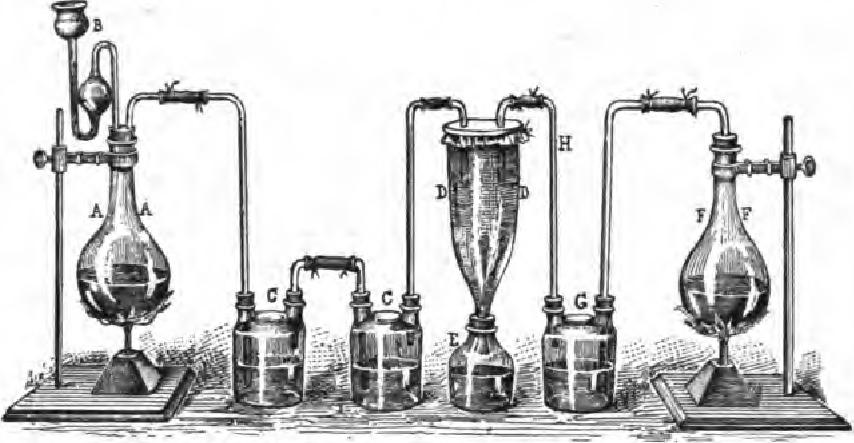
128 AOAVE VIROINICA. 18 ocoasionaUy used locally, in eptAy or otherwiee, to allav the safiferin^ in Obtain maladieef from pain, as in rheumatwm, lumbago, x^eurau/ia, etc. The ansnthetic dose is abont that of chloroform. Belated Oomponndi.— Ethtl Chloudb (C.HbCI). Bydrochlorie etiter, is made by paanng dry hydrochloric acid cae into cold alcohol, and puri^ing the product by digtillinguie ccmtents of the retort, waabing ^e gas with a litUe tepid water, and oondenBing in a receiver Buirounded with ice and MUt £thyl chloride, or cnlorethane, is a volatile, highly inflammable liquid, boiling at 12.5° C. (64.5'^ F.}, and ia, oonBeqaently, naeous at ordinary temperatures. Water disao^es 10 per cent, and akohol, at 21" G. (69.8^ P.), dissolves 48.S per cent of its weight Ethvl chloride, or hydrochloric (or muriatic) ether, is occasionally employed in combination with an equal volome of alcohol, as a inibstitate for the compound spirit of ether, in <loBe8 of from 5 to 20 drops diluted with water, wine, etc. It haa been used locally to anaesthetize parts in minor opmttiom. It must not be used near a flame, and its inhalation may depress the heart. Chloric Etheb, is a name once applied to mixtures of alcohol, and from 5 to 18 per cent of chloroform. Afterward, it was prepared by distilling chlorinated lime with water and an excess of akohol. It is seldom mentioned at the present day, and bas properly become almost obsolete. E^BYDBNB Crloridb, EthyUdeTK cldoride, Ethydene di^loride, or 3fcnodi3onruUed hydroMoric ether (OjH^Cl,. or CHj.CHCla). Specific gravihr 1.198. Boiling point 57.6" C. (135.5* F.). This compound, isomeric with bichloride of ethylene, is produced by acting upon ethyl chloride (see above) with chlorine, avoiding an excess of the latter. It has beui tried as an anEGsthetic, and though so far as phyBioIogical experiments go to show it is safer than chloroform, clinical evidence does not harmonise with that of the physiological investigators, and consequently its use as an aneesthetic has been practically abandoned on account of the number of deaths occasioned by it. According to Brnnton, its action upon the cardiac ventri(des is precisely like that of chloroform. It is now generally accepted as being more dangra^ ona than the latter. AGAVE VIBOINIOA.-rALSE ALOE. The root of Agave Virginica, Linn6. Nat. Ord. — Amaryllidacese. Common Names: /bZse ahe, Iiattlemake'8 master. Botanical Source.— A perennial, herbaceous, stemlees plant, with a ^remorse. tuberous root. Leaves 11 near- lanceolate, fleshy, glabrous, and radical, with cartilaginous, marginal Serratures. The scape, which is round, and from 3 to 6 feet high, bears sessile, greenish-yellow flowers, scattered in a wand-like spike, emitting a strong fragrance. The root (the part employed) is very bitter, and yields its properties to alcohol and water by infusion. Histoiy. — This plant is common to Pennsylvania and the Southern States, growing on dry or rocky banks, and flowering in August and September. In some parts of the countrv this plant is considered a valuable antidote to wounds by poisonous snakes, and is termed "rattlesnake's master." Action and Medical Uses. — False aloe is reputed laxative and carminative, and has been beneficially employed in obstinaU diarr?uBa,^atulenn/j spasm of the inteUineSy etc. Belated Species,— Aj^M Ameruxma, Linn^. Amerimn aioe. Nat. Ord. — AmarylHdacem. Tropical America; naturalized in Florida. Cultivated for centuries in Mexico (A. IVCandolle). American aloe, Maguey or Metl, also called Century planL from an erroneous supposition that it blossoms only once in a hundred years, is the largest of all herbaceous plants; it inhabits the warmer latitudes of the American continent, where it flonrUies as an evergreen, and is utilized for hedges in southern Europe, where it is known as aloe. The agaves, from their resemblance to the aloe fomily, have been called aloes, as false aloe and American aloe; but the Braves differ from the woe in having entire!)' different properties, both chemical and medicinal, and also in the relation of the botanical parts, the ovary of the latter being superior; that of the agave, inferior. All agaves are natives of Mexico. The aloe', on the contrarv, is an Eastern plant. The leaves of the American aloe are long (4 to 6 feet), lanceolate, thick, succulent, and curved or reflected backward, and beset with marginal and terminal spines. The flowering scape may reach a heq^t of from 20 to 40 feet, the plant blooming in its native habitat about once in a decade. The Aamse Americana and other species, partictilarlv A. putoi^, are employed in Mexico in the mannfactore of a spiritous beverage known as pwqui. Tbw is prepued by fermentation of the saccharine liquid, known as aguamtet (honey water), whicb exudes from the leaves and root when cut. Occasionally this '* noney water is evaporated to a honey-hke, or syrupy eonaistenoe, and may be resolved into soear. DittiUed pulmU is a brandy-like liquor called HHHoI. Tba flbrei of the leaves are num into thread ana cordage, and are known as pitn.
AORIMONIA. 129 Gum maguey is analogona to g[Dm arabic, though differing in the amount of calcium salts contained therein. It is partially solable, the portion dissolving resembling arabin. The ioBoluble portion reeembles bassorin. The pulp of the leaves, locally applied, acts as a mbeiadent, somewhat like mustard. The fresh juice is said to act upon the kidneys and bowels, and also to promote menstraadoa. Dr. G. Ferrin considOTB it a snpeiior remedy in teorbvtuM, S referring it to lime fnice, in doees as high as 2 fluid ounces 3 times a day (N. Y. Jour, fed. N.S. VJL, 181). ' AgoM mexieana, Lamarck; and Agave vivipara, LinnS. Those two spedeB are elosely related to the preceding planta, and are natives of Mexico. AaSIHONIA-AaBIMOHT. The whole plant of Agrimonia Eupatoria, Linn^. Nat. Ord. — Rosacete. Common Names: Agrimony, Cockleburr, Stickwort. Botanical Source and Description. — Agrimony is a perennial herb, growing to the height of 2 or 3 feet, having stems but little branched, and coverod with a soft, silky pubescence. The leaves are alternate, long, nearly smooth beneath, interruptedly pinnate, having frou! 3 to 6 or 7 oblong*ovate, coarsely serrated leanets, between which are interspersed several smaller * ones. The root is long, fibrous, and tapenng, and of a reddishbrown color. It is much branched at the summit, producing numerous heads. The flowers are small, yellow, and borne in a dense, racemose ^ike, from a half to 1 foot long. The calyx-tnbe is curiously nuted with 10 ribs, conical, and surmounted with reddish, hooked bristles. Agrimonia has a bitterish, harsh, subastringent taste, which is somewhat aromatic, but unpleasant. This taste is strongest in the root. Ite odor is aromatic, and especially is it more fragrant when in bloom. History and Ohemical Oompositioii.— Ammonia is common in the United States and Canada, as well as m Europe and Asia. It thrives along roadsides, in. old fields, and in woodlands, flowering from midsummer throagli September. The burrs attach themselves to the clothing as one comes in contact with them, hence the com- snmon mon names, cockle-burr and stickwort. It is employed in domestic practice on the continent as a ^i^e. The abori^nes and Canadians used the root in the treatment of intermittent febrile states. According to Linnseus, a grateful beverage was prepared by steeping the plant in whey. Porcher states that an infusion oi the leaves and stalks, previously treated witn a weak bismuth solution, permap nently dyes wool a beautiful, golden color, and that tanners employed the nowers in preparing soft and delicate hides. French peasants use it as a substitute for tea. Agrimony yields its properties to water and alcohol. Tannin and a volatile oil are the only known chemical constituents, the latter being obtained by distillation. Action, Medical Uses, and Dosa^.—Agrimony is a mild tonic, alterative, and astrin^nt. A decoc.tion of it is highly recommended in bowd eomplaints, Uur mrrhoea^ chronic mucous diwoses, chronic c^ediona of the digestive organs, profuse bleed' ingsy of an asthenic character^ certain aUaneous dueows, tctena^ etc. A strong decoction, sweetened with honey, is reputed curative in scrofula^ it its use be persisted in for a length of time; and it has also been highly extolled in the treatment of gravel, asthma, cotbghs, and obstructed •menstruation. Dr. D. C. Payne speaks highly of a continued use of a decoction of this plant in the treatment of erysipelas and stcrofidom affections, to be used freely, in connection with diet and regularity of the bowels. It is also reputed to be valuable as a diuretic, and has been considered a specific in dropsy and in gorwrrhcea. As a gargle, the decoction is useful in ukeror tions of the mmuk and throat. The astringencv of the root renders it very useful in those aflections requiring the exhibition of astringents. Specifically, agrimonia checks mucous profluvia, and gives tone to mucous tissues. Chronic bronchUis, phthisis, with increased secretions, and muddy, illsmelline urine, htmoroU asthma^ and chronic gmtto-winary catarrhal states^ are most benefltM by it. Pain in the lumbar region is relieved by it..Cystitis, wphritiSf 9
180 AILANTHU8. and an irritable condition of the bladder, are met by it, as is painful renal congestion. Dose: A drachm or two of the pulverized leaves may be taken for a doeei or 2 or 3 fluid ounces of the decoction; specific agrimonia, 1 to 60 drops. Specific Indicationi and Uies. — Deep-seated and colicky pain in the lumbar region, with uneasy sensations reaching from the kidneys to the bii>s and umbilicus (renal colic); muddy, ill-emelling urine, and dirty looking skin; especially as a palliative in phthisis; cystic catarrh; cough, with profuse, thick secretions, and pain under the lower nhs, extending to the renal organs; renal congestion; cough, with dribbling or expulsion of urine; irritation of kidneys or urinary organs, with cough. Belated SpeeieB.— -vl^nnumta parmflora, Aiton. Small-flowered, or Sweei-Kented agrimotuf. United States; Pennsylviania, southward and westward. Stronger scented than common aanmony; has smaller flowers, and from 11 to 19 pairs of densely crowded leaflets, with smaller ones interspersed. Has numerous resinous dots on the leaves, rendering it somewhat clammy. AlchemiUa vujgarit, Ladiet' mantle. Europe. An astringent, bitterish herb, onoe much used in dtarrAoKi. Accredited by the ancient ^chemists with wonderful powers. An.ANTHUS.-AlLAirTEa8. The inner bark of the tree and root of Ailanthua glandulotat Drafontaines. Nat. Ord. — Simarubaceaa. CoHHON Names: Tree of Heaven, Atlanta, Chinene sumach. Botanical Source.— Allan thus is a large tree, with blunt, clumsy branches, which give to it an odd appearance after the leaves have fallen. The leaves are odd-pinnate, each consisting of from 10 to 20 pairs of leaflets and a terminal one. The leaflets are about 2 inches long, ovate, smooth, acute, and have a few blunt, glandular teeth at the base (hence, the specific name, ji;landulosa). The flowers are small, green, and collected in large terminal panicles. They are polygamous, or generally dioecious. The calyx consists of 5 united sepals. The petals are 5, small, green, and longer than tne sepals. The stamens are 10 in the male flowers, but fewer in the female. The pistil is surrounded at the base by a disk, and consists of from 3 to 5, 1-ovulea, free carpels, with united styles. The fruit is a flat, membranous samara, bearing a seed in the middle, and somewhat resembling the fruit of the ash. Histoid, Description, and Ohemical Ooto:pofidon.—Ailantku8 glandulom is a native of China, where it is known as "Ailanto," of which the German name " Gotterbaum " is said to be a translation. " Tree of Heaven " is the name by which the tree is vulgarly known in this countrv. It is in common cultivation as a shade tree throughout Europe and the tJnited States, and has become naturalized in many localities. It was formerly classified in the natural order, RiUa4:eaey but is now placed in that of Simarubacese. It is allied to the genera. Quassia and Simaruba, from which it diflers in the fruit being a samara. This tree ia of rapid growth, and easily accommodates itself to any soil, thus being well adapted to cultivation; but it is objectionable on account of a fetid odor, which ia mostly exhaled from the sterile flowers. The genus Ailanthus consists of 4 species, all large trees, and natives of Asia, none of which, however, are cultivated in this country excepting the A. glandwosa. The recent root is white, hard and woody. It is covered with a wnite, fibrous bark, the outer part of which is gritty, brittle, and yellowish, over which is a gray epideimis. The e{>idermi8 of the limbs and growing sprouts is smooth, shiny and brown, or yellowish. It is studded with numerous little eruptions which increase in size with age, until, when old, the bark is rough. Beneath this a green coloring matter is found in young specimens, while the bark next to the wood is white. In growing shoots the woody matter is thin, surrounding a yellowish-brown pith, which latter decreases in proportion with the growth of the shrub. Both the root and shrub have an acid reaction when fresh, and exhale a disagreeable odor when broken. For medicinal purposes, the bark of the small bmhes and roots is to be preferred. Prof. Hetet, of Toulon, noticed the tree in the Jburnof de I'harmaeiej in 1869, at which time it attracted attention in France, in consequence of its leaves having been suggested as food for a Bpecies of silk-worm. The
AILANTHtra. » 131 bark of the tree was experimented with, and attracted some attention at that time as an emeto-cathartic and anthelmintic, but it seems to have quickly fallen into disuse. ^ In the year 1875, Dr. H. L. True published an article in the E. M. Journal, which revived, among the Eclectic practitioners of this country, an interest in the therapeutical uses of the bark; since which numerous communications to medical journals have created a demand for it, the bark being supplied in abundance in most localities. In the later fifties, M. Fayen analj^zed the bark, and detected lignin, chlorophyll, yellow coloring matter, pectin, bitter substance, aromatic resin, traces of volatile oil, nitrogenous mattcv, and some salts. Afterwanl (1861), Mr. Alonzo Lilly, Jr., made an examination, the result of which differs considerably from the above, as, according to this gentleman, the constitue;its are, starch, tannin, albumen, gum, sugar^ oleoresin, and a trace of volatile oil, potash, phosphoric acid, sulphuric'acid, iron, lime, and magnesia. The bark has a nauseating, bitter taste, and when recent, a sickening odor. Both the fresh and the carefully dried bark impart a deep-green color to alcohol, probably due to chlorophyll, the color gradually changing to yellowish-brown by age, the action of light accelerating the change. According to our experience, the bark contains a resinous substance, which, with the volatile oil, is extracted alcohol, which agent will perfectly exhaust all the characteristic properties of either the fresh or dry ailanthus. According to the ez|>eriments of M. Hetet, the pui^tive property resides in the resin, while the volatile oil gives rise to the prostrating and other ill effects produced on those exposed to the vapors of the evaporating extract; and, probably, to a similar hydrocarbon, ma^ be ascribed the sickening sensation experienced by many persons when inhaling the atmosphere vitiated by the emanations from an Ailanthus tree in blossom. M. HeteVs statement, tnat the resin is purgative, has been disputed; some even assert that the resin is inert. Action, Medical Uses, and Dosafe. — The bark of ailanthus has been employed by Roberts, Du^t, and others, Doth in the recent and dried state, as a remedy for dymUery and diarrhoea; also in gonorrhceaj leucorrJiaea, prolapsus ani. etc. Fifty grammes of the root-bark are infused for a short time in 75 grammes of hot water, then steuned, and when cold, administered in teaspoonful doses, night and morning. To lessen the disagreeable impression following its use, as welfas to mask its bitterness, it may be administered in sweetened orange-flower water, or in some other aromatia Professor Hetet, of the Toulon Naval School, states in tW*. de Chim. Med., December, 1859, that the leaves and bark, in powder, or in the form of an aqueous or of an alcoholic extract, will remove tapeworm; but he found its action upon patients to be very disagreeable and nauseating, somewhat like that occasioned by tobacco upon young smokers. Dupuis has also found it useful as a ttenifuge. In the Septemoer number of the Eclectic Medical Jownal, for 1875, p. 393, Dr. H. L. True, of Ohio, states, that from his observations, the bark is not poisonous, but produces vomiting, great relaxation, and a deathlike sickness, which symptoms gradually pass away. He has successfully employed a tincture of the root-bark in cardiac palpitation, obstinate singultus, asthma, and epilepsy. Ra use in epilepsy has gained in reputation. It should be studied for its action in sick and nervous headache, with nausea,and an indescribable burning sensation in the forehead. Webster states, "the remedy, in 2x dilution, will cure malignant mrt throat, tUcerated tonsUs, and other tonsiUar xnfiammaiimSy marked by adynamia and persistency." He states that he has been pleased with it in putrid, maligncaU, typhoid scarlatina^ with dusky, carmine eruption, high temperature, pungent surface, pulse small and extremely rapid, with thimt, delirium, and coma. The tongue is dusky, parched, and fissured; sordes upon the teeth; and the urine dischaiges involuntarily. Dose, 1 to 10 drops of the 2z dilution. His uses of the drug were derived from homoeopathy. Dr. True considers the presence of these trees in malarial districts to nave a strong action, similar to that of the eucalyptus, in antagonizing those influences that produce intermittents. The dose of the tincture is from 5 to 60 drops, repeated as often as required, or, from 2 to 4 times a day; specific ailanthus, 5 to 20 drops. SpedJbs Indications and Vses. — Cardiac palpitation; spasmodic or epileptiform muscular contraction.
132 ALCOHOL. Eelated Species. — AUanlhut excelm, Roxburgh. Bark used in India as a powerful febrifuge, tonic and stomachic, being UBed in decoction in dytpeptia. Leayea and bark in good repute as a tonic after labor, and the juice of the leaves and fresh bark employed by the Goncans ae a remedv for a/ier^in$ (Dymock). Daji found in it aUantkieacidf a redcUBb-brownf deliqueieent mass, bitter, aolable in water, less so in ether and alcohol; inmoble in benEol and chloroform. AUanihtu malaharica, T>e Candolle. Habitat, Canara. Yields a fn^rant reran called " mutteepal," which ie powdered and administered in small doees, in milk, for dyeentery and broHcMUx. It is also employed as incense. The bark is tonic, febrifuge, and valued in diy^tqma (Dymock). ALOOHOL.-ALOOHOL. Formula (Absolute, or eth^l alcohol): CiHjOH. Molecular Weight: 45.9. Synonyms: Ethyl alcohol^ hthyiic alcohol, Ethyl hydroxide, Alcohol^ AieohU vim, Rectified spirit^ Spirittis rectificatus, Vinic alcohol; Spirit of w-ine. Official Kinds. — I. Alcohol Absolutum {u.S.P.}, Absolute alcohol. " Ethyl alcohol, containing not more than 1 per cent, by weight, of water" — ((/. S. P.). II. Alcohol {U. S. P.) — Alcohol. "A liquid composed of about 91 per cent, by weight, or 94 per cent, by volume, of ethyl alcohol (CiHaOH— 45.9)i and about 9 per cent, by weight, of water"— (C/. S. P.). III. Alcohol Dilutdm (JJ. S, P.) — Diluted alcohol. "A liquid compoeed of about 41 per cent, by weight, or about 48.6 per cent, by volume, of absolute ethyl alcohol (C,HsOH=45.9), and about 69 per cent, by weight, of water"— (C7. S, P.). IV. Alcohol Deodoratum (J7. SCP.) — iModortzed alcohol. **A liquid composed of about 92.5 per cent, by weight, or 95.1 percent, by volume, of ethyl alcohol fCjH40H=45.9), and about 7.5 per cent, bv weight, of water"— S. P.). The foregoing should be kept in well-closed, vessels, in a cool place, remote from lights or fire"— (?7. S. P.). History and Source.— The Bible frequently mentions fermented juio» from various fruits, as the grape or pomegranate. However, the art of abstracting the alcohol from alcoholic beverages by distillation, was, in all probability, discovered by the Arabs in the ninth, or later centuries. The raw materiaJs used in the making of alcohol by distillation, may be taken from three sources: 1. Alcoholic liquids which have already undergone fermentation, e. g.y wine, beer, cider. 2. Saccharine material which exists, for example, in sugar cane^ or grape ^oice; from this, alcohol is generated by fermentation. 3. Starch-beanng material, of which an innumerable variety is available for this purpose, e.g.y root tubers, such as potatoes, and such cereals as rye, corn, barley, wheat, rice, etc. With this class of material, the conversion of starch into fermentable sugars (maltose, or dextrose), is efifected in the so-called mashing process, whereby the starchy material, after preparatory treatment, is acted upon by an infusion of malt, the active principle of which, diaatat^, converts starches into maltose and dextrin, at temperatures not to exceed 70° C. (158° F.). In rare cases, perhaps, the starch is converted into dextrose (glucose) by treatment with dilute sulphuric acid, at a temperature near the boiling point of water. TinouB, or Alcoholic Termentation.— Fermentation', generally speaking, is a process of decomposition of more or less complex organic substances into simpler compounds, induced by the vegetative action of exceedingly small, living organisms, called ferments (to which belong, e.(f., the yeast plants and bacilli). The action of purely chemical ferments, called enzymes, as, e.g., diastase in malt, or myrosin in black mustard seeds, etc., is analogous to, though not identical with, fermentation. Accordingly, we speak familiarly of acetic, lactic, butyric, putrid fermentation, etc. In the vinous fermentation, a solution of sugar, e.g., dextrose, is decomposed into alcohol and carbonic acid gas, under the influence of the yeast plant, of which there are several species, the most prominent of which is Saccharomyces {Torula) cerevUue. Dextrose, for example, is decomposed as follows: CeH,^a=2CjHiO-l-2COi. This formula, however, illustrates the process only in a general way, as various circumstances tend to alter the above reaction. Pasteur has found among the products of vinous fermentation, about 0.6 per cent of Buccinio acid and 3 per cent of glycerin, as regular constituents. The most favorable temperature at which fermentation takes place, is from 15.5 to 32.2* C.
ALCOHOL. 188 (60" U) 90° P.); at temperatures somewhat higher than 30** C. (86° F.), butyric and other kinds of fermentation are liable to set in. Not all sugars are directly fermentable. Cane sugar, for example, under the influence of ^east, first becomes converted into fermentable invert su^ (an equi-molecular mixture of lavulose and dextrose). The part played by the yeast cells has not yet been completely elucidated, notwithstanding the advances made in this direction through the famous researches of Pasteur, Liebig, Naegeli, and others. Some contend that fermentation is purely physiological, others, that it is a physical, and others again, that it is an essentially chemical process. Quite recently, E. Buchner demonstrated that a fluid obtained by expressing, under high temperature, moistened yeast, previously dried by strong pressure, is capable of producing fermentation. Preparatioii. — The bulk of commercial alcohol is, at the present day, derived from cereals and potatoes; in Germany, principally from the latter source. If potatoes are the raw material used, they are first steamed in suitable, ingeniously devised vessels, in order to gelatinize tfie starch grains. After cooling the mass to a temperature of about 65.6** C. (150® F.),it is subjected to the process of mashing, in large vats with steam fittings, by mixing the mushy material with finely comminuted malt, whereby, under the influence of the malt diastase, starch is converted into maltose and dextrin, the latter being subsequently converted into maltose by prolonged action. Then the temperature is reduced to 21.1° C. (70° F.), and yeast is addec^ whicJi starts the fermentation. Cereals are treated either in Ihe same manner, or are naerely crushed without being steamed, and are then subjected to the same treatment. The fermented mass contains, of non-^latiU mooters, fibers and husks, inorganic salts, protein bodies, peptones, fat, yeast, lactic and succinic acids; of volof tile matters, alcohol, fusel oils, and traces of fatty acids, e.g., acetic acid, but not the higher acids, such as butyric, if the fermentative process was properly conducted. The alcohol may then be separated from the mash by fractional distillation in a simple copper still with worm condenser, the distillate being repeatedly distilled or rectified, in order to get a stronger product. This process is still in use in the making of Irish whiskies. In recent times this rather primitive procedure has been replaced by the introduction of ingeniously contrived stills, especially the so-called column-stills, the construction of which has reached such a state of perfection that it is possible to obtain, with some of thesCfa strong alcohol of 94 percent, by direct distilling from the fermented mash in a single operation; the higher alcohols, as fusel oil, remaining behind for the most part. (For details see Sadtler, Indust. Org. CAm., 1895.) The alcohol resulting from the first distillation, unless obtained at once pure and of the desired strength by the use of the perfected stills aforementioned, must be subjected to redistillation, called rectiJiccUion. As it is extremely difficult, however, to completely remove by fractional distillation certain impurities, especially the higher alcohols, propyl, isobutyl, and the amyl alcohols, collectively called fusel oiU or grain oila, it has been found advisable to purify the raw spirit prior to rectification. This has been tried more or less successfully by chemical means, employing oxidizing agents, as ozone, or silver nitrate; but a rather expedient and efficient method seems to be to dilute the spirit to a strength of about 50 per cent, whereby the fusel oil is thrown out as an insoluble layer; the spirit IB then filtered through charcoal, and rectified ^see Sadtler). Another efficient method is said to consist in distilling the spirit over fused acetate of sodium, employed in the quantity of 2 per cent. Another method, which seems nromisin^is to shake out the fusel ous from the dilute spirit with mineral oils (Bang and Kufin). Oommercial Fonns. — Absolvie alcohol. Mere rectification will not produce a liquid stronger than about 94 per cent, by volume. The remaining 6 per cent ot water must be removed by chemical means; which is best accomplished by allowing the alcohol to stand over freshly prepared, unslacked lime, ior several hours, then distilling from a water-bath, a process which should be repeatedly carried out. It is often preferred to boil the alcohol with unslacked lime for one hour, using a reflux condenser, and then distilling off the alcohol. This process, however, is attended with some danger if the alcohol has more than o per cent of
>I,ODHOL. 234 water, jj^hrdrtted chloride c^xim has tlw W tiwd in preparing '^^^toAol of the V. S. P- contains 91 per cent,b]r weight, or 94 per >att«, by volnme, of pure ethyl alcohol, and has a specific CTSvity of 0.820 at 16.6» C. (60*» P.). This strength is obtained in the process of redistillation or rectification. Ardent Spiritous Bkvbragbs. — Holland gin^ is obtained by distilling grain spirit with juniper berries. Rum, is maae in the West Indies by fermentation and subsequent distillation of molasBes derived from the sugar cane. Arrack, is the distilled product of the fermented juice of the palm tree, in Batavia, or is obtained from rice and millet, in China, by malting, fermenting, and distilling. Brandy, is the product of distillation of wines, or the fermente<l juices from such fruits as the a{)ple or pear, called cider and perry. Genuine eognacy is a fine grade of brandy, the pro(uict of distillation of Frendi wines. Its cluuraGteristic aroma is due to the presence of oenanthic ether (oil of wine). American whiskey, is prepared from malted corn and rye; either mixed grains are used (Kentucky bourbon), or malted rye alone (Pennsylvania whiskies). Irish whiskies, ii&vG a smoky flavor, due to the peat niel used in the making of the malt. Description and Testa.— I. Alcohol Absoldtdm (U. S. P.), Absolute alcohol. Anhydrous alcohol, Ethyl alcohol. Pure absolute alcohol is " a transparent, colorless, mobile, and volatile liquid, of a characteristic, rather agreeable odor, and a burning taste. Very hygroscopic. Specific gravity not higher than 0.797 at 15" C. (SS** F.); or 0.789 at 25° C. (77° F.). In other respects, absolute alcohol has the properties, and should respond to the reactions and tests, of deodorized alcohol (see Alcohol Deo€bratum)"—(,U. S. P.). It boils at 78.3° C. (174° F.),and assumes an oleaginous consistence at — 90° C. ( — 180° F.). It is very combustible, burning with a pale-blue flame, without smoke or residue, giving out a very intense heat, and proaucing carbonic acid ^ and water. Chloride of sodium added to it will render its flame yellow; chlonde of {)ota8s;nm, whitish violet; boric acid, or a salt of copper, green; chloride of lithium, carmine red; chloride of strontium, crimson; and chloride of barium, greenish-yellow. A solution oi barium hydrate in absolute alcohol, delects traces of water in absolute alcohol by yielding a precipitate when mixed with it. Dehydrated copper sulphate, which is white, turns blue with absolute alcohol when water is present. It mixes in all proportionL. with water, wood-spirit, and ether; heat is evolved when it is added to water, and contraction of volume takes place, which amounts to- nearly 4 per cent when 53.9 parts of alcohol, and 49.8 Sarts of water, are mixed, resulting in a volume of 100 parts, instead of 103.7 parts, ne part of ether added to 2 parts of alcohol, forms with P^t of oil of wine, Hoffman's Anodyne Liqttor. Partly on account of its affinity for water, it preserves animal and v^table tissues. It dissolves hydroxide of potassium and of sodium, certain metallic chlorides and bromidee, the organic acids, camphor, volatile oils, iodine, urea, resins, balsams, etc. With nearly all acids it produces the compound ethers. Most oxygen salts with inorganic acids, excepting calcium and magnesium nitrates, starch, caoutchouc, the protein compounds, etc., are insoluble in it. Of the fixed oils, castor oil is the most freely dissolved by it. It combines with many neutral metallic chlorides, as of magnesium, calcium, manganese, etc., taking, in these compounds, the place of water of crystallization. Sulphur and ph(»phoru6 are dissolved by it to a limited extent. Dry chromic acid introduced into a mixture ol air and alcoholic vapor, causes an explosion. If a spiral piece of platinum wire be placed upon the wick of an alcohol lamp, and the flame be suddenly blown out, the platinum wire will continue to glow with a white heat, caused oy the imperfect combustion of the alcoholic vapors. II. Alcohol (U.S. P.) — Alcohol. The alcohol of commerce possesses the above qualities (see Absolute Alcohol) in proportion to its freedom from water, as known by its specific gravity. The strength of alcoholic fluids, the sole ingredients of which are alcohol and water, is determined in the spirit trade, under the supervision of the U. S. Government, by taking the specific gravity by mrans of
ALCOHOL. 186 liTdromet«TB, also obeerTing the teraperatnre at which the specific gravity ie taken. By the aid of tables, the actual percentage of the spirit^ by Ttdume, is then ascertained. Proof mwiit, as defined by the U, S. Revenue Office, is a liquid containing 60 volumes of absolute ethyl alcohol in 100 volumes of spirits, ^is solution being called 100 per cent prwf tptrU. Its specific gravity is 0.9343 at 15.6°C. (60° F.). If higher, the spirit is below proof; if lower, thespint is over proof. It is used in pharmacy to form tinctures, extracts, etc. The Pharma«>pGeia gives the following description and tests: "A transparent, colorless, mobile, and volatile liquid, of a characteristic, rather agreeable odor, and a burning taste. Specific gravity about 0.820 at 15° C. (59° F.); or 0.812 at 26° C. (77° F.). Miscible with water* in all proportions, and without any trace of cloudiness; also miBclble with ether or chloroform. It is readily volatilized, even at low temperatures, and boil8at78°C. (172.4° F.). It is inflammable and burns with a blue fiame. It should not affect the color of blue or red litmus paper previously moistened with water. If 50 Cc. of alcohol be evaporated in a clean glass vessel, no color or weighable residue should remain. On allowing alcohol, mixed with one-third of its volume of water, to evaporate spontaneously from clean, odorless blottingpaper saturated with it, no odor of fusel oil, nor other foreign odor, should become perceptible. If 10 Go. of alcohol be mixed in a test-tube with 6 Cc. of potassium hydrate T.S., the liquid should not at once become dark-colored (absence of alde* methyl alcohm, or oak tannin). If 20 Cc. of alcohol be shaken in a clean, Ehstoppered vial with 1 Cc. of silver nitrate T.S., the mixture should not me more than faintly opalescent, or acquire more than a faint brownish tint, when standing during six hours in diffhsed daylight (limit of organic impurities, amylic alcohol, etc.)" — (C/. S. P.). III. Alcohol Dilutum (U. S. P.) — Diluted Alcohol. "Alcohol, five hundred cubic centimeters (500 Cc.) [16 flj, 435 111]; distilled water, five hundred cubic centimeters (500 Cc.) [16 fl3, 435 Ttl]. Mix them. If the two liquids be measured at the temperature of 15.6° C. (60° F.), the mixture, when cooled to the same temperature, will measure about 971 Cc. Diluted alcohol may also be premred in the following manner: Alcohol, four hundred and ten grammes (410 Gm.) [14 OSS. av., 202 grs.]; distilled water, five hundred grammes (500 Gm.) [1 lb. av., 1 OS., 279 grs.]. Mix them. Dilated alcohol has a specific gravity of about 0.936 at 16« C. (59** F.), about 0.937 at 15.6° C. (60° F.), and about 0.030 at 26<* C. (77° F.). It should respond to the reactions and tests given under Alcohol " — (t/.S. P.). IV. Alcohol Dbodobatuh (U. S. P.) — Deodorized alcohol. " Specific gravity about 0.816 at 15° C. (59° F.), or 0.808 at 25° C. (77° F.). If 25 Cc. of deodorized alcohol be mixed with an equal volume of water and 5 Cc. of glycerin, and the mixture allowed to evaporate spontaneously from a piece of clean, odorless blotting-paper, no foreign odor should become perceptible when the last traces of the alcohol leave the paper (absence of fusel oil constituents). If 25 Cc. be allowed to evaporate spontaneously in a porcelain capsule carefully protected firom dust, until only a moisture is left, no red or brown color should be produced upon the addition of a few drops of colorless, concentrated sulphuric acid (absence of amylic alcohol, non-volatile, carbonizable, organic impurities, etc.). In other respects, deodorized alcohol has the properties, and should respond to the reactions and tests, of Alcohol"^iU. S. P.). *' Rules for making an alcohol of any required lower percentage, from an alcohol of any fiven higher percentage: By Volume. — Designate the volume-percentage of the stronger alcohol by V, and that of the weaker alcohol by v. Rule. — Mix V volumes of the stronger alcohol with pure water to make V volumes of product. Allow the mixture to stand untu full contraction has taken place, and until it has cooled, then make up any deficiency in the F volumes by adding more water. Exarfa)le. — An alcohol, of 30 per cent by volume^ is to be made from an alcohol of 94 per cent by volume. — Take 30 volumes of &e 94 per cent alcohol, and add enough pure water to produce 94 volumes. II. By WBI6HT. — ^Designate the weight- percentage of the stronger alcoh(d by W, and that of the weaker by w.
186 AUX)HOL. Rule. — Mix to parts, by weight, of the stronger alcohol with pun water to. make If parte, by weight, of pnraact. Example. — An alcohol of 50 per cent, by weight, is to be made from r alcohol of 91 per cent, by weight. — ^TakeoO parts, oy weight, of the 91 pei^dDt alcohol, and add enough pure water to produce 91 parts by weight " — ( U d. P.). Uses in Pharmacy and the Arts.— In the numerous official pharmaceutical preparations, alcohol, of various strengths, is a prominent constituent. i Pharmacists also employ it as a fuel producing a high temperature during combu!ition without aepositing soot upon bodies introduced into its flame. It is largely upcd in the arts as a solvent and preservative. Action and Toxicology. — Applied locally to the skin, alcohol first causes a cooling sensation, but if evaporation be prevented, heat and irritation follow, and inflammation may result if too lung applied. The skin and the mucous membranes are hnrden^d by it, and the latter corrugated, owin^ to its coagulating power over albumen, and the abstraction of water from the tissues. Some fat is also removed from the integuments. As it at first constringes the arterioles, it may act slightly as an ansBSthetic. Taken into the stomach in small amonnta, (usually of the various lic^uors) it augments the appetite and increases digestive power. Owing to dilatation of the arterioles, slignt congestion of the mucous tissues takes place, and the buccal and gastric secretions are increaRed, but if continuously imbibed, this excessive secretion results in catarrhal conditions, and, continuing, may produce atrophy of the gastric glands and hyperplasia of the gastric connective tissue. Furthermore, pepsin is precipitated by it, allowing digestive impairment through the loss of that ferment. The inordinate outpouring of gastric mucus (gastric catarrh) causes fermentation of the fatty, starchy, and saccharine foods, resulting in sour stomach, heart-burn, pyrosis, and that peculiar retching and morning vomiting of the drunkard. Alcohol is believed to enter the blood before reaching the duodenum, and in that fluid it difiiises itself with great rapidity. The portal circulation ia impressed, and {greater hepatio activity follows, but finally, this over stimulation leads to destruction of the liver cells, fattv and atrophic alterations taking place, while the connective tissue is increased. This hyperplasia, with consequent shrinkage of the cells, allowing contraction of the connective tissues, res^ults in that shrunken, hardened, and nodular state of the organ, known as ctrr^wis. These liver changes take place more rapidly than those of the stomach. Alcohol in small doses increases tne heart's action and surface circulation; all the body functions are stimulated and better performed, and temperature is slightly elevated. Larger doses produce exhilaration and vascular excitement, and a mild intoxication. Stilllarger doses aflect muscular power, causing incoordlnsr tion of movement (staggering), and the victim speaks incoherently and in a rambling manner — all tne well-known phenomena of drunkenness. Upon the nervous system, the first effects are increased cerebral activity, rendering the senses more acute, and all the mental actions more enei^tic. These eflfects are shared in common with the increased functional activity of the economy in general. In an exposed brain, turgescent and throbbing vessels have been observed as the effects of its first action, with dilatation of the vessels, and passive congestion as the secondary phase (Jacobi). In toxic amounts, cerebration is suspended, and profound insensibility takes place; there is a feeble performance of the body functions, and the movement centers are poisonously impressed, resulting in complete muscular inactivity, stertorous respiration, and arrest of breathing and the neart's action. In large quantities, and continued daily, alcoholic liquors occasion intoxication, nervous derangement, loss of appetite, mental imbecility, dyspepsia, indurated liver, granular disease of the kidneys, paralysis, mania, atheroma of the vessels, apoplexy, and death. The alcohol is absorbed, and may be detected in the blood, urine, breath, brain, liver, and other organs, producing permanent injury to them. The treatment of acute alcoholic poisoning consists in emptying the stomach by means of the stomach-pump, and cautiously applying ammonia gas to the nostrils; external warmth snould be used, cold water applied to the head, and faradism employed to stimulate respiratory action. It is extremely difficult to difierentiate acute alcoholic poisoning from apoplexy,
ALCOHOL. 137 opium i>oi8oning, cerebral conctlssionSf and hemorrha^ into the brain tissueB. The pupil ma^ be contracted or dilated; unequal dilatation, however, is somewhat of a guide to intracranial hemorrhages. The odor of the breath will assist somewhat, but can not be relied upon, as alcoholic drinking is so common that any of these conditions may take place after one has imbibed an insuSicient amount of alcohol to produce toxic symptoms. A person "dead drunk*' should be treated as if poisoned, and not allowed to " sleep off" the effects. After death from acute alcoholism, the gastric membranes are found intensely hyperemic, as are the meninges of the brain. The subarachnoidean spaces, ani the cerebral ventricles, are filled with an effusion of serous fluid; and the right ventricle of the heart, and the great veins, are distended with blood. From chronic poisoning, hyperplasia of the connective tissue, as thickening of the stomach walls, cirrhotic liver, and fatty heart, and hardened and contracted, or fatty, kidneys as well as atheromatous vessels and sclerosed nervous structures, are found. Taken into the system in moderate amounts (1 to 1^ ounces of absolute alcohol) alcohol is scarcely eliminated, but is destroyed by oxidation in the system, and imparts circulatory, nervous, glandular, and muscular force. It refreshes the exhausted system by yielding to it a force to be applied in the body functions, and in this way acts as food, though it is not known to contribute to the building of a single cell or fibre of the animal structures. It also acts as food, in that it retards or checks tissue waste by partially preventing the excretion of carbon dioxide and nitrogenous material: and it even favors the formation of fatty tissues, as is shown by its pathological tendency to cause depositions of fat in certain organs. That the temperature is increased by moderate amounts is well known, as is the fact that large dosea depress the temperature; and this depression is more pronounced if fever be present. It may be concluded that alcohol serves as food, when it is used E^ort of gastric impairment, does not over-stimulate, and is not in excess of what can be burned in the oxidation processes of the oi:gani8m. In quantities in excess of those above mentioned, it is excreted by the lungs, skin, kidneys, etc. Contrary to popular notions, alcohol does not protect one from the influence of cold, as has been shown by the experience of Arctic explorers, and by the ease with which drunkards are frozen todeath. Nor does it protect one from the effects of the heat. The facility with which topers are attacked with, and succumb, to, epidemic disorders, proves conclusively the deleterious effects of its continued use, injuries do not heal so readily in the inebriate as in the temperate, and it is well known that chloroform is not well borne by them, nor can they as well withstand the shock of sur^ic^l operations. On the other hand, enormous amounts of alcohol may be ingested by those unaccustomed to it, when meeting with accidents, or suffering from the effects of hemorrhage, bites of insects and serpents, when suddenly depressed, and in convalescence from acute disease. Infants and old people bear alcoholics well. Medical Uses and Dosage. — Alcohol is seldom or never used internallv, except in dilution. Undiluted, it is a powerful irritant and poison, rapidly causing intoxication, and, if in large quantities, deatli. It is usually employed in the form of wine, brandy, gin, beer, whiskey, etc., which, in moderate doses, act as diffusible stimulants, and are highly beneficial in prostrating diseases, and in cases where these kinds of stimuli are indicated. Brandy is said to be cordial and stomachic; rum, heating and sudorific; gin and whiskey, diuretic. There are very few cases in which alcoholic stimulants are necessary to be given, and those are seldom of a chronic character, or in which these fluids have to be used longer than a few days. The use of our small doses of concentrated alcoholic preparations, and improved modes of treating diseases, have done much to set aside the dangerous and unscientific practice of indiscriminately prescribinf^ alcoholics. Exceptions to its non-use in chronic disorders, are cases 01 great debility with feeble digestion, such as the gfistrie dSility of old age, and wasting of tissue, in phthisis. Here, as long as it favors digestion, acts kindly and prevents tissue waste, it is of marked value. If, however, it should occasion unpleasant symptoms, it will aggravate phthisis, a form of wliich ts also known to result from alcoholic excesses. An ounce of brandy or whiskey may be given with milk, ^-nog, broth, or other liquid food; when cod-liver oil agrees with
138 ALCOHOL. the stomach, alcoholics may be given with it. While in email doees it is m Btomach tonic, it should not be employed in ordinary atony of the stomach, which other a^ntB will overcome, on account of the danger of fixing upon the patient the alcoholic habit Nor should those subject to neuralnc pains make general use of it; and for general, chronic adynamic states it is of less value than other agents. Alcohol is mostly employed in acute disorders. Its utility in delirium tremens is well established. It will a^mravate cases dependent u|>on the direct and sudden action of excess of alcoholics upon the gray brain-matter, but when it depends upon failure of the stomiuih to take and appropriate food, no remedy ie more efficient; and opium and other stimulants assist its action. As long as the patient is able to take and retain and digest food, delirium will not occur. As soon, however, as gastric rebellion ensues, the stimulant must be given to allay the irritability and sustain the nervous powere. An ount-e nt' whi.-^key, alone, or in milk, may be given every hour or two until the stomach will act without its aid. Give no more than enough to sustain the nervous system (Locke). In high fevers and inftammationa, in those accustomed to the use of alcoholics, it is dangerous to wholly withdraw the stimulant, and it may be given at intervals in small doses. In acute diseases it is never admissible where there is determination of blood to the brain, or where there is severe, darting headache of a throbbing character, suffusion of the skin and eyes, and noisy or violent delirium. Nor should it be continued in any case where it increases the rapidity of the pulse, elevates temperature, or causes or increases dryness of the tongue. The condition in which it is admissible, is that of prostration, as in low fevers, the pulse being soft and feeble. Small quantities should be frequently repeated. Thus, ia typhoid^ and other hw fevers^ where there is a tendency to fainting, with low, muttering delirium, and dry tongue, the patient will die unless stimulation ia resorted to, and nothing is better for this purpose than alcohol. Add 1 ounce of brandy to 3 of milk and give frequently, as necessary. If it slows the pulse, rendering it fuller, calms the delirium, tends to moisten the tongue and promote sleep, it is doing good as well as acting as food; if it increases the symptoms, it is doing harm, and should be discontinued. In certain forms of vomiting^ as of aea-eichness and pregnancy, alcoholics are of service. Give a glass of wine before rising from bed in the morning in the latter complaint. Insomnia and soninamhuliam,\>oth when due to cerebral anemia, are benefited by alcohol. Refreshing sleep will follow its administration. Hyperemia of the brain contraindicatra it. Threatened injlammatwm of the internal organs from exposure or cold, causing suppression of the functions of the skin, is often averted by a hot toddy and putting the patient to bed. In this manner, threatened pleurimf and pnetmonia may be prevented. In the emnthemata, when exhaustion threatens, alcohol may be resorted to. In the collapse of AnaHc cholera, it is called for, and is of value in some cases of traumatic tetanits. Large doses sustain the nervous system while undergoing the effects of serpent and insect bites and stings. It should also be locally applied. Alcohol may be made to act as an external stimulant or refrigerant, by merely aj)plying it to a part, and preventing its evaporation by placing a compress of^ linen or muslin over it, to produce the first effect; or, by allowing it to evaporate, to produce the latter. With an equal quantity of water, it forms a good dressing for bruises, orehitiSj arthritis, and other superficial injlammalions. Cracked nipples, should be bathed with brandy and dusted with bismuth subnitrato (Locke). Applied to threatened bed-sores, it hardens the tissues and prevents excoriations. Dr. Christison recommends " a mixture of equal parts of rectified spirit and white of egg as w application to excoriations, from pressure, in fever and other exhausting oiseaseB. It IS to be applied frequently with a fine brush or feather, and renewed as it dries, till an albuminous coating is formed over the part." As a drying to fnah wnmds, alcohol, diluted, is of much value; and even in suppurative injuries, it corrects fetor and acts as an antiseptic, as well as to stimulate granulation. Owing to its coagulating power over albuminous material, alcohol is a hemostatic in conditions in which the blood slowly oozes, as from abrasions. AurtU polypi and unhealthy granulations of the tympanum, the result of long suppurative processes, are well treated with absolute uoohoi. This it does
ALCOHOL AJCYUOUM. 139 by ccMtfulating albumen and abstracting water, and may canst permanent dryness 01 the tympanic membrane. Foltz regards it a specific in tympanic choleateor toma (Dynam. Ther.}. The dose of alcoholics (brandy, whiskey^ etc.) should not be such as to exceed 1^ fluid ounces of alraolute alc(diol, except in serpent poisoning, when more may be given. Specific Indications and Usei.— Pioatration, with soft, feeble pulse, hurried respiration, and irr^ular heart action; prostration, with dry tongue, low, muttering, or wandering delirium, tremor, subsultus, and insomnia; delirium tremens, when the gastric powers fail. Locally, to cholmteatoma of the tympanic cavity (abwlute alcohol). ALOOHOL AMTLIOUH-AKTLIO ALCOHOL. Formula: CsHnOH. Molecular Weigh i: 88. Synonyms: Fusel oU, Oil of potato spirit, Com spirit oU, Amyl alcohol^ Peniyl alcohol, Grain oil^ Amyl hydrate, Amyl hydroxide^ Primary amyl alcohol. Preparation and History. — "l^ke of the light liquid, which may be obtained at any large distillery, by continuing the distillation for some time after the pure spirit has all been drawn ofl, any quantity. Introduce it into a small still or retort connected with a condenser, and apply heat so as to cause distillation; as soon as the oil begins to come over unmixed with water, the receiver should be changed, and the distillation being resumed and carried nearly to dryness, the desir^ pivoduct will be obtained. The liquid drawn over during the first part of the distillation, will consist of an aqueous fluid, surmounted by a stratum of the amylic alcohol. This latter, though impregnated with a minute quantity of water, should be separated and preserved, as being sufficiently pure ior use"— (Z>u6.). It is usually preparea from fermented cereals, or potatoes, by distillation. Amylic alcohol was first noticed by Scheele, in the spirit obtained by distilling fermented potatoes, and was called OH of jiotatn.yiirU; since his time its general character nas been more fully investigated by several chemists. It is now found not only in potato spirit, but among the products of alcoholic fermenta-' tion generally, in which it exists in the or part. When alcohol is distilled from potatoes, toward the termination of the process a whitish fluid passes over, which, when allowed to rest, yields a deposit of amylic alcohol, combined with nearlv equal part^ of water and alcohol. This is washed several times in water, then pmced in contact with chloride of calcium to remove the water, and distilled over again, in order to purify it. Alcohol and water pass over at first, but as the heat becomes elevated to 132.2° C. (270° F.), a clean receiver is substituted for the one just used, into which the pure amylic alcohol is received as it passes over. It is viewed as a hydrated oxide of amyl. Description. — Amyl alcohol is a limpid, transparent, very mobile, oily liquid, colorless, or of a light-rellow color, having a very nauseous odor, producing stupefaction, and an acrid, sickening taste. Its vapor, when inhaled, causes cough and spasmodic dyspnoea, resembling asthma, often followed by vomiting. It produces an evanescent stain on paper; gives a bluish-white flame when burned with a wick, or heated to 56° C (131° F.); boils at about 132° C. (269.5° F.); has the specific gravity 0.818; and absorbs hydrochloric acid gas largely, heat accompanying the process. It unites in any quantity with alcohol, ether, fixed and volatile oils, and concentrated acetic acid; is hardly dissolved by water, to which it imparts its odor, and the property of becoming beaded when shaken. Iodine, camphor, phosphorus, resins, fatty matters, sulphur, etc., are dissolved by it; and it combines with solutions of potash or soda without alteration. Heated with dry potash, it undergoes decomposition, evolving hydrogen, and forming valerianate of potassium by absorption of oxygen. According to Pasteur, ordinary amylic alcohol consists of a mixture of two metameric bodies, one being inactive on polarized light, the other producing left-handed rotation of a polarized ray; these two alcohols can be separated. Fusel oil may be detected in alcohol by introducing the suspected fluid into a burette, diluting it with its volume of rectified ether, and an equal volume of distilled water;
140 ALCOHOL lUGTHTLICnH. slightly agitate and allow it to rest. The ether will float upon the surface of tiie liquid, holding all the fusel oil in solution. Separate the ether by the usual method, allow it to evaporate spontaneously, and the fusel oil remains behind, known by its bad odor. Amyl alcohol of commerce contains from 20 to 30 per cent of common alcohol. By exposure to the atmosphere in the presence of platinum-black, slow oxidation takes place, with the formation of valerianic acid as the result. Hirsch (Ajner. Jour. Pharm., 18^) has pro^tosed to remove alcohol from fusel oil by the following process: Shake fusel ou with an equal volume of saturated salt solution, repeat the operation, finally shaking out with pure water. Then distill the washed fusel oil with 3 to 4 times its weight of distilled water in a retort; the distillate will then consist of an oily laver of almost pure amvl alcohol, and an aqueous layer contuning what little fuconol has remained unabstracted in the preceding treatment Action and Medical Uses. — Valerianic acid, and several medicinal valerianates, are prepared by the aid of amylic alcohol. It is also used in preparing amyl nitrite, artificial fruit essences, and in the production of certain proximate principles, alkaloids, etc., notably the cinchona alkaloids. Fusel oil is said to produce the peculiar nervous and dyspeptic symptoms of those accustomed to consuming large amounts of alcoholics; uie rapid intoxication produced sometimes, is likewise attributed to this body, occurring a« an adulterant. Even in small doses, amylic alcohol induces a tensive pain in the head, while in excessive amounts, insensibility and profound narcosis result. The breath exhales a A'uit-like odor. Amon^ the poisonous symptoms are giddiness, sta^ering, headache, diplopia, unconsciousness, reductiou in temperature, rigidity and subeequent relaxation of the muscles, marked cyanosis, and death. In cases of poisoning bv it, ether and other stimulants may be subcutaneously injected. Amylic ^cohol, in very small doses, is a nerve stimulant. It has been used in phihiaiSy with negative results. The nennua irritability and weakness of habitual drunkards, is said to be relieved by small do:$e8 of fusel oiL ALCOHOL METHTLIOnH.-HETHTI. ALCOHOL. Formula: CHaOH. Molecular Weight: 31.93. iSynonyms: Wood alcohol, Wood nnphtha, Pyroxylin epirit (or alcohol), Pyrolig^ neoua spirit (or alcohol), Spiritus pyroxylicus rertijicatus. Preparation and History. — This substance was first carefully studied and named by Dumas and Peligot (1834), though previously differentiated from ethyl alcohol by Philip Taylor, in 1812, and noticed still earlier by Boyle, in 1661. ^ As a result of the destructive distillation of wood, several substances are obtained (as noticed under Acetic Acid)^ among them I per cent of crude pyroxylic spirit. When calcium carbonate is added to the aqueous liquor containing the crude product, the salt calcium acetate is formed, and upon distilling the solution, that portion passing over before a temperature of 100° C. (212° F.) is reached, contains the crude wood alcohol. The next step is its purification, which is accomplished by saturating it with fused chloride of lime, forming thereby, with the crude spirit, a crystalline body, which is then distilled to allow impurities to pass over. To separate the pyroxylic spirit from the calcium compound, water is added, and the mixture again distilled, after which it is freed &om the water by being; left in contact with dry lime, and rectified. Description and Tests. — Anhydrous methyl alcohol, when pure, is a limpid liquid, colorless, has a pungent, burning taste, and a peculiar odor, somewhat like that of acetic ether and alcohol. Like alcohol, it burns with a pale-blue, though less luminous, flame. Alcohol, ether, and water dissolve it in all proportions, and its solvent properties are said to be the same as those of alcohol. It may be distineuished from acetone by its power of dissolving calcium chloride. It shoulil be free from a smoky odor. Its boiling point is about 67° C. (152.6* F.), and it has a specific gravity of 0.SO2I at 15.5° C. (60° F.). Its vapor occasions conjunctival irritation. Crude pyroxylic spirit is used lar^ly in the arts and especially as a solvent for resins in the manu&cture of Tarnishes. The
ALSERIB* 141 methylated spirit of Great Britain i» a mixture of alcohol, A parts, and pvroxylic spirit, i part. It is employed in laboratories in making ether, nitrous ether, and chloroform, and is used in the arts as well, for its solvent properties and on account of being cheaper than ethvl alcohol, the duty on which is heavy, unless to be used in the arte; then the dfuty is removed by the Government. But in this' case the ethyl alcohol must be mixed with wood-spirit, so as to render it unfit for use in beverages. At present, an important use of wood alcohol is for the production of formUdehyde (see Fhrmalaehvdum). Wood alcohol should not become colored by exposure U> the air and light. It mixes with water in all proportions, without becoming muddy, and when pure has no action on paper stained with vegetable colors. It may be preservea without alteration in a vessel, though imperfectly corked; but when its vapor, mixed with air, is left in contact with spongy platinum, much heat is evolved, and formic acid is formed. It dissolves many salts, many resins, hydroxides of potassium and sodium, most essential oils, and forms crystalline compoundb with chloride of calcium, barium oxide, and lime. The admixture of ethyl alcohol is recognized by the fact that concentrated sulphuric acid will, upon warming, liberate ethylene gas. In the absence of ethyl alcohol, the prraence of acetone may be shown by ite capacity of yielding iodoform upon wurming with iodine and sodium carbonate. AeUon, Medical Uses, and Doiage.— The fumes of wood spirit occasion conjunctiTal initation, nausea, anorexia, headache, and vertigo. It was the preparation recommended by Dr. J. Hastings as a remedy for phthisis pulmon^te; ne incorrectly termed it Wood naphtha. Although it has no influence in effecting cures in this disease, it is frequently of service in relieving the cough and feverish symptoms which manifest themselves. As to its action in vomiting, Christisonsays, "I can amply confirm all that has been said of it as an antiemetic remedy in cases of <hronic vomiting; for in cases of this affection, depending on botn functional or organic disease, I hav'e frequently seen the vomiting arrested, or greatly mitigated, by pyroxylic spirit." It has also been found of service in dysentery and diarrhaea, dyspepsia, raiarrhal disorders, and for the expulsion of intestinal worms. The dose is from 5 to 20 drops, 3 or 4 times a day, mixed with a fluid drachm or two of compound tincture of cardamom and a fluid ounce of water. It may be substituted for alcohol in lamps for chemical purposes, and answers exceedingly well for making varnishes, as it is more volatile than alcohol. Bodies which contaia much oxygen, are more readily dissolved b^ it than hydrogenous bodies. It has now been practically abandoned as a medicine. ALETBI8.-AI1ETBI8. The rhizome of Aletris farimaay Linn£, gathered after the plant has flowered. Nat. Ord. — Hsemodoracete. Illustration. — Strong's American flora (exclusive of root), p. 65. Common Names: Blazing star, Star grass^ Stanoort, False unicorn root. Botanical Sonrce. — Aletris is a small herb found in most parts of the United States. The common name is Star grass, but the term /n/^r vnirorn is sometimes used. The name Unicom rm/t ia more properly applied to ChatMelirinm{Helmias). Aletris is also known as Blazing star. The leaves are all radical and grass-like, from i to ^ inch wide, and from 2 to 4 inghes long. They are smooth, entire, acute, and of a firm texture, and have from 6 to 10 parallel and quite prominent veins. The flowering stem is erect, from 2 to 3 feet high, and arises from the center of the cluster of root leaves. It has no stem leaves, but at intervals of about 2 inches, there are very small, linear scales, which may readily escape detection without a close examination. The stems are round and striate near the base, but angular above. The flowers are perfect, and in slender, terminal, simple racemes. They are on short pedicles, with small bracts at the base.. The perianth is cylindrical, urn-shaped, white, with a yellowish tinge at the apeq^; wrinkled, rough and mealy outsiae, and 6-c\eh at the summit. The stamens are 6, small and included. The ovazy is ovate, and tapers
142 ALBTBia AletrfB farlDON. decayed matter, or even 10, inches in length. to a slender style, which is trifid at the apex. The fruit is a dry, manynseeded, acate pod, opening by 3 valves. Histoiy and Description.— The commercial drug, under this name, as found upon the market, is generally the rhizome of Ohamseliriam (see Chamielirium). Strange as it may seem under these circumstances, the two roots have no resemblance, are utterly unlike, and their appearance forbids admixture. We can not recall h single instance where Aletris farinosa was adulterated with Chamfelirium, and yet so universal has the sul>stitution of the last become, that Prof. King, in describing the root of Aletris {Anier. Dusp.^ SiU ed., f\. 78), has given a description of that of Chamieirium, and Strong's American Flora figures the top of Aletris with the rhizome of Chamselirium. In this connection, we invite attention to our exact engraving of the Aletris plant and root (Fig. 14), and. as a comparison, invite attention to the engraving of Chamselirium (see Chamaslirium, Fig. 66). When dry, the root of Aletris farinosa is from ^ to 1 inch in length, seldom longer. It is surrounded and completely hidden by an intricate mass of fibers, remains of radical leaves and partly The recent growth of yearly fibres are white, and from 2 to 6, In texture, they are made up of a hard, durable, brown, woody center, over which are several layers of white, tissue-like epidermis, that peel on by age, and decay. Thus we find the lower portion of the dry rhizome of Aletris farinosa covered by a mass consisting of dead, brown, woody fibers of former years, from which the paper-like envelope has separated, together with white, recent rcotlets from which the white epidermis is still scaling; while intermixed, are the chaff-like remains of the epidermis, in various stages of decomposition. The radical leaves spring directly from the upper part of the growing end of the creeping rhizome. They contain numerous nara, round, woody fibers running lengthwise with the leaf, and from year to year, as the succulent portions of the leaves decay, the fibers remain and hold the fragments of mealy leaf-matter; and thus the upper, as well as the lower portion of the primary root is perfectly concealed from view. The dried root proper is about ^ of an inch in diameter just beneath the leaves, and tapers from this point to nearly ^ of an inch; very often the extreme end turns downward, and usually terminates abruptly. The surface is rough, scaly, and thickly covered with root fibers below, and leaf scars and leaf fibers above. Internally, it is soft, spongy, white or slightly strawcolored, the central portion being less firm than the outer. It is odorless, acrid to the taste, not bitter. Chameelirium (Helonias), on the contrary, is very bitter. Physicians should insure the identity of Aletris when purchasing. There is no excuse for confusion, as the two plants (Aletris and Chameelirium) are entirely different in appearance, the roots do not resemble each other, and are, to the taste, utterly unlike; and while Chamselirium has a peculiar and characteristic odor, the Aletris is odorless. Action, Medical Uses and Dosage.— Owing to the confusion which formerly resulted from the substitution of the root of aletris for helonias, erroneous the status of the drug in female comto determine its true place in therapy., ^ it among the simple bitter tonics and stomachics, and as such it is employed to promote the appetite and aid digestion, and in flatulence, colic^ borborygmi, etc. This root and its preparations are almost entirely employed in dyspeptic conditions; while, in the abnormal conditions of the female reproductive organs, the chanuelirium is used. The dose of spedfic aletris is from 5 to 20 drops. statements have been made regarding plaints. The drug must be restudied Enough is known, however, to place
ALI8HA.-ALKANNA. 148 ALISBIA.-WATBB PL&HTAIN. The leavee of Alisma plantagoj Linn6. Nat. Ord. — Alismacese. Common Names: Water pkmtain^ Mad-dog weed. Botanical Source, Description, and History. — A perennial, caulescent herb, growing in watery places, along streams, in marshes, and on the borders of ponds. Water plantain has long (4 to 6 inches), radical, oblong, or lanceolate leaves, subcordate at the base, cuspidate, or abruptly acuminate, and borne on long petioles. The flowers, which appear in July and August, are small, white, andnumerous, and borne in a loose, whorled panicle on a scape, 1 or 2 feet hi^h. The root is fibrous, and serves a Russian tribe as food. The American species is said to be a variety, and is known as Ali»mn plant^o, var. Americanum, Gray. In odor, the root wnen fresh is said to resemble oms root, and has a sickening, acrid taste. A pungent, volatile oil, and a resin, are its only constituents. Water plantain inhabits the North American continent, as well as Europe. The root was formerly considered efficacious in hydrophobia, but repeated tnals have shown it to be impotent. The leaves are the parts used. Action, Medical Usee, and Dosage. — An infusion of the dried leaves is an excellent remedy in urinajy diseases; the leaves, dried and powdered, have been successfully employed in gravel, and other urinary affections. The indications are: " Irritation and uneasiness in passing water, frequent desire to micturate, Bain in the loins, and involuntary muscular movement" (Scudder, Spec. Med.). lose of the infusion, from 4 to 6 fluid ounces, 3 or 4 times a day; of the leaves, 1 to 2 drachms. The fresh leaves, bruised and applied to the skin, irritate abd redden it, and, not infrequently, will cause vesication. Bpe<ufic Indicatioiis.— (See above). The root «f Alkanna tinetoriaj Tausch; (^Anchttsa tinctorial TAnni; Lithoapermum tinctoria). Nat. Ord. — Boraginaceee. Common Names: Alkanet, Dyer's bugloss. Illustration; Artus' Hand Atlas, Vol. II., p. 438. Botanical Bonrce. — This plant is a weak, hairy herb, about a foot high, with alternate, oblong, entire, bicuspid leaves. The flowers are small, and disposed in terminal racemes, usually in pairs, which unroll as the flowers expand. The calyx is 5-lobed, and the corollas funnelnshaped, with a red tube about the length of the calyx-lobes, and a blue, 5 -parted limb. The fruit consists of 4 distinct nutletfi, which are contracted, and not hollowed, at the base. History and Ohemical Oompositioil. — The Alkanet plant is indigenous to, and cultivated in the southern part of Europe. The roots of the cultivated plants are not so rich in the red coloring matter as are those grown in their native soil. The genus Alkanna is closely related to Anchusa and Lithospermum, and the roots ofall three genera yield red coloring matters. Alkanet root contains the red coloring matter — anckttsin or alkanet-red. To obtain it(Wittstein) the root is exhausted with water to remove gum and foreign coloring matters, then dried, f round, and percolated with alcohol. The alcoholic tincture is acidulated with ydrochloric acid, distilled, and evaporated to the consistence of a soft extract: this is exhausted with ether, water added, and, after agitation, the lower liquid separated. The ethereal solution is again washed with water, decanted, and evaporated. Anckuain, is dark, xed-brown, brittle, neutral, and volatile, subliming in violet-red vapors. It is insoluble in water, soluble in chloroform and alcohol, more soluble in ether and oils. Sulphuric acid dissolves it with an amethyst color; solution of alkalies, with blue. The other constituents of the plant are nniimiortant. Description. — Alkanet root, as obtained in this market, is often worm-eaten, and of very inferior quality. It appears as fragments, mixed with entire roots ALKAIINA.-DTEB'S BuaLOSS.
144 ALKANNA. Irom 6 to 12 inches in length. They are dark purple externa^y, lighter within, Eliahle and spongy. The root is largely employed by manufacturers of pomades, air oils, ointmente, etc., for the purpose of coloring them. For these purposes, a solution of the cUlumet^-red is made Dy covering the crashed root with castor-oil, macerating, and straining; the deep red coloring matter is thus obtained, in solution, and this solution is added to the oil or pomade until the desired shade ia produced. Uses. — This root is rarely, if ever, employed therapeutically, though stated to possess emollient properties. Its chief use among pharmacists is for coloring certain articles. It is asserted that it is used to color adulterated wines. Other Oolorinc Acentl.— Abnotta, Annotta, AntuUlo, OrtUana, OrUana. These various names refer to the coloring principle of the pulp of the seeds of Bixa Oretlana, Linn^ (NcU.Ord., Bixaceee), a medium-sized tree of the Amencan tropical regions. The whitish, obovate and angular seeds are inclosed in deep-red pulp. According to Peckholt {A. J. P., 1859), the coloring matter is obtained by soaking the bruised seeds in water (or allowing them to ferment in water), mbbing the pulp from the seeds by hand, passing the liquid mass Uirongh a neve, and 6nally mashing the seeds and waahii^ again with more water. The coloring matter is allowed to settle, then dried, and formed into cakes or cylindrical pieces. A coloring matter also remains in the water employed. Prime annotta is plastic, generally quite soft, having the red color of blood, becoming, when exposed to air, of a deep reddish-brown. When dry or old, it is brittle and hard. It has an unpleasant, saline, bitterish taste, and a peculiar sweetish odor. It is scarcely soluble in water, in which it softens, however, and to which it imparts a yellow color. Alcohol, fixed oils, ether, and alkalies dissolve it, an orange-red or deep-red solution being formed. Heat does not fuse it, and it is inflammable. There are two paaes known in commerce — the Fivnch (fiag annotta), the best for coloring purposes, thou^ it poss^ea the most disagreeable odor, probably having been prepared by the fermentation process; and the Spnni^ ( Brtuaiian), which is not unpleasant to the sense of smell. Annotta contains two coloring principles; one, discovered by Preisser, a non-crystalline, bright-red, resinous body, called oixin (Oi5iIig04, Stein; CjaHwOs, Etti); oreHi'n, the second coloring body, is yellow, and soluble in water. Nitric acid colors bixin yellow, producing an odorous body resembling musk in odor; sulphuric acid colors bixin blue. Besides other compounds, annotta contains a terebinthinous body and a fatty acid. The seeds contain phosphoric acid, ailica, and potassa (Ebert). Annotta is subject to adulteration, the agents employed being sand, chalk, gypBam, bri(^dust, red ochre, turmeric, and starchy bodies. The minecal impurities will refuse to diBsolve in boiling alcohol. Annatto is employed to dye fabrics, especially silk, an orange-yellow fuj^tive color being imparted. In pharmacy, ointments and plasters are sometimes colored with it, while in the arts it is used to produce " butter color, for giving yellowness to butter and cheese. This preparation may be obtained by digesting annotta, 1 part, until wholly disintegrated, in alcohol, heating with olive oil (or some other bland oil) 4 or 5 parts, by weight. Another method is to add to olive oil (1 part), extract of amotta (10 parts). A small quantity of tormeric is added when the preparation is desired aa a cheesecolor. BraxiIi Wood. Several South American and West Indian species of Csesalpinia yield this red dye-wood. There are two chief commercifd kinds, ( 1 ) Pfmambaco ( F^rnoLmmux) wood. the most valued, and the Brazil wood proper, from C^ualpinia Braalieatu and C. criMa; and (2) BrasUetto, from the West Indian and Jamtucan C. vemcaria, of less value. Analogous to Brasiletto are the sappan, or mm/en vxxxi (from C. Sappan), and the Nicaraugua, or peach tmod (C. echinata). Brazil wood was formerly used in medicine, but now has only a limited use in pharmacy, viz., to color tinctures. It is lai^ely used in dyeing, and to some extent in preparing lakes and red ink. Its coloring matter is extracted by water. The wood has a faintly-sweetish taste, and practically no odor. BraxUm, or bratilin (CwHmOj), the coloring principle, is sulphuryellow (colorless if absolutely pure) and crystallisable, sparingly dissolved by water, the solution being clear, nearly colorless, and sweet. Acids do not affect the solution, but alkalies redden it. Ether and alcohol producepale yellow solutions. Brazilin quickly becomes red in the sunlight, and more slowly in diffused light, hence it must be kept in the dark. The red color produced by exposure to light and air is due to the production of hrazUdn {CwHiaOi). Onosina eckioides, I^amarck..South Europe. A hairy, rough perennial, whose flowers, at first white, finally become yellow. Tberoot, which is conical, and has a deep-red bark which is black on the outer surface, is used as a substitute for alkanna in coloring. Laumnia(dba, Lamarck. {Nat.Ord., Lytbracee). ^mna, or A/Amna, is produced from this plant, which is much esteemed by the inhabitantsof India and otherOriental lands. Mohammed is said to have spoken of it as the "best of herbs." Innumerableconditionsare said to be curable with it, among them headache, vmaVpox, leprosy, and " huminqjeet," a peculiar and obscure aflfectioQ met with occasionally in India, etc. Dioscorides speaks of it as a plant "whose leaves dye the hair of on orange color." In Africa and Asia, and among the Mahometans especially, the custom is in vogue of dyeing the feet and hands omnge-yellow, a practice said to have prevailed among tiie ancient Jews and Egyptians. The coloring matter, which appears like a brown-resinoid material, is a sort of tannm to which the name hennotemnic add was ^ven by Abd-el-Aziz Uerraor^. Madura avixintiaca, Otage wange. Bark of root yields a yellow dye. Alexander King isolated from it morUs and moritonnie aeub.
ALUUM. ALLIXTM (U. S. P.)~OAiaJ0. The bulb of the Allnm wc^iwiii, Linn^. N(U. Ord. — Liliacese. ' Common Namk: Oarlie. Botanical Bonree.— The garlic plant has a stem about 2 feet high, leafy belov the middle. It terminates in an umbelliferous head of pink, red or whitish flowers, intermixed with bulbs, enveloped in a calyptriform, horned spathe. They appear in July, and are ratner longer than their stamens. The leaves are acute, distichous, fflaucous, and channell^ above. The medicinal part is the very proliferous, dustered bnlbs, many of which are invested in the same silvery skin. Description. — The bulb is compound, subBpherical, covered with membranous scales. About 8 wedge-like, compressed bulblete, are arranged circularly around a central stem-baee. The smaller bulbs are appressed laterally, and consist of succulent scales, enveloping a central, fleshy mass. Garlic has an acrid, warm taste, and a disagreeable, pungent, alliaceous odor. History, Action, and Onemical Oonatitaents.— Garlic is a native of Sicilv, and is indigenous in Asia Minor and Central Asia, but is cultivated in gardens m various sections of the United Btates and Europe. The bulbs of this plant are official J when removed from the ground some of the stem is left attoched, so that after desiccation, by exposure to the sun, or in a warm room, seveml stems may be secured together, thus forming small bundles for sale. The root loses about one-half its weight b^ drying, but scarcely any of its smell or taste. Garlic should be used without being previously dried. Though changing color, garlic may be preserved in a closed jar with a small amount of alcohol for some length of time, without impairment of its virtues. All parts of this plant, but more especially the bulbs, have a 'strong, offensive, very penetrating and diffusible smell, and an acrimonious, almost caustic taste; both of these properties are owina to an acrid, volatile oil, of a deep, brownish-yellow color (when crude), heavier than water, and possessing, in a strong degree, tne odor and taste of the plant; sulphur is one of its constituents, the oil containing 6 per cent of a compound (C<H]f8s) and 60 per cent of a substance (CcH]oSi): the rest are higher sulphur compounds. AUyl sulphide does not occur m the oil (Semmler, 18^). When purified it is witnont color, not so heavy as water, and consiBts chiefly of a sulphur compound. Water dissolves a small amount of it, while in ether and alcohol It Is readily soluble. In contact with the skin, it occasions violent pain, rubefaction, and frequently vesication. Garlic yields its properties to alcohol, vinegar, acetic acid, and boiling water by infusion. Action, Medical Uses, and Dosage.— Garlic is stimulant, diuretic, expectorant^ and rubefacient; it is used both for medical and culinary purposes. The medicinal effects above stated are owing to the absorption of its volatile oil, the stimulating action of which causes thirst, promotes the activity of the various excretory organs, as the skin, kidneys, and mucous membrane of the air-tubes, communicating its odor to their excretions. It has been beneficially used in coughs, catarrkM e^ectumSf pertuwis, hoarseness, vmrms, and calcuUms diseases, during the abisence of inflammation. Externally, it has been employed as a resolvent in ii^olent tumors, and as a counter-irritant in eer^mil and ^Imonary affections. When applied along the spinal column and over the chest of infants, in tne form of poultice, it is very useful in vnetmoniai and placed over the region of the bladder, it has sometimes proved effectual in producing a discharge of urine when retention has arisen from torpor of the bladder. Garlic juice, oil of sweet almonds, and glycerin, of each equal parts, mixed, and dropped in the ear, has cured several cases of deajness, due probably to excessive cerumen, or to chronic debility of the mucous tissues of the organ of hearing. The dose of fresh garlic is 1 or 2 drachms; of the juice, a small teaspoonful. Large doses cause nausea, vomiting, purging and other unpleasant symptoms. The juice is often made into a syrup with sugar, by nurses, for coughs, caiarrh^ and pulmonary affections of injanu, Tne^ odor imparted to tne breath by garlic and onions, may be very much* diminished by chewing roasted coffee grains, or parsley leaves and seeds. 10
146 ALLIUM CEPA^ALNUS. Belated Product.— Alltl Tbibbomide. A. product closelr related to oil ot garlic may be produced by the iateraction of brotniae and alLyl iodide. It baa the compositioii CiHsBr* (or CHjBr.CHBr.CH.Br.), and the name cUlifl tribr<mide or tribmmhydrin. A. product identical with rectified oil of garlic is produced by acting upon allyl iodide with sulphide of pntaasium in alcoholic solutioiL Allyl tribromide'is a o>k>rle8B, or pale-yellowisb fluid, ooooealiBg with the appearance €t a ateaiopten at l(f to 15** C. (50° to 69° F.). Allyl tribromide fiaa been administered in S^lrop doses (in capsule^ in tn/antile conmdmom, angina pedorit, hyUeria, aMkma, icAoc^nj^oouffAt and similar ^lamnodie eomplaint$. ALLIUM OEPA.-OinON. The bulb of the Allium Cepa, Linn^. NcU. Ord. — LiliaccK. CoHXON Nahe: Onion. Botanical Source. — The common onion is a biennial garden plant, having a scape, which appears the second year, 2 to 4 feet high, being naked, smooth, straight, stout, swollen at the base, and listulous, bearing at the top a round umbel of greenish -white tlowers. The leaves are round and fistulous, of a shining green color, acute, and shorter than the stem. The part employed is the bulb. Description. — The onion is a tunicated bulb, compressed or round, or oblong in figure, invested with a shining, thin, dry membrane, of a reddish or white color. It is less pungent to the taste than garlic, with some degree of sweetness, and a peculiar, well-known odor. Onion bulbs are of various shapes and sizes, usual^ globular, the layers being juicjr. History uid Ohemical Oompositioa. — This biennial plant is supposed to be a native of Hungary, but is now found in all parts of the world. According to Fourcroy and Vauquelin, onion contains an acrid, volatile oil, uncrystallizable sugar, gum, albumen, woody fiber, acetic and phosphoric acids, phosphate and citrate of calcium, and water. The oil is colorless, acrid, and contains sulphur. It was investigated, in 1892, by Semmler, who found it to be mainly composed of a sulphur compound, C,HiiS,. A peculiar wine may be made by fermenting the juice of the onion. Action and Medical Uses. — Onion possesses properties allied to those of garlic, but in a milder degree, and the absorption of its oil and infiuenoe. upon the system is somewhat similar to that of the oil of garlic. Onions do not agree with all persons, especially dyspeptics, in whom they favor the production of flatus, which, however, is a common symptom among sll those who eat lai^ely of them; boiling, in a great measure, deprives them of this property. Sugar and onion-juice form a syrup, much used in domestic practice, for cough and other afiections of the air-tubes amcmg children. A roasted onion employed as a cataplasm to mj^nUing tumors, or to the eu in otitis^ has proved beneficial. A saturated tincture of onions made with good Holland gin, has been found serviceable in gravel and dropaical affetiiont. A cataplasm of onions pounded with vinegar, applied for a number of days, and changed 3 times a day, has been found to cure roma and bunions. Belated Species.— ^Uium Porrum, Linn^. The Common leek. AUium Scfumoprasum, Linn4. The Chirrs. AUium Ascaionicum, Linn£. The Shallot. The above species posseea similar medicinal qualities, though less active. They have the characteristic odor, thou|^ milder, and are cultivated in gardens for the same purpose as the onion. ALNUB.-TAO aldeb. The recent bark of the Alnus serrulata, Aiton. {Alnus rubra'). NcU. Ord. — Betulacete. Common Names: Tag alder. Red alder. Black alder, Smooth alder. Ckmmon alder. Botanical Source and History.— This shrub grows plentifully tfarou^out the United States from Southern New England to the western border of theureat Lskes and southward. It occurs as clumps or thickets, along the borders of streams, rivers, ponds, and in swamps, attaining a height of from 6 to.15 feet The stems are straight and the leaves smooth, somewhat coriaceous, obtuse, doubly
147 serrate, round or blunt at the apex, and are acoompanied by elliptical, obtuse stipules. Its flowers appear in Miarcn and April, before the leaves have expanded, and are of a reddish-green color. The pistillate flowers are borne in an erect, and the staminate, in a drooping, catkin. The fruit, which is ovate, often persists throughout the winter and gives rise to the name '* tajf alder." The Dark is brownish-gray when fresh, and has an astringent, bitterish taste. Ohendcal Oomposition.— The bark contains tannin, oils, and resin. The first may be precipitated with gelatin. A lesser quantity is found in the leaves. Alnus is chemically antagonized by the mineral acids, alkalies, ferric salts, salts of lead and silver, and gelatin. Action. Medical Uses, and Dosage. — To the taste tag alder is bitter and astringei^t. It powerfully increases retrograde metamorphosis and exerts a direct tonic action upon mucous surfaces, aiding digestion and assimilation. It is a true catalytic and a positive anti-putrefactive agent. Locally applied, the decoction stains the skin. The dru^ stimulates the gastric mucous membrane and causes an increased flow of gastric juice. Applied to the mammse, the leaves are said to decrease the lacteal secretion. It is alterative, emetic, and astringent. This much neglected, but very important, remedy is a valuable i^nt in acrofttlonSf especially in those cases marked by glandular enlar^ments and suppuration. Irof. Scndder speaks of it as one oithe most valuable of our indigenous remedies, and points to its use in "superficial diseases of the skin and mucous memhratieSf taking the form of eczema or jmi^idar eruption" Administered internally and applied locally in these conditions, we may expect from alnus the best of results. Impetigo, prurigo, herpes, and sconmtus, are diseases in which alnus will The happiest results are obtained from its use in successive crops of boils. It is a good agent in passive hemorrhages, particularly in hematuria, for which a decoction of the cones has also been used, and it is favorably mentioned for purpura hemorrhttgiea. In marasmus of children, it is a much praised remedy. Combined with rumex crispus, and used locally and internally^ it is a good drug in nursing sore vunUh of mothers. Alnus is an important drug in indwestion and dyspe^psia, when resulting from deflcient secretion of gastric juice ana debility of tne muscular coat of the stomach. It may be associated witn specjfic nus vomica. In diarrhoBa, caused by or attended with deficiency of the^tricBeoretion, it serves an excellent {>urpo6e. It has been used with good results as an injection for leueorrhcea, and the eaves may "scatter" indurations of the marnvmry ghmds during the nursing period. Dr. A. D. Ayer reports many cases of periodwal hypei'aisthettc rhinitis (hay fever) cured by alnus. He recommends a distillate prepared after the manner of distillate of tiamamelis. The distillate is first used with an equal bulk of water and snufTed up the nostrils 5 or 6 times daily. It may be increased to full strength in a day or two. If desirous, it may be applied by atomization. At night the nose is smeared with the distillate combined with petrolatum. At the same time give internally: K Distillate of alnus, gtt. x v to xxx, in a little water, 1 hour before or after meals. Dr. Ayer also recommends this preparation in the acute stage of (gonorrhoea, and as an antidote to rhua poisoning. The remedy is most efiectual in infusion (fresh alnus bark, aqua Oj); dose, a wine-giassAil. Specific alnus, 1 to 20 drops. Specific Indications and Uses.— The specific use of this remedv is to improve nutrition and increase waste. It is of particular value in scrofula, with feeble vitality, and chronic skin diseases exhibiting scaly or pustular eruptions. Belated Species. — Alnus ghainosa, Gertner. {BOuJa Alnta, LinnS). Europe. A tree about 30 feet high, the bark of wnich contains tannin, and is employed for the same purpoaes afi the Alrau temilata. Its bark is probably gathered indiBcriminately with that of the latter. The wood resists water, and has been much used for posts and piles, for wet situationsj the woo<i thus becoming very hard and durable. It was formerly emploved in making water-pipes, puinp-trees and reservoir conduits; in sculpture, turnery and caoinet-makine; for making wooden household utensils, wooden shoes and soles, etc. Europeans have used the bark for tanning and dyeing, and a cluircoal from its timber in preparing gunpowder (Hogg, Nat. Rut. qf Veg. King ). Ahws vvridM, De Candolle. Mmadain alder, North America. This spedes is a shrub 3 or 4 feet high, the bark of which is einplmred in dropsuxd oomplatrtfi by a Bntish-Ameiicaa tribe of Indiana living in the vicinity of Hudson's Bay.
148 ALOE. AL0S.-AL0E8. The inspinated juice obtained from the leaves of several species of Aloe. Nat. (>3.— Liliacese. Official Kinds.— I. Aloe Barbadbmsis (U. S. P.), Barbadoes tUoos (Oura^ aloes), Hepatic ^oes. Derived from the Aloe vera (Linn6), Webb; (Aloe viUgari8f Lamarck; Aloeperfoliata, var. vera, Linn^; Aloe Barbaderms, Miller). II. Aloe Socotbina (K S. P.), SoeotHne aloes, Zanzibar aloee. Derived from Ahe Perryi, Baker. Non-Official Kinds. — Aloe Capenbib (U.S. P., 1870), Cape aloee, Aloelucida. Derived chiefly from Aloe spicata, Thunber^, Aloeferox, Lamarck, and Ahe Lingua, Linn6 (Gasteria Linaua, WiUdenow). Vanous other species probably contribute to this variety. A kind known &s Jefferabad aloes enters the Bombay markets, and is thought to be derived from Aloe abysainicaf Lamarck. Botanical Scarce and Hiatory. — Aloevern (Linn^), Webb, grows in the East Indies and Barbary; is now cultivated in the West Indies, as well as in some of the southern sections of Europe. The stem is woodv, simple, c^'lindrical, and short; the leaves fleshy, amplexicaul, first spreading, then ascending, lanceolate, glaucous-green, flat above, convex below, armed with hard, distant, reddish spines perpendicular to the manpn, and a little mottled with darker color; the parenchyma is slightly colored brown, and very distinct from the tough, leathery cuticle. The scape 18 axillary, glaucous, reddish, and branched; the spike is cylindrical-ovate. The flowers are at first erect, then spreading, afterward pendulous, yellow, and not longer than the stamens (L). This plant yields the Barbadoea idoes of commerce. Several Bpecies, formerly regarded as distinct, are now reguded as varieties of this specieB; among them are Aloe liUoralis, Konig; Aloe indica, Royle, and others. Aloe Perryij Baker, the now recognized source of Socotrine aloes, resembles in, habit the Aloe vera (Linn6), Webb, but its leaves are shorter and the tube of the flowers is of a much greater length than the s^^mente. The flowers are also borne on long pedicles and arranged in racemes much looser than those of the Barbadoes plant. The true aloes plant, and that from which the drug was formerly believed to have come, ia the Aloe eocotrina, which inhabits the Island of Socotra. The stem is woody, straight, 1^ feet high, or more, and naked below, where it is strongly marked with the scars of leaves. Leaves amplexicaul, ascending, eneiform, green, curved inward at the point, convex below, rather concave above, marked with numerous small white marginal serratures; parenchyma abounding in a bright brownish-yellow juice. The raceme is cylindrical and unbranched; flowers scarlet at the base, pale in the middle, green at the point. Stamens unequal, three of them longer than the flowers. Aloe spicaitti Thunberg, or Spiked ofoe, inhabits the southern parts of Africa, where it grows in sandy soil. Tne stem is woody, round, and about 4 feet high, and from 3 to 5 inches in diameter j the leaves are thick, fleshy, subverticillate, broad at the base, gradually narrowing to the point, full 2 feet long, channeled, distantly toothed, and dotted with a few white spots; their parenchyma Is almost colorless. The spike is a foot long, and very compact; the flowers are scarlet, horizontal, campanulate, and flUeu with a purplish honey. The three petals are broader, ovate, obtuse, and white, with a triple green line; the sepals are narrower, and less concave. The stamens are much longer than the perianth (L). This plant (together with others above mentioned) furnishes the Cape aloes of commerce. There are several species which furnish medicinal aloes, but the three above named are supposed to yield the principal portion, although but two are now recognized by the U. S. Pharmacopceia. The mucilaginous juice expressed from the parenchymatous tissue of the leaves has no remedial influences; but only that which is procured by incising the air-ducts of the leaves transversely, so that the juice may flow from them or, as stated by M. E. Robiquet, from the intercellular structure between them. H. Marais states that three distinct kinds of Barbadoes aloes have been found in commerce, two of which are probably obtained by simple exudations of the juice from the incised leaves, while the third is the result
ALOE. 149 obtained by boiling the plant in water and evaporating. These three kinds may be distinguished from the other species of aloes oy a common property they have of giving a perfect emulsion when triturated with a little cold water. Onttiration and Preparation. — Of the method of obtaining Socotrine aloes little is known. In regard to Barbadoes aloes, the actthors of the Pharmacograpkia state: "In Barbadoes, where Aloe vulgaris {^A. vera (hmn€)^ Webb] is systematically cultivated for the production of the drug, the plants are set 6 incoes apart, in rows which are 1 to 1} feet asunder, the ground having been carefully prepared and manured. They are kept free from grass and weeds, but yams or pulse are frequently grown between them. The plants are always dwarf, never in the least degree arborescent. Almost all of those above a year old bear flowers, which, being bright yellow, have a beautiful effect. The leaves are 1 to 2 feet long; the^arecut annually, but this does not destroy the plant, which, under sood cultivation, lasts for several years. Th« cutting takes place in March and April, and ia peiformed in the heat of the day. The leaves are cut off close to the plant, andplaced very quickly, the cut end downwardsj in a V-shaped, wooden trough, about 4 feet long and 12 to 18 inches deep. This is set on a sharp incline ao that the juice, which trickles from the leaves very rapidly, flows down its sides, and finally escapes by a hole at its lower end into a vessel placed beneath. No pressure of any sort is applied to the leaves. It takes about a quarter of an hour to cut leaves enough to fill a trough. The troughs are so distributed as to be easily accessible to the cutters. Their number is generally 5; and by the time the fifth is filled, the cutters return to the first and throw out the leaves, which they roiard as exhausted. The leaves are neither infused nor boiled, nor is amy use afterwards made of them except for manure. When the vessels receiving the juice become filled,'the latter is removed to a cask or reserved for evaporation. This may be done at once, or it may be delayed for weeks or even months, the juice, it is said, not fermenting or spoiling. The evaporation is generallv conaucted in a copper vessel; at the oottom of this is a large ladle, into which the impurities sink, and are from time to time removed as the boiling goes on. As soon as the inspissation has reached the proper ^int, which is determined solely by the experienced eye of the workman, the thickened juice isj)oured into laree gourds or into boxes, and allowed to harden"— iPharmacographta). InC ape Colony, according to Peter MacOwan, a goatrskiu is spread in a shallow depression scratched in the earth, and the aloe leaves are radially arranged in such a manner that the juice falls into the center of the skin. When filled, the I' nice is poured into an iron pot and boiled, great carelessness being manifested )y the operator throughout the whole process (see Pharmacographia). Description and Te8ts.~AL0B BABBAi>siisiB ( U. 8. P.), Barbadon aloes. This variety comes " in hard masses, orange-brown, opaque, translucent on the edges; firacture waxy or resinous, somewhat oonchoidal; odor saffivn-like; taste strongly bitter. Mixed with alcohol and examined nnder the microscope, it exhibits numerous crystals. Mixed with nitric acid, it acquires a red color. Barbados aloes is not colored, or acquires only a light bluish-^een tint on being mixed with sulphuric acid and blowing the vapor of nitric acid over the mixture (difiference from Natal aloes)" — (U. S.P.). Barfeocfoesa/oeg is not so bright and clearas the Socotrine variety, is of darker color, more compact texture, drier, though not so brittle, with a stronger and more disagreeable taste, being intensely bitter and nauseous, with little or nothing of the aromatic flavor of the Socotrine; it is extremely apt to induce hemorrhoids, and is principally used among veterinary physicians. Aloe Socotrina {U.S. P.), Socotrine aloes. "In hard masses, occasionally soft in the interior, opaque, yellowish-brown, oran^brown or dark ruby-red, not neenish, translucent on the edges: fracture resinous, somewhat conchoidal. When breathed upon, it emits a fragrant, saffron-like odor. Taste peculiar, strongly bitter. Almost entirely soluble in alcohol and in 4 parts or boiling water. The aqueous solution becomes turbid on cooling and yields a deposit. Mixed with alcohol and examined under the microscope, Socotrine aloes exhibits numerous crystals. The powder, on being throughly dried' on a water-bath and then heated to 100° C. (212 F.), should not cake. Mixed with nitricacid, it acquires a reddish-brown color. Socotrine aloes is not colored blue on being mixed witn sulphuric add and blowing the vapor of nitric acid over the mixture (difference from
150 ALOE. Natal aloes)" — (U. S. P.). It is hard and friable in the winter, somewhat plastic in summer, and growing soft between the fingers; easily pulverizable; and, when reduced to powder, of a bright, golden color. Aloes of superior value, whether from the Island of Socotra or not, are often commercially designated as Socotrine ahes — {Ed., Duncan). Aloe Capensis, Cape aloes {Shining aloes). Caipe aloes has a glossy or resinous fracture, a deep-brown or olive color, with a greenish tint, a shining, smooth surface; and thin scales of it are nearly transparent, having a ruby color. Its odor is more powerful and unpleasant than the Barb^ioes aloes; its taste peculiu and bitter; and its powder is bright yellow, somewhat like gamboge, but having a greenish tint. The finer Bast Indian varieties are sometimes confounded with the Socotrine. Othek Alobs. — Hepatic aloes is the name applied to a variety of Socotrine aloes at one time commercial in Europe. In this country Barbadoes aloes has been called by this name. Any of the opaque and liver-colored aloes have also been known under this term. Jefferabnd aloes (already referred to) is inferior in taste and odor to the Socotrine and has a lustrous, pitch-black color. Natal aloa, from Natal, is of a pale brown-yellow or a brown-gray color, quite different from the other varieties. It is carefully prepared, but the plant yielding it is still undetermined. Moka aloes, is a disagreeably odorous, nearly black, opaque variety, prepared in Arabia. Caballine aloes {Horse aloes) was the term by which impure and fetid grades of various sources were formerty known in European commerce. Aloe Pnriflcata {U. S. P.), PtJRiFiED Aloes.— The following is the Pharmacopceial method for purifying aloes and a description of the product: Take "Socotrine aloes, one thousand grammes (1000 Gm.) \2 lbs. av., 3 ozs., 120 gre.]; alcohol, two hundred cubiccentimeters (200 Cc.) [6^3,366 tH.]. Heat the aloes by means of a water-bath until it is completely m&Ued. Then add the alcohol, and having stirred the mixture thoroughly, strain it through a No. 60 sieve, which has just been dipped into boiling water. Evaporate the strained mixture by means of a water-oath, constantly stirring, until a thread of the mass becomes brittle on cooling. Lastly, break the product when cold into pieces of a convenient size, and keep it in well-stoppered bottles. The product is in irregular, brittle pieces of a dull-brown or reddish-brown color, and having the peculiar, aromatic odor of Socotrine aloes. It is almost entirely soluble in alcohol — (U. S. P.). Aloe should never be boiled for any length of time, as its medicinal virtues are thereby diminished. It is dissolved by fQcohol, whether diluted or not. A clear solution made with cold water reddens litmus, gives a deep, olive-brown color with ferric chloride, is deepened in color b^ alkdies, is unchanged with gelatin, and forms a copious yellow precipitate with acetate of lead. Heat occasions fusing, frothinj^ charring, and ignition, burniDK with a crackling noise, and a dense smoke which has the peculiar aloetio smell. Ohemical Oomposition. — The disagreeable odor and taste of aloes is dne to a pale yellow, mobile, volatile oil, but minute traces of it existing in the plant. Aloes contains a resin, Resin of aloes, being that portion which separates upon cooling the hot aqueous solution of the drug. The chief body of interest, however, is that announced by T. & H. Smith, of Edinburg, and called aioin. As it was first found in Barbadoes aloes, it is now known as barbaloin, since a similar but distinctly different substance was later found in Socotrine aloes, called soca^ loin, and in the Natal variety, nataloin, all three being closely connected chemically, but having each distinctive differences. The owettn {ah'esin, resiruHimara [of Braconnot], or aloe biUer)^ the bitter extractive of aloes of Robiquet and other early investigators, was probably aloin in an impure, or at least modified, condition. The official ahin is compcned of barbaloin or socaloin (see Ahinum). Barbaloin (CnHa^, Sommaruga and Bgger, 1874), forms small vellow crvetals, soluble in water, alcohol and ether (see AUnnwnC). Brilliant yellow needles of bromaloin may be produced with it by treating its cold^ aqueous solution with bromine water, and recrystallizing from alcohol; chloraloin may likewise be produced from it. A rapidly-fading crimson color is struck when treated to a drop of nitric acid. Heated with the same acid, it yields aloetic, chrysammic, picnc and oxalic acids (Tilden).
ALOE. 151 Socaloin (CuHi^t, Sommarnga and Ejoffer), was obeenred hr Pareira (ISBQ in the liquid 8ocotoine aloee, brought into Enghuid and isolated, in 1856, by T. B. Groves, who re{»rded It as identical with the preoedinc. Histed (1871) proved it to be distinct. It forms in small, tufted, yellow Deeafe-crystals, soluble in absolute alcohol, water, ether, acetic ether, and methyl alcohpl (see Aloinum). Heated with nitric acid an orange-red coloration enBues, and acids corresponding with those obtained from barbaloin are obtained. This form is also known as zanaloin. Titden, in 1886, obtained from both kinds of aloin yellow crystals of alorxanthin (methyl-tetraoxyanthraquinone) by oxidation with potassium chromate and sulphuric acid. Nataloin (CmHibO:, SommaniKa and Egger) was first isolated by Prof. Fliickiger, in 1871, from Natal aloes. It forms thin, light-yellow scales, soluble, according to Fluckiger, at 15.5° C. (60° F.), in methylic alcohol (1 in 35), acetic ether (1 in 50), ether (1 in 1236), and in absolute alcohol ri in. 230). Water, hot or cold, ver^ sparingly dissolves it. It is soluble in alcohol (60 parts). Picric and oxalic acids, but not chrysammic acid, are formed from it by treatment with nitric acid. This varietv does not yield a bromine comptound. If the formulfe above given for the three varieties of aloin by E. von Sommaruga and Egger, of Vienna (1874), be correct, these bodies would seem to constitute an homologous series. The following beautiful tests for the three aloina were pointed out by Histed: "A drop of nitric acid on a porcelain slab gives, with a few particles of barbaloin or nataloin, a vivid crimson, but produces little eflFect with socaloin. To distinguish barbaloin from nataloin, test each by adding a minute quantity to a drop or two of oil of vitriol, then allowing the vapour from a rod touched with nitric acid to pass over the surface. Barbaloin (and socaloin) will unde^o no change, but nataloin will assume a fine blue*'— (/^muu*o(^a/)Am). The afore-mentioned aloetic acid has the composition CtH|(^XO|)iO, and is orange-red, while ehrwammic acid (CMH4[NOi]4[OH]^), occurs in laminse of a vivid Kolden-vellow color. It has an explosive propert;;^ when heated. Needles of an indigo color of the sublimable body hydrochryaamidet produced fi*om the last-named acid by means of deoxidizers. The resin of aloes was found by Tilden and Rammell, in 1872, to be separable into two resins — one soluble by prolonged boiling; the other insoluble. While both are nearly similar to barbaloin in composition, the first lacks the elements of water, being regarded as the anhydrid of barbaloin. The insoluble resin is very similar in structure. Czumpelik (1861), by prolonged boiling of Socotrine aloes with an alkali, and Hlasiwetz (1865) with sulphuric acid, obtained para-ctimaric acid (C#H4[0H].CH:CH.COOH.). This, when fused with potassium nydroxide, yields para-oxyb^ zoic acid, ^fornnic aaa was also obtained with these bodies by Weselsky (1872). By distillation of aloes with quick-lime, Robiquet (1846) obtained a yellowish oU, ah'isoly an odorous body since shown by Rembold to be a mixture of xylenol (dimethylated phenol), acetone, and hydrocarbons. Aloes, distilled with zinodust, yielded Graebe and Liebermann (1868) anthracem (CuHu), and Liebelt,in E. Schmidt's laboratory, vietkylanthracene. Action, Medical Uses, and Dosasre.— Tonic, purgative, emmenagogue, and anthelmintic. In doses of from ^ grain to 1 grain, 2 or 3 times a ^y, aloes exerts a decided tonic influence, but is seldom resorted to for this purpose. As a laxative and purgative, its- applications are unbounded; it acts more especially on the muscular coat of the large intestines, rather increasing their peristaltie motion than effecting copious, thin or watery dischai^es; and from its tendency to produce heat and irritation about the anus, it is extremely improper (except in minute doses in debilitated individuals) for persons dispi^ed to or troubled with piles. When applied endermically to an ulcer or blistered surface, it purges as efifectually and promptly as when taken into the stomach; 10 grains used thus will purge in from 6 to 10 hours. Administered to nursing mothers it will purge the sucking child. It is commonly supposed to have no action on the jciunum or ileum; and some imagine it to influence the duodenum, especoadly the mouths of the biliary ducts, causing; an increased flow of bile and stimulating the intestinal canal, when that secretion is suspended, as in jaundice. It acts upon the uterus, promoting the menstrual flow, which is partly owing to the
152 ALOINUM. stimulation of the or^an, and the determination of hlood toward it, occasioned hy the medicine. It la said that 1 to 3 grains of extract of hvoecyamus, or hops^ or 2 grains of ipecacuanha, mixed with the aloetic doee, will prevent its irritating effect on the lower intestines. An increase of the quantity of aloes beyond the medium dose is not attended by a corresponding increase of effect. Albes has been efficacious in constipation^ dyspepsia, and ctscarides; in this last instance being used in form of an injection, 10 grains to 3 ounces of water, for children. In chlorosis and amenorrhcea, it has often proved serviceable, and is used for this purpose in various combinations. In cases of delicate females, with loss of appetite, torpor of the bowels, and suffering, with suppression of the menses, the following has been recommended for the purpose of exciting proper ovarian or uterine action: Take of the best aloes, pulverized, asafoetida, pulverized, each, | dnwhm; cantharides, pulverized, 20 grains; mix and rub well together with a little soap, and divide into.20 pills. Of these give from 1 to 8, 3 times a day. If the patient be very feeble, some of the salts of iron may also be added. Injections of aloes, composed of from 10 to 30 grains dissolved in 2 or 3 fluid ounces of water, and thrown up the rectum daily, and continued for a week previous to the menstrual period, have sometimes proved effectual. For habitual constipation, aloes should never be given in cathartic doses. Debility and marked int^inal torpor point to its selection. R Aloes, gr. j; powdered ipecac, gr. en; extract nux vom., gr. i. Mix. Make 1 pill. Sig.: Give 1 such pill from 1 to 3 times a day, according to the condition. If the liver is active, less of aloes will be required than if it be torpid. A pill of aloin, belladonna, ipecac and strychnine, is much used in chronic constipation. There are some cases of piles, with marked relaxation of the rectal tissues, that are benefited bv minute doses of aloes or aloin, and both are effectual remedies in rectal prolapse, am to debility. In both cases there is an associated condition of feeble innervation, in which case the minute dose tends to increase the nutrition of the nervous system. Aloes should never be given in inflammatory affections, in irritable, plethoric habits, in gastritis, enteritis, and, as a rule, where piles are present; nor to females liable to sudden uterine evswjuations, nor during pre^ancy. In hemorrhoids it may be given when modified by combination, or in the minute doses above referred to. Soap, or an alkaline carbonate, lessens its irritant action. The union of other pui^atives with aloes often modifies its tendency to irritate the rectum. One grain of aloes with 2 or 3 grains of sulphate of iron will also modify this action, and will produce as much effect as 2 or 3 grains of aloes. As a laxative, aloes will be found useful in habitual conMipation, from intestinal torpor, jaundice, scrofula, hypochondriasis; and as a cathartic, where there is a tendency to cer^ral congestion. Dose of aloes is from ^ to 10, or even 20, grains; and the most convenient form of administration is that of pill. It enters as a constituent into a great number of useful compound remedies. Specific Indications and Uses.— "Atony of large intestine and rectum, mucoid discharges^rolapsus ani, pruritis am, ascaris vermicularis " (Scudder, Dis. of Ch^retif 1882). Difficulty in evacuating the lower bowel. ALOimTH (U. 8. P.)— ALOIK. " A neutral principle obtained from several varieties of Aloes, chiefly Barbadoes Aloes (yielding Barbaloin); and Socotra or Zanzibar Aloes (yielding Socaioin) — differing more or less in chemical composition and physical properties, according to the source from which it is derived" — (C/. S. P.). Preparation. — There are several methods of preparing this substance. One part of aloes may be dissolved in 10 parts of boiling water, the fluid portion decanted, and slightly acidulated with hydrochloric acid (Groves). Or the aloes may be previously made acid with eulpnuric, hydrochloric, or sulphurous acid, and. allowed to stand a half-day (Tilden). Then rapidly evaporate to 2 parts and set aside, that crystals may form. To purify, recrystallize from alcohol very much diluted. These methods answer well for barbaloin. Socaioin is best obtained by digesting for a day 1 part of aloes in 3 parts of alcohol, and then boiling the mixture on a water-lwth for 2 hours. Cool, filter, and allow crystals
ALSTON! A CONSTEICTTA. 153 to form, which are to be washed with a small portion of alcohol and then dried (Plenge, Amer. Jour. Pharm., 1884). Descriptioil and Tests.— Barbaloin, when ^ure, crystallizes in stellated noups of small, prismatic needles, whose purity is shown by the color, which uiould not dee[>en bv exposure to the air in desiccation. Its polutions in the alkalies and their carbonates are orange-yellow, and the liquid absorbs oxygen upon contact with the atmosphere, which rapidly deepens its color. Boiled with alkalies or acids^ it is speedily transformed into a brown resin. Corrosive sublimate, nitrate of silver, or neutral acetate of lead, do not cause its precipitation; concentrated subacetate of lead produces a precipitate of an intense yellow, soluble in excess of water, and becoming deeper colored on exposure. Cold fuming nitric acid dissolves it, without disengaging gas, forming a reddish-brown liquid; to which, if sulphuric acid be added in great excess, a yellow, pulverulent body is thrown down, which explodes when heated. ■ By dry distillation, alo'in furnishes a slightly aromatic, volatile oil, and a quantity of resinous substance. It forms crystallized compounds with bromine, but not with chlorine, although it combines equally well with the latter. The official aloin may be either barbaloin or socaloln, or both. (For the chemistry of these substances, see under Aloe). " Minute, acicular crystals, or a microcrystalline powder, varying in color from yellow to yellowish-brown, odorless, or possessing a slight odor of aloes, of a characteristic, bitter taste, and permanent in the air. Barbaloin is soluble at 15" C. (59° F.), in about 60 parts of water, 20 parts of alcohol, or 470 parts of ether. Socaloin is soluble in about 60 parts of water,30 parts of absolute alcohol, 380 parts of ether, or 9 parts of acetic ether. When heated, aloin melts, and, on ignition, it is consumed without leaving a residue. An alcoholic solution of aloin is neutral to litmus paper. An aqueous solution of aloin is colored greenish-black bv ferric chloride T.S., and slowly precipitated by basic lead acetate T.8. On adding a minute portion of barbaloin to a drop cf cold nitric acid of specific gravity 1.200, on a white porcelain surface, a crimson color will be developed. Socaloin will produce scarcely any color when thus treated. In alkaline solutions, aloin is rapidly decomposed; in neutral, or acid solutions, only slowly"— (f'- S. P.). Action, Medical 0ses, and Dosage. — The action of aloin is similar to that of aloes, except that this agent will produce the efifects of aloes in about one-third as large a dose, and is said to Ijhb freer from irritant effects. Dose: ^ to ^ grain. ALSTONIA 00N8TBI0TA.-ALST01IIA BABK. Vlg. 16. The bark of Aistonia ctmstricta, F. Mueller. Nat. Ord. — Apocynacece. Common Names: Native quinine of Australia, Auatraiian Jever bark, Fever bark, Bitter bark, Alstoma hark. Botanical Sonixe. — The genus Alstonia comprises about twelve species, seven of them being given in Bentham's Flora of Australia. They are milk bearing shrubs or trees, with lai^, entire, generally whorled leaves, and terminal cymen of white flowers. Alitonia constricta, F. Mueller, is a lactescent, smooth tree, found growing only in Australia, and has large, opposite, entire oblong leaves about 4 inches long, borne on slender leaf-stalks. The flowers are small, while, numerous, and disposed in corymbose cymes. The calvx is deeply 5-parted and has ovate acute lobes. I'he corolla has a bell-shaped tube, about twice the length of the calyx, and 6 equal spreading lobes. The stamens are 6, distinct and included. The pistil consists of 2 carpels, with a single style. The fruit consists of a pair of slender, smooth pods, from 3 to 8 inches in length, and containing numerous, flat, pubescent seeds, the upper margins of which are fringed with long hairs. sukof Airtonuooiutriota.
154 ALSTONIA CONSTKICTTA. Detcriptioii, Ohemical Oompontioii, and Hiitoiy.— The bark is used in Australia as an antiperiodic. As found in commerce^ it is in piecra varying in length from 6 inches to 2 feet, from ^ inch to 3 inches in thickness, and from 2 to 1 inches in width. That from the young trees or branches is often curled, like cinnamon bark, until the edges meet, or even overlap. The accurate description given by Mr. Chas. Mohr in the Amer. Jour. Pharm., August, 1879. is as follows: "The bark occurs in semicircular pieces of various length, about 4 inches wide and from to 2 inches and over in thickness, according to the more or less exuberant development of the corkjr layers. The rough outer bark is furrowed by more or less broad and deep longitudinal fissures, presenting in the cross section a margin corresjmndingly deeply indented by irregular, more or less wide and deep sinuosities. The exposed surface of the bark is of a din^ gray-brown, and of an ochre color where fresh layers of cork are exposed. This outer bark, forming far the largest part, shows in the cross section a mottled yellow and brownish color, resulting from mmewhat irregular, conoentric layers of a clear ochry-yellow, altematine with bands of a deeper tint. It is of -Bpongy texture and friable. The middte and inner layers, about ^ of an inch tn thickness, are compact and homogeneous in the cross sections, of a yellow color, and under the lens appearing punctate from the darker faces of the bast-bundles; of a fibrous structure, hard and tou^h, and on the inner side serrated by longitudinal ridges, caused by the impressions of the baatr-bundles upon the cambial layer. The powder of the bark is of a dingy yellow, and possesses a faint, not unpleasant odor, and a lasting, purely bitter taste. The active principles are contained chiefly in the middle and inner bark." This bark is of a comparatively recent introduction, having been shown for the first time in this country at the Centennial Exposition, in the Australian department, where it was asserted by its exhibitors to oe a remedy for malarial fevers. A Cincinnati gentleman, having had his attention strongly attracted toward these assertions, procured a specimen of the bark and, after investigation, having found it to poE»ess therapeutical virtues, he ordered a supply from Australia, intending to introduce it as a proprietary medicine. Prof. J. M. Scudder, of Cincinnati, persuaded him, however, to give up his intention, and allow it to come before the medical profession under its true name, A Istonia con^ricta j the positive identification of which Mr. Charles Mohr effected through specimens sent by him to Sir Joseph Hooker. Tne chemical constituents have been investigated repeatedlv. Alstonine (chhrogenine of Hesse), is the name given in Wittstein's Organic ^onstititerUs of Plants, for an orange-yellow, amorphous alkaloid, isolated by Mueller and Rummel. Mohr (1879) found a substance agreeing with that of M. and R. in all respects, and announced the probable presence of another proximate constituent; but want of material prevented a thorough examination. Oberlin and Schlagdenhauffen CPhami. Jour, and Trans., June, 1879, from *^Jow. de i%am. «t de CAtmie"). rej>ort an analysis of the bark, and the isolation of two alkaloids.* One, mne, in crystalline tufts, bitter, colorless, soluble in alcohol, chloroform, and benzin; insoluble in coldj but somewhat in boiling water; soluble in nitric, hydrochloric and sulphuric acids, without color, but which neutralizes acids, changes red litmus paper to blue, and the acid solutions of which produce fluorescent (blue) liquids. The other, "a^«(oniciTj«," is amorphous, and is obtained from the mother liquor after the production of alstonim. It somewhat resembles alstonine, bufe is not as soluble in boiling water, turns a red-crimson color with nitric, and greenish-brown with sulphuric and hydrochloric acids, and the acid solutions are not fluorescent. In 1880, Hesse established with certainty the presence of the following three alkaloids: Alstonine (C2iHa,Nj04), identical with his chlorogenine of 1865 and the alstonine of Palm (1863); orange-yellow, not easily soluble in water, easily soluble in alcohol, chloroform, ether and dilute acids, the solutions having blue fluorescence. Porphyrine (CnHsNaOs), is white and noncrystalline; dissolves in concentrated sulphuric acid with purple color, the acid solutions being fluorescent, with blue color. Al^onidine, less soluble in petroleum benzin than porphyrine. Hesse indicated the existence of other alkaloids besides those mentioned. All reports agree, however, that these proximate principles exist in very small amount. Doubtless, either the bark in substanoe, or the
AL8T0NIA CONBTRICTA. 155 'tinctQT& or the fluid extract^ will be the medicinal pieparationB employed; the most eflectoal being prepared ttota the inner bark. Von Mueller appears to have been the first person who made known the febrifuge properties of this bark, in 1870, in an address beford the Industrial Museum of Melbourne; in 1874, in a published statement reWive to certain select plants, he again remarks that the bark of A. eonstricta is aromatic, bitter, and r^arded as valuable in ague; also as a general tonic. It was subsequently referred to as an antiperi<^ic, in 1876, Dr. A. Cathcart, of South Wales. Its introduction to the materia medica of this countrr justly belongs to Prof. J. M. Scudder, M. D., of Cincinnati. It is said that English brewers substitute it for hops in the making of pale export beer, for, unlike ihe hops, it will not produce headache (Christy). A decoction of fever bark is sold in some of the Engli^ colonies as " bitters." Aetion, Medical Uses, and Dosage. — The inner bark of Alstonia constricta is said to possess marked antiperiodic properties, while the outer bark is stated to have been efScacious in curing certain forms of rheumatism. Further trials are needed, however, before it can be ranked as a substitute for quinine, or other of the cinchona alkaloids, yet it has proved as efficient in intermittenU. "Hesse attributes to alstonidine properties analogous at once to those of quinine and to nux vomica. The experiments of Bancroft and of Bixbr prove that this drug is valuable as a tonic febrifuge, and more valuable as a feorifuge than as a tonic, while the Alstonia scholaris is more generally employed against dysentenr " (Beringer, Amer. Jour. Pharin., 1895, p. 167). Trot. King has used the bark in several cases with prompt and decided success; four of these cases were small children. The inner bark was given to the patients in a dose of from 4 to 8 grains, an hour or two before the expected chill, repeating the dose 2 or 3 times, each, time anterior to the anticipated chill. Three doses were usually required; in one case, only 1 dose was given, and in two others, 4 doses were taken before the chills disappeared. The most marked influence was in an obstinate case, tertian, invariably attended during the attacks with gastric pain and irritability, and neuralgic pains in the superior extremities; the first dose afforded' much relief, and since the third dose the patient has been entirely free from any symptoms of the malady, and has, for the first time in several years, passed an autumnal season without any chills, while neighbors were suffering more or less severely from them. Professor Locke has used it successfully in chronic ttitermittent, but thinks it not so efiacacious in the acute forms. Prof. J. M. Scudder also had considerable success with it. He regarded it an excellent tonic and restorative when the secretions are depraved, the bowels irregular, tongue inclined to be dirty, skin dirty and sallow, and the nrine depositing a sediment {l^iec. Med., 69). Many physicians have reported favorably as regards its antiperiodic virtues, having successfully used it where C{uinine had ffuled. From the fact that it corrects depraved states of the blood in midarial disorders, Webster contends that it should not be termed an antiperiodic, but rather a corrective of malarial cachexia. Dr. John Fearn favors its use in chronic maUirial poisoning, and gives as its specific indications: Tongue dirty, skin sallow, and urine turbid, with periodicity. Gastro-intestinal disorders, depending upon chronic malaria, such as lienteric diarrhcea, dysentery, and atonic dymepsia, are reputed to be cured by it. According to Dr. ft.. E. itunze, of New York City, this bark possesses slightly narcotic, cerebro-stimulant, antiperiodic, febrifu^, and tonic properties; he has used it with success in several cases of intermittent fever, though, from its peculiar effects in certain cases, he is rather inclined to conaderits use contraindicated in "patients of a delicate and highly nervous organization." Among the patients with whom it has acted favorably, it not only checks the ague, but appears also to prevent its return, for the season, at least. The bark is very bitter, and produces different eflncts with difibrent parties; among these effects may be named a persistent dist^ireeable taste, more or less nausea or a sense of dis^st, dizziness, pain in the forehead and occiput, tinnitus, weight in the epigastrium, etc. With many, the only appreciable symptoms noticed are the unpleasant taste left in the mouth and iiEiuces, and the prompt disappearance of the chills. The dose of the bark, which should be well masticated, is from 2 to 8 grains; but
166 ALSTONIA SCHOLARia the more desirable form for administration and efficacy appears to be tho powdered bark, in capsules, 2 to 5 grains everv 3 or 4 hours; as a tonic, grain doses. Of the tincture the dose will vary from 10 to 60 minims every hour or two, and should be given'on the days of the attack, commencing several hours before the expected chill. This is certainly an agent that should be- thoroughly tested by the profession. Specific Indicationfl and Usei.— Chronic malarial cachexia and gastro-intestinal disorders dei>ending thereon, with dirty, sallow, or tawny skin, and dirty, pasty tongue; the urine is turbid and cloudy, with urinary deposits. Periodicity, with exacerbations, and remissions, or intermissions. Eelated Speciei and other Antiperiodics.— ^btonta tpeOabilit, R. Brown. Podi-bark. Java. Contains, according to Hesse, a much larger proportion of alkaloids than the other Alstonias. Yields echitamtne and abstanamine (alstonine of Scharl6e). Wrightia atOidyaenterUxif R. Brown (Holttrrhma antidytenierica. Nerium antidyaentericum, Linn6). Nat. Ord.—Apocynaeese. Coiifsgi bark, Codaga pala, TeUieherri bark. A nisty-hued, spongy, bitter bark, formerly mudi «mployed on the continent in dyterUery and diarrluea, and still in use in India. Uaines (1858) extracted an impure alkaloid from it, which Stenhouse afterwards obtained pure. The former named it eonemtie; the latter, ■wrighHrte. Its composition has been variously given, and the name kurchicine has also been applied to it. It is amorphous, white, bitter, soluble in alcohol, diluted acids, and ether. As obtained and put on the market b^ Merck, it forms delicately interlaced cr^'stalline massee. Hoiarrhma africana contains a similar alkaloid, and is used in Africa as a remedy for dytmtery. Pici-orrhiza Kurroa, Royle. India. The root of this plant, known as iaii tutki, is used in India as a mild aperient and bitter stomachic. According to Dymock [Mai. Med. Walem India), it is a powerful tonic, and is of much value as an antiperiodic, its slighUy laxative qualities rendering it doubly efficient. Ecliile»»pecie». — 'Several species of Ecfaites are used in India and South America. Tb<^ and their uses are as follows: Echitet typhUitica, lAaa^ filius. Surinam. Used in typhUitus ditordert. Echitet anlidymiterica, Roxbur^, EchUes pube$cem, Buchanan, Echiiea long^ara, Deofontaines, EchUes Curura, Martius, and Echiles imigniits, Sprengel; bark used in dymiUry and diarrhtea. EchUes canjophyllaia, Roxhui^h; leaves used in arthritic febriU camplairU$. EehUem nuUabarica, Lamarck; root employed in feivrSf and leaves topically to carinatde$, ALSTONIA SOHOLAEIB-DITA BARK. The bark of Alatonia scholaris, R. Brown. Nat. Ord. — Apocynacea;. Common Names: Dita bark, Devil tree of India. Illustration: Bentley and Trimeu, Med. Plnntii', 173. Botanical Sonrce. — Alstonia schoiaris (Dita ])ark), is found throughout tropical Eastern Asia and the Malayan Archipelago (Bentham). It is a lar^ tree, with smooth, entire, thick leaves disposed m whorls. The flowers resemble those of AUtonta cmstricta, but differ in having corolla tubes about three times as long as the calyx, and shorter pubescent lobes. The pods are slender and over a foot long. Don says it is a native of the East Indies and the Moluccas; the bark met with in commerce comes from the Phillippine and neighboring islands, and is the portion used in medicine. The local name of the bark is sattoeen. Barkof AimniaKtaoiniB. ^ remedial agent di^a is old, having been mentioned, it is paid, by Rheede (1678), and Rumphius (1741). Description — Dita bark is about ^ inch thick, and is found in market in irregular sizes from 1 to 2 inches wide, and from 3 to 6 inches long. Externally it is of a mottled pinkish or brownish and white color, rather smooth, but marked bv shallow fissures which are raised upon the edges and scarcely extend through the corky layer. The cork, a very thin layer, represented by the dark edge of the section b of our engraving, is brown. Internally, the color of the bark is light, slightly striated with yeilowish layers or grains. In texture it is granular and brittle, resembling wild cherry bark from old trees. The taste is slightly bitter, free from astrineency, not unpleasant, and may be compared to the aftertaste of wild cherry bark, and in like manner the bark is gritty between the teeth.
ALTH£A. 167 Ohemical Oomposition. — According to Husemann. Bcharl6e, in 1863, publiehed an article on the preparation of an alkaloid which he named alOonine. Qruppe found in it about 2 per cent of a subBtance which poBseseed febrifuge powers, and he named it "ditain." It waa prepared, according to Hildwein, in a manner similar to that used in making quinine; it is not an alkaloid, but a mixture of substancee, as was verified by Gorup-Besanez, who found it to contain a crystallizable substance possessing the properties of an alkaloid. -Jobst and Hesse (1875), separated the true alkaloid, ditamine (CnHi^i), from the bark, as a white amoiphous powder, slightly bitter, soluble in ether, chloroform, benzene, and alcohol, being alkaline in reaction from the latter solution. It forma soluble salts, with diluted acids, which are very bitter: it dissolves with a reddish color, in sulphuric acid, and yellow in nitric acid, turning dark green at first when heated, then orange-red, with evolution of fumes of the same color. It waa obtained only in about 0.02 per cent of the bark operated upon, and on this account can never be expected to come into general use &b a febrifuge. A second alkaloid, ditaine (crystal lizable) was obtained by Harnack in 1877, for which He^, in 1880, found the formula CsH^N^^, and changed the name to echitamine. Besides, Hesse discovered a brown amorphous alkaloid which he named echUenine (CuHstNO^). In addition, there are present oxalate of calcium, fattj^ acid, crystallizable acid, and several fatty resinous substances called: jScAicaoutcAin (C»H«yO|); echicerin (CaoH A) ', eckitin (CnHajOj); echitein (CuHroOj); eehiretin (CasH«Oi). These substances closely resemble resins obtained from other sources. Doubtless, the bark, if emploj^ed in medicine, will be either used in substance or in the form of tincture or fluid extract, as the proximate principles can not become of much commercial importance. History. — In Ceylon coffins are made of this light wood {Treasury Botany). According to Drury, the name "scholaris" is deriv^ from the fact that its planks^ when sanded, were used by school children for tracing letters. It is largely used in India for skin disorders (Dutt, Hindu Mat. Med.}, and as a febrifuge. According to Graham, the natives have a superstitious reverence for this tree, believing that all the forest trees assemble once a year to pay homage to it (Dymock). This bark is largely used by the natives of lndia (where it is official in the?harmacopceia), as a remedy for bowel disorders, and to restore^the tone of the gastrointestinal tract after exhausting sickness, as from fever (Maiden). Woolen and cotton cloths are dyed various shades of yellow with this bark (Baron von Mueller's Exhibit, Melbourne, 1866X Action, Medical Uses, and Dosa^e.—Dita bark has been efiScaciously employed in malarial fever; it does not, however, appear to be as prompt nor as active in its influence as the alstonia constricta bark, requiring to be used in somewhat larger doses. Alstonia scholaris has some reputation as a remedy for dysentery (Bancroft, Bixby). Its alkaloid may prove more efficient should it ever become more lai^ely and less expensively prepared. Dose of the fluid extract, 1 to 4 fluid drachms. ALTHJIA (U. 8. P.)— ALTERA. "The root of AUhsea affkinaliSj Linn6 "— (f7. S, P.), Nat. Ord. — Malvacea;. CoHHON Name: MarshmaUow. Illustrations: Bentley and Trimen, Mai. Plants, 35; Woodville, Med. Bot., VJ8. Botanical Source. — Althsa officinalis is a pecaliarlv soft and downy, hoary, green herb, having a tap-shaped, rather woody root. It nas several erect, simple stems, from 2 to 6 feet in height, round, leafy, tough, and pliant; the leaves are ovate or heartrshaped at the base, of various breadths, plaited, 5-ribbed, unequally serrated jpetioled, soft and pliable, and more or less deeply divided into 5 acute lobes. Tlie flowers are large, in very short, dense, axillary panicles, rarely solitary, of a delicate, uniform, blush color. The involucre has 8, 9, 10, or 12 divisions. The l-seeded fruit is formed of numerous capsular carpels, closely and circularly arranged around the axis.
158 ALTHfA. History and^Deacription. — ^This perennial herb is found commonly on the banks of riven, and in Bait marshes. It is indigenous to Europe, and portions of Asia, in some parts of which it is cultivated in great quantities for medical use; and moist, sandy soils are preferred. It flowers from July to September. The whole plant, but especially the root, abounds with mucilage. Although the plant grows to some extent in the United States, the root is principally obtained trom £urope for medical purposes^ that which comes from Germany being much whiter but not so thick as tnat from the south of France. As found in commerce, the root is in pieces 3 or 4 inches long, or more, roundish, about \ inch in diameter, with a feeble odor and very muci^inous taste. It should be chos>en plump, and little fibrous; with a very white surface, well cleared of its yeUowish epidermis, downy from the mode of dressing it with files; and possessing no moldy, acid, nor musty odor, and no acid taste. Sometimes it is met with divided lengthwise. The plant contains nearly 20 per cent of mucilage — Duncan). Both the flowers and leaves are occasionally employed by the Europeans. The root should be gathered in the early spring or autumn of the second (not later than the third) year's growth, and only the fleshy portions retained, the older, woody roots being valueless. The Pharmacopoeia of the United ^atea directs that Altha^ shall conform to the following description: *' In cylindrical or somewhat conical pieces, from 10 to 15 Cm. (4 to 6 inches) long, 10 to 15 Mm. (.039 to.059 inch) in diameter, deeply wrinkled; deprived of the brown, corky layer and small roots; externally white, marked with a number of circular spots, and of a somewhat hairy appearance from the loosened bast fibres; internally whitish and fleshy. It breaks with a short, granular, and mealy fracture, has a &int, aromatio odor, and a sweetish, mucilaginous Ohemical Oomposition. — Althiea-root contains starch, pectin, mucilage, sugar, lignin, calcium phosphate, fixed oil, a viscid material, and agparagin (A. Buchner). Aaparagin (CiHgNiOs-HjO), is a colorless, crystallizable body, without taste or odor. Ether and alcohol do not dissolve it, but it is extracted from the root with water, from which it may be crystallized by concentrating the solution* Its reactions prove it to be amido-suceinamic acid, having the formula: COsN.CH^CHNH^CO^H^ When boiled with acids or alkalies, it splita into ammonia and amido-sitccinic acid or aspartic acid (C4H7NO4). Aspara^in is distinguished by its optical activity, being lievo-rotatory in aqueous solution, which changes to dextro-rotatory by the action of acetic acid. Asparasin, when pur&, is stable in solution, but is susceptible to fermentation in the j>re8ence of albuminoid substances, whereby it is converted into ammonium succinate. Asparagin was discovered by Vauquelin and Bobiquet, in 1805, in the juice of the asparagus plant, and in the marshmallow root, as aUhein, by M. Bacon, in 1826. It 18 identical with agedoite, found by Caventou in liquorice root (Jour, de Pharm., xiv., 177), and is found in many other plants, e. g., comfrey, dahlia, potatoes, the roots of Robinia Pseudacacia, etc. The mucilage (free ftx>m starch) of the root is extracted with cold water; the starch by boiling water. Action, Medical TJseB, and Dosage.— The root of this plant, as well as of each of the below mentioned plants described as substitutes, is demulcent and diuretic, and may be used indiscriminately, the one for the other. They will be found valuable, in the form of decoction, in diseases of the mucous tissues, as hoarsenes8j catarrhj pneumonia, gon/nrhaa, vesical catarrh, renal irritation, acute dy8enr ter^, and diarrhoea. In strangury, inflammation of the bladder, hematuria, retention of unnet some forms of gravel, and indeed in nearly every affection of the kidney and bladder, their use will be found advantt^ous. Much use is made of tiiem combined with equal parts of spearmint, in urinary derangemmU. They are likewise efficacious in gaairo-int^naX irrii^ion and inflammation. As the decoction soon decomposes, or becomes moldy or acid, it should always be made in small quantities, not more than 1 or 2 pints at a time, according to the temperature of tne weather. Externally, marshmallow root is very useful in the form of poultice, to discuss, painful, inflammatory tumors, and swellings of every kind, whether the consequence of wounds, bruises, bums, scalds, or poisons; and has, when thus applied, had a happy effect in preventing the occurrence of gangrene. The in]^Bion or decoction may be freely administered.
ALTRAA. 159 B6lftt«d Bj^ecieB.—AUhsea rosea, Cavaailles (Alcea rotea, Linn^). Common garden luMyhock. Native of China. Cultivated for its beautv i^ gardeoa. The flowers, capsules, and root are used for Himilar purpoaes as the maishmaliow. The purple flowers are preferred, a concentiated infusion ot which colors white bibuloos paper a fast purple-blue, which is turned a blne< green by alkalies, and red with acids. The root contains a considerable amount of macilaftet and is sometimeB used as an emollient and demulcent AUhxa taurinetud*, De CandoUe. South Europe. Use, same as of AUhxa offidnalia. Malva sylvestrit, L,inu^. Gonmon mallow. This is a perennial, hairy herb, sometimes called High-mallow; has a tapering, branching, whitish root, and an erect, round stem 2 or 3 feet high. Leaves alternate, deep-green, soft, downy, serrated, plaited, with 7 acute lobes, on hairy petioles; uppermost with fewer, but deeper and more acute lobes than the lower ones. Flowers targe, numerons, of a shining purple, veiny, on idmple, aggr»mte, hairy n^illary stalks. Calyx 5-cleft. Petals 5, inversely cordate, thrice the length of tne calyx. Stamens indefinite, monadelphous. Pollen large, whitish. Ripe carpels reticulated at the back.— (L.-G.). Malva Tolundi/olia, Linn^. Loto-malloiv, or Round-mallow, called by children who are fond of eating the fruit, dteesea; has a fusiform root and prostrate stem; leaves of a fine, delicate texture, roundish, cordate, or somewhat reniform, crenate, obtusely 5 or 7-lobed, on long, haii^ petioles. Flowers pale-pink, deeply-notcbed petals, on a^^^^te, axillarv peduncles. Fmit depressed-globose, composed of the numerous carpels arranged circularly {W.J. The Jf. BjfiwitrU is a native of Europe, and is naturalized in this country.growing abundantly in fields, roadaidcB, and waste places, and flowering from May to October. The whole plantv especially the root, abounds in mucilage. The M. rotundifolia, a very common, troublesome pluit, growing around dwellings and in cultivated grounds t(^ther with other species of this genus, poeseeses similar properties, and they may be substituted for each other. The herb and flowers are inodorous, with a weak, herbaceous, mucilaginous taste. Water extracts their mucilage, and acetate of lead precipitates the solution. The root and seeds may be also used, as they contain much mucili^. The blue infusion, or tincture of the flowers, is turned green by alkalies, and red by acids, thus forming an exceedingly delicate indicator. Mallows possesses the properties fsommon to mncilaginous herbs. An infusion forms an excellent aemalcent in cought, irrUtdiota of the air pqxtagttt fittx, affMion$ of Vie kidneyt and bladder, etc. It may also be oaed jn injectim. The herb, braised, forms a good emollient cataplasm to boils and in/^tminator!/ coitdtfions of external parts. Low-mallows makes a good ointment for use on torn in horses. Malva vulgaris, Fries. (Malva neglecla, Wallroth). Europe. Together withleaveeof J^.9^ vnlri$, the source of German official Malloio-leavn. ^fru^ifon JncmnK, Geertner. (Sirfa ^frufi/on, Linn6). Indian maUows. Velvet leaf. Indigenous to the Levant Naturalized in Europe and the United States, where it is a common weed. Emollient and diuretic. Cultivated in China as a substitute for hemp. Hibncut MotclieiOoa, Linn£. [HUntcut jxduttria). Marth rose hibitcnt., TT. 6. Marsh hibiscus has a root very much resembling that of the Marshmallow, possesses exactly the same properties, and may be as efi'ectually used. It is a tall, showy, perennial plant, growing in salt marshes, near salt springs, and on wet prairies, and flowers in August Hibixug vir^niciu, Sireut wed. Marshes along the Atlantic from New York southward. Has the mucilaginona properties of the Althaeas. IKbiKiu etculentVM, lAnn&. {Abelutoschia esculenttu,GailleTain and Perrotott). (Hee Hibixtts). AMmoachm moKkatut, Moench {Hibuicut AbdmoKlttu, Linn£). (See Hibiacua). Hibiaetu SotaSinenna, Linn^. China nae. The bark of the stem is reputed emmenagogae, while the root is employed in the Eastern world like Maishmaliow. It is a cultivated species. Hibiaeia S<Adariffa, Linn^. Africa. Ited aorrel. Cultivated in tropical climes. It is known in the Mexico-Texan reeions as Jamaica. The calyx, which contains mucilage, malic, tartaric, and possibly oxalic acids, in a free state, is the part employed. Sida fimibunda, Peru. Contains an abundance of mucilage. The leaves, which are thickly beset with minute, stiff spines, are reputed a mechanical vermifuge (Martinet). Sida rhombifolia. QuKndana hemp. Jelly leaf. Contains an abundance of mucilage, and is emploved as a poultice and a remedy in resplrcUorycomjdaints. opecles.— Species PKcroaALis (N.F.], Pectoral tipecif$. Spaiea ad ir^ttaum pectorale. BreaM tm. (Oerman Pharmact^xna). Formutarv number, 344: "Altniea, peeled, 8 parts; coltsfoot leaves, 4 parts; glycyrrhixa, Knasian, peeled, 3 parts; anise, 2 parts; mullein flowers, 2 parts; orris root, 1 part. Cut, bruise, and mix them. Note. — Coltsfoot leaves are derived from Thuailngo Farfara, Linn^. Mullein flowers are from Verbaacum Thavaua, G. Meyer. Infusum jitctoraie (pectoral infusion, or infusion of pectoral species), is made oy infusing 1 troy ounce of the above reparation, in the usual manner, so as to obtain 10 fluid ounces of strained product "—{Nai. rorm.). As the name of this preparation implies, it is employed by the GennanB in various jndmonic complainta, attended M-ith cough. Spbcibs Ehollibntes (N. F.), Emollient sjie^ifK. Emollient caiaplaam. {German Pltarmaeopoeia). Formulary number, 342: "Althaea leaves, mallow leaves, melilot tops, roatricaria, flaxseed, of each, equal parts. Keduce them to a coarse powder, and mix it uniformly. Note. — Mallow leaves are derived from Maha vulgaris. Fries, and Maltxi aylrettris, Linn^. Melilot tops are the leaves and flowering branches of MeiUotua offidnalia, Desrousseaux, and Melilotm aUiaai' mm Thuilliers"— (^oX. Form.). This is designed for the ready preparation of an emollient poultice for various <i)/C«nniattoiu, iweRtn^s, etc
leo Ajmas. ALiniXH.-(U.,8. FO-ALUH. I. Aluubn, U. S. p. (Alcuinii et Potassii Sulphas). Foruula: A1JC,(S0«)4+24H30. Moleculab Weight: 946.46. Symomyms: Alumf Pciash a^um, Potassium alum. II. Aluhinii et Amhonii Sulphas. Formula: A1/NH4),(S04)424H/3. Molecular Wbxoht: 904.42. Stnonyhb: Alurtiy Ammonia alum, Ammonium alum. Source. — These salts axt double sulphates of aluminum and an alkali manufactured from clay, from alum stone (amnit€), from cryolite, and from aluminous schist, or alum slate, often containing pyrites. Common alum (potash.alum) is chiefly found in volcanic countries, in the earth of which it exists naturally. nreparatioil. — Alum is prepared in several ways. Pipe-clay (aluminum silicate), Wnich should contain out little iron, is calcined and!^ then mixed with hot sulphuric acid until a paste-like magma results; the mixture then being exposed to the atmosphere, will be gradually changed to aluminum sulphate. If this be mixed with either sulphate of potassium or ammonium in solution, alum will be deposited in crystab. To render the combination of the acid less difficult, the clay 18 sometimes heated in a reverberatory furnace with from 10 to 20 per cent of charcoal or gas coke. Again, when alumrsUme, which contains the elements of alum (potassium sulphate and aluminum sulphpte), combined with hydroxide of aluminum, is roasted, thrown into piles, and kept moist for a number of months, it will be found to have been changed to alum, which ma^ be readily obtained by lixiviation with water and then crystallized. This calcined aluniU, or alum-stone, yields a very pure alum. To obtain it from ahtminoua schist^ or alum slate, which is principally aluminum silicate (clay), containing iron sulphide, bitumen, and lime and manganese in small amounts, the slate, if dense, is piled in alternate layers with wood or coal, and slowly calcined; or if the slate be not too compact, the roasting is dispensed with and the slate is at once subjected to the process of weathering. The shale is crushed, thrown into heaps, and exposed to the air for an extended length of time — sometimes for years. By oxidation, iron sulphide is converted into ferric sulphate and sulphuric acid, which acts upon the aluminum silicate, converting it into aluminum sulphate. The mass is then lixiviated. To the concentrated solution, while hot, is added potassium chloride (obtained from waste in soap-boiling, and from nitre works), which combines with the iron sulphate, yielding chloride of iron and sulphate of potassium. The iron salt remains in solution while the alum formed separates as a powder when the liquor cools. The alum is then purified by recrystallizing several times, the last operation being conducted in large retainers, which may easily be taken apart so as to detach the alum crystals. This process yields potash alum. If, however,^ ammonium siilphate be used instead of potassium chloride, ammonia alum is the result. The ammonium sulphate is usually obtained from the refuse of gas works. Alum is extensively made by treating the mineral, cryolite, with concentrated sulphuric acid, applying heat to it, and then washing out the sodium sulphate formed, with cold water. The resultingaluminum sulphate is dissolved in hot water, and to the solution is added ammonium or potassium sulphate. The alum is then crystallized. The only alum now recognized by the U. S. Pharma7ceia is the potash alum. Both alums in commerce contain a variable portion iron, not more than 8 per cent, which may be detected by potassium ferrocyanide, which produces with the alum solution a bluish coloration. Description. — The official Alum (potassium alum), is thus described by the Pharmacopoeia: "Large, colorless, octahedral crystals, sometimes modified by cubes, or in crystalline fragments, without odor, but having a sweetish and strongly astringent taste. On exposure to the air, the crystals are liable to absorb ammonia, and acquire a whitish coating. Soluble in Sparta of water at 16" C. (59° F.), and in 0.3 part boiling water; it is also freely soluble in warm glycerin, but is insoluble in alcohol. When gradually heated, it loses water; at 92° C. (197.6** F.), it melts, and if the heat be gradually increased to 200° C. (392° F.), it loses all its water of crystallisation (45.62 per cent of its weight), leaving a
ALUMEN. 161 Toluminous, white reeidue. The salt has an acid reaction on UtmuB paper" — (U. 8, P.). Its density is 1.724. A very strong heat expels its acid. Bther refuses to dissolve it. Alum in solution is precipitated by potassium and sodium hydrates; also by at^ua ammonis and alkaline carbonates. The precipitate, A1|(0H), (see Ahmim Hydras), is easilv soluble in excess of potassium or sodium hydrate, but not of ammonium hydrate, forming aluminaUs of these metals (AliOfNas or AlfOJCt), and may be reprecipitated by boiling the solution with ammonium chloride; also carbonic acid gas decomposes the aluminate. As the physical |)ropertieB of both the ammonium and potassium alum are identical, a description of the one will answer for that of the other. The ammonium alum may be differentiated firom the potassium alum by adding to it an excess of alkali and heating, whereupon ammonia gas will be evolved, which may be known by its odor. If the same be heated to complete redness, alumina is produced. If potassium alum be mixed with powdered charcoal and heated without access of air, in a flask or retort, an inflammable powder, capable of spontaneous ignition upon exposure to the atmosphere, is produced. This is known as Homberg^g pyro^horus. and is a mixture of ^arcoal, potassium sulphide, and alumina. A solution of alum dissolves the metals usually dissolved by weak sulphuric acid. Ammonium alum has a density of 1.631 and contains 47.6 per cent of water of crystallization, whit^ is completely espied when heated higher than 205° C. (401" F.). Testa. — For Alumen (U. 8. P.): "The aqueous solution of the salt affords, with ammonia water, a white, gelatinous precipitate, which is nearl}^ insoluble in excess of ammonia. Another portion of the aqueous solution yields, with barium chloride T.S., a white precipitate, insoluble in hydrochloric acid. When a saturated solution of thesalt is actively shaken with tartaric acid T.S., itaffor^ within half an hour, a white, crystalline precipitate. The aqueous solution of alum affords^ with potassium or sodium hydrate T.8., a white, gelatinous precipitate, which 18 completely soluble in an excess of the alkalL and this alkaline eolation should not evolve the odor of ammonia, even when heated (distinction from and absence of ammonium alum). A 5 per cent aqueous solution of the salt should not be affected by hydrogen sulphide T.S. (absence of copper, lead, or zinc), and 20 Go. of this solution should not at once assume a blue color on the addition of 6 drops of potassium ferrocyanide T.S. (limit of iron) " — (U. 8. P.). Alumen Exsiccatum (U. S. P.), Dried Alim. (Alumen uetum, Burnt alum). Formula: Al(K,(S0i)4. Molecular weight, 515.42. Preparation: Take "Alum, in small pieces, one hundred grammes (100 Gm.) r3ozB.av.,231 grs.]; to makefifby-nve grammes (55 Gm.) [1 oz. av., 411 grs.]. Place the alum in a shallow porcelain capsule so as to form a thin layer, and heat it on a sand-bath until it liquefies. Then continue the application of a moderate heat^ with constant stirring, until atjueous vapor ceases to be disengaged, and a dry, white, porous mass is obtained, weighing fifty-five grammes (55 Gm.) [1 oz. av., 411 grs.]. When cold, reduce the pt^uct to a fine powder, and preserve it in well-st^pered bottles " — ( U. 8. P.). Deacr^tion: " A white, granular powder, without odor, possessing a sweetish, astringent taste, and attracting moisture on exposure to the air. It is very slowly, but completely, soluble in 20 parts of water at 15° C. (59° F.), and quickly soluble in 0.7 part of boiling water. Its aqueous solution should respond to the reactions and tests of alum (see Ahmen) " — {U. 8. P.). Action, Medical Uses, and Dosage.— Alumen. Alum corrugates and constricts the organic fibres, condensation probably being due to its power of coa^lating albumen. It contracts the capillaries and coagulates the blood, and is ther^ore very useful in passive heToorrhages. In large doses it may act as a gastrointestinal imtant. An ounce in solution killed a man, severe gastro-intestinal burning and pain being experienced and inflammation induced. In dos^ of from 30 to 60 grains, repeated every 3 or 4 hours, alum exerts a purgative influence; if these doses are repeated every 10 or 15 minutes, they will cause vomiting. From 5 to 20 grains, dissolved in some aromatic infusion, and repeated every 8 or 4 hoars, will exert an astringent-tonic influence. As an astnnsent, alum has been used in passive hemorrhages and immoderate secretions, as in aiarrhcea attending tyvhoid feveTj nig?U sioeats of exhausting diseases, passive bleeding from the Itmgs (best by spray^, «tomacA, kidney or uteruSy fiwr af6u», etc. In Uie inflammatory 11
102 ALUUINI HYDRAS. ■tage of ponorrAofa, it Will often be found useful in solution with an infusion itf marshmallow. In eoUc^ it 1ms been found very useful when given in large doses, especially in that form of colic to which workers in lead are subject. In fpoam of the glottis and diaeases of the throat, accompanied with membraniform exudation, it is advised in emetic doses. It should only be used in crou^us complaints when the secretions are free and loose. As an an ti -spasmodic, it appears to exert a beneficiat influence in perttiasis. In several affections of the throat, alum, in solution, may be beneficially employed as a gai^le, or it may be finely ^wdered, and blown upon the parts through a quill or small tube; thus used it will be found valuable in sore throat, reU^ced uvula, etc. In the form of powder spray it will be found especially useful in many chronic mucous diseases, as in congestion, calarrhal o/^ums, chronic angina, thickening of the mueotw tisisw^ etc. Its solution may also be used as a wash ^r ptyalism, and as an iniection in gleet and leucorrkeeaf alone or conjoined with sulphate of zinc. It has likewise jjroved very useful in furuletd ophthalmia 0/ tn/an£«, and in the later stages of c(mjwicHval infiammation. The crystol (pencil), once much em{)loyed in conjunctival diseases, is not much used at present. In colica pictonum, it may be given in doses of from 30 to 60 grains, every B hours; it mitigates aJI the unpleasant symptoms of this disease more promptly and permanently than any other remedy. Singularl^r, it will relieve some cases of obstinate constipation. These cases are chiefly those in which there is marked atony, due to habitual distension of the bowels with gas. R Alum, grs. ij to iij; aqua, fl^iv. Mix. Sig. Teaspoonful every 2 hours. It is often used externally, eitner in powder or solution, to check bleedvng from the nose^ excessive Tnenstntation, and to check the bleeding from cut surfaces; it may be api>lied on lint, or on a small piece of sponge if used in solution. From 4 to 10 grains of alum to 1 ounce of water, is of sufficient strength for a coUyrium. To use in the form of spray in fauciat, tracheal, laryngeal, and nasal affections^ a solution of firom 4 to 15 grains of alum to 1 fluid ounce of water may be used. I have found much advantage from the use of the following i)reparation in troublesome cottghy especially when attended with tickling or irritation of the fauces, larynx, etc.: Take of a saturated solution of alum, syrup of balsam of tolu, each, 2 fluid ounces; camphorated tincture of opium, 1' fluid ounce. Mix. The dose for an adult is a tablespoonful 8 or 4 times a day, or whenever the cough is very troublesome (Prof. John King, M. D.). Vulvar pruritis, inflammation of the vtUva in the young, and leucorrhoia are well treated with alum. In the latter complaint use a solution of borax one day, and one of alum the next (Locke). Aluhen Exsiccatuh. Dried or burnt alum, {AluTnen ustum)^ is principally used as a mild escharotic, to destroy exiUterant spoTigy granulations, known as proud flesh. It difiers from alum only in the absence of water, being therefore more powerful, and may, like it, be used in form of powder spray. Alum Whey, is made by boiling alum with milk, in the proportion of 5 grains of the former to every fluid ounce of the latter, and then straining off the thin liquor (C). It may be given internally, in diarrhoea, etc., in doses of from ^ ounce to 1 or 2 ounces. Externally, applied over the eye as a poultice it is very serviceable in inflammation of that organ. Alum Curp, is prepared by mixing 30 grains of alum with the white of an e^. It is of value in conjunctival injlcmmatvms, and as an application to the face when poisoned by Rhus Toxicodendron, ALUHINI H7DBAB (U. S. P.)— ALtnOVUK STDR&TE. Formula: A1,(0H),. Molecular Weight: 155.84. Synonyms: Aluminum hydroxide, Hydrated alumina. Source. — Aluminum hydroxide is found in ashes of cryptogamous plants, being most plentiful in certain lycopodiums. It occurs native lu some rare minerals, as gihbsite (AlifOH],), and diasmre (Als[OH]jO|), the former in America, the latter in Europe. The alkalies ana their carbonates precipitate salts of aluminum from solution; in this way aluminum hydrate is prepared for medicinal use. It may be obtoined from cryolite as a by-product m the manufacture of sal soda (sodium carbonate) from this source (see Sodii Carftonos).
ALUMINI HYDRAS. 163 Preparatioil.— Alum, one hundred grammes (100 Gm.) [3 ozb. av., 231 gra.]; sodium carbonate, one hundred grammes (100 Om.) [3 ozs. av., 231 grs.]; distillM vater, a sufficient quantity. Dissolve each salt separately in one thousand cubic ceotimeters (ICXX) Cc.) [33 fij, 391 111] of distilled water, filter each solution, and heat it to boiling. Then having poured the hot solution of sodium carbonate into a capacious vessel, gradually pour in the hot solution of alum, with constant stirring, and add an equal volume of hoiling distilled water. Let the precipitate subside, decant the clear liquid, and pour upon the precipitate two thousand cubic centimeters (2000 Cc.) [67 fl^, 302 tU] of hot distuled water. Again decant, transfer the precipitate to a strainer, and wash it with hot diBtOled water, until the waeoings produce not more than a faint cloudiness with barium chloride T.S. Then allow it to drain, dry it at a temperature not exceeding 40° C. (104'* F.), and reduce it to a uniformly fine powder "-(C;: 8. P.}, This formula was eseentially elaborated by Prof. J. U. Lloyd (see New RemedMBf 1879, p. 237). Description and Tests. — Aluminum hvdrate is a light, amorphous powder, white, insoluble both iu water and alcohol. It remains permanent iti a dry atmosphere, and is without taste or odor. It readily and completely dissolves in sulphuric and hydrochloric acids, and in caustic potash and soda solutions, forming aluminates in the latter cases. It loses about 34.6 parts of water of hydration when heated to redness (17. 8. P.). Aluminum hydrate has the property of forming insoluble compounds with coloring matters, as for example, madder or cochineal; hence the use of aluminum salts in the preparation of lakes, e, g., carmine lake prepared from cochineal, and as mordants in dyeing fabrics. " A solution of 1 Gm. of aluminum hydrate in 20 Cc. of diluted hydrochloric acid should not at once assume a blue color on the addition of 1 drop of potassium ferrocyanide T.S. (limit of ironV and should not give more than a faint cloudiness with barium chloride T.S. (limit of sulphate). When dissolved in potassium or sodium hydrate T.S., it should yield no precipitate with hydrogen sulphide T.S. (absence of zinc or lead); and when boiled with 20 parts of water, and filtered, the filtrate should not leave more than a slight residue on evaporation (limit of alkali salts)"— (C7. 8, P.). Action, Medical 0ses, and Dosaffe. — Absorbent, desiccant, and protective. Like the ox.ides of bismuth and zinc, it may be applied to injlammations, 6unia, and excoriations, and some of the diseases of the skin; it is likewise feebly astringent, and, like magnesium oxide, it may be used in acid states of the digestive ragans resulting in diarrkosa and dyspepsia. Dose: 3 to 6 grains. Al^mtiiffn^ and Its OomponndB.— ^^vmbol: Al. Atomic Weight: 27.4. Alcminch or AxDHiMUM. This 18 the metallic basis of the earth Alumina (Aluminum oxide, Al.Oj) and is widely distributed in the earth's cniet, forming the basic part of common clay (aluminum silicate) and vanous double silicates containing potaasiam, sodiom, and other metals, aa, for inBtanoe, the feldspar or garnet group. The metal, however, is not readilv obtainable from its compounds except by somewTtat laborious processes. It was first isolated, in 1827, by Wdbler, by meltinf^ttHiether metallic potassium and chloride of aluminum under exclusion of the air. St. Clatr-DeTille, in 1854, was tbe first to isolate the metal in large quantities, obtaining it by the action of sodium upon sodium-aluminum-chloride, this salt having the advantage over aluminum chloride of being less hygroscopic. The metal obtained in this process was naturally very expensive. Bunsen, in 1854, was the first to prepare aluminum by ^e electrolysis of alummnm chloride, and in recent years the electrolytic separation of alumianm has become the dominant mode of manufacture, the detuls m which are mostly kept secret. Aluminum may now be counted among the common metals, costing at present only 46 oents a pound, while in 1879 one pound was as hi|^ as $20. Alominum is nearly as white as silver, malleable and ductile in the h^tbeet degree. When worked it appeara to become harder, and its tenacity probably approacnes that of iron. It may be hardened, and again softened, by annealing. Ite specific gravity is about 2.600. It may be melted and run out into tbe air without being sensibly ozidiMd. It is a good conductor of heat, and, when pure, is completely unalterable in dry or moist air. If not contaminated with metallic sodium, of which it is liable to contain from 1 to 3 percent {Moissan,i>ruj7. Circ., 1896), it will not become tarnished, and remains bright by tbe side of freshly cut sine and tin, while the latter lose their brUliancy. It is not acted upon by hydrogen sulphide. Cold water has no action upon it, but boiling water oxidizes it slowly at 100° C. (212° F.). Nitric add, either t<HUsentrated or dilated ( Wltnler), and diluted snlphnric acid, when applied cold are also said to be witiioat action upon it. With hydrochloric acid it evolves hydrogen, and forms chloride of aluminum. When heated to redness in hydrochloric acid gas, dry and volatile chloride of aluminum is produced. It is also soluble in adkaline liquids. Aluminum is highly sonorous.
164 ALTTMINI HYDRAS. Great claims have been made for this metal, many believing it destined to saperaede iron as a construction material; also that it will replace the metals now in general oae in the makiiw of household utensils. These enthusiasts, however, overlook the fact that it is soluble in alkalies, forming aluminatea, with the liberation of hydn^en. Were it to become a kitchen ntensii, the constant use of soap and alkaline solutions in common ose for the cleanbiug of such vessels would gradually dlasolve the aluminum utensils. Again, if employed for cooking, the use of common salt (sodium chloride), which is a common necesdtv m neariy all culinary procesBee, would be apt to have a disintegrating effect upon the metal (see e.g.^ data in Comey, Dtti. of Inorvanie Solt^ilitiea). It is, however, exceedingly useful in the manufacture of manjr ornamental articles, rivaling silver in its beauty. Its remarkable levity and freedom from oxidation renders it ver^ valuable in the production of clocks, picture frames, etc. Some uBc-ful surgical and gynecolc^cal appliances are now made of this metal. Until recently, no method of soldering aluminum was Known, but this now seems to have been accomplished. An alloy of zinc, tin, aluminun and phosphorus, is stated by Prof. J. Richards to make a good soldering material (Drug.Circ., 1894). An alloy, of golden color, known as aluminium bwme, is composed of copper 00 parte, uominum 10 parts. Aluminum aa-a base gsves rise to the alnma and other medicinal salts. Aluminum oxide (Al,0)).-~This compound exists in the mineral Cobcnovh, a substance almost as hard as the diamond, forming crystals of the rhombohedric form, and varying considerably, in color. It has several modiflcations or varieties which are transparent and used as preciouB stones, their color, as a rule, giving them their distinctive appellations. Thus, we have the ^Sapphire (blue), the Ruby (red, By the presence of chromium), Orienial tapat (yellow), OrierUaX ameikyti (violet), Oriental emerald (green). The well-known polishing powder, fmery, known also as Lapia smiridit, or jL<q»s anyria, or Schmirgel, is a coarser modification of corundum. Alumina, or oxide of aluminum, in grain doses of the Ix trituration, or 1 centeeinud triturate, is indicated where the patJent cannot pass the urine without great straining (Scudder^ TabUofSpec. Ind.). Aldhini Acbtas, Aluminum acetate (Al,[GaH303], -f HjO). — This may be made by double decomposition of lead acetate and aluminum sulphate, when, by evaporation at a low heat, a styptic, gum-like product results, having acid properties. It may be prepared also by dissolving hydroxide of aluminum in acetic acid (cold). A solution (impure) is made by adding an aqueous solution of 5 parts of alum to an aqueous solution of 6 parts of lead acetate. This salt is a valuable antiseptic and antiputrefactive agent. In its general action it resembles alnm. It removes the odor of foul secretions, aa sweat, etc., and has been emplored as an embalming liquid. FuruneUa of the external auditory meatus have been aborted by it. It is a valnaUe deodorant in gangrene, besides preventing consequent pyemia. Aluminum acetate is used as a mordant in dyeing. Aluhini CHLORini, Aluminum chloride (AljCls). — This salt is prepared from a solution of hydrocide of aluminum in hydrochloric acid, which, when carefully evaporated, yields crystiUB containing 12 molecules of water. The anhydrous salt volatilizes; the hydrated ealt decomposes wnen heated. It is dissolved by water and alcohol. A disinfecting solution is made by mixing solutions of alum (2 parts) and anhydrous calcium chloride (1 part), and filtering. On aax)unt of its lack of odor, it is especially useful in the sick room, as its aeodorinn^ property is similar to that of acetate of aluminum, for which it may be snbstituted. Alnminum chloride finds a most useful application in organic synthesis (friedel and Crafts). Chloralum. — This deodorizer and disinfectant contfdns aluminum chloride to the extent of 15 per cent. Copper and arsenic, alnm, alkaline sulphates, calcium chloride, and hydrochloric acid, are also ingredients. It has likewise been employed to check hemorrhages. Alumini TiiTV.Ji%, Aluminum nitrate (Al,[N03]e + 18HjO). — This salt is deliquescent, and difficult to obtain in crystalline form. Twenty parts of nitric acid are employed to dissolve such an amount of aluminum hydroxide as will be yielded by 33 parts of potasn alum, or 31.5 parts of ammonia alum. ThiB salt has been used in solution as an application to itching snrfacee, as pnmii* vidv«. Alum INI Aceto-Tabtras, Aluminum aceto-tartrate. Aluminum aeeHco-tarlariaim. — Take basic acetate of aluminum, 6 parts, tartaric acid, 2 parts, water q. s. Solve and evaporate to dryness. The salt thus formed is in almost colorless, shining masses, amorphous, soluble in water, insoluble in alcohol, has an astringent, sour taste, and a weak, vinegar-like odor. An aqueous solution of it baa been employed as an astringent and antiseptic. Its action is similar to that of acetate of aluminum. It is nonpoisonous, and has been employed in ozena and other offensive conditions. The OiC^o-gtycerinateof aluminum has similar medicaj properties. TTltrahabine. — An Asiatic mineral known as /^pu laeuli (laetdite), formerly furnished this pigment. Lazulite is a com^und of aluminum and sodium silicate with sodium polysulphide. At the present time it is artificially produced by the ton, the color of the artiticial product exceeding in beauty even that prepared from the mineral. ISeveral colors are prepared, and known as tvhiU, green, violet, red, sttiA blue ultramarine$. Ultramarine is made by neatiuK together a mixture of white clay with sodium sulphate and carbonaceous material in crucibles; a variety richer in silica is obtained by heating clay with finely ground quartz sand, soda, sulphur^ and colophony in muffled furnaces; a bine product thereby at once results. The compodtion of the artifidalprodnct is not definitely known. The blue variety is laively employed in neutralizing the yellowness of paper, sugar, starch, and other materials. Ultramimne was first observed, in 1814, by Tessaert, in the black-ash furnaces of glass works, and found identical with lapis lazuli by Vauqnelin. It was first prepared artificially, simultaneously by Onimet and by Gmelin, in 1824, the investigation being carried on at the instance of the French government, which offered a prize theretor. Ultramarine is easily distingoished
ALTJMim SULPHAS. 166 from any other blue i^meat by the fault that it evotTea h^iogen nilphide when treated with acida, becomea diacolored and depoeita anlphnr. BoLua, BoU. — This term has been applied to varioun amllaceooB earths in tioiee past. Tbey are eubatances composed chiefly of aluminnm silicate. All of them are unctuous to the touch, will adhere to the tongue, break with a shell-like fracture, and are soft enough to be easily scraped off with any cutting instrument. Though not soluble, they gradually form, with water, a paste-like mass. Tbey have received dinerent names, and are distinguishable by their colors, thus: Bolu»cJba,or Terra alba, ArgiUa, fi white form, containing, in addition to aluminum silicate, nuupiesium oxide in small amount as well as a very little iron. Boiut Armm:i, Armenian bole, Bona rubra, ArgUla /fjTuglnm. Brownish-red in color, caused by the quite laige amount of ferric oxide present. It received its name from Armenia, the country in which it was first produced, it is now found in various European localities. At one time this variety, and tne one following, were highly prized under the ii!)iiu> lerrte tigilliUe, so called from the fact that circular cakes of them coula be impressed with a seal. Terra lemnia, Lemnian bole. Almost identical with Armenian bole, but containing less ferric oxide, being yellow in color. Boltu Veneta, or Veneiianred, is an ocherr body of a dull-red color, employed In painting. Crtta rubra, Bed chalk, ReddU, Rubrica fahrUi$. This occupied a place between ni oemni and bole. It is of a deep-red color, is firm and dense in tuzture, will soil the hands, and leave upon paper a bright-red mark when drawn over it. Its n-d color is due to iron. It is sometimes made into crayons and used to draw upon wood, stoue, and other hard substances. All of the foregoing have been employed medicinally, being prei>ared by pulverization and elutriation. Bole was employed by the ancient Romans and Greeks, but is very little used in medicine at the present time, though occasionally employed in Europe. It is astringent and absorbent. The dose is from 5 to 10 grains. Internally it has been used in relaxed amditiont ^ tiie alimentary tract, in hemorrhagic tiatea, and pulmonary affection*. It was used lociUly in many conditions requirii^ an aMwhent astringent. Armenian bole is aometimes uaed to color dentifrices. TasRA Tripoutana, Tripoli.— K. whitish, pale-straw or yellowish-colored eartli, sometimes even brownish or reddish, presenting a clayey aspect, though differing from clay in not forming a paste when rubbed with water, and in having rongn and bard part icles. It is usually easily broken, and will often adhere to the tongue. It is employed in scouring and polishing metallic surfaces. A variety known as Venetian Tripoli is said to come from Corfu. Tripoli is sometimes artificially prepared by calcining argillites. Sienna, Terra di tienna. — A smooth, glossy, clayey mineral, light in weight but very compact and fine in texture, having a yellow-brown color tinged with orange. TTiis iaJtmr nienna. When burned it is known as Jiuna $iemia,a,nd baa a red-brown color. Both varieties are used aa pigments, the bi^st gravies coming troin Italy. Kaolin, Fullers^ earth, Porcelain clay. A white clay in the form of a powder, which appears unctuous when wet. It is nearly pure hydrated unminum silicate, generally answerin^ to the formula AI,;SiOs),-|-Al,0(OH)4, and is formed by the weathering of feldspar mmerals. PuHicB Stome, Pumey, Pumez. — A light, porous, stone-like substance, most of which comes from near Lipari. As it is found near volcanoes, it is regarded as a product of volcaoio eruption, the spongy texture being produced by the presence of watery vapor in the hot, fluid la\'a. Pumice stone is of great value iu the arts, being employed either whole or in powder, as a polishing substance for metels, Klass, stone, and particularly in giving a smooth axutaoo to painted wood-vork, as to carnage oodies, etc. ALUMINI SULPHAS (U. S. P.)— ALUHIinTM SULPHATE. Formui-a: AUS04)8. Molecular Weight: 342.06. Crystallized, Als( 804)3. 16H,0. Molecular weight, 628.9. Preparation. — This salt is prepared oa a large scale from China clay, by roaeting the clay and then digesting it in diluted sulphuric acid, the Bolution being permitted to stand until clear. It is then decanted from the insoluble matter (silica and undecomposed alumina), and evaporated until it thickens upon cooling. As thus prepared, it is often known as concentrated alum (alum cake), and is used mainly as a mordant, and also to give weight to paper. The composition of anhydrous aluminum sulphate is represented by Ali(S04)3. The nydrated salt, AIj(S04)j-|-16H^j was official in the United States Pharmaeopceia 1870); the former process of which forms precipitated trihydrate of aluminum AlHgOj, or Alj[OHja), by the decomposition of sulphate of aluminum and ammonium, by means of sodium carbonate; sulphates of sodium and ammonium remaining m solution, and carbonic acid gas being evolved. It is intended that the precipitated aluminum hydrate be freed from soluble sulphates by washing, tikoi united with sulphuric acid, and the solution evaporated to dryness, whereby
166 ALUHnn 8ULPHA& crystallized aluminum enlphato, A]«(804)«+16H/), is obt^ned. PnwtioaUy, it wul be found that the water in which the salts (cu-bonate of sodium and the alum) are dissolved by the U. S. P. is insufficient, inasmuch as the solution of the alum may be troublesome to make, and when obtained, the two solutions are so concentrated that the hydrate is deposited in lumps, difficult, if not impossible, to free from contaminating sulphates by the subsequent process intended for washing. The formula of the U. S. P. (1870) has been referred to here because we think the process an objectionable one, and would present the following as an improvement upon it (see New Remedies, August, 1879, p. 237): Dissolve 4 troy ounces of alum, and the same amount of carbonate of sodium, each separately, in 4 pints of hot distilled water; pour the alum solution, in a small stream, with constant stirring, into the soda solution in a capacious porcelaindish, and bring the mixture to a &lr boil. Then cool and pour the mixture upon a muslin strainer; when drained, return the precipitate to the dish, and mix thoroughly with a eallon of water, then strain, as before. Repeat the operation; then almost dissolve the gelatinous precipitate by means of diluted sulphuric acid, and filter the solution; evaporate it upon a water-bath, with stirring, until a dry salt remains. In case there is an excess of acid, it will be impossible to dry the salt; therefore we advise the use of not more than I troy ounce of sulphuric acid, thus insuring complete saturation. The excess of aluminum hydrate will remain upon the filter. Description. — " A white, crystalline powder, without odor, having a sweetish, and afterward astringent taste, and permanent in the air. Soluble in 1.2 parts of water, at IS'* C. (59'' F.), and much more ireely in boiling water, but insoluble in alcohol. When gradually heated to about 2(X)*' C. (392** F.), it loses its water of crystallization (45.7 per cent of its wei^^t). The salt has an acid reaction on litmus paper"— (a S. P.). Sulphate of aluminum prepared as above, maycontain traces of the sulphates of sodium and ammonium, which, however, is not a serious objection, unless in larger amount than is possible with the process we have given. It crystallizes with difficulty, forming thin 6-sided crystals. According to Berzelius, it is soluble in 2 parts of cold water. It melts on heating, in its water of crystallization, and then swells, like alum, forming the anhydrous sulphate, Al](SOf)s. At a red heat, it decomposes, the residue being alumina. " The aqueous solution of uie palt yields, with barium chloride T.S., a white Precipitate insoluble in hydrochloric acid: and with potassium or sodium hydrate '.S., a white, gelatinous precipitate which is soluble in an excess of the alkali, but is again separated on the addition of a sufficient amount of the ammonium chloride T.S. A filtered, 10 per cent aqueous solution of the salt should not be aifected by hydrogen sulphide T.S. (absence of copper, lead, or zinc), and should not become more than faintly opalescent within five minutes after the addition of an equal volume of decinormal sodium hyposulphite V.S. (limit of free acid). 20 Cc. 01 a 5 per cent aqueous solution of the salt should not at once assume a blue color on the addition of 5 drops of potassium ferrocyanide T.S. (limit of iron). If 1 Gni. of the salt be gently heated with 5 Cc. of potassium or sodium hydrate T.S., the liquid should not evolve the odor of ammonia" — (U. S. P.). Action and Medical XTses. — Sulphate of aluminum is employed as a local application in cases in which a stimulating, astringent, or antiseptic action is required. From 4 to 6 pounds of the salt dissolved in 1 gallon of water, and the solution injected into the cadaver, in the usual way, will preserve it in the dissecting room for from 18 days to 2 or 3 months, according to the temperature of the weather (Gannal). A solution consisting of from 75 to 240 grains of this salt in 3 fluid ounces of water, has been found exceedingly useful as a topical application to old ulcers, and in teucorrhasa with offensive discharge. A saturate solution, and more especially when in combination with zinc oxide, has been employed as a stimulant or gentle caustic in tonsillar enlargements^ polypus of the -nosey affections of the uterine cervuc^ nwther's marJt, obstinate ulcers, chronic catarrh, and in oth^ chronic diseased conditions of mucous tissues; it maybe applied every day in form of sprav or with a camel's hair pencil. A " benzoinated solution of aluminum," diluted with from 25 to 64 times its weight of water, forms an excel
AMARANTHUS.— AMBRA 0RI8EA. 167 lent application in chronic imsal dischargee, in ulcerated conditions of the os uteri, as "well as in offensive vaginal discharges; it may be used by injection, or in the form of spray. This benzoinated solution is prepared by dissolving 4 ounces of aluminum sulphate in 8 fluid ounces of water, then add.ing recently formed gelatinous alumina to saturation, and finally addine 8 drachms of coarsely powdered benzoin — the best article of benzoin, tnat in the form of whitish tears, being used fcf this purpose. This solution is kept at a temperature of from 64.4** to 66.7° C. (148** to 152" P.), for 6 or 7 hours, being stirred from time to time until, when f liltere<l, it has attained the specific gravity, 1.260. It is then set aside in a cool place for 6 or 7 days, until alum crystals are precipitated, and the solution has acquired a balsamic odor and taste, with astringency. AMA]LAllTHUS.-AKA&AnTH. The leaves of the Amaranthus hypoehondrutcitay Linn6. Nat. Ord.— Amaranthacefie. Common Names: Amaranth, Prince's feather, Lovely bleeding. Red cockscomb. Botanical Soorce and History. — An annual herb, with a stout, upright stem, growing from 3 to 4 feet high, bearing oblong, lanceolate, mucronate, green leaves, having either a red-purple spot, or tinged with purple. The flowers, which are bright-red, are compactly clustered on erect, compound racemes. The whole plant is dark-red, or reddish- purple^ with long, plume-like clusters. This plant is a native of the Middle States, and is cultivated as an ornamental plant in gardens. It bears deep, br^ht-red flowers in August. The leaves, which are the parts used, are also red, and yield their virtues to water. Action and Medical Uses.— Amaranth is astringent. The decoction drunk freely is highly recommended in severe menorrhagia, and has also been found beneficial in diarrhcea, dysentery, and hemorrhage from the bowels. It has likewise been used as a local application in ulceration of the mouth and throat, in Uiicorrha^a, and as a wash to foul, indolent ulcers. It is scarcely used at the present day. Belated Species. — Amaranthtu melanektiicus ruher contains 16 and AmaraiUhm airopur' puma nearly 23 per cent of potassium nitrate (Boutin). AmaranUniM eaudatua contains oxalio acid. AMBRA aBIBEA.-AMBEB0BI8. Synonym: Ambra cinerea. Sonrce. — An odorous, fatty material, believed to be a morbid production of the Fhyseier macrocephalns, Linne, or Sperm whale. It is found in the intestines of the whale, where it is thought to be produced, and also excreted and floating in large masses upon the waters of tlie sea. A single whale has yielded over 700 pounds of amber^is {Amer.Jour. Phann., IS^ilj. The manner of production of ambei^is is not definitely known, though it is supposed to be derived from the fatty matter of certain cephalopods consumed as food by the whale. Description. — Ambergris occurs in irregular, wax-like masses, of a grayish or grayish-brown color, streaked or mottleof, and opaque. Its density is less than that of water; it becomes soft and waxy by the warmth of the hand, but when cold is friable. It is also inflammable, and when heated ia almost completely volatilized. Its odor is peculiar and fragrant. Ambergris has little or no taste. It is subject to adulteration, but may oe distinguished by its physical characters. Ohemical Oomposition.— The chief constituent (80 to 85 per cent) of ambergris is avfibrein (Pelletier and Caventon), a fatty body bearing some resemblance to cholesterin. It may be obtained in shining, white, needle-like crystals, odor> lees and tasteless. Aooording to an analysis by John, in 1818, it also contains coloring matter, balsamic suratances, sodium chloride, and benzoic acid. Medical and Other Uses.— This substance has-been employed as a stimu* lant to the circulatory and nervous systems. On account of its supposed selective affinity for the generative apparatus of the female, it has been given in
168 AHBROSrA TRIFIDA. hysterical disordera of a Bpasmodic character. Musk, castor, and like animal drugs, as well as valerian, have been frequently given in conjunction with it. It has likewise been employed in low grades of feven. The dose is from 5 to 20 grains in substance, or in eolation in ether. It is more generally used in the preparation of perfumes. Ambe^ris was formerly employed in cookery. TiMCTURA Ambba— Finely triturate with well-washed sand 10 parta of ambergris; then % macerate the powder in 100 parts of alcohol (80 per cent). This tiucttue is often em^oyed in fixing the odms erf delicate, volatile pcnfumea. AMBROSIA TSiriDA.-TALI. AHBB08IA. The leaves df the Awhroaia trijida^ Linn^. Nal. Ord. — Composite. Common Namks: Tall ambrosiei. Great ra^voeed, Boneweedt SSane eane, Ri^taeed, Wild henipf Bittenrecd. Botanical Source. — Ambrosia trifida is a rough, hairy, herbaceous, annual {>lant, with an erect, branching^ furrowed stem, from 5 to 10 feet in height. Its eaves are opposite, from 4 to 7 inches broad, scabrous and hairy, with three large, deep lobes which are oval, lanceolate, acuminate, and closely serrated; the lower leaves are often 5-lobed. The petioles are narrowly winged and ciliate; racemes often paniculate. The flowers are mean and obscure, in long, leafless spikes, axillary and terminal. The fruit (fertile involucre) is turbinate-obovoid, with a short, conical-pointed apex, 6-ribbed, the ribs terminating in as many cristate tubercles. It nas a variety called Ambroaia trifida^ var. ifUegrifolia. History. — This plant grows in low grounds and along streams, from Canada to Georgia, and west to Louisiana and Arkansas, bearing greenish-yellow flowers in August. It is much in use among farmers, for the ''slabbers" in horses, effecting a cure in a few hours. It has a spicy, pleasant, aromatic taste, slightly resembling ginger, and imparts its properties to water. According to Baflnesque, the aborigines used it to make a sort of hemp and ropes. Action, Uedical Uses, and Dosare.— This plant is slightly stimulant, astringent, hemostatic, and antiseptic. Useful in decoction as an injection in oea, prolaptms uteri, chronic gonorrho'a, and gleet; also valuable as a coUyrium, in ophthalmia, and as a wash or ^rgle — with its internal use also — in nursing sore mouth. It will be found an excellent application to mercurial, and all other ulcera of a fetid or gangrenous character. As a remedy for mercurial mltvation, used every half hour as a wash, it is said to be prompt and efflcacious. Internally, the decoction is useful in fevers, attended with a disposition to mUreacenei/, diarrhoea, and dymife-ni. It has been successfully employed in oleedinff from the tiose, and other hemorrhagic discharges, where the flow is small in amount. It has also been employed for the relief of after-pains, for hysteria and other 'nervous disordera. Dose of the decoction (tops Sss, aqua Oj) from 1 to 2 fluid ounces. Belated ftpecies. — Ambeoiia ariemisixfolia, Linn^ {Ambrwia Potior), Roman xoormwood, or Sagweed, has a sfeuder stem rising from 1 to 3 feet high, much branched, aiul pubescent when Eoung; leaves oppo8ite, the upper alternate, twice piniiBtifltt, emoothiHh above, paler or hoary eneath; barren nowera small, Ki's<:^n, in terminal racemes, or Bpilcea loosely panicled; fertile ones fK'Ssile about the axis of tlie upper leaves; fruit obovoiil, or globular, pointetl, armed with alwut 6 ptiort acute teeth or spinea ( W. — G.). It in sometimes called "hog-weed," as but few animala ex'.-eptiug the hog will eat it. Cows orca»ioDally partake of it, and it imparts to their milk a bitter taste which reniaing in butter made from the tainted cream. When careIrasly gathered with wheat it ali^o imparts to the flour of that cereal a bitter flavor, rendering it uimt for bread-making. Schimmel A Co., in 1804, isolated by diHtillation from the blooming plant, an essential oil, ot deep-green color, aud speciflc gravity 0.870. It has an aromatic, not unpleasant odor. Ambrosia trifida, subjected to the same jproceas, did not yield any volatile oiI._ Ragweed is highly recommended as a fomentation m recent tn/IammaJton from uvututs or injunes of any kind. Made into a salve by bruising the green leaves, and simmering them in spirits and cream, it is very useful in hemorrhoidal tunwn, and some forms of ulcer. It maybe iised as a tonic after hUfrmitimU, and to alleviate mueoia fltureg. Dose;.Specific ambrosia artemisinfotiu, I to 10 drops every I to 4 hours. Infusion (tops ^as, to aqua Oj), 1 to 2 flaid ounces. It is very common in all our flelds, and would probably prove fully as efllcacionH, if not more so, than A, trifida.
AMMONIA. 109 AinoinA..-A]ai6ifu. GAS. Formula: NHj. Moi^ecttlab Weight: 17.0t. Source, History, and Preparation. — Ammonia was unknown to the ancients; it was discovered in a state of solution by Black, in 1756, and in the pure gaseous condition by Priestley, in 1774, who produced it by heating a mixture of lime and sal ammoniac, and collecting the ammonia over mercury. Priestley named it volatile air." To the earlier chemists it was known as volaiile idkali, in contradistinction to faxd alkali (caustic potash), and to marine alkali (caustic soda). The alchemists were acquainted with a volatile alkali found in the urine, from which sal ammoniac was obtained by Geber. Ammonia exists abundantly as the product of the decomposition of vegetable and animal matter, chiefly the latter. When hoofs, horns, oones, and other animal substances are subjected to dry distillation, ammonium compounds are formed. The ammonia thus obtained has the name, spirits of hartshorn. The atmosphere contains a small amount of ammonium in combination with carbonic acid gas as carbonate. It has likewise been found in pnow. In rain water it has been observed in combination with nitric and nitrous acids. The soil contains it, and it is especially abundant in natural beds of ammonium chloride, resulting from the decomposition of nitrc^enous bodies. Most plants contain ammonium iir combination. The principal source of gaseous ammonia at the present day is the ammoniacal liquor derived from the manufacture of illuminating ftas. From this by-product it is obtained on a lai^ scale by distilling with milk of lime, and neutralizing the distillate with hydrochloric acid; or the ammonia gas resulting from the distillation of gas liquor is allowed to pass into diluted sulphuric acid, from which it is crystallizf d as sulphate of ammonium. This salt is purified, and in turn is made to yield ammonia, by decomposition with the caustic alkalies. It raa^ be obtained from any of the ammonium salts by heating them with potassic, sodic, or calcic hydroxides. A common method is to heat sal ammoniac (ammonium chloride) with lime: 2(NH4Cl)+Ca(OH),:= CaCIg-f-2H,0+2NH3. Ammonia may also be prepared on a commercial scale by heating together in a retort (glass or iron), sulphate of ammonium and calcium hydroxide. When nitrous or nitric acid is acted upon by nascent hydrogen, ammonia results (see Aqua Ammonije). Description.— Ammonia is a volatile, colorless gas, having a characteristic, pungent odor, and imparting an acrid, alkaline taste. It is irrespirable, causing rm of the glottis when an attempt is made to inhale it. Under ordinary atmos^ lie temperatures and pressures it is a permanent rats. At — 40'*C.(— 40^ F.), it is condensed to a colorless liquid, or at 15** C. (59° F.), under a pressure of 7 atmospheres, it may also be reduced to a very mobile, colorless liquid, lighter than water. At — 75°C'. ( — 103** F.), it freezes, forming white crystals. Its specific gravity is 0.59+. When ammonia is rendered liquid by pressure and then allowed to evaporate spontaneously in suitable vessels, an absorption of heat, i. e., an excessive cold, is produced iuring evaporation. An important technical application is made of this principle in the manufacture of artificial ice. Ammonia is strongly alkaline, turning red litmus paper blue, and turmeric paper brown. It isvery soluble in water, the latter dissolving about 700 times its volume of ammonia gas, forming hydroxide of ammonium (NH4OH). Alcohol absorbs it. With acids it readily combines to form crystallizable salts, which, when heated, are either sublimed or decomposed. In contact with gaseous acids, e. g., hydrochloric acid, it combines with tnem to form a dense smoke of white salts. It enters into the formation of many medicinal salts, and in solutions of definite strengths, it forms Aqua Amnwnia? and Aqua Ammonim Fortior. It burns in pure oxygen with the formation of water, nitric acid, and the liberation of free nitrogen. Animal structures are irritated and inflamed by this gas. Ammonia gas ma^ be easily recognized bv its characteristic odor, and by the black coloration it imparts to a strip of bibulous paper saturated with a solution of mercurous nitrate, a compound, H^NH,.NOs, bein^ formed. An alcoholic solution of ammonia (10 per cent) forms the official Sjiint of Ammonia (see SpiriUu Ammonix). Action and Medical Uses.— (See Aqua Ammonise).
170 AMMONI^CUM. AHHOHIAOUM (U. 8. P.)-A]IHOKZAO. "A gum resin obtained from Dorema Ammomaeum^ Don " — (U. 8. P."), Nai. Ord— Umbellifene. CoHHOH Names: Gum ammoniae, Gummi-reaina ammoniaeu/m. Botanical Booreo. — The Dorema Ammoniacum is a glaucous ^reen plant resembling opopanax. Its root is perennial and large, from which arise smooth stems, 8 or 10 feet high, and over 1 inch in diameter at the base, having petiolate, somewhat bi-pinnate leaves, about 2 feet long; the pinnie are in B pairs, the leaflets are inciso-pinnatifid, with oblong, mucronulate, entire, or straightlylobed segments, from 1 to 5 inches long, and J inch to 2 inches broad. The petiole is downy, very -large, and sheathing at the base. The umbels are proliferous and racemose, being composed of partial, globose umbels, on short stalks, often arranged in a spiked manner. The flowers are white, sessile, and immersed in wool. The fruit, which is elliptical and compressed, is also buried in wool, and surrounded by a broad, flat edee (L). ffistoiy. — From a want of correct knowledge of the plant furnishing this gum-resin^ it was formerly considered a FmiUij but specimens of the Persian plant having been investigated by Don, he ascertained that, although it was somewhat related 'to this genus, yet it differed from it in several characters; he therefore gave to it its present name, "the plant grows on arid, exposed sitmitions in several parts of Persia, and in the course of the summer it is reple1« with a lacteouB, gelatinous juice, which is readily obtained. It prefers a soil abounding in silica. Mr. Jackson says: "It is remarkable that neither bird nor beast is seen where this plant grows, the vulture only excepted. It i«, however, attacked by a beetle, having a long horn proceeding from its nos>t, with which it perforates the plant and makes the incisions whence the gum oozes out."^ Colonel Johnson states that " in the month of May, while the plant is soft, an insect of the beetle kind begins to puncture the stem in every direction with his proboscis," etc. Captain Hart gives a similar account. But Tontanier asserts that it flows naturally, and is gathered in June. It is still supposedj however, to be sometimes furnished by other and dissimUar plants of Asiatic as well as African srowth. It is asserted that in some places it is collected after the manner of obtaining asafoetida. Around the plant, imbedded in the soil, are often formed tears of the gum which have either exuded into the ground from the root, or have dropped from the punctured stems. From the fibrous root-crown an inferior quality of gum is made to exude, which is dark in color. Gum ammoniac is mostly gathered by the peasantry in July. Cake ammoniac consists of tears of the gum admixed with the inferior brown exuda^ tion from the stem-base. Description. — Gum ammoniac is not a gum proper^ but a gum-resin; it is met with in tears and in lump. The tears vary in size from that of a small pea to that of a walnut. The lump ammoniac varies in appearance at^rding to its quality. The best kind iscomposed chiefly of tears ag^utinated together, though foreign impurities are frequently present. Ammoniac does not melt, but softens by heat, even the warmth of the hand; at a red heat it bums with a white flame. It may be partly dissolved^ by water, forming a white emulsion, which, upon standing, precipitates a resinous portion, leaving the supernatant liquid clear. Alcohol dissolves more than one-half, the remainder being a resin, insoluble in this liquor; and the soluble white r^in is precipitated by the addition of water to the alcoholic solution. Ether dissolves resin and volatile oil, leaving the gum. Vinegar forms a smooth, uniform emulsion with it, but does not dissolve it. Mr. Hatcnett found it soluble in alkalies. The U. S. F^rmacmKeia ttius describes ammoniacum: " In roundish tears, from 2 to 6 Mm. (-^ to | inch) or more in diameter; externally pale yellowish-brown, internally milk-white, brittle when cold, and breaking with a flat, conchoidal, and waxy fracture; or the tears are supei^cially tinited into irre^Iar masses without any inter^'ening, dark-colored substance. It has a peculiar odor, and a bitter, acrid, and nauseous taste. When triturated with water, it readily yields a milk-white emulsion " — (17. S, P.). chemical Composition. — Ammoniac has been analyzed by Braconno^ Budi
AMMONII BBNZOA& 171 olz, Ha^u, HirBchfiohn, Plugge, and others, and am>ears to consist of a large proportion of resin, with gum, bassorin, volatile oil^ and water. The reain of ammoniac, amounting to 70 per cent, or less, is reddish or yellow, transparent, tasteless, but having the odor of the gum-resin: is brittle, Boftens in the hand, melts at 54.4'* C. (130** F.), and is Boluble in alcohol^ and in excess of carbon dieulphide. Ether separates it into an insoluble resin, and a resin soluble in sulphuric acid, and fixed and volatile oils. Alkalies form a cloudy solution. Nitrio acid converts it into a yellow bitter matter, soluble in hot alcohol and water, and.which wiU dye silk a fine yellow color, without being affected by chlorine. The gum is reddish-yellow, transparent, brittle, somewhat bitter, soluble in water, from which it is precipitated bv subacetate of lead, and is converted into made, malic, oxalic, etc.. acids, by the action of nitrio acid. The oily which may be obtained by distillation of the gum-resin with water, is transparent, colorless, and lighter than water. It is yielded to the extent of ^ to i per cent, has a specific gravity of 0.891 at 15^ C. (59^ F.), and boils between 250"* and 290° C. (482*' and 554° F.), (Schimmel & Co., Semi- Annual BepoH, Oct.. 1893). The oil has dextrogyrate properties (Pharmacographia). Hlasiwetz and Barth (1864), obtained oxalic acid, resorcin, and a fatty acid of a volatile nature by fusing the gum-resin with caustic potash. It differs chemically from most of the allied gum-resins, in not yielding umbdliferon upon dry distillation. Neither does the drug contain sulphur. Action, Medical Uses, tmd Dosage. — Gum ammoniac possesses stimulant, antispasmodic, and expectorant properties, and is said to purge in inordinate doses, as well as to produce vonbiting, colic, and cutaneous eruptions. It has been found especially useful in chronic affections of the respiratory organs, especially among the aged, or those in whom the expectoration is scanty, as ia- cough, asthma^ etc., and has likewise been found advantageous in prq^m mucoua discharges, the result of weakness of the parts involved, as in bronchUia or lar^gitia, catarrh, leucorrhcea, etc It has also been advised in hysteria, but is inferior to some other of the fetid gum-resins, as asafoetida. Ammoniacum may be of service in small doses, in the headache resulting from disease of the frontal sinuses, in affections of the optic nerve, in catarrhal affections of the throat, nasal passages, eyes, ears and stomach, mucoiLS diarrhaa, and in pains in the limbs accompanymg disease of more or less of the mucous tissues generally. Applied externally in the form of plaster, it irritates the skin, frequently producing a papular eruption; and has been employed beneficially in this way, as a resolvent, to indol^ buboes, white su>eUing, tumor of the joints, chronic gtanaiUar enlargement, and other indolent swellings. The dose is from 1 to 30 grains, in pill or in emulsion. Related Species and Onm-BeBinB.— i>orma Aucheri, Boissier. Western Persia. This species is thought to famish a portion of the gam ammoniac of commerce. The plant is known in the Knrdidi vernacular aa Zuh. Dorema robutlum, Loftus. Western Persia. Yields a guin unlike that from Dorema Ammoniacum, Don {Pharmacographia). Ferula tingilana, Linne. North Africa and extreme West Asia, It is known in Morocco as Keith, and its gum by the name Fatay. The latter is generally Itnown, however, as African ammoniac. The gum differs from true gum ammoniac in having a comparatively weak odor, and in yielding UTn&eUt/irron (Hirechsohn). A peculiar acid, having the formula CioHioOc, not present in the true sum, was obtained by fusing the Moroccan gum with caustic potash (GoldBchmiedt). As wiUi the true gum, resorcin was obtained by fusion with caustic potash. African ammoniacam occnrs in dense, large, dark masses, formed by the aggluUnation of whitish, fawn-oolored, or light-n^enish teare, some specimens containing a conniderable amount of foreign admixtures. It has a persistent, faintly-acrid taste, and is principally used by the Mahometans as incense. Opopanax Chironium, Koch. Southern Europe, along the Mediterranean Sea. This plant is suppooedto be the source of a rare and costly gum-resin known aa Opopanax (see Opopanax), AHHONn BBNZOAB (U. 8. P.)— AHHOnUH BSNZOATE. Fobhcla: NH^CtHsOs. Molecular Weight, 138.72. Synonyms: Ammonix bemoas, Ammonium benzotcum. Preparation. — Mix equal amounts of ammonia water and distilled water, and diBBolvd in the mixture enough benzoic acid to bring to slight acid reacDigitized by
172 AMHONII BBOMIDUM. tion. Then moke the solution slightly alkidine by the addition of ammonia water and evaporate to dryness, occasionally adding a few drops of ammonia water. Two parts by weight of benzoic acid reqaire about 31 parts of ammonia water. Benzoate of ammonium can easily be crystallised, if the operator prefers, instead of evaporating the solution to dryness. Description. — The following description is that of the official salt: "Thin, white, 4-sided, laminar crystals, odorless, or having a slight odor of benzoic acid, a saline, bitter, afterwani slightly acrid taste, and gradually losing ammonia on exposure to the air. Soluble at 15° C. (59° F.). in 5 parts of water, and in 28 parts of alcohol; in 1.2 parts of boiling water, and in 7.6 parts of boiling alcohol. When strongly heated, the salt melts, emits vapors having the odor of ammonia and oenzoic acid, and is 6nally completely dissipated. The salt is neutral, or has a very slightly acid reaction upon litmus paper. A saturated, aqueous solution of the salt affords, with ferric chloride T.S., a flesh-colored precipitate, and when it is gently heated with potassium or sodium hydrate T.S., the odor of ammonia is evolved. If diluted nitric acid be added to a 10 per cent aqueous solution of the salt, a precipitate of benzoic acid is produced, which, when thoroughly washed, should respond to the tests of purity mentioned under AcUlum Bemoicum. and the flltmte from this precipitate ^ould not be affected by barium chl<Hride T.S. (absence of sulphate), or by silver nitrate T.S. ^absence of chloride)" — (CT. & P.). This salt must be kept in welKstoppered vials. Action, Medical Uses, and Dosstfe. — This salt is a mild diuretic, somewhat stimulant, forming hippuric acid with decrease of urea in the urine. It has been employed as a diuretic in cases of deficient adivity of the renal organSy in chronic irrUation of the urinary mucous membrane, in phogpnatic urinary saiivientSf of which it tends to aid the solution, and in gotU. Its uses are much the same as those ot benzoic acid. It should be employed as indicated below. The dose is from 10 to 60 grains, in water, 2 or S times a day. ■ Spedflc In^cationa and Uses.— Scanty and pungent, dark-red urine, with thick deposits; urinary incontinence of the ^ed, with cystic irritation or subacute innammation, and headache, drowsiness, pain in loins and limbs. A 2z trituration in doses of 2 or 3 grains is recommended for the urinary troubles of the aged. AHHONU BBOMIDUH (U. S. F.)— AXHOHnJM BBOUDE. Formula: NHfBr. Molecular Weight: 97.77. Preparation. — Add a solution of carbonate of ammonium to a solution of bromide of iron, stirring constantly as long as a precipitate results, and until the ammonium carbonate is in slight excess. Filter the liquid from tne magma and wash the precipitate well with water, adding the washings to the original filtrate. Lastly, evaporate the mixed liquids to dryness. Bromide of ammonium may also be made by saturating hydrobromic acid with ammonia water and evaporating the product to dryness. Description and Tests. — "Colorless, transparent, prismatic crystals, or a white, crystalline powder, odorless, of a pungent, saline taste, and permanent in the air. Soluble at 15" C. (59 F.), in 1.5 parts of water, and in 30 parts of alcohol; in 0.7 part of boiling water, and in 15 parts of boiling alcohol. When heated, the salt volatilizes completely without melting. The aqueous solution of the salt has a slightly acid reaction upon litmus paper. When the aqueous solution is gently heated with potassium or sodium hydrate T.S., the odor of ammonia is evolved. If to another portion of the solution a little chloroform be added, and subsequently a few drops of chlorine water, and the whole agitated, the chloroform will acquire a yellowish or j'ellowish- brown color without a violet tint. If a few drops of diluted sulphuric acid be brought in. contact with a little of the powdered salt on a porcelain plate, the salt should not at once assume a yellowish color (absence of bromate). A 10 per cent aqueous solution should not be affected by hydrogen sulphide T.S. fabsence of metals), nor by barium chloride T.S. (absence of sulphate). 20 Cc. of a 5 per cent
AMMONII CARBONAa 178 a^ueouB solution of the salt should not at once assume a blue color on the additioa of 5 drops of potassium ferrocvanide T.S. (limit of iron). If 3 Gm. of the salt, dried at 100** C. (212° F.), be dissolved in water to the measure of 100 Cc, 10 Cc. of this solution, after the addition of a few drops of potassium chromate T.S., should require not more than 30.9 Cc. of decinormal silver nitrate V.S. to produce a permanent red coloration (absence of more than 1 per cent of ammonium chloride)" — (C7. S. P.). Action, Medical uses, and Dosaffe. — According to Dr. Gibb, this salt is tonic, sedative, or antispasmodic, according to the quantity ^ven, and the mode of administration. In large doses, frequently repeated, or given at intervals, it influences the entire mucous tract, affects all the special senses, and produces invpaired sensibility of the various mucous outlets. In very large doses it produces poisonous effects analogous to those caused by similar doses of bromide of potassium. Though more irritant to the stomach, it is less depressing to the heart than the latter salt. It is more certain and reliable in small doses, causing no diarrhoea nor diuresis, while its special propertira are exerted sooner, and with less inconvenience. In small doses, more or less continued, it acts as a tonic and absorbent, and exerts its peculiar properties on the skin and mucous membrane; it possesses a soothing influence on the mucous membrane, and according to the strength and mode of its application, so does it diminish the sensibility: it improves the intellectual powers, increases the bodily capacity, and promotes healthy functions; when continued with a well regulated diet, it diminishes the weignt of the body, causing absoxption of fat in the economy, and arresting atheromatous changes. It has been lound beneficial in corpulency^ cxUaneom diwoKS, glandular and oOter enlargemeniSy scr^puloua affedims^ ^ofukm ophihatrMa^ and epuepsy due to certain causes. Bromide of ammonium is serviceable in pertu88Wj in doses of 1 grain for each year of the patient's age, repeating the dose several times a day. The cases in which it is valuable are tnose in which the cough is associated with epileptiform movements of the extremities, or where the movements of the chest are more or less convulsive. It is also employed in cases of nervous prostration, from sexual excess^ or masturbation, accompfuiied with deranged sexual nervous power. Prof. J. M. Scudder {DU. of Child.y Spec. Med.), preferred this to all other drugs in eptlqaet/y though he did not claim it would cure all cases. He regarded tne remedy as a nerve stimulant, and used it where the symptoms pointed to enfeebled cerebral circulation, and to relieve irritation of the brain and spinal cord giving rise to convulsive disorders. The cases were those of disordered innervation, the movements being epileptiform, or partially spasmodic, with enfeebled cerebro-spinal centers. Where the tendency was to repeated convulsions from slight causes, he employed it to relieve the predisposition; and when convulsions had already occurred, and had been checked by other means, he used bromide of ammonium to prevent their recurrence. Foltz (^DynaTO. ThercymUics) uses it in nervovs deafness, and to relieve the tinnitus from the use of cinchona alkaloids; it is also a remedy for nervous twitching and jerking of the eyelids and ocular muscles. Ammonium bromide will promote sleep when insomnia is due to cerebral excitement (Locke). The dose is from 1 to 30 grains (1 to 5 grains for children), well diluted with water, which may be repeat^ 2 or 3 times a day; it is best taken dissolved in water. Specmc Indications and Uses.— Tendency to convulsions; epileptiform disease; convulsions when.there is a return to consciousness; sudden movements of the body and limbs, jerking of tendons, facial twitching, with eyes turned upward; lack of ocular accommodation. Spasmodic or convulsive cough; whooping-cough. A minor indication is, small pulse with unusual pallor of the skin, thoogh one is not to be guided by this alone. AHHONn OAKBONAS (U. 8. P.)— AHKONinH OABBONATE. Formula: NH4HC0,.NH4NH^0,. Molecular Weight: 156.77. Synonyms: Mild volatile alkali. Volatile salt, Ses^icarbonate of ammonia, Hart^ horn, Sal volatHe, Preston^s salt, Smelling salt, Alkali volaliie, Sal volatile siccum^ Ammonim anqmatrlxmae, Car&onos ammonicu*. Digitized by
174 AHMOmi CARB0NA8. Source and History. — By distilling decomposed urine, Raymond Lully was the first to prepare this salt. Afterwards it was found that it could be obtained by distilling such nitrogenous material as blood, hoof, horn, and other animal tissues (salt of hartshorn), after which it was purified with animal charcoal. Sal ammoniac and sal tartar were later employed by the monk Basil Valentine, but still later chalk was substituted for the potassium salt. The principal source of ammonium carbonate is coal-gas liquor, as described under Ammonia. Preparatlon.—Take of finely powdered chloride of ammonium, 1 pound; carbonate of calcium (chalk), finely powdered and dried, 1^ pounds. Mix them together thoroughly, and subject the mixture in a retort with a proper receiver to a gradually increasing heat so long as any vapors sublime — (Si.). By this process calcium chloride is yielded, which remains in the retort, while ammonia, water, and carbonate of ammonium distill over, and the latter condenses in the cooler portions of the condenser as a white sublimate. This product is not the neutral carbonate of the composition C0s(NH4)j, but a mixture of equal molecules of hydrogen ammonium carbonate (acid or bicarbonate of ammonium) and carbamate of atammiium. The reaction resulting from the above operation may be thus expressed: 4NH4Cl+2CaCOB=NHJICO.!NH4NH/30H-2CaClrl-NH,+Hrf). Its empirical formula would be represented by NsHhC^,. Description and Tests.— Ammoni am carbonate is in the form of "white, hard, translucent, striated masses, having a strongly ammoniacal odor without empyreuma, and a sharp, saline taste. On exposure to the air, the salt loses both ammonia and carbonic acid, becoming opaque, and is finally converted into friable, porous lumps, or a white powder — (U. S. P.). The valuable constituent of this salt is its volatile portion — that which makes up the carbamate of ammonium — and the change above mentioned when the salt is exposed to the air, is due to the escape of this substance. The remaining light, porous, IHable masses or powder, which lack the ammoniacal pungency, consist of the bicarbonate of ammonium. Hence it will be seen at once that the product should be kept in securely glass-stoppered bottles, in a cool place, and not, as is often the case, in drawers and casks, if its full therapeutic properties are to be preserved. In making such preparations as Liquor Aamonii AeOaiis, only the translucent lumps should be employed, as they alone contain the active medicinal agent, the amm/mium carbamate. Ammonium carbonate that has decomposed, should be discarded. This salt is sometimes found to have a slightly pmkiui color, due to iron present as an impurity. When condensed in a leaden receiver, iioall frf^;ment8 or clippings of lead may be found adherent to the surface. Ammonium carbonate is "slowly but completely soluble in about 5 parts of water at 15**.C. (59' F.); decomposed by hot water with the elimination of carbonic acid and ammonia. By prolonged boiling with water, the salt is completely dissipated. Alcohol dissolves the carbamate (NH4NHiC0f),and leaves the acid carbonate (ammonium bicarbonate). When heated, the salt is completely volatilized, without charring. The aqueous solution possesses a strongly alkaline reaction, and effervesces with acids" — {U. 8. P.). It is incompatible with acids, caustic potash, or caustic soda, magnesia, alkaline carbonates, lime-water, chloi^ ide of calcium, alum, bitartrate of potassium, bisulphate of potassium, bichloride of mercury, most salts of iron and lead, sulphate of cine, etc. Combined with sulphate of quinine, in fluid or solid form, decomposition ensues, with the formation of sulphate of ammonium and quinine. "A 5 per cent aqueous solution of the salt, slightly supersaturated with acetic acid, should not be aflFected by hydrogen sulphide T.S. (absence of metals), nor by barium chloride T.S. (sulphate), or ammonium oxalate T.S. (calcium). A 5 per cent aqueous solution, on the addition of a slight excess of silver nitrate T.S., and subsequent supersaturation with nitric acid, should neither assume a brown color (absence of hyposulphite), nor become more than slightly opalescent within 2 minutes (limit oi^ chloride). If 1 Gm. of the salt be slightly supersaturated with nitric acid, and the solution evaporated to dryness on a water-bath, it should afford a colorless and odorless residue, which, npon gentle ignition, should be completely volatilized (absence of empyreumatic or non-vomtile matters). If 7.84 Gm. of unaltered ammonium carbonate be dissolved in water to the volume Gc, 80 Cc. of this solution (containing 2.618 Gm. of the salt) should
AMMONri CARBONAd. 176 require, for exact neutralization, 50 Cc. of normal sulphuric acid V.S. (each cubic centimeter corresponding to 2 per cent of the pure salt), roaolic acid being used aa indicator"— (K 8. P.). Action, Hedical Uses, and Dosage.— Carbonate of ammonium quicklv enters the blood, increasing its alkalinity, and is chiefly eliminated by the kidneys and somewhat less by the skin and lungs. The renal, cutaneous, and bronchial secretions are augmented by it, and in health it is asserted to elevate the temperature somewhat. Moderate doses (5 to 10 grains) increase the force and volume of the circulation, with sometimes a sense of constriction or throbbing in the head. In large doses it is a powerful irritating poison; in small doses it is an energetic diffusible stimulant and antispasmodic. The effects of an overdose are gastro-intestinal inflammation, pains in the abdomen, convulsions, nervous derangement, and death. When fatal doses have been swallowed, the post mortem signs are ^tro-intestinal inflammation, with pulmonary congestion and oedema. Ammonium carbonate should not be administered for any great len^h of time, for besides neutralizing the acid of the gastric juice and producing diarrhoea and like disturbances, it destroys the blood, with symptoms resembling scurvy, and increases tissue waste in a degree to cause pallor, debility, and emaciation. The antidotes to acute poisoning by this agent are diluted acids, with demulcents and protectives to allay the after-effects. Ammonium carbonate is stimulant, diaphoretic, and expectorant. In doses of 20 to 30 grains, it is emetic. Its stimulating properties render it useful in low contintted fevers, in which it acts without increasing the circulation or the cerebral functions. In typhoid fever it may be used where alcohol would irritate. It is also useful as an antacid in gastric derangement from dissipation, e;n£ep«y, and sickheadache. As a remedy to sober drunken individuals, it is very prompt, but less efficient than the solution of the acetate: in delirium tremens, with cerebral anemia and weak circulation, it may be used to advantage. It has also proved of ^reat value in certain cutaneous affections, psoriasis, lepra, etc. Combined with guaiacum, it has been serviceable in chronic rheumatism, and has likewise proved beneficial in epilepsy, hysteria, chorea, scrofula, and other chronic disorders, more especially when these are attended with acidity and debility of the digestive Cleans. Full doses have been given to occasion vomiting in paralysis. *' In broken down constitutions with greatly diminished vitality, when an antacid is needed, this is the best remedy known " (Locke's SyUabus, 215). Give 5 grains in sweetened water. It is especially serviceable in prostration from acute disease (Scudder, Dis. of Child., 39). It is a prompt agent, both internally and locally, to relieve the distressing symptoms from imect and serpent bites. Amenorrhcea and dysmenorrhea, of asthenic character, are benefited by it. In lung diseases, with marked enfeeblement and bronchial dilatation, it is advantageous; and in the latter stage of typhoid pneumonia, it may be given in an infusion of boneset. Here it acts as a tonio and expectorant, lessening secretion, making expectoration easier, and sustaining the strraigth of the patient (Locke). Following the spedfic indications below, it will be found valuable in many disorders, whether it be a commencing coryza, the exanthemata, or other conditions. Externally, ammonium carbonate is a gentle rubefacient, but is seldom employed as such. The dose is from 5 to 20 grains every 3 or 4 hours, in the form of a pill or dissolved in some aqueous vehicle. For its specific use, the dose preferred is from -j^y to 1 grain every hour. Specific Indications and Uses. — Feeble pulse, imperfect surface circulation, pallid or dusky, cold skin, difficult breathing, restlessness and insomnia (from debility). As a stimulant where alcohol is inadmissible; broken-down consti' tution, with low vitality and acidity of the stomach; feeble heart, with aching sensations about the omn; tendency to fainting and collapse; distressing cough, with viscid, scanty ana difficult expectoration, particularly in the aged. Smellinc Salts.— Formerly ammonium carbonate was much ased under the name of Smelling Scuts, combined with some aromatic oil, as a stimulant in hytieria, fainting, headcu^, etc. An old and popular lalt mar be made as follows: Take oil of cloves, 1 flg; oil of lavender, 2 fl3; essence of bersamot. & fl;; liauor ammonise, specific gravity 0.880, 1 pint. Mix, and make an essence. Fill the bottles witn rongh carbonate oi ammoninm, then add as much of the above essence aa the salt will abaorfo.
176 AMMONII CARBONAS. Kalfttad Oonponndfl. — Htdbogen Ammoniuk Casbonatb, or Bicnrhonate of ammonixtm (NH4UGO1), described on p. 174, ia the white salt leftwhen commercia] amtnomom carbonate IB exposed to the atmoephere, or when the carbamate is separated from it by solution in alcohol. About 6 ports of water dissolve it When dry it does not give off the odor of ammonia. It sometimes occurs in crystalline conditiou " in FiUiwonian guano and in the purifiers of gasworks" (Lloyd's Chan.). It is without Talofl u a medicine. Amm ONiDU Cakbakats.— This oonstitaent of oommerdftl ammoniom cartxmate is a crystalline, deliquescent powder. It has the pungent odor iA ammonia ga^ and when heated in a sealed tube to 140° C. (2M° F.), it ia decomposed, water and urea resulting. It may be prepared by bringing t<^ther <^ carbon dioxide and dry ammonia (las, or by passing both gases into cold absolute alcohol. When this salt is left in aqueous solution it forms normal ammonium carbonate, thus: N[l4NH,CO] + H|0=(NH4)tCO|. So that when commercial carbonate of ammonium is brought into watery solution, the latter contains some nonn^ ammonium carbonate, and the remaining acid carbonate may be converted into the same by adding to the solution a little aqua ammonite. Such a solution is valuiUale as a reagent Ahmonium Embbllicdu (CfHuOi-NHi). Thu ammonium salt ctf embelic add is a brick-red powder, soluble in dilated alcohol. In pills of 3 (children) to 6 (adults) grains, it ia reported an efficient teenicide. Akhonium Borate, AmTmmium biboraie (2I|NHfHB,04].3HtO).— Dissolve in warmed ammonia water, specific gravity 0.060 (3 parts), bone acid (1 part, in excess), and allow the solution to slowly cool. Crystals form, which are alkaUne in taste and reaction, and on exposure effloresce, with a loss of ammonia, changing gradually to the tetraborate. It dissolves in water (1 in 12). Dose: From 10 to 20 grains in liquorice water every bour. Highly praised in retuU eolie, calculu*, and dirtmie verical eatarHt. Ahmonii Ubas, Ammomum urate (CbH,[NH^]N40^).— An acid compound prepared by digesting uric acid in ammonia water, or by dissolving in eolations of otiier urates a sufBcient C|uantity of ammonium chloride. It is present in most grades of euano. Ammonium urate is an amorphous, white powder, not very soluble. It has been used as an ointment (20 grains to 1 ounce; in chronic ectemaloua duordert. Ahmonii Absen AS, Ammonium orsewrfe ([NH4],H.As04).— Efflorescent crystals of an alkaline Bait obtained by adding a solution of ammonia^ or carbonate of ammonium, to strong solution of arsenic acid, and spontaneously evaporatmg the same. Half the ammonia is dissipated upon exposure to air. From 20 to 26 drops (in divided doses throughout the day) of a solution of 1 grain of ammonium arsenate in 1 fluM ounce of pure water, has been lauded in stubborn skin affectiara. Ammonkjm Salicylate, i^iiliryl^it of ammonium. — This agent may be prepared extemporaneously in neutral solution as follows: Vi Acid salicvUc, 5ij; ammonium carbonate, grs. czl; aqua menthee piperitee, fl^iv. Mix. The dose of this preparation is from 1 to 2 fluid drachms everv 2 hours. This drug comes highly recommended as an abortive of tyj^utid and remitterU and allied fevm. It is classified as antiseptic, germicide, antipyretic, stimulant^ and analgesia Several observers declare it the best salt of salicylic acid. It is claimed that it will generally abort the above-named fevers, and should it fail to do so it will render their coarse much milder. It readily reduces temperature and holds it down. It modifies' or checks the intestinal discharges, and yet when cotutipation is present, is said to operate as a laxative. The headache of these fevers is said to be promptly controlled, and sleep is favored by it. The skin and kidneys become more active under its use, and the urin6 assvmes a paler hue, and if offensive, is partiall^^ deodorised. Frof. Webster {Dgnam, Tker., 53} reports success with it It deserves investigation. Ovabo.— This valuable fertilizer is composed of the wbollv or partially decomposed excrements ot various sea-birds, notably the penguin, inhabitingthe western shores of South America, and the coasts ^f Australia and Western Africa. The bnlk of the commercial guano comes from the islands of the Pacific opposite Bolivia and Peru (Galap^oe Islands). (7Uano usually comes in the form of grayish or light-brown powder, intermixed with friable lumps. It may be amorphous or crystalline. It is hygroscopic, absorbing from 6 to 20 per cent of moisture, becoming "tacky." Its odor is very offensive, somewTiat ammoniacal. Though sometimes of acid reaction^ guano is usually alkaline. Besides moisture, it contains organic matter and salts of ammonium^ notably ammonium oxalate and carbonate, tricalcic phosphate, and other alkaline salts, unc add, and salts of the same, phosphates, sulphatea, and chlorides of ealdum, magnesium, etc Gruano is largely soluble in water. An alkaloidal substance, guanine (C^H^^^O), was found in it by Unger, in 1846. Nitrous add, acting upon guanine, produces xanthine (C5H4K4O,), and this in turn has been converted into caffetne and theobromine (Fischer). Guanine is a constituent of pancreatic juice, and occurs as a crystalline, white powder, soluble in solution of caustic potash and acid media, but not in water, ammonia, alcohol, or ether. When burned, guano leaves from 25 to 40 per cent of a white ash. This disgusting substance has been administered internally in the form of a syrup, and was at one time applied topically, mixed with potter's clay, in various cutaneous disorders. Its irritating properties led to its abandonment as a medicinu agent Its only use at preset is as a fer^izer. AHHOirn M0LYBDA8, Ajitmomum motifiidate ([NH4]<Mo04).— This is a salt of molybdic add (H^MoOf) and ammonium, and may be prepared by (uasolving molybdenum trioxide (MoO|) in aqua ammonite, and, by means of alcohol, precipitating the salt so formed. It is a valuable test reagent for the detection of alkaloids ana of phosphoric add. When ammoniam molybdate, in the presence of nitric acid, is added to phosphoric add or a solution of a phosphate, ammonium pAngpAomofybdate ai[UoO|].[I!rii,3srUtiH|0), is tonatA.
AHMONII CHLORmrii. 177 AHHOHn OHLOBIDUM (U. B. P.)— AMMOKIDM OHLOBIDB. Fobmula: NH^l. Molbculab Weight: 63.38. Synonyus: HydroehloreUe of ammonium, Muriate of ammonia, Chlorhydrate ^ a/mmtmia^ S(U ammoniac, Purifial ammonium chloride^ Sal ammontomm, Ammoniae hydrochloraa, Ammoniae muriaSy CkUmtretum ammonictim, Ammonium hydrochhratum Stratum, Ammonium muriaticum depuraium. Source, Histoiy, and Preparanon.— Chloride of ammonium is found native, especially in the neighborhood of volcanoes, and in the waters of some mineral springs. It was first prepared in Egypt from the soot of camel dun^ by sublimation. Geber obtained sal ammoniacum from urine. At present it is prepared in various ways, for instance, by the union of dry hydrochloric acid gas and dry ammoniacal gas; or by the double decomposition of sulphate of ammonium and chloride of sodium. The sulphate of ammonium is obtained principally from ga8-li(]uor, as described under Ammonii Sulphas. In order to obtain ammonium chloride from the ammoniacal ^^liquor direct, the latter is distilled'with lime, and the ammonia thus formed is conducted into diluted hydrochloric acid. The solution, when sufficiently Bteong, is evaporated to dryness and the Sfd ammoniac purified b^ sublimation. Description. — Ammonium chloride is usually sold in thick cakes, convex on one surface, concave on the other, colorless, translucid, tough, fibrous, permanent in the air if dry, but becoming slightly moist and unctuous to the touch if exposed to dampness; no odor, but possessing a pungent, saline, acrid taste.. The salt is sometimes tinged or streaked with red, due to iron. It is an anhydrous salt of the composition NH4CI. Its specific gravity is 1.520. When dissolved in water, cold is produced during the solution, ft is not readily reduced to Eowder, but this may be accomplished by making a strong aqueous solution, eating it to 100* C, (212" F.), stirring it constantly until it is cold; by this process granulation of the salt takes place, and after thoroughly drying it, it may be easily pulverized. It is decomposed by sulphuric and nitric acids; also by hydroxides of potassium, sodium, barium, and calcium. The official salt is thus described: " A white, crystalline powder, without odor, having a cooling, saline taste, and permanent in the air. Soluble in 3 parts of water at 15* C. (59* F.), and in 1 part of boiling water, but almost insoluble in alcohol. On ignition, the salt is completely volatilized, without charring. The aqueous solution of the salt is neutral to litmus paper, and affords with silver nitrate T.S. a white curdy precipitate, which is so rub^ e in ammonia water. Another portion of the aqueous solution, when gently heated with potassium or sodium hydrate T.S, evolves the odor of ammonia. A 6 per cent aqueous solution of the salt should not be affected by hydrogen sulphide T.S. (absence of metals), barium chloride T.S. (sulphate), diluted sulphuric acid (barium), or ammonium oxalate T.S. (calcium). When acidulated with hydrochloric acid, the solution should not assume a red color on the addition of* a few drops of ferric chloride T.S. (absence of sulphocyanate). • 20 Cc. of a 5 per cent aqueous solution of the salt should not at onoe assume a blue color on the addition of 5 drops of potassium ferrocyanide T.S. (limit of iron). If to 1 Gm. of the salt a little nitric acid be added, and the mixture evaporated to dryness in a porcelain capsule on a watei^ bath, a white residue should be obtained which, when more strongly heated, should be completely volatilized (absence of empyreumatic or non-volatile matters) OA S. P.). Action, Medical Uses, and Dosage.— Chloride of ammonium, according to its mode of employment, is refrigerant, laxative, expectorant, diaphoretic, or diuretic. "It acta primarily on the intestinal canal, as an irritating stimulus" (Ed.). Its action upon the general system is to promote secretion ana exhalation generally, soften and break down textures, check phlegmonous inflammation, lessen inflammatory effusions, and promote their re-absorption. It is said to act upon all the tissues of the system, producing the solvent e&ots accorded to mercurials, but without their injurious consequences. If long employed, it may oocar sion gastro-intwtinal disturluinces, with coated tongue, anorexia, difficult digestion, pain, vomiting, diarrhcea and loss of flesh. It has a tendency to produce nemor
178 AHHONU CHLOBIDUBC. rhages, as epistaxis, hematuria, etc. In very lai^ doses, it acts as a decided irritant, producing inflammation of the alimentary canal, and also coma and tetanic convulsions. In mitcom diseases of the throat, nasal passages, and Eu^achinii pavilion, it has been beneficially employed in the form of spray, of from 5 to lij grains of the salt to an ounce of water; or the impalpable powder may be used in the form of powder-spray, alone, or in combination with powdered extract of liquurice, etc. The vapor of chloride of ammonium passed into the inner ear, through the Eustachian tube, b^ means of an instrument for this purpose, has effected cures of chronic mwrnu dtaeases of these parts. As an external application, it is used in the form of plaster or lotion, as a stimulating diacutient, and has been found valuable in chilblains," indoUnt tiuiwra of all kinds, contusions, gangrenej psora, ojihthalmia^ aore throatj And in stimulatingcly8ters;"anditi8al80ver^beneficial in hemicrania and other neuralgic affections, in "which it may also be given in doses of a tablespoonful every hour, of a solution of 2 drachms dissolved in € fluid ounces of water, and continued until relieved. When first applied, in solution, the coldness will diminish the sense of heat and uneasiness of the part, and the subsequent stimulus will excite a more healthy action in the vessels. For these purposes a favorite lotion with some physicians is a mixture of 2 drachms of chloride of ammonium dissolved in 1 fluid ounce of distilled water, to which 1 fluid ounce of tincture of conium is subsequently added. In erysipelas and eryai'j^laimis inAamviations, I have found the following mixture an excellent local apphcation: Take of chloride of ammonium 1 ounce, distilled water ^ pint; mix and dissolve, then add tincture of camphor 4 ounces, tincture of lobelia 4 ounces. To be shaken each time previous to bathing with it. It allays the burning heat and itching, and in many instances assists in preventing the farther development or extension of the disease (King). As a gai^le or in spray, it is often serviceable in the chronic form of tonsUliHa; use a solution of 1 or 2 drachms of the salt to about 2 or 2^ fluid ounces of water, and 4 fluid drachms of alcohol. In fiuor albus and gonorrhea (as well as for a wash in ecabies anil ulcers), from X drachm to ^ ounce may be dissolved in 12 or 16 fluid ounces of water, and used aa an injection. A solution (3ss in aqua flgviij), is declared by Foltz to be the best agent for palpebral ecchymosis, and if applied early, prevents the discoloration {Dynam. Therap.). Internally, ammonium chloride has been recommended in all tuberculous diseases, in chronic pulmonary affections, rheumatic face-ache, hemicrania, ischuria, chronic enlargement of the prostcUe, chronic rheuvMtism, chronic brxmehitis, nearalgiaj nervous headachy, chronic dysentery, avMnorrhaeaj the result of deficient uterine action, and. in all chronic diseases of mucous or serous tissues. In these cases we will be largely guided by the indications pointed out by Prof. Scudder — cases showing feeble capillary circulation, with dusky redness of the skin (not due to Mood poisoning), l^e efihcement of which is again slowly replaced by a return oz the dark color. ■ The drug is a capillary stimulant, and as such is frequently of benefit in emnthemaia, to favor the eruptive process. In brofusho^p'ulmowxry disorders, it is a valuable remedy. It is a remedy for dryness and tightness in the throat, with sharp, violent cough. Throat disorders, especitdly when chronic, with a tight, rasping cough, precipitated by a titillating or tickling in the larynx, is promptly relieved by the following: R Ammonium chloride, 3 ij; sanguinarine nitrate, gr. j; spts. lavender compound, flsij; syrup, q, s. flgiv. Mix. Filter through cotton. Dose, 1 teaspoonful every 3 hours. It is also useful early in bronchitis, and the active stage of catarrhal pneumonia (1 to 3 grains every 2 or a hours). Cou^A, associated with sluggish abdominal circulation and hepatic torpor, and subdued cough with scanty secretion, are met by ammonium chloride in small doses. It is asserted to relieve hepatic neuralgia — hepicdgia — and to be of value in chronic catarrhal disorders of tM intestinal trad. The pain attending biliary catarrh is also said to be controlled by it. Dose: From 5 grains to { drachm is the dose, which may be repeated 3 or 4 times a day; it may be given in the form of a powder, mixed with powdered gum or sugar, or dissolved with syrup, mucilage, extract of liquorice, etc. In laige doees it puiges, but in small doses it rather constipates the bowels. It may be given for a long time without any inconvenience, but at last it impairs the digestive powers. Specific Indications and Umb.— Dusky or dull fedness (non-wptio) of bui«
AMM0>'1I lOUIDUM. 179 &ce, easily effaced but slowly returning; cough, subdued, tight, rasping or ticklinff, with scanty eecretion; cough dependent on hepatic torpor and imperfect abdominal circiuation. Locally to edchymooB '4^ the lids; also as a bath in capillary enfeeblement. AMM Oim lODIDUH (U. S. P.)— AKMOHinU IODIDE. Foruula: NH4I. Molecular Weight: 144.54. Synonyms: loduretum ammonicum, Avimontum jodcUum. Preparation. — Place iodine, a sufficient quantity, into a dish, and add to it enough water to cover it, then add sulphide of ammonium, agitating from time to time, and continue the addition of the sulphide until the red color has disappeared; boil, to drive off the excess of the sulphide, filter^ and evaporate to dryness. This process yields a salt to which traces of sulphur obstinately adhere, and even when ezduded from light, discoloration is liable to occur, with evolution of free iodine. A formula has, therefore, been proposed bv Mr. Jas. F. BaUcock, which produces a salt absolutely pure, and which, if carefully dried, is said to remain white for a considerable period. The process consists in the double decomposition of pure iodide of potassium and pure sulphate of ammonium, forming iodide ot ammonium and sulphate of potassium; it is as* follows: Dissolve by heat, iodide of potassium, 5 parts by weight, and sulphate of ammonium, 2 parts by weight, in distilled water, 4 parts by weight. ' On cooling, a large proportion of sulphate of potassium is deposited; and wnen the fluid is at 15.5° C. (60° F.), alcohol (95 percent), 1 part by weight, is mixed with it, which separates all but about 1 per cent of sulphate of potassium, and the concentrated solution of iodide of ammonium, after evaporation, yields crystals of perfectly white iodide. Subsequent addition of alcohol will separate the whole of the sulphate of potassium from the mother liquor, which, on evaporation to dryness, will yield an additional quantity of the iodide. To give the best results, the evaporation should be performed in the dark, or in the evening b^ gas-light. The solution being very concentrated, will require but comparatively little boiling, and the precipitate of sulphate of potassium being crystalline, can be readily separated by filtration {Proceedii^a Amer.I^rm.A88oe.jl8o6, p. 246). This salt may also be produced directly by combining iodine with ammonia water. This mixture, however, should be prepared with the greatest of caution, as nitrogen iodide, an extremely dangerous explosive compound, is formed simultaneously with the ammonium iodide. In this way the so-called colorless tincture of iodine is prepared. • The simplest and safest way of obtaining ammonium iodide is to neutralize hydriodic acid (IH) with aqua ammoniee, and evaporate to dryness. This process is 50 per cent more expensive than by the older method (Lambert). Another process consists in preparing ferrous iodide, precipitating the iron with aqua ammoniee, and evaporating the filtrate to dryness. Another process was introduced by Rother {Amer.Jour.Phann.,1887), consisting in the double decomposition of calcium iodide with ammonium bicarbonate. Description and Teats. — Iodide of ammonium occurs as " minute, colorless, cubi<»l crystals, or a white, granular powder, without odor when colorless, but emitting a slight odor of iodine when colored, and having a sharp, saline taste. The salt is very hygroscopic, and soon becomes yellow or yellowish-brown on exposure to the air and light, owing to the loss of ammonia and the elimination of iodine. Soluble at 15° C. (59° F.), in 1 part of water, and in 9 parts of alcohol; in 0.5 part of boiling water, and in 3.7 parts of boiling alcohol. When heated on platinum foil it evolves vapor of iodine, and volatilizes completely without melting. The aqueous solution of the salt is neutral to litmus paper, and, when gently heated with potassium or sodium hydrate T.S., evolves the odor of ammonia. If a little chloroform be added to 10 Cc, of the aqueous solution, then a few drops of chlorine water, and the whole agitated, the chloroform will acquire a violet color. A solution of 1 Gm. of the salt in 20 Cc. of water, acidulated with a few drops of diluted hydrochloric acid, should not afford an immediate cloudiness or precipitate with d drops of barium chloride T.S. (limit of sulphate). A 1 per cent aqueous solution of the salt should not at once
180 AMHONII NIIRA8. asBume a blue color with potassium ferrocyanide T.S. (limit of iron), nor, after bein^ mixed with a little starch T.S., should it assume a deep-blue color (limit of free iodine). If 0.25 Gm. of the salt be dissolved in 10 Cc of ammonia water, the solution then shaken with 19 Ca of decinormal silver nitrate V.S., and the filtrate supersaturated with 6 Cc. of nitric acid, no cloudiness should make its appearance within 10 minutes (absence of more tnan about 0.5 per cent of chlonde or bromide)" — (U. S. P.). "Ammonium iodide should be kept in small, well -stoppered vials, protected from light. When deeply colored, the salt should not be dispensed, but it may be deprived of free iodine by adding to its concentrated aqueous solution, sufficient ammonium sulphide T.S. to render it colorless, then filtering, and evaporating on a water-bath to dryness" — (U. S. P.). The coloring of the salt red by the liberation of free iodine, may be overcome by triturating the salt with a few drops of hypophosphorous acid, which combines with the iodine to form a product wnich does no barm, and at the same time the salt is freed from the irritating qualities it may possess when free iodine is present. Acti<m, Medical Uses, and Dosaffe.— The action of ammonium iodide is somewhat analogous to that of iodide of potassium, its therapeutic eflecis being, however, more rapidly eviden<»d. It frequently produces diuresis, and also appears to have a well-marked and satismctory influence in the reduction of glandular swellings. It has been very successfully employed in scrofula^ constitU' tional syjphilisy glandxUar enlargenienis, chronic rheumatism, phihisis puhionali8,&nd in strum/ms disorders generally. It is of great value in the localized headache of syphilis, and is indicated in dull headache from strumous disorders and other causes, with feeble, sluggish circulation, dizziness, unsteady gait, and difficulty in controlling voluntary movements. The pain seems confined to a small area, as in inflammation, which may be covered with the finger tip. In pericravial hmdache, with cerebral excitement, it is also a good remedy. In secondary syphilis, it gives good results where the "tissues give the pinched and stringy sensation to the touch" (Scudder, i^jcc. Diag., 144). Foltz values it in ityjihUitic eye disease, with depression, giving 2 grains every 2 hours; also in syphilitic disease of the interned and middle ear, particularly in suppurative otitis meaiot, he considers it one of the most useful of agents (ZJ^nam. Th^a^.). The dose for an adult is from 1 to S grains, repeated 3 or 4 times a day; it may be taken dissolved in water. A liniment made by dissolving \ drachm of the iodide in 1 ounce of glycerin, and applied to enlarged tonsUs by means of a camel's-hair brush, once or twice a day» has, in the course of three or four months, aided by internal use of the salt, effected their complete and permanent reduction. The same liniment employed in frictions, has been found oeneficial in nocturnal syphilitic pains of the muscles or joints. An ointment (20 or 30 grains to 1 ounce of lard) has been efficacious in lepra and psoriasis, and in what is known as " camp or prairie itch," applying about ^ ounce of it in frictions, twice a day. But a small quantity of this ointment should be prepared at a time, and kept in well-etoppered vessels, as the action of the air decomposes the iodide. Specific Indications and Uses. — Localized pain in the head; dull pain in the head, with tinnitus aurium^ vertigo; unsteady gait, and difficulty in controlling muscular movements; circulation feeble and sluggish; pericranial beadache, with cerebral excitement; secondary syphilis, with stringy, pinched tissaes; syphilitic diseases of the eye and ear, with depression. AMMONn NITRA8 (U. 8. P.)— AHMOMIUM HITBAXE. Formula: NH4N0i. Molecular Weight: 79.9. Synonyms: Ammoniim nitrictm^ Nitrum flammans, Ammonia tutnu, NUrate of aimmonia. Preparation and History.— Nitrate of ammonium (discovered by Glauber) has been known for a great many years, and was formerly termed nifrum flammans. It is readily prepared by adding ammonia, or ammonium carbonate, to diluted nitric acid, until the mixture becomes neutral, and then evaporating it slowly to c^stallization. As found in the market, for the purpose of making nitrogen monoxide, it is in the form of a white, fibroos mass, in which case it is
AMMOXII PH03PHAS. 181 prepared by quick boiling until a portion will become solid when placed upon a cola porceUin slab. The masa is then allowed to cool, broken into fragments, and preserved in a coolplace. As thus prepared it is known by the name ^uwrf nUnUe of amiaonium. Tnis salt was of little interest until the introduction of nitrous oxide, when a demand for it was created. When ammonium nitrate and manganese dioxide in equal amounts are heated together, at the temperature of from 182** to 204** C. (860* to 400* F.), pure nitrogen is evolved, but above 212* C. (420* F.), teroxide of nitrogen and oxygen accompany (Chem. News, Vol. XXXV). Dry ammoniacal gas is absorbed in large amount when passed over ammonium nitrate, attended by lique&ction of the salt. At 0* C. (32* F.), half the weight of the salt will be condensed (Phil. Tram., 1873). When quickly raised to a high temperature, dry nitrate of ammonium decomposes into nitroeen, water, and nitric oxide, whereas, when gently heated, in an apparatus, as illustrated below, it fonaa water, and nitrogen monoseide (N^), or nitrous oxide. ng. 17. Description and Tests.— This salt is thus described in the U. S. P.: "Colorless crystals, generally in the form of long, thin, rhombic prisms, or in fused masses, without odor, having a sharp, bitter taste, and somewhat deliquescent. Soluble at 15* C. (59* F.), in 0.5 part of water, and in 20 parts of alcohol; very soluble in boiling water, and in 3 parts of boiling alcohol. When gradually heated, it melts at 165* to 166* C. (329* to 830.8^ F.); at a temperature between 230** C. (446* F.) and 250* C. (482* F.) it is decomposed into nitrogen monoxide gas and water, leaving no residue. The aqueous solution of the salt is neutral to litmus paper, and when gently heated with potassium or sodium hydrate T.S., it evolves the odor of ammonia. On heating the salt with sulphuric acid, it emits nitrous vapors. A 10 per cent aqueous solution of the salt, when acidulated with nitric acid, should not be aflfected by silver nitrate T.S. absence of chloride), nor -by barium chloride T.S, (absence of sulphate)" — U. S. P.). This salt should be kept closely stoppered. Action, Medical Uses, and Dosage.— Ammonium nitrate is employed irincipally in the preparation of nitrous oxide, or " laughing gas.'" It has rarely »een employed therapeutically. Dr. Walter Coles {Avi. Med. Tivies, November, 1860, p. Sll) has advised its use as a tonic, and for the purpose of introducing an increased quantity of oxygen into the system. It certainly has been found beneficial in cases of excessive ddklUy from suppurcUing obaeesses or vAcen^ where the mucous tissues present a dark appearance, and has, apparently, been of service in several diabetic paiienU, The dose is from 5 to 15 grains, repeated 2 or 3 times a day. AHHONn PHOSPHAa-AKUONnrM PHOSPHATE. Formula: (NHOjHPO,. Molecular Weight: 181.82. Synonyms Phosphate oj ammonia, IHammxmivm, orthophosphaUy Phoephas ammonicii8,Ammoiiiinn phosphoricum, Arnmonias phosphas. rrtparatioil. — Pour syrupy phosphoric acid gradually into ammonia water until of slight acid reaction, then add ammonia water until it is slightly alkaline. Evaporate the solution to crystallization and dry the crystals by exposure to cool air.
182 AMMONII FICRA& Descnption. — Phosphate of ammoninm forma lar^, transparent crystals, odorleeSi of a cooling, decidedly Baline taste, insoluble in alcohol, and soluble in about twice its weight of water. In damp air it sli^tly effl<»eBce6 through loss of ammonia, and when heated with hydroxides of sodium or potassium evolves ammonia. Normal ammonium photjphate occurs in guano. Action, Medical Uses, and Dosage.— This salt was recommended in 1846, by Dr. T. H. Buckler, for the cure of gout axid rheamatiam, and though the grounds upon which he commended its use are not tenable, yet the article has been found useful in these affections, and in some diseases of'^the urinarv apparatus. The dose varies from 10 to 40 grains in ^ fluid ounce of water, and repeated 2 or 3 times a day. Belated 8alt."AMM0Nn Rodii Phobphas, ^mniontum wdium photphaie, Microcoanie taJL Formula: {NH«)KaHF04 +4HsO. This salt has been obtained by the alchemiBts from ewporated urine; hence the name, microoosmic salt, implying man, or microcosm, being contrasted with the world at lai^ or macrocosn). It ia obtaineil by cryBtaltizine a mixture of 5 parte tA eodinm phoBphate(Na,HPOi) and 2 parte of mono-ammonium phoBpnateCHjXHfPO^). Microcosmic salt occnm in transparent, monoclinic prisme, easily soluble in water. To the taste it is distinctly Haline. When heated in the loop of a platinum utire, in a Bunsen burner, it first losen ammonia and water, leaving a residue of dihydrogen sodium phosphate, and when farther heated, forms a clear, gla8s-like bead of Bodium faiexa-meta-phoephate, which dissolves <»rtain metallic salts with characteristic colors, hence its application in blow-pipe analysie. Hicrocoemic salt occurs also in guano. AHHONn PIOBAB.-AHUORinu FlOKATB. Formula: NH4C(H,(NOi)aO. Molecular Weight: 245.58. Synonyms: Picrate of ammoniumy Car^caotaie of ammoninvi. Preparation. — Add 1 part of picric acid to 8 parts of distilled water, and bring the mixture to the boiling point. Then, with constant stirring, add aqua ammoniie until in slight excess, and filter through paper while hot. Mix the filtrate with 8 parts of alcohol, and, when cool, strain, and dry the precipitate on blotting paper, by exposure to the atmosphere. The picric acid unites with ammonia in the foru;oing operation, forming a dark orange-colored solution (picric acid dissolves with lemon-yellow color), from which the mechanical imparities are separated by filtration through paper. Owing to the lact that picrate of ammonium is almost insoluble in alcohol, and is soluble to a considerable extent in water, the alcohol is added, thus precipitating a larger amount than could be obtained by cryatallization. Another advantage derived from the use of alcohol, results from the fact that a common impurity in commercial picric acid is a resinous substance prmluced by the action upon carbolic acid of the acids employed in making the picric acid. This resin is held in solution by the alcohol, but precipitates with the picrio acid if water only is used. Description. — Picrate of ammonium, obtained by the precedinjj formula, is in the form of minute lemon or orange-colored acicular crystals. It is intensely bitter, and imparts, in solution, a permanent^ellow color to organic bodies, more parlicularljr such as horn, the finger-nails, hair, etc. Solution of picrate of ammonium precipitates most of the solutions of alkaloidal salts, forming insoluble picrates of the alkaloids. Action, Medical Uses, and Dosaffe. — Administered for some time to certain animals, it has occasioned a yellow discoloration of the conjunctiva, as well as of the urine; also diarrhcea, leanness, flatulency, spasmodic twitchings, etc.; and the globules of the blood, both the red and the white, become seriously changed in their character. With man, somewhat similar efiects have been observed. At one time this agent was highly extolled as an effective remedy for tniermittentfgvert and was also suggested for the destruction of trichina in man^ but no positive or satisfactory results have been derived from its employment m these cases. Its chief use at the present day is in the preparation of colors for staining in histological investigations. The dose is ^ to grain. On account of its intenee bittemees, it Bhonld be'administered in pill or capsnle.
AMUOmi BULPHA8.-^AMM0Nn YALESIANAa 183 AUHONn SULPHAS.— AHHONIUU SULPHATE. Formula: (NU4),S04. Molecular Wbigbt: 131.84. Synonyms: Sulphas amrrumicus. Ammonium ettlphurieum, Sulphate of ammoniOy Scd ammonium aeeretum Glavberi. Source, History, and DescriptioiL—This salt was discovered by LibavitiB (Roscoe and S.)* but was first investigated carefully by Glauber. It is mentioned in the early works on chemistry as ammontacal vitriol, vitriolic sal ammoniac, and Qtavher'8 eecrfie sal ammoniac. It is found in certain volcanic districts, but is made in immense amounts from ammoniacal gas-liquor, from which the ammonia is liberated by lime, and then conducted into diluted sulphuric acid; after which ■ this solution of impure sulphate of ammonium is strained and evaporated until the salt separates. The impure brown mass formed is then recrystallized. Sulphate of ammonium occurs in long, transparent^ &sided crystals, which are isomorphous with potassium sulphate, and have a strongly saline taste. They dissolve in their own weight of ooiline. and in 2 parts of cold water; insoluble in alcohol of less specific gravity than 1).850. Sulphate of ammonium is made in large amounts in this country^ and is moeUy consumed in the preparation of ammonium alum, aqua ammonice, and chloride of ammonium. It also enters into the composition of ammonio-ferric alum, and is used to make other preparations of ammonium, such as iodide of ammonium, and as a fertilizer. Medical Uses. — Sulphate of. ammonium has not been employed as a therapeutical agent AHHONU VALERIAMAS (U. 8. P.)— AHUOHIUM VALESIAHATE. Formula: NH4C3H80j. Molecular Weight: 118.78. Synonyms: Amimnium valerate^ Valerianua ammmiicus. Preparation. — Pass ammonia gas into valerianic acid until the acid is saturated. Svaporate the solution to solidification and dissolve the mass in hot alcohol, from which the valerianate of ammonium separates on cooling. Description. — Owing to its unstable qualities, this salt should be kept in.well-stoppered containers. The official salt should correspond to the following description: "Colorless, or white, quadrangular plates, emitting the odor of valerianic acid, of a shar]^ and sweetish taste, and deliquescent in moist air. Veir soluble in water and in alcohol j* also soluble in ether. When heated, the salt fuses, ^ves off vapor of ammonia and of valerianic acid, and is finally completely volatilized. The aqueous solution has an acid reaction, and, when gently neated with potassium or sodium hydrate T.S., it evolves the odor of ammonia. If a concentrated, aqueous solution of the salt be slightly supersaturated with sulphuric acid, an oily layer of valerianic acid will separate on the surface. A 5 per cent aqutious solution, when acidulated with nitric acid, should not be affected oy barium nitrate T.S. (absence of sulphate), nor by silver nitrate T.S. (absence of chloride). If a neutral solution of the salt be completely precipitated with ferric chloride T.S., the filtrate should not possess a deep-red color (absence of.acetate) " — {U. S. P.). R. Rotber, in 1884, proposed to substitute for ammonium valerianate an evaporated mixture of this salt with ammonia and borax, in order to over^ come the objectionable odor {Amer. Jour. Biann., 1884, p. 313). Action, Medical Uses, and Dosaee. — Small doses stimulate, and lai^ doses of ammonium valerianate depress the functions of the spinal cord (Parke). This salt has been highly recommended in neuralgia, epilepfty, headache, nervous irrita' bUity, chorea, etc. The dose of the salt is from 4 to 10 grains 3 times a day: of DeclaCs soliUion (containing part by weight of the salt), from 1 fluid drachm to 4 fluid ounce, according to the urgency of the symptoms. For epi^cpay, or other fully developed convidsive disorders, however, it is of no value whatever. Elixir of Valerianate of Ammonium is a preparation designed to disguise the disagreeable taste of the valerianate, and for which several formulss have been proposed. One, about as useful as any, is as follows: Take, of valerianate of ammonium, 1 drachqa; fluid extract of vanilla, i fluid oan(»; compound tinctnie of
184 AMFBLOPSia— AMYGDALA. cardamom, 4 fluid drachms; tincture of prickly ash berries, 2 fluid drachmfl; syrup of orauge flower, 6 fluid drachms; water, 3| fluid ounces. Mix. The dose ia a teaspoonfol, to be repeated 3 times a day. AHPELOP8I8.-A1EEBI0AN ITT. The bark and youne twigs, with leaves, of the Ampelopsia quinquefolia, Mich&ux ( VitU kederacea.W iWdenow; CHsaus quinquefolia, Persoon; l^tis qutnquefolm, Moench; Cissus hederacea^ Barton). Nat. Ord. — Ampelidaceie. Common Names: American ivy, Virginian creeper, Five leaves. Woodbine, False grape. Wild vood vine. Botanical Bonrce.— This is a woody vine, with a rooting, climbing stem,' and quinate and digitate leaves composed of oblong, acuminate, petiolate, dentate, smooth leaflets which turn crimson in autumn. The flowers are inconspicuous, greenish or white, and borne in dichotomous clusters; calyx entire; petals 5, distinct and spreading; ovary 2-celled,. cells 2-ovuled; style very short; berries dark-blue, acid, smaller than.peas, 2-celled, cells 1 or 2-6eeded. History. — The American ivy is a common and familiar shrubby vine, climbing extensively, and, by means of its radicating tendrils, supporting itself firmly upon trees, ascending to the height of 50 feet: in the same manner it ascends and overspreads walls and buildings; its lai^e leaves constituting a luxuriant foliage of dark glossy-green. It is found in A ain ti«( iia. ' woods and thickets throughout the United States, and ' ' ' blossoms in July, ripening its small, blackish berries in October. The bark and twiga are the parts used. Its taste is acrid and persistent, though not unpleasant, and its decoction is mucilaginous. The bark should be collected late in the fall, after the berries have ripened. Bernays (i*. Tr.. Vol. VII, p. 80) reports poisoning by the leaves, with severe emesis, diarrbcea. collapse, and narcosis, with dilatation of the pupilf. This plant is frequently thought to be poison vine {Rhus Toxicodnidron). It differs from the latter, however, among other ways, in having 6 instead of 3 leatiets. so that any one may easily differentiate the two vines. It may be handled with impunity. [Compare with illustration of Rh(s Toxicodendron']. Ampelopsin, one or the old " resinoids or concentrations," is unworthy of consideration as a medicine. Ghemical Gomposition.— Analysis shows that the leaves and berries have the same constituents, differing only in the latter not containing glycolic acid. Analysis of the leaves gathered in midsummer, revealed albumen, pyrocatechin, su^ar, tartaric acid (free), bitartrate of potassium, and tartrate of calcium, while neither free tartaric acid nor bitartrate of potassium were found in the leaves collected in early autumn (September), but two additional substances, pectin and calcium glycolate, were detected. The analyses were made by Wittetein and Gorup-Besanes!. Action, Medical Uses, and Dosajfe.— Alterative, tonic, astringent, and expectorant. Used principally in the form of syrup in scrofula, syphililic affections, and wherever an alterative is required. It has also been recommended in dropsy, brmichitis, and other pulmonary complaints. Dose of the syrup or decoction, 2 to 4 fluid ounces, 3 times a day; tincture, 10 to 30 drops, 3 times a day. Specific Indications and Uses.— In faulty nutrition, and scrofulous diathesis, with sluggish lymphatic action. Belated BpB^Ba.—Anipett^is Botrya, L)e Candolte. Habitat, southeast Africa. Diuretic. Root employed. AUTGDALAr-ALMONB. I. Amygdala AmabaTC. S.P.) — Bitter almond. "The seed of Prunxis AmygdaluH, var. Amarn, DeCandolle'* (f/. »S'. P.). {Amygdalua communis^ var. Amard),
AMYGDALA. 185 11. Ahtgdal A DuLCis ( U. S. P.) — Sweet almond. " The seed of Prunus AmygdaliM.v&r. Dulcia, DeCandoUe" ([/. S. P.). (AmygdcUns communM, var. Duleis). iLLusTRATtoN: Bentlev and Trimen, Med. Plants, 99. Botanical Source. — The IVunus Amygdalus, or Almond tree, is from 10 to 18 feet high, with a pale-brown, ru^ed bark, and dividing into many spreading branches. The leaves, which are Iwrne on glandular petioles, ^ are between 2 and 4 inches long, about 9 lines broad, lanceolate, acuminate, thin, serrated, bright light-green, and glandular near the base. The flowers are moderately laige, pink or white, sessile, and in pairs, appearing before the leaves. The calyx is reddish, with blunt segments. The petals are variable in size, always much larger than the calyx, ovate, concave, and irregularly notched. Stamens spreading, about half the length of the petals. The ovary is wooly; the style simple. The fruit a leatherv, hoary drupe, with the sarcocarp spontaneously cracking and dropping off the putamen. The stone is oblong, or ovate, acute, hard in various degrees, always ru^ed, and p_. pitted with irregular holes. The seed is oblong, compressed, "™ ovate, with brown testa, at the apex of which there is a broad, round, brown chalaza. The cotyledons are very large, and plano-convex. Both the sweet and bitter almonds are taken from this tree, of which there are several- varieties — the sweet almond Is obtained from the var. Duleis^ and the bitter almond from the var. Amara (L.). History. — The Almond tree is indigenous to most of the southern parts of Asia and Barbary, and is cultivated in many parts of Southern Europe. According to Consul Mathews, of Tangier, the almond tree "is remarkable for the facility In raising it, for its hardiness in standing continued droughts, growing in the poorest soils, in the sands, gravels, and amongst rocks; and finally for the abundance of, and high price which its fruit commands. * * * At the sixth year the almond trees commence to yield by far greater product than the expenses incurred in their raising and cultivation, owing to their rustic habit, requiring no care from the time of their planting to the long period which these trees live iU. S. Special Consular Reports, Vol. XL, 188^)-90). The varieties of sweet fdmond found in commerce are the Valencia, Italian, Barbary, and Jordan. The latter, which are the finest of the sweet ahnond& come £rom Malaga. They are hard-sbelled, though they are generally deprived of the shell before being put'on the market. The Barbary variety is the smallest and cheapest. The soft-shell {paper shell) variety from Majorca of the Balearic Isles, is shipped from Valencia, and French and Italian ports on the Mediterranean coast. They are derived from Pntnus Amygdalus, vht. frngilis, De CandoUe. The Jordan, or Malaga almonds, differ from all others in being much longer and of larger size. The bitter almonds are imported principally from Mogador, in Morocco. So far as the external appearanpe goes, they can not be differentiated from the Sweet almonds, except the long Jordan variety. Almonds are now cultivated to some extent in California. The bitter variety is said to grow wild in Greece. The almond has been known from the earliest time.'*, having been one of the presents carried down into Egypt by Jacob's sons {Geji., ch. xliii, v. 11). Among the bitter almonds the following are the chief varieties: the French, the 1>e8t product the Sicilian; and the Barbary, or least valuable kernel. Description.— I. Auyodala AUA.&K{r. S. P.), Bitter almond. "About 25 Mm. (almut 1 inch) long, oblong-lanceolate, flattish, covered with a cinnamon-brown, scurfy testa, marked by about 16 lines emanating from a broad scar at the blunt end. The embryo has the shape of the seed, is white, oily, consists of 2 planoconvex cotyledons, and a short radicle at the pointed end, and has a bitter taste. When triturated with water, bitter almond yields a milk-white emulsion, which^ emits an odor of hydrocyanic acid" — {U. S. P.). II. Amygdala Dur.cis S. P.) — Sweet almond. "Closely resembling the bitter almond (see Amygdala Amara), but having a ^bland, sweetish taste, free from rancidity. When triturated with water, it yields a milk-white emulsion, free from the odor of hydrocyanic acid" — {U. S. P.). Ohemical Oomposition. — Both varieties of almond contain oil; the swe^i, a
186 AMYGDALA. fixed oil (see Oleum Amygdalx Expre88um): the bUUr, a fixed oil (see Oleum AmiigdaUe Expresgwn), and a glucoeide, called amygdcUin, capable of splitting into hydrocyanic acid, dextrose, and benzaldehyde (see Oleum Amygdalx Amarx). The fixed oil may be obtained by expression; it is colorless, or slightly yellowish, sweet and bland to the taste. The essential oil, called oil of biUer almondg, consisting of benzaldehyde (C«HiCHO), and hydrocyanic acid, may be obtained from the bitter almonds by first depriving them of their fixed oil oy expression, subjecting the residue to the action of cold water for some hours, and finally distilling the product The reaction involved is as follows: Amygdalin (C9»H«NOu)is converted, under the influence of emulein (^tioptow), a vegetable protein ferment present in the bitter and sweet almond, into dextrose, hydrocyanic acid, and benzaldehyde (oil of bitter almonds), as follows: C,H»N0nH-2H/>=--CNH-H 20aHuO«-i-CTH<0(Wohlerand Liebig). Envulsin is non-poisonous, and is obtained in an amorphous state. Its activity upon amygdalin is destroyed by boiling heat. Anotner proteid body, which is likewise soluble in water, is present in the almonds. It was named congltUin, by Ritthausen, while Comaille denominated it amandvii. It is to t^is body, and emulsin, that the emulsificatiou of oil of almond in water is due. Amygdalin exists onl^ in the bitter almond. On boiling amygdalin in alkaline solution, it splits up into amygdalic acul (Cg^jC>a\ and ammonia. With diluted acids, amygdalic acid vields manddic {p?ienylglycoiie) acid (CgH^a) and grape sugar. In 189i5, E. Fiscner succeeded in eliminating from the molecule of amygdalin one molecule of dextrose by acting upon it with an aqueous extract of beer yeast. He thus obtained a new jglucoside (CmHbNO;'), which closely resembles amygdalin, and splits under the influence of emnUdn into the same products; it differs from amygdalin in melting point and solubilities. The integuments of almonds contain both cane and grape sugar, the latter predominating, a green, resinous body, and a bitter, yellow principle having an acrid taste (thought to be a glucoside). Tannin has been found in the unblanched kernels. The almonds contain mucilage and protein matter, and yield in the ash, phosphates of calcium, potassium, and magnesium. Amygdalin is obtained also from many barks, flowers, seeds, and leaves of plants of the natural order Rosacese, those of the sub-orders Ainygdalese and Pomeee' seeming to yield it in considerable amounts. Amygdalin (C»H]fNOii)iia obtained by freeing bitter almonds from their fixed oil by pressure and extracting the residue with Ixjiling alcohol, evaporating the solvent and recrystallizing the residue. It is a crystalline body, has a sweetish bitter taste, is soluble in cold water (1 in 12), slightly soluble in cold, but easily soluble in hot alcohol, insoluble in ether. It is said to be poisonous, even in the absence of emulsin (Moriggia and Ossi). Its solution is Isevo-i-otatory. When crystallized, it contains three molecules of H^, which is expelled when amygdalin is heated to 120'' C. (248*=* F.). Seventeen grains of amygdalin dissolved in 1 ounce of emulsion of sweet almonds, furnishes 1 grain of nure hydrocyanic acid, an amount of aoid equivalent to oO minims of the official diluted hydrocyanic acid. The oil of bitter almonds is a poison acting in the same manner as hydrocyanic acid, unlets the acid be removed from it by shaking with milk of lime and ferrous sulphate (Liebig and Wohler). One drachm of it dissolved in 3 fluid drachms of alcohol, forms an ''essence of almonds" much used by confectioners, perfumers, etc. The oil of bitter almonds has a golden-yellow color, an agreeable^ prussic acid-like odor, and an acrid, bitter taste. It is combuBtiole, burning witn a white flame, itsfipeciflc gravity varying from 1.060 to 1.070; soluble in alcohol orether,and in water (300 parts); communicates its odor and taste to water, and yields follaceous crystals of benzoic acid upon standing for a time exposed to the atmosphere. Action, Medical Uses, and Dosage. — Sweet Almonds. Triturated with 'water, sweet almonds produce a white mixture called emulsion or milk of almond&, which possesses a very remarkable analogy with animal milk; it contains a great quantity of oil, kept in suspension in water by the presence of sugar, gum, and albumen, and is used as a demulcent and as a vehicle for other medicines. The oil, in small quantitv, acta as a demulcent; in larger doses it is laxative. It is frei^uently employedf in cough^ diseases attended with inteaUtuil irritation, and for mitigating the acrimony of the urine in caktUom affectiorUf eystUiSy gonorrhomt etc
AHYGDALU8 FER8ICA. 187 Externally the oil is sometimes used in lotions and cosmetics. The kernels have been made into a bread, as well as cakes and pudding, to take the place of wheaten bread in diabetes. Dose of the oil, 1 to 2 nuid drachms. BiTTEB Almonds. — Bitter almonds are sedative, and in lar^ doses poison011B. The toxic srmptoms and treatment are those of hydrocyanic acid (which see). The oil of bitter almonds, or bitter almond water, is commonly employed, and may be used as a substitute for hydrocyanic acid. Dose of the oil, ^ uf a drop to 1 drop, in emulsion, and cautiously increased. Seldom used. AMTGDALUS PERSIOA.-PEAOH TBEE. The leaves, bark of twigs, and kernels of the Amygdalue Pemca^ Linn6. (/%reica vulgaris^ De Candolle). Nat. Ord. — Rosacese. Common Name: I^ach free. Botanical Source. — The common peach tree is a well-known medium-sized tree, with spreading branches and a brown, smooth bark. Its leaves are from 3 to 5 inches long and about one-third as wide, bright-green, smooth, lanceolate, and serrate, with all the serratures acute. They are borne on short petioles with 1 or 2 glands. The flowers are axillary, solitary, subsessile, and of a beautiful rose-color, and have the odor of hydrocyanic acid. The petals are 5 in number, and the stamens 25. The fruit is a sub-globular, fleshy, tomentose, yellowish-drupe, tinged with purple, and contains an ovate, compressed, acute, stony putamen which is rugosely grooved and perforated on the surface. The seed enclosed by the putamen resembles the almond in odor, taste, and appear* ance (W). DOBCrivtion. — The leaves are lanceolate, finely serrate, from 3.to 5 inches long, smootn on both sides, short petiolate. and green in color. They have a bitter taste and faint odor of hydrocyanic acid. The seeds, though smaller, resemble almonds, chemically and physically. History and Chemical Oomposltion.— The peach tree is commonly considered to be a native of Persia. It is cultivated in all parts of the United States, where its fruit reaches a greater degree of completion and excellence than in any other country. Its height is from 8 to 15 feet, its fruit is large, being from 1 to 3 inches in diameter, juicy, containing sugar, malic acid, etc., and of a delicious flavor. There are about 200 varieties of this fruit, of which probably onethird are clxngsioneSy the flesh adhering to the stone, and the remainder /rees/on^s, or cUartioneSy the flesh free or separating from the stone. The kernels somewhat resemble bitter almonds, but are smaller, and, probably, possess similar medicinal virtues. Thev contain amygdalin. Hydrocyanic acid can be obtained from most all parts of the tree. Gmelin procured by distillation of the leaves a yellow volatile oil which was heavier than water, and contained hydrocyanic acid. The fixed oil of the seeds is used to adulterate oil of almond, which it resembles. It is known as "peach oU^ A liquor known as peach brandy is distilled from the fermented fruit. Action, Medical Uses, and Dosage. — Peach leaves in infusion have been recommended in morbid irritability of the bladder and urethra^ pertussis, ischuria^ hematuria, and nausea, as well as in all inJiaviTnations of the stomach and abdovien. They act as a sedative in doses of a tablespoonful every hour or two, of the cold infusion; in larger doses they slightly act upon the bowels, and are said to have been useful m removing vHyrm. Amygdalus is the remedy for irritation and congestion of the gastric surfaces, ft is a very valuable agent in ga^ritia to control the vomiting and allay the extreme irritability of the stomach. Oongh depending upon irritation of the throat and bronchial macous membranee, is amenable to it Prof. J. M. Scudder has found the infusion useful in tgrostn^tntesfina/ irritaiiony in cholera infantum with nausea or vomiting, in chronic diarrhoea and dysentery, in chronic hepatitis^ in chronic bronrhUis, and in dysphasia attended with gastralgia and nausea. The cold infusion may be freely admmistered. The kernels are similarly employed in the form of tincture, infusion, or syrup; 4 ounces of the kernels in a quart of brandy is asserted to form a
188 AMYL NITHia powerful touic in intermittent fever^ and to be remarkably efficacious in curing fcucorrhcea; dose, a teaepoontul 3 or 4 times a day. Both leaves and kernels give hydrocyanic acid, with emulsin. Poisoning like that from hydrocyanic acid has occurred from the ingestion of peach seed. Infusion (^ss of bark of twigs and leaves to water Oj), 1 fluid drachm to 1 fluid ounce. Specific amygdalua, 1 to 10 drops. BpecUlc Indicatioiis and Uses.— Gastric and abdominal tendemest<, irritation, or congestion, with elongated, pointed tongue with reddened tipe and ed^iea, and prominent papilUej nausea and vomiting; intestinal and bronchial irritation, irritative cough; irritative diarrhcea. Belated Species.— JEHobofr^joponioa. Loquat. The leaves and aeedsof this tree conUin emulsin and atuvgdalin in amounts sutficient to produce toxic quautitiea oi hydrocyanic acid {P. J. Traia., IHSoi. Helerotneles arbutifolia. Toyon. California. Contains hydrocyanic, tannic, and gallic acida. (D. D. Lustig, A. J. P., 1882). AMTL NITBI8 (U. 8. P.)— AKTL NITBITE. Formula: CsHhNO,. Molecular Weight: 116.78. Synonyms: Amyl-nitroxis ethei; AmylsHher 'nitromis, "A liquid containing about 80 jier cent of amyl (principally iso-amyl), nitrite [CsHnNOs — 116.78], together with variable quantities of undetermined compounds. It t^hould be kept in small, dark, amber- colored and glass-stoppered vials, in a cool and dark place, remote from lights or fire" — {U. S. P.). Source and History.— Nitrite of amyl was discovered by M. Balard, in 1844, who gave an account of its chemical and physical properties. Chapman and Smith iJour. Chem. Sew., 1866 and 1867), and afterward Chapman {Pmrm. Jour, and TranA.^1871), investigated it carefully. Tanner recommends that it be prepared by a process similar to that of Mr. Redwood for making nitrous ether. MaiBch (Am. Jour. Pharm., 1871, p. 147), distills purified amyl alcohol with nitric acid. In all cases the operation requires the utmost care and attention, notwithstanding which by-products will be largely produced which will require careful elimination. Preparation. — The process of Prof. Maisch, as modified by him from Balard 's, is essentially as follows: Mix pure amyl alcohol with its bulk of nitric acid in a rather large glass retort and heat gradually until the reaction commences, then remove the fire and allow the subsequent spontaneous distillation to proceed until the temperature reaches 100° C. (212° F.). This distillate only is reserved, aa above that temperature considerable nitrate of amyl, and etfayl-amylic ether are produced. The reserved distillate is agitated with solution of caustic potash in order to remove free acids. The decanted liquid is carefully distilled, and those portions only that distill between the temperatures 96<' C. (205° F.), and 100" C. (212° F.), are to be reserved. The yield is small. Tanner mixes 10 parts of amyl alcohol with 1 of sulphuric acid in a capacious glass retort containing some copper wire; 1 part of nitric acid is added, having been previously diluted with its volume of water. Heat is nOw applied, and distillation conducted until a temperature of 98° C. (208** F.), is reached; the heat is then discontinued, and when the temj>erature of the liquid within the retort has fallen considerably, another part of nitric acid is added through a safety funnel, and distillation conducted as before. The operation is repeated until the distillate rather more than equals the bulk of the amyl alcohol employed. This constitutes impure nitrite of amyl, and may be purified by the directions given in Prof. Maiscn*s process, DeBCription and Tests. -"A clear, yellow or pale-yellow liquid, of a peculiar, ethereal, fruity odor, and a pungent, aromatic taste. Specific gravity, 0.870 to 0.880 at 16° C. (59° F.). Almost insoluble in water; miscible, in all proportions, with alcohol or ether. In alcoholic solution it gradually decomposes with formation of ethyl nitrite and amylic alcohol. It is very volatile, even at a low temSerature, and is inflammable, burning with a fawn-colored flame. At about 5° to 99° C. (204.8° to 210.2° F.),it boils, yielding an orange-colored vapor" —
AHYL NITRia. 189 ( U. S,F.}. When much diluted with ^ther and allowed to act upon sodium in exoeae, almost pure nitrogen is produced. If the nitrite be in lai^e excess, monoxide of nitro^n (N/)), is evolved. It is converted by the oxidizing action of chromic acid into nitric acid, valerianic acid, and valerianate of amyl (Chapman and Smith). "If 1 Cc. of normal potassium hvdrate V.S. and 10 Cc. of water be mixed with 1 drop of phenol phtalein T.S., then 6 Cc. of amyl nitrite' added, and the tube inverted afew times, the red tint of the alkaline layer should still be perceptible (limit of free acid). On shaking t<^theT equal volumes of amyl nitrite and potassium hydrate T.S., the aqueous layer should not acquire a deeper tiat than pale-yellow (limit of aldehyde). Amyi nitrite should remain transparent, or nearly so^ when exposed to the tehiperature of melting ice (absence of water). If 0.26 Gm. of amyl nitrite, diluted wil^ about 6 Cc. of alcohol, be introduced into a nitrometer, followed by 10 Co. of potassium iodide T.S., and afterward by 10 Cc. of normal suli>huric acid V.S., the volume of nitric oxide generated, measured at the ordinary indoor temperature (assumed to be at or near 25*' C, or 77° F.), should be about 40 Cc. (each cubic centimeter indicating about 2 per cent of pure amyl nitrite)"— (C''. S. P.). Action, Medical Uses, and Dosage. — Nitrite of amyl was introduced to the profession as an aniesthetic, in 1863, by Dr. B. W. Richardson, of England; but from many experiments that have subsequently been made, it appears that unconsciousness does not follow its inhalation until its full effects nave been experienced, and these effects are due to its absorption by the various tissues of the system. The blood becomes blackish or of a chocolate color, and the absorption of oxygen, as well as the production of carbonic acid, are greatly lessened and, after a time, from its continuous action, the blood presents a modification appreciable with the spectroscope, and the hemoglobin loses its faculty of crystallizing. From its action Vascular and mucous tissues present a dark appearance, the number of pulsations diminish and then increase, the capillaries mlate, arterial tension becomes greatly lessened, and the temperature decreases. Bader and Goodhart, at Guy's Hospital, found that 3 drops of the nitrite, on sugar, occasioned considerable dilatation of the retinal veins, and especially of the papilla of the optic nerve, so as to leave no doubt as to the production of a cereoral hyperemia. Nitrite of amvl likewise possesses a paralyzing influence on both nerves and muscles. Its efiects, however, do not appear to be the same with all who inhale it: some are affected by a very minute amount of it, while others require large doses for inhalation, even to w drops. With some its action is succeeded by nausea* others, asun, will have their vision dimmed, or will be annoyed by a yelloir eloud in the field of vision, yellowish and green sparks or rings, and persons around them will appear to be surrounded with a yellow or dark tint. Occasionally, its inhalation is followed by pallor, great depression^ and collapse. On these accounts, great care and prudence must be olwerved m its administration, and especially on the first occasion of its inhalation. With some, repetition of the inhalation appears to lessen its more serious effects; but a too prolonged inhalation should always be avoided, as it is apt to prove fatal. It should not be employed in serious organic diseases of the heart or of the brain. The usual immediate effects from inhalation of the nitrite of amyl are those ol tscrved at first by Guthrie, viz., flushing of the face, throbbing of tne carotids, and acceleration of the heart's action. 8ome patients, after its administration, complain of throbbing in the temples, fluttering, of the heart, and a 'death-like sensation of breathlessness; others feel a tingling throughout the system, or cramp-like i»ins in the extremities. Dr. Richardson, who introduced nitrite of amyl as a remedial agent, considers its physiolodcal action to be directly exerted upon the ganglionic nervous tract; that it pariuyzes so that the nervous supply over the extreme vascular system is impaired; that this paralysis of the nerves travels from the periphery inwards, diminishes muscnlar contractility, followed by relaxation and dilatation of the capillaries. This effect of the article led Dr. Richardson to suggest it primarily as a remedy for excessive spasmodic action, as in tetanus, angina pectoris, etc., in which affections it has proved very successful. The action of the nitrite is curative only so far as it controls the spasms present — that is, it prevents death, and thus fulows time for recovery, either from the
190 AMYL NITRIS. natural powers of the patient's system, or from the emplovment of the proper hygienical and therapeutical measures. The -various maladies in which it Baa been successfully employed, are, angina pectoris, for which it is the best known palliative, tetanua^ uncomplicated neurtugia, g^amodic cathma depending more upon nervous derangement than upon organic lesions, spamns of the noers of involuntary muscles, as in inteetinal colic, epil^m, kyatero-epilepsy, nervous headache, due to anemia, in which it acts promptly, chorea, syncope, puerperal conmdeions, spasmodic pains in some of the more important organs of the trunk, trismits nascetUium, and intermittent fever. While its inhalation may cure certain of these affections, it must be borne in mind, that, with many of them, a very prompt and material amelioration of the troublesome or painful symptoms are all that can be expected, as in epilepsy, eclampsia, hysteria, etc. In the aick-headache, and other disorders of the menopause, as flushes of heat followed by perspiration, cardiac palpitation, and great prostration. R Amyl nitrite gtt. xv, alcohol fl|j. Mix. Dose, from 1 to 10 drops on sugar, 3 times a day. Amyl nitrite is a good drug in cardiac dyspnoea from hypertrophy or anasarca. In obstinate whooping-rxiugh it gives temporary relief. Afier-paina are said to be promptly checked by iU inhalation. Dr. W. E. Saunders (Scndder's Med.,l2\ cuts short attacks of ague by the inhalation of 2 drops of am^I nitrite or 4 drops of a mixture of equal parts of amyl nitrite and oil of coriander. The inhalation is discontinued as flushing of the face and warmth take place, ^rychnine poisoning is said to be antidoted by it, used to control the convulsive action. Chloroform contracts the capillary vascular system, and in several serious cases of narcosis following the inhalation of chloroform, the prompt employment of the nitrite of am^l as an antagonizing agent has been successfully resorted to. In seasickness, the nitrite has been used with much efficiency. It has likewise been advised in the collapsed stage of cholera, by Gamgee and others, but Dr. Brunton has stated, from a doubt whether it dilates the pulmonary capillaries, which are contracted in this disease, that he considers it should l>e used, if at all, in this disease, either internally or by subcutaneous injection, and not by inhalation; also in tpaamodic asthma, when the arterialization of the blood la impaired. In the employment of nitrite of amyl, it ia highly important that a pure article be had. When used in inhalation the dose is from 2 to 5 drops, which are to be placed upon a folded linen or handkerchief, and then immediately inhaled for from 3 to 6 minutes. The article is also put up by manufacturers in hermetically sealed glass tears, and called " pearls of nitrite of amyl." As the fluid is exceedinglv volatile, this is undoubtedly the best form in which to keep it; and these pearls can be had, each one containing 2, 3, or 5 drops; all that is necessary being to place the pearl in the center of the handkerchief, then crush it, and inhale the vapor. Internally it is rarely employed in d(»eB of from 2 to 5 drops in a small amount of spirit; thus used, its action is very energetic and requires to be closely watched. In poisoning^ by chloroform and in the eoUapBe of cholera, 2 or 3 drops may be subcutaneoualy injected. Specific Indications and Uses.— Tensive spasmodic disorders of the heart, as in angina pectoris; fluttering, irregular pulse; cold and pallid surface; depression; nervous spasms; nervous headache with pallor; dyBpnoea from cardiac hypertrophy. In very minute doses in increased throbbing of the arteries; in flushing of the surface, and in burning pain with natural hue of the skin. Contraindicated by tendency to apoplexy, brittle or atheromatous arteries, and ia predisposition to blood-detenuinauon to the brain. Related Oomponnd.— Ahti. Nftras {CjHuNOs). Amyl nitrate. Specific gravitjr, 0.902 at IB* C. (59* F.). Boiling point near 147*'C. (296.6 F.). This compound ia prepared by actina upon am;l alcohol (50 parts by measure), with 150 parte of a mixture of nitnc acid (1) and snlphuric acid (2). The amvl alcohol is to be dropped through a tube of considerable length and the mixture accomplianed by continuous stirring. The whole is kept cold by a mixture of salt and ice. Impure amyl nitrate rises to the surface as an oily stratum, and is subsequently purified by washing with weak caustic potash solution and water, drying by means of ohloride of calcium, and finally rectifying the product. It forms a sweet, oily fluid, withoat c(^or, and poaaeanng a characteristic odor, and pungent taste. It ia inaolable in water, but dissolvea in the three alcohols (ethylic, amylic, and methylic), in benzene and g^aitiiU acetic add. It ia not used in medicine, and should not be confounded with nitrite ^ amyL
AHYLEinTM. 191 AHTLENUH.-AMTLENB. Fobmula: C5H10. Molecular Weight: 69.85. Synonyms: laopenteney Peritene^ Valerene. Source and History.— Amylene was discovered by Balard, in 1844, who obtained it by distilling amyl alcohol with zino chloride. It was introduced to the medical profession by Dr. Snow, in a paper presented to the Medical Society of London, January 10, 1857. In the same rear, M. Duroy experimented with it carefully, obtaining but 1^ ounces of amylene from 10 pints of amyl alcohol. By his and subsequent investigations it was found that commercial amylene is not a pure article. Its principal constituent is beta-iso-amylene (trimethyl ethylene [CH,]gC:CHCH,). Preparation and Description. — It is prepared by distilling equal parts of amyl alcohol and zinc chloride, by which means amylene and some of its isomers, am^l alcohol, and other substances are obtained. It is to be purified by fractional distillation from chloride of calcium, care being taken that the hydrocarbons of higher boiling point are rejected (see Pental below). Amylene is a thin, colorless liquid, having a fragrant odor, being freely soluble in alcohol and ether, and almost wholly insoluble in water. It boils at 35" C. (95° F.), and has the specific gravity 0.663 at 0° C. (32° F.). It bums with a bright, smoky flame. Sulphuric acid, previously diluted with half its bulk of water, causes it to polymerize; of the various bodies thus formed, one only, diamylene (CioHn), nas been more closely studied. Amylene is also known under the name isopentene. Action and Medical Uses.— Dr. Snow introduced this agent as an anesthetic, but a large amount of it is lost during inhalation, from not being absorbed, besides, death has occurred very suddenly from its use. Unlike the. commonly employed ans^thetics, it often produces complete aneesthesia before loss of consciousness, and does not readily nauseate. The French Academy of Medicine gave it a very careful investigation, and rejected it as an uncertain and hazardous agent. It has, therefore, not come into general use, as few physicians would care to replace chloroform or ether by so unsatisfactory an artide. Belated Oompomids.— Pektal/ fieto-ia(Mtmj/2im«, 7VtwtA^!eTi«([CH,],C:CH.CH,). Dens* ity 0.678. Boils at 38** C. (100.4° F.) This highly inflammable compound is a purified form of amylenam. It is prepared by digestinff amylic alcohol with chloride of zinc, and afterwards fractionally disulliD^ the mixture.^ It is a volatile, colorleaa fluid, of an odor recalling that of mustard. It is not soluble in water, but dissolves in alcohol, chloroform, and ether. It has been employed as an antesthetic, requiring but a small amount (less than 6 drachms) to produce insensibility. It is occasionally djw^rously depressant to the eircaUttion, and is not likely to come into use, being much less efficient than our commonly employed ansesthetica. It has been employed locallylby spray in minor operations. Ahylbnuh Hydbatdm. — Amiflme hydraU; Tertiary amylic alcohol, Dtmetkyl-eUiylcarbinot (CfHijO=[CH3],COH.CjH5). Molecular "Weight: 87.81. Density 0.815 to 0.820. Boiling point near 102.5° C. (216.5° F.). This compound is official in the Gmiian Pharmacopaia, and IS prepared from crude amylene, consisting principally of beta-iso-amylene ([CH 3] iO:CH.CH| ), by anaking it in the cold with sulphnnc acid, whereby amyl sulphuric acid is formed, and boiling the latter with water. The product obtained ia then subjected to fractional distillation, and that portion of the distillate reserved which diatills over between 100^ C. (212° F.) and 102.5° C. (216.5° F.). Amylene hydrate is a volatile, limpid fluid, without color, and possessing a pungent, somewhat campnoraceous, mint-like odor, and a sharp, hot taste. It is neutral to litmus, mixes freely with alcohol, benzin, chloroform, fixed oils, and glycerin, in all amounts, and with water (1 in 8). It should not contain amyucalcohol nor aldehyde. Thisagent is employed chiefly aa a hypnotic. It ia of less value in spasmodic disorders. The slumber induced is nataral and without stupor, the patient awakening promptly and refreehed, without headache, nor gastro-intestinal disturbances. It is serviceable in the iiwmnia of insanity, and daring convalescence from exhausting diseases, and in the deef^etenea of old age, or arising from mental overwork, neurasthenia, or alcoholism. From 40 to 75 graina are recommended in red wine, or water flavored with a fruit syrup, or syrup of liquorice. The same amount may be given in macilage by enema, where onanic diaease of the stomach prevents its ingestion.. Am^lena hydrate has also been praised as a remedy in mama, defuwm tmnnu, the cough t^ph&ua and Mioo^7tg<ough, and in epHapm, especially pmt mal, and in nocturnal eptUpiy. AuYL Htdbids (C«Hu}.— Tnia product resembles, in some respects, amylene, though its odor is more like that of chloroform, and it has a lower boiling point, SO** C. (B6° F.), than the former. It ia obtained from petroleum and coal, beiiu: foond among the more volatile oonatitoents of tiie fcnmer, and in the li^it, tarry oil 01 the latter.
192 AMYLUM. AHTLUH (U. 8. P.)— 8TAS0H. " The fecula of the seed of Zea maySy Linn6 {JJ.8. P.). Nai. Ord.— Gramineie. Formula: GeHuOa. Holecitlab Wsioht: 161.62. Synonym: Cbrn starch. Illustration: Bentley and Trimen, Med. Plants, 296. History and Source. — The ancient Greeks were well acquainted with starch, and itfl preparation " without the use of a millstone" (hence the name, amylum). The process is described by Dioscorides, and later by Pliny, and closely resembles in principle that followed in our days. Beccari, in 1745, showed that gluten may be obtained as a by-product when wheat is used as raw material (R. and S). The pharmacopoeial starch is derived from the seed of the Maize^ or common Indian com plant, for a description of which see Zea Mays. Previous to the present revision (1890), the U. S. P. recognized the starch prepared from the seeds of TrUicum vulgare, Villars, or Qmvnum wheat. Starcn Delongs to the organic compounds called earbo-hydrcOes, and is one of the principal constituents in various organs of many plants, especially in the seeds, where it serves as stored food-material for the growing embryo; also in roots and tubers (potatoes, arrowroot, tapioca), and in the pith of the stems of certain plants, e g., the sago palm. It abounds especially' in the different kinds of grain, among which wheat yields one of its purest vaneties, and from which an average of about from 50 to 60 per cent is to be had. Preparation. — Commercial starch is principally obtained from potatoes and the more abundant cereals. The processes for preparing the various kinds of starch differ to some extent, thougn all are prepared by comminution of the starch-bearing parts, then separating the starch from the coarser portions by treating with warm or cold water, and allowing the starch to subside. Most cereal starches are prepared as follows: Soak the grain in luke-warm water, to which has been added a little alkali to separate the starch grains from the gluten. After the outer covering of the grain has softened, the material is ground under water and put into sieves and thoroughly washed, over a tank, with pure cold water. The gluten is thereby left upon the sieve, and the starch passes through and is allowed to sulfide in the tanks. It is then collected imd dned in drying chambers, and is ready for use. Starch may be obtained as follows: From wheat flour, which consists of starch, gluten, mucilage, albumen, salts, and bran. The fiour is kneaded in a cloth with successive portions of cold water, whereby the gluten and bran remain in the cloth; the mucilage, albumen, and salts dissolve in the water, and the starch passing away with the water, in a state of suspension, gradually falls to the bottom. By allowing the albumino-mucila^nous water, from which it has subsided, to undergo fermentation, the starch is thereby purified from all of the gluten: for the acetic and lactic acids formed during this process dissolve the gluten. The fermentation method is sometimes carried out directly with the wheat, after the latter is softened with water and crushed in rollermills. The fermented mass is then washed in sacks and fine sieves, as before described. Another method, by which no fermentation takes place, and the §luten may nearly all be saved, is as follows: Allow a stiff dough of wheat our to stand for a few hours, and then transfer it to a fine wire sieve. While a small stream of cold water plays upon it, knead it until the latter passes clear. The starch may now be thoroughly washed with cold water, drained, and dried. The gluten remains upon the sieve to the extent of 25 parts from 100 parts of wheat flour. Description and Properties. — Starch, from whatever source, occurs in the form of white granules of varied size and form; these granules are definitely organized structures, although their existence in relation to that of the cell is transitory. They are the first definitely-formed products of assimilation, insoluble in the ordinary cellisap of the plants containing them, through a process of o^anization analogous to that by which the development of the ceu itself is eTOCted. When these minute granules acquire appreciable dimensions, concentric lixtes may be observed, more or less distinctly in different cases; a well
AMYLUM. 198 mftrked example is offered in the granules of the potato-staroh. These lines increase in number with the increase of size, in many cases, however, soon becoming eccentrical from the preponderating growth of one side of the grannie. In freshly extracted granules, the original center generally appears solid, or with a minute black point; but if the starch is dry, the center appears hollow, sometimes is even occupied by air, and some starch grains have a large cavity. If strong alcohol be applied to fresh grains, the alwtraction of water likewise produces a hollow in the central point of growth, and in all these cases, cracks not infrequently run out toward the surface. The lines seen in the starch granules are the boundaries of concentric superimposed layers of its substance; sometimes these are very distinct, sometimes very faint; often, more distinct lines appear at intervals in the series of the same granule, and in these cases even, a thin vacancy, or in the dried granules a stratum of air, seems to exist between the layers. The specific gravity of starch is 1.53; its <memical composition is C«HioOt, or a multiple of this formula. Starch, according to the U. S. P., made from corn occurs " in irregular, angular masses, which are easily reduced to a fine powder; white, inodorous, and tasteless; insoluble in ether, alcohol, or cold water. Under the microscope ai>pearing as granules, nearly uniform in size, more or less angular in outline, with indistinct strise, and with a distinct hilum near the center. Triturated with cold water, it cives neither an acid nor an alkaline reaction with litmus paper. When boiled with water, it yields a white jelly having a bluish tinge, which, when cool, acc[uires a deep-blue color on the addition of iodine T.S. When completely incinerated, stardi sbouM leave not more than 1 per cent of ash"— ((7.5. P.). Starch, as met with in commerce, is of a granular appearance, friable, insipid, inodorous, permanent in dry air, and in the form of irregular quadrangular or hexagonal columns, emitting a peculiar sound when compressed. In a damp atmosphere it absorbs about 24 pcHT cent of water, without losing its dry appear^ ance; a moderate heat removes ite moisture. In its ordinary state it contains about from 12 to 18 per cent of moisture. Starch, well dried by beat, produces with water a rise in temperature of about 15° 0. (27** F.) [Msercker]. Following the researches of Naegeli and others, it is now generally adopted that the starch granules consist of three constituent bodies: An external, thin tegument, of the nature of cellulose, not.soluble in water, and not attacked b^ sugar-forming ferments; to the presence of this protecting influence the fact is due that cold water has no action whatever on starch granules as long as they are not crushed. This tegument envelops another substance called starch cellulose proper, or farinose (formerly named amplin), which in turn encloses the bulk of the starch granule, a substance called starch granulose formerly termed amiden), soluble in not water, insoluble in alcohol and ether. The solution of the latter substance in water is powerfully dextro-rotatory, three times as much as cane sugar (Biot). There is, probably, no essential dinerence between starch cellulose and granulose. The former, under the influence of sugar-forming fermente (ptyaline, contained in saliva, and diastase), may be converted into the same substances as granulose; at ordinary temperature the conversion of starch cellulose tokes place very slowly, with the result that it may thus be differentiated from the granulose. In pure condition it is colored yellow by iodine solution. Warm water at about 87.7* C. (190° F.) converte starch into a kind of mucilage, which, when suflSciently concentrated forms, on cooling, a jelly, starch paste. When long boiled, the granule almost wholly dissolves, and the decoction on cooling does not gelatinize. Alcohol removes from potato starch a trace of essential oiL on which its odor and taste, when any is present, depend. Pure starch is colored blue by iodine, whether in its natural state or softened by hot water, the depth of the color depending upon the quantity of iodine. Where much is added, the color is almost olack. The best application is the solution of iodine in iodide of potassium, and this should be used very weaJc in t^e investigation of starch, If iodine be almost a million times diluted, it can be detected by stu%h. Iodide of starch, when suspended in water and heated nearly to the boiling point, loses its blue color, which returns as it cools; alkalies also remove the blue color; alcohol has the same effect. Boiling with diluted sulphuric add, also hydrocnloric or IS
194 AHYLUM. oxalic acids, converts starcli paste into sugar (dextrose) yielding several intermediary and soluble products collectively called dextrin. The latter products are colored yellow or red, not blue, by iodine solution, and the process may thus be traced by the iodine reaction. Dextrin mar also be formed by subjecting starch to a temprature of about 204.4"* C. (400® F.) (see DeXlrinum). Starch may be converted for the most part into sugar (maltose) by the ferment dia^atc, a substance into which the protein matter of barley and other grains is converted, after these have been made to germinate, and their vitality destroyed by drying at an elevated temperature; as an intermediary product, dextriii (malto-<iextrin) is formed. One part of diastase can convert 2000 parts of starch, at 65° C. (149° F.), into dextrin, and a little su^r, or maltose. The dextrin is completely fionrertible into sugar only by continued boiling with diluted mineral acids. Starch is dissolved by alkalies, from which it is again precipitated by acids, acetate of lead, tannic acid, calcium and barium hydroxides. Upon the formation 'of an insoluble compound of starch with barium hydroxide is based a method for the quantitative determination of starch, devised by Asboth. When heated, starch melts, turns black, and is decomposed. Nitric acid splits it into malic and oxalic acids. With fuming nitric acid, starch is changed into a white powder, capable of being softened by water, but not soluble in it. It is also insoluble in alcohol. This tasteless powder is a mixture of certain nitrates of starch, called xyloidin, an explosive substance discovered by Braconnot (R. and S.). Action and Medical Uses. — As a constituent of many ve^table substances, starch forms a most important alimentary substance; in a medical point of view, it la to be.considered as a demulcent. Tne powder of starch is used to take up acrid secretiotis from the external surface, soothe the pain in erysipdaa^ and to f revent intertri^ in children; in these affections it is usually dusted on the parts, t is also used in mucilage, or in emulsion for suspending drugs, when to be g;iven internally, or by injection, especially as a lenitive in injlammation of the lower bowel. Starch is sometimes triturated with the more active medicines, in order to render them more bulky and easily taken. It is an antidote to iodine when swallowed in lai:ge quantity. Othar Varieties of Starch.— I. Amtluh Tritici, WheairHardi. The fecula of the seeds of TV^ieum wdgare, Villara (Triiieum taiivum, Lamarck). Nat. Ord. — Graminese. This starch was formerly official in the U. S. P., but has been replaced by cora-starch. According to Fereira, wbeat-atarch, examined under the microscope, consists oi large and small grains, the large ones beine rounded and flattened, or lenticular; the small ones rather spheroidal. In the middle of the flattened surface is the rounded, elongated, or slit hUum, surrounded by concentric rinsB, which frequently extend to the edge of the gruns. When heated, the fiartifJeB crack at ue edges. The grains vary in siM from.0001 to.0009 of an English inch. These granules have each a thin exterior pellicle or tegument, insoluble in water, and an interior soluble substance (see Farina Tritidi. II. AMYLtjif Oryza, Bice^areh, liice-fiour. Prepared from the Bee<:ls of Oryza aatira, Linn6 (NiU. Ord.— Graminese), or ordinary Rice. The latter is deprived of its coverings and [Milee, and presents a pearly-white, or translucent, oblong body, about i inch in length, with a single groove on one side. Rice starch presents the smallest granules of all the ordinary commercial starches. They consist of polygonal grains more or less adherent to other or lar^r Sauulea. The rice plant is largely cultivated in subtropical and tropical r^ions, and quite [gely in SouUiem United States. Its native habitat is India (see Oryza aatira). III. Ahyluic Solani, Potato-tUtrdi. The common potato plant is too well known to need a description. It is indigenous to Chili and Peru, and was cultivated at an early date in Virginia from whence the colonists carried it to England. Potato-starch is the principal starch of commerce, and is very largely employed, and is even used to adulterate other varieties, notably arrowroot. It consists of large, irregularly-oval granules intermixed with small snbspherical ones. The lar^^er ones present a small hilum at the little extremity and are marked by distinctly concentnc lines, giving under the microscope the appearancc'Of asea-shell. IV. Ahyluh Cavkm. — Canna, Canna $tarch. Probably the fecula of the root of Canna tdulU, Ker. NtU. Ord. Marantacece. Canna starch, also known as ** Tout lea Mm*,'* is obtained from a West Indian plant, supposed to be the Canna edulit of Ker, tlie tubers or roots of which are rasped, and then subjected to the ordinary methods of washing, straining, decantation of the supernatant fluid, and drying of the deposited starch. Canna starch ia imported from St. Kitts, and is an excellent form of arrowroot Canna starch looks more like potato-starch than any other amylaceous ■abetance, has a satiny or glistening exterior, and its particles are lai^e, varying in length from the rH to the of an mch. Examined by the compound microscope, tihey are oval or oblong, generally more or less ovate, have a very distinct nucleus or hilum, and fine, regular, vnitorm, concentric rings. The drcnlar hilum is nsaally placed at Uie narrow ^tionily.
ANAC'ABDIUM. 195 and is ver^ rarely double. The hilum and the body of the particle are frajDently cracked. Tom Us Moa containa aboat 16.74 per cent of hysroBcopic water, is very solable in boiling water, and yields a very tenadoos jelly when Boileti in this fluid. Ganna starch fonus a salutanc and agreeable article of diet for invalids and children, and appean to be eanl^ dif{«8ted. It may be boiled the same as arrowroot, and used in the same cases. By many it is preferred to any other kind of arrowroot. V. Ahyluh Manihot, Tapioca. — (See Afanihot). « VI. Ahyluv MarantjB, Arroiffrool. — (See Maranta). VII. Sago.— (See Sago). Starch Derivative and Preparation.—DEXTiuN, Dextrinum (CaHjoOs). This derivsr tive of starch may be prepared in several ways. On a large scale it is usually prepared by heating starch to a temperatare ranging from 226° to 260° 0. (438° to 500° F.). It is a whitiah-vellow or yellowiui, non-cryatuline, gum-Uke mus, or it may occar in granular form, insolable in ether and dcobol, bat readfiy soluble in water. Its action on polarized li^ht ia dextrogyrate, and with an alkaline copper solution occasions no reaction. WhUe dextrin has the appearance of starch. It fonns a very tenacious, adhesive paste with water, which does not cause the paper on which it is spread, to wrinkle, as do many adhesive mixtures. Ahylux Iodatuh, Iodized etarck, Amyh iodidum. Iodide of tiarch, loauretum amyli. — This compound was official in the U. S. P. of 1880, which directed iodine (6 parts) to be triturated with a small quantity of distilled water, and starch (96 parts) to be gradually added, and the trituration continued until a uniform blue (approacliing black) coloration ensued. It was finally to be dried at a heat not higher than 40** G. (101° F.), and after rubbing to a finely powdered state, kept in closely secured, glass-etoppend vials. This product iahy some thought to be a definite chemical compound, Fayen and Fritzsche giving it the formula (OgHioOs)ioI, and Bondonneaa (GaHioOA)5l7 Although it is generally believed to be what Liebig pronounced it, a mixture of finely comminuted iodine and starch, the foct must no^ be overlooked that iodide of starch may 1;>e subjected to a temperature of JOO°C. (212° F.) fcvG to 7 days without any loss of iodine being incurred (Stokes in Maercker's Hajidbuch). Iodized starch is a deep-btue powder,, decolorizing in the sunlight. It has a slight odor of iodine. Water heated above 65* C. (149° F.) also decolorizes it, out it again assumes its blue color on cooling. Iodine is partly expelled by boiling with water, and may he wholly driven off by long^ntinued boiling- Such substances as will readily dissolve iodine, as caustic potash, alcohol, sulphide of nydroeen, and nearly all animal nuids decompose it. The production of iodized starch exhibits the action of the best knowo test for iodine. The nearer the freezing point, the more perfect are the results of this test. The test is exceedingly sensitive (see Amyium). This compound was introduced into medicine as a non-irritatmg preparation of iodine. Buchanan, of Glasgow, who advocated its use, gave large amounts oi It in the course of 24 hours without ill effects. It forms insoluble compounds with man^ poi»im$f consequently Bellini recommended it as a general antidote, and further claimed that it assists in the elimination of lead, mercury, and other salts, in cases of poisoning by them. It has been given with success for lvpu$ erythemaiodin (McCail Andenon). A well-rounded tea^Hwnfal may be administered several times throughout the day. Aa bifj^ as 3 ounces have been given in a day, administered in three doses (Buchanan). ANACABDinM.-0A8HEW-NUT. pi«. ao. The nut of Aiweardiwm oeeidenicUe, Llnn^ (Caasuvium pomt^^m, Lamarck). NcU. Ord. — Anacardiaceee, Lindley (Terebinthacese, Kunth). Common Name: CkisheiP-nut. Illustration: Strong's American Flora, p. 125. Botanical Source and Description. — The cashew-nut is a small tree, native of the East and West Indies and South America. The leaves are alternate, simple, entire, obtuse, and borne on short leaf-stalks. The flowers are very numerous, small, and fr^rant; they are produced in terminal, loose panicles. What is known as the '* cashew-a^le " is the enlai^ed juicy peduncle which bears the nut. When ripe, it is of a golden-yellow color, obovate in shape, and has a pleasant, acid flavor, but is somewhat astringent. It is much eaten by the natives. The cashew-nut is attached and hangs from the end of the cashew-apple. It is kidney-shaped, and aboat 1 inch long. It consists of an edible kernel, surrounded by two shells. The outer shell is smooth and of a bright-brown color. Between the two shells there is a very caustic oily substance which produces troublesome sores within the mouths of those who injudiciously attempt to crush the nut between the teeth, in order to obtain the kernel. When fresh, the kernel is pleasant to the taste, OMtl«W-lHlt, Kataral liie.
196 ANACABDIUM. and is largely conBnmed by tlie natives. Fig. 20 is a drawing, natural eiie, of cashew-nut in our possession. Ohemical Composition and Historr. — The cashew-nut was first examined by Cadet, who found in it gallic acid and an acrid reein. Afterward, De Mattos (Jour, de Pkarm.f 1831), by a more careful investigation, found, in addition, tannin, an extractive substance, a ^um-resin, and some green coloring matter. But the most interesting investigation was made by St«deler, in 1847-1848 {Chem, Gazette^ Vol. VI;, who examined the viscid liquid contained between the two shells of the nut, having extracted it by means of ether. This liquid is fluid at 15.5° C. (60" F.), congeals at 10° C. (50° F.), is soluble in alcohol and ether, but insoluble in water, and is acrid and caustic; when placed upon the skin, it promptly produces vesication. Stsdeler separated this liquid into two constituents, one of which was an oily substance constituting about 10 per cent, fluid at even low temperatures, and forming the vesicating part of the liquid, which he named cardoi (CiHaoO,). This was associated with an acid substance, white and crystalline, when pure, capable of forming salts with bases, some being crystalline, and others amorphous, and to which Stfedeler gave the name anacardic ctcid. This acid is not vesicating. Cardol was recently investigated by Spiegel and Dobrin (1895), who established therefor the formula CnHsoOa-H/). The tree furnishes a gum in abundance (aoimne d^acajou. Ft.), which is brittle, and transparent, resembling gum acacia, with the exception of a slight astringency which it possesses. When the trunks of the trees are tapped, a milky juice exudes, which is white when fresh, but turns black on exposure, and, in India, is used as varnish. It stains cotton or linen deep-black by exposure to air. The apple yields a liquor by fermentation, called '^cashew wine," which is said to be a wholesome arink. The roasted nuts are edible, care being taken, however, that the fumes from the roasting shell do not come into contact with the face, as thereby painful blisters will be produced upon the exposed portions. A tar is said to be prepared from the pericarp which is used in tarring wood-work and boats, to protect them from the ravages of insects, and the gum from the stems is employed by American bookbinders to insure the bindings from destruction by worms and book-pests. Action, Medical Uses, and Dosage. — The fresh juice of the rind is very acrid and corrosive, producing redness, tumefaction, inflammation, and blisters, on which account it has been employed in the West Indies for the removal of warte, coma, rin^immw, and as a stimulant to indolent ulcers. Blisters formed by its application are apt to be very troublesome and annoying. The kernel, especially when roasted, is edible, having a rather sweet and agreeable flavor. Qxrdol Eossesses the activity of the juice of the rind, producing vesication, and in the igher.animals, when injected hypodermatically, gastric inflammation, with diarrhcea, followed by stupor and paralysis. The bat-k of the tree was used by Adanson, to cure himseli of the peculiar fever of Senegal; it has an agreeable taste, does not appear to aflect the nervous system, has a favorable influence upon digestion, and is very effective in its action, having conquered the Senegal fever in, cases in which the largest doses of quinine proved unavailable (Comptes Rendus, xxvi, p. 254). Prof. Webster {Dynam. Therap., p. 114) Buggests its study in mental disorders, and states that it has been successfully used in the mental weakness, following acute diseases and sexual abuses, in loss of viemory, dementia, and in failure of nervoiis poicer in the old. From to ^ of a drop of homoeopathic mother tincture in water, 4 or 5 times a day, is 8Ugg<«ted as the proper dose. Selated Species. — AnacardUm orientaU {Semecarpm Aiuieardium, Liuai filius), Oriental catihew-nvi, India. The nat has similar properties to the cashew-nut A brown-black oi) having Htrongly vesicant properties, is derived from the mesocarp of the fruit. Serious ernptions of an eczematoua nature follow the vesication prwluced by it, and bloody alvine dischur^ea and disordered urination have resulted from its application. This nut is the mnrjh'nc/'nr^/ 4if India. It is there used quite extensively in medicine, being prepare^l for internal use liy boiling it with cow-dung and subsequently washing with cold water. The Hindus use it for dytpepxia, neurcuAhenia, hemorrhoids, and aUaneo}iK diseatet (Dymock). The constituents of this nut are probably like those of the cashew-nut, though the brownish oil of the oriental nut difiers in giving a green, instead of a red color, in cauoUc potash solution, and in being predpitatcd m alcoholic solution, black, instead of red, with basic lead acetate (Basiner, 1881). The nut is described as Idack, glossy and smooth, about 1 inch in lengtii, sabcordate, obtus^ and flattish.
ANAGALLTS ABVENSia— ANDIRA. 197 ANAOALLIB ARVENSIS.-RED OmOEWSED. The leaves of the Aimgallvi anwims, Linn^. Nat. Ord. — Primulaceee. Common Names: Red pimpemdt Scarlet pimpernel, Red chichtoeedj Poor man's v>eather glass. Botanieal Source. — Anagallis arvensis is a beautiful annual trailing plant, growing in fields, roadsides, etc., introduced into this country from Europe. The stem, which is square, and more or less procumbent, is from 6 to 20 inches long, has elongated branches, or is simple, often dotted with purple. The leaves are sessile, ovate, many-ribbed, opposite or ternate, dotted with purple at the back; the peduncles longer than the leaves; the sepals linear-lanceolate, about equaling the petals; the petals obovate, obtuse, longer than the stamens, and crenateglandular. The flowers are opposite, small, but beautiful, with scarlet petals opening at 8 o'clock, a. m., and closing at 2 p. m.; in damp weather not open at all. The stamens are purple, hairy, dilated, and smooth at the base. Anthers yellow and heart-shaped. Style purple and permanent. Stigma capitate. The capsule la pale and transparent, the size of a pea, separating aU round, the valves marked with some indications of longitudinal separations which seldom take efifect. The seeds are roughish, abrupt externally, e&ch with a central dot. Historr and Ohemk^ Oompositioil. — Red chickweed blossoms from May to August. The leaves are the parts used; they are odorless, but have a rough nnsavorr taste. Water extracts their virtues. A volatile oil, of the specific gravity 0.980, has been obtained from the dry plant. It has a harsh, pungent taste, and possesses a pronounced odor. Salaain, in 1830, announced that the unpleasant acrid bitterness of the leaves was due to qjclamin, a white, poisonous, crystalline principle, while Malapert, in 1857, believed it due to saponin. In fact the plant here under consideration, has been usually substituted in Mexico for Saponaria officinalis. In 1891, Dr. Schneesaus obtained two glucosides identical with those from quillaja and senega {Amet: Jour. P/iurm.). A fermenl^ active in disesting raw meat, has been found (1892) in it (Daccomo and Tommasi), statecT to be a white, amorphous mass, soluble in water, with no action upon starch. Action, Medical Uses, and Doses.— This plant appears to possess energetic properties, for according to Lindley, Orfila killed a dog oy " making him swallow 3 drachms of the extract; upon examination it was found to have inflamed the mucous membrane of the stomach." Grenier obtained a similar result. The volatile oil in very small doses (4 drops) produced bodily pain, and persistent, violent "sick-headache." Its virtues are not fully known. It was considered an antidote to. poison many years ago, and has more recently been employed to prevent the evil results arising from the bite of a rabid animal. Its internal use has been advised in mania, epileptic attacks, dropsical affections, and other derangements of the nervous system, but it should be employed with cautionIt may, however, be used in form of poultice, as a local application to old and ill-conditioned uUxrs. Dose of tincture (3Tiij to alcohol, 60 per cent, Oj), from 1 to 5 drops. Belated Speeiea. — Anagallia coenUm, Schreber. Blue pimpernel. Distinguiabed bv blue ^wers. It was thoagbt by Linn^ a variety of red pimpernel. Ita properties, chemically and medicinally, are probably analogons to those of Anagam% areenm. ANDIRAr-OABBAOE TBES BASK. The bark of the Andira VMrmw, Kunth {Qmffroya ttuniH^ Swarts; Qeoffroya jamaicensis, Wright). Nat. Ord. — Leguminoses. Common Name: Jamaica cabbage tree^ Cabbage tree. Botanical Source. — The Andira inermis is a tree of moderate height, with terete, glabrous, ash-colored branches, suberect at their extremities. The leaves are alternate, about 1 foot in length, unequally pinnate; with from five to
198 ASKUOSE KBMOB08A. eight paired leaflets.on shorty roundish, ferruginonB, downy stalks, oblong-lanoeolate, rarely ovate-lanceolate, acuminate, for the most part rounded at the base; they are entire, glabrous, thin, with the nerves, scarcely prominent, about 4^ inches long and 1 inch broad. The petioles are minutely downy, and the stipules lanceolate and persistent. The panicles are terminal, axillary, and erect; the branches subdivided, spreading, angular, brownish purple, and covered with ferruginous down. The pediods are very short, one-nowered, numerous, and crowded. The flowers are reddish-lilac The frnit is a hard, one^eeded legume about the size of a large plum. History, Deseription, and Ohemical OompositiOB.— This tree inhibits the West Indies, especially Jamaica. The bark, as met with in commerce, is in pieces of vahous sizes, which are thick, whitish, or grayish-brown externally, covered with scales and eroded by lichens: yellow-brown interiorly; furrowed: of a resinous fracture, nauseous oaor, mucilaginous and sweetish taste, and pulverulent, the powder resembling that of jalap. This tree was at one time erroneously supposed to be the plant from which Hiittenschmid, in 1824, obtained his jamatcine, that was subsequently (1865) identified as berberin by Gastell. However, Hiittenschmid, in 1824, isolated from the genuine Andira M.rk a supposed alkaloid, which he called suriimmine. This was reobtained by O. Hiller-Bombien, in 1892, from an authentic specimen of Andira inermis, Kunth, and ascertained to be methyl-ty rosin, an amido acid of the formula CkHuNOs, which he found identical with the ratankin of Ruge and the angelin of Gintl (1869). He finally named it andirin. It occurs in white needles, it tasteless and neutral to litmus, easily soluble in hot water, but sparingly so in cold water, ether, or alcohol. The name aTtdirin had been applied before to other, ^obably more active, constituenta of the plant — e.g.^ by Miay to a glucoside — andTeckolt, in 1859, applied the same name to a brown-yellow coloring matter from Andira anthelmintica, Bentham (see below) {Aiiier. Jour. I^irm., 1889). Action, Medical Uses, and Dosage.— Cabbage tree bark is emetic, purgative, and anthelmintic. It is thought by some to be a dangerous acro-narcotic in large doses, causing troublesome sickness, fever, and delirium, on which account it is not much used in practice, although it has proved effectual in removing the Iutjihricoid loorms. The bark in powder may be given in doses of from 10 to 30 grains; of the decoction, 1 tablespoonful 2, 3, or 4 times a day. Any unpleasant symptoms resulting from its admmistration may be obviated by a dose of castor oil, and a free use of lemon juice or lime juice. Related Species.— Andira retiuvi, Kunth {Oeoffmya rettua, I^niarck). Habitat, Snrinam. Scarce of Kurioam twrk. "The Surinam bark haa a grayish epidermis, covered with lichens; dark brown, lamellated, very toi^h.ccHnpact; whea cut acroie, brilliant and variegated brown -, when recent, nauseous; no smell when dried; taste a little acrid and bitter; powder pale cinnamon." Tlie bark abounds in tannin. It iti frequently asserted that Hutttfnsclimid found his mrinamine (see Andira inermia) in this bank, but modern researches do not favor this view (E. Schiir, 1893, and O. Hiller, 1892). Andira atiihelminlica, Beotham (Geoffroya tvnnijugti, St. Ililaire). Brazil. This tree contains, according to Peckolt, a yellow-brown coloring body, called andirin. The Heeds of this iorest tree are yellow and about the size of nutmegs, and are reputed to possess anthelmintic properties. They are known as anj/cfim amargom. The purgative and vermifuge properties are due to an acrid resinous body, soluble in both alcohol and ether. The sawdust, when inhaled by those who cut the trees down, produces conjunctivitis, great tbifst, with faucial constriction, and has a burning, bitter taste. Itching ol the integument and occasionally ekin eruptions result from it (Peckolt)../Indira ArarolMf Aguiar (see Aramba). ANBHOHE NEHOBOSA.-WDn> FLOVEB. The whole plant of Anemojie nemorosa, Linne. Nat. Ord. — ^Ranunculacefe. CoHHON Names: Wind fiower^ Wood anemone^ Wind crmofoot. Illustration: Drugs and Medicines of North America, by J. U. and C. G. Lloyd, Vol. I, p. 22. Botanical Sonrce.— "This is a graceful little plant, about 4 inches high, which blossoms in early spring, and is found in open woods. The root is a slen '
ANEMONE NEH0R08A. 199 der, horizontal T00t<«talk. The Btem, which is produced from the extremity of the root-stalk, is simple, slender, erect, and leafless, except at the top, where it bears a whorl of three-petiolate, three-parted floral leaves, and a solitary, small, peduncled, white, or purplish flower. This little plant is of wide distribution in this country and also in Europe" (C. G. Lloyd, in Drugs and AKdicinesof North America^ p. 21). Bistory and Ohemical Composition. — This plant bloBSoms in Apriland May. "Anenums nemoroaa abounds in an acrid juice, which is particularly intense in the root. These properties disappear when the plant is dried, and hence only the recent plant, or preparations of the recent plant, are of value in m^icine. In consequence of this fact, the dried plant is not a commercial drug, and doubtless, like others of this family, the uncertain nature of the plant when dry has prevented it from becoming a recognized remedy" (Prof. J. U. Lloyd, in Dnigs and Maiicinea of North America, p. 22). The acrid properties of this plant are due to a principle subsequently mentioned — a principle that IS dissipated even in drying the plant; hence the ^ 22 dried drug is practically inert. =- ^ '. According to Prof. J. U. Lloyd ^- s^^,?5i>J ( Drugs an d Medicines of North Ameriea, p. 22), a tincture of the fresh plant affords the only reliable representative of the drug. According to Linnteus, it produced in cattle feeding upon the plant both dysentery and bloody urine. Anemonin (CioHgO*) Beckurts, 1892), occurs not only in the herbs of A. nemorosa, but also of A. Pulsatilla, L., A. pratensis, L., Ranujunthts reptam, L., R. a«r, L. (45 pounds yielded 11.5 Gm.) and R..-*rdertUufi, L., and the leaves of Clemaiia angustifolia and C. tntegrifolia. It is obtained by distilling the plauts with water, and either setting the product aside, allowing it to crystallize, or shaking out the distillate with chloroform. From this solution anemontn first crystallizes, and afterwards a substance called anemone camphor, which is a very unstable compound having a sharp odor, irritating the mucous membranes oi the nose, etc. It readily splits into anemonin and amorphous isanemonic acid. To this property of anemone camphor are accredited the evanescent physiological properties of the drug. Anemonin forms white needles having a fusmg point at 150 to 152° C. (302 to 305.6° F.). It is without odor and taste, and of neutral reaction to litmus, but acquires a burning t^te when melted. It volatilizes with the vapors of boiUnz water, and is quite irritating under this condition. It is slightly soluble in cold water and alcohol, more readily in chloroform and fixed oils, out not in ether. Alkalies readily combine with it. Anemonk acid (CwHmOs) also occurs in the herb, together with anemoninic acid (GuHi^e). The former, occurring in white needles with the fusing point 250^ C. (410^ F.), may be obtained by boiling anemonin with lead oxide; the latter by warming anemonin with diluted acids (Beckurts, Amer. Jour. Pbarm., 1892). Action, Medical Uses, and Dosage.— This plant is acrid and poisonous. It has been recommended in amaurosis and other diseases of the eye, secondaruayph' His, cutaneous diseases, and whooping-cough, in doses of 1 or 2 grains daily. These, however, are its old-time uses. When applied locally it is said to be efficient in scald-head. In the recent state, the leaves bruised and applied to the skin are rubefacient. In large doses this article produces nausea, vomiting, looseness of the bowels, and hematuria. Prof. Edwin M. Hale, M. D., states that it is not in use CryBtals oE Antjiaonia CTTStallUed from chlo> rolormic BOlutiona. Anemone Demorow.
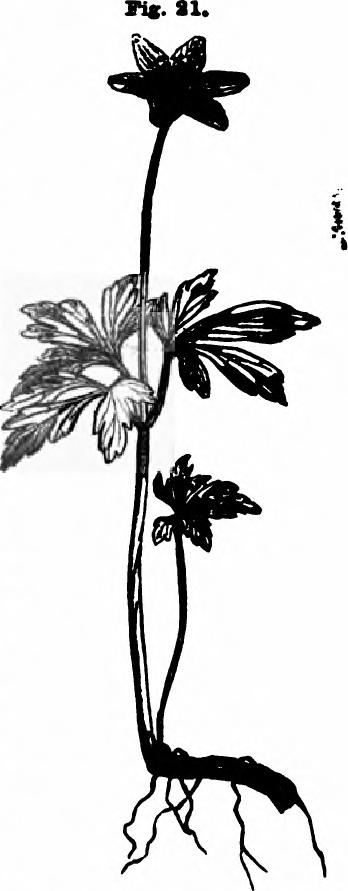
200 ANEMONE PATENS. among the homoeopaths, and that he has heard of several cases of poisop.ing by it in which the toxic effects were similar to those of Pulsatilla, but much more severe. He suggests that as a remedy it might occupy a place between aconite and Pulsatilla {Drugs and Medicines of North America). Prof. Scudder {Spec. Med.) writes: "It influences the functions of waste and repair, but works directly upon the nervous system." The remedy will repay study, and is suggested as of probable value in ikin diseaaea^ apd, we might add, nerwna derangements. The drug referred to by Webster as ^'PaUat^ NtUtaUiana^" or "Anemone nemoroaa," is undoubtedly Anenume patens, var. mitUUlwna, which see. A tincture of the fresh plant in fruit (Sviij to alcohol Oj) may be tried in doeeB of a fraction of 1 drop to 5 drops. Kelated Species. — Ajiemone eylindrica. Gray. United States. Distii^iflhed by cylindrical friiit-lieiuls. Used by the Indians for the cure of rattlesnake bite. Their mode of usin^ it is to chew aome of the tops of the plant, swallowing but little of the saliva, and then applying it to the bite; in a few minutes the poison is rendered harmless. When chewed the tops have a hot, pui^nt taste, somewhat like capsicum. All the anemones are useful in tnenttrual gappremioH, and all are likewise acrid and poisonous. Anemone virginiam, Linn6. Wood flovier. Wind fiower. Thimble teeed. An herb growing from 2 to 3 feet hi^h, having from 2 to 4 greenish-white flowers; distinguished also by its oblong head of wouly achenes. Reputed to have similar properties to those of Anemone nemorosa. According to Kalm, the seeds relievo toothache if dipped in alcohol and placed in the tooth cavity. Porcher states that it will remove corns {Drugs and MedicineKtf Jvorth America, Vol. i;. Anermne palen$, var. NutaUiana (tie.^ Anemone ^iens). Anemoiie coronaria, Linn^. Jjevant Occasionally cultivated. Used medicinally to s slight extent. Anemone cemua, Thunberg. White-headeil old man. China and Japan. Root used medicinally. Anemone sylvesths, Linn£. Europe and North Asia. This and the next species employed by the Siberians. Ariemone ranunculoides, Linn^. Europe and Siberia. Anemone prateiait, LinnS, and A.P^satUla, Linne(see PutiaiUla). The flowering plant Anemone patens, Linn6; var. NuttaUiana, Gray. {Anemone Ladoviciana NuttaU; Anemone NuUaUiana^ De Candolle; PulMUUa NuttalUana, Sprengel). Nat. Ord. — RanuncuUcese. CoHHON Names: American pulaaiUla, Pcisque flower. Illustration: Drugs and Medicina oJ North Ameriea, by J. D. and C. G. Lloyd, Vol. I, p. 27; Meehan's Native Flowers, I, 49. Botanical Source and History. — ''.i47i^ioHepnten« is a very conspicuous flower in early spring, found in prairie regions of Illinois, thence west to the Rocky Mountains, and northwest. The stem rises about 4 inches out of the ground, and is terminated by a large, erect, solitary, light bluish-purple flower. Below the flower, encircling the stem, is a many-parted floral leaf, covered with silky hairs, as are all parts of the plant. The true leaves are not expanded at flowering time, but are afterwards developed from the root of the plant, and are palmately divided into many linear lobes. The fruit is a head of achenes, with long, silky tails. It is borne on a stalk which is greatly elongated after the plant has flowered" (C. G. Lloyd, in Druga and Medicines of North America, Vol. I, 26). The plant has a faint, camphor-like odor, and a somewhat saccharine taste in the dried flowers; the recent flowers and leaves are very acrid and irritating, which properties are considerably lessened by drying, owing to the evaporation of a volatile, acrid principle. The fresh plant will vesicate, and the vapors of the fresh juice have produced severe conjunctivitis. Simple contact with the plant produces severe irritation. The drug was introduced to the profession by Dr. W. H. Miller, and F. B. and A. W. Miller (sons), all of St. Paul, Minn. It was introduced to Dr. Miller by an Indian, who declared it the "great medicine" of the Northwestern tribes of Indians. This plant bids fair to supplant foreign Pulsatilla in the American drug market (/>jvtf/s and Medirinesof North America, Vol. I, 28). Obemical Oomposition.— Mr. A. W. Miller (1862), proved the existence of a volatile acrid principle in this plant, and by agitating the aqueous distillate with ANEMONE PATENS -AUERIOAN FXTLSATILLA.
ANEMONE PATENS. 901 lis. 84. chloroform he obtained an acrid white principle which he believed to be anemonin, though the amount was too small for verification. His brother, Mr. F. B. Miller, re-examined the plant in 1873, and by the same process obtained white, feathery crystals of a neutral reaction at firet, but becoming both acid and colored in a few days. A distillate of the fresh juice preeerred in alcohol was also distilled by him, and treated with chloroform, from which brown acid crystals were obtained. A quantity of the dried herb was tnen distilled, and subsequently treated with chloroform, as above, without obtaining the acrid principle yielded by the fresh herb. Hence, it seemed conclusive that the anemonin ia dissipated in drying, and this also appears true from the fact that the dried herb has none of the irritating properties of the fresh plant, and upon chewing the herb a year old only a slight tingling sensation was produced. In fact it was scarcely more than astringent. Glucose, tannin, two resins, pectin, calcium and magnesium salts, sulphates, and the ordinary plant constituents were also found by Miller. Albumen was absent (see Prof. J. U. Lloyd, Drugs and Medicines of North AmFor further details on constituents, see Anemone nemorosa., Action, Medical Uses, and Dosage.— This plant has been found useful in man^ chronic cases of ophthalmic maladies, as cateavKL omauFomR, and corneal <ypacUy; also in cutaneous erujaiona and aeeondary ayphilitic diseases. It has likewise effected cures in uncomplicated amenorrfioea^ lettcorrhcea^ pains in the testes, ox ovaries, and alon^ the spermatie chord, sharp, cutting gastric pains, frontal headache in onanists, and m chronic irritation of the nerves, li will alao be n>and useful in r^ex paralysis, ohstinale hiccough, chorea, and in chronic mucous diseases generally. The foregoing statements constitute a summary of the uses of the drug as gleaned from European and early American observers and are the cases in which lai^e doses were employed. Many of these statements, however, require confirmation. According to Dr. W. H. Miller, it is a good pite remedy {Drugi and Medicines of North America). Prof. Edwin M. Hale, the distinguisheid homoeopath ist, found upon investigation, that its properties were practically identical with those of ETuropean pulsatilla. (See Drugs and Medicines of North America, for homoeopathic uses). This is undoubtedly the drug referred to by Prof. H. T. Webster {Dmam. Therap.), as ^^PiUsatiUa Nvttodliana" or "Anemone nemorosa." Owing to its probable identity with Pulsatilla, this drug will undoubtedly prove a reliable substitute for the European species, and be used for similar purposes and in the same doses (see Pulsatilla). The U. S. P. (1880), recognized it as a source of Pulsatilla. Five to 30 drops of the tincture (Jviij to alcohol Oj), may be added to 4 fluid ounces of water, a dose of which is a teaspoonful 3 times a day. Anehonin. a solution of anemonin has been used externally in scald-head, ulcers, caries, indurated glands, venereal nodes, serpiginous affections, paralysis, a-maurosis, cataract, and opaque cornea. Its internal use is questionable. It has, however, been employed in bronchitis and in convulsive forms of cough, as in whoopingcough and a^hma. Experiments upon the lower animals indicate that it possesses panilyzing properties, particularly directed to the cardiac and respiratory functions. Flower of Anemone patena, var.NutUlilan&. erica. Vol. 1, 29). Anemone Mtetu, rut. Nuttsllluift. withfrolt
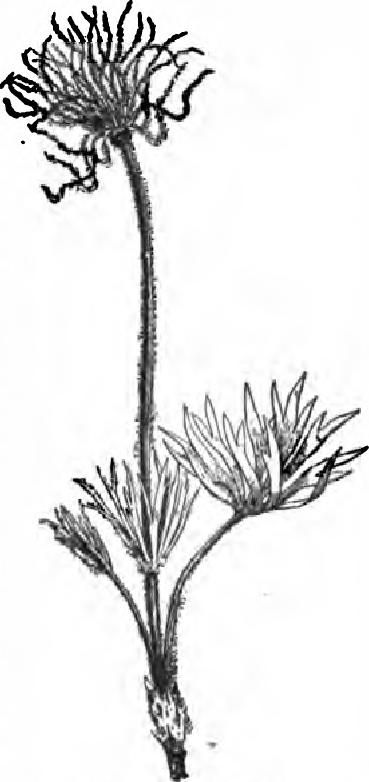
2Q2 ANSHOFSIS CAUFO&NICA. AinuOPSIS OALIFOBinOA.-nBBA lunu. The root of Anemopeia califomieaj Hooker. Nat. Ord. — Sauru races. Common Name: Yerba manaa. Botanical Source and History— This is a perennial herb, a native of wet places in Southern California and in the northern part of Mexico. The stem is erect, about a foot high, and bears a close, terminal spike of flowers. Near the middle of the stem is borne a large claspinff \ea£ from the axis of which a few ahortjslender branchy are produced. The leaves are mostly in a radical cluster at the base of the stem; they are from 2 to 4 inches in length, one-half as broad, of a firm, leathery texture, smooth and entire; their outline is oblong, with a cordate base. The leaf-stalks are about the len^h of the leaf, dilated at the base, and pubescent along the marvin. The stem is remarkable for sending out from its base, slender, nnbranched stolons, from 8 to 6 feet long. These stolons are of rapid growth, and produce at intervals of about a foot, roots and a cluster of leaves, which in another year become a separate plant. The flowers are small, and borne in a thick, dense spike (spadix]), about an inch in length. At the base of the spadix are about 6 large, petaloid, involucre leaves in the same manner as the flowering dogwood, which give to the entire inflorescence the appearance of a single terminal flower. The flowers are small, and destitute of either corolla or calyx, but are each subtended by a small colored bract. The stamens are about 6, with short filaments, and borne on the ovary. The stigmas are generally 3, spreading, and about as long as the Btamene. The ovary is 1-celled, immersed in the spadix, and consolidated with it. The seeds are small, light-brown, and attached to the parietal placentte of the capsule. There is a pungent, disagreeable, somewhat aromatic odor, and a sharp, biting taste, imparted by all parts of the plant, when chewed, followed by a sense of astringency. History and Description.— The Indians of Southern California, Mexico, and Arizona; according to Dr. PsXmetiAnter.Jour.Pluirw., Dec.,1878), employ both the roots and leaves of this plant. Dr. William H. George, of California, first brought the drug to our notice, the root being the part employed. When dried, the roots are of a brown color, wrinkled, from ^ inch to ^ inch in diameter, and seem to grow mostly horizontally near the surface of the ground. From 4 to 10 fleshy rootlets spring in a clump ftx>m one side of the root at the base of the leaves, and run downward. A strange peculiarity of the lot 'of.roots examined by UB, is, the presence of numerous grass stalks that pierce and grow through them, sometimes appearing several inches from the place of entrance. Internally, the root is pinkish; and, running lengthwise through it, about midway between the surface and the center, is a ring of course, fibrous, medullary matter. The upper portion of the root is not infrequently brown and half decayed. Onemical Composition.- The active principles of this root are freely extracted hy alcohol; they are, firstly, about 6 per cent of a volatile oil, which is heavier than water, is soluble in ether, alcohol, chloroform, and disulphide of carbon, and possesses the exact odor and taste of the plant. This oil turns blue when agitated with hydrochloric acid. Secondly, a vegetable Annate, which forms a black precipitate with ferrous sulphate. There is no alkaloid, or other body present, worthy of notice (^Avier. Jour. Phdrvi., Jan., 1880). Action, Medical Uses, and Dosage. — This plant was introduced to the profession by Dr. W. H. George, of California. He states that the natives esteem it a panacea far excelling the Yerba santa, and successfully employ it in all malaruU fevers, in diarrkcea, and in dysentery (^Eclectic Med. Jimr., 1877, p. 238). In a letter to Prof. King, he observes that the natives frequendy carry the root with them, chewing it and swallowingthe juice, and consider it a certain remedy for cough and ptLmonary affections. They likewise employ a strong infusion of it as an efficacious local application to aaddU and eoUeo' galls on harm. Dr. George considers it a stimulant tonic, astringent, carminative, and anti-emetic. He oae successfull v employed it in gonorrhem with profuse discharge, and thinks it ec^nal to cubebs in this disease, and more pleasant to take. Prof. King has tried it in one case of gonorrhaa, and in several cases of bronchial cough, with nivorable resulta. The dose of the fluid extract is from 10 to 60 minims, in syrup, repeated every 8 or 4 hours.
ANSTHI FBUCTDar-AKGUSTUKA. 208 Belated Sjpecies. — iSaurunu remuut, Linn^. NaL Ord., Sannuracese. A common peran* Dial known as LuanTa tail, found in Bwampy grounds in North America. Whitiuh flowen, borne upon a slender spike, recurved at the top; fruit fleshy and beny-like. The plan( has a Bub-acrid taste and a disagreeable^ aromatic odor. Its constituents have not been determined. The decoction is freely usetl in imtaA'iv duordm the gadnhirUatiwU tract and urinary apparatm, particularly atranpury. As a poultice the root has been applied to painful ii^ammaiorj/ ato^irngt and to vanons kinds of abaeat. ANXTHI FRnOTn8.-DlLUBniT. The Anethum graveokns^ Linn^. {I^ueedamm graveiUenSj Hiem.) NiU. Ord.— UmbeUiferae. COMHON Nahbs: Dill seeds. Dill fruits. Illustration: Bentlev and Trimen, Med. Plants, p. 132. Botanical Source. — This plant is an annual, befuring large yellow flowers, cUspoBed in flat umbels. It*reaches a height of from 1 to 2 feet, and has delicately striated stems, bearing pinnate leaves composed of long, setaceous leaflets. The whole plant is glaucous. The root is long and fusiform. Histoiy. — This plant is indigenous to Southern Russia and other Mediterranean regions; also to the Caucasian territories. It is cultivated in Europe, thriving as far north as the Scandinavian peninsula. It occurs in some sections as a common weed in cornfields. It is cultivated to a very limited extent in this country. It is scarcely used here as a medicine, but enjoys considerable reputation in England, where it holds a place in the British Pnarmacopceia. It is said to have been known to Dioscorides, and is now regarded as the plant mentioned in the Scriptures i^^falt., ch. xxiii, v. 23). Description. — Anethi Fructub. Dill-fruit. The seeds are oval or ovoid, seldom longer than ^ inch, convex or flattish on one side, concave on the dorsum, which is striated or marked with piliform ridges 5 in number, the two outer ribs becoming blended with the thin, membranaceous mai^n surrounding the fruit. The 3 central or dorsal ridges are sharply keeled. Six vittse (oil cells), are usually present, 4 between the ribs and 2 on tne commissure. The mericarps separate ' when mature, are about inch in width, and of a brown color. The membranous marginal wings are of a yellowish color. The fruit has a strongly aromatic odor and taste. The fruit grown in India is smaller, not so broad, more prominently ribbed, more convex, and the margin less winged. Otherwise it resembles the above described European fruit. Ohemical Oompositibn. — Dill-fruit yields a volatile oil to which its properties are probably due. This oil is obtained to the extent of 3 or 4 per cent, and was found by Gladstone to consist mainly of anethene (C,oH,8), a nydrocarbon having the odor of lemons, strongly dextrogyre, with boiling point at 172** C. (341.6** F.), and density of 0.846. Two other bodies have also oeen found (see Oleum Anethi). Action, Medical Uses, and Dosage.— Carminative and stomachic, and used in the preparation of dill-water. The natives of India use the fruit largely in medicine and cookery. FlaitUent colic and siiimdtiUj when due todisordered digestion, are relieved by the administration of dill-water or the oil of dill; the former in 1 or 2~drachm doses, the latter in from 2 to 6-drop doses on sugar. It possesses no advantages over the other aromatic seeds. ANaUSTUBA^AzronSTUBA BABK. The hark of Galipea Cusparia, St. Hiliare {Galipea officinalis, Hancock; Ctisparia fdirifuga, Humboldt; Galipea febrifuga, Baillon; Bonplandiitrifoliata,'Wi\\' denow). Nat. Ord. — Rutacese. Synohyic and Cohhon Names: Cusparisp. cortex, Ou^Ha fiorife, Angostura bark, Illustration: Bentlev and Trimen, Med. Plants, ^ Botanical Sonrce. — This tree seldom exceeds 20 feet in height, with a stem whose diameter is from 2 to 6 inches, having irr^ular branches, and a smootii bark. The leaves are alternate^ trifoliate, ana petiolate; the leaflets oval.
204 ANGUSTURA. acute at the bas^ acuminate at the apex, smooth, glossy, bright-green, having a tobacco-like smell when fresh and bruised, from 6 to 10 inches long, 2 to 4 broad, somef of them marked with small, whitish, round spots. The petiole is about the length of the leafietSf and slightly channeled. The flowers are white and beautiful, with a narcotic odor, and are borne in cylindrical, contracted, stalked panicles, longer than the leaves, the branches being about three-flowered. Calyx inferior, campanulate, five-toothed, hairy; corolla somewhat curved before expansion, nearly an inch long, downy on both sides; of the five petals, two larger than the others. Sterile stamens, five, subulate, tipped with a pellucid, watery gland; fertile stamens, two; style, erect; stigma, simple. The fruit or carpels are five, or fewer by abortion, becoming villous as they mature, two-seeded, with a strong, elastic, separable, two-valved endocarp (L.). History. — There has been heretofore some uncertainty relative to the tree from which the official angustura bark is obtained, but the <iuestion has been definitely settled by Dr. Hancock, who has ascertained that it is chiefly the product of a tree to which he has gi ven the above name. Qalipea ^icinalis, now Galipea Cuspari(t,iB official in the British Pharimacopceia. Under Hancock's name, it was formerly official in the U. 8, P. It is found growing in great abundance in the missions of Carony, Tumeremo, etc., and other parts of Columbian Guiana. Description. — The bark, as imported from the West Indian ports, is in flat Eieces or incomplete quills, from 2 to 4 or even 8 inches long, 1 or 2 inches in readth, and 1 or 2 lines in thickness. Its outer surface is dirty-grayish-yellow in color, often speckled in the smaller pieces with lighter gray spots and elevations; the inner surface is dull-brown; and the substance of the bark is yellowishbrown. It breaks easily, the transverse fracture being smooth' and somewhat resinous in appearance; and presents white, shining striEe, produced by aggregations of crystalline, calcium oxalate; its powder has a grayisn-yellow color, somewhat like that of rhubarb. When soaked in water, it is soon softened sufficiently to be easily divided by means of shears. It has a characteristic, unpleasant odor, and an intensely hitter, somewhat aromatic and acrid taste. Water, alcohol, or proof-spirits take up its virtues. Ohemical Oompoidtlon.— Fischer found in it a volatile oil 0.3, peculiar bitter principle 3.7, bitter hard resin 1.7, balsamic soft resin 1.9, elastic resin 0.2, ^m 5.7,hgnin 89.1. By submitting the bark to distillation with water, a yellowish-white, odorous, acrid, volatile oil is obtained, which is not so heavy as water. The bark also contains nearly 1.5 per cent of a peculiar neutral, crystalline principle, named cwparin by Saladin, and termed the peculiar bitter principle by Fischer. Cusparin, or angosturin (Pereira), is obtained by submitting the alcoholic tincture of the bark (prepared without heat) to slow atmospheric evaporation; the crystals thus obtained are to be purified by repeated crystallization from alcohol and agitation with ether and hydrated oxide of lead. It forms tetrabedral crystals, is fusible at 44.4° C. (112° F.), and loses 23.09 per cent of its weight; cold water dissolves J per cent and boiling water 1 percent of it; it is freely soluble in alcohol, but not m ether or volatile oils; readily dissolves in the concentrated acids, and more sparingly in the alkalies, and its acid solution yields a whitish precipitate with the tinctureof galls (Saladin, Jour, da Chim. Med., IX, 888). Cuapariny obtained in the cold, occurs in needle-like crystals. It is inflammable. The volatile oil, which has a boiling point at 266° C. (511° F.) is represented, according to Herzog, by the formula, Ci3Ha40. Oberlin and SchlagdenhaufTen, who examined the bark in 1878, found volatile oil, resin, fat, dissolved by alcohol; wax, fat, and stearic acid dissolved by benzin; moisture; and a bitter, yellow body, which yielded a crystalline alkaloid called by them angttsturine (CwH^jNOh). It is fusible at 8.^° C. (185° P.), turns green when treated with sulphuric acid mixed with oxidizers — as nitric acid — but with pure sulphuric acid a red coloration ensues. In 1892 Beckurts and Nehring made a detailed investigation of the bark, isolating therefrom the following four alkaloids: Cilsparine (CnHisNOa) fusing point 98** C. (208.4° F.); readily soluble in alcohol and ether, its salts being difficultly soluble; cit.'fparidine f CwHitNOs) fusing point 78° C. (172.4° P.); galipine (CwHwNOs) fusing point 115.5° C. (240° F.), and galipidvne (CjaHnNOs) fusing point 111° C. (231.8° P.), the mroper crystallizing Bolvent for the latter three alkaloids being light petroleum. The authors found, besides
ANILINUM. 205 an eamUial oil extracted means of ether. anousCuruw, a bitter principle insoluble in ether, having a fusing point of 58° 0. (136.4** F.)» and a glucoside not further examined. The baxk was previouslV studied also by Koemer and Boehrin^r, in 1884, who found three alkaloids, one being idenUcal m composition and fusing point with the galipine of Beckurts and Nehring. Snbstitated Barks. — Some years since a poisonous bark was introduced as the true bark, and the administration of which was attended with fatal results. This spurious bark was at first supposed to be the product of the BruceaferrugiTieay but is now recognized as the hark of Strycknos Nux vomica. It is known as the False Anoust'ura Bark, and may be detected by the following marks: The genuine bark haaa strone and disE^eeable odor; a bitter, durable, pungent taste; softens in water, and imbibes it quickly; is very light; tissue not compact: has a resinous, shining fracture, and when touched with nitric acid becomes colored a dull red; the false bark has no odor; an insupportably bitter, very durable taste; does not soften sensibly in water; is venr heavy and cornet; has a dull and blackish firactare, and nitric add turns its fractured surface bright red and its rusty epidermis an intense green. The false hark is rarely met with in this country (Duncan). It contains brucine. A bark known as Brazilian anguslura, derived from Esenbeclcia febrifaga, Martins, (^Ehodia fMfugOy St. Hilaire), and collected in Brazil, has been met with in substitution forangustura (Maisch, Amer. Jour. Pharm.^ 1874, p. 414). It occurs in Eieces a little curved, and having a thickness of about inch. It is very bitter, ut not aromatic to the taste, nor doee it swell when macerated in water. The inner layers are deep-brown, over which are blotches of a soft, corky layer of a browngray hue, having internally a faint, orange-rusty brown color. Its fracture is short and fibrous, and there is an absence of the white, shining strise, due to the raphides of calcium oxalate found in the true bark. Oberlln and Schlagdenhauffen found in the Brazilian product an alkaloid turning yellow-gxeen upon treatment with sulphuric acid. To this principle they gave the name evodine (esenbechine)^ and the formula, C«HnNO«. Oberlin and Schlagdenhauffen record the following additional substitutiona of angusturabark: Guaiacum bark, Copalchic bark, and the barks of Oinchona bicolr orata and Samadera Indica {Amer. Jour. Pharm., 1879, p. 83). Action, Medical Uses, and Donaee. — In large doses, of from 20 to 60 grains, it is emetic and cathartic; in doses of from 5 to 15 grains, non-astringent tonic and febrifuge. Recommended in bilioua diarrhceas and dysenterieBy intermiitents, dropsies, etc. It is seldom used, on account of its liability to adulteration with the poisonous iHirk of the Struchnos Nux vomica, known as the FcUae anauftura bark. Dose of the bark, 10 to 30 grains; of the infusion (jss in Oj), 1 to 2 tluid ounces. ANILINUM.-ANIUNE. FoBinTLA: CeHa.NH^ Molbculab Weight: 92.83. Synonyms: Menylamine, Amidobensene, AnilinOj AnUmj FhenaM. History and Source. — Aniline is named from the Portuguese ant^ meaning indigo, from which aniline was first obtained. This name was given to it by Frit«che, in 1841, though it was first discovered by Unverdorben, in 1826, who obtained it by dry-di8tilling indigo, and named it cry«laUine. In 1834 Runge obtained from coal-tar three volatile bodies, among them one which, on account of the beautiful, dark, violet-blue color produced with chlorinated lime, he named kyanol. Zinin, in 1846, observed the formation of aniline from nitrobenzene by the agency of hydrogen gas, and called the substance benzidam. Erdmann and HoflTman then proved the identity of crystalline with kyanol, benzidam, and aniline. Coal-tar is a source of aniline, containing 0.3 to 0.5 per cent, but the principal source of aniline is nitrobenzene (CtHgNOs), from which it is prepared in large quantities by the reducing action of nascent hydrogen, thus: C,H,NOr^H,==C,H5NH,+2HA Pn^iaration. — Aniline may be obtained on a small scale according to the process of B^hamp {Amer. Jmvr. Pharm., as follows: Place 600 grains of iron filings and 600 grains of pure nitrobenzene into a quart tubulated retort^
.206 ANILINUM. which must be adapted to a receiver, and the receiver connect^ br a bent tube with a deep, small-necked flask, into which it reaches nearly to the Dottom. The neck of the retort, the receiver, and the flask must be kept well reirioerated, and the flask must be left loosely stopped with cotton. Now gradually pour 600 grains of concentrated acetic acid tnrongh the tubulure ot the retort, which should be 'closed and tied, being careful tliat the temperature does not rise too bi^b. Reaction soon commences wiUiout the application of heat, and becomes rapid, with quick rise of temperature and rapia ebullition, and a large portion of the roducts will be lost should the refrigeration be imperfect. The spontaneous istillate that comes over, consists of aniline, acetate of aniline, and a little unchanged nitrobenzene. When the retort has cooled, these are returned to it from the receiver, and a careful sand-bath heat applied until the residue in the retort is dry. Now mix the distillate with an excess of liquor potassee, which causes the aniline to separate and rise to the surface, whence it is to be removed and dried; it is sufficiently pure for medicinal purposes, and its amount is equal to about three-fourths of the nitrobenzene employ^. Uvdrochloric acid is now generally employed in place of acetic acid, and milk oi lime instead of liquor potassn. Aniline may also be readily procured by distilling a mixture of concentrated liquor ^otassse and finely powdered indigo; the mass swells up greatly, and water holdme ammonia in solution passes over, accompanied by uiiline in the form of a brownish oil, which, when redistilled, fumishee pare aniline amounting to nearly one-fifth of the weight of the indigo. DescnptiOB. — Pure aniline is a nearly colorless, limpid liquid, luiving an oilyappearance, but when impure or partly oxidized, as often met witn in commerce, it varies in color from a dark to a light red. It is of an agreeable, vinous odor, and an aromatic, burning taste, and remains fluid at — 20* C. ( — 4** F.). Its specific gravity is 1.020 to 1.028, and its boiling point 182.2'> C. (360'' F.). It is heavier than water, in which it is slightly soluble to the extent of S per cent; is soluble in alcohol, ether, wood spirit, acetone, aldehyde, carbon disulphide, and fixed and essential oils, and has little or no action on test papers, though it chants dahlia-blue to green. It refracts light powerfully, is a non-conductor of electncity, rapidly absorl» oxygen, even under water, and becomes convwted into a brown, resinous mass. Camphor, many resin^ phorohoms, and solphxur (if heat be employed) are dissolved by it. Commercial aniUne (puns) contains about 1 per cent, and other grades more, of toluidinej i. e,, ortho and txzra amido toluene ((^HjNH^. It is a powerful base, forming mostly colorless, soluble salts, with a strong tendency to crystallize, and become rose colored; and decomp<»e8 the salts of iron, zinc, aluminum, mercury, copper, etc. In contact with chlorinated lime, or other hypochlorites it forms at once a deep violet-blue. Another color test for aniline is as follows: To aniline add sulphuric acid and a few drops of potassium chromate; a red color is developed, changing to deep-blue if aniline ia present. It is chiefly employed for the production of various magnificent colors used in dyeing, and which are made by different processes (see below). Action, Medical Uses, and Dosage. — Aniline is poisonous, though Wohler and Frerichs state that it is harmless to dogs. It has been observed that workmen employed in preparing aniline are liable to intense bronchitis, with violent, dry, spasmodic cough, coinciding with ulcerations of the scrotum and inferior extremities: the ulcers being round, with distinct borders, often callous^ and covered witn thick, blackish crusts, beneath which is a dirty-gray base, with a neighboring painful tumefaction, and which cease with the cessation of the cause. According to M. Bei^ron, those who are exposed to its vapors present a chloroanemic appearance. In one case where a druggist was employed for two months in putting up packages of aniline, he was attacked with pulmonary catarrh, followed by prostration, tendency to syncope, occipital pains, dilatation of the pupils, and clonic convulsions of the extremities and muscles of the face; he was cured. According to 8chuchardt and Demeyer, aniline belongs to the most violent poisons, and to that class which acts upon the nervous centers and the spinal marrow. The muscular contractions produced by it resembling electric shocks, the constant diminution of the sensioility, the paralytic state of the extremities^ the acceleration of the respiration, and the activity of the heart, indicate this. It causes prickings of the parts with which it comes in contact,
ANILINUai. 2p7 and its elimination Beemg to be by the respiratory organs, not bjr the urine. One grain of aniline coagulates 4 grains of albumen, demongtratine its toxic influence upon the animal tissues. The workmen in it present a cadaveric blue appearance, the gums discolored, the lips bluish-gray, a slight paroxysm of cold, headache, and vertigo, which are not i)ermanent, however. Gases of poisoning are on record from wearing clothes which have been dyed with aniline colors. Six drachms of aniline oil, taken with suicidal intent, produced death in a woman in a few hoars. After death, aniline was found in the urine, and the iungs^ kidneys, and heart-muscle showed nodular hemorrhagic effusions. It is practically useless as a remedy. Dose: 1 to 5 grains (see Aniline Sulphate below). DerivatiTSB, Aniline Colon, and Inks.— Aniline Camphobatb has been introduced by Tomaselli {P. J. Tr., 1887) as a remedy for conmltive ditorden. The daily doae administered being from 8 to 12 grains. Anilini Sulphas, SiUpkate of omHiu, Anilxn fu&Aote.— Formula: (C«HtNH.}r^«Hi. Molecular Weight: 283.48. Dissolve 100 parts of aniline in 600 parts of alcohollK&i*.), to which add under constant stirring a freshly prepared mixture oi 65 parts of pure, concentrated sulphuric acid, and 150 parte of alcohol. Allow the mixture to stand for a few hours in a dark place, then add under constant stirring about 400 parts of ether, transfer the magma of crystals on a funnel closed with a pellet ofglass-wool, and displace the mother liquor by means of ether. Finally, dry the crystalline magma, without the aid oi beat, by spreading ft in thin layers on slabs of nnglazed porcelain in a dark place. Avoid the use of filtering paper, and exclude bright daylight as much as possible (Hager). Sulphate of aniline forms small, crystalline, white plates or needles, without odor, if pure, but exposed to air and light acquires a reddish tint and an odor of aniline. It is soluble in water and diluted alcohol, much leas soluble in strong alcohol, and insoluble in ether. Alkalies liberate from its aqueous solution an oily layer of its aniline, and tiie salt responds to the teats for sulphuric acid, as well as to all the teste for aniline. Sulphate of aniline has been used in chorea by Dr. Turnbull with success, and M. Filberti cured a case in four days, administering it in duees of 10 centigrammes twice a day, increasing it as much each day to prevent a relapse. He also cured a case of epUepsy by giving daily a s^ution of 5 centigrammes of aniline sulphate in 100 grammes of water, increasing the dose 6 centigrammes each day; in ten days the case was apparently cured. Others >ave also reoommendeil it in these affections; while again it has been asserted that the sah^te of aniline has no influence upon the system. Ite administration is apt to be followed by a blneneas or yellowness of the skin, nails, and gums. DipHKNYLAMiNB.— Formula: (CeHs)aNli. Molecular Weight: 168.65. This substance may be obtained by heating aniline hydrochloride with aniline to a temperature of 240° G. (464' F.) in closed vessels, the following reaction taking place: C,H»NH,.HC1+C,H,NH,=(C,H,),NH+NH«C1. It is likewise formed when aniline la heated with phenol and zinc chloride (ZnClj) to a temperature of 260*C. (600° F.) (for description see No. B2 of List of ReagmU and TeH iSblutioni). Aniline Colors.— Aniline as such (GtHsfTH,) enters into the composition of but few of what are usually called aniline dyes. Host frequently used are its homologues, the toluidines. (CcHiGHiNHjl, ite methyl derivatives, e.^r-, mono- and di-methylaoiline (UiHjKHCH,) and (C(HftN[(5Hj]t),diphenylamine ([OeH^liN'H,) and other amines. Many of the soKtalled aniline dyes as, e.g., eosin, may not contain auy aniline derivative at all, but have phenols as their principal constituent. Coal-tar dyes is a more comprehensive, and therefore more proper, name. The majority of these ever intrreasing dye-atuflis, may he classified broadly into two groups, according to whether they are derivatives oE triphenj^nuthane (CH:[C|Hb]3), or of azobrnztne (C,Hj — N=N— CjHj). Oxy-triphenylmethane becomes a mromogen (a dye-forming principle), when the amidogroup (NH,\or the phenol group(OH) replaces hydrogen in the benzene ring. In the first case the color is producedwhen combining with an acid, in the second, with.an alkali. Fuchsin, for example, is the hydrochloride of the (colorlpss) basis roianUim, which has the following formula: C(OH): (CsH,KHi),.C,H3(CH,)NH,. Rosolic acid is similarly constituted, merely having OH in tiie place of 5^H], being an anhydride of the compound: (HO)0:(09H40H),.(C,H,[CH,]OH). Alkalies produce the colored aalte in the latter case. If in the case of rosaniline the hydrogen of the KHs group is replaced by methyl, the resultant product acqnires a violet color (ndethyl violet), or if Buratituted by the benzene radical the product has a blue color (aniline blue). The azobfmme type likewise becomes a prolific chromogen upon the entrance of the amido group (NHj), or the phenol group (OH) in the benzene ring: in the first case we have basic ayes forming colored salte with acids; in the second, acid aves, forming colored salte with alkalies. The simplest representative of this class of dyes, called azo dya, is aniline yeUtno, the oxalate of (colorleEs) amido azobenzene(CsHB — N=N — CtHtNH.}. Anotherof the more 8impleazodveBiBpA«nyIen«6r(n»i, or Ke»urine, the hydrochloride of the following compound: NH, — C|H( — Jl-=N— OaH|[NH,]j). These azo dyes are formed by the action of nitrous acid upon aniline or other aromatic primary amines (both H atoms in the NH, group being intact)^ whereby the extremely anstable (and explosive) diazo compounds are formed; these react easily with aromatic amines, or phenols, azo compounds being the result In the case of aniline yellow for example, the following reactions are involved: CgH^NH, (aniline) -i-N0,Na-f-2HCl=CaHt— K=N— €1 (dia«»-6mi»ie-dUbrMle)-t-2H,0+NaGl. C«U,N=NC1 {diaMo4>etueae-t^t!orid^+CtHtf(Ut(ana^ =OcH»N=N— GfHaNHa {amido atobeiuene, the basis of anOme imOow).
208 ANIUNUM. It ia erident that when int^ecting aabstituted aminetf to " diasotlzing," and afterwards allowing a variety of amines or phenols to react with the diazo compound formed, and enlarging upon all poesibilitieB, an endless variety of azo dyee most be the result. The following aniline or coal-tar dyes may find special mention here: Akilinb Red, Magenla, or Fudmne, is a mixture of the hydrochlorides of rosaniUne (CiDHitNa) and para-roeaniline (CuHnNj) and is produced on a large scale by ^e oxidation of aniline (containing toluidine) with arsenic add (Medlockand Gi»rd), or with nitrobenzene (Coupier). It is stated that f uchsine obtained by the anenic acid prooessj is liable to contain araenie; this dannerous impurity is said to be removable by recryrtallization. The acetate of roaaniline is usually called Bobbin; the nitrate is called Azalxine. The latter was formerly prepared by oxidizing aniline oil with mercuric nitrate. FucHsiKB, the hydrochloride, forme crystals of a green, metallic lustre, in reflected light. It is soluble in 10 parts of alcohol, and 300 parts of water. On account of its insolubility in pure volatile oils, it isemploj^ed to detect the presence of alcohol in them. It is also employed as a valuable staining material in bacteriol<wy, and in botany for staining lignified ceH-walls (Bastin). Fuchsine is sometimes used to color wines, and though apparently of use in tubuUxr nmhritu and aearlatinai dropty, its position as a remedy is aa yet ny no means well established. The dose is from } to 4 grams S or 4 times a day. HoniANN's Violet, Methyl Violet.— ^oAnon'strioIef is obtained by the action of methyl or ethyl chloride, or iodide, upon roeaniline salts, wherebv three H atoms of the KH, gronps are substituted by the methyl or ethyl group. The violet tint becomes more bluish the more hydrogen atoms are eumtituted. Methyl Violet, in its purest form, is a salt of penta-methyl rosaniline, the commercial grade also containing hexa-methyl roeaniline. It is prepared by oxidizing dimethyl^anitine with copper chloride. When acted upon by methyl chlonde or methyl iodide, it forms addition pnKlucts, the zinc donble chlorides of which are called Mrhyl GssKM,<n> Zqdi» Grum, respectively. Pyoktanim, related to methyl violet, was introduced in 1890, into medical practice, for general surgical parpoeea: it was claimed that it retarded the growth of bacteria and badHi in a solution of 1 to 30000, and prevented putrefaction in a solution of 1 to \GW[Amtr.Jour. Pharm., 1890). There are two pyoKtanins in the market, a blue p^oitanin (pi/oUanin ccerulmm), probably tetra-penta- and hexa-methyl violet, and a ytUow pj/oktanin {vyoktanin aurevm), intended for ophthalmic practice, probably belonging to the auramines (dipbenyl-amine derivatives). Pyoktanin was introduced into medicine by Prof. J. Stilling, of Btrasbur^. Hypode.~matically, it is said to relieve rheumatic and neuralaie paint. To the conjunctiva it is a mild ttrpical antesuietic. It is employed in powder (with talc), and in pencils.' Wound*, ulcen, carbuncta, bvboa, boila, etc., as well aagonorrkaa and ckrmie cuititit have been successfully treated with it. In various eye and ear troubut it has also been naed by some with iipparentlv ^od results, while oliiers condemn it severely, attributing much harm to its use, as well aa claiming injury from its fltaining properties. Tlie stains of pyoktanin may be removed by alcohol or diluted nitric or hydrochloric acids. Very likelysomeof its deleterious effects maybe attributed to impuritiea. Aniline Blue ib the salt of triphenyl para-rosaniline H0C|^C(H,NU[C«Htl)3, and ia obtained by boiling together a rosanUme salt with an excess of aniline. Malachite Grbbn is the oxalate or zinc double chloride of tetra-metbyl-diamido-triShenyl carbinnl, (CaHA.C[0H]:CaH4N[0Ht]a),and is obtained by hfating benzaldehyde with imethyl aniline and zinc chloride or oxalic acid, and acting upon the product with oxidizers. AuBiN, Parabobolic Acid. Corallim Yellow (CiglluQs), Is the lower bomologue of roeolic acid, and is prepared by heating phenol with oxalic aud sulphuric acids. It forms red needles or prisms of metallic luBter, is soluble in hydrochloric and act-tic acids and alcohol, and dissolves in alkalies with a deep-red color, forming salts therewith. {See Corallin Test Solution). Ck>BALLiN Red {Pseonin), is an intermediary product between piira-rosaniline, and aurln, oontuning one or two amido groups besides the remaining phenol gniups. RosoLic Acid (CjolIwOa), one of the indicators directed by the U. if. P. (see Iio«olic Acid TVrt fMulion), may be obtained from rosaniline by " diuzotizing " and boihng with water, which has the effect of replacing the NHj grouij by the OH group. It niity also be prepared in a way analogous to that in wliich rosaniliue is made, viz., by oxidizing a'mixture of phenol and cresol (CaH4[CH,]0H) with areenic and sulphuric acids. Piitaleinbs. These are altto phenol derivwves of triphenyl-methane, and are obtained by he&ting phthalic anhydride (1 Mol.) with phenols (2 Mdb.)» in the presence of sulphuric acid, oxalicacid, or stannic chloride. PHBHOLPHTALaiN IS foHned by treating phthalic anhydride with phenol and stannic chloride. Its formula is: C»Hn04=-CBH4.(CO.O).C:(C,H40H)a. It is a yellow powder, soluUe in alcohol, the solution forming an intense red with alkalies. It is tlirected by the U. S. P. as an important indicator in alkalitnetry (aec Plienotphialein Tett Solution). Fluorescein. This substance is prepared by heating phthalic anhydride (5 parts), with resorcin i7 parts), to 200° C. {S92**F.); for reasons of analogy it mtiv therefore be called resorcin-phthalein. Its composition is: C2oHi,OB+HiO=CeH4.(CO.O)C:(C'flHj[OH],)a. EosiNB are the alkali salta of halogen siibstitntion products of fluorescein; tmiuyellou-.toT example, is the salt of tetra-brom ttnoreBcein, and eotin blue, is that of tetra iodo-fiuorescein. Fluorcstxiin and eosin are among tlie indicators directed by the U. S. P. (see Indicators). Methyl aRAWax is an azo dye. which occurs under the names of Hflinnihin, Orange III. Poirrier's Orange 3P, and Tropanliu D. Its formula is SOjII.C.H,— K=N— t'eH^NtCHj),, from
ANISUIf. 909 which it is evident (me introdoctOTy remarks) that it is pnsptnd from snlphanilie add and dimethyl aniline. In water and alkalies it dissolves with a light-yellow color, wUeh tnrasnd with acida. For its use as an indicator see Mdh^-crmue Tat Boltmon. McrHTLXNa Bldb, TOrameikyi Uiionin chloride (GwHwN.SOl). This most not be oonfnsed with aniline blue, a trisulphonate of which is tailed nuwyl Mue, which belongs to ^e trihydrogen sulphide and ferric chloride. The bfae solTition is then precipitated and ZnCl,. Methylene blue occars in scale-like blae crystals having a bronse tint, and being easily soluble in water. The formation of this substance ia ntiliwd as a delicate test for hydrogen sulphide (E. Fischer and Bemthsen). Methylene blue is used in the arts as a dye-stuff. Medicinally, it has been employed aa an antipyretic, anodyne, and antiperiodic. Bheumatmn, ffonorrhaa, qfltitU, pjfdUit, and malaria^ have been treated with it It has also been employed in the treatment of cancer. Ihe inter* nal dose ia 2 to 4 grains in capsnlea; aa an injection, 1 ^in in aolution. Prot F. J. Locke reports SQCcesi with this agent in old tibial wfon. Bis method Is to dia^ ■olve 20 srains of methylene blue In 1 fluid ounce of water, and with this solution paint the ulcers night and morning, keeping the parts covered with a cloth wetted with a 1 to 1000 cor* loeive sublimate solution. After each treatment the limb should be covered with an elastic bandage. Anilinb Black, JOaHne. Its formula is a malttple of CaH^N, perhaps Gi>HuN,.HCI (Liechti), It is produced on the fiber direct by elow oxidation of aniline by means of potassium chlorate and copper chloride, or hydrochloric acid and potassium bichromate {Amer. /ow. Phamut 1880), or more recently with ammonium vanadate. The resulting dark-green color appean black. Amiunb Inks. AniUne inb are prepared by dissolving 15 parts of dry aniline dyes (either i«d, bine, green, or yellow), in 150 parts of strong alcohol and 1000 parts of distilled water, in a ]>oreelain-fined vessel 1^ the aid of a gentle heat, until the odor of alcohol is disfdpated, and adding a solution of 60 parte of gum arabic in 260 parts of ■waXeT(Afrur.Jmr. Phann., 196^ p. 332). An indelible ink may be made with aniline bfad^ as follows: 1, dissolve crystalliaed chloride of copper 17] parts, chlorate of sodium 22} parts, and chloride of ammonium ll^f SMuts, in distilled water l2o parts; 2, diesolve chlorohydrate of aniline 2 parts, in distilled water > paria, and add to it of a eolation of 1 part gum arabic to 2 parts of water, 2 parta, and f^f^ enn 1 parL Mix 4 parts of No. 2 with 1 part of No. 1, as wanted. It forms a greenish llqiud, which may be applied with pen, pencil, or brush. As it changea in a few days, it should be mixed only as wanted (7&td, p. 335). STAMPiRa Ink. iHssolve any aniline dye 6 parts, in hot water 76 parts; add ayrap 1 parl^ and glycerin 2 parti. ANISUH (U. 8. P.)-ABIBB. "The fruit of PimpijieUa Animm, Linn^ " — {U. & P.). (,Aninm vuigartt Moendi). NaL Orti.— Umbelliferae. Common Names: Aniiteed, Anise. Illustration: Bentle3'and Trimen, Med. Ptanta, 122. Botanic&l Source. — Anise has a perennial, spindle-shaped, ligneous root, and smooth, erect, brancbed stem, 10 or 12 inches in height. The leaves are petioled; the radical ones roundish, heart^haped, lobed, and cut serrated; the cauline ones biternate, with linear- lanceolate, rather cuneate-acuminate segments. The flowers are small and white, and borne in nmbels on long stalks, aud are 9 or 10-rayed, and naked; the partial ones have a few subulate, reflexed bracts. Calyx wanting or minute; corolla of 6obovate.emargidate petals, with an inflexed lobe. Stamens 6, longer than the petals. Tne anthers are roundish, the styles subulate, spreading, long, and capitate. The fruit ia ovate, 1^ lines long, dullbrown, slightly downy, not at all shining; half-fruits or mericarps with d fiUform, equidistant, elevated ridges, sometimes rather wavy, and paler them the channels. The commissure is broad and flat (L.). Histon. — Anise originally came from Egypt, and is at present cultivated in man^ of the warm countries of Europe: the fruit of the Spanish plant is that which IS more generally selected for medical purposes. The fruit, popularly called aniseed, is the oflicial portion. Care must be taken not to confound any of the seed of the poisonous umbelliferous plants, as of the Contum nuuruiotutn, with those of the anise; a little attention will detect any accidental admixture of this kind, as the difierencee in the seed are well marked. The odor of anise is fwnetrating, and fragrant, and the taste aromatic and sweetish (P.). Water partially takes up its properties, alcohol wholly so; theee are due to a volatile <nl which may be procored by distillation of the fruit with water. 14
210 ANTEWARIA. Description.— "About 4 or 5 Mm. (J to I inch) long, ovate, compressed at the sldeSj grayish, finely hairy, and consisting of 2 mericarps, each with a flat face, and 5 light-brown isn, filiform ridges, and about 15 thin oil-tubes, which can be seen in a transverse section by the microscope. It has an agreeable, aromatic odor, and a sweet, spicy taste. It may be distin* guished from conium fruit (which it somewhat resembles, and which has been mistaken for it), by the odor and taste, and by the conium fruit consisting ususdly of single mericarpa, which are smooth, grooved upon the race, ana have crenate ridges with wrinkles between them, and nooil-tube8"-^f7.S.i*.). Ohemical Oomposition. — A volatile oil is contained in the external coat of the seeds, while a green -colored, fat oil of a butyraceous consistency, is obtained by expression of their inclosed substance. Brandes obtained from tne fruit of anise, concrete fixed oil, green fat oil, resin, nitrogenous matter, sugar, gum, bimalate and binacetate of calcium, bimalate of potassium, volatile oil, lignin, silicate of iron, water, gum-resin, phosphate of calcium, extractive with various salts, etc. The star-anise of cordial manufacturers possesses a taste pimpineiu Annum. similar to the anise, but is procured from the lUicium Aniaatwn^ Loureiro, a plant growing in Eastern Asia. A volar tile oil is obtained by distillation from its fruit, which is often iraudnlentl^ substituted for the oil of anise; it is called oleum badiani or oil of star antae. Oil of common anise is sometimes adulterated with spermaoeti or camphor, to promote its solidification; the former may be known by its insolubility in cold alcohol, the latter by ite odor. Oil of anise yields, upon oxidation, anisic acid (CBHiOj=C,H4[OCH»]COOH). This acid occurs in the form of colorless crystals, insoluble in water, but freely soluble in alcohol. It is an oxidation product of an^hol (CuHijO) (the chief principle of the oils of anise [94 per cent, Fliickiger], star anise and fennel), obtained by fractional distillation of the oil of anise, reserving and purifying that fraction distilling from 230° to 234° C. (446° to 453.2° F.). Action, Medical Uses, and Dosage. — A stimulant and carminative; used in cases of fiatulenct/, jlatul^t colic of infants^ and to remove nausM. Sometimes added to other -medicines to improve their flavor, correct griping and other disagreeable effects. The dose of^ aniseed, crushed or powdered, is from 20 to 40 grains. Infusion (sij or giij to aqua Oss.), for infant^ in doses of a teaspoonful. Derivattves. — Anisic acid is claimed to be antipyretic and antiseptic, acting very much like salicylic acid^ and lias been employed with reputed aaccess in ariUMar r}leulnatum^ and aa a topical application to iooutuIs. Fur internal use todium aniaate is preferred, the add bemg but Uttie nsed. Dose of the salt, 15 grains. ANTENNABIA.-FBASLT EVEBLASTDTO. The leaves of the Antmnaria margaritacea^ Robert Brown; {Qiw^phalivm mar-, garita^mvi, Linne. Nat. Ord. — Compositte. Common Names: Pearly everlasting, Pearl-flowered life everlaMing. Botanical Source. — Antennaria maivaritacea is a perennial plant, with a simple, erect stem, corymbosely branched above. The leaves are linear-lanceolate, acute, S-veined, sessile, and beneath the stem woolly; the corymbs are manyflowered and fastigiate; the scales of the hemispheric involucre are elliptic, obtuse, opaque, pearl-white, the outer ones only tomentoseat the Intse; heads dicecious; the pistillate flowers are very slender; pappus simple, bristly, capillary in the fertile flowers, and in the sterile club-shaped, or barbellate at the summit. The corolla is yellowish (W. G.). History and Ohemical Composition.— The name Antennaria is from the resemblance of the sterile pappus to the antennas of many insects (W.). The plant is slightly fragrant^ and grows in dry hills and woods of various parts of the United States; it is irom 1 to 2 feet in height, and bean yellow and white
ANTHEHia flowers ID July. The leaves are the parts used. They contain a bitter priiiciple and an essential oil.,. Action, Medical Uses, and Dosaffe. — Anodyne, astringent, and pectoralj^ A decoction has proved beneficial in aiarrhcea and dysentery, and in pulmonary affections. Externally, it forms an excellent poultice in sprains, bruises, hoils, painful sioellings, etc., and is said to produce sleep when applied externally to the head, even in cases where a poultice of hops has failed. Rafinesque is authoritv for the statement that the Indians, for a trifle, would allow rattlesnakes to bite tnem, to show that they could cure the bite at once with this plant. Decoction to aqua Oj) freely. Belated Species.—.^ntennoria pUintapinifoiia, Bobert Brown. (Qnaphalium pUmtaginifo/lum, Linn^; G. p/aiitayiTwwm, Pursh; G. dwimm, \ax. plardaginifolium,M\chtmi.). Plantainli/e ecerleuting. Cudweed. Mcmse-ear everUutitig. Canada and the United States, in open woods and barren bills. Domestic remedy, when Doiled In milk, for dtarrhan and dytentery. Reputed efficacious in bUes of poimmma re-let. Aniennaria dioica, Geertner {QnaphtUium dmoum, Linn6). Europe. Used the same as preceding species. ArUennaria arenarium, lann^. Europe aud Asia. Uses same as preceding spedes. Qnaphalium polycephalum, JAan^. (See Chtaphtdium). ANTHEMI8 (U. 8. P.)— ANTHEUIS. "The flower-heads of Anthemia ncbitia, Linn6, collected from cultivated plants"— (C/.S. P.). NaL Ord. — Compositae. Common Names and Synonyms: Chamomile, Roman cTuxmtmile, AntiiemiAiB fiares, English chavwmile, Florea chamomilUe Romance. Illustbation: Bentley and Trimen, Med. Plants, 154. Botanical Sonrce. — This is a perennial herb, with a strong root, having lon^ fibers. The stems, in a wild state, are prostrate, but more upright when cultivated in gardens. They are about a span long, round, hollow, furrowed, downy, leafy, and branched. Tne leaves are doubly pinnate, sessile, and pale-green in color, having small, thread-shaped leaflets, which are rather flat or channeled above, convex beneath, somewhat downy, acute, and commonly trilobed. The flower-heads are terminal and solitary, with ligulate, white, ray-florets, and a yellow center of tubular florets. History and Chemical Composition.— Chamomile is indigenous to Southern Europe, where it is cultivated for the purposeaof medicine, and gathered and quickly dried by artificial heat. There are two varieties, the single and the double, of which the former is the beet, the latteroeing commonly the result of cultivation. The white flowers are the best; they have an aromatic, agreeably bitter taste, a strong and peculiar odor, and yield by distillation 0.45 per cent of a volatile oil of a pale-blue color at first, but gradually becoming brownish or yellowish (Oleum Anthemtdis). Their aromatic and stimulant properties are due to this oil and a resin; their tonic to bitter extractive and tannic acid. They also contain chlorophyll, albumen, extractive, gum, salts, fat, and glucose. Camboulises (1871) obtained quercOrin, a yellow, coloring matter, when boiling the ether extract of the drug with water, and allowing it to cool. The filtrate vielded to ethera crystallizable, bitter principle, which Camboulises thought iaentical with anthemic acid, supposed to have oeen obtained by Pattone in 1859 from Anthemis arvensis. No alkaloid was found in the drug. A fixed oil may be obtained from the seeds by expression. The flowers ^ield their properties to water or alcobol. The wild flowers are seldom met with in commerce, and the darker grades of flowers, probably gathered in bad weather, bring a lower price. Description. — The flower-heads are rather larger than a daisy, with a convex, yellow disk and numerous white, spreading, or reflexed rays. The involucre has small, shining, membranous-bordered scfues, rather downy. The receptacle is AntbemlB nobllls.
213 ANTHEHIS. obtusely conical, with minute, chaffy scales, which do not appear until the diskflorets are turned to one side; the innermost are gradually narrowest. The rayflorets are white, strap-shaped, and tridentate; about eighteen in number when wild (usually in a single row), but when cultivated may be more numerous, the disk-florets often taking on a ligulate form and beooming white. The disk-florete are yellow, many, tubular, and consist of fire awments. The stamens are five in number, the ovary obovato, the style slender, ana theetigmstwoKilefland reflezed. The ovate seeds are flat. The flowers directed by the Pharmacopceiaare those of the coltivated plant, and are thus described in that work: Heads snl^obular, about 2 centimeters (| inch) broad, consisting of an imbricated involucre, and numerous white, strap-shaped, three-toothed florets, and few or no yellow, tubular disk-florets, inserted upon a chafly, conical, solid receptacle. It has a strong, agreeable odor, and an aromatic, bitter taste "—(f^- S. P.). Admixtures. — The flower-heads of Matricaria ChamomUla, Linn^ (Crerman chamomile); Maruta CotuUiy DeCandolle (Miyweed); Achillea Ptarmica,hmne( SneezeiDorC); Pyrethrum Parihenium, Linn6 (Feverfew); Anthemis arvei%si8, Linn6 (Com chavioiniir], and of other species of compositae are sometimes admixed with chamomile flowers as adulterants. The double flowers of Roman ch&jaomWe (ArUhemig nobUis) may be determined from the double flowers of Fevcvfew (Pi/rethrum Parthenium) by the following characters: A. nobUia fiowers have a peculiar and pleasantly aromatic odor; the involucre is nearly flat, and composed of a number of spr^ing, nearly equal, overlapping bracts, with broadly and evidentlv membranous mai^ins; when the florets are removed, the receptacle is observed to be a solid, conicafbody, more or less pointed at the apex, and the scales on it are thin, concave, blunt-pointed, or obtuse, more numerous, more closely compacted, and more membranous than those of P. Parthenivm. The flowers of P. Parthenium are less double than those of A. nobilia, have a strong, peculiar, and more or less unpleasant odor; the involucre is convex, and composed of a number of nearly equal, imbricated, concave bracts, which are bent inward above, and each having a prominent ridge on it« dorsal surface; when the florets are removed the receptacle is observed to be slightly convex or nearly flat, and rounded above, and the scales on it are lanceolate, acute-pointed, less in number than those of A, nofrt'Zii, and less membranous. The Common, or Wild chamomile, German chamomile (Matricaria ChamomUla,} is usuaU;^ with single flowers, which have a strong, peculiar, unpleasant odor, a convex mvolucre, com^tosedof nearly equal, obtuse-pointed bracts, not distinctly membranous at their margins, and the receptacle is hollow, broadly conical, or nearly cylindrical in shape, naked, or without any scales. The flowers of the Achillea Ptarmica have rounder rays, much shorter than those of A. nobilij<,&nd are odorless, but have a harsh, acrid taste. Mantta Cotula may be known by its disagreeable odor, which differs from that of chamomile, while the Anthemis arvemis is without odur. The former has an Oj), chamomile is atonic; from 5 to 12 fluid ounces of a warm, strong infusion usually vomits. The cold infusion has proved useful in dyspepsia, weak digestion, and in all cases of vjeak or irritable stomach, as well as in obstinate goMro-intestinal irritdtion; also in intermittent and typhus. The oil is carminative and antispasmodic. Used in Hatulenry, roHr^ cramp in th^ stomach, hyateritty nervous dis&ises^ auil tions, are quickly relieved by anthemis, as are also recent cases of rheumatism and neuralgia, brought on in the same manner. In amenorrhaa from cold immerw the feet in mustard water, and after putting the woman to bed, give freely of the warm infusion. Dose of the oil, 5 to 15 drops on sugar; specific anthemis, 1 to 6 drops. The flowers of the Matricaria Chnmomilla (see Matricaria) possess similar properties to the anthemis. A poultice of chamomile flowers is said to prevent gangrene and to remove it when present. Bpecifle Indications and Uses. — Qastro-intestinal debility; flatus; dysmeiiorrhcea from cold; malarial affections. A tonio and antispasmodic.
ANTIMONII ET F0TA88U TABTSAS. AHTIMOHn ET POTASSn TABTBA8 (U. 8. P.)— AHTmONT AMD FOTABSIUK TARTRATE. Formula: 2K(SbO)aHA+H,0. Molecular Weight: 662.42. Synonyms: Tariar em^ic, Tartarated antimony, AnttTnoniwm tartaratum, Antimonium tartarisatum (Tariarizatum), Antimonii potassio-tatiraSj Tariariz&i arUimony, Tartaras emeticue. "Antimony and potasBium tartrate should be kepi in well-stoppered bottles " —{U. S. P.). History and Preparation.— Uynsioht, in 1631, prepared this salt from crooua of antimony (saffron of antimony) and cream of tartaf (potassium bitartrate); Glauber, in 1648, employed cteam of tartar and flowers of antimony. This preparation is made in various ways, the readiest of which is to boil t^^ther 4 parts of oxide of antimony and 5 parte of bitartrate of potassium, both in fine powders, previously mixed, in 36 parts of distilled water; filter the liquid, concentrate, and crystallize by slow cooling. These proportions are the same as directed in the V. S. P. (1870), but boiling water was directed, into which the mixed powders were to be introduced and boiled for 1 hour. The BrUish Pharmacopctia directs: "Take of oxide of antimony, 5 ounces (av.); acid tartrate of potassium, in fine powder, 6 ounces (av.); distilled water, 2 pints {Imp.). Mix the oxide of antimony and acid tartrate of potassium with sufficient distilled water to form a paste, and set aside for 24 hours. Then add the remainder of the water, and boil for a quarter of an hour, stirring frequently. Filter and set aside the clear filtrate to crystallize. Pour off the mother liquor, evaporate to one-third, and set 4side that more crystals may form. Dry the crystals on filtering paper at the temperature of the air '*—(BriL ^uxr.). Whatever process is pursued, it' is essential that the antimony oxide be slightly in excess that crystals of free cream of tartar be not deposited with the tartar emetic. The British process obviates long boiling, which tends to prevent the formation of an uncr;^stallizable portion, and the coloring of the crystsds necessitating recrystallization. The antimonous oxide should be wholly free from oxychloride, and the cream of tartar free from calcium tartrate, the latter necessitating recrystallization and the former partially preventing crystallization, on account of rendering the solutions acid. Some manufacturers use an impure antimonous oxide, having methods by which they can purify the product to advantage, but the producer on a small scale should rely upon pure materials. The oxychloride was used instead of the oxide by Berzelius and Henry. In London, antimony ash is lai^ly employed in manufactories for the preparation of this salt. The reaction in preparing this salt is as follows: 8b^+2KHC4H40t=2(K [SbOlCMiiO,)-!-!!^, the hydrogen being displaced by the ladicaX atUivionyl (SbO), which is univalent. Description. — " Colorless, transparent crystals of the rhombic system, becoming opaque and white on exposure to air; or a white, granular powder, without odor, and having a sweet, afterwards disagreeable, metallic taste. Soluble in 17 parts of water at 15° C. (59° F.), and in 3 parts of boiling water, but insoluble in alcohol, which precipitates it from its aqueous solution in the form of a crystalline powder. When heated to 110° C. (230° F.), the salt loses its water of crvstallization (2.71 per cent). When heated to redness, it chars, emits an odor resembling that of burning sugar, and leaves a blackened residue having an alkaline reaction. The aqueous solution of the salt possesses a slightly acid reaction, and yields, with hydrochloric acid, a white precipitate soluble in an excess of the acid; but no precipitate occurs if tartaric acid had previously been added" — (U.S. P.). If tartar emetic be prepared from the oxvchloride, tetrahedral crystals form. Wine and proof-spirit dissolve the salt, wnich, as met with in commerce, is usually powdered. Its solution in water is unstable, but decomposition ma^ be prevented by adding one-fifth part of alcohol. Tartar emetic is incompatible with the concentrated and diluted acids, alkalies, most metals and their carbonates, hydroBulphides, soaps, fsaHie and tannic acids, and most astringent, bitter
AirriMONII ET P0TAS8II TASTRA& bodies, aa Peruvian bark, rhubarb, etc. These latter render it weate in quality, vhile galls render it quite inert. TeflU. — " In a solution of the salt, acidulated with hydrochloric acid, hydrogen sulphide T.S. produces an orange-red precipitate. The aqueous solution, even when lai^ely diluted, at once b^omes permanently turbid on the addition of a small quantity of potassium carbonate or calcium hydrate T.S. A 1 per cent aqueous solution of the salt, acidulated with acetic acid, should not be aflFected by the addition of a few drops of barium chloride T.S. (absence of 8uli>hate), silver nitrate T.S. (chloride), ammonium oxalate T.S. (calcium), or potassium ferrocyanide T.S. (iron and other metals). On adding sodium carbonate T.S. to crushed crystals of the salt, effervescence should not ensue (absence of potassium bitartrate). If 1 Gm. of the salt be dissolved, with the aid of heat, in hydrochloric acid, and to this solution 1 Cc. of stannous chloride T.S. be added (see List of Reagents, Bettendorff 's Test for Arsenic^ together with a small piece ot pure tinfoil, no turbidity or coloration shoula ensue within 1 hour (limit of arsenic). If 0.331 Gm. of the crystallized salt, or 0.322 Gm. of the salt dried at 110" C. (280'' F.), be dissolved in 10 Cc. of water and about 20 Cc. of a cold, saturated solution of sodium bicarbonate and a little starch T.S. added, it should require not less than 20 Co. of decinormal iodine V.S. to produce a permanent blue color (corresponding to 100 per cent of the pure salt"— (f/. 8. P.). Potassium sulphate, to the extent of from 40 to 70 per cent, was found in commercial tartar emetic by A. H. Jackson — (Year Book of Pharm., 1885). Action and Toxioology. — Applied to the skin, a strong solution or ointment of tartar emetic produces a pustulous eruption of a peculiar character, accompanied with a more or less intense inflammation. The pustules resemble those of variola, and when the scab drops an indelible cicatrix remains. Internally, oft-repeated, small amounts (^ to -j-^ grain) produce an uncomfortable feeling, with nausea, colic, diarrhoea^ anorexia, debility, pasty tongue, and possibly an eruption of pustules. Emetic dosoi occasion nausea, a sensation of sinking, free ptyalism, violent and protracted retching and vomiting, with cold extremities, and a cool, perspiring skin. If given with plenty of fluid, pui^tion, may result instead of emesis. Taken internally, in large quantities, tartar emetic_ acta as a violent poison, and may produce a very lively inflammation of the intestinal canal, as manifested by excessive vomiting, hypercath arsis, tenesmus, great heat and pain in the gastric region, colicky symptoms, oppressed breathing, cold surface, and gradual loss of the senses and vital powers. The antidotes are infusions of (Geranium maculatum, table tea, solution of tannic acid, or other vegetable astringent and mucilaginous infusions, aided by preparations of opium to check the excessive evacuations; together with the usual means for combating inflammatory symptoms. Alcohol and digitalis may be required to support the heart. The quantity sufficient to kill is small. A child was killed by | of a grain; an adult by 2 grains, but circumstances favored the accident; 15 grains killed a young man in 6 hours. On the other hand, recovery has taken place after.a teaspoonful had been taken. Enteritis and loss of hair were the secondary results (see Taylor, Med. Juris.). Medical Uses and Dosage. — Tartar emetic was formerly much used as an emetic in doses of from 1 to 4 grains, dissolved in a tumblerful of warm water, of which 1 or 2 tablespoon fuls were to be given every 5 or 10 minutes, until vomiting was produced, aiding its operation by frequent draughts of warm water. It has likewise been employed as a nauseant and diaphoretic in febrile and ivftammatory difteaseM, especially of the thoracic organs; the dose varying from J of a grain to 1 grain, every 1, 2, or 4 hours. One or 2 grains in a pint or two of water will generally act as a purgative. In doses of 4 grains, gradually increased to 20 or even 40 grains during the 24 hours, Rasori, Laennec, Balfour, and others have considered it very useful in acute inflammations, as pneumonia, h/r^mtitis, jaundice^ etc; It was thus said to exert a sedative or contra-stimulant eflect, and could only be advantageously administered in this way, provided the first doses did not produce vomiting nor superpui^tion, and the stomach become in that state termed tokranee. A prominent old-school writer, tlie therapeatio editor of the National Diifpensatoryj has justly characterized the mischief done by tartar emetic, used as un emeto-cathartic, as **one of the medical scandals of the sixteenth century,'*
ANTIMONII OXIDUBL 215 and hoped that the tendencv toward its revival, as was manifested a few yeaxa since (1882^7-8), would be diecked by those who were acquainted with " its martyrol(^." It will be remembered that the abuse (not the use) of this agent was one of the potent factors in brind^ne into existence the Eclectic School of Medicine. The use of tartar emetic in the Eclectic School has been very limited. It never has been employed in the same manner as by the old school, and never as an emetic. The only field of action thus far determined for it has been in bronchopulmonary disorders of a sub-acut'e character, particularly in suh-acute inflammation of the bronchioles. "The simplest indication," says Prof. Scudder {Spec. Med.\ " for the minuie dose of this remedy is increased secretion of the respiratory mucous membrana To this may be added a feeble pulse, pallid skin, cool eztremititja, cold sweats, uneasin^ in the lower abdomen, and frequent desire to go to stool and urinate. If we were giving it in the old-fashioned dose, the indications would be the reverse of this." Its usefulness in capillary bronch^is ia marked. The increased secretion, with lack of power to expectorate, the rattling cough, persisting until the sputa is finally dislodged, and attended with a sense of taintnesB, difficult, suffocative breathing, wheezing, and loudly subcrepitant, bronchial rales are the guides to its use. Add to these a pallid surface, bathed in a cold, clammy sweat, a cyanotic countenance, with fr&quent urgings to emptj the bowels and bladder, and hypogastric uneasiness, and it is the remedy for tnis unpleasantness, and when indicated by the whole or a portion of these symptoms, and particularly by the free secretion, with lack of power to dislodge the sputa, the act being feeble and attended with faintness, it should be remembered in cisthma, crpup, pneumonia, bronchitiSj and bronchorrhaa. It is particularly valuable in the brosimiaJ, catarrh of the young and of the enfeebled and debilitated old. Some practitioners pretend to have cured many chronic diseases by the administration of minute doses of tartar emetic, repeated 3 or 4 times daily. It was formerly often used in the form of lotion, liniment, ointment, or plaster, as a counter-irritant in many painful, deep-seated, and chronic maladies. A drachm of tartar emetic to 4 drachms of lard for an ointment, or, dissolved in 1\ fluid ounces of water as a wash. Not unfrequently the external application of tartar emetic gives rise to obstinate ulrers^ sometimes of a gangrenous character, and in some cases severe and fatal constitutional disorder has resulted. It must be borne in mind that to accomplish specific results with this agent, the dose must be minute. It is generally preferred in homceopathic trituration — 2x trituration for adulte; 3x trituration for children — of which about 2 grains should be given every 2 hours. Specific Indications and Uses. — Sub-acute bronchial in6ammation; cough, rattling (sometimes hollow and reverberating), with loud, fine, subcrepitant rales: noarseness, with tenderness of the larynx; capillary bronchitis; feeble cough of the aged, with free secretion and lack of power to expectorate. ANTIilOlin OXIDUH (U. 8. P.)-ANTIlIOnT OXIDE. Formula: SbsOs. Molbculab Weight: 287.08. Synonyms: Antimony tnacidej Antimotmu oxide, Oxydum oOncumf Oxydum antimonicum, StU}ium oxudaitm. History. — Under the name Ftores antimanii {flowers of antimony, or the Argentine ftoicers of antimony)^ this substance was known to the alchemists since the time of Basil Valentine. It was first procured by roasting the sulphide, but afterward by burning metallic Antimony in the air. This oxide constitutes white antimony or the ore known as valeniinite; a compound consisting of this oxide and antimonic oxide forms cervantite or antimony ochre. A large deposit of this ore is also to be found in the district of Sonora, Mexico (Awn-.J'>vr.Pharm.,lfi8l'), Antimony oxide is mostly used as a substitute for white lead in painting. Preparation. — *'Take of solution of chloride of antimony, 16 fluid ounces; carbonate of sodium, 6 ounces ^av.); water, 2 gallons (Imp.); distilled water, a sufficiency. Pour the antimonial solution into the water, mix thoroughly, let tiie precipitate settle, remove the supernatant liquid by a siphon, add 1 ndlon of distuled water, agitate well, let the precipitate suDside, ag^n witndraw tne fluid,
S16 ANTIMONII 8ULFHIDTJM. and repeat the prooeasefl of affosion of distilled water, agitation, and anbsidenoe. Add now the carbonate of sodium previoody dissolved in 2 pints of distilled water, leave them in contact for hair an hoar, stirring frequently; collect the deposit on a calico filter, and wash with boiling distilled water until tiie washings cease to give a precipitate with a solution of nitrate of silver acidulated by nitric acid. Lastly, dry the product at a temperatnre not exceeding 100^ C. (212'' F.)"— (5r. Ph.). The U, S. P. (1870) process differed from the above chiefly in the agents emploved, the chloride wing first prepared by digesting 4 parts of black sulphide of antimony and 18 parte of hydrochloric acid: 8bA+6HCl=28bCl,+3H,8. The hydrogen sulphide escapes for the most part, while the antimonous chloride remains in solution. The use of nitric acid was also directed in the U. S. P. process, the object being to oxidize what little hydrogen sulphide would remain in the liquid. The aqueous solution of antimony terchloride thus formed is now diluted, whereby antimonous oxrchloride (2SbClt.5SbsOs), or powder of Algaro^ is precipitated. This, when washed with water, is deprived of a portion of its chlorine combined as hydrochloric acid, leaving a still more basic oxychloride. Next by means of an alkali (ammonia, U. S. P., 1870) or alkaline carbonate (sodium carbonate, Br. Ph.), the oxychloride is converted into an antimonous oxide, and, to prevent the formation of the higher oxides, is dried at a low heat. The process should be conducted under a flue to carry off the deleterious gases. Description and Tests. — "A heavy, gruyish-white powder, without odor or taste, and permanent in the air. Almost insoluble in water, and insoluble in alcohol. Nitric acid fails to dissolve it, but it is readily soluble in hydrochloric acid without effervescence, and also in a warm solution of tartaric acid, or in a boiling solution of potassium bitartrate. When heated, the oxide turns vellow, becoming white again on cooling, and at a dull-red neat fuses to a yellowish lic^uid, which concretes, on cooling, to a crystalline mass of a pearly color. At a higher temperature, it sublimes, producing colorless and transparent, or white, shining, needlenshaped crystals "~(U. S. P.). The tetroxide, known also as afUimmouS'afUimoriic oxide (SbjO* or St^Oj.SbA), is formed when the antimonous oxide is slowly heated in the air. "On dropping its solution in hydrochloric acid into water, a white precipitate is produced, which is at once changed to orange by hydrogen sulphide T.S. If 1 Gm. of the oxide be dissolved with the aid of 5 Gm. of tartanc acid in a little water, and the solution diluted with water to the measure of 100 Cc, portions of this solution should not be affected by test-solutions of silver nitrate (absence of chloride), barium chloride (sulphate), or potassium ferrocyanide (iron and other metals). If a solution of the oxide in hydrochloric acid be diluted with water, until it just begins to become permanently turbid, and then precipitated with hydrogen sulphide, this precipitate, when collected and thoroughly washed, should be completely soluble in ammonium sulphide T.S. (absence of copper and lead). If 1 Gm. of the oxide be dissolved in hvdrochloric acid, and to this solution 1 Oc. of stannous chloride T.8. (see List of Iteagmts, Bettendorff's Test for Arsenic]) be added, together with a small piece of pure tin-foil, no turbiditv or coloration should ensue within 1 hour (limit of arsenic) " — (f/. S. P.). Actioili Medical Uses, and Dosage. — This product is seldom used in medicine, and never by Eclectic practitioners. Owing to its comparative insolubility, it is less nauseating and less apt to provoke emeais th.in the other antiraonials, which in the main it resembles in action. Dose; 2 to 4 grains. This article is generally employed in the preparation of the various medicinal salts of antimony. It has been occasionally used as a sedative, in doses of from 1 to 10 grains, though its action is uncertain, being sometimes inert, and again causing violent emesis. ANTIHONn 8VLPHIDUM (U. S. P.)— ANTIHONT BULPHIDB, Formula: SbiSa. Moleculah Weight: 335.14. " Native antimony sulphide, purified by fusion, and a» free from arsenic as possible"— (f^-S. i*.)Synonyms: ArUimony trisulphide, Antimonous tulphidet Black or Cmde antimoniff
ANTIMONII BULFHIDUBL 217 Antinionium crudum, Sulfuretwn tfibumm, AiUmonii »ii^»hy/nttm ({/. A, 1870), Antimonium nigrum, (Br., 1867). BouFCe and History.— Under the name etimmi, the ancients employed this metallic compound as a cosmetic and topical remedy for skin diseases. It is found in Europe (chiefly in Germany and France), Nevada and Arkansas, New Brunswick and Borneo, as an ore denominated stibnite, a,nd la usually associated with galena, quartz, heavy spar, calc spar, and iron pyrites. It is separated by melting it after which, it is run into earthen receivers, cooled, and powdered. This is called crude antimony, which name should not be confused with that for metallic antimony. Crude antimony usually contains iron sulphide, and traces of the sulphides of lead, copper, and arsenic. Powdered coal, chalk, and marble, are frequently^ found as adulterants. Descripnon and Tests. — Before powdering and purifying, crude antimony usually has the shape of the conical vessels in which it has cooled. Outside it u blackish, but when broken, exhibits a crystalline, needle-like appearance, of a blue-gray or steel-like lustre. Its density ranges from 4.5 to 4.7. When drawn across a white object it leaves a black mark upon it. Officially it is described as in "steel-gray masses of a metallic lustre, and a striated, crystalline fracture, forming a black or grayish-black, lustreless powder, without odor or taste, and permanent in the air. Insoluble in water or alcohol, but soluble in hydrochloric acid with the evolution of hydrogen sulphide. At a temperature below a red heat, the sulphide fuses to a dark-brown liquid. If 1 Gm. of the powdered sul5 hide be digested and finally boiled with 10 Cc. of hydrochloric acid, it should issolve without leaving inore than 1 per cent of residue. This acid solution, completely deprived of hydro^n sulphide by boiling, yields, when added to water, a white precipitate which is soluble in a solution of tartaric acid. After the separation of the precipitate by filtration, the filtrate yields an orange-red precipitate with hydrogen sulphide T.S." — iU. S. P.). Antimony trisulphide occurs in amorphous form when precipitated from solutions (see Antimonium Sulphuratuvi). It may be distinguished from coal dust by the failure of the latter to dissolve in hydrochloric acid, while marble or chalk effervesce when in contact with hydrochloric acid. An ounce bottle, dry and tared, will hold, when well shaken down, 2^ ounces of antimony sulphide, and but 1^ ounces of coal dust {Proe. Am. Pharm. Am>c., 1385). By purification, the object of which is to deprive it aff much as possible of admixed arsenous sulphide, crude (sulphide of) antimony yields the official Antimonii Sulphidch Purificatum (17. 5. P.) — Purified antimony nUphidef Purified antimony trisulphide. SbtSs=336.14. Purification. — "Antimony sulphide, one hundred grammes (100 Gm.) [Soz. av., 231 grsj; ammonia water, mty cubic centimeters (50 Co.) [1 flj, SSJltl]; water, a sumcient quantity. Reduce the antimony sulphide to a 'very nue powder. Separate the coarser particles by elutriation, ana, when the finely divided sulphide has been deposited, pour on the water, add the ammonia water, and macerate for 5 days in a well-closed vessel, agitating the mixture frequently. Then let the powder settle, pour off the ammonia water, and wash the residue by repeated affusion and decantatiou of water. Finally dry the product by the aid of a gentle heat (CT. S. P.). Description and Teds. — "A heavy, grayish-black, lustreless powder, without odor or taste, and permanent in the air. Insoluble in water or alcohol, but soluble in hydrochloric acid with the evolution of hydrogen sulphide. At a temper* ature below a red heat, it fuses to a dark-brown hquid. If 1 Gm. of the sulphide be digested, and finally boiled, with 10 Cc. of hydrochloric acid, it should dissolve without leaving more than 1 per cent of residue. This acid solution, completely deprived of hydrogen sulpnide by boiling, yields, when added to water, a white precipitate, which is soluble in a solution of tartaric acid. After the separation of the precipitation by filtration, the filtrate yields an orange-red precipitate with hydrogen sulphide T.S. If 2 Gm. of the sulphide be mixed and cautiously ignited, in a porcelain crucible, with 8 Gm. of pure sodium nitrate, and, after cooling, the fused mass be boiled with 25 Cc. of water, there will remain a residue which should be white or nearly so, and not yellowish nor brownish
318 ANTmONII 8ULFHIDUH. (abflence of other metallic Bulpbides). On boiling the filtrate separated from the last-mentioned residue with a slight excess of nitric acid, until no more nitrouB vapors are evolved, then dissolving in it 0.1 6m. of silver nitrate, filtering again, if necessary, and cautiously pounng a few drops of ammonia water on top, not more than a white cloud, but no red or reddish precipitate should appear at the line of contact of the two liquids (absence of more than about 0.1 per cent of arsenic)"— (t'-S.i*.)Action, Medical Ums, and Dosage.— Action, that of the -antimony compounds in general. It was formerly combined with drastic purgatives. It is very seldom used in medicine at the present day. Dose: 5 to lo grains. Antimony and Its Oompoundg.— Antiuonidm, Antimony, StUrium. Symbol: Sb. Atomic Weigtit: 120. Many mineralB contain antimony, but the chief and almost only eouroe of the commercial product is the native trisulphide of antimony (SbjSs) — the ore ttibtiite. Though known at a very early time, it was fint separated by the monk Basilius Valentinos. The bulk of antimony comes from France and Germany, though other places also furnish it. France fumishea the best product, which is in plano^convez circular cakes packed in casks. Spanish antimony is formed into pise; the English into cones. Iron, lead, and srsenic are luways present. To obtain the metal, stibnite is melted and the lused sulphide roasted in contact with the air to crude oxide of antimony. It ia then intermixed with powdered charcoal previously saturated with solution of soaiiim carbonate, and roasted. Or, metallic iron and purified sulphide of antimony are fused tc^ther, iron sulphide and metallic antimony resulting. The product ia. then run into molds. Antimony is a ciystalUne mass of hard, brittle, silver-white metal, having a density of 6.7 or 6.8. It is UDwected by cold air, bat when heated in the atmosphere, oxidizes, and heated in tlie presence of a current of hydrogen, volatilizes. It is not affected by cold, diluted sulphuric acid; hot sulphuric add forms with it a sulphate; hot hvdrocbloric and cold nitrohydrocblonc acids diesolve it The elements of the sulphur and chlorine groups, and phosphorus and arsenic, combine with it directly. Some aUoys are prepared with antimony, e.g., type metal. The antimony black (not black antimony) employed to give a ateel-like poiiah to casts and patterns, is a form of metallic antimony produced by precipitating the solution of the trichloride with zinc. Antimony forma three oxides, viz.; antimony trioxide (SbiQg ), antimony tetroxidL> (Sbi04), and antimony pentoxide (SbsOs), the last two of which are not employed in medicine. Antimony teroxiae is aiUimonotit oxide, and forms with water, aittimomta acui, the salts being known a« mHmonitn; antimony tetroxide ia alao known as anttmoTiouMnttnumtc oxide (ShjOf or SbgOj.-' SbaOs); antimony pentoxide is arUimonic oxitk, i>roduciug with water, anh'monir aad, a lemoD" yellow powder, tne salts of which are the antimonatfs. Antimony atk (ctnit antimonii) is an impure tetroxide produced bv gradually heating to redness the black sulphide in contact witli the air; ii this ash be fused with a little blade antimony it forms aniimmial glats Ivitrvm antimonii) a ganiet-red, transparent mass. Liver of anlimony (hepar antimonii) is formed when small amounts of potassium nitrate and black antimony (equal parts) are ignited and when the resulting potassium sulphate and sulphantimonate are removed from it by exhausting with water, crocTw o/ aitltmo'ii/ (a mixture of oxide and sulphide chiefly) remains. Diaphoretic antimony {aniimoniiimdiaphoretUnim) is prepared like liver of antimony, excepting that twice the quantity of nitrate potassium is emploj'ed. It contains antimony oxide, sulphate, antinronate and nitrate and nitrite of potassium in variable amounts. Metallic antimony may be realized by dissolving it in aqua re^a and evaporating off the solvent. When the 'residue is dissolved in hydrochloric acid, precipitates are obtained with water (oxychloride, soluble in tartaric acid), with hydrogen sulphide gas (SbiS^, orange-red antimouic sulphide), or Uie liquid may be subjected to Marsh's test (see AeiduAi Artenomm). Antiuonii Iodiduh {H\At).—AnHmony iodide, Teriodide of antimony. A dark, orange-red powder, yielded upon pulverizing the foliated crystalline mass produced by gently beating together in a Florentine flask, 3 parts of iodine and 1 part of metallic antimony, and allowing the product to cool. Water decomposes it. Dose: i to 1 grain in pill as an alterative. Antiuonii Absenas. — Antimony arsenate. A snowy-white, heavy powder, employed in certain portions of Europe (Russia) as an alterative in doses of grain i times a day. It is composed nearly half (44 per cent) of arsenic acid. Antimonii Tbichloridum (SbClj). — Antimony trichloride, Antimony terchioride. Butter or oil of antimony, Muriate of antimony, Seapiichlftride of antimony. As formerly prepared by placing in a glass retort 3 parts of pure metallic antimony and 8 parts of mercuric chloride, and gradually heating, butter of antimony was produced, subliming and condensiiw in the neck of the retort as a white, thick, unctuous, semitransparent, inodorous substance, &ving a very caustic taste. Soubeiran prepared it by dissolving, with the aid of a gentle heat, 1 part of sulphide of antimony and 6 piria of hydrochloric acid, allowing the mixture to stand, and then decanting off the clear fluid, evaporating, and distilling almost to dryness. As obtained by these processes, butter of antimony is decomposed by water, and attracts moisture from the air and becomes yellow. It melts at 100° C. (212° F. ) and volatilizes a little above this temper^ ature, forming on cooling, tetrahedral prisms. The "butter of antimony" of the present day is a reddish solution produced by dissolving antimony trisulphide, 1 part, in hydrochloric acid, 4 parta, employing heat, filtering, and evaporating to 2 parts. Its colw is due to iron and otDOT metallic impnriUes, and the solution when dstilled is a ookstesB solntion of SbClg (see Liquor Antimmii vhloridt—Br.).
AKTmONIUM SULFHURATUX. 219 AHTUtOHIUH BULPHOBATUH (U. S. P.)— 8ULFHUBATED ANTIMONT. "Chiefly antimony trisulphide (Sb^t=335.14); with a very small amount of antimony trioxide" — {U. S. P.). Syhomyms: Kermea mineral^ Antimonii mlphuretwn prae^nUUKm {Dvh.), Antimonii oxi/srUphuretumi (Zxmd.), Antimonii stUphuretum auretm. Source and History. — The monk, Basil Valentine, seems to have been the first to obtain what was subsequently known aB goldm giUpkur {aidphur auratum of Quercetanus, 1603), and antimonial kermes (kermea minerale of Simon, 1719). Glauber had, however, already prepared the latter substance by makinga hot solution of black antimony in potassa and cooling the product. Roee, in 1825, and Fuehs, in 1833, made clear the &ct that Kermes mineral was nothing elee than amorphouB antimony sulphide (R. & S.). All the processes — and they were numerous — result in producing a mixture of one or the two sulphides of antimony and some oxide of antimony. That of the U. S. P. is an almost pure antimony trisulphide (SbsSs). That of the German Pharmaeopoeia is pure antimony pentaBulphide (SbiS,). This prepuation, though official under the name Kermea mineral^ is not the original mixture of that name (a description of which will be found below ander Related Compounds). There are three preparations of sulphur and antimony: (1) an amorphous precipitated antimony mlphide (SbjSj), orange-red in color; (2) a mixture containing some antimonous oxide known as Kermes mineral ([Sb,SJ,+ SBjOj, of a red-brown color; (3) and antimonic sulphide (antimony pentasulphide), (SbaSs), known as golden mlpkur or golden mlphide of antimony. Preparation. — "Purified antimony sulphide, one hundred ^mmes (100 Gm.) [3 oz. av., 231 grains]; solution of soda, twelve hundred cubic centimeters (1200 Cc.) [40 fi3, 277 111]; distilled water, diluted sulphuric acid, each, a sufficient quantity. Mix the purified antimony sulphide with the solution of soda and three thousand cubic centimeters (3000 Cc.) [91 AS, 203 HI] of distilled water, and boil the mixture over a gentle fire for 2 hours, with frequent stirring, ana occasionally adding distilled water so as to Dreserve the same volume. Strain the liquid immediately through a doable muslin strainer, and drop into it while yet hot, diluted sulphuric acid, so long as it produces a precipitate. Wash the precipitate with hot distilled water until the washings are at most but very slightly clouded by barium chloride T.S.; then dry the precipitate at a temperature not exceeding 25° C. (77® F.), and rub it to a fine powder. Keep the product in well-stoppered Dottles, protected from light" — (^U.S. P.).. Crystallized antimony sulphide requires the aid of heat to dissolve it in alkaline fluids. The amorphous form dissolves in cold solutions. Such a solution (soda), as directed in tne official process, contains sodium meta-antimonite (NaSbOt) and sodium sulphantimonite (NagSbSg), according to the following equation: SbiSi+4NaOH— SbjSjNaj-l-SbOai^a. These bodies are decomposed upon the addition of the sulphuric acid, whereby antimonous sulphide precipitates, thus: Na,SbSt+NaSb0^+2H|SO4=2Na^O4+Sb,Ss+2H/). The reaction does not take place quantitatively in this manner, as some hydrogen sulphide is liable to escape, resulting from the action of the acid upon tne sulphantimonite. Consequently some undecomposed antimonite is precipitated with tho sulphide. The official directions should be closely followed to insure, as nearly as possible, uniform results. Atmospheric exposure and state of concentration of the alkali solution, affect the conriposition of the product. DesCTiption and Tests. — "An amorphous, reddish-brown powder, becoming lighter in color on exposure to light, and having neither odor nor taste. Insoluble in water or alcohol, but soluble in hydrochloric acid with the evolution of hydnwen sulphide. When heated in a dry test tube, it emits moisture and leaves a black residue. If 1 Gm. of sulphurated antimony be gently heated with 10 Cc. ofhydrochloricacid.it should dissolve, with the exception of a slight residue, which, when washed and dried, should burn on the application of a flame, with the characteristic odor of sulphur, leaving not more than a scanty ash. The acid solution, completely deprived of hydrogen sulphide by boiling, yields, when "added to water, a white precipitate, which, after oeing washed and aried, should
SSO AimPTBINVM. vei^ not less than 85 per cent of the original weight of the sulphide. The liqaid filtered from this precipitate yields an orange-red precipitate with hydroSm snlphide T.S. If 1 Gm. of sulphurated antimony be shasen with 20 Co. of ot water, the filtrate should be neutral to test paper, should not be rendered more than slightly opalescent by Imrium chloriae T.S. (limit of sulphate^, or silver nitrate T.S. (limit of chloride), and should not be affected by ammonium oxalate T.S. (absence of calcium). When tested for arsenic, as described under purified antimony sulphide, it should afford no reaction beyond the limit prescribed for the latter"— (i7. S. P.). Action, Medical Uses, and Dosfltfo. — This agent is not used in Eclectic medicine. It possesses the qualities of antimonials in general, and is adminiatered in firom 1 to 2 grain doses as an altorative, and in &om 6 to 20 grains as an emetic. Belated Oomponnds.— Aktimonii Oiysulphdrbtdu (17. S. P.,1870). Oxyaulphunl of antimony, Kerrtm mineral. This preparation waa formerly official. It is prepared by toe dry procem by heating in a crucible 2 parts of antimony triealphide and I part of poturinra hydroxide; Ealverize the maaa thus obtained, and boil it with lOor 12 parts of water; filter the liqaor while filing, and the kermes precipitates on cooling. In the humid ivay ilia prepared by boiling for I hour I part of finely powdered sulphide of antimony, 22.5 parte of crystallized carbonate of sodium, and 250 parte oi water; kermes precipitates likewise on cooling. The last mode gives a finer article, preferred to that by the lonner process. It is a reddiah-brown powder with a tinge of purple, of a velvety appearance, light, inodorous, of a slowly-developed, metallic taste, and insoluble in water or alcohol. Hot nydrochtoric acid dissolves it, hydrt^n sulphide being evolved. Exposed to air or light, it loses ite red color and velvety aspect. It is completely soluble in aminonium sulphide. Heated to a red heat with charcoal. It is ooaverted into metallic antimony. It is a mixture of Sb|S, and Sb,Ot. Kermes mineral, in doses <rf from 6 to 10 grains, is an emetic, Init its action is uncertain. In smallerdo8eB,8ay rrom ^ grain to 1 or 2 grains, in mucilage, it is a stimulant, expectorant, nauseant, and diaphoretic, and was formerly employed in the last stf^ of "peripneumonia" (pneumonia}, in dtroniceB^arrlu, humid atthma, cutawoiu duecueg, gout, rheumaHtm, etc.; it is seldom used in this country except among German practitioners. It should have no place in therapy. Antikoku Pbntasulphidum (SbjSs), Aniimony tuJphide. Golden sulphur, Ooldm tulphuret itf antimony. Sulphttr liibiatum auranliacum, Sulphur aurc^m anlinumit. — As originally pr&> pared, by boUlng antimony sulphide in caustic potash solution and adding sulphuric acid, a golden*red powder was obtained, containing SbiSs, with some 8b]8) and.SbiOj. Hie Qtrman Pharmacopoeia directs a pure pentasulphide instead of this mixture. Boil asolution of <9ryBtallized sodium carbonate (70). in water (250); mix with a milk prepared from lime (26) and water (80). Add washed antimony sulphide (36) and sublimed sulphur (7); boil until no longer of a gray color, filter and crystallize. These crystals (24 parts) having the composition Na,SbS4.9H,0, and known aa Schlippe' stall, Are diaaoWed in water (700) and added to a solution of sulphuric acid (9) in water (200). The pure salt (SbaS^) precipitates, and is washed and dried. A tasteless, odorless, orange-colored powder, which when sublimed evolves sulphur, leaving behind black antlmonous sulphide. It wholly volatilises at a red heat. It is not now employed medicinally. It was formerly used as an alterative in damne afffctiont ^ the tkm. rheumatitm, $eamdary venereal diteam, and ehronie Aepafftta; it is one of the constitnenta of Hummer's Alterative Pill. The dose is from 1 to 3 grains every 6 hoois; when ovtf 6 ctaino, the dose will be apt to occasion emesia ANTIPTBnrUH.— AHTIFTBDnB. Formula: C,H,N.CO.CH:CCH,NCH^=(CuH„NA). MoLBCDLAB Weight: 187.65. Synonyhs: Analgesin, Antipyrin(e), Methonnie), Metfiozine, Phenazonet F^ienaxon^ Analgesine, Dimetkyl-oxyquinitine, Pkenyldirn£thylpyrazolon^ Dehydrodimethylfhmypyrazine, Phenazonum {Br.). A compound derived from coal-tar or prepared synthetically. *^ A crystalline substance obtainable from phenylhydrazine " — (Br.). Bonrce and Preparation.— Knorr first produced this compound in 1883. The original way of preparing it is as follows: Phenylhydrazine (CcH«HN.NHt) is allomd to react, in the cold, upon aceto-acetic ether (CHS.GO.CH1.COOC1H5V whereby water is displaced and phenylhydrazine aceto-acetic ether is formed. This oily product heated to 100^ C. (212" F.) evolves alcohol, leaving behind phenylmetnylpvrazolon, formerly called methyloxychinizin (CioHipN/3). This body IS then changed^ into phenyldimethyl-pyrazoion iodide by heating it with methyl iodide in contact with metnylic alcohol. It ia then treated with sulphurous acid solution until decolorized, the idoohol separated by distillation, the residue treated
AOTIPYBINUMwith concentrated soda solution, and the heavy, oily base, after eoUdificatioiit recrystallized from ether or toluene. By a patented process of 1890, antipyrine is made by the action of phenylh;^drazine upon a compound ether; e. eth^lether of beta-bromo, or chlorobut^c acid. It was demonstrated by Lederer, in 1891, that this prooees does not yield antip^rine, but an isomer. Antipyrine has also been prepared (1^) from uie interaction of phen^lbydrazine and crotonio acid (Knorr and Duden). Various procMses or similar principle have been patented subsequently to obtain pyrazolon deriyatives; e. o., by the interaction oS beta- chlor-lactic acid and phenylhydrazine (Pfleger and Krauth, 1893). Description. — Antipyrine usually occurs as crystalline lamince,orwhen crystallized from water as prismatic crystals. As found in trade it forms a white, reddish-white, or whitish powder, having a taste mildly bitter, and scarcely any odor. It dissolves very readily in water, alcohol, chloroforhi, and benzene, less soluble in ether (about 1 in 50), and scarcely at all in benzin and carbon disulphide. It fuses at 113** C. (2^5.4° F.). It completely volatilizes by heat, but not without decomposition. Its solution in water is neutral to litmus, and should not respond to hydrogen sulphide, but precipitates with most alkaloid-test reagents, corrosive sublimate, basic acetate or leaa, and Fehling's Test Solution, which latter is reduced by it. A characteristic reaction for antiprrine consists in the formation of green crystals of nitroeo-antipyrine, when antipyrine, together with one-third its weight of sodium nitrite, is dissolved in about 8 times its weight of water, and a few drops of diluted acetic acid are added, and allowed to stand for I hour. The same reaction takes place with sweet spirit of nitre containing free acid (Fliickiger and Naeelvoort). In dilute solution (about 1 in 20,000) merely a green coloration is formed, which deepens with the quantity of antipyrine employed. M. T. Schaak (1894) has proposed a method or determining antipyrine quantitatively by means of this reaction. A concentrated solution of antipyrine turns deep red by the addition of an acid-free solution of ferric chloride. The color disappears or turns light yellow with sulphuric acid. Antipyrine gradually decolorizes wine. By the direct contact of acids, salts are formed, showing this body to be a pronounced base. When first obtained it was erroneously Bupp(«ed to be a derivative of ^uinoline. It is incompatible with solutions of amyl nitrite, hydrocyanic acid, spirit of nitrous ether (sweet spirit of nitre), chloral hydrate, salicylate and bicarbonate of sodium, carbolic acid, tannic add, ete. It may be combined with aromatic syrups for administration. Action and Toxicology. — Antipyrine is an extremely uncertain agent in its effecte. Even small doses have occasioned alarming symptems, a peculiaritv being a characteristic livid hue of the countenance, which is attended with symptoms of collapse. As small a quantity as 3^ grains has produced death, while on the other nand a woman survived 1 ounce at one dose, and another consumed 1^ ounces in five days, the former with no other damage than a half-day's unconsciousness, and the latter swollen extremities and cyanmis. The usual symptoms from physiological doses are a languid and uneasy feeling, rise of temperature, peculiar cyanotic countenance, dyspncea, hysterical phenomena, and often a rubeoloid eruption lasting about five days, followed by slight desquamsp tion. The eruption sometimes assumes an ery^matous character, or severe urticaria, or dermatitis, with oedema, or watery blebs and bloody blisters may follow its use. Even in doses regarded medicinal, it has occasioned coldness, copious sweating, irregular heart action, vomiting, and other symptoms of depression, bordering on collapse. Occasional symptoms are stomatitis, laryngeal complications, amaurosis, tinnitus, violent cough, coryza, burning in the mouth and fauces, metallic taste, g^tro^nteritis, and mental dullness. More rarely general neuralgic pains, vomiting, diarrhoea, dysuria, convulsions, paralysis, and sopor are its effucte. A toxic dose presents vertigo and tremors, distressing head-symptoms, increased pulsation, proftise sweating, reduction of temperature, oppressed respiration, exaggerated reflexes, somnolence, coma, profound insensibility, stertor, pupillarr dilatatiou, convulsions, and death. The reauction of temperature, which is marked in febrile states, has been shown to be independent of the profuse sweating produced. The reduction oocnrs whether sweating be ^reeent, or when it is prevented by auch agents as atropine. The action of antipyrine, in toxic doses, upon the brain, is first to stimnlsU and
222 ▲NnFTBunm. then to depreas; the spinal nenrea are paralysedf and the reepiratory centers first stimulatea and finally depressed and paniljzed. Blood-preesure is incmaed bj large doses and dei)res8ea by lethal doses. Doses short of toxic have, as a ml^ but little physiolo£pcal effect ut>on the respiratory or^;an8. The urinary secretioii IB markedly diminished by antipyrine, though this is the channel by which it is principally eliminated, the drug appearing in the urine within 30 minutes afta being administered. It has been detected in human milk, and may therefore affect nursing infants. The teeth are said to be colored b^ this agent. Symptoms of collapse from antipyrine should be met by alcoholic stimulants and by the subcutaneous use of atropine sulphate. Medical Uses and Dosage.— Antipyrine has been used. as an analgesic, nerve sedative, antispasmodic, antipyretic, local aneesthetic, topical hemostatic, antigalactagogue, ana to restrain secretions from the kidneys and bowels. Its chief value is in its power to control pain and spasm. It markedly reduces temperature in JdirUe states, but the preponderance of fast-accumulating evidence, even in the old school where it haa been so largely and so fatally used, shows it to be wholly undesirable as an antipyretic. While its power to reduce tempera tare is undisputed, It is well known that it does not, in the least, ehorten the course of any of the febrile disorders, and is open to the serious objection of favoring depression and collapse, and tends to increase the difficulty ux>oa which many fevers depend in causing the retention in the system of morbific products, whose elimination is prevented by its restraining power over renal activity. There are a few febrile complaints in which it does apparent good. These are targical fever after operations and •puerperal septicaemia, with intensely high temperature. Here it should be employed to reduce the temperature somewhat, but it must not be carried too far. In the high temperature of respiratory lesions it is said to be of some value, as in pneumonia and pleurisy. It has no action upon the diseased structure, except to relieve pain and lower temperature. Undoubtedly, the majority of cases of "heart failure," which have been reported in the past few years, are due more to the indiscriminate use of this and other coal-tar derivatives than to any other agency. Antipyrine has been used to control the febrile phenomena of phthisisy but the unpleasant and debilitating sweating produced more than overbalances the good it may do. Thermie Kver (congestive fbnn) from sunstroke and not that from beat exhaustion, is said to be benefited by it. Diarrhcea, diabetes melliiis and insipidus, and other excessive secretions, except of the skin, have been restrained by its use. Epilepsy, purely functional, tetanus, asthma, and other spasmodic disorders^ have been treated by it with both success and failure. Chorea and whooping-cough^ however, seem to be more amenable to it, and it is accredited with shortening the duration of the latter disease. In painful and spasmodic disorders it will find its best field of action. Its use in migraine and ouier forms of headache, especially of neuralgic character, is well known. However, much danger attends its constant employment, as prolonged prostration and debility have followed such use. Webster believes it to be cumulative {Dynam. Ther., 115). It is used laigely to control in sciatica, tetanus, dysmenorrhreay gravely locomotor otoxia, neuritis, rheumatisjn (muscular and articular;, arthritis (rheumatic), gout, angina pectoris, renal and hepatic colic, syphilis^ neuralgia of zona, after-pains, and to allay itching and h\iming pain of cutaneous disorders. I^pebral neuralgia, sclero-choroiditis, ^nschleriiis, iritis, iceratitis, irido-chormdiiis, detached retina, pain after cataract operations, toxic amblyopia, and floating bodies in the vitreous humor are among the eye affections in wnich it has been used, though it is not looked upon with special favor by our ophthalmologists. Locally it has been employed as an antiseptic dressing to tUeers to relieve pain, and as a local hemostatic. The large doses formerly recommended — 75 to 90 grains, and subsequently 15 to 50 grains — are seldom nownven. The dose should not, at any time, exceed 20 grains, and 5 grains is about Uie best dose for average purposes. For young children give 1 grain every hour until 3 doses have oeen taken. It may be administered in mint water, aromatic syrup, or coffee. Subcutaneously, 5 grains la the safest maximum dose. It has also been given by enema and suppOBitory. Specific Indicatioiu and Uses. — Pain and spasm; high temperature in surgical and puerperal fevers; migraine.
ANTIPYRIKUM. 32S AntipJTine DerintiTU.— Iodoftbinb. lodopyrin, lodantipyrin. This Bait is prepared by mizliig with an alcoholic solution of aotipyrine a hot alcoholic solution of ioainet the iodine ana antipyrine being present in each a prc^ortion as to form a mono-iodide. When left standing a few days, iodoppine dyslalliies. If the proportion of iodine be twice the former, a diiodide of antipyrine is produced. lodopyrine forms colorless, silky, acicular crystals, almost without taste or odor. It is practically insoluble in cold water, but dissolves freely in hot water. It fuses at 160" G. (330** P.). This agent sometimes occasions copious diaphoresis, and is antipyretic, thongb it does not shorten the period of febrile diseases. Dose, 1 to 4 grains. Bbohopykinb. — MbnobromanHiwrin (CiiHuBrN,0). White acicular crystals, which melt at 114** C. (237.2" F.). Scarcely soluble in water, hot or cold, but dissolves easily in chloroform and alcohol. Its action has not yet been determined. Benzopybiiik.^ — Benzoate of antipurine. Add antipyrine to a solution of benzoic acid at 100° G. (212'* F.), below which point the resulting salt forms with the production of a yellow fluid, which coneeals as a mass of opaque crystals. It is practically inwdnble in water, while both ether and alcohol dissolve it. Salipyrinb. — Salipyrazoton, Saiazolon^ Salicylate of antipyrine, AtOipyrine tfdicylale. A definite salt formed by the interaction of salicylic acid and antipyrine. It is prepared by heating t<wether molecular quantities of the two named bodies. An oily fluid results, which solidifies when cool, and is then crystallized from alcoholic suluticn as a white salt, with a somewhat pleasant taste, but no odor. It is practically insoluble in water, is partially soluble in ether, and freely so in alcohol or benzene. It fusee at 91.5° C. (196.7° F.). Its solution is faintly acid, and the taste at first sweet, then bitterish. If prepared from solutions of salicylicacid in water and of autipvrine in ether it slowly deposits beautiful crystals, which dissolve in ether with difficulty. This agent is antipyretic, antirheumatic, and antineuralgic. Like antipyrine it may occasion an eruption, and sometimes acts as an emetic. It is eliminated by the kidney Dose, 5 to 15 grains, and not more than 40 grains should be administered in 24 hours. AimpYRiNUM AHYQDALicnM.~7>i«K>^. This substance wss introduced In 1894 88 a remedy for v^vxping-comht and is obtained by fusing tt^ther 188 parts of antipyrine with 1^ parts of mandelic add, which proportion represents equimolecuW quantities. The product forms bitter crystals, essily soluble in water. Alkaline liquids and milk decompose it. The doses vary from i to 1^ grains for children less than 1 year, to be given 2 to 3 times a day; for children of i to 2 years of age, the dost* is 1 i grains, to be given 3 times a day. The, wwe may be increased to 3| grains, or even 6 grains, 3 to 4 times a day for older children. Phbnopyrine. Equal amounts of antipyrine and pure carbolic acid (phenol), well dried, triturated tt^ther form phenopyrine. It is a colorless and inodorous, oily liquid, which crystallises upon standing. Does not dissolve in cold water. Ficboptbimb. Prepared bj^ adding, drop by drop, a strong solation of antipyrine to a concentrated solution of picric acid in water. The resultmg precipitate is then recrystallized from hot water. It forms fine acicular crystals of the characteristic yellow color of the picrates. Naphthopybinb. Beta-napMiot^ntipyrine. This product is the result of triturating antipyrine 1 part (by weight), with 2 parts of beta-nap hthol. Is somewhat soluble in boiling water, soluble in ether and alcohol, but does not dissolve in cold water. Pybogallopyrinb. Triturate together I part (by weight) of antipyrine, and 2 parts of pyrogallol. If the solutions of the two be mixed and allow^ to stand a' few hours p^rogallo< pyrine crystallizes in handsome prisms. Its solubility is like that of naphihopyrine (wnich see). Bbsoroylaloin is anew antiseptic prepared in 18^ by the action of resorcylate of potassiom upon antipyrine. It is little soluble in water, easily soluble in alcohol, has an acid reaction, and forms salts with alkalies. The ammonium salt is easily soluble. ToLYPYKiN is a copyrighted name given to a homologue of antipyrine elaborated by H. Thorns in 1892. It is prepared by the action of paratolyl-hydrazine upon aceto-acetic ether. Its taste is bitter; it has a fusing point of 136° to 137° C. (276.8° to 278.6* F.), is soluble in 10 Krtsof water, in alcohol, almostinsoluble in ether; with ferric chloride, orwith nitrous acid it haves like antipyrine. A specific reaction for tolypyrin is said to be as follows: If to a quantity of tolypyrin, about i to 1 gramme, be added, 2 Gc. of a 26 per cent solution of nitric acid, the liquid turns wine-red, and becomes lighM^ellow when ammonia is added. Tolysal. — Totypyrinum taliq/lieum (1893), is said to be valuable as an antirheumatic, antineuralgic, and antipyretic agent KeUttedOomponndfl.-'ANTlTHEBMlK. PAmyZ-Aydronn^imiZtntc ac^d(GH3.C:[N,HCaHa].CH^.CHl.COOH). This compound precipitates when phen^lhydrazine (108 parte) dissolved in acetic acid is mixed witn a solution of Isevulinic acid (CH.jGOCHjCHi.COOH.) (116 parts), in water. By dissolving the resulting product in boiling water, and decolorizing with animal charcoal, it crystallizes as a colorless, lustrous salt, having scarcely any taste, and is very slightly soluble in alcohol and water. When heated to 170° 0. (338° F.), it becomes phenylhydrazine iBBvnlinic anhydride (GnHuNiO). InSgndn doses it is used in the febrile states 01 pulmonary ixmtumption and Bnghl's diaeaae. AQATmn.—SalicylakUkyde alj^-mfthylphenulhydnuone (G,H«[OH].GH=N.NrGH,].CeH»). This salt results from the direct interaction of alpha-methylphenylhydraaine ana salicyl-aldehyde. It forms greenish-white, crystalline plates which dissolve in ether and alcohol, but not in water. They are tasteless and odorless. It fuses at 74° G (16(k2** F.). Antirheumatic and antineuralgic in S to 8 graio doses 3 times a day. Ko nntoward resnlts have been obserred from its use. Ptuiolb (CaH^N,, or< puZnu f'^^^' f'oniwd 1>7 siting upon hydrsibie withes
S24 API& chlorbydrin in the preseDce of chloride of zinc. It fotms in needles solable in water, ether and Alcohol. Of iti derivatives, all of which paralyzo the central nervous Bystem (l^peiner, ldin)fVhet^methy^^raMlcarboxylieaeid,i^ daily dnw d from 15 to 90 grains, is said to be an ezcMdingly active and harmleii diaretie. MioBANiw. Said to be a mixture of antipyrine (aboot 9 parts), caffeine fabont 1 part), and a small portion of citric acid. Given in 15 giwn doaea for the i«lie{ of moraine and the headache of ui grippe. AcBTO-oRTHo-TOLuiD (CtHtNH.GiH,0). Ncedles, colorlesB, Boloble readily in alcohol, i-ther, and hot water. Sliehtly tonic. Powerfully depresses temperature. Ahtipyrinb-Salol. Equal parts of salol and antipyrine fused together until of a brown color, remaining fluid when cool. Antiseptic, and applied by cotton tampons as a hemostatic in hemorrhage from the uterus (CoUents). APIS.— APIS. The alcoholic tincture and the viruB of Apw mdl/^ca, Linn^ the common honeybee. Class, Insecta; Order, Hymenoptera; Familyj ApicUe. Common Names: Honey^we, Hive-bee. History. — This well knnwu bee inhabits the wilds in swarma, and 1b also kept in proper eetabliBhrnents for the puriXMse of obtaining its honey and wax. The insect is too well known to need a Ascription here. Preparation. — I. Tinctuba Apis Mblliftcjb, TVnetwv of apis. The preparation of apis generally employed is the alcoholic tincture, which, for general pur^ posee, mav he prepared as follows: Place a swarm or live bees in a large jar and Uien by shaking them excite their anger. When this is accomplished, cover them with deodorized alcohol and allow them to macerate a month; then decant and filter the liquid. The homceopathic tincture is prepared in the same manner by using 1 part of live bees to 5 parts of diluted alcohol, macerating 8 days, decanting, 'straining, and filtering. Diluted alcohol is also preferred for their dilutions of this preparation. II. Apium Virus. — This form is used but little by Eclectics, but largely in homceopathy. It is obtained either by drawing the sting and poison-bag m>m a freshly killed bee, inserting the sting into a small glass tube, and by compressing the nag, squeezing the poison into it Or, with a pair of forceps seize a lire bee and allow it to grasp a small piece of sugar. It will at once sting into the lump which will absorb the virus. This is to be repeated until a sufficient amount is secured to start a trituration, which is prepared like other homoeopathic triturations as stated under Triturations. Action, Medical 0ses» and Dosage.— This remedy bad its origin as a medicine in the homoeopathic school, but is now a general favorite among Eclectics for certain diseased conditions. Apis is diuretic, alterative, and diaphoretic. It specifically influences the urinary tract, small doses somewhat resembling cantnaris in action, in removing irritation, and in larger doses, stimulating the renal organs and other portions of the urinarv passa^s. The small dose may be employed if there be irritation, even though inflammation exists. Aconite, veratrum, and like agents, promote the action of apis, while ammonia and alcoholic liquors are antagonistic to it. It is specifically indicated where we have hot, burning, dry, itching surfaces; and where there is constant desire, but inability to urinate, the urine being dark-red in color. Apis is one of the most certain diuretics in the materia medica, and is of very great value in sufipreasion and retention of urine, from atony. It may be used even when there is active inflammation: R Specific apis, gtt. v; aqua, fl^iv. Mix. Teaspoonful every hour; or use an infusion of from 15 to 20 bees in water, 1 pint, for the usual urinary difficulties indicated above. It is a very useful remedy for urethral and cyMic irritation, with burning, stinging pain, and constant and annoying t^nesmtut. dhronic nephritis and cystitis are sometimes cured by it. It serves a good purpose in diseases of women characterized by heat and a sensation of burning, with pain in the bladder and urethra, and constant desire to pass water. These conditions are relieved by it quicker than by any other agent. In vienorrhagiay amenorrhosa, and leueorrhosa, with acute congestion of the ovaries, or in simple ovartari eonge^Um, the parts being tender and painful, apis often gives prompt relief. Qemitial jniffinesa with irritation, and hbitd infkanamation of the same character, are
A?OCTVUU. cured by it. B Specific apis, gtt. z; aqua, flgiv. Mix. Teaspoonful every 4 Jioars. Owiug to its power of relieving renal irriUUum and engorgement^ thereby increasing function, apiB is an exceedingly useful agent in anasarca, ascites, and hydrothorax, provided the kidneys are in an active condition. For these troubles: R Specific apis, gtt. v; aqua, nSiv. Mix. Teaspoonful every hour. It is particularly ueeral in pod-acarlatinal dropsy. Jnfiammatory tore vvmih is benefited and often cured by apis. Sore lAroote, of an cedematous character, having a uniformly spread puinnow, as if the submucous tissues were involved — the parts appearing as if stung by a bee — are relieved by apis. These conditions are fre?ttently met with as a complication of ergeipmi^ and in the angina of scarlatina. t is often a prompt remedy for vesicular erysipelaa, and for all suocwlaneom infiammationBf with burning, stinging, tensive, and lancinating pains, and dermal irritation. We have no better agent for the tr^tment of urticaria, or " hivee," with BorenesB and intense itching, than apis. Pumuess is a strong indication in cutar neons diseases, and in traumoiic ia^urie$ of the subcutaneous areolar tissues, it ia often indicated by this symptom. It is a good remedy in rubeola and scarlatinOf the usual indications being present. That form of rheumatism having the peculiar symptoms otherwise indicating apis, will be found to respond oftentimes to this remedy. We have known of well authenticated cases, where individuals suffering from rheumatism have been cured of that complaint after having been severely stung bv the hive-bee. We do not recommend this form of hypodermatic injection, but prescribe for rheumatic conditions with blanched pumness, and the peculiar stinging pain, as follows: B Specific apis, gtt. v; aqua, fl^iv. Mix. Teaspoon^! every 2 or 3 hours. Dose: Tincture of apis, 4 to 5 drops; specific apis, -^10 2 drops. The larger doses in dropsies; the emaller, in cutaneous disorders, and in vesical irritation; iufnnon (12 to W bees, aqua, Oj), tablespoonful doses frequently. Bpeciflc Indlcatioiis and Uies.— Itching, with burnine of the surface, especially of the gentalia or urinary passages (Scudder); hot, dry, burning, itching or stinging surface; pufBnese of mucous tissues, with burning, stin^nf^, or irritation, the parts appearing as if stun^; hives; vesical and urethral irritation, with constant desire, out inability, to unnate,the urine being deep-red; puffinesB of parts with tendency to oedema. AP0C7NUM (U. 8. P.)— APOOTNUM. The root of Apoewmm cannainnum,hinnL (_Apoeynum hyperi^^ gathered in autumn tater the leaves and firuit nave matured. Nat. Ord. — Apocynaceie. Common Names: Canadian hemp, BUter root, Indian hemp. Illustration: (See King's American Dispensaloryt 8th ed., ^. 114). Botanical Sonroa and Hiatory.— This is an erect, branching plant, from 2 to 4 feet high, which is found erowin^ throughout the United States, on the borders of fields and in similar localities. The stem is covered with a strong fibrous bark, which is green when the plant grows in the shade, and of a reddishbrown color when in sunny localities, in which situations the plant is usually found. The fibrous bark was used by the Indians, and on this account, the name Indian hemp has been applied to this plant; but it is a bad term, as it has led to much confusion, from the fact that ^is ia the common name for several other plants. The plant should never be designated by this name. Tlie entire plant exudes a milky juice when wounded. The leaves are opposite, and attached to the stem at an acute angle. The^ exhibit considerable diversity of shape in plants that grow in different localities, and form several well-marked varieties; presenting, in the different varieties, modifications in outline from oblong to oval, with the oases of the leaves acute or subcoidate. The most common form has oblong-lanceolate, veiny, entire leaves, on leaf-stalks, about ^ of an inch long, and end in a short, mucronate point. The flowers are small, numerous, and in close, peduncled, flat cymes, whi^ are shorter than the lateral branches. The calyx is small, with narrow, sharp lobes; the corolla is 6-parted, with erect lobes, white or pale-red color, and but a little longer than the palyz. The stamens are 5, 16
226 APOCYNTTM. TUC S7. ApocyBam eanublam. Bmall, diBtinct, and included. The pistil has 2 ovaries covered hy 2 united, sessile, fleshy stigmas. The fruit, which is produced by only a few of the flowers, congists of a pair of slender, ^veiging pods, containing numerous small seed, which are furnished with a bunch of silky, white hair at the apex (see Fig. 27). This plant, also erroneously called Bovmiaii'B root in Kentucky and some other sections of country, is indigenous, inhabiting the same locations and blossoming in the same months as the A, undrosseTnifolium. It is replete with a lactescent juice, which becomes hard, like opium, under exposure to the air. The bark of the stem, when dry, from its fibrous, cohesive nature, is a superior article in the manufacture of rope, giving a white, strong, and durable production. A permanent brown or black dye, according to the mordant used, is obtained from a decoction of the plant. The root of the plant is gathered by diggers and thrown upon the market under the names, fntterroot,OTJnatankemp. It is not to them known as the true Apocynuvi canvabimim, few of the diggers being aware that two species exist. Some writers have supposed that the roots of A. cannabinum and A. androastmi folium are not to be distinguished from each other. Doubtless, such assertions have been made after having compared the roots sold upon the market under the foregoing names, in which case they are usually tfi^im/, being in almost every instance, obtained from the Apocynuiii tannabinum. There is, however, a marked difference both in the external appearance and the internal constitution of these two root& and those who have compared authentic specimens can distinguish the two at a gUnce. DescriptitHl. — The root of A. ranno&ttium, gathered in the autumn ana dried, is about \ of an inch in diameter, wrinkled longitudinally, and marked by occasional transverse fractures through the bark, which show the white central portion. It consists of a bark, externally ash-^ray in color, beneath which is a thin, brown, corky layer, and within this, the inner bark, which is of a pale-pink color. The remainder of the root is composed of white medullary matter, perforated by numerous longitudinal tubes, disposed more thickly in concentric circles about the fortieth of an inch apart, or forming a single circle. Radiating from the center are delicate medullary rays. When gathered in the spring, or in early summer, the center is pierced by a light pith, or a small cavity. The root, when dry, is brittle, and snaps readily, giving a clear, smooth fracture. As found in market, there are few, if any, fibers attached although, when fresh, the root is. plentifully supplied with secondary roots; but as they are very brittle when dry, they do not long remain attached. We call attention to the exact engraving presented of the dry rootj and also to a section of the root magnified (Fig. 27), and suggest that a companson be made between these and those of A. amrossem'^olium (Fig. 28). The woody portion of the root is slightly bitter; the bark is extremely bitter and disagreeable. It is described in the Pharmacopoeia as follows: "Long, cylindrical, somewhat branched, 5 to 10 Mm. (-J to ^ inch) thick, gray or brownish-gray, longitudinally wrinkled and transversely fissured; brittle; fracture short, white; the bark rather thick; the wood porous, spongy, with delicate medullary rays; inodorous; taste bitter, disagreeable" — (t7. S. P.). Water readily takes up the active properties of the root, which are also partially soluble in alcohol; its virtues are impaired by age. Ohemical Oomposition. — Dr. Griscom, who analyzed the root in 1832, found it to contain tannic and gallic acids, gum, resin, wax, fecula, apocynin, coloring matter, woody fiber, and, probably, caoutchouc. From the precipitate of the fluid extract, a white, waxy body without taste, and cane-sugar crystals were obtuned by P»f. J. U. Lloyd ia 1879. Two bodies having properties reeemhling
APOCYNITM. 227 those of digitalin were obtained, in 18S3, by Schmiedeberg; one, apocynin, bu amorphous principle, resinous, nearly insoluble in water, but readily dissolved by ether ana alcohol; the other, ajiocyrw'in, a glucoside of a yellow color, dissolving freely in alcohol, but insoluble in ether, chloroform, and benzin. Boiling the ibrmer with chlorh^dric acid renders it inert. Bromine and sulphuric arid give no test reaction with either of these bodies. Action^ Medical Uses, and Dosage— Dr. Griscom states that this agent baa four different and distinct operations upon the system, which it almost invariably produces, viz.: (1st) nausea or vomiting; (2d) this is followed by increased alvine discharges, which are succeeded (3d) by copious perspiration, and in many instances (4th) by diuresis. In full doses it occasions considerable sickness at the stomach, lessens the pulse, and produces an inclination to sleep, probably from some somniferous principle in it — copious vomiting soon ensues, and the other efifecta as above stated. Snuffed into the nostrils, the powder will excite sneezing. In diaphoretic doses it has proved beneficial in intennitterU aLiid remittent fevers, and pneumonic affectimis. A strong decoction in doses of a teaspoonful everjr 1, 2, or 4 hours, is exceedingly valuable in irritable and congested uterus, accompanied with nausea, vomiting, tympanitic abdomen, headache, and powerful pulsations of the abdominal aorta. In some cases it may be advantageously combined with asclepias. As a hydragogue cathartic, and also as a diuretic in thoee instances where this effect is displayed, it has been found most useful in dropsy. Indeed it has proved very emcient in dropsy and its accompanying symptoms, when associated with general debility or a strong tendency to struma, albuminuria bein^ absent, romoving the effusion without necessarily inducing watery stools. It is, however, seldom employed in dropsical complaints for its purgative action, but rather in the small dose for its action in removing oedematous infiltration, probably acting upon the heart by strengthening that organ, and thereby affecting the kidneys, secondarily inducing diuresis. Used for this purpose, it is the most certain diuretic in the materia medica. Certain conditions, however, govern its use. If dropsy be dependent upon structural lesions, as organic disease of the heart, liver, or kidneys, apocynum will not relieve the trouble, though it becomes a useful addition to digitalis, strophanthus, cactus, and other remedies used to mitigate the urgent symptoms. Neither would it act well whero the pulse is quick and hard, evidencing circulatory obstruction, and in febrile disoraers. The cases calling for apocynum are those of debility or weakness, that atonic state which readily permits exudation from the bloodvessels. Under such circumstances it is positive whether it be simple cedema or anasarca, ascites, or dropsy of any of tne serous cavities. The indication is watery fullness of tissues, as if infiltrated. It may be puffinees of the eyelids, feet, or other parts; the parts pit upon pressure; and there may be a blanched, glistening appearance of the skin. Chronic cases, as a rule, are those in which it acts best, though it is of great value in acute hydrocephalus, as well as the chronic form, the fontanelles protruding, the sutures spreading, the eyes prominent, and the lids puffy. The dropsies following ague and scarlatina are particularly cases for its employment. In gynecological practice it is of value in amenorrheea, passive menorrhagia and leucorrhcea with watery, discharges, the uterus being in all these disorders full and relaxed. Usually there is oedema of some other part. In menorrhagia the profuse flow lasts too long and too frequently recurs. It is a ^d remedy for the depreasion attending old cases of scrofula and syphilis, and in aionie dyspepsia fulfils an important nse in removing constipation and fluid accumulations when present. Rheumatism yields to it when oedema of a part of or whole of the body is present, or even where there is slight puflfiness or glistening of the parts. Frequently it must be given with other antirheumatics. Apocynum is a decided neart tonic. The conditions above-named, and a dilated condition of the cardiac ventricles, point to its use. It is not the remedy where the circulation is excited, with hard, quick pulse. Dr. E. R. Freeman reports an inveterate case of angina pectoris benefited by it. (Edema was a feature of the case. Dr. Waterhouse {Ec. Med. Gleaner, 1891) relieved the wsecordial oj^ession of a smoker with it. ■ Dr. J. C. Kilgour (Ec. Med. Jour., 1886) declares it a decided antineurahpc, relieving sciatic, crural, and lumbar neural' ffias. Prof. 6. 0. Oere (Cal. Med. Snir.) asBerts that it is the most valuable of
228 APOCYNUM ANDB08.£MIF0UUM. deobstruents to relieve renal congestion in the second stage of tubular nephrUis {Ih/nam. Therap.). Too much, however, must not be expected of it where there are structural changes of the vital organs. Acvie inflammation of the upper laryngeal and pastrami region is specifically met by this drug, according to Prof. Webster being nearly as positive as pbytolacca,and preferable when the irritation does not extend beyond those parts, and is readily brought on bv slight exposure (Dynam. Therap.). Gobb found it to remove aacarides from the rectum when given in cathartic doses. As an emetic, from 12 to 30 grains of the powdered root-bark may be given; aa a hydrag<^ue or diuretic, the decoction is the beet form in which to employ it — 1 ounce of the root may be boiled in a pint of water, of which half a wineglassful, or even less, may be given 3 or 4 times a day. Smaller quantities of the decoction, given warm, will cause diaphoresis; as a purgative, the aoueous extract may be given in doses of from 3 to 6 grains. For its specific uses the decoction in small doses (a teaspoonful every 1 or 2 hours) or the specific medicine is preferred. R Specific apocynum, gtt. x to sj; aqua, flSiv. Mix. Sig. A teaspoonful every 1 to 3 hours. The decoction is most efiectual. Apocynin is reputed a powerful heart tonic, similar in action to strophanthus and digitalis. Specific Indications and Uses. — ITatery /u^neM of cellular tissues— cedema; puffiness of eyelids, and wrinkled lids as if the parts had recently been swollen; feet fuU and cedematous, pitting upon pressure; constipation, with oedema; scanty urine; skin glistening; circulation sluggish; passive hemorrhages, small in amount, with great depression, and oedema of the feet; hemoptysis; menorrhagia, profuse, too often and too long continued; full, relaxed uterus, with watery disdia^eB. APOOTVUH ANDROSAUZrOLIUH.— DOG'S BAHE. The root of Apocynum androesemifdivm^ Linn^ gathered in autumn after the leaves and fruit have matured. Nat, Ord. — Apocynacese. CoMHOM Names: Dog^s baney Indian hemp, Bitter root, Illubtiiations.— Btrf. Mag., 280; RigeFs Med., 36; Amor. Di»p., 8th ed., PI. 8. Botanical Sonroe, Hiatory, and Description.— 4pocynum androBsemifoliuvi has a dose resemblance to A, eannabinum^ but is found in more northern latitudes, being the more common species in Canada and in the Northeastern States. The leaves are oval, roundish, about three-fourths as wide as they are long, and end in short, mucronate points. They are smooth, of lighter color on the under surface, and are attached to the stem at nearly a right angle, on leaf-stalks about of an inch in length. The flowers are larger than in Apocynum cannahinwn, and are disposed in loose, terminal panicled cymes, extending beyond the leaves. The corolla is flesh-colored, with spreading lobes, and more than twice the length of the calyx. Our illustration was drawn from a plant furnished by Mr. F. H. Hosford. The root of this plant is rarely found in market. It bears a general resemblance to that of Apocynum cannabinum, although its distinguishing characteristics are well marked, and sufficiently distinct to forbid confusion, and to prevent substitutions from being practiced upon those who have compared the two roots. Apocynum androBsemifolhm has a long running root. When dry, it is contorted, frequently having the woody remains of its stalks attached. It is shriveled longitudinally, and often marked by transverse Apoornvm androMnniioUnin. fractures, that extend through the bark and
AFOMOBPHIN^ HYDROCHLORAa 229 show the white woody center. Oocaflionklly the bark scales off. The root breaks with difficulty, its central part being woody. Externally, the bark is duk-brown, white upon its inner surface, and rMdily separates from the central or ligneous part of the root; it is very bitter. The central part of the root is smooth and firm, bends before breaking, and usually requires considerable twisting before the woody fibers give way. Attached to the root are rootlets, not very plentiful, which bear a gener&l resemblance to the main root, their central portion being woody and covered bv a brown epidermis. The confusion that has existed regarding the roots of Apocynum androsmnifoliwn and Aporynum cannabinum results from the general resemblance of the plants, and from the fact that the names bittfr root and Indian hemp have been applied indiscriminately to both species by herb gatherers and counU'y people. A. cannabinum is quite plentiful in localities from which our (Cincinnati) market is supplied, while the A. andnxsemifolium is scarce. This plant, likewise called Dog^B oan«, iltfJttiwRf, etc.,is found growing in dry, sandy soils, and in the borders of woods from Maine to Florida^ flowering from May to August; when any part of it is wounded, a milky juice exudes. The large, milky ruot is the medicinal portion, or rather its bark, which forms the greater part of it; it possesses an unpleasant, amarous taste. It yields its properties to alcohol, but especially to water. Age impairs its virtues. Ohemical Oompoaition, — ZoUickoffer states that it contains resin, caoutchouc, and mucus. Bigelow supposed it to contain volatile oil, soluble red coloring matter, extractive, and a body resembling caoutchouc. The bitter principle has been isolated as a semi-solid mass, and is thouj^t to contain (^xieyntn, and the glucoside, apownein (see Apocynwvty. Action, medical Uses, and Dosage. — Emetic, diaphoretic, tonic, and laxative. When given with capsicum or opium its emetic action is checked, and with the latter drug diaphoresis is produced. It has been found very valuable in the treatment of ehrmie hepatic amectiofu, and in conjuction with menispermum in dygpepda and amenorrhtjm. When it Is required to promptly empty the stomadi, without causing much nausea, or a relaxed condition of the muscular system, the powdered root may be given in doses of 40 to 60 grains. However, it is said to occasion a subsequent weakness or languor, from which the patient is some time in recovering. As a laxative, it is useful in cases of constiptUion, and in hepatic derangements. As a tonic, 10 or 20 grains may be given to stimulate the digestive apparatus, and thus effect a corresponding impression on the general system. As a diaphoretic it must be combined with opium, in the proportion of 1 grain of the latter to 40 of the former, and divided into three or four doses; however, as a diaphoretic it is inferior. Also reputed useful as an alterative in rheuviatism, scrofula, and syphilis^ having been much used in the first and last complaint by the American Indians. Its chief use, however, is in dyspepsia with constipation, and in headache with torpor of the bowels, as well as in nervous headache and headache due to sluniish venous capillary circulation of the brain. It is somewhat singular that it aoea not meet dropsical conditions like its relative, Apocynum cannabinum. Dose: Infusion (gj to water Oj), 1 fiuid drachm to 1 fluid ounce; fluid extract, 1 to 20 drops: tincture. 1 to 30 drops every 3 hours. APOHORPHIHA HTDR00HL0BA8 (U. 8. P.)— APOHOKPHDIE htdkoohlobate. Formula: CuHkNOiHCI. Molecular Weight: 302.79. "The hydrocblorate of an artificial alkaloid prepared from morphine or codeine. It should be kept in small, dark ambeiH»lored vials " — (17. S. P.). Synomyu: Hydroehlorate of apomorphine. Preparation. — The salt u produced by the abstraction of a molecule of water from the morphine employed — a process of dehydration. For this purpose place into a strong glass tube pure morphine {1 part) and hydrochloric acid (20 parts). The tube should be large enough so that the mixture fills but about onefifteenth of its capacity, and the open end securely sealed. Enclose this tube in one of metal and heat for 3 hours at a temperature between 140° and 160° C. (284° and 302° F.), preferably in an oil-bath. After cooling, water is added to
23a AFOMORFHiyJS HYDBOGHLORAS. the contents of the tube, and an excess of bicarbonate of sodium added. The precipitate is exhausted with chloroform or ether and the Bupematant liquid poured off from the precipitate, which mar be agitated with chlorofonn or ether to recover an additional amount of the salt. Hydrochloric acid, in very small amounta, is now cautiously added to the solution when crystals of apomorphine hydrochlorate are. formed. Apomorphine should be rendered pure oy recrystallizing it from boiling water^ and afterward drying rapidly under a glass bell-jar over concentrated sulphuric acid, or upon layers of bibulous paper. Apomorphine may also be prepared by acting upon codeine with hydrochloric acid. This compound was first produced "by Matthiessen and Wright in 1869. Description and Tests.— The U. 8. P. describes this salt as " minute, grayish-white, shining, acicular crystals, without odor, having a faintly bitter taste, and acquiring a greenish tint upon exposure to light and air. Soluble at 15° C. (59° F.)j in about 45 parts of water, and about 45 parte of alcohol; very little soluble in ether or chloroform. When heated to near 100° C. (212° F.), the salt is decomposed, rapidly if in solution, slowly when dry. At 270° C. (518° F.) it fuses to a black mass, and, when ignited, it is consumed without leaving a residue. The salt is neutral to litmus paper. The crystals are colored blood-red to orange by nitric acid, transiently violet to light-brown by sulphuric acid, dark-purple to orange bv a mixture of these acids. On shaking a few cubic centimeters of the saturated aqueous solution of the salt with a few small particles of manganese dioxide, the liquid acquires a green color, which is turned reddish-brown by adding some crystals of oxalic acid. If the oxalic acid be added to the solution first, and then a few small particles of manganese dioxide, the liquid will, upon agitation, assume a deep brownish-red color. Silver nitrate T.S. added to the aqueous solution of the salt throws down a white precipitate, insoluble in nitric acid, soon turning black by reduction to metallic silver, or instantly reduced by addition of ammonia water. Addition of sodium bicarbonate solution to the aqueous solution throws down the white, amorphous alkaloid, which soon turns green on exposure to air, and imparts a violet or blue color to chloroform, in which it is very soluble (difference from morphine). If the salt impart, at once, an emeraldgreen color to 100 parts of water on being shaken with it a few times in a testtube, it should be rejected "— ( U. S. P.). When pure, the alkaloid, apomorphine, is an amorphous, white, or grayishwhite powder, dissolving with considerable freedom in water, chloroform, ether, and benzol. After turning green by exposure to a moist atmosphere, it will dissolve with a blue tint in chloroform. With ferric chloride, an amethyst or rose-red hue is produced which serves to distinguish it from morphine, which, under like treatment, gives a blue coloration. Apomorphine salts are not readily soluble in water at ordinary temperatures, but dissolve more readily in acidulated solutions and warm water. On account of a change in properties, with the development of a green color upon exposure, solutions of apomorphine, or its salts, snould only he pre|)ared when needed for use. Action, Medical Uses, and Dosage.— The action of this drug is exceedingly depressing, and death may result even from very small doses. The chief symptoms are pronounced sedation, giddiness, pallid surface, cold sweat, and profound collapse with unconsciousness. Usually, however, copious vomiting takes place, and the foregoing symptoms are then relieved. Sometimes, after vomiting, dangerous syncope may result. A middle-aged man, sufiering from bronchitis, died in 7 minutes without vomiting, from grain hypoderniatically. Deep sleep and disposition to faint sometimes i<j11ow when a disturbing dose has been administered. Owing to the fact that this agent induces a profuse, watery bronchial secretion, it is, unless in minute amounts, contraindicated in respiratory affections. However, in aitarrhal pneumonia and bronchitis, minute doses (y^f to S^^^i^) ™Ay improve a dry condition of the membranes when such a state is present. Care should be had in its use upon children. Attacks of vianiacal delirium^ chorea, (^stinate singultun, tetanus, ritjid as tUeri, and hmiero-epHepsy have been cut short with it administered hypoderniatically. It is, however, a dangerous remedy. An emetic dose is said to very promptly relieve hygUria. Prof. Bloyer employs it in painful conditions of the stomach due to OTerl<Hiding that organ. By its prompt emetic effect in unloading the stomach, the painful attack
AQUA. 231 13 cat tJxozt The chief use, however, for this salt, is as an emetic when promptness is imaired in relieving the stomach of poiaons. A A or ^ grain dose ma^ be hypodermatically injected and vomiting almost immediately follows. This course is to be recommended in poisoning by strychnine, carbolic acul, opium, and its alkaloids, etc., and in alcoholic intoxitxUion. Care should be exercised in its employment in the latter state. It has been used to expel /om^n bodies from the oesophagus. The dose as an ex^>ectorant is to X grain; as an emetic, by mouth, to i grain; hypodermatically, A to ^ grain. The smaller doses, never exceeding ^ grain, should be given to cniidren.. Only fresh preparations should be used. Specific Indications and Uses. — To provoke prompt emesis in the early stage of alkaloidal and other cases of acute poisoning. Related Salt. — Apomorpuinb Sulphate. This product waa obtained by Arppe, in 1845, by beatiiw togetber, at a temperature as high as 150° C. (302° F.), sulphate of morphine in water, and sulphuric acid in exceea. Itfonua a practically insoluble white Balt,and was named by ita discoverer, nUphormm)}iid, and given the formula CitHuNSO*. Matthiessen and Wright, who first prepared nydrocnlorate of apomorphine, proved it to be apomorpbine snlphate. AQUA (U. 8. P.)— WATER. Formula: H,0. Molecular Weight: 17.96. Synonym: Hydrogen monoxide. " Natural water in its purest attainable state " — (U. S. P.). Source, Description, and History. — " A colorless, limpid liquid, without odor or taste at ordinary temperatures, and remaining odorless while being heated to boiling" — (U. 8. P.). Water is one of our most extensive pharmaceutical agents. The purest water obtainable is distilled water (see Aqua Deatillaia), which, when properly prepared in clean glass vessels, is colorless, transparent, scarcely compr^iole, tasteless, and odorless, with the assumed specific gravity 1, being the standard to which the specific gravities of liquids and solids are referred. It is the only admissible water for pharmacal and chemical tests, as the presence of oi^;anio or saline substances in it, may decompose the articles to be dissolved, or impair its solvent power. At a temperature of 0° C (32° F.), or lower, it is converted into ice; boils at 100° C. (212° F.), and is converted into steam. ^ Its crystallization into ice is accompanied with expansion, and the specific gravity of ice is 0.916: the volume of steam is about 1700 times more than that of water, and its specific gravity is 0.622. Water is perfectly neutral, exhibiting neither acid nor basic properties, though capable of combining with acid or basic anhydrides, thus developing acids and cases formerly and still incorrectly called hydrates. It likewise readily combines with many gaseous bodies, giving to them a fluid form. As a general rule, its solvent powere are increased by heat, especially in regard to solid Dodies. It should always be kept in well-closed, green glass vessels. Pure water is formed by the combination of 2 volumes of hydrc^en with 1 volume of oxygen, thus: Hs+0=HiO or hydrogen monoxide. Water is never found naturally pure, difiering in many respects according to its locality. It is generally distin^ished as Soft water, Hard water, and Mineral or Medicinal water. For most ordinary purposes soft waters are preferred to the hard, and may be distinguished by the readiness with which they dissolve soap, notwithstanding they may contain considerable foreign matters. Hard loaters, on the contrary, holding in solution salts of calcium or other earths, dissolve soap, but subsequently form insoluble compounds with the latter; these waters are unfit for internal use or household or pharmacal purposes. In this respect water is spoken of as having temporary and permane^vt hardness. The former takes into account the total amount of calcium and magnesium salts, including those that are precipitated by merely boiling the water (see Tests). Permanent hardness refers to those salts alone that remain in solution after boiling the water. The principle involved in the determination of the hardness of a water (by Clarke's process), is simply that the calcium and magnesium salts are precipitated from the water by means of an alcoholic potassium-soap solution, ot known strength, praviously standardized by means of a calcium chloride solution of definite strength. When all alkaline earths are thus precipitated from the water, a slight excess of the soap
382 AQUA. solution, upon shaking the water, will cause a heavy froth which remains permanent for at least 6 minutes. The old English degree of hardness was defined as the number of grains of calcium carbonate in 1 gallon of water; by more modern usage, 1 part of calcium oxide (CaO) (German usage) or calcium carbonate (CaCOg) (French usage), in 100,000 jjarts of water, is called 1 degree of hardness. Water is distinguished by its origin as follows: Rain Water {Aqua pbivialvi) and Ssow Water {_Aqvi<x nivalis), when collected so as to prevent accidental impurities, are the purest waters to be had naturally. They are generally impregnated with the soluble matters in the atmosphere, which vary in diflferent localities, the most common impurities being <!arbonic acid gas, carbonate of ammonium, chloride of sodium, organic and suspended mineral substances; during a thunder-storm traces of nitric acid and nitrates are said to be likewise present. In collecting rain water, the first that falls should be rejected; if from the to^ of houses, 2 or 3 hours of continuous shower will wash oflF any objectionable impurities, and the water will run clear and transparent • if from an open space at a distance from dwellings, it may be permitted to fall an hour or so before attempting to collect it. To obtain it aa pure as possible, it should be filtered, boiled, and again filtered. No pure water should ever be used that comes in contact with new lead — for the lead becomes oxidized by the oxygen of the water, which oxide is converted into a carbonate by the action of the carbonic acid gas derived from the air, and the water thus containing lead may produce the poisonous effects of the metal upon the system. Hard water attacks lead less readily than soft water. Snow vater is said to be richer in oxygen than other water,.and is generally free from the atmospheric gaseous impurities found in rain water; it quenches thirst, while snow, not melted, augments it. The' opinion at one time entertained that the use of snow Water disposed to goitre is undoubtedly an erroneous one, as the disease not only occurs where snow is never seen, but is unknown in many sections of mountainous countries where the water employed is chiefly that supplied by the melting of the snow which covers the mountains. Rain and snow waters, collected with a degree of care, are applicable to every domestic purpose, as well as to many chemical and pharmacal processes. SPBiNe Water {Aqua fimtand) is that which springe from the earth, free from large amounts of carbonic acid, or salts, and not possessing elevated temperatures; it is the general beverage of mankind, and is ap[>]icabre to all domeetic purposes. Its quality varies according to the nature or the soil in its vicinity.; those springs arising from trap rocks, sandstones, transition, and primitive rocks, are purest; those from alluvial strata, limestone, and coal formations, are the least pure. All, however, contain variable traces of the salts of calcium, sodium, or magnesium, according to the character of the soil through which they flow. Well Water {Agua puteana) very much resembles spring water in ita qualities, ita purity being somewhat governed by the depth at which it is procured, and its daily flow. The Artesian wells usually supply a very pure water. Nitrates and organic impurities have been found in the well water of cities, as might naturally be expected from the impurities of tbeir soils. River Water {Aquu Jiuvinlu), especially when passing through alluvial countries, and near ^at cities, contains suspended in it more or less earthy and organic impurities of a vegeto-animal origin, which lessen its clearness, bat in a short time it becomes purified of tliese by deposition during its downward course. In countries where the rivers pass chiefly over primitive rocks, the waters are found to be almost perfectly pure. When moderately pure, it is fit for all ordinary purposes, though if it contains much organic matters, it is apt to occasion dysentery, and other aflections of the bowels, and then becomes inadmissible in medicine. Marsh Water (Aqua ex palude), on account of its stagnation and repletion with putrescent matters, is altogether unfit for domestic or therapeutical use. This water contains among other impurities animalcules, and microscopic vegetation; although these are met with in running and clear waters in which there is considerable vegetable growth. But they are absent in spring and well waters, and most of the river waters supplied for domestic purposes. There is no doubt but that the drinking of water containing t-hreds or nlaments of cryptogamoua
A<1UA. 288 plants, has occasioned sickness and dTen death. River and lake water (Aqua ex laeu) should always be filtered or boiled before using as a beverage. Aqua Minerales. — (For Mineral Waters see Aqvss MineraUs). ImpnritieB in Oommon Water, and Their Detection.—From 1 to 3 parts in 10,000, or even slightly more of solid matter (t" S. P. permits the limit of 5), if it be composed principally of sodium chloride and calcium carbonate, is permissible in good, wholesome drinking water. It may also con tain carbon dioxide in the proportion of 1 volume in 100 volumes of water. The most objectionable impurities are ammonia and organic matter, the presence of which indicate contamination of the water with decaying animal ana vegetable tissues. The pharmac<HKBial testa for oryanurmotter and limitof ammonia are subsequently mentioned. Water contaminated with sewage or other nitrogenous impurities, contains ammonia, 0.10 Gm. of which in 1,000,000 renders it unfit for drinking purposes. An outline of the quantitative analysis of water, on which subject there are several well-known special works extant (e.g., Wanklyn, Frankland^ Miller, etc.), can not be herein considered. The U. S. P. gives the following criteria for tile purity of water: "A colorless, limpid liquid, without odor or tatste at ordinary temperatures, and remaining odorless while being heated to boiling. Water should be perfectly neutral to litmus paper, and its transparency should not be affected, nor should anr color be imparted to it, by hydrogen sulphide T.S., or ammonium sulphide T.S. (absence of metallic impurities). It should also remain unaffected by mercuric chloride T.S. (limit of ammonia). On evaporating 1000 Cc. of water on a water-bath, it should not leave a residue weighing more than 0.5 Gm. (limit of soluble salts), and this residue, when ignited, should not carbonize, nor evolve ammoniacal or acid vapors. If 200 Co. of water be aciduUited with hydrochloric acid and heated 'to boilinff, and 0.5 Cc. of barium chloride T.S. addea^ the liquid, cooled and filtered, shoula give no further precipitate on the addition of a lew drops of barium chloride T.S., even on standing (limit of sulphates). If 200 Cc. of water be acidulated with nitric acid, and 0.5 Cc. of decinormal silver nitrate V.S. be added, the filtered liquid should not be affected by the subsequent addition of a few drops of silver nitrate T.S. (limit of chlorides). If 5 Cc. of water mixed with a few drops of diphenylamine T.S. be carefully poured upon about 2 Cc. of sulphuric acid, free from nitroee, contained in a test-tube, so as to form a separate layer, no blue color should be formed at the line of contact of the two liquids (limit of nitrates). If 100 Cc. of water be acidulated with diluted sulphuric acid free from nitrose, and a few drops of zinc-iodide-starch T.S. subsequently added, the liquid should not at once assume a blue or violet color ^absence of nitrites). On heating 100 Cc. of water, acidulated with 10 Cc. of diluted Bulph uric acid, to boiling, and subsequently adding 0.5 Cc. of decinormal potassium permanganate V.S., the color of the liquid should not be completeW destroyed by boiling it for 10 minutes (limit of^ organic and other oxidizabto matters"— (C^. S. P.). Calcium salts in solution are recognized by being precipitated with ammonium oxalate T.S. Free carbonic acid gas in the water may be recognized by the addition of an excess of lime water, whereby insoluble calcium carbonate falls. If lime water is cautiously added in an amount sufficient to combine with only half, or less, of the carbonic acid gas present, the remainder of this gaa will keep the calcium carbonate in soltition, forming bicarbonate of calcium. This, upon boiling, is decomposed into carbonic acid gas and insoluble calcium carbonate. On this principle calcium carbonate is dissolved by natural water with the aid of carbonic acid gas, and deposited from this solution when its solvent, carbonic acid gas, is expelled by spontaneous evaporation. O^anic matter may be recog^nized, oeside the test previously indicated, by evaporating to dryness and ignitinf^ whereby charring takes place to a greater or less degree. Organic matter also wiU reduce gold from a few drops of chloride of gold solution that have been added to about 1 or 2 ounces of the water to be examined. The reduction of the gold is manifested by a violet or blue coloration of the originally slightly yellow liquid. The presence of ammonia in water, beside the test indicated above, is also detected by Nessler's refwent (see Lid of Reagents). For the detection of nitrites in water there are several delicate tests. The following test, originally devised
S34 AQUA. by GriesB, will detect 1 part of in a thoueand million parts of water. It carried out as follows: Add to the liquid to be tee ted some pure eulphnric acid, then a few drope of a solation of sulpnanilio acid (CtHiNHiSOjH) and aboat 10 zninotea afterward a few drops of naphthylamin solphate (CmHtNH9.H^B04). If a nitrite is present, an intense red coloration is developed after a short while, due to the formation of an azo-dye (see AniliTie). Action, Medical History, and Uaea.— Lack of space pertuits of but a brief resumS of the physiological and therapeutical actions of water; for further elucidation the reader is referred to special works on Hydbothebapy. The treatment of disease by means of water is by no means modem, as there is ample evidence of its employment by Hippocrates, and later by Galen, Avicenna, and Celflus. In more modern times its importance in therapy was recognized by Sir John Floyer and Dr. Baynard (England) who employed baths in chronic affections, and particularly by Dr. James Currie, pf Liverpool (1797), who published a work upon the uses of cold and warm water in fevers and other diseases. His views, given to the world at a time when even a drink of cold water was rigidly denied the fever patient, naturallv met with violent opposition from a large portion of the medical fraternity, though his sensible doctrines and practices met with considerable favor in some quarters. Though affusions were largely recommended by him, an important feature of his practice consisted in the administration of cold drinks in fevers. Later, however, a renewed impetus was given the water treatment through the discoveries of Vincenz Priessnitz, the peasantfarmer of Silesia. Having grained his wrist, Priessnitz resorted to afifusions of cold water, followed by the Umscklag (wet bandage). Priessnitz was but 13 yean of age, but so successful was his treatment that in subsequent injuries to himself he resorted to similar treatment. As in each instance, an eruptioa was produced by the constant wet ajjplication, he conceived a theory that it was indicative of impure blood, and this subsequently led him to adopt a humoral " pathology, and to declare that all morbific matters (a^d humors) were eliminated by "crisis" (the eruption). His treatment was extended to the ulcers, injuries, etc., of his neighbors, and finally, in 1^6, he opened an establishment for the treatment of disease by means of water, and his fame became world-wide. Though lacking in scientific knowledge, and entertaining many mistaken hygienic views, yet his treatment, coupled with improved habits of living and eating, and plenty of fresh air and exercise, proved eminently euccesBfal. In 1844 the treatment was introduced into New York City. While undoubtedly much credit is due Currie as the originator of hydropathy as now practiced, its establishment as a therapeutic measure is due to the persistency and the success of the unlettered Priessnitz in pursuing his novel methods of treatment. The treatment, as pursued by Priessnitz and his followers, is that commonly known as Hydro^hy; as now employed it is known as Hydrotherapy. Owing to the unscientific and injudicious methods of the followers of Preissnitz, his method? ^dually fell into disrepute, and in medical circles but little more was heard of it until Brand, of Stettin (1861), ^ve his scientific reports of the use of cold baths in typhoid fever; since which time the treatment of fevers by means of baths has been by modifications of Brand's method. In recent years much importance has been attached by some physicians to the cold bath in fevers, particularly those of a typhoid type. According to its advocates, it is contraindicated chiefly by intestinal hemorrhages, which it appears to favor, and by peritonitis. Brand's method is to immerse the patient, wrapped in a sheet and his head first wetted, into a large bath of water at 15.5 to 21. r C. (W to 70" F.), whenever the patient's temperature reaches 89° C. (102.5° F.). The body is briskly rubbed through the sheet, and stimulation resorted to if shock and cyanosis seem to demand it. After remaining in the bath for 15 or 20 minutes, the patient is removed from the bath, the wet sheet (quickly replaced by a dry one, and the patient placed in bed, covered with a light blanket. The rectal temperature is taken immediately after immersion and again in 45 minutes. When the temperature again reaches 102.$*' F. or over, the okth is repeated, and so on indefinitely. Ziemssen's method consists in employing the bath at about 36.6° C. (98° F.), and cooling the water during the immersion, by means of ice, to 26.6° C. (80° F.), 15.5° C. (60** F.), or even 4.4** C.
AQUA. 286 (40* F.). according to effect upon temperature. After the bath, the patient is dried, placed in bed, and covered with blankets. The temperature is taken per rectum. Ziemssen, Immerman,'and others, administered the baths at regular intervals; others have modified Ziemssen'e method by employing the bath only as the rise of temperature seemed to demand it. Still others, as Osier, have recom- mended and practiced baths at 29.4'* to 82.2° C. (85° to 90° F.) and cooling to 21.1° C. (70° F.). The claims made for the cold bath, and particularly by Brand's method, are: Reduction of temperature, control of muscular twitchings, brightening of the intellect, soothing of the nervous system, the induction of sleep, - increased heart-power, improvement of the skin, and low mortality. Ziemssen^s method la said to give less 8hock,and Osler*8 method is asserted to be less effective in reducing temperature (see also paper by G. S. Harrington, M. D.,in N. Y. Med, Times, Aug., 1897, p. 239). The use of the bath as above described, has not found favor in the Eclectic school. The medical treatment of fevers, as pursued so successfully by our physicians, and with results thai have gained fame for the methods of our practice, has been such as to beget an unwillingness to abandon successful and pleasant methods for a procedure at best uncertain, and extremely uncomfortable and annoying to the patient. Briefly, the following resume will indicate some of the uses of hot and cold water, both internally and externally. As a remedial agent, apart from its natural necessitous use, water internally is a tonic, diuretic, or sudorific, according to its mode of administration. Small quantities, taken cold, between 7.2"* to 15.5° C. (45° to 60° F.), and occasionally repeated, act as a tonic; in larger dwes it produces diuresis and diaphoresis, the latter effect more especially, if the patient be kept warmly covered; and it is extensively used for this purpose in many acute diseases. Warm water, of a temperature varying from 18.3° to 37.7° C. (65° to 100° F.), and especially when taken in large quantities, will usually produce sickness and vomiting, and its continued daily use in small quantities will impair the tone-of the stomach. Cold water, from 1.1° to 7.2° C. (30° to 45° F.) is a grateful drink, more particularly to fever patients, allaying thirst, moderating the fever, often producing sleep and relief from restl^sness, and is sufficient, unaided by other means, to effect a rapid solution of the disease, in many instances. It should never be withheld from patients laboring under febrile or iujlaviitiatnrif complaint", who crave it. During the operation of a vegetable emetic, cool water at 15.6° C. (60° F.), is more agreeable, and fully as beneficial in assisting emesis, as warm. Cold drinks are very useful in chronic eoiietqKition, a glass of cold water being drunk before breakfast With some, warm water acts best as a laxative. Owing to its diuretic effect, an abundance of water assists in washing out the Sidneys in acute ^sqnaTntUive nephrUis. Water, in judicious amounts, may be administered in acute gagtric infiammcUiona. Ice held in the mouth frequentl)r aids in subduing tonaillUis. The ingestion of warm water is frequently useful in gmtmlgia^ dytipepsia^ chronic (Harrhcea, gout, rheumatwm, and in many chronic skin affections. The effects of water employed externally, depend upon its temperature. The cold bath acts according to its degree of cold, the manner in which it is used, and the peculiar state of the body at the time. When below 10° C. (50° F.), the bath is considered very cold. The primary effects of a cold bath constitute the shock — its secondary effects, the glow, or reaction. The immediate effects of a cold bath are a sensation of cold, which gradually ceases, and is succeeded by numbness, the skin becomes pale, and covered with ciUia anserinay there is shivering, with quick and irregular respiration, and a contraction of the cutaneous vessels, as well as of the volume of the body. If the immersion be continued, the palse becomes slow and small, drowsiness and cramps come on, the heat of the body diminishes rapidly, and finally syncope and death occur. A cold bath is usually taken for its stimulating and tonic influence, and hence, should not be below 10** C. (60° F.), nor above 23.8° C. (75° F.), and the immersion should be temporary. Reaction speedily follows, capillary circulation is re-established, a glow is felt, perspiration comes on, the pulse becomes full and frequent, and the whole system feels invigorated. Delicate or weakly persons should not take a cold bath. It is a common opinion that immersion in cold water is dangerous when the body is heated by exercise or other exertion; and hence it is castomaiy
AQCA. with bathers to wait until they become cool. The first Is an erroneous opinion; the second an injurious act. Cold water abstracts heat &om the body, first becoming sedative, and then. If immersion be not too prolonged, it acts secondarily as a stimulant. Under the cold bath, properly employed, the body gains in weight. Warm water, according to its temperature, affects the system in varving • degrees^ but the quality of the action is similar, no matter whether the bath be warm or hot. A sense of warmth is firet experienced, followed by increased tsscular activity of the skin, the latter becoming red. Res{>iration is quickened, and the heart action increased, though the vessels lose tensio":. The body takes on heat, the radiation of which is prevented, and the temperature amounting in some persona, if the bath be hot, almost to a fever. The renal secretions are diminished, while those of the skin and lungs are augmented, through whi<di the body loses weight. Unpleasant prscordial oppression, and a feeling of fullness in the head, with a sense of distension, dizziness, and faintness, are among its effects. If too prolonged, or too high in temperature, the hot bath may produce bleeding at the nose and lungs, cerebral congestion, or apoplexy. They are oontraindicated where the cerebral vessels are known to be diseased. The hot bath ii somewhat similar in its effects to the vapor, but is apt to prove dang;erous in some constitutions. Dr. J. Chapman states that heat along the spine lessens the general circulation, overcomes congestion in all parts of the body, lessens fever, checks hemorrhage, and diminishes or suspends the menses. Externally, water is frequently applied as a sedative in local inflammations, as quinsies, goir throats, ophtheUmia, sjirains and funttuums, and sjb a means of restraining hemorrhage. Cloths wet with cold water and applied to the abdomen, have relieved severe pain in tfie bowels, retention of urine, etc. The cold dash or douche, has been successfully employed in delirium tremeng, apoplexy, tetanvt, hy*ieria, convulsions, obstinate contttipation, covoestive, bilious, and typn&id feoera. The wet sheet is much used to aM&y febrile and injlammatmy conditions, and to promote diaphoresis. As an injection, it has been efficient m habitual constipaHan, and excessive tympanitic distension, as well as In dysentery. Applied warm it is an excellent application to erysipelatous infiartmatums. Ice and iced water, as local applications, are said to be very useful in buma and Kolds; also in manv cert^rai tt^lections. Prof. C. E. Brown-Sequard considered the application of cold to the spinal column to produce a contraction of blood-vessels by a reflex action, but if tnis action be very powerful, it will be followed by exhaustion and dilatation <^ the blood-vessels, and an actual increase of the amount of blood circulated in the cord. Dr. J. Chapman considered that ice applied upon the spinal column augments the ^neral circulation, checks the cramp of voluntary and involuntary muscles, restrains the sickness of pregnanry, cures seasickness, and promotes menstruation. He stated to have used it successfully in epilepsy and other convulsive affections, in paralysis, tetanus, and in cer^ro-n>inal fever. His views have been published and are worthy of consideration. Locally, both cold and warm water are very useful in surgical procedures, particularly in wrains, bruises, contusions, etc., and the local warm bath is particularly valued in lacerated wounds and amtusiims. The application of cold water, snow or ice to frost-hUes is veil known. The following are the temperatures at which baths are usually applied: lO" to 23.8"C. ( 5(yto 75° F.). 23.8 to 29.4 G. ( 75 to 85 F.). 29.4 to S3.3 C. 85 to 92 F,). 33.3 to 36.6 C. I 92 to 98 F.}. 36.6 to 44.4 C. (98 to 112 F.). 32.2 to 37.7 C. { 90 to 100 F.). 37.7 to 43.3 C. (100 to 110 F.). 43.3 to 54.4 C. aiO to 130 F.). 35.5 to 41.1 C. ( 96 to 106 F.). 41.1 to 48.8 C. 106 to 120 F.}. 48.8 to 71.1 0. (120 to 160 F.). 29.4 to 37.7 a ( 86 to 100 F.). 37.7 to 54.4 C. 100 to 130 F.). The Vapor-bath increases the action of the capillary vessels, causing excessive diaphoresis; it renders the skin pliable, relieves tension and rigidity of the Water, cold " temperate tepid " warm hot Vapor if breathed, tepid " warm.... hot..:... " if not breathed, tepid. warm " hot., Hot air, as a sudorific " " as a stimulant
AQUA. 887 joints, and may be usefally employed in rhemnaliavi, cutaneous aj^eUimSf gouty profuse stoetUing from cutaneous debiuty, tardy or imperfect eruptions of the easanthematOy paralysis,^ dropgyy etc. It ie of particular value in nephritisy and. directed into the mouth, in membranous ermp. The Russian bath is a form of vapor bath in which the patient is subjected to the vapor of water at 85° to 43.3^ C. (95** to 110^ F.). It should not be borne longer than a quarter of an hour, and the bath should be followed by a cold bath or the dashing of cold water over the body, asBociated with friction. The vapor bath may be conveniently given, and in a very simple manner, by placing the patient between blankets, on a bed previously protected by a rubber sheet, and tucking the covering well around the head and shoulders, and down at the sides of the bed. Then, by means of rubber tubing, conduct the Bteam &om a partiallv filled tearkettle of boiling water, kept hot by placing the kettle upon an oil or other heating apparatus, into the space between the blankets. Care should be had that the jet of steam does not come in direct contact with the flesh. If the ^tient is able to sit up, a low stool may be utilized, and the patient covered with a blanket under which the jet oi steam may be directed. Fresh lime is sometimes resorted to to raise a vapor, and is particularly of value in diphtheria and crtmp. The spirk vapor bath is referred to The Tepid-bath (29.4° to 33.3° C. [85" to 92° F.]) is useful in softening and removing the broken-down epithelium, as well as the sebaceous and sudoriferous secretions. It does not appreciably reduce temperature, and no reaction follows. The Waem-bath (33.3° to 36.6° C. [92° to 98° F.]) relaxes the system, lessens the activity of the circulatory and respiratory organs, ultimately somewhat diminishes the temperature of the body, and tends to tranqutlize and occasion somnolency. It is useful in apagms ana convulsions of children^ retention of urine, nephritic patm, eto., and occasionally through its secondary effects in high tnAammatory and fwrUe diseaeeSy it will frequently prove advantageous. It should not be used in cerebral and pulmonary alTections. The Tepid or Wahh SpoNaE*BATH is exceedinj^ly useful in many febrile condUionSf for when employed in this manner, the skin is well relaxed, ana the radiation of heat is not prevented as by immersion. There can be no doubt but that sponffii^ the head eonittantly with warm water, drawing the sjwnge back and forth, uia at the same time fanning the parts, is far more effective and safe in cases of insolaiiony eerdtrospinal inflammalkmSy etc., than is the local application of cold water or ice, which probably does little more than chill the surface. The Cold Sponge-bath (12.7° to 26.6° C. [56° to 80° F.]) is frequently employed by some to reduce temperature and allay nervous excitement; the anterior surface of the body being firet sponged, and then the dorsum. Dr. O. S. Harrington {N. Y. Med. Timea, 1897) advises the addition of 20 to 35 per cent of alcohol to increase the antipyretic value of the bath. The patient is then to be covered with a light sheet and blanket. Cold water may also be used by affusion, shower-bath, or douche, and will be found tonic, stimulant, or sedative, according to ite temperature, the length of time it is used, and the state of the body. In addition to the above uses of water, it has likewise other employmente, as follows: The Wet-shest Packimo, or Lein Tuch of the Germans. A mattress of cotton, hair, or straw, has spread over it three or four laige, thick comfortobles, and over these one or two soft flannels. A linen sheet, having been previously dipped in cold water, or for very delicate persons in tepid or even warm water, is lightly wrung out, so as not to drip, and spread over tne whole, having under it one or two pillows for the head. The patient is made to lie upon these on his back, and is quickly and snugly enveloped in the wet sheet, over which is placed the flannels and blankets, or a light feather bed may be thrown over the top, in case oomfortables are not plenty. Care should always be taken to turn the clothing snugly and smoothly around the feet and neck; and if the feet remain colcT bottles of hot water should be placed to them. Headache is prevented or removed by the application of cold wet cloths applied to the head. The time for remaining thus " packed" varies in different cases, averaging
238 AQUA. from half an hour to an hour, depending on the effect; the body should become comfortably warm before being removed. A disagreeable sensation of cold ib first experienced, which is soon followed by a pleasurable warmth over the whole surface, and sometimes copious perspiration, though this last is not always indicated. On coming out of the " pack,'' the plunge, the douche, rubbing wet efaeet, or towel washing, are to be employed, as the case may require. If the patieut experiences a chill after coming out, a thorou^ rubning, followed by lo or 20 minutes' dry packine, will usually obviate all injurious consequences. The process uf packins should never be continued so long as to cause tteadache, languor, muscular debility or giddiness. This is said to act as a sedative, reducing the heat of the body, and excessive arterial action, and as an alterative, correcting morbid secretions, and restoring healthy ones. In fevers and all acute inflammaiory disorderSy it may frequently be renewed according to the degree of fever or inflammation, until the tenaperature and circulation are reduced to the natural standard, and the skin becomee soft and perspirable. Much sweating is not usually to be desired. In chronic disea^, it removes internal congestions, develops external circulation, produces a healthy condition of the skin, and may be used in many forms of this class of maladies. If carelessly attended to the wet sheet may give rise to serious difficulties. When the wet sheet is applied to the trunk of the body only, as in cases of feeble persons, where there is not sufficient vitality for the wiiole aheett or for other punposes, it is termed the "Half-pack" Sheet. The Rubbing Wet-sheet is a large sheet dipped in water, and wrung out so as not to drip. It is then suddenly thrown around the patient's body, enveloping him closely from the neck to toe feet, and the body is then rubbed for about 5 minutes by the hands of the attendants on the outside of the sheet. It is to be followed by rubbing with dry towels. This produces a strong and general determination to the whole sumce, and is applicable in all cases wnere a strong determination is desired from internal organs or surfaces to the skin. It will be found valuable in the early stages of ^wcl complairUs, diarrhcea, dyserUeryy coUct fevers, etc.; it is likewise useful Tor exhavMion following mental exertion, many forms of inmnity, delirium tremens, night-sweats, toakefalness, nightmarey etc. Wh^ the sheet is employed drippingly wet dripping sheet)y a large tub or pan is necessary for the patient to stand in, to avoid wetting the floor. The Douche is the application of a stream or cold, tepid, or wann wat«, from a greater or lesser height, and continued for a time indicated by its e£fect& The force of the stream and time of application should be carefully adwted to the strength of the patient. Very nervous persons, and those subject to determinations to the brain, should resort to it with extreme caution. A strong douche should never be applied to the head, nor should it be long continued on any one spot alon^ the vertebral column. A douche may be vertical, oblique, horizontal, or ascending. The most common are in perpendicular streams 1 or 2 inches in diameter. Its effect is to arouse theactivitr of the absorbent system, and is hence very useful in gouty rheumatism^ parcUysiSy chronic enlargemeiUs oj the viscera, tumor^y etc. The ascending douche will be found beneficial in piles, tUerine dispiacement*, ^lapsus ani, constipation from debility, chronic enlargement of the prostate gland, tmpotencyy etc. The stream may be ^ to 1 inch, and should not be forcible enough to cause absolute pain nor serious inconvenience. Warm-water douches are rar the purposes of producing relaxation of the muscles of the part acted upon, and are hence useful in rigidity of the muscles, painful suxUings, chronic injlavtmation of the jointSy neuralgia, spasjnodic and bilious colic, retention of urine, amenorrhaay uterine rigidiiy, leucorrhcea, metritis, renal coli^, etc. In some cases it should be followed by a momentary cold dash. Prof. Brown-Sequard considered the Cold douche ot Cold shower bath, useful in white softening and rglex paraplegia; and the Hot douche (37.7° C.) [100" F.], when applied to the spinal column over the painful part, very efficient in congestion or inflammation of the cord, but injurious in white softening and reflex paraplegia. The Hip or Sitz-bath is a common tub, in which the patient sits so as to have the water cover the hips and lower parts of the abdomen. A vessel made for the purpose, with a back to rest against, is more convenient. The water may be of any temperature^ and the time of application vaiies from 5 to 30 minutes.
AQTTiE MEDICATE. 239 According to its application it is tonic, derivative, or sedative. Tonic when applied from 5 to 15 minutes; derivative when extended from 15 to 30 minutes; and sedative according to its effects. Derivative hip baths should not be carried to the point of producing paleness or lividy of the lips, shiverings, nausea, faintness, or headache, and according to the eflect desired, and the coldness, torpor, and debility of the patient, inmcate that the quantity of water should be lessened, or its temperature elevated. It is useful in debUity, irregularUy^ Gbf^tdimt, and torpor of the organs of the pelvis and lower part of the abdomen. A blanket ia generally thrown around the patient during this bath. The Shallow-bath is a circular, or oval tub, raised about 12 inches from the floor, and with water in it from 4 to 6 inches deep. The patient sits in this, while the attendant sprinkles his head, and rubs his chest, abdomen, and back. It may be employed from 1 to 30 minutes, and should be followed by a good, dry rubbing. It is used at a temperature from 15.5° to 23.8° C. (60° to 75° F.), and is excellent in cutaneoua affections, and other cases where a mild derivative, or moderately sedative influence is desir^. The?LUSGE-BATH may be any vessel or place, the water being from 12.7° to 18.3* C. (65° to 65° F.), which will allow the patient to plunee into it, head or feet foremost as he fancies, or to quickly immerse the whole body up to the neck. The time for remaning in it vanes from a few seconds to 2 or 3 minutes, or in hUfhfeoer^ to 10 or 15 minutes. It is generally taken after the sweating process, and after the wet sheet, when the patient can bear' the exertion; in these cases tiie sheet is not to be removed untu at the plunge. It is very useful in all/efertfo and chronic affectumSt but should be employed with care, or avoided alt<^ther in consumptive and dropsical patients, and those laboring under oi^canic diBeasee of the heart. These are the principal applications of water in practice; yet there are several others of a useful character, as the Foot-bath, the Head-bath, the Shower-bathf etc., the modes of application of which are generally well understood, as well as their effects. Cold water may likewise be used in form of a bandage or girdle, by ^plying one or more folds of linen wet in cold water, to the part affected, or around the abdomen, and covering it with a dry cloth or other material to reUdn the heat. The vwf gmUe or abdominal wrapper or compress, is applied around the abdomen in all acute diseases of the fu>dominal viscera. The bandages are applied mim or eo/<f, according to the indications they are intended to fulfil. The application of hot water by means of wetted cloths laid upon the parts, is Tery effective in painful conditions, as in dyfrmniorrhoea, various forms of colicy rheumati^n, and neuralgia, and to injlammatory swellings. The rubber water bottle it an excellent apparatus for the application of moist heat AQUA MBDIOATJB.— MEmOATED WAIBB8. Th^ consist of water holding in solution some medicinal or aromatic prindples, as certain gases, volatile oils etc. Heretofore those waters which containea a portion of the aroma of certain plants, were procured by distilling water irom either the fresh or dry herb; the principal portion of the volatile oil which collected on the top of tne distillate upon standing, was removed, a sufiicient amoont being retained by the water to render it of the taste and odor of the plant. But such distilled waters are very apt to become spoiled, unless great care be taken to redistill them from time to time, or add to them some preservative materiid which is frequently an undesirable addition. It has, therefore, been found the heat method to triturate the essential oil itself with certain substances in the water, which so minutely divide the former as to render it more soluble in the latter, as carbonate of magnesium, pumice stone, finely powdered glass or silica, etc., vhich yield a clear and permanent solution after being Altered through paper. Carbonate of magnesium was, previotis to 1880, the medium more commonly employed in this country. The U. S. P. now directs precipitated calcium phosphate. As ordinary water contains several agents which may dec<Hnpose or ultimately destroy the aromatic virtuea imparted to it by the above method, it is of much importance that distilled water only be always need. T. B.
240 AQUA ACini CARBOKICl. Groves succeeded in recovering volatile oils from their watery solutions, by first adding to them olive oil, and then saponifying with potash. The soap thus formed, when decomposed by an acid, liberates the mixed oils, from which the aromatao portions mav be separated by shaking with alcohol (/%arm. Jwr. and Tran8.,V. 347, Feb., 1*864). Medicated waters have been made by adding to a few pounds of the leaves or flowers of the article required, 6 or 7 fluid ounces of proof'Spirit, and 2 gallons of water; from which 1 gallon is distilled. In this way was formerly obtained nearly all of these preptarations, but the processes given below are now esteemed the best Aqua Aurantii Flomm^ orange-flower water, Aqua FoenieuHf fenn^ water. Aqua Mnfhse IHperitse, peppermint water, Aqua Mentha Viridig, spotfmint water, together with several others, may be procured from the plants or lowers, by the mode of distillation just referred to. The U. S. P'. of 1880, directed the preparation of several of the medicated waters prepared from oils by adding to cotton a few drops at a time of the desired oil, carefully picking the cotton apart after each addition, after which the cotton was packed firmly in a conical percolator, and upon it distilled water was poured until the percolate measured 1000 parts. By this method it was found that either not enough of the oil was taken up by the water, or else free globules of oil passed through into the percolate, thus rendering it of uncertain strength. This method has been abolished. The objection to the use of magnesium carbonate^ which was formerly employed in making these waters also, is that the aaXt itself is slightly soluble in water, so that when a substance like silver nitrate was directed to oe aissolved in such a water, a precipitate of silver carbonate was thrown down. It has been replaced by precipitated calcium phosphate. AQUA AOIDI OABBONIOL— OABBONIO Aom WA1SR. Synonyms: Soda water. Mineral water, Artificial SdUer uxUer, Aqua carbonica. Prq>aratioil. — This is prepared by saturating water under pressure with ■carbonic acid gas (see Acidum Carboniaan^t generated by the action of diluted solphoric add on pulverised marble 1^ means of an apparatus manufactured for the pnrpoee. Five or six volumes of gas may thus be condensed in 1 volume of water. ffiltOXT and Description. — ^At the ordinary temperature and pressure of the atmosphere, 1 volume of water absorbs 1 volume of carbonic acid gas, and acquires a specific gravity of 1.0018. By doubling the pressure, the quantity of gas absorbed by the water is doubled, and so on for other degrees of pressure; for, according to Henry's law, the quantity of gas forced into the water is directly as the pressure (P.). Thus, for water to absorb 6 times its bulk of this gas, a pressure of 5 atmospheres must be used. The "soda water" of commerce, the well-known summer beverage, is merely a carbonic acid water, rendered more palatable by the use of some aromatic or i^reeable syrup; when the carbonated water and syrup are mixed and bottled, it is then known by the name of " mineral water." Water containing carbonic acid gas is very effervescent, has a pleasant, tingling, slightly acidulous taste, and an acid reaction. The vessels containing it should be strong, and perfectly airtight, and kept in a cold place, otherwise tiie gas will escape, and the water lose its sparkling activity. Too much care can not be taken to avoid metallic impurities, especially lead, which should not be used at all where the curbonic acid water can come in contact with it; the pipes leading from the fountain should be made either of block tin or gutta-percha. The fountain containing this water, if made of copper, should be well lined with tin, and should be carefully examined every season before using it. The glass-lined iron fountains are preferable. Ammonium sulphide or hydrogen sulphide should not be discolored by carbonic acid water. Action and Medical Uses. — Carbonic acid water is a refreshing, refrigerant beverage, useful to allay thirst, check nausea, and promote diuresis. It may be need in,^wr«, tr^fnmatory diteaaes, chronic inflammation of the stovuich, vomiting of mwnantJmaU$f etc.; and may be taken 3 or 4 times daily, in doses of from 3 to 0 fluid ounoee.
241 AQUA AHMOHU (U. S. P.)— AMMONIA WATER. ** An aqueons solution of Ammonia (NHs=17.01) containing 10 per cent, by weight of tne gaa. Ammonia water should be kept in gla8»«toppered bottler in a cool place '^-(Kft P.). Stnonyhs: laquor ammonm^ SolvUon of ammonia. Preparation. — "Take of ammonium chloride, 13 ounces; qnlcklime, 18 ounces; water, 7^ fluid ounces: distilled water, 12 fluid ounces. Slake the lime with the water, cover it up till it cools, triturate it well and quickly with the chloride of ammonium previously in fine powder, and put the mixture into a glass retort, to which is attached a Receiver with a safety-tube. Connect with the receiver a bottle also provided with a safety-tube; and containing 4 ounces of the distilled water, but capable of holding twice as much. Connect this bottle with another loosely corked, and containing the remaining 8 ounces of distilled water. The communicating tubes must descend to the bottom of the bottles at the further end from the retort; and the receiver and bottles must be kept cool by snow, ice, or a running stream of cold water. Apply to the retort a gradually increasing heat till gas ceases to be evolved; remove the retort, cork up the aperture in tne receiver where it is connected with the retorti and apply to the receiver a gentle and graduallv increftsing heat, to drive over as much of the gas in the liquid contained in IL but as little of the water as possible. Should tne liquid in the last bottle not have the density of 0.960, reduce it with some of the stronger aqua ammonite in the first bottle, or raise it with distilled water, so as to form aqua ammonite of the prescribed density" (£lcl.)- The fluid measures in this formula are Imperial We have by this process Aqtta AmmonisR Fortior^ specific gravity 0.901 at 16° C. (59* F.), ( U. S. P.), and Aqua Ammonue, specific gravity 0.960 at 15* C, (69° F.), (U. S. P.). A commercial form of ammonia water designated " F. F. F." or " 20** contains usually about 14 per cent of ammonia gas. Desoriptloii and Tests.— "A colorless, transparent liquid, having a very punsent odor, an acrid, alkaline taste, and a strongly alkaline r^iction. Specific gravity 0.960 at 16° C. (69° F.). It is completely volatilized by the heat of a water-bath. On bringing a glass rod dipped into hydrochloric acid near the liquid, d^se, white fumes are evolved. On slightly supersaturating 10 Co. of ammonia water with diluted sulphuric acid, no empyreumatic odor or red color ahould be developed, and if to this liquid 1 Cc. oi centinormal potassium perman^nate V.S. be added, the pink color should not be completely destroyed within ten minutes (absence of readily oxidizable matters). If ammonia water be mixed with 4 times its volume of calcium hydrate T.S., it should not afford an immediate turbidity (only minute traces of carbonic acid); and if it be diluted with twice its volume of water, it should not be affected by ammonium oxalate T.S. (absence of (»Jcium), nor should it be aflected b^ hydrogen sulphide T.S., either before ox after neutralization with hydrochloric acid (absence of metallic impurities). If ammonia water be slightly supersaturated with nitric acid, it should not be afiected by barium chloride T.8. (absence of sulphates), nor by silver nitrate T.S. (chlorides); and if a third portion of the acidulated liquid be evaporated on a water-bath to dryness, it should afford a colorless residue, which, on ignition, should be completely volatilized (absence of coal-tar bases, and of fixed impurities). To neutralize 3.4 6m. (3.54 Cc.) of ammonia water should require 20 Co. of normal sulphuric acid (each cubic centimeter corresponding to 0.5 per cent of ammonia), rosolic acid being used as indicator" — {U. a. P.). Occasionally a commercial form of ammonia water is prepared by adding to the ammoniacal liquor derived from gas works a quantity of milk of lime and passing the gas so obtained into water. If prepared in this manner, however^ the product is apt to contain certain empyreumatic substances rendering it difficult of purification. Purification of sucn a product is accomplished, however, bv passing the ammoniacal gas through a series of wash-bottles and lastly through charcoal contained in a series of tubes. A delicate test for ammonia in aqueous solution is that with Nessler's reagent. The specific gravity of solution of ammonia will phow the percentage of ammonia contained in the solution. Davy, in " Elmenta of Chemical PhUmoP^Vf^ P* ^268, has given the following table for tnis purpose. 16
242 AQUA AHUONIA. 100 parts of specific gravity at 15° C. ^59° F.) contain of ammonia: BP. an. AHUONf A. BP. GR. AHHOMA. 0.8750 32.50 0.9435 14.53 0.8875 29.25 0.9476 1 3.46 0.9000 26.00 0.9513 12.40 D.9054 26.37 0.9.>4.> 1 1.56 0.9166 22.07 0.9573 10.82 0.9265 19.54 0.9597 10.17 0.9326 17.52 0.9619 9.60 0.9385 15.88 0.9692 9.60 Action and Toxicology. — Water of ammonia is a powerful irritant and narcotic poison, producing, in large doses, tetanus and coma, and in smaller quantity, inflammation or ulceration. Plants exposed to its vapors, shrivel and ade; animals are asphyxiated by it. Stronger ammonia applied to the cutaneous surface occasions heat and burning pain, with redness and vesication. If in taige amount and long applied, a painful and even gangrenous ulcer, difficult to heal, is produced. The vapors inhaled, produce sneezing, burning of the nasal membranes and increased lachrymation, and in contact with the eye occasion burning pain and conjunctival inflammation. The inhalation of the gas, if strong and in sufficient quantity, may produce inflammation of the mouth and broncno-pulmonary tract, and occasionally causes cedema of the glottis, and death. If the person be insensible, the inhalation may cause death hy asphyxiation. Internally, small doses do not sensibly affect tne healthy individual, but are prompt in showing their effects in low states of the nervous system. Tension in the head, exhiliration, increase of strength, with greater activity of the cutaneous, renal, and bronchial functions, are observed. Such eflects are not followed by depression. Large doses cauterize the parts over which it passes, and visceral inflammation, with local cedema, follows. Death may be produced by moderate amounts, while again excessive quantities have been followed by recovery. The antidotes to it when swallowed in lar^e doses, or in an undilutea state, are acids, as vinegar, juice of oranges, lemons, cider, etc., which should be administered at once to secure any good eflects; they combine with the ammonia, forming harmless salts; or olive oil may be ^ven. Inflammatory symptoms must be met according to indications. In poisoning by inhalation, the beet antidote is the vapor of hydrochloric acid cautiously innaled. Medical Uses and Dosage. — In medicinal doses, ammonia water is an energetic stimulant, especially of the nervous system, prompt, diffusible, and transient. It is adapted for speedily rousing the action of the vascular and respiratory systems, and for the prompt alleviation of sjiafmi. It exerts but little action on tne cerebral functions, while it stimulates the vascular system. It acts as a useful autacid in cases of acid stomach, and in diseases which are caused or augmented in severity by this gastric condition, as 8ick headache, spasm, heart-bum^ palpitation, etc. It has likewise been used as a stimulant and antispasmodic in neuralgia of the face and head, asihTna, 'pertussis, and delirium tremens; it is highly recommended as an internal stimulant in cases of retrocession of obi and obstinate cutaneous eruptions. The vapor of water of ammonia, inhaled through the nostrils, makes a powerful impression on the nervous system, and is useful in syncope, asjfhi/xia, and to prevent an attack of epilejisy, hysteria, etc. Ammonia water should be remembered as the antidote to poison ing by the inhalation of the vapors of chlorine and bromine. By intravenous injection, ammonia water has promptly antidoted the toxic effects of hydrocyanic acid, hydrochloric acid, privy gas, and alcoholic intoxication. I have used the water of ammonia successfully m the treatment of hydrmhobia, an account of which will be found in the Western Medical Reformer^ Vol. VI, Oct., 1846, p. 83; since which it has been used by others in this country and Europe, and with very successful results,- and some have also found it a very efficient remedy against the bites of venonwut serpents (J. King). On the other band, several observers, Fiiyrer among them, uphold the views of Fontana, of Florence, enunciated in 1782, to the effect that it is useless, or at least very uncertain in its action, in such accidents. It is very probable, however, that in some cases it tends to sustain the heart, and should w cautiously used by intravenous injection. As an inhalation to check wdpient
AQUA AMMONIA FORTIOR.— AQUA AMYGDALA AHARA. 248 catarrhal dimrden of the respiratory passages, it has not found much favor in our school. It is an appropriate remedy in retrocession of the eruption in the exanthemata, and to sustain the vital powers in the torpor, prostration, or sinking of typhoid and typhim ferersj and other adynamic cnnditions. It is also of value in the cold stage of comjeniive intermittente. Externally, water of ammonia may be used as a nibefacient, irritant, or vesicant, as mar he required, in rheumatic and neuralgic pains, and internal infiammationa. It nas been found to benefit bums and chimaiiis when superficial and not too extensive. The ttings of bees and ■wasps, and the bites of mosquitoes, spiders, and like insects, are relieved by its local application, and it should be given internally when depressing effects follow such accidents. Its combination with oil forms a rubefacient liniment much used. Dose of water of ammonia, from 5 to 20 or 30 drops, sufficiently diluted. (See also Aqu/i Amimniiv Fortior). Specific Indications and Uses —Feeble circulation, with pallor and lack of expression in the lips, eyes dull, with pupils dilated or immonile; nose, ears, and forehead cold — want of stimulus; stings and bites of insects and reptiles. AQUA AMMONIfi FOBTIOB (U. 8. P.)— 8TB0NOEB AHHOmA WATEB. Preparation. — (See Aqua Avmoniae). Description. — "An aqueous solution of ammonia (NHa=17.01) containing 28 per cent, by weight, of the gas. Stronger ammonia water should be kept in strong, glass-stoppered bottles, not completely filled, in a cool place. A colorless, transparent liquid, having an excessively pungent odor, a very acrid and alkaline taste, and a strongly alkaline reaction. Specific gravity 0.901 at 16° C. (59° F.). If stronger ammonia water be diluted with twice its volume of water, it should respond to the reactions and tests described under ammonia water (see Aqaa Ammonia). To neutralize 1.7 Gm. (1.88 Cc.) of stronger ammonia water should require 28 Cc. of normal sulphuric acid (each cubic centimeter corresponding to 1 per cent of ammonia), rosolic acid being used as indicator " — (JJ. S. P.). Action and Medical Uses. — Undiluted, this stronger water of ammonia is entirely too potent for medicinal use. Its principal employment is externally as a counter-irritant. The formula for Qondre£» Ammoniacal Ointment as improved is as follows: Take of lard, 16 drachms, oil of sweet almonds, 1 drachm; melt the lard and mix it with the oil in a wide-mouthed vial with a glass stopper; then add aaua ammonise fortior, specific gravity 0.901,8^ drachms; close the bottle, mix tne contents by agitation, and keep in a cool place. Rubbed on the skin it causes rubefaction, but if covered by a compress it speedily produces vesication. If well prepared, vesication will take place in from 8 to 12 minutes. In cases of poisoning from swallowing this stronger water of ammonia, the means to be used are the same as named above for the weaker solution (see also Aqua Ammonise}. AQUA AHTaDAU AMABA (U. 8. F.>-BinEB ALMOND WATEB. Preparation.— " Oil of bitter almond, one cubic centimeter (1 Cc.) [16 TU]; distilled water, nine hundred and ninety-nine cubic centimeters (999 CcJ [33 flj, 374 Till to make one thousand cubic centimeters (1000 Cc.) [33 fl3, 391 mt Dissolve the oil in the distilled water by agitation, and filter through a well-wetted filter"— (^-S. P.). This medicated water soon undergoes decomposition, on which account it should only be prepared as required, and never in large quantities. It is a sedative, of the character of hydrocyanic acid, and is preferable to the distilled water of bitter almonds; which is more dangraous in its effects upon the system, and which is sold under the same name; great care is required to distinguish between these two preparations in dispensing prescriptions. Action, Medical Uies, and Doia^.— Bitter almond water may be uaed in all cases where hydrocyanic acid or its sedative compounds aie useful, as in
244 AQUA ANETHI.— AQUA AURANTII FLOBUM FORTIOR. whof^ing-coughy pulmonary affecUons, etc. It is more commonly used as an addition to other medicines to impart ito peculiar flavor to them. The doee of bitter almond water, when freshly made, is from 1 to 2 fluid drachms, which may be repeated 2 or 3 times daily. Care should be had not to confound thispreparation with some of the European preparations whi(^ are much stronger. Even this i< uncertain in strength, and not very safe as a remedy. AQUA ANKTHI.— DUX WATER. Preparation.— "Dill fruit, bruised, 1 pound; water, 2 gallons. Distill 1 gallon " — (Br. Ph.). Imperial measure. Hiatory, Action, Medical Uses, and Doiage.— This water is but little need in America. It is slightly oi)ale8cent when first made, and resembles anise water in odor and taste. It may w administered in infandile colic. When administeml to a nuraiuK mother it is said to impart its flavor to the milk. The dose is from 1 fluid drachm to 1 fluid ounce. AQUA ANISI (U. 8. P.)— AKISE WATER. Preparation.— " Oil of anise, two cubic centimeters (2 Cc.) [32 TH]; precipitated calcium i>ho»phate, four grammes (4 Gm.) [62 grains]; distilled water. a sufficient quantity to make one thousand cubic centimeters (1000 CcO [33 il^, 391 tli]. Triturate the oil of anise with the precipitated calcium phospha^, add the water gradually, under constant trituration, and filter" — {U. S. P.). Action, Medical Uses, and Dosage.— Used principally as a pleasant Tehide for the administration of magnesia, and such, cathartics as jalap, rhubarb, and senna, to modify their griping action. It is useful also as a carminative to expel flatus in fiatulent colic, and indigestion accompanied with gaseous accumulations. The dose is from 2 fluid drachms to 1 fluid ounce. AQUA AURANTn FLORUM (U. B. P.)— ORAKOE PLOWER WATER. Preparation. — ** Stronger orange flower water, distilled water, of each, 1 volume. Mix them immediately before use" — (U. S, P.}. Action, Medical Uses, and Dosage.— This water is emi)loyed chiefly as a delicately perfumed vehicle for other substances. As a medicine, it has little to recommend it, though it has been administered in cardiac palpitationty and A«ad> aches of a neural^c character in nervous females. It has likewise been employed in various hysteroidal affections. AQUA AUBANTH FLORUM FORTIOR (U. S. P.)— STRONGER ORANGE FLOWER WATER. Stnonyhs: Aqua aurantii^^mtm (Pharm. 1880), Triple oranae fiotoer water. Bonrce, History, and Tests. — "Water saturated with the volatile oil of fresh orange flowers, obtained as a by-product in the distillation of the oil of orange flowers. It should be kept in loosely-stoppered bottles, in a dark place. Stronger orange flower water should be neutral to litmus paper, and possess a sti-ong odor of fresh orange flowers. It should be colorl^ and clear, or nnly faintly opalescent, not mucilaginoue, and give no reaction with hydrogen sulphide T.S. or ammonium sulphide T.S. (absence of metallic impurities)" — {U. S. PS). Eau defieurs d^Oranger, of the French, was prepared by taking orange flower?, 10 parts, and water, 30 parts, and distilling therefrom 20 parts. If in thi:: manner 2 pounds of orange flower water are obtained from each pound of flowers employed^ the product is called dtmhU orange fiower vxOer; if pound for pound is obtained, it is guadniple orange Jhwer vtater; if 3 pounds are obtained from 2 pounds of flowers, it is triple orange Jlowvr waier; if the daubU he cut with an equal amount of water it produces simple orange fiotoer water (Jourdan, I^armact^ Univeraelle, 1840).
AQUA CAMPHOA^— AQUA CHLORI. 245 Description and 08ea.— Orange flower water (distilled) is a clear, colorless, and agreeably aromatic liquid, having an odor and taste distinct from that preSared from oil of neroli (oil of orange flowers). It may be &intly opalescent.. mucil^nous material sometimes separates from the commercial water, which may be removed by filtration, after being previously agitated with pulverised kaolin. Should It become acid in reaction, distillins from magnesia will restore it to its normal condition. It is used in preparing A^iui Aurantii FUymm, AQ0A OAHPHOBJE (0. B. P.)— OAHFHOB WATER. Preparation.— "Camphor, eight ^ammes (8 Gm.) [123 gr.]; alcohol, five cubic centimeters (5 Cc.) [81111]; precipitated calcium phosphate, five grammes (5 Gm.)[77gr.]; distilled water, a sufficient quantity to make one thousand cubic centimeters (1000 Cc.) [33 fig, 391111]. Triturate the camphor with the alcohol and precipitated calcium phosphate, then with the water gntdually added, and filter"— (t^ -S. P.}. The first trituration with alcohol, by destroying the tenacity with which the I^rticles of camphor adhere together, renders it more readily pulverizable; the second trituration with the calcium salt subdivides it still more finely, so that the water can more readily act upon it, and produce the desired medicated water. The filtration removes the c&l<aum phospnate and excess of camphor from the solution. loe-oold water will dissolve more camphor than water at the ordinary temperature. Action, Medical 08es, and Dosage— Camphor water is a very feeble preparation of camphor, and is principally used as a vehicle for the administration of some other remedies. It has, however, been useful in the typhoid stage of f^rile diseases te produce sleep and quietness, also to relieve severe ajier-pains, colic, mild neuraigic pains, dysmenorrhcea in nervous individuals, singultus, nervous debility, and in all cases where small doses of camphor are indicated. Its dose varies from i fluid ounce to 2 fluid ounces, every 1, 2, or 3 hours, as circumstances require. Externally, it has been found useful in chronic oj^halmia, in oombina^ tion with rose water, infusion of golden seal, ete. AQ0A OAIt0I.—CAItAWAT WATER. Preparation. — Prepare caraway water in the same manner as cinnamon water on page 247, usiiijg oil of caraway instead of oil of cinnamon. Aetiim, Medical 0se8, and Dosage.— The properties, uses, and dose of caraway water are the same as for anise water. It has a strong odor of caraway. AQ0A OHLORI (U. 8. P.)~CHLOBINE WATER. "An aqueous solution of chlorine (Cl=35.37), containing at least 0.4 per cent of thegaa'M?/. S. POPiiparation.-" Manganese dioxide, ten grammes (10 Gm.) [154 grs.]; hydrochloric acid, thirty-five cubic centimeters (35 Cc.) [1 flg, 981h]; water, seventy-five cubic centimeters (75 Cc.) [2 fl^, 257Tn.]j distilled water, four hundred cubic centimeters (400 Cc.) [13 fi^, 2521111. Place the dioxide in a flask connected by a suitable tube, with a small wash bottle containing fifty cubic centimeters (50 Cc.) [1 flg, 331 HI] of water, and connect this with a bottle having a capaci^ of one thousand cubic centimeters (1000 Cc.) [33 flS, 391 HI], and containing four hundred cubic centimeters (400 Cc.) [13 flg, 252 HI] of distilled water which has previously been boiled and allowed to cool. Add to the dioxide in the generating flask the hydrochloric acid, previously diluted with twenty-five cubic centimeters (25 Cc.) [409 HI] of water, and, by means of a sand-bath, am)ly a gentle heat. Conduct the generated chlorine through the water contained in the wash-bottle into the bottle containing the distilled water, which should be loosely stopped with cotton and kept, during the operation, at a temperature of aboat lO*" C. (50« F.). When the air has been entirely displaced by the gas.
246 CHLOai. diBconnect the bottle from the apparatus, and, having inserted the stopper^ shakfr the botUe, loosening the stopper from time to time, until the gas ceases to be absorbed. If necessary, reconnect the bottle with the apparatus, and continue passing the gas, and agitating, until the distilled water is saturated. Finally, pour the chlorine water into small, dark amber-colored, glass-stoppered bottles, which should be'completely filled Uierewith, and keep them in a dark and cool place. Chlorine water, even when kept from light and air, is apt to deteriorate. When it is required of full strength, it should be freshly prepa^ S. P.). In the preparation of chlorine and chlorine water, tne operator should be cautious not to inhale the gas, as it is a very poisonous irritant to the respiratory mucous surface. In case such an accident should occur, ammonia water, or carbon disulphide, should be cautiously inhaled. Care should also be taken not to inhale sufficient of these compound^ to produce poisonous effects. DeBCription. — "A clear, greenish -yellow liquid, having the Bufibcating odor and disagreeable taste of chlorine, and leaving no residue on evaporation. It instantly decolorizes dilute solutions of litmus, indigo, and other v^etable coloring matters. When shaken with an excess of mercury until the odor of chlorine has disappeared, the remaining liquid should be at most but faintly acid (limit of hydrochloric acid). On adding 17.7 Gm, of chlorine water to a solution of 1 Gm. of potassium iodide in 10 Cc. of water, the resulting deep-red liquid should require, for complete decoloration, not less than 20 Cc. of decinormal sodium hyposulphite V.8. (corresponding to at least 0.4 per centof chlorine)" — (17. S. i*.)Chlorine water, formerly called oxymuriatic acid, has an astringent, nauseous taste, and possesses all the bleaching and oxidizing properties of Uie gas. It has no acid reaction, unless it has been exposed to light. With water near its freezing point, it combines and forms a crystalline hydrate of a pale, yellowishgreen color, which Faraday found to contain 27.7 per cent of chlorine. This practically corresponds to the formula C1,-|-10H,0. Action, Medical Uses, and Dosage. — Chlorine water is a powerful antiseptic, destroying foul and noxious efmivia, and also acts upon ttie system as a stimulant It has been used internally in chronic hepatitis, typhus, cynanchc maligna, and scarlet fever, in doses of 1 or 2 fluid drachms largely diluted with water,and repeated 2 or 8 times a day. Diluted with water, it has been employed as a c^gle in the throat affections attending the eianthemaUtt in ptUrtd affections of the mouth and throat j as a wash or local application in indolent, gangrenous, and careinomaioua ulcer<Uionii, in indolent absceestis, bulioes^ and pAudoua ulcers. In hepatic diseoMs its internal should be associated with its external use, bathing around and over the region of the liver. Chlorine gas inhaled in small quantity has been found serviceable in chronic catarrh, chronic brovrh it is, and even in phthisis. At first, expectoration is augmented, but eventually it decreases with marked improvement in the general health. Ten or twenty drops of chlorine water may be placed in 2 or 3 fluid drachms of water in a glass inhaler, to which add 1 or 2 minims of sulphuric acid. Upon placing this in a water-bath at 37.7*0. (100° F.), the chlorine gas will be driven ofl; and may be inhaled by the patient for several minutes, repeating the operation several times a day (C. — EUiottson). A solution of from 5 to 10 minims, applied by atomisation, would be preferable to the latter methods. However, it is now seldom employed in pulmonary complaints. Its best use is in fetid local troubles requiring a deodoriser and powerful disinfectant. Dose from 1 to 4 fluid drachms largely diluted. In lar^ doses it is an irritant poison. The treatment after emesis consists in administering albumen, milk, veal and other animal broUis^ a thin mixture of lime-water, or flour and water, etc. Ofalorine (Cl=36.37). — Chhrim occurs in nature only in combination, principally in common salt (sodium chloride), of which it conBtitutes about 60 per cent. It is therefore a prominent constituent of aea-water. It was discovered in 1774 by Scheele, who named it '* dtphloaisHeated muriatic add " and " oxjftauriaiic acid." Chlorine was proved to be hd element Dy U. Davy in 1810. Chlorine gas may be prepared in several wavs beside that indicated ander Aqaa Otiori. It ia usually obtaine<l by the interaction of diluted sulphuric adfl, sodium chloride, and manjranese dioxide, according to the following equation: L>NiiCl+3HsS04+Mn 0|=MnS04+2NaHS04+2H,0+Clj. Chlorine gas is preparecT on a lartre scale in the manufacture of bleaching powder by various proceflseH (see Valx Chlorala). Chlorine gas is of a greenish-yellow color, with a pungent and suffocating odor, a peculiar and aomewhat astring
AQTTA GHLOROFORMI.— AQUA CRB060TI. 44? oit taat^ and Is hi|^y ixTitatina when reapired, exciting cough and great irritation of the lonoB, even when conndembly dilated vith common air. In more concentrated state it may produce hemoptysis, with intense pain, and even death mar result. It has the specific gravity 2.48. Under a pressnre of 6 atmospheres at 0" C. (32" F.), or subjected to a temperature of —34'' C. ( — 42.8** F.), at ordinary preasare^, chlorine gas is condensed into a bright-yellow liquid of Bpea&c gravity 1.33. Water at 15.6^ G. (60** F. ) diasolves twice its volume of the gas. It unites with many metals nnder combustion to form chhrida; also with orMnic componnds. On account ot its great affinity for hTdrosen, it acts as a powerfal bleaching agent in the presence of moisture. It is a powerful, dinusible disinfectant. AQUA OHLOBOFOBMI (U. 8. P.)— OHLOKOFOBH WATER. Preparatioii. — " Chloroform, distilled water, each a sufficient quantity. Add enough chloroform to a convenient (juantit^ of distilled water contained in a dark amber-«olored bottle, to maintain a Blight excess of the formeiv after the contents have been repeatedly and thoroughly agitated. When chloroform water is required for use, pour off the needed quantity of the solution, refill l^e bottle with distilled water and saturate it by thorough agitation, taking care that there be always an excess of chloroform present" — ^(K 8. P.). Action, HediCftl UseB, and Dosage. — Chloroform water is an agreeable vehicle for the administration of other medicines, and is particularly useful in non-^njlamTnatory diarrh(m^ flatulent colic, gaMralgia, and other forma of abdominal pain. It is a stimulant to mucous surfaces, and is useful as a gargle and mouth wash. On account of its preservative qualities, it is valuable in solutions containing organic materials, which, without some antifermentative, would undergo decomposition. Medicinal mixtures to be used in a few days may be preserved bv it in summer time. It forms a pleasant vehicle for cough mixtures, and it alone is useful in amghs characterized by tickling, irritation, or other nervous sensations in the bronchise and throat Whooping-cough is j)aliiated by it. It is likewise employed as a local hemostatic, where bleeding is small in amount. Dose, from 1 fiuid drachm to 1 fluid ounce. AQUA OINNAMOHI (U. 8. P.)— OsnrAlCOH WATEB. Preparation. — "Oil of cinnamon, two cubic centimeters (2 Cc.) [82 HI]; precipitated calcium phosphate, four grammes (4 Gm.) [62 grs.]; distilled water a sufficient quantity to make one thousand cubic centimeters (lOOOCc.) [33 flSt 391 HI]. Triturate the oil of cinnamon with the precipitated calcium phosphate, add the distilled water gradually, under continued trituration, and filter" — (t;.S.P.). When cinnamon water is prepared with true oil of cinnamon, it soon becomes turbid from oxidation of the oil, and the formation of cinnamic acid (C»H5.CH:CH.C00H), which crvstallizes from tlie water. Oil of Chinese cinna* mon yields a water remaining clear for a much longer time. Action, Medical Uses, and Dosage. — Cinnamon water is useful ia pamve hemorrhage from the hrngSy stomachy kidneys^ or vierus, in chronic diarrhoea anidysenr terVf and in flaluleney. It is frequently employed to cover the unpleasant taste of other remedies, especially opiates, and will often allay vomiting. Its dose is from 2 fluid drachms to 2 fluid ounces. It should not be used when fever or* inflammation is present. Pre|Miratlon.— "Creosote, ten cubic centimeters (10 Cc.) [162111]; distilled water, nine hundred and ninety cubic centimeters (990 Cc^ [30 flj, 229 TH], to make one thousand cubic centimeters (1000 Cc.) [33 fl^, 891 Ttt]. Agitate the creosote vigorously with the distilled water, and filter through a well-wetted filter"— (KS. P.). Action, Memcal Uses, and Dosage.— Creosote water may be employed as a lotion where the discharges are fetid^ ichorous, and profose, as in H^^rv, bunu^ AQUA 0RE080TI (U. 8. P.)— GSE080TE WATER.
248 AQUA DB8TIU«ATA.— AQUA F(ENICUU. and ganarene. It may also be used ad^antageoiuly in catarrhal states, as leucorrhcea and gleeL, and in some forms of skin diseases, especially sycosu and prurigo. -Internally, it may be given in obstinate migiUtvs, diabetes, and chronic pulmonic complaints with profuse and offensive secretions. The dose is from 1 to 4 fluid drachms. AQUA DKSmtATA (U. 8. P.)— DismUED WATER. Formula: HA Molbculab Wbioht: 17.96. Preparation. — "Water, one thousand volumes (lOOO vol.), to make eight hundrea volumes (800 vol.). Distill the water from a suitable apparatus provided with a block-tin or glass condenser. Collect the first one hundred volumes 100 vol.), and throw this portion away. Then collect eight hundred volumes 800 vol.) and keep the distilled water in glass-stoppered bottles, rinsed with hot distilled water immediately before being filled "—((.''. 8. P.). Description and Testa. — "A colorless, limpid liquid, without odor or taste, and perfectly neutral to litmus paper. The transparency of distilled water should not be affected, nor should any color be imparted to it, by test solutions of hydrogen sulphide or ammonium sulphide (absence of metallic impurities), or by those of Mirium chloride (sulphate^, silver nitrate (chlorides), ammonium oxalate (calcium), or mercuric chloride (ammonia); nor should its transparency be affected when mixed with twice its volume of calcium hydrate T.S. (absence of carbonic acid). It should give no reaction for nitrates or nitrites when tested as described under Water (see Aqua). When 1000 Cc. of distilled water are evaporated on a water-bath to dryness, no residue should remain. On heating 100 Cc. of distilled water acidulated with 10 Cc. of diluted sulphuric acid, to boiling, and subsequently adding 1 Cc. of centi-normal potassium permanganate V.S., tlie color of the liquid should not be completely destroyed by boiling for 10 minutes, nor b^ afterwards setting the vessel aside, well covered, for 10 hoars (absence of organic or other oxidizable matters)" — (t'. S. P.). The demand of the U. S. P. that 1000 Cc. of distilled water, evaporated on a water-bath to dryness, should leave no residue, is probably impcesible to strictly comply with. The amount of residue which good distilled water may leave upon evaporation, should not exceed 1 part in 100,000 {Am. Jour. i%ana., 1896, p. 18^). Distilled water is apt to become contaminated with fresh water algffi (confervse). In many pharmaceutical and chemical processes, distilled water is very essential, while in others, pure spring or river, or rain water, will be sufficient. The reason for throwing away the first 100 parts which are distilled over, is that any volatile principles which may be present, as ammonia, carbonic acid j^is, ete., and which may pass over with the first portions, may be removed. The last 100 parts, left in the still, contain the residual impurities, and if allowed to pass over might give to the product an empyreumatic odor and taste. Carbon dioxide will be absorbed by distilled water if the latter be ex|>osed to the atmosphere for any considerable time. In this case lime-water will occasion turbiditv in the distilled water. Distilled water is nearly always employed in making the medicated waters, in diluting ncids, and in making solutions of various salte, as the alkaloidal salts, silver nitrate, permanganate of poUssium, etc For other uses, see Aqua. AQUA f SmOULI (U. S. P.)— FENNEL WATER. Preparation. — "Oil of fennel, two cubic centimeters (2 Cc.) [32111]; precipitated calcium phosphate, four grammes (4 Gm.) [62 grs.]; distilled water, a siitticient quantity to make one thousand cubic centimeters (1000 Cc.) [33 fl§,391 Ttl]. Triturate the oil of fennel with the precipiteted calcium phosphate, add the distilled water gradually, under continued trituration, and filter" — (U. S. P.). Action, Medical Uses, and Dosage.— Fennel water is a pleasant aromatic stimulant and carminative; and may be added to other medicines to render them more agreeable. It may be employed for gaetric acidity and jiatulent colic. The dose is from 1 fluid drachm to 1 fluid ounce.
AQUA HAMAMEUDIS.— AQUA HYDSOOENII DIOXIDI. 340 AQUA HAMAMBLIDIS.— HAMAMELI8 WATEB. Synonyms: Di^Uled hamamelUt DistillcUe of hamamdia, Distilled witch-hazel. Witchhaiel extract. Preparation — Take of the green leaves and young twigs of witch-hazel, any convenient amount. Place them in a copper still and cover them with a mixture of alcohol, 1 part, water, 9 parts. Boil by direct fire and recover 2 parts of distillate for each part of leaves employed. For commercial purposes very inferior preparations are made in whico the alcohol is decreased, and the distillate increased. Uses. — (See Haviamelis). Aqua Hamahelidib Spirituosa {N. F.). — ffamamelia water, Witdi^haael mtier, WUeh''hauL esrtrtui. FormnUtrif number, 10. '* Hamamelis, ehoots aod twige, ten thousand grammes (10,000 Gm.) [22 tbs. av., 323 grs.]; water, twenty thousand cubic centimeters (20,000 Oc) [5 Cong., 3 flj, 30 Til,]; alcohol, fifteen hundred cubic centimeters (1500 Co.) [50 flg, 345 tTl]. Place tlie hamamelis in a still, add the water and alcohol, and allow the mixture to macerate during 24 hours. Distill ten thousand cubic centimeters (10,000 Cc.) [2 Cong., 8 ft^, 102 Xtl}, by applying direct heat, or preferably, by means of steam." Note.—" This prepanttiun should be made only from the fresh young twigs of hamamelis^ which are collected for this purpose, preferably when the plant is in flower, in the late aatumn of the year "—{Wai. Form.). AQUA HEDEOMiE.— FEmmiOYAI. WATEB. Preparation. — Triturate oil of American pennyroyal, ^ fluid drachm, with precipitated calcium phosphate, 1 drachm, then with distilled water, 2 pints, to be gradually added; finally, filter through paper. Action, Uedical Uses, and Dosage.— Pennyro^^al water may be used as a aubstitute for, and in the same doses as peppermint and spearmint wateiB. Some persons prefer it. AQUA HTDBOOENn DIOXZDI (U. 8. P.)— SOLUTION OF H7DB0OEV DIOXIDE. ■ "A slightly acid, aqueous solution of hydrogen dioxide (H|Of =33.92), containing, when freshly prepared, about 3 per cent, by weight, of the pure dioxide^ corresponding to about 10 volumes of available oxygen —(U. S. P.), Synonym: Solution of hjfdrogen peroxide. History and Preparation. — Dioxide of hydrogen was discovered in 181^ by M. Thenard, and named oxygenated wata: It is produced when peroxide of potassium, sodium, barium, strontium, or calcium, is digested with any acid that forma a salt with the base. Thenard prepared it by acting upon barium dioxide (peroxide of barium) with diluted hydrochloric acid, thus: BaOi+2HCl=HjOi+ BaCIj; and afterward separating the barium chloride by the cautious addition of sulphate of silver. Clermont reported finding it in the juices of a great variety of plants, but the experiments of Belluci failed to support him. Struve states that the combustion of hydrogen in the atmosphere produces hydrogen dioxide, together with ozone and ammonium nitrite. Strove and others report that it is often present in the atmosphere, in rain-water, and in snow; Houzeau failed in his first attempt to find it in rain-water, but afterward discovered it in snow, at Rouen (Compt. Rend. Ixx, 519). At the present time hydrogen dioxide is made by decomposing hydrated tmrium dioxide with sulphuric acid, as follows: Freshly prepared hydrated dioxide of barium is gradually added to a cold mixture of sulphuric acid and water (not less than 5 of water to 1 of acid) until the mixture becomes very slightly acid; the sulphate of barium is then separated by filtration; the excess of sulphuric acid in the filtrate is now removed, by the cautious addition of dilute baryta solution; again filtered; and the aqueous solution of hydrogen dioxide concentrated in vacuo over sulphuric acid: BaOs-SH^+HjSO* — BaS04+HiOa+8H^. When the solution becomes more concentrated, an addition of a small amount of sulphuric acid will give it more stability (Th^nu^). The official sohition of hydn^n dioxide is prepared as follows: "Barium
250 AQUA HTDBOGENII DIOXIDI. dioxide, three hundred grammee (300 Gm.) [10 oz. av., 255 grs.]; phosphoric acid, diluted sulphuric acid, distilled water, of each, a sufficient quantity. Pour five hundred cubic centimeters (500 Cc.) [16 flj, 435 TH] of cold distilled water into a suitable bottle, add to it the barium dioxide in eucn a way that it shall not forno lumps, and shake vigorously so that a uniform mixture may result. Provide suitable means of refrigeration, so that the bottle And contents may be kept at a temperature below 10* C. (50" F.), and shake it thoroughly every few minutes during half an hour. Afterwards, continuing the refrigeration, shake it occasionally, but vigorously, until the dioxide has become fully hydrated, which may be recognized from the fact that only a small jwrtion of tne water separates from it on standing, and that it nia^ be mixed with the separated water without great effort by shaking. Having introduced ninetynnx cubic centimeters (96 Co.) [3 AS, 118 TTl] of phosphoric acid into a bottle having the capacity of about two thousand cubic centimeters (2000 Cc.) [67 flg, 302 m], add to it three hundred and twenty cubic centimeters (320 Cc.) [10 fl^, 394 TH] of distilled water, cool the mixture, and remove fifty cubic centimeters (50 Cc.) [1 flS, 332 Itl], as a reserved riortion. Now add the well-mixed magpia, in about four portions, to the acid iquid, and mix them intimately by vigorous and continuous shaking, cooling the bottle after each addition of magma. From time to time test the reaction of the liquid, and, when it becomes ^kaline, add to it, cautiously, a little of the reserved phosphoric acid, until the liquid has again acquired an acid character. Repeat the agitation from time to time, and also the cautious addition of phosfhoric acid, as long the liquid becomes alkaline on prolonged, vigorous shaking, f necessary, a further quantity of phosphoric acid should be diluted with distilled water, in the proportion above given, and a portion of this liquid used for saturation. Having finally shakea the bottle again very thoroughly, and until the liquid part is neutral to litmus paper, set it aside until the precipitate occupies only about one-third of the volume of the contents, and pour the Bupernatant liquid upon a wetted, double, rapidly-acting, white filter, of a diameter of 30 centimeters (11.8 inches). Then transfer the serai-liquid precipitate to the filter, rinse the bottle with one hundred cubic centimeters (100 Cc.) [Sfl^, 1811TI] of distilled water, transfer this to the filter, and when the liquid has drained off, wash the barium phosphate on the filter with distilled water, until the filtrate measures one thousand cubic centimeters (1000 Cc.) [33 fiS, 391 lU]. Now add to it, first, 20 drops, and afterwards, if necessary, further, smaller quantities of diluted sulphuric acid, until a small portion of the liquid, after filtration (which may be assisted by a little starch), is no longer rendered cloudy by diluted sulphuric acid. Mix the cloudy liquid with about ten grammes (10 Gm.) [154 grs.] of starch by agitation, so that the starch may be thoroughly distributed, throughout the liquid, and then filter it through a well-wetted, white filter, of a diameter of 26 centimeters (9.8 inches), returning the first portions until it runs through cl^. When all the liquid has passed, ascertain the percentage of hydrogen dioxide contained in it by the method of assay given below, and dilute the remaining liquid if necessary, po that it will contain 3 per cent of absolute hydrogen dioxide. Keep the product in loosely-stoppered bottles, in a cool place. Since solution of hydrogen dioxide will gradually diminish in strength, even when carefully kept, it should either be freshly made when wanted, or be kept on hand only in such quantity as will probably be consumed within a short time. Any solution which has become weaker, need not, for this reason, be thrown away, but may be reserved for an occasion when a weaker or diluted solution is prescribed or demanded. Or, it may be employed, when making a fresh supply, as a diluent of the stronger solution " — (C* S. P.). Description. — Concentrated hydrogen dioxide is a colorless, odorless, oily appearinK fMjuid, of sp. gr. 1.452, and does not solidify at —30** C. (—22" Fj (Th^nard); it evaporates in vacuo at ordinary temperatures, without decomposition, and docs not redden, but bleaches, litmus and turmeric paper; it has an astringent, bitter taste; when applied to the skin it first bleaches, and subsequently develops a white blister, accompanied with violent itching, followed by painful irritation. It mixes in all proportions with cold water, and when a solution, containing eight times its volume of oxygen, is heated to 60^ C. (122° F.), the oxygen b^ns to be evolved, ebullition inorcMoo, and upon ceasing, water
AQUA HYDROOENn DIOXIDL ^ 261 only remains. Concentrated hydrogen dioxide evolves oxygen slowly at 20** C. (68° F.), but if quickly heated to 100° C. (212° F.), the separation is violent, and fiometimes explosive (K. and S.). It is alao decomposed with almost explosive violence when in contact with finely-divided metals, as gold, silver, and platinum, the metals remaining unaltered. The oxides of these metals are decomposed by, and in turn decompose, hydrogen dioxide; the metala being reduced to a metaUic atate, and iree oxygen liboated; thus we have a powerful oxidizing agent which acts as a reducer.. In other instances, hydrosen dioxide transforms many basic oxides into hisher oxides. With solution of nrrocyanide of potassium it forms ferricyanide of potassium; with solution of ferrous sulphate it forms ferric sulhate. Manganese sulphate in alkaline solution is oxidized to mangan^ dioxide y hydrogen peroxide, while in acid solution manganese dioxide is reduced by it.to a man^nous salt under evolution of.oxygen. An aqueous solution of hydrogen dioxide is used to clean and bleach old engravings and oil paintings, and, according to C&meron, the popular colorless solution perniciously employed to change dark hair to yellow is tnis substance. Official solution of hydrogen dioxide is described as "a colorless liquid, without odor, slightly acidulous to the taste, and producing a peculiar sensation and soapy froth in the mouth; liable to deteriorate by age, exposure to heat, or orotracted agitation. Specific gravity about 1.006 to 1.012 at 16° C. (59° F.). When exposed to the air at the ordinary temperature, or when heated on a waterbath at a temperature not exceeding 60° C. (140** F.), the solution loses chiefly water. When rapidly heated, it is liable to decompose suddenly. Solution of hydr(^n dioxide has an acid reaction, due to a small amount of free acid purposely allowed to remain in it for preservation " — {U. S. P.). Solution of hydrogen dioxide should be kept well corked and in a cool, dark place. Tests. — When a solution of ferrous fiulphate is mixed with phenol, the addition of a small amount of hydrogen dioxide, gives a green color; of a laige amount, a dark-green precipitate. According to Parnell, the test will fail if the phenol be added after the admixture with hydrogen dioxide. Hydrogen dioxide liberates iodine from a solution of iodide of potassium and ^rrous sulphate (Schonbein), a reaction so delicate aa to form the blue iodide of starch, when but 1 part of hydrogen dioxide is present in 25,000,000 parts of solution. Another delicate reaction is that based on the formation of perchromic acid, as described Tinder the U. S. P. tests which are as follows: "On adding to 10 Cc. of water, in a test-tube, 1 drop of potassium chromate T.S., then 10 drops of diluted sulphuric acid, and pouring a few cubic centimeters of ether on top, the subsequent addition of a few drops of solution of hydrogen dioxide, even when considerably diluted, will cause a blue color to appear at the zone of contact of the two liquids. After shaking, the ethereal layer will separate with a blue color. Upon evaporating 60 Cc. of the solution to dryness, ori a water-bath, not more than 0.25 Gm. of residue should remain. Upon evaporating 60 Cc. of the solution, previously rendered alkaline by sodium hydrate T.8., to dryness, transferring the dry residue to a watch-glass, moistening it with Bulphnric acid, and setting the glass in a moderately warm place for a few hours, the surface of tne glass, after being washed, should exhibit no sign of corrosion (absence of hydrofluoric acid). Fifty Cc. of the solution should not require more than 0.5 Cc. of potassium hydrate V.S. to render the liquid alkar line, phen<dphtalein being used as indicator (limit of free acid). The addition of a few drope of diluted sulphuric acid to 10 Cc. of the solution should produce no turbidity or precipitate (aoeence of barium)" — (U. S. P.). Valuation of Solution of Hydrogen Dioxide.— "Dilute 10 Co. of the solution with water to make 100 Cc. Transfer 17 Cc. of this liquid (containing 1.7 Cc. of the solution) to a beaker, add 6 Cc. of diluted sulphuric acid, and then, from a burette, decinormal potassium permanganate V.S., until the liquid just retains a faint pink tint after being stirred. Each cubic centimeter of the decinormid potassium permanganate V.S. corresponds to 0.0017 Gm. of absolute hydn^n dioxide. To express the strength of any solution of hydrogen dioxide approximately in volumes of available oxygen (that is, in volumes of oxygen, given off by 1 volume of the solution upon decomposition), multiply the number of cubic centimeters of decinormal permanganate V.S. decolorized by 1 Cc. of
252 ^AQUA HYDBOGENII SIOZIDI. the solution, by 0.56 (0^94); or those deoolorued by 1.7 Co. of the solution, by 0.33. (It is aasumed that 1000 Co. of oxygen, at 0* C. [82° F.] and 760 Mm. pressure, weigh 1.43 Om.) To express the strength in percentage (by weight) of absolute hydrogen dioxide, multiply the number of cubic centimeters of decinormal permanganate V.S. decolorized by 1 Cc. of it, by 0.17; or divide the number of cubic centimeters of permanganate V.S. decolorized by 1.7 Cc of it, by 10"— (t/. 5. P.). Action, Medical Uses, and Dosage.— This agent was introduced to the profession as a therapeutical means, by Dr. B. W. Richardson, of London, England (1S60). From experiments instituted by him, he found that certain animal Bubstauces when brougnt into contact with a solution of peroxide of hydrogen, liberated its oxygen, as was the case with fibrin, carbonic acid, etc. The presence of frw oxygen in the system must act as a stimulant, oxygenate the blood, and. antagonize septic cmdiiions; he, therefore, recommended its employment, tfaerapeutically, in all cases marked by deficient oxidation; as an antidote to various poisons; in low fevers, and in all cases manifesting deficient oxidation; in diabetea^ tetanus, and cancer. Subsequently, from a larger experience, he advised it as useful in chrmic rheumatism, in scrofiilcms tunwrs and amcessea^ in pertmsia to mitigate the paroxysms, in the dyspnoea attending chronic bronchitis, and in poisoning by narcotics. He recommended that the solution employed should be charged with 10 volumes of oxygen, which could be readilv determined by an estimate of the amount of oxygen present in the peroxide ot barium employed in its manufacture; and of this preparation the dose varies from 1 to 4 fluid drachms, largely diluted with water, io be repeated 3 or 4 tim^ daily. Richardson later stated that nothing except a change of air acted aa quickly in checking v^iooping-^MJigh. Both the aqueous solution and the ethereal solution Qxtonic aher) have b^n employed internally, and the various experimenters with this agent, since its introduction, differ greatly in their views as to any therapeutical efficacy it may possess. It is altogether probable that the agent is destroyed in the stomach, so that but little of it as peroxide can enter into the system. As a remedy for au> betes, a disease in which it was once thought to be of particular value, it has entirely fallen into discredit. It is occasionally used as a test for blood stains. It is its importance as a topical disinfectant and pus destroyer that gives peroxide of hydrogen its value in therapy at the present time. It is undoubtedly one of the b^t antiputrefactive agents in use. It is of value, however, only when putrefaction has already set in, and is of little or no value as a preventative of such changes, owing to its liability to decomposition. When brought into contact with the mucous tissues or ulcerations, it immediately coagulates the albuminous material and leaves a whitish coating on the parts, doing no injury, however, to the tissues. At the same time gas is copiously evolved as shown hj the frothing which ensues, and particularly if pus be present. It stands anrivailed as a pus destroyer, and, being unirritating, may be poured upon pus-bathed surfaces or into the body cavities, when prompt effervescence will ensue, with the liberation of oxvgen, and when the commotion has ceased, the cavity will be free from pus. Ordinarily the agent causes no pain, but in small cavities, as in the ear, nasal fossae, and urethra, the sudden distension of the parts by the rapid evolution of the gas may occasion pain, if not other injury, to the parts. It is applicable to all forms of loounds and ulreriUhns as a local disinfectant and antiseptic. Ihttr id mirf aces and discharges call for it. Pus cells are found to shrivel, become granular, and brealc down after having been in contact with the solution. It promptly destroys many of the bacterife. Syphilitic ckomcre is said to be destroyed by it, but this is probably claiming too much for it. It does, however, improve the condition of si^hilUte ulcers, as well as those of a tub^ulous or scrofulous character. Mcmmary abscesses may be cleansed with it, and it may be poured or injected into other absceswjt, sinuses, fistulsp,&nd upon slngglBh, fetid ulcerations and carbuncles. As a spray it may be used in an atomizer upon the membranes of the throat and nose, and especially where fetor and pus are present, in ulcerative tonsillitis, scarlatinal angina, ozena, chronic nasal catarrh, and in fetid bi'onchial secretions and fetid breath from local causes. In diphtheria it has been highly valued, and particularly after the membrane has become detached. In this disease the remedy should also be given internally in teaspoonful doses of a
AQUA LAUROCERASI. 25S 15-Tolume solation (100 parte) mixed with glycerin (1^ parts). Owing to its bleaching properties it has been successfully used to remove moTph. In the puerperal state when the lochia becomes putrid and the temperature leaps high, and there is great excitation, the ushering in of a puerperal septicsemia^ no lietter cleansing agent can be used than solution of hydrogen dioxide. With appropriate reme^es it will greatly assist in preventing a fatal issue. In gonoT' rnceOf ieucorrfuxa, eystUia^ and other genito-urinary states m which pus ia contained in the eecretions, it makes a safe and efficient wash. In purulent conjunetivUia it quickly destroys the pus, and irrigation of the sac in dacrocystUis is often followed by a prompt cure. Foltz states that he has been disappointed with it in the suppiirntive diseases of the ear in which it has been so highly praised. With him the " dry treatment has yielded prompter results. The stings of insects are rendered painless by spraying the solution upon the parts. Hydrogen peroxide is on the market in 10 and 15 volume solutions in water. Of the 10-Tolume preparation from 1 to 4 fluid drachms largely diluted may be given internally 3 times a da^ after meals; as a spray and gai^^le take 2 fluid ounces of the 15-volume solution in 14 ounces of water; for other local uses, a wash of from 3 to 10 fluid ounces of the 10 or 15 volume peroxide to 16 fluid ounces of water. Belated Snbstancea, — Ozonb (see Osonf) has been proposed aa a dieinfectant of the air, bat it has been shown that before pathofcenetic bactena and otber low forms of life are affected by iL the atmosphere must be so saturated with it as to render it irreepirable. OzoNic Ethbb. — A fairly stable, bat very inflammable solution of hydrogen dioxide in ether, iutrodnced by Richardson and used as an internal agent. Htdrozonb.— Manufactured by Charles Marchand, Chemist, of New York City. It is a concentrated preparation of preserved hydrogen peroxide, containing tt per cent of anhydrous hydrc^n dioxide (HiOg), and yields not leas than 30 volumes of available nascent oxygen. It baa a feebly acid taste, and should not be neutralized before using. With ordinary care it does not lose more than i^f of 1 volume every 30 days, at a temperature not exceeding 21.1** C. (70° F.); therefore it is quite a stable preparation. It is intended for nee in the same conditions for which hydrogen peroxide is valued, but on account of its high degree of concentration is best adapted when an immediate and more decided antiputrefactive and germicidal agent ia required. Glycozonb. — Manufactured by Charlee Marchand, Chemist, New York City. It is a stable chemical compound resulting from the chemical reaction which takes place when C. P. glycerin is submitted to the action of 15 times its own volume of ozone. It has a pleasant, sweet, acidulous taste. It absorbs moisture quite rapidly, therefore, it must be kept in wellstoppered containers, to avoid deterioration. Changes do not take place in it below 43.3° C. {lltr F.). When tightly corked, so as to retain its anhydrous condition, its healing properties increase with age. It acts similarly but leas promptly than hydrozone. In i^attric diaorders it is preferred on account of its kindlier action. It is not poisonous, but it should never come in contact with metallic utensils, like syringes, as it is decomposed thereby. Glafs or rubber syringes must be employed. It is 'snccesBfuUy applied externally and topically to the throat, rectum, and vi^iina. Internally it ia valued in gastric disorders, being given in 1 or 2 drachm doses in a wineglaseful of water, on an empty stomach. In atonic ami acid dy^pfpria^ gastric catarrh and aimilar affections, it should be given immediately after meala AQUA LAUBOOERASI.— OHEBBT-LAUBEL WaTES. Preparatioii. — Aqua Laurocerasi is prepared, according to the Briiish PharmaeopoHa (1867), as follows: **Take of fresh leaves of cherry-laurel, 1 pound; water, 2J pints (50 flj'); chop the leaves, crush them in a mortar, and macerate them in the water for 24 hours; then distill 1 pint (20 flS) of liquid; shake the produt^ filter through paper, and preserre it in a stoppered bottle "-—(Br. 1867). The French Codez employs cherry-laurel leaves, ten grammes (10 Gm.) [^155 grs.!; water, forty grammes (40 Gm.) [1 oz. av., ISOgra.]; and by a moderate hre distills until fifteen grammes (15 Gm.) [231 grs.j have passed over. The proportion of hydrocyanic acid contained in the cherry-laurel water is determined by means of a titrated solution of cupric sulphate, containing 23.09 Gm. (356 grs.) of this ealt, in crystals, to one thousand cubic centimeters (1000 Cc.) [33 fl5, 391 ITl] of distilled water. The process is as follows: A flatrbottomed glass beaker is placed upon a sheet of white paper, and 10 Cc. cherry-laurel water, with 1 Cc. of aqua ammonijp, are poured into it. The titrated cupric solution is placed into a burette divided into tenths of a cubic centimeter, from which it is
254 AQUA MENTHA PIPERITA.— AQ1TJE MINEHALES. gradually dropped into the liquid in the beaker, and, as soon as the blue coloration is maintained, the number of divisions read upon the burette of the cupric fluid employed, will give exactly, in milligrammes, tne proportion of hydrocyanic acid contained in 10 Cc. of the cherry-laurel water experimented with. In this country, cherry-laurel water is often substituted by ou of bitter almond water; as that which is imported is quite variable in strength. In 1875, Mr. W. A. Tilden examined 2^ ounces of uie oil that rose upon the sur&ce of cherry-laurel water, and concluded that it consisted chiefly of Ibitter almond oil, accompanied with less than 2 per cent of hydrocyanic acia, a small portion of another volatile oil, and traces of an odorous resin. Mr. Beringer, in 1890, called attention to commercial epecimens containing magnesia, undoubtedly due to preparing the water, not by distillation, but by trituration of the essential oil with magnesia and water (^Avier. Jour. Pharm., 1890). Action, Medical Uaes, and Dosage. — This water is employed In the same conditions and maladies as those in which hydrocyanic acid is indicated, in doses of from 5 to 30 minims, administered with prudence and caution; but on account of its uncertain strength it is rarely used in this country, bitter almond water being preferred, as it can readily be prepared as wanted for use (see also Aqua Amygdalse Amarae). AQUA HENTHA VOWTM (U. 8. P.)— PEFFEBHINT WATER. Preparation.—" Oil of peppermint, two cubic centimeters (2 Cc.) [32 HI]; precipitated calcium phosphate, four grammes (4 6m.) [62 grs.]; distilled water, a sufficient quantity to make one thousand cooio centimeters (1000 Cc.) £33 flS, 391 IH]. Triturate the oil of peppermint with the predpiteted calcium pho8phate, add the distilled water gradually, under constant trituration, and filter" —iU. S. P.). Action, Medical Uses, and Dosage. — Peppermint water is used as an anti* spasmodic and carminative, in flatulence and fiatulent colic, to allay naitsea and vomiting^ and as a gentle aromatic stimulant. The dose is from 4 fluid drachma to 2 fluid ounces, 8 or 4, or more times a day. AQ0A MEHTHiE VIBIDIS (U. 8. P.)— 8PBABinHT WAIBB. Preparation. — " Oil of spearmint, two cubic centimeters (2 Cc) [32 HI]; precipitated calcium phosphate, four grammes (4 Gm.) [62 grs.]; distilled waten a sufficient quantity to make one thousand cubic centimeters (1000 Cc.) [33 flS, 391 1111. Triturate the oil of spearmint with the precipitated calcium phosphatei add the distilled water gradually, under constant trituration, and filter " — (K S. P.). Action, Medical Uses, and Dosage.— Similar to those of peppermint water, to which some peraons prefer it. The dose is also the same. It is a useful vehicle for potassium acetate and other diuretics. AQUA MIHEBAI.E8.— MinB&AL WATERS, Mineral Waters {Aquae Minerales) are those which present a large proportion of carbonic acid gas, with or without saline, alkaline, metallic, earthy, ffoaeous, and other forei^ substances, and which exert an appreciable therapeutical influence on the animal economy. The chemical ingteaiente most frequently present are chloride of «odium, carbonates of sodium and of iron, sulphates of sodium, of magnesium, and of calcium, iodide of sodium, sulphide of hydrogen, carbon dioxide, oxygen and nitrogen. Less frequently found are arsenic compounds, lithium salts, bromide of sodium, free sulphuric acid, fluorides, and organic compounds. The ingredient in excess, or that having the most pronounced action, usually determines the classification. Space permits but a brief notice of a few of the most important mineral springs of this country and Europe. In the United States tiiere are upwards of 250 mineral springs possessing reputed
AQUM HINKRALE8. 265 medicinal properties. Many of the Bprin^ in this country, if not the majority, are the counterpart of those of Europe. For all practical purposes, they may be appropriately divided into aciduhus, chalybeate or ferritginoit8,8iuphurouey and saline mi-neral waters, etc When the water is elevated in temperature the springs are called Hoi or Thermal; when of ordinary temperature or lower, they are called Cold Mineral ^arinffa. I. Acidulous Watbbs are not so frequently met with as t^e other forms of mineral waters, from which they are diatineuished by holding in solution a free acid, other than the carbonic. Oak Orchard Springs (Genesee Co., N. Y.), is a representative sulphuric acid spring, containing in a quart, besides sulphates of calcium, iron, magnesium, aluminum and silica, 20.74 grains of free sulphuric acid. Free sulphuric acid is stated, likewise to exist in the Alum Springs of Virginia. II. Chalybeate Waters (Ferruginous Waters) contain iron (usually as a bicarbonate, occasionally as a sulphate) as their active principle, and in considerable proportion; they nave a styptic taste, and become purplish-blacky with tannic or gallic acids. When the water contains ferrous salts, the addition of ferrocyanide of potassium causes a white precipitate, which on exposure to the air becomes blue; when the higher salts of iron are contained in the water, ferrocyanide of potassium gives a blue precipitate, and sulphocyanide of potassium, a red one. Chalybeate waters are divided into carbonated and sulpkuretud; the former being brisk, sparkling, and acidulous, the latter containing hydrogen sulphide. To be of first quality these waters should contain considerable iron and but little of other mineral ingredients, and should be highly carbonated. A representative spring of this type is Schooley's MourUain (Morris Co., N. J.), temperature 10" C. (50^ F.). Rawley Spriiws (Rockingham Co., Va.), and Coopet'a Wed (Hinds Co., Miss.), are also typical. European springs of this class are represented by i^o (Germany), temp. 10*" C. (50<* F.); BrighUm (England); Cheltenham (chalybeate) (England), temp. 11.1' to 11.6*» C. (52" to 63° F.); Pyrmont (Germany), and SchwaUmch (Germany), the latter being one of the strongest of chalybeate waters. AndersorCs Spring (Bedford, Pa.), temp. 13.3" to 14.4" C. (66" to 68" F.), and BaUston 8pa fN. Y.), temp. 10" to 12.2^ C. (60" to 64" F.), are sometimes classed with the chiUybeate springs. The Tunbridge WdU (England), are celebrated as iron springs. III. SuLpHUB {Sulphurated) Waters are impr^nated with hydr<^en sulphide, and other sulphides and nitrogen, in consequence of which they have an odor resembling that of rotten eggs. They react upon many metallic salts, causing black precipitates. They are frequently divided into murwited alkaline, and Crt/cwr sulphur toaters. They are also divided into cold and thermal sulphur springs. Some of these waters are designated according to the color of the deposits yielded by the escaping water, as white (sulphur), red (oxide of iron, or microscopic algee), blue (slate), or yellow (polysulphides) sulphur iDaters. This class of waters is largely represented in the United States, but not all of them are decidedly medicinal. In Europe, among the chief cold springs are: Harrox^ate Old TFm (England): Jftmimorejicy (France); Nenruiorf, Larigenbriicken, and Meinberg (Germany). Of the thermal springs are: Aix-la-Chapelle (Germany), three springs, the temperature of which ranges from 48.3" to 61.6" C. (110" to 143° F.); Aix'les-Bains (Savoy); St. Sauveur, BarJaes, Bamhe^^Lwhon^ and EauxrChauden ( France); and Baien (near Vienna). In the United Stat<» the muriated sulphur springs are represented by the Columbia (N. Y.); Louimille Artesian (thermal); Ipper and Lrnoer Blue Lick, Big Bone Springs, Paroquet, Olympian Springs, of Kentucky; Maesena Springs (St. Lawrence Co., N. Y.); and Salt Sulohur (Monroe Co., W. Va.). The last named, together with Sharon Springs (White Sulphur and Magnesian Spring) (N. Y.), French Lick (Orange Co., Ind.), Greenbrier White Sulphur (Va.), contein purgative, or purgative and calcic salts. The Red Stdphur Springs (W. Va.) contain also a sedative oi^anic principle termed hydrosin or bar^tne. Borden Spring (W. Va.) is sulpho-alkali-saline and purgative. YeWm Sulphur (Va.), and Oliftmi and Chittenango (N. Y.), are calcic sulphur springs. The WhiU, temp. 16.6" C. (62" F.); the Red, temp. 12.7" C. (65" F.); and Bhu Sulphur 8prmg$j are noted Virginian springs. The most noted American thermal sulphur waters are those of Qodi»U)ga (about GO springs), Semta Boriora, temp.
266 AHVM HINEBALB8. 16.5° to 54.4' C. (60° to 130° F.), Pasa RobUa, temp. 44.4" to 50° C. (112° to 122' F.), all of California; Midd^ Park (Colo.), temp. 43.8° to 46.6° C. (111° to 116° F.); Warm Spnnga (Ga.), temp. 32.2° C. (90° F.); Warm Springs (Va.), temp. 35.6° to 86.6° C. (96° to 98° F.). Near Sitka, Alaska, are the celebrated Warm Sulphur Springs or Geysers, temp. 35.6° to 40° C. (96° to 104° F.). IV. Saline Waters owe their medicinal activity to their saline ingredients, as various salte of sodium, magnesium, calcium, potassium, etc.; and the sulphates, chlorides, and carbonates are the most common. The principal constituent is sodium chloride. They usually contain small portions of iron/and often a large amount of carbonic acid, and occasionally iodine or bromine. They are divid^ into SaU (Muriated), Calcic (OcUearame^j and SUicious Waters. The most agreeable of these waters are the mUd saline or murialed vjaters, best represented in_ this country by the Saratoga Springs, temp. 9.4° to 10.5° C. (49* to 61° F.), with few exceptions (some being muriated-chalybeate, as HumUton, Columbian, and Pavilion Springs), Charlest&ii (S. C), Albany Artesian Wells (N. Y.), and BallaUm Spa. The Hot Springs of Virginia, temp. 35.5° to 41.6° C. (96° to ]07° F.), are representative American alkaline-saline springH. In Europe the following are celebrated: Selters, Apollinaris, Bath (England), temp. 44.4° to 46.6° C. (112° to 116° F.); Cheltenham Saline Springs (England), temp. 11.1° to 12.2° C. (52° to 64* F.); Carlsbad (Bohemia), temp. 73.8^ C. (165° F.); Sprudel and Ptombieres g^rance) 32.2° to 62.7° C. (90'* to 145° F.). Among the calcic springs of note are: Eaton Rapids Wells (Mich.); Siceet Springs (Monroe Co., W. Va.), temp. 23.3° C. (74° F.); Bethesda (Waukesha, Wis.), temp. 15.5° C. (60° F.), calcic alkaline; YeUow S^rin^8 (Greene Co., O.), and Qettydntra (Adams Co., Pa.). Calcic springe are rich in hmestone (calcium carbonate) and gypsum (calcium sulphate) mixed with saline and alkaline salts and some iron. Some Canadian Waters, as of the Ptantagenet and Caledonioy are good examples of iodo-bromated saline waters. Sea Water. — The proportions of the contents of sea water, as found by Schweitzer, who analyzed the water of the English Channel, are about as follows: Water, parts 29235.424+; sodium chloride 895.72+; potassium chloride 23.48+*, magnesium chloride 111.12+; magnesium bromide 0.878+; magnesium sulphate 68.81; calcium sulphate 42.6+; calcium carbonate 1.0. V. Alkaline Waters. — In these waters, sodium, potassium, and magnesium carbonates predominate, the most noted of this class being those of Vichy (France), temp, of the various springs ranging from 23.8° to 46.1° C. (75° to 115° F.). In Germany they are represented by such springs as £m«, Fachingen, Sa^rmny etc.; in England, by Buxton and Bri^l; Camaria in France; and in this countiT by the Bladon Springs of Choctaw Co., Alabama. yi. Puroativb Waters.— These wat^s include those having pu^tive or aperient properties due to the presence of sulphates of magnesium, sodium, and potassium, modified by the presence of alkaline or calcic sulphates and carbonates, or some chalybeate compound. They constitute the BUterwasser (bitter water) of the Germans. Some of them are highly carbonated. European waters of this class are those of Seidlilt (Bohemia), temjr. 15° C. (69° F.); Friedrichshall (in Saxe-Meiningen); Kissingen, rullna, Hunyadi Jdnos, l^mm (England); Ivdnda (Hungary); and Champagne-sur-Aude (France). American purgative waters are represented by the Crab Orchard Springs (Lincoln Co.,Ky.); Harrodsburg (Mercer Co., Ky.) (containing also calcium sulphate and iron carbonate); Estill (Irvine} Springs (Estill Co., Ky.); and Bedford Springs (Bedford, Pa.), the latter being a purgative-chalybeate water. VII. StLicious Waters. — As already remarked, these are a division of the saline waters, which are occasionally met with. The boUinq s^nga of Geyser^ in Iceland, belong to this division, the silica being held in solution by the sodium impounds present. VIII. Carbonated Waters.— Formerly the carbonated waters were recognized as a separate class. They include, however, many of the waters named in the other classes. They owe their qualities to carbonic acid gas, which gives them more or less of an acidulous taste, a briskness, a sparkling property, and an acid reaction. In this class were formerly included such springs as Sehz or Sdtzer (Germany); Pyrmont (Germany); (Belgium): Mont d'Or (France), including 4 springs: St. Marguerit^St the temperature of which is 10° to 12.2° C. (60° to
AQU^ MDfKRALUB. 257 64* F.V the Gfmnrf Baih, temp. 43.3** C. (110° F.), Camr's Botha, temp. 46*» C. aiS** F.), La Magdelaiw, temp. 42.2'' C. F.); Viehy (France); Sued ^mngs (Va.), etc. They are cooling, refreshing, and exhilarating, and frequently zelieve naueea. They usually hold in solution ferrous carbonate, or th9 carbonates of one or more of the alkaline earUis. Carbonated waters are contraindicated in acute diseases and in plethoric persons. IX. Thbbual Watebs. — The indifferent thermal waters contain but small amounts of inorganic compounds, and are valuable chiefly on account of their elevated temperature, 23.8** to 71.1' 0. (76" to 160** F.). The noted American springs of this type are represented by the Hot Springs (Ark.), numerous springs ranging in temperature from 33.8** to 65.5° C. (93° to 150° F.); Hot Springs(y&X temp. 25.5° to 43.3° C. (78* to 110° F.); Warm Springs (Va.), temp. 36.6° C. (98° F.); Healing Springs (Bath Co., Va.); Ldtanon Springs (Columbia Co., N.Y.). The Idaho Hot Springs, temp. 29.4° to 46.1° C. (85° to 115° F.); Warm Springe (N. C), temp. 86.1° to 88.8° C. (97° to 102° F.): and Paso Babies (Cal.), temp. 44.4° to 50° C. (112° to 122° F.), are thermal springs not belonging to the indifferent class, but containing seTwal active constituents. Noted European thermal waters are those of PUmSHrea (France), temp. 51.6° C. (125° F.)j Qastein (Salzburg, in Au8tria),temp.30.5*to71.1'*C. (87° to 160° F.); T<n)2tte (Bohemia), temp. 48.S* C. (120° F.)^tc. Action and Medical Uses. — Mineral waters vary in their effects u^n the system, according to their constituent combination. Added to their intrinsic value, when properly employed, the change of climate and habits, the hygienic influences, the abandonment of business and social cares, the pleasant associations, and various other aids, undoubtedly contribute largely to the successful treatment of chronic diseases as pursued at the various mineral springs. Injudiciously used, mineral waters are, of course, as liable to do mischief as is the injudicious employment of medicines. The uses of the various classes of mineral waters can be but briefly referred to in this article, as follows: I. AciDTTLons Watebs. — The acidulous waters are powerful and difiUsible stimulants of the nervous and circulatory system, likewise diuretic. Generally useful in dyspmncif passive dropsy, chronic diaeaaa^ ehltmms^ and phoapkatie gravd; contrundicatea in recent palsy, apoplexy, and active hemorrhages and inflammations. II. Chalybeatb Waters. — Chalybeate waters are tonic and restorative, and used in anemia, chlorosis, dyspepsia, all kinds of chronic cachexias, gout, dutb^, leucorrhcea, chronic diarrhcea, and chronic diseases generally, especially those attended with excessive mucous and other discharges, and those not attended with plethora, fever, or inflammation. Their use blackens the stools. They increase the appetite, and improve diction, ^ve increased cardiac action, and improve the quality of the blood, particularly in anemic individuals. III. Sulphur Watebs.— Sulphurous waters are stimulant, diaphoretic, diuretic, and emmenagogue, and are found beneficial in chlorosis, gout, rheumatismj dysmenorrhaea. secondary syphilis, chronic cutaneous diseases, hemorrhoids, and derangm amditionsof we stomach and liver. They are contraindicated in plethora, determination to the head, and active hemorrhages and inflammations. Waters which contain iodine or bromine, have been found of some use in goitre and scrofula. For rheumaiic, gouty, and syphilitic individualsj the thermal sulphur waters are most effective, while for ■puhnortary and other forms of catarrhal diseases, the cold sulphur waters are preferable. These waters are especially adapted to chronic metallic poisoning, as lead poisoning, and mercurial cachexia. IV. Saline Waters.— Saline waters are diuretic and aperient, particularly useful in chronic constipation, dyspepsia, with hepaiic sluggishness, jaundice, biliary catarrh, gaU-stones, urinary calculi, rheumatism (when alkalies are indicated), and gout, especially if anemic, and in uterin£ and renal irritability, and passive congedum, of these pajrts. Abdominal plethora in the robust, is benefited by these waters. Saline baths have benefited hemiplegia a,nd paraplegia in the early stages. Calcic Waters are valuable in chronic cyttUiSy with irritability, wrinary calculi, diabetes mellituSj and painful forms of dyspqaaia. Sea Watbb. — Sea water internally is an emetic and {>ui^tive; as a bath it has all the effects of an ordinary cold bath, with the addition of exerting a more 17
258 AqUX MIKERALES. stimulant action on the akin than fresh water, owing to its saline contents. It has been found serviceable in rick^, enlargement of glands or jointSy some chronic eutaneovs erupt iom, Bcrofula, and many chronic diseases. V. Alkaline Waters. — Alkaline waters are antacid, antilithic, and diuretic. They may be used for the same conditions as the saline waters, being particularly useful in gouty uric acid gravel, urinary and h^>aiic caieuli, certain skin diseases, chronic gastritis, and saccharine diabetes. VI. Purgative Waters. — Purgative waters also possess diuretic properties, and are useful in small doses in all cases where laxatives, and, in larger doses, purgation are required. They are particularly of value in corptUena/f hepatic engorganent, constipation, and abdominal plethora, especially when due to intemperance in eating and drinking. VII. SiLicious Waters. — Silicious waters are of value chiefly in chronic affections of the osseotts and ligamcTiious structures. VIII. Thermal Waters. — Thermal waters are chiefly curative by virtue of their uniform heat, and valued mostly as aids to medicines in the treatment of various chronic disorders by means of baths. They are largely resorted to for the cure of skin affections, such as lichen^ jisoriasis, various ulcercUions, old vminds, enervated conditions, hysteria, acute and chronic articular and musrular rhetmatiam, gout, false ankylosis, paraplegia, gcutralgia, etc. They are lately resorted to as an aid in curing syphilis. Artificial Mineral Water Preparations.— Sal CABOUNtiM FAcrmnK (N. F.) Art^cial Carltbad saiL F(mnulary number, 336: "I. Jn a dry, anioipAouf/onR(&«r. PAorm.).— Potassium salphate twenty grammes (20 Gm.) [309 gre.}; sodium chloride one hiindred and eighty grammen (180 Gm.) [6 oza. av., 153 grs.]; sodium bicarbonate three hundred and sixty grammes (360 Gm.) [12 ozs. av., 306 grs.]; sodium sulphate (dried) four hundred and forty grammes (440 Gm.) [15 ozs. av., 228 gra.]. Triturate the ingredients, preWoualy well dried, to a fine, uniform powder. ^Yoft.—Tne dried sodium sulphate is prepared by slowly drying the crystalline salt until it has lost one-half of its weight. "II. In a cryitaUine form, — Potasuttm sulphate twenty grammes (20 Gm.) [309 gre.]; sodium chloride one hundred and eighty grammes (180 Gm.) [6 ozs. av., 163grs.j; sodium carbonate (in clear crystals) six hundred and ten grammes (610 Gm.) [I lb. av.,6oz8.,226gre.]; sodium sulphate (crystallized) eight hundred and eighty grammes (880 Gm.) [1 lb. av., 15 oa., 18 grs.]; distilled water five hundred grammes (500 Gm.) [1 lb. av., 1 oz., 279 gn.]. Dissolve the potassium sulphate and sodium chloride in the distilled water, and add thia solution to the other two salts, previously melted in a tared capsule and at a gentle heat in their own water of crystallization. Evaporate the mixture to about 1800 Gm. [3 lbs. av., 15 ozs., 217 grs.], set it aside in a cool place, and stir frequently, so as to prevent the format tion of large crystals, taking care, however, mat none of the separate in a pulverulent form. Distribute any remaining water of crystallimtion uniformly over the crystals, and dry the whole mixture sufiSdenuy by exposore to ur, so that it will retain Its cryatallina character. A solntkm of about 16 grains of the dry, or about 27 grains ot the crystalline salt, in 6 fluid ounces of water, represents an equal volume of Carlsbad water {^rrudd) in its essential constituenU. " Note. — ^The salts employed hi the preparation of the crystalline form must have been purified by recrystallization " (Nat. Form.). PuLvis Salis Cabolini Factitii Eppbrvxscbks (X. F.). B^ervescerU potoder of art^fickU Carl^Kid taU. Formulary number, 331: " J^erveteenl artifieud CariAad ao^—Artiflciar Carlsbad salt ( F. 336), (in form of dry powder) one hundred and eighty grammes (180 Gm.) [6 on. av., 153 grs.]; saccharated sodium bicarbonate (F, 341) four hundr^ and tt>n grammes (410 Gm.) [14 ozs, av., 202 grs.]; saccharated tartaric acid (F. 8) four hundred and ten grammes (410 Gm.) 14 ozs. av., 202 grs.]. Mix the ingredients, previously well dried, and triturate them until a uniform powder is obtained. To make Oranular eftrvacent artificial CarUhad ttUt, substitute saccharated citric acid (F.6), (not dried) two hundred and five grammes (205 Gm.) [7 ozs. av., 101 grs.) for an equal weight of the saccharated tartaric acid, anaprepare the granulated compound as directed under the general formula (F. 319, B.). A solution of about 87 grains of this fireparation, in 6 fluid ounces of water, represents an equal volume of Carlsbad water {Spnidet)^ a its essential constituents" {NoL Forvi.). Sal KlssiNOBlRU FACnTiuH (N. F.). Artifiaat Kiningfn salt. Fkrrmuiary nuoAer, 337: "Potassium chloride seventeen grammes (17 Gm.) [262 g^re.]; sodium chloride three hundred and fifty-seven grammes (357 Gm.) [12 ozs. av., 259 grs.]; magnesium sulphate (anbydroae) fifty-nine grammes (69 Gm.) [2 ozs. av., 36 grs.]; sodium bicarbonate one hundred and seven grammes (107 Gm.) [3 ozs. av., 338 grs.]. Triturate the ingredients, previously well dried, to a fine, uniform powder. A eolntion of about 24 grains of this prejpaiatitui, in 6 fluid ounces of water, represents an equal volume of Kismngen water (RoJuen ^^ring) in its essentia! ooastituents '* {Nat. Form.). PiTLVis Salis KHSuranrsis Factitii ErrBavsscBNS (N. F.). ^ervernxnt powder (jjT ariUlciiU ISsnnf/m saH. FormuUxry number, S32: " E^irvexent art^eial AiMtngm jott,— Artificial Kissia
AQUA nCIS LIQUID^.— AQUA PIMENTO. 259 gen salt (F. 337) two hundred ami eighty grammes (280 Gm.) [9 o». av.. 384 gra]; saccharated sodium bicarbonate (F. 341) three hundred and sixty grammes (360 Gm.) [12oze. av.,306grB.]; saccharated tartaric acid (F. 8) three hnndreil and Bizty grammes (360 Gm.) [12 oza. av., 806 grs.] Mix the iaeredivnts, previous y vxU dried, and triturate them until a uniiorm powder is obtained. To make Granular efferregcenl artUkial Kimngen gait, substitute saccharated citric acid (F. 6), {not dried) one hundre<l ami eighty grammes (180 Gm.) [6 ozs. av., 153 grs ], for an equal weight of the saccharated tartaric acid, and prepare the granulated compound aa directed under the general formula (F, 3H>, B.). A eolntion of about 80 grains of tnis preparation, in 6 fluid ounces of water, repreaenta an equal volume of Kissingen water {Rahtcsi i/ipriaga) in its essential constituents" (Nat. Form.). Sal Vichyakum FAcrmuM (N. F.). Artificial Vidiy taU. Formulary number, 838: " Sodium bicarbonate eight hundred and forty-six grammes (846 Gm.) [X lb. av., 13 ozs., 366 grs.]; potassium carbonate thirty-eight and one-half grammes (38.5 Gm.) [I oz. av., 157 grs.]; magnesium sulphate (anhydrous) thirty-eight and one-half grammes (38.5 Gm.) [ I oz. av., 157 grs.T; sodium chloride seventy-sevpn grammes (77 Gm.) [2 ozs. av., 313 grs.]. Triturate the ingredients, previously well dried, to a fine, uniform powder. A solution of about 14 grains of this preparation, in 6 fluid ounces of water, represents an equal volume of Vichy water {Grande Grille gpnng) in its essential constituents" (Nat. Form.). PuLVis t>ALia VicHTAKi Factitii Effkbvbsciks (N. F.). S^erveaoad powder of aHificial Ttcfty taU. Formtdarg number, 833: "J^^fenaoen* oHifieitU Vichy sott.— Artificial Vicliy salt < F. 338) two hundred and forty grammes (240 Gm.) [8 ozs. av., 204 grs J; saccharated sodium bicarbonate (F. 841) three hundred and eighty grammes (380 Gm.) [13 ozs. av., 134 grs.]; saccharated tartaric acid (F. 8) three hundred and eighty grammes (380 Gm.) [13 oza. av., 178 grs.]. Mix the ingredients, j>rmOTi«/y well dried, and triturate them until a uniform powder la obtained. To make GrarwUar effervexent artificial Vichy aaU, substitute saccharated citric acid (F. 5), (not dried) one hundred and ninety grammes (190 Gm.) [6 ozs. av., 307 gis.], for an equal weigh t of the saccharated tartaric acid, and prepare the granulated compouna as directed under the general formula (F. 819, B.). A ai^ution of about 57 grains of this preparation, in 6 fluid ounces of water, represents an equal volnme of Vichy water ( Grande Orule ^ng) in its essential constituents" (Nat. Form.). PuLvis Salis VrcHYANi Factitii EFPaHvascBiis cum Lithio (N. F.). Ffferve$ceni powder ofart^ciai Vichy talt icith lithium. Formulary number, 334: "E^ervescent nrtifiaal Vichy aaU wiih Wftitim.— Artificial Vichy salt (F. 338) one hundred and fifty-six grammes (166 Gm.) [5 ozs. av., 220 grs.]; lithium citrate (in very fine powder) fifty-six grammes (66 Gm.) [I oz. av., 427 grs.]; saccharated sodium bicarbonate (F. 341) three hundred and ninety-four grammes [394 Gm.) [13 ozs. av., 393 grs.]; saccharated tartaric acid (F. 8) three hundred and nmety-four grammes (394 Gm.) [13 ozs. av., 893 grs.1. Mix the ingredients, prevrntOy wdl dried, and triturate them until a uniform powder is obtained. To make Oramdar tfferveteent artificiM Vichy boU wth nmi«m, substitute saccharated citric acid (F.5), (not dried) one hundred and ninety-twogrammes (192 Gm.) [6 ozs. av., S38 grs.] for an equal weight of the saccharated tartaric acid, and prepare the granulated compound as directea under the general formula (F. 319. B.). 90 grains (or about a heaped teaspoonful) of this preparation represent 14 grains artificial Vichy salt Mid 6 grains of lithium citrate" (Nat. Form.). AQUA PIOIS LIQniDJB.~TAR WATER. Preparation.— Take of tar, 2 pints; boiling water, 1 gallon. Mix together and stir with a wooden rod for l5 minutes. When cold, and the tar has subsided, strain the liquor and keep it in well-stoppered bottles (Ditb.). The Oervian Pharmacopasia prepares it by mixing witn previously washed and dried pumice stone (3 parts), tar (1 part). Of this mixture add 2 parts to 6 parts of water, shake well for 5 minutes and filter. It forms a clear yellow or yellowbrown fluid. Description, Medical Uses, and Doaaffe. — Tar water has a Madeira-wine color, and a sharp, emp^reumatic taste; it reddens litmus, but does not effervesce with carbonate of potassium^ thoujg;h it becomes more darkly colored. Persulphate of iron blackens it. It conBista ofwater. h olding in solution acetic acid, resin, and pyrogenouB oil. Tar water exerts a mild influence on mucous membranes, and hence has been found useftil in ckronie catarrhal and urinary affectionsj in doses of 1 or 2 pints daily. Sometimes tar water is prepared^ with the addition of )ioney, for pulmonary imectwna. Externally, it has been found useful as a wash in diseaaa of the scalp, andother chrome affections of the akin. The usual dose is from ^ to 1 fluid ounce. AQUA PIBIXNTJE.— PIMENTO WATER. Preparation. — Take of pimento, bruised, 14 ounces; water, 2 gallons. Mix them, and distill 1 gallon— (Br.). Or it may be prepared in uie same manner
260 AQUA ROSJEL— AQUA SEDATIYA. as cinnamon water, on page 247, using oil of pimento instead of oil of cinnamon. A brownish resin separates on standing. Action, Medical Uses, and Dosage.— Used in jUaalmey and weak digettiiM^ in dosra of 1 or 2 fluid ounces. AQUA R08JE (U. B. P.)— BoaE WATER, Synonym: Aqtta romrum. Preparation. — " Stronger rose water, distilled water, of each 1 volume. Mix them immediately before use " — (U. S. P.). Action, Hemcal Uses, and Dosage.— Rose water forms an agreeable, cooling, unirritating, and slightly astringent coUyrium, which is useful in many afictiona of the eye; it is also added to lotions, washes, etc., to impart an agreeable perfume. It enters into the official Unguentum Aquse Soase. AQUA ROaS POBTIOB (U. 8. P.)— STBONaEB ROSE WATER. Synonyms: Aqua rosas (i%am., 1880), Triple rose tocUer. Sonrce and Teats. — Water saturated with the volatile oil of rose petals, obtuned as a by-product in the diatillation of oil of rose. Stronger roee water should be kept in wellnBtoppered bottles, in a dark ^lace. Stronger rose water should be colorless and clear, not mucilaginous, and give no reaction with hydrogen sulphide or ammonium sulphide T.S. (absence of metallic impurities). Use. — Used in the preparation of Rose Water. AQUA BAMBUOI.— ELDER-FLOWER WATER. Preparation. — To fresh elder flowers, 12 pounds, add water, 2 gallons. Distill 1 gallon. The Br. Pkarm. directs 10 pounds of the fresh flowers freed from the stalks (or an equal weight of flowers preserved, while still fresh, with salt), to 6 ^lons of water, to produce 1 gallon (Imp.) of elder-flower water. Action, Medical Uses* and Dosage.— But little oil is contained in elder flowers; the water distilled from ' them is sometimes used in coUyria and other lotions. It is more extensively emj)loved in England than in America. According to Mr. Haaelden, the water distilled from elder flowers is better, when the flowers have been previously mixed or beaten with half their weight of chloride of sodium, as it tends to preserve them much longer from decomposition. The dose (usually as an excipient) is from 1 to 2 fluid ounces. AQUA 8EDATIVA (N. F.)— SEDATIVE WATER. Synonyms: Lotio ammoniacalU campJiorata (Codex), Eau sedative de Batpail^ Fbrmulary numbery 11. Preparation.—" Water of ammonia (U. S. P.), one hundred and twenty-five cubic centimeters (125 Cc.) [4 fl3, 109111]; spirit of camphor (U. S. P.), twelve cubic centimeters (12Cc.) [195 lU]; sodium chloride, sixty-five grammes (65 Gm.) [2 ozs. av., 128 grs.J; water, a eumcient quantity to make one thousand cubic centimeters (1000 Cc.) [33 fl3, 391 TTl]. Dissolve the sodium chloride in about five hundred cubic centimeters (600 Cc.) [16 flS, 435 TH] of water, add the water of ammonia and spirit of camphor, and nnally enough water to make one thousand cubic centimeters (1000 Cc.) [83 fl3, 391 m]. Shake the liquid when it is to be dispensed " — (iVoi. i*brm.). Raspaira Eau SedcUive was formerly made as follows; three strengths being indicated: No. 1. No. 2, No. 3. Take of solution of amtnoDia (22^) 60 parts. 80 parts. 100 parte. Tincture of camphor 10 " 10 " 10 " Common salt 60 ** 60 " 60 " Water 1000 " 1000 " 1000 "
ARALIA HI8PIDA..—ARALIA NVDICAITLI8. 261 DisBolve the common salt in the water, then mix the camphor and ammonia together^ and add them to the saline solution. Action, Medical Uses, and Dosage. — Stimulant, sedative, and anodyne. It is employed in hemicraniaj cerebral eongefAion^ and rheumatic i^ectiona^ and is applied by compresses to the affected part; and when near the eyes, care should M taken to protect them. No. 1 is for persons whose skins are easily irritated; No. 2 for aluiyifig the pain from the Mnga o/ iiuecis; and No. S for persons having a hard and callous skin. A&ALIA HISPIDA^DWABr ELDBB.. The bark of the root of the ArcUia hiapida^ JAnni. Nat. Ord. — Araliacece. Common Names: Dwarf elder, Wild elder. Bristle-stem BaraapartUa. Botanical Source. — Aralia hispida is a perennial plant, with a low stras, from 1 to 2 feet high, the loner part woody and shrubby, thickly beset with sharp stiff bristles, the upper part herbaceous and branching. The leaves are bipinnate^ and composed of oblong-ovate, acute, cut-serrate leaflets. The flowers, which are greenish-white, are arranged in numerous umbels which are simple, globose, axillary, and terminal, on long peduncles, and followed by bunches of dark-colored, nauseous berries. It flowers from June to September. The whole plant exhales an unpleasant odor. History. — This is a low undershrub, growing from New England* to Virginia, in fields, hedges, rocky places, and along the road-sides. The fruit is round, black, one-celled, containing three irregular-shaped seeds. The bark of the plant is employed in medicine, but that of the root is the most active. It yields its virtue to water. Action, Medical Uses, and Dosage. — The leaves in warm infusion are sudorific. It has a marked influence upon the secretions, and the circulation. The bark is diuretic and alterative, and has an especial action on the kidneys, increasing secretion and allaying irritation. Very valuable in dropsy, gravel, and suppression of uriTie, and other urinary disorders. The juice and decoction of the fresh roots are said to be emetic and hydragogue, and have been found efficient in dropsy. Dose of decoction (Sss to aqua Qj),2 to 4 ounces, 3 times a day. Specific aralia hispida, 1 to 30 drops. Specmc Indications and Uses. — Diffused anasarca; dropev of cavities: csdema; dropsy with constipation; renal and hepatic torpor; dyspnoea; and pain in the lumbar region. ARALIA NUDIOAUUS.— FALSE flABHAPAKn.T.A. The root of the Aralia nudicaulis, Linn6. Nai. Ord. — Araliacefe. Common Names: American, Wild, or False sarsapariUa, Small spikenard, WHd licorice, Shot hush. Botanical Source. — Aralia nudicaulis is a smooth, herbaceous, perennial plant, with a large, fleshy, horizontal, creeping, tortuous root, very long, often many feet in length, about 6 lines in diameter, and yellowish or brownish externally; from this arises a solitary, lai^e, compound, radical leaf, the leaflets of which are oval and obovate, acute, and finely serrate. A scape or flower stem also arises from the root, which is shorter than the leaf, naked, about 1 foot high, terminating in three small, simple, many-flowered, globose umbels, without involucres. The flowers are greenish, or greenish-yellow. The fruit is a small drupe or berry. Historr. — This plant, sometimes known as Amervxin, Wild, or False sarsaparilla, is indigenous, growing in moist woodlands, in the Northern and Middle States, and as far south as Tennessee and South Carolina. The part employed is the root; when fresh it has an agreeable balsamic odor, and a pleasant, spic^, sacchanne taste. It yields its virtues to water or alcohol. In commerce this plant is often substituted by spikenaid.
262 ARALIA RACEV08A.— ARALIA 8PIN06A. Description and Ohemical OompoBition. — The rhizome, when dry, is found in commerce in longitudinal ly-wrin kled pieces, having but few rootlets, and being a little over 1 foot long, and about ^ inch in diameter, of a grayish-brown color externally, and marked by shallow, cotyloid scape-scars, and annnlated on the upper surface. The bark of the root easily exfoliates. Internally the root is white, with a starchy, sponge-like pith, enclosed by a yellowish wood. It breaks with an abrupt iracture, and has a somewhat lialsamio odor, and a mawkish, somewhat oily, unpleasant taste. It contains starch, pectin, sugar, resin, and a trace of a volatile oil. For an interesting paper on this drug, see contribution of William Alpere to the American Pharmaceutical Association, 1897. Action, Medical Uses, and Dosage. — Small spikenard possesses alterative properties, and is used in decoction or syrup as a substitute for sarsaparilla in all cases where an alterative is required. It is likewise used inpuivwnary di$easea. Bxternally,a decoction of it has been found beneficial as a wash in zona (shingles) Bikd in indolent ulcers. ABALUL BA0SM08A.— SPIKENARD. The root of Aralia racemotro, Linne. Nat. Ord. — Araliaceee. Common Names: American spikenard, Spign^, PeUymorrel. Botanical Source. — Spignet is an indigenous perennial, having an berba* ceous, widely branched, smooth stem, 3 or 4 feet in height, of a dark-green or reddish color, arising from a thick, tiesliy, aromatic root. The leaves are decompound; the leaf-stalks dividing into three partitions, each of which bears 3 or 5 wrge, ovate, pointed, serrate, slightly downy leaflets. The umbels are numerous, small, arranged in' branching racemes from the axils of leaves or branches, and are composed of small greenish-white flowers, succeeded by dark-purple berries. History. — This plant grows from Canada to Georgia, and westward through'out the United States. It flowers in July, and is found in rich woodlands, and rocky situations, often growing in the crevices of rocky declivities. Description and Ohemical Oomposition.— The rhizome is from 4 to 8 inches long, and several inches in thickness, growing obliquely, and having a lightbrown color externally, being whitish within. It is prominently marked by scars or cavities, an inch or more in width, where stems of the previous year were attached. The older stem-scars are deepest. The rootlets are long, often attaining a length of 2 or 3 feet, and being about 1 inch in thickness at the base. Their color is like that of the rhizome, the central portion being reddish. They are sparingly branched, and somewhat wrinkled. They break easily, with an irregular, transverse fracture. The taste is pleasantly spicy and balsamic, and the odor of the root peculiar and agreeably aromatic. The whole plant, when bruised, gives off this balsamic aroma. Its constituents are those of the A. nudieaiUis. Action, Medical Uses, and Dosage. — The root of Aralia racemosa possesses properties similar to that of the A. nudicauUs; it was formerly much used in pulmonary ejections, and enters into the compound syrup of spikenard. Dose: specific aralia racemosa, 5 to 30 drops in water, 4 times a day; infusion (Sss to aqua Oj), i to 2 fluid ounces. Specific Indications and Uses.— Atonic states, with cough and irritation of the broncho-pulmonary tract j catarrhal affections. Belated Species. — ArcUia califomica, California tpitenard. Reeemblee A. rucemom in propertieB and appearance, tbough both the root and plaDt are larger. ARALIA SPIHOSA FBIOKLT SLDEB. The bark of the Aralia spinosa, Linn^. Nat. Ord. — Araliaccfe. Common Names: Prickly dder, Angelica tree, Hercules^ club, Toothache bush or (r«, Southern prickly ash (improperly so-called). Botanical Source.— The Aralia spinosa is a small tree, with an unsymmetric, naked stem, about 10 or 12, sometimes 20, feet high, but taller in warm latitudes^
ARALIA SPINOSA. 263 having priclcles below, and the leaves all crowded near the summit. The leaves are very lai]ge and lone, often 3 to 6 feet in length, prbkly, bipinnate, and borne on long, pnckly petioles. The leaflets are ovate, acuminate, serrate, sessile, and glaucous Deneath. The flowers are white, and disposed in numerous umbels, forming a very larae panicle. The involucres are small and few-leaved. The firuit consists of blackish, juicv berries. History. — The prickfjr elder inhabits the United States in various parta, from Penneylvania to Louisiana, and westward to Missouri, growing in damp and rich woods and fields. The thin, ash-colored bark is the part used, although other parts of the plant possess medicinal properties; it has a peculiar, somewhat fragrant odor, and a slightly bitter, biting taste; alcohol or water extracts its properties. It is frequently grown in the Northern States for ornamentation. It blooms in August and September. Description. — Aralia bark, as it occurs in drug houses, is curved, or in thin <^uilled pieces, with an external gray, smooth surface, or slightly marked with hnear elevations, and the stem-bark usually with transverse lines of slender prickles, or in the absence of these, short ridges running crosswise. Beneath the corky layer, the color is brownish-neen or green. The inner bark is composed of lavers concentrically disposed, and breaks with a smooth, but tough fracture. The taste is sharp, acrid, and bitter; the odor slightly balsamic. ' Ohemical Oomposition. — The chemical investigations of this bark by different authors present somewhat conflicting results. h.H.llolilen (Avier.Jour. Pharm., 1880) found in it fat, tannin, a slightly acrid resin, and a yellowish glucoside to which he gave the name araliin. It is soluble in alcohol and water, and froths considerably in aciueous solution upon shaking. Araliin, when acted upon in aqueous solution by hydrochloric acid, splits into sugar and a white, insoluble, tasteless body, called aratiretin by Holden. K\kins{Amer.Jour.Pkarm.f 1880) demonstrated the presence of the following organic constituents: starch, glucose, pectin, gum, two acrid resins, a volatile oil, and an alkaloid. The latter constituent, however, J. K. Lilly failed to obtain {Anier,Jour. P/uinii.,lS8&'). Lilly isolated^ the volatile oil by distillation; also the bitter, araorphousl extract-like principle, the ruinous, acrid principle, and obtained Holden s araliin in pure form, characterized b^ its striking saponaceous property. Satisfactory tests for tannin were not obtained by Lilly. Action, Medical Uses, and Dosage. — The fresh bark will produce vomiting and purging; but when dried it is a stimulating alterative, producing a determination toward the surface. The tincture has been used in syphilitic and rheumatic affections^ and in some diseases of the skin. The warm infusion, especially when strong, is apt to induce vomiting. The berries in tincture have been found useful in lulling the pain from a decayed tooth/ also in various painful a£[ectioTU of other parts. Much use was made of this bark by ^ihysicians in Cincinnati during the cholera of 1849-60, in cases where cathartics were required, but where the action of every purgative was diflicult to control; the preparation was composed of 1 drachm of compound powder of jalap^ 1 drachm of aralia spinosa, and 2 drachms of compound powder of rhubarb. Given in powder^ in half-teaspoonful doses; or the powder was infused in half a pint of boiling water, of which infusion, when cold, a tablespoonful was given every half hour. In no case in which it was given did it produce a tendency to looseness or choleraic discharges. It is a powerful sialagogue, and is valuable in diseases where the mouth, and throat are dry and parched, as a very small portion of the powder will produce a moisture and relieve difficult breathing; also useful in sore throat. The dose of tincture (bark Bviij to dilute alcohol Oj) id from 6 to 60 drops; of the infusion (Iss to aqua Oj) a tablespoonful to a wineglassful. fielated Species. — Aralia edutU, SieboM. In Japan it is universally cultivated in fields and gardens, where it attains a height of 3 or 4 feet, flowering in Ausust, and ripening its blniBh-black berries in November. It ia valued chiefly on account ofita root, in Chinese trade called Tang-Kwei, which is eaten like scorzonera, but the young stalks are likewise a delicious T^ietable. The root ia fleshy, resembling gentian, and has a sweetish, aromatic taste, and an odor approaching that of celery or nnge lic^. It ia said to be brot^bt from Western China (Hanbary, Scimce Fapers). Aralia pamr^erot Hodcer. (Properly FaUia papyriferoy Decaisne and Planchon.) Native of Fmmon. The so-called Rke paper (ree of the GniiiMe. The pith of the stem (1 to 1}
2d4 ARANBA DIADEMA.— ASAROBA. inches in diameter) is unrolled by cutting with a sharp knife from circnmferance to the cent«r, flattened and pressed in small sheets known as Rtcf Paper, and used in ornamental tancywork, especially to imitate delicate petala in making artificial flowers. For description and Ulnrtration see Am. Jour. Pkarm., 1879, p. 241. ARANEA DIADEHA — DIADEM SFIDSS. The freshly spun web, free from dust, of the Arariea diadmna, Linn^ (Epeira diadema). Class: Arachnida; Ordej'' Araneidea; Family: Epeiridse. Common Names: Wd> of diadem spider, Papal cross spider. Garden spider, Crost 9pider. History, Description, and Preparation.— The diadem spider inhabits old walls, stables, etc., throughout America and Europe. It may be known by its large ovoid body, often attaining the size of a small nut. Along the back is a loi^tudinal line composed of white and yellow points, while three other lines of like appearance traverse the body. This remedy is of homoeopathic origin, aud followers of that laith prepare a tincture by crushing the live insect and coveriD^ it with 5 parts of alcohol. The web only has been employed by Eclectic practitioners. The tincture may be prepared bv macerating 2 ounces of the fresh, clean web in 1 pint of 98 per cent aXoohol, allowing it to macerate 10 days, then filter. Action, Medical Uses, and Dosage.— -This remedy is but little used by our practitioners. " It has been employed in ague and •malarial disease when there was marked confusion of intellect, with' headache and burning of the face and eyes. In ague the chill is prolonged, with great pain in the bones, and a feeling aa if bruised" (Scudder, i^we. A^rf., 77). Dose of tincture, prepared as above directed, fraction of a drop to 10 drops (see Tela Araneee). Specific IndicationB and Uses.— Chills with confiision of ideas: chills prolonged, with prostration, febrile reaction not high (Scudder, Lid of Spec, Jnd.). A&ABOBA.— OOA FOWDBB. A powder obtained from cavities in the tmnk of the Andira araroba, Aguiar. Nat. Ord. — Legumin(»ese. CoHuoiV Nahbs: Ooa powder, Bakia powder, Brmil powder, Ringworm poader^ Chryaari^i'ne, CAry«aro6tn (improperly so-called). Botanical Source, History, and Description. — This drug must not be confused with Arariba rubra, a Brazilian plant, the bark of which was investigated by Rieth, in 1861, and has been used as a red dye for wool in its native country. Dr. Fayrer was the first to call attention to Goa powder in the Med, Times and Qaz., Oct., 1875, but was unable to give its origin, farther than that it reached Bombar through OtOA on the Malabar coast, thus acquiring the name Goapotoder, by which it is commonly known. Its source was kept secret for some time, and the powder was sold at exorbitant prices. In the same year (1875) E. M. Holmes called attention to the identity of araroba with goa powder, su^esting that it was prob^ ably produced by a species of Csesalvinia, and for some time his conclusion was generally accepted although not without reserve. Dr. J. M. de Aguiar, of Bahia (1879), published an article in pamphlet form upon this subject (Pharm. Jour. and Trans., July, 1879; also Ne^a Remedv'H, Sept., 1879) which lightened the mystery that had heretofore surrounded its source. He informs us that ararofia is derived from a large intertropical tree, the ordinary height of which is 80 or 100 feet. It belongs to the Leguminoseie, and tribe of Dalbergiese, resembling, in some respects, Dalbenjia mistcolobium, Benthani, and Andira fraxifolia, Bentham, After having given a careful botanical description, the author concludes that the tree has been heretofore undescribed, and proposes for it, the name AiuHra araroba, Aguiar, "since the drupaceous fruit, panicled infloresence, purple flowers, and other characters, clearly point to its being an Andira." The araroba powder is obtained by cutting down the older trees, as they yield it in the greatest abundance, and then scraping the powder from cavities found by splitting the trunk into longitudinal sections. The tree contains an
ABCHA^GELICA ATROPTTRPirBEA. 266 abundftaoe of resin, bv tiie oxidation of which. Dr. de Aguiar believes, the ara* roba is prodnoed. W nen &esh, it is a pale primrose color, but, by age, changes to the color of rhubarb, and, eventually, becomes dark-purple. The tree exists abundantljr in all the southern part of the province of Bahia, although the powder now chiefly comes from Camamu and Taperoa. As found in commerce, this agent is in the form of a powder of different degrees of fineness, of a color ranging from light-yellow to dark-chocolate. It resembles the partly decayed matter occasionally observed in cavities of old trees and stumps, and is often mixed with irregular woody fragments. It is now fairly established that it is the partly decayed matter of the South American tree above mentioned, and thus, curiously enough, by the way of distant India, where it had been long used, this product of the South American forest was introduced to the medical profession. Chemical Oompositioii. — Araroba is remarkable for occasionally yielding from 80 to 85 per cent of chrysophanic acid, as shown by Attfield, in 1^5, and, according to tne same authority, the remainder of the powder examined consists of 7 per cent of a glucoeide and bitter matter, 2 of a resinous substance, 5^ of a red woody fiber, and J per cent of ash. The ashes consist chiefly of silicate of aluminum, and sulphates of potassium and of sodium. Prof. J. U. Lloyd examined several specimens upon the market, and, in all cases, obtained a much smaller proportion of chrysophanic acid than stated by Mr. Attfield. Therefore, he concluded that Attfield must have procured an unexceptionally rich specimen of araroba, or that which reached this country was very inferior. Araroba readily yields chrysophanic acid to benzin. When heated in a suitable vessel, a sublimate is obtained, which, doubtless, consists lai^ely of the aforementioned acid, as it ia colored red by alkalies in solution. Araroba is chiefly employed for the preparation of chrysophanic acid (which see). Liebermann and Siedler, are authority for the statement that chrysophanic acid does not exist ready-formed in araroba, but is formed by oxidation of a natural constituent, to which they give the formula CmHnOr, and the name Chryaarobin (previously applied to araroba). Action* Medical Uses, and Dosagre.— In the Indies this agent has been employed for the removal of tsenia solium, and in the treatment of certain cutaneoug maladiea. Attfield, Fayrer, Da Silva Lima, Squire, Hebra, Bernier, Blanc, Thin, and many other medical men have successfully employed this powder in the treatment of herpes circinatuBf porrigo scutulata, porrim decalvans, sycosis, favus, psoriasis, eczema, lichen, acncj and other diseases of the acin. The powder is mixed with vinegar or lemon juice to form a thin, pasty mass, or is well incorporated with glycerin or starch paste, and then applied over the eruption once or twice a day, a>t from 5 to 8 days successively, in which period of time the cure is' generally affected. Its application causes, after some length of time, a temporary uneasy sensation in the part to which it is applied, the eruption assumes a whitish appearance, and the surrounding tegument presents the appearance as of a dark stain; as the cure progresses, the skin assumes its normal color. For inte> nal use, it may be taken in the form of pills, made by incorporating it with medicinal soap. For external application, it may be used as above stated, by means of a small brush, or a tincture of the powder may be painted upon the affected parts. It may be also used in the form of an ointment, consisting of from 15 to 60 grains of the powder, from 15 to 30 drops of acetic acid, all thoroughly mixed with an ounce of benzoinated lard. At the present time, however, chrysophanic acid and chiefly chrysarobin (which see) are used in preference to the goa powder. ABOHANaSLIOA ATBOPURPUBEA.— PUBPL£ ANOELIOA. The root, herb, and seed of the Archangelira atropurpureoy Hoffman {Angdiea fUropurpurea, Linn^, Anqelim trujuinata, Michnux). Nat. Ord. — Umbeili terse. Common Names: Purple angelica, Mastencoii, High amgdieOj Qreat angelica. Botanical Source. — The Angelica atropurpurea has a root of a purple color, and a smooth, dark-purple, furrowed, hollow, glaucous stem, 5 or 6 feet high, and 1 or 2 inches in diameter. The leaves are ternately divided and the lai^ petioles
266 ARCHANGELICA 0PPICINALI8. much inflated, channeled on the upper side; the leaflets are pinnate,5to7in number, sharply cut-serrate, acute, j>ale1beneath, the terminal one sometimeB 3-lobed, the lateral one of the upper division decurrent. The pale, greenish-white flowers are borne in three lu^e, terminal, many-rayed, spreadine, spherical umbels, 6 to 8 inches in diameter, without the involucre. The um bellets are dense, subhemispheric, on angular stalks, and with involucels of subulate bracts longer than the rays. The calyx 5-toothed; the petals equal, entire, with the point inflected. The involucels are short, about 8-ieaved. The fruit is smooth, compressed, elliptic, somewhat solid and corticate. Description. — The root is about f inch in diameter, and 3 to 6 inches in length. It Ib branched, of a pale, brownish-gray color on the external surface, which is deeply furrowed. Internally it is nearly white. It breaks with a short fracture, showing a thick bark finely dotted with resinous deposits, enclosing a soft wood. It has a fragrant odor, and is spicy and sweet to the taste, afterward bitter. It is extremely liable to the attack of insects. History and Ohemical Oomposition.— This perennial plant grows in fieldB and damp places, developing greenish-white flowers from May to August, The plant has a powerful, peculiar and not disagreeable odor, and a sweet taste, succeeded by considerable pungency and spiciness; much of these properties is lost by dessication. They are due to a volatile oil, acrid soft resin, and a volatile acid. Starch also abounds in the root. The fresh root is reputed to act as a poison. Action, Medical Uses, and Dosage. — Aromatic, stimulant, carminative, diaphoretic, expectorant, diuretic, and emmenagogue. Used in flatulent colic and heart-bum fOknA nervous headache. The root has been candied and eaten. It is said to promote the menstrual discharge. In diseases of the urinary organs^ calculi and passive dropsy, it is used as a diuretic, in decoction with uva ursi andEupatoreum Surpureum. Dose of the powder, 30 to 60^rains: of the decoction, 2 to 4 ounces, or 4 times a day. The Archange-lica o^Seinalis, Hofimann (Angdica Archangdicaf Linn^), may be substituted for the above. B^ted Species. — Archangelica himUa, Torrey and Gray {An^uxi hirtuta, Michaux). V. 8. (Soathem ^^tateB). Often collected with purple angelica, the root of which it resemblea. AKOHANOELIOA OmOINALIB.^ASDEN AHOELIOA. The root and seeds of the Archangelica oj^nalia, Hoffmann {Angelica Archangelica, Linne, Angelica officinalis, Moench). Common Name: Garden angelica. Botanical Soorce. — Garden angelica is a plant about 5 or 6 feet high. Its biennial root is fleshy, quite thick and long, and from it ascends every year a smooth, branched, fistulous, articulated and furrowed stem, of a purple color. The leaves are lai^e, bipinnate, with -acute, lance-ovate, serrate leaflets, the terminal one trilobate, and are borne on hollow foot-stalks. The greenish-white flowers are arranged in umbels which in turn are made up of compact, semiglob* ular umbellets. History. — ^This plant is a native of Northern Europe, but is also found further south, especially in high altitudes, as among the Alps and Pyrenees. Much of it is cultivated in Germany from whence the drug market is chiefly supplied. The cultivated variety is said to difler from the native species sufficiently for some botanists to classify it as a distinct species. Thus it has been known as Archangelica sativa, Fries (Angelica saliva. Miller). The root should be gathered in the first year's autumn, as it is more likely to keep without becoming covered with mould. Its properties are in part abstracted by water, and fully by alcohol. It is highly valued as a domestic drug and condiment by the natives of Lapland where it is indi^nous. The stems are preserved in Europe and employed as a food and gastric excitant. The fresh root when broken, emits an aromatic fluid having the appearance of honey. The warm infusion is an eligible form of administration. ^ Description.— Boot. The root-stock is from 2 to 4 inches in length, and seldom exceeds 2 inches in thickness. It is fusiform, corrugated, annnmted above, and tipped wi^ the remains of leaf-stalks. It has many tuberculated
ABCHANGELICA OFFICINALIB. 267 rugose branches which are from 6 to 12 inches long, and J inch thick. The color externally is gra3r-brown, and it is whitish or yellowish- white within. It has a thick bark enclosing a yellowish wood. The bark shows resin dots, indicating the position of resin ducts. The root breaks with an amylaceous fracture. lU taste is sweetish, spicy, and followed by bitterness. It has an aromatic fragrance, and is liable to attack and destruction by insects. Skeds. — The seeds are of an ashen color, oval, &om 2 to 3 lines in length, slightly bifid at the extremities, convex with three distinct rid^e on one surface, and traversed on the other by a single groove running lengthwise. Their odor ia aromatic, and their taste pungent, sweetish, and bitter. Ohemical Oompoaltuni. — This root contains the usual plant constituents as, albumen, lignin, tannin, pectin, starch, sugar, and salts; also malic acid (Buchner). Buchner, in iS^tS, obtained from the root angdic acid (QJlf)^j^xi unsaturated volatile body, of acid taste and aromatic smell. It crystfdlizes in colorless prisms, fusing at 45* C. (113* F.), Buchner also abstracted a wax-like, white substance, crystallizing from alcohol in warty masses; an acid resin of acrid taste, capable of forming acicular crystals from alcoholic solution. To this substance he gave the name angelicin. In 1877, Brimmer proved its identity with Husemann's carotiTi^ and still later, 1886, Arnaud demonstrated that in all probability it is identical with phytosierin^ a cholesterin-like body contained in Pnyso^igma venen08um (^calabar bean). Buchner finally obtained from the root an amorphous, bitter principle, and a yellow, volatile oil which was subsequently investigated quite extensively. It consists, for the most part, of terpenes (CmHu) (Beilstein and Wi^iand, 1882), containing, among other constituents, dextrc^rate phelkmr drene (SchimmeVs R^^*rUASQl~^Z-Q&)* There are also oxygen compounds present in the oil. In 1880, B. HiiUer isolated therefrom oxymyri^ic acid (ChHi^s)- The presence of metyl-ethyl-acetic acid, an isomer of valeric acid, has also been establiehed. In 1896, Schimmel & Co. state that the oil from the seed is abundant, and deserves the preference over that distilled from the root. The percentage of oil from the dried root is 0.35 to 1 percent; from the fresh root 0.25 to 0.35 per cent. The specific gravity at 16° C. (59** F.) is 0.856 to 0.905 (Schimmel & Co., SemirAnnucU ReporiSy Oct., 1893). Action, Medicid TTsea, and Dosage. — Diuretic, stimulant, tonic, and emetic. It has been appli^ as a fomentation in tuTnefoHiom and swellings^ and given internally in 0nlerie fever and other typhoid stnte-^ chronic rheuimttic complaints, goiUj and malanal intermitterUs, As a stimulant to the respiratory mucous surfaces it has been serviceable in chronic bronchitia. The dose of the infusion (^ to aqua Oj) is from ^ to 1 wine^lassful; of the powdered root, 6 to 30 grains; of the powdered seeds, 6 to 30 grains. Related Species and Preparations. — Leviglicum offidnaU, Koch {Ligtuticum LevixHctm, Linn£). Nat. Ord. — Umbelliferae. Lovage. Mouutains of South Europe and in gardens. The Toot and seeds are employed. The former is from 1 to 1 j inches thick, has several heads, is somewhat annnlated, and is wrinkleil lengthwise. Externally, yellow-brown; intenutHy, light-yellowish. The thick bark is radially striated, fissared externally, and has numerous rean cells of an orange color, arranged in imperfect circles. Its odor is aromatic, resembling somewhat that of angelica. Itn taste is pan»int, mncilaginons, and balsamic. The seeds are ovate-oblong, or elliptical, small, compreased, curved, and strongiy marked with ribs, which are winged, and in the grooves between the ribs occur one or more oil-tubes. The color of the u'ait is yellowish-brown. Analysis has revealed several hard and soft resins, one of which has a pungent, bitter taste, athick, volatile oil, containing a large amount of stearopten, sugar, and mucilage. The coloring principle is ligtdin (Nickles) and has been propoaeaasa test for caldom componnds in water, the substance imimrtiDg to distilled water a permanent crimson hue, which with lime-water changes in a brief space of Ume to a handsome blue, lavage is a gastric stimulant, diuretic, emmenagogue, and carminative. It closely resembles angeHca in its action and uses. The infusion is the best form of administration. lAguttieam picinum^ Watson. OAa, or Colorado cough root. Rocky Mountain regions. Boot resembles the preceding in appearance and action. Used as a stimulating expectorant ^see A. J. P., 189(^91J. A Mexican umbellifer, of unknown botanical source, known as Oska root, yielded othaic acid, which very closely resembles angelic acid (Haupt). L^usticttm admfolium. — Southern States. Properties same as Lovage. lagutticum tinenK. — The Kao-p6n of the Chinese, who employ it medicinally. LMerpUium laiifolium, Linn6. This is the Radix gerUiarue albte of former times, so called on account of its gentian-like appearance. It has, however, a white interior, and a brownishwhite exterior. Its bark is thick and spongy, and ia interspersed with resin cells of a yellow color. It contains a crystalline bitter, hagaUin (CuHfiOt). It is reputed a prompt puigative.
268 ARECA. PimpineUa Saxifnga, lAnni. Small bumet tax^roffe. — A European perennial nmbelUfer^ the root of which haa a pungent, biting, balaunic, Bweetiah and oittensh taate, and a diaagreeable, strongly aromatic odor. Acnd resin, a bitter principle, pimpin^in, solable in alcohol, and a golden-yellow, l^ht, volatile oil, having; a sharp taste, and a parsley-like odor, are its chief oonstituenta. The root is reputed diuretic, diaphoretic, and stomachic Its nsea an similar to those of levisticam and angelica. AiOma, catarrh, drapwo, ammorrtoo, ete^ and tooOiaehe (applied locidly} have been nested with it It was formerlv much naed (in Germany) to expel menniry from the system after a mercorial course. The iralowing tanctare may be employed: TiMOTlTBA PiMPiNELLA F^, TiuctUTe of Pimpistdla. Formidary nwoAer, 420.— " Pimpinella, root, one hundred and sixty-nve grammes (165 Gm.) [5 ozs. av., 359 grs.]; alcohol, water, of each a sufficient quantity, to make one thousand cubic centimeters (1000 Cc.) {3SS^,391 TH.]* Mix 2 volumes of alcohol with 1 volume of water. Macerate the pimpinelia, reduced to a moderately coarBe (No. 40) powder, with enough of the menstruum to keep it distinctly damp during 12 hours. Then percolate it with the same menstmum, in the usual manner, nntO 1000 Cc. [33 flS, 391 lit] of tincture are obtained. Abfa.— This preparation is approximately of the same strength aa that which ia official In the Germ. Pharm. Pimpinelia root is derived from Piv^mdla SaXffraga, Linn6, and Pim^neHa magna, Linn6— (A'a/. Form.)^ Pimpindla magna, Linn^, ia also known as Small bumet saxifrage, and is aimilar to the foregoing in properties and used like it. It enters into tlie foregoing tincture. The seed of Areca CaiechUy Linn£. Nat. Ord.— PalmEe. CoHHOM Names: Areca mit, Betel nut. Illustration: Bentley and Trimen, Med. Plants, 276. Botanical Source, Hiatoiy, and Description.— The tree furnishing areca nut (Semen arecse) is a handsome palm, probably indigenous to the Malayan group of islands where it is cultivated. It is also cultivated in Ceylon, India, IndoChina, and the Phillipine Islands. Its straight trunk, nearly 2 feet in circumference, shoots upward to a height of 40 or 50 feet. The flowers are borne on a spadix, the male flowers above, the female flowers lowermost. The Iroit is ovoid and smooth. It is about as large as a small-sized hen's orange-^llow in color, and consists of a fibrous envelope adherent to a crustaceoua endoi^up enclosing the single seed. The seeds are hard and heavy, and are cut with dimculty. In shape they are round-conical, and depressed at the base, and at one side of the depressed portion a tuft of fibres is frwjuently found, showing where the seed was attached to the pericarp. Their color externally is brown, mottled with ffiwn color, giving it a reticulated appearance. Its internal structure closely resembles that of the common nutmeg, being a brown-red with whitish veins. The odor, when the nut ia fresh, is feeble, resembling cheese. The taste is astringent and sub-acrid. Betel nuts have long been employed by the Asiatics as a masticatory, for sweetening the breath and hardening the gums, and are believed by them to improve the digestive powers. They have been given to both dogs and human mings in China and India as a vermifuge {Pkarmaeogrophiu). They are often chewed with slaked lime and piper betle leaves (see Maiico. Related Siiecies). Onemical Ooniposition.-^Areca nnts contain tannin, gallic acid, gum, lignin, volatile and fixed oils, iron peroxide, magnesium phosphate, and other salts. The tannin resembles catechu-tan nic acid, is red, and strikes green with ferric salts, quickly changing to brown, and when an alkali is added, a violet coloration ensues. It is not very soluble in either hot or cold water. Pyrocatechin was obtained from it by dry distillation, but no catechin is present in the nut (Pharmacographia). Four alkaloids were isolated by Jahns {^Anur. Jour. Phunn., 1889, 1891) from areca nuts. Arecnliite (CgHuNOj), a colorleps, volatile, and oily, nicotine-like principle, identical with Bombalon's (1885) arekane. The teenifuge properties of the drug are probably due to this principle. It mixes with water, chloroform, alcohol and ether. It yields cry stall izable salts, among which the hydrobromide crystallizes best; some of these salts are deliquescent. Areeaine (C7HiiN0|-|-H,0) probably a betaine-like body, physiologically inert, forms permanent, colorless crystals, insoluble in ether, chloroform, and benzol, almost insoluble in absolute alcohol, but dissolving with ease in diluted alcohol and AREOA.— BETEL NUT.
ABOailONK-^ABaXiNn otaxidusi. 209 water. Its salts are crvBtallizable, acid, and freely diaeolve in water. A third alkaloid, ar^idine (CrHuNOi+H^), an isomer of arecaine, and non-poisonous, was discovered by Jahns, in 1891. The poisonous arecoline aforementioned is methyl-arecaidine. A fourth alkaloid, disooveied bv Jahns, and called guvacine (C«H»NO|), is the lower homologne of arecuctine, ana non-poisonous. Action, Medical Uses, and Dosage. — Astringent and tfenicide. The chief use of this drag is to expel iapea&rm, mt which it is said to be ^cient in doses of 2 to 6 drachms of the powdered nut, administered in syrup. The smaller dose is generally effectual. A hard charcoal suitable for dentifrices is prepared from the nut. Arecoline is the taenifuge principle, reeembling pelletierine, both chemically and in action. Arecaine, the betaane-like body, has been likened to trigonelline from fosnngreek. Experimentation with it upon animals proved it to be inert. ABOEHONE.— PBIOKLT POFFT. The plant Argemone viextcanOf Linn^. Nat. Ord. — Papaveracese. CouuoH Nahb: Prickht fx^ipy. Botanioal Bonree.— 'niis annual plant has a stem about 2 feet high, erect, bristly, uid glaucous. The leaves are sessile, alternate, sinuately lobed, the angles armed with prickly spines, and spotted with white patches. The flowers, which are either yellow or white, and about IJ inches wide, are solitary, have numerous stamens and from 4 to 6 petals. The sepals, 3 in number, are deciduous and p>rickly. The stigmas, 4 to 6, are reflected. The capsule is ovate, prickly, about 1 inch in diameter, terminated by a radiate, subsessile stigma, and has many seeds which are minutely pitted, and blackish in color. The plant, when bruised, exudes a viscid, milk-lite juice, which turns yellow when exposed to the atmosphere. The whole plant has an acrid, bitter taste. HistOTy and Ohemical Oomposition. — This plant is native to Mexico, the West Indies, Southern and Western United States, and has been naturalized in Brazil, Hindustan, Africa, and other subtropical ana tropical places. The seeds of this plant yiela a hajse <}uantity of a pale-yellow, fixed oil, of the drying variety, yet sum to dry. doing so incompletely, has a sickening odor, and ia nearly bland, or but feeoly acrid, and not disagreeable to the taste. This oil yielded a hard soap with soda, and gave in the soap-liquor acetic, valerianic, and butyric acids, and a trace of benzoic acid (Frolich, 1871). The oil is a mild cathartic in small doses, and has a density of 0.919 at 16.5° C. (61.8" F,) (Fliickiger)- From the capsules and leaves a smalt quantity of morphine was obtained by Charbonnier, in 1868. It is also believed to contain san^inarine. The oil has been proposed for use in painting. The flowers have soporific properties (De CandoUe). Action, Medical Uses, and Dosage.— Emetic, purgative, anodyne, and narcotic. The juice is applied in the East to icarte, cKancres, uipers, corneal opacitiea, and ophthalmia; internally, it is used in certain akin diseases. The juice in ite acrimonious qualities resembles gamb<^ The oil is useful in Jlatulent coliCt with atony of the bowels and constipation; in headache. From 10 to 20 drops of the oil mildly purges; larger doses act as an emetic and hydragogue cathartic The herb in infusion is diaphoretic. It is not much used in this <K>untxy. ABaXm OTANIDUM (U. S. P.)— SILTEB OTAHIDS. Formula: AgCN. Molecular Weight: 133.64. Synonym; Argentum cyanatum. Preparation.— This salt may be prepared by adding an excess of pure potassium cyanide, in solution, or of hydrocyanic acid, to a solution of silver nitrate. Collect the precipitate, wash it well and dry it. The U. S. P. of 1870 directed its preparation as ftulows: Dissolve silver nitrate, 2 troy ounces, in distilled water, 1 pint, and pour it into a glass receiver (tubulated). Dissolve potassium ferrocyanide, 2 troy ounces, in distilled water, 10 fluid ounces; put into a tubulated
270 ABOENTI lODmUH. retort, which has been first connected with the above-mentioned glass-receiver, then mix with distilled water, 4 fluid ounces, sulphuric acid, troy ounces, and our the mixture into the solution of potassium lerrocyanide, and with moderate eat distill on a sand-bath 6 fluid ounces, or until a precipitate is no longer thrown down in the receiver. Wash the precipitate, and dry the salt. Deacription. — "A white powder, without oidor or taste, permanent in dry air, but gradually turning brown on exposure to light. Insoluble in water, alcohol, or cold nitric acid, but soluble in boiling nitric acid with evolution of hydrocyanic acid; also soluble in ammonia water and in solution of sodium hyposulphite, or of potassium cyanide. When heated the salt fuses, ^ves off cyanogen gas, and on ignition leaves a residue of metallic silver, amounting to 80.56 per cent of its original weight" — (U. S. i*.). Chlorine water and heated solutions of iodides and chlorides decompose this salt, hydrocyanic acid bein^ evolved. Silver chloride and hydrocyanic acid are produced by the action of diluted hydrochloric acid on this salt. Solution of potassium cyanide isthe b^tsolvent forsilver cyanide, a double cyanide being formed. " Silver cyanide should be kept in dark ambercolored vials, protected from light"— (t/. S. P.). Use. — It is used chiefly in preparing extemporaneously diluted hydrocyanic acid. ABOENTI lODIDUH (U. 8. P.)~SILVX& IODIDE. Formula: Agl. Molecular Weight: 234.19. Synonym: Argentum iodatum. Preparation. — Dissolve separately equal parts of pure potassium iodide and pure silver nitrate in about 12 parts of water, and pour gradually into the potassium iodide solution the solution of silver nitrate, stirring the mixture constantly. Filter and wash the precipitate thoroughly with distuled water, and dry the product upon unsized paper. According to H. Vogel a slight excess of the potassium iodide insures greater stability of the salt when exposed to light. " Silver iodide should be kept in dark amberKX)lored vials, protected from light" — (U. S. P.). Description and Tests.— The Pharmacopceia describes silver iodide as " a heavy, amorphous, light-yellowish powder, unaltered by light, if pure, but generally becoming somewhat ^eenish-yellow, and having neither odor nor tajste. Insoluble in water, alcohol, diluted acids, or in solution of ammonium carbonate, but soluble in about 2500 parts of stronger ammonia water. It is also dissolved by an aqueous solution of potassium cyanide and by a concentrated solution of potassium iodide, and the resulting solutions yield a black precipitate with hydrogen sulphide T.S. or ammonium sulphide T.S. When heated toabout400® C. (752° F.), the salt melts to a dark red Uquid, which, on cooling, congeals to a soft, yellow, slightly transparent mass. When mixea with amm(mia water it turns white, but ugains its yellowish color upon being washed with water. If a small quantity of chlorine water be agitated with an excess of the salt, the filtrate acquires a dark blue color on the addition of starch T.S. If 0.5 Gm. of the salt be digested for five minutes with 10 Cc. of a cold 15 per cent solution of ammonium carbonate, the filtrate, when supersaturated with nitric acid, should not be rendered more than faintly opalescent (absence of chloride). On digesting a portion of the salt — which has been found to be free from chloride, or from which the latter has been completely removed by repeated digestion with ammonium carbonate — for five minutes with 10 Cc. of ammonia water, and supersaturating the filtrate with nitric acid, only a slight opalescence, but no yellowishwhite precipitate, should be produced (absence of bromide)" — (U.S. P.). This salt suDlimes at a white heat. When strongly heated on charcoal with ^ blowpipe flame it ignites, producing a green blaze and giving off a white smoke, leaving a small residue of metallic silver. When this salt is fused it assumes yellow, red, and deep-brown hues, according to the degree of heat employed. Water reprecipitates it from its potassium iodide solution. Action, Medical Uses, and Dosace.— A practically obsolete medicine, fi>rmerly given in ^ grain to 2 grain denes in wAoopinp-eouj^A, cuthma, chorea^ viaeerxU
ARGENTI NITRAS. 271 neuraltjta, and eyphilia. Dr. Charles Patterson, of Dublin, found it to act in various diseasey as a substitute for nitrate of silver, producing its therapeutical influences without discoloring the skin. The dose for an adult is 1 or 2 grains, in pill, every 3 or 4 hours. ARaENTI NITBAB (U. 8. P.)— SILVER NITRATE. Formula: AgNOs- Moleculah Weight: 169.55. Preparatioil. — "TvojuutB of pure silver in small pieces are to be dissolved in 3 parts of pure nitric acid, specific gravity 1.41, diluted with 1^ parts of distilled water, at a gentle sand-bath heat^ and the clear solution — after decanting and filtering the last portions, If necessary— evaporated in a porcelain dish, at first over an open fire, and afterward, when it has become thick, under constant stirring with a glass rod, to perfect dryness in a sand-bath. On account of the nitrous vapors tnat are evolved this process should be performed under a chimnev with a good draught. If the crystallized salt is required, the dried mass is again dissolved in its weight of distilled water, and allowed slowly to evaporate in a sand-bath to about half; it is then placed for some days in a cool spot, the mother liquors poured from the separated crystals, and again slowly evaporated. The crystals are not dried on paper, but drained in the vessel in which they formed, dried and kept in a bottle excluded from the light. When required in sticks a i>ortion is fused over a spirit lamp, in a porcelain dish, being constantly stirred with a ^lase rod, and the liquid mass poured into a bright iron mold that has been previously warmed. The sticks as soon as cold are removed, and the tubes wiped with dry filtering paper, to remove any adhering salt. Eight parts of pure silver yield 12 parts of nitrate " (Witt.), 'fhe reaction involved in this process is aa follows: Ag»+4HN03=3AgN08+NO+2H^. NO+0=NO,. All organic matter must, from this as well as all other silver salts, be carefully excluded, as they facilitate their reduction and discoloration, consequently the crystals must not be dried on filtering paper. It issometimes recommended to rub the surface of the mold with oil, but this is unnecessary and inadvisable, as the sticks slide equally well out of the dry and polished cylinders, and the oil will cause a gray appearance on their outer surface.,The salt must be poured into the mold as soon as it ia liquefied^ because it soon be^ns to evolve nitric acid, and the oxide formed becomes reduced to a gray metallic covering which is prejudicial to the appearance of the preparation. If such a pellicle has formed (it will mostly remain in the dish after pouring out the fluid portion) a few drops of pure nitric acid must be added to the next portion of the salt, previous to fusing it. The salt must not be fused in an iron vessel. Description. — "Colorless, transparent, tabular, rhombic crystals, becoming gray or grayish-black on exposure to light in presence of organic matter; without odor, but having a bitter, caustic, and strongly metallic taste. Soluble at 15° C. (59** P.) in 0.6 part of water and in 26 parts of alcohol; in 0.1 part of boiling water, and in 5 parts of boiling alcohol. When heated to about 200** C. (392* F.) the salt melts, forming a faintly yellow liquid, which, on cooling, confeals to a pure white, crystalline mass. At a higher temperature it is gradually ecomposed with evolution of nitrous vapors" — (J7. S. P.). The presence of hydrogen sulphide will also cause the crystals of Edlver nitrate to turn black. The sticks or rods of the salt are at first white, but ftom the action of light and organic matter become grayish, and when broken they present a crystalline texture irith a radiated sunace. They differ from tiie crystallized nitrate only in form and color, and do not contain any water of crystallization, as has been supposed. Nitrate of silver, especially in solution, should always be ke^t in dark, amber-colored bottles with glass stoppers, as cork quickly decomposes it. It is a heavy, non-deliquescent, anhydrous salt, and is incompatible with all waters containing salt, phosphorus, charcoal, vegetable astringent solutions, chlorides, most acids and their salts, earths, and alkaline solutions. Its specific gravitv is 3.521. It corrodes the soft tissues, and in contact with the hair, skin, nails, linen, and almost all organic sabstances, it produces stains of an indelible black — ^£d.). StainB of nitrate of silver may be removed by first applying a strong solution of
S72 ABGEKTI NITRAfl. iodide of potaBsiam, and afterward a solution of hyposulphite of sodium; or a solution of cyanide of potassium will remove them; or the application of tincture of iodine, and afterwara liquor potassee, or solution of sodium hyposulphite. Tests. — Fused nitrate of silver almost always contains a small proportion of free silver when in sticks, which may be known the undissolved bla^ powder present in its solution in distilled water. Precipitate a solution of nitrate of f>ilver by an excess of chloride of sodium; if this precipitate is entirelr soluble in ammonia the salt is pore: if not, lead is present. Hydro^n sulphiae gas passed through the liquid, uter haviiw removed the above precipitate, gives a white precipitate if zino be present, and black if there be any copper. Nitrate of potassium mav be suspected when a colorless fracture is presented upon breaking the sticks, and when the salt is entirely soluble without the black jwwder sediment. It is readily distinguished by precipitating all the silver as chloride by means of hydrochloric acid, and evaporating to dryness, when the nitrate of potassium will be found in the residue. "An aqueous solution of the salt is neutral to litmus paper, and yields, with hydrochloric acid, a white precipitate, which is readily dissolved without color (absence of copper) by ammonia water. If 5 Co. of a lO-j>er-cent aqueous solution of the salt m mixed with 20 Cc. nf diluted sulphuric acid, and heated to boiling, no turbidity should be perceptible (absence of lead). If another portion of the aqueous solution be completely precipitated by hydrochloric acid, and the filtrate evaporated to dryness, no residue should be left (absence of foreign salts]. 0.34 (0.3391) Gm. of silver nitrate dissolved in 10 Cc. of water should require, for complete precipitation, 20 Ca of decinormal sodium chloride V.S(corresponding to 100 per cent of the pure salt) " — (U. S. P.). Action, Medical uses, and Dosage.— Applied to the tissues silver nitrate coagulates the Mbumen and fibrin of the parts, forming a white pellicle, which may become dark and quickly dries. Intense smarting or burning pain attends its application. Ulceration and sloughing may supervene firom its use as a caustic, but the mitigated stick and the solutions are quite superficial in action. It stains the tissues dark or black, which stains may be permanent if often repeated. When swallowed, pain, heat, and vomiting, and other distress indicative of an irritant poison are experienced. There may be a feeble pulse, cold, claramv per?>iration, anaesthesia, unconsciousness, loss of muscular power, and convulsion?, aralysis of central origin ma^ result from its use. The only symptom from its long-continued use internally in small doses is a peculiar dark line upon the gums and conjunctiva, followed by a discoloration of the skin of a dingy or slate color. This condition, known as argvria, is permanent, and is produced by the deposit of silver in znetalUc form in the pigmentary portion of tne skin. Some practitioners consider this salt a tonic and nerve-stimulant, allaying irritability^ of the nerve centers, and improving nutrition, and emplojr it to fulfil these indications in epilepsy, chorea, angina pectoris, etc., as well as administering it in intestinal ulceration during typhoid fever, diarrhcea, etc. It has largely lost favor in these complaints, though it is recommended by some as an internal agent in perforating gastric ulcer, gastric catarrh, fiaiulerU dyspefma, and gaatralgta. Also in ulcerative or non-ulcerative chronic diarrhcea, dysentery, with pinkish bloodstreaked mucoid discharges, and in cholera infantum to allay chronic irritation and assist the recuperative powers of the membranes when feeble. The dose for this purpose should be very small, from to ^ grain; some recommend from ^ to ^ grain. We believe we possess better rem^ies for these disorders. However, it is seldom used as an intomal seent, but externally as an escharotic, either in the solid form, or dissolved in distilled water. It has been beneficially applied to sluggish ulcers, toarts, and other growths, fungous flesh, chancres^ and in ulcers of the cornea^ some forms of o^thalmia, granulation of the lids^ fetid discharges Jrom the ear, aphthous affections of mouth, and spongy gums. It has likewise been recommended as a topical remedy in erysipelas and various other external inflammations, leucorrhcea, gonorrhcea^ uterine ulcerations, granulations and excoriations, and stricture of the urethra (care should be had in its use in the urethra); also in ringworm, and some other forms of chronic cutaneous diseases. A solution of it is highly recommended in chronic laryngitis, pharyngitis, pertussis, asthma, and venereal ulceration ef the tkrwXL applied by means of a sponge fastened to one end of a piece of whalebonei It nas more recently been owd m the form of spray in
ABGENTI NITRA& 278 IracAeoi, Zorynoeat, noso^ and faucial diseases — 1 to 10 grains of the salt to 1 fluidounoe of distiUed water, and sprayed upon the affected parts every day or two, or even oftener. A caustic solution should not be passed into the lung^ or bronchi. The solid stick is sometimes used in ul<^raliona of the throat and chUblains. A modified nitrate of silver is much used in trachoma and other affections of the e^e. In eye disorders the greater the inflammation the stronger should be the application, and as the severity of the symptoms decline the strength of the application should be reduced. In catarrhal trachoma a 26 per cent solution or the mitigated etick may be nsed. In comml vleer a 5 per cent solution may be applied after curetting the lesions. In such ulcers, however, care should be had that no deposit of silver should take place and thereby obscure vision. Solutions of silver nitrate should not be dropped into the ear, but if to be applied should be carried upon cotton, or fused to a fine wire. Perforation of the drum refusing to heal after mppurative otitis media should be treated with the i^ent upon a wire, simply touching the margin of the perforation. Closure follows. NojirconJluerU exuberarU granulatiorut and redwndant tissueSf after operations, should be treated with it, either in solution or by stick. In gomrrhceal <^/Uhalmia and ophthalmia rteonatorum: R Silver nitrate, grs. v to x; aqua dest., fl^i. Mix. Wash the eve well with warm water and apply (Locke). It is well to have salt water at hand to limit its action if desired. QonotrhoBa of the female is amenable to it, and for leucorrhcea dependent upon irritation and subacute inflammation: S Silver nitrate, grs. ill to iv; aqua dest., flSi. Mix. Apply with a swab or syringe (Locke). In gonorrhoea of the male silver nitrate in solution sometimes cures^ but more often aggravates the disease. Painting the scrotum with a solution is said to sometimes abort eptdtdymilis. Felons are occasionally aborted in the same manner. In erysipelas it is inferior to tincture of chloride of iron. In using silver nitrate if the pain be excessive from the application it may be at once relieved by washing the parts with a solution of common salt, which decomposes it, and converts it into the insoluble chloride of silver. Tne same article is an antidote to its poisonous effects when taken internally in too large doses. In obstinate or severe dysentery, after having first cleansed the rectum by an injection of soap and. warm water, another injection^ composed of nitrate of silver 10 grains, disuUed water 1 fluid ounce, may be given, and repeated in an hour if necessary. The second or third injection is said to cure. For a child less than a year old, 1 grain of the nitrate to uie fluid ounce of water, and so in proportion (W. H. Punons, CoUeqe Journal, Cincinnati, Ohio, III, 269). Its use in this manner has been practically abandoned, though it may be resorted to in extreme cases. The dark color of the skin produced by the internal use of nitrate of silver generally remains for life. A premonitory indication of this discoloration is the appearance of a dark-blue line along the margins of the ^ums, darker than that caused by the internal use of lead. Duncan states that it is said to be at last removed by a steady course of cream of tartar; and Pereira suggests to wash the body with diluted nitric acid daily, at the same time administenng it internally. Others advise the use of iodide of potassium during the period of taking the silver salt. For the purpose of operating with greater safety in cavities where the fracture of the caustic might be dangerous, Chaissaignac emploved nitrate of silver fused round a platinum wire; thus applied it adheres firmly to the wire, even when cracked; or aluminum wire might be substituted for the platinum. The dose of the crystals of nitrate of silver is from i to ^ of a grain, repeated 8 times a day, and gradually increased to 2 or 8 grains. It may be ^venin pill form with bread-crumb, or in solution largely diluted, but preferably in pill with some vegetable extract. When employed locally in solution its strength is varied, according to the condition of the parte to be acted upon and the character of the affection — from 5 to 80 grains to the fluid ounce of water. Specific Indications and Uses. — Intense tormina and tenesmus, with dis* charge of pinkish, blood-streaked mucus in dysentery, or pinkish, blood-etreaked discharges in diarrhcei^ with flatulence, mucorrhoea, and cardiac palpitation. IndeUUe Ink.— Indelible ink for marking linen, etc., owes its character to this salt. *'An ink for marking linen has been largely naed, which does not require a mordant, flowa freely irom the pen, does not require a etrong or kng-cwtinned heat to develop the black mark, and which irill not destroy the texture of the finest cambric Itia prepared 18
274 AROENTI NITRA8. thtu: Diwolve nitrate of silver, 1 ounce, in a sufficient quantity of dittilled Wfttor; fttao dfssolve cryatallized carbonate of eodium, 1) ounce, in anfficient distilled vmter. Mix Uie two eolutions; a precipitate enaues vhich must be collected and washed on a filter. Introduce the washed precipitate, still moist, into a Wedgewood mortar, and add to it taitaricacid 160 ^iOB, rubbing them together until effervesceiioe lias ceased; add strong a^jua ammoniEe in sufficient quanti^ to ('iesolve the tartrate of silver ^bout 2 ounces); then mix in archil i fluid ounce; white sogar, 4 drachms; powdered mm arahic, 12 drachms, and add distilled water anfficient, if reqair«l, to make 6 fluid ounces oFthe whole mixture." (Adapted from Am.Joar.qfPharm., XIX, 103). Silver and Its Baits.— Aboentuh, 8ilvbr. Symbol: Ag. Atomic Wught: 107.(i(i. ArgentumpuryuxUum, Si^iedgiltKr. This well-known metal, called by the ancient alchemists Luna, or I)iana, has been known from biblical times. Pliny nientions the preparation of silver in his writings. It is found in European countries, aa Spain, Germany, Norway, and Russia, and slso abundanlly in Mexico, Peru, and the Western portion of the United States, all of these places yielding very rich argentiferous ores. It is also found native, often formiue large masses. It is also louud in combination with sulphur and various metals, notably lead, gold, copper, and arsenic, and with iodine, bromine, and chlorine. Sea water contains some silver. A large amount is obtained from galenite (lead sulphide), in which silver exists as a frequent accessory constituent. In fact, silver is often produced as a by-product in the pro duction of lead, and tt'M vena. There are several methods of extractins silver from its ores. We will briefly notice but two. The first is the amolgamaUon procaa. The finely-powdered m1ver ore, with sodium chloride is put Into a reverberatory furnace and roasted, thereby producing silver chloride. The roasted mass is then mixed with water so as to form a thin paste, and agitated with scrap-iron in revolving casks, or cylinders, thin process being conducted for many hours. The object of this is to alMtract the chlorine, as is shown by the following equation: 2AgCl-f Fe— FeClj+Aga. Then mercury is adiled, the agitation continuing until a silver-mercury amalgam is produced. This amalgam ia then distilled, the mercury passing over, and the silver, often containing gold and copper, remains as a residue. Asecoud method ia that known as cup^aiion. If the arjientiferous lead ore contains less than -^oll per cent of silver it is first put through Pattisoirs proci'ss of concentration — that is, of melting it and allowing it to Mrtially cool, on which lead crystals separate, which are removed with a strainer-ladle. This leaves a richer alloy behind, which is remelted, and the foregoing process repeated until the alloy is bo rich as to contain at least 300 ounces of metallic silver to the ton. This is then cupelled — that is, melted, in the presence of an air-blast, on a porous, boneash bed, the lead becoming oxidized as litharge, while nearly pure silver remains. Silver ol^ned in this manner on a large scale is always contaminated with other metals. There are several methods of purification. One of these is to separate the silver in the toim ct insoluble silver chloride b^ precipitating a nitric acid solution of the metal with hydrochloric acid and washingthe precipitate wellwithdistilledwater. Boiling thisprecipitatewitfasodium carbonate and glucose reduces it to a powder of metallic silver, which, after being thoroughly washed with acetic acid and distilled water, mat he fused as pure silver. Silver is a soft, white, brilliant, tough metal, malleable and capable of takinga high polish. It may crystallize in regular octohedrons. It may be hammered into a thin leaf known as argenlum foitatum or nVrer l^qf, and it is so ductile that it may be drawn into a fine silver wire. It is the best conductor of beat and the electrical current. It volatilizes, boils, and distil Is completely aX a white heat produced in the oxyhvdrogen flame. At 1000° C. (1832° F.) it fuses with the absorption of oxygen, which ia expelled when the silver cools, exhibiting the peculiar phenomenon known as the *' spitting" of silver. At the ordinary temperature orat a red heat it refuses to oxidize. Hydrochloric acid does not dissolve silver, but it is easily dissolved by nitric acid. Exposed to the air it becomes superficially tarnished by the hydrc^n sulphide of the atmosphere. Sulphur unites with it to form a sulphide, as is seen when a silverspoon is blackened bv e^, onions, etc. Silver precipitated from solutions by various reducing agents may be ootamed in several allotropic forms, some soluble, and most of them capable of being powdered by trituration. The modificationsarevariously colored,green, lilac, blue, reddish-brown, and gold-colored, according to the substance employed as a reducing agent (see Carey Lea, A. P. A. Proceedingg,lS90-91-^2). The denai^ of silver varies, distilled silver being 10.675; pressed silver, 10.57, and fused silver, 10.42 to 10.61. Silver is not used in medicine, except as silverleaf for coating pills. It is largely used for silvering appliances and instruments, and furnishes silver sutures for the surgeon. It is extensively used in the arts for plating purposes, aud is an all-important agency in photography. Combined with varying amounts of copper to give it hardness, it fumishee the silver coin of the world. Of ita salts the nitrate is the most important. AaaBNTi Chloridum (AgCl.), Silver chloride. — Prepared by adding to a silver nitrate solution one of common salt in excess (or hydrochloric acid) until it no longer precipitates. A white curdy substance is formed, which agglutinates upon shaking. If exposed to light it darkens. Filter and dry in the dark at a gentle heat. The caustic alkalies, but not the alkaline carbonates, decompose it, producing silver oxide. When found native this salt haa been called horn gUver. It is soluble in 3072 parts of water, soluble in ammonia, and gradually acquires a purple color on exposure to the air. At 260° C. (500° F.) it fuses, and on cooling forms a gray, semi-transparent mass, called luna cornea, from its resemblance to horn. Its specific gravity is 6.129; that of the native chloride is 6.562. This salt was recommended by Dr. Perry in epH^tic dimue, chronic affediont of the boioela, and as a substitute in many diaeasea lOTthenurateof ttlTer,in (useaof 2or 3grains every 3 or 4 hours. It ia generally used indoaes oi from 1 to 8 graina 3 or 4 timea a day in complaints in which nlver mtrate ia employed.
ABGENTI NITRAS DILUTUS^ABOENTI NITEA8 FV8D& 276 BiLTBR AnoNio-CHLORiDB cryatalUxes in cubes when a heated Holntion of aminOBta is saturated with silver chloride, and the mixture allowed to cool in elosed bottles. In doses of ^ grain, it has lx>en employed in $j/phUilie ditordm. ABQEMTI imnUB DILUTUB (U. 8. P.)— DILUTED SILVER NUBATB. Synon YMB: Mitigated caustic, Argenti et pofomi niixaSf Lapis infennalis nkratus^ Argentum niiriciivifusum mitigatwnij Niirate of silver and potassium. Preparation. — " Silver nitrate, thirty grammes (30 Gm.) [1 oz. av., 25 grs.]; potassium nitrate, sixty grammes (60 Gm.) [2 oz, av., 51 grs. J. Melt the salts together in a porcelain crucible, at as low a teinperature as possible, stirring the melted masses well until it flows smoothly. Then cast it into suitable molds. Keep the product in dark, amber-colored vials " — (^U. S. P.). This preparation is a mitigated form of fused silver nitrate, containing 3Si per cent of pure argentic nitrate. If sodium nitrate (Chili saltpeter) be substituted for potassium nitrate thepencils are liable to become hygroscopic on the surface if exposed to moist air. The addition of the potassium salt, Iise the silver chloride in -molded silver nitrate, renders it opaque and less fragile than pure fused argentic nitrate, and is employed in this form especially as diluent. The diluted silver nitrate of the U. S. 1880 {Lunar Caustic, No. 3), contained 50 per cent of silver nitrate; a commercial form, containing 67 per cent of silver salt, has long been known as "Lunar Qmstic, No. 2." Description and Teats— "A white, hard solid, generally in the form of pencils or <»>nes of a finely granular fracture, becoming gray or grayish-black on exposure to light in prince of organic matter; odorless, having a caustic, metallic taste, and neutral to litmus paper. Each of its constituents retains the solubility in water and in alcohol mentioned, respectively, under argenti ultras and potassii nitras. An aqueous solution of diluted silver nitrate yields, with a slight excess of hydrochloric acid, a white precipitate, which is readily soluble in ammonia water. The filtrate from this precipitate, when evaporated to drvness, yields a white residue which is completely soluble in water, and this solution affords a yellow, crystalline precipitate with platinic chloride T.S. and a white, crystalline precipitate with sodium bitartrate T.S. If to an aqueous solution of diluted silver nitrate a slight excess of ammonia water be added, it should neither assume a blue color (absence of copper) nor show any turbidity (absence of lead and bismuth). If 1 Gm. of diluted silver nitrate, dissolved in 10 Cc. of water, be mixed with 20 Cc. of decinormal sodium chloride V.S. and a few drops of potassium chromate T.S., not more than 0.5 Cc. of decinormal silver nitrate V.S. should be required to impart to the liquid a permanent red color (corresponding to at least 33 per cent of pure silver nitrate) (17. S. P.). Action and Hedical Uses. — Same as silver nitrate (which see); applicable where a mild appUcAtion is desired. ABGENTI BriTBAS FUBUS (O. S. F.)— MOLDED SILVEB NITBATE. Synonyms: Lunar caustic, Lapis ivfemalis, Azotaa argentieus fusus. Fused nitrate of silver, Nitras argenticus fimts. Preparation. — " Silver nitrate, one hundred grammes (WO Gm.) [3 oz. av., 231 grp.]; hydrochloric acid, four grammes (4 Gm.) [62 grs.]. To the silver nitrate, contained in a porcelain capsul^ add the hydrochloric acid, and melt the mixture at as low a temperature as possible. Stir well, and pour the melted mass into suitable molds. Keep the product in dark, amber-colored vifds, protected from light"— (f/. SP.). Description, History, and Tests— Pure fused nitrate of silver yields a very brittle pencil, hence the allowance of 5 per cent of chloride of silver in maided sUverni^rate (as produced by the above process), giving the stick a greater degree of toughness, so that it can be more easily sharpened and used without readily brewing. This form of lunar caustic is the most economical on this account,
276 ARQSKTI OXIDUM. Inasmaoh as it lacks bat little of being pure sUver nitrate. The addition of aiWer chloride to the pure fused silver nibrate was proposed by Dr. B. R. Squibb, in 1858. The U. 8. P. deecribes molded nitrate of silver as follows: "A white, hard solid, generally in the form of pencils or cones of a fibrous fracture, becoming gray or grayish-black on exposure to lig^t in the presence of organic matter, odorless, and having a bitter, caustic, and strongly metallic taste. Soluble at 15** C. (59° Fo, with the exception of about 5 per cent of silver chloride, in 0.6 part of water and in 26 parts of alcohol; in 0.1 part of boiling water and in 5 parts of boiling alcohol. The portion left undissolved by water should be completely soluble in ammonia water. A clear, aqueous solution of the salt, decanted from the insoluble portion, should be neutral to litmus paper, and should respond to the tests of identity and purity mentioned under argenti nitras. If 0.34 Gm. of molded silver nitrate, dissolved as completely as possible in 10 Cc. of water, be mixed with 20 Cc of decinormal sodium chloride V.S. and a few dnms of potassium chromate T.9., not more than 1 Cc. of decinormal silvOT nitrate V.S. should be required to impart to the liquid a permanent red color (corresponding to 95 per cent of pure silver nitrate) " — (U. S P.). Aotion and Medical Usog.— (See fHlver nitrate), ABGBNTI OXmUM (U. B. P.)— 8ILVEB OXIDE. Formula: AgsO. Molecular Weight: 231.28. Synonyms: Argentum oxydatumy Argentic oxide, Ozidum argenticum. "Silver oxide should be kept in dark, amber-colored vials. It should not be triturated with readily oxidizable or combustible substances, and should not be brought in contact with ammonia" — (U. S. P.). Preparation. — To a solution of nitrate of silver add a solution of caustic potash as long as any precipitate falls; collect the brown precipitate on a filter, wash it repeatedly until the washings are almost tasteless, and dry it at a heat of about 82.2** C. (ISC'* F.). This is practicallv the process of the U. S. P., 1870. The British process is: *' Take of nitrate of silver, in crystals, jounce (av.); solution oflime, 3^ pints (Imp.); distilled water, 10 fluid ounces. Dissolve the nitrate of silver in 4 ounces of the distilled water, and, having poured the solution into a bottle containing the solution of lime, shake the mixture well, and set it aside to allow the deposit to settle. Draw ofi* the supernatant liquid, collect the deposit on a filter, wash it with the remainder of the distilled water, and dry it at a temperature not exceeding 100° C. (212° F.). Keep it in a stoppered bottle " — (^British Pharmacopoeia). It is essential in these processes that the absence of chlorides and carbonatee be insured, lest the product become contaminated with silver chloride or carbonate. The silver nitrate is decomposed, and accordingly, as lime or potassa is employed, the result will be the precipitation of silver oxide and calcium or potassium nitrate. Gre^ry recommended its preparation from freshly prepared, moist silver chloride, boiling it with solution of potassa (in excess) until diluted nitric acid would dissolve a portion of the product. By this method a black or blue* black powder is obtained. Descriptioil and Tests.— "A heavy, dark, brownish-black powder, liable to reduction by exposure to light, odorless, and having a metallic taste. Very slightly soluble in water, to which it imparts an alkaline reaction, and insoluble in alcohol, but readily and completely soluble in nitric acid without efiervescence (absence of carbonate). When heated to about 250° to 300° C. (482° to 672° F.) it is rapidly decomposed, with the evolution of oxygen, and leaving a residue of metallic silver" — (U. S. P.). This body readily gives up its oxygen, hence the caution given at the head of this article. When exposed to sunlight it turns black, giving off oxygen, a change which slowly takes place in the mere light, and rapidly when heated. When kept moist it gradually changes to a carbonate. It is insoluble in the fixed alkalies, readily soluble in ammonia, and about 3(XX) parts of water dissolves 1 part of the oxide. With caustic ammonia it forms a black fulminating powder {Berthollel'a JulTtmoHng eUear), on which account the
ABUORACU. 277 experimenter bhould be careful aboat using ammonia vitii it, or for preparing it, 86 it is always attended with danger. Dangeronsly explosive black crystals of the BMne are deposited from the ammoniacal solution. " The solution of the oxide in nitric acid should be colorless, and should respond to the reactions and tests mentioned under silver nitrate (see aiventi nitra^. If 0.5 Gm. of the oxide be ignited in a porcelain crucible, it should yi^d O.m Gm. (or 93.1 per cent) of metallicsilver — (K 8. P.). Action, Medical Uses, and Dosage.— The internal uses of this agent are much the same as those of pilver nitrate, though it is less energetic. Oxide of silver has been employed in neuralgic and irritable conditions of the stomach and bowels, in dyspepsia^ water-braah, chronic diarrhoea^ and dysentery^ epilepsy^ etc. In uterine diseases, attended with great irritability and augmented dischaiges, it has been found especially beneficii^, as in kysteralgia, menorrhagia, dysmenorrhoea, and leucorrhcea. Its use has occasioned salivation. Pereira states that its long-continued use will occasion a permanent coloration of the skin. A drachm of the oxide to 1 ounce of lard forms an ointment, which has been used in irritable uleert, both syphilitic and non-syphilitic, in sorenippUx^ and in gonorrkoeay applied to the urethra by means of a bougie. The dose is m>m ^ grain to 2 grains, 2 or 3 timea a day, in the form oi a pill or powder. The fresh root of (hcfUearia Armoracia^ Linn^ (Oochlearia rusticana, Lamarck; Jrmora4na rusticana, Geertner; Aniaoraeia dotiva^ Heller). Nol. Ord. — Cruciferee. Common Name: Horseradish. Botanical Source. — Horseradish root, very tenacious of life, is a perennial, thick, tapering, white, long, acrid, and from which arise many large leaves. From the center a round or angular, smooth, erect, branching stem arises, a,bout 2 feet in height; those branches which flower are corymbose, smooth, and angular. The radical leaves are nearly a foot long, half as wide, oblong, crenately-toothed. petioles; the cauline leaves are smaller, lanceolate, dentate, or incised, sessile, sometimes entire, and without footstalks; the lower ones are often pinnatifid. The flowers are numerous, small, white, peduncled, and borne in terminal corymbose racemes. Calyx ovate, spreading, and equal at the base; sepals four, concave. Petals obovate, obtuse, entire, claw-like. Stamens without teeth, the length of the calyx; anthers cordate; silicle sessile, oblong, or ovoid-globose, and compressed; dissepiment thin; valves ventricose, thicklsh; celts many seeded; seeds not bordered, and cotyledons flat and accumbent (G. — W. — L.). History and Description. — This well-known succulent plant is a native of Europe, and extensively cultivated for the use of its root as a condiment. It flowers in June. The fresh root is the official part, and should be dug in the autumn, as its acrimony is then the strongest; it may be preserved for some time fresh by burying it in a cool place in sand. The root is whitish-yellow externally, white internally, of various lengths tapering to a point, from ^ inch to 2 inches or more in diameter at its thicket part, fibrous, fleshy, succulent, of a very pungent taste and odur, producing a flow of tears, and when smelt, violent sneezing. The root is surmounted by several annulated heads. It breaks with a short fracture. Water, alcohol, or vinegar extracts its properties, which are due to the presence of a volatile oil, and which is dissipated by heat or desiccation. Fresh aconite root has been eaten by mistake for horseradish, probably on account of their somewhat similar appearance and odor when fresh. Ohemical OompOSitioil. — This root contains a volatile oil, its principal constituent, which passes over when the root is distilled with water; it is of a lightyellow color, possessing the pun^nt properties of the plant in a high degree, causing irritation and even blistering when in contact with the skin. It is supposed to be perfectly identical with the volatile oil of mustard, and is obtained in minute proportion, 6 parts only of the oil bein|; procured from 10,000 of the root It is oelieved not to exist already formed m the unbroken root, but to be ARHOBAOI A. — HOBBERADIBH. waved, sometimes upon lon^, channe]
278 ▲BNICA. developed by the mutual reaction of its conBtituenta when the root is bruised. Dr. A. W. Hoffman, however, has found these two oils to be entirely different, the oil of cochlearia boiling at 160° C. (320'' F.), while the oil of mustard boils at 146.6° C. (296" F.); treated with ammonia the oil of horseradish yields a beautifully crystallizing substance, thioninamin, which fuses at 135** C. (275° F.). The dned loot possesses no pungency, and yields no volatile oil when distilled with water, nnless white mustard be added, the myrosin of the mastard supplying some necessary principle destroyed by desiccation. In addition the root contains a bitter resin, sugar, gum, starch, extractive, albumen, acetic acid, acetate and sulphate of calcium, water, and lignin. Various other salts and acids were found in the ash by Hilger. Action, Medical Uses, and Dosage. — Stimulant, sialagogue, diuretic, antiscorbutic, and rubefacient. The pungent and acrid nature of the fresh root, with the faucial and nasal irritation and consequent lachrymation, are well-known effects to those who use it as a condiment. Burning pain at the epigastrium, nausea, and vomiting follow an immoderate dose. Externally applied it is rubefacient and may vesicate. It promotes all the secretions, the urinary in particular, and stimulates the stomach when this organ is enfeebled. By its sialagogue and stimulant effects upon the gastric membranes it promotes digestion. The infusion is emetic. It has been used with advantage in chronic affections attended with debility of the digestive organs, and of the general system, as in paraim^ rAtfUTimfuni, dropsy^ and as an antiscorbutic in scurvy. In droptn/ an infusion of the root in cider, and drank as warm as could be borne, in larse quantities and freely, the patient being warmly covered up, has caused copious diuresis and diaphoresis, and cured the disease in a few weeks; the operation being repeated nightly, or as the strength of the patient would permit. Horseradish was formerly much employed to produce abortion, frequently effecting this object, when other internal agents failed; it was used as follows: A saturated infusion of the recent roots in whiskey was made, of which 4 fluid ounces was the dose, repeating it 3 or 4 times every day, and continuing its use until the desired effect was produced. Locally the vinegar infusion u said to remove tan and fr&Mea. The grated root, with sugar and water to form a syrup, is excellent for koarseMss] a spoonful or two may be swallowed as occasion requires. It has been also used externally as a rubefacient. Dose of the root grated, from 1 to 2 drachms. The (hchlmria officinalis, or Scurvy grass, is seldom used in medicine; it posB08S68 similar properties. Specific Indications and Uses. — Hoarseness from relaxed faucial tissues; gastric debility. It is a remedy for atonic conditions only. ARNICA.— ABNIOA. The flower heads, rhizome, and roots of the Arnica montana, Linn6. Nat. Ord. — Compositte. Common N.\mes: Arnica^ Leopard*s bane. 1 1,1. sTiiATio.v: Bentley and Triraen, Med. Plants, 158. Botanical Sonrce. — Arnica montana is a rather hairy plant, with a dark or blackish root, from wliich are given off numerous radicles. The stem is simple. Fix. 29 pubescent, rough, obscurely angled, striated; one to thn>e-headed and from 10 to 12 inches in height. The leaves are entire and opposite; the rfMiical ones obovate or oblong, ciliated, five-nerved; the cauline in one or two pairs. The flowers are large, orange-yellow; in erect or drooping heads. The involucre is cylindrical and rough with glands. There are many tubular, five-lobed disk-florets, and about fourteen strap-shaped, three- toothed, striated ray-florets, downy at the base. The achenia are somewhat cylindrical, downy, ribbed, and blackish, with a straw-colored, hairy pappus. History and Description.— This perennial herb inhabits Siberia; also the cooler parts of Europe from the sea coast to the limits of iw Dum- sJiow; in moist, shady situations, flowering in June and twoA. Jniy; it is likewise found in the northwestern parts of the United
ARNICA. 279 States. The whole plant has been used in medicine; more especially the flowers. The flowers are compound, radiated, yellow, with a calyx of linear equal follicles, the length of the disc, ligulate, floscules twice the length of the disc, two lines broad, three-toothed, with a sessile pappus, fragile and somewhat scabrous; taste acrid and bitterish; the dust is unpleasant, and causes sneezing. The odor is unpleasant, but is much diminished, as well as the taste, by drying. They yield their properties to water or alcohol. The dried root is about the thickness of a small quill, fiexuons, bark brown externallv, rugose longitudinally, with a somewhat hard, whitish wood, larger pith, and long, dense radicles on one side; its taste is aromatic, acrid, and slightly bitter. It should be gathered in the spring. Arnica flowers are liable to adulteration with various composite flowerheads, as antherais, inula, and calendula. As these difier considerably botfmioaily, there will be no difficulty in detecting the spurious flower^heads. The Pharmacopoeia of the IMited States gives toe following descriptions of die flowers and rhizome: Arnica Flores (C7. S. i*.), Arnica fiowen. — " Heads about 3 Cm. (IJ inches) broad, depressed-roundish, consisting of a scaly involucre in two rows, and a small, nearly flat, hairy receptacle, bearing about 16 yellow, strap-shaped, tennerved ray-florets, and numerous yellow, flve-toothed, tubular di^-florets^ having slender, spindle-shaped achenes, crowned by a hairy pappus. Odor feeble, aromatic; taste bitter and acrid "— (K 8. P.). Arnica Radix {U. S. P.), Armca root. — "Rhizome about 5 Cm. (1| inches) long and 3 or 4 Mm. Q to ^ inch) thick; externally brown, rough from leaf-scars; internallv whitish, with a rather thick bark, containing a circle of resin-cells, surrounding the short, yellowish wood-wedges, and lar^e, spongy pith. The roots numerous, thia. fragile, grayish-brown, with a thick Dark containing a circle of resin-cells. Odor somewhat aromauo; taste pungently aromatic and bitter"— (C7. 8. P.). Ohemical Oomposition. — Pfaff found the root to contain volatile oil, acrid resin, extractive, gum and woody fiber. Chevallier and Lassaigne found the flowers to contain resin, a bitter, nauseous substance resembling q/tisin, gallic acid, a yellow coloring matter, albumen, gum, chloride and phosphate of potas* siam, traces of sulphates, carbonate of calcium, and silica (T.;. In 1851 Mr. Bastick announced the existence of an silkaloid in the flowers, which he obtained in small quantity and called amiona (ammrie). It is not volatile, bitter, slightly soluble in water, but more so in alcohol and ether. Its hydrochlorate is crystallizable (P.). Two bodies, known as aminn, and derived from both the flowers and rhizome, have subsequently been isolated by two observers— Pavesi in 1859, and Walz, in 1861. The principles are totally unlike, though bearing the same name. Pavesi's amicin is a disagreeably bitter, viscid resm, of a deep-yellow color, dissolving easily in alkaline solutions, from which acids precipitate it, and it dissolves sparingly and with difficulty in both ether and *ucohoL Walz's amicin (sometimes written amicine, though different from Bastick's alkaloid), on the contrary, is an acrid, amorphous, golden-yellow mass, dissolving sparingly in water, and readily soluble in ether and alcohol. Alkalies also dissolve it. Recently amicine was isolated from the flowers by Borner {Am, Jour, of Pharm.. 18£@), who found for it the formula, CuHg^. It exists in the flowers to the extent of 4 per cent, and is obtainable from a concentrated acetone solution as a micitHsrystalline mass, deliquescing after prolonged exposure, melts at 40° C. (104*' P.), and boils at 83° C. (181.4° F.); is golden-yellow, and easily soluble in ether, alcohol, acetone, benzole, insoluble in water and alkalies.. He also found fat (glycerides of palmitic and lauric acids), and a hydrocarbon of the marsh-gas senes. A small amount of angelic and formic acids have been obtained from arnica. Dr^endorff obtained 10 per cent of irndin from the root (Pharmacograpkid). The volatile oil, which is obtained most plentifully from the green rhizome, abounds to the extent of from 0.5 to 1 per cent, and has a specific gravity of 0.990 to 1.000 at 15° C. (59° F.), and contains iso-butyric acid, phlorol-^er, and thynuh hydro-guinone^irnethyl-ether (Schimmel & Co.'s ^mi-Annual Report, October, 1893). Actioii, Medical Ueet, and Dosage.— Locally arnica is irritant, the preparatiouB of the flowers being most powerful Strong preparations should not be
280 applied full strength, for in some instances of tender skin, or in accidents occurinx after its use, an erysipelatous inflammation has followed. Even when used as a local dreeaingfor wounds dangerous inflammation, with vesioation, has occurred. Internally, in large doses, arnica causes heat in the throat, nauiea, vomiting, {purging, spasmodic contractions of the limbs, difficulty of respiration, and sometimes inflammation of the alimentary canal, and coma. There is no known antidote to its poisonous influences; vegetable acids have been recommended. Two fluid ounces of the tincture has produced death. In small doses arnica accelerates the pulse, increases the perspiration, excites a flow of urine, and is said to occasionally cause headache and giddiness. It is esteemed as a stimulant in typhoid fever ana other adynamic f^mlediaeaaea fin chronic palsy, and amenorrhcea; also as a tonic in chronic rkeumaiismy and as a tonic and diuretic in the asthenic forms of dropsy. In intermittent fever it has proved very successful; also in nyctcUopia and amaurosis (the best remedy); and is reputed to be highly etiicacious in constiltUimal derangements caused by powerful shocks to the brain, from thumps, kicks, etc., in internal painSy and conge^ions from bruises^ deficient action of parts, etc. It has also been recommended in cases of deficient nervous sensibility, languid vascular action, and almost every disease where there is debilitv, torpor, or inactivity of iunction. The conditions cadling for arnica are those with evidences of spinal innervation. As a specific stimulant to the spinal nerves it is exceedingly prompt in advanced stages of disease, with feeble respiratory power and sleeplessness due to the same cause; also in lack of control over the voluntary discharges. It is indicated in low typhoid states, and in low forms of typhus fever, diarrhcea, and dysenteryj always where there is marked depression and debility. In typhoid pneumonia, with marked asthenia and feeble circulation, great depression, low-muttering delirium, and tongue dry and loaded with foul mucus, it is one of the most emcient agents in use. Its action upon enfeebled respiratory efforts is much like that of phosphorus, as is also its effects in sexual debili^ from abuse, and in paralytic states of the orifices without active inflammation, particularly in thea^ed. Small doses are very efficient in an^»ia with weak circulation, general debility, and especially when associated with diarrhcea and dropsy, provided no inflammation is present (Locke). It is a remedy for hecHc fever, witn diarrhoea or excessive sweating. In rheumatism^ with cold skin and debility, it arouses nervous action and stimulates excretion. It is a good i^nt in m^dZ^ia, and one of the best in muscular soreness and pain dependent upon strains, over-exertion, or other injuries. Here it should be applied locally in weak solutions and taken internally. The nervous headache of the debilitated and depressed calls for it, as does debility of the cardiac muscle due to excitement, over-activity, or " heart-strain^ The dull aching in the praecordifiB, due to such over-action, is relieved by it. Prof. Scudder (^Spec. Med.) writes: "I haye frequently prescribed it for lame back, backache, and feelings of debility and soreness in tlie small of the back. It is only useful in those cases where there is feebleness, with deficient circulation; but in these the influence is direct and permanent." Bxternally arnica is used in the form of an infusion, a fomentation, or diluted tincture of the flowers, both to prevent and discuss local infiamvudums, to remove ecchyviosisy and as a dressing for cuts, lacerations, contusions, etc. For this purpose the infusion is attended with the least danger. The late Prof. J. M. Maisch i>repared a fluid extract of arnica, which has been found very useful as an application for the bitesof mosquitoes and other insects, thus: Exhaust powdered arnica flowers, 1 pound, with diluted alcohol; filter; evaporate to the consistence of an extract, and redissolve this in 2 pints of ordinary alcohol. By adding 4 ounces of this fluid extract to 1 pint of glycerin, placing the mixture on a water-bath, so as to expel the alcohol, an elegant glycerole of arnica may im made: it may be made stronger if desired. This may be used in all cases where the local action of arnica is desired. Dose of the powder, 5 to 10 grains, 2 to 4 times a day; of the infusion, made by adding | ounce of the flowers to 1 pint of water, from ^ fluid ounce to 1 fluid ounce; of the extract, which is an excellent form of administration, from 1 to 10 grains, 4 or 5 times a day. Of specific arnica, from 1 to 10 minims. In preparing an infusion of the flowers they should be loosely tied in a bag in order to
ABBBNI lODIDlTM. 281 prevent the down or fine fibers from getting into the infaedon, or elae they will caufw troubleeome irritation of the throat, nausea, and vomiting. BpOciflG bldic&tioiu and Uses. — Muscular soreness and pain from strains or over-exertion; advanced stage of disease, with marked enfeeblement, weak drculation, and impaired spinal innervation; embarrassed respiration; lack of control over urine and feces; spleeplessness from impeded respiration, and dull prteoordial pain from " heart-strain; " muscular pain and soreness when the limbs are moved; tensive backache, as if bruised or strained; cystitis, with bruised feeling in bladder, or from a fall or blow; headache, with tensive, bruised feeling and yain on movement; hematuria, with dull, aching lumbar pain, or from over-exertion. All cases of debility with enfeebled circulation. Belated Species. — Amiea foiioea, Nattall. Northern and western United Statea, as far south as Colorwio, growing in the mountain districts. This and the following species have flowers which resemble very much those of Arnica mtmtana. Arnica alpina, Olin* United States. Distribution same as A.Jolioaa. Arnica nudicavlis, Elliott {Arnica ClayUmiii, Pursh). United States, from Virginia to F1or> Ida, growing in damp, pine barrens and wet sands. Flowers in April and May. Arnica mollit, W. J. Hooker (Arnica lanceolata, Nuttall; Arnica Ckaminunia, Lessing.) Hoontainoua regions of northern states, especially iu New York and New Hampshire. Blooms in July. This and the preceding species are thought to have properties resembling those of Arnica moiUana. AK8ENI lODIDUM (U. 8. P.)— AKSENIO lODIDB. Fobhula: AsIs. Holeculab Weight: 464.49. Synonyms; Anmom iodide^ Iodide of arsenic, Arsenii todtdum, Araenicwm jodaturn, Araemim jodatum, Arsenici iodidum, loduretum arsenvmtm. Preparation. — Sixty (60) parts of pure, powdered, metallic arsenic are mixed with three hundred (300) parts of iodine, and the mixture fused in a flask. The operation must be performed under a flue, with a good current of air, and the operator must avoid inhalation of the fumes. The foregoing method is in accordance with the U. S. P., 1880. Arsenic iodide forms an orange-red volatile, crystalline solid, which is dissolved by cold water, and is a jjowerful preparation, combining the effects of arsenous acid and iodine, and requiring great caution in its use. Descriptton and Tests.— The Pharmacopceia directs: Glossy, orange-red, crvstalline masses, or shining, orange-red, crystalline scales, having an iodine-like odor and taste, and gradually losing iodine on exposure to air and light. Soluble at 15^ C. (59" F.) in 7 parts of water and in about 30 parts of alcohol; also soluble in ether and in carbon disulphide. The salt is gradually decomposed by boiling water and by boiling alcohol. By heat it is completely volatilized; and if it be heated with diluted nitric acid, vapor of iodine will be evolved. The aqueous solution of the salt has a yellow color, is neutral to litmus paper, and, on standing, gradually decomposes into arsenous and hydriodic acids. On adding hydrogen sulphide T.S. to the solution acidulated with hydrochloric acid, a lemon-yellow precipitate is produced" — (U. S. P.). If prepared by fusion, orange-red masses result, while the crj'stalline scales are produced by sublimation or by crystallization. "Arsenic iodide should be kept in glass-stoppered vials, in a cool place, protected from light"— (K S. P.). Action, Medical Uses, and Dosage. — ^In small doses this agent is alterative: in excessive doses an irritant poison like arsenic. The symptoms from small doses are dryness of the throat and intestinal canal, perspiration, and headache. Gastric derangement and &ucial dryness are signals to stop its administration. Said to be useful in secoTidary syphilis, lupus, lepra, and other obstinate affections of the skin, with dry, burning, itching, and scaly eruptions, or scrofulous enlaigfr^ ment of the glands (Webster). Like arsenic it undoubtedly retards the development of scirrhus of the breast in debilitated individuals. Internally its dose is ^ grain, '3 times a day, in form of pill, gradually increasing to ^ grain. Biett'a ointment for cutaneous diseases is made of 1 Mrt of the iodide to 19'2 parts of lard, of which 1 drachm may be used at a time. The solution m&y be made extemporaneously br mixing together 1 part of compound solution of iodine and 4 parts of Fowler's solution, of wobsh the dose is from 3 to 6 drops.
382 ARBBNI lODIDmL In epidemical hot weather diarrhoea of children, and in the manuiRus following prolonged cholera infantum^ the 6 x trituration, in 2 or ^-grain doses, every 2 hours, is recommended bv Webster. Hay fever, and old fetid and bleeding nasal catarrh, extending to tne throat, is treated with the 3z trituration by Hale. Specific Indications and Uses. — " Chronic eczema, dyspepsia, feeble nutrition, weakness, debility, profuse, acrid, nasal discharge, causing erosion where it comes in contact with the skin. Three to 5 grains, third trituration, 3 times a day" (Watkin's Comp. of Ec. Med.). Arsonic and Its OompoiULds.— Arsem^m, Arsenium, Artmicum, Anenic. Symbol: As. Atomic Weight: 74.9. Specitic gravity, 5.73 to 5.tM. Thia if a metallic subetance of bluishwhite culur, nut unlike that of steel, with a great deal of brilliancy. It is odorless, bot when heated emita a strong odor of garlic. It is the softest of all the metallic bodies, and is verv brittle and easilv reduced to powder. At 180° 0. (356° F.) it Rublimes without melting. It may be kept antler water without alteration; but when exposed to the air it soon loses its luster, and often becomes black and falls Into powder. It combines with oxy^n in two propwtions, forminft cooijraunda which possess acid properties; namely, artenmu aeid and artenic arid, both combining with bases, forming anenitet in the former, and anauiica ia the latter case. Arsenic exista free in small amounts, but is most abundant ns arsenide of iron, nickel, w cobalt, and still more plentiful in the arsenic Bulphides — realgar ( AsaSj) and orpimmt { As,i»,V It exists in large amounts in arsenical pyrites, ormtspt'ctf? (FeSj.FeAsj). Xatire argenicnncotabined is often known as flystone (cobaltum). Cobalt-glance has the composition, Co.S,.CoA9,, and tin-while eobalij CoAss. From these ores, especially arsenical m-rites, metallic arsenic ia obtained by aablimation and poriflcd by resublimation with the addition of some powdered charcoal. Arsine, Hydrogen artentde (AsH,), Araeniuretted Itytlrogen. — This colorless, poisonous gas is produced when arsenic or arsenous acids or oxides, or their salts, are acted upon by hydrogen m a nascent condition. It is familiar as the gas generated in applying Marut'$ TaHjor Anenyie ^see Acidain Arie^xmam). This gas lias a strong odor of garlic, and when ignited bums with a bluish flame, evolving white, cToud-like vapors of arsenous oxide, at the same time liberating water. If, however, a cold plate of porcelam be held in the flame close to the orifice of the emission tube metallic arsenic will be deposited U]>on it as a mirror-like film. Glass or a plate may be used for the same test. Arisen iuretted hydrogen has a specific gravity of 2.68&. Reaioar, ifni ofTTimmt, Dimlphide oj armm^hA^^). — This mineral sulphide <^ azvenie occurs in beautiful scales of an orange-red color. It is volatilized by heat It may be artificiallv prepared by melting tojjether 3 parts of sulphur and 5 parts of arsenic, when ealphnr dioxiue will be evolved. If ignited it produces a bme flame. A pyrotechnic mixture may be made of 2 parts of red orpiment, 7 parts of sulphur, and 25 parts of potassium nitrate,' the latter, when mixed with red orpiment, causing it to give a white flame. This preparation is also used for signaling. It has been used as a pigment. Orpiment, Aurlpiginenluin, Triguiuttide, or Yellow sulphide of artenic (AsjSj), crystallixefl in monoclinic prisms of yellow color, and ia the same substance as that ob^ned artificially when a solution of arsenous acid in water, acidulated with hydrochloric acid, is precipitated by hydrogen sulphide gas. It has been used aa a pigment under the name of Kinfft yellow, bat its use ia now abandoned, owing to its poisonous properties, as it contains a large percentage of arsenous acid. It is prepared commercially by subliming a mixture of 7 parts of powdered arsenic trioxide and 1 part of sulphur. Chrome yellow is now used in its stead (R. and i. Mixed with a large quantity of slaked lime it acts as a depilatory. It is chiefly usecl in making pyrotechnic mixtures. Absbxois Bbohidb ( AsBr,). — This salt is produced bv the union of arsenic and bromine through the intervention of carbon disnlf^ide. It la a deliqnesoent, crystalline body, devmd •of color, and has a distinctive and peculiar odor. It fnses at near 2(r G. (68° F), and b^ns to boil at 202° C. (428° F.). Its density is 3.86. In contact With water it is decomposed, prodocing bromide of hydrogen and trisulphide of arsenic. Tliis remedy was employed in solation by Clemens for the treatment of diabetn. Specific indicatimf and tua. — " Choreic tendencies, asthma, anemia, soft, flabby skm. Ten to 20 (frops (solution) in 4 fluid ounces of water; teaspoonfnl:l times a day " (Watkin's Comp. of Ec..\fed.). Arsenous Chloride (AeClij.-'An intensely poisonous, oily fluid, without color, produced by heating together and distiUing aiseuous acid an<l hydrochloric acid. It is volatile, and when dissolytnl m water is at once resolved into the acids used in preparing it, nazuely, arsenous nn<l hydrochloric acids. Its boiling point is 134° V. (273.2° F.); its density, 2.206. Arsenic Oxide (A8,0a>, Arsenic pentoxide, Anhydnm artenic acid.— It arsenous acid be heated withanaqueous solution of nitric acid, arsenic acid(As04H,) is produced. If this solution be evaporated, and the residue heate<l to 100° C. (212° F.), orthiHirtenic acid ( ASO4HJ) » left. It occurs as a white, heavy, solid mass, which, by its deliquescence, is converted into a corrosive, oily-appearing fluid, really arsenic aeiil, in 'concentrated solution. Ortho-areenic ■dd(AsO(H,),Wted to a temperature of 180° C. (366° F.l, loses water and terms yyro-oriemc acid (AbjO,H,). Upon further heating to a temperature of 200° C. (392° P.), water Is wain given ofil resulting in the formation of m«ta-arKHic ocul (.VsOsH.), a CTystalline mass. In this lespect the anal(^ between arsenic and phosphonu is evident. Unlike phosphoma, however, metararsenic acid, upon further heating to a temperature just below red-heat, aiaiu loses
' ASUM. 283 water and forms amtmlc pentoxlde. Thia, when sabjected to a red heat, gives off oxvgen and leaves araenons oxide (AssO,). Water chanses it into anenicacid. MOa-arteiiic uia pynhoraenie aada may also be oonreited into arsenic (ortho-afsenic) add when brought in contact with water. This conipound, while poisonous, is less so than the lower oxide. It, as well aa arsenic acid, is consumed conriwrably, chiefly as an oxidiung chemical in the production m aniline red (see AniUne Df/m). Aiaenic acid Imnm salts (arBenateB) conespottding with those of phosphoric add. ABUH.— INDIAN TUBNIP. ric. so. The partially dried corm of the Ariasma trij^ylkmy Toney {ArumtriphyUim^ Linn^). Nat. Ord. — Araceie. CoHHON Nahes: Indian turnip, Jack4n4ke-pulpU, Dragonrrootf Wake-robin. Illustrations: Willdenow, Sp. Plant IV, 480, as.4rum trtphyllum; also as same in Bigelow, ATner. Med. Bot. I, 52; Johnson's Med. Bot. of N. A., 263. Botanical Sonrce. — Indian turnip has a round, flattened, perennial, rhizome (cormus), the upper part of which is tunicated like the onion, tiae lower and lai^r portion tuberous and fleshy, giving off numerous long, white radicles in a circle, from its upper edge; the under side is covered with a dark, loose, wrinkled epidermis. The spathe is ovate, acuminate, convoluted into a tube at the bottom, flatr teneJ and bent over at the top like a hood, varying in color internally, being green, dark-purple, black, or variegated with pale-greenish stripes on a dark ground, supported by an erect, round, green, purple, or variegated scape, invested at the base by the petioles and their acute sheaths. The q>adiz, situated within the spathe, is club-shaped, shorter than the spathe, rounded at the end, green, purple, black, or variegated, contracted into a narrow neck at the base, where it is surrounded by the stamens or ovaries. In the fertile plants it is invested with roundish, crowded ovaries, each tipped with a stigma; in the barren its base is covered with conical, fleshy filaments, each bearing from 2 to 4 circular anthers. Plants which are perfectly moncecious, and which are the least common, have stamens below the ovaries. The upper portions of the spadix wither, together with the spathe, while the ovaries grow into a large, dense bunch of shining berri^ofa bright scarlet color. The leaves, generally one or two, are temate and stand on long, sheathing footstalks. The leafletsareoval, mostly entire, acuminate,8niooth, paler on the under side; becoming glaucous as the plant grows, the two lateral ones being somewhat rhomboidal. Description and History.— The corm is subglobular, depressed, or turnipshaped, from 1§ to 2i inches in diameter. The base is free, fiat and corrugated, while the upper portion has a zone of rootlets surrounding the corm. Within it is milky-white, amylaceous, or mealy, while externally it is of a dark, brownishgray color. It has no odor, and possesses an acrid, burning taste. When first dug it is fiercely acrid — too much so for internal employment; upon masticatine it, it causes a persistent and intensely acrid impression upon the tongue^ lips, and fauces, like that of a severe scald, with considerable prickling, and which is followed by slight inflammation and tenderness. Milk relieves this sensation, greatly modi^ing its intensity. It exerts no such influence upon the external skin, except upon long and continued application. The ordinary solvents, ether perhaps excepted, do not extract the acnd element, which is exceedingly volatile, the root rapidly losing its acrimony by age. It should always be used when partially dried. Its activity may be preserved for a year or more by burying the root in sand. This plant inhabits the American continent, in both hemispheres, being^ found in wet locations, and flowers from May to July. The whole plant is acrid, but the root is the only part employed. Chemical Oomposition.— In addition to its acrid principle it contains a laige proportion of starch; also, gum, albumen, saccharine matter, calcium and potasArlBcema trlpbfllam. Digitized by
884 ABAFlBTiDA..Bium salts, and extractive. When the acrid property is driven off by heftt, the root yields a pure, delicate, amylaceous matter^ resembling the finest arrowroot, very white and nutritive. That raphides of oxalate of calcium give to the corm its acridity has been asserted by Weber (1891). Action, Hedicftl Uses, and Dosage. — (For action of the fresh root see above.) Acrid, expectorant, and diaphoretic. Recommended in ^aft*fe»uw,m)tt|>, whooping-coughy stomatUia, a^mOj chronie laryngUUj bronchitis, pains m the cheti, coi«r, Um stage of tymtu, and varioas alfoctions connected with a cachectic state of the system. Bxtemally it has been used in gcroJuUnis tumors, tinea capitis, and other eutajieous diseaeee. Its action in the prostration of low fevers with wild delirium is due to its effects upon the cerebral centers. It is reputed useful in eerdmhspinal fever and scartaUna, when delirium ie present, when the tongue is swollen, red, and painful, and the buccal membranes inflamed. Chronic laryngitiSj or minister's sore throat, with sudden hoarseness and aphonia, is Bpeclfically influenced by arum. It is also useful in ulceration of the larynx and pharynx. It is a good remedy, internally and locally, for aggravated red sore throat. The powdered root may be given in 10-grain doses, increased, if required, to 20 or 30 grains, and repeated every 3 or 4 hours. It may be taken in sweetened mucilage, synin, or honey. Specific arum, -Ar to 10 drops. Its specific effects are best obtainea by minute doses of the specific arum — to ^ drop doses. Specific Indications and Uses. — Hoarseness and aphonia, with burning wd constriction of the throat, and thin, ichoronSf nasal dischai^ge; intensely sore throat, with bleeding and fetor^* a feeling of fullness or swelling of the mouth, throat, and tongue, ine latter being red and sensitive. Belated Bpecies, — Arum maculatum, Linn6, Cuckoo-^nt.— Europe. This plant ia somewhat similar to IndiaQ turnip, posseesing the same chemical componeiitB| with the addition thereto of aaponin, fixed oil, ana resin. J^rge doees of it have produced inflammation of the bacco-cesophageo-gastric tract, and fatal effects are recorded from its use. In times of famine the peasants twve used the prepared conn in rnnking bread. Small amounts of a starohy material were at one lime prepared from it on the Isle of Portland, En^and, and sold on the markrt as " Portiand aago" OT"Portland arrourrool." It was formerly official in the DvitUn Pharmaeepceia. Coloeama antiquorum, Schott. {Arum Cbfocama leacuterOum], Linn^. CcUadhim acre, Robert Brown. Caiadium eaci^erUum, Ventenat). The Fijian " Taro. This plant is cultivated in the Levant for its leaves, which are eaten like spinach (Treasury of Botany), The root well cooked is eatea by the Fijis. They call it taro and prefer to eat it cold. The whites prefer it roasted and served hot. These roota are largely used in Japan for food, having been cataloetied in a Japanese exhibit in London as "Japanese potatoes" (Maiden, Nat. PUmta of AuOriaia). 8t)rptic and astrlnsent. Tubers used in India as lojaentations in rMumatUm. A single a|^lica> tion of the juice oi a slightly roasted petiole checks otorrhcea in children (Dymock, Mat. Med. Western India). The same arrests artorial lumorrhage {Pharvt. india). Gnlttvated in gardens in the United States for decorative effects. Colocasia macrorrhiza, Schott Tubers baked or roasted in cakes cilled AoUin, and used as food by the Queensland natives. Typhoniiim Broimii, Schott. [Arum orixmee, Robert Browi^. New Sonth Wales to North Australia. Used as food like the Colocwsia macrorrhiza. Michardia tdhiopica, Kunth. ( Oalla teOtiopioa, Linnti.) Egyptian caUa. The starchy tober - of this ornamental plant has been used as food. Rhapkidophom rilimitis, Seemann. Kat. Ord.: Aracex. Fiji Islands. Source ol Tor^fa, which is a mixture of leaves, bark, and fibrous wood sent to market tied up with ooooannt fiber. The stem of the tree is scraped to obtain the drug. It contains ^rch, raphides, potassium chloride, and tongine, a volatile alkaloid. Introduced by Ringer and Murroll as a remedy lor neuralgia. The bark in the above mixture comes from a tree of dnother order ( Verbenaoea) — the Premna taitensis, Do Candolle. It contains fat, volatile oil, sugar, and pectin (Gerard). ABAF(£TIDA (U. S. F.)— ASAF(ETIDA. "A gum-resin obtained from the root of Ferula foetida (Bunge), Kegel" — (K S. P.). (Ferula Narth^ Boissier; Seorodosma fostida, Bunge; Fmua aa^oetida, Linnd; JVam«x osctfixfufa, Falconer; Firuto £lroriicfo«nia, Bentley and Trimen). Nat. Ord.— Umbelliferse. ' Illustration: Bentley and Trimen, Med. Plants, 127. Botanical Source. — This plant has a perennial fusiform root, several inches in diameter, with a coarse, haiiy summit, dther simple like a parsnip, or with
AfiAFCETIDA. one or more forks; its bark is wrinkled, blackish; its internal structure fleshy and white, containing a lai^ amount of a thick, milky, fetid, alliaceous juice. The leaves are radical, springing up in the autumn, growine vigorously during the winter, withering at tlie close of spring. They an eeveral in number, 1^ feet long, shining, coriaceous like those of lov^e, glaucousgreen, pinnated, with pinnatifid segments whose lobes are oblong and obtuse; the petioles terete, and channeled only at the base. The stem is herbaceous, 8 or 10 feet high, and about 6 inches in circumference at the base; it is solid, smooth, and clothed with membraneous sheaths. The general umbels have from 10 to 20 rays; the partial ones 6 or 6 flowers. The flowers are paleyellow, succeeded by a flat, thin, reddish-brown fruit, like that of parsnip, only rather larger and darker, and slightly hairy or rough. The plant varies somewhat owing to its location and the chanuJter of the ground (L.— Falconer— Boy le). ^f^u^T^^ a««fiBtid«. Historjr.— This plant is indigenous to Persia and Thibet. It was personaUy examined and imperfectly delineated by. Kffimpfer, in 1687. According to Fx)lak it is principally gathered in the country from Ispahan to Mahior, and that part which separates Abedeh and Murgab, and is much used as a culinary article, and to remove spasm. In several provinces it is planted in gardens to keep away destructive insects. The gum-resin is obtained by incisions into the upper part of the root, or by elicing it successively in small pieces; plants under four years are not made use of, as they yield but little, if any, of the juice. When the leaves begin to decay, the root-leaves and stem are twisted off close to the root, and the soil is removed from its crown. About 40 days afterward a thin slice is cut off transversely from its top, and a milky juice of a fetid, alliaceous odor gradually exudes. In about two days, or when this exudation has become hardened, it is scraped off, and another thin slice removed as before, from which juice again flows, and this process is repeated until no more juice' can be obtained; while this collection is going on the root is constantly protected from the solar raya Theconcrete juice from several plants are then put t<^ether, further hardened, and disposed of for home use or foreign exportation. Most of the gum used in medicine comes from Afghanistan and Persia. The purest gum is known by the vernacular, kiiig. According to Dymock the brown asafoetida is produced oy the Ferula aliiacea, Boissier. The product principally found in our markets is that shipped from Bombay and known as hingra, a product largely admixed with stones and dirt. Dymock states that sliced potatoes have bwn used to adulterate asafoetida.. Description. — This gum-resin is brought to America in packages of various weights, but seldom less than 60 or 60 pounds each. The U. S. P. describes it as occurring " in irregular masses compose of whitish tears, which are imbedded in a yellowish-gray or brownish-gray, sticky mass. The tears, when hard, break with a conchoiaal fracture, showing a milk-white color, which changes gradually, on exposure, to pink, and finally to brown. It has a persistent, alliaceous odor, and a bitter, alliaceous, acrid taste. When triturated with water it yields a milkwhite emulsion, which becomes yellow on the addition of ammonia water. It is partly soluble in ether, and at least 60 per cent of it should dissolve in alcohol " — (f/. S. P.). Those masses'should be selected which are clear, of a pale, reddish color, and variegated with a ^reat number of white tears, and on burning they should not have an odor of pitch. Berzelius and Thomson give as its specific gravity, 1.327. Age hardens it and impairs its properties; it ^omes pulverable at a diminished temperature, as in frosty weatner: in warm weather it becomes soft and adheres to the pestle. Moderate heat softens it so far that it may be squeezed through a coarse doth, and freed from impurities of a mechanical nature; a stronger heat causes it to froth, and at a red heat it burns with a white flame.
28B ASAFOCTIDA. Rubbed with cold or warm water, the gum is dissolved, forming a smooth white or reddish, persistent emulsion, in which the resin and volatile oil are suspended. With rectified alcohol, which is its best menstruum, it forms a clear, yellowishred tincture. Spirit dissolves the resin and oil, but is too feeble a solvent. Sulphuric ether dissolves the volatile oil and a portion of resin; solution of caustic potash dissolves it almost entirely, forming an emulsion when the alkali is neutralized; and solution of ammonia dissolves the gum and oil, with ^art of the resin. It readily unites with other resins, gum-resins, and wax; and is best preserved in bladders kept in tin boxes. Chemical Composition. — Asafoetida contains volatile oil, reein soluble in ether, a tastel^ resin insoluble in ether, various gums, sulphate of calcium, carbonate of calcium, oxide of iron, and alumina, malate of calcium, etc. The volatile oil may be obtained by distillation with water or alcohol; at first it is pale-green, but oecomes yellowish- brown by age, is lighter than water, of a powerfully offensive odor, and a taste peculiar to the gum-resin; it contains sulphur (Zeise). In odor it closely resembles that of the persulphide of allyl, procured from oil of mustard. According to Schimmel & Co. (Semi-Annual Report, October, 1893) the gum-resin yields from 3.3 to 3.7 per cent of oil, having a specific gravity of 0.985, at 16° C. (59° F.), and an optical rotation of —9° 16'; and according to Semmler'a investigations (1891) it contains a terpene, probably pinene; also the sulphurous combinations, CiqHhSi and CuHmSsi fti^d, beside ouier compounds, a body having the formula (CHHi^)n. Fractiondly distilled the volatile oil yields, at 300* C. (672° F.), a beautiful blue oil (Btarrmrographia). The oil and the bitter resin are the active principles. The resin is but^rtially soluble in ether and is soluble in alcohol. It contains fernlaic acid (C10H10O4), a substance crystallizing in irid^ent, acicular crystals, having neither taete nor odor. The resin fused with alkali yields resorcin (CbHbOs). A body named umbellifermi (CsHaOj), as well as oils of various colorSj may be obtained by dry distillation of the resin. Acetic, formic, malic, and valerianic acids have also been found in asafcetida. Sulphate of calcium has been found as an adulteration of this gum-resin, occurring in commercial samples sometimes to the extent of 60 per cent. The U. S. P. requirement (60 per cent soluble in alcohol) is not reached by asafoetida of commerce. Were the standard made 40 per cent, the drug would better conform to requirements (J. U. Lloyd in Pharm. Review, 1896). Action, Medical Uses, and Dosa^rc —I'he odor of asafcetida is imparted to the breath, secretions, flatus, and gastric eructations. Its properties are stimulant^ antispasmodic, expectorant, emmenagogue, and vermifuge (Ed.). Improper in inflammatory conditions of the system, but of marked value in purely mnctional nervous disorders, with excitability, and as a gastric stimulant in gastro-intestinal atonyy with flatulence. It &\la,y 8 gastric irritation. Used in croup, pertunsis, hy^erioj infantile convulaion-t, flatulent colic^ chronic catarrh, ckloroats, spasmodic nervous diseases 01 females, and, in combination with morphine and quinine, in sick arnervous headache. With resin of podophyllum and resin of cimicifuga, it is beneficial in chorea. Likewise efficient in aniCTorr/ifea and dysmenorrhcea,di,nd. as an injection in tympanitic abdomen, lumbrirus, and ascaridea. In hysteria its effects are especiallygood, sometimes preventing the attack if given early, or if the disorder be alreadydeveloped it tends to modify its force. In the tympanitic states of the boweb during fevers, or when only constipation exists, it is a prompt remedy. As an antispasmodic it holds a secondary place, probably acting best in those disorders arising from a disordered stomach. Minute doses are asserted to increase the mammary secretion. As a remedy for h-onchvd cough^ dry, deep-seated and stabborn, a 2-grain pill every 3 hours will give quite positive results. Asafoetida is best adapted to cases exhibiting nervous depression, with more or less feebleness, and particularly if associated with gastric derangements with constipation, flatulence, and tardy or imperfect menstruation. Dose, in powder or pill, from 5 to 10 or 20 grains; of the tincture, from 30 drops to 2 fluid drachms. Asafoetida is also employed^ alone, or in combination, in the form of a suppository, or an enema. Specific Indications and Uses. — Nervous irritation, with mental depression, headache, and dizziness; hysteroidal conditions; convulsive disorders nrom purely functional wrongs of the stomach, gas^ro-intestinal irritation, wltii flatulence and palpitation of the heart; dry, deep, choking, bronchial cough.
ASARtTH. 5187 ASABUM.— WILD QINaEB. The rhizome and rootlets of the Amnim cnnadense, Linnd. Nai. Ord, — Aristolochiacete. Common Nameb: WUd ginger^ Indian ginger, Canada smnkeroot, and (improperly) Coltsfoot. Botanical Sotirce. — This American plant closely resembles the asarabacca of Europe {A. Europseum). It has a creeping, fleshy, somewhat jointed, yellowish rhizome, with rootlets. From it ascends a quite short stem, which is forked near the surface of the soil, and each branch bears a reniform leaf, downy on both sides, 3 or 4 inches by 3 or 5, the petiole of which is long, round, and hairy. Upon a pendulous, hairy peduncle, growing from the fork of the stem, is a solitary flower, having a very wooly calyx, consists ing of 3 broad, concave, pointed leaflets, of a brownish, dull-purple or greenish color on theinside, at top and bottom, depending on the amount of light which the plant enjoys, terminated by a long, spreading, inflected point, with reflect sides. The corolla is wanting. The fruit is a coriaceous, 6-ceIled capsule. Descnption. — Wild ginger occurs in commerce in insularly 4-angled pieces, about 3 to 5 inches in length, and about ^ inch in diameter. They are crooked, ash-brown, or purple-brown in color, break with a short fracture, are pulverable, and whitish internally. About every half inch exhibits nodes, to which thin rootlets are attached. The inner structure is pithy, surrounded by a broken zone of woody fibers, all enclosed in thick bark, which contains oil cells. The rootlets are traversed by a' ligneous, central portion, covered with thick bark. It is fragrant, spicy, and AMrum cmadeiue. slightly bitter. History. — Wild ginger is a native of the United States, growing in woods and mountains, and in nch soil along roadsides, flowering in Mav and June. The whole herb has a fr^ant odor, and a spicy, amarous taste. The root is the part used, and yields its active principles to alcohol, and partially to water by infusion. The oil is now nsea in the making of perfumes, and in various toilet waters. Ohemical Composition. — Asarum contains an acrid, bitter, reddish resin, a pale, spicy, aromatic, volatile oil, gum, chlorophyll, fat, starch, und various salts. It probably, also, contains an alkaloia, as Power obtained a body in very small Suantities, which reacted with alkaloid-group reagents. The coloring matter ^rellow), as Prof. Power has shown, appears to be the same as the owirm found by ■raeger in asarabacca. The oil consists of asarene (CjoH,(), a neutral principle, aearin (CuHi^s), asarol (CuHi^), and ethers of asarol — probably the acetic and valerianic — and is thought also to contain tnethylreitgmol, a substance hitherto not observed in nature. Action* Medical Uses, and Dosage. — Asarum canadense is a spicy, stimulating agent, causing perspiration, promoting expectoration, and possessing carminative properties. It may be advantageously added to tinctures and compounds to improve their flavor, and render them more stimulating. It is used in colic and other painful affections of the stomach and bowels where no inflammation exists, and in chronic pulmonary affectioyis. It has been successfully used by Dr. J. R. Black in dropsy, with albumen in the urine. The warm infusion is an excellent agent to promote copious sweating, and may be substituted for Virginia snakeroot as a diaphoretic and in d^ility. Harsh, dry ekin, with checked perspiration, in low f^mle and inJlammcUory affections, not of the gastro-intestinal tract, and sudden colds, have been successfufly treated with the warm infusion, which is also a prcmpt emmenagogae when amenorrhoea is due to recent colds Dose of the powcwi, ^ orachm: of the tincture, i fluid drachm to 2 fluid drachma Of the infuuon (Jsa to aqua Qj), freely; used also as an errhine.
288 ASABUM KUBOP^UIL-ASCLBPIAS. ABABUM EUROPJEUH.— ASA&ABAOOA. The rhizome and leaves of the Asanm Europseum, Linn6. All*. Ord. — Aristolochiacefe. CoHMON Names: Asarabacca, Haalewortj Wildnard. Botanical Bource. — This plant has a creeping root or rhizome, entangled with numerous stout, branching fibers. The stems are very short, simple, round, herbaceous, pubescent, each bearing 2 dark-green, shining, reniform, obtuse, entire, somewhat aowny leaves, which are opposite, 2 inches wide, on long, downy, footstalks: also, 1 drooping flower, not an inch long, fleshy, of a dusky-purple color, placed upon a^hort terminal peduncle. The calyx is campanulate, greenish at the base, divided into 3-pointea, purplish segments, which are erect and turned inward at their extremity. The corolla wanting. The fruit is a 6-celled, coriaceous capsule, crowned with the persistent calyx. Description and History. — The root is ash-colored, 2 or 3 lines in thickness, 4rangled, contorted, rough; has a pepper-like odor, a biting, spicy taste, and yields an a^-colored powder. Its properties are taken up by water or alcohol; boiling evaporates and age impairs them. The leaves have virtues similar to those of the root; they have a very feeble odor, a taste like that of the root, with some bitterness, and produce a green powder, having a yellow tinge. Asarabacca is a European plant, growing in moist, hilly woods, and presenting a single, bell-shaped, dingybrownish-red flower from Ma^ to August. The root and leaves are used in medicine, and when recent are quite acrid. They should always be carefully dried for preservation. Ohemical Oomposition. — Grceger has found in the root volatile oil, asarum camphor (CjoHjgOj) (asaron), asarit, asarin, tannic acid, resin, starch, extractive, gluten, albumen, various salts, etc.; in the herb, asarin, tannic acid, extractive, citric acid, chlorophyll, etc. (P.). The substances designated by Grs^r as asanim camphor and asarit, were subsequently shown to be identical in chemical composition, differing only in their physical properties, the former being at first an oily liquid, which afterwards crystallizes in scale or needles from an aqueous distillate, and ^e latter acicular cr^stals^ precipitated from the same. Amrin, a yellow body, gives to this drug its bitterness. It is probably identical with the cytisin of Lassaigne and Fenuelle. The yield of oil is about 1.0 per cent. It has an odor resembling valerian, is yellow, viscid, and has a pungent, burning taste. According to Scnimmel & Co. {Semi-AnnwU Report, OctoMr, 1893), its specific gravity, at 15° C. (59° F.), ranges from 1.046 to 1.068, and its known constituents are asarom, pinene, and eugenol-ni^yl-dher. The chemistry of asarone was investigated in detail by Eizza and Butlerow, in 1884 and 18S8. Action, Medical Uses, and Dosage. — Asarabacca produces nasal irritation, followed by free secretions, which flow persistently. It is emetic, cathartic, and errhine. Used principally as an errhine in certain affections of the brain, eyes, &ce, and throat, toothache, ophthalmia, and paralysis of the vunUh and tongue. Internally it is a stimulant in doses of 10 or 12 grains; and an emetic in ^ drachm or 1 drachm doees. It is said to be used in France by drunkards to produce vomiting. Belated Species* — AMarum Siebotdii, Miqnel. This plant is the to-sai-^iin of the Japanese. The rhizome is slender, stem-scarred, and has attached to it thick, tufty a^regations of long, light-browD rootleta. These are white and mealy internally, surroundinff a yellow, woody cord. Ithaa an aromatic fr^ranoe, and the taate resembles the combined navors of Buaafru and natm^, followed by an irritating poi^ncy. It grows in.Tapan. ASOLEPIAS (U. S. P.)— ABOLEPIAa. The root of Aselepias iuberoaa, Linn6"— (I/. S. P.). Nat. Ord. — Asclepiadese. Common Names: Pleurisy root. Butterfly loeed^ Orange ewaUowwort, Wind root. Tuber root. Illustbationb: Bigelow, Am, Mied. Bot. II, 59; Barton, Med. Bot. 1, 239.
A8CLEFIA8. 288 Botanical Source.— Aaclepua has a perennial, large, fleehy, branching, white, and sometimes Aiiiiform-like root, from which numerous stems arise, giowiiig from 1 to 3 feet high: these are erect, or more or less procumbent, round, baiir, green or red, growing in hunches from the root. The leaves are alternate, the lower ones pedunculated, the upper sessile. They vary from linear to oblong-lanceolate, are bairv, dark^[reen above, paler beneath, waved on the edge, and in the old plants sometimes revolute. The flowers are numerous, erect, of a beautifolly bright orange color, and are arranged in terminal, rarely axillary, umbels, which are corymbose. History.— Manv of the asdepiaden have, from time to time, furnished the medical profession with important medicines. The order is largely represented In the tropics, but the North Amencan genera are comparatively few. The most important plant bearing the name asclepias (derived from iEsculapius), to Eclectics at least, is the Asclepias Utberosa^ or butterfly weed. It is perhaps best known to the profession, at least to the older physicians, aspZeuruy root, a name indicating one or its most important applications. Though growing most abundantly in l£e South, it may be found as far north as Massachusetts, preferring gravelly and sandy soils. It blooms in June, July, and August, and when in flower forms one of the most conspicuous and handsomest features of a summer landscape. For miles along the AwLepUa tuberou. railways clusters of the rich, deep orange flowers of the butterfly weed, as it is called, hedeck the fields, a sight perhaps more pleasant because it blooms when the majority of showy plants are less abundant. This plant dififers from its congeners in being destitute of the milky juice common to most of them, such as the common milkweed (Asclqaias CormUi), and others. Several popular names have been given it, indicative either of its appearance or use, the most common of which are pleurisy root, butterfly weed, orange swallowwort, silkweed, tuber root, wind root, white root, flux root, and Canada root. The official part is the root; it is spindle-shaped, of a light-brownish color on the outer surfEhoe, white, coarse, and striped within. When fresh it has a disagreeable, dightly acrimonious taste; when dried its taste is slightly bitter. Boiline water or alcohol extracts its virtues. The infusion is undoubtedly the most effective me^cinal preparation. When the infusion can not be employed specific asclepias is next preferred. Description. — "Root large and fusiform, dried in longitudinal or transverse sections, from 2 to 15 Co. long (f to 6 inches), and about 2 Cc. (finch) or more in thickness; the head knotty, and slightly but distinctly annulate, the remainder longitudinally wrinkled, externally orange-brown, internally whitish; teugh, and having an uneven fracture; haxk thin, and in two distinct layers, the inner one whitish; wood yellowish, with large, white, medullary rays. It is inodorous, and has a bitterish, somewhat acrid taste. When long kept it acquires a gray color "—(U. S. P.). Ohemical OompoBition. — Mr. Elam Rhoads found in this root gum, pectin, starch, albumen, gallic and gallo-tonnic acids, lignin, salte, an odorous material of a fatty nature, two resinous bodies — one dissolving in ether, the other refusing to so dissolve — and a fixed oil. Mr. Rhoads also obtained a peculiar body having the taste of the drug, which may be thrown down from a strong infusion of the root by tannin. By decomposing with litharge and exhausting with boiling alcohol, decolorizing and evaporating the liquid, ayellowish-white powder is obtained, which is soluble in ether, alcohol, and less freely in water, from which it may be dissociated by tannin. Sulphuric acid colors it brown and nitric acid pink, finally becoming parple (Glabaugh). The above-mentioned principle was ascertained by Quackenbudi (18^ to be a glucoside, and was obtained by 19
290. ASCLKPIAS. him in crystalline condition. He also detected a fluorescent body, hat nc tannin. Aetioiif Medical Uses, and Dosage. — Asclepias, or pleurisy root, was one of the most common of the indigenous medicines employed by the Eclectic lather-:. It was favorably written' upon by niret of the earlier writers on American medicinal plants. The drug has fallen into jj^^ unmerited neglect, and could pro6talitr ^^^fc be employed at the present day for pur^Iftk poses for which much more powerful. and sometimes dangerous, drugs arc ^F^l^ ^ used. It has an extensive range of j^ug^ usefulness, being possessed of dia{>ho^>#jLj^0|2nkM^3fl|^B^M retlc, diuretic, laxative, tonic, carmina^ A dr ^■•^^^ggU^^^^ tive, expectorant, and prolMibly antiY spasmodic properties. Asclepias and corPrwh root of Mui J aWrhiza, are, par excellence, the diaphoroo o uLepaa. retics of the Eclectic materia medii'a. Like crawley, it is not stimulating, and may be used to promote diaphoresis, no matter how nigh the degree of fever. It differs from most diaphoretics in producing a true secretion from the skin that more nearly resembles the normal function of insensible perspiration than any other agent of its class. It increases largely the elimination of solid material to the exclusion of copious perspiration. Craw ley increases both the solid and liquid transpiration. Asclepias may be indicated even though the patient be ft^ly perspiring. While the liquid flow is copious iv may be deficient m power to carry off the solid detritis, an act which the asclepisH will perform, provided the indications for its use are present. While it is serviceable even where the temperature is high, it does its best work where the temperature is but moderately exalted, and when the skin is eligktly moist, or inclined to moi'iture, and where the pulse is vibratileand not too rapid. If the pulse be rapid, weak, and small aconite will assist it; if rapidly bounding and strong, veratrum should be administered at the same time. Pleurisy root has a deservedly good reputation in respiratory diseases. It acts upon the mucous membrane of the pulmonary tract, augmenting the secretions and favoring easy expectoration. Besides its action on the respiratory mucous surfaces its action upon the skin as a true diaphoretic, establishing the insensible perspiration when the skin is dry and harsh, and correcting that weakness of the skin which allows the sweat to pour out too freely, renders it of value in the colliquative moeating of pfithisift. As Its popular name indicates, pleurisy root is of much value in treating pieuriti*. Here it will greatly assist the action of bryonia and aconite, the latter being administered in the early stage, and bryonia and asclepias in alternation later. Not only is its action on serous membranes marked, as in the ^recedinff disorder and in pktiro(h/n>a, but it is very effectual in irdercostal neuralgia and rnewnntifmi, aayieWm in per irnrdi/dpaiiis. The chief action of asclepias is to lessen arterial tension, and acute diseases are those in which it is of most value. With the indicated sedative it is one of the best known agents in the early stage of pneumonia and plmro-piieumouia, provided always the indications alluded to are present. Some cases will yield to asclepias alone, but this is not generally the case, as the drug plays more the rOle of an assistant than a leading remedy. It is a saftdrug, for while it may not act as efficiently when not indicated, it may be said to never be contraindicated, so far as expecting any harm from its use is conoemed. Hyperemic states of the breathing organs seem to call for asclepias. In pneumonia, as well AS in bronchitiit, it is best adapted to ihe acute stage, where the lesion seems to be extensive, taking in a lai^ area of lung parenchyma and mucous tissues. Webster believes it nest adapted to control vascular disturbances in the area supplied by the bronchial arteries, and suggests that by reserving it for this place we shall lessen its liability to confusion vith other appropriate remedies. It undoubtedly acts upon the general circulatory apparatus, lowering arterial tension. In the convalescing stage of pneumonia, and other respiratory lesions, when suppression of the expectoration and dyspnoea threaten, small dost^ at frequent intervals will correct the trouble. In dry akhma with fever, but lack
A8CLEPIA8 CORNUTI. 291 ing the spasmodic element, 5-drop doses of specific asclepias will do good service. As a remedy for dry and conBtncted oiugh it may be given in small amounts, preceded a half hour by specific lobelia in doses of 1 or 2 drops. In catarrhal troubles specific asclepias, well diluted, is useful as a local remedy when used early in the disease. It, as well as euphrasia and matrlcaria (chamomilla), is among our best drugs for snufftes, or acute nasal catarrh of infants. Inphthisis it is valuable to alleviate the distressing cough and to allay irritability of the mucous surfaces, and is not without good effects on the circulation and the stomach, through its Bubtonic action. It is an excellent remedy for ordinary coiEds. It is, in fact, one of our best drugs for catarrhal conditions, whether of the pulmonary or gastro-intestinal tract, especially when produced by recent colds. Stmrutch trouhlen, particularly those of children, are often markedly benefited by small doses of specific asclepias. A weakened stomach, accom{>anied with nervous impairment, or with catarrhal complications, rendering digestion difficult and painful, is often toned to do its work pleasantly under the use of small doses of asclepias. Diarrhoia and dysentery, when of catarrhal character and due to cold, are benefited by alternating with other indicated remedies, firom 10 to 15 drops of specific asclepias, or the infusion may be freely employed. As a remedy for gastric disorders it is well adapted to children and weak individuals, Headache from disordered digestion has been cured with it, and for flatulent colic in young children: R Specific asclepias, gtt. x to xv; aqua, fljiv. Mix. Teaspoonful every 5 minutes. Dioscorea may also be administered with it in cases of fiatus in adults and children. A pill composed of equal parts of alcoholic extracts of asclepias, aletris, and dioscorea will be found very beneficial in flatulencytborborygmi, and where ' persons are subject to flatulent and bilious colic. In some cases, especially of long standing, the addition of pulverized African ginger will much improve its efficacy. Asclepias is a remedy for nervous irritabUUy of children, especially when due to gastric disturbances. The dry forms of ctUaveom affectiom are benefited by it, especially where it is necessary to establish the true dermal secretions. It is likewise oeneficjal in this sense in those cases of neuralgia and acute rkeumaliamf accompanied with profuse sweating. It alters the character of the perspiration. In the exanthematous fevers it favors the eruptive process, and in painful inflammations gives some relief by its diaphoretic action. Asclepiaa has been used in dropsy^ but we have better agents for that aflection. It is not an active agent, yet on the whole, though apparently a feeble remedy, when indicated, it accomplishes a purpose which no other remedy in the materia medica fulfils. Dose of the powder, 20 grains to 1 drachm, 3 or 4 times a day; of a strong infusion (the best preparation), from 2 to 4 fluid ounces, 4 or 5 times a day, until perspiration is produced; specific asclepias, 1 to 60 drops; fluid extract, 1 to 60 drops. Asclepidin, or oleo-remn of asclepias, is a dark, semi-liquid mass, and is prepared by evaporation or distillation of the saturated tincture in water, similar to the plan pursued for obtaining resin of cimicifuga. It was formerly used for all purposes to which the crude article is applied, in doses of from 1 to o grains, 3 or 4 times a day. or as indicated. « Specific Indications and Uses.— The specific indications for asclepias, according to Dr. J. M. Scudder are: "Pulse strong, vibratile; skin moist, pain acute, and seemingly dependent on motion." • The skin may be hot and dry or inclined to moisture; the urine is scanty; the face flushed; vascular excitement is marked in the parts supplied bv the bronchial arterioles; inflammatioQ of serous tissues; gnstro-intestinal. oatarrnal troubles due to recent colds. ASCLEPIAS COBNUTI.— MILKWEED. The root of the Asclepias Comuti, Decaisne {Asclepias syriaca, Linn^). Nat. Ord. — Asclepiadete. Common Names: ComTnon milkweed, Silkweed, Wild cotton. Botanical Source.— The common milkweed has a large, stout, simple, somewhat branched stem, growing from 2 to 5 feet high. Its leaves are OTateHBlliptical, spreading, opposite, with short but distinct petioles, gradually acute, tomentose beneath. Tne floweca are fragrant, arranged in several axillary, sabterminal,
292 A8CLBPIA8 INCARNATA. nodding, dense, globoee umbels, each of 20 or more flowers. The calyx s^menta are lanceolate. The corolla is pale or greenish-purple, reflexed, leaving the corona, which is of nearly the same hue, quite conspicuous. But fisw of the flowers prove fertile, producing oblong-pointed pods or follicles covered with sharp prickles, which contain a mass of long, silky fibers with seeds attached, and which fibers have been used for beds, pillows, and in the place of fur in manufacturing hats. Description. — This rhizome grows from 1 to 6 feet in length, and is cut into transverse pieces or slices about i inch' or -J inch in diameter. ■ The root is cylindrical, finely corrugated, tough, has a somewhat knotty appearance from stemscars, or partially formed branches, and breaks with a short, splintered fracture. Externally it is grayish-brown; internally white. Its white bark is thick and surrounds a yellowish, porous, wood^ center, and contains lactiferous channels. It has scarcely any odor^ but its taste is disi^eeably bitter. History and Ohemical Oomposition. — This herb is indigenous to the United States, inhabiting rich soils, uncultivated fields, roadsides, etc., and bearing whitish-purple, or rather dull, pinkish-purple flowers from June to September. When wounded it emits a milky fluid, which contains wat«r, wax-like fatty matter, gum, caoutchoac, sugar, various salts, etc. A crystalline, resinous substance, has been obtained from the juice of the A. CbmuEt, to whidti the name of aaeleputn has been given. It is procured by boiling and then filtering the juice, and separating the ascUpion from the filtrate by ether, from which it may be subsequently obtained by evaporation, and purified by several washings with pure ether. Aactepion thus obtained is a crystalline solid, without taste or smeli, and is readily dissolved by spirits of turpentine, pure acetic acid, and sulphuric ether (C. List, 1849). Tannin, gummy material, ash, and a small quantitv of volatile oil were found in the root by Mr. W. L, Hinchraan, in 1881, who also obtained, in an impure state, a bitter principle. A volatile principle of an acrid character is said to reside in the fresh root. Quackenbusb obtained a crystalline glucoside similar to that which he obtained from pleurisy root, but failed to find tannin (Amer. Jrw. Pharm., 18^). Starch is present in the parenchymatous portion of the root. Action, Medical Uses, and Dosairo.— The root of this plant is tonic, diuretic, alterative, emmenagogue, puraative, and emetic; and given in large doses It is stimulant and anthelmintic. Dr. Richardson has attributed anodyne properties to it, but he must have had reference to some other plant. It has, however, recently been revived as a remedy for muscular rheumatism^ some claiming it to be as effective as macrotys. It should be studied in this connection. It has been found useful in amenorrhceOj dropsy, retention of urine, osfAma, dyspama, cough, dymncea, cnnstipatioti, primary syphilitic disease, worm, scrofulous and rheumatic di»oraers. The action of the heart is augmented under its u^. A very excellent fluid extract may be made from it as follows: To 16 troy ounces of the recently dried root, finely bruised, add 6 fluid ounces of ether and 4 fluid ounces of aloohof; form a tincture bv slow percolation, and set it aside. Then thoroughly exhaust the root by percolation, with 6 fluid ounces of alcohol and a sufficient quantity of water: evaporate this last over a water-bath, add the first tincture, made with ether and alcohol, to it, and reduce by evaporation to 1 pint. An aromatic, bitter, red fluid extract is thus obtained, of which 1 fluid drachm is equal to 1 tn>y ounce of the crude root. The dose is from 10 drops to 1 fluid drachm; it may be taken in ginger syrup, lemon syrup, cinnamon water, or other pleasant vehicle, to cover its unpleasant taste. Dose of the powder, 10 to 20 grains; of the decoction, 2 to 4 fluid ounces; of the tincture, 10 to 60 minims. A80LEPXAS INGARNATA.— FLESH-OOLOBED ASOLBPIAS. The root of the Ascl^iae incamata, Linne. Nat. Ord. — Asclepiaaete. Common Names: Flesh-colored asclepias, Swamp milkweed, Swamp sUkvoeed, Rmeeolored silkieeed, While Indian hemp. Botanical Source. — Swamp milkweed has a smooth, erect stem, with *i downy lines above and on tbe branches and peduncles, branching above, about 3
A80LEPIAS nrCABKATA. 293 or 4 feet high. The leavee are opposite, oblong-lanoeohite, acute, or pointed, obtuse at the base, on short petioles, and slightly tomentose. The flowers, which are red or reddish-purple and sweet-scented, are disposed in numerous umbels, which are crowded, erect, mostly terminal, and often in opposite pairs. The hooda of the crown are entire: the horns exserted and subulate. The leares are from 4 to 7 inches long, and irom ^ inch to 1^ inches wide; the umbels are from 2 to 6, on a peduncle 2 inches long, and consist of from 10 to 20 small flowers. There is a variety of this plant, the Aaclepias vncamaia var. pukhra^ whi(^ is more hairy, with broader and shorter petioled leaves. History. — This herb inhabits damp and wet grounds throughout the United States, and bears red flowers in July and August. On wounding the plant a milky juice exudes. The part used is the root; it varies in thickness from 1 to 6 lines, and is of a light-yellowish or brownish color. It imparts its properties to water. Description.— The root is about f to f inch long, oblong, or uosymmetrically f;lobalar, hard, knotty, and has attached to it several rootlets 3 to 5 or more inches ong. Externally the color is yellow-brown; internally nearly white. The bark is l£in, surrounding a wood that is tough and white and has a thick pith. The rootlets are of a pale-brown color and com^K>8ed about equally of a woody center ' and whitish bark. The root is nearly without odor and has a sweet, harsh, and finally amarous taste. Ohemical Oomposition. — The root contains starch, pectin, grape-sugar, albu* men, a fixed and a volatile oil, the latter in small amount, two resins of an acrid character (J. Y. Taylor), and an unstable, amorphous, veliow glucoeide, oKUpior dtn, whose physiological effects are similar to those oi emetine (Gram, Araiiv. /. Exper. PtUh. und Pharm. 19, page 389). Action, Medical Uses, and Dosage.— Anthelmintic, for which purpose the r>wder may be used in doses of 10 to 20 grains, 3 times a day; or the decoction, to 4 fluid ounces. It has been recommended in rhettmcUiCy osmotic, catarrhaly and mphUUie affectiona, and as a vermifuge. Said to produce vomiting and purging, but this is doubtful. It is undoubtedly a valuable agent, and worthy of further investigation. According to Frazer (Birmingham Med. Review, 1884) this agent is stomachic and a quick, powerful, and reliable diuretic. It acts upon the heart and circulatory system like foxglove, but without its gastro-intestinal disturbances. It is useful in chronic mucous disease of the stomach and in eryeipdatous affections. The dose of the fluid extract, 15 to 60 minims; infusion Cjfis to aqua pj), ^ to 1 fluid ounce; specific asclepias incarnata, 1 to 10 minims. Specific Indications and Uses. — Chronic mucous diseases of the stomach; catarrhal discharges; leucorrhoea; entozoic aflections. Belated Species.— -^Klonas eurasanvica, Linn^. Habitat: Central America, Sooth America, and Weet Indies. Baxtard ipecacuanha, known also in Central America as poncftisAuu and canarriUo. It is also called Bloodvoeed and Red head. It ia a perennial herb, with red (rarely white ) flowers, and its smooth, shining seed-haire are sometimes called Vegetahie nUs. Tins herb a'elda (udepiadiTi, a {ducoBide soluble in al<K>hol, but scarcely dissolving in ether, yielding to a latter aKlejrin, a derivative of the former. Among the effects of this drug Gulmerais (IBSl) found it to impress the cardiac muscles and to dilate the larger arteries. Large doses (root 20 to 40 grains) are emetic; smaller dosee are cathartic and anthelmintic. Caiolropit giganiea, R. Brown iAacl^iat gigantea, Willdenow). Habitat: Kast Indies and South India; and Calotropis procera, R. Brown {Caiotropi* HamiUonii,\f\^t) North India, West Asia, and Africa. Shrubs yielding Mudar-bark, which contains a bitter principle, an acrid, resinous body, and BtarcbjCaoutchouc, and resins. A crystalline body reeembling<uc/t7)um was lound In it by Waddell. The bark has a bitter, acrid, mucilaginous taste. Mudar-bark (3 or 4 grains) is used as an alterative and tonic in India; in laiger doses (20 to 40 grains) it is emetic and diaphoretic, increasing tiie action of the surface capillaries and absorbents. It is employed as a substitute for ipecac in dyserdety; also in tepnty, eiephantkuit, rheumeUitm, dropty, ana gypkilia. Dose, 3 to 12 grains, 3 times a day. The dry juice is said to be used in India as an abortivant and to destroy female babies. (Jynanekum Vincetoxicum, Persoon ( Vincetoxicum ojfficinaU, Moench; A»^epia$ Vincctoxicim, Idnn6). Europe, where it is known as White twaUow-vBort. The root is employed, and when fresh has a valerian-Uke odor, which is practically dissipated on drying. It contains fat, esseu* tial oil, pectin, and aadepin, a resinous body shown Gram to be a d^vative of a»dejnadin, the emetic glucoside. It is thoofl^t to be identical with the mncebmn of Tan ret. The bark has an acnd, sweet, and bittensh taste. Emetic, and in large amounts may induce fatal gastric iiiflaiiuiiatio&. Sanfulom and cutoneoui diaordm have been treated with it
294 ASEP8IN. 4SEP8IN.— A8EP8IN. The trade-narae of a compound prepared from wintergreen oil. Formula: C|HiO,Na. Molecular Weight: 150.64. Histoiy, Preparation, and Description.— Asepsin, so named by Prof. A. J. Howe aa a trade-mark name, is a compoand made of oil of wintei|n«en {fXaim CktiUtheria), and introduced as a remedy under the above trade-name. This sub* stance is a definite sodium compound of the above composition. It is a white, crystalline powder, nearly insoluble in cold alcohol, chloroform, and ether, but soluble in boiling alcohol and ether. It is perfectly and readily soluble in both cold and hot water. Asepsin has a sharp, sweetish taste, and the agreeable odor and flavor of oil of wintergreen. It has an alkaline reaction, and nearly all acids decompose it, producing wintergreen oil. Action, Uedical Uses, and Dosag'e. — Asepsin is one of the most important of the more recent introductions into medicine, and in the Eclectic school is the most extensively-employed agent for antiseptic purposes where putridity is to be overcome. Applied to the skin in solutions ol greater or lesser density it imparts to the surface a sensation of slipperyness. If the skin be unbroken a sensation of warmth is very quickly produced by even a 10 per cent solation. Stronger solutions slightly redden the skin and impart a feeling of stiffness. Applied to the mucous tissues it acts energetically. It slightly liquefies fdbumen, difiering thereby from carbolic and salicylic acids in not causing coagulation and consequent hardening of the tissues. Taken internally asepsin imparts a feeling of warmth, and in doses of a grain or upwards causes an appreciable rise in the body temperature, and quickens.resEiratory action. The renal and cutaneous functions are also augmented by it. arge doses cause intense burning in the stomach, with dryness of the fauces, and these sensations may extend to the rectum after an evacuation. It does not appear to be readily absorbed, as most of it, as shown by its odor, passes through the bowels as methyl salicylate. However, small doses, well triturated with starch or milk sugar appear to be taken up by the blood, and may be detected in the urine by the test for salicylic acid, tne odor of wintei^reen, however, persisting. Pepsin, pancreatin, and other similar ferments are not aflfected by asepsin. On the contrary, minute doses encourage digestion. Asepsin possesses decided antiputrefactive and a nti fermentative properties. When fermentation and putrefaction are brought about by the presence of formed ferments tliey are promptly arrested by the exhibition of asepsin. The remarkable preservative power of asepsin was well illustrated in the experiments conducted by Prof. Lyman Watkins, M. D. Comparative tests were made with distilled water, mercuric chloride solution, and solution of asepsin. Fish, beef, and mutton were immersed in these solutions, and kept in moderately warm situations. The preservative power of the asepsin solution proved greater than that of the others, the fiesh being preserved about three timesas long as b^ the bichloride solution (1 to 20,000). Not only did the asepsin retard decomposition, but checked the decomposition already proceeding in a piece of the flesh removed from one of the other solutions. Neither did it attack the flesh, which showed no change tinder the microscope, whereas that subjected to the action of corrosive sublimate exhibited a white film of coagulated albumen. It effectually checks alcoholic fermentation in cider (see below). Therapeutically asepsin is an agent of great value. Internally exhibited it acts as a corrector and preventer of fermentation and putrefaction. Many have employed it in small do.seB as an intestinal antiseptic in cholera in fantum^ dyneinteryy and typhoid fever. The dose, however, should bo but a fraction of a grain, lest an increase of temperature be provoked. Asepsin is exceedingly useful in Jlatulent eondUiona of the stomach and bowels. In minute doses it favors digestion, and may be employed where digestion is sluggish and the meal is followed by offensive ructus. In gastro-intesUruU diaordera it acts best after excessive acidity has been first modified by the indicated alkali. Though alkaline itself it is often insufficient to entirely overcome such conditions, hence its association with the carbon.
295 ates, as tna^nesia^ and particularly with sodium bicarbonate. Fearn recommends a combination of the latter character prepared as follows: R Asepsin, grs. v to XV; sodium bicarbonate, Ji. Triturate well. Dose, 1 to S grains. This, like asepsin alone, is indicated by the clean, white tongue, with j^Ior of the membranes, g:ibtric fermentation, and flatulence and atony, associated with gaoeous distension of the abdomen. A dusky coloration of the membranes also indicates asepsin. In dyspeptic disorders^ Prof. McMillan associates with it pepsin or hydrastis, as indicatea; it may also be combined with papoid, ingluvin, nux vomica, etc., and similar digestive ferments and tonics. When a cadaverous fetor contaminates the breath, we have added to its solution potassium chlorate; and with a dirty, pasty tongue, with a mawkish, unpleasant odor short of cadaveric, sodium sulphite. In many of the disorders in which asepsin may be exhibited internally it may be added to the solutions of other medicines, serving at the same time to prevent them from decomposition, especially in hot weather. Thus it may be given with nux vomica, hydrastia (with Lloyd's hydrastis it forms a precipitate), etc.; (^mbined with resinous alcoholic preparations, such as podophyllum, macrotys, etc.,'it serves to make better mixtures, and seemingly renders them more efficient. This is particularly true of macrotys in rheumatiam, the asepsin, like other methyl salicylates, undoubtedly possessing antirheumatic qualities. It must be remembered, however, tibat asepsin, on account of its strong alkalinity, should not be added to solutions containing considerable amounts of toxic alkaloids, as belladonna, aconite, gelsemium, etc., lest, by precipitation of these bases, the patient's life be endangered by getting a large dose of tne deposited alkaloids when the last doses of medicine in the glass or bottle are administered. Stomachic and intestinal dyspqma of catarrhal forms are benefited by asepsin, and it is one of the best agents to control that unpleasant rolling of gases in the bowels (borboi-ygmua) 80 annoying to women. Asepsin may be administered in gastric cancer to overcome the stench; it is also useful in gastric ulcer. Diarrhoea^ with fetid evacuations, is benefited by asepsin. Asepsin has also been used internally in scarlatina and diphtheria, chiefly for its stimulating and disinfecting action. Asepsin appears to oe capable of restraining passive hemorrhage. Prof. R. L. Thomas (Ec. med,Jmr., 1888, p. 71)reportsacaseof'^severeand alarming hemorrhi^e from a uterine fibroid, from which the patient was gradually becominf^ anemic and dropsicaL Six weeks' treatment with R Asepsin, grs. x; aqua fi^iv; mix; teaepoonful every ^ or 1 hour during the hemorrhage, and 4 times a day during the interval, cured the patient As a local antiseptic asepsin has had a more extended use in the Eclectic school than any other topical agent of this class. Very dilute solutions act as a pleasant cleansing agent; solutions of 20 per cent or higher are mildly caustic, but do not leave a scar nor dry the secretions. Wounds treated with asepsin or asepsin in hamamelis heal kindly. Applied to caTicerotts growths its deodorant effects are remarkable. Applied to an extensive and foul cancer after death it removed the odor so effectually that no stench could be observed at the time of burial three days later. It is useful to assist in curing and in removing fetor from foul and intractable scrofulous ulcers and buboes; offetisive armpits and fetid feet are deodorized by it. Applied to bums it controls the pain and promotes healing, with less tendency to cicatrization than by other forms of treatment. A cerate or ointment ot it may be applied, having previously well-washed the parts with a moderatelystrong solution of asepsin in water. An elegant dressing for bums, scaldSf cuts, eJmisums, laceraiions^ and amtusians consists of a solution of 5 to 10 grains of asepsin in 1 fluid ounce of distilled hamamelis. In all mrgical operations asepsin may, be used in solution as a wash and applied in trituration, or solution as a dressing Dr. A. P. Taylor employs a solution of 3 grains of asepsin to 1 ounce of water to wash out thoracic abscesses. Many skin affections requiring alkaline medication and strict cleanliness may be treated with a solution or ointment of asepsin. It is especially useful in rhus poisoning, porrigo, chronic eczema, and crmta lact&i. A solution of asepsin, or combined with hamamelis, sodium sulphite, or potassium chlorate, is very effectual in the angiria of scarlatina, and assists in removing the false membrane of diphtheria. Vegetative groMhs may be removed with a 20 per cent solution of asepsin. Cloths wetted with asepsin solution (7i grains to aqua Oi) and applied to the breasts may abort mammary absceaSf when irritable and mapped
296 ASEF8IK. nipples aie a complication. Mixed Titii albumen it also forms a good application to eon nijpplee. To cure foul, indolent Ubial ulcers Prof. John Feam recommends the addiUon of 5 grains of asepsin to 1 ounce of ointment of Umbellnlaria califomica (leaves, 8 ounces; petrolatum, 1 pound; cook until crisp, and strain), the parts having first been washed with a solution of asepsin. An ointment of asepsin has ^ven excellent results in pruritis ant. Tnturated with an equal amount of bismuth subnltrate and applied locally (associating with this the internal administration of apis, podophyllum, and hamamelis), it has cured a long-standing case of piles (Dr. W. P. Best, Ec. Med. Jbur., 1894). Asepsin has a wide application in gynaecological and obstetrical practice. For foul-smelling, acrid leucorrhoBa a wash of'^ asepsin forms an effectual treatment, and more especially if combined with borax. As a cleansing and deodorant application after labor it has no superior. An injection of hot asepsinated water, with or without the addition of borax or potassium chlorate^ does excellent service in cleansing the parts of the foul discharges due to fragments of reUmKl placemia, the woniD being first curr^ted, and in removing offensive loehial a/xumulaiione. It has thus rendered excellent SOTvice after the birth of dead and decayed fetuses. Oonorrhaea in the female, as well as in the male, is well treated by a small portion of asepsin (\ grain) in about 4 fluid ounces of warm water or liquid albolene. Asepsin is extensively employed in the treatment of catarrhal disorders of the nose and naso-parynx. Its agreeable odor, stimulant effects, and cleansing powers nlake it particularly desirable for this purpose. It may be used alone or in combination with other agents, generally in solution, in water, liquid albolene, or colorless hydrastis, as a douche or spray. It is particularly adapted to ozena. An ointment is sometimes used in mild cases. It is one of the few agents that gives decided relief in periodical hyperaeOhetic rhinitis or hay fever. For this purpose the following ointment may be used to relieve the distressing irritation and consequent sneezing: R Asepsin, grs. vj; cocaine hydrochlorate, grs. j; petrolatum, 3i. Mix. Sig. Appl^ to mucous membrane of tho nose as needed. A solution of menthol and asepsin in liquid albolene is also effectual in this disorder. A solution of asepsin is venr useful as an ordinary garjp^e and moath-wash to cleanse the parts of foul acctmu&Uions. For this purpose it is often desirable in typhoid and other fevers, and particularly for the insane, who are prone to allow particles of food to accumulate upon the teeth^ which give rise to dental caries and offensive breath. Combined with chalk, orris-root, or charcoal it forms a useful dentifrice. F. I. Sumner, D. D. S. (paper before Tioenty-seventh Annuai Meeting of Sixth District Dental Society of New York), recommends solution of asepsin for syringing cavities previous to treatment or filling. For removing stains from the enamel he employs the following with which to appl;^ powder^ pumice to the teeth: B Asepsin, 51; alcohol, siv; glycerin, 3xij. oLix by agitation. He also advises the foregoing Liquid Asepsin as jpreferable to other antiseptics, bein^ noninjurious to the metallic surfaces, for disinfecting instruments and month-mirrors; the glycerin, by leaving a transparent film on the glass, also serves to prevent clouding of the mirror by the patient's breath. Sprinkling a little asepsin in the water before preparing plaster for impressions is also advised to modify the unpleasant flavor of the mass; puirescent dental pulp may be treated with asepsin, and kneaded with gutta-percha it may be utilized for rootrfiUing. Its pleasant odor and flavor, and ite n-eedom from poisonous and corrosive qualities, make it one of the best of antiseptics for dental operations. Aaepein may be used in place of the more dangerous i^ntiseptics in ocular mrgery. For this purpose 1 grain of asepsin to 1 fluid ounce of distilled water is a desirable strength. It prevents purulent complications and keeps the traumatic surfaces in a healthy condition. The commoner local medicines (silver nitrate excepted) employed in ocular therapeutics may be dissolved in the above solution. It will prevent a sediment forming in cocaine solutions (W. P. Biles, Ec. Mai. Jdurn,, 1896, p. 504). Conjunctival inflammations, and particularly catarrhal and punUent forms of cmijunctivitis, are benefited by cleansing washes of asepsinated water. Asepsin, as pointed out by Dr. Albert Sayler, is an excellent preservative of cider. The following mixture is advised for a barrel of cider (45 ^lons). Take
A8IHINA. 297 of strong alcohol 10 flaid ounces; oil of sassafras, ^ fluid ounce; asepsin. $ ounce. Mix in a bottle in the order named. If the cider be clear of pomace add at once; if not clear allow it to stand a day before adding the preservative. Such a cider Dr. Sadler advises in doaes of 2 glasses a day in prasons inclined to muatkar and arthritu: rhewmUm^ wlddi treatment he claims fa efifeotual as a pzevmtative of these disorders. The dose of asepsin for internal use ranges from a fraction of a grain to 4, and rarely 1 grain. As a local application solutions varying from 1 to 20 per cent may be employed as circumstances warrant: ointments and liquid albolene solutions may be used of similar strengths. Of the compound powder of asepsin (grs. z to xv) and sodium bicarbonate the dose may range from 1 to 20 ^raina. A SoLCTioN OF BoBATED AsKPsiN, advlsed for internal and external use, is prepared by Prof. Fearn as follows: Take of asepsin, ji; glyuerin, fljii; sodii boras, 51; aqua destillata, flSvi- Place the asepsin in a mortar, and little by little add the glycerin, triturating until well mixed. Make a solution of the borax and distilled water, and lastly mix the two solutions by agitation. Besides the uses above mentioned this solution may be used as a spray or wash for puntlent conjwuiivUis and as a wash for bladder affeetiom. Specific Indications and Uaes.— Fermentation and putrefiwtion; pide tongue, or dusky discoloration of throat and tongue; fermentative dyspepsia, with atony, flatulence, and colicky pain; abdominal tympanites; borborygmus, pnine-juice evacuations; feeble capillary circulation, with tendency to broking down of tissues; rhus poisoning, ulcerations, etc. A general antiseptic for surgical, gynsooIf^cal, and obstetriou manipulations. Prafarationi, — AexnAmjim. Dr. B, K, Jones, of Kenton, Ohio, has formnlated a combination of asepsin (5 grains) and acetanilid (1 ounce), which he reffards as an excellent remedy for Tarioas forms of luadaehe, and especially those characterised by sharp, lancinatiiw paina. If taken early, before the sta^ of nausea ensues, it will abort ndb Mulacw and mnicSna$. Externally employed Dr. Jones declares it an admirable dry-dressing for wotmdi, etc He snggests for this compound the name Askptanilidb. Ammfub tJoAP.— This is a pure animal-fat (tallow) soap, into Which is incorporated borax and ateprin. It comes in rounded, oblong cakes of a pearly, pale, bluish-white color, approaching to olive, and has a somewhat foliaceous appearance. It is not perfumed, but posscssce a clear, tallow-like odor, pleasantly modified by the presence of the asepsin it coataina. It is perfectly non-irritating, and is the only medicated soap exclusively of Eclectic pharmacy. Asepsin soap is used both as a medicated soap for skin affections and as a toilet soap. Originally intended only for profeasional use, the laity have learned that a soap poaseased of in cleansing qualities, and ^'iiich leaves no odor on tne skin, and is unchangeable under atmospheric influences, is the most desirable soap for toilet purposes. Asepsin soap may be employed with safety and benefit whenever soap is desired in snrgjcal, obstetrical, and gyneecological manipulations, and is unsurpassed as a general cosmetic soap, particularly for the toilet of infants. Perfectly unirritating, it may be used on the most delicate skin, and employed where the cutaneous surface is rough and dry and the sebaceous functions imperfect. It renders the skin soft and pliable. Aw, oom^donaj mUium, ieborrhaxi, herpet, impetigo, pruritic ditorden, and paraaiHc, typnUitic, and uloeratire affetHom arp benefited when a part of the treatment consists 01 the application of this soap. It hastens desquamation after the exanihemata. It removes dand™/", crurti, and jpwmii^M 0/ Vu scalp. In dry, scaly forms of eczema its- application forms an important part of the treatment, and excellent results have followed its use in aeuU and chrmic rkut poiaoning. For its medicinal eS^ts a thick lather may be applied and left to dry upon the parts, or in some instances after remainii^ upon the skin for from 15 to 30 minutesthe latter should Ik removed from the surface with hot or cold water, - as indicated. ASimNA.— PAPAW. The seed of Asimina trilobn, Dunal {Anona tritoba^ Linne; Orchidocarpum artetmum, Michaux; Fbrcelia iriU^, Persoon; Vvaria trilma, Torrey and Gray). Nat. Ord. — Anonacese. CoBmoH Names: Papaw, Pawpaw, Awrnvner (Louisiana), A^f^memi custardappie. Illustration: Lloyd's Drugs and Medicmea of North America, Vol, II, plate zxxiii. Botanical Source. — ^This is a small and beautiful indigenous tree, growing from 10 to 20 feet high. The young shoots and expanding leaves are clothed with
298 A8IMINA. Tit. 85. Asimiiu triloba. a rusty down, Boon glabrous. The leaves are thin, smooto, entire, ovate-oblong, acuminate, 8 to 12 inches ions, by 3 or 4 broad, tapering to very short petioles. The flowers are duU-purple, axillary, and solitary; the petals veiny, round-ovate, the outer ones orbicular, and three or four times ss large as the calyx. The flowers appear early with the leaves (which are then small), and are about 1 Jinch wide. The fruit is a yellowish, ovoid oblong, pulpy pod, 2 or 3 inches long by about 1 inch in diameter, fragrant, Bweet, edible in autumn, and contains about 8 seeds (W.— G.)HistOIT. — The papaw (sometimes improperly called the American custard-apple tree) is an inhabitant of the Middle, Southern, and Western States, growing in rich soil, and on the banks of streams, and flowering from March to June. The &uit is large and fleshy, and has an unpleasant odor, but when ripe and after frost, the pulp is sweet, luacious, and yellow, similar to custara; it is considered a healthy fruit, and is sedative and laxative. The seeds, which are the parts used, have a fetid odhr, similar to stramonium; they are covered with a tough, hard, exterior coat, of a light-brownish color and smooth externally, lighter and wrinkled internally, inclosing a kernel of a whitishyellow color, compressed, deeply fissured on both sides, nearly inodorous, very faintly bitter and sweetish, and dry and branny when chewed, leaving a very persistent, faint, but rather unpleasant sensation of nausea. They are of various shapes, being flat, ovoid, nearly circular, or somewhat reniform, with a longitudinal furrow or depression along the center of each of the flat surfaces, and frequentlv a ridge or eleVation instead of the furrow. They yield their properties to fucohol. This fruit must not be confounded with the true papaw, from the Carica PapayOf an American tropical plant, whose fruit is the true cvMard-apple. Ohemical Composition.— The only chemical investigation of papaw seeds that we are aware of has been made by Prof. J. U. Lloyd, who isolated therefrom an alkaloid exhibiting anodyne properties, and to which he gave the name ofiminine. It occurs as a white, tasteless, and colorless, amorphous alkaloid. In water it is practically insoluble, though it freely dissolves in alcohol and ether, and less readily in chloroform and benzol. Its soluble salts, and most of them are freely soluble in water, are bitter. Diluted alkalies precipitate the alkaloid from euchsolulions. The hydrochlorate, the salt most available for medicinal use, forms beautiful crystalline squares, or "interlocked sections of cubes," odorless, white, "at first sweetish, then bitter, leaving a bitter after-taste." Crystalline laminte are the forms assumed by the sulphate. Nitric acid strikes with it a carmine red, quickly changing to deep-blackj>uTple. The reaction 18 delicate, and should be differentiated from mor* phine, in that its color is not blood-red^ and that it deepens to purple, and finally to dark red. It does not become lighter in color, nor does it turn yellow when treated with nitric acid. All parts of the aaimina tree yieldafetid, volatile oil, and bitter extractive was obtained from the bark (see Lloyd's Drugs and Medicines of North Ama-ica^ Vol. II, pp. 54, 55), Action, Uses, and Dosage —Emetic, for which purpose a saturated tincture of the bruised seeds is employed, in doses of from 10 to 60 drops. The bark is said to be a bitter tonic, and has been used as such in domestic practice. The medical properties of this agent have not been folly investigated. inc.80. CryatalB of hydrochlorate of ulmlo Ine from atcoholic Bolution.
ASFAHAOUa— A8PIDIUU. 299 A9PA]tA0US.— ASPABAGVa. The young shoots and roots of the Aapaaragw f^gSeimUis, Linn& Nat. Ord. — Liiiacese. Botanical Sonrce. — The asparagus is a perennial plant, with an erect, round, unarmed, very branching, herbaceous stem, n:om 2 to 4 feet high. The leaves are setaceous, flexible, filiform, and fasciculatet from ^ to 1^ inches long, and of a pale-green color. The flowers are axillary, small, and greenish in color, either solitary or in pairs, and are succeeded by handsome red berries, which are globose and three-celled, each cell containing 2 seeds. History and Desoription.— This herb is Indigenous to Europe, and is extensively cultivated there, as well as in the United &tatra^ as an article of diet. The root has a faintly saccharine flavor, but no odor, and is active only when in the recent state. It is a short rhizome, from ^ to | inch thick. Stem-scars mark its upper surface, while from beneath many long white roots are given ofl", which become longitudinally furrowed on drying. The fresh roots were formerly much more used than at present, though they are still used by the French. The young shoots, which are employed as an article of diet by many, have a disagreeable taste, which is removed by boiling with water. Ohemical Composition. — Vauquelin and Robiquet (1805) found in the juice, a^aaraain (C4H8NjO8.H(0), which crystallizes in right rhombic prisms, is odorl^s, and without taste, and refuseB to dissolve in alcohol and ether. The same principle is found in other plants, notably althea, in which it was found by Bacon in iS26; also mannit, oleoresiii, wax, albumen, salts, etc. In 1870 Reinsch discovered glucose in the berri^ and an orange-red coloring principle, aublimable and crystallizing as scales from ether, to which the name spargancin has been given. The seeds contain sugar, fixed oil, a fragrant resin, and a bitter body^ «pamin, capable of crystallization. Action, Hedioal Uses, and Dosaife.— Both the fresh roots and shoots act as diuretics, communicating an unpleasant odor to the urine. A syrup is prepared by adding sugar to the expressed juice, deprived of its albumen by heating and straining, or an extract may be prepared from them by evaporation of the juice to a semi-solid condition. The dose of the former is from 2 to 3 fluid ounces; of the latter, from 30 to 60 grains. They are said to cause copious diuresis, and are reputed very beneficial in repressing undue excitement of the circulatory system, and have been used with advantage in entargemerU of the heart, dropsy, etc. It is said that asparagus shoots may produce irritation of the urinary mucous surfaces, attended with a morbid muoorrhoea. ASPIDIUH (U. S. P.)— Asmiinff. "The rhizome of Dryopteris FUiz-mas, Schott, and of Dryopteria margincUis, Asa Gray" — (U. S. P.). The first is the Amidium Filix-mas of Swartz and others, and the Polypodium FUixrvvia of Linne. It has many other synonyms. The second is the A^pidium marginale of Willdenow. Nat. Ord.— Filices. CouuoN Names: (1) Male-fern, (2) Marginal shieldfmi. Illustrations: Bentley and Trimen, Jfed, PUints, 300; Woodville's 3£ed. Bot., PI 271; Johnson's Med. Bot. of N. A., Fig. 160 and PI. ix. Botanical Source. — Male-fern {Ihyopteria FUiaymas) has a large, perennial, tufted, scaly rhizome, sending forth yearly several leaves, 3 or 4 feet high, erect, disposed in a circle, oval, lanceolate, acute, pinnate, bright-green, and leaiy nearly to the bottom: their stalks and midribs having tough, brown, transparent scales throughout; divisions alternate, taper-pointed, and pinnate; the pinnae or leaflets numerous, crowded, sessile, for the most part distinct, occasionally somewhat combined at the base, oblong, obtuse, crenate throughout, the lateral notches broadest and most shallow, the terminal ones more crowded and acute, without any terminal bristles; both sides smooth, destitute of glandular globules, but having a depression on the upper one over the insertion of each sorus. The son are circular, tawny, arranged in simple, close, short rows, near the partial midrib,
800 ASPIDIFM. scarcely occupying more than the lower half of each leaflet. The indufflum is circular, durable, crenate, and tumid, with a cleft terminatiag in the central depression. The tbecas are numerous, shining-brown, and prominent all round for a little beprond the indusium (W. — L.). Dryoptens marginale differs from the preceding mainly in having its fruit dots or sori arranged upon the marnns of the fronds, the latter being from 1 to 2 feet in length, of an ovate-oblong snape, and light-green color. The pinnn are lanceshaped, with an almost sessile, broad base; the pinnules are crowded, and. are oblong in outline, with an obtuse termination. mstory and DeBcriptikm.— Male-fem is found nowing in many parts of Europe, and likewise in various sections of the United States. It is also found in South America, Africa, Asia, from the Himalayas northward, and in the islands of Polynesia. The dried root or rhizome is the oflScial part, which, divested of its leaf-etalks and radicles, is from 8 to 12 inches in length and 1 or 2 inches thick, compre^d, tortuous, tuberculous, brown or dark-brown epidermis, yellowish, rarely reddish parenchyma, fragile, striated, almost inodorous, with a nauseous sweet taste, but at last becoming rancid, slightly astringent and bitter. The fibrous radicles are covered with brown, paleaceous scales (£4^.). The U. S. P. thus describes the official drug: " From 5 to 15 Cm. (2 to 6 inches) long, 10 to 25 Mm. to 1 inch) in thickness, and, together with the closely imbricated, dark-brown, roundish, and slightly curved stipe-remnants, 50 to 75 Mm. (2 to 3 inches) in diameter; densely covered with brown, glossv, transparent, and soft, chaffy scales; internally pale green, rather spon^; vascular bundles about 10 (Dryopteri» FUiatmat) or 6 (Dryopteria marainalui) in number, arranged in an interrupted circle; odor slight, but disagreeable; taste sweetish, acrid, somewhat bitter^ astringent, and nauseous. The chaff", together with the dead portions of the rhizome uid stipes, should be removed, and only such portions as have retained their green color should be used" — (U. S. P.). The fresh root is colored bluish-black by iodine, which is indicative of the presence of starch. From the first of June to tne latter part of September is the proper time for collecting it— when it should be cleansed without being washed, then dried quickly in the shade and open air without heat. Select those parts which are greenish internally, immediately pulverize them, and keep in well-closed bottles. The powder is pale greenish-yellow, and has a peculiar earthy, disagreeable odor, ana the same taste as the crude rocTt (C). In two rears the best article becomes useless. Ohemical Oomposition. — According to Geiger male-fern contains green fat oil (oomposed, according to Luck, of glycerides of fiUmiylic and fiixoUe acids), green resin, unorystallizable sugar^easily oxidizable tannic acid, gum, salts, starch, and lignin. In addition to these Bock found fixed and volatile oil, pectin, albumen, etc. According to Pescbier, the fern-buds contain a volatile oil, brown resin, &t oil, solid &tty matter, green coloring principle, a reddish-brown principle, ana extractive. Three acids have been found by Dr. C. Luck in the root; two fronx the root itself, named " tannnspidic" and pteritannic acids" (soluble in ether), and one from its oil, termed ^'■JUicic acid" The latter has the formula, CuHuOi — according to Grabowski (1^7) or CisHmO^ (Luck) or ChH,^( (Daccomo, 18^). The first-named regards it as dibuiyryl-pkhro^lttcvn, for at near the fusing point of potassium hydroxide the latter decomposes it into butyric acid and phloroglucin. An impure filicic acid constituted Pavesi's (1861) aspidin. Malin (1867) isolated but one tannin, and to it he gave the name filitannic acid. Protecatechuic acid and phloroglucin result when this acid is fused with caustic potash; and when boiled with diluted mineral acids it yields glucose and filix-rea (impure tannaspidic acid of Luck). Daccomo (Amer. Jour. Pharm., 1889) found a white wax-like Dody, having the composition (CisH|^)n., filicic acid, tannin, glucoee, filix-red,a green oil, a brick-red, and a black, plastic resin. Marginal shield fern yields filicic acid and a tannin probably identical with that of male*fem (Patterson, 1875). The oil may be obtained by digesting the powdered root in pure ether, filter^ ing, and then distilling or evaporating the ether from the ethereal tincture. It is athick black oil, having the taste and odor of the root, reddening vegetable blues, depositing stearin when left at r^t,and yielding a littie volatile oil when distilled from watw. Alcohol partially dissolves it; it Dums with a thick smoke, and is
AfiPIDOSPERMA. SOI compoeedj according to Peecbier, of fiat, resin, volatile oil, coloring matter, extractive, chloride of potassium and acetic acid. Action, Hedical VseSf and Dosage. — Aspidium was the secret teenicide of Madame NoufiTer, and Was purchased of her by the French King in 1775. The oleoresin has been ^own to be poisonous, five fatal cases out of twenty being recorded (Katayama and Okamoto, 1892). Vomiting, purging, headache, dizziness, dyspncea, cold perspiration, cyanosis, disordered intellect, profound stupor, and oonvulsionB are among its effects. In some cases amblyopia and permanent amaurosis have occurred, though the vision is generally restored. Male-fern is used for the expulsion of the tapeuxtrm. Bremser says it is an excellent remedy ^inst the BothrioeepfuUua laitts, but it is not so efficient against the Tsenia solium^ and Merat entertained a similar opinion. According to Feschier the best mode of administration is the ethereal oil or extract, of which IS grains, or from 10 to 25 drops, may be given in the form of pill -or emulsion at night and again in the morning; 2 hours after the administration of the last dose a purgative dose of castor oil is to be tfdcen, and the worm is discharged dead, without any severe or unpleasant symptoms. Dose of the powder, 1 to 4 drachms; of the ethereal tincture of the buds, which is made by digesting 1 part of the buds in S parts of ether, S'to 30 drops (see also Oleoreaina A^ndii). Belated Species. — Pot^ff)oditan tncafwm,PaiBb. Said to be employed by Alabama negreeses to prevent conception. It u a popular Southern remedy for dymenorrhaa. Emmenagogne. Aspidium noidum. Swarts. £urope and Pacific coast range. Contains same constituenta as Filix-mas, and in Culifomia is nsea like it as a popnlar teenicide, Ataiatium FUiX'fcemma, Bernhardt. Reputed tsenicide. The rhizome of Agpienittm thdt/pitroideBj Hichaux. North America. Besenibles the preceding. Atpidntm Athamanicum^ Kunze. South Africa. The iniomanhmio {uncomoamo) of the Kaffirs and pannum (Shizoma Paniue) of commerce. Tsnifuge. Contains parmic acid, a prindple closely related to^tcic acid (see Kursten in A. P. A. Pnxx^ings, 1892, p. 605). Scotopendrium officinamm. Smith {Atj^miam Scdopendrixm. Iann£). HarfB-tongue, A fern indigenous to Europe and America, wnme leaves have a sweetash, mncilaginons. subastringent taste. An nnpleasant ole^nooa odor is emitted if the leaves be rubbed. They have been Tarioosly employed as a demulcent in duorden <^ the mpmttory tract, aa a deobstment in affeo' tiooMt^weababtmiuUeontentt, and as an astringent in eavonw ducftojuw* and hmorrkaga. # ASPmOSPEBHA (U. 8. P.)— A8FID0SFEBU&. "The bark of Aapidoaperma Qu^micfuhblanco* Schlechtendal (£7. 8. P.). Nat. Ord. — Apocynacese. CoHHON Name: Que&rocAo. Botanical Source. — This tree is a large evergreen, having pendant branchlets, bearing small elliptic-lanceolate, acutely-pointed leaves, which are opposite, or tri-verticillate, and subsessile. They have entire, stiff margins. The flowers are axillary, cymose, small, and yellow. The fruit is a ligneous capsule, containing seeds having broad wings. 'History. — This tree is a native of Chili and the Argentine Republic. The variety furnishing the official drug has the lighter-colored wood, another variety having a dark wood. The former comes chiefly from the province of Salta, the latter from the province of Cordoba. The wood of this tree is exceedingly hard, and the name "qudtracho" (from giie&rar AocAo, signifying '^l^reakiiig the axe") is given it in its native habitat, and is equally applied to all trees having wood that IS very hard. The <kug was introduced into Europe, in 1878, bv Bchickedanz. The Intrk is used for tanning in some parts of Soutii America. The bark having a thick, corky layer is preferred, and is collected from the older trees. Descriptioil. — " In nearly flat pieces, about 1 to 3 Cm. to If inches) thick; the outer surface yellowish-gray or brownish, deeply fissured; inner sur&ce yellowish-brown or reddish-brown, distinctly striate; fracture displaying two sharplydefined strata, of about equal thickness, and both marked with numerous whitish dots and stria arranged in tangential lines; the fracture of the outer, lighter-colored layer rather coarsely granular, and that of the dwker-colored, inner layer short-splintery; inodorous; taste very bitter and slightly aromatic" — (i7. S. P.). Ohemieal Oomposition.— The wood of this tree yields no alkaloids. The barks, besides conttuning a small amount of tannin, Isevo^yre inosite, and another form of sugar, denominated qoAraehUf yields at least six alkaloids, as follows:
302 ASPID08FERMA. 1'S 09 « « 0) « u n P 1 a 6 d d d o H
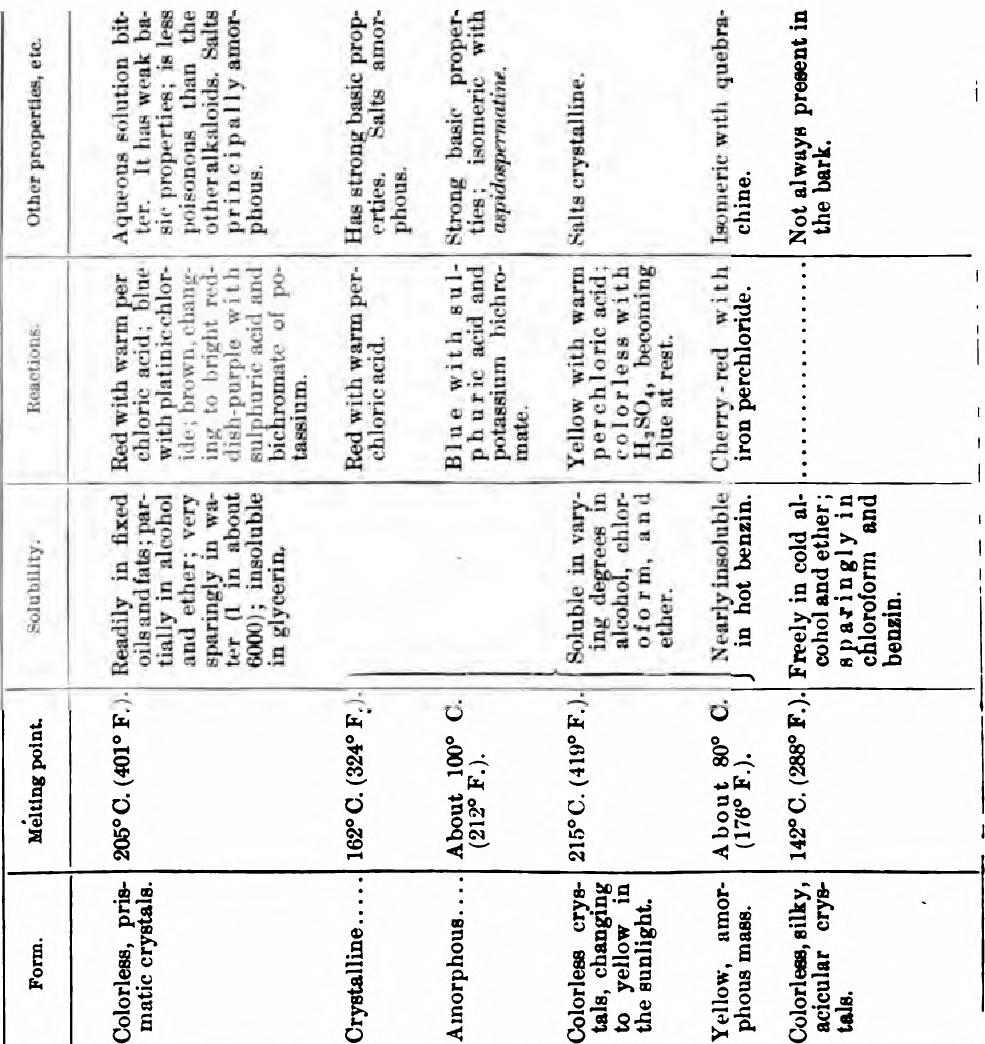
ASTER PUNICEUS. 308 Action, Medical Uses, and Dosage. — Quebracho is said to be valued as an antiperiodic by the Chilians. Wounds are sometimes dressed with the fluid extract. But its chief value rests upon its property of controlling dyspnoea, when not due to oi^anic changee. Some, however, contend that it is equally valuable when structural changes are pr^nt. It is valuable in both cardia/; and aaihmatic di/spncea, as well as in emphymnatous states. Being a stimulant to the pneumogastric it affects chiefly the cardiac and pulmonary plexuses, and is a remedy of marked value where there is evidence of imperfect oxygenation. The cases snow a disturbed relation between the pulmonic circulation and the action of the heart. In cardiac asthma it is reputed one of the best remedieSj and to relieve the distressing dyspnoea of capillary bronchitis, the latter stages er advanced bronchitis, asthmatic hronchiiis, and simple asthma, with insufficient cardiac power, it has been highly praised. Pure, uncomplicated asthma is not much beneflted by it, but asthma associated with emphysema is very promptly metby^it. The cough of la grippe^ with marked dyspnoea, yields to it. Dose of the fluid extract, from 5 to ^ minims, in water^ syrup, or syrup of tolu, every 2 or 8 hours; for specific uses, doses of 5 to 15 minims are preferred; of the tincture, 10 to 20 minims; of commercial aspidospermine, which is a mixture of the associated alkaloids, the dose varies from i to ^ grain. Specific Indications and Uses. — Dyspnoea of functional origin; dyspnoea with emphvsema, face pale, anxious, and livid, lips cyanotic; pulse small, soft, compressible, irr^^lar, or intermittent; orthopnoea; cardiac palpitation with cough. Selated Drugs.— £oa»pten/yiuT/i Lorenim, Grisebach. Nat. Ord.: Terebinthacese. _ The «ju^>rac^ Colorado of the Argentine Republic. The wood containsa large amount of tannin and a yellow coloring matter. Hesse obtained two alkaloids, both bitter iu taate, one being unnamed and the other known as lozopfeiwinf. The juice of the bark forms a resinous exudation not unlike kino, and ia Bidnble in ak»nol, wood alcohdi. acetic acid, acetic ether, acetone, and boiling water (Arete). Has been used as a substitute lor aspidoaperma, but is weaker in action. lodvna rhombifulia. Hooker and Amott. Nat. Ord.: Aquifoliacees. Qudtraeho^o. TTsed as above and often gathered with it. Mnrhsaitm /ertUe, Grisebach. NaL Ord.: Legnminosse. ■ Tipa tree. Uses same as preceding apecies. Crotonpmtdochina, Schlechtendal, Mexico. Source of Q^pakhi^xiTk, which is occsBionally sold as quebracho bark. ASTER PUNIOEUS.— BED-STALKED ASTBB. The root of the AOer punieeta, Linn6. Nat. Ord. — Compositfe. Common Names: Red-stalied aster, Cocash, Meadow scahish^ Squato-weed. Botanical Source. — The root of this plant is perennial and fibrous. It has a hispid stem, paniculate above, furrowed, generally red, or at least on the south side, stout ana tall, growing from 3 to 6 feet in height. Tlie leaves are oblonglanceolate, amplexicaul, more or less auriculate at the base, sparingly serrate in the middle with appressed teeth, rough above, nearly smooth underneath and pointed; the lower leaves have remote serratures, are rough-edged, rough on the upper surface, and all acuminate and narrowed at the base. The involucre is loose and longer than the disk; the scales linear-lanceolate, long, revolute, nearly equal, in two rows. The flowers are Ifurge, showy, of a pale-purple or lilac-blue cMor, having from 30 to 60 long, narrow rays. History and Description.— This plant is found mowing in various parts of the United States, in dwamps, ditches, along the borders of small streams, and sometimes in dry soils. It flowers from July to October. The radicles or fibers of the root are the parts used; they are'about the size of a pipe-stem, having a pungent, aromatic odor and taste, with some bitterness and astringency. Water or alcohol extracts their active properties. This species has several varietim — vimineiis, glaber^firmus, and mndiaua. The second variety and the candidna have white flowers. Action, Medical Uses, and Dosage.—Stimulant and diaphoretic. The warm infusion may be used freely in roMs, rheumaHamj wnow dOnliiy, headaehef
804 ATBOFINA. patna tn the ttomaeh, Minium, and menstmal impUarities, Thig, together with A. cordi/oHuBt has been oompaied m value with valenan. Infoflioii (^sb to aqua Qj) freely. B^ted to«clea.—.i4fer jeiftna, Alton; £A«umalio-toe«(2,Siiii9iMmmaJb^n^ raeemblei the above plant, haring biiceolate, subclaqting leaveis tapering to the apex; mamn roagh; stem branching from ita base, erect, hiapid: braochlets pilose; involucre scaly; scalee lax, linear, acute, equal. Flowers middle-siced, blue. It is found more abundantly west d the Alleghany Mountains, and is recommended aa an anti^taamodic and alterative. Prinripally naed in the cure of rhevanatiam in the form of infusion or tincture; recommended, however, in hytteria^ chorea, ^Uepey, tpatmt, irrtgular wmttraatUin, etc., internally; and used both externally and mtemally in many cutoneotu diaeoMo, the eruption occasioned hy the poiton rAw, and in the bites of venomons anafces. Doeeitf the infudon, 1 to 4 fluid ounces; of a satnrated tincture, } drachm to 2 dradime. This ^ant deserves farther investigation. Aaier oonft/oKui, Linnd. HearUeoBedaaler. United States. According to Haflneeque (JM Flora, II, 198), an excellent aromatic nervine, in many cases preferable to valerian." It is also reputed antispasmodic The root is the part used. A decoction has been used in rheumatirm. Alter Nom-ATi^iXf Linn^. Neto Engia$td otter. United States. A beautiful plant, espedaUy when cultivated. It has rose-purple, oocasionidly white flowers. Used in icin erupdoM snd valoable torpoiaoniiu/bypoiMn ntmaek (Bafinesqncu oa authority of Dr. Lawrence). hanena of toe United States. Summit nsoally oovond with insects (Porchez). Diuretic. Forhcla: CuHnNO,. Moleculab Weight: 288.38. Bymonym: Atrmia. "An alkaloid obtained from belladonna. Ae it occurs in commerce it is always accompanied by a smali proportion of hyoBcvamine extracted along with it, from which it can not be readily separated " — ({/. S. P.). Preparation. — An easy process for the preparation of atropine is as foUowe: One pound of the dry leaves of belladonna are to be boiled in distilled water sufficient to cover them tor 2 hours, and the decoction strained off through a coarse cloth into a lai^ precipitating jar. The leaves are again boiled in a second watt-r and the decoctions mixed, to which 2 drachms of strong sulphuric acid are now added; the vegetable albumen is precipitated, and the clear liquor is drawn off with a siphon to a filter. A clear, sherry-coloi^d solution comes through, which is either decomposed by passing gaseous ammonia through it, or by adding commercial carbonate of ammonium. In either case the color becomes changed to black, and crystals of atropine are slowly formed. At the expiration of a d&y or BO the supernatant liquor may be drawn off with a siphun, and the crystals thrown on a filter to dry. To decolorize them, about 1 onnce of spirit of ammonia may be poured on the filter, which washes away most of the coloring matter, leaving the crystals moderately white. Purify by dissolving in boiling alcohol and recrystallizing. Bonchardat stetes that bv dissolving crude atropine in acidulated watw, and then adding an alkaline carbonate to neutralize the acid, a deposit of resinous matter occurs at first, succeeded by a pulverulent precipitate, which is alkaline; this is atropine (though by some has been considered as a distinct subetfuioe), and has sometimes received the name of belladonnine. DeBCription and Tests. — The Pharmacopoeia thus describes atropine: White, acicular crystals, or a more or less amorphous, white powder, without odor, having a bitter, acrid taste, and gradually assuming a yellowish tint on exposure to air. Soluble at 15° C. (59° F.) in 130 parte of water, 3 parte of alcohoL 16 parte of ether, 4 parte of chloroform, and about 60 parte of glycerin. At about 108° C. (226.4° fV) it melte, forming a colorless lic^uid; at about 140'* C. (284° F.) it begins to give off^ white, acrid fiimes, and, when ignited, it is consumed without leaving a residue. It has a markedly alkaline reaction; ite saturated aqueous solution acquires a pink color upon uie addition of a drop of phenolphtalein T.S. If a small quantity of atropine, or of one of ite salte, be heated with a few cubic centimeters of concentrated sulphuric acid, a peculiar odor recalling that of a mixture of rose, orange-fiower, and melilot will oecome noticeable. On now gradually adding minute fragmente of potassium dichromate the odor will change to that of oil of hitter almond, the rose odor disappearing as more dichromate is added. Atropine and ite salts are decomposed by proloi^d contact with sodium ot potaeATEOPINA (U. S. P.)^TBOPIHB.
AT&OPINJR SULPHAS. 306 Binm hydnte, and if heated with either of them evolve ammonia. On diseolTing a email anantity (about 0.1 Gm.) of atropine in 2 Cc. of alcohol, and adding an equal volume of mercuric chloride T.8.; a yellow precipitate, which soon turns red, is produced. On adding concentrated sulphuric acid to atropine no color should be produced (absence of readily carhonizable, organic impurities), nor should any color be developed by the subsequent addition of nitric acid (absence of and diffsrence from morphine). The aqueous solution of atropine, or of any of ita salt^ is not precipitated by platinic chloride T.S. (difference from most other alkaloids). With gold chloride T.S. it gives a precipitate whidi, when recr^stallized from boiling water acidulated with nydrochloric acid, is deposited, on coolmg, in minute crystals, forming a yellow, lusterless powder on drying (diffei^ ence from and absence of more than a smal I proportion of tiyoscyamine " — ( U.S.P.). The test above referred to, regarding the variuty of odors produced as directed, is, beside the physiological (mydriatic) test, nrobably the most stritdnff and reliable test for this substance. Manganese binozide and potassium bichromate do not produce, with a sulphuric acid solution of atropine, a blue or purple color, thus showing the difference between this substance and MryckniM. Its salts dissolve in water and alcohol, but are not soluble in chloroform and ether. Ohemical Oomposition.— The principal alkaloids contained in Atropa BeUadonna^ as atropine,^ nyoscyamine, hyoscine, and belladonnine, also atropamine, are substances which bear a close chemical relationship to one another, being partly isomeric and capable of being tranjrfbrmed into one another, e. g., hyoecya* mine into atropine (Scnuette, 1891; O. Hesse, 1894). Jtropins and hyoscyaminey both of the formula, CuHnNOi, are capable of being resolved into the alkaloid tropine (CgHuNO) and tropic acid (GsHuOs) by treatment with bairta-water, while kyoscine, under these conditions, is split into jpaeudctrvpine (C,HuNO), melting at 106° C. (232.2** F.), and tropic acid. If in these processes concentrated hydrochloric acid is employed atro]ne acid (C«H^) and its polymer, ieairmaic acid (CuH^O are formed, besides tropic acid. These reactions were first estabushed by Kraut, in 1863, and Lossen, in 1866, and subsequently studied in detail by Ladenburg and other investigators. Tr<^w was found to be a pyridine derivative, viz.: oxu-ethylmethyl -tara kydro^yndine (C|H|N.[C|H/)H].CH8). It is a strong, tertifury oase, forming hygroscopic crystalB, which melt at 62*> C. (143.6** F.) and boil at m"* C. F.). They are easily soluble in aloohol and water: sJso soluble In ether. Heated with ftuninc hydrochloric acid to 180° C. (356° F.) or acted upon by sulphuric acid and glacial acetic acid, the base <roimfi7ie, containing 1 molecule less of water, is formed, having the composition C,1U(Ct'SI^)^.CKs, boiling at 162° C. (323.6* F.\ and resembling coniine in odor. In 1880 Ladenbura recc^ized tropic acid to be A-phenylB-oxypropionio acid (CH^H.CHC8H,.C00H). It is soluble in alcohol and ether, to some extent in water, from which solvent it crystallizes in needles or plates, melting at from 117** to 118° C. (242.6° to 246,2° F.), Ladenburg, in 18S4, succeeded in obtaining atropine by synthesis from its products of decomposition by evaporating a mixture of tropic acid and tropine with hydrochloric acid. By substituting other aromatic acids for toopic acid Ladenburg, in 1884, made known a series of synthetical alkaloids, to which he gave tiie name tropeinest of this series tropine being the common basic constituent. Homairomne (CwHnNO^ he obtained by the action of tropine upon manddie add (C«H,.CHOH.C(X)H) in the presence of hydrochloric acid. (For the chemistry of belladonna alkaloids, also see Belladonna.) Action and Usei. — (See Atropime Sulphas,) ATBOPIN.fi SULPHAS (U. S. P.)~ATSOPnnE SlTIfHATE. Fobmula: (C,iHbN08)|H,804. Molecdlah Weight: 674.68. Synonym: Sulphate of atropia. Preparation. — Sulphate oi atropine may be made by dissolving 30 grains of atropine in 18 fluid drachms of pure ether, and then, adding to this, drop by drop, a mixture of 3 grains of sulphuric acid, and ^ fluid drachm of aloohol (specifio gravity, 0.817), which forms a milky fluid, continuing the addition of the ao
306 ATROPINE SULFHAa mixture to saturation of the atropine. Then set the liquid aside, and when there is no further precipitate pour on the supernatant ether, and allow the residue to evaporate spontaneous^ to dryness (M. Ch. Maitre). In this process all the fluids used should -be free from water, and the whole manipulation should be conducted in a cool place; the ether will hold any excess of acid or alkali^ which, however, may be neutralized by adding a little more atropine or acid, as required. Description.— Atropine sulphate is in the form of "a white, indistinctly crystalline powder, without odor, having a very bitter, nauseating taste, and permanent in the air. Soluble at 15^ C. (59° F.) in 0.4 part of water, 6.2 parts of alcohol, 2270 parts of ether, or 694 parts of chloroform. At 187° C. (309^F.) the salt melts, forming a brownish-yellow liquid. When ignited it chars, emits acrid vapors, and is completely consumed. The salt is neutral to litmus paper. On adaing sodium carbonate T.S. to a concentrated aqueous solution of the salt a white precipitate is obtained, which should respond to the reactions and tests given under Atropine (see Atropina). The aqueous solution of the salt yields, with barium chloride T.S., a white precipitate, insoluble in hydrochloric acid" — (U. S P.). Atropine sulphate or its solution should strongly dilate the pupil when applied to the eye. This salt is soluble in about 3 parts of gl^^cerin. Action and Toxicology. — The action of belladonna and its chief alkaloids is practically identical, except in degree and rapidity. The first effect of very small doses is to cause dryness and constriction in the throat, with possibly slightly- disordered vision and unpleasant sensations in the head, with vertigo and confusion of ideas. Larger doses occasion mydriasis, with dimness of sight, quickened breathing, frontal headache, with mild delirium, and in some individuals a flushing of the surface with a rash closely resembling that of scarlatina, though lacking the punctations of that eruption, and rarely causing desquamation. If toxic doses be taken these symptoms are intensified. Dimness, or total loss of sight, and extreme pupillary dilatation, with brilliant, staring eyes, headache, and a peculiar delirium ensue. The latter consists of fancies and illusions, hftUucinatioDS, and other phantasmagoria, with laughter and gayetv, or the cerebral disturbance may lead to violent and mrious delirium, with fignting propensities. The respiration ia decidedly increased, as well as the frequency of the pi^lse, which is now hard and small, and the body temperature rises fromJt° to 1** F. The latter foils, however, when vaso-motor paresis takes place. These symptoms are followed by a well-murked second, or paralytic stage, with muscular weakness, and incoordination and motor paralysis, though sensation is not lost^ but is, in a measure, diminished. Stupor, collapse, with feeble pulse, cold surface, and shallow, weak respiration supervene, and death takes place by exhaustion of the powers upon which the circulation and respiration depend, aspb;^xia preponderating as a cause of death. Narcotism never occurs, and convulsions rarely. It will be observed that full medicinal doses cause a febrile state, while toxic doses paralyze. The rapidity of the heart's action is due first to stimulation of the sympathetic cardiac ganglia, and secondarily, to paralysis of the terminal filaments of the vagus — a state of increased motor activity with decreased inhibitory power. The capillaries are contracted, but in poisonous doses dilated, allowing a fall of blood- pressure, and being due to paralysis of muscular layers of the vascular coats. Owing to vaso-motor paresis, the temperature £a11b from toxic doses. Atropine causes mydriasis when taken internally by being carried in the blood-current directlv to tne eye and there acting, as when locally applied, by causing paralysis of the terminals of the oculo-motor nerve, and it is thought also by stimulating periphereal filaments of the sympathetic. Small doses of atropine, while probably causing primary dryness of the gastro-intestinal tract, subsequently induce secretion, as is shown by the slight laxative effects of it and belladonna. It also increases tissue waste, and is eliminated almost wholly by the kidneys; and the urine so charged is said to be capable of dilating the pupil of another subject. The voluntary muscles are but little or not at all affected by atropine. A livid or cyanotic countenance is seldom observed in poisoning by atropine. After death the heart, lungs, and brain are found to be overchai^d with blood. The treatment in atropine poisoning is the same as for belladonna poisoning. Onehalf grain killed a miadle>^ed man, death singularly being delayed until the sixth day; 1 grain hypodermatically proved fatal to snotherCsee BeUadoma).
ATROPIN.E SULPHAS. 807 Medical Uses and Dosage. — As a general medicinal ^ent atropine may be used in ca^ee requiring belladonna, governing the dose accordingly. Such uses will be those named under belladonna. However, it does not full^' represent the parent drug. There are certain cases, however, in which atropine will be preferred; iQ some on account of its special adaptability; in others for its prompter action. It is a powerful stimulant to the vaso-motor centers and to the capillary circulation. It has at least four well-defined fields of action, viz.: to relieve purely nervous pain; to relieve painful spasm of the involuntary-muscles; to arrest excessive secretion of saliva, perspiration, and milk; and as a mydriatic. In varions forms of neuralgia, where the pain originates in some nervous disorder it acts magically. Thus it is useful, in the order named, in interrogtal, trigeminal^ and seiittic neuralgia. It often fails in the latter, and the dose must be large to ^ ^rain). In neuralgia of the stonutrk^ ovaries, uterud, and in other visceral neuroses it 18 an efficient remedy. In most instances it should be subcutaneously employed. By combining it with morphine when this is subcutaneously injected (say X of a grain of atropine) it prevents the faintness, nausea, and tendency to retching occasionally produced by the morphine alone. Atropine sulphate, in from 2 to 4 per cent warm solution, has been instilled into the ear for the relief of pain in earache, nonsu^^rative otitis media, and in diffused inJlamvicUion oi the aural canal. Atropine is specifically antagonistic to excessive secretions of'^ saliva and sweat, hence it is of much value in ptyaiism and in the colliguntive sweats of phthisis, hectic and other conditions of debUity, The dose Bhould be about ^ain. The value of both belladonna and atropine is well established as remedies to check the Tmrnmnry secretions. Hence it is used both locally and internally. Atropine sulphate gives prompt relief to <pa«m of the sphincters and tubular organs of the body. It is chiefly in ophthalmic practice that atropine has gained laurels. It has, however, been objected to on account of the conjunctival irritation and oedema, as well as the dangerous ocular tension sometimes produced, which mav imperil the safety of the eye. More recently it has been replaced, to a considerable extent, by homatropine, which is said to be free from some of the disadvantage attending the use of the former. Sulphate of atropine in solution is preferred to any other salt of this alkaloid for parcuyzina the power of accommodation, and for dilating the pupil of the eye, whenever such dilatation is required; but for this purpose the siut must be pure and perfectly free from acid or alcohol, else it is apt to occasion more or less irritation. That made according to the preceding formula with ether will be found advisable. The habit of orderiiu; a solution of atropine, to which a few drops of sulShurio acid are to be added! is objectionable on the above account, when it is esigned for application to the eye. An atropine gelatin has been made for the purpose of dilating the pupil, and which is preferred by some oculists to the solution. It consists of a thin layer of gelatin, with which has been mixed some sulphate of atropine. This layer is-marked out into discs or squares, each one of which contains about of a grain of sulphate of atropine. One of these discs placed upon the eye, between the ball and the lid, dissolves rapidly and causes dilatation. When it is desired to paralyze the power of accommodation it is prepared of greater stren^h (see also Lamellse Atropine — Br.). It is largely used where inspection of the interior of the globe is sought, and in. such operations as cataract, etc It is a very valuable agent, but may do irreparable injury if inappropriately used. Glaucoma always contraindicates it, and in old people more or less danger attends its use, and even glaucoma may result from it. It is also contraindicAtedinphlydeiiular keratitis after subsidence of the acute phases; inmarg iital corneal ulcers; in keratitis with superficial vascularity, and in all cases of overfffision of the ocular globe. On the other hand, it is the remedy in irit is, from start to finish, and in central p^forating corneal ulcers ii^oxiXA be used Sufficiently strong and often to insure continuous ciliary paralysis, thereby insuring full dilatation of the pupil, and in the latter instance preventing the iris from adhering to the ulcerated cornea. After operations for catarart, iritis, as a complication, is averted by the use of atropine, and it should be employed also in deep, interstitial kerat^ia. Jntentuitentetrabismtts and consequent eye-strain, as well as chorea from eye-strain, have been corrected by this drug, followed by the selection of the proper lenses.
808 ATROPINE BCLPBAS. In the acuU stajge ot phlyctenular keratitis it may be employed to check the flow of tears and sensitiveness to light, discontinuing the dru^ as soon as the active inflammation has been subdued. Haziness of tne cornea in ophtludmia neonatorum is the danger signal in this trouble, and the prompt use of atropine sulphate will prevent involvement of the corneal and deeper sUuctures of the eye. As an eye remedy it may be used as the exigencies of the case demand. Foltz uses, B Atropine sulphate, grs. ss to grs. xvi; water, add flSi,the stronger solutions to foe used 0^ the pnysician himself. A solution not stronger than 4 ^ains to the ounce is dispensed, to be used by the patient 3 times a day. Dilatation is produced in 10 or 15 minutes, and usually persists for 3 or 4 days. Both atropine and belladonna are antagonistic to opium, poiaoniiuf, and have been used as strong as grain every hour K>r 5 hoars. It is also antB^nistic to eseririe&ndpilocarjnne, SLndhuaheen successfully used in stryehnine f>oisoning And chloroform and aher iiarcoais. Fraser used it Ijiw ^ ^ grain) with morphine sulphate (i to grain) hypodermatically before antesthetizing with chloroform, claiming that it lessens the excitement, takes less chloroform, and longer sustains the action of the latter. Sulphate of atropine (x^b grain) placed directly ui>on the sensitive pulp of a tooth is said to promptly check the pain, and a solution has been applied to (;a7icm}»«u^0 to allay pain. Sulphateof atropine, on account of its ^ater solubility, is preferred to atropine itself, and both are given in the same-sized doses, to p^ain, the lai^er doses only in extreme cases, as in narcotic poisoning. The solutions should be fresh, as they are apt to develop fungoid growtns, with decomposition of the alkaloid. An ointment containing 3 erains of atropine sulphate rubbed upon an ulcer of the neck is said to have produced death in 2 hours. Sulphate of atropine is generally used in solution in hypodermatic injection^ the quantity injected at a time varying from to -j^ of a grain of the salt. The solution may be made by dissolving 1 ^rain oi the sulphate in 4 fluid drachms of distilled water; 4 minims of this contain ^'^ of a grain of the salt; the amount to commence with is 2 minims, which may be cautiously increased to 3or4 minims. Dr. A. Fleming preferred the following solution of atropine for internal use: Take of atropine, 1 grain; distilled water, 5 drachms. Dissolve thoroughly with the aid of a few drops of diluted hydrochloric acid, and add of rectified spirit sufficient to make 10 drachms. This solution keeps well, is of uniform strength, and is much safer and more efficient than some other preparations of belladonna. Ten minims contain >^ of a grain of atropine, which is the commencing dose for an adult; it should oe given in a little water, once daily, at bed-time, and on an empty stomach. The dose may be increased daily by 2 or 4 minims until some of the physiological effects are slightly produced, as dry throat, dilated pupil, and dim sight For children under 1 yearthedose is 1 minim; of 2 years, 2 minims; of three years, 8 minims, and so on. up to ten years, when 10 minims may be given. It is, however, too dangerous, as an internal medicine, for children, minute doses of belladonna being preferable. Atropine should never be given in pill form, lest from sliw or deficient solution it may accumulate in the stomach or bowels, giving rise to severe atropism. Belated Salts of Atropine. — Atropine Valbrianas. Vttlerianate of o/roptne may be made by disBolviog a siifBcient quantity of monohydrated valerianic acid in a sufficient quantity of pure ether, Baturatine this solution with atropine, and allowing theli<^uid to Bpoutaneously evaporate. The salt isdepoeitett in the form of light, white scales, consiating of a massof Bniall eryetals, which is very soluble in water, less so in alcohol or ether, which foses at 32.2"C. (90^ F.) and becomes yellow by exposure to light and air. M. Michea recommended the valerianate of atropine in ipatmodic or eonvuUive digetuea, m doses of a milHgrame per day fpr an ulult, on commencing its use; he considered it superior to either valerian or belladonna, on account of its email dose and its certainty of action. It is also recommended in various chronic wrroiis oomplaiutt. The dose is to f-^v of a grain, repeated 2 or 3 times a day. Atropine salicylas. — Salici/late of atropine forms in deliquescent, non-crvstalline, colloidal masses, soluble in water and alcohol, and must Vx- kept in securely-stopperea bottles. It may be prepared by taking a little more than 2 parts (288 grains) of atropine and 1 part of salic^iiiacid (137 grains) and disaolvingthem in water (20 ounces), and gently evaporating the solution. When pure it is reputed to act more efficiently and with jrreater 'rapidity than sulphate (tf atropine. The dose is the same as for the latter palt. Atbopina 8ANTO.VICUM. — Atfoitine mnlorutti' is formed by the union of atropine and Kantonifl aeid. It forms an amorphous powder unaffected by atmospheric moistare, but dfissolveK
AUBANTU AHABI OOBTBZ. 809 with fauiiity in water, fonAing a Bolntion which, If kept in amber-colored vials (prevents fonnation of photo-santonic acid), andergoes no change, hence its advantage over the other salts of atropine. Another advantue is that it is said to be perfectly unirritating. For SeopoKne see Boated FrodueU, ander Bdhdonna; see also Homatnpine hffdrobroauUe. Babtad Species and FrinclplbB.—BMtedra mi^m. Japan. A plant of the order Geutianse, from which Nanii of Tokio isolated the alkaloid ephedrine (CvHuNO). The latter body prodttcea death in the lower animals by both cardiac and respiratory paralysis. It ia a local mydriatic, producing, in 10 per cent solution, an incomplete dilatation of toe pupil in from jt to 1 hoar, the n<n>mal condition being regained in from 6 to 20 hours. The accommodation IB acaroely affected. It is not likely to come into general use. ^^eira tnonottadtya, Linn£. — Root and branchee need in Siberia in mphiUt and gout. The alkaloid, according to Kobert, is non-toxic and non-mydriatic, and ther^ore unlike qAedrme. This view is supported by P. Spehr {Amer. Jour. Fharm., 1892), who finds the alkaloid to be distinct with the composition CuHnNO, white that of ephedrine is GidHuNO. ^^tedra av^xmhiiHica, C. A. Meyer. — Mormon tea, MoarUain nuh, Whore-houte tea, Brigham weed, rfevada- Used in gonorrhcta in doses of 1 to 2 fluid drachms of the fluid extract The medicinal activity depends, in the opinion of Loew, upon a tannin. GuDiTSCHiNK.— Dr. Lautenbach (187$ found this alkaloid in the GUdiiechia triaean^u» and Qlediitchiaferox. The same alkaloid was afterward introduced under the name ttenocarpme before it was known to be the product of O. triacaalho$. The former name was then restored. The alkal<^ was introduced as a local anaestbetic andmydriatic. A solution at one time upon the maiket was shown to contain cocaine in oouiderabre amounts, besides some atropine or a, nmilar mydriatic, since which gleditscbine has fallen into disrepute. Trrahydbo-B-vaprthtIiAHIiib (CioHtU4.NH|). — An extraordinarily powerful local mydriatic, s^ to be even more powerfnl than atropine. A 1 to 6 per cent solution is need (Filehne). AUUHTn AHABI OOBTXX (U. 8. P.)— BXTTEB OB&HaE PEEL. " The rind of the fruit of Citrus vulgaria, Risso S. P.) CCHtrut Aurantium, Tar. amara^ Linn^; Citrus Bigaradta^ Dahamel). Nat. Orrf.— Rutaceee. CoHMON Names: - Bitter oramge, Bigarade orange^ SevUU orange. Illustration: Bentley and Trimen, Med. /%into, 50. Botanical Source. — The bitter orange tree is scarcely distinguishable botanically from the sweet orange tree (see Aurantii DiUcis CoHez), except in its leaves, frui^ and flowers. The 1^ BtaXi. of the bitter orange is more broadly winged, and the fruit itself of deeper hue of red, having a rougher rind, and a bitter, sour juice. Added to these characteristics all portions of Uie bitter orange emit a greater fragrance than the same parts of the sweet variety. By some botanists this tree is regarded merely as a variety of the CHtnta AurartHum of Linn6 (see AurarUii JhUcw Cortex). Description. — I. The Rind {Aurantii amari eortez). The U. 8. P. describee bitter orange peel as consisting of " narrow, thin bands, or in quarters; epidermis of a dark, brownish-green color, glandular, and with very little of the spongy, white, inner layer adhering to it; it has a fragrant odor, and an aromatic, bitter taste " — ( U. 8. P.). (For further information r^arding bitter orange, see Aurantii Dtdcia Cortex.) It is official in E^etradum Aurcmiti Amari f^uidum and in Tinctura AuranHi ATnari of the U. 8. P. n. Thh Fruit (Fhictue auraTUii)^ when ripe, is about the shape and size of the common sweet orange, is darker in color, rougher, and has a white parenchyma beneath the rindj and the juice of the pulp is bitter and sour. Orangettes {petit graiiiM) are the unripe fruits which drop from the trees, and are considerably used on the continent under the name of orange berries. They vary from ^ to 1 inch in diameter, are of a greenish or brown-black color, closely wrinkled, and pleasantly aromatic both in taste and odor. Ill, The [jEAVes (Pb/ia auraTitii). — These are borne on a jointed, broadlywinged petiole, and are smooth, oblong-ovate or ovate, nearly entire, or having a slightly crenated margin. They are aromatic and have pellucid oil-glands scattered throughout the blade. Chemical Composition. — A bitter crystalline body was isolated in 1828 by Lebreton and named hemeridin. It exists in the white parenchymatous tissues of both the orange ana lemon rind, but is found in greatest abundance in the unripe Seville orange. It occurs, wnen purified, in wnite, acicular crystals, practically insoluble in water, even when hot. (1 in 6000 of boiling water). It
310 AURANTU DlTIiCIS CORTEX. dissolves In boiling acetic acid and in alcohol, but refuses to dissolve iu ether, fats, essential oils, and benzol. Treated with diluted acids it is split into grapesugar and hesperetin, insoluble in alcohol. Hesperidin fuses at 245° C. (473° F,); hesperetin at 223° C. (433.4° F.). A substance analogous to tannin, gum, resin, albumen, fixed oil, and an essential oil (see Oleum Auraraii Chrticia) have also been found in the rind. The juice of the orange consists chiefly of sugar, mucilage, and citric acid. Tanret (1886) found in bitter orange peel a bitter, acrid resin, a crystallizable, tasteless acid having the formula CmH^mi hesperidin, an isomeric glucoside (iaohe^eridin, CtJi-tfin^^^^) o.nd another glucoside (aurantiamarin)^ to which he attributes the bitterness of the rind on account of ite solubility in water. Action and Medical Uses. — (See Aumntii Dulcu Cortex.) AURANTn DULCIS CORTEX (U. S. P.)— SWEET ORANaE PEEL. "The rind of the fresh fruit of Citrm Aurantium^ Linn^" — (U. S. P.) (CUrua dulcia, Link). Nat. Ord.— RutacesB. CouHON Names: SweU orangey Portugal orange^ China orange. Illustration: Bentley and Trimen, Med. Banto, 51. Botanical Source. — Citrus Aurantium is a middle-sized evergreen tree, with an arborescent stem, covered with bark of a greenish-brown color, having axillary spines on the branches. The leaves are alternate, ovate-obiong, acute, slightly serrulated or entire, -shining green, the stalk more or less winged. The flowers are large, white, rendering the atmosphere around very fragrant; the calyx urceolate and 5-cleft: the petals 5, oblong; the stamens 20 or even more; the filaments compressed at the base, more or less united there, and polyadelphous; the anthers oblong and yellow. The ovary is many-celled. The fruit is roundish, goldenyellow or tawny, and several-celled, with a fleshy, juic^ pulp; the seeds white and several. The cysts in the rind are convex ^L.). Description, History, and Chemical Composition.— The orange is a native of Asia, and is cultivated in the southern parts of Europe and America and in the West Indies. Its varieties are numerous. The Cltnu AnnntlQiiL fruit likewise varies in its character, that of the C. Atirantium, the China orange, being sweet, while that of the C. ruiparis, the Seville orange, is acid and slightly bitter. The ordinary commercial oranges are subvarieties of the sweet orange, and usually take their names from the country where grown, or the shipping ports from which tiiey are sent out. Some varieties are seedless, as St. MichaeVa orange, and generally the Navel orange of Brazil; another variety having a reddish pulp is known as the Shod orange or Maltese orange. The Mandarin orange differs considerably from the common orange, and on account of its delightful fragrance and flavor the name Citrua delicioaa has been proposed for it hy those who regard it as a distinct specie. The leaves of the orange are studded with vesicles containing volatile oil, and have a bitter, aromatic taste, and when rubbed between the fingers are very redolent They, together with the young twigs, yield by distillation an oil termed essence de petit grain. The original oil bearing this name was distilled from orange berries. It does not differ chemically from orange-oil, though it has a different odor. An infusion of the leaves is sometimes employed as a gently-stimulant diaphoretic. The flowers have a delicious fragrance, which is imparted to the surrounding atmosphere, but which is loft by drying; those of the bitter orange are considered the most delicate. They owe their aroma to an essential oil, which may be obtained by distillation; it is termed oil of nerolL and is much used in perfumery. An ora/nge flower wal^ is prepared in Italy and France, which is quito pale, has a rich odor of the flowers, and a bitterish, aromatic taste; it is employed
AITRANTII FLOREB. 811 for the purpoeea of perfiimery, although reputed to possesB antispasmodic virtues. The peculiar fragrance of the flowers may be preserved for a long time by beating them into a pulp with one-fourth their.weight of common salt. The juice of th« orange consists chiefly of sugar, mucilage, and citric acid. The outer rind of the mature fruit is the official part, the inner being destitute of useful properties, and the two should always foe separated from each other when drying the rind for medicinal purposes, as the spongy, inner rind is apt to occasion moldineee from its absorbing moisture from the air. Orange-peel has a deep orange color, a grateful aroma, and a pleasantly bitter taste, the Seville variety being more bitter than any other. It contains a volatile oil in visible vesicles, mostly lost in dryiD|[, a saccharine principle, Aespertdm, and a ligneous fiber, agreeing in composition with bitter orange peel, though containing a lesser amount of the bitter principle. The fresh rind, grated and expressed, will yield the volatile oil, or it may be obtained by distilling the fresh rind with water. Water or alcohol takes up the sensible properties of the rind. The finest orange oil, which must not be confounded with the oil of neroli, is obtained from Portugal, and is prepared from the rind of the sweet orange. It has a pale straw tint and a rich fragrance of the rind. It is imported in tinned copper cans, and is much used in perfumery and for other purposes. On exposure it spoils rapidly, acquiring a turpentine odor. When about the size of a pea or cherry, the bitter fruit is sold under the name of orangeUe$j that variety coming from the isle of Cura9iu) being known as Cura^oi onmges; and the small ones are sometimes used to maintain the discharge from issues. The U. 8. P. describes the official drug as "closely resembling bitter orange peel, but having an orange-yellow color. It has a sweetish, fragrant odor, and an aromatic, slightly bitter taste." It is used in the preparation of Syrupus AurayUii and Tinctura Aunuaii Dulcis of the U. S. Pharrruicojxxm. Test. — A test to distinguish orange peel from lemon peel was recently proposed by E. G. Clayton. It consists in moistening the rind with strong hydrochloric acid. The orange peel is stated to acquire a rich, dark-green tint, while lemon peel assumes at most a dingy, yellowish-brown color {Amer. Jour. Pharm.. 1894). Action, Medical Uies, and Dosasro. — Orange peel is aromatic and slightly tonic, but is seldom used except to cover the taste or disagreeable medicines or to lessen their tendency to nausea, and for these purposes it is frequently added to bitter tinctures, infusions, etc., as quassia, Peruvian bark, etc.; though care should be taken not to subject it to long boiling on account of its oil, which will thus be dissipated. As a tonic tiie rind of the ^ville orange is preferred; its dose in substance is from 30 to 60 grains 3 times a day. La^. quantities of it have caused violent colic, convulsions, and even death. The juice of the orange is not only a light refrigerant article of diet, but has a direct beneficial medicinal influence in several diseases; as in all and etmXhevMdom diseases, where acids are craved, and the patient's tongue is coated deep-red, brown, black, or any intermediate color; in such cases its free use may be allowed with advantage; it is also useful as an antiscorbutic in scurvy. In administering the juice the membraneous portion should always be carefully rejected (see also Aurantii Flores). AUBANTn nOBES.— OKAVGE FI-OWEBS. The fresh flowers, partially ezi>anded, of Cilnts Aurantitm^ Linn£, and Oiinu vulgariSt Risso. NaL Ord.— Butaceae. Description. — Orange flowers are composed of a small, <H>tyloid, 5-parted calyx and 5 white, fleshy, oblong, obtuse petals, which are dotted here and there with glands. The^ are about ^ inch in length. The filaments of the stamens, which are about 20 in number, are united below into bundles (3, sometimes more). The ovary, which is globular, rests on a disk, and is surmounted with a ronnd style, capped with a globe-like stigma. The odor of orange flowers is exceedingly and pleasantly frngrsnt, the bitter variety possessing this quality more than the sweet (HTange. They have an aromatic, bitterish taste. When dried the petals are oi a pale, brown-white color. The flowers may be preserved for some time by adding
312 AURI ET 80DU CHLORIDim. to them half their quantity (by weight) of common salt, and pressing them into a jar, which should then be securely closed and kei>t in a cool, dark situation. Ohemical Composition.— Orange flowers contain an essential oil (see Oletim AuraTUii Florwm\ acetic acid, gum, salts, and bitter extractive (BouUa^, 182S); the bitterness of the latter is thought to be due to haiperidin, (see AvmntU Amari Cortex). Action, Medical V»W, and Dosage.— Orange flowers are used in the preparation of orange-flower water, which ma^ be employed as a vehicle for the administration of medicines. It is slightly stimulant to the nervous apparatus, and is said to have proved beneficial, in (loses of 1 or 2 fluid ounces, in chorea^ k^UnOy epilepsy^ and many other nenxna duorders. AUBI ET soon OHLOBIDUIK (U. S. F.)— OOLD AHD SODniK OHLOBIDB. "A mixture of equal parts, by weight, of dry gold chloride (AuCl3=302.81) and sodium chloride (NaCl=58.37). It should be kept in well-stoppeied vials"— (U. S. P.). Synonym; Chloride of gold and sodium. Preparation. — 1. Dissolve 4 parts of gold in nitro-hydrocbioric acid, evaporate the solution to dryness, and treat the dried mass with 8 times its weight of distilled water containing in solution 1 part of well-dried, common salt. Evaporate the solution nearly to dryness, stirring all the time with a ^lass rod (Fignier). 2. Dissolve 85 parts, by weight, of chloride of gold (auric trichloride) and 16 parts of chloride of^ sodium in a small quantity of water: evaporate the solution by a gentle heat until a pellicle forms, and then put aside to crystallize. As prepared by the French ftrom proper proportions of solutions of auric trichloride and sodium chloride, and evaporated to crystallization, it forms in yellowish-red, permanent rhombic crystals or the competition NaCl.AuCls.2H/). In this country it is most generally prepared by dissolving equal weights of gold chloride and sodium chloride and evaporating to dryness. Description and Tests. — The crystallized double salt is in the form of prismatic^ quadrangular, and elongated crystals, of a very bright*yeUow color, permanent in the air, unless they contain uncombined trichloride, when they are slightly deliquescent. They are soluble in water. When heated they give out water, and then melt, and at a red heat give out chlorine;- but it requires a very long-continued application of heat to drive off the whole of the chlorine. Thesalt moregenendly employed is that of the U. S. Pharmacopoeia^ which should agree with the following description uid tests: "An orange-yellow powder, odorless, having a saline and metallic tas^e, and slightly deliquescent in damp air. The compound is very soluble in water, and at least one-half of it should be soluble in cold alcohol. When exposed to a red heat it is decomposed, and metallic gold is separated. A fragment of the compound imparts a persistent, intensely-yellow color to a nonluminous flame. Its aqueous solution has a slightly acid reaction, and yields, with silver nitrate T.S., a white precipitate insoluble in nitric acid. On bringing a glass rod, dipped into ammonia water, close to a portion of the compound, no white fumes should make their appearance (absence of free acid). If 0.5 Gm. of gold and sodium chloride be dissolved in 50 Ccof water in a porcelain capsule, the solution acidulated with 5 Cc. of diluted sulphuric acid, and, after the addition of 1 Gm, of pure oxalic acid, heated for about 2 hours on a water-bath, a precipitate of metallic gold will be obtained, which, when washed, dried, and ignited, should weigh not less than 0.15 Gm. (corresponding to atleast 30 per cent of metallic gold). The filtrate from the precipitated gold should not be affected by hydrogen sulphide T.S., nor, after being supersaturated with ammonia water, by ammonium sulphide T.S. (absence of metallic impurities)" — (U. S. P.). Of all the preparations of gold, this is the most to be relied upon. When taken into the system, being a soluble salt, it is excreted and passed off by the skin and kidneys, principally the latter. It is incompatible with most va^table and mineral acids, earths, most vegetable juices, and the oxides or salts of^other metals. The simpler the form in which it is prepared for administoation, the less liability will there be of its decomporation.
AURI ET BODH CHLORIDUM. 813 AotUm, Hedieal Vses, and Dosage.— The salta of «>ld closely reeemble those of mercury in their effects upon the human system. The chloride of gold is caustic^ and even more poisonous than corrosive sublimate. An erethism, not unlike the fever of mercurialism, is said to be produced by its long-continued use, and the sexual functions are said to be stimulated by gold preparations. Brom ide of gold is twenty or more times as powerful as the commonly employed bromides. The chloride of gold and sodium has been found by Bartholow to have a marked action when long continued in causing a waste of connective tissue, a fact taken advantage of in certain diseases chazacteriEed by an oveMkbundance or over-production of that tissue. Among the effects of anric preparations are the following: Small medicinal doses promote the appetite ana digestion^ but their long-continued use induces constipation. Full dosesoocasion gastric irritalttlitT, nausea, and anorexia. Long continued they produce a tevex (auric fever) witn colliauative sweats, marked diuresis, and ptyalism, differing, however, from mercurial ptyalism in not producing tenderness or ulceration of the gums. The mind becomes active under auric medication, and may be excited, followed by cheerfulness. Among the earliest uses of gold we find it principally a remedy for mental disorders. Increased sexual desire in the male, with erections, amounting sometimes to priapism, takes place, while both sexual desire and the menstrual function are augmented in the female. The pre^rations are chiefly eliminated by the kidneys, though to some extent by the skin and bowels. Over-doses of the gold salts are to be treated with the same antidotes as for the mercury compounds. Gold was formerly employed in the form of the trituratedleaf in many of the conditions in which the s<H»uled double chloride is now employed. The chloride of cold and sodium in small medicinal doses is endowed with general stimulant ana diuretic properties, acting also as an energetic alterative, ft has been highly recommended in primary ana secondari^ syphUig^ scrofuhw and herjaitie affectUmiy goitre^ scirrhoua tumors^ ophthalmic affections^ dropsy, etc. It is pnncipaUy used among Eclectic physicians as an antisyphiUtic, and as such it is of decided efficacy. In four cases where some of the virus from chancres had accidentally lodged in the eye, producing symptoms threatening a loss of that organ, I saved the eves by bathing them several times a day, with a wash made by dissolving 7 grains of the chloride of gold and sodium in a fluid ounce of distilled water, likewise using the salt internally (J. King). The cases in which gold and sodium chloride acts favorably are those showing a moderately red tongue and fair surface-circulation in secondary syphilia, glandular affections, and in certain chronic sJdn dis&ues. The tongue is contracted more than ordinarily, and the symptoms are secondary or tertiary. When chancres and buboes are present they are indolent and of the non-sensitive variety. The dose should be small — ^ to ^ grain in pill. Of recent years gold and sodium chloride has been quite extensively used in certain menttU disorders and bone diseases. This use has been borrowed from homoeopathy, and the strength of preparations used is the 3 x to 6 x triturations. A keynote for the use of the drug in these attenuations seems to be a melancholic state of mind, with despondency and desire for death or disposition to suicide. These indications are aU the more strengthened if the individual be one whose system is shattered with syphilis. Thus this salt, as well as the arsenate of gold, has been used in the chronic headaches dependent upon syphilitic periosiilis, ozena, and hone necrosis, especially in caries oj the nasal bones, for which it appears to have a selective affinity. From the earliest times gold has been known as an efficient' remedy for hypochondriasisy and this action has been put to good use by homoeopathists. The mental and nervous disorders in which it may be employed are insanity from sexual excesses, melancholia, v/i th suicidal mania, and hypochondriasis, due to disorders of the testes or liver. Chronic bon^paina, pericranial md periosteal pain^ and neuralgia are cases for it, particularly when a syphilitic taint is present. Where the neuralgic element is strong the arsenate is preferred. Diseased states arising from the abuse of mercury, as in viceraiion of the throat, are to be treated That gold and sodium chloride would increase waste of connective tissue led Bartholow and others to employ it, where it was desired to prevent the over
314 AURI ET SODII CHLORIDITH. production of that tissue — hyjierpUma in any organ. Thus it has been used in chronic interstitial nephritis^ and other like affections, in ^ grain doses. Lherine and ovarian indurations are reduced by it (3x trituration). Chronic sexuai di^ordersy with involvement of the structures, are thought to be benefited by its use. Among these troubles are erotomania, nocturnal pollutions, premature emissiona, and sexual irritabUUy, as well as testicular atrophy after ejjuhdi/mUis and sarcocele. In ophthalmic and aural practice it is said to be eflicient where the iodides are not well received. Caries of the orbit of scrofulous nature, deep keratitis from hereditary syphilis, and the iritis and keratitis of acquired syphilis are disorders in which it IS of service (Foltz). Dose, grain. In ear diseases Foltz finds it of value in such cases as depend upon hereditary syphilis, but of little value in acquired syphilis. He claims brilliant success from its use in suppurative otitis media, where caries is a prominent feature. Dose, to grain every 4 houn. (For the further use of this drug in minute doses, see Webster's Dyruimieal Therapeutics.') The dose of gold and sodium chloride internally is from to of a grain, which may be ^ven in pill form or in solution, thus: Dissolve 2 grains of chloride of gold and sodium in a fluid ounce of water, of which the dose is 10 or 16 drops every 2 or 3 hours. For pills mix 2 grains of the salt of gold with 1 drachm of powdered starch, lycopodium, or orris root, and form into a pill mass with a sufficient quantity of gum Arabic in solution; divide into 40 pills, each of which contains ^ of a grain of the gold salt. Or it may be given in powder made by rubbing together 1 grain of the salt with 1 drachm of white sugar, or sugar of milk, and dividing into 12, 15, or 20 powders, according to the dose requiild. It has, however, been given in doses of from i to ^ grain, 3 times a day, and without any unpleasant consequences; but when such doses are prescriDed its action should be carefully watched, and its administration be suspended for a time. Its effects upon the system in over-doses, or when the patient contracts cold while under its influence, are said to be equally as severe and dangerous as those following the use of corrosive sublimate, under the same circumstances. The 3 x and 6 x triturations are given in 2 or 3-grain doses 3 or 4 times a day. Externally it may be applied to scrofulous and syphilitic ulcers in solution, or made into an ointment with prepared lard, in the proportion of 7 or 9 grains to the ounce of water or lard. Spedflc Indicatioiis and Uses. — Tongue contracted and redder than usual, syphiliB, especially in secondary and tertiary stages, and in the hereditary form; non-sensitive and indolent buboes and chancres (X to ^ ^rain). Melancholia, with suicidal propensity, depressed spirits, hypochondriasis, and troubles associated with these symptoms; syphilitic caries (3 x trituration). Gold and Its Oomponnds. — Aurum. Svmbol, Au. Atomic weight, 196.2. Groldistho chief of the precious wetals, aa well as being the most ductile of metallic substances. It is the only element having a bright-yellow hue, and is named from its lustrous, shining col<n'. It is found naturally in the earth free and combined. It exists in sea water, and is oocanmially met with as an amalgam. Mon is native gold, the crystals of which are so arranged as to resemble golden threads. Gold ia obtained in the mining digtricts by agitating the crushed earthy material with water, whereby the heavier gold falls to the bottom, and is then dissolved from the mineral admixtures by agitation with mtircurv. The amalgam thus obtained is then distilled, whereby the mercury passes over and the gold remains behmd. Of late years advantage is taken of the solubility of gold in potassium cyanide to extract gold from poor ores. Such ores could not be worked at all by the old process. Some idea of the ductility of gold may lie gaUiered from the following statement fmn Lloyd's Otrmuiry, that when hammered "280,000 thieknesses of gold-leaf wiU only occupy 1 inch in thickness, and 1 grain of gold will gild 2 miles of silver w^ire." Gold may be so finely attenuated that the precipitate will remain suspended in water, even though its dent^ity is much greater than that of the latter. According to Matthiessen its specific gravity is 19.265. It is wholly unaffected by oxygen or water, nitric and the other concentrated mineral acids sliould have no action on it, nor should ammonia tarnish it. Nitrobydrochloric acid (aqua regia), however, dissolves it reailily and eoiiipletely, nascent chlorine being the agent which accomplishes its solution. Pure gold is too soft for coin and trinkets, hence it is generally all<^ed with copper or silver, the former impartii^ to the alloy a reddled tint, while the latter occasions a pale-yellow hue. With mercury it forms an amalgam. In maaing and selling jewelry the term cnmi is employed, pure gold being represented by "24 carat"— an '* 18 carat" gold, for example, meaning an alloy of 18 parts of ^Id and 6 partsof copper or mlver. The chief salt of gold used in medicine is the chloride m the combinatioii of gold and sodium chloride.
AVENA. SATIYA. 315 AtTBUx VouAimt.—CMdrleaf is m tfBnsparent, blnlsh or greeniBh fltm, used Minetimes as tt piU-eoating. Adri Pvhvia.—Puheri»ed or powdered goid. ThtB may be made by triturating until lustreless a quantity of (jold-leaf with some gritty uubatance like milk-sugar, or other bard crystalline substance which Ib eolubte. The goldiB washed with water. AuRi sr Ammokii Chlobidcu.— Gold-ammonium cMoride. Thia salt resembles auric chloi^ ide, and is made by dinolving in wster eonal amounts of gold chloride and ammoniom chloride, bydrochkiric acid being added to addulate the solution; and finally evaporating to dryness. AuBi Ghlobiddm. — Aiaric trichloride. Chloride 0/ gold (AuClf ). Dissolve gold coin in nitrohydrochloric add, evaporate to dryness, dissolve the r^due in water, and pour the solution into an excess of ferrous sulphate. Metallic gold is thrown down as a black precipitate. Wash the precipitate well, dtasolve in nitro'bydrociiloric acid, and evaporate to dryness. Dissolve the residue in a little water, and again evaporate to dryness and place the product at once in well-stoppered bottles. This saltm mass is dark-red, but yellowtsh-red when powdered. It should Dave no greenish tinge, and should disBolve completely in water, alcohol, and ether (see Lloyd's Chonittry, p. 346J. With solution of stannous chloride it forms " purple 01 CaasiuB," a deep, browuish-purpie precipitate. Auric chloride is used in testing for alkaloids, with which it forms insoluble precipitates. Adri Oxiduh Au(OH)i.— Gold hydroxide, Auric add (so-called). A very dark, almost blackbrown powder. This may be prepared by strongly aikalinizins with caustic potash a cold Boluti(mof auric chloride, and precipitating the solution with mrium chloride. Aurate of barium results, and this, when treated with diluted nitric acid, leaves its barium in solution, and pure oxide of gold remains (M. L. Figuier). It may also be obtained by precipitating a solution of chloride of gold with magnesium oxide or zinc oxide, the precipitate being washed on a filter snccessively with diluted nitric acid and water, lliis does not g^ve so large a yield as the preceding process. AuM CvAHiDvu.—Ctfanide 0/ gold. A tasteless, odorless, lemon-yellow salt, prepared by adding to pure gold chloride in solution an equalquantity.by weight, of pure cyanide of potassium m aoneous solution. Should too much of the latter salt be employed a darker precipitate, which is not desirable, would be formed. This salt contains 7R per cent of metallic gold (Elguier'a process), Awo-potamwn cyanide, in colorlecA, p)ate-like crystals, may be prodooed by employing a stoong, hot solution of cyanide of potusyium in excess. It effloresces and becomes white on exposure to the air. It contains golil amounting to 55 per cent. AuRi loDiDCX. — Iodide o/'j^o/tl ( Aulj). A deep-green powder, made by precipitating gold chloride from solution with iodide of potassium, taking the precaution not to have an excess of the potassium salt Wash well with water and carufullydry the compound. When exposed to the atmosphere it liberates iodine, being successively converted intoaurxnu todufe ( Aul) and metallic gol^ Potassium iodide solution dissolves it. AcTBDH Bbomiddh.— OoM bromide is recommended by Hale (Horn. New) as a remedy for aomnambuliim in children, with night terrors, the child starting upon a run as if pursued. Tliird z trituration in 2 grain doses 3 times a day,tiie last at Iwdtime. The specific indications, acoordinff to Watkuis (Cbm;;. ^ JSc Hed,), are nervousness and apprehennon, night terrors, atoep-walUi^ epilepsy. Two grains of 3 z tritnration every 3 hours. AVSNA SATIVA.— COHHON OAT. The seed of the Avena aativn, Linn£, and a farina prepared therefrom. Nat, Ord. — Graminacefe. Botanical Sotirce. — A vena sativa, or the common oat, has a smooth stem, from 2 to 4 feet hi^h, with linear-lanceolate, veined, rough leaves, with loose, striate sheaths; the stipules are lacerate; the panicle equal and loose; the spikelets pedunculate, pendulotis, 2-flowered, both flowers being perfect, the lower one mostly awned; the palese are somewhat cfulilaginous, closely embracing the cuyopsis: the root is fibrous and annual. mstiycy. — Oats have been noticed by the ancient Greek and Roman writers; at present they are cultivated in nearly all northern temperate latitude?. Their native country is unknown, though they are stated to oe indigenous in Sicily and in a certain Chilian island. When the seed is stripped of all its teguments, including its innermost, silky, fibrous covering it constitutes groats; and when this is ground into fine meal or flour it is called prepared groats. When the seed is kiln-dried, stripped of its husk and delicate outer skin, and then coarsely ground it constitutes the oatmeal of Scotland, a common, fnrinaceous article of rood for laboring people and children (C-). Many forms of " rolled oats " are now a general article of commerce, forming excellent cereal foods. Oats are largely cmtiTated in America as fooa for horses and cattle. American oatmeal is said to be inferior to the foreign preparations.
316 AVfiNA SATIVA. OhMaiMl Oomposttkm.— Vcgel found oats to coataia 66 per oentof mMl and 34 per cent of husk; the dried iumI ooDsists of starch, 59; Baccfauo-mncila^noiu extract, 10.75; albumen, 4.3; oleaginous matter, 2; ligneous fiber and moisture, 24 (T.— C.)- Other analyses have been made, which vary from the above in quantity and elements, showing oats to consist of a large pro{>ortion of starch, some sugar, gum, oil, albumen, gluten, a nitrogenous bwly, epidermis, alkaline salts, etc. M.Payen found oatsto contain starch, 60.59 parts; gluten and other azotized matters, 14.39; dextrin, glucose, or congenerous substances, 9.25; fattv matters, 5.60; cellulose, 7.06; silica, phosphates of calcium, magnesium, and soluble salts of potassium and sodium, 3.25 (P.). A large proportion of the nitrogenous material consists of avenin, a body containing a large proportion of nitrc^n to a small amount of oxygen (about 17 to 1). With smvents it behaves much like feyunun, which it rambles. It may be ootained i!ronl oatmeal by treating the latter, at a low temperature, with a dilute solution of caustic poti^h, decanting the clear liquid and precipitating the impure avenin by means of acetic add. To purify it wash it first with diluted alcohol; then, with concentrated alcohol^ dissolve a^n in a dilute solution of potassium hydroxide, and treat again with acetic acid, when avenin will be precipitated (Kreusler\ Oatmeal. — Aven^ Fabina. Oatmeal is odorless, or has but little odor, is not so white as wheat flour, and has a somewhat bitterish taste. Particles of the integument may be observed in it, and it contains the gluten of the oat. Its Btarch-cells are polyhedral, having a checkered appearance, and are usually a^reIpited into ovoid or subspnericai masses, easily separable under pressure. It is insoluble in alcohol, ether, and the oils; nut the first two remove an oleo-resinons matter from it. Water removes its nourishing principles when boiled with it. Action, Medical Uses, and Dosage.— I. Avbn a Farina. Oatmeal is nutritive and demulcent. Good in hnbUmd conttipalionj but not in dyspepsia accompanied with addity of the stomach. In the form of gruel, either salted or seasoned with sugar, honey, or the pulp of fruit, it is an agreeable nutritive daring convalescence from acute diseasesj in the puerperal state and in some ekronie dtaecaea. Oatmeal made into a cake with water, baked and browned like coffee, then pul' verized and made into a coffee, or infusion, forms a drink which will allay nausea and check vomiting in a majority of cases when all other means fail, and used thus is very useful in diarrhcea, dysentery, cholera vwrbusy and irritable conditions of the stomach. One ounce of oatmeal in 2 quarts of water, boiled down to 1 quart and then strained, forms a very nutritive gruel. It may be rendered more palatable by the addition of ve^table acids, aromatics^ sugar, prunes, raisins, btc. II. Avbha Satxva. — This plant is a nerve-tonic, stimulantj and antispasmodic. It ranks among the most important restoratives foroonditions depenainx upon n«rKmsprcwtra<i(m,andforthe nervous exhaustion consequent upon (ypAotd ana other low feverSf and the acddental disorders arising from these complaints, as weak h&irtf yaermcUorrhaeOf tiuomnto, etc. In enfetbled sUxtes ef the heart nwade it acts as a good tonic to improve the energv of the organ, and is recommended by Prof. Webster to prevent relapsing cardiae rheumatism. In this condition it is not thought to be specially antirheumatic, but rather to strengthen that debility upon which the rheumatic diathesis depends, so that the patient is less subject to atmospheric and other impressions. In epermatorrhcea it is adapted to those cases of debility following adynamic diseases, or in simple spermatorrhoea when not due to selfabuse. The atonic state gives rise to a nervous erethism or an enervated condition favorable to nocturnal losses. In cases depending wholly or partially upon prostatic irritation it is of less value, but aios stapnisagria, salnl, salix nigra aments, and other indicated remedies. Spasmodic conatftotu of the neeh of the madder are said to be relieved by it. A few years s^o it was much lauded as a remedy to assist the morphine-consumer to throw off the habit, and to sustain the nervous system while undergoing that ordeal. We have, however, found it to exert but little good in this direction. A strong tincture may be prepared by crushing or pounding to a pulp the entire oat-plant when the grain is " in the milk," covering with strong alcohol and allowing It to macerate 14 days. The dose is from lO to 30 drops in hot water; specific avena^l to 20 drops every 2 or 3 hours: Keith's concentrated tincture, 1 to 25 drops. This remedy was infamiuced by B. Keith & Co.
AZEDARACH. 817 BpedAe Indications and Ubw. — Nerve tonic, stimulant, and antispasmodic. Spasmodic and nervous disorders, witli exhaustion; cardiac weakness j nervous debility of convalescence; spermatorrhoea from the nervous erethism of debility; tensive articular swellings. AZKDAEAOH. ^AlEDAXACH. The bark of the root of MtUia Azedarach, Limi& Nat. Ord. — Meliacea;. Common Names: Pride of India, Pride of China, Bead-tree, Indian lUae, Afncam lilac, and Persian lilac, a name properly belonging to Syringa persica. Botanical Source.— This elegant tree, attains the height of 30 ur 40 feet, with a trunk about Ijf feet in diameter, and divaricate branches. The bark in rough. The leaves are alternate and unequally biplnnate; the leaflets opposite, ovate^ acute, serrated, sometimes incised, and in pairs with an odd one. Lilaccolored flowers are borne in terminal panicles, on axillary peduncles. The corolla consists of 5 petals, patent, pale-pink inside, deep-lilac outside; the calyx is 5-parted. Stamens with tube 10-cleft at top, deep-violet; anthers yellow. Ovary 5-celled j stigma 5-lobed: style columnar. The fruit is a drupe the size of a small olive, with one 6-celled, bony nut; the cells are l-seeded (L.). ffistory. — This tree, although a native of several Asiatic countries, is cultivated in the warm climates of Europe and America; it does not grow to any extent north of Virginia, and flowers early during the spring. Its name of Beaitree was derived from the use to which its hard nuts are put in Roman Catholic countries, viz.: for making rosaries. The recent bark of the root is the moat active part for medicinal purposes. Ithasadisagreeably bitterta8te,anda verrunpleasant odor, and imparts its properties to water at 100** C. (212° F.), and to weak alcohol. A fiuidextractmightpossiblybepreparedfromitforgeneraluse. Quite a quantity of alcohol may be obtained from the berries by fermentation. This drug was early used by the Arabs and Persians. In the Ea-st the flowers and leaves are used locally to cure nervous headache, and a poultice of the flowers is employed to destroy lice and cure scalp eruptions. Tl^e fruit, though poisonons, is given in scrofula and leprosy (Dymock, Mat. Med. Western India). Description. — The commercial bark comes in curved or irregular pieces, or quills, which break with a somewhat fibrous fracture. They vary considerably in length and thickness; are reddish-brown externally, with irregular ridges running lengthwise, of a blackish color. The inner surface also has longitudinal mandngs, and is either whitish or light^brown in color. It has a sweetish, succeeded Dy nauseous, bitter taste, and is without odor. The bark of old roots has a thick, cx>rky layer, of a rust-color, which must be removed if a good article is desired. It has scarcely any taste. Obemical Oompositlon. — Jacobs, in 1879, obtained the bitter resinous constituent of this bark, of a yellow-white color. It dissolves readily in alcohol, chloroform, and ether, and is but partially soluble in carbon bisulphide, turpentine, benzin, and water; scarcely at all in the last three. Its other constituents are thought to be similar to those of the Azadirackta indica (pee below). Action, Medical Uses, and Dosage. — The bark is anthelmintic, and in large doses nu'cotio and emetic. Kollock states that if gathered in the spring of the year, during the ascent of the sap, it will cause narcotic symptoms resembling those occasioned sometimes by spigelia. Among the effects of over-doses are dizziness, dimness of vision, confusion of the mind, tendency to syncope, vomiting, stertorous respiration, coma, pupillary dilatation, cold perspiration, and catharsis. It is useful in worm fevers and in ivfarUUe inaittents, in whi(^, although worms are absent, yet the symptoms are similar to those accompanying the presence of worms. Dose of the powdered bark, 20 grains; of the decoction (which is the best form for administration, 2 ounces of the bark to 1 pint of water, and boiled to ^ pint), 1 tablespoonful every 1, 2, or 3 hours till the desired otiect obtains; a purgative should follow its employment. The fruit is somewhat saccharine, and IS said to be an active anthelmintic; its pulp has been used in an ointment for destroying lice and other eclozoa, as well as in the treatment of scald-head and other
818 BALBAMVU PERUVIANUH. dieeasee cf the skin. By expressing the nuts an oit mar be obtained which is said to possess anthelmintic properties, and to be useful as a local ai>plication to rheumatic affections^ cramps, obstinate ulcers, etc. As an anthelmintic it has' attained considerable reputation in our Southern States, where the bark may be obtained fresh. Belated SpeeieB.— Jf«Ita Azadinehta, Linn€ (Azadiraehta indica, Jossien). N'lm tree India, where it ia cultivated extensively for i)ie<liciDal use. The bark is a bitter, astringent tonic. The leaves are used in glandular enlargements, pustuiar, cutaneous diteam, and their juice as an anthelmintic. The fermented sap of the tree is employed as a stomachic. It is regarded reverentially by the euperstitious natives, who believe that syphilis is cured b^ waving a nfm branch in the air, and that the insane are cured by passing tnrough an opening formed by reunion of the extremities of the parts of a cleft liuib, or trunk of the tree. Hove found a decoction of tlie leaves useful in liver dimrders and intermiltentM. The drug is offidal in the Phanmcopceia of India (see Dymock, Mai. Med. of Western India). Marwsa fxirk (Nlm bark}, as this drug is called, contains a substance considered as an alkaloid by Cornish (1856) and to which he gave the name margmine. It baa a bitter taste, ami was obtained only in exceedingly small amounts as a " double salt of toargoeine and aoda," taking the form of long, white, acicular crystals {Phartmtctiyraphia). The composition of marSoaine and of margosic acid, obtained by the same experimenter from a bitter oil contained in ae seods, is unknown. Broughton {Phann. Jour., 1873) believitl the bitter principle to reside in an amorphous resin having the formula C3>H,wOii. He also obtained a crystalline principle of unknown character, which he, however, thought to be a fatty body, a view not participated in by Fluckiger on aocountof its nigh melting point, 17d'*C. (347° F.) {Pharmacogmplmi). Melia dmia, Cav. India. The dried fruit is used by the poorer classes as a remedy for colw, the half of a fruit very effectually relieving the pain. The green fruit, with sulphur and curds, is emploved in ecabies (Dymock). Soymida febrifuya, Jussieu {Swietenia febrifnga, Willdenow). Nat. Ord.: Meliacete. This is the Bohuna or i^o/iun tree of Hindustan, and is known on the Coromandel coast of India as Redtuood tree, and is the only known species of the genus. The bark is very bitter and astringent, and was recommended by Roxburgh as a substitute for cinchona. It was admitted into the E(Hnburgh Pkarmtuopma in 1803, and in 1807 into the Dublin Pharmacopeia. It is used as a tonic and also as an antifwriodic; but, according to Ainslie, if gi ven beyonil the extent of 4 or d drachms in 24 hours will derange the nervous system and occasion vertigo antl subsequent stupor. It is said to liave been employed in India with success in the treatment of gangrene (?); and in Great Britain as an astringent, and in the treatment of typhus fever: Waring, who haft employed it, considers it to be a bitter tonic and not a febrifuge. Swittenia Mahogoni, Linn€. Mahogany tree. West Indies, Mexico, and the American tropical re^on. Yields the well-known wood, mahogany. Bark bitter and astringent; containa catechin. Kha^ teiwjalettsis, Guillemin et PeTTOttet. &irk and woo<l similar to precedii^; contains an ^kaloid (Caventou). Used in Africa in inUrmiiienU. Oarapa guianenm, Aublet, and Coropa Touloucouna. Guillemin et Perrottet. Bark anthelmintic; seeds yield crab, kundah, or caUiooonak oil, which ia non-volatile and bitter. BALSAHUM PEBUVIANUM (U. S. P.)— BALSAM OF PEKU. "A balsam obtained from Toluifera Pamra (Eoyle), Baillon"— (tt 8. P.)Mwrovpermum of Sonaonaie, Pareira; ^h)ro8permwn^ Pardrse, Royle; Myroxylon Psreirae, Klotzsch J Toluifera Balsavmni var. Bailum. Nat. Ord. — Leguminosa*. CoUHON Names: (Tree) Peru balsam tr^; (Balsam) Balsam of Peru. Illustrations: Kiihler, Med. Pflanzen Atlas; Bentley and Trimen, Med. PlarUs, 83. Botanical Source. — A beautiful tree much resembling the Toluifera Balsamum, Miller, growing to a height of about 60 feet the ramifications of its branches / beginning low at a distance of from 7 to 10 feet from the ground and having both a spreading and ascending tendency. The young branches are covered with a Hmooth, gray, or purplish bark, beset with yellowish or white penticels. The alternate, petioled leaves are odd-pinnate, with from 7 to 11 leaflets. The leafstem, somewhat thickened at the base, and the base oi the leav^ are beset with a dense growth of very stout, yellow, reverse haira The leaflets are about 3 inches long and half as wide, lanceolate-ovate, rounded at base, pointed (the point beine sometimes twisted), undulate, and folded at the edge. They are finely veined, and within the venation of the leaf-substance there occur more or less rounded or oblong, oil receptacles, transparent when held up to the light. The mid-rib is very prominent on the under-eur&ce of the leai. The flowers are numerous.
BAL8AMUH FERUYIANUM. 818 hermaphrodite, and long-ped uncled, in slender racemes. The fruit is an oblanceolate, indehiscent legume, about 2 to 4 inches lon^, and contains one seed, the mesocarp of which exhibits balsam receptacles, especially two oblong vittee upon each side. History and Collection. — Until recent years it has generally been believed that the tree yielding Peru balsam was the Myroxyton Pei-uiferum of Linn6 filius, a tree growing along the western coast of South America and in Brazil. Pareim (IfioO), however, showed that another species produced it, and provisionally named that species the Myrospermum of Smisonnte. Some authors, like Baillon, Carson, Ruiz, and others, regard the trees furnishing tlie balsams of Peru and Tolu as identical. Others, however, regard them as entirely distinct from each other. Fliickiger and Hanbury, in Pharmacogitijihia, make the following dia* tinctions: "M. Toldifera: Trunk tall and bare, braQcliini; at 40 to 60 feet from the ground, and fonning a roundish crown of foliage. Calyx rather tubular. Kacemes dense, 3 to 4i incheB long. Legume scarcely narrowed towards the stalk end." " M. Pareira: Trunk tbrowingofl' aacending branches at 6 to 10 feet from the ground. Calyx widely cup-shaped, shallow. Kacemes looae, 6 to 7 inches long. Legumes much narrowed towara the stalk-end." The Peru balsam tree inhabits the coast region of San Salvador in Central America. While the trees are found singly or in clusters in the forests, they are generally owned by certain individuals who control the collection of the balsam, which is done by the natives. The trees are in the sections known aa the Indian R^rvation Lands of the Balsam Coast. The flowers are said to be so fragrant as to be smelled at a long distance, even before one is in sight of the trees. Dr. Charles Dorat, of Sonsonate, in a letter to Mr. Daniel Hanbury, gives the following account of the collection of Balsam of Peru: "Early in the month of November or December, or after the last rains, the balsam trees are beaten on four sides of their stems with the back of an ax, a hammer, or other blunt instrument until the bark is loosened, fourintermediate strips being left untouched that the tree may not be injured for the next year. Five or six days after men with resinous torches or bundles of lighted wood apply heat to the beaten bark, which becomes charred. It is left eight days, during which the burnt pieces of bark either fall or are taken off. As soon as they perceive that the bare places are moist with the exuding balsam, which takes piace in a few days, pieces of rag (of any kind or color) are placed so as entirely to cover the bare wood. As these oecome saturated with the balsam, which is of a light-yellowish color, they are collected and thrown into an earthenware boiler, three-qtiarters filled with water, and stirred and boiled gently until the rags appear nearly clean, and the now dark and heavy balsam siriks to the bottom. Fresh rags belonging to the same owner are continually being put into the boiler until sun-down, when the fire is extinguished; when cold the water in the boiler is poured off, and the impure balsam set aside. During this process the rags that appear to have been cleared of balsam are taken out of the boiler at different times and given to a man to be pressed, by which means much balsam is still obtained. The press consists of a small open bag about 14 inches long, made of stout rope fixed together with twine, open at the middle and looped at both ends to receive two sticks. The rags are placed inside, and the whole is twisted round by means of the sticks and the balsam thus squeezed out. A washerwoman wringing out a wet cloth fairly represents the process. The balsam thus procured is added to that in the boiler. The next day the cold balsam is weighed and put into tecxminiea or gourds of different sizes and sent to market" (extract from Reprird, with additions from Pkarm. Jour, and Trans., Dec, 1863, article on Perxi Balmm, by Daniel Hanbury). Balsam of Peru is so-called because it originally went to Europe from Peruvian ports, and was thought to be a product of the Peruvian tree above nientioned. It now enters commerce from Acajutla either in earthenware jars or in metal drums. The balsam of our markets is not constant in quality or appearance. Description. — Balsam of Peru is " a liouid having a syrupy consistence, free from atringiness or atickiness, of a brownisn-black color in bulk, reddish-brown
320 BALSAMOM PERUVIAKUM. and transparent in thin layers, of an agreeable vanilla-like, somewhat smok^v odor, and a bitter taste, leaving a persistent after-taste. On exposure to air it does not become hard. Specific gravity: 1.135 to 1.150 at 15° C. (59° F.). Miscible, in all proportions, with absolute alcohol, chloroform, or glacial acetic acid; only partially soluble in ether or benzin. It is completely soluble in 5 parts of alcohol. Water agitated with a portion of the balsam reddens blue litmus paper " — (U. 8. P.). It is inflammable, burning with a foliginoas flame, and giving out an aromatic odor. It is miscible witii water by means of mucilage. Tests.— If 1 Cc. of carbon diaulpfaide be mixed with 3 Cc. of the balsam, contained in a dry test-tube, a clear liquid will result. On now addine 8 more Cc. of carbon disulpnide and agitating the resinous constituent of the balsam (amounting to about 15 per cent) will adhere to the walls of the tube, and the liquid portion will be clear, of a tint not deeper than light-brownish, and not more tnan faintly fluorescent (absence of guijun balsam). If 2 Cc. of the balsam be vigorously shaken in a dry test-tube with 8 Cc. of benzin, so that the balsam may be spread over the walls of the tube, and the liquid then immediately poured ofi', the balsam should remain adherent to the walls for some minutes and subside slowlv, while the liquid (which should be filtered if turbid) should be colorless or only faintly yellow, and should deposit no sediment on standing (absence of appreciable quantities of storax, turpentine, copaiba, etc.). If 10 drops of the balsam be triturated in a small mortar with 20 drops of sulphuric acid, a tough, homogeneous, brownish-red mass will result, whicn, when washed with cold water, should, after a few minutes, be converted into a brittle, resinous maes (absence of fixed oils). On distilling water with a portion of the balsam no essential oil should pass over"— (a S. P.). G. L. Ulex (Jour. Phann. and Tram., Vol. XII, p. 649, from Archiv. der Pkarmacie, Jan., 1853) gives the following mode of detecting the purity of balsam of Peru: " To detect copaiba balsam, the substance is to be heated in a small tube retort until a few drops of a yellow, oily liquid have passed over, which takes place at a teniperature of 190° C. (374" F.). This distillate is acid and soon deposits crystals oi cinnamic acid. If the balsam was pure it solidifies completely, out when adulterated with copaiba the crystals float in copaiba oil. The distillate is. then to be saturated with caustic potash, and the solution of cinuamate removed b^ means of blotting paper. The drops of oil which are then left mix quietly with iodine if the balsam was pare, but cause an immediate explosion if copaiba was present in it." Mr. W. J. Jenks gives the following simple method for detecting the true balsam of Peru from the false or adulterated: Place a drop or two of the article on the tongue, if it be true balsam it produces a liquid, difiTused impression; if the false (a solution of resin), the resin is deposited on the tongue and on the back of the teeth " {Avier. Jour. Pharm., 1867, p. T). Chemical Composition. — The chief (Constituent of this balsam appears to be cinnamein (benzyuc cinnaTnat^) (C,H7fC7HJO|). This, when treated with concentrated caustic alkalies, is resolved into Senavlic alcokol (CrHgO) and cinnamic add. The melting point of artificially-prepared cinnamein (Grimaux) is 39° C. (102.2° F.). Upon boiling it sufiers decomposition. According to the analyses of Kraut (1869) and Eachler (1870) the balsam contains, besides cinnamein, benzylic benzoate, benzoic and cinnamic acids, resin, and a small portion of benzylic alcohol^ besides ^ilbene, found by Kraut alone. The resin (about 32 to 38 per cent) obtained as a residue by treatment with carbon disulphide is a "black, brittle, amorphous mass, having no longer the roecific odor of the balsam" (Pkarmacographia). By fusion with caustic potash E^hler (1869) obtained from it proto-catechuic acid; by destructive distillation toluol, Btyrol, and benzoic acid. Benzylic benzoaie (C7HXCtH7]Oj) is an oily, colorless substance, which boils near 340° C. (644° F.) and forms crystals at a much reduced temperature. Beiusylic alcohol (betizakohoV) (C7H8O) is probably the so-called peruvin of Fr^my in a purified condition. It is a colorless oil, feebly aromatic, ooils at 204° C. (399.2° F.), and is not so light as water. It may be resolved into bitter almond oil, and subsequently into benzoic acid, by means of oxidizers. Stilbenc is in the form of scales of a pearly luster, or in prismatic crystals, fusible, and boiling neat 340° C. (674° F.). Its composition is CmHi,. Cinnamein (benzylic dnnamaie) is a brownish, aromatic fluid before purification and colorless when pure. It constitutes about 60 per cent of Pern balsam (Kachler).!t is oily,
BALSAMUM FKRITVIANTTX. 321 feebly and a^ireeably odorous, and to the taste Bhup and aromatic. The difficulty of distilling it. even with superheated steam of 30Cr C. (572° F.) or above, renders its extraction by this method less easy than b^ evaporation ^m carbon disulphide (FltickigeiO- Its density is near l.d95. It is the body called by Stolze Pent bain mm oil. The leaves of Myroxylon Pareirm yield a fn^rant oil (fiiarrriacographid). Vanillin was isolated from Peru balsam by E. Schmidt in 1885. Delafontaine, in 1870, found cinnamyl cinnamate (j^racin) (CgHj.COO [CtH»]).' Action^ Medical Usei, and Dosage. — This agent in medicinal doses occasionssome cutaneous heat, increases the rapidity of the circulation, and augments the renal secretion^ with irritation of the kidneys. Lar{^ doses, by producing gastro-intestinal irritation, may cause dlarrhcea and vomiting. It should not be employed in febrile states. Balsam of Peru possesses expectorant and stimuUting properties, acting more e6i)ecially on mucous tissues, lessening their secretions when promse. n is useful in all chronic affections of mucous tissues, as in catarrh^ goTMrrhceOf mucous inflammation of the stomach and boweU, chronic diarrhoea and dysentery, UucorrhceOj etc. Externally it forms an excellent application to obstinate ulcers, wounds, ringuiorm of the scalp, eczema^ and other cutaneous affections. It may be applied alone, or in ointment made by melting it with an equal part, by weight, of tallow. It is much employed in Germany to destroy the itch insect and its eggs. After a warm bath the whole body is rubbed three times a day with 40 drops of the balsam. This is done for two days when the scabies is cured. It is considered antiseptic, and has recently been applied locally to tv^cuhus ulcers, involving the bones, larynx, and skin. Wounds are readily healed by it in parts lacking vitality. C^^kUns, sore nipples, pruritus vulvas, and senile pruritus are said to be promi>tly relieved by it The dose is from 10 to 80 drops, and is best given diffused in water by means of sugar and the yolk of egg, or gum Arabic, or in alcoholic solution dispensed in glycerin. Used in ointment with beefs marrow, 1 ounce, sulphate of quinine 10 grains, balsam Pern 1 drachm, it forms an excellent tonic and stimulant preparation for ahpecia. Selatftd Species. — Myroxylon Fmtifemm, Lion^ filins {Myrtayion pedkeUtUum, Klotssch: Tolmfera J^mt^era, BaiUon). Toie Ib the tree that was formerly euppoeed to yield balsam oi Peru. It is a large tree, with a thick, Btraisht, smooth trunk; a coarse, gray, compact, heavy, granulated bark, of a pale, straw color, mled with resin, which, according to its quantity, changes the color to citron, yellow, red, or dark-chestnut; smell and taste gratefol, balsamic, aromatic; leaves pinnated; leaflets alternate, of 2, 3,4, or even 6 pairs, ovate>ianceolate, acute, coriaceooB, somewhat emaiginate at the apex, shining above, hairy on the underside, marked with transparent spots, terminal one the same size as the others; flowers in axillary racemes longer than the leaves; calyx campanulate, nearly equally 5-toothed, with the odd tooth remote from the others; i^etals 6, white; upper reflexed, woad, roundlBh, emarginate; the other four distinct, linear-lanceolate, reflexed, spreading; stamens 10, distinct, spreading, shorter than the petals; anthers mucronate; samaras pendulous, Btraw-colored, pedicellate, linear-oblong, about 2 inches in length, compressed, membranouB, except at the ai>ex, which is obliquely rounded, clavate, l-celled, l-seeded; seed reniform, lying in yellow liquid balsam, which aaroens into resin (L). The Mvroxiflon Peniiferum is common to the forests of Peru In low, warm, sunny situfrtions near tne river Maranon, and in other portions of South America, as New Granada. Brazilj Ecuador, and Bolivia, flowering from July to October. The resin, obtained in small quantities, resembles Peru bialBam, except that it is harder and of a deeper-red tint No crystals could be detected in it when pressed between two warm slass-plates {Phannacographia). Its density is 1.031. It has an astringent, feebly-pun^nt, balsamic taste. With sulpnuric acid it yields a sticky, grease-like mass, and not a brittle resinous body like Peru balsam. Both castor oil and alcohol diBsolve it in any quantity, forming solutions which are clear. Bauaho Blakco {"Babamito" or'* Bahama eatalicooT Virmn b<Usam" ) { Pharmamgrai^ia). — There is likewise a variety of Peruvian balsam of a pale-yellowish color, Byrupy, becoming ciyetaltine, highly fragrant (odor of m^ilot),andof a bitteriBh, acrid, somewhat aromatic taste. It ifl called White Peruvian balsam, and is obtained by expressing the fruit. It is of very fine quality^ but is not prepared for market. Prismatifi cmrtals of myroxocarpin (CmHsiOs). a neutral ream, were obtained from it by Stenhouse, in 1860. Dorat {letter to Hanbury) states that "from the flowers there is distilled a most delicious and frasrant aguardiente, far superior to any brandy." When dried this balsam constitutes the Dry Peruvian bnlnam or Indian opobalmmum, and is of a reddish, pulverisable, resinoid character. The fruit infused in mm is used for several medicinal purposes by the natives, also under the name of btUmanUo. Rbbinoub Exddatb.— liie Myroxylon Pareirx exudes a natural resin, which, according to Dorat and others, is not aromatic, and which Attfield declares to be devoid of cinnamic add. The latter found it to contain resin, uncrystallizable and feebly acid, 77.4; Kum, similar to gum acacia, 17.1: limpid, framnt, colorless, volatile oil and water, about 4.0; woody fiber, 1.5. It has no relstioa to the balsam, though obtained irom the same tzee. 21
322 BALSA.UUM TOLUTANUM. BAL8AHUH TOLUTANUH (U. S. P.)— BALSAM OF TOLU. "A balsam obtained from Toluifera BaUamum, Linn6" (17. S. P.) (^HimayUm Tduifera, Kunth; Myrospermum Tolu^enm, Richard; Tolu^era Ai&amum, Miller). Nat. Ord. — Leguminosse. GouHOH Naues: (Balsam) Balsam of Tolu^ Tolu bcUaam; (tree) Tolu balmm tree. Illdstrations: Kohler, Med. lyianzen; Bentley and Trimen, JBcd. Plants, p. 84. Botanical Source. — This tree very closely resembles that yielding balsam of Peru. The trunk is tall and bare, and at about 40 to 60 feet from the ground throws out its branches, producing a rounded crown of foliage. The younger the tree the lai^er the foliage of obovate leaflets, older trees suffering irom the drainage of balsam. The flowers are borne in dense, axillary racemes, 3 to 4^ incheslong, and the calyx tube is rather tubular. The fruit is an oblong, linear legume, scarcely narrowed at its base. The tree, which is an evergreen, rises to a height of 70 or 80 feet. History. — As with the preceding article, so with the present, it has been involved in considerable obscurity, it formerly being uncertam whether the same trees which yield balsam of Peru furnished likewise that of Tolu. Some, notablv Baillon, consider that the two balsams are derived from the same species, and that the method of gathering, etc., causes their dissimilarity. It is, we believe, now quite definitely settled that entirely distinct species mrnish the two bsHsams. The Toluifera Balsamum, which is undoubtedly the one species from which tolu is obtained, is found in many parts of South America, especially on the elevated olains and mountains near Carthagena, Tolu, and in the Magdalena province of Columbia. The balsam is said to be obtained by incisions made into the tree, from which it flows into wax (formerly) vessels placed for the purpose, and in which it solidifies. For the mode of procuring balsam of Tolu, seea paper by Mr. John Weir (Lond. Pharm. Jour., 1864, and Amer. Jour. /%arm., 1864, p. 449), summarized as follows by the authors of the Pharmacographia: "The balsam tree has an averse height of 70 feet, with a straight trunk, generally rising to a height of 40 feet before it oranches. The balsam is collected oy cutting in the bark two deep, sloping notches, meeting at their lower ends in a sharp angle. Below this V-shaped cut the bark and wood is a little hollowed out, and a calabash of the size and shape of a deep tesKsup is fixed. This arrangement is repeated, so that as many as 20 calabashes may be seen on various parte of the same trunk. When the lower part has been too much wounded to give space for any fresh incisions, a rude scanold is sometimes erected, and a new series of notches made higher up. The balsam-gatherer goes from time to time round the trees with a pair of bags of hide, slung over the back of a donkey, and empties into them the contents of the calabashes. In these bags the balsam is sent down to the ports, where it is transferred to the cylindrical tins in which it reaches Europe. The bleeding of the trees goes on for at least 8 months of the year, causing them ultimately to become much exhausted and thin in foliage " {Pharmacographia^ 2d ed., p. 203). Description and Tests.— Balsam of Tolu is imported from Carthagena in tin, earthen, and other vessels. When first received in this country it is soft and adhesive. As described by the U. S. P,. it is "a yellowish-brown, semifluid or nearlv solid mass, becoming more brittle when exposed to cold, transparent in thin layers, having an agreeable odor recalling that of vanilla, but distinct from it, and a mild, aromatic taste. Readily and completely soluble in alcohol, the solution showing an acid reaction with litmus paper. Also completely soluble in chloroform and in solutions of the fixed alkalies; almost completely soluble in ether, but nearly insoluble in water, benziu, or carbon disulphide" — {U. S. P.). It softens when chewed, melts whea heated, and when burned evolves a fra grant odor. Ohemical OomDosition. — According to Fr^my, Tolu balsam consists of cinnamein, cinnamic acid, and resin, and the balsam resinifies to a crystalline mass with greater facility than the balsam of Peru. About 8 parts of volatile oil are obtained from 4000 parts ot tolu by distillation witn water; this oil contains tolene (ChHm), which is thin, colorless, and volatile, and has an acrid, hot taste and
BAFTISIA. 823 a pleasant odor. Its density is 0.858. Oxygen is rapidly absorbed by this body. Benzoic acid, cinnaraic acid, benz^lic benzoate, and benzylic cinnamate are pre»ent in balsam of Tolu, the latter in lai^er proportion (Busse). Vanillin was also found in this balsam (E. Schmidt). Guibourt states that as the balsam solidifies its odor becomes more feeble, but its quantity of cinnamic acid is aus^ented, which is probably owing to the action of the atmosphere upon its oil effecting a chemical change. According to E*. Kopp, the solid, resinous portion of the balsam consists of two resins which have the composition of hydroxides of styracin (see Balsam of Peru), one ea,qily and the other diflScultly soluble in alcohol. Deville, however, maintained that there is but one resinous body. Upon dry distillation, beside the above-mentioned acids and ethers, balsam of Tolu yields a hydrocarbon termed toluol (CiHg), styrol, and phenol. Toluol, or toliiene (CtHs), is the body found among the products when wood, certain resins, and other vegetable substances are submitted to destructive distillation. It is likewise found in coal tar. Chemically it is mdhyl-bemene (CeHj-CHsorCrHg). It is a powerfully refractive, oily liquid devoid of color, and has a benzol-like odor. It boils at 111*»C. (231.8* F), and refuses to congeal at — 20°C. (—40° P.). Its density is 0.86. Balsam of Tolu is scarcely soluble in the essential oils (Pharmacographid)^ but water at lOQ® C. (212* F.) takes up its cinnamie acid. It yields very little volar tile oil when distilled ' with water, and if the distillation be continued its acid sublimes. Mr. Hatchett found that when he dissolved it in the smallest possible?[uantity of liquor potassse, it completely lost its own odor and assumed a most ragrant smell, somewhat resembling that of the clove-pink (T.)- " When balsam of Tolu is pressed between two warm plates of glass, so as to obtain it in a thin, even layer, and then examined with a lens, it exhibits an abundance of crystals of cinnamic acid" (Phamuicograpkia). Acetone and glacial acetic acid easily dissolve it, and it is insoluble in benzene. G. L. Ulex (Phami. Jour, and TVotw., p. 550, Vol. XII, from Arckiv. der ^uinnacky Jan., 1853) gives the following mode of testing the purity of balsam of Tolu: " Pure Tolu balsam, heated in sulphurio acid, dissolves without any disengagement of sulphurous acid, yielding a cherryred liquid; when, however, colophony, with which it is frequently adulterated, is present, the substance blackens, swells up, and disen^es much sulphurous acid." The same is true of turpentiae. '* Carbon disulphide, aided by a gentle heat, removes from the balsam scarcely anything but some of its cinnamic and benzoic acids. On decanting and evaporating the disulphide no substance having the properties of resin should remain" — (U. S. P.). Recently efforts have been made to distinguish between the different balsams, including Tolu and Peru balsams, and to recognize admixtures of resin, etc., by determining the saturation-power of the balsams for alkalies, and by similar methods (Kremel and Dieterich). Action, Medical Uses, and Dosafire-— Balsam of Tolu, like that of Peru, is a stimulant, tonic, and expectorant, and may be used as a substitute for it in chronic ratarrhs,&nd other pulmonary affections not actively inflammatoryin their character. It is usually preferred on account of its more agreeable fiavor, and for which it is often added to cou^h-mixtures. The balsam, dissolved in ether, and the vapor therefrom inhaled, is reputed beneficial in coughs and bronchial affections of long standing. Two parts of Tolu, 3 of ^mond oil, 4 of gum Arabic, and 16 of rose water, make an excellent liniment for excoriated nipples. The dose is from 10 to SOgrains, frequently repeated, and given in tincture, syrup, or similar to balsam of Peru. Belated Species.— ifj/rwryfcm punctalum, KlotKSch {Tolui/era punctata, BaiUon; Myr(»permum balmmiferum, Ruiz et Pavon). This species grows in the northern portion of South America, and is known to the Peruviana as Qunio-ouino. Bentley, Trimen, and Flflckiger, amone others, regard it as identical with Tduifera Bahamum, Miller. BowdAdna mq^.— Yields the hard, yellow, bitter bark, Sturupira; contains an alkaloid posaeoBing mydriatic power fPetit). The Braziliaoa employ the bark in rhewtaaUmn and fevm. BAFTISIA.— WILD INDIOO. The root and leaves of St^ma tinetona^ Robert Brown (Sophora tinOmia^ Linn^; Podalyria tinctorto, Michaux). Yat. Ord. — L^^uuinosee. CoiCKON Nahk: WUd indigo, Indigo weed.
824 BAFTISIA. Botuiical Source.— Wild indigo is a perennial plant having a stem from 2 to 8 feet high, glabrous and branching, yellowish-green in color, ana studded with small black dots. The leaves are subsessile, S-foliatepalmate; the leaflets small, roundish, or obovate, acute at base, vcfv obtuse at apex, bluish-green in color, and turn black on drying. The etif^nlee are setaceous and caducous. The flowers are bright yellow, few, and borne in small, loose, terminal racemes. The calyx is 4 or 5-toothed. Petals 5, stamens 10. and distinct. The iruit Ib a subgloboee, bluish-black pod the size of a pea, on a stalk longer than the calyx, and contains several seeds. History. — Wild indigo is an indigenous perennial, having the appearance of a shrub, growing ali over the United States in woods and on hillsides. It thrives best on dry, poor soils, being seldom met with in alluviums and rich, loamy soils. In New England the young shoots, like asparagus and poke, are eaten for greens, and like the. latter, if too far advanced in growth, act as a drastic cathartic. The plant blooms &om June to September^ and yields a blue dye, not unlike, but inferior, to indigo. Bajitisia is familiarly known as wild indigo, indigo weetl horsefly weed, yellow broom, clover broom, rattle bush, and yellow indigo. The name baptisia is derived from the Greek bapto ot baptixo (to dye, to Bmtbiatfnetoria. color), the plant having formerly been used as a coloring agent. Owing to the great number of antiseptic remedies that have been pre&ented to the profession within the last few years, wild indigo, the favorite drug of thig class with the early Eclectics, has fallen into unmerited neglect. Baptisia was mentioned early in the present century by Dr. James Thacher, in his Di^tenaatary. as a local remedy for gangrenous and other ill-conditioned sores due to debilitatw. conditions of the body. Still it received but little attention until the E^ectic Others," in their studies of indigenous plants, pronounced it a valuable drug. In the ITestem Medical R^ormer for 1846, Prof. John King highly recommended it for its alterative and antiseptic properties. Prior to this (1837) it was used by Eclectic physicians in diarrhcea with offensive discharges and typhus (?) fever, scarlatina maligna and putrid sore throat. Description. — Baptisia presents a root-head, giving ofl* knotted branches, and numerous bent or curved roots about 18 to 20 inches in length and from 4 to i inch in thickness. Externally the bark is rather scaly or dotted with wart-like excrescences, and is brown in color. The root breaks with a tough, fibrous fracture, displaying a whitish interior. The bark is thick; the corky layer thick and brown; the woody portion strong and porous. The root is inodorous, and of a nauseous, somewhat acrid taste; its virtues appear to reside chiefly in the bark. Both the root and leaves are medicinal. When the whole plant or any portion of it is dried it becomes black, and yields a blue dye, inferior to indigo. Aloohol or water will take up its active propertiei?; also chloroform, ether, and glycerin. Ohemical Oompoflition. — Mr. B. L. Smedlev found in the root gum, albumen, starch, a yellowish resin, and a crystalline substance, which he believed to be firobably a new alkaloid {Amer. Jour. Pharvi., 1862, p. 310). This supposed aikaoid was, however, asserted by Mr. J. A. Weaver to be a calcium salt. B<iih Weaver (1871) and Dr. F. V. Greene (1879) found an alkaloid the chloride which possessed a nauseous, acrid taste. This alkaloid, baptmue {hoptiloxine)^ will not dissolve in chloroform, benzol, or benzin, but it is soluble in water, ether, and alcohol. It has an acrid taste, and is said to be actively poisonous. Later investigations by Von Schroeder (1885) show the existence of three active constituentr: in baptisia root. One of them is the above bnfttUnne^ to which he gives the naiiir baptitoxine. The others are two glucosids, Intptmn and baptin. The former is bitter, does not dissolve in water, and is indiflerent, so far as its activity is oonoemed.
BAPTISIA. 835 The other (baptiri) is in the form of soluble, acicnlar crystals, and is laxatire and cathartic The glucoaid baptiain should not be confounded with the "Bclectic concentration," Baptisin, described below. The active principles of baptisia root were recently investigated, in detail, by Dr. K. Gorter (Arch, der i%ann., 1897). He isolated baptisin, a non-bitter and (to frogs) non-poisonous glucosid of the formula, CnH^H+^HiO, capable of splitting with diluted sulphuric acid into sugar and baptisin (CuHM). Baptisin melts at 240'* C. (464° F.)j is difficultlv soluble in water and dilute alcohol; when cold easily soluble in glacial acetic acid. He furthermore isolated the alkaloid baptUoxmey wnich he found identical with cytisine (Cn^uN^), the alkaloid of the nnripe seeds of Laburnum (Oytism Labnrnum). Previously (1895) Plugge established the identity of Von Schroeder's baptitoxine, which he obtained from the seedx of baptisia with cytisiney hence uleaoMy aophorine, baptitoxine, and cytisine all denote one and the same substance. Action, Hedicftl XTbos, and Dosage.— To the taste baptisia is somewhat bitter, subacrid, and subastringent. It increases the secretions of the glandular apparatus of the gaatro-intestinal tract. Large doses are dangerous, acting as an emetocathartic. Sometimes this action is su violent as to produce gastro-enteritis. Lai^ dosee have caused an excessive flow of viscid saliva, ulceration of the pharynx, insomnia, restlessness, and ocular disturbances. It produces soft, mushy stools, accompanied by a sensation of soreness of the whole body. Small doses act as a laxative. Baptisia is an active and efficient hepatic, stimulating the liver and causing an increased biliary secretion. It loses much of its activity when dried or boiled. It is asserted that ba-^^xim increases the respiratory movements, and in toxic doses kills by asphyxiation through paralysis of the respiratory centers. Therapeutically baptisia is indicated in pathological conditions characterized by feeble vitality with tendency to disintegration of tissue. The keynote of this drug is Bepds, accompanied by dark or purplish discoloration of skin and mucous membranes. The appearance of the face is swollen, dusky, and expressionless — has the appearance of having been long exposed to cold. It is not the remedy for acute disease characterized by great activity, but rather for cases showing marked, capillary feebleness, with tendency to ulceration — a condition of atony. Baptisia was fint employed as a dressing for all kinds of u&eratiotu, malignant vkers, sore mouth, mercurial or otherwise, especially when accompanied by foul breath, loss of appetite, and general gastric disturbance. Sore ntj^les, erysipdatmUy acrofttlom, and avphilitic nken were treated with a decoction of wild inaigo. The freater the tendency to mortification, the more highly the remedy was valued, t controls irritable and painful ufeers, le<«en8 their foul dischai:ges, and overcomea putrescency. Baptisia is of marked value in many forms of vudigriant sore throat. The dusky, leaden-colored, faucial ulcerations of scarlatiiui and tonsill-Uis point to this drug. IHphtheria, v/itn swollen and enfeebled mucous membranes, with free secretion, appearing either dusky or blanched, and accompanied by sloughing, calls foi* baptisia. While the infusion is undoubtedly the best preparation of baptisia, it can not always be employed, for the dried plant is almost worthless, and the fresh herb not ah. ays easily procured. We depend upon specific baptisia, giving it internally in small doses, and applying it locally, diluted with water. Futrtd ulcerationa of the mucous membranes of the nasal passages are benefited by baptisia. The offensive breath, with turgidity of tissue, will indicate the drug. All typhoid roTiditionSy marked by the dusky appearance of skin and mucous tissues, are promptly benefited by this agent. Typhoid dysentery, with stools like " prune juice or meat washings, or dark, tar-like, fetid dischai^es, mixed with decomposed blood, yields to its kindly action. Typhoid fever with persistent diarrhoea, typhoid pimimonia, typho-malarial fever, as well as common continued fever, with the usual indications, call for baptisia. It is said to be valuable in variola and cer^jro-minal meningitis. In the sore throat of variola it is of great utility. Septveseirwx following retained fragments of placenta after abortion has been promptly checked by this drug. In fd.id leitcorrhcea and tdcereUion of cervix uteri, especially with muco-purulent discharges, a douche of baptisia will be found beneficial. It acts as a gentle excitant and local tonic to the vessels implicated in the ulcerative process. It has been employed with good results in atonic varieties of
826 BARII DIOXIDUH. acute rheumatim,. In fetid dixharges from the ears, etc., the infusion will be found efficient, if injected into the parts with a suitable syringe. The leaves applied in fomentations have discussed tumors and swelling of the female breast, resembline ScirrhuB. Webster suggests baptisia in mania, dementia, and melanehoUa, with stupor, in conditions characterized by drowsiness in typhoid states. Bi^tina is an old and tried remedy, but will still repay further study. Dose of the decoction — made by boiling 1 ounce of the powdered bark in 2 pints of water down to 1 pint — I tablespoonful every 1, 2, or 4 hours, as required; if it pui^e, produce nausea, or a disagreeable relaxation of the nervous system lessen the dose, or omit its use entirely for a time; of the alcoholic extract, 1 to 4 nains every 2, 3, or 4 hours. The usual form of administration is as follows: K Specific oaptisia, gtt. xx; aqua^ fljiv. Mix. Sig.: Teaspoonful every ^ or 1 hour. Indicated remedies may oe given with or alternated with the above. Locally an infusion of the recent plant; or, R Specific baptisia, flSss; a^ua, Oi. Mix. Sig.: Anply 2 or 3 times daily. An ointm^: K Specific baptisuL flsi; vaseline, Bi* Mix, Sig.: Apply locally to inflamed tumon, cAancres, ouboa, and ulcers. Bpeciflc Indications and Uses. — The indications will be found to be fulr ness of tissue, with dusky, leaden, purplish, or livid discoloration; tendency to ulceration and decay; seiMia; typhoid conditions; enfeebled capillary circulation color of skin efiacea by pressure and returns alowly; patient's face swollen and bluish, appearing like one having been frozen, or long exposed to cold, fetid discharges, with atony, and gangrene. Belated Species.— Optima oUm, Robert Brown. Prairie indigo. Plains of weetera TTnited States and in rich Boil from Vireinia to Florida. This species lias white flowers, and is ■aid to possess similar properties to the BapHma tiTiOoria, for which it has been used aa a lataBtitnte. CaMfUn Nif-hobionn. — Contains n resinoos body named by Putegnat amargonn. Beputed antiaeptic. DeriTatlve.— Bafhsin, prepared similarljr to aletrin, was once supposed to be the active principle of tfae plant, but it m a mixtun.' containing a greater or less proportion of the active principles of baptisia. Baptitin is of a yellowish-brown color, a strong odor, similar to that of the powdered root, and of a rather bitter, not very disagreeable taste, persistent in its character. It is partially soluble in alcohol, but gives a precipitate on standing. " I have found it to exert a powerful influence on the glandular system in doses of from i to i grain; if given in large doses it prodacee a very disagreeable prostration <A the whole system. It is a&o an excellent application to gangmnout and tn/tipdatotu tdcertUiom, and malignant and fetid tieeraturns of the cervix tUeri. Combined with extract of leptandra, resin of podophvllum, quinine, or remn of cimtcifuni, in diseases where these agents are indkated, it will be found valuable in ftipAtu and tyfhxM /even, dytentery, and all diseases of a typhoid character, when administered fntemally'* ^Prof. King, in Amer. Dup., 15th ed.). BAXn DIOXmUM (U. S. p.)— BABIUK DIOXIDE. Formula: BaOj. Molecular Weight: 168.82. Synonym: barium peroxide, ''Commercial, anhydrous barium dioxide. It should be kept in well<closed vessels"— (C7.S. P.). Preparation. — This preparation is formed when baryta (barium monoxide BaO) is heated to redness in a current of dry oxygen. It usually contains silica, lime, and iron oxide, which substances conBe<^uently exist as impurities in peroxide of hydrogen prepared from commercial barium dioxide. Therefore, aside from other considerations, it is better to use hydrated dioxide of barium to prepare this compound (see below). Desniption. — "A heavy, grayish-white, or pale yellowish-white, amorphous, coarse powder, odorless and tasteless. When exposed to the air it slowly attracts moisture and carbon dioxide, and is gradually decomposed. Almost insoluble in cold water, with which, however, it forms a aefinite hydrate, and to which it impi^s a decidedly alkaline reaction. Hydrochloric, phosphoric, and most other mineral acids, decompose it, producing the corresponding barium salts and hydrogen dioxide, which remains in solution for a considerable time, if the reaction has taken place in the cold, and an exoeas of the acid is present When heated to a
BABU DIOXIDUM. 827 bright-red heat bariam dioxide fuses, loses oxygen, and is reduced to barium oxide. Barium dioxide should be dissolved by diluted hydrochloric or phoe* phoric acid without leaving more than a trace of residue" — iU. S. P.). Tests.—" If 2.11 Gm. of barium dioxide be dissolved as completely as possible in ioe-cold water to the volume of 25 Cc, with the aid of 7.5 Cc. of phosphoric acid, and 5 Co. of this solution (corresponaing to 0.422 Gm. of the dioxide) be measured off for aasaT, it should require not leas than 40 Oc. of decinormal potassium permanganate V.S. to impart to the liauid a permanent pink tint, corre* sponding to not less than 90 per cent of pure oarium dioxide (each cubic centimeter of Lhe volumetric solution indicating2 per cent of the latter" — (U. 8. P.). Uses. — This salt is used for preparing the official solution of dioxide (per^ oxide) of hydr<^^. Barium and Its Oompoiulds.—BABiiiH. Symbol: Ba. Atomic Weight: 136.8. Barium is the metallic basis of the alkaline earth baryta (barium monoxide, BaO). It occnre, in nature, in the form of heavy tpar (barium sulphate, BaSO,}and ae wUheriu (bariam carbonate, BaCO,), from which minerals it is chiefly obtained. It was isolated by Sir Humphrey Davy in 1808. It is also contained, to some extent, in certain mineral waters and in sea-water, feldspathic rocks, some silicates, and several mansanese ores. It is a solid metal of a luetrous, silvery color, melts at a temperature below redness, and is not volatilized by a heat capable of melting jriats fi^asB, but at that temperature it acts violently upon the glass, probably decoDoposing its aficali. Exposed to the air it rapidly tarnishes, absorbs oxygen, and is converted into baryta or bantes. It sinks rwtdly in water, decomposes it with ^eat rapidity^ hydrogen being evcdved, and is converted into baryta. When strongly presera it becomes flat and appears to be both ductile and malleable. All of the solnble banam salts are powerfully poisonous. ^ They are antidoted by sulphate of sodiom (Glauber's salt), sidphate <M magneeinm (Epsom Balt8)^and sulphate of aluminum. Hyobatbd Dioxide of Barium (BaOa+SHjO) ismade as follows: Add powdered barium dioxide gradually to diluted hydrochloric acid until the acid is nearly neutralized; coot, fllter, and add cautiously baryta-water until the silica and metallic oxides cease to separate and the white hydrated barium dioxide appears; then filter and add concentrated baryta-water nntil a precipitate ceases to form. Collect the predpitate npon a fllterinf^paper, wash with cold water, and preserve in well-corked bottles. It is used for the preparation of hydrogen dioxide, but otherwise is not employed in medicine. - Barii Hydboxiddh. — Barium Ajrdroride (Ba[OH]s). Molecular Weight: 170.82. Barium hydreOe, also called heavy earth, " terra ponderota," is bycbx)xide of barium, and is formed when barium has been put into water. It was discovered, in 1774, by Scheele. It may be procured from the native sulphate of barium or ponderous spar, by mixing this in very fine powder with one-eif^hth its weight of powdered charcoal, keeping jtatared-heatfbrsome^einacructble; dissolving the sulphide of barium thus formed m nitric acid, filtering the solution, which is a nitrate of barium, sulphur being deposited, and slowly evaporating the filtered liquid till it crystallises. Place the crvatals of nitrate of barium in a crucible, and drive off the nitric acid by a strojM heat gradually applied, whereby caustic baryta (BaO) is formed. Caustic baryta is a grayish-white, porous body, having an acrid, alkaline taste, no smell, an alkaline reaction, and when taken into the stomach proves a most violent poison. Its specific gravity is 4.5. In the air it attracts moisture, swells with heat, and falls to a white powder. It slakes with water like quicklime, forming the above hydrate; and water dissolves.06 part its weight of barium hydroxide, formiiw the test reagent for sulphuric and caihouic acids, known by the name of baryfa-wOer. It forms several raits used in medicine and pharmacy. It should not effervesce upon the addition of adds. Barii Garbonas (BaCOy). Molecular Weight: 196.86. Carbonate of barium, Baryta oxT' bonka. Also called vnHierUe after Withering, who first found it native m 1783, though pr^ viously examined by Bemnann. It is found in Hungary, Sicily, Siberia^ Neuberg in Styria. etc., but occurs in considerable quantity in veins along with lead ore in different parts ox Elngland, and is found also in Hcouand and in the Scandinavian Peninsula. It maybe pr^ pared wtiflcially by exposing baiyta-water to the air, or by passing carbonic acid gas into it; in either ease the carbonate predpitatesin the state of a ^ito powder. The native carbonate occurs in masses, stalactitic, and crjrstallized in six-sided prisms formed by the intersection of three primary, right-rhombic pnsms. It is poisonous, has no sensible taste, and when native has the speciBc gravity, 4.331; when artificial it scarcely exceeds from 4.23 to 4.30. Cold water dissolves W^x part, and boiling water tV<m P^i^ this salt; it is unalterable in tbs air, and when exposed to a btow-pipe heat it fuses, evolving much light, lodng carbonic add gas, and presenting the appearance of white enamel. It is dissolved or acted upon by the mineral adds with effervescence. Its principal use is in the preparation of barium chloride* It was formerly employed in poroattu: $kin dueata. Weakness of the 1^, paralysis, and death have been prodnoed by it Webster declares it is a superior remedy for acute mrenchynuUoua Um^Utit^ to control the vascular distarbance and avert the formation of pus. Used early he daims it is abortive; less valuable in chronic cases. Homcaopathic diluticm (6 x), in 6 to 10-drop doses every 3 hours, in acute cases: 3 or 4 times a d^, in dironic cases. I^peetfie htdieatian: Scndder's indications are, "Weight and pieasuie abont the pabes; BOU^ine» stnutioa; vary soiiitive to oold; 2 x to 6 z tnturatiiHi, } to 1 grain."
328 BASn DIOZIDUIC. Baait Crlobiduh (BaCl.+2H,0). Molecular Weight: Cldande of ftoWum. This nit ia easi ly obtained by diasMrlng carbonate of bariam m dilated hydrochloric acid, ev^xmiting the eolution, bo that on cooling emtala may form. Or U may be prepared by miziog powdered sulphate of barium with one-toorth iti weight of charcoal, lieatmg the mixture in a covered crucible for three faoan at a loV* white heaC powdering the product, etirrin^ it HreD with 15 parts of water, boiline, flltevingf and adding to the filtered liquor hydrochloncadd in amatl portions at a time until effervescence ceases, and the solution is neutral to teM paper; again niter, evaporate, and set aside for crystallisation. In this latter process be careful not to inhale any of the hydrogen sulphide gas which escapes on the addition of the hydrochloric acid. Chloride of barium forms transparent, right-rhombic, tabular crystaJs, generall;^ flattened at the comers, odorless, of an tmpteaaant, sharp, amaroua taste, permanent in the mr, soluble in 2\ parts of cold and 1} of boiliiu; water, insoluble in strong alcohol, and of specific gravity, 3.0&. When heated they lose their water of crystallisation,- and at a red heat fuse to a clear liquid. If the salt attracts moisture from the air it contains chloride of calcium; this is proved by shaking the finely-powdered salt with absolute alcohol, which dissolves any chloride of calcium or strontium present, filtering, eyaporatlng the filtrate, treating Uie residue with water, aud tbea with diluteu sulphuric acid; a precipitate denotes strontium; this is filtered ofi*, and after saturating the filtrate with ammonia, oxalate of ammonium is added, and any turbidity caused by it is due to calcium salts. The solution of chloride of barium must be so thoroughly precipitiUed by sulphuric acid as to yield no residue on evaporation; should there be a permanent one oh heating, it is due to impurities. A blue precipitate with ienocyanide of poteasium denotes iron; with ammonia a white precipitate, disappearing on the addition of sal ammoniac, denotes magnesia, the chloride of which, Uke that of calcium, deliquesces in the air, and may also be a cause of the moisture of thechloride of barium. A blue color caused by the ammonia arises from copper. Chloride of iMrium is incompatible with the alkaline and metallic sulphates, the phosphates and carbonates. In large doses this salt is a violent poison, affecting the nervous system chieflv. Vomiting and purging, with abdominal pain, collaiiee, with extremely weak and thready pulse, labored breathing, with efibsion into the bronchis, muscular weakneaa, coma, and death, preceded by convulsions, are the toxic phenomena. In amall dowa it is said to be usef nl in tero/ula, dropay, tcirHitm affleiiion»j bnnchooae, etc. It is used in solution, both externally and intenuuly, 1 part of the chloride being dinolved ia 8 parts of distilled water, and administered in doses of 10 drops, 2 or 3 times a day, gradually and carefully increased nntil nausea or giddiness is experienced. It has been used as a lotion in herpetic ervptums, and as a collyrium in tcroftdotu ophthalmia but its external use must be conducted with caution, as it is easily absorbed. It has latel^r (1889) been proposed as a heart stimulant, to increasing force, rhythm, and volume of the circulation. 'Hie dose for this purpose is iV grain. When taken in poisonous doses its antidotes are the sulphates, as sulphate of m wiesium, with a free use of well or spring water, and evacuating the stomach as soon as poSsiote, together with other treatment indicated by the symptoms present Chloride of bariam, in solution, is employed as a test for sniphuric acid or the aulphatea in solution, with which it forms a white precipitate of sulphate of barium (see Tat SiMMm)^ insoluble in mineral acids, except strong sulphuric acid. Liquor Barii Chloridum of the U. 8. P. (1870), was prepared by tlissolving 1 troy ounce of barium chloride in 3 fluid ounces of distilled water (see Test Sobiiiora). Specific Indicationa atid Use». — Prof. Scudder (Spec. Med.) says of barium chloride: " In its action upon the economy this remedy has some resemblance to arsenic, and is indicated by an inelastic, dirty akin, enlarged lymphatics, and feeble respiration. It has been emploved as a remedy in cajtcer, trrofula, and ten^iUcm pAtAins. It has oeen deemed of espedal value ia tcrofiilout inflammation of eyet, earn, and tesln." A teaspoon ful of the dilation of 10 drops of the U. S^P. (1870) solution in 4 fluid ounces of water may be given every 3 or 4 hours, or 2 or 3 grains of the 3 x trituration may be employed. Baku Nitras {BaCNOj],). Molecular Weight: 260.68. A'i(rtite of (wrtum.— This salt was known immediately after the discovery of baryta, and may be prepared by dissolving native carbonate of barium in nitric acid; or r>y decomposing sulphide of^barium by means of nitric acid, filtering, evaporating, and crystallizing. It crystallizes in transpareut, permanent octahedra and tetrahedra, is oaorless, of a pungent and slightly bitter taste, soluble in 14 parts of water at 16.6" C. (60" F.), in 3 parts of boihng water,. and slightljr soluble in alcohol. Heat fuses itj with decrepitation; a strong heat drives off the nitric acid, and leaves pure barium monoxide. Firework makers use it to communicate a beautiful, green tinge to flame. It Is employed in chemistry and pharmacy, in solution, as a test for sulphuric acid and sulphates, instead of the chloride of barium, when it ia considored desirable to avoid the presence of a metallic chloride. The solution ia made by dissolving one part of the nitrate in SO parte of distilled water, and keeping the solution in well-closed Dottles. Barii Iodidum (HaI,+2H,0). Molecular Weight: 425.88. lodwle of barium.— Thia salt may be obtained by dissolving carbonate of barium in hydriodic acid cr by Magendie's formula: Take iodine, 100 parts; iron filings, 30 parts; water a sufficient Quantity; mrm an iodide of iron, to which add a solution of barium hydroxide, 1 pu-t, in distilled water, 20 parts, and continue it aslwg as a precipitate occurs; heat for a few seconds, filter the solution, concentrate by evaporation, and ciystallize. It crystallizes in fine, acicular prisms, which are very soluble in water, and but feebly deliquescent. When long exposed to the air, a portion of the hydriodic acid is decomposed and dissipated, carbonate of barium is formed, and hydriodate of barium, colored by iodine, may be dissolveii by water. It is a violent poison, requiring great caution in its use. Jahn recommended it as a powerful alterative, resolvent, and liquefacient, in acrojuimts ailargemenU, hypertrophy, etc The doee is i of a grain, very cautionaty
BEBERIirjE SULPHAR 829 increased to 1 ecain, 3 times daily, diuolved in diBtilled water. As an ap|dication to »ert^ low ftmors, Biett recommended an ointment, made by triturating 2 grains of the iodide (rf buium with ounce of lard; applied by friction. Specific Ijubeationt and Uta: ToDsillar enlai:gement; scrofulous lymphatic entailments, scrofulous ophthalmia, with swelling c4 meibomian glands (Webster); testicular ewellingand indurations; 3x trituration, 2 or 3 grains, 3 times a day. Barii Bromidum (BaBr,+2H,0). Molecular Weig;ht: 332.34. Bromide of barium.— This salt occurs in rhombic, plate-like ctystals, colorless, ha^1ng an unpleasant taste, and dissolving freely in both alcohol and water. It is prepared from a hydrobromic acid solution of barium carbonate. Barii Sulphas (BaSO«). Molecular Weight: 232.62. Sulphateof barium, Heavy Bpar.—'Ihie salt was- discovered by Scheele in 1774: its nature was first ascertained by Assessor Gahn. It occurs in considerable quantity, chiefly in veins, and very frequently accompanies galena and gray copper ore; it is also frequently prejmred artificially. It often occurs in ngbt-rbombic prisms. Its color is white or nesh-red; it is brittle, commonly in platee, of specific gravity 4.41 to 4.67, odorless, tasteless; is not easily fuseit; is insoluble in nitric Hcid, and requires 43,000 times its weight of water at l&.b" C. (60* F) to dissolve it. Heated suddenly it decrepitates; a violent heat converts it into a white, opaque globule. Ignited in powder with charcoal it becomes changed into sulphide of barium, evolvins hydrogen sulphide on the addition of hydrochloric acid, and forming a solution of chloride of oarium. Tlieseverat salts of barium are generally prepared from it This material is extensively employe*! as an adulterant, or at least a substitute, of white lead, and the artificial salt especially, is consumed in enormooa quantities for this parpoae by painters, to whom it is known as baryta or bcayla. This must not be confounded with monoxide of barium, which is also known as baryta. BEBEBINJE SULPHAS.— BSBEBINE SULPHATE. Synonyms: Beberim stUphtu, Sulphate of bibirine, Sxdphate of h^)eerim. Source. — An impure sulphate of an alkaloid obtained from nectandra or bebeeru barks. The salt is probably a mixture of bd)erine, neetandring (this is probably identical with sipirine), and other alkaloidal bodies. Preparatioil. — The process for obtaining it is essentially the same as that for sulphate of c^uinine. The bark is at first freed of tannin and coloring matter by boiling it with carbonate of sodium; it is then exhausted by boiling in water acidu^ted with sulphuric acid, and the alkaloidal matter is thrown down from the concentrated acid liquor by means of carbonate of sodium. The impure bases thus separated are washed, dissolved, and neutralized with weak sulphuric acid, and the solution is treated with animal charcoal, concentrated, filtered again, and finally evaporated in thin layers in flat vessels. Any excess of acid must be carefully avoided, otherwise the salt will be charred on eva{)orating it to dryness. DeBCliption and History. — The sulphate of beberine of commerce contains both bebeerine and probably sipirine {aipeerin)^ another alkaloidal principle also discovered by Dr. Rodie. It occurs in thin, somewhat glittering scales of a deepbrownish color (sometimes with a greenish tinge), and forming a yellow powder. It is inodorous, and has an intensely bitter, persistent, and somewhat astringent taste. Like the sulphate of quinine, it requires an excess of acid for its penect solution; hence the addition of a few drops of diluted sulphuric acid renders its solution more complete. It is also soluble in alcohol, when well prepared the scale-like particles should be glittering and translucent, and when incinerated ought to leave no ash, or a mere trace only. In this way sulphate of calcium, the on^ important impurity which has been found in it, may be easily detected. When carefully dried it contains 90.83 percent of base and 9.17 of sulpnuric acid. Beberine sulphate is always impure, containing, as above stated, other idkaloids. While it has not been proven that nectandrine and sipirine are identical, it is altogether probable that they are one and the same. The commercial sulphate of beberine contains scarcely " one-third of its weight of the pure alkaloid" (Pftarmacographla). (See Nectandra, BuxKSy and Pareira Brava.) Action, Medical Uses, and Dosaffe. — Beberine (and its sulphate) is a tonic and antiperiodic, and is applicable to the same forms of disease as those in which quinine is employed. It increases the appetite, raises the pulse a little, and improves the tone of the constitution generally, with but little tendency to produce ringing in the ears, headache, vertigo, or other nervous symptoms, as is the case with quinine, except when given in lai^ or freqnentlv-repeated doses. It has been used with success in intermittent and remitterUjevers^ but is inferior to quinine,
930 BKLM PRUCTU8. although a valuable substitute for it. It has been found of dedded benefit in penodie heaAaeke uid oihxst periodic neuralffias. as well as in atonic dyspepma and general dAUity. It seems to be specially applicable to persons of a strumous or phthisical habit, and in the latter stages of pfUhisis has strengthened the system, improved the appetite, and checked night-smats. In menorr?iagia, strumous opklhalmtfl, and in pregnancy requiring tonic treatment it has been higby prized by many practitioners. Dr. Scudaer {^ec. Med.) asserted its specific action upon the uterus, and suggested its use in menorrhagio, where the flow is profuse and too frequent. The dose he su^ested was from ^ to 3 grains every 3 or 4 hours. The dose of eulfhate of bebeerine is from 1 to 3 grains as a tonic and from 5 to 20 as a febrifuge, t may be given in pill with conserve of roses, or in solution. Half a drachm of tne sulphate, 25 minims of elixir vitriol, a fluid ounce each of syrup and tincture of orange peel, and 4 fluid ounces of water, mixed tf^ther, form an excellent solution for general tonic purposes; of this a tabieapoonful may be given 3 times a day, each doee oontaiDing about 2^ grains of Uw sut. Dose of the salt, from 2 to 6 grains. BELA nUCTUS.— BAEL TOnX. The unripe or half-ripe fruit of j^le Marmdos^ Correa. NaL Ord.— Aurantiacese. Common Names: BU, Bad fruU, Indian quince, Indian bael, Bengal qumee. Botanical Source. — A large, erect, thorny tree, with a few spreading branches. The leaves are ternate, with crenulate, lance-oblong leaflets, which are dotted to some extent. The terminal leaflet is the largest. The flowers are borne in both small, axillary and terminal panicles, and are quite laige and of a white color. The fruit is a hard-shelled, subglobular berry. History. — This tree abounds in Farther India and Hindustan. It is regarded as a sacred tree by the Hindus, who cultivate it largely in their gardens, and employ the leaves in enormous quantities in Siva worship. Sanskrit poems allude to it as an emblem of fruitmlness and increase, and to destroy it is sacril^^ (Dymock). Several parts of the plant are used bv the natives, but in England only the partially-ripe firuit is employed. It is official in both the I^rmacopceia of India and the British Phamiacoposia. From the ripe fruit a kind of thick sherbet is prepared, which, in India, is much esteemed as a laxative. Bael fruit, or Indian quince, is known in Indian vernacular a» bH, hhel, and hela. The fruit resembles the orange in appearance, has a delicious flavor and pleasantpdor when ripe. The thick rind of^ the unripe fruit is astringent, and is used in India for dysentery, diarrhoea, and other bowel complaints. A yellow dye is prepared from the rind when the fruit is ripe. Description,— The fruit, which has a hard, ligneous, almost smooth rind, is about the size of an orange, and is subglobular in shape. It is divided info from 10 to 15 cells, containing from 5 to 10 wooly seeds, immersed in a tenacious, transparent mucus. In commerce it appears as dried slices, more or less twisted, or in dried fragments of the pulp and seeds, with portions of the rind adherent. The rind is hard, nearly smooth, light-brown or gray in color; the pulp is brittle, yet firm, externally orange-brown or bright red, but on fracture exhibits a nearly colorless interior. It is without odor, and to the taste is mucilaginous, slightly astringent, and scarcely acid. When fresh, however, the iruit has a pleasant flavor, and the rind is aromatic. Mangosteen, the fruit of Garcinia Afangostana, has been substituted in England as an adulterant. Ohemical Oomposition.— Bael fruit yields its properties to water, either by decoction or maceration. The chemical properties of this substance do not seem to be definitely understood. The pulp yields mucilage and pectin to oold water. Pollock reports tannin in the fruit, and according to CoUas about 6 cent of tannin may be obtained from the ripe fruit. Prof. Fliickigw, however, states that neither the higher nor lower salts of iron show any appreciable amount of tannin in the infusion of the fruit. Warden, on the contrary, observes that when both the unripe and ripe fruits are moistened with femo
BBLLADONNA. 831 chloride solntion a marked reaction takes place, showing the presence of tannic acid in considerable quantity. This change was most noticeable in the pulpy ortions nearest the rind. He also found that acid properties were possessed y the mucilage around the seeds, and that the same also contained calcium (Dymock^. Medical Properties and Uses. — In Malabar the root, bark, and leaves of this plant have refrigerant properties attributed to them, and are considered of great value in kypochmdrUi, melancholia^ palpitation of the hearty and in asthma. The ripe fruit is very agreeable to the taste, and is used for the removal of h^Uual constipation. A fluid extract of the rind of the unripe fruit may be given in diarrhoea and in dyamtery in doeea of from 30 minims to 2 fluid drachms every 2 or 3 hours. Belated Ung.—Fmmia ekphantum, Correa. Wood apptt, EUphani apple. India. Used like bael for dtarrhcBa and dyterdery. The ripe fruit is employed in man and throat affecliom. The leaves have an odor like anise and are carminative. EztemaUy applied the pulp and dried rind are emfdoyed for the hiitt of poisoruna tneecte. A gum obtained from it is substituted for nun Arabic in India, and is used m inteaihcU diteam to overcome tenesmus. The ripe fruit is ediUe (Dymock). Citric acid in considerable amount may be obtained from the dried fruit BELLADONNA.— BELLADONNA. T. Belladonna Folia (U. S. P.), Belladonna Leaves.— " The leaves of Atropa BeOadonna, Linn6"— (t/. S. P.). II. Bblladonna Radix (17. S. P.), Belladonna Root.— "The root of Atropa BeUadonna, Linn6 "—({/. S. P,). Nat. Ord. — Solanacese. CoHHON Names: Deadly nightshade, Dtmle, Black cherry. Illustration: Bentley and Trimen, Med. Hants, p. 193. Botanical Source.— Atropa Belladonna is a perennial herb, with a thick, branched, fleshy, creeping root, and annual, erect, round, dichotomously branched, leuify, slightly downy stems, about 3 feet high. The leaves are lateral, mostly two together, of unequal size, ovate, acute, entire, soft, of a duU-green color, smooth and borne on short petioles. The flowers are imperfectly axillary, solitary, stalked, lai^e, drooping, dark, jdull-purple in the border, paler downward. The calyx is green, 5-parted, permanent, and nearly equal. The corolla 18 campanulate, with a short tube, and limb divided into 5, shallow, nearly equal segments. Stamens 5; filaments nearly as long as the corolla tube; anthers cordate and 4-lobed; stigma capitate and 2-lobed. The fruit is a 2-celled, many-seeded berry, subtended by the enlarged calyx; it contains reniform seeds (L. — Smith). When bruised the whole plant exhales a fetid odor. ffistray. — This plant is common to FioweiiDg branch and fretb root of Atropa Europe, growing among ruins and in waste Belladonna. f laces, blossoming from May to August, and maturing its berries in September, t is also found as far east as Gentral Asia. It is often found growing in woodlands, and especially in the woods of high elevations, as of mountains. It is cultivated to some extent in this country, in France, and in Britain. The whole plant j)088e88eB poisonous properties. The leaves must be gathered while the plant is in flower. The British Pkarmacopceia directs the leaves (gathered at the banning of the fruiting season and separated from the stems, and dried with care) of the wild or cultivated plants growing in Britain. The British or imported dried German root is directed under BeUadonnx Radix. Leaves in as fresh a state ae posaible should be employed, as the older leaves are said to absorb
832 BELLADONNA. mouture, caoaing decompositioD of the active coDstituents, with the libeiation of ammonia. The stems should be rejected, also musty leaves, if the herb is denied for the preparation of the alkaloids, or if a fuU-etrength preparation is desired. The root should be taken up in the spring, or late autumn, from plants at least three years old. Description. — The XL S. P. demands belladonna leaves and root conforming to the following description: BelladonnjE Folia (U. S. P.), Belladonna Leaves.^" Le&ves from 10 to 15 Cm. (4 to 6 inches) long, from 6 to 10 Cm. (2 to 4 inches) broad^ broadly ovate, eguilaterally narrowed into a petiole, tapering at the apex, entire on the margin, smooth, thin, the upper surface brownish-green, the lower surface grayishgreen, both surfaces whitish punctate: odor slight: taste bitterish, msasreeable (C/. S. P.). B£LLADONH.a: Radix {U. S. P.), Belkuionna Root.— "In cylindrical, somewhat tapering, longitudinally-wrinkled pieces, 10 to 25 Mm. (f to 1 inch) or more in thickness; externally brownish-gray, internally whitish; fracture nearly smooth and mealy, not radiating or showing medullary rays in the thicker roots, only in the layer near the bark; nearly inodorous; taste sweetish, afterward bitterish, and strongly acrid. Roots which are tough and woody, brewing with a splintery fracture, should be rejected: likewise the hollow stetn-bases which are sometimeB present"— CP. -S. PX Prom "Belladonna," edited by F. B. Kilmer, of Johnson & Johnson, we abstract, by permission, as follows: * Belladonna Leaves. — Macroacopically: " Belladonna leaves are of two sizes, the larger about l^d. m. long, the smaller being about one-half this size. They are brownish -green upon the upper surface and gray-green below, broadly ovate or ovate-long, narrowed into a petiole; apex acute or acuminate; mamn entire, the petioles and nerves of the un^rside of the leaf particularly are downy, hairy, and glandulous. Both sur&oes of the leaf possess trichomes, numerous cells are apparent, filled with crystal-like contents, giving the leaf the peculiar spotted appear^ ance it possesses. The leaf is membranaceous, odor narcotic, and taste bitter and disi^p^able. Mirroscopically: "The epidermal cells, on making a surface section, appear undulating. On the under surface the stomata are more numerous, near to which arise trichomes, which tend to cover and protect the stomata by preventing too great evaporation and so assist the work of transpiration. The hairs are of three kinds: (a) Simple-jointed cells; (b) short, glandular cells, with one or more (3 to 4) c»lled apex; (e) hairs with long stalks and a spherical-celled apex. In the mesophyll are cells containing an innumerable numberof granulelike or crystal-like bodies. Belladonna Leaves of the Market: "As found in the market, belladonna leaves, especially the finer grades, when crumpled or broken up, look very much like the mints, but are easily distinguished from them by the narcotic odor and disa^;reeably bitter taste. They also resemble somewhat the narcotic herbs, stramonium and hyoscyamus, but from these may be easily distinguished. "Belladonna leaves, compared to the other official leaves of the Solanacese, are comparatively smoou and the margin is entire. The upper sur&ce is darker CROHS-BECTIOM OF LEAP. Epidermis (upper surfaced. Epidermis (unnt;r surface). Palisaiiu cells under which are the mesophyll cells Crvstal-coiitalnlDK cells (calcium oxalate In minute crystals). Simple trlchome. Head -beu ring and gland- bearing trie home. than the lower suriace. is often present. The undeveloped fruit, a calyx with an unripe berry. " ThiH moiiograpb contaiuH contributlonH from Uie_penB of Prob. Henry Knemer, Charle* RIoe. John MHaiflch.J. V. Lloyd. J. P. Remington, R.G. £c<^,M.D., H.U. Wood, M.D., W.G.CUdweU. H.D..JoliaB. SmlilL, A. R. L. Dobme, Robert W. Johnson, and oUien.
BELLADONNA. 333 II. St'RFArK-SVriOK OP I.RAF. Btoma. " Stramonium leaves are dark-^een and not quite bo Bmooth as belladonna, the hairs shorter, with a many-celled apex, and in the mesophyll are numerous cells containing laree, single crystals of calcium oxalate. The perforations and cork formations in the leaves are numerous. The base of the leaf is unequal and does not taper into a petiole. The fruit is a capsule, and very often a few leniform seeds will be found present. "Hyoscyamus leaves are furnished with long hairs, which tend to become tangled and matted, so giving the leaf & hairy appearance. There is an absence of petiole and a presence of stem-stalks. The fruit is a pyxis encl<^d in an urn-shaped calyx. The seeds are much JJ: ^^^"S^^ "^"Jsmaller than stramonium. " Solanum nigrum leaves are mucn smaller than belladonna, wiih a repand dentate margin (Wigand). Belladonna Root. — Macroscopic characters. " The root of belladonna is a fleshy, spindle-shaped, primary root. When fresh it is about 5 decimeters long, and about 6 centimeters in diameter. It then possesses a number of stout branches, the remnants of which are sometimes seen attached to pieces of commercial root. The bark contains the lai^t amount of alkaloid, therefore roots are selected by careful buyera which possess the larger portion of bark compared to the woody portion. Young roots of but 2 or 3 years are preferred. Chemical analysis shows that the amount of alkaloid in roots collected about the time of flowering is twice as much as in spring, so roots should be collected about the flowering and fruiting season, carefully dried and preserved. "The commercial root, to hasten the drying, is invariably split into smaller pieces. It occurs in rough, irregular pieces, from a few inches in length to 6, 8, or even 12 and 15 inches, varying in diameter according as the root is split. Externally, it is longitudinally wrinkled, of a pale-brown, or grayish color; internally, brownish, or whitish; odor heavy and licorice-like; taste peculiar, characteristic, sweet at first, and afterward acrid or bitter. The fracture may be mealy, horn-like, or woody, and from these characters may be distinguished 3 commercial varieties: 1. Mealy Belladonna. — " Is lighter externally and internally than the other two, and on cross-section it is of a nearly uniform, dirty-white appearance. The bark is about 4- of the cross-section. At the periphery of the fundamental tissue of the pith are yellowish, vascular bundles scattered apparently indiscriminately. These finally disappear beyond the cambium. Starch is present throughout all the cells of the wood and bark, which is colored blue by iodine. In spring and autumn roots the starch is present in the lai^Bt amount. 2. Hom-fike BeiladonncL — " Is very dark. On cross-section it looks brownish and waxy, or hom-Iike. The bark is separated by an indistinct cambium from the woodj^ portion, of which the fibro-vascular bundles are arranged in single f roups, and separated from each other by one or more broad anas of a horn-like tissue (keratrenchym). In the tissues of both the wood and bark occur numerous cells filled with crystal-like contents, appearing to the eye as white spots. This variety looks more like inula root, and is much smaller generally than the other two. The starch grains are replaced by a dark, resinous material. 3. Woody Belladonna^ — "This form possesscB characters between the other two. The color is more of a li^ht-brown or gray. In crosB-section the bark resembles the horn-like Vic. 43. llMlr Bellftdoona root <croM-sectlon). Fig. 43. Honi-like BelladoDoa root (croM-Bectlou).
334 BELLADONNA. Woody Belladonna root (eross-wctlon). Fir 46. FiB. 44. variety. Inside of the cambium ring is found a prominent, radiating, woody zone, with the largest duct in the very center. The wood bundles have prominent, yellow ducts, and are separated by equally prominent, broad medullary rays. This variety is generally figured in text-books. Starch grains are not so numerous as in the mealy variety, still they are abandant. Microscopically. — "The cork consists of thin layer of cells, next to which is arranged the cortex. In the latter are numerous cells filled with crystal-like particles, called by Wigand hn/Atall'tnehly and by Moeller krystalkaiid. These are yery common characteristics in both the roots and the leaves of belladonna. The sieve tubes are scarcely perceptible in the bark of young roots, but later are formed in groups more or less wedge-shaped like the wood bundles. These sieve tubes show a beautiful sieve plate in longitudinal section. Stone cells are wanting. As regards the bast in belladonna authors disagree. Wigand (4th ed., 1887) mentions the presence of hast. Prof. Schrenck announced in the American Druagist (1887, p. 2) that he had detected bast cells in belladonna root, but found it necessary to remove the starch and stain the cells. The wnter examined a mount made by Prof. Schrenck from the belladonna root of commerce (October 16, 1886) mounted in glycerin jelly, and stained apparently with phlororiucin, ana readily made out bast cells. Upon fnrtner investigation ne found it unnecessary to use clearing and staining agents to discover them. The ducts are provided with elliptical pores. The wood bundles are surrounded by wood i>arenchyma (colored yellow by potassium hydroxide solution), the bundles separated from each other by radially broad, medullary rays. Both the wood and bast parenchyma contain starch. The starch grains are of medium size, in shape J; gSJ.SS:cSii5f with.u«h «d round, irregular or hemispherical, or even 2 or ciratai ceils. 3-8ided; single and sometimes compounded of J; ^em5l^l!S(d^rt^*^•''^'*• 2 or4 starch grains. Some of the grains possess ^ Sad^a, imv^d^iuUteMmt^root a distinct cross-cleft or a stone-like nucleus; in f; s&e- mt^£«rit« picte^ others, however, the stratifications are scarcely ap- '^^SSSa'wS^tSSr*"* ""^ parent. With sulphuric acid alone large numbers of priamatic crystols are produced. With sulphuric acid and bichromate of potassium a greenish coloration is immediately produced, remuning sometimes 24 hours or more." Chemical Oompoaitioii.— The chief and most interesting constituent of belladonna is the a&aloid atropine (CnHnNOs) (see AtropinaX mat obtained in crystalline condition from the root by Hein and from the herb hy Geiger and Hesse (Pharmacographia). On the history and constituents of this plant Mr. Kilmer, the editor of " BeUadorma" (Johnson & Johnson), ofiers the following data herewith: "Galen is the first author who refers unquestionably to the mydriatic action of two species of Solanaceee. Dr. Ray, in 1686, reported the case of a lady who had placed a belladonna leaf upon a small ulcer beneath the eye and afterwards was annoyed by an excessive dilatation of the pupil. Kvers independently, in 1773, discovered the mydriatic power of belladonna. These writers were followed by Davies (1775) and Loder (1796). After this the specific action of bdladonna upon the eye became generally accepted. Runge, in 1819, approximately Isolated the alkaloid of hyoscyamusand called it koromegyn (meaning magnifier of pupil). In 1830 the apothecary Mein isolated the alkaloid atropine from the root. Independently Geiger and Hesse^ in 1832, isolated the crystallized alkaloid from herb, whUe Liebig, in 1833, determined its chemical formula.'*
BBLLADOXKA. 886 The main constituents of belladonna are as follows: Afyvpine (CnHnNOs) (see Airopina). Hyoacyamine (CuHnNOs), sometimes the principal constituent of belladonna root. It is convertible into atropine hy heat; conversion also takes place in the plant itself. Atropamine (CirHnNOi) is identical with the apoatropine obtained by Pesci, in 1882, by the action of nitric acid upon atropine (O. Hesse, 1893). It is convertible into betladonnine by the action of HCl orKOH. Belladonr nine (CiyHjiNO,) (HiibBchmann) is an amorphous alkaloid, and is obtainable from hyoacyamine or atropine by heating these alkaloids from 120° to 130° C. (248° to 2G6° F) for several hours. By raising the temperatare gradually, transformation takes place with products resulting in the following order: Hyoscyamine, atropine, atropamine, ana belladonnine, Hyo»rhie (CijHjiNO*), discovered by Ladenburein Hyoscyamua nwer, occurs in belladonna root in small amounts (Schuette, 1892). O. Hesse, in 1893, showed its identity with scopolamine, an alkaloid obtained from the root of Scopolia atropoides, B. and P. {S. camiolu-a, for which E. Schmidt, in 1892, had found the formula, CitHuNOi. Earlier analyses show the presence in belladonna of chrysatropic acid (Kunz), the concentrated solutions of which show green and blue fluorescence, atrosin, a red-coloring principle in the root (HubschmannX succinic acid in the herb, malates, and oxalates, combined with sodium, potassium and magnesium salts, gum, wax, aspara^n, chlorophyll (in the leaves), starch, and albuminous bodies. The Production of Atropine in the Plant. — "Messrs, Sobering, in 1888, stated that belladonna roots contain practically only hyoscyamine, and that atropine was a decomposition product produced during the process of manufacture. Drs. Will and Schmidt (1887) proved that the mere contact of an alkali with hyoscyamine was sufficient to produce this change. Dr. Schuette {Arch, der Pharm., 1891, p. 492) found that the same result is produced by repeated crystallization from acidulated water. He also investigatea the influence that age and period of vegetation exerted upon alkaloids in the roots, leaves, and berries. He found that fresh roots (1 to 2 years old), coUected from a basaltic district, whether gathered in the spring, summer, or autumn, contained only hyoscyamine, but the older roots (8 years and u^vrards) always contained, besides much hyoscyamine, a little already-formed atropme. Similar results were obtained with roots from old cultivated plants that nad been kept for several years. Spring and autumn leaves of belladonna contained principally hyoscyamine, with equal quantities of readyformed atropine. The unripe berries of the wild plant contained chiefly hyoscyamine and a little atropine, but the ripe fruit contained only atropine. The ripe berries of cultivated plants, however, yielded both hyoscyamine and atroine. His investigations upon other members of the Solanacese indicated that yoecyap^ine is the primary base from which other alkaloidal products may be formed." Conclusums. — " Regarding the time of collecting and variation of alkaloid in the plant, investigators have drawn the following conclusions: " The first year's growth of belladonna contains but one-half the quantity of atropine present in older plants, and so are unworthy of collection. Young roots contain only hyoscyamine. The older roots contain both hyoscyamine and atropine, the latter predominating. In young leaves atropine is present, but hyoscyamine is the predominating alkaloid. The length of keeping after gathering appears to have no influence on the alkaloid present (Maisch). From the second to the fourth year the quantity of alkaloid is fairly uniform. At these ages, and durinjs the period of flowering, the plants should be collected. The plant before flowering, is not rich in active principle, but at the period of flowering the full development is reached and maintained, both in roots and leaves (Gerrard). \Vild-grown belladonna contains a lai^er quantity of alkaloid than the cultivated kind. The process of flowering and leafing does not exhaust the root of its alkaloid, there being a simultaneous development in the root and leaf; therefore the roots may be gathered at the same time as the leaf. "Gerrard 8 analysis of the freshly-gathered plant shows the highest percental of alkaloid in the leaves; following them the root, fruit, and stem, and the wild plant contains the laigest amounts of alkaloids. Later investigators, however, nave shown that the root will show a much hieher averf^. The results of analysis of the commercial dry root and leaf of belladonna indicate that the roots
886 BELLADONNA. vield a much hieher j>ercentage of alkaloid than the leaves (.82 per cent has been round). A chalkv soil favors the formatiou of atromne, which may account, to some extent, for the euperiority of the English leaf. Belladonna leaves in pressed packages several years old do not show evidence of loss of alkaloids (Lynns). Both the root and leaf of belladonna show great variations in strength, and, as has been said, appearance alone is not a sufficient criterion as to tho relative value of one lot as comjoared with another. The peculiar acid and acrid taste of belladonna, which 18 more apparent as the sense of taste is cultivated, together with general physical characters already described, are foir indications to an expert of fhe value of a sample of belladonna. Chemical analysis is, however, the only certain and reliable test as to the full value" — (BeUadonna). Actitm and Tozicology. — Belladonnais an energetic, narcotic poison. While fatal to carnivorous animals and to man, the same doses have but relatively little effect upon fowls and herbivora. Dogs, however, stand relatively large amounts of this drug and its alkaloid. Children are often poisoned by the berries, mistaking them for cherries. In lai^e doses, according to Pereira, it acts upon the cerebro-spinal system, as manifested by the symptoms, "dilatation of the pupils (mydriasis), presbyopia, or long-sightednees with obscurity of vision, or absolute blindness (amaurosis), visual ulusions (phantasms), suffused eves, occasionally disturbance of hearing (as rineinjp; in the ears, etc), numbness of the face, confusion of bead, giddiness, and d^inum. The mouth and throat become dry, with difficulty of dWlutition and articulation, constriction about the throat, nausea, vomiting, swelling, and redness of the face, and sometimes irritation of the urinary organs, or an exanthematous eruption." If the dose be very large, the abovenamed symptoms will be produced, but in a more violent form, with extravagant delirium, followed by sopor. Convulsions are rarely present; when it causes death it is commonly by coma. The effects of belladonna and atropine are^practically identical. Therefore, for further remarks concerning the action of this drug, see Atropine Sulphas. The proper remedies in poisoning by belladonna are the stomach-pump, emetics and purgatives, cold to the head; and in the comatose stage, ammonia internally, with external stimulants, electro-magnetism, etc. (C.) Belladonna and opium api>ear to exert antagonistic influences, especially as regards their action on the brain, the spinal cord, and heart; they have consequently been recommended and employed as antidotes to each other in cases of poisoning; this matter is now positively and satisfactorily settled; hence in all cases of poisoning by belladonna the great remedy is morphine, and its use may be guided by the degree of pupillary contraction it occasions. Bouchardat and Suiz Rioya recommend iodine as an antidote, even when the symptoms of poisoning with belladonna are of long duration; the compound solution of iodine may be given for this purpose. medical Uses and DosaffO. — Therapeutically employed belladonna exerts Srecisely opposite effects from tnose of its toxic doses. Large doses paralyze, small OSes stimulate, the nervous system. Belladonna, as chiefly used in our school^ is selected in conditions in which there is impairment of the capillary rirculation in any part of the body, wUh ampestion. Dr. J. Harley, from a series of experiments instituted by himself, was led to consider belladonna: 1. As a direct and powerful stimulant to the sympathetic nervous system, or to the heart, being superior to all agents in its simple, direct, immediate, and powerful influence in exalting the force and rapidity of the heart's a<!tion, and therefore useful in cases where there is a depression of the sympathetic nervous influence, aa in sj/Tiro/w from asthenia or 6h()ck; in the collapse of cholera; in failure of the hearCs action from, chlorofoim, or other cardiac paralyzers. 2. As a diuretic in cases of suppression of urinCj whether accompanied by uremic symptoms or not. He has likewise found it efficient in arule Tiephritis, in which it calms the nervous irritation, and at the same time contracts the dilated bloodvessels; in chronic aUmminuria, in which it stimulates the kidneys to healthy action, and diminishes the albumen gradually. He also considers it useful in rheumalic fever and in the uric and lactic acid dicUheeia. According to Prof. BrownSequard, belladonna diminishes the blood in the spinal cord, and hence diminuhea the vital propertira of it and its nerves; dilates the pupil, causes tiie secretion
BELLADONNA. 337 of milk to cease; ia nseftil in Ofangukued henUa, noehnrruU vMonHnmue of wwa, etc It has a depressant influence upon the pneunuwastric nerve, excites the nrmpathetic, depresses the cerebro-spmal system, touches the secretions, and is dightly aperient. It imparts tone to most involuntuy muscles, causes wakefulness, restlessness, is a powerful excitant of the blood-vessels, uid in large doses causes delirium; it is useful in external nearalgiay in conoestive headaehef and coma, with contracted pupil, in paraplegia, with symptoms of irritation of the motor, sensitive and vaso-motor or nutritive nerve-nbers of the spinal cord, or of the roots of its nerves, as in sptTiaicongesUon^mmingUiSfm^^ It is a dangerous agent in paraplegia, without symptoms of irritation, as in cases of white softening, or of the reflex parapl^a. Prof. J. M-. Scudder, who based his investigations upon the ex^riments of Brown-Sequard, and to whom we are indebted for the chief indications for the use of belladonna, employed it to relieve congestion of the nerve-centers, in which malady he considered it a specific wherever there is an enfeebled circulation in the cerebro-spinal centers, as manifested by enfeebled innervation, sluggish circulation, tendency to coma, and to congestion of internal organs, a soft, oppressed pulM, dilated pupils, pasty, sofb skin, coldness of the extremities, and involuntary micturition, acting by causing contraction of the blood-vessels of the spinal cord and the capillary blood-vessels, and which action may be effected by stimulation through the sympathetic nervous system. Headds from 5 to 10 minims of specific belladonna to 4 fluid ounces of water, of which the dose is a fluid drachm every 1,!^or 3 hours, according to the symptoms and influence of the agent (see Diseagea of dhildren). In doses laige enough to dilate the pupil it exerts an opposite influence, and then becomes useless as a remedy, and fails to produce its specific action. The indications for this agent as a specific are a full, oppressed pulse, tendency to congestion, diminished neat of parts distant from the heart, a labored, slow, and impeifect respiration, expressionless countenance, dullness, hebetude, sleeping with the eyes partly open, drowsiness, dilated or immobile pupil, ana coma. A deep color pervades the skin — a duskiness often — which, when the finger is drawn over it, is ^&ced, leaving a persistent, white streak, the blood very slowlv ^ returning. This is one of its best indications in the severer exanthemata. Involuntary urination and copious passages of limpid urine are also indications for its use; also deep aching in loins or back, with a feeling of fullness. When much pain is present, it ma^ be combined with specific aconite. We employ minute doees of belladonna with confidence in congestive disorders. Throbbing, congestive, or nervo-congesUve headaches are quickly relieved by it; or it may be a dull, heavy headache, with a drowsy feeling, as if, were it not for the pain, toe patient would drop off to sleep. While it is a remedy for blood stasis, due to dilated capillaries in any part, its operation is perhaps more pronounced in impairment of circulation in the nervenienters. In cerebral or srtiiuU amaesUon, as evidenced by dullness and coma, it is the first remedy to be selected. In chronic hrain diaeaaee, with dizziness, drowsiness, and dull, heavy aching, with a sense of fcillness in the head, its effects are pronounced, and when the dull eye, with dilated pupil and drowsiness, are present in threatened ap<^exif this remedy should be selected. Perhaps with no remedy is the size of dose so important as with belladonna. For the above-mentioned conditions and those umilar to follow the proportions above mentioned are preferred. Webster, however, calls attention to the &ct that the 3 X dilution (flsss to flgj; aqua, flgiv. Teaspoonful every two or three hours) serves better in certain nervous disorders. The condition in which he uses belladonna in these attenuated doses is in " nervous exaltation — great irritability and impressionableness of all the senses." Such a condition accompanying spasmodic disorders — cJwrea and epiiepsy— indicates it, while in fdtrile disorders, where the " hyperfesthesia of the senses amounts to delirium," he declares it the remedy. According to this author, wild and furious delirium is met by the attenuations; dullness and hebetude by the laiger doses above-mentioned, keeping within the bounds indicated by Prof. Scudder. Belladonna is one of the most important remedies for bladder and kidney dtMoaev. It stimulates and at the same time relieves irritalion of the urinary tract. Both the solid and watery constituents of the urine are increased in amount. It is the remedy in urmaj incontinence in small children when ths&olt depends upon 22
388 BELLADONNA. a poor pelvic circulation or chronic irritability of the bladder (Locke). Should the latter condition result from rectal ascarideB eantonine will correct the trouble. It seems best adapted to that dribbling of urine in the young, which occurs chiefly durins the day. We have seen mark^ benefit from minute doses of belladonna in children wno urinate every twenty minutes or half hour, marked pallor of countenance and dullness of eye being present, and the condition evidently depending upon "a cold." Diabetes iiis^ipiaus is well treated by applying a belladonna plaster and administering the drug internally. It is the remedy in the congestive and early stajs^s of Udney diseaae, with a sense of fallness, weight, and dragging in the loins. Tubular nephritis (early stage), aairlatiwU nepArfCw, and all cases of renal capillary engorgement are promptly benefited by belladonna. Belladonna is well known to cause dryness of the mouth, and in full doses it chetks salivation, especially in that salivary overactivity accompanying pregnancy. Full dos^ likewise check the exhaustive sweating of phthisis and other deoilitating diseases. Its good efifects in this direction, however, are overbalanced by the drr condition of the mouth and fauces produced. Belladonna is a remedy for pain and for spasm. Certain forms of neuraiffia, particularly trigeminal neur<Ugiaj are relieved by ordinary doses of belladonna. Intercostal, visceral, and nciatic neuralgias are sometimes amenable to it. If there be excitation of the circulation and increase of temperature aconite should be given with it. It overcomes spasm of the involuntary, but is less effectual in spasm o( the Toluntary, muscles. Spasm oi the aniu, bUiary spasmj tUerine, cystic^ integtinal and urethral tpaxm, and mcum of the ureters are relieved by it. Such of these parts as can be reached should be treated locally with the extract. It is a rennedy for spasnwdic asthma, whooping-cough, and nervous cough from laryngeal irritation. Id whooping-<;ough it is usually indicated in the latter stage, where it lessens the severity of the paroxysms and increases the intervals between them (Locke). Obstinate constipation, spasmodic colic, lend colic, spasmodic constriction of the iniestinr^, and spasmodic dysmenorrhcea are conditions often met with belladonna. It is often serviceable in chorea and in epilepsy, with congestion. It is also recommended in infantile convulsions of an ^ileptiform character. Hay fever is said to be palliated b^ belladonna, and its influence is good in spermaiorrhcea, with enfeebled pelvic circulation. It is useful, but less valuable than morphine, in puerperal convultiortf. In various forms of tore throat belladonna is an important remedy. In non-diphtheritic faucial inflammation, with redness, swelling, soreness, difficult deglutition, with dryness of the throat and more or less fever, it should be administered in alternation with aconite every half hour. If given early it often greatly benefits in diphtheria, interfering with the formation of the membrane. In non-mmeular erysipelas, with burning and deep redness of the skin, where the subcutaneous tissues are not much involved, it is an efficient remedy. Perhaps in no class of diseases has the action of belladonna been appreciated more than in the exanthemata. That it is a prophylactic, in minute doses, agjunst scarlatina has long been maintained. On the other hand this view has been vehemently assailed. Whether true or not, and testimony is mainly in its favor, it certainly can do no harm, and if scarlet fever supervenes an advantage will have been gained in its early administration. In both scarl^ fever and meade* it is nearly always indicated, and its effects are certain and prompt. The more congestive the form the more satisfactory the effects from this remedy. It awakens the little patient from his stupid or drowsy state, or even from unconsciousneffi, quiets delirium, and favors the eruption and renal activity. Undoubtedly it aUo possesses some power over the poison producing the disease. Urticaria and erythema are often relieved by it, and it is a remedy in all f^nile states (ending to conpe»tion. It is particularly a child's remedy, but must be cautiously used. We have observed the scarlatinoid rash from ver^ minute doses of specific belladonna. Belladonna is valued in the complications attending or following scarlatina. It readily relieves these troubles and tends to prevent sequelae. Small doses of the specific medicine should be administered every hour. The antagonism of belladonna and opium now seems well established, both physiologically and clinically. It is therefore, like atropine, used as an antidote to opiums and morphine narcosis, as well as for the toxic action of phydostigma and its aLkaloid, eteriw (phymtigmine). Here it must not be used to overstimulation.
BELLADONNA. 839 * for its narcotic effects are to be avoided. Small and oft-repeated doses of belladonna (or atropine hypodermatically) should foe given until respiration becomes stronger, the pulse more forcible, and pupillary dilatation begins. Here the action should be maintained until the danger is past. Externally it was formerly applied in extract to the pans around the eye, to dilate the pupil, before operating toraUaract, in iridectoiny, to relieve internal ocular prensure in tureration of the mrnea^ and also in trtCis to prevent adhesions. For these purposes a drop or two of an aqueous solution of the extract is sometimes placed upon the conjunctiva. The sulphate of atropine has now superseded the use of the extract. Both locally and internally belladonna is a prompt agent for the relief of photophobia. The ointment, or extract, has also been applied locally in spasmodic stricture of the urethra^ and of the sphincters of the bladder and rectum, in great pain along the female urethra^ in strangulated hernia, spasmodic contraction of the tUerus, hemnrrhoidx, etc. Belladonna plasters, or the extract with vaseline, are applied to relieve pain in forming abscesses, recurrent boils, neuralgia, and lun^ago, with gratifying results. No remedy is of more value to check the secretion of the mammary gland when prompt action is desired. One part of the specific may be added to 3 parts of glycerin, and the breast painted with it once or twice a day. Care should be had to see that the surface is unbroken or constitutional effects will be produced. A belladonna plaster over the heart reeves pain in that organ. The followinff has been recommended in neuralgia of the uterus: Mix t(»ether 1-^ grain of alcoholic extract of belladonna and } of a grain of opium. Place the two extracts in the center of a little pledget of carded cotton, and fold it up so as to inclose the extract; tie it up with a very strong thread, and leave a double thread S inches long attached to It. The plug is to oe introduced into the va^na by the physician or patient, and placed upon the neck of the uterus, where it is to be retained from 12 to 24 hours. In very painful menstruation, accompanied by leucorrhoea, from 8 to 15 grains of tannic acid, or extract of geranium, may be added to the tampon. Belladonna is said to retard sekirrous grovjths, and when applied to canceroua tumors it relieves pain. It is a remedy for heal or external injlammation, acute matUtis, inflamma^ry glandular sweUing, sympathetic buboes, gouty and rheumatic infiammoiluma^tc. App[y the belladonna plaBter. Dose of the powdered leaves, 1 to 2 grains once or twice a day, and gradually increased till the peculiar eflfecto of the medicine are produced; of the extract, ^ of a grain to 1 grain; tincture of belladonna, 1 to 7 minims; fluid extract of bellfr* donna, 1 to 2 minims; specific belladonna, gtt. v to x; to aqua, ^\v. Teaspoonful every 1 to 3 hours for congestive states and general uses; for nervous disorders, with furious delirium, specific belladonna (3 x dilution), 3ss to 5i; to aqua, fl^v. A teaspoonful every 2 or 3 hours. Specific Indications and Uses. — Dull, expressionless face, dilated or immobile pupils, dullness of intellect, impaired capillary circulation of skin or internal organs; drowsiness, with inability to sleep on account of pain; cold extremitioi, dusky, bluish face and extremities; skin soft, doughy, or pastv; circulation slug> gish, with soft, full, oppressed, and compressible pulse; slow, labored, and imper* feet breathing; sleejung with eyes partially open; hebetude; coma; urinal incontinence; copious passages of limpid urine; deep aching in loins or back, with sense of fullness. The remedy for congestion, with dimted capillaries; a deep redness of the skin, effaced by the fin^r, leaving a white streak, the blood slowly returning to the part; spasm of the involuntary muscles. In 3 x attenuation the remedy for nervous excitation, with wild and furious deUriam; also in pallid countenance, with frequent urination. B^ted Species and Adulterantf.— I. AduUeratwMorA^ixturaof Boot: "Japankb Belladonna {Saypotia Japonica, Maximowicz) is a rhizome from 5 to 10 d. m. in lentrth, and on an average 1 d. ni. in diameter^ cyliDdrical, slightly compresaed, rarely branched or knotty; on the upper surface marked by circular, sliehtlv alternate stem-ecarB, Externally brown, internally paler, speckled with numerous white dotfi; odor mousy and narcotic. "ScopoLiA Carniolica, Jacquin, is obtained from Bavaria, Austro-HungarVj and southwestern Russia. The genus Scopolia is interesting, as it forma a connecting link between hyoacyamus and atropa. Scopolia is a rhizome and resembles the genus atropa in containing peculiar, crystal-like oontents; bat they are less prominent. Neittier the bark nor the flbrovascalar bondlea are so huge <»■ w> nameroiu. The starch gnins are likewise smaller. There
840 BEMZENUH. « is a don alliaiice in the anatomy <rf these two plants, but all of the important characters are less pronoanced than in belladonna. Belladonna scopolia is also a rhixome, and, like Japanese belladonna, may be distinguished from tnie belladonna, which is a root. Where a preparation claims to represent the Pharmacopoeia, which explicitlv calls for the use of true belladonna, this dnig should not be used. Messrs. W. H. Cole & Co., arug merchants, London, make tfae statement that " Scopolia camwliea is always picked and rejected as uselesB by makers of atropine." Blecahpanb ( Imda Helmiutn, Linne) is the root of Inula. This root possesses resin cells, the taste is aromatic, and it is stained yellow by iodine — being free Irom starch. Mbdicaoo Root ^^Medicago aativa, Linn6) has been noticed as an adulterant in Europe. It is distinguished from belladonna by a solid crown; the bark ia thinner, and the meditallium is touffb and woody and traversed by numerous fine medullary rays. Marshmallow {Altlisa offimncUit, Linn£) is said to be used as an adulterant for belladonna. It resembles the young uncut root. It is easily distinguished by its radiating wood, numerous bast fibres and mucilage. Holmes noted that belladonna root of the market had been found to contain as high as 50 per cent marshmallow root It has been stated that some time ago the herbalists in Madrid offered for sale as belladonna a plant which was not belladonna, nor even belonging to the order Solanacese. It was called m the Madrid market "Belladonna Silvistre de la casco de campo ares botanica cucubalus" (A. P. Vol. 21). hkPVK {Arctiwn Lappa, Linn4) root is sometimes admixed wiUi belladonna. Itisdistinguished by its peculiar pith, its distinct radiating bark and being colored yellow by iodine and blue by ferric chloride " (Kilmer, in BfUadorma). Mullein, foxglove and henbane leaves are said to be occasionally present as admixtures. Scopolia camiolioa (Htfoacmmui Scopolia, Linn£) Jacquin and Scopolia Japonica, Maximowicz. The first of these plants has been shown to contain the principal constituents of belladonna, namelv: Atropine, hyoecyamine, hyoecine (scopolamine); furthermore choline and a fluorescent body, scc^)olettn (E. Schmidt), and has been used in this country for the production of atropine and in the preparation of belladonna plasters. The identity of tcopolamine (scopol^ne) (CnHnNO*) ana hyoKine is above alluded to (see BeUadtmna omriifuefifs). Bdlingwith baryta water decomposes scopoleiue into atropic add (CpHsO,) and ciTstalline mxmoline (CgHuKO)), which E. Schmidt oelieves to be identical with viethylr-mcutin. The alkaloid ecopoline may be synthetically combined with organic acids to form a series of compounds called ge(^aoleinet, of which scopolamine is a member (compare TVoprtnes under Atropina). Scopoline is declared a more powerful mydriatic than atropine, causing dilatation sooner and lasting longer than that from the latter bodv. Internally, according to Sir Dyce Duckworth, it fails to affect the pupil and does not, like 'belladonna, produce dryness of the throat. Mr. Gordon Sharp (BrU. Med. Joum.) states that bis personal experience leads him to believe that scopolamine, hyoecine, daturine and duboimne differ but little in effects from atropine (E. M. J., 284, 1896). The drug needs further study. II. OUier M^dnaHc PkmU and Alkalmds. AmMdut htridue. Himalaya Mountains. A solanacese containii^ atropine and hyoKyamine ^iebert, 1890). Alropa Mandragora, Linn6 {Mandragora officinalis. Miller; ifandragora vemali$, Brotero) and Mandragora aiUumiuUit are Southern European stemlees plants known as Mandrake, or Mandragora. Their roots, which are seldom seen in America, are sharp, bitter and narcotic. The rootof Atropa Mandragora is spindle-shaped, and often divided below into two or three forks so as to somewhat resemble the human shape. On this account animal sensations were attributed to it by the ancients, who also fabnloouy declarpd that when torn from the earth it nttered shrieks like those of a human in distress. Dr. T. H. Silvester (1848), according to Lindley, was the first in recent years to call attention to the fact that it was lormerlv used like chloroform and other aniesthetics now are, so that operations might be painlessly per^ formed. _ Dioscorides describes the use of wine of mandragora before actual cautery and even amputation, and that a suppository of the juice and also emanations from the fruit were employed to induce sleep. A vulgar superstition attributed the power of promoting fecundity to amulets made of it. Botanically and therapeutically mandragora is related to belladonna. It contains two mydriatic alkaloids — one of which, called niandra^<ffine (CnH^NOj) is isomeric with atropine (Croniel). This is withont odor or coIot, and is deliauescent Alkalies do not convert it into atropine. Mandragora and its alkaloids are not nsed in this country. BEHZBNUM.— BERZENB. Formula: CsHg. Molecular Weight: 77.82. Syhonths: Benzol, Benzole. Source, History, and Preparation. — The name Benzene given to this substance should not be confuBetl with that of the official Benzin, which is an entirely different substance and of an entirely different origin (see Benzinum). The name benzol would be preferable for benzene, but is rejected in chemical nomenclature on the ground that the ending *' ol " indicates alcohols or phenols whereas benzene is a hydrocarbon. It is accepted in the parlance of chemical industry, however, to designate aa benzene the chemically pure compound C4H«, while the term benzol is reserved for the commercial product, whidi contains mainly benzene and varying quantities of toluene (CrHg), xylene (CsHw), and other homologneB
BENZINUM. 841 (Sadtler, Handbook of Tndu^rial Organic (^lemiOry). Benzene is one of the products of the destructive distillation of wood and coal. Its vai>OT occurs in the iUuminaiing gas manufactured from coal, and in liquid form it is one of the constituents of wood- and coal-tar. It is obtained from coal-tar on a lai|^ scale by fractional distillation very much resembling the process by which the rectification of alcohol is efibcted (see Alcohol). Most of the benzene is contained in the portion distilling below 170' C. (338** F.), and is called light oils or crwfe naphtha; an aqueous layer of ammonia water likewise results, separating out from beneath tne oils. By redistilling the light oils drawn off from the aqueous layer, three fractions are obtained— one below 110*> C. (230° F.), another from 110° to 140" C. (230° to 284° F.), and a third from 140° to 170° C. (284° to 338° F.) The first fraction contains the bulk of benzol, the exact boiling point of which is 80.5° C. (176.9° F). This faction is purified by treatment with concentrated sulphuric acid, whereby olefines and empyreumatic resins are removed; the acid treatment is followed by caustic soda, then by water. The resulting oil is again rectified, and yields 90per eentbemoltWaich is, by Allen's definition, a benzol, 90 percent of which distills over before the temperature of 100° C. (212° F.) is reached (S. P. Sadtler). The residue is added to the second fraction, boiling between 110° and 140° C.; this, after treatment with sulphuric acid^ and with alkali as above^ is again distilled, yielding 60 per cent benzol (the definition of which is analogous to that of 90 per cent benzol). The fraction distilling between 140° and 170' C, after chemical purification, is redistilled and yields solvent naphtha. A 90 per cent benzol of good quality consists, according to Allen, of "about 70 per cent benzene, 24 per cent toluene, including a little xylene, and 4 to 6 per cent of bisulphide of carbon and light hydrocarbons" (S. P. Sadtler, Handbook of Industrial Organic (Memistry). Chemically pure benzene may be prepared by repeated fractional distillation of 90 per cent benzol, collecting only the fraction between 80° and 85° C. (176° and 1to° F.^, and finally subjecting the liquid to low temperature whereby benzol becomes solid and may conveniently be purified by pressure. An absolutely pure benzene is obtained by distilling benzoic add with iime, the process being represented by the following equation: C,H,.COOH+CaO=C,H,+CaCO,. Deieription, Ohemical Oomposttion, and Test— Benzene is a very mobile, inflammable, highly refhuitive Hquid of.an ethereal odor, boiling at Sftfi^ C. (176.9^ F.), and having a specific gravity of 0.8991 at 0**C. (32° F.) and of 0.8841 at 16*» C. (59** P.). It congeals at 0" C. (82» F.) and melts at 6** C. (42.8*' F.). It is scarcely soluble in water, but easily soluble in alcohol and ether. It is an excellent solvent for resins and fats; also for phosphorus, iodine and sulphur. Commercial benzene contains thiophen (C4H4 S) as a regular constituent, which was discovered, in 1883, by Victor Meyer. A mixture of nitric acid and sulphuric acid converts benzene into nUrobenzene (nitrobenzoC), which has a bitter, almondlike odor. By this reaction benzene is easily distinguished fix)m petroleum benzin (see Bermnwrn). Benzene (CbH,) has proved of the utmost theoretical and practical importance, it being the compound from which the vast class of aromatic organic compounds is derived. Uses. — Benzene is employed in the arts on account of its power as a solvent for fats, resins, alkaloids, etc. Its most extensive application is in the manu&ctuTe of nitrobenzene, and of aniline and its derivatives; hence the importance of benzene in the industry of the coal-tar dyes (see AnUinum).. Belated Products.— 7Wu«(« (C»H6.CH,=C7Hb). Molecular weight: 91.79. Toluene is the next higher homologue of benzene. Its boiling point ie between 111° and 112° C. (231.8^ and 233.6° F.), and is contained in the Xighi oUs resuiting from the fractional diatillation of coal-tar, from which source it may be iBolated by proper rectification. It is also a oonstitnent of balsam of Tolu, from which it may be obtained by dry distillation <see Baltam qf Tobt). BENZINUM (U. 8. P.)— BEMZm. Stmonths: ^her petrolei, Petroleum bemin, Benzine, Petroleum ether. ** A purified distillate from American petroleum, consisting of hydrocarbons, chiefly 01 the marsh-ms series (CsHu, C«Hh< &nd homolc^us compounds). Benzin should be carefully K«)t in well -stoppered bottles or tin cans, in a cool plac^ remote from lights or fixe" (C/. S. P.).
842 BENZOINUM. Preparation and Purification. — Benzin is one of the products obtained when American crude petroleum, as it is found in Pennsylvania, West Virginia, Ohio, Kentucky, etc., is fractionally distilled for the purpose of purification. The first distillation yields 12 per cent of an impure friMHion containing the benzin. This is again subjected to fractional distillation. As thus obtained the crude product has an objectionable odor which may be removed by shaking the benzin with sulphuric acid, or with lime. Grazer employs the mixed BolutiouB of sulphuric acid and potassium bichromate. Beringer employs potassium permanganate, sulphuric acid, and soda (see A. J. P., 1890, p. 6, for process). Desmption. — This suletanoe must not be confounded with benzene (beraoS)^ which see. Benzin is thus described in the U. S. P.: "A transparent, colorless, diffusive liquid, of a strong, characteristic odor, slightly resembling that of petroleum, but much less disagreeable, and having a neutral reaction. Specific gravity: 0.670 to 0.675 at C. (59° F.). Boiling point: 50** to 60° C. (122° to 140" F.). Insoluble in water; soluble in about 6 parts of alcohol, and readily soluble in ether,, chloroform, benzol, and fixed and volatile oils. Benzin is highly inflammable, and its vapor, when mixed with air and ignited, explodes violently " (17. S. P.). Ohemical Composition and Tests. — Benzin consists chiefly of pentane (C«Hi|), hexane (CaHu), and heptane (C^Hw), the former predominating in the benzin official in the U. S. P. ^'On evajporating benzin from the hand, it should leave no odor, and on evaporating it from a warmed dish, it ehoula leave no residue (absence of heavy hydrocarbons). When it is boiled for a few minutes with one-fourth its volume of spirit of ammonia, and a few drops of silver nitrate T.8., the ammoniacal liquid should not turn brown (absence of pyrc^nous products and sulphur compounds). If 5 drops of benzin be added to a mixture of 40 drops of sulphuric and 10 drops of nitric acid, in a test-tube, the liquid warmed for about ten minutes, and then set aside for half an hour, on diluting it, in a shallow dish, with water, it should not evolve the bitter-almond-like odor of nitro-benzol (difference from, and absence of, benzol)" — (V. S. P,). On account of its higher price benzene (frequently called benzol) is not likely to be an adulterant of benzin. Pharmacentical'Uses. — Benzin is an excellent solvent for rubber, fats, some resins, and many of the alkaloidal bases. Fixed oils may be removed from Sowdered drugs by it, while volatile oils m^ also be preparea by percolatiz^ the rug containing them with this fluid. In some pharmacal operations it is em^oyed in plaoe of ether, but its solvent power on proximate plant constituents is so (Hflerent as to render it unsafe in many cases where the product contains other bodies than oils, as, in the pharmaceutical oleoresins. It is largely used in the arts as a solvent, and on account of its resemblance in many respects to tnr* pentine it is substituted for that solvent in painting and other operations. Action, Medicid Uaes, and Dosage. — Vapors of benzin are reputed destructive to insect life, and in large doses its effects are said to resemble those of nitrobenzole. Mental confusion, dizziness, insensibility, convulsions, and* intoxication as from alcohol, or coma are among its effects. By inhalation it has been used to mitigate the symptoms of pertmtfu; internally in fermentative dyspepsia and tTv:ktWMU. Locally it acts somewhat as an ansesthetic, giving relief to neuralgic and rhmmaUc pain. Boils are said to be aborted by its ap{)lication, and it has been considerably employed inparaintic akin diseases. While it kills the itch-insect, it fails to destroy the eggB. Dose, 6 to 16 minims in capsule, in emulsion, or on sugar. BENZOmUM (U. 8. P.)— BENZOIN. "A balsamic resin obtained from Styrax BemoiUy Dryander" — ({7. 8. P.). NcU. Ord, — Styracese. OoHiioN Names: Benzoin, Guvt benzoin, Qum Benjamin. Illustration: Bentley and Trimen, Med. Pfanto, 169. Botanical Sonrce.— Styrax Benzoin is a tree from 50 to 70 feet high, with round, tomentose branches. The leaves are alternate, petiolate, oblong, entire, aonminat«, smooth above, tomentose beneath, a palm long; the petioles are round, striated, tomentose, very short, and channeled. The flowers are on one side, in
BENZOINtTM. 348 compound, axillary racemes, nearly the length of the leaves; the common footstalks are tomentose; the partial alternate, spreading and tomentose. The cal^x campanulate, very obecurely 6-toothed; outwardly tomentose; above a line in depth. The petals, numbering 5, are linear, obtuse, outwardly gray with very fine down, and four times longer than the calyx. Stamens 10; filaments inserted into the receptacle, rather shorter than the petels, beneath connate into a cylinder of the length of the calyx, and ciliated on tbe upper part below the anthers. The anthers arp linear and longitudinally adnate to the petals. The ovary is sQperior, ovate and tomentoee; the Btyle filiform and longer than the stamens. The fruit is a globose drupe, containing 1 or 2 nnts, anguur, concave on one side and convex on the other (L.). History. — This beautiful tree presents a handsome appearance with its conspicuous Crown of large spreading branches, bearing deep-green leaves, hoar^ white on the under sunace. Its flowers are either white or radish. The tree is indigenous to Sumatra (where it is cultivated), Java, and Borneo. A kind of gum is also produced in Siam and Cochin China, while along the east bank of the Mekong, it is said to be produced from the neighboring cassia forests. The botanical name of the tree, which is the source of the Siam gum, is unknown. The greater portion of the commercial benzoin is collected in the northern and eastern portions of Sumatra, and comes into English markets as Oum Benjamin^ the tree from which it is derived being known as the Benjamin, or Benzoin, tree. This resinous balsam is obtained by making incisions into tiie bark of trees 6 or 7 years old, from whidi the balsam flows in the form of a thick, milky, resinous juice, which is allowed to remain until sufficiently hardened, when it is collected and new incisions made. The trees yield about 3 pounds of resin annually for a period of about a dozen years. The first 3 years' yield gives a superior product, containing a greater quantity of white tears, and is designated by the natives as Head benzoin. A browner resin, inferior to- the above, which exudes during the remaining 7 or 8 years, is known as Belly benzoin. The least valuable product. Foot benzoin, is that obtained by cutting down the tree, splitting the wood and scraping it. In this way it becomes mixed with foreign matter, such as wood, bark, etc. Benzoin appears in commerce in the form of square masses, having been melted by sun heat or hot water and poured into square receptacles. While the resin is known to the Malays by the above names (which correspond to superior, medium, and inferior) it is known in commerce as two varieties — Siam betaoin and SamcUra bensmn. Deieription. — Benzoin occurs in market in several grades, as r^aids the amount of milkv-white tears contained in the mass. The Siam gam is r^arded the most valuable, containing less foreign impurities than the Sumatra variety, the inferior grades of which are sometimes bark and but little resin. SiAH Benzoih comes in the form of square blocks having opaque, milky tears, often an inch or two in length, loosely adherent to each other. Usually, however,'the tears are smaller, the mass more compact, the tears being imbedded in an amber-colored, or brown, resiniform material. Specimens containing tbe translucent resinous matter and very small tears, in appearance, are said to resemble Scotch granite. The tears show internally a semi-translucent, lamellated structure. Even the opaque tears become discolored and translucent by age. The resin is brittle, but may be readily softened by mastication, and has a pleasant fn^mnce, resembling that of the vanillarbean. When heated benzoic acid is evolved. Sumatra Benzoin also comes in rectangular blocks, usually having its tears imbedded in a grayish-brown resinous mass, intermixed with foreign matter. Its odor is not so pronounced nor as f^reeable as that of the Siam product. A variety of Sumatra benzoin, of unknown origin, known as Penang benzoin (Benjamin), or Stomx smeiling benzoin (Benjamin) has a much more agreeable odor than the Siam variety, comparing somewhat with storax. It frequently consists of large tears, agglutinated together by a grayish resin. The fragrance of the different kinds of benzoin is best compared by adding water to their tinctures. The best variety (Siam) yields a reddish tincture, that of t^e other grades being yellow-brown or brown. Benzoin is firm, brittle, pulverizable, of an agreeable, balsamic odor when Tabbed, and of a sweetie, balsamic, somewhat acrid taste. When pure it is
844 BENzonrmf. wholly soluble in alcohol or ether. Upon exposure to heat, benioin oousnmes with the discharge of a dense, irritating, white smoke, consisting of bensoic acid and a fragrant empyreumatic oil. In pulverizing benzoin, it irritates the lining membrane of the nostrils, causing sternutation. Water added to its alcoholic solution, precipitates it, forming a white liquid, which has been used as a cosmetic under the name of viigin s milk. Benzoin has a specific gravity of about 1.068. Official benzoin is thus described in the U. S. P.: " In lumps consisting of agglutinated, yellowish-brown tears, which are internally milk-white, or in the form of a reddish-brown mass, more or leas mottled, ftom whitish tears imbedded in it. It is almost wholly soluble in 5 parts of moderately warm alcohol, and in solutions of fixed alkalies. When heated, it gives off fumes of benzoic acid. It has an agreeable, balsamic odor, and a sl^ht, aromatic taste "-H^- S. P.). That benzoin does not lose its properties by keeping is evident from the fact that the best benzoin we have ever seen was that recently recovered from a vessel wrecked in the East Indian trade two centuries ago. Chemical Oomposition. — Benzoin belong to the class of substances known as balsam-resins. It contains a small amount of volatile oil, about 75 per cent of amorphous resins, and about 18 per cent of benzoic acid. The white tears contain the latter in smaller quantities than the resiniform substance in which they are imbedded. Among the empyreumatic products resulting from the dry distillation of benzoin is a strongly fragrant, oily substance, designated sttfnd. Cm"namic acid (CsHgOi) was found to be present in Siam and Penang benzoin (Kolbe and Lautemann, 1860). Sometimes only this acid is present, to the exclusion of benzoic acid. AschofT found cinnamic acid alone in a sample of the Sumatra prodact, while in the amyedaloid Penang and Siam varieties, only the benzoic acid was present (1861). Pliickiger, however, obtained cinnamic acid from the latter variety. Rumjf> believed that both adds were not eimultaneonsly present in any variety of benzom, but that the cinnamic acid was present onlv in the Penang benzoin. The resins of benzoin, at least four in number, are all soluble in alcohd and caustic potash, but behave differently with other solvents, especially with ether. Vanillin, a product found mainly in vanilla, was obtained from Siana benzoin by Rump, in 1878. Benzoin was acted upon with caustic lime, the benzoic acid precipitated with chlorhydric acid, and tne remaining liq^uid agitated with ether and evaporated, when a mixture of vanillin and benzoic acid remained. Action, Medical Uses, and DoB^e.— The effects of benzoin are much the same as those of benzoic acid, which is its most abundant constituent, modified bv the resin and essential oil. It is never given in bulk or alone. It is eliminated cniefly by the mucous membranes. Benzoin exerts a stimulating influence on the mucous tissues, and has been used to promote expectoration in chronic diseases of the air-passages. It is also stated to stimulate the sexual organs. It enters into the manufiacturo of elixir of paregoric, and constitutes the basis of Turlington's and man^r other balsams, which exert a salutary influence in healing wounds; the tincture is also employed to form a coating over the adhesive preparations so well known as Cmri PUuter. The fumes or vapor inhaled into the lungs, has been stronfidv recommended in chronic pulmonary catarrhs^ and old laryngeal inftammations. The tincture ia protective and stimulant in the early stage of coryza and as a dressing for fregh tDounds. Benzoin is principally used to prepare benzoic aJuid, to improve the taste and odor of other medicines, and in perfumery. The dose, in preparations, may be equivalent to 10 to 40 grains. Kelatfld Products. — Paoliari's Styptic. A preparation called PagHari't Htanotiaiir or &yptic, has been used with Bome degree of Buecess iannnorrhaga. Itie made by boiling together for 6 hours in a glazed earthen vesHel.alum 1 pound, tincture of benzoin 8 ounces, water 10 pounds. As the water evaporates it must conatantly be i^eplftced with hot water, so ma not to interrupt the ebuUition, tlie resinous mass beinv stirred conatantly. Th^n filter the fluid and keep in stoppered bottles. It is limpid, color of champagne, styptic in ta8te,and aromatic in odor. White resin has been succeasfully substituted for the benzoin. Every drop of this fluid poured into a glass containing human blood produces aa instantaneous mi^w^i and by increaaing the proportion of the styptic to the quantity of the blood, a dense homogeneons, blackish mass results. It is said to be useful in all artenal and venma hemanhaga. In applying it, lint and bandages should be used to prevent the roasnla which form from neing removed from tfie mouths of the vessels; an appliontion of them for 24 or 48 hours \a «afBcient
BERBERia 345 BEBBESIS.— BASBESBT. The bark of the root and the berries of Berberis vulgaritf Linn^. Nat. Ord. — Berberidaceffi. Ck)HHON Name: Barberry. iLLnsTRATioN: Bcntlev and Trimen, Med. PUxnU^ 16. Botanical Source. — Berberis vulgaris is an erect, deciduous shrub, from 3 to 8 feet high, with long, bending branches which are dotted with triple spines. The leaves are obovate-oval, simple, closely serrulate, alternate, petioled, about 2 inches long, one-third as wide, and terminated by soft bristles. In their primary state they are S-parted and spiny. The flowers, v^ich are small and yellow, are borne in clusters on lax, pendulous racemes. The petals are entire; the stamens irritable, springing violently against the stigma when touched. The fruit consists of bright red, very acid, oblong berries, clustered in bunches (L.— W.). History. — This shrub, a native of Europe, and naturnndized in Asia, is found in the New England States, on the mountains of Pennsylvania and Vii^nia, among rocks, and in hard, gravelly soils; occasionally it is found in the West on rich grounds. It flowers from April to June, and ripens its fruit in June. " It is frequently planted in gardens and prized for the beautiful Duncnes of red berries which hang after the leaves have &llen. The plant is gen- b„k„i i ^ erally a shrub from 2 to 8 feet high, although Loudon is BwbertoTnigwi.. authority that ' there are examples of trees 30 feet in height' and that * they live for two or three centuries.' The wood contains a yellow, bitter coloring matter, and is sometimes used as a dye. The flowers are in pendulous racemes and appear in May or June. The leaves are obovate, bristly serrate, tapering at the Mse to a verv short petiole. The;^ are agreeably acid, resembling in this rrapect the leaves of the Nai. Ord. — Oxalidacese. The French name for barberry, EpvM vinOU^ means literally an acid thorn. The fruit is a bright scarlet. berry, and has an intensely, yet agreeably acid taste. It is said to make excellent preserves; was highlv esteemed by the ancients, and probably would be now, if other fruits had not been cultivated to such a degree of excellence. The name berberys seems to have been first applied to this fruit by Averroes, an Arabic writer on medicine, who wrote in the Twelfth centniy " {BerberidauxK, by C. Q. and J. U. Lloyd, p. o). Barberry bark, it is stated, has been used as an adulterant of pomegranite root bark. Descriptioxi. — This drug is the foHaceous bark of the barberry root, and occurs in thin sections, having an orange-yellow, smooth inner surface; externally it has a soft, yellow-gray periderm. It oreaks with an abrupt fracture, exhibiting a vivid yellow interior. Its laminated structure permits of its being separated into layers. It has a bitter, non-astringent taste, but no odor. When chewed it imparts a yellow color to the saliva. In Europe the whole root is frequently employed. It is thick and tou^h, very much branched and hard. Externally it has a brown color: internally it is vellow, the color extending throughout the light, thick wood. Like its bark it is oitter and without odor. Chemical Oomposition. — Berherine (see HjfdroMis) is the active alkaloidal principle of this drug. It has also been found in Hydrastis, Podophyllum, and other plants. According to Brande, the bark likewise contains gum, starch, fatty matter, chlorophyll, bitter yellow extractive (probably the above alkaloid in an impure condition), brown coloring matter, a resinous substance, lignin and water. Other alkaloids have also been found in this bark, viz.: OxyacaTUhine (CijHnNOs), also called herbine and vinetine; and berbamine (CisHrtNOj) (see Berberis aquifolium). A fourth alkaloid, in an amorphouscondition, hasalso been obtained from it. A very little tannin is also said to be present, sufficient to give a green eolor with the lerric salts. The flowers contain sugar and an essential oil, while malic acid is present in the berries.
346 BBRBERI8 AQUIFOLIUM. Action, Hedieal Uses, and Dosage.—" Berberis vulgaris, a native of Europe, is DOW quite common in this country, and for manv years has been in domestic use as a medicine. A tea made from the bark is taken during the spring months as a blood purifier. A strong decoction is employed as an application to the wres which sometimes afflict children's lips, and in certain conditions of the system demanding tonic treatment, the infusion is a favorite remedy. The fluid extract is usually administered. It is readily prepared by those having the proper facilities, and can easily be made to represent tne bark, fluid ounce to troy ounce. It is more satisfactory in its action than the alkaloid berberine " (Lloyd's Berheridace«). Berberis is a tonic and laxative. Formerly used extensively by practitioners in the New England States, in all cases where tonics are indicated, also in jaundice, and chronic diarrhea and dysentery. The berries form an agreeable addalous draught, useful 9» a refrigerant in jfewrs, also beneficial in dyeenlery, cholera infarUumj dtarrAoso^etc. The bark is bitter and astringent, and has been uaed with advantage as a tonic. The bark of the root is the most active; a teaspoonfnl of the powder will act as a purgative. A decoction of the bark or berries, has been found of service as a wash in aphthous sore movih^ and in chronic ophthalmia. Webster declares it of value in jaundice when there is no obstruction of the bile ducts, and in doses short of purgative stimulates the duodenal functions, relieving intestinal dyspepsia. Small doses are also palliative in renal calcvXiyBXiQ. in soreness, burning, ana other unpleasant sensations of the urinary tract. Belated Species. — "Berberis Canadenns is our only indig<Mious species of the Berberis proper. It very closely resembles the berberis vulgaris, but is a smaller shrub, with smaller naves, smaller oerries, and smaller and fewer flower racemes. Its locality is farther South than toe intro<1uced Bpecies, being a native of the Southern States. The acidity of the fruit and leaves and the yellow color of the wood are also observed in this species. It closely resembles the foregoing in medicinal properties. Doubtless it contains much the same principles, as the two species closely resemble each other and are used commonly for the same ptupose" {Berberidacfte, C. G. and J. U. Lloyd; see also BerberU aquifolium). BERBERIS AQUIFOLniH.— OBEOOH QBAPE. The root of Berberis aquifolium, Pursh {Makonia aquifolium^ Paxton). Nat. Ord. — Berberidacese. CoHifON Names: MounUiin grape, Oretfon grape. Illustbations: Pursh, Vol. I, Plate iv; Bctanical Begisterj 142S. Botftnigftl Bmirce. — Berberis aquifolium is a shrub having stems about 6 feet high, erect, and of rapid growth. The leaves are alternate, and consist of nc 47. 3 or 4 pairs of leaflets, and an odd one. They are evergreen, coriaceous, bright and shining upon the upper surface, and very ornamental; hence, the shrub is frequent in cultivation, often under the improper name "holly." The leafleta are smooth, ovate, from 2 to 3 inches long, and one-half as wide. They are acute, sessile, pinnately veined, and the margin is indented with from 15 to 30 repand spiny teeth. The lower pair of leaflets is from 1 to 2 inches distant nom the base of the common petiole. The flowers are numerous, small, yellowish-green, and appear in early spring, borne in fascicled^ terminal racemes. The calyx has 9 distinct sepals, colored like the petals and disposed in 2 rows, the outer of which consists of 3 sepals (bracts?). The petals are 6, distinct, orbicular, and in rows of 3 each. The stamens are also 6, and oppo- ' site the petals; they have irritable filaments, and extrort-e anthers, opening, each by 2 little valves, hinged at the top. The fruit, which is known as "Oregon ^r&pe," is a cluster of purple berries, each containing an agreeably acid pulp, I«mi of Berberis a^iillbltiun. BUd from 3 to 9 seeds.
BERBBRIS AQUIFOUUII. 847 History. — This is a tall shrub, native of the weetem section of the United States. It grows from Colorado to the Pacific Ocean, and is especially abundant in Oregon and the northern part of California. Berberis aquifolium belongs to the section Mahonia of the genns Berberis, which section is considered by some botanists a distinct genus. The following synopsis of the difference between the two siib-genera is taken from *^ Berberidaeeas*' (a pamphlet by C. G. and J. U. Lloyd. 1878): v r "The BerberiB proper has eimple leaves elostering in the axis of a simple cr 3-parted Bpiae. The petals have two glands on the inside of each, at the base. The fllamenta bave no teetii. Bemee 2 to S-seeded. Mahonia has o<14!7' pi^^tely, compound le-aves, with do spine at the base, bat with epiny-toothed leaflets, llie petals are glandlesa. The stamens have a tooth on each side of the filament, near the top. Berries 3 to 9«eeded." The section "Mahonia" is represented in the western United States by six species, viz.: Berberis ^nnata, Lag., a tall shrub with the general appearance of B. amiifoliumy distinguished from it by the leaflets, which are glaucous underneath, and the lower pair approximate to the base of the petiole; Berberis repenSf Lind., a small creeping plant, with leaves often ternate, and leaflets nearly orbicular, and which has been much confounded, and frequently described as Berberis aquifolium. Berberis nervosa, Pursh, a small erect shrub, with leaves often longer than the stem— it appears to be more generally distributed than the other q>e(»e8. The chief characteristics of this Bt)ecies are. the leaflets are three-veined -m>m an obliqae base, the common petiole is, jointed " like a bamboo stem," and the flowers are in slender racemes. The two other species, B. fkndleri and B. Firemontij are of rare occurrence. Berberis aquifolium and the other species long in use in domestic practice throughout the West, were brought into general notice a few years since by Parke, Davis & Co., of Detroit, who gave the remedy great conspicuity. Dr. Bundy, of Colusa, Cal.j wrote many papers on its therapy; these were published in their journal, " New /VeporaiMWW." From an examination of the drug, as thrown upon the market, we find the species are confounded, several of them being generally sold as B. aquifolium. The B. nervosa is' more commonly met with in these sophia* tications, but we have likewise noticed B. repem in considerable amount. The confusion is, perhaps, unimportant from a therapeutical point, as all the Mahonias are bitter, and seem to contain berberine in nearly the same i»oportion (see Related Species). Description. — The root of Berberis aquUoUum is from ^ to 1 inch in diameter, often increasing to 2 and 3 inches at the base of the stem. It is woody, yellow throughout, and very hard. The bark is deep-yellow beneath and brown upon the surface. It is without odor and very bitter. The roots of the other species of Mahonia are smaller; the B.pinnata more nearly approaching the B.aquifoliwn in size; the B. repens is the smallest of any of the known species. Ohemical Oomposition. — Berberis aquifolium contains berberine, a yellow alkaloid (see Hydrastis), berbamine, and oxyacanthine^ both white alkaloids, and phytosterin, gum and sugar. The flowers contain, in addition to the above alkaloids, volatile oil, and the berries contain malic acid. The presence of ber^iw renders both root and bark bitter. The white alkaloid, omfaecauhine (CsHnNOs, Rtidel), which forms soluble salts with most acids, is itself practically insoluble in water, solable in hot alcohol and hot ether, ana slightly so in cold alcohol and cold ether. It dissolves freely in fats and volatile oils, and in chloroform and benzol. It is alkaline, bitter, and in the presence of eunlight changes color, becoming yellowish. Iodic acid id reduced by it with the liberation of free iodine. With nitric acid a yellow color is produced, which, vrhen heated, changes to purple. Cold sulphuric acid turns it brownish-red; on heating it changes to a vivid red, and finally a brown, color. With ferric chloride, in dilute solution of potassium ferricyanide, a blue color is produced with salts of oxyacanthine. Other names have been given this alkaloid to avoid confounding it with products of a species of thorn-apple, the Craifegus Oxj/acantha. Thus vinetine was u>plied to it by Wacker, while Berzelius christened it berbinc. Berbamine (CmH^C^) is a white alkaloid tJie salts of which dissolve slightly in solutions of
348 BEBBERIS AQUIFOUUM. Chili saltpetre (nitrate of sodium). These salts strike a blue color with ferric chloride in a weak solution of ferricyanide of potassium. I%yU>8terin (CMH44O.H/)) is a neutral body (found also in Calabar b^n, Physoattgma venenosum^ Balfour), differing from chol^terin, which it closely resembles, by its solution in chloroform not having any affect on polarized light. Aetion, Medical Uses, and Dosage.— This agent has justly been extolled aa an alterative and tonic, and has been recommended in evphUUic affectumSj aaltrAewm, pityriagia, psorifms, and other cutaneous affivfiofu^ well as in maladies supposed to be due to some raal-condition of the blood. Excretion and secretion are promoted by it; digestion and assimilation improved; the lymphatic glandular system and the ductless glands are stimulated; and the renal Becretions somewhat augmented. Thus it acts as a blood-maker, and is therefore a remedy to oppoee depraved conditions of the body-fluids. As a tonic, it mavbe employed as a synonym of hydrastis, Colombo, berberis, etc., possessing in addition its own peculiar virtues, in dyspeptic conditions, chronic mucous maladies, and in certain enfeebled' conditions of the system, etc." Owing to its invigorating power over the gastric functions, it is a valuable remedy for atonic dyspepsia, and more particularly if associated with hepatic torpor, for which it is also an excellent remedy. A cirrhotic liver, associated with gastro-enteritis, has been benefited by it, and for chronic const^ation it is a useful f^nt when combined with cascara sagrada. It is said to be effectual in stomatitis. The great field for berberis aquifolium is in con^itutional syphUa and its manifold complications and sequelie. The disorders named above are more amenable to this drug when assodated with a syphilitic taint than otherwise. If given early enough it will prevent tertiary phases, provided the patient has not been too thoroughly mercurialized. Its use must oe prolon^d in appreciable doses. It is especifuly adapted to long-standing cases of syphilis, the older the better, according to some of its advocates, and yet it is a remedy of much value all through the course of the disease. It is the remedy for that broken-down state so frequently following in the wake of that malady. The various eruptions give way to it, the gastric complications are subdued, and the mucous membranes are toned so that excessive secretions are restrained. The bone and periosteal, as well as the muscular, pains of syphilitice, are amenable to berberis. Its action is slow but sure, as it is also in severe muscular pains, with partial paralysis, due to spinal disease. Long standing syphilitic phagadense and herpetic and eczematom slates, yield to it better than to most agents. It should not be forgotten in syphilitic arumia. Several stubborn cases of ^soria»ia (Ed. E. M. J., p. 148, 1896) have iJeen cured by it, and it is a valuable drug in eiysipekUom and chronic scrofulous affections. While it has failed to cure carcinoma, as its introducer, Dr. J. H. Bundy, believed it would, it has, however, shown itself of value in the dyscrasise due to a cancerous cachexia. Berberis a<iuifo1ium commends itself for study in certain pulmonic troubles, on account of its excellent results in controlling secretions of the mucous tract. Cases of purulent bronchorrhosa, pronounced incurable, have been cured by it, and Prof. Webster asserts that he has seen cases of phthisis recover, even where there were extensive cavities, under the use of this agent. The appetite improved, hectic subsided, expectoration liecame lessened, the cough milder and less freq^uent, and fleeh ana strength were augmented. Theremray should be long continued. Berberis is of some value in leucorrhceOj and particularly when a syphilitic taint exists. Owing to its remarkable power over mucous structures we would suggest its employment in gastric and intestinal catarrh. The principal uses of this drug have been developed by Dr. J. U. Bundy and Prof. Herlwrt T. Webster. The dose of berberis aquifolium should be relatively large. Sm^ doses, as required of most of our important ^ente, do but little good. The dose of the fluid extract is from 10 to W drops every 3 or 4 hours; of specific berberis aquifolium 5, 10 or 15 drops, every 3 or 4 hours. Specific Indications and Uses. — Syphilitic dyscrasia;, constitutional syphilis, with periosteal or muscular pains; chronic skin affections, with blood dyscrasice; profusely secreting, tumid mucous tissues; indigestion, with hepatic torpor; yel* low skin, with marked weakness and emaciation. Belated Species. — "Hahohia, the sub-genus of the eenoa berberis, Is a fine, diowy family ot evergreen ahrufas. The distinction between this sab-genas and the berberis proper,
BirrVLA LBNTA. S49 altiiongh very obvious, is not considered snfficient by authorities to entitle it to the rank of a distinct genus, henoe the generic name is berberis, the same as the common barberry. The twospedesof the berberia proper, which grow in this country, are both deciduous sbmbs, although there are several evergreen species found in the OldWodld. All the plants of the sub-genus, mahonia, are evergreen, and on this account they are often cultivated in yards and cemeteries, frequently under the improper name holly. "Hiere are four indigenous species fonnd in the United States, all west of the Missiasippi, and there are also a few other species in Mexico. Our native species are B. nervosa, S. repem, B. pinnata, and B. aquifolium. The two former are small plants, never over 2 feet high, and often only a few inches, while the oUier two are large shnibs from 3 to 6 feet high; hence by their height alone fi. nervosa and B. repens can be distinguished from B. pinnata and B. aquifolium. *' B. nervoM, Purah, is a little erect shrub, with leaves often longer than the stem. The leaves consist of 3 to 6 pairs of leaflets and an odd one. The main leafstalk of each leaf is very conspicuously jointed at each pair of leaflets, as remarked by Dr. Lindley, * like a bamboo stem.* The leaflets are ovate, lanceolate, acute or acuminate; triple veined from the oblique base, and have teeth, not repand, but serrate. The flowers are in erect racemes, which are more slender than those of any other species. The plate of B. nervom, tab. 5, vol. 1, in Pursh's work, is spurious. The leaves are correct, as intended, but the flowers are of the B. aquifolium. Since the plate is made up of two species, and hence liable to confuse, Lindley proposed to remedy the matter by changing the name to B. ghmaeea^ bat the change was not received with iamnt br botanists, and the name B. nmxm is still applied to the plant. " B. rrpetUf Lindley. — A small shrub, procumbent, with ahort, erect branches. The leaves are often temate, bnt generally of fi or 7 leaflets. Leaflets are ovate, orbicular, acute, or the terminal leaflet obtuse; pinnately veined with repand teeth. Flowers in terminal uacicled racemes. " B. repent and B. nmxwa are both employed by the western miners as blood purifiers, and as an antiperiodic, the B. repens extensively. We have several letters from physicians in widely separated portions of the great West, enclosing leaves of these varieties for us to classify and examine, all saying the root is extensively used for the above purpose. It is made into infusions and decoctions. The acid berry of the Berberia repens, under the name ' mountun gn^w,* is made into confections and freely eaten. It acta as an antiscorbutic, and is of gi'eat benefit to persons long deprived of fruit ''The following description was kindly furnished by Dr. G. L. Aylwortb, of Montana State: 'The plant I enclose for description is called the Oregon grape. The fruit is eaten. It grows in medium or rich soil, among rocks or bushes, seldom in open ground. It is more {ilentif ul upon the foot-hills of mountains, and along the banks of mountain streams, extending ar down into the valleys. It does not grow in clusters, but I have seen it nearly cover the ground. It is common about all the small streams in this section of the Yellovratone valley, and about the headwaters of the Missouri river.' " The root of the B. repens is a small, vine-like rhizome, resembling somewhat in appearanoe the Menispermum C, though not so fibrous. It is yellow throughout, woody, hara, and brittle. Tlie bark, yellow within, is brown upon the surface and easi^ separated. The root and bark contain a large amount of berberine, which, together with other principles, is readily extracted by alcohol. It contains a principle in combination, precipitated by alkalies from aqueous solution. This, very likely, is identical with the white alkaloid of Hydnutiz eanadamM, or oxyacanthine. "The medical profession at large is not aoqoainted with either of these plants under their proper names, although they may be upon the market for B. aquifolium. " B. pimwia, Lagasca.— This is the only species that is liable to be confused with the medicinal species, B. aquifolium, as both are about the same size, and closely resemble each other. The leaflets are lanceolate, acuminate, and of a light-^reen color, glaucous on the under side, "there are 2 to 6, seldom more, large teeth on each side of the leaflet, each ending in a slender spine. The specific character by which this species may always be distinguished from the B. aquifolium, is the position of the lower pair of leaflets. These leaflets are approximate to the base of the common petiole in the B. pinnata, and never ai a distance from it, as they are in the aquifolium. ** B. pmnota, often called Mahonia pinnata, has not been used by the medical profession unless in local practice. It has been mistaken for B. aquifolium, which it nearly resem-bles, and from which its root can not be easily distinguished. Its berries are eaten by western settlers, and a tea from the root is used as a medicine" (from Berheridacae, by G. G. and* J. U. iJoyd) (see also Berbem and Berhem aguxfoUum). BETULA LENTA.— BLAOK BtBOH. The bark and leaves of the BetvXa lenta, Linn£, Nat. Ord: — Betulacese. Common Names: Cherry birch, Black birch, Sweet birch. Mahogany hirch^ Mountain mahogany. Botanical Source.— Black birch is a large tree growine irom 50 to 70 feet in height, with a diameter of from 2 to 3 feet. Its leaves are cordate-ovate, acnzninate.
350 BIDBirs. acutely and finely doubly serrate, hairy on the veins beneath, and on the petioles. The fertile amenta are erect, elliptical, thick, and somewhat hairy; the sterile amenta are from 2 to 3 inches long, longer than the fertile, and not so thick; the lobes of the veiny scales are nearly equal, obtuse, and diverging (W.— G.). History. — This is a well known tree, growing in various parts of the United States. The trunk is invested with a dark-brown or reddish bark, which becomes rough in old trees, and has^ together with the leaves, an aromatic flavor and taste, somewhat similar to wmtergreen (QauUheria procuinbena,JAnn€}; the wood is of a reddish color, strong, compact, and takes a fine polish; it is much tised in cabinet work. The cambium is usea in the spring by Doys as a deliciouB morsel. The bark is the part used, and yields its properties to water. The leaves also possess active properties. Chemical Oomposition. — The bark of this tree contains tannin. Both the bark and leaves yimd a volatile oil, to which is due their peculiar and pleasant aroma. This oil is largely sold as oil of wintergreen, either wholly substituted for the latter, or mixed with It. Its identity with oil of gaultheria was pointed out by Prof. Proctep, in 1843, who also called attention to the fact that it was a product — that it did not exist pre-formed in the bark as found on the market, but that it was the result of the mutual reaction between a neutral compound of the bark (somewhat similar to amygcUUin) to which he allied the name gat^therin, and water. This oil was shown by Pettrigrew (ISSS) to be a very pmre methyl salicylate (see Oleum QaxiUfteriss). Action, Medical Uses, and Dosanfe.— Gently stimulant, diaphoretic, and astringent. Used in warm infusion whereverastimulating diaphoretic is reqaired; also in diarrhcea, dy^^entery, cholera infantum, etc. In decoction or syrup it forms an excellent tonic to restore the tone of tne bowels, after an attack of dysentery. Said to have been used in gravel a.nd female obstructions. Oil of birch will produce a drunken stupor, vomiting, and death. It has been used in gonorrhteoj rheumatism, and chronic skin diseases. Dose, 5 to 10 drops. Belated Species.— fefuto alba, Liun^. European binA, Whiie birch. Europe, America north of PennBylvaDta, and ^'o^tfa Asia. This tree yields a brown, warty bark from the limbs, and a whitish bark from the bod^ of the tree, separating in papOT-like layen. The bark hm a bitter, astringent taste. Chemical manipulations of the latter have bronght forUiacamphorac^ous substance known aa betulin (betula catnphor), having the composition CatHjpOg. It forms light crystalline fioeculi, which when heated to 258* C. {496''F.),fuBe ass tastelees mass, capable of being Bublimed if carefully heated. It dissolves in hot alcohol, ether, alkaline solutions, and essential oils. By oxidation it splits up into two adds, b^int'c (CnHsiOig) and betulinamaric (CMlIasOie) aci(M. A balsamic essential oil is obtained by distilling the >-onng shoots and twigs, while the bark and wood, by destructive distillation, yield a tar-like body known asdagget or birch-tar. Thi8,whendistilied,yieldBo/«utnruact (o!. ^w^ii/mutn; oLmiucovittim). This ia an empyreumatic, brownish-r^ oil. This oil, birch-tar, and betala camphor (dnring dry distillation) give off an odor which resembles that of Russian leather, in the pre^Miation of which the empyreumatic oil of birch is said to be largely employed. Sfiulo-rennic ncid (CnUssOs), is a powdery substance found on the leaves and yoimg twigs of the tree. The white birch is a favorite remedy in northern Europe, where it is abundant. A ttpiritoas beverage is prepared from the sap (through the intervention of yeast) by the peasants, and the sap itself is esteemed valuable in cutaneous disorden, renal ana genitO'tirinartf afflKiionAy Kttrrv, gout, rheumaiism, and intermittent febrile sfatet. An infusion of the leaves has been emploved in rheumaiism, skin diseases, gout, and dropn, while for the rheumatic a bed of fresh leaves is prepared, and is said to occasion profuse diaphoresis. A pulpy mass of the bark, with gunpowtler. IS employed for scabia. The oil has been used internally in gonorrhcea, and extem^ly in «h'H erupiions, especially those of an eczematous type. Betula papyracea, Alton. Canoe birch. Northern United States. The strong white bark oS this species, which forms papyraceons layera, is used by the American Indians in covering their canoes. BIDENS.— 8PANIBH NEEDLES. The root and seeds of Bidens bipinnata, Linne. Nat. Ord. — CompositGe. Common Name: ^anish needles. Botanical Sonrce and HisttMry.— Bidens bipinnata is an annual plant, with a smooth, branched stem growing from 1 to 4 feet high. The leaves are bipinnatebr parted, nearly smooth and petioled; the leaflets ovate-lanceolate, pinnatindf mostly wedge^haped at the base; the heads of flowen on slender
BIBMUTHI CITRAa 351 peduncles, each with 3 or 4 obscure, obovate, yellow rays; the outer involucre of linear scales are as'long as the inner, and nearly as long an the short, pale, yellow rays; the achenia are long and slender, 4-gruoved and angled, nearly smooth^ 3 or 4-awned, and adhere to the dress and to the fleece of animals (G. — W.). This is a common plant, growing in waste places on dry soils, flowering from July to September, and found' from Connecticut to Pennsylvania and westward. The root and seeds of this and the related plants below mentioned are employed medicinally, and may be used in decoction, infusion, or tincture. Action, Medical Uses, and Dosage— Emmenagogue and expectorant: the seeds in powder or tincture have been successfully used in amenorrfuea, (h/'*i}U"norrkcen,a.nd some other uterine dertingetnents; and an infusion of the root has proved beneficial in severe cou^A. Hay aMhma has recently been treated with it. Infusion freely administered. Related Species. — Bidmt frtntdoeaj Linn£. Common beggar-lich. Kurupe aud United States This olant has a smooth, brauching, rather hairy Btem, from 2 to 6 feet high. Leaves 3 to 5, dividea; leaflets lanceolate, poiDtea| coarBely-toothetl, mostly italked; outer leafy involucre much longer than the head, ciliate Via. ^B. below; rays none; flowers in clusters at the end of the branches, yellow: achenia wedge-obovate, 2-awned, the margins ciliate with upward bristles, except near the summit. This is a common, very troublesome weed, growing in moist, cultivated fields throughout the United States; the achenia, as in the otherspeciea, adhering by their retro rsely-barbed awns to clothes, etc. It flowers from July to September (G. — W.). Bidena frondosa in infusion has cured several cases of eroup, even where they have been considered beyond aid. A strong infusion of the plant, sweetened with honey, was administered to the children, warm, in doses of a tablespoonf ul or more every 10 or 15 minutes, until it vomited. A quantity of mucous and membranous ehreas were ejected, followed by immediate relief; the children passed into a sleep, from which they awakened perfectly well. In a few honra after the emetic operation of the warm infusion, it acted aa a cathartic. The leaves from which the infusion was made, were, at the same time placed in a piece of flannel with some brandy added to them, and laid over the enest and throat This plan is also beneflciul m colds, aciUe bronchial tmd laryngettt atlncla from exposure to cold, etc. An infusion of the seeds formed into a syrup with noney, is useful in whooping-cough. Dr. Scudder directs attention to itsaction on Bldene frondou. the heart an'( circulation, su^estiug investigations in this line. Bidgra amnaia, WUldenow l^'ucxs tripartita, Liun4). Cuckold' s, or Sivamv beggar-tickt, has a smooth stem, 4-furrowed, with opposite branches, and grows from 1 to 3 feet high; the leaves are lanceolate, opposite, serrate, acuminate, slightly connate at the base; the lower ones are mostly trifid; the lateral divisions are united at the base, decurreut on the petiole; the scales of the outer involucre are longer than the head, leafy, mostly obtuse, scarcely ciliate: rays none; the achenia is narrowly wedge-form, 2, 3, or 4-*awned, with downwardlybarbed margins; the flowers are terminal, solitary^ consisting only of the tubular, yellow florets, surrounded by a leafy involucre. This is likewise a common weed found in wet grounds, rich fields, swamps, and ditches, from New England to Missouri. It flowers in At^ust (G. — W.). Bidena connata has likewise been recommended in the above affections, also in patpiiation of the heart, in which the infusion or decoction, drank freely through the day, has been found enectual. Bident cemua, LinnS, Bur^arigdtd. Europe, Canada, and the United States. The leaves are subconnate, dentate, and lanceolate; the external scales are long as disk; the ravs are pale yellow, few or none; the heads are cemuom (nodding). Swamps and ditehes. For the uses of all three species, see also Bident inpinnata. BISMUTHI 0ITRA8 (U. 8. P.)— BISHUTH OITKATE.. Formula: BiCHA. Molecular Weight: 397-44. Synonyms: Bvtnuuhum citrtcum, Citras bismiUhicvs, Citrate of bismuth. Preparation. — " Bismuth subnitrate, one hundred grammes (100 Gm ) [ 3 ozs. av., 231 grs.]; citric acid, seventy grammes (70 Gm.) ^2 ozs. av., 205 grs.]; distilled water, a sufficient quantity. Boil the bismuth subnitrate and the citric acid with fourhundredcubiccentimeter8(400Cc.) [13fi3.,253 m.l of distilled water for about 15 minutes, or until a drop of the mixture yields a clear solution with ammonia water. Then add five thousand cubic centimeters (6000 Cc.) [a little more than 5^ quarts] of distilled water, allow the suspended matter to deposit, wash
862 BI8MUTHI KT AMMONII CITRA8. I I the precipitate, fiist by decantation, and afterward on a strainer, with distills water, until the washinira are tafitelese, and dry the residue at a centle heat ' In this process decompoeition ensues with the formation of anl)i^>aB bismuth citrate, nitric acid, and water, the salt thus formed being aJaioet insoluble in the two latter bodies. The reaction takee place according to the equatioD: BiN08(OH),+CtIIA=^BiC4lBOT+NO,H4-2HA and is complete when aaunonii water ceases to cause a precipitate of BiO(OH) in the supernatant liquid. DescriDtioxi and Testa. — "A white, amorphous or micro-crystalline powder, odorless and tasteless, and permanent in the air. Insoluble in water or aloohd, but soluble in ammonia water, and in solutions of the citrates of the alkalies. When strongly heated, the salt chars, and, on ignition, leaves a more or Use blackened r^due having a yellow surface, and soluble in warm nitric add. This solution, when dropped into water, occasions a white turbidity. A solution of the salt in ammonia water, when treated with hydrogen sulphide in excess, yields a black precipitate. If the filtrate from the latter be deprived bv heat of the excess of hydrogen sulphide and cooled, a portion of it, boiled witn lime-water, yields a white precipitate. If another portion of the cooled filtrate be mixed with an e^ual volume of concentrated sulphuric acid, and again cooled, no brown or brownish-black color should appear around a crystal of ferrous sulphate dropped into the liquid (limit of nitrate) " — ({/. 8. P.). PhumacenticaL Uses. — ^Used chiefly in preparing Binwthi et Ammonu OiraL Stnonyhs: Biamuthwn citricum ammomaturn, Bimuthi armtonio-citroB. Preparation. — " Bismuth citrate, one hundred grammes (100 Gm.) [3oz8.8t., 231 grs.J; ammonia water, distilled water, each, a sufficient quantity. Mix the bismuth citrate with two hundred cubic centimeteis (200 Cc!) [6 flg, 367 HI] of distilled water to a smooth paste, heat the mixture on a water^bath, and gradually add ammonia water, until tiie salt is dissolved, and the liquid is neutral or has only a &intly alkaline reaction. Then filter the solution, evaporate it on a water-bath to a syrupy consistenoe, and spread it upon plates of glass, so that, when dry, the salt may be obtained in scales. Keep the product in small, wdlstoppered bottles, protected from light. " description and Tests.— A somewhat variable salt, from the fact that do provision is made in the preceding process for the loss of ammonia, which necessarily occurs during the process of concentration. It is employed in the preparation of Liquor Bisnvuth (see Liquor Bismuthi et Ammonii Vitratis)^ the ongioal preparation of which was long kept secret by Mr. Schacht, of England. This salt, when dry, through loss of ammonia, becomes partially insoluble in water. It however, a little ammonia water be cautiously added to the imperfect solutioD a clear liquid will result. The official description of this salt, and the tests for ite purity are as follows: " Small, shining, pearly ortranslnoent scales, odorless, having a sightly acidulous and metallic taste, and becomii^ opatiue on exposure to the air. Very soluble in water, and but sparingly soluble in alcohol. When strongly heated, the salt fusee, and finally leaves a more or less blackened residue, having a yellow surface, and soluble in warm nitric acid. This solution, when dropped into water, occasions a white turbidity. The aqueous solution of the salt is neutral or faintly alkaline to litmus paper. When boiled with potassium or sodium hydrate T.S., it evolves the "vapor of ammonia, and when treated with hydr^n sulphide, it yields a black precipitate. If the filtrate from the latter be aeprived by neat of the excess of hydrogen sulphide and cooled, a portion of it, boiled with lime water, yields a white precipitate. If another portion of the cooled filtrate be mixed with an ^naX volume of concentrated sulphuric acid, and ^ain cooled, no brown or brownish-black color should appear around a crystal of ferrous sulphate dropped into the liquid (absence of nitrate) " — (U. & P.;. Medical Uses. — (See Liquor Bismuthi a Ammonii Otratis). BIBHUTHI ET AHHONn 0ITRA8 (U. 8. P.)^Bl8]tDTH AlID AMMONIUM OITEATB.
BISMUTHI OXIDUll^ISllUTHt 8UBCABB0NA& BI8MUTHI OXIDUH.— BiSinnH QnBB. 853 FomuLA: Bi^g. Molecolar Weight: 465.68. Synonyhb: Bismuthum oxydatuvif Oxydum biemuthicum. Preparation. — " Take of subnitrate of bismuth 1 pound (av.). solution of soda 4 pints (Imp.)- Mix and boil for five minutes; then, having allowed the mixture to cool and the oxide to subside, decant the supernatant liquid, wash the precipitate thoroughly with distilled water, and finally dry the oxide by the heat of a water-bath " (Br. /%.)• In this process bismuth hydroxide is formed, which precipitates, leaving sodium nitrate in solution thus, 2 (BiONO,.HiO)+aNaOH==2Bi(OH)3+2NaN08. When dried at ordinuy tempeiatares, water ui lost and bismuthyl-hydroxide (BiO.OH) remains, but when heated to 100° C. (212*' F.) all the water is lost and the anhydrous oxide of bismuth is left. Deseription.— Oxide of bismuth is a somewhat orystalline powder, of a dull yellow color, eolublej without effervescence, in mineral acids and in equal i>arts of nitric acid and water. It is not dissolved by water. Its solution in pure nitric acid should yield no precipitate, or at least should become but slightly turbid on the addition of silver nitrate solution. When heated to incipient redness it scarcely loses weight. At a high heat it melts to a brownish mass which, upon cooling, resumes a yellow color. Silver and lead oxides are among its impurities. They may be known by their appropriate tests. Aetion, Medical uses, and Ima^ This agent resembles bismuth subnitrate in action, and may be used like it and in the same doses. It is, howevw, scarcely ever employed. Belated Oompound. — Bibmuthi Ox[dum Htdratdm (JV. F,). HydrtUed oxide of hUttnuih. Formulary number, 13: BiBmuth subnitrate, three hundred fframmea (300 Gm.) [10 OZB. av., 255 gre.); nitric acid ( V. S. P.), five hundred grammea (500 Gm.) [1 lb. av. 1 oz., 278 wre.]; TOter of ammonia (U.S. P.),tax hundred grammes (600 Qm.) [1 lb.mv.,5 c»8.,72prs.]; sodium bicarboiMte, fifty grammes <60 Gm.) [1 oz. av., 334 ktb.]; disUiled water, a Bofficient^uantito. Mix bismuth subnitrate with two bundrea cubic centimeters (200 Gc.) [6 flX, 366 llitj of distilled water in a ^uart flask, add four hundred and fifty cubic centimeters j4dO Cc.) [lo fl^, 104 in,] of nitric acid, and promote the solution of tlie salt by agitation, and, if neceflsary, by a gentle heat Pour the solution into six thousand cubic centimeters (6000 Cc.) [about 6i qts.] of distilled water previously acidulated with fifty grammea (50 Gm.) [1 ok. av., 334 grs.J of tutric acid, and filter the liquid through absorbent cotton. Mix the water of ammonia with twelve thooaand cubic centimeters ( 12,000 Cc.) [about 12| qts.1 of distilled water in a f lazed vessel ol doable that capacity, and pour into it, slowly and with constant stirring, &e ismuth Bolution. Let the mixtuie stand (luring four hours so that the precipitate mavenbeide, then pour off the supemataut liquid, and wash the precipitate four times more by decantation with distilled water, the sodium bicarbonate beii^ dissolved in the last wash water! -Pour the precipitate upon a wetted muslin strainer, and wash it with distilled water, until the washinra run off tasteless. Tnmsfer the stntiner to a warm place, so that the precipitate may dry. Then rub the latter into powder, and keep it in well-stoppered bottles. Note.—" Hydrated oxide oi bismuth is sometimes demanded in the form of a creamy mixture with water, under the name of Cremor bwnuthi or Cream of bigmttUi. This may be prepared by triturating 20 parts <rf the oxide witli 60 parts of water" (Nat. Form.). BISKUTHI SUB0ABBONA8 (U. S. P.)— BiSinTTH 80BOABBONATE, Synonyms: Bismuth carbonale, Oxycarbonate of biamtUhj Suhearboma biamuthietUf Bismuthi carbofuis (Br.), Bismuthum nt&mrbontcum, Biamvihyl earboncUe, CarbonMe of 6umu£A. Preparatioil. — The British process for making this preparation is as follows: " Take of purified bismuth, in small pieces, 2 ounces (a v.); nitric acid, 4 fluid ounces (Imp.); carbonate of ammonium, 6 ounces (av.); distilled water, a sufficiency. Mix the nitric acid with 3 ounces of distilled water and add the bismuth in successive portions. When effervescence has ceased apply for 10 minutes a temperature approaching that of ebullition, and afterwards decant the solution from any insoluble matter that may be present. Evaporate the solution until it is reduced to 2 fluid ounces, and add this, in small quantities at a time, to a cold filtered solution of the carbonate of ammonium in 2 pints of distilled water,
354 BISMVTHI. SUBCABBON A& continuously stirring during admixture. Collect the precipitate on a calico filter and wash it with distilled water until the washings pass tasteless. Remove now as much of the adhering water as can be separated from the precipitate by slight pressure with the hands, and finally dry the product at a temperatare not exceeding 65.5" C. (160" F.)"— (Br. Ph.). Most bismuth is contaminated with arsenic. The U. 8. P. (1870) prooess was so constructed as to first purify the bismuth and the bismuth subcarbonate formed after purification. Such purification is not necessary in the British process, purified bismuth being used from the start. The U. S. P. (1870) process is as follows: "Take of bismuth, in pieces, 2 troy ounces; nitric acid, 8J troy ounces; water of ammonia, 6 fluid ounces; carbonate of sodium, 10 troy ounces; distilled water, a sufficient quantity. Mix 4i troy ounces of the nitric acid with 4 fiuid ounces of distilled water in a capacious glass vessel, and having added the bismuth, set the whole aside for 24 hours. Dilute the resulting solution with 10 fluid ounces of distilled water, stir it thoroughlv, and after 24 hours, filter through paper. To the filtered liquid, previously ailuted with an equal measure of distuled water, slowly add the water of ammonia, constantly stirring. Transfer the whole to a strainer, and after the precipitate has been drained, wash it with 2 pints of distilled water, and drain it again. Then place the precipitate in a proper vessel, add the remainder of the nitric add, and afterward 4 fluid ouncra of distilled water, and set the solution aside. At the end of 24 hours filter through paper. Dissolve the carbonate of sodium in 12 fluid ounces of distilled water, with tne aid of heat, and filter the solution through paper. To this, when cold, slowly add the solution of nitrate of bismuth, with constant stirring. Transfer the whole to a strainer, and after the precipitate has been drained, wash it with distilled water until the washings' pass tasteless. powder — (f/. S. P., 1870), Owing to the fact that this compound occurs in market in both dense and light form, the question often arises concerning the reason for this difierence in condition. If the final precipitation be made with hot distilled water the precipitate is dense, a pound of it l^ing easily placed in a pint bottle. If the water be very cold, the precipitate dries light and may require a 24-ounce bottle. Ammonium carbonate is preferable to sodium carbonate as employed in the U. S. P. process, because of the difficulty in removing all traces of alkali from the subcarbonate by washing out with distilled water as directed by the U.S. P. (1870). Description and Tests. — The formula ascribed to this compound by the British Pharmacopceia is (Bi20iC08)8,HaO. No formula is given by the V. S. P., which describes the salt as follows: "A white or pale yellowish- white powder of somewhat varying chemical composition, odorless and tasteless, and permanent in the air. Insoluble in water of alcohol, but completely soluble in nitric er hydrochloric acid, with copious effervescen(». When neated to redness the salt loses water and carbon dioxide, and leaves from 87 to 91 per cent of a yellow residue which ia soluble in nitric or hydrochloric acid, ana blackened by hydrogen sulphide. If 3 Gm. of the salt be dissolved in just a sufficient quantity (about 4 Co.) of warm nitric acid, and the solution poured into 100 Cc. of water, a white precipitate is produced. After filtering, ana evaporating the filtrate on a wai/erbath to 80 Cc, again filtering and dividing this filtrate into portions of 5 Cc., tliese should respond to the following tests: On mixing one portion with an equal volume of diluted sulphuric acid, it should not become cloudy (absence of lead). If another portion be precipitated with a slight excess of ammonia water, the supernatant liquid should not exhibit a bluish tint (absence of copper). Other portions should not be affected by silver nitrate T.S. (absence of chloride), or barium nitrate T.S. (sulphate), nor yield, with hydrochloric acid, a precipitate which is insoluble in a slight excess of the latter (silver). If 1 Gm. of the salt be boiled with 10 Cc. of a mixture of equal parts of acetic acid and water, the solution cooled and filtered, and the filtrate freed from bismuth by hydrogen sulphide and again filtered, the last filtrate should leave no residue on evaporation (amrace of alkalies and alkaline earths). On boiling 1 Gm. of the salt with 10 Cc. of r)tas8iam or sodium hydrate T.S^ it should not evolve the odor of ammonia. If Gm. of the salt be added to 10 C^c. of a mixture of equal parts of concentrated Lastldry it on bibulous
BI8UXTTHI SUBNITRA^ 865 sulphuric acid and water, tinged slishtly blue with indigo T.S., on heating, the bluish tint should not bo diKcharged (absence of nitrate). If 1 Gm. of the salt be ignited in a porcelain crucible, the residue, when cold, dissolved in 5 Co. of stannous chloride T.S. (.see List of ReagetUs^ Bettendorfi'a Tpst for Arsenic), and ft small piece of pure tin-foil added, no dark coloration or ]>recipitate should be produced within 15 minute (limit of arsenic)" — (V. S. P.). Action, Medical Uses, and Dosage. — This agent was thought to be more soluble in the gastric fl uids, and less liable to color the stools and to constipate, and was therefore introduced to take the place of subnitrate of bismuth. Its claims, however, have not led to its substitution for that agent. Dose, 10 to 40 grains in water. BI8MUTHI SUBNITBA8 (U. 8. P.)— BiBUXrrH BUBHIT&ATB. Forhdla: BiONOiH^ (approximate). Molecular Weight: 304.71. Synonyms: Bimuthum euSnitricum, Subaztdas bismuthicus, S\ihnitr<is bim,uthic*at Hoffisterium frimu^At, Bimnithvm kydric<Mutrieum, Suhnttrate of bismuth, White naUh (Bismuthum o/Aum, Br. 1S64) Oxynitrate of biamuth. Preparation.— The British process is essentially as follows: Take of bismuth, in small pieces, and free from arsenic or other impurities, 2 ounces, add this gradually in successive portions, to a mixture of 4 fluid ounces (Imp. meas.) of nitric acid, and 3 fluid ounces (Imp. meae.) of distilled water. When effervescence has ceased apply nearly a boiling heat for 10 minutes, and decant the clear solution from any remaining undissolved particles of the metal. Evaporate this solution to 2 fluid ounces and pour it into ^ gallon of distilled water. Decant the supernatant liquid when precipitation has ceased, and agitate the sediment with ^ gallon (Imp. meas.) of distilled water. After 2 hours, a^&in decant, and, placing the product on a calico filter, press it with the hands, and dry it at the temperature not higher than 65.5° C. (150" F.). Moat of the metal may be dissolved without the application of heat', and only when there is no more action in the cold, must heat be used. If the metal be not added gradually, the action will be very violent and at the same time a basic salt will be formed, which can with difficulty be redissolved. Concentrated nitric acid attacks bismuth with great violence, a vast quantity of red nitrous gas is emitted, and the metal is converted into a white oxide. When the acid is diluted the action is less violent, and the oxide of bismuth is dissolved by the nitric acid remaining in the solution, which has not undergone decomposition. The solution is colorless, and, on cooling, lets fall white crystals of oblique rhomboidal prisms, generally attached to each other in the form of stars of the ternitrate of bismuth (Bi[N03]3+5H^). Wheft a large quantity of water is added to the clear solution, the ternitrate is decomposed, the subnitrate of bismuth precipitating in. -very fine white, silky, acicular crystals, while nitric acid remains in solution as represented in the following equation: Bi(N03)8-|-H,0=:BiO.NO>+2N03H. Description and Teste.— The official description is as follows: "A heavy, white powder, of somewhat varying chemical composition, odorless and almost tasteless, and permanent In the air. Almost insoluble in water, and insoluble in alcohol: but readily soluble in nitric or hydrochloric acid. When heated to 120** C. (248^ F.), the salt loses water (between 3 and 6 per cent of its weight); and when subsequently heated to redness, it evolve nitrous vapors, leaving from 79 to 82 per cent of itsweight of ayellow residue which is soluble in nitric or hydrochloric acidj and blackened by hydrogen sulphide. When l)rought upon moistened blue litmus paper, the salt shows a slightly acid reaction. On dissolving 3 G m. of the salt in 3 Cc. of warm nitric acid, no effervescence should occur (absence of carbonate), and no residue should be left (absence of insoluble foreign salts). If this solution be poured into 100 Cc. of water, a white precipitate is produced. If the filtrate, separated from this precipitate, be evaporated on a water-bath to 30 Cc, the liquid again Altered, and the new filtrate divided into portions of 5 Cc. each, these should respond to the tests for purity described under bismuthi subcarbonas. When further tested as described under bismuthi subcarbonas, the salt should be found free from alkalies and alkaline earths, and should five no reaction for ammonia. If 1 Gm. of the salt be heated, in a porcelain cruoibl^
S56 BraUUTHI 8nBNITRA& until nitrouB vaporfl ceaee to be evolved, the residue, when cold, dissolved in 5 Cc.of stannous chloride T.S. (see lAst of Reagents, BettendorflTs Test for Arsenic), and a small piece of pure tin-foil added, no dark coloration or precipitate shoukl be produced within 15 minutes (limit of areeuic) " — S. P.}. Subnitrate of bismuth was also formerly known by the names TrimHrate af bumtOh and White oxide of bismuth. Hydrogen sulphide, or the sulphides, blacken it; light also darkens it when it contains a portion of silver, or when, in a moist state, it is placed in contact with paper or other organic sulwtances. Under the blowpipe it gives out nitric acid, and is reduced to the yellow oxide of bismuth^ and if the heat be continued globules of metallic bismuth are obtained. If any lead be present, diluted sulphuric acid gives a white precipitate with the solution in nitric acid. Arsenic, which may sometimes be present, may be detected by Marsh's test, or Bettendorff's teat (see above). This preparation of bismuth was formerly known by the name of magtstery of bismuth. Thallium is aXeo stated to be frequently present in this salt, and M. Rousdn has found it adulterated with phosphate oi calcium, in the j^roportion of 28 to 100. There is no excuse for any pharmacist dispensing an inferior grade now, as it can be obtained to stand the official test of^ all American manu&cturere. Action, Medical Vnu, and Dosage.— The insoluble pre]3arationB of bismuth have a feebly metfUIic taste, and, owing to the formation, it is claimed, of a sulf>hide, give a blackish coat to the tongue. While the subnitrate acts chiefly as& ocal agent, it must be remembered it is also somewhat absorbed, for it has been detected in the blood, and in the urine and other secretions. Very likely some of its specific influence is so exerted. The peculiar pasty taste upon the tongue and in the mouth, even after it has been administered in sugar-coated pilk so' as not to touch the buccal tissues, would tend to prove that a portion of it at least is absorbed. The chief action, however, is its protective agency upon the mucous linings of the stomach and intestines, allaying irritation hy uistnbutinK overtiie surface a practically insoluble coating of unirritating material, and, while not a true astringent, it somewhat restrains the secretions, and acts as an absorbent of excess of acids present. It does not coa^late the gastro-intestinal mucus. It has been considered a tonic and antispasmodic, but it is doubtAil -whe^bKr it possesses any such properties, though it may relieve masm dependent upon an irritable condition of the mucous lining membrane of the stomach and the alimentary canal, upon which, as before stated, it appears to exert a sedative influence. When given in overdoses, subnitrate of bismuth produces unpieasani symptoms, as pain in the stomach, sickness, emesis, derangement of the bowels, giddiness, insensibility, etc., for which the remedies are, albuminous and mucilaginous draughts, milk injections, and warm fomentations. Perhaps diluted nitric acid would also be useful. These e^cts are said not to be produced by pure bismuth subnitrate, but have been attributed to impurities present in the drug. It is probable that some such effects are possible from even the purednig. The long-continued use of the subnitrate of bismuth occasions symptoms of scorbutus. After death from disorders in which bismuth has long been used, a bluish discolOTation in portions of the small intestines has been observed, and, owing to the formation of sulphides, the colic and rectal membranes may be stained black. The granular, amorphous, hydrated oxide of bismuth must not be used in medicine; it may be known from the subnitrate.by the crystalline character of the latter, under the microscope. Subnitrate of bismuth has a very soothing influence upon irritated mucous surfaces, or when theseare ioastate of chronic inflammation, and on this aooount it is very useful in some forms of dy^aepsia, chronic gastritis, heartburriy gastrodynin, loater-brash, colliquative diarrhcea, etc. Also in obstinate affections of the genitourinary organs, in chronic urethritis, in muco-purulent leucorrhasa, and in urethral injection in gonorrhoea. Its field of action in onutro-intestinal disorders is in those states of morbid sensitiveness as evidenced by the elongated, pointed, and red tongue, especialty reddened at the tip and edges, uneasy sensations with heat in the stomach, or excessive sastric acidity, with nausea, vomiting, or eructations of acid or acrid fluids, and irritative diarrhoea. While an excellent agent in these condition^ many prefer for the same the Liquor Biamuth^ or solution of ammonio-citrate of
BiaMUTHI S17BNITRA& S&7 bismuth. It is especially applicable to mild forms of gagtritis and gaatro-itiieaivnal catarrh of youDg childrea Give from 1 to 3 grains every four hours. It is one of the most certein agents for the pain of yastrie tUcer^ though less valuable where the gagiralgia is purely neuralgic. The case of simple ulcer may be known by the pain coming on at once upon the ingesUon of food. It does not cure caricer of the stomach, but the following combination giv^ as much relief as any form of treatment: R Bismuth subnitrate, grs. t to x; morphine sulphate, gr. Fiat, 1 powder. Sig. One powder everr 6 hours (Locke). In chronic diarrhaea it has been found serviceable in doses or 5 to 20 grains every 1 or 2 hours; in the diarrhcea attending typhus and phthisis^ 5 grains of the subnitrate combined with 3 grains, each, of magnesia and gum Arabic, has proved efficient — the dose to be repeated everv 4 or 6 hours. An excellent treatment for the diarrhcea of phthisis is that recommended by Prof. Locke {Sullabm of Mat. Med., p. 375): R Bismuth subnitrate, sj; cinnamon water, fl^ij. Mix. Sig. Dose, 1 or 2 teaspoonfuls every 3 hours. A milk diet, with 5 or 6 grains of this salt, was very effectual in the chronic diarrhcea from exposure so common to military life in the late civil war. It is also very valuable in the dysenteries of hot climaiea. In a long-standing case of ckronie gastritis, accompanied with a harassing cough, laryngitis, great debility, night-sweats, loss of appetites looseness of the bowels, and a fiery red tongue, the following mixture proved very beneficial: Take of fluid extract of cubebs, 1 fluid ounce; mucilage of gum Arabic, 2 fluid ounces; lupulin, subnitrate of bismuth, each, 2 dxaehma and 4D srains; essence of lemon, 1 fluid drachm. Mix. The doee was a teaspoonful 8 or 4 times a da^, shaking it thoroi^iily each time previous to its exhibition. Bismuth is sometimes added to pills as a tonic. The action of the gaaea in the bowels causes the bismuth salt to appear black in the stools. Subnitrate of bismuth has been found useful as a drying local application in ulcers and diseased mucous tissues with profuse discharges, as in leucorrhcea, catarrh, gonorrhcea, gle^, etc.; it may.be applied upon the affected parts direct, through a tube, by powder spray, or suspended in water and in^ted. Aphtha^ mtrsing sore mouthy and paimtU ulcers of the mouth, due to gastric disorders, are zdieved by it locally applied. It is an excellent dressing for abrasions, but should not be used on large wounded areas. EmoriaHons and intertigo, when red and painful, should first be washed with a weak solution of borax or alum, well dried, and then dusted with bismuth subnitrate. Bed sores, superficial bumSf tapped' hands and Urn, cracked nipples, fismred ontu, vaainal and raUU pfrdapse^ eemtaa, innblo, and tmfo&fe ukers are conditions in whicn it is of great usefnlneoL and it may do good service in uterine tUceroHon, with acrid, offensive discharges. Ulcers of the septum nasi may be first cauterized with a mild caustic and then dressed with bismuth subnitrate, sii, in glycerin, fl^. Prof. Locke recommends the following as a valuable cosmetic for rmtgh and pimpled skin; ft Bismuth subnitrate, sij; glycerin, fiij; rose water, fi^ii. Mix. Apply to face with a sponge after having washed well with Asepsin soap. The dose of bismuth subnitrate is from 1 to 30 grains, 2 or 3 times a day, in powder, or mixed with mucilage. Where clearly indicated by the indications given, tlfe small dose (2 to 4 grains) will usually be sufficient. Specific Indications and Uses. — Elongated^ red, pointed tongue, especially reddened at tip and edges; gastric uneasiness, with heat or pain from irritation; pyrosis, with acrid or acid eructations; intestinal irritation, with irritative diai^ rboea; nausea and vomiting; gastric ulcer; morbid gastric sensitiveness. Locally, A soothing protective. Bismuth and Its Salts.— BiBMCTHVM. Symbol: Bi. Atomic weight: 208.9. Saxony furnishes the balk of commercial bismuth. It is found there native in the metallic state, associated with nickel, cobalt, and ai^ntiferoos ores. Gold ore is sometimea associated with it, as in Colorado. Some bismuth is found in Australia, England, Texas, Connecticut, California, Mexico, WyominKr Utah, Bolivia, TVance, and Hunsary. Agnoola (1620) was acquainted with bismuth, though Basil Valentine first differentiatea it from other metals; but for a time afterwards it became confused with tin, antimony, lead, and zinc. Sometimes bismuth is found as an oxide, under the name of Bigmuth ochre, but more frequently as snlphide [Bismulh gbmee) <xf telluride and sulphide (rBi,Tei]i+Bi,S,), known in the latter case as the mineral THradffmH, On accoont of its low melting point — 268.3° C. (SIS'* F.)—bi8math is readily obtained byinelting the metal, by which means it is separated from its grosser impurittes. Wbe& onained
868 BISMUTHI 817BNITRA8. from the snlphide, the latter ib first roasted to change it into oxide, and then heated witli chai^ coal to reduce it to metallic condition. Am obtained by these processeB it is known « Orwte bitmuth, and, besides other metallic bodies, it contains varying amoanta araenic, iron, and coppier. For medicinal nse it must first be purified— that is, Ireed from anenic, sulphnr, and sefeninm <Bee below). Bismuth is a lamellated, crystalUne, grayish-white metal, bnlUant in lustxe and exhibiting a decidedly roseate or pinkish tinge. Its crystals are rhombohedral, appearing very much as if cubical; brittle, easily comminuted; have a densi^ of 9JBS; fuse at 368.S°C. (515° F.); boil near 1100° C. (2012** F.); and, in the presence of hv(h-c^;cn, may be distilled. In the air it tarnishes somewhat When at a red heat the vapor of water is decomposed by it, and in the air it burns with a faintly-blue flame, channng to a brown oxide, I DecfHnins yellow when cool. Nitric acid attaclcsit energetically, disBOiving it with the escape of reddish vapor. Diluted sulphnric and concentrated hydrochloric acids act npim it with moch sreater difficulty. Combined with other metals bismuth lowers their meltii^pointa. An alloy, for example, consisting of 15 parts Bi, 8 Ptk 4 ^ 8 Gd, called Wood's metal, has a melting pobit ol 60^ C. {140P F.). BiBMUTacM PtmiFicATDM.— " Take of bismuth, 10 onnces (av.); cyanide of potassium, 4 ounce (av.); sulphur, 80 grains; carbonate of pot^sium, recently ignited, and carbonate of sodium, recently ignited, ot each a snfficiencv. Melt the bismuth in a crucible ' add the f:yanide of potasdom and sulphur, previously mixed; heat the whole to low redness for about 15 minutes, constantly stirring; remove the crucible from the fire and let it cool until the flux baa solidified to a crust. Jnerce two holes in the crust and pour the still fluid bismuth into another cmdble. Hemelt this partially purifled bismuth with about 6 per cent of a mixture at equal parts of the dried cartwnates of potassium and sodium, heating to bris^t redness and constantly stirring. Remove the crucible from the fire, cool, and pour out the bismuth into suitsble molds" {Br. Ph.). For the U. S.P. (1870) method of purification see process for preparing bismuth subcarbonate. Another method of purification, directed by some Pharmacopoeias, consists in fusing the powdered bismuth with potassium nitrate for about 1 hour, and boiling out the impuritieB (arsenate, sulphate and selenate of potassium) with water. BnifDTni Bbkzoas, BimaUi bentoak.—A compound containing 27 per cent of itenxfAc acid «nd introduced as a substitute for salicylate of bismuth by Vi^er. It decomposes in the alimentary tract, libevating the acid. To prepare it dissolve bismuth nitrate (100 parts), in slycerin (20 parts) and distilled water (60 parts). To this solution add another, prepared by dissolving sodium benzoate (76 parte) in distilled water (200 parts), employing heat. BisHnTH-csaiUH Salicylate. — A powder of reddiah-white color, Bo!uble in neither water nor alcohol, introduced by Salaya, to be used in 6-grain doses in etUtritu, diarrhcea, and dyamter^. BiSHUTHi OxYCHLOKiDUM (BiOCl). Bumtt^h oxychJoridt, BitmiOhyl c^Zaride.— This salt is produced by pouring into a nitric add solution of bismuth a sodium chloride solution. It oonstitates a powder luiown as peati idUte, and is s(Hnetimes sold for bismuth oxide. It is easily dissolved by acids, but refuses to dissolve in water. If heated in closed tubes, it first turns yellow and then melts. BiBMDTHi Lactas, Bitmutk lactate. — ^This is a powder, white, not soluble in alcohol, uid but slowly dissolving in water. It may be made by boiling with excess of sodium hydroxide bismuth nitrate ( 10 parts), thoroughlv washing the resultmg oxide with water, and mixing it (moist) with lactic acid (9 parts). Allow the mixture to digest, and dry upon the water bath. BiswuTHi Phobphas, Jiismxith photphaie. — This ia a whi^ powder prepared by dissolving in a little nitric acid 5 parts of bismuth subnitrate, and slowly pouring the solution into one of Bodiuqi phosphate (6 parts). Preferred by some to other Dismnth salts on aooomit of its greater insolubility. Dose, 1 to 5 grains. BlSMDTHi NiTBAS (Bi[NOj]3.5H,0), Bimnvih nitraie, BimtUhms nUrale.—KXm known as.^Mttdft Urrutraie, Bismuihum trimitrirum, and Normal bimaUk mfrafe.— The manner of forming and purifying this salt has already been described. It forms lai^ prismatic crystals without color, pronouncedly acid to the taste, and soluble in glycerin. Sucn a Bolution, when fresh, may be mixed in all amounts with water without precipitation (Br. Balmano Squire). The salt is decomposed whon added primarily to water, a basic nitrate resulting. The crystals melt in the crystal-water at near 80* C. (176° F); at 120*0. (248° F.). a portion of its acid is lost, while at 260° G. (500° F.) the whole of the acid is diasipated, an oxide (Bi,0,) being left A ^ycerite <^ bimuih nitrate was proposed by Morehead, in 1877, in which bismuth nitrate (2 ounces), was to be dissolved without heat, in sufiicient glycerin to produce 8 ounces of finished {Hroduct. A perfect solution is produced, which may be diluted with water as desired. BfSHUTHi 8alicyla8 (BirC7HaO)]t.Bi,0)), BiKnvlh salicylate.— Buyk'e process is to prepare bismuth oxide (BiaOj ), nom pure biBmuth subnitrate by means of ammonia water, and digesting the moist oxide with salicylic acid, wash the product with cold water, and dry the magma at a low temperature. It forms a tasteless, odorless, non-crystalline powder, having the color of cream. It is dissolved by acids, but not by water, alcohol, glycerin, or ether. This agmt is not superior to the subnitrate, but has been used in painful gadne qfeetiona and dtarrhoea. Extraordinary claims have been made for it in typhoid Jevtr. Large doses of 10 to 30 grains, S times In 24 hours, are reputed efficient in dvnmic catarrh of the stomach. The nitrosalicylate of bismuth is reputed a heart stimulant. BiHMUTHi SuBioDiDnM (BiOI), BigmtUh gtUfiodide, Bismvihyl iodide, Bimvth oxyiodtde.—Thia is a brown-red or bright-red pow^j which may be crystalline or amorphous, according to the manner in which it ia produced. When bismuth nitrate, suspended in water, is boiled with iodide of potassium, the crystalline salt is formed. It may be obtuned amorphous by taking Insmoth nitrate solution in such a proportion that the salt does not precipitate, and dmply
BOLDUa 369 warming it with potaasiam iodide. This agent was introdnced as an anti0ei)tic to teke the place of iodoform, and is used like bismaUi enbnitrate in gatirie ditordtn, being particularly adapted to chrome ulceration of the Momach and other parts. Do^, 5 to 10 grains. BiBMUTHi SuBOALLAS (C,Hj[OH],.COOBi[OHL), BimntUh subgaUaii, Biemtdh gtUlate, Bumuihi gaUicum bamcim. Dermatol. — To prepare it diaaolve in glacial acetic acid (30 parts), bismuth snbnitrate (15 parts); then add 250 parts of water and filter the solution. Now prepare a second solution of gallic acid (5 parts), in water (250 parts), and while still warm add the warm Bolntion, with constant stirring, to the filtrate first prepared. Decant the supernatant fluid, wash the precipitate until the presence of nitric acid is no longer detectable, and dry tiie £Foduct at a heat of 100° G. (212^ F.j. Dermatol is an impalpable powder, without odor, and aving a saffron-yellow color. In the air it remains permanent, and the common solvents do not efiectits solution. Though accredited with perfectly non-toxic properties, a pe<-jiliariDtozication is reported to have resulted from dermatol. It was introduced as an iodoform substitute, but is not so powerful a germicide as that agent. It is astringent, absorbent, sedative, and protective. Internally it baa been given in doses of from 5 to 30 grains in chrmic diarrhaa and a,jaentery. Locally it may be applied to parts after active iuflammation has subsided, as in mmiia»ytdcehitiicm,cmcaus,buria, Mtpe»,ertema»,etc. — iashortj in the conditions for which iodoform is generally employed. BlsMOTHl Valbrianas (Bi[CfiH,0i]3), BigmuA val£rianate, Vt^manat biem'uihicut. — Valerianate of bismuth is a white, amorphous powder, with a strong valerian odor. It is made by dissolving pure metallic biamuth in nitric acid, saturating any excess of the acid with carbonate of sodium, and then adding a solution of valerianate of sodium to the bismuth solution as lon^ as any precipitate continues. Collect the powder'on a filter, wash and dry it. It has been highly recommended in dyspepsia with nervous irritability, guiirodynia, and In netiraigic affection^ in doses of from \ grain to 2 grains, repeated 3 or 4 times a day. BisuuTHl Tannas, Bismuth tannate, BigmutTiwn tanntcum, Tanntu bismuUticua.~-Ta3ina.ie of bismnth is prenired by treating 44 parts of crystallized nitrate of bismuth with water, at the same time adding a slight excess of caustic soda; collect the white hydrated precipitate (hydroxide of bismuth), on a filter, carefully wash it, and then triturate it in a mortar with 29 parts of pure tannic acid. Dilute the magma with water, throw it upon a filter, wash it, dry it in the air, or at a very moderate artificial heat, and reduce it to powder. It is a yellowish, insoluble powder, without taste, and may be given in pills, or suspended in a mucilaginous fluid. The dose is from 30 to 60 grains. It has proved remarkably efficient in the treatment of both acute and cAronicdtarWioMt; it was formerly used in ophthalmia, leucorrhm, and gomrrhaa. BOLDUS.— BOLDO. The leaves of Peumus Boldua, Molina, (Boldoa Jragrans, Gay). Not. Ord. — Monimiacefe. CoHHON Name: BoUio or Boldu. Illustrations: Boi. Reg,^ Plate 57; Bentley and Trimen, Med. Ftants, 217. Botanical Source.— Peumus Boldus {Bot. Reg.y Plate 57, and Bentley and Trimen, Med. PUmis, 217), is an evei^reen, fragrant snrnb, firom 16 to 20 feet hij^ and native of the mountainous regions of Chili. The leaves are opposite, coriaceous, and on leafstalks about i inch in length. The flowers are in loose, terminal, dioecious cymes of about 12 flowers each, on slender, pubescent pedicles. The petals are ffenerallv 7, strap-shape, and about \ inch long, of a light-yellow color, and somewhat twisted. The male flower has numerous recurved stamens, with slender filaments, which are hairy at the base. The fruit is a small orange-green, l-seeded drupe, which is aromatic and edible. Description.— The leaves (Pig. 49;, as found in commerce, are thick, firm, of a nght-green color, and covered with numerous glanduhu* points on the upper surface. They are about 2 inches long, twothirds as wide, and oval or elliptical in outline; have a rounded base, and a very obtuse &pex. The edges are entire, and slightly recurved. The veins are pinnate, and prominent on the under side of the.leaves. The odor of the leaves somewhat resembles that of wormseed, and the taste is nauseating and disagreeable. ffistoryand Ohemioal Composition.— In 1782, HoUna described this shrub, under the name PewavM Soldtu; in 1794, Ruiz and Fig. 48. LmI Of PfrnaHH BcMufc
860 BOLDUS. Pdvon ddBcribed the same plant under the name Rtdda fmgrwM; in 1809, Jnssien classed the plant under tne name of Boldoa fragrans; finally, in 1869, M. H. Baillon presented a complete history of the plant under the name Peuiims Boldus^ which name it still retains. Boldo was introduced to the profession by DujardinBeaumetz and C. L. Verne, about 18^, and in the same year E. Bourgoin and C. Verne obtained from the leaves a volatile oil, and an alkaloid to which the name boldine or boldina was ^ven. The plant also contains essential oil, citric Acid, lime, sugar, gum, tannin, and a quantity of thick, black, aromatic substances, probably due to oxidation of the oil; these constituents have no medicinal virtues. Boldoglttctn^ a narcotic alkaloid, was isolated by Chapoteant The plant attracted but little attention until 1875, when Prof. Bentley exhibited it before the Pharmaceutical Society of Great Britain, and Dr. Miller brought it before the Philadelphia Pharmaceutical meeting. After this, some little demand was created for it, and even at exorbitantly high prices, small amounts were sold in this country. At present the demand is limited, and the price is reasonable. The virtues of the drug, whatever they may be, are evidently derived from the essential oil and the alkaloid. Boldine is obtained by extracting the leaves of the plant with alcohol, distilling the alcohol, and exhausting Uie residuum with acidulated water (acetic acid preferable), precipitating with ammonia, and purifying by solution in ether. It is a tedious operation to obtain the pure alkaloid. Boldine is crystallizable, soluble in alcohol, ether, chloroform, lienzol, and benzin. The diluted acids dissolve it, from which solution ammonia, in slight excess, precipitates the alkaloid as an amorphous mase. It is sparingly soluble in water, to which it imparts a bitter taste, and gives an alkaline reaction. Nitric and sulphnric yield a ved color when boldine is added to them. The best ajjent to extract the medicinal prinoiples of the leaves is alcohol, and the addition of water to the menstruum, even in small amount, is objectionable. Action, Medical Uses, and Dosaife. — This agent is a stimulant to the circulatory organs and nervous structures. It is quieting and soothing, producing in full doses drowsiness. CerSral excitation is said to be controlled by boldo and boldoglucin, refreshing sleep following Boldo was sent from Chili as an efficient agent in hepntic diseases, but its effect appears to be that of a gentle, diffusible stimulant, probably useful to a certain extent in gastric dSUity, incipient dyspepsioy an&nie eimditi/m», etc. It is of value in painful digestion with nervous irritability, and in gastrodynut. In these cases the alcoholic solution is undoubtedly the preferable one. A wine, elixir, and syrup have also been prepared, bat they possess no advantages over the tincture, whicn mar be used in doses of from 6 to 20 drops in some agreeaUe vehicle. One part of the leaves to 6 parte of alcohol, at 90 per cent, forms a deep-red, bordering a little on green, bitter tincture. Boldine may be given in doses of from 1 to 6 grains. The essential oil, in doses of from 3 to 5 drops, in capsules, has been recommended in svbactUe injktmr mo^tmi^and catarrh of the urinary passages; but it certainly possesses nosupericr advantages over turpentine, copaiba, and other resinous balsams. A very moderate use of the oil will, in a few days, impart the strong odor of the leaves to the urine, which fluid will redden under tne action of dilated sulphuric acid. Speciflo Indications and Uses. — Gastric pain, nervousness, debility and jaundice. Related Species. — Athero^)erma moKhatn, I^hillardidre. Snanfmt tree. Australia. All parts of this tree have anutmeg-likH odor. Tannin and a bitter lUkatuidal body [atherotpe^miM) have been obtained from the bark. Tbe latter is an amorphous, white powder, sparioglT soluble in ether, but dissolving freely in chloroform or alcohol. The bark is reputed antisyphilitic, antiwrorbutic, and tonic. It renders difficult expectoration easy, rednoes the pulse rate, and is sedative to an overacting, irregular heart. The Australian Bushmen employ s dietdrink prepsred from it, in iheumaiign\ and mvndary syphUU. Graves personally found it of much valoe in chronic brmtchitle. Da^nandra repandiiJa, F. von Mneller.— A toxic alkaloidal principle is derived from this plant, which is said to be, in some respectn, the antagonist of strrchntne. It is soluble id water. Muscular paralysis is pn>dnced bv it« local appfiration. It has antiputrefactive qnalities, and will deodorise tainted meats. 'The bark is rich in alkaloids which, when pnre, are crystaHiuo and ooloriess. It checks the growth of the yeast plant (TVmito T. Dajihnandra m<Ofun{Aa, ^rAhamlAOterogperma micranthnm, Tal.), Is laeotical with the foregoing in its flsiton iP^J. and Traat., 1887). It Is intensely bitter, and is nsed as a tonic by the Aaatrallans.
BOLETUS. BOLEnro^W&ITB AOAKEO. The fungus Polyporw (^^nalis, Fries {Bol^ua laricis^ Jacquin; Boletus purganSj Peraooo). Nat. Ord— Fungi. CoHUON Names: W/tite agaric, Larch agaric. Purging agaric. Description. — White agaric {Agaricua albm) is in massen varying from the size of an ordinary apple to that of a large nutmeg-melon; its shape somewhat resembles a horse's hoof; it is reddish-grey or yellowish externally, whitish internally, and of a spongy, friable consistence; hp^menium concrete; substance of the hymenium consisting of subrotund pores, with their simple dissepiments; pileus corky-fleshy, ungulate, zoned, smooth; pores yellowish; it has a feeble odor, and a bitter, acrid, somewhat sweetish taste. History. — ^The various medicinal substances, included under the elastic name Agaric, are obtained from various plants of the fungous tribe. These plants afford a great diversity of form and structure, being in their simplest character little articulated filaments composed of chains of cellules, as in the mildew of the rose bush, and in moldiness, mucor; a^in, they may present an even and imperforate Aurface, and another separated mto plates or cells, in which the sporulea are.deposited. They absorb a great amount of oxygen with evolution of hydrogen and carbonic acid gas, and contain considerable proportions of nitrogen. They are dgsstructive to nearly all oi^anic matter upon which they grow. According to recent nomenclature, "the genus Boletus, as now constituted, includes only jfes^ species, with a hymenium composed of separable tvhes. Those species for* merly included in Boletus (many of which have corky or woody tissues) and the bymemum of which is coinposea of pores not tqtartwle irom the pileus or horn «iiGh otb«: form the genus Polyporus.^* The Jn>lyporv8 o0cinali8. Fries {Boletus laricts, Jacc^uin), is procured from Asia, Corinthia, Russia, and Central America, where it is found ^wing upon the larch. It is collected in August and September, deprived of its outer covering, and then dried and bleach^ in the sun. It is exceedingly difficult to pulverize in a mortar, but may be readily powdered by grating through a sieve. This substance is generally known in Eclectic medicine as Boldus laricis. hence that term is here retained though the fungus is properly a Polypoms, and «hould be known by that name. Ohomical Compontion. — This fundus is remarkable for the great amount of reamow matter it contains, running as high as 79 per cent. Various resinous and crystallizable substances have been differentiated therefrom by several investiga^ tors. Jshne, in 1883, isolated oMuric aeid from the alcoholic extract of the fungus, for which he found the formula CwHi^s+H^. This formula and the bil»sio nature of the acid was confirmed by Schmieder, in 188^ who made an exhaustive study of the chemistry of this fungus. Petroleum ether [boiling point, 45** C. (113 F.)], abstracted from the finely-powdered drug a fluorescent oil, from which crystals of agaricol (C,ffH^) were separated, melting at 223° C. (430.7° F.), Choleaterm was obtained from the mother liquor; also two solid hydrocarbons, CiiH«and Ct»Hj4. The residue from the treatment with petroleum ether yielded to boiling water sugar, phosphoric, malic, and tannic acids. Boiling alcohol then abstracted 5 resins, the principal of which was a red resin (CaUM, melting at 88** C. (190.4° F.), which is stated to be the actively purging principle of the drug. The fungus contains also a peculiar kind of cellulose, to the extent of 10 per cent, and ash, which mostly consists of ihe phosphates and carbonates of potessium and magnesium (Flilckiger, Pharmaeognoaiey 1891). Agaric a^dd is official in the German I^rmacopceui, under the name of Agaricinum, and is described as a " white powder having a faint odor and taste, fusing at about 140'* C. (284^ F.]) to a vellowish liquid; upon further heating evolving white fumes, and charring wnile giving ofi a caramel-like odor. It is little soluble in cold water; swells up in hot water and dissolves upon boiling, forming a frothing opalescent liquid, which faintly reddens litmus, and becomes strongly turbid upon cooling. Agaricin is soluble in 130 parts of cold, or 10 parts of hot alcmiol; more easily soluble in warm acetic acid; very little soluble in ether; scarcely soluble in chlorofOTDu
B0LETU8. Caustic potash dissolves it, forminff a liquid which, upon shakingi forms a heavr froth"— (Ger.i%«rm.). Action, Medical Uses, aad Dosage.— iWw)oru« officinalis and the P. pmieola (see below), in doses of 3 or 4 grains of the powder, repeated every 3 or 4 hours^ or of the concentrated tincture in doses of 5 drops, Iiave both been found valuable in the cure of obstinate and lon^-standing interments, and other diseases common to malarial districts, as obstinate bilious remittent fever, chronic diarrhcea, chronic d^fsentery^ periodical neuralgia, nervous headache, ague cake, and increased Jtow urine. They have likewise proved useful in long-stanaing jaundice, and in the cMlb and fever common among consumptive patients. The dust of the Larch agaric is irritating to mucous surfaces, causing teais when it enters the eyes, and sneezing, cough, and nausea, when the nostrils are exposed to it. It has been used in ^ drachm or drachm doses as a purgative; in laraer doses as an emetic. Small doges, unless long continued, check diarrhcea, as well as excessive broncho-pulmonary secretions; hence the value of agaric and agaricin in phthisis. Boletus is also said to arrest the mammary secretion. In doses of 3 to 10 grains, graduidly increasing to 60 grains in the course of the 24 hourB^ it has been found efficient in arresting the nocturnal perspiration of constimptioes. For this purpose, however^ agaricin (see below) is now preferred. Owing to its power over the sympathetic and spinal nervous system, certain cases of eptUftj/ and chorea have been controlled by it; and in newraigia and insanity it has been found of value where nutrition was imperfect and the cerebral circulation feeble. As a remedy for it is adapted to those cases presenting alternate chills and flushes of heat, with heavy bearing-down pains in the ba^. The patient i>aspires freely at night and has a yeUow-coated tongue^ bitter taste, poor appetite, slight fever, and nas for some time been experiencing a dull, languid feeling. Not only does it check phthisical night-sweats, but it also controls the rapid circulation and reduces the hectic fever. Externally, it has been used, tc«;ether with the Agaric of the oak (Polyporus fomerUarius^ Fries) as a styptic, ana is said to restrain not only venous, But arterial hemorrhages, without the use of ligatures; it does not appear, however, to possess any real styptic power, or to act ouerwise than dry lint, sponge, or other soft applications. Prepared with nitre as for tinder, it has been used as a spedes of moxa Agaricin (agaric or agarictnic acid) is irritant to the ^^o-intestinal tract, occasioning, in (loses of 5 to 15 grains, purging and vomiting. Upon the lower animals it depresses the nervous, respiratory, and circulatory systems. According to Riegel ^ grain of agaricin is equal, as an antihydrotic, to | grain of atropine^ In dc^s of ff to'l ^in it has been remarkably effectual in caUiquative sweating, especially in phthms, where it also allays thirst and controls the cough and diarrhoea in some cases. Long continued use of it will produce looseness of the bowels. Tincture of boletus, 1 to 5 drops; specific boletus, fraction of a drop to 5 drops; agaricin, t^* to J grain. Specific Indications and Uses. — Ague, with alternate chills and flushes of heat, with heavy bearing-down pain in the back (Sp. Boletus, gtt. x to aqua, fljiv. Mix. Teaspoonful every 2 hours). Stimulant to nervous system, when nutrition is impaired and cerebral circulation feeble; colliquative sweats. Belated FnngL— Fi-ngus chirdboorum, or Surgeon^t agaric, known also as Agarieus (or Bolettu), chirujyorum, and as Spunk, Touchwood, and Tinder, is the Polypona fomeniarim. Fries. A hoof-shaped, obliquely triangular, seRsile fungus lound on oak and beech trees in South and Central Europe, freed of its hard rind and liytueniaL tubular spores, cut into slices, immersed in water, and afterward boiled in a weak, alkali aolation, washed again, and finally beaten until soft and pliable. When cut into slices, beaten, soaked in a solution of nitre, and flried, it forma an innainmable substance known as tpunk, artwulou, or German tinder. Surgeon's agaric is tasteless, practically odorless, and soft. It is in velvety, gloasy, and cinnamon-colored flat pieces. It is exceeding^ly light, tough, [xirous, and elastic, and ham lonj; been valued to arrest local heimrrhagn, small in amount. By insinuating it between the nail and the flesh, and securing it with adhesive strips, it is one of the best of substances for use in the treatment of ingromi toe-nail. Polymnu igniariut, Fries, or Agaric of the oak, is a fungus found on oak, cherry, willow, plum, and- other trees. When young it is soft, but gradually becomes hard and woody. In shape it somewhat resembles the Polyponu officinaH*; its upper smooth sorhce is marked with dark circular ndges, and its under BoHace is very porous and of a yellowish-white color. It is tasteless and inodorous.
BOLBTU& m JPidllffnnu vinMa grom npon the pine, birdi, tam«rac, fir, and Bimilar trees. With ibatrfnte alcohol, the frmh inngns iorms a dark-ied. Intensely bitter tincture. jmomto muKoria, Persoon {Agartcm muscariut, Linn^). Fungus mtacarhu or Fly afforie. — ^iia poisonousEaropeanfongaSiWhich makes its growth in the autumn months, usually in pine woods, derives its common name from the fact thatwhen infused in milk it is used for the purpose of destroying flies. Thestem or stalk is white, thick, and tuberous or bulbous at the base, wherethere are also scales. It is about) of an inch thick, and from 3 to 6 inches high. The cap or pileus, which is at first spherical, flattens out or becomes c<mvez while growing, and when full ffrown is either flattish or depressed, and from 4 to 8 inches broad. The cap is usually scarlet or orange in color, thooKh it has been found to vary to crimson, light-brown, greenishyellow, or even white. IntOTnally the fungus is ^ellowiidi. White, angular warts are scattered upon the surface of the' pileus, and when moist these are sticky. The under surface haa brrad, white, lamellated ^lls, or hymenium. An acrid, burning taste and an unpleasant odor characterizes this species. Apoiger (1851) considered the toxic principle to be a crystallirable acid, while LeteUier regarded amanitin, a brown, tasteless, non-cryBtalline glucosid, to be the active constitnent. An alkaloid, mutcarine (CsHuN'Oj), was isolated, in 1869, by Schmiedebei^and Koppe, choline (CsHuNOj), also a constitnent of hops, beer, bile, brain, and herring brine^ being associated with it. The latter body is probably identical with Hamack's (1876) amanUim. Mutearim (sometimes wrongly termed amanitine) is an exceedinely deliqueacenl^ crystalline alkaloid, without color or odor; sparingly dissolved by chloroform, out not by ether. It unites with acids to produce deliqueswnt salts. It dissolves readily in water and alcoboL Kobert, in 1891, pointed out the exigence in this fungus of another alkaloid, pihaimpin, this being the physiological opposite of muscarine. A. B, Griffith, in 1896, gave the name amanitine to the red, amorohoua j)igment of the fungus, insoluble in water, and soluble in chloroform and ether. Ffy aganc once had a reputation as a remedy for epilepty. Chorea is treated with it by homcBopathists, and it was also used in chronic skin affectiora. That it possesses undoubted power over the nervous system seems well establi^ed, and its use is suggested in <pmaj irrHaiion and typhmd conditions characterised hjr " tremor, restlessness, and desire to get out of bed " (Webster). Pntf. Bcudder {S^peeific Sfedieaiion)^ who suggested a tinctare of the freab fungus prepared with strong alcohol, wrote: "Probably the best defined indication for this remeily is involuntary twitching of the muscles of the face, forehead, and even of the eyes, so that objects are not seen well because they seem to move; drawing of the tissues of the for^ hoad and nose. Pressing pain in the occiput and an inclination to uill backward is also a veiy has been made of this fungus is to control coUiqualive ntght-eweatt from debilitating diseases and profuse sweating during the daytime. The extract, in doses of 6 drops of a 1 per cent sedation, has been employed. Muscarine may be used. JfuKoWm is usually employed in the form of a sulphate or nitrate. It is an exceedingly 6nei^teticpoiaon,andisantagoni8tic to atropine, and is sometimes used instead of eserine in poisonins by the latter. Profuse ptyalism, weeping, vomiting, depressed circulation, difficult breathing, musculai* weaknesSj paralysis, and death are the efi'ects of a toxic dose. Before death the pupils, which are minutely contracted, dilate. Tetanic contractions of the spleen, bladder, and intestines occur, and the latter finally relax, when violent peristaltic movements ensue. Muscarine is used in colUqtuUive twenis and in di<il>etn inmpidut in doses of ^ toVr grain. For the poisonous effects of Amanita species, see below i Amanita pkalloidet). Amanita phaUoida.¥ne6. Death-cup (see illustration, Year Book ^ U.8.Agri€. Ikpl.,lBSfi, L 144).— This IB reputed the most toxic of all the fleshy fungi. It resembles In general shape ) common mushroom, which, however, lacks the basal, cup-like appendage of the death-cup. It resembles also the Amanita naucaria (see above), from which it may be dietinguished by the more brilliant coloring of the latter. This fungus grows in the medium elevations and low lands of nearly all parts of the United States and in Europe. The white stem when young is more or less pithy, out as the fundus grows it becomes somewhat fifltulous. The young plant is entirely enclosed in a volva, which breaks oircumcisally as the plant expands, leaving at the base, as a remnant of the volva, a cup-like appendage, which is characteristic. The cap, unless it should bear fragmentary remains of the volva, is usually smooth and satin-like, ana when moist, viscid. It varies in color, and though most generally white or yellowish, it may be f reen, or if grown in deeply shaded situations, spotted. It has white gills and spores. The angus varies in height from 3to 6 inches. No bad taste gives warning of the dangerous character of this fungus, of which but a small portion may kill. A boy of 12 metdeath Iroma third of a middle-sized raw pileuB. Outof 61 cases of poisoning by this plant, 75 percentwere fatal, and during the summerof 1893, 25 deaths in the United States alone, were attributed to species of amanita. A half day or more may elapse after swallowing the fungus before any discomfort is felt by the victim. Then follow severe intestinal pain, nausea and vomiting, and excessive diarrhoea of the rice-water type,qrmptoms closely resembling Asiatic cholera. These symptoms persisting, death may take place in from 2 to 4 days, consciousness being retained.to the last That muscarine was the chief cause of the toxic symptoms has been maintained for several years. It has been observed, however, that in fatal cases the symptoms were different from those cansed by muscarine alone, and that they were not aiitidbteu by atropine, which is antagonistic to that alkaloid. Later investigatiotm, in 1891, by Kobert, of Dorpat, seem to establish the fact that the chief toxic principle is a tox-albumin, not unlike abrin (see Atyna ■preeatorau), and other poisonous albumins, such as have been found in rattlesnake and insect ▼emmi, barbadoes nut, castor«il bean, eto. To this body the name p&aUin has been given. It is wiUkODt odor and taste, and ia easily coagulated by heat. Its death-dealing actuok
864 BROMVU. uppesrg to raride in ita power to diiMlTO the red-blood disca, tbeieby allowing the blood •emm to escape by way of the alimentaiy euuU. Salt solution diaaolves phallin, removing it from the fnogtis, but alter haviiqc been swallowed there is do known antidote. For ao exodlMit Article, n-om whidi this note is eompiled, aee '*Some Common Fouonom Plmtto" (illostnted^, by V. K. Chennt in Yearbook V. 8.Aarie. Dept., 1896. p. 144. iMoperdan Sovitta, Linn6 ( Lyeeperdon gi{fanieum, Batach; BoviMa gi^ntauitf Nee4> Giant pu^WT— Yellow or deep-brown, obewical or sul^lobular maaaeB having a spongy iaterv^. They sometimes attain a width of 2 feet. It furnished the Fungwt darvtrgonan, much naed at one time as a local heemcetatic. Baid to be anodyne and sntiseptic, and to be a good application to earuxrom grf3wlh», to allay pain and check bleeding. Porcher, from peraonal experience, declared Gtant puffball to pomesa some narcotic power. A tincture has been need in nervoux affectioia and the dry powder in inlertrigo. The fumes from burning this common puffball are narcotie and antestnetic, but no practical application of them baa been made. In 1853, Dr. B. W. Bichardson, acting upon the suggestion that bees were stupefied by the fumes of this fungus, experimented upon and narcotized and amesthetiaed several animals, from one of which he painl?esly removed a tumor. If carried too far the inhalatiaD produced death, respiration being paralyzed. No congestion was produced. When de^Uh was not produced the animal slowly recovered, and even after the narcotism had passed off the perception of pain was for a time abolished. These effects have been attributed to carixmic oxide, the gas given off when the puffball is burned. Elaphomycn gramUatiu, Fries (h^oi^erdofi cerviman, Linn^; Sderoderma gianulatu», Peraooo.) Bart'i tnUfUf Af/ftoff. — Walnat-sbed, warty, brown fnngns, with a parple-brown interior. Stimulant Pachyma Coan, Fries (Zwcopntfon tolidum, tironovius). TuckaJwe—A pecniiar formation foond upon flr-tree roots, believed to be an alteration of the same, produced by a fongns. It is loondin the southern portion of the United States, where it is known as tue£ahoe-,or Jftdtoi bread. In China, where it sIho grows, it is called /uh4ing. It is a long or irregnlariy a^bose body, often weighing many pounds. It has a rugose, ashy-black surface, and a whitu£, fkrm, hat apparently spongy interior. It has « etarcoy appearance internally, and brei^ into irregular fragments. It contains pectose, glucose, gum, cellulose, nitrogen, and salts. Tuber cAortum, Sibthorp (iMOperdm Tuber, Llnn^). Truffle.— An edible tuber gnnrinf beneath the anr&Ke of thegroand. walnatHBized, subglobose, warty, and blackish extenuUj, with a fleshy, marbled (white and brown) interior. BBOMUM (0. 8. P.V-BBOHIHS. Symbol: Br. Atomic Weight: 79.76. Source, History and Preparation. — Bromine is one of the two known liquid elements. It was nrst obtained by Balard (1826), who prepared it from the mother-liquor left in the production of sea salt. It is alwa^ found in combination, never in a free condition. It exists in sea water principally in bromides c€ magnesium and sodium. The greater share of bromine, however, is prepued from the bittern of salt works. Formerly the supply came from the mineral springs of Europe and the Stassfurt potash-beds, but at the present time immense quantities are prepared from saline springs, along the Kanawha River, in West Virginia. Quite laive quantities are prepared also in Pennsylvania, while in recent operations in Micnig^ bromine is said to be produced in as great amount as in West Virginia. Bromine may also be prepared from seaweeds. In sea water the bromides usually accompany chlorides. &Iard pointed out its relationship to iodine and chlorine. Bromine is prepared for commerce hy mixing suljshnnc acid, manganese dioxide, and the evaporated mother-liquor of the salt springs in a stone retort and applying heat. By this process decomposition takes place, with the liberation of chlorine, which, in turn, decomposes the soluble bromides present, forming chlorides, allowing the bromine to distill over and condense. The greater portion of bromine is used in making the medicinal bromides and in photography. A portion, however, is used in the production of certain aniline dyes (which see). Description and Teats.— Bromine in bulk appears almost black, but shaken so as to strike the sides of the bottle, it exhibits a ruby-red color. AocordiDg to the U. S. P. it "should be kept in glass-stoppered bottles, in a cool place," and respond to the following description and tests: " A heavy, dark brownish-red, mobile liquid, evolving, even at ordinury temperatures, a yellowish-red vapor, highly irritating to the eyes and lun^ and having a peculiar suffocating odor, resembling that of chlorine. Specific gravity: 2.990 at 15" C. (59° F.). Soluble in 30 parts of water at 15" C. (59" P.), and readily soluble in alcohol or ether (with gradual decomposition of these liquids);
BBOMUM. S05 also in carbon disulphide, and in chloroform, with a deep reddish-yellow color. On exporare to air or to heat it is completely vtdatilixed. It destroys the color of solutions of litmus and indigo, and imparte a yellow color to solution of starch "— (K S. i*.)At about —22° C. (—7.6° F.) it freexes, forming a leaden-colored crystalline solid. Its boiling point is near 62.7" C. (145° F.). From a saturated solution of bromine, at a little above 0° C. (32" F.), a crystalline body, having the formula Br. (H^)j, is produced. Organic material is decomposed by bromine, while in dilution in water, like chlorine, though in a lesser degree, it acte as a decolorizer. A yellowish-brown color is imparted by it to starch. Aqueous solutions of bromine decompme in the sunlight^ with the liberation of oxygen and the production of hydrobromic acid. This is true also of its solutions in alcohol and ether. Commercial bromine often contains, as impurities, carbon bromide, rendering its boiling point higher, and chlorine, which reduces its boiling point. Iodine is rareljr present. Owing to its intensely poisonous vapor workmen, when handling lm)mine, always stand in a draught of air so that its fumes may be blown from them and keep near at hand a <}uantity of ammonia (which is its b^t antidote) to inhale in case it is breathed into the lungs. Bromine forms hydrogen salt^ derivatives of hydrobromic acid, e.g., BrNa, called bromides, and oxy-sfJts of the type BrOsNa, called bromates, or of the type BrONa, called hypobromites. "If bromine be added to an excess of potassium or sodium hydrate T.S., it should combine to form a permanently clear liquid, without the separation of oily drops, or the development of an odor resembling that of chloroform (absence of bromoform or other organic bromine compounds). If an aqueous solution of bromine be shaken with a slight excess of reduced iron until it becomes nearly colorless, the filtered liquid, on the addition of a small amount of ferric chloride and of starch T.S., should not assume a blue color (absence of iodine). If 1 Cc. of a saturated aqueous solution of bromine be diluted with 9 Cc. of water, then mixed with 8 Cc. of ammonium carbonate T.S., and 5 Cc. of decinormal silver nitrate V.S., and the whole actively shaken, tiie ffltered liquid, when supersaturated with nitric acid, should not become more liian opalescent, nor separate a flocculent precipitate within 3 minatea (absence of more than 8 per cent of chlorine)"— (^ 8. /*.). Action, Uedical Uses, and Dosage.— Bromine, in vapor, is an irrespirable irritant poison, and, locally applied, is corrcaive. An atmosphere impregnated with the fumes occasions excessive secretions and discharges from the throat, nose, and eyes, associated with hoarseness, cough, and difiiculty in breathing. Vomiting, intense pain, and diarrhoea, followed by death, are the toxic symptoms. As with iodine and chlorine paralysis of the brain centers is produced; and respiratory paralysis is the direct cause of death. The gastric and intestinal mucous membranes are found corroded and softened. Ihe element, in medicinal doses, is a cerebral sedative, and allays sensory irritability. Faucial antesthesia is also among its effects. It depresses the sexual functions and somewhat obtunds the sensibility of the genito-urinary passages. Applied to the skin, a weak solution (t to 8) relieves pain; applies full strength, it is a penetrating cauterant, and may cause gangrenous ulcers. In internal poisoning by bromine the stomach should be washed out and a brisk pur^tive be administered in alkaline water; in inhalation, alkaline vapors from a steam-atomizer, or better, the cautious inhalation of ammonia, is recommended. The earliest use of bromine was in those constitutional disorders for which iodine was employed, and in which that drug has now almost entirely superseded bromine. It is, however, still used, in minute doses, in sirumons enlargements of the lymphatic glandular structures. Here it is given in 1 or 2-grain doses of the 6 X trituration,. 3 or 4 times a day. As an inhalation it is sometimes employed in diphtheria and croup (TU, x to aqi^ua flsij). Bromine is an excellent deodorant and disinfectant. A dilute solution should be employed. During the war of secession it was lai^ely employed as a remedy for hoepUai gavigreae. The method of Goldsmith, who introduced this procedure, was to apply the pure bromine ui>on a lint or cotton swab to the cleansed gangrenous parts, subsequently covering with lint moistened with a weak aqueous solution oibromine, and bandaging the whole with oiled silk. This dressing was followed in a few hours by a pouUioe, '
308 BB0M1TH. which separated the eschar, and, by healthy granulation, the wound quickly healed, it hap since been employed locally to diphtherUtc memhranes^ using (^Qual parts of bromine and potassium bromide (| to 3 grains) in water (fl^vj). The affected parts are penciled with the solution. The results, however, have been none too satisfactory, and the method is open to serious objections if the larynx be involved, or if broncho-pulmonary disorders exist. Cancer^ especially of the womb, has been treated with an alcoholic solution of bromine (1 in 2 or 3 parts). Chancres and ckancroida have been destroyed with it, and a sweet-oil solution (til X to flSj) h&s been employed as a sedative application for ekancroid, and for the eruption caused by Hhus Toxicodendron. Dose, 1 or 2 grains of the 6 x trituration 3 or 4 times a day. Specific Indications and Uses. — Locally, to hospital gangrene; by inhala* tion, in croup (10 drops to 1 fluid ounce of hot water). Bromine Oompoonds. — Brohol. ^I^ribromophenol. Formala: C.H,Br,OH. Molecular Weight: 830.06. This compound mnst not be confounded with bromalisee below). When an aqueous solution of carbolic acid (phenol) is acted upon by bromine, bromol resolta. It forms a white crystalline compound, having an unpleasant, bromine-like odor; to the taste it is sweetish and astringent. It refuses to dissolve in water, but is readily dissolved by alcohoL chloroform, ether, glycerin, and oils. Bromol fuses at 95" C. {203° F.). Bromol is considered an efficient non-toxic antiseptic. Locally, in glycerin solution (1 in 25), it has been employed in d^hUieria, in gornqrene, ana upon Vvhmm/om tUceratiom; internal];^, as an intestinal antiseptic in typhus fever and in cholera infantum. The dose is from iV to i grain, Brohi Chloriduh, Chloride of brmmne. — Under this name a mixture of chlorine and bromine has been used in medicine. It is probably not, as its name ^ould indicate, a tree or definite chemical compound. It is prepared bv mixing bromine, 1 part, with cold water, 60 parts, and passing into the mixture a stream of chlorine gas, until the bromine disappeam and a dark red solution, having a powerfully irritating odor, results. This vol^ite liquor is soluble in water, and is intensely caustic. It was used by Landolfl as the chief ingredient of a paste employed for the destruction of tnaimiani growths, having been, at one tame, quite popular in Europe for the treatment of cancer. The remedy soon fell into disrepute. Brohal. — Formula: CjHBriO. Molecular Weight: 280.18. Chemicallyj this cmnponnd is analogous to chloral (GjHCIjO). It is a colorless, oily fluid, having a distinctive, pungent odor; is a conjunctival irritant, and to the taste is sharp and burning. It is pTHMred by adding bromine slowly to refrigerated absolute alcohol, and, after several boun' (15 to 24) contact, distilling the mixture, when volatile matter, including bromine, first panes over; aubsequenti y [between 1 70° to 180° C. {341.6" to 356" F. ) ] bromal distilla and is condensed in an oily condition, congealing at a reduced temperature — 20° C. { — 4''F.). In contact with water lai^e crystals of bromai hydraie are produced; with alcohol a crystalline aleohokUe results. Mere exposure to a moist atmosphere results in the formation of a white mass of crystals of the hvdrate of bromal (GaHBr,O.HaO). The Audrate melts at 53.5" C. {128.3° F.); the akoholate at 44°C. (111.2*>F.). &T>moform ia produced from brom^ and bromal hydrate through the decomposing action of caustic alkalies, the reaction being similar to that by which chloroform is obtamed from chloral or its hydrate. The hydrate is soluble in water; the alcoholate but slightly so. Heat decomposes the latter at 100° C. (2\2° ¥.). Bromal may be distilled unchanged, and has a boiliuKpoint of 172° to 173° C. (341.6° to 343.4° F.). Bromal hydrate, the form employed chiefly in medicine, is a powerful irritant. Infiammatory conditions, with cellular infiltration, result from its application to the integument as an ointment. It is a pain-relieving and sleep-producing drug, by some thought to be superior to chlond. Itmuat be employed largely diluted, and, even in dilution, may occasion a sensation of heat in the fauces, diarrhiea, and vomiting. In both warm and cold-blooded animals, according to Stinauer, who investigated it phyaiol<^ically, it produced moderate sleep, and almost perfect amcsthesia, after previously producing marked r(«tle8snees. l^yspncea and finally death from convulsions ensued, and the ventricles of the heart were foimu relaxed, or tetamcally contracted according to dose — large or small. It has hiien given in epUij)ti/ witti varied results. The dose is from 2 to 6 grains, largely diluted. Bromahidb (GsHaBrjNH.HBr). — A compound of the anilide group, containing bromine to the extent of aijout 75 per cent, as calculated from the formula. It occurs in crystalline needlee, without taste, odor or color. It is iusoluble in water and beoiin, sparingly dissolved by alcohol, but freelv sotuble in tether, chlorofonn, and fixed oils. It fuses at 117.2° C (243° F.), and heated to 154.4° C, (310° F.) volatilizes. Owing to its reputed antipyretic properties, it has been used with asserted favorable results in tyf^oid fever, rhgumatie feoer^ and articiuar rheumatitm, acute and chronic. Neuralgia, in its many forms, has been treated with it. It has also been employed with asserted benefit in nephritic droptia. The dose for adults, from 5 to 10 grains; lor children, 1 to 6 grains; preferably in capsule, water, or emulsion. Bbomopobh, TViferomonwtfMiiie.— Formula: CHBr,. Molecular Weight: 252.25. Thisliquid ia the analogue of chloroform. It is produced when bromine acts upon alcohol in contact with alkalioe earths or the caustic alkalies. It is largely made by saturating a aolnti<Hi of calcium hydroxide with bromine, adding alcohol, and distilling the mixture. According to Denigte* method, by which nearly all oi the commercial article is now produced, aodiom faypobroaute is made to act upon acetone, as followa: To a solution of cuutic soda bromine is
BBYONIA. 367 mliied, the result being aodium bromide and sodium hypobromite. Tlie mixture is allowed to foiiu! into contact with acetone; reaction ensues, resulting in the formation of bromotorm and B<i<liani acetate, principally. Bromoform is a sweet, limpid, colorless liquid, emitting an aromatic fragrance. It is dissolved to a slight extent by water, but freely by alcohol aud ether. Ita ■ lensity at <f C. (32» F.) is 2.83. It boils at 147" to Iftl^C. (296.6" to 308.8° F.) and becomee ttolid at 2.0° C.(36^F.). Sunlight decompoees bromoform. In administering this drugonlvtfaat which is coUrrleta and free from acids snould be employed. Bromoform was su^estea as a plt-asant anaesthetic in 1849. Van Horoch, in 1883, inves'tigated and used it as an aniesthetic on man. Its anaesthetic properties are very similar to those of chloroform, though it is slower in action, and, unlike the latter, produces no pre-narcotic excitement. The Schneiderian and ciiijuitctival membranes are sometimes irritated by it. Collapse, coma, and cyanotic countenance are the effects of its toxic action, and bromine is eliminated by the urine. Bromoform is antiseptic, analgesic, and antis^modic. It is for its action in viliooping<ougk that it is most valued. Though not perfectly miscible with water, it may be prescribed in that liquid; or, for children especially, syrup of acacia, or alcohol, may be employed as a vehicle. The doae ranges from 1 to S oropa, 3 times a day. BBTONIA (U. 8. F.)— BBTOITIA. The root of Bryonixi dioica, Jacquin {Bryonia alba^ Hudson), and Bryonia tdbtty Linn^. Nat. Ord. — Cucurbitacese. Common Names: Bryony, Snakeweed, Devita turnip, BcMard turnip, Ptirmip turnip. ILLUSTBATION: Woodville's Med. Bot., Plate 187. Botanical Sonrce. — The epeciee used in medicine are Bryonia dioica and Bryonia alba. The genus to which they belong is a family of herbaceous vine^ climbing by means of tendrils. The species, of which there are about 50, are found in most parts of the Old World. They are distinguished from the allied plants of the natural order Cucurbitacete, by having the flowers moncecious, or occasionally dioecious, the 5 stamens united into 3 bundles, and the fruit globular and berry-like. Bryonia rfwtcrt belongs to the section of the genus Bryonia, with palmately lobed leaves. It is common among the hedges and in the borders of woods in Europe, especially in the calcareous soil of some parts of England, where it is quite ornamental. The stem, which is a rough annual, climbs to the height of several feet above hedges and undershrubs; the leaves are cordate and 5-lobed, the terminal lobe being longer than the others, and dissimilar. The flowers are of a light, greenishwhite color, with darker green veins; they are perfectlv dioecious in the young plants, although both sexes are often found on older individuals. The fruit is a bright scarlet berry (red hryonta), with several flat seeds. Bryonia alba is a closely related plant, found in Central Europe, Sweden, and Denmark. It has white flowers, regularly lobed leaves, and black berries (Btark bryonia). These two species of bryonia must not be confounded with the black bryony (Tamns commumft)^ a European plant of the natural order Dioscoreaceae. mstory and Doscription. — Bryonia has been used in medicine throughout sections of Europe for a great many years, and occupied a conspicuous place in the London Dispematory, published in 1653. It is vulgarly known as maheweed, deviTa turnip, parmip turnip, and bastard turnip. The root, the part employed, la from 2 to 4 inches in diameter, and about 2 feet in length, although occasionally lai^r. It is fleshy, and when wounded, yields a milky juice. Internally it resembles the root of Phytolacca decandra, maintaining the similarity when sliced and dried. Brfonia dioica.
866 BRTONIA. Ab found in our market, br^onia ie in eliosfl, often worm-eaten, or even decayed, and totally unfit for use. It is said that the pur^tive principle (^Bryot»n), is stable, but, undoubtedly, even though this be the case, it can not withstand the attacks of time and tne ravages of insects, for tinctures prepared 5-om inferior specimens will not give satisfaction. The Pharmacopceia describes the drug from both species as foilowe: "In transverse sections about 5 Cm. (2 inches) in diameter, the bark {p'ay-brown, rough, thin, the centnd portion whitish or grayish, with numerous small, projecting wood-bundles arranged in circles and radiating lines; fracture short; inodorous; taste disagreeably bitter" — {l\ S. P.). Chemical Oomposit&on.— In 1858,0. F.Walz published an article upon the chemical composition of Bryonia alba (Arckw. der Pharm.^ cxlvi), the reeuft being the identification of two white, crystallizable bodies, bryonin and bryonitin. The latter substance, however, was, in 1862, admitted by Walz not to be an individual body, but merely a mixture of a crystalline, fatty acid, and some saponifiable fat {Amer. Jour. PKarm.^ 1862). To obtain bryonin from the root, an alcholic extract is made of the latter, and the resulting product, after evaporation, is treated with water. After extraction of the aqueous extract with ether, frryonm, with impurities, remains in the residuum, and may be obtained by dissolving the residuum in water, precipitating the coloring matter with acetate of lead, the excess of which must be removed with sulphide of hydro^n; after filtration, neutralize the filtrate with carbonate of sodium; then precipitate with tannic acid, dissolve the precipitate in alcohol, dizest with calcium hydroxide, filter, digest with animal charcoal, i^ain filter, and evaporate. Bryonin is a eolorlesB powder, very bitter, soluble in water and alcohol, and insoluble in ether and in chloroform; when boiled with diluted sulphuric acid it assumes a bluish tint, splits into su^ar and two bodies named by Walz, bryorain (soluble in ether), and hydrohryotin (insoluble in ether). Walz's analysis would point, for 6ryoijtn, to the formula Cn^tP^, while Masson, in 1893, arrived at the formula CttHdCV Starch, sugar, gum, wax, fatty constituents, albumen, celluloee, and salts, are also preaent in the root. Actiim, HediOftI Uses, a&d Dosage. — The fresh root of bryonia is extremely irritating, occasioning blisters when bruised and kept in contact with the skin, and caostng serious gastro-intestinal inflammation when taken internally. A Srofuse ana uncontrollable diarrhoea, vomiting, vertigo, reduction of temperature, ilatation of the pupils, cold perspiration, extremely Bmall pulse, colic, collapse, and death have resulted from its use. Its influence on the nervous svBteai is marked. A similar result follows the administration of la^^ doses of uie dried root. An infusion of galls is said to antidote it. This root appears to have been well known to the ancients, and was used in various maladies. It has likewise been employed in more recent times in conmLhicms due to the presence of tcovfta in the intestines, ba a cathartic in dropsy, and in cafies of chronic in/lammationi^, attended with glandular enlargements, or serous effusiuns. It is chiefly used at the present day in small dosef>, as a remedy in acute and chronic aerom maiadieg^ in glandular etdargement$, in ncarlatina to lessen the tendency to aural complications that may terminate in otorrhcea and deafness, in ehrontc orchUiSt in chronic rhewincUic affections^ pleuritic and pulmonic duonlera, /ewm, etc., and to overcome consthxttion and i^;alate the bowels. The indications for bryonia, according to Prof Scudder, are '* a hard, vibratile pulse, flushed right cheek, frontal pain extending to the basilar region, and irritative cough." Perhaps no remedy in the whole range of respiratory therapeutics is more valuable than this one, and much of the success of Eclectic physicians in the treatment of lung diseases is the result of the frequent use of specific bryonia. It is the remedy for the sharp, cutting, and lancinating pain witn harsh cough. It is equally valuable when the pain is tensive and tearing, especially when aggravated by motion; the parts feel stiff", sore, or bruised, and there is a lai^ quantity of "mucus within the bronchioles, as evidenced by the loud mucous rale*. When the pulse is hard, frequent, and vibratile, and the temperature is elevated, bryonia is indicated. A prominent indication is the flushed right cheek just afaiove the malar bone. It acts best in small doses. It frees the circulation, overcomes capillary obstruction, lowers tempwature, and oontrola pain. It is the remedy for injlamnuaioii of 8mnu tiwuM, and is equally valuable in paritmitU and in
BRYONIA. 869 gynooial it^ammatiotu. It leesena nervouB excitation and eretiiUm, and promotes secretion and excretion. In rheumatie conditions (jf the cheat and in pleurodyniaAt is valuable, especially if the pain be sharp, and is a^ravated • by motion. Its best results are observed in p&urisy. In simple pleuritis from cold aconite alone is sufficient; but that form of pleurisy which is insidious and complicated, is beet tr«ated with brvonia, and in tne second stage it hastens the removal of efiused material. In the so-called "bilioua" plmrisy, with jaundice and a burning sensation in the lungs, and tenadoua mucous expectoration, it proves an excellent drug. In pleuro-pnmmumia it may begiven for its absorptive qualities. jBnmcAtfM, wiuo. frothy, blood-streaked expectoration; pneumonia, withsharp pleuritic pain, or with harsh, haraasins; cough; and in cough ag^vated or excited bv talking, walking, or ticRling in tne throat, or by vomiting, it is always indicatea. It is beneficiu in typhoid pneumonia, but should be associated with baptisia. It is valuable in phthtsig to control pain, lessen temperature, and to allay the troublesome cough. Probably no remedy, excepting gelsemium, was so frequently indicated to control cough and ip&m in the recent epidemics of *^la gripped In nearly all cases in which bryonia isemployed it should be associated with aconite, veratrum, lobelia, or gelsemium, as indicated. As a remedy for coug\ independent of bronchopulmonary complications, it is valuable where the trouble originates in the larynx uid trachea, especially that painful cough seemingly located between the BU|nB8temai notch ana the bifurcation of the trachea. Such a cough is irritative, and senerally due to a nervous erethism, which is controlled by bryonia. The cough is dry, rasping, hacking, or explosive, and always attended with more or IflSB tensive or sharp pains. But littJe, if any, secretion is present, unless it be a small quantity of wnite or brown, blood-streaked or clotted, frothy mucus. Tilling, irritative oou^h, aggravated by swallowing food, talking, or upon entering a warm room — the kind of cough produced by coul — is always benefited b^ bryonia. The bryonia condition is one of debility, and the patient perspires readil;^. It is a remedy for feverg, and will often control them when the special sedatives falL Chilliness, with a sensation of tension, and that form of cutaneous weakness in which one easily sweats, upon movement, are the oonditions for it. Add to this the peculiar bryonia pain, given above, and deepened color of mucous tissues, and full veins, evidencing capillary obstruction, frontal headache, dry tongue, and tendency to delirium — and tne bryonia case is complete. "Aggravated by motion " has long been a phrase applied to bryonia cases, and so we find in these cases a lethargy induced more by a desire to remain quiet than one of dullness, as is noticeable when belladonna is required. The pauent is languid, torpid, tired, and has little inclination to go about. A general deficiency of UOTvous balance is observable, and every effort tends to induce perspira^ tion. With this may or may not be associated the bryonia headache, pain from the frontal r^on to the occipital base; thinking is an efifort, and the patient is irritable if disturbed. Temperature is slightly increased, and the tissues contracted. When any special onran is affected, extreme tenderness and soreness is experienced upon pressure. Thus in hepatic diaorden with jaundice, high-colored unne, and developing pain upon pressure, it is an excellent drug. Stitching, sticking, or cutting pains about the liver, as if the serous capsule were involved, also indicates bryonia. In acute rheuTnatiem, especially where the Joints are swollen and feel stiff, it is direct in its action, ana is equally valuable in chronic cases; painful and stiff rheumattam of the spine in children, rheumatic headache, sharp, temporal pain, frontal headache, hemicrania, with tender scalp, and sharp, ' tearing pains, made worse by motion, are all conditions for this drug. According to Prof. Ij0ck& it is an absolute specific in rhenmaUc moving of the finger jointa. It is a remedy for ovarian and men^rwU wronge, witii soreness on pressure. Acute mammiUie is usually controlled by Phytolacca^ but when very painful and with elevated temperature, and the mammary glands are swollen, tender, and knotted, bryonia and aconite should be associated with the former. Partial deafneas from cold, or from scarlet fever with swollen glands; ehronie orchitis, rheumatic paralyaia, acrofuloua condittona of the ears and e^ee, and acrofuioma ulcera and white atoeUmg, with stin^ng, burning pain, are relieved by bryonia (Locke), Tensive pains in the ear in children call for bryonia. Prompt results were obtained from bi7oni& in an inveterate case of facuU neuralgia of 6 years 24
370 BRYONIA. standing, hy Prof. W. 6. Scudder (Ec. Med. Jour., p. 144, 1894). The patient had a weak heart, and cold hands and feet, a countenance like one accustomed to morphine, and furtive, lightning-like pain, involving the left side of the head and left eye, coming on at intervals of a half minute, and lasting a few seconds. So severe was the pain that the patient had to grasp a chair to support himself during the paroxysm. A peculiarity of the case was a hypersesthetic spot upon the upper lip and gum me size of a silver dollar, so sensitive that even the contact of a soft cloth could not be borne. Bryonia is the remedy for rheumatic iritis, with aching soreness upon movement of the eyeball; also in non-edematous puffiness of the upper eyelia. Bryonia seems to be a valuable heart tonic in weak and delicate individuals, who, by overwork and nervous excitation bring on a deprrased and insular heart-action {hmrt-Arain'); and even in oiganic heart troubles when exposure and rheumatic twinges bring on the cardiac paroxysm, bry on ia, with rest in bed, is asserted to powerfully and rapidly influence the condition for good. In peritonitis the pain requiring bryonia is of the character of colic, but is marked by unusual tenderness and tension. Bryonia is valuable in jjericarditu tending to hydropericardium, and in brain disorders with serous exudation. Bryonia should not be forgotten in ordinary indigestion^ where the food lies heavily, as if a stone were in the stomach. Ordinary jaundice is often cured with it,and in typhoid fever, as soon as pulmonic complications ensue, the patient should be put upon bryonia. Some cases of trifantile constipation are said to be benefited by bryonia, especially such as are due to gastric disorders arising from difficult digestion of cow's milk. It does not, however, benefit all cases. Scudder caJls especial attention to its use in the abdominal tenderness and pain in Q^>Ao-ina2arial feveTf and zymotic diBeaaea^ and associated with ipecac or euphorbia id cholera infaTUum. with abdominal tension and tenderness, or articular pain and swelling {Dis.of Child., J). 31). Bryonia should never be given in lar^dos^. The usual prescription reads Specific bryonia, gtt. v to x, aqua fl^iv. Dose, a teaspoonful every 1 to 3 hours, as indicated. Some, however, and Prof. Locke particularly, prefer the first decimal dilution of specific bryonia, of which from 5 to 20 drops should be added to 4 ounces of water, and the dose of which is 1 teaspoonful. Tincture of bryonia may be given in doses of a fraction of a drop to 1 drop. gpeoifle Indications and Uses. — Sharp, cutting, lancinating, or tearing pain, from serous inflammation; ^n in serous cavities, with muscular tension and tenderness on pressure; tensive, sharp, tearing pain, with a sore feeling in any pui of the boay as if bruised, and always ag^avaled by motion,; dry, Bensitive skin; hajd, mo<{erately fullj or hard, wiry, vibratile pulse, tensive rheumatic pain, made worse by motion; headache on nght side, with flushed right cheek above malar bone (a prominent indication); frontal pain extending alongside of head to basilar region; hypersesthesla of face or scalp; head so sore that one can not bear to be touched; pleuritic pain; neuralgic pain with hypereesthesia; irritative, hacking, rasping, or explosive cough, with soreness or bruised feeling of parts, and with laryngeal and suprasternal soreness and tenderness; abdominal pain with tenderness; ocular tenderness, increased by movement; tensive earache: articular and synovial pain, swelling, and tenderness; bowels constipated and urine scanty; burning in eyes and nose, with acrid nasal flow; apathy or lethargy short of dullness, from disinclination to move on account of aggravation of condition; tired, weary feeling, too tired to think; disposition to perspire on the slightest movement. Related Species and Dmga.— Tatuya Root. This Brazilian root is said to be that of the Trianosperma ficifdia. It is proposed as a remedy for tcrofula, tertiary, tjfphiliSy dnpl^^ para^ fylia, and sttMx>tn gktn dUeaaa. Doee of tincture, 5 to 15 drops. Bryonia afrkana, ThunberR. South Africa. Used like bryonia. Styimia americana, Lamarck. West Indies. Employed for same purposes as tnTtmia. OoraUocarpus qngxa, Hooker flliue (Bryonia epipKa, Bottl.). A native of Java, and considerably employed by the natives of India, where it is foand also, as a valoable remedy for mak^nte», cb^entery, and typhUitic diaordert. The taber is somewhat tomip-shaped, larg^e, often weighing 5 or 6 pounds, has a subacid, bitter taste and is mudlaginoui. The viacia juice which exudes upon cutting the tuber hardens into an opalescent gum. The root is cathartic and anthelmintic. M. Jules Lepine, of Pondicheny, found in it a yellow bitter body refuidi^
BUCHU. 871 to crystallize, and thought to be probably indentical with brymin (Dymock, Mat. Med. of Wettem IrwUa). Bryonia lacinumi, Linu^, also found in India, is aperient and tonic. The whole plant, in fruit, is need. BUOHU (V. S. P.)— BUOHV. " The leaves of Baroma behUina (Thunberg), Bartling et Wendlaud, and Barosma crenulata (Linn6), Hooker" — {U. S. P.). Nat. Ord. — Rutacete. CoMUON Name: Burku. Illustrations: Bentley and Trimen, Med. Plants, 45, 46. The gynonymy of the official plants yielding buchu is somewhat uncertain. The following are generally recognized: I. Barosma beiuiina, Bartling {Diosma crenata, De CandoUe and others; Diosma b^lina, Thunberg). II. Barosma crmulata. Hooker (£aro«ma crenata^ Kunze; IHoama crenulata, Linn^; Diosma crenata^ Linn^; Dio»nia odorata, De CandoUe). BotanicflJ Source. — The official buchu leaves are derived from plants which are chiefly differentiated from each other by their leaves. They are Doth slender, smooth, perennial shrubs, having twiggy, somewhat angular brancnes, of a purplish-brown color, and reach a height of from 2 to 3 feet. The flowers are white or pinkish. The leaves are opposite, or nearly so, and are almost sessile, or, at best, having but a very short petiole. Five upright carpels, each containin^i; a single oblong, shining black seed, comprise the fruit. The leaves are conspicuously marked with oil glands appearing as pellucid spots. The leaves of other species also appear in commerce, conspicuous among which are those of the Barosvia mrati/olia, Willdenow. Hiatory. — The plants yielding buchu are indieenons to Southern Africa, occupying a limited extent of territory. According to Burcheir they are odoriferous, and are, when powdered, used by the Hottentots under the name of Bookoo or Buku^ for anointing their bodies. They likewise prepare a buchu brandy by distilling the leaves with wine, and which they employ as an efficient remedy in all affections of the stomach, bowels, and bladder; they also apply a decoction of the leaves to wounds. Buchu is said to have been introduced into medicine by a London drug firm (Reece & Co., in 1821), to whom a supply had been sent by Cape Colonists, who learned its uses from the Hottentots (Pharmacographia). Buchu leaves have a strong odor, resembling somewhat that of pennyroyal, and a corresponding taste. When held up to the light translucent dots may be observed, owing to the fact that the under surface of the leaves is beset with scattered glandular oil-points. If buchu leaves be preserved with ordinary care, their odor will remain for some years. The long variety of buchu is occasionally adulterated with leaves of Ihnpieurum semtlalum, Aiton (^RiUace«\ a shrub growing in the same locality with buchu. They have a different odor from buchu, a bitter taste, are narrower than buchu leaves, and the oil-gland at the apex, present in B. aerratifolia, is absent. Moreover, the adulterant has leaves with an acute apex, while those of long buchu are truncate. The leaves of another species of the same order, the B, Eckloniana, Berg, has also been imported with true buchu. They are markedly crenate,have a rounded baae, and are grown on pttbescent twigs (_Pharmacographia). Description. — Buchu is described in the U. S, P. as follows: "About 15 Mm. inch) long, roundish-obovate, with a rather wedge-ehaped base, or varying between oval and obovate, obtuse, crenate or serrate, with a gland at the base of each tooth, dull yellowish-green, thickish, pellu'cid-punctate; odor and taste strongly ardmatic, somewhat mintrlike, pungent and bitterish" — (U. S. P.). The two official species of buchu constitute the mart (round) buchu of commerce. The leaves of the B. beiuiina compoee the greater amount of this grade. They range from i to f inch in length, and possess more rigidity than the second species. These leaves are obovate and wedge-shaped towaid the petiole, and usually have Bncba Imtol
872 BUCHU. the apex carved backward. The margins are bordered with shaip serraturee, an oil-gland being set at the base of each serrature. This variety vanes somewhat in size and shape. The second species, B. crvnukUa, has longer leaves (from f to 1| inch), which have a crenately serrulate margin, each indenture having an oilgland situated at the bottom of it. They may be oval, oblong, or obovate, and are narrower than the preceding varietv. The longer and lai^e leaves constitute the commercial intermediate tmchu. This species presents but little variation in the size and shape of its leaves. The long mtchu of commerce is that derived from the Baroama serrcUjfolia, Willdenow {Dtoama aemUtfolia, Curtis), official in the U, S. P., of 1880. These leaves differ considerably from the preceding, having a lance-linear form, irregularly narrowing towards each extremity, and have a truncate apex furnished with an oil-gland. They range from 1 to 1^ inch in length, and have a sharply serrulate margin, each serrature containing an oil-cell. Chemical GompOSition. — Buchu leav«s have been ana^zed by Brandes and Cadet de Gassicourt, and later by Fliickiger, Hanbury, and P. W. Bedford. Gaasicourt found them to contain volatile oil (0.665 per cent), gum, extractive, chlorophyll, resin, lignin, etc. The leaves also contain mucilage. Their virtues are chiefly due to the volatile oil and extractive, which they yield to aloohol, or water. The oil has a powerful penetrating odor, somewKat like that of peppermint. Different amounts of the volatile oil were obtained by the above-named investuators, that derived from the long buchu being of lesser quantity than that from the short leaves. According to Schimmel & Co. {SemirAnnwU Report, Oct, 1898), the percentage yield from B. hebUina u 2 per cent, and from B, aerratifolia 1 per cent. On Buojecting this volatile oil to a low temperature, a stearopteo, known as diosphenol (Ct4Hi^)a), or barosma camphor separates, which may be recrystallized from alcohol in needles. When pure they are colorless, and, according to Fliickiger, have a nearly pure peppermint odor. They dissolve freely in carbon disulpnide. Barosma camphor is present only in a small amount in the B. aerratifolia, while the B. betulina is very rich in diosphenol. The specific gravity of the oil from the last variety (B, betulina) is 0.944, at 16° C. (59* F.), while that from the B. serratifolia, aftereliminationof diosphenol, which separates at ordinary temperature, is 0.969, at IS'^C. (59** F.) (Schimmel's iceporf). Diosphenol can not be distilled without decomposition. Both Brand and Landerer had obeerved bodies to which they gave the name dioemin. That of the former was a bitterish body, while that of the latter was ]Drobably the stearopten diosphenol, as he observed it in a tincture of buchu, which had been made tor some length of time. Prof. E. F. Wayne obtained salicylic acid by distilling the leaves. Others have failed to find it. The ash of buchu leaves contains considerable manganese. Barosma crenulata was examined by Spica, who found an oil differing somewhat from that of the other observers, and the diosphenol obtained he regarded as an oxycamphor. From the greenish-yellow mint-like oil he obtained a body, the odor of which resembled thymol. To this bodv he applied the name dioscamphor. From the residue after the extraction of the oil he obtained, by means of alcohol, a substance to which he gave the name dioamin (i%. Tr., 188o). Action, Medical Usea, and Dosage. — Buchu is an aromatic stimulant and tonic. It promotes the appetite, relieves nausea and flatulence, and acts as a diuretic and diaphoretic. In favoring the urinary secretion it augments both the solid and watery constituents. On the other hand, when the kidneys are excessively active, their action is restrained by buchu. It is principally used in chronic diseases of the urino-genital oigans, as in cases of chronic tn/Zamnuifvm of the mucous men^trane of the htadder^ irri^ihle condUionB of the uretAro, in urinary discharges with increased deposit of uric acid, and in incontinence connected with diseased prostate. Profuse muco, or muco-puruluent discharges, with vesico- renal irritation, point to its use. It is a remedy where irritation depends upon altere<l secretions from the urethral glands. Acid urine, with continual desire to urinate and when but little relief is experienced from the effort, calls for buchu. GcUarrfi of the bladder, from the extension of gonorrhoea, from irritant injections, or due to gleet, is relieved by it. For this use, as well as for long-standing cy^ic irriiahUiiy^ the patient having difficulty in restraining his urine, administer the following: B Specific barosmaj fl^iiiss; tinct. chloride of iron, fljss. Mix. Sig. A tea^>oonfu1 4 times a day in a wine-glassful of infusion of hope or in sweetened
BDzva 878 water. Upon the prostate gUnd it is Baid to reeemble thi^ in its action, though it is leas powwfui Uian the latter. Some have found it beneficial in peptict eutajieoiUj and rheamatic affections. I do not, however, think it equal to many of our indigenous remedies, which are sadly n^ected by the [Mrc^eauon, in their e^rness for something at a distance from home. Were our native plants more cloeely investigated, there would be but little use for foreign, and consec^uently expensive agents (Prof King). Under favorable circumstances a warm infusion of Duchu leaves will cause diaphoresis. Dose of the powder, from 20 to 30 grains, 2 or 3 times a day; of the innision, 2 to 4 fluid ounces, 3 or 4 times a day; of the tincture, 1 to 2 fluid drachms; specific barosma, 10 to 60 drops, well diluted, from 3 to 6 times a day. SpecUlc Indications and Uses.— Abnormall;^ acid urine, with constant desire to urinate, with but little r^ef from micturition; ve^co-renal irritation; copioufl muooos, or mnco-parolent dischaiges; cystonhosa. BXJXUS.— BOX The leaves of the Buxu$ ten^iervirens, Linn6. NcU. Ord. — EuphorbiaoefB. Common Name: Box. Botanical Source. — Buxus sempervirens is a small, dense-leaved, hardwooded, evergreen tree. Its leaves are ovate, opposite, of a deep, shining green, becoming red in the autumn, quite smooth ana entire, with the cuticle of the underside readily stripping off; the petioles and voung branches are slightly downy; the flowers aggregate, axillary, and pale-yellow; the capsule is globular, 3-horned, tricoccous, S-seeded, and bursts elastically; the seeds are parallel, oblong, slightly compressed, and externally rounded (L.). History. — This is an exotic, though generally well-known plant, growing on dry, chalky bills in Europe, and the west of Asia. One variety of it, the B. fntkeoaa (ptoarf-box), with oDovate leaves, and a stem acaroely woodjr, and which ifl much esteemed for borders dong the walks of nrdens, possesses similar medicinal virtues. It is of very slow growth, a tree 8 leet high must be 100 years old. The wood is yellow, very hard, and much used by wood-engravers for wood-cuts: also for other jpurposes. The leaves, which are the parts used, are bitter and nauseous, and impart their properties to water or alcohoL The bark has been used to some extent to adulterate pomegranate bark. Chemical Oompoeition. — The bark of box-tree was found by M. Faur6 to contain among chlorophyll, wax, resin, pum, ash, etc., a bitter alkaloid, which he named buxine. This alkaloid was obtained by exhausting the powdered bark with alcohol, evaporating the liquid, dissolving the residue in water, and treating the solution with ammonia. The precinltate thus obtained was digested in alcohol, which, being evaporated, left a dark-orown translucent mass, which is the buxine. It is bitter, causes sneezing, is insoluble in water, slightly so in ether, readily so in- alcohol, and is difficult to obtain white, even when treated with animal charcoal. It colors red litmus blue, and forms neutral salts with acids. Nitric acid added to the sulphate of bnxine, removes a resinous matter and leaves the sulphate of buxine pure; from this salt, pure buxine may be obtained in crystals. Buxine was shown by Walz (1S60) to be apparently the same body as bebeerine (from Nectandra Rodiaei, Schomburgk, or bebeeru bark), which observation was confirmed by Prof. Fliickiger (1869), who has further shown that both b^teerine and buxine do not differ essentially from peloaine, an alkaloid derived from both Ciseampeloe Pareira, Linn^ (Common False Fareira oravd), and Chondodendron tomeniosum^ Ruiz et Pavon (True Pareira brava). A second alkaloid, discovered by Pavia, and investigated by Rotondi and Pavesi, received from the latter investigator the name parabia^ine (CmH«N/)). Still another alkaloid, parabuacinidine, in the form of pnsms, without color, and capable of producing a deep-red hue with turmeric paper, has been announced by Barbi^lia {A. J. P., 1885). It di8S(^veB In alcohol and ether, but not in water. An alcoholic solution of oxalic add yields a heavy crystalline precipitate with solutions of the alkaloid. Tannin is said to be present in the leaves, as well as a fetid volatile oil.
874 CACTUS Aetion, Medical Uses, a&d Dosage.— Cathartic, sudorific, alterative, and antikelmintic. It may be used, in syrup or extract, in all diseases where an alterative is required. In doses of 10 or 20 grains of the powdered leav^ it proves an excellent vermifuge. The dose of a strong decoction, or syrup, ia from ^ fluid ounce to 1 fluid ounce, 3 or 4 times a duty. And in combination with the stilling and corydalis, in the form of a syrup, it forms a very useful tonic and alterative in sypkUis. Reputed to possess antispasmodic virtues, and to have been beneficially used in epilepsy, chorea, hysteria, etc., but requires further corroboration. Chips of the wood are said to have the same prop>erties, and have been prescribed in secondary syphilitic diseaseSj and chronic rheumatism. A fetid empyreumatic oil, oleum buxi, was formerly ])repared, but the use of which has become superseded by the preparations of guaiacum; it has, however, been successfully used in toothache. Camels who eat the leaves are said to become poisoned. OAOTUS.— 0A0TU8. ric. 62. The fresh (green) stems and flowers of Cactus grandiflorus, Linn£ {Cereus grandiflorus. Miller and De Candolle). Common Names: Night-blooming eereus, Large-fiowered cnctu», Sweet-scent^ cactm, Vanilla cactus. Botanical Source. — Cactus grandiflorus is a creeping, rooting, fleshy shrub, having cylindrical or prismatic stems, with about 5 or 6 not very prominent angles, branching, and armed with clusters of small spines, arranged in radiated forms. The flowers are terminal and lateral, from the clusters of spine& very large, 8 to 12 inches in diameter, expanding at night, enduring for a few hours, and exhaling a vanilla-like odor. The petals are white, spreading, and ehorter than the sepals; the sepals are linear-lanceolate, brown without, and yellow within. The fruit, or berry, is ovate, covered with scaly tubercles, fleshy, and of an orange, or fine reddish color. The seeds are very small and acid. History. — Cactus grandiflorus (Grro« grandiflorus of De Candolle), Night-blooming cereus, also known by the names, VaniUa cactus, Swed'Scented cactus, Larye-fiowered cactus, is indigenous to Mexico and the West Indies, and also grows in Naples, where it blooms in July. In Mexico it was, at one time, a popular remedy for various diseases, as irriUition of the kidneys and bladder, intermittent fever, difficulty in breathing, cough, etc. It is rarely met with in the higher temperate latitudes, where it is of difficult culture. Night-blooming cereus is a handsome and very showy shrub. Its blossomscomraence expanding about 6 or 7 o'clock in the evening, and are fully blown about midnight; but about 3 or 4 o'clock in the morning, they are quite decayed; during its continuance, however, there is scarcely any known flow^er of greater beauty. The perianth, when open, measures nearly a foot in diameter; the outer leaflets are of a dark-brown color, the inner ones are of a splendid yellow, gradually shaded, toward the center of the flower, into a pure and brilliant white. These flowers are delightfully fragrant, and fill the air with odors to a considerable distance. When the flower has withered, the ovary enlarges -and becomes p°1py) ^nd forms an acid juicy fruit, having some resemblance to a gooseberry. The plant was introduced to the medical profession by Dr. Scheele, of Oermany; but little attention, however, was given to it, until Dr. R. Rubini, a Homoeopathic physician of Naples, brought it into especial notice as a remedy in heart diseases. The parts of the plant used in medicine are the flowers and young and tender stems, which should be gathered in July, and at once made OMtiifl gnudlllMiu.
CACTUS. 376 into a tincture. The plant is mucilaKinouB, and when beaten in a mortar fonns m yificid magma. No Batis&ctory analysis has been made of this plant, nor bae it been aati^bctorily ascertained whether the plant srowins in ita natural latitudes has any more powerful action than that cultivated in higher temperate latitudes. Aetton^ Hedioal Uses, and Dosai^e.— Cactus impresses the sympathetic nervous system, and is especially active in its power over the cardiac plexus. In sufficiently large doses it acts as an intense irritant to the cardiac ganglia, producing thereby irritability, hypertesthesia, arythmia, spasm and neuralgia of the heart, and even carditis and perictirditis. According to E. M. Hale, M. D., it * Acta upon the circular cardiac fibers, whereas digitalis acts upon all the muscular fibers of the heart. Like the latter, as a secondary effect of over-stimulation, it may induce heart-failure. The tincture, in lai^e doses, produces gastric irritation, and also affects the brain, causing confusion of mind, hallucination, and slight delirium. In excessive doses, a quickened pulse, constrictive headache, or constrictive sensation in the chest, cardiac pain with palpitation, vertigo, dimness of s^ht, overHSensitiveness to noises, and a disposition to be sad or to imagine evil, are among its many nervous manifestations. Melancholia often follows such action. It is generally conceded, however, that the mental, cerebral, gastric, and other effects are secondary to and dependent lai^ly upon the primary effects of the drug upon the heart. In medicinal doses, night-blooming cereus diminishes the frequency of the pulse, and increases the renal secretions, and is, therefore, sedative and diuretic. According to Prof. Scudder (Spec. Med.)y it neither increases nor depresses innervation; that it is neither stimulant nor sedative. Prof. Locke, on the other hand, believes it sedative, but not depressant (Syllab. of Mat, Med.). In such doses it does not appear to weaken the nervous system in the least. The special field for cactus is dtseaaesofthekeaii, in which it exerts a very decided action, palliating or removing the symptoms, and frequently giving prompt relief. This influence upon the heart is manifested when the disorder is functional; organic conditions are onlv benefited in a measure. However, our Allopathic antagonists, who are generallv skeptical r^;arding the virtues of phmts which do not poraess unusually Sowerful properties, consider cactus as a valuable agent in mUral regurgitatiorit ue to valvular lesions. In our school, however, it is rec<^ized chiefiy as afunctional remedy, and one of the best of cardiac tonics. There is no doubt but that the continued use of the drug tends to increase cardiac nutrition and waste, and in this wa,Y may benefit cases with structural lesions. The influence of cactus is exerted wholly upon the sympathetic nervous system, through the superior cervical ^nglion, expending its force in regulating the action of the heart and controlling the cerebral circulation, thus giving increased nutrition to the brain. It is the remedy for almost a\\ functional cardiac irregularities, as palpitation, pain, cardiac d^spnceOf tntermission in rhythm, etc. Even in structural heart-wrongs, the minority of unpleasant symptoms are due to disordered innervation, and this condition is corrected by cactus. It does not seem to make any difiference whether the heart-action be feeble, violent, or irre^lar, provided it be due to lack of innervation, associated with mental depression, or in excitable or nervous individuals, the remedy relieves, because its tendency is to promote normal rythmic action of the cardiac muscle. In spasm of the heart-muKie, and in cardiac pain of a constrictive character, as if the organ were held with a strong band, it is the most, Srompt of all cardiac remedies. It is a good remedy in the heart troubles prouced by tobacco. In palpitaiion, angina pectoris, cardiac neuralgia, rheumatiam, or hypertrophy^ valvular disease, etc., it is of much benefit, often giving great relief, even in incurable cases. It has been likewise found serviceable in some cases o( dropau^ and in tendency to, or in incipient apoplexy. Pulmonary hemiyrrhage, particularly that accompanying phthisis and in advanced intereiitial pneumonia^ prompt resulUl may be expected from cactus. Its use should be associated with iron in anemic cases, with tonics where great debility exists, with antiscrofulous agents where there is a scrofulous disposition, eto. When associated with cardiac weakness and irregularities, and in so far as they depend upon these conditions, it has likewise been found useful in eertbral congestion, mentai derangemerUSf rAeunuUim, inflammaiiona of mucous membranes, prostatic diseases, irritable bladder, renal eongetUon, Digitized by.Google
376 CACTUS. general dro^, cedematoua eondUion of the lmb$, dymenorrheea, ehronk bronckUU^ ete When a vigorous and healthy action of the heart obtains under its use these troubles pass away. Cactus is recommended in vieuai defects of an asthenopic character, and in exophthalmic goitre, due to functional heart disease; tinnitue aurtunk from the same cause, is benefited by it. These eye and ear disoiders are not benefited by it when the cardiac disorder is of an organic nature. The peculiar state of the nervous system in cardiac diseases, calling for cactus, is quite characteristic. There is a marked mental depression, often amounting to hypochondria and fear of impending death. Associated with these are prsecordial weight and oppression and difficult breathing. During the menstrual period and at the menopause, nervous women frequency experience unpleasant «ardiac disturbances of a functional character. These are promptly relieved by cactus. For the nervous TnenstruaJ. hmdacfie. Prof. Locke recommends: ft Specific cactus, git. X to xxx; aqua, flSiv. Mix. Sig. Dose, a teaspoonful 3 or 4 times a day. It has a markra control over the nervous system, somewhat like that of Pulsatilla. The eflects of cactus are permanent and not merely temporanr. The nutrition of the heart is increased, the contractile power augmented, and the in^pilar movements regulated. The dose of tincture of cactus (plant, Siv to alcohol, 98 per cent, Oj) is from a fraction of a drop to 10 drops; of specific cactus, a fraction of a drop to 6 drops. gpedfle Indications and Uses. — Impaired heart«ction, whether feeble, violent, or irregular; cardiac disorder, with nervousness, prsecordial oppression, anxiety, apprehension of danger, or death; hysteria; tobacco heart; nervous disorders, with heart complicationB. Belated Species. — Man^ species of the cactus family have been used for food and medicine; others furoish acid iruits which yield a refreefaiDg juice to thirsty travelers, while the seeds of ecHue apeciei have been roasted and made intb bread. The Opantia^ growug wild in Texa& are roaated and fed to cattle, and it is lecorded that horaea and moles will crush with their hoofs various members of the order Gactacete to obtain the acid juices, of which they are exceedin^y toad. The following represent a few of the species which have been employed more or less as a medicine, or for some other economic purpose: Gseftu ^lagetlifomtit, LinnS {Ceretu flagelliformii, Miller). — Red or pink flowers; atembrmnches apmy, vemicoee, lO-angled, slender, weak and prostrate, and many feet long. This Cit has an acid juice and wooly fruit. Buchner (1836) found it to contain albumen, muci, bimalate of calcium, and acetate of potassium. Its juice ia aaid to possess anthelmintic prc^rties. CactuMfimlmatuM, Lamarck ( Cemwfimbnatug, De Candolle).— Stock 8 or l&«ngjed and erect; spines clustered; flowers rose-pink; and fruit red and acid. The juice of the plant is acrid. CaetUB paniculatU, Lamarck {Cereui panicitialis, I>e CandoUe).— -iStock 4-au&;led,' branches spiny and crenated. The whole plant la tree-like, and bears sweetish-acidulous, yellowidi fruit (berry). Opuntia vulffarii, Milter [Cacha Opuntia, Linn^). Prickly pear, Indian Stock prostrate, glauoous, with minute, scale-like leaves, a few spines and numerous bristles. The flowets are large and yellow. The fruit ovoid, almost smooth, slightly bristly, crimson when mature, and emble, having a sweetish, acidulous taste. According to careful analysis by Miss DoOraffe ^A, J. P., 1896) neither alkaloids, glucosids, nor tannin occur in the frui^ but sugar is present in comparatively large amount. Used as a discutient, and the decoction is mucilaginous. Grows in the West Indies and from Connecticut to Texas, delighting in rocky situations. This species ia said to effect the intestinal mucous surfaces and probably the abdominal nerves. Diarrhoeti, with excessive nausea, is reputed to have been cured by Opuntia vulgaris. Mehcactut coinmunia, Link et Otlo (Cactm MeUxadm, Linne). — West Indies. Stock succulent, round-ovate, about a foot high, and from 12 to 18-ribbe(l, brown clusteretl spines; stock surmounted by what resembles a spadix, consisting chiefly of dense, woolly tufts, in the summit of which are imbedded the small red blossoms. The bruised stems are employed as a discutient. The red berries of this and other species are said to impart a red color to the urine. Aithtdmdum Lewinii, Henning. — Habitat Mexico, where it is known as MvxcaU buttow^and employed for narcotic purpoeea. I^win (1888) isolated an alkaloid, anAoZoniW (CitHuNO^). Tlie anhalonium is said to grow on high chalk-cliffs and on almost inaccessible mountain peaks. Anhalonine paralyzes the spinal-conl, and increases reflex action, and may produce tetanic svmptoms. Vomiting is induced by small doses of it. The fruit has a somewhat prolonged intoxicant action. Anhalonium is reputed a cardiac tonic, and is said alno to be a remedy for alt forms of dyi^pnota (?), and of value in angina peOoria, to control the painful paroxvsms. JsamffliUona rimpUx, Haworth (Ca^ua mnmmiUaris, Linn^). — Stock ovate-oblong, simple, studded with tubercular mammillae, having spines, and bearing white floweis and red fnilt.
CADMU lODIVUM. 877 OADim lODIDUM.— OADmUM lODm. Fobuula: Cdl,. Molecular Weight: 364.56. Synonyms: lodidum cadmieum, Cadmium iodatwm. Preparation. — Cadmium combines readily with iodine, either by heating the two Bul^tances together, or by boiling them in water till a solution is obtained. By evaporating this solution the iodide of cadmium crystallizes in 6-sided prisms. It may also be prepared by the double decomposition of 4 parts of iodide of potassium and 3 parts of sulphate of cadmium, and crystallizing from alcohol (absolute). It may further be made by dissolving cadmium in hydriodic acid. Description. — Cadmium iodide crystals are white, with a silvery^tin or pearly luster resembling fish scales^ transparent, permanent in the air, and melt very easily at 315.5° C. (600° IV), forming a liquid of an amber color. Strongly heated, the iodine is driven on. They are soluble in water and alcohol, from which solutions they are precipitated by the alkaline carbonates, furnishing carbonate of cadmium. With starch and chlorine, cadmium iodide yields a blue color, and with sulphide of hydrogen, a yellow precipitate. Its solution in watw is of acid reaction. It is extensively employed by pnotographers. Action and Medical Uses. — (For action, see Cadmium). Iodide of cadmium has been used as a substitute for iodide of lead, in external applications. It is eaid to produce the same benefidal effects as the latter agent, without any of its deleterious effects. It may be dissolved in glycerin, and must be applied friction, in order to produce any e^ct. An ointment composed of 1 part of iodide of cadmium to 8 parts of lard has been found very useful in chUhUam, some fbrms of cutaneous diBeaae^ ehronie mjlammatory affections of the joints^ various forms of nodes, scrofulous tumors, etc. Oadmiam and its Oompounda.— Cadhium. Svmbol: Cd. Atomic weight: 111.8. This metallic element was discovered hj Stromeyer and Hermann about the year 1818. It usually occars associated with the oxide of zinc obtained in the manufacture of this metal, from which it is separated as indicated below. It occura native in Scotland as greemchie, a sulphide ci cadmium. It resembles zinc in many of ita phyucal and chemical characteristics. It differs, however, from cine in formipg with Bnlpniae oi hydrcigen a ydlow precipitate, wbidi, like sine sulphide, dissolves in diluted acids, out is insoluble In potassium cyanide soluticin. Cadmium may be obtained by diasolvinff in diluted hydrochloric or sulphuric acid, the zinc ore containing it, or the oxides resulting from the manufacture of zinc, and then precipitating the cadmium with zinc. It may also be prepared by taking the solutions in acids, and preeipltating cadmium sulphide by means of liydrogen sulphide, zinc sulphide remainins in solution. The yellow product is then dissolved in concentrated chlorhydnc acid, a precipitate produced by adding carbonate of ammonium in excese, and finally distilling the well-washed and dried precipitate with lampblack. Cadmium has a white color, with a slight bluish-gray tinge, is soft, very malleable, crystallizes in r^cular octahedrons, is very fusible, melting before it becomes red hot, and at a temperature somewhat higher than the boiling point of mercury. It IB volatil& collecting in drops and crystallbing as it cools. Cadmium breaks with a fibrous fracture, and may be rolled out as foil or drawn as wire, and when bent, crepitates like tin. Its density (molten) is 8.646, and (hammered) 8.667. Nitric acid, also hydrochloric and hydriodie acids, readily dissolve it Its dark-yellow vapor bums with a deep-red fiame. Its'solutions in acids yield a characteristic yellow precipitate (CdS), with hydrogen (or ammonium) sulphide; insoluble in yellow ammonium sulphide (difference from arsenic). White precipitates are obtained with alkaline hydroxides, phoephatee, soluble carbonated alkalies, oxalates, and yellow pmssiate of potash. Zinc ana copper are apt to be i>resent as impurities. Cadmium salts, which are soluble, are powerful agents, producing vomiting, purging, slow pulsation, slow respiration, ver^(o, prostration, InaenntnliW, and painful oonvolBions. Simpson compared their effects to those of antinumy, while Garrod, who introduced the iodide into practice, thought them more nearly related to zinc salts. Cadhii StTLPHA.8, Sulphate of cadmium, Sulphas cadtniai», Cadmium nilpkuricum {3CdS0,+ SHjO) =768.64).— This salt may be obtained by dissolving carbonate of cadmium, obtained by first making a solution of cadmium nitrate, and precipitating by the addition of sodium carbonate in diluted sulphuric acid, and evaporating the neutral liquid to crystallization; or.bydiEh solving 7 parts of cadmium in a mixture of 6f parts of sulphuric acid, 15 parts of water^and a small portion of nitric acid. Evaporate the solution to diyness, dissolve the residuum in dietitled water, filter, and evaporate to form crystals. This sut cnstallizes in large, traDq>arent, rectangular prisms, similar in appearance to sulphate of zinc. They are very soluble in water, effloresce strongly when exposed to the air, lose their water of crystallization at a low heat without fusing, and at a strong red heat are changed into tabular crystals of Bubsulphate of cadmium, which are not very soluble in water. Their taste is astringent and metallic. Its aqueous solution has an adid reaction.
378 CAFPEA. Hie effects of enlphate of cadmiuiu on the system are said to resemble those of sulphate of line, but are 10 times more active. Inteniwly ( grain has produced a copious flow of saliva, nausea, vomiting, and pain. It has been recommended as an irritant and astringent - topicfu application in ajeetiont ofOie eye, tpeckg and opacitta of Uu eomm, etc. As an application in chronic ophihalmia, from j grain to 4 grains may be diasolved in a fluid ounce of water; in ctorrhcea the solution may be made of double the above strength. In specks on the cornea, an ointment has been used, composed of 1 or 2 grains of the sulphate to 80 gmins of prepared lard. Cadmittm bromide, lai^ly employed in photography, was formerly used in epUMg by Boox, but was abandoned on account of its emetic effects. Two women were poiaonea with it, the agent producing severe gastro-intestin^ disturbances. Cadmium earbonaU has poisoned the operator by inliaution, while he was using it to polish silver. OAFrSA.— OOFFES. The seeds of Oojffw amfrim, Linn^ Nat. Ord. — Rubiacee. CouHON Name: 0>ffee. Illustrations: Konler's MedinncU-Pflanzen, Plate 106. Bentley and Trimen, Med. PUinUt, 144. Botanical Soiirce. — (See CvUivation and Collection). History and DesGription. — The coffee plant is a native of Arabia Feliz and Ethiopia, and is extensively cultivated in Asia and America between the north and south latitudes of 56°. The plant is propagated ^ from the seeds, which sprout in 3 or 4 weeks, and are sufficiently advanced in the course of 12 months for transposition. The fruit appears in about 3 years, and the npenine of the seeds may be known by the darkred color of the berries, when they must be gathered, else thev will fall spontaneously. The fleshy part is removed from the &eeds by certain apparatus, and their thin covering is detached after drying. There are many varieties of coffee, the characters of which depend upon the soil, the locality and the method of cultivation. *r '^^o origin of its employment is still surrounded with ^^^Hr Wf many obscurities. The Mocha coffee is esteemed the beet, '^^^ il and the Java next; but the coffee consumed in this Coflb* awMcm. country is chiefly furnished from Brazil, Demarara, Jamaica, and other West India islands. Good coffee should be firm and solid, and heavier than water, in which it immediately sinks; a blackish-colored coffee, not compact, and floating on water, is an inferior article. Mocha mffee comes from Arabia, in small, yellowish, and almost round grains, and emits an agreeable odor when properly roasted. Zanzibar is frequently sold under the name of Mocha; its bean is rather small, its color the same, a little paler, of a light-yellow, slightly greenish; the grains are irregular, round, like those of Mocha, sometimes compressed like those of the Bourbon coffee; the odor and taste after torrefaction are like those of good Mocha. Martinique, a very good kind of coffee, presenting large, elongated grains, of a persistent greenish color, and covered with a silverv pellicle, which separates upon roasting; the longitudinal furrow is quite marked and very open. The coffee is rich in active principles, and has an agreeable odor on roasting. Hayti and Porto Rim are in more irregular grains, of a clearer green color, rarely provided with a pellicle. Taste and odor less agreeable than the preceding. Bourbon, or Coffee of the Reunion^ is somewhat like the Mocha, but' it is larger, not so round, equally yellowish, but less perfect in the agreeableaess of its odor upon roasting. The inferior kinds of coffee improve by keepA distinct species of coffee shrub is cultivated in Liberia. It is the Ooffea liberica, Hiern. It has been introduced into the isles of the Indian Ocean, and is said to be less prone to plant disease than the comnion coffee shrub. According to Dr. Stenhouse, the dried leaves of coffee, roasted, form a very agreeable infusion, and which may be used as a substitute for tea and ooffie.
CAFFBA. 879 They contain a mach larger amount of eaffeim than the coflfee-bean, with cafieic acid, and the thought was at one time entertained that they would be extensively used in the same manner as tea. According to James ifotley, Esq., the natives of Sumatra cultivate the coffee plant extensively, but use only the leaves, entirely neglecting the berries. They are fastened upon strips of bamboo, held over a clear blazing fire, until they acquire a rich, brownish-green color, and become perfectly crisp and brittle, then powdered and infused in boiling water, forming a dark-brown liquid of the odor of tea, but the flavor of a mixture of tea and coffee. This is much used by them as a beverage. Roasted coffee is a powerful deodorizer, destroying the effluvia from decomposed animal and vc^table matter. OnltiTatimi and OoUectiMt. — The following excellent pa;^, by Mr. G. G. Lloyd, is here inserted in fbll by permission of the author, showing the modes of raising and gathering co£foe in the West Indies, as described by the author in 1892: Tbx Cultivation of Coffee in Jamaica. — "The island of Jamaica exports each year between 800,000 and - 900,000 pounds of coffee, valued last year at $1,360,000, and the product was last year 15.7 per cent of the total exports from the island. In former years the grfat bulk of the coffee went to England; thus only 10 years ago, England got 73 per cen t, while the United States only received 13 per cent; but beginning with 1884, the States have taken a large proportion of tlie product, and last year received 45 per cent, the year before 67 per cent. I am very sorry to have to report, however, that the United States only gets the poorer grades, the English paying a better price for the choice grades..The beet coffee of the island is raised on the Blue Mountains^ in the parishes of St. Andrew and St. Thomas, the eastern end of the island, which coffee fJmost entirely goes to England. I am informed by the planters of Manchester parish, who sort their coffee, that their best grades, also, go to England. "Jamaica (and luso Hayti) coffee is of an average good quality, a little stronger than Java or Mocha, but not so strong and rank as the Rio. I presume every one who knows nothing of the subject, has an idea bow coffee grows, even if it is erroneous. We naturally imagine tnat it grows on trees like cherries, and I had expected to see a coffee plantation look like a cherry orchard. (Mv impress sions had been formed from the picture, plate 10, of the recent French work '■'PUifdes Medicinales " of Dujardin-Beaumetz and Egasse. This plate is so grossly inaccurate, not only in regard to the character a'nd apparent size of.the co£^ tree, but also to the size, shape, color, and cluster of the berries, that it is a discredit to that otherwise very excellent work. A good illustration of a coffee branch is plate 106 of the German work lately completed, Kohler's Medicinal- Pjlanzen Atlas). When I left Kineston by rail for the interior of the island, a couple of weeks before Christmas, naving been told that the coffee berries were then ripe, I kept a sharp lookout for the coffee trees, but saw nothing that I could take for them. On arriving at the station, I walked along the single road or street of the little village of negro huts, and chancing to stop by the side of a copse of tangled bushes, which I took for a wild growth, I noticed a few coffee berries on the ground under the bushes, and, on investigating, found that the^e bushes were coffee shrubs. I tried to think of what they reminded me at home, and nothing conveys to my mind a cloeer comparison than a tangled undergrowth of Wahoo shrubs. "The bulk of the coffee of Jamaica is raised by small growers — n^roes, who own from i to 5 acres of ground, and who plant the shrub around the place without an^ oraer or system whatever, and apparently give the shrub no attention, excepting to break off occasionally the tops when they get too high, or to cut on a few dead branches. In the statistics of the island, where the estates are specified which raise 50 acres or more of coffee, only 30 estates are named, comprising about 8,000 acres, while the acreage of small holders, less than 50 acres, is nearly 18,000. These small growers, of course, for the most part have no machinery for C paring or sorting uie coffee. Almost every ne^ hut in the coffee districts in the yard what they call a " barbicue. It is a flat drying surface, built where the sun will strike it, and reminds one of a souare tray on a lai^ scale, built of brick with raised edges and cemented smooth. The usual size is from 12 to 20 feet square. The negroes gather the coffee berries when the^ get ripe, a few each week, somewhat like we would pick gooseberries, one at a time. They
880 OAFFBA. put the berries into a wooden mortar and beat them, which separates the onter skins, which are washed away in buckets of water. The seeds are then put on the "barbicue" to dry. Without a close examination at this stage the product resembles large grains of coffee mixed with the imperfectly separated outer skins, but on closer observation we notice that each grain of coffee is enclosed in a thick, tough, cartilaginous skin. When the coffee bas been dried on the "barbicue*' this skin becomes brittle, and the negroes anin beat it in the mortar to hnll it out of this skin. Then the seeds are picked over by hand, the better part of them bein^ sold to the little stores throughout the country, which we notice with the sign out, "Licensed to deal in agricultural products," and whidi pav Her Majesty's government 2 pounds each per year for the privilege. These small storekeepers send it to Kingston, from whence it is shipped abroad. Cofiee mer, chants in Kingston and some of the merchants in the smaller towns, sort the coffee into grades according to size and weight of the berry. Most of the sorting is done by hand, though some have sizing machines, as described further on. '*0n coffee plantations the same process is gone through, but on a lai^er scale, more svstematic, and with the aid of machinery. The coffee shrub thrives best on new land, hence the portion of the plantation devoted to coffee growth is virgin soil cleared of its forest for this purpose. "Around Mandeville, in Manchester parish, the land is now almost alt pasturage, and I am told that the whole of it was oiij^nally cleared off for the growth of coffee many years ago in slave times, and having raised its crops of coffee and exhausted the ground for this purpose, it was sown in Guinea grass and used foK grazing. To establish a coffee plantation the land is deared of its trees, baint over, and cleaned up. Then it is laid out by into squares at 6 feet, and young coffee sprouts about a foot high are planted near each peg. These sfnouts are generally obtained from beneath old shrubs, and are adventitious growths from seed dropped from the shrub, thouzb sometimes nurseries are eetabliihed for raising the young sprouts from planted seed.. In these tropical regions, weeds and vines and wild growths of all kinds spring up very quicRly, and with these the planter is constantly at war. Four times a year, at least, the fields should be gone over with a hoe and the weeds cut down. In 3 or 4 years the young coffee?lants begin to bear, and the shrubs continue giving crops for about 30 yeam he shrub. If left to grow, would reach the he^ht of 12 to 15 feet, but on a plantation they are toppra when about 4 feet high, and kept to about this height by breaking off the tops and such suckers as appear. The branches are slender, and when the shrubs are not crowded, spread nearly horizontal. The leaves are ever> green (as, indeed, are most of the shrubs and trees in the tropics), of a finn text* ure, smooth and shiny above. They are opposite, oval, entire, and borne on diort petioles about ^ an inch long. They are 3 to 6 inches long, 2 to 3 inches wide, and are terminated by acuminate points. " The flower? are white, borne in clusters of 3 to 6 in the axes of the leaves, and are exceedingly fragrant. The petals are 5, slender, spreading. The shruhs be^n to blossom in February and continue in flower up to May; the fullest bloom is in March and April. Coffee does not blossom as our fruit trees, all nt once, and go out of bloom in a week or two, but continues to bloom for about 4 months, and the crop in conBequence ripens through the same length of time, and the planters are thus enabled to gather and care for it to better advantage than if it all ripened at once. The coffee season lasts from September to December, Septemb» and October being the principal months. The coffee berries are borne on short stalks in clusters of 3 to 6 in the axis of the leaves. When ripe they are about tiie sise of cherries, but are oval (not globular), and slightly compressed on the side. Each berry consists of 2 seeds (familar to us as the green coffee of commerce), each seed enclosed in a thick, tough white skin, called the parchment skin, placed in the berry with 3 flat surfaces together, and surrounded with a small quantity of sweetened pulp, the whole enclosed in a thick skin like a Malaga grape. The color of the skin, when^ripe, is red, not a bright red, like a cherry, bat a pale, dull red. " The berries are picked by negro and coolie women, who go over the oo^e shrubs, picking the ripe berries into baskets, and are paid by measure. The price varies according to abundance of the berries, but is related so that a woman
CAMTEA, 881 makes about 9 pence (18 cents) a dav. Ruts are very fond of the sweetish pulp that surrounds the coffee grains, and they climb the shrubs and gnaw ofi a great many berries. Birds are also said to pick them, and lizards — which are very numerous in Jamaica — are also charged with despoiling the fruit. This "rat" coffee is picked ftY)m the ground by the women, and comprises about ^ of the crop. It furnishes a laj^r proportion of heavy grains than the berries gathered ft^m the shrubs, as the rats are credited with selecting the largest and best berries, and it is kept separate in all subsequent operations. As the bulk of this coffee is supposed to be gnawed off by the rats, all coffee picked from the ground is called '* rat cofiee." It costs about double to gather it as when picked from the shrubs. "The women bring the berries to tiie works, where they are measured and paid far by the " Busher," as the oversea of a coflfee plantation is called. To prepare the coffee for market the berries are 6rst run through a machine called the " pulper," which tears off the outer skins and pulp. A " puljwr " is simply a large cylindrical wheel about 3 feet in diameter and 2 feet long, covered with corrugated iron, like a nutmeg grater, and arranged so that it revolves so close to another corrugated iron surface that the berries can not go through entire, but are caught by the rough surfaces and torn to pieces, the skins and pulp being carried through, the seed dropping beneath into a tank of water. The water serves to wash the grains, and also to separate the light from the heavy coffee; the former floating, are skimmed off; the latter sinking, are taken from the tank after the water is drawn away. Heavy cofi^ is much the better grade, and it is kept separate from the light in all subsequent o|>eration8. At this stage the coffee seeds are still enclosw in the " parchment skins," which are tough and can not be separated from the seeds when green; hence the next process is to thoroughly drv the seed in order to make the " parchment skins" brittle so they can be hulled OS. For this purpose the seeds are spread on " barbicues " similar to those previously described, only, of course, on a lai^er scale. The *' barbicues " of an ordinary sized plantation cover about an acre of ground, and are usually built on sloping ^ound and terraced. When it threatens a shower, and every evening to protect it from the rain and dews (which are heavy in the tropics), the coffee is raked into a pile in the center of each barbicue and covered with a wooden covershaped hopper. From 10 days to 2 weeks' exposure to the sun on the "barbicue " will dry uie seeds so that they can be hulled- The "huUer" is a large wooden wheel arranged to revolve like the wheel we see in brick-yards, but running in a circular narrow trough. The coffee is placed in this trough, and the wheel constantly running over it breaks off the brittle " parchment skins," being heavy enou^ for this purpose, but not so heavy as to crush the seeds. The conee seeds are sepaiated from the broken " parchment skins," called trash at this stage, by being run through a "fanner," slniilar to the nms of our threshing machines, wbi^ blows off the trash. There still remain closely adhering to many grains of coffee thin light gray skins called "silver skin8,"which would hardly "be noticed by the ordinary observer. To remove these skins and brighten the grains of coffee, it is farther dried in the warehouse for 2 or 3 weeks, and again put through the " huUer " and " fanner." The next step is to separate the " pea-berry coffee." A small percentage of the coffee berries, instead of containing the normal 2 seeds, have by abortion only a single seed. The grains of these single-seeded berries, instead of having a flat face, are rounded, and are called "pea berries." These "pea berries" are heavy and of the best quality, and bring a better price than the best grade of flat-faced grains. To separate them the coffee is run into a cloth belt slowly revolving at a slight inclined plane, the flat-faced grains being carried over the top, the rounded " pea berries " rolling off the bottom. " The coffee is next graded according to the size of the grains b^ being run through a " sizer." This is a cylindrical screen, (K>nsisting of 4 sections of different sized meshes, the smallest holes near the top. The screen revolves at an incline, and the diflerent-sized grains drop through the various sections according to size into bins beneath, the largest grained and nest grade being carried through the cylinder. Finally the coffee is given to women who spread it on a table and pick out all the deformed or broken grains, which are called the "tringe." The best grades of coffee are put in tierces holding about 800 pounds, and mostly dipped to England. The poorer grades and "tringe" are put into barrels or
382 CAFFEA. bags for this country. I have given a description of the machinery which I saw in operation on the plantations. There are improved machines, I am told, but they are said to furnish no better results than the old ones. In concluding this article, I wish to acknowledge my indebtedness ibr information and other courtesies to John H. NoBworth^, the "Busher" of Somerset Plantation." Ohemical Oomposition. — Kuuig {IHe menschl. Nakr. und Gemtssmittel, 3d ed., 1893), enumerates tne following constituents of raw cofiTee beans, with percentage added: Water, 11.23; nitrog^enous matter, 12.07; caffeine, 1.21; fat, 12.27; sugar, 8.55; nitrogen, free extractive matter, 33.79; woody fiber, 18.17; asn, 8.^. Earlier analyses, e. g., that of Paven, have also demonstrated the presence of 0.003 per cent of essential oil. Tne amount of caffeine (CsHnN^s-f-H/)), which is the most important constituent of the coffee bean (see Caffeina)^ seems to vary in the different specimens examined, from 0.23 to 2 per cent, and more, according to older analyses. More recently, however, Paul and Cownley have observed a marked uniformity in the amount of caffeine in 4 specimens analyzed, varying only from 1.10 to 1.28 per cent (Amer. Jour. Ph arm., 1887). Coffee is also stated to contain a small portion of citric acid. Another important constituent is caffoh tannic acid (CuHigOg) (which is probably the same as Payen's chloro^nic acid). Hlasiwetz has shown this compound to be a glucosid, capable of being decomposed by prolonged boiling with caustic potash in excess, and afterward treating the solution with sulphuric acid, the process yielding caffeic acid (CsHgO^), and grape sugar. To caffeo-tannic acid Hlasiwetz assigns the formula GuHgO?- Cdffeic acid (Hlasiwetz), forms pale-yellow crystals, yielding, as a rule, salts of the same color. When submitted to a roasting temperature the characteristic aroma of roasted coffee is evolved. Cc^eo-iannic acid is an amorphous body, somewhat gum-like, soluble in water, and both this compound and caflfeic acid yield protocatechuic acid (CjH/^t), when melted with caustic potash. It 3rield8 a green color with ferric chloride, but is not precipitated by gelatin. The caffeic acid isolated by Stenhouse from coffee leaves, in 1854, is probably identical with the kinic acid obtained later by Zwenger and Siebert (in 1861), from Java coffee. The latter, by oxidation with sulpnuric acid and dioxide of manganese, yielded kinone (quinone). The viridenic acid of Rochleder (1848), is thought to Ik a mixture of several acids. By roasting, coffee acquires new properties; it expands considerably, becomes lighter by 16 or 18 per cent, has a peculiar, agreeable odor imparted to it, and a bitterish, aromatic taste, owin^ to the products of the torrefaction, viz., a brown, aromatic oil, and a brown, bitter principle; the caffeine volatilizes to a slight extent. Paul and Cownley have shown that the amount of caffeine in roasted coffee is fairly constant, about 1.3 per cent. Palmitic, acetic, and carbonic acids are found among the products when coffee is roasted in a closed vessel. Methylamine, pyrrol, acetone, and hydroquinone, are also produced, as well as eaffisol. The flavor of coffee depends upon its minute quantity of aromatic, volatile oil, caffeol (CgHioOj), and if the roasting process is carried too far, this is dissipated, and the co^e then becomes bitter, without the aroma. The reactions of caffeol point to its being identical with saligenin methyl-ether. The roasting of coffee should be effected by a gentle heat, carefully watching the process, not driving it too rapidly; the coffee must be removed as soon as it becomes of a russet tint, friable, and emitting an agreeable aroma. Different qualities of coffee should never be roasted together, but each one separately, as one may require such a length of time for proper torrefaction as would either destroy the desired properties of the other, or, fail to develop them. To make a superior infusion, the grains should be roasted only aa required for use, be at once ground, or pounded, then have boiling water poured upon the powder, in a proper vessel, tne whole set over a fire and allowed to remain until the liquid begins to boil. Let it stand a couple of minutes after removal from the fire, and it is ready for use. Or, it may be made by percolation with boiling water. The soluble materials of coffee furnish the aromatic and bitter principles, for when coffee, not roasted, is exhausted by water and then roasted, it fails to impart these principles to boiling water. Roasted coffee should be of a chocolate color, should be used soon after roasting, and should be ground only as wanted, as otherwise it loses nearly all of its flavor and activity.
CAFFEA. 883 Adulterations. — Roasted corn, peas, beans, oata, rye, or potatoes, when added to coffee, may^ be known hy the deep-blue, blackish-blue, or purplish-red color, which a solution of iodine imparts to the infusion; pure and roasted coffee in infusion is rendered of a deeper reddieh-brown tint by the iodine (see Chicory). A few drops of tincture of chlonde of iron, added to an infusion of coffee berries, gives a sap-green color and are recommended as a test for the ^nuinenees of essence of coffee. Whole coffee is most generally adulterated by mixing it with the inferior grades of berries yariouslj pigmented with coloring agents. Coffee made of clays and other like snbstances may be detected by the absence of pieces of the tegnmentary structures, and by having no deep furrow on the face of the berry. Ground coffee has been adulterated with ground roasted dandelion root, besides the amylaceous bodies above mentioned. The husks of coffee-seed, which contain a con8iderable amount of the active constituent, have been sold as suitan or sacca coffee. The flavor of coffee is materially improved when it contains the seed pericarps. They should be distinguished from the fruit pericarp, which contains no caffeine. Action, Medical uses, and Dosage. — An infusion of roasted coffee is an agreeable stimulant, anti-soporific, and anti-emetic. It produces a mild, stimulating influence upon the or^ns of digestion, facilitating digestion^ augmenting the biliaiT flow, and increasing peristals, thus favoring a iree action from the bowels. It slightly accelerates the circulation; taken too freely, it impairs the nervous and digestive systems. The nervous symptoms are usually irritability, dejected spirits^ weakness, trembling, watchfulness, mental confusion, headache, dizzinesSf and ringing noises in the ears; the gastric effects are flatulence, acidi^, gyroeis, and bitter and sourish eructations, as well as disotders of the bowels, n the other hand, if one is accustomed to moderate amounts of the beverage, which aids digestion, headache will result if the coffee be withdrawn. Black coffee removes that drowsiness which is apt to follow a heavy dinner. A cup of strong coffee will cause a decree of wakefulness for several hours, and will fre* quenuy overcome the soporific or intoxicating effects of opium, morphine, or alcohol. In delirium tremens strong black coffee acts as a good and valuable hyposthenisant. In paisoninq from opium it should always be given. Prof Lehman considers coffee to increase the activity of the vascular and nervous systems, while at ttie same time it retards the metamorphifflis of plastic constituents; and which effects are owing chiefly to its empyreumatic, volatile oil. C. Voitj from more recent experiments, instituted b^ himself upon a dog, is led to infer that coffee rather increases the metamorphosis of nitrogenous tissue, and the excretion of urea, and attributes its principal effects to its action on the nervous system, and not to its influence on the tissue changes. The question as to whether coffee and its alkaloid hastens or retards tissue metamorphosis, is still a mooted one, but the preponderance of evidence is in favor of declaring it a restrainer of tissue changes, acting thereby as a conservator of force. With regard to the influence of coffee upon the circulation, there is a discordance among authors, probably depending upon the quantity used, and the conditions under which it has been administered. In moderate quantity it increases the pulsations from 5 to 10 beats or more. M. Jomand, who experimented carefully upon himself, found it, in an elevated dose, to diminish the pulsations from 84 to 7^. It moderates digestion, removing the sense of fullness and heaviness after meals; diminishes the sense of hunger, and powerfully aids in supporting abstinence. It lessens the amount of urea and phosphoric acid in the urine, as well as diminishes the quantitv of carbonic add evacuated in the 24 hours, and has the power of retardinj; the disint^ration of the constituents of the animal frame. It is an active diuretic, especi^ly when its action is seconded by a white wine rich in carbonate of potassium. With some it regulates the bowels. It renders motility and exercise more energetic, and diminishes the sensation of fatigue. It i>roduce8 wakefulness without being followed by fatigue, and influences the brain so that one acquires an unexpected facility for intellectual labor, ' conversation, etc. But when coffee is used in excess, or wnen only its bitter and other principles are employed, too long boiling having driven off its aroma, it proves decidedly injurious. Some individuals, from the excessive amounts of coffee ingested, suffer from what may be aptly termed chronic coffee poisoning. The chief symptoms are a
CAFFEA. pallid or dusky Bkfn with emaciation, dull, expression less featares, sometimes swollen, and again looking prematurely old. Dilated pupils and a glassy stare are observed, and both the tongue and lips tremble in talking. Sleeplessness or disturbed sleep supervenes, the appetite is poor, digestion is feeble, with diarrhoea or constipation; gastralgia and other neuralgic pains are felt in varioas parts of the body, and dizziness and headache, with occasional spasms or convulsions, are not uncommon results. It is not unlikely that many cases of pruritis ani et vulv» are due to even moderate coffee drinking, and when the amount consumed is very large, these symptoms are more j)ronounoed. To complete the picture, intractable leucorrhoeal discharges debihtate the woman, while sexual v^or is impaired or impotence induced in the male. Coffee, when burned in the rooms where noxious odors are present is well known as an efficient deodorizer, and is said to exert a feeble influence over pathogenic bacteria. When partially carbonized it may be used like charcoal, aa a dressing for ganprenous and other foul wicera. Internally, coffee has proved temporarily usenil in light nervous headaches^ especially migraine^ and in asthma, hysteriOf.oostincUe chronic diarrhcea^ and caUndom nephritis. It is contraindicated in all inflammatory affections of a high grade. Dr. A. Brown, of Cincinnati, found a strong decoction of the pulverized, unroasted coffee a superior remedy in some forms of chhrosii or amenorrhcai. When fullness in the head and pain in the back were present, he gave a gentle purgative, then used the warm foot-bath, and administered the c^coction in wineelassful doses every half-hour or honr. Taken in early morning, coffee is a valuable adjunct in the treatment of eotutipation; on the other hand, in excess it may induce that condition. Either eotutipation or diarrhaa are corrected by it when these troubles depend upon gastro-intestinal atony. Indige8tion, 'when dependent upon gastric a>tony, or when associated with exhaustion or debility, is benefited by pure black coffee in moderate amounts. It has long enjoyed a reputation of retarding tissue waste and conserving the vital forces, and when administered in this manner in acute fevers of a typhoid character, and in convalescence from acute disorders, the effects are salutary. In these conditions it is preferable to alcohol, for it is not followed by depression like the latter agent. The well known power of coffee to sober drumxen, tndimduaU is often taken advantage of by inebriates, and in small and repeated doses it stimulates the stomach and nervous system^ and retards tissue chan^, thus aesistiDg in the treatment of ddirium tremens, in which it also tends to overcome the anemic condition 6f the brain. Coffee, in strong infusion, without cream or sugar, is one of the first i^nts to be thought of in opium nonoMu, though atropine should also be cautiously used, and electricity, and particularly flaggellation, resorted to; here the coffee should be given in sioall and frequoitly repeated amounts, and not in large quantities at a single dose. Both coffee and caffeine are efficient in strychnine poisoning. It is a v£uuable agent in congestive headache, but is asserted to aggravate where the patient is pale and the pain is simply neuralgic in character. Coffee has also been used with much success in tohot^ng-cough, hiccough^ and in spasmodic asthma, in the form of syrup, made with the extract of coffee prepared without heat, or a strong infusion by percolation, given in small and repeated doses. Salter expresses his belief that two-thirds of the cases of a^ma in which coffee is employed, are relieved by it. Dr. W. Hamilton considered the free use of strong coffee almost a specific for gout, rhewnatism^ and gravel. Its efficiency in the majority of cases of rheamatim, however, may be questioned. Bouchardat considered it useful iavudarial dutrieto,and stated that without it, the European colonists would have been unable to dwell in several parts of A^ers. It has been observed by Dr. Mosely, in his Treatise on Coffee, that "the great use of coffee in France is supposed to have abated the prevalence of the grai>d. In the French colonies, where coffee is more used than in the English, as well as in Turkey, where it is the principal beverage, not only the gravel, DMt the gout, those tormentors of so many of the human race, are scarcely known. Du Four relates, as an extraordinary instance of the effects of coffee in gout, the case of Mr. Deverau. He says this gentleman was attacked with the gout at 25 years of age. and had it severely untn he was upward of 50, with chalk-stones in the joints of his hands and feet; but for 4 years preceding the account of his case bei^ given
CAFFBINA. 389 to Du Foot to lay before the public, he had been reoommended the use of coffee, which he had adopted, and had no return of the gout afterward." But its efficacy is not confined to the cure or mitigation of these maladies. Sir John Floyer, who had Buflbred under asthma for more than 60 years, without finding any relief from any of the numerous remedies he tried, was at length cured, when above 80 years of age, by the free use of coffee. Through their diuretic qualities both coffee and its alkaloid have attained some distinction as remedies for dropsies of cardiac origin. It, is adapted to cases of heart debiliiy^ rather than to obstructive valvular lesions, and, according to Brakenridge, it acts upon (stimulates) the renal epithelium. The whole circulatory and muscular system is aroused by them, because the nervous power to cause them to act is augmented, and they become, therefore, of more value than digitalis, which only affects the involuntary muscular fibers, inducing tonic contractions. Caffeine possesses this power to a greater d^ree than coffee. It should be borne in mind, however, ^t both coffee and tea will acoomj^ish therapeutical results, which their alkaloid is unable to fulfil (compare Th&i: Caffeina). S. Martin observes that the decoction of green conee (unroasted), when it possesses all its caffeine, forms a liquid possessing stupifying properties; while roasted coffee furnishes an excitant fluid. Strong coffee has been used snocessfully to control metrorrhagia and post partum hemorrhage. Specific Indications and Uses. — Spasmodic asthmatic seizures; opium nar* cosis; renal torpor; cardiac insufficiency; unpleasant sense of fullness in the head and drowsiness after meals; migraine, with cerebral hyperemia; constipation, irom gastric atony, when not due to excessive use of coffee. OAFFEINA (U. S. F.)— OAFFEDIS. Formdla: CiHvNA+H/). Molecular Wbkibt: 211.68. *'A feebly basic, proximate principle, obtained from the dried leaves ot Tfiea tinensitj Linn^ (Nat. Ord. — Temstroemiaceee, or from the dried seeds of Cq/Tea arabica^ Linn^ {Nai.Ord. — Rubiaceee), and found also in other plants" — (U. S.F.). Synonyms: Theine, CoffeinCy Caffeia, Quaraninej lufethyltheobromine^ Trim^hylr xa/nthine. Preparation. — H. J. Versman states the following to be a very profitable and simple mode of obtaining caffeine. Ten parts of bruised coffee are mixed with 2 parts of caustic lime, previously slaked. This mixture is placed in an ordinary percolator, with alcohol of 80**, until the fluid which passes through no longer rurnishes evidence of the presence of caffeine. The cofiee is then roughly ground and brought nearly to the state of a powder, and -the refuse of the 'already once digested mixture from the percolator dried, and ground a^ain, and, mixed vriih hydroxide of calcium, is once more macerated. The grinding is more easily effected after the coffee has been subjected to the operation of the alcohol, having lost its homy quality, and the caroine is thus certainly extracted. The clear alcoholic fluid thus obtained is then to be distilled, and the refuse in the retort to be washed with warm water to separate the oil. The resulting fluid is then evaporated until it forms a crystalline mass, which is to be jplaced on a thick filter, and the moisture expressed. The moisture, after evaporation, still furnishes some caffeine. The impure caffeine is freed from oil by pressure between folds of blotting paper, and purified by solution in water with animal charcoal, and then crystallized by evaporation. Good Brazilian coffee thus yielded 0.57 per cent of caffeine, A former Hanoverian Pharmacopoeia directed caffeine to be made by precipitating a decoction of coffee with acetate of lead, filtering and washing the precipitate, evaporating the liquids to dryness, and, after mixing the powdered extract with sand, the mass is sublimed in Mohr's apparatus, just as in making benzoic acid (A. J. P.). With a view of extracting all the caffeine from coffee, M. Pucetti tried the following method: He brought the decoction of coffee to the (insistence of an extract, and treated it with alcohol, which left undissolved a resinous substance; he then dissolved a slight excess of pulverized caustic lime in the alcoholic fluid, 25
386 CAFFEINA. which^ when filtered and evaporated to the DecesBary degree, furnished crystals of impure caffeine. This was pressed between thick linen, to get rid of the adherent mother liquor, and then dissolved in well-water, and treated with animal charcoal, by which means the alkaloid was obtained pure. One pound of coffee vielded ^ of an ounce (about 1.5 gramme) of caffeine. He also obtained it in larger quantity from tea. Vogel's procesB for procuring caffeine is to treat ^und coffee with benzin; this dissolves out the caffeine and fixed oil. Distill the benzin solution to drfness, and boil the residue in water, which dissolves the caffeine, and deposits it on filtering and concentrating the liquid. Wayne's method is to boil finely ground coffee or tea (2 parte) in washed litharge (3 parts) and water. On filtering, an almost colorless filtrate is obtained, which, by means of sulphide of hydrogen, is fteed from lead, and, when sufficiently concentrated, yields caffeine in colorless crystals. Some of the alkaloid still remains in the mother liquor^ and, after treatment with bone charcoal, colorless crystals may a«ain be obtamed. Another common method is that ol Garot: Precipitate a coffee decoction with acetate of lead; filter; treat the filtrate with sulphide of hydrogen, to remove the lead in excess; add ammonia to neur tralization j evaporate and recrystallize. Description and Tests. — According to the U. 8. P. canine occure as " fleecy masses of long, flexible, white crystals, possessing a silky lustre, without odor, having a bitter taste, and permanent in the air. Soluble, at 16" C. (59** F.), in 80 parts of water, 33 parts of alcohol, 655 parts of ether, or 7 parts of chloroform. Also soluble in 9.5 parts of boiling water, and very soluble in boiling alcohol. When heated to 100^ C. (212° F.), caffeine loses its water of crystallization, and at 229° C. (444.2° F.) it melts, forming a colorless liquid. When ignited, caffeine is completely volatilized without charring or leaving a r^idue. Caffeine is neutral to litmus paper. On dissolving a small quantity of caffeine in concentrated sulphuric acid, and adding a minute fragment of potassium dichromate to the liquid the latter will acquire a yellowish-green color, which eraduaily becomes green. If a small quantity of caffeine be dissolved in about 1 Cc. of hydrodiloric acid, a little potassium chlorate added, the whole evaporated to dryness on a water-bath, and the ca^ule then inverted over a vessel containing a few drops of ammonia water, the residue will acquire a rich purple color, which is destroyed by alkalieu. Caffeine should dissolve in strong sulphuric or nitric acid without producing a color (absence of organic impurities). Its aqueous solution should not be precipitated by mercuric potassium iodide T.S. (absence of other alkaloids) " — (f/. S. P.). At an elevated temperature it sublimes in needles similar to thoee of benzoic acid. Tannic acid precipitates it from aqueous solution. According to the analysis of theine from tea by M. Jobst, caffeine proves to be identical with it. Caffeine exists in other substances, as tea (containing 2 to 4 per cent), mat£ (Paraguay tea), kola nut, guarana, etc. (in the latter to the extent of 6 per cent). The taste of ca£feine, though bitter, is not very unpleasant. The alkaloid may be obtained in an anhydrous state by crystallization ih)m ether or alcohol; but, if crystallized from water, it contains a molecule of HdO, which is expelled at, or above the boiling point of water (100° C. [212° F.] ). Ohemical Oompositioil. — It has been shown by Strecker, who produced it synthetically (1861), that caffeine is viethyl-theobromine. When heated in the preeencic of barium hydroxide solution, or with solution of caustic potash in alcohol, beside a barium or potassium salt, ammonia and methylamine are produced, and from the residual matter may be obtained an amorphous basic body, soluble in both alcohol and water, but very sparingly soluble in ether, and which is known as caffeidine (CtHuN40). By prolonged heating the caffeidine is further decomposed and results in the production of formic acid, methylamine, ammonia, and sarkosine (methylglycocoll [NHCH,.CH,.COOH]). J. E. Walter (Pftarni. Rec., 1890), from an anuysis of several kinds of unroasted coffee berries, found Coeta Bica coffee to contain the lareest amount of caffeine (1.24 per cent), and Hocha the least (0.54 per oent); other grades n^ere: Rio 1.12; Liberian Java, 1.08; Java, 0.89; Peaberry (Fenroll), 0.77 (also compare Caffea). Action, Medical Uses, and Dosage. — To the nervous system cafi^ne is stimulant, its effects being rapidly developed. It produces a charaoteristio wake
CAFFEINA. •87 fulness, and a state ot nerrons unrest. Mental activity is pronounced, thought is rapid, and so great is the cerebral stimulation, that an enormous amount of brain power is developed, so that individuals are capable of prolonged and severe mental application. The reasoning faculties are sharpened^ and there is also a marked capacity for physical labor. There is a great variability in its effects, as much aa 23 grains having been given without marked toxicity, while doses of Sor9 (grains have induom symptoms quite like those from alcoholic intoxication— giddinees, tinnitus, headache, tremors, unrest, wakefulness, mental confusion, delirium, and a state of drowsiness being among the phenomena observed. Diu* resis is also increased. It seems not to affect the blood, though readily absorbed. Varying reports are given of its effects upon the heart. The cardiac contractions, however, are increa^ in force, the systole being sustained while the diastole is shortened. In consequence, there is a rise in the blood pressure. It is not thought, as formerly, that caffeine acts directly upon the cardiac muscles, like digitalis, but that it stimulates the nervous centers, thus striking at the source of cardiac power. Under its action the re|[ularity of the heari-Mtion is restored when disordered; the pulse rate is increased, and blood pressure augmented. These are the effects of medicinal doses, while in large amounts the heart is paralyzed by caffeine and its salts. Small doses scarcely affect the temperature, wnich is somewhat increased by lai^ doses. Large doeofi also depress the breathing oigans, while, in therapeutic doses, it acts upon the medulla, causing mere respira* tory excitation. Upon the muscular structures its action is decided, increasing the power of contractility. Caffeine acts upon the secreting cells of the kidneys, stimulating them and causing diuresis — a function greatly augmented by over^ doses of the drug. Both the liquid and solid constituents of the urine are increased by it, thus proving it one of the best diuretics. Partial elimination takes place by the kidneys, chiefly when toxic amounts are ingested, but in therapeutic noses the drug is destroyed in the system. That both coffee and caffeine enables one to stand severe men^ and physical service is well known, and, though a question still in dispute, it is believed that this is due to its power of limiting the excretion of nitrogenous products, thus acting as a restrainer of tissue waste — a conservator of both tissue and force. This was pointed out b^ Lehmann (1853) and Bdcker (1854) the former ehowiiu that, after the administration of a daily quantity of 6 grains of caffeine, the elimination of urea diminished from 12 to 120 per cent. Citrated caffeine, in a dose of IS ^ins, caused in a woman of 80, delirium, semiinsensibility, but no headache. The feet, hands and tongue trembled, and the patient walked with a reeling gait. A cold and clammy perspiration covered the surface and the extremities were cold; the temperature remained unaffected, but the pulse was irregular and slow (55); the legs cramped; the hands and feet were slightly paralyzed; and tetanoid convulsions ensued, as well as vomiting. Intestinal pain added to the unpleasantness, but no action from the bowels was provoked. The vision was dulled though the pupils were unaffected. As is characteristic of the drug, free and frequent urination took place. In another instance an experimenter (Dr. Pratt) experienced, from 12 grains of caffeine, ^eat mental anxiety afid restlessness, persistent and rapid thinking, tremors, obstinate insomnia, and urination was frequent. These effects were aeveloped in 2 hours after taking the drug. Caffeine may be used to fulfil many of the uses for which coffee itself is used. It should be remembered, however, that neither fully represents the other, their effects being somewhat different, and, indeed, it is very doubtful if much caffeine remains in coffee which has been subjected to heat. The chief uses for caffeine are as a cardiac and cerebral stimulant, and as a remedy for dropsy of cardiac origin. As opium and coffee, and morphine and caffeine, are directly antagonistic to each other, it seems a plausible remedy for opium narco8is,a.nd coffee has for years occupied the place of a standard remedy for this condition. Other and more active treatment should be instituted at the same time. Caffeine and its salts are among the most powerful of heart enei^zers, and may be thought in feeble and irregular action of that organ, when not due to obstruction or valvular lesions. It is preferable to digitalis in that it does not derange the stomach, is not cumnlativei, and acts primarily upon the nerve centers, presiding over tiie cardiac movements and not uke digitalis upon the heart muscle alone. Digitized by
S88 0AF7BINA CITRATA. Canrdiae paraiiy^t or heart failurty may be averted by administering 5 grains ev^ry 2 hours. It is particularly adapted to that fiEulare of cardiac power depending upon Aeart tftfato^ton, typhoid fever, pneumonia, la grippe, and other diseases tending to implicate the heart. Administer 2 grains every 2 or 3 hours. It is more prompt tnan digitalis and yet more fugacious, though its diuretic power is greater. It is a valuable remedy in dropsy, due to feeble and irregular cardiac action, and will even act independently of its effects upon the circulation, as it has been shown to directly affect the secretory epithelial structures of the uriniferous tubules. Other forms of dropsy than the cardiac variety are little benefited by it. While it should be avoided in acute albuminuria, it is of signal value in the chronic form, with weak heart, provided no marked irritation of the kidneys be present. It corrects the deficient action of the renal structures. It is not without value in uremic coma. Caffeine, or the citrate, may be given in doses of from 1 to 5 grains every 4 hoars, increasing the dose as necessary. If it tends to produce obstinate wsJcefulnees at night, the doses may be given at short intervals in the early part of the day. It is of value in the fnUnionary con^e^ion and pneumonia of the aged, assisting both the heart-action and the pulmonic circulation. Caffeine, and especially the citrated form, has attained a reputation in migraine. The cases most benefited are those of a hyperemic character with flushed countenance and cerebral fullness. Purely neuralgic pain, with cerebral anemia, is said to be made worse by caffeine. The dose of caffeine ranges from ^ to 9 ^ains, mixed with sugar, though the intermediate doses are to be preferred. Sodium benzoate, sodium salicylate, and antipyrin render it more soluble, and it should not be given in pill. Tanret's solution for hypodermatic use consists of sodium benzoate, Gm. 3.60 (56.5 {grains); caffeine, Om. 3 (46.3 grains); and distilled water, q. 8. 10 Cc. (162.3 minims). Bach cubic centimeter contains Gm. 0.30, or about 5 ^ains of caffeine. Spedfio Indications ud UBas.— Cardiac insufficiency; renal torpor, depending upon a weak heart, and dropsy from a like cause. Headache (migraine), with cerebral hyperemia, as evidenced by flushed face; hyperemic states of the oeiebram; opium narcosis. DerivatiTe of Oaffelne. — ErHozT-CAirraiNB. — This product has a somewhat narcotic effect upon both the brain and the spinal cord. Without materially interfering with the motor centers, or the circulation, it may cause stupor and paralysis. Diuresis, diaphoresis, and quickened heart-action, with Qushed countenance, result from its physiological doses. Moder* ate doeei induce sleep, while larger doses seem to disturb it. It may produce vomiting. In broken doses it may be adminiat^ed to the extent ol Irom 4 to 12 grains daily for the rdief of migraim, OAFFEINA OIT&ATA (U. 8. P.)— OITBATED OAFFEIHB. Synonym: Caffeine citrate. FreparfttiOB. — "Cafifeine, fifty grammes, (50 Gm.) [1 oz.av.,334 grsj; dtoic acid, fifty ^mmes (50 Gm.) [1 oz. av.,334 grsj; distilled water (hot) one hundred cubic centimeters (100 CcJ [3 flSi 183111]. Dissolve the citric acid in tlie hot distilled water, add the caf^ine, and evaporate the resulting solution, on a waterbath, to dryness, constantly stirring towards the end of the operation. Reduce the product to a fine powder, and transfer it to well-closed bottles" — (U. S. P.), Commercial citrate of caffeine, so-called, is not a definite salt, but as the pharmacopceial name (citrated caffeine) would indicate, it is the alkaloid caffeine, with a portion of adherent citric acid, as shown by Hager and Haannann. While the process above given produces a citrated caffeine only. Prof. J. U. Lloyd has shown that a true citrate of caffeine may be obtained by dissolving caffeine in chloroform and citric acid in alcohol, and mixing the two solutions, when, by evaporation, crystals of caffeine citrate result. He has further shown that this salt, 80 obtained, decomposes immediately in contact with water. (See New Remedies, 1881, p. 38). Description. — *'A white powder, odorless, having a purely acid taste and an acid reaction. One part of citrated caffeine forms a clear, syrupy solution, with about 3 parts of water. Upon dilution with water, this yields a white precipitate (caffeine), which ledissolves when about 26 parts of water have been added.
CAFFEINA. CXTKATA. EVFERVEBCENa-CAHINCA. 889 It 16 also eolable in a mixture of 2 volumefl of chloroform and 1 volume of alcohol"— (KS. P.). Action, Medical Uae8» and Dosage.— The general action and usee of thia drug are the same as those given under caflfeine. This salt is used chiefly as a remedy for the idiopathic hecmache, called migraim (pain in the forehead). This salt is very soluble in water, and is assimilated much more readily than pure caffeine when taken into the stomach. It may be made iotd a pill mass with some simple extract, say 8 grains of the salt to 15 of the extract, and divided into 10 pills, of which 1 may be given every 1 or 2 hours. Pills, however, are not as desirable as other forms for adminlBtration. Or, 2^ drachms of the salt may be dissolved in 4 ounces of simple syrup.'of which 1 tablespoonful may be given as above, according to the violence oi the attack. The dose of citrated caffeine ranges from 3 to 8 grains (see Oaffema for Uses and Specific IndieaHoiM). Belated Salts of OaiWne.— Valkbiamatk or Caivbihe. Like the citrated caffeine, this is not a deflnite product^ and is liable to fptea.i wiabilitv in atrangth end quality. It has been unployed in 1 to t-grain doses, administered twice oaily, for the relief of jNTftuais. It Is asserted to be nsefm m allaying the vomiting hyOaia. Gaffbinb DiiODiDB-HYDRO-iODiDB (SCgHioN^OiIjHI+SHsO), or so-called caffeine triiodide, occun aa long prismatic crystals, of a deep-green color. It ia freely diseolved by alcohol. Dose, 1 to 4 grains. OAFPaiNA SoDio-BENZOAs (N.F.), Caffeine todio-bauoate. — Fonrndtuy numbert 15: " Caffeine, fifty grammes (60 Om.) [1 oz. av.,334grB.]; sodiam bensoate, fifty grammee (60 Gm.) [1 os. «r.. fe4 gn.); alcobol, a sufficient quantity. Triturate the cweine with the sodium bensoate ana a sufficient qoantity of alcohol, to a smooth {wste, and dry this by exposnre in a moderately warm place. Rub the dry mass to a powder, and keep in well-stoppered bottles. Note. — The product contains 50 per cent of caffeine, and is soluble in 2 parts of water" — (Nat. Form.). Caffkinx Sodio-saucylas (N. F.), Caffeine »odio-talic^aie. — Formulary number, 16: "Caffeine, fifty grammee (50 Gm.) [1 oz. av., 334 grs ]; sodium salicylate, fifty grammes (60 Gm.) [\ oz. av.,334 grs.!; alcohol, a sufiScient quantity. Triturate the caffeine with the sodium salicylate and a sufficient quantity of alcohol, to a smooth paste, and diy this by exposure in a moderately warm place. Rub the dry niass to powder, and keep it in weu-stoppered bottles. The product contains 60 per cent of caffeine, and is scduble in 2 parts of water "— (Jfot J%m.). OAITEIHA OITBATA EmBVESOENS (U. 8. P.)— EFFERVBSaBNT OIT&ITED CAFFEINE. Preparation. — "Caffeine, ten grammes (10 Gm.) [164 grs.]; citric acid, ten grammes (10 Gm.) [154 grs.]; sodium bicarbonate, three nundred and thirty fframmes (330 Gm.) [1 1 ozs. av., 280 grs tartaric acid, three hundred grammes (300 Gm.) [10 ozB. av.,25d grs.]; sugar, in very fine powder, three hundred and fifty grammee (350 Gm.) [12 ozs. av.,151 grs.]; alcohol, a sufficient quantity to make one thousand grammes (1(X)0 Gm.) [2 lbs. av., 3 ozs., 120 grs.]. Triturate the solid ingredients, separately well dried, to a fine uniform powder. Mix this with alcohol, to a soft paste, and rub it through a No. 6 tinned iron sieve or enamelled colander. Tnen dry it, and reduce it to a coarse, granular powder. Keep the product in well-stoppered bottles" — (f. S. P.). Action, Medical Uses, and Dosage. — An agreeable form in which to administer citrated caffeine, the dose being a teaspoonful dissolved in water, and drunk while effervescing (see Chffeina). OAHINOA.— OAHINOA-BOOT. The bark of the root of Chiocoeca raeemosa^ Jacquin. Nat. Ord. — Bubiacece. CToHHON Names: Snowberry, Clu^erjUnoered snowberry, Cahinea, CatTun, Damd*s root. Botanical Source. — A somewhat climbing shrub, with a round, branched root, and a stem 8 to 12 feet high, arborescent, with branches opposite. The leaves are ovate, pointed, and smooth, with an uninterrupted mai^n; the stipules are short, pointed, and joined t(^ther at the base. The fiowera are white, without odor, but subsequently become yellowish and redolent, and are borne in
880 CALAllUa short, axillary, l-sided racemes. The calyx is 5-cleft; the corolla lunnel-sha^; the stamens 5. The fruit is a small, roundish, compressed, white beny.^ The C. anguifaga, Martios, and C. denaifolia, filartios, are varieties possewing similar properties. HlltOTT and Descripti<ni. — This plant, sometimes called Srunoberryy is a native of tne West Indies, South America, and also of the sea-coast of Florida. In Brazil the root is known as "raw preUa" (black root). In that country the roots of Chioeocxa anguifuga, Hartius, and Chiococca densifoHOf Martins, are employed under the names catnana and eaninana. The root as found in commerce, is in small round pieces of different sizes and lengths, flexuou^ with longitudinal and a iew rough spots, and brownish-black or grayish-brown, having its thin, cortical portion of a reddish brown color, fragile, of a disagreeable odor, and a coffee-like taste, succeeded by a pungent nauseousness; its internal, woody portion is without taste. The bark is the medicinal part, and yields its properties to water or alcohol. Chemical Gomposition. — Besides cahindc acid (C«HmOu), the root-bark contains, according to Pelletier, gummy, oily, and coloring matters, the nature of which is not well understooa. Its most important medicinal constituent is the cahincic tidd^ or cahincin. It forms in silky- white, acicular crystals, sparingly soluble in ether and cold water (1 in about 600). It dissolves in not alcohol, from which it a^ain crystallizes upon cooling. It is a permanent bodvj and is supposed to exist partly free in the root, and also as a calcium subcaibincate. It is odorleKf and has a slowly developing, yet excesravelv bitter taste. boiling with hydrochloric add it is split into grape sugar and other bodies, chief among which IS cahincetin (caiiuxtin) (CsHs^Os), a principle soluble in alcohol, in which on adding water, it gelatinizes. The root contains a tannin which was pointed oat, in by Rochleder and Hlasiwetz, to be caffeo-ttinnic acid. A body, named ccthiTicigenin, having the formula GuHhOj, and butyric acid, are produced when cahincetin and caustic potash are melted together. Action, Medical Uses, and Dosage. — In medium doses it augments the urinary discharge, Blightly accelerates the action of the heart, and increases the peristaltic action of the bowels; and if the body be kept warm, and warm infusions be drank, instead of purging it will produce perspiration. In large doses it produces the most violent emetic and drastic effects. It has been found effi* dent in dropsy, uncomplicated with acute renal disorder, a7n«7torrAa?a, rkeumaHamy a^phUigy and otteoeoma, and in Brazil is used as an antidote to poisonoua make' mtes. From 20 to 60 grains of the powdered root-bark will act as a purgative and diuretic; or from 10 to 20 grains of an aqueous or spirituous extract. It may also be used in decoction or tincture (root, Jviii to alcohol 98 per cent, Oj). Tincture, 1 to 5 drops. Speciflc Indications and Uses.— Scanty urine with a sense of fullness in the loins; edematous feet and eyelids. CALAMUS (U. 8. P.)— SWEET FLAO. The rhizome of tne Acorua Ox/amus, Linn^. Nat. Ord. — Aroideie. CiOMMOH Names: Sweet flag, Calamus. Illustrations: Willdenow, Sp. Ptanta, II., 199; Woodville, Med. 248; Barton, Med. Bot, II, 63; Bentley and Trimen, Med. Bants, 279. Botanical Source.— -Calamus is an herbaceous, perennial, aromatic, flag-like plant, flourishing in wet situations. The leaves are long, radical, and sworcf like, erect, bright green, but reddish or pink at the base, where they are ensheathing. The stalk is triangular, giving off irom one side a spadix bearing thickly crowded, perfect greenish-yellow Bowers. History. — Calamus grows in muddy places, in swamps and meadows, along streams and the borders of lakes, in nearly all parts of India and Central Asia (from whence it has spread to other parts of the globe), Southern Siberia, Japan, China, Bhirope, and North America. In Ceylon and Burmah it ie cultivated to seme extent. Persian and Bast Indian calamus is said to be of better quality
CALAUUa 391 than that of other parts of tiie world. In America it blooms from April to July. The rhizome should be |;athered in early spring or in October and^ November, freed from dirt and its bitter rootlets, ana dried quickly in a gently warmed room. The leavfiB also possess the aromatic properties of the rhisome, but to a lesser degree, and toe not emjiloyed asa medicine. This drug and tiie calamus of Scripture are probably identical. Sweet ftag has long been a popular remedy in India, where la^ quantities of it are yearly gold in the bazaars. According to Ainslie (1813), it IS tnere considered so valuable in the bowel disorders of children that a penalty is incurred by any pharmacist who will not open his shop in the night to sell it when called upon to do so (PharTnacograpkia). The Hindus regard it as an emetic in large, and stimulant, tonic, and carminative in small doses, and employ it in 8timulant doses in paralysis and other nervous disorders. The Manometans use it internally in calculous troubles, and advise its use for teething children to bite upon. An infusion is considered in Ceylon as an efficient anthelmintic for children (Dr. Ondaatji, Col. Suk. of Ceylon). Evers found the deooction useful in diarrhoea and dysentery, and in&ntile bronchitis, and oitm used it personally for cold in the chest. Watts states that it is useful for di»tressing cough (Dymock, Mat. Med.Wealem India). DeseriptioIL^The rhizome, or part employed, is subspherical, creeping, fleshy, thick, and rather spongy, and gives on numerous rootlets. It is often several feet in length, and shows ui>on its upper surface triangular leaf-scars, which are occasionally apparently hairy (when dried), and on the lower surface may be seen several zigzag or wavy lines composed of circular dots, indicating where the rootlets were attached. The rhizome is occasionally wrinkled longitudinally, and has a brownish-yellow color (pinkish shortly after being peeled). It has apeculiarly agreeable, aromatic odor, and an aromatic, bitterish, pungent taste. Tne dried roote of commerce are from 3 to 6 inches long, light-brown or fitwn colored, of a whitish or slightly roseate hue internally, corrugated outside, and Ineak with a spongy or cork-like fracture. It haa the peculiar warm, pungent taste poBseesed by the green rhizome. It loses its strength with age, and is liable to destmotioa by worms. Water or alcohol takes up its medicinal virtues. To proBerre it, it should not be peeled. The U. S. P. describes it as follows: "In sections of various lengths, unpeeled, about 2 Cm. (f inch) broad, subcylindrical, longitudinally wrinkled; on the upper surface marked with leaf-scars forming triangles, and on the lower surface with the circular scars of the rootlets in wavy lines; externally reddish-brown, somewhat annulate from remnants of leaf-sheaths; internally whitish, of a spongy texture, breaking with a short, corky fracture, showing numerous oil cells and scattered wood bundles, the latter crowded within the subcircular endoderm. It has an aromatic odor, and a stroiudy bitter taste"— (f/. 8. P.). Ohemical Oomposition. — Trommsdorff found it to contain essential oil, resin, extractive with chloride of potassium, ^m with phosphate of potassium, starchy matter, woody fiber, and water. The oil is lighter than water, and is ^le yellow, Terv odorous and pungent. Kurbatow (1873) found this oil to contain a bydrocartMU (Ci«H|(), which, with hydrochloric acid, formed a crystalline compound, and another hydrocarbon refusing to combine with this add {I^anMeographia), Faust (1867) obtained a bitter glucoeid, of a brownish color, and of a semi-fluid consistence, which he named acorin (CjiH«0(). It contains no nitrogen when Eurified, is insoluble in water and benzol, but dissolves in alcohol, methylic alcool, ofaloroform, and ether. Fliickiger (JPharmacogravhia\ by precipitating a decoction with tannin, and treating the precipitate with litharge, and exhausting the residue with chloroform, obtained a minute quantity of a very bitter, crystalline solid. Thoms (1886) thought to have obtained a crystalline alkaloid, caUimine, which, however, in 1888 He declared to be triniethylamine. This result is supported by the observation of Kunz (1888) who found choline to exist in ^ caUmus root. Action, Medical TJies, and Dosage.— The root is carminative^ slightly tonio, and excitant, fuid forms a useful adjunct to other tonics and stimulants. It may be used in cases of flatulent eolie, atorUc dj/gpepaut^fMrnm of <A« dige^iine ergam^ wd to aid the action of cinchona or quinine in tntermAtento. It forma an excellent substitnte, in syrup, for Godfrey's cordial. In foibuiefnt eahe oS infEUits
392 CALCII BROMIOUU. it is best combined with magneeia. Externally, it ia a valaable applioation to indoleat ulcers, and to keep ap the di8ciiai|ns from ft^utera! mrfaeet and »bsum. Dose of the infusion made oy scalding 4 drachmB of the root, coarsely bruised, in 8 fluid ounces of water, from 4 to 6 fluid ounces; of the powdered root, 20 to 40 grains: a tincture may be prepared from 1 part of the root and 5 parts of tdcohol. Dose, from 5 to 30 minims. CALOn BBOHIDim (U. 8. P.)— OALOZUIE BSOMIDS. Formula: CaBri. Molbcitlar Wbioht: 199.43. Synonym: Bromide of calcium. Preparation. — This salt may be formed by the decomposition of bromide of sulphur with lime. In 1872, Mr. J. B. Mercein recommended that it be prepared from hydrobromic acid and carbonate of calcium, hydrotvomic add Ymug flrst made by passing sulphide of hydrogen through bromine beneath water, and then ^e carbonate of calcium to be 8ubeec[uently decomposed with this solution. To this end, take any convenient quantity of solution of hydrobromic acid, place it in a porcelain evaporating dish capable of holding 4 times the bulk, and then add carbonate of calcium, with stirring, as long as eflervesoence continues, tiien warm it, filter, and evaporate the filtrate to dryness. Description. — Bromide of calcium, by evaporation from its aqueous solation, forms siLk^ needles which, according to Watts, are a hydrated bromide. In many respects it resembles calcium iodide and calcium chloride. The U. 8. P. describes it as "a white, granular salt, odorless, of a sharp, saline taste, and very deliquescent. Soluble at 15** C. (59*^ F.), in 0.7 part of water, and in 1 part of alcohol; much more soluble at a boiling temperature. At 680° C. (1256° F.), the salt fuses, and at a higher temperature it is partly decomposed, mth loss of bromine. The salt is neutral to litmus paper"— 8. P.). The impurities more apt to be encountered in thu salt are hydroxide of calcium and calcium oxybromide (calcium bromate). Either xnajr be separated by dissolving the salt in alcohol, and then filtering, as these impurities are insoluble in alcohol. Other substances, such as chlorides, nitrates, bromatee, etc., are not likely to occur in any considerable amount. "Calcium bromide should be kept in well-stoppered bottles"— (f/. S. P.). Tests. — "The aqueous solution (1 in 20) of the salt yields, with ammonium oxalate T.S., a white precipitate insoluble in acetic acid, but soluble in hydrochloric acid. If to 5 Cc. of the aqueous solution a few drops of chloroform be added, and then 1 Cc. of chlorine water, bromine will be liberated, and, on antating the mixture, will dissolve in the chloroform with a yellow or browniuiyellow color. If 1 Qm. of the salt be dissolved in 20 Cc. of the water, it should form a clear, colorless solution, leaving, no residue (absence of insoluble impurities). If to 6 Cc. of this aqueous solution, slightly acidulated with hydrochlonc acid, an equal volume of hydro^n sulphide T.S. be added, neither coloration nor turbiditj^ should be perceptible (absent of arsenic, lead, etc.). The addition of ammonium sulphide T.S. to the aqueous solution should not produce any color or turbidity (absence of iron, aluminum, etc.). If 5 Cc. of the aqueous solution (1 in 20), slightly acidulated with acetic acid, be completely precipitated with ammonium oxalate T.S., the filtrate should, on evaporation, leave not more than a trace of fixed residue (limit of magnesium and alkalies). If diluted sulphuric acid be dropped upon the salt, the latter should not at once assume a yellow color (absence of bromate). If to 5 Cc. of the aqueous solution (1 in 20) a few drops of starch T.S. be added, and then chlorine water, drop by drop, no blue color should appear (absence of iodide). No turbidity shoula be produced if 0.2 Cc. of barium chloride T.S. be added to 5 Cc. of the aqueous solution (absence of sulphate). If 1 6m. of the salt be mixed wiUi 0.5 Gm. of iron filings and 0.5 6m. of powdered zinc, and heated in a test tube with 5 Cc. of sodium hydrate T.S., no ammoniacal vapors should be evolved (absence of nitrate or nitrite). If 0.25 Gm. of the well-dried salt be dissolved in 10 Ccof water, and 2 drops of potassium chromate T.S. added, it should require 25 Cc. of decinormal silver nitrate V.S. to produce a permanent red color (corresponding to 99.7 per
CALCU CARB0NA8 PR^[PITATU& 393 cent of the pore salt, a greater amount indicating presence of chloride, a smaller amount other impurities" — {U. S. P.). Aetion, Uemcal Usei, and Douure.— The attention of the profession was directed to bromide of calcium, in 1871, by Dr. W. A. Hammond, as a sedative and hypnotic in certain nervous maladies, in lien of bromide of potassium and other bromides. He has found it beneficial, acting promptly, in cases of delirium, tTisomnia due to business anxieties, or intense mental labor or excitement; in exhausted and irritable conditions of the nervous system, as indicated by headache, vertigo, wakefulness, etc., so frequently observed among hysterical women; in «pilemy occurring in verv young infants, that resisted the bromide of potassium. He has likewise derivea advantage from its use in cereal congestion, both the active and passive forms, and in locomotor ataxia. It is much more prompt in its action than the other bromides. Its dose is from 15 to 30 or more grains for an adult He has given the following as an eligible finrmula: Take of bromide of calcium 1 onnce, syru^ of lactophosphate of odcium 4 fluid ounces; mix. The dose of this solution is 1 teaspoonful in a little water, to be repeated 3 times a day. This bromide will be found useful in nearly all cases in which the other alkaline bromides are indicated, in most instances acting more promptly, with greater efficiency, and with less tendency to acneiform eruptions. Specific Inoicatioiu and Uses. — Anemia; nervous debuity from malnutrition. OALOn OASBOHAB P&JBCIPITATVS (0. 8. P.)— PBEOmTATBD OALOnTM OABBONATB. Fobuula: CaCOa. Molecular Wkight; 99.76. Synonyms: Calcaria caH)onica prtecipitata, Creta prascipitata, Precipitated ear' bonate of calcium. Precipitated chalk (compare Creta prs^rata). Fr^|»aration — Precipitated chalk may be made oy dissolving 5 ounoee of chloride of calcium (obtained b^ dissolving pieces of marble in diluted hydrochloric acid, leaving the former in excess), and 13 ounces of carbonate of sodium, each^in 2 pints of boiling distilled water, mixing the two solutions, and when the Srecipitate has subsided, collecting it on a calico filter, washing it with boiling istilled water, until the washings cease to give a precipitate with nitrate ox silver, and then drying the product at a temperature of lOO'^C. (212° F.), or on bibulous paper. It forms a ver^ pure article. This process is in accordance with that of the British PKarmacopona. The reaction may be expressed thus: CaGlt+ Na/!7Os=:CaC03+2NaGl. The calcium carbonate is precipitated while the sodium chloride is left in solution, though the precipitated salt, even when repeatedly washed, is apt to retain a small amount of common salt. If precipitated in cold instead of hot water, the product is a light and bulky, flocculent article, difficult to deprive of its impurities, even by thorough washing. Otiber alkaline carbonates produce with soluble calcium nits, a precipitated carbonate of calcium. When ammonium carbonate is employed, the product is deprived of its impurities with less difficulty than when sal soda is used. It is sometimes adulterated with calcium sulphate (gypsum). Description and Tests. — *'A fine, white powder, without odor or taste, and permanent in the air. Nearly insoluble in water; the solubility is increased by thepresence of ammonium salts, and especially by carbonic acid; alkali hprdrates diminish it. Insoluble in alcohol. In diluted acetic, hydrochloric, or nitnc acid, it is completely soluble, with effervescence. When heated to redness with access of air, the salt loses carbon dioxide, and a residue of calcium oxide remains" — {U. S. P.), " For applying tests of identity and of purity, boil 6 Gm. of calcium carbonate with a mixture of 50 Cc. of diluted acetic acid, and 50 Co. of water, allowing the liquid to cool, and filter. In this solution, ammonium oxalate T.S. produces a white precipitate insoluble in acetic acid, but soluble in hydrochloric acid. If from 20 Cc. of this solution the calcium l» completely precipitated by a slight excess of ammonium oxalate T.S.,the filtrate should, on evaporation, leave only a trace of fixed residue (limit of magnesium and alkalies). If 10 Cc. of the solution be slightly acidulated with acetic acid, no immediate turbidity should be produced by the addition of 0.5 Cc. of barium chloride T.S. (limit of sulphate).
m CALCn CHLORIDTJM. If to 10 Cc. of the flolntion, elightly acidulated with nitric acid, 0.1 Cc. of siWcr nitmte V.8. be added, and the precipitate, if any, removed by filtration, the filtrate i^oald remain perfectly clear upon the addition of more silrer nitrate V.8. pimit of chloride). Addition of ammonia water ehoald not produce any turbidit;^ in the Bolution (absence of iron, aluminum, phoephate, etc.)- If to the solution, slightly acidulated with acetic acid, an equal volume of hydrogen sulphide T.S. be added, neither color nor turbidity should be produced (absence of arsenic, lead, etc.). If 1 Gm.of the salt be agitated with oO Cc. of water, the filtrate ehould not show an alkaline reaction with litmus paper, and, on evaporation, should not leave more than a trace of residue (limit of soluble impurities)" — {U. S.P.). AxAion, Hedioal Uies, and Dotage.— For general uses precipitated chalk does not possess any marked advantage over prepared chalk, though some dentists prefer it to the latter as a denti^ice. On the other hand, the amorphous creta preeparata is to be preferred for internal use (see Creta Prxparata). The dose of precipitated chalk is the same as for prepared chalk. OALCn OHLOBmUM (0. S. p.)— OALOIUM OHLOBIDB. Formula: CaCU, Molecular Weight: 110.65. "Calcium chloride, rendered anhydrous by fusion at the lowest possible temperature. It should be kept in well-stoppered bottles" — (U. S. P.). Synonyms: Calcium chhratum, ChUnidum cnlcicum, Ccdearia nmricUica. Source and Preparation. — Calcium chloride is present in sea-water and in the waters of many mineral springs. It is obtained largely as a by-product in the production of potassium chlorate and ammonia water. When the latter is made by double decomposition of ammonium chloride and calcium hydroxide, calcium chloride results, thus: (NH^01),+Ca(OH),-^CaCli-|-(NH,OH),. It maybe pr». pared by dissolving fragmenta of chalk, marble, or other forma of calcium carDonate, in hydrochloric acid, allowing chlorine gas to pass into the solution to oxidize the iron and manganese, then adding an excess of milk of lime, filtering and finally evaporating the filtrate to dryness over a fire. The commercial form is unsuited for chemical uses, such as drying gaaee, etc It may, however, be rendered useful for this purpose by fusing in a porcelain or iron evaporating dish over a direct fire, and allowing it to become dry, and, vhile stUl hot, transferring to and securing it in glass-stoppered bottles. Description and Tests. — Calcium chloride may be obtained as transparent, colorless, deliquescent, striated,^ prismatic crystals, having the composition: GaClt+6H^; but as met with in commerce it is in amorphous masses or lumpe. On account of its remarkable affinity for water, it is used in the laboratory for al^tracting moisture from gases. The Pharmacopoeial salt is thus described: " White, slightly trauplucent, hard fragments, odorless, having a sharp, saline tastCj and very deliquescent. Soluble, at 15" C. ^69° F.), in lid parts of wattt, and m 8 parts of alcohol, in 1.5 parts of boiling alcohol, and very freely in boiling water; insoluble in ether. Below a red heat the salt fuses, and, on cooling, solidifies without change in composition; but at a higher temperature, especially if kept in fusion for some time, a portion is decomposed and calcium oxide formed. When perfectly pure, the salt dissolves in water without residue, and the solution is strictly neutral to litmus paper. When the salt is overheated in fusing, the solution has an alkaline reaction, and a small residue is left, which is soluble in hydrochloric acid. The aqueous solution (1 in 20) yields, with ammonium oxalate T.S., a white precipitate, insoluble in acetic acid, but soluble in hydrochloric acid. With silver nitrate T.8. it yields a white precipitate insoluble in nitric sold. The aqueous solution (1 in 20) should remain clear upon addition of ammonia water (absence of iron, aluminum, etc), or of barium chloride T.S. (absence of sulphate). If from 20 Cc. of the solution the calcium be completely precipitated by ammonium oxalate T.S.,the filtrate should, on evaporation, leave not more than a trace of fixed residue (limit of magnesium and alkalies). If 6 Cc. of the aqueous solution, acidulated with hydrochloric acid, be mixed with an equal volume of hydrogen sulphide T.S., neither color nor turbidity should appear (absence of arsenic, leul, etc). No turbidity should be produoed
CALCII HTfOPHOeFHIS. 895 by the addition of 0.5 Cc. of potasBium dichromate T.S. to 6 Cc. of the aqueous solution (abeence of barium) —((7..SL P.}. Galtanm chloride hae been employed in preparing artificial mineral waters, and, mixed with snow or ice, forms a powerful n«ezing mixture, producinff a temperature as low as — i8°C.( — 54.4*^ F.). Liquor C algii Chloridi. — The Briiith Pharmacopcna directs calcium chloride, 88 grains; distilled water, 1 ounce. Solve. It may also be prepued by diseolving in 1 ounce of distilled water 226 grains of fused calcium ohuvide,and filtering the solution. Actton, Hedieal Uses, and Dosage. — Chloride of calcium in small doses promotes secretions from the skin, kidneys, and mucous surfaces. Over the glandular system and lymphatics it exerts a specific influence, acting as a powerful resolvent in reducing hard lymphatic and glandular enlargements. Nausea, vomiting, sometimes purging, quickened pulse, pr£ecordial anxiety, faintness, musculi^ weakness, tremors, and vertigo are the effects of large doses. Toxic doaes act powerfully upon the nervous system, producing tremors, contracted pulse, spasms, paralysis, unconsciousness and death. Both internally and by means of a bath, chloride of calcium has a d^rved reputation as a remedy in gcrofulmu conditions^ with marked involvement of the lymphatic glands. GoUre, panUysis and arthritic affectiona have been successfully treated with it, and it is asserted to have cured tabes mesenterica — a mistake probably — but there is no reason why it should not exert a kindly action in this disorder. The conditions pointing to its selection are given below. Add 1 drachm of fresh calcium chloride to I pint of distilled water, cork the vessel well, and give teaspoonful or tablespoonful doses of the solution in a wine-glassful of cold water, 3 or 4 times a day. Of the liquor calcii chloridum, 10 to 60 drops in milk or water. Spetnfic Indications and Uses. — Lvmphatic glandular enlsj^ement; slow inflammations, with cacoplastic deposits; baabreath, with tongue dirty with pasty coat (Scudder); dyspepsia of scrofulous children, with enlai^ed tonsils, bad breath, iiiegalar stools, capricious appetite, restlessness in sleep; strumous skin diseases. OALOn HYF0PH08PHI8 (U. S. P.)— OALOIUH HTF0PH08PHITE. Formula: Ca(PHsOs)s. Molecular Weight: 169.67. Synonyms: Hypophosphite of lime, CcUcaria hypophoephorosa, Oalcmm hypophoBphoromm, Hyp&phoiphvt calcicusj Hypophosphite of catcium. Preparatioo.— On a large scale this salt is prepared by acting upon finely divided phosphorus, with milk of lime, at the same time exposing the mixture to the air and frecjuently agitating it until the phosphorus is all consumed. A complicated reaction ensues, whereby phosphide of hydrogen is formed as a byproduct, which ignites spontaneously in contact with the air, forming white rings of pentoxide of phosphorus and water as the products of combustion, consequently the operation, which at best is unpleasant, should be conducted under a hood, or in the open air. Prof. Procter (1858) proposed a process essentially as follows: Into a deep boiler introduce a smooth milk of lime, prepared with 5 gallons of water and 4 pounds (av.) of quick lime. Boil with this milk 1 pound of phosphorus, adding boiling water occasionally to preserve the full amount of liquid^ and continue heating until all the phosphorus has become oxidized, and until it no longer evolves the odor of hydrogen phosphide. Then filter the mixture, wash the residue with water, evaporate to 6 pints, and again filter to remove the calcium carbonate and calcium nydroxide, and evaporate until a pellicle forms, when it may be set aside to crystallize, or, if desired in granulated form, it maybe so obtained by stirring while still hot, and continuing the evaporation. When prepared according to this process, a lai^e amount of the phosphorus is oxidized, forming phosphoric acid, which unit^ with the superabundant lime to form insoluble phosphate of calcium. Much of this loss may be averted by rendering the phosphorus spongy by passing a current of air into the water in which it IB immersed. In this way it mav be made to unite with the lime at a much lower heat^ or even at 15° C. (59*> F.), though most readily at about 54" C. (abont 129^ F.); bat little hydrogen phosphide is then evolved.
896 CALCII lODIDTJM. Descripticm and Tests.— The 5. i*. deecribea this salt as follows: "Colorless, transparent, monoclinic prisma, or small, lustrous scales, or a' white, crystfdline powder, odorless, having a nauseous, bitter taste, and permanent in the air. Soluble, at 15** C. (59° F.), in 6.8 parts of water, and in 6 ^Arts of boiling water: insoluble in alcohol. When heated in a test-tube, the salt decrepitates^ and above 300° C. (572° F.) it begins to decompose, giving off water, and emitting inflammable gases (hydrogen and hvdrogen phosphide), and leaving a residue of calcium pyrophosphate and metapnosphate, with some red phosphorus. The aqueous solution (1 in 20) is neutral to litmus paper, and vields, with ammonium oxalate T.S., a white precipitate insoluble in acetic acia, but soluble in hydrochloric acid. The aqueous solution, slightly acidulated with sulphuric acid, yields, with silver nitrate T.S., a precipitate which is white at iirst, but rapidly turns brown and black by separation of metallic silver. With copper sulphate T.S., on gentle heating, a reddish-brown precipitate of copper hydnae is formed. When the aqueous solution is added, drop bv drop, to mercuric chloride T.8.,at first a white precipitate of mercurous chloride is formed, which, as soon as the hypophosphite solution is added in excess, turns gray from reduction to metallic mercury. If 1 Gm. of the salt be dissol vea in 20 Gc. of water, no insoluble residue should DO left (absence of phosphate, sulphate, and other insoluble impurities). In this solution no precipitate should be produced by the addition of lead acetate T.S. (absence of soluble phosphate); nor, after acidulating with hydrochloric acid, by barium chloride T.S. (absence of soluble sulphate); nor by an equal volume of hydrogen sulphide T.S. (absence of arsenic, etc.). On adding to 5 Cc. of the solution (1 in 20) 1 Cc, each, of ammonium chloride T.S. and ammonia water, and 3 Cc. of ammonium carbonate T.S., applying a ^ntle heat for a few minutes, and then filtering, not more than a very slight turbidity should be produced upon adding to the filtrate a few drops of sodium phosphate T.S. (limit of magnesium). If O.X Gm. of the salt be dissolved in 10 Cc. of water, then mixed with 10 Cc. of sulphuric acid and 60 Cc. of dednormal potassium permanganate V.S., and the mixture boiled 15 minutes, it should require not more than 3 Cc. of decinormal oxalic acid V.S. to dischai^e the red color (corresponding to at least 99.68 per cent of the pure salt)''— (r. 8. F.). Action, Medical Uses, and Dosage.— Calcium hypophosphite belongs to the class of alteratives and restoratives. Undoubtedly much of its value is due to the phosphorus combined in it, but its whole action can not be attributed to that element. It is adapted especially to those conditions of innervation, with great depression of the nervous powers — a lack of nerve force, which so often seems to be the chief trouble in innumerable chronic diseases. It is of considerable value in ecrofulosiSy and in incipient conmmptum it was regarded by Prof. J. M. Scudder as one of the most certain agents he had ever employed (Dia. of 0ttld., p. 69). It tones the digestive organs, relieves pulmonary atony and irritation^ checks the cough, gives freer respiration, and improves blood-making and nutrition. It is a constituent of the compound syrup of the hypophosphites. Dose, 2 to 10 grains, 2 or 3 times a day. BpedflC Indications and Uses.— Deposits of aplastic or cacoplastic material in connective tissue, resulting in slight inflammations; tuberculosis; j^Uiisis pulmonalis, especially in early stage; marked nervous depression. OALOn lODIDUH.— OALOIUH IODIDE. Formula: Calj. Molecular Weight: 292.97. Synonyms: Iodide of calcium^ CcUcium iodatum, Iodide of lime. Preparation.— Iodide of calcium may be prepared by acting upon a solution of ferrous iodide with milk of lime, and filtering and evaporating the solution. It may also be prepared by making a solution of slaked lime (or carbonate of calcium may be employed), in hydnodic acid, and evaporating to crystallization. Description.— Iodide of calcium crystallizes in lustrous, j^early lamelUe, which are exceedingly deliauescent. When pure it should be white, but as ordinarily prepared^ is yellowish. Water and alcohol freely dissolve it, and the solution of^the salt itself will dissolve iodine. In contact with the atmosphere partial
CALCn PH08FHAB PRJSOIPITATUa 897 decompoBition of its solution takes place, with the formation of some carbonate of calcium. This salt does -not easily crystaUize^ and is not bo stable as pota»BLum iodide. It is usually found in commerce as a powder. Action, Medical Uses, and Dosage. — Large doses of this salt are irritant. Putrefactive chan^ are arrested, and the feces deodorized by it. Material doses (1 to 3 grains 3 times a day), have been used to check suppurative discharges, at the same time deodorizing them, to arrest erysipdaious inflammation^ and to promote resolution in Krofuimia utcavaions. Calcium iodide acts chiefly upon the glandular system, and has been preferred by some over other iodine preparations in ptUmonary conmmption. It is especially serviceable in enlarged cervical lymphatics^ and in enlargemenUi of thebronchial glaiids as evidenced by persistent cough. Among scrofulous children, a chronic bronchitis with the above characteristics is likely to occur; 1 to 3-graiu doses of the 1 x, 2 x, or 3 x trituration may be given several tknes a day. A dark-colored iodide of lime has been lauded as a remedy for cramp. Belated Bait.— Calcu Iodab. C(Ucivmiodate,IodateofKme. Formula Ca(IOa)a-i-6H30. ■ Molecniar weight, 496.49. Thie salt may be prepared by actiiiff npon iodine with chlorinated lime in excem, in the presence of water. When decolorized, nydrocbtoriu acid AufBcient to Blightly acidulate, is added, the mixtare heated to 100° C. (212° F.J, filtered, and allowed to crystaHize. It may also be prepared by mixing gradually an excess of aqueous solutioii of chlorinated lime and iodine dissolved in alcohol. When this process is employed, iodine chloride ia liable to be formed if the temperature is much increased. This salt exists naturally in the waters of the sea. It forma elowlv efflorescing, flat, acicular cryetats, without color, and presenting a shining appearance. It Is not readily soluble in water, and scarcely at all in alcohol. On the addition oi snlpharons acid, iodine ib aet free. TbiB salt has been nsed but little in medicine, thongh it is said to rednoe tempeiatnre and augment the appetite in fevtrtt when adminiatered 3 times a day in from 2 to 4rgrain doaes. On account of its reputed antk septic qualities, it has been ]m>poeed as a food preservative. OALOn PH08PHA8 PRJCOIFITATUS (U. 8. P.)— PBEOIPITATED OALOIUH PHOSPHATE. Formula: Cae(P04)j. Molecular Weight: 309.33. Synonyms: Cwcium phosphoricum^ PredpOeUed phosphate of lime, Bone phtaphate of UmSt Bone pho^hate, Ckilcaria phogphorica, Caleii phosphas (Br.). Preparation. — Take of finely powdered calcinedl bone, 2 ounces; hydrochloric acid^ ounces; ammonia water, 6 fluid ounces; distilled water, a sufficient quantity. Digest the calcined bone in the hydrochloric acid diluted ^rith 8 fluid ounces of the water, until it is all dissolved. Then filterthe solution and add to it 8 fluid ounces more of the water, and afterward the water of ammonia, ^pradually adding it until the fluid acquires an alkaline reaction. The precipitate thuB obtained must be collected on a calico filter, and, to remove any ammonium chloride that may be present, washed with boiling distilled water as long as the liquid which passes through occasions a precipitate when dropped into a solution of nitrate of silver acidulated with nitric acid. Dry the washed product at a temperature not exceeding 100° C. (212° F.). The U. S. P. (1870), and the British Pharmacopana, direct bone ash, 4 ounces; water, 2 pints; hydrochloric acid, 6 (5r.), [8 ( f/. S.)] ounces; solution of ammonia, 12 ounces (or a sufficient amount), and distilled water, q.s. After digesting the bone-ash in the diluted hydrochloric acid, the solution is boiled (Br.) fora» few moments, after which the procedure is essentially that given above. The Qennan PharmacojHjeia prepares a more soluble salt by precipitating with sodium phosphate a solution of sodium chloride. Its formula is CaHPO^+SH^. DeBOription and Testa. — "A light, white, amorphous powder, odorless and tasteless, and permanent in the air. Almost insoluble in cold water; partly decompOBed by boiling water, which dissolves out an acid salt; almost iuBoluble in acetic acid, except when freshly precipitated; easily soluble in hydrochloric or nitric acid; insoluble in alcohol. At an intense white heat the salt fuses without decomposition. When moistened with silver nitrate T.S., a yellow color is assumed by the salt either before or after ignition (distinction from acid calcium phosphate, which, after ignition, when moistened with silver nitrate, remains white). For applying tests of identity and purity, shake 2 Om. of the salt wiUi
398 OALCII PH06PHA6 PR^IFITATUB, 20 Cc. of water, and add nitric acid, drop by drop, until Bolntion is effected; and then add water to make the liquid measure 40 Cc. No effervescence should occur on adding the acid (absence of carbonate). From a portion of this solution the salt is precipitated unchanged by a slight excess of ammonia water. From another portion ammonium molybdate T.S. precipitates yellow ammonium phospfaomol}M>date; the reaction is accelerated by a gentle heat. If to 6 Cc. of the solution, acidulated with nitric acid, 0.5 Cc. of silver nitrate T.S. be added, not more than a slight tur)>idity should result (limit of chloride). The clear solution should not be rendered turbid by barium chloride T.S. (absence of sulphate); nor b^ potassium sulphate T.S. (barium); nor by an equal volume of hydrogen sulphide T.S. (arsenic, lead, etc.); nor should it be colored blue by potassium ferrocyanide T.S. (iron). If 5 Cc. of the solution be mixed with 1 C& of sodium acetate T.S., and tnen with ammonium oxalate T.S., until the calcium is completely precipitated, the filtrate should not be rendered very turbid by adding ammonia water in slight excess (limit of magnesium)" — (^U.S.P.). Prolonged boiling with water slowly decomposes it, forming a soluble acid phosphate, and an insoluble basic phosphate of calcium (Ca3[F04]30H). Action, Medical Uses, and Dosage.— Phosphate of calcium was at one time considered a useful remedy in rickets and mollitiea owium, its application to these diseases being based upon a theoretical inference from the state of the bones, which are known to be deficient in their calcareous constituents. Later it was presented to the profession as a remedy in the treatment of tvhemUous affectums, as scrofula, pulmonary conmmj^ion^ etc. But it is extremely doubtiiil whether the beneficial results following its use are due to it, or to the other agents with whi^ it is usually associated, as cod-liver oil, preparations of iron, etc. The following compound has been recommended in pkthma, scrofula^ chUyro-cmmiay moUUia osstum, caries^ and oxaluric gravel: Take of precipitated phosphate of calcium, 30 parts; precipitated carbonate of calcium, 20 parts; bicarbonate of sodium, 6 parts; mix thoroughly toother. The dose is 1 or 2 drachms in sweetened water, every morning and evening. Recently, some of our practitioners, basing their views partially upon homoeopathic uses of the drug,have declared it avaluable remedy lor that form of malntUrition in which the teeth, bones, connective tissue, and blood corpuscles suffer. Rachitisy tardy union in fractures, ulcers and abscesses of a scrofulous character, with rapid melting away of soft structures, exhaustive dischai^s, as ct^iguative sweats oj debility, leucorrhosa, bronchorrhcea, malnutrition during dentition, foarasmus following cholera infantum and anemic conditions are those in which it has been successfully used. In chronic ton»Ular and faucial irrUation in scrofulous patients, malnutritive states following child-bearing and suckUng, and in menstrual derangements with debility and exhausting discharges, it has been highly commended. Small doses (1 or 2 grains), of the crude salt, or the triturations, may be employed. Some prefer the 3 x trituration. Dose of precipitated phosphate of calcium, 1 to 30 grains. Specific Indications and Uses. — Strumous diathesis; profuse discharges, leucorrhcea, and profuse menstruation; debility after child-bearing; colliquative sweats, hectic fever; anemia; osteal and dental malnutrition. Preparations and Related Bodies,— Stbupus Calcii Phosphatis, i^/ruo o/ fhoif^iate of calcium. Precipitated phosphate of calcium, 1 troy ounce; phosphoric acid, a aofficient quantity to dissolve the calcium salt without having anexceBsof theacid. Add simpleByrup to make 1 pint of the finished product H^rocbloric acid has been emplosred as a Bolvent, but phosphoric acid is better for this preparation. Os. — Bmu. The bones of the vertebrate animals 'coneist of a compact organic tissue, impregnated with calcareoos depofiitions. When fresh they are pinkish-white; when dried, a dull, ivory white. Water does not, hut acide partially dissolve them, taking up the inorsanic constituents, and leaving behind a gelatinous framework, called ottein. On the other hand, when calcined in the open air, the orcaoic iiortion is totally destroyed, leaving; a white, porous residue of inorganic matter. Whenlieated in closed vessels by destructive distillation, a porous charcoal— ocmw ammoZia— is produced, while ainmoniacal products are given off. The OTganio constituent, omein, when long boiled, yields gelatin. Bones of different species, different bones of the same animal, and different portions of the same bone, vary in the propcntion •f inorganic matter. The enter or compact iimie of bone contains the moat, soanetimee as hi^ as 60 per cent; the inner or oanceQoua timie, contains the least, sometimeB as modi as 40 per cent. JEby, in 1874, advanced the theory that the chief inorganic canstitaents of bone were oombined with a chemical salt of the stmctare, 8C^(F04)]CaCO», and probably with water.
CALCII SULPHAS EXSICCATD8. 399 and mixed with carbonate of calciam. The ash of bone is recognised in the BrUish Pharma' coptaa aa Ot uOum or Bane oA, ana defined as ** tlie residue of bones which have been burned to a white ash in contact with air. Bone conaistg principally of phosphate oi calcium mixed with about 10 per cent of carbonate of calcium, and a little fluoride of oUcium, silica, and phoephate of magnesium" [Br. Ph.). Bom aA or bf»iemrth is employed chiefly in the preparation of calciam and sodium phosphates, glacial phosphoric acid, and phosphorus. Bonea^ contains approximately traces of iron, silica, manganese, and sodium chloride, and less than 1 per cent of calcium fluoride, 1 to 2.7 per cent ofmagnesium phosphate, 5 to 10 per cent of calcium carbonate, and 75 per cent of calcium phosphate {the chief constituent). One hundred parts of ox bones (dry), 3.45 parta of soda with a small portion of sodium chloride, 2.05 parts of m^nesium phosphate, 3.85 parts of calcium carbonate, 57.35 parts of calcium phosphate, with a littJe of calcium fluoride, and 83.3 parts of bone gehiUn, the organic constituent (Berzelius). Gelatin, size, and g^ue are obtained from the organic constituent of bones. Animal jellies, iainriass, etc., are prepared from them. The hoof-bones of cattle yield the oil known as tworWoot oU (OUvm tn^nUum). SiTPKRPHospHATE OF LiHB 18 extensively employed as a fertilizer. It contains onnnic matter, a small amount of magnesium compounds, acid calcium phosphate (Ca[H3P04]t) (23 or 23 per cent), and calcium sulphate (about 50 per cent). It is prepared by treating ground bones with about 50 per cent, by weight, of sulphuric acid. Such a'mixture is employed also to extract ammoma from illuminating gas, forming besides the superphosphate of lime, a portion of phosphate and sniphate of ammonium, very valuable as an arti&sial manure. OALOn SULPHAS EXBIOOATUS (0. S. P.)— DBIED CALOnTM SULPHATE. "A powder contuning about 95 per cent, by weight, of calciam sulphate (08804=3135.73), and about 5 per cent of water; prepared from the purer TOdeties of native gypsum (CaSQ4+2HjO=171.65), by carefully heating until about } of the water has been expelled. Dried calcium Bulphate should bo kept in wellclosed vessels, carefully protected from moisture" — (U. S..P.). Synonyms: Plaster of Paris, Dried gypmm, Calcii sulphas {Br.). Description and Tests. — Piaster of Paris is "a fine white powder, without odor or taste. From moist air it attracts water, becomes granular, and then loses the property of hardening with water. When mixed with half of its weight of water, dried calcium sulphate forms a smooth, cohesive paste, which rapidly hardens. It is soluble in about 410 parts of water, at 15° C. (59° F.); in 388 prts, at S8' C. (100.4° F.); and in 476 parts, at lOO** C. (212° F.). In alcohol it IB insoluble. It readily dissolves in diluted nitric or hydrochloric acid, also in saturated solutions of potassium nitrate, sodium hyposulphite, and of vuious ammonium salts. When heated above 204^ C. (399.2*^ F.)* oried calciam sulphate becomes anhydrous and loses the property of forming a paste with water and hardening rapidly. Its saturated solution m water should be neutral to litmus paper. It forms white precipitates with barium chloride T.S., with ammonium oxalate T.S.,and with alcohol. No eflFervescence should occur on the addition of diluted acids to dried calcium sulphate (absence of carbonate)" — {U. S. P.). Plaster of Paris hardens without decrease of bulk. Surreal and Other Uses.— Plaster of Pahs is chiefly used as an immovable surgical dressing, and as a material for preparing plaster casts as well as molds for the same and wax figures. The method is as itollows: Into a common pasteboard box of sufficient cfopth and size, pour a quantity of plaster of Paris, mixed with water, to the condstence of a soft magma, so that it will not run, but receive the impression of the article of which a mold is desired, and thick enough to quickly "set." Now, take the article, an apple for instance, grease it well and press it down to that portion of the model at which the dimensions begin to (liminish. Allow the plaster to harden, and, without removing the apple, cut a conical depression, one on each side, into the plaster surface, a little distance from the apple, and again apply grease to the expcMed portion of the fruit and to all of the exposed surface of the plaster, including the depression. Now, fill the box completely with more plaster of the same consistence as that first employed, completely burying the apple. Allow the mass to harden, when the two halves of the mold will readily come apart, and the fruit may be removed. The cut depressions in the lower half will nave received plaster in the form of pegs depending from the upper half, and these will serve to accurately fit the parts of the mold
400 CALCII eULPHIS. together when in use. Now cut a gutter in one-half of the mold, or in hoth opposed to each other, and the instrument is finished. To reproduce the figure, instrument, etc., in wax, all that is necessarv is to bring the wax to a fluid state by heat and pour through the gutter a small quantity into the mold (previously thoroughly greasing inside), and then slowly revolve the mold until the wax has hardened. Separate the mold and remove the figure. To reproduce in plaster follow the same procedure, using a milk of plaster of Paris; if tne figure is aesired solid fill the mold full. This proems may be used to reproduce the shapes of instruments, sui^icid deformities, inj uries, etc., but in order to obtain a mold of a part of the body, the hair must first be shaven from the put else much pain will be experienced in removing the mold from the flesh. Plaster of Paris is the substance used in preparing the fixed surgical appliance known as the plaster of Paris dresmig. To do this, take a roller of sofl^ coarse* meshed cloth— cheese-cloth, crinoline, flannel, or musUn, the latter is preferred — and rub into' the meshes dry plfister and roll the bandage tightly. These may be used at once, or kept in air-tight, dry boxes until needed. To use these pour upon each end of the roller some cold water, or immerse the roller in the water. First apply a dry cloth without plaster and follow with the moistened plaster-impr^nated bandi^e, being careful not to execute any reverses in applying the roller. It dries quickly and forms a light, hard dressing. When applied to the body it may be cut longitudinally and eyelets inserted, so as to serve as a plaster jcxhA. Plaster dressings are applied to jraetwed limbs and ribs, and certain spinal deformities. Many object to them on account of their concealing the injury and the liability of shortening, strangulation, and other accidents which may result from their unskillful application. Belated Oompoimd.— €alcii Bulphab. Oypsum, Native ealaum mlphaU.—Hhia compound occurs in nature in the form of transparent prismatic bodies, known as aeleniu, or as white, somewhat opaque maaseB, termed aUtbaeter. b^peam is often beautifully colored by imporitiee present. Another beautiful modification is known as aafm-spar, or fibrous gypium, irom which many ornaments may be made. Ground gypeum, popularly known in rural sections as " land plaster, or plaster," is used extensively in agricultore to spread upon the soil, and as a medium (or diluent) by wiiich paris green may be applied to potato plants for the destruction of the Colorado beetle. It may be artificially prepared by precipitating calcium compounda with a sulphate, or with sulphuric acid. In this way it occurs as a crystalline, white powder, ■parioKly soluble in hot water, and more soluble in cold water. It refusee to dissolve in aicotioT. But very little use has been made, in our school, of calcium eulpliate as an internal remedy. Webster, however, following Schueasler, of " tissue-remedy " fame, states that it is a remedy closely allied to calcium sulphide, as a remedial agent in mppuraiht states of the connective tiBSues. It has been used in a variety of troubles, mainly of a scrofulous suppurative nature, much after the method of using calcium sulphide. Five grains of the 3 x trituration is added to 4 fluid ounces of water,and teaapoonful doses administeied every 2 hours in acute, and every 4 hours in chronic disorders. The preparation used by Homoeopauiists is that prepared by acting upon solution of calcium chloride with dUuted sulpharic acid, washing Uie precipitate with hot water, and drying the product at a heat near 3(rC. {96" F.]—(Am. Mom. Fharm.). OALCn SULPHIS.'CALGIUH SUIfHITE. Formula (of anhydrous salt): CaSOa. Molecular Weight: 119.76. Formula (of crystallized salt): CaSOi+2HjO. Molecular "Weight: 165.68. Preparation. — Sulphite of calcium may be made by mixing a solution of a normal sulphite with a solution of a salt of calcium. Also, by making a thick paste with slaked lime and water, spreading in thin layers, and passing sulphurous acid gas over it until absorption of the gas ceases. The latter is the process employed on a large scale. Description. — This salt is a white powder of a weak, sulphurous taste, and is known in commerce as sulphite of lime. It is soluble in 800 parts of water, and freely soluble in solution of sulphurous acid, without efiFervescence. If effervescence ensues, carbonate of calcium is present as an impurity. When the solution in sulphurous acid is exposed to the atmosphere, the acid escapes, and 6-sided needles of the composition CaS0s+2H^ separate. Sulphite of calcium is chiefiv consumed by cider-makers, as the addition of a small amount will retard or check
CALENDULA. the TinoQS fenuentation. For this purpose it has been customary to permit fermentation to pn^ress until the cider is of the desired quality, then to add to it sulphite of calcium in the proportion of 4 or 6 ounces to the cask of 40 gallons of' cider, then s^tate well, ^rmit the turbid liquid to settle, and afterward, as desired, draw off the clear cider. The impurities that may be expected to exist in, sulphite of calcium are such as are contained in the lime from which it is prepared, as, carbonate of calcium from previous exposure of the slacked lime to atmospheric action, and sulphate of calcium, both in varying proportions. The latter substance is gradually produced when sulphite of calcium is exposed to the atmosphere. Action, Medical Uses, and Dosage. — Sulphite of calcium and "bisulphite of lime" (see below), possess properties similar to other sulphurous acid preparations, being disinfectant and antiseptic. They are mostly employed for the purpose of checking fermentation in fluids liable to under^ such action. They are rarely employed in medicine, except, occasionally, to disinfect and stimulate obstinate vMxrs of long standing. For internal use, there are several other sulphites before the profession that are preferred. Dose, 5 to 60 grains. Kelated Compound.— Bisulphite of Limb. The solntion of sulphite of calcium in sol* phnrous acid water is known in commerce aa higvMate of lime, and is prodaced by passiiig Balphorous acid into milk of lime. It is a clear liquid of a auffocating eulphnroua odor, ana is said to hv need by brewers for the purpoee of giving stability to beer (Bosooe and Bchorlemmer), and ia oocasionaU;!' employed by trait preservers, in amall proportion, for the parfMse of preventing fennentation in canned fruit. It is uaefol for preeemng anatomical specimens and animal tissues of several kinds. It is also oonsiderablj em|doyea to prevent Knnentatlon in cider, wine, etc. OALENDULA (U. S. P.)— OALEHiynLA. The florets and leaves of Calendula offiemcUis, LinnS. Nat. Ord. — Compositte.. Common Names: Calendula, Marigold^ MarygtMj Garden mangold. Botanical 8(nirce.--Galendula officinalis has a fibrous, annual root, with a stem about a foot high, having many patent, dichotomous, or sometinoee trichotomous branches, which are striated, green, succulent, and bispido-pubescent. The leaves are alternate, oblong, acute, mucronate, sessile, somewhat succulent, broad, a little cordate at the base, the margins quite entire, often scabroue-ciliate. The flower-heads are large, terminal, solitary upon each branch, of a rich, full, golden yellow, deeper and brighter previous to tneir full expansion. The involucre consists of many nearly equal, appressed, H near-subulate, pilose-hispid leaves or scales, not one-third as long as the radiant florets, the apices a little recurved. Achenia carinate, muricate, incurved. Corollas of the ray ligulate, female tridentate, broadly linear, lower tubular portion hairy; ovary singularly boat-shaped, curved like a horse-shoe, large, green, downy within, having a thickened margin, more or less tuberculated on the back. The florets of the center are all tubular, small, male, and consequently sterile; mouth 5-cleft, base hairy. The abortive ovaries are cylindrical, downy, and green. Receptacle dotted (L. — W.). History.^alendula is a native of South Europe and the Orient. It is a common garden herb, with a feeble, aromatic, somewhat narcotic, though not very unpleasant smell, and a salty, austere, rather disagreeable taste. Theleaves, and more generally the flowers are used, and impart their active properties to alcohol or ooiling water. The dried plant has a much weaker odor and' taste. The dried flower heads are occasionally found in commerce. The }<Vench and the African marigold of our gardens^ Taqetes erecta, Linne, and Tagetea patula, Linn6, respectively, natives of the tropics, have been sold for true oUenduIa, and it is believed that mudi 'of the fluid preparations of calendula are prepared from these plants. Description. — " Florets about 12 Mm. inch) long, linear and strap-shaped, delicately veined in a longitudinal direction, yellow or oranip;e-coIored, ^-toothed above, the short, hairy tube enclosing the remnants of a flliionn style, terminating in 2 elongated branches; odor slight and somewhat heavy; taste somewhat bitter and fiuntly saline"— (C7. 5. P.).
402 CALENDULA. Chemical OoznpOBition. — Geiger, who examined this plant in 1819, found gum, sugar, an amorphous, bitter body, a minute quantity of volatile oil, and a tasteless, yellow substance to which the name calenaulin was applied. Calendulin is obtained by digesting the flowers and leaves of marigola in alcohol, and then evaporating tne solution to the consistence of an extract. This must first be digested in ether, which dissolves a substance analogous to wax, and afterward in water. The mucilaginous substance which remains ib the calendulin. It is, when dried, yellowish, translucent, and brittle; it swells up and forms mucilage with water: it dissolves in hot water, but assumes the torm of Jelly on cooling. It is insoluole in the diluted acids, alkaline carboiiates, lime, ether, and the fixed and volatile oils, and soluble in concentrated acetic acid, diluted solutions of the caustic alkalies, and in absolute alcohol. It is not precipitated by tannin. Action, Medical Uses, and Dosage.— Blighcly stimulant and diaphoretic. Used for similar purposes with saffron, but lass active. Has been reputed useful in spasmodic affections, struirurus maladies^ icterus, suppressed menstruation, typhoid febrileconditions, cancer, etc. Used in infusion or in the form of extract, from 4 to ft nains, 3 or 4 times a day; also app'iieil locally to cancerous and other w/<:cr«. Probably overestimated. Its chief use is as a local remedy. Dr. William J. Clary, of Monroeville, Ohio, writeu me as follows, in relation to this plant: "As a local remedy after surgical operations, it has no equal in Materia Medica. It& forte is its influence on laceratea wounds, without regard to the general healin o^ the patient or the weather. If applied constantly, gangrene will not follow, and, I might say, there will be but little, if any, danger of tetanus. When applied to a wound it is seldom that any suppuration follows, the wound healing by replacement or first intention. It has oeea tested by several practitioners, and by one, is used after every surgical operation with the happiest efiect. You need not fear to use it in wounds, and I would not be without It foi- a hundred times its cost. It is to be made into a saturated tincture with whiskey diluted with onethird its quantity of water; lint is saturated with tiiis, applied to the parts, and renewed as often as it becomes dry." The statement of Dr. Clary has stood the test of time, and now hundreds of advocates of calendula endorse it. It may be used well diluted for the chafing and excoriations of infants. Michener (_Cal. Med. Jour.), claims remarkable results from its use in gangrenous and indoleiU ulcers with capillary impairment. Use 1 part of specific calendula to 3 parts of water, locally, keeping the parts constantly wet. Teaspoonful doses every 4 hours of a solution of specific calendula fl^y, in water flsiv, are to be given at the same time. He also uses it successfully after surgical (^aerations to induce healing by first intention, to wash abscess cavities^ to prevent cicatrization from bums and moms, in eczemaious and ulceraiive skin diseases, vaginitis (wash or tampon), endocervicitis, gonorrhcea, non-specific urethritis, and mercuricU stomatitis. Dr.Bradner (An. cf Ec. Med., 1890), st&tes that cavities from which epiiheliomaiffm growths have been removed, heal quickly under the use of the evaporated fluid extract mixed with petrolatum. LocaJly, bv atomizer, the doctor directs: R Tr. calendula, gtt. x to Ix; ol. petrolatum, gi. Mix. In catarrhal conditions of the nose and throat, with raw ana tender membranes, its action is kindly and soothing. Lamoreaux {An. of Ec. Med., 1890), uses it in mild conjundiviiis in the proportion of 6 drops to the ounce of rose water; and as a dressing for Uuxr* (Ued perDieum he states that it operates to prevent pain and swelling. In obstetric practice it is of value to relieve burning and smarting after delivery, and relieves to some extent the pain and tenderness of excoriated nipples. In vaginitis, endometritis, all uterine and vaginal abrasions, and non^naHanant tUceroHons, leucorrheeaj and as an intia-uterine wash, calendula has receivea strong endorsement. It is a vaso-motor stimulant, and relieves capillary en^i^ment of the mucous tissues and akin. Oimgestion of the nasal membranes and its consequent unpleasantness are removed by it. Uterine subinvolution and vaginal engorgements are thus relieved. It stimulates ecchymosed tissues, and has been recommended in varicoses of the lower limbs, using it both locally and internally. Locally^ it is applied diluted to inflamed -conjunctival and aural tissues, and to traumatic injuries of the eye and ear. Foltz (Dynam. Ther.) emploj^s it in suppurative otitis media as follows: R Specific calendula, fl^; boric acid, Mix. Ft. chart, No. 1. Use by insufiQation. Prof. Webster values it in mtperfieial skin aff&Hons, even where there are longstanding
CAtLlTRICHE.— CALUHBA. 403 inflammatory indurations, as in stubborn acne. Use it both locally and internally. Locally, specific calendula (the best form), from 1 to 4 parts of water to full atreneth; internally in doses 1 to 10 drops. opeoiflc Indications and Uses. — Locally, to wounds and injuries to prevent suppuration and promote rapid h«ding. Internally, to aid local action, and in chronic suppuration, capillary engorgement^ varicose veins, old ulcers, splenic and hepatic congestion. Belated Species. — Calendula arvenns, Linn^.' A cultivated species, smalter than the preceding, aud having lighter-colored flowers, undoubtedly having properties similar to those of uie foregoing species, its taste and odor being simdar. The whole plant, CallUriche vema, Linn4 Nat. Ord. — Callitrichaceie. Common Names: Water-starwort^ Water-chickweed. Botanical Source. — This plant is a small aquatic annual herb, which floats npon the water, the stem being 1 or 2 feet in length, and composed of 2 tubes, simple or branched. The leaves arQ opposite, B-nerved; upper ones oblong-spatulate, two at each node, crowded above into a star-like tuft upon the surface of the water; lower ones becoming gradually narrower, the lowest quite linear, obtuse or emarginate. The flowers are very minute, white, azilliuy, solitary, or in pairs, and often monoecious; the anther is a little exserted and yellow; the styles constantly erect; the fruit nut-like, indehiscent,l-celled, and 4-8eeded; the seeds peltate and albuminous (W.). History. — This plant is common to the United States, growing in shallow streams and muddy places, and flowering from April to September. The whole plant is used: it yields its properties to water, or alcohol. There are several varieties, as C. aulumnalis, C. austinii, 0. heteropkylla, all of which possess similar medicinal virtues. Action, Medical Uses, and Dosage. — This plant is a verv valuable diuretic, and has been found advantageous in some ajfectwm of the kidneys and bladder^ dropsy^ gonorrhoea. A decoction of it may be drank freely, according to its diuretic influence. In dropsy, a tincture made with whiskey is prefeneo. The plant deserves more attention than it has heretofore received. "The root of Jateorhiza pftbtuUa (Lamarck), Miers" — {U. S. P.) {Coamlvt palmatits, Wallich). Nat. Ord. — Menispermaceee. Common Names: Columbo, Colornbo. Illustration: Bentley and Trlmen, Med. Plants, 13. Botanical Source. — Clolombo is a climbing plant, with a perennial root, formed of a number of fasciculated, fusiform, somewhat branched, fleshy, curved, descending tubers, of the thickness of an infant's arm, covered with a thin, brown epidermis, marked, especiall;^ toward the upper part, with transverse warts; internally they are deep yellow, inodorous, very bitter, filled with numerous, mrallel, longitudinal fibers, or vessels. The stems, of which 1 or 2 proceed from tne same roott are annual, herbaceous, about as thick as the little finger, simple in the male plant, twining, branched in the female, rounded and green; in the full-grown plant, below, they are thickly clothed with succulent, longitudinal hairs, which are tipped with a gland. The leaves are alternate and large; the younger ones thin, pellucid, bright^een, generally 3-lobed, and upward gradually more numerous; the older ones remote, a span in breadth, nearly orbicular, deeply cordate, 5 to 7-lobed, the lobes entire, often deflexed, wavy on the surface and margin, dark-green above, paler beneath; hairy on both sides j the nerves, according to the number of lobes, are 3, 7, or 9, pale, connected by veins which, in themselves, are reticulated and are prominent beneath. The petioles are about as long as the OALLITBIOHE.— WATEB4TABW0BT. OALUHBA (U. S. P.)— OAZiUHBA.
404 CALUHBA. leaves, rounded, glaD<luIoso-pilose, and thickened below. The flowers are small, indistinct, arranged in the male plant in solitary, axillary, drooping, compound hicemes, covered with glandular hairs, and with small, caducous bracts at the base; in the female they are also axillary, solitary, simple, spreading, but short«r than those of the male. Sepals 6, glabrous; petals 6, in a single row; stamens 6; anthers terminal and 4-celled. The fruit is arupaceous, or berried, about the size of a hazel-nut, densely clothed with long, si>reading hairs, and tipped with a black, oblone gland. The seeds are black, striated transversely, and subreniform (L.). Bosiory. — This plant inhabits the forests near the coast of Mozambioue, and Oibo in East Africa, and has been cultivated at Madras, and in the Isle of France. It was formerly incorrectly described as Menispermum p€Umatum, and has more recently been properly investigated and classified. It grows abundantly on the southeastern coast of Africa, where in the neighborhood of Mozambique, it is known by the name Kalumb. The root is dug up in the dry season in the month of March, and is very fibrous and ligneous, only its spindle-shaped offsets are removed, being cut in slices, strung on cords, and hung up to dry in the shade. DescriptiOIl. — As met with in commerce, Colombo root consists of transverse sections from ^ an inch to 3 inches in diameter, and from 1 to S or 10 lines thick. These sections are composed of a thin, olive-brown and generally rugoae cuticle; a thick, bright-yellow^ easily detached inner bark; and a pith or spongy ligneous internal structure of a pale-brown or yellowish color, more or less contracted, often exhibiting dark concentric rines with radiated striss. The brat pieces are those which are firm, deneeL and regular, of a lively color, and not mucli injured by insects. The root is friable and readily reduced to a pale greenishyellow powder, having a faintly aromatic odor, and an unpleafiant, bitter taste, without the slightest acrimony or astringency. Alcohol, or boiling water, extracts its virtues. The bark has the strongest taste, which is readily taken up by water, alcohol, or ether. The central pith is almost mucilaginous. The powder soon spoils and becomes unfit for use, m consequence of absorbing moisture from a damp atmosphere. It is better to powder the root in limited portions, when required, keeping the powder in closely-stoppered bottles (P.). The U, S. P, describes it as "in nearly circular disks, S to Cm. (1| to 2^ inches) in diameter, externally greenish-brown and wrinkled, internally yellowish, or grayish-yellow, depressed in the center, with a few interrupted circles of projecting wood-bundles, distinctly radiate in the outer portion; fracture short mealy; odor slight; taste mucil^inous, slightly aromatic, very bitter"— (K S. P.). AdulteratioiUl.— The American Colombo {Fhxsera WaUei% Michaux), which is sometimes added to the ^nuine article, contains no starch, and is not, therefore, affected by iodine; but it contains tannic acid, and, therefore, becomes blackish-green when sulphate of iron is added to its decoction, and yields a precipitate with a solution of gelatin (P.). White bryony (Bryonia alba) root is said to have been an adulterant also. Both this and American columbo root can be detected by their widely divergent physical characteristics, so different from ealumba. A wood, known as faim columho, or columbo wood (from Cascinum fenestraittm)^ also of the Moonseed farailyj has been received into England from Ceylon. Ohemical Gompositioo.— According to Plancne and Buchner, the root contains bitter matter, vellow resinous extractive, volatile oil, wax, gum, starch, v^etable medulla, wooay fiber, and water. Wittstock, in 1830, discovered a bitter principle, which he named colombmj or colimbm. If the genuine columbo be first moistened, it does not become black when in contact wi^ tincture of iron; iodine lidded to a decoction of the root, forms the blue iodide of starch; a decoction of the root does not redden litmus paper, nor is there any precipitate (tannic and galliiacids) when tartar emetic, gelatin, or sulphate or perchloride of iron are added lo it; infusion of nut-galls, or tannic acid cause a precipitate. Columhin (C4sH440») may be obtained by treating columbo root twice or thrice successively with alcohol of specific gravity 0.835. Mix these solutions, dif^till off I of the alcohol, and allow the residual liquid to remain at rest for some days. Crystals are deposited which may be collected by throwing the whole on a cloth and allowing the liquid portion to pass. These crystals are to be washed in cold water, dissolved in alcohol, and the solution digested with ivory-black, and filtered. When the solution thus treated is concentrated, it deposits purs crystals.
OALUXBA. of columbin. The mother liquor etill contains abundance of the same principle^ which ma^ be separated by mixing it with powdered glass and evaporating to dryness, stirring it constantly when it b^ns to become con<a%te. Digest this mixture of powder and glass in ether, which dissolvw wax, fatty matter and columbin. Distill off the ether, digest the residue in boiling acetic acid, which takes up only the columbin, then evaporate, and crystals are formed. Sixty grains are obtained from ^ pound of the root. Columbin crystallizes in transparent rhombic prisms, which are inodorous, but very bitter. They are neutral, little soluble in water, alcohol, or ether, at ordinary temperatures, yet give a bitter taste, to them; boiUns alcohol dissolves from ^ to A of its weight, but on cooling deposits them. Volatile oils sparingly dissolve them. The caustic alkalies dissolve columbin, from which it is precipitated unaltered by acids; nitric and sulphuric acids dissolve it, but hydrochloric acid has very little action on it. Boiling acetic acid of specific gravity^ 1.04, is its best solvent (T.). Berberine (CkHitNOO exists in Colombo root to a lai|;e extent, being in union with columbic acid. Dr. Bodeker obtained it by exhausting the columbo root with boiling alcohol of specific gravity 0.889, removing as much of the alcohol as poeeible by distillation: and when a yeUowish-brown mass of impure columbin had separated after 3 days* standing, the supernatant liquid, together with the aqueous solution arising from the rinsing of the impure columbin, was evaporated to dryness on a water-bath. The residue was exhausted with boiling alcohol of specific gravity 0.863, and this solution again treated as the preceding one. The residue was then treated with boiling water, and the filtered solution mixed with a considerable quantity of hydrochloric acid. The precipitate thus formed was collected on a niter, and well pressed between paper. Owing to its great solubility in pure water and alcohol, it could not be washed. To remove any free adherent acid, it was dissolved in alcohol of 0.863, and precipitated from this solution by ether. The salt obtained was an indistinctly crystalline briKht-yellow powder, of an unpleasant bitter taste, and believed to be the hydrodilorate of berberine (Amer.J^. i%arm.,VoI. XX., p. 322). We have not verified these experiments, bu^ in our opinion, if the resultant salt is, as stated, very soluble in water, it is not hydrochlorate of berberine. Columbic acid (C«H]rOr) is amorphous, but sparingly soluble in water (cold), but dissolves in diluted alkalies and alcohol, is of a pale^yellow color, and bitter to the taste. Q>luirJnne, a white body, has been obtained by Alessandri (1882), who believes it to be an alkaloid. It was prepared by neutralizing an infusion of calumba made with oxalic acid solution (3 per cent) and evaporated to one-third, cooled, ether added, and the solution again evaporated, when pure columbine remains — (UOron. Vol. I; P.J. Tr., 1882, £^995). Action, Medical Uses, and Dosage.— A pure, bitter tonic, which neither stimulates nor astringes. It acts upon the stomach much like hydrastis. Used in dyapepsia, chronic diarrhoea^ and dyBenlery; in convalescence from Jdjrile and inflammatory duoues, hectic fever^ dyaentery and diarrkcea; and in the mvscukir ddnlUy of young children. It has been efficient in gympaihdic vomiHng, not connected with gastritis, as in pregnancy. Like other strong bitters, it occasionally checks the remittent and inlermittent fevers of hot climstw. A powerful tonic may be formed of the alcoholic extract of the root. In dyspepsia and vomiting, it may be advantageously combined with the alkaline bicarbonates^ as well as in debility with aoidity of the stomach. It is used in various combinations, with aromatics, antacids, cathartics, or other tonics. It is particularly useful in dyspepsia, with constipation and hepatic torpor, and should be employed in d-drop doses of specific calumba associated with a light dose of specific rheum or leptandra, to be given 5 or 6 times a day. In cholera morbus It stops the vomiting and pui^ing, and imi>art8 strength; after the active phases of cmlera tTi/aTUum, when an unirritating tonic is desired, this agent is to be preferred. Dose of the powder, from 10 to 30 grains, 3 or 4 times a day; of the infusion, from 1 to 2 fluid ounces; of the Uncture, from 1 to 2 fluid drachms; of specific calumba, 5 to 30 dropei, 3 to 5 times a day. Colombin is highly useful in the treatment of djiHpepna, in doses of from f of a grain to 2^ grains daily. Specific uidications and Uses.— Enfeebled stomach, with indigestion, (mt feeble digestion; anorexia, and general debility.
406 CALX. OALX (U. B. P.)— UHB. Formula: CaO. Molecular Weight: 55.87. Lime prepared by burning wbite marble, oyster shells, or the purest varieties of natural calcium carbonate. It should be kept in well-closed Teasels, in a dryplace"— (f^-'S-P-)Synonyms: Calcium vumoxide, Caustic lime, Quicklime, OcUcii oxidum, Caiearia^ Calx tufa, Cabs viva. Burned lime, Oxydum calcieum. Source and Pr^wrfttion.— Lime does not exist in the pure or canstic state in nature, because if exposed in this condition it would rapidly absorb cu-bonic acid gas. It is prepared by heating a natural carbonate of calcium, hy which process its carbonic acid gas is set free, while the lime is left in the residue. It is round purest in limestone, chalk, marble, and the shells of oysters. That procured from the last two is quite pure and especially suited for the delicate inv^ tigations in the cheniical laboratory. The Edinburgh CoUeee ordered white mai-ble, broken into small fragments, to be heated **in a covered crucible atafnll red heat for 3 hours, or till the residuum, when slaked and suspended in water, no longer effervesces on the addition of hydrochloric acid." After the lime has become cool, it should be at once secured in well-cloeed vessels to prevent it from absorbing carbonic acid gas from the atmosphere, which it does very speedily. This gives a very pure product. The burning of the limestone on a large scale is conducted in lime-KilnB in such amanner that a good draught of air passes tiirough the heated lime-stones. The chemical reaction involved is as follows: CaCOa= CaO+Ot^. If not conducted with a good draught the liberated carbonic add gas would surround the limestones and prevent them, even at a high heat, from parting with the remaining carbon dioxide. As ordinarily prepared it contains a large amount of impurities, notably ferric oxide, magnesia, alkaline compounds, clay, and silica. The presence of much clay causes it to slack slowly and feebly, or scarcely at all, the cause being the formation of a glaze of calcium silicate, which obstructs the free access of water, and when this is the case it is commonly called "poor lime" or **over-burnt lime." It may be obtained pure by calcinine pure carbonate of calcium in a crucible, moistening the resulting product, and recalcining, by means of which the carbon dioxide will be completely dissipated. Descn^tion and Teste.— The U. S. P. describeslime as " hard, white, or grayish-white masses, which, in contact with air, gradually attract moisture and car* bon dioxide, and fall to a white powder: odorless, of a sharp, caustic taste. Soluble in about 750 parts of water at 15° C!. (59° F.}, and in about 1300 parts of boiling water: insoluble in alcohol. Soluble in diluted acetic, hydrochloric, or nitric acid. When sprinkled with about half its weight of water, lime becomes heated, and is gradually converted into a white powder (calcium hydrate or slaked lime), when this is mixed with about 3 or 4 parts of water, it forms a uniform, smooth magma (milk of lime). Even at the highest d^rees of heat, lime remains unaltered and does not fuse. Its aqueous solution gives an intensely alkaline reaction with litmus paper" — {U.S.P.). Lime, when pure, is a white or gr^ish solid, moderately hard, but easily reduced to powder, and having a specific gravity of about 3.08. It has a hot, burning, alkaline taste, in some measure corrodes and destroys animal tissues, reacts powerfully on vegetable colors as an alkali, and is difficult of fusioh, requiring the oxvhydrogen flame to both fuse and volatilize it. A pint of water atO°C. (32° F.),''di8aolve8 13.25 grains of lime; at 100° C. (212° F.), it dissolves only 6.7 graina The dense fluid termed milk of livie, is slaked lime suspended in lime water. When water is added to lime, this swells up, cracks, ana becomes reduced to powder, with the evolution of a considerable degree of heat; in this state it is called gUuced lime {calx extincta), or the hydrate of lime {colds hydras)^ milk o_f lime {hydroxide of calcium). It is white, pulverulent, much less caustic than lime, and is principally used for preparing chlorinated lime. On exposure to the air it falls to white powder known as "air-slaked lime." Its ashen-gray color is due to impurities present in the stone from which it is prepared. When perfectly pure it is a wnite compound. When heated in an oxyhydrt^n flame it emits an intensely brilliant white light, and when the flame of the oxyhydrogen
CALX 407 blow-pipe is directed upon a small piece of quicklime the oxy-hydrogen^ealciwn tight IS produced, and when the oxygen gas is &ret passed through an alcohol lamp flam^ a lees brilliant li^ht (the oxy-ccUcium light), is the result. These lights are used for stereopticon exhibitions and for theatrical stage-effects. Lime is one of the alkaline earths, differing from the others in forming an exceedingly deliguescent salt with chlorhydric acid ^calcium chloride), and one practically insolule with sulphuric acid (calcium sulphate). In 1808, Davy showed that lime was an oxide of calcium. Lime is soluble in hydrochloric acid without effervescence, and the solution gives no precipitate with ammonia. Lime-water reddens yellow turmeric paper, turns infusion of ' red cabbage ^reen, is rendered milky on the addition of carbon dioxide; forms a white precipitate with oxalic acid or an oxalate, and gives no precipitate with sulphuric acid. **It entere very readily into combination with all the acids, sulphur, and phosphorus, and decomposes the alkaline carbonates, phosphates, fluorides, borates, oxalates, tartrates, and citrates; the ammoniacal acetates, chlorides, and succinates, the sulphates of aluminum and magnesium; the metallic salts, spirituous liquors, and astringent substances" (Coxe). Consequently the above are incompatibles. '* Its solution in diluted acetic acid gives, with ammonium oxalate T.S., a white precipitate insoluble in acetic acid, but soluble in hydrochloric acid. If 1 part of lime be slaked and then thoroughly mixed with SO parts of water, and the greater portion of the milky liquid decanted, no hard, gritt^r particles should be found in the residue, nor should the addition of hydrochloric acid to this residue cause much effervescence (limit of carbonate), nor leave more than a slight insoluble residue. If the decanted portion be dissolved in acetic acid and filtered if necessary, a portion of the filtrate should not be rendered turbid by potassium dichromate T.S. (absence of barium). In another portion of the filtrate, the addition of the ammonia water should not produce more than a slight turbidity (limit of aluminum, etc.)" — {U. S. P.). Laboratory and Pharxoacentical Uses.— Lime is employed to dry gases and to abstract water from alcohol and ether when concentration free from moisture is desired. It forms, under certain conditions, insoluble salts with many acids, e. 9., carbonic, phosphoric, and citric acids; hence, it is useful, not only in the preparation of alkaline compounds, as, for example, caustic potash or soda, and alkaloidal products, and certain other principles (santonin, etc.), but also of OKanic acids (citric acid, tartaric acid, etc.). It is used in making precipitated eniphur (milk of sulphur); in preparing liquor calcis, potassium chlorate, and especially sodium carbonate according to Leblanc's process, and many other chemical materials. Action and Medical Uses. — Unslaked lime disint^prates animal and vegetable tissues, favoring their solution, and with albumen forms a horn-like substance. Its use by tanners to remove cuticle and hair from hides is well known. It is not so energetic a caustic as the alkalies on account of the fact that it has ■ot so great an affinity for water. Internally, it m&y act as a violent gastro-intestinal poison. Diluted acids will antidote it. For its internal employment, see Liquor Ckdcis. Externally it is a powerful escharotic. It is generally employed with other agents. Potassa cum cake, a powerful caustic for cauterizing the neck of the uterus, or other parts, and also known as Vienna powder or p(ut«, is made by reducing cauidic potash 1^ ounces, and quicklime 2 ounces, each separately, to powder in a heated mortar; then mix them carefully and rapidly, and keep the. mixture in a wide-mouthed bottle with a nY}und stopper. In using this caustic, the powder must be moistened with a little alcohol, so as to. reduce it to a soft paste, which is to be applied to the part to be cauterized. In this case the potassa only acts upon a circumscribed portion of skin, instead of spreading, as common caustic potash generally does; but to bound the space still more accurately, it may be surrounded l)y a ring of diachylon plaster; vinegar will neutralize its action. This caustic is sometimes made with equal parts of the two articles forming it. It is also prepared in sticks. Dr. Filhos has prepared a caustic of the same agents, which is more easily used; it is called the Cauatic of FUhoa. It is made by fusing together 6 ounces of caustic potash, and 3 ounces of quicklime: the mixture is poured into leaden cylinders inclosed in glass tubes, and which are to be sealed afterward at each end. Londim pastey aim used as a caustic for destroying
408 CALX CHLORATA. abnormal growths, is made by making a pasty mass with equal parts of caustic aoda and un<^laked lime, aAd a sufiicient quantity of absolute alcohol; it should not be allowed to remain in contact with the parts more than 5 or 6 seconds. It haa been especially recommended for the removal of enlarped UmaiU. In cases where aiaphoreeis is desirable, without disturbing the patient, it may be efiected as follows: Take a piece of lime about the size of a Sicily orange, and wrap around it a wet rag, but not too wet; around this wiap several thicknesses of dry muslin or cloth. Place one thus prepared on each side of the patient, and by both thighs; it will soon induce copious perspiration. Lime is freely used to arrest piUrefaction in cesspools, staughter-houses, dissecting rooms, drains, vaults, sewers, ete., and to disinfect tiie stools in infectious diseases. Related Preparation.~-OALCit Hydras. Calcium hydroxide, Calcium hydrate. Slaked Itm^ MydraU of lime, Ccdoaria hydrica. Formula: Ca(OH}j. Itfolecalar weight: 73.83. When lime is gradually treated with about one-third of its bulk of water it unites with it to form elaked lime under evolution of much heat. So intense is this heat that fires are said to have resulted from it. For the preparation of this compound the BrHi$h Pharmaeopcaa dir^its 2 pounds of lime and 1 pint (Imp.) of distilled water. Introduce the lime into a metallic pot, pour upon it the water, and when vapors cease to arise, cover and set aside to cooL When reda<»d to the atmospheric temperature, transfer the slaked lime to a wire sieve, and gently agitate to allow the finer particles to^tass, rejecting that which remains in the sieve. Keep the powder away from the air by putting it in closeiy-stoppered bottles. Slaked lime is a pore woite powder, strongly alkaline in reaction and ti^, and soluble in acids without much effervescence, if but little carbonate is present. A dull, red heat renders it perfectly anhydrous without previous fusion. On exposure to the atmosphere it absorbs carbon dioxide, and forms calcium carbonate. "One hundrecf parts of water at 16.6'C. (60"F.), dissolve 0.1368 parts, and at 100" C. (212° F.), only dissolve 0.0752 parts." Its st^ution is known as lime-water (see Liquar Oaleia). Wh«n Siuicklime Is slaked, or when slaked lime la made into a thin paste with 8 or 4 parts of water, t forms ffltfib of lime, a preparation oontiderably employed in chemical maaipmatkuis, and as " lehUe vKuh " hr ceilings. For uses see X^quar Oalcu (see also above). OALZ OHLORATA (U. 8. P.)— OHLOBIKATXD UMB. "A compound resulting from the action of chlorine upon calcium hydrate, and containing not less than 35 x>er cent of available chlorine. This preparation is often improperly called 'chloride of lime.* Chlorinated lime should oe kept in well-closed vessels, in a cool and dry place" — (i7. S. P.). Synonyms: Chloride of lime, Sleacning powder, HypoddorUe of rafewm, CoJx chlariwUa, Calaaria ehlorata. Prepftratioii. — This compound is made essentially on the same principle as when first prepared by Tennantand Knox at the close of the last century. It is prepared by passing thoroughly dried and perfectly slaked lime through a sieve, and spreading the powder so produced upon trays arranged tier upon tier, in proper chambers or tmxes. Upon these trays a stream of chlorine gas ia directed from the top until the slaked lime has absorbed all the gas it will take up. Care should be taken to prevent a temperature above 25^ C (77° F.), so as to guard against the formation of chlorate of calcium (Ca[C103]i). It may be prepared so as to contain available chlorine (see below) to the amount of 43 per c»nt. The reaction involved is as follows: Ca(OH)j+Cl4=Ca(C10)jH-CaCl,+2HiO. The compound formed is looked upon by some as being a mixture of calcium hypochlorite and calcium chloride (Ca[C10]s+CaCla), b^ others as being a definite compound, CaCl(OCl)+H^. The improvements in this process tmve consisted mainly in the introduction of new methods in the manufacture of the chlorine gas. Efforts are being made, for example, to obtain chlorine gas on a manufacturing scale by electrolysis of chloride of^ potassium or of the cnloridee of heavy metals, such as zinc or copper. For an interesting historical resume of the progress made in the manufacture of chlorine gas, see paper by L. Mond, read before the B. A. A. S,, 1896 (PAarm. Jour. Trans., 1896, p. 282). DescriptioD and Tests. — The Pharmacopoeia describes chlorinated lime as follows: "A white, or grayish-white, granular powder, exhaling the odor of hypochlorous acid, having a repulsive, saline taste, and becoming moist and gradually decoiuposing on exposure to air. In water or in alcohol it is only partially soluble. The aqueous solution first colors red litmus paper blue, and then bleaches it.
CALX CHLORATA. 409 If the salt be dissolved in diluted acetic acid, an abundance of chlorine gas is evolved, and only a trifling residue left undiseolved. From this solution ammonium oxalate T.S. throws down a white precipitate insoluble in acetic acid, but soluble in hydrochloric acid. If 0.35 (0.354) 6m. of chlorinated lime be thoroughly triturated with 50 Cc. of water and carefully transferred, together with the wuhinffs, into a flaak. and then 0.8 Gm. of potassium iodide and o Cc. of diluted hydrochloric acid added, the reddish-brown liquid, mixed, toward the end of the titration, with a few drops of starch T.S, shoula require for complete decoloration, not less than 35 Cc. of decinormal sodiiim hyposulphite V.S. (each cubic oentinieter corresponding to 1 per cent of available chlorine) " — {U. S. P.). Much 01 the commercial product contains from 20 to 35 per cent of available ^as. Chlorinated lime decomposes even when preserved in close containers, and it is recorded that explosions have occurred when bo secured. iSven carbonic acid gas slowly decomposes this compound with the liberation of hypochloroua acid ' (ClOH). Oxygen is evolved from its solution in water when mixed with black ( oxide of manganese^ and other oxides. It has active decolorizing properties. Excessive moisture indicates the presence of calcium chloride, and the amount of lime in excess may_ be approximately determined by its degree of solubility. By the term available chhrine, is understood the amount of chlorine gas which is evolved by brinnng chlorinated lime into contact with acids in excess, e. 9.,Bulphuric acid, according to the following eouation: CaOClt+HsO+HiS04= Ca804+2H^+2C1. Hydrodiloric acid would effect a similar decomposition, the only difference consisting in the formation of calcium chloride instead of sulphate. The amount of available chlorine in calx chlorata may be det^mined in various ways. By the U. S. P. process (see above), the available chlorine liberates iodine from potassium iodide in acid solution according to the equation: 2KI-t-C]r= 2KCl-f 21. The iodine is then determined by titrating with decinormal volumetric solution of sodium hyposulphite. Another method is that based upon the oxidation of arsenous acid to arsenic acid in alkaline solution by chlorinated lime. A known quantity of a decinormal solution of arsenous acid in excess being employed, this excess is determined by titration with decinormal iodine volumetric solution, starch test solution being used as an indicator. The following formulae express the principle of this rcMtion: A8^+4Cl+2H^=AsiOj+ 4HCl,and A8^3+4I+2H^=:A%0,+4HI. The 17. S. P. (1880) demanded a stren^^ of at least 25 per cent, byweight, of available chlorine, which standard vas raised to 85 per cent in the 1890 edition. The F^reneh Codex demands a minimum sfrongth of 90 chlorometric decrees, a degree (established by Gay-Lussac), denoting the number of liters of chlorine gas (r^uced to a temperature of 0° C. [32° F.], and the normal atmospheric pressure of 760 Mm.), evolved from 1 kilogram of chlorinated lime. A simple calculation shows 90 such degrees to be equivalent to 28.63 pet cent of available chlorine. Uses in Pharmacy uid the Arts.— Chlorinated lime is largely used for its decolorizing action upon oi^nic materials, its solutions, especially in the presence of acids, being powerful bleaching agents. It is employed in pharmacy in the making of chloroform, and the official solution of chlorinated soda (Labarraque's solution), which, as well as chlorinated lime itself, is an excdlent deodorizer and disinfectant. Action, Medical Uses, and Dosage. — Chlorinated lime partakes of the Eroperties of both lime and chlorine, the most valuable constituent being the itter. Large doses produce gastric heat with nausea, vomiting, and purgation. Sven moderate doses produce gastro-intestinal irritation. Externally a|>plied, it ia actively irritant, and may act as a feeble caustic. In lesser quantities it is dessicant, and counteracts gangrenous manifestations. Internally, chlorinated lime has been of considerable service in scrofiUouB affections, myenteric glandtdar enlargemento, and to control and modify the profuse and purulent secretions in phthisis and bronchitis, where it may also be used as a spray, and as a remedy in such adynamic states as low fevers, typhus, typhoid dysentery, and particularly in typhoid /ever, where it is asserted to quiet delirium, moisten and cleanse the foul, dry tongue, and stimulate the dormant cutaneous functions. Externally, it is a stimulant to various indolent disorders, and a remedy for the itch. Purulent oj^UhcUmia, gonorrhcea, gangrenous^ scarlalnwU, and Msr&ufic vkeratvms of the mouth
410 CALX 8ULPHURATA. fmm»f frottbites, rdtxrated awm^murid eore throaty and indolml syphilitie tUeen, are all improved by a wash of from.20 to 40 grains to the ounce of water. It removes the foul odors arising from retained jMicenta, uterine and other eareintmata^foid feet and axiUsBj oufwt, and foul breath due to mercnrialization or to altered secretions irom the tonsils ana faucial glands. For vkerSy 4 drachms of the powder may be added to 1 ounce of lard; for glandular enlargemeniSy add 1 drachm. Chlorine is probably the best general germicide known, and chlorinated lime, which evolves it slowly, should be used in sick rooms as a disinfectant. Place it in the vessels into which septic and infectious sputa, and alvine discharges are passed. A little of the powder may also be placed in a saycer and moistened with water, or cloths may be saturated with a solution of it, and hung up in the room for general disinfecting purposes. Like chlorinated soda and its solution, it may be used to deodorize and disinfect vaults, sewers, dissecting rooms, and dead bodies preserved for police investigations should be wrapped in sheets dipped in saturated solutions of tnis compound. Chlorine, though an active germicide, does not exert its force readily when objects are dry, but in the presence of moisture its action is decidedly energetic. Therefore, in using bleaching powder, steam should also be generated in the room, that the chlorine may better attack the oflfeuders. When it is desired to disinfect unoccupied rooms after sicknees or death, a saturated solution of bleaching powder may be placed in the steam-moistened room, and a little sulphuric acid added to the solution, and the room closed. Care should be taken not to inhale the chlorine gas, which is rapidly liberated. The person should get out of the room as soon as possible after adding the acid. For external use a solution prepared by adding 20 to 40 grains to 1 fluid ounce of water; for internal use the dose snould be from ^ to 4 grains, largely diluted with water, and sweetened if desired. For disinfecting purposes, use a saturated solution. Specific Indicfttions and Uses.— Bad breath and pallid, dirty ton^e,with pasty coat, lymphatic glandular enlargements, and slow inflammations with caooplastic deposits; inflammation of cellular structures with tendency to sloughing Add calx chlorata, Sj to aqua Oj. Filter. Dose, 10 to 80 drops, largely minted (Scudder). OALX SULPHUltATA (U. 8. P.)— SULFHinULIED LOOB. "A mixture containing at least 60 per cent of calcium monosulphide (Ca&= 71.89), together with unchanged jcalcium sulphate (CaS04= 135.73), and carbon, in varying proportions"— (f/. 5. P.)Synonyms: Crude calcium sulphide, Hepar sulphuris calcareum, Hepar caicisj and improperly as MorumUpkide, or Sulphide of calcium. Preparatitm. — This salt, which is usually called calcii sulphidum, or snlphuret of lime, is obtained by heating sulphate of calcium with powdered char^ coal, or by passing a mixture of carbon dioxide and the vapor of carbon disulpbide over incandescent lime (Schoene); or, by calcining calcium monoxide (b'me) or la also formed. The following directions are given by Wittstein: "Three parts of finely powdered crystallize sulphate of calcium (native gypsum), an intimately mixed with 1 part of finely powdered wood charcoal, the mixture is well pres-ted into an earthen or black lead crucible, covered with a thin layer of charcoal powder, and then the cover luted, with tno exception of a very small opening on the top; when the luting is dry, heat is applied, at first gently, and afterward strongly, in a good wind Airnace for at least 1 hour. When cooled, the crucible is removed from the fire, the upper portion of its contents taken off, the remainder powdered in a mortar, and kept in a well-closed vessel. The yield is nearly 1^ parts." The following is the r/. P. formula: Dried calcium sulphate, in fine powder, seventy grammes (70 Gm.) [2 oz. av.,205 grs.]; charcoal, in fine powder, ten grammes (10 Gm.) [154 grs.]; starch, two grammes (2 6m.) [31 gre.]. Mix them thoroughly, pack the mixture lightiy into a crucible, cover this loosely, and heat it to bright redness, until the contents have lost their black oolw. Allow the crucible to cool, reduce the product to powder, and at once ttanafer:ko small, glass-stoppered Tuds"— (t7. iS P.). In the latter case calcium Bulphate
CALX SULFHUBATA. 411 DMoription. — Ptue calcium monosulphide (formula, C&S; molecnlar weight, 71.89) forms a white mass, almpst insoluble in water, to which, however, it gives an alkaline reaction and hepatic taste. As usually prepared, it inclines toward a sray or red tint, from iron or manganese contained in the materials, or (gray) from the presence of unconsumed charcoal. In moist sir it is sIowIt decomposed, evolving sulphide of hydrogen. The final result of the action of the atmosphere is complete aeoomposition of the calcium monosulphide, with formation of calcium carbonate (CaCOg), calcium sulphate (CaS04),and free sulphur. It is essential, therefore, that the salt be either freshly prepared, or else carefully preserved in glass^oppered bottles, which should be nearly filled. The following describes crude calcium sulphide (calx sulphurata) and gives the tests of the U. S. P.: "A pale^ray powder, exhaling a faint odor of hydrogen sulphide, having a nauseous, alkaline taste, and gradually decomposed by exposure to air. Very slightly soluble in cold water, more readily in boiling water, which partially decomposes it; insoluble in alcohol. Sulphurated lime is decomposed by diluted acetic acid, and converted into calcium acetate and hydrogen sulphide gas which escapes, while a residue of calcium sulphate remains. The filtrate from this yields, with ammonium oxalate T.8., a white precipitate insoluble in acetic acid, but soluble in hydrochloric acid. If 1 Gm. of sulphurated lime be gradually added to a boiling solution of 2.08 6m. of cupric sulphate in 50 Cc. of water, the mixture dieted on a water-bath for 15 minutes, S'Ud filtered when cold, no color should be imparted to the filtrate by 1 drop of potassium ferrocyauide T.S. (presence of at least 60 per cent of pure calcium monosulphide)" — (U. S. P.). Action, Hedical Uses, and Dosage. — Calcium sulphide is a valuable remedy on account of its power over cellular and cutaneous inflammations, with suppuration or tendency to suppurate. Not only does it influence glandular and lymC.tic structures, proving a good remedy in euppurrUive adenitiSy but it undoubtedly some control over the b(ray fluids, such as to prevent suppuration from inflammations of the soft structures. In cases tending to the formation of pus, resolution will take place if the condition be recognized early enou^ and the drug administered; if past the stage for resolution suppuration will oe hast«2ed by it, thoi^h the amount of broken-down tissue and consequent quantity of purulencv will be less than if the suppurative process proceeded without its aid. It is the best antisuppurative known when the condition is not due to syphilis, and even in the secondary stage of the latter it is not without good effects, but other agents, notably berljeris aquifolium, are regarded more efficient. The mucous surfaces (the mtemal integuments) are also influenced by it, and suppurative action checked as in the purulent stages of hronrhitis and pneumonia. It is a wellestablished remedy for certain forms of nasal catarrh — those in which secretion is abundant with a tendency toward purulency, and where the patient readily takes repeated colds. In this condition the 2 x trituration is to be preferred. It is a remedy in cArontc pharyngUis and in diseases of the larynx, with impairment of voice; also after pnetmoniaf where small suppurative points or deposits linger in the wake of the disease. Prof. Locke (Symb. Mai. Med.) commends it in tne cough of pAcAww following syphilis. In (Tronic «Hh diseases it is adapted where the epidermal tissues undergo a change, and also in these forms in which «umniraiive pimples form. Eczema, in scrofulous subjects, is amenable to it, and, while it tends to check suppurative action in acne^ it does not always check the disease. As a remedy for successive crops of boils no agent is superior, though alnus is a close second. Sulphide of calcium, in order to be of therapeutical value, must possess the odor peculiar to sulphides, which is very similar to that of rotten eggs. This remedy is particularly valuable in boHs, carbuTicles, suppurating scrofalous ulcers in the neck, scrofulous wresy soreness of the throat with glanaular enlargement, occuring in measles or in acarlatinaf enlarged testes, indolent and suppurative bvboes and soft ehajicreSj acne, mammarv oteceM, anal fUtvXa, etc. Its influence on the suppurative process, as stated by Prof. S. Ringer, is as follows: A thin, watery, unhealthy disoha]^, becomes, at first, more abundant, then diminishes, and becomes thicker and healthier, like "laudable" pus, the condition of the sore improving correspondingly, and its healing being promoted. In some cases, any pain that exists is temporarily aggravated, but, as a rule, it is speedily mitigated. The general
CAHBOOIA. liealth {mproT«8, and the deUlitr and malaise, so frequently aitendiiig these maladies, promptly passes away. In cases where.inflammation and severe pain are present, be advises the smearing of the parts with a mixture of equal parts of belladonna extract and glycerin, covering this with a small poultice, at the same time protecting the surroundine skin from the tendency of the poultice toward the production of a fresh crop of boils, etc., by the application of a piece of leather with a hole in it large enou^ to conUiin the boil or affected portion. The dose varies from ^ grain to ^ grain, every 2 or 3 hours, and the treatment requires to be continued for several weeks. Ordinarily ^ of a grain rubbed up with 2 or 3 grains of sugar of milk, will be a sufficient dose. Dr. 8. Sexton, of New York, and others have derived much benefit from sulphide of calcium in cases of faruneular inflammation of the extemal meatus auditorius^ when suppuration was threatened, or had already occurred. Folte gives 1 grain of the 1 z or 2 z trituration to prevent suppuration in aevOe otitis media, and continues its use if suppuration becomes established. He uses it abo (1 grain of 1 z or 2 z trituration, every 3 hours) in dacryo-q/stitia^y in crops of sfyes, which it will generally prevent, eiltary blepharitis^ with tendency to pustulation, and declares it the drug in suf^ratine ^ectims of the cornea, conjunctiva, and deeper eye structures (Dynam Therap.) Dr. Solomon, of Birmingham Hospital, England, has found the sulphide of cslcium efficient in cases of chronic vaaciUar keratitis (strumous), when accompanied with cold extremities and other indications of impaired circulation; he dissolves 1 graia of the sulphide in -| pint of water, and administers the solution in doeec ot from 1 to 4 fluid drachms, repeated every 2, 3, or 4 hours. In acute cases, he has found it injurious, and, in patients of a sanguine temperament, it acts as a stimulant. In doses of ^ of a gram, rubbed up with 3 grains of sumr of milk, and repeating the dose 3 or 4 times daily, this agent is reported to have oeffli suocenful in the treatment of diabetes; but further experiments are required befinre much confidence can be placed in this statement. Larger doses of the sulphide of calcium than those stated above, are apt to derange the digestive fiinotions; with children they should be less. The dose of calcium sulphide ranges from to 2 grains; many, however, prefer 2 to 5-grain doaea of the 1 x or 2 x trituration, given every 2 or 3 hours. Calcium sulphide gives the best results in chronic cases, and a disagreeable feature of its administration is the eructation of sulphuretted hydrogen, the drug being decomposed in the stomach. Specifio Indications and Usm. — Inflammation of areolar or connective tissue, with tendency to suj^puration; to prevent suppuration, or to hasten it aft^ once established, thus saving extensive tissue destruction; successive crops of boils or styes; pustular eruptions; lymphatic torpor, with tendency to pumlaicy; feeble recuperative powers after exhaustive purulent diseases: suppuration of tne ear or eye and appendages; purulent caturhal states; scrofula and struma. Belated Oomponads and Preparations.— Calcii OzYBULPHasBTDM.— This is •u(furede calcium of the French, and is a mixture of ox^alphide and sulphate (or thiosiilphate) of caleiam, in variable proportions. It oocurs in grayish-green or gray masBee, and should be securely kept inglaas-stoppered vials. It is prepared by boiling, with frequent etirring, calcium hydroxid« (300 parts), sulphnr (100 parts), and water (600 parts). When of the proper consistence to soliduyr it is poured upon a dab of marble until cool, when it is at once transferred to bottles. Mabtin's Depilatory. — When a current ol hydrogen sulphide is passed into a mixture of calcium hydroxide (2 parts) and water (3 parts), until no more will be absorbed, a semi-solid mass of pronounced sulphurous smell, and known by tlie foregoing name, is produced. Its depilatoiy action is so perfect that but a veiy few moments' application suffices to remove the hair. ITpoa standing it is separated into 2 parts which, before using, must again be mixed. TtuB preparation contains caldam hydroaulphide (Ca[HS]|). OAHBOaU (U. S. p.) OAHBOOE. "A gum-resin obtained from Qarcinia Hanburii, Hooker Alius" — (K 8. P.). {Qarcinia MoreUa, Desrousseauz, var. pedic^UUa, Hanbury). Nat. Ord.— Guttiferae. Common Nahbb: Oam&o^e, Gamboge, Quttij Qummirresma guUi, Cambodia, Qvtta ffomba. Illustkation: Bentley and Trimen, Med. Plants, 33.
CAMBOGIA. 41S Botanical Sovree and HistOiy.— This plant diflfers from that of Oarcinvi Morella {G. pictoria\ deacrihed below, in h&vmg pediceUeUe male flowers. It hae glossy leaves reaemblinE those of the laurel, ana bears yellow flowers. Gamboge was flrst brought to Europe by Admiral Van Neck, in 1608, who gave a specimen of it to Prof. Clnsius, of Leyden {Amer. Jour. Pharm.^ 1837). In relation to the plant from which this gum-resin is derived, there was formerly much confusion. By some it was laid down as coming from Stalaqmttis cambogioides, upon the authority of Murray, but Dr. Graham has satisfactorily determined that there is no such plant in existence. It was then supposed to be derived from trees of Ceylon, which produce gum-resins agreeing closely or entirely with the official gamboge (the Garcinin Cambogia and the Hebradendrtyn cambogioides, which last was supposed to be the tree from which it was principally collected), though on merely presumptive evidence. The latter tree is not now recognized under the name HeAradeiidrtm^hui is regarded by botanists as identical with Garrinid Morella of DeerouBseaux. Hanbury also regards the G. elUptica,'W &\\ichf as identical, the product of which is certainly identical with commercial gamboge. The matter was best presented by Mr. Hanbury, who investigated the subiect, finding that the gum was the product of a variety of the above mentioned Gareinia Morella of Desrouaseaux (Geardnia pictorvi^ Roxbui^h; Betmtdmdrtm cambogwid^Bj Graham), and to that variety he gave the name 6amnta MordUiy var. pedicelkUay on account of its pedicellate, male flowers. The younger Hooker, however, regarded it as sufficiently distinct from the Chrcinia Morella to entitle it the rank of a species, and accordingly gave it the title, Gareinia Havburii (see Hanbury, "On the species of Gareinia which aflbrds Gamboge in Siam," 2V. Linn. fi!oc.,Vol. 24, p. 487). The Gareinia Morella, Desrousseaux, is a moderate-sized tree, with opposite petiolate, obovate-elliptical, coriaceous, smooth, entire, abruptly-acuminate, shining leaves, which are dark-green above and paler beneath. The flowers are unisexual, sessile, and axillary; the calyx membranous and persistent, consisting of 4 sepals; the corolla is 4-petaled, while the fruit is a pleasant, saccharine, quadrilocular berry, about the size of a cherry, crowned with a sessile stigma, contuning 1 seed in each division (L.). In order to obtain the ffum-resin incisions are made into the tree, or a laree slice is pared from the bar^ from which the juice flows thick, viscid, and bright-yellow, which is scraped off and dried in the sun. If left on the tree, it speeduy concretes into dry tears or irregular masses. It is more generally collected, however, by making incisions into the bark, into which bamboo joints are inserted to catch the oozing fluid, which subsequently solidifies. It is removed from the bamboo by slowly rotating them over a fire until the water has dried out sufficiently to allow the receptacle to be detached from the hardened gamboge. The first process described is that by which the Ceylon gamboge is collected. The best kinds are the pipe gamboge and Ceylon gamboge, which last is seldom found in our country. The pipe gamboge consists of cylindrical pieces, often cohering together, forming irregular masses weighing several pounds. lamp or cake gamboge Occurs in masses of several pounds weight; it diflers from the best pipe gamK^ in containing between 5 and 10 ^r cent of starch, and fragments of wood, twigs, and air cel^. Gamboge is used in painting as ayellow pigment, known in Europe as gummiguU. It is collected in Siam and CochinChina, and principally in Cambodia, and sent to Singapore, Saigon, and Bangkok, from which places it is imported into this country. Description. — Gamboge, to meet the official demands, should conform to the following description and tests: " In cylindrical pieces, sometimes hollow in the center, 2 to 6 Cm. (f to 2 inches), in diameter, longitudinally striate on the surface; fracture flattish-conchoidal, of a waxy luster, orange-red; in powder bright yellow; inodorous; taste very acrid; the powder sternutatory. Gamboge is partly soluble in alcohol and in ether. When triturated with water it yields a yellow emulsion, and forms, with solution of potassium or sodium hydrate, an orange-red solution, from which, on addition of hydrochloric acid, a yellow resin is precipitated. Boiled with water, ^mboge yields a liquid which, after cooling, does not become green with iodine T.S. (absence of starch)'' — (('. S. P.). Ether and water when used alternately, dissolve the whole of pure ^mboge. Alcohol dissolves all the resin, leaving the gummv matter, and ammoniated alcohol forms a solution with it which is not changed by water.
414 CAIIPHORA. OhemicAl Composition.— Gamboge consists mainly of resin (71.6 to 74.2 per cent), gum (21.8 to 24 per cent) moisture (4.8 per cent), traces of starch and woody 6ber (Christison). The resin has the nature of an acid (gambogie acid), and is the active principle of the gum. Its specific gravity is 1.221. It mrms soluble salts with alkaUes, and insoluble precipitates with salts of heavy metals; this class of compounds has been called mviMgiates. The resin is obtained by extracting gamboge with ether (whereby the gum is left behind), and evaporating the solution to dryness. It occurs in brittle masses of a deep orange color, insoluble in water, but soluble in alcohol, ether, <^loroform, carbon disulphide, and caustic alkali, with which it forms an or&n^red solution, from whicii acid again precipitates the yellow resin. Gambogie acid imparts a perceptible yellow hue to 10,000 times its weight of spirit or water (C). Pereira gives the following as the tests for distinguishing ^mboge: "Gamboge emulsion becomes transparent and deep-red on the addition of potassa, forming gambogiate of ftotmsium. Digested in alcohol or ether, gamboge yields orangered tinctures (soluti/ma of gambogie acid). The ethereal tincture dropped on water yields, on the evaporation of the ether, a thin, bright-vellow, opaque, film orscum (jgambogio ticid), soluble in caustic potash. The alcoholic tincture dropped into water, yields a bright, opaque, yellow emulsion, which becomes clear, deep red, and transparent, on the addition of caustic potash. The gambogiate of potassium (obtained by any of the above processes), gives, if the alkali be not in excess, with acids, a yeflow precipitate (gambogie acid); with acetate of lead, a yellow precipitate (gambogiate of lead); with sulphate of copper, brown (ganAogiaU of topper); and with the salts of iron, dark brown (gtaiAogiateof iron)." Illasiwetz and BaHh (1866), in fusing the purified lebin of gamboge with potassium hydroxide, obtained several acids, among them acelw, vwo4artarie (CsB^t), and intvitinic (C.H4CH^C00H],) acids; aUo phloroghuin (CcHJ;OH]a). The vapor given off during fusion had the odor of balm and lemons. The presence of wax has also been indicated by Hurst, in 1889 (Fluckiger). Action, Medical Uses, and Dosage. — In large doses gamboge is a powerfid irritant, causing gastro-enteritis and death; it is said to produce diffuse inflammation of the cellular tissue, when applied beneath the skin. On account of its severity of action, and its liability to cause serious symptoms, it is seldom employed singly as a purgative; yet when combined with other cathartics it forms a safe and excellent physic. It may, however, be safely administered alone in moderate doses, by reducing it to a state of fine division with other comparatively inert powders, as sulpluite or bitartrate of potassium. It thus operates effectually as a hydragogueL without occasioning much tormina or constitutional exhaustion. In medicinal doses, it is a drastic, hydragogue cathartic, causing nausea, griping, and copious watery stools, on which account it is often used in dropity, in combination wil^ squilu, cream of tartar, etc. It has also been used for the expulsion of tapetoorm, in torpor of the bowels, dysmenorrkmt, etc. Two grains of sulphate of quinine combined with 1^ grains of gamboge, and administered 3 times a day, have been highly recommended in cases of long-continued cmuUtVr tional debiliti/f with constipation. United with an alkali, it proves diuretic. Its use is contraindicated in gastritis, enteritis, during pregnancy, menorrhagia, hemorrhoids, in excited, irritable, or diseased uterus, and where there is irritation or disease of the urinary organs. When taken in large dcsee, or when it acts with severity, the best remedy to counteract its dangerous effects is a solution of some alkaline substance, as sodium bicarbonate, to be followed by general treatment if inflammatory symptoms be present. Dose, in pill, powder^ or alksr line solution, from 1 to lo grains; the larger doses given in BmaUquantities, and repeated at snort interrals until it operat^ OAHPHORA (U. 8 P.)— OAHTHOB. Formula: CmHuO. Molecular Weight: 151.66. "A stearopten (having the nature of a ketone) obtained from CmMmoman Camphora (Linn€) Nees et Ebermaier, and purified by sublimation (J/. S. P.); {Laurtu Camphora^ Linne; Camj^mra q^narum, C. Baunin)." NicU. Ord. — Laurinen.
CAMPHORA. 415 CoHHoN Names: Laurel camphor. (Tree) Camphor laurd. Illustration: Bentlev and Trimen, Med. Plants, 222. Botanical 8oiiroe. — llie Cinnamomum Camphora is a large tree with lax. smooth branches. The leaves are evei^een, alternate, on long, Blender, smooth petioles, somewhat coriaceous, oval, acuminate, attenuate at the oase, bright-green and shining above, paler beneath, triple-nerved^ with a sunken gland at the axils of the principal veins, projecting at the upper side and opening by an oval pore beneath. The flowers are smal^ smooth, yellowish- white, in axillary and termin.il, naked coiymbose panicles. The leaf-buds are Bcaly. The fertile stamens are 9 in 3 rows; the inner with 2, compressed, stalked glands at the base: the anthers 4-celled; the outer ones turned inward; the inner ones outward. Three sterile stamens are placed in a whorl alternating with the stamens of the second row; 3 others are Btalked, with an ovate glandular head. The fruit is placed on the obconical base of the calyx (L.). HistOTy. — Camphor, obtained from the (Hnnamomum Camphora, and, in the crude state, is imported into this country, principally from Canton, where it undeivoes purification by sublimation, before it is in a state adapted to medicinal use. The camphor tree inhabits the eastern and warmer latitudes of Asia. It thrives in warm countries and is cultivated by the Italians for ornamentation. It is an aromatic tree, all parts of it yielding the odor and giving the taste of camphor. Camphor is obtained in Japan by cutting the wood, roots, etc., of the tree in small pieces, boiling them in water, in large iron etills, fitted with earthen heads, containing straw cones. The water is kept boiling for about 48 hours, the camphor sublimes and concretes upon the straw in the head, in the form of a gray powder. It appears in commerce as whitish, dry, granular cakes, slightly tinged with red, and is known as Japan camphor, or Tub camphor, on account of being imported in a double tub. It was once commercially known as Dutch camphor. The Chinese pursue a different process. They steep the chopped branches in water, then Iwil it, continuing the ebullition until a stick placed in the fluid will, when cooled, be covered with the camphor. The liquor is then strained, and by cooling, the camphor solidifies. This is then placed alternately in layers, with powder^ dry earth, in a copper vessel, over which another one is placed, and the camphor, being sublimed by heatj attaches itself to the upper inverted vessel. It is of a dirty grayish color, and is known as impure or crude camphor. Though prepared by the Chinese and known as Chinese camphor, it is manipulated in Formosa. None is made in China. It sometimes appears in the market like the preceding in appearance, but oftener of a darker hue, in smaller particles, and in a moist condition. It is packed in chests, covered inside with sheet-lead or tin, and is known as Chinene camphor, or Formosa camphor. In Formosa, camphor is also prepared by allowing the camphorated steam to collect on earthen receivere placed over the vaporizing troughs. Camphor is now refined in this country. Vessels similar to the bombahes of Europe (large globular glass vessels), are sometimes used, differing, however, from the European apparatus in being made in sections, so that they can be readily taken apart and the camphor removed. To remove the sublimate from the b&mbaloes (of Europe) the latter must be broken. It may also be sublimed slowly and cautiously from retorts into a receiving chamber, as **fl<noer9 of camphor" a fine crystaliine state which, by powerful pressure, may be made to form cakes. Japan, since the acquisition of Formosa, now has a monopoly of Chinese camphor. The camphors are closely related to the different varieties of turpentine. Two species are known in the East,viz.: Borneo camphor (CioHhO), obtained from a very large tree, the DryobcUaTwps Camphora, Colebrooke, which is so highly prized by the natives that it rarely finds its way to our markets; and the Laurel camphor (CjoHi^), from the Cinnamomum (iaurrw) Camphora, and which is the ordinary camphor of commerce. Many other plants furnish camphor by oxidation of- their essential oil, as lavender^ rosemary^ mairjoram, pennyroyal, pepper* mint, feverfew, etc. Amber and the oils of valerian, sage and tansy, also yield it when treated with nitric acid. Description. — ** White, translucent masse?, of a tough consistence and a crystalline structure, readily pulverizable in the presence of a little alcohol, ether, or chloroform; having a penetrating, characteristic odor, and a pnngently aromatio
41« CAHPHORA. taste. Specific gravity: 0.995 at 15° C. (59** F.). Very sparingly soluble in water, but readily soluble in alcohol, ether, chloroform, carbon disulphide, beoEin, ana in fixed and volatile oils. When camphor is triturated, in about molecular proportions, with menthol, thymol, phenol, or chloral hydrate, liquefaction ensues. It melts at 175° C. (347° F.), boils at 204 <^ C. (399.2° F.), and is inflammable, burning with a luminous, smoky flame. On expoeore to the air it evaporates more or less rapidly at ordinary temperatures, and, when moderately heated, it sublimeB without leaving a residue. Camphor should be kept in well-closed vessels, in a cool place"— (r/. 5. P.). Caroi)hor is somewhat unctuous to the touch and, beside being pungent to the taste, it imparts an after-sense of coolness. It is so tough and elastic as to almost defy pulverization, which mav be readily accomplish^, however, by adding a few drops of alcohol or any or the agents above mentioned. Besides the above-named solvents, acetone dissolves it. It requires about 1300 parts of water for solution; sugar, magnesia, carbonic add, corrosive sublimate, or spirit of nitrous ether render it more soluble in water. Resins and fats, when heated with it, unite in all proportions. Three isomeric modifications of camphor are known; they can not be distinguished from each other, except by their action upon a ray of polarized li^bt; one of the varieties produces rototion of the rar to the ri^ht; the second varietur produoss left-handed rotation; whilst the third has no sensible efibot upon polarized li^ht. The common camphor of commerc^ and that obtained by the action of nitric acid upon borndne, is the right>handed modification. The camphor contained in the oil of Pyrethrum (Matricaria) Parthenium exerts a left-handed rotary action upon a ray of polarized light (Chautard); whilst, according to Biot, the camphor deposited by oil of lavender is destitute of anv such rotary eflect upon a polarizcKi ray. By the application of polarized light, the smallest portion of natural camphor may be distinguished from the artificial camphor (hydrochlorate of camphene). If small fraffments of each be placed separately on glass slides, and a drop of alcohol added to each, they dissolve, and speedily recrystallize. If the crystallization of the natural camphor be watched by means of the microscope and polarized light, a most b«iutiful display of colored crystals is seen, while with the artificial camphor nothing of the und is wit* nessed. Camphor is lighter than watcor, and keeps up a constant rotary motion when small piecra are placed on that fluid. When camphor is triturated with dragon*s blood, guaiacnm, galbanum, or asafcetida, the mixture preserves the pilular consistence indefinitely. With benzoin, tolu, mastic, and ammoniac, the mixture becomes soft when exposed to the air. With olibanum, gamboge, euphorbium, amber, and myrrh, the mixture remains pulverulent, though grumous. Asafoetida, galbanum, sagapenum, tolu, dragon's blood, olibanum, mastic, benzoin, tacamahao, guaiacum, and ammoniac, destroy to a greater or less extent the odor of camphor (M. Planche). Chemical Oompositioii.— The class of substances known as camphors, of which Japan camphor (CwH,^) is a representative, are products of oxidation of the group of hydrocarbons, known as terpenes. These are mostly all isomers of the formula CwHw and, in turn, are hydrogen addition products of the hydrocarbon, cytnol (cwnene) (C,^u), or parsrmethyl-iso-propvl-lmnzene, having the graphic formula C,H,.(CH,).(C^,)-. ' Japan camphor may be converted into cymol by distillation with sine chloride, or with phosphonc anhydride, which t^Lcies abstract from camphor the elements of water, thus: C»H«0 — HjO=C»H„. On the other hand, camphor may be obtained (in small amounts) by the oxidation of terpenes. When heated witn iodine, ortho-oxycymol (carwMToi), an isomer of thymol is formed. These various reactions point to the foUowinig graphic formula for Japan camphor: C,H,.CH I chI!cH } Bomeol (CioHuO), the camphor obtained from DryobalanopsCamphora, stands to Japan camphor in the simple relation of a secoudaiy alcohol to a ketone. Consequently, borneol, by mild oxidation, yields Japan campbor, and from the latter, inversedly, Borneo camphor may be obtained by reduction with sodium in alcoholic solution. When Japan camphor is heated with nitric add on a boiling water-bath, camphoric add (CioHiiOj is formed; upon continued oxidation, cam
uAiiraofiA. 417 pAonmtc acu2 (CtHi^Os) results. When treated-with concentrated sulphuric acid, Japan camphor yields a black solution, from which, upon dilution with water, an oily body, camphene (CjoHm), is precipitated. This suostauce, which is an isomer of the terpenes, forms, wi^ hTorochloric acid, a crystalline compound, which has the smell of camphor, and is known as artijictal camphor. It is obtained by passing into oil of turpentine dry hydrochloric acid eas and cooling the compound formed. Artificial camphor melts at 125° C. (257° F.) and boils at 210° C. (410° F.). The eamphreainie acid of Schwanert (1863) has been shown to be a mixture of camphoric and camphoronio acids. Oxycamplior (ChHi^s) in white, acicular crystals, possessing the characteristic taste and odor of camphor, results from treating camphor with tiie weaker oxidizing agents (notably hypochlorous acid), and acting upon the bodies thus formed with a solution of caustic potash in alcohol (Wheeler, 1868). With bromine, camphor forms unstable garnet-red crystals, having the composition C]oHi^Brt, which yield, on being heated to between 80° and 90^ C. (176° to 194° F.), an amber liquid, and evolve hydrobromic acid. On cooling, the liq^uid congeals, yielding crystals of monobromide of camphor, which may be purified bv means of boiling alcohol. Chlorine also unites with ■camphor, forming monochlorine and dichloriDe camphors, while iodine forms with camphor a substitution product. AoiDUM Cahfhoricum. — Camphoric acid (CwHi^4)' Camphoric add is an oxidation product from boiling camphor and nitric acid, or permanganate of potassium, usually the fbnner. It may be prepared by heating campcor with 10 timee its weight of concentrated nitric acid. It preeenta odorless needle-like crvstals, having a iiuntly acid taste. It is soluble in boiling, but very sparinglv soluble in cold water. Fats, essential oils, ether and alcohol also dissolve it. It is a bibaeic add, fuses at 70° C. (158*^ FX and ma^ be rendered anhydrous by sublimation. There are 3 isomeric modirations of it, determined by their action upon a ray ofpolarised light. Action, Hedioal Uses, and Dosage.— In large doses camphor is a narcotic and irritant; in small ones, sedative, anodyne, antispasmodic, diaphoretic, and anthelmintic. Very small doses stimulate and lai^ doses depress. Large doses cause oesophageal and gastric pain, vomitii3^, slow and enfeebled and subsequently intermittent pulse, dizziness, drowsiness, dimness of sight, pallid, cold skin, muscular weakness, cyanosis, spasms, muscular rigidity, and convulsions. Several deaths have resulted from its use, other circumstances contributing somewhat to the &tal issne^ but cases of death in a healthy individual have heen reported. Mental confusion may follow its esmssive use. Its effects in nnall doees are transient, but are not followed by depression or exhaustion. It exerts an influence on the brain and nervous system, exhilarating and relieving pain, is an ezdtant to the vascular system, and irritates mucous tissues which are in proximity with it. When given in the solid form, it is capable of producing ulceration of the gastric mucous membrane. It is used to allay nervous excitement, subdue pain, arrest spasm, and sometimes to induce sleep. In the delirium, watchfulness, tremors, and starting of the tendons in typhoid conditvms, it is of much utility as a nervo-stimulant. Occipital headache, from mental overwork, is relieved by small doses, and the external application of camphor. Lai^e doses (grs. xx) are required in maniacal excitement. In inflammatory affections, as remit' tent and intermittent fevers, acute rheumatiam, etc., it acts beneficially as a diaphoretic and sedative; and is also valuable in gouty neuralgict, dymmorrhcea, after-pain$f puerperal conmUsiom, and painful diseases of the urinary organs, acting as a sedative, anodyne, and antispasmodic. It is often advantageously combined with opium in cnordee^ and ky^erie nymphovnania, and all irrUations of the sexual or^arw. It relieves the strangury caused by the use of cantharides. By some physicians it is said to act as an aphrodisiac, exciting the reproductive organs, causing consider. able heat in the urethra, and nocturnal emissions; others, a^ain, use it as an antaphrodisiac, and to diminish urino-genital irritation. For the first purpose small doses are effectual; for the eecond, large sedative doses are requisite. It is said to bean antidote to poisoning by strychnine, and has been used in poisoning from iUumivating gas. An oleaginous injection of camphor in the early stages of gonorrhoea often allays urethru irritation, as well as the tenesmus caused oy thread-wonm. flux, etc., when injected into the rectum. It enters into many embrocations and 27
418 CAMFHORA. liniments for rhewnatiCy neurcUgic, and deejp-seated pains, eynanche tongSlaris, contusiona from blows, sprains, chi&lains, chronic cutaneom diseases^ and as a stimulant for tnc2o^«nt and gangrenous ulcers. The itching of smallpox pustules is said to be relieved by it. It hu been found beneficiiJ in asthma and gpasmodic cough; and the powder ma;^ be used as a enuff for the relief of nervous headachcy and catarrh in its commencing 8ti^;ee. Camphor is s remedr of marked value in many botrel troubles^ and is usually used in combination witn pain-relieving agents for that purpose. Evidence is strong in ite favor as an a^^nt in Astaiie cholera. The nervous manifestations of la grippe seem to be controlled by small doses of camphor. Spirits of camphor ana camphorated oil are well known to allay the pain attending acute maHilw, and to checK the lacteal secretion. The spirit, on cotton, sometimes allays toothache. The best form of using an aqueous solution of this agent is the aqua camphorte. The administration of opium will best neutralize the evil effects of an overdose of camphor. Small and repeated doses of alcohol may also be given. Dose of the powder, 1 to 10 grains; aqua camphorse, flsii to flsiv; spirits of camphor, 1 to 30 drops. Camphoric Acid is sedative and antiseptic. It has been lately advocated as an efficient remedy for the night-stoeais of pulmonary consumption. It is considerably employed in 1 per cent solution in catarrhal diseases, both acute and chronic, food results being reported from its use in sore throat, acute nasal eaiarrh^ acute ronchitis, irritable bladder, cystitis (acute and chronic), stranmtry, enuresis, and nocturnal seminal emissions. It has made some impreesion for ^ood in spasmodic states, as epilepsy^ hysteria^ and cAorm. For local use it may, if desired, be combined in solution with borax, or boric acid. The dose is from 10 to 25 grains in solution or in capsules. Solutions of from 1 to 4 per cent are locally employed. Speciflo Indications and Uses. — " Insomnia and restlessness, the pulse being soft and tongue moist; diarrhoea" (Scudder). Low grades of inflammation and fevers, particularly typhoid, with great restlessness, morbid watchfulness, mattaring delirium, subsultus, dry skin, and <)uick, irritable pulse(Locke); strangury; urination frequent, difficult, and tenesmic. For specific use i to 1 mi& doeee. In minute doses in burning pain in stomach; dizziness, nausea, and Tmnitiiig: weak, husky voice; cyanotic countenance, with cold extremities. Selated Camphors and Camphor Oils.— Many essential or volatile oils, when sabjected to distillation, yield a prodact liquid at ordinary temperaturee, which i8ahydrocartMm(nsiially of the terebenthene class or series [CuHu] ), often termed an <i«op(en, and a portion soUd at ordinary temperatare, an oxldfi^jon prodact known as a dearoplen. The latter often exists b a vegetable exudate, or may be derived trom vegetation by proper treatmrait It has a higher boiltag point than the ebxtpUn. The stearoptens are known under the general and elastic term cam^hort, and have the general oomposition GnHisO, and, though obtained from many plants, it IB altogether probable that they are identical with laurel camphor. BoBNEO Camphor. Qimphol, Bomeol, Malayan camphor, Camphyl cUc(Aol, Sumaira camphor, Barus camphor, Druobakmop* camp/ior.— Composition CmHuO. Found under the bark and in flainres of the trunk of Dryobakaixi^ Oxmphora, Colebrooke {pryobakmeps aromoCiGa of Gaertner), cA the natural order Dipferocarpacex. India, Sumatra, ana Borneo. Borneo camphor contains 2 atoms more of hydrogen tban common camphor. It is an alcohol yielding ethers with adds. It requires a heat of 198^0. (388° F.) to melt it, is leas volatile, but denser and harder than ordinary camphor; it boils at 2n.6*'G. (413° F.). Its smell, solubility, and general appearance are like those of common camphor, and it exerts a somewhat more feeble right-handed rotary action upon polarized light. On account of its cryst^lizinp in the regular s^rgtem, however, it is stated by Descloizeaux (1870) and confirmed by Fluckiger (1874), that it displays no colors under the polarization microscope. Ita taste differs from that of ordinary camphor in being both camphoraceous and hot and peppery. It crystalliaee in small, transparent rwilar, coIorlesB, &«ided prisms, and is converted into ordinary camphor when gently heated with nitric acid of moderate strength, which causes a loss of 2 atoms of its hydrogen. It is naturally associated with an oil termed bom^ne (CnHm), whidi is isomeric with oil of turpentine and with valerene, and which is removed by distillation in order to obtain the camphor free from it. Dryobalanops camphor is a little heavier than water and falls to the bottom, while the laurel variety floats. It does not possess the gyratory movemeats of the laurel camphor; has generally a tabular form; an amberous odor, and'te osoally accompanied with foreign substances, among which are amorphous reun, neither add dot vcdatfte, bat which, when heated, gives out an odor of colophony. Bomeol may be made artifldally by hydnwenating laurel camphor. Borneo camphor is sold at an excessively high price in the East and is never found in our markets. TSqm Caufbob, Slumai canwhor. — A camphor identical in composition (CwHuO) with bonwoLbnt different in taming the ray of polarized lisht, as much to the left as bomeol does to the right; dwived fnmiaaotttheastem Asia compome^ant,kiioimtothe Ghinan as-M^oi,
OAMPHOBA MONOBROUATA. 419 and to botanists as Elumea baimnijera, De GandoUe. Br oxidation with nitric add it yields a camphor tdentiral in comgoaition vith laarel camphor (CioHigO), but still retaining its lievogyre behavior. It is prepared in Canton and the Hainan Isle, and used hf the Chinese as a medicine and in perfaming choice Chinese inks. Its price beuig about tenfold higher than that of common camphor, prevents its occurrence in European and American commerce. Its physical appearance, after Bublimation, is identical with that of bomeol. Bluiitea lacem ia uaed in India as an insecticide. It yielded Dymock, a pale-yeilow essential oil of extraordinary left-rotating power. Its density, at 26.6° C. (SO* F.), is 0.9144. Champaca Cahpbor. — Qhampacol (CuHaoO). A new camphor from cbampaca wood. Isolated by Merck (1893). FoKMosA Camphor Oil. Camfhor oil ttf Fornum, Oteum easmphont {U. S. P., 1870), Cumphor oil.— This oil is drained off the crystals of crude camphor in the i>reparation of the latter, and prepared to some extent when camphor is refined. It is a brownish-colored liquid, holding in solution quite a quantity of campnor, which crystallizes out of the oil when the latter is subjected to a reduced temperature. It has the taste of common camphor and a saesafrae-like odor, by which it may be readily distinguished from Borneo camphor oil ( Pharmacoffraphia). It has a density of 0.940; its boiling point is near ISO.S^'C. (357'^F.). Like laurel camphor it is dextrc^re in behavior. Fluckujer (P^irmafioortone, 1891) mentions as the constituents of thiaoit the following: Dipentene {cmene) {CmiHh). a hydrocarbon boiling at 182**C. (me^'F.), capable of yielding addition prodacts with bromine rCiotIicBr4),fuBing;pointl26°C. (246.2°F.); also with bydrochloiic acid(CioHi«[HCn3), and with water(CioHi^H,Oj,). Besides, Bchimmel ACo. (jRepoH, Oct., 1888) made known the following constituents: Pinene, phellandrene (both OisHm), cineol (CioHuO), safrol, eugenol, and a considerable amount of a hydrocarbon, identical with that obtainable from cubebs. Borneo Camphor Oil. CamjJtor oH of Borneo, Sumatran campher oU, BorrUau. — An oil derived from the tapped or felled trees (DrvobeUanope Camj^utra, Colebrooke) which yield Borneo camphor. It has been said to be secreted in sntm great quantities in old trees, and to exert Buch great pressure as to disiiipt the trauk of the tree, the bnatine causing a report like that from a cannon. A dmilar dbenomenon is said to take place in we tree nimisning copaiva balsam iPharmaeoffrapltia). ^om^ne (CioHie) is isomeric with pnre tur^ntine, and is a volatile, viscid, toownish-red oil, composed of bomeol and resin dissolved m bom^ene, a liquid having a turpentine-like odor, and identical with the vakrme of valerian oil. It does not deposit Borneo camphor on standing even when subjected to a very tow temperature. Ea its optical properties it is dextrogyre. Oami»nor Preparations.— Vindm Camphoratum. Wine of eampAor.— This is a turbid, whitish fluid, prepared according to the German Pharmaoopoeia, by dissolving 1 part of camphor in 1 part of uomol and incoi|>oratinc gradually, and with agitation, S parts of mucilage ct acacia and 45 parts of white wine. Ito use is uie same as tlut (A spirits of camphor, and it must be shaken before dispensing and administering. Camphora Carbolisata. Camphora phmoiata, Carholated eamphor. Phenol eamplior. CamphortUed phenol. — An oily or colorless liquid, having a camphoraceous odor, practically insoluble in glycerin and water, but soluble in alcohol, fixed oils and ether. Hager prepares it by dissolvii^ 100 parts of camphor and "36 parts of carbolic acid in 4 parts of alcohol: Bufalini, by allowing 2 lurts of campIior and I part of phenol to liquefy. A local anesthetic and antiseptic. Ten-drop doeee of an olive-oil solution have been given in catarrh of the stomach, and the same applied has arrested erf/^pdtu. Womdt, ubxn, botli^ and ^rpeHc nttn affection$, as well aa difM/teric mtnbrane$, have been painted with it, and tUerine leueorrhaa locally treated with it, with asserted relief. It is said to relieve the pain of ingrown noils and denial caries. Oahphora.Salictlata. Salicylaied camphor. — Heat, by means of a water-bath, to 90*'O. (I94'*fLj,a mixture of 65 parts of suicylicacid and 84 parts of camphor until liquefaction takes place (Quirleo). An oily fluid, devoid of color, and becoming a solid opaque mass which, when triturated, assumes an unctuous consistence. Fixed and volatile oils oissolve it, while it is much less soluble in waler or glycerin. Useful, locally, in typhilitic phagedena and ulcerationt. Suppoeitones are sometimes maae of it by combining it with 10 to 15 parts of petrolatum, with a htne paraffin added to give hardness. OAMPHORA MONOBBOHATA (O. 8 P.)— HOHOBBOKATBD OAKFHOB. Formula: C»HiaBrO. Molecular Weight: 230.42. Synonym: Bromated camphor, Forniation smd History.— Camphor unites directly with bromine in the cold without evolution of gas, forming bibromideof camphor (CioH,^Brs),whidi was discorered by Laurent in 1840. This compound is unstable, being decomposed even by the atmosphere. In 1861, Th. Swartz found, that when bibromide of camphor is heated in sealed tubes, decomposition ensues, whereby hydrobromic acid is split off and a monobromated camphor compound remains, thuB,C|oHi^Brr= CoH^OBr+HBr. It was also shown that camphor and bromine heated together for 3 hours in sealed tubes, would accomplish the same rosull^ and doubtless in this inatanoe idao bibromide of camphor is first formed. In 1866, W. H. Perkiii,
420 CAMPHORA. MONOBROHATA. independent of former investigators, prepared monobromated camphor while experimenting upon Laurent's bibromide of camphor, and named it bromo-camphor (Jour. Chem. Soc., 1865). Monobromated camphor was first experimented with, as a therapeutic agent, by Prof. Deneffe, of Ghent. In 1872, an article in its favor appeared in the N. Y. Med. Jbur., May, p. 522, from W. A. Hammond, M. D., and from this time numerous articles in the various medical journals created a demand for it. Preparation. — The fact that sealed tubes were unnecessary for the practical preparation of the article was shown by Prof. Maisch, inthei4.mer..^r. /%aim, August, 1872. The writer recommends the following process, which varies somewhat, in certain respectp, from that by Prof. Maisch, as one which he has employed quite extensively in his laboratory work: Take of camphor, in small pieces, 15 troy ounces; cold bromine, 16 troy ounces. Place the camphor in a tubulated retort, of not less than ^-gallon capacity, and connect the exit by means of a rubber tube, with a glass tube extending into ammonia water; then, through a funnel, pour upon the camphor 4 troy ounces of bromine. As soon as the temperature begins to rise, stop the tubulure of the retort, and occasionally agitate the contents. The mixture will partially liquefy, and the temperature will increas*' spontaneously, with evolution of gas, until about 71.1' C. (160** F.), is reached; from which point the heat must be continued by means of a steam or water^bath to 93.3" C. (200" F.). The flow of sas will now cease, and the stopper of the retort must be immediately removed, in order to prevent the ammonia being drawn into the retort by absorption of hydrobromic add and the contraction <m the cooling gas. When the contents of the retort have become cool, cautiously pour into it 4 troy ounces of the bromine, care being taken that the contraction caused by the bromine vapor coming into contact with the gas within the retort, followed by subsequent expansion, does not throw a part of the bromine upon the operator. Now repeat the preceding operation, and when the reaction ceaeee, cool as before. In like manner, add the remainder of the bromine in successive portions of 4 tr^ ounces, raising the temperature, as in the previous instances, to 93.3" C. (200 F.), after each addition. Lastly remove the stopper, and permit the contents to cool to about 10" C. (50" F.), and remain for 24 hours, when there will be a mass of crystals formed. Invert the retort, and permit the thick liquid to drain from the crystals; then pour upon them 16 fluid ouncra of alcohol, and dissolve by means of a gentle heat and agitation; then decant the solution into an evafwrating basin, and cool gradually, when crystals of monobromated cam{>hor will separate; these should be purified bv cfissolving again and recrystalizine from tneir solution in 16 fluid ounces of not alcohol. The yield will about equal the weight of the camphor employed. By-products are generated also by otner reactions, so that the theoretical amount of monobromated camphor is never obtained. If the temperature of the bibromide be retained at about 10" C. (50° F.), by means of ice, no decomposition of bibromide follows. After the addition, each of the first and second portions of 4 ounces of bromine, in the foregoing process, decomposition of the bibromide ensues when the temperature reaches 68.3° C. (155° F.;. It is not advisable to permit the temperature, at any time during the reaction, to exceed 93.3" C. (200° F.), as the reduction of the bibromide will have occurred at this j>oint, and when too great heat is employed volatilization of the contents of the retort ensues, and to some extent, destructive decomposition, with formation of a black oil (perhaps containing finely divided carbon;, difficult to remove from the crystals. The hydrobromic acid rorms bromide of ammonium with the ammonia water, and this salt may be obtained by evaporating the solution of ammonia after the reaction. Description. — "Colorless, prismatic needles or scales, having a mild, camphoraceoua odor and taste, permanent in the air, unaffected by light, and neutral to litmus jjaper. Almost insoluble in water, freely soluble in alcohol, ether, chloroform, hot benzin, and fixed and volatile oils; slightly soluble in glycerin. It is also soluble, without decomposition, in cold, concentrated sulphuric acid, from which it separates again unaltered, when the solution is poured into water. It melts at 76*' C. (168.8° F.), and sublimes at a slightly higher temperature. At 274° C. (525.2° F.), it boils without decomposition, and is finally volatilized without leaving a Tesidue" — {U. S. P.).
CANBLLA. Action, Hedical Uses, and Dosage.— Monobromated camphor was first introduced to the proteion, as a sedative to the nervous system, by Prof. Deneffe. M. BonmeTille, who experimented with it upon different animals, as cats, rabbits, fainea pigs, and frogs, concluded, from the results obtained, that this article iminish€^ the numl^r of pulsations and determined a contraction of the auricular vessels; that it diminished the number of inspirations, reduced the temperature in a regular manner, and that it possessed undeniable hypnotic properties, ai}pearing to act principally upon the cerebral system. Its continued use, at least with cats and guinea pigs, determines a rapid emaciation. The diseases in which it has been extolled as a remedy, are certain forms of mental alienation with excitation, chorea, paralysis agitans, fevers, and acute diseases^ hysteria, delirium tremens (when wild, and the temperature is increased), convulsions of children, especially when due to dentition, insomnia, satyriasis, nymphomania, spasm of the glottis, nervous palpitation of the heart, pertussis, headache, and dyspnoea of asthmatic or cardiac origin. In fully developed mania it is less useful than chloral, but may be emplojred where the mania is less pronounced and there is slight nervous derangement, with increase of temperature. Give 2 or 3 grains every 2 or 3 hours. In tne convulsive disorders of children it is less valuable than chloroform to check the spasms when severe, but may be used in mild cases. One grain in mucilage may be given every hour to a child, and 16 or 20 gnuns are admissible in a day. According to Fro£ Locke, it is a better agent to prevent the return of convuuions than to arrest them. It is likewise stated to have proved beneficial in spermatorrhcea with great nervous excitability. M. Lannelongue prescribed it with benefit in painful cystitis, when the pain is not the result of any organic lesion — neuraigie cystitis. Also in cystitis of the neck of the bladder, of coi^stive origin and associated with a vascular lesion of the neck, the result of various causes; if vestaU catarrh be combined with the cystitis, the efiect will be nearly null. If the vesical catarrh be slight, even when a more or less acute prostatitis is associated with the inflammation of the vesical neck, the effects will be well marked. While niany experimenters have highly praised this agent as a euooessful remedy in the auctions above referred to, many others have repudiated it as being mudi less efficient than the alkaline bromides. This discordance of opinions, t<^ether with its disagreeable taste, has, in a measure, prevented its coming into more general use. The dose of monobromated camphor is &om S to SO grains per day, in form of pills, dragees, or elixir. An elixir has been proposed as follows: Take of alcohol (90 per cent), 4 fluid ounces; glycerin, 8 fluid ounces and S fluid drachms; water, 2jk fluid ouDces; mix together, and then add monobromated camphor, 46 fp^ins. Gently heat the mixture until the camphor is dissolved. Specifie Indications and Uses.— Simple insomnia, headaohe; mental excitement; delirium; hysteria: mild infiintile convulsions. OARELLA.— GANELLA BARK. The bark of CaneUa alboj Murray {CandlM WhUeranaf Gaertner; WitUeramia Oemdla, Linn^). Nat, On2.--GanellaceflB^ Common Names: White wood trecy Wild cinnamm tree. Illustration: Bentley and Trimen, Hed. PlatUs, 26. Botanical Bonrce.— Caneila alba is a straight tree, firom 20 to 50 feet high, with erect branches at the summit onljjr. The bark ib yellowish-white; the inner bark thick, smooth, and pale, with a biting, aromatic taste. The leaves are scattered, shining, and yellowish-green, obovate, cuneate at the base, dotted when young, opaque when old, and petioled. The flowers are terminal, small, and Dorne in clusters, and of a purple color; the petals are concave, erect, thick, and deciduous. Berry the size of a pea, fleshy, smooth, blue, or black, hot and bitii^ while green; seeds generally 2. Stamens combined in a tube; anthws 15, resembling farrows; stigmas 3 (L). Historr.—This is a South American tree, being indij;enou8 also in sections of south Florida, and in many of the isles of the West Indies. The bark was introduced into Europe early in the seventeenth century. The corky layer of
422 CANNABIS INUICA. the bark, which is of a silver-like color, is removed by beating and catting, after which the commercial bark is obtained. The drug is exported only from the Bahama isles. Description, — The bark is of a pale yellowish-white color (externally slightly vellowish-red with elongated scars disposed transversely), occurring in quills or hard, twisted pieces, with an acrid, peppery ta^te, an aromatic, clove-like, or cinnamon-like odor, and a short, white, granular fracture. On breaking the bark, numerous resin cells, appearing as orange-yellow specks, are scattered throughout the whiteness of the internal structure. Alcohol extracts its properties, the tincture being of a yellow color, and becoming white when water is added. It pulverizes reaidily, yielding a powder of a pale-yellow color. Oheiid«al Oompontioii.— When the bark is distilled with water an essential oil may be had, of a dark-vellowish color, having a powerful aroma and intense acridity; a pound of the bark yields about a drachm of oil. Besides, analysis has discovered in it gum, starch, bitter extractive, resin, albumen, and various Eoline substances. Analyses were made by Henr}r (1821), and Petroz and Robinet (1822), the latter observers finding a body to which they gave the name canellin, subsequently (^1843) shown, by Meyer and Von Reiche, to be identical with mannit, which exists to the extent of about 8 per cent. The last-named chemists showed the presence of mgenol in the volatile oil, and also demonstrated the presence of another oil bearing a close resemblance to the principal constituent of oil of cajeput. Two other oils were found, but have not been thorougblv studied. The ash was found to be largely calcium carbonate. No tannin is present in the bark. Action, Medical Uses, and Dofago.-^Janeila bark is an aromatic stimulant and tonic, useful in mf^led amdiiurM of the stomach and eUimentary canal. It is fenerally used in conjunction with other tonics. It is employed in the West ndies as a spice, and has been advised in scurvy, and in chlorotic, post partum, and carcinomatoits monorrhagia. Some smokers add this bark to their smoking tobacco to remove the unpleasant odor from the tobacco, and to impart a d^ree of firagranoe to their smoking-rooms. Dose, 10 to 40 grains. Belated Species.— Otnnamodmdron eorticosum, Miera; Jamaica. Used by the natives for the same purpOBe aa the canella bark, for which it is frequently sold. Cinoamodendron bark contains tannin; hence its decoction yields a black coloration with ferric salts, thereby diff^ ing from canella bark, which it is thoi^t to resemble in other respects chemically. The barfc is grayish-brown or fem^nous in color, the coricy warte leaving a nearly circular scar, instead of the elongated, transverse scar of the true bark. Cinnamodendron macranUium, Baillon; Porto Rico. Yields a bark resembling the precede ing, and is substituted for canella bark. The barks of the above species and canella bark itself have been sold as Winter's baric (see mntera). CANNABIS INDZOA (U. B. P.)— INBIAN OANNABIB. " The flowering tops of the female plant of Cannabis aativa, Linn^: grown in the East Indies^'— (tt S. P.). Nat. Ord. — Urticaceie. Common Name: Indian hemp. Illustration: Bentley and Trimen, Med. Plants, 231. Botanical Sonrce. — Cannabis sativa is a herbaceous annual, growing &om 4 to 9 feet high, covered with a very fine, rough pubescence, scarcely visible to the naked eye. The stem is erect, branched, bright-green, and angular. The leaves are alternate or opposite, on long, lax petioles, digitate and scabrous, with linear^ lanceolate, sharply serrated leaflets, tapering into a long, smooth, entire point; the stipules subulat& The flowers are borne in axillary clusters, with subulate bracts; the males are lax and drooping, and branched and leafless at the base; the females are erect, simple, and leafy at the base. The calyx of the male is downy; of the female, covered with short, brownish glands. The fruit is an ovate, 1-seeded achenium; the seeds are roundish-ovate, slightly flattened, 1 or 2 lines long, without odor, of. a sweetish, oleaginous, unpleasant taste, and glossy, and grayish in color (L).
CANNABIS INDICA. 423 nB.64. CanoAbil aativa. Hiltory. — Hemp (Ctmnofru i-ndica of Lamarck), is indigenous to Persia and northern India, and is cultivated in man^ other countries. It is naturalized in North America, Brazil, and Europe. The hemp of this country (the pre{>ar rations of which are often referred to as Ckmnabu saUva in contradistinction to CannabiB indieOf an oror which should not be continued), is identical with the Eastern plant in its botanical characters, but differs somewhat from it in its physical qualities, the India plant being more powerful in its effects on the system, and which is probably owing to the influence of climate, cultivation, etc., or perhaps, from the absence of some ethereal ingredient. In the Eastern countries an infusion of hemp, prepared with cold water, is much employed as an intoxicating drink. Several native names are applied to different parts or products of this plant. Thus the leaves and smaller stalks, dried and broken coarael^ and intermixed with a few cwBules, is known as bhang (Hindustan), «id</Ai (Bengal),8aw» ^Bombay), and hashish (Arabia). Our modem term tusasain is said to have arisen from this word, the name Haahsha(assassin), having been applied to a murderous Persian sect, which, in its religious rites, used hemp (hasnish) to intoxication. Bhang is almost tasteless, and is of a dark-green color. It is smoked with tobacco, or without the latter, but usually is incorporated into a sweetmeat known as. majtm. The flowering and fruiting tops, from which the resin has not been removed, are known as ganjaj ganjah, or gmjah in India, and as guaea in London and other drug markets. These occur as compressed, brittle, brown-green shoots, or as stiff, ligneous stems with flowering and fruiting shoots attached, both varieties having a glutinouB aspect Like bhang, it is without a pronounced taste. The concrete resinous exudation of the plant is known in India by the name of ehwTua or charas. This is peculiar in being the production of those plants, scarcely more than 3 feet high, growing in elevated situations (6,000 to 8,000 feet, Jameson). The naUves, clothed in leather ai>parel, run among the hemp plants^ beating them, and thus gather the resin which adheres to Uieir garments, from which it is afterwards removed by scraping. Or it may be obtained by rubbing the ripened fruit-tops between the hands, from which it is afterward scraped and formed into balls. This kind is most valued, and is known as momeea (waxen churrus). A third and more dangerous method is that of stirring dried bhang and collecting the dusty, resinous powder shaken therefrom. Hemp has long been raised for its textile fibers and for its oily seeds. The fibers are largely used in making cordage, and the seeds for feeding birds, and for the expression of oil of hempseed, mostly prepared in Russia, which is used in mixing paints, and manufacturing varnish and soap, and has been used as an illuminating oil, though not well suit^ for this purpose. The Poles and Russians, it is said, eat the roasted seeds with bread as a condiment (Amer. Ency.f Hemp). Description. — Cannabis Indica. "Branching, compreMed, brittie, about 5 Cm. (2 inches) or more long, with a few digitate -leavn, having linear-lanceolate leaflets, and numerous sheathing, pointed bracts, each containing 2 small, pistillate flowers, sometimes with the nearly ripe fruit, the whole more or less agglutinated with a resinous exudation. It has a brownish-^zeen color, a pecmiar, narcotic odor, and a slightly acrid taste" — {U. S. P.). Fbuctds Cannabis, Hempseed. — Hempseed is about |^ to ^ of an inch in length, subglobular, somewhat compressed, and possessing a marginal keel, whitish in color. The testa is brownish or olive-gray, smooth, shining, brittle, and marked with veins. The inclosed greenish se^ is oily, with a sweetish, oleaginous taste, and but a fiEunt odor. Chemical Oomposition.— The leaves of cannabis contain chlorophyll, coloi^ ing matter, exteactive, a volatile oil, a green, resinous body, gummy extractive, a bitter body, albumen, liniin, sugar, and salts, as potassium nitrate, silica, phosphates, and other salts. The chemistry of the active constitaents is not vet well determined. Not since T. & H. Smith (1846), declared that the soporific, oakoative^
424 OAm^ABIS INDICA. and other properties, resided in the resin mnnoMn, have any very material advances been made. Personne (1857) thought the activity of the drug depended upon its volatile oil, the vapor of which is stupefying. He succeeded in sepalatinf it into two matn—eaniuAene (CuHio), a fluid, and eannabene hydride (ChHs), a crystaUizable solid. The oil rectified (over sodium), is miacible with alcohol, boils at 256° to 258° C. (492.8° to 496.4° F.), and has a density at 0° C. (32° F.), of 0.9292. Bromine energetically attacks it (Valente, 1881). The cannabin of T. A H. Smith Is the alcoholic or rrainoOB extract employed in medicine; it is prepared from the dried flowers and incipient fruit, with the smaller branches of uie plant (gunjah). This extract is prepared according to the directions of Messrs. cmitfa, as follows: " Digest bruised gunjah in successive quantities of warm water till the expressed water comes away colorless; and again for two days, at a moderate heat in a solution of carbonate of sodium, in the proportion of 1 part of the salt to 2 of gunjah. Coloring matter, chlorophyll, and inert concrete oil being thus remove^ express and wash the residuum, dry it, and exhaust it by percolation with rectified spirit. Agitate with the tincture, milk of lime containing an ouqce of lime for every pound of gunjah, and after filtration, throw down toe excess of lime by a little sulphuric acid. Agitate with the filtered liquor a little animal charcoal, which is afterward to be removed by filtration. Distill off most of the spirit, add to the residual tincture twice its weight of water in a porcelain basin, and let the remaining spirit evaporate ^adually. Lastly, wash the resin with fresh water till it comes away neither acid nor bitter, and dry the resin in thin layers." This resinous extract contains the taste and odor of gunjah, and its activity is not impaired when exposed in air for S hours to a temperature of 62.2° C. (180° F.). One hundred pounds of dry gunjah yield about 6 or 7 pounds of uiis extract (P). It has a dark, duU-^reen oolor, a peculiar narcotic, somewhat fragrant odor, and a hot, somewhat bitter, and acrid taste. It is mostly soluble in alcohol, chloroform, ether, oil of turpentine, olive oil, and partially m benzol; its terebinthine solution dmosits minate scaly crystals on standing. It bums without leaving a residue. When water is added to ita solution in alcohol, a white precipitate fells. It may be distii^piiRhed from the extract of common hemp by the following tests: Resinous extract of Indian hemp only partially dissolves in liquor potassee, while that of common hemp dissolves readily; nitric acid, ep. gr. 1.38, converts the former, with red fumes and rapid reaction, into an orange-red resinoid substance, amounting to nearlv the same quantity as the resin under treatment, while the extract of common nemp gives but a small amount of resinoid (Prof. W. Procter^. In the year 1876, Preobraschensky obtained a volatile alkaloid which he beUaved to be nicotine, but Dragendorfl* suggests the possible admixture of tobacco, as the latter and hemp are frequently smoked together: at least others have not succeeded in isolating nicotine from hemp. By using ttie methods for extracting nicotine, Siel>oldand Bradbuty (1881), extracted a very minute quantity of eannobininet a vamish-lik« mass. In 1883, Matthew Hay arrived at the conolurion that several alkaloids are contained in the plant — one of which, in otystalline form and possessing tetanic properties, he succeeded in isolating in minute quantity and named tetano-ccmnabine. Jahns (1889), however, claims this bodv to be identical with choHne. In 1891, H. T. Smith extracted a varnish-like alkaloid, possessing the odor of coniine; of this he formed a sulphate which crystallized n'om alcohol. More recently (1895), F. Marino-Zuco, and Q. Vignolo {Qcaefta Chimica Jtaliavd, 1895, part I, pp. 262-8), have attempt^ to determine definitely the constituents of the drug. They succeeded in obtaining from the drug by means of water acidulated with sulphuric acid, an alkaloidal base, the hydrochloride of which formed a deliquescent, crystalline mass, which to the heart is a powerful depressant. As v^etable acids destroy or render practically inert the action of Cannabis Indica (Poili), it is not readily accepted that a stronger acid should be expected to extract the active principle or principles (/%arm. Jimr.f 1896). The Ifuxmaitutieal Jottmal, 1895, remarks: "The chemistry of this remarkable and powerfiil drug still remains to be elucidated, therefore, and the active principles to which its complex action is due yet await isolation. It ma^, perhat», serve as a hint to investigators, to recall a statement which appears in Schlimmer's (Persian) Pharmaeopceia (p. 102), from which it appears that the der^
CANNABIS INDICA. 425 Tishes make on extnmely somniferous preparation by boilinff the tops of Indian hemp in fresh butter or oil of almonds. *0f this a sufficiently minute quantity introduced into an ordinary culinary preparation will cause an entire family to sleep for 24 or 72 hours, without the taste of cannabis being detected.' Assuming the intoxicant action and the odor of Indian hemp to be due to a volatile constituent likely to be driven off by the boiling process, the use of the oil as a solvent might serve to separate the most important active principle, and anothei might be separated by distillation. Hitherto most of the processes adopted appear to have Yielded products incapable of causing the characteristic action of the drug." Gastinel's hashiactn is an alcoholic extract of gunjah, from which the water* soluble principles are excluded. Bombelan's pure mnna6in, Merck's eannabin tannatej or Kobert's eannabindiney are not thought to be the active princiide proper (i%om. Jbwr., 1895). Action, medioal Umi, and Dosa^a.—Administered to healthy peraons in hirge doses, cannabis creates more or less disturbance in thedigestive met, afifeots the nervous system with convulsive movements and sudden shocks, causes conation of the brain, confused ideas, exalted imagination with frequently changing pictures, torpor, and sleep; the cerebral symptoms bein^ more constant, while the others vary to a great extent, sometimes nothing occumng but a few confused ideas followed by sleep. The long-continued use of this article induces injected eyes and bloating of the &ce, prostration, dropsy, sudden attacks of dangerous mania, and occasionally catalepsy and imbecility, followed by a marasmic state, ending in death. Deatn has not been known to result directly from the effects <^ oannabia, except when continually used until marasmus is induced, when death may ooeur from the latter condition. The symptoms of acute poisoning vary neatly, probably owing to the uncertain character of the drug employed. Collapse, unconsciousness, stupor, cataleiwy, extreme debility, irresponsive pupils, ooid, clammy skin, spasms and convulsions are among its toxic eflects. A mama feature is the antestnesia produced, and it is asaerted that the Chinese formerly performed suraical operations under its use. The effects from large doees are best Gombatted by vegetable acids, especially lemon juice, coffee, emetics, cold applications and leeches to the temples. Probably strychnine and faradization of the respiratory muscles are the most effective means. By some coffee is said to increase its effects. Indian hemp is considered anodyne, hypnotic, antispasmodic, and phrenic, producing sleep even where morphine has failed, and without impair^ ing Vie appetite, repressing the secretions, or causing constifMition like opium and its preparations, it frequently ^^Iajs pain, and has men found of great benefit in hvtlteriaf ehona, and other n&rvoua affections. Its effiacts upon the system vary under (afferent conditions, thus: It lessens pain, checks spasmodic action, improves the appetite, causes sleep, exhilaration of spirits, and, in increased doses, inebriation, with phantasms, catalepsy, illusory delirium, and strong aphrodlsia. Its oonUnuea use, however, lessens the venerml appetite and pow«. It occasions dilatation of the pupils and prevents normal perception more strongly than any other agent. A peculiaritv observed in those wno take cannabis is the strong and voracious appetite inauced. Medicinally, in small doses, its effects are less intense than those of opium, and the excretions are not so much suppressed by it; it does not disturb digestion, rather increases the appetite, seldom induces sickness of the stomach, never causes congestion, and disturbs the expectoration far less than opium, also effects the nervous system much less, and produces a more natural sleep without interfering with the actions of the internal organs. Cannabis is one of the most important of our remedies, but, like our best agents, it must not be used indiscriminately, but its cases should be specifically selected. The ^eat indication for cannabis (the keynote) is marked nerwus depreanon. With this indication present it will fulfil a multitude of uses. Specifically Selected it has been efficient in delinum trmetu, toakefulneu in J^evers, nmral^, g<nU, rhmmtfwm, ^fantUe eonnUMOiMy low mental eonditionsj insanity, etc., and in inflammatory conditions in cases where opium disagrees, and is often preferable to opium. Acute mania and dementia, mile^, hysterical catalepsy, cerebral softening (with potassium bromide), anemia of the eerSral cortex, paralysis agitans and seniU tremors, tratmatie or idiopathic tetanus, and irritable refiexes, are among the nervous disorders in whi<^ it exerts a positively beneficial and soothing action, when depression is the guide
426 CANNABIS INDICA. to ite selection. In mental dieturbances the guides to its use are mental oppree* non, a dull, drowsy, or stupid countenance (a dreamy condition), with dizziness and vioknt t^robbings in the head, and a morbid fear of becoming insane. The Satient sometimes has an "exaggerated idea of time and space" (Webster). The rug is a useful hypnotic for the insane. As a remedy forpain, it ranks among the nrst; the more spasmodic the pain the better it acte. The neuralgic pains m depression are those most quickly relieved. It should be administered in painful states of the stomach, as gastric neurcUgia^ nervous gastniUgiat in ga^rie lUtxra^ where opium is inadmissible, and in pain due to indigestion. The pains attending lierUery, a/terrains, the passage of renal and h^KUic calnUi, gout, newralgia of the uterus^ cancer, locomotor ataxia, axe all met by it, and, added to purgatives, it mitif;ates their griping effects. It relieves the itching of cutaneous disorders, particuarl^ that of senile pruritus and eczemaious affections. Migraine, nervous headache, factai^ and other neuralgias, whether due to catamenial wrongs or attending the menopanse, as well as tnose d^wnding upon fatigue, are releived when nervous depression is the most marked symptom. Head^ins, due to tumors, have been asserted to yield to cannabis. The pains of chronic rheumatismf sciatieOy spinal meningitiB, dysmmorrheeOj endometrUiSt mhinvolutionf and the vuue |iainB of ammorrha^ with depression, call for cannabis. Owin{[ to a speciu action upon the reproductive apparatus, it is accredited with averting threatened abortion. Tt is a prominent remedy for certain spasmodic conditions and especially in the choreic states of weak women and children. It mitigates wfioojnng-cough and other conwlntw cmighs; alleviates palpitation of the heart, with stitching pain in the part; quiets hysterical manifesUUions, and allays the distressing symptoms of spasmodic asthma^ and periodic hyperse^fietic rhinitis. It is a valuable remedv in senile catarrh^ with harrassing cougti and profuse mucous ex^toration, and, Doth internally and by inhalation, it has afforded relief in the painful cough of consumptives. Cannabis is said in many cases to increase the strength of the uterine contractions during puturition, in atonic conditions, without the unpleasant conse* Eices of en^ot and for which purpose it should be used in the form of tincture below), 30 drops, or specific cannabis, 10 drops, in sweetened water-or muci, as often as required. In menorrhagia, the tincture in doses of 5 or 10 drops, 8 or 4 times a day, has checked the discharge in 24 or 48 hours. The grentest reputation of cannabis has been acquired firom its prompt reenlta in certain disorders of the genito-urinar;^ tract. In fact, its second jp'eat keynote or indication is irriiaiion of the genito-urinary trad, and the indication is even of more value when associated with general nervous depression. It is, therefore, useful in gonorrhoea, chronic irritation of the bladder^ in chronic eytiitiSf with painful micturition, and in painful urinary affections generally. It makes no difference whether a urethritis be specific or not, or whether it is acute or chronic, the irritation is a sufficient guide to the selection of cannabis. Use it in gonorrfuea to relieve the ardor urinse, and to prevent urethral spasm and avert chordee, and in gleet, to relieve the irritation and discharge; employ it also in ^Hism of.the vesical sphincter, in dysuria and in strangury, when spasmodic. Bunting and scalding in passing urine, with frequent desire to micturate, are always reHeved by cannabis. The following is saia to be a certain cure for gonoirhim: Take, while in blossom, equal parte of the tops of the male and female hemp (Clinna6u scUufa), braise them in a m<»rtar, and express the juice; to this add an equal portion of alcohol. Dose, from 1 to 8 drops every 2 or 3 hours. It should be remembered that the American hemp has the same properti^ as the Indian hemp, but is a much feebler product— the difference, therefore, not being, as some have indicated, in action, but merely in degree..Cannabis has been recommended in diabetes and hematuria, and in Bright^s disease, with painful voiding of bloody urine, it is strongly endorsed. By its control over the mental functions, it controls lascivious thoughts, dreams and desires, and is, therefore, of some value in nocturnal seminal emimom. Probably its control over urethral irritation contributes to its value here. In this manner vmpUentx is said to have been cured by it. Cannabis has some reputation as a remedy for chrome akohaliam^ and for the cure of the opnm habiL Externally, the resin may be applied endermically or in embrocation with oils, ointments, chloroform, etc., in tnfUmmaiory and nmralgic c^«eHon$. It may
OANTHABia 427 also be need in injections. The ^reen plant collected in the spring, and 2 or 8 tw^ placed in or between beds, wiU, it is asserted} owtainly and effectually cause bedbugs to remove from the room in which they are used. Hemp seed, in infnrion, luw been found very useful in q/tcr^uu, and in the bearin^own sensation accompanyingj»io£iip«tMiif«rj. Acombination of cannabis, collodion, and salicylic acid luM Men used to destroy coma, the extract of the hemp acting as an anodyne. A tincture may be made by dissolving 24 grains of the resinous extoact in a fluid ounce of rectified spirit; for ordinary purposes, its dose is from 10 to 80 drops. The extract varies in strength, whicn will require a vwriation in the doses. When well pr^Mired, the dose is from } grain to 1 grain; but this may vary from 1 grain to 20 grains, depending entirefy on the qnality of the article. The Biwlish extract is a good preparation, and of all extracts, the smaller dose should first be employed. The ta^nate of cannabine, in dosw of 5 to 15 ^ains, is said to be an efficient hypnotic, though many declare it inefficient for this purpose. The best preparation is the specific cannabis, which may be given in doses of a fraction of a drop to 10 drops. The ordinary prescription for its specific effects is: B Specific cannabis, gtt. t to xxx; aqua, fl|iv. Mix. Dose, a teaspoonful •very ^ to 2 or 8 hours. Specific Indications and Ums. — Great nervous depression; irritation of the nnito-urinary tract; painful micturition, with tenesmus; ardor urinse^ scalding, Doming, frequent micturition; low mental conditions; wakefulness; insomnia, with unpleasant dreams during momentary sleep; spasmodic and jHunful conditions, with nervous depression^ mental iUuaions; menstrual headache; palpitation of the heart, with sharp stitching pains in the heart; hallucinations; cere1ml uiemia, from spasm of cerebral Teasels. 0ANTHABI8 (U. S. P.)— OAHTHABQW. "(hntharis vencataria, DeGeer" — (U. S. P.). {Z^tta vmccUoria, Fabricius; MeM vniaUornUy Linn^). Clast: Insecta. Order: Coleoptera. CoHKON Name and Stnonyu: Spanish Jlia; Muscse Himanica. Source, History, and Description.— There are a number of insects inhabiting various sections of the world which possess acrid propwties, and which, when applied to the skin, produce vesication; the most common in use are those under preeent consideration, Spanish flies, or cantharides, the CarUham vesicatoria of LatrieUe, Jfe2o8 vmeatoriiu of LiniuBos, or Lytta veneatoria and Oantharia tfficmalit of other naturalists. At what period they were introduced into the practice of medicine is a matter of nncertainty. The beetle, called Spanish fly, is a native of Europe, where it is collected principally in south Russia and Hunnry; also in Italy and Spain. It is imported into this country from Messina and St.Feterabuiv. Those from Russia, are the beet, and may be known by being larger than the French or English varieties and more copper-colored. Qmercd Characters. — Antennce elongate, simple, filiform; maxillary palpi with terminal joint somewhat ovate; head large, heart-shaped; thorax small, rather quadrate, narrower than the elytra, which are as long as the abdomen, soft, linear, tne apex slightly gaping; wings 2, ample ^J. F. Steptiens). CantharU veaicatoria^ De Geer, the Spanish fly, is of an elongated, almost cylindrical form, from 6 to 11 lines in length, and 1 or 2 lines in breadth. This insect ma^ be distinguished from other analogous ones, by presenting 2 shining-green wing covers, which cover 2 monbranous wings, ample, thin, veined, transparent, pale-brown; black, jointed antennn, and a longitudinal furrow along the head and chest Their smell is stron^^ virose, very disagreeable, and compaied to that of mice; thmr taste is acrid, burning, and urinous (Ed.). It is of a grass or oopper-green color, with numerous whitish-gray hairs on its body and uiorax. The head is large, suboordat«,the eyes lateral and dark-brown; the thorax not larger than the h^d and narrowed at the base; the elytra or win^-covers are from 4 to 6 lines long, and from } to Inline broad; the oosta are slightly margined; the wines 2, with tips folded; tiie Iflgs are stout, from 4 to 6 hues Ions, the hinder ones longest. The abdomen is soft, and broadest in the female. In the fomak, near the anus, are
428 CAKTHABia 2 articulated candA appendagM (Pp* 'The U. S. P. thus describes oantharis: "Aboat 25 Mm. (1 inch; lonff and 0 Iha. inch) broad; flattish-oylindricalf with filifonn antennsBf black in the iil>per j^art, and with long wing cases and ample, membranous, transparent, brownish win«; elsewhere of a shining, coppery-green color. The powder is grayish-brown, and contains green, shining {>article8. Odor strong and dieaKreeable; taste slight, afterwards acrid. Cantl^ides should be thoroughly dried at a temperature not exceeding 40^ G. (104° F.), and kept in well-cIoBed vessels." The Spanish fly inhabits the earth in the form of a larva, and comes forth in the state of a fly in the month of May. It infests various trees, as the elder, rose, plum, willow, poplar, and elm, but more especially the privet, lilac, ash, and honeysuckle. They are caught during the month of May, either early in the morning or late at night, when the cold renders them less active; to undertake their removal in the dayUme would be a serions measure. Those who gather them cover their faces and guard their hands with gloves, then shake them from the bushes over sheets, and kill them immediately by immersion in vinegar, or hy exposure to the vapor of vin^ar, spirit, or oil of turpentine. Hager recommends the use of carbon disulphide for this purpose; 7 Cm. to each liter of cantharidea in bulk. Thus they are left in a closed vessel for one day. They are then quickly dried in the sun, or with artificial heat which, as stated above, should never rise above 40° C. (104° F.). They are best dried by placing them over caustic lime at a temperature of from 26° to 30° C. (77° to 86* F.). In the dried state the flies may be known by the preceding descriptiona aa to color, form, odor, and taste; they are easily reduced to a dirty, grayish-brown powder, dotted with numerous brilliant green points. These points consist' of the elytra, head, etc., and do not readily decompose, even when mixed witii decaying animal matters. Orfila has recognized these particles in a body nine months after interment. The vesicating property of the fliea may be preserved for many years, if they are kept from moisture in weU-6topx>ered bottles, powdering them only aa required. If purchased in powder they may have lest their activity, or suffered from adulteration with euphorbium, capsicum, or with some other insects. To preserve them from insects, various means have been advised, as the introduction of a few lumps of camphor into the vessel containing them, or the addition of carbonate of ammonium, or a few drops of strong acetic acid. Chloroform vapor is said to excel them all. Exposing them for ^ hour in glaw bottles, to the heat of boiling water, destroys the insects and eggs, without impairing the virtues of the flies; of course they must not be allowed to come in contact with the water. The properties of the fly are much diminished by the Insects which feed upon them. Chemical Composition.— Cantharides i>owder yields its active properties to boiling water, acetic acid, alcohol, proof-spirit, ether, the fixed and vowtile oils. The active principle is a white, crystalline substance termed rontAortdtn. It is in small, white, pearly prisms, or scaly crystals, which are nentralf practically ineolnble in water and cold alcohol, but soluble in ether, benzol, chloroform, acetone (E. Dietrich), alkaline solutions, acetic acid, acetic ether, the oils, wood alcohol, and in boiling alcohol, which deposits it upon cooling, and is insoluble in carbon disulphide; it fuses at 98.8° C. (210° F.), volatilizes at a higher heat without decomposition, and evaporates slowly at ordinaiy temperatures. It is said to exist principally in the trunk and soft parts of the body, and may be obtained by exhausting powdered cantharidra with cold rectified spirit by percolation, concentrating the tincture till most of the alcohol is expelled, and allowing the residue to rest for a long time until crystals form. It may be freed from impurities by elutriation with a little cold rectified spirit, which scarcely acta on cr^ tallized cantharidin; and it may be obtained quite pure by redissoiving them in boiling rectified spirit, adding animal charcoal, and recrystallizing them by rest and cooling. Ether is, however, preferred to alcohol in preparing these crystals, as it dissolves less of the green oil, which is very difficult to separate. E. Dietrich (in 1880), has obtained cantharidin in brilliant white crystals by dialysis. The vield was above 0.28 per cent. The composition of cantharidin is represented oy CioHuO^, or according to Krafit (1877), CmHhO*. It may likewise be prepared by macerating, at three consecutive times, very finely bruised cantharides, for
CANTHARI& 429 24 hours, in a sufficient quantity of chloroform, and then removing this hy distillation. The green, thick residue is then treated by carbon disul^hide, which dissolves the fatty matter. Throw the whole on a filter, which retains the crystallized cantharidin, which may be purified bv several solutions in chloroform CW. Procter, A. Fumouze, M. Mortreux). Baudin (Am. Jour. Pharm., 1889), found 1 per cent total cantharidin, of which 0.72 per cent is abstracted bv pure chloroform and 0.3 per cent by diloroform acidulated with 2 per cent of hydrochloric acid. M. Fumouze does not consider cantharidin to be the active vesicating principle of the flies; some cantharides 8 or 10 years old, from which he could obtain no appreciable amount of cantharidin, nevertheless, produced prompt vesication when applied to the skin. Cantharides contain, besides cantharidin, a green oil, soluble in alcohol, black matter, soluble in water, insoluble in alcohol; a fatty matter, insoluble in alcohol, a vellow viscid subetance soluble in water and alcohol, yellow matter soluble in etner and alcohol, free acetic and uric acids, phosphates of calcium and maene* siumj etc. (P.). Formic acid is said to be present also (E. Dietrich, 1883). Thia acid IB the best solvent for cantharidin, ana this &ct may explain why decoctions and alcoholic preparations of cantharides are active, as cantharidin, which is generally believed (a^^inst Fumouze) to be the vesicating t^ent, is practically undiseolved by water or by cold alcohol. Others explain the solvency of cantharidin in decoction and tincture as being due to its being combined in the beetle, with the yellow matter, which is dissolved by boUi alcohol and water. The best menstruum (for ordinary use), for cantharides, is chloroform, or ether, which dissolvea only the active constituents. ' Cantharides, in powder or tincture, is sometimee used criminally for aphrodisiac purposes, and is administered to the female victim in coffee, chocolate, brandy-punch, wine, porter, ale, etc. If any particle of the flies is present, the microeoo{>e will detect it; otherwise, the only resource left is to ascertain whether cantharidin is present in the suspected liquid. The best test in such a case is to demonstrate its vesicating power. According to C. B. 0. Tichbome, Esq., this may be accomplished by the following process: To ^ pint of the suspected fluid add 1 fluid ounce of chloroform (or in like proportion with smaller quantities), and allow it to stand 24 hours, frequency agitatins; then allow the mixture to subside, carefully separate the chloroform with a nmnel, and filter it through bibulous paper; evaporate the chloroformic solution, spontaneously, in a watch glass, to dryness. A small pellet of lint about half the aiie of a pea, made loose by teasing out the fibers, and moistened with a drop of olive oil, is gently rubbed over the surface of the watch glass so as to mop off the whole of the film of extractive matter, then applied upon the arm, covered with, a piece of goldbeater's skin, and allowed to remain on the arm for 3 or 4 houra. Then remove the lint, wipe off the surface of the arm upon which it had been applied, with chloroform, and if the suspected fluid contained cantharides, rubefaction and vesication will be observed. By this process, 1 grain of cantharideB, equal to about of a grain of cantharidin, may be detected in solution. Cantharidin (OjJHi^i), is an anhydride of eantharicUc acid (CwHi^a), which forms a line of salts called cantharidates. When these salts are warmed with an acid, cantharidin is r^nerated as an insoluble compound. Cantharidin, by prolonged heating with hydriodic acid, is converted into cantharic acid (C^TiJ^X a crystalline monobasic acid to which the double formula (C»H|^b), was assigned by Kraflt, its discoverer. A solution of this substance in glycerin does not vesicate. All these compounds are derivatives of tite hydrocarbon C(Hg(CHs)i, which is a hydro^n addition product of orUuyxylme or orUiO-dimethyl benzene. Action, Medical uses, and Dosage. — In lai^e doses cantharis is narcotic and irritant; in medicinal doses, stimulant and diuretic. The earliest symptom {>roduced by- the smaller dose is irritation of the genito-urinary tract, and if continued, or the dose be larger, strangury with burning pain, and voiding of bloody and albuminous urine results. In large doses, its use is dangerous, being attended often by constriction and difficulty in swallowing, and by violent inflammation of the alimentary canal- and urinary organs, strangury, irritation of the sexual or^n8,and in the female, abortion; also, redness of face, heat, hurried respiration, Suick, small pulse^ headache, delirium, tremors, tetanic convulsions, and coma, burning pain is wit in the stonuu^, and nausea and vomiting follow, with
430 CANTHARI& abdominal tenderness, violent griping and pui^ng, the stools being bloody or fibrinous. Ptyalism is excessive, there is a cadaverous odor to the breath, and burning thirst is prominent. Upon the genito-urinary tract its effects are very severe, causing severe burning pain in the kidneyg and bladder, with first an. increased, then a diminisihed, flow of urine, with constant urging to urinate, and the act attended with great difficult}', the water passing drop by drop. In the male priapism occurs, and occasionally satyriasis and seminal emissions. In the female, genital heat and irritation are characteristic and sometimes abortion occurs. Genital gangrene may also result Applied externally, heat, redness, pain, serous effusion, and vesication occur. The serum is albuminous, of a vellowish hue and alkaline reaction. If continued too long, or even until compleie vesication has occurred, serious sloughing, and often ffangrenous uloeration may occur, and particularly so after measles, trphoids, and in low vital states. Postmortem examination reveals enlarged and engorged kidneys, with desquamative nephritis generally, though the parenchymatous form is sometimes observed, The bladder membranes are red, blistered, or ulcerated, or coasted with false membranes. The gastric, as well as the urinary surfaces, are bloody, congested, or inflamed, and present exudates, or are gangrenous. Twenty-four grains of the powder or 1 ounce of the tincture have produced alarming symptoms, and even death. The smallest dose of the tincture of cantharides which has been known to destroy life was 1 ounce, equal to 6 grains of powdered cantharides. There is no known antidote to its poisonous effects, which must be treated on general principles. Internally, cantharis, in small medicinal doses, acts as a stimulant to the urinary organs. In minute doses it relieves vesical irritation, ajid this is its best use. Cantharis is sometimes ^iven in chronic gonorrhoea^ gleky ImeorrhcBOjaemiruU weakness, parcUif»is, and chronic tnfiammation of the bladder. In ^MitiB it is valuable to relieve teasing and tenesmus; and in the daytime enwmaof women, due to rrtial sphincter paralysis, it serves a useful purpose when given in minute doses. Specific cantharis gtt. x; aqua, fi^iv. Mix. A teaspoonful every hour. It has also been reputed useful in the anasarcous swellings succeeding searUUinay dtoscaly cutaneous erujdions, chronic eczema, incontinence of urtn«, amenorrhoea, etc. Thirty drops of solution of potassa, given every hour, is said to be an effectual remedy in cantharidal strangury (see Tinctura Cantharidis).. Externally, cantharides cause redness, vesication, suppuration or sloughing, according to the length of contact with the integuments. Their most general use is to produce vesication. Blisters are sometimes beneficial in tic-doloretfXf sciatica, local chronic inttammations, diseases of the brain, ch€9t, and abdomen, to excite the languid action of vessels, in rHrocesaion of exarUhematous affections, and to rouse from general defective sensibility, as in typhoid fever. In their application to children, much care should be observed, especially in typhoid conaitions, exanthemata, and where a tendency to sloughing exists. As a rule, blisters are not well thought of by the majority of our practitioners, though occasionally they lure deemed of value. A piece of white paper soaked with cantharidin, which is greenish and liquid, laid on the part, and covered with a compress, and confined by means of a bandage, will vesicate in 3 or 4 hours. A vesicating oil "has been recommended by E. Dupuy, prepared as follows: To 1 part of pulverized cantharides add, in a close vessel, a mixture of chloroform and castor oil, of each, by weight, 1^ parts; after some hours, transfer the ingredients to a glass apparatus, and displace the liquid in the usual way; it will amount to about two-tnirds of the original bulk of the liquid employed. A few drops of this vesicating oil applied to the arm of an adult will produce a perfect blister in about 8 hours. It 18 easy of application on any surface, holds tne vesicating agent free from the disf^ireeable concomitants of the ordinary fly blister, and retains the cantharides in a soluble state. Its action will probably be favored by the use of oil silk over the application of it to the skin. Cantharidal collodion is now generally pieferrea to other vesicating preparations of cantharis. The dose of powdered cantharides is from i to 2 grains; of specific cantharis, 8 to 10 drops in water; tincture of cantharis, 10 to 60 drops, 4 times a day. For specific purposes the minute dose is preferred. Specific Indicatioiui and Uses.— Vesical irritation, partial sphincter paialyda, irith dribbling of urine and teasing desire to urinate, accompanied with tenesmna.
CAF8ELLA. 4S1 YMioatliif and Otlwr Madlefaul Luactl.— Cbn^Aam viUata, Latrielle; Potato Jy.— The potato fly is common to thia coontry, being found principally below 39** north latitade; It appears iii July and Augnat, and feeds upon the potato plant, wme seasons the fly exists in l^mat numbers. It resembles the Spanish fly, though somewhat smaller, generally not exceeding half an inch in length. The potato fly, though not so much employed as the Spanish fly, is an excellent substitute for it; indeed, its effect are found to take place more promptly than with the foreign insect, which is probablv due to its more recent state. There are several other species oi the blistering fl^ in the United States, which are probably not at all.inferior to cautharides, as the Cantharu ciwreft, C. airata, C. marginala, C. vufnfraUi, C. inelstna, C. NutttUU, and other species. The Jfylobrti b^aaaata, from the Cape of Good Hope contains a Ivge amount of cantliaricUn (Braithwaite, P.J. Proe.,xviii, p. 246). MylabrU ekhorH and M. hmaia are also vesicant. The former is reputed, in Salamia, a cure for hydrophobia, and is thought to have been the ancient canthaiia. This species and JT. pktiUrata, nave occurred in commerce as Oiinae blutering fiiet. The LyUa Gigat of the East Indies has also been a commercial commodity. These species all contain considerable cantharidin. These insects may be used in all cases as substitutes for the Spanish fly, as the property they all possess of blistering the skin when in contact with it, is due to the same constituent. The doses will also be the same. ^nag afer, of Spain,aa insect of the beetle order, is said to be fully as great a vericant as canttiaris, and (K>Bses8e8 besides, the advantage of operating almost painlessly and withont any irritant action upon the renal organs {Br. Med. Jour., 18S2). Blatta orvnto/u, Linn£, Cockroam. — A revived ancient remedy, having been of late yean brought forward in Russia as a non-irritating diuretic for albuminuria and other droptkal complatnlEs. The ancients emplo;^ed a preparation of the insect in oil in various cuianeout maladia. l^e active principle, which is crystalline, and known as atoihydropin (or laraoanin), is said to have been isolated b^ Bogomolow in 1876. Formica n^a, Linn^, Red anL — This insect whi<di contains formic acid, and from which the latter was first isolated, enters into eome Knropean phannacentical preparationB. Thus the Ckrman Pharmacopceia has Spiritu* Formieanm: Alcohol 70, water 26, and formic acid 4 parts. Mix. Dose, 20 to 60 drops. It forms an add liquid without color. A Tinctura Formieanun is made by taking alcohol 3 parts, and fresh, bruised red ants 2 parts. Digest This I>roduces a tincture having a brown color. Baths prepared by adding to the water a deoof^ tion <tf red ants was once used in rhmmaiic and gouty txmplaintx. The spiritus formicanun!■ employed in Germany internally and locidly in parafytic and other nervom dkorden. 0AP8ELLA.— BHEPBEKD'B P0B8E. The dried plant of (hpsdla Buna^KatoriSj Moench (ThUupi BunoFpastonSj lAnnl). Nat. Ord.— Crucifene. CoHHON Nahbs: Shepherd^a purse, ^lepherd's tprout. Illustration: Amencan JH^aeMotory, 8th ed., Plate 5. Botanical Source. — This is an annuaiL weed, the stem of whieh is erect, striate, about 12 inches high, where the plants grow apart, but in rich Boil, where they are in patches, the stems are often over 2 feet long, and reclining, but the thickness is increased very little. The branches are few, remote, and generally simple. The leaves are mostly borne in a thick radical cluster, at the base of the stem, and recline on the ground. They are from 3 to 6 inches long, and pinnatifid, with from 9 to 15 acute, wedge-shaped segments. The stem leaves are few, shorter than the internodes, and clasp the stems at the base of the branches. The lower ^ stem-leaves are st^ttate and dentate; the upper, linear and entire. The flowers* are small, white, and borne in terminal racemes, which elongate as the flowers expand. The sepals and petals are 4, and the stamens are 6 and tetradynamous. The fruit is a flat, wedge-snaped pod, notched at the end, and divided by a narrow n&rtition, into 2 cells, which contain numerous minute, oblong seeds. History.^TShepherd's purse is a native of Europe, but is naturalized in almost every country of the world. In the United States it has become amone the most common of yard weeds, growing in all sections of the country, and often forming large patches in waste grounds. It is especially luxuriant in the spring months, but the stem dies and the weed entirely disappears by the middle of summer. It is often eaten in the spring as "greens." Capsella Buraa-pastoris has been used in domestic medicine since an early day, Culpepper rerers to it in his English PhyBieian, and the article is copied almost verbatim in subsequent works, until Lewis' (1761) Materia Mikliea cast discredit upon it as an astringent
432 CAP8ELLA. FraltofORpHlU. _ Dftscription and Obenucal Composition.— Shepherd's puree has been described above {Botanical Source). It has an herbaceous, unpleasant odor when fresh, if bruised, and a punsent, biting taste, which lc> ^s* is lost by drying. The herb contains a resin and a volatile oil; the seeds yield proteid substances, a fixed oil, and a volatile ou said to be identical with the volatile oil of mustard. But no satisfactory analysis has yet been made of its chemical constituents. Action, Medical XTiOs, and Dosage.— Shepherd's purse appears to possess mild stimulating, astringfinty and diuretic prop«'ties, and the fresh nerb is decidedly more active than the dried. In urinary derangements of reruU or cystic origin, and in Amo^urto, an inrasion, and especially a tincture of the herb, will be found very efficient. It has likewise been used with some success as an expectorant and for the promotion of the catamenial flow in cases of simpU omcnorrKoea. It is a remedy for ehronit mcnorrhagia^ with too frequent and too long-continued or constant, but almost colorless, flow. Associated with this condition is a frequent urging to nrinate, and a depodt of phosphates. Atonic dyspepsia and efawtie diarrhmi have been Buccessfuliy treated witn it. In bleedina piles, diarrhaa, and dyseniery^ it ie stated to have been found beneficial. The dose of the infusion is from 2 to 4 fluid ounces, but its best forma for administration are the specific medicine, a tibcture, or fluid extract of the herb; the dose of the tincture is 1 or 2 fluid drachms every 2 or 3 hours; of the fluid extract, from 20 to 60 minims; of specific capsella, 1 to 30 drops. The firesh herb, bruised and applied locally, has been efifectual in wchymos^ the reault of blows, bruises, etc., and has been of service in rheu.malic pains. Specific bidications and Uses. — Chronic hemorrhages; menorrhagia with too frequent and long continued, or constant, colorless disciiarge; indigestion from atony; chronic diarrhoea; constant desire to urinate, with deposits of phosphates. Kelated Species. — Lepidivm virginicwm, Linn^, Pepper-gran, Tongw-groM. — An allied weed found in similar locationB, has often been confounded with capseila, and has been lately flnired for it in one of the medical journals. Pepper^rasB has an enM:t, macb-branched stem, about a foot high. The leaves are numeroai and mnch more toothed uian the stem leaves of capeella. The fruit ii an orbicular, flattened pod, divided into 2 cells by a narrow partition, and containing 2 rather large seeds. Pepper^grasa haa a much sharper and more pungent taate than cnpseMa. This and the next species probably contain a sulphuretted easentiaroil. Lepidium iiUermedium, Gray; North America. Wild pepper-grtm. Leptdium sativum, Linn^, Garden pepper-gnm. Garden crets. — Habitat, Asia. Cultivated in Europe and America for table use. Contains a volatile, sulphuretted oil, and myroedn. Lepidium campettre, Linn6, Yellow-seed, and Lepidium ruderale, Llnne, Fepper-gra». — Acrid plants with the same constituents as the preceding specio. Lepidium Iberia, Linn€, Pepper-grass. — Southern Europe to northern Asia. Contains Imdia, a bitter, amorphous body obtained from the flowers and seeds (Leroux, 1837), and a Tolatile, snlphnretted oil. Lepidium UUifolium, Linn^, Brond-leared jiepper-wort. — Properties similar to last apedea. Thla^i arvense, Linn€, and Thlnxpi campestris, Linn6; Europe and America; known as Penny crets and Mitkridate mustard; have brown, alliaceous seeds wnich yield an oil which FlesB declares to be a mixture of oils of mustard and garlic. Iberis amara, Linn^ Bitter candy-la/t.~Th\B plant has a herbaceous stem about a foot in height, with lanceolate, acute, somewhat toothed leaves, and white flowers, cotyrabed, but
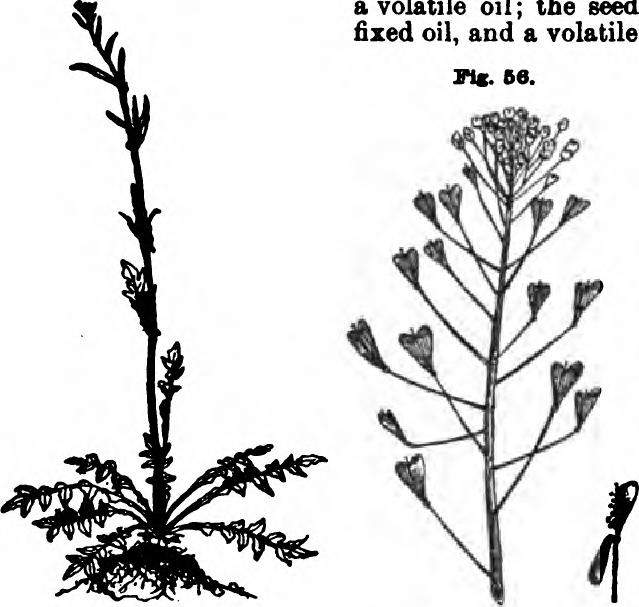
OAFSBLLA. 433 becoming racemed. Silicles obcordate, narrowly emaiginate; cells I-seeded (Wi. This is a small annual, common to Europe, where it is admired as an oroameotal plant; its beautiful white flowers appearing in June and Jul^. The whole plant is reputed medicinal, the seeds more eepecially. In overdoses it occasions vertigo, vomiting, and purging, without accomplishing any Tunable result Medicinally, it appears to control ttenxm and vaaeular accUemaO, and has been found efficient in enlargemeid of the Aeari,aDd some a£tectionB of the air-tubes. It is also said to have been beneficially administered in rheumaHc, gouty, and dropsiccd affeelion$. "Bm dose is from 1 to 6 grains of the powdered seeds. CochUaria (vgSeinalu, Linni, Scurty-ffnua, Spoonwort {Herba cochlearise). Europe. An acrid, bitterish, pungent plant when fresh. It contains the commou plant constituents with a bitter body, tannin, aaltSj and gives rise to an essential oil (oil of tcwrvy-gnm), not pre-existent in the plant. A.W.Ho fimann demonstrated that it was composed mainly of hniyl-iao-wlfhocyanidt (CSN.C4H,). An oil of like composition, but having a different odor, is synthetically prepared from bntylamine (C4Hp.N'H,). It diffeiB also m the fusing point of the addition compound it forms with ammonia, 90° G. (192° F.), while the corresponding compound (rf Uie former (CS.[NH,].NH[G4Ha]}, melts at 135° C. (275" F.). The plant is sometimes used as a salad. It ia stimulant, antiscorbutic, and diuretic. It to very valuable in tcurvy whoa eaten ireeh, and the juice in water makes a good wash for spongy gutn$ and buccal tdcercOiont. Cardaminf. praienta, Linn£, Cuckoo-flower {Herba naetunii praterait). — A bitterish, pungent perennial found in Asia, Europe, and sparingly in North America. The showy flowers are of a white or rose color. The virtues of the plant are due to an essential oil, probably analogous to oil of mustard, as the seeds are said to contain mynmic acid. The characteristics of the plant are lost upon drying. Diuretic, antispasmodic, and antiscorbutic. Has been used in morea, a$thma, dtvpey, bronckitit, intermitteni /ever, laryn^ia, and tcaly skin affectimw, and locally to cancer ■od other aorea. Cardamine hirsuia, Linn^. SnuUi bUier ereu of Europe and North America, and Cardamine atnara, Linn^, Bitter cren of Europe, have properties somewhat like the preceding. Deniaria dipkyUa, Linn^, of North America, and several other species of Dentaria, are known as Toothwort and Pepperwort, the rhizomes of which have a pungent taste. Of the European species there may be mentioned the D. emieapkyUa, Linn^, ana^D. bvibifera; of the American, D.laamaia, Mumenbeig, D.kderophyJia, NutteU, and D.Tiutximaf Nuttall. Barbarea vulgaris Robert itanwn, YtUmo tcurvy-gnm^Winter cre$9, YeUmv roobet.— Frequently cnltiTated as a Balad, as is also the Barbarea pracox, R. Brown, or Early winter crm. Both are found in Europe and North America. NaOurtium officinale, R. Brown [Sisymbrium Natttaiitmt Linn£), Water crm. — Common in wet places. Pungent and bitterish when fresh, and contains a sulphuretted essential oil analoS}UB to that of mustard. A plant having similar properties is the JViufurtjuin palxutre, De andolle, or Marsh cresa. Capparis ^itwsa, Linn^. Nat. Ord.: Capparidacete. Caper. — The caper bush is a trailing shrub growing in northern Africa and Southern Europe. Formerly the root-bark was official. It has a bitterish, sub-acrid, aromatic taste. The blmsbrgreen, entire, round-oval leaves also possGoo the bitter, acrid taste. The plant is chiefly cnltivated, however, for its flower buds, which, when prepared with salt and pickled in vinegar, form a much esteemed condiment The buds are about the size of a pea, have 4 each of petols and sepals, many stamens, a sin&^e ovarii and a sharp, hot taste. When pickled they are sour and burning to the taste. Besides tannin and a bitter body, the root-bark contains a pungent saponin-like principle. The buds contain an alliaceous, volatile oil, and a yellow coloring body thought to be rwn {ruiic acid) {Bee Ruia). Pickled capers were formerly employed in aeuniy,and the root-bark in rheumatic compUiinit and amenarrhaea. Cappnria ferrvmnea, Linn€, and Capparis eynophaUoidiortt, IAua6. West Indies. Root-bark vesicant and muretic; fruit used in tcurvy; all parts have been used in hytleria and to expel worms. The B^utem species. Cappari* wfij^iipftaca, Lamarck, and CappariM coriaeea, have similar usee. The African fruit of C«9>pariB lodada, Robert Brown, and other species, are used as substitutes for pepper. Reseda Luteota, Linn€. Nai. Ord.: Resedaceee. Dyer's weed, Weld. Europe. Naturalized in the United ^^tate8. The root of this plant is conical, and resembles in taste and odor the garden radish. It contains allyl-sulphocyanate (CjHsCNS), or volatile oil of mustard (Volhard). A persistent bitter taste is imparted by the herb. It contains silky yellow crystals of a colors ing body, fitteo^in (CioUiiOb). It is feebly bitter and somewhat astringent It is quite soluble in alcohol, and less so in ether and water. Fused with caustic potash it yields protocatechuic acid, phloroglucin, and carbon dioxide. It is now used only in dyeing; formerly it was employed to inctvftSi' the renal and cutaneous secretions. Reaeda odoraia, Linn^, Migrumeite. Its root also contains the volatile oil of mustard, or allyl-sulphocyanate. PMinisia graveoIem,'Ra.QneBqae. iVof. Ord.: Capparidacese. North America, from Vermont to Arkansas, in gravelly soil. An annual bearing small yellowish-white flowers and temate leaves, and many-seeded, oblong-lanceolate pods. The whole plant is viscid-pubescent and has a pungent taste and disagreeable odor. It is an irritant. Oynan^vpmpenlaphyUa, IteCindoWe. xVdt. Oni.; Capparidaceee. Eastlndira. Naturalized in this country, growing in waste places from Virginia to Georgia. Flowers white; capsule linear and containing numerous seeds, which have been used like mustard. TropsBolum majta, Linn^, and Tropteolum mima, Linn6. Nat. Ord.: GeraniacesB. Oarden nasturtium, Indian crm. Natives of Peru. Cultivated for ornament and for the bnds and imp mature fruits, which are need in pickling.
4S4 0AF81CU1L Other OressM.— ift>tIan/A«8 dtemcea, Jacqnin (Compostta), la Para crew; Arabi* Jyvrio, Ubii6 (Gradiene), is Boat or toaU enm; and Senebma didyma^ ^noon, ia T^ait arm and ^mne erm (lee ftlao <SCru^). "The fruit of Capsicum fastigiatum, Blume" (17. 5. (Chpsteum mtmmum, Roxburgh). Ord. — Solanaceee. Common Names: Cayenne pepper, African proper. Bird pepper^ Guinea p^iptr, or Chillies (in England), Red pepper. iLLusrKATiON: Bentley and Trimen, Med. Kante, 188. Botanical Source. — T^his plant differs from the next species in being a ahrab instead of an herbaceous annual, and in baring the corolla lobes more sharply pointed, and differs also in fruit and seed. The fruits, 2 or 3 in number, are rx>me where the branches fork. They are from ^ to less than 1 inch long, narrow, somewhat oblong-ovoid, erect, sub-cylindrical, of bright scarlet-red color, and are borne on a flat cup-like calyx. The fruit is hot, extremely pungent, or biting, and has a characteristic odor. Its seeds are smaller thui those of CSa|30iCTim annuum^ Linn£, a description of which is here added. Capsicum annuum, Linn6, Pod proper. — An annual plant, of a dark-green color. lar, furrowed, and branched. The leaves are ovate or oblong, acuminate, entire, on long petioles, and sometimes hairy on the veins underneath. The flowers are white, solitary, axillary, pendulous, with dark-colored oblong anthers; the calyx angular, erect, persistent, with 6 short acute lobes; the corolla hypogynous, rotate, 5-lobed; the corolla-tubes very short: the lobes spreading. Stamens 6; OTaries ovate; style filiform; stigma blunt. The fruit is oi various forms, round, oUonft cordate, or horned, and either of scarlet or yellow pods, smooth, shining, anS 2-celled, <»ntainii^ numerous flat, dry, reniform, very acrid seeds (L.). History. — There are several species of Capsicum, all varying more or leas in their d^rees of pungency. The onlyplant now rect^ized by both the tMUed Stata I'mrmaayxeia and the British I^armaa^Meia is the C. fastiaiatum^ Blume. The botanical description of the Capsicum annuum, Linn^, is here included, because often employed for the same purposes as the official species, and on account of its being largely cultivated in American gardens. Furthermore, it is part of ground red pepper. The official capeicam grows on the Guinea coast and the East Indian Isles. There are several other species of Capsicum, as the C.frtUeseens, Linn^: C. lonCandolle; O. cemsifame, Willdenow, etc. Many of them, however, are rwcarded as mere varieties. They are natives of the Bast and West Indies, and of most hot climates throughout the globe. Several specira are cultivated in the United Stateb, flowering from June to September, and maturing their fruit in the latter part of autumn. A good variety is found indi^^ons in Texas. They all agree in producing a shining vraicular berry of a greenish, yellowish, cherry-ied, or most generally scarlet color, consisting of a thin, fleshy, inflated) bilocular, or tiilocular capsule, and many small, flat, reniform seeds. The Bird pepper (C/osf^toftm, Blume) is usually deemed the best. The C. annuum, Linn^, is the most extensively used in this country. The large ovate peppers are picketed while green. All the varieties of capsicum have a faint, characteristic odor, and an extremely hot, acrimonious taste, which in some is so intense that the smallest fragment, when chewed, will excite a sensation of intolerable burning in the month. This acridity is imparted to hot water, ether, spirit, vinegar, ana fixed oils. Powdered cavenne pepper, of good qualit;^, is ot a bright color, varying from a beautiful red to a brown or yellow, which is considerably discolored oy Uie action <tf light. Insects will attack it. Adnlterati<nu.— Powdered capsicum is sometimes adulteiated with pulveriied woods or barks, red ochre, and minium (red lead). This last may oe iUaooVered, by steeping the capsicum in nitric add diluted with water, then adding OAPSIOUH (U. 8. P.)-CAP8I0nH. The stems are herbaceous, an^
CAF8I0UM. 435 sodium sulphate to the filtered Bolatlon, vhich gives a white deposit, if the metallic oxide is contained in it. Description.— "Oblong-conical, from 10 to 20 M™, (J to | inch) long, supported by a flattish, cup-shaped, <5-toothed calyx, with a red, shining, membranous and translucent pericarp, enclosing 2 cells, and containing flat, reniform, yellowish seeds attached to a thick, central placenta. It has a peculiar odor, and an intensely hot taste*'— (17. 8. P.). Chemical Oomposition. — In 1816andl817,Braconnotand Bucholz extracted what they believed to be the active constituent and called it cap»icin. According to Hf^r {HancOt. i%am. Praxis, 1886), Braconnot gives the following composition of 100 parts of Spanish pepper: Pungent oil, 1.9; wax, combined with red coloring matter, 0.9; brown amylaceous matter, not blued by iodine (pectic acid, according to Berzelius), 9.0; gam, 6.0; nitrogenous matter, 5.0; woody fiber, 67.0; potassium citrate, 6.0; potassium phosphate and chloride, 3.4. Capsicin of Braconnot and* Bucholz is obtained by making an alcoholic extract of capsicum, and then digesting this in ether, filtering and evaporating the ethereal solution. It is a thick liquid, of a yellowiah-red, or reddish-brown color, of an overpowering acrid taste, volatilizes at a moderate elevation of temperature, and disengt^es so acrid a vapor, that jr grain will cause every person in a lai^ room to cough and sneeze violently. Water and vinegar slightly dissolve it, -but ether, oil of turpentine, alcohol, chloroform, and the caustic alkalis readily dissolve it. With barium oxide it forms a solid, acrid combination (P. — T.). F.Victor Heydenreich (Ajtier. Jour. Pharm.^ 1858)^ concluded that the capsiein of Braconnot consisted of two active oils with an inert fatty snbstance, and that the true capsicin consisted of these oils without the fattv matter. In 1873, Buchheim pronounced capneol to be the active principle which, however, was probably not quite pure (Fliickiger). Mr. J. C. Thresh (Pharm. Jour, and TVona., 1876) succeeded in^isolating the probably pure acrid principle — a colorless crystalline substance present in small amount only, and difficult to obtain pure — to which he gave the name capsaiein (CfHuO,). It is intimately associated with a fatty material, composed largely of palmitic acid. It is extremely rubefacient, fuses at 69° C. (138.2^ F.), sublimes at 115° C. (239° F.), and, when heated, gives off intensely acrid fumes. Al(M>hol, ether, hot disulphide of carbon, benzin, diluted alkalies, and amylic alcohol dissolve it. In 1889, Arthur Meyer demonstrated that the placenta of Capsicum annuum is the carrier of the acrid principle (capminn). This isolation was effected by extracting with boiling ether, evaporating the solvent, mixing the residue with oil of sweet almonds (to retain the red coloring matter), extracting with 70 per cent alcohol, evaporating and dissolving the residue in solution of causUc potash free from carbonate, filtering and passing into the filtrate carbonic acid to saturation. After standing for some days the capsaicin crystallizes out and is purified by washing with water and cold benzin. This method (which is that of Thresh) yielded 0.9 per cent of capsaicin in 1 10 Gm. of placenta, obtained from 6000 Gm. of red pepper (Amer. Jour. Pharm., from Pharvi, Zeitung). Felletar (1868), also Thresh (Amer.Jour. Pharm., 1876), and later Fluckiger, isolated a volatile, but non-acrid alkaloid of coniine-like odor. A very small portion of a crystal lizable fat, occurring in white crystalline tufts, and associated with essential oil, to which the odor of capsicum is probably due, was obtained by Fluckiger {Pharmacognosie, 1891). It had a non-acrid, spicy taste, and resembled parsley oil. Action, Medical Uses, and Dosage.— Capsicum is a pure, energetic, permanent stimulant, prtxlucing in large doses vomiting, purving, pains in the stomach and bowels,- heat and inflammation of the stomadi, gifkliness, a species of intoxication, and an enfeebled condition of the nervous power. Tne infusion is much used in colds, eaiarrhj hoarmuas, etc. In atonic dyapqma and catarrhal pastritia it stimulates the nervesof the stomach, promotes the secretion of the digestive juices, and assists peristaltic motion. As an internal remedy some have advanced the theory that it is destroyed during digestion. Perhaps, when ingested with food, thiij may be partially true, but, if so, how do we account for its remarkable activity in sustaining the nervous system when given in ddirivm tremens, and the power it has in steadying the patient and promoting sound sleep? That its effects are partly due to its stimulating action upon the gasbic membranes is unquestionable, ont its entire eflbcts can not be due to this cause alone. The same may be
486 CAPSICUM. said of its action in congetiive intermittent and remitterU fevers. Some have thoaght to attribute its action in rongeative chill to its effects upon the Bolar plexus. It forme an excellent addition to quinine in irUermittentSy where there is a deficiency of gastric susceptibility, and it has been asserted that but one-half the quinine will be needed when combined with capsicum. Capsicum is the very best i^ent that can be used in delirium tremens. A enables the stomach to taxe and retun food, and the best form of administration is a strong beef tea, or strong soup made hot with red pepper. There ia no danger of giving an overdose, as a wonderful quantity (even a drachm of red pepper) may be swallowed with evident pleasure and without ill results by a connrmed dipsomaniac. In the atonic dyspepsia of dipsomania it takes the place of alcoholic stimulants, removing the craving for al<»holicB and sense of sinking at the pit of the stomach, prevents the morning sickness and vomiting, restores gastoio tone and promotes the digestion of wholesome food. It should administered whenever the desire for drink comes on. Prof. Locke recommends for delirrum tremens doses of 10 to 40 grains of capsicum every 3 hours, or liberal doses of compound tincture of myrrh and capsicum. When the craving for drink occurs he administers 20 drops of the following in water: R Comp. tinct. of myrrh, fljj; epecific nux vomica, fisss. Mix. Capsicum is said to reduce irritation and increase capillary activity in chronic renal congestion. It affects the bladder and rectum similarly and may accordingly be a remedy for diarrhcea, constipation, piles, and in dysentery^ where the stools are bloody, the mucus tenacious, with tenesmus and burning, and associated with tenesmic action of the bladder. These cas^ are those in which there is a lax habit of body with feeble digestion. Other indicated remedies may be given with it. For hernorrhoid», with torpor, constipation, or relaxation, it is a good remedy. Prof. Locke suggiests for this state, when not recent nor assodated with recUl Darning: B Capsicum, gr. ij; alo^, gr. ^. Mix. Make 1 pill. Cfapsicum should not oe forgotten in low fevers, where there is dryness and constriction of the tissues, and the ton^e is dry and harsh and there is but little buccal or salivary secretion. Here it is a very valuable adjuvant to other Indicated drugs. Though a stimulant, the general circulation ib but little increased by capsicum. Paralytic states, without organic lesions, and with great digestive and nervous torpor, are often greatly improved by capsicum. In AMatic cholera and angina pectoris, with cold extremities, cool perspiration, and great nervous prostration, it is asserted a saving agent. Capsicum meets the debility of young and old, but is particularly useful in old people when the body-heat is low, vitality depressed, and reaction sluggish. 7%r«e(, painful myscles. stiffened joints, and relaxation of any part are common conditions in the elderly that are, in a measure, rectified by capsicum. Homoeopathists suggest its use in pneumonia when abscesses threaten. Flaiulenee in dye* peptic states may be dispelled by capsicum. A preparation made by adding \ ounce of powdered capsicum and 2 drachms of salt, to ^ pint each, of vinegar and water, has been found an excellent antiemetic, in all cases of vomiting or navsea. To be given in tableepoonful doses as often as required. It has received the name of Anti-emetic drops. Capsicum has been also used in spasmodic affections, passive hemorrhages, especially uterine, and, when combined with the compound powder of ipecacuanha will, in many instances, promptly arrest hemorrhage after parturition. Externally,' the infusion and tincture have been found valuable as a stimulating gargle in the ulcerated throat of scarlatina, or in chronic cynanche tonsillaris; also as a counter-irritant, as an application to tTidolent tUcerSy in chronic ophthalmia, and in chronic or indolent tUceration of the cornea. If used early in UmsillitiSj with relaxation, it may abort the trouble, but if it does not its use should be discontinut d until the active inflammation has subsided. Hoarseness, from atony of the vocal cords, is relieved by it^ and it is a remedy for relaxed uvula. It enters into various tinctures and liniments. The concentrated tincture of capsicum has been highly recommended in the treatment of chilblains and toothache. In the former, a piece of sponge or flannel must be saturated with it, and rubbed well over the seat of the chilblain, until a strong tingling and electrical feeling is produced. This application should be continued <uiily, until the disease is removed; relief
CABBO ANIMALia 487will be experienced on tne very first application, and frequently there will be a total removal of the diBease after the second or third application. This, however, will depend upon the severity of the case. Powdered capsicum, sprinkled inside the stookinga, was a favorite prescription with Prof. Scudder for cold feet. This medicine possesBes an extraordinary power in removing congestion by its action upon the nerves and circulation; if the skin is not broken, it never causes excoriation by rubbing with it For tooihaekB from dental caries. j)lace 1 or 2 drops of the tincture on cotton, and apply to the affected part; the relief will be immediate. Tmdwra Oapsiei Omeentra^ is prepared by macerating 4 ounces of capsicnm in 12 fluid ounces of rectified spirit for 7 days; then filter. The ethereal oil of capaicum^ prepared by the evaporation of a saturated ethereal tincture of the pods, is sometimes used as a rubefacient. It is of a brilliant yellowish color, with a peculiar odor and aromatic taste, and filled with crystals of solid fatty oil of curious dendroid forms (see OleoresiTia Cajmci). Capsicum may be used wherever a pure stimulant is indicated, in all cases of diminished vital action, and may be combined beneficially with other remedies, in order to promote their action, as emetics, cathartics, diaphoretics, tonics, etc. Dose of the powder, from 1 to 6 arains; of the tincture, from ^ to 1 fluid drachm. Specific Indications and Uses.— Marked depression and debility; atonic dyspquia of drunkards; delirium tremens; colic, with abdominal distension; congestive chills; cold extremitiee, with Uandied lips and small, weak pulse; congestion, with capill^ atony; tongue dry and hanin, and buccal and suivaiy secretions scanty, in fevers; oluronic hemorrnoids, from relaxation. OABBd~ANIMALIS (U. S. P.)— AHDKAL OHABOOAL. "Charcoal prepared from bone" — ((/. 8. P.). Stnonyus: Bone-black, Ivory-black, Spodium, Carbo ossium, Ebur ustum. Preparation and Ohemicu Oomposition. — ^When bones, or indeed any animal substances, are exposed to a red heat, with limited access of air, in covered iron vessels, or retorts, until they cease to emit any vapor, the residue is animalcharcoal. Boiie 8pirU, an ammoniacal fluid, is also obtained by this process of of destructive distillation, from the vapor which passes over. The animal charcoal or bone-black thus obtained is impure, and though serviceable for some purposes in pharmacy and in the arts, yet it will be found unfit for many others unless purified. The impurities it contains are mainly phosphate and carbonate of calcium, with carbide and silicide of iron, and sulphides of iron and calcium. The amount of inorganic constituents is as high as 85 per cent, leaving for pure carbon not more than 15 per cent. Sand also is frequently present. Cabbo Anihalib Purificatus (U. S. P.), Purified animal charcoal. Animal charcoal in No. 60 powder, one hundred grammes (100 Gm.) [3 ozs. av., 231 grs.]; hydrochloric acid, three hundred grammes (300 Gtn.) [10 ozs.av.,255 grs.]; boiling water^ a sufficient quantity. Introduce the animal charcoal into a capacious flask, add two hundred grammes (200 Gm.) [7 ozs. av., 24 grs.], of hydrochloric acid, and one hundred cuoic centimeters (100 Cc.) [3 flj, 183 TTl], of boiling water, and connect the flask with an upright condenser. By means of a sand bath keep the mixture gently boiling during 8 hours. Then aad five hundred cubic centimeters ^600 Cc.) [16 flS, 435 HI] of boiling water, transfer the mixture to a muslin steamer, and when the liquid has run ofl*, return the charcoal to the flask. Add to it one hundred cubic centimeters (100 Cc.) [3 fi^, 183 Til] each, of hydrochloric,acid and of boiling water, boil for 2 hours; again add five hundred cubic ■centimeters (500 Cc.) [16 fl3,435 ttl] of boiling water, transfer the whole to a plain filter, and when the liquid has run ofl*, wash the residue with boiling water, until the washings give only a faint cloudiness with silver nitrate test solution. Dry the powder in a drying oven, and immediately transfer it to well-stoppered vials"— (C/. S. P.). Description and Tests. — I. Carbo Aniualis (Ul S. P.), Animal charcoal, — According to the Pharmacopoeia, carbo animalis should be in "dull black, granular frfl^ments, or a dull-black powder, odorless, nearly tasteless, and insolnDle in
488 CABBO UGNI. water oi alooboL When ignited, it leaves a grayish or yellowish' white ash, amounting to about 85 per cent or the original weight of the portion taken, which should have been previously dried at 120° to 125° C (248° to 257° F.), to a constant weig[ht. The ash should be soluble in hydrochloric acid with the aid of heat, leaving not more than a trifling residue. If 1 Gm. of animal charcoal be boiled fbr several minutes, with a mixture of 3 Cc. of potassium hydrate T.S. and 6 Cc. of water, the filtrate should be colorless or nearly so (evidence of complete cai^ bonization)"— (f7. S. P.). II. Carbo Anihalis Pdbipicatus (U. 8. P.), Purified animal charcocU. — "A dull black powder, odorless, tasteless, and insoluble in water, alcohol, or other solvents. If 2 Gm. of the powder be ignited at a red heat with free access of air in a broad shallow porcelain or platinum didh, it should not leave a residue weighing more than 0.08 Gm.,or 4 per cent of the original weight (limit of siUcates ana other fixed inorganic matter). If 1 Gm. of the powc^r be boiled with a mixture of 3 Cc. of potassium hydrate T.S. and 5 Cc. of water during 3 minutes, the filtrate should be colorless (evidence of complete carbonization)" — ((7. S. P.). Purified animal charcoal somewnat resembles vegetable charcoal, but is more dense, and lees combustible. V^pon long ex^sure to the atmosphere it absorbs moisture, and loses its decolorizing properties, for which it is chiefly employed. The nature of its decolorizing action is not well understood, though supposed to be lai^ly owing to its peculiar porous texture. It not only removes the coloring principle of vegetable infusions and tinctures, but is likewise capable of absorbing bitter principles, and when purified, abstracts iodine and numerous salts from their watery solutions. When carelessly purified, animal charcoal may contain phosphate and carbonate of calcium; these impurities may be detected by efifervescence with hydrochloric acid, and the precipitation of phosphate of calcium from the filtered solution by ammonia, or of carbonate of calcium by carbonate of ammonium, H. Iieplay and J. Cuisinier have given a method of restoring, by easy and speedy methods, the absorbing properties that animal charcoal 1<hws by use (Amer. Jour. Phartn., 1862, p. 651, from Ckem. New., 1862). Action, Medical and Pttamacentical Uses, and Dosage.— Its principal uses are to decolorize various oraanio matters, as strychnine, cinchonine, etc., and to purify syrups and glucose. It is used extensively in sugar refineries for this purpose. It is also used to remove from spirit prepared from grain, its grain- or fusel oil. It has likewise been highly extolled as an internal remedy, in doses of ^ grain to 3 grains, twice a day, in scroJuUms and canceroua affet^ionSj goitre, ob^iruUe chronic glandular indurations, etc. Not used in this country medicin^ly. Like vegetable charcoal, it destrovs the odor of putrid animal matter. Dr. A. B. Garrod, in a paper read before the Medical Society of London, Nov. 17, 1846, recommended Surined animal charcoal in cases of poisoning by opium, strychnine, aconite, bellaronna, stramonium, tobacco, hemlock, eta First remove as much of the poison ae possible by means of the stomach pump, or emetics combined with the antidote, and then give a lai^e quantity of the purified animal charcoal, diffhsed in warm water; a vegetable emetic must not be used, as the charcoal would destroy its emetic properties. He considered this agent useful as an antidote to arsenous acid. According to M. Lebourdais, animal charcoal mar be used for the purpose of procuring many of the active constituents of vegetable medicines (see London Pharm. ^.,1861, p. 447). B^ted Frodnct.^?AitBO Cabhis, Meat dtareooL This product ia prepared by roaatinff 3 parts of lean veal with 1 part of bones (small ones preferred). The operation is cooductea in a covered apparatus, and continaed until inflammable vapors cease to be evolved. When eoLd, it Is to be powdered and put into a wellnrtoppered vial. OABBO ZJOMI (U. S. P.)— OHABOOAL. "Charooal prqMred from soft wood, and very finely powdered. It should be kept in well-closed vessels"— (K S. P.). Synonthb: Carbo vegetahilis, Chrbo pragparaius. Wood charcoal, Carbo e ligno. Preparation and Pnrificauon. — Wood or v^table charcoal for pharmaceutical or other purposes is made by the well-known process, too familiar to be
CARBO LIONI. 439 described. For medicinal ptirpoee^, charcoal as ordinarily prepared is not pure enough ibr internal use. It may be purified, according to Lowitz, by placing fine common charcoal in a crucible, and, when filled, cementing on a cover containing several orifices. This is to be exposed to a red neat, whioh must be continued as long as flame of a blue color emerges from the orifices of the cover, and when this has stopped remove from the fire, and when cold place the charcoal as soon as possible in glass vessels, which must be kept well closed. The best charcoal for medicinal purposes is that which is properly prepared from young willow shoots, and is known in trade by the name, " willow cnarrotUJ' Deteription. — In shape and texture charcoal resembles the {)articular wood from which it is prepared. As used in medicine and pharmacy it is in pulverized condition. According to the U. 8. P. it should be "a black, odorless, and tasteless powder, free from gritty matter. If 1 Gm. of charcoal be boiled with a miztoie of 8 Cc. of potassium hydrate T.S., and 5 Cc. of water for several minutes, the filtrate should be colorless, or nearly so (evidenoe of complete carbonization)"— (U. S. P.). Wood charcoal is an exc^Ient conductor of electricity, but not of heat. It corrects the fetor from putrid animal matters, and decolorizes vegetable infusions, but not so promptly as the animal charcoal. It decomposes many metallic compounds, when heated with them, by depriving them of their oxygen. If kept in the air its weight is speedily augmented in consequence of its amnity for moisture, even to the amount of from 10 to 15 per cent. Combufttion produces carbonic acid gas, leaving behind an ash composed of earthy matters and carbonate of potassium. Charcoal has the property of absorbing gases, which it accomplishes to an extent varying with the grade of charcoal, and with the eaa absorbed. For this purpose it should be freshly prepared. Generally speaking, 1 volume of charcoal will absorb 10 volumes of oxygen, 35 volumes <h carbonic add 65 volumes of hydrogen sulphide, and 100 volumes of ammonia. It is not so usOTul for decoIorizinK pharmaceutical preparations as animal charcoaL Action, Medical Uses, and Dosage.— As a medicine, charcoal should always be purified. " Charcoal is generally c^scribed as possessing antiseptic properties, while the very reverse is the fact. Common salt, corrosive sublimate, arsenons acid, alcohol, camphor, creosote, and most essential oils, are certainly antiseptic substances, and, therefore, retard the decay of animal and vegetable matters. Charcoal, on the contrary, greatly facilitates the oxidization, and, consequently the decomposition of any organic substance with which it is in contact. It is, therefore, the very opposite of an antiseptic" (Dr. Stenhouse). It does, however, render the gases evolved latent. It acts as an at^rbent (both fluids and fases) and disinfectant. Its internal employment will be found useful in those igestive derangemenU which are associated with offensive breath and disagreeable belchingsj also to correct the fetid condition of the stools in dysentery. It is also naefiu in acidity of ^ aUnnaeh, JUUtiUency^ and in the naneea and constiI»tion attending pregncmey. It is also very useful in internal heat and irrita* tion of the stomach, with acidity; skh headache; diarrhoea; cholera infantum, etc. In cases of sick headache, due to gastric acidity or derangement, and which are ushered in with blurred vision, photopsia, and finally nausea and intense headache, I have found a drachm of charcoal mixed in a little syrup, to which is then added about a gill of water, and 10 or 12 drops of ether, to afford prompt relief; in very obstinate cases, the dose may require to be repeated 2 or 3 times, everv 20 or 30 minutes (J. King). In some cases charcoal may be advantageously combined with the enbnitrate of bismuth as a sedative* and where a laxative action is required, rhubarb may be beneficially added to it. Biliom coUc is said to have been cured by it, in doses of 1 drachm in 2 fluid ounces of burnt brandy, repeated as required. Externally, it may be used in poultices to correct fetor or ttUerSf arrest gangrene, etc., and is efficient in many cutaneous diseases. It absorbs foul gases generated in vaults, sewers, etc. It is also a useful hemostatic, having arrested epuiaad* when subsulphate of iron had fiuled. "The tpee^ use (tf charcoal," says Dr. Scndder {8pee, Medication) "is to arrest hemorrhage from the bow^ It has been used in enema, 38s to sj, finely powdered, to 4 ounces of water, thrown up the rectum. Why this checks it I can not tell; that it does it, I have the evidence of my own eyes. For several years I have employed the second decimal trituration as a remedy for passive hemorrhage^ with most mu:ked benefit. I
440 CARBO LIQNI..employ it in threatened hemorrhage dnring typhoid fever; in m«7u>rrAa<;rui, especially when chronic; in prolonged menstruation; the watery discharge that Bometimes follows menstruation; hemorrhage from the kidneys; hanorrhatfe from the Itmgs; and in some cas^ of Uucocyt.hemia. A good indication for this remedy is a small, Sallid tongue with lenticular spots, and with this it may be given in any form of isease." It occasionally enters into tooth-powders, and may oe used with advantage to correct the fetor of the mouth, and cleanse the teeth. In such cases, the charcoal prei)ared from brwd is the bes^ as it contains no gritty particles. Water may be purilied by passing it through <marcoal mixed with aana. The ordinary dose of cnarcoal is Arom 20 grains to 2 drachms, 2 or 3 times a day, in water, milk, or burnt brandy, repeating it according to indications. For- specific uses the 1 X, or 2 X trituration, 5 to 10 grains, as often as necessary. Specific Indications and Uses. — A pallid, expressionless tongue, with slight coat and lenticular spots, or slight coat lifting in patches; pallid skin; feeble pulse; tumid, doughy abdomen; tendency to hemorrhf^e; frequent, foul, hemorrhagic bowel discharges; passive hematuria; passive hemoptysis; salty taste in the mouth. The remedy for asthenic hemorrhage and profvse secretion. Oarbon and Its U odiflcatlons and Belated Prodncts.— Cabboh. Symbol: 0. Atomk "Weight: 11.97. A quadrivalent, sometimes bivalent, element, widely diffused over the earth. It is found in the earth as free carbon, especially aa granite (plamMgo), and in cryatalliied, tnuupareat condition, aa diamond, la an impure amorphous lonn it exifrts as eoaL It combines with oxygen to produce carbonic anhydride (CO,), or carbon dioxide, existing in this form in coneiaerable quantity in the atmosphere, and in effervescing mineral waters. Id mineral formations it exists combined with other substances, forming carbonates. It is found very extensively in organic matter, both animate and inanimate; in fact, the study of so-called organic chemistry may be said to be the study of carbon and its compounds and derivatives. The black residue left when organic matter is heated, with limited access of air, is produced by freeing the carbon, or the process of carbonization, aa it is called. Carbon occurs in S allotropic lorms, yix.: Diamond, graphite, and amorphous carbon. I. Diamond, one of the taaraest bodies known, is a crystalUxed carbon. Electiicity is not conducted by it. If heated, excluded from the air, it remams unaltered at very high temperatures, bat if neatedin the airortowhiteneesin oxygen, combustion ensues, with the production of carbon dioxide. The diamond is the purest form of carbon. Its density is 3.5. It is found chiefly in India, Borneo, Brazil, and South Africa, while some diamonds have been unearthed in North Carolina and Geot^a. An impure carbon-mass, containing both oxygen and hydrogen, and known as anthracite diamond, or bLacKdiamcmd, is said to be even mirder than the true diamond. II. Graphite. Plumbago, or Black lead. — This next purest form of carbon presents a totally different aspect from the diamond. It is found abundantly in some localities, especially in England, and in New York, Massachusetts, and Canada, ^e purest form is said to come from the Borrowdale mines in England. In granite and other mineral formations it occurs sometimes in large lumps. It is crystalline, forming plates, which are hexagonal, soft, unctuous to the feel, usually of a dull-gray, or grayigh-black color, and has a density ranging from 1.9 to 2.25. Graphite is infusible, and is a good conductor of the electric current. It is largely enaployed in the arts in the making of lead-pencils, crucibles, stove-polish, etc. The name black lead should be discarded, as graphite has no connection chemically, or otherwise, with lead. III. AuosPBous Cabbon.— This form of carbon 4b well known as eoal. The purest Tariety is known as arUAmctte, or hard coal. The next variety is known aa ftttaminoua, or Kft coa{,a form containing considerable hydrogen. When subjected to red beat in dosed retorts, volatile hydrocarbons and tar are given off, leaving coke as a residue. Coke is a fairly pure carbon, intermixed with the mineral components of eoal. Anthracite coal contains about 90 per cent of carbon; bituminous coal, about from 75 to 90 per cent; and amorphous carbon {lignite), about 65 per cent. LampiAaek, another amon>hous carbon, is the result tA the impei^ feet combustion of resinous, fatty and waxy material, the tmoke so produced condensing as finely divided carbon, or tampfdaik. FuLioo LioKL Sboe, Wood toot (FuUgo aplmdew).— The best soot for medicinal purposes ia that which is gathered within an air-tignt wood stove and its pipe; that which is collected from a clean cfiimney or ordinary stove-pipe, where hard wood alone is bumedj will ordinarily answer, if it be free from ashes and calcium compounds. Soot has a peculiar odor, somewhat resembling that of creasote, and a nauseously empyreumatic, more or leas bitter and acrid, saline taste. Its infusion in water is of a dark-brown color, with the characteristic odor and taste of soot. It is a complex mixture of distilled products from the imperfectly burnt wood, ashes, or other fixed matters, carried up the chimney by the current of air. It consists (rf an empyreumatic resin (pj/reUn), combined with acetic acid, which also saturates the bases, calcitun, potassium, and nuignesinm, of the ashes carried up the chimney. Acetate of ammonium, chforide of calcium, sulphate of calcium, extractive matter, creasine, carbon, ailica, eeeqaioxide of iron, and nitric acid, have all been found in soot. The solution of soot, evaporated, fumiahes a dark-colored extract, which, on being re-dissolved in water, forms a dark- brown. solution. About 0.44 (rf soot is insoluble. It probably owea its virtues largely to
CARBOMEI I>ISULPHID0M. 441 «raMOte. Soot hu deodwsnt and diBmfectant propcrtieB, and may be employed ia vaults, etc.. to overcome fool effluvia. Internally, soot was fbrmeTly murii employed, and found valuable in all forms of disesM attended with acidity of the ttomack. A powder, composed of I part each of powdered rhubarb and soot, and half a part of bicarbonate of potassium, will be found invaluable in all such cases, removing acidity ana a tenden^ to constipation. It may be given in doses varying from 3 to 18 grains, 3 times a day, or in eumcient quantity to cause 1 or 2 evacuations from the bowels daily. An infusion of soot, made so as not to be unpalatable, is very beneficial in tT^fiammation of mucosa tnembranet, and in hytkria. A strong deooction of soot, used as an injection into the rectum, has caused the expulsion of atearida; its use should be continued for several days in succesuon; injected into the bladder it has been of swvice in cAronie tri/Iaininalion of tiu bladder; it should be injected twice a day for some days. It poeeesses no antispasmodic virtues, further than neutralizmg the acidity oi the stomach, to which the spasmodic action is owing. Combined with extract of geranium, in the proportion of 2 parts to 1 of the astringent, it will prove va\\iB.hle in diarrhoia And chcUramorbuB of chUdrm; in tummer-complaint, 1 part oi the dried extract of leptandra,Bnd ^ part of camphor or ginger may be added to the above. The infusion or decoction may be made by addmg 1 or 2 ounces of soot to a pint of water, macerate or boil for i hour, and filter. Dose, I or 2 fluid ounces, 2 or 3 times a day. Externally, Prof. King used the Unffueatum Fuliumi* in cases of recent and extensive &unu, with almost immediate reuef. It must be spread on raw cotton and applied over the part. The ointment is also efficient in various eutaneom dttonfrra, espedally those of an erynpeiaUnm character, tinea, JUtuIa, cancerom and typhilitic vlcert,mvriiM vulvm, »peat on the cornea, acrofutom mhUialmia, severe 6urn« and acalix, etc. In some oi^theee diseases the decoction will answer. In many ophthalmic diseases, a strong decoction of equal parts of soot and hydrastis, will be found valuable. It may also be employed internally oy mouth, or injection into the bladder or vaanna, for ehrcnic muanu injlammatum. Boot is but little used at the present day. FULIOOKAU. — A preparation called Ftdigokalt has been recouimenned in acrofula, chronic rheumatism, rheumaiie tumon, and certain htqpetxc ajfectton*. It is made thus: To 2 or 3 parta of water add 50 parts of good, shining powdered soot, and 10 parta of caustic potash; boil the mixture for 1 hour, then dilute it when cold, and filter. The filtrate, when evaporated to dryness, yields a black powder, having a slightly alkaline taste, a burnt-like odor, and a ready solubility in water. It may be given 4 or 5 times a day, in doiies of 2 to 3 grains. This substapce should be kept in well-closed bottles (Deschamps). A stimulating disciitient external application is made by triturating ^ ounce of preparea lard with 8 or 13 grains of fuligokali (Uibert). Ahthukoeali. — A preparation occurring as a black powder, produced oy boilinf; p<»<phyrised coal with a strong solution of caustic potash, in an iron vessel. The mass is stiired, while cooling, until a powder results. This forms timple arOhrakokali, but when sulphur in small amounts is added to the coal before it is put into Uie boiling potash solution, the resultant product is ndphurrftted antkrabdcali. These preparations were introduced by Dr. Polya, who applied them externally, and also administered them in doses of 1 to li grains, disguised in licorice-root powder. (Mronic rheumatic MmjAairUx, including rheumatic arthriiie swaUnga, as well as acrofiua, and akin diaeaaes of an herpetic character^ were treated with it. An ointoient (16 grains to 1 ounce of lard) was employed locally twice a day. OARBOHSI DISULFHIDUH (U. B. F.)'-OAXlKm DISULPHIDE. Formula: CSs. Moleculak Weight: 75.93. Syhonthb: DinUpkide of mr&m, Simlr^ide of carbon^ Cor&onn bigulj^tdtm (Cf. S. P.,1880J, Alcohol mlfurig. Preparation and Historr. — Carbon forms two compoundB with sulphur, a disulphide and a monosulphide; the former alone is of use in medicine or the arts. The latter is a more recent discovery, and is obtained by exposing the disulphide in sealed tubes to the sun's rays for several months (see Watts' Dtctionary^ 1888). Lampadius, in 1796, discovered carbon disulphide accidentally, while heating iron pyrites with charcoal, and, in 1802, Clement and Desormes obtained it by heating charcoal and sulphur. It is prei)ared upon a large scale by passing the vapor of sulphur over red-hot charccml, in which case an impure carbon disulphide distills, and ia collected in a cooled receiver beneath water. This crude article is always impure, containing dissolved sulphur and several sulphur compounds, which imE«rt an offensive odor to the oommercial article. Purification. — ^Formerly, it was purified. by repeated distillations fifom oil or fat, but, at present, the impure carbon disulphide is at first agitated vitii mercury until it ceases to blacken the bright surface of the metal, and then it is distilled from white wax; or it is allowed to remain a long time in contact with corro* sive sublimate, or litharge, with frequent agitation, and is then distilled from bleached wax. M. Yvon, of Alfort proposed the addition of copper turning to the disulphide, in order to deodorise it, stating that it is not neoeesary to agitate
442 CARBOHEI DIBULPHIDUM. it; the disulphide soon loaee ite offensive odor, and gives out an ethereal odor, free from all unpleasantn^s. DMCription.— The U. 8. P. describes carbon disulphide as foUowB: Carbon disulphide should be kept in well-stoppered bottles, or ia tin canSj in a cool 5 lace, remote from lights or fire. A clear, colorless, highly re&active houid, very ifilisive, having a strong, charactnistic, but not fetid odor, and a uiarp. aromatic taste. Soluble in 386 parte of water at IS** C. (69' F.); very SQluble in alcohol, ether, chloroform, fixed and volatile oils. Specific gravityj 1.268 to 1.260 at 15* C. (59° F.). Carbon disulphide vaporizes rapidly at the ordinary tempera'ture, is highly inflammable, boils at 46° to 47° C. (114.8° to 116.6° F.),.ancL when ienited, burns with a blue flame, producing carbon and sulphur dioxide. It should not affect the color of blue litmus paper moistened with water (absence of sulphur dioxide. A portion evaporated spontaneously in a glass vessel should leave no residue (absence of dissolved sulphur). Lead acetate T.S. ^itated with it should not be blackened (absence of hydrogen sulphide) " — ((7. S. F.). Its flash ing point is stated differently by different authorities: 149° C. (300.2° F.), Frankland; 170° C. (338° F.)^ Braun; 160° C. (320° F.) Wagner's Sandbuch, 1889. Its va^r, mixed with nitnc oxide, bums with a bright-blue flame which is rich in actinic ra^s: and when mixed with oxygen or atmospheric air, the mixture explodes with great violence when inflamed. It evaporates so rapidly in the open air as to condense and congeal the moisture contained in the air on its surface; when evaporated in vacuo, a cold of —60° C. ( — 76° F.), may be obtained. It freely dissolves such bodies as essential oils, sulphur, phosphorus, iodine, bromine, camphor, gutta percha, caoutchouc, fats, wax, etc., and substances that are usually soluble in ether. It is insoluble in water, but soluble in alcohol, ether, and fats: ite alcoholic solution becomes very readily changed, but if some essential oil of mint be added to it, it prevents its decomposition, and lessens any unpleasant odor. Under the action of the solar rays it assumes a yellow color. It is poisonous, and its vapor destroys small animals exposed to its action. When inhaled for some time, even in very email amount, it produces serious effecto upon tiie nervous system. According to Zoller, meat may be preserved in an atmosphere which contains ite vapor, ft is used largely in various branches of the arte^as in india-rubber and woolen factories. Carbon disulphide has been employed in the process of the extraction of alkaloids, to eliminate the fats, resins, chlorophyll, etc., present; to extract croton oil, bay oil, butter of cocoa, butter of nutmegs, oil of male-fern, oil of spruce, fir, etc.; to extract the fat from wool, bones, etc.; to manufacture soluble spices; to purify paraffin; to destroy certain noxious insects and animals; to preserve meate, fruits, etc.; also used to extract sulphur from certain minerals. It forms no solution with water, and advantage has been taken of this factio determine the amount of moisture in commercial iodine. Berzelius found that it unites with metallic sulphides to form salte called tk%ocarb(m(Ue8.ot nUphocarhonates, in reality the salte of thiocarbonic cund (HjCSs), which is analogous to carbonic acid, the oxygen of which merely is replaced by sulphur. Carbon disulphide combines witn tnelhylphotphine (PrCsHsla) to form a solid which crystallizes in beautiful red crystals (P^CiHslsCSi). The formation of these crystals serves as a sensitive test for carbon disulphide. Another test not quite as sensitive Gonsiste in Uie formation of potassium xanthato by the combination of carbon disulphide with alcoholic potassa solution. Carbon disulphide, for medicinal use, should not possess a repulsive odor; the fetor of the commercial article, as we have said, is owing to ite impurity. It should likewise be neutral to litmus pap«r, and should not blacken mercury, nor precipitate a solution of plumbic acetete when i^tated with it (Hoffman). As frequent contact with air occasions ite deterioration, carbon disulphide, for medicinal use. should be placed in small, wellstoppered bottles, and kept in a cool place; it snould not be handled nor poured out in the vicinity of flame. Action, Hemcal 0SM, and Dosaffe.— Disulphide of carbon was first used as an antesthetic, in 1848. bv M. Harald Taulow, of Christiania, Norway. Subsequently, Dr. Simpson^ o( Eldinburg, confirmed the &ct of ite annsthetic properties, and published.his experimente to the profession iPharm. Jbur.,VII, p. 517). Ite unpleuant odor, the disagreeable symptoms following ite inhalation, M frequent pulsations, headadie, vertigo, emesis, and annoying visions, togetfanr with
OABBONEI DIBTTLFRIDUIL 443 its brief ansBsthetio influence, have proved objections to its coming into general use. Inhalation of air saturated with the vapor«f the disulpbide has been found injurious, as observed in the manufactories where it is employed for dissolving caoutchouc. The symptoms resulting from such inhalation have been describedj by those physicians wno hav« investigated this poinl^ as follows: Headache, vertigo, wakefulness^ impurment of the mental faculties, over-excitement of the nerves, neura^c pains, cramps, bluntness of the senses oi touch, sight, and hearing, impotenc^, derangements of the digestive functions^ dyspnoea, palpitation, debility, emaciation, and occasionally, delirium. The period of excitation wUl be manifested in various ways, by vehement lau^diter, boisterous talking^ rambling singing, weeping, etc. Mansfi^d, Wurtz, and ouiers, have advised its internal use, in doses of 2 drops in milk, or in sweetened water, repeated every 2 hours, as an emmenagogue; it has also been [)ropo8ed as a stimulant and sudorific in r^eumafu; and gouty affections, and in certain cutaneotia maladies, but the uncertainty of its effects, and the serious symptoms apt to follow the ingestion of even a few drops, as intense burning sensation in tne mouth and fauc^ sickness at stomach, emesis, gastralgia, flatulency, and difficult micturition, will undoubtedly prevent its general use as an internal therapeutic agent Dr. J. T. Whittaker has reported to have found its internal administration of considerable efficacy in the treatment of camfumia,and especially that of the stomach; he administered it in doses of 2 drops in alcohol or almond oil, repeated every 2 or 4 hours. Although not curinff the disease, it promptly mitigated the severe symptoms, improved the health and strength, and prolonged the life of his patiente. Its application, externally, has been found of great value in certain diseases. Its vapor, directed through a tube upon the eye, or upon the outer surface of the dmm-membrane, for a few seconds, or until aglow of heat is experienced, acts as a stimulant and promotes absorption in the parts; employed in this manner, it has proven efficient in drnf-MSS due to deficient nerve power, lack of cerumen, in purulent discharges from the meatus auditorius, in tinnitus due to indurated cerumen with dryness of the canal, and in eczema of the ear; also in chronic inflammation of the conjunctiva, ulceration of the cornea, lachrymal suppression, muscse, sclerotitis, and in scrofulous ophthalmiay phlyctenular formations, etc. In rheunwitsm, lumba^, and other painful affections, oenefit will often follow the application of the disulpbide, on cotton or on a compress, over the painful parts; it should be allowed to remain in contact until a smartinz sensation is produced. When it occasions pain, as will sometimes be the case, the vapor majr be directed upon the part, inst^id, and be continued until the smarting sensation is complained of. If the disulpbide be sprayed upon the part, allowing it to evaporate from time to time, before a renewal of the spray, in a few minutes local aneesthesia will result, pain will be relieved, and, if necessary, deep Incisions may be made without any pain being felt. In this manner, it will likewise frequently be found useful in goitre, lupoid growths, glandular enlargements, and indolent tumors. In many of the maladies just referred to, the efficacy of the remedy may be increased by the addition of iodine to the disulpbide. Under the local antesthesia that may be produced with the spray of carbon disulphide, such minor operations as the evuMon of nailSf opening of abscesses, etc., may be paiiUessly performed. Topicallv applied it is also reputed a good remedy for various forms of iwuroZoui, particularly that associated with locomotor oftma (applied upon the spine), and in neuralgic forms of AcwfocAe, and in toothache. In atonic vmMids and ehranie tt^cers, its local application has proven very beneficial, as well as in ulceratuyM of a scrofulous or qrphilitic character. A camel's hair pencil, or a pledget of lint, moistened with the fluid, is quickly and lightly passed over the surface of the wound or ulcer, which may then, if necessary, be immediately covered with a layer of finely pulverized subnitrat^ of bismuth or starch. This may be repeated once every 1, 2, or 3 days, according to the degree of inactivity of the ulcer. Its application is followed by intense pain, which, however, does not last longer than from 20 seconds to 3 or 4 minutes. Applied to vXcers of the cervix uteri, the pain continues but a few minutes, while that produced by other agents, as, for instance, acid nitrate of mercury, frequently continues for many hours. The pain gradually becomes less and less with each application, ana as the dcatrising process becomes confirmed, it diminishes and
444 CABBONEI TETRACHLORIDUM. disappears. Dr. DoTrinf; considers it by fu the best local application known, for mdolerU tUcera. This fluid has also been applied in the form of a linimen^ composed of 1 part of the disulphide to 4 parts of olive oil; also an ointment in parasitic cutaneous diseases, consisting of 1 part of the disulphide to 4 or 8 parts of lard. These should be kept in well-closed vessels. Insects, fro^, lizards, dissected or not, and parts of animals, suspended from hooks, or deposited upon perforated shelves, may be preserved indefinitely in a perfectly- air-tight vessel containing 5 drops of disulphide of carbon for every quart of air capacity. Strawberries, raspberries, cherries, beans, currants, cucumbers, peaches, radishes, etc.j may be completely preserved in the same way, the only change noticeable being a fading of the color, and an exudation of juice from the berries. A short exposure to the air on removing these artieles from the vessel, will render them fit to eat, and with a flavor the same as when fresh. The preservative powers of this fluid are chiefly due to its coi^Iation of albuminoids, and its lessening the quantity of free water in the article preserved in it. Seldom used internally. Dose, i to 2 drojw in al<»hol, almond oil, milk, or sweetened or mint water. OABBOma TETRAOHLOBIDnH.— OASBOH TETBAOHLORIDU. Formula: CCU Molecular Wbiqht: 153.45. Synonyms: Carbonii tetrachloridum, Tetrachlor-Tnethane, Oarboneum eJUoraiumt Odorocarbon. History and Preparation.— Renault discovered chlorocarbon, in 1839, bnt it did not become prominent until Simi)son, of Edinburgh, suggested its use as an anaesthetic, in 1865. To prepare it, dried chlorine gas is made to pass thiov^h disulphide of carbon, then through a copper-wrapped tube of porcelain, filled with fragments of porcelain and maintained at a red neat, whereby a reaction ensues, in which sulphur chloride and carbon tetrachloride are produced, thus: 3Clt+C^= B^lt+CCl*. Then, by the aid of ice, or other means of refrigeration, the vapors are condensed to a yellow-red liquid, treated to an excera of solution of caustic potash, or milk of lime, added sIowIt to decompose and dissolve the sulphur chloride. The chlorocarbon sinks to the bottom, and is distilled to eflect its purification. It is also produced when chloroform^ or marsh gas (CH^), are acted upon by chlorine in direct sunlight, the result being chlorocarbon and hydrochloric acid. Description.— Chlorocarbon (CCy is a chlorinated derivative of methane or marsh gas. It is sometimes.alluded to under the old name, bichloride of carbon, given it under the old chemical notation. It is a thin, colorless, oily fluid, of an f^reeably fragrant odor, soluble in ether and alcohol, but not in water. Its density is 1.599; its boiling point 77° C. (170.6*' F.). If carbon disulphide be present it may be removed by Bolution of caustic potash, which does not decompose the chlorocarbon at ordinary teinperature. Action and Medical uses. — This agent is pleasant in odor, and, when inhaled, first produces a cooling sensation in the fauces, followed by a general glow of warmth throughout the body. If its administration be stopped short of aneesthesia, a prolonged sense of calm is experienced, followed by a refreshing sleep. Aneesthesia is quickly produced by it, but complete consciousness returns very shortly after ceasing inhalation. It was experimented with by Dre. Sansom and Harley, in 1864, and introduced into general medicine, as an efficient aneesthetic, by Simpson, of Edinburgh, in 1865. Owing to its depressing action upon the heart, it has been practically discarded, being considered a dangerous agent, even when skillfully handled. Kelated Oomponnd. — Carbon TsacaixnaDS, or Hexachiorethane (G}C1«). When in direct sunlight dry chlorine gas is made to para into either ethydene chloride (CsHaCIi), or ethyl ctiloridti (CjTlsCt), until the fluid BOHdifies, a crystaltiae maBS of carbou tricfaloruie forms, which may be purified by recryBtallizing with alcohol. It forma in white orcolorleiB prisms of the rhombic system, is almost tasteless, has an aromatic and camphor-like odor, and is brittle and easily reduced to a powder. Alcohol, fata, esBential oils, ana ether easily dissolve it, but it is not soluble in water. Its density is 2.0. At the temperature of the air it slowly volatilizes; at 160° C. (320° F.) it fuses; and at 182^ C. (359.6° F.) it forms a crysUlliue sublimate. Burned with alcohol ft exhiUta a red flame.
CAKDAHOHUH. 446 OABDAHOHUM (U. 8. P.)— OABDAMOH. "The fruit of Elettana r^em (Sonnerat), Baillon"— ((7. S. P.). (Elettaria Cardamomum, Maton; Alpinia Cardamamurn,, Roxburgh; Avummm rcpeiifl, Sonnerat; Amomum Cardamonxunij White; BenaUmia Cardamcmum^ Roscoe; Matonia Cordamxmum, Smith). NaL Ord. — Scitamineie. Common Names and Synonyms: Cardamom aeeds, Malabar cardamomtt; Chrdavumum Maiabancvm, Cardamonixm. minus. Illustration: Bentlev and Trimen, Med. Pbmfe, 267. Botanical Source. — EUUaria repens has a knobbed, perennial rhizome, with manj fleshy radicles. The stems are numerous, erect, simple, jointed, enveloped in the spongy sheaths of the leaves, and about 4 or 6 feet high. The leaves are bifarious, subsessile on their sheaths, lanceolate, fine-pointed, somewhat villous above, sericeous underneath, entire, 1 or 2 feet long, and nearly \ foot broad; the sheaths are slightly villouFi, with a rounded ligula rising above the mouth. There are from 3 to 5 scapes proceeding from the base of the stem, which are from 1 to 2 feet long, lying upon the ground, flexuous and jointed; the branches or racemes are alternate, 1 from each joint of the scape, sub-erect, and 2 or 3 inches long. The solitary bracts are oblong, smooth, membranous, striated, sheathing, and but 1 at each joint of the scape. The flowers are alternate, short-stalked, solitary at each joint of the racemes, opening in succession as the racemes lengthen. The calyx is monophyllou& funnel-shaped, 3-toothed at the mouth, about f of an inch long, striated with fine veins, and permanent. The tabe of the corolla is slender, as long as the calyx; limb double, exterior of 3 obloi^, concave, nearly equal, pale, greenish-white divisions; inner lip obovate, much longer than the exterior divisions, somewhat curled at the edge, with the apex slightly 3-Iobed, and marked chiefl.y in the center with purple-violet stripes. Filament short and erect; anther double and emai^nate. Ovary oval and smooth. Style slender. Stigma fnnnelshaped. Capsule oval, somewhat 3-sided, size of a small nutmeg, ^celled, and 3-vaIved; seeds pale-brown, coriaceous, and numerous (L.). History and Description. — Elettana repens inhabits the mountainous parts of the coast of Malabar, where it grows both cultivated and uncultivated, the cultivated plants generally yielding the commercial cardamoms. (For account of culture, see Pharmaeographia). The fruit, which is the official part, is not obtained until the shrub has reached its utmost height, which requires 4 years. The Phar^ macopoeda describes cardamoms as "ovoid or oblong, from 10 to 15 Mm. (-^to-|inch) long, obtusely triangular, rounded at the base, beaked, longitudinally striate; of a pale-buff color. 3-celled, with a thin, leathery, nearly tasteless pericarp, and a central placenta. Theseedsareabout 4 Mm.(|^inch) long, reddish-brown, angular, rugose, depressed at the hilum, surrounded by a thin, membranous arillus, ana have an agreeable odor and a pungent, aromatic taste" — (t/. S. P.). They contain about 75 per cent of the seeds which contain the active properties, while their covering, which has very little smell or taste, should be rejected; the aromatic, camphoraceous flavor of the seeds is soon lost when deprived of the capsules covering them. The length of the commercial cardamoms varies, and on this account dealers have denominated, longs, medmms (short-longs), and shorts. The Malabar, as well as Aleppi fruits, constitute the ovoid varieties, while the longer and more acuminate seeds are the Madras cardamoms. Chemical Oomposition.— Water ot alcohol takes up the virtues of the seeds, which Trommsdorn found, in 1834, to be due to a colorless, strongly fragrant, volatile oil, of sp. gr. 0.943, which is very soluble in alcohol, ether, oils, and acetic acid; insoluble in potash-lye. It has a hot, camphoraceous, bitter taste, and exists to the extent of 5 per cent and less in Malaoar cardamoms (Fliickiger, 1891). By keeping, it becomes yellow, viscid, and loses its peculiar taste and smell. It consists chiefly of terpene bodies, whose constitution is CmHm. Crystalline terpin hydrate (C]oHj8.[HjO]3) was obtained by Dumas and Pfligot from oil that had been kept for a considerable length of time. The seeds contoin also about 10 per cent of fatty oil, and the ash contains a marked amount of manganese, some starch, gam-like extractivfl^ coloring material, and potasnum salts — {J^rmacographia).
446 OABDAUOHUX. Action, Hedical Usei, and Dosage.— Catdamom eeeds a» verj warm, s^teful, pungent and aromatic, and form an ^^reeable addition to bitter infusions, and other medicinal compounds. They are chiefly employed asti carminative in flcUulenn/y and to flavor syrups, tinctures, etc. Dose of the powder, from 10 grains to 2 drachms; infusion (bruised seeds, to boiling water, Ose), a wineglassful. As the powder rabidly loses ite aromatic property, tne seeds should be puWerized from time to time, as they are required for present employment. Other Oardamonu and Belated Seeds.— The following caidamomB are need in Oriental countries', but are not often seen in American commerce: I. Cbylon Cardamom.— This variety is variotuly known as Long,laTge,aja^d vrild cardamom. In the East it is incorrectly termed Grmtu ^ Paradiae. It is the product of aCeylon plant the Eletiaria major, Smith, now regarded merely as a variety of Elettaria repem. The fmita are from 1 to 2 inches long, lance-oblong, have 3 fiat sides, are sometimes arcbed, and of a deep graybrown color. They are terminated with a prolonged apex. They contain more seeds than the Malabar cardamom, and are larger, and differ in taste and odor, beiUR lees agreeable. Its properties are similarto those of cardamom, having essentially the same cbemicafoomponenta, besides, according to Fluckiger, a dextrogyrate body, apparently like ordinary camphor. II. Round Cardamom. — Known ateo as ClxaUr cardamomt. This variety is the fruit oi Anumum Cardamomum^ Linn6, growu^ in the East Indies and in Siam. Iliey grow in compact clusters, are globular or ovate, about tiie ose of a common cherry, and have a somewhat hairy, buff-colored pericarp. The seeds resemble those of Malabar cardamom, but have a more strongly aromatic, camphoraceoos taste. They are conaumed considerably in South Europe. In. Xamthioid Cabdamom.— This is the fruit of Jmomum araraAtotdniWaltich, growii^ in Siam and Tennaaserim, and is variously known in English markets as Chirdamom teed*, Bastard or Wild cardamom of Siam. They have received their specific name from the fact that the pericarp is thickly covered with fieshy, 'spiDooB projections, as in the species of Xanihivm, The seeds only appear in market, and resemble those <^ cardamom, bemg, perhaps, more finely wrinkled, bat diner in flavor. IV. Nkpal Cabdamom.— This corresponds almost exaeUy with the following variety, except that it terminates in a tube-like calyx, of at least the length of the fmit itself, and differs also in being sometimes borne on a abort stalk (Pharmacographia). It is produced by an undetermined species of Amomum, V. Bbnoal Cardamom. — This variety is known as Storung elaehif Bttro dacki, and Winged Bengal cardamom. The firuit has a brown color, is about an inch in lei^h, of ovoid or subobconic form, rounded at the lower end, and has 9 jagged, ridg&-like wings near the distal extremity, the latter terminating in a truncated, nij>ple-tike projection. It contains from 60 to 80 highly aromatic and camphoraoeoos seeds, imbedded in a viscid, sweet palp. Hie wings are more readily seen if the seeds be soaked in water. Bengal cardamom is the fmit of Amomum mdndatum, Roxburgh. VI. Java Gardahou. — A Java plant, the Amomum maximum, Roxburgh, foraiihea this variety. They are borne in a globe-like group, each scape having from 30 to 40 fruits. They are conical, or ovoid, stalked, 1^ 'inches In length, by 1 inch in oreadth (when freeh), have 9 or 10 conspicuous wings passing the whole length of the fruit, and coarsely dentated, except in the lowermost portions. They are faintly aromatic, and their essential oil is of an interior quality. They have an edible puip which is prized by the Javanese. VII. KoRARiMA Cardamom. — True cardamomum majta, JToroHma, HeU, QwAji qita^ iTaMaZ-AaAtuAi, hahaiiiee. Conical, perforated fruits, reeemblinff inverted flgs, and having aromatic, angular seeds resembling in taste and odor those of ft&labar cardamoms. They are perforated by the natives so that they may be strung to dry, and in this manner are occasionally used by' the AnUie for rosaries. The pluit which produces them inhabits eaatem AfricSjand has not been described by botanists, but Pareira proposed for ft the name Amomum Korarima. VIII. Chinbsb Cardamom, or Bouna Chinete cardamom.— Th]a is the fruit of the Amomum globomm, Loureiro, and is cbanu^rized chiefly by having a rounded side. IX. Madaoascab Cabdamom.— This frntt is believed to be derived from the jlmonum angutti/oiium, Sonn£rat. It is ovate, striated, has one flattened side, is pointed, and presents at tne base a broad scar, circular in outline, and surrounded by a raised, wrinkled, and notched border. The taste and flavor resemble those of the official variety. Orana Paradisi. — Graint of Paradiie, Guinea graing, MeUgueta pepper,. Piper mdemuta. At least 7 species of fmits have at times received the name of aranu of Paradiu. That now recognized as the true variety is the fruit of Amomum MdeguOa, Koftcoe, a reed-like plant grovZ widely distributed along the tropical portions of western Africa. The botanical source of plant has given rise to much confusion, but as Mr. Daniel Hanburv raised well-developed specimens (from the commerdal eeeds), whidi blocnned and bore the perfect fruit, the botanical origin above given seems clear from doubt It is stated that there are two grades w varieUes of seed in market^ according to some authorities, both being the fruit of the same plant, white others believe one variety to be derived from Amomum grnrtum porodttu Abelios, said to be a Sierra Leone plant. It is the smaller of the two kinds. The commercial graint of Paradiie resemble cardamom seeds both in appearance and aixe, bnt do not possess a rugose surface. Hie seeds are vAriable in shape, bat generally are iV inch in diameter. They are somewhat nranded, or blnnt-<agalar, hard, shining, and ol a red-brown color. The hilum is
CARDUUS MAKIAK17S. 447 not BO deeply colored, and that sort referred to as ntel^mteta pepper or Qwmea gravM, has an elevated, tufted, beak-like hilum, while the siualler kii^ds present a broad, depressed bilnm. Both are faintly aromatic in odor, but have a very hot, jieppery taste. Under the name of "grains*' they were used as pepper, and as an ii^redientof a spiced wine — Atppocnu— containing also ^n^r and cinnamon, they vere quite popular in the middle ages. Grains of Paradise contains a volatile oil having a fragrant, but non-acrid taste. It is neutral, yellowish in color, and posesaes the agreeable odor of the seeds. It dissolves Rpariiigly in aJcohol, but is soluble in carbon disiitphide. Iodine is disftolved by it. Its formula, aix'onliug to Fluckiger, is C»H3i<), and density 0.825 at 15.6* C. (60' F.). The ash is colored greeni^ through the in:uig:tncse present. Gum, taunin, starch, and a visc^id, brown resin, soluble in acetic add, have also been obtained from the seeds. Thresh (1884) announced the discovery of thu nctive constituent as a viscid, pale-yellow fluid, without odor, but having a pungent taste, not bo peppery, however, as capsaicin. Grains of Paradise are employed almost wholly in giving Dctitioag strength to liquors, and in compounding certua veterinary powders. OARDUnS BIABIANnS.— ST. HABY*a THISTLE. The ripe seeds of Carduui marianvs, Linn^ (C'nirus maridnus, SUybum maru anum, Gsertner). Nat. Ord.— Compositfie. CouHON Names: Mary th'Me, Milk thistle^ SL Mary's thistle. Botanical Source. — Mary thistle is an annual, or biennial plant, glabrous, or but Blightly wooly, growing to a height of 2 or 3 feet, and brancning but little. Its leaves, which are shining and smooth above, are marked with white veins; the lower leaves are deeply plnnatifid, the lobes being broad and very prickly; the upper ones clasp the stem by prickly auricles, and are scarcely decurrent. The large, drooping flower-heads, with purple florets, are solitary and terminal upon the branches. The involucral bracts are very broad at tne base and have a stiff, spreading leaf-like appendage, terminating in a long spine, and bordered at its base with prickles. The fruit is an achenium. The pappus hairs are simple. History and Description. — Mary thistle is indigenous to m«iaiM«. southern Europe. The part used iu medicine is the fruit known asFructuseihjbi, or Sevien cardui vmrias. Theacheniaare from^to-Jof an inch long, obovate, smooth, shining, and pale-brown in color, with strise of a black, or blackisa hue. At the apex they are oblique and have a marginal crown of a yellowish color, from the center of which the style-base projects. They have no odor, but a mucilaginous and oleaginous, as well aa bitterish, taste. They yield their virtues to diluted alcohol. The Homoeopathic mother tincture is prepared br covering the whole ripe seeds (1 part by weight) with diluted alcohol (2 parts), and letting stand in a dark, cool place in a well-stoppered bottle for 8 da^s, shaking twice a day. It is then decanted, 8trained,and filtered. The introduction of this medicine into Eclectic therapeutics is due chiefly to Prof. H. T.Webster, M. D. (Dyfiam. Therap.), and to Prof. Finley EUingwood, Al. D. (Eel. Annual,Vol I). Action, Medical Uses, and Dosage. — Carduus marianus is an old remedy, which had nearly passed out of use and has more recently been revived. Rademacher valued tne seeds in hemorrhuges associated with galenic or hepatic disorders. That it influences the parts supplied by the coeliac axis, particularly the distribution of the hepatic and splenic arteries^ especially the latter, seems well established. Congestive conditions of the splenic eimUalion are those most benefited by it. To a lesser extent, the whole venous apparatus is influenced by this drug, giving power to the veins, and preventing varicoses and other dilatations. But little effect, however, is observed upon the hemorrhoidal circulation, as piles do not seem to be directly benefited by it. Dull, aching, splenic pain passing up under the left scapula, and associated with pronounced general debility and despondency is the indication for its use. It controls splenic pain even where no enlargement can be detected, and it is the remedy for hypertrophy of the spleen when nonmalarial in character. OoTigestion of the liver, ^leen and kidneys is relieved by its use. Bilious states^ with stitches in the side and pain in the abdomen, hard and tender right hypochondrium^ gaU storua, jaundieet hepatic pain and mwUtn^,
448 CABIGA PAPAYA. VomUing of pregnancy fOad leueoeythemiaf are cooditioiu in which it is reported oflefnl. Ameiwrrhc&i, with wrong of the portal circulation^ m^rnia, hemoptysis, and uterine hemorrhage^ nave all been BUccessfully treated with it. Hematuria^ with weight and pain in the pelvis, has been promptly met by 25^rop doses in water, twice a day. JVitn/W dysitria, from urethral caruncle, and pelvic congestion have also been quickly relieved by it. A strong tincture (seed, ^viii to alcohol Oj), or the homceopathic mother tincture, in doses of from 1 to 20 drops. Specific Indications and Uses. — Splenic, hepatic and renal congestion, face sallow, appetite capricious; nervous irritAbility; despondency; physical debility; pain in either hypochondrise; pelvic tension and weight; congestion of tiie parte supplied by the ooeliac axis; and non-m^arial splenic hypertrophy. OABIOA PAPAYA.— PAPAW. The juice of the fruit, and Papain, the digestive ferment, obtained from Carica Papaya, Linn6 {Papaya vulgaris, De Candolle). Nat. Ord. — Passifloracese. CoHUON Names: Papaw, Pawpaw, Mdmaeiro. Illuutb ATiONS: Botanical Register, Plate 459; Botanical Magazine, 2898 and 2899. Botanical Source. — Carica Papaya is a tree indigenous to South America, where it is met with in its wild condition, as well as under cultivation, and varies in height, according to its wild or cultivated state, from 5 to 30 feet, and is about 1 foot in diameter (Kees' Ci/rlnp/nUn). The trunk or stem is simple, erect, without branches, and eradually tapers from the base to the summit, where it terminates in a cluster of leaves, after the manner of a palm. Its entire length is thickly covered with the scars of the &llen leaves. The leaves are lai^e, alternate, close together, palmately divided into from 5 to 7 irregularly cut lobes, and are borne on leaf-stalks 1 or 2 feet in length, and which are peltately attached. The flowers are dioecious, rarely moncecious, and are grouped at the top of the trunk; the male flowers are borne on long peduncled racemes; the female flowers are solitary and axillary on short stalks, and consist of a small, 5-parted calyx, 5 twisted, pale-yellow petals and a large ovary, bearing 5 dilated, subsessile stigmas. The ovary is globular, 1-celled, and contains numerous ovules attached to 5 parietal placentfe. As the ovary enlarges and develops, the leaves gradually fall ofif, and the fruit, when matured, appears suspended to the highest part of the smooth trunk (L.). History. — The Carica constitute a famil;^ of phanen^amous plants, which grow in the East Indies and in South America, either in a natural state or cultivated. The following species have properties similar to those of C. Papaya: Chrica apinoaa. Well, a native of the provinces of Pemambuco, Bio de Janeiro, etc.; and Carica dodecaphylla, or jaracatia, a tree of high stature, with a trunk furnished with spines. When incised, this last gives a milky juice. Its fruit is smaller and longer than that of the Carica Papaya. The Carica Papaya is cultivated throughout the greater part of Brazil, and its fruit bears some resemblance to that of the Cucurbiteceee, especially to the genus Cucumis. The fruit, when ripe, ia yellow, irregularly ovoid, with 5 rib-like projections j it is pvilpV) enclosing numerous blackish seeds, and has a rather agreeable, sweetish taste. The root is said to have an odor resembling that of rotten cabbage. In Brazil, the common name of the plant is maiwfiro, and the fruit is called mamao. The juice or milk proceeding from the bark or fruit is the part that has attracted attention. In 1850, Hoefen: stated that the Juice was milky, bitter, and possrased the property of an irritant poison, and that, when mixed with water, it was used to soften tough meats, by macerating them in the liquid. A. Pinto, A. Camara, and Martius have made nearly the same statements; and Pinto also remarks that it is used to render the skin of the hands soft, and to remove freckles from the face. In 1875, Dr. Roy, an English physician, instituted some experiments with the milky juice, and found that it nad the property of softening and dissolving meats; a microscopic examination of the meats thus dissolvea showed a complete disiut^ration of the muscular fibers, the fasciculi being dissociated, and the ultimate fasciculi in a fair way for separation. The
CARICA. PAPAYA. 449 entire fluid mass was swarming with vibriones. Other investigatorB have arrived the same results. Ohemical Composition.— The milk of mamadro, whether from the bark or (torn the fruit, is so small in amount that a sufficient supply for instituting a regular chemical analysis can not be procured: the greatest quantity that hasbMa obtained from a luge numb^ of trees and fruit is in all about 1 fluid ounce. Another circumstance which ant^onizes analysis and interferes with investigation of its physiological and therapeutical eflfects, is- the extraordinary rapidity with which it enters into fermentation, and which commences a few seconds after its extraction. The seeds of the fruit contain a resinous acid, which is probably, their active principle. Dr. T. Peckolt obtained it by treating the fresh seeds witn boiling alcohol and hydrate of lime, and then separating it by means of hydrochloric acid. It forms a yellowish powder, possessing a pungent taste. The active principle or ferment of Cdrica Papaya, a true vegetable pej^sin, formerly termed caricine, is now known as papain, or papayotin. Mauriac ootained it (^from the leaves) by extracting the juice from those recently gathered and filtenngit. To the turbid and yellowish-green filtrate, double its volume of absolute alcohol was added, and, jgradually, a flocculent precipitate of papain formed upon the filter^ slightly greenish and amorphous. This may be purified by new solutions and precipitations, and then carefully drying at a temperature not to exceed40<'C. (I04«y). Pap ain is obtained from the leaves in the proportion of 4 parts to 100. It is insoluble in alcohol, and perfectly soluble in distilled water. Nitric and hydrochloric acids^ bicarbonate of sodium, or of potassium, and caustic potash have no action upon it. It may be employed as a solvent of albuminoid materials in certain forms of dyspepsia, and as an anthelmintic. Papain is an amorphous powder, white, or yellowish- white, practically odorless when jjure, and has a feeole taste, almost imperceptible^ yet faintly si^gestive of pepsin. Its composition, further than the fact that it contains 10.6 ^r cent of nitrogen, has not yet been determined. It dissolves in water and glycerin, the aqueous solution becoming turbid ivhen boiled. Its peptonizing powers are said to be greater than those of pepsin, 0.1 part being capable of dissolving from 100 to 200 parts of moist blood nbrin (BeeWurtZyAmer.Jour.Pharm.^lSSl). It acts under all conditions, whether in neutral, acid, or alkaline media, and is most energetic in tho presence of a small amount of fluid. A considerable portion of the papain on the market is said to be practically inert. In 1890, Dr. Greshoff, in Batavia (Java), discovered a new alkaloid in the leaves of Carica Papaya, which he named carpaine. It exists to the extent of 0.25 per cent in the dned'and young leaves, but only in an amount of 0.07 per cent in old leaves; has a bitter taste, and a melting point of 121** C. (249.8° P.). The formula is CHHajNOj, and its physiological properties were investigated by Dr. von Oefele, who found that, with the exception of the caffeine group, carpaine was the only digitalis substitute which, by subcutaneous injection, did not cause local irritation or abece8ee& while internal doses of 0.025 Gm. per day did not show any advantage over digitalis {Amer. Jour. Pkarm.ylSQZ). Action, Medical Uses, and Dosi^e. — Without entering into a description of the varied experiments that have been made with the milk of carica, and concerning which an excellent account is given by Dr. Moncorvo, of Rio de Janeiro, in his translation of an article in the Portuguese langu^e, entitled: " Note on the Physiolc^ical and Therapeutical Action of Carica jRipaya,'* by Dr. E. Mauriac, we will simply refer to the conclusions dra^vn therefrom. This substance exerts a real dissolving or digestive action upon nitrogenized substances; this action la 1 ikewise obtain^ with it in aqueous solution, while its solution in alcohol appears to render it wholly inert. It has no action upon feculent substances. Applied upon the skin, it renders it softer and more smooth, and appears to destroy the § rejections formed at certain points by a greater or less thickening of the epiermis. Upon the skin deprived of its epidermis, and upon the subcutaneous cellular tissues, it has an extremely irritating action, provoking intense inflammation; and, in addition, the formation of abscesses, rapidly followed by a putrid infection when 30 grains were hypodermatically injected, these symptoms being § receded by severe pain, moaning, and great difficulty of motion. Upon the igestive mucous membrane it acts as a caustic and corrosive substance, its efibcts 29
460 CAROTA. being rapid, violent, deep-aeated, and occaBioning energetic pu^tion. According to Deejardins, boiling removes these corro^ve emcts. and it then proves the most active vermifuge of the Materia Medica, in doses of 1 or 2 drachms, mixed with an equal quantity of castoivoil, a single dose being sufficient to cause the expulsion of an astonishing number of the lunibricoids. The seeds possess an identical property, and will probably be found preferable for administration. It is likewise said to cause the destruction and expulsion of the tapeworm. Various preparations of carica are reputed abortifacient and galactagogue. The chief property of the milk of the carica is its action upon food, similar to that of pepsin, exercising, like this latter article, a digestive influence upon albuminoid substances. But the difficulty of procuring and preserving a sufficient amount of it for therapeutical use, together with its deeply irritating action, will prevent it from coming into use as a remedy for dyspepsia or ga^ric affectioTis. To overcome these obstacles, Dr. Mauriac instituted a series of experiments with the leaves of the tree, and found that a concentrated decoction of them exerted upon albuminoid substances an action anal<^ns to that of the milky juice of the tree and of the green fruit, without any appreciable irritation of the gastric mucous membrane. This decoction must be administered in small doses. Dr. Mauriac and others, however, prefer papain, the action of which.does not appear to be interfered with by an acid or neutral condition of the stomach, and which, beln^ more ene^^etic than pepsin, must be given in smaller doses, and in aqueous solution. Papain has been used in atonic and /ermentoftw dyspepstaj with painful acid eructations, flatulence, and constipation. The softening and disintegrating qualities of papain (generally in alkaline combination, as with borax or potassium carbonate), have been taken advantage of in the treatment of warts, coma, sinuses, and chronic forms of scaly eczema, cutaneous tiAercles, and other hardness of the skin, produced by irritation, etc., and injected into indolent glandular tumors to promote their absorption. Epithelioma has been similarly treated, but this painful procedure is not to be commended. Glowed fissures and uUxrations, and particularly ayphUitic ultxrations of the throat, mouth, and tongue, are asserted to have yielded to alkaline solutions of papain. Papain, in 5 per cent solution, when pure, is credited with the power to dissolve the false membmnes o{ diphth^na and inenthranous croup. This can be accomplished only when the solution can be brought into contact with the membrane by means of a brush or spray. It must be frequently applied as it has no power to prevent a subsequent formation of the membranous exudate. A 5 per cent solution of papain, with sodium bicarbonate, 6 grains, warmed and instilled into the ear in quantities of 10 or 15 drops, and allowed to remain 1 hour, has given good results in chronic suppurative infiammation of the middle ear, with scanty, onensive diachar^; the o per cent solution alone has been employed to remove hardmed secreHons from the auditory canal. The dose of papain is from 1 to 6 gndna. OABOTA.— WILD OAESOT. The root and fruit of Daucua Oarota, Linn6. Nat. Ord.— Umbelliferse. Common Name: Wild carrot. Illustration: Bentley and Trimen, Med. Hants, 135. Botanicftl Source. — W lid carrot is a biennial herb, with a slender^ yellowish, aromatic, spindle-shaped and sweetish root. Its stems are 2 or 3 feet high, round, branched, erect, furrowed, leafy, hairy, or Taristly. The leaves are alternate, on broad, concave, ribbed footstalks, bipinnate, cut, narrow, acute, and distantly hairy; the leafifets are linear and acute. The flowers are small, white or creamcolored, except the one central, neutral flower, which is blood-red. The umbels terminate the long, leafless branches, and are solitary, large, dense, concav^ and many-rayed. The general involticre is pinnatifld, slender, and large^ though not BO long as the umbel; the partial invmucre is undivided, or partly 3-cleft, and membranous at the edges; the petals, 5 in number, are obovate and emai^nate, with an inflected point. Fruit small, oval, somewhat compressed, and pale dullbrown; the half-fniits or mericarps with the 5 primary ridges, filiform and bristly,
CAROTA. 451 the 3 middle ones at the lack, tlie lateral on the plane of the commissure; the 4 secondary equal, more prominent, winged, and split into a single row of spinee. The vittie are solitary in the channels below the secondary rit^es (L. — W. — G). History. — Wild carrot is indigenous to Europe, and is extensively naturalized in tins country, growing in old fields and by roadsides, flowering from Juno to September. By cultivation it becomes somewhat changed, as in the garden carrot. The root of the wild variety, and the seeds of both kinds are employed. Description. — Carrot Seeds. The seeds or mericarps are oval, with planoconvex surfaces, slightly ciliated, and marked with 5 ridges, ^m 1 to l| Vineb long, of an agreeable, aromatic smell, and a moderately pungent, bitter taste ■ Their medicinal properties are owing to a volatile oil, which is colorless, or slightly tinged with yellow, and which may be procured by diBtillingthem with water. They yield their virtues by infusion, to water, at 100° C. (212° F.); boiling dissipates them. No particular analysis has been made of them. Carrot Root. — 'rhe root is fusiform, slender, yellowish-white, occasionally branched, rather woody, poscessing a peculiar aromatic odor, and an unpleasant, bitterish taste, with some acrimony. The root of the garden carrot is fusiform, from 9 to 12 inches, in length, white, orange, yellow, or reddish -colored, transversely wrinkled, with scattered radicles, having a reticulated bark or fleshy parenchyma, and a round or angularly radiated medulla; they are quite thick, nave an agreeable, peculiar odor and a rather pleasant, saccnaro-mucilaginous taste. Ohenuoal Composition.— According to Wackenroder, the expressed juice of carrot root contains fixed oil, with Bome volatile oil, a coloring matter termed by him carotiUf uncrystallizable sugar, with some starch and malic acid, mannit, albumen, and ashes comjtpsed of salts of aluminum, calcium, and iron. It also contains pectose, a substance insoluble in water, alcohol, or ether, which gives the hardness to green fruits, and which may be converted into pertm. The volatile oil is of sp. gr. 0.8863 at 12.2° C. (54° F.), is very soluble in alcohol or ether, less so in water, is colorless, and has the odor and strong taste of carrots. Carotin (CigHaO, according to Husemann), is a ruby-red, crystalline, tasteless, odorless, neutral substance, neavier than water, fusible, combustible, soluble in fixed and volatile oils, benzol, and carbon disulphide, slightly bo in alcohol, chloroform, and ether, insoluble in water; and its solutions are not decolorized by solar light The solution in carbon disulphide is blood-red, and vields ain^in as a precipitate upon the addition of alcohol. It undergoes a complete change when exposed to light, becoming colorless and amorphous, and mu^ less soluble in carbon disulphide, but easily soluble in alcohol and ether (Husemann). Another body, in the juice of the root, was investigated by A. Husemann. in 1860, named by him hydrocarotin (CbHjoO), which is the same substance as that found hy Brimmer in angelica root. From hot alcohol it crystallize upon cooling in silky, colorless crystals, devoid of taele. Arnaud also obtained a body related to cholesterin, differing but little from the animal product of that name, but agreeing with the phytosterin obtained from the calabar bean (Comptes Rendus, eii, 1319). After rei)eated alcoholic purification it was obtained, combined with a molecule of water, in foliaceous condition. Pedin or vegetable jelly is found universally scattered over the vegetable kingdom, bein^ in considerable quantity in luaxiy fruits, roots, etc. It may be obtained from the ^uice of all fruits by (1) the cautious addition of oxalic acid to throw down their calcium salts; (2) then adding a concentrated solution of tannin so long as a precipitate occurs, of coagulated albumen; (3) separating the albumen b^ filtration, and then adding alcohol to Xh» clear liquid, and leaving the solution for a couple of days to spontaneous evaporation, when the pectin is deposited in a gelatinous coagulum; to obtain it in purity, subject it to gradual pressure, and wash it with weak alcohol. It is translucent like isinglass, swells in 100 parts of cold water, forming a mass like starch, but not colored blue by iodine; boiling water has less action upon it than cold. It is insoluble in alcohol or ether, and has no action on polarized light. The least trace of a fixed alkali instantly converts it into pectic acid, forming a pectate of the alkali, the addition of another acid decomposes it, and sets the pectic acid free. Pedie add has the form of a transparent and colorless jelly, with a perceptible acid tast^ reddens litmus, and forms salts with alkalies (T.).
462 GARTHAMITS. Action, Medical Uses, and Dosage.— Both the root and seeds are mildly stimulant and diuretic. Used in infusion with much success, in dropsy, chronic nephritic affectiom, and gravel. Also as a carminative, and to relieve ^anpury from cantharides. Carrot is said to possess emmen^ogue propertieSj and the juice is reputed to relieve pruritk, accompanying some forms of skin disease. Externally, scraped or grated, it forms an excellent application as a poultice to jjAoocdenic, cancerous, malignant, and indolent ulcers — relieving the pain, correcting the fetor, lessening the discharge, and altering the morbid condition of the parts. Dose of the infusion (Sj to water Oj), from 2 to 4 fluid onnce6,3 or 4 times daily; of the powdered seeds, 20 to 60 grains. 0ABTHAHU8.— DTEB'8 8AFFB0N. The florets of Cartfiamus tineUmus, Linn^. Nat. Ord. — Compositffi. Common Names and Synonym: SoM^iwer, Bastard sagi^I^ saffron, False saffron, American saffron; Fiores carthami. BotanicaT Source. —Oarth am us tinctorius is an annual plant, with a smooth stem, growing from 1 to 2 feet high, striate, and branching at the top. The leaves _ gg are alternate, ovate-lanceolate, sessile, spinose-dentieulate, subamplexicaul, smooth and shining. The flowers are numerous, long, slender, orangecolored, and borne in large, terminal, discoid hefws. The florets are tubular; the corolla infnndibuliform and 5-cleft(W.). History and Description. — This plant is cultivated in this country and Europe, though inhabiting Egypt and the countries surrounding the Mediterranean Sea. The orange-red florets are the medicinal parts, and are generally met with in commerce in laminated masses, with the yellow m\t.^^r^ filaments accompanying. Their odor is peculiar / \jfY^i^/f^ *°d aromatic, and the taste slightly bitter. Dyer's W ^1 safiron is sometimes used to adulterate genuine I.^^^^H / saffron, but may be detected by the cannular form I -^^^^^^ / of the flowers, the reddish-yellow color of their P H^^^^ stamens and pistils, and the absence of the white ends belonging to the true saflron. The cultivated _, ^ safflower in this country is usually sold unpressed, as American sanron. Ohemical Composition. — Safllower contains 2 coloring matters: the first, which is soluble in water, is yellow (called Safflor yellow); the other has a beautiful red color, greenish in reflected light, is insoluble in water, fixed and volatile oils, ether, and in diluted acids, is slightly soluble in alcohol, but readily soluble in alkaline solutions, in which, however, it readily decomposes, with discharge of the color, and is termed cartkaviin, or carthamic acid (ChHuO?). Its acid properties are feeble. Dried and mixed with French chalk, it constitutes rouge, which is used as a cosmetic. Carthamin is the valuable dye constituent. Both carthamin and safilor yellow were investigated particularly by Schlieper. The former exists in small amount (0.3 to 0.6 per cent); the latter is abundant (25 to 30 per cent). Action» Medical Uses, and Dosaiffe. — Dyer's saflron, when the warm infusion is used, is Eiaid to restore the menstrual discharge which has been recently suppressed by cold; also when taken largely, to produce an action on the bowel?. The warm infusion is often employed -'is a diaphoretic in domestic practice among children and infants in measles, scarlet fever, and other eruptive maladies. It may be given tolerably freely. The infusion may be made by infusing 1 or 2 drachms of the flowers in ^ pint of boiling water. The seeds are white and angular, and have been much used as a purgative and emmena^ogue. They yield an oil by expresBion, which has been used as a local application in rheumatic and paralytic affections; also for bad ulcers.
CAfiTni.--CAST0PHTLLT7a 468 OABVH (0. 8. P.)— OAKAWAT. The fruit of Carum Carvi^ Linn^ (U. 8. P.) (Geinm Carui^ LiimO> Nat. Ord.— TJmbeiliferfiB. Common Names: Caraway-aeed, Caraway-fruii. Illustrations: Bentley and Trimen, med. Plaints, 121; Kohler's Medmnal Pfianzen, Vol. I, Plate 91. Botanical Source.— Carum Carri ^Carui) is a biennial plant, with a fusiform, fleshy root, and a stem about 2 feet hign, erect, branched, leafy, angular, and furrowed. The lower leaves are nearly a span long, bright-green, petioled, doubly pinnate, with numerous opposite, finely-cut leaflete, of which the pairs next the midrib cross each other; those on the stem are much smaller, opposite, and very unequal. The umbels are numerous and erect. General bracts, if present, capillary, connected, when more than 1, by a membranous base. The flowers are numerous, white, or pale flesh-colored; marginal ones only perfect and prolific Peduncles very small and convex. Calyx extremely minute; petals 5, obovate, inflexed. Stamens as long as the petals; anthers small, bilobed; ovary ovate. Fruit, or mericarps, narrow, brightrbrown, elliptic-ovate, about 2 lines long, with paletelevated, filiform ridges, and shining convex channels (L.). Hiltory. — Caraway is indigenous to Europe, growing in the meadows and on the mountains of the South of France, and flowering irom April to July. It is cultivated and appears wild also in lodand, Scandinavia, throughout Russia, in Siberia, Persia, and the Caucasus. It grows wild in the Himalayas, and a peculiar form, an annual, difiEbring in many ways, yet belonging to this species, is cultivated near Morocco. Caraway is also cultivated in Great Britain, Germany, Holland, and the United States. Its seeds are completed in the second year of its frowth, when they mature in the latter part of summer. They are procured by eating the plant, after it has been removed from its place of growth. They are termed mericarps. Description and Ohemical Oomposition. — "Oblong, laterally compressed, about 4 or 5 Mm. (§ to ^ inch) long, usually separated into the 2 mericarps, which are curved, narrower at both ends, brown, with 6 yellowish, filiform ribs, and with 6 oil tubes. Caraway has an agreeable odor, and a sweetish, spicy taste " — ({/. S. P.), The virtues of caraway firait are due to a volatile oil (see Olewm Carui), and are readily yielded to alcohol or ether. The oil is at first pale, becomes darker by a^, and has the peculiar fragrance and taste of the seed. The immature &uita are rich in tannin. Resin, wax, mucilage, sugar, and a greenish fixed oil, were shown by Trommsdorff to exist in the fruit. ActtOB, Medical Uies, and Dwuwe.— Caraway is an aromatic carminatiTe, used in fiatulent colk, especially of children, and to improve the flavor of several medicinal compounds. The ou (Olmtn Caru%) is more generally used. The seeds are frequently added to cakes and confectionaries, to render them more agreeable, while, at the same time, they gently excite the digestive powers. Dose of the eeeds, from 10 to 60 grains. OABTOPHTLLUS (U. S. P.)— OLOVES. " The unexpanded flowers of Eugenia aromatica (Linn^),0. Kuntze" — ((7. S. P.). (^^jtgmia caryophyllata, Thunbei^; OaryophyUus aromaticus, Linn^; Myrtus eary<^hyllatus', Sprengel). Nat. Om. — Myrtacete. Common Name and Synonym: Cloves; Carymhylli aronuUici. Illustration: Bentiey and Trimen, Hied. Plants, 112. Botanical Source.— Eugenia aromatica is a beautiful tree, rising to the height of 15 or 20 feet. It is of a conical or pyramidal form, evergreen, and the whole plant is glabrous. Its branches are numerous, slender, opposite, and more or less virgate. The wood of the stem is hard; the bark grayish and smooth. The leaves are opposite and decussate, persistent, somewhat coriaceous and shining, minutely punctated, about 4 inches long and half as broad, ovate-lanceolate, more or less
454 CARYOPHYLLUa nc 60. Eogenta aromatlca, with fruit; anci mother clove (to the left). acute, quite entire, pale beneath, and tapering gradually at the base into a slender foot-stalk, which is nearly 2 inches long. The flowers are very odoriferous, and are in short, terminal, many-flowered panicles, trichotomously divided and jointed at every division. Peduncles terete and green. The calyx is composed of 4 ovate, concave segments, erecto-patent, placed upon the top of the ovary, and together with it, is first gneen, and then red and coriaceous. The petals are 4, larger than the calyx, imbricated into a globe in bud, at length spreading, roundish, concave, yellowish-red, and very soon caducous. In the center of the calyx, and occupying the top of the ovary, is a quaarangular, elevated line or gland, surrounding, but not embracing, the base of the shortiph, obtusely-subulate style. Around this gland, imraediatelv within the petals, the stamens are inserted. These are longer than the petals, yellow, and with small, yellow, ovatecordate, 2-celled anthers. The ovary is oblong, almost cylindrical, and 2-ceUed, with many small ovules in each cell. The berry is purplish, elliptical, and 2-fleeded. The seed is covered with a thin int^;ument of a sofb texture (L.). History. — A tall and beautiful tree, growing in tropical climatee, extinct in its first habitat (Clove Islands), but introduced and extensively cultivated on the East Africa coast, and in the East and West Indies, and Brazil. The cultivated tree, from which the cloves are gathered, is not so tall as in the wild state, but its aromatic properties are much more pronounced. The flowers are collected twice yearly, in June and December, before they are fully developed, and just as they become bright-red, being either hand-picked or knocked from the tree with bamboo poles, railing upon a cloth outstretched to receive them. They consist of a tubular calyx, bearing a roundish bud of unexpanded petals; they are quickly dried in the sun, becoming thereby brown. The finest kinds are plump, neavy, and dark, and give out oil when squeezed with the nail. These are usually from East Africa and the Moluccas. A lighter-colored, shrunken variety comes from South America and the West Indies. Occasionally cloves from which the oil has been partially extracted, appear in market mixed with the better qualities. As a rule, they are deprived of their heads, and are in a moist state. Description. — "About 15 Mm. inch) long, dark-brown, consisting of a subcylindrical, solid and glandular calyx-tube, terminated by 4 teeth, and surmounted by a globular head, formed by 4 petals, which cover nulnerous curved stamens, and 1 style. Cloves emit oil when scratched, and have a strong, aromatic odor, and a pungent, spicy taste" — (U. S. P.). They yield their virtues to alcohol, spirit, and ether; water merely acquires their aroma. Ohemical Oomposition.— Cloves contain volatile oil, fixed oil, a peculiar tannin, gum, resin, fiber, water, and two crystalline principles called caryophyllin (CaoHaaO) and eihgenin (CioHijOj) (Trommsdorff). Caryophyllin is a camphor-like body which occurs in silky, needle-like prism8,"without taste or odor, and of neutral reaction. It was isolated by Lodibert in 1825. Eugenin occurs in pearlv white laminee, without taste. It was obtained in 1833, from the aqueous distillate of cloves, by Dumas, and named by Bonastre. Caryophyllin ma^ be prepared by treating cloves previously deprived of the greater part of their volatile oil by means of a small quantity of alcohol, with hot ether. When treated with nitric acid it yields crystalline caryophyllinic acid (CsoHmOb) (E. Mylius, 1873). The active properties reside in the volatile oil, which is colorless or of a paleyellow color, darkens by age, and is heavier than water. The yield from cloves IS from 16 to 20 per cent. It is extremely pungent and acrid, and its principal constituent is eugenol (CmHujOj), a fluid body (see Okum Caryophylli). Action, Medical Uses, and Dosage. — Aromatic, stimulant, and irritant. Used to allay vomiting and sickness at stomach, to stimulate the digestive functions.
OASCABILLA. 465 and to ixDproTe the flavor or operation of other remedies, and prevent a tendoicy to their producing sicknees or griping. Dose, from 5 to 10 grains. Snbitltiited Drugs and Related Speeiea.— Clovb Staleb. The dividing flower^ka of cloves are frequently powdered to adulterate ground cloves, and occaBioually are met in commerce intact. They iiave a pale-brownieh hue, are about a line in thicknesB, and poesess ttie cliaracteristic clove taste and odor, though in feeble degree as compared with g(^>nuine cloves. They yield about i as much essential oil as the latter, and are used to some extent in the diatillatioa of clove oiL Their presence in powdered cloves may be shown microscopitally by Btoce-celle (examined in glyoerm after being treated with caustic potash), which are not found in dove-buds. MoTHBB Clovbs, AfUhopkyUL — Nearly ripe, dried cUrve-fruHs. Oblong-oval, calyx-crowned, nearly an inch in length, resembling cloves to some extent, though yielding much less cloveoil. Af icroscopically detected in ground cloves by starch-cells of large size. Royal Cloves, CaryopkyUam regium. — A monstrosity clove, small, having imperfect floral organs, sepals abnormal, and calyx-tube with bracts at base. Bare (PharToacographia). Allspicb (see Plmenia). — Occasionally used as an adulterant f>f ground cloves. Microflcc^ically shown by starch-cells, together with stone-cells. 2Xim<ftua Onr^ipAyfluf.— The dore ptnib, selecting the deep-red and most fragrant flowers, k need in Europe to flavor and color a syrup. 0A80ABILLA (U. 8. P.)— 0A80ABILL&. " The bark of Croton Eluteria, Bennett" (U. S. P.) (CZ««*a Eluteria, Linn^. Nat. Ord. — Euphorbiacefe. CouuoN Names and Synonyms: Sweet-wood tree, Cascarilkb^rk tree, Eleuthero hark tree; CascarilUe cortex (Br.), Cortex eluterias. Cortex thura. Illusthation: Bentley and Trimen, Med. HatUi, 238. Botanical Source. — Croton Eluteria is a small tree, said to rise to the height of 20 feet, and branching thickly at the top. The branches and twigs are anf^lar, rather compressed, striated, downy, and ferruginous. The leaves are petiolated, alternate, ovate, with a short, but obtuse point, entire, slightly nerved, bright-green above, with a few scattered leprous dots, feilvery, and very downy beneath. The petioles are short and scurfy. The racemes are axillary and terminal, branched or compound; the branches short, divaricating, and covered with numerous, closely -partra, subsessile, whitish, moncecious flowers. The sterile flowers are above and smallest; the fertile ones below, few, and on short stalks. The stamens, 10 to 12. The capsule is roundish, minutely warted, scurfy, and not much larger than a pea, with 3 furrows, 3 cellsj and 6 valves (L.)History. — The tree from which cascarilla is obtained is a native of the West Indies, and is found plentifully in the island of Eleutheria, from which it derives its name. It was, for a time, supposed to have been derived from the Croton Ca0eaHUoy a small tree growing in the Bahamas, Hayti, Peru, and Paraguay, but this is now ascertained by botanists to have been an error. Cascarilla bark is imported from the Bahuua Ismnds. Jamiuca, etc. At one time it was known as China nom, on aoooant of the resemblance of the external portion of the bark to that of cinchona, the latter having been adulterated ana even substituted with cascarilla bark. The name Chma nova was subsequently applied to the bark of Bernia magm/ofia, Weddell, a South American tree, noted for the magnificence of its foliage and the fra^ance of its flowers {Pharmacngraphia). Our Pharmacoposial name — CascarUla — la scarcely known in the Bahama Isles, the drug being there known as Eleuiheria^ OT Swe^-wood bark. The name Caacarilla was first used in connection with cinchona bark, to which, by priority, it should apply, but it is now applied wholly to the sweet-wood bark. It signifies (Spanish) " liitU bark" (Ibid). Descri^on. — Cascarilla bark occurs "in.quills, or curved pieces, about 2 Mm. inch) thick, having a grayish, somewhat fissured, easily detached, corky layer, more or less coatra with a white lichen, the uncoated surface being dull brown, and the inner snr&ce smooth. It breaks with a short fracture, haring a resinous and radially striate appearance. When burned, it emits a strong, aromatic, somewhat musk-like odor; its taste is warm and very bitter "— ( U. S. /*.). On account of its agreeable odor when burned, resembling that of musk, vanilla, or amber when heated, it is often added in small portions to tobacco, by smokers, to render the fames more fragrant, but it produces unpleasant symptoms if used
456 CASSIA. FISTT7LA. too freely. Water or spirit readily extracts its active principles, bat diluted alcohol is the preferable menstruum. Ohenucal Oomposition. — Trommsdorff found the bark to contain volatile oil, bitter resin, gum, and bitter matter with a trace of chloride of potassium, and woody fiber. Messner found oxide of copper in its ashee. Brandes detected a peculiar substance, cascartllim, which he took to be an alkaloid. Duval has found a neutral principle which he calls cascarilUn, a disf^;reeable, fatty substance, an acid very much resembling tannic acid, etc. CascariUa resembles salicin in many respects (Av}er. Jour. i%arTn,,Vol. XVII, 1846). In 1882, Alessandri, by abstracting the bark with a 2 or 3 per cent solution of oxalic acid, obtained a substance similar in behavior to Duval's cascarilUn, with the difference, however, that Aleesandri's substance was basic, evolving ammonia by warming with caustic potash, and forming salts with acids. R. A. Cripps, in 1886, could not obtain such a bod^'. G. and E. Mylius, in 1873, confirmed Duval's observation as to the absence of nitrogen in cascarilline, for which they establish the formula CuHbOc Nay lor and Littlefield obtained a puVified cascarUliny having a melting point of 203.6*' C. (398.3° F.), and the formula CwHsiOi. It yields a distillate related to anthracene (CmHm), when heated with zinc dust (Amer. Jour. Pkarm., 1896). Conrady found vanillin in cascarilla bark (1895). Action, Medical Uses, and Dosage. — Tonic and stimulant. Used in dysp^ eiafjlatulencyy chronic diarrhoea^ in d^nlHy attending chronic diseases, convalescence from acute diseases, and to arrest vomiting. When cinchona produces nausea, the addition of cascarilla will prevent it. Dose of the powder, from 20 to 40 grains; of the tincture, from 1 to 4 fluid drachms; of the infusion, from 1 to 4 fluid ounces. On account of its musky odor, it is a common ingredient of fumigating pastileo. Helated Species. — Orolon pgeudo-china, Schlechtendal (see Aqaidomerma)^ Cratan Makmbo, Kanten, Malambo bark. Venezuela. Bark reaembles cascarilla in taste and odor. It is quilled, brown externally, and transversely grooved. Grayish-brown internally, and Gnely mailed with strin. The cork-layer ia nearly white, sof^ not thick, and flsBured lengthwise. It has an abrupt splintery fracture. Used by the natives in djyamteryi atonic dytp^siOf worms, apdnru, yetlow and mimmtieni /even, atfkma and tritmut noaeenftim OASBU. FISTULA (U. 8. P.)— OASSIA FISTULA. "The fruit of Cassia Fiatula, Linn6" {U. S. i*.) (Bactyrihbium Fistula, yfUXdenow; Cathartocarpus Fistula^ Persoon). Nat. Ord. — Leguminosee. CoHKON Kahe AMD Bynonth: Purging cossia; Fmctus cossise fistuUe, Illustration: Bentley and Trimen, Med. Hants, 87. Botanical Bonroe. — Cassia fistula is a tree growing from 20 to 40 feet high, with many spreading branches toward the summit. The wood is hard and heavy. The leaves pinnate, alternate, &om 12 to 18 inches long, and deciduous; the leaflets opposite or nearly so, from 4 to 8 pairs, the lower ones broad-ovate, smooth, obtuse, or emarginate, polished on both sides, on short, round petioles, from 2 to 6 inches long, and from 1^ to 3 broad. The flowers are large, fragrant, brightyellow, and borne on long, slender, smooth pedicels. The racemes are axillary, pendulous, simple, and 1 or 2 feet long. The calyx is composed of 5 nearly equal, oblong, obtuse, smooth sepals. The corolla consists of 5 petals, which are oval, unequal, concave, spreading, and waved. The 3 lower filaments, much longer than the others, have a double curve, but no swelling. The anthers on the 3 long filaments are oblong, opening by 2 lines on the face, while the other 7 are clavate, with pores at the small end. The ovary is filiform, smooth, cylindrical, curved, and 1-celled, containing numerous seeds. The fruit is a wooay, dark, blackishbrown, cylindrical pod or legume, a foot or more in length, about an inch in diameter, terete, smooth, blunt, indehiscent, filled with a viscid, reddish-black, sweetish pulp, divided into many cells by hard, transverse phragmata; the cells 1-seeded; and the seed oval, glossy, and somewhat flattened (L.). HistOX?. — Purring cassia inhabits Egypt and the Indies, and has become extensively diffuses in various tropical countries, as China, Hindustan, West Indies, Brazil, etc. The part used in medicine is the fruit or pods, and those are to be preferred which are heavy and new, and do not, when shaken, make a
OAfiSIA MARILANDICA. 457 rattling noise ^om the seeds being loose within them. The pulp should be of a bright, shining, black color, and nave a sweet taste, neither harsh, from the fruit heing collected before it is fully ripe, nor at all sourish, which it is apt to become on keeping, nor at all moldy, which is frequently the case when kept in damp cellars, or moistened to increase its weight (Ed.) To obtain the pulp, the pods are pounded, so as to break their outer coat, and then they are infosed in boiling water, which dissolves the pnip; the infusion is then strained, and evaporated to the proper consistence. Description.—" Cylindrical, 40 to 60 Cm. (16 to 24 inches) long, nearly 25 Mm. (1 inch) in diameter, blackish-brown, somewhat veined, the sutures smooth, forming two longitudinal bands; indehiscent, internally divided transversely into num-. eroua cells^ each containing a reddish-brown, glossy, flattish-ovate seed imbedded in a blacki3h-brown sweet pulp; odor resembling that of prunes " — ( U. S. R). Ohemical Oomposition. — The pulp has a feeble, nauseous odor, a mucilaginosaocbarine taste, and contains, according to Henry, sugar, gum, impure tannic acid, coloring matter, a gluten-like matter, and moisture. It keeps longest when preserved in the pod. It is largely soluble in water, and its active parts are taken up by alcohol. Action, Medical 0ses, and Dosage. — One or two drachms act as a mild and ' effectual laxative; 1 or 2 ounces are cathartic, but excites nausea, flatulence, gripings, etc. (Ed.). It tints the urine brown or green. It is generally employed only in the electuary of senna. Belated Species.— Cowia moKhaia, Kanth {Cathariocarpu moecAo/us, Don). Central and nortberu.South America. Yielda a purging cassia, rf^rabhoe the official, though not quite 8o uniformly straight, and is from a foot to nearly 20 inches long, and of a light color. Its pulp ia Bweet, subastringent, and of a reddiafa-brown color. A Randal-wood fragrance ia emitted when the crutihed legumes are heated in a mtter-bath (Pharmaeographia). Catsia baciUarig, Linn^ filins {QttbartoearpuB baeiUvt, Feraoon).'orields a drug essentially correeponding with the preceding. Cntnin hrnnilinitn, T^amarrk (Cmmia^randiM, Linn^ fillaa; Calhaiiixvtt-ptta brasdiana, Persoon; Caesia iiwUix, Vahl), Hbr^ amia. — Brazil and Central America. I^rgt^r than purging cassia legumes; Buturos prominent, and pulp astringent, bitter, and purgative. They are compressed, may be curved, and have dividing veins running trauBveisely. OeraUmia »Uigua,lmn6. — Mediterranean conntries. An evergreen tree bearing purple, apetalous flowers, and producing a fruit known aa St. joftn'« bread, somewhat resembling pu^ ing caasla. Employed in Europe in connection with demulcents and pulmonary mixtures. Beeidea augar and Rlucoee, muotage, tannic add, and proteids, the fruit contains free iaobutyric add ([CUslsCH.COOH). A more recent analyais 6t Ceratonia ailiqua ia recorded in the ATner. Jour* Pharm., 1893, p. 131. 0A88U IUBILAia>IOA.^&UE]aOAH 8ENHA. lie. 60. The leaves of Chstia marilcmdica, Linn^. Nat. Ord. — Leguminosie. • CouuoH Names: American senina.Wild senna. Botanical Source. — Cassia marilandica is an American, perennial herb, growing from 4 to 6 feet high, with round, striated, smooth, or slightly hairy stemg. The leaves are alternate, on long petioles, at the base of which is a large, ovate^ shining green gland, terminating in a dark point at top, which is sometimes double; each petiole contains from 8 to 10 pairs of leaflets, which are oblong, smooth, entire, mucronate, somewhat hairy at the edges, 1 or 2 inches long, and from 5 to 10 lines broad. The flowers are bright yellow, in axillary racemes, extending quite to the top oi the stem; the peduncles are slightly furrowed, and marked with minute, blackish, glandular nairs; sepals 6, oval, obtuse, the latere ones longest. Petals 5, concave, and very obtuse. Stamens 10, the 3 upper have short abortive anthers; to these succeed 2 pairs of deflexed, linear, brown anthers; the remaining lowermost 3 taper into a sort of beak, the middle one being shortest. The fruit is a legume, from 2 to 4 inches long, pendulous, linear, curved, swelling at the seeds, furnished with slight hairs; eeeds many (L.). It is sometimes called wild senna.
458 HUtorr and Chemical Oomposition.— This plant is frequently met vith in allnvial sous, and in stony situations, from New England to North Carolina, flowering from June to September, about which time the medicinal parts of the plant should be gathered. The leaves yield their properties to alcohol or water: they are nearly odorless, have a senna-like, mawtish taste, and in medicinal power are equal to foreign senna. Mr. Martin, of Philadelphia, found the leaves to contain albumen, mucilage, starch, chlorophyll, yellow coloring matter, volatile oil, fatty tnatter, resin, lignin, salts of pot^ium and calcium, and a principle resembling cathartin {Amer. Jour. Pharm.yol. I, p. 22). It is also thought to contain ckrysophan and cathartic add (Avier. Jour. Pkann., 1888, p. 231). Action, Hedical Uses, and Dosage.— An excellent cathartic, equal to the imported article, for which it may be suDstituted. But owing to the presence of a^l leaves, much of the foreign senna has its activity increased; hence, in giving the American article, its dose must be somewhat increased. It may be given in powder or infusion, and should be combined with aromatics to prevent any proneness to griping. The dose in powder is from i to 2^ drachms. The infusion may be made by adding 1 ounce of the leaves, with 1 drachm of coriander seeds, to 1 pint of boiling water. Macerate for an hour in a covered vessel and strain; dose, 4 or 5 fluid ounces. Kelated Speetoi. — Coma CAanueeruto, Linn^. Prairie senna or Partridge pea, growing on the western prairies, is an excellrat substitute for tiie above; it is likewise Imowu aa Lwtrf eama and Seimtivepea. 0A8TANEA (U. 8. P.)~0A8TAXmA. "The leaves of Castanea dentata (Marshall) Sudwordi: collected in September or October, while still green" — {U. S. P.). Castanea vesca (Gaertner),var. Americana^ Micbaux; Casia'nea, vesca^ Michaux (_Si/lv.,Yol. Ill, p. 11): Fagtts Castanea^ Linn^; Castanea vu^aria, Lamarck; Fagita Cakanea dentata^ Marshall). Nat. Ora. — Cupuliferse. CoHUON Name: Chestnut. Illustrations: FbraofNewYork,Pla.te 111; Michaux's Vol. Ill, Plate 104; Emerson's Trees of Mass., -p. 187. Botanical Source. — This is a large, well-known tree, the flowers of which appear in June and July, after the leaves are full grown, and when all other forest trees have hlossoraed; they are small, apet* ____. alous, and monoecious. ITie sterile flowers are very numerous, in long, erect, white, rigid aments, which emit an unpleasant odor. The stamens are from 8 to 20, and have slender filaments. The fertile flowers are 2 or 3, enclosed in a scaly involucre. The fruit is a 4-va1ved burr, armed on the outside with stiff, sharp, bristles, and lined on the inside with a soft, velvety pubescence. It encloses 3 (or often, by abortion, 1 or 2) edible nuts. The leaves are alternate, lanceolate, and coarsely toothed, tapering to a slender point, and are borne on leaf-stalks about ^ inch loiig; the veins are parallel, rigid, and terminate in the mucronate points of the teeth. History. — The chestnut is a large tree, originally a native of Asia Minor, but cutaneft denuta. introduced and extensively naturalized in • the temperate parts of Europe. The American tree (var-^Tfuricam, Michaux), differs slightly from the European, in having smaller fruit, and leaves acute at the base. It is found from Maine to the gulf states, being especially abundant in the Alleghany regions. Chestnut leaves should be gathered in the fall, before frost, and carefully dried in the shade. They are of a greenish color, and exhale a pleasant, tea
OASTOBEUM. 459 like odor. At firert, elightly astringent to the taste, they become mudlannoiu and sweetish when chewed, leaving an after-taste, veiy much resembling that of SoUnium Dulcamara. DescriptioB' and Chemical Oomposition. — **From 15 to 25 Cm. (6 to 10 inches) long, about 5 Cm. (2 inches) wide, petiolate, oblong-lanceolate, acuminate, mucronate, feather- veined, sinuate-serrate, smooth; odor slight; taste somewhat astringent "—([/. S. P.). The chief constituent of chestnut leaves is a mucilaginous Buotance which is slowly extracted from the shredded leaves by means of cold water, and more freely by hot, but which is insoluble in alcohol. Any preparation of the leaves which does not contain this material will fail to relieve the paroxysms of whooping-cough, and, for this reason, but little alcohol is admissible in the fluid extract, and thus, undoubtedly, the best preparation^ is freshly prepared infusion or decoction. Chestnut leaves also contain an astringent principle, and a sweet substance, the other coiutitnent8,seeming to be simply those found in most plants. The ash consists of potassiam, calcium, magnesium, and iron salts. The lesta of the seeds is said to contain a bitter principle. Action, Medical Uses, and Dosage. — Chestnut leaves appear to have been brought into notice, as a therapeutical agent, by Mr. G. C. Close, in a statement before the American Pharmaceutical Association, in 1862. Subsequentlv, they were employed by the late Dr. J. S. Unzicker, of Cincinnati, who valued them highly in the treatment of whooping-amgh; since which, moat favorable reports have oeen made by other physicians, as to their value. These leaves have, thus far, been employed mainly in the treatment of pertusm^ in which malady they have proved remarkably efficient: but their manner of action has not yet been determined. It is very probable toat they may be found useful in other irritable or excitable conditions of the respiratory nerves. Dr. Unzicker employed an infusion of the leaves, an ounce to a pint of boiling water, and administered this in tablespoonful, or small wineglassful doses, repeated several times a day. The fluid extract when properly made, will be found reliable; its dose is from i to 1 fluid drachm, repeated 3, 4, or 6 times daily. Chestnut bark appears to possess astringent and tonic properties, and is used in some sections of our conntry as a popular remedy for fever and ague. Other forms of paroxysmal or convulsive cough resembling pertussis have been cured with it. ^ Prof. Scudder (;^p«. Med., p. 1(B), suggests a trial of the remedy in cases exhibiting unsteadiness of gait and a disposition to turn to one side. Specific ludioationi and Uses. — Paroxysmal, convulsive oongh; pertussia. Belated Species.— Oa«ton«x pumila, Michanx (Fagiu pttmila, Linn4), an allied species commonly called "CAmcaptn," or "Chinquapin," is a shrub or small tree found in sterile placea from Ohio southward. The flowers, leavefljjoid fruit of this species bear a dose resemblance to those ol C. dentata, bat are all smaller. The fruit encloses but a single seed, which is not flattened as are the seeds of C. dmtola, (For a monographic description, see Henry Kraemer, A. P. A. Prae.,\«S6.) OA8TOBE0U.— CASTOK. The prseputial follicles (dried), with their secretions, taken from the common beaver. Castor Fiber, Linn6. {Castor americanus, Cuvier). Class. — Mammalia. Oder.— Rodentia, Source, History, and Description. — This drug is a peculiar solidified secretion procured from peculiar follicles, two in number, connected with the external genital organs of the Castor Fiber, or Beaver. These follicles are filled with a thick fluid secretion, which slowly concretes when they are removed from the animal. Most of the caator of the present day is derived from the heaver of North America. It has much the appearance of a pair of dried testicles united by their spermatic cords, dark liver-brown and wrinkled externally, paler liver-brown internally, reeinous in fracture, when perfectly dried of a strong, peculiar heavy odor, ana an aromatic, bitter, ofibnsive taste. Rectified spirit is its best solvent; though ether extracts a good part of its virtues. • The Russian castor, from the Russian dominions, is seldom seen in this country; it may be distinguished from the American by being more fully developed, weightier, and less cohesive, by its more powerful odor, resembling that of
460 CATALPA, Russian leather, and its taste, and by effervescing with hydrochloric acid. The American castor gives a white precipitate with aqua ammonise, the Russian, an orauge-yellow. Castor deteriorates by age, which is hastened by elevated temperatures; a damp atmosphere readily spoils it. When kept in a cool situation, in well-closed vessels, its virtues will continue uninjured for some years. A tasteless and inodorous article is inert. A spurious castor is sometimes met with, which is composed of several drugs combined, iutermized with dried laminae of mucous tissue, odorized by a small portion of good castor, and then placed within a goat's scrotum. The deficiency of the little follicles which hold a fatty substance, the fiiint smell, and the feeble castor taste, and the wfmt of other determinate characters, will at once expose the imposture (P. — Ed.). On the other hand, W. Foesek observed a pathological specimen of Russian origin, which was decomposed and contained 21 per cent ash, as against only 2 per cent from good castoreum: this was due to the formation of glooular pathological concretions containing calcium (^Amer. Jour. Pharm., 1892). Chemical OomposiUon. — Castor is composed of numerous salts, mucus, a volatile oil, a resinous substance (to which its acrid bitterness is due), a homy matter, osmazome, and a peculiar crystalline, non-eaponifiable principle called eaetarin. Wohler detected mlicin and carbolic acid in castor. The former is probably derived from the food of the beaver, which lives on salicin-producing barks; and carbolic acid is thought by Lehmann, to be derived from the birch-wood fires over which the drug is ^ied. Wohler also found benzoic acid present Perein found aalicyl-aldehyde in Aqua Castorei prepared from American castor. Action, Uedical Uses, and Dosage.— Mildlr stimulant, antispasmodic, and emmeni^ogue. Used in %«(ma, amenorrkoea^ epilepsy, and many irregular nenmu affectiom. I)ose of the drug, from 10 to 20 grains; of the tincture, from ^ fluid drachm to 2 fluid drachms. Cramer, in 1888, claims to have discovered in the tincture of castor (castor 1, alcohol 6) a remedy for breaking ofi" the mcrrphine habit (Amer. Jtmr. I^rm., 1888, p. 177). It has also been used among the Cree Indians to prepare a poultice for ^orama (Amer, Jowr. i%ann., 1884). OATALPA.— OIOAB TBEE. The bark of Caialpa bignonioideSf Walter (Oxtalpa iyrvngs^olia^ Sims; Bi^noMa Oxtalpay LinnS; Catalpa cordifolia, Nuttall). Nat. Ord. — Bignoniaceie. CoHHON Names: 0igar4ree, Catalpa-tree, Bean-tree, Indian beanrtree. Illustrations: Michaux, F. Sylv.,Vo\. II, Plate 64; Bot. Mag., Plate 1094. Botanical Source. — This handsome tree has leaves that are large, heartshaped, opposite or disposed in whorls of 3. The flowers appear in June and July, and are produced in large, showy, terminal, compound panicles. The corollas are about an inch long, white, tinged with purple, and studded with orange spots in the tubes. The^ are bell-shaped, with a swollen tube, irregularly 6-lobed and 2-lipped. The fruit is a slender, 2-celled capsule, about 1 foot long, ^ of an inch thick, and hangs suspended until spring. The seeds are numerous and winged. History. — This tree is a native of the southern United States, but is cultivated as an ornamental tree and frequently naturalized in the northern states. It belongs to the natural order Bignoniace«,^ and, except a western states species, the Catalpa apeciosa of Warder, is the only indigenous species of Catalpa, although others are found in Asia and the West Indies. The tree is called cigar-tree," or " bean-tree, " names derived from the slender fruit. The frmt and seeds have also been used. Description. — The bark of the trunk is scaly, brown, and from 3 to 6 lines in thickness. That of the young limbs, is smooth, dark-grayish, and spotted with lighter colored excrescences. The young bark, and the inner portion of the old, is bitter. Catalpa wood is very durable, rivalling cedar. It is nard, grayish, and of coarse fiber. Ohemical Oomposition.— In 1870, Eugene A. Rau iAmer. Jour. Pharm.') made an examination of the inner bark of the tree, and found it to oontain tanam, and
CATAPLASM AT A. —CATAPLASMS GARBONI& 461 a nauseating matter soluble in ether. When this substance was boiled with water and oxide of lead, and then filtered, a yellowish solution was obtained, free from alkaloids, and very bitter. The precipitate that separated with the oxide of lead, gave to boiling alcohol a crystalhzable, white, neutral substance, which possessed the nauseating bitter taste of the bark, and was soluble in ether and chloroform. In addition to the above, an insipid resin and glucose were obtained. The seeds, when extracted with a mixture of alcohol, ether, and ammonia, yielded several crystallizable principles (Brown, 1887). Sugar, tannin, resin, and fixed oil are also constituents of the seeds. Action, Medical Uses, and Dosaffe. — It is stated that poisonous emanations is^ue from this tree, but we have no knowledge of any serious effects resulting from an exposure thereto. The pods and seeds have been employed in decoction in chronic bronchial affections, spasmodic asthma, and dyspnoea^ and certain forms of functional heart disease; 6 or 8 ounces to a pint of water, and given in tablespoonful doses, repeated every 1 or 2 hours. The leaves, bruised, and applied as a cataplasm, have been used in irri/Uitble scrofulous ulcers; they appear to possess anodyne properties. The bark has been employed intemallyj m powder, or in decoction, in scrofulous maladies, and as an anthelmintic. The juice of the leaves, as well as of the root, has been beneficially employed as a local application in the several forms of strumous ophihalmia, aa well as in certain cutaneous affections. From the statements that have been made as to the toxic properties of this tree, and which have not yet been satisfactorily demonstrated, it would be advisable to use some prudence and care in the internal administration of any of its preparations. Dose of specific catalpa, fraction of a drop to 20 drops. Belated SiMcies. — BignonUi mpreolata, Linn^. Southern United States. Trumpet creeper. A shrub of climbing habit, bearing large orange-colored flowers. Aqueous preparationa of the stems and root of this species have been used, according to Porcher, for the same purpoees as sarsaparilla— t. e., in syphilis^ chronic rkevmaiie complaints, and other disorders dependent upon blood dyecrasia. It is reputed alterative, deterront, Budorific, and dinretic. A doaely related plant is the Teeoma radiean»t Jnssien, known a^ TVumpet floteer. OATAPLASMATA.— CATAPLASMS. Stmonyk: PouUices, Cataplasms, ordinarily called "poultices," are preparations designed to be applied externally for the purpose of producing relaxation, holding moisture, and allaying pain and inflammation. They are usually composed of substances capable of absorbing considerable fluid, and are applied either cold or warm, in a moist state. They should not be made so thin as to flow over the parts adjacent to their application, nor so thick as to become dry too rapidly; neither should they be composed of substances which stick too tenaciously to the skin and are not readily removed by water; nor'of hard bodies. They should always be removed without being permitted to dry. Owing to the affections for which they are applied, and their influence upon these, they have received the several names of emollient^ discutient, refrigerant, stimulating, etc When applied to ulcers, tender and irritable parts, ete., it is customary to cover their sur&ces with a little olive oil, in order to prevent adhesion to such parts. Poultices are commonly prepared by nurses, but physicians and dru^ists should be acquainted with their method of preparation. Spongio-paine is sometimes applied to parts to absorb excessive moisture, or to prevent evaporation. It is a thick cloth composed principally of sponge, one side of which is applied to the skin in a wet or dry state, according to the action required; the other side being coated with some water-proof varnish, or with ' rubber. It may likewise be used to apply moisture to a part or may be saturated with medicated solutions and applied to the aflected part. 0ATAFI.A8KA OABBONIB.— CHAKOOAL POULTIOE. Synonym: Charcoal cataplasm. Preparation. — Macerate bread, 2 ounces, with water, 10 fluid ounces, for a short time near the fire; then gradually add and mix with it powdered flaxseed,
CATAPLASMS. CONIL-CATAPLASMA LINL 10 diachms, stirring so as to make a suft cataplasm. With this mix powdered charcoal 2 drachms, and whea prepared for application, sprinkle 1 drachm of charcoal on the surface of the cataplasm {Lorn.). The SrUiah PharmarojKeia diflfers merely in directing 2i ounces of linseedmealf and in em^ying * ounce of wood charcoal. Action and medicaTUses. — Charcoal, properly prepared, haa the proi>erty of removing the fetid odor evolved by gangrenous and pnagedenic ulcers, for which the above cataplasm is designed. It should be renewed 2 or 3 times in every 24 hours. Synonyms: Hemhck catapUmn, Conium caiaplasm. Preparation.'— This poultice is official in the BrUish Pharmacopceia^ and is prepared as follows: One fluid ounce of hemlock juice is evaporated to i fluid ounce, and this is added to a mixture of 4 ounces of linseed-meal in 10 ounces of boiling water, and the wbole stirred together. Conium extract maybe substituted for hemlock juice if so desired, though the juice only is directed by the above-mentioned authority. Action and Hedicsd Uses. — This poultice is desirable when a preparation of this class is needed with pain-relieving properties. It has been employed in nuili^ant soreSj being especially valuable in cancer. Synonyms: Cataplasma carotas^ Carrol cataplasm. Preparati<m. — Take of garden carrots, scraped, 4 ounces, Indian meal, 1 ounce, boiling water, a sufficient quantity to form a cataplasm of the proper consistenGe. Action and Medical Uses.— This will be found a valoable application to indolent and gangrenous ulcersy and painful tumors. Synonym: Yeast cataplasm. Preparation.— To jj pint of milk, tepid, add yeast, 2 fluid ounces, and fine ippery-elm bark, a sufficient quantity to form a cataplasm of the proper consis* The British Pharmacopoeia directs that 6 fluid ounces of beer yeast be mixed with 6 fluid ounces of water (at 37.7° C. [100° F.]), after which 14 ounces of wheat flour is stirred into the yeast mixture, and the mixture placed near the fire until fermentation ensues, causing it to rise through the liberation of carbon dioxide. Action and Medical uses. — This is valuable as an antiseptic application. It will be found especially serviceable in gangrenous and phagedenic tueeraUons; it destroys the fetor, often checks the sloughing, and assists the s^Hiration of the dead parts. It should be renewed 2 or 3 times a day. Five or 10 dropa of carbolic acid stirred in this poultice, will augment its antiseptic virtues. Synonyms: Flaxseed poultice, lAnaeed cataplasm, Flaxseed cataplasm, Cataplaama emoUiem, Cataplasma communis. Preparation. — To boilin« water, 10 fluid ounces, add gradually, powdered flaxseed, 4| ounces, or a sufficient quantity; stir constantly, so as to make a cata^asm (Land.). The British Fharmacopceia directs 4 ouncM of linseed-meal. If American "cake-Twal" be employed, the addition of about * ounce of olive oil will be neoeesary. Some prefer a mixture of linseed-meal and cake-meal for this purpose. CATAPLASMA OONn.— HEMLOOK POTTLTIOE. CATAPLASMA DAUOL— OABBOT POULTIOB. CATAPLASMA RRMENTI.— nABT POULTIOB. CATAPLASMA LDn.—LlNSEED POULTIOE.
CATAPLA8MA LOBELIA.— CATAPLASM A 81NAPI8. 4S3 Aetion and Medical Uses.— This is a valuable emollient cataplaBm, to allay pam, injlammatiott, and favor mjipurcUion. It is used for similar purposes with the elm poultice. If it should decompose, as it is apt to do, it may vesicate, or at least cause a pustular eruption, sweet oil, lard, glycerin, or olive oil may be mixed with or spread upon the poultice, both as a preservative and preventive. Flaxseed poultice causes the skin to be blanched, sodden, and wrinkled. Flaxseed poulticfti is frequently employed in acute pulmonic dutmlera. 0ATAPLA8MA LOBELU.— LOBELU. POULTICE. SYNONYif: Lobelia calaplasvi. Freparataon. — To equal parts by weight of powdered lobelia and fine elm bark, add a sufficient quantity of weak lye, warm, to form a cataplasm. Action and Medical Uses. — This forms an excellent appU^tion to fdons. white-eweiling, ioounds, fistula^ inJktmTneUion of the breast and other parts, ^fij^ w insecU, eryaipekUoits inftavmatvomy and paivjul mellinga or uUxratiam. It snonld be frequently renewed. OATAPLABMA OX70000L— OEAITBEBBT POULTIOB. Synonym: Crmiberry caKsplaam, Preparation. — Take of ripe cranberriee, an^ qucmiUyf and bruise them to toxm a cataplasm. Action and Medical Uses. — Applied around the throat in qttinay, and in swelling of the glands of the throat m scarlatina and other diseases, its action is prompl It has been likewise reputed useful in caneerous tU^rs, erysipekUotu inflammaiiont and gouty rheumatism. A split cranberry, secured in position by a daub of starch, is recommended for boUa on the tip of the nose, when a poultice can not be retained in place. OATAPLABMA PHTTOLAOOA.— POKE-BOOT POULTIOE. Synonyms: PhytoUicca poultice, Poke-root cataplasm. Preparation. — Place fresh poke-root in hot ashes to roast, when sufflcientiy done, mash it and form a cataplasm. Action and Medical Uses. — This may be applied to all kinds of tumors in order to discuss them; or if they be too far advanced, it will hasten suppuration. In the latter instance its action is accompanied with much pain. It is applicable when it is desired to hasten suppuration in mastitis. It is especiallv valuable in tnmon of an indolent character, as buboes. It should be renewed 2 ors times a day. OATAPLABMA BINAPIB.— MUSTABD POULTIOE. Synonyms: Sincmismus, Sinapism, Mustard cataplasm, Oaiaplasma mbefaciefu, Pr^aratioa. — ^The British PkarmaatpoBia directs 2^ ounces of mustard (composed orboth ground white and black mustard) to be mixed with 2 or 3 ounces of water (lukewarm). This is to bestirred into i. mixture of 2^ ounces of linseed-meal, made with boiling water (6 or 8 ounces). Mustard should not be mixed with hot water, and it is altogether probable that, by mixing the above mixture of flaxseed and binling water, the poultice is rendered less eflfective on account of the volatilization of a portion of the volatile oil of the mustard. The French Codex simply directs the preparation of200Gm.[7 oz. av.,24grs.] of black mustard-meal, recently prepared, to be mixed with water (scarcely tepid) until a poultice-consistence is obtained. A simple method is to mix flour, or flaxseed, with ground mustard, and mix with sufficient water to form a poultice. Vinegar should not be employed in noaking mustard poultices.
464 CATAPLA8MA SOD* QHLORIN ATA. —CATAPLASM A ULMl. Action and Medical Uses. — Mustard poultice is powerfully stimulaQt to the skin, the lubefiudent effisct being quickly produced, and, if long applied, vesicar tion may ensue. A mustard plaster produces intolerable burning. Gangrenous ulcerations have been produced by the careless and prolonged application of these poultices. The black mustard is stronger than the white, and, as a rule, the former should not be left in contact with the Rkin longer than 20, nor the latter longer than 30 minutes. Care should be exercised in applying them to children. It is best to have a thin piece of gauze or other fabric between the surface of the poultice and the skin, the hairs of the latter having been previously shaved off. (For UseSy see Sinapis. For Mustard pUuteVj see Charta Sinapia). 0ATAPLA8HA SODJK OHLOBINATA.— OHLOBINE POTTLTIOE. Synonyms: Chlorine cataplaam, Ckloriimted soda poultice. Preparation. — Gradually mix 4 ounces of linseed-meal with 8 fluid ounces of boiling water, and add to the mixture, with constant stirring, 2 fluid ounces of solution of chlorinated soda (Labarraque's solution). Action and Medical Uses.— This poultice is official in the British PkarmacopceiOj and may be emplo^yed where yeast poultioe is indicated. It has a stimulaint action on old dtmghing ulcemtionsj ana corrects the fetid emanations arising therefrom. 0ATAPLA8BIA STRAMONn.— STBAHORIUH POULTIOE. Synonym: Stramonium cataplasm. Preparation. — Take of the fresh leaves of stramonium, any ^quantity, bruise them, and add a email c[uantity of hot water, to form a sufficiently moist cataplasm. Action and Medical Uses. — I have found this a decidealy eflUcient application in peritoneal inJlamnuUionj the whole abdomen to be covered with it; likewise in acttte rheumatiem^ and in gastro-irUestiiuU infiammationa..Applied to the perineum in enlargement the prostate, for tiie purpose of securing the passage of the catheter in case of retention of urine, when it can not otherwise be entered into the bladder, I know of no better agent — it should remain on the parts about an hour before attempting the introduction of the catheter. It will be found valuable in rheamatic or neuralgic pains (Prof. J. King, M. D.). OATAPLASMA ULML— ELM POULTIOE. Synonyms: Etm cataplasmy Slippery-elm "poultice. Preparation. — Take of powdered elm bark (Vlmus fviva) a at^^kient quantity; stir it in hot water, or milk and water, to the consistence of a cataplasm (Beach's American Practice). Action and Medical Uses. — This cataplasm is of almost universal application, and is superior, in many respects, to every other. As an application to painful swellings, inJlamnuUions, ulcerations, and to facilitate the separation of the slouch produced, by caustics, and for various other purposes, it stands, and justly, too, in high repute among American physicians. Other Oataphuims.— I. Bread Poulticb.— Take crumbs of bread, any amount, and heat with sufficient eweet milk to form a cataplasm. A little fresh lard may be added, which prevents the skin from becoming Bodden and wrinkled. It forms a good emollient poultice, but shoald be frequently renewed. II. MoLASSBS Poulticb.— New Orleans molasses, a sufficient quantity, add wheat flonr, enough to form a soft, easily-spreadine mass. This is, according to Prof. J. U. Uojd, one of the very beat applications for burru and tcaidt, and his standard laboratory application, where scalds are not infrequent. It should be spread upm a cloth and the burned sur&ice bound up in it. III. Indian-ubal Poultice.— Corn-meal, a sufficient quantity. Stir ^adually into boiling water until of the desired consistence. An excellent emollient application. In the form of a mash-jacket, it is much employed la acute pulmonary and plmral injUsnma^ons. When pre
* CATAKIA. 465 pared with a hot decoction of black-willow bark (Salix n^^), it forms an excellent appUcatioa to Bartaceapowoned by Rhm To^cieodendron and other species of poison vine. IV. Potato Poultice. — Mashed boiled potatoes spread upon inflamed mr^aca are often asef al, bein^r peculiarly effective in aeuU arikntic rheumanm. GnUed raw potofo is also a uaeful applicaUon for t^/tmnmatory diMorden, and especially valoable in «)flanunatu>ni oftii» taet and eymdt. It will stain clothing black. V. Alitic Foultici.-— This is prepared by ooasulating with 1 drachm of alnm, the albumen, or fluid whites, of 2 eggs. It is employed where a cooling and astringent cataplasm is required. OATABIA.— OATHIP. The leaves and flowering tops of JVepeta CatanOy Linn^ (Cbtorta vulgariSy Mcench). Nat. Ord. — Labiatse. Common Names and Synonyms: Catnip, Catmint, Catnep; Herbatiep^^ Her^ eatariee. Illustration: Bentley and Trimen, Med. Plants^ 209. Botanical Bonroe and Desciription.— Catnip or catmint is a perennial herb, with an erect, square, hoary-tomentose, branching stem, 2 or 3 feet in height. The leaves are opposite, cordate, oblong, petiolate, coarsely cren&te-serrate, and covered with a soii^ hoary down, paler beneath. The flowers are many, white, or purplish, in whorled spikes, which are slighUy pedunculated, the lower tip dotted with crimson. The calyx is dry, striate, tuhalar, obliquely 6-toothed. The corolla is naked and dilated in the throat, 2-Iipped, twice the length of the calyx; upper lip rather concave, erect, notched, or 2-cIeft; lower spreading, 3-cleft, nii< idle lobe lai^st and crenate. The stamens are 4, ascending under the upper lip; anthers approximate in pairs, the cells divergent (G. — W.). History. — Catnip is a very common, naturalized plant, growing about old buildings and fences, and on waste and cultivated lands, flowering from June to September. It is a native of Europe. The tops and leaves are medicinal; they have a strong, characteristic odor, not very grateful to many persons, and a peculiar, bitterish taste. Their virtues are imparted to boiling water by infusion. It is very much liked by cats, preventing, it is said, attacks of fits. Catnip should be collected each year in June and July, when flowering, and the coarser stems and branches rejected. It deteriorates in value, hence the necessity of gatiiering it annually. A variety, NepeUt CatariOf Linn6, yar. ettriodorOf Becker, has the odor of lemon or balm. Ohemical Oomposition. — Its active constituents are an oxygenated essential oil, and tannic acid striking a green color with ferruginous salts. Mr. H.R. Gillespie, in 1889, detected in catnip both fixed and volatile oils, mucilage, sugar, dextrin,acrystallizable wax, and a bitter body, neither glucosidal nor alkaloidal in character, but having acid properties. Action, Medical Uses, and Dosage. — Catnip is diaphoretic and carminative in warm infusion; tonic when cold. It is also antispasmodic, emmenagogue, and diuretic. In warm infusion it is used in febrile diseases as a diaphoretic, and to to promote the action of other diaphoretics, as well as to allay spasmodic action and produce Bleei>: it is also given as a carminative and antispasmodic in the JUitulent colic of children; and as an emmenagogue or uterine tonic, it has pro ved decidedly beneficial in amenorrhaa and dysmenorrhceaj and has likewise been suocessfully employed in n«rvou9 headache, hyeteria^&nd nervous irritability. The leaves are reputed oeneficial in toothache, Y/hen masticated and applied to the decayed tooth. A warm infusion of saffron and catnip is a very popular and beneficial remedy in coW«,/e6rtfe and exanthematotui diseases to which infants and young children are subject. The infusion is very efficient in allaying the irruahilUy and nervousness of dyspeptica. A fluid extract of catnip, valerian, and scuUcap forme an excellent agent for the cure of nervous headache, restlessneas, and many other nervous svmptoma The expre^ed juice of the herb, given in doses of a table- ^ spoonful ^ or 3 times a day, is decidedly a superior remedy in ametuyrrhcea, often restoring the menstrual secretion after other means have failed. The leaves are frequently used in fomentation as a local applioation to pair^ and im^mmUory affecUimt, Of the dried leaves in powder, 2 drachma may be given for a dose in 30
466 CATECHU. some liquid, as cold or warm water; the infuion (1 ounce of the recently dried herb to 1 pint of boiling water) may be drunk warm as freely as the stomach will permit. Specific nepeta cataria, 2 to 60 drops. Sjpeoific Indications and Uses.— Abdominal pain, with constant flexing of the thig^ writhing, and persistent crying; colic. A remedy for children. "An extract prepared from the wood of Acacia Catechu (Linn£ filiu8)WiIldenow"— (f/. S. P.). (Minwm Catechu). Nat. Ord. — Legumino8£e. CouuoN Names: Catechu, Black catechu, Cutch. Illustration: Bentley and Trimen, Med. Plants, 95. Botfmical Source. — Acacia Catechu is a small-sized tree, from 15 to 20 feet high. The bark is thick, scabrous, rust-colored, slightly bitter, and exceedingly astringent; the branches are spreading, armed with strong, black, stipulary spines, and downy toward their extremities. The leaves are bipinnate; pinnte 10 to 30 pairs; leaflets 30 to 50 pairs, linear, bluntish, unequal, and auricled on the lower side of the base, and ciliated; the petiole angular, and channeled above, downy, with 1 orbicular urceolate green gland below the lowest pair, smaller ones between the two, and has 3 or 4 terminal pairs of pinnie. The spikes are axillary, 1 or 2 together, slender, cylindrical, and borne on downy stalks. The flowers are numerous, white or pale-yellow, and sessile. The calyx is downy, tabular, and 5-toothed; the teeth erect. Corolla rather longer than the calyx, 5-petaled, and glabrous. Stamens twice the length of the corolla, very numerous and distinct; anthers roundish. ■ The ovary is green, glabrous, and shortly stipitate; the style capillary, and as long as the stamens; stigma simple. The legumes are flat, linear, thin^traight, glabrous, and contain about 6 orbicular, compressed seeds (L.). Histoxy. — The catechu tree is common to the East Indian continent, thriving in Bengal, ou the Coromandel and Malabar coasts, etc., and, according to Pereira, in Jamaica. According to Dr. Royle, the extract (catechu), is prepared by concentrating a strong aqueous decoction of the reddish inner wood, and pouring it into square clay molds to dry. Catechu is likewise obtained from the Areca CaUchu (see Arecd)^ and Uhcaria Gamhier (see below). There are several kinds of it met with in commerce, but the best are those which are the most aatringent It was named Terra japoniea at a time when its sorurce was unknown, the general belief hein^ that it came from Japan. Desonpti(Ml and Tests. — Catechu is met with in square, round, and irregular pieces, pale-red, pale-brown, dark-brown, or blackish in color, friable, odorless, astringent, and sometimes having a sweetish after-taate. The epwcific gravity of catechu is 1.23 to 1.39. It is soluble in hot water, which takes up its tannic and catechuic acids, but a reddish matter is deposited as the solution cools. It is imperfectly soluble in cold water. The tannic acid of catechu is easily soluble in water and alcohol, but very slightly so in ether. Alcohol or ether dissolves its catechuic acid. Its solutions are not precipitated by alkalies. The official catechu is described as occurring " in irregular masses, containing fragments of leaves, dark-brown, brittle, somewhat porous and glossy when freshly broken. It is nearly inodorous, and has a strongly astringent and sweetish taste. If a portion of catechu be digested with 10 times it wei^t of alcohol, and the liauid filtered, the undissolved matter, after being dried at 100° 0. (212° F.\ shoula not exceed16 per cent of the original weight. The tincture, diluted witn 100 parts of water, acquires a green color on the addition of ferric chloride T.S. If 2 parts of catechu be boiled with 20 parts of water, a brownish-red, turbid liquid will be obtained which turns blue litmus paper red. Upon incineration, catechu should not leave more than 6 per cent of ash" — (U. S. P.). Catechu is incompatible with solutions of the pure earths, with sulphuric or hydrochloric acid, salts of aluminum, lead, copper, and with ferric salts; also with gelatin, opium, cinchona, and those salts of tne vegetable alkaloids which form insoluble salts with tannin. Chemical Composition.— Successive treatment of catechu with ether and absolute alcohol abstracts the two principal constituents, namely, from 18 to 88 CATECHU (U. 8. P.)— CATBOE0.
CATECHU. 487 per cent of crude cutechin, also called catechuic acid, and from 22 to 60 per cent of a peculiar tannic acid, called cafechu-tannic acid. Besides there are present watersoluble extractive matter, gum, and mineral substances. Cateckin is not soluble in cold water. When pure, it forms minute, colorless crystals, which are acted on by alkalies, causing them to absorb oxygen, giving a yellow, then red, and finally a black color. Its formula is variously given as CijHisOg (Hlasiwetz), CjiHiaOa (Gautier), CisHj/)5 (Rochleder)^ Cj|HjoO»+5HiiO (Liebermann and Tauchert). When subjected to drjr distillation, it yielda pyrocatechin (CiH/)a), while jjAtoroglttcin and protocat&:huie acid are produced by fusing it with caustic potash. By the action of sulphuric acid, aUecnurdin is produced. The catechvr-tanmc acid of catechu, sometimes termed mmntotonntr acid and caterku-red, differs from ordinary tannic acid by giving a greenish-gray precipitate with the iron salts, by not precipitating a solution of tartar emetic, and by not furnishing pyrogallic acid on exposure to heat. It is an amorphous, deep-red powder, dissolving in alcohol, alcoholized ether, and water, but little soluble in absolute ether, and is regardea as an anhydrid of catechin. Quercetin was obtained from the aqueous solution of catechu by means of ether, by Lowe, in 1873. Pyrocatechin (CsUjOt), or catechol, may be obtained from many tannins and extracts by means of destructive distillation. It forms short, prismatic crystals, readily soluble in water, ether, and alcohol. Ferric chloride colors its solution in water a deep green, which, when treated with sodium bicarbonate, ammonia, or tartaric acid, changes to a violet hue. Catechol fuses at 104° C. (219.2° F.). Its boiling point is 2&° C. (473° F.). Its methylic ether is gwtiaeol. Certain gumresins, resins, and tannins, when fused with caustic potash^ produce protocatechuie acid (CtH(04) (dioxybenzoic acid). It forms shining, acicular crystals, or may form scales, reaidily soluble in hot water, alcohol, and ether. When heated above 199" C!. (390.2° F.) it is resolved into pyrocatechin and carbonic acid gas. When treated with ferric chloride its aqueous solution gives a deep-green color, changing successively to blue and red by sal soda solution much diluted. Action, Medical Uses, and Dosage.— €atechu possesses strong astringent properties. It is used for arresting mucous discharges when excessive, for removing relaxation or congestion of mucous membranes, and for checking hemorrhages. In chronic diarrhoea^ chronic ccUarrhy colliqaative diarrhoea, and chronic dysentery, it has proved beneficial, especially when combined with opium. As a local application, it is a valuable f^ent for removing cynanche UmeUlariSj aphthous tUceraUons of the' mouth, elongation o/ the uvttZa, and relaxcUion and conge^ion of the mucous membreme of the fauceSy especially of the kind to which public singers are subject; it is also useful in congestion, tenderness and sponginess of the ^ms, particularly when the result of mercurial ptyalism. The tincture of catechu is often beneficial in fissure of the nipples, when applied twice a day with a fine hair pencil. An ointment composed of 4 ounces of catechu, 9 dracnms of alum, 4 ounces of white resin, and 10 fluid ounces of olive oil, with a sufficient quantity of water, is in great repute in India as an application to ulcers (Thomson, Lom. Dis.y Chronic &ndphagedenic ulcers are frequently benefited by the application of catechu to them. Chronic gonorrhceay old ^eetSj and ffuor a^nts, as well as hemorrhage from the nose and other parts, nave been curedfby the local application of an aqueous solution of catechu. Powdered catechu may be given in a dose of from 6 to 20 grains, or more, repeated as often as required; it may be administered in pill form, in syrup, or in gum macilii|i;e. The dose of the tincture is from 20 minims to i fluia ounce. Dr. E. Hopkins states that catechu is not incompatible with opium and quinine, as no precipitate ensaes when their respective solutions are united. He recommends, m diarrhoea, a compound of catechu 10 grains, opium 1 grain, sulphate of quinine 2 grains; mix, and make into 1 or 2 powders, according to the urgency^ of the case. Catechu Pallidum (see below), has similar properties, but is less astringent. Belated Drags.— Gatkbd Pallidom. PaJe catechu (Coieic&u of Br. P^).— This is also known as Terra Japonim, OomMr, Oambier. and Gambeer. Pale catechu is the official cateeba of the BriHth Pharmacopceia, and one of the official kinds of the German Pharvtacopaaa. It is extracted from the young leaves and Bhoots of Uncana Gambier, Roxburgh {Naudea Oajnbir, Hunter). NdtOrd.: Rubiaowe. Thia is a climbing plant bearing pink flowera, and grows in Sumatra, Ceylon, and in the conntriea bordering the straits of Malacca. At Singapore it is
468 CAULOPHYLLUM. extensively enltivated. A species thought to be a variety, Onearia aeida, Tlorbui^;h, alec furnishes a portion of pale catechu. Gambier is prepared by boiling the fresh young twigs and leaves for 1 hour, after which they are taken out and placed in a trough which allows the decoction to flow back into tlie boiline i>an, and the liquor from the exhausted shoots and leaves is squeezed out by hand. Tbe fluid is then evaporated to a thin, syrupy consistence, and dipped into vessels to cool, and instead of stirring round and round, tbe operator passes a soft piece of wood in and out of the liquid, in a sloping manner. This, be asserts, will cause it to thicken when ordinary stirring will have no effect on it. It is then poured into ahalloWf rectan};ular molds, and allowed to narden sufficiently to be cut into cubical blocks to be dried in a shady situation (see Pharmacographia). Gambier is an earthy-appearing mass of palebrown color. It occurs in small cubes, or mav come in irregular, compact masw-s. It is lighter in color than cutch, which it reaembles, and when broken (for it is porous, dry, and friable), it prt'senta an irregular surface of an earthy, brownish-gray hue, interspersed with darker streaks. It is odorless, but has a bitter, aBtringent,'and afterwards sweetish taste. The microscope shows it to be made up of minute, crystalline needles. It dissolves in alcohol, giving a deep-brown solution. Water does not dissolve it wholly, and with hot water a turbid mixture is produced. Impurities to the extent of 15 per cent of the whole weight are allowed by the Oerman Pkarmaeopaia. The same work limite its ash to not more than 6 per cent. Its cliemical composittOD agrees with that of cutch (catechu), the proportion of tannin being Ies8 than in the latter. The coloring principle is quercetin and the chief constituent ia caUchin, which gives to it a crystalline appearance. Qainovic acid is prolmbly present iu gambir, having been found in other species of NaucUa. It contains from 25 to 38 per cent of tannin, and from 20 to 29 per cent of catechin. The ash consists largely of calcium and magnesium carbonates (PAurniocographia). Prof. Trimble (Am. Jour. Pharm., 1888) making a comparative determination of catecnin, catechu-tannic acid and other constituenta in 3 representative samples each, of cutch and of gambier, finds a decidedlv higher i>ercentage of available tannin in gambier than in cutch. He therefore recommends the official use oT gambier in preference to cutch for several reasons: Gambier, as he finds, haa more available astringency, and being put up in the form of cubes, can not be so easily adulterated, and ia not liable to contain mordanba added for the use of dyere. OAULOFHTLLUH (U. S. P.)— 0AT7L0PE7LL7H. "The rhizome and roots of Caulophyllum tkalictrmdea (Linn^), Hichaux" — (K S. P.). {Leontice thalictroides, Linn6). Nat. Ord. — Berberidacese. CoMUON Names: Blue cohosh, SqtLaw-root, Pappooae-root. Illustbation: Lloyd's Druga and Med. of N..4., Vol. II. Botanical Source.— This plant is a smooth, glaucous plant, purple when young, with a higb^ roand stem. Fig.efl. History. — This drug h one of our oldest indigenous Eclectic remedies. The Algonkin name (cohosh) is generally supposed to have been applied to this plant by the natives, but according to the statement of Mr. W. R. Gerard, this is hardly probable, as the native term, "applied by the whites to several plants, smooth in all their parts, means *it is rough' (with hairs)." Among the Montagnais of Canada the name cohosh is applied to the bristly fruit of Ribea lacustre. (See D. & M. of A A.). Still, there is Canlophrllum ttatUctroldw.
CAULOPHTLLUK. 469 no doubt that the plant waa later known to the American Indiana, in common with Omieifaga racmomy At^sea aSxi. and Aetmi rubra var. tpioaiOt aa cohodi. The true common name of the plant is oltie cohosh, though it is Known also in various parts of the country as pappoose-root (Smith), sqitaw-root (Smith), false cohosh (Eaton), and blueberry. Both Pursh (1814) and Barton (1818) call it cohosh, and state that it was known as such among the natives. The plant was introduced into medicine as blue cohosh by Rafinesque, in 1828, though it is but just to say that the Indian uses of the plant were first made known through an irregular publication entitled " Medical Facts" issued in Cincinnati, in 1813, by Peter Smith, an advertising "Indian herb doctor;" and, it is to Smith that Rimnesque refers as an authority on the subject. The first published botanical record of the blue cohosh is by Gronovius (1739), who received the plant from Clayton, a Virginian botanist, and the second by Cadwallader Colden (1743), an American botanist, afterward distinffuished as governor of New York State. Its preeent botanical name (OcaUophylTum') was given it in 1803 by the elder Miohanx, who believed the genua to di^r sufficiently from the European LeorUke, with which it had been classed, to entitle it to a generic rank of which only the one species is now known, which is a native of America, and is found also in Japan. The term Caulophyllum is derived from two Greek words — kaulos, stem: and phvMon, leaf; hence, stemleaf, so called because the leaves terminate in such a manner as to give them the a{)pearance of being a mere continuation of the stem. Blue cohosh is widely diatributed throughout this <M)untry extending from New Brunswick to the southern limits of the Appalachian system of mountains, and westward to the Mississippi valley. Contrary to published statements it is not found in low, moist grounds^ swamps and marshes, along sea^coasts and on prairie lands and irrigated islands, but grows in rich, shady woods, and deep loam, in hilly and mountainous districts. It is plentiful along the AU^hany mountains, but it is not found in the adjacent lowlands in the southern states. Caulophyllum is a handsome plant oif a peculiar bluish-green color. It bloeaoms in April and Majr and matures ita ftuit in August. A decoction of the roasted ripened aeeds is said to resemble coflfee. Although caulophyllum was first introduced by Peter Smith as earlv as 1813 and endorsed by Rafinesque (1828) and the botanies, there was but little call for it, except in domestic medicine for making infusions and decoctions, until 1852, when Prof. King, who firat became acquainted with the drug in 1S36, brought it out in his first edition of the Amerwan Dispmsatory^^v'm^ a description of it and ita uses, and introducing some preparations of it. From that time until the present day it has been in increasing demand in Eclectic practice, and has been adopted by the Homoeopaths, though it is still largely ignored by the "regulars." Prof. B. M. Hale, M. D., of Chicago, states that caulophyllum was introduced to the Homceopaths by Prof. B. L. Hill, at one time Professor of Sui^ry in the Eclectic Medical Institute, of Cincinnati, O., in his lectures on obetemcs and gynecology before the Homoeopathic Coll^, at Cleveland. O. At the same time he introduced to them hydrastis, cimicifuga and other Eclectic drugs. Among the early preparations of this drug were the fluid extract of caulophyllum, compound tincture of caulophyllum, and the compound tincture of mitchella (mother's cordial), all exclusively Eclectic products. Blue cohosh partially yields its virtues to hot water and glycerin, and full^ to alcohol. It may be employed in decoction, or the specific caulophyllum, which is reliable and more convenient, may be used. In purchasing, care must be taken that this root is not mixeu with other roots, especially those of the Hydrastis canadensis, with which the pressed and wrapped article prepared for sale is apt to be associated. Caulophyllin added to drastic purgatives, as aloes, podophyllin, etc., will entirely prevent or relieve the tormina attendii^ their action. Description. — Rhizome of horizontal growth, about 10 Cm. (4 inches) long, and about 6 to 10 Mm. (1 to f inch) thick, bent; on the upper side with broad, concave stem-scars, and short, knotty branches; externally grayish-brown, internally whitish, tough and woody. Boots numerous, matted, about 10 Cm. (4 inches) long, and 1 Miii.(^ inch) thi^, rather tough, nearly inodorous^ taste sweetish, slightly bitter ana somewhat acrid "—(17. S. P.). Ohomical Oomposition. — The most detailed chemical analysis to date of caulophyllum was made, in 1864, by Mr. A. E. Ebert. He found it to oontaia
1 470 OATJLOPHYLLUM. albumin, starch, gum, coloring matters, calcium pl»oflpli*te\jgdTOlphate^^flJ^ iron, potaeoium and maniesium, phoephoric acio, sihca, and Tt€£lV^^%%luble in alcohol and ether, ana the other not soluble in ether, and "a Bubi.'SSice similar to M^xmtn." The latter substance vaa, in 1863, ideatined and called saponin Prof. F. F. Mayer, who claims also to have obtained a colorless alkaloid. This alkaloid Mr. Ebert failed to find, and inferred that Prof Mayer's analysis was made with a drug adulterated with bydrastis, or some other alkaloid-yielding plants. He found also that the only substance of interest was the resinous, 1 saponin-like body. Prof. J. U. Lloyd agrees with him in the main as to his ' analysis and esp^ially with the latter's sl^tement that the " substance similar to saponin" was the characteristic principle of the plant. This amorphous substance found by Mr. Ebert was at first sweetish, and then acrid to the taste, and irritated the nostrils, provoking sneezing. It was soluble in alcohol, both strong and dilate, and in alkaline aqueous fluids. It remwned, however, for Prof. Lloyd to obtain this characteristic principle in a pure, crystalline form, for the white amorphous precipitate found by Mr. Ebert contained much foreign matter that was entirely eliminated, in Prof. Lloyd's experiments, by repeated crystallization. To this principle, which, by the way, is a glucosid, Prof Lloyd applied the name UorUin — a name derived from the old Greek botanical name Leontice (lion^s fi>ot), applied to the genus (caulophyllum) by Linnseus. This name, UoiUin, was given to it because the name caulopnyllin, which could most appropriately be given it^ had been applied already to the resinoid of caulophyllum. Leontin, as obtained by Prof Lloyd's process, is a glucosid, occurring in pure, snow-white, feathery, or silky crystals, resembling quinine. It is slightly soluble in cold alcohol, very soluble in boiling alcohol, from which it crystallizes upon cooling. It is slightly soluble in anhydrous alcohol, verv soluble in boiling anhydrous alcohol, from which it also crystallizes upon cooling, the most perfect crystals being obtained &om absolute alcohol. In sulphuric acid, both cold and boiling, its solubility is similar to that in alcohol. In chloroform it is practically insoluble. It is insoluble in water, and upon the addition of water to the aloo> holic solution, immediate precipitation is the result. Acids precipitate it and alter its character, while alkaline aqueous solutions dissolve it freely and perfectly. Leontin is tasteless, but owing to the alkalinity of the saliva, it slowly ciissolves, producing an acrid after-taste. Alcoholic solutions of it are acrid to the taste, wnile the alkaline aqueous solution is extremely acrid and irritating to the mouth and fauces, and for this reason should be administered in syrup, or in sweetened water, which somewhat obtunds these sensations. While odor^ss, the dust is acrid, producing irritation of the nostrils. Leontin, even in dilute solution, forms much froth when shaken. Prof. Lloyd has further shown that while Prof. Mayer did not obtain an alkaloid from caulophyllum, (which he claims to have done and named caulophylline), such an alkaloid does exist, and that he (Lloyd) has separated it as an amorphous, glassy substance, colorless, tasteless, and odorless, fieely soluble in alcohoL and quite soluble in water. It does not possess the characteristics of caulophyUum, nor does it have any sensible properties. The name eauhphylline applied by Mayer must not be confounded witit that of the resinoid, cautophyllin. Shortly after 1835, when Prof John King discovered podophyllin, macrotin, hydrastin, etc., he also brought forth the substance now known in commerce as cautophyllin. It wa8 in great demand among Eclectics in times past, and is still sold in considerable quantities. But like nearly all of the so-called concentrations and resinoids of early Eclectic preparation, while they were better agents than preceding pharmacal products, yet at the present time they are too uncertain in composition and medicinal value, to hold a leading place among our more modern therapeutic preparations. The current statement in medical publications that caylophyllin is obtained by precipitation from a strong alcoholic tincture with water is, according to Prof. Lloyd, erroneous, as there is no evidence from manu&cturers to support it. As prepared by Lloyd, whose process is given in "i)ru^« and Medicines of North Amenca," caulopnyllin is a powder of a gravish or brown color, and possesses the characteristic taste of the crude drug. Tne {Heparation known as LtoycPs Leontin^ is a one per cent solution of the white iuystalline emmenagogue principle above described.
CAULOFEYLLnil. 471 Action, Medical Uses, and Dosage. — Of caulopHyllum, Rafinesqne states that "as a powerful emmenajgogue it promotes delivery, menstruation, and dropsical dischargee," and that " it was employed by the Indians and their imitators for rheumatimiy dropsy^ co/tc, sore throat, cramp, hiccough, epil^isy, hysterics, inflammation of the utents, etc." Prof, King first employed blue cohosh for its beneficial influence on abnormities of the mucous tissues, using it for aphthous ttomatitis in decoction, alone or combined with hydrastis. Prof. Scudder believed ihsX this a^nt exerted its influence through the hypogastric plexus, thus affectiug the circulation, nutrition, and functions of the reproductive apparatus. Blue cohosh is reputed antispasmodic, emmenagogue, and parturiJkcient, ' besides being diuretic, diaphoretic, and expectorant. Its use as a parturient originated in the custom of the Indian squaws of employinga decoction of the root for 2 or 3 weeks previous to labor to fw^itate childMrvi. This became known to the whites through Smith's publication. There is no doubt but that caulophyilum has a decided action upon the gravid uterus. During labor it relieves /(Use pains and coordinates muscular contractions, at the satne time increasing their power. Like macrotys, it is a better oxytocic than ergot. Unlike the latter agent it stimulates normal contraction instead of inducing spasmodic uterine action. It is most valuable in those cases where delay is due to debility, fatigue, or lack of uterine nervous energy, and for deficient contractions where the tissues feel full, as if congested. As a parltis ]n-!rparatory blue cohosh has enjoyed a wellmerited reputation. When used by delicate women, or those who experience prolonged and painful labors, for several weeks previous to confinement, it gives tone and vigor to all the parts engaged in the accouchement, facilitating its pn^ress, and relieving much suffering. Prof Hale testifies that women who have taken caulophyllum previous to confinement, have overrun their time from 10 to 12 days, but all had verv easy labors and inade good recoveries. It is a good remedy for after-pains, especially when spasmodic in character. Caulophyllin has also been used for this purpose. It is a remedy for hour-glass contraction and for ^unoiu labor-pains. Blue cohosh acts as an antiabortive by relieving the irritation upon which the trouble depends. King states that for tnis purpose it is fully equal to viburnum. As a gynecian remedy it has been employed to relieve irriiati^m of the reprodu^ tive organs as if dependent on congestion. It controls chronic inflammatory states of these organs and gives tone in cases of debility. In the sexual disorders of the female it is indicated by tenderness and pain in the uterus, in debilitated patients. It has been ver^ successfully used in cases of hy^eria to overcome the attack, and to relieve ovarian, or mammarj/ jxtin^ or irritation when accompanying that disorder. Chronic corporeal, or cenneoZ endomdritis, metritis, ovariiis, oearaJgia, vierim Imcorrhoea, ammorrnoea, and dymnenorrhcea^ are conditions in which it has been most Bncc^fully employed. It has an established reputation as a remedy for rheumaitism of the uterus, with nervous excitement, for vlerine cramps attending menstruation, and for menorrhagia, depending on uterine suMnvohttion. As an antispasmodic it has been employed in chorea and epilep^ due to diseased states of the sexual organs, but with varying results. It is better suited for spasmodic intestinal affections, as flatulent and spasmodic colic, and cramps. It is not without value in obstinate sin^ulttis. Its antispasmodic effects are permanent. By lessening irritation it has been serviceable in cystitis, urethritis, chronic •nephritis, and aibuminuria. ^msnwdic retention of urine is relieved by it. It is a good remedy for some cases of rheuTnatism, though not so valuable as macrotys. It eflisctually overcomes rheumatoid conditions of the uterus and of the stomacn — in the latter instance when crampy pains follow the ingestion of food. While valuable in all chronic cases muscular rheumatism, it ie especially adapted to arit«»£(ir rheumatism, particularly when confined to the smaller joints, as of the toes and fingers. It is a remedv for asthenic plohora, and for rheumatio pains accompanying that condition. Associated with testicuW support, it &vorably influences orchialgia. By ite sedative action it is valuable in some cases of insomnia, and has been suggested as a remedy for bronchitis and catarrhal pneumonia. It is also a remedy for gastric nausea and vomiting. Dose of the infusion (root 5j to aqua Oj), from 1 to 3 ounces, every 3 or 4 hours; of specific caulophyllum, from 3 to 10 drops; of caulophyllin, from 2 to 4 grains.
472 CEANOTHITB. Llovd's Leontin (tbel per cent solntinn of the emmenftgogue principle of blue cohosh) has been very successfully emploved in amenorrhea, dysmenorrkteOj and chhrosis. The dose ranges from o to 16 drope in syrup or sweetened water. Specific Indications and Uses. — The s^inc indications for caulophyllum are uterine pain, with fullness, weight, and pain in the legs; fullness of tissues as if congested; debility (irritability) of the nervous system, with impaired muscular power; spasmodic muscular pains; articular pain; rheumatic pains of asthenic plethora; epigastric and umbilical colicky pains; dull frontal neadache; great thirst; as an oxytocic; to relieve false pains and uterine irritability; sexual debility, with excitability; spasmodic uterine contractions; dysmenorrhoea; irregular menstruation; cnmpy pains in stomach and bowels after eating; pain in toes and fingers not due to tissue changes. Related Drug. —Stylosanlha datior, Swartz. Pencil flower. United States. Reputed of value in relieviog abdominal and utrrine poiiu daring pregnancy^ and ia said to be a tonic parturient. OEANOTHUS.— BED-BOOT. The root, root-bark, and leaves of Ceamtkua aTnericanus, Linn6. Nat. Ord. — Rhamnaceee. Common Names: Red-rooty New Jersey tea, Wild snotobaU. Botanical Source. — This plant has a larae root, with a red or brown epider^mis, containing many small, white veins, and tolerably thick; body of the root dark-red. The stems are from 2 to 4 feet high, slender, suffruticose, with many reddish, round, smooth branches, the younger ones pubescent. The leaves are ovate or oblong-ovate, acuminate, serrate, 3-veined, rather smooth above, downy, with soft, reddish hairs beneath, and often heart-shaped at base. The flowers are minute, white, in long, crowded panicles from the axils of the upper leaves. Calyx 5-cleft, companulate, cut round after flowering, with the base permanent and adhering to the fruit. Petals 6, saccate-arched, with long, spread' ing claws. Stamens 5, exserted, inclosed in the curiuosly vaulted corolla; anthers ovate, 2 celled: ovary, 3-angled. Fruit dry, obtusely triangular, 3-celled, loculicidal, with papery valves; cells 1-seeded; seed convex outside, concave within "(G.—W.). HistOiy.— Ceanothus americanus is indi^nous to the United States, and is very abundant m the Geuiotbiusmeriaintu. West; it grows in dry woodlauds, barrens, etc., flowering from June to August. The leaves are astringent and slightly bitter, and have neen used as a substitute for tea-to which they have a strong resemblance when dried, both in taste and odor. The root is the medicinal part, and has a taste and smell somewhat resembling those of the peach leaf It has been occasionally used for coloring. Water extracts its active principle. Description. — Red-root is a long, cylindrical, thick, irregularly contorted, branching root, with either a simple or oranched head, with knotty tubercles. Its surface is finely corrugated, and of a rusty-brown color. The bark is thin, and breaks with a ^anular fracture; the wood, light brownish-red, and tough. To the taste red-root is astringent and bitter, but has no odor. Ohemical Composition. — The leaves are said to contain tannin, a soft resin, a bitter extractive, a greenish coloring matter almost identical in color and taste with men tea, gum, a volatile substance, lignin, and a principle oalled ceanotkine, but which does not appear to exert as much therapeutical valne as the infusion or fluid extract of the root-bark. When purified, ceanothine is white; its odor and taste is similar to that of green tea; it is soluble in water, but insoluble in alcohol, ether, and carbon disufphide. Chloroform is its best solvent. CUnch (j4»i'"r. Jour. jRftarm., 1884) found in the leaves a volatile oil. The bark contains considerable tannin and ceanothine.
CBLASTRUS. 473 F. C. Gerlach (Amer. Jour, Phami., 1891) found ceanothus-red, tannin, volatile oil, gallic acid, resin, vegetable wax, fixed oil, starch, saccharose, glucoBe, mucilage, -albuminoids, calcium oxalate, and the alkaloid ceanothiney which he found to resemble caffeine in not forming salts, but differing in not being precipitated with Mayer's reagent (A. P. A. Proc., 1892). Action, Medical Uses, and Dosage. — Astringent, expectorant, sedative, antispasmodic, and antisyphilitic. It is used in gonorrhoBOj dysentery, cMhma, chronic Irronchitia, whoopiiig-eoughy and other pulmonary affections. Dose of a strong decoction, 1 tablespoonful 3 or 4 times a day. It has likewise been suocessfuUy used as a wash and gargle in the aphthse of children, eore mouth subsequent to/ever^ and in xtlcercUion of the fauces attendant on searlaiina. Besides the old uses, as given above, ceanothus has been found to be a useful ^tric, hepatic, and splenic stimulant, and it is in splenic troubles that its action IS most favorable. Scudder {Spec. Med.), states that it is indicated by splenic enlargement, with sallow, doughy skin, and expressionless face. Webster gives as indications, deep-seated splenic pain, though no enlargement be detectable, and for the pain of splenic hypertrophy, as well as for sympathetic, painful conditions depending upon splenic wrong. Its action is compared to that of carduus marlanus, influencing the hepatic, and more so the splenic vessels, overcoming congestion. Hypertrophy of the spleen and splenitis of malarial origin are met with it. The cases of splenitis to which it is specially adapted are not acute, but rather subacute, after the active symptoms have passed, and when pressure does not markedly a^avate the pain. It was much used during the Civil War for malor ricU splenitis. Copious catarrhal pn^uvia in non-inflammatory oonditioAs are benefited by its astringency. For hepatic and splenic disorders the tincture of the leaves is preferred. Dose: Strong decoction, fljss 3 times a day; specific ceanothus, 1 to 10 drops. Specific Indications and Uses.— Enlarged spleen; sallow, doughy skin; expressionless countenauce; non-inflammatory, catarriud states, with profuse secretion. Related Species.— CKinofAtuomZtSiBigelow. United StateSiVermont to Becky MountaioB. Has oval leaves, and is probably similar to above species. Ceanothus reeUnatta, De CandoUe. Mexico and West Indies. Used by the natives in gonOrrhaa, typhUU, dywniery, tdceration of the mouth and faucet, and cawxr. CtaaoUim azureiu, Deafontainea, and CeamOmt ccenilew, Laguca. Mexico. Febrifuge. The bark of the root and the bark of Celaetrua scandens, Linn6. Nat. Ord. — Celastracese. CoMUON Names: Staff4ree,€^imMngaaff-tree,Staff-^ine,FiUaebUter8wed,ClinUni^ bittersweet, Waxwork, Fever-tww. Botanical Source. — ThiR plant is a clirabing, indigenous shrub, with a woody, twining stem, without thorns or prickles. The leaves are thin, oblong, acuminate, serrate, alternate, stipulate, petiolate, and smooth; the racemes small, terminal, and axillary; the. flowers are greenish-white, or yellowish-white, fragrant, and OELASTBUS.— FALSE BITTER8WEET. to a great height. It flowers in June and bears a scarlet berry, which remains through the winter. The plant thrives most luxuriously in a rich, damp soil. The root is very long, creeping, woody, of a bright-orange color, about
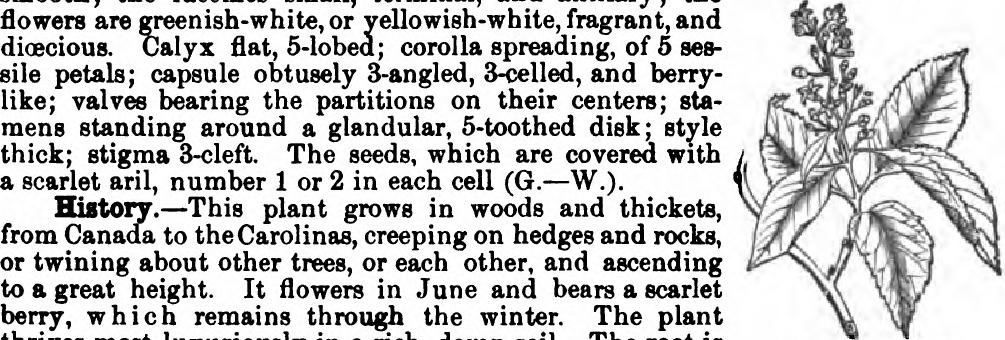
474 CBPHALAKTUUa. ^ inch in thicknese, witb a thick red, or yellowlBb-red bar£, whicb is the medicinal part. On account of the Bimilarity of name, bittersweet, the plant has been confounded with the Solanum Lhdcamara^ from which, however, it essentially differs in appearance and therapeutic action. The bark has a bitter, afterward sweetish, rather nauseous taste, and imparts its medicinal properties to water. Description. — The root-bark occurs in nearly smooth quills, orange-brown externally; whitish and marked with fine striae intemallv. A second layer of an orange-red hue is exposed on the removal of the somewnat tough outer Dark. The stem-bark resembles the above, except that its outer layer has an ashen-gray or biownish-grav color. Ohemicu Oompositioa.— Wayne (1872) obtained a white crystalline prinxiiple to which the name ceUuirin was given. Bernhard {Amer. Jour, j^am., 1882) found the bark to contain starch, gum, sugar, coloring material, volatile oil, two resins, one acid and the other neutral, and a body resembling caoutchouc. Mr. Jacob Hoch (1892), failed to find any volatile constituents (v4. P. J., 1892). The coloring matter of Celastrus scandens was investigated by Dr. Keller, who defined its chemical relation to the vegetable coloring matters, xanthin and carotin {Amer, Jour. Pharm., 1896). Actioiii Medical Uses, and Dosage. — Alterative, diaphoretic, and diureti<^ with some narcotic powers. Used in serofula, secondary m/philiej chronv: k^mtSe affectvcmSy cutaneous affections^ lettcorrhceOy rheumatUm, and ob^ntcted menstruation. Externally an ointment has been succeGBfuUy employed in injlamed and indurated breads of nurs^ in pruritis vulvXj bumSy excoriatwna, etc. Dose of the decoction, from 2 to 4 fluid ounces, 3 times a day; of the extract, from 5 to 10 grains, OEPHALANTHUB.— BUTTONBUSH. The bark of C^halanihtu oecufento/u, Linn£. Nat. Ord. — Rubiacete. CouMoN Names: ButU>nbvsh,Buttonwood,PonddogtDood, Crane vnUow.Globe flower. Botanical Sonrce. — This plant is a handsome shrub growing from 6 to 12 feet or more high, the bark being mostly rough on the stem and smooth on the branches. The leaves are opposite or in whorls of 3, oval, acuminate, entire, smooth, spreading, petioled, with short, intervening stipules, and from 3 to 5 inches by 2 to 3. The flowers are white, terminal, in spherical heads about an inch in diameter, resembling the globular inflorescence of the sycamore {Hatantu occidentaiie). Peduncles long; corolla tubular, slender, and 4-cleft; calyx tube inversely pyramidal, the limb 4-toothed; stamens 4; anthers yellow; style threadform, mu(^ protruded; stigma capitate, yellow. The fruit consists of small, hard, and dry capsules, inversely pyramidal, 2 to 4-Gelled, separating from the base upward into 2 or 4 closed 1-seeded portions (G. — W.). History and Description. — Buttonbush is indigenous to the United Statee, 'and is found in damp places, along the margins of rivers, ponds, etc., flowering from June to September. The bark is the part used, and possesses much bittei^ ness. Water or alcohol takes up its virtues. Buttonbush bark occurs in market as short, curved pieces of a smooth, grayish-brown color marked "with fine strise externally. The smooth and white inner bark is tough, and changes to a pale, rosty-brown color. Old bark has sometimes a fissun^, ashen-gray, corky layer npon the surface. It has a bitterish, sub-astringent taste, but no odor. Ohemical Oomposition.— Analysis has shown the bark to contain starch, sugar, gum, fatty matter, several resins, tannin, a saponin-Iike body, and an amorphous, bitter constituent readily soluble in both water and alcohol. A crystalline, fluorescent body has been obtained bv precipitation with acetate and subacetate of lead. These acicular crystals are ainolvM by alcohol, ether, and water (Hattan, Amer. Jour. i%arm.,Vol. XLV). Mr. Edo Claasen has obtained three bodies from the bark, cephalanikin, cephaletin, and cepkalin. The latter occurs as warty crystals, and is thought to be a glucosid, splitting up into glucose and cephaUtin on evaporating the solution. CaAalin is in vellowish-white needles, strongly-refracting, acid in reaction, and otoerwise tasteless. It is insoluble in petroleum ether, very sparingly soluble
OBRA ALBA^-CERA FLAVA. in cold water, more soluble in hot water, and dissolving with greater ease in alcohol, ether, benzol, chloroform, and acetic acid. This body is strongly fluoreecent in aqueous, alcoholic, and alkaline solutions, all well diluted. Even so minute a trace as 1 part in 2,000,000 of water exhibits this property, and if an alkali be added the blue coloration will be noticeable in a duution of 1 to 20,000,000. The concentrated alkaline, solution has a lemon-yellow color (iVoc. A. P. A.^ 1892). Action, Medical UBes, and Docage.— Tonic, fbbrifuge, aperient, and diuretic. The bark has been used with much success in iidermiUcnt and remiiUfnt fevers; and the inner bark of the root forms an agreeable bitter, which is often employed in coughs, and as a diuretic in gravel. The plant deeervea further investigation. Tincture, 10 to 30 drops; infusion, fljss to nji. CephaUaithin is, according to Robert (1892), distinctly poisonous to both cold and warm-blooded animals, producing emesis, spasms, and paralysis. It destroys the blood corpuscles, converUng them into metnmnoglohin and oxyhsemoglobm. Belated Species. — Sarcocephalus escuJtnitu, Afzeliua. Sen^ambia and Sierra Leone furnish tbia plant, which is known in ita habitat as the doundake. The bark, under the names Qum^tna Africaxae and Kina du Rio Nurm, ia emploved by the negroes as a febrifuge. More inoperly it ia an astringent tonic, and as sach is usfflol in the anemic etaU {oUowing tmhoidi, and as a remedy for Um of m^fpetite, and for aUmic dytpepeia. No alkaloid is present, aocoraing to Heckel and Sculaedenhauffen, but its virtues seem to depend upon three resinous principles— an orange-yellow bitter soluble in water, alcohol, and solutioo of potawa; a pale-yellow \>odj insoluble in water, but soluble in potaRsa solution; and tihe third insoluble in aledhol and water, but diawlviiig in the potassa solution. OIBA ALBA (U. 8. P.)— WBUE WAX. " Yellow wax bleached"— ([/. 8. P.) (see under Cem Flam}. OEKA FLAVA (V. 8. P.)— YELLOW WAX. "A peculiar, concrete substance, prepared by Apis meUijica, Linne" — {TJ. S. P.). Class: Insecta. Order: Hymenoptera. 8oiirce, Hiitozy, and Preparation.— Wax is a substance which exists in small quantities in various plants. It is chiefly obtained, however, through the agency of the common bee (Apia meU^ca), which forms cells, in which its food and ova are contained. It is a natural product of the insect, being secreted upon the abdominal scales or rings. The wax produced by the bee is the offidal urtide, of which there are two kinds, yellow wax arjd white wax. Yellow Wax is procured directly from the comb, which, after having been deprived of its honey, is fused in boihng water, strained, again fused, and poured into appropriate vessels of various sizes. White Wax is prepared by exposing ribbons of yellow wax to air, sunshine, and moisture, for one or two weeks, or more, according to the weather^ when it loses its color, nearly all of its odor, and becomes yellowish-white. To bnng about this e^et, it must be turned every dav, and watered from time to time. The wax IB then remelted. reribboned, and rebleached; it is subsequently refined by melting in water aciaulated with sulphuric acid. When finished, it is cut or cast into flat, round cakes, to which a little spermaceti is generally added to improve the cdor (C). Chlorine will also decolorize wax, but changra its character, causing it, when Dumed, to evolve irritating vapors of hydrochloric acid. Description and Ohemical (imposition.— Oera Alba, White wax. "A yellowish-white solid, somewhat translucent in thin layers, having a slightly rancid odor, and an insipid taste. Specific gravity: 0.965 to 0.975 at t5° C. (59° F.). Melting point about 65° C. (149° F.). In other respects white wax has the cha^ acteristics of, and should rey)ond to the reactions and tests given under yellow wax (see Cera Ftava) " — (U. 8. P.). It readily dissolves in fixed and volatile oils, and combines by fusion with fats and resins; boiled with caustic alkaline solutions, it is impenectly saponified. Cbba Flava. — teUtno teax. "A yellowish to brownish-yellow solid, having an agreeable, honey-like odor, and a faint, balsamic taste. Specific gravity:
476 CBEA FLAVA. 0.955 to 0.967 at 16«C. (59*" F.). Melting point: 63°to64»C.(145.4»tol47.2' F.). It is brittle when cold, and wnen broken presents a dull, granular, not crystalline fracture. By the heat of the hand it becomes plastic. Yellow wax is insoluble in water, sparingly soluble in cold alcohol, but almost completely in boiling alcohol. It is completely soluble in ether, chloroform, and in fixed and volatile oils; ftartially soluble in cold benzol or carbon disulphide, and completely in these iquids at a temperature of 25*" to 80*»C. (77° to 86* F.)"— (C SI P.)- Wax possesses considerable firmness and tenacity, though somewhat soapy, but not greasy to the touch. At a high temperature it boils, and in close vessels distills over with little alteration; at a red neat its vapor inflames, burning with a dense white brightness. Boiling alcohol dissolves about 20 per cent of it (cerotic acid), but deposits it upon cooling almost completely. Yellow wax is largely a mixture of 3 substances: Myricin, or myricyl palmitate (CjeHsiOj-CjoHw), which is the principal constituent, not soluble in boiling alcohol, and having its fusing point at 72" C. (^161.6° F.); cerin, or cerotic acid, (CnH^Oj) (Brodie^, extractible from wax by boiling alcohol, fusing at 78° C. (172.4° F.); and cerolein, an acid substance, soluble in alcohoL to which are also due the color and flavor of wax. Adnlterations and Torts. — Both yellow and white wax are liable to adulterations. Resin may be suspected by the fracture being smooth and shining, instead of granular; also by its solubility in cold alcohol. Insoluble mineral and oivanic suBstanoes, like clay, yellow ochre, starch, etc., may be separated by dissolving the wax in chloroform, whereby these substances remain nehind. However, this kind of clumsy adulteration is not now liable to occur. Tallow and suet reduce the melting point of wax, and impart an unpleasant odor when melted. Fattj' acids,e.fir., stearic acid, may also be detected by the formation of a granular precipitate of calcium soap, when the chloroformic solution is shaken with lime water. If the wax contains starch, boil it in water, and add tincture of iodine to it, which will produce a blue color. (For Myrtle wax see Myrica cerifera). Paraffin is sometimes mixed with wax, which will reduce the specific gravity of the latter. Wax has the specific gravity of 0.955 to 0.967; the specific gravity of paraffin varies from 0.870 to 0.877. Wax, when placed in alcohol (specific gravity, 0.961), will fall to the bottom;.should it float, we may suspect it to be mixed with paraffin. The U. S. P. directs the following tests for wax: "If 1 Gm. of yellow wax be boiled, for ^ an hour, with 35 Cc. of a 15 per cent aaueouB solution of sodium hydrate, the volume being preserved by the occasional audition of water, the wax should separate, on cooling, without rendering the litmid opaque, and no precipitate should t>e produced in the filtered liauid by bydrocnloric acid (absence of fats or fatty acids, Japan wax, resin); nor should the same reagent produce a precipitate in water whicn has been boiled with a portion of the wax (absence oi" soap). If 5 Gra. of yellow wax be heated in a flask, for 15 minutes, with 25 Cc. of sulphuric acid, to 160° C. (320° F.), and the mixture then diluted with water, no solid, wax-like body should separate (absence of paraffin). If a portion of yellow wax be ignited on platinum, it should not emit the odor of acrolein (absence of tallow ana other fats) " — (U. S. P.). Besides the methods here indicated an extremely useful method of analysis of beeswax has been introduced within the last 15 years, and consists in the determination of the acid number, and of the ether number, also certain other numbers. The acid nurnber denotes the number of milligrams of potassium hydroxide required to saturate the free acids contained in 1 gram of wax. The ether number is the number of milligrams of potassium hydroxide necessary to saponify the ethers of 1 gram of wax. As these numbers vary only between narrow limits for pjure wax, it is evident that any admixture of an adulterant like rosin, for example, which has a high acid number, may be easily recognized by titration with an alkali. For an interesting and instructive article on the subject of wax analysis, along the lines briefly indicated, see J^. F. Kebler, Ainer. Jour. Pharrn., 1893, p. o85; compare p. 380. Also see paper by Prof Bedford in iVtw. ^. -P..<4.,1877, p. 444. ' Action and Medical Uses. — Wax exerts little or no influence upon the systern, though it has been recommended, combined with olive oil and the yolk of egg, in diarrhoea, dysentery, and inflam-mtition of the alimentary mucou8 rimnbrane. Its pnnci^l employment is in the preparation of ointmente, cerates, and plasters, of which it forms Ml ingredient^ imparting to them due consistence and tenacity.
OERATA.— OKUTDH. 477 Miiad Prodveta.— Japak Wax. Jnwet toMlc woe Cfttno.— This wax ig Mid 1o be obtained in Japan {rom the meeedaneum, and other treei, being produced, as is flnppoaed, by an insect, Coccus sttunns^Weatwood, which feeda upon the tree. Huber states that the insect has the power of transmntiiw sagar into wax, which latter is, in fact, a secretion. It is said, however, that the Japanese make candles from ttie oil of the seeda of the lUaa mtccedaneum; and Neesvon Easenbeck states that the wax from this tree greatly resembles the Japanese wax found in commerce. Japanese wax cloeelv resembles white beeswax, but is less white and more yellowish, with a more tender and friable conaiBtence, and a crystalline appearance. It occurs in circular cakes of from 4 to 4i inches in diameter, nearly an inch thick, flat on one side, and rounded off on the other, as if cast in a small saucer, and is also met with in large square blocks or cases, weighinz from 100 to ISO ponnds. Its fosiDg point varies from 46" to 48.&° C. (113** to 120** F.), and, when melted, it will unite with beeswax, lard, etc., and more perfectly incorporateswim cacao batter than either spermaceti or wax. It has a rancid-tike taste and odor; is far more soluble in alcohol than beeswax, and, unlike this laet, it is saponified by caustic alkalies. It is chiefly palmitin, with a smalt quantity of glyceridea of arachidic and stearic acids. Itissaid tobeadulteratedsometimeswith water, samples containing from 15 to 20, and even 30 per cent of this fluid. When thus adulterated the wax loaes its transparent and shining appearance, becomes opaque, white, and very brittle. The water may be separated by simple fusion, or by fusion in water acidalated with solpbaric acid, when the presence of an alkali in the water of falsification is suspected. Cabnacba Wax. — A wax from the north of Brazil, wax of Camahuba, a product of the palm, Copfrniciacerifera, has been introdnce<l into commerce, which poBseaBt-s the advantage over beeswax of not melting so readily, as it ret^uires a heat of 84** G. (183.2^ F.). It readily saponifies, yielding an acid upon the decomposition of the soap by an acid; treated with alcohol, it S'ves cerotic acid, whicb melts at 77" C. (170.6'' F.). As it is not affected by finger-marka at e temperature of the hand, it is much used as a furniture polish. There are other forms of vegetable wax, but they do not enter prominently into our OMnmene. Among them are Ocotilla Wax (from the bark of Fouqmeria mlendeiu); Arbol DE LA CnA (from Myrica jalapengii), employed in Mexico in jaundioe and aiarrluea. Ocvba Wax is frcnn the fruit of a Para shrub; while a wax, used by the natives in making canoes, is yielded the Oeroxffion imdieolMm, a palm of the Andes. OSRATA.— 0E&&TE8. Ceratoft are agents Intended for external application, and are composed of wax, or spermaceti, combined with fatty matters, and with which resins, jrowdeis, etc,, are frequently amalgamated. The articles entering into their composition should always be fresh, especially the fats, as these preparations are very prone to rancidity; the addition of benzoic acid tends to prevent this change, but its presence, is not always desirable. Prof. E. S. Wayne found that by substituting paraffin for Uie wax, in cerates and ointments, the disposition to decompose was considerably retarded. Cerates are firmer in consistence than ointments, and are intend^ more as a sort of plaster than for inunction. The cerate is intermediate in consistence between the ointment and the plaster, about the consistence of cold butter, and may be spread with a spatula upon cloth or other substance, and be applied to the body, to which it wiU adhere without melting. In the preparation 01 cerates the water-bath will be found preferable to a direct exposure to the fire; and to effect the fusion of the materials, a very moderate heat will be sufficient. During the cooling of the compound it should be constantly and thoroughly stirred, not permitting one part to solidify before another. Cerates should he made in small quantity at a time, and should he kept in a cool |)lace, in jars closely covered with tin foil, so as to exclude the air as much as possible. It was at one time thought that the use of wax in these preparations would be entirely superseded hy paraffin, which does not become rancid, but experience has shown it to be objectionable on account of the granular character it ^ves to the cerate. Yellow wax is found to be less liable to become rancid than white wax. OERATUH (U. 8. P.)— CERATE. Synontus: Simple <xratet Lard cerate, Oertttum HmpleXf (%reUum ad^m. PrnMuration. — "White wax, three hundred grammes (300 Gm.) [lOoas. av., 265 grs.J; lard, seven hundred grammes (700 Gm.) [1 lb. av., 8 ozs., 308 grs.]; to make one thousand grammes (1000 Gm.) [2 lbs. av.,3 ozs., 120grs.]. Melt tnem together and stir the mixture constantly until it is cool"— ((7. 8. P^,
478 CERATVU CALAMINE— CBKATUU OAMPHORiE. This preparation should be perfectiy bland, and great care should be observed in selecting lard entirely free from ranciditj. To orevent an^ decomposition a low heat should be employed. This is not designed for inunction, though often improperly directed for that purpose. An old formula is as follows: Melt together prepared hog's lard 4 ounces, and white wax 2 ounces, agitating the whole briskly until cool. Put up in small vessels and cover well with tin foil, to protect as much as possible from the action of the atmosphere. Action and Medical Uses. — Simple cerate forms a mild and cooling application to irrigated mrfaces, wounds, excoriations, bums, bliOers, etc. Mr. W. J. M. Gordon, pharmacist of this city, formerly prepared a " paraffin cerate," which has been found a very useful article. It is composed of paraffin 2 drachms, oil o£ almonds ^ ounce, white wax 1 drachm, oil of roses 2 drops. Simple cerate has been advised by G.W. Sloan {A. P. A. Proe0ed.yl^) as an exdpient for certain readily oxidizable pill-masses. Steatinvm.— A class of substances resembling the cerates in consistfince, was proposed by Dr. W. H. Mielcke, in 1881, under the name of gieatinei or Oeatina. Suet or tallow formed the base, which was compounded with other bodies, such as wax, dehydrated lead plaster dei«iTed oi its glycerin, nutmeg oil, and various medicamenta. OBRATUM OALAHINJe.— OALAMDIE OEUTE. Stnonyhs: Turner's cerate, Cerate of zme earbonate. Preparation. — Take of prepared odamine 1 ounce; simple cerate 5 onnoes; mix them well together {Ed.). Or, take prepared carbonate of zinc, wax, of each, ^ pound; olive oil, 16 fluid ounces (Imp.). Melt the wax in the oil, remove them nom the fire, and as soon as the mixture begins to concrete, add the carbonate of zinc, and stir oriskly until they are cold (Lond.). Action and Medical Uses. — This cerate is an excellent desiocant and astringent application to frunu, secUds^ erysipdalous tUcerationSt ehqfingSj etc (P.). OSRATUH OAHPHOEA (U. 8. P.)— OAHFHOB OE&ATB. Synonym: Unguentum camphoraiuvi. Preparation. — " Camphor liniment, one hundred grammes (100 Om.) [3 oia. av.,231 grs.]; white wax, three hundred grammes (300 6m.) [10 ozs. av.,2&5 grs.]; lard, six hundred grammes (600 Gm.) [1 lb. av.,5 ozs., 72 grs.]; to make one thousand grammes ^l(XX)Gm.) [2 lbs. av.,3 ozs., 120 grs.]. Melt the white wax and lard with the aid of a gentle heat; then add the camphor liniment, and stir the mixture occasionally until it has become cold" — (17. S. P.). This preparation is somewhat softer than the cerates in general. It contains about 2 per cent of camphor. This preparation, formerly ( U. S. P., 1880), contained less than 1 per cent of camphor, and was originally intended and is now used as a basis for the extemporaneous preparation of Goulard's cerate. Action and Medical Uses. — Antipruritic and slightly anodyne. It possesses no advantages over camphorated oil. Other Oamithor Oerates.— Camphor Gbbatb, of a former ediUon of the French Coda, ia Erepared by melting tof^ther white wax (1 part), and lard (9 parts), employing moderate eat, and finally stirring into the mixture nntil dissolved, powdered camphor (3 p«rt4, continuing the stirring until the whole is cold. Ckratuw Cahphorx Composituu (N. F.), Compound camphor cerate, Cerainm camphoratum. Camphor ice. — Formuiary number, 19: "Camphor, in coarse powder, one hundred and seven fframmes (107 Gm.) [3 ozs. a^., 338 grs.]; white wax, one hundred and fifty grammes (IdOGm.) [5 ozs. av., 127 grs.]; castor oil, two hundred and fifty grammes (250 Gm.) [8 ozs. av., 368 gre.]; iDermaoeti, four hundred and eighty grammes (480 Gm.) [16 mb. sr., 408 grs.]; carbolic acid, luioefied by warming, two grammes (2 Gm.) [31 grs-]; oil ot bitter almond, one gramme (1 Gm.) [15 grs.]; benzoic acid, ten grammes (10 Gm.) [154 grs.]. Melt the white wax and spermaceti on a water-bath, add the castor oil and afterwarofi the camphor, and continue heating and stirring until the camphor is dissolved. Then withdraw the beat, cover the veflsel, and when the mixture has somewhat cooled, add the remaining ingredients, and thoroughly Incorporate them by stirrii^. Lastly, pour the cerate into suitable molds" — {Nat, jbrm.). roT other cerates coutuning camphor, see Ceratum CetaeeL
CERATUH CANTHARIDI3.— CERATUM CBTAOEI. 479 OSBATUM 0ANTHABIDI8 (U. 8. P.)— 0ANTHABIDE8 OBEA.TB. Stnonyhs: Ehnplastnm carUharidiB, EmplaMrvm vesica'M, Emplaatrum eptspcuH' cum, £hnpla8trum vesicatorium,^ Bli^ering cerxUe, Blistering placer. Preparation. — "Cantharides, in No. 60 powder, three hundred and twenty grammes (320 Gm.) [11 ozs. av., 126 grs.]; yellow wax, one hundred and eighty grammt-s (180 Gm.) [6 ozb. av., 153 grs.]; resin, one hundred and eighty grammes 180 Gm.) [6 ozs. av., 153 grs.]; lard, two hundred and twenty grammes (220 Gm.) [7 ozs. av., 333 gra.]; oil of turpentine, one hundred and fifty cubic centimeters (150 Cc.) [5 flj, 36tlXJ; to make one thousand grammes (1000 Gm.) [2 lbs. av., 3 ozs., 120 grs.]. " Moisten the cantharides with the oil of turpentine, and set the mixture aside, well covered, for 48 hours. Then add it to the yellow wax, resin, and lard, previously melted and strained through muslin, and keep the mixture in a liquid condition, by means of a water-bath, stirring occasionally, until its weight has been reduced to one thousand grammes (1(XX) Gm.^ [2 lbs. av.j3 ozs., 120 grs.]. Then remove it from the bath, and stir it occasionally until it is cool '^—(a S. P.). This preparation contains 32 per cent of cantharides, and will always vesicate, providing the flies used are of good quality. It should not be heated, in preparation, higher than lOO*' C. (212^ F.), lest the catharidin be lost with the aqueous vapors given off from the powder employed, thus reducing the strength of the cerate. The vapors given off, when heating higher than the above-mentioned point, are liable to produce vesication of the hands and face of the operator. Turpentine, being a solvent of cantharidin, is employed to render that body more. readily soluble in the &tB employed. In 1860, Wm. R.Warner proposed a formula, which differs principally in embodying an aloofaoUc extract of cantharides, in place of the powdered drug. This formula was adopted by the U. 8. P., of 1880, under the name of Ckratdm Extsacti Cantharidis, and is by many preferred to the present official cerate. This is practically reproduced in the formula of the Naiional Formulary giyen below. Action and medical Uses.— As a blistering agent (see OanikarU). "OjuuTinf ExTBAcn Gantrahdu (N.F.). ( 015. P., 1880). C&aie of extrtua of ccmlharidtt, — Formtdarj/ number, 20: CantharideB, in Mo. 60 powder, three hundrea Knuumes (300 Gm.) [10 OM. av.,856 gn.V, resin, one hundred and fifty grammos (150 Gm.) [5 ozs. av.,127 gra.]; esllow wax, three hundred and flftr grammes (350 Gm.) [12 ozs. av., 151 gra.]; lard, three andred and fifty grammee (350 Gm. j [12 ozs. av., 151 grs.]; alcohol, a sufficient quantity. "Moisten the cantharides, wiui one hundred and eighty cubic centimeters (180 Cc.) [6 HX] of alcohol, and pack firmly in a cylindrical percolator; then wadutJly pour on alcohol, unm one thousand eight hundred cubic centimeters (1800 Cc.) [60 n^, 41din Jof percolate are obtained, or until ttie cantharides are exhausted. Distill off the alcohol by means of a water-bath, truufer the residue to a tared capsule and evaporate it, on a water>bath, until it weighs one hundred and fifty grammes (150 Om.) [5 ozs. av., 127 grains]. Add to this the resin, wax, and lard, previously melted t<^ther, ana keep the whole at a temperature of 100^ C. (212° F.), for 16 minutes. Lastly, strain the mixture through muslin, and stir it constantly until cool" (Nai. Form.). Cahphoratbd Cantharidal Plastkb. — A camphorated cantharidal plaster is prepared by spreading a strong ethereal (or chloroformic) solution of camphor on a plaster of cantharides cerate. This, on evaporation, leaves a film of camphor on the surface of the cerate. VetieiUing ddh, or Uiiterina tafietai, are occaaionallr prepared. The Qtarta ^in>a$tiea of the V. 6. P, will probably fulfil all the indications for these various preparations. OKRATXJH OETAOEI (U. S. P.)— SPEKHACETI OEBA.TB. Stnontms: Sm^attrum mmuifw eeti. Ceratum labiale album,. Preparatton.— Spermaceta, one hundred grammes (100 Gm.) ^oz8.av.,231 grs.]; white waz^ three hundred and fifty grammes (350 Gm.) [12 ozs. av.,151 " g's.l; olive oil, five hundred and fifty grammes (560 6m.) [1 lb. av.,3 oza, 175 Ss.J; to make one thousand grammes (1000 Gm.) [2 lbs. av..3 oes., 120 grs J. elt together the spermaceti and white wax; then add the olive oil, previously heated, and stir the mixture constantly until it is cool " — (17. S. P.). This preparation should be pwfectly free from lumpiness, should not be rancid, and ehoukl have a white color. Should the olive oil oe added without previous
480 CERATUM CROTONI8.-€KRAT0M PLUUBI 8UBACBTATI8. heating, a lumpy cerate is produced. The following old formula also produces a spermaceti cerate: "Take of olive oil, 6 parts; white wax, 3 parts; spermaceti, 1 part. Heat the oil gently; add the wax and spermaceti; stir the whole briskly when it is fluid, and continue the agitation until it is cool" It is found that this cerate may be preserved a much longer time when made of yellow instead of white wax, and of Olive oil not bleached (J. B. Barnes). Action and Medical Uses.— Spermaceti cerate is used as a mild and uuirritating application to superficial uUera, oBcoriationgy blisttn^ etc.; more active ingredients are sometimes added to it (P.). Other Oerates.— Rid Lip-saltjb. Place in a Teesel, oil of almonds, 1 pound; spermaceti, white wax, alkanet-root, of each, 2 ouncea. Melt over a steam or water-oath, and allow the articles to digest on the alkanet 4 or 5 hours to extract its color; then strain through fine muslin, and add 2 drachms of oil of roeea just before the mixture cools. Stir well tcnetber. Whitb Lif-salvb.— Melt, as above, oil of almonds, 4 ounces, with white wax ana apermaceti^each, 1 ounce. When nearly cool, add oil of bitter almonds,i drachm; oil of geranium, 15 minims. Stir thoroughly tfwether. After the lip^ve is poured into pots, and has become cold, a red-hot iron must be held over it temporarily, in order that the heat radiated from the iron may melt the surface of the salve, and make it even and smooth lATner. Jour. Pharm., Vol. XXVIII, p. 86). Camphor OoLD-CRaAM is made by melting together almond oil, wax, spermaceti, of each, 1 pound; now pass into the mixture, in a very small stream, of roee water, 1 pound, agitating constantly until the whole is introduced and well incorporated. Then add powdered camphor, 2 ounces; oil of rosemary, 1 drachm. Ross Cou>-caRAH is made similarly of almond <nl, rose water, each, 1 pound; white wax, qiermaceti, each, 1 ounce; oil of roses, i drachm. Camphob Ball is made by melting together, spermaceti, 3 drachms; white wax, 4 drachms; almond oil, 1 ounce; and then addmg powdered camphor, 3 drachms. Camphor Ice is made by melting spermaceti, 1 drachm, with almond oil, 1 ounce, and adding powdered camphor, 1 drachm (see also Ceraium Camphorx Composiium, N. F.). Cebatuu Rosatum. Rose cerate, Lip-talve. — White wax, 50 parts; oil of almonds (ex* pressed), 100 parts; carmine, i part; essential oil of rose, ^ part. Rub the carmine with a portion of the oir. Melt the wax and almond oil together with moderate heating; add the carmine (in oil) when the mixture has partially cooled, itirringall intimately tt^eUier, and lastly,, add the oil of rose. This is in accordance with the French Codex. 0BR4TUH 0BOTONZ8.— OBOTOH-on. OERilTE. Preparation. — Melt lard, 5 ounces, with white wax, 1 ounce, and, when nearly cool, add croton oil, 2 ounces, and stir until cool. Action and Medical Uses. — Croton-oil cerate is a rubefacient and vesicant, and may be used in all cases where such actions, or counter-irritation, are demanded. OEIUTUM PLUHBI 8UBA0XTATIB (U. 8. P.)— OE&ATE OF LEAD SUBAOETATE. Symonyus: Ungneiitum glycerini plumhi st^baeHaHt^ Oovilard'i rerate, OnUmerU of glycerin of lead mbacetate. Preparaton. — "Solution of lead subacetate, two hundred grammes (200 Gm.) [7 ozs. av.,24 grs.]; camphor cerate, eight hundred grammes (800 Gm.) [1 lb. av., 12 ozs., 96 grs.]; to make one thousand grammes (1000 Gm.) [2 lb. av.,3 ozs., 120 grs.]. Mix them thoroughly. This cerate should be freshly prepared, when wanted'*-(aS. P.). Care should be taken, in making this cerate, that the camphor cerate be not rancid. Both the Oemum and British I^iarniacopmaB empioy no fats in the preparation of this cerate, hence their greater staoility. Goulard's cerate rapidly assumes a yellow color, and shortly oecomes so rancid as to render it unfit for medicinal purposes. Action and Medical Uses. — Protective and astringent. Should be cautiously used on large raw surfaces, lest lead poisoning ensue from absorption. When rancid this cerate is irritating, and should be discarded, but when freshly prepared, it forms a good dressing for blisters^ excoriationSj u^Mrt, and to sttppvratwe jmrta.
OERATXTM BBSIK^— CEEEI. 481 OEUTUM BE8ZNJE (U. 8. P.)— BE8IN CEKATE. Stkontms: Batilicon otiitmenf, Vnguentum reaina. Ointment of resin. Preparation.— "Beein, three hundred and fifty gr&mmeB (350 Om.) [12 ou. av., 161 grs.]; yellow wax, one hundred and fifty grammeB (160 Gm.) [6 ozs. av., 127 grs.]; lard, five hundred grammes (500 Gm.) [1 lb. av., 1 oz., 279 grs.]; to make one thousand grammes (1000 Gm.) [2 lbs. av.,3 ozs., 120 grs.]. Melt them together at a moderate heat, strain the mixture through muslin, and allow it to cool without stirring. In cold weather use the following proportions; Resin, three hundred and fifty grammes (350 Gm.) [12 ozs. av., 151 grs.]; yellow wax, one hundred and twenty grammes (120 Gm.) [4 oza. av.,l02 grsj; lard, five hundred and thirty grammes (530 Gm.) [1 lb. av., 1 oz.,304 grs.] "— (U 5. P.). An old formula reads: " Take of resin 5 ouncra, axunge (lard) 8 ounces, beeewax 2 ounces Melt them together with a gentle heat, and then stir the mixture briskly while it cools and concretes" (Ed.). Strain it while it is hot. Action and Medical UseB. — This cerate forms a mildly stimulant^ digeetive, and detergent application to ulcen which follow frunu, aealdsy etc., or which are of a foul or indolent character, and also to blistered mrfaces to promote a diaeharge (F.)CEBATUH SABINJS.— SATQIB OE&ATE. Synonyms: Ointment of savin, Unguentum saMnss. Preparation. — Take of lard 74 ounces, resin 1^ ounces, yellow wax 3 ounces, fluid extract of savin 2 ounces. Melt tq^ther the lard, resin, and wax, fuid when nearly cold, having stirred it constantly, add the fluid extract, and continue the stirring to completion. Action ana Uedical Usbb. — Savin cerate is applied to bliUered mrfacea, to maintain a constant discharge. It is less irritating than the cerate of cantharides, and has no tendency to excite strangury. When well prepared it has a fine green color, is uniform and transparent, without any tendency to separate, and has a smell like that of the plant. * Belated Product.— Cibatttk Sabinb {N. F.) {U. S. P., 1880). Saving cerate.— Formulary nuBifcw, 21: *' Fluid extract of eavine, twenty-five cubic centimetera (25 Cc.) [M6 till; reain cerate, ninety erainmes (90 Gm.) [3 ozs. av., 76 grs.]. Melt the resin cerate by meaxuof a "waterbath, add the fluid extract of savine, and continue the heat until the alcohol has evaporated; then zemove the heat, and stir constantly until cool"— (^ot. fbrm.). OEBSI.— OEBEOU. Synonym: Bougies. Preparation. — Bougies are made by dipping strips of soft linen cloth, bundles of uiread, etc., rather wider at one end than at the other, into certain emplastic or elastic compositions, folding them closely, and rolling them firmly on a smooth slab. Beady-made bouses are now a regmar article oicommerce. The following are some of the compositions held in most repute: I. Bell's. — Lead plaster 4 ounces, yellow wax, 1^ ounces, olive oil 3 drachms. II. Hunter's. — Olive oil 3 pounds, yellow wax 1 pound, red lead 1^ pounds; boil together over a slow fire until combined. III. Swediaub's White. — White wax 1 pound, spermaceti 3 drachms, acetate of lead from 2 drachms to 1 ounce; boil together slowly. IV. Pidebit's Wax.— Yellow wax 6 parts, olive oil 1 part. V. Godlabd's. — Yellow wax 6 ounces, melted and mixed by stirring with Goulard's extract of lead, from 2 drachms to 2 ounces. VI. Elastic. — Boiled linseed oil 12 ounces, amber 4 ounces, oil of turpentine 4 ounces, in which is dissolved caoutchouc 5 drachms. Me.lt and mix the articles well together, and spiVAd the compound at tJiree successive intervals upon a silk cord or web. Place we pieces so coated, in a stove-oven heated to 65.6** C. (150° F.), and leave them in it for 12 hooiB, adding 15 or 16 firesh layers in SI
482 CKRSVmX FBRMEMTVBL Buccession, until the inBtruments have a(M)uired the proper sise. Polish fint with pumice stone, and finally smooth with tripoli and oil. SUTffical Uses. — Bougies are usually employed for dilating strictures^ ss of the urethra, vagina, n(tck of the uteru^ and rectum. The largest size that can be convemently introduced ia first osed^ and the size gradufdlv increased as the treatment pn^esses. The wax bougie is often employed for obtaining the form of a urahral Afncture, its location and distance from the external orifice. OEBEVIBLfi FEBMENTUM.— BBES YBA8T. The ferment obtained in the brewing of beer. Synonyms: Breioer'a yeasty Barm. Preparation. — When an infusion of malt (barley steeped in water, left to incipient fermentation, and dried in a kiln), technically called Wort, is subjected to the process of fermentation, a dirty, grayish-brown substance gradually separates, forming in part a frothy scum (top or upper yeei^), and partly a sediment (bottom, or lower yeast); this is yeoM, or barm. Description and History.— Yeast is a thick, glutinous, foamy -like fluid of a wine-acid odor, and a rather unpleasant taste; it is a very complex mixture, containing water, alcohol, carbonic, acetic, and malic acids, potaraium and calcium salts, saccharo-muciU^nous extract, and a cryptogamoos growth consisting oi nucleated cells, which was formerly named TonUa cereviam^ of Tuipln, but now known as Saccmromyees cereomse. When exposed to moist air, or to a temperature above 15° C. (59*" F.), yeast rapidly decomposes; but when subjected to a gentle heat, BO as to dissipate its watery parts, it forms a fragile solid, which may be kept without change for a considerable time, but with a diminution of its fermentative properties. Neither water nor alcohol dissolve yeast. Its most important property is, that when placed in contact with saccharine solutions at a temperature between 1(P and 26.6° C. (50° and 80° F.), it excites vinous fermentation in them, converting their sugar into carbonic acid and alcohol. This was first pointed out by Thenard, in 1803, but the fungi producing this change were observed bv Leeuwenhoek as early as 1680. Dr. Christison, by means of yeast, has been able to detect one part of sugar in 1000 i)arts of urine, of specific gravity 1.030. The cells appear as small, oToidal, ellipsoidal, or somewhat pyriform, transparent, nucleated bodies, varying in size nom 7^ to about 7^ of an inch (P.). The fermentative power of yeast is much impaired by dryineit; a heat of 100° C. (212° F.) destrovs veast when moist, as does the addition of some of the concentrated acids, and 01 undiluted alcohol. It is also destroyed by boiling water, sulphurous acid, sulphate or acetate of copper, salt, nitrate of silver, black oxide of manganese, carbolic acid, creosote, quinine, strychnine, free alkalies, pyroligneous acid, salts of mercury, essential oils, etc. If, however, fermentation has commenced, the vegetable bases have no specific power of arresting the process. Arsenous acid, acetate of lead, and tartar emetic have no retarding effect upon the progress of fermentation. The keeping qualities and the taste of Uie products of fermentation depend largely on tne nature of the yeast employed. The introduction of pure cultures of these micro-organisms by E.C. Hansen, of Copenh^n, has raised the arts involving fermentation to an almost exact science. For some iaterestine remarks on fermentation, by H. Pasteur, see Amer. Jour. /%ann.,VoI. XXX, p. 328; also see under Alcohol. Yesst may be expcsed to a very low temperature (—60° C. [ — 76° F.] ) without losing its vitality, though the plant ceases to form and bud at a temperature of less than 5° C. (41° F.). On the other hand, it may be heated, if no water be present, to 100° C. (212° F.) without destroying its activity, but if water be present, its destruction is accomplished at 75° C. (167° F.). Commercial dry yeast is prepared by pressing out most of the water from yeast. Vienna yea^ is the dried m>th from the wort from barley malt, maize, and rye. Patent veast is said to be flour doi^h mixed with yeast, or hop infusion, with malt added. Action, Medical Uses, and Dosage— Stimulant, tonic, nutritious, antiseptic, and laxative. Formerly used in typhoid fnen by mouth and injection,
OBRn OXJLLAa 483 and in tympanitis by enema. With or without the addition of olive oil, which renders it more laxative, it will l)e found highly beneficial in all malignant ulceratiom of the throat and iiwuth, in diseases where there is a disposition to putridity, in Karlatina, and loio sta/jes of fever. Externally, in combination with elm bark and charcoal, it forms an excellent emollient and antiseptic poultice in eloughing ulcers, stimulating the vessels, removing the tendency to gangrene, and correcting the fetor. In the furuneidoid epidemic, which existed in this country and Europe, given internally, in conjunction with quinine, ^east was found effectual in tne treatment of boils, carbimcUs, and felons. Yeast in doses of 1 fluid drachm, 3 or 4 times a day, taken immediately before meals, has been advised in diabetes mellUus. It has in some instances proved efficient, and is supposed to act by decomposing angax or preventing ita abnormal production in the stomach. The dose of yeast is m)m ^ tol fluid ounce, every 2 or 3 hours. OEBn OZALAS (U. 8. P.)— OEBIUM OXALATE. Formula: Ces(C,O08+9HA Molecular Weight: 704.78. Synonyms: Ornlas cericm. Cerium, oxalicum, Oxalate of cerium, Cerous oxalate. Source and Preparation. — Cerium oxalate is prepared by a tedious method from the Swedish mineral cerite, which is composed chiefly of the silicates of cerium, lanthanum, and didymium. "For its production the powdered mineral is digested with hydrochloric acid. The solution is evaporated to a small bulk, treated with sulphide of hydrogen, diluted and filtered. Ammonia water is then added in slight excess, the precipitate collected, washed with water, dissolved by means of dunted hydrochloric acid, and precipitated by solution of oxalic add. This produces cmdeoxalate of cerium, from which the impurities (lanthanum 9nd didymium), are separated by calcining it, whereby sesquiozide of cerium is produced with the oxides of other metals. The powder is then digested with solution of sal ammoniac which dissolves all but the cerous oxide. This is then dissolved in diluted hydrochloric acid, and oxalic acid solution added until in slight excess. The precipitate of oxalate of cerium is then dried. It will be observed that thex)bject of the foregoing roundabout process is to obtain chloride of cerium, and that irom this the oxalate is in reality prepared by decomposition with oxalic acid" (Lloyd's Chemi^ry of Medicines). Description and Testa. — "A white, granular powder, without odor or taste, and permanent in the air. Insoluble in water, alcohol, ether, or in solutions of potassium or sodium hydrate,- soluble in diluted sulphuric or hydrochloric aoid" — (U. S. P.). When heated in a current of hydrt^en it decomposes, leaviug the sesquiozide, or so-called eermu aside. Cerium oxalate feels gritty when chewed^ and seems to impart a sensation as if the teeth would adhere when moved upon each other. "When heated to redness, it is decomposed, leaving a residue of reddishvellow eerie oxide (a brown color would indicate the presence of didymium). On boiling the salt with potassium or sodium hydrate T.S., white cerous hydrate is left as insoluble residue, while in the filtrate, supersaturated with acetic acid, calcium chloride T.S. will produce a white precipitate insoluble in acetic acid, but soluble in hydrochloric acid. If the yellow residue left after heating be dissolved in concentrated sulphuric acid, and a small crystal of strychnine added, a deep-blue color will appear, which will rapidly change to purple and then to red. From the solution in diluted hydrochloric or sulphuric acid, potassium hydrate T.S. precipitates white, cerous hydrate, which does not redissoive in an excess of the reagent, and gradually turns yellow in contact with air. Ammonium carbonate T.S. precipitates white, cerous carbonate, which is somewhat soluble in an excess of the reagent. If 0.1 Gm.of cerium ozalate be dissolved in 1 Cc. of sulphuric acid, and 2 Cc. of potassium sulphate T.S. be added, sm^l, colorless crystals of cerium potassium sulphate will be deposited after some time. No effervescence should occur when the salt is dissolved in diluted hydrochloric acid (absence of carbonate); nor should the solution be colored or rendered turbid on the addition of an equal volume of hydrogen sulphide T.S. (absence of arsenic, etc.). On boiling the salt with potassium or sodium hydrate T.S. and filtering,
484 CBTACBUM. no precipitate sfaould be produced in the filtrate either br ammonium chloride T.8. (absence of aluminum), or by ammonium sulphide T.S. (alMenoe of sine) " -(K S. P.).. ' ^ Action, Medical Uses, and Dosage. — Cerium oxalate allays certain forms of vomiting, being best adapted to that renex disturbance of uterine origin, and less valuable where the vomiting depends upon simple gastric irritation or destructive processes going on within the stomach. To a certain extent it will sometimes relieve the vomiting due to gastric irritability in dyspepsia, phthisis, and other chronic wasting diseases. Its reputation as a remedy for coiigh and chorea has not been well sustained. Its most decided effects are in the vomiting of pregnancy, and even here it often fails. Prof. Scudder alludes to its probable special influence upon the female reproductive apparatus, and states that he has given the remedy (2 X trit.) in ulceratm cervix uteri and uterine irritatum with leuchorrhceal discharges, with apparent success. It has been asserted a useful remedy for dysmmorrhcea in robust, n^hy women, with scanty menses, and spasmodic, colicky, or tenesmic pain before or at the beginning of the flow, relief fcSlowing the free establishment of the discharge. Six grains are given every hour until relieved (Webster, Dynam. Therap.jfrom Med. Record). The dose of cerium oxalate ranges from 1 to 10 grains (preferably in powder), from 1 to B grains being the ordinary dose — every 4 hours. The valenanate of cerium is also used in the same doses for vomiting of pregnancy. Specific Indications and Uses. — Nausea and vomiting of pregnancy with nervousness; dysmenorrhoea of plethora, with colicky, tenesmic pain at the outset. Oerinm and Its Salts. — Cbbium (Ce). Atomic weight, 141.2. EUproth discovered this metal in. 1803, ttiougb he believed it to be an earth. Simultaneoaely Berzelias and Hisinger obtained tbe metal, all three extracting it from the Swedish mineral cfrUe above noticed. Later it was obtuned by Mosander by heating cerium chloride and sodiam together, and Hillebrand and Norton obtained it from the chloride by electrolysis. The minwal aJtomIe, Iband in New York and Pennsylvania, as well as in Scandinavia, contains the same ulicates that cerite holds. Among other minerals orthiu, mdolimU, etc., of northern Europe contain it Oeriam resembles in color iron, and like it tarnishes in the presence of a moist atmosphere, yellow, blue, and green shades being produced. Though hard, when warm it is malleable, ana may be drawn into wire. Beautiful scintillations are produced when the metal is struck with flint and it bums even more brilliantly in the air than magnesium. Two oxides are known, the blue-^^n powder, cerium sesquioxide (cermtsoxide) (CejOj), and tbe white or pale-vellow cerium dioxide (eerie oxide) (CeOt). Corresponding to these oxides are the two lines raofnw uid cene compounds. Ckrii NiTBAs(Ce[N03]i.6H30). Cerium nitrate forms very deliquescent prisma or scales, colorless, and readily solume in water or alcohol. It is prepared by double decomposition of barium nitrate and cerous sulphate. Simpson, the discoverer of the medicinal properties of tbe cerium compounda, employed it as a nerve tonic. Probably of little value. Ckrii Bbohidum. — A sweet, chocolate-colored mass, having a styptic action, readily ■oluUein alcohol, but when added to water leaving an insoluble cerous salt. It is prepared by diSBolvit^ cerous carbonate in hydrobromic acid, and evaporating (Bullock, Amer. Jour. Pharm., 1871). Cbbii Cabbomas (CegCCOsJg.GHgO). Scales of a silver-like brilliancy, produced by the changing of the floccnlent white precipitate thrown down when cerous sulphate is decomposed by ammoniam carbonate. Not soluble in water. OETAOEUH (U. 8. P.)~SPESMAOETI. "A peculiar, concrete, &tty substance, obtained from I^yseter maeroc^halvs, Linne. Class: Mammalia. Order: Cetacea. Source and Preparation. — Spermaceti is obtained from the cachalot, or sperm whale, the Pkyseter nuicrocephalus of naturaliete, a specie of the order Cetacea, and family Physeteridm. It is a gregarious animal, inhabiting the Pacific ocean, the Indian Archipelago, and the Chinese and Australian seas. It varies in size, being from 50 to 80 feet in length, with a huge, quadrangular head, from 20 to 30 feet or more in circumference, and which constitutes about a third of its whole length. Spermaceti is found in various parts of its body, in small proportions, dissolved in its blubber, but that which is met with in commerce is obtained from laree cavities in the upper part of the head; these are divided into numerous cells.
486 vhich are filled with a milky, oleaginous solution of spermaceti. From a large whale 40 to 60 hundred weight, of this fluid may be collected. It is removed from the caTities and boiled to sepuate the oleaginous matter from the solid substance, and as it oools, the spermaceti crystallizes. The oil is then drained off as much as possible, and the remainder is removed from the spermaceti by powerful pressure. The crude spermaceti is subsequently purified by fusing and skimming it, then fusing it in weak lye of potassa, and finally by a third fusion at a gentle heat; after which it is solidified in tin molds. Description, Chemical Oomposition, and Tests. — Spermaceti is a concrete, crystalline, foliaceous, pearly-white substance, without much taste or odor, easily indented or scraped by the nail, slightly greasy, pulverizable on the addition of a little alcohol, or almond oil^ fusible and combustible. It is freely soluble in boiling alcohol, which deposits it on cooling; also in fused fats or resins. It is soluble in sulphuric acid, which decomposes it, but the other mineral acids do not influence it. It differs from ordinaiy &ts in not yielding glycerin when saponified, but in furnishing in its stead a monobasic alcohol termed ethal^ or eetyl xdcohol (CMHas.OH). The U. S. P. describes spermaceti as in "white, somewhat translucent, slightir unctuous masses of a scaly-crystalline fracture and a pearly lustre; odorless, ana having a bland, mild taste. It becomes yellowish and rancid by exposure to the air. Specific gravity, about 0.945 at 15° C. (59° F.). It melts near 50'' C. (122* F.), and congeals near 45° C. (113° F.). Insoluble in water, and nearly so in cold alcohol; soluble in boiling alcohol; also in ether, chloroform, carlion disulphide, fixed and volatile oils; only slightly soluble in cold benzin. An alcoholic solution of spermaceti is neutral to litmus paper. If 1 Qm. of spermaceti be boiled with 1 Gm. of anhydrous sodium carbonate, and 50 Cc. of alcohol, and the mixture cooled and filtered, the filtrate, upon being supersaturated with acetic acid, may become turbid, but should not afford a precipitate (absence of stearic add)" — ((/. S. P.). Exposed for a length of time to atmoBpheric influence, spermaceti becomes yellow and rancid, owing to a smidl portion of oil (pU of tpermacetx) contained in it, but may be purified bv boiling in alcohol, which deposits the pure spermaceti as it cools. By this method, or when it is deprived of oil by means of an alkali, it becomes a nearly pure proximate principle, intermediate between wax and the concrete oils, and presenting all the leading properties of the ordinary article, but less unctuous, ratner harder, and fusible only at 49° C. (120.2° F.). It is then termed cetin (cetyl palmitaU!) (CMHa.CMH„O0, and is soluble in 40 parts of boiling alcohol of specific gravity 0.821. When boiled in a solution of caustic potash, cetin is partially saponified, forming a brittle soap composed chiefly of palmitate of potassium, oleate of potassium, and a crystalline principle called ethai (CmHmO) (cetyl akohol^ or c^yl hydrate), and which soap is not wholly soluble in water. When melted or dissolved in hot alcohol it crystallizes beautifully: when acted on by nitric acid, it yields first, pimelic acid, which is then oxidizea into adipic acid, which is finally converted into succinic acid. Besides cetin, stearic, laurostearic^ and myrutic acioA, as well as other and higher alcohols, besides ethal, are present in spermaceti. Action, Medical Uses, and Dosage. — Demulcent and protective, combined with equal parte of loaf-sugar, once used among children in domestic practice in coughs, colds, and cotarrAoZ affections^ and in irritation of the intestinal mucous membranes.. If to spermaceti be added half its weight of olive oil, and after mixing this, powdered gum Arabic be added, and, finally, some water be added by degrees, an emulsion may be formed, useful for children and in&nts. HoUandt states that spermaceti may be reduced to the most impalpable powder, by melting it over a gentle fire, and then stirring it in a previously- warmed mortar until cold. Spermaceti forms a useful ingredient of several cerates and ointments. It enters into the formation of a crayon which is of much value to chemists, druggists, and others, inasmuch as it enables them to write ni>on clean glass. It is made by fusing in a cup 4 drachms of spermaceti (or stearin), 3 drachms of tallow, ana 2 drachms of wax; after which 6 drachms of red lead, and 1 drachm of potassa are to be stirred into it, keeping the whole mass warm for ^ hour, when it IB poured into glass tubes the thickness of a lead-pencil. Kelated Wax.— Black Wax. An animal product introduced into England from the Psdflc Z^nda and India.
486 CBTBARXA. OETRABIA (U. 8. P.)— OETRAXIA. Cetrarla Ulaudlca The lichen, "Cetraria ialandica (Linn^) AchariuB "—(U. S. P.)- (Liehm ialandieu8f Linn^). C2aw; Lichenes. CoHHON Names: Icdand moaa, ledand lichen. Botanical Source. — Iceland moss is a perennial, foliaceous plant, from 2 to 4 inches high; the thallus is erect, tufted, olive-brown, paler on one side, laciniated, channeled, and dentato ciliate, the fertile lacinse being very broad. The shields are brown, oppressed, and flat, with an elevated border (L). History.— This lichen is a native of the mountainous section of Britain and the northern countries of Europe, particularly Iceland. It is found as far south as France, Italy, Switzerland, and Spain, growing in mountainous elevations. It is likewise found in the antarctic countries, British Ameri(»^ and in the United States from the eastern states to the mountains of Carolina and westward to the Rocky Mountains, from Colorado northward. In northern Europe it has long been used for food under the name mosL mws, or uiossa {Pharmacographia). Though called Iceland moss, none is exported from that island. It is diversified in color, oeing brownish or gray-' ish-white on some parts, and of a reddish hue in others; it is without odor, with a mucilf^inous, bitter, somewhat astringent taste, and when dry the lichen is crisp, cartiU^nous, and coriaceous, and is convertible into grayish-white powder. It swells up in water, absorbing more than its own weight of that fluid, communicating a i>ortion of its bitterness to it, as well as a little mucilage. When long chewed it is converted into a mucilaginous pulp, and when boiled in water the decoction bujomes a firm jell^ on cooling. DeBcriplion. — ^Tne following article is re^quired by the Pharmacopoeia: "From 5 to 10 Cm. (2 to 4 inches) long, foliaceous, irregularly branched into fringed and channelled lobes, brownish above, whitish beneath, and marked with small, depressed spots; brittle and inodorous; when softened in water, cartilaginous, and having a slight odor; its taste is mucilaginous and bitter. It should m freed from pine leaves, mosses, and other lichens, which are frequently found mixed mthit"— (U.S. P.). Ohemical Oomposition. — Iceland moss consists of starchy lignin, a peculiar starch, gum, uncrystallizable su^ar, a substance closely related to chlorophyll, wax, various salts, and a bitter principle called cdrann or cetraric acid (CuHibOs), which it is said, has been used in Italy for cinchona. Christison states that it may be obtained pure "by boiling the coarsely-powdered lichen in 4 times its weight of rectified alcohol, filtering the solution when tepid, acidulating it with diluted hydrochloric acid, diluting it with 3 times its volume of water, and purifying the crystals which slowly form, by squeezing them and washing them with a little etner." As thus obtained, cetrarin is in white, microscopic, acicular crystals, pei^ manent, odorless, intensely bitter, insoluble in water, sparingly so in cold alcohol, more so in boiling alcohol, or ether, and readily soluble in alkaline solutions. When its alkaline solutions are treated with acids, the cetrarin is procured without being changed in its properties; concentrated hydrochloric acid converts it into a blue coloring matter. It is said to prove an eflicient febrifuge in 2 or 3 grain doses, administered every 2 or 3 hours. Iceland raosa also contains lichenostearic acid (Cu'iiA),fumaric acid {Uchmic add of Pfaff [1826]), oxalic and tartaric acids, BXiA thailochlor {of K nop and Schnedermann), a chlorophyll unaffected by chlorhydric acid. The most important part of Iceland moss la its nutritive princii>le, to which the name of licnmin or lichm^rch has been given, and wnich exists to the extent of 70 per cent It may be obtained by macerating the chopped
OHAlUGLUUUlf. 487 lichen for 24 hours in 18 parts of water, containing of its weight of carbonate of i)otas8ium — strain off the bitter solution without pressure, and remove the rest of it from the residuum by maceration with cold water and simple straining. Boil the residuum in 9 parts of water down to 6, strain the decoction, and squeeze what is left in the cloth, and then allow the strained liquor to cool. A firm jelly is formed, which cracks and throws out much of the water, and then dries into a hard, black, glassy-like substance. The black coloring matter may be removed by boiling again, straining, cooling, and drying; upon which the lichenin is obtained ia thiuj transparent, and tou^n plates of a yellowish color. Cold water renders it gelatinous, boiling water dissolves it, forming a jelly on cooling; alcohol and ether do not aflfect it. Iodine renders its watery solution blue, and it is converted into su^r by sulphuric acid, and into oxalic acid by nitric acid. According to Berg this body is made up of a substance for which he retains the name Hchenin, and another constituent, which alone imparts the blue color to iodine. Out of 30 per cent obtained from the drug, 10 per cent was of this latter body, unnamed by nim, but for which others have proposed the name lichenoid {imlicMnin). This latter principle ia freely soluble m cold water, but very sparingly soluble in boiling water. Lichenin has the same composition as that of starch and cellulose (CuHj^ie), and is believed to be a modification of the latter, and in some respects resembles amidin. PreparatioilB. — Icsland Moss Jslly (jGreUuina lichenis istamiici). Washed Iceland moss 3 parts, water 100 parta Make a decoction, strain, add white su^ar 3 parts, and evaporate the whole to 10 parts. Official in I^rmacopceia Oermantca. Dried Sacchabated Iceland Moss {GdaHTUtlichenis islandici saeeharata sicca). — Iceland moss 10 parts. Deprive the lichen of its bitterness by heating to 100** C. (212** F.), in a sm^l amount of water, express, and wash with cold water. Boil the residue in water an hour, strain and decant the decoction, mix with sugar 10 parts, evaporate, dry and pulverize. This gives a grayish-brown product. This is officii in the French Codex. To deprive Iceland moss of its bitternero, the Pharmacopceia Germanica directs, Iceland moss 15 parts, to be macerated in tepid water 90 parts, containing carbonate of potassium 1 part, for 3 hours. The product is subsequently thoroughly washed with cold water. Action, Medical Uses, and Dosage. — Demulcent, tonic, and nutritious. £xcessive doses may induce nausea and looseness of the bowels, while ordinary doses improve the appetite, digestion, and general nutrition. Constipation is not produced by it, and the circulation is unaffected. Its nutritive qualities are undoubtedly due to its starch. The bitterness of cetrarin may be detected in the nursing mothers milk. Used as a demulcent tn chronic caiarrhsj chronic dysentery and diarrhoea, and as a tonic in dyspepsia, convalescence, and exhausting diseases. Boiled with milk it forms an excellent nutritive and tonic in phthisis and general d^nlit/^. It relieves the cough of chronic bronchitis. Its tonic virtues depend on its cetrarin, the bitter principle which, if removed, renders the lichen merely nutritious. Dose in powder, 30 to 60 grains; of cetrarin, 1^ to 3 grains. The jelly and decoction are most generally employed. OHAMmiRTOM (HELOMIAS.)— BLAZOra STAB. The rhizome of Chamxlirium luteum, Gray (Helonias dioica, Pursh; Helonias lutea, Alton). Nat. Ord. — Liliacete (Melanthacese, Br.). CoicuoM Names: Unicom root, False unicorn root, Bleaing star, Starwort. Illustration: (See American IHspensatory, eighth and succeeding editions). We have adopted Gray as authority in the name of this plant, therefore the term Helonias dioica of former editions will be replaced to conform with the generally accepted classification. The common name is Unicom root, derived from the fact that the rhizome resembles a horn. Afterward this term was applied to Aletris farinosa, which is thus the False unicorn. Chameelirium is also known under ihe names Dnyoj^mg starwort, DeviPs bit, and in former editions of this work, and in other books, as FQte unworn. Digitized by y Google
468 CHAM^LIRIUM. lis. 06. CbanueUrlum lateum. Botanical Source. — The Chamselirium is an erect, slender herb, about 2 fleet high, and without branches. The stem is smooth, round, striate, and terminates in a long, slender spike of small white flowers. The lower leaves are obovate-spatulate, smooth, entire, alternate, and exstipulate. They are clustered in at the base of the stem, gradually becoming smaller until the upper are rwluced to scales. They are attached at an acute angle to the stem. The radical leaves are obtuse, but those on the upper part of the stem are acute; the veins are parallel, and run lengthwise along the leaf, but are not prominent. The flowers are very small, and the fertile and sterile are on different stems; the fertile stems being much more leafy than the sterile. The female flowers consist, eadi, of 6 small, linear, white petals, a small, globular ovary, about the size of a grain of hemp seed, with 3 linear stigmas about the length of the ovary; each one is succeeded by a dry, omong capsule, opening by 3 valves at the apex, and containing numerous minute seeds. The sterile flowers are in spikes much longer than those of the fertile, and are from 4 to 6 inches in length. They have 6 linear petals, and the same number of stamens, which have unequal filaments about twice the length of the petals; the anthers are small and globular. The aspect of the flowering stems of male and female plants is vei7 dififerent, and they would hardly be attributed to the same species by one who has not closely examined them. Histoiy. — This plant is indigenous to the United States, and is abundant in Bome of the western states growing in woodlands, meadows, and moist situations, and flowering in June and July. It is also found in low grounds from Canada to Georgia and Louisiana. The rhizome of this plant has long been confounded with, and sold for, that oiAletris farinosa, and to such an extent that dru^ists generally have concluded the two must bear a very close resemblance. This is a mistake, as there is scarcely any likeness between them. The impression as to their similarity of appearance was strengthened by the American Dispenmtory, p. 419, eighth and sucoeeding editions, viz.: " There has been, and still exists, much difficulty among druggists and herb-gatherers, in determining the difference between the roots of Aletrv jarinoaa and Ilelonias dioicn, as they greatly resemble each other," etc. With the view of correcting previous mistakes, and setting right the history of the two plants, we have produced fac-simile drawings of both plants (Figs. 14 and 66), and bv a simple reference to our engravings of Aletris farinosa and a comparison with that of Chamfelirium, it will be obvious: (1) " That the shape of the leaves and general appearance of the plant are entirely different. (2) The rhixonaae are ntteny unlike, and do not in the least resemble each other." It is to be regretted that so much confusion has existed with regard to these rhizomse,and the difficulty must be ascribed to the common names given them, and not to a resemblance. We have upon the market, the rhizomse of Unicom and False miicom, of Stargrms and Siarwort^ Helonias dioica, and Aletris farinom and the majority of dealers and therapeutists are by no means decided as to the identity of either of them. When ordered by their common names, the roots from one section of country will be the reverse of those from other sections; and when stargrass or unicorn root is sold to a druggist the dealer is uncertain as to whether it will not be returned as "different from that previously purdiased." Strict conformity to botanical names will assist in overcoming this extended and serious evil. Description. — The rhizomse of chamselirium are irom ^ an inch to 2 inches in length, and, when dry, average from ^ of an inch to ^ an inch in diameter. They are mostly curved (horn shape), but some are nearly strai^t; usually premorse (as though bitten off), but sometimes they are pointed. Externally, tnej are dark-brown, transversely wrinkled, rough and uneven,' showing the stem-acais
CHAM^LTRIUM. 489 upon the upper side. Around the entire rhizome are fibrous rootlets, scattered above and thicker below. The fresh fibers are succulent, with the ezoeption, however, of a hard, ligneous, thread-like center, which remains from one season to another long after the soft external portion has decayed. This gives rise to the appearance of pores or pin-holes upon the surface of the root, through many of which the woodr fibers still pass, and extend, as fragments, from | an inch to 2 inches beyond the surface, and internally, to the central part of the rhizome. When the fibers are entirely decayed, the small, pin-like holes remain and are often mistaken for worm-holee. Remains of radical leaves are occasionally found attached to the upper end of the rhizome, below which will often be observed a bunch of dried fibers, and along the upper side of the rhizome may be seen the bases of several annual stems or stem-scars. Internally, the rhizome is very hard, of a horn-like color and texture, about ^ of the central portion being a little lighter, and partly composed of fibrous matter, from the surface of whicn the rootlets rise. The.dried rhizomte exhale a peculiar, characteristic, not uupleasant odor, more strongly developed when bruised, or rubbed between the fingers. The taste is very bitter, disf^eeable and acrid. The virtues are extracted by alcohol, and, when fresh, by alcohol or boiling water. Ohemical Oomposition. — The rhizome contains a yellowish bitter principle, for which the name i^mxlirin has been proposed by Dr. F. V. Greene. It is a neutral body in the form of a powder, insoluble in the ordinary solvents, except alcohol and water, with both oi which it ^ives frothy solutions after the manner of saponin. By treatment with diluted acids it is resolved into grape sugar said ehavMdiretin, a resinous body dissolving in ether and alcohol. Chamfelirin is said to act as a heart poison. Action, Medical Uses, and Dosage. — Helonias is tonic, diuretic, and vermifuge; in large doses, emetic, and, when fresh, sialagogue. In doses of 10 or 15 grains of the powdered root, repeated 3 or 4 times a day, it has been found very beneficial in dy»pepma, loss of appetiUf and for the removal of wotwm. It is more especially applicable in vMU^eetian, dvgpepaia, and maUimmikdvm, where the trouble is reflex from, or associated with wrongs of the female reproductive apparatus. Such digestive disturbances as depend upon uterine and ovarian irritation, or upon lack of uterine activity, in chhrotic anemia, are benefited by it, as well as the gastric complications of albuminuria. It is not, however, of much value in albuminuria itself. It is said to render the urine alkaline. It is reputed beneficial in colic, and is valuable in atony of the generative organe. I have found this plant to possess a decidedly beneficial influence in cases of sexual lassitude in both sexes, and of nocturnal emiaions, the result of excesses, especially in those instan* ces where there are symptoms of gastric derangement with impaired memory, mental apathy, or indifference, and an enfeebled condition of the general system, with weakness or dull pain in the renal, or lumbo-sacral region (King). In diseases of the reproductive organs of females, and especially of the uterus, it is one of our most valuable agents, acting as a -uterine tonic, and gradually removing abnormal conditions, wnile at the same time it imparts tone and vigor to the reproductive organs. Hence, it is much used in leiKorrhaea, arnenorrhcea^ dyrnnenicrrktm, and to remove the tendency to repeated and successive mucarriag^. A particular phase removed by it is the irritability and despondency that often attends uterine troubles. In painful menstruaiion it has fa«en found especially adapted to those cases in which there is pelvic fullness, a sensation as if the womb ana rectum were distended with blood, and the aching, bearing^lown oi^ns feel as if ther would fall out of the body. Its action here is very decided when the smaller doses are employed. It is considered useful by some for the relief of the wmiting of pregnancy. Helonias is a decided tonic to the urinary tract, and has exerted some benefit in diabdiea insipidus. The plant is said to kill cattle feeding on it; and the decoction to kill insects, bugs, and lice. Dose of the powder, from 20 to 40 grains; of the decoction, from 2 to 4 fluid ounces; of a saturated tincture, from 10 to 30 minims; of the hydro-alcoholic extract, from 2 to 4 or 5 grains: specific helonias, 1 to 20 drops. The Helonias buUata, with purple flowers, and probably some of the other species, possess similar medicinal virtues. Owing to the confusion that once existed (compare Aletria and Chammiirkm) oonoerning the rhizomes furnishing helonias and aletris, the therapy of these
4S0 CHABTiE.— CHABTA FOTAflSU MITRATia drugs have been heretofore similarly given. Aletris, however, iB more adapted to digestive disorders, while helonias is chiefly a uterine tonic. Specific IndicatioiiB and Uses. — Mental irritability and despondency; sexual lassitude; atony of the female reproductive organs; gastric debility, with anorexia^ nausea, indigestion, and mal-assimtlation, particularly when due to reflexes of uterine origin; sticky, slimy leucorrhcea; atonic urinary tract; dysmenorrhoea, with pelvic fullness and heaviness, as if congested, with a Dearing-down sensation, as if the parts were about to fall out. OHABTJI.— MBDIOATED PAPERS. This claffl is known as medicated papera, and was introduced into the U. S. P. in 1870, having previously been official m the French Oodex and BriHsh Pharmacopceia. The {irooesses of preparation are given under each particular paper, the modes of coating, etc., necessarily varying according to the material employed. They (excepting potassium nitrate paper) are like plasters, diflering, however, in being spread upon non-absorbent, or sized paper. OHABTA 0ANTHABIDI8 (H. F.)— OANTHABIDES PAPER. Synonyms; Charta ^nspaetica, Ckarta vesieatorioy Blistering papeVj CkmtharuUf paper (17. S. P., 1880.) Fbrmulary number, 22. Preparatioil.— The Nat. Form, directs: "White wax, eighty grammes (80 6m.) [2 OZB. av., 360 grs.}; spermaceti, thirty grammes (30 6m.) loz. av., 25 gre.]; olive oil. forty grammes (40 6m.) [1 oz. av., 180 grs.]; Canada turpentine, ten grammes (10 6m.) [154 grs.]; canthandes, in No. 40 powder, ten grammes (10 6m.) [154 grs.]; water, one hundred cubic centimeters (100 Cc.) [3 flj, 183 TU.]. Mix all the substances in a tinned vessel, and boil gently for 2 hours, constantly stirring. Btrain through a woolen strainer without expressing, and by means of a waterbath, keep the mixture in a shallow, flat-bottom^ vessel witn an extended suz^ face. Coat strips of sized paper with the melted plaster, on one side only, by passing them successively over the surface of the liquid; when dry, cut the smps into rectangular pieces" — (Nat. Form.'). Action and Medical Uses. — Applicable as a blistering agent when vesication is to be accurately limited^ but less efficient than can^arides cerate when fall and pronounced vesication la required. The parts must be well washed with soap and water before applying the paper. OHARTA POTASSn NITRATI8 (U. S. P.)— P0TA88ID1I NITRATE PAPER. Synonyms: Saltpetre paj^. Preparation. — '* Potassium nitrate, two hundred grammes (2(X} 6m.) ozs. av., 24 grs.]; distilled water, eight hundred cubic centimeters (800 Cc) [27 flS, 25 TTl], Dissolve the potassium nitrate in the distilled water. Immerse strip of white, unsized paper in the solution, and dry them. Keep the paper in welldosed vessels"— (U S. P.). In making this preparation, which is sometimes known as asthma paper, it is essential that a paper free from chlorine and its compounds, and a potassium nitrate uncontaminated with chlorides be employed. If the medicated paper is to be used in making moxas, these precautions are not so necessair. The potassium salt should be completely dissolved, so that aggregations of the salt may not form upon the paper, thus causing the paper to bum unevenly. Medicat&i eiaarettes may be prepared from this paper by rolling it with such leaves as those of belladonna, stramonium, digitalis, hyoscyamus, sage, etc., or the paper may be formed into a quill, whose edges are held in contact with each other by means of a little gelatin, and the medicated substance to be inhaled introduced into the
GHABTA BnrAFia-CHXLIDONnTM. 491 hollow tube. Moxas mar be prepared by rolting the nitrated paper into firm,' cylindrical sticks about i inch in thickneee and catting them into sections of the desired length. Aetiott and Medical nsea— This paper is to be burned and the fumes inhaled for the relief of nervous oHhma. It is thought by some that the heatii^ converts tite potassium nitrate into potassium nitnte. Preparation.— "Black mustard, in No. 60 powder, one hundred grammes (100 Gm.) [3 0Z8. av.,213 grs.]; India rubber, ten grammes (10 Gm.) [154 grs.J; benzin, carbon disulphide, each a sufficient quantity. Pack the black mustard m a coni^ percolator, and gradually pour benzin upon it until the percolate ceases to produce a permanent, greasy stain upon blotting paper. Remove the powder from the percolator, and dry it by exposure to the air. Having meanwhile dissolved the India rubber in a mixture of one hundred cubic centimeters (100 Cc.) each, of benzin and carbon disulphide, mix the purified mustard with a sufficient quantity of the solution to produce a semi-liquid magma, and apply this, by means of a suitable brush, to one side of a piece of rather stiff, well-sized paper, so as to cover it completely, and then allow the surface to dry. A surface or sixtv square centimeters should contain about 4 Gm. of black mnsterd deprived of oil. Before it is applied to the skin, mustard paper should be dipped in warm water for about 15 seconds"— (f^. S. P.). That of the British Pharmaeopceia is inferior to this paper, inasmuch as the oil is not extracted from the mustard, nor has the paper prepared with guttapercha solution the fiexibility of that made as above directed. While not as useful as mustard cataplasm, mustard paper is more convenient for travellers, and has the advantage of beingalways ready fpr use. Action and Medical uses.— In this paper the adhesion isperfect, and the preparation remains unalterable by time or atmospheric action. To use it requires only to wet it with water for 12 or 15 seconds, and then aj)ply upon the skin, when it becomes a most active sinapism. M. Paul Ri^ollot is the inventor. This sinapism has been found more efficient tiian ammonia in the bUea or atings of horseflies, gnats, mosquitoes, bees, wasps, etc As soon as the first sensation of the sinapism is felt, the pain and swelling rapidly disappears, and in from 1 to 24 hours the cure is complete. It may be usea in all cases where a sinapism is indicated, except, perhaps, in a mustard foot-bath; it requires no loss of time in preparation, no water, no fire, no flour, no linen, is easily conveyed about, and acts promptly. OHBUDONIUM (U. 8. P.)— OHEUDOmOH. "The entire plant, CAefu&mtum nu^, Linnf" — 8. P.). N(U. Ord. — Papaveraceee. Common Names: Celandine, Ckelandine, Tettenoort, Great celandine. Illustration: Kohler's Medicinal Pflamen,\ol. I, Plate 21. Botanical Source. — This plant is an evei^reen perennial, with a stem from 1 to 2 feet in height, branched, swelled at the joints, leafy, round, and smooth. The leaves are smooth, spreading, and very deeply pinnatifid. The leaflets, in from 2 to 4 pairs, from 1^ to 2^ inches long, about § as broad, terminal one lai^est, sdl ovate, and cuneately incised or lobed; the lateral ones sometimes dilated at their lower margin, near the base, almost as if auricled; color of all a deep, shining green. The flowers are bright yellow, umbellate, and are borne on long, often hairy stalks; umbels thin, axillary, and pedunculate; calyx tawny, often hairy; petals 4, entire, yellow, and very fueacious; stamens numerous; capsules lone, torulose, 2 valved, and l-celled; seeds black and shining, each with a whitisn, deciduous crest (L.). History. — Celandine is a pale-green, fleshy herb, indigenous to Europe, and naturalized in this country; it ^ows along fences, by roadsides, in waste places, etc., and flowen finnn Hay to October. When the pUuat is wounded, a brighVyellow, OSABTA 8INAPIS (U. S. P.)— MUStABD PAFEB.
492 CHBUDONITTM. He. 07. CbcUdonlnm m^xia. offensive juice exudes, which has a persistent, nauseous, bitter taste, with a biting ■ensation in the mouth and fauces. The root is the most intensely bitter part of the plant, and is more commonly preferred. Dryine diminishes its activity. It vields its virtues to alcohol or water. The plant snould be collected while in bloom. Description. — "Root several headed, branching, reddish-brown; stem about50Cm.(20iuches lon^), light-green, hairy; leaves about 15 Cm. (6 inches) long, thin, petiolate, the upper ones smaller and sessile^ iight-«reen, on the lower side glaucous, lyrate-pinnatind; the pinn« ovateoblong, obtuse, coarsely crenate or incised, and the terminal one often 3-lobed; flowers in small, long-peduncled umbels, with 2 sepals and 4 yellow petals; capsule linear, 2-valved, and manyseeded. The fresh plant contains a saffroncolored milk-juice, and has an unpleasant odor and acrid taste"— (r. S. P.). OhemicaL Oomposition.— Analysis has detected in this plant a deep-yellow bitter, resinous substance, an orange-colored, nauseous, and bitt«gum-resin, mucilage, albumen, free malic acid, silica, and various salts (Chevallier and Lassaigne). Probst (1838) obtained a peculiar add termed ehe'idonie cteid; and an alkaloidal principle, forming neutral red salts with acids, which are narcotic and poisonous, denominated cnderyOvrine (jpf^hopine) (CbHijNO*), predicted by Probst (1840) to be identical with mnguinanne^ which Schiel, of St. Louis (1855), proved to be the case. More recently, however, G.Konig (1891) assigns to sanguinarine the formula C»H|jN04, and pronounces chelerythrine to be methyl aanguvmri'M (Cj,H,:NO0 (see ^nier,.feur. i%arm.). It is a gray powder, and excites violent sneezing when snuffed into the nostrils. Another alkaloidal principle, bitter, insoluble in water, and forming crystallizable salts, is called chdmonine (CuHijN^g); also a nentral, yellow, crystallizable bitter principle, is termed cheltdoxanthin. The alkaloids are held in combination with malic acid and chetidonic acid (CTH40t), a bibasic acid capable of dissolving iron and zinc. It occurs in silk^, acicular crystals, has a very sour taste, decomposes the alkaline carbonates, dissolves in hot water, slightly in alcohol and cold water, and when boiled with an alkali, yields acetone and oxalic acid (Lieben and Haitinger). Zwen^er (1800) announced another acid, chelidoninic acid, believed by Walz to be succinic acid, and by Schmidt to correspond to ethylene-succinic acid. It is believed to be identical with the yellow acid produced by treating chelidonic acid with cold alkali in excess. Ckelerythrine may be obtained by forming a strong ethereal tincture of the celandine root; through this pass hydrochloric acid gas, and dry the precipitated chloride, which is insoluble m ether. Then dissolve it in hot water, filter, precipitate by ammonia, dry the precipitate, dissolve it in ether, decolorize by animal charcoal, again precipitate by hydrochloric acid gas, and decompose the chloride by ammonia, as before (see Sanguinarid). Thi^ additional alkaloids, protopine and alpha- and heta-homockelido^iine, have been isolated by Schmidt from the commercial alkaloids, chelidonine and chelerythrine. The alkaloid, chdidontTif, was found by this author identicfd with gtyhophorine^ an alkaloid obtainable from the root of Stylophorum diphyllum, an oDservation con6rmed by Selle {Amer. Jow. Pharm., 1890). Action, Uedical Uses, and Dosage. — Stimulant, acrid, alterative, diuretic, diaphoretic, purgative, and vulnerary. As a drastic hydrag<^ue it is fully equal to gamboge. The juice, when applied to the skin, produces inflammation, and even vesication, and has long been known as a caustic for the removal of warts;
CaiBLONB 49S an unrivaled external application to prevent or subdue traumatic injUirrmatioris. Used internally in decoction or tincture, and externalW in poultice or ointment, for m-oftUa. ctUaneom diseases^ and piles. Likewise useful in hepatic affections, and is supposed to exert a special influence on the spleen. It is a remedy influencine the parts supplied with nerve force from the branches of the solar plexus, and with blood from the hepatic artery, and to some extent by the splenic artery. Both acute and subacute forms of inflammation of the liver, when suppurative action has not set in, are benefited by chelidonium. Migraine, bilious headaches, supraorbital neuralgia, bilioits dyspepsia, with headache, and other gastric and intestinal disturbances, due to faulty action of the liver, are well treated with it. It. is a remedy for so-called " liver coughs" Hemorrhoida, hepatic and splenic congestion^ and gaxtro^nteUinal d»OK20r& due to capillary engoi^ment of the viscera, are conditions for its exhibition. It is one of the Iwst of remedies for biliary catarrh, the result of hepatic congestion, and for jaundice, due to obstruction of the bile ducts, the mucous membranes of which are swollen from the subacute inflammation present. Full, tensive, or throbbing pain in the right hypochondrium, and pain extending to bieneath the right scapula, are the guides to its use in the^e hepatic disorders. Prof. Scudder, who conceived a very favorable opinion of this remedy, favored the use of small doses of chelidonium where the tongue was somewhat f)alUd and enlarged, the skin sallow, full, and occasionally tinged greenieh-yelow, the mucous membranes enfeebled and full, right hypochondrium full, abdomen tumid, feces light in color, and urine of high specificgravity, and pale, but cloudy. As a rule there is no general abdominal pain. (Edema of the extremities is sometimes an added indication. The remedy has acted favorably in biliary calculi, and in the small dose (X to A drop, every 2 or 3 hours) the extravagant claim of having radically cured hydrocae, has been made by some leading HomceoSaths. Dose of the powdered root, from ^ to 1 drachm; of the fresh juice, from [) to 40 drops, in some bland liquid; of the tincture, from 1 to 2 fluid drachms; of the aciueous extract, from 5 to 10 grains. The foregoing doses represent iU gross action, but for the specific purposes for which it is now employed, the dose should be small, preferably from 1 to 15 drops of specific chelidonium. Prof. Scudder preferred it as follows: Specific chelidonium, gtt. x; aqua, fl^iv. Mix. A tablespoonful every 3 or 4 hours. Specific IndicatioiiB and Uses. — "Full, pale, sallow tongue and mucous membranes; skin pale and sallow, sometimes greenish; " hepatic congestion; jaundice, due to swollen bile ducts; sluggish hepatic action; cough, with nepatic pain; fullness, with tensive or throbbing pain in the right hypochondrium, and pain extending to right shoulder; melancholia, headadkes, and gastric disorders, dependent upon Aiulty action of the liver. Related Species.— <?!auciunt luteum, ScopoU {Chdidonium Glaucium, Linn^). Europe. Naturalized in tne United States. Horn poppy. Grows near the coast and has yellow flowers. Resembles celandine somewhat, though poeseBsing less acridity, has asaffron-yeilowjtiice, and contains langitinarine, glaucine (in the herb), and gtaueo-picrine (in the root), all_ white alkaloids. Narcotic and poisonooSt occasioning delirium and visual disturbances, objects appear^ ing yellow. The juice, mixed with egg albumen, has been used domestically in Provence tor piU9 and ^xumodic anal stricture, and the juice apfuied for ilingt, oonhimoiu, vJcen, etc. Qlaadtua cormctdaium, Curti us. —Simitar to above plant, but has red flowers marked with a black spot at the base of the petals. OHELONS.— BAZJIOKT. The herb, and especially the leaves of Cht^one glabra, Lina6. Nat. Ord. — Scropnulariaoese. Common Names: Balmtmy, Snakehead, Turtlehead, TurtUhhom, Shellftower, Mrheum weed. Botanical Source. — This is a perennial, smooth, herbaceous plant, with a simple, erect, somewhat 4-sided stem, about 2 or 3 feet high. The leaves are opposite, sessile, or nearly so, smooth, oblong-lanceolate, acuminate, serrate, and of a dark, shining green above. The flowers are large, inodorous, white, rose color, or purple, suD^ssile, in a short, terminal, dense spike, somewhat resembling the head or a snake or tortolBe; the corolla is inflated, Dilaoiate, and contracted at the
494 CHENOPODIUM. mouth; the upp«r lip is broad and arched, and keeled iu the middle; the lower one woolly within; tne calyx is deeply 5-parted, with 3 bracts at the base. Stamens 4, with hairy filaments and hairy, cordate anthers, a fifth sterile filament gg smaller than the others; ovary ovate j style long, exsert, and bending downward. The fruit is an oval, 2-celled, 2-valved capsule, with many small, wing-mai^ined seeds (W.— G.). History. — This valuable medicinal plant is found in the United States in damp soils, flowering in August and September. The flowers are very ornamental, and vary in color, according to the variety of the plant, there being many varieties. The leaves are exceedingly bitter, but inodorous, and communicate their properties to both water and ^cohol. Ohemlcal Oompoaitioii. — W. Pfeufifer (1892), who made an approximate an^ysis of the over-ground portion of this herb, detected in the alcoholic and ethereal.extracts, a glucosid, which, when decomposed, evolved a peculiar, disagreeable odor. The usual plant constituents were found, and from the ethereal extract crystals giving the reactions for gallic acid were obtained {A. P. A. Proc.,lSd2). Action, Medical Uses, and Dosage.— Tonic, cathartic, and anthelmintic. Especially valuable in jaundice and hepatic diseases, likewise for the removal of twm«, for which it may be used in powder or decoction, internally and also in injection. Used as a tonic in small doses, in dyspepsia, d&)'Uity of the digestive organs, particucheioneBUbra larlv when associated with hepatic inactivity, and during convalescence from famle and inflammatory diseases. It is valuable after mcUar^ fevers as a tonic and to unlock the secretions when checked by quinine. Recommended in form of ointment as an application to painful and inflamed tumors, irritable and painful tUcers, inflamed breasts, piles, etc. Dose of the powder, 1 drachm; of the tincture, 1 or 2 fluid drachms; of the decoction, 1 or 2 fluid ounces; specific chelone, 10 to 30 drops. Specific IndicationB and Usee. — Gastro-intestinal debility, with hepatic torpor or jaundice; worms. OHENOPODIUH (U. B. P.)— OHENOPODIUM. "•The fruit of Chenmodium ambrosioides. JAnnL and variety anthelmintieum. Omy"—(U. S. P.). Nat. Ord. — Chenopodiacea? OoHscoN Names: Ajnerican wnrmseed, Wormseed. Botanical Bonrce. — This plant, sometimes known also by the name of Jerusalem oak, has a perennial and branched root, with an erect, herbaceous, muchbranche^ furrowed stem, rising from 1 to 3 feet in height. The leaves are alternate or scattered, oblonc-lanceolate, toothed, sinuate, nearly sessile, distinctly veined, attenuated at both ends, of a yellowish -green color, and marked beneath with small resinous atoms. The flowers are very numerous, small, of the same color as the leaves, arranged in long, slender, axillary, or terminal, leafless racemes; calyx with 5 ovate, concave, permanent segments; stamens 5, opposite to the s^ments of the calyx, and about as long, with awl-shaped filaments; styles 2 or §, short; ovary orbicular, depressed; seeds solitary, lenticular, crustaceous, and covered by the permanent, 5-angled calyx (L.). History and Chemical Oomposition.— Chenopodium is found growing in waste places in almost all parts of the United Stat^, flowering frvm July to September, and ripening its seeds throughout the autumn, at which time they should be collected. The whole plant has a strong, unpleasant odor, which is owing to its essential oil (see Oteum ChenepodiC). When first obtained, it is of a light straw
CHIMAPHILA, 496 colorj but gradually aoqninB a darker hue. The eeeda contain a lawe quantity of this oil, which is obtained from them by distillation. The whole plant is oocar eionallv employed, but the seeds only are official. Chenopodin has b«en obtained from the fresh plant, in the form of a white, tasteless, inodorous powder, soluble in 11 parts of water, 202 parts of cold alcohol, and soluble in diluted acids. Description. — "Nearly 2 Mm. (A^ inch) in diameter, depressed-globular, glandular, auU-greenish or brownish, the integuments friable, and containing a lenticular, obtusely-edged, glossy, black seed. It has a peculiar, somewhat terebinthinate odor, and a bitterish, pungent taste" — {U.S. P.). Action, Medical Uses, and Dosage. — Anthelmintic and antispasmodic. It is used in various forms, as the expressed juice, electuary, or decoction, to expel the lumbrid in children. The dose of the juice is a tablespoon ful, repeated night and morning; of the infusion, prepared by iufusing 1 ounce of the recent plant in 1 pint of milk, with the addition of some aromatic, a wineglassful; of the electuary, made by thoroughly mixing the pulverised seed in honey or syrup, 20 or 40 grains. But Uie essential oil, on which the vermifuge properties depend is the best form, and is more generally employed. Its dose is from 4 to 8 drops mixed with sugar, or in emulsion, to be given morning and evening, for 4 or 5 days successively, and then, as with the other forms of administration, it should always be followed by a puigative. It is used in various combinations. Take of oil of wormseed and tansy, of each 1 ounce, spirits of turpentine 1^ ounces, castor oil 1 pound. Mix. Dose, for a child, a t^poonful every hour, until it operates; for an adult, a tableepoonful. Equal parts of cbenopodium and jalap in decoction may be given in tablespoonfiil doses, on an empty stomach, 4 or 0 times a day. The oil has likewise been reputed beneficial in amenorrhcBO. Spedflc Indication and Use.— To expel Inmbricoid wonns. Belated Species.— The Chenapodivm ambronoida, Linn^, which baa been euccesefally nsed in ehorm, and the Chenopodium botrya, Linn^, which has been ueed with advanta^ in eatarrh and htmiral atlhma, as an expectorant, are both indigenous, and though less powerful, poaBeBS somewhat similar properties; and, indeed, from the anperior powers of the C. an^Aelmtnlwwn, it might pcnsibly be found of more benefit in these affections than the above. The first species ia official in many of the European countries where it is known as Herbn botiw* nuxitxaue or Mexican tea. It is plentiful in our middle etates. Its flower-Bpikes are dense and Uafy. The second Bpecies ia strongly aromatic, the odor resembling turpentine, and ia known as Oak of JenucUetn and Feather geranivm. It is naturalized in tois country, being a native of £arope and Asia. Qtmopodnm aSmm, Linnd, is Common pigvietd or Lamb'a-quarter. It is a mealy, smooth idant, having a saline, mmnla^noos taste. Qtenopodium Bonia-Bmiwu, Linn^. A somewhat mealy plant, having a saline, mucikginoua taste; a native of Europe, but naturalized in America and known in Europe as Oood King Benry. It ia a domestic application for pain, and is reputed antiBpasmodic and expectorant. Chmopodiwm indvaria, Linn^. A mealy plant of Central Europe, having the smell of fish brine on account of the trimethylamine it contains. It is known as F^id goomfootf and employed in Europe, both locally and internally, in many nenoua disorders. GhtTtopodium miinoa.— Cultivated in Chili and Peru for its seeds, which yield a flour reeembling oatmeaT The seeds contain 1 1 per cent of albumen and other protein matter, 5 per cent of sugar, 7.5 per cent of casein, and 40 per cent of starch. A bitter pnnciple has been isov lated from the variety known as red futnoa, and this variety has been employed as an antiperiodic and emrtic. OHIMAFHILA (U. 8. F.)— OHZHAPHILA. The leaves of Chimaphua umbellata (Linn6), Nuttall"— (U. S. P.); {Chimaphiia corymbom, Pursh; Fyrola tmbeUata, Linn^). The whole plant may be employed. NcU. Ord. — Ericacefie. CoHHON Names: P^aaisaeum, I^inet^8 pine, Qrovmi hoUy,Wi^ Illdbtrations: Bentley and Trimen, BSed. PUmt». 166: Bigelow Med. Bot. Vol. II. 21. Botanical Sonrce. — This plant is a small evergreen, nearly herbaceous, perennial herb, with a creeping, yellowieh rhizome, from which are sent several ample, erect, or semi-procumbent stems, somewhat angular, marked with the sears of former leaves, and woody at their base; they grow from 4 to 8 inches in height. The leaves are in two or more irr^ular whorls, &om 2 to 3 inches long, about (m»-foarth as wide^ onneate-lanceolate, acute at the base, sharply serrate, on short
496 CHIMAPHILA. petioles, coriaceoiu, Bhining, of a uniform dark^reen color, paler bdow, and not spotted. The flowers are corymbose, nodding, of a light-purple color. The pedicels, vith lineaiHsabulate bracts about their middle, 8 lines long. The calyx is small, consisting of 6 roundish, acute teeth, or segraents, and much shorter than the corolla. The corolla is composed of 5 roundish, concave, spreading, cream-colored petals, exhaling a fragrant odor, and tinged at the oase with purple. Stamens 10, hypogynous; filaments sigmoid, the lower half fleshy, triangular, dilated, slightly pubescent at the edges; the upper half filiform. Anthers 2-celled, each cell opening by a short, round, tubular orifice, which points downward in the bud, but upward in the flower. Pollen white: ovary globular, depressed, furrowed, obscurely 5-loDed, witn a funnel-shaped cavity at the top, and supporting a large peltate, convex, obscurely 5-rayed stigma. Style short, straight, half as long as the ovary, inversely conical, inserted in the cavity of the ovary, and concealed by the stigma. The capsule is erect, depressed, 5-celled, 5-valved, with partitions from the middle of the valves. The seeds are numeroas, linear, and chaffy (L.— W.— G.). History. — This little herb is indigenous to the north temperate regions of both hemispheres, and is met with in the United States in dry, shady woods, flowering from May to August. The leaves have no Cbinuphiia umiMiiattL o**®' when dried, but when fresh and rubbed they are rather fragrant; their taste is astringent, sweetish, and not disf^reeably bitter. The whole herb is used. Boiling water or aJcohol extracts the active properties. Description and Chemical Oomposition.— "About 5 Cm. (2 inches) long, oblanceolate, sharply serrate above, wedge-shaped and nearly entire towards the base; coriaceous, smooth, and dark-green on tne upper surface. It is nearly inodorous, and has an astringent and bitterish taste ' — (U. S. P.). Mr. S. Fairbank found the leaves to contain gum, tannic acid, starch, pectic acid, extractive, resin, fatty matter, chlorophyll, yellow coloring matter, lignin, and golden-yellow, needle-shaped crystals, whicn he named chimaphilin. This yellow body is without taste or odor, freely soluble in alcohol, chloroform, ether, benzol, benzin, glacial acetic acid, and acetone, and in oils, both essential and fixed, but dissolves sparingly in water. It has a neutral reaction, and is volatile with aqueous vapors. ArlnSm (ChH3^i4.U^), a crystalline, glucosidal principle, found also In other ericaceous plants, forming neutral, silky, colorless, bitter needles, and readily soluble in boiling water and alcohol, but sparingly so in ether, was found in this plant by Zwenger and Himmelmann, in 1864. Salts of potassium, calcium, iron, magnesium, chloride of sodium, phosphoric, sulphuric, and silicic acids were also found (Jour. Tram. Md. Col. Pharm., March, I860). Mr. E. S. Beshore (1887) also obtained chimaphilin, and found another crystalline body^ of the composition CmH^O, melting at 236° C. (457.2" F.), by abstracting the dried drug with petroleum ether. Mr. J. C. Peacock (Amer. Jour. Pharm.y 1892) failed to obtain chimaphilin from the fresh plant of Chimaphila maculcUa, but obtained it in the ordinary way from the dried plant, by distilling the drug with water. The influence of drying upon the yield of chimaphilin from C. macukUa was likewise observed by him when attempting to abstract this substance by means of petroleum ether. Mr. Peacock found the fusing point of chimaphilin at 113 to 114^0.(235.4'' to 237.2"* F.),and the composition or this substonce to correspond with the formula ChHuOi. Three other pnnciples of a crystalline character were obtained from chimaphila, occurs ring respectively as "matted crystals," "tufted crystals," and "glistening crystals," all dififering in solubility and other respects from any previously known constituents of the order Ericacesd (A. P. A. Proc., 1^2). In 1896, Mr. Ridenour confirmed Mr. Peaoock'B fimnoU by tne analysis of chimaphilin and some new derivatives
CHIKOIDINUM. 497 prepared by him; he succeeded, aowever, in obtaining chimaphilin from the fresh plant of C. maculata. Action, Medical Uses, and Dosagre. — Diuretic, tonic, alterative, and astringent. The fresh leaves, when bruised and applied to the skin, act as vesicants and rubefacients. Its alterative properties are marked, the processes of waste and nutrition being powerfully influenced by it. It is especially useful in acrofula and chronic rheunmtic and nephritic affections. Irritation of any part of the urinary tract is relieved b^ it, and the circulation and nutrition of the part improved. The casra of all diseases in which it is of most value are those of debility, and particularly when a scrofulous taint is pr^nt. Its particular field is in geniUh nrinary fluoces, due to debility or depending upon a scrofulouB diathesis. The more pronounced the catarrhal character of the disorder, the more valuable is the drug. Catarrh of the bladder, with offensive urine^ or urine loaded with mucus, muco-pus, or even blood, ue cases for its exhibition. Chronic affections of the kidneys, with muco-purulent discharges, are also conditions indicating it. The infusion is the best preparation. Do not make a decoction, as boiling impairs its virtues. It is also a remedy for chronic prostatie irritation and chrome prostatitis. Used both locally and internally, it is a good remedy for serofulous ulcerations. The infusion has cured ascites, and has been advantageous in ^rangury, chronic gonorrhcea^ and other mucoits projtuvia; and as an antilithic it is said to diminish lithic acid in the urine. In dropsy it can not be depended upon without the use of other more active measures, and is better adapted to cases accompanied with weakness and loss of appetite. In urinary disorders, it may be used as a substitute for nva ursi and buchu, to which it is preferable on account of being less obnoxious to the stomach. In many cutaneous diseases it has proved very efficient. Dose of the infusion, from 1 to 4 fluid ounces, 3 times a day; of the extract, from 10 to 20 grains, S or 4 times a day; a syrup may be prepared by macerating 4 ounces of the finely-bruised leaves in 8 fluid ounces or water for 36 hours, then subject the whole to percolation till a pint of fluid is obtained, evaporate to ^ pint, and add 12 ounces of sugar. Dose, 1 or 2 tablespoonfuls; fluid extract, sss to 3j, largely diluted; specific chimaphila, 5 drops to 1 drachm, every 3 or 4 hours. opeciflc Indications and Uses. — Atonic and debilitated states of the urinair oigans, giving rise to lingering disorders, with scanty urine, but excessive voidings 01 mucus, muoo-pus, or bloody muco>pus, offensive or non-offensive in character; smarting or burning pain with dysuria: chronic irritation of the urethra and prostate: chronic relaxation of the bladder walls; chronic pnntatitis, with vesical catarrh. Related Species and Thngt.—Ckmaphila maeulata, Porsb, l^xtted wintergreen, may be knowzi from the above by its leaves, which are opposite, or in threes, lanceolate, acuminate, rounded at the base, where they are broader than near the summit, remotely serrate, of a deep' olive^reen color, and veined with greenisb-white. Tlie C.umbdlata leaves are broader near the summit, taperinff toward the base, of a uniform abining-green color, serrated, and not marked with the whitish line along the mid-vein and veinlete. The C. maetdata is probably possesBed of similar powers with the official artide, and may be used as a snbatimte. An extract of it is reputed to have cared epU^sy. Pyrola rotundifolia, Lino^; Pyrola cAwranAo, Swartz; Pyrola ^Sptica, Nattall; Pyrota t^nda, Linn6 (see Pyrola). OiikomjJum elammeus. Java tea.— Tbis drag comes in the form of little oval, green leaves, finely toothed, and rolled like ordinarv tea. Essential oil and a glucoeid, oHhotiphonin in crystals, are among its constituents. It is reputed powerfully diaretic, and, in doees of from 1& to 20 grams per day, it has been lauded in une acid diathesis, gravd, owues, and nephriHe coUc OHIKOnHNUH.— OHINOIDIlfE. Symoryhs: Chiniouiinumf Chinoidina, Quinoidine, Quinoidina, Chvnmdin, Qumoidin. Amorphous cnUnine^ Precipitated eaittaet of bark. Histo^ and Ohemioal Composition. — Chinoidine is a non-crystallizable alka^ loid occurring in the mother liquors resulting from the manufacture of cinchona alkaloids. The name chinoidine (quinoidine), was first given by Sertumer to what he believed to be a new alkaloid, from cinchona barks, which, however, turned out to be a mixture of quinoidine and cinchonine, intermixed with a yellowish body that prevented crystallization. Liebig, after depriving quinoidine of its 82
498 OHIMOLINA. crystallizable admixtures, thought it to be amorphous quinine, rendered nonci^stalUzable through the apphcation of heat. The chief conatituents of commercial chinoidiue of the jiresent time are diconchinine (CvHtcN^Oj), when obtained from barks containing quinine and ^uiaoidine in abundance^ or diemehonine (CmHmN|0,), when barks predominating in cinchonine or cinchonidine are manipulated. These two bodies are amorphous and not easily separable. Desciiption and Tests.— Commercial chinoidine usually appears in rolls or masses, of a brownish-black or almost black color, and when cold breaks with a resin-like, shining fracture. It is odorless, feebly bitter, and blues litmus paper. When warmed it becomes plastic and in the heat of summer it gradually takes the shape of the container. Water scarcely dissolves it; ether and benzene partially, and alcohol, chloroform, and diluted acids freely dissolve it. These solutions are extremely bitter, and exhibit right-hand polarization. After triturating chinoidine with boiling water and filtering the fluid which should then be transparent and colorless, it should remain so upon the addition of an alkali, thus showing the absence of alkaloidal salts. Not more than 0.7 per cent of ash should be left upon incineration. Action, Uedical Uses, and Dosage.— Chinoidine was introduced as a remedy for malarial manifesUUionSj and is considered by many superior in some respects to quinine. It is slower to act, and the dose required is from ^ to 2 times greater than that of quinine sulphate. It is claimed for it that it is equal in efficiency to the latter in simple malarial intermiUents, and may be given before and during the chill without unpleasant results, and it never causes aural tinnitus. In chronic malarial disorders it is asserted that its power is greater than that of quinine, and persons toxically impressed with the latter may take chinoidine without unpleasant consequences, and with therapeutical benefit. Lastly, in malarial rheumatism, Toaaked malaria, and as a tonic, it is regarded by some as far more effective than the quinine salts. It is undoubtedly valuable in malarial cachexia^ and has the advantage of having but slight taste. If desired it may be eiven m sweetened, strong co^. Dose for adults, 7 to 15 grains; for young children, 2 or 3 grains. Related PreparatioiU.— Tinctcra Chinoidiki.— T^ndure of chinoidine of the German Pharmacopfeia, is prepared by dissolving the ingredients in the following proportions: Chinoidine (2 parts), in hydrochloric acid (1 part), and alcohol, ep. gr. 0.894 (17 parts). It ia tnuiaparent in thin portions, dark brown in hmk, and exeeBsively bitter. An equal measure of mter and ammonia water precipitates the chinoidine from the tincture, causing the liquid to assume a yellowish color. Chinoidiki Hydrochloras.— CAinouftn« AydroeUdrtde is a hygroscopic yellow or brownishyellow powder produced by saturating with chinoidine warmed dilated hydrochloric acid, filtering, and condensing by evaporation. Chinoidini Citkas. — Chinoidine citrate. Transparent, soluble, reddish-brown scales, produced by dissolving chinoidine in a solution of citric acid in water,and evaporating to dryness. Chinoidini Tanhas. — Chinoidine (annate. This is a yellowish-brown powder produced by mixing tincture of chinoidine (see above), diluted with water, and an aqueous solution of tannin, and lastly adding solution of acetate of ammoninm. After several noan the precipitate is washed and dried at a heat not higher than 30° C. (86° F.). Its solution in water and hydrochloric acid is deep-yellow in color. Chikoidihi Bokas. — C/tirioidine borate. Take chinoidine 10 parts, boric acid 5 parts, and water 100 parts. Heat to the boiling point, and filter through moistened cotton. Again heat the clear naid to the boiling point, filter out the resinous portion, and continue this filtration and boiling until resinous matter no longer separates. Evaporate to 10 parts, set aside a half day, at a temperature not above 15°G. (59^F.). Now filter it from the acid and evaporate, when:-itner transparent^ brownish-yellow scales, or a yellowish powder will form. This baa an Ikaline reaction, is somewhat hygroscopic, is bitter to taste, and with water (3 parts), it proiuces a deep-yellow, clear solutionrbut with a greater amoant of water (10 parts), the mlntiou becomes turbid on boiling, and clear again upon cooling. OHINOLINA.— QUINOIJME. Formula: CsHtN. Molecular Weight: 128.74. Synonym: Lmicoline. History and Preparatioil.— Quinoline is an artificial alkaloidal bodjr obtained in the destructive distillation of ouihine ^or of cinchonincO, with caustic potash. In 1842, by distiUing quinine witn potassium hydroxide, Gerhiudt obtained this
CHINOLZNA. 499 body in an impare condition and named it ckinoleine, though Runge had before (1834) obtained a similar body from coal-tar and named it leucolim. These two bodies are now understood to be identical. Quinoline was first obtained pure by Williams in 1855. Zd. Skraup, in 1887, published his fruitful method of obtaining quinoline, by which way it may also be produced on a large scale. A mixture of strong sulphuric acid, glycerin, nitro-benzene, and aniline are heated carefully and gently to begin with, lest the reaction be too violent, and then water is added to dilute the mixture, w^ich is then distilled in a current of steam to remove the nitro-benzenc. Caustic soda is then added to the residue to alkalinity, and the quinoline thus liberated distilled with steam. The resulting product is fractionally distilled, Qissolved in alcohol, and to this solution sulphuric acid is added, which precipitates an acid sulphate of quinoline. The yield is about three-fifths of the theoretical amount. By this process the sulphuric acid abstracts from glycerin the elements of water, converting it into acrolein, which then combines with aniline, the nitro-benzene acting as an oxidizer. Description. — Pure quinoline is a mobile, oily liquid, colorless, or but feebly yellow, hi^ly refractive, with a sharp, bitter taste, and a distinctive, aromatic odor. Its density is 1.084; its boiling point near 237** C. (458.6° F.). Itishygroscopic, and exposed in the damp it forms a hydrate (CgHrN.l^HiO.), which, at 40° C. (104° F.), becomes clouded. Alcohol, chloroform, ether, and benzin readily dissolve it, hot water ^rtially. Carbon disulphide and wood alcohol mixes witn it in all amounts. It is (Quickly turned brown Dy air and light, but decolorization may be effected by agitating it with solid potassium hydroxide, and subsequently slowly rectifying it. At ordinary temperatures it volatilizes, the odor resembling that of bitter-almond oil. It may be converted to a crystalline mass by means of a reMgerating mixture. Resin and camphor are soluble in it. When treated with fumine sulphuric acid it is changed into quinoline-sul phonic acid; this when melted with potassium hydroxide, forms oxyquinoline (C9H,N0H). German quinoline is a variable product. When quinoline is acted upon by amyl iodide, and then, with potassa or soda, a yellowish-green body, cyanineAa obtained. Quinoline salts are mostly crystalline, odorless, and respond to alkaloidal tests; its mineral acid salts are extremely hygroscopic. Action, Medical Uses, and Dosage.— This agent has not fulfilled the claims made for it when introduced into medicine. While it has some antiperiodic and antipyretic propertiee, rendering it occasionally successful in periodical fevers^ its bad effects upon the stomach — nausea, vomiting, and disordered dig«etion — more than offeet any of its better qualities. A 6 per cent solution has been used with asserted success as a solvent for the false membrane of diphtheria, but the preparation has now fallen into disuse for this purpose. The tartrate and salicylate are «ven in doses of from 7 to 16 grains. Quinoline preserves anatomical specimens, uiough it extracts all the coloring matter. The following preparation is suggeeted: Quinoline 5 parts, common salt 6 parts, glycerin 100 pa[rts, water 900 parts. Quinoline Salts and Belated Oomponnds.'— Qdinoumb Tabtbatb.— A neaiiy white, micaceous powder, having a sharp taste and pungent odor, solable in cold water (80 parts), alcohol {160 parts), and ether (300 parts). It fuses at 125" 0. (267° F.). QiTiNouNB Salicylate.— A crvstalline, white powder, easily Mdnble in alcohol, fatty oils, petrolatum, and ether, and less so in glycerin and water. QuiNouvB Htobochlobatb.— Diasolves in alcohol, chlorottmu, and water, and is sublimable. DiAPHTHBRiN, Oxf/auinateptol OxychinasetOol (C(H4.S0sH.0H.[NC,H,0H],).— A brieht, yellow, crystalline powder composed of oxyquinoline and Rseptol. It is produced by combining 1 molecule of phenol-eulphonic acid with 2 of oxyquinoline (oxydunoUn^. Water and diluted alcohol readily dissolve it; alkalies and blood decompose it It is claimed for it that it is a non- poisonous, non-caustic antiseptic, and in a 1 per cent solution is used upon wounds. Amalobn. — Ortho-oxjfetitylana^moruihenzo^ramidoqa^^ (CuUmN,Oi or CsH^NrOG^H,] NHOOCfHs). This ia a quinoline derivative prepaied by a complicated method. Itu a crjnstalline, white powder, soluble in alcohol, acids, and acaroely at all in cold, but more easily in hot watet. It has been used in 16^rain doses to allay the pains of rheumaium. it is claimed to be antipyretic, antirheumatic, and analeeBic. It colors the urine red. Orbxinb Hydrocblobidb.— PAmj/UmycfrD^tnoiofiTM hydroeJtloride {G«H4.NC!H.GH3NC« HgHCl.), PAenyldtftydroeAnuisoIm hydrochiorate. A quinoline derivative of complex character, introdnoed in 1890 aa a ramarkaMe appetizer, stomachic, and digestive. It la either a white powder, or in needle crystals soluble in. water (I in 13), and alcohol, but not In ether. It is pungent and Intter to the taste. Upon the Schneiderian membraae It acts as a powerful
Pl«.70. 500 CHIONANTHTTS. irritant. The doee is from 4 to 8 grains, in wafera or capeulee (not in pills), immediately followed by fluid to protect the gastric membrane from its irritant effects. It is said to increase the appetite, but reports concemirg its TiUae are modi at variance. It is probably overrated. This compound is also known as Orexin. Caisou—Oiinolint monahypochlorUe (G«H(N.C10.]. An odorless, crystalline, while powder, practically insoluble in water, but quite freely dissolved by alcohol. Its taste is ^unjient, but not unj>tea8ant. In doses of 3 to 5 grains it is employed as an analgesic and antipyretic, being applicable to cases in which antipyrin succeeds. t OHIONANTHUSc-FRmOE-TBEE. The bark of the root of Chumanthus virginicus, Linn£. Nat. Ord. — Oleacese. Common Names: Fringe-tree, Old jnana beard, Snowdrop-tree. Botanical Source.— This shrub grows from 6 to 20 feet high, has oval or •blong, Bmooth, leathery leaves, opposite and veined. The flowers are in a dense, pendulous panicle, the pedicels being long, filiform, and single flowered. The calyxtube is very short, pemstent,4-parted, and small. The corolla is about 1 inch long, consisting of 4 very narrow, drooping, linear, snow-white petals; hence the name fringe-tree, by which it is generally known. The style is short, the stigma notched. The fruit is an oval, purple, fleshy drupe, with a bloom, and contains a bony, oneseeded nut. Histoiy. — Chionanthus is one of our most striking and beautiful southern shrubs, and is often cultivated in gardens and parks for its ornamental beauty. We regard it as one of our most valuable indigenous remedies. The fringe-tree, as It is commonly called, grows from Pennaylchionaotbo. Tiiginicniu T^nU to Georgia and Tenneflsee, thriving in sandy soils, in elevated situations, near flat rocks, and along river banks. The tree, when in blossom (May and June), presents a beautiful appearance, being snow-white, hence its common names of old man's beard, old mar^s gray beard, STiowdrop-tree, and white ash. It is also known as poison ash. The name chionanthus (pronounced ki'5-nan"thtt8) is derived from two Greek words, chion (snow) and anthtts (flower, or blossom), hence, snowflower. The bark of the root is the part used, and imparts its properties to water or alcohol. Action, Medical Uses, and Dosage. — Chionanthus acts principally upon the abdominal glandular organs, and to some extent upon the venous system, relieving congestion. It is an alterative in the Eclectic meaning of that term. While its main action is upon the visceral glands, especially the blood-making organs, its influence is also quite marked in other secretive structures. Besides its pronounced catalytic properties, it is diuretic, tonic, and is said to be aperient and narcotic It is exceedingly doubtful if the latter statement be true and its aperient property, if it possesses such, is the result of its cholagogue action. Prof. King, in former editions of the Avierican Dispensatory, states that in bilious and typhoid fevers, as well as in obstinoXe intermittenls, the infusion of the bark of the root is efficient. While the remedy is now but very little used for these conditions, still some "old school" authors, as well as some trade catalogues, seem to have appropriated the above statements in regard to its use. Prof. King further states that it is an excellent tonic in "convalescence from exhauntive diseases," and that it also proves a ^ood local application in external in^ammationa, ukers and wowfids. The use of an infusion of the bark of the root is directed, still it is doubtful whether such a preparation would be as efficient as an alcoholic form, for the resin, or the r^noid, the active constituent of the drug, is insoluble
CHI0NANTHU8. 501 in watw. Oofs states Uiat the infttsioii is wholly inert Chionanthos improves the appetite, aids digestion, promotes assimilation, and is a tonic to the whole system. It never produces catharsis, but ptyallsm has resulted from its use. Chionanthus has been successfully used in mercurial cachexia, scrofula^ and syphilis, though we possess better agents for these dasses of disease. Yet, if the patient be sallow, or yellow, and has hepatic pains, the remedy will prove a valu* able accessory agent in hastening the cure. It is for its prompt and efficient action in hepatic derangements that we most value fringe-tree preparations. If there is any one thing true in specific medicine, it is that chionanthus has a decidedly specific action in jaundice. The credit of having brought this remedy before the profession, for the purposes for which it is now used, belongs to the late Prof. I. J. M. Goss, of Georgia, who, in 1843, tested it on himself while suffering from an attack of jaimdice, and reported the result in an eastern journal. Since then it has come to be the first remedy thought of for this (wmplaint. Goss considered it the best remedy for all cases ofjaundice, not dependent on gall stones. On the contrary, Prof. Scudder was high in his praise of it, even when calculi are present. He recommended it in 10 or 15-drop doses during the paroxysm, and also gave it to prevent a recurrence. Nux or dioscorea may be associated with it when called for, the former in atonic conditions, with broad, expressionless tongue, the latter in irritative states, the tongue being red, pointed, and elongated, with prominent papillse. Hypertrophy of the liver, chronic hepatic inflammation, and ported congestion are speedily relieved by chionanthus. The remedy acts quickly, often removing in from 1 to 2 weeks, an icteric hue that has existed for months, and even years. Jaundice once cured by it is not apt to recur. There are two direct indications for the drug— jaundice, as evidenced by the yellowness of skin and conjunctiva; and soreness and pain, hepatic colic, as pointed out by Prof. Scudder. The latter is by far the most direct indication. There is the dull, heavy pain, in right hvpochondrium, with a feeling of fullness and weight, deep-seated tenderness ana soreness on pressure, occasional hectic flushes, light colored feces, sometimes diarrhoea with frothy, yeasty stools, and urine scanty and high colored. These conditions, with the icteric hue of skin and conjunctiva, call for chionanthus. Sometimes the patient writhes in pain, can not find rest in any position. R Specific chionanthus, gtt. x, every half hour, and appl;^ a cloth wrung out of hot water. In dyspepsia, with hepatic compUcations; in irritative states of the stomach from "high living," and the.use of alcoholic stimulants; and in general chronic inftammatory condUiom of the diwdmmn, and dvxtxis comimunis choledochust chionanthus serves a useful purpose. It is also a good remedy in infatUile dy^aepsict. Rheumatic affections, with soreness in the region of the liver, and a jaundiced condition, are ameliorated by this drug. Its tonic effects on the chylopoietic viscera render it a good agent in general debility. In intestinal dyspqmoj with jaundice, thin, watery, yeastr alvine discharges, with previous aDdominal distension: B Specific chionanthus, gtt. v, every 2 hours. Chronic spUnilis and nephritis are conditions in which fringe-tree often proves a good remedy; B]ao in pancreatic disease, inflammatory or otherwise. GlandiUar diseases, with evidence of imperfect waste, often call for its administration. Chionanthus is of utility in uterine and ovarian congestion, when the usual hepatic symptoms calling for it are present. If there be fullness and bearing down in the pelvic viscera, especially a desire to frequently evacuate the rectum, combine it with specific helonias. B Specific chionanthus, specific helonias, aa flsj; aqua q. s., Siv. Mix. Sig. Teaspoonful every 2 hours. In female disoraers it may also be combined with gelsemium, macrotys, or Pulsatilla, when indications for these drugs are present. Some cases of uterine leucorrhcea are promptly benefited by it. Cleansing iigections should be emplo^^ed at the same time. As a poultice it will be found an excellent local application in external inflammationsy ulcers, and lanmds. Dose, from ^ fluid ounce of the infusion to 2 fluid ounces, repeated several timeB a day, according to its influence upon the system. The asuu dose of specific chionanthus (the best preparation), is 10 drops in water every 3 hours. Chionanthin, the so-called concentration, is of little value and is bnt seldom used. It was fiist prepared by Prof. Goss.
602 CUIRATA. Spedflc Indicatioiu and Uses.— Dirty, eallow akin, with expTeeeioulees eves and hepatic taidemeBs; an icteric hue, with or without pain: hepatic oouc; intense pain from liver to umbilicus, attended with nausea and Tomitins and gr^t proetration; pain in epigaEtrium and right hypochondrinm, simulating colic, sometimes extending to the abdomen; jaundice, with itching skin and thin, light-colored, watery stools; tympanitoi; colic, with green alvine dischai^^; urine stains the clothing yellow. OHIBATA (U. 8, P.)— OBiaATA. "The entire plant, SweHia Cfiirata, Hamilton"— S. P.), {Ophdia Ohirata, Grisebach; Agaihotes Chirayta, Don; Gentiana ChirayUi^ Rozbui^. NaL Ord. — Gentianese. Common Names: ChirakLfChirem(U.S.P.jiS10)jChirvLyta. Illustration: Bentley and Trimen, Med. Pianta, 188. Botanical Sonrce. — Chirata is an annual, with a nranched root, and a smooth, erect stem, about 2 or 3 feet high, the middle and lower portion being round, the upper 4-angled, with a prominent decurrent line at each angle. The branchy form panicles, the lea\e8 being lanceolate, or ovate-acuminate, and cordate at the base, smooth, entire, acute, sessile, clasping, and marked with 3, 5, or 7 nerves. The flowers are yellow, rotate, 4-parted, numerous, and peduncled. The stamens are 4^he style sine^e, and the stigma' 2-1 obed. The fruit is a many-seeded capsule. History and Description.— This annual plant is a native of North India, growing in the mountainous districts, and has been held in considerable esteem as a medicine by the Hindus. The whole plant is gathered about the flowering period, or just as the capsules have fully formed {Pkarmacographid). The whole plant, including the flowers, is very bitter, with the exception of the woody jior^ tions of the stouter stems. The U. 8. P. thus describes the medicinal article: "Root nearly simple, about 7 Cm. (2| inches) long: stem branched, nearly 1 meter ^about 40 inches) long, slightly quadrangular above; containing a narrow wood-circle and a large, yellowish pith. Leaves opposite, sessile, ovate, entire, 6-nerved. Flowers numerous, small, with a 4-lobed calyx and corolla. The whole plant smooth, pale-brown, inodorous, and intenselv bitter" — (C7. 8. P.). Ohemical Oomposition. — The ash of chirata yielas carbonates and pho&phates of calcium, potassium, and magnesium. Tannin is almost entirely absent. A crystalline, yellow, waxy body in small amount, as well as the ordinary plant constituents, abound. Two bitter principles occur, discovered byHohn in 1869. These bodies are ophelic acid (CbHsoOio), and chiratin (CieH4gOis), the former being in largest amount. Ophelic acid is a hygroscopic, non-crystalline, yellow, viscid body, having an odor faintly suggestive of gentian, and an acidulous, bitter taste which is (>ersistent. Water, ether, and alcohol dissolve it. Basic lead acetate precipitates it yellow. Chiratin forms an insoluble compound with tannic acid (ophelic acid does not), and may be removed by means of that acid. It is a paleyellow, indistinctly crystalline powder. Alcohol, etherj and warm water dissolve it, and yet, though hydroscopic, it is not readily soluble m cold water. Its taste is extremely bitter, and its behavior to litmus neutral. Boiled with hydrochloric acid it splits into ophelic acid, water, and chlraiogenin (CisHmOj), a bitter, amorphous, brown body, not soluble in water, but freely so in alcohol. It is unaffected by tannin. Substitates and Adulterants.— Several species of Ophelia and related plants go by the name of chirata in India. These are designated by the natives as hill (puharee) chirata, sweet (meethn) chirata, purple (ooda) chirata, and southern {duhhunee) chirata. Ckota ckiretta, or small chtretta is the product of Slevogtia orientalia, Grisebach. The 8i>ecies of Ophelia referred to above are the O. angustijolia, Don (less bitter than chirata); O.efe^ans, Wight; 0. d«nm/b2ta, Grisebach; O.mvU^ora. Dalz; 0. pulchelta^ Don. These all possess, more or less, the bitter tonic virtues of diirata. Besides these are included Andrographia panietUaia, Wallic^, and a few species of Ikacum {Pfuirmacographia'). Action, Medical Uses, and Dosaj^.— This drug possesses the tonic properties of gentian and similar bitters. It is valued in Hindustan, where it is much
CHLORAL. 608 employed in urinary complaints with uneasiness in the region of the kidneys, frequent urging to urinate, which is accomplished with difficulty, and in cases oi uric acid deposits. It is a remedy also for convalescence from exhausting sickness, and for atonic and nervous forms of dyspqma. Dose of chirata, 10 to 20 grains; fluid extract, 10 to 20 minims; infusion (Jss to boiling water Oj), flji to fljii, 3 times a day. CHLORAL (U. 8. P.)— CHLORAL. | Foruula: Chloral, C^l^H. Moleculab Weight: 147.01. Formula: Chloral hydrate (Chloral, U. 8. P.), CHClaO+H/). Molecular Weight: 164.97. Stnonyus: Aldehydum trichloratum, Hydrous chloral, Chloral hydrate, Trichloral^ dehyde hydrate. Historv and Formation. — Chloral, the anhydrous compound (for the hydrate or C7. 8. P. cnloral, see below) was discovered in the year 18^2, by LiebigfOmelins CAtfmirtry, Vol. IX), who obtained it by passing chlorine through absolute alcohol. In 1845, Staedeler procured it by the action of nascent chlorine upon various organic substances, and also by the distillation of starch, binoxide of manganese, and hydrochloric acid. It excited but little interest until the year 1869 (Pharm. Jour., 1869, p. 160), at which period hydrate of chloral was introduced to the medical profession by Dr. Oscar Liebreich, of Berlin. Shortly afterward, in the same Tear,_ both Mr. Hanbury^ and Dr. Richardson brought specimens before the English Medical and Therapeutical Associations, and subsequently its introduction to other oountoies soon followed. Many long names have been given to it by chemists, as aldehyde of tricMoretted acetic ooti, tricMoraldehyd, tricMormethyl-hvdrocarbonoxvdy triehloracetyloxydhydrfUj but which have not been and are not likely to be aoopted by physicians. n^paration and Description. — Chloral occurs as a colorless fluid, oilv in appearance, and of the specific gravity 1.518, at CO. (32° F.),and 1.602, at 18° C. (64.4° F.). Its boiling point is about 99° C. (210.2° F.). At ordinary temperatures it evolves a pungent vapor that is very irritating to the eyes. It has a disagreeable taste, is soluble in less than its weight of water, and in 4 times its weight of chloroform, and is "freely miscible with ether. Chloral dissolves phosphorus, sulphur, bromine, and iodine, the latter solution giving a very rich puf pie color. Heat facilitates their solution. Anhydrous metallic oxides have no action upon it. It unites with water to form a hydrate, and with alcohol to form an alcoholate. The formula for chloral is CaCUOH, and its modern name is TrichloraldeHyde. It is made by passing chlorine gas into anhydrous alcohol. The word chloral is derived from the first syllables of chlorine and alcohol (cAZor[ine] a^[cohol] ) (a similar word-creation is aldehyd). The reaction which produces chloral is venr complex. (For a lucid exposition of the reactions involved see Attfield's Chemistry, 1894). In practice, it is customary to first reduce the temperature of the alcohol through which the chlorine passes, then, as the solution thickens, to apply heat until hydrochloric acid gas ceases to be evolved and chlorine appears, wnen the flow of chlorine is discontinued. The crude chloral alcoholate, together with other incidental products of the reaction, is now agitated with sulphuric acid, and then distilled; it is now purified, by again distilling it, from a small portion of quicklime, being careful not to have an excess of lime, or the chloral will be destroyed. Chlorw is decomposed by solutions of caustic alkalies, yielding a formate of the baseband chloroform, and it is thought by some, that to this decomposition of chloral in the alkaline fluids of the body, gradually ^roducin^ chloroform, its influence upon the system is due. It is not employed in medicine, and is of interest only from the net that it unites with one molecule of water to form chloral hydrate. Chloral can be distilled unchanged, but gradually becomes thicker, and oocasionally changes into an insoluble modification with development of heat; this modification presents a porcelain-like mass, termed fROacMoTal, vhidi, though isomeric with the fluid chloral, is insoluble in water, alcohol, or ether, but which is reconverted into chloral by distillation; contact with water ^[radually changes it into the crystallised hydnte of choral The aqneons solution of cnlonl has
504 CHLORAL. no action upon ratable colors; oxides of silver or mercury do not affect it; concentrated sulphuric acid deprives it of water and separates tne anhydrous crystals. The foregoing chloral must not be confused with the official preparation, which is chloral hydrate, and now passes under the name Chloral ( U. S. P.). Chloral (17. S. P.). Chloral Hydrate. — HydraU of chloral. PrqMimiion: Chloral hydrate (C^laHaO^ or C^ljOHHA or according to U & P., CJiCl^+ H3O) is prepared by mixing chloral with the proper amount of water, and then pouring the solution, in thm layers, into a porcelain or glass dish; this is covered and placed in a cool situation. Heat is liberated, and the liquid solidifies, forming a mass of pure dazzling whiteness, composed of minute, transparent, or semi* transparent crystals, or crystalline plates of chloral hydrate. These have a sweet, ethereal odor, a greasy feeling when rubbed between the fingers, and a pungent taste. According to Versmann, 100 parts of water dissolve 360 parts of chloral hydrate. Prof. J. U. Lloyd, in SupplemeTit to American Dispensatorj/ (1880), writes: "when the therapeutical use of chloral hydrate was first agitated in this country, the writer was obliged to prepare the article in a limiteKl way, until a supply could be obtained from abroad. Few persons can realize, without actual expenment, the care that is necessary, and the large amount of chlorine required for the production of even a limited quantity of this agent. It has been calculated that 1 pint of alcohol will require at least 316 g^ons, or 73,233 cubic inches of chlorine, and there will be formed about 396 gallons or 91,542 cubic inches of hydrochloric acid gas." DeBCription and Tests.— Chloral (U. S. P.), Chloral hydrate. "A crystalline solid, composed of trichloraldehyde or chloral with 1 molecule of water. It should be kept in glass-etoppered bottles, in a cool and dark place. Separate, rhomboidal, colorless and transparent crystals, having an aromatic, penetrating, and slightly acrid odor, and a bitterish, caustic taste; slowly volatilized when exposed to the air. Freely soluble in water, alcohol, or ether, also in chloroform, benzol, benzin, carbon disulphide, fixed and volatile oils. It liquefies when triturated with about an equal quantity of camphor, menthol, thymol, or carbolic acid. When heated to about 58° C. (136.4° F.), it melts, forming a liquid having a specific gravity of about 1.575, which, at a higher temperature, should not evolve inflammable vapors. Liquefied chloral solidifies to a crystalline mass between 35° and 50° C. (95<^ and 122<* F.). Chloral is decomposed by caustic alkaliu, alkaline earths, and ammonia, chloroform being formed, and a formate of the base produced. A freshly prepared, aqueous solution of chloral is neutral, but gradually acquires an acid reaction. A neutral alcoholic solution remains neutral permanently. Chloral should be dry, and not readily attract moisture in dry air. A solution of chloral (1 in 20) in diluted alcohol, acidulated with nitric acid, should remain unaffected by silver nitrate T.S. (absence of hydrochloric acid and chlorides. If 1 Gm. of chloral be dissolved in 2 Cc. of warm water, mixed with potassium hydrate T.S. in slight excess (about 8 Cc), the mixture filtered, and a portion of the clear filtrate treated with iodine T.S. until it is yellowish, no yellow, crystalline precipitate (iodoform) should appear within ^ an hour (al»ence of chloral alcoholale"— (L'. S. P.). Its alcoholic solution is neutral, and wheu the chloral is pure and recent, the aqueous solution is also, but with the chloral of commerce, the latter solution usually exhibits a slightly acid reaction. Chloral hydrate dissolves in glycerin, and this solution has the property of dissolving many alkaloids that are nearly or quite insoluble in that menstruum (glycerin). This property of dissolving alkaF loids, insoluble in water, is also possessed by the aqueous solution of chloral hydrate, and both this and the solution of chloral hydrate in glycerin, was recommended for the purpose by Mr. Fairthorne. By placing together equal weights of camphor, and chloral hydrate, a clear liquid results, which is decomposed by water into the original substances. It is dissolved by alcohol, glycerin, chloroform, ether, and the fixed oils. This liquid was named Cauprobatbd Chloral, but is rarely used. With aqueous solutions nf the caustic alkalies, chloral hydrate is entirely tesolved into alkaline formates and chloroform. Thus, with hydrate of sodium, the reacUon will be as follows: C,Cl,HA+NaOH=CHCl«-|-NaCUOi+H/). It vas this property, which chloral hydrate possesses, of producing chloroform whan
CHLORAL. 605 in contact with an alkali, that led Liebreich, in 1889, to reason that it might be used as a remedial agent. In 1873, it was found that chloral hydrate would prevent decompoeition of albuminous substances, such as milk, meat, and animal matters generally (Camj^ RendvSy Feb., 1874, and Pharm. Jimr. and Trans., 1876). and it is at present used in solution for injecting anatomical subjects. Chloral hydrate solution rendered slightly alkalhie with carbonate of sodium, entirely prevents the coagulation of blood (Ore). According to Meyer and Hafiler, 165.5 grains of chloral hydrate consume 1000 Cc. of normal sodium solution. Theoretically, chloral hydrate shouM yield 72.2 {ler cent of chloroform, when agitated with slight excess of strong solution of caustic alkali; but, practically, the yield is generally between 70 and 72 per cent, often below 70 percent with commercial chloral hydrate. Chloral hydrate should never present a pink appearance, and should dissolve in concentrated sulphurict hydrochloric, or nitric acids, with formation of colorless solutions, and, with the mter acid, should not evolve red fumes. When pressed between two pieces of filtering or blotting paper, chloral hvdrate should produce no stun. When an aoueous solution of cnloral hvdrate is acidulated with diluted sulphuric acid, ana the solution faintly tinged with a few drops of solution of permanganate of potassium, it should not decolorize in several hours. If the solution becomes quickly colorless, the chloral hydrate has partlv decomposed. For therapeutical purposes hydrate of chloral must be strictly pure, as impurities which occasion irritating and even serious effects are by no means rare. It must form a hard, white, or transparent crystalline mass, be completely soluble in water, not smell of chloride of carbon or hydrochloric acid, but retain the peculiar penetrating odor of chloraL It would be dangerous to employ hydrate or chloral contaminated by chlorous acetylene, chloride of carbon, and other incidental products, and hence great care must be observed in its preparation. Action and Toxicology.— Prof. Liebreich lirst experimented with chloral upon frogs and rabbits, and then upon human subjects, using it internally, and by subcutaneous injections. M. Demai^uay, who experimented with it, in a communication to the Academy of France, observed that it produces a well-marked soporific effect upon weak patients, the duration of which effect is in proportion to the debility of the patient; that the sleep induced by it is calm, being disturbed only in patients suffering from acute pains, and that it may be given in doses of from 1 to 5 grammes (15 to 77 grains). He states that the breath of the person smells of it. He does not believe with Prof. Liebreich that it is decomposed into chloroform and formate salt in the blood, but agrees that it is the mc^t rapid of all the then known soporifics. In fact, there arc several reasons why Liebreich's theory of the action of chloral, being due to the formation of chloroform, are untenable, though the point is still in dispute, and the majority of investigators seem to think that, while-some chloroform may be formed, the whole of the action of chloral can not be attributed to that agent alone. Among these reasons are the following: After the administration of chloral, diloroform can not be detected in the blood, excretions, or exhidations: the effecta of chloral are different from those of like amounte of chloroform; chloral is less aniesthetic, but greatly and positivel;^ more hypnotic than chloroform; and, lastly, chloral crystals have been detected in the blood, while the urine has yielded chloral decomposition products. Dr. B. W. Richardson, of London, who has also experimented with this agent, sums up its effects as follows (M&i. Times and Goz.jSept. 4, 1869): Hydrate of chloral can safely produce deep and prolonged narcotism: during a portion of the period of this narcotism, there may be complete anfestnesia with absence of reflex actions, and a condition in which every kind of operation fails to call forth consciousness. There are also intervals of apparent exalted sensibility, and during the narcotism there is invariably a reduction of temperature; in the transition from drowsiness to stupor there is no stage of muscular excitement, but in birds, vomiting. It produces muscular relaxation, which extends to the muscles of volition, to the iris, and to the muscular arterial system, and, from the condition of the muscles after death we may infer that this iHindysis is in part due to change within the muscular structure itself; its action on the nervous system is primarily on the sympathetic ganglia, afterward on the cerebrum, and, lastly, on the heart; when recovery takes plaoe it is followed by no bad results; in uttal cases the
606 CHLORAL. fttnctions deetroyed are (1) the cerebral; (2) the voluntary maecalar; (Z) the reepira^ tory: (4) the heart; in small proportions it somewhat arrests the coagulation of the blood; in large quantities it stops the process of coagulation altogether, destroys the blood corpuscles and proaiiceB general destruction of blood, but the dose required to produce extreme narcotism need not be eo large as to lead to serious derangement of the blood. Dr. Richardson believed the effects of chloral to be the result of the action of chloroform. Dr. Wm. A. Hammond {Med. Record^ N. Y., 1870, p. 499), from some careful obeerrations, in numerous experiments made by himself, believes he has clearly demonstrated (1) that pretty large doses of the chloral hydrate produce at first congestion of the brain, probably from vaso-motor paralysis accompanied by functional exaltation; (2) that this stage is soon followed by one of cerebral anemia (perhaps from cardiac and cerebro-spinal paralysis), wim the resultant drowsi* ness deepening into profound sleep; (3) that small doses produce only the congestion ana excitement, with no subsequent hypnotic effect. He is satisfied that it is a remedy of real value in many nervous diseases. M. Bouchut {U Union M^icale, Nov. 13, 1869) considers hydrate of chloral a powerful sedative of the motor and sensory nervous system, the doses of which should not exceed 5 ^mmes (77 grains) for adults, and 2 grammes (31 grains for children). Its effects are more prompt when given by rectum than by mouth, and, when injected subcutaneously, it occasions formidable eschars. When the agent is pure, and in the state of solid hydrate its results (most calm hypnotism and almost absolute insensibility) are rapid, manifest, and energetic, its action lasting longer than when chloroform is employed. Dr. Jules Worm& ahet a series of experiments^ concludes that hydrate of chloral dissolved in 10 parts of water can be drank without any inconvenienee to the amount of 10 grammes (154 grains); the effect is felt with 1^ or 2 grammes (23 or 31 grains), but there are some obstinate cases which require a dose of 2 or 3 grammes; in about 10 or 15 minutes after the digestion of the hydrate, a calm, often ^oiound sleep, occurs without any modification in the temperature of the body, in the regularity of the pulse or the respiration, and which continues for 7 or 8 hours, and the awaking from which is not accompanied by headache, nausea, torpor, or other disagreeable sensations. We should here olwerve that, unless tlte chloral hydrate is pure, it may not only fail in producing some of its beneficial effects, but it may likewise occasion serious symptoms; and it is by no means improbable that the unexpected deaths that have sometimes followed its internal administration in medium doses were due to the impurity of the chloral employed. That chloral hydrate is a powerful went for good or evil, accordingly as it is employed, is now well recognized. Briefly, we shall here give the action of ihe drug as now understood. Chloral is distinctly antiseptic, and animal structures may be preserved by it for A considerable time. Applied to the skin and kept in contact, it will cause redness and inflammation, and upon the mucous membranes it occasions pain. Under certain conditions it is vesicant. It is powerfully irritant to denuded surfaces and wounds. Taken internally, the taste is pungent and hot, and the salivary flow is greatly augmented. At first a cooling sensation is excited in the stomach, but this is followed by warmth, and if in moderate amount the appetite is stimulated without any ill after-effects. If the amount be large, however, gastric irritation, with nausea and vomiting, is apt to occur. Injected into the rectum it causes heat and irritation, and subcutaneously produces pain and sloughing. In ordinary or even large amounts, it is thought to have but little effect upon the blood. The clots found after death from chloral are now attributed to ''stasis of the blood in the vessels from lack of propelling power in the heart and arteries" (Jeancon). Chloral fulfils three indications; it controls pain, though less effectually than opiates, it subdues spasm, and it induces sleep. The effects are quite uniform, though occasionally an individual will be found in whom the ordinary hypnotic doses fail to cause sleep, and such persons are then likely to have headache and become delirious under its action. A very short stage of excitement precedes its secondary action when a hypnotic dose (15 to 30 grains) is administered, but this is followed by a calm, reneehing slumber, remarkably like natural sleep, wi^out dreams, and the patient awakens
CHLOKAL. 607 in about 3 to 6 hoars without experiencing any of the unpleaeant after effects, either of the head, stomach, or bowels, so common to opium and some of the other narcotics. While lai^e doses of chloral produce deep narcotism, such an effect as is produced by the hypnotic dose can not be called distinctly narcotic, for the patient mav be aroused to take nourishment, or even to respond to Nature's calls, and tali to sleep again as if nothing had disturbed his slumbers. Occasionally an individual may be found who, though asleep under its use, will be disturbed by hallucinations and dreams, and when awakened will suffer from nervous and gastric symptoms. Chloral is not a true anodyne in the sense that the morphine salts are, and allays the sensibility to pain only when given in very large doses — amounts sufficient to produce atiolition of the cerebral functions. During sleep under chloral the &ce is somewhat flushed, and the pupils slightly contracted, becoming normal upon waking; the pulse may be unaffected or very little slowed, while the respiration is wholly undisturbed. The sleep of chloral is produced br the cerebral anemia caused by the drug. Lai^e^ dangerous doses of chloral induce a profound narcotism with muscular relaxation, reduced temperature, and loss of sensation and reflexes. Death from lethal doses ia preceded by all the symptoms of syncope. The breathing becomes slow and shallow, the pulse is weak, rapid, thread v, and fluttering; a sinking sensation ia experienced; complete muscular relaxation ensues, and both sensibility and reffexes are abolished; the pupils first contract, then ailate; the extremities are cold and paralyzed, the surface pallid, and the countenance partially livid. Death is ]^receded first by the suspension of the cerebral functions, which is followed by respiratory paralysis, and lastly, by paralysis of the motor ganglia of the heart, though some cases result directly from sudden cardiac jparalysis, especially.where fatty degeneration of that organ exists. The heart is arrested in diastole in acute chloral poisoning, and the patient dies antesthetized and paralytic. Prof. J. A. Jeangon (Scudder's Materia Medico), thus states the action of chloral: "Chloral hydrate acts primarily and directly upon the gray substance of the medulla oblongato, some gray substance of tne cortex, and upon the posterior tubercular quadngemina. The respiratory centers are primarily affected, and from them a reflex action is exerted upon depressory fibr^ of the }>neumogastric of the heart, causing a reduced pressure of the blood in the arterial systein. when moderate doses are taken. In large doses the psycho-motor and motor fibres of the gray mass of the cortex of the middle cerebral lobe are there included in its action,^ which is then intensified, the circulation and respiration much affected, and complete muscular relaxation produced. The center of common sensation is temporarily paralyzed. The sensation of the skin and the vegetative functions of the body are but imperceptibly disturbed." While the blood is ordinarily but little affected by chloral hydrate, there are cafes in which a blood lesion is produced by the drug, death being preceded by a scorbutic state with eruptions, purpuric spots, enlarged and ulcerated gums, prostration, and collapse. Chloral has produced an erythematous eruption, followed by desquamation, a rash most likely, it is said, to be produced in children, and in the debilitated and cachectic, particularly those suffering from nervous disorders. It is most liable to occur when alcohol and chloral are taken at the same time. Chloral hydrate is taken by some individuals until the chloral habit is formed. Chronic cMoralism presents serious disturbances, the chief amon^ which are the following: The chloral habitue ia a voluble talker, speaking in a quick and excitable manner; the eyes are irritable and byperemic, tnough brilliant. Tinnitus, sudden dizziness, wakefulness with irritability and great nervous unrest, are experienced, and the victim can not sleep without the hypnotic effects of the drug. Mental hebetude, melancholia, loss of memoi^. hallucinations, and maniacal excitement, are among the nervous symptoms. Tne person is easily tired and has no capacity for exertion; efforts at work are prostrating, and all the voluntary movements are irregular and uncertain. There may be no appetite, or if present it is always capricious, digestion is very feeble and attended with dyspnoea when the stomach is full, and the stools light and pasty, showing a lack of bile, though the latter stains the urine, which may also contain albumen. The heart-action becomefl progressively feeble and irregular, and rashes and purpuric spots may appear on the skin.
506 OHIiOBAL. Death from chloral reveals, apon post-mortem examinationrmenuveal,onebral, spinal, and pulmonary congestion, with a distended right heul. The treatment of acute chloml jpoiaoning is similar to that for narcotics. As a peculiar coldness pervades the victim, artificial heat should be applied to the extremities, and to the pr£ecordium. Alcohol in repeated small doses may be given by the mouth, rectum, or subcutaneously. Frxction, flagellation, faradization, or galvanism to the diaphr^m, cold applications to the head and neck, artificial respiration, and coffee or cafreine to sustain the heart, should be administered. Atropine, digitalis, and amyl nitrite may be used for the same purpose. Strychnine, hypodermatically, for its efiects upon the spinal cord should be given in ^grain doses about every half hour. (Mrwiic ehlmralmn is best treated by gradually lessening the quantity of the drug consumed; nourishing and easily digested food, and tonics, particularly the cbalybeates, should be eznibited. Cathartics should be occasionally resorted to. Cannabis indica is said to aid the stomach, and lessen the appetite for chloral. As calmatives to the nervous system, lupulin and hyoscyamus may be used, while strychnine is indicated as a nerve stimulant. That strychnine was an antidote to chloral was announced by Liebreich (Comptea RendtUj Feb., 1870), basing his conclusions upon experiments performed upon rabbits. Medical Uses and Dosaf e. — Chloral is one of tne most important remedies in the materia medica. Witn but few remedi^ is it so absolutely essential to know the proper indications for its use, for if used when contraindicated, it takes but very little of chloral to kill. It is contraindicated always when there is an anemic condition of the brain. It can not safely be given to old topers, nor should it be used where the heart-walls are thin or where fatty degeneration of the organ is established. All cases of marked depression are warnings not to give chloral. On the other hand, when indicated, no remedy is more useful nor more satisfactory in its results. An active hyperemic etate of the brain is an indication for chloral, and particularly if there be sieepleasnw from nervous excitement. Its use here is the same as that of potassium bromide, which it exceeds in efficiency. If sleeplessness be due to pain, it is less efficient than opium. As before stated, three important indications are fulfilled by chloral. It produces sleep, relaxes spasm, and to a certain extent relieves pain. In all cases of gleeplesmess, and more especially when this condition is the result of brain exhaustion, irom previous mental or moral excitement, or in sleeplessness and excitement where opium or other narcotics are objectionable, as in amte mania, delirium tremens, hysteria of plethoric females, etc., chloral is indicated, but it should be remembered that it is not to bo administered to persons greatly enfeebled, nor to those who are subjects of any dyspnceic or cardiac affections. While chloral is a dangerous remedy in the depression of confirmed inebriates^ it is of value in delirium tremens, where opium would be inadmissible. The condition admitting it is one of over-stimulation of the brain and nerve centers, while in the opposite condition, where the brain suffers from a want of stimular tion, it is inadmissible, while opium and alcohol act beneficially. Use chloral where there is great excitement, dry skin and tongue, increased temperature, and flushed face. The pale face, feeble* circulation, muscular relaxation, and surface bathed in perspiration, are contraindications to its employment. In properly selected cases chloral hydrate may be used to relieve pain in neuralgia, cancer,rheamatism, tmtkache, lend colic, pain from the pressure of (umor«, etc., on nerve trunks, painjul disease of joints, and in painful minor surgical opercUions; in some instances, nowever, the pain seems to be intensified after the transient and anodyne effects have passed off; to reduce the animal heat in fevers, and especially those following stirgical operatityiis when the temperature is increased and the patient is excited or delirious; to produce extreme muscular relaxation in medical and surgical cases, where it is required to overcome rraistance or spam/ in tetanus; passage of biliary calculi^ it likewise dissolves these calculi; vesical and renal catculi; etranavh lated hernia; reduction of dislocations or fratiures, etc. It has also been successfully used in severe sea sickness, vomiting of pregnancy (enema), vesical catarrh, metritis, consumptive cough, puerperal peritonitis, phlegmasia dolens, c/astralgia, enteralgia, nervous asthma, laryngospamue, etc. According to Dr. A. Jacobi, its use is contraindicated in gastric ulcerations, as the remedy is slightly caustic, and in catarrhal or ulcerative affections of the larynx, in which cases it produces pain and cough. It ia a
CHLORAL 609 jmnnpt Temedy for hieeough. For idiopathu: tetanus it is one of the best known remedies. It should be used when the temperature is high, giving 30 grains at bedtime, repeated if necessary at midnight Sustaining food, as eggs and beef tea, should be administered A-eely. While this does not lessen the severity of the spasms, they become much less n^uent. Like all other treatment, it will often fail. As the chief danger from strychnine poisoiiing lies in the convulsions produced, the antispasmodic power of chloral renders it valuable as an antidote to that poison, though large doses are required, and if great care is not exercised lethal effects may be produced by the laree doses of the antidote employed. During ^rfuritiem, chloral hydrate, in doses of from 15 to 30 grains, repeated every half hour or hour, and continued no longer than is necessary to effect the desired result, is stated to have been useful in regulating uterine contractions, and iMSening their severity, in favoring dilatation of the os, and in soothing undue nervous and mental excitability. It is an efficient reraedv for after-pains. By those who have employed it in ectampaia, it is considered one of the best agents for overcoming the convulsions, although instances of failure have occasionally occurred; in this malady it io administered in doses of 10 or 15 grains, repeated as required, every 10, 15, or 20 minutes; and in severe cases, from 30 to 60 grains in solution may be employed as a rectal enema. In epilepeu, chorea, ■pertussis, and paralysis affitans, although not effecting recovery, it greatly lessens the severity of the paroxysms, as well as of muscular movements. One part of chloral hydrate dissolved in 6 parts of distilled water, and administered in fluid drachm doses every half hour, has frequently proved advantageous in hemicrania, as well as in retention of urine; in these cases, after sensations of relief have been experienced, the intervals between the doses should be extended to every 2 hours, tor the last three or four periods of administration. Occasionally the headache is said to be more severe after the effects of the chloral have sunsided. Probably the cases were not well selected. Alone or combined with specific hyoscyamus it has relieved the wretched h&idackes of the menopavM. Ten grains of the drug in solution with 10 drops of henbane, are given every hour until sleep is induced. Prof R. L. Thomas uses chloral extensively In the gnstro-intestinal diseases of ckiMren, with nausea and uncontrollable vomiting, when the condition depends on cerebral hyperemia. Small doses are employed, from 1 to 4 grains to 2 ounces of water or syrup, and a teaspoonful of the mixture administered every half hour or hour, as indicated. This use of chloral in this manner, is, so far as we are aware, original with Dr. Thomas. Prof. Scudder recommended 1-grain doses of chloral with hydrastine (berberine), in irritable dyspepsia. A rather novel use of chloral is reported in Webster's Ih/nanvical Thernpeuticay in which a physician claims to have cured two cases of albuminuria by rectal injections of chloral. One was a much debilitated woman whose condition developed afWr <»>nfinement; the other an Irishman "in extremis" from what appeared to be all the symptoms of "Bright's disease." The urine was scanty and aloaminous, and chloral dissipated the urgent gyraptomSj while the augmented flow of urine was maintained by nux vomica and digitalis alternately administered. As a local application, chloral hydrate has proved serviceable in several affections. Equal parts of chloral and distilled spirit of horseradish root, applied upon the affected parts by means of a soft sponge probang, every day, or every other day, has proved efficient in the ulitis of pregnant women; before applying it, the mouth should be cleansed, and any excess of tartar on the teeth be removed. It produces a slight degree of pain, and leaves a superficial,- whitish eschar, which disappears after some hours. Finely powdered chloral hydrate sprinkled upon the surface of a Bui^undy pitch plaster, and this applied over painful parts, has been found effectual in lumbago, sciatica, p^rodynia, and intercostal neuralgia. The plaster must be allowed to remain upon the part for 1 or 2 days, or until the skin Deneath becomes covered with small vesicles filled with a limpid serosity; the plaster is then removed, each vesicle opened with a needle, and the whole covered with simple cerate spread upon a soft cloth. They become speedily healed. In seald-nead, baldness, dandruff (piiyriasis), and especially in obstinate indolent u^^, the local application, daily, of a solution of chloral hydrate, 10 or 20 grains in distilled water. 1 fluid ounce, will be found highly efficient; some ■marting may follow eacn application. A weaker solution (1 in 100) will be
510 CHLOBAL. advanti^eouB as a palliative and antiseptic in ulcerated eatuxr of the breast, cancer of the tUeruSj in suppurating caviti^, diphtheritic and gcmgrenous surfaces, also to remove the offensive odor in ozeena (1 in 300), as well as that which emanates from the axillss and feet (1 in 150) of certain persons. It may be applied on lint, or be used as a wash^ by injection or by spray. A solution of chloral hydrate (30 grains to 1 ounce of water) will often prove serviceable as a local application to painful bunions and chilblains. One part of chloral and 16 parts of Carron oil (equalparts of lime water and linseed oil),formamixture that nas acted promptly and efficiently in burns and scalds. Camphorated chloral is an efficient topical application to painful parts. Prof. Locke regards it a valuable antiseptic in diphtheria. He recommends a Bolution of from 20 to 25 grains of the salt in 1 ounce of glycerin, the solution to be painted upon the false membrane, the removal of whicn it promotes, as well as overcoming the disagreeable stench. Itching of the mucous surfaces is relieved by a weak solution of chloral (2 to 5 grains to 1 ounce of water). Chloral is efficient as an injection (1 to 2 per cent) in gonorrhoea. A weak solution (7 grains) in brandy and water (1 ounce), is reputed an efficient lotion in the nightstoeats of co)isumptionf while a solution of 1 part in 100 of water is reputed a good surgical application in indolent, gan^jrenous, or camxroua ulcerSf etc. Erectile tumora and varicocm have been cured by an injection of a 10 per cent solution, though this method is hy no means free from danger. Chloral has a limited use in ear affections. It may be used to destroy grantdationa of the tymjianic caviiy, when there is an excessive purulent discharge. A 5 per cent solution is preferred. It may also be employed to destroy the base of the pedicle after the removal of polypi. Locally applied, chloral-camphor will mitigate the pain of mastoid disease^ while tlie hydrate, given internally in doses of from 2 to 6 grains, every 2 hours, will sometimes alUy the pain from acute catarrh of the middle ear. Chloral hydrate is not used in subcutaneous injection (except in strychnine poisoning), as its action is too irritating and apt to be followed Dy troublesome abscesses, and should it be injected into the veins, its influence upon the heart and lungs is of a dangerous nature. Internally, for an adult, its ordinary dose varies from 10 to 30 erains, to be repeated every 1, 2, or 3 hours, as indicated; children, who stand chloral better than adults, also require much less, say, as many grains for a dose as there are years of the child's age. The dose, however, may vary from 5 to 10 grains as a hypnotic, which, in severe cases, may be increased to 20 or 30 grains. Liebreich recommends 7 grains as the dose for children; for adults from 25 to 30 grains, where short intervals of sleep are required, and repeated every 2 or 3 hours, and in cases where more determinative effects are demanded at once, from 60 to 120 grains at once. As a cuio it is better to prescribe moderate and frequently-repeated doees rather than one large dose. The best mode of its administration is in distilled water, being well diluted, 1 part of the liydrate to 50 of water. When the dose is large, its bitter, pungent toste may be corrected by the addition of some syrup, tincture of oran^, or by giving it in mucilage. There is some evidence of cumulative effects having been produced by chloral. In iMunful states, morphine, when not otherwise contndndicated, is often administered in conjunction with chloral hydrate. Alkaline additions to it must be avoided, and the chemical constituents of l^e food taken before or after its administration should be taken into consideration. It may be given in some aromatized syrup, to conceal its taste. When used in enema, the saturated solution should be mixed with some mucilaginous, albuminous, or oleaginous fluid. Chloral hydrate has been incorporated in suppositories, and Trelat proposed a mixture of morphine and chloral for producing incomplete anaesthesia for minor operations. Specific Indications and Uses. — Sleeplessness, from cerebral hyperemia; pain, with cerebral hyperemia; pulse soft and temperature normal or somewhat increased; delirium tremens, with great cerebral excitation, dr^, hot skin, dry tongue, elevated temperature, and flushed &ce; surgical fever, with elevated temperature, patient excited and delirious; spasms, when not associated with debility or depr^ion; irritable dyspepsia (1 grain with berberine): nausea, retching, and vomiting, when dependent upon cerebral hyperemia; strychnine poisonii^. Contraindicated by debility, depression, and ozganio heut and lung a&otions.
CHLORAL. 611 Belated Dnus and DerhratiVflB. — Chloral Alcoholatb. When chloral Is mixed with one equivalent of alcohol, white crystals of chloral alcoholate are formed, resembling in appearance hydrate of chloral. They difler, ■however, in therapeutical action, and in beingfreely soluble in cold chloroform, carbon disulphide, and turpentine, while less soluble in cold water than the hydrate. When warmed with sulphuric acid, a reddish-bnxwn, or brown solution is formed, and with nitric acid, red vapors are evolved (Hoffman). Chloral alcoholate yields per cent of chloroform. It is not used in medicine, unless as an adulterant of cnloral hydrate, and ia of interest simply from the relation it bears to this substance. CHLORAI/-AUUONIU1I (CCls.CH.OH.NH.), Trichtoramidoethytic o/coAof, occurs in small, white needle crjrstate, soluble in water, in which solution it is liable to undergo decomposition. Alcohol also dissolves it. It is prepared by rapidly passing into a chloroform solution of anhydrous chloral a stream of dry ammonia gas. A crystalline product is deposited, from which the chloroform is decanted; the crystals placed between layers of bibulous pa|>er, and pressed, are finally dried in vactm. It. is employed as a hypnotic and analgesic^ oemg indicated in cases due to nervous and jxitn^ dUaraen, aceompaniAd l:^ nervous ituomnia. The doee is from 15 to 80 grains. Chloral Cvanhydbin, Chloral hydrceyanaie, Chlortd hydroeyaninj Chloral cyanhydraie (CClj.CHOHCN ). — ^This substance is prepared by the interaction of chloral hydrate and anhydrous hydrocyanic acid at a high temperature. It may also be prepared from a solution of the aciil. This salt forms white, rhombic, plate-like crystals, easily dissolving in water, ether, and alcohol. It fuses at 61° C. (141.8° F.), has the combined odor of its ingredients, and, when heated to between 215° and 220° C. (419° and 428° F.], boils, and at the same time more or less decomposition ensues. Alkalies decompose it, the result being hydrocyanic acid, formic acid, and chloroform. It keeps well in aqueous solution, and yields 15.5 per cent of h}^ro<grame acid; 1.29 parts in 9 parte of distilled water has the etren^n (2 per cent) of the offidal hydrocyanic acid. This compound is recommended as a substitute for prussic acid. Hypnal, Monoehloranliptfrine, or Trt^hloraldehydpliaiyldiTad}^^^ — ^This hypnotic is produced bv the iDt«raction of chloral hydrate and antipyrine. It occurs as transparent, odorless, tasteless, rhombic crystals, soluble in water. It fuses at 58° to 60°C. (136° to 140** F.). This drug is hypnotic, antispasmodic, and analgesic, and is employed in painful condituna to produce sleep as well as to give rest where sleep is disturbed by narassing cou^. Its value as a remedial agent is still in dispute, some claiming it to be a safe remedy in every reroect, while otben aedare it liable to produce serious depressant effects, while others regard it as possesain^ but feeble hypnotic powers. It was introduced, in 1885, by Dujardin-Beaameti aa a 8^K>rific. The dose ranges hom 15 to 30 grains, in capsules. Cbloralosb.— This crystalline body is one of the newer additions to medicine and is prepared b^ the reaction of anhydrous chloral and glucose (dry) upon each other when equal Siantitiee are heated together for 1 hour at the temperature of boiling water. When cool, e resulting mass is first treated with a small amount of water and then with boiling ether. The portions soluble in ether are separated from excess of chloral by several distillations with water, then ihe chtoralose is allowed to crystallize. Hot water and alcohol dissolve it. It is ■Imoet iiw^nUe in cold water, and has a bitter taste. Hanriot and G: Bichet regard this agent as a better hypnotic than chloral, it having given good reenlts as a producer of lifreehing sleep ^ter both chloral and morphine failed. Physiolc^ically, it is said to excite the medulla, aiM to exert its hypnotic action on the brain proper. Chloralose has been used in hyiteria, chorea, and epUepty, Doses as large as 35 grains were administered by Dr. F^nS (1893). The sleep so produced in some of the h^steri<»l patients was stertorous, and urine was passed involuntanly while asleep, thus exhibiting its pronounced effect in suspendiDg cerebral action. Others report very favorably concerning its action, though occasional cases occur where headache, fitintnesB, nausea, vertigo, and cardiac irregularity resulted from comparatively small doses. It has cured dymqma in a neurasthenic sabject, and has been ^ven with success in valvular heart d&teaie tH chronic character, and in nemiuQienia. In paralyna offiiam, 10 grains produced a deep sleep, followed, however, by aggravation of the musctalar tremor (^^jard). It has neither a constipating nor irritaong action on the digestira tract. The dose is from 3 to 10 grains, given preferably in capsule. Ukaudm, CiaoraUtrethaue, Ural (CsHsGlsOjN, or CCUCH.OH.NHCOiCiHo).— If urethane be dissolved in fused chloral hydrate and strong hydrocnloric acid added, an insoluble (in water) mass results in the course of a dav. If strou^^ sulphuric acid be now added to this mass and the whole washed in water, an oily fluid, which afterward crystallizes, is produceil. This is nraliumj and it has a meltmg point at 103° C (217.4° F.). It refuses to dissolve in cold water, while boiling water decomposes it. Alcohol freely dissolves it, as does also ether, and from these solutions it may be precipitated again by water. This body is said to be superior to chloral In hypnotic action, and is administers in doses of about 15 to 40 grains. It probably possesses no advantage over other hypnotics, and its lack of solubility willmilitate against its general utility. SoNNAL. — Ethylaied chloral-^rftkane (C7H11CI3O3N). This compound is the result of a combination of chloral, urethane, and alcohol. As employed, it is a clear liquid, colorless, and has a punsent, burning taste, recall inj^ that of spirit of mtrous etlier. The dose ranges from 15 to 80 drops in ligoorice water, or in solution, in water, flavored with raspberry or other srrupa. It is hypnotic, though regarded as feeble in its action, and dangerously depressant to the heart's action. Others claim that a rather prolonged sleep (6 to 8 hours) is induced, and is followed by no enl after-effects. Chloralavide. — Chfornbtmformamidaium, Chloral formamid^, CAIomf/f>nnmni(fttm(CGI,OH> OH.00NHs}. This hypnotic results from the interaction of formiunide and anhydrous <^knal,
518 CHLORAL BUTTLICUH. ud to otteUt In the Oernum Phamaeopceia. It fonns InstrooB, white, eliriitly bitter erystele, derdd <d odor. It Is soluble in alcohol (1) parts), and slowly so m cold water <20 parts). Diluted acids do not affect it, bat alkaliee and water above 60° G. F.) decompose it, forming ammoniam formate and chloral hydrata It should, on heating, volatilize without giving off inflammable fumes, and a 10 per cent solution in alcohol should not color litmus paper red, nor be immediately affected by solution of silver nitrate. It fuses atlI5**C. (239° F.). It should not be confused with the chloral-derivative known as ddoralimide (CCljCHyH), which occurs in long, odorless, tasteless, and colorless, acicular crystals, and is produced by heating chloral-ammonium. The latter is a stable salt, dissolves in alcohol, chloroform, ether, and fixed oil^ but is insoluble in water. It fuses at 166** C. (830.8° F. ). It is seldom employed in medicine. Chloralamide is hypnotic, and has been successfully employed as -such in the treatment of the intone, in cases wiiere great excitement is absent. If tnis condition is prment it fails to operate as well. The same is true of its action in ddirium tremens. In painfiu conditiont, where the pain is not too severe, it induces refreshing steep. It has been employed for this purpose in atthma, chorea, cardiac affections, spijial affections, rheumatism fmoscular), and insomnia, of old or young subjects. It is thoi^ht to have a better action in tiMtwinta due to Jieart troubles than chlorarand other hypnotics. Mucous tissues are not irritated by it, nor is digestion deranged. It acts quickly, in from 16 to 60 minutes, giving a prolonged sleep, not ffMlowed by unpleasant after«enaationB. Chloralamide ra&y be given in wine, or in diluted whiskey, or better still, in warm (not hot) water. The dose is from 20 to 40 grains. CHLORAL-PHBNOL.^0ar&o2ateri chloral, Chlor<d-carbol. Equal parts of carbolic aod and hydrateof chloral triturated together, produce this substance, which is a viscid, colorlees liquid, volatilising with an odor closely resembling that of chloral hydrate. To the taste it is sweet and caustic. It may be mixed with alcohoi, chloroform, ether, carbon disulphide, and acetic acid. Albumen is coagulated by it in small amounts, but lan^r quantities redissolve it At 20°a (68° F.), its density is 1.289. It is a local irritant, anda topical ansesthetic. Toothache is said to be relieved when cotton saturated with it is placed in the dental cavil^. The cotton from the cotton-wood tree (P^dus canadmtis, Michaux), impregnated with it u preimed by Oarriaon (1881). The cotton so treated is known as cJdoro-carbolatfd eotton. Chlobal-mbnthol. — Mentholated chloral. When equal amounts of menthol and chloral are rubbed together and heated carefully by means of a water-bath, a colorless, oily liquid havii^ the odor oi peppermint and warm to the taste, results. It dissolves with freedom in alcohol, benzin, and chloroform, and is employed for its local anaesthetic and counter-irritant action, cases of facial, as well as other neuralgias having been relieved by it. It has a density of 1.1984. Chlobal Camphobatum (N. F.). — Camphorated chloral. Chloral et eamphora, Chloral and camShor. Formulary numiw, 23: "Chloral, fifty grammes (50 Gm.) [1 oz. av., 334 grs.}; camphor, fty srammes (60 Gm.) [1 oz. av., 334 grs.]. Mix them by agitation in a bottle, or by tnturap tion m a warm mortar, until they are liquefied and combined" — {Nat. F&rm.]. This preparation is employed as a counter-irritant and topical aneesthetic, particularly in neuratgim. Chloral Cabbauide. — Mix in a porcelain mortar urea (carbamide) 60 parts, and trichoraldehyde hydrate 165.5 parts. A liquid will result which should then be dissolved in three times its bulk of water at 60° C. Upon cooling the solution a crystalline mass of chloral carbamide is deposited. This body, which Robert has shown to act like chloral, but much Flower, is easily floluble in cold, hut less easily in warm alcohol. Warm water readily effects its solution. Chloraloiimes. — A series of compounds recently introduced, which are not readily dissolved by water, but are soluble in ether and alcohoX Hot water has a tendency to decompose them, chloral hydrate being reformed. In the system they are said to split op into chloral hydrate and tneir particnmr oximes. The names and fusmg points of some of thes& chloraloximes are as follows: Chloral ben:caldoxime, 62° C. (143.6' F.); chloralacetoxime, 64° C. (147.2°F.); cAiOTYtIacdaZd(min<!,74°C.(l65.2<*F.); cAMcmcvftorariiiu!, 96° C. (204.8° F.>; OUoratniUromhbeta naphtol, 100° C. (212° F.). OHLORAL BUTTLIOUH.— BUmMTHLORAL HYDRATE. Formula: C^HaClsO-H^. Molkcdlab Weight: 192.91. Synonyms: Butyl-chloral hydras {Br.), Hydrate of butyl-ehlortUj enoneouBly called CroUm-chloral "hydrate. Preparation and History. — This body is produced by the action of chlorine upon acetic aldehyde in tne cold^ and subjecting the resulting product to fractional distillation. The flwition boiling between the constant limits 163° and 165° C. (325.4° and 329° F.), contains the practicallv pure butylchloral. By dissolving this in water the hydrate is produced, and may be obtained by crystallization. This body was accidentally discovered by Kramer and Pinner, in 1870, while examining the by-products of Schering's chloral works. At that time they regarded it as croton-chloral (CnHsClaO), an unsaturated compound, but in 1875 they found it to be trirhlorbutyl-aldehyde, having the graphic formula: CHs-CHCl. CCCCHO. Description— The hydrate occurs in scaly crystals, fusingat 77.8° C. (172° F.), the lesulting transparent fluid congealing at 71.1° C. (160°?.). It is soluble in
CHL0ROF0RMI71L 613 hot water, alcohol, ether, and glycerin, more sparinglj soluble in cold water (1 in 50), and practically not at all Boluble in chloroform. Its taste is warm and bitterish. It Taporises with the steam of water at 100*> G (212° F.). Its aqueous aolutioh should oe neutral or but faintly acid to test paper. Decomposition gradually ensues in its solution, and in such a state it can not long be kept. Caugtio alkalies (soda, potash, etc.), convert it into formate and chloride of the base employed, and Dichlorallylene (CjHjCU), but chloroform is not produced under sucii treatment, a fact to be anticipated from the graphic formula above given. Action, Medical Uses, and Dosage.— This agent was introduced in 1S70, by Liebreich, as a remedy for trigeminal neuralgia. Within a few minutes after the ingestion of from 10 to 30 grains of this sait^ a heaviness and mental confusion, and dulling of the senses take place. Sensibility of the skin, first of the face, and then of the limbs, is impaired, and motion is more or less impeded, muscular tone being |>ecnliarly conserved, bo that persons impressed with it will remain in deep sleep sitting upright in their chairs. Within a half-hour after taking the above doses a deep and peaceful slumber sapervenes without affecting the circulation, temperature, or respiration. Slight htoA symptoms, quickly passing ofi^ are experienced on waking. I^arge doses may induce emeto-catharsis. Ratner than narcotic, this agent is an ana-sthetic, and is peculiarly effective in neuralgia of thefiftk nerve and in tic-doxLlourcaXj and is not of much value in other neuralgic complaints. Anemic girls and women are most benefited by it. It is only palliative, and for this purpose is likewise beneficial in dyamenorrhoea and in nervous headache^ provided there is no depression of the heart, no gastro-intestinal irritation, nor a hyperemic state of the brain, which are contraindications to its use. It has been used in inaomnia, particularly of phthisis and heart affections, when chloral was inadmissible, or when the required dose of the latter was too large. It affects iemales more readily than males, and the ordinary dose for neuralgic affections is from 3 to 15 grains. Larger doses are not safe. It may be administered in syrup of licorice, glycerin, or syrup of peppermint. It is best given in successive smaU doses until anesthesia is produced, stopping short of its hypnotic action. For its hypnotic effects it is given at bedtime, m doses ranging from 15 to 45 grains. The patient's condition, however, must be taken into consideration for much harm may come from such doses. Electricity, artificial respiration, and stimulants, applied to the extremities, are the means resorted to when over<U)ees have been swallowed. OHLOBOTOBHUM (U. 8. P.)— OHLOBOFOBIL Fobmula: CHCli. Molecular Weight: 119.08. )ight, of absolute chloroform, and I to 0.6 per cent of alcohol. It should be kept in dark, amber^olored, glassstoppered bottles, in a cool and dark place" — (_U.S.P.). History and Preparation.— The first discoyery of chloroform was in 1831, by Mr. Samuel Guthrie, a <^emist residing in Sackett's Harbor, N. Y.; subsequently, in 1832, Soubeiran, of France, and Liebig, of Germany, prepared it; neither of these gentlemen being aware of the others discovery. Chloroform, is yielded by a variety of processes. It is formed by the action of chlorinated lime upon alcohol, acetone, wood alcohol, and other organic substances. It is also produced by the action of chlorine upon marsh gas (methane, CH^), and on methyl chloride (see Amer. Jour. Pharm,., 1881, p. 188); by the decomposition of sodium trichloracetate (CCla.COONa) with caustic soda, whereby sodium carbonate is formed as a by-product; and by the action of caustic soda upon chloral or chloral hydrate, sodium formate then resulting as a by-product (see Chloral), Until about 1882. the bulk of the chloroform of commerce was prepared by the action of chlorinated lime upon alcohol, whereby chloral is most likely formed as an intermediary product. In 1882, however, great improvements in the manufacture of acetone by the dry distillation of acetate of lime (see Addwn AceUetm) resulting in the obeapeninR of that article, made it possible to utilise Liebi^s old reaction, aocording to whi^ chloroform is made by distillation of acetone with chlorinated lime. The bulk of chloroform of the market is now obtained in this mannw. 33
514 CHLOROFORMUU. The yield of ohlotoform from acetone is comiderable — ^namely, as high as twice the weight of the acetone employed. For an interesting pa^r on this subject see Prof. S. P. Sadtler in Amer. Jour, Pharm., 1889, p. 321, wnerein is also given the followiug equation as most likely expressing the reaction involved, calcium acetate being among the by-products formed: 2C3H(0-|-6CaC)Cl,~2CHCls-|-Ca (CsHsO,),+2Ca(OH)j-f-3CaCIi. In addition to the advantage of a higher yield, greater purity is also claimed for the chloroform obtained by this process. As pure chloroform is now largely manufactured in this country, no formula for its preparation is given in the V. S. P. For detailed directions according to the old process with alcohol, see the British Pkarmacop(eia, 1885. As the chloroform of commerce is often produced more or less impure, the U.S. P. has given the following process for its purification: Purification. — "Chloroform which fails to respond to these tests {U. S. P. tests) should be purified by the following process: Chloroform, four hundred grammes (400Gm.) [14 ozs. av., 48 grs]; sulpnuric acid, eighty grammes (80 Gm.) [2 ozs. av., 360 grs.]; dried sodium carbonate, twenty grammes (20 Gm.) [309 ^rs.]; deodorized aloohol, four cubic centimeters (4 Co.) [65 til]- Add the sulphuric acid to the chloroform, contained in a ^lass-stoppered bottle, and shake them together occasionally during 24 hours, avoiding exposure to bright daylight. Separate the lighter chloroform layer, add to it tne dried sodium carbonate, previously renders anhydrous by heating it in a porcelain capsule on a sand-bath until it ceases to give oflF aqueous vapor, and shake them together frequently and thoroughly during half an hour. Then transfer the chloroform to a dry retort, add to it the alcohol, and distill, by means of a water-bath, at a temperature not exceeding 67.2*' C. (153** F.), into a well-cooled, tared receiver, until the distillate measures two hundred and fifty-five cubic centimeters (255 Cc.) [8 flj, 299 m.J "— (T. S. P.). Recently a physical method of obtaining pure chloroform was proposed by Pictet. It consists in subjecting chloroform to reMgeration to — 82° C. ( — 147.^ F.), when pure chloroform solidi^, and may afterwards be distilled at a reduced temperature and pressure. An interesting chemical method has also been proposed by Anschiltz (see Amer. Jour. Pharm,., 1893), by which chloroform enters into a solid combination. It consists in the formation of salicylide-chloroform, by allowing salicylide (CaH,COO, an anhydride of salicylic acid), or ortho-homosalicylide (CHjCeHjCOO) and chloroform to remain in contact for 24 hours, when a crystalline, almost insoluble, product results, containing about 33 per cent of chloroform. This compound may be kept unchanged for a long time in closed containers. Salicylide-chloroform easily decomposes when heat is applied, yielding chloroform, free from the ordinary impurities, as these do not form crystalUzable bodies with the above-named substances. Repeated use may be made of the same salicylide and ortho-homo-salicylide for the purification of chloroform according to this process. Description. — The V. S. P. demands chloroform to answer the following description: "A heavy, clear, colorless, mobile and diffusible liquid, of a characteristic, ethereal odor, and a burning, sweet taste. Specific gravity: not below 1.490 at 15° C. (59° F.).or 1.473 at 25° C. (77° F.;. Soluble in about 200 times its volume of cold water, and, in all proportions, m alcohol, ether, benzol, benzin, and the fixed and volatile oils. Chloroiorm is volatile even at a low temperature, and boils at 60° to 61° C. (140° to 141.8° F.). It is not inflammable, but its heated vapor burns with a green flame ( S. P.). Chloroform, when absolutely pure, has a density of 1.499 (Hirsch), or 1.502 (Schacht and Biltz), at 15° C. (59° F.). In this state it is exceedingly liable to decomp>osition upon exposure'to diffused daylight and in contact with the atmospheric oxygen. The addition of a small quantity of alcohol has been found ueceasary in order to preserve it. Schacht and Biltz (see Amer. Jour, i^rm., 18&S) have determined the following specific gravities for chloroform, containing varying small amounts of alcohol. Specific gravity at 15° C. (59° F.): Pure chloroform 1.6030 " with 0.25 per cent alcohol 1.4977 « " " 0.B " " 1.4980 " 1.0 " " 1.4854 " " " 2.0 " " 1.4706
CHLOROFOKMUII. 616 The eame invegtigators have found that, as a general rule, 0.25 per cent alcohol will prevent recognizable decomposition for one month or longer; 0.5 per cent will preserve the chloroform for nearly one year; and 1 per cent for several years. Similar results have been arrived at by Squibb (1893). Accordine to the investigations of D. Brown (Amer. Jour. Phfirm.,X8QS^, decomposition ieinduoed by atmospheric oxygen. Chloroform, kept in a Torricellian vacuum, was exposed for several months to direct sunlight, during many hours, without change. Another specimon of chloroform being kept in a bottle, hermetically sealed, after the air was expelled by allowing the chloroform to boil in the glass for several minutes, likewise kept unchanged for 4 months (106 hours' sunlight), while chloroform not preserved with such precaution, and contained in a glass-stoppered bottle, liegan to decompose in 5 davH (12^ hours' sunshine). In the first stage of the decomposition, oxygen acts upon chloroform, decomposing it into water, chlorine gas, and carbon oxychloride (phosgene gas)y a gas of a suffocating, nauseous odor, having a much lower boiling point than chloroform — viz.: 8°C.f46.4*'F.). The reaction takes place as follows: 4CHCl8-f30,=r=4COCl,+ 2HaO+2Clj. In the second stage, carbon oxychloride reacts with the water present, forming carbon dioxide and hydrochloric acid, as follows: COCliH-H^= C0,+2HCl This reaction applies only to chloroform free from alcohol. If the latter is present, chlorine, prooably in its nascent state, acts upon it, whereby hydrochloric acid is formed. Thus, in the presence of alcohol, tne formation of free chlorine may escape notice. Free chlorine will he recognized by its property of liberating iodine from iodide of potassium, or from zinc iodide starch paper. Carbon oxychloride is recognizable by its peculiar smell, which becomes especially noticeable after shaking the chloroformic liquid with mercury, which takes up the free chlorine (Schacht and Biltz). Another test, suggested by Prof. Ramsay, consists in the action of the gas upon barium hydrate (see fj. S. P. tests below). The following equation represents the reaction: C0CIj-f-2Ba(0H)i= BaCO,-|-BaCli+2HiO. It is stated by Boettger that fra^ents of caustic soda will i>re8erve chloroform even in the presence of ught, and will restore chloroform containing hydrochloric acid and chlorinous compounds as products of decomposition. Chloroform is a powerful solvent, and is thus a most valuable auxiliary to the chemist, pharmacist, and manufacturer. It is preferable to ether in many instances on account of its non-inflammabilit;^. Still, the fact must be borne in mind that if the vapors of chloroform are mixed with vapor of alcohol or ether, they become readily inflammable. M. Lepage has recorded the qualitative solubilities of a number of substances, such as resins, oils, alkaloids, and chemicals, in chloroform (see Avier. Jour. Pkarm., 1852, p. 147). A table of solubilities of alkaloids and alkaloidal salts in chloroform has been compiled by Schlimpert (see Amer. Jour. Pharm.y 1860). Chloroform has also become of some importance as an antiseptic. The solution of chloroform in alcohol is precipitated by an excess of water. Potassium and caustic potash have no action upon pure chloroform. With an alcoholic solution of potassa, however, it is decompoeedj slowly in the cold, but more rapidly when heated, potassium formate and potassium chloride resulting. Chloroform is also used in the carbylamine test of Hofmann for aniline (see Anilina). bmnritles and Tests. — Pure chloroform, not containing ethylidene chloride (CH3.CH.Cls) and other chlorinated ethyl ana amyl compounds, remains unaffected in color when shaken with pure concentrated sulphuric acid. According to Dr. Gregory, these chlorinated pyrogenous oils are the most pernicious foreign matters in chloroform, as they occasion, even when slightly inhaled, pain in the head, unpleasant nausea, etc. To detect these, he directs the addition of 2 or 3 ounces of the chloroform to an equal volume of concentrated and chemically pure sulphuric acid. If the chloroform be pure, the mixture will not be colored, but if these oils be present, the acid will be colored dark-brownish yellow, owing to the quantity of these foreign substances contained in the chloroform. In testing the punty of chloroform, especial notice must be taken of its specific gravity; if less than 1.49, it contains a mixture of lighter fluids (alcohol, ether, or aldehyde), and, in this case, the volume of such a mixture sensibly diminishes when shaken with twice its bulk of pure water. The presence of alcohol in chloroform may be rect^ized by various tests— e. g.^ the iodoform test, t.
616 CfiLOROFORMUX. abetracting the alcohol by shaking with water and warming the Bolution with Bodium carbonate and a crystal of pure iodine; if alcohol is present, the smell of iodoform becomes manifest. M. Roussin's test (referred to m the French Codex) is said to be extremely delicate, and consists in introducing several grammes of chloroform into a tube or stoppered bottle, then adding a few centigrammes of nitroso-stUphide ofirouy shaking the mixture, and allowing it to settle. If the chloroform is pure, it remains clear as water; but if it contains alcohol, it assumes a brown tint, more or less deep, according to the proportion present. This reagent will also detect the presence of ether, aldehyde, and methylic and amylic alcohol, it being ver^ soluble in all these compounds. The nitroso-sulphide of iron is procured bv mixing a solution of nitrate of potassium with sulphide of ammonium, then, while the mixture is being agitated, dropping in a solution of ferrous sulphate. The whole is boiled, evaporated to dryness, treated with fdcoholized ether, filtered, and the solution crystallized. MM. B^hal and Francois have recently elaborated a new method to determine the amount of alcohol present in chloroform. It consists in abstracting the alcohol by means of strong sulphuric acid, distilling the ethylsulphuric acid thus formed with water, and oxidizing to acetic acid the alcohol thus regenerated by means of pota^ium bichromate and sulphuric acid of known strength, according to the method of Nicloux (Pharm. Centralh., 1897, p. 647). The U. S. P. tests are the following: *' If 20 Cc. of chloroform be poured upon a clean, odorless filter laid flat upon a warmed porcelain or glass plate, and the plate be rocked from side to side until the liciuid is all evaporated, no foreign odor should become perceptible as the last portions disappear from the paper, and the paper should be left nearly odorless when compared with a new, odorless filter. If 10 Cc. of chloroform be well shaken with 20 Cc of distilled water, and the liquid be allowed to separate completely, the water should be neutral to litmus paper, and should not be affected by silver nitrate T.S. (absence of chlorides), or potassium iodide T.S. (absence of free chlorine). If to about 5 Cc. of chloroform, contained in a dry testrtube of the capacity of about 10 Cc, about 4 Cc. of perfectly clear barium hydrate T.S. be added without agitation, and the test-tube be then corked and set aside in a dark place for 6 hours, no film should be visible at the line of contact of the two liquids (absence of products of decomposition in chloroform which may be otherwise pure). If 40 Cc of chloroform be shaken with 4 Cc. of colorless, concentrated sulphuric acid in a 50 Cc. glass-stoppered cylinder during 20 minutes, and the liquids be then allowed to separate completely so that both are transparent, the chloroform should remain colorless, and the acid should appear colorless, or very nearly colorless, when seen in a stratum of not less than about 15 Mm. in thickness (absence of impurities decomposable by sulphuric acid). If 2 Cc. of the sulphuric acid, separated from ihe chloroform, t>e diluted with 5 Cc. of distilled water, the liquid snould be colorless and clear, and, while hot from the mixing, should be odorless, or give but a faint vinous or ethereal odor (absence of odorous decomposition products). When further diluted with 10 Cc. of distilled water, it should^ remain clear, and should not be affected by silver nitrate T.S. (absence of chlorinated compounds). If 10 Cc of the chloroform, separated from the acid, be well shaken with 20 Cc. of distilled water, and the liquid be allowed to separate completely;^ the watery portion should not be affected by silver nitrate T.S. (absence of chlorinated compounds)"—(t^. S. P.). Action and Toxicology. — I. Intehnally and Subcutaneously. Chloroform applied to the skin reddens the part, and if evaporation be prevented, vesication is apt to result. Injected subcutaneously in small amounts (10 to 20 minims) it causes some pain at first, followed by a benumbing sensation, which is succeeded by complete anfesthesia of the part, the tissue around the puncture becoming firat puff/ and then indurated, the induration persisting for many days. Taken internally, it imparts a sweetish, hot, and pungent taste, and if undiluted, may occasion severe irritation or inflammation of the mucous tissues. Hence it is customary to administer it in emulsion or as chloroform water. Heat and inflammation, followed by oedema of the larynx may occur if the concentrated vapor be inhaled during the act of swallowing the drug. In the stomach warmth is lirst experienced, followed by a cold sensation, and if the drug is not ^eU diluted^
CHLOROFORHVM. 617 a eerere gastritis may ensue. Efifects not unlike those after the in^stion of alcohol or ether, follow when chloroform is taken in moderate amounts into the stomach— Bxi increased dnmlation, fullness of the head, giddiness, mental confusion, and hrief cerebral excitement or inebriation, succeeded by a soporific state. About 1 drachm subcutaneously, or 1 or 2-drachm doses by mouth, occasion a soporific state, which obtains very slowly, but is singularly prolonged, the drug presumably being very gradually absorbed into the blood. Such a sleep is not accompanied by antesthesia, for the patient may be very easily aroused, and will again lapse off into sleep. The pulse is slightly slowed, while a reduction in temperature to the extent of 1° or 2°F. is generally effected. A dose of ^ fluid ounce has occasioned alarming symptoms, among wbicb are convulsions, trismus, partial pupillary dilatation, insensibility, retarded and stertorous breathing, frothing at the mouth, livid countenance, bloody stools, and feeble or irregular pulse. Blood may be ejected from the stomach also. Taken in lethal doses, profound stupor, insensibility, and death result. Death results from cardiac paralysis or from asphyxia, or from these and inflammation of the stomach combined. Under (duoroform poisoning the pupils may either be contracted or dilated. Usually vomiting occurs, though arter lai^ doses no vomiting has taken place. A middleaged, robust man, but an alcoholic inebriate, poisoned by the ingestion of fluid ounces of chloroform, was aroused in 10 hours by the subcutaneous use of two large doses of strychnine grain, followed in half an hour by grain). Severe gaatro-intestinal, hepatic, and renal symptoms followed, the intellect remained clear, arid the temperature unaffected, but death occurred in 67 hours from combined cardiac paralysis and pulmonary oedema (Taylor, Med. Juris.). The smallest fatal dose recorded was "a ctrachm or two," which killed a boy of 4 years in 3 hours; 6 to 7 drachms is the smallest fatal dose in an adult. A fluid ounce has frequently killed, and the time required to produce death generally ranges from 1 hour to 8 days (Taylor, Med. Juria.). The {H)St-mortem appearances are congestion and inflammation — congestion of the brain and pulmonic structures, and congestion, inflammation, and ulcera* tion of the gastnc portion of the gastro-intestinal tract — the intestinal portion usually presenting nothing marked except some congestion and the odor of the drug. The bronchiee are bathed with sanguineous mucus or muco-pus. Coagulation of the blood is prevented, that liquid being found unusually fluid in the vessels. The post-moHem appearances are not, as a rule, constant. Poisoning by swallowing chloroform must be met by emetics, the stomach-pump, or siphon; the further treatment is that of narcosis by inhalation. On account of its Durning taste and pungency, it is rarely selected for suicidal purposes. II. Inhalation and Anesthesia. — The effects usually occasioned by anaesthetic doses of chloroform are, whizzing and pulsation in the head, a change in the apparent color of objects, pleasurable ideas and visions, loss of consciousness, incoherent talking or muttering, and sometimes loud or noisy respiration, muscular relaxation, and complete insensibility to pain, from whatever cause. A minute or two generally suffices to occasion ansastnesia, which will last for several minutes, but may be continued for an indefinite period, by carefully repeating the inhalation at certain intervals of time, as its influence is obeervea to be decreasing. Sometimes, from the coughing produced, or other circumstances, it ma^ require a long time before its aneesthetic effect is induced, but which may be obviated hj holding it, at first, at a little distance from the nostrils, that it may be mixed with atmospheric air, and then gradually approaching it to them. Itn antesthetic influence is succeeded by somnolence, or a calm slumber, and usually there is no remembrance of incidents which happen during the ancesthesia. The full anfesthetic effects of chloroform are always attended with great hazard; it has been ascertained that it may be administered to an extent sufficient to produce torpor of the nerres of sensation without completely destroying confldousnesB, so that, in some cases, it may be unnecessary to risk the proauction of an entire suspension of the mental powers. Generally, however, it is unsafe to operate until complete unconsciousness has been effected, a majority of the fatal accidents from chloroform inhalation having been observed in minor operations where incomplete aneesthetizatlon had been practiced. It is probable that the fiitaUtiee attending the extraction of teeth, etc., are in part due to the fact that
518 GHLOBOFOBHVU. the drug was inhaled in the Bitting posture; and that many deaths from chlorofonn have been hastened by fear. In inhaling chloroform, the article should be pure, as the presence of pyrogenoua oils occasion vomiting; this effect is also apt to occur if the chloroform inhaled immediately after a full meal. About a fluid drachm is the quantity generally used at a time for inhalation, and this should be renewed every 3 or 4 minutes until the required effect takes place. The only apparatus needed to inhale chloroform is a handkerchief, closely, but not too tightly, rolled up, and held in the hand, having a concavity into which the chloroform is poured, and then placed near, but not immediately in contact with, the mouth and nose. A quantity of common air should always be allowed to enter the lungs with the chloroform vapor. /( w never safe to administer chtoroform. vapor in greater proportion than Si per cent, the rest being atinospheric air. It should be remembered that the vapor of chloroform is heavier than air, so that it should not be held too close to the nostrils, lest the air should be wholly replaced by it. As soon as the requisite amount of insensibility occurs, its inspiration should be discontinued, and only carefully repeated when there is too early a restoration to consciousness. Epileptics, those laboring under disease of the heart, those predisposed to apoplexy, or cerebral determinations, and persons who have recently lost much blood, should not be [>laced under the ansesthetic influence of chloroform. It should never be administered immediately after a hearty meal, as it may cause vomiting: and when the pulsations fall below 60, the inhalatloD should be stopped. Excitement, which often marks the first degree of insensibility, is a mark that the handkerchief should be removed and not kept on, as is generally practiced. Violent excitement, and the exclamation, " I am choking," should be followed by the immediate removal of the handkerchief. The patient should be in the recumbent position, the head slightly raised by a pillow, and he should be frequently asked, while he is being pinched, what is done to him; and when he begins to answer with ill humor, "you pinch me," he is on the point of losing sensation. As soon as he answers no more, sensation is abolished, the handkerchief should be immediately removed, and the operation at once commenced, without waiting for a complete resolution of the muscles (M. Baudens). Some, however, prefer to wait for muscular relaxation, stopping snort of stertorous breathing. Before banning the administration of the ansesthetic, certain precautions should be taken. Au the implements to be used in the operation should be concealed from the patient's view, and all the necessary implements and restoratives deemed necessary in case of an accident, should be at hand, and also out of the patient's sight. The patient's chest should be bared, his fears allayed, and his confidence gained by the necessary explanations. Care should be taken that the clothing does not in any way constrict the circulation, nor should the administration be commenced after a full meal, nor after a long fast. The recumbent position must be maintained always. The administrator should attend to the administration of the aneesthetic, and to that alone. No talking nor noises, as the rattling of instruments, should be allowed, and there should be an abundance of fresh air admitted into the operating room. If desired an ounce of brandy or whiskey may be administered previous to the administration of the anaesthetic, or a hypodermatic injection of morphine, as suggested by Bernard, may be administered. The latter is said to render the process of inhalation quieter, and to lessen^ and in some cases prevent the sta^e of spasm and rigidity nearly always {>resent in the strong and robust, while it is also believed to antagonize the paraytio action of the chloroform U{K>n the heart and lungs, and to prevent the snock succeeding the chloroformization and the operation performed. To prevent irritation and subsequent swelling of the nostrils and lips, the parts should be anointed with oil or petrolatum previous to the administration of the antESthetic. Certain organic changes should be taken into consideration. AuKsthesia should not be attempted in those suffering from fatty and other degenerate conditions of the heart; it is inadmissible in feeble and obstructed heart, though it has been safely^ given where only valvular lesions exist, without change in the heart-muscle or cardiac ganglia, with apparent safety. The same is true of phthisis (Bartholowj. Orffanic lesions of the brain, as cerebral tumors or abscesses, tendency to apoplexy^ epuepsy, and obstractive lesions of the kidneys, are also oonteaindioationa to its
OHLOBOFORUUIf. 619 ansBsthetio raapU^ment Beeide the previons named oonditioDS, ansBstheeia is improper in aneurism, chloroeuj most cases of phthisis, chorea, and anemia. We should be cautious in using it, if indeed, we should use it at all, where the tonsils are markedly enlarged, or when the epiglottis is swollen, or oedema of the glottis is present. It is a dangerous procedure to produce anaesthesia in old topers, a fattv heart ^nerally being present; and the mhalation of chloroform is likewise inadvisable in delirium tremens. Great care should be exercised in the administration of the aniesthetia The pulse, and particularly the respiratory movements should be carefully and continuously noted. Sudden pallor of the countenance and sudden and complete ' dilatation of the pupils are signs of the gravest danger. Stertorous breathing is the danger signal of respiratory paralysis, and when it occurs the chest should be vigorously slapped, as taught by Prof. Howe, until respiratory movements become. free again. Children bear chloroform ansssthesia better than adults; women better than men: feeble persons and those reduced by long sickness better than the robust and healthy. This latter statement is disputed by some. It seems, however, that ansesthesia for operations upon diseased parts is better borne than when employed after injuries. Probably the shock and the terror attending the latter have much to do with the untoward action of the anseethetic. Much discussion has been made as to the method in which chloroform produces death, the belief formerly prevailing that it was nearly always due to cardiac paralysis. The first (1889) and second (1890) Hyderabad Commissions combated this view of its action upon the heart, and claimed that the lungs were the organs mainly and primarily involved. The experiments of this body, however, were performed in India and upon dogfi, European and American observers nave vigorously combated this theory of primary respiratory paralysis, the majority of deaths in Europe and America resulting from cardiac paralysis. Again, it shows the futility of trying to infer the action of a drug upon man because of certain efifects produced in the lower animals. Indeed, it is not uncommon for entirely different effects to be produced upon man and animals by the same drug. Prof J. A. MacWilliam (5rti. Med. Jour., 1890), has recently shown that chloroform directly affects the heart substance, and that death from cardiac failure is the rule, the mode of failure being due to a more or less sudden dilatation of both sides of the heart, with marked enfeeblement of that organ, the feeble state and distension of the heart, which is unable to propel the blood, explaining the failure of artificial respiration to revive the patient. He shows that respiration may continue for several minutes after the heart has ceased to beat. The ground occupied by Wood (1890), Laborde (1890), Reeve. Hare, Dunlop, and others, is probably nearest to a correct solution of the lethal action of the drug. According to these observers, death may take place either from primary cardiac or from primary pulmonary paralysis, either taking place independently of the other. ^ Thus death may result either from asphyxia or syncope. Dr. Wood maintfuns that while ether more generally acts upon the respiratory, more strongly than upon the circulatory oi^ans, it may occasionally also produce death by 'heart paralysis. The treatment for chloroform narcosis, then, includes methods for sustaining both the cardiac and respiratory functions. When administenng chloroform, the operator ought always to be provided with a bottle of strong aqua ammpnise, and whenever unpleasant symptoms arise, the patient should be made to inhale it from another handkerchief imbued with it, in the same manner as named for chloroform, and be either restored to sensibility, or not, as the case may require. If the accident be due to respiratory failure, artificial respiraUon should be resorted to, and strychnine injected, or nitrite of amyl or ammonia inhaled. In case the tongue should tend to fall back into the throat, it should be drawn forward out of the mouth. The body should be placed head downward (Nelaton's method) in cardiac fidlure, to allow the blood to pass freely to the brain, and atropine, strychnine, and, best of all digitalis, administered nypodermatically. The latter is probably the best agent that can be emploved. The use of alcoholics is questionable, as small quantities do no good, whife lai^e amounts aid in embarrassing respiration. External heat should be applied and cold affusions avoided. Recently it baa been shown that fbrdble and sadden dilatation of the anal sphincterB will
520 CHLOaOFORMUM relieve patients from chloroform narcosis. While this has been ridiculed, we have the testimony of competent observers that it is signally effectual, operating probably through shock to the sympathetic nervous system. Chloroform Habit. — Chloroform continuously consumed for the purpose of producing inebriation, as it often is, is more pernicious in its effects and more intractable to treat than the opium habit. Enormous quantities, as much as a pound, have been consumed in a day, but life can not long rraist such amounts. Occasionally only acute symptoms lasting a week or so, and characterized by hallucinations ot sight and sound, noisy delirium and furious maniacal raving may be the effects. More often, however, a chronic form ensura, with mental irritability, melancholia, or hypochondriasis, delirium, and early decay of the intellectual powers. The worst phases of moral depravity may also be exhibited. Fortunately, this use of the drug soon destroys its vicUms. Oomparison of Ether and Ohloroform.—Chloroform is now very largely used by inhalation as an anfesthetic agents and from the small quantity required, the promptitude with which it inHuences the system, its rather pleasant action, its more agreeable and less persistent odor, its moderate price, and the facility with which it may be administered, many in this country prefer it to ether, not* withstanding its greater danger. On the continent its seems to be losing ground, ether being preferred. The tact that chloroform is a much more dangerous aneesthetic, producing fatal results about 4.5 times as often as ether, makes the latter the more desiraole a^ent to use in all operations where it is desired to produce antesthesia. The maiority of surgeons, and many of those who use chloroform, admit the greater safety of ether. Dr. Thomas Jones, of St. George's Hospital, London, who, in the course of eleven years, had administered chloroform to ovei 6.000 individuals, declared that if he were unfortunate enough to have to be anseS' tnetized, nothing conld induce him to take chloroform. In obstetricy, however, chloroform is remarkably free from dangerous results, much more so tnan in any other condition, and is always preferred to ether in obstetrical manipulations. A comparative table will show the advantages of ether over chloroform, while it will be observed that if equally as free from danger as the former, the latt^ would, from its pleasanter and prompter effects, be far preferable to the former. Ethw. Unpleasant odor, nnpleasaat to inhale. Inflammable, and can not well be ased fvound fire and lights. More irritant to the air passages. May be siven more rapidly. Airshonld be excluded as much as possible while administering. Its vapor may be inhaled almost In full Strength. Reduces temperature several degrees. More apt to occasion pugnacity, or lascivioos or vulgar talk. Not contraindicated by mere feebleness of heart. More irritant to the kidneys and lunga. \ Action less prompt and more transient. Comparatively free from danger. Kills chiefly by respiratory paralysis; occasionally by heart failure. Danger easily detected by color of face and ears, and state of pulse in sufficient time to resort to artificial respiration, by which death may be averted. Death occurs in proportion of about I to 17,000. Claimed never to be dangerous when properly administered. should always be preferred in long operations. Less used in obstetricy. Chloboforh. Agreeable odor. Pl^sant to inhale. Non-inflammable and safe around fire and lights. Less irritant to the air passages. Must be slowly administered. Air to the extent of at least 97^ per cent should be mixed with the anieethetic vapor. Not more than 3) per cent with the inhaled air is safe. Practically no reduction of temperature. More apt to render the ideas and visimiff pleasurable, the incoherent talk being of • pleasant and not vulgar character. Not adnussible in wesk heart Less irritant to the renal and pnlmonoiy tisfluea. Effects more prompt and more prolonged Alwa^ dangerous. Kills chiefly by cardiac ^alysls; and quit» often primarily by asphyxia. Danger signs, as of pulse, pallor, etc., exhibited as quickly »a with ether, but too late to be of value if cardiac paralysis has occurred. Death occurs in proportion of about 1 to 4,000. Admitted to be dai^roas, even by its advo* cates. Prepondennce of opinion in favor of never using where ether may be employed. Preferable in obstetric manipulations.
CHLOROFOBUnU. 621 KotwithBtanding its dftnserous character. Prof. A. J. Howe was a Btrong advocate of chloroform, and in his incomparable article on ANjESTHESU (Art and Science of Surgery, pp. 38 to 51), states: "I have administered chloroform over 5,000 times, and have been so fortunate aa not to have a death occur from the ansesthetic.*' He states that he has always succeeded in resuscitating the patient in handling several cases in which startling symptoms were exhibited, by his method, now well known to Eclectic practitioners, viz.: "Turning the patient on his face and forcing a fin^r deep in the throat to remove <K>llectionB of mucus or material that is vomited, ma^ clear the way for respiration which must be kept up artificially. While the patient lies upon nis abdomen, the chest is to be tumea every few seconda from one side to the other, and heavy slaps are to be imparted to the thorax just below the scapulie. Blowing in the mouttk is then to be quickly performed, and the turning and slapping renewed. Every few minutes the finger is to be forced deep into the pharynx, and the tongue pulled forward as the digit is removed. Efforts of the nature above described are to be kept up until no hopes of resuscitation remain. The manipulation &vor6 a return 01 the heart's action and respiratory changes. If the reeble vital spark can be kept unextinguished there is a possibility of resuscitation. I once worked over a child for an hour, and my labors were rewarded by complete recovery (Howe's Surgery, p. 48-9). To obviate the alarming effects of chloroform, Dr. Warren proposed a mixture containing 2 parts of anhydrous alcohol, and 1 part of pure chloroform. This mixture is considered less dangerous than chloromrm and more pleasant than ether. The su^estion that either alcohol or ether, by their stimulating qualities, overcome the prostrating efifocts of the chloroform, when in combination with it is probably correct (see Warren, "Ow the Effects of Chloroform and Chloric Ether"). However, nearly all modifications, such as the A. C. E. mixture, etc., have now been largely discarded, either pure ether, or chloroform, being employed singly. Medical Uses and Dosage. — I. Internally. Internally, chloroform is a stimulant, sedative, antispasmodic, and ansesthetic. It has been used successfully in a^hma, spasmodic cough, scarlatina, atonic quinsy to relieve the pain, hysteria, and to allay the pain in £ead colic, biliary or renal colic, paitsage of renal calculiy ^tralgia, gastric ulcer, atonic dyspe^aia, cancer, neuralgic affections, and to avert chills in irUermitterUs. It may be administered in doses of from BO to 80 drops in solution of gum Arabic, or in a mixture of water and yolk of egg, repeating the dose if required, every ^ hour, hour, or 2 hours, until it has occasioned the desired influence. Spirit of chloroform is an eligible preparation. The solution of camphor in chloroform is an el^nt form of administering that medicine. Dr. T. H. Buckler recommends chloroform in teaspoonful doses every hour during the pain, and 3 times a day subsequently, as a preferable solvent of cholwterin in btliary ealctUi; to be followed by the use of the hvdrated succinate of iron, to check the further formation, of these calculi. Whether it dissolves the calculus or not, it certainly relaxes the spasm of the tube through which it passes, thus effectually allaying the pain. Imusea and wmUing where no inflammation is present, as of sirk hecMoche, sea sickness, pregnancy, etc., may often be relieved by ^ving from 2 to 5 drops of chloroform on sugar. Added to cough mixtures it aids in controlling nervous cough. Internally, a full dose administered just before the chill, may cut short a paroxysm of irUermittent fever, and a few drops of chloroform, or better of chlorodyne, frequently arrests the symptoms of Asiatic cholera. While inhalations of chloroform are inadmissible in ola topers and in delirium tremens its internal use is valuable where marked depreesion is present. R Chloroform, flSj; diluted alcohol, flSxn; tinct. capsicum, n^xiij. Mix. Sig. Teaspoonful doses in water. From 10 to 15-drop doses of the same are oseful in flaiulerU colic and hiaxn^h. SzTBRHALLT. — Extemallv, it has been employed in several forms of disease, and has been beneficially used as a local application to gangrenous and cancermu ulcerations, dry gangrene^ ulcerations of the mo^ath and fauces, and in copious uterine secr^vms. It allays pain, corrects putrescent odors; and hastens the sloughing process; 1 or 2 fluid drachms of chloroform added to a pint of water, will answer lor these purposes (Tuson). When a sponge, moistened with it, is placed in proximity witn the os uteri, it has relieved painful menstruation (Higginson); applied to the sacmm, it has ruieved the same disorder, and has also proved semoeable
622 CHLOBOPORMUM. able when applied externally in tic-douloureux, rheumatic affectiont of the eye, soreness of the ^inal column, and in orchitis. The vapor applied directly to the part will often relieve the pangs of sciatica and the sufierine from myalgia, lumbago, and nervous headache. Where the area is small, as in the latter, a little chloroform maybe poured into a watch-glass and the latter inverted upon Uie part, as the temple. Applied in this way, or upon a folded handkerchief, it is eflfectual in localized nev,ralgiaa, as of the face. The vapor should be kept'in contact until the pain is relieved. Prof. Locke recommends {Syllabus of Mat. Med.} the following as an efficient and elegant liniment for the relief of pain: B Chloroform, flgvj; tinct. aconite, flgii; spirit of camphor, fl|ij8s; glycerin, flgss. Mix. Sig. Rub on the painful part. Another excellent liniment is the following: R Chloroform, tinct. aconite, aa Sj: soap liniment^ %n. Mix. Sig. Apply on flannel and cover with oU silk. Thirty minims of chloroform, mixed with 5 drachms of lard, has been employed as an ointment in cutaneous eruptions of a papular character. When apmied to the uninjured skin there is no necessity for diminishing the strength of chloroform; a piece of lint moistened with it may be applied to the part, and its volatilization may be retarded by covering this with several thicknesses of muslin, Indiarrubber cloth, etc. If the chloroform is rendered impure by the presence of anhydrous alcohol, it is thereby rendered caustic (Mialhe). In earache, from acute catarrh of the middle ear, the vapor may be cautiously passed into the external meatus by means of an insuiffiator; the escape should not be prevented, however, lest the part be blistered. Therefore it should not be introduced on cotton. In both mastodynia and mammitis its local action has given relief, and applied to the perineum in labor, it has controlled the severe pain and relaxed the rigidity of the parts. Applied to the epigastrium it has leliered cases of cholera numms, and over the abdomen it has allayed painful affections and rms of the viscera. Rheumatic toothache may be palliated at least by rubbing gum with chloroform, while camphorated chloroform will often alleviate pain from dental caries, if applied to the cavity on cotton. Deep subcutaneous injeo* tions, first employed hy Bartholow, have been used to give relief in neuralgias, particularly of the trifacial nerve. The injection should be deepj and near the sheath of the nerve trunks. Induration follows where the needle is introduced, and occasionally abscess. Injection into the gums is asserted to frequently cause gangrene. A pledget of cotton, moistened with pure chloroform, has been introduced into the external auditory canal for the relief of the photophobia accompanying interstitial keratilis. It acts by aneesthetizing the Gasserian ganglion (QutierozPonce). A chloroform liniment has been made of oil of almonds, 2 fluid ounces: chloroform, 2^ fluid drachms* mix accurately. Pieces of flannel are to be soaked with this liniment, and applied to the painful part in cases of nervom headache, neuralgia, rheumatic, hepatic, nephritic, uterine or intestinal pains, lead-colic, etc. By adding aouble the quantity of oil, it maybe used for vaginal injections, which may be retained b^ a plug of cotton, in cases of dysmenorrhcea,.utenne neuralgia, or other painful aflfections of the uterus, bladder, or rectum. Gelatinized chloroform has been recommended as an application by friction, or on compresses, to cause insensibility of the skin; it may be prepared in a few minutes, by agitating together the white of an egg with four times its weight of chloroform, and then setting the bottle containing the mixture in water having a temperature of 60° C. (140° F.). A weaker preparation, requiring 3 or 4 hours for the gelatinous change to occur, is made by agitating, in the cold, equid parts of white of egg and cliloroform. Fournie states that equal measures of diloroform and glacial acetic acid form a mixture, the vapor from which will prodnoe complete anaesthesia of the skin in a very few minutes. III. By Inhalatio.n. — Chloroform was in use as an internal remedy for years before it became known as an ansesthetic. It was, however, used by inoalar tion in a case of pulmonic embarrassment as early as 1832. At the instigation of Mr.Waldie, of Liverpool, who had experimented with it in 1838-9, it was adopted and used first as an ansesthetic in November, 1847, by Br. Simpson, of Edinburgh, who had been looking for a substitute for ether. Chloroform is used to produce anasstheHa, to relax spasm, and to alleviate pain. Certain respiratory neuroses are relieved by its inhalation. In the same manner it may be used to give relief in the various forms of colic —, bilum8,Jiatulent, renal, eta:
CHLOBOFOBMUM. 623 dymmorrhcea, neuralgia, tie-doiUoureux, cancer, and other painful states. For these purposes full anaesthesia is never required. It may be used in excited states, as in hysteria, puerperal mania (when not due to cerebral hemorrhage), chronic insaniiy, and maniacal excitement, and is extremely valuable in many spaemodic disorders of the muscular and nervous systems, many of which are also painful. Thus it is one of the best agents in hiccough^ convulsive hysteria, chorea, tetanus, hydrophobia, and other conmdsive disorders. In okAma, though it may not cure, it is unfailing as a palliative. It loses its power, however, after many repetitions of its use. It relieves severe vohooping-cough and convulsions arising from cough. In laryngismus stridulus its effects are prompt. In infantile convuuums it is certainly one of the best agents to overcome the spasm, so that indicated drugs may be given to avert a return of the convulsive attacks. Durins the passage of gall stones and renal cair euli, it not only relieves pain, but relaxes the spasmodically contracted tubes, thus facilitating the passage of the offending body. It is by far the best agent to control uremic spasms or convulsions from the same cause following scarlatina, while it stands at the head of all agents to check puerperal eclampsia. Morphine should also be hypodermatically injected. By the use of chloroform time is gained in which to administer other and appropriate remedies. It should not be forgotten as an aid in poisoning by strychnine. When no organic disease of the heart exists, the inhalation of chloroform will relieve angina pectoris, but the condition of the heart should be carefully ascertained before risking the agent. Amyl nitrite, followed by lobelia, is preferable. Chloroform is principally used in surgery and midwifery, as an anceathetic, for the purpose of proaucing insensibility to, or relieving pain and facilitating labor. In tne latter state, it seems to be far saf%r than in any other condition. When labor is normiU, brief, and not very painful, its use should be avoided. If, however, the opposite be true, no agent will act more beneficially and none will be more greatly appreciated by the woman. In first labors it should be used with great care. It is seldom necessary to carry it to complete ansesthesia, in fact, it should seldom be carried beyond the stage of merely blunting sensibility. It mitigates the pains, though it does not interfere with the force and frequency of the contractions, when not pushed too far, while it promotes relaxation of rigid f arts. Pushed too far it interferes with the contractions and favors hemorrhage, ts use favors the easy performance of the required obstetric operations, as turniTig, applying forceps, changing positions, extracting retained placenta, or other manipular tions, unless the patient be enfeebled by hemorrhi^e. If the latter state be present, and the agent must be employed, it should not be used to complete unconsciousness. In turning, enough must be given to suspend utenne action, while in forceps delivery enough should be administered to quiet the patient, or if necessary, to aocomplish complete relaxation of the muscles. In instrumental interference it tends to prevent shock. In craniotomy, symphyseotomy, or Cseserian section, the woman should be fully under the influence of^ the vapor. In most cases of labor a few whiffs of chloroform are allowed by many practitioners just as the head is emerging from the vulvar aperture. Chloroform is of great value in &cilitating diagnosis, where a thorough examination is necessary. It prevents pain, thoroughly relaxes the parts, and does away with any objections that mi^ht otherwise be made by the patient. It is especially useful to aid in determining obscure abdominal, genito-urinary, pelvic, and rectal di^frders^ and in examining/rodures and dislocations. It is likewise useful in detecting /tr^^ diseases. By far the greatest use of chloroform has been to render surgical operations Kainless. Either this agent or ether is employed in all great operations. It may e used in p^forming an^nUations, extirwUing tumorsy in the redaction of hemiXf adjustingyractored boneSj rmueing dishccOums (almost absolutely necessary here, to overcome muscular resistance), to rend adhesions^ overcome muscle or tendon contractions, in performing orificiai work, to correct deformities, and in dressing painful ulcers and toounds. Not only does it relieve the pain, but it also removes the fear and anxiety of the patient, and overcomes that muscular tension or rigidity which would otherwise defeat the surgeon in accomplishing a perfect result. Prof. A. J. Howe, M. D., states that he has for some years been in the halnt of administering chloroform, by inhaUtion, to break the force of cAtUv. If given
524 CHONDBUS. when a chill is coming on, a condition foreshadowed by gaping and other wellknown signs, the influence of the ansesthetic will prevent the paroxysm. He does not pretend that it eradicates the poison which causes the cnills, or in any way takes the place of quinine, but by preventing or breaking up a paroxysm, time is gained m which to get an action irom antiperiodic remedies. Dr. O'Bryan Tecommends a mixture of 10 drops, each, of laudanum, tincture of aconite, and chloroform, as being almost a specific in intermittents. It may be given 3 times a day for 7 or 8 days, during the intermission, preceding its use by a purgative. The dose of chloroform is from 2 minims to 2 drachms; spirit of chloroform, iiom 10 to 60 minims, well diluted; chloroform water, ^ to 2 fluid ounces; emulsion of chloroform, 1 to 5 drachms. For ansesthesial by inhalation, the amount will be indicated b;^ the eflects produced. Dr. Thos. Skinner, of Liverpool, recommended the following preparation for internal use: Spiritits Formyli Terchloridi (commonly called chloric ether). Chloroform, 5 fluid (unchms; alcohol, specific gravity 0.8S8 at 15.5° C. (60° F.), 1 pint. Mix. Dose, i to 2 fluid drachms, in a sufficient quantity of water. Specific Indications and Uses. — To produce antesthesia for surgical purposes; to alleviate pain; to relax spasm and control convulsions; to dissuTe biliary calculi (?); to check severe and protracted chills (gtt. x to xx.). Belated ProdnctB.—CHLOBODTNB. An empirical {««paration under the name of CSUora* dyne, has been eomewhat popular in the profession of England and this country, as a remedy in Atiaiic citotera; it is said to possess anodyne, diaphoretic, antispasmodic, and astzingent properties. It is very effectual in many painfal ttatet of the vitcera, and is proinpt in its effects in merMrual colic. From 5 to 10 drops every hour until reliel is obtained, is eflectual to allay the frequent and painful micturition of chronic cykitit. Aa there are on the market many preparations bearingthe name CMorvdyne, and nearly all varying in their composition, their strengtti ahoald always be ascertained before administering them. Several formnlfe for Uie preparatioa of chlorodyne have been published, from which the following are selected: Agitate together sulphate of morphine, 64 sraine; alcohol (05 pur cent), 2 fluid onnces; and purifled chlcMoform, 6 fluid ounces; then sradually add sulphuric acid q. s. to make the mixture clear upon agitation; add oleoresin of capsicum, 12 drops; extract of cannabis indica, 30 grains; anaScheele'a hydrocyanic acid, 96 drops. This forms a clear, dark, green liquid, each teaapoonfnl of which contains 1 grain of sulphate of morphine, about ^ grain of extract of cannabis, and 1^ dn^ of prusaic acid, equal to nearly 4 drops of U. S. P. acid. The dose is from 16 to 30 drops. This preparation is said to be preferred to the origin^ one by Dr. J. Collis Brown. But it must be used with care, as it must be extremely poisonous {E. Mclnatl, Jr., Amrr. Jour. PAarm., 1868, p. 209). A leas dangerous preparation was proposed by Prof. E. S.Wayne, aa lollows: A^neousextractof opium, 12 grains; extract of hyoscyamus, 8 grains; oilofpeppfo^ mint, 6 minims; oil of capsicum, 1 minim; camphor, 10 grains; aloDhoI,4 fluid drachmB; glyoerin, 2 fluid drachms; chloroform, 2 fluid dradims. Mix. Chobamyl.— Chloroform, 1 pound; amyl nitrite, 2 drachms. Mix (Sanford). Chlor-anodynb.— This pharmaceutical preparation was devised and introduced by Parke, Davie & Co., of Detroit, and aa made by them enjoys an enviable reputation. The formula ia published in their literature, and is fieely given to whoever wi^ies to study either its composition or ita therapeutical action. LvcopsaDox.— The fumes from burning the common pnff ball {Lf/coperdrnx BtmstOt limid) are said to be aneeathetfc, but not equal to ether or chloroform. It possesses a volatile narcotic principle, which is not tidcen op by alcohol, water, or strong alkaline Bolntions (see p. 364). OHONDBUB (U. B. P.)— OHOnDBxre. Chondrus crispus, Stackhouse {Sphserococcus crispus, Agardh; Fueua eriipm, Linn^), and Gigartina Tnamilloea, J. Agardh (Spkeeroroccxts vmmillogm, Agarah; Mastocarpus mamillosus^ Kiitzing; Chondrus mamiUosus, Greville). Clans: Algse. CoHHON Names: Irish moss. Carragheen, Carngahen, Carragaheen. Botanical Bonrce. — Chondrus mspus, Stackhouse. Irisn moss, sometimea called carrageen, has a root-disk, throwing up tufts of many flat, nerveless, slender, cartilaginous fronds, from 2 to 12 incnes in height, subcylindrical at the bascL but immediately becoming flat, generally dilating from the base upward, until they become 3 or 4 lines vide, then dividing repeatedly and dichotomously, each division spreading and becoming narrower than the preceding one, and taking place at shorter and shorter intervals; the summits are bifid, the segments linear, wedge-shaped, varying greatly in length, rounded or acute, stea^t or curved,
CHOKDBTT& 525 often twisted in each a manner as to give the curled appearance denoted in the specific name. The fructification is roundish or roundish-oval, and subhemispnerical. The capsules are imbedded in the disk of the frond, prominent on one side, producing a concavity on the other, containing a mass of minute, roundish, red seeds. The substance is cartilaginous, in.&ome varieties approaching to horny, flexible, and tough. The color is a deep purple-brown, often tinged with a purplish-red, paler at the summit, becoming greenish, and at length white in decay (L). Oignrtina nmmUlom, J. Agardh. This plant differs chiefly from the preceding in the situation of its cystocarps (sporocarpa or capsules), which, instead of being slightly raised and near the extremities of the segments, as in the foregoing species, are borne on short, tuberculated projections or stalks, scattered over the channeled thallus. History. — These are very common European plants found along the seacoasts, especially along the west shores of Ireland, where quantities of it are ^thered. They also grow on the Atlantic shores of this countj^. Lai^e quantities of Irish moss are annually collected on the Massachusetts coast. It is found attached by its disk to the rocks along the sea, where it is collected in the spring-time, washed, and spread on the sands some distance from the shore-line, and allowed to lie in the sun until it becomes well bleached and of translucent, horny texture, when it is ready for market. It was introduced into medicine in 1831, by Todhunter, of Dublin. Carrageen (more properly carraigeen) signifies, in Irish, " moss of the rock" (Pharmacogrnpkia). It is used to some extent in the arts, as sizing for paper and cotton fabrics in calico printing, for filling mattresses, and in this country in making beer. Cattle are sometimes fed on it (Pharmacograpkia). When fresh its color is somewhat purple, but when cleansed, and dry, as met with in commerce, it is in long crispy pieces, yellowish, or dirty-white, nearly inodorous, and of a mucilaginous taste. It swells up in warm water, and almost entirely dissolves in boiling water, forming a jelly when cold. Descriptioil. — "Yellowish or white, horny, translucent; many-times forked; when softened in water, cartilaginous; shape of the segments varying from wedgeAaped to lineur: at the apex emarginate or 2-lobed. It has a slight sea-weed odor, and a mucilaginous, somewhat saline taste. One part of it boiled for 10 minutes with 30 parts of water yields a solution which gelatinizes on cooling, and is not colored blue by iodine T.S.' — (C^. S. P.). Chemical Oomposition. — Irish moss contains oxalate of calcium, compounds of sulphur, iodine, dilorine, bromine, potassium, magnesium, and sodium, and a large portion (as high as 80 per cent), of pectin matter. Fliickiger, however, failed to find sulphur in the mucnage. Though starch is not present, Fliickiger has shown that if thin pieces of the moss be treated for one day with solution of caustic potash in alcohol, the cell-contents (not cell-walls), react with a darkblue coloration with the iodide of potassium iodine solution (^Pharmacographia). Pereira considered the pectin to be a peculiar modification of mucilt^e, and has called it carrageenin. Carrageenin mar be known from sum by its watery solution not affordins a precipitate on the addition of alcohol] from starch by its not assuming a blue color with tincture of iodine; from animal jelly, by tannin causing no precipitate; and from pectin by acetate of lead not throwing down anything, tnough mucic acid is formed by the action of nitric acid. Action, Medical Uses, and Dosage. — A decoction of Irish moss, with water or milk, is very nutritious, and may be used as a demulcent in chronic affections of the airpamiges^ chronic diarrhfea and dysentery, scrofula^ rickets, enlarged mesenteric glands, irritation of the bladder and kidneys, etc. As a culinary article it may be employed in the preparation of jellies, white soup, blanc mange, etc. The decoction is prepared as follows: Macerate \ ounce of carrageen in cold or warm water, during 10 minutes; then boil in 3 pints of water, or milk if stronger nourishment is desired, for a quarter of an hour. Strain through linen. Sugar, lemon*juice, tincture of orange-peel, essence of lemon, or other aromaticB, as cinnamon or nutmeg, may be employed as flavoring ingredients. Belated Species and Dm^.— Other species of al^ are said to be collected with the true Irish moss, the Gigartuui acm^aris, Lamonroux, having small, cylindrical seflTnenta, and having been Bold in France as carraglieen (Dra^endorff). Another species leaembUng carragheen IB the OigarUna inttiUalat Lamouroux.
526 CHBY8AR0BINUH. Ceylont Mosh, Fuais amifiaeetu, Jaffna mm. Edible mon.— The Sphtoiteoeeitt Kcftaiouia, Agardh. Irregularly dichotomow, cylindrical, terminating in filiform extremities, of a reddish color (fresh); whitish and brittle when dried. Mncila^nous to the taste, and poneming a faint odor of sea-weed. A delicate moss from 4 to 10 inches in length Contains metarabin, ^lose, param^'lon, cellulose, ^um, other carbohydrates, some soluble in boiling water, others m Boda solution, ash, albuminoids, and a substance soluble in alcohol (H. G. Greenish, 18S2). This moss is collected from the Indian Ocean (Ceylon coast), and ia one of the algse consumed by the Coital ia eaculenta (Hirundo e^ilenUi), and other species of swallow of the East Indies, and after having been changed in the bird's gizzard, is made to enter into the formation of their nests, which constitute the Ediblr Bibds' Nests of the Chinese. Ceylon moss is used like Irish moss. Agar Agar. — This term is applied to sereral edible sea-weeds of the East Indies, and some of these varifties, largely employed by the Chinese forsizingsilks and preparing jellies, have received conimprcial names as follows: Chinese (or Japana^ igingkua, or gflatin, derived chiefly from GiHdiam comeum, I^:narck; and from Euchntma gpinoimm, Agardh; Etickmma gelaliim, Agardii; Gelidinm cartilagineum, Gaillaird; Sphxrococcia cmnprfssus, Agardh; Gtoiopdlit tenax,J. Agiinlh, iind other alga^. This variety occurs in strips about a foot long, or in slender pieces a couple of feet in length, and of a yellow-white color. The stripe are employed in bacteriological investigations. It is employed for the same purpose as jellies prepared from animal tissues, and Its chief gelatinizing agent is gHote (Payen), a substance having greater gelatinizing properties than carrag^nin. Celebes or Macatsar agar agar. — The salt-incrusted Eucheuma gpinomm, Agardh, and Euckeuma gelatine, Agardh, gathered in the straits between the Celebes Isles and Borneo, and occurring as a brown-white moss, with sharp projections on its segments. It contributes io the preparation of Chinese gelatin {see above). CoRsiCAN Moss or Helminthocorton. — A mixture of a number o( sea-algse gathered in the Mediterranean, one species of which, at least, is the S^kKroeoeca* HHmUilhocorton, Agardh, (CHgartiTia IlelminilKicorton, Greville: JVtu Helmintiuxorton,iAnni). The latter has a cartilaginous, terete, tufted, entangled frond, with setaceous branches, is somewhat dicbotomous, and marked indistinctly with transverse streaks. The lower part is dirty-yellow; the branches more or less purple (L.). This is a marine plant, growing on the Mediterranean coast, and especially on the Island of Corsica. The plant is of a cartiliM^nous consistence, of a dull and reddish-brown color, has a bitter, salt, and nauseous taste, and its odor is rather pleasant. It is found in the form of thick tufts, composed of numerous filaments, united at the base in bundles intermingled together, and laetened to each other by small hooks, with which the stems are furnished. It is seldom employed in this countrv; The commercial article consists of some 20 or more species, and may oe whitish, yellowisa, or of a brownish color. It contains bromides, iodides, and other salts, mucilaginous, and gelatinous material. Water diasolyes its active principles. It ia anthelmintic. The influence exercised b^ this substance npon the economy is hardly appreciable — perhaps occasionally a slight irritation of the di^stive canal — but it acts very powerfully on the intestinal worm*, especially the lumbricoid. Dr. Johnson affirms that when thrown mto the rectum, "it destroys any worms domiciliating there as effectually as choke-damps would destroy the life of a miner." The dose is from 10 to 60 grains, mixed with molasses, jelly, or syrup, or in infusion. Dulse.— The Halymenia palmatm, Agardh, and Halymmia eduHt, Afprdh, of the Atlantic and Mediterranean shores. Iodine, bromine, and mannit were found in these algse, which appear in commerce as deep-purple mosses, but when growing they have a rich red hue. GxLOSiNE. — A substance under this name was proposed as a basis for preparations for topical UBe{Brit. Med. /aur.,Vol II, 1886). It is a dried, mucnaginous preparation, oocnrringinsheets or leaves nearly white in color, and is the product of a Japanese sea-weed. It dissolves in both water and alcohol, but gradually conUtwting, expels the water or any foreign substance it may contain. 0HBT8AE0BINUM (U. 8. P.)— OHKTaABOBIN. A more or less impure neutral principle extracted from Goa powder^ a substance deposited in the wood of Andim Araroba^ Aguiar (NcU. Ord. — Leguminosee). See also Araroba and Acidum Chrysophanicum. History. — This body is extracted from Goa powder by means of hot benzene. It is largely used in the preparation of chrysophanic acid, which it contains in greater or less quantities, and as a local remedy for parasitic skin diseases. Its composition is mainly CggH]^;. It was difTerentiated from chrysophanic acid by Liebermana and Seidler, in 1878. This substance, at one time su^ipoeed to be chrysophanic acid, is a neutral principle. Aa a commercial article^ it is more or less Impure, and is so recognized by the V. 8. P., where its use is directed in the preparation of Unguentum Chrysarobini. Description and Tests.— Chrysarobin is a permanent, pale-yellow, or orangeyellow, warty, micro-crystalline powder. It is without taste or odor, but is an irritant to the conjunctival and Schneiderian membranes. It is "very slightly
OHRTSAROBINUM. 52T soluble in coM water, or alcoliol; soluble, without leaving more than a sma]! residue, in 150 parts of boilinz alcohol; also soluble in 33 parts of boiling bensol, and in solutions of the alkalies. When heated to 151° C. (303.8° F.), it fusee, forming a dark, opaque mass; and, when ignited, it is partly sublimed, and finally consumed without leaving a residue" — (11. S. /*.). It dissolves in Sulphiiric acid with a yellow color when pure (chrysophanic acid dissolves with red color in this acid). It is somewhat soluble in fusel oil, chloroform, and collodion, but nearly insoluble in ammonia and dilute potassium hydroxide solutions, and yields a brown mass when fused with caustic potash. Chrysophanic acid, on the other hand, dissolves with a red color in dilute solution of the potassium hydroxide; fusion with that agent produces a blue compound. If chrysarobin be dissolved in concentrated solution of caustic potash, a yellow color, accompanied by a marked greenish fluorescence results. In contact with air the solution, by oxidation, turns red and chnnges tochrysophanicacid. Chrysarobin was named by Attfield, who obtained it by treating Goa powder with boiling benzol. It acquires a deeper tint upon exposure to the atmos)>here. "When boiled with about 2000 parts of water (which produces only partial solution), the light, reddish-brown filtrate does not aflect litmus paper, and is not altered by ferric chloride T.S. In concentrated sulphuric acid it is soluble with a deep-red color; on pouring this solution into water, the substance is again deposited unchanged. On addingO.l Gm. of chrysarobin to 10 Cc. of potassium or sodium hydrate T.S,, in a test-tube, and shaking the latter, the solution, which is at first yellow, or yellowish-red, will gradually acquirea declared color " — (U. S. P.). Action, Hedical Uses, and Dosage. — The action of this body in certain skin affections is said to be due to its strong reducing powers, its affinity for oxygen being ^reat. It is losing ground as a remedy on account of the occasional recurrence in a more severe form of the maladies that it appears to cure, and also on account of its irritating and staining qualities. EiytMma, with swelling and cuticular desquamation, with reddening of the conjunctiva, are the effects of its application to the face or scalp. Intense!}^ painful inflammation may succeed, lasting several weeks, and associated with it may be recurrent crops of boils. It has recently been lauded as a remedy for hemorrhoids, when combined with belladonna and iodoform in ointment and suppository. Its uses in akin affections are precisely those mentioned under araroba and chrysophanic acid ^which see). It should not, as formerly, be prescribed under the name chrysophanic acid. Taken internally chrysarobin provokes purgation which, though at first delayed, continues for several days without marked discomfort. Doses of about 5 grains (children) and 25 grains (adults) are likely to first cause emesis. If used internally the 1 X or 2 X trituration should be preferred. Locally, the best ointment for f neral use may be prepared by incorporating 10 to 20 grains of chrysarobin with ounce of lanoline or lard. Selated Prodncts. — Anthbabobin. Daoxyalitarin (CuHioOj). Anthroarobin. — A reduction product of commercial alizarin, produced by meaoB of nascent hydrogt^n. A yellowish or yellowish- white powder, readily disBolving in alcohol, cold alkaline solutions, and glycerin: sparingly dissolved by chloroform, ether, and benzol, and practically insoluble in'water and acidulous solutions. With fatty bodies it mixes readily to produce ointments. In alkaline solutions it absorbs ox};gea from the air, turning to green and blue in color, alizarin being reproduced. When ignited the residue should not amount to more than 2 per cent. It has been used as a substitute for chrysarobinum and pyrogallol, because it is more easily dissolved ttian the former, and lacks irritant properties. It is weaker in ita action than chrysarobin, though its stain is more prouoanced upon the skin and linen. Hydboxylamink HynRocHLOBiDE (NHj.OH.HCl). — Hydroxylamine exists free, only in solution. The salt use<l is the hydrochloride, which forms in hygroscopic, colorless crystals, dissolving in 1 part of water, 1 part of glycerin, and in 15 parts oi alcohol. Its solutions are acid in reaction. The salt must be kept in well-closed bottles. It is a strong reducing agent. On account of its non-staining qualities, it has been recommended to replace anthrarobin, chryBaiobin and pyrogallic acid in the treatment of skin affections, particularly aco&io, Awtu, herpe»tontumm,enr(muipnria$iM, paraatic eucoeu,etc. A solution (1 to 1000} in glycerin and alcohol (equal parts) is preferred, being applied with a brush to small areas at a time. Stroneer solutions do mnch danu^ to the skin, and many denounce its use at all, stating it to oe inferior to the other applications mentioned and to be liable to serions consequences, both to the skin and to the general system through absorption. Constitutionally it induces a lowered blood preasore and desttoys the blood corpuscles, rendc^^ the blood brown in color. It is also dntmctive to plant life.
CICHORIUM.-CIMICIFUQA. OICHOBnTM.— CmOOBT. The root of (Hchorium IrUybuSt Linn£. Nat. Ord, — Compositse. Common Names: Chicory^ Succory^WUd succory. Illustration: Johnson's Med. Bot., Fig. 138. Botanical Source. — Chicory is a perennial plant, having a spindle-shaped, fleshy, whitish, and milky root. The stem is solid, rouud, farrowed, hispid, vtrj tough, growing 2 or 3 feet high. The radioed l^ves are spreading, above aspu: long, numerous, runcinate, toothed, and roughish. The cauline leaves smailn, eessile, less lobed, the uppermost cordate, acuminate, and entire. The flowos at large, 1 or 2 inches in diameter, axillary, in pairs, sessile, placed rather remote c<n the long, rather naked branches, and of a beautiful brignt-blue color. CoroU* fiat and 5-toothed; involucre roughish; anthers and stigma blue (L. — W.)History. — Chicory is a native of Europe, but cultivated in this countrj. where it grows in grass-fields and along roadsides, bearing large, el^nt hki flowers in July and August. The root is quite bitter, and imparts its virtues to water. The young leaves are used as a salad. The plant is extensively culiivated for its root, which is used as a substitute for coffee, or for adulterating it: it ia dried, roasted, and ground. J. L. Lassaigne states that an infusion of pure fee acquires a more or less intense ^een color, when some drops of a soluUon ot' persulphate of iron are added to it; while an infusion of chicory retains iti brownish color, becoming more intense with a greenish tint. Mr. Hoisley pn^ posed bichromate of potassium as a test. It produces no coloration with an ini^snon of chicory, but graduallv changes the weakest infusion of coffee to a deep porter^brown color. When tne two infusions are mixed, boil the mixture vid: the bichromate, add a few grains of sulphate of copper, and again boil. A floccslent precipitate is formed, of a more or less deep_ sepia-brown color, the ioteasity of which varies with the quantity of coffee contained. It ia sometimes used as ai adulterant of dandelion root. Ohemical Composition. — Besides the usual vegetable constituents, this rod consists of more Uian one-third inulin (CuH«Ot(t), a fine, white, tasteless, and «io: less powder, obtained chiefly by expression of the grated roots of various com posite plants (see IniUa). A very pure and pleasantly aromatic alcohol majbc obtained from chicory root after the inulin has been converted into sugar ty means of the mineral acids. A bitter glucosid, having the formula GasHjiOih obtained in colorless crystals from the flowers by Ni^ki, in 1876. Alcohol and hot water dissolve it freely, while it is not soluble in ether. Sugar, pectin, and a bitter principle, not yet isolated, also exist in the root. The leavM yield a bittr: body, albuminoids, sugar, and salts. Action, Medical uses, and Dosagre.— Tonic, diuretic, and laxative. The decoction, used freely, is said to have proved efficient in jaundice, engorgemerUojtv liver, and other chronic visceral diseaseB, as well as in cutaneous eruptions, ^out, m^;' fever, etc. An ounce of the root to a pint of water forms a good decoction. It used as an adulterant of coffee. Belated BpecieB.— Ciefton'um Endina, liunA. Chrden endive, a naUve of the Hediterraoe^ coantrieH, is Raid, by some French physicians, to be a remedy for joundioe. It is alflo cnmnttf and eaten as a salad. onaoiruGA (u. s. p.)— cnnoiFijaA. " The rhizome and roots of Cimicifuga racemosa (Linn6), Nattall " — (V. S. P-iNat. Ord. — Ranunculaceee. Common Names: Black snakeroot, Black cohosh, Raitleroot, RaUleweed, Squa^^ Illustration: Drugs and Med. of N. A, bv J.U.and C. G. Lloyd, P1.21,Vol.l Botanical Sonrce. — This plant is a tall, leafy, perennial herb, having a largeknotty root, with long, slender fibers, and a simple, smooth, furrowed stem, fj^^ 3 to 9 feet high. The leaves are large, alternate, and temately decompound. Thf leaflets ovate-oblong, inciselv serrate, and opposite. The flowers are fetid, sicai.. and borne in long, terminal, slender racemes. The sepals are 4 or 5 in numbei.
CIHICIFT7GA. He. 71. rounded, and white; petals from 4 to 6, email, not so long as the sepals, resembling abortive stamens, and apt to be overlooked. The stamens are very numerous and showy; the anthers introreeand white. The stigma sessile, and lateral; pistils oval, forming dry, dehiscent, ovate, follicular capsules; the seeds numerous, small, and compressed (W. — G.). History. — The black cohosh is a plentiful and conspicous plant, growing in fence corners, on side hills and in nch woods. It blooms from the latter part of June until August. It Gprows from the Indian Territory to the Atlantic coast, extending as far north as the great lakeSj and nearly as far south as Florida. The center of distribution is in the Ohio Valley. The part used in medicine is the rhizome, gathered in the autumn and carefully dried in the shade,.t has an unpleasant, faint, earthy odor. Boiling water takes ip its properties only partially; alcohol or ewer wholly. Fne seeds probably possess active properties. The resin is but little used at the present time except in pill form, in combination with other agents. Cimicifu|;a has several common names, as snakeroot and rattleroot, having been used to cure rattlesnake bites; rattle~ toeedf from the fact that the seeds remaining in the pods through a part of the winter, rattle when blown by the winds; sqtiawroot, a name more properly belonging to blue cohosh; and its pharmacopceial name, black encuceroot. The name 7?uuTot^«, adopted by some Eclectics, is an erroneous one, given by De CandoUe, the celebrated French botanist. The proper word is macrotrys, from two Greek words meaning a large bunch, referring to its large raceme of fruit. Cimicifuga, its present botanical name, is derived from cimex (bedbug), and/iioare (to drive away), the European species having Deen used as a bug exterminator. The drug is best known to the members of our school as Macrotys. This interesting remedy was a decided favorite with the early Eclectic practitioners, and to this day holds a very BiMuaofi»rMeme oi cimt> prominent place among the remedies originally placed before ^^"^ rwemoM. the medical profession by our school. As early as 1785, Schoepf merely mentioned the plant, but its medical uses were first recorded by Barton, in 1801, who called it squawroot, and writes: "Our Indians set a high value on it." He describes its use in putrid sore throat, itch, and in diseases or women, and further adds that it was used in the treatment of murrun in cattle. Other investigators wrote concerning it from time to time, but to Prof. John King belongs uie credit of placing it before the medical profession, and it was through his valuable writings that it necame an established and valued remedy. Prof King began the use of macrotys in 1832, when but few physicians knew anything concerning it as a medicine. In 1835 he prepared the first resin of cimicifuga, often sold under the improper names of cimicifugin, macrotyn, or macrotm. In 1844 he called the attention of physicians to it, and again, in 1846, wrote of it in the Western Medical Reformer; though the remedy did not come into general use until about 1850. Finally, when the Ecledic Di^oenscUory appeared in 1852, Dr. King gave the remedy great prominence, and from that time on it has been used very extensively by the Eclectic physicians. Description. — " The rhizome is of horizontal growth, hard, 5 Cm. (2 inches) or more long, about 25 Mm. (1 inch) thick, with numerous stout, upright or curved branches, terminated by a cup-shaped scar, and with numerous, wiry, brittle) Fi« 7a. Tmh ibiioine of dmlctfnga ntoemon. 84
580 OIMICIFUOA. obtusely quadrangular roots, about 2 Mm. inch) thick; the whole brownishblack, of a slight, but heavy odor, and of a bitter, acrid taste. The rhiiome and branches have a smooth iracture, with a rather large pith, surrounded by numerous sublinear, whitish vood-niys, and a thin, firm oark. The roots break with i short fracture, have a thick bark, and contain a ligneous cord expanding iDto about 4 rays"— (T.S. P.)Chemical Composition. — The root yields an impure mixture of reaios, t'< which the names Cimicifugin, Macrotin, or Macrotyn, have been given. Ii may be readily prepared by precipitation of the alcoholic extract by the additiia of water. Dr. G. W. Meara (Phila. Monthly Jour. Med. and Surg., Sept., 1827) fir^t examined the plant chemically, obtaining therefrom gum, reein, starch, galiic acid, tannin, extractive, and a bitter (acrid) substance, but failed to obtein u alkaloid, for which he searched (D. & M. of N. ^.,Vol. I, p. 262). In 1871, Mr, T. Elwood Conrad announced the discovery of a neutral, "cry?tallizable principle in black snakeroot" By a circuitous process he obtained"! crystalline substance of a light yellow color, not of a very r^^lar or decide sliape, but of a massy appearance, resembling almost exactly the crvstals of sulphate of aluminum on a small scale." In its behavior and most of its phpica] properties it resembled the resin. Mr, L. F. Beach (1876) claims to have found the same body in cimicifugin. M. S. Falck (1884) obtained from the fresh inice a body similar to Conrad'8,and suspected it to be of an alkaloidal character. Both Profs. F. H. Trimble and J. U. Lloyd, who examined the drug in all conditiooi, failed to obtain a proximate crystalline substance. The same negative resalti attended the investigation of Prof. R. R. Warder. Prof. Lloyd believes the product obtained by Conrad to have been merely purified resin — i. e., the resin d cimicifuga (cimicifu^n) purified from extraneous substanoes, and that thegntlemen, who supposed they had obtained a crystalline body, were mistaken as to in stmcture, or, if they obtamed crystals, that they mistook a lead or aluminas salt for a product or cimidfuga. The fresh juice, firom which Mr. Falck is said t? have obtained crystals, is, aocording to Proi. Lloyd, composed diiefly of ^uook. and has no resin, or but very litUe of it. According to the latter, the reuns are the important constituents of the drug. (Seei^ruos and Med. of N. A. fhy J. 0.and C. &. Lloyd, Vol. I, p. 262). Besiaes the above resinous body, black and green coloring matters, tannic acid, gallic acid, salts of iron, calcium, magnesium, and potassium were found in 1834 by J. H. Tilghman (Jour. PhU. Col. PAam.,VI, p. 20). Mr. G. H. DavU hts found the root to contain gum, albumen, extractive, starch, uncrystallizal^e sugar, tannic acid, gallic acid, resin soluble in alcohol or ether, resin soluble iz alcohol and insoluble in ether, fatty matter, waxy matter, volatile oil having th> peculiar odor of the root, green and brown coloring matters, lignin and salt? >-f potassium, magnesium, calcium, iron, and Bilicek (Amer. Jour. Phnrm.,l8Gl, p.39r. Mr. E. C. Jones found the seeds of cimicifuga to contain gum, starch, fat, tannic acid, gallic acid, a resin soluble in alcohol or ether, a resin insoluble in alcohol, but soluble in ether, and salts of potassium and calcium (Proe. Amer. PAom. Abboc., 1865, p. 186). Action, Medical Uses, and Dosage.— This is a very active, powerfdl, and useful remedy, and appears to fulfil a great number of indications. It poesesw? an undoubted influence over the nervous system. In small doses the appetiteand digestion are improved, and larger amounts augment the secretions of tbii' ^astro-intestinal tract. Excretions from the skin and kidneys are increased br /It, the peculiar earthy odor of the drug being imparted to the urine; the secretions of the bronchial mucous surfaces are ^o augmented under its administration. ITpon the heart and circulatory system its effects have been conapared to those of digitalis, though beinp much less pronounced. The heart-beat is slowed and given increased power by it, while arterial tension is elevated. In large doee? its action on the nervous system is very decided, producing vertigo, impaired vision, dilatation of the pupils, nausea, vomiting, and a reduction of the circalir tion, but no alarming narcotic efifects. Three drapa of the saturated tincture given every hour, for 20 houra^ have been known to produce symptoms in every wa^ simulating those of delinum tremens. Green tea is said to counteract its nucobe influences.
CIMICIFVGA. 581 Upon the reproductive oi^na it exerts a specific influence, promoting the menstrual discharge, and by its power of increasing contractility of the unstnped fibres of the uterus, it acts as an efficient parturient. The venereal propensity in man is said to be stimulated by cimicifuga. Few of our remedies have acquired as great a reputation in the treatment of rheumntisni and neuralgia. As early as 1844, in the New York t^Uosophical Journal^ Dr. King recommended the use of a saturated tincture of cimicifuga in anite rheur vmtisniy stating that the remedy would permanently cure the disease. Prof. King's own statement of his use of it is as follows: "The saturated tincture of this article was recommended b^ me in acute rheumatism, in the New York Phitompkicnl Journal, as early as in the year 1844; to he given in doses of 10 drops every 2 hours, gradually increasing to 60 drops, or until its action on the brain is observed, which action must be kept up for several days; it almost always removes the disease permanently, especially if it is a first attack." The experiences of other physicians since that aay give abundant evidence of the truth of his statement. Indeed, few cases of rneumatism, or conditions depending upon a rheumatic basis, will present, which will not be influenced for the better by macrotys. Rheumatvnn of the heart, diapkmgm, ptoatvauelaj "luvdtago" ^^etiffneck, in fact all cases characterized by that kind of pain known as "rheumatic," dull, tensive, intermittent, as if dependent upon a contracted state of muscnlsr fibre, soreness in muscular tissue, especially over the abdomen and in the extensor and flexor muscles of the extremities, aU yield readily to it. If there be febrile and inflammatory conditions it should be associated with specific aconite, or specific veratrum* or possibly specific asclepias will be indicated. If the pain be greatly aggravated by motion, and especially if the serous tissues be involved, specific brvonia should be added to it. Should there be burning pain, a^ravated by warmtn of the bed, specific rhus. If efiiision of serum into cellular structures be jneeent, combine the macrotys with specific apocynum. In cardiac rheumatism it should be given early and in quite full doses, withdrawing the remedy when the full and dull headache is produced by the drug. In- this way confirmed rheumatism of that organ may often oe averted. It is most useful in acute cases, being of value only to relieve the acute complications that may arise in chronic cardiac rheumatism. Miaeularpain of a rheumatoid character, when not amounting to a true rheumatic attack, and other rhewnatoid pains, when acute and not of spinal ori^, such as gattralgia, enteralgta, tenemic vesical pain, pleurodynia, pain in the tneduuetno, orbits or ears, are relieved by cimicifuga. in dismses of the ear the drug is indicated when the condition is aggravated by rheumatic association, or in -Muralgia of the parts with atiflhees in the niucial and pharyngeal muscles. The dose should be aoout to ^ drop of specific maci'otys every 2 hours. In eye strain, giving rise to headache, and associated with a sensation of stifihess in the ocular muscles, or a bruised feeling in the muscles of the frontal region, the same sized doses will give marked benefit. In doses of 1 fluid drachm of the tincture, repeated every hour, it has eflected thorough cures of acute conjunctivitis, without the aid of any local application. Cimicifuga is a remedy for dyspeptic manifestations when due to rheumatoid states of the gastro-intestinal tube, or when associated with rheumatism of other parts of the body. It should be remembered in those cases where there is a dull or aching pain and tendency to metastasis, made worse by taking food or drink, and when the walls of the stomach seem to be contracting upon a hard lump, the patient having a rheumatic tendency or history (Webster). Macrotys plays a very important part in the therapeutics of ff^nfiecolc^. It is a remedy for atony of tne rejffoduetive tract. In the painful concutions incident to imperfect menstruation, its remedial action is fully displayed., By its special a(¥inity for the female reproductive organs, it is an efficient i^ent for the restoration of suppressed menses. It is even a better remedy io that variety of amenorrhtm termed "oWniio mensium." In dpmendrrhcea it is surpassed by no other drug, being of greatest utility in irritative and congestive conditions of the uterus and appendages, characterized by tensive, dragging pains, resembling the pains of rneumatism. If the patient be despondent and chilly, combine macrotys with specific Pulsatilla, especially in anemic subjects. In the opposite condition associate it with gelsemium. It is a good remedy for the reflex "tulMeA«»" of the
532 CIMICIFUOA. unmarried woman; also for moM^ia and mtutodynto. It should be remembered in rheumatism of the utenu, and in vlerine lewMrrhoea^ with a flabby condition of the viscus, its effects are decided. When there is a disordered action or lack of functional power in the uterus, giving rise to sterility^ cimicifuga often corrects the impaired condition and cures. B^ex mammary pains during gestation are met by it, and in rheumatic subjects it promptly relieves such ovarian troubles as ovarialgia and neuralgia^ the pain being of an aching character. Orchialgia and aching sensations of the prostate are conditions calling for macrotys, and as a tonic it is not without good effecte in ^)€rviaiorrhcea. Macrotys has proved a better agent in obstetrical practice than ergot. It produces natural intermittent uterine contractions, whereas ergot produces constant contractions, thereby endangering the life of the child, or rupture of the uterus. Where the pfuns are inefficient, feeble, or irr^;ular, macrotys will stimulate to normal action. It ie an excellent ^^partrts jtrtrparator" if given for several weeks before confinement. It is a diagnostic agent to differentiate between «puriou«and tnie labor pains, the latter being increased, while the former are dissipated under its use. It is the best and safest agent known for the relief of after-pains, and is effectual in allaying the general excitement of the nervous system after labor. Macrotys exerts a powerful influence over the nervous system, and has long been favorably known as a remedy for chorea. It may be used alone or with specific valerian, equal parts. It is particularly useful here when associated with amenorrhoea, or when the menstrual function fails to act for the first time. Its action is slow, but its effects are permanent. It has been used succeeefully as an antispasmodic in hysteria, epilepsy when due to menstrual failurea, (utAma and kindred affections, periodical conmtlaions, nervous excitabiliiy, pertussis, delirium tremensj&nd many other spasimlidie ejections. For headache^ whether congestive or from cold, neural^, dyamenorrhaa, or from la grippe, it is promptly curative. As a palliative agent in phthisia pulmonaUtj good results are obtained, in that it lessens cough, soothes the pain, es^eciall;^ the **aching" under the scapulee, lessens secretions and allays nervous irritability. Fevers, intermittent and remittent, have been benefited by it, well-marked antiperiodic and tonic virtues having been observed in the drug. For rheumatic fever we have no better agent, when combined with aconite or veratrum. In the cerebral complications of the simple and eruptive fevers, especially in children, its action is prompt and decisive. It uniformly lessens the force and frequency of the pulse, soothes pain, allays irritability, and lessens the disposition to cerebral Irritation and congestion. In febrile diseases especially, it frequently produces diaphoresis and diuresis. In the exanthemata, it is a valuable agent, controlling pain, especially the terrible " boneaches" of smallpox, rendering the disease much milder. In aear^inaand measles, it relieves the headache and the backache preceding the eruptions. It is stated that it has been used in the South with some success as a prophylactic against variola. Cimicifuga exerts a tonic influence over both the serous and mucous tissues of the system, and will be found a superior remedy in the majority of chronic diseases of these parts. In all c&aee where acidity of the stomach is present, this should first be removed, or some mild alkaline preparation be administered in conjunction with the remedy, before any beneficial change will ensue. As a remedy for pain, macrotys is a very prompt agent, often relieving in a few hours, painful conditions that have existed for a long time. The saturated tincture of the root is recommended as a valuable embrocation in all cases wherea stimulant, tonic, anodyne, and alterative combined is required, us — in all cases of inJUvnvmation of the nerves, tic-douUmreux, periodic cephalic pain, inflammation of the spine, ovarian inflammation, spasms of the broad ligaments, rheumatism, eriek in the back or aide, inflammation of the eyes, old ulcers, etc. If a more active jireparation is desired, add tincture of grains of paradise in proper quantity, and if a more powerful anodyne be needed add tincture of sulphate of morphine. The specific macrotys will be preferable to the saturated tincture. The local use of the drug, however, is not extensive. Cimictfugin, whose action differs somewhat from macrotys, was used by Prof. King in the treatment of *^ chronic ovaritis, endometritis, amenorrhosa, dysnienorrhoM, menorrhagia, frigidity, sterility, threatened abortion, uterine subinvolution, and to relieve severe after-pains."
CINCHONA. 6S3 PrqMurations of cimiciiuga, to be of any medicinal value, must be prepared from tecently dried roots. In phthisis pulmoncUis, cough^ aeiUe rheumatimj nmralgiOt terqfiUa, phlegmasia dolenSf amenorrhcea, dysmenorrho^y leuayrrhcea, and. other vierim t^eetions, the alcoholic preparations, as the saturated tincture or the specifio macrotTS are the best modes of exhibition, and exert a therapentio influence not to be obtained from the impure resin, termed cimicifugin. As a. partes accelerator, it may be substituted for, and should be preferred to, e]^t; i drachm of the powdered root may be given in warm water ever^ 15 or 20 minut^, until the expulsive action of the uterus is induced, and which it seldom fails to bring on speedily and powerfully. The powder, however, is seldom now used, the specific macrotys in from 15 drops to ^ ffuid drachm being given in the same manner. In acute troubles, as aciUe mumilar rheumatism, and in false j^inSj and as an oxytocic, Webster prefers the strong decoction of the recent root in tablespoonful doses. The fluid extract of black cohosh may be used in all cases where the article is indicated; its dose is from ^ fluid drachm to 2 fluid drachms. The ordinary dose of macrotys for its specific effects is a teaspoonful of a mixture of from 10 drops to 1 drachm of specific macrot;rB in 4 ounces of water, the lai^r or smaller dose neing determined by the condition of the patient 8p«cifle IndicatioiiB and uses.— Dr. Scudder gives as tbe specinc indications for this drug: "Muscular pains; uterine pains, with tenderness; false pains; irregulifr pains; rheumatism of tbe uterus; dysmenorrhoea. As an antirheumatic, when the pulse is open, the pain puozysmal, the skin not dry and constricted." To these ma^ be added a sense of soreness, with dra^ng pains in the hips and loins; rheumatoid muscular pain; rheumatoid dyspepsia; chorea, associated with **ab»mtio mensium." OnrOHONA (U. S. p.)— OmOKONA. The bark of several species of Cfinehona. Nat. Ord. — Rubiaceee. Common Names: F^rvmanbarkyCmehonabark. Officul Cinchonas. I. Cinchona (U. & P.), Oinehona. "The bark of Cfiwhona Os/wayo, Wedaell; Oinehona ^kinalis, Linn6; and of hTbrids of these and of other 8[>ecies of Cinchona (Nat. Ord. — Rubiacese), yielding, wnen assayed by the process given below, not less than 5 per cent of^total alluiloids, and at least 2.5 per cent of quinine (C»HmNA+H*0=841.3) (C7. 8. P.). (1) Cinchona Co/isaya, Weddell, furnic^es the Cinchona Flava {U. S. P., 1880) — the Yellow cinchona, or Caliaaya bark—(Cinchon» fiavse eortex; Corten ehmm calisayse, China reg^; Cortex chinse regise).. (2) Cinchona officinalis, Linn6, furnishes Cinchona Pallida (U. S. P., 1880) — Pale Pimvian bark. Crown imrk, Loxa bark — (Cinchonai paUidx cottex; China fusca; Cortex china fusctts; China pallida; China cinerea; China grisea). II. Cinchona Rubra ( Red cinchonayR^ Peruvian bark, Red bark (China rubra, Cortex chinas ruber). "The bark -of Cinchona succiruhra, Pavon (^Nat. Ord. — Rubiaces), containing not lees than 5 per cent of its peculiar ^kaloids' — ( U.S.P.). Illustrations: (1) Cinchona CALi8AYA,Weddell, Histoire Natardle des Quinquinas. PI. 3, 28; Bentley and Trimen, Med. PtamtSj 141; Fluckiger, Cinchona Barks (C OcUisaya var. Ledgeriana, PI. 3, 4). (2^ Cinchona officinalis. — Bentley and Trimen, Med. Pkmts, 140. (3) Cinchona succirubra. — Fliickiger, Cinchona Barks, PI. 1; Bentley and Trimen, Med. Plants, 142. Botanical History and Sonrce. — The tribe Cihchone^, of the natural order Rvhiacese, includes the genera Cinchona, Cascarilla (with Buena and Omnibuend), Rem'^ia, Macrocnemum, Ladenbergia, and about 30 other nearly allied genera (see Pharmacographia). This tribe is comprised of those opposite-leaved shrubs or trees bearing a 2^11ed, manyH9eeded, dry, capsular fruit, and having scale-like, decidaous stipules. The inflorescence is expanded or branched, and not capitate or contracted. The numerous seeds are small and bordered all around by abroad membraneous wing, lacerated or toothed at the edge. The subtribe Eucinchoneae has valvate corollas in contradistinction to the subtribe BiUum^ which has the oorolla contorted; inflexed, or imbricated.
584 CINCHOVA. The genus Cinchona is finally distinguished by its having the corolU-tube somewhat lengthened and cylindrical, and but slightly contracted or expanded. The lobes of the corolla are 5 in number, small, delicate, expanded flatly, and fringed at the edves. Their color ranges from whitish and purple to bright red or violaceous in uie different species. These fragrant flowers are abundant and clustered in cymose or paniculate order. The valves of the capsule dehisce from ^3 the base, from the splitting of the partition, the two divisions T remaining attached to each other at the apex by means of the permanent 5-toothed oalyz. The cinchona trees, or shrubs, are handsome, and have somewhat the appearance of the syringa bush. The leaves, which are of various shapes, from ^A|e|^ ovate or ubovate to nearly circular, sometimes cordate, and, ^SI3^ in some species, lanceolate, have always an entire mai^n (sometimes slightly revolute), and are of variable size and character, often on the same shrub. They are coriaceous, shining, laurel-like, finely-veined, and have a strong midrib. In some of the valuable species, in the vein-axils, near the midrib on the lower surface of the leaf, are small depressions, termed scrobiculi, which give out an astringent fluid. Hairy tufts replace these in some species. Often the young leaves cindioiw Gaiitara. ' purpUsh, violet-colored underneath, and the mature leaves before rtdling assume rich tints of orange or crimson, this being marked in the C.purpunu(wn«,Weddell. The petiole is thick, about i, or less the length of the leaf, and frequently of a handsome red hue. The most valued cinchona trees range from 40 to SO feet high. They easily form hybrids, of which there are several, and so uniform are the characters of the members of the genus that it is extremely difficult to separate the individual species, which are so closely connected by intermediate forms which tend to form a somewhat connected series. From the foregoing it will be seen that botanical classification has been difficult. The species number about 31. Weddell, whose views are generally accepted, enumerates 33 species and IS subspecies, with varieties and subvarieties. Bentham and Hooker place the number at 36, DeCandolle at IS species, while Howard indicates 3S. On the other hand, 0. Kuatze (ISS2-3) contends for only 4 primary species, with their hybrids; a view, however, not universally accepted, and one based upon observation from cultivated Indian plants and herluLrium speoimens. The four species of Kuntse are: 1. Cinchona WeodelLXAHA. 2. Cinchona Pahddiana. 3. Cinchona Howaroiana. 4. Cinchona Pavoniana. This agrees but little with the classification of Weddell, who condensed all of his species an4 subspecies of Cinchona into stems (stirpes or souches). To these fundamental groups, from which all the others radiate, he has placed the best known or most characteristic at the head of each. These stirpes or stevis are: 1. Stirps CiMCHONJE officinalis. 2. Stibps CiNCHONiK rugose:. 3. StirpsCinCHOMJt HICRANTH.«. 4. StIRPS CiNCHON.£ CaLISAY^. 5. StIRPS CINCHON.S ovATJB. A comparative table will show the relation of Kuntze's classification to that of Weddell: VXDDELL'B FOXMS OT ARE DECLARED BY KUNTZE 1. C. offieinalu Hybrids of C. WfddeUiana with C. /IbiMirdiana and C. Pavoniana. 2. C. rugota C. PtikudUtna and hybrids. 3. C. muranilm C. Pavoniana and liyhrids. 4. C. Calnaya C. WeddtUiatm and hybrids. 5. C. maim C. Howar^ana. Kuntze's classification includes altogether 44 species and hybrids Probably the most correct estimate of the number of species is that of Baillon, who places it at 20. The following conspectus, extracted by permission from the Pharmaeographia, gives not only the stirpes of Weddell, but the species enumerated in each group, with source, where illustrated, and the barks known or believed to be derived from them:
CINCHONA. 586 I ^. & i 1 ^ a I ^ a. ^, 1 « S nil I I'll J4 S is J S ^1 c a. I I ss'^a 5 p D 0.£ 3pP "3 a a a 6 I I m.•s *■*.£ if!e - J ~B3 ^^B^ta ^ 5 5 S Tj" -o" run 0» Hlp|ii!ii g 3 9,. » £
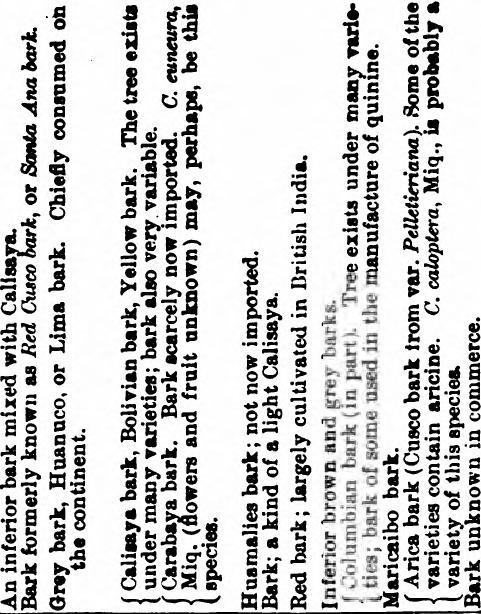
586 CINCHONA. Oinehona Caliaaya. — Weddell. This is a high tree, and if we accept the view of Weddell, also exists in a shrub form as var. Joaepkuma. Some botanists, however, regard the latter as distinct, or rather as belonging to no particular species. Cinchona Cali»wa has an important variety largely cultivated in Java, known as the Cmehona C. var, Ledffenana (named from Charles Ledger, who introduced it in Java), which is extremely rich in alkaloids. C. Calimya is distinguished by its smooth, ovate capsule^ scarcely equal in length to the flowers. G. Bolivianat Weddell, a variety of Boliviiu has leaves with a purplish under sor&oe. (For ■ description of C. CcUiaaya see Amer. Dup., 15th ed.). Cmchona Calisaya grows in declivities and steep and rugged places of the mountains, at an altitude of from 1500 to 1800 meters in the hottest forests of the valleys of Bolivia and Southern Peru; between 13* and 16° SC south latitude, and from 68° to 72° west longitude; in the Bolivian provinces of Enquisivi, Yungas, Larecaja, and Caupolicon; and in the Peruvian province of Carabaya. It flowers in April and May. It yields the Yellow 'cinchona Bark, commonly called indiscriminately by the Spaniards and Indians, cagcarilla ccUisaya, calimya. or ciUiaaya. Cinchona o^dnalis, Linnfi. — This species has suffered much at the hands of botanists, some contending that the name indicating the Linnean species is capable of double interpreUition (Fliickiger). Hooker has made a new diagnosis regarded as diflering from that of Linn^, and the former's plant is now re^uiled by many as the true Cinchowi officinalis. Others regard the diagnosis of Linn^ as correct. This was the original species of Cinchona. It has ribbed capsules. (For a description of this species, see Amer. Diap., 16th ed.). It is Indigenous to Ecuador and Peru, and is the sonrce of Loxa hark. The Loxa region, howvnr, a«x>rding to Wellcome, is now exhausted. Cinchona succirubra, Pavon, is a tall tree, from 50 to 80 feet high, indigenous to the western slope of Chimborazo, its territory of growth extending to northern Peru. It flourishes well in Ceylon, and the Blue Hills of India, being well adapted for grafting and hybridization. Its capsules are smooth. It is the source of Red cinchmia bark. History. — As a therapeutical agent of inestimable value, cinchona, ^m its first introduction and use to the present da^, stands pre-eminent. In fact, no article of the Materia Medica has borne so high and unwavering & reputation. It is an (Went for which, notwithstanding the vast addition to the list of the Materia Medica, no other substance has been discovered in nature nor in the laboratory that could full^ substitute its therapeutical value. The period of the discovery of the medicinal properties of cinchona, is unknown. Some fabulous stories are mentioned concerning it, but we have no reliable information as to when, or how it was discovwed. Some writers (Geoff roy, Ruiz, and Joseph de Jussieu), are of the opinion that the Indians were acquainted with its medicinal properties prior to the arrival of the Spaniards; but even this is doubtful, for La Condamine, who visited Peru in 1738, found the natives then unacquainted with it; and J. J.Caldas, pupil of the celebrated bota^ nist, Mutis, who traveled from 1802 for many years in the mountains of Peru in order to examine the natural history and geographical distribution of the Cinchonas, states that the Indians who inhabit those regions, and among whom fever often makes sad inroads, will not use it, believing that it heats the blood and humors; and states that the heaviest chastisements are often inflicted to compel them to employ it as a remedy; he remarks that this prejudice is much against the fact of their ever having heen acqaainted with its use, as they cUngwith the Seatest obstinacy to tiieir inherited customs, vices, and prejudioes. Ulloa» and umboldt also express the opinion that the Indians were unacquainted witn the use of cinchona. The introduction of cinchona into Europe dates from the year 1639; it came, to be known, it is said, from its having cured the lady of the Comte deChinchon, at that time Viceroy of Peru, of a fever, and who, upon her return to Spain, carried some of the bark with her. For some time after its introduction, the Jesuits, who received the bark from their brethren in Peru, alone used it, and kept to themselves the secret of its origin; and it was through their use of it that its fame as a febrifuge so rapidly spread, and from which fact it derived the name which still idings to it, of "Jem^ oark." The medical profession at first opposed its use, and
CINCHONA. 537 it is recorded that it waa not employed br them, until Sturm, of Antwerp, iu 1639, and Bado, of Genoa, in 1663, advocated its employment and wrote in praise of its virtues. Notwithstanding the len^h of time that has elapsed since the discovery of the medicinal properties of cinchona bark, its botanical history is yet subject to discussion. A number of botanists have explored and described some of the sources of the barks of commerce, yet much remains to be accomplished. The barks that are recognized as official by the Pharmacopoeias, both of this country and Europe, are now chiefl v cultivated. Much of the information we have concerning them is from the lalwrs of M.Weddell, who accompanied a scientific expedition, under the ^trona^ of the French government, to Brazil and Peru in 1843, and who continued his researches untu 1848, since which others hare written descriptions, as M. Guibourt, B. Rampon, A. D«londre, G. Planchon, etc but thev have not materially di£fered from Weddell. Prior to him was Conda^mine, wno first described the Cinchonas,- Jowieu, Mntis, Ruiz, Pavon, Humboldt, and Bon^Iand. Weddell's researches (modified) having been adopted by many as authority, we shall, in the following text, give in a somewhat condensed form his manner of collecting the bark (see D^r^uti&n and OoUecHon). and some remarks' upon the classification of barks into red, yellow, and pale bafks, as adopted generally in works upon Materia Medica. Previous to the year 1775, Loxa bark (most probably derived from Cinchona officinalis), was the only kind of cinchona known in commerce. It was not until 1772 that Mutis discovered the valuable tree in the neighborhood of Santa Fe de Bogota, and at this period Europe began to receive Cinchonas direct from the ports of New Granada, on the Atlantic. Some years later the authors of Flora Peruviana (Ruiz and Pavon), studied the species of lower Peru, to the north of Liina, and these were also introduced into commerce. The only species then, which, botanically speaking, still remained unknown In Europe^ were those growing iu the vast extent of country extending southward. ' Notwithstanding the efforts of De Jussieu and the botanist, Thaodeus Haenke, little was added to the scientific knowledge of the Cinchonas by their travels. In the work by M. Weddell, he has made known the species observed by him in those regions during the years 1845, '46, and '47. From his observations, tnis Cinchona (Calisaya) does not spring up again in the localities from which it has been cut, the circumstances peculiar to its growth being, as it were, altered, and a stunted growth, the variety.^MpAiam, is the only representative of the majestic C. Calisaya to be found in the localities which have been destroyed by the hands of the cascarilleros in a very ruinous and wasteful manner. To remedy the evil, at least as far as lay in its power, the government of Bolivia prohibited the cutting of the bark from the rear 1851 for three years; this, together with a monopoly by the government of all the bark then cut in its territorv, caused a rapid rise in the value of calisaya bark, and forced the manufacturers of quinine to use other barks in its preparation. The immense commercial demands on tiie Cinchonas of these parts, tending to exhaust the forests, also rendered it necessary that new sources should be die* covered. According to Wellcome's report (Fluckiger, 1884), the forests of Loxa, for example, are now exhausted of their cinchona trees. To give some idea of the consumption of this bark, and the enormous drain upon the localities from which it was obtained, the company which had a monopoly of it exported at one time annually, more than 850,000 pounds of it. The great extent of the country, however, over which the Cinchonas are spread, excludes the idea, which has been entertained, that we shall ever be deprived of this valuable drug^ and the extensive Eastern cultivation now makes the contingency of its extinction next to impossible. Onltivation. — The subject of cultivation of the Cinchonas early received the attention of botanists and laymen, both with a view to increasing the supply in their native country and their introduction into foreign climes. Condamine made an unsuccessful attempt to transport to Europe younff trees, which, in transportation, were lost in the Amazon river. Mutis cultivated the tree, and the Bolivian Jesuits obligated the collectors to plant 5 trees in cross-form on the spots where each tree was felled. The same body of religionists from Peru, made unsuccessful attempts, in 1849. to grow the trees in Algeria. Later, however, several persons, chiefly among whom were Miquel, Pahud (Govemor^neral of Dutch East
588 CINCHONA. Indies), Hatekarlf Weddell. Karsten, Royle, Harkham« and Tjcdger, saooeeded after innumerable and partly vain attempts, in establisbing the plants, firet in Java and afterwaid in India. It was with the greatest of difficmty and danger owing to the hostile attitude of the native i>opulation, that the plaiit& or seeds even, conld be procured, and the transportation was attended with mishaps, either due to the perishing of the plants or seeds en route, or at stations, or to losses in the sea. The seeds sent by Weddell to Paris were planted in the gardens of Thibaat and Keteleer, and the plants grown therefrom were, in 1852, bought by the Dutch government and sent to Java. The results, however, were none too satisfactory, and it was not until Markham, already well acquainted with the territory, m 1859 went to South America to procure plants, that the foreign introduction of cinchona became at all successful. Upon reaching the cinchona lands he associated with him Spruce^ a botanist, Prichett, a resident, and Cross (1861), a gardener, the latter jalan ting with his own hand, in India, the plants procnred by him in America. The plants secured by the latter were those of C. ewxirvbrc^ Markham's purpose was to reserve for himself the Peru and Bolivia border-lands, and procure the C. Ca/tsai/a, of which he collected 456 young plants, amid great dangers and hardships, a graphic account of which is to be found in Afarkham's work on Peruvian Bark. These plants, which were shipped by way of England, however, in transportation from thence to Hindustan, became exposed to such intense heat while in the waters of the Red Sea, that they were of little value when planted. The deficiency was made up, however, by seeds of C. CalitayOf procured from Java, and the cultivation of the Cinchonas in India, Ceylon, and Java, became at last a marked success. The plants obtained by Prichett were from the Huanuco country, and were chiefly plants of C. nitida and C. micratdKa. The cultivation of the plants in their new homes is not without some drawbacks. According to F. B. Power, the Javan volcanic eruptions of 1883 did ^reat damage to the cinchona plantations. In addition to such accidental injuries, a constant source of trouble is the beetles and caterpillars, as well as a new and small hemiptera, the ^^teabug" {SdopeUu Antonii, Sigm.), the wingless young of which, hatched among the tops of the branches and leafstalks, nourish themselves at the expense of the leaves, producing a disease known as htnarcett (see OmcAona Airis, Fluckieer, Tr. by Power). The Cinchonas have been cultivated with some success at Jamaica, but the only commercially important ground in South America where cultivation is at all successful is in Bolivia. Western Africa and Mexico have also attempted the cultivation, the former with considerable success. Within a few years the estimated number of cultivated trees was about 75,540,000, Java alone possessing 30,000,000; Central America and Bolivia, each 2,000,000; India, 18,500,000; Ceylon, 19,000,000; Australia, Borneo, and other islands, 1,000,000; Africa, 2,500,000; Jamaica, 500,000; and Mexico the remainder. Only cultivated barks now appmr in commerce, the wild bark being seldom met Distribution and Oollection.— The native Cinchonas seem to be exclaavely confined to the Andes within the boundaries of Peru, Boliviaj Ecuador, and New Granada, from 11° north latitude to 20° south latitude; chiefly growing at an elevation Tarring from 1200 to 10,000 feet above the level of the sea, and in a dry, rock^ soil. There are at least 12 or 13 species, which have from time to time furnished the barks of commerce. The only period in which these cinchona barks are collected, is during the rainy Reason, which continues some 3 or 4 months. The trees rarely constitute an entire forest, but form more or less compact groups in various parts of the forests, termed manchae. Frequently they grow separately. Experienced cutters, called diestros or prcKticoa, are engaged to explore the forests, and report where the Cinchona trees are to be found, their number, and the quality of thebark they yield. This investigation requires much sagacity, patience, and experience, as the chances of success depend wholly upon the report made. So well skilled are these diatroB that they can in most instances distinguish the trees by the appeuance of their tops, by a peculiar slight movement of the leaves of certain species, by a particular color of the foliage, by the aspect presented by a great massx>f innoTCScenoe, eta Sometimes thev are favored with suooess in a short time, while at c»iher times, many dajs pass before they can reach the ottject which they have
CXNCBONA. 689 oonstantly kept in sight from the moment of ite discovery. Matters having been satisfaotorily ascertained, the merchant or company deeinng to procure the bark, engage other parties who are called cascarilleroB, and are trained to this occupation from infancy, to out the bark for them. A road ia at once made up to the point which is to rorm the center of operations, and the catearillerQay together with aconfidential agent of the company, called the mtyordomoj cons^ct small huts or houses in a favorable site near this point, both for the purpose of encampment and to shelter their provisions and cuttings. And while the party are engaged in this neighborhood, all partpS of the forest adjacent to the roads are considered the property of those who formed it, and no other cascariUeros are allowed to work there. The trees are felled with hatchets, bein^ cut a little above the root, the bark havine been previously removed from this part, even removing the earth from around the trunk that the barking may be more complete. As soon as all obstacles to the falling of the tree have been overcome, and it lies upon the ^ound, the useless branches are cut off, and the peridermis is removed by strikmg it with a wooden mallet, or the back of a hatchet, which exposes the inner bark; frequently this is further cleaned by means of a brush. The bark is then divided by incisions circumscribing the pieces to be removed, the size and r^ularity depending upon circumstances, but generally for conve* nience of transport and facility of preparation they are made from 15 to 18 inches long, and 4 or 5 inches wide. These pieces are removed from the trees, with a common knife or similar instrument, and as close to the wood as possible. The bark of the branches is similarly removed, except that its peridermis is not beaten off. The thinnest bark from the branches is dried by exposure to the sun's rays, and forms hollow cylinders: but the pieces of thicker bark, which are to form the flat cinchonaj tabUt or plancha, are, aner a slight exposure to the sun, placed one on the other m crossed squares, upon the top of which a heavy weight is placed. This exposure and pressure is repeated foV several days until the bark is flattened and completely dried. This is the process more commonly adopted, yet it will sometimes vunr a little, according to the locality, or the nature of the tree operated upon. Thus, the peridermis may be simply scraped, or be only partially removed; the bark maybe imperfectly or not at all pressed; or it may be imperfectly desiccated, thereby destroying its value, etc. The bark prepared^ is carried by the caacarUleroa in heavy shoulder loads to the camp, which is an inconceivably laborious task, frequently requiring 15 or 20 days for its removal from one district alone. It may oe proper to state here, that, as a rule, before the bark reaches the coast, it pafises through at least three or four hands, and on each occasion its price is augmented; its carriage from the coast being expensive, and having to pass throuffo other hands also, a pound of the bark that would cost at the ooaat a certain price, is sold in Europe for the price many times doubled. As the bark ia brought into camp by the cutters, it is examined by the major' dome, who, after rejecting that part of it which is bad, submits it, if necessary, to a fresh process of drying. It is then formed into bundles of nearly equal weight, sewn up in coarse canvas, and conveyed on the backs of men, donseys, or mules, to the depots in the towns, where they usually receive an exterior envelope of fresh hide, which, as it dries, forms the hard compact packages in which the bark is exported, termed semons. Such is the history of the original method as pursued in South America. The East Indian and Java methods are three: Mossing^ felling or coppicing^ and shnving. The first method, proposed by Karsten and put into operation by W. 6. Maclvor, consists of removing from the stems narrow vertical strips of the bark. The denuded surface is then enveloped with moss (clay is now being used in India and Alang-Alang grass in Java) when the bark is quickly renewed, and becomes richer in alkaloidu principles. The second method {coppicing) consists in felling the trera and sMppmg them of buk, while the stumps so left send up shoots, which, in about 8 years, yields a rich bark also. This meUiod is emploved in Bolivia to some extent; when the roots are utilized also the process is called uprooting. The third method, introduced in Java by Bemelot Moens (1880), is that of ikavifig or scraping, which consists in removing not the whole of the bark, but a few layers, leaving enough of it to preserve the vitality of the tree. The efiiset of tiiem methods has been a greatly inonaaed yield of aluloidB.
640 CINCHONA. OLuwiflcation of Barks.— In most works on Materia Medica, we find the cinchona barks classified according to their color, t. e., into the yellowj pale an d red barJu; the Cinchona, Calitaya^ as yellow bark: the C q^Scniaiu, and others, as jMde barks; and the C. mcevrvbra, as red bark. This classifinition, while convenient, is very defective; not only does it, in some instances^ separate the products of thei same ^ree, but it connects those which are essentially different. At one time it was thought that all the gray cinchonas were furnished by the same species, bat not only are they produced by many different species, but very frequently they are the young bark of the same trees which yield the yellow and red cinchonas. A more useful and, indeed, more natural classification would be founded, in the first instance, upon the chemical composition of the barks, it being only necessary to study their active principles, as quinine, cinchonine, etc. But this method is impracticable on account of the unavoidable difficulties arising from such a mode of classification, and, also, from the fact now fully proved, that the same botanical species furnish barks varying greatly, according to accidental circumstances. Weddell remarks that if a cUusification be alnolutely needed, one which should be based upon the anatomical structure of the bark would be of much greater utility than either of the preceding, inasmuch as we shall find existing, even in the cinchonas, a certain relation between their structural and chemiw characters. M. Weddell gives the data upon which he bases the latter conclusion which, however, can not be here discussed. The classification of commercial cinchona barks, according to their color, has been most generally accepted. At the present day such a classification is even more easily made than in earlier days, for the various sources and conditions of the bark caused the colors to vary greatly, and even to mei^e clcKiely into one another. The color was chiefly basra upon the powder rather than upon the exterior of the bark. The botanical sources of the three grades are now, nowever, well known on account of their being cultivated. To those specif with their hybrids, wMch have become official, may be added mention of an inferior bark now known as hard yelUno,or Mararaibo bark. These distinctions into red, yellow, etc., are mainly taken cognizance of by pharmacists^ the manu&cturers or alkaloids caring but little for classification, their reliance being placed upon all barks which, by assay, will ^rield them the greatest amount and best quality of bases. A convenient classification is that less in vof^ae known as dntggiats^ barks (quills, or lai^ chips), and manufacturer^ barks (broken bark). In general, barks occur rn commerce in 6 chief forms; (1) small chips or fr^ ments, which includes much of the broken bark and pieces of root bark; (2; shaved bark, which includes largely barks of branches and dry stems, with some root bark; (3) irregular fiat chips or pieces of varying sizes and shapes, mostly made up of hard yellow bark; (4) the cultivated, together with some wild bark, in the form of quills, taken from stem and root; (5) and lastly, the thick, mo^ed bark and thinner renewed bark, obtained by the mossing process. Making allowances for different conditions existing at the time of gathering, such as the age of the j>lant, etc., the following descriptions will apply to the barks as classifira, according to color: Description of Barks. — Yellow Bark {Calisaya harhf Cinchona fiava\ from C. Ckdisaya and its variety Led^eriana. Mostly cultivated, rarely collected wild, in great demand, and greatest quinine yielder (70 to 80 i>er cent of whole yield of alkaloids). The best bark; the mtUl forms only commercial, the Jlat, or table 6ar]fc, being rarely met at present (see below). Large, handsome quills, sometimes broken, varying from 18 to 30 inches long, and from f to J inch thick, and occasionally 2i inches wide; color gray, or light-brown gray externally, pale cinnamon-brown internally, the inner surface marked with very fine striie. Its powder is a pale, yellow-brown. The quilled bark maybe in fragments varying from 1 or 2 inches to 24 inches in length, from 2 lines to 2 inches in diameter, and from i to 7 lines in thickness. Very small quills, however, are very rare. They are generally singly quilled, though occasionally met with doubly quilled. Usually coaiedt with an outer bark or periderm; sometimes uncoated, or deprived of its periderm; the inner, living })art of the bark, Weddell terms its cZerm, in contradistinction to its external covering, or pffrtderm. In the coated siKcimens, the periderm varies in thickness, is more or less rugous, and marked with transverse impressions, furrows, or cracks, which some
CINCHOITA. 641 times form complete ringe around the quills. The edges Are thick, everted, and raised. If the periderm is very thick, the consistence of it is corky or elastic, and the annular furrows have the appearance of deep incisions. Between these annular markings are longitudinal vrinkles or cracks. In the large quills, these furrows and cracks give the hark a ver^ rough character (the so-called carved, or chickenIcKged appearance), hy which it may easily be distinguished from the large quills ofgray bark {Huanuco). The periderm is nearly tasteless, having a naturally brown color, but sometimes more or less gray or silvery from the crustaceoua lichens with which it is covered. The flat, or uncoaied bark, consists chiefly of liber; its taste is very bitter and feebly astringent; its transverse fracture, externally, is resinous, internally fibrous. The color is brown eztonally, and it is marked with impressions corresponding to the furrows or cracks of the periderm. Internally, it is finely fibrous, and of a deep cinnamon-brown color. Pale Babk {Loxa bark^ Loja bark, Grown barky Hiumnco bark, Ouenca bark). From Cinchona officinalis. Cultivated largely in India, and collected wild in Ecuador in former times, chiefly around Loxa. Large quinine yielder (60 to 70 per cent of whole yield of alkaloids). Entire or broken (irregularly), single or double quills 3 to 15 inches long, by J to } or 1 inch in diameter, chiefly 1 or 2 lines in thickness, but very variable m this respect. Its periderm is darker than in other species, and its powder light-brown. More lichens are present upon it than upon other barks, rendering it shaggy, and sometimes a portion of the ridges are verrucose. Its fissures are broader and more open than in the preceding bark, nor does it contain but a few longitudinal craoks, and is therefore not "checkered or chicken-leggf d " in appearance. The app«r surface of the bark ift very variable. According to age, temperature, and lo<»lity, it varies from a lightbrownish color to black. If the trunk and branches are much exposed to the sun and wind, the bark.becomes black, and if the tree is closely surrounded by other trees, it assumes a brownish color, which varies to a light-yellowish gray, A large quantity of lichens grow on the whole of the surface. On the epidermis,, whatever its color may be, annular impressions or furrows are always perceptible, although sometimes but slightly impressed. They are the traces of places where the stipules were situated. Immediately beneath each ring are two almost circular cicatrices, formed by the petiole after the fall of theleaves. Between the rings many other transverse furrows and cracks, varying in len^h, depth, and distance from each other, are perceived, mostly parallel to the rings, but never extending entirely around the trunk. All these characteristics of the surface are also found on other species of Cinchona^ and are therefore insufiBcient of themselves to distinguish any species. On the inner smooth surface, which is formed of fine, parallel, longitudinal fibers, we perceive numerous whiush spots, some of which are diining, but most of them dull. The color of this sur&oe is similar to that of dry cinnamon, passing rather into yellow when the bark is fresh. The edges of the fractured surface of the bark are sharp, like grass, and only here and there a small point is perceptible on the inner edge. Under a magnifier the epidermis appears attached (g^nden), blackish, and shining; the subjacent parenchyma, which forms a concentric ring, is thicker than the epidermis, sometimes blackish, sometimes brownish-yellow with many shining spots. Next follow the layers formed of parallel fibers, between which we observe shining points, which proceed from the gummy, resinous juice diff"used through the entire bark. This 18 the onl^ oflicialspecies which has an odor, which, in this bark is distinct and characteristic. J. J. Galdas, writing in 1802, states: "The natives call it casearilta jina amarilla and never quina. It flowers very probably twice, in July and Auffust, and in December and January. The leaves fall successively, as is the case with most equinoctial plants. By the epithet amariUa fina it is distinguished from coloradajina, which diflers from the typical principal form by the color of the fresh bark, wnich is reddish, whereas the other is yellow. This quality, however, does not appear to be permanent, for when the amarilla is dried it assumes the color of the other sort, so that the most experienced person is unable to distinguish (by color alone) one from the other." Red Babk (Cinchona rubra). — From C. awcctru^ra. Chiefly cultivated, except in South America. Yields an abundance of alkaloids, but of quinine only about
642 CINCHONA. 2 per cent. Quills thicker and wider than calisaya, otherwise quite similar, and the inner surface of a much redder cinnamon-brown than that species. Yields a reddish-brown powder. Transverse fissures few or none; when present disposed irregularly not forming a checkered or chicken-legged appearance. The prominent suberous, warty ridges, often short and merging into each other, and the elongated furrows between the ridges are distinguishing features (see Official De«cri]ition). The hybrid barks vary somewhat from these descriptions. CHnrhona rubra is very largely hybridized with C. officinalis and vice versa, and with C. Calimya and its variety Ledgeriana. The hybrids with the former are lighter in color, and show the transverse fissures. The hybrids of the latter species with 0. awxiruhra yield a bark in which the characteristics of the latter are most prominent. (For the other known barks and their sources, see QnupectuSy already given). The U. S. P. has combined the medicinal cinchonas into two classes, made official as follows: I. Cinchona (U.S. P.). — "In quills or incurved pieces, varying in length and usually 2 or 3 Mm. (-^ or \ inch), or sometimes 6 Mm. inch) thick; the outer surface covered with a gray or brownish-gray cork, usually slightly wrinkled, marked with transverse, and also with intersecting, longitudinal Msures (C. CaliMtya), and sometimes with scattered warts and slight longitudinal ridges; inner surface light cinnamon-brown, very finely striate; fracture short and granular in the outer layer, and finely fibrous in the inner layer; powder light-brown or yellowish-brown; odor slight, somewhat aromatic; taste bitter and somewhat astringent"— (C/.S. P.). II. Cinchona Rubra {U. S. P.) Red cmehona. — " In qaills or incurved pieces, va^ing in lengthj and from 2 to 4 or 6 Mm. (^to ^ot\ inch) thick; the outer snrnice coverea with grayish-brown cork, more or less rough from warts and loneitudinal warty ridges, and from few, mostly short, transverse fissures; inner surface more or less deep-reddish- brown and distinctly striate; fracture shdrt* fibrous in the inner layer; powder reddish-brown: odor slight; taste bitter and astringent"— (C/: S. P.). The Maracaibo or Hard yeVaw hark (Puerto Cabdla bark), of uncertain derivar tion, is a wild bark yielding very little quinine, and unimportant so far as its consumption in this country is concerned. It may be employed for the extraction of alkaloids other than quinine, is very bitter, and is tised in some countries in the preparation of Huxkam's Tincture. Ohenucal Oomposition. — I. General Chemical History. The very ear^ liest chemical examinations of Peruvian bark were directed to the determination of amounts of resinous and extractive bodies, and the action of menstrua upon it. However, very earlv attempts were made to separate a febrifuge principle, but without success. The first alkaloidal principle isolated from cincnona was einehanine, the existence of which had been pointed out, in 1803, by Dr. Duncan, of Edinburgh; it was first isolated and obtained in a state of purity by Gomez, a physician of Lisbon. He attributed the efficacy of cinchona barks to the presence of this body; but he failed to recognize its alkaline character, which, in'^eed, was not fully appreciated till after the discovery of morphine was announced by Sertiirner, in 1816, when an impetus was given to investigations for alkaloids. Toward the year 1^0, Pelletier and Caventou pronounced the alkaloidal character of cinchonine, an observation which was communicated to them b^ HoutonLabiUardi^re; at the same time these chemists made the important discovery of quinine. About twelve years later two other French chemists, MM. Henry and Delondre, discovered in yellow cinchona bark a third alkaloid to which they gave the name of quinidine. In 1829, Sertiirner, already celebrated by his discovery of morphine, observed in the mother-liquors of suh>hate of quinine an uncrystallizable base, which he called quinoidine, and to which he attributed wonderful febrifuge properties. This last substance quinoidine (or more properly chinoidin), was undoubtedly a distinct amorphous base, but the name was snortfv afterwara applied to a deep-brown, brittle mass obtained by precipitating tne motherh(|Uors from quinine works with ammonia, the substance so obtained being a mixture of alkaloids, subsequently found to be chiefly dicinchmine (CssHmN^Os)) and diconchinine (CwH^N^Ot). Quinoidine was formerly used in medicine under the name amorphmu gwnine. Resinous matter, as well as the amorphotu and artifi<aal Digitized by
CINCHONA. 643 conatituents, were contained in it (see Chinoidinuiri). In 1847 Winckler obtained a new alkaloid from Maracaibo bark, to which he gave the name guinidine. Pasteur, however, in 1853, proved this to be different from the quinidine already known, and affixed to it the name cinchoniditie, A number of alkaloids have since been isolated from the various Bpecies of cinchona (see below). The discovery of alkaloidal principles in cinchona is antedated by the isolation of a peculiar and comparatively inert acid by Fr. Chr. Hofmann, in 1790, who gave it the name Chtnamure (kintc add). A (calcium) salt of this acid was lirst observed in a sediment from an extract of cinchona, by Count de Irfiragaye, as early as 1745. Another discovery of early date is that of chmnrin {fiuiiwvin or kbuivin)^ by Pelletier and Caventou, in 1821, who named it adde quinovique, having obtained it from the bark of Cinchona nova surinamensis. It \s a non-crystar lizable, bitter principle which was later ascertained to be a glucoeid (see below). As a matter of history we retain the following results of some of the earlv investigators: Bucholz found in cinchona bark (Loxa), cinchonine 0.36, kinio aci& 1.17, kinate of calcium 1.30, hard resin (red cinchonic) 9.97, bitter soft resin 1.56, fatty matter with chlorophyll 0.78, tannin with some chloride of calcium (?) 6.80, gum 4. 48, starch a trace, lignin 74.43. According to 1£M. Pelletier and Caventou, the pale,yellow and red barks contain kinate of quinine, kinate of cinchonine, soluble cinchona-red, or cincho-tannic acid, insoluble cinchona-red, yellow coloring matter, grass-green coloring matter, kinate of calcium, starch, gum, and lignose. II. The Cinchona Alkaloids. — More than 40 alkaloids, Doth naturu and artificial^ have been derived from cinchona, cuprea, and related barks. Of these, those existing in greatest amount and of medicinal valtie, are but 4, viz.: Quinine^ quinidine (Hesse's con^utntne), cinchonine, and cinchonidine (quinidine); two others of importance are mtinamine and conquinamine (conckinamine). Of these the first two are isomeric, and the third and fourth are likewise isomeric, comprising two main groups of cinchona alkaloids, one or more of the alkaloids of which are found in the cinchona harks. The following tabulated statement indicates the numerous alkaloids with their composition and some points of interest connected therewith: compotiuon. DlKoverer. Pelletier aad Caventou, 1820. Henry and Delondre, 1833. Gomez, 1812; Pelletr ier and Caventou, 1820. F. L. Winckler, 1847. Hease, 1872. 1 Hene, 1877. / Bourn. AlkAloldt. 1. QuiNINS 2. QciNiDiNK (HeMe's Conehmme). 3. CiNCROHIMK. 4. CiMCHOMiDnnL 6. QviNAHIIfl. 6. CONQUINAMIXB (Qutnamidiru) (Hease'e Conckinamijie). 7. Hoiioq,uiNlNE( Ultraq^iinine). 8. CUPBEINB. 9. HYDBOQUIHniK. 10. HYDROQ0I.<(n>IHB. 11. Hydbocinchurinb. 12. Hydrocinchonidine iCinchftmidine). 13. CiNCHONAKIMB. 14. ClHCHOTINB. 16. HoMoonfoaoHiHi. 16. HOUOCINOHOiriDIMB. 17. OmooNin. 18. OtnooinDtHB. C«)HmN,0, C»HmN,0, CiiH»N,0 CuHiiN,0 GuHhN.O, CifHtiNaO, CuHiiN,0, CitHifN.O, C»H»X,0, C>HttK,0, OuHmN.O CmHmN.O Ci»H«N,0 CwHhN.O C»HbN,0 Ci*HmN,04 CiiHiiN,04 Tod, Howard, Hodgkin, Paul,Cowoley and Whiffen, 1882. -Paul and Cownley. Hease. Forst and Boehringer Oavenhm. Maracaibo bark. Oinchona nuxirvbra and Crondenitt. Aem^ia Purdimma. OnuAona romlmta. Qnduma romdenta. CoBCO and Cnprea baika. Hesse, 1881. Amand, 1881. Heme, 1882. Hease, 1877. Hease, 1877 (I^verkohn, 1829[?]). Hease, 1S77. CincKona cuprea. Cinchona cuprea. Derived from quinidine. Derived from dnchonioe. Exists in Gaprea bark (Hease).
CINCHONA. AlbOoUi; 19. CoMCVSOOimiE. 20. CONCroOOITIDIHX. -21. CiwcAiuin. S2. Pattiiik. 23. PAYTAHIira. 24. Paricimb. 25. DlCIHCHOMINK. 26. Aricins (Mansmrs Cinchovatiru). 27. DiQ(TiNiDiNB(He8BeV Dkiiiehonine). 28. CHAlRAMUIk. 29. CHAiRAmDin. 80. COHCHAIRAMINB. 81. CONCBAIRAMIDIMK. 82. CuaCAMIDINB. 83. JATAnvs. 34. DlHOHOCIHCBONIMK. 86. CiMCBOUNK. DERIVATIVES. 86. OwcHOMiciirs. 87. DiaircHoiiiciMK. 88. HoMOCIMCBOMICUrB. 89. Apoqdinahink. 40. qoikioinb. 41. DiaUIMICtNB. 4S. QDlMAKICim. 48. PBOrOQUIllAHICIIIB. Compovitlon. C»M)sN,04 CbHjiN.O, Not analyEed. CiiHaiN,0+H,0 CmHuN,0 ChHmN.O, CuHmNiO, CttHMN,0« CbHkN.O* CaH«N,04 CbH^NjO* Kot analy wd. Not analyied. C«H«N,0, Not analyzed. CifHiiNiO G«H4iN,0 CuH2tN,0 ■GuHtiNiO CHmN.O, C«HmN,0, C»H«N,0, C,tH»N,0, DlKorerar, Hesse. 1883. HeBBe, 1863. Hem, 1880. Bene, 1870. Winekler. 1845. Pelletier and Oarid, 1820. Hesae, 1885. Hene. Heaae. Heaae. Uease, 1880. H«Me, 1877. Hease, 1882. Boom. Gaprea bark. Caprea bark. CoBco bark. P^^or White Cinchon* PUabaik. Oqbco and Caprea barka. Jtamjia Purdieama. Cnsco bark. Cinchona (kdUaya var. Jovaniea. Cinchona romdenta. Quinine motber-liqaora. Derived from cinchonine and ciDchonidine. Derived from cinchonine and cindxHiidine. D^ved from homocincfa<K nidine anlphate. Derived from qninamine, or conquinamine. Derived irom qninine and quinidine. Derived from quinine and quinidine. Derived from qninamine sulphate. Derived from qotnamine sulphate. The first 35 alkaloids in the preceding table are r^utied as naturally existing in cinchona, cuprea and related barks; the first 4 only are employed medicins^; the last eight are the artificially produced alkaloidal bases. According to Flfickiger (0!meAona Barks^ p. 64), "every cinchona bark contains amorphous alkaloids." The majority, however, are crystal lizable. Of the cinchona alkfuoids, four are considered elsewhere under their respective heads, or as sulphates. These are Quinine, ^amidme^ (Xnehonine, and OfncAomtftw. The others will be briefly considered here. QuiNAHiNS (CuHmNiOi) (Quinamia or CMvtamme). — Long, white, asbestoslike, nearly tasteless crystAls; aextrogyre; anhydrous; its solution in diluted sulphuric acid is not fluorescent Somewhat soluble in boiling water, nearly insoluble in cold water, soluble in ether, benzolj and benzin, most readily wnen hot, depositing crystals on cooling and evaporating; hot alcohol dissolves it, depositing crystals on cooling, the solution being alkaline; soluble in caustic potash solution and in ammonia. With hydrochloric and sulphuric acids it forms salts, their solutions being very bitter. Gold chloride precipitates solutions of the hydrochlorate yellowuh-white, changing to purple, while gold is liberated; the solution at the same time turns puiple-red. Boiled with diluted sulphuric acid it chan^ to isomeric noncr^stallizable gutnamidtne, behavins similarly to quinamlne with gold chloride; quinamine sulphate heated to the Doiling point of water changes to quinamicvM^ also isomeric. The sulphate heated to 120° C. (248* F.), or higher, forms protos^iiiamiHTie. Apoquinamine is produced when quinamine or quindmicine is treated with hydrochloric acid, resulting in the abstractiou of water. Quinamine fuses at 172° C. (841.8° F.).
CINCHONA. 645 Apo^uniAinira (CnHnNiO).— FoliaoeouB, white, eanly toluble in eth«r, diluted hydrochloric acid and alcohol. Its gold chloride double salt does not change to purple. Its amorphous hvdrochlorate dissolves readily in water. Apoquinamine la isomeric with nomocinchonidvMj komoct'ochoninef and homocinchonicme. It is an artificial base. HoHOQUiNiNE (Ci»HbN,Oi) {WroQuinine of Whififen). Obtainable from ouprea bark. Crystalline, soluble freely in chloroform and alcohol, but sparingly in eUier, from which solvent it may be crystallized. Diluted sulphuric acid dissolves it, the solution giving the thalleioquin reaction (see Quinirue). It is extremely levogyrate, and fuses at l??"* C. (SaaB*" F.>. Its sulphate, like that of quinine, forms a fluorescent solution in water; the salt when freshly prepared, is soluble in ether (difference from quinine sulphate). The cold saturated solution of the sulphate in water is precipitated by Rochelle salt, thus bdiaving like quinidine and cinohonidine {Amer. Jour, PAami., 18£B2, p. 76). CxNCHONAHiNB (CuHhN/)). — Aflsodated with cinchonine. A dextrogyrate base, discovered by Amaud, in 1881, in the bark of J2em^ IStrdieanOy sad said to have ualagogue properties, and to be much more toxib than quinine. Readily soluble in hot alcohol, less so in cold alcohpl (1 in 30), and in ether (1 in 100). It fuses at 184° to 185° C. (363.2° to 365° F.) (ArnaudJ. It is usually extracted from the bark with milk of lime, the magma dried, boiled with alcohol, treated with hydrochloric acid, and crystallized as hvdrochlorate. Water and diluted cdcohol sparingly dissolve its crvstelline salts, tne sulphate being an exception. CiHcROTiNE (CnHitN/D) is obtained by oxidizing crude cinchonine snh)hate with potassium permanganate in the cold, which leaves cinchotine unamcted. It wrees with Willms* and Caventou's hydrodnchonine^ which see. HVDROQUINIDINB (CaiRtiSjC>3.2^B.fi)y {Hydroconckinine), forms efflorescing crystels soluble freely in chloroform and hot alcohol, but less so in ether. It is dextrogyrate, gives the thalleioquin reaction, is fluorescent in sulphuric acid solution, and fuses at 168° C. (334.4° F.) (Hesse). It is present, according to Forst and Boehrtnger (1882), in commercial quinidine, f^m which it is obtained by oxidation witn potassium permanganate in acid solution. Htdrocikchoninc (CnliMNgO). — Obtained by the action of sodium amalgam upon cinchonine acetate in alcoholic solution. Soluble in ether, alcohol, and water (1 in 1300). Hydrocincbonidinb (CuHmN^). — This base is found in commercial oinchonidine together with homocinchonid.ine. CupREiNK (C]|Hj]N,0,). Isomeric with homoquinine. Crystellizes from ether with 2 molecules of HjO; from alcohol, anhydrous. Soluble readily in alcohol; sparingly in chloroform or ether. Solutions alkaline, give thalleioquin coloration, and are lev(^yrate: the alcoholic solution strikes red-brown with chloride of iron. It forms a crystallizable sodium compound (CnHnN^.ONa), which is mainly of theoretical interest. Htdroquxninb (CDHttN^s.H|0) occurs in the mother-liquors frotfi themannfiuttui9 of quinine sulphate; it has been found present in commercial quinine sulphate to the extent of 4 per <»nt (Hesse). According to Allen's method,, purification of quinine from hydroquinine is effected by allowing the quinine to crystellize as acid sulphate, whereby hydroquinine remains in solution. Ether aiyd alcohol dissolve it, it exhibits the thalleioquin reaction, is fluorescent in sulsulphuric acid solution, and fuses at 168° C. (334.4° F.). Potassium permanganate does not aflect it when cold. HoMociNCHONiNE (CmHssNjO) (Koch's CHnchontdim). — This body has been confounded with cinchovaUne (aricine). From alcohol it forms lai^ prismatio crystals, having a left-handed rotation. Salte partly amorphous. DiHOMociNCBONtns (CagHMN^OOi is amorphous, imd exhibita a right-handed rotation with polarized Hsht. HoMociNCHONiDiME (Cj»HsiN^) occurs in large prisms, and is said to form the chief paH of the cincJiovcUine (aricine) of Winckler. It is levogyre, ito sulphate cr3rstallizM in gelatine^like needles, holding 6H^, and soluble in not water. Paytine (CtiH„NiO.H|0), a crystalline body, and Paytahine, from a species of A^ndomema called Fayta or Whiie cinchona bark. The latter is amonihous, and both are Wogyrate, and form insoluble double salts with chloride of^ platinum, 86
546 CINCHONA. thus diflfering from quinsmine which they resemble in Bolubility ia ether and in the instability of the double salts they form vith gold chloride. Paricine (CmHuN^), a yellowish powder, was isolated by O. Hesse from the bark of C. succirubra, of Darjeelingf associated with quinamine and other bases. When fresh, ether will dissolve it, and nitric acid changes it to a deep-green, resinous material. It is separated from its associated alkaloids by means of sodium carbonate, the paricine precipitating first. Paricine closely reeicmbles aricine,but differs in being more soluble in ether, and being uncryBtolIizable. CuscoNiNE (CbHuNjO*). Acrystallizable bodysofuble in chloroform, alcohol, •and ether, and scarcely at all in water. It has been believed to be identical with aricine, but differs from most cinchona bases In its salts being gelatinous and not dissolved by sulphuric acid. Its neutral sulphate is yellow, gelatinous, noncrystalline, and insoluble in sulphuric acid in excess. Accompanying it in Cusco bark, besides aricine, is Cuscohidine, an amorphous, yellow body. Concusconihs (CmHnNiOO from Rsmijia Purdieana (HeBse)^ is crystalline and tasteless. CnscAHiNB is crystalline, easily soluble in hot alcohol, ether, and chloroform, and insoluble in nitric aind oxalic acids. It fuses at C. (424.4^ F.). CuscAUZDZHE is amorphous, aqd otherwise agrees with the preceding in solubility, etc. Arioine (Manzini's Cinchovatine) (C^HmNjOO forms salts which are not readily soluble. This body, as cinchovatine, was found in Ariea bark by Pelletier and Corioi in 1829. Aricine crystallizes in white, non-volatile needles, fusible at 187.7° C. (370*'F.), insoluble in water, and soluble in ether; forms a diaracteristio acetate and acid oxalate. DiciNCHONZNB (CatEUNfOs) is one of the constituents of commercial chinoidine, the chief other one being Diquinzmns (Hesse's Diconchinine) (G«HmN40 ). It is dextroeyre, fluorescent in eolution, and does not give the thalleio<)uin oolonr tion. Was foand by Hesse (see Amer. Jimr. i%nrm., 1885), especially in the bark of C. Tomienta. QuxNAHiDiNE (CuHMN,Oi) (Cofi^utnamtTie, Quinamidia, or Hesse's Omchinar min«). Forms long, lustrous, prismatic crystals, fusing at 123*' C. (253.4** F.). With gold chloride it beh'aves like quinamine. It is non-fiuorescent, and gives no thalleioquin reaction. It is obtained from the barks of C. Sfw-cirvbra, C. ronUenta, and other India barks. An amorphous quinamtdine (isomeric) is produced as stated nnder quinamine. It forms a sparingly soluble hydrochlorate. QuiNAMiciNB (CijHmNjOO is amorphous, white, melts at lOO" C. (212** F.), and is soluble in acids^ from which it may be precipitated by sodium bicarbonate. It is obtained by heating quinamine with diluted acids. Pbotoquinamicinb (CjtHioN^i) is a brown amorphous body precipitated from its sulphuric acid solution by sodium carbonate. £ther does not dissolve it. Water scarcely dissolves its sttlphate. An artificial product. Javanine. — Crystallizable. easily dissolved by ether, and forms an intense yellow solution in diluted sulphuric acid. Occurs in C. Calisaya var. Jaoaniea. CiNCHOLiNE. — A pale-yellow, volatile oil, tasteless, yet of alkaline reaction, easily dissolving in etner, chloroform, and alcohol; little soluble in water. This alkaloid has the odor of chinoline. CiNCHONiciNB (C]»HiiNjO) is formed when cinchonine or cincbonidine is fused in the presence of acids. It is isomeric with these bodies. It is amorphous, soluble in alcohol, water, and especially in ammonium salts; dextro-rotatory. DiciNGHONZciNB {Apodicincftonine). One of the constituents of commercial / chinoidine. QuiNiciNE (CkHmNjOs)- Amorphous, very soluble in alcohol, little soluble in water dextrogyrate, its sulphuric acid solution non-fluorescent. Chairahinb (CbHmN/)4.H^). White acicular crystals, soluble in chloroform and ether. CoNCHAiRAMiHB (CsHmNi04.H/).C|H^). Forms crystals containing both water <^ crystaliization and alcohol of crystallization. Hot alcohol, chlwoform, and ether dissolve it. A mixture of sulphuric and molybdic acids dissolTes the alcoholate, the solution being first brown, changing to aeep^reen. Conchazbahidine (CaHMNt04.H|0). White needle-crystals soluble in ether, chloroform, alcohol, benzene, and acetone (0. Hesee, Amer, Jbur. Pftorm., 1885). -
CINCHONA. 547 The followinsr table exhibits the more noteworthy properties of the principal cinchona alkaloids, the table being that of Fliickiger, in Cint^ona Banna, p. 06: (a) Hydrated crystals are formed by Quinine, Quinidine. m eoaWning water o. cry.t.lli^,i„n { S'^t^Sirn'o^SinlS:: (ft) A bundantir soluble in ether.QaiDine, Quinidine, Quinamine..Slightly Boluble in ether Qnchonidine, Cinchonamine. Very sparingly soluble in ether Cinchonine. (e) Tjevogyrate solutiuns afforded bv Quinine, Cinchonidine. Dextro^rate solutions afforded by Quinidine. Cinchonine, Quinamine. (d) Thalleioquin isafforded by Quinine, Quinidine, Homoquinino. Thalleioquin is not afforded by Cinchonine, Cinchonidine, Quinamine. («) Fluorescence is displayed in Ihe acid sohi-1 r»„;-:— rk.:.:^i«» TTyv»»...:n;n» tiona of salts of...,. | Qainidlne, Homoqmnine. No flooreacence is displqwl by Cinchonine, Cinchonidine, Quinamine. IIL Acid and Other Cohstituents of Cinchona. — The cinchona alkaloids exist naturally in the bark in combinatioa with one or more acids — kink, kinovic, and cinchotannic acids being associated with them, forming kinates (ouinrt/es), kinovatea ((/umovateaX and cmchotannates. These acids are minor principles so far as the medicinal value of the cinchonas is concerned. KiNic Acid {Quinic, or Cinchonic acid) (CrHiiO,). — This is the CM-namure of Hofmann, and is a principle closely related to quercite or acorn-sugar (CeHT[OH]j). It was among the first observed of the cinchona constituents, its calcium compound having been obtained as early as 1745 by the Comte Claude Toussaint Marot de L^raye. Hermbstadt (1783), of Berlin, indicated the character of the compound, though he believed the acid to be tartaric, but the acid was identified and named, in 1790, by Friedrich Christian Hofmann, a Hanovarian chemist, of Leer. This body gives to the aqueous extracts of cin<mona their acid diaracter, being present in some barks to the extent of 9 per cent Besides, it occurs in coflfoe beans, and in several species of Fornntum, e. g., the American cranberry (E. Claassen, 1890). It forms readily soluble, hard, and large monoclinic crystals, permanent in the air. The aqueous solution is without odor, and is purely sour and not bitter to the taste. Such a solution exerts a left-handed polarization. It is more soluble in water than in strong alcohol, but very little soluble in ether. At 162° C. 323.6° F.) the crystals fuse. This acid is a benzol derivative, having the graphic formula C«Ht.C0H)4.C00H., which explains the possibility of its being reduced to benzoic (CeHB-COOH) and protocatechuic acids (CiHsfOIlli.COOH) by means of heating with hydriodic acid. By more energetic oxidation, as when treated with sulphuric acid and manganese dioxide, it yields, besidu formic acid and carbon dioxide, kinone (quiTume) (CgHiOt), a crystalline, bright-yellow sublimate. Its physiolc^cal effects are not pronouncra. Kinovic Acid (Quinovicy or Chintmc otfid) (CmHnOO is obtained from East India barks by extraction with dilute ^kaliea, precipitation with acid and purification of the precipitate. It was first obtained as a decomposition product of the glucosid kmomn (Hlasiwetz). It forms shining, white crystals, or a crystalline powder, not soluble in water or chloroform, sparingly soluble in cold alcohol and ether, more readily soluble in hot alcohol, and easily soluble in the solutions of alkaline carbonates and caustic alkalies. It is a feeble acid, and all its solutions are bitter. It is reputed tonic, a calcium compound seemjng to have been preferred for its exhibition. Kinovic acid results from the action of hydrochloric acid upon an alcoholic solution of chinovin, whereby this substance is split into a smeary, uncrystallizable sugar, called mannitan, or kinovic sugar (C«H,^j), and kiwmc acid (fi^tf^t)Cinchotannic Acid (CfmcAotonntn, or ^inotanmc acid) (CuHhOs). — This is tannic acid, ot tannin of cinchona, and the soluble red colormg maiterj or aolvble cinchona-red of Pelletier and Caventou. It has all the properties of tannin; it precipitates ferric solutions green (the red from the pale bark, however, precipitates these solutions brown). It also precipitates gelatin and tartaf emetic, and forms a compound with starch, insoluble in the cold, but soluble above 60° 0. (122" F.). It exists in cinchona barks in amounts varjring from 1 to 4 per cent
548 cnrcHOKA. De Vrij, in 1886, observed in one sample of Cinchona <^cinaliB, the exceptionally high amount of 12 per cent CAmer. Jour. PfuLrm.'). When prepared from its lead salt it forms an acidulous non-bitter asUingent and very hygroscopic mass of a bright yellowish color. It is soluble in water, ether, and ucohoL Heated to 100° C. 0212** F.)* cinchotannic acid turns darkred, at the same time becoming insoluble in wa.iet. Ita aqueous solution absorbs oxygen from the air, particularly if acids or alkalies have been added, and red products are formed. When boned with diluted sulphuric acid it splits into cinchona-red and sugar (Rembold, 1867). CiNCHONA-RED, or Imolvble cinckoiiorred (CnH^iO, is inodorous, insipid, reddish-brown, nearly insoluble in water and ether, readily soluble in alcohol and alkalies, does not precipitate gelatin, but does precipitate tartar emetic. It exists in some specimens of bark to the extent of 10 per cent, being most abundant in the thicker red barks. It is undoubtedly formed in the bark by the decomp<»ition of cinchotannic acid. Fused with caustic potash it yields protocatechoic acid. An ammoniacal solution of cinchona-red yields, with alum, a red lake. Besides the acid bodies, the following principles belong to this class of bu-ks: Chvnovin {Qu,inovin, or Kinovin) (CMH«iOg). — This is an amorphous, bitter glucosid, found not only in the cinchonaci, but in the nearest relatives among the HubiacesRf and is the bodv known as ctncAona-6dter, ehinovorintterj or kinomc-oitter. It was first observed by Pelletier and Caventou, in 1821, in Cinchona nova aurinametisis, and named mdnovic acid ("acide quinovigue") a name afterward corrected, and which properly belongs to the acid which has been considered above. Water hardly dissolves chinovin, but it is freely soluble in acetone, alcohol, ether, chloroform, and oils. It has no action upon litmus, yet, with the alkalies, it forma salts, most of which dissolve in water, the solutions being very bitter. Kerner (1859-62) has applied the name cinchocerotin to a substance obtained by extracting cinchona with boiling alcohol, from which solution it separates on cooling. Purified, it displays handsome, pure white, crystalline laminte, of a neutral reaction, and fusible at 130° C. (266° F.). Its composition corresponds to the formula CsrH4gOi. Fabbroni first separated the volatile oil, which is of a butyraceous consistence, and gives to cinchona barks their odor. Teste and QnaiitEtative Determlnfttion of Alkaloida in Oinohoaft Bark.— As stated before, the U. 8. P. demands that Cinchona contain not less t^an 6 pw cent of alkaloids, at least 2.5 per cent of which must be quinine. Cinchona Rubra is required to contain not less than 5 per cent of its peculiar alkaloids. The table on page 549, compiled mainly from data contained m Fliickiger's Onehona Barks, by Power, 1884 (marked in tlie table by*), demonstrates the amount of alkaloids in various species of cinchona barks. Broughton found but little more than traces of alkaloid in the leaves of the Indian CinchoTia ncccintbra, Happersberger ( Amer. Jow. Pharm., 1883, p. 197), from analyses of the leaves of several species of Cvnxhona, found those of the C. CkUitaya to have a predominant amount of bases (2 per cent)— these alkaloids being quinine, quinidine, cinchonine, and cinchonidine, qainidine amounting to about one half of the total yield. These species were grown in an un&vorable locality in California. Therefore the leaves seem to deserve more recf^itlon than has hitherto been given them. Tests fob Bpitrious Banks. — As spurious barks, liable to be substituted, are found in commerce, it is of importance that some ready means for their detection should be known. Bitterness is not always characteristic of the value of cinchona bark; barks which do not contain traces of alkaloids, and yet c jntain considerable kinovic acid, are very bitter. An infusion of such barks will give, upon the addition of a solution of sulphate of copper, a greenish precipitate of kinovate of copper. Tannic acid has been recommended the best reagent for distinguishing the genuine from the spurious barks, as it forms insoluble compounds (tannates) with the alkaloids of genuine Peruvian barks. In using this test, all that is necessary will be to make a decoction or infusion of the bark under examination, filter it, add a solution of tannic acid, when, should the bark contain any of these peculiar alkaloids, the addition of the solution of tannic acid will immediately cause a precipitate of them as tannates. Consequentlv those barks which yield no {ffedpitate with tannic acid, are destitute of these alkaloids.
CINCHONA. 549
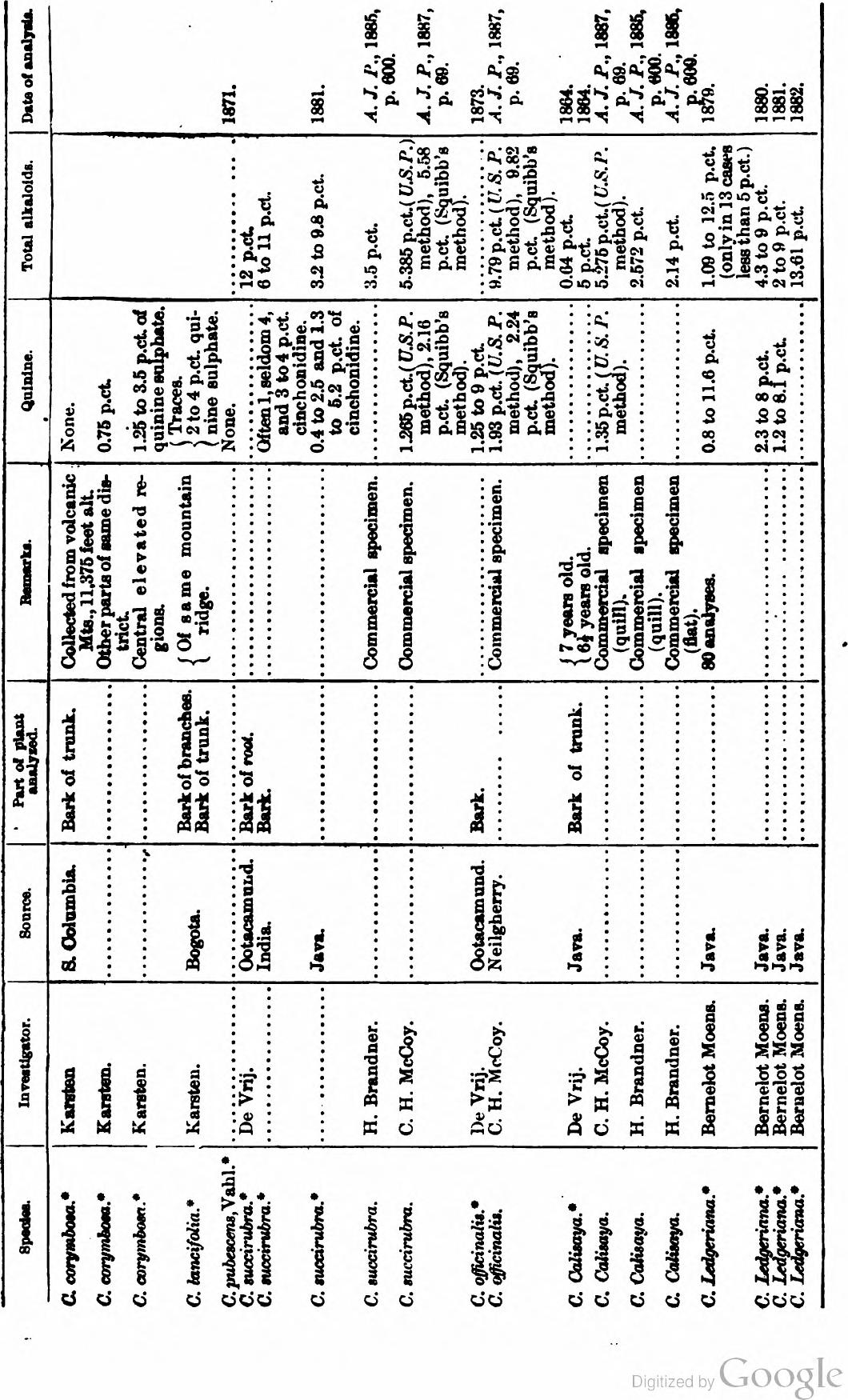
660 CINCHOMA. Ifr. Grahe has also instituted the following ready proc^ for distinguishing the tme from the false barks. He finds that true cinchona barks, when submitted to dr^ distillation, give a product of a bright carmine color; this product is characteristic of these barks, and is not furnished by any others that do not contain the cinchona alkaloids. The quantity of this red substance depends upon the amount of the alkaloids, and it appears to afford a tolerable indication of this amount. This test is applied by heating the fragment of a bark, weighing about 6 or 10 grains, in an oidinary test-tube, gradually raising the heat to redness. With cinchona bark a whitish smoke is given off, and also watery vapor, whi<dk condenses upon the sides of the tube. Very shortly afterward, the red color b^ns to appear, communicating to the vapor a reddish tii^ and at about one inch distant from the heated portion of the tube there is ofeposited a red pulverulent film, which gradually passes into a thick oleaginous liquid, running down the glass in drops or streaks of a fine carmine color, in the water condei^ed with it. Close to this point are deposited the, tarry products, generally resulting from the destructive distillation of^ vegetable substances. The presence of some substances prevents the production of this red color, even in the case of the true cinchona barks, such as caustic alkalies, lime, nitric and chromic acids, bichromate of potassium, glacial phosphoric acid, and sulphuric acid. As regards the quantitative determination of the alkaloids contained in -cinchona barks, numerous assay methods have been proposed (see for example that of Dr. J. F.L.Winckler, ^Imerican Dispensatory^ loth edition). These methods have been appropriately classed by Husemann and Hilger {PfbamufMtioffet 1884) into 3 groupSj according to the a^nt employed in the abstraction or liberation of the alkaloids, and are thus distinguished as Add methods, Lime methods, and Ammonia methods. For an account of DeVrij's process, which is a representative of the acid methods, see Amer. Jour. Pharm.y 1 w5, p. 627. The process of the British Pharmacopceia, and that indicated by Squibb (Ephemeri8,Yol. I, p. 105, 1883), are methods employinglime, while those directed by the German and the VnUed Statea Pharmacopceiaa employ ammonia. For an interesting comEn|rativd study of some recent methods, see L. F. Kebler, ^mer. Jowr, Phxtm., 1896, p. 79. The United Statee Pharmacopoetal process is as follows: Assay of Cinchona. — I. For Total Alkaloids. — "Cinchona, in No. 80 (or finer) powder, and completely dried at 100° C. (212° F.), twenty grammes (20 Gm.) [309 grs.], alcohol, ammonia water, chloroform, ether, normal sulphuric acid V.8., potassium hydrate V.S., each a sufficient quantity. To 20 Gm. of cinchona, in very fine powder, and contained in a bottle provided with an accurately ground fflass stopper, add 200 Ca of a previously prepared mixture of 19 volumes of ^conol, 6 volumes of chloroform, and 1 volume of ammonia water, stopper the bottle and shake it thoroughly and frequently during 4 hours. Then separate the liquid by pouring it into another bottle through a funnel containing a pellet of cotton, in such a manner that no material loss dv evaporation may result. Transfer 100 Co. of the clear filtrate (representing 10 6m. of cinchona) to a beaker, and evaporate it to dryness. Dissolve the residue of crude alkaloids thus obtained in 10 Cc. of water and 4 Co. of normal sulphuric acid, with the aid of a gentle heat, fiHter the cooled solution into a separatorv funnel, and wash the beaker, and filter until ihe filtrate no longer has an acia reaction, using as small a quantity of water as possible. Now add 5 Cc. of potassium hydrate V.S., or such an amount as will render the liquid decidedly alkaline, and extract the alkaloids by shaking the mixture, first with 20 Cc, and then repeatedly with 10 Cc. of chlorofoim, until a drop of the last chloroform extraction, when evaporated on a watdi-glass, no longer leaves a residue. Evaporate the united chloroformic extracts in a tared beaker, dry the residue at 100^ C. (212° F.), and weigh. The weight found, multiplied by ten (10), will give the percentf^e of M)(U oBealoida in the specimen of cinchona tested. II. For Qtiinim. — "-Transfer 60 Cc. of the clear filtrate remaining over from the preceding process (and representing 5 Gm. of cinchona) to a beaker, evaporate It to dryness, and proceed as directra in the assay for total alkaloids, using, however, only one-half the amounts of volumetric acid and alkali there directed. Add the united chloroformic extracts containing the alkaloids in solution, gradually, and in small portions at a time, to about 5 Gm. of powdered ^aas contained
CINCHONA. 561 in a porcelain capsule placed over a water-bath, bo that, when the contents of the capsule are dry, all or nearly all of the dry alkaloids shall be in intimate admixture with the powder«d glass, and the chloroform be completely expelled. Now moiBten the residue with ether, and, having placed a funnel containing a filter of a diameter of 7 Cm., and well wetted with ether, over a small graduated tube (A), transfer to the filter the ether-moistened residue from the capsule. Binse the latter eeveral times, if necessary, with fresh ether, so as to transfer the whole of the residue to the filter, then percolate with ether added drop by drop, until exactly 10 Cc. of percolate have been obtained. Then collect another volume of 10 Cc, by similar, slow percolation with ether, in a second graduated tube (B); Transfer the contents of the two tubes completely (using ether for washing) to two small, tared capsules, properly marked (A and B) bo as to avoid confusion, evaporate to a constant weight at 100° C. (212*' F.),and weigh them. (The residue in A will contain practically all the quinine, together with a portion of the alkaloids less soluble in ether; the residue in B will consist almost entirely of these alkaloids). From the amount of residue obtained in capsule A deduct that contained in B, and multiply the remainder by twenty (20). The product will represent, approximately, the percentage of quinine (containing 1 molecule of wata>) in the specimen of cinchona tested " — (tZ S. P.). Action, Hedical Uses, and Dosage. — Cinchona bark is tonic, antiperiodic, slightlv astringent, and topically antiseptic. When swallowed, a sensation of warmtn is experienced at tne stomach, whidi gradually spreads over the whole trunk; occasionally, it produces an unpleasant excitement of the stomach and bowels, with retching and eraesis, more ^ipecially if the former be sensitive. In a little while after its administration the general system becomes more or lees. influenced, the pulse being fuller and more rapid, and a gentle stimulus imparted to the various oi^ans of the body. With many persons it occasions symptoms which have been termed cin^hmism, and which, some believe, are evidences that the remedy is exerting a favorable influence: but these symptoms should never be pushed too fer. They are: Throbbing headache, and giddiness, of greater or less severity, tinnitus aurium, and imperfect hearing. Cinchona is valuable in functional derangement of the stomach, improving digestion, and invigorating the nervous and muscular systems in diseases of general debility, and in convalescence from exhausting diseases. Cinchona will be found useful in all /e6ri/e, eruptive^ and inftammaSry diseases, which manifest a degree of periodicity, in which it should oe administered during the remissions; it is also valuable during the low and ti/jAoid cmtdUioM of these diseases, and also in those cases, where, from an excessive and continued secretion of pus, the system becomes very much enfeebled and prostrated, in which it supports the powers of the constitution until all abnormal action is removed. It is likewise of much benefit in all chronic aflections attended with periodicity, great feebleness, or nocturnal perspiration. When it occasions vomiting, its use should be suspended for a time. Its employment is contraindicated in acute inflammation, innamma^ tory fever, pleUiora, active hemorrhages, and in all nervous or vascular irritations., Cinchona bark, however, exhibits its most important therapeutical powers as an antiperiodic, and in the consequent influence it exerts in almost invariably curing remittent and intermittent fevers^ and the generality of diseases which are accompanied by symptoms of marked periodicity, as neuralgia, kemicraniat dywepsiott diarrhcea, and dysentery^ when epidemic, etc. Its use shoula in most cases be preceded by a mild laxative, after the action of which the powd^ may be given in doses of 10 to 60 grains, and repeated, according to circumstances, every 1, 2, or 4 hours, until 1 or 2 ounces have been taken during the periods of intermission, and continue thus until a cure is effected, or the remedy is found insufficient for the cure of the disease. In the use of the oar^ to obtain their antmeriodio influence, the red and yellow are considered superior to the pale, and ofwhich the red is preferred. As a tonic, the pale bark is generally preferred, being less obnoxious to the stomach and intestines. Quinine, or its salts (see Quininse Suljohas), especially the sulphate, is usually employed as a tonic and antiperiodic in place of the bark itself, but there have been many instances in which the bark in powder has succeeded in e£fecting a cur^ when its alkaloidal salts failed: the cause of this is not well understood. Still, it is often the case that the crude orug, which holds
£52 CINOHONA. all aesooiated prinoiples, is more effective than its ieolatMl alkaloids. In soeh cases, when the powder, from its bulk, or otherwise, offends the stomach, the infusion, decoction, tincture, or extract may be administered. Sometimes cinohona, or its preparations, occasion purging, which may be obviated by pmall portions of opium or laudanum. When a tonic effect only is desired, and periodicity is lacking, or when a tonic is indicated after exhoMHive bleeding, the bark is |>referable to the quinine salts, and, for some reason not well determined, the bark IB sometimes preferable in chronic cases of ague. Cinchona is to be preferred when an astringent effect is desired. Externally, a poultice of the bark has been found an excellent application to Jdom, fetid and gangremma vXcen^ etc.; also as an injection witb opium, when the stomach rejects it; the powdered bark, placed between muslin, and held in place by sewing it in crosa-bars, the same as }n quilting, making medicated jackets, to be worn in contact with the body, has been of utility in obetinate intermiitenig. Dose of cinchona as an antiperiodic, from ^ to 1 drachm; as a tonic, from 10 to GO grains; of the infusion or decoction, 2 fluid ounoes, to be repeated 2 or 3 times 8 da^; of the extract, from 5 to &0 grains; of the fluid extract, 10 to 60 drops; of specific cinchona, 5 to 30 drops. Quinine, cinchonine, and quinidine appear to poasees somewhat similar medicinal properties; their salts (as the sulphate) appear to be best adapted for medicinal use, principally on account of their ready solubility. Dose of either, from 1 to 5 grains, ^ times a day^ or oftener, if required; in severe imUrmiUaiU as hi^ as 10 grains may be administered for a dose. Spaoiflo Indicattoni and Uses. — Periodicity and, like quinine, effective when the pulse is soft and open, the tongue moist and cleaning, tne skin soft and moist, uid the nervous svstem free from irritation. If op^jsite conditions fkienil, cinchona will be lisely to aggravate. Empyema; gastric debility; anemia and debility from chronic suppuration; afternoon febrile conditions; weakness, with pale snrface, loss of appetite, feebte digestion, and deficient veouperatiTe powers. Belated Baito.— Flat Calisata, scarcely ever met in American markets, occora in pieces from 8 to 15 inches in length, fnun 1 to 3 inches broad, and from 1 to 6 lines in thidknesa. It is but slightly curled, Kenerally nncoated. It has considerable density, la perfectly mitform in texture, marked on its outer surface lonvitadinal digital farrotra, more or len running into one another, and separated bv projecting ridges. Its external surface is of a somewhat browiiiah tawny-yellow, orten with blackish-red patches: its internal surface ia fibrous, of a yellowish-tawny color, sometimee— especially when the bark is freeh— with an orange tint, and often with an undulating grain. The transverse fracture is fibrous, the fibers being short easily detached, and irritatins the skin like the hairs of DoUeJtM pruriftu. The lon^tadinal fracture is not splintery, and presents a surface covered with brilliant points, owing to the reflection of Uffht from the denuded fibers, and is of a uniform color. The taste Is very Intto', the bitterness being gradually developed by mastication, with scarcely any astringency. The great reputation of the cahsara bark has made it so much sought after, that it was becoming exceedingly rare, and there is no doubt that it might have one day disappeared almost entirelv from commerce, and that we should be obliged, ultimately, to be satisfied with one or other of the species judged of leas value. Cultivation has, however, removed the possibility of its extinction. In this conneetionf Amer. Jour. Pkann., 1896, p. 120, remarke that the species C. Ledgeriana, cultivated in Java, now yields a surplus of quminc. lYeddell sa^ that the increasing scarcity of calisaya bark induced the ca«cariUpros constantly to mix tfaerarksof several of their Cincnonaa, and this fraud was effected much more successfully than it was formerly, and, without much experience, it was sometimes difficult of detection. The admixture was made especially with the barks of ChicTtona Boliviana and Ciiichona ovatayAT.nUinervU; or, more rarely, and only on tlie coast, n ith the bark of C. tcrobiculata; in other words, with the barks which M. Guibourt calls, with much justice, the ligfu calisayat of commerce. With the bark of scrobiculata it would not be likely to be lon^ confounded, but it may readily be so with the first two; so much is this tbe case that in Bolivia the bark of C. JBoliviana is also called Calimya bark, a name which its properties will, at any rate, justify. The bett cAorocfars by which to distinguish the true (flat) calisaya from all other species, are, the shortness of the fibers which entirely cover the surface of its transverse fracture, and the facility with which these are detached, instead of remaining adherent and pliant, as in the case with the rufinervis and scrobiculata. Lastly, its uuiform rufus color, and its not being marbled throughout its thickness w;ith whit^ sufficiently distinguish it from the bark of C. Boliviana. Added to these characters, its preat density, the depth of the furrows and the projecting edges, are generallv eofficient to distinguish the flat calisaya from all other barks with which it may be mixed. Boiled calisaya is much more difficult to distingnish, for not only does its peridermis, in its physical character, much resemble that of many other spedes, especially that of scrobiculata snd rufinervis, but the fracture does not present clear characteni as it ctoes in older barka. If even a microscope be used in the examination, the characten are very BlighL
CINCHONIDINA SULPHAS. 553 teutons (HaotMia Bark*.— Pravioiu to the discovery of the alkaloids, varioas barks -vnterea commerce either as adulterants or substitutes for ciiwhona barks. Since the alkaloids have become so well known, these false barks, which anatomicidlT di£fer from the trueeiqchonaa, as well as being very inferior ia value, have been designated antrum cmdumu barh. They seldom now appear in commeroe. They were derived chiefly from the generas, CaacariUa, Ladenberpia, Erotiemma, and Naudea. The bast fibers of those barks clo^st related to cinchona exhibit central cavities — the so-called sieve-like fibers. Grahe's test is regarded as mfficient to distinguish most of these harks from the true cinchonas. CupREA Bark is the most important the spurious barks now recognized. It does not enter into general commerce, bat is abandantly used in the manufacture of quinine. The name cuprea was given it by (lOckiger, in 1871, on account of its peculiar ruHty copper color. It cornea from the central and southern secUons of Colombia, along the eastern Andes. The Bemijia Purdieami, Weddell, and Remijia pt-duncuJnta, Triana ((kn^oaa fedunctdaUt, Ksraten), are pointed out by Triana (1882) as the source of that from the first-named locality. The bulk of these barks comes in small fragments, tliough some of it occurs in flattish or channelled pieces, and, occasionally, in quills about 20 inches long, and from less to ^ inch in thickness. The corrugated, or warty, li^nt-brown cork is removed, so that the scraped, smooth surface often shows sharplv incised mipresaious, made with « sharp knife, thus showing the characteristic oopperoolor oi the onter Inrk tissae. it is much harder than the true cinchona, is heavy, and sinks in water. That from soath Colombia is more compact, denser, and exhibits a corneous fracture. By Grahe's test it yields the red tar, tike the cinchonas. The total alkaloids avera^ about 3 per cent, 2 per cent of which is quinine, cinchonine and quinidine being the remainder. According to Hesse, Howard, and others, cincbonidine ia not present. The south Colombian cuprea barks contain cinchonamine. Fraudulent Red Cinchona Barks are {produced by acting upon inferior barks with ammonia, thereby producing cinchona-red. Their red aqueous preparations precipitate browo-xed with Nessler's reagent, instead of white, as with good or normal cinchona barks. Other CtNcunNA Bakkh.— A number of unofficial barks have been known from time to time. A number of them are given in the Comipeftut under Cinchona. CrotufpUriit f^ifutjtt, Bentham (iVul. Onf.— Rubiaces). Africa. This baik is febrifu^, and yields (Hesse) cnmattiMeriiu, a white, non-crystalline alkaloid soluble in ali^ol, aramonu^ and ether. A blue fluorescence marks its infusion, which dissappears in the presence of aolphurio acid, and is restored by an alkali, even after the infusion has been boiled. Pindmeya fnibeits, Michaux (Cinchona earoliHiana, Biret). — Yields tSfOjyia bark, a febriftuB and tonic..Swamps from South Carolina to Florida, dnchmine (?) is said by Farr to ba present in the bark. Other Fabriftages. — China Morada, Qtd'tui morada. The bark of PogandhmftbrifugM {NaL Ord.—Rubiacea;), and several otiier Bolivian and Araentine Republic trees. The former contains a fluorescent (blue) body, morodtn, and an alkaloid, morademe. Therapy, the same as Onchona. Panbotano Bark.— Root of Calliandra Hotutoni (Leguminosse). Mexico. A tincture of t ounces of the root taken in 4 doses in a day, is highly praised as an antiperiodic (Valud^. Qurrya Fremottli, Ctdifornia fever-buak^ Skunk-biuli. — The intenselv bitter leaves of this Gall* fomia shrub are provincially used as an antiperiodic and tonic. The alkaloid, garryint, was aoQOnoced by D. W. Ross {Amer. Jour. Pharm., 1877). Dose of fluid extract, 10 to 30 drops. anrOHONIDINA sulphas (U. S. p.)— OnraHOVIDZRB SULPHATE. Formula: (C„H„N,0),HS0.+8H,0. Molbculab Weight: 738.52. "The neutral sulphate of an alkaloid obtained from the bark of varioas species of Cinchona"— (t/. 8. P.). Historr and Preparation. — The hasefCinchmidi-ne, is contained chiefly in the cultivated India species, Oinehona og^nalis, Hooker, and Cinchona mccirvhra, Pavon (Hesse); also in the South American species, Cinchona tucujensisy Karsten, and Cinchona lancifolia, MutiB. It was discovered by Winckler, in 1848, in the lAaracaibo bark and a certain other species, and named by him chinidin (guinidtn). Pasteur^ having established, in 1853, that it was different fi^m the base now known aa quinidin, and isomeric with that known as cinchonin, gave it the name cinehonidinej which was not generally adopted until recently. Its formula was established by 0. Hesse, who also found it associated with small amounts of homacivr chonidine (C„H„N,0), a substance which he found to be preponderate over clnchonidine, in some parcels of South American origin. At one time the chinoidine of commerce (a mixture of cinchona bases), yielded a considerable amount of this base. It is now prepared, however, from the mother liquors obtained in preparing quinine sulphate (see table showing the amount of cincbonidine in various commercial samples of quinine sulphate by A. J. Cownley {Anur. Jour, i%arm., 1886).
654 CINCHONIDINA BULPHAa DMCrhrtSOB. — The alkaloid dnchonidine forms light, white, pulverulent, crystallizable manee. Sparingly soluble in cold (1680 parts), and more soluble in hot water. Alcohol (20 parts), and ether (70 parts) also dissolve it. At 206.5°C. (404* F.) it melts^ and on ooolinff to 190° C. ^374° F.) it congeals to a crystalline maas. Neutral solutions of it« salts yield wita Bochelle salta ctystalline precipitate insoluble in the excess of the precipitating liquid. The official body is tne sulphate of the preceding alkaloid. It occurs in white, silky, acicnlar crystals, without odor, and having a very bitter taste; slightly efflorescent on exposure to air. Soluble at 15** C. (S** F.), in 70 parU of water, and in 66 parts of alcohol; in 1.42 parts of boiling water, and in 8 parts of boiling alcohol. Also soluble in 1316 parts of chloroform, and almost insoluble in etner. The presence of sulphates of other cinchona alkaloids increases its solubility in ether and chloroform. At lOO** C. (212* F.) the salt gives off its water of crystallization. At 215* C. (419° F.) it melts, and when ignited, it i3 consumed without leaving a residue^ The salt is neutral, or hasa faintly alkaline reaction on litmus paper" — (JJ. 8. P.). When treated with potassium sulphocyanate, either star-shaped groups of feathery, microscopic crystals, or stellate or fon-shaped groups of long, unbranched needles form. When the reagent is employed in excess, precipitation is so complete as not to cause even a turbidity when the filtrate is treated with ammonia. Cinckotenidine (ChHmNiCVSHiO) is formed in colorless, prismatic crystals when the isomer, homocinchonidine sulphate (r^arded as impure cinchonidine by Skraup and Glaus), which forms either in fine, white needles, or in whitish prisms. This body dissolves in 70 parts of slightly warmed water. Its saturated solution in water prepared at 50* Cf. (122* F.), congeals to a gelatinous, crystalline mass holding mother-liquor, from whidi it is not easily separable. Under like treatment cinchonine sulphate forms smooth, shining needles easily drained of their motber-li(]^uor. Beautiful prismatic crystals (with 2H^), are onl^ produced when cinchonidine sulphate is crystallized from alcohol. If crystallized from water, according to the amount of salt and d^ee of concentration^ the result will be either fine, silky, lustrous needles, like the official salt, or shining, square crystals, devoid of color. Tests. — '*0n adding ammonia water to the aqueous solution of the salt, a white precipitate (cinchonidine) is produced, which is but slightly soluble in ammonia, but dissolves in about 7o parts of ether. If concentrated sulphuric acid be added to a small quantity of the salt, not more than a faintly yellowish color should be developed (limit of readily carbonizable, oi^anic impurities). Upon adding to this liquid a crystal of potassium dichromate, a yellowish-green color is produced, which gradually changes to grass-green. Addition of buium chloride T.S. to an aqueous solution of the salt produces a white jprecipitate insoluble in hydrochloric acid. A solution of the salt (about 1 in 1000) in diluted sulphuric acid should not exhibit more than a faint blue fiuorescence (absence of more than traces of the sulphates of quinine or quinidine). If 1 Gm. of the salt be dried at 100* C. (212° F.), until it ceases to lose weight, the residue, cooled in a descicator, should weigh not less than 0.920 Gm. (absence of an undue amount of water). If 0.5 Gm. of the salt be macerated with frequent agitation, at the ordinary temperature, with 20 Cc. of water, 0.5 Gm. of potassium sodium tartrate then added, the maceration continued, under repeated agitation for 1 hour at 16* G. (59* F.), and the mixture then filtered, the addition of 1 drop of ammonia matex to the filtrate should not produce more than a slight turbidity (ab8en<» of more than small proportions of the sulphates of cinchonine or quinidine)" — {U.S. P.). Aetion, Medical Uses, and Dosafirc^This salt has been used as a substitute for quinine sulphate. When pure it is probably equally as efficient both as a prophylactio and remedial agent, during the prevalence of malarial disorderBy as inter* mittrnt and remittent fevers and miasmalic neuralgias. It reduces the temperature even mere readily than the quinine salt, and is a better tonic. It is claimed that it is not so likely to produce the unpleasant head symptoms often resulting from the use of quinine sulphate, and is pleasanter to take. - Laiver doses are required than of the latter salt. It may be given in doses of from 10 to 20 grains several hoars before tike expected chill; or where the paroxysms are mild, oroken doses, 10 grains in all, may be given in the course of a day. cinchonidine is acted upon The same occurs with
CINCHONINA. 666 Speciflo Indioatioiis and Uses. — Periodicity, when the pulse is open and soft, the ekin soft and moist, and nervous irritation absent. Belated Salts.— Cihcbohidini Hydbobbomidk baa been adminifitered h^podermatically (4 graina, twice a day) in malarial duorden, infiammaiioni, and in the mmmer dueam of ckildrm. CiKCHoximxx 6AUCTLAS, SaHcyloU of an^umidine (CisHaN}O.CTU«0|). Needles epuio^X Bolable iu water. Antiperiodic and antirhenmatic: Dose, 15 to 20 ffnuns in pill form as a daily allowance. OINOUONIHA (U. B. F.)— OmOHOHUfB. FoRMnLA: ^CnHttNyD). Molecular Weight: 293.41. '*An alkaloid obtained from the bark of various species of Cinchona" — {U.S. P.). History and Preparation.— Pelletier and Caventou, in 1820, discovered the alkaloidal nature of this principle, which had been observed before and named by Gomez (see Cinchona tukalmds). Most of the cinchonas yield it, the pale bark furnishing it -most abundantly. According to a former Parisiau Codex^ cinchonine may be obtained by exhausting 125 {uuts of powdered pale bark, by 8 successive boilings with 2f parts of hvdrochlorio acid, and 600 parts of water, successively (so that 8 parts oi acid ana 1500 parts of water will be employed in the three boilings). Mix the decoctions, and then add 12i^ parts of quicklime diffused in water, and. when j)recipitation is completed wash and dry the precipitate. Dissolve this in boiling alcohol, filter the solution while hot^ distill in a waterbath, evaporate to dryness, digest in cold alcohol, and then dissolve the residue in boiling alcohol, with the addition of some animal charcoal; again filter while hot, and allow the cinchonine to crystallize spontaneously on the cooling of the liquid (Far, Cod.)..Cinchonine may best be made from the mother-waters after sulphate of quinine has been prepared; the process is to considerably dilute the mother-waters with water, and then add ammonia; the precipitate thus formed is collected on a filter, washed, dried, and manipulated in the same manner cited. The sulphate, acetate, hydrochlorate, etc., of cinchonine are made by dissolving cinchonine in the required diluted acid, filtering, evaporating, and crystallizing. Deicription. — Cinchonine or cinchonia crystallizes readily in anhydrous, quadrilateral prisms bounded by oblique facets. It is a strong base, combining readily with acids. Cinchonine may be obtained by precipitating its salts with aqua ammonife, in which it is almost insoluble; it crystallizes readily from alcohol. The salts of cinchonine are bitter, and bear considerable analogy to those of quinine. The solution of cinchonine sulphate, however, when pure, is not fluorescent, and, unlike quinine, does not give the thalleioquin reaction. An alcoholic, or acidulated aqueous solution of cinchonine possesses the property of right-nand rotatory polarization. The formula of cinchonine was found by Laurent to be CnHeN^, which was confirmed by Skraup, and is now accepted by the U. S. P. in preference to the old formula of fcteur CC»H„N^). The U. S. P. describes cinchonine as occurring in " white, lustrous prisms or needles, without odor, at firat alm<nt tasteless, but soon developing a bitter after-taste; permanent in the air. Soluble at 15'* C. (59° F.), in 3760 parts of water, and in 116 parts of alcohol; in 3600 parts of boiling water, and in 26.5 parts of boiling alcohol. Also soluble in 626 parts of ether, and in 163 parts of chloroform. At 240° C. (464* F.), the crystals fuse together, and at 258" C. (496.4° F.),they melt, forming a brown liquid. When ignited, they are consumed without leaving a residue. When placed on moistened red litmus paper, cinchonine shows an alkaline reaction" — {U.S. P.). Cinchonine sublimes without undei^oing change, forming large crystals when heated in a current of an indifferent gas, 0.9., hydrogen (Husemannand Hilger), sublimation beginning at 220° C. (428° F.) (Hesse). Sulphuric acid In excess in the presence of heat, renders cinchonine amorphous (Winckler). Cinchonine, though permanent in the air, will absorb sufficient carbon dioxide in the atmosphere to cause it to feebly effervesce when treated with acids. Cinchonine or any of its udts are soluble in chlorine water without being decomposed. Such a solution precipitates tohite with ammonia (compare thalleioquin test under Qairune). Of its salts, the oxalate, gallate, and neutral tartrate are soluble in hot
ClNGBOiriNiB SinPHAB. water, ftoidi (in «xee8s), and alcohol, but not in cold wator, vhile the Utter dissolves the acetate, hydrochlorate, nitrate, phoaphate, and eulphate of cindionine. Distilled with caustic potash ^iTioline ie produced (Gerhardt), together with pyridine and its homoIoKues. Oxidation of tne alkaloid or its Baits withpotaft> Slum permanganate yieldd, besides formic acid, cinckotenine (CuHjoN^s+Stl^), a neutral body, and an alkaloid, hydrocincftonine (CuHmN/)^. Cinchotenine mar alec be obtained by oxidation of cinchoniue or its salts with plumbum dioxiife and sulphuric acid. Further action of potassium permanganate and other oxidizing agents upon cinchonine results in the formation of acids, these beine quinoline and pyridine derivatives, e, g., quinoHne-cari}onK acid (ciitckoninic aci^ (CgHeN.COOH), and the pyridine derivative pyridine-dicarbonic acid (cinchomeronic acid (CsH8N.rC00H]() (Weidel). C?inc/i«w(C«H„N,), a volatile, crystallizable base, is formed when alcoholic potassa and cinchonine chloride are boiled together (Koenigs, 1881). By exposing to a heat of 130* C. (266° F.), a mixture of absolute alcohol, caustic soda, and cinchonine, a permanent, oily base having the composition C»H)sN,, was obtained by Michael in 1886. The commereifd cinchonine was found to contain cinchotine (of Skraup) (CuHmNiO), the hydrocinchonine of Gaventott and Willms. Teits. — "On adding to a neutral or not more than faintly acid solution of cinchonine, or any of its salts, enough potassium ferrocyanide T.S. to rediasolTO the precipitate first formed, and afterward an acid, a golden-yellow precipitate will be formed, which, when rediseolved bv gently warming the liquid, will separate, on coolin{|, in minute scales or needles. On adding an excess of ammonia water to a solution of cinchonine in a dilute acid, the alkaloid will be precipitated. The precipitate is but feebly soluble in ammonia and should require not less than 300 parts of ether for solution. A solution of cinchonine (1 in 1000) in diluted sulphuric acid should not exhibit more than a faint blue fluorescence (absence of more than traces of quinine or quinidine). Cinchonine should not impart more than a faintly yellowish tinge to concentrated sulphnrie acid (limit of raaailj carbonizable oreanic impurities) " — ( U. 8. P.). Action, ana Medical Uses.— (See Cifuhonina Sufyha»). OXNOHONINJB SULPHAS (V. S. F.)— OIHOBONIHE SULPHAXB. Fobmula: (OuHBN^),H,SO,-f2HA Molkcular WsiaHT: 720.56. Synohyh: Oiwhonise sulphas ( U. 8. P., 1870). Preparation— The process of the U. 8. P. (1870) is essentially as follows: Render the mother-liquor obtained in the preparation of quinine sulphate alka^ line by adding gradually, with continued stirriqg, a sufficient quantity of solution of soda. Collect the precipitate which falls, place it on a filter and wash it with water (to remove sodium sulphate) and dry it. Next wash it with alcohol in successive portions to remove other alkaloids which may be present and soluble in that medium. Add to the residue 8 times its weight of water, heat the mixture, and add gradually sulphuric acid until saturation is efiected, and the mixture becomes clear. Boil the liquid with animal charcoal (unpur^oi), filter while yet hot, and set aside, that crystals may form. Drain the crystals and dry them on paper. By further treatment of the mother-liquid (concentration), mare crystals mar be obtained. Winckfer has shown that an excess of sulphuric acid in the presence of heat renders cinchonine amorphous; therefore care should be had that the acid be not in excess. This is obviated to an extent by employing animal charcoal which has not been purified (bone black), the calcium carbonate present tending to neutralize the free acid. Description and Tests. — Cinchonine forms two sulphates, the acid sulphate (see Related Compounds), and the neutral sulphate, or the official salt. It forms " hard, white, lustrous, prismatic crystals, without odor, and having a very bitter taste; permanent in the air. Soluble at 15^* C. (59° F.), in 66 parts of water, and in 10 parts of alcohol; in 13.59 parts of boiling water and in 3.25 parts of boiling alcohol. Also soluble in 78 pturts of chloroform, but almost insoluble in etber. At 100 0. (212° F.) it gives off its water of crystallization, and at 215*' C. F.)
CINNAMOMTJM. M7 it melta, forming a brown liquid. When i^ited, it ifl conaumed witiioat leaving a residue. The salt is neutral to Utmus ^per. Addition of ammonia to an nqueous solution of the salt produces a White |H«eipitate which should respond to the reactions and tests given under Oinchonma. On adding barium chloride T.S. to an aqueous solution of the salt, a white precipitate is produced, which is insoluble in nydrochlorio acid. A solution of the salt (1 in 1000) in diluted sulphuric acid should not exhibit more than a faint blue fluorescence (limit of quinine or quinidine). If 1 Gm.of the salt be dried at K)0°C. (212'' F.), until it erases to lose weight, the residue, cooled in a desiccator, should weigh not less than 0.95 Gm. (absence of an undue amount of water). If 1 part of the salt, reduced to powder, be macerated with frequent agitation, at the ordinary temperature with 80 parts of chloroform, it should wholly or almost wholly, dissolve (limit of quinine or cinchonidine). The salt should not impart more than a faintly yellowish tinge to concentrated sulphuric acid (limit of readily carbonizable, organic impurities" (KA P.). Bensene and benzin do not dissolve this salt, but acids freely effiact ito solution. The solutions of cinchonine sulphate are very bitter, and are not fluorescent. If a drop of the saturated solution in water be placed in the field of the microscope, and a drop of potassium sulphocyanate solution be added, long, branched, radiating, anther-like crystals will be seen to form. Like cinchonine, the commercial sulphate yields einc?iotin« (Caventou and Willm's kydrocinchoniiit) (CmHmNiO), which dissolves in alcohol more easily than cinchonine. Cold perttianganate of potassium solution does not afl^t it, and its sulphate forms sharp, acicular crystals. It is separated from cinchonine by precipitating it fractionally. Cinchonine sulphate contains 82.S per cent of base. AotiOB, Medical Uses, and Dosajge.— In the main, the physiological action of cinchonine and its sulphate agrees closely with that of quinine. It is said, howerer, to be more poisonous to does and frogs than quinine sulphate. As an antiperiodic, it mav be used where the patient can not take the quinine salt, though the dose must be larger than that of the latter, and, according to some, it is a less reliable agent. Its advantages over quinine are its cheapness, its greater solubility, its pleasanter taste, and its freedom from producing the gastric and head symptoms (tinnitus and disordered vision) of the latter, while, on the other hand, it is charged with producing a peculiar frontal oppression and pain, besides muscular debility, faintness, tendon-ierking, and pain in the region of the heart. The dose should be at least a third larger than that of quinine sulphate. Dose of cinchonine sulphate, as a tonic, from 1 to 2 grains; as an antiperiodic, 5 to 10 grains, aboutS doses generally being sufficient to prevent the recurrence of the chill. Specific Indieationi uid Uses. — Periodicity, when the pulse is open and soft, the skin moist and soft, and nervous irritation absent. Belated Oomponnds.— Acid Cimchohinb Sulphate (CMHBN,O.HiS04.3HaO). Thissalt Ib prepared by adding diluted salphuric acid to the neutral Bulphate, and crystalliziDg. It forms rhombic-octahMral cryBtals containing 59.2 per cent of the base; soluble in leas than one-half part of water and in alcohol 90 parts; insoluble in ether. It becomes opaque when exposed to dry air. CincHONiNS HvDRocHLORms (Ci^iiN,0.HC1.2H,0j.~PTepared in crystals reaembliDg quinine snlphate by addhig cinchonine in excees to diluted hydrochloric acid. Soluble in boilit^ water (1 in 3.2), and in cold water (1 in 24), chloroform (1 in 22.2), alcohol (1 in 1.3 of 80 per cent), and ether (1 in 273.) It contains 80.24 percent of base, and melte near I30**C. (266° F.). It does not fluoresce in solution like quinine sulphate, and forms with silver nitrate a white precipitate. It may thus be distinguished from the latter salt, for which it is sometimes suDstitnted, or used in adulterating. OINNAHOHUH.— OnrNAHON. The barks of numerous species of Cinnamomuni. Nat. Ord.— Laurinese. Three kinds of cinnamon are official in the U. 8. P., viz.: I. CiifNAHOUUH Cassia ((7. S. cinnamon (OiTinoTnomwm of U. 8. 1880), Cawvi bark. " The bark of the shoots of one or more undetermined species of Oiniuanomxm grown in China (Chinm cinnamiony* — {U. 8. P.)
568 OINNAHOMtm. II. CIMNA1IOM0H SAZoomcuil (27. 8. P.)j Saigon cinnamon. — " The bark of an undetermined specieB of CithnanionHun" — {U.8. P.). III. CiNNAHOHcM ZsYLANiciTM iU. 8. P.)^ Ceylon Hwnamon (CVnnamomum. K S. P., 1880). " The inner bark of the shoots of Ctnnamtmttm zeylanicum^ Breyne" — (I/. S. P.). {Laurm Cinnamomum^ Linu6). CouHON Names: I. Cassia cinnamon, Cassia barkj Chinese cinnamon. Cassia lignea. II. Saigon cinnamon. III. Ceylon cinnam/m, dnnanum bark. Illobtration: Cinnavwmum zeylanicum, Bentley and Trimen, Med. IHants, 224. Botanical Source and History. — The trees yielding ca^ia or Chinese cinnamon are of several undetermined species cultivated in China and India. According to Charles Ford (Jour. Linn. Soc., 1882), the Cinnamomum Owsia of Blume yields the true cassia bark of the Chinese. Man^ other species have been thought, however, to yield a Sortion of this bark. Chinese cinnamon proper is the pro* act of a wild tree growing in Annam, and should not be confbsed with cassia cinnamon. It never occurs in oar commerce, being consumed entirely in China, to which country it is exported. The cassia barks irom Sumatra and Java^ the latter being of excellent quality, are said to be the products of Cinnamomum Cassia, Blume, and Cinnamomum Burmannif Blume. Indian cassia is derived in part, at least, from several species of India, which are by many botanists considered but varieties of the Ceylon cinnamon tree. They are the Cinnamomum Tamala^ C. nittdum^ and C. iners. Cinnamomum Burmanni var. Kiamia yields Mcuaoy^rk. The botanical Bnneh and bai^of cinna- source of Saigon cinnamon is unknown. In fact the source '^'^^ of the species yielding cassia bark is but little known, excepting that of the Ceylonese bark. Cassia bark does not come in commerce with the quills telescoped (in the form of quills within quills) like the Ceylon bark. They are uBuallv sinde, though sometimes double, and are tied together in bundles with bamboo. It is gathered from March to May from trees of about the sixth year's growth. The branches after being cut, are carried to a building where the shoots, after being deprived of leaves and twigs, are twice cut longitudinally through the bark, after which cross-incisions are made at intervals of about 16 inches. The bark is then detached by a curved horn-knife, and while still pliable is laid inner surface downward, and the epidermis detached with a plane. It is then dried for a day, and tied in bundles of about the diameter of tne length' of the pieces (Ford). Cassia cinnamon is, in fact, a mixture of a variety of different qualities of cinnamon. It is generally met with in cylindrical rolls or quills of various sizes, from 2 to 12 lines in diameter, or in semi-tubular s^ments, 12 to 18 inches long, with the external layer much thicker than that of cinnamon; externally more of a dark red, traversed with thicker and more shining, straight or serpentine veins: more fibrous and paler in fracture; internsd layer coarsely fibrous; heavier and more compact, with an odor similar to that of cinnamon, but not so strong or agreeable, and a corresponding taste more acrid, bnmlnff, and lasting, and at the same time mucilaginous. It is used in tinctures instead of cinnamon, and is the kind iisually sold as cinnamon. ^igon cinnamon comes in unscraped pieces or quills. Java cinnamon may resemble the Ceylon variety, though its flavor is not considered so fine; or it may resemble the better grades of cassia cinnamon, though its flavor is of a better quality. Cayenne cinnamon is somewhat mucilaginous, and is of a reddish hue. Cmnnmamum zeylantcum, Breyne (Lawnw Cimuimomum, Linne). — This tree has a rough bark, and grows from 15 to 25 feet or more high, having a trunk from 1 to 1 J- feet in diameter. Its branches are somewhat 4TCornered, and smooth; the leaves are ovate, or ovate^blong, from 6 to 9 inches lone, 2 or 3 inches broad, ta|>ering into an obtuse point, triple-nerved, reticulated on the under ade, smooth, with the uppermost the smallest, opposite, and coriaceous. Its flowen are small, hoary, silky, and white; the segments oblong and deciduous in the middle; the panicles are terminal and axillary, and stalked (L. — Ed.— "P.).
CINNAMOMITM. 569 Cinnamomum zeylanicum is a native of Ceylon, Sumatra, Borneo^ etc., and is cultivated in many parts of both the new and old world. The bark is the official part j it has the odor peculiar to cinnamon, and an i^reeable, warm, aromatic flavor, with a mild degree of sweetness. The leaves are similar in taste and odor, but less powerful, ana contain a volatile oil, which may be procured by distillation. The odor of the flowers is to most people disagreeable, like newly-sawn bones (Ed.). The tree throws out no fragrance beyond its immediate sphere. The bark is the true cinnamon of commerce. It is UBually collected from trees about 9 years old. The plant is kept pruned in such a manner that the shrub forms "stools," and from these a few snoots are produced, which, when about 2 years old, or just as the corky layer begins to appear (the bark beginning to change to a brown color), are cut, deprived of their leaves, and prepared for market. The peeling of the shoots and oranches commences in Mav, and continues until the latter twrt of October. The bark is freed from its epidenuis, and then dried, first in the shade, and afterward under exposure to the sun; it curls in dryii^ into quills, which are subsequently placed within each other, as they will admit. The beet bark comes from Ceylon, and is in the form of rolls about i inch in diameter, and from 30 to 40 inches long, and composed of many quills within each other. The fragments of bark obtained in preparing the shoots are sold in the market as cinnamon chips. Cinnamon quills have a light-yellow color, and are thin, smooth, shining, a little thicker than cartridge paper, and break readily with a splintery fracture, being easily pulverizable. They possess a rich, pure, peculiar odor, and a warm, spicy, sweetish, and agreeable taiste, and yield their virtues to water, but more readily to alcohol or spirits. A small amount of volatile oil may be procured from it by distillation. The thick, dark-brown, and feebly-flavored bark is of an inferior quality. Cinnamon is often adulterated with the poorer sorts, and likewise with the bark after having been deprived of its oiL Uesci^tioa. — The following are the Pharmacopoeial descriptions of the three varieties ofcinnamon: L CiNMAUOUUM Cassia (C^. 5.P.), Ocuaia cimumon. — "In quilW of varying length and about 1 Mm. inch) or more in thickness; nearly deprived of the corky layer; yellowish-brown; outer surface somewhat rough; fracture nearly smooth; odor fragrant; taste sweet, and warmly aromatic" — (if. S. P.). II. CiNNAHOHuu Saioonicum (U. 8. P.), Sutgon cinnamon. — "In quills about 15 Cm. (6 inches) long, and 10 to 15 Mm. (} to ^ inch) in diameter, the bark 2 or 3 Mm. to ^ inch) thick; outer surface gray or light grayish-brown, with whitish atcbes, more or less rough from numerous warts and some transverse ridges and ne longitudinal wrinkles; the inner surface cinnamon-brown or dark-brown, granular, and slightly striate; fracture short, granular^ in the outer layer cinnamon-colored, having near the cork numerous whitish strise forming an almost uninterrupted line; odor fragrant: taste sweet, warmly aromatic, somewhat astringent ^-(K 5. P.). III. CiHHAHolcuH Zeylamicum (U. 8. P.), (kyUm cmnanum. — "Long, closely rolled (^uills, composed of 8 or more layers of bark of the thickness of paper; pale yellowish-brown; outer surface smooth, marked with wavy lines of bast-ounoles; inner surface striate; fracture short-splintery; odor fragrant; taste sweet and warmly aromatic" — (U. 8. P.). Ohemical Composition. — The various species of cinnamon difier but little chemically, the chief constituent being their volatile oil (see Oleum Cinyutmomi), which occurs to the amount of 1 per cent in cassia bark, but more sparingly to L per cent) in that from the Ceylon variety. The latter, however, has by far the nner flavor. The principal constituent of cinnamon oil is cinnamic aldehyde (C«HjCH: CH CHO) together with cinnamyl-acetic ester and a little cinnamic acid. Holmes, in 1890, obtained from the oil distilled from the leaves eugenol, as chief constituent; a hydrocarbon resembling cymene in odor, little benzoic acid) ' and leas cinnamic aldehyde. Cinnamon, according to the older analysis by Vauquelin, contains volatile oil, tannic acid (see investigation by T. B. Thornton, A4Rer..Amr.i%am.,189&\ coloring matter, resin, an acid (cinnamic), and ligneous fiber; starch has been found in it. S. Martin, in 1868, obtained cimanuminet a bod^ identified asmanTiifeby Wittetein, in 1869. Ceylon cinnamon leaves upon incineration about 4 or 6 per cent of ash.
660 CIBSIUBC. Aetion, Medical Uses, aad Dosage —Stimulant, tonic, Btomachic, carminative, and afitringeut: also reputed emmena^gue, and capable of diminiehing the Becretion of milk. The tincture of the bark is useral in uterine hemorrhage and menorrhagiaj given in drachm dosra in sweetened water, and repeated every 5, 10, or 20 minutes, or as mar be required. A tincture of the oil (sj) in 98 per cent alcohol (Sviii), is preferable, given in from 5 to SO^rop doses, repeated as often as necessary. For po8t-partum and other uterine hemorrhages, it is one of the most prompt and efficient remedies in the Materia Medica. To a limited extent it controls hemorrhage from other parts of the body, yet its most direct action is upon the uterine muscular fibres, causing contraction and arresting bleeding. Upon the nervous system cinnamon first stimulates and then depresses. Cinnamon is generally used to correct the effects, or improve the flavor of other drugs, and is one of the best additions to cinchona bark for correcting the nausea or vomiting sometimes occasioned by that drug. Internally, it is very useful in diarrhaa, colic, cramp oj the stomachy fiatulency. and to allay nausea and vomiting. Dose of the powder, from 6 to 20 g^rains; of the tincture, from 10 to 60 drops; tincture or oil, 6 to 60 drops. Specific cinnamomum, 10 to 60 drops (see Oil of Cinnamon). Bpecinc Ibimoations and Uses. — Post-partum and other uterine hemorrhages with profuse flow, cold extremities, and pallid surface; haamaturia; hEemoptysis. Belated ProdneU.— -Casna, Buds {FUk^ cam*) or CiaoeOi danamomi. The immature pedicellate fniita of one or several species of Cinnamomum. Thongh smaller, they resemble cloves somewhat, though their taste and odor is nearly like that of cinnamon. They contain tannin and an eBsentiiu oil. Cassia Twigs.— These ere the small branches of the same tree yielding cassia lignea. They are about 2 feet long, vary in thickness, and possess a cinnamon flavor. IsHPtNoo. — ^The calyx of a lauraceous tree common to Fern and Ecuador, It consists of an mlarged, woody calyx from l^toS inches broad, funnel-shaped though shallow, the cuplike cavity being surrounded by an im^olar, brood, usually recurved margin. It is of a deepbrown color, smooth internally, and veiny and rough on the exterior. Its taste is sweet and aromatic, resembling that of cinnamon, tar which it is em;>loyed as a substitute in EcuadM-. The bark of the twigs resembles cinnamon, being famished in small quills (P/mnnaco^pAta). Clovb Bark or Cassia Cartophtllata ( Cortex cary<^kyUatui}. — Ijiis Brazilian bark has a cinnamon-tike, mucilaginous taste and the odor of cloves. It is the product of DicypMhan earyopkyUaium, Neee. 'The bark is tliin (iV inch), smooth, or sightly mgoee, is of a rich brown color, occasionally bluish-brown, and when broken displays a nearly white line close to the external margin. It breaks with a short fracture. It is occasionally found in market, but is most largely employed in BnuEil as a substitute for cinnamon, whose properties it resembles. Gotjlawait Babk.— This bark, employed by the natives of Molucca and occasionally sold on the market, is the product of Cinnamomum CuUlawan, Neea. It o)mea in somewhat thick (l^ to i inch) curved or flat pieces. It breaks with a short, flbrous, somewhat corky fracture, and has internally a brownisn color, while on the external surface it is gmy or brown. It has a mucilaginous, aromatic tasfe, and a mixed odor of cinnamon, sassafras, and cloves. Mabsot Bark. — Several aromatic barks bear this title. A Kew (iuinea bark yielded a an oil to Schimmel & Co., resembling that of cloves and nutmeg. The true maseoy harka, however, are those believed to be derived chiefly h^m the Cinnamomum Burmanni var. JSSamu^ Cinnamomum xanUumeuroni and Samnfrat gonianum (see P. J. 7Va»., 1888). OnUBiaH.— OAHADA THI8TLS. The root of Cirsin m arvense, Scopoli. Nat. Ord. — Compogitffi. Common Names: Canada thistle^ Cursed thistle. Botanical Source. — This plant, called in England Cur8c<£ MisfZe, has a perennial, creeping, very long root, extremely tenacious of life, with a stem 3 or 4 feet in height, having a branching panicle at the top. The leaves are alternate, oblong or lanceolate, sessile, smooth, or slightly wooUy beneath, sinuate-pinnatifid, and prickly margined. The heads are rather small, numerous, and imperfectly dioecious. The flowers are rose-purple. The involucre round or ovate, with minute spines; and the scales close pressed, and ovate-lanceolate (W. — G.). History. — Canada thistle grows in various sections of the United States, in cultivated fields and pastures, roadsides, and waste places, flowering from June to August. It ia an extremely troublesome phmt to the farmer, requiring his utmost vigilance to extirpate it from his fields. The involucre is the only part of the plant that can be handled with safety. The root is the part employed, which
CLEMATia 561 yields its properties to water. Herman J. Pierce has made a chemical analysis and found a volatile alkaloidal principle diflBcult to obtain crystalline, of narcotic odoi, soluble in ether, chloroform and alcohol; an organic acid, resin, etc., while starch, tannins and glucosids were absent {Amer, Jour. Pharm., 1896, p. 529). Action, Hedicu Uses, and Dosaffe— Tonic and astringent. Used principallv. boiled with milk, in diarrhoea and dysentery; some recommend the addition of dried codfish skin to the decoction. Also, used as a local application to some cvtaTuous diseauty tUeerSy and in leucorrhcea. 0LEHATI8.— VIBQIN'S BOWEB. The fresh stems, leaves, and blossoms of Clematis virginianaj Linne. Nat. Ord. — Ranunculacece. Common Names: Virgin'sb<ywerylMdies'b(noerf Love viiie, Traveler's ivy. Illustration: Lloyd's Drugs and, Med. of N. ^.,Vol. I, PI. 1. Botanical Sonrce.— Clematis virginiana is a ^erenniaL climbing plant, with a stem from 8 to 15 feet or more in len(^h, supporting itself on shrubs, fences and brushwood, by means of its long petioles. The leaves are opposite, deep-green, and ternate; the. leaflets ovate, cordate, acuminate, lobed, cut-dentate, and from 2 to 3 inches in length by 1 or 2 in breadth. The flowers are in paniculate clusters, and dioecious; the panicles being large, axillary, and dichotomous. Sepals 4, white, spreading, ovaloblong, obtuse-petaloid. Stamens from 28 to 36. The iruit is furnished with long, plumose tails, appearing in large, downy tufts. The seeds are compressed (W.). History. — The Clematis virginiana is a native of the United States, and grows by river banks, in hedges and thickets, from Canada to Georgia and the MississippL It flowers in July and August; the parts used are the bark, leaves, and blossoms, which yield their virtues to water or alcohol. The leaves should be gathered when they are fully grown, say in August. The fresh drug only should be emplo^^ed, aa most of its proi>ertie& are di6sii>ated in drying. Clematis is not found as a drug in commerce. Alcohol takes up the properties of clematis, yielding a green tincture, which, upon exposure to li^ht, turns brown. This and all of the ciematii Tirginiuw below- mentioned species of Clematis have been used in medicine to some extent, but only this species and Clemalis recta are now employed, and chiefly in domestic practice and by Homoeopathic physicians. Thou^ never favorite remedies, they have probably fallen into undeserved neglect on account of having been used in the dried instead of the fresh state. They should be ^ven a proper trifd, and their worth or worthlessness established. Descnptioii. — The leaves and flowers are described above. " The stem attains a diameter at the base ftom J inch to 1 inch, and has a spongy, ligneous texture. When recent, it is covered with a thin brown bark. The wood is coarsely divided into distinct medullary rays, between which, when the plant is recent, are deposited layers of a greenisn substance, which contains the avid principles." (J. U. Lloyd, in Drugs and Med. of N. ^.,Vol. I, p. 7). Ohemical Oomposition. — According to Raflnesque (1830) a peculiar body lesembling gluten, and known as clematin, exists in the flowers of C. virginiana and C. Vwma. The fresh plant (Clematis virginiana), according to Prof. J. U. LWd, who examined it chemically, has a peculiar, unpleasant odor, and a taste at nrst rank and disagreeable, but, after prolonged chewing, becomes acrid and irritating, not followed by pain, but rather leaving "a dry, metallic-like roughness of the tongue and mouth." When distilled with water a neutral distillate, having an 86
M2 CLKICATIB. odor rocftlUng that of ekunk-cabbage, was obtained. This odor may be removed by agitation with chloroform or benzol. If thig solution be spontaneously evaporated, "a colorless, oily Bubetance remainSf which is the characteristic principle of the plant, but which evaporates by expcwure." He found the distillate, when inhaled, to be a pulmonair irritant, giving a sensation similar to that produml by sulphurous acid gas. No alkaloid, either volatile or fixed, was found. Besides the usual plant constituents the plant contains grape-sugar. (See paper by Prof. J. U. Lloyd, in Dnigs and Med. of N. A.,Vo\. I, p. 10). Action, Medical Uses, and Dosage. — The various species of clematis, when applied to the skin in a fresh state, blister it; and if taken internally, act as corrosive poisons. Both drying and boiling destroy the virulent property. They have been used externally m tne treatment of several ciitaneovji affections^ and in form of a liniment, made with oil, for the cure of itch; internally, as diuretics and endorificsin chronic rhewniatmn, palsy ^ etc., in minute doses. The extract, in doses of 1 or 2 grains, is recommended for osteocopic pains. The green leaves bruised are sometimes employed to produce vesication, uso, as an escharotic and detergent for venereal and other foul and indolent ulcere. Clematis vlrginiana has been highly spoken of as a nervine in vtarine diaeasee. Place 2 drachma of the dried leaf into a cup ^lled with hot water, cover it, and allow it to stand until the liquid is cool enough to drink; strain, sweeten with sugar if desired, and let the patient drink it at once. Repeat as often as may be required, the doses being regulated by its effects upon the system. Like Qematie recia (which see), this species produces painfut eczema-like eruptions, which may r^ult in small painful ulcerations. Prof. E. M. Hale, M. D.,has found it fully equal to Clematis recta, being particularly useful in nenxnu erethimn, tnMinnta, neuralgic and rheuvuUic headache, Ux^haehe, rt^ez neuro9e8 of women from ovarian or urinary irritation, 7tffuro9ea of men with patn in testicles and bladder, evstitis, urethritis^ gonorrhcea, orchitis, and swellings of the inguincU glands. Following tne law of timUia, he also found it useful in "eczema, herpes zoster, and ptutuktr erupHaru on the scalp and face of children." A good tincture mav be prepared as follows: Clematis (fr^h stem, leaves, and flowers), 1 part; alcohol,2 puUs; bruise to an even Pulp. add the alcohol, mix thoroughly, and allow to macerate in a close vessel for 10 days. Bzpress and filter (D. and M. of N, A.), As clematis acts very much after the manner of Pulsatilla and ito GongenenL it should be tried in fractional doses in the oompudnts for which such cfrugs nave an established reputation. (For uses of other species see Rdaied Species). Dose, ^ to 5 drops, well diluted. Related Bpeeies.— Prof. Ijuiderar, of Greece (1877), reported a cue of epOepty cxmd after futile attempts with other medicine, by a species oi Clematis, either C. eirrJuma or C. tjfhatrU. Also rubefacieot and vesicant. Clemaiit recta (ereda), LinnS. tJprighi VxrgviCt &o«>er.— The Flaraimda Jovii of old medical writers and the first species introdaoed M a medicine {D. and M. of N. A.)'. This species, like others of its family, will produce a painful pustular, eczemO'like eruption, which may remit in blebs or buIlEe,and even develop mto small painful ulcers. It has been used to some extent in Homoeopathy, and is mentioned by Froi. Webster (i)ynam. Tkerap.) in the conditioja named below. It appears to affSEict both the male and female reiHoductive organs, inflaeocing both the testes and ovaries. Omrian indurations and dmmic gonorrkaxd orchitie are said to be relieved by ft. It Is also repnted UKoful In other after-effects of gonorrhaa, as and tnetptmi stricture. It relieves irritation of the urinary tract, especially the vetiecd vritaOon of nervoas women with ovarian derangements. Dymria and urtncu retention are also occasionally benefited by it. Homceopatbists employ it in chronic tcrofiUous and eyphUitiotkin diteajiet, especially when mereurialization hiia been carried too far. Foul, vesicular, and pustular emptiom, tdcert, typhilitic excrescencci, erzema, and iiriiaUd and siootlen ryelidt, involvinjt the meibomian glands, are conditions in which tbey claim success from itn use. A Homoeopathic tincture may be used in the proportion of 10 to 15 drops to 4 fluid ounces of water, the dose of which is a leaspoonfnl several times aday. Storck (176^ employed Clematis^ recta in old uIcen,teeondttry»miHa headache, and carcinoma. He also pointed out its diuretic action, a view confirmed by Prof. Bauveur, in 1866, ubo claims to have cured Bri^/fa't diseate with its mfnsion. ClarwUieVitaUxt, Linu^. — The common species of Europe and only one in England. "Virffin's bower, Ttavehr't joy^ Loi-e vine, White vine, Txidieg' bower, Oid Man't hfard, Smoke wood. Wild vine, Bind-mth, Ued^e vine, and C7imi>fr8" (/>. and M. of N. A.),WHd tlemoliit. Oaube extracted a principle from tbis plant to which he gave tbe name clematine. It is alkaline, and forma a beutral compound with sulphuric acid, which cryHtallixes in heza(onal needles. Beudee this principle, he also detected an essential oil, to which it owes it inoperties, tannin, mocitar glneas Buhptances, and a small amount of earthy asltt.
CZflCim BENEDICTn& 56S Tlis 8 eiia of clernatiB, givpn in infnsion, have been foand serriceable in aUnaninuriOj 'Yt'W wlien general anaaarca, ambiyopia, uicipieitt hypcriTophy of the left ventricie, witbont valvalar eiion, Hilt] which condition ia, aa >i. Traube baa ehown, always a result of abnonnal condi;ioii8 of the kidneys, and other symptoms peculiar to wis disease were present The effects if the remedy were quite prompt, a profage diuresis, followed by a gradual diminutioii of ilbnmio in the urine, and a rapid dteappearance of the anasarca, and other symptoms. This nfiision tins likewise proved effident in other serous affections due to other muadieaol the tb'loiiiinat viscera jPr(».£<aaveur, 1886). The roots of the Crito/M, boiled for a dhort time to limiiiirih their acrimony, and tlion infused in boiling oil, were applied to the skin sevaml imt-s a day, in iich, and a cure was effected in 12 or IS applications. The plant, boiled in oil tnd mixed with wax nn 1 ver(li:j;ris, Wiis formerly esteemed a remedy for tinea. ClematuVionia, Liim^, or Leather floiner, which is more common in the western states, and aay be found growing in ToodsfmiaPennsylvaniasouthward, may, probably, be employed aa. Bubatitute for the above. It differs from it in having a cylindrical, striate stem; with oppoite, decompound, pinnately dividedleavea, consisting of from 9 to 12 ovate-lanceolate leaflets,.cute at each end, entire or 3-lobe<I; flowers large, purple, nodding, solitary, axillary, camtanulate; sepals thick, leathery, acuminate, and peduncles from 3 to 6 incnea long, with a »air of small, simple^ entire leaves near the middle (W.). Qematii FUefun, Torrey and Gray. — From Illinois westward. This and above species are irobably varieties of the same species. It has single, dull-purple flowers, having thick, eatherv, valvate sepals. It is also known as Leather flower. Ciematia mipa,Xinn4.— Southern United States. This is thought to be the most acrid of the ndigenous spedee. Itisknowninthesouthas^/ucitufniVandC^irtHlFiiym'sdotMir. Ithassinle nodding flowers, with "purplish-blue sepals, with dilated thin margins ( D. and if. ofN. A.). Ciematia Flamim^a, Sweet-mxntfd Virgin $ bower. — Fnuce and other parts of south Europe, las fragrant white flowera and is cultivated for ornamentaUon {D. and U,^ N. A.). Clematis Viticella, Liuni; Blue c/moHi.— South Europe, particularly France. Cultivated, nd has blue flowers {D, and M. of N. A.). Formerly esteemed in itch and leprotiy. C^matia verticillari$, DeCandwle; Whorl-leaved Ptratn't bower. — Bare northern speciea. " It as large, 4-sepaled, purple flowers, with thin, aiweadtng sejnis" (D. and M. ofN. A,). Gnltiated for ornament. Oemati* alpina, Miller. — Sonthem Europe, in moontainouB regions. Analogom to pnsding (Z>. and M, ofN. A.). Clmatit %ui<ici/o^ia, Nnttall: Wild aarmitMriSla. — Western United States. Closely reeemIe« Ciematia virpiniana. Root used by New Mexico Indians as an alterative {D. and M.of K A.) Clem<Uia dtoico, Linn£. — Jamaica. Used aa a rubefacient (D. and M. of N. A.). l!ne root, oiled with sea water, acta as a powerful hydragogae cathartic, and is useful in drapqr; aud an if usion of the leaves and flowers removes a^wto and frecklea from the skin. Ciematia mauritiana, lAaa^. — Madagascar. "Probably the most acrid of all the genua" 0.andM.of N.A.), Employed by the oegroesof the Isle of France to blister the cheek for the )liei<rf<ooMaeft«. The leavee and flowering heads of Chtciw' Anwdtlcfuf, Oaertner (OfUoumi hm^ icta, Linn6; Carduvs benedictus). Nat. Ord. — CompoBitse. Common Names: Blessed thistle, Holy thistle. Botancial Source. — Bleseed thistle is an annual, branched, woolly plant, ith a fibrous, whitish root, sending out several rounaisb, reddish stems, 1 or 2 et high. The leaves are amplexicaul, somewhat decurrent, nearly entire, pinlisd or deeply pinnatifid, more or less hairy: the upper leaves sessile; the lower les petioled. The flowers wre'yellow, and Dorn'e in terminal bracteate heads, ivolucre ovate; scales close-pressed, coriaceous, extended into a loug, hard, spiny, innated appendage; lateral spines conical and distant.' The florets of the my e sterile, slender, and as long as those of the disk. Fruit longitudinally ana gularly striated, smooth, with a broad, lateral scar. Pappus triple, as it were; le outer being the horny, short, crenated margin of the iruit: the intermediate tnsistingof 10 long, stiff setse; the inner, of 10 short setee; all the setee altemar ng with each other (L.). History. — This plant is common to southern Europe and the Levant, and 19 been introduced into this and several other countries. It flowers in June, at hich time the leaves and tops should be collected, as the plant is at its highest tgree of medicinal power; they should be thoroughly and speedily dried, and! kept free from moisture, light, and free access of air. Their odor is faint and ther disagreeable, and their taste is exceedin^y bittor. Their properties are elded to water or alcohol, formine a pleasanuv-bitter draught when infdaed ith the former fluid, but a irickenmg and repulsive decoction. 0NI0U8 BENIDIOTUB^BLEMED THZBTLE. Digitized by
564 COCA. Ohemical Oompositioil. — The leaves yield, upon analysis, an amorphous, browriBh-yellow, biiter principle, resin, a fixed oil, gum, sugar, albumen, some salts, etc. The bitter principle was discovered, in 1839, by Nativelle and by him named cnicin (CaHagOia, Scribe), and is supposed to be the active constituent of the plant. It cryBlallizee in transparent white needles, which have a bitter taste, are odorless, neutral, unaffected by the atmosphere, are fused and decomposed by heat, slightly soluble in cold, but more so in boiling water^ sparingly soluble in ether, but readily in alcohol. Chemically it approaches salicin. Vomiting is produced by it in doses of 5 or 6 grains; 7 or 8-grain doses have proved benScial in periodical fevers (see Chem. Craz.,Vol. II, p. 4^). Action, Medical XJm, and Doiage.— A cold infusion is tonic; a warm infusion diaphoretic and emmenagogue; and, if strone, emetic. Used as a tonic in has of appetite, dyspepsia, and trUermittent diseases. Valuable also in the forming stage of febrile and inflammatory affections. Colds may be broken up with it, and it acts well in menstrual mppression from cold. Dose of the powder, from 10 to 60 grains; of the infusion, 2 fluid ounces; specific cnicus benedictus, 5 to 10 drops, every 4 hours. IMated Speeies. — Cmtaurta eaJeitrapa, Lino^; Star thittle. — Eait^. Natnralized fo some extent In the United States. Flowers purple, and herb has a bitter taste. Virtues like those of bleesed thietle. Centaurea cyantu, Linn^; Bltte botUe; Cornflower. — Europe. Naturalized and cultivated in 6ower gardens in the United States. Florets blue. Seaides beiuK an ingredi^t of some fumigatuig powdera, tiiese flowers have virtues similar to the preceding plants. OOOA (U. 8. F.)--00aA. "The leaves of Erytkrosylon Coca, Lamarck"— (K S. P.). This is the EbyTHBOXYLON of the U. S. P. of 1880. Nat, Ord. — Linete. Botanictd, Source. — This is a shrub growing about 4 feet high, with the leaves ovate, alternate, thin, membranous, flat, opaque, acute at both ends, the apex almost mucronate, quite entire, tri-uerved in the middle with fine connecting veins on either side of the midrib, a slightly curved line extending from one end of the leaf to the other (the crossing of larger veins rendering the leaves somewhat areolated), dark-green above, paler beneath, 1^ to 2 inches long, an indi or more in their greatest width, and on short, delicate foot-stalks. The petioles are from 2 to 4 lines long, with a pair of intrapetiolary ovate-lanceolate, orown, acute stipules, upon the rack of the outside of whidi the petiole is articulated, and from which the leaf readily falls away, leaving the branches scal^ with tiie persistent stipules. The flowers are small, white, numerous, and borne in fascicles irom the branches where the leaves have fallen away, bracteated. The peduncles are about as long as the flower, and sharply angled. Calyx 5-cleft, 5-angled at the base; segments acute. Petals 5, alternate with the calyx segments, oolong, concave, wavy, with a lacerated and much plaited membrane arising from within and above the base. Stamens 10, monadelpnous; filaments longer than the pistil, combined below into a rather short cylindrical tube. Ovary oval, 3-cellea, 3-seeded; stales 3, about aa long as the ovary, distinct from the very base, not consolidated; stigmas thickened. The fruit (by abortion), is an oblong or ovoid drupe, l-seeded, red, and obscurely furrowed when dry; the nut is oblong and furrowed (L.). History. — Coca grows in moist and wtiody regions on the eastern slopes of the Andes, from 2(XX) to 10,000 feet above the level of the sea, and is highly valued and cultivated by the natives of Peru, Chili, and Bolivia, who make great usi' of it as a medicine, and as an article of diet. It answers as a substitute for the tea, coffee, tobacco, hashish, opium, etc., of other nations. In some sections the plant produces three crops annually. The natives masticate the dried leavi-s with finely powdered chalk or lime, or with a highly alkaline substance preparetl from roasted potatoes and the ashes of various plants, which they call Uipta. Jt» use is not confined to the rich; the poor laboring classes make great use of it as a stimulant and imaginary nutrient, as it enables them to endure fatigue and exertion for many hours, and even for several days, with but little nounshment
COCA. 565 One Peru, TUt 76. Gocftlne olkftlold, commercial product crjitalllzed from alcohol. X. 00 diuneterg. of any other kind; and while under its influence they are said to perform prodigies of labor. The leaves after being gathered must be dried as quickly as possible, and be kept perfectly free from moieture and dampness; they then have a rather pleasant odor, recalling that of tea, and a bitter, aromatic, and slightly astringent taste. Coca shrub has been cultivated successfully in Ceylon, India, and Java. In the latter country the cultivated species differ sufficiently from the ErythToxyUm Coca to have been designated as the variety E. Coca^ var. Spruceanvm, Burck. DeseiiptitHl. — Two South American cocas are found in commerce, known as uuannco or Cvxco Coca, is derived from places of those names in the cities being located south of the central part of the state; and Tnunllo or Trujillo Coca, coming from the northern portion of Peru. The latter kind has pale-green leaves, which are thin and easily broken, not so large but more pointed than those of Huanuco coca, which are coriaceous, thicker, and have a much deeper green color, The Truxillo leaf is said to be identical with that furnished by the Java shrub. Bolivian coca is regarded as finer than that grown in Peru. It is identical in appearance with the Huanuco variety. Ooca is marketed in cestoa or bags of from 25 to 60 pounds each. The U. S. P. thus describes coca: "Varying between ovate, lanceolate, and obovate-oblong, and from 2 to 6 or 7 Cm. (J to 2 or 2| inches) in length; shortpetiolate, entire, rather obtuse or emarginate at the apex, slightly reticulate on both sides, with a prominent midrib, and on each side of it a curved line running from base to apex; odor slight and tea-like; taste somewhat aromatic and bitter. When chewed it temporarilv benumbs the lips and tongue" — (U. S. P.). ^ Ohemioal Oompofntion.— Wackenroder, in 1863^ failed to isolate any of the active principles of coca leaves, but obtained its peculiar tannic principle to which later the name coca4annie acid was given. Sevend alkaloids have since been observed in coca. Cocfiine (Ci7HnN04), was first noticed by Gfedeke, in 1855, who named it erytkroxiliney but it was better defined by Niemann, in 1860, who gave it its present name. When heated with concentrated hydrochloric acid, it is resolved into benzoic acid, methyl alcohol, and a new base called ecgonine (CflH^NOa, or CH3. NCjHr.CHOH.CH,.COOH); hence cocaine is methyl-bemoyl-tcgonive ( W. Lossen, 1862). Ecgonine crystallizes from alcohol in monoclinic prisms, easily soluble in water, less so in alcohol, and insoluble in ether. It has a sweetish bittertaste. CocAiNEoccurs in large 4to Srsided monoclinic prisms, and when pure, is without odor and color. Cocaine in readily soluble in chloroform, ether, carbon disulphide, benzene, petroleum ether, petrolatum (melted), and in Volatile and fixed oils. It is much less soluble in alcohol than in the above solvents, while water dissolves it with difficulty (1 part in 704 at 12** C. [53.6*' F.]) (Niemann); more than 1300 parts of cold water (Paul), being required. Cocaine is bitterish, and produces upon the tongue an evanescent numbness. It can not be kept in aqueous solution on account of its tendency to split into methylalcohol, e(^nine, and benzoic acid. Cocaine is strongly alkaline in reactionf rig. 77. Cocaine bjdtobroiute. CrTslsla formed bj rDtaneou evaporation of aqticoiiB boIu1. Z. SO diameters.
566 COCA. producing with acids oryetalUzable salte, which, as a rule, are bitter, and diasolve n«ely in wat-er and alcohol. Ether does not dissolve them. They all.possess the property of benumbing the tongue in a greater degree than does the alkaloid cocaine. For the details of Bquibb'e process of preparing cocaine by percolating coca leaves with a 5 per cent solution of sulphuric acid^ and abstracting the alkaloid with kerosene oil after rendering alkaline with sodium carbonate, see fj^Am^rw, 1887, p. 906. Cocaine may also be considered a methyl derivative of benzoyl-ecgonine (C»Hu NC^.COGsHg), which is another alkaloid occurring in coca leaves. laatnml-coeaiTte (Cn^nNOf), a very poisonous, amorphous alkaloid, has also been founa in this drug (Liebermann, 1888). With hydrochloric acid it splits into methyl-alcohol, ecgonine, and isatmpus acid (CbUt.COOH), thus disdosinff an analogv' to cocaine, the relationship being similar to that exhibited in the class of alkaloidal bodies known as tropeinea (see Mn^ine). CHnnamyl-cocaine (CitHaNOf), another alkaloid existing in coca leaves, is likewise analogous to cocaine, yielding by decomposition cinnamie acid (Geisel), or iaocinnamic add (Liebermann, 1890), instead of nentoic acid. Cocamhie (CigHj)N04, Hesse, 1889), being present in Erytbroxylon nova granatense, or Truxillo bark, in the amount of 0.6 per cent, yields cocaic acid (CbH^j), which Hesse pronounces, however, identical with isaimpic acid. Liebermann and Geisel (1891), found in coca leaves from Java benzoyl^paeudo^r&peine (CuHwNOi), which, when heated with hydrochloric acid, splits off pseudo-tropine (C>H„NO). The alkaloid hygrine^ named by Lessen, was previously observed by Maclagan. According to Hesse (1887), it is a yellowish, strongly banc oil easilr soluble in ether, chloroform, and alcohol, less so in water, forming salts witn adds. Its diluted solutions in acids are fluorescent. Its formula is probably OuHuN, which points to its being a homologue of quinoline (C«HtN). Chcaicine (Etender, 1885), is one of several undetermined coca alkaloids. Among other constituents of coca leaves may be mentioned, chlorophyll, resin, traces of essential oil, the coca-tannic acid before mentioned producing a green-black color with ferric salts; a wax crystallizing from alcohol in white granules, and melting at 70** C. (158 F.) (Niemann), and inorganic salts. The amount of total alkfdoids in coca leaves has been found to vary from 0.2 to 0.8 per cent, seldom reaching 1 per cent. For comparisons of assay methods, see Amer, Jaw. i%arm., 189o, pp. 489 and 572. Action, Hedical Uses, and Dosaffe. — In lai^e doses, coca is said to cause delirium, hallucination, and finally cerebral congestion. In medium doses it acts aa a stimulant, increasing the temperature of the bod^, as well as the respiration and frequency of the puLee; in a moderate dose it excites the nervous system in such a manner as to render the performance of muscular exertion much easier, and producing a sensation of calmness. According to Dr. Mantegacsa, its use hiss {>roduoed an erythematous emplioQ resembling pityriasis, with a sense of pricking and itehing: the intoxication produced by it, differs from that resulting from the use of alcoholic drinks, the symptoms being feverishnegs, increased heat of the surface, palpitation, photopsy, headache, vertigo, increased fre<^uency of the pulse, a peculiar roaring tinnitus, strong desire for active locomotion, with increased sense of strength and agility, exaltation of the intellectual sphere, sense of isolation, followed by a feeling of intense calm and comfort, complete apaUiy, sleep, odd and rapidly changing dreams, and from which the patient awakes without debility or indisposition of any kind. The leaves of coca, chewed or taken in «. weak infusion, Btimulato the gastric nerves and greatly facilitate dieeetion; and are also useful in relieving the sense of fatigue from excessive mental or physioal exercise. A drachm of the leaves chewecl produces a feeling of comfort in the stomach, and upon repeating the dose a few times, a slight burning sensation is experienced in the nu>nth and pharynx, with increased thirst, rapid digestion^ and a substitution of the coca odor in the stools for that ordinarily present. More recently, M. Moreno, who made some interesting experiments upon tbe effecte of coca and cocaine, remarks, that coca gives much less arterial tension than coffee, as he has convinced himself with the aid of the sphygmograph. Relatively to iU action, M. Weddell has observed: "One of two things, either coca incloses some nutritive principles which direcUy sustain the forces, or else it simply dBceives the hunger, by acting upon the economy as an excitant."
H. Moreno has^ snbinitted anttoals to an insafficient alimentation or to abeolute inanition, and in these conditions he haa obBerved that tboee to whom he administered coca lost more of their weight and died more speedily. He concludes that if coca sustains the forces, that is to say, permits man to forget hunger, it is not, however, as an aliment, and does not succeed in satisfying it. He has carefully studied the Buecial action exerted by this substance upon the nervous system. According to him it determines (1) phenomena which place it with strychnine (tetanic and Bpontaneous convulsions, and, upon the least excitation of the animals, death); (2) in a small dow* it provokes a remarkable excitation of sensibility, dilitation of the pupil, irregularity of the movements; the animals seem to have lost the coordinating power of their movements. Lastly, in large doeeg, it causes C diminution, followed by exhaustion, of sensation, without motility being completely abolished, and in all the cases, the pupils remain dilated. Like tea and conee, coca lessens the elimination of urea, acting thereby indirectly aa a food, though not a food in itoelf. That hunger is staved off bv it is probably due to a benumbing effect upon the nervous supply of the stomach. That the habit of using coca will grow upon one, is illustrated by its efiiects upon the mountaineers of the Peruvian Andes (see History), who employ it to leBsen fatigue, and to guard against the pulmonary hemorrhage likely to occur at high altitudes. The habitual coca-chewer acquires a general apathetic state and his step becomes uncertain. Deep purplish circles surround his sunken eyes, bis lips tremble, a peculiar blackish colorization is obeerveil at the angles of the mouth, the teeth become green and encrusted, and an intolerably offensive odor is imparted to the breath. Extreme emaciation^ with intractable sleeplessnesB, and anasarca ensue and finally death completes the deetruction. Coca is a remedv for defective innervation, as evidenced by imperfect digestion, even tbough tne appetite remains normal, and when the disorder is associated with occipital and post^oervical pain, vertigo and inability to stand for any length of time (Bcudder). It increases the flowoi gastric juice, improves the tone of the stomach, and relieves gastric pain. In fact, atonic states of the nervous system and the stomach, are the conditions in which it appears to exert the best effects. Hysteria is often cured by it, while, in chorea, it may relieve by toning the muscles and increasing nerve power, in this manner giving the patient better control over the muscular movements. From 10 to 15 drops of specific ery throxylon will overcome insomiiiaf caused by a gloomy state of the mind, and sometimes lethToa is slowly, but permanently, curecT by the drug (Locke). In the treatment of the opium habU it generallv fails. Coca has been succeesfully used in irritaLiw or atonic dy^qjsia, flatulency., eoUCf jastralgia, enteralgia, hypochondria, apinal irritation^ idiojHUhne eonmUnom^ nervout trethism, and in the denlity following severe acute affections, anmto, seuniy, etc. In lai^ doses it has been proposed in teUmw and hiydrophobia, though no trustworthy reports of its efficacv are aa yet forthcoming. Prof. Scudder {Spec. Med.^ suggests that it may be useful in " the earlv stages of tuberculosis, by enabling the person to take the exercise so much needed to burn the imperfect materials in the olood." There is no doubt but that it exerts some control in toasting disease* in zeneral. It is reputed useful in relaxed states of the vocal chords^ and in the granular 'orm of pharyngitis; and to allay the thirst accompanying diabetes^ and the inordilate hunger of the insatie and epileptics. Like tea, coffee, guarana, etc., it is an effectual remedy in mu^raine, or nervous headache, and is not without utility in functional impotence nna spermcUorrhoeaf when due merely to a condition of general iebility. Coca has been suggested as an a^nt to control hunger, thirsl^ and 'atigue for armies during long and forced muches, but, owing to its ecsjcity, it iriU probably never be used for this purpose. Three or 4 drachma of the leaves is a medium dose, whether chewed or nsed n infusion; of the hydro^lcoholic extract, 10 to 15 grains, in pill form; the lose of specific erythroxylon is from 5 to 80 drops. Sneeific fodlcatioiis and Uies. — Defective innervation with diuinees, imTaired digestion, occipital and postrcervical pain, and inability to stand for a ength of time; muraine; fatigue; weariness and mental and physical ezhaus.ion; labored and difficnlt breathing, with normal temperature; inordinate hunjer and thirst.
568 OOOASSM HYDROGHLOBAS. n«. 78. OOOAINJE HYDBO0ELORA8 (U. B. P.)— OOOAINE HTDBOOHLORATE. Formula: CitHmNO^HCI. Molecular Weight: 338.71. "The hydrochlorate of an alkaloid obtained from Coca" — (U.S. P.). Synonyms: Cncnine kydroehhrate, Cocaine muriate. Preparation. — According to the British Pharmaco^ceia, cocaine hydrochlorate may be obtained by dissolving an acidulated alcoholic extract of coca in water, rendering it alkaline by means of sodium carbonate, and agitating it with ether. Evaporate the ethereal solution, purify b^ means of acidulated water, shake out with sodium carbonate and ethetj repeating the above process, decolorize, and, finally, neutralize with hydrochlonc acid, and then recrystalliie. Cocaine is usually not made by pharmacists. Desoription. — The U. S. P. describeB this salt as " colorless, transparent crystals, or a white, crystalline powder, without odor, of a saline, slightly bitter taste, and producing upon the tongue a tingling sensation followed by numbness of some minutes' duration. Permanent in the air. Soluble at W C. (59*" F.), in 0.48 part of water, and in 3.5 parts of alcohol; very soluble in boiling water, and in boiling alcohol; also soluble in 2800 parts of ether, or in 17 parts of chloroform. On heating a small quantity of the powdered salt for 20 minutes at a temperature of 100** C. (212° F.), should not suffer any material loss (absence of water of arystallization). The prolongped application ot heat to the salt, or to its solution, induces decomposition. At 193° C. (379.4*' F.) the salt melts with partial sublimation, forming a lieht, brownish-yellow, liquid. When ignited, it is consumed without leaving a residue" — (U. S. P^. TeitS.— "The salt is neutral to litmus paper. On adding 5 drops of a 5 per cent solution of chromic acid to 5 Cc. of a 2 per cent solution of cocaine hydraohlorate, a yellow precipitate is produced, which redissolves on shaking; on now adding I Cc. of hydrochloric acid, a permanent, orange-yellow precipitate will be formed.' If a small quantity of the salt be rubbed, with a glass rod, on a dr;^, white porcelain surface, with an equal bulk of mercurous chloride, and the mixture then breathed upon, it will acquire a dark-gray or grayish-black color. The fU]ueous solution of the salt yield^ with silver nitrate T.S., a white precipitate, insoluble in nitric acid. The addition of sulphuric or nitric acid to the salt, at the ordinary temperature, should develop no color. If 1 drop of a mixture of 1 vorume of decinormal potassium permanganate V.S., and 2 volumes of water be added to 5 Cc. of a 2 per cent solution of cocaine hydrochlorate mixed with 3 drops of diluted sulphuric acid, and contained in a small, clean, glass-stoppered vial, the pink tint produced by the permanganate should not entirely disappear within half an hour (absence of cinnamyl-cocaine and some other bases derived from cocoa)" — {U. S. P). Maclagan's test is carried out as follows: Dissolve 1 grain (0.064 Gm.) of cocaine in 2 fluid ounces (56.5 Cc.) of water, add 2 drops of aqua ammonias (10 per cent), and stir well with a glass rod. When pure, a crystalline {precipitate will be produced after a few minutes* stirring. The reliability of this test is doubted by Giinther, but is upheld by ^al and Cownley (see Pftarm. Jour. Trana.y ol VII, 1898, and Vol. VIII, 1899). Action and Toxicology. — Most of the physiological action of cocaine has been determined from experiments upon frogs and the lower warm-blooded animals. Its action upon man has been gleaned principally from its therapeutic employment, and from its action in cases of poisoning by it. There appears to be Coealoe hydrodilorftte. CryiUilB formetl by spontan eons evapomtfon of a drop of uttirate'l aQueoiu solution. X. 100 dUmeten. Digitized by Googie
OOCAXmS HYDBOGHLORJJS. 66d a difference in the elfocts produced by the parent dru£^ and its alkaloid, as well as a difference produced by the fresh leaves of coca in its native habitat and the dried product as used in this country. When applied to mucous surfaces, as of the mouth, it first excites the parts, an action which is quickly followed by a sense of numbness, followed shortly by complete local aniesthesia. The same effects are felt upon all mucous surfaces, and are more quickly produced by hypodermatic injection. A sense of coldness after drinking cold water or drawing in the breath, is experienced in the mouth after the benumbing has taken place, simildr to that following the application of peppermint or menthol, thus showing that while insensibility to pain may be effected, that the impression to cold is not wholly abolished. To produce a general antesthesia of thepurts quite lar^ doses are requisite. Taken internally in small doses it increases peristaltic movements, while such movements are paralyzed by large amounts. Upon the pharynx, larynx, or nasal fossce it effects a reduction of sensibility, so that examinations and small operations may be freely permitted. Applied to the conjunctival membranes local antestnesia is produced though a sense of coldness when an unwarmed instrument is brought m contact with the parts is distinctly felt. The accommodation is impaired, and a partial pupillary dilatation is effected, which may however, be further increased by atropine. The vessels are constringed by it. Internally or hypodermatically administered, or even where absorption has taken place &om its application to mucous surfaces, its effects upon the nervous system are very pronounced, and a number of fatal cases have been reported. It has been compared to Indian hemp in its effects upon the brain. Among the symptoms are mental confusion, disordered senses, a glowing sensation throughout the system, and in the beginning a sense of cheerfulness and contentment in some cases, of restlessnesSf nervous excitation, fear, and terror in others. Vertigo, tinnitus, dilated pupils with impairment of accommodation, headache, and a sense of passing from earth into air, is sometimes experienced. Sleep occasionally follows. The conjunctivse and skin are pale, the heart's movement accelerated, and respiration quickened. In some cases nausea, vomitingj and eructations occur. When only that stage is reached in which a cheerful inebriation occurs, the insensibility to hunger and power to endure fatigue are striking, and muscular power is undoubtedly increased. ConscioOsness is usually lost, though this unconscious state may be only apparent, but rather an antesthetic state. The more pronounced toxic effects vary somewhat. Besides nausea and vomiting, if consciousness still persists, a sensation of great tiiirst and dryness of the fiiuces and mouth are complained of. A very rapid, small, thready, and imperceptible pulse characterizes most cases, while in others a slow, feeble pulse and cyanotic state precede slow or arrested breathing. Pain is seldom felt. The breathing is generally slow, shallow, and labored, though at first it is generally quickened. Muscular trembling or even spasms may occur, and if the dose be large they are often severe and with epileptiform movements. Headache, vertigo, and carotid throbbing may be present, and in many cases hallucinations are experienced. Perspiration is sometimes profuse, and in some instances ffreatly increased diuresis has taken place. Outside of what is oxidized in the body, cocaine is eliminated by the renal oigans. Even as small a dose as f grain, hypodermatically, has produced great depression and collapse. To the brain, then, cocaine is a powerful stimulant, first exciting, and in larger doses producing a narcotic state associated with convulsions of an epileptiform character. Upon the spinal cord the sensory portion is thought to be more responsive to cocaine than the motor tract, as toxic doses depress and paralyze the sensory nerves much more readily than the motor filaments. Upon the circulation its effects are less pronouncea, arterial pressure being first increased, and if the dose be toxic, the pressure falls. That the heart substance or the intracardiac nerves are directly impressed, increasing the power of contraction, is thought to be the cause of the increased heart action. Striated mnsclra are not strongly impressed by cocaine, but it exerts a powerful stimulating effect upon the breathing organs, first increasing their action, and finally paralyzing the respiratory centers. While the urine is sometimes increased in quantity, diuresis is not a constant effect of the administration of cocaine, though nearly all agree in its power of decreasing nrearelimination.
670 COCAINE HYDBOCHLORAS. Cocainu poisoning ia beat treated with amyl nitrite, though chloroform and ether (the Latter eubcataneously) are usefnl. Alcohol, morphine, atropine, and chloral are also antidotes in some d^pnee. The treatment is much the same as for poisoning by ca£feine. KecUcu Uses and Dotage.— Cocaine is not extensively used as an internal remedy. However, it may given by mouth or bypodermaticall^, and haa been found serviceable in the following conditions. In small doses it has proved a good heart tonic in low febrile states, but this use of it has received but little recognition from members of our school. In angina pectoris^ however, while not so, effective as amyl nitrite, nitroglycerin, or lobelia, doses of from ^ to ^ grain 3 or 4 times a day have given good results. When dropsy is due to heart debility, the same-sized doses 3 times a day, by their eifect of causing increase or rise of olood pressure, stronger heart contractions, and a greater flow of urine, have accomplished cures. It is a remedy for the vomiting of yelUm fever, sea sicknets, and of prMnancv. In the latter condition it has also been applied bv way of the rectum, or directlj as an ointment to the os uteri. Testimony may be had for and against its use in sea sickness. As a preventative and as a remedy therefor, Monassein {Med. News, Vol. 47, p. 320), need a solution of cocaine hydrochlorate 0.15 part, alcohol a sufficiency, and distilled water 160 parts. A drachm dose of this was administered on embarking, and continued every 2 or 3 hours until no further danger of eickiiess seemed probable. In skh headache and neuralgia from ^ to ^ grain may be injected near the affected parts. The same mav be resorted to in sciatica. The J^loom of temporary hypochondria may be dispelled by small doses of cocaine, and atigue due to loss of sleep may also be relieved by it Its action in confirmed mental disorders, however, is rfeleterious, and it has failed to become a remedy for neurasthenia, melancholia, etc., as it was once hoped would prove to be the case. Were it not for the fact that almost toxic doses -are required, it would be of value in such gastric disorders as neuralgia, ulceration, or carcinoma of that oi^n. As a remedy in the treatment of alcoholism and of the opum haJnt it has nothing to commend it, aa a cocaine habit, as pernicious as those it is sought to cure, is extremely liable to become established. Cocame is locally used in a great variety of painful affeaions of the mucous tracts. When applied to the parts they become pale on account of the anemia nsulting from tne constriction of the vessels produced. It is thus valuable to arrest or to palliate inflammtition df-ihe nasal mem>ra7ies, fauces, pharynx, and larynx. In acute Ummliiis a 2 to 4 per cent solution painted upon the parts relieves the pain and reduces the swelling, while for chronic cases a 6 per cent solution in a vehicle of one-third water and two-thirds glycerin is effective. These solutions should be painted upon the parts with a pencil twice a day. In tubercular troubles of the upper part of the throat, such as tenderness and ulceration, and in the irritable throat of phthisis, cancer, or syphilis, preventing the patient from taking food, a strong solution (6 per cent), applied to the parts 8 or 4 times a day gives marked relief, and enables the patient to take nourishment with comfort. Early applied it will arrest coryza, and applied in solution or suppository it is exceedingly effectual in the paroxysms oiXa^/ev^. Or it may be applied, upon cotton wool or insufflated with some inert powder. It not only allays the pain and irritability, but it has a tendency to enlarvs the nasal fossse through its constringing agency. It alleviates the painful condition of Jimtres, ulcers, etc., of the buccu membranes, ^nstoxis may be arrested with cocaine locally applied. The solution is palliative only in whooping-cough, and may be used to allow the hydro, phubic patient to swallow water and other fluids. Cocaine reduces phimosis and paraphimosis, and applied to the urethra or rectum controls chordee, and in enema or suppository is useful in allaying cy^ie irritabUUy when due to an enlarged prostate, and will control tenesmic pain in the bladder or rectum. Dysentery is relieved &y it locally applied, and in strong solution, suppository, or ointment, it mitigates the pain of rectal cancer. UrHhral spasms are relaxed by it, and it relieves in the acuta stage of gonorrhasa. It may be applied in itching and burning conditions of the vagina and anus. Applied to tlie vaginal orince in cases of vaqinimus, ooitus may be perfectly and painlessly accomptisbed. A 2 per cent solution is valuable to assuage the pain or bums and smlas, and is of service in wounds of delicate parts like tne eye, to subdue the exalted sensibility so that the
571 puts m*;^ be oroperly end painleeely dressed. Locally applied or subcnUneouBly iniected, it subdues the pam incident to insect atingi and bite$. In earach* from cold a few drops of equal parts of glycerin and a 2 per cent solution of cocaine arrests the pain. The same procedure may assuage the pain of dental caries. Cocaine serves a valuaole purpose in allaying imtability of parte so that examinations of delicate structures may be facilitated. It renaers easy the use of the aural speculum, and instruments necessary in examination or operation upon the auditory canal^ catheterization of the Kustachian tube, the introduction of^ the rhinoscope, laryngoscope, and lavage tubes, examination of the male or female urethra, and the introduction of catheters, bougies, or Uthotrite, and the rectal speculum and dilators are all facilitated by first treating the parte with cocaine. The discoTery of the aneesthetic properties of cocaine revolutionized the practice of minor niraieal operations, and especially upon the eye and kindred structures. As a local antesthetic the acetate of cocaine was used as early as 1868, by Thomas Moreno y Maiz iParis Thesis, p. 77); but the importance of this use of the drug did not seem to oe fully appreciated by him. In 1880, Von Anrep called attention to the probable utility oi cocaine as a local aneesthetic, but it was reserved for KoUer, a student at Vienna, and now a practitioner of New York City, to perfect the knowledge of the anEesthetic uses of the drug and proclaim it to the world, and its success and popularity has been phenomenal. In ophthalmic surgery, the solution generally employed is that of 4 per cent strength, tboush some use as high as an 8 to 10 per cent solution, but the latter has no particular advantf^e over the former. It should preferably be applied with a dropper at intervals of 3 or 4 minutes until 8 or 4 instillations have been made. Cocaine discs grain) of gelatin, paper, linen, or cotton, are all undesirable and likely to become moldy. Not only does cocaine constringe the vessels of the part and produce local ansesthesia, but in the case of the eye it dilates the pupil and increases the power of absorption of atropine, homatropine, and eserine. A false astigmatism may be produced by its use on account of an irr^;ular action set up in the ciliary muscles. The lone-continued use of cocaine upon the struo* tures of the eye is very deleterious, and following the temporary effects, inflammation of a grave character, ulceration, opacity, or exfoliation of the cornea having been produced by it This is undoubtedly due to its constringing action^ lessening the blood supply and consequently lowering the vitality of the tissues. Slow healing after operations has been attributed to the use of cocaine as an aneesthetic. In spite of its occasional bad results, however, it has become a most important agent with the ophthalmic surgeon. It is injected behind the eye fox the removal of that organ^ and should also be injected when operations upon the lachrymal sacs, InciBionB into the lachrymal canalst or operations upon the lids are to be performed. Its local use allays photophobi/i, and carried to aneestheeia by instillation it may be employed to remove foreign bodies from the eye, and in operative measures for trachoma, Pinguecula, j^erygium, cauterization of corneal ulcerSf strabtJimus, tenotomy, anterior staphyhma, irtdedomyy cataract, prolapse of the iris, the removal of conjunctival and corneal growths, and in other operations within or without the globe. As a rule it is contraindicated in glaucoma, but hypopyon is said to have been reduced in size by a 2 per cent solution. In the nasal, pharyngeal, and laryngeal cavities it is employed to produce ansesthesia preparatory to the removal of tumors, polypi, and other growths, and to enlarge the parts in nasal stenosis, and to reduce hypertrophied states of the mucous tract. Operations for harelip and clefi palate have been performed under its use, while amputation of the uvula and tonsils are painlessly effected when the parts are well cocainized. Operations for hernia and staphylorraphy have been succewfully performed under cocaine antesthesia. It dionld be used in opening mammary abscesses, felons, suppurating buhos, and for the remov^ of ingrown nails. While cocaine has been applied to sensitive teeth to facilitate their excavation, it is not considered universally applicable, and is not now very much used for that purpose. It is, however, very valuable, but not without occasional dangerous results, as an anesthetic for the extraction of teeth, or of alveolar spicuUe. The hydrochlorate is generally used, though some contend that better results are obtainable from the citrate. Of the 2 per cent solution 4 or 5 minims may be injected into the gam dose to the tooth, and allowed to remain about 8 minutes before extraction Digitized by
672 COOAINiE HYDROCHLOBAS. of the tooth i8 attempted. If it does not wholly contiol the pain it gieatly lessens it, and especially obtunds the gum so that no pain wbaterer is feilt in applying the forceps unl^ the gum be greatly inflamed. Itching shin digeaseSy such as eczema, herpes, erysipelas, scalnea, and the like are relieved by a 5 per cent petrolatum ointment of cocaine. The maxium doee of cocaine hydroclorate should not be more than f, or at most, 1 grain, though eome have put the limit at 2 grains, and the daily amount at 6 grains. Specific Indications and Uses. — To produce local anssthesia upon p«uaful parts, or to facilitate examinations and minor operations upon sensitive tissuesOther Salts of Oocaine and Belated Dmcs.— Cocaihb Bbnzoatb. This salt foims needles which cr^stallue with difficulty. It is prepared by combioing aqueous solutions of cocaine (5 parts) and benzoic acid (2 parts). Water freely dissolves it. Benzoyl eegonine has been sold for it. The latter is formed by the action of water and heat upon cocaine. CocAiNB Nitrate. — Readily soluble, large crystals, devoid of color. It has been recommended as an a^ent to use conjointly with silver nitrate to lessen the pain caused by unng the latter as a caustic. Cocaine hydrocblorate, however, can not be used with silver nitrate, owing to the formation of insoluble silver chloride. CocAiNB Phbkatb. — A viscid, yellow mass soluble in alcohol, but not in water. On account at its being less readily absorbed, Von Oefele has proposed it for use in place of oocune hydrochlorate as a local ansesthetic on mucous surfaces. Cocaine Boratb contains 68.7 per cent of base. A white crystalline powder, soluble in alcohol, which solution is more permanent than that of cocaine hydrochlorate {MeTck's Index, 1896). CocAiNB CtTSATB forms a white crystalline powder, hydroscopic and soluble in water. It contains 75.7 per cent of cocaine. It is chiefly employed m dental practice. Hie dose is from ^ to 1 gram. Cocaine Hydrobromate (CiTHsiNOf.HBr). — This salt occurs as small, white crystals (see Fig. 77). It is soluble in water, and is used in the same sized doses and for the same putpossB as cocaine hydrochlorate. EucAiNB.— Two preparations, vis., Eacaine "A " and Eucaiw "B have recently been placed upon the market as substitutes for cocaine. El'cainb "A" {n-^ethyt-betuoyUetra»ifthyl-g-oxyinperidincarb(mic acid^nuihylater) is a white, crystalline powder, neutral, and soluble in 10 parte of water. It is claimed that it is less toxic than cocaine, though the maxiura dose ( j grain) of the latter should not be exceeded. The solution does not, it is asserted, decompose, and may be sterilized without injury to the preparation. Claimed of less value for ocular work than the Eucaine " B on account of the irritation and hyperemia produced. The following strengths of solutions are directed: Diseases of nose, thriMt, and ear, 2 to 8 per cent; dentistry, 4 to 9 per cent; minor Hurgical operati<Hia, 6 per cent; solutions of greater than 9 per cent strength deposit crystals <A the drug. EucAiNB '* B" (benatytvinytdiacebmalkamiiv') is crystalline, white, neutral, and soluble in 27 to 28 parte of water; hot water dissolves it more readily. Solutions non-decomposable and not affected by sterilization. Claimed to be slightly antibacterial, less toxic than Eucune "A", and 5 times less poisonous than cocaine; doee not cause mydriasis and corneal, or accommodation distnrbances (as cloudiness of the cornea), but litUe vascular injection, etc. The strength of solutions recommended are: For ocular use, 2 per cent, about 4-drop instillations shortly before operations, prolonged and repeated applications producing untoward effecte; inflltration anseatheaia, iV to I per cent; genito-urinary disorders, ^ to 2 p^r cent Though concealed to be lees toxic than oocaine, eucaine is reported to have produced intoxication tbroueh the application of 4 per cent solutions to the throat. F. B. Kello^, M. D., Tacoma, Wash. {Pad/ic Coast Journal of HomoeopcUky, April, 1897), reports snch a case exhibiting " spasmodic muscular contractions of the arms and legs; " " the heart's action was idso ai&cted, the pulse becoming rapid and small." Dr. Kellogg regards eucaine as too irritating for ordinary application to the eye. The greatest advantage, he concedes, is ite value when desirable to avoid pupillary dilatation, as in the removal of foreign bodiet {the iris acting as a back ground in liKut-colored eyes, thus aiding in the detection of the particle), and for use upon the e^yes of the elderly with " alaucxrmaloug tendency.'* * It gives one advantage in natal opmitioru, in that, by not causing shnnkim;e, it allows the operator to ensnare poi&rwr hyper^ trophies of the inferior turbinated bone, being useful as well in anterior hypertrophiet. On the otnw hand, oocaine produces a marked shrinlcage of the tissues. As yet the exact therapeuticsl position of the agent can not be stated. Tropa-cxx:aink.— TropR-cocaine, an alkaloid isolated by Giesel from the narrow-leaved variety of Eruthroxyhn Coca, Lamarck, grown in Java, is, accortling to Liebermann, ftnuoyl-pKudotropeine {CsHmNO.CbHj.CO) (see Cocaine). It is also prepared synthetically. The hydrochlorate is principally used. It occurs in colorless crystels, soluble in water, the solution beins (claimedj more stable than the corresponding solution of cocaine hydrochlorate. It is reputed a local aniesthetic, diCK^ring in action from cocaine and other local ansestfaetica in not producing irritation, hyperemia (occasionally slight and transient hyperemia), or ischemia; furthermore it is said to be less toxic and depressing to the cardiac ganglia and to the heart. But little or no mydriasis resulte from ite use. Aufesthesia is quickly produced, accordinj^ to SUex, tenotomy having been painlessly performed in less than ^ minute after the application of a 3 per cent solution of the hydrochlorate. The usual method of exhibition is the 3 per cent solutitMi <it tropaKiocaittef in a 0.6 per cent sodium chloride solution, 1 or 2 drops being instilled into the eye.
coocuB. 573 OOOODS (U. 8. P.)— OOOHHTEAL. Fls.78. CoccDs cacti 1, Cochineal insecu feedlny* 2. PamBl« Imect. 8. Uale Insect. '* The dried female of Coccus cacti, Linn6" — ( U. S. P.).. ''Class: Insecta. Order: Hemiptera"— ((/, 5. P.)Source. — The cochineal insect, Coccus cacti, belongs to the class Insecta. order Hemiptera; the general characters are: Tarsi, with one joint, terminated by a single nook. The male is destitute of a rostrum, and has two wings covering the body horizontally; the abdomen is terminated b^ 2 setsB. The female is apterous, and furnished with a rostrum. The antennee are of 11 jointfi, filiform, and setaceous. The males are very small, with antennee shorter than the body, which is elongated, deep-red, and terminated by 2 long, diverging eetse. The wings are beautifully snow-white, large, and crossed above the abdomen. The females are nearly twice as large as the males, wingless, bluish-red, covered with a white farina,nave the antennsB short, and the body convex and flattened below, with short feet. History. — The Cochineal insects inhabit Mexico, and other parts of tropical America, where tney feed on the Opuntia and Cactus families or plants. They are also cultivated extensively in the Canary Islands, and to some extent in the West Indies, and have been introduced into southern Spain, though their cultivation in the latter country is said to have been unprofitable. They are collected at various seasons. The best are the product of the first collection, which consists of the impregnated females; the males not being gathered. Those killed by the heat of a stove are said to be superior to those destroyed by boiling water and sun-dried. The insects are protected during the rainy season by coverings placed over the cactus plants on which they are feeding. After pleasant weather has returned they are taken out and planted or sown on the difEerent species of Opuntia, pai^ ticularly the Oinmiia cochinitUfera of Miller, known to the Mexican natives a& nopaL The male insect, which is very rapid in its movements, flies to the female, and, after the act of fecundation, the female attaches itself to the plant and remains stationary, rapidly enlarging from the development of an immense number of eggs within theoody, and, in this distorted condition is knocked off the plant with 'feathers and dull knives, and either dipped into hot water and afterwards sun-dried, or killed by being placed in heated ovens. A few are left, however, to deposit their eggs, shortly after which they die. The eggs, hatching in the sun, give an innumerable supply of young insects, which at once distribute themselves over the plant and begin feedins. In this manner B crops are gathered yearly from the nopai plantations. For a full and instructive account of the cultivation of cuchineal in Central America, see Amer. Jour. Pharm., 1873, p. 30. Description.— The U. S. P. thus describes cochineal: "Abouto Mm. (|inch) long; of a purplish-gray or purplish-black color; somewhat oblong and angular in outline; flat or concave beneath; convex above; transversdy wrinkled; easily gulverizable, yielding a dark-red powder. Odor faint; taste slightly bitterish, ochineal contains a red «oloring matter soluble in water, alcohol, or water of ammonia, slightly soluble in ether, insoluble in fixed and volatile oils. On macerating cochineal in water it swells up, but no insoluble powder should be separated. When completely incinerated, cochineal should leave not more than 5 per cent of ash" — (U. 8. P.). As met in commerce, cochineal is sometimes covered with a white bloom, which, if not due to adulteration, consists of a wax-like body (see below). When properly kept it is not liable to deteriorate. There are two varieties, aUver graiiu (n^ver, or Hondunu cwrAtneoQ and black grains (zaccatiUa
674 COCCUS. cochmeaT). The silver cochineal, of a reddish ash-color, is said to be procured by destroying the female insect previous to laying its eggs, and is tne most esteemed; the black cochineal, of nearly a black color, is obtained by killing the female after the eggs have been laid {Amer. Jour. Pharm,jVo\. XVIII, p. 47). According to other statements the silver grains are the product of oven-killed insects, or those allowed to perish by sun-heat, while the black grains are produced by immersion of the live insect in boiling water. There are also inferior grades, consisting chiefly' of uncultivated young insects, called granilla(grana aylvestrn). Dr. Jas. Stark, in 1855, directed attention to a commercial form, called "cake cochineal," imported from Cordova, Argentine Republic. However, it possessed only^ of the coloring strength of ordinary cochineal. Ohemical Oomposition. — Cochineal imparts a violet-red tinge to the saliva. It was first analyzed by Pelletier and Caventou, in 1818, and according to Hager {Hnndhuch, 1886), was found by subsequent analyses to contain moisture (about 6 per cent), fatty matter (15 to 18. per cent), red coloring matter (40 to 45 per cent), ash (3.5 to 5 per cent), and insoluble matter (7 to U per cent). The red coloring matter, first investigated closely by Warren de la Rue, in 1847, has been called carviinic acid, and, following the later researches of Grabowski and Hlaaiwetz, was believed to be a glucosid capable of being resolved by the action of diluted sulphuric acid, into carmine^ed and sugar. Von Miller and Rohde (1893), however, established the non-glucosidal character of this substance. Pure carminic acid, by treatment with boiling dilute sulphuric acid, remained on the whole unaffected, although partial decomposition took place, yielding formic acid and a strongly reducing substance of unknown compoeition (^Amer. Jour. Pkarm^ carminic acid yields upon oxidation mehenilUe acid (C^H^j) and eoeemw acid CCgHiOa) which are (tri-and dicarboxyl) derivatives otmeta hrrnl (C|H«.CHa.OH). The exact structural formula of carminic acid is not exactly established. Carminic acid (carmine-red) usually occurs as a brown-purple body, but may be obtained in large, garnet-red crystals by treating good commercial oochineu with 5 times its weight of water, filtering, agitating with 20 times its weight of glacial acetic acid, filtering airain, and allowing the solution to crystallize over salphuric'acid (v. MuUer and Rohde). Carminic acid is soluble in alkalies, warm, water, and alcohol; not soluble in oils and fate; aluminum salts precipitate* it in the form of a }>urple-lake. Will and Leymana obtained from 6 kilograms of the 8ilver-p»y variety of cochineal, 400 to 500 grammes of pure carmine-red. The«e investigators also obtained two bromine compounds (OwH^BriOs and CuHjBr^^), which are mainly of theoretical interest (see Amer. Jour. Pharm., 1886, p. 91). The whitish material covering the insect was investigated by Liebermann (1885), who found it to be a peculiar wax, soluble in benzol, which he named coccerin, the constituents of which are coccerylie acid (CjiHwOs), melting at about 92** C. (197.6** F.), and cocceryl alcohol (CjoHmOs), melting at about 104** C. (239.2° F.). Besides, he found in cochineal myristin (1.6 to 2 per cent), and liquid fatty oil (4 to 6 per cent). Liebermann observed 1 to 2 per cent of coccerin in the silver variety, 0.5 to 1 per cent in the black variety, while from graniUa (the inferior kind) he obtained 4,2 per cent {Anier. Jnur. Pkarm.,lS86). Adulterations. — Carmme has been adulterated largely with starch, vermilion, dichromate of lead, talcum, etc. These additions, however, may be readily detected by dissolving the cochineal coloring matter with aqua ammoniee, and examining the residue for the substances named. £. Donath, in Chem. 1891, re^rts on a sample of commercial "ordinary" carmine, which consisted of letma oxide and alumina lakee of eo»ine, and contained much lead sulphate,. Another specimen ('*carmin antik") of good appearance was the barium compound of »d corallin (related to rosolic acid and rosaniUn), leaving, upon ignition, 75 per cent of barium carbonate {Amer. Jour. Pharm.). Cochineal, especially in powder form, has been adulterated with French chalks, plumbago, soapstone, carbonate of lead, manganese dioxide, barium and iron salts, etc., to increase the weight, and the grains have even been imitated. The U. S. P., as stated before, fixes the upper limit of ash at 5 per cent We, however, have found the majority of commercial specimens (both powdered and whole cochineal) to exceed this limit by fiir, the ash often running as high as 25 and 82 per Digitized \y\/ Google
CODBINA. 675 cent. A species of Coccus (Oomu Uicisy Fabricius, feeding upon a Mediterranean oak {Quercus cocci/era^ Linn€), has been occasionally met as an adulteration. It is known ad chermes, kermes, or alkermes, and, when dried in the eun after having been treated with acetic acid, becomes colored a brown-red, and yields a carmine powder, producing with tin salt (SnClf-|-2H^) a bright scarlet-red color, similar to that derived from true coccus. They are nearly spherical and quite smooth. Action, Medical Uses, and Dosage. — Anodyne and antispasmodic. Fnr^ merly used in whooping-cough and neuralgic affections. Also used to color tinctures and ointments, imparting a beautiful carmine hue. Webster (^Dynam. Titernp.. §. 431) declares that co(»u8 specifically influences the entire urinary tract and irects small doses in renal coticy copious voidings of clear^ limpid urine, due to renal capillary relaxation, and in vesical tenesmus and urinal retention. He suggests that 10 to 15 drops of mother tincture be added to 4 fluid ounces of water, and a teaspoonful administered every 2 hours. Dose, from 5 to 10 grains, 3 or 4 times a day. Specific Indications and Uses.— "Colica/enalis, with dark-colored urine and pain extending down ureters to bladder" (Watkins* Qmp.ofEe. Med.), DaiiTativa.— Cabmirb {derived from cochineal) is not a definite principle, but oonhuna a miztare of nitrogenons compoanda. ash, wax, and coloring matter to the extent of as high as 60 per cent. It may be prepared by precipitating a filtered cochineal decoction with bibtftrate oi potaasium or alum, and collectiug and drying the precipitate at aboat 30^ C. (86** F.). Rbd Ins.— Red ink may be made as follows: Take of cochineal in powder, 160 graiDs; carbonate of potauinm, 320 grainB; distilled water, 8 fluid ounces; mix together and boil; then add of alum, 80 grains; bitartrate of potauium, 2 onocee; let them stand fw 24 houn, filter, and add \ ounce of powdOTed gum Arabic. OODKNA (U. 8. P.)— OODEOrE. Formula: Ci8H„N08-|-HiO. Molecular Weight: 816.81. SyNOMYMS: CodevMtm, Codda, Mdhyl morphine. "An alkaloid obtained from opium"—?K 5. /*.). Source and History. — Codeine, one of the alkaloidal constituents of opium, exists therein in the form of rn^mujie. It was discovered in 1882, by Robiquet, and its close chemical relation to morphine (CrHuNOj), was pointed out by Mattbiessen and Wright, in 1869, who demonstrated that codeine (CuH,iNO,) must be considered as methyl movphine. In 1881, Grimaux succeeded in preparing codeine synthetically from morphine by heating together equimolecular quantities of methyl iodide (CHsI), morphine and sodium hydrate in alcoholic solution. O. Hesse also effected the synthesis of codeine m>m morphine independently of Grimaux's discovery, and farther methods have since been elaborated by A. Knoll and others. Preparation. — Directions for preparing codeine from opium are given by Hager ijlandbuch, 1886) According to this process the hydrochlorates of morphine and codeine, after being obtained together, are decomposed by caustic potash solution, whereby codeine is precipitated, while morphine remains in solution. In the process of Robiquet and Anderson these alkaloids are separated by means of ac[ua ammonife which precipitates the greater part of the morphine, while codeine hydrochlorate remains mssolved, crystallizing upon concentration of the liquid. From this salt the codeine is liberated by caustic potash, and purified (see also Codeina under Opium). Description. — "White, or nearly translucent, orthorhombic prisms, or octohedral crystals, odorless, bavinff a &intly bitter taste, and slightly efflorescent in warm air. Soluble at 15^ C. (59" F.), in 80 parts of water and in 3 parts of alcohol. In boiling water codeine melts into oily drops which dissolve in 17 parts of the water. It is very soluble in boiling alcohol; also soluble in 30 parts of ether, and in 2 parts of chloroform. At 100° C. (212° F.), codeine loses its water of crystallization (6.67 per cent); at 155° C. (311° F.) it melts, forming a colorless liquid; and when ignited it is consumed without leaving a residue. Codeine is neutral to litmus pajfer" — {U.S. P.) Codeine, the reverse of morphine, is almost insoluble in concentrated solutions of caustic soda or potassa. In ammonia water <»>deine is soluble in the proportion of about 1 to 85, and morphine 1 to 117. Codeine ie aleo soluble in oarbon
576 OODEINA. disulphide, and methylic and amylic alcohol. Recently, M. L. Fouquet sunested a method of separating codeine from morphine, based on the diflerence oTboIubility of these alkaloids in anisol (the methyl ether of phenol [CtHjOCHs], boiling point 150° C. (3(^° F.), and sp. g. 0.991), morphine being insoluble and codeine soluble in this liquid at ordinary temperature (Amer. Jmr. Pharm., 1897, p. 158). From absolute ether, codeine crystallizes without water of crystallization. With acids it forms crystallizable salts, nearljr insoluble in ether. Codeine is so strong a base that it displaces morphine from its salts. Tests. — "If 0.1 Gm. of codeine be dissolved in 6 Cc. of cold, concentrated sulphuric acid (free from nitrose), the resulting liquid should be colorless. If about 2 Cc. of this solution be poured into a small porcelain capsule, and 1 drop of highly diluted nitric acid (made by adding 1 drop of nitric acid to 20C Cc. of water) added, a bluish-red tint gradually changing to pale blue will be developed. Another portion of the same swution, of about 2 Cc, ^ntly warmed and mixed with 1 drop of a mixture of 1 volume of ferric chloride T'.S. and 19 volumes of water, likewise assumes a bluish or blue tint (difllerence from morphine). On adding to 5 Cc. of an aqueous solution of codeine (1 in 100), 10 drops of bromine water, and shaking so as to redissolve the precipitate formed, the liquid will gradually develop a light claretrred tint. This tint may be developed at once by the addition of ammonia water. On sprinkling 0.05 Gm. of codeine upon 2 Cc. of nitric acid (specific gravity 1.2(X)), the crystals will turn red, but the acid, even when warme d, will acquire only a yellow color (diffisrence from and absence of morphine) (U S. P.). Unlike morphine, codeine does not liberate iodine from iodic acid. Frohd^s Reagent (a solution of 1 gram of sodium molybdate in 1 liter of water), dissolves codeine with a dirty-green color which soon turns blue, fading to yellow only after many hours. A characteristic test for codeine is that proposed by L. Raby, which, according to the Amer. Jour. Pharm.^ 1886, p. 495 (from Jmir. Pkarm. (Mim., 1884), is executra as follows: Rub a small quantity of codeine with 2 drops of a solution of sodium hypochlorite on a watch crystal, and add 4 drops of concentrated sulphuric acid. A beautiful sky-blue color is then produced. No other alkaloid is known to produce the same reaction. Action, Medical Uses, and Dosage.— Codeine acts specifically upon the vagus. When pure it is probable that large doses of it may be taken without decided physiological effects. However, that is denied by some investigators. That the commercial product varies greatly is generally accepted, and by the majority of observers tne effects of commercial codeine are mainly attributed to its impurities, the adherent alkaloidal bases. Owing to its great variability tha smaller amounts should always be given as a beginning dose and the drug increased until its desired action is obtained. While as high as 8 grains have been given in 24 hours without pronounced effects, 4 grains have, in another instance, caused almost fatal results (Myrtle, Br. Med, Jour., 1S74). Among the effects of codeine are the following: Small doses of ^ grain seldom occasion constipation, nausea^ or vomiting, but produce a calmative effect, followed by a peaceful and refreshing slumber, without producing skin eruptions or perspiration. Large doses, from 1^ to 2 grains, produce first a sense of exhilaration, quickly followed by depression with nausea, vomiting, anxiety, giddiness, tremor, dullness of intellect, cerebral fullness and heaviness, and cold, pale, and moist skin. The pulse is slightly quickened, the pupils somewhat contracted, and delirious wakefuln^ is iidded to the unpleasantness. Codeine in ^grain doses, increasing as indicated, has been used in the treatment of the opium liabU—heing a substitute for the latter agent and the morphine salts. It was introduced into medicine chiefly on account of its beneficial effects in diabetes, both simple and saccharine. Much evidence has been produced to show that it lessens both the amount of urine secreted and the quantity of glucose produced. However, it has not by any means proved of universal application in these disorders. Large (juantities of codeine are used in France as a calmative to take the place of opium, to which it is inferior in power, and over which it has the advantage of oeing, in ordinary doses, practically non-constipating. It is a favorite wiUk some as a calmative in resUessnees and Miaomnta, and as a quieting agent in etrngh^ and particularly that of ^AzAtsu, being employed where opium is Dipitized by Google
coLCHicnu. 677 not well tolerated, and iB r^arded as superior to the latter from the fact that it does not irritate the stomacn, nor disorder digestion. In doses of from ^ to 1 grain, it is anodyne and antispasmodic, without acting as a soporific. For this purpose it has been employed in painful abdomined dttorderSf as mteralgia^ and in painful diamsei of the gentto^rinary fmrt, in 7>ain due to sfruciurafclMeaM or to obstruct tionSf and as a remedy for neuraigiCj rhemuUtCf and various parae^mal paint. It is especially adapted for the relief of mild pain from ovarian irritation. Although inferior to morphine for allaying j}ain, and necessarily given in larger doses, in many respects it is 8up«rior to it in its effects, never causing heavy agitated sleep, perspirations, eruptions of the skin, obstinate constipation, retching, vomiting, nor disturbance of digestion when given in the smaller doses. Its earlier application was in nervous diseases of the stomachy in the stubborn and harrassing coughs of bronchitis and consumption, in violent rheimatic and gouty pains^ and in the patns of cancer. The beginning dose of codeine is ^ grain, increased as indicated, and may be administered in powder, pill, or syrupy mixtures. The sulphate and hydrochlorate are given for similar purposes and in like doses, while the phosphate, in doses of about f to ^ grain, may be given hypodermatically. Specific lodicationB and Uses.— A odmative where opium is apparently indicated, but not well tolerated. Insomnia, and particularly when sleep is prevented by cough; cough, constant and irritating; aodominal pain; diabetes. Belated Salt. — Codbini Phosphate is official in the Oerman Pharmacopceia, which demands that this product when heated to 100^ C, should lose about 8 per cent of its weight. The salt forms white needles of bitter taste, quite soluble in water, less so in alcohol. It is obtained by neutralizing codeine with phosphoric acid and crystallizing from water, or precipitating tbe solution with alcohol. Proi. £. Schmidt has demonstrated that under these conditions asaltof the composition CuHiiN0i.H3PO4+2H,O results, while, when crystallized from hot dilute alcohol its composition is represented by we formula 2(CisHiiNO|.H,P04)+H,0 (Amer. Jour. Pharm., 1890, p. 446). Derivatives.— Apocodeinb (CuHmNO.). Matthiesseh and Wright obtained this body by heating codeine hydrochlorate with zinc chloride in excess to a temperature of 180" C. (366'' Fj. More recently, W. G^lich produced the same substance by acting with alcoholic caustic potash underpressure upon enlorocodid (OuHmClNOi ), a chlorine substitution product of codeine (see Archiv. aer Pharm., 1893, pp. 235-290). Apocodeine is an amorphous mass, soluble in alcohol, chloroform, and ether, and acts as an emetic and expectorant like apomorphine, being more stable than the latter body. A perfectly neutral solution mav be used hypodermatically. The dose is about } grain. Laive doses may produce death, preceded by emesis and coma. PsKuixMx>DEiNB (CbHuNO, +H3O).— Mcrck, In 1890, obtained thCs body as a by-product in tbe manufacture of iqmcodeme, and proved it to be an isomer of codeine. W. Gdfalich {Ardiiv. der Pharm., 1893) demonstrated its being identical with a cryetallizable body which he obtained by heating codeine with a mixture of an equal volume of sulphuric acid and water. The amorpnous form of this substance Gohlich found to be identical with the "amwphous codeine " of Armstrong, the melting point of these bodies being 180° C. (356" F.). Kobert states that the phynological effects of pseudo-codeine are similar to those of codeine. OOLOHIOUM.— OOLOmODlI. The corm and seeds of CMehicrm autimnatef Linn6. Nat. Ord. — ^Liliaoese. CoHHOM Name: Meadow sotfnm. Illustration: Bentley and Trimen, Med. Plants, 287. Botanical Source. — This pl^nt has a large, ovate, solid, fleshy corm (tuber, according to some authors). The leaves are dark-green, very smooth, obtuse, above a loot long, 1^ inches broad, keeled, and produced in the spring along with the capsules. The flowers are several, radical, leafless, and bright purple, with a long, white tube appearing in the autumn without the leaves. The capsules 3 and distinct, thougn forming together a single, oblong, elliptical fruit, with inters mediate &aurefl. The seeds are whitish and polished (L.). BQstory.— Golchicum grows in meadows and low, rich soils in many parts of Europe, and'is common to England. The herb is annual, but the bulb is annual or perennial, according to the manner in which the plant is propagated, which may be from the seed, by the formation of a single mature bulb from a parent bulb, or by the separation of several immature bulbs from the parent. A brief 37
678 COLCHICUM. reference to its mode of development may be useful: "In June or July anew bulb about the size of a grain of wheat is formed at the lower end of the old one, in close approximation with its radicles; this little bulb increases with rapidity, and at the same time sends up a leafless flower-stem. Toward the first of October a lilac, or pale-purple, flower springs from the ground, the germen remaining at the base of the corolla tube, but the leaves do not appear until early in the ensuing spring, at which time the germen, consisting of 3 many-seeded capsules, is elevated, and the s^ds are matured during midsummer, after which the plant speedily withers. While the flower is rising in the autumn, the Dulb is very small, but in the winter it grows rapidly, being in April as large as a chestnut, and attaining its greatest size, about that of a small apricot, in July, [t is now a year old, and the herb having matured its seed, is withering away, but a new bulb appears at the lower end, close to its junction witn the radicles or root proper, and passes through a similar succession of changes; while the old parent bulb gradually becomes more spongy and watery, but retains its size until the following April, the second spring of its own existence, when it quickly deColcblonm an- cays" (C.)tomnaie. Description.— OoLCHici Radii (tt S. P.), Cotehicwn root. "About 25 Mm. (I inch) long, ovoid, flattish, and with a groove on one side; extomally brownish and wrinkled; internally white and solid; often in transverse slices, reniform in shape, and, breaking with a short, mealy fracture; inodoroas; taste sweetish, bitter, and somewhat acrid" — (U. S. P.). CoLCHici Sehen {U. 8. P.), Oolehicwn seed. — " Sutwlobular, about 2 Mm. inch) thick, very slightlv pointed at tiie hilam; r8(uliah-brown, finely pitted, internally whitish; very nara and toiwh; inodorous; taste bitter and somewhat acrid"— (r: 5. P.)The seeds and the bulb are the official parts of the plant. The bulbs are usually collected about the beginning of Jul^, but are said to attain theirgreateet perfection while the plant is flowenng, or just after blossoming, at which time colchicum should be gathered for medicinal use. The odor is hircine (stinking like a goat), and the taste bitter, acrid, and nauseous. In drying, the bulb is usually cut into thin transverse slices, having first been stripped of its external dark brownish-black membranous tegument, and is dried quickly; sometimes it ia dried entire. Good colchicum bulbs, when dried, are capable of chan^ng their color to blue if softened with distilled vin^ar, and then touched with tincture of guaiacum. Stained or mouldy bulbs should be rejected. Their virtues are imparted to alcohol, vine^r, or wine. The acetic tincture is often preferred to the vinous, as it is not so liable to change or decomposition. Acids render the vinous tincture drastic, while alkalies render its operation milder. The decoction of the fresh bulb forms, with a solution of iodine, a deep-blue precipitate (iodide of starch); with perchloride of iron, a faint bluish tint (gallate of iron); with subacetate of lead, or mercurous nitrate, a copious white precipitate; with nitrate of silver, a white precipitate, which soon becomes black; with tannin, a very slight, dirty-looking precipitate; and with a solution of gelatin, a slight haziness (P.). It was formerly supposed that the medicinal virtues of the seeds resided in the husk or cortical part, and it was advised not to bruise them in making the tincture, but experiments have proved that the bruised seeds yield the strongest tincture. Their properties are similar with those of the bulb, and, as they are considered more uniform in strength than the bulb, they are usually preferred. Chemical Composition. — Of general plant constituents, colchicum bulbe contain gum, starch (more than one>fourth their weight), sugar, resin, tannin, and water (as high as 70 per cent). A volatile principle present in the fresh bulb, and to which its odor is due, is dissipated in drying. Fatty oil occurs in the seeds; Fliickiger found 6.6 per cent, Rosenwasser 8.4 per cent The peculiar constituent, common to all parts of the plant (bulbs, seeds, and flowers), is colchvcine, concerning which there has been much discussion. Pelletierand Caventou (1820) thought it identical with veratrine, but Geiger and Hesse demonstrated it to be di£forent. These and other investigators, however, describe it as a crystallizable body, but colchicine, as now established through the researdies of Ascho^
COLCHICUSL 679 Bley, Oberlin, Hubler, Maisch, Hertel, and Zeieel^can not be obtained in cryBtolline form. Oberlin, in 1856, made the discovery that, by evaporation of an acidulated solution of colchicine, a crystallizable body is formed, to which he affixed the name eolchic'eine. This is most probably the substance described by the earlier chemists. UCibler, in 1865, arrivea atthe conclusion that colchicine and colchiceine were isomeric bodies, which was proved erroneous by the more recent investigations of Zeisel. Hertel, in 1881, gave a process for the extraction of colchicine from the seeds, by which he obtained 0.4 per cent of pure colchicine. Aschoff had previously obtained about 0.2 per cent from seeds and 0.085 per cent from the bulb. Hertel also investigated the resinous coloring matter accompanying colchicine, to which he gave the name colchico^mn. He found it to be a decomposition, product of colcnicine due to exposure to the air, or to higher temperature, in a moist condi* tion. He found it especially in the dead leaves surrounding the tubers, and in dried seeds and tubers. BeUi-colchico-resin he observed in the process of making colchiceine from colchicine by means of diluted hydrochloric acid. Hondas, in 1885, concluded that he obtained crystallized colchicine, a point that 8. Zeisel had, however, cleared, in 1883, by demonstrating that colchicine crystallizes from ohloroformic solutions in the form of a chloroform compound. To Zeisel and Jobanny (1888) is finally due the credit of having established the accurate fonnnln for colchicine and colchioSine, and the chemical relationship the substances bear to each other. Colchicme (CiiH»NO«, or CuH,.[OCHJ,.NHCH,CO.COOCH,) is the methylester of cMic^im (2C„H«N0rfH^. or CuHt.[;OCH,lNHCH,CO.COOH), the latter (crystallizable) body beine formed by heating colchicine with dilute mineral acids, whereby methyl alcohol is split off. The (question whether colchicine is an alkaloid, has been much delmted. It is certain, however, that colchicine has weak basic properties, and yields |>recipitate8 with some alkaloidal reagents, yet, as a rulei, it does not combine with acids to form a salt. Zeisel succeeded in establishing an exception by forming a double salt with gold chloride. Zeiael's colchicine melts at 143'' C. (282.6'* F.). Hertel describes colchicine as a sulphuryellow body, impossible to crystallize, possessing a very slight alkaline reaction, out VOTy indifferent body, the only noteworthy and insoluole compound being that wiu tannic acid. Colchicine is soluble in watw, ^oohol, ana chloroform, hardly soluble in ether and benzol. Nitric acid has been recommended as the b^t reagent for the detection of colchicine, yielding a violet coloration. A mixture of nitric and sulphuric acids produces a series of colors changing from green to dark blue, violet and yellow (Amer. Jour. Pharm.^ 1888, p. 569). Colchineine is described by Hertel as occurring in white and odorless crystals, readily soluble in alcohol, chloroform, and caustic potash, with yellow color; the fusing point is 150° C. (298° F.). With ferric chloride it yields a beautiful ereen coloration even in greatly diluted solution. The alcoholic solution feeblv reddens litmus. Zeisel states that it has the double character of a weak base and an acid, which behavior its formula sufficiently explains. Like colchicine, it forms a double salt with gold chloride. Hubler, on the other hand, has prepared salts of colchiceine with bases. With the exception of the salts with alkaliee, thm compounds are insoluble in water, but soluble in alcohol and chloroform. Apoct^hicHnevss obtained by Zeisel (1883) by heating colchiceine with diluted hydrochloric acid, methyl chloride being disengaged in the reaction. It hoB both basic and acid properties, and was first observed as a by-product, and obtained &om colchicine in the preparation of colchiceine. H. Wamecke found in colchicum seeds 2.66 per cent of ash. Action, Medical Uses, and Dosftge. — Golchicum in small doses is stimulant, increasing the secretions of the skin, kidneys, liver, and bowels. Epigastric heat, eructations, and a sense of nausea accompany the administration of a large dose or several moderate doses. If the medicine be continued a coated tongue, anorexia, colicky pains, intestinal gurgling, and diarrhoea may result. Large doses occasion bilious vomiting, colic, tenesmus, and bloody mucoid evacuations, accompanied with anal heat Toxic doses act as an acronarcotic poison, producing violent ^tro-inteetinal symptoms much like those of chdieia — headache, vomiting, gnping pain in the bowels, diarrha»a, punful cramps of the mnsclee
580 COLLINSONIA. and feet, collapse, decreased circulation, and death, probably from cardiac syncope Colchicine is a powerful poison, and should rarely be used. Medicinally, colcliicum is sedative, cathartic, diuretic, and emetic. Used in gout and -gf/uty rheumatism ^ dropsy, palpitation of the hearty gonorrhcea, enlarged prostate, etc. Care must be had in its employment. It sometimes increases the uric acid in the urine of arthritic patients; and has been beneficially employed in fArile, inflammatory, and nervmui affections, and in chronic bronchial complaints. Equal parts of tincture of colchicum and laudanum have been found efficient in some cases of gonorrhcea. The reputation of colchicum rests most largely upon its value in gotd and the conditions hinging upon a gouty diathesis. It is, perhaps, better adapted to acute than chronic gout. By its eliminative powers it removes from the system the morbid material upon which the gout depends. As a rule many of the foilurea to remedy this condition have been due to the fact that too lai^e doses of colchicum have been employed. The dose will vary, however^ some cases requiring larger doses than others, but in all cases the administration should be snort of producing a free action from the bowels, the best effects being obtained from its slow and silent action. As a remedy for rheumatigm it has been less employed. In cardiac rheumatism it may be alternated with the alkalies where the latter are indicated. The wine of colchicum may be given in 10-drop doses, or drop doses of specific colchicum may be given every 4 hours. As a rheumatism remedy it acts equally well in the acute and chronic conditions, provided the temperature and pulse be first brought almost to normal by means of other agents. Tearing muscular pain is the indication for it. It is efficient in rheumatic iritis and in chronic rheumatism when there is effusion into the joints and tearing pain aggrar vated by heat, and the joints present a swollen condition. Dysmenorrhcea and fiepaiic enlargemmis are also remedied by it when associated with a gouty diathesis. Lai^ doses should never be used, and the action of the drug should always be carefully watched. Prof. Scudder employed small doses for intestinal disturbances with gaseous accumulation, as in colic from intestinal irritation. It has been used in 8u£<iciUe and chronic sciatica where the pain is " sharp-shooting, tearing, or duUaching" from back to hi^ and down the leg, fever being absent. " It la not the kind of pain so much as its position" (Dr. L. A.Kelley). A good acetic tincture may be made by macerating 1^ ounces of the dried bulb, or seeds, in 12 ff uid ounces of the strongest vinegar for 14 days. Then filter and keep in well-stoppered bottles. The dose for an adult is from 10 to 60 drops as often as may be required. An acetic extract may be prepared, containing all the powers of the plant, by rubbing the fresh bulbs to a pulp to the quantity of a pound, and gradually adding acetic acid, 3 fluid ounces. Express the liquid, and evaporate it in an earthen vessel not glazed with lead, to the proper consistence; the dose is from 1 to 3 grains, 3 or 4 times a dar. Dose of the dried bulb, from 1 to 10 grains, gradually increased every 4 or 6 hours, till the influence of the medicine is obtained. Wine of colchicum, 10 to 20 drops; English wine of colchicum, 5 to 10 drops; tincture of root, 10 to 60 drops; tincture of seed, 10 to 40 drops; specific colchicum 1 to 10 drops; colchicine, y^j- grain twice a day. Specific Indications and Uses. — Gout; gouty diathesis; rheumatism, pain tearing and aggravated by heat, to be used after sedation has been accomplished; juin in course of the nerves; gouty h^idaches with swelling of joints, constipation, and nervousness; sudden tearing pain from back to hip,- and down limbs, without fever. OOLLINSOMIA.— 8T0N£-B00T. The fresh root and plant Collinsonia canadensis, Linn4 Nat. Ord.— Labiatfe. Common Names: Stoner-root, Rich-weed, RichrUaf, Knob-weed, Knob-rootj Horsebalm, Horse-weed, and improperly as Hardhack and HecU-cUL Illustrations: "Meenaxi^s Naiive Flovxrs and Fems,ll,lG5; Millspaugh's.^mmcan Medicinal Plants, PI. 119. Botanical Source. — Collinsonia is a perennial herb, having a square stem, smooth, or slightly pubescent, somewhat branching at the top, and growing from 2 to 4 feet high. The leaves are large, coarsely serrated, ovate, acuminate, lower
OOLUNSONIA. 581. ones petiolate, upper oned nearly sessile. The flowers, appearing in summer and early &il, are greenish-yellow, and are arranged in a terminal paniculate raceme. The corolla^ funnel-shaped, is 2-Iipped, with throat expanded, the lower lip being lai^r and ninged. The stamens, usually 2, are much exserted. The flowers exhale a bflJsamic odor, somewhat sunesUve of the lemon, and the whole plant when bruised also gives this odor, wBich is rather disi^reeable, especially in the root. History. — CoUinsonia is found in damp, shadjr situations, and in rich, moist woods, from Canada to Florida, and flowering from July to September. The whole plant has a peculiar, lemon-like, balsamic odor, rather disagreeable in the root,and a spicy, pungent taste. The fresh root, which is the part chiefly employed in Eclectic medicine, is exceedingly hard, requiring to be crushed in an iron mortar, in order to prepare it for pharmaceutical manipulation. It has a sharp, spicy taste. Water and alcohol extract its virtues, but boiling destroys its medicinal properties, as its active principle is evanescent. It is most familiar under the name Stone-rootj because of tne hardness of its root, and not, as stated by Johnson (Med. Bot.), on account of its having been formerly used in calculous affections. This plant was named in honor of Peter CoUinson, an English merchant, botanist, and antiquarian, who introduced many Amoican trees, shrubs, and plants into Englid S^urdens. Ohendoal Oompontion.— Collinaonia has been analyzed by Mr. Lochman {Amor. Jour. Pharm.,1885), and was found to contain resin, starch, tannin, wax in all parts of the plant, mucilage in the root, and volatile oil in the leaves. The theror peutic constituent or constituents of collinsonia have never been recorded if deter^ mined. The old Eclectic concentration (or resinoid), has long since become obsolete in the practice of modern Eclectics. It is a mixture of uncertain composition. Action, Medical Uses, and Dosacro*— Collinsonia is said to be alterative, tonic, stimulant, and diuretic. It acts principally on the venous system and mucous tissues, and undoubtedly has a marked action on the vagus, relieving irritation in parts to which that nerve is distributed. Minute doses of the green plant will promptly provoke emwis. The warm infusion will induce perspurft* tion. It has longoeen a popular domestic remedy for various disorders. The bruised leaves were applied as a poultice in buma, bruiua, wounds^ ttlcera, tons, mratfu, eontusiona, ana tor internal abdominal ailments. The root was ased in JemaU complaiiUa, piles, urinary diseases, and gastro-intestirud affections. The remedy has been used with varying degrees of success by the profession in female disorders, as amenorrhcea^ dyamenorrhcea., menorrkagia, vicarious menstrua^ Hon^ prolapsus uterij leucorrhoea, threatened abortion, And pruritis vulvse, dependent on varicosis. Stone-root, being diuretic and tonic, was formerly much used in genitourinary troubles. It was highly thought of in calculous diathesis. While very much overrated, it is probable that it was not without beneficial results in toning the renal organs and allaying irritation consequent upon the presence of gravd. It is certainly a good remedy in vesical catarrh. Good results have come from its employment in spermatorrhoea and varicocdey when accompanied hy vUea. (kUarrhcu conditions, whether of renal, vesical, or genito-urinary organs, or or the respiratory mucous surfaces, are speedily benefited by it. Even the cough of phthiaia is rendered much less harassing by its administration. One of the firet uses of colunsonia by Eclectics was in the treatment of that ' form of laryngitia known as "miniver's aore throat." For this condition it is the best agent we possess. It is equally v^uable in other forme of chronic laryngitis, pharyngitis, ana in some cases of chronic bronehitisy and tracheitis. It is an excellent remedy for aphonia, resulting from vascular hyperemia, or from congestion. In throat troubles: R Specific collinsonia, flsii to a^; simple syrup, q.s.,n3iv. Mix. Sig. Teaspoonful every 3 or 4 hours. In diseases of the gastro-intestinal tract, it is beneficial in relieving irritation, improving the appetite, promoting the flow of gastric juice, and in exerting a decided tonic effect upon the oi^ns involved. It is more clearly indicated when piles are present as a complication. It is a good remedy in indigestion, irritative dyspepsia, chronic gastritis, chronic gastric catarrh, diarrhoea, dpsenUry, colic, and spaamodie eondituma of the stomach and intestines. By its tonic action upon the bowels, it is a Talnable remedy for eontt^paiion. Perhaps one of the most direct indications for
582 OOIXODIUV. ooUinsonia, is a hemorrhoidal and constipated state due to vascular engorgement of the pelvic viscera. The most marked Bymptoms calling for it will be a senso of constriction, heat, and weight in the rectum, with dr^, scybalous feces. Under these conditions the remedy gives marked relief, especially in pregnant women. In rectal ailments give the small dose: R Specific collinsonia, gtt. x to xv; aqua, flSiv. Mix. Sig. Teasi>oonful every 3 or 4 hours. It is useful also in hemorrhoids where there is rectal irritation, with the feces partiy scybalous and partly semiflaid, no constipation being present. Prof. Scudder has found it to effect cures in doees of 1 or 2 oiops of siwdfic collinsonia in water, repeated 3 or 4 times a day. SuhaaiU proctitis, the tenesmus accompanying dyserUery^tuiddysentericcholeraii^an<um, rectal pain and infiavmation following surgical operations in that region, irritation attending anal JbttuUe, rectal ulcers and pockets are all relieved by collinsonia, the latter conditions, however, being only palliated by it. It relieves neurotic pains in the rectal region, though no appreciable lesion be observed, and certain forms of hypogastric pain are relieved hy it when not due to bladder trouble. All of these pains are more amenable to it when associated with rectal capillary congestion. Prof. J. M. Scudder valued this agent very highly as a stimulant and tonic in cases of atonic dyspepsia^ and in chronic disease with feeble digestion, increasing secretion from the kidneys and skin, and in a marked manner relieving irritation of the nervous system and increasing innervation. In chronic diseases- of the respiratory apparatus it relieves pulmonary irritation and acts as a Btimnlatin|; expectorant. In irrUation of the pnewmogoMrie nerve^ heart di$eaae, and that peculiarly distressing asthma simulating, and sometimes attendin|( ^A»m«, he has observed more particularly its supenor influence in quieting irritation, giving increased strength and r^ularity to the heart's action, and increasing the strength of the patient. Collinsonia acts upon the tissues and valves of the heart, relieving irritation, increasing its power to act, and regulating its contractions. It is a serviceable dru^ in hydropericardium, rheumatic heart troubles^ and functional disturbances due to irritation of the stomach. Mitral regurgitation and the distreesine cough of heart disease, are greatlv benefited by its administration. R Specific collinsonia, gtt.iij every hour. Lack of tonicity of the blood vessels is overcome by collinsonia. In snort, passive vascular engorgement with dilated oapillaries, torpid portal circulation, and lack of muscular tonicity, call for aton^ root. The keynote is a senas of vxight and constrioion in the part affected. Foltz uses collinsonia in ear disectses with increased secretions non-purulent in character, failing to get good results after suppuration ensues; he also emplojrs it in the early stage of middle ear disorders when foUicular pharyngitis and hypertn^hied Luschka*s glands are complications. Other species of Collinsonia probably possess similar virtues. Dose of the infusion, from ^ to 2 fluid ounces. Webster prefers a strong tincture of the green plant to that of the root, in doses of a fraction of a drop to 5 drops in acute cases, 4 or 5 times a day in chronic troubles; specific collinsonia (root), -jV to 15 drops, the smallerdose being preferable in hemorrhoids; tincture, 10 to 30 drops 4 times a da^. CoUinsonin. — This concentration is a light-brown powder resembling snuff in appearanc^ and has a slightly bitter, sharp taste. It is but little used. Spedflc Indications and Uses.— Prof. Scudder points out as indications for this drug, "a sense of constriction, with irritation in throat, larynx, or anus; a sense of constriction with tickling in throat, with cough arising from use of uie voice; a sensation as if a foreign lx>dy were lodged in the rectum, with contraction of sphincter, and contracted and painful perineum." Sticking pain in the larynx, heart, or bladder; contracted abdomen; vesical tenesmus; minister's sore throat. OOLLODIUH (U. S. P.)— OOLLODIOH. Preparation.— " Pyroxylin, thirty grammes (30 Gm.) [l oz. av., 25 grs.]; ether, seven hundred and fifty cubic centimeters (750 Cc.) [25 fl5, 173T11.T; alcohol, two hundred and fifty cubic centimeters (250 Cc.) [8 flj, 218111.]. To the pyroxylin, contained in a suitable bottle, add the ether, and let it stand for 15 minutes; then add the alcohol, and shake the bottle until the pyroxylin is dissoWed. Cork the bottle well, and set it aside until the liquid luu beoome olsar.
OOLLOOiUM CANTHABIDATUH. 68S Then decant the clear portion from anr eediment which may have formed, and transfer it to bottles, which ehould be well corked. Keep the collodion in corkstoppered bottles, in a cool place, remote from lights or fire"— (17. S. P.). The U. S. P. process of earlier years prepared both the pyroxylin and the collodion at one operation. The present official process wisely directs the use of ready-prepared pyroxylin (see I\/rosnflinwn). JMsdrtaltioii.— -Collodion is a oolorless. thickish liquid, having a neutral reaction, an etner^like odor and taste, and unless it be kept in well-secured vessels, it thickens and becomes unfit for surgical use, frequently depositing acicular crystals of gun-cotton. When prepared from gun-cotton slightly decomposed, it has an aciareaction, and yields an opaque residue, which is not adhesive, and consequently useless (see Pirroxylinum). Action uid Meucal Uses. — When placed upon the surface of the body, the part being dr^, by evaporation of the ether, a transparent, extremely electric and adhesive nlm is left, forming an artificial epidermis; in drying, the collodion contracts very strongly, producing local pressure. By thus limiting in a measure the supply of blood, it aids in allaying congestion and inflammation, and materially reduces pain. It has been successfully used in sore nipples, erygipelatouB diseases, leech^iUSy b^stingSy ulcers, bums, wounds, abnuions, and several eutanetnu diseases, over which, when applied, it forms a coating impervious to air, and not affected by water. It forms a good compressor in orchiiis,fdon8, and nmrnu, and acta well as a splint in fractures of small bones, like those of the nose. It is largely used to protect toouiids and abranons upon the hands of those engaged in dissecting dead bodies, or in performing surgical and gynsecoli^cal operations. It may be placed upon the part by means of a camel's hair brush, or by layers of thin muslin. In ulceratwms around the neck of the uterus, collodion has been found beneficial, forming, after the evaporation of the ether, a thin film or coating over the ulcers, thus protecting Uiem from atmospheric influence, and from the vaginal secretions, and facilitating their healing. CToUodion is said to have given instant relief in chiiblains. In many instances, collodion is not commendable, on account of its powerful contraction, which, however, may be obviated by adding to a solution of 1 drachm of gun-cotton in 2^ ounces of ether, 1 drachm of Venice turpentine. H. Sourisseau renders collodion more pliable by adding ^ part of elemi to it. This same property is imparted to it, as stated by M. Startin, by adding ^ or of an ethernd solution of animal fat. Collodion may likewise be prepared pliable and without any tendency to crack or break, by the following formula: Take of collodion, 30 grammes; castor-oil and soft turpentine, of each 50 centigrammes. This is similar in composition to the official (hllodiwn Flexile^ whidl was deugned for use where grwt compression is not desirable. Belated Bodies. — Photoxtwn. A nitro-cellaloae, prepared from wood pulp by procMS of nitration, similar to that for preparing collodion. It is completely diBsolved by a mixture of equal amounts of strong ether and alcohol, Upon evaporation a 3 per cent solution leaves a tough collodion-like film (Beringer, Amtr. Jmr. Pharm., 1888, p. 225). This agent is preferred by some to collodium, as being more impermeable to fluids, atiheres better, and exerts a more equal compression of the parts to which it is applied. It is applicable to small gmUal and faewd mound*, etc. Kauri Guh.— An exudation from the Dammara auatroJia, of New Zealand. When freshly exuded it has little value, but after lying in the aoil for a time it Is dua and then becomes useful. It is an ambei^Uke body, varying in color from cream to amber. When distilled it yields an oil which is chiefly terpene. A solution of this sum in an equal quantity of alcohol (90 per cent) forms Baume CaUdonim, a substitute for coflodion and for eolable glaaa This solution bae been lauded in the treatment of uouncb, tdcen, and in taemabm and similar tkin diteam. It leaves an insoluble varnish upon the parts to which it is applied, the film not being easily removed even by friction. OOLLODnnH OAHTHASIDATUM (U. 8. p.)— OABTEABIDAL OOLLODION. Synonths: Blistering collodion, Collodium vesieans, Collodium camtharidaie. Preparation. — "Cantbarides, in No. 60 powder, sixty grammes (60 0m.) [2 OSS. aT.,51 grs.]; flexible collodion, eighty-five grammes (85 Om.) [2 ozB.av» i37 grs.]; chloroform, a anffioient quantity; to make one hundred grammes (100
584 C0LLL0DIT3M FLEXILE.-COLLODIUM STYFTICtTH. Gm.) [3 ozs. av., 231 grs.]. Pack the cantharides firmly in a cylindrical percolator, and gradually pour chloroform upon it, until the powder is exhausted. Recover the chloroform by distillation from a water-bath, and evaporate the residue, in a capsule, on a water-bath, until it weighs fifteen grammes (15 Gm.} £231 grs.]. Dissolve this in the flexible collodion, and set it aside to become clear by settling. Finally pour off the clear portion from any sediment which may have formed, and transfer it to bottles, which should be securely corked. Keep the cantharidal collodion in cork-stoppered bottles, in a cool place, remote from lights or fire"— (r/. S. P.). Action and Hedical Uiei. — Cantharidal collodion is used as a vesicant. As an epispastic it is preferred to cantharidal cerate, which it equals in power, being better adapted to uneven parts, and retaining itself better in position. The parts having been well cleansed and dried the blistering agent may ne applied bv means of a brush, and if, after evaporation of the ether, the parts are not thoroughly covered, it may be reapplied. If covered with oiled silk quicker results may be obtained. OOLLODZUM FLEZILB (U. S. P.)— TLEXSLE OOLLODION. Preparation. — Collodion, nine hundred and twenty grammes (920 Gm.) [2 lbs. av., 198 grs.]; Canada turpentine, fifty grammes (oO Gm.) Fl oi. aT..334 grs.]; castor oil, thirty grammes (30 Gm.) [1 oz. av., 25 grs.]; to make one tnonsand grammes (1000 Gm.) [2 lbs. av., 3 ozs., 120 grs.]. Weigh the ingredients, successively, into a tared bottle, and mix them thoroughly. Keep the product in cork-stoppered bottles, in a cool place, remote ftom lights or fire. Description. — Flexible collodion closely resembles collodion in appearance. When evaporated it forms a film which is barely contractile and is elastic. Action Uid Medical Uses. — Flexible collodion is intended for use chiefly as a protective, where the strongly contractile properties of collodion are not desir^ able. Like the other collodions it may be applied with a camel's hair brush. Croton oil, cantharides, iodine, salicylic acid, cnromic acid, corrosive sublimate, line, iron, and copper salts, tannin^ etc., are sometimes incorporated with flexible collodion. On account of the intimate contact produced in this way, great care should be exercised in the use of these agents. Medicated Flexible OoUodions. — Collodium Iodatuu. (N. F.) Ltdiuxi collodion. FornmlaTv number, 24: "Iodine, reduced to powder, 6 grammes (5 Gm.) [77 gra.]; flexible collodion {U.S. P.), ninety-five erammea (95 Gm.) [3 ozs. av.,154 grs.]. Introduce the iodine into a bottle, add the flexible collodion and af^tate until the iocHne is dissolved " {Nai. Form). CoLLODiDM loDOFOBMATUM. (N.F.) Iodoform coUodton, Formulary number, "Iodoform, five grammes (6 Crm.) [77 grs.]; flexible collodion {U,8. P.), ninety-five grammes (95 Gm.) [3 ozs. av., 154 grsj. Dissolve the iodoform in the flexible collodion by agitation " {JUtt. f^orm.). CoLLODiuM TioLii, (N. F.) Crotm oil coUodUm. Formulary nwiiber, 26: "Croton oil, ten grammes (10 Gm.) [154 gra.]; flexible collodion { V. 8. P.), ninety grammes (90 Gm.) [3 on. av.,76 grs.]. Mix them" (jVai. Form.). CoLLODiuH Salicylattm CoMFoetTUM. (N. F.) Compound aaliq/laitd coUodum. Com coUodion. FormtUary number, 27: "Salicylic acid, eleven grammes (11 Gm.) [170 gra.]; extract of Indian hemp, two grammes (2 Gm.) [31 grs.]; alcohol, ten gntnimes (10 Gm.) [154 grs.]; flexible collodion ( 8. P.),a Bufficlent quantity; to make one hundred grammes (100 Gm.) [Soza av., 231 grs.]. Dissolve the extract of Indian hemp in the alcohol, and the ulicylic acid in aboat fifty grammes (50 Qm.) [1 oz. av., 334 gia] of flexible collodion contained in a tued bottle. Then add the fwmer solution to the latter, and finally add enough flexiUe collodion to make one hundred grammes (100 Gm.) [3 on. av., 231 grs.}" (JVot Form.). This preparation is lately used as an application to eorm. OOLLODHTH STTFTIOUH (U. S. P.)— STTPTIO COLLODION. Synonyms: Styptic colloid, Xyhtiyptie ether, Collodium JumotlcUieum. Preparation.— "Tannic acid, twenty grammes (20 Gm.) [309 grs.]; alcohol, five cubic centimeters (6 Cc.) [81 TTl]; ether, twenty-five cubic centimeters ^25 Cc.) [406111]; collodion, a sufficient quantity, to make one hundred cubic centimeters (100 Cc.) [3 flS) 1831^11]. Introduce the tannic acid, alcohol, and ether into a graduated DOttle, agitate until the tannic acid is thoroughly incorporated and Digitized by
OOLOCYlTTHia 685 partiallr dissolved, then add enough collodion to make up the volume to one nundred cubic centimeters (100 Cc!) [3 fl^, 183111], and shake occasionally until the acid is completely dissolved. Keep the product in oork-atoppered bottleB, in a cool place, remote from lighta or fire"— (f/. S. P.). The hemostatic effect of collodion is increased by the following CoUodium tarmatam (Pawn's styptic coHocUon): Take of collodion 100 parte, carbolic acid 10 parts, tannin 5psu>ts, benzoic acid 3 (wrte; mix. Actum and Medical Uses. — This agent, as its name implies, is intended as a styptic to small bleediiig mrfacea. It mav be applied simple or combined with medicinal agents, such as morphine, caroolic acid, etc., to abrcuionsy uUxraHorUf and wounds, especially of the scalp. The parts must be thoroughly cleansed, ana the collodion applied by means of a smalTbrush, or with cotton wool. OOLOOTNTHIS (XT. 8. P.)— OOLOOTNTH. " The fruit of CUrullus CohcwOhia, Schrader, deprived of its rind "—({/. 8. P.). (^Oueumis Colocyntkis, Linnd; Cotoeynthig (j^Smnorum, Schrader). Nat. Ord.— CucurbitacecB. Common Names: BiUer appk^ Bitter <ni£umber, Colocunth w Illustrations: Kdhler's Meditmal-PfiamenyYoi. I, Plate 118; Bentley and Trimen, Med. Hants, 114. Botanical Source. — Colocynth Is an annual plant, with a whitish root, and prostrate, angular, hispid stems. The leaves are alternate, cordate, ovate, manylobed, and white, with hairs beneath; the lobes obtuse; the n^. si. etioles as long as the lamina. The tendrils are short. The owers axillary, yellow, solitary, and stalked; the females, with tube of the calyx globose, somewhat hispid, and the limb campanulate, with narrow segments. The petals are small. The fruit is globose, smooth, the size of an orange, and yellow when ripe, with a thin, solid rind, and very bitter flesh. History. — The bitter apple, or cucumber, is a native of Northern Africa (ovomnning the sandy spots of Nubia and Upper Bgypt after the rainy jMriod), the Cape of Good Hope, Fnut of atroiiiu ooioWestern Asia, Japan, etc., and is cultivated in Italy and Spain. cynthh. The fruit assumes a yellow or orange color extwnally during the autumn, at which time it is collected, and dried (quickly, either in a stove or in sun^ uter vhich it is j>eeled. The colocynth with which the United States is supplied, is chiefly derived from the Meaiterranean ports. That which is deprivea of its rind, and Is very white, light, and spongy, is considered the best article; and the grayish or brownish drug, owing to careless curing, is of the poorest quality. The fruit, as usually met in commerce, is about the size of a small orange, or more generally in broken apples or fragments of the dru^ devoid of seeds. Occasionally the drug is found with the brown, dried rind intact. A Persian colocynth occurs in the London markets, having a shrivelled appearance, with the seeds tightly imbedded in the pulp, owing to the fact that it has been peeled while still fresh, but the drug of commerce is usuall;^ divested of its rind after having been dried. The yellowish -brown seeds (^ inch long by \ inch broad) are ovate, flat, and composed of a thick, hard teste, enclosing 2 oily cotyledons, and arranged on the 3 placentee so as to give the 1-celled fruit a 6-celled appear* ance. They have been used for food by the poorest Saharan tribes, after being deprived oi'^ all the pulp and heated by boiling, roasting, or baking (Fliickiger). A paste of the root and fruit is used locally on pimples atid boils, and the root <paste), is spread upon enlarged bellies in children, and for rheumatic complaints the root, combined with an equal quantity of long pepper, is administered in pill form in (the Concan) India (Dymock). Description. — "From 5 to 10 Cm. (2 to 4 inches) in diameter; globular; white or yellowish- white; light, spongy; readily breaking into 3 wedge-shaped pieces, eacn containing, near the rounded surface, many flat, ovate, brown seeds; inodorous; taste intensely bitter. The pulp only should be used, the seeds being separated and rejected"— (C^. S. P.).
586 O0LOCYNTHI8. Ohemical Oompoaitioil. — Meissner, in 1818, made a chemical analysis of colocynth. He obtained the bitter principle in an im{>ure form, and called it edoeynthin. The fruit was further investigated, and various modes of isolating colocynthin were proposed by Vauquelin (1818), Broconnot (1819), Herbeiger iim), LaboardaiB (1848), Baatick (1850), Hubechmann (1858), and Walx (1858), and anin, more recently by G. Henke (Archiv, der I^rm.. 1883, p. 200). According to Walz, coloi^/nthin is a glucosid, the action of diluted acids resolving it into eo&eyrUhein, a resinous body, and sugar. Wals also deecribes a crystalline substance, coloeynthitinj -insoluble in water and cold absolute alcohol, but soluble in ether and boiling alcohol. Henke could not obtain colocynthin in crystals, which was the form claimed for it by Walz; contrary to Waiz, be also found it insoluble in benzene. Henke's cotoq/nthin is insoluble in chloroform, ether, carbon disulpbide, and petroleum ether, but is soluble in water (rendering the solution very oitter), alcohol, ammonia water, and an aqueous solution of chromic acid. Tannic acid precipitates it completely from aqueous solution. From 5 kilt^rams of colocynth deprived of seeds, Henke obtained only 30 grams of colocynthin, and recommends the use of the drug in iresh condition. £. Johannson, in 1885, found eolocynihein to be loss soluble than colocynthin in water, and in acid solution soluble in benzene, which affords a means of separating it from colocynthin. Colocynthin he also found soluble in acetic ether. Colocynth contains about 4 per cent of fatty oil which is used in India as a remedy (JahretberkJU der Fhnrvi., 1892, p. 28). In addition to the forgoing, Hr. George Wagner (Proc. A. P. A.^ p. 179), examined colocynth in 1893, and Corner. Jour. /%rtTTn., p. 272), Prof. L. E. Sayre investigated American colocynth in 1^. Action, Medical Uses, and Dosaflfe.— Colocynth is irritant and cathartic It acts ver^ powerfully, producing copious watery evacuations. Even in moderate doses, it has excited inflammation of the mucous membrane of the intestines, vomiting, severe tormina, and bloody Btools. Except in minute dos^, it is never used alone, because its violence is greatly mitigated, while its efficacy and certainty are not impaired, by uniting it with other cathartics, as aloes, scammony, etc. The addition of extract of hyoscyamos will likewise deprive it of its harsnand griping effects. Its principal employment in material doses iainpasrivs dropsy^ in cer Aral derangements, and in pills with other cathartics for thepurpoM of overcoming torpid conditions of the biliary and digestive systems. However, it is scarcely ever used for these purposes in our school to-day. Its irritant effect upon the rectum may influence the uterus by sympathy of contiguity, and thus provoke menstruation, and on the same principle, du»olved in whiskey, it has cured gonorrkcea. It has been used in moderate doses, in all diseases where catharsis is indicated. The powder applied to an ulcer, or raw surface, affects the lower bowels in the same manner as when taken internally, and the tincture aplied to the abdomen has purged, and more actively when the surface has been enuded of its epidermis. It is said that Hippocrates used the colocynth apple as a pessary for tne purpose of exciting menstruation. Debility and even slight gastro-intestinal inflammation con traindicate the use of colocynth. Later years have developed the true sphere of colocynth as a remedy, and that use is not as a cathartic. It is essentially a remedy for visceral pain, and the dose should be very small. Not more than 5 or 10 drops of the specific colocvnth should be addt^l to 4 ounces of water, of which the dose is a teaspoonful. Even better are the same number of drops of the 1 x dilution of the specific medicine. The pain calling for colocynth is cutting, darting, cramping, or tearing. It is of great value in tUmaeh and inUstinal dimrders with sharp " oelly-ache," and meets these disorders even when rheumatoid, and is particulany valuable in neuralgic pairu of thevitcent. The patient is cold, weak, and feels faint; the pain of a sharp character causing him to flex his body upon his thighs. The bacK, joints, and bones feel stiff and sore, as if bruised, and the abdominal pain is made worse by motion. It is an important remedy in dyspepsia, with bitter taste, bilious yellow and bitter eructations, and bloating after eating, accompanied with sharp griping or cutting, coliclike pain in the umbilical region. The minute dose here acts l>est: R Specific colocynth, 1 X dil.,gtt j to x; aqua, flgiv. Mix. Teaspoonful every3or4 houm. The same characteristics indicate it in JlattUerU, worm and bUiou$ colica. The accumulation of gases may be large, producing by distension disturbances of the
COLOGYNTHZS. 587 breathing oi^db and heart, with much anxiet^j aud belching, or expukions of flatus may be symptoms, and nausea and vomiting are not uncommon. ChUtra infantam sometimes presents many of these symptoms, and colocynth will give prompt relief. Cknmic diarrhoea^ with slimy stools and distended abdomen and the characteristic pun^ or diaarhaa due to overeating or improper food are relieved by it. In dymUer^^ with cutting tormina and tenesmus and in^fectnal efforts at Btoot, it is an admirable remedy. It should not be overlooked in liver disorders with tympanites, constipated bowels, and sharp, darting pains in the liver region; and in the chronic constipation of women and children with the symptoms above mentioned, and, in addition, dry, hard scybalous feces, its tonic action is marked and gastric and intestinal digestion improved, with a consequent improvement of the constipated state. In fact, in chronic disorders of any kind in which colocynth aids, there is an evident intestinal and hepatic inactivity. Certain forms of heada«A«, with the colocynth pain, whether neuralgic or reflex from stomach troubles, are remedied with colocynth. It exerts a direct influence upon the nervous system, relieving near^gia of the parts supplied by the solar plexus, neur(Ugic colic, ovarian neurcUgui, orchialgia, neuralgia of the fifth nerve, and sciaiica, all presenting the chai^ acteristic sharp, cutting pain. The same is true in rheumatic complaints a,nd lumboM, Colocynth is decided in its action upon the female organs of reproduction. When colicky pains precede or accompany amen&rrhcea, and pressure gives relief, colocynth is the remedy; other painful states of these organs are relieved when the oases are properly selected. A characteristic of colocynth is that, if it is to help at all, it belps quickly, but the smaller doses should be tried before a failure is declared. The oil of colocynth has been recommended as an external remedy for neuralgia. The dose for the old cathartic use of colocynth is from 4 to 10 grains, either in powder or aqueous extract; of the alcoholic extract, from 1 to 4 grains. When to be given alone, it should be triturated with some inert or insoluble powders, as gum or farinaceous matter, in order to diminish its severity of action. For the newer and specific uses of colocynth: R Specific colocynth (or 1 x dil.), gtt. j to X, aqua, flSiv. Mix. Dose, a teaspoonful every 1 to 4 hours. Specific Indications and Uses. — Pain of a cutting, twisting, boring, griping, contractive character, and if of the gastro-intestinal tract, accompanied with a desire to go to stool; colicky iMuns in tne umbilical, iliac, and hyponistric regions; dysentery, with tormina in right iliac r^on or diffused over tne abdomen; diarrncea, with shining, mucoid passt^es, and tenesmic, colicky pain; constipation, with dry scybale and shaip, griping pain in the lower bowel; flatulent eructations and discharges; tensive rheumatic pain, with contractions; visceral neuralgia of cutting character. Belated BiraclflS. — CucumU trigontu, Roxburgh ( Cucumis Pmuio-colocyntku, Koyle); Karit* — North India, especially the presidency of Bombay. T!ie fruit is exceedingly bitter, and resembles a small streaked with yellow and green. It is carried into market during the Hindu New Year feast At this time the BomMv Hindus are accustomed to crush a frourd with the foot, touch the forehead and tongue with it, thus, of their own accord, tatting bitier, hoping thereby to be protected and preserved from calamities throughout that year. It is employed ineaicinally, but not for food. A variety (var. puhenceiiii), not eo bitter, after soaking in salt water, is eaten like the cncmmber, and the seeds are employed in herpea (see Dymock, MaL Mtdica Wnlem India). CucumU Hardtmekii, Royle; Hill cdoc^nih of Jndia.— Purgative CWumu prophdarum, Linnffius. — Arabia. Purgative. Li^a opercwaia, Cogn. — Brazil. The drastic Iruit of this plant has been employed in affections for which colocynth is used. The boiled fruit pulp is strained, beaten into froth, and, when cold, given in" tablespoonful doses for dropsical complainte until either pui^ng or vomiting is induced. It is quite a popular domestic remedy in its native habitat (Amer. Jour. Pharm.,\ol. 56). For i^iuTa echinaia, Roxburgh and its constituents, see Amer. Jour. Pharm,, 1888, p. 486. uiffa acutangula var. amara, Roxburgh. — ^The Karti^urat of the Hindus who employ the fruit and vine medicinally. It possesses cathartic and emetic properties for which purposes the infusion of the ripe seeds is generally preferred. The jnice of the frait is employed locally for headache ttnd biia. The bitter leavesare employed inBombav for wres upon cattle (Dymock, Jfof. Med. Wedem India). Cucumis myriocarpus. — The Cacur of southern Africa. Has active emeto-cathartic properties, similar to those of colocynth, and, after heating, is used by the natives for its emetic action. It contains a neutral, resinous substance (myriocarpin) which is also emeto-cathartia CATAPomirB.— The alkaloid extracted by Qubler from Oayaponia globtdota {NaL Ord. — Cocurbitaoea), of Brazil. In doses of gnun it =ji sud to pnrge without pain. Digitized by
688 001IP1!0NIA.-00NDnBAirG0. OOHPTONIA.— SVEET FEBH. The plant and especially the leaves and tope of Cbnwtonia atpteni^oiiaf Aiton (Jfyrica asplmifoUaf Linn^; Myriea Cbmptonto, DeCandolIe). Nat. Ord. — Mjricaceffi. Common Names: Sweet fern. Meadow fern, Ferngale. Botaaicsl Source.— Sveet fern is a low. indigenous shiub, with a long, horisontal root, and growing from 2 to 4 feet hign, the main stem being covered with a ruBty, brown bark, which becomes reddish in the branches, and whit^owny in the young shooto. The leaves are numerous, on short peduncles, from 8 to 4 inches in lensth, ^ inch broad, alternate, linear-lanceolate, sinuate-pinnatifid, re* sembling the leaves of the spleenwort fern, brown, rather downy on the under side, shining on the upper. The stipules in pairs and acuminate. The flowers are green, monoecious, amentaceous, appearing before the leaves; barren ones in lon^, erect, cvlindrical, looaelv imbricated catkins, terminal and lateral, with deciduous, 1-nowered bracts; the fertile ones in ovate, densely imbricated catkins, situated below the barren ones, with 1-flowered bracts. Stamens 6, adhering in pairs. Sepals 6, larger than the bracts; styles 2, capillary. The fruit is a small, ovate, brown, l-celled nut (L. — W.). Hiltory. — ^This plant is found growing in thin, sandy soils, or dry, roc^ woods, from Maine to Kentucky, flowering in Hay. The whole plant poaseesee a spicy, aromatic odor, especiidly when bruised, ana an aromatic, astringent, fiuntly bitterish taste. The wnole herb is used, and imparts its virtues to water or alcohol. The leaves have been used in the rural districts of New York state as a substitute for tea. Ohemical OompositlQn.— U. K. Bowman (Amer. Jour. Phana., 1869, p. 194), found the leaves to contain 8.2 per cent of tannin, corroborated by Charles 6. Hanger, who, in 1894, made a complete analysis of both the rhizome and the leaves of Myrica asplenifolia. He found the amount of tannin to vary with the season; dried January leaves containing 7.06 per cent, July leaves 10.28 per cent. Tannin in the dried rhizome reached a maximum of 6 per cent in a sample collected in August. Starch was not found in the leaves, but the rhizome contained 8.24 per cent. By distilling the leaves with water, Mr. Manser isolated a small amount of an aromatic volatile oil, which was liable to resinify upon exposure to the air. R. T. Chiles, in 1873, found gallic acid in the leaves, the usual plant constituents, and a body resembling saponin. Peacock subsequently could detect traces only of gallic acid in a January specimen of the rhizome, and none at all in a specimen collected in June {Amer. Jmtr. Pharm.y 1892). Action, Medical Uses, and Dosasre. — Tonic, astringent, and alterative. Used in diarrhcea, dymUery^ hemoptynSj leucorrhaa, rheuvicUism, ddnlity succeeding fevers, and in rachUix. A <fecoction of it is very useful in the mmmer complairUs of children, when given as an auxiliary. A pillow of the leaves is beneficial to rachitic children, and they may be used as a fomentation in contwions and rhgumatmn. Dose of the decoction, from 1 to 4 fluid ounces. 3 or 4 times a' day. OONDURAVOO.— OUVDURAVOO. The bark of Gmolobus Cundurafu^,Triana ( Jfarsdmia Omdvunrngo^ Reichmbach). Nat, Ord. — Asclepiadaceie. Common Nahks: Eagle vine^ Matorperoo. Botanical Bonroe. — This plant is a twining vine, having opposite cordate leaves, which are cuspidate and sinuately narrowing on the margins, hairy above and silky and tomentose underneath. The flowers are borne in loose cymee. The peduncles and petioles are covered with a pale, grayish pubescence, and the stem, which reaches a thicknees of from 1 to 0 inches and a great height, has a greenish-gray bark, which, when cut or bruised, exudes a viscid, milky juice. History. — Cundurango was introduced, in 1871, in rather an official manner, having been received by the State Dei>artment at Washinston, from the Minister of Ecuador. The drug was accompanied by certificates m>m two physidanB ot
OONPBCnONBS. 689 the proTiace of liOja, attributing to the bark great power to cure cancer, ery^philis, etc. The statements were supported by a letter from our Minister at Efcuador. An analysis of the plant (see below) threw but little light upon the subject, as substances common to most plants on\y were found. Shortly after it came into notice, a note from Mr. Dan. C. Robbins, of New York, to the editor of the Amer, Jour. Pharm., stated that Mr. Wiehl, United States Consul at Guayaquil^ had favored him with specimens of the flowers, leaves, and fruit of the true conduraneo vine. It was stated that the name condurango meant " Eagle vine," or " Condor-vine," and that there were some 6 varieties, 3 of which were used in medicine, and were known in Spanish by names signifying dog-killer, big fruity and little fruit The " dog-killer," which is true condurango, is a tropical climbing vine, seeking the highest trees of the cinchona region of South America. Doubtless, the market is supplied with barks of several species of climbing plants. Description and Ohenucal Oomposition.— The bark only is recommended for use. It is in thin pieces, of a whitish or yellowish color, in appearance reminding one of the bark of ptelea root The taste is slightly bitter and aromatic. Thomas Antisell {Amer. Jour, i^rm., 1871) found in lOO parts of condurango bark: Moisture (8 per cent), ash (12 per cent), fatty matter (7 per ceot)^ yellow resin, soluble in alcohol (2.7 per cent), gum and glucose from starcn (0.5 per cent), tannin and coloring matters (12.6 per cent), cellulose, lignin, etc. ^63.5 per cent). In 1872, Vulpius observed a precipitate that formed upon warming ot a clear, aqueous infusion of the bark, and which suggested the i>resence of a substance related to Tanret's vincetoxin, from the root of Asclepias vincetoxicum. In 1885, YulpiuB pronounced the glucosidal nature of this substance, which he named eonduranptn, admitting, however, that it might not be a simple body. A 2 per cent solution in water has the property of gelatinizing upon warming, and becoming clear again when cold. Condurangin, while a glucosid, also reacts with alkaloidal reagents. Vulpius resolved it into two substances, one soluble in water, and insoluble in ether, and another with these solubilities reversed (Archiv, der Pharm., 1885, p. 299). Robert and Jukna (1888) investigated condurangin both chemically and physiolo^cally, and Carrara (1892) examined Vulpius' decomposition products, establishing formulee and melting points for both. He also announced the presence of a new glucosid of the formula CtoHitOt, having a melting point of 112° C. (233.6° F.), insoluble in ether, sparingly soluble in cold alcohol, and very slightly soluble in water. It is not precipitated by Mayer's reagent, nor with iodine in solution of iodide of potassium. The same observer found £07uiuraTUten'n(CgoHjnOi), melting point 52° C. (125.6° F.), a body related to cholesterin. It is contained in the ether solution of the precipitate formed in the cooled alcoholic extract. Cinnamie add was idso isolated from the mother-liquors. Schroflf and Schmiedeberg,. (Jfed. Chir. Rundschau, 1871-2) believed that an alkaloid, resemblin^^ strychnine in its action, must be present in the bark, and riuckiger,in 1882, obtained minute quantities of an alkaloid. Action, Medical Uses, and Dosage.— This agent, at one time so highly lauded as a positive remedy for cancer and svphilis, is rarely employed at the present time, and should it possess any valuable therapeutic virtues, they are not likely to be ascertained for some time to come, as the exaggerated statements and misrepresentations attending its introduction have led the profession to regard it with suspicion and incredulity. It is probable, however, that it has a tonic effect in gastric dSility, and especially relieves pain in the' stomach. Condurangin, according to Kobert, acts upon the central nervous apparatus, producing in animals impairment of appetite, vomiting, ptyalism, muscular weakness, convulsions and paralysis. Of condurango a decoction (bark ^ss to aqua Oj boiled down to Oss.) may be given in tablespoonnil doses 3 times a day; fluid extract, 6 to 30 drops. OOMnOTZOMES.— OONTEOnONS. The Pharmacopoeias still recognize two members of a class of preparations, but little used at the present, and yet modifications of them were very important medicines in former times under the terms eonaervea and eUctuaries. Confections
590 CONPECIIO OPII.— CpNFECTIO 8ENN^ are semi-solid preparations of medicinal agents preserved by means of eagar, or honey, or both. Conserves, as originally understood, were composed of fresh or undried, medicinal vegetables laid down in sugar. Subsequently it became common to prepare them by beating fresh vegetable medicines and sugu* into a uniform sou mass, the juices of the vegetables furnishing sufficient moisture. When frrah drugs were not obtainable, dried drugs, either whole or powdered, were used, and sufficient water added to soften the mass. Electuabibb were understood to comprise the mixture of powdered drugs with such softening and preserving agents as honey, syrups, or pulps, made into a uniform, pasty mass by thorough trituration in a mortar. If honey and pulpy substances are employed the electuary is not apt to become dry, hard, and crystalline, as is often the case when syrups are used. Such substances as light insoluble salts, soluble salts, extracts, oils, gum-resins, etc., may be made into electuaries. Heavy insoluble powders should not be used, as they are likely to settle, and finally to be found mainly at the bottom of the preparation. Extracts to be used in preparing electuaries, should first be softened with water or other suitable liquids; nonpulverizable gum-resins should first be emulsified, and essential oils should be first rubbed with some inert powder or sugar. Freshly made electuaries should be soft enough to drop easily from a spatula. If so soft that the ingredients separ rate on standing they must be again brought into a uniform mixture bv Btiiring. It is desirable that they be firm enough to hold up their several ingredients, and still be so soft that mastication is not required. As already stated, the confections displaced both these sweets (conserves and electuaries) of medifeval medicine, and very properly so, and in turn confections have given way to other and better pharmaceutical preparations. OOFraOTIO OFn.— OOHFBOXION OF OFIDK. Synonym: Electuarium theriaca. Preparation.— The U.S. P. of 1870 recorded the following formula: ''Take of opium in fine powder, 270 grains; aromatic powder, 6 troy ounces; clarified honey, 14 troy ounces. Rub the opium with the aromatic powder, then add the honey, and l>eat the whole together until thoroughly mixed." This contains 1 grain of opium in about every 36 grains of the confection. Action, Medical Uses, and Dosafl^.— This confection was designed to take the place of the ancient mixtures known as Tfienaca and MithridcOum. It is said to be useful in debilitated conditions with diarrheal, wak digeationt with flatulence, muty amdiiiona, and other states where a stimulating opiate is thought neoessary. The dose ranges from 5 to 30 grains. OONTEOTIO R08JB (U. S. P.)— OOHFEOTION OF BOSE. Stnonyh: Conserve o/" rose. Preparation. — ''Red rose,in No. 60 powder, eighty grammes (80 6m.) [2 oxa. av., 360 grs J; sugar, in fine powder, six hundred and forty grammes (640Gm.) [1 lb. av., oozs., 252 grs.]; clarified honey, one hundred and twenty grammes (120 Gm.) [4 ozs. av., 102 grs.]; stronger rose water, one hundred and sixty cubic centimeters (160 Co.) [$ flj, 197111]. Rub the red rose with the stronger rose water previously heated to 65° C. (149° F.), then gradually add the sunir and honey, and beat the whole together until a uniform mass results" — ({7. AP.).. OOKFEOTXO SENNiB V. B. P.)— OONTEOTION OF SSHNA. Synonyms; Electuary of «e»ma. Lenitive electuary. Preparation. — "Senna, in No. 60 powder, one hundred ^ammes (100 Gm.) rZ ozs. av., 231 gra.]; cassia fistula^ bruised, one hundred and sixty grammes (180 Gm.) [5 ozs. av., 282 grs.]; tamarind, one hundred grammes (100 Gm.) [3 ozs. av., 231 gra.]: prune, sliced, seventy grammes (70 GmO [2 ozs. av., 206 nsj; fig, bruised, one nondred and twenty grammes (120 Gm.) [4 ozs. av., 102 grs J; sugar,
GONFECTIO SBSJSX C0UP08ITA.— OONIVM. 691 in fine powder, five hundred and fifty-five grammes (555 Om.) [1 lb. av., 3 ozb., 252 grs.J; oil of coriander, five grammes (5 6m.) [77grs.]; water, a sufficient quantity to make one thousand grammes, (1000 Gm.) [2 lbs. av., 3 ozs., 120 grs.j. Place the cassia fistula, tamarind, prune, and fig in a blose vessel with five hundred cubic centimeters (600 Cc.) [16 flS, 486 IVlJ of water, and digest for 3 hours by means of a water-bath. Sepsuate the coarser portions with the band, and rub t^e pulpy mass, first through a coarse hair sieve, and then trough a fine one, or through a muslin cloth. Mix the residue with one hundred ana fifty cubic centimeters (150 Cc.) [5 flSj 35 111] of water, and having digested the mixture for a short time, treat it as before, and add the product to the pulpy mass first obtained. Then, by means of a water-bath, dissolve the sugar in tne pulpy liquid, and evaporate the whole, in a tared vessel, until it weighs eight hundred and ninetyfive grammes (895 Gm.) [1 lb. av., 15 ozs., 250 grs.J. Lastly, add the senna and the oil of coriander, and incorporate them thoroughly with the otiier ingredients while they are yet warm " — (U. S. P.). Action, Medical Uses, and Dosage. — When correctly prepared, this confection is a pleasant, mild, and very enectual paigative, useful during pregnana/t and for patients afflicted with costiveruga, hemorrnoidst or diseases of rectum. It forms a vehicle for Uie administration of some pni^tive drugs. The dose is from 1 to 3 drachms, or more. OONROTIO SENNJE 00MF08ITA.— OOMFOUND OONFEOTION OF SENITA. Synonym: Compound electuary of senna. Preparation. — Take of confection of senna 1 ounce, bitartrate of potassium ^ ounce, pulverized jalap 3 drachms; nitrate of potassium, flowers of sulphnr, each, 2 drachms; extract of butternut, a sufficient quantity to form into a mass of pilular consistence. Keep in small glass jars well covered with tin foil. Action, Medical Uses, and Dosufe.— This confection has been used with advantage in constipation and in hemorrhoids of whatever form. A dose of 12 or 16 grains nxay be taken in pill form, repeating it twice a day, so as to act mildly on the bowels. OONTEOTIO SULFHUBIB.— OONFEOraOH OF SULFHUB. Synonyh: EUctuarium nUphuris. Preparation. — Rub intimately leather, 4 ounces (av.) of sulphur, 1 oance (av.) of potassium bitartoate, 4 fluid ounces of syrup of orange-peel, and 18 grains of powdered tragacanth. Action, Medical Uses, and Dosage. — This method of exhibiting the two laxatives, sulphur and cream of tartar, is beneficial in cases of hemorrhoids. The stools produced are semi-solid and copious. The doee is from 1 to 2 drachms. OONPEOTIO TEBEBHrfHINJE.-— OONFEOTION OF TUBPENTINE. Synonym: Etectuarium tereimUhincttm. Preparation. — Take 1 ounce of oil of turpentine, 1 ounce of powdered licoriceroot, and 2 ounces of clarified honey. Rub first the turpentine and licorice together, and mix in the honey until the whole is uniformly and intimately mixed. Action, MedictU. Uses, and Dosag'e. — This is a convenient form for administering turpentine in cases of ftatulmce, round worms, rheumaHe eompUUntSt tymr paniteSj and passive hemorrhages. The dose ranges from 1 to 2 drachms. OOmUM (U. S. P.)— OONIUH. "The full grown fruit of Oonium mocufatum, Linn^," "gathered while yet green (C/. S. P.) (dumto maeulata, Lamarck). The leaves are official in the British I^armacqpceia. Nat. Onl.— Umbellifera. Digitized by
592 OONIUM. CoHHON Names: Hemlock, Poison hemlock, jotted hemlock, Ptnaon panley. Illdstkation: Bentley and Trimen, Med. Plants, 118. Botanical Source. — Poison hemlock haa a biennial, fusiform, whitish, fleshy root. Its stem is from 3 to 5 feet high, erect, round, hollow, glaucous, polished,and copiously spotted and dotted with dull purpie. The leaves are tripinnate; the lower ones very large, several times pinnate, and brightgreen, on long, sheathing foot stalks. The leaflets are ovate, lanceolate, pinnatifid, lower lobes incised. The flowers are numerons, small, white, all fertile, outermost very slightlv irregular, and are arranged in erect, terminal, compound, many-rayed, smooth umbels. The general involucre is ovate, cuspidate, with membranous edges, consisting of ft'om 3 to 7 lanceolate, reflected bracts, with whitish edges; the partial involucre of 3 or 4 oval, pointed, spreading bracts, with the inner side wanting. The petals are obcordate, with acute, inflected points, and 5 in number. The fruit is about a line and a half, or rather less in length, by a line in breadth; roundish-ovate, compressed, ofa pale-green color; the primary coninm iBMniatDm. ridges are elevated, sharp and undulated; the commissures and chaunelB finely wrinkled. The whole plant exhales a disagreeable, viroee odor, more especially when bruised (L.— W.). History.— Hemlock inhabits Europe and Asia, and has been introduced in many parts of this country. It flowers from May to August. The leaves and seeds are the parts used. The leaves are best when collected durine the flowering seasons of the herb; they should be speedily dried by a gentle beat, not over 47.7* C. (118* F.), and placed in closely covered vessels, to preserve them as much as possible from the influence of the atmosphere and lignt. If properly dried, the leaves should have a fine green color, with a disagreeable odor, less powerful than in the fresh plant, and a peculiar, nauseous, saline, and somewhat acrid taste. The fruit, or seeds, should be gathered shortly previous to ripening. Both the leav^ and seed yield their virtues to alcohol or ether. The aqueous extract is uncertain; the alcoholic extract is the best, but even this becomes destitute of coniine in a few years (P.). The.^^ leaves and fruit should be employed in the preparation of the active constituent. Descrtotioii.— CoNiUH (U. S. P.).— The fruit is thus described in the U. S. P.: "About 3 Mm. inch) long; broadly ovate; laterally compressed; grayish-green; often divided into the 2 mericarps, each with 5 crenate ribs, without oil tubes, and containing a seed which is grooved on the face; odor and taste slight. When triturated with solution of potassium or sodium hydrate, conium gives off a strong, disagreeable, mouse-like odor" — (U. S. P.). CoNiUM Leaves. — (Bee History and Botanical Source). Ohemical OompOSltion. — The active principles of conium are the alkal^iids, of which 5 have been identified (C. E. Sohn^ 1894, Dictionary of Active Principles of Piants): Coniine (C.H^,N), identified with contcine and cicutine; conkydrine (C.H,,NO), discovered by Wertneim, in 1856; peeudo-conhydrine (C-H„NO), isolated by E. Merck, in 1891; metnylrconiine ^C,H,jN); and ethyl-piperidine (C,H,jN). The mixed alkaloids may be prepared bvdistilhng a mixture ot strong solution of caustic potash and alcoholic extract of the unripe fruit, whereupon they pass over, forming an oily layer in the receiver. According to directions of J. Schorm (18^) the conium fruits, moistened with water, rendered alkaline with sodium carbonate, are distilled with steam under a pressure of 3 atmospheres. The distilled oil is neutralized with hydrochloric acid, evaporated, and treated with alcohol. After removal of the alcohol on the water-bath, an equivalent amount of caustic soda is added, and the alkaloids then shaken out witn ether. The ethereal solution is reduced to a low temperatare, whereby the bulk of amhydrine separates in the form of
COKIUM. 598 long needles. The remsining traces will evap<vate with the ether, pure conieme leznfdning {Amer, Jour, jpharm.y 1882). Ooniine^ when jpure, is an oily4ike, transparent, colorless liquid, becoming brownish by oxidation, of specific gravity 0.86, with a very penetrating, tobaccolike odor, and a sharp, acrid, benumbing, and offensive taste. At ordinary temperatures it is volatile, disengaging ammonia^ depositing a resinous matter, and losing its activity; its vapor excites a flow of tears. It is soluble in 90 parts of water, and forme a hydrate by uniting with about a fourth part of water, which, in cold, saturated solution, becomes turbid by heat owing to the separation of the water of hydration. It is very soluble in alcohol, ether, benzin, chloroform, benzol, the fixed and volatile oils, and also in weak acids, which it neutralizes. It boils at about 171° C. (340° F.), and distills over with water at 100° C. (212° F.). It strongly blues reddened litmus paper and forms soluble salts with acids, which, excepting the hydrochlorate, are difficult to crystallize. Caustic potash wided to salts of coniine sets the base Aree, which ia then reoc^ized by its odor; heat produces the same effect on most of its salts. As to the behavior of coniine towards reagents, see Amer. Disp., last edition; also C. E. Sohn (see above). Coniine possesses the same remarkable action on the spinal cord as hemlock itself. A few drops will suffice to kill a cat, rabbit, or young dog; a strong cat was killed in a minute and a half by 3 drops of It. Its effects are gradual paralysis, slight convulsive tremors, and death from suspension of the breathing, without any change in the appearance of the blood, and without any depression of the heart's action. Cbniine was observed b^ Giesecke as earl^ as 1827, and obtained in the form of an impure sulphate. Geiger, in 1881, obtained it pure and recognized its alkaloidal nature. It is present in all parts of hemlock, probably in combination with maUe acid (Hnsemann and HiUer, 1884). It ia optically active, turning the f lane of polarized light to the right. Its present formula was established, in 881, by A.W. Hoffmann, and its synthesis was accomplished, in 1886, by Ladenbuig, who first prepared inactive coniine {cUpKorpropyl pi^>eridin6 (CbH,[C,Ht]NH), and succeeded in isolating therefrom the active afkaloid by adding a crystal of the tartrate of the dextrogyrate alkaloid to the syrupy solution of the tartrate of the inactive alkaloid. Conhydrvne (CgH„NO), discovered by Wertheim, is an oxyconiine occurring in commercial coniine from which it'sepantes on cooling to near 0° C. (32^ Y), Its melting point is 126° C. (258.8° F.). Fseudo-conhydrine (CgH^NO) was discovered by E. Merck, in 1891, in the high boiling portions of crude couiine. It crystallizes in needles, is easily soluble in alcohol, ether, and chloroform, and fuses at about 98° C. (218.4° F.). Its boiling point is 230° to 232° C. (446° to 449.6° F.). Methylrconune (C.H»N), an oily base, and associated with coniine, was found by Von Planta ana Kekule in hemlock (1854). It is a faomologue of coniine, or rather of its isomer, paraconiine, prepared by Schiff, in 1871. G. Liljenstroem {Arner. Jour. i%arm., 1894), calls attention to the difficulty of accurately determining the quantity of the alkaloid in extract of conium by means of continuous extraction with ether, owing to the volatility of coniine, even though a reflux condenser is employed. He suggests that a known amount of centinormal acid be placed in the receiver, which readily absorbs coniine, and to titrate back the excess of acid. Wertheim obtained from fresh seeds about 0.20 per cent of pure coniine. Action, HedioaL Uses, and Dosaffe.— Conium is narcotic, possessing, however, properties somewhat similar to uiose of belladonna. On account of the former difficulty in procuring good preparations of this plant, it has not been so much used nor its virtues so fully investigated, as with some of its congeners. The symptoms produced by its use are thirst, dryness of the throat, dizziness, sickness at stomach, dnking, ttenumbing feelings, and more or less prostration of ^e muscular system. If ito use.be continued, or in large dosra, the pupils become dilated, there is a general pAralysis, rendering talking and breathing difficult, with coma^ or convulsions tcprminatmg in death. In about 30 minutes n-om its administration, its effects wlll^generally appear^ and continue from 10 to 40 hours. It is stppoied to effect its lAsalta by exhausting the nervous energy of the spinal cord 38
594 OONIUM. and Toluntarv muscles. It is used for promoting sleep, and will be found extremely useful in allaying excessive action of the heart in hypertrophy of this organ; a pill of 1 or 2 grains of the extract producing a calm, soothing influence, followed Dv a diminution or removal of the palpitation or augmented action. Indeed, all affections attended with an excited or excitable condition of the nervous and vascular systems, will be benefited by its use. Dr. J. Harley considered conium as a depressor of the muscular movements, tranquilizing and renovating the whole muscular system— being to the corpora striata, the smaller nervous centers, and the whole of the motor tract, just what opium is to the brain. It depresses the motor function of the third nerve, causing a lazy movement of the eyes, and sometimes strabismus, with imperfect adjustment of the ■refracting media of the eye. It affects the sedentary and strong more than the delicate and active, so that its action is influenced more by the muscular -activity than by the muscular power^ It has no pure cerebral effects, but diminisheB imtability of the spinal cord without disturbing the sensory functions. It has no direct action on the sympathetic; improves nutrition; and can not be detected in the urine, breath, or feces. He considered it preeminently useful in taryngimtu striduluSy convulsive cough, and in (etanic muscular condUions. The dose must be proportioned to the degree of motor activity of the child or adult; by its use we may almost measure the bodily activity of the individual. To a child 21 months old he has given 20 minims oi the prepared juice, and gradually increased it to 2^ fluid drachms. Conium has in times past been lauded in cancer, and, while it undoubtedly has influenced growths pronounced cancerous, it is not known to have effected a cure. The pain of cancer, nowever, is alleviated by it, and it undoubtedly afifects tumon of the mamma, even when they amount to Mcirrhxu. Conium has been used to dieck lactation, thus showing its specific action upon the mammary jglanda Ovarian torpor, giving rise to scanty menses, and aterwty in the femide, and in the genital feenleness of the male, accompanied with an unpleasant erethism, or where lack of sexual activity is due to passive testiculur venous engoi^ement, conium is said to be efficient when given in small doses. Glandular enlargementt sometimes yield to the alterative influence of this drug, and while not generally efficient in syphilis, as some of its admirers claim, it is useful in allaying the pains which accompany that affection. In rheumatism and n«ura^td, B Specific conium, gtt. V to X: aqua, fl^iv. Mix. Sig. Dose, a teaspoonful as often as necessary, or nve from ^ to 2 grains of the English extract. CAor«a and epHepsy^ due to sexual abuse, and wMoprng-coupk and acute mania are states in which it is asserted useful. It has been vmously used in cachectic and depraved states, either as' a palliative or for its curative action. Large doses are contiaiDdiGated by debility. In consequence of the action of conium on the spinal manow, it leeaens the venereal appetite. It likewise lessens the secretion of milk. In the nemralifie patTi* attending carcinomaUma affections it usually gives relief, probably, from its causing relaxation of muscular fibers: sometimes, however, it has ezerteid no influence whatever^ in palliating them. In scrofula, goitre, and, indeed, in all tubereuUrns affectvytw, it will be found very effectual given in combination with the iodide of iron. It enters into the compound plaster of belladonna, an excellent preparation, which Prof. King used for many years. Coniine, the active principle, is not extensively used in medicine. The hydrochlorate, benzoate, and, best of all, the hydrobromate have been most used, the latter particularly in whooptng'omgh and sciatica. Dr. Reid gives the following formula for toothache: Take of coniine, 1 drop; rectified alcohol, essence of cinnamon, each, 4 drops. Mix. This is ap§ lied by means of a camel's hair pencil. It ralieves the pain instantly, but prouces no effect where the nerve is not exposed by caries; a few minutes after its application there will be vertigo, difficultT of swallowing, etc, which usually cease in about 10 or 20 minutes. It should not be too frequently, nor too largely applied. The leaves have likewise been employed externally as a poultice to patnful tumors, ulcers, neuralgic and rheumatic pains, etc. For painful parts the following is useful: R English extract of conium, sij: petrolatum, 3 vj. Mix. Apply. In ivOermiUeat fever, Dr. King frequently employed the following pill when quinine alone failed: Take of sulphate of quimne, 10 grains; inapiflBated
OONTRATERYA. 696 juice of conium, 15 grains. Mix and divide into 20 pills, ot which 1 pill may be given every 1 or 2 hours, until the efifects of the conium have commenced, after which give 1 pill every 4. or 5 hours, according to its influence. The aqueous extract of the plant is worthless; the inspissatea juice, or the ethereal extract, are alone valuable only when they are carefully and properly prepared. A strong solution of the inspissated juice, or the juioe of the frm leavea, coated over the parts daily, for 5 or 6 days, will cure the itch. Dose of the leaves and inspissated juice, from 1 to 3 grains, 3 or 4 times a day; of the ethereal extract, whicn is an el^ant extract of a rich, dark-green color^ &om i to ^ grain; coniine, to ^ grain; coniine bromohydrate, to ^ grain; coniine hydrochlorate,^ to i grain; coniine benzoate, ^ to igrain; specific conium, ^ to 3 drops. Spednc Indicatioiu and Uses. — To relieve nervous excitation and give rest; neuralgic or rheumatic pains in the old and feeble, or where there are caco-plastic deposits; pain in stomach; pain of gastric ulcer; nervousness and restlessness. Belated Species.— Cicu^ macukUa, Linn^, Spotted waler-hemhck, Spotted pardey. Spotted eowhane. Beaver poiton, Muaquath root, American vKUer-hanlock. North America. This plant differs from the ioUowing in bavins a purple-spotted stem, wider leideta, and long, tabOTOua, fleshy roots. A volatile alkaloidai principle, believed to be coniine, was isolated by J. £. Young {Amer. Jour. Fharm., 1855, p. 289). Mr. Gtenk, in 1881, made a onnplete analysis of the fruit The volatile oil was inveetigatod recently by Mr. Stronp and lonnd to connst mainly of teipenes (see Amer. Jour. Pharm., 1894, p. 236). Cicuia virota, Linn^ {Cicutaria aguatica, Lamarck); WcUer hemlock, Qowbane. — This plant Krows in wet situations from Canada north. Its rhizome is short, somewhat ovate, thick, and hollow, and has attached rootlets arranged in circles. The taste of the plant is aromatic and acrid, and its odw slightly aromatic. The plant, but not the root^ as sbonn by Van Ankom's researches (1868}j contains eteutnu, a volatile alkaloid. Cieuioxin is a name applied hj fioehm and Trojanowski, in 1887, to a soft, amorpItouB and tenacioaa yellow sabBUuice existing in the rhizome to the extent of 3.5 per cent. Cicuta is used as a local anodyne in rhtumaJic and nwruMe omttfiainlt, andjivul. Seldom employed in medicine. mim latifolium, Iinn£; Water t>ar*mu.— Europe and Galifomia. Root contains apoisonous resin, volatile aromatic oil, ana a volatile base (analsned by A. R. Porter and N. Kogersl, and said to resemble the pattinacine of Wittatein (see Amer. Jour. PAann.,1876, pp. 348 and 483). Reputed narootic and has been employed in akin diteatet. 8ium lineare, Michaux, of North America, and Sitm armmttfolium, Linn^, of North America uid Europe, are similar plants and poisonons. Sitm nodiflorum. Water parm^.— A European nrabeUiferouB, aquatic perennial, the |uice of which was found to be useful in various cutaneoua qfecHom, was formerly regarded as poison308. The dose of the juice as ^ven by Withering, nowever, was 3 or 4 ounces daily. It is liuretic and exerts a good influence upon tcrofidom lymphatic enlargementa. This plant is also tound in the southern states. 8ium n$arum, Skirret. — Habitat China, cultivated in Europe, where it is eaten as a salad, [ts root is sweetish and aromatic. Recommended as a diet in puimonie wmvlaxtOM. Ammi Vvtnaga, I^marck j Tooth-piek c&mf.— South Europe, north Africa, and east Asia, rhis aromatic plant yields a bitter, ci^stalune. colorless glucosid. called kelline, isolated in 1878 3y Ibrahim Mustapha. Th. Maloese, in 1881, lound 2 per cent oi an oily, acrid principle which le called vimagcl; 3 crystalline^ partly alkaloidai principles, collectively named mmamn; a ixed oil (10.6 per cent) containmg ammixUaric acid, etc. (Amer. Jour. Pharm., 1881, p. 640, and 1886, p. 300). Kelline occasions vomiting, impeded respiration and cardiac irregularity. This;)Iant is the El Kellak of the Moors. An 8 per cent decoction of the seeds, taken internally, is reputed to be a cure for troubles dependent on a uric acid diathesis, especially rheumt^mn. It relieves pain in the kidneysandarinary tract by its obtundinK powers. Locally, this decoction:iaa been applied in HmmatiMm of the jointt to allay pain, and as a wash for bwcal vJeeratimt. Artthntctu Cer^iumf De Candolle iSatndix CereMvum, Linn^: ChierophyUum mttvurn. La-, narck); ChervU. — A European annual raised in gardens and used for^jreens. A volatile oil rives to the plant a strong, but pleasant odor, and a shaip, yet feebly bitterish taste. Extern lally, it has been applied to bruises, wwoilen mammary glaruu, and other local tumefactiom; iuierlally in phthitit, tcorbuttu, scrofula, dropsy, and atiaruous disorders. It is dtoretic. emmenagogue, md deobetruent. Like other species oi Chserovhyllum, its leaves are sometimes collected for Msniam, though the phmts do not greatly resemble each other. OOMT&AYSRVA.— OONTBATEEVA. The root of Dontenia Contrayerva, Linn^ and DartUnia brasiUmsis, Lamarck. Nat. Ord. — Urticacese. Botanical Source.— i^orstenui Contrayerva is a perennial caulescent plant, with k Bpindle-shaped root, from which arises a stem covered witii spreading, green, caly stipules. The leaves are palmate; the lobes lanceolate, acuminate, coarsely Digitized by
OOirVALLARIA. serrated and gashed, and occasionally almost pinnatifid. The receptacle is borne on a very long stalk, and is quadrangalar, waivy, or plaited. The acbenia are lenticular, and imbedded in the fleshy receptacle froin which they are projected with elasticity when ripe (L.). The Dorstenia braailiensia closely resembles the preceding. History and Description. — These plants inhabit the tropical parts of South America. The root, which is the part used, is knotty and ovoid, woody, 1 or 2 inches long, of a reddish-brown color extern^ly, and pale within; its diameter is about i an inch, and long, rough, slender fibers shoot out from all sides of it, especially its lower portion, and are generally loaded with small, brown knots. It has a peculiar aromatic odor, and a somewhat astringent, warm, bitterish taste, with some acridity when long chewed. As the fibere have but little odor or flavor they should be removed from the rhizome. It yields its virtues to alcohol, or water, at 100^ C. (212° F.); the root abounds in mucilage; its tincture has an acid reaction on litmus. The root of commerce is probably derived from several other species, which possess similar virtues, as the D. HovMoni, D, dracenaj D. tubicina, and D. opifera. Monardes states that the word eontrayerva is the Indo-Spanish term for alexipharmic or counterpoison. Ohemical Oomposition. — According to Geiger, the root contains volatile oil, starch, and a non-crystalline bitter, to which may be added resin, free acid, and woody fiber. Action, Medical Uses, and Dosage. — Contrayerva is a gentle stimulant and a diaphoretic, and is sometimes given in exaTUhemaious diseam, typhus ftvery and dysetUery. Its dose, in powder, is 30 grains; the best form of administration is the infusion. The Virginia snake-root is preferred to it in this country. OONVALLABIA (U. 8. P.)— OOKVALLABIA "The rhizome and rootlets of OonveUkaria nu^oZw, Linn£" — ({/. 8. P.'). Niat. Ord. — Liliacese. Common Names: Lily of the valley {LUium conmUiunC)^ May lily. with Botanical Source. — This plant is a low, glabrous, stemless, perennial herb, I a much-branched, slender, creeping, whitish rhizome, sending up from a ng. 88. bud 2, sometimes 3 oblong or ovate-elliptic leaves, the petioles ot which are long and sheathing, and rolled t<^ther so as to appear stalklike. The flowers are borne on an angular scape, in the form of a raceme, and are handsome, fragrant, nodding, bell-shaped, and waxy-white in color. The perianth has a recurved lobes, and is deciduous: the stamens, 6 in number^ are inserted at the perianth-base. The style is stout and single,, and the stigma triangular. The fruit is a few-seeded, red berryHistory and Description. — This beautiful wild flower Is indigenous to Siberia, and to a large part of Europe, from the Mediterranean northward, and is found in the mountainous woods of our own country from Vii^inia to the Carolinas and Georgia. It blooms in May and June. The cultivated flower ia somewhat larger than that of the wild species, and is a general favorite on account of its beat^^^nd fragrance. All parts of the plant are possessed of medicinal propertieB, the rhizome alone being official. It is described as follows; "Of horizontal growth and somewhat branched, about 3 Mm. (i inch) thick, cylindrical, wrinkled, whitish, marked with few circular scars; at the annulate joint with about 8 or 10 long, thin roots; fracture somewhat fibrous, white; odor oeculiar, pleasant; taste sweetish, bitter, and somewhat acrid'* — {XJ. 8. P.). The flowerB have a bitter, acrid taste, and the root is best when gathered in August. Chemical Composition. — The flowers of this plant contain a crystalline, odorous body, isolated in 1835 by Herberger. So powerful is its odor tnat headache is said to be induced by it. When much diluted it is extremely fragrant. CoDvuIlarla mojalls.
OONVALLARIA. 597 Two ^ucoside were foand in the root and herb b^ G. F. Walz in 1858 {Amer, Jour.?%orm., 1859, p. 657). The first is convallamann (C„H^^O„). It occurs as a very bitter, subsequently sweetish, amorphous or imperfectly crystalline powder, insolable in ether, but soluble in amy! alcohol and chloroform, alcohol, wood idcohol and water. Heated with diluted acids it splits into convaUamaretin and sugar. The second glucosid is convallarin (CmH^O,,), the acrid principle, occurring in rectangular^ prismatic crystals, which, although but little soluole in water, impart to the solution an acrid taste, and cause it when agitated to foam as if saponin were present Alcohol readily dissolves it, while ether does not. Heating with diluted acids causes it to split into eonvaUarain and sugar. (See Buchner^ Bep., 1835, p. 397, and Husemann and Hilger, 1884.) Action, Heoical Uses, and Dosage. — In its effects upon the human circulatory system, convallaria very closely resembles digitalis, without, however, cauaing the unpleasant disturbances produced by the latter. Besides its effects upon the heart it acts upon the gastro-intestinal tract, producing emesis or purgation. The entire plant should be used to get the best effects, the flowers alone having been found quite inert. It seems well established that the failures attributed to this drug nave been largely due to the poor preparations used, for it is certainly true that representative preparations have a pronounced action upon the economy. Convallamarin is decidedly toxic, death having promptly occurred from eospension of Uie heart action when introduced directly into the veins of the labUt The powdered- flowers are sternutatory, and have been used in foments^ tions for the removal of eeehymoaed spott caused by frrutws. EpUqatyt ufonM, and mitunuUic fever$ have been treated with the root. The chief use of con vallaria, nowever, is that of a heart remedy. Owing to its controlling action upon the heart it acts secondarily as a diuretic and was first employed in dropsy for this purpose by the Russians. Like digitalis, it is useful in those cases off iropey where the cardiac dibiliiy is such that there is imperfect circulation through the organ itself, and where there is evidence of obstrudiion. Palpitation and irregular movements, dyspnoea, diminished renal action with increase of solids in the urine, hepatic fullness and engorgement, and oedema, are usually symptoms of this form of cardiac inefficiency. The cases of dropsy benefited, therefore, are those of cardiac oriain with feeble circulation and diminished blood pressure. In small doses convallaria is a tonic to the heart, strengthening its action. Cardieie excitation is relieved by moderate doses, while large doses increase the heart action. Medium-sized doses are recommended in the early stage of carditis (Webster). MUr<U irm^^kiencp, with the attendant dyspnoea and palpitation, is considered as a proper condition for the exhibition of convallaria. When the fitvorable action upon the heart and vessels b^ns the heart-beats become slower, normal rhythm is established, heart power is increased, arterial pressure is augmented, respiration deepened, and the sufifocative sensation, with the distressing and painful desire for air, is dispelled. Convallaria should be thought of in the cardiac debility following severe and exhaustive diseases, such as typhoid fever, la grippe, etc. It tends to promote a normal circulation, and relieves that sense of preecordial &intness which is apt to follow prostrating conditions. Convallaria nas had no bad effects upon the cerebro-spinal tract, nor upon the digestive organs. In fact it is rather a tonic to the latter, increasing the appetite and digwtive power, and acting slightly as an aperient. Compared with digitalis, convallaria is generally as efficient, both as a heart tonic and as a diuretic, and m many cases is said to act better. It is safer than digitaUa, which may destroy life by paralysing the heart, an effect never produced bv convallaria. Moreover, it is freer from cumulative effects. Vomiting, anorexia, disordered digestion, cerebral excitation, and pupillary dilatation, in addition to its acrid taste, make digitalis often an unpleasant remedy. Convallaria is free from these objections, and may be substituted whenever the former has to be withdrawn. It should be borne in mind that the heart irregularities benefited by this drug are not those due to organic degeneration so much as those of an obstructive character, due to mechanical causes, and particularly where the mitral valves are involved. Insufficienm or stenotic conditions of the aorta are less benefited tbut mitnd complications. While it may be said that convallaria is never contraindicated in
698 OOKTALLARIA. proper doees, it is, however, more particularly designed, accordine to Prof. Scudder, "to lessen the frequency of the pulse when there is an impaired capillary circulation, as shown by eochymosis, or by the slow return of blood when it is effaced by the finger" {Spec. Med.). Rheumatism^ when associated with disordered circulation, has been relieved by it. The aqueous extract of the whole plant in doses of from 15 to 20 grains a day, is said to be an efficient form of »i ministration (Germain-Sefe); the dose of the infusion of the whole plant (si to water fljiv) is ^ fluid ounce; of the fluid extract, 6 to 15 drops; the tincture, 5 to 30 drops; specific convallsu'ia, 2 to 10 drops 4 times a day; convallamarin, from ^ to 1 grain. Smciflc Indieatioiu and Uses — Heart irregnilarities due to mechanical impediments; mitral insufficiency; dropsy of cardiac or^in; palpitation and tenement heart action, with arrhythmical movements, dyspncea, and diminished arterial pressure. Quickened pulse with capillary obstruction. Belated Species. — Polyoonaium biflomm (Walter), Elliott. ConvaUaria In^ora, Walter. Hairy Soiomon'a teal, Smailer Solotnon's seai. Formerly the specieS' named as growing in the United States, and as being used medicinally, was indicated aa Vitf. 84. ConvaUaria mulHflm-a of Linn^, or PolygoruUum mvUiJionm of Desfontaines. The only species of Fol^gonatnm, nowever, growing in the United States in the territory aacribed to the preceding, are the Polygonatum b^orum, E31ion, and the Polygonatum commufatum (R. & S.), Dietrich. The former is from 8 inches to 3 feet high, and has the under surface of the leaves pubracent. It thrives in woods, on high banks, hillsides, mountains, and in thickets, from New Brunswick to Ontario and Michigan, southward to Florida and West Virginia, and westward to Kansas and Texas. It blooms from April to AugustFolygonatum commtttatum (R. & S.), Dietrich (Polygonahm gigatUftan, Dietrich; ConvaUaria comtnutata [R. AS.}); Smooth 8ohmon*$ md, Chtat SoUmotCt teal, Giatd So&mton's teaL — A glabrous species seldom found in dry situations, but thriving in, „, ~ moist woods and along streams from Rhode Island to Ontario 2 ^Scre i^^SL""' Manitoba, southward to Georgia and Ix)uisiana, and west^ ward to Utah; New Mexico, and the Rocky Mountains. It blooms from May to August, and is quite vanable both in size and in the form of its leaves. Vagnem racemoga, Moroug; CoinyUkiria racemowt, Liune, Hmiiacina racemogti, Doafontaines); Fttl/w Solomon's sttd^ SpikM iiolxmon'a teal, FaJae ^ikenard. — Common in copses in the United States. Rhizome thick, sweet, with a stem from 1 to 2 feet high, downy, and recurved at the top. Leaves from 4 to 6 inches long, about one-third as broad, oval, acuminate, veined, minutely pubescent, on petioles not exceeding 2 lines in length, often sessile. The flowers are ver^ numerous, small, white, on white pedicels, with white, exserted, tapering filaments, constituting a lai^e, compound, terminal raceme. Berry SKjelled, pale-red, speckled with purple, aromatic (W.— G.). The rhizomee of the fore^iiig plants are inodorous, but of a mucilagiooDB, scanewhit sweetish taste, followed by a faint sense of bitterness. The name Solomon's seal is derived from the peculiar seal-like scars left upon the rhizome by the decay of the stems of the previous year's growth. The True Solomon » seal is derived from the Paiygonalum mjidt^orum, AUioni IConvaUaria Tnutttfloro, Liiin^), and Polj/goruamn {0/^ nale, AUioni '{ConvaUaria Polygonatum, Linn^). Indigenous to Europe, northern Asia, and Afghanistan. Their rhizomte and plants yielded (Walz) pectin, sugar, starch, mucilage, asparagin, and eonvailarin. Although used with asserted benefit in severil diseases by many physicians, yet the American species of these plants have received but little attention as to their true therapeutical characteristics. They are reputed tonic, mucilaginous, and mildly astringent, exerting a specific influence upon irritated and relaxed mucous membranes. Of much value in leworrkaxiy mmorrkagia, JemaXe debUity, and peroral affectiont. In pi/a, the root chewed and swallowed, or a decoction drank as freely as the stomach wiU bear, will give prompt relief, or the root may be applied to the part with a similar result. An infusion of the root will be of great efficacy in irritable conditions of the intestines, as well as in chronic inflammationt of these parts, especially when attended with burning sensations, pain, etc. In eryeipehx* and cutaneoua affectiom of an erysipelatous nature, as well as those maladies of the skin produced by the poiion-vitu,oT resulting from the poisonous exhalations of other plante, the decoction of Solomon's seal root will aflbrd direct relief, and an ultimate cure. It may also be applied externally, with advantage, to local inflammatiom. A large dose of the decoction will often provoke emesis or nausea, and act as a cathartic. Dose of the decoction, from 1 to 4 ounces, 3 times daily. Solomon's seal 4 ounces, water 2 pints, molasses 1 pint, simmered down to 1 pint, then sbained and evaporated to the consistence of a thick fluid extract, and 1 ounce or } ounce of powdered resin mixed with it, indosesof 1 teaspoonful aeveral times a day, forma an excellent remedy for j>ifas. The rbizomse of the various species may be used collectively under the term Solomon's seal. ^igademu tenenoma, Watson. Nat. Ord,— Liliaceee. Northwestern states. The poisonoiia bnlb of this speciefl, acoording to Watson, is known to the northern Indians of this countiy
COPAIBA. 699 u Death camaa. Violent spwins have been observed hj Dr. S. H. Goodell from the ingestion of the plant Several membera of this genus are accredited with poieonoos qualities. Tdupinm.— Alkaloid <d Oesnmono, or Qorden AiKp. A caraiae poison with prononnoed rialogogue properties. " The oleoresin of Copaiba Langadoiffii (Desfontaines) O. Kuntze, and of other Bpeetee of Gmaiba"—{U. S. P.). Not. Ord. — ^L^;liminOBffi. Common Names: Oopaiba, Capivi, Balsam of copatva^ Balaam of copaiba^ Balaam capivi. Illustration; Bentley and Trinien, Med. I^nts, 93. Botanical Source. — The genus Copaiba is composed of handsome shrubs or trees (most of them middle or large-sized), clothed with abrupt, pinnate, leathery leaves, and adorned with apetalous blossoms borne in whitish racemes. The fruit is a coriaceous lefjume, containing a sintrle seed. The official species varies cohsidersbly in the size and form of its leaflets, and may itself be only a shrub, or a small, or a very lai^e tree. It yields the oleoresin abnndantly. The substanoe of the literature on copaiba may be given in the follovdng fragment of an article contributed by us to the We^em Druggiatj Feb., 1898: ffistory and Collection. — Copaiba (popularly known as balsam of copaiva), is obtained from South America, principally from Brazil and Venezuela, being the following species are the principal sources of the copaiba of commerce: (1} Oopaifera o^Kinalis, Linne, (Guiana, Venezuela, Colombia, Trinidad); (2) Copaifera guianensts, Desfontaines (Lower Amazon, lower Rio Negro, Cayenne, Surinam); (3) G.coriacea, Martius (Bahia and Piauhy); (4) C.Langsdorgii, Desfontaines (continental provinces of Brazil). The number of known species has steadily increased until now the Index KewetmB recognizes 23 American and 5 African species. The copaiba obtained from the vast territory of the Brazilian continent, along the Amazon and its tributaries, is collected in the shipping port of Para. Maranhao Island is also a place of export Other shipping rorts are. Maracaibo and An^stura in Veneraela; Trinidad, Demerara (Bntiaa Ouiana), Cartagena (Colombia), and fiio de Janeiro. As to tne mode of collecting the balsam, Piso (1658) relates that an incision is made through the bark deep into the pith at the season of the full moon, which causes such an abundant flow of fatty and oily li<juid that 12 pounds may exude in 3 hours. In case no oil should appear, the opening is at once closed with wax or clay, and after 2 weeks the vield is sufficient to make up for the delay. The fact that the resiniferous ducts in toese trees often attain a diameter of 1 inch, as has been observed more recently by Karsten, seems to be quite in harmony with the statement regarding the abundant yield. It is also related that frequently the balsam accumuwtes in these ducts and exerts pressure enough upon the enclosing walls to burst the tree with a loud report. According to Piso, the copaiba tree is not very A^uent in the province of Pernambuco, but thrives luxuriantly in the island oi Maranhao, which he says furnishes the balsam of commerce in great quantity. He also enumerates the many medicinal virtues of the balsam, making the curious statement that its healing virtues are also experienced as an ufficient means to check the flow of blood in the Jewish practice of circumcision. Labat reports that in 1696 he had an opportunity to observe for the first time the tree yielding copaiba in the island or Guadeloupe. He relates in detail the manner of collecting the balsam which he calls huile de copau. The vessels in which the balsam is collected are made of the fruit of the calabash, a kind of gourd. The collection, he states, takes place about 3 months after the rainy season; that is, in March for the countrira north of the equator, and in September for the countries south of this line. The balsam, he states, closes all kinds of wounds except those inflicted by gunshot. He decdaree it to be a powerful febrifuge, having been used witii almost marvelous effbct in the fever epidemics at Bennes and Nantes in 1719. COPAIBA (U. 8. P^)— COPAIBA. produced
600 COPAIBA. ' Dciciiption and Ohendoal Oomposition.^The U. S. P. describes copaiba balsam as "a transparent or translucent, more or less viscid liquid, of a pale-yellow to brownish-yellow color, having a peculiar, aromatic odor, and a bitter and acrid taste. Specific gravity 0.940 to 0.990 at 15° C. (59° F.). Insoluble in water, readily soluble in absolute alcohol, ether, chloroform, carbon disulphide^ benzin, and fixed and volatile oils. It yields a transparent mixture with one-third of its volume of ammonia water" — (tl. S. P.). Copaiba has the property of solidifying when triturated with 6 per cent of its weight of calcined magnesia (mass of copaiba, U. S. P,). According to Roussin the condition necessary to bring about solidification is the presence of water, either in the balsam or in the base. When both bodies are anhydrous the balsam remains liouid. In this connection it may be said that the process of the U. S.'P. (and of other pharmacopoeias as well), for making solidified oopaiba directs the magnesia to he previously triturated with ft little water. Two varieties of copaiba are distinguished in commerce; the Para vari^ from Brazil, a thin, clear, pale, aromatic, somewhat acrid and bitter fluid; and the Maracaibo variety^ from the Antilles and the adjacent parts of the continent, a thick, golden-yellow, sometimes &intly fluorescent oil, having an odor suggeBtive of turpentine. Balsam of copaiba, so-called, is not a balsam in the strict sense, for the term balsam is properly applied to such resinous exudations as contain the aromatic principles benzoic or cinnamic acid, both of which are absent in co^iba. Copaiba IS an oleoresin, consisting of a volatile oil, which holds a non-volatile resin of acid properties in solution. The proportion of oil varies considerably with the different specimens, ranging from ^ to 60 per cent, sometimes being as high as 80 per cent, or even more. Both the oil and resin have been investi^ted (see OUum Copaiba). The residue remaining after distilling the essential oil is a hard and bnttle resin which softens on warming. It dissolves in alcohol, benzin, and amyl alcohol, and consists mostly of amorphous acids. Cbpaivie aeid (C„H„O0, is a crystal lizable substance which sometimes occurs as a deposit when balsam of copaiba is kept for a long time. It was first obtained by Schweitzer, in 1829. Fliickiger observed a simil^ deposit in Trinidad balsam, from Copaifera officinalis, which he thought identical with copaivlc acid. Fehling, in 1841, obtained a crystalline deposit from Para copaiva which differed from copaivio acid, and gave it the name oxycopaivie acid (C^HJ^t). From Maracaibo copaiba, Straus, in 1866, isolated another crystalline acid of the formula C„H,.0„ which he called metor copaivic add. It melts at 205° C. (401° F.). All these crystalline, resinic acids and a peculiar principle discovered by Fliicki^r, have a bitterish taste. The closer cnemical study of the oleoresin is beset with many obstacles, owing to the difficulty of procuring authentic specimens, as well as to uie ^reat variation in the product itself, due to its being collected from different species, or even different trees, and also to the possibility of sophistications not easily to be recognised. Adnlterationa and Teata.— Probably the most frequent adulteration of the balsam is that of turpentine, which is facilitated imen the pharmacopasial demand calls for the more viscid variety of the balsam. The f7. S. P, mentions the following testa: " When copaiba is heated it should not evolve the odor of turpentine. When the volatile oil has been completely driven off by heating copaiba in a flat-bottomed capsule, the residue, when cold, should be amorphous, transparent, and friable (absence of fixed oils). Copaiba should not be fluorescent, and, when heated to 130° C. (266° F.), it should not become gelatinous. On adding 1 drop of copaiba to 19 drops of carbon disulphide, and snaking the mixture with 1 drop of a cold mixture of equal parts of nitric and sulphuric acids, it should not acquire a purplish-red or violet color (absence of gurjun hal~ sam)" — {U. 8. P.). The German Pharnuuopegia, 3d ed. (additions), introduces two tests for colophony (suggeflted by Gehe & Co.)j the second, the more sensitive, being as follows. *'Expel the essential oil by heating on the water-bath, pulverise the residual resin, ana dissolve 1 part in 5 parts of ammonia water. The cloudy solution should not gelatinize even after 1 day's standing." This test is said to detect about 10 per cent of colophony. See also Bosetti, Chem. Ztg., 1896, p. 846. The absence of fixed oils in copaiba is indicated, according to the U. S. P.. if upon complete evaporation of the volatile oil, the residue, when cold, becomee amorphous, transparent and friable. One of the direct tests for castor oil is baaed
tX)PAIBA. 601 upon Us insolubility in petroleum beosin, while copaiba, in excess of tiie solvent, is cpmpletely soluble, save a flooculent precipitate. However, it requires the addition of at least 10 volumes of petroleum benzin (Uaisch, Amer. Jour. /%arm,, 1S77, p. 131), for the precipitation of part of the admixed castor oil. Fliickiger and Hanbury's test for the prince of castor oil is to heat the cop&iba with 4 parts of alcohol (85 per cent); cool; evaporate the upper of the two layers formed, which contains alcohol, castor and essential oils, when the odor of castor oil will be evolved. If caustic lime or soda be heated with it oenanthol will be formed, which may be recognized by its characteristic odor. This will detect even 1 per cent of the adulterant (Pharmacographid). Another {>oBsible (perhaps.probable) admixture is that of gurjun balsam, or wood oil, obtained from various species of mnntic trees (Dipterocarpus), native to India. (According to Hr. Kebler about ^,000 pounds of gurjun balsam were imported in 1894 without any authentic information being obtainable concerning its disposition). This balsam has the property of thickening when heated to 130^ C. (266° F.), espedallr in closed tubes. Mr. L. F. Kebler has employed with much satisfaction the following test suggested by Messrs. Dodge and Olcott, for the presence of gurjun balsam in copaiba: "Place 1 Cc. of glacial acetic acid (99.0 per cent) in a test-tube; to this add 4 drops of pure concentrated nitric acid (sp. gr. 1.42); mix well; then add to this mixture, carefully, 4 drops of the balsam in question; if gurjun balsam is present, within 5 minutes a reddish zone will appear between the layer of balsam and the acid. On mixing the contents of the test-tube well, the whole will assume a reddish or purple color." Another test, by which it is claimed that 1 per cent of gurjun balsam may be detected, is ^ven by JGd. Hirschsohn (Jahre^. der Pharm., 1895), and consists in heating a mixture of 1 volume of the balsam, 3 volumes of 95 per cent alcohol, and 1 gramme of stannous chloride. If guHun balsam is present a pink coloration appears, becoming violet-red after ^ hour, out after 1 hour's standing its vividness oisaimearB. In testing copaiba the Chrman Pharmacopceia (1890) introduces directions for the determination of the add number and the ester number, calculated to detect an admixture of colophony and compound ethers (or esters). Action, ttedicu Usei, and DoMge.— When given in large doses, copaiba is an irritant; in medicinal doses it is stimulant, cathartic, and diuretic: it likewise exerts an especial influence on the mucous tissues of the system, aiminishing their secretions when excessive, and for this latter purpose it is principally employed. Taken internally, it causes warmth in the gastric region, with unpleasant eructations, and sometimes nausea, or even emesie. Its continued use, unless in very small doses, impairs the digestive functions. In the course of its action it becomes absorbed, so that its odor and bitter taste are communicated to the urine, while the former can also be observed in the respiration. Among the inconveniences attending its use, especially in lai^ doses^ the most frequent are sickness at stomach, emesis, hematuria, cawarsis, and febrile symptoms: tliese effects maybe obviated very often by administering the remedy more frequently, but in smaller doses, and by combining it with cinnamon, nutmeg, or some other aromatic. At times it produces a tmnsient, papular, cutaneous affection, like the eruption of rubeola, and which is accompanied with an unpleasant formication or itching. It has been found most beneiicial in chronic mucous affections, as in chronic gonorrhoea, bronchUia, irritable condUvms of the bladdery gleet, Uucorrhcea, chronic catarrh, chronic diarrhcea and dysentery, and oh^inate pOes. Its effects in gonoi> rhoeaare much improved by the addition of liquor potassse; and is much more beneficial in the gonorrhoea of males than of females, because, in the latter, the vagina is oftener affected than the urethra. However, in the urethral form it is equally as efficient in both sexes. It seems necessary that the copaiba-impregnated urine pass over the infected parts, and for fJiat reason it is seldom as eflfectual in iniectioQ aa when taken internally. According to Prof. F. J. Locke it has a specific influence if properly used, and that in all st^es of the disease it has been used in too large doses. In the inflammatory stage of gonorrhoea, with great urethral irritation and profuse discha^e, it is always contraindicated. In this acute stage he recommends the following as a sedative: '* R Specific aconite, 2tt. x; specific gelsemium, specific cannabis, aa flsj; simple syrup, aqua, aa q. s. njiv. Mix. Dose, a teaspoonful every 3 hours, or 4 teaspoonfttls yer day."
602 COPTIS. If the urination produce burning, give in a wineglasefal of water ftvm 10 to 15 grains of sodium bicarbonate, 2 or 8 times a day; if constipated, purge with compound powder of senna and jalap. Then, in the latter stf^;e, in the absence of inflammation: R Copaiba, fl^; alcohol, fl^. Mix. Dose, 5 to 10 drops, 4 times a day in sugar and water. When the disease is chronic or unduly prolonged: R Copaiba, sweet spirit of nitre, aafl^ss; liquor putassae, essence of cinnamon, aa flsj; mucilage of acacia, simple syrup, aa fl^j. Mix. Dose, a teaapoonful after each meal (Locke's Syll^ms, p. 110). However, the more recent improvements in the treatment of gonorrhoea (especially the course above pursued in the acate form), render the disease readily curable, copaiba bein^ rarely, if ever, required to effect the cure. In injection, it has been used with fairly good results. Make an emulsion of 2 drachms of copaiba with the yolk of an egg, add 20 or 30 drops of laudanum to it, in order toprevent its too speedy discharge from the rectum, and 8 fluid ounces of water. This may be used as a rectal injection, and repeated 8 or 4 times a day. In small doses (5 drops) copaiba ia useful in chronic imammaiion of the inUstinal tract with ulceration. Give the medicine 8 times a day. Locally, it forms an excellent application to chilblains, aore nipples, old tUcers, amdfietuioua tUcera, in which it serves to speedily soften the callosity of the walls of the fistulous canal. Vesical catarrh^ painful dw*urta, and irritable bladder, from exoeesire venery, or following gonorrhoea, are relieved by taking 1 to 5 drops of copaiba on sugar. Inflammation of the urinary passages contraindicates its use. Painted upon the breast in mastitis, and covered with oil silk, it often prevents the formation of abscesses. It has been painted upon the cheeks and temple for the relief of purulent ophthalmia, syphilitic iritis, and sclerotitis. Scaly diseaaet of the ftfctn have also been influenced for good by its internal use. The dose of copaiba is from 5 to 60 drops, 2 or 3 times a day. It may foe taken in emulsion, made by triturating each dose with the yolk of 1 e^, adding ^ an ounce of mint, cinnamon, or other aromatic water, and sweetening with sugar, or it may be taken in the form of pill with magnesia. The best and least objectionable form in which it can be taken is in the form of capsules. The oil (which see) is the best form for obtaining the effects of copaiba upon the respiratory tract. Specific Indications and Uses. — Vesical pressure and tenesmus, frequent desire to urinate, the urine coming in drops; itching, burning, or smarting in urethra after urination; urethral mucoid dischaiges; cough, with thick tenacious expectoration, accompanied by loud mucous rales; laryngeal irritation. Related Products. — Olboubin op Hardwickia. This ia a product of the Hardmckia pinnata of Bozbuivh, Nat. Ord. —L^raminoeee, and closely reaemblee copaiba in taste and odor. It is, however, of darker color, and, though transparent, appears black when viewed with reflected l^t It is tbkk and viscid, and is not fluorescent like jrurfun baimm, and, in transmitted tight, 18 pale yellowish-green in thin layersand wine-red in thicker layers. Brongfaton obtained a conaiderable amount of volatile oil (25 to40per cent), identical in compontion with copaiba oil, thot^h he failed to find copaivic acid in the resiuous portion, which probably codeists oF two resiuB, one of which has acid qualities. The oil has Isevogyre properties. ' This oleoresin comes from the East Indies, and is collected exactly like copail:^ in Brazil. On applying the above pharmacopceial test for the presence of gtirjun balsam in copaiba to the oteorenn of hardwicicia. a faint greenieh-yeUow hue results, in India this oleoresin is employed in gonorrhcea with as good results as are obtdned from copaiba. Laoak Balsam {Mnjat-Utgam].— a. prodnci reeembling Iwlsamum dipterocarpi, and having a bitter, persistently acrid taste. It is of greenish cast in reflected, and transparently yellow in transmitted tignt. It readily dissolves in alcohol, benzol, ether, carbon disnlphide, and chloroform. A tevogyre essential oil (CjnHn), to the extent of | of the baleaui, was obtained by G. Haussner by distillation with water. There are two resins present, one neutral and the other acid. The acid resin (CtHmO]} is amorphous. When melted with canstie potash the neutral resin yields acetic, formic, butyric, and other acids and phenols. It was introduced into Europe from Sumatra, in 1854, but its botanical source is unknown (vlnwr. Jour. Pharm., 1883, p. 369, from Arrkiv. der Phann., 1883). C0PTI8.— OOLD-THBBAD. The rhizome and rootlete of Coptis trifolia, Salisbury (HeU^>orus trifoHus, Linn^). Common Names: Oold-thread, Mouth-root, Canker-root. Illustrations: Lloyd's Drugs and Med. of N. ^.,Vol. I, PI. 13; Bentley and. Trimen, Med. Plants^ 8. I
OOFTI& 60S Botanical Source. — This plant has a small and creeping, slendeT, threadike, perennial rhizome of a bright-yellow color. Its leaves are temate, on long, [lender petioles, evergreen, and radi:al in tufts and invested at the base rith a number of ovate, acuminate, yellowish scales. The leaflets are oundish, acute at base, lobed, and irenate, smooth, firm, veiny, sessile, ind 4 to 8 lines long; the crenatures ruminate. The scape is slender, ound, bearing 1 small, starry, vhite lower, and a minute, ovate, acute >ract at some distance below. Petals », 6, or 7, inversely conical, hollow, ind yellow at the mouth. Sepals », 6, or 7, oblong, concave, and vhite. Stamens numerous, white, vith capillary filaments, and adnate, oundish anthers. Ovaries from 6 to 7, stipitate, oblong, and compressed. The tylea are short and recurved; the stigmas acute. The ca^ulee ue stalked, oblong, ostrate, and comprised, <liveiging stellately, and containing many small, black, ►val seeds (L. — W.). Histwy, — Gold-thread is found growing in the northern parts of the United states, following the Appalachian range as far south as northern Alabama, and n Canada, Greenland, Iceland, and Siberia. It grows in dark swamps and phagnouB woods, flowering from early in the spring to July. " Northern cedar and Eruce and balsam swamps always abound with it. Another favorite habitat of e plant is the cold swamps, such as are found in mountain plateaus. It often prows freeXj in beds of sphagnum and other mosses, especially in wooded swamps. Although coptis is a atmmp plant, it is not a mud plant, but generally selects tne Iry knolls surrounded by wet soil" (C. G. Lloyd, Drugs and Med. of N. A.,Yoh I, >, 195). At one time it was so popular as a domestic remedy that more of it was lold in Boston than almost any other indigenous drug (Bigelow). It is now but ittle employed. Autumn is the season for collecting coptis, when it EhouM be Iried with care. Its properties are imparted to water^ but more perfectly to ilcohol, and the solutions are precipitated by nitrate of silver and acetate of lead. Description. — Coptis "appears in market as masses of the entire plant, in vhich the bright-yellow, thrc»d-like rhizome preponderates, and this vellow color s often perceptible part way up the leaf-«talk. The rhizome is pure oitter to the ante (berberine), a,nd the portion of the leaf-stalk that possesses a yellow color is ilso perceptibly bitter. The other portions of the plant are insipid *' (J. U. Lloyd, n JMtga and Med. of N..*4.,Vol. I. p. 198). It is also odorless. Chemical Composition.— Coptis does not appear to contain resin, gum, gallic Lcid, or tannin, its virtues depending, probably, on its two alkaloids. In 1862,!*rof. John M. Maisch (Buchner's Neites Kepert. of PAnrm., Vol. XI) announced herbeine as its bitter principle, which was later confirmed by Prof. F. F. Mayer (1863), S. Z. Gross (1873), and J.J. Schultz (1884). Prof. Mayer also announced that the )erberine was associated with another idkaloid, which was afterward obtained by K)th Gross and Schultz, the former naming it cmtine. C. W. Burr (1884) found itarch in the rhizome, though Gross had previously failed to do so. Sugar, albunen,and silica are also present in coptis. Coptine isa white, crystalline alkaloid, ixisting in the plant in small quantities (see Vrugt and Med. of N. A.). Actioa» Medical Uses, and Dosage.— Gold-thread is a pure and powerful litter tonic, somewhat like quassia, gentian, and calumba, without any astrin^nc^. It may be beneficially used in all cases where a bitter tonic is required, md 18 decidedly efficient as a wash or gai^Ie, when in decoction, in various ulceraions of the mouth. In the nur«tn^ mre mouth of mothers we have repeatedly and >romptIy cured with the decoction when infusion of hydrastis had no effect. Phis would seem to indicate that its virtues are not wholly dependent upon berwrine as is generally supposed. In dy^>epsia, and in chronic inflammatwns of the tomocA, equal parts of g^d-thread and goldeuHBeal, made into a decoction, with Digitized by
604 COR4.LIiO&HIZA. elixir vitriol added in proper qauttity, will not only piove effeotaal, bat in inan;r inBtanoBB of the latter kind, will permanentlv deetroy the appetite for alcoholic beverages. Doee of the powder, or tincture,^ Rom i drachm to 1 drachm; of the decoction, from 2 to 6 fluid drachms; the unotnre, made by adding an ounce of the powdered root to a pint of dilated idcohol, ie preferable to the powder. Belated Species. — CopiU occidentali», Torrey and Gray. This and the following plant are the more common species of Coptis found in the Rockr Monntain region and in the northweatera states, this species being found in Washington, Idaho, Oregon, and western Montana (D. & if. of y. wl., Vol. 1, 195-197J. Copltt axjpltnifoiia, Salisbnir.— High altitudes of northern half of Montana, Idaho, and Washington, and common in West British America. This and the above speciee contain berberine, and probably possess medicinal virtues similar 'to those of Coptit trifolia {D.JeM.t^ N. A.,Vq\. 1, 195-197). ChptU Teeta, Wallich, TUa.— This drag (known in the Indian baiars as MUkmee bitter, IB exported from China into India, where it is used as a latter tonic, and locallj in eotgunetM dieeases. The root is also used in India in vuoeral (Attruciimu,flahuauXf jaundux, and ioothatJtt (%mock. Mat, Med. Wa/em India). Copda anemoiu^Hiay Siebold.— Japan. Used like coptis and contains herherirti. OORALLOBHIZA.— OO&AZrBOOT. The rhizome of Corallffrhixa odontorhwiy Nuttall. Nat. Ord. — Orchidacea. CouHON Names: Cravrlei^y CorcU-root, Dragoii's claw, Chicken-toe. Botanioal Source. — This is a singular, leafless plant, with much-branched and toothed, coral-Uke root-stalks. The rhizome is a collection of small, fleshy tubers, articulated and branched much like coral. The scape is from 9 to 14 inches high, rather fleshy, striate, smooth, and invested with a few long, purpBsh-brown shwths. The flowers are from 10 to 20 in number, ringent, in a long spike of a brownish-^reen color. The lip is white, ffenerally with purple spots, undiviaed, oval, obtuse, and crenulated; the spur obsolete and adoate to the globular ovary; the anther 2-lipped and terminal; pollen-masses 4, obliquely incumbent. The capsule is large, rsflexed, strongly ribbed and oblong, or subglobose (G. — W.). History. — This plant is indigenous to the United States, growing in rich woods, about the roots of trees, from Maine to Carolina and westward to the east bank of the Mississippi River, flowering from July to October. Not very common south of 35** or SS" latitude. The species C. rmUtiflora, C. WistenaTia, C. innaiOy and C, Macrm probably possess similar medicinal virtues. The rhizome of the nrst mentioned species (C. multiflora^ Nuttall), which grows as £ur west as the Rockies, is undoubtedly often present in the commercial drug, and is probably as valuable. It difiera from the above apedes somewhat, especially in having in its spike from 15 to 25 or 90 Coraiio^isa flowers, wnich have a deeply 3-cleft lip, and are spurred, and are succeeded by a pendulous, elliptical capsule, instead of a roundish one. The plant is alRO much stouter. It was first discovered in 1S16, by Dr.D.8. C. H. Smitn, although long known previous to that time to herbalists. The entire plant is destitute of verdure. The root is the medicinal part; it is small, darkbrown, resembling cloves or a hen's claw, has a strong, nitrous smell, and a mucilaginous, slightly bitter, astringent taste. It has not oeen analyzed. Descriptioil. — The dried root, as met in commerce, is composed of small, corallike pieces, about 2 lines in diameter, and from B to 12 lines long, the longest pieces consisting of the small, coral-like branches, round or compreSsed, crooked, wrinkled lengthwise, more or less distinctly annulated at distances varying from 1 to 2 lines, dark-brown externally, and lighter within. Its fracture is short, preaenting under the microscope a shining, pulverulent, or granular appearance, somewhat lil» the saccharine frost on figs and raisins. The root is inodorous, with a taste sweetish at first, somewhat resembling that of raisin-Beed, and suooeeded by a &intly bitterish, mndlaginous flavor.
COBALLOBHIZA. 60& Action, Hedieal Ums, and DoMfe.— Ciawleyis probably the most powerful, prompt, and oertoin true diaphorotic in the materia medica, but its scarcity and high price prevent it from coming into general use. It is also sedative, and promotes perspiration, without producing any excitement in the system. Its chief value is as a diaphoretic, m fevers, especially typhus, and in inflarmiuUory diseases; it has proved emcient in acute erysipdas^ cramps, fiatule)icy, pleurisy, and nightsioeats; and relieves hectic fever without debilitating the patient. Probably it will be found to combine tonic, sedative, diaphoretic, and febrifuge properties. When, in acute pulmonic troubles, a non-stimulating diaphoretic is nee we can employ none better than the coral-root. To "break up a cold" it is one of the most certain of medicines. It is fully equal to ascle^ias, and lacks the dangerous features of Jaborandi. It has done excellent service in diphtheria. Acute and chronic pleurisy are both conditions in which it will prove curative. Years ago it was used for the control of colliquative stceating of pAd^ins, and will be found equal to muscarine and salvia for this purpose. It is one of tne best remedies ever employed for the general debility preceding pulmonic affisctions. We have employed tincture of coral-root in cases where all the symptoms were those of incipient consumption, with the most beneficial results. There is hacking cou^h, loss of weight, want of appetite, pleuritic pains, and marked general prostration. The remedy will be found slow, but certain in its action. From 3 to 6 weeks will be required before any good results can be observed. The appetite is the first to respond, the cough and pain cease, there is increased urinary product, and the functions of the skin are better performed. The patient increases in strength and flesh, and all the unfavorable 83rmptom8 disappear. It has been employed in dry bronchial irri' tation with " tightness across the chest, wheezing, and severe paroxysms of irritable oough," and in one case where enlarged thyroid caused mechanical bronchial irritation, the physician was Bucoessfnl in removing the condition by the reduction of the size of the goiin with this argent It should be employed either in infusion or tincture, and the doses should be moderately large and Ions-con tinued. The infusion is prepared by taking ^ ounce of the root to 1 gallon oi water, and the patient is to drink freely of it. Or a saturated alcoholic tincture, or a saturated rye-whiskey tincture, may be given in ^-drachm doses 3 or 4 times daily. Ita virtues are especially marked in the low stage ot fevers. The dose is from 20 to 80 grains of the powdered root, given in water as warm as the patient can drink, and repeated every 1 or 2 hours, according to circumstances. The powder should always be kept in well-closed vials; it formerly constituted the "/«wr-potcd*r« " of some practitioners. Combined with extract of blue cohosh it forms an excellent a^nt in amenorrhcea and dysmetwrrhcea; and is unsurpassed in after-pains, supprea^ mon of lochia, and the febrile symptoms which sometimes occur at tne parturient period. In fevers it may be advantageously combined with specific leptandra, or resin of podophyllum, where it is found necessary to act upon the bowels or liver; and mixed with specific dioscorea, it will b^ found almost a specific in flatulent and bilious colic. Spedflc Indications and Uses.— General prostratiouj malaise, hackin|r cough, loss of appetite, loss of weight, pleuritic pains, oronchial irritation, pyrexia. Selated Bveeles. — As there waa formerly some doubt as to the true plant which tarxuabes Uie crawley root, and, as Prof. King, in his first edition of the American Diapetuc^ory (which he correcti'd, however, in a subsequent edition), described it as the Pteroapora Andromedea, it may not be out of place to give a deacription of the latter. In many respects these plants resemble each other, as will be seen by the following description: Pttnxpora Aiidromedea, Nuttall. Albany heecJirdrom, lHne-drot>». — It belongs to the Aat. Ord., Ericacete. It is a rare and aimnilsr plant, found on l)arren hills and shady uplands, and in a hard clay soil in the State of New York, and some of the northern states and Canada, flowering in July. It has aperennial, fleshy, tuberculous root, with many tubers which resemble the claws of a fowl. Stem or 8ca|>e erect, simple, straight, dark-purple, cylindrical, covered with short viscid wool, from 8 to 30 inches in height, leafless, and sparely beeet with scales. Leaves none. Flowers pale or reddish-white, lateral, nodding^ disposed in a terminal raceme from 6 to 12 inches long, composed of 60 or more flowers: pedicels irregularly scattered, from S to 8 lines in lenjgth, axillatv to long, linear bracts. Calyx 5-parted; corolla roundish-ovoid, □m-shaped: limb 5-toothea, reflexed, inclosing the stamens. Stamens 10; filaments flat; antliera peltate, 2-celled, 2-awned, opening lengthwise; style short; stigma 5-lobed, capitate. Capsules or pod globose, depressed, 6*lobed, 6-celled, locnlicidal. Seeds very oumerons, minute, ovoid, tapering to each end, the apex expanded into a broad, reticulated wing, many
606 COEDIALE RUBI FRUCTU8.— CORIANDRUM. times Urger than the nucleus (G.— W.). It was discovered near Albany, N. Y.^ 1817, by Dr. Edwin James, who regarded it as a Monotropa, and as such, on aathonty of Dr. Toirey, was designated by Amos Eaton {Man. of Bol., 2d ed.). under the name MoncMropa prooera. OORDIALE BUBI FBUOTUS (N. 7.)— BIAOEBESBT OOBDZAL. Formulary number: 28. Preparation.—"Bhiekberry Juice, eighteen hundred and seventy-five cubic 1 centimeters (1875 Cc.) [63 flS, 192 Ifl,]; cinnamon^in No. 40 powder, one hundred grammes (100 Gm.) [3 ozs. av., 231 grs.]; cloves, m No. 40 powder, one hundred grammes (100 Gm.) [3 ozs. av.,231 grs.J; nutmeg, in No. 40 powder, twenty-five grammes (25 Gm.) [386 grs.]; diluted alcohol (Jj. 8. P.), a sufficient quantity; syrup {U. S.PX eighteen nundred and seventy-five cubic centimeters (1875 Cc.) [63 nj, 192 TUJ. Percolate the powdered spices with diluted alcohol to obtain twelve hundred and fifty cubic centimeters (1250 Cc.) [42 fl3, 128 ITL] of tincture, and add to this the blackberry juice. Then add thirty grammes (3(J Gm.) [1 oz. av., 25 grs.] of purified talcum, set the mixture aside for 24 hours, occasionally shaking, and filter. Wash the filter with sufficient diluted alcohol to obtain thirty-one hundred and twenty-five cubic centimeters (3126 Cc.) [105 flj, 321 TU] of filtrate; lastly add the syrup, and mix well" — (Nat. Form.). Prof. Maisch used precipitated calcium carbonate instead of talcum, and sugeests that aa the syrup is apt to become turbid after standing, it should be filtered before dispensing, but in our opiuion this shoald not be done. We have known blackberry cordial to become a gelatinous magma. Action, Hedical 0sea, and Dosage.— This is a popular remedy for diarrhaa, and nuiy be given in dosea of ^ to 1 fluid ounce. OOBIANDBUIC (U. B. P )— OOEtAlTDEB. " The fruit of Coriaiidrwn mtnnm, Linn6 "— ( U, 8, P.). Nat. Ord.— UmbellifewB. CoHHON Names: Ooriai»der^ Coriander frutt. Botanical Source. — Coriander ie an annual, smooth herb, with a tapering root, and a round, erect stem, 12 or 18 inches high, more or lees branched, leafy, round, and striated. The leaves are compound; the lower ones pinhate, on long, slender petioles, their leaflets wedge-shaped, or fan^haped, acutely notched; upper leaves multifid, in fine, linear segments. The flowers are white, often with a reddish tint, disposed in compound, terminal, stalked umbels, of rarely more than 4 or 5 rays; tne partial rays being more numerous. The calyx is 5-tcK)thed, acute, unequal, and permanent. Petals obovate, emarginate, with inflexed lobee, the exterior radiating and bifid. The fruit is spherical, a line and a half in diameter, somewhat coriaceous, carminative, and aromatic. The seed is excavated in front and has a loose skin (L.) ■ EQstory. — Coriander is an Italian plant, but introduced in all the warmer portions of Europe and temperate part^i of Asia, flowering from Hay to July, and maturing its fruit earl^ in the latter part of summer. OccasionaUy it is found in cultivation in the United States ana South American States. When the fresh plant is bruised, it emits a disf^wable, bedbug-like odor, but by desiccation the fruit acquires its peculiar aromatic odor. The pleasant flavor is owing to aToIatile oil, which may be procured by distillation. Alcohol takes up the active properties of the seed, water only partially. Description. — "Globular; about 4 Mm. (^ inch) in diameter; crowned with the calyx-teeth and stylopod; brownish-yellow, with slight, longitudinal ridges; the two mericarps cohering, enclosing a fenticular cavity, and each fumishea on the face with two oil-tubes; odor and taste agreeably aromatic" — {U. 8, P.). Ohemical Oomposition.— The fruit contains a volatile oil, its chief constituent (see Oleum Conandri), tannin, malic acid, mucilage, and a la^ quantitr (about 13 per cent) of fatty material. The amount of ash was found to be 5.21 per cent {Amer. Jimr. Pharm,^ 1887, p. 28). _
CORIAKIA. 607 Action, Medical Uses, and Dosage.— Coriander is a atimalant and carminatire, and is employed in medicine as an adjuvant or corrigent. Its doee is from 20 to 60 grainB. The leaves of Coriaiia myrtifoliOf Linn6 (Rhus Cbnorta, Linn^). N(U. Ord. — Coriariacese. Common Names: Myrtle-leaved coriaria, Currier's sumach. Botanical Source. — This is a low, nnarmed shrub of the Mediterranean legions. The leaves are opposite, entire, lanceolate, acute, short petiolate, and prominently 3-veined. The flowers are small, inconspicuous, in erect, terminal racemes. The sepals are S^and imbricated in the bud. Petals 5, fleshy, glandlike and shorter than the calyx. The carpels are 5, distinct, and each is furnished with a lon^, thick, exserted stigma, which protrudes from the bud, and forms the most conspicuous part of the flower. The fruit is a small, black berry, not larger than a commonpea. HistOT^. — This shrub grows in Mediterranean Europe and Asia, and has been cultivated in gardens for ornamentation and for the leaves, which yield a black dye. The leaves have likewise been employed to adulterate senna — a dangerous fraud, as, according to Dr. Masters, the^ have caused convulsions and Bubse<juent coma. The most distinctive characteristic is to be found in the three prominent veinsof the leaves, whereas senna leaves have but one. The fruit of this shrub is poisonous, having proved fatal to French soldiers at Catalonia, who ate of it. Description. — Coriaria leaves are from 1 to 1^ inches in length, smooth, entire, ovate-lanceolate, of a shiny bluish-green above, paler beneath, marked by a prominent mid-rib and two lateral nerves running near the border of the leaf nearlr to the apex. They have an acrid, bitter, and verjr astringent taste. Chemical Oomposinon. — The leaves contain a poisonous bitter principle, investi^ted byRiban (1865), and named eorvamyrtin (f^Jl^O^^. It Is obtained* by precipitating the aqueous extract of the leaves with subacetate of lead; filtering, treating the filtrate with sulphide of hydrogen; filtering again, and evaporating the filtrate to a syrupy consistence, from which substance ether dissolves the coriamyrtin; it may subsequently be purified by recrystallization from alcohol. It is a neutral, white body, very bitter, forming in from 4 to Onsided prisms, which are soluble in 70 parts of cold and slightly more soluble in boiling water; are ven- soluble in boiling and in 50 parts of cold alcohol, also soluble in ether, chloroform, and benzol, but only sltgbtly so in carbon disulphide. Dilute acids split it into a substance resembling sugar, and a resin (Husemann and Hilger, are used tor tanning leather and dyeing black. For microscopical tests for ooriarmyrtin, see T. F. Hanausek, Amer, Jour. PAorm., 1893^ p. 136. Action, Medical Uses, and DosaflfO. — Both the leaves and berries are poisonous. H. Riban ^ve about 3 grains of the bitter principle to a lar^ dog, and, although it was immediately^ ejected, horrible convulsions occurred in about 20 minutes, followed by death in 75 minutes; 1 grain of coriamyrtin killed rabbits, and the subcutaneous injection of-^of a grain killed a rabbit in 25 minutes. The symptoms following its administration to these animals were rapid succussions of the head extending to all the limbs, clonic and tetanic convulsions coming on in paroxysms: contractions of the pupils, trismus, and foaming at the mouth: the animals died from asphyxia and nervous exhaustion. Autopsy revealed vessels goived with brown blood, coagulated in the cardiac cavities, the' pulmonary artery,. and the inferior vena cava; brown ])atches on the lungs; injection of the meninges; rapid cadaveric rigidity. No irritating action appeared upon the digestive tube. In cases where children have accidentally eaten the frui^ the symptoms have been a condition like that occasioned by alcohol (^drunkenness), aphasia, frothing, purplish countenance, nausea, vomiting, convulsions, and death in from 15 to 20 nonrs. The plant has not yet been employed in medidne. The New Zealanders have a toot-jxnson^ which is very destructive to human and animal life, and which, it is steted, is procured from Coriaria sarmentoMf Forster. Coriaria nue^olia is also repntod poisonous. OOIUARU OUBBIEB'S STJUA.OH.
608 OOBNU CBBVINiB U8TUH.-COBNU8. OOBHU OEXVJXM USTUM.— BUBMED DBEB'S HOBV. Freparatioil. — Take the horns of the deer {Cervu$ virginiantu) any time from the month of August to December, or from the time they are tn velvet (until just before they fall ofi),and when dry rasp them to a coarse powder. Place this in an iron vessel, cover it tightly, and put it in an oven, or other situation, where a strong heat can be gradually and increasingly applied. When the whole becomes of a light-brown color, like roasted cofifee, and is readily pulverizable, cool, pulverize it, and keep it in well-stoppered bottles. During the application of the heat, which should he gradual, the powder should be occasionally agitated. The powder, thus prepared, is of a light chocolate, or brown color, of a peculiar, slightly aromatic, animal charcoal odor, and a very faintly astringent taste. During the operation disagreeable fum» are evolved. Action, Medical Uses, and Dosafl^.— A powerful styptic. Especially an American remedy, of much value in uterine hemorrhage and menorrhagia. Hasalso been found beneficial in dysentery^ hemoptysis, and other hemorrhciges. Doee of the powder, 1 drachra, every ^ hour, until the hemorrhi^ ceases permanently, which IS usually from the first to the third or fourth dose; or 1 drachm of the powder may be placed in a gill of hot water, and a tablespoonful of the infusion be given every 5 or 10 minutes. It is often given combined with the compound powder of ipecacuanha and opium, or with otner agents, as capaicam and opium, etc GORNUS.— DOGWOOD. Vim- 87. The bark and bark of the root of Comua florida, Linn^ Nai. Ord. — Comaces. CoMHOK Naues: Dogwood, Flowering dogwood, Ftowervkg comely Boxwood. iLLtTBTRATioMs: Beutley and Trimen, Jfed. Plants, 136; Johnson, Med. Bot. ofN. A.,?\.5. Botanical Bonrce.—Dogwood is a small, indigenous tree, from 12 to 30 feet high, with a very hard and compact wood, covered with a rough, brownish bark, much broken. It is a tree of tardy growth. The branches are opposite, spreading, smooth, and covered with a reddish bark, marked with rings at the place of the former leaves. The leaves are opposite, but partially expanded at the flowering time, ovate, acute, entire, petiolate, nearly smooth, dark - green and grooved above, and paler beneath, and marked with strong parallel veins. The flowers very small, of a greenish-yellow color, in heads or sessile umbels, upon peduncles an inch or more in length, surrounded by a large involucre, constituting the chief beauty of the tree when in flower. The involucre is composed of 4 white, nerved, obovate leaves, having their point turned abruptly down or up, so as to give them an obcordate appearance. The calyx is superior and campanulate, with 4 obtuse, spreading teeth. The corolla is composed of 4 oblong, obtaBe,reflezed petals. Stamens 4, erect; anthers oblong, with filaments inserted in their middle. Style shorter than the stamens, erect, oearing an obtuse stigma. The fruit is an oval drupe of a glossy scarlet color, containing a not, or nucleus, with 2 cells and 2 seeds (L.— W.). Hilrtorv. — Cornua florida grows in various parts of the United States, but more abunaantly in the middle states. It flowers in April and May, sometimes earlier and sometimes later than this, depending upon the climate. The fruit Comnt floridm.
coBirua 009 natures in autumn. This is one of the most conB|»cuouB and bandsome of our lative trees when in bloom, and is frequently cultivated for its singular beauty.!ts leaves turn red in the autumn. The wood is very compact and hard, and apable of receivinjg a high polish, and may be employed for many purposes. The American Indians extracted from the twigs and roots of this and other speaes a scarlet coloring matter for dyeing^ purposes. Dogwood bark was used conliderably during the American Revolution as a substitute for Peruvian bark. Description. — The bark of the stem, branches, and roots, is the medicinal >art. That from the root is the best. It is found in commerce in broken fra^ nents, somewhat quilled, i or ^ of an inch in thickness, ash-colored, with a redlish tinge, very friable, and very readily reduced to a powder of a similar color; t has but little odor, and its taste is astringent and feebly aromatic. Its properies are taken up by wateror alcohol. Ghemical Oompositioil. — Geiger, in 1836, obtained from the bark of the root i bitter principle (corntne), in pure form, and he proved that Carpenter's comine s a mixture of calcium salts and the bitter comine discovered by himself, jreiger's process is essentially as follows: Make a cold aqueous extract of the root)ark, shake with freshly prepared hydroxide of lead, filter, evaporate to dryless, abstract with absolute alcohol, filter again, add ether to turbidity, filter, and tUow to evaporate spontaneously. Orniine crystallizes in silky needles, is soluble n water and alcohol, but sparingly soluble in ether. Its aqueous solution is pre;ipitated by basic, but not by neutral, acetate of lead; also by silver nitrate. Tannic acid, mercuric, ferric, and barium chlorides are without efifect upon it Husemann and Hilger, 1884). Prof. Maisch, in 1859, showed that cornine is iable to be decomposed by exposure to heat or the atmosphere. The bark was bund by H. K. Bowman (1869) and ChaB. F. Kramer (1882) to contain 3 per lent of tannin {Amer. Jour. Pkarm.). Action, Medical Uses, and Dosage.— Dogwood bark is tonic, astringent, and ilightly stimulant. It forms an excellent substitute for Peruvian bark, having 'requently proved efficient in periodic attacks when the foreign drug failed. It nay be used in many cases where quinine is indicated and can not be administered, owing to idiosyncrasy, etc. It may be used with advantage in cases where x>niG8 are required, in per iodiral fevera, typhoid feverg^ etc. Its internal employnent increases the strength and irequency of the pulse, and elevates the temperar mre of the body. It should be used in the driea state, as the recent bark is apt xy d^ange the stomach, and cause more or less pain in the abdomen, but which nay be removed by 10 or 15 drops of laudanum. It is useful in headaches from ]uinine, in general exhaustion and pyrosis. An extract of the bark prepared by joiling it in water, and evaporating to the proper consistence, will be found one )f the best forms in which to administer it. Dose of the powdered bark, from 20 to 60 grains, as often aa required; of the extract, from 5 to 10 grains. _ The ripe berries formed into a tincture with brandy or whiskey, are a popular bitters imong some country people; the flowers are occasionally used in the place of chamomile. Specific cornus, 1 to 20 drops. Speciflc Indications and Uses.— "Tonic and antiperiodic; intermittent or miasmatic fevers; pyrosis; headache from quinine; general exhaustion" (Scud3er); feeble, relaxed tissues; pulse feeble and temperature subnormal; quinism. Belated Sjweiei.— C'omiu tericea, Linn^. Swamp dogwood, Kinnikinnik, Rate-Billow, Redyaier, Silky cornel, Red-vnllou). This is a ehrub from 6 to 10 feet high. Stems several, erect, with I dark-red or purplish bark, and opposite, spreading branches, with downy twigs. Leaves )pposite, from 2 to 4 inches long, half ai wide, ovate, acaminate, varying from ovate and oval;o lanceolate, nearly smooth above, with rather prominent veiDs, with a brown, silky down mderneath, on petioles, from half an inch to an inch long. Flowersyellowiah-white, small, lis|K»i>d in large, terminal, depressed and woolly cymes or corymbs. Berries globose, brightjlue; stone compressed (L. — W.). Swamp dogwood is found in moist woods, and on the marfins of rivers, from Canada to Carolina, flowenng in June and July. The bark is the official nart, that of the root being preferred. It resembles the bark of the following species ( C. dr'inata) though it is not so warty and has a purplish tint It possesses properties similar to » those of Cormuflorida, being, however, more astringent and less bitter. It has been found.iseful in dyspepsia and diarrhaa, and, in the same doses, may be employed as a substitute for:he C.Jhrida, and administered in a similar manner. An infusion is valuable in checking •nmiting, especially that common to pregnancy and diteate of the idenu. It has also been highly recommended in an>p>jr, Mlcen, maH^mai fevers, and as an antiseptic. 39 Digitized by
610 00RTDALI8. Cli>rmtt drc&Mta, L'Heritier. Round-imved dogmodt JtraotMeoMrf dogwoodf Ald£r4eami dogwood, Round-leaved corne£.— A ahrub erowing from 6 to 10 feet high* with strai^t, deader, greenish and vernicoae branches. Leaves large, about B8 broad as long, orbinihir, or very broadly oval, opposite, acuminata, waved on tlit^ir edges, somewhat rough above, downy beneath. Flowers white, in small, spreading, depressed cymes, without an involncnim. Fruit, or bt'rries, a bright-blue, becoming hghter colored as they ripen, small, soft, hollowed at base, and crowned with the persistent style ( W. — G.). This plant is found in North America from Canada to the Carolinas, and west to Missouri, growing on river banks, copses, and elevated ridges, and flowering from May to August. The dried bark is usually greenish or grayish-white and warty when from youn|; twigs, brown-gray from old Intincties, with shining-brown conflnent vermcse, shor^ cyliudrtcal, or semi-cylindrical piecen, having a slight odor, and a somewhat aromatic, astringent, and bitterish tai^te. It imparts its virtues to water, and, in chemical character, has tbus for been found similar to C-omns florida (R. Gibson, 1880). An astringent tonic, which mav be employed in all cases where such agents are indicated. An infufuon of it may be made by infusing an ounce of the coarsely-powdered bark in a pint of boiling water, and may be given in doses of 1 or 2 fluid ounces, several times a day. It is useful in aiarrhm and dyaentay, and also as a gargle in tore throat. One ounce of the iMtrk affords 150 grains of an astringent, intensely bitter extract, which may be nsed with benefit. The medkanal Tirtnea of the plant, as well as its doeest are similar to those of 0»*nus fiorida, SpemiU IndicatUm and Um. — Bittw taste, aversion to food, continnal natiaea, indlgeatioii. Tincture (Sviii to dilate alcohol Oj) 20 to 60 drops, 3 times a day. The tuberB of DicerUra Canadenaig, DeCandolle (Butueulla Canaden»i$ (Gc^dM% MilUpaugh; OorydaZU formoga^Tunh; CorydalU Caiwi*/en»«, Goldie). Jvot. Ord. — Fumariacese. GoHHOM Names: Turkey-comf fi^trtvf-cora, Wild turkey-pea^ Staggsrwed. BoUnical Bonree.— This is an indigenous iwrennial plant, from 6 to 12 inches in height, and having a root-stalk bearing many small deep-^ellov round tubers, about as large lu peas. The leaves are ternately compound, with stalked dirisions, incisely dissected into linear or oblanceolate segments, and decidedly glaucous underneath. The scape is slender and naked, rises from 8 to 12 inches in height, and bears a simple raceme of from 4 to 8 flowers, which are cordateovate, 6 lines broad at base and 7 to 9 lines long, ghort-petioled, nodding, greenish-white tinged with purple, and somewhat fragrant. The spurs or nectaries are abort and rounded. The fruit is a many-seeded pod-like capsule. History. — This beautiful little plant has been considerably employed in medicine. It flowers very early in the spring, in this section of the country aa early as March; and the root or tuber, which is a small, round ball, should be collected only while the plant isin flower. It grows in rich soil, on hills and mountains, among rocks and old decayed timber, and is found westward and south of New York to North Carolina. It must be distingui^ed from the JHcmtra (Oarydalu) OucuUaria, which flowen at the same time, and very much resembles it. Desoriptioil.—The root or tuber of the Dicentra Canadensis (C. formosa, Pursh) when fresh is of a darkish-yellow color throughout, while the Dicentra Cucullaria (C. Cucullaria), or White ear-drop has a black cortex or rind, and is white internally. When dried, the external covering of the tuber is of a light grayish-yellow color, about ^ of a line thick, inclosing an internal light-yellow substance; fre?uently it is of a dark color externally, and internally yellow or brownish-yellow, b has a faint peculiar odor, and a taste at first slightly bitter, succeeded by a somewhat, penetrating, peculiar, and persistent sensation, which gently influences the fauces, and increases the flow of saliva. Water or alcohol iextracts its virtues. Chemical Compoiitioit.~The only analvsia we find on record of this species of Corydalis (C. )brmo«^Pursh), is that of Mr. William T. Wenzell (Amer. Jbur. i%am., 1855, Vol. 27, p. 207), who found the root to contain corydaline, fumaric acid, yellow bitter extractive, acrid resin soluble in alcohol or ether, containing volatile oil, tasteless resin, soluble in alcohol and insoluble in ether, brown coloring matter, starch, albumen, bassorin, cellulose and cortical substance, and inorganic salts. The alkaloid cftrydalijie occurs in several species of Corydalis, and was discovered in 1826, by Wackenroder, in the root o( Corydalis cava, Schwgg. (P. tubmta, De Candolle). It crystallizes in white prisms or fine needles, which melt at 185* C. (275^ F.). It is odorless and tasteless in substance, bat its alcoholic solution or tne solutions of its salts are bitter. It is not soluble ia water, soluble with OOBTDALIB.— TURKET-OOBV.
GOTO. 611 difficulty in alcohol, soluble i n ether, chloroform, amyl alcohol, carbon disulphide^ benzol, and turpentine. Its eulutioa in alcohol has a strongly alkaline reaction. The formula for corydaline has been variously stated by difiTerent authors as C,gH„NO^ (Wicke), and C„Ha,NO, (Dobbie and Lauder, Jour. Chem. Soc, 1892). Adermann's corydaline {Amer. Jour. PAnrnt.,1890, p. 396) (C„H,iNOJ, is probably not identical with the body long known by that name. The alkaloids of Corydalit cava have been investigated more closely than the others. E. Merck (^Archiv. der Pharm.^ 1893, p. 131), reports the occurrence of the following: Bulbocapnim^ crystallizable, was present in largest quantity; fuses at 199" C. (390.2® F.); corydine, an amorphous alkaloid; corydaline^ the alkaloid of Dobbie and Lauder, fusing at 135° C. (275*' F.), and a base melting at 218" C. (424** F.). The last alkaloid is probably not identical with Freund and Josephy's eoryccmnt, isolated in 1893, together with bvMwcapnine^ from commercial corydaline. For Adermann's invratigitions, see Amer. Jour. Fharm..^ 1890, p. 396. The preparation sold under the name ORyDALiN, as an old Eclectic concentration, is a mixture of corydalis constitu* ents. It has a dark yellowish-brown color, and not being a definitet proximate principle, should not be confused with the alkaloids. Action, Medical Uses, and Dosage. — This agent is peculiar to Eclectic practitioners, and was formerly mnch employed by them. It is tonic, diuretic, and alterative. In all st/phUitic affectionay it is an excellent tonic and alterative; and will likewise be found valuable in «cro/Wa, and in many cases where tonics are indicated. As a tonic, it possesses properties similar to gentian, calumba, or other pure bitters; its alterative properties, no'wever, render it of much value. In ayphiliSj especially in the constitutional form, when occurring in debilitated or broken-down constitutions, its efficacy is not equaled by any other agent aa an alterative tonic; but from considerable experience with it, I am by no means satisfied that It exerts any real influence as an antisyphilitic, properly so-called, as has been heretofore believed (King). On the other hand, Webster and othws r^^rd it as a very valuable remedy in the disorders depending upon syphilis and scro^ftUaj in the former comparing its action to that of Berberu aqu,i^Mium. It is claimed to be a remedy for syphilitic nodeSj and particularly when ther are recent. The tibia and the skull bones seem to be chiefly impressed by it. The ptriosteal thin pains of syphilitics are said to be promptly alleviated by corydalis. In syphilitic ulcerations the drug should be given internally, and an infusion used lo^Uy. Prof. Locke recommends it in amewnrkceaf di^smenorrhcea, and leucorrhcea in atonic cases with a scrofulous or syphilitic diathesis. Also as a tonic to the digestive organs with enlargement of the abdomen due to atony, and declares it excellent in dysaUery and aiarrhcea with coated tongue, fetid breath, and poor digestion. It is likewise of value in the cachexia foUowing miasmatic fevers. Dose of the infusion, from 1 to 4 fluid ounces 3 or 4 times a day; of the saturated tincture, from i to 2 fluid drachms; of corydalin, from ^ to 1 grain 8 or 4 times a day. The infusion to be made of 4 drachms of the powdered Dulb and 1 pint of boiling water. Specific corydalis, 10 to 60 drops. Webetor expresses the nope that the Eclectics will not let the homoeopaths discover this remedy anew. Specific Indications and uses. — Syi>bilitic or scrofulous diathesis; yellow skin with lymphatic enlargements; syphilitic nodes. Increases waste and improves nutrition. The bark of an undetermined South American tree. Historj. — Goto bark is exported from the interior of Bolivia, but the tree from which it is derived is unknown. (The bark of PalicurM deta^mxi, Hartius, is known in Brazil under the name Ooto-coto). In 1875, Dr.Wittstein received a few pounds for chemical examination, with the statement that it was produced by a species of Cinchona; this was disproved, however, by Harz, after a microscopic examination. In this country, coto bark and not Paro-coto bark (see below), in substance, in tincture, or in fluid extract, is always used in medicine. Description. — Coto bark reaches us in pieces of from 4 to 12 inches in length, 2 to 4 inches in width, and from i to 2 inch in thickness; the outer or corky portion is about ^ of an inch in thickness, dark-brown internally, rusty upon OOTO.— GOTO BABK.
612 GOTO. the inner surface, and externally grayish-brown or blotched with spots of white. The surface is somewhat rough. Beneath the thin cork it is of a durk-cinnamon color; fibrous upon its inner snr&oe and intermixed with some granular matter; but, toiirard the outer part the granular matter increases in proportion until the reverse is true. Its fracture presents very numerous points ot a golden yellow. The odor of the bark is aromatic, especially when freshly broken, reminding one of mace or of a mixture of mace and cinnamon. The taste is intermediate between that of mace and allspice, finally becoming acrid and biting. The dust is irritating when inhaled. Ohenucal Composition.— Dr. Wittstein found this bark to contain a paleyellow, aromatic, volatile oil, of less density than water, and biting to the taste; a volatile alkaloid resembling prop^lamin, and two resins, besides a tannin, starch, formic, butyric, and acetic acids, etc. In 1876, Jobst obtained a crystallizable body, eotoiny possessing the biting taste peculiar to the bark, and wMch he supposed represented its meaicinal virtues. Cotoin was obtained by exhausting the powdered bark with cold ether, distilling the greater part of the solvent, treating with light petroleum benzin, 6 parts (which caused the precipitation of a copious amount of resin), and evaporating the benzin solution to the point of ciystallization. Afterward, by the same process of isolation, he found another crystalline, but non-pungent body in another sample of bark (since named Parar coto bark), and named it paracotoin. Still further examinations by Jobst and Hesse gave conflicting results, and Uter researches by the same chemists demonstratea that the discrepancies were due to the fact that two barks were upon the market under the name coto, and that only to the first, that examined by Witt* stein, should the term (coto) be applied; Para-coto bark being accepted as the name of the second (see Related Drug). Coto bark, according to the investigations of Jobst and Hesf^e (T.ieh. AnnaLf Vol. 199, 1879, pp. 17-96; also see Amer. J<mr. Phamn., 1880, pp. 20-28), contains aj4om and dicotoin^ the latter occurring in the mother lii^uors from the preparation of cotoin, and beinK regarded as its anhydride. Cotom forms square prisms of a lisht vellowish-white color, having an intensely biting taste, and melting at 180°^C. (266^ F.). The dust of cotoin causes violent sneezing and coughing. It is soluble in alcohol, ether, acetone, chloroform, carbon disutphide, and boiling water, and nearly insoluble in cold water. It is soluble in alkalies and alkaline carbonates, being again precipitated by mineral acids, and even carbonic acid gas. Its aqueous solution reduces gold and silver salts in the cold, and exhibitfl some characteristic color reactions with nitric and sulphuric acids, ferric chloride, etc. Its formula is C„H,,0„ and tribromine-and triacetyl substitution products were obtained by the authors. Action, Medical Uses, and Dosage.— Coto bark, in the form of powder, tincture, or extract, has been successfully employed in ddarrhcea; M. von Gietl considered it a specific in the several forms ox diarrhoea. Bnrkhart and Rieker have found it to possess extraordinary virtues in inteaUnal catarrh^ dtorrAoa, and dymUery. Gkwd results are obtained from it in some cases of ckoiera i^cmtvm^ and stoong endorsement has been accorded it as a remedy to control the OHliquaiive noeaU of phthisis. It has likewise been employed beneficially in colic, denteU ntrvotu paim, in gout, and in rkeunuUism. The tincture made by percolating 1 part of the coarsely powdered bark with 9 parts of alcohol, may be given in doses of 10 drops, repeated every 2 hours: the powder, in doses of J grain,' repeated 4, 6, or 6 times a oay. The effects of the tincture and the powder are, however, very disagreeable, owing to the essential oil and the resinous principles present in them, producing a persistent, burning taste in the mouth, with increased flow of saliva, a burning sensation in the stomach, with eructations and vomiting, on which account the active principle, cotoin, has been substituted, as it does not occasion these unpleasant symptoms, and is fully as efficient. Cotoin is especially nseful in cases in which opium and its preparations are contraindicated; its dose is very small, thus: In 4 fluid ounces of distilled water dissolve ^ of a grain^or U grains of cotoin, and to this add 10 drops of alcohol and 1 ounce of syrup. The dose is a tablespoonful every 1 or 2 hours. Belated Drag.— Pab^-coto Bark. Para-coto bark resembles coto bark in its genenil appearence, but has a much weaker odor, and only a faintly pungeat, acrid taste. It reaches
OOTULA. 618 market tinder the name Colo, and is packed in exactly the same manner, thus, it is said, rendering its snbstitation in commerce freqaent Tlie principal constitaents are, jwraootMn, which cr^rstalliMS from an ethereal tincture o< para^»to barl^ in jrellowisb scales, and has the fiomposition CnHuO,. Solbtion of hydrate of potaBsium, or of sodiom converts it into panieotoieaad (GnHkOt)- J>uarfin, a substance crystallizing in white prisms, is present inlanrer proportion, and is obtained by agitating the crystalline mass resulting from evaporation of the tin<^are of para-coto bark with glacial acetic acid. The leucotin dissolves in tne acetic acid, and maybe purified byrecrystalLization from hot diluted alcohol, Its composition is CwHsfOioOxyUuxx^n is obtained from the alcoholic mother liquor, after separation of paracotoin, and has the composition, CmHmOu. An agreeable volatile oil was also obtained by distillation of the bark with supertieated steam, colorless, specific gravity 0.9275, and separable into 6 distinct compounds by means of fractional cUstilliition, with boilii^ points rang^g from 160" 0. (320° F.) to 24?* C. (467.6* F.). Tn addition to the foiegoing, several other products were identified, «.^.,dt&man/! kydrocotoin (OkHsiOi), hydroa^n (C«Hi404), and piperonylic acid (CaHaO«), and we refer the reader, if interested, to the original article, or the abstracts publishM in the Amer. Jour. Pharm., and in New Jtme(He$, January, 1880 (see under Cota Baric; also see Ciamlciaa and Silber, Chem. CentFaOd,, 1892, Vol. I, p. 761). COTULA.— HAT-WEED. lis. as. The whole herb Maruta Ootukiy DeCandoUe {ArUhemis CotulOf Llnn6; Maruta fatida, Caesini). Nai, Ord.— Composito. GoHHON Names: May^wed^ Wild ehamomUey Dog fmmlt Dog chamom^ Botantoal Source.— Maruta Cotula has an annual, twisted, tapering, fibrous root, with one or more stems, erect, branched, busby, leafy, angular, lurrowed, nearly smooth, and solid, from 1 to 2 feet high. Itsbranchesarecorymbose. Theleaves are alternate, sessile, bright-green, smooth, or slightly hairy, bipinnatifid, and cut. The B^ments are narrow, fiat, a little succulent, spreadiDg, rather distant, not crowded or parallel, and somewhat bristle -pointed. The flower^heads are solitary, on terminal, striated, slightly downy peduncles. The involucre is more or less hairy, its scales almost equal, obtuse, and slightly bordered. The disk is convez, lemon-colored, with the slender bristle^haped, or subulate, greenish scales not quite so tall as the opening fiorets. The rays are white, elliptical, S-tootned, defiexed, and close to the stalk, at night. The receptacle is highly conical, almost cylindrical, and b^t with slender, permanent scales. The seeds are brown, obovate, furrowed, and Bometimes rough, with minute tubercles (L.). History. — May-weed is indigenous to Europe, and is common in this country, where it is known as Wild e^amomiilt, Doafmndy etc. It may be found growing in waste places, in hard, dry soils, espedslly along roadsides. Its flowers are white, and appear from June until September. Every part of the plant is acrid and fetid, and, according to Linnaeus, is grateful to toads, and is annoying to fleas and flies. The whole plant is medicinaL Its taste is bitter and pungent; water or alcohol extract its properties. Chemical Oompoiitloii.— Mr.W. H. Warner found it to contain oxalic, valerianic, and tannic acids, coloring matter, albumen, acrid oleoresin, insoluble bitter extractive, volatile oil, and various salts (^Amer. Jour. i%arm.,Vol. XXX, p. 390). From an analvsis, in 1859, Pattone announced an alkaloid under the name ajUhemidiney and a crystallizable acid, of a bitter taste, and soluble in ether and alcohol, to which the name anthemidic acid was given. Action, Medical Uses, and Dosage-— Tonic, emetic, antispasmodic, emmenagogue and epispastic. The cold inmsion or extract may be substituted, as a tonic and antispasmodic, in all cases, for the foreign article. The extract may be used in skk hauUtche, and in convalescence from /even. A warm infusion may be lUnita Ootnla.
614 COTYLEDOK.— CKE080TUM. lued M an emetic or diaphoretic. It has been efficient in amenarrhen. The fresh plant braised and applied to the ekin, will cause vesication, and the sores heal readily. A powerful epiBpastic is made by preparing the fresh leaves of Jf. Cotvh and Folygtmum puniAaivm^ equal parts, and moistening them with a small quantity of spirits of turpentine. Dose of the infusion, from 1 to 4 fluid oanoes, as often as required. OOTTLEDON.— NAYELWOBT. The plant Cotyledon UmbUicWy Linn^ {UmbUiau pendidinus, DeCandolle). Nat. Ord, — Craasalacece. ■ Common Names: Penmpoort^ Navehoorty OotyUt. Botanical Bonroe. — A succulent, herbaceous perennial, having an erect stem about 6 inches in height, arising from a tuberous, fleshy root. The leaves are small, peltate, concave, fleshy, and somewhat rounded, with a repand-crenate border, the upper leaves being smallest. The flower-stem beard a profusion of small pale or greenish-yellow, and bell-shaped, pendulous, tubular flowers arranged in a spike. History and Chemical Composition. — This succulent perennial is indigenous to England and south and west Europe. It inhabits old rocks, stony ruins, and sandy situations, growing on dry banks. When dried, the plant is odorless, and ^oss^sed of a mucilaginous taste. If the plant be powdered and exposed to the air, it acquires a pecuHar, fish-like odor, probably due to trimly lamine, which it has been found to contain. It also contains an ammonium salt, potassium nitrate, salts of putassium, sodium, calcium, oxide of iron, mudlage, cellalose, tannim yellow coloring principle, chlorophyll, a volatile oil, and 96 per cent of water (fresh plant). Aetion, medical Uses, and Dosa^.— This plant was formerly bruised and applied to contused ivounds. At one time it acc^uired a reputation, in England, as a remedy for epilepsy^ but, after an extended trial, was discarded as worthless. Its composition is such that possibly the plant is not wholly inert. The fresh jnice may be administered in doses of from ^ to 1 fluid ounce, 8 times a day. OREOSOTUH (U. 8. P.)— 0BB060TE. ''A mixture of phenols, chiefly guaiacol and creosol, obtained during the distillation of wood-tar, preferably of that derired from the beech,.Fhffus mlvatiea. Linn* (m. Ord.— Cupulifera)"*'—(L': & P.). Synonyms: CVwcuo^m, CreasUe. Histoiy and Preparation.— Creosote was discovered by H. Reichenbach in 1830. It exists in impure pyroli^eous acid, and in the tar obtained by the distillation of wood, the latter yieldingit in the greatest quai^tity. As regards the spelling of the word creosote (the British Pharmacopoeia prefers the spelling creasoU), see Chas. Rice in Ainer. Jour. Pharm.j 1894, and Jos. Ince, Phann. Jour., 18%, p. 306). Briefly creosote is prepared as follows (see Prof. S. P. Sadtler, Indus. Org. Chem., 189): The lower, tarry layer resulting from the destructive distillation of wood (petT Acidum Areticum Pi/rolignosuin) furnishes the material from which creosote is obtained. By distillation and rectification the tar is differentiated into an aqueous distillate containing wood spirit and pyroligneous acid, an oily distillate lighter than water, another distillate heavier than water, and the residual pitch. The creosote oils constitute the fraction of the heavier distillate collected between 150" and 250^ C (302° and 482*> FJ. These oils ara abstracted b/ means of solution of caustic soda, which separates the aqueous, creosote-beanng layer, from which the addition of sulphuric acid liberates the creosote. The oils are then farther purified by distilling with steam, and finally rectifying in glass retorts. Creosote oils from wood-tar contain a little phenol (carbolic acid), which is more abundant in coal-tar creosote. Creosote contains the higher phenols and their methyl ethen, e. g., guaiacol (C,H.[OCH,].OH), creosol (C,H rCHJ.[OCH,].OH), xylenol (phlorot) (C,H,[CHJ,.OH^, methylrreoeol, etc. Max Ptrenger {Ar^iv. der PKarm.) examined a certain specimen of birchwood enoaotef and found it to consist
CRE080TUM. 616 of ffmiaeol and ereoaol in largest quantity, of eresol and xylenol (the homologues of phenol), in smaller amount, while phenol (carbolic acid) could not be identified. Description. — The official creosote is "an almost colorless, yellowish or pinkish, highly refractive, oily liquid, having a penetrating, smoky odor, and a burning, caustic taste; usually becoming darker in tint on exposure to light. Specific gravity, not below 1.070 at IS® C. (59** F.). Soluble in about 160 parts of water at 15" C. (59* F.), but without forming a perfectly clear solution. With 120 parts of hot water it forma a clear liquid which, on cooling becomes turbid from the separation of minute oily drops. The filtrate from this yields a reddish-brown precipitate with bromine T.S. (distinction from carbolic acid). Soluble, in all proportions, in absolute alcohol, ether, chloroform, benzin, carbon disulphide, acetic acid, and fixed and volatile oils. It begins to boll at about 205*> C. (402.8° F.), and most of it distills over between 205* and 215* C. (401° and 419° F.), When it ia cooled to — 20° C. ( — 4** F.), it becomes gelatinous^ but does not solidify (difference from carbolic acid). It is inflammable, burning with a luminous, smoky flame. Creosote is neutral or onlv faintly acid to litmus paper" — (t/.RP.). When concentrated it destroys the epidermis, dissolves iodine, phosphorus, sulphur, and brack oxide of copper, reduces oxide of mercury at a boiling temperature, and dissolves the coloring matter of indigo, which is precipitated on the addition of alcohol and water. It also dissolves camphor and many of the resins. An a<^ueous solution preserves meat, which has been dipped into it. Concentrated nitric and sulphuric acids decompose it Tests. -Creosote irom wood-tar is liable to be adulterated with crude carbolic acid, or it may even be totally substituted by it. F. B. Eisenhart (Amer. Jour. Pharm.y 1886, p. 593), showed that of 15 specimens analysed, 8 were carbolic acid. In another instance (JlfawouAweMa Health Report^ see Anner. Jour. i%amt., 1886, p. Ill), the extent of substitution was approximately 60 per cent. Creosote is sometimes impure by reason of the presence of some of the other principles (indifferent oils) formed by the destructive distillation of wood. Since pure creosote is completely soluble in concentrated acetic acid and solution of caustic potash, while the above adulterations rise to the top of the solution, this treatment affords a ready means of separation. If creosote leaves a stain on paper not removable by heat, it contains a fixed oil. Besides, the Pharmacopceia gives the following tests: "On mixing equal volumes of creosote and collodion in a dry testrtube, no coagulum should form. If 1 volume of creosote be mixed with 1 volume of glycerin, a nearly clear mixture will result from which the creosote will separate on the addition of 1 or more volumes of water. On addine to 10 Cc. of a saturated, aqueous solution of creosote 1 drop of ferric chloride T.S., the liquid will acc[uire aviolet-blue tint which rapidly changes to greenish and brown, with formation, usually, of a brown precipitate. (The preceding 8 tests show difference from and absence of notable quantities of carbolic acid). On mixing 2 Cc. of creosote with 8 Cc. of a 7-5 per cent solution of sodium hydrate, a clear, pale yellowish liquid results, which Decomes turbid when diluted with water, but clears up after oO Cc, have been added (absence of neutral oils). If 1 Cc. of creosote be mixed with a warm, 20 per cent solution of potassium hydrate in absolute alcohol, a solid, crystalline mass will form upon cooling. If 1 Cc. of creosote be shaken with 2 Cc. of benzin and 2 Cc. of freshly prepared barium hydrate T.S., upon separating, the benzin should not be blue or muddy, and the aqueous layer should not have a red tint (absence of.■(urulignol and some other high-boiling constituents of wood-tar)" — (C7, S. P.). For a valuable paper on the distinctive tests for carbolic acid, cresylicacid (cresol), ind creosote, by Alfred H. Allen, see Amer. Jour. Pftarm., 1879, p. 28-36. The above-mentioned ferric chloride test, while very sharp for carbolic acid iilone (in the quantities above indicated, it yields, with coal-tar acids, a permar nent violet-blue coloration), can not be used to identify carbolic acid when mixed with creosote. Fliicki^r's test is said to overcome this difficulty (^Amer. Jour, Pharm., 1892, p. 195). In principle it is as follows: 4 Cc. of creosote are mixed (vith 1 Cc. of ammonia water, the mixture heated to 60° C. (140° F.), spread in a flatbottom dish to form athin layer, and the vapors of bromine brought in contact with it. Pure creMote vields a brown color, turning green, while carbolic acid forms a leep blue. For tne valuation of guaiaeol in creosote consult the same referenoe. Digitized by
916 CRBOSOTTTlf. Action, Htdical Uses, and DoMge.— Creosote, when applied to the mucoas tiaeaeB, or to the denuded cuttSj occasions sharp, burning pain, and if the article be the commerciai variety, which generally contains carbolic acid, it coagnlates the albumen of the tissues and ma^ cause ulceration of the part. The action of creosote closely resembles that of'^ carbolic acid, and, in view of the fact that a large part of so-called creosote employed in medicine is carbolic acid, many of the effects attributed to the former are those previously described under the latter agent. Creosote may be absorbed when applied to ulcerations, so that poisonous effects may be experienced. Taken internally to excess, pain in the abdomen, with bloody discharges, may occur, and fatal cases show destructive lesions of the parts over which the creosote has passed. As high as 500 drops of creosote have oeeu taken in 24 hours, which goes to prove that, when pure, its physiological effects must be different from those of carbolic acid, the action of which it has always been thought to resemble, and the range of application of the two agents have been considered very similar. Its antiseptic power is fully equal to, if not superior, to that of phenol. A thorough investigation of the action or creosote has not as yet been made. Anatomical specimens may be kept in an aqueous solution of creosote, equallj as well as in alcohol. Moldiness in ink may be prevented by the addition of a few drops of creosote to it; it is also added to preservative fluids for microscopical preparations for the same purpose. Creosote protects wood against most of the attacking insects, as the marine teredo, and tne land white ant; also from moisture, fungi, and animal and vegetable life, and prevents dry rot and other species of decay. Probably carbolic acid would answer a better J)urpose in these several instances. Commercial creosote (holding carbolic acid) brms a gelatinous compound with f its weight of collodion; this is not the case with pure beech-tar creosote. A poisonous dose of cret^te occasions dimness of vision, fixation of the eyes, vertigo, diminution of the action of the heart, coma, and often convulsions. The treatment must be ammonia and stimulants to counteract the depression of the vital powers, the solnblo sulphates with white of egg, oleaginous and maoilaginoiu drinks. Creosote is irritant, styptic, antiseptic, narcotic, escharotic, and probably diuretic. Internally, in smaU doees, it is sedative and anffisthetic. It is used in diabetes mellitiu, epilepsy^ hysteria^ neuralgia, chronic catarrh, hemoptysis, hematemem, chronic gonorrhcea and gle^, and to arrest nausea or vomiting occasioned by hysteria or pregnancy, but further and mure accurate investigations are required before we can positively determine its value in these affections when internally administered. Its value in vomiting is enhanced by its property of partially paralyzing the sensitive gastric nerve filaments, and, like carbonc acid, it Is undoubtedly of marked value in yeasty or other fermeiUatton of the contents of the stomach. As early as 1833, Reichenbach claimed creosote as a remedy for phthisis. Following him came EUiotson (1834), Carmack (1836), and others, who made similar claims, but the remedy failed to find favor and its use for this purpose was dropped, to be revived again bv Imla^, in 1876, since which time its use in this country has amounted to "a tad" with certain practitioners. Imlay only employed it by spray. It is, however, again fast losing ground as a remedr for consumption, the relief in cases apparentljr benefited now being attributedf lai^lv to the use of restoratives employed with it and the hygienic precautions oDserved. Even those who made a large use of it, upon the ground that it would destroy the tubercle bacillus, now admit that it possesses no such power, and that it does not in any way benefit the consumptive patient. On the contrarv, when long taken, the patient becomes possessed of a disgust for medicine and food, while gastrointestinal irritation is so far produced as to induce nausea, vomiting, and diarrhoea, with the consequent nervous depression resulting from such a state. Externally, as more commonly used, it has been found efficient in scaly eutor neous affections, bums, external wounds, capillary hemorrhage, indolent and gangrenovs tUcers, also scr&fuiouSy syphilitic and j^tuhus uker$ and tcrofidom ophthalmia; as a gargle, in putrid sore throat, as an injection, diluted with oil of ^monds, in chnmu sup^ration of the external meatus of the ear, and it is one of the most effective applications in toothache, depending on exposure of the nerve. A saturated solution of camphor in creosote, applied by means of camel's hair pencil slightly moistened
CBETA PRJSPARATA. 617 with it has been efficient in gangrene of the vmUh. Creosote should most usually be sufficiently diluted, and used in the form of mixture, solution, or ointment. Dose, from 1 to 3 drops, diluted with 2 or 3 fluid ounces of weak aromatized mucilage, 3 or 4 times a dav. When employed in phthisis it is generally given with cod-liver oil, wine and gentian, etc. Creosote water (see -^jfua Oreoaoti) has been used as a local application in various ways to stimulate mdolerd vicers and absceaaea, to neutralize bad odors, and to stimulate mucous tissues, as of the mouth and throat. Internally, from ^ fluid drachm to 3 or 4 fluid drachms of aqua creosoti may be given for a dose. For inhalation, take 1 part of creosote to 3 of alcohol. Belated Bodies. — Crxosotuh Cabbohicch. A transparent, yetlowish-brown, honey-like body, vithout odor, and bavinK a feeblybitter taste, baa been introduced under this name an a remedy for phtiiisw. It is solnble in tbe fatty oils, but not in water. By the arrtion ol alkaliee, and when within tbe system it andergoee tfecompoution into carbonic acid gas and creosote. As much as 75 grains have been given in a day (Obaumier, 1892). Cbsobotal is the name given to tbe carbonate o! creosote, containing 90 per cent of pare creosote and rich in gniuacoT. For its properties and uses, see Amer. Jour. Pharm., 1804, p. 40. OBETA PRSARATA (U. B. F.)— PBEPABED OBALE. Fobmula: CaCO^ Holeculab Wixght: 99.7& Synonyh: Cfreta laevigata. 'Sooree. — Chalk is an impure calcium carbonate, a substance that eusts widely distributed over the globe, and constitutes a la^ share of tbe rock for^ mations of the earth. It occurs in various modifications, e. 9., in the form of limestone, marble, calc-spar (Iceland spar), and aragonite. It is the basic substance in coral, and crustacean and mollusk shells. The bones and teeth of man and animals, and the solid portion of egg-shells, are comf>08ed chiefly of calcium carbonate. It is frequently found in pathological conditions of the human system, such as calcifications, and occasionally as renal calculi. The so-called otoliths in the internal ear of the human species are crystallized calcium carbonate. Chalk in quantities has not been found in tbe United States, but is obtained in abundance in tbe south of England, where it forms the immense chalk cliffs of the Bnglish channel, and along the adjacent coast of France. It occurs in the newest secondary strata, and constitutes, with its subordinate rocks, a distinct and peculiar formation. It is scarcely ever a perfectly pure calcium carbonate, always containing silica^ alumina, iron, and fossil remains of land and marine animals, in great quantity, e. g., the shells of Foraminifera of microscopic sise. Ohemically it is impure carbonate of calcium, and is identical with marble (which see) in its relations to water, air, alcohol, heat, and acids. Chalk is termed by some writers naiive friable carbonate of lime. There are two kinds, hard and soft chalk; the latter is commonly preferr&d for medicinal purposes, though the former may be employed as well. It has an earthy appearance, white when pure, grayish-white or even reddish, when impure, inodorous, tasteless, opaque, insoluole, giving a sensation of roughness when touched, very friable, with an earthy fracture, leaving a white mark when drawn over a resisting surfiice, and having the specific gravity 2.3 to 2.7. Chalk is completely dissolved by hydrochloric acid, with the exception of tbe silica present; if this solution contains alumina, the addition of ammonia will cause a white precipitate; if it contains oxide of iron the precipitate will be in yellow-brown flakes. Prmaratton. — Chalk stiould not be employed as a medicine until it has been divestea of its gritty particles by levigation and elutriation, as follows: Rub chalk into a paste, with a little water. Stir this into a- large quantity of water, and when the coarse particles have subsided, pour off the supernatant turbid liquor, and let it settle. Decant the water, and dry the powder upon some flat, porous known as prepared chalk. If^tfiTiy is chalk freed from its silicious particles. A finer grade, soft and smooth, is known as Paris or Spanish white; this when mixed with pigments, forms the basis of pa^d pencils. DMCription.— Cbbta Prapabata (U.S. P.). "A white, amorphous powder, often molded into conical drops, odorless and tasteless; permanent in the air. body. Molded it forms, when which are
618 CRETA PRJEFAKATA. Almost iuolnUd in ipmter; insoluble in aloohol.- Soluble la diluted acetic, kvi-ohlorie, or nitric acid with copious effiMrveeoenoe, but without leaving mnctu: a trifling rendue. When heated to redneee, prepared chalk loeee carwa din:> and is converted into lime" — (U. S. P.). Testl. — ^"The solution in diluted acetic acid yields, with ammoaiuin oxuv T.S., a white precipitate insoluble in acetic, but soluble in hydrochlmic lU'i If from the solution in diluted acetic acid the calcium ))e eompletelTmnoTpi i' precipitation with ammonium oxalate T.S., in slight excess, the filtrate A-l. not be rendered very turbid upon addition of sodium phosphate T.S. and « '.-1. ammonia water (limit of magnesium). Another portion of the solution in 10": acid should not assume more than a slight bluish tint upon addition of potaic::i ferrocyanide T.S. (limit of iron). Another portion of the same solution itb not be rendered turbid by the addition of barium chloride T.S. (abaeiueoi^ phate). In another portion of the solution no precipitate should occur npontv addition of potassium dichromate T.S. (absence of barium)" — (U.S. P.}.?s pared chalk hag been largely adulterated with, or entirely substituted by calc:::! 1 sulphate (powdered gypsum). The latter is whiter than prepared chalk, yl:: | has a grayish cast. Gvpsum does not effervesce when treated with acus; ■ substitution may thereoy be at once recognised. j Action, Medical Uses, and Dosage.— Antacid, astringent, and abeoibe:-. The animal cretaceous products probably act more kindly upon the stoiLia Used in acidity of the stomach and acid diarrhoeay combined with aromatics lopium; externally to vlcen and 6urn«, to absorb the ichormtt discharges, and te p vent excoriaUon from pressure or friction. Dose, from 10 grains to 1 diadun. Selated DrngS.— Tista P&sfabata, PrqMred oytUr ihfU. The prepared ibeU cf:> (MmiAfufi^ Lirni^. Cttw, Acephala; Ord«-, Lamellibranchia; jPami/.v, Ostraoea. Tiuavt^but httle used at the ^reoent time, was official ia the U. 8. P. of 187U. Its chief coB^aait-.'. calciam carbonate, which is present to the extent of f nun 67 to 08 per cent, beii^ coatii>ri greater proportion in the internal pearly layer of the shell. Calcium phosphate, lilki. other earthy substances form tlie remainder of the inorftanie material. The oiguic vis/ may amount to from 0.5 to nearly 5 per cent. CalcakAa Cabbonica or Catcarea Ontrearum (Hering), is effientially the aame aa Tk Pbjeparata, and ia a standard remedy among HomoeopaUnsta. The original procendpi^ ration as puraued by Hahnemann, was to break clean, thick oyster shells into mnall p--^ and after carefully selecting fragments of the inner, snow-white portion, to powder t^r. This was then used in making triturations. Prof. H. T. Webster is a strons advocate (4 tbr» Uiifl remedy in$trumom coiidiiiona with faulty action of the lym{>hatic ^oda. Lackof t-or nutrition resulting in riekeU and the hecut sweating of debilitated infants, are pootin iE"> tiouB for it. Mucorrhcea, or copious muco-punilent diBcharffes as in hronchorrhcea, and ia pott-ncued injlammations and chronic pharynaUix, marked resmts are claimed bv t his anther. *'■ t^BO employs it ia rum^rUative voffinal &na ttterine teucorrhcea due to relaxed ti^Enee. In* auction* and chronio cought it is adapted where there is but little iDfIammati<m or Gfaronie cases are best treated with it It is said to bea positive agent in eome caaesof goibre. Webster employs the 3 x trituration in doses of 1 to 3 grains 3 or 4 timcfl a day. Scudder gives as the speciflc indications lor calcarea carbonica enlargement of Im;:^ glands; pallid, inelastic skin; softnesi of tinnea; diseases of the reprodactive appkaac women, with these symptoms (Utt of Spec. Jnd.). Oa Sbpi^b, CuttleHuh bone.— The chalk-like bone found in the mantle of the Stpia cjErr Ijnn^. date: Cephalopoda. Collected principally in the Mediterrant^an vaterB. Thig V>> white, calcareous, oval-oblong, convex on both surfaces, a portion of it being porous and tciHroken, while tho back part of the suVface is hard, (flossy, and smooth. Aitboagh txinta:^-minute quantities of calcium phosphate, the bone is chiefly made np of calciuDi eaitc-^ (80 to 83 per cent); orgiuic, gelatinous matter amounting to from 10 to 16 per cent if 1^ pred^nt. Cuttlefish bone is largely used to furnish calcium carbonate to oagi'-DiTda.! CoRALLiuH. — CbroZ. The calcareous skeleton of Ccmitttunt ruirvm, Lamarck (Im r ■ Pallas and Linn^), and Oculina virginea, Lamarck. Clam: Pcdypiphera. Corals inbabT ibottom of eome parts of the sea, and consist of branching skeletons, covered with pnlpT a..' • tissa'is. These chalk-like skeletons were formerly employed in medicine for tbesuirE'-' poses as calcium carbonate, but are now chiefly oollectea as ornaments. The firvtsperitf t< a dull-red color, while the second is milky-white, the color of the former being doe to ^ oaide, which is i>re8ent to the extent of nearly 6 per cent. The skeleton contains a nri ' and small quantity of animal matter, a little magnesium carbonate, but is mo&tly vaty'^ d caldum carbonate. The Homceopaths use coralHam robnim in doses of 2 or 3 drofs d ^, 6 xdilation, 2 or 3 times a day, in conmMre and wrmm cought, not originating in the pslsi^ tisBaes. Webster claims gooa results from it in wkoomng-rough. Lapidbs Cancborom, LapiUi cancromm, Calaui cancrontm, OcuH cancnrtan, Cmt't ff Orab'tttmtet. — Calcareous concretions found in the stomach of Aitacut JhmatBiMf Fat«iciusi'^=' OnutaoenJ, or Oai^bA. These bodies are compoeed of about 64 per cent of caldiun cattotf
CB00U8. 619 about 16 per cent of calcium phosphate, small amonnts of oihar salts, and the remainder of uiimal matter. They are circular, plano-ooovex, and have a concentric farrow on their flat surface. They range from i to i inch in diameter, the cross section exhibiting a series of concentric layers. They effervesce in hydrochloric acid, in which they do not completely dissolve, thus being distinguished from spuriouB crab's ejres, which are wholly dissolved by that icid. In the presence of boiling water crab's eyes assume a piukish-red hue. Ghelx CANcaoBVM, CWi6'< c^iM.— Finely powdered erae's ebiiM were formerly empkqred medicinally as an antacid and absorbent They contain calcium carbonate, 60 pans; calcium phosphate, 14 parts; and of organic matter, 20 parts. Other Calcium Oompounds.^Aix:]! Bknzou (Ca[CTHaO,],.3H30), CtUcium beneoaU. To a hot solution of benzoic acid add calcium carbonate in slight excess, filter, and evaporate \o crystallization. Hudsome radiating, tuft-like crystals, soluble in cold (I in IS), and in ixdling water (1 in 6). Used in lO-grafn doses in afruma, tneipieta hepatic «uTAom, tmtMotu wuHbona, and uric acid diatium. Calcii Hipfubas (CatCtUgNOilfSHgO), Calcium kippuraie. — Prepare like the preceding, osing hippnric acid ia place of the salicylic acid. It resembles calcium bensoate. Calcii Hyposdlphib (CaSjO,6HjO), Calcium kypotulahiie, Calcium thio-mUpkaU, Calcium nUf^ui-tulphaU. — The hyposulphites closely resemble the sulphites in therapeutic action. The^ ire more stable than the latter and easily dissolved by water. Upon adding an acid to tlieir lolutions, sulphur is precipitated. They are generally prepared by heating sulphur with a sulphite or bisulphite, in the presence of wat«.>r. Hyposulphite of calcium nunr be prepared Dy boiling together lime (40), sulphur (400), and pure water (400), filtering, ana then passing vashed solphar dioxide into tlie solution of calcium polysulphide formed until the former Is lecolorised. Carefully crystallize at a low heat, when tS-sided efflorescent crystals wilt form. K syrup may be prepared from 1 part of ciystallued calcium hyposulphite, 2 parts of distilled water, and 17 parts of syrup oi orange. Does of syrup, 1 to 4 flaid drachms; of the salt, from > to 20 grains. Calcii Salicylas (Ca[CjH»03]i.2H,0;. — Prepared by neutralizing a hot aqueous solu:)on of salicylic acid with calcium carbonate, and filtering, or by decomposing sodium salicylite in solutaon with calcium acetate. It is a gritty, cryauUline, white powder, feebly soluble n cold water (1 in 2000), and without taste or odor. Diluted acetic, sulphuric, hydrochloric, md nitric acids dissolve it. In doses of 5 to 25 grains it has been employed in the dtarrA«mI U$orden of ehildrm. It is not, however, very highly valued. Calcium Dithio-cabbonate (CalCOSf), I)ithio-carb<maie of lime.— An hygroscopic, orange■ed, crystalline ^wder, sparingly soluble in water and in alcohol. In aqueous solution, if (xposed to the air, it decompoeesj sulphur and hydrt^n sulphide being among the products, i^yogenic bacteria are said to be inhibited, but not destroyed, by a 1 per cent solution (Sabbaini). Upon the human skin, irritation, bnmins, and pustulation may result from the applilation of a 20 per cent solution. Locally, it has been applied to stubborn «tfn t^ecMons, such at wrtdntf wjteretU uJoen, ectema, Input, ptorieuiM, and other cutaneous disorders. 0BO0U8 (u. s. F.)-aArntoH. " The stigmas of Cfrocu$ aaHwt, Linn^ "— (17. 8. P.). Nat. Ord.— IridefB. Illustration: Bentley and Trimen, Med. i^anto, 274. Botanical Source. — Saffron is a perennial herb, with a roundish cormus; he integuments consisting of parallel fibers, distinct at the upper end. The eaves are radical, very narrow, linear^ l^ong, flaccid, revoute at the maigin, with a longitudinal, white rarrow.bove, and surrounded at the base with long membranous heaths. The flowers are large, axillary, nearly or quite essile on the bulb, with a 2-valved raembranons, thin, ransparent, radical epathe, appearing with the leaves, triate, with a lon^ white tube, and purple, elliptical segnents. The style is filiform, with 3 stigmas deeply divided, inear wedge-shaped, and of a deep-orange color, hanging (own on one side of the flower, fragrant, and notched at he points. The capsule is3-celled, and many-seeded; the eeds roundish (L. — W.). Histoi^. — Safiron is indigenous to Asia Minor, and is QUch cultivated in some tMrts of Europe. The greater Htrtion in this country is snipped from Spain and Prance. ■^^Ji,*^*'* 7he former country sends Spanish Alicante, or VcUencia aa^Ton, which is admixed, to some extent, with other varieties. The latter are cottideied objectionahle by the U. S. P. France sends Odtimi»t or French tofrwA rhich is a better grade than the Spanish, English and Austrian safiron are both Digitized by
020 CBorus. of very fine quality, but do not reach our markets. Safiron is also cultivated in the United States, Dotably ia Peonaylvauia. The Penusylvanian product, which is of fifT-t quality, is often termed Anierican aaffron, a term which should not be confounded with that of the florets of another plant — the Carthamuatinctornu — which is the true American saffron. The so-callM African aaffrm is nsuallr Carthavmt florets, though the flowers of a south African plant (£^|pin-ia eroeeo, £k;klon), of the natural order ScTophulariacem^ have passed under that name. Safiron reqairesa rich soil, and the yield per acre is said to be about 35 pounds. Safiron blossoms in autumn, the flowers are in abundance, and mantle the fields with a flax-gray covering. Each flower has one style, on the summit of which are the smooth, shining, dark, orange-red stigmas. The flowers are gathered earlr in the moming, just before thev open; the stigmas are picked out, very carefully dried by the heat of a stove, and sometimes compressed into firm cakes. Five pounds of fresh safiron are required to yield one pound of dry (JGf.)- The other parts of the flower are useless; of the stigmas it takes 70,000 to make one pound of saf&on (P. L. Simmonds, Amer. Jour. Phann.^ 1891, p. 200). Safiron of commerce was formerly of two kinds, viz.: The Hay $affron, which is the best, and at present alone in use, consisting simply of the stigmata entangled together, and retaining their original deep-orange color; and the Cake mffivn, which is in flexible cakes, about half a line in thickness, and of a dirty, brownish, orange tint, made by beating the stigmata together before they are quite dry. Description.— The U.S. P. thus describes safiron: "Separate stigmas, or' three, attached to the top of the style, about 3 Cm. (1| inch) long, flattish-tubolar; almost thread-like, broader and notched above; orange-biown; odor strong^ peculiar, aromatic; taste bitterish and aromatic" — (U. S, P.). Safiron imparts its properties to water, vinegar, or spirit. The best saffion is that which is recent being very slightly damp, not readily reduced to powder, of a strong, acrid,' di> fusive odor, but free from any disagreeable smell when burned; it imparts a soapy-like touch between the fingers, coloring them orange. On account of the great volatility of the aromatic part of the safiron, it should be wrapped in bladder, and preserved in a box, or tin case {Ed.). Chemical Oompontioil. — The yellow aqueous-alcoholic extractive matter obtained in the early analyses of safiron by Vogel, Bouillon-Lagrange (1811), and ABchoff(1818j, was called polychroit, on account of its property of changing color when acted upon by certain reagents. It was first obtained pure by Qua<mit, in 1851, and named crorin by Rocmeder and Mayer, in 1862, who found it identical with the yellow coloring matter of Gardenia grandiflora, Loureiro, and established its f|[]ucosidal nature. When heated with acids, it splits into sugar and crocetin which Weiss (1868) proposed to call crocin, and retain the older name (polychroit). for the mother-sul^tance. R. Kayser {Amer. Jour. Pharm., 1885) obtained croein by first depriving saffron of its fatty matter by means of ether, extracting the coloring matter with cold water, and removing it from its aqueous solution by shaking with bonecharcoal, washing with cold water, evaporating to dryness, and extracting the coloring matter with 90 i>er cent alcohol, which upon evaporation left eroein as a brittle residue. It is soluble in water and dilute alcohol, less soluble in absolute alcohol, almost insoluble in ether. Its formula is CmH^Ok. In strong sulphuric acid it dissolves with blue color, which first turns to violet, then cherry-rod, and subsequently to brown. Heated with weak bases (e.p., baryta water), it is converted into crocetin (C«H«,0.), insoluble in pure water, soluble in alcohol and alkaline liquids, and a peculiar sugar not quite identical with dextrose, henoe called crocoae. Picro-croein^ or Saffron-bitter {C„HJ[)„\ Kayser observed to crystallise from ethereal extracts of saffron in colorless prismatic needles, melting at 75° C.(167° F.), and having a bitter, persistent taste. Soluble in water and alcohol, sparingly soluble in ether. It is a glucosid which, when acted upon bv weak bases^ resolves into crocofttf anda volatile oil (terpene, C,«H„), which has the characteristic and intense odor of safiron. The same oil was prepared by R. Kayser by distilling safiron with steam in a current of carbonic acid gas. Adnlteratioiu and Tests. — Muscular fibers are said to have been used as an adulterant. They may be known by the odor of baniing flesh, emitted on
CROcua 621 burning the suspected article. Rubbing between the finger and thumb, without staining the skin yellow, indicates that the 8a£lron has been exhausted by water or spirit. According to J. Miiller, genuine saffron immediately assumes an indigoblue color, when acted upon by chemically pure sulphuric acid, while the adulterations remain unchanged {Chem. Gaz,, May 1845, p. 197). Safiroa has ever been liable to various forms of adulteration, and the pmctice does not seem to have abated. It is frequently substituted in part, or entirely replaced by the ^oreis of Carthamus tinctorms; yet substitution in this case may rather be due to ignorance, owing to the mieleading name ATnericun 8affron^affi.xea to this plant. Other substitutes are the worthless yellow styles of its flowers, or the florets of Calendula officinalis, the flowers of Arnica montana, the petals of red p<>ppy, especially cut into shape for this -purpose (C. Bernbeck, 1882), etc. Saffron is eometimes weighted by the addition of oil, or glycerin, or water, the gain from the Utter source often being attained by storing the drug in damp places. Thus Dr. Niederstadt, in 1887^ observed in "good" Spanish safi'ron 20 per cent of moisture, while genuine safiron contains from 10 to 12 per cent (Ctesar and Loretz, 1891). Sand and other mineral matters, as calcium sulphate, barium sulphate, or soluble salts, as sodium sulphate (Beringer, Amer. Jour. Pharm., 1889) have been used ss adulterants of saffron, and are admixed by means of honey or syrup. These additions (if they do not consist of ammonium salts) naturally increase the amount of ash, which should be about 5 per cent in good saffron. Adulteration of saffron with barium sulphate has been detected by Morpurgo (Drug. Circ.,lSQ7, p. 129), microscopical examination having revealed abnormal crystals within the cells. Closer examination showed that the drug had been Boaked in solution of a barium e< and then treated with solution of a soluble sulphate. In a similar sophistication with barium sulphate, the ash amounted to 60 per cent ( Viert^ahreschrifi von Hilger, etc., 1896). The addition of sugar, according to Dr. l^iederatadt, is difficult to detect, since sugar is a natural constituent of saffron, amounting to 15 per cent. Another adulteration often reported, is the admixture of a large proportion of shredded fibers of sedge grass, tinged with safranin (a coal-tar color), or with some nitrophenol compound (related to picric acid). Saffron may also be exhausted of its color and then dyed with yellow aniline or other yellow. The U. S. P. provides the following tests for saffron; Saffron should not include the yellow styles. When pressed oetween filtering paper, it should not leave an oily stain. When chewed it tinges the saliva deep orange-yellow. When soaked in water, it should not deposit any pulverulent, mineral matter, nor show the presence of oi^anic substances differing in shape from that described. On agitating • 1 part of saffron with 100,000 parts of water, tne liquid will acquire a distinct yel' low color. No color is imparted to benzin agitated with saffron (absence of picric acid and some other coal-tar colors). On drying safiron at 100° C. (212° F.), it should not lose more than 14 per cent of ite weight (absence of added water). When thus dried, and ignited with tne free access of air, 100 parts of the dry saffron should not leave more than 7.5 per cent of ash (absence of foreign inorganic substances). Action, Medical Uses, and DosajfC. — Emmenagogue and diaphoretic. It has been reputed of benefit in amenorrhoea, dysmenorrhtea^ chlorosis^ kyifteria, and in mppresaion of the locfiial discharge. It arrests chronic discharges of blood from the uterus. In merwrrhaaioy with dark clotted l<M»es, give 6 drops of specific crocus, or a teaspoonful of the infusion sever^ times a day. Saffron is not the important drug it was at one time. Like many of the old remedial agents, it is being supplanted Dy others that serve l>etter the purpose. Asa diaphoretic, it is used in f^niU and exantheniatoua digeases, especially of^children. In the latter it a.^'sists in producing the eruption, and is valuable in cases of retrocession of the same. Many consider this valuable agent as inert. Dose of the powder, from 1*2 to 40 grains; of the tincture or syrup, from 1 to 2 fluid drachms; of the infusion (safTon, 3j; hot water, Oj.), from 1 to 3 fluid ounces. Saffron is recommended for coloring tinctures, ete., but it is toe costly an article for this purpose. Belated Species.— franienia f;ran(/i/lora, Loureiro; Gardenia radicon»,'IhunheTg; Onrdemnforida, Linne. Nat. Ord.— Riibiaceee. Europe and Bouth Asia. The betries of these Bhrubs are u«hI ns a rbfrigerant and demulcent The fruit palp contain a coloring material identical with pvtychfoH, and has been used in tlie Orient to impart a yellow color to fabrics.
CUBBBA. OUBKBA (U. 8. P.)— OrasB. ''The unripe &ait of A>wr C^i6e6a, Linne filius" (U. S. F.) iOubeba t^jicmaiu, Miquel). Nal. Ord. — Piperacea*. CoiiuoN Name: Cubebs. Illustration: Bentley and Trimen, Med. IHant», 243. Botanical Source. — Thia is a perennial plant, with a climbing etem, whose branches are round, of the thickness of a goosequill, ash-colored, smooth, and rooting at the joints; and when very young are minutely downy, as well as the petioles. The leaves are 4 to 6^ inches long by 1^ or 2 inches broad, petioled, oblone, or ovate-oblong, acuminate, rounded, or obliquely cordate at base, strongly veined, netted, coriaceous, and very smooth. The flowers are dicecious, and arranged in spikes at the end ofHhe branches opposite the leaves, on peduncles the length of tlie petioles. The fruit is rather longer than that of black pepper, globose, and borne on pedicels from i to -I inch long (L.). History and Description.— Piper Cubeba inhabits Java and Prince of Wales Island, Sumatra, Southern Borneo, and other isles in the Indian ocean, growing without cultivation in the forests. They are also cultivated to some extent in the coffee plantations of Java, being easy to grow when placed so as to climb the shade trees which are necessary in a coffee plantation. The fruit is gathered before it is fully ripe, and when dried is the part used in medicine. The fruit m berries are nearly globular, rough, grayish, somewhat lighter-colored than black pepper, of a rather pleasant, aromatic odor, and a hot, bitter, and somewhat camphoraceous taste. The cortical portion appears to have been thinner and less succulent than in black pepper, and contains within it a hard, spherical seed, which is whitish and oily. Cuoebs are officially described as follows: "Globular, about 4 or 6 Mm. (Jk^i inch) in diameter, contracted at the base into a rounded stipe about 6 or 8 Mm. to ^ inch) long, reticulately wrinkled, blackish-gray, into^ nally whitish and hollow; odor strong, spicy; taste aromatic and pungent. Cnbeb should not be mixed with the nearly inodorous rachis or stalks" — {U. S.P.). The volatile oil is much used in medicine. The ^wder of cubeb becomes inert after a time, in consequence of the loss of its volatile oil; hence, it is better to powdo' the drug only as required for use. Chemical Oomposition. — ^The more important constituents of cubebs are: Volatile oil (see Oleum Cvhdm)^ fotty oil, evbtbin^ cvMnc acidj and indifferent cvbArenn, the latter two substances alone carrying the diuretic qualities of the dru^ Calcium and magnesium malates are also present. Cubebin, cubebic acid, aim, cubeb resin maybe obtained in one operation according to explicit directions given by E. A. Schmidt in Airkiv. der Pharm.^ 1870, pp. 1-49. Cvbdnn (C^^O. according to Weid^, 1877), first obtained pure by Soubeiran and Capitaine, in 1839, is present in about 2.5 per cent (Schmidt). It is an indiflerent, crystallizable substance without taste or odor, but is bitter in alcoholic solution. It melts at 125** C. (257° F.), is insoluble in cold, and but little soluble in hot water; requires 76 parts of absolute alcohol for solution, and is much less soluble in weak alcohol. It is also soluble in about 27 parts of ether, likewise in bensene, acetic acid, and chloroform, the solution in the latter solvent being kevo-rotatory. Cubebin is soluble in concentrated sulphuric acid with blood-red color (Husemann and Hil^er, 1882). Weidel (1877) found that when fused with caustic potash, cubebin yields carbonic acid, acetic acid, and protocatechuic acid (C,H,.[OHV COOH). This fact, in connection with Uie ol:wervation of Pomeranz (1887), to tne eflfect that cubebin yields, upon oxidation pipenmylie acid (C^,: [O.O.CH JCOOH), establish it to be a derivative of pyrocatechin (orthoKUoxybenzene) (C,H,[OHi). Oabebic acid (C„H,.0„ Schmidt; C«H_0,.H,0, Schultse, 1878), was obtained by Schmidt in Uie quantity of abont 1.7 per cent. When pure it forms a white, resinous mass, insoluble in water, soluble in alcohol, ether, chloroform, stronger water of ammonia, and caustic alkali. It forms salts with alkalies and the basea of heavier metals, the former being soluble in water. The sodium salt was obtained in crystals by Schuttze. Concentrated sulphuric acid dissolves cubebic acid with cnmson color, a reaction pointed out by E. M. Holmes (1885), as useftil
CUBKBA. 628 in the detection of adulteration by " false cubebs (see Related Species). Gt6«6 renn (C,jH„Op is an indifierent substance, soluble in alcohol and alkalies, sparingly soluble in chloroform, ether, and carbon disulphide. The yield is from 2 to 8 per cent. F.V. Heydenreich (1868) instituted ft series of experiments to determine whether the active principle of cubebs resided in its oil, its oleoreein, or in the cubebin. He concluded that the diuretic property of cubebs resides in its soft resin (now known as being composed of cubebtc acid and culteb resiv); that cubebia is comparatively inert; and that the volatile oil is carminative and stimulant, producing in large doses the irritation common to analogous oils. These results were confirmatory of those previously announced b^ Bernatzik (1863). Action, Sfedical Uses, and Doswre. — Cubebs are mildly stimulant, expeotorant, stomachic, and carminative. They act-more particularly upon mucous tissues, arresting excessive discharges, especially from the urethra. In large dose« they produce increased frequency and fullness of pulse and augmented heat; occasionally they cause nausea, vomiting, burning pain, griping, or even purging. Sometimes they cause a rash-like eruption on the ekin. They exercise an influence over the urinary apparatus, frequently producing diuresis, rendering the urine of a deeper color, with a peculiar, aromatic odor. The;^ have been auccessfuUy employed in gnnorrhaen, gleet, leucorrhcea, mtarrh of the unnatnf bladder,chron%c injlammation of the oladdeTf cUtscetaof the prostate, chronic iarj/ngitis and bronchkia, dy»pepsia due to a,n atonio condition of the stomach, etc. Generally, it is better to use them after the high inflammatory symptoms have subsided. If they do not afibrd benefit very soon, they should be used no longer. There has been much controversy as to whether this drug should be emploved during the active stage criT gonorrhoea, or after the active symptoms have subsided. Prof, Locke, whose experience has been large, declares in favor of it after the active inflammatory st^e has pasaed, and that it should be employed only after the profuse dischaFge has ceased. He believes it contraindicatea in all inflammatory states, and prefers it in the chronic form of gonorrhoea, believing it more successful than in the acute. In chronic gonorrhoea, 30 grains of the powdered berries are to be given 3 times a day to produce an f^ravated condition of the disease — a substitutive inflammation — and as this passes ofi" the disease is decidedly better. This method should be persisted in until urination is painful, and then the dose should be lessened from day to day until a cure is effected. Christison states that he has known the use of cubebs to be frequently attended, like copaiba, with an ephemeral synocha, followed bv a prompt cessation of the gonorrbceal discharge; in which disease they may oe given in powder, along with water or milk, or made into a paste with copaiba. The following preparations have been successfully used in gonorrhoea and gleei: 1. Take of etnereal extract of cubebs, solidified balsam of copaibiu and carbonate of iron, of each 2 drachms; resin of podophyllum, 10 grains. Mix, and divide into pills of 4 grains each, of which 1 or 2 may be given 8 times a day. 2. Take of pulverised cubebs, podophyllum, white pond lilvj of each ^ ounce; Holland gin, 1 pint; macerate for several days, and give sumcient doses 3 times a day to act slightly on the bowels. 3. Take of solidified capaiba 2 ounces, ethereal extract of cubebs 1 ounce, oil of juniper a sufficient quantity; mix and divide into pills of 4 grains each, of which 1 or 2 may be taken 3 times a day. Not only does cubeba afiect the urinary tract, but it acta upon all the mucous tissues of the body, restraining profluvia, givine tone, besides augmenting the appetite and improving digestion. While contraindicatea in acute inflammations it is often of service in chronic inflarn.maiion». When in leueorrhcea the discharge is copious and o^nsive, give large doses (30 to 40 grains 8 times a day), until a decided eflfect is made; then diminish the dose from day to day. Chronic inflammatory states of the female bladder and urahra, with constant urging and painful efforts to urinate, are relieved by 6-drop doses of specific cubeba given every 8 or 4 hours. Spermatorrhcen, cystic catarrh, nocturnal urinal incoMinence of children, and prostatic abscess, are all benefited when the conditions are first aggravated by the larger dose, and the drug lessened as the treatment progresses. The urethral burning is the indication for it. The greater the debility the more pronounced are its enacts. Use it for the eoalding sensations often experienced by women in urinating, a condition common to the menstroal period, ana fi>r Irritation and burning of the vulva. Prof. Scudder suggests the small
624 cnHnruii. dose **in debility with irritation of the repiodnctiTe apparatus, proBtatonhcea, uneasiness and formication of the Bcrotnm and anas, and diseases associated with reproductive weakness." Atonic reanrtUcry troubUt with profuse expectoration, are benefited by 5 to 10 drop doeea of specinc cubeba on sugar every hour. It has been eiven in this manner and the berries smoked for the relief of nastUecOarrh. The bitter procedure is often beneficial in hay fever. Elqual parts of black German snuff and |K>wdered cubebs are stimulating and alterative in excessive catarrhal states of the: afial membranes; snuff into the nostrils several times a day (Locke). M. Trideau Inund a syrup of cubebs, in connection with one of copaiba, to be almost a specific in croup. M. Beijeron has also met with great success in the same disease, but he prefers to administer the oleoresin of cubeba either in capsules or in emulsion, having the children take according to their ages from 15 to 60 grains per day. Chrome tore throes with great relaxation of the membranes and excessive secretion is benefited by specific cubeba suspended in svrup. Dose of cubebe in powder, from 5 grains to 1 drachm 3 times a day; of the tmcture, to 2 fluid drachi&s; of the oil, from 6 to 30 drops; of specific cubeba, 1 to 60 drops. Spedfie IndicfttiOBfl and Uses. — Latter stage of gonorrhoea, after profuse discharges have ceased; chronic gonorrhoea; enfeebled states of the lai^ intestine and rectum; subacute inflammations of the urinary passues; urethral burning; scalding of urine in females; irritation and burning of vulva; debility with profuse discharges from the mucous tissues. Belated Speeies and Products.— /*i|wr Cbmi^ Caa. DeCanddle (Cube&a Oum, BGqnel; Piper AfzfHi, Lindley). This plant, from French Afru», famiBbes a drag sapposed to be moie closely allied to black pepper than to cubeba; it almoet always has a Iodk stalk attached, and its rise is about one-half leas than that of the commercial drug. The color is asheD'gray, mud the taste hot. It is known as African pepper, African eabebt, Wett African blade pepper, AthoTOee pepper, and Guinea pepper. The plant with its ripened cluster of red fruit is renraed as one of the handsomest ana most conspicnoua specimens of African vegetatioD. Sanislas Martin fonnd the chemical comporition of African pepper to be nearly the same as the Sumatra or Malabar cubebs, and believes it to possess the same properties as these, provided it be perfectly cleansed of itastatla. Stenhoose, bowevw, in 1856, states that its proximate conetitDent is piperint, and not cnbebin, thus bringing it ckiaer to pepper than to cabebs. These berries are used as a condiment in tropical Went Africa. Other Spwcims. — Tbe following plants also yield berries that more or lem ref>emble cabefas, and some of which have been used as substitutions therefor. They are called '* false cabebs. ftiiriw Lotmng, Miquel (Piper Lowong, Bluroe); Cubeba eanina, Mjqael {Piper common, Dietrich); Cutteba WalRehii, Miquel iPiper ribesioi^e$, Wallich); Cubeba craaipet, Miqael {Piper crmnpes, Korthalfll, probably the Piper anitaimn of Humboldt and Bonpland; and LauroM Cubeba Looreiro (see Pharmacographia). Mr. Holmes recommends as a useful test the bright, indigo-blne coloration that the genuine dmg yields with solataon of iodine, both in tbe form <rf powder and decoction (nndoabtedly due to the action of iodine upon the essential oil of cobebs, and not to tbe presence of starch, as has been suggested), and the crimscn cdor the dmg imparts to strong sulphuric acid (see paper on this subject by £. M. Holmes, in Mmrmu Jour. Trant., Aug., 1892, or Amer. Jour. Pbarm., 1892, p. 494). OUHUI UM.— OmiH. Tbe ftnit of Cummum Cymimim, Linni. Nat. Ord.— Umbelliferae. Common Name: Cumin. Botanical Source. — This is an annual herb, with an erect, round, slender, branched stem, about a foot hieb. The leaves are multifid, with long, filiform 8^ments. The flowers, small, wnite, or pink, are overtopped by the bracts, which, after fluwering,are refiexed. The umbels, both partial and general, consist of about 5 rays, with the involucres consisting of "2 or 3 filiform, l-sided bracts. The fruit is about 2 lines in length, much longer than the pedicels, nearly tapering, but little contracted at the sides, fusiform, crowned by the short teeth of the calyx, densely covefed with short rough hair upon the channels, and less densely upon the ridges, which are paler, filiform, and a little raised; the seeds or half-fruits, 2 in number, are oblong, plano-convex, with the plane snr&ces together (L.). History and Deaciiptlon.— This plant is cultivated in man^ narts of Europe though originally from Cgypt. It is referred to in Scripture (Isaian xzviii, 25-^,
CTTNILA. 025 and Matt, zxiii, 23), and waa a lesser titheable product in PaleBtine {Pharmacographia). The fruit- or seeds are ovate or fueiform, of a light-brown or grayish color, with 2 adhering concavo-convex fruits. The fruit resembles caraway, but is larger. Each seed or fruit presents 6 filiform, rough, primarjr ridges, between which are 4 secondary ones, wnich are furnished with small prickles. Between each primary ridge is an elongated oil tube (vitta) besides 2 vittte on the face of the mericATp. Insects often destroy the fruit. Their odor and taste is similar to that of caraway, but warmer, and not so agreeable. Ohemical Oomp08ition.~Bley (1829) found the fruit to contain resin, fatty matter, gum, liguin. protein bodies, salts, largely composed of malates, extractive, and volatile oil. The volatile oil, which is the chief constituent, may be sepsr rated by distillation with water, and is of a yellowish color, thin, having a specific gravity varying from 0.890 and 0.9S0 at 15° C. (59** F.) (Scbimmel & Co.), and possessing the taste and odor of the plant. This oil is a compound, consisting mainly of 2 oils, viz.: Cymol («/m«w, or para-methyl-jjropyl-benzene, Cu>H^), a hydrocarbon having the odor of lemons; cuminol (cumin -aldehyd) (C^^lCfH^'] CHO), an oxygenated substance possessing the odor of caraway. Lastly, a terpene, having the composition CioH,„ was believed to have been oDtained, in 1896, by Wolpian (see Schimmers Report, Oct., 1896). When treated with nitric acid, cumin-aldehyd is oxidized to crystaHizable cuminie acid (CuHj^Oa). Trai)p (1858) obtained from the seeds of Ciatta virosOf Linn£, essential oils identical with those of cumin oil. The yield of oil of cumin from raw material, according to Schimmel & Co. (<Smv«nnua2 Report, Oct., 1893), is as follows: From Syrian fruit, 3 to 4 - ■ - - - - - - - -^^3^ near. -. - boiling Soint near 229** C. (444.2<* F.). Scbimmel & Co. report in October, 1896, that the emand for cumin oil has been constantly decreasing and is now inconsiderable. Action, Medical Uses, and Dosage.— Highly stimulant and carminative, possessing medical properties similar to the other aromatic fruits of umbelliferous plants, but more stimulating. They are seldom used in the United States. DosOi lirom 15 to 60 grains. Belated Pnus.— Nioblla. Fermfl fiouxr. The aeedi of two nmuncnlaceoua plants^e 2iig^ tativa,liim«l Nvtme^ fenndfiower\ and IHgeUadainw»ceiMtlAmii,oxKagaea Lady. They are natives of Syria and eouth Europe, and are cultivated in gardens. The leaves of these plants resemble thoee of fennel, llie seeds of the first species are rough, triangular, ovate, two surfaces being flat and the other convex, about t*! to I'v inch loog, externally dull-black, and internally white and oleaginous. To the taste they are acrid, somewhat spicy, and pongent. In odor they are aromatic or campfaoraoeous, remmding some persons of natme^ others of caiapat. The seeds of roMed Uxdj/ are occasionally sold under the name ma^wba tud». They nave rounded angles, and a deeply-netted and corrugated testa. When rubbed they exhale an odor comparable with that of strawberries. The s^de of nutmeg flower^ according to Husemann and Hilger, contain 1.5 per cent of an essential, colorless and nuore^ cent oil, and consists of a eabatance doHsiO and a terpene (Fluckiger). Its odor difiers fnm that of tbe eeed^ and a fixed oil to Uie extent of 36 per cent, was obtained by Reinsch, in 1841. Fluckiger has shown it to be composed of mjrrutin, stearin, and palmitin. Ayelww extract-like mass, havina a bitter taste, was isolated by Beinsch and named nig^vn. It is not, however, r^rded as a distinct body. Mi^maan (OnHnO, ), a glacoeid, was isolated by H. O. Greenish, in 1880. It is amorpfaoos, acrid, foams when shaken with water, is very soluble in alcohol, but scarcely solable in water, benzin, benzol, ether, and carbon disulphide. Acids split it into glucose and mdarUhigenm ( ChHssO J ). Both principles impart a rose-red tint with pure satphuric acid in about 16 minutes. Tbe color changes to violet-rea upon long standing. The seeds of Nigella damaacena were observed by Greenish to yield to petroleum benzin a fluorescent principle, but contain no nielanthin (Amer. Jour. PAorm., 1882, pp. 10 and 804), and A. Schneider (1890) showed that this was due to a cirstalline alkaloid which he named damtucenme, the compounds of which, however, are non-flnoreecent. OUNXLJL—DITTAHT. The whole herb of Oum2a mortant, Linn£. Nat. Ord.— LabiatsB. CoHHON Nahbs: Ammean dtttony, MowUain dittaay, SUmmint. BoUaioal Souree.— This is an indigenons, perennial pl&n^ with a fibrow root, and emooth, deader, 4-angled, mostly purpliah, ooiymboeely bianobed it«in% 40
626 CUPRI ACETAS. growing 1 or 2 feet high. The leaves are opposite, small, nearly smooth, ovate, serrate, subsessile, roundish or subcordate at the base, tapering to a point, and punctate with pellucid dots. The flowers are while or |iale-rea, pedunculated, with subulate bracts at the base of the S-forked pedicels, in corymnoee, axillary, and terminal cymes. The corolla is nearly twice as long as the calyx, pubescent, middle lobe lont^r than the others, upper lip erect, flat, emargiaate, and lower lip spreading. The calyx is green, lO^ribbed, equally 5-tootfaed, hairy in the throat, and punctate. Stamens 2, erect, exserted, distant. Anthers small, didymous; stigma bifid, exserted; seeds 4, small, obovate (W. — G.). History and Ohemical Oomposition. — Dittany is found growing in dry hills and woods, and on rocks, in nearly all parts of the United States, flowering from June to October. The herb is very fragrant, with a warm, spicy taste; its taste and odor are due to a volatile oil which may be procured by distillation. Mr.?. Milleman found the herb to contain a warm, pungent, delicately fragrant, volatile oil, tannic acid, a trace of glucose, eummy matter, considerable extractive matter, a part of which was bitter and acid, and dark-green resin; the ashes gave salts of potassium, calcium, magnesium, and iron {Amer.Jour. PAarm., 1866, p. 495). Action, Medical Uses, and Dosage.— Stimulant, canninative, antispasmodic, and diaphoretic. Used freely in warm infusion to promote perspiration, to relieve flatuleTicy, and as an emmenagogue. Popularly employed for cwds, heaaticheB, and fevers; also to relieve nenmts headache, and hysterical diaordera, colic, indiges^orij and many nervous affections. The volatile oil possesses all the medicinal properties of the Herb, and may be given in doses of from 6 to 10 drope. Belated Speeiu. — DieUanam albtu, Battard dittany, White fraxmiUa. A bitter, anoutie mot-bark used by Baron Storck for womu, qnUpejf, ki/tleria, amenorrhaa, snd inbumUkM feteru Dose, 20 to 60 grains. OUPBI AOETAS.— OOPPBK AOETATE. Pokmula: Cu(C,H,0,),-|-H,0. Molecular Weight: 198.86. Synonyms: OrydaUizM airugo, Crystallized verdigris, Copper verditert Flora virides deris, Cuprie acetate, Acetaa euprieus, Cuprum cuxticwn, jEruga erystaUisata, jEruga destillata. PrvMratlon. — Acetate of copper is prepared by dissolving subaoetate of copper (verdigris), in an exc^ of acetic acid, adding a small portion of water, filtering, and crystellizing the filtrate by evaporation It may also be prepared by tiie double decomposition of lead (or calcium) acetate and copper siupnate. It was known to the Arabs, who obtained it by dissolving verd^ris in warm vin^ar, decanting the supernatant fluid, evaporating in copper receptacles, and fintUly crystallizing the salt in wooden vessels. Description. — The neutral acetate of copper, or crystallized £erugo, also called Crystals of Venus (Cu[C,HjOJ,+H,0), is little used in medicine as such, but is employed in the form of an alcoholic solution known as Bademiacher's Tincture of Acetate of Copper. It forms small, dark-green, rhombic prisms, inclining to a bluish hue, of a feeble, acetous odor, a nauseous, metallic taste, efflorescent, soluble in 5 parts of boiling water (15 of cold), partially soluble in alcohol (14 parts of hot and 135 of cold), inflammable, burning in the open air with a beautiful ^^reen flame. Its solution in water is bluish-ereen, and when boiled evolves acetic add and precipitates a basic salt (»>lored dark-blue by ammonia water (or ammonium carbonate) in excess. Stronger mineral acids li1>erate acetic acid from it. TiNCTUBA CuPRi AcETl Rademachebi. — Rademocher's Tincture of Acetate of Copper. Take crystallized copper acetate 1 part, warm water 10 parts; solve. Add to the solution alcohol 8 parts. "The original process of Rademacher was by the double decomposition of crystallized sulphate of copper and crvstallized acetate of lead, and we prefer it at the present day. It is as follows: Take of crystallized sulphate of copper and of crystallized acetate of lead, each 3 troy ounces; watery 17' fluid ounces; alcohol, 13 fluid ounces. Powder the salts separately, and then. rub them together in a mortar until they assume a pasty condition. Then gradually add the water, and afterward the alcohol. Race the mixture in a DOttle, and after 14 days, carefiilly decant the clear dark-green or blue solution
CUPRI ACBTA8. 627 from the precipitate of lead sulphate, and filter it through paper" (Lloyd's Chmr ittry ^ Medicines, p. 262). Action, Medical UseSj and Dosage.— I. Cuprith, or Ccwn^r. Metallic copper seems to have but little influence upon the human system. Copper workers, who are constantly exposed to its dust, are not poisoned by itj uiough they are usually somewhat anemic and experience sensations of lassitude, vertigo, and gastric disturl»nces. Their gnms present a greenish or olive-oolored line, and their teeth, which also present the same discoloration s, are often lost at an early day. They^ seem to be peculiarly free from choleraic and typhoid diseases. Those who work in copi)er leaf (bronze powder) are said to become subject to either diarrhoea or constipation, with abdominal tenderness and colic, nauseaj vomitinp;, and have a retracted gum with a purplish line or edge, and a peculiar anemic appearance, emaciation, cough, and lack of muscular power. More recent experiments have demonstrated the fact that copper is at least not a cumulative poison, e. g., as lead, and the so-called "colique de cuivre" asserted in the eighteenth century to be a definite disease, does not exist {Amer. Jour. i%arm., 1884, p. 293). The soluble copper salts, however, produce a coppery taste, nausea, vomiting, severe colic, frequent bloody or black stools, quick, small, irregular, and sha^ pulse, burning and thirst, syncope, dyspnoea, suppression of urinc^ or scanty nrine, burning when being voided, intense headache, cramps and spasms, and finally death. This extreme action, however, is rare. n. Cupric acetate in the form of Bademacher's tincture is quite extensively employed in our school as a blood maker. Prof. Scudder preferred greened pichle$ to any other form of administration, and he points out the cases requiring cuprum (as the greened pickles and tincture of the acetate are known in Eclectic therapy), as those of OTi^mta without great loss of flesh, the surface " pallid, yellowish, greenish, or sometimes tawny, skin waxy, parts usually colored with blood, pale, with sometimes a greenish tinge." Tongue pale, broad, usually clean, bowels inactive, "pulse rather full, but without sharpness of stroke." He employed it in any condition of disease presenting these indications. Leucocytkemia, chlorogia, and anemia yielded to it when other remedies failed. The soft, full, and doughy tissues gave way to firmer flesh, and the appetite and blood making were improved. It has been su^ested (6xtrit.) in explosive cough, meeting conditions similar to those calling for drosera. It is particularly recommended in whooping-cough with a tendency to convulsions. Its use in paralysis depending upon aaerosis of the epiruz/ cord has been advised, as it has also m the later stages of cer^ro-^nal menmgitis where structural alteration is threatened. The general indications should guide to its selection. It should be remembered as a bloiod maker after severe AmorrAaott or other exhausting discharges. Faulty nutrition in diseases of the ear, especially when dependent upon chlorosis, and with tinnitus as a prominent symptom, are admirably met with cuprum, 4- to J drop 4 times a day. Impaired hearing is usually present. Dose: Add or the tincture of the acetate or of specific cuprum, gtt. X to XX to aqua giv, and give a teaspoonful 4 times a day. Of the 6x trituration 1 to 3 grains 3 or 4 times a day. Tne sulphate of copper in doses of ^ to ^ grain fulfil practically the same indications. Specific Indications and Uses. — Skin tawny, dirty, yellowish, greenish, pallid, or waxy: parts usually red are pale or greenish; tongue broad, uncoated, and pale; gums blanched; pulse small, soft, and quicker than usual; bowels torpid with colorless dischar^s, and if loose, the pale evacuations resemble rice-water. Anemic states with dirty-greenish tinge, and without great loss of flesh; chlorosis; tissues full, but soft and doughy; after hemorrhages or exhaustive discharges as a bloodmakOT, when the skin is pale and transparent. Related Bodies.— Cuprum. Copper. Symbol: Cu. Atomic weight: 63.18. This tnetal app<.-arB to have been known even before the time of Mobbb. It exists native in different parts of tlie globe, especially near Lake Superior, Michigan, and Chili, and is found in a great variety of compounds, principally in the form of copper pyrites (dDuble aiilphidt' of ropi)er and iron (CaFeSjjOrCuiS+FejS,^. Copper glmice {ciipToaa sulphide), another copper miiu'fal, lias the composition Cu,8. It u also found as medachite, a most beautiful Vflvety -green mineral, which is a combined copper carbonate and hydroxide (CuC03+Cu[0H]|). Both oxides of copper (CuO and CujO) are occaaionally found native. Copper is obtained from - its ores by vwious metallurgies procesBea. In recent yean the manuiacture of copper by electrolytic decompoBition of Bolt&ons of copper salts has been gaining ground. In the old
028 CUPRI ACKTAS. EDglish process of ooffer amebin^, the sulphnr^bearing oopptf ores andeiso aevenl proccswot rosstiii^, iron slags beiDg added at the proper stages, nnm nearlyall the copper is coaverted into white mdo/, which is almost pure cuprous sulphide (Cu^S). This is again roasted, rvsaltiDgintbe partial formatioD of CuO; the mixture, upon fusion in properly construirted furnaces, next yields metallic copper and sulphurous acid, as follows: 2CuO+Ca3S=4Cu+&02. The copper thus obtained (blittfr copper) is at last refined. Pure copper is a reddish, brilliant, ductile, sonorous, and malleable metal, of a nauseous, styptic taste, a peculiar disagreeable odor, harder than silver, fusing at 1091** G. (1996** F.l, and on cooling it crj'Btallizes in regular octahedrons and cubes. It is combostible, and is readily oxidized at a red beat, forming olai-k scales on the sorfsce. On exposure to moist air, it acquires a filmr-green coating of subi-arbonate of copper (or, if exposed to a salty atmosphere, of Bubcfaloritle of copper), and has the specific gravity 8.914 to 8.952. As a conductor cm electricity and heat it is one of the best we possess. Nitnc acid readi]ydisBotveeit,but cold Bulpburic,or even hot sulphuric acid (diluted) has no action on it. Copper forms with oxygen principally 2 oxides and 2 lines of salts, known as the cuprous (lower) and cupric (higher). The copper directed by the BrilUh Pharmaajpaia is copper wire of about No. 25 gauge. In case of poisoning with copper after vomiting has been induced, and the stomach pump applied, albumen should be freely adminiptered; also reduced iron, iron filings, or fenocyanide of potassium (yellow pmssiate ol potash) in dilatioD, may be riven. (For action of copper, see CupuAcRrAs). Alloyi of Copper- — Copper forms many useful alloys, the principal of which are as follows: Brass— Copper 64, sine 36; BROMZB-~Copper 80, tin 16, xinc 4; Gun Mital — Copper 90, tin 10; Bbll Metal— Copi>er 78, tin 23; Aluhikcm Bbohzb— Copper 95 to 90, aluminom 6 to 10; Gbiuian Silver— Copper 51, zinc 31, nickel 18. The proportion of zinc in brass, however, is not always that given above, but may vary from 28 to ^ per cent In fact, the proportion of parts in all alloys vary within certain limits. Bc^ the brass and bronce of the ancients contained lead in addition to the other metals. A good Hafuary bwnu is made of ct^ per 91, zinc 6. tin % lead 1. Figments Prepared from Ot^per.— Several copper pigments are employed in the arts and occasionally in medicine. Sometimes they are adulterated with barium, caldnm, iron, lead and aluminum, com pounds. ScHKBLE*s Green. Mineral green. — A hydn^nated arsenite of copper (CuHAsOs). Prepared by precipitating solution of sulphate of copper with that of potaeeium or sodium arsenite. A poisonous grass-green compound, insoluble in water. This compound, under the name anenUe of copper, has recently been employed in minute doses (j^ gr. in water, fljvi; teaParis Grbbm. Schweinfurt green, Miti* green. Emerald green. — Chieflv composed of acetoanenite of copper (3CuABt04+Cn£CsH,0a]^). A pale, graas-green, insoJnble crystalline powder, the most poisonous of the capro-arsenical compounds. It is extensively employed for the destruction of tlie Colorado potato beetle and other insects, and as a coloring material. It isprepMvd by boiling together arsenous oxide (AsjOj) and verdigris. Bbsuen Blub. Bremen green. — Usually hydroxide of o^per, though the snbcarbonate ie sometimes sold for it. If used with oil, it turns green by forming a soap, tmt, if naed mth water only, it retains its blue color. Hence the two names. Brunswick Green may be either an oxychloride or an oxycarbonate of copper. MooNTAi.y GasKN. Mineralgreen (Scheeie's green is also called Mineral green). — Powdered malachite, or manulactored oxycarbonate of copper. Blub Ash. — A pigment prepared from the mineral tmmte {Mountain bluei, which is tricnprie carbonate {2[C0sCu]+Cn[0H],). It is made by a secret method. Vbrditbr. — Two copier preparations, known as Blae verditer and Green verdUer, are used as Dements. The former is ootameil by treating copper nitrate with chalk or with lime. If chalk be used, the product is a copper carbonatt*; if lime is employed, a mixture of calcium and copper hydroxides results. Green verditer is ctiiefly a mixture of copper carbonate, with an excess of chalky material. It is prepare<l by the interution of copper nitrate and calcium carbonate, or white marl. Other Copper OomponndS. — Cuprum Ammoniatuh. Ammonuded copper, Cumi ammoniotuJphaa, Ammonite cupro-gmphxu, Cuprosulphale of ammmia. This salt is preparea by nibbing together until effer\'escence has ceased, 1 ounce of sulphate of copper with an ounce and a half of carbonate of ammonium; then place the residue in bibulous paper, and dry it on a porous brick. Finally, inclose in a well-stoppered bottle. The S. P. (1870) directed 3 parts of ammonium carbonate and 4 parts of copper sulphate, the product to be wrapped in bibulous paper, and dried by gentie heat. Wlien prepared and made by the foregoing processes, the Aalt contains ammonium carbonate in excess. By dissolving 1 part of blue stone (coppei sulphate) in 3 parts of ammonia water, and, after filtering, adding to the filtrate 6 parts ot alcohol, the pure salt will erystaUise either aa a deep blue crystalline powder, <ar in the ibnn d long, flat prisms and needles, haTing the composition Cu804.(NH,)4.H,0. The ealt baa an odor of ammonia, and a nauseous, metallic taste. It dissolves in U parts of cold watn, hot ndecomposed in a large quantity of water, a pale-bine powder (basic sulphate of copper) being precipitated; excess of ammonia will prevent this. Expo&ed to the air, it loses its ammonia, a green powder resulting, which, being carefully heated, leaves a white residue, the neutral sulphate ot copper. Acids, lime-water, and the fixed alkalies, form precipitates with a eolation of the cupro-sutphate of ammonium; arsenous acid, in solution, given a precipitate of Scheeie's green. It is said to be a tonic, and has been used in cAoneo, hytUria, epQ^ty, tpaxmdie aMJma, waAentnmvfthettomaeh, indoMS of from ^ min, 2 or 3 tiinee a day, caanoaay inoeeeed toK piioa. It is generally gven in pill form, with cmmb of bread end carbonate <rf ammoainm. It
CUPRI erOBACBTAS.. 689 iiatid, in dowa of 2 gninB, 3 times a day (alter meals), to be an efflcieot remedjr in neuraigia p/ (Ac jytk nerve. The tuual medicinal dose of this aalt ia from i to 1 grain. In soiation (a flraohm of tha lalt to a fluid onnne of wateri it has been used as an application to indtrfent iilam to ■UmnlatB them; and, still fortber dilnted* to the eye, to Amove ^Mit tpeeh m the MTMO. In lamdoaes it produces TomiiiDgjparging,«edineBs, trembling, and paralyds. Th^ antidotM an vxe earn* as named for poisoning by swlpbate of copper. OUuTi or CoppsR.— This product has been found ot service in many forms of tinea fttcftofiMotU. It is employed locally as an ointment of from 1 to 5 grains to 1 ounce of petrolatum. It is antiseptic, astrioAeat, and antimrasitic. CupM OxiDVM, Cupric oxide (CuO=79.14), Copper numoxide. Black oxide of copper. — ^This is found native as mdaconite. It may be obtained by calcining well-wasbed and dried carbonate of cepper (prepared by precipitatmg eolation of blue Ti^l with solntion of sodium carbonate), and then by gradually beating it to redness in a Hestian crucible, the temperature beinj; maintained about 30 minutes. When nearly cool transfer to glaas-fltoppered vials (Lloyd's Chemistry,p.^i). Black oxide of copper ig a heavy, soft, amorphous powder, black in color, tasteless and odorless. It should dissolve, without effervescing, in diluted nitrie acid, or other diluted acids that dissolve It. An ointment (4 parts to 30 cn lard) has been used to discuss chrmic glandular enlargemenit. CoppEB HYDROxinE, C'u^nc hydrate (Cu[OH^,). — Prepared by precipitating a solution of copper sulphate with a solution of an alkali. It la a blue substance that dissolves in ammonia to lorm a dark-blue fluid (the aqueons solution of the cuprum ammoniatum above described), which is capable of dissolving linen, cotton, and other^' modiflcataons of cellulose *' (Lloyd's Chemidry, p. 264). CuPRi NiTRAS (Cu[N0a]a+3H,0), Copper nitrate, Cupric njfrote.— According to the BritM Pharmacopaia cupric nitrate is prepared by dissolving fine copper wire (about Mo. 25 gauge) in diluted nitric acid and crystallizing the salt, when the solution is sufficiently evaporated to admit of the formation of crystals on cooling not lower than 21.1*^ C. (70^ F.). It crystallizes as dark-blue, deliquescent prisms of very corrosive action. It forms with } of its weight of water (at a low temperature) a tabular salt of the composition CufNOajt-f 6HtO. absorption of atmospheric vapor, or on the addition of a slightly increasea amount of water, it yields a styptic, corrosive liquid. Cryatals'Of cupric nitrate corrode the skin with gre&t energy, are soluble In water or alcohol, and fuse when heated, parting with water and nitric acid, and leaving a green basic salt, which, still further heated, becomes pure oxide of copper. This salt has been used as a caustic to xilcert of various parts, as well as of the tongue and throat; the ulcer must first be dried, then mply the caustic, and cover the part with sweet oil (Braithwaite's Retroepect, Vol. XXV, p. 201). CuPRi Chloridum, Chloride of copper, Cupric chloride fCuCli + [H20]2=.134.2). — This may be easily prepared in crystals by dissolving cupric oxide in chlorhydric acid, and evaporating tbB solution. The salt ia depositMl in rectangular prisms of a fine grass-green, or blue-greoi color. It is exceedingly acrid and caustic, has the specific gravity 1.67, is very soluble in water, attracts moisture from the air, forming an oily liqnid, ami fuses at a moderate heat, becoming solid when cold. In doaes of from 2 to 10 grains, in the form of pill or solution, it is said to be useful in epilepty. The solution may be used externally for the same purpose as that of the nitrate of copper. CoppsB Carbon AT a.— This is the compound found on copper (copper rust), when the latter is exp<Med to the atmosphere. It is also known as basic carbonate and subcarbonate of copper. Wheu freshly made, by precipitating copper sulphate solution with solution of sodium carbonate, the bluish precipitate nas the composition CuCO,+Cu(OH),-|-H,0, but on drying the water escapes, leaving CuGOs+Cu(OH),. It has a greenish cotor after dryinf;, and has been used as a pigment under the namemtnmil green. It should dissolve completely in diluted adds witii a green color, and in aqua ammontee wiUi a blue color. OUPRI SUBAOETAS.— SUBAOSTATS OF OOPPEK. Fobhula: (C,H,0,),Cu.CuO+6H,0. Molecu'lab Weight: 196.68. Synonyms: Gupri subac^as, Cupric gubacetate, Oxy-aeetate of copper, Verdigris,.ShruffOf Viride oeru. Prsparatioil. — Subacetato of copper, or verdigris^ was formerly prepared chiefly in the southern parts of France. It is formed by exposing sheet copper to theaction of the acetous fumes which are evolved in the process of wine-makmg. The refuse of the grapes placed in heaps, passes into the acetous fermentation, whereby the copper sheets are oxidized, and the oxide so formed unites with free acid. About the end of 4 or 6 weeks this is removed by scraping, and the plates are again exposed to the further action of the grape refuse. The paste-like substance which is thus formed, from time to time removed from the plates, is pounded with mallets of wood, and bagged in white leather, each bag weighing from 26 to 30 pounds. It mar also be madeby sprinkling vinegar over the copper. dliemical Oinnpontion and Deseription. — Verdigns is an impure mixture of several basic acetates of copper. The meUiod of preparation necessarily produoee
680 CUPBI SULPHAS. a Bubetanoe of varying compoeition, containing more or less of foreign sabetances. The principal ingredient has the formula as given above. Commercial verdigris occurs in the form of hard lumps of irregular shapes greenish-blue or bluish^reen, often interspersed with light-green blotches, and when freshly broken ia of partially crystalline structure. It is heavy and earthy. To the taste it is nauseous, styptic, and coppery, and in powdered form has a disi^reeable, acetous odor. Alcohol does not dissolve it, and water partially dissoh-M it, at the same time decomposing it, precipitating a deep-green, insoluble, tribasic acetate, which ultimately becomes black, while the neutral acetate remains in the solution. Verdigris is sjteedily blackened by hydrogen sulphide; diluted sulphuric acid, with the aid of heat, almost wholly dissolves it, from which solution no precipitate is caused by ammonia; hydrochloric acid dissolves it, with the exception of about 5 per cent of impurity*; concentrated sulphuric acid decomposes it^ evolving acetous fumes; ammonia dissolves all but ita impurities, forming an intense violet-blue solution. The so-called " verdigris " observed on copper vessels when exposed to moisture, is not an acetate of copper, but a carbonate. Action ana Medical Uses. — Detergent and escharotic. Never used internally, but occasionally employed ext*?rnally by some practitioners to remove syphilitic vemtcx, fun^mis growih-a^ and callous edges, and as an y)plication to obstinate ulcer^ ringvMrni, riTigworni of the scalp, ophihalmia tarsi, etc. The powder may be sprinklea on the surface, or it may be used in the form of ointment. It is best employed as an escharotic when deprived of its water of crystallization by heat, which leavee an efflorescent mass. Verdigris is poisonous, and when swallowed, is decomposed by zinc and copper filings, in the dose of from ^ to 2 drachms, followed by the fne ase of warm water, and afterward subduing the Inflammatory symptoms by the usual means; or wheat flour, milk, and white of egg mav be fteelv administered in water, or sugar and water, and vomiting be produced as ppeeaily as possible. OUPBI SULPHAS (U. S. P.)— OOFFEE SULPHATE. Formula: CuSO.+SHjO. Molecular Weight: 248.8. Synonyms: Blue stone, Blue vitriol, Ciipric sulphate. Cuprum vitrioUUum. Prej;>aration. — Sulphate of copper, or blue vitriol may be made by dissolving copper m diluted sulphuric acid, with the addition of nitric acid, evaporating and crystallizing. Metallic copper is scarcely acted upon by diluted aulphuric acid, even when warmed, but tne addition of sufficient nitric acid to oxidize it causes it to readily dissolve. The nitric acid is reduced in this process, evolving vapors of nitric oxide (NO), which in contact with air, form red fumes of nitrc^n peroxide (NO.). Description and Tests. — "Lai^, transparent, deep-blue, triclinic crystals, odorless, of^ t, nauseous, metallic taste: slowly efflorescent in dry air. Soluble at 16° C. (59** F.), in about 2.6 parts of water, and in 0.5 part of boiling water; almost insoluble in alcohol. When carefully and continuously heated to SO** C. (86** F.), the salt loses 2 of its 5 molecules of water (14.43 per cent), and is converted into a pale-blue, amorphous powder. Two more molecules of water are lost at 100" C. (212° F.), while the fifth is retained until 200° 0. (392° F.) is reached, when a wliite, anhydrous powder remains (63.9 per cent of the original weight). At a still higher temperature sulphur dioxide and oxygen are given off and a residue of black cupric oxide ia left. The aqueous solution (I in 20) has a blue color, and shows an aci<l reaction with litmus paper. If a drop of the solutioa be placed upon a briglit piece of iron, it will produce a red stain of metallic coj>per. With potassium ferrocyanide T.S. the solution yields a deep reddish-brown precipitate. Barium chloride T.S. produces a white precipitate, insoluble in nydrochlorio add. If ammonia water be added to the solution, drop by drop, & pale-blue precipitate of cupric hydrate is formed which redissolves in an ezceesof ammonia water, forming a deep azure-blue solution, leaving no trace of residue undissolved (absence of iron, aluminum, etc.). If the aqueous solution (1 in 20) be heated to boiling with an excess of sodium hydrate T.S., until all of the copper has been converted into black cupric oxide, it will yield a filtrate which, after acidulation with acetic acid, should not be colored or rendered turbid by an equal
CTTPRI SULPHAS. 631 volume of hydrogen sulphide T.S. (absence of arRcnic, lead, zinc, etc.)> If hydrogen sulphide gas oe passed through 10 Co. of the solution slightly acidulated with hydrochloric acid, until all of the copper is precipitated as sulphide, the filtrate should, on evaporation, leave not more than a trace of residne (limit of iron, aluminum, alkaline earths, etc.)" — (U. 8. P.). The pvivis sympathtiicw of former timea was the anhydrous white powder obtained by heating to about 200" C. (392 F.), while the aqua sapphirina was the deep-blue solution prepared by treating the pale-blue cupric sulphate with excess of ammonia. When less ammonia water is taken a green-blue precipitate of hydroxide of copper is formed, which dissolves if excess of ammonia is added, the well known deep-blue color resulting. Action, Medical Uses, and Dosage. — Sulphate of copper in small doses is astringent and tonic; in large doses a prompt emetic. When the tissues are sound and intact it seldom acts as an escharotic. The earlier notions in regard to its toxic qualities are not now entertained, and death in fact seldom results from its employment even in large doses, though a gastro-intestinal irritation may persist for some time. Usually, however, recovery from overdoses is prompt. In small amounts copper is now deemed an important blood maker in certain anemic eondUioM (see Acetate of Copper). The emetic action of sulphate of copper is prompt and decided, and without nausea and the depression following many other agents. For narcotic povtoning it is quicker and just as safe an emetic as zinc sulphate, while the dose is smaller, from 3 to 5 grains. Occasionally, however, death results directly from sulphate of copper, gastro-intestinal congestion being the only discoverable post-mortem condition; when death has taken place some time after the ingestion of the salt, ulceration, sloughing, and perforation have been observed. The toxic symptoms of poisoning by this drug are: Headache, spasms, intestinal pain, vomiting, occasionally jaundice, collapse^ and arreet of secretion of the urine. In cases of poisoning by sulphate of copper, administer pure reduced iron, or iron filings, which reduce the copper in an insoluble condition, empty the stomach by means of the stomach pump or by hypodermatic injection of apomorphine, and give white of e^ freely in sugared water. Treat the subsequent inflammar tion on general principles. Sulphate of copper is one of the many discarded nmediesTor epUepsy. and is said to be efficient, given in |-grai n doses 8 times a day, in quartan aguea. However, the salt is seldom used internally except as an emetic in narcotic poisoning and iot pseudo^mefmbranous crow) after the false membrane has been thoroughly detached by other means. Prof. Scudder recommended it in the same class of cases in which he employed acetate of copper (see Cupri Aceta»^. Externally it is occasionally employed as an escharotic or stimulant; and is applied by some practitioners to indoleni ulcers, wartSj calloua edges^ fungous growths, chancres, etc., and as a styptic to capillary hemorrhages^ and as a wash in some cases of chronic ophthalmia, gonorrhoea, gU^, and leucorrhaa, stomalitis, and malignant sore throat, and we have found the solution of a few grains very efficient in rhus poisoning, promptly checking extension, though considerable smarting is produced and a faint bluish discoloration of the skin may persist for several days. For the eyejas a collyrium, 2 or 3 grains to the fluid ounce of water, will be sufficient in (sdinary cases. In granulations of the lid and other affections of the i^e, it ia often desirable to use sulphate of copper in pencil form; this may be effected in two ways, viz.: 1. Mix and brisklv triturate together 4 parts of the pulverized sulphate and 1 part of pulverized borax; the water of crystallization given out unites them into a plastic mass, readily molded into pencils. 2. Mix together pulverized sulphate of copper 2 parts, pulverized ordinary potash alum 1 part; gradually melt them together in a porcelain vessel, and pour the fused maes into cylindrical molds of bronze or copper, to prevent the precipitation of metallic copper; the molds should have a diameter of about ^ of an inch. Foltz does not &vor the use of this remed v in eye disorders, believing other agents are as efficient and kindlier in action. He suggests, however, tliat it seems indicated in the transitional st^e from acuie to ^wiic trnrhnma, with pale, indolent follicles, and in old, chronic trachoma, with transverse, cicatricial bands across the conjunctiva, and the granulations undergoing atrophy (Webster's Dynam, Therap., 575). A 10 per cent solution is &vorea to destroy ^/un^oiu (thrush) growths in toe ear, and to
CURAXB. cftoterise after remoral of tympamie ehotaHeaioma. From 2 to 10 gtaina of the mix diaeolTed in a flaid ounce of water, according to the drctimatancee under which it is to be emplored, will f<»m a stimiilating lotion. Sulphate of copper enters into FMitufg Test Solutiim for diabetic sugar. Dose as an emetic, 3 to 5 grains; Intern«Jiy»Atoig™in. BeUted Drnf.— Cnpsm AunmiATDM. Jbmmaled copper. Lapis dtwimu. — Fnee toother in « poreehUn vcasel at a modente heat, pnie ooKier eulphate, alum, and potaniDai nitrate, of eacli, 17 parts. Addtothia,atifTiasthotoiighl7,aiBbttaKolcaairtM»'aadaliim,fiiieljpal^^ iwd, 1 part each. Poor npoo a alab or frfate, and when cool braalc hito ptoeea and preaenre in well-atopoered coatainen. OUBASB.— WOOBABL The poisonous preparation, Curare. Source and Hirtoiy. — Curare is a frightfully poisonous extract, prepared by the savages of South America, for the purpose of poisoning the points of their arrows, it is known under various names, bearing a general resemblance, such as tpoorari, tooorara, curari, cururu^ ourari, toourcUi, etc. It is said to have been first brought to Europe by Sir Walter Raleigh. It was mentioned by the Fathers d'Acunja and d'Artieda, who visited the Amazon River in 16^ (New SemedieB, 1877). In 1745, De la Condamine brought the poison to the notice of the French Academy. It was carefully described by Waterton (1812) (Waterton'a Wanderiiwg in SioiUh America), t<^ether with a process of preparation, as followed by the Hacoushi Indians. Regarding its origin authorities disagree, but it is known that difTerent tribes vary the plants that enter into its composition, and thus we have little reason to doubt the conflicting statements of travelers. Waterton states that a vine called by the Macoushi Indians "Wourali," is the poisonous agent; although, according to him, they add the fangs of vipers, and plants that simply give bulk to the extract. Bancroft (1769) obtained from the Accawan Indians, a receipt for making it from native plants, under local names, and from one of th^ planta (woorara) the extract seemed to derive its name. According to a more recent authority, J>r. Jobert, the Tecuna Indians, at Calderao (Brazil), prepare curare from Strychnot Ckutelnast,'W eddeWt Cocculm toxiferus, Weddell, Diddphyt caTicrivorOj a plant belonging to the Arum family, known as "T'q/a," a plant of local name "Toucan s tongue," and three Piperacece of the genus Artanthe. These are extracted with water, and evaporated to an extract. According to Jobert, the StrvcAnaa Qutdntei and the T^a are the most poisonous of the constituents {New Jwnudin, April, 1878, from Bulletin de Therapmtiqm). M. Planchon, in 1888 (Jour, de Pharm. et de Chim.^ p. 539), summarizing what was known regarding the botanical origin of the various kinds of curare, states that the curare of the Amazon is derived from 8trychno8 Castelnaeianaf Baillon (S. Castelnfei^W eddeW); that of British Guiana from StrycknoB taxtferOf and that of French Guiana from Strychrwa Ch-evauxii (named by Planchon). The curare of the Orinoco region, according to Gaillard's report, is of two kinds; one of weaker activity, from Strychnos Gublerij used for hunting purposes, and another (strong curare) from Strycknog toxifemj a plant that extends over a vast territory in South America. DMeription sad Ohemical Oompoiition. — In appearance curare seems to differ according to its origin and its age. Sometimes it is described as a syrup, into which the ^ints of the arrows are dipped; again, it is of a hard, resinous appearance. It is, in reality, simpiv a vegetable extract, and may be expected- to vary aa much as other extracts; and. we know that time and mode of preparation will change the general appearance of all solid extracts. In quality also, it is uncertain; according to Blodgett (1878), the most active article presented a glistening fracture, and was of a dark-brown color. Doubtless, those specimens which contain the largest proportion of the extract from the species of Stryehnos, or of Oocculvs toxiferus^ are most poisonous. Although, in 1828, Roulin and Boupsingault announced the poisonous principle to be curarine, yet, tor some years afterward, it was erroneously believed hy many that curare depended upon stiychnino and brucine for its poisonous property, for Oberdorffer had announced that woozara, from three sources, yielded both strychnine and brucine, and Wittstein
CURARK. 683 stated that both alkaloids aro present in woorara from Bnuil, and in the wood of StrjfehmM toxtfera^ Schomboighk. It is generaUv accepted, at the present dav, that curare contains curarine, a very poisonoas suDstance, resembling strychnine in swne respects, but differing quite markedly in othws. Curare is of a bitter taste, soluble in cold water to the extent of about 75 per cent, which fluid also extracts the poisonous substance known as curarine. ^rarine (C„H^N) ^Sachs) is an alkaloid, and was discovered by Roulin and Boussin^a^3Xt^. It IS colorless or white, of a bitter taste, deliquescent to a certain extent in moist air, soluble in water, and in alcohol, less soluble in chloroform, and insoluble in pure ether, benzol, oil of turpentine, and disulphide of carbon. It has an alkaline reaction, and unites with acids to form crystallizable salts. According to Sachs, it exists naturallv as a sulphate. It ma^ be separated from strychnine, if mixed with that alkaloid, by benzin, in which substance, according to Fliickiger, curarine is insoluble. According to R. Bohm (1887) curarine is yellow and neutral in reaction. Its aqueous solution is fluorescent (greenish) and when evaporated, after the addition of a mineral acicL yields non-toxic, acicular crystals. Curare when treated with water, leaves from 5 to 50 per cent of a residue; the solution contains large amounts of another alkaloid of a non-poisonous character, soluble in diluted sulphuric acid, and named by Bohm nirine. By treatment with iodide of methyl, curine yields an alkaloidal body exhibiting the poisonous activity of curare itself. Curine is amorphous, but may be cryBtalhzed from ethereal solutions. It is little soluble in water, but easily soluble in alcohol {Jahr&^. der Pharm, 1887, p. 415). Action, Medical Uses, and Dosage. — Curare, or woorara, produces its poisonous effects only when it has penetrated into the circulation, either by means of a wound, by rectal injection, or by inhalation (Pelouze and Bernard). When applied to the skin it powerfully irritates. It first paralyzes the voluntery and then the involuntary muscles, death, when it occurs, being due to respiratory par* alysis. It is seldom toxic when introduced into the stomach, although it would be prudent to use some care in its internal administration, as fatal results are stated to have followed its ingestion in maximum doses, or when taken upon an empty stomach. However, saccharine urine and profuse perspiration are said to have heen produced by its internal administration. The symptoms following its introduction into the circulation are muscular paralysis (which, more or lees rapidly, becomes general), stupor, suspended respiration, sometimes convulsions, and death, the heart continuing to act for some time after all other indications of life have disappeared. It is stated that animals have recovered from its effecis, even at this stAge, artificial respiration having been resorted to before the heart had wholly ceased its action. The di£ference in the character, and in the rapidity of the symptoms observed in poisoning by this agent, is supposed to be due to a difiference in its <K}mposition, and to its more or less rapid expulsion through the urinary organs. The causes of the phenomena produced by it are not satis&otorily determined; ther have been variously attributed to paralysis of the respiratory nerve centers, ana of the motor nerves; to a primary and direct action upon the heart; to a primary influence upon the nerve terminations, etc. It has no effect apon the pulse or physical temperature, and no perceptible change has been observed in the character of the blood nor in that of the solid textures; hence it can not be a blood poison. Vella (i%rtm..four., 2d series, Vol. II), in 1861, decided that strychnine and the poisonous principle of curare, antidoted each other, basing his assertions upon actual experiments, m which larae doses of both substances were administered to dogs without fatal effect, while afterward the same amount of strychnine alone, resulted in death, but caution must certainly be observed in the use of so powerful a poison, even in the way of an antidote. In the N. Y. Med. Gaz., July, 1855, Drs. Brainard and Green announced that a solution of iodine 1 part, iodide of potassium 2 parts, and water 48 parts, acta as an antidote to the poison when the antidote is injected under the skin, and neutralizes it when mixed with its solution. Kxtreme care must be employed both in handling and administering so deadly a subsUuace. It should by no means be permitted to come into contact with a cut, abrasion, or scratch; indeed, it were safer never to handle it with the naked fingers; ndther should we attempt to pulverise the dry article, as its inhalation
684 CTRCAS PURGANa is dangerous. Mr. H. S. Wellcome exhibited, at the meeting of the American Pharmaceutical Asaociation, held in Indianapolia, Ind., 1879, arrows brought by himself from South America and poisoned by the Indians with curare. These arrows had been dipped into a paste (soft extract), about i an inch of each point being covered with the poisonous extract. Mr. Wellcome informed Prof. Lloyd that the natives could antidote the poison if trertment was instituted at once, but that they refused to name the antidote. The therapeutical employment of curare has been su^ested in certain severe and obstinate spasmodic affections, as in qnlqasyj chorea^ydn^hobia, and, more particularly, in Utanus. It is used by subcutaneous injections of its filtered aqueons solution, thus: Add cuiarel grain, to distilled water 24 minims; dissolve, let the solution stand 48 hours, and mter; of this, from 2 minims grain) to 6 minims a grain) may be used at one injection, carefully repeating toe injections until relaxation of the muscles has been effected. Curarine, dissolved in water, with a few drops of sulphuric acid added, to facilitate its solution, is to be used in still smaller doses — from the to the part of a gnun. It is doubtful whether this agent will ever come into general use aa a mecUcinal remedy; at least, not so long as other medicines are known in which greater confidence can be placed. The diversity of action, attributable, in some instances, to its difference of composition, in otners to its inertness, or to its highly active qualities, render it an uncertain, as well as an unsafe, remedy. Belatad SobatanMS.— JTiiaru/iu tmaumu, Mturfl.— Owing to the presence probaUy of eeitain ptomainea, mme mmels are poisonous, or, at least, edible miuaels may becmne ocea■ionally toxic, as, when kept in filthy water, aboonding in amoeba, bacteria, etc Brieger hat shown thatoDeof these animal bases {mytilotorinf, CiUuNO,) has physiolo^cal actioiis similar to carare. Mussels are rendered uoD-tosic by being boiled in weak alkalme sotutiona. (For an interesting accoimt of this sabject, see Vangban and Hovj^a Ptotaainai, etc., 1896). Maiavftia nitida, Guaehamacii. — A \'enezuelan plant coaXaiuiug guachamacine, an alkakad identical, according to Kobert, with rurarine{A.J. /^, 1885). CmnvTVXKXj or DicltinoltHtlimfth^imlpluile. — A new synthetic prodoct is reputed to act like cniare. 0UB0A8 FUBGAHB.— PUBOnw-HIIT. The seeds of Curcaa purgarUy Adanrnn (fjahropna Ocrou, Linn£). N(U. Ord. — Euphorbiacee. Common Names: Purging^tU^ Phy*ic-mUy Barbfulo^nvit. BoUncial Sonree. — A lai^ shrub, with a milkv juice, and leaves that an heart-shaped, smooth, 6-lobed, wd borne on leafstalks 2 or 3 inches long. The flowers an small, green, moncecions and in axillary, stalked cymes. The corolla and calyx are 5-parted, and the male flowers have 10 stamens. The ovary is 8-lobed, 3-celled, and has a 3-parted style. The fruit is a fleshy black berry, and contains 3 seeds, about an inch in length. The kernel is oily, inodorous, sweetish to the taste, followed by acridity. History. — This is a large, thick-stemmed, lactiferous shrub, a native of the Cape de Verd Islands (Pickering), but cultivated as a hedge plant, as well aa for its oil, and has also been naturalized in theWef^t Indies, South America, and in mo>>t parts of the tropics. The plant was formerly referred to Jfttropha, from which it differs in having a monopetalous corolla. The seeds are called Purging-nuU^ X't^fS cathartiese Amerirnn?e, Seinina ririni mnjoris^ Snnen cvrcadis, Ficu8 infentnligj Xut-es Barbaden^-y, Phi/.-<ir-mtt, etc., (JV>w Remedies 1878. from Zettachriji da Ofrtnr. Ain^h. Vereins\ and affords an oil, upon pressure, which is a drastic catiiartic, and which has been used to adulterate croton oil. Descriptimi. — ^The seeds are about 1 indi lone, oval, flattish on one surface^ rounded on the opposite, each side presenting a slight elevation, running lengthwise. It has a fissured t^tA of a blackish c^or. Taste at first sweet, afterward acrid. It has no odor and contains oil. Ohemical Composition. — The oil was examined by M. J. Bonis (1854) (Omptef Rewlm,\o\. XXXIX) who obtained it from the nuts, bv pressure, to the amount of 37 per cent. It is white, has a density of 0.910 at 16.5° C. (62" F.), is almost insoluole in alcohol, eusilv saponified by (ioda. forming a white, hard soap. It ^ decomposed by heat, yielcling, among otber products, sebacic acid. When saponi'
CUBCUMA. 686 fied by potash, if the resulting soap is decomposed by hydrochloric acid, a mixture m fatt^ acids is' produced, from which, by pressiure, m>m 18 to 20 per cent of a whitej solid acid may be separated. This is soluble in hot alcohol, from which, on cooling, it is deposited in brilliant spangles. From its close resemblance to cetic acid (from spermaceti), Bouis named it tsocetie acid. August Siegel, of Dorpat, who more recently (1893) investigated the seeds of Ourcaa purgans, found isocetic acid to be a mixture of palmitic and myristic acids, and isolated a peculiar fatty acid of the formula CuH^gO^, which he called curcinoleic acid. Besides, he obtained from the seeds, previously deprived of their fatty oil, a toxic albuminoid substance, soluble in water and resembling the poisonous principle of ^wianttopAailoides. It was named trumn, and becomes inert when exposed to temperatures above 50° C. (122° F.), or when treated with precipitants. The percentage composition of the seeds was found by Siegel as follows: Water,7.2; ash, 10.2; oil, 33.86; sugar,coloring matter, cellulose, 47.83; albuminoids, 1.71 (^m^.J<ntr. /%arm., 1893). Action, Medical Ubcs, and Dosage.— The seeds of Pur^ng or Barbadoesnut occasion emetic and drastic cathartic effects, accompanied with a burning sensation in the fauces and stomach, and other unpleasant, and even serious, symptoms. However, if the seeds be entirely deprived of their embryo, the eme818 and other disagreeable sensations do not occur. The juice of the leaves acts as a rubefacient, and has been successfully employed, in the countries where the shrub grows, as a local application in rheumatic pnim, in certain eruptive affections, and in piles. The oil, in the dose of 10 or 12 minims, is a cathartic, somewhat resembling croton oil in its action, though less severe. It may be used in all cases where the employment of croton oil is indicated. Belated Species. — CurcatmuUifidu8,'End\icher IJatrophumuUifida, Lma.4). South America. The seeds resemble somewhat the Etarbadoes nut and yield an oil probably identical with that from the aeeds of Curcat purgans. Anda Oomesii, Jaasieu (Joarmmti principi8,\e\[ozo; Anda branUieiww, Raddi), The Andaami tree of Brazil, yielding purgative brown, cheHtnut-like seeds, having the taste of peachkemelg. The see^ act violently as a purgative, and may even act as an emetoH^thartic. The reddish, limpid oil, of which the seed^ yield about 50 percent, is also actively cathartic. By Ereparing the seeds in emulsion, the ^rm and testa being first remove<l, a griping constituent I avoidea, and the oil may be used m the place of castor oil, the action of which it closely resembles. Doees of 3ii to 3iii act gently ana efficiently. Large doses harshly overact Jatrx^^ macrorhvm. Jieoma (Euphoriareee). — Northern Mexico and Texas. An active pomitive in overdoses; a mild evacuant and cholagogne in doees of i drachm to 2 fluid drachma of the fluid extnct OTTBOUMA.— TlTKMEBIO. The rhizome of Curcuma longa, Linn^ (Curcuma rotunda, Linn^; Amomum Curcuma, Jacquin). N(U. Ord. — Zingiberaceie. CoMlfON Nahes: Turmeric (long and round), Curciimti. Illustration: Bentley and Trimen, Med. Plants, 269. Botanical Bonrce.^This is a perennial plant, with the roots or tubers oblong, palmate, and deep-orange inside. The root-leaves are about 2 feet long^ lanceolate, long-petioled, tapering at each end, smooth, and of a uniform green color. The petioles are sheathing. The spike is erect, central, oblong, and green. Its flowers are dull yellow, arranged 3 or 6 together, surrounded by bracteolie (L.). History. — Turmeric is indigenous to several parts of southern and eastern Asia, and is extensively cultivated in China, Hindustan, and other countries, where it is propagated from cuttin|;8 of the root. Several varieties arc found in commerce, their names being derived from the countries producing them Thus we have Chinese, Madras, Bengal, Java, T^ng turmeric short tnnBMic. and Cochin turmerics. The latter is thought to be derived from another species than CurcuTna longa, Linn6, and though never
«86 CURCUMA. used as turmorio in Cochin^ the natives obtain from it a variefy of «rahr>. The other varietiefl di^r somewhat, thoogh in general not mioq^ tofaeKiLi by inexperienced persons. The Chinese turmeric is generally wefemd..r. turmeric is the least valuable, and is the product oi Ottreuma tn^nLkv Hasskarl. Curcuma is chiefly used as a condiment and for dyeiQK; the Bes variety, which is of a deeper color, bdng gmerally preferred for the littei pDr<While the foregoing varieties of curcoma are recognised, the drag is pun. distinguished in commerce by the terms long and rmmd turwrie. Tbe the central or primary rhisome of the plant, while the former oonsi^ of tbt eral or secondary rhizomes. Turmeric is Isdrgely used in the preptntintfT meric Test Paper^ and also for coloring table mustard and some oth«r food pni: Desertption. — Long twemens {cwrevma hnga), when dry, is in slightlTRrsnbcy^lindrical, or oblong tubers, about ItoSinchee in length, and froiat: inch in diameter, often pointed or tapering at one end, yellowish eztenuUr.T: transverse, parallel rin^, internally aeep-vellow or readish-brown, niark« » shining points (due to immersion in scaltung water in order to &cilitate*.b ing process), dense, solid, having a short, granular fracture, and formiDgi yellow powder. Round turmeric (curcuma rotunda), differs in beiog ora:^,;shaped, or subspherical, occasionally pointed and crowned with leaf renu:: the upper end. They are from 1| to 2 inches long, and from f to 1| iQ-!diameter. Turmeric has a peculiar, somewhat fragrant odor, and a bit!-' slightly acrid taste, like that of ginger, exciting a moderate d^ree of wl' the mouth, and communicates a yellow color to the saliva. It yields iiep ties to water or alcohol. Chemical Oomposition. — The yellow coloring matter, cummnii*^obtained (impure) by Vogel and Peltetier; more recently it was prepared:: and crystalline form by Daube (1870), and contemporaneously by IvaDo^^;: sky. It was further studied and some derivatives of it prepared by C. I' Jackson and A. G. Mpnke, in 1882-83, who determinea the formula C.: These chemists obtained it from the root by first removing the fetty andi oil by means of ligroin, which removed 11 per cent of the weight of tlierxt abstracting curcumin (contaminated with resins), by means of ether, and edly crystallizing from alcohol until the melting point became consUtL' 178" C. (352.4° F.). The yield was 0.3 per cent. As thus obtained, currvut ■ tallizes in amber-yellow prisms, appearing orange-yellow in reflected ligbi.: ■ ble in water and diluted acids, sparinglj^ soluble (1 in 2000) in benxene ^I'^-' solvent, which refuses to dissolve the resins); eaflily soluble in ether, chl«ff' "and alcohol; also in diluted alkaline solutions with a striking red-brovn."-" cent color. It is partly soluble, with crimson color, in concentrated aci'^ ' tions. Non-alkaline solutions exhibit green fluorescence. Chemically, nr-' is a substituted aromatic oxyacid, yielding fKintUin with weak oxidicer^ anil;' caUchuic arid when fused with caustic potash. Filtering paper saturated with an alcoholic solution of curcumin and reacts like turmeric tincture (see below) towards acids, alkalies, and b'>ricfc"i'' ■ turns red-brown with alkalies which color becomes violet upon drying; tbtjcolor is restored with acids. When the paper is dipped into solution of boric^ it turns orange-red (upon drying), and remains so even when it is afterward a ened with free mineral acid. Paper that has been turned to orange by bonci^ will assume a blue color when it is moistened with diluted alkali. Schium*^ (1866) obtained crystallineroaoryanm by heating an alcoholic solution of curr/and boric acid with mineral acids and then allowing the blood-red Eolnti'cool. It is insoluble in water, but soluble in alcohol, this solution tnrninj' upon the addition of an alkali. A red compound of curcumin with boric acid was obtained in tbefon^ precipitate b^ the same author, by adding water to a mixture of alcoluriicc-' min and boric acid; boiling water removm therefrom all the boric add,4M^'yellow resin which he called psewlo-mrcumin. Strong sulphuric acid fon"*' curcumin a solution of crimson color, which color disappears upon dilution water, a precipitate of yellow flakes resulting. About 1 per cent of an acrid vokuile oil is present in curcuma root, one ' Btltuent of wnich, called iurmerolt was isolated, in 1888, by C. L. Jackw'^
cnsso. 637 A. 6. Menke, the boiling point being about lOS*" C. (379.4° F.)- It has a pleasant ' aromatic odor, is lighter than water, and is oxidized by means of potassium permanganate to terephthalic acid (CgH^[COOHl). The presence of alkaloids in curcuma root was indicated by Ivanow-GajewsKy and by J. Cook. Kachler, in 1870, obtained considerable amounts of acid potassium oxalate from an aqueous infW sion of the root. TnRUERic Tincture and Turmeric Paper. — Turmeric is much employed as a test for alkalies, which render it reddish or brownish; white bibulous paper or paper not sized, is brushed over with the tincture or decoction, or dippea into one of them^ and dried in a neutral atmosphere (see Reagents and Test SonUions of U.S. P., No. 69). Action, Medieal Uses, and Dosage.— Turmeric is a mild, aromatic stimulant, but is seldom used in this country, except to color ointments and pharmar oeutical mixtures. Selated Product. — Murraya Koenigii IXat. Ord. — Rutaceie), Curry Uavft. The leaves of this tree, which grows wild in the mountaiiiB of the western coaet of India, are qnite extennveiy used as a coDdiment. Tliey enter into the mixture kDOwn as Curry pmoder, laively need in i^ckling and cooking. In India the leaves are regarded as tonic and stomachic, and'^are given raw in dyaentery and applied externally in ttin eruj4um$. The Hindus employ an infnsion ^ the leaves to check romitmg (Ainslie). The root is stimulant, and is in repute as a remedy for the bita of venonupu animala (Dymock, Mai. Med. of Wentern India). An essential oil, two resins, and a bitter jglncosid, koeniffin, were obtained from the leaves. Simabotee oil is obtaiiaed from the seeds. The white, sweet-odored flowers of Murraya exotica (cultivated), yielded <De Vrij) the glncosid murraytn, (CuHnOM) (Dymock). 01T880 (U. 8. P.^— KOnSBO. " The female inflorescence of Hagenia obyssinica (Bruce), Gmelin " — {U. 8. P.). (^Brayera anthdmintica, Kunth; Banksia abyssinica, Bruce). Nai. Ord. — Rosaces. Common Names: Kooso, Cuseo, Kouseo, KussOyKosso^ Coitsoo. Illustration: Bentley and Trimen, Med. Plants, 102. Botanical Source.— This is a tree growine about 20 feet high, with round, rosty, tomentose-villose branches, marked by tne annular cicatrices of the fallen leaves. The leaves are crowded, alternate, interruptedly imparipinnate, and sheathing at the base. The leaflets are oblong, or elliptical-lanceolate, acute, serrate, Tillose at the margin and on the nerves of the under surface. The stipules ^•re adnate to the petiole, which is dilated at the base, and amplexicaul. The flowers are dioecious, small, greenish, becoming purple: repeatedly dichotomous; and with pedicels with an ovate bract at the oase. The so-called male flowers may be regarded as hermaphrodite flowers, inasmuch as the carpels are well developed. Female flowers somewhat diflerent in their structure. The outer segments of the calyx are much more developed than in the female flowers, are 4 or 5 times larger than those of the inner row, and placed somewhat below them; the petals are entirely wanting; the stamina are rudimentary and sterile. The ripe fruits are unknown (Kunth). History. — ^This plant was introduced into notice by a pharmacist of Paris, and its properties as an anthelmintic were investigated by the Academy of Medicine and the Academy of Sciences as early as 1817. It grows in Abyssinia, the flowers being the parts of the plant usea. They are reduced to a fine powder, which is brownish, like jalap, bitter, somewhat nauseous, and possessed of an odor similar to scammony. The flowers, not powdered, have a somewhat fragrant odor, and a slight taste, which soon becomes nauseous and acrid. The plant was named in honor of Dr. Braver, who first made its virtues known in Europe. Bruce, in his Travels, Vol. VII, appendix, gives a minute description of the plant, and calls it, in testimony of esteem for a friend, "Banksia obyssinica." Dr. Kirk, in the appendix to the second volume of the **Highland8 of Ethitmia" by Sir W. C. Harris, calls it "Hagenia ah/ssinica,^^ and states " that a cold infusion of the dried flowers and capsules, constitutes the famous drasticum purgans and anthelminticnm of the Abyssinians." Both the male and female inflorescence are collected, though the latter only are official in the U. 8. P. The dried male flowera an of a pale^ greeniah-bcown hne^ and are frequently termed kooao-e$^. The oon^
638 CTCLAMXN. mercial female flowers are of a light, brown-red color, and are known aa red kooso. The indoreacence is collected before the ripening of the fruit, forming loose, dried panicles, which, as found in commerce, are often considerably broken. DMCription.— The U. S. P. thus describee the official cusso: " In bandies, rolls, or compressed clusters, consisting of panicles about 25 Cm. (10 inches) long, with a sheathing bract at the base of each nranch; the two roundish bracts at the base of each flower, and the 4 or 5 obovate, outer sepals are of a reddish color, membranous and veiny; calyx top-shaped, hairy^ enclosing 2 carpels or nutlets; odor slight, fragrant and tea-like; taste oitter, acnd, and nauseous " — ( U. S. P.). Chemical Oomposition. — Wittstein found the flowers to contain gum, wax, bitter acrid resin, sugar, tasteless resin, fatty matter, chlorophyll, tannin, and lignin. The first-named resin is identical with ibumn. A preparation named koussin was made by M. Pavesi and M. V^, according to the following process: Treat kousso (300 parts) with alcohol (100 parts), and calcium hydrate (25 parts), at a temperature of 60*' to 66.6<' C. (140o to 150" F.). Also digest the residue with bailev water (600 parts). Mix the solutions thus obtained, filter, and precipitate by means of acetic acid. The koussin thus obtained is yellow, bitter, resinous, non-crystallizable, and insoluble in cold alcohol. Merck obtained it in well-defined rhombic crystals of sulphur-yellow color, readily dissolving in chloroform, ether, carbon disulphide, and benzol; leas soluble in glacial acetic acid, and alcohol of specific gravity 0.818, and not at all soluble in water. Fliickiger {Pharmacognosie, 1891) states that koussin crystallizes best on oooling its solution in concentrated sulphuric acid, saturated at 15° C. (59® P.). i t is dissolved b^ alkalies, while acids reprecipitate it, unaltered, aa an amorphous, white mass, which may be again obtained in crystals from solution in hot alcohol. Koussin is not chemically altered by cautiously melting it; in this condition it remains as a yellow, amorphous, transparent mass, which, if simply touched with a minute portion of alcohol, instantly assumes the form of stellate, crvstalline tufts. When treated with concentrated sulphuric acid, if water is added to the solution, amorphous white koussin isprecipitoted. If the (yellowish) solution of koussin in concentrated sulphuric acid is allowed to stand for a few days, or if it be carefully warmed, a scarlet-red coloration makes its appearance, iBobutyric acid, but not sulphurous acid, being formed as a by-product. On diluting the red solution with water, purple-red amorphous flakes are precipitated. These vary in composition from C„H„0„ to C„H_0„. Fliickiger and Burl assign to Merck's koussin the composition CstHJi)tf,(Pharmacognosie, 1891). This principle has been variously termed ktmsin^ koairij kot^n, brayerin, and tamiin. It is notable that the pure kousin is not so active an anthelmintic as the amorphous product obtained by Pavesi's method. Action, Medical Uses, and Dosage.— Purgative and anthelmintic. Used by the Abyssinians for tapeworm, to which they are very subject, and it is said they will not travel without having some of the kousso with them. The dose of the flowers in powder is a small handful, or about 4i drachms, which is to be macerated in about 3 gills of lukewarm water for 15 minutes. The infusion, with the powder suspended in it, is taken either in 1^ 2, or 3 doses, quickly following each other. It is recommended that lemon-juice, or tamarind water, should be taken freely before and after the kousso. The patient must be prepared by a low diet for 1 or 2 days previously, and by a dose of castor oil, or other purgative, and the kousBO is to be taken on an empty stomach early in the day. The clear infusion has the color, and a somewhat similar taste, of very weak senna tea. Its operation is safe, speedy and most effectual, rarely causing any annoyance or uneasiness, except a slight nausea, and this but seldom; occasionally emesis takes place, or diuresis. A gentle cathartic after its operation is also advisable. As far as it has been used, when ftesh, it has not failed to kill and ^pel the worm. OTOLAMEN.— CTOLAUm. The tuber of Cyclamen AAierasfo^tum, Willdenow (C^tomen earopmumf Miller). Nat. Ord. — Primulacete. CouMON Names: Sow^ead, Hogy-bread. Illustration: Botanical Magazine, Plate 1001.
CYCLAMEN. 639 Botanical Source and History. — Cyclamen hedenefolium is a native of Italy and Sicily, and is occasionally found naturalized in the wet, clayey soil of Eng. land. The leaves are all radical, on slender leaf-stalka; they are heart-shaped, finely-toothed on the margin, and variegated with light and dark-green color. The flowers are solitary and nodding, on long, slender stalks; they closely resemble the flowers of the Americail cowslip {Dodecaiheon Meadia). The corolla is monopetalous, with a very short tube, and a large, refiexed, 6-parted limb, which gives the flower an odd appearance. The fruit is a many-seeded, 6-valved capsule. After flowering, the slender flower-stalk twists into a spiral curl, and, bending over, ripens the seed Tessel on the surface of the ground. On account of the graceful little flowers, this and other species of Cyclamen, are often found in cultivation. The tubers of C europseutrij Linn6, and of C. perskum, Miller, are also used, and the various species have been employed in cycUmen europBum. medicine from an early period. Pliny and Dioscorides advised the root as a curative agent in numerous affections. It occupied a place in the Phamuicopceia Londorienaia (1653), under the name Artan^ cyclaminis, and in Lewis' Materia Medica (1761), as Arthanita. It was ofl&cial in Germany about 120 years ago. Description ana Chemical Composition. — The green root is an orbicular, flattened tuber, brown externally, white within, with olackish radicles. It contains about 80 per cent of moisture, and ^ per cent of ash. The constituents are saccharine matter, starch, gum, and cyclanun (M. de Luca), which is the poisonous principle of the tuber. Vyclamin was first obtained by Saladin, and named by nim arthanttin. To prepare it, exhaust the dried and powdered tubers with alcohol; filter this tincture, evaporate to dryness, extract the residue with alcohol; and then permit the solution, after filtration, to evaporate spontaneously in a cool, dark place. Whitish amorphous aggregations of cyclamin will be deposited, which may be purified by re-solution in not alcohol, and subsequent evaporation over sulphuric acid (Coviptea Hendita, 1857). As obtained by M. de Luca, cyclamin (C^Hj^Oio), is white, amorphous, opaque, inodorous, friable, neutral, and of an acrid taste. It absorbs moisture in damp air, becomes gelatinous in a small quantity of cold water, and dissolves in 500 parts of this fluid, rendering the liquid frothy, like soap-suds. In aqueous solution, it is coagulated by a temperature of from 60** to 77° C. (140° to 170** F.), but the coagulated matter redissolves after a few days. It readily dissolves in hot alcohol, acetic acid, wood spirit, and glycerin, but is insoluble in chloroform, ether, oils, and disulphide of carbon; tonnin j>recipitates it from its solutions. By the action of boiling diluted acids, glucose is formed, and a' bod^ called cydamiretin (CuH-0,); hence it is a glucosid. For further details regarding those substances, see Husemann and Hilger (Pfiamenatoffe). Both cyclamin and the juice of the tuber are poisonous to man ana fish, but the tubers are sought for and eaten by hogs with impunity, thus giving rise to the vulgar names applied to the plant — "sow-bread," or ".hog's-bread." Cyclamin, the chief active principle of this plant, has not been employed therapeutically; administered to small animals, it has occasioned their death in a few days. Its action has, by Bernard, been compared to curarine: and to saponin, senegin and srailacin, by SchrofF. Action, Medical Uses, and Dosage. — The root or tuber of cyclamen, in its recent state, is a drastic cathartic, for which purpose it has been long in use among the peasantry of some parts of Europe. Its efiects, however, are frequently very severe, as violent emesis, hypercatharsis, intestinal inflammation, cold sweats, tinnitus aurium, spasmodic movements, etc., which sometimes result in death. This severity of action is lessened by drying the tubers. In the dried state, 8 or 10 grains of the powder, rubbed up with an equal quantity of starch or gum, will have a purgative effect. Formerly, an ointment was prepared from the fresh tubers, "ointment of arthanita," which was rubbed upon and around the umbilicus of children, for the expulsion oiwo-nm, upon the abdomen of adults to cause emesis, and upon the region over the bladder to increase the urinary discharge. The fresh tubers, bruised and formed into a cataplasm, have been employed as a local stimulating application to indolent scroftUous amUvngSj absceaseSt etc.
640 CYDOMIUM. Prof. Scudder (^>ec. Med.) states that the tincture is prepared from the tuberin early spring, or during the period of rest of the plant. He suggests a tincture to be made from the tubers of hot-house plants The special uses to be made of this tincture are to arrest severe emests, j^articularly that oepending upon brain disease, vertigo, tendency to fainting, inability to walk straient, and diarrhaay with tormina and tenesmus. Tincture of cycUmeu (3 viii to alcohol Oj) gtt t to a^ua fl^iv; teaspoonful every hour. Dose of powder. 6 grains; of decoction (zi to 5iiif in aqua Oj), 1 to 4 fluid drachms. CTDOJIiUM. — QUIN0E4EED. The seeds of Oydonia vulgaris, Persoon (Oydonia europaa, Savi; Sorbus C^fdoniOy Crantz; Pynts Cydoma^ Linne). Nat. Ord. — Rosacese. Common Name: Quince-teed. Illustrations: Kohler's Medizinal Pfiamm^di. 1, Plate 34; Bentley and Tiimen, M^. Plards. 106. Botanioal Soarce. — This is a well-known shrub or tree, from 8 to 20 feet high. The leaves are obloDg-ovat& obtuse at base, acute at apex, entire, smooth above, and tomentose beneath. The flowers are solitary, wnite with a purple tinge, la^, and terminal. The pome or fruit is tomentose, obovoid, yellow when ripe, having a peculiar fragrance, and an austere, acidulous, astringent taste; cells 5; seeds many, in a thick, soluble mucus (W, — L.). History.— The quince tree is a native of Candia, but is cultivated extensively in this country and Europe, and its fruit is much employed in making jellies, preserves, etc. It grows wild in the forests north of Persia, not far from the Caspian Sea, and south of Caucasus, and also in Anatolia (De Candolle, Ou^n oj Cultivated Hants, 1882). De Candolle also states that the fruit has been but little modified by cultivation, being as harsh and acrid yet as when known to the ancient Greeks. The parts used in medicine are the seeds. Desaiption and Ohemical Composititm. — The seeds are ovate, acute, flat on one side, convex on the other, being compressed triangularly, brown externally, with a reddish tinge, internally white, odorless, and of a bland, mucilaginous taste when whole, but when the testa is removed from the dicotyledonous embryo, the taste of the latter is somewhat like that of bitter almonds. The external coat of the seeds is composed of very fine cells, in which is lodsed a large quantity of mucilage, which is taken upoy cold or hot water. The decoction, evaporated to dryness, and powdered, will form a proper mucilage with water, in the proportion of 3 grains to the fluid ounce. One part of it ^ives a semi-syrupy consistence to lOOO parts of water. Pereira proposed to call this mucilage cydonin; he considered it a peculiar variety of gum, which, like arabin, being soluble in cold or boiling water, is diflerent from cerasin and bassorin. This mucilage gelatinizep with perchloride of iron, but, unlike that principle, it is not affected by silicate of potassium. It has but little adhesive qualities, contains albumen and calcium compounds, is precipitated by alcohol, mercuric chloride, zinc chloride, neutral and basic acetate of lead, but is unafiected by sodium biborate in solution. Its composition is CibHj,0„ (Kirchner and Tollens, 1876), and it may be obtained in a dry state to the extent of 20 per cent. Oxalic acid may be derived from it b^ treatment with nitric acid. The cotyledons contain fixed oil, and malic acid is present in the fruit to the extent of 3 to 3.5 per cent. Sixty grains of quince seeds will make a thick mucilage in 30 minutes, of 8 fluid ounces of water. Action, Medical Uses, and Dosage. — Decoction of quince seeds forms a demulcent mucilage, very useful in gonorrhosa, dysentery, aphthous affeetions, and excoriations of the mouth and fauces; also as a collyrium in ixn^ndival epluhedmia. A syrup prepared from the fruit, or the jelly, forms an agreeable article, either alone or added to drinks, for patients laboring under /ebrt£s diseases, diarrhaa, dysenterv, and nausea. The following preparation rubbed upon the parts twice daily, has been recommended to discuss slow injlamnuUory deposits and tutnora B Quince seed Jiv, alcohol fl^viij. Macerate 20 days and express. Aiiz with an equal bulk of turpentine (Scudder, jSbec. AUd.f 122). The mucilage should always De fieshly pfepared, as it sours reMUiy.
CYNARA.— CTKOOLOSSVH. 641 Belated Speciei.— CVionia japonica, Persoon (Pynu jmoniea, Thunberg); Japan quince. This beaatiful shrub, cultivated for ornamental effect, has hanosome crimson or fire-red flowere, an acidulous fruit poeseeBing a Bomewbat spicy fragrance, and smooth, shining, coriaceous, serrated, ovate-lanceolate leaves, acute at each extremity. Propertiee probably similar to those the ineceding plant It ia a native of Japan, and blooms m Aprifand May. OTVARA.— OAXDSN ABTIOHOKE. The leaves of Oynara Swlymua, Linn^ (Oynara (hrdunctUm^ var. $aUva, Moris). Not. Ord. — Compositte. CoHHON Names: Artichoke, Garden artichoke. Botanical Source. — This plant is perennial, with enbspinose, pinnate, and undivided leaves. The heads are discoid and homogamous; tne involucre dilated and imbricate; the scales ovate, with fleshy bases, emarginate and pointed j the receptacle setaceous: the pappus plumose and sessile: and the achenia not beaked (W.). History. — This well-known plant is a native of southern or Mediterranean Europe, and is cultivated in this country. The flowers, or keculs, as they are commonly called, appear in August and September, and are the parts used; the succulent receptacle and part of the calyx-leaflets are the edible portions. In their young state, the beads, prepared with vinegar, salt, etc., are much valued by some i)ersons. The corollas are used for cof^lating milk. The juice of the leaves is amarous. This plant must not be confounded with the Seltanthus tubero8U8 or Jerumlem artichoke^ a species of sunflower, the tuberous roots of which are sometimes used as a substitute for potatoes, and as feed for hogs. Action, Medical Uses, and Doiaffe.— Diuretic and alterative. Reputed very beneficial in dropaia, and has been efficient in rheumatisnif goiU, jaundice^ tic-douUntreux. etc. The recent leaves only e^ould be used in the form of an extract, or alcoholic solution. Dose of the tincturCj 30 to fiO drops, repeated 8 times a day; of the extract, 3 to 6 grains (Dr. Badely, in London Lancet, 1848, p. 666). Belated Species. — CynaraCardunculite,l,mn6; Cardoon. Native of Mediterranean Europe. tTsed as a food similarly to the above species. The Romans ate the flower receptacle under the name girdio, as do also the Italians. It has been nataralized over a laive extent of the Pampas of Buenos Ayres, and in Chili, and ia now so plentiinl as to be a hindrance to travellers (A. DeCandolle, Origin of CultivaUd Plana, 1882). OTHOOLOSSUH.— HOUBD'8 TOHaUE. The leaves and root of Cfynogloumn offiemaU, Linn6. Nat Ord. — Boraginaces. Common Namb: Hotmd'a tongue. Botanical Source. — This is a biennial plant, with an erect, silkv-pubescent stem, growing Arom 1 to 2 feet in height. The leaves are hoary, witn soft down on both sides, lanceolate, acute, and entire — radical ones alternate at the base, petiolate; cauiine ones sessile, clasping, with rounded or slightly heart-shaped bases. The flowers are in terminal, panicled clusters, recurved at the end; the calyx downy and 5-parted; the corolla reddish-purple, short, funnel-form, and vaulted; the throat or orifice closed by 6 converging, convex scales. Stamens shorter than the corolla. Achenia depressed, fixed laterally to the style; seeds rough, with booked prickles (W. — G.). mstoiy. — ^This plant is met with in Europe and this country, growing in waste grounds and road-sides; its name is derived from the peculiar form of the leaf; it bears purple flowers in June and July. The root is preferred to the leaves; it has a heavj. mouse-like, unpleasant odor, which is removed hj desiocation, and a mawkiui, amarous taste. The fresh plant is much more active than the dried. Ohemieal Oompofition. — Prof. Schlagdenhaufibn and E. Reeb, in 1892 (see Amer. Jour. Pharm.), found the constituents of roots, stems, leaves, and seeds of Cynogloantm cfficiwde identical with those of Hdiotrimitm europaum. The roots yiM^id by extraction with hot petaroleum ether a red coloring matter identical 41
642 CTKOGLOSSCM. with thftt from #Tlf*nn#, An alkaloid, eynogtomne^ was foand to exist in the alcoholic eztiacts of the roots and the seeds of both plants, bnt not in the Aems or the laaTOS. The authors could not establish for it any cnrarine-like phymolo^cal pn^ierties, as claimed b^ others. Action, Hedieal VuSp and Doian.— Anodyne, demulcent, and astringent, and has been used in cau/jfis, catarrhs, nemoptyns, diarrheal^ and dysentery. Externally, in the form of a poultice, it has been found highly beneBcial in mrofulont tum/yrs, bums, goitre, and may be applied to recent cmttmimis or injtammaiiong with much advantage; also to remove the pain and soreness attending irritated, ftn/wni, or chnfed parts, giving complete and immediate relief, especially in excoriation of the feet from much traveling. The tincture, or the application of bruised fresh leaves will remove the swelling and erckynyms consequent upon severe blmn or bruiset,. Paralyzing effects are said to be produced by it in the vertebrate animals. Related SlMeiet. — Cyno^ouam ampUxieauU or WUd amfrey, affords a root which maybe ■abstitated for the official comfrey. laeed, haa oeen varioaidy classed by botanists, as JSoeMia rirginiaua, M^ototia rtfyvnea, and Eehino^tetTnum vtrgininua. It is an ammal plant, with an erect, hairy, furrowed, very broadly branched and leafy stem, from 2 to 4 feet in height. Leaves from 3 to 4 inches lonfc obloiwlaoceolate, acnmiQate, entire, remote, tapering at the base, thin, minutely downy undemeatn, scabrous above, lower oneapetioled. Branchfs slender and remote, each terminating inacentrifugal, divaricate, diehotomoiis, hairy, paniculate raceme, leafy-bracted at the base. Flowers very small, white or pale-blue; pedicels nodding in fruit. Fruit convex, densely covered with prickles having barbed points. This plant is common throughout the United States, growing m rocky grounds and among mbbif!b,floweringin July ( \V.>. The whole plant hasanan^leasant odor. The root is the twrt used, and imparts its Tirtnes to water. It n mndl^imoiM^ tMiic, and astringent, and has been found very efficient in dtarr^aa and dytmtery. From its exoellent effect in these diseaaea, it has acquiml the popular name of d^$attery-root. It has also been used with marked advantage in chuUrtt infanium, gattro-intatined trriiation <^ ctmiimud fever^ and as a mild tonic during convalescence from acute disease. As a diuretic, it has been nsefnl in cystitis, neohrUU, and other diseases of the urinary organs. The root may be chewed, or given in powaer or infusion ad libitum. It will probably be found useful in other diseases, where such a combination of properties ia indicated. EkMumvuigaretlAna&i Viper' $bugloM, Blue-axed. — Euro^, naturalised in the United Statas, where, in the eastern and middle states, it is fast becommg a nozioua weed, destroying the naeftiliieaB of whole fields, and requiring great labor for Its eradication, from the fact that the plvit must be uprooted, a very difficult task, as the root is often 3 or 4 feet in leng^ running Straight down into the ground. It resembles a raw-bide whip, and is dark brown externally and whitish within. The plant has a whorl of radical leaves, from the center of which arise several stems curved like toe fortuB of an umbrella (rcverBedl, and covered with sharp spines that break off easily in the fingers. The flowers form long, terminal racemes, and are of a beautiful blue color, marked with pink. The root, when properly burned, has been used as a flne-grade charcoal by artists. The plant is diuretic, besides possessing the pectoral properties of the above drug. Andiit$a o^cinaiit, Linn£; Buf^on, Osc^ot^ue. — Tbia is a too^ and haiiy plant, bearing cymes of purple-blne flowets. Its root is white intemally, and deep or blackish-brown externally, resembling in shape that alkanna. The herb, as well as the root, has a mucilaginoos taste, and both have emollient properties. A cold, or nearly cold, infbsion provokes diuresis; a hot infusion provokes diaphoresis. P^nunuiria oMcinaiu, LinnS; Lungwort. — This ia a rough plant with a stem about 1 foot in height. Radical leaves ovate, cordate, scabrous; cauline ones ovate and sessile; flowers blue, in terminal clusters; calyx prismatic, 5-aiigled, o-toothed, and as long as the tube of the corolla; corolla infundLbuliform,withacylindric tube, orifice hairy, in 6 uneaaltematingwith theatamens; stigma emarginate; acbenia roundish, obtuse, imperforate at base (W.l. Longwort is an herbaceous perennial, growing in Europe and this country, in northern latitudes. In Europe it is a rouffb-leaved plant, but In this country the whole plant ia smooth. The leaves are much used in France in cough mixtures. (For uses, see next species). yf'-rieiisia. rirginicn, De Candolle, or T'(>(;(ji<(m lmigux}rt, or Couviip,ia frequently employed in the United States; it is the Pulmonnria virgiuim of Linneeus, and the Liihospenaum puUmwn of Lehman. It ina smooth, erect, and elegant plant, about 20inchcs in height; radical leaves obtuse, obovate-elliptical, become from 5 to 6 inches long, and about two-thirds as wide, manyveined; cauliue lonK-lanceolate, ses-iilf. Flowers blue, in terminal clustere. CaK'x 5-cleit, much shorter than the tube of the corolla, limb longer than the tube; corolla neany an inch long, funnel-form, 4 timoa the length of the calyx, naked in the throat, and the much-spreading border slightly 5-lobed; atamens and ntyle included; filaments slender. Disk bearing 2 glands as long as the ovaries. The stent and'leavi-s are usually pellucid-puncbBte. This plant 18 found in alluvial banks, growing from western New York to Georgia and the weetem states, and flowering in May. Being a showy plant, it is frequently cultivated. The leaves of this plant are the parts used; they are without odor, and have a faint, astringent, somewhat viscid tsste. Water extracts their properties (W. — G.). This and the preceding plant are demulcent
CYPRIPEDIUM. 643 and mucilaginous, ami tnay be used in decoction whenever this class of agents is indicatAd.-^ Tli(>y hnvu been miicb used in bleeding from Vie lungi, broadiial and catamuU qfflidUm, and otliera diaordera of the respiratory organs. Bomgo officinalis, ljnn£; Borage. — Levant. Ni^nraliied in Europe and the United StiUes. It has a fleshy wliite root; the pUuit is hispid, and the flowers blue or reddish, and borne in tt^rininal racemes. The plant is often cultivated in ganlens, and is occasionall v used for salad. When fresh the plnut is siitine to tlie taste, and 1ms an odor faintly recalling tnat of tlie comnion cucumber. The whole plimt has been used in medicine. Braconnot and lAinpadius found the plant to contain mucilage, resin, and a lai^'e amount of salts of potassium and calcium. Potassium nitrate has been found to the extent of 3 per cent. This plant is used to some extent in France, where it is employed in /even and pulmomtry complaints attended by excessive secretions. Owing to potassiam nitrate, it is diuretic, and its mucilsffinous properties render it demulcent and emollient. A fomentation of the flowers is used for ir^amma^ lory nai^xa^, and for internal use an infusion of it is prepared (1 to 2 drachms to water 1 pint). OTPRIPBDIUH (U. 8. P.)— OTPBIPEDIUM. '* The rhizome and roots of Cypnpedium pubeaems, Swartz, and of Oypripedivm 2)arviflorum, Salisbury" — {U. S. P.). 'Nat. Ord.— Orchidese. Common Names: Ladies'-sliM>er, Yellow ladies'-Blipper, Ameruxm valerian, Vinbd, Nerve-rootj Yellow vwccasinrflmoerj Noah's ark. Illustbation': Johnson's Med. But. of N. A., Plate VIII (Cyp. pub.). Botanical Source. — Cypripedium pubescens is an indigenous plant whose roots are perennial, fibrous, fleshy, undulated, or crooked, long, about a line in diameter^ from which arise one or several round, leafy stems, growing from 12 to 18 inches high. The leaves are from 3 to 6 inches long, by 2 or 3 broad, sheathing, obloQg-Ianceolate, entire, veined, cauline, acuminate, pubescent, alternate, and generally the same number on each side. Its flowers are large, very showy, terminal, and solitary. Segments 4. Lobe of the style triangular-oblong, and obtuse; the sepals ovate, oblong, and acuminate; the petals long, linear, uid contorted; the lip shorter than the other petals, compressed laterally, very convex, and gibbous above, pale-yellow, and from IJ to 2 inches long (B. — R. — W.). Oyprwedium p^trvijlorum has been considered a diBtinct species by some botanists, and as a mere variety by others. It differs from the above in having the lobe of the style acute, the leaves are broader, the flowers somewhat smaller, and the perianth more brownish-purple in color (W.). History. — This plant is found in most parts of the United States, in rich woods and meadows, flowering in May and June; its flowers are scentless. There are several varieties of it, all of which possess similar virtues, and the roots of which are undoubtedly collected, sold, and indiscriminately used with the official article (see Related Species). The rhizomes and fibrous roots of these plants are the parts used in medicine. They should be gathered in autumn, cleansed from dirt, and carefully dried in the shade. They have a peculiar, slightly bitter, and rather nauseous taste, and a somewhat unpleasant wlor. Alcohol, or boiling water, takes up their virtues, which, however, are impaired by boiling. Description. — *'0f horizontal growth, bent, 10 Cm. (4 inches), or less, lon^; from 3 to 5 Mm. to ^ inch) thick; on the upper side beset with numerous circular, cup-shaped scars; closely covered below with simple, wiry roots, varying from 10 to 15 Cm. (4 to 6 inches) in length; brittle, dark-brown, or orange-brown; fracture short, white; odor peculiar, heavy; taste sweetish, bitter, and somewhat pungent"— A'. P.). Chemical OompoBition. — Mr. H. C. Blair (1866) found the root of Cypripf(U>im pubescens to contain a volatile oil, a volatile acid, tannin, ^^Ihc acid, two rpriins, gum, glucose, starch, and ligneous matter; and salts of ciilcium, potassium, and magnesium. A more recent quantitative analysis by E. S. Beahore (Amer. Jour. Phnrm., 1887, p. 395) confirms these results, except that the tannic principle is distinct from both tannic and gallic acids. Alkaloids were not present, except id weak basic substance obtained in distilling the dru^ with milk of lime. Cypbipedin, an impure active principle, oleoresin-Iike, and incorrectly named cypripedin, has been procured &om the rout by a process similar to that named
644 crntimDiuic. for oleoreeins of iris, xanthoxylum, etc. It ma^ be given In doNB of fnmj'. '. or even 3 grains, but is inferior to other preparations. Action, Medical Uses, and Dosatre— Tonic, stimulant, diaphoretk j,: antispasmodic. Its chief value is as a nerve stimulant in atonic cases, imp. ^^^i: both the circulation and nutrition of the nerve centers (Scudder). Iti;: '. powerful agent. This root is valuable in all cases of nervous exdtajnlity oj t~ biliiy unconnected with organic lesions, allayine the irritability, lesseciLgLi aocompanying pain, producing a more calm and cheerful condition of the:■ nnd mind, and consequently favoring mental tranquillity, or sleep. Henoeiiheen of service in Aysferia, chorea^ nervous headache^ wakeftdnesa and pnstratiny feoerSf epilepsy, from reflex irritation, and, indeed, in all cases of morbid inita5i of the nervous system, from functional derangement or reflex irritation. It' be found very efficient in the nervoufiness, hypochondria^ or mental depressimii panving certain forms of derangement of the digestive organs, which is mo:^: erally met with among females. Its action is greatly increased when coa:t with certain other agents, though this is not alwa3rg necessary or advisable:: combined with EiipfUorium aTomatica and Scutellaria Uxterijlora^ it has proTt<i ficial in neuralgia^ delirium^ and hypochondria. A soothing syrup for nensm r tion of children is recommended by Prof, Scudder (^toec. Mm.): B Specific pedium, compound tincture lavender, aa flsii; specific lobelia, fl^; simpler' njiii. Mix. The alcoholic extract is a good form of administration. The following preparation has been used in nek or nervous headachx.Tf pendent on acid stomach: Take of Nepeta cataria, Scutellaria lateriflon. Cypripedium pubescens in powder, of each, -I ounce, pour on a pint ofKwater, and infuse for 15 or 20 minutes. Dose, 1 fluid ounce of the warm infiafter which, \ fluid ounce, every -J hour, for 3 or 4 hours, or until the betceases. Used thus, during 3 or 4 attacks of headache, it is asserted to have ii ably eflected permanent cures of this distressing complaint. An infusion:;to oe beneficial in the pains of the joints following scarldjever. Although ered by many practitioners superior to valerian, yet it will be found in^cir many instances where the European article will prove beneficial. Pro! I MacDongal {Amer. Jour. Pharm,.^ 1896, p. 218), points out that the leaves aod r of Cypripedium ^yectabile and C.pubeseena exert a poisonous influence iiptr hnman skin, ana that the source of this property resides in the glandular ha:^^ which the plant is covered. Dose of alcoholic extract, from 10 to 20gniD«::ture^from Ito8 fluid drachms; infusion^ from 1 to 4 fluid ounces; ofthevo^: 1 drachm in warm water, repeated as required; specific cypripedium, lOtowd: Specific Indications and Uses. — Insomnia, nervous irritability, nean:and delirium, all from atony; menstrual irregularities, with desponaencj; ^ency to dementia at climacteric; mental depression from sexual abuse. Belated Bpeciei.— The following species of Cypripedium poasns propertin mbl: to those ot the official drug: Cypript*Uum gpertoMfe, Willdenow; Sfuncj/ ladin'-^ipper. — Havin); crowded, ovau-i^ late leaves, embraeiDg each other: lobe of the style elliptic-cordate, obtuse; eepais htota~ oMuse; lip loneer than the petals, cleft before, white atriped with pnrpie, 3 inchea k-*.:, inches broad; flowers very large, 2 or 3 on each plant, appearing m May and Jnw- ' whole plant pubescent ( W.). Cypripedium ricatde, Aiton; Low or Slemless ladia'-tlipper. — Having a bulbouF n- ' ~ numerous fleshy fibers; Bcape leafless, 1-fiowered; leaves radical, in pairs, oblong, obts^ of the style round-Thomboiu, acuminate, deflexed; lip longer than the lanceolate peti^ lH.>fore, purple, or white, nearly 2 inches )oDg,veiny; flowers solitary, terminal, with sslanceolate bract at the base, and appearing in Ma^ and Jane (W, — B. — R.). Ci/pripedwm eandidum, Willdenow; Small wfti'te. or Whit^^otpered /adu«*-«lHmr.— Hsrrleafy atem, obloncf-lanceolate leaves; lobe of the style lanceolate, somewhat obtase; tipTi ■ shorter than the lance-linear petals, white, about } of an inch longj flowers terminal, hThe plant is slightly pubescent, seldom growing above a foot in height; the flowers a^fi' May and June (W.). Cypripedium arietinum, Alton, or Ram^t'head ladies-dipper. — Having a leafy stem; ellT'* • fitriate-veined, sessile, amplezicaul leaves; lobe of the style orbicular, eomewnat ob^ee; I^' long as the petals, saccate, obconic before, red, and wfaate-veined, faaiiy at the <»ifin>. i inch long; perianth greenish-brown. The flowers are mostly solitary with a kafyfcnc ' base, and appear in Hay and June (W.—B.— R). (h/pr^mum tpeetaoOe and Cjffiripediuin aemde are said to posMS more narootie pnf^ than tM others, especially when Inhabiting dark swamps.
DAUIANA. 645 DAMIANA.— DAKIAirA. Hr, Wellcome's iChieago FUE.08. The leaves and top of l\traera <^>An)du»aea, Ward aad Vasey {Turnera dffftuOf illdenow, var. aphrocUsiacaf Urban). NoU, Ord. — Turneraceie. CouMOH Name: Damiana. Botanical Sonrce, History, and Deicriptioil. — This drue was introduced, in 74, by Dr. F. O. St. Clair, and first appeared in the form of fluid extract, from e firm of Messrs. Helmick & Co., of Wiuthinffton, C. Three distinct varieties or species of plantB ider the name of Damiana, are occasionally found K>n the market, and are derived from as many fferent sources. In connection with the history this drug, it may be stated that Mr. H. S. Wellme read a paper upon the subject before the 3w York Alumni Association of the Philadellia College of Pharmacy, October 15, 1875, at the me time exhibiting cuts of leaves, which were lown upon the market, at that time, as "Dami* la," reproduced by us (Fig. 92). The true Damiana, the kind originally introiced by Dr. F. O. St. Clair, who obtained it from r. Eugene Gillespie, the IJnited States Consul at Cape San Lucas, is derived Dm Mexico (see Fig. 93). It is evidently from a Mexican species of Turnera, ipposed, by E. M. Holmes, to be a smooth-leaved variety of T, microphylla, De Candolle. Prof. Lester F. Ward, on the examination of authentic specimens obtained by Dr. St. Clair, concluded that the dru^ is obtained from an undescribed si)ecies of Turnera, which Prof. Vasey and himself designated Turnera aphrodisiaca, and this name we shall accept for the Mexican damiana, until further light is thrown upon the subject. The result of Prof. Ward's examination can be found in the Virginia Med, Monthly^ April, 1876. We extend our thanks to Dr. St. Clair for the aid given us in our endeavor to ob;nieniaphrodiBi«ca(tniei>aiDiu»). Natuni ite. tain the complete history of this drug, as well as for the specimens of original damila so kindly furnished by himself. In this connection we can say that the aves of Fie. 93, niaiked A A, are drawn from the original lot of damiana iported by Dr. St. Clair, in 1872. The genus Turnera is a small family of chiefly tropical American plants allied the Passifloreffi. The flowers are small, yellow, and, in the species that produces uniana, subsessile near the end of the short branches, he calyx is tubular, hairy externally, colored like the!tals, and 5-toothed at the apex. The petals are 6, yelw, and inserted on the tube of the calvx. The fruit, ecimens of which are oiten found with dsmiana leaves, e dry, 1-celIed, globular, and about the size of a large )mp seed (Fig. 93, B B). They are warty and rou^h exrnally, open by 3 valves, and contain from 3 to 6 kidney- CBiJfomi* p«i?ian* {bmcIm of V rl,Tn- nn.. i_ i i ft • * I Turnofa), Vi natural Biic. aped seeds (Fig. 93, C, magnified), attached to 3 parietal acentte. Mexican damiana (Tumern aphrodisiaca'), as found in market, consists broken leaves mixed with fragments of the branches, and, sometimes, with seedids. The branches have a reddish-brown bark, and are covered, when young, ith white, cottony hairs. The leavee (Fig. 93, natural size) are less than an ch long, obovate, wedge-shape, and taper at the base to a short, slender leafalk) when young, they are covered with a sli^t pubesence, but beoome smooth FiS. 94. Digitized by Goo
046 DAHIAKA. when old. They are distinctly pinnately Tuned, and the maxgin is toothed r. from 8 to 10 teeth. A variety of damiana, cloeelr resembling the preceding, is deriTedfrcHBU fornia. It was ascertained by Mr. E. M. l^lmes to be obtained from 7\nuerophylla^ De Candolle, a small shrubby plant, native of lower Califomis: northern Mexico. The leaves resemble the Mexican, but are broader, and vai-y with hairs on both sides (Fig. 92, A, preceding page). A second kind of California damiana (also a species of Tomera) lalcr its appearance in the market. We are indebted to Mr. James G. Steele fs ifact that this lot of damiana came from San Diego, California, and grev in^ at the southern part of the state. The leaves have the shape of tbe Hn. damiana, but are larger, and very hairy, especially underneath (Fig. 94,|ai:j. sice, preceding page). The most common sophistication, however, once sold freely under Uwl^ of Damiana, is obtained from Aplopapput diaandmsy De Candolle, a Compoeitci -:, of the section ^sem>u/ea*. Ituoocc:'few rayless species of Aphpefpw,iL. referred by some to the genus Un It has no botanical relation to tl^ v damiana, and can only be con^ii.'-'' sophistication. The leaves (Fi: natural size, and Wellcome b Fig - j preceding page) of this plant, as f -: | on the market, are thick, firm.:! so much broken up as the Tumm. j surface of the leaf is rough, iwl i ^, „,_.,.,„ ^,. dotted, the mid-rib being proci::: ■ Apiop.i>pa.di«»id«i.(^>tirioa.d«nu»i.K.tiini.i« veinlets are indiitinet T teeth are toward the apex of the leaf, and are rather remote and sharp. Tfaisc can readily be distinguished from the true damiana by the presence of noa-" flower-hesuis, which are common in all the specimens examined by ns (Fig.^' They are borne in axillary clusters of from 4 to 6 heads. The involucre l- shaped, and consists of numerous coriaceous imbricated scales, pubescent i:' tips. The achenia (Fig. 95, B, magnified) are covered with a dense apF■^^ pubescence, and bear a tawny, scabrous, spreading, unequal pappus. The sensible properties of the leaves of all the varieties (or species) nera found upon the market, under the name damiana, are similar. Ail b" fragrant odor, resembling lemon*baIm, and a pleasant, slightly aromatic The leaves impart their virtues readily to hot water, as well as to miil^irs: water and alcohol. The spurious damiana, Aplojfappus disroidma (Fig. 95 '.:■ tirely different. It resembles more nearly the Grindelias, both in odor and u---' It is very resinous, and imparts its characteristic properties moat freely ioi~ alcohol. Water hardly affects it, and mixtures of water and alcM>hol imperj-' exhaust the resinous principles, and do not permanently retain in solutios portions as are extracted. This spurious damiana need never be unintentii^cemployed, as both the general appearance of the leaf, and the sensible cbu^^-^ istics, are entirely different from all the species of Turnera. It has been <^''at half the price of true damiana. Chemical Oomposition.— When distilled with water, the distillate fron '* leaves yields an essential oil. This oil is lighter than water, possesaee the i-acteristic odor, and imparts to the plant its fragrance. Chlorophyll, hwd soft resin, tannin, sugar, albuminoids, gum, and ash were found by Paiwt? true damiana. Potassium chloride was found in spurious damiana by E. S.Ws ^ in 1876. According to a more recent analysis of the leaves of damiana, bj F Pantzer {Amer. Jour, Pharm., 1887, p. 69), alkaloids and glucosids were not ob< able. The yield of volatile oil obtained by distillation was 0.5 per cent. Action, Medical Uses, and Dosa^. — This drug has been almost euloiri^ for its positive aphrodisiac effects, acting enei^tically upon the genito-ur.:-' organs of both sexes, temovingimpotenre in the one, a.nd fri^iditp in the wnether due to abuses or age. Many physicians who have tned it, deny it^?' session of such virtues, but the friends of the Img attribute their &iliuM ^ ^
DECOCTA. 647 use of the spurioas articles. It will very likelj be found to possess laxative, tonic, and diuretic properties only; and tne aphrodisiac effects following its use, no more prove that these belong to it, than the same effects, that not unfraquently appear after the employment of many other agents, prove that such agents possess similiar excitant virtues. Upon the system at large, it exerts a tonic influence, and is useful in some cases of chronic eystie and renal catarrh. It relieves irritation of the urinary mucoiis memhraiws^ improves digestion, and overcomes coristipation in some instances. In respiratory disorders, it may be employed to relieve irritation and cough, and, by its tonic properties, to check hypersecretion from the broncho-pulmonic membranes. The dose of the fluid extract is from ^ fluid drachm to \ fluid ounce; specific damiana, 5 to 60 drops. Specific IndicatUms and Uses. — To relieve irritation of the genito-urinary mucous surfaces. (Sexual w^ness and debility, with nervousness and depression [?]). Other Aphrodisiacs. — HygrophHatpinota. India. Seeds repated diuretic and aphrodifliao. MuxTa-Puama. — A Brazilian wood containine an alkaloid, and reputed strongly aphrodifliac Its botanical source is unknown iBuU. of Pharm., 1802). BuBBA. GooEEHOo.— The carpels and whole plontof TribuUu lanuginomt are said to be apbrodisiao and diuretic. A fluid extract of the fmit, in doses of 20 to 60 drope, is recommended for noctemoZ poUtitiom. I^^ueranthut indiau, Mundi, Murmuria, Ooraikmundi, Kotiakkarandai. — India. Contains a rich, cherry-red, volatile oil (Dymock). It u reputed deobatruent, alterative, tonic, and aphrodisiac. DXOOOTA.— DEOOOnONS. The solution procured from the various parts of plants, by boiling them in water, is called a decoction. Decoctions are generally prepared n'om those articles which do not readily yield their active constituents to water, at a temperature below 100° C. (212'* F.), yet it must be remembered, that as most plants contain starch, ^um, and other inert matters, which are readily soluble in ooiling water, th^ will generally be found associated with the remedial principles in a decoction. Medicines containing volatile principles, or substances liable to be changed into insoluble and inert matters at a hoiling heat, should never be subjected to decoction. When, however, decoction is determined upon, the drugs should be sliced, bruised, or powdered, according to their character, and placed in an earthenware, glass, or iron vessel of suitable size, the latter being lined internally with enamel. In most instances, tin vessels may be employed, but copper, brass, iron, or zinc vessels, on account of their liability to oxidation, or incompatibility with such principles as tannic acid, are apt to prove injurious, and should not, therefore, be used. The water employed should be pure and clear, and the boiling should not be continued for too long a period. The vessel should be kept covered. The decoction should be strained oefore it cools. In decoctions where several drugs are employed, each should be placed in the boiling water at periods adapted to the time required to obtain its soluble constituents. Some plants require to be boiled for some minutes, while others yield all their virtues if addea toward the termination of the process. Volatile agents should be added after the decoction, which should be kept closely covered until cold, has been removed from the fire. Decoctions are now seldom ordered from the pharmacist, but are made a matter of domestic management; hence, with but few exceptions, a list of decoctions is omitted herein, an explanation of the general rules relatingto them being deemed sufficient. Physicians usually prepare decoctions b^ allowing 1 ounce of the drug to 1 pint of water, the dose depending on the activity of the agent, or the physiological eflect required. Decoctions are liable to speedy change or decompostion; consequently they should be made in small quantities. Decoctions have been largely superseded by the more stable and elt^nt pharmaceutical preparations of the present. Owing to the fact, however, that-many are occasionally employed, we give formuhe for those most iinportant. The U,S.P. gives the following generu method for the preparation of decoctions:
048 DBOOCTUM ALOW 001fF0BrrUlf.-^BC!0CTUll CBTRASIA. "An ozdinuy decoction, the stren^ of which is not directed by the physi' dan noir Bpecifiea by the Pnannacopoeia, ehall be prepared by the following formals: Take of the substance, coaisely comminuted, fifty grammes (50 6m.) [1 oz. av., S34 gre.]; water, a suflBcient quantity to make one uiousand cubic cen^meters (1000 Cc.) [33 flS, 391 X(l\. Put the subeUnce into a suitable vessel provided with a cover, pour upon it one thousand cubic ceutimeters (1000 Cc.) [33 flS, 391 HI] of cold water, cover it well and boil for 15 minutes. Then let it cool to about 40°C. (104^ F.), express, strain the expressed liquid, and pass enough cold water through the strainer to make the product measure one thousand cubic centimeters (1000 Cc.) [33 flj, 391 Tit]. Caution.— The strength of decoctions of enen;etic or powerful substances should be speciallv prescribed by the physician"— (t^. S. P.). The Pharmacopoeia, of 1880, directed decoctions of 10 per cent drug strength. Those of the present L\ S. P. have a strength of 5 per cent, and onfy two are recognized. Decoctions Formerly OfflciaL— The fuHowing decoctioQa were official ia the U. S. P. of 1870: Decoctom Chiuapmil^, Decoction of Piptittewa; Decoctum Cinchonje Flat^ Deeoetim ^Yellow Citichona; I)ECXK.TfM Cin'chona Kl'br^ Decoction of lieti Chtchona; Dbcoctuic Cosnra Floridjb, Decoctim of Dogmxnt; Dscocn'x 1>i'ix;axab.e, Derortion of Bittfrnwert; DacocrvM HmuaTOXVLI, Decoctimi of Logvooml; Pbcoctdh Hordei, Deenctimof Bariry; DKOcrmc QoBBCUsALBa, Decoction of White Oat Bnrk; DucotTUM Kenko.*:, Deenction of.SWwifr; Dbcjctum Vvm Ubk, Decoction of Ufa I'rgi. All were pn-jtared (excepting decoction of barley) by boiling for 15 minutes a troy ounce of the dru^ in a pint of water, straining and finally bringing the finished product tol inntby adding to it a sumclent quantity of water. DEOOOTUM ALOES OOHFOSITUM (N. F.)— OOMFOnHI) DECOCTION OF ALOES. Preparation. — i^brmuiary nurnber, 29: "Extract of aloes (U. S. P.\ ten grammes (10 Gm.) [154 grs]; myrrh, seven and one-half grammes (7.5 Gm.) [IIS grs.]; saffron, seven and one-half grammes (7.5 Gm.) [115 grs.'j; potassium carbonate, five grammes (5 Gm.) [77 grej; extract of glycyrrhiia, in powder, thirtyfive grammes (35 Gm.) [1 oz. av., l(fe grs.]; compound tincture of cardamom (f/. 5. P.), two hundred and fifty cubic centimeters (250 Cc.) [8 fl5, 218111]; water, a sufficient quantity to make one thousand cubic centimeters (1000 Cc.) [33 fl5, 391 ITl]. Reduce the myrrh and extract of aloes to a coarse powder, mix this with the potassium carbonate and extract of liquorice in a suitable covered vessel, and r»ur on six hundred-cubic centimeters (6u0 Cc.) [20 flj, 138 Til] of water; boil for minutes and add the safiron. When cool, add the compound tincture of cardar mom, and allow the mixture to macerate for 2 houra; then filter through flannel and add enough water to make the product measure one thousand cubic centimeters (1000 Cc.) [33 flS, 391 in.]. This preparation should be freshly made when wanted for use"— (iVbe. Pomu). This decoction contains the same ingredients, and varies but little in propor tions from that official in the British Pkarmacojiffia. Action, Medical Uses, and Dosage. — Compound decoction of aloes is employed like compound tincture of aloes and myrrh, though the decoction is less stimulating. A gentle cathartic and eramenagogue for atonic states, as amaUpftivm and anymorrkaa. Dose, ^ to 2 fluid ounces. DEOOOTUM OETBARUS (U. S. P.)— DEOOOnOE OF OETRAEIA. Synonym: Derortion of IreUmd num. Preparation.— '*Cetraria, fifty grammes (50 Gm.) J[l oz. av., 334 gre]; water, a sufficient quantity to make one thousand cubic centimeters (1000 Cc.) J33 flS, 891 tn,]. Cover the cetraria in a suitable vessel, with four hundred cubic centimeters (400 Cc.) [13 flj, 252 mi of cold water, express after half an hour, and throw the liquid away. Then ooil the cetraria with one thousand cubic centimeters (1000 Cc.) [33 fi^, 391 111] of water for half an hour, strain, and add enough
DBCOCTUM ORAITATI RAD1CI8.— DBOOCTUM HOBDBI. 649 cold water, through the Btrainer, to make the product, when cold, meaaure one thoasand cubic centimeters (1000 Cc.) [33 fl^, 391 Ttl] "—(U. 8, P.). The object of macerating the moss in cold water is to remove a part of the bittw principle, a procees objected to hy many, who consider it no better than the ordinary demuloentB, if it be deprived of this peculiar bitter. The Briii$h Pharmaeopaia directs decoction of Ic^and moss to be boiled 10 minntes. Aotion, Hedical Uies, and DoMge.— (See Cetrcaw). The dose is from 2 to 4 fluid ounces from 3 to 6 times a day. DEOOOTUH GRANATI RADIOIS.— DBOOCnON OW POKEOBAITATE ROOT. Synonym: Decoctum coriicis radicis granati. Preparation. — Boil 2 ounces (av.) of sliced pomegranate-root bark in 2 pints (Imp.) of distilled water, until reduced to 1 pint (Imp.). Strain, and if neces% pouring sufficient distilled water on the contents of the strainer, bring the finished decoction to measure 1 pint (Imp.). This accords with the British IViarmacopceia. Action, Hedical Oses, and Dosage.— Used internally to expel tapeworaiB (see Qranatum). Also as a wash for mucous, serous^ and aanguineouB Jtuxes, and for relaxed viembranes and discharging ulcers. The following has been a standard with Eclectic physicians for many years: "Put 4 pints of water and 8 ounces of selected bark, mto a kettle and boil well; then strain through muslin; press well. Add the contents of the strainer again to the same amount of water (4 pints), boil and strain as before. Mix the two liquida, and evaporate to the measure of 1 pint. Allow the decoction to cool before administering. iHrectionsJor Use. — "The patient should fast 1 day, and on'retiring should take 2 compound cathartic pills to loosen the bowels. Next morning on arising, take a good dose of Rochelle salts, and as soon as there is a profuse stool, take 2 or 3 ounces of decoction of pom^ranate. If it be retained on the stomach, the worm will probably pass with the next stool. If the decoction is vomited, as is probable give another dose, after waiting a couple of hours for the stomach to rest." DSOOOTUH HiUIATOZYLI.— DSOOOnON OF LOGWOOD. Preparation. — Take 1 ounce (av.) of logwood (in chips), 65 grains of coarselypowdered cinnamon bark, and 1 pint (Imp.) of distilled water. Boil the logwood in a closed -vessel for 10 minutes, adding the cinnamon toward the end of the boiling period. Strain, and, by pouring sufficient distilled water upon the contents of the strainer, bring the decoction to measure 1 pint (Imp.). The British Pharmacopoeia directs the foregoing method which is improved by continuing the boiling longer in order to letter exhaust the chips. A former U. 8. P. process directed 1 ounce of logwood in 2 pints of water, to be reduced by boiling to 1 pint. Action, Medical Uses, and Dosage.— (See HsematoxyUm.) A mild astringent Dose, from 1 to 2 fluid drachms (children), to 2 fluid ounces (adults) DSOOOTUH HOBDEI.— DEOOOnON OF BABLET. Synonym: Barley water. Preparation. — Wash 2 ounces (av.) of poarl barley in cold water and throw away the washings. Then boil the barley in a closed vessel for 20 minutes, in 11 pinU (Imp.) of distilled water, and strain. This accords with the British Pharmaeopma. Boiling the barley for 1 or 2 minutes will remove mustinees or othjr unpleasant extraneous matter, if present, better than washing in cold water. Action, Medical Uses, and Dosaife. — An admirable unirritating, nutritious, and readily digestible drink for fei/ers or irritable eUUes of the gaetro-iniestincU ana
660 DBOOCnrH PAPAYEBIS.— DBOOCTTTV SOOPABII. urifUhgrnUal tmcU. Hoy be Bweetened or acidulated when not containdiciie: ■ Dose, 1 to 4 or more fluid ounces. ' DEOOOTUH PAPAVEBXS.— DEGOOTXOH OF POFFIEB. Praparatioii. — Boil, in a closed vessel, for 10 minutes, 2 ounces (it bruised poppy capsules in 1^ pints (Imp.) of distilled water. Sbrain,tQ'i: pouring sumcient distilled water on the contents of the strainer, bring tbf 2.^ ure of the decoction to 1 pint (Imp.). This is official in the Br. Pharm. Tbe*e should not be rejected, as they add to the emoUiency of the preparation. Action and Medical Uses. — This is a feebly anodyne, emollient, and ni laginouB preparation, used locally as a fomentation to infiammatory parU. DEOOOTUM aABaS.— DEOOOnON OF aAlWAFARn«T«A. Synokym: Decoctum sarmpariUx. Preparation.^Digest for 1 hour ounces (av.) of transversely cut Ja:: sarsapanlta in 1^ pints (Imp.) of distilled water. Then, in a closed ve<:«^. for 10 minutes. Cool, strain, and by the addition of distilled water, if nece-i' bring the finished product to the measure of 1 pint (Imp.) This accords t-. the British Pharmacopoeia. Action, Medical Uses, and Dosage.— Many prefer to use the bruised roci ~ to avoid boiling, for the longer the jpreparation is boiled the weaker it become; infusion is preferable to the decoction. Digestion of the root at a temperan^ about 80° C. (176° F.) is probably the best method. This decoction is but litTl^t: ployed. Its uses are those of sarsaparilla. Dose, 2 to 4 fluid oances 4 timesic-' DEOOOTUM SABSAFABILLA 0OMF08ITUM (U. 8. P.)— OOMPOOIS DEOOOnON OF BARSPARn.T.A Preparation.— Sarsaparilla, cut and bruised, one hundred gramme 6m.) [3 ozs. av., 231 grs.]; sassafras, in No. 20 powder, twenty gramme? (30 \Wd grs.]; guaiacum wocn, rasped, twenty n^mmes (20 Gm.) [309 grs.1; 7 rhiza, bruised, twenty grammes (20 6m.) [309 grs.]; mezereum, cut and l-r; ten grammes (10 6m.) [154 ns.]; water, a sumcient quantity to make one-'- ■ sand cubic centimeters (1000 Cc.) [33 flS, 891 TRl Bou the sarsaparilla and rcum wood for half an hour in a suitable vessel with one thousand-cubir meters (1000 Cc.) [33 flS, 391 HI] of water. Then add the sassafras, giycTi::and mezereum, cover the vessel well, and macerate for 2 hours. FimdlTFtr ' and add enough cold water, through the strainer, to make the product dk^- ' one thousand cubic centimeters (1000 Cc.) [33 flj, 391 W\"—iU. S. P.). Action, Medical Uses, and Dosage. — This decoction may be given in ' lUic. and ftrrofiiloiis conditions as an alterative and mild diaphoretic It is lik^'' ' employed in certain rutaneouSf rheumatiCt and other affections dependent on dyfcraaia. Mezereum and sarsaparilla are its chief active agents. It is pstt^rafter the Derortiim litsitanimm, or Lisbon diet drink. Somewhat similar pR-;-'~ tions are employed in 6ermany under the names Decoctum Zittmanni/ortr'^ ■ Decoctum ZUmavni mitius, < t Ziftmann's stronger and milder decoctums, which (x>i'-however, cinnabar and calomel. The compound decoction of sarsaparilla be given in doses of 3 to 6 fluid ounces, 3 times a day. DEOOOTUH SOOPARn.— DEOOOTION OF BBOOIC. Preparation. — The British Pharmaarpcda directs the preparation of decccti^ of broom essentially as follows: Boil in a covered vessel 1 ounce (av.) ctf bc^^ tope in a pint (Imp ) of distilled water for 10 minntee. Strain uid pour av '
DEOOCrUM TAltAXAOLr-DIEETILLA. 661 the residne in the Btniner suflQdent distilled vater to produce a pint (Imp.) of the finished product Action, Medical Uses, and Dosage.— This is actively diuretic, and is useful in dropsicai disorders. Care must be taken in its administration, aa it may provoke renal and cystic irritation. The dose is about 2 fluid ounces, given so that from i to 1 pint IS taken in 24 hours. Belated Preparation. — Dkcoctusc Scoparii CoxFoerrQM. Compound decoction of broom. Take oi broom-tops, jnniper berriee, and dandelion root, of each, i troy ounce; water, Qjn. Boil down to I pint. Doee, from 1 to 2 fluid ounces. DEOOOTUH TA&AXAOI.— DBOOOnON OF DANBEIJOH. Preparation. — Slice and bruise 1 ounce (av.) of dried dandelion root, and boil it in 1 pint (Imp.) of distilled water for 10 minutes; strain, and pour upon the residue in the strainer enough distilled water to make the finished product measure 1 pint (Imp.). This is in accordance with the British Pharmacopeia. A little orange peel added at the end of the boiling period, is said to increase its usefulness. It does not keep well and must be freshly prepared. Action, Hedieal UseSt and Dosage.— (See Taraxacum.) This may be employed as a vehicle for the simple bitters. The dose is about 2 iluid ounces before meals. DEOOOTUH ULMI.— DEOOOnOH OF ELH-BABE. Preparation. — Take 2J ounces (av.) of small pieces of elm-bark and boil in 1 pinto* distilled water, for 10 minutes, in a suitable covered vessel; strain, and pour upon the residue in the strainer sufficient distilled water to make the nnished decoction measure 1 pint. This is in accordance with the British Pharmacopcna, of 1867. Action, Medical Uses, and Dosage. — A luucilaginous, astringent, and bitter decoction. (For uses see Vlvius). Dose, from 2 to 4 fluid ounces. Mucilage of slippery elm is preferable. DIERVILLA.— BUSH HONETBUOEIiE. The root, leaves, and twigs of DierviUn trijida, Mcench {DierviUa mnoderiMS, Muhlenberg). Nai. Ord. — Caprifoliacese. GoHHON Names: Bush honeysuckle, Qraveltoeed. Botanical Sonroe. — This plant is a low shrub, with a branching, pithy stem, about 2 or 3 feet high. The leaves are from 2 to 4 inches long by 1 to 1^ broad, ovate, acuminate, finely serrate, opposite, deciduous, and borne on short petioles. The peduncles are axillary and terminal, dichotomous, and from 1 to 3-flowered. The fiowers are greenish-yellow. Calyx tube oblong, limb 5-cleft, with 2 bracts; corolla twice as long as the calyx, greenish -yellow, 5-cleft, funnel-shaped; border 5-cleft, spreading. Stamens 5, which, with the style, are much exserted; stigma capitate. Capsule oblong, attenuate above, 2-celled, and naked, with many seeds (W.), History. — This is a woody shrub, growing in the United States from Canada to Carolina, in hedges and thickets, and by the sides of fences and rocks, flowering in June. The leaves, twigs, and roots are the parts used, and they yield their properties to alcohol, and boiling water in infusion. Aetion, Medical Uses, and Dosage. — Diuretic, astringent, and alterative. A cold infusion of the bruised leaves and twigs, used freely, nas been very beneficial in inflammation of the bladder, with gravelly deposit in the urine, m nephritic and cfdcvl&us affections, and in goTiorrhaa. The root, in decoction or syrup, has been lauded for the cure of syphilis. Externally applied in erysipelas, or eryaipelor Urns inflammations, and over tne inflamed surface occasioned by the rhus, ivy, or poison vine, it soon relieves the itching, burning, inflammation, and swelling.
652 DIOITALI& DZaiTALIB (U. B. P.)— DianAUB. | "The lesTes of Digital%» purpurea, Linn£, collected from plants of theimi year's growth"— (CT. S. P.). (DtgUalU tomenAwx, Link et HofiSnann). Nat. Ord. — Scrophularines. CoHHON Names: Foxglove, P^trpU foxglove. Illustrations: Benfley and Trimen, Med. Ptants, 195; Woodville, Jfe^. hPlate 24. Botanical Sonrce. — Foxglove is a handsome biennial plant, with & wL> root of numerous long and slender fibers. The stem is straight^ wand-like. l:i mostly simple, roundish, with several slight angles, downv. l 8 or 4 feet bigh. The leaves are alternate, ovate, or elliptic o! '-. crenate, downy, rugged, and veiny, of a dull-green, taperini; a:.base into winged footstalks, the radical ones being lai|^ ' flowers are numerous, large, pendulous, scentless, puipli^-i^xelegantly marked with eye-like spots, and hairy within, ul.' borne in terminal, l-sided, erect, simple racemes. The oor.j monopetalous, campanulate, ventricose, contracted at the ha*.^ an oblique limb; upperlipemarginate, lower trifid, with th^L lobe the largest. The calyx is composed of 5 acute eepals.. nent, and much shorter than the corolla; the uppermost ar^: _ rowest. The stamens are didynamous, and inserted inloih i of the corolla; anthers large, acute, naked; style simple; fl:, bilamellate. The capsule is ovate, sharp-pointed, with a stpii' i dehiscence; seeds many, email, grayish-brown, pitted, and obloL. j History. — Foxglove is indigenous to the larger pora Europe, and has been introduced into the United States*' " Bigiuiia pnr. flowers in June and July. It grows in thickets, along borders, and on the common.^, preferring a sand^il, noi often found where limestone abounds. Thougu also a mountain plant il warmer portions of Europe, it is not found in the Swiss Alps and Jura Moc:'(Pharmacographia), It has been naturalized in the Isle Chiloe of Souths (CunniMham). The official part is the leaves, though the eeeds will i'.- ■ found efficient. The leaves should be collected from the second yearii p^r. while the plant is in bloom — Duncan says " before the inflorescence " — stin only those which are fully developed, and separating from them the inert pt'and mid-veins; they should then be dried by exposure to a current of drja' being placed in a drying stove, or by being inclosed in a hot air press. M care is necessary in preserving them for medicinal purposes. When well prt] ' the powdei has a fine green color, and retains the intense bitterness of tllt^leaves. The leaves, when dried or in powder, should be placed in oiwqae ' closed ve.s8els, to protect them from the deleterious influence of *l:iuipiit~p ' light; and the drug should be renewed annually, as it loses its virtues by ag^- s^s, though but little used, retain their properties much better than the '.r.:Fresh foxglove leaves have a slight virose odor, which, by desiccation be- - ' feebly narcotic, with an acrid, bitter, disagreeable taste and a dark-giwn Their properties are yielded to alcohol, ether, water, or diluted acids. Description. — The V. S. /^-describes digitalis leaves as follows: "From I'-' Cin.(4to 12 inches) long; ovate or ovate-oblong; narrowed into a petiole; cm dull green, densely and finely pubescent; wrinkled above; paler and reti.L. beneath; midrib near the base broad; odor slight, somewhat tea-like; tast* ': nauseous. An infusion prepared with 1 part of digitalis and 10 parts of water, and allowed to cool, has a peculiar odor, turns blue litmus paper red. j i upon the addition of a few drops of ferric chloride T.S., acquires a darker: a brown precipitate appearing after a few hours. The infusion, dilated " ■ 3 parts of water, becomes tarbid on the addition of a few drops of tannic ' T.s:'—(u.s.px Ohemical Composition. — Digitalis purpurea was first investigated ch^i ally by Destouches, in 1809, although the plant has been known ia botaucs' Mature through the writings of Leonhard Fuchs since 1542. Dulong d'Aeti'
DIGITALIS. 653 (1827) appears to have been the first to recognize the bitter substance, digitalin,"aa an individual body, capable of forming an insoluble compound with infusion of galls (Archiv. derPharm., 1870, p.28). Tnisreaction was employed by later observers in the making of digitalin, e. g., by Homolle and Quevenne. In 1844, the Soci^t^ de Pharmacie of Paris awarded a prize to these chemists for having succeeded in isolating the active principle of digitalis; yet their digitalin, though crystalline and no doubt purer than similar preparations of their predecessors, was by no means a uniform substance. Neither were the preparations obtained by later chemists, 9., Walz (1846-58), and Kosman (1861 and later), individual substances. Nativelle (1867-74) prepared digUalim crikallisie, which at last was believed to be Sure. Meanwhile a commercial distinction had been established between German igitalin (originating from Walz's preparation), an amorphous powder easily soluble in water and alcohol, less soluble in chloroform, and very little soluole in ether; and French crystalline digitalin (that of Homolle and Quevenne, and Nativelle), easily soluble in chloroform and alcohol, but hardly soluble in water and ether. In this connection it may be stated that the French Codex s^ves detailed directions for the preparation 01 both digitaline amorphe and digitaUne cristallisiey the yield of the latter being 1 gram from each kilogram of leaves. To Schmiedeberg (1874) we are indebted for a critical study of the more important digitalins of commerce. He arrived at the conclusion that these preparations were composed mainly of the following principles: Digitoniny digitoxin, digitalin^ and du/tialnn. The first is an inactive glucosid, while the three othere have the property of acting upon the heart, digitoxin possessing this power in a most pronounced degree. The more recent researches of Kiliani have materially extended our knowledge of the chemical nature of these substances. IHguonin. — ^This medicinally inert substance was obtained amorphous by Schmieideberg. Kiliani found that it will easily crystallize from 85 per cent alcohol, and that by means of this solvent it maybe abstracted from water-soluble commercial digitalin. When crystallized, digitonin is less soluble in water than when amorphous; its solution foams when shaken. It is little soluble in alcohol, insoluble in ether, chloroform, and benzin, and forms an insoluble tannate. Warmed with diluted hydrochloric acid, it splits into digitogenin (observed by Schmiedeberg), galactose, and dextrose (Kiliani, Ber. d. d. Chem. Ges., 1890). IHgiioxin. — This forms the main constituent of Nativelle's digitalin. It is insoluble in water, although the presence of other digitalis glucosids or extractive matters may render it more soluble. It dissolves freely in alcohol and chloroform, slightly in ether, but is insoluble in petroleum ether (Keller, 1897). It yields a precipitate with tannic acid, but not with basic acetate of lead. Schmiedeberg could not establish the presence of sugar as a constituent of digitoxin, although he obtained toxiredn by the action of acids. Recently Kiliani succeeded in resolving digitoxin (C„H„0,o), into digitoxigenin and a substance, digitoxoge (C,H„0,), resemblinff sugar {Archiv. der Pharm., 1896, p. 481). DigitMein. — The existence of this substance as an individual body is questioned by such authorities as Kiliani and C. C. Keller (Ber. d. d. Pkarm. Ges., 1897, p. 125), who pronounce it to be most likely a mixture of digitonin with traces of digitoxin ana digitalin. Z)«)Ft(rt;m.— Schmiedeberg proved this to be a glucosid, but, excepting a resinous substance which he callea digitaliresin, yv&B unable to obtain a well defined product of hydrolysis. Homolle and Quevenne's digitalin he pronounced to be composed mainly of digitalin and digitaliresin. He also found tnat digitalin acts on the heart, but in a much milder form than digitoxin. It is soluble in water. Kiliani, considering digitalin a useful therapeutic agent, made it a commercial product under the name digitalinmi verwm^ believing it to be a uniform substance, notwithstanding its refusal to crystalluse. He finally succeeded in resolving it into dwitaligeniny a well-defined crystalline body, dextrose, and digitaloae (^Archiv. der Pkarm., 1892, p. 250; also see Pharm, Jour. Tram., 1895, p. 29, for details of preparation of digttalinum verum). As r^ards the therapeutic use of digitalin, there has been a tendency in late years to give preference to digiUxdn and the preparations containing it, although it was formerly discarded on account of its insolubility in wat4», as well as the violent action it exwto when in solution. (See Arner. Jour, Phom., 1897, p. 460, for Keller's piooefls of prepanttion). Keller's
DIOtTAUSL teet for digitoxin is u follows: iHawlve digitoxin in glacul aoetic acid conUining ferric chloride; float this Bolation npon strong siupboric acid. At the line of contact a dark zone appear?, and after a few minutfs the acetic acid liquor becomes dark blue. This reaction takes place with ^ of a milligrmmine of diptoxin in 1 Cc. of acetic acid. As to the occurrence of the digitalis glucosid^ in leaves and eeedi*. Keller holdsnSOT^that digitoxin, digitonin,anddintalin in different prriportions maybe obtained from both sources. The amount oidigituxin id the leaves was observed br him to varr from 0/26 to 0.62 per cent Kiliani, on the other hand, remarks (Ph'tnn.Jf,ur. Tran*., 18t>5,p. 120, and 1896, p. 289), that digitalis s«^<l8 contained digitoninand digitogenin,and are besides the (more remntt-) source of his digitalinum verum, which does not occur in the leaves. The latter contain principally difdtoxin. which is not to be found in the seeds. The relsr tion of Amaud's duyitatine eruitnUi^e (pee Jmr. Pharm. Oiim., 1889, pp. 454 and.^U.^ to the aforenamed principles remains yet to be established. Other Cortsti/ueiifs of Digifali^. — Morin (184>5) isolated an acid subetance which he called digitnlu: arid, which Fliickiger believed to have been malic acid merely; and volatile aniirrhinir arid which resembles valerianic acid. JHgiialimnin was an odoriferous substance having a nauseous taste, obtained by Walz in 1852. The sugar imgU, was discovered in the leaves by Marme, in 1S64. The ash in the leaves was found by Fliickiger to be 10.56 per cent. Infusions of digitalis sometime-i gelatinize, owing to the precipitation of modified pectin matter, the result of the influence of micro-organisms. This change is facilitated (Dr. Forcke, Amer. Jour. Ph/trm., 1890.}, by the employment of the petioies in making the infusion, as they are richer in pectin matter than the leu itself The U. S. P., and otbw pharmacopoeias as well, direct that leaves of the second year's growth be employed, as the infusion from leaves collected in the first year are believed to be prone to gelatinize. Action and Toxicology. — In single large doses, digitalis is an irritant-narcotic poison, producing ^astro-intestinal irritation, nausea, vomiting, and very abundant alvine evacuations. Its action is afterward spent upon the nervous system, causing vertigo, dimness of sight, delirium, convulsions, or a general debility, and finally death (E. & V.). A elow, feeble, irregular pulse and suppression of urine are generally present. When given in medicinal doses, too long continued, or in quantities U> exert an immediate action on the system, it causes an increased discharge of urine, reduces the pulse from 70 beats in a minute to 30, with languor, nausea, occasionally anzie^ and salivation, a sense of weight, or constriction, obtuse pain in the head, giddiness, disordered vision, mental disturbance, and rarely spectral illusions; not unfreqnently a huskiness of the voice is present, the result of irritation of the fauces, trachea^ etc. The nausea produced by digitalis, and more quickly by digitalin and digitoxin, is precedea by malaise, faintness, and depression, and is ex<%edingly distressing. Vomiting temporarily relieves it, the vomited material being first dark -green, afterward yellow. Prostration becomes so great that the individual can not stand without help, and au intense disgust for food is experienced. Familiar objects are unrecognizable— a disturbed vision with yellowness or blueness supervening. Persona are recognized only by their voices. These effects, if not fatal, naay last several days, the sleep being disturbed by nightmare and general unrest. Finally sound sleep and a voracious appetite quicklv restore the individual to normal h«ilth. If the use of the remedy be persisted in, these effects will continue to increase until the poisonous symptoms, first referred to, become developed. Dr. Fuller states that digitalis stimulates the muscular fibers of the heart, and augments the contractility of the capillaries; when it kills it does so not by producing paralysis of the hearty but by giving rise to tonic contraction and spasm of ihat organ. Primarily, digitalis acts upon the heart as a stimulant, increasing the tension and pulse rate; larger doses, acting as a sedative, reduce the pulse, but the tension remains unaffected. The diastole is prolonged while the systole is increased in vigor. A lethal dose produces a tetanic contraction of the heart muscle, particularly of the left ventricle, the heart being arrested in systole. The effect of the stronger systole and the prolonged diastole is a reduction of the number of pulsations. Not only does a contraction of the heart muscle take place, but a marked contraction of the arterioles also results, so that the blood coneBt
DIGITALIS. 655 is redaced in size and the amonnt of blood Bent throagh the arteries to the different parts of the system is decreased. A rise of blood pressure then ensues from the resistance of the narrowed arterial calibre and increased systolic action. From the fact that, after the administration of full medicinal do§es, a change of posture, aa from the recumbent to upright position, occasions a greatly increased number of jmlsations and a marked diminution of cardiac force, it has been assumed that no real power is imparted to the heart Ify digitalis. This has been explained by others as an occurrence only met with when the tonic action is about to verge into that of exhaustion from overstimulation. Lethal doses cause the tetanic contraction above mentioned, obstructing the passage of blood through the organ and death takes place from spasm, resulting in syncope. In woman, digitalis, like ergot, causes contraction of the uterine fibers of an enlarged or gravid uterus, thereby arresting hemorrhage; in man it primarily l^sens the supply of blood to the erectile tissues of the penis, preventing or enfeebling erections and consequently diminishing the venereal desires. Many affirm that digitalis has no direct diuretic power. In health it is known to generally lessen the secretion of both the solia and fluid constituents of the urine. Some contend that it slightly increases the flow of urine. It is more than probable that, when diuresis is the result of its administration, it is in those cases in which a diminished secretion of urine is due to debility or some other form of cardiac embarrassment. Others, however, maintain diflFerent views, and Brunton asserts that diuresis produced by it in dropsy is due to a special action of the drug upon the Malpighian bodies, and not to augmented blood pressure alone. Poisoning by digitalis may be produced by ^ grain of digitalin (equal to 8 § rains of good powdered digitalis leaves), and Taylor (Med. Juris, 229) states that OSes of from 1 to ^ grain would probably produce death. Cold, belladonna, eivot, etc., increase the activity of digitalis, while aconite opposes its action. According to Bartholow, the most complete antagonist to digitalis, physiologically speaking, is saponin. Strychnine is also a physiological antagonist. The poisonous effects of digitalis are best counteracted by first evacuating the stomach by the frc use of warm liquids and mechanical emetics, if any of it is supposed to remain in the stomach, and then administering brandy, wine, opium, black coffee, ammonia, ammonium carbonate, or other stimulants, with sinapisms to the wrists and ankles. Both external and internal heat should be used. A solution of tannic acid might be of service, by forming an insoluble tannate of digitalin. Preparations containing tannin, such as tea, etc., may be given. Iron sulphate and cnloride are recommended by some as chemical antagonists. Digitalin produces similar effects on the system with digitalis, but its internal administration is hazardous, and demands much care and prudence. After death from digitalis the gastric membranes were found (tartially inflamed and the meninges of the brain much injected (Taylor). Action, Medical Uses, and Dosaffe.— In medicinal doses, foxglove is sedative and secondarily diuretic. It has been employed with asserted advantage in febrile diseases, acute inftammatinna, inaanUy, nmml-gia attended with irritative fever^ <M(Anwi, hemoptysis, whooping-cough, palpitation oj the hearty epiiepej/, and as a diuretic in dropgy, connected with diseased heart or kidneys. As a sedative in fevers and inflamviations, its use is not to be commended, in view of the fact that it tends to produce unpleasant gastric disturbances and other disquieting symptoms. It has been claimed that it is of great service in scarlatina, both for the purpose of producing sedation and keeping the kidneys active, thus tending to avert ^a^-scar^atiTuil dropsy and iiraemia. That it will do this without some heart debility being present also, is by no means well established, while, on the contrary, its unpleasant, nausea-provoking properties make it an undesirable remedy. The same is true of it in typhoid and other febrile disorders. It should always be used with care, on account of its cumulative effect, which may otherwise occasion an unexpected fatality. Such cumulative action is not, however, likely to occur unless the dose be too large and too frequently repeated, thus overlapping the successive doses when, like any other remedy so administered, its effects will become cumulative. The old view of cumulative effects from small doses suddenly developing toxic symptoms, is not now held by many, yet it is proper to be cautious and to
666 DIOITALia keep within the bounds of safety. When its constitutional effects become c ouB, the exhibition of the remedy shoald be omitted from time to time, in to guard against the results of this alarming accumulation. Whenitseei.- ' eflfect is too great, it is best counteracted by the use of wine and opium cocj r Like ergot, by its contractile power over the capillaries, digitalis is a ^.. for asthenic ftemorrhaae, meiwrrhagtaf menorrhagiOy purpura hemorrhagvA, ti-y and ftemoptyaie, thou^ it is of less value in the lut-named disorder than in: of uterine origin. However, as a remedy for hemorrhage it will not taken Eortant place when other drugs are so preeminently superiyr for this f!.- 'igitalie has not found favor with the majority of practitioners of our fi pulmonic and bronchial inflammations (except pulmonary a>ngestion\ as it hv- ' some of the members of the Allopathic persuasion. No materia medica i*? ■ in efficient broncho-pulmonary remedies as the Eclectic, and, as digiuli:;uncertain in its effects in these disorders, and so liable to occasion inte^tii:^. turbances, it is not likely to become at all important with us in this hm. therapy. In nervoua disorders it has a limited usefulness. In chronic i»an.'i maniacal delirium^ and in delirium tremens it has been administered with success, but as the indications for its selection, given by different ofaeme^ -' diametrically oppoeed, it is difficult to make a selection of the proper as* ia probable, however, that it is of some value in congettive hemicranui. Fu- • MemUhalmte goiire^ in the anemic young, and associated with cardiac vor.and dilated vessels, is often benefited by digitalis combined with restoratirs It ia in heart trouhles of an asthenic character, however, that digitalis sboipower as a true remedv. As a general statement it may be said that it ii cated by a weak, rapid, and irregular heart and low arterial tension — a couc of asthenia; and it is contraindicated by a strong, vigorous heart action.' hieh arterial tension — a sthenic state. As Prof. Locke very properly states. ■ taliB ia the true opium for the heart." Digitalis primarily excites the vaao-motor nerves only, those whidi are ■ ited to the ventricular portion of the heart, contracting the blood veasels aoii ' muscle; temporarily quickens the heart's action, and secondarily, thio^gt.: aWsia of those nerves, dilatation of the blood vessels ensues with consequectf: 01 the muscular tissues. Hence in cardiac AypertropAy, when simply com:'tory,it should not be given at all; in cardiac duataiion it should be given io. ■ to produce its physiological action. Digitalis acts as a sedative to an oper". and irregular fieart, and as a tonic to a weaJe and enfe^Ud heart. But its pr.z employment should be in dilated enfeebled heart with feeble and irregular i: According to some writers it is contraindicated in ramollissement and ^neration of the heart, and in aortic regurgitation, while it is especially besr: m aortic obstructive disease. That the slowing of the heart, with more powerful contractions and fi-resistance to the blood current in the contracted arterioles produced by it, * • render the drug inadmissible in a heart already enfeebled by fatty depodt. must be self-evident. Slight muMular degeneration is said not to contraindics'providing there are otherwise strong reasons for its use. But when aortkr.'^ lotion occurs, which is due to faulty action of the valves {vahmicw imuj^*-the heart is but relatively weak, and a stronger contraction is needed to fcr.^ current onward, and thus prevent, as far as possible, the valvular leaka^f course, some hypertrophy exists here, but not enough to be compensatorv. Gi" to physiological effects, in aortic stenoais, it may produce death. M.'Ler states that, when given to persons in feeble health, it increases the contK^ power of the capillaries, causing increased arterial tension, lowering thetect' ture of the body, diminishing the frequency of the heart beats, and relieviog congestions. It has, in this manner as before stated, been of service in pu ' eongestiony uterine and pulmonary hemorr^xge, and in hemorrfioids. In ca&es ' the circulation is generally active, with small, frequent, but regular pulse, tec. ■ is preferable to d^talis. " Digitalis is indicated where there is a diminQUcvascular tension; if the cardiac palpitations are purely nervous without anrir'fication of arterial tension, digitahs is of no vuue. Another indication k " use of digitalis is dsdmto, whi(£ shows an abnormal disposition of the ceUokt: admit the fluid material of the blood into them. It Bbould not be emploH'
DIOITALia 667 heart diseases of aged persons, among those heart diseases that have already attained to a period of complete and continued asystole, nor in excessive dilatation of the heart, various cardiac degenerations, and other persistent conditions of a manifest (extreme) hyposthenia (Ferrand). To sum up, digitalis is useful in the following conditions: In structural heart lesioTis, as dilated heart with mitral incompetence; in mitral atenosia and regurgitatiorij and in dilated right heart with tricuapid incompetence, and in relative or positive debility the cardiac muscle. The mechanical trouble is a state of ischsemia, or lack of sufficient arterial blood in the left heart, while in the right heart and the entire systemic and pulmonic circulation there is venous stasis. Digitalis increases the power of the auricles and ventricles to empty themselves; prolongs the inter-contractile intervals, thus allowing the auricles sufBcient time to more perfectly send the blood current into the ventricles. It restores and regulates a mechanical compensation or balance in the circulatory organs. The general symptoms leading to its selection are a weak, rapid, and irregular pulse, low arterial tension, cough, dyspnoea, pulsation of the jugular veins, a cyanotic countenance, deficient urina^ tion, the secretion being high-colored, and cedema. Digitalis is contraindicated in simple compensatory hypertrophy, aortic stenosis, fatty or other degenerations of the heart muscle, and atheromatous or other structural changes in the arteries. As a rule it should not be employed in the heart affections of old age, or when dilatation is excessive, and particularly when the flabby state of the heart muscle is due to degenerative changes. It was formerly believed and still the view is held by many, that the diuretic effect of digitalis is the result of its secondary action. If, however, the views more recently advanced, that it has also a special action upon the renal glomeruli be true, the reason for its well-earned reputation as a remedy in dropsy will be be more apparent. Digitalis has long been known as an efficient remedy where the dropsical condition was dependent upon oardiac irregularities and upon renal congestion. When the trouble is cardiac in origin it relieves by strengthening the heart action and producing capillary contraction. When of renal origin, obstructing the circulation, it relieves at lea^t the tension of the renal capillaries, thus lessening engorgement and bringing about absorption and diuresis. In general dropsy it is indicated by the distressing dyspnoea, especially when in the recumbent posture, fullness and pulsation of the jugulars, pale or dusk}^ countenance, scanty and high-colored urine, and quick, feeble, fluttering, and irregular pulse. When known to be associated with the cardiac lesions in which digitalis IB indicated, it seldom fails to remove the dropsical effusion. It relieves chronic nephritis by lessening vascular tension in the renal capillaries, and in ^anvlar degeneration of the hidneya it is said to benefit by lessening the proportion of solids excreted, while the quantity of fluid is incretuBed. While of doubtful utility in BcarUuina^ it is very serriceaole in the anasaroous condition sometimes following that disease. Rheumaiiamf with threatened heart failure, is sometimes relieved by digitalis. Owing to its power of preventing erections, by limiting the supply of blood to the erectile tissues, it has proven itself of service in nodumal aemmai poltutiona, particularly when the extremities are cold, the erections feeble, and the emissions oft-occurring. The leaves, bruised and mixed with warm water, and applied upon the abdomen as a cataplasm, or the tincture mixed with warm flaxseed poultice, has been successful in urinary mppreasion. So great was the cutaneous absorption in one case that an enormous diuresis followed, producing death by exhaustion. Without doubt many of the failures from the use of digitalis in properly selected cases are due to the quality of the drug employed. A recent study of digitalin by competent observers shows, however, that it is unreliable in therapy and does not adequately represent the crude leaf. In fact, the crude drug in infusion is, without doubt, the best preparation of digitalis for use in medicine, and that no uncertainty as regards quality should exist, the best English digitalis should he employed. The dose of digitalis, in powder, is from i to 14 grains, repeated every 4 or 6 hours; of the tincture, from 3 to 20 minims: of specific digitalis, 1 to 3 minims; fluid extract, 1 to 2 minims; infusion (see Infuxmn Di^iialia), ^ to 1 fluid ounce. The infusion should always be well shaken before administration, lest, in case of precipitation of digitaUn, which has been thought to occur, an inordinate 42
668 DIOSCOBEA. quantity of the latter shoald be contained in the last doee administered. Weaker infixsicKis than the official may be administered, and for diuretic purposes it should be remembered that its action is slow, soraetimes not apparent until several days after administration. Consequently too much should not be given until its effects are produced, lest the cumulative effect should obtain. Of di^italin, from Atoy, of a grain in syrup, or in ^ill mass, may be given for a dose, if it be found desirable to use it — cautiously increasing to an amount not to exceed the ^ of a grain. Specific IndicatiollS ind Uses. — Weak, rapid, irregular heart action, with low arterial tension; weak heart sounds; dusky countenance, jugular puIsatioD, cough, and dyspnoea; oedema; anasarca with scanty, high-colored urine; renal congestion. An antidote tt> aconite, but slow in its action. Belftfced DrogB. — CoroniUa »ewuioidt». France. Canlot ( 1886) proDOUDces this legaminone pluit an active heart poison. Its action is mnch like that ot digitalia, both apoo the heart and kidneys. Its effects, however, are more transient Aglucosid, ooroniUin (CiiHuOj), has been separated from it br Schla^enhauflen and Keeb (1889). It is a yellowish powder, soluble in water, amyl alcohol, and acetone, slightly bo in chloroform and etner. Treate<l with nitric acid, containing some capric chloride, it produces a chamcteristic red coloration (Amer. Jour. Fharm,, 1891). If heated with hydrochloric acid (diluted) an amocpbons, yellow resin {eoroniliein) is obtained; insoluble in water, but soluble in alcohol, chloiworm, and acetone. It has no perceptible phy8io!(^cal action {Aiaer. Jour. Pharm.,lSS9). Much uncertain^ exists as to the size of the aose of this dru^, one observer stating that ) grain is poisonoiiB, while another recommends as high as 6 grains. It is suggested as a remedy for cardiac drop^. Mauwin Bark. — Mozambique. The bark of a tree employed by the natives of eastern Africa as an "or'ifaf" poison. It resembles sassy bark and contains an alkaloid (mauwtntaN), obtained by £. Mert:k, in 1891. Alcohol, ehloroiorm, and ether dissolve it. Its action is oiaisidered similar to, but more transient than that of digitalin. VreckUn Kuheretia, fkivaamih fiower^ Ydtovhftowered niglOahade {SaL, Ord. — Apocynace»1. West Indies. Violent emeto-catnarsiswithoonvulsions are the symptoms attributed to this plant, which is said to be used as a poison by the negroes of Jamaica. Two glncoeidi of the digitalis croup are found in the piaDt: UrechUin (CjsH*!©,) and urfchiioxin (GnHi^,}. Small doses of theplant are said to depress the heart's action, and, in larger doses, nanses, vomiting, marked general depression, increased action of the skin, and slowing of the pnl8e,u« attributed to it. I^ath is produced by cardiac paralysis. The fluid extract, in doses of from 2 to 10 drops, hss been nsed in Jamaica in the uratment of sfAmte faien. DI0800BEA.— WILD YAM. The rhizome of Dioscorea villotaj Linn^. Nat. Ord. — Dioscoreacefe. Common Names: Wild yanifColie^root^ Rheuma^mrroat. Botanicftl Booree. — Dioscorea viUoaa, Linne. This is an herbaceous, slendw vin& found throughout the United States, but more common in the central and southern [wrtions. The stem is a smooth green twiner, about the size of a goosequill, twining from the right to the left, over fences, bushes, etc. The leaves are symmetrical and heart-shaped, gradually tapering to a sharp, acuminate point, and are borne on leaf stalks from 2 to 4 inches long. The lower leaves are in whorls of 4 or 5, with intervals of from 6 inches to a foot between, while those on the upper part of the vine are irregularly alternate. The maivins of the leaves axe entire and wavy in the larger leaves. The veins are generally 9, quite prominent, and gradually diverge from the top of the leaf-stalk. The under side of the leaves is clothed with a thick pubescence. The flowers appear in June or July, are dicecious, very snjall, and greenish-yellow. The male flowers are in compound loose spikes, with from 3 to 5 slender branches; the perianth is 6-parted, sessile, flattened, and has, near the base, 6 minute stamens. The female nowen are placed at intervals of ^ of an inch or ^ an inch apart, in simjile, drooping, axillary spikes, consisting each, of from 4 to 8 flowers. The ovary is sessile, slender, about ^ of an inch in length, bearing at the summit a 6-parted, small perianth, and 3 short styles. The female flowers are succeeded by dry, brown fruit, which remains hanging among the limbs of shrubs in winter for some time after the herbaceous stems of the plant have perished. They are sharply 3-angled, and have 3 cells, each cell bearing 2 (or often, by abortion, 1) flat, membranous-winged seed. Dioscorea vUhsa^ Linn6, var. a/o^. — This appears to be a distinct variety, chiefly differing from the preceding in the entire dtssimilarity of its rhizome.
DIOSCOREA. 659 rhe plant cloeely resembles the true wild yam in its general shape and in the structure of its leaves, flowers, and fruit. The leaves, however, are entirely glabrous, ind are not covered with a short pubescence underneath. The two plants likewise appear to differ in their manner of growth, the ^. vt2f(»a often growing in lense clumps^ while the variety glabraia generally found isolated. From the specific wtm at. aame given to this plant by Linnaeus, it is ivident that he was possessed of a specimen >f thepubescentkind (orthe true wild yam), ind we have ventured tu apply the designation, var. glabra, to the variety distinguished >y smooth leaves and knotty rhizome. Works jpon botany recognize only Dhscorea villoea, 3ut it has become necessary to classify the;wo rhizomaa of commerce. ConBiderable attention has been given by me to the plants, md without an exception the form of the rhizome was indicated by the pubescence >f the under surface of the leaf. I am, therefore, led to hold to the foregoing distinctions until a better explanation is given:C. G. Lloyd). History. — The rhizome of Dlo«!orea vilosa is a favorite therapeatical agent ftmong Bclectic physicians, who have advantageously used it for more than 60 years. It is tnown as wild yam and colic root. The first ipeciraens employed were from the Dioscorea ^illosa, with pubescent leaves (Fig. 97), and aow known as the true wild yam. About i" wSSSS™ SK' ^^""^ he ye&T 1850, botanic dru^sts noticed the idmixture by root-diggers of the rhizomse represented by (Fig. 97, 1), and for a contiderable time rejected it as an adulteration. The diggers insisted, however, that >oth "roots" were obtained irom vines almost identical in appearance (although hey can distinguish between them), and finally purchasers were compelled to Lccept them, more especially as the true rhizomse became very scarce. The late dr. H. M. Merrell, of Cincinnati, Ohio, to whom we are indebted for this informaion, stated that the first heavy shipments of the false " wild yam " root to Eastern louses were made about I860, whicn article purchasers refused to accept, but after ome correspondence, coupled with the fact that the true wild yam root could not vt that time be obtained, the parties concluded to receive it. Since then the two -hizomae have been sold indiscriminately, although but little of the original drug 8 to be found in the market. Eclectic physicians are aware of the difference jetween these rhizomse, and refuse to use the "false" variety, insisting that it loes not possess the medicinal properties, and can not safely be substituted for the *true." In this connection, we invite attention to the accurate engravings of iach variety of the rhizomse in Fig. 97. The root loses its therapeutical virtues after the first year, and hence should 30 freshly gathered every year, and carefully dried. Water or alcohol extract ts virtues. Several species of Dioscorea yield edible rhizomte, generally known is "yams." Description. — I. Dioscorea villosAj True wild yam. The rhizome of Dios'orea viUosa (Fig. 97, 2), appears in market m slender, contorted pieces, from J of an Inch to -J an inch in diameter, and often 2 feet in length. It is oval, being flattened above and below, as it creeps in a horizontal position beneath the surface of the ground. It seldom throws out branches, but occasionally little protuberances project from its sides being from |ofan inch to an inch in length, and about i IS large in diameter as the primary rhizome. They are rounding at the extremity, a.nd seem to indicate an abortive attempt of the rhizome to throw out branches; but they do not send up the vine. Along the upper side of the rhizome are stemscars, which are about f of an inch apart. The epidermis is brown, thin, and scales Digitized by
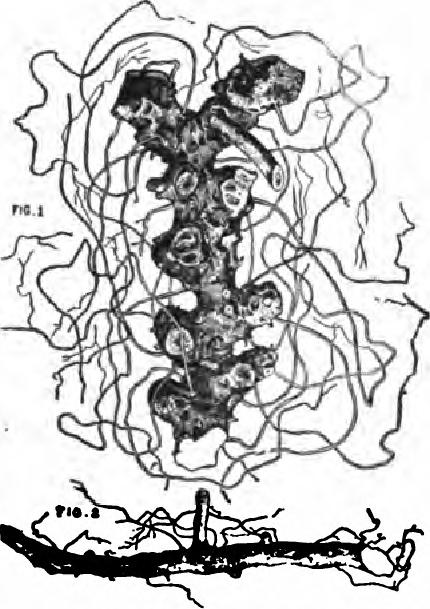
660 DI08C0KBA. off, more or Imb, upon drying, esj^ecially when the rhizome is ntiieftd in:; spring, but which ia not the case with a good <;^nality of it, when dug in ac::. The internal color of the drv rhizome is whitish, or slightly Btraw-colorBi,igathered in the autumn, but it is often brown when collected early in the «a.-. there is no bark to it. Under a magnifying glass the texture of a broken r!i:: appt'ars mealy and perforated with numerous woody bundles. Attached:' lower i>art of the rhizome, an abundance of strong, wiry-like fibers will be«h^r Diom-nrea viilma lias one of the hardest of rhizomse, it being tci^ difficult: ■ <lcr or crush. It has no odor, and but little taste beyona a ethght acriditT prolonged chewing. II. DioscoREA viLLOSA, var. glabra; False wild yam. — The rhizome (Fi^ ' of this plant resembles that of ChlUngonia canadensis more nearly thaa it'i"» true D.vUtosa. It ia found as a rough clump of a pound or more in veigL'.'-.- 1 fr^h, thickly branched, each branch shooting from the side of the maio ik - 1 at an angle inclining Imckward and upward. The branches almost touci: • other, are as large as the rhizome, and are from 1 inch to 3 inches ial:. Along their upper surface are numerous cup-shaped stem-scars, which are j J to i of an inch in diameter, and so thickly inserted as to intrude Ji^-iother. (The vine of the true Dioscorea villosa, upon the contrary, springs &*!:; main rhizame). The diameter of the rhizome and of the ramifications, i to I of an inch, and the length seldom more than 6 inches. Internally, tb^' zome resembles that of the true wild yam, while the lower portion is,ii manner, covered with stout, fibrous rootlets. The color is generally a T«yr. darker brown. Obemical Oompoaition. — The virtues of this drug appear to reade i: acrid resin, almost insoluble in water, but readily extracted br alcobo'.. so-called dtoacorein is not a definite principle of the rhizome, but ia siiLj dried solid extract, and to call it otherwise is a misnomer. Kalteyer(l888 i: a substance dosely allied to saponin in considerable quantity in tiie rlii! Wild yam contains an abundance of starch. Action, Medical Uses, and Dosage.— In former editions I hare^^rthis agent an antispasmodic, and solely for the reason that it cures frilKV-' And I can truly say that nearly all remedies have thus been classified, not any positive knowledge of their action, but from the results following l administration. A change of classification based upon the known action cf:^-dies is certainly desirable, and I am glad to observe that the attention oi |- cians has already been attracted in this direction. In the absence c>:' ■■' positive knowledge concerning the action of diiMCorea, perhaps it would be tf to say that it is a specific in bilious colic, having proved almost is^irsuccessful in doses of ^ pint of the decoction, repeated every halfhour.v:Specific dioscorea may oe given in 6-drop doses every 5 minutes. No othet::'cine is required, as it gives prompt and permanent relief in the most Eeraec^ (Prof. J. King). In fact it is not only of value in bilious colic, but in all fo^' colic and other painful abdominal neuro8e«, and all forms of aastro-intestinal tr?'; If it does not relieve in one hour, the medicine should be discontinue has allayed the pain incident to the pass^e of biliary calculi when given full doses of eelsemium (Webster). It has also proved valuable in painfui:' morbus attended with cramps, in neuralgic affections, in irritable comUtto^', nervniis system, especially when attended with pain or spaaww, in »jHti»nwlk ^ ' obstinate and pninful vomiting, gastralgia, and in one case of sptvnuodic if^f<''- • King eff^ected a cure with it after several other means had failetl. It will 1:^'' allay nausea, also spasms of the bowels, and, combined with equal part^vbark of Comtts sericea in decoction, is eminently beneficial in the nausea aodr ing of pregndncy. This root appears to exert an action especially upon enitt, and irritable mucous tissues that become painful from spasmodic contnci:'''' ' their muscular fibers; hence its value in jHftbtu colic, in painful dysenteric k*'' in difsmenorrhcea the result of spasmodic irritation of the mucous membran^^^ j cervix uteri, and in svaamodic irritations of the gastric mucous memhrane att^^'*' with pain, nausea, ana vomiting. It is reputed useful in indigestion with derangement, in chronic h^nUic congeatvm, and in the chronic gcutritis e4 dntiW'^ It is also useful in c^Ur^ins. In ordinary caaes the decoction of tnenri"!
DioaPYBoa 601 be jpTea in dosea of from 2 to 4 fluid ounces, uxd repeated every half hoar until ttAiet iB obtained. By man;^ the infusion or decoction is considered preferable to the tinctvue. The tincture is said to be a valuable expectorant and diaphoretic, and in lurge doses produces emesis. Dose of the tincture, from 20 to W drops; specific diosoorea, 5 to 40 drops. Speciflc iDOicatioziB and Uses. — Bilious colic; other forms of colic with spasmodic contractions; yellow skin and conjunctiva, with nausea and colicky paina; tongue coated, paroxysmal abdominal pain, and stomach deranged; frequent small, flatulent, alvine passages; colic, with tenderness on pressure; «Wp abdominal pain, made worse by motion. DI08PTR0S.— PEBSnOfON. The bark and unripe fruit of Dvo^pyroB vtrotniona, Linn^. Nat. Ord. — Ebenaceie. CoUMOH Names: PerHmmon, Dat&filum. Botanical Bonrce. — This is an indigenous tree growing from 15 to 50 feet or more ia heicht, its dimensions being larger at the South; the bark is rough and dark-colored; the branches alternate and spreading. The leaves are alternate, elliptic or ovate-oblong, abruptly acuminate, from 3 to 5 inches long, entire, smooth, shining, and glaucous oeneath; the petiole, veins, and margin are puberulent. The flowers are obscure, pale, greenish-yellow, the fertile ones in axillary racemes, 1 to 3-flowered, the pedicels being shorter than the flowers; the sterite flowers are smaller and often clustered. Stamens 16 in the sterile flowers, 8 in the fertile, in the latter imperfect; the anthers of the sterile flowers are bilobed. The style is 2 to 4-cleft, and short: the stigma obtuse and spreading. The fruit is a round, golden-yellow berry, about an inch in diameter, containing a sweet and edible pulp, and from 6 to 8 hard, compressed seeds (W. — O.). History. — This is a well known indigenous tree, growing in woods and fields from Rhode Island to the western states and southward, flowering from April to July, ripening its fruit in S»)tember and October. The fruit is edible after exposuro to irost. The unripe iruit and the bark are very astringent, and are the medicinal portions of the tree. (For tiegcription of fruit see Botanical Source). A beer is sometimes made from the fruit, and the fruit is made into a bread with wheat bran, known as perdvimon bread, and then kept for the purpose of making beer by means of fermentation with hops. The roasted seeds nave been used in some portions of the South as a substitute for coffee. Ohemical Oomposition. — Water or alcohol extracts the virtues of the bark and unripe fruit. B. R. Smith found the unripe fruit to contain li^nin, tannic acid, sugar, a little malic acid, and coloring matter; also, that when ripe the tannic acia almost disappears, while the sugar and malic acid become more abundant (^mtfr. Jbur. PAfmu., 1846, 167). J, E. Bryan (1860) also found pectin present, and thought the tannin to be analogous to that of cinchona, catechu, etc., while others contend tliat it is identical with the tannin from oak and galls. The bark of persimmon was analyzed by F. E. Murphy (1889), and a crystalline body obtained by him from the ethereal extract investigated by Schleif (Amer. Janr. PAanft., 1890). He found it to be free from nitrogen, and allied to the resins. Action, Hedical Uses, and Dosage.— Tonic and astringent. The bark has been used in intermitienix, and both it and the unripe fruit have been beneflcial in various forms of disease of the bowels, chronic dysentery, and uterine hemorrhage; used in infusion, syrup, or vinous tincture, in the proportion of 1 ounce of the bruised fruit to 2 fluid ounces of the vehicle, and ^ fluid ounce or more given to adults, and a fluid drachm or more to infants. The infusion may be used as a gargle in ulcerate aore throat. When ripe the fruit in very palatable, and as it matures at a time when fruits are generally departing for the season, the cultivation of the tree would undoubtedly be a valuable accession to our autumnal fruits. A kind -of brandy is obtained by distillation of the fermented infusion. Related Species. — Diotpyrot Kaki, lAnn^ filiuB, the Chinese date-plum or Jaaaneae pentH^ mon, is a native of Chiaa and Japan, and is cultivated in India. The fruit is oi a bright-red color, about the sice of an ordinary apple; when ripe, it ia eaten by the Ohinese, aad when
662 DIBCA. dried, is made into nreetmetti. The bark is astringent, and probably reaemblea that of other species ot JHrnps/nm. The JapmneM n^tard this p««minon as their beet fmit, which they even eat bef»e it npena. When dried it resembles the fi^ When fresh, and eaten with mg»r and cream, it is said to be deltdoni. It isnowcnltinted inF]orida({/.<S.^jrr. ii^.,1890). J.Ishii, 01 Toldo, in 18%, found in the nnripe fmit a conaidefBUe auHHint tannin which disappears npon ripening; the palp contains mnch dextroae and heruloae, while the seeds, being free from starch, contain a soft white material, manaww, convertible into manmm by bcnling with 5 per cent of sulphuric acid (Proe. Amer. Fhana. Auoc., 1896, p. 674). The bark of Dioepyrot KaJd has been advised as an astringent in cAronte munmt affecHtm^ as in certain forms of dyspeptia, in diarrhaa and dytentery, in muoom diatatn of the bladder and urfOtra, andasalocal application in leumrrhota, gl^ chronic e<mjundmtu,waAcatarrluU<^ The fluid extract, dilated with water, may be applied locally, injectifm, or by spray. Bv some phyridans kaki is highly laoded as a remedy for gairO'tnttmncd irrUaHon. Dr. J. W. Huckin8(Bee Webster's Dynam. Tiurap., p. 359), regards it as an excellent remedy fordyKnlrry, Kmple mucoid diarrhaa, chronic diarrhaa, and dtarmeea 4^ typhoid Jerfr, quickly lelieTiiw pain, tenesmus, and thirst, and checking the discharges; he also praises it in pattrie catarrh, tdceration the ttomach, or howeh, and in catarrh of the rectum and eofon. A decoction of 1 or 2 drachnui of kaki to \ pint of water, steeped \ hour and' cooled, is employed in doses of 1 to 4 tableepoonfols every 1 to 4 hours as required: I>MMpyro« o6(un/(>^M, Willdenow; Mexico. Bark and leaves employed. Astringent tonic Dioipyrot emhryouterit, Persoon, or /lufMnperstmiiionfraijisfoand inlndia, JaTajUid nei^boring tropical islanw; bat is not valued hi|^ly for its fmit, which is insipid. When green, tbey are very astrin^nt, and are employed in tannine. The inspissated jaice has been used in diarrhaa; it is thick and viscid, and has been empfoyed in India as a preservative for coating fishing nets, and the seams of boats. The unripe fmit waa admitted into UiePAaniMMoiMHi fiflndia in the year 1868. DIBOA.— LEATHBRWOOD. The bark of Direa palustris, Linn6. Nat Ord. — ^Thymelseaceae. CoifHOM Names: Leatherwood, Mooaaoood, American mezereon, Wickopy. Botanical Sonrco. — This indigenous shrub attains the height of 5 or 6 feet, having crooked, jointed, and Bpreading branches. The leaves are alternate, simple, entire, on very short petioles, oblong-ovate, or obovate, downy when youn^ Bmooth and membranous when fully grown, and pale underneath. The nowen are axillary, yellow, appear long before the leaves; when young they^ are incloeed within a small, hairy, bud-like involucre, occupyinga sheath or cavity in the end of eadi flowering branch, usually in bunches of 3 together, with their peduncles cohering. Coroua none. Calyx funnel-shimed, ^ inch long, with a contractioii near the base and another in the middle. The stamens are 8 in number, much longer than the calyx, alternately a long and a short one, with rounded anthoa. The ovary is ovate, placed obliquely, the style appearing to issue from one side; the style filiform, curved, longer than the stamens, and terminated by an acute stigma. The fruit is a small, oval, red or orange-colored berrv, containing one seedrB.— W.). History, Description, and Ohemical Composition. — This shrub is more common to the northern and eastern states, being occasionally met with in the west. It inhabits marshy places, low swampy woods, flowering in April and May. The bark is the part used; it is very tenacious and fibrous, and bard to pulverize. It has a disagreeable odor, and a pungent taste, with considerable acrimony, producing ptyalism, which property it imparts to alcohol, and slightly to boiling water. It has been used for making ropes, thongs and baskets, and might be advantageously employed in the arts, for making paper, etc. The wood is white, soft, and very brittle. It has not been satisfactorily analyzed, though mucilage, an acrid resm, and bitter extractive have been found in it. Action, Hedical Uses, and Dosage.— Thu bark \» acrid, rubefacient, and vesicant when fresh. From d to 7 grains of it cause great gastric heat and uneasiness, with emesis and catharsis. In contact with the skin it produces rubefaction, followed by blisters, and the sores it occasions are frequently difficult to heal, forming very indolent and obstinate ulcers. If chewed it causes salivation, with burning pain in the tongue, gums, etc., and has thus proved useful as an irritant in paralysis of the tongue, tiMihache, facial netmUgia, etc. Bigelow says, that a decoction of the bark may be used as a sudorific and expectorant, in the place ef senega. The berries proau(» vomiting, and are said to be a^aiootic poison. bigitized by Google
DEAOONTIUM. 663 DUOOHTIUH.— 8XinnC-4UBBA0B. Til. 98. The rhizome, roots and seeds of Dracontium fcetidumt Linn^ (/etode» fcetidat, tigelow; Pothoa fcettda, Michaux; Sj/mplocarpua fcetidua, Salisbury). Nat. Ord. — Aracete. Common Names: Skunh^abbtyef Sktmk-weedj Meadow-caJbbage^ Pol^atrweedf Fcetid ell^tore. iLLUStBATiONs: MiUspaugh's ilmer. Jferl. i%tnte, Plate 169; Meeh&n'a Native loioers and FemSyWoh I, Plate 16. Botanical Source. — Skunk-cabbage is a perennial plant, having a lai^ge, brupt root or tuber, with numerous, crowded, verticillate, fleshy fibers, which xtend some distance into the.ground. The pathe, which appears before the leaves, is vate, turgid, various in width, cucuUate, spotid and striped with purple and yellowishrcen, the top acuminate and incurved, the iges folded inward, auriculate at the base and t length coalescing. The flowers are dullurple, tetrandrous, numerous, and situated itnin the spathe on an oval or subglobose, 3ort pedunculated spadix. The calyx conists of 4 fleshy, wedge-shaped, truncate sepals, aving the top and edges inflected. Corolla one. Stamens 4, opposite the sepals, with abulate filaments equal in length to the calyx; nd oblong, exserted, 2'cellea anthers. The:.yle is 4-sided and tapering; the stigma minte and pubescent; the ovary roundish and oncealed within the spadix. After the spathe decays, the spadix con.nuee to grow, and with it every part of the owers except the anthers. When the fruit la Se, the spadix has attained many times its original dimensione, while the yx, filaments, and style are larger, very prominent and separated from each ther. Within the sps^x, at the base of each style, is a naked, round, fleshy ted, as large as a pea, white, tinged with ^reen and purple, invested with a 8e|>ap ite membranous coat, and with a prominent embiro situated in a depression t the top, and umbilicately attached to a large, solid perisperm. Sometime fol•wing tne flowers, numerous large, crowded leaves appear, which are oblong, )rdate, acute, and smooth, with numerous fleshy veins of a pale color, and are ^rne on long, channeled petioles, furnished with large, oblong sheaths, and are r bright-green color, and often 20 inches long by 12 broad (L. — G. — W.). mstOiy. — This plant has been a troublesome one for botanists to dispose of., has been variously annexed to Ictodes, Dracontium, and Potkos. Salisbury termed Symplocarpus, a name which is preferred by many botanists. It is indigenous, -owing plentifully in various parts of the United States, in moist grounds, flowing in March and April, and maturing its fruit in August and ^ptember. It rins a roughened globular mat^s, 2 or 3 inches in diameter, in decay shedding le bulblet-Tike seeds, which are to i an inch in diameter, and filled with the ngular, solid, fleshy embryo (G.). The whole plant has an extremely disagree>le odor, resembling the commingled odors of skunk and onions, which is most iparent when the plant is bruised, and which has given rise to the several names ■ Skunk-cabboQe, Skunk-weed, Polecat-weed, and Meadow-cabbage. The parts used are le rhizome, with its rootlets, and the seeds. The rhizome should be gathered soon ter the appearance of the spathe, or after the seeds have matured in autumn. It as the unpleasant odor of the plant, and, when fresh, a persistent, acrid taste. DeMniption and Chemical Composition. — As found in commerce the drug in somewnat cylindrical pieces, 2 inches or more in length, and about 1 inch in lameter, or, more commonly, in tranverse slices, very much compressed and coiv igated. Its color externally is dark-brown, and internally whitish, or yellowishDnoonUum totldain. Digitized by Goo
white. Drying leeseiu the odor as well ms the acridity of the pUnt, and age and expoffure diasipata them entirely, oonaequuitiy the root should be renewed annoaUj. The seeds have been need and preferred as being more enacetic than the root. They have an exceedingly acrid taste, and emit the fetid odor of the plant only when bruised. They preserre their virtues longer than the root. The properties of this |>lant are chiefly owing to a volatile substance, which loses its activity by desiccation, and is completely volatilized by subjection to an increased temperature. Alc<jhol or water extracts its virtues, and the aqueous infusion should be made by displacement. As &r as we can ascertain, the only analysis on record of Symplocarpus foetidus is that of Hr. Jos. H. Turner (Amer. Jtmr. Fharni.f 1836, Vol. \ III, pp. 1-10), who found the root to contain besides starch, fixed and volatile oils, " a peculiar substance, soluble in acids and precipitated by alkalies." In the seeds he found starch, gum, resin, albumen, fixed oil, wax, and coloring matter. Prof. Bastin showed the starch of Symplocarpus fcetidus to be so characteristic of the drug as to allow its identification in cases where it is used as an adulterant of commercial Veratrum viride ( The Apothecary^ 1893, p. 152). Action, Medical Uses, and Dosage.— In large doses, according to Bigelow skunk cabbage will cause sickneiNS at stomach, vomiting, headache, dizziness, and impaired vision. la medicinal doses it is a stimulant, exerting expectorant, powerful antispasmodic, and faintly narcotic influences. Its action upon the nervous system is marked, relieving irritation, and it has a tendency to promote normal functional activity of the nervous structures. It has been sncoe^ully used in €Uthmay whnoping-cottgh, nervmu irritabitity^ hyderint epilepty^ and rcmruMions during prn^nanrj/ aiici ^W/ likewise in rAnmte ra/arrA, pulmonary, and hmnchicd aj^iant. The powdered root or seed may be given in doses of from 10 to 40 grains, 3 times a day; but the most eligible mode of administration is a saturated tincture of the fiesh root, of which 1 or 2 fluid drachms may be given for a dose. It enters into the composition of Acetous Emetic Tincture, Compound Emetic Powder, and several othw old Eclectic preparations. DB08ER&.— SmniEW. The herb Drosera rotundtfi^ia, Linn£. Nai. Ord. — Droseracese. Common Names: Sundew, Round-leared tundew. Botanical Source. — Sundew is a low, small, perennial, herbaceous, aquatic plant, also called Round-leaved sundew, with a fibrous root, from which arises the Hg. OB, leaves, which are radical, small, and nearly round, depressed, lying flat upon the ground, and abruptly narrowed into the spreading hairy petioles. The scapes are erect, 5 to 8 inches high, at first coiled inwnrd, and bearing a simple raceme. The flowers are arranged on one side, very small and white; the sepals are 5, united at the base, and ]>ersistent; the petaU 5 and convolute. The stamens5; anthers adnato; stylesSorS, each deeply 2-parte<l. Ovary single. Capsule 3 or 5-valved and many-seeded. The seeds are spindle-shnped, and the coat loose and chafif-like (\V. — G.). History. — Sundew (Ro^ SoliJt) U a peculiar Httle plant, growing in Europe and this country, in Itogs, and muddy shores of ponds and rivers, and flowenng in J uly and August It may he at once distinguished by the reddish glandulai hairs with which the leaves are beset, and which are usually tipped with a small drop of a clammy fluid, appearing like a dew drop, glistening in the sun, this secretion bein^ most abundant when the sun is at its highest, from which circumstance it derives its name. The long, shining red hairs of this plant form beautiful objects for the microscope, under which they are seen to consist of an immense number of minute cells, regularly arranged, and exhibitinE a most goigeous variety of brilliant colors. They are very irritable, slowly curved inward, and entrap insects within their reach; the fluid secreted from their points Droierft rotmidifoU&.
665 also retains insects which settle upon it. The flowers only open in sunshine. The juice of the plant is bitter, aond and caustic. The meaicin^ preparation is the tincture of the recent plant. Obemlcftl OonOKMitiOB. — Trommsdorf examined the juice of this plant (Ckem, Centra&l., 1833), finding in it a free oi]panic acid, probablv malic acid, cranio salts, and a reu coloring principle, which formed an insoluble compound with acetate of lead. Reese and Will believed the free acid to be a mixture of formic, propionic and butyric acids, and Ha^er thought it to be malic and citric acids combined. Lugan obtained from theiuice of tne plant a crystallizable acid insoluble in chloroform; besides, a greeniah-orown resin, by successive treatment with ether and chloroform. It is soluble in both these solvents and possesses acrid properties. According to Stein's experiments {Ber, d, Deutsch. Chem. Ges., 1879; also Amer. Jour. i%an)i., 1880, p. 12), the free acid in Drosera intermedia was identified with citric acid, which acid probably occurs in all species of Drosera. A ferment also seems to be present, capable of converting albuminous substances into peptonea. ■ Experiments of H. Biisgen (see Amer. Jour. Fkarm.^ 1885, p. 106) would demonstrate that the plants of drosera are capable of assimilating animal food. Action, Medical Uses, and Doaatre. — This ^nt appears to exert a peculiar action upon the respiratory apparatus, and its effects are best observed m>m the use of email doses. It is peculiarly adapted to dry, spasmodic, or explosive coughs, such as are met with in many cases of whooping-cough and vieaslea — for the cough of the latter it being an almost absolute specific. The coughs met b^ drosera are those in which dryness of the air passages is marked, and there is irritation or even inflammation, and nervous irritation, particularly irritation of the base of the brain and of the parts supplied by the vagus. The special seat of most of the trouble seems to oe centered in the larynx. Tickling in that organ, giving rise to spasmodic cough, is met by it, and while exceedingly useful in all coughs having the above characteristics, it appears to benefit best those cases associated with or following measles and whooping-cough. For the latter it may also he given as a prophylactic, and if the individual does contract the disease, the influence of the medicine will have been early obtained. 8anguinarine nitrate acts well with it in dry, tickling cough. It has been found essentially useful in asthma, incipient phthisis, chronic bronchitis, with dry, spasmodic cougn, and nervous or sympatlietic cough, whether from pulmonary, cardiac, or gastric disease. Two fluid drachms of the saturated tincture, or 1 drachm of specific drosera, may be added to 4 fluid ounces of water (or wine, if indicated), of which a teaspoonful may be administered every 3 or 4 hours. In former times it was considered a powerful aphrodisiac, and as a remedy to cure intennittents, insanity, and to promote delivery. The juice of the plant has been used as a local application for the cure of corns and warts. Dose, of the saturated tincture, 1 to 6 drops; specific drosera, to 5 drops. Specific Indications and Uses. — Expulsive or explosive, spasmodic cough, with dryness of the air passages; whooping-cough; cough of measles; uncontrolable irritating cough. DUB0I8IA.— DUBOISIA. The leaves of Duboisia myoporouka^ Robert Brown. Nai. Ord. — Solanaceee. Common Names: Corkwood e/ui, Onmp'urflAie, A'g'moo (native namra). Botanical Source. — This is a large shrub found in Australia and New Caledonia. It has alternate, smooth, entire leaver, narrowed into a short leaf-stalk, which is articulated to the branches. The flowers are small, white, and disposed in large terminal panicles. The calyx and corolla are 5-parted, with obtuse lobes. The stamens are didynamous, with the rudiment of a fifth, and bear 1-celled anthers. The fruit is a small, black, 2-celled berry, which contains a few reniform, rough seeds. The genus Duboisia is intermediate between the natural orders Solanaceee and Scrojikularinceir, and was referred to the former by the older authors; Bentham, in the Flora of Austrnlvi, classes it with the latter, but more recent develouments regarding a natural constituent (du6omne), seem to indicate tiiat its true place is among the Solanaceee.
666 DUBOISIA. HiiUny. — The honor of introdncing this dnw to the profeasion belonn to Dr. J. Bancroft, of Briehuie, Anstralis, who presentea the plant to Baron ron Maellor for botani(»l identification, and who, at his suggestion, experimented with it aa a therapeutical agent, and presented the first paper on the subject to the Qneenaland Philosophical Society of Australia, in October, 1877. Shortly afterward, he (Bancroft) sent sjtecimena of the plant to the Museum of the British Pharmaceutical Society. In March, 1878, Mr, E. M. Holmes read a paper before the society on Duboisia viyoporoUlea^ its botanical history, etc., and nearly at the same time, a communication appeared in the London lAinret from Drs^, Ringer and Tweedy, detailing a line of experiments upon its therapeutical action, in which the previous report of Dr. Bancroft was corroborated in every particular. Shortly alxerward, Gerrard, of England, and Petit, of France (see Pharm. Jour. Trans., pj. Vol. VII. p. 787), almost simultaneously announced the discovery of an alkaloid called dvhoitine or dtthomiia. F.vonl^ueller and L.Rummell also announced their discoTei^ ofdtdwkine from B. myojmroides {Jour. Chem. £br., January, 1879, p. 32), bat as thor alkaloid is an oily, volatile base, its identity with duboisine is questionable. Ohemical Oomposltloii.— The chief constituent of this leaf, called duboimne by its discoverers, was found by Prof. A. Ladenburg to be identical with hyoacyamine (C„H„NO,) {Ber. d. Dcutik-h. Chem. Ges., 1880, p. 1257). The properties of duboisine are therefore described under kyoscyavune (see Hyoscyamus). Another isomeric alkaloid was obtained by Merck, called peeudo-kyoscyamine, forming yellowish needles of an acrid, bitter taste, soluble in alcohol and chloroform, slightly soluble in ether. Its melting point is 133° to 134** C. (271.4 to 273.2° F.), while hyosq/amine (duboisine), melts at 106° to 108° C. (222.8° to 226.4° F.) (Merck's IndeXj 1896). Action, Medical Uses, and Dosage. — The action of duboisia upon man and animals is very similar to that of belladonna, hyoscyamus, eto. Dogs and cats to which it has oeen administered, almost immediately commence walking with difficulty, stumbling over the least obstacle as though they were blind, and foiling asleep as soon as they are left at rest, having the pupils laively dilated; these results also followed its introduction into the system by hypodermatic injection. Large doses internally, or by subcutaneous injection, occasion large pupillary dilatation, dryness of the mouth and throat, increase the number of pulsations, and give rise to general debility, vertigo, and cephalalgia; the results are the same with man as with animals. The alkaloid, duboisine, produces similar effects. The sulphate of this alkaloid, subcutaneously injected in large doses, occasions a sort of intoxication, mental derangement, pupillary dilatation, incoordination of muscular motion, relaxation of the vesical and anal sphincters, and an increased temperature at firs^ succeeded by a very marked diminution. As an internal remedy, neither the shrub nor its alkaloid (except as hyoscyamine) have come into general use. Used in this manner, duboisia will be found to possess properties similar to those of belladonna and its congeners. Duboisine, and its sulphate, are more commonly employed in this country, principally in ocular therapeutics; it has been found by Drs.Weckerand Galezowski, of Paria. to be a piompt and unirritating mydriatic, the mydriasis being accompanied with paralysis of the ciliary muscle, and consequently an absolute loss of accommodation. The mydriasis produced does not appear to annoy the patient, nor to lawt as long as when occasioned by atropine; nor does the employment of the agent give rise to the intense conjunctival irritations (follicular conjunctivitis and eczema of the lids) so often following the application of atropine. It may be employed in all vvjiadiea of the eyes in which atropine is indicated, being contraindicaU'd in glaucomatous conditions, and in diseased conditions of the fundus. From 2 to 4 grains of tlie sulphate of duboisine are dissolved in 1 fluid ounce of water, and of this solution from 2 to 5 drops may be instilled into one or both eyes as required; the mydriatic effect commences in afew minutes. The solution of the sulphate of duboisine has likewise been successfully employed, by hypodermatic injection, for checking the pathological avoeijAinga common to phihisiay etc., and also as an antidoto to poisoning by maahroom^y antagonizing the paralyzing effect of muscarine on the heart. It is reputed palliative in exophihalmic goitre. The dose to be used will differ with various individuals, from the or to frain. The beginning dose should rarely exceed i/y grain. For ophthalmic use to 4 grains to 1 ounce of distilled water. Care should be had in its use, as occa
DTTLGAXABA. 667 sionally untoward symptoms have been produced by reduced applicatiouB (see alBO Atropine Sulphas^ Belladonna, and Syoacycmm), Specific Inaicaaons and uses. — A Bubstitute for atropine aa a mj^driatic, and to check colliquative sweating; antagonises muscarine; mushroom poisoning. Belated Species.— />u6ouim Hopuxodii, F. von Mueller. This ia the AuBtralian Piiury^ Miaoiaownaawturie,pedgeryfpikhirifj^^ bedgery. It has long been known that the natives of Central Austrdiaiue the leaf of some shrub in order to invigorate tliemselyes, after long^ marches, or when they are deeirotia of undergoing great fatigue, aa during a battle. This leaf is used as a masticatory by the Australians in a manner simiutr to that o? the coca leaves by the South Americans. It is asserted that when tiie natives chew pitury "in company," the quid ia passed from one to another until all are satisfied, when one of the numoer preeerves it by sticking it behind his ear (Maiden^ Atutralian Ute/iu Ptanis). Dr. Bancroft, of Brisbane, in 1872, made some physiologiciil expenmenta with authentic apecimens of pituri; yet the source of the dn^ was unknown until 1877, when Baron von Mueller identified it from a specimen of the leaves of the plant submitted to him by Mr. W. O. Hodgkinson; accordingly, the pitury is Didtouia Hopwoodii, F. Mueller, a shrub found sparingly " from the Darling Biver and Barcooto to West Auatralia." But little is known of this shrub, aa it grows in a country difficult of access. Staiger is probably tlie first wlio isolated from Duboisia Hopwoodii piiuriw, an alkaloid with which the "duboiHine" of F.von Mueller and F. Rummel (see above), is most probably identical. A. \V. Gerrard, in 1880, independently discovered the alkaloid piturine in this plant (Pharm. Jour. Traru., 1880). When fresh it smells like nicotine, but when older haa a smell of pyridine. Its vaiKtrs aflect the mucous membranes and cause violent headache. Some authorities {e. g.. Petit, Jvur. Pharm. Chim., 1879, p. 338), consider piturine identical with nicotine. Prof. Liveraidge, however,j>ointB out some dinerences in their reactions, but otherwise they are quite simdar {Anur. Jour. Pharm., 1881, p. 357). Piturine (GisHmN,), waaobtained by him in uie amount of l.Oand 2.4 per cent It isa colorless alkaloid, volatile at ordinary temperatures, changing to yellow and brown rapidly when exposed to air and sunlight. Itis soluble in water, alcohol, and ether, ia slightly heavier than water, and forme salts with acids, which, with oxalic acid, are capable of crystallizing. Its salts gradually lose the alkaloid by evaporation. Piturine is reported to antagonize the action of muscarine on the heart, but not BO promptly as atropine. Dr. Bancroft states that this drug arreata the respiration of animals^ and thus causes their death. The action of pitury is essentially differ* ent from thatof duboisia. Applied to the eye, it first contracts, and then widely dilates the pupils; internally^ small doses contract the pupils, while laige doses produce a wide dilatsp tioo. Faintness, ^ddiness, trembling, pallor, quickened and shallow breathing, increased heart actiw, and sweating^ are induced by it, and it the dose be large, drowsineBS, ptvalism, spasmodic muscular twitching, and spasmodic rigidity of the limlw are among its enects. DULOAIUUU (U. S. P.)— DTTLOAKABA. FiclOO. "The young branches of Sohnum Dtdcamara, Linne" (C7. S. P.). Nat. Ord. — ^lanacete. Common Names: BUtersweei, Woody nwht-ahade, Viol.et-bbom, Scarlet-berry. Illustrations: Bentley andTrimen, Med. Plants, 190; Woodville, Med. Bot.AZS. Botanical Source — Bittersweet, or Woody night-shade, is a woody vine, naving a woody root, with a shrubby, nexuous, thornless, and branching stem, several feet in length; with an ashy-green bark on the Btem and large branches. The leaves are alternate, acute, and generally smooth; the lower ones ovate or cordate; the upper ones more or less perfectly hastate, and all entire. The flowers are purple, drooping, and are borne on branching peauncles from the side of the stem, in spreading, cymose clusters. The calyx is very smalf, purplish, acute, persistent, and 5-parted. The corolla is rotate, purple, with 5 reflexed segments, and 2 round, green spots at the base of each segment. The filaments are short; the anthers erect^ opening by pores at the apex, yellow, and convergmg into a cone. Ovary roundish; style filiform; stigma simple and obtuse. The fruit is a scarlet, oval, juicy, bitter, and poisonous berry, the seeds of wbich are many, planoconvex, and whitish (L. — W. — G. — B.). ffistorr and Description.— Bittersweet, also known by the names of Vialetrhlofm an d Scaiietrherry^ soiannm Dnicanun.
668 is oommoa to both Europe and this coantoy, growing on moist banks, around dwellings, and in low, damp grounds, about hedges and thickets, flowering in June and Julv. Its berries are ripened in autumn, and hang upon the vines f<» several montns. The parts used in medicine are the roots and twigs, the latter only being official. The berries when eaten have certainly produced serious consequences, though considered by many to be harmless. The twigs should 6e collected in the autumn, after the dropping of the foliage: they have an unpleasant odor, which is lost by drring: and their taste is bitter, followed b^ some sweetness and a slight acridity. The dried twi^ found in commerce are in pieces varyine in length, having a greenish-gray epidermis, a light wood, and a very light and spongy pith. They impart their properties by infusion to boiling water, and also to diluted alcohol; long boiling impairs their medicinal activity. The U.S. P. describes dulcamara as followa: "About 5 Mm. [\ inch] or less thick, cylindrical, somewhat angular, longitudinally striate, more or less warty, usually hollow in the center, cut into short sections. The thin bark is externally pale greenish, or light greenish-brown, marked with alternate leaf-scars, and internally green; the greenish or yellowish wood forms 1 or2 concentric rings. Odor slight, t^te bitter, afterwards^ sweet "— ( V. S. P.). Obemical Composition. — Two proximate principles have been obtained from Solanum Dulcamara: Solanhie, an alkaloidal principle, discovered by Deefosses, in 1820, in the berries of Solanum nigrum, and (1821) in the leaves and stems of S. Dulcamiim; and duUanuirin, its bitter-sweet glucosid, w^as first isolated in pure form by E. Geisler, in 1875. Probably it is identical with a substance previously named picroglycion by Pfaff", and dulenrin by Desfosses (1821). It was again ot tained by Biltz (1841), and later by Wittstein, who named it dulcamarni. Peschier (1828) demonstrated that solanine existed in the berries of dulcsr mara in even larger quantity than in the leaves and stem; it also occurs in tiie sprouts of our common potato (see Soltimim tuherosuniy ReUxUd Species) and in various other Solanaceiu, e. g., the tomato phint (G. \V. Kennedy, Amer. Jour. Pharm., 1873), etc. Desfosses obtained it from the rii)e berries of the black night-shade (^Solanum nigruvi) by expressing the juice, adding ammonia, washing the precipitated alkaloid with cold water, ana cr^'stallizing from alcohol, after purifyii^ 'with animal charcoal. Fresh sprouts of potatoes furnish it in greatest abundance. Solanine (C^H^SOfg, Kraut; C„H„NO,„ Hilger) occurs either amorphous, in minute prisms, or in feathery crystals, bavins a bitter, somewhat acrid taste. Solanine fuses at 2'd6° C. (^^o*" F.). It is 8<»luT)le in warm amyl alcohol, which abstracts it completely from alkaline solutions; i» less soluble in boiling alcohol, still less in cold alcohol, considerably less in ether (1 in 4000), and requires 8000 parts of boiling water for solution. The solution of solanine in alcohol tends to gelatinize upon cooling; the solution in amyl alcohol possesf^es this property ina pronounced di^greo (T)ragendorff). Solanine has an alkaline reaction and combines with acid") to form salts. Dilute mineral acids decompose eolnnine slowly at ordinary temperatures, and more rapidly at boiling heat, into sugiir and toiatudine, another alkaloid which is soluble in cold ether and hot alcohol, but hardly soluble in water (Zwenger and Kindt, alsoGmelin, 1859). O. Bach (1873) recommends as a test for solanine and solanidine, the behavior of these subf^tances towards a mixture of equal volumes of concentrated sulphuric acid and alcohol; a trace of these alkaloids causes the appearance of a rose-red, then cherry-red color, which lasts for 5 or 6 hours, and is not interfered with by the presence of laige quantities of morphine (Ainer. Jnur. Pharm., 1873). Du'canuirin CC.„H-„0,o) was obtained by E. Geissler (ArcMv. der Pharm., 1875, p. 203) from the stems of dulcamara, by digesting the aqueous infusion with animal charcoal until the peculiar, bitter-sweet taste was removed, washine thecha^ coal with water and abstracting by means of alcohol. After purification of the bitter-sweet extractive (by using of its lead compound), pure dulcavtarin was obtained free from nitrogen (Wittstein's dulcamann contained nitrogen), as an amorphous yellow substance, possessing the characteristic, bitter-sweet taste of the plant in concentrated form. It is soluble in alcohol and water (30 parts) and in acetic ether, but it is insoluble in ether, chloroform, and petroleum ether. Diluted sulphuric acid splits it into du/mmonetm, a tasteles, resinous substance, and sugar. Solanine is poisonous.
DULCAMARA. Action, Medical Ubcb, and Dosa^.— Prof. Caylus, of Leipeic, who has made Boiae careful experiments with solanine, as well as with the twigs of dulcamara, states that an extract of the twigs is from 5 to 10 times more active than the twigs, and solanine is 30 times more powerful than this extract. He considers the plant and its active principles to possess poisonous properties, which may prove fatal in large doses. All these preparations, when adininistered internally, cause renal congestion, and occasionally an augmented urinary secretion of an albuminous nature; tney exert a depressing or paralyzing influence upon the respiratorv nervous system, cause increased but enfeebled cardiac action, tetanic spasms of the thoracic muscles as well as those of the extremities, and increase the sensitiveness of the cutaneous nervous system; they exert no direct influence upon the brain, stomach, or bowels. He believes they act more particularly on the spinal cord and medulla oblongata, and recommends the acetate of solanine, in doses of i to 1 grain, in pulmonary maladieSf attended with spasm or irritation (Ann. de Thh.y 1859, p. 24). Solanum Dulcamara is a mild narcotic, diuretic, alterative, diaphoretic, and discutient. In large doses it causes dryness and heat with stinging pain in the fauces, accompanied with tliirst, sickness at stomach, vomiting, diarrhoea, prostrar tion or syncope, and spasmodic twitchings. With some persons it depresses the action of the heart and arteries, and causes a moderate degree of liviaity on the hands and face. The head usually feels heavy and dizzy, and a cutaneous erythema may be developed. It is reputed antaphrodisiac, and has proved beneficial in mania attended with powerful excitement of the venereal functions. On the other hand, it is said to occasion venereal desires, and to induce heat and itching of the external female parts, attended with strangury. Dulcamara is a valuable remedy in most acute trovbUs, brought on by co^, and in chronic skin affections of a pustular, vesicular, or scaly character. It has been chiefly used in syrup or decoction in cutaneous diseases, syphilitic diseases, rheur matic and cachectic affections, ill-conditioned tUcerSjScrofula, indurations from milk, leucorrhasa, jawidice, and obstructed menstrttation. It isof*^ more benefit in scaly cutaneous diseases than in others, as in l^rosy, tetter, eczmo, and porrigo, and especially in combination with guaiacum and yellow-dock root. Dulcamara is a remedy for etUarrhal trtmbUSf resnlting from cold or suspended cutaneous action. Here the fractional doses should be employed. Suppression of the mcTiaes, with headache, nausea, and chilly sensations, when the flow has been arrested by cold, is a case for its exhibition. Dyspnoea, cough, and pain in the chest produced by exposure, are relieved by small doses. (Marrhal headache, from acute colds, and nasal catarrh are both benefited by bitter-sweet, which is also a remedy for retrocession of eruptions, and to primarily develop tardy eruptions. Owing to ito kindly action on the stomach and its influence in aiding secretion and excretion, it is a valuable alterative and should have a more general use. In vesical catarrh, aggravated by dampness, it has given good resulto. The eame is true of catarrhal diarrhoea of children, and acute and chronic rheumatism in those who are much exposed or who dwell in cold or damp quarters. Nymphomania and satyriasis were successfully treated with it by Dewees. Pundendal Uchin^ and Pitching pains have been relieved by it in small doses. Lu^e doses have produced these troubles. Dr. Scudder saggests a trial of the drug in "small doses in those cases of chronic disease in which the circulation is feeble, the hands and feet cold and purplish, with fullness of tissues and tendency to oedema" i^pec. Med.,2A&). Equal parts of the twigs, yellow-dock root, and stiUingia made into a syrup, form a valuable preparation for scrofulous affections, as well as ayphUitic. Externally, in the form of ointment, it is employed as a discutient to painful tumors; also as an application to some forms of cutaTieous disease, ulcers^ and erysipelatous affections. Dose of the decoction or syrup, 1 or 2 fluid ounces; of the extract, from 2 to 5 grains; of the powdered leaves, from 10 to 30 grains; specific dulcamara, fraction of a drop to 30 drops. Small doses act best. The decoction is prepared from 1 ounce of fresh twigs and sufficient water to produce, after boiling for 15 minutes, 1 pint of decoction. Bpeciflc Indications and Uses. — Scaly skin affections: acute disorders due to colds and dampness; deficient capillaiv circnlation in tnt skin; diminished cutaneoos action with urinous odor; oolanees and blneneai of the eztremitieej full tieevMB with tendency to oedema.
670 DXWCAMARA. MtiMX^A Wipeeim -Setenl other ■pecies of Bcdannm appeM* to po— »■ medicinal power — among them are: Sotamnn tukroMMS Iiiui£; Common potato. An extract of the herb, Soianum tubentum (common pfitato), haa lieen foond oa^ol in chrome rhamatie ofeetiimM, atutrie and intatinal ^pasm, cough, etc., in the dose of from i of a grain to 1 grain. Some ptactitioDt-n have, bovevor, emplored it in these MBTectiona, and in very large doses, without obo^ving anj influence whatever. Probably cultivation, soil, climate, acaaon, etc., exert some iufloence npon the medicinal powers of the plant. The pt^ato Hseli has been e^en raw, either with or without Tinogar, in cases of anirn/, and with good effect; oocanonally it has caused narroeis, and slij^ht purgation. Both rawaudcooked the potato makesan excellent poaltice. Consider able potassium hydroxide may be procured from potato-stalks; and if they be gathered while the plant is in flower, and patvted through an oil mill, the juice obtained is said to forma haodsome yellow dye. Wackenroder obtained mjianine Siom potato spronts. The green fruits and the hprh of the potato plant have also been shown to contain solanine and its allied bases. aolanidine and Hifaneine. In 1887, Dr. George Kaasner demonstrated that wei^able quantitiM of solanine will de\'elop in injurfd potatoes when stored in a cellar {Amer. Jour. PAomi.). Traces of mydriatic alkaloids (hyoscy8mine,etc.) have even been observed in Solannm taberoemn and allied species. LyfoperKinim aculentum, Slillspaugb; (&>Iamim Lyeopemeum). — Tomato, or Lon-appU, like the potato, came ori^nally from South America. Its unit contains several acids (citnc, oxalic, and malic acids faavmg been shown to be present), a thick, adhesive, brownish, resinous-like sut^tance, and the seeds probably contain an alkaloirl. It is much used as an article of food in the Unitud States, and is supposed to ezurt a healthy influence upon the liver and biliaty organa. The leaves have a heavy, disagreeable odor, and contain oil, extractive, and aoianiitt, which has bcea obtained from aU the berbuceoas portions ol tlie plant (Kennedy, Amer. Jour, i'harm., 1873). Most of the Solannms are niitiitive, or possess medicinal virtues. Solatium Pteudo<apticum, Jerumlrm durry. — A handsome, erect, dwarf treelike sbiiib, a native of Mauritius, ancl bearing large scarlet berries. Poisonona. On aooonnt of tlw reeemblance of the fruit to clierries, children are liable to be poisoned by them. Sfjlanun Melongma (or aculenium I, Eqg-plant. — Tliis plant yields an elongated, purple froit known as the egg-appU, bimjal, or auberginf. It dm-s not possesB the agreeable properties of tomato, but when properly prepared is much esteemed as a vegetable. Solatium ni(7mm,XinDe; Gardeti nighi-thade, Nighl-nhade.— Planum nigrum ie a fetid, narcotic, bushy herb, with a fibrous root and an erect, branching, angular, berbaoeoiiB, thonil«a stem, 1 or 2 feet in height Leaves uiuiivided, ovate, toothed, and waved,Bmooth, lengthened ont atthe base, almout always with the lamina perforated and the margin erose; as if oiawed by insects. Umbels from the intermediate spaces between the leaves, solitary-, pe<randed, smiple, downy, nodding. Flowera white or pale-violet, with a muftky scent; anthers yellow. Berries globose, black, about the size of peas (L. — W.— G.}. The Gardm, or Black niglO-Juidt, is found growing along old walls, fences, and in gardens, in various parts of the Vnit«l States, flowering in July and August Another species, the Srtlanum rii^manum, is abundant in this country. It hag an erect, prickly stem; pianatilid leaves, prickly on both sidee; divisioiis sinuate, obtuse; margin cihate; calyx prickly, and flowers blue, or whitish. The leaves of these plants are the parts employed, ana yield their properties to water, alcohol, or fixed mb. Solanum nigrum is narcotic and sedative, and produces, when given in laroe doeea, ii^ ness and vertigo. One to 3 grains of the leaves infused in water, will, it is said, prodiiee a copious perspiration, and often purge on the next day. They have been used in eaiKtr, schrw and tcrofulou* affecliom, being applied locally as a cataplasm, or in ointment, and also exhilHted in small doses ptenmlly. laolanhie, which was first obtained from this species by I>eefoAes, in 1820, exists in it more abundantly than in the S. Dulcamara, to which it is somewhat analogous in medicinal properties, with more active and energetic narcotic virtues. The berries an poisonous, causing torpor, burning in the stmnachjjrever, nausea, stupor, and insensibility; though this is denied by M. Dnnal, of Montpellier. Tlie plant is employed la the form of oiDt ment only, as a discutient. Solatium patiicidatutn, JtruVbn.— Brazil. Considerably used by Brazilian physiciaDS in atiemia, liver disorders, amenorrhcta, vetncul catarrh, And spfeen digordert. It is regarded tome, alterative, antiperiodic, antisyphilitic, antiblennorhagic, and drastic. Tlie leaves, fruit, and root are employed both externally and iutomally. It is considered a good laxative to overcmne chronic cotutipation. Jenibebitie, an alkaloid, is contained in the root and fruit (F. V. Greene, Atner.Jour. Ffiarm., 1877, p. 506). Sulnnum bacci/erutH.~\ variety of this plant yields the toxic nimmher ftnrieL from the eating of which several citses of poisoning have be<>n reported. Another variety oi the same species is said to be hurmless, and its fruit is employeil by tlie natives of Jamaica. Solatiuin Jticquinii, Willdenow {Solatium xatitltocarputit, Schrader). — A drug of considerable repute in India, where it is valued as a diuretic; expectorant, and sialagogue. It is used in Bengal for dropsy, and, smoked in a pipe, gives relief in toothache. Catiirrhat fertrt, cough, aad o«i/t7Ha are among the conditions said to be benefited by it (Dyojock, Mai. Med. Wettem ItuOa). Lycium urabrmum, Humboldt and Bonplanil. Sat. Ord. — Solanacefe. South America. Lydum J/rum, Linn^.— \orth Africa. The leaves of this and the foregoing species are eror ployed in infusion for the relief of numerous tkiti affection*, particularly fryripebts. Lycium vtdgare, Dunal ( fjycium barbarum, Linn^); Matnmony nw.— Indigenous to 3)fediterranean Europe and is found in the Unitefl States, both wild and cultivated. Its flowers are oi a dull, purple-sreen hue. The leaves and bark have a sweet, followed by a faintly bitter, acrid taste. Lyctne ( C» Hu NOs ), in deliqnescent, white, prismatic crystals, was obtained by HoBemum And Hannd, in 1863, from the leaves and branchee, the fonner yielding the laigw amount of
KCHIKACEA. 671 alkaloid. Its identity with ScheiDler's betdine ( Liebrich's oasyneurine), from the juice of beet-root, was subaequently {Ardtiv. der Pharm., 1876, p. 216) proven by Husemann. According to the latter, it does not preexist ia the plant, bat is developed during the process of obtaining it — t. e., lieating in the presence of hydrochloric add. Allcalbidal mydriatic prindples, like those fran bitlladonna, have been detected in this plant by £. Schmidt and others (see Amer, Jour. Phamu, 181l0,pp. 13 and 492). EOHINAOSA.— EOHINAOEA. The root of Echvnacen angugtifolinj De Candolle. Nat. Ord. — Composites. CouHON Naheb: Nnrrvw-leavetl purpU ame-Jlowery PurpU cone-flower, Cane-flawer^ Black Sampson. BotUlical Source. — Echinacea angustifolia is an herbaceous plant, the thick, black, pungent root of which sends up from year to year, a slender, sometimes somewhat Btout stem, bristling with hairs, and from 2 to 3 feet high. The^ leaves (see illustration), which are 3-veined and hispid-pubescent, vary in shape from broad lanceolate to lance-linear. At the base they become slender, and the lowermost have short petioles. The involucre consists of about 2 rows of lanceolate, scaly bracts. As the flower develops the disk is at first concave, but as the growth progresses it becomes ovoid, the receptacle taking on a sharply conical form. The linear-lanceolate, chaff-like bracts of the receptacle are firm, remain permanently attached, are boatshaped and concave, and become narrowed into a stiflti spine-like crisp, extending beyond the disc-f owers. The ray-flowers are narrow, and from 1 to 2 inches long. They are rose or purple, and drooping or pendant, and, while withering, are yet persistent. They are generally " iinperfectly styliferous." Rarely these ray-flowers or ligules are white. The discflorets are cylindraceoua, presenting fine, erect teeth, and the tubular portion upon which the stamens are inserted, is scarcely a tube proper, out merely a ring. The fruit consists of acutely 4-angled akenes (]-seeded, dry, indehiecent peric^irps, tipped with the remains of the style), of a firm, tough, yet cork-like texture. The^are beset with a thick, crown-like pappus, which is extended somewhat into triangular teeth. History. — Conspicuous among the remedies introduced within recent Leat J ears, echinacea undoubtedly takes the first rank. As with all new reme-Knu^ai ies, it has suffered the usual over-estimation, and the exaggerated claims made for it led Prof. Lloyd to view it with suspicion for a long time. Prof. H. T, Webster (^Dipiam, TherapX was the first to give an extensive, though sectional, account of the therapy of the drug. Though now a well-known drug, echinacea stands peculiarly alone in being essentially a new remedy. Many remedies which have lately been introduced can be traced back for years, and some of them for centuries, as having at some time occupied a place in eitner domestic or profes* sional practice, but our ancient scientihc works are silent concerning this species of echinacea. Gray, in his Synoptical Flora of North America^ published some years ago, wrote: "Used in popular medicine under the name black sam^tson," but since he Tefera to the plant as " black sampson," a name applied to Echmaced purpurea, it may be accepted that he referred to that drug. A careful search through the large number of works upon domestic medicine, herbals, medical botanies, and the so-called "irregular" works upon practice, contained in the Lloyd Library, failed to reveal even a mention of Echinacea angustifolia as a medicinal agent. In this connection, the following from the pen of Mr. C. G. Lloyd, who identified the drug first used by Dr. Meyer and Dr. King, will serve to distinguish between black sampson and Echinacea angustifolia; ^'■Echinacea purpurea, Moench, is a plant growing in the eastern states from Pennsylvania west. It was introduced in King's Dipensatory under the name of Rttdheckia purpurea, and the common name black sampson. Echinacea angustifolia, De CandoUe, is an entireljr different plant, found only in prairie regions, and not occurring east of the prairie regions of Illinois, and has never been used under the name black sampson. There is no mention of it in medical literature preceding the paper of Drs. Meyer and King." The first notices concerning echinacea are from Efdectic physidans, and the drug is, from start to finish, an Edectio medicine.
672 SCHINAGSA. Echinacea angustifolia is an indigenona plant of the compoeite order, pi t.: chiefly in the western states, from Uunois to Nebraska, and soathTanl t*::.-, Missouri to Texas, thriving best in rich prairie soil. That whii-h gr<^- j marshy places is of inferior quality. It has also been stated that it pj<- n rocky and sandy soil. The plant, however, which is abundant in K:i I Nebraska, and neigbborinK localities, is not mentioned by P. A. Rydbei^, '-.i recently piibliBhed Flora of the Sand Hill* of Nebraska (Contributions to tiir" ■ Xat.Herbarium,Vol. IILNo. 3, 1895). The plant blooms firom June toA^; Echinacea is sometimes known in Kansas aa nigger-head, a name derived vhape and somber hue of its fruiting head. The scientific appelktk-:!-. derived from physical features of the plant, and are therefore descriptire. I generic term Ecktnac&if is derived from the Greek ArAino^, meaning hedge-h-. searurchin, referring to the spinv, hedge-hog-like fruiting head; while ihtsyname angtuit\foUa, comes from the two Latin words, anguatua (narrow) and; (l^if), contrasting thereby this species with the other forms of Echiium.-. being the narrow-leaved species. The introduction of echinacea into professional practice is due conjoia.Dr.H.P.C.Meyer,of Pawnee City, Neb., and the late Prof. John Kin^. Ihtt-. had, for many years (since 1870), been using the plant without knowmg its U~ cal position. In a letter to Prof. King (see E. M. J., 1887), in 1886, he comt-! cated to the latter his uses of the drug, as he had employed it for 16 yean 1| claims for the remedy were based upon the conclusion that it was " an mtmodic and antidote lor blood-poisoning." The enthusiastic doctor had bees it in a secret mixture with wormwood and hops, which he had deDomi:. " Meyer's Blood Purifier." Among his claims for it was its antidotal action i. the poison of various insects, and particularly that of the rattlesnake. M stated that he even allowed a rattler to bite him, after which he bathed tht:/: with some of the tincture, took a drachm of it internally, and laid don. slept, and upon awakening all traces of swelling bad disappeared! Proll' wrote: "He (Dr. Meyer) kindly offered to send the writer a rattler 8 feet. that the antidotal influence of the tincture upon Ao^, rabbits, etc., bitten serpent, might be tested; but having no friendship for the reptile, and unaccustomed to handling this poisonous ophidian, the generous offer ms i teously declined." The following range of affections were those in which Dr. Meyer claimeccess for this remedy: Malarial fever, cholera morbus, cholera infantum, bou- internal abscesses, typhoid fever (intem^y and loodly to abdomen); niori sore throat, old ulcers, poisoning from rhus, erysipelas, carbuncles, bites ande-^ of bees, wasps, spiders, etc.; in nasal and pharyngeal catarrh, hemorrhoida n.' fevers, including typhoid, congestive, and remittent; trichinosis, nervous tache, acne, scronilous ophthamiia, milk crust, scald bead, and eciema; sis colic in horses. Subsequent use of the drug has in a measure sulwtantittK seemingly incredulous claims of its introducer, for it will be observed that t of these conditions were such as might be due to blood depravation, or to nci introductions from without the body — the very field in which echinacea iskr to display its power.! In the autumn of 1885, Dr. Meyer sent to Prof. J. U. Lloyd a quantity of root, desiring the latter to enlighten hhn as to its botanical name. At tlte •c^ time he expressed Dr. King a quantity of the tincture. Prof. Lloyd, qoeft; ing the claims of Meyer, wrote to him that he could not name the plant ^ the root alone, whereupon the latter shipped another quantity of the root.lowed (September 28, 1886) by a specimen plant, which Mr. Curtis G. Llovd identified as Echinacea angtatifolia of De Candolle (see paper by Prof. lIotc Echinacea, in E. Jf. Jour,, Aug., 1897). Prof. King, appearing to have more £uth than Prof. Llo^d in the possiliit' ^ of the new drug, took an active interest in it, and by experimenting exteas'^ was soon convinced of its great value. His use of it led him to report socctft olwtinate naso-pharyngeal catarrh; in rheumatism (one case being of theartic:variety); in cholera morbus and cholera infEintum; in chronic ulcers of tbc | gne case of which was complicated with an ecsemMons eniption of yean' etit] lO; also in painftil ehtonic hemoniioidfl, vsgUiaL UmwrAsm with nlcmtw^
KCHINAOSA. 678 Fi«. 108. le OS uteri, poiBonine A'om poison ivy, and stings of wasps and bees, with very Etensive awelUng. Dyspepsia, with pain and great distress, a|;graTated brpariking of food, and long resisting tr^tment, also yielded to it. Goss (Chtawo Tedical Times, 1888), who became interested in the drug, praised it as a remedy for lad dog bites, chronic catarrh, chronic ulcers, gonor^cea, and syphilis. Dr. A. arker, of Wilber, Neb., also reported success with it in an apparently hopeless ise of septiceemia. Then followed the reports of Dr. Hayes (see below), whose atements did much to obtain general recognition for the drug. Description, Chemical Oompositioii, and Preparations.— The rootof echinavaries in thickness, £rom that of an ordinary lead pencil to that of the little nger. The deep-brown or reddish-brown epiderm is shrunken and rinkled loneitudinally, and is often disposed in spiral folds upon le Bubdermal portion of the root. The woody portion, as seen upon ansverse section (see illustration of root), is composed of medullary lys, separated bjr a greenish, pulp-like substance. When broken the ried root exhibits a grainy and apparently rotten aspect. When lewed the root, if of good quality, imparts at first a sweetish taste, ibeequently becoming acrid and pungent, and finally leaving a per^ stent tingling sensation, followed by a peculiar numbness of the ingue and fauces, seemingly intermediate in character between that roduced byaconite and cocaine. It has been compared to the prickng produced by prickly ash, but is essentially different, lacking the eculiar aromatic qualities of the latter. Tincture of echinacea is transparent, and of a reddish-brown >lor. It mixes well with water, as does also the fluid extract, which Lves at first no appreciable precipitation in that fluid. The preparaons chiefly employed by Eclectic practitioners, and from which the ledicinal value of the agent has been determined, are specific echinaia and Echafolta. The latter is simnly a purified preparation of }hinacea,free from coloring matters ana extraneous suDStances, Buch I chlorophyll, extractive, and other "plant dirt." Much of the root >llected has little medicinal value. This is due not to poorly kept id cured roots alone, but chiefly to the locality in which it grows.!uch of the drug collected in the marshes and lowlands east of the [issiseippi is of this negative quality. The best quality of root comes om the prairie lands of Nebraska (J. U. Lloyd in E. M. J., 1897, p.!7). The experience of the writer is to the effect that few drugs vary lore in quality than crude echinacea. conilon tincture of echinacea is a mixture of alcohol 4 parts, and water 1 part. His ivestigations of echinacea reveal the presence of minute quantities of an alka\d, which is devoid of color and unimportant so far as its medicinal qualities are >ncerned. His earlier analyses fiailed to show tiie existence of this principle. The laracteristic principles of the root are those substances linked to an acid organic )dy of a resinous character, nearly, if not quite colorless, and possessing, in an calted degree, the persistently acrid qualities of echinacea — so intensely that it is stressing to the taste, even in very small amount, when pure. The stinging sen.tion aflects the tip of the tongue for hours. But small quantities of it are presit, even in the best root — "less than i to 1 percent." (Adapted in part i^m ■tide by Prof. J. U. Lloyd in E. M. Jour., August, 1897). Action, Medical uses, and Dosajfe. — As a therapeutic agent echinacea is 'ten used both internally and locally at the same time: therefore in this article le internal and external uses will not he given separately, but collectively. And lasmuch as echafolta is a name given to distinguish a purified form of echinacea, le remarks concerning the one are equally applicable to the other, except in aportant surgical cases, where greater cleanlinesB is desired, when echafolta is to 9 preferred. Under the older classification of remedies, echinacea would probably be classed » an antiseptic and alterative. Strictly speaking, It is practically impossible to 43 Digitized by Goo
•74 XCHINAOKA. ebwsify an agent like echinacea by applying to it one or two words to indicate its virtues. The day is rapidiv approummg when these qualifying terms will have no place in medicine, for they but inadequately convey to our minds the therar peutic possibilities of our drugs. Especially is this so with regard to such terms as alterative, stimulant, tonic, etc. If any single statement were to be made concerning the virtues of echinacea~, it would read something like this: "A corrector of the depravation of the body fluids/' and even this does not suflEiciently cover the ground. Its extraordinary powers — combining essentially that formerly included under the terms antiseptic, an ti fermentative, and antizymotic — are well shown in its power over changes produced in the fluids of the body, whether from internal causes or from external introductiona. The changes may be manifested in a disturbed balance of the fluids resulting in such tissue alterations as are exhibited in 6cnb, carbuncles^ absceaseSt ot celltUar glandular inflammaiiom. They may be from the introduction of serpent or insect venom, or they may be doe to such fearful poisons as give rise to malignant diphtheriOy cerebro-minal meningiti*, or puerpenU and other forms of septicaemia. Such changes, whether they be septic or of devitalized morbid accumulations, or alterations in the fluids themselves, appear to have met their antagonist in echinacea. *'Bad blood," so called, a«tA«nta, and adynamia, and particularly a tendency to malignancy in acute and subacute disorders, seera to be special indicators for the use of echinacea. Outside of the claims made for this remedy bv its introducer, which included many of the conditions for which it is now valued, it first attracted genenl notice as a remedy for eej^icxniia^ in which malady it appeared to promise more than airr remedy previously in use. The reports of Dr. Hayes (K M, J., 1888, pp. 68, 14^ S^ve an impetus to the use of the drug in this direction; since which time physicians, whose statements are valued, have lauded it as a remedy in various forms of blood-poisoning. Thus it has been successfully employed m injuriea complicated with septic infection. A. crushed hand, thought to he beyond aid, with the intolerable stench of putrid flesh, was saved by the application of echinacea. It has given equally satisfactory results in alarming cases of venom infection^ with great depression, from the bites of the rattlestuike, tarantula and other spiders, and from the stings of scorpions, bees, wasps, etc. Prof. Webster, among others, speaks highlv of its action in slow forms of cerebrospinal meningitis, usin^ it as the oasic remedy (in connection with other indicated drugs), because of its sedative virtues, controlling, as he believes, the vascular area concerned in the nutrition of the cerebro-spinal meninges, and for its efiects upon the general circulation. The cases benefited were those characterized by a slow, feeble pulse, or at least a PuIm not appreciably quickened, with the temperature scarcely elevat^ and cold extremities. The evidences of cerebral disturbances were erratic. Headache, with a peculiar periodical flushing of the face, even to the neck, was present, and associated with these symptoms, dizziness and profound prostration. Prof. Webster was the first, we believe, to employ the remedy in this afiection. He asserts that as a stimulant to the capillary circulation, no remedy is comparable with it, and that it endows the vessels with a recuperative power or formative force, so as to enable them to successfully resist local inflammatory processes due to debility and blood depravation. While clinical evidence is strong in support of the curative action of echina* cea in diphtheria, the writer can not but feel that in some instances, at least, the reports have been based upon mistaken diagnoses, and upon non-malignant cases. He is forced to this view from a liberal use of the drug in several cases of a malignant type, in which it utterly failed to accomplish the results desired. Nonmalignant forms of diphtheria tend to recovery, and we should be careftil about endorsing remedies as curatives in such cases, lest we bring discredit upon a good remedy hy making sweeping claims for it which can not be substantiated when the drug is put to a test in the severer forms of the disease. Nevertheless, in these non-malignant cases it appears to expedite convalescence. In the various forms of tonsilitis it has given better results, particularly in the necrotic form, with dirty-looking ulcerative surfaces. It comes well endorsed as a remedy for that malignant form of quinsy known in some of the western states as "black tongue." Sohinacea will contribute much to the cure of various catarrhal affceiwM qf tht n«e, iM&hpharynx, and other portions the respiratory iraeL
ECHINACEA. m It 18 specially indicated by olMnited and fetid mocoufl aorfacei, with dnoky or duk coloration, and a general debilitated habit. Many patients vho have taken echinacea for other purposes have remiurked its beneficial effects upon eatarrh. from which they were suffering at the same time. Chronic catarrfuU bnmchitis and fetid bnmchitia have been signally benefited by echinacea, and it has done that which few remedies can accomplish, i. e., it has overcome the stench of pulmonary gangrene^ and, if given early, it is asserted to avert a gangrenous termination in Julmonic affections. A case of typhoid pneumonia retried by Shelley (Med. OUaneTy 894) with a "jet-black coating of the tongue," evidencing sepsis, improved rapidly under echinacea, in about 2-drop doses every 3 hours. Echinacea is a good appetizer, and improves digestion. The writer has used it with ^ood results in fermentative dyspepsia, with offensive breath and gastric pain as prominent symptoms, which was also aggravated upon taking food. It is also efficient in duodenal catarrh^ and other forms of intestinal indigedionf with pain and debility. Few remedies are as efficient in ulcerative siomatitig, and in nuraiTig soremouth it is asserted to be promptly curative. It has been praised in diarrhoea, cholera mor&ufl, cholera infantum, and dysentery, all of the semi-inflammatory type, with a tendency to malignancy. Applied externally and given internally, it has been of service in aborting typhlitis and perityphlitis. Echinacea has been prominently mentioned as a remedy for fevers. In the eruptivefevers, as measles, chicken-^ox, and scarlet fever, it has received some praise, especially for its control over the catarrhal phases of the former, and its influence in masking the odor and controlling the pain of the scarlatinal angina. The fevers, however, in which it has accomplished the best results are of the typhoid and typho-malarial types, as well as in sympathetic fevers from septic infection and rheumatic attacks. Notwithstanding that it has lieen recommended as one of the best antimalarial remedies, it appears to exert but little influence over periodicity. Prof. King reported signal failure in every case of ague in which he gave it a triu. Others, however, speak of it as a remedy for malaria when of an asthenic chac^ acter. Possibly in such conditions it might prove of value, as the fevers in which it has proved so successful have been chiefly characterized by adynamia. Very likely its usefulness here depends more upon its influence over the asthenia than upon the miasmatic poison. However, Dr. Snyder, of Cameron, Mo., a good authority, contends that it is an excellent remedy for chronic malaria, a persontd use of it having first convinced him of its value. The doctor has not, however, given us the special cases to which it is adapted. Epidemic influenza (la grippe) is oocagionally ameliorated by echinacea, and in all such cases, with great debility, it assists materially in securing a good convalescence. Puerperal fever^ due to septicaemia, yields somewhat to echinacea with potassium chlorate and other indicated remedies; yet^in some cases it is inadec[uate to check the disease unless a thorough curetting of the womb, to insure against the absorption of imprisoned fragments of placenta or unhealthy discharges, be first resorted to. Frequently this procedure alone, with a free use of hydrogen dioxide solution as a douche, is sufficient to cure, but a marked debility often persists. It is this debility that is so pronouncedly benefited by echinacea, and in two instance) the writer has thought that the high temperature was averted, and the weakened system greatly sustained, by the liberal use of echinacea, until curetting had been accomplished. Others nave been more fortunate in the use of the drug, giving it the credit of being the main agent in accomplishing cures. Its internal and local use is recommended. Hayes commends it in ^^mowntain fever" an affection often mistaken for typhoid fever. Echinacea is in some respects a remedy for pain. It relieves the pain of ery^pdaa, and contributes largely to a resolution of tiie swelling when extensive, tense, and of a purplish-red hue. It is reported to have reliered the pain of cancerous 0rrou)<A«, particularly when involving the mucous membranes, as ccmcer of the fauces. Prof. Farnum calls attention to the wonderful rapidity with which the odor of carcinoma is overcome by echafolta. He strongly recommends it as an application for cancer, and relates a case of mammary cancer long held in check by it. He also advises its internal administration in cancerotta cachexia. So Kreat is the confidence placed in this agent by our foremost suiveons that they have been content to use it with sterilized water to cleanse and uess, after operations,
m BCHINACKA. diechai^ng tubenular abseeues^ ganareney empyema v/ith gangrene oftht hug, dUty ana carcinoma of the breast ana toAicle (Farnnm). Prof. L. E. RtueeL i-. echafolta as a preventative of sepsis, giving it internally previously to cprn-: to act as an intestinal antiseptic, and^ locally, as a corrective, to dress ai;T;'i tism showing signs of sepsis, and as a wash in abdominal and pelvic o^-^r^ into which any organ has discharged septic contents. PfUeffmonmu m Kirea^ ery»ipda» yiiwi sloughing phagedena, dtsso^tn^ or sur^trn/ vountJi,/ ' dolcJiSt dermatitis venenatay&nd pus cavities should be treated with echinact^au-' folta, both locally and internally. A most remarkable case came undertDeir care in which a nigh fever with marked adynamia, associated with the:c'^ ment of celluliu: abeceraes and a hemorrhagic diarrhoea, yielded to echiQa'>u Rhus aromatica. Other medicines did but littie good until these remedir-brought into use. The abeoesses were of a non-active variety, eomewbai p^. but not excessively so; they numbered about lOor 12 at any given limeii ous parts of the body. The alvine discharges were passed inToluntarik.^: when kept under control by the fragrant sumach. The boy, whose aeev:.: 4 years, lingered in this condition for over 2 months. Echinacea surelrkr;: child alive, for whenever the dose, which was 10 drops every 3 hours, was the symptoms were greatly exaggerated. In spite of his low condttion u: very unsanitary surroundings, recovery took place rapidly, as soon as the j symptoms subsided. Echinacea is highly endorsed as a topical dressing for malignant ci' Painftd mammitis has been verv successfully treated with it, and, used asij ition, it relieves the pain and inflammation in gonorrkosa. Several pby>.have used it in syphuis, and declare it a good remedy for that disease, 'k: seems like claiming too much. It is, however, like thuja^ efficient in aUijn: pain and healingtne idcers^ particularly of the mouthy throat, and toogue,^' ing ayphilitics. Dr. Snyder extols echinacea as an efficient remedy for i; ~ It acts admirably in purulent salpirigitiSj contributing toward a cure and a. the distressing pain. Evidence is abundant, concerning its value in K- ' with oflfensive discharges; and Webster reports it as valuable in en/thc erysipelatous vulvitis, being especially effective in that form afiecting sirchildren. Echinacea is a remedy for eczema. It is adapted to chronic oif' sticky or glutinous exudations associated with asthenia and general dtrLiberal doses should be administered for a prolonged period. A striking il.. which had been diagnosed as psortoms, resulting from vaccination, came n::-' care of Prof. Ellingwood, of Chicago. A shedding of the hair and a difir disease, with loss or the nails and thick skin from the palms and soles kfollowed by a destructive iritis of the left eye and cornel ulcer of the r^:' Prospects were &ir for a &tal termination. Perfect recovery, vith the ex:t' of the loss of the left eye, followed the use of liberal doses of echinacea, v::with syrup of iodide of iron and phospho-albumen. Dropsy after scarlatina is said to have been cured by echaiblta. M dition usually tends to a spontaneous cure it is difficult to determine ho? any remedy contributes to such a result. Likewise echinacea has been t; mended to prevent (1) hydrophobia. How one can prevent a result of ibi-i from a dog bite, and especially as the very existence of that so-called ai?-*' denied by many, is not clear. Like many other new remedies echinacea iireported curative in smallpox. It appears to have mitigated many of theS'' symptoms of tubercular phthisis^ and renders expectoration easier in "((f-fK-i-; or grinder's" consumption. It would be no great surprise if this remedy> prove effective in impressing a tubercular diathesis, thereby preventing a nation in consumption. The dose of either specific echinacea or echafolta ranges from lto5.' larger doses (even 60 drops) may be employed, but small doses are geocral-' efficient if frequently repeated. They may be given in water or syrup, i^' and glycerin, as: R Echafolta, flsj to flgij; water, q. b., fl^iv. Mix. Sif spoonful every ^ or 1 hour in acute cases: every 3 or 4 hours in chronic i^^-'If these, preparations are to be dispensed in hot weather, or are to be useJ mentative gastro-intestinal disorders the Bubetitution of 1 ounce of gljce:^' 1 fluid ounce of the water is advisable. For external use both |»eparsuoi»
BLASnCA. 877; be empl(»red, though in point of cleanliness echafolta is to be preferred. Solations of from 1 to 60 per cent stren^h may be applied by means of a saturated compress every 2 hours, or oftener, if necessity demands. Spec£ftc Indicatioiis and Vses. — To correct fluid depravation, "bad bloody" tendency to eepeis and malignancy, as in gangrene, sloughing and ph&gedenio ulcerations, caroundes, boiis, and various rorme of septiceemia; foul dischargeB, with weakness and emaciation; deepened^ bluish or purplish coloration of skin or mucous membranes, with a lowform of inflammation; dirty-brownish tongue; jet-black tongue; tendency to the formation of multiple cellular abscesses of semiactive charactffl', with marked asthenia. Of espedal importance in typhoid, septictemio and other adynamic fevers, and in malignant carbuncle, pulmonary gangrene, cerebro-spinal meningitis and pyosalpinx. Echafolta is advised as a cleansing wash in surgical operations, and^to annul the pain of and to deodorize carcinomata. Belated Species. — Rudbeckia laeiniata, Linn^; ThimbleiBeed. This plant, also known by the names of Vone-diik sunfloieer and T<iil cone-jknixr, is a tall, ehowy, indigenous perennial plant, with a round, glabrous, stem, 3 to 8 feet in height. Leaves alternate, smooth or roughiflh; lower ones pinnate, w ith from 5 to 7 cut or 3-lobed leaflets, petiolate; upper ones irregularly 3 to 5-parted; lobes ovate-lanceolate, pointed. Flowets large, terminal; papi>u8 crenate; chaff truncate and downy at the tip. lUys 1 or 2 inches longj oblanceolate, bright-yellow, spreading or drooping. Disk ol>Iong-coiiical and colamnar in fruit, greenish-yellow (G.— W.). This plant grows In various parts of the United States, in damp places, low thickets, edges of Bwamps and ditches, etc., flowering from July to September. It was introduced into Europe from America and cultivated in Paris early in the seventeenth century {see Amer. Jour. Pharm., 1872, p. 107). The whole herb is recommended to be used. It has not been investigated chemically. It imparts its properties to water. Thimbleweed is a valuable diuretic, tonic, and balsamic. Useful in many disecues of the urinary organs, and highl v recommended in strangury, BrighCi diseate (?}, and wasting or atrophy of the tidjieys. Dose of the decoction, ad libitum. Echinacea purpurea, Moeuch {Rudbecbia purpurea, Linn^), variously cailed Bed muflower, Comb-Jlower, or PurpU cone-ilower, has a thick, black root, with branched, sulcate, smooth, or rough stems, 3 to 5 feet in oeight. Leaves alternate, 4 to 8 inches long, and about ^ as wide, rough, with short, stiff bristles; lower ones broad-ovate, attenuate at base, 6-nerved, veiny, long-petioled, remotely-toothed; cauline ones lanceolate-ovati;, acuminate, nearly entire. Heads large, solitary, on long pieduncles. Disk thickly beset with the stiff, pointed, brown chaff. Rays from 15 to 20, 2 or S inches long, dnll-purple, pendulous, bifid. This plant is common to the western prairies and banks, and is found also in the southern states, flowering from July to Beptember. The root is very put^nt to the taste, and has been popularly used in medicine under the name of BlcKk sampaon. It is stated to have been employed with much benefit in typhUis (W.— G.J. Both of the above plants deserve a full and thorough investigation from the profession. From all that I have been able to team, the latter plant is equal to stilliniria in medicinal efllcacy (King). BouvoTdia tripkylhi, Trompolite.— Mexico. Stem and small branches an aboriginal remedy for hydrophobia ( A. J. P., 1874). Aeeralet decumbent. — New Mexico. Reputed specific for tnake-bitei (W. J. Wilson, M. D.). ELABTIOA (U. B. F.>-Iin)I& BUBBEB. "The prepared milk-juice of various species of Hevea (Nat. Ord. — Euphorbiaceffi), known in commerce as Para rubber "-^((7. S. P.). Synonyms: CamUcfmtc, Gvm elastic, Gummi elasticum. Botanical Source and History. — Caoutchouc, as it exudes from the trees, is a milk-like emulsion, wherein globules of caoutchouc proper are suspended in a gummy solution. It is produced by several plants chiefly of the natural orders, Swphorbiaceaey Apocvnace/e, JMimc&e^ Ascl^piaaacese, and Artocarpese. The finest quality of rubber, that known as Para fw66er, comes from the Amazon district, and u produced by the Heveas. The Hevea gtwanmsis, Aublet {Siphonia daatiea, of Persoon; ^xtropka daslica, Linn6 filius) or syringe4reey of Brazil, furnishes a portion of the species that are official in the U. S. P. This tree generally averages about 65 feet in height, with a diameter varying from 30 to 40 inches. Frequently the trunk reaches 40 or 60 feet in height before branching. In collecting rubber, the natives fasten a small, swallow-nest-shaped, glazed dish around the base of the tree by means of clay; then, by means of a hatchet, sever the bark immediatelv above it, and the milky sap immediately exudes, and is collected in' the dish below. Twenty trees yield, daily, about 2 pints, continuing thia amount for some
■LAfinCA. months. The most feTorable period for extracting it is from April to November, during dry veather; the trees having to be wounded afresh every day. Some allow it to coagulate ia a small, square box, but this method requires several days with subs^uent slicing and pressure, to remove air and water; and some form it into bottles, tubes, etc., by dipping a mold of clay, fastened to the end of a stick, into the fresh juice, and immediately afterward holding it in thick smuke, produced by the combustion of oleaginous seeds. When the first layer has properly solidified, it is dipped again, and so continued until a sufficient thickness has been obtained. The smoke coagulates the milk, and exposure for some time to the sun hardens it. A small quantity of alum, or the addition of acids or salt solutions, accelerates the coagulation of the milk, while ammonia has a contrary effect, and is useful when the milk is requized to be kept for some time in a liquid state. Other South American grades, more or less inferior to Para caoutohouc are known commercially as PemambucOy JMamnAan^ and Bahia caoutchouc, and are derived mainly from Haticomia spenosa, Gomez^ an apocynaceous plant. Very laige quantities of rubber are furnished by the Latidolphias — L.fiorida, Bentham; L. gumrniferOj Lamarck, and L. owariermSj all climbing, apocynaceous plants of West Africa; while in East Africa rubber is yielded by Landoiphia Petersiani and L. Kirkiif and various species of Vahea in Madagascar. Other plants of the same order yielding Borneo caoulchouCy are the Vrceola elaetica^ Roxbui^h; Urceola «8cuZenfo, Bentham (^Cfuivannesia esculenta, De CandoUe), and other species from the Malayan Islands and India. The Willttghbeia edulis, Roxburgh, and other apocynaceous plants yield the Chittagong variety. A kind of rubber is derived from Vrostigma Vogdii, Uiquel (iVof. Ord. — Arto<»Lrpeffi) of Liberia in West Africa; Fictu ittdiea. Linne, and Mcua nligioeay Linn^, yield an inferior caoutchouc. The Ficua dastuxu Roxbni^h iUromtfTna elattiaif Hiqael). is the chief source of Bast India caoutohouc, one variety being called Assam rubber. It has a trunk from 2 to 2^ feet in diameter, and from 40 to 60 feet high. The leaves are alternate, approximated, 3-foliate, articulate at the top of a long slender stalk, convex below, furrowed above, and swelled at its base; the leaflets aresmooth, oval, acute, green above and cinereous beneath. The flowers are monoecious. Calyx 5-cIeft. The fruit is oblong, greenish, B-cornered, broadest at base, tricoccus, each coccus opening with 2 valves. The seed is ovate, brownish, variegated with black, with a thin, brittle testa, and a sweet, nut-like, pleasant kernel. It is frequently cultivated as a hot-house plant. Ceara rubber is the product of Manih/^ Glaztovii, Mueller, native of the Rio de Janeiro district. This Brazilian species, unlike the others of that country, thrives in dr^ situations. Good qualities are also obtained from the following Soutii American species: Sevea hrasiUeimSf Mueller: Hevea dixfUor^ Mueller, bow yielding Para ruober; CastUloa Harkhamianay Collins, and QifiiUoa e&istini, Cervantes. The export of rubber from the city of Para (at the mouth of the Amazon River), in the year 1893, exceeded 42,000,000 pounds. An instructive, exhaustive, and admirably illustrated article on rubber and its industry in South America, with a long list of rubber-yielding plants, classified according to their botanical and geographical origin, from the pen of Prof. H. H. Rushy, is to be found in the Druggist^ Circular J 1894, p. 173. This valuable paper is too extensive to permit of condensation in our pages, and we commend the original article to persons interested in the subject. Efibrts are being made to cultivate caoutehouc-yielding plants in various parts of the world; the chief difficulty with regard to Hevea, according to Prof. Rusby, seems to lie in the great length of time required (from 12 to 35 years), to bring the tree to a proper condition of productiveness. In Lagos, on the west coast of Africa, Kickxia Africana^ Bentham (an apocynaceous plant, the seeds of which have become known as an adulterant of strophanthus seeds), is being cultivated with success, over 680,000 pounds having been exported during the first half of the year 1895. This plant has advantages over the LandolpkiM on account of the climbing habits of the latter, which make cultivation dimcult (G. M. Beringer, Amer. Jour. Pkarm., 1896, p. 212, from Kew Bulktin^ 1895). Description. — Caoutohouc is black when coagulated by smoke, but when pure it is in thin, transparent layers, of a pale-yellow color, destitute both of taste and smell. Upon melting and subsequent cooling it remains in a semi
XLABTICA. 679 fluid, adhesiTe state, unde^ing very Uttl« change for years, if protected from the notion of light, but when expOMd to the action of diffused davli^bt, in the air, it gradually aworbs oxygen, and becomes converted into an inelastic, viscid mas^ soluble in alcohol. It is described by the Pharmacopoeia as follows: In cakei^ balls, or hollow, bottle-shaped pieces, externally brown to browniah-black, inters nally brownish or of lighter tint; very elastic; insoluble in water, diluted acids, or diluted solutions of alkalies; soluble in chloroform, carbon diaulphide, oil of turpentine, benzin, and benzol. When heated to about 125° C. (257° F.), it melts, remaining soft and adhesive after cooling. Odor faint, peculiar; nearly tasteless. When pare, or nearly pure, India rubber floats on water ' — (£7. S. P.). It is insoluble in alcohol, softens and swells up by long boiling in water, but resumes its former state on exposure to the air, and is soluble in pure ether, most fixed and volatile oils, and coal-tar naphtha, the latter and oil oi turpentine being technically convenient solvents. Hot alcohol and wood alcohol cause it to soften and swell. An excellent solvent for caoutchouc is a mixture compoBed of 6 parts of alcohol and 94 parts of sulphide of carbon. Its solutions in ether, oil of turpentine, and coal-tar naphtha, dv evaporation, leave the gum in an elastic state, and on this principle water-proof cloth is made; the same is said to be the case with its solution in the oils of lavender, sassafras, and cajuput. The fixed oils, in dissolving it destroy its elasticity. Under exposure to heat, caoutchouc first melts and then distills, yielding a mixture of several oily liquids, all of which, as well as pure caoutchouc itselffare hydrocarbons. Atmospheric air, ammonia, hydrochloric and diluted sulphuric acids, exert no influence upon caoutchouc. Rubber tubing, it is said, may be prevented from becoming brittle by keeping it under water, which must be changed from time to time. Ohemical Oomporitioii. — India rubber is a hydrocarbon having the general formula (C,4^^)x. It is therefore, to be considered a polymer of terpene (C,^,^. Upon destructive distillation it yields oily anbstances, collectively callra oU of caouh^oue {caautehoucin), besides carbonic acid, carbon monoxide, hydrochlono add, etc. This oil, when subjected to fractional distillation, may be separated into two fractions, one of low and the other of high boiling points. From the former, a hydrocarbon, isoprm (CjHg), was isolated by Greville Williams (1860), having a specific gravity of 0.622, and a boiling point of 37° C. (98.6° F.). Bouchardat (1875) suc^eded iu obtaining from this oil, by polymerization, oils of higher boiling point, and the composition C,oH„; and he even succeeded in obtaining artificial caoutchouc fi*om iaopren, which he therefore considers to be its basic principle. From the high boiling fraction Himly (Liebig's Annal^Vol. XXVII, p. 40), isolated the hydrocarbon caoiUehin (C,(,H„), which has a specific gravity of 0.654, and boils at 171° C. (S39.8° F.). For a description of substances further evolved from India rubber, see Husemann and Hilger, Mamenstoffe, p. 511, CkunUehoucin, OT oU eaoiUchmic, is saiato be the lightest fluid known, and yet its vapor is denser than the heaviest of the gases. Mixed with alcohol, caoutchoucin dusolves all the resins, especiallr copal and India rubber, at orainajy temperatures, and it speedily evaporates, leaving them again in the solid state. It mixes with oils in all proportions, and but for its price would be valuable for the solution of resins in the manufacture of varnishes, and to replace turpentines for liquefying oil paints. Being very volatile it must be kept, in closed vessels. VULCANIZED INDIA RuBBER. — When caoutchouc in sheet-form is immersed in a bath of fused sulphur, heated to 121.1° C. (250° F.), it gradually takes up from 12 to 15 per cent of its weight of sulphur, but without undergoing any change in its chemical or physiuiil properties; but if it be then heated for a few minutes to about 150° C. (302° F.), it produces the elastic vulcanize India mbber. The same vulcanized condition can also be produced either by kneading the India rubber with sulphur, and then exposing it to the necessary temperature; or by dissolving the India rubber in any known solvent, as turpentine, previously charged with sulphur. It may also be effected by immersing very thin sheets of caoutchouc in a solution of 1 part of chloride of sulphur in 60 parts of bisulphide of carbon; then simple exposure to the air causes it to take the character of vulcanized caoutchouc without the aid of heat. Thus treated, caoutchouc remains elastic at all moderate temperatures; in its ordinary state it is quite rigid at a tomperatnre of 4.4° C. (40° F.); it is not affected by heat short of the vulcanizing
680 point, and aoqoirea extaraordinarr powcfs of ifidrting eompuHioa. It doe« not readily nndngo aolntion in napntlia or tnrpoitine; the sa^drar gndvally destroys its elaaticitr, rendering it brittle and subject to decay. 'VcLCASiTK.— If the vnlcanized rabber be ezpoeed to a still hitler tanpa»> ttue, 148. to 176.6' C. i30(f to F. -. it aaBumes a caiboDiaed appearance, becomes black, hard, and like horn, and is termed nUeaniu or AomU, and may be used for most pai|K»se8 to which horn is adapted. Uowera, it dioiild not come into contact with silver or gold ntenmla, as tne acti<m of the snlphnr larnisbes them. Vulcanite becomes negatirely electric by friction, is <Hie of the best insolators of electricity known, and appears to resist the action nearly all solvents. A m-jch higher percentage of sulphur rfrom 30 to35 per cent> also enters into the preparation of tnis hard variety of vulcanized India rubber. For details regarding the manufacture of hard-rubber articles, and the treatment of India rubber in general, we refer the reader to Prof. S. P. ^Hitler's most instriKtive HanShonk Indantrid Or'j't.nic Cftemi4ry^ 1895. Actum, and Mffdical and Sunieal Um. — Caoutchouc is employed iot a number of purposes, as rubbing out the writing made by lead-pencils; asaranent or lute by chemists and others, being first fufcd; for f<nrmiDg tubes of various kinds for surgical and othw purpo^; and it also enters largely into the preparation of wateninxif cloth. Innumerable surgical af^lianoes and instnunents are made of &'>ft and hard rubber. It is preferred to metal in many instances where a non-corrosive material is desired, and its durability, lightness, firmncsB and cheapness are in favor of iu Eelectiun. Tubes — drainage, stCMnach,and reo tal — syringes, specula, catheters, bougies, pessaries, nipple-shields, dilators, trusspads, artificial nose, ears, and other parts, orthopfedic and other surgical appliances are constructed from it. Rubber sheets, bed-pans, and when woven into fabrics, rubWr cloth, and stockings, bandages, and other appliances for even compre9.sion, hot-water ba^, etc., are among the many naefnl articles of which it forms the whole or a part. Indeed, its peculiar character has rendered it useful in various and numerous wars in the arts, sciences, and for domestic purposes. Softened by heat, it has been'applied over small bleeding orifices to check fnrtha hemorrhage; also to arrest tfithdche^ by placing some of it In the abnormal cavity so 08 to protect the dental nerve from atmospheric acii<m. Externally, it hu been used as mn in^edient of adhesive plasters and liniments. Caoutchouc dissolved in oil of origanum or cajuput, and spread upon oil-eilk or cloth, and allowed to dry, forms an excellent stimulating plaster for many local diflScnlties. Skin diseases, as eczema, p«»rta«i9, etc., and Imras and ill-conditioned vicen have been treated by wearing next to the skin thin sheets of rubber or rubber cloth, which prevents the escape of the perspiration, thus rendering the parts moist and soft. Its use in these conditions is not commendable. S^celUd testicles have been strapped and compressed by thin bands of caoutchouc, and for even compression and support the rubber stocking and other woven-nibber &bric3 are extensively used in varicogitieSy kydrwele^ varicocele, ventral hemtsBj penduUms abdomen^ prolapse of the rectum And. other similar conditions. A grain or 2 of caoutchouc has been administered in consumptiotiy repeating it 3 times a day, but its results have not been such as to bring it into ^neral use. It is seldom or never employed into^ nally, and certainly has nothing to recommend it in a medical sense. Related Preparation8.~MABiNE Gli'e, or Cement, is made br digesting from 2 to 4 parts of caoutchouc, cut into sniall pieces, in 34 parts of coal-tar naptitha, protnotiiig Bolnlion oy the application of heat, and by agitation. When the solntion has the conaisteace of thick cream, a^ld 02 or 61 parts of powdered shellac, and heat the mixtare slowly, constantly stirring it, until complete fusion and combination have been affected. Pour the mixtare vbile atill hot on plates of metal, so that it may cool iathinsheets like leather. In using the cement Eat Rome of it into an iron veasel, and beat it to about 120* C. {ZW' F.), and apply it with a rash to the surfaces to be joined. MtMBBAL Caoctchouc. — An nndetennined substance, differing from petroleum products, and found in deposits a foot or less in depth in Australia, has been named mineral caoutdMie, from its marked resemblance to caoutchouc. Whether it is of animal or mineral origio is at present undetermined. Artificial GAOUTCHOtrc is an elastic body produced by acting npon a solution of glue vith sodium tungstate and hydrochloric acid. The precipitate formed upon the addition of the latter is highly elastic at 29.5^to 40.5°C. (85° to I&7**F.).and becomes solid and brittle upon cooling. The process was duKOvered, in 1871, by Prof. Sounenachein {Amer. Jour. Pftorm., 1871, pw 471).
BLATERIMUH.— BLATERIUM. 681 XLARBimTM (0. 8. P.)— ILATBBIH. Formula: Molecular Weight: 347.20. "A neutral principle obtained from elaterium, a substance deposited by the juice of the fruit of EcbcUlium ^ateritm (Linne), A. Richard (Nat. Ord. — GucurbitaoefB)"~(U. S. P.). Preparatioil. — EUUerinum is the principle on which the active properties of elaterium depend. It was first obtained by Sforries. Hennel procured it by separating the ercen resin (chlorophyll) from the crystalline matter of the alcoholic extract of elaterium (see Elaterium), bv ether, which took up the resin and left the elaterin. The latter was then purified by solution in hot alcohol and subsequent crystallization. According to Fluckiger (Pharmacographia), the best method of obtaining elaterin is to exhaust elaterium by means of chloroform; treat the solution so obtained with ether, npon which white crystals of elaterin at once separate. Wash with a small quantity of ether, and recrystallize the pure elaterin from chloroform. This process has been adopted by the BrUiah Pharmac(^i>ceia. Good elaterium should yield from 20 to 25 percent of elaterin. Less is obtained as the fruit approaches maturity. As high as 60 per cent has been isolated (Walz). Descriptioil and Tests. — Pure elaterin, as officially described, occurs in "minute, white, nexagonal scales, or prismatic crystals, without odor, and having a slightly acrid, bitter taste; permanent in the air. Soluble, at 15° C. (59° F.), in 4250 parts of water, and in ^7 parts of alcohol; in 1S20 parts of boiling water, and in 34 parts of boiling alcohol; also soluble in 543 parts of ether, or in 2.4 parts of chloroform. At 190° C. (374° F.) the crystals begin to agglutinate, and at about 209° C. (408.2° F.) they melt, forming a yellowish-brown liquid. When i^ited, they are consumed without leaving a residue. Elaterin is neutral to htmns paper. Elaterin is dissolved by solutions of the alkalies, and reprecipitated on supersaturating with an acid. When dissolved in cold, concentrated sulphuric acid, it causes the latter to become yellow at first, which color gradually changes to scarlet. On dissolvini^ some crystals of elaterin in melted carbolic acid, and then adding a few drops ot strong sulphuric acid, a crimson color will be developed, which soon becomes scarlet. An alcoholic solution of elaterin should not be precipitated by tannic acid T.S., mercuric chloride T.S., or platinic chloride T.S. (absence of, and difference from, alkaloids) " — ({'. S. P.). Elaterin is possessed of all the activity of elaterium, being considerably stronger and always more definite in strength and quality. Its alcuholic solution is the most active preparation. Action, Medical Uses, and Dosage. — (See Elaterium,) The dose of elaterin is from to ^ grain, the latter being a rather lai^e dose. Not more than ^ to ^ grain should be administered as a beginning dose. ELATERIUM.— ELATEBIUH. The feculence of the juice of the fruit of Eeballium IXaterium (Linn6), A. Richard, (EcbcUlium officinale, Nees; Eeballium agre^^ Reichenbach; Monurrdica EUUerium^ Linne; Elaieriuvx cordifolium, Mcench). Nat. Ord. — Cucurbitaceye. Common Names and Synonyms (of plant producing it): Squirting Oictivibcr, Wild cuciimber, Wild balmvi-apple, Cucumis agrestia^ Ciicumis onnntiw. Illustration: Bentley and Trimen, Afed. Plants, 115. Botanical Source. — Ine wild, or squirting cucumber, sometimes called wild balsam-apple, is a hispid, scabrous, and glaucous plant. The stems number several from the same root, and are cylindrical, prostrate, and without tendrils. The leaves are cordate, somewhat looed, crenate-toothed, very rugose, supported on long stalks. The flowers are moncecious and yellow. Male flowers: corolla 5-parted; calyx 5-cleft, with a short tube; stamens triadelphous, with yellow, connate anthers. Femue flowers: filaments 8, sterile j style trifid; ovary S-celled. The fruit is oblong, obtuse at each end, hispid, disarticulating from its stalk with
682 KLATBRIUH. yiolence, expelling its seeds and mucus with coo8id»able force, in consequence of the sudden contraction of the sides. The seeds are black, oompressea, «id reticulated (L.). History and Prepantum. — ^The wild cucumber produces the EcbaUii Fmcttu of the Brituh Pharmaofpcna. It is indigenous to the south of Europe, growing on i>oor soils, in waste places, and flowering in July. It has been extensively cultivated in England for medicinal purposes, where, however, it dies in the winter. It could be cultivated in our countrv, a-s it thrives well, requiring but little attention. The medicinal part isobtainecl by sedimentation from the juice of the pulp, and forms the Elnter'nim of commerce. The process of the British Pharmacopaeia for preparing it is essentially as follows: Slice nearly ripe wild cucumbers, express the juice gently, and pasii it through a fine hair sieve; then set it aside for some hours until the thicKer part has subsided. Reject the thinner, supers natant liquid, transfer the greenish sediin^ut tq 4 linen strainer, allow it to drain, and then, by means of a gentle heat, dry it on a porous brick. Elaterium exists in the juice of the fruit in a soluble condition, but rapidly becomes insolubts when tne juice is exposed to the air. Elaterium is seldom adulterated, its varia* tion in strength being due both to the difference in the time of its collection, and to &ulty modes of preparation. Sometimes it is obtained by subjecting the pulp to too strong pressure, and in other instances, perhap^ by evaporating the juice to an extract It is then called SSateriumnigrttm, asagainst MaUrium owum, which is made by the method herein described. Description.— Good elaterium is in light, brittle, flat flakes, about ^ line or 1 line in thickness, of a pale-gray color, with a slight greenish or yellowish tinge, having a feeble animal odor (slightly tea-like — Pharmacogmphia), and an intensely bitter, somewhat acrid taste. It frequently carries the marks of the muslin or paper containing it during its desiccation. It floats upon water, forms a green tincture with alcohol, and does not effervesce in diluted hydrochloric acid. Reotified spirit dissolves about half its weight, and such a solution concentrated and added to a warm caustic potash solutioa should yield a deposit of at least 20 per cent of colorless, crystalline elaterin (Brit. Pfuirm.). Elatenum of inferior qualitT is more or less curled, much darker colored, less brittle, and has a glistening fraoture. It yields about 6 per cent of elaterin, while good elaterium yields from 16 to 25 per cent. When obtained from the fruit collected in summer, elateriom may contain from 40 to 50 per cent elaterin. The Maltese elaterium is in larger flakes than the best English, is paler, with hardly a trace of green, is soft and friable, or chalk^r to the touch, and frequently contains starch, chalk, and other impurities. It is inodorous, heavier than water, and effervesces with diluted hydrochloric acid. Ohemical Oomposition. — Mr. Hennel obtained from elaterium 44 parts of elaterin, 17 parts of green resin, 6 of starch, 7 of saline matters, and 26 of woody fiber (P.). Pectin, gummy substances, and albumen have also been found in it. Its watery solution should be wholly or nearly free from starch, as shown by its behavior to iodine solution. Its most important constituent is the drastic principle elaterin (C,aH„Og) (see Elaterinum), From the whole plant, including the root, four principles, said to be found also in elaterium, were detected by Walz in 1859. They are the vellow, crjrstallizable glucosid, ^ropA«tm (found also in the fruit of Cu£umis propnetarwn, Linn^); ecballin (eiAaUtc otrid), a bitter, acrid, amorphous, resin-like body; amorphous, non-bitter hydro-elatertn; and an extremely bitter, amorphous body, elaterm. For a more detailed account of these substances see Husemann and Hilger, Pfianzetistoffe, p. 1353. Action, Medical Uses, and Dosage. — Elaterium is an ener^tic hydrar Sogue cathartic, operating with great violence in doses of a few grains, causing iffuse inflammation of the stomach and bowels, characterized by vomiting, griping pain, and profuse diarrhoea. It is the most powerful of our hydragogue purgatives, and for this purpose should be used only in plethoric stat^. In ordinary medicinal doses it produces copious watery evacuations, attended with considerable depression of the circulation and nervous system, and most general Iv nausea and vomiting. Hence, it is often'used in dntpsyy especially pulaumary cedema and oaeftM, to aid in removing the effhsed fluid, as a revulsive in txr^mU affediaM^ and whwever a bydr^gue or revellent effect is indicated. It has been used in this
ELATBBIUM. 683 manner in nanoUc poimning. It cansra an en<vmou8 flow of watery eeram from the blood and mncouB Btructures, and it has been aptly said that one may be "bled throagh the tissues" with a full dose of elaterium. It aleo augments the urinary discna^. The doee of the common commercial article, as a cathartic, is from ^ to } grain, administered every lor 2 hours until it operates; of Clutterbuck's elaterium, considered the best, and so named because it is prepared after the process recommended by Clutterbuck, from ^to-i^ifOf a grain every 3 or 4 hours; of elaterin, from A to -j^ of a grain, best given in form of tincture. A few grains of capsicum added to each dose of elaterium will prevent its nauseating effects. Morris recommends a tincture of elaterin made by dissolving 1 grain in 1 fluid ounce of alcohol, to which 4 drops of nitric acid have been added; the dose is from 20 to 40 drops diluted with cinnamon water. Great care should be exercised in administering elaterium to the debilitated, or to old and infirm individuals, and it is always contraiud^cated by gastro-inteetinal inflammation. Prof. Locke reoommendB the following: In dropsy toUh liver eompliccUwnSf K Elaterium, gr.j; podophyllin, grs. ij; powd. ext. colocynth comp.,gn. zvj; ext. hyoscyamus, q. B. to make a pill mass. Mix. Divide into 8 pills. Give 1 i>ill every 3 hours until the bowels are freely moved. In dropsy with heart complications, R Elaterium, gr.j; powd. digitalis, jss; powd. squill, jbs; ext. hyoscyamus, q. 8. to make a pill mass. Mix. Divide into 20 pills. Give 1 or 2 pills every 3 hours until the bowels move freely; after that 1 or 2 pills each day. For urmnic convulsions with ascites, particularly that following^ scarlatina^ R Elaterium, gr.j; powd. ext. colocynth comp., grs. XV. Mix. Divide into 8 pills. Administer 1 pill every hour until free evacuations are produced {SyUahm of Ec. Mat. Med.). In the latter condition, gelBeminm, jaborandi, or apocynum may be associated with the elaterium treatment if indicated. "For the first time, I now introduce this article to the pnfession as a specific in chronic injiammation of the neck of ^ bladder, in which dweaae I have BuccesBfuUy used it for many years. I am not aware of its ever having been named heretofore for this purpose. It is more especially useful in cases in which there is a constant, more or less painful sensation in the region of the neck of the bladder, where the urine passes in a torrent as if poured through the urethra, and where, after micturition, there is a violent, cramplike aching in the parts, often extending over the whole lower pelvic region and thighs. The saturated tincture (elaterium gr.j, alcohol fljj), is emplojfed in doses varying from 5 to 30 minims; I usually mix it with simple sarsaparilla or other syrup, so that a teaspoonful of the mixture may be taken at a dose, and be repeatea 3 or 4 timee a day. It must be used carefully, so that it doos not purge, although occasionally cases will be met with in which, if its purgative effect is produced by the firrt doses, its subsequent influence will be more decided. * The dose should be small at first, and be gradually increased, as it can be borne. I have also found some good effects from it in chronic gastritis and chronic inflammation of other mucouB membranes" (John Kin^). It must be remembered that it is the minute dose that allays ga^tricirritatwn. Sore, tender, and heavy, or dragging sensations in the region of the bladder, or in the whole pelvic or perineal region, and accompanied with tenesmic passage of urine containing an abundance of mucus or muco-pus, are relieved by small doses of elaterium more readily than by any other drug. It should also be remembered that in the administration of elaterium only the smallest dose that will accomplish results should be used, for even small doses are apt to occasion emesis and other unpleasant results that may interfere with a successful treatment. For irritable and painful stales of the bladder, the small dose is now preferred: R Specific elaterium gtt. v to x to aqua flSiv. Dose, a teaspoonful every 2 or 3 hours. The ordinary dose of elaterium is from^to f grain; of elaterinAto^ in strength. BpMille IndicatioiUI and Uses.— Chronic cystitis with constant, more or lesB painfm sensation in the r^on of the neck of the bladder, where the urine passes in a torrent as if poured through the urethra, and where, after micturition, there is a violent, cramp-like aching in the parts, often extending over the whole lower pelvic region and thighs" (King); deep soreness or tenderness in bladder, pelvis, or perineum, with tenesmic passage of urine l(»ded with mucus or muco-pUB; ^in. It muBt be remembered
684.BLEIU. oonstipfttion. In oathuiic doses: Dropsy of plethora; asdtes and polK:. oedema; cerebral oongestion. I Belated flMelea.— jMbmoniioii bueku. Nat. Onl— Cacurbitaoen. BfeuL Bk■qttirting cucamber in its propertiefl, though its dimatic qoalities are nid to be Wr.' Med. Jour., 1887). I A concrete oleoresin obtained by incieionB, the Bource of which has ox determined, though thought to be from Canariwn commune, Linn^ i.Vr - Burseraceae). Synonyms: Jiesina elemi, Gummi elemi, Manila elemi. Illustration: Bentley and Trimen, Med. Plants, 61. Botanical Source and History.— Several resinous bodies hare at v. times been placed in the European market under the name Elemi, are believea to have been the products of plants of the natural ord« Buiyr The British Pkarmacopceia recognizes a product from the Philippine Idandf v.'. as Manila elemi, thought to be derived from the species above named. Description. — Manila elemi, when recent, occurs in transparent lar mafiises, consisting of a solutioti of solid resin in essential oil. ExU'. has a light, canary-yellow color, and, as found in commerce, is largely presenting an opaque and granular fracture, due to the crystallization «ti-'- '■ Chips and other foreign subsUinces are often found in the solid fragments wetted with a little alcohol, elemi readily disint^^tes, showing a ■ small, crystalline needles. It melts easily, a transparent fluid resultini- i ' an aromatic, warm, acrid taste, and a fragrant odor, resembling that of tt-'-' binthinates, the drug in many respects closely resembling the latter ci^ stances. It is insoluble in water, partly soluole in cold, and compl^ly^, in hot alcohol; easily soluble also in oil of turpentine and ether. Ohemical Oomposition. — A neutral volatile oil, strongly dextrogvn^: less, and fragrant, wasobtained to the extent of at least 10 per cent bytb«i^ of ^armacoaraphia. Deville, on the other hand (1841 X found oilofelesi^ Uevoeyre. Maujean (1821) found in this drug two resinous bodies— ore* in cold spirit, the other in hot spirit only. The principal conetituentoft'ia the part soluble in cold alcohol. It is an amorphous, non-acid rasm. Tt': insoluble in this solvent is a crystalline magma, soluble in hotalcobdr: upon cooling, yields 25 percent (of the original elemi) of a crystalliabt called amyrin by Baup (1851). It is also soluble in ether, chloroform, &n<l ' disulphide. Ciaraician,in 1878, distilled it from zinc dust, obtaining /o/ttf^- ' ethyl-ben zene^ and etkyl-napkthalene. Vesterberg (1887) differentiated am;r. I two isomers of the formula Cjo^jg.HjO, derived from two isomeric hvdrAi' (C„HJ of the melting points 135" C. (275° F.) and 194" C. (381.2" F ': (1874), from the mother-liquors of amyrin, obtained a small quantity cii\' which he called elemic acid (C„H^,0.). It forms lai^e crystals, melts it (302° F.), is insoluble in water, soluble in alcohol, ether, and amyl alcoho!.: din is a crystallizable, neutral substance, observed by Baup in the residiola^' l liquid obtained by the distillation of a mixture of water and the esaentiftl ^-! soluble in hot water and crystallizes upon cooling. Flucki^er purified it b'mation in a current of carbonic acid and found itscompoeition tobe(C„H» and its melting point 133.5° C. (271.5° F.). Dry hydrochloric acid pi ' bryoidin to undergo changes of color ranging from red to violet, blue sM ^ ' Amyrin remains unchanged under similar treatment. A bitUr princ^Jf. observed by Bonastre (1824) was obtained by Fliickiger in the mother liq bryoidin, in the form of a soft, resinous mass (F\uckigeT, F%armatogihVR. Action, Medical Uses, and Dosagfo. — This agent cl(^ly re^mbif^'- ' pentiries, and undoubtedly might be substituted for them. The action _ oil and oil of turpentine are also similar. Elemi is, however, only used ir. pean medicine externally, in plaster and ointment form, as a dressinff y^' ' indolent sores, etc. Belated Products. — Braziluk Elemi. The product of sevenl species of greenish-yellow, fragrant, tranatnceiit resin, sometimes opaque, whitiah-fny or ydkwi^
ELIXISIA. 685 IB compoBed of small needlefl. The odorous resin exu^ng from the tnmks of species of Idea (f. g., I. IdcarUM, De GandoUe) is consumed as incense in the churches of French Guiana (P. L. Simmonds, Amer. Jour. Pharm., 189djj). 253). Mexican Elehi. Vera Cruz demi. — llie product of Amyria demifera of Royle; also of Elaphrium Jacquinianum {Burtfratomentoaa) and E. demifera {Awrr. Joum. Phcarm, 1895, p. 253). Occurs in opaque (sometimes tTansIncent) fragments or semi-cylindrical pieces, is pale-yellow or nearly vnite, and has an agreeable odor. It ma^ be readily masticated. Treatment with cold alcohol reveals white needles, probably of amyrin. Mauritius Elbmi. — The product (AOoCophonia if auritiana, DeCandoUe. Mauritius. When fresh this is a liquid, but subsequently hardens, and finally resembles the Manilla product, especially in the abundance of residual amifrin cirstals by treatment with cold alcohol. Afbican Elsui, or Oribntal Elemi. Luban weydx, Lubdn mati. — Exudes from BoaweUi Frereana, Birdwood. Occurs in tears, fraementa, or large stalactitic pieces, whose fracture is shell-like, ezbibitii^ a transparent, amber-yellow interior. It is encrusted with a thin, opaque crust The thin, paper-like, brown bark may be found adheringto the masses. The taste is mildly terebintiiinonB. while the odor is said to be agreeable, resembling a mixed odor of turpentine and lemon. Alcohol practically dissolves it It was found to be a mixture of a deztrc^yrate terpene (CieHw), and a probably leevogyre oxygenated oil {Pharmacographia). Oil op Mexican Lignalobs is yielded oy the wood oi Bunera ddpachiana. It has the OomHiied fragrance of lemon and jasmine. Definition and History. — The term "EHxir" is an heirloom, and comes to •us from the alchemist. Among the alchemical vagaries none stand more conBpicuous than the Elixir VUse, The substance designated in alchemy as an elixir may be defined clearly, in the language of Boerhaave, as "An artificial body of such virtue and efficacy as that, being applied to any body of any of the three, kingdoms, it shall improve its natural innerent virtues, so as to malce it the most perfect thing in its kind. Thus, for instance, if applied to the human body, it will become an universal medicine, and make sucn a change, both in the solid and fluid parts thereof, as shall render it perfectly sound, and evea maintain it in that state, until the parts, being slowly worn away and spent, death gently, and without a struggle, takes possession.*' Then came Paracfelsus (b. 1493 d. 1541) who is generally accredited with instituting a new era in the study. He demonstrated that alchemy, which ilourished in his day, and of which he was a zealous student, could be made of value to the physician. He originated the famous concoction Elixir Pn^rietatis," made of saffron, aloes, and myrrh, claiming thatwhoever used it would Uveas long as Methuselah;" then he died in his 47th year. Following this came the era of proprietary elixirs, all of them nasty and probably all frauds. Among these we may name hoffeifa Elixir^ HelimnVa Elixir^ Mynsichta Elixir, Vigani's Elixir, etc. These naturally were imitated and gave lines of elixirs to the early pharmacopoeias. Tbev were first introduced under fanciful names, which spoke oi their uses, not of tneir constituents. They were all very disagreeable and usually bitter, bein^ in fact, compound tinctures. Finally, the original name became secondary ana thus this class of compound tinctures, favorit^ in medicine until recently, were established. The following list will give the original (elixir) name of a few of these compounds and the resultant compound tincture, as it is still found in our pharmacopceias: Elixir Salutis gave us Compound Tincture^ Senna. Elixir Paregoricum gave us Camphorated Tincture of Opium. Elixir Proprietatis gave us Compound Tincture of Aloes. Elixir Stomackicum gave us Compound Tincture of Oentian* Elixir Sacrum gave us Tincture of Rhubarb and Aloes. Gradually the physician and pharmacist, under the march of civilization, revolted i^inst these villainous concoctions. No aim had been made toward making them palatable; indeed, the contrary^ seemed evident. The I/mdon New Diapenaatory (1770), however, named one elixir containing sugar. But at present, in European pharmacy and medicine, an elixir is still an alcoholic liquid iree from sugar. In 1859, Mr. Alfred B. Taylor, of Philadelphia, published in the American Jourwd of Fharmacy a formula for a sweetened "£2mr of Caliaaya?* The DruggiOjf
686 KLIXUUA. OiretUar of tb« same year states that no previous formula bad been published. Immediately mann&^urers of pharmaoentical prepantions threw lines of sweetened elixirs on the market. These were realhr cordials. In 1870 to 1^4, the elixir mania was at its height. In 1871^ Prof. J. Faris Moore, M. D., repreaeating the American Pharmaceutical Association, on " UnqMcial PrepartUiomj included formulse for several of these popular mixtures. In 1872^ Prof. C. Lewis Diehl read a paper on the elixir subject oefore the Louisville College of Pharmacy, which was published generally. The agitation was continued in the American Pharmaceutical Association, but finally the elixir craze died out, not, however, until a few of its members received recognition in the U. S. P. The American Elixir is a cordial, made of su^r, spirit, flavors, and drugs. It is not as disagreeable as the European Elixir and in that regard may be entitled to preference. Eclectic physicians nave always opposed elixirs. In the following pages will be found formulse from the National rormulary, for those most important. For more extensive liste the reader is referred to the National FormxUaryt and EHxirs^ by J. U. Lloyd. National Formulary Elixirs,— Euxib Ahhosii Bbomidi (K. F.}, Elixir hftmidt. — Formulary numba; 32: "Ammonium bromide, eighty-five grammes (85 Gm.) [3os. av.]; citric acid, four grammea (4 (im.) [62 gra.]; aromatic elixir ( U. S. P.), a sufficient quantity to make one thouBand cubic centimeters (1000 Cc.) [33 fl^, 391 lit]. Dissolve the ammonium bromide and the citric acid in about five hundred cubic centimeters (500 Cc.) [16 fij, 435 Hft] of aromatic elixir, bv agitation. Then add enough aromatic elixir to make one thoasand cubic centimt-ters (lOOO'Cc.) [33 flS> 391 TTl], and filter, if necesBary. Each fluid diachm contains 5 grains of ammonium bromide "~{Xat. Form.). EuxiR AuHONii Valerianatm (N. F.), Elixir of ammonium txtienanate. — Fonnxdary mm^ her, 33: "Ammonium valerianate, thirty-five grammes (35 Gm.) [1 oz. av., 108 grs.]; ehloroform, eight-tenths of a cubic centimeter (0.8 Cc.) [13 111,]; tincture of vanilla ( E7. & P.), sixteen cubic centimeters (16 Cc.) [2601Tt]; compound tincture of cudbear (F. 419), sixteen cubic centimeters (16 Cc.) [260 Tit]; water of ammonia ( U.S. P.), aromatic elixir {U, S. P.), of each,* sufficient quantity to make one thousand cubic centimeters (1000 Cc.) [33 fl^, 391 Hy. Dissolve the ammonium valerianate in about seventy-five cubic centimeters (75 Cc.) [2 flj, 257 Hllcrf aromatic elixir, in a graduated vessel, and add enoueb water of ammonia, in drops, until a faint excess of it is perceptible in the liouid. Then add the chloroform, tincture of vanilla and compound tincture of cudbear, and finally, enough aromatic elixir to make one thousand cal^ centimeters (1000 Cc.) [33 fl^, 391 ITt]. Filter, if neceflBaiy. Each fluid drachm contains 2 grains of ammonium valerianate. Nott. — Should the odor of valerianic add become perceptible after the elixir baa been kept for some time, it may be overcome by slightly supenwturatuig with water of ammonia " — (Am. Form. ). EuxiR Aph Gbavbolbxtis CouposiTUH (X. F.),Con^>ound elixir of celery. —Formulary num6er, 36: "Fluid extract of celery seed (F. 139), sixty-two cubic centimeters (62 Cc.) [2 fl5, 46 tit]; fiuid extract of erythroxylon { U. S. P.), sixty-two cubic centimeters (62 Cc.) [2 fl5, 46TTIJ; fiuid extract of kola (F. 176), sixty-two cubic centimeters (62 Cc.) [2fl|,46in.]; flnSl extract of viburnum prunifolium ( t/.&'./*.),aixty-two cubic centimeters (62 Cc-jTrsflJ, 46111.]; alcohol, one hundred and twenty-five cubic centimeters (125 Cc.) [4 fi^, 109 tu]; aromabc elixir ( 17. S. P.), a sufficient quantity,to make one tliousand cubic centimeters (1000 Cc.) [33fli, 391 TTl]. Mix the alcohol with two hundred and fiftv cubic centimeters (260 Cc. fl^, 218 TTl] of aromatic elixir. To this add the fluid extract of celery seed in several portions, shaking after each addition, and afterwards the other fiuid extracts. Finally add enough aromatic elixir to make one thousand cubic centimeters (1000 Cc.) [33 fl^, 391 Tu], allow the mixture to stand 24 hours, and filter. Note. — If this preparation is prescribed or quoted under its Latin title, it is recommended that the full title be given, so ttiat the word 'Apii ' may not be mistaken for *Opii"'— (A'a/. Form.). EuxiR BiBiWTm i'S.F.), Elixir of bismidh. — Formtdary uumba',37: " Bismuth and ammonium cin^te, thirty-five grammes (35 Gm.) [1 oz. av., 103 gra.]: water, hot, six^ cubic centimeters (60 Cc.) [2 fil, 14 TTl]; water of ammonia ( U. S. P.), and aromatic elixir ( U.S. P.), oi each a sufficient quantity to make one thousand cubic centimeters (1000 Cc.) [33 flj, 391 TU Dissolve the bismuth andaminoniumcitratein the hot water, allow the solution to stand until any undissolved matter has subfi<le<l; then decant the clear liquid, and add to the residue just enough water of ammonia to dissolve it. Then mix it with the decanted portion and add enough aromatic elixir to make one thousand cubic centimeters (1000 Cc.) [33 65, 39111^]. Filter, if necessary. Each fluid drachm represents 2 grains of bismuth and Mnmoninm citrate"—! Xdt. For/a.). Elixik Bvchv {"S.F.), Elixir of bttchu. — Formulary number, 2S: "Fluid extract of buchn (U. S. P.), one hundred and twenty-five cubic centimeters (125 Cc.) [4 fij, 109 TTl]; alcohol, sixty-two cubic centimeters (62Cc.) [2fl3.46TTl]; syrup ( S. P.), sixty-two cubic centimeters (62 Cc.) [2 fl.^, 46 Til]; magnesium carbonate, fiiteen grammes (15 Gm.) [231 gts.]; aromatic elixir ( U. S. P.), a sufficient quantity to make one thousand cubic centimeters (1000 Cc.) [33 fl.?, 391 TTl]. the fluid extract of buchu with the alcohol, then add seven hundred and fifty cubic centimeters (750 Cc) [25 fl^, 173 til], aromatic elixir, and the syipp. Incorporate vlui it the magnesium carb<wate, and fllter. Finally, pass enough aromatic elixir tlmragh
KUXIRIA. ^ 6S7 the fllta' to make one thooauul cnbio oentimeters (1000 Co.) [S3 flj, 301111]. Each fluid drachm repreaenta aboat 7} gnUns of buchn " — {Nat. Form.). Elixib Bucho Cohpo6itum(N.F.), Cmnpowid dixir<^budm. — JV^nnuZary number, 39: "Com*?ound fluid extract of buchu (F. 144), two hundred and fifty cubic centimetera (250 Cc.) [8 flS, -18 Ttl]; alcohol, six^-two cubic centimetere (62 Oc) [2 flj, 46 Xd]; syrup ( U.S. P.), eixty-two cubic centimeters (62 Cc.) [2 flj, 46'ni]> maguesium carbonate, fifteen grammes (15 Gm.) [231 gra.]; aromatic elixir (V. 8. P.), a sufficient quantity to make one thousand cubic centimi-ters (1000 Cc. [33 fl5;391 1TL]. Mir the compound fluid extract of buchu with tbe alcohol, then add five huudred cubic centimeters (500 Oc.) [iti fl|> 435 ULl of aromatic elixir, and the Bynip. Incorporate with it the mi^euum carbonate, Bod filter. Finally, pass enough an>niatic elixir throue^ the filter to make one thousand cubic centitneterB (1000 Cc.) [33 fll. 301 tTlj. Each fluid drachm represents 15 minims of compound fluid extract of buchu — (iva/. Fonn.). EuxiR Buchu it Potassh Acbtatis (N. F.), Elixir of buchu audpotamum aceicUe.— Formulary number, 40: "Potassium acetate, eighty-five grammes (85tim.) [3oza. av.]; elixir of buchu iF. 38), asufflcient quantity to make one thousand cubic centimeters (1000 Cc.) [33 0^,391 nil. Mssolve thepotaasmm acetate in about seven hundred and fifty cubic centimeters (750 Cc.) [25 fi^, 173 tlf ] of elixir of buchu; filter, if necessary, and add enough elixir of buchu to make one thousand cubic centimeters (1000 Cc.) [33 fiX, 391 HI ]. Each fluid drachm represents fi graiofl cl potassium acetate and about 7 f^aina oihuchu * — (iVdf. Form.). Elixir OArniNS (N. F.), Elixir of caffnTK.— Formulary number, 41: " Caffeine, seventeen and one-half grammes Jl7.5 Gm.) [270 gra.]; diluted bydrobromic acid ( U.S. P.), four cubic centimeters (4 Cc.) [S5 tit]; syrup of coffee (F. 367), two hundred and fifty cubic centimeters (250 Cc.) [8 fl^, 218 Tll]| aromatic elixir ( U. S. P.), a sufficient quantity to make one thousand cubic centimeters (1000 Cc.) [33 flj. 391 HI ]. Rub the caffeine, in a mortar, with the diluted bydrobromic acid, and about one hundred and twentv-five cubic centimeters (126 Cc.) [4 fl^, 109 Tit] of aromatic elixir, until solution is effected. Tnen add the syrup of coffee, and lastly, enough arooiatic elixir to make one thousand cubic centimeters (1000 Cc.) [33 fl^t 391 TT],]. Filten^if necessuy. Each fluid drachm contains 1 grain of caffeine "—{Nat. Finn.). Elixib Oalcii HTPOPBOSPHirts (N. F.), Elixir of mleium hypophatphiU.—Formtuar^ number, 43: "Calcium hypophoephite, thirty-five grammes (35 Gm.) [1 oz. av.,103 grs.]; citric acid, four grammes (4 Gm.) [62 gra.l; aromatic elixir ( U, 8. P.), a sufficient quantity to make one thousand cubic centimeters (1000 Cc.) [33 fl.^, 391 TH.]. I>isaolve the calcium hypopbospbite in nine hundred cubic centimetere (900 Cc.) [30 fl^, 306 HX^ of 'aromatic elixir, an<f filter. Di»7 solve the citric acid in the filtrate, and pass enoum aromatic elixir through the fllter to make one thousand cubic centimeters (1000 Cc.) [33 fl^, 391 TTL]* Eachfluid dratmm containa 2 graiiiB of calcium hypophosphite "—(Nat Form '.). Elixib Galcii Lactophosphatis (N. F. ), Elixir of caietum ku^opbotpbate. — Formulary number, 44: "Calcium lactate, seventeen and one-half grammes (17.5 Gm.) [270 ^.]; phosphoric acid ( U. S. P., 85 per cent), eight cubic centimeters (8 Cc.) [130 Ttl] t water, sixty cubic centimeters (60 Cc.) [2fl5, UTTl]; syrup (U.S.P.), sixty cubic centimeters (60 Cc.) [2 fl^, 14 TH]; aromatic elixir ( U. S. P. ), a sufficieat quantity to make one thousand cubic centimeters { 1000 Cc.) [33 flj, 391 TTL]- Triturate the calcium lactate with the phosphoric acid, the water, and the syrup, until the salt is dissolved. Then add enough aromatic elixir to make one thousand cubic centimeters (1000 Cc.) [3:^ fl^, 391 TTl], and filter. Each fluid drachm represents 1 gtaln of calcium lactate, or about li grams of so-called calcium lactophosphate " — (Nat. Form.). EuxiB Cathartici'M Compositum (N. F.), t\>mpound ctUkartie elixir. — Formulary number, 45: "Fluid extractof senna( C/.tS. P.),one hundred and twenty-flve cubic centimeters (125 Cc) [4 flS, 109 TTl]; extract of podophvllum ( U. S. /'.), sixty-two cubic centimeters (62 Cc.) [2 fl5,46TT1.3; fluid extractof leptandra ("(/. S. P.),fifty cubic centimeters (.WCc.) [i fl3,332Tn]: fluid extract of jalap (F. 16^), fifty cubic centimeters (50 Cc.) [1 fl,5, 332 Ttl]; potassium and sodium tartrate, one hundred and twenty-five grammes (125 Gm.) [4ozs. av., 179 grs.]; sodium bicarbonate, sixteen grammes (16 Gm.) [247 grs.]; compound elixir of taraxacum (F. Ill), two hundred and fifty cubic centimeters (260 Cc.) [8 fl^, 218 Ttl]; elixir of glycyrrhiza (F. 76), a sufficient quantity to make one thousand cubic centimeters (1000 Oc.) [33 fl.^, 391 Til]- Mix the fluid extracts with the compound elixir of taraxacum; in the mixture dissolve the salts by s«itatioii, and add enough elixir of glycyrrhiza to make one thousand cubic centimeters (JOOO (%.) [33 fi.^, 391 III]. The product ahould not be filtered, and should be shaken up whenever any of it is dispensed. The average dose for an adult is 2 fluid drachma" — (Nat. Form.). Kli-xir Chloroformi Compositum (X. F.), Compound elixir of chloroform. — Formulary number, 46: "Chloroform, one hundred and ninety cubic centimeters (190 Co.) [6 fl.'» 204_TTl]; tii^cture of opium ( r..S. /*.), one hundred and ninety cubic centimeters (190 Cc.) [6 fl.5^. 204 Ttl]; spirit of camphor ( U. S. P.), one hundred and ninety cubic centimeters (190 Cc.) [6 fl3, 204 TttJ; aromatic spirit of ammonia ( U. S. P.), one hundred and ninety cubic centimeters (190 Cc.) [6fl^. 204 ftl]; alcohol, two hundred and thirty-five cubic centimeters (235 Cc.) [7 fig, 454 Til]; oil m cinnamon (cassia), five cubic centimeters (5 Cc.) [81 TTl]. chloroform with the alcfjbol, then add the oil of cinnamon, aromatic spirit of ammonia, spirit of camphor, and tincture of opium. Allow the mixture to stand n few hours, and filterin a well-covered funnel. Each fluid drachm represents about 1 grain of opium and 11 minims of chloroform. Note. — This preparation is called chloroform paregoric m some sections of the country. It is recommended that this title be abandoned, to prevent confusion with the official paregoric or Ttncfuro (hii Catm>horata" — (Nat. Form.). Elixib Cinchona (N. T.),]^ixirof cinchona, ISixir of calitaya.—FormuiarynuvUier, 47: "Tincture of cinchona ( U.S. P. ),one hundred and fifty cubic centimetera ( 150 Cc. ) [6 fl|, 35 Ttl] i ayrup {U.S. P.), one hundred and twoity-five cubic centhueten (126 Cc) [4 fllj, 109 Ttl] i gi7cerin.
688 KLIXIRIA, one bandred and tventj-^re cubic eentimetew ( IS Cc ) [4 lU. lOB HI]; sromatie elixir ( C^.K; ■X bandred cubic eentimeten '600Cc.> [20 fll, 138 TO Mix the liquids, allow to aUnd a loaf as coDvenient, and filter tfarongb a wetteafiha. £acfa flnid oonoe representa about 14 grains yellow cinchona " — ■.Vot. eorm.). Euxia CiacBOir^ DrrAJdATUX ( F., DOamattd eUxir nf cukAom, JkUmnaUd cKzir tf ealimva. — Formuiarj/ num£«r, 48: ** Detannated tincture of ciDcb<«a -F. 403-, <M>e bmidKa and fift^ cubic centioieterB -150 Cc.'j5 fi^ 351TI]; Bjrnp ( T. & P. t. one bnndred and tvcn^five rubic centimeters \VJ^ CV. • [4 fl5. V/it ITl]; glyoerin, one buntb^ and twenty-five cubic rentim^ters ' 126 Cc. i [4 flj, WJ Tl[ aromatic elixir I L\ S. P. aix hundred cubic centimeters (foiOCi:.) [20 fl,^, 134 tri]. Mix the lirjuids,and filter, if necessary. Each fluid ounce reprvfterits about foort««n f^<tin8 • 14 grains of yellow cincbona. Sole. — ^Thia preparation may be u»f*-d when elixir cincboofe ia directt^ in combination with preparations of iron, but may be replaced hy compound elixir of quinine (F. 98i, colored by the addition of fifteen cubic centimet«rB(l5 Cc.f [242 HI compound tincture <rf cudbear (F. 419i toone thousand cubic centimetersnOOO Cc.) [33 fij. 391 Hi]"— i.Vot Form.i, EuxiB CiKCHOKsnFcaai (N.F.r.£lLr)>c/«ncAona and iron, EHrir ^ cahaaya and iron, Ftrrnled dizir ^ ealiMya.—FonmJary nuiA&fr, 50: "Phoq>hate of iron ( C. S. P.), thiity-fire grammes < 35 Gm. \ [1 ox. av., 103 gn.]; water, boiling, sixty cnUc centimeteia (60 Cc. i [2 fl^, 14 TH.]: compound elixir of qnioiae i F. 98 <. a sufficient quantity to make one thousand cubic eentimeteni (1000 Cc.) [33 fit, 391 1T[1. Dissolve the phosphate of iron in the boiUi^ water, then add enoa^ oompoond elixir of quinine to make one thooaand cubic oentimeteiB (lOOO Cc.) [33 fiS, 391 in.], and filter. Each fluid drachm containe 3 grains trf phosphate of iron **— {JfaL Form. I. EuxiB CntCHOH^ FkKU n BvmrannxM (N. F.), Elixir ef cinchona, mm and jfryeAHoic^ EHxir caiiaaya, tnm and thychnine. — Formulary number, 65: "Strychnine sulphate, one htmdred and seventy-five milligrammes (0.175 Gm.) [2.7 gr^; water, fifteen cubic eentimeten 06 Cc. ) [242 tn.]; elixir of cincbona and iron (F. 50), a snflfcient quantity to make one thon■and cubic centimeters ( 1000 Cc. ) fl^ 391 ITl]. I>iBolve the strychnine snlphate in the water and add enough elixir of cinchona and iron to make one tbouaand cubic centilneteiB (1000 Cc.) [33 fl^, 391 in]. Each fiuid drachm contuns grain of strychnine snlphate, and about 2 grains of phosphate of iron " — ( Sat. Form.). Elixib Cubassao (N. F,i,£'Lri>o/'cuni(oo, C^ivfooeorifiat — Formulary monArr, 58: "Spirit ai eara^ao (F. 348), sixteen cubic centimeters (16 Cc.) [260 HI]; mris root, in fine powder, lour grammes (4 Om. ) [62 grs.]; deodorized alcohol, two hundred and fifty cubic centmieterB (350 Cc.)[8fiJ,2I8Hl]; citric acid, seven grammes <7Gm.) [108 grs.]; syrup( r.& i*.),fiTe hundred cubic centimeters (500 Cc.) [16 fl^, 435 HI]; magnesium carbonate, fifteen grammes (15 Gm.) E231 mins]; water, a sufficient quantity to make one thousand cubic centimeters (1000 Cc.) 33 n%, 391 itll. Mix the spirit of curp^ao with the alcohol, add the orris root, the magnesium carbonate, and one hundreo and eighty-five cubic centimeters (185 Cc.) [6 fl^, 123 HI] of water. Allow the mixture to stand 12 honrs, occasionally agitating; then pour it on a wetted filter, returning the first portions oi the filtrate until it runs Uirough clear, and pass enough water throngh tiie filter to make the filtrate meaaurs five himdied cubic centimeterB(SOOCc.) [Ififlj, 435 HTI. In this dissolve the citric acid, and finally add the symp "—{NoL Form.). Elixib Ebttbkoxyi,! ( N. P.), Elixir of erythroxylon, FSixir of coca. — FormvJary number, 61: "Fluid extract of erythroxylon ( t'. & P.), one hundred and twenty-five cubic centimeters (125 Cc) [4 fl^, 109 Tn.]; alcohol, sixty-two and one-half cubic centimeterB (62.5 Cc.) [2 fl^, 54 Hi]; syrup {U.S. P.), one hundred and twen^-five cubic centimeters (1 25 Cc. ) [4 fl^, 109 TTlJ; tincture of vaniUa (17. S. P.), Bixteen cubic centimeters (16 Cc.) [260 HI]; purified talcum (F. 395), fifteen gramuiee (15 Gm. ) [231 grs.]; aromatic elixir ( 17. S. P. ), a sufficient qnantitv to make one thousand cubic centimeters (1000 Cc.) [33 65, 391 HI]. Mix the fiuid extract with the alcohol, the symp, and ux hundred and fifty cubic eentimeten (660 Cc.) [21 fli, 470 HI] ot aromatic elixir, add the purified talcum and incorporate the latter thoroughly. Let the mixture stand daring 46 hours, if coDvenieot, BhaJking occasionally; then filter, add the tincture of vanilla to the filtrate, and [msb enough aromatic elixir through the filter to make the product measure one thousand cubic centimeters (1000 Cc.) [33 flj, 391 HI]. Each fluid dracbm represents 7i grains of erythroxylon (coca) " — {Sat. Fomi.). Elixib Pbbri Hypophosphitib (N. F.), Elixir of hypophotphite of iron. — Formulary numbrr, 65: "Solution of hypophoephite of iron (F. 219), one hundred cubic centimeters (lOOCc.i Hi, 183 11]t]; aromatic elixir ( V. S. P.), nine hundred cubic centimeters (900 Cc.) [30 05, 208 ifn. Hue, allow the mixture to stand a few days in a cool place, and filter, if neccsBary. Each ifaid drachm contains 1 grain of hypophosphite of iron (ferric) "—{Sai. Form.). Elixib Fbbri PnospHATia {N. F.), Elixir of phosphaia of iron.—Formvlary number, 67: "Phosphate of iron {U. S. PX thirty-five grammea (35 Gm.) [1 02. av., 103 HI]; water, sixty cubic centimeters (60 Cc.) [2 63, 14 HI]: aromatic elixir ( t'. S. P.),& sufficient quantity to make one thousand cubic centimetera (1000 Co.) [33 flg, 391 HI]. Diasolve the phosphate of iron in the water with the aid of heat; then mix this solution with a sufiicient quantity of aromatic elixir to make one thousand cubic centimeters (1000 Cc.) [33 fig, 391 HI]- Filter, if neoesBary. Each fluid dracbm contains 2 grains of phosphate of iron —(Nat. Form.). EuziR Fbbri Fhobpratis, Quihixx bt Strtchhihx (N. F.), Elixir of ^totphate troh, guinine and tlry^nine.—Formiaary number, (^x "Phosphate of iron (K S. P.j, seventeen and one-half grammes (17.5 Gm.) [270 gra.]; quinine (alkaloid), eight and three-fourths grammea (8.76 Gm.) [135 grs.]; strychnine (alkaloid), two hundred and seventy-five milligramiuee (0.275 am.) [4.24 grs.]; afoobol, one hundred and thirty cubic eentimeten (ISO Cc) [4 fll, 190 HI]; water.fifty cnblo oentimetetB (60 Cc.) [1 flj, 332 HI]; uomatic elixir (U.S.P.hi
XLIXIBIA. 689 eient quantity to make one thcQBand cubic centimeten (1000 Cc.) [33 fl^, 391 HI ]. DuBolve the alkaloids in the alcohol and add seven hundred and fifty cubic centimeters (760 Cc.) [25 flj, 173111] of aromatic elixir, then dissolve the pb(wphate of iron in the water, using heat, If necesBarr, and add to 1^ previous mixture. vinaUy. add enoi^ aromatic elixir to make one thousand cubic centimeters (1000 Cc.) [33 flS» 391 Itll. Each fluid drachm contidtts 1 grain of phosphate of iron, ^ grain of quinine, and ^ grain of strychnine. Note. — When this elixir is mixed with water, it may become cloudy or opaqne through the separation of some of its con■tituent8"-(A"ai. Form.). Elixib Fbbiu Fybophosphatib (N. F.), Etiicirof pyropho^ihaU of XTon. — Formuiarynumberf 70: "Pyrophosphate of iron ( & J'.),tbir^-five grammes (35 Gm.) [loz. aT.,103 grs.]; water, sixty cubic centimeters (60 Cc.) [2 fiS, 14; aromatic elixir ( D. S. P.), a sufficient quanti^ to make one thousand cubic centimeters (1000 Oc.) [33 flj, 301 HI,]. Dissolve the pyroph(»> phate of iron in theirater, and add enough aromatic elixir to maice one thousand cabic cei^ meters ( 1000 Cc. ) [33 fl^, 391 in,]. Filter, if necessary. Each fluid drachm contains 2 grains of pyrophosphate of iron" — (JVa*. Form.). Elixir Fbrsi, QuiNiNiK it Stbychmikx (N. F.), Mixir qfiron^ quinine and ttrycknine. — Formulary numbfr, 71: "Tincture of citro-chloride of iron (F. 407), one hundred an'd twenty-flve cubic centimeters (125 Cc.) [4 fl^, 109 ITl]; quinine hydrochlorate, eight and one-half grammes (8.5 Gm.) [131 grs.]; strychnine sulphate, one hundred and seventy-flve milligrammes (0.176 Gm.) [2.7 grs.]; alcohol, thirty cnbic centimeters (30 Cc.) [1 fl^, 7 HI]; aromatic elixir (17.S. P.), a sufficient quantitv to make one thousand cubic centimeters (1000 Ge.) [33 fli, 391 lUL I>issolve the alkaloidal salts in abont seven hundred and fifty cubic centimeters (750 Cc.) [25 fl|, 173 tit] of aromatic elixir, then add the tincture and the alcohol, and finally, enongh aromatic elixir to make one thousand cubic centimeters (lOOOCc.) [33 fliS, 391 ITt]- rllter, if neoessafy. Each fluid drachm represents about 1 grain of ferric chloride, t grain of quinine hydrochlc^ late, and gniin of strychnine auljihate " — (Nat. Form.). Elixir FranouljB (N. F.), Elixir of frangula, Mixir of buckthorn. — Formulary number, 72: "Fluidextractof franguIa(C/.&P.), two hundred and fifty cubic centimeters (250 Cc.) [8fl|, 218 ItV]; alcohol, sixty cubic centimeters (60 Cc.) [2 fiJL 14 Hill compound elixir of taraxa^ cum (F. lU), two hundred and fifty cnbic centimeters Cc.)t3 flS<^lS11l]; aromatic elixir ( U. 8. P.), four hundred and forty cnbic centimeters (440 Cc.) [14 fl|, 422 Hi ]• Mix them, allow the mixture to stand during 48 hours, if convenient, and filter. Each fluid drachm represents 16 grains of frangula"— (Aiai. Form.).. Elixir Gbntiam a (N. P.), &ixir of genHan. — Formulary number, 73: " Fluid extract of gentian ( U. S. P.), thirty-five cubic centimeters (36 Cc.) [1 fi-S, 88 Htl; compound spirit of cudamom (F. 347), twenty-five cnbic centimeters (26 Cc) [406 HI]; solution of tetsulphate of iron (17.5. P.), twentjr-flve cubic centimetets (25 Cc.) [406 Ht J; water of ammonia (V.S.P.). twen^-eight cubic centimeters (28 Cc) [455111,1; alcohol, water, aromatic elixir (U.H. P.),oi each, a sufficient quantity to make one ttionsand cubic centimeten (1000 Cc.) [33 flS. 891 Hi]* INlnte the solution of tersulphate of iron wiUi two hundred and fifty cubic centimeters (£S0 Cc) [8 flS, 218 nil of cola water, and add it, constantly stirring, to the water of ammonia, praviously diluted with an equal volume of cold water. Collect the precipitate on a well wetted muslin strainer, allow it to drain completely, return it to the vessel, mix it intimately with two hundred and fifty cubic centimeters (2&0 Cc.) [8 fi^, 218Ht] of water, and again dirain. Repeat this operation once more with the same quantity of water. When the precipitate has been completely drained for the third time, fold the strainer, and press it gently so as to remove the water as completely as poesible without loss of magma; then remove the m^gma ioto a tued bottle, and ascertain its weight Now add to the manna one^fth (i) td its weight of alcohol, the fluid extract, the compound spirit, and seven hundred and fifty cuUe cenUmeters (760 Cc) [2S fij, 173H1.] of aromatic elixir, and shake the mixture occasi<»ially daring 24 hours. Filter through paper, and iwss enough aromatic elixir through the filter to make the product measure one thousand cubic centimeters (1000 Cc.) [33 &%, 391 HI]. Each fluid drachm ropreeents about 2 grains of gentian"— (iVaf. Form.). Euxia GsHTlANA Cum Tinctuha Fkrri Chlorioi (S. F.), Elixir of gentian ■imlhtineture{^ chloride of iron. — F^nmulary number, 74: "Tincture of citro-chloride of iron (F. 407), one hundred cubic centimeters (100 Cc.) [3 fl^, 183 Hi]; elixir of gentian (F. 73), nine hundred cubic centimeters (900Cc.) [30 fl^, 208 Hi]. Mix and filter, if necessary. Each fluid drachm represents abont I grain of feme chloride, and nearly 2 grains of gentian "—{Nat. i^orm.). Elixir Glycyrrhiza Aromaticcm (N. F.), Aromatic elixir of glycvrrhita, Arom<aic dixir cf liquorice. Formulary number, 77: "Fluid extract of glycyrrhiza (U. S. P.), one hundred and twenty-five cubic centimeters (126 Co.) [4fl3, 109 Ht]; oil of cloves, four-tenths of a cubic centimeter (0-4 Cc.) [6.6 HI]; oil of cinnamon (Ceylon), four-tenths of a cubic centimeter (0.4 Cc.) [6.5 HI]; oil of nutmegs, one-fourth of a cubic centimeter (0.26 Cc.) [4 HI]; oil of fennel, threefourths of a cubic centimeter (0.75 Cc.) [12 Ht]; magnesium carbonate, flfteen grammes (15 Gm.) [231 grs.]: aromatic elixir (17. S. P.), a sufficient quantity to make one thousand cubic centimeters (1000 Cc.) [33 flS, 391 Ht]. Triturate the oils with magnesium carbonat^and gradually add eight hondrea and sevraity-five cubic centimeters (875 Cc.) [29 flS. 282 Hi] ot aromatic elixir. Shake occasionally during an hour, filter, and paaa enougn aromatic elixir through the filter to make eight hundred and seventy-five cnbic centimeters (875 Cc) [29 flj, 282 HT] of ffitrate. Add the fluid extract to the filtrate, mix, and filter, if necessary "—{NaL Arm.). Employed to mask the bitterness of quinine. Euzia GvAUAVM (N. F.), Elixir of guarana.—FormiiJaru numfcfr, 79: "Fluid extract of gnanma (C7. S. P.), two hundred cubic centimeters (200 CcJ [6 flS. 3661Tt]; aromatic elixir (l^.AP.), two hundred cubic centimeten (200 Cc.) [GflJ, 366111]; compound elixir of tanxacoft 44
680 BUUBIA. <F.lU),riz haDdr»d<nbfeoentiineten(60aGc.) [90 03,1381111. Mix Om;!&■*&.•. tare to lUuid darinf 4B hoon, if ooaT«nieut, and flUer. Eidi fluid dndim npiwa. 12fniiwof avmmtu'*— (Mil. j^>nnO. i EuuK HTPoraoaranvM (N. F.), Sixir y I^cpopfeonAdM. — FbrmtMlary w—in, cittm hjpophoapliite, flfty-two aod one-half grmmmea {SiJH tim. } [1 os. 373 fis |x hvpophoaphite, Kventeeu and one-half grammea (17.5 Gm.) [270 gra-J; potaflBVB. i;frtiite, aerenteen and one-half grammes (17.6 Gm.) [270 gra.]; citric acid, foorfEniDSr- • 62 gre.]; water, two hundred and fifty cubic centimeters (250 Cc.) [8 As, -i^ ^'. ^ thirty cubic centimeters (30 Cc.) [1 fll, 7 Xti]; componnd q>irit of cardanioai iF.r: cubic centimeters (30 Cc.) [I flj, 7 VlUi aromatic eUxir ( r.& P.),a sntficHtmtqiaiBi:-one thousand cubic centimetera (1000 Cc.) [33 fl^,39l Ht]. Diaeolve the hypoiib>:--.-the citric acid in the water; then add the glyoerin, componnd spirit of canumo&m'j.aromatie elixir to make one thousand cubic centimeters (1000 Co.) [33 fl^.X'IT'. if necessary. Each flui<l drachm contains 3 grains of calcium hypopbosphite iD-i 1 r. of sodium and potassium hypopbosphite "— ( A^tif. Form.). Elixir Hypophosphitdii Cdm Fmbbo ty.¥.),Sijnr(^ hypnpkiMphiti*vitkirm.-F nun^,S2: "Calcium hypophoephite, twenty-five Kr8nime8(25 iim.) [StJBgrs.]; fi>iphosphite, seventeen and one-half grammes (17.5 Gm.) [270 grs ]; potaasiom hypo.eight and one-half grammes (8.5 Gm.) [131 grs.]; sulphate ofiron, id Hear cmUi ' grammes (13 Gm.) [201 gra.]; citric acid, fourgnunmea (4 Gm.) [62 ots.]; wata.ts-.. and fifty cubic centimeters (2*10 Cc.) [8 0^,2181111; svmp ( (7..S. A), two hnndmli:.: oulw centimetera (250 Cc.) [8 fl^, 218111 1; aromatic elixir (CI & P.l.araifficiei)*. make one thousand cubic centimeters (1000 Cc) [33 flS,391 lilj. Dissolve the farpcMia one hundred and seventy-five cubic centimetera (175 Cc.)T5 fl5. 440 Tltl of wiv i. thesyrup. Dissolve the sulphate of iron in the remainder of the wat«r, ana mix)li«>~ ' other solution. Then add three hundred and fifty cubic centimeters (350 Cc.) [11 1?. * of aromatic elixir, set the mixture aside, ia a cold place for 12 hours, and filterfn>D ited calcium sulphate. Finally, dissolve the citnc acid in the filtrate, and paaea-:: matic elixir through the filter to make <me thotuand cubic centimeters (1000 CV. 391 1Tt]. Each fluid dnu:bm contains about i grain of bjrpophaepbite of iron ikn^ 1 grain each, of the hypopbospbites oi calcium and sodium, ana ( gnun oC pobKBz. pbosphite"— Form.). Elixir Lithii Citkatib (Tfl.F.), Elixir of litkuan citrate. — FormuZnry muN&cr.M: citrate, eighty-five grammes (85 Gm.) [3oz. av.l; aromatic elixir (C'. & P.), a eaffirk^' tity to make one thousand cubic centimeters (lOOO Cc.) [33 flj, 391 HIJ. Diaspire ±: citrate in about nine hundred cubic centimeters (900 Cc.) [30 fl^, aOSITL^of an>cu:by a^tatioQ. Then add enough aromatic elixir to make one thousand cubic centtnh^''^ Gc.) [33 flj, 391 iil], and filter. Each fluid drachm conUina 5 grains of lithiam r~ (iVtri. Form.). Elixib Malti rr Fbbri(N.F.), Elizir of maUandirm.—Formularif numAer,ih. l of malt, two hundred and fifty cubic centimeters (250 Cc.) [8 fl^, 218111]; P^^ifon ({/. S. P.), seventeen and one-half grammes (17.5 Gm.) [270 grs.]; water. th.scentimetera (30 Cc.) [1 flS, 7 in.1; aromatic elixir f U. S. P.), a sofficient qoantitvto ^ | thousand cubic centimetera (1000 Cc.) [SS fl^, 391 11[]. Dissolve the phosphate 'of irx j water by the aid of heat, mix the solution with the exteact of malt previously intnyii' a graduated bottle, and add enough aromatic elixir to make one tfaonaand cubic c>:'(1000 Cc.) [33 fl^, 391 nt].. Set the mixture aside for 24 hours, and filter. £arh fisi represents I erain of phosphate of iron, and 15 minima of extract of malt. AW.— Fi ' malt, most suitable for thia preparation, should have about the consistence of Bateai i at a temperature of about 15* C. (69° F.) "—{Nat. Form.). Elixir Pbpsini {If. F.), Elixir of pepmn.~Fhrtmdary number, 8S-. " Pepsin ( T. -v ' enteen and one-half grammes (17.5 Gm.) [270 grs.]; hydrochloric add ( U. ^'. P.. centimetera (4 Cc.) [6o HI,]; glycerin, one hundred and twenty-five cubic oentimeh-r^ [4 fl^il09in,}; compound elixir of taraxacnm (F. Ill), sixty-five cubic centimetei^ (2fi3,951TL]; alcohol, one hundred andaeventv-fivecubiccaitlmeters(175Gcjr5ILi^ purified talcum (F. 3%), fifteen grammes (15 ^m.) [231 giB.]; sugar, two bunurw grammes (250 Om.) [8 ozs. av., 358 grs.]; water, a sufficient quantity, to make oar i- ' cubic centimetera (1000 Cc.) [33 fij, 391 till. Mix the pepsin with three hnndreii' i cubic centimeters (350 Cc.) [11 fl5j 401 IttTof water, add the ^Ijrcerin and adiw-iuntil solution has been effected. Then add the compound elixir of tarazacam, ilt the purified talcum, and mix thoroughly. Set the mixture aside for a few honn- ■•' ally azitating. Then filter it through a wetted filter, dissolve the sugar in the filtnt'- ' enough water through the filter to make the whole product measure one tbcasu-: centimeters (1000 Cc) [33 fl^, 391111}. Each fluid drachm represents 1 stud dpi' (Nat. Form.). Elixir Pbpbiki, Bibhitthi rt BrRYCHsriNf (N. F.), Elixir q^Mimn, biamvtk m^*' —FormHlarif mtmbfr, 80: " Strychnine sulphate, one hundred and seventy-five mi^sr (0.176 Gm.) f2.7jrr8.]; elixir of pepsin and bismuth (F. 90), one thoosand cubic (*=" (1000 Cc.) [33 fl3,38l m ]. Dissolve the strychnine sulphate in the elixir. Each flo:' represents grain of strychnine sulphate, 1 grain of pepsin, and 2 grains of bif^ " ammoniura citrate" — (Nat. Form.). This execrable combination, in a phannacenti-'* • has been one of the most popular American elixirs. Possibly, its chief advantage if«- ' minute amount of strychnine present, and the fact that the incompatible nature flf ther «ad Msmoth precipitates the fwmer and destroys the Utter.
BLIXIR ABOHATICUM. Eutm pKPBiHi BT BuKimii (N F.), EKseir ^ iwpnn ami frwmuf^— JV»wi<>rymtmftgr, 90: *' FeMin ( (7. tS. P.)> aeventeeo aad one-hulf grammes (17.6 Om.) [270 gn.l; bismuth and ammoDium citrate, thirty-five grammes (35 Om.) [L oz. av., 103 grs.]; water of ammonia ( C7. >V. i^, a sufficient quantity; glycerin, one hundred and twenty-five cnbic centimetera (125 Gc.) [403, 109 in,]; alcohol, one hundred and seventy-five cubic centimeters (175 Cfc.) [5 ^3. 441111]: syrap {U. S. F.},tvo hundred and fifty cubic centimeters (250 Co.) [8flJ, 218 tit]; compound elixir of taraxacum (F. Ill), sixty-five cubic centimeters (65 Cc.) J2 fl5, 95 TH.]; purified talcum (F. 395), fifteen grammes (16 Gm.) [237 grs.]; water, a sufficient quantity to make one and fifty cable centimeters (250 Cc.) [8 fl^, 218 till of water. Dissolve the bismuth and ammonium citrate in sixty cubic centimeters (60 Cc.) [2 fl^, 14 11^] of warm water, allow the eolatioD to stand until clear.if necessary; then decant the clear liquid, and add to the residue just enough water of ammonia to dissolve it, carefully avoiding an excess. Then mix the two eolations, and add the glycerin, compound elixir of taraxacum, and alcohol. Thoroughly incor^ porate the purified talcum with the mixture, filter it through a wetted filter, and pass enougti water throu^ the filter to make the filtrate measure seven hundred and fifty cubic centimeters (750Cc.) [25 fl,^, 173 Til], this add the syrup. Each fluid drachm xepreaenta 1 grain of pepsin, and 2 grains of bismuth and ammonium citrate "^{Nat. Form.). £uxiB PoTASSii AcETATis BT JuNiPEai (N. F.}, Elixir of potosttum acefote and juniper. — Fonmdara number, 96: " Potassium acetate, eighty-five grammes (86 Gm.) [3 ozs. av.]; fluid extract of juniper (F, 164), one hundred and twenty-five cubic centimeters (125 Cc.) [4 flS, 109 TTtl; magnesium carbonate, fifteen grammes (15 Gm.) [231 grs.]; aromatic elixir ( U. o. P^, a sufficient quantity, to make one thousand cnbic centimeters (1000 Cc.) [33 6%,391 tit]. Triturate the fluid extract of juniper with the magnesium carbonate, then add seven hundred end fifty cubic centimeters (750 Cc; [25 fl^, 173 11^] of aromatic elixir in which the potassium acetate has previously been dissolved. Filter, and add enoutrh aromatic elixir through the filter, to make one thousand cubic centimeters (1000 Cc.) [33 ns, 391 til]- Fach fluid draduu represents 5 grains of potassium acetate and 7| grains of juniper "—(Nat. Form.)t Elixir Khahni PaRSHiAN.s (N. F.), Elixir T^aynnwi yurskiarm. Elixir of caacara aaffrada.'Formulary numfeer, 101: " Fluid extract of rhamnus purshiana ( 11. H. P.), two hundred and fifty cubic centimeters (250 Cc.) [8 fl5, 218 Til]; compound elixir of taraxacum (F. Ill), seven hundred and fifty cubic centimeters (750 Cc.) \^ fl3, 1 73 Itt]- Mix them. Allow the mixture to stand a few days, it convenient, and filter. £acli fluid drachm represents 16 grains of rhamnus purshiana"— (JToi. Form.). Elixir Rhbi (N. Y,), Eliiir of rhvbarb.—Formxdary number, " Sweet tincture of rhubarb ( U. S. P.), five hundred cubic centimeters (500 Cc.) [16 fl|, 435 111]; deodorised alcohol, sixty-five cubic centimeters (65 Cc.) [2 fl^, 95 ttt]; water, one himdred and eighty-five cubk) centimeters (185 Cc ) [6 fl^, 123 111 1; glycerin, one hundred uid twenty-five cubic centimeten. (125 Cc.) [4fl3, 109 111]; syrup (if & P.), one hundred and twenty-five cubic centimeters (126 Gc.) [4flS, 1091111. Mix tbem and filter. Each fluid drachm represents about 2i grains of rhubarb'^— (JVoi. Form.). Elixir Rdbi CoHPOSiTcm (N. F.), Compoutid elixir of bluckbtrry.—Formtdary number, 106: ** Blackberry root, one hundred and sixty grammes (160 Gm.) [5 ozs. av., 282 grs.]; Mils, one hundred and sixty grammes (160 Gm.) [5 ozs. av.,282 grs.]; cinnamon, Saigon, one nnndred and sixty grammes (160 Gm.) [5 ozs. av., 282 grs.]; cloves, lorty grammes (40 Gm.) [1 oz. «v^ 180 grs. f; mace, twenty grammes (20 Gm.) [3fw grs.]; ginger, twenty grammee (20 Gm.) [309 grs.]; blackberry Juice, recently expressed, thirty-seven hundred and fifty cubic centimetras (3760 Cc) [128 flg, 386 Ht]; syrup ( U. S. P.), eighteen hundred and seventy-five cubic centimeters (1876 Cc.) [63 fl3, 192 1Tt]; glycerin, eighteen hundred and seventy-five cubic centimeters (1876 Cc.) [63 fig, 192 ITtl; diluted alcohol (U. S. P.), a sufficient quantity to make ten thousand cubic centimeters {10,000 Cc. ) [16 0, 82 flj, 66 Ht]. Reduce the solids to a moderately coarse (No. 40) powder, moisten it with diluted alcohol, and percolate it with this menstruum in the usual mannerj until twenty-five hundred cubic centimeters (2500 Cc.) [84 flS, 257 IT).] of percolate are obtained. To this add the blackberry juice, syrup, and glycerin, and mix thoroughly"— (JVtrt. Form.). E»LixiR SoDii Saucylatis (N. F.), Elixir of sodium taHcylaU.— Formulary number, 108: Sodium salicylate, eighty-five grammes (85 Gm.) [3 ois. av.]; aromatic elixir ( U. >S. P.), a sufficient quantity to make one thousand cubic centimeters (1000 Gc.) [33 flj, 391 HI ]. Dissolve the sodium salicylate in about eight hundred cubic centimeters (800 Cc.) [27 flj, 25111] aromatic elixir, by agitation. Then add enough aromatic elixir to make one thousand cubic centimeters (1000 Cc.) [33 flS, 391 111], and filter, if necessary. This iHteparati<m should be freshly prepared, when required lor use. Each fluid drachm contains o grains of sodium salicylate"-(A^o^. Form.). ELDUR AROKATIOUH (U. S. F.)— AKOHATIO EUZIR. Synonym; Simple elixir. Preparation.— " Compound epirit of orange, twelve cubic centimeters (12 Cc.) [195 mij syrup, three hundred and Beventy-five cubic centimeters (375 Cc) [12fr3, 327 m]; precipitated calcium phoephate, fifteen grammes (15 Gm.) [281 grs.]; deodorized alcohol, distiUed water, each, a eufficieni quantity to make one thousand cubic centimeten (1000 Cc.) [33 fl 391 111]. To the compound spirit _
602 ELIXIR FHOfiFHORI^EHPLAflTRA. of orange add enough deodorized alcohol to make two hundred and fiftt centimeters (250 Cc.) [8 flj, 218 TH]. To this solution add the sjrup in f portions, agitating after each addition, and aflerwarda add, in the samer.' | three hundred "and seventy-five cubic centimeters (375 Cc.) [12 fl5,32Tl^] | tilled water. Mix the precipitated calcium phosphate intimately with;b: | and then filter through a wetted filter, returning the first portions of 'Jic^: until a transparent liquid is obtained. Laatly, wash the filter with a inir { one volume (1 vol.) of deodorized alcohol and three volumea (3 voLj of: • i water, until the product measures one thooaand cubic centimeten il^' [33 fl5.39lTn]"-(^/.'S.P.). I Action and Medical Uses.— Canainative; generally employed asaii. agent. UiOOB PHOSFHO&I (U. S. P.)— BUZIK OF FHOSraOBQL Preparation. — "Spirit of phosphorus, two hundred and ten cab:: meters (210 Cc). [7 flj, 48 till; oil of anise, two cubic centimeters (2 C^. ' i glycerin, five hundred and nit^ cubic centimeters (550 Cc.) [18 85, 2871''] i matic elixir, a sufficient quantity to make one thousand cubic oentimt*^ Cc) [33 flg, 391 m]. To the spirit of phosphorus, contained in a gradoii*- \ tie, add the oil of anise and glycerin, and mix them by repeatedly inTo::'-. i bottle, until they form a clear liquid. Then add aromatic elixir, in ectcl! tions, gently agitating after each addition, until a transparent li^^d is c>*. and the product measures one thousana cubic centimeters (lOOO Cc. y 1 391 Til]. Keep the product in dark, amber-colored, well-stoppered bottl-- | cool and dark place. Each cubic centimeter of elixir of phosphorus about i milligramme (0.00025 Gm.) of phosphorus"— (J7. S. P.). Action, medical Uses, and Dosage.— (See PAospAonw). Doee, fsaa: fluid drachm (equivalent to ^ i^r phosphorus). EMPLA8TRA.— PLASTEB8. Plasters are designed to be applied upon the skin or surface of thf: they are of much thicker consistence than cerates, require a certain d^m to soften them sufficiently for spreading, and are very adhesive when iff ■ any part of the body. 'Hiey are intended to fulfil four indications, vir: ' mechanical support or pressure to certain parts; to hold cut sur&oes ia c^' to protect parts from atmospheric action; and to produce sedative, stiioi;! other therapeutical influences,accordingto the nature of the medicines isr-- ' with them. They are most usually composed of resins combined with ' and other substances, and frequently in combination with the oleo-ste&n> ' palmitate of lead or lead plaster as a basis. Plasters should be prepared u metallic vessel, as tin, or iron, which, in consequence of the uprising nii:' cles undergo when heated, thereby augmenting their volume, should be erably larger than required to hold the components of the plaster wbf^ ' unmelted condition. The heat should be continued no longer than is tr- ' to effect the proper amalgamation of the ingredients; and those of a ^ character should be added at as late a period durinj^ the cooling of the}i^' is consistent with their intimate combination with it. After having mt.:wax and resinous substances, etc., together they should be strained whi-' remove impurities, and, as the several articles required to form the pL-'- ' added, the mass should be well stirred. Some planters rec^uire to be?tir?^ ' stantly till cold, while others are poured into cold water during their nie!:^^-' and worked by the hands, kneading them until nearly cold, and Xht: ing them into cylindrical rolls, or sticks of various dimensions and shap^^ the views of the operator. The cylinders are usually made by rolling '■• of the plaster on a hard, smooth surface, kept constantly wet during ib' tion. If some of the components of a plaster are soluble in water, th^; ' should not be worked in this fluid, but be idlowed to cool, either in the which it is prepared, or in pans or cylinders made for the purpose. As the -'
BHFLASTRA. 093 of the air exerts an influence upon plasters, it is advisable to cover them with paper or tin-foil, in order to protect them as much as possible against this influ«nce; and they should always be kept in dry and cool situations. Plasters should be hard and not adhesive, at atmospheric temperatures, and should not become too soft, but remain flexible and tenacious when exposed to the natural heat of the body. When a plaster softens under ordinarr atmospheric warmth, it should be remelted, and more resin, or other of its solid constituents be added; if it is too firm, not being readily spread at a moderate heat, or not sufficientlv adhesive when in contact with the body, a sufficient quantity of olive oil shoula be added upon remelting it. Plasters are spread upon various materials in accordance with the object for which they are used. If they are designed to act as mechanical supports, to exclude atmospheric air, etc., white sheepskin is the best material; if they are to be applied to ulcers, to surfaces exposed by the removal of the skin, or to wounds for tne purpose of holding the divided surfaces in close contact with each other, some softer material may oe used, as muslin, eta Sometimes oiled silk, or indiarubber cloth is employed, and where economy is desired, they are spread on stout paper. After cutting the leather somewhat larger than the size desired, paste strips of paper, about ^ inch wide, along the ed^es of the leather, and after having spread the plaster within the space which they inclose, remove them. The plaster should be spread thinly and evenly, always leaving an unspread edge or b6rder, i inch wide, which serves to protect the linen worn over it from adhering to it. There are various modes of spreading the plaster; some melt the plaster in a suitable vessel over a gentle fire, and spread it by means of a common spatula; others use an iron instrument made expressly for the purpose, which, when properly heated, they apply to the plaster; as this melts, the fused portion is dropped upon various parts of the leather, and the spreading is accomplished by carefully passing the same heated iron over the surface, carrying portions of the melted plaster along with it. Care must be taken not to heat the irons employed in spreading to too great a degree, else certain parts of the plaster ma^ become volatilized or decomposed. When it is desired to obtain laree quantities of plasters, they are spread by machines made for the purpose, and these factory-made spread plasters are now such fovorltes as to have practically displaced those of the pharmacist. Adhesive material spread upon silk, muslin, or paper, makes adhesive and court plasters, of which the official Eviplastrum Capsici and Emplaatrum IckthyocolUe are examples. Such preparations are known in Europe under the name sparadrap. Porous plasters are those which have been closely perforated by means of a metal wheel beset with punches. Klegant plasters are now manufactured on a large scale by specialists who use rubber and other plaster bases. The following plasters containing mercury are official: Ehplastrum Amhoniaci Cuu Hydrarqtbo (U. >S. p.), Ammimi€ie plcuter wUh mercury. — "A uiuioniac, seven hundred and twenty grammes (720 Gm.) {1 lb. av., 9 oze., 174 an.]; mercuiv, one hundred and eifihty grammes (180 Gm.) [6 ozs. av., 153 gn.]; oleate ol mercury, eigntj5ramme6(8Gm.) [123 grs.]; diluted acetic acid, one thousand cubic centimeters (lOOOCc.l E33 83, 391 TTl]; lead plaBter, a sufficient quantity to make one thousand grammes (1000 Gm.) 2 lb. av., 3 ozs., 120 grs.]. Digest the ammoniac with the diluted acetic acid, in a suitable vessel, avoiding cootiuit with metala, until it is entirely emnlsified; tlien strain, and evaporate the strained liquid by means of a water-bnth, Btirring oonatantly, until a small portion, taken from the vessel, lianlens on cooling. Triturate the oleate of mercury with the mercury gradually added, until globules of the metal cease to be visible. Next add, gradually, the ammoniac, while yet hot; and finally, having added enough lead plaster, previously melted by means of a water-bath, to make the mixture weigh one thousand grammes (1000 Gm.) [2 Ibe. av., 3 OM., 120 grs.], and mix the whole thoroughly "— { U. S. P.). This plaster frequently excites an eczematous eruptiou, and may produce pt^'alism. Jt is more active than plaster of mercury, and is used to discuss gt/philitic mellhigs. It is not employed in Eclectic practice. Kmplastrum Hydbargyri ( U. S. /■*.), Mercurial pUater. — " Mercury, three hundred grammes (300 Gm.) [10 ozs. av., 255 grs.]; oleate of mercury, twelve grammes (12 Gm.) [185 grs.]; lead plaster, a sufficient quantity to make one thousand grammes (1000 Gm.) [2 lbs. av.. 3 ozs., 120 grs.] Triturate the mercury with the oleate of mercury in a tared capsnle until globules of metal are no longer visible. Then place the capsule on a water-bath, add enough lead plaster, revioualy melte*!, to make the contents weigh one thousand grammes (1000 Gm.) [2 fbs.av., ozs., 120 grs.], and mix the whole thoroughly "— ( U. S. P.). Used as a counter-irritant and stimulating diacutient to remove tyjihiHtic ui)def, glandular swellings of ryphilia, ayphUitie engorgemenU of the livery and splenic enlargements of malarial origiD. Hay produce sore goma and ptyaliam. Not emi^oyed in Eclectic medidne.
694 KUPLAeTRUM AOONITI.— EHF1.4OTRU1I AStmCM. Th« U. 8. P. ot 1880 directod the following {fasten, the Mnoonto being thoM in the metaric ■jBtem as pven in the National Formukuy: EMFLAflTRtJif Ammohiaci (N. F.) ((.'. iS. P.,l880/i,AmMotuaepiatleT.- — Formukay mwi^, 116: "Ammoniac, one hundred grammes (100 Gm.) [3 on.av^231 gn.]; dilated acetic acid, one hundred and forty cubic centimeters (140 Cc) [4 fl^, 352 ift]. Diffnt the ammoniac with the diluted acetic acid, in a suitable veoael. ai'oiding contact with metals, until it ia entirely emnlsitmiaed: then strain and eTaporate uie strained liquid, by means of a wat^^th, atirriiu oooatantly, until a small portion, taken from tbe TesBel, hardena on cooling"— (JAiL FonH.). EMPLAsraoM Galbahi (S. F.) { C. S. i*., 1880), ffoOaAun plntler.—Formulnty number, 120: "Galbonuin, sixteen grammes (16 Gm.) [247 gni.]; turpentine, two grammes (2 Gm.) [Slgre.]; bunnindy pitch, six grammes (6 Gm.) [92 grs.]; lead plaster, seventy-six grammes (76 Gm.) [2 ozi. av., 298 grs.]. To the galliunum and turpentine, previously melted together and strained, add, first, t)ie Durvaady pitcli, then the leau plaster, melted o\'er a gentle fire, and mix the whole thoroughly" — (A«(. Form.). Galbunum plntter of the Brituh Phartn. consists of I ounce (av.) each of ealbanum, amnio niacum, and yellow wax, and 8 ounces (av. I of lead plaster. The galbanum and ammouiacnm are melted tcnetnerand sbBined^and subsequently the wax and lead plaster, also melted togethn', are addet^ <md the whole mass thoroughly mixed together. EvPLASTRUM Galbam RrBRt'M, Of KHPLASTRUif OxvcROCBCM. — The German PharmaeapteM, of 1872, directed the following plaster, much employed by the German people in America: Melt together, with mo<Ierate heat, 6 parts each of resin, burgundy pitch, and yellow «'ax; strain; now add to 3 parts of turpentine, 2 parts each of powdered ammoniac and galbanum. Add this solutioQ to ttie first part. Next add to the whole mixture 1 part of jwwdered saffrm, and 2 parts each of powdereti mastic, olibanum and myrrh, all previously intimately mixed, and mix the whole mass together. An excellent stimulating plaster for local afiectiona. ExPLASTRUM Picis Cakadinsis (N. F.) (V. S. P., 16S0), QxTUida pitch plotter. — Formulary numbfr, 121: " Canada pitch, ninetv grammes (90 Gm.) [3 ozs. av., 76 grs.]; yellow wax, tea grammes (10 Gm.) [154 grs.}. Melt them together, strain the mixture, and stir constantly until it tiiickens on cooling" — {Nat. Form.). The following plasters are sometimes used: Emplastrum Cerossx (£mp/a«(nima/&tmcodum),irAileIeadpIaatfr.— Lead pla8ter,60 parts; olive oil, 10 parts. Melt together. Add lead carbonate (in fine powder), 35 parts. This, with the addition of a little water, as needed, is to be billed until a plaster consistence is obtained. This is a German official plaster. Mahy's Plaster resembles the preceding, ezceptiiqc tbat it contains, in addition, powdered orris root and a small amount of wax. Preparatioil. — Take of aconite root, in coaree powder, 4 troy ounces, moisten it with 6 fluid ounces of alcohol, ep. gr. 0.835, and permit it to macerate 24 hours; then put it in a displacer, and pour on gradually alcohol, sp. gr. 0.835, a sufficient quantity to make a pint of tincture. DiBtill off j of the alcohol, evaporate the residue on a water-bath to a thick, syrupy consistence, then add lead plaster, in a melted state, 3^ troy ounces, and Btir constantly until it is properly incorporated with the soft resinous extract, and cools. Description. — Thl^ forms a brown, homogenous mass, weighing about 4 troy ounces. It should, when used, be spread in a thin layer on skin or oiled-silk, and may be used several times when its application has not been too long continued at first. It is considered superior to that in which only aconitine enters, being more uniform in its strength and of equal efficacy. Action and Medical Uses. — It possesses the medicinal efficacy of the root, and has been found a valuable application in neuralgui^ headache^ rheumatic pain$f painftil tumors of the breast and other parts, and in infiammatory dynnenorrhaa (W. Procter, Jr.). EHPLA8TRUH ABNIOiE (U. B. P.)— ABNIOA FLASTEE. Preparation. — " Extract of arnica root, three hundred and thirty grammes (330 Gm.) [U ozs. av., 280 grsj; resin plaster, six hundred and seventy gmmmes (670 Gm.) fl lb. av., 7 ozs., 277 grs.1; to make one thousand grammes (1000 Gm.) [2 lbs. aT.,3 ozs., 120 grs.]. Add tne extract to the plaster, previously melted by means of a water-bath, and mixthem thoroughly" — (U. S. P.). Action and Medical Uses.— A stimulant, useful as an application to potii/U or ^traiwdjoinU, chronie rhmmatic pains, toeak backj etc 1MFLA8TBUM AOONITI.— AOOHXTE PLABTEB.
BMPLJJBTRUM AROMATICUM.— EMFLABTBUM CAF8ICL EHPLASTRUM ABOIUTIOUH (N. F.)— ABOHATIO FLA8TEB. Synonym: Spice plaster. Preparation.— J4)mttiory number, 117: "Cloves, ten grammcB (10 Gm.) [154 grs.]; cinnamon, Saigon, ten grammes (10 Gm.) [15i grs.]; ginger, ten gramme8(10Gm.)[154 grs.]; capsicum, five grammes (5 Gm.) [77 grs.]; camphor, five grammes (5 Gm.) 177 grs. J; cotton seed oil, thirty-five grammes (35 Gm.) [1 oz. av., 102 grs.]; lead plaster, twenty-five grammes (25 Gm.) [386 grsj. Melt together the lead plaster and cotton seed oU, with the aid of neat. (Tool the mixture and, while it is still soft, thoroughly incorporate with it the aromatic ingredients, previously reduced to a very fine powder" — {Nat. fhrm.^. Action and Medical Uses. — This is an excellent stimulating application for the relief of local pains, especially of the chest and abdomen, and to palliate the pains of rheumaitam and neuralgia. SHPLASTBUM BELLADONNJB (U. B. P.)— BELLADOmrA PLA8TEB. Preparation. — "Alcoholic extract of belladonna leaves, two hundred grammes C200 Gm.) [7 ozs. av.,24 grs.]; resin plaster, four hundred grammes (400 Gm.) [14 OES. av., 48 grs.l; soap plaster, four hundred irammes (400 Gm.) [14 ozs. av., 48 ^.1; to make one taousand grammes (lOW Gm.) [2 lbs. av.. 3 ozs., 120 grs.]. Melt the plasters on a water-bath; then add the extract of oelladonna leaves, and continue the heat, stirring constantly, until a hom<^|;eneonB mass results" — {U. S. P.). For uses, see Belladonna. BHPLASTBUM BELLADONNiE OOMPOSITUH.— OOHFOUin) PLASTER OF BEUJLDOimA. Preparation. — Take of resin plaster, 5 troy ounces; alcoholic extract of belladonna root, 1 troy ounce; alcoholic extract of conium maculatum, 1^ troy ounces: pulverized iodine, 40 grains. Place the plaster in an earthenware mortar, and put this in hot water. When the plaster commences to melt, add the extracts of belladonna and conium, and rub the ingredients well together; then take the mortar from the water-bath, continuing the trituration, and, when nearly cool, add the iodine. The inspissated juices of the above narcotics are preferable to the ordinary extract in preparing this plaster. Action and Medical Uses. — This plaster may be used for the same purposes as the belladonna plaster, and is also an excellent application over scrofulous and other tumors, white-swelling, and goitre; and may likewise be applied over the region of the liver and spleen for chronic affections of these organs, and over the lumbar vertebra in severe dyeaxenorrhcea. Like the preceding plaster, it occasionallv affects the constitution, and then requires to be omitted for ft few days (J. King). BBIPLA8TBUH 0AP8X0I (U. 8. P.)— OAPBIO0U PLA8TBB. Synonym: Spnradraj)um cajisici. Prepso^tion. — " Oleonwin of capsicum, resin plaster, each, a sufficient quantity. Melt the resin plaster at a gentle heat, spread a thin and even layer of it upon muslin, and allow it to cool. Then, having cut off a piece of the required size, apply a thin coat of oleoresin of capsicum, by means of a brush, leaving a narrov^ blank margin along the edges. A space of ten centimeters ( 10 Cm.) [3.94 inchesj square should contain about twenty-five centigrammes (0.25 Gm.) [3.85 grains] of oleoresin of capsicum " — (U. S. P.). Action and Medical Usei.— This plaster is stimulant and slightly rubefacient. It may be applied where a mild counter-irritant is needed in neuralgic, rheumatie, and other painful etmdUionB.
696 BMPLA8TBUM CAP8ICI 00MF08ITUU.— EUPLA8TRUM ICHTHTOOOLLI. UfPL&BTEVM OAPSXOI OOMPOSirUlL— OOMPOOm OAPSXOUM PLASTER. Synonyms: (hmmm MrmgtAening plaiter, Sear<loth jJaa^ Prepantioil. — Take of todn, 4 tro^ ounces; yellow wax. 1 troy warn r. turo of capsicum, ^ pint. Melt toe roein and wax, and ado the tinetm istirring by a gentle hea^ until the alcohol is evaporated; then remorefrx. fire, and, when nearly cold, add pulverized camphor, i troy ounce; oil c^*fras, 45 minims. Stir until cold (Beach's Amer. Prac.). Action and Medical Uses. — This forms a gently stimulating and itresf ing plaster, and may be used in all cases where artificial support, preveoti'X contact of atmospheric air, or mild stimulation is required. It was a great with Eclectic physicians 25 years ago, and Is still extensively used by tfa(211IFLAST&0H FEBBI (U. 8. P.)— SUW PLASTER. Synonyms: Strengthening plaster, Empkulmm ferratumf Chalybeate ^ear.'. plcutrum viartiale^ Emptastntm roborans. Preparation. — "Ferric hydrate, dried at a temperature not exceedinp (176° F.), ninety grammes (90 Gm.) [8 oz. av., 76 gm]; olive oil, fifty ps:(50 Gm.) n. oz. av.,334 grs.]: burgundy pitch, one nundred and forty gni(140 Gm.)T4 ozs. av., 411 grs.J; lead plaster, seven hundred and twenty pi(720 Gm.) [1 lb. av., 9 ozs., 174 grs.]; to make one thousand grammes (li'>. [2 lbs. av.,3 ozs., 120 grs.]. Melt Ine lead plaster and burgundy pitch byiof a water-bath, and add the olive oil; then add the ferric hydrate, and n-Btantly until the mixture thickens on cooling" — (U. S. P.). iietion and Medical^Uses.— This plaster is stimulating^ protective, n: porting. It is applied to the chest during the latter stage mpieurii^, to p'^enlargements, and to rheumatic Joints and musclea. It is sometimea appUed t > baclu. It has nothing in particular to recommend it. SKPLA8TBUH lOHTHTOOOLLiE (U. 8. P.)— IsnrOLASB PLASTER. Synonyms: Ontrt ploKter, Sparadrapum adhaeivum, Taffetaa ad&sKmm, £■ trum adha'Bivum anglicum, Sertcum angltrum. Preparation. — "Isinglass, ten grammes (10 Gm.) [154 grs."]; alooh'.. grammes (40 Gm.) [I oz. av., 180 grs.]; glycerin, one gramme (1 Gm-}[15i"" water, tincture of benzoin, each, a suilicient quantity. Dissolve the isin^^-t sufficient quantity of hot water tc make the solution weigh one hundred andiigrammes (120 Gm.) [4 ozs. av., 102 grs.]. Spread one-half of this, in sub layers, upon taffeta (stretched on a frame), by means of a brush, waiting aiV:application until the layer is dry. Mix the second half of the isingU^ss-- with the alcohol and glycerin, and apply it in the same manner. Then ^ the taffeta, coat it on the back with tincture of benzoin, and allow it to 1*perfectly dry. Cut the plaster in pieces of suitable length and preserve tb*' well-closed vessels. The above-directed quantities are sufficient tocoveri' of t:iffeta thirty-eight centimeters (38Cm.)[about Idinchee] square"— U'.* The glycerin is added to this plaster to give it pliability, white the bensoiDiv^ it partially water-proof Pharmacists now purchase all their court plast#r: plaster manufacturers. Action and Medical Uses. — This is the ordinary isinglass plaster ^mp^ for covering minor injuries, as abrasions, slight cuts, pimples, etc. It should plied by moistening it with clean water, and never with saliva. Related Preparations.— <7blanthum. Gplantham is s kind ot varnish of tbe a^. class, havingaboat the consistency of UDgaentum Glycerini. It was derised by Dr. Vmj is made by W. Mielck in Hamburg, apothecary of the Schwaaen-Apotbeke. who iiuproprietor of the copyii^ted name Gelanthnm. Unna endeavored to find a vthk^
SMPLASTRITH MKNTHOL.— BMPt«A£T£UM OFII. 697 would allow the flziiiff of the nrions medicaments npon the skin, and which wonld be Mpable of drying quickly, l^ia be at last accomplished by means of a combination of gelatin and tragacanth. Ungaentum Caseini, which has hitherto been considered the best sabetance for this purpose, does not possess the property of absorbing »3l medicaments without decomposition, nor does it keep for an indefinite length of time. Xeverthetees, Unna states that, in certain cases, ungaentum caseini is preferable to selantham, since the casein salve is a better medium for carrying the different kinds of tar, ana since casein itself exerts a beneficial influence in the case of thickening the epidermis. iVapanUton of GdanihuM. — ^The truacanth, in pieces, is to be treated with 20 timrs its wei^t cn cold water for S to 4 weeks, wim frequent agitation; then heated over steam for one day, and pressed through cheese cloth. The gelatin likewise is swollen in cold water (4 to fi parts), exposed for some time to steam under pressure, in order to deprive it of the tendencv to gelatinize, and is then filtered through a steam filtering funnel. This filtrate it mixed with the tragacacth mucilage and the mixture heated for about 2 days in a steam bath, again straineci, and finally mixed with 6 per cent of glycerin, some rose water (preferably a few drops of oil of rose ), and thymol ^10,000). The finished eelanthum cootains about 2 per cent each oi ^latin and tragacanth. This geuuithum may safely be mixed with as much as 50 i>er cent of ichthyol, 40 per cent saliejrUc acid, resorcin and pvrogallol, 5 per cent carbolic acid, or 1 per cent mercuric chloride without impairing its qualities as a Tamitii. Incompatibles incorporated into gclanthum are nid not to act upon each other, still it is recommended to flnt triturate them, if in powder form, or as a viscid liquid, with water or spirits as the case may require; fate and oils should first be emulsified by means of gum Arabic. An addition of w per cent glycerin, or of 40 per cent ichthyol does not affect the drying qualities of gelanthum. Gblakthe C«&he is a preparation introduced by the Schwauen-AjKitheke in Hamburg as a cosmetic, and consists of 10 per cent of fat and some perfume admixed with gulantbum {Pharm. CentniiialU, 1896, pp. 183 and 816). BUFLA8TBUH HSNTHOZ..— HEMTKOL PLASTER. Piwaratlon. — Melt together resin, 7 ounces (av.), and yeiiow wax, 1 ouno* (av.). stir into the mixture, as it cools, menthol, 2 ounces (av.). Action and Medical Uses. — This plaster is now official in the Br. Pharm. It 18 deBiened as a counter-irritant, and is used for local pains^ naur^gie or rhei^ matie in character, and in migraine. EMFLASTKUH HTBIOiB.—BATBEKRT PLASTER. Stnonyh: Green mlve. Preparation. — Take of white gum turpentine and bayberry wax, each 2 troy ounces. Melt together, strain, and Btir till cold. In winter a smal} quantity of olive oil may be added (Beach's American Prartice). Action and Medical Uses. — This forms a very valuable and efficient application to atrofuloue and other ulcers; also to many cutaneous affections. It is often prepared of the consistence of an ointment for these purposes (see Bayberry Ointmeni). EHPLA8TBUM OPn (U. S. P.)— OPIUM PLASTER. Synonyms; Emplaslrum odontalgicum^ Empla^rum eqahalicum, Emplagtrvm cpiatum. Preparation. — "Extract of opium, sixty grammes (60 Gm.) [2 ozs. av., 51 grs.]; burgundy pitch, one hundred and eighty grammes (180 Gm.) [6 ozs. av., 153 grB.J; lead plaster, seven hundred and sixty grammes (760 Gm.)[l ib- av., 10 oza., §56 grs.]; water, eighty cubic centimeters (80 Cc.) [2 iis, S39Ta); to make one thousand grammes (1000 Gm.) [2 lbs. av., 3 ozs., 120 grs.]. Rub the extract of opium with the water until it is uniformly soft, and add it to the burgundy pitch and lead plaster melted together by means of a water-bath; then continue the heat for a short time, stirring constantly, until the moisture ia evaporated" — iU.S.P.). Action and Medical Uses. — This plaster is designed as an application to fulfil many of the j>urpo8e8 for which opium is used externally, as for the relief of /K»n/uf partSy as in rhewnuUism, neuralgM, odonUUgiOj etc.
688 BMPLA6TBVU FIC18 BUROUNDICJB^BIIPLACTRUM PICI8 OOMFOBrmL '' KMPLASTEVM nOU BnOUHDIOA (U. 8. P.)— BUBffDin PITOH PLA8TSK. Pr«pantiOB.—"Burgiindr pitch, eight hundred srunmes (800 6b. 12 oiB., 96 grs.]; olive oil, fifty grammes (50 Gm.) [1 oz. av., 334 grs.]. ■ i wax, one hundrea and fifty grammes (150 Gm.) [5 ozs. av., 127 gn.]: i one thousand grammes ^1000 Gm.) [2 lbs. av., 3 ozs., 120 grs.]. Melt Uftx- | burgundy pitch and yellow wax, ttien incorporate the olive oil, and fl* | stantly until the mass thickens on cooling"— (l/l S. P.). Aotioit and Medical Uses. — This plaster is stimulant, and mav beec; where a mild counter-irritant is demanded, as well aa for a strengtneiuiu:' porting plaster. Occasionally the pitch plaster will be found to caufc,^: up a dischai^ of semm, and when it does so, it should be often reneind ■MPUSTRXm PlOn OANTHABnUTUM (U. 8. P.)— OAimuiBi: PITCH Plaster. Synonyms: WamuTig plaster^ Warm plaster. Preparation.— Cerate of can thandes, eighty grammes (80Gm.)[2r^ 360 grs. J; burgundy pitch, a sufficient quantity to make one thousaoar!-. (1000 Gra.) [2 lbs. av., 3 ozs., 120 Melt the cerate of cantharides ou r bath containing boiling water, and continue the heat for 15 minutes; tb^: ■" it through a piece of muslin of close texture so that the cantharides will l« i^'- ' on the muslin. To the strained liquid add a sufficient quantity of h^: pitch to make the whole weigh one thousand fframme8(1000Gm.)n!*K OSS., 120 grs.]; render the mixture hom(»eneouA oy Btirring, remove tM fic stir the mass until it thickens on coplinr * — (17. 8. P.). It is neoessarv that the cantharides ne in very fine powder. The diicfstrain the cerate tnrough muslin is very essential, that none of the panicle tharides of any considerable size may come in contact with the skin and t& Action and H eiUcal Uses. — This plaster is a mild countet^irriUcL i considered useful in chronic articular dtaeaeea^ chronK rheumatism^ and t^-' diseases as chronic bronchitis^ chronic pleurisy, and in ptUmonary mgorgrmeni o: cular character. Also applied in phthisiSf asthma, whooping-cough, bronelad r. hepaiUia,eic. EMPLASTBUH PIOIS OOMPOSITUH.— OOHPOXnO) TABPLABTEB. Synonyhs: Irritating plaster. Preparation. — Take Burgundy pitch, 24 troy ounces; white tDrperu: troy ounces; melt them tt^ther, add tar 48 troy ounces, stir well l^-^'' strain, remove from the fire, and odd finely-powdered mandrake root, bl»:>:; Soke-root, Indian turnip, each 10 tro}' ounces. Incorporate well to^the: [orrow). When it is desired to prod uce a more active preparation, andc::' will act more promptlv, euphorbium, in powder, 4 troy ounces, is added to the! Action and Bf eijQcal uses. — This plaster iBirritant,rubefacient, andE:; tive. It is U!*ed extensively in many cases where counter-irritation or revulsion is indicated, in neuralgia^ rheumatism^ and in the majority « i chronic diseases. It acts more efficiently, and is much more adhesive whcatr quite thin, on soft leather, than when spread on any kind of cloth; ibf" may bespread on oil-silk, india-rubber cloth, or other substance that will not^ any portion of it. This plaster ma^ be held in place by a bandage ortvvhas to be removed daily, hut when it is desired to have a firmer adbfsioo: skin, some adhesive plaster may be applied around the margin left on the p rial upon which the tar plaster is spread. When applied to a part of thf ' it must be removed daily, for the purpose of thinly respreading the sanepleather, or oil-silk, etc, with the pUster, which is to he immediately la: Upon the part. This course is to be continued until the eorfaoe, to whics
BMPLA8TRUM PLIJMBI. 699 a)>plied, commences diecharging matter, after which it should b« removed 2 or 8 times a day, wiping it quite dry each time before respreading it, and likewise carefully drying the Bore as much as possible. This latter is best accomplished bv lightly pressing upon it soft pieces of dry cotton, linen, or lint, so as to absorb all the pus. The practitioner must bear in mind that he is never, no matter what may be the condition of the sore or surrounding parts, to wet it; this will render it irritable and inflamed, and cause It to cease suppurating healthily, and even to require its immediate healing. This plaster is very painful, producing more or less irritability of the system, and should never be used except when its use is indispensable; when it becomes very painful and irritating, depriving the patient of sleep, orcausing him to complain loudly, it must be removed, and a shppery-elm poultice be applied. Many practitioners consider the disturbance of sleep, alone, as an indication for removing the plaster, which may be reapplied when it is desirable to continue the sup{>urative dischai^ for a longer tim^ as soon as the elm poultice has allayed the ocal irritation. If this is not retjuired, the sore may be healed by some simple application, as simple cerate, a mixture of beeswax and tallow, red oxide of lead plaster, etc. Whenever the tar plaster or the dressing to the sore produced by it, are removed for renewal, the sore should each time be cleansed from matter in the manner referred to above. As the peculiar odor of the ingredients of this plaster may be observed in the excretions, there is no doubt but that they are absorbed into the s^^tem, and exert an alterative as well as a counter-irritating influence. EUPLASTRUM PLUMBI (U. 8. P.)— l£AD PLA8TEB. Synonyms: Diachylon pUuter^ Envplatitrum diachylon simplex, LUharge plaetery Emplastrum ctlbum coctum. Preparatioil. — "Lead oxide, three thousand two hundredjcrammes (3200 Gm.) [7 lbs. av.,384 grs.]; olive oil, six thousand grammes (6000 Gm.) [13 lbs. av., 8 ozB., 282 grs.1: water, a sufficient quantity. Mix the Isad oxide, previously pa£»ed through a No. 80 sieve, intimately with about i of the olive oil, by trituration, and add the mixture to the remainder of the oil contained in a bright copper boiler of a capacity equal to at least 4 times the bulk of the ingredients. Then add one thousand cubic centimeters (1000 Co.) [33 flj, 391 Itl] of boiling water, and boil the whole together, over a fire, constantly stirring with a wooden spatula, until a small portion, when dropped into cold water, is found to be pliable ana tenacious. From time to tima a4d a little water to replace that lost by evaporation. When the contents of the boiler have acqu ired a whitish color and are perfectly homogeneous-transfer them to a vessel containing warm water, and as soon as the mass has sufficiently cooled, knead it well with the water so as to remove the glycwin, renewing the water from time to time, as long as it may be necessary. Finally divide the mass into rolls of suitable size " — ( U. S. P.), In the method here given, the formation of the plaster is rapid when the oxide of lead is in fine powder. Stirring facilitates the combination, by intimately mixing the particles, and preventing the oxide from adhering to the bottom of the vessel. To a practiced pharmacist the tenacity and consistence of the mass indicates when the reaction is complete. The reaction here involved, which is tliat of ordinary saponification, requires the addition of water as an indispensable ingredient, in order to make the formation of glycerin possible, aa will be seen from the following equation which tsdies into accountpure olein only: 2C,U,(C,^K„0,\(oldn)-\-ZFW(leadoxide)-\-Snfi^^ -\-2CMi(0U\{3lycerin), DMCriptlon and Tests. — Lead plaster, or diachylmt, as it is frequently termed, is a grayish-white body, brittle when cold, plastic when warm, insoluble in water or alcohol, and partially soluble in ether. In the official description it is described as yellowish- white, but as a rule it is evenly grayish-while, unless old, when it changes on the surface to a yellowish or light-brownish hue. We have seen this plaster of a decidedly green color from the employment of " virgin " or the green olive oil. "A yellowish-white, pliable, and tenacious, but not greasy mass, gradually acquiring a brownish tint on the outside. On treating 5 Gm. of lead plaster
700 SMPLASTRUM PLUMBI lODIDL— BMPLASTRITH PLUlfBl OXIDI SUBBn. with 26 Cc. of beniol, a som«what viscid and sUghtlj turbid eolation wiU ir. which will eepu^te into a clear and a gelatinous layer after some timclrat *l ■hoold not d^KMit anv sediment (abe^ce of nncombined lead 0x166)"— (t -' Action and Memcal Uses.— Lead plaster is chiefly used as a basis fer. plasters. It is used in surgery on account of its adhesiveness and mildna:.. action, rarely causing irritation. It is used to keep the edges of wmisdlt and as an application to blistered and chafed awiacet, and occasionally to ssbai all of which it serves to protect from atmospneric influence. ThesedatiT:. acter of the lead used in its formation, probably assists its beneficial acttia. An ointment is in considerable use as a dressing for &um«, e<*<if(^ mi btaina, and various cutaneous affections accompanied with a buroing oi sensation. It is prepared as follows: " Take of lead plaster, 24 troy oji it by a gentle heat, and, when melted, add to it oil of turpentine, 9 tiui'*. linseed oil, 3 fluid ounces; oil of origanum, 16 fluid ounces; tincture U., 3 fluid ounces. Stir the articles constantly until the mass has sufficieD'J; This is applied b^r completely^ and thickly covering the afifected part %: ointment, over which a layer of raw cotton is to be placed, and alloved i 'until the part is well. In the case of deep burns, should the pain Mzr-i' few hours, the ointment should be removed, softening it with some warm' a cataplasm of elm bark, or flax seed, be applied. It is said to afFon. relief. Should the burn be extensive, care must be taken not to applrtiment over the whole of it, but only over a portion at a time. This old ointment we have recognized under a fanciful proprietary name, extd.lauded to the r^ular profession as a wonderfiil remedy for bums. EBKPLASTRUM PLUHBI lODIDI.— lODIDB OF LEAD PLASTEL Preparation. — Take lead iodide, 1 part (2 ounces av.); lead pla?t« ' (1 pound av.); resin, 1 part (2 ounces av.). Melt the resin and lead piaster lowest pofisible temperature, add the leaid iodide, in fine powder, and mately. This accoras with the Br, P&am. Action and Hedioal Ubm.— Discutient Useful wplication forwfibi^ mottsm, and for topical use on indurationsj the result of mflamtnatitmL EHPZ.A8TBUM PLUHBI OZIDI RUBBUH.— BED OXIDE (ff LEAD PLASTER. Synonym; Black mire. Preparation. — Take of olive oil, 1 quart; roain, beeswax, each, 1 troy ' Helt together in a capacious iron kettle and raise the mixture neai.j' ' decomposition point; then gradually add pulverized red lead, 12 tioj < Stir constantly; when the lead is taken upby theoil,theniixture bectHut^: ' or shining black; then remove from the fire, fmd when nearly cold ad-l of; ' ized camphor, SO grains. It should not be removed from the fire until - 1 sistency n such that it maybe spread easily, which maybe ascertaine<l br? ' ing small portions of it from time to time, on a knife, and testing this wb« I (Beach's American Practice). This is practically tlie old Nitrentbu7-g planter of the German Pharmw}< ' formula for which is as follows: Take of red lead, 8 troy ounces; oUtj' troy ounces; mix, and expose to- a heat until the mixture assumes a ' blackish appearance, and then add rosin,^ troy ounce; yellow wax, 1^ troj'c- < camphor, 2 drachms; stir thoroughly together. In the preparation of this plaster it must be remembered thatoi. ' requires a heat of about 315.5° C. (600° F.) for ebullition; and should but observed when the heat is only 100° C. (212° F.), it will probablv be ow'mi ' presence of water. If the oil itself is not brought nearly to the boiling ■ ' the red lead will not be acted upon; hence, the operator should not add tL:; ' the oil has been so far heated as to scorch a feather when dipped into it. > ' preparations similar to these have been employed from time to time, ffos ' tiie Univenalj or Breast plaater, often sold as a secret nostrum under varioffi ^'^^
3MPLASTRUM SBBINJE^EMPLASTRUU SBBISM COHFOSTTinC. 701 It is raade by boiling together, with constant stirring, red oxide of lead (in fine Sowder), 2 parts, ana olive oil, 4 parts. When the melted mass has assumed a eep-brown color, add yellow wax, 1 part. This constitutes the Emplastrum fmcum, Empla^rum mairis /uscum, Eknplastrum nomcum, Emplaatrum nigfuniy etc. Camphor (1 per cent) added to the above produces the Emplastruvi, fmcum camphoraiMim of the Germans. Action and Medical Uses. — This is a valuable application in 6um«, many cu^oneous affectiom, and syphilitic^ scrofulous, fietulous, and all other species of u/cers. A? reparation similar to the above is employed by many practitioners in preference, t IS made as follows: Heat 2 quarts of linseed oil until it will scorch a feather; then gradually add 16 troj; ounces of red lead in powder; when the red lead is taken up by the oil, and the mixture is black, remove from the iire, and when nearly cold add 2 troy ounces of oil of turpentine, and stir until the mixture is cold. Belated Preparation.— Emplastrum Fuscum Camphobatcm (^.F.), Campkoratfd brown pioitfw, Emplastrum matrix campfioratum. Camphorated mother plaster. — Formulary number, 119: Red oxide of lead, three hundred grammes {300 Gm.) [10 ozs. av., 255 gre.J; olive oil, six hundred grammee (600 Gm.) [1 lb. av., d oz8., 72 gra.}; yellow wax, oue nxiudred and fifty grammes (150 Gm.) T5 ozs. av., 127 en.]; camphor, ten grammes (10 Gm.) [164 gn.]. Tritarate the red oxide of lead with a portion of the oil in a capacious copper kettle until a smooth paste results. Then add the remainder (St the oil, excepting a email quantity required for trituration with the camphor, and boil the whole over a nak^ fire, under coDstant stirring, until gas bubbles rise, or until the red color of the mixture begins to turn brown. Then moderate the heat, but continue the stirring until the mixture has acquired a dark-brown color, and from time to time allow some drops of it to fall iuto cold water to test its consistence. When this is eatis&ctory, remove the vessel from the fire, add the w'ax in small pieces, and finally the camphor, previously rubbed to a smooth paste with a little olive oil. Mix thoroughly, allow the mixture to become somewhat cxxA, and while it is still warm, pour the plaster into paper molds, previously coated with mucilage, contuniiw about 6 per cent of glycerin, and drwd. iVbte.— This preparation is official in the GentumFharrnacopceia" — {Nat. t'arm.\. The precedii^ cloeely resembles the Eclectic block salve. BHPLASTBUM RESINiE (U. S. P.)— BE8IN PI.A8TEB. Synonyms: AdJtenve j^kuter^ Sticking plaster. Pnparatioil. — "Resin, in fine powder, one hundred and forty grammes (140 Gm.) (4 ozs. av., 411 grs.]; lead plaster, eight hundred grammes (800 Gm.) [1 lb, av.,12 ozs., 96 grs.]; yellow wax, sixty grammes (60 Gm.) [2 ozs. av., 61 grs.]; to make one thousand grammes (1000 Gm.); [2 lbs. av., 3 ozs., 120 grs.]. Melt the lead plaster and yellow wax together with a gentle heat, then add the resin, and, when it is melted, mix the mass thoroughly — (fZ 8. P.). This preparation, when spread on muslin, forms the oTdinaxy Adhesive plaster; as age impairs its adhesiveness, fresh supplies should be obtained frequently. Sometimes powdered Castile soap is added to it, which increases its plasticity without diminishing its adhesiveness, and renders it less brittle in winter. If a small band of adhesive plaster be used as though it were paper, the writing being made on its reverse side, then warmed and placed upon a bottle, it will form an excellent label for vessels kept in cellars ana damp places. In place of ink, varnish mar be used, colored with vermilion, and then both ink and label resist the action of water and moisture. Action and Medical Uses. — This plaster is more irritating, as well as more adhesive than Lend plaster. It is used in surgery to hold the edges of imunda together, to keep the dressings of ulcers^ etc., in place, to make pressure upon, or give support to parts, and for the same purposes as the lead plaster. It is sufficiently irritating; in its composition, without having any other stimulating agents combined with it UFLASTBUH BEBINA 00HP08ITUM.— OOHFOUin) BBBZN FLA8TBB. Synonym: Adhesive and Strengthening plaster. Preparatioii.— Take of white resin, 12 troy ounces; vellow wax, borgundr pitch, taUow, of each, 1 troy ounce. Melt together, and aad oliye oil, pulverized.
702 mPLASIKim SAFONia— DinLSA. camphor, and eaanfras oil, of each, 1 drachm; West India rom^ 1 fli^r Incorporate well together, then pour the whole into cold water, and utA r.:: hands untitcold, forming it into rolls or sticks (Beach's American Prvtxt Action Ud Mediou Ums.— This forms an adhesire and 8tten|tbeci^ ter, used In rheuTnatiam, waknen of thejovnta^ inwnds, ulcen^ etc. It upa»« considerable stimulating property, and has been frequently used by pnr yet, notwithstanding, it is an unscientific preparation, as the rum ainuivi not be found to unite readily. The Bmplastrum Ciqidci Compoatom,if i: better article to use for the same porposee. BMPLABTBUH SAPOHXS (V. S. P.)— SOAP PLA81EL Proparatioit. — "Soap, dried and in coarse powder, one huudndr. (100 Gm.) [3 ozs. av.,23l grs.]; lead plaster, nine hundred gramme? [1 lb. av., lo ozs., 327 ^re.); water, a sufficient quantity. Bub the Ki: enough water to reduce it to a semi-liquid state; then mix it with tbelai:. previouslv melted, and evaporate to tne propMer consistence "—(V. I: portant tnat the soap be in powder form, in order to insure a poftc.cj with water, and that the water be afterwMd evaporated, so that theplL^^ poBBess good adhesive qualities. Aetton and Hedieal Uim.— This plaster, spread on leather, is uae^a: cutient and mechanical support. It will be zound very useful as an wi-for constant wear, to aid in softening and removing conw, after tfaeTb-carefuU^ shaved down. The addition of iodine and camphor will gratiris its utility in this respect. JKHPLABTBUM 8AP0HIS FUSOUH.— BBOVH SOAP FLiSIB Stkonths: Emplastrum cerati saponis, Soap cerate ptagter. Preparation.— -Boil together by means of^ a steam bath, lead oxide, Isn (av.), and vinegar, 1 gallon (Imp.), with constant stirring, until the&ddo oxide combine. Add powdered curd soap, 10 ounces (av.)t &nd ^ mixture until the greater portion of tiie moisture is dissipated. Lsetlj.ulow wax, 12i ounces (av.), and olive oil, 1 pint (Imp.), previously meltd With constant stirring maintain the)heat until the remaining moistoi^tBti ciently evaporated to give a plaster consistence to the product. Tb^:^ is in reality a cerate, and is the Same as the Ceratum Saponi$ OmpM''-' < London Fharmacopasia. A similar preparation is that of the (J. S. P. (1^', ' lows: Take of soap plaster, 2 troy ounces; white wax, 2* troy ounc«; 4 trojjr ounces. Melt together the plaster and the wax, add the oil, and tinuing the heat a short time, stir the mixture until cool — (U. S. P.,I^'', Gerrard proposes the substitution of acetic acid (18 ounces) in vt^' vinegar. This quickens the process by shortening the time reqaireo ^^it Action and Medical Uses.— This plaster is employed where a coo-:::' tive cerate is desired. It is adapted to chronic ii^nmcUory noeUtnjV,asoii^ arthritic enlargements, etc. It also serves as an adhesive plaster. EHUL8A.— EmTLSIONB. The class emulsions comprises milk-like mixtures of liquids and term emulsion is restricted to olet^nous, fatty, or resinous bodieflUiJ'j menstruum. The agents chiefly employed to emulsify fixed oils arel«^ lages of acacia, tra^acanth, chondrus, dextrin, yolk of egg, and eometiine * ture of quillaja; the latter, however, is somewhat toxic. Emulsions m^' egg do not keep well. Acacia enters into the composition of most fE- ' Solutions of pancreatin or liquor potasss are rarely used. Emulaiona ^ oils may be made by rubbing the oil with some solid intended as so iJ^^ or with sugar, syrup, or glyoerin. If it be such an oil as oil of tnip>i>^
BMULSA. 706 emtiUion may be improved by first mixing it with an equal bulk of a fixed oil, as olive oil, ou of sweet almund, or oil of sesamum, and afterwards prooeeding as with the fixed oils. With the resins suspension is efiected by means of mucilages: with the gum-resins water only is required, inasmuch as the mucilago thus formed by the gummy material of the gum-resin holds the resinous particles in suspension. Emulsions prepared by means of an alkaline emulsifier precipitate upon the addition of acids; emulsions prepared with mucilages or with the yolk of egg are precipitated by the addition of an excess of saline or alcoholic preparations, such as tinctures, wines, or fluid extracts. Emulsions, if properly i>repared will not "crack," ».e., separate into oil and water upon standing. The Nat hnal For~ mutory gives the following general directions for the i>reparation of emulsions: Ehulsiones (N. F.), EnitUevms. — Formulary number, 1*23: "The successful formation of emulsions, whether of fixed or volatile oils, is most satisfactorily and expeditiously accomplished with acacia as the emulsifying a^ent. Hence, preference ia given acacia in this Formulary, though other emulsifying agents are not ignored, and their use and appltcaUon is exemplified in a number of alternative formulas for preparing emulsion of cod-liver oil. A. EmuUification. — " When acacia is used as the emulsifying agent, it is important that the oil, the acacia, and the water, shall primarily be in absolutely definite proportion to each other by weight. This proportion is 8 parts of oil to 2 parts of acacia, and 3 parts of water. The oil (8), and acacia (2), in fine powder, are weighed into a mortar, and well mixed by trituration; the water (3), is then added in one portion, and the whole is triturated briskly until a thick, creamy emulsion is produced, the sides of the mortar being carefully scraped, and the mixture again triturated so as to insure the complete emulsification of all the oil. During warm weather, the water and oil should be cooled. The other ingredients may then be gradually added; first the fiavoring, then the greater part of the water necessaiy to make the final quantity, then the syrup, etc. Finally, the quantity is adjusted by the addition of sufficient water. Alcoholic liquids should be added last, and shobld be previously mixed with a portion of the water. If these simple conditions and directions are carefully observed, and particularly, if the proportions by weight are accurate, a perfect emulsion is obtamed with certainty and rapidity. "With other emulsifying agents — mucilage of Irish moss, mucilage of dextrin, glycerite of egg, tincture of quillaja — the proportions need not be adjusted with the same minuteness. It sumces to place the emulsifier into a bottle or mortar, and to add the oil in small portions at a time, shaking or triturating briskly after each addition until emulsification is completed. Obviously, the preparation of this class of emulsions is very much facilitated by mechanical contrivances that are capable of producing brisk agitation and mingling of the two fluids, and such are necessarily resorted to when emulsions are to be made in large quantiti^ for the market. fhvoring. — " Since no single or compound aromatic can be devised which would be acceptable under all circumstances as a flavoring for emulsion of codliver oil, the selection of the most suitable aromatic must m left to the prescribe or dispenser. Among those which are found to be mc^t serviceable are the following, the quantities given below being intended for one thousand cubic centimeters (1000 Cc.) [33 fl3, 391 m] of finished emulsion, though in some cases a smaller or a larger quantity, in the same proportion, may be preferable: (1) ^*0U of gnuUheria, four cubic centimeters (4 Cc.) [65Ttl]. (2) Oilojgaultheriay two cubic centimeters (2 Cc.) [32.6 TH]; Oil of aasaafras, two cubic centimeters, (2 Cc.) [32.5111]. (3) Compouna spirit of orange {U.S. P.), one and one-halt" cubic centimeters (1.5 Cc.) [24111). (4) Oil of gauUheria, two cubic centimeters (2Cc.) [32.5 nX]; oil of bitter ahrumd, one-fourth cubic centimeter (0.25 Cc.) [4111^; oU of coriander, one-fourth cubic centimeter (0.25 Cc.) [4 TU.]. (5) Oil of gaulthervi, one and one-half cubic centimeters (1.5 Cc.) [24 Itl]; oil m KusafraSy one and onehalf cubic centimeters (1.5 Cc.) [24111]; oil ofoitter cUmond!,one-rourth cubic (wntimeter (0.25 Cc.) [41TI]. (6) Ouo/t^rauffAeria, two and one-half cubic centimeters (2.5 Cc.) [41 W]; oil ofbiiter almond, two and one-half cubic centimeters (2.5 Cc.) [411111 (7) Oil of neroli, one and one half cubic centimeters (1.5 Cc.) [24111]; oil of ^tter cdmond, one and one-half cubic centimeters (1.5 Cc.) [24111]; oUofchvOj one-foortii cubic centimeter (0.250c.) [4 HI].
704 EMUX^UM AMMONIAC!.— EMUIAUM ABAFtFTIDA. C. PreaervaUon. — "Whenanemalaonofcod-liveroil is to be kept for Bome time, its deterioration may be prevented or retarded by tiie addition of sixty-five cnbic centimeters (65 Cc.) [2 □ 95 HI] of alcohol in the place of the same quantity of water, when making one thousand cubic centimeters (1000 Cc.) [33 fiS, 391 DlJ of emnlrion." EIDTLBUII AHMOHIACn (U. 8. P.)— SlIULSIcni OF AUOnAO. Synonyms: Mistura ammonictci (Pharm., 1880), Lae emmonion, EmtUno ammo'niaeLMilk of ammontaCf Annnoniaeum mixture. Prqpuratioil. — Ammoniac, forty grammes (40 Gm.) [1 oz. av., 180 grs.]; water, a sufficient quantity to make one thousand cnbic centimeters (1000 Cc.) [33 391 HI].. Rub the ammoniac in a warmed mortar, with nine hnndred cubic centimeters (900 Cc.) [30 0^, 208111] of water, at first very gradually added, until a uniform emulsion results. Then strain the mixture into a graduated vessel, and wash the mortar and sbainer with enough water to make the product measure one thousand cubic centimeters (lOOO Cc) [33 fl3,39l1Tl]"— (t' SIP). Description and Dosag^. — A milk-like preparation, hence its name, mtZl o/ ammoniac, tne appearance ^ing due to the suspended resinous and oleaginous bodies, the first of which laively precipitates upon standing. Acids sligblly curdle the mixture. Uses, those of ammoniac. Dose, 1 to 4 fluid drachms. EHULSUM AMTaDAU (U. S. P.)— EMDLffiOH OF AJMOKD, Synonyms: Mixtura amygdala iPharm., 1880), MiUc of almond. Almond msitan, Emdaio nmpleXf Simtde muMon, Emulsio amygdaUej Emutsio amygdalarvm. Pr^aratiOB. — ** Sweet almond, sixty grammes (60 Gm.) [2 ozs. av.,61 gis.]; acacia, in fine powder, ten grammes (10 Gm.) [15 grs.]; sugar, thirty grammes (30 Gm.) [1 oz. av.,25 grs]; water, a sufficieut quantity to make one tbonsand cubic centimeters (1000 Co.) [33 flj, 391 HI]. Having blanched the almonds, add the acacia and sugar, and beat them in a mortar until they are thoroughly mixed. Then rub the mass with nine hundred cubic centimeters (900 Cc.) [30 flj, 208111] of water, at first very gradually added, until a uniform mixture results. Strain this into a graduated vessel, and wash the mortar and strainer with enough water to make the product measure one thousand cubic centimeters (1000 Cc.) [33 flS, 891 m]. Mix the whole thoroughly "— ( U. S. R). Acacia is present in this formula ostensibly for its mechanical action, but it is wholly unnecessary, as it enables no more oil to be suspended, nor does it add to the keeping properties of the emulsion. Care should be exercised to select almonds that have not become rancid. Emulsion of almond is not permanent, the oleaginous portion separating to form a creamy upper stoatum. In warm weather it rradily sours. Alcohol and heat cause the separation of the ingredients/irhile acids coagulate the albuminous matter present, thus favoring separation. Emulsion of almond has the appearance of milk, and possesses a blana taste. Action, Medical Usea, and Dosage.— This agent is demulcent and nutritive. It may be freely used in catarrhal disorderSy irritated urinary passages, and dyaeiUerp. It forms an agreeable vehicle for medicines not acid in character. Dose, 2 to 8 fluid ounces. EHULSUM ABAFOTTDM (U. S. P.)— EBIULSION OF ASAFETIDA. Synonyms: Miatura asafostidas (Pharm., 1880), Milk of asafcetida, Asafcetida ffWEture, Lac aaafcelidse. Prepu'ation. — "Asafetida, in selected tears, forty grammes (4&Gm.) [1 oz.av., 180 grs. J; water, a sufficient quantity to make one tnousand cubic centimeters (1000 Cc.) [33 fl3, 391111]. Rub the asafetida, in a warmed mortar, with nine hundred cntnc centimeters (900 Cc.) [30 flj, 208111] of water, at first very gradually added, until a uniform emulsion results. Then strain the mixture into a gndoated vessel, and wash the mortar and strainer with enough water to make uie product measure one thousuid cubic ceutimeterB (1000 CcO [38 fl^, 391 TR}.
EMULSUM (7HL0R0F0RMI.— EMUI^O OLEI MOBBHTTA 706 Hiz the whole thoroughly"— (a S. P.). About 181 gndiu of asafetida to the ounce of water are contained in this emulsion.. Action, Medical Uses, and Dosage.— This is the beet preparation of aasp fetida. It IB also used as an enema. Dose, } to 1 fluid ounce. mnLBUH OHLOBOrOBHI (U. B. p.)— BUULSION OF OHLOBOFOBH. SYNONvm: Mutuira ^lonjformi (i%arm., 188Q), Chhrtffmn mkOuret EmtUaio efUoroformi. rreparatioii. — "Chloroform, forty cubic centimeters (40 Cc.) [1 flJi 169111]; expressed oil of almond, sixty cubic centimeters (60 Cc.) [2 flj, 14111]; tragacanth^ in very fine powder, fifteen grammes (15 Om.) [231jnis7); water, a sufficient quantity to make one thousand cubic centimeters (1000 Cc) [33 flj) 391 IH], Introduce ike tragacanth into a perfectly dry bottle of sufficient capacity, add tiie chloroform, and shake the bottle thoroughlv, so that every part of tne surface may become wetted. Then add about two hundred and mty cubic centimeters (250 Cc.) [8 fl^, 218111] of water, and incorporate it bv vigorous shaking. Next add the expressed oil o and when the oil has almond, in several portions, shaking after each addition, been tiioroughly emulsified, add enough wat^r in divided portions, shaking after each addition, until the product measures one thousand oabic centimeters (1000 Cc.) [33 fij, 391 HI] "—(U. 8. P.). This preparation is preserved by the chloroform^ and does not separate on standing. It contains 4 per cent of chloroform, dififenng in this respect from the formula of 1880, which contained 5 per cent, and in addition camphor; yolk of 9fx being the emulsifying medium. Ae&BL Medical Uses, and Dosage.— This is a convenient and stable preparation of cnloroform. and may be need in the various forms of co2tc, aa tUenne, flatulent, renal, and biliary colic, and in gastralgia, hy^eria, and other nervoua deran§6ments. Dose, ^ to 1 fluid ounce. Belated Freparatbm.— MisnmA OHunoioEia (K&P., 1860). "Parifled chlorofram rte.« " " roikc 8 parts, camphor 2 parts, fresh yolk of egg 10 parts, water 80 nurts; to make 100 parts. Rub the yolk of egg in a mortar, first by itseliT^then with the camphor, preTiouslv dissoived in the and lastly with the water, gradually added, so as to make a oniiorm mixture EHULBIO OLU HOBBH0.S (H. F.)— EUOLSIOV OF OOD-UVBB On*. Preparation. — Fhrmi^ry nmnber, 124: "Cod-liver oil, four hundred and sixty-four grammes (464 Gm.) [1 lb. av., 160 grs.]; acacia, in fine powder, one hundred and sixteen grammes (116 Gm.) [4 oz. av., 40 grs.]; symp of tolu ( U. S. P.), one hundred cubic centimeters (100 Cc.) [3 fl3, 183 ml; flavoring (F. 123,^ water, of each a sufficient quantity to make one thousand cubic centimeters (1000 Cc-S [33 fl5, 391 ITl], Triturate the oil and acacia together in a mortar. Carefully weigh out one hundred and seventy-four grammes (174 Gm.) [6 ozs. av., 60 grs.1 of water, and add it at once to the mixture of oil and acacia, triturating brisxiy until a thick, creamy emulsion is produced. To this add the desired flavoring, the syrup of tolu, and enough water to make one thousand cubic centimeters (1000 Cc.) [33 flS, 391 m] of the finished emulsion "—{Nat. Farm.). AltomatlTe Formulas.— {For flavoring see Formula 123, B. Ermd$ionn). Emulsion of ood-liver oil may also be prepared by any other method capable of emulsifying oil, the following forraulaa being given as examples: Irish Moss Emuuion op Cod-livkr Oil.— "Cod-liver oil, 0ve hundred cubic centimeters fSOO Cc.) [16 fl|, 435 HI]; mucilage of Irish moea (F. 275), three hundred and twenty-flve cubic centimetere {326 Oc.) (l6 fi^, 475 mi; of tolu ( 17. S. P.), one hundred cubic centimeters (100 Cc.) [3 fl5, 183 mi; flavoring (F. 123.B.), water, of each, a sufficient quantity to make one thousand cubic centimeters flOOO Cc.) [33 fll 391 mi- Pour the mucilage of Irish moss into a suitable bottle, add the ood-liver oil in divided portions, shaking well after each addition, and when a perlect emnUon is formed, add the syntp of tola and flavoring, and lastly, enougn
706 EMDIAO OLEI HOBRHUA CUX HYFOPHO0PHITE.— EMULSIO OLBI KICIHL wafer to nuke one thonnad cDbic centuneten (1000 GeJ [33 11$, 381 IHJ. Finml]^, niz flie whaHe thMDO^y tofcether ** — (.Vol. Form.). (HTConif EnDuioaop God-litxb Oil. — "Cod-liver oil, fire handred eabae oentiDieten (SOOCc.) [lAflJ, 4% HI]; Klrc»rite<rf Tolk of egg ({.'. & P.), one handred and aenutj-tn cable eentimeten (175 Oc.) 440 fn.1; syrnp of tola ( C. S. P.), cme bandied enbie centimeteia (100 Cc.) £3 flS, 183 TUl; flavorins ( F. B.), water, of each, a aoffictent aoantity to make one tbooaand cable oentimeten (lOOO Cc.) [33 fl^, 391 Ttl]. Tritarate the ^yomte of yolk of egg (glyoooin) in a mortar with the oil, aidded in amall portiona at a time, and thoroughly incorporate each portion before adding the nexL Then, continning the trituiatiwi. gra lually add the ajrap oi tola, and flavoruiK^ Finallv, add enon^ water to mm thou■and cabic centimeters (1000 CV.) [33 flj, 391 IIU, and mix the whole tfaorongliljr tagether"— [XaL Form.). QciLLAJA Emulbiox OF CoD-LivEB OiL.— " Cod-liver oil, five hundred cabic emtimeten (500Cc.) [I6flj,435 tni; tinctareofqaillaja(r'..V. P.). sixty-five cubic oentimeten (65 C&i [2 fli, 3M 111 ]; sympoftolQ ( T..V. /*.),onennndr(>d cable centimetm (l00Gc.)[3fll,imnj: flavoring {V. 123, B.), water, of each, a aofficient quantity to make one thooaand coble omtinKters ( lOM) Cc.) (33 fl^, 391 Til ]■ Poor the tincture into a saiUbte bottle, then add the cod-liver oil in portionaof about one hundred and twenty-five cubic centimetera (125Cc.) [4fl$, 109111] each, and Bbake after each addition until a perfect emulsion results. Next add the aymp oi tola, and the fiavoring, and lastly, enongh water to make one thousand cubic centimeters (1000 Cc.U33fl3, 391111]- Finallv mix the whole thoroughly together. An85 peroentemnlaicmofcodliver oil may be prepared by mixing in tbe manner just prescribed: Cod-liver oil, ei^t handred and fifty cubic ceutimeteis (SoOCV.) [28 fll. 35(> m,]; tincture of qoillaja {l\S.P.\,ODt handred cubic centimeters (100 Cc.) [3 85, 183 HI}; flavoring (P. 123, B.), wjnpot ttdo ( U. S. P.), of each, a aaffident quantity to make one thooaand coUe cratinnteis (1000 Cct [33 flj, 301 nil. Abte.— Emulsioo of cod-lirer oil made with goilUja ahoold not be ilinwHiiiil without the dlrecHon or cooBeot of the pieooriber"— (Aof. Form.). SHULSIO OLEI UOUBSam OUH HTPOPHOSPHm (N. r>BHULSION OF OOI>-LIVXS OIL VITH H7P0PH0BPHITE. Preparation. — Formulary num^, 129: "Cod-liver oil, four handred and sixty-four grammes (464 Gm.) [1 lb. av., 100 grs.]; acacia, in fine powder, one hnndred and sixteen grammes (116 6m.) [4 ozs. av., 40 grsj; any solable hyp(^<» phite, seventeen and one-half grammes (17.5 Gm.) [270 grs.]; srrup of toln {U.S. P.), one hundred cubic centimeters (100 Cc.) [3 flS, 1^ Hi]; flavoring (F. 123, B.), water, of each, a sufficient quantity to make one thousand cubic centimeters (1000 Cc.) [33 fl^, 391 laj. Emulsify the oil with the acacia and one hundred and seventy-four grammes (174 Gm.) [6 ozs. av., 60 grs.] of water, aa directed under EmiUsio Olei Morrhuae (F. 124), and add the flavoring. Then diaBolve the hypophosphite in sufficient water, mix this solution with the syrup, and add the mixture gradually to the emulsified oil. Lastly, add enough water to make one thousand cubic centimeters (1000 Cc.) [33 fl|, 391 HI], and mix the whole thoroughly. Xoie. — If several hypophosphites are required, equal parts of them may be used, amounting altogether to seventeen and one-half grammes (17^ Gm.) [270 grs.] for the above formula. Varying quantities, l^^r or smaller than the above, may of course, be used upon prescription "—{Nat. ^brm.). EHULSIO OLEI BIOINI (N. F.)— EHULSION OF 0A8T0B OIL. Preparation. — FormtUary number, 131: "Castor oil, thirty-two grammes (32 Gm.) [1 oz. av., 56 grs.]; acacia, in fine powder, eight grammes (8 Gm.) [123 grs.]; 'tincture of vanilla (U. S. P.)» two and one-half cubic centimeters (2.5 Cc.) [41 ill.J; syrup (U. S. P.), twenty cubic centimeters (20 Cc.) [325 111]; water, a sufficient quantit}[ to make one hundred cubic centimeters (100 Cc.) [3 fig, 183 IHl Carefully weigh the castor oil and the acacia intoamortar,triturate until well mixed; carefully weigh out twelve grammes (12 Gm.) [185 grs.] of water, and add atente to the mixture of oil and acacia, triturating briskly until a thick, creamy emulsion is produced. To this add gradually, with stirring, a mixture of the syrup and tincture with a portion of the remaining water, and finally enough water to make one hundred cubic centimeters (100 Cc.) [3 fIS, 1^ ^1]. The emulsion oontains about one-thiid (|) of its volume of castor oil. The flavoring may be varied to suit prescription. It should be freshly prepared as required " — {Nat. tbm.).
EMULSIO OUEI TBREBINTHINiS.— INBUATA. 707 BMULSIO OLU TEREBIHTHINA (N. F.)— KMULBION OF OIL OP TUKPENTIME. Preparation. — Formulary number, 132: "Oil of turpentine, twelve and onehalf cubic centimeterB (12.5 Cc.) [203 TTt]; acacia, in fine powder, two grammes (2 Gin.) [31 grs.]; yolk of egg, fiiteen cubic centimeters (16 Cc.) [243 ttl]; aromatic elixir ( U. S. P.)^ fifteen cubic centimeters (15 Co.) [243 tH]; cinnamoii water (U. 8. P.)> ^ sufficient quantity to make one hundred cubic centimeters (100 Cc.) [3 fl|, 183 mj- Triturate the acacia with the yolk of e{^, then add the oil of turpentine very slowly, continuing the trituration, and nnally add the aromatic elixir, and enough cinnamon water to make one hundred cubic centimeters (100 Cc.) [3 flS, 183 m], in the same manner"— (iVcU. Form.). Emultion of oil of turperUine, or any voIatHe oS, may also l>e prepared accordiiu; to the follov' ing^neral formula: "Volatile oil, twelve and one-naif cnbic centimeters (12.o Cc.) [20^^111]; acacia, in fine powder, six grammes (6 Gm.) [93 gre.]; syrnp, twenty-five cubic centimetera, (25 Cc.) [406 niJ; water, a sufficient quantity to make onenundrediJUDic centimeters (100 Cc.) [3 fi3, 183 TTt]. Pour the volatile oil into a dry bottle, and, having corked the latter, aaitate it eo that the inner surfaoe may be completely wetted by the oil. Then add the acacia, ana shake again. Fioally add the syrup, and enough water to make one hundred cubic centimeters (100 Cc.) [3 &%, ISiiftl], and mix thoroughly. Aote.— If this general formula is applied to emulsion of oil of turpentine, and a product similar to that obtained by the first formula ia desired, the syrup should be replaced by aromatic elixir, and the water by cinnamon water. If a so-called " emulsion " of a volatile oil is to he made more permanent, this may be accomplished hr incorporating with it a small portion of some blana fixed oil, such as expressed oil of almond. Usually, 1 volume of the fixed oil will be sufficient for 2 volumes of tiie volatile oil. Id this case the mixture should be made in a mortar, by trituration, and under oboervih tion of the rule laid down in general formula for emulsions (F. 123) " — (Nat. Form.). 0 ENEKATA.— 0LT8TEB8. Stmontkb: Jr^ectionSt EnemaSf Lavements, Clysteria, Clyamata. Injections are medicinal agents in the form of infusion, decoction, or mixture, designed to be passed into the rectum, vagina, urethra, bladder, etc. Sometimes pulverized in^redienta are added to those intended for the rectum. They are usually thrown into the rectum to remove comtipationf to allay injlammation of the lower intestines, to remove atcarideSj to stimulate or nourish the system, to produce an influence upon distant oigana by sympathetic action, aa to occasion emesia, perapiration, uterine action, etc., and aa a revulsive. When, from any cause whatever^ medicines or liquid food can not be administered by mouth, tbey may be used in the form of a rectal injection, in about double the quantity required when taken into the stomach; though some care is necessary in proportioning the dose of powerful medicines. When an evacuation of the bowels is designed, as in bilious colic, apoplexy^ convtUsions, constipation, etc., the quantity of fluid should be large, 1 or 2 pints for an adult, repeating it every 10, 20, or 30 minutes, until the t>bject is eflected. Children will require reduced amounts, according to their ages and susceptibilities. When it is desired to make an impression upon distant or neighboring parts, or upon the rectum itself, or to produce a constitutional influence, the injection should be given in as small an amount of fluid as is consistent with its activity or character, and should be held witMn the rectum as long as possible; and if the patient can not retain it, a warm compress of linen or muslin mav be pressed upon the anus with a moderate degree of firmness, by the nurse, wnich will prevent the enema from being immediately evacuated. Injections into the vagina are intended to aid in restoring the normal condition of its walls, to assist in the cure of excoriation or ulceration of the cervix, to remove vaginal leticorrhcea, to produce a sedative influence upon the uterus, to induce premature delivery, etc. Uterine injections are designed to remove a low grade of injlammation of its mucoiw Unirig membrane, to cure ulceration in the canal of the cervix, to stimulate the organ to activity, etc. Urethral injections are to relieve injlammatioji of the urahra or bladdery to check chronic discharges from the uretAro, heal ulceraiiim of me bladder^ atimiUate the mucous lining membrane of the urethra,
708 XNElfATA. and the prostate gland » etc. Injectiona into other parts a» nsnaHrfvih*:! pose either of removing foreign or unhealthy matters, allaying innanaur.: stimulating the parts to increased action. Very salutary effects are fr^::: obtained in this wa^, better than it is possible under certain conditioii;: i cure by administration of remedies by mouth. Man^ ingenious instraKt: present are contrived for the administration of injections. Injeclions are a valuable mode of treatment in many diseases; isdee*:.-! affections ciin not be readily nor permanently cured without them. U- i found especially beneficial in bilimta eoliCf in oiUouSj typhus, ve/^, and i forma of fecer^ in dymdery and diarrhota, etc. In infants, life has ofleo b«ti i served by tlieir timely application, and the pains and dangers of the ptrri woman have frequently been -very materially lessened by their use. ki. > notwithstanding their value and importance, there are hundreds of 'ji \ especially in country places, who do not supply themselves with the >r \ necessary for their administration, but who depend entirely upon the pfcj' i or perhaps a neighbor, for the use of a syringe. This is a very repretT.-i omission, and, altnough not exactly within the province of this work, tc./-: the evil results whicn I have seen depending upon a negligence of t>,: character, I can not refrain from making a few brief advisory remarki. I ^ individual, and more especially every family, is liable to sickness wbi;:^ require the use of a syringe, and to depend upon the ph3'sician for its certainly bad policy, for very few, especially tnose practicing in the cosdt i nish themselves with a quantity sufficient to meet the demands of th«<ti families under their professional care; besides, very few physicians or article of this kind, and, in some diseases, the delay occasioned by eeDdiiri may be death to the patient. No doubt^ an immense number of jntiesi- 1 more particularly among those residing in the country, die yearly, scdriTn the want of an instrument with which to administer an injection. It ii fore, a matter of duty with the practitioner, both to himself and to bisfto strongly impress these facts upon those who patronize him profesioul: ^ ur^ them by all means to make the necessary provisions. A rubber or syringe, capable of holding a pint, and a smaller one of 3 or 4 fluid oqdw. ^ rubber bulb and tube syringe, or a fountain syringe, should be found in H sioQ of every family, as these can be adapted to meet any emergency ik- ' their use. Injections are emollient, stimulant, anod^rne, purgative^ antispssmod^ t and are mwt generally prescribed by the physician to suit the emeigtiKT '' case, without r^rd to official directions. Forj>nrpoeefl of nutrition, as ve-^ reduce inflammation of the lower intestines, infiwions of etarch, of elicit' flaxseed, and of commeal, are usually injected into the rectum, with a por ' laudanum added when inflammation is present; and in cases where thef^'J rejects all food and medicine, and when this condition is accompanied vir -t tration, a proper quantity of wine, brandy, or some similar stimulant, may '^^^^ to the nutrient clyster, and repeated as often as the circumstances require The following enemata are among the agents of this class in more comoi'"' Enema Aloes, Enema of (does— "Mix and rub together 40jiwns of aloes, 15gni»<^. ' idam carbonate, and 10 fluid ounces of mucilage of starch. This accords with tfaei* • ' Uses same as for Enema Aloes CompotUa, which see. Enbh a Alosb CoxFosiTA^ Compowid enema aloa, Compound dytter o^ oAm— Tsl^ * ' 40 grains, carbonate of potassmm 15 grains, tincture of aaafetida 3 fluid diaduus, ii^' -' \ boneset J pint. Mix and rub them together. This is a stimulant, cathartic, audur-i clyster, and may be uaed with advantage for the removal of atearidea from the recttuE--'* cmutipation, especially ainong females laboring under amenorrkixa (J. King^. For tbf T'! of inducing catharsis' large amounts should be used; for the destruction of asoridA • ' stimulate local parts, small quantities are preferable. Enbma Catharticum, Cathartic enema, Cafhariic clutter. — Take of coounon tables-' ] ounce, olive or castor oil 1 fluid ounce, molaasea 2 fluid ounces, warm water 3 p^V together. This is a very common laxative clj^ter, the ingredients of which are pwtt-' procured readily in every family. The above quantitv ia intended for an adnit;;i ' fiven at once, or be divided into 2 eqnal parts, to be used within 10 or 15 minutes oi a;t is generally employed in cases of corutipaiUm, or where a qteedy evacuation of th* t; * ' oeored. An injection is sometimea used for the above purposes, and in diankmaBic^ and, indeed, in almost every case where an enema is indicated, fxnupoeed as Mlov>: ■■•^
EPIO£A. 709 •weet milk ) pint, iniFtuion of elm bark } pint, olive oil 2 fluid oancea, molassee 4 flaid oanoest faicftrboMte ol potaariam ^ troy ounce. Mix. When there are painaand nipinies in the lower intestines, laadanom } flaid drachm may be added to each injection (Beactrs American PraOice). Ehbka. Lobblix Cokpobita, Compmmd enema oflobdia. Compound clytlerof U^lia, AtOitptumodie <%ifer.— Take of water } fluid ounce, compound tincture of lobelia ana capncum i fluid drachm. Mix bother. This is a relaxant and antiBpumodic clyster, and is used in casM of tetanuB, commfnoru, rigidity of the otideri, and whenever its peculiar actions are indicated. The proportions, as given in the above formula are adapted to an infant from several weeks to a year old, laboring under an attack of convuleione; for adults, i fluid ounce or even moie of the tincture, may be added to a sufficient quantity of water, and so in proportion (J. King). Enema Maonesii Sulphatis, Enema of maffnetium sulphate, Enema catharticum. — Diseolve 1 ounce (av.) of magnesium sulphate in 15 fluid ounces of mucilage of starch, add 1 fluid ounce of olive oil, and mix. This accords with the Br. Pharm. This enema is of value in cer^>ral congestion wnere aderivative efliect ia desired and as an evacuant in oAsfinate ooMtipation. Lai^ amounts should be used. A simple solution of magnesium sulphate without the other ingredients would be just as effective. Enbha Opii, Enema of opium, dytler of opiitm, Enema tedtUivumf Enema anodynum. — Take of decoction of starch, or infusion of elm Dark 1 fluid ounce, tincture of opium 20 minims. Mix them. The Br. Pharm. directs tincture of ojiium } fluid ounce, and mucilage of starch 2 fluid ounces. This clyster is useful in irritation or inflammation of the bladder, uterut, or protiaie glandf in obstinate emesit, in the passage of rejicU calculi, in nephritis, in dytentery, and in painful affections of the large intestines. It may sometimes be necessary to double or treble the quantity of tincture of opium named in the formula. It should be retained in the rectum as long as possible, and may be repeated every 1, 2, or 3 hours, and in severe cases even oftener, according to the ur^ncy of the symptoms. If frequently employed it will produce the constitutional efliecta of the opium. Enbha Tabaci, Enetna of to&occo.— Infuse in a closed vessel for 30 minutes, 20 (piiina of leaf tobacco in 8 fluid ounces of boiling water (Br. Pharm., 1867). This enema is designed to produce nausea and consequent muscular relaxation in cases of strangulated hernia, lUut, fecal accumulationi, and other bowel obrirvetions, to induce alvine evacuations. It must be carefully used. It has been used in tetanus, and for the destruction of oMcaridtt. Not more than \h ounces of this preparation should be employed at one injection. EThbica Tbbbbinthina, Enema of turppiHne.—'Ais. I fluid ounce of oil of turpentine with 16 fluid ounces of mucilage of starch. This accords with the Br, Pharm. Of value in (ymoomfie distension of the intestines when confined to the colon. Also tised to destn^ ascaridea, and m hy^eria and amenorrhaa, and is Bald to give marked relief from the pain produced by the presence of vesical calcidus. Enbma TBRBBtNTHlNi CoHPOSlTA, Compound enema of turpentine. Compound clyster of turpen^ Hne. — ^Take of castor oil i fluid ounce, oil of turpentine 2 fluid drachms, camphorated tincture of opium 1 fluid drachm. Mix together. This injection is principally employed in flati^ lency, and tumpanilic distennon of the abdomen, especially during an attack of pentonitis. It may be repeated 2, 3, or 4 times a day. It may likewise be used in ascarides, obstinate eorut^Mhoii, and amenorrhcea. EFIGJSA.— T&AIUNa ABBUTUS. The leaves of Epigsea repens, Linn^. Nat. Ord. — Ericaceee. Common Names: Trailhig arbutus, Ww^er-pa^^ Qravelrmedf Orav^ tam^nk, Ground laurel, May-jUmer. oOtanical Source. — This is a small trailing plant, indigenous, with woody stems from 6 to 20 inches long, and covered with a hairy pubescence in all its parts. Its leaves are evergreen, alternate, cordate-ovate, entire, 2 or 2^ inches long, hy H wide, roundish at the end, abruptly tipped with a very short point, and borne on slender petioles. The flowers, which are verv fr^rant and white, or tinged with various shades of red, are disposed in small axillary cKisters on short stalks. The corolla is hypocrateriform, tube cylindrical, longer than the calyx, hairy within; Hmb 5-parted and spreading. The calyx is green, 5-parted, with 3 lai^e bracts at base; stamens 10, with filiform filaments; anthers oblong, awnless, dehiscent by two longitudinal openines. The capsale or pod is depressed, S lobular, 6-lobed, 6-celled, and many-seeded ( W. — 6.). According to Mr. Thomas [eehan, this is a dicecious plant. Hiitory. — This shrubby little plant grows in sand^ woods, sometimes in rocky soil in the shade of pines, ana is found from Newfoundland to Northwest Territory and Michigan, and south to Kentucky and Florida. Its flowers exhale' a rich, spicy fragrance, and appear from March to May. It is much sought in early spring, and admired by nower lovers for its modest beauty and fragrance. Cstue that chew this herb an said to be lerioiiflly a£focted by it. The leaves
710 EP1FHEQ17S. which have an astringent, bitterish taste, are the mcdidnftl parts, and jitM:' properties to water or spirits. Ohemical OompontUnL — Trailing arbatas contains tannin, as dtot: Jefferson Oxley (Amer, Jour. Pharm., 1872, p. 253). He also obserred a bodr f. some of the test reactions for gallic acid, bnt ai'-. from the latter in not yielding p^rogallol by drr r: tion. Mr. Oxley also found formic acid and the f J ' principles, which also occur in Uva urei, which m glucosid arhuiin (C„HJi)^), urson (C^^^O^, aod it- itter glucosid ericolin (C^H„0„) or, according T(C„H-0,). Grape sugar, gum, and coloring niittc:' founa in addition to the constituents mentioned. Action, Medical Uses, and Dosage.— Trailiiig i tns specifically influences the urinary oigaiif. ItL-. retic and astringent. This is a very valuable As^:. ren)e<1y, and is nimbly beneficial in lithie add. all dueage$ of the urtnary organs attended with vmta! tion; it is superior to uva ursi, or foreign buchu,aEdT these have failed in producing benefit, this has Esa" It may be used as a substitute for uva ursi. It reodo urine less irritating, and will be found of value tot^:" vaical tenesmus, and ^rangury. A discb::bloody mueo-pus is an indication for its exhibition ' CpisM reiMiu fluid extract and specific epigsea are el^ant preput for all urinary dimculties. It enters into a vm c-' E reparation termed Diuretic compouiui, which see under the head ot hfm'^ as been occasionally used with advantage in diarrkoeay and boird eonj^m'children. The infusion of the leaves may 1^ drank freely. Doae of spedactp 10 to 30 drops in water every 2 to 6 hours; fluid extract, 10 to 40 drops. Specific Indicattons and Uses.— Uric add deposits; irritable veslGtl zc; brane; voiding of urine containing blood or mnoo-pus; debilitated indiuif bladder. KPIPEiaUS.— BEEOH DBOPB. The whole plant of Epiphegus vtrgrtntana, Barton {S^phegxu ameneoKu}all; Orobancke virgtniana, Linne). Nat. Ord.— OrobanchaceflB. CoHUON Names: Beech-drom, Cancer-root. Illustration: Meehan*s Native Flower* and Fenw, Vol. II, p. 93. Botanical Source. — This plant is the Epiphegm amerieanus of NiittiL:3 Orobancke virginiaTia of Linne, and is also known by the name of Oancr^ is a parasitic growth, with a smooth, fleshy, leafless stem, about 1 or U tt^^height, with slender and irregular branches given off along its whole length root is scaly, tuberous, and covered with stin, short, and brittle radicles. Itf'-^ of leaves it has only a few scattered, inconspicuous, ovate scales, one at thf* of each branch, of a yellowish or purplish color. The flowers are altemit*-f* tered on each branch, subseesile, the lower perfect and fertile, the upper w^-' imperfect and abortive. Calyx short and 6-toothed. Corolla of the perfect era 2-Iipped; upper lip emarginate, lower 3-toothed; of the imperfect, Eit--'' 4-toothea, deciduous, 6 to 8 lines long, curved, whitish, and purple; upptit j or lip broadest, notched at the apex, arched not longer than the otheiE. stamens are as long as the corolla; the filament smooth; the anthers S-i '*^^ acute at the base; valveless and dehiscent in the middle. Stigma capitate, what emarginate. Capsule gibbous, truncate, oblique, 1-oell^, compre6Md.» 2-valved at the apex, with 2 approximate placentte on each. The seeds numerous, straw-colored, shining (L. — W.— G.)., History and Description.— This pUnt is found throughout North Amtm parasitic upon the roots of beech trees, and flowering in August and Septet* The whole plant has a dull-red color, without any veraure. It has a dinjcnf*' astringent, and amarous tastei much lessened by desiccation. It yields its ^i't'
IPILOBIDH. 711 to water. There are sereral other species of this genos, which are panntic, «&d which possess analogous properties, as the Aphyllon unifiorum. Gray ^Orobanehe wiijZora, Linn^), or One-Jhwered oi Naked hroomrapefS.nd the OmopAo/u ammcana, Wallroth {Orobanche americana, Linn6)j0r American broomrape, Squaw-roolf or Cancer-root. Action, Medical Uses, and Dotage.~An astringent. Used with benefit in hmarrhagea of the bowels and uterus, and in diarrkcea. Said to cure cancer, but it possesses no property of the kind. In a decoction drank freely, and the parts bathed with it, has effected many cures. As a local application, the decoction or poultice will arrest the tendency of wmtnda or ulcers to gangrene; a poultice of equal parts of poke, white oak, and beech-drops is very useful in herpetic affeetiom. Also useful as a topical application to obatimite ulcers, aphthous ulceratumSy leucarrhceay gleet, etc. The nomoeopaths extol it in headaches brought on by fatigue and jouraejre. This plant seems to exert an influence upon the capillary system, somewhat similar to that produced by the tincture of cnloride of iron. Dose of the powder, from 10 to 16 grains. The decoction may be drank freely. XPILOBIUH.— WILLOW HEBB. The leaves and root of ^niobium anj^uafifo/tum, Linn6, and EpUebiwa pcUwtrej Linn6. Nat, Ord. — Onagraceae. CoHHON Names: I. &iilobiwn anguatifolitm — Willow herb. Great toillow A«r6, J2o«e-6ay, Wichip. II. Epuobitm palustre — Mixrth qaUobium, Wichop, Swamp toiiha herb. Botanical Source. — EpUobium angustifolium. This plant, sometimes known as Ro^^y, is the ^ilobium spteeUmi of Lamuck; it is a perennial, indigenoofl f>lant, with a simple, erect stem from 4 to 6 feet in height. The eaves are scattered, lanceolate, sessile, smooth, subentire, with a marginal pellucid vein, from 2 to 5 inches in length, and onefourth as wide. The Aowers are larg^e, numerous, very showy, pink-purple, and in a long terminal spike or raceme. The corolla has 4 deep, lilac-purple petals, clawed, and widelv spreading. The calyx-tuM is not prolonged beyond the ovary; toe limb is 4-cIeft, 4-partedf and deciduous. Stamens 8, and as well as the stvle, turned to one side. The stigma has 4 linear, long, revolute lobes. The ovary and capsule are long, linear, 4-cornered, 4-celled, and 4-Talved; and the seeds numerous with a tuft of long hairs (W. — G.). EpUobium palustre has a terete, branching, somewhat hirsute stem, Rowing from 1 to 2 feet in height, sessile, lanceolate, or linear, entire or subdenticulate, smooth leaves, attenuate at base, rather acute, alternate; lower ones opposite, and from 1 to 3 inches long, and one-third as wide. The nowers are small, numerous, axillary, rose-colored, or purplish, and in the narrow-leaved variety (var. albidum), white. The petals are small, obcordate, twice longer ^^'''^^'KS!'™*'' than the calyx; style included; stigma clavate; capsules X or 2 inches long, not over J of an inch in diameter, borne on short pedicels, and pubescent. History and Chemical Conwosition.— i^iTo&ium angustifolium, when in bloom is a conspicuous feature of"^ our landscape, from July to September. It grows plentifully from Pennsylvanift northward, and to some extent m the mountainous districts of North Carolina, and from thence westward and northward. Like Jireweed {EreclUites hieracifotia), it may be found growing in one place one year, and the next year may disappear therefrom, and reappear in a new situation several miles distant. In some localities, however, it is almost constant, coming year after year in the same spot. This plant is known by various names, the best known of which are willow herb,wickup, and rose-bay. In contradistinction to other species known likewise as wickup and willow herb, it is called great toiUovf herb. Willow herb is a perennial, growing along waysides, railroads, along the fences of oasture lands, as well as in new ground recently cleared by burning. Mr. C. J. Biddle found the root of Bpilobium angustifolium to contain mucilage,
712 BPILOBIUM. tannin, starch, sugar, rerin, and a crystalline calcium salt {Amer. Jour. Pham., 1877). Several species of epilobium are indigenous, Epilobium pcUustre or swamp epilobium being valued as poaBearing nmilar medicinaL virtoee to' the plant in question. The roots of epilobium possesB some activity, but the leavesjue preferred. They yield their virtues to water or alcohoL ^Holnum pcUustre, or Stoamp wtUow herb, grows in swamps and marshes from Pennsylvania to Arctic America, and westwara to Oregon. Action, Medical Uses, and Dosafi^e. — Epilobium has never attained a place in the front rank as a medicine. This is often the case with drugs that have not decided poisonous properties, or with such drugs as have not yielded to the chemist an active principle. That it has not attained prominence as a remedy is not the fault of the plant, for in certain cases of summer bou>el troubles it is without an equal. The infusion is probably the best form of administration, though ^ooholic preparations are not without remedial activity. Specific epilobium is a reliable preparation. The infusion is not unpleasant, its taste being somewhat like that of tea. Epilobium is tonic, astringent, demulcent and emoUient. The uses given for it are many, but we would particularly allude to its value in mmmer botoel complaints. It has a deserved reputation in chronic diarrhcea, and It has been known to give better service than otner remedies in diarrhoeas following, or dependent in the first place on "camp or army diarrkceay The infusion should be freely used. Several cases of diarrhosa of a watery character, due to change of drinking water, have been promptly checked by the infusion or the tincture. Certain forms of cholera infantum^ especially with greenish discharges of undigested aliment, have been controlled by this agent in domestic practice, where the ordinary remedies prescribed by the physician failed to have an^ beneficial effect. It is prominent aa a remedy mr muco-enteritis. Administered in very small doses it has proven eflfective in a large number of cases of typhoid dysentery. With Prof. Scudder, infusion of epilobium was a favorite remedy to correct and retrain the diarrhoea of typhoid or erUeric fever. In this particular condition others attest its efficacy. It is a good remedy in inteaUnal tmtotum, as a wrong of intestinal digestion. It is indicated here by the pinched, features, emaciation, and the slick, contracted tongue, the pajpillte being somewhat effihced. It is further indicated in bowel troubles by impairment of digestion with uneasy sensations in the abdomen, amounting to pain, accompanied by diarrhoea and having the above symptoms of bowel irritation. An infusion of the leaves will bo found beneficial in leucorrhoea, menorrhagia, and uterine hemorrhage; and forms an excellent local application for opfdhalmia, ■ulcerations of the mouth and throat, and leucorrhoea. The leaves in poultice are a valuable remedy for foul and indolent ulcers. Dose of the infusion, sweetened if desired, from 2 to 4 fluid ounces, 5 or 6 times a day, or smaller doses may be repeated every 10,20, 30 or 60 minutes as required. Epilobium palustre, marsh epilobium, wickop, or swamp willow herb, is said to be a valuable article in colic and in irritable conditions of the intestines; in severe dyserOery, camp diarrhoea^ formerly known as Mexican diarrhoat," and cremp cf the stomach. In fact it acts similarly to willow herb. It has proved quite successful in some very severe cases of colic and dysentery, even after the failure of other agents. Prof. J. M. Scudder extols this plant very highly in the above diseases, and also in ulceration of the bowels attending (T/pAoid /suer, aa it quiets irritatioQ, gradually checks diarrhoea, and relieves tenderness and tympanitis. He prescribes a tableepoonful every hour of an infusion made by infusing an ounce of the herb in ^ pint of boiling water. The dose of specific epilobium ranges from 10 to 60 drops. The infusion may be freely used. Spedflc Indications and Uses. — Prof. Scudder gives the following specific indications: "Diarrhoea, with colicky pain; feculent discharges with tenesmus; diarrhoea, with contracted abdomen; chronic diarrhoea, with harsh, dirty, contracted skin." Diarrhoea of typhoid fever; typhoid dysentery. Belated Species.—.^[>tIo&ium hinuium, Linn^; Great hairy vHUow herb, Fiddle-gnm, Codlint-and-cream. Adventive from Europe, and found in waste places in eaatem New Eonand, Ontario, central New York, and in the ballast near seaports (Britton and Brown). Dr. Oliver (see Amer. Horn., 1897, p. 442) reports the case of a three-year-old boy, poisoned by eating EpiloUutm hirsatniu. The symptoms were profound coma and recurring epUepttform oodtoIbiou.
EQUiaETUU.— XllKCHTITBS. 718 ■QUUXTUH.— SCXnniRO BUBB. The pUnt £git««efum hyemale, LinnL NaL Ord, — Equisetaceae. GoMHON Nahbs: Scouring rttsh, H&ne-tail^ SJuive-grass. Botanical Source— This is a perennial plant, with simple, stout, erect, jointed, and hollow stems, marked with from 14 to 26 longitudinal furrows, the ridges rough with 2 rows of minute tubercles, growing from 2 to 3 feet in height, each stem bearing a terminal, ovoid spike. Frequently 2 or more stems are united at the base from the same root The sheaths are from 2 to 3 lines long, from an inch to an inch and a half apart, ashy-white, black at the base and summit, short, with subulate, black, awned, deciduous teeth, which leave a bluntly crenate margin. The fertile plants are mostly leafless. The fruit is i)laced under peltate polygons, being pileus-like bodies, arranged in whorls, forming a spikelike raceme, from 4 to 7 spiral filaments surround the spores, which resemble green globules, and which roll up closely around them when moist, and uncoil when dry (G.— W ). History and Chemical Composition.— This plant is common to the northern and western parts of the United States, growing in wet grounds, on river banks, and borders of woods, and maturing in June and July. Together with other Cfryptogamia, this species abounds in the fossil remains of coal measures, indicating that they were once of gigantic dimensions, and formed a large part of the original flora of our globe. Silica enters largely into the composition of these plants, on which account they have been used to* scour, rou^h polish, etc.; 1.4 per cent of a brownish-green, semi-fluid fixed oil, easily saponifiable, was abstracted iiom this plant by F. J. Young, by means of petroleum benzin (Aitier. Jovr. Pharm., 1886, p. 420). The plant left 18.2 per cent of ash, and proved to be free from tannin, alkaloid, or glucosid. Mucilage, sugar, and a sott, green resin were shown to be present The equiaaie acid ot Braconnot was found by Regnault to be identical with aconitic tieid. The whole plant is medicinal, and imparts its properties to water. Action, Medical Uses, and Dosage.— Diuretic and astringent. An infusion (gij to aqua Oj) drank freely, has been found beneficial in dropsy, sxtppression of unn«, hematuria^ gravely and nephritic offectimis; and has also been used with advantage in gomrrkcea and gleet. This drug has a specific action in irritation oJ the bladder, and in dysuria with tenesmic urging, in the nocturnal urinal incontinence of children, and in urinal incontinence, the efifect of cystic irritation, it is a very serviceable remedy. The infusion or the decoction of the green stalks is preferred. The ashes of the plant are very valuable in dy^)epaia connected wiui obstinate acidity of the gtomack, and may be given alone, or combined with powdered rosin, or nydrochlorate of berberine, etc. Dose of the pulverized ashes from 3 to 10 grains, to be repeated 3 or 4 times daily. The fresh juice may be given in 1 or 2 ounce doses, administered in water. Specific equisetum, 6 to 60 drops. Specific Indications and Uses.— Cystic irritation; nocturnal urinal incontinence; tenesmic urging to urinate; dropsy; renal calculi. Eelated Species.— ^vicV/'ou l)engnttt)», Braun, and Eqnitetum n^mrtum, Braun, of the sODthern and western borders of our country, may be substituted for the above. Equisetum arvensej Linn^; Common horK-tait.—Cauaidti to Kentucky and Virginia. This species pats forth its sterile stems after the appearance of the fertile ones. It has the medicinal naes of Scouring rush. ERECHTITE8.— FIBEWEED. The entire plant and oil of Erechtitea hjeraeifoHa^ Rafineeque {Seneeio hieraeifoUue, Linne). Nat. Ord. — Composite. Common Name: Fireioeed.^ Illustration: Lloyd's Drugs and Med. of N. A., Vol. II, Plate 38.
714 KRKCHTITE8. nc 105, Erechtlte* hlenclfolU. Botanical Source.— This plant is the Senecio hieradfoUus of Linnseas. It has an annual herbaceous, grooved, thick, fleshy, branching, virgate panicled, and roughish stem, from 1 to 5 or even 8 feet high. The leaves are simple, alternate, large, lanceolate or oblong, acute, unequally and deeply toothed with acute indentures, sessile, and light-green; the upper ones often have an auricled clasping base. The flowers are greenish, or about the same hue as the plant, terminal, crowded, and destitute of rays. The involucre is emooth, large, tumid, and bristly at the base. The jichenia are oblong and faairv (W.-G.). History and Descriptioii.— This is an indigenous, rank weed, growmg in fields throughout the ITnited States, in moist woods, and in recent clearings, especially and abundantly in such as have been burned over, hence its vernacular name Firew^. From the fact of its brittlenees and consequent liability to be easily broken, it is seldcnn found where animals graze. Itflowers from August to October, and resembles in appearance the sowthistle (Sorirhiie oleraceus); the flowers somewhat resemble those of lettuce. The whole plant is medicinal, and yields its virtues to water or alcohol. It has a peculiar, aromatic, and somewhat fetid odor, very unpleasant to many persons, and a peculiar, slightly pungent, bitterish, rather disagreeable taste, with some astnngencv. The leaves, which are most generally employed, when dried are almost olack, and by this characteristic, as well as by form, may be distinguished from those of Erigeron canadtnaej or Erigeron annuuin, with which they are sometimes confused. The former plant is often erroneously called Firetoeed. Erechtitea is often incorrectly spelled Erechthites. DfaMniGal Oompouti<m.~Tbe properties of Fireweed appear to reside in a volatile oil (see (Xetun ErechtUis), which may be obtained from the plant by distillation with water, and which possesses in an eminent d^ree the taste and odor of the plant, and which is very persistent. Action, Medical Uses, and Dosa^.— Fireweed is reputed to be emetic, cathartic, tonic, astringent, and alterative, of which the most valuable are the latter three. Reputed an unrivaletl medicine in diseases of the mucous tissues of the lungs, stomach, and bowels. A spirituous extract of the plant has been highly recommended by Dr. A. R. Wyeth, of Pennsylvania, in tlie treatment of cholera and dyaerUery, in the latter disease promptly arresting the muco-eanguineous discharges, relieving pain, and effecting a speedy cure. In the summfl-complaint of children, he has found it to prove almost invariably successful, even in cases where other means had failed. Prof. Roberts Bartholow, at the instance of the authors of Drugs and Medicinea of North America, experimented physiologically and therapeutically with trueml of flreweed. He found it to possess the general charactenstics of the antiseptic group. It proved to be non-irritant to the stomach, and rather to improve the appetite and digestiotr. On account of its stimulating eSects upon the gastro-intestinal glands, and ]>rohably upon the pancreas, an abundant secretion is poured oat, rendering the alvine evacuations easy, frequent, and copious, thus provine very useful in habUwil constipation, and especially benefiting such cases with acid fermentation and flatulence. He statra that "in tMimbraneoua enterUia, an affection difiicult to cure, it has seemed to be, in a high degree, useful." It first stimulates the heart, dilates the arterioles, and sends a glow of warmth throughout the body. Secondarily, perspiration ensues, the sense of warmth is succeeded by a lowering of temperature, slowing of the pulse, and contraction of the arterioles. Following this is a rise in vascular tension. It is rapidly diffused, absorbed quickly, and uickly excreted, elimination taking place most largely by the lungs, and less so iy the kidneys and skin. He concludes that its most important therapeutical 8
EROOTA. 716 action is in disorders of the parts by which it is eliminated, as ehronie br&nehUU. pidmonie affections, with catarrn of the air tabe& cA«8< neuroses, and coughs of local origiD. It may also be used by inhalation. Benefit was derived from its use in gmUo-vrmary catarrh, pyditis, gleet, cy^itis, etc., the drag aleo allaying nervous irritability. Prof. Barlholow further su^ests its value in "setaUeay mwicular rheumatism, and cognate affections.'^ Prof Uale, on part of the Homceopaths, gives cjuite a list of the effects of the oil in tincture, in large doses, and concludes that its action is chiefly upon the vascular system. As oil of fireweed upon the market is generally oil of neabane, it is very probable that the product used by the Homoeopaths has been the erigeron oil. However, oil of erechtites is considered useful \n passive hemorrhages from the kidneys, whether due to '^^Bright's disease'''' or other renal disturbances. It has been nsed also, like oil of erigeron, in episiaxis, hemoptysis, hematemeais, profuse Tnenorrhagia, and hemorrhage from the bofwels. According to Hale large doses will increase the menses and bring them on early if used continuously in cold, torpid, phlegmatic individuals. It is a remedy for gonorrhcea, gleet^ and gomrrhceal orchitis. (See (Xeum Erechtitis.) Dose, 6 to 10 drops of the oil upon sugar, in emulsion, or in capsules. Specific Indications and Uses.— Catarrhal states of the mucous membranes; passive hemorrhages; "albuminuria, dropsy, pale, waxy skin, swelling of feet, scanty nrine" (Watkin's Comp. of Ec. Med.). Fli.100. EROOTA (U. S. P.WEBQOT. Symonym: Ergot of rye. " The sclerotium of Claviers purpurea (Fries), Tulasne {Class: Fungi), replaoinff the grain of rye, SecaU cereale, Linne (Nat. Ord. — Graminese). Em>t should be only mraeratelv dried. It should be preserved in a close vessel, and a few drops of cnloroform should be dropped upon it from time to time to prevaat the development of insects. When more than one year old, it is unfit for use" — {V. 8. P.). Nat. Ord. — Fungi — Ascomycetes. Synonyms: Spur, l^urred rw, Smut rye. Ergot of rye. History and Formation.— ^rgot is the sclerotium, the second, intermediate, or dormant stage of Claviceps purpurea (Fries), Tulasne, a fungus replacing the ^rain of rye (Secale cereale, L\nn€). Ergot, or spur, as it IS sometimes called, was formerly regarded as a diseased grain of rye, bat as now understood the grain of rye is simply replaced with the fungous growth. No transformation occurs as was supposed, but the tissue of the caryopsis of the rye is destroyed (I^armaeographia). Ergot has been the subiect of much investigation, particularly at the hands of L6veill6, Meyen, Tulasne, and others. Ue Candolie (1816), believing with others that ergot was a distinct and complete fungus, named it Sclerotium Clavis, while Fries denominated it Spermaedia Clavm. Queckett called it Ergotwtia abort if aciens, and Berkley, Oidittm abortifaciens, Tulasne, however, placed it in the genus Claviceps, as an ascomj'cetous fungus, of which he described 3 species — one of which, the Claviceps purpurea, grows on rye, wheat, oats, and numerous (>asture grassy. For a long period the eivotized condition of the rye was confounded with ouier and somewhat similar conditions met with in other cereals and in the fruits of sedges and grasses — para sitic maladies of crowded herbaceous plants growing side by side, year in and year out, in the same localities. The affection of the rye has been more thoroughly studied than some of those in other plants, probably on account of the former general use of rye as a food and the terrible consequences of epidemics of gangrene that have been traced to the contaminated grain, and also from the fiict wat it is one of the most important of medicinal substances. 1. Earot rye with Eigot. 2 Ergot. a EiBotisedrre
716 ■BOOTA. The generic name of the fhngiu, now reooenised as the cauaative ftctor in the prodaction of ergotized rre, ia C^vie^^ and is (ferived from tiie dab-headed neeatades bearing the fractincations; the roedfic name^^fTwrai, refen to its pmplub hue. The intermediate stage of the rangna is designated the ac^enXntm, jmir,or ergot. ScUrolium, signifies a hardened bodv, and ergolf derived from a French word (argotf a cock's spur), has reference to tne spar-like diape of the aclen^am. The effect of the Claineai$t or fangos, is to appmvnffy change the youD|[ frait into an eloneated, purplish-black, bara body which projects from the fruiting head of rye. This boay is snbcylindrical, carved, tapers blantly at each extreniity, and is an inch or more in length. Its outer surface is dark, oeing parple-black, while its interior is white and felt-like, being, in foct, "a densely compacted mass of fungus mycelium " (spawn, or branching network of hyphx, which latter are thread-like bodies or cells, having a protective membrane of celluloee incloeing protoplasm). Besides the protoplasm the mycelium cells contain about 35 per cent of oily food materials. The dark, spur-like body is the ergot, and L^veill^ > French botanist, was the first to show it to be an aggregation of mycelium at rest and not, as formerly supposed, a diseased grain. Tulasne (1S5'2), desirous of learning the fate of these bodies (ergot) after leaving the host plant (the rye;, instituted experiments which led to the determination of the true character of er^ot and the fangas of which it is a part. He began his experimentation by sowing a number of the sclerotia (ergot),and these, after remaining at rest upon damp earth for several months, be^n to pat finth from their surfaces little nodules or hillocks which, by lengthening, formed rodlike projections (stipes) of thick, white material, capped at the free extrraaitj with plump, rounded expansions or heads (stroma) of a violet color. At fint these club-like projections were thought to be distinct parasites, but were later proven to be mere expansions of hyphfe growing out from the mycelium cells constituting the sclerotium, and pushing therr way from their point of origin in the pale-white interior through the thin-purple coat. In time the surface of the little purple head or stroma was found to nave developed minute papillie, or wart-like projections, each presenting a minute orifice at its apex. The opening led directly into an ovoid cavity, directly below the papillae, known as the pen^eeium (ronceptaculum). Subsequentlr there arose from the baee of this ovoid cavity (pertthecium) long, thin, tubular bodies, denominated aari or thecte (tpen»ac8)t as wdl as other asci in various stages of development. Inasmuch as the orifice of the papillie leads vertically downward into the perithecium, the aad, whoee long axes are also vertical to the surface of the stroma, point toward the orifice in the papillary elevation. Within each of these asci there are long, slender, thread-like bodies without color, and from 6 to 8 in number, termed <ueospores. Aa these silky-white flocculent spores ripen they are shed as an agglutinated mass through the small orifices of the papillfe by the bursting of the caci, and are then carried about by insects, rains, winds, and like fancies. This asually takes place at about the same time that the cereals are beginning to blossom. If now the ascospores come in contact with the young flower of the rye, the latter is infected in the following manner, the result being that the mycelium takes poesession of the base of the pistil. At various points the ascospores swell, ana at these swellings give rise to small, slender brunchlets, which quickly bore tiiroug^ the epidermis at the base of the flower. In about 10 or 12 days the lower portion of the flower is found to have been invaded by the mycelium, the slendo', colorless hyphsB of which soon project from the surface and envelop the young pistil in complex folds. From the tips of the hyphee, which terminate these rolds, there "ouds off" enormous numbers of very minute, colorless b6dies, termed conidia, and at the same time the folds secrete a malodorous but viscid and sngaiy fluid of a yelluwiHh color, which repels bees, but attracts flies, beetles, anta, etc, and is popularly known as the " honey dew." This saccharine fluid, in which are immersed the conidia, sticks to the proboscides, feet, and other parts of the visiting insects, and is thus carried to healthy flowers, where the conidia, in contact with the young flowers, bebave exactly as do the ascospores — germinating and Senetrating the pistil-base and developing in it a mycelium exactly like that pronced by the latter, and which, in a few days, produces new conidia and Ineh honey dew, thereby establishing a new source of infection.
ERGOTA. 717 The white mycelium and the honey dew with its contained conidia, conetitutea what was formerly known as the sphacelia, a term indicative of the shrivelled gangrenous appearance of the tissues attacked. After the production of conidia and honey dew has progressed for several days, the pistil wnich normally would have developed into the grain, becomes a dead, shrivelled mass. The fact has already been referred to that the mycelium, whico gives origin to the conidia and honey dew, has peBetrated the 'floral base and pistil, forming in their tissues a dense, white felt-work. This now becomes more and more compact and increases in quantity, while the outer cells become first dark in color and then hard in texture, thereby developing the sclerotium of the fungus — the ergot^ which, as its growth progresses and it becomes an elongated, spur-like body, carries before it the shrivelled, dead remains of the pistil and the sphacelia, which gave origin to the conidia. Thus the ergot matures just previous to the time for harvesting the rye and then drops off, rests upon the ground through the winter and early spring months, and in the summer germinates, and thus the ravages of the previous season are repeated. In this way it may go on for years, producing its sphacelia and developing its ergot parasitically upon the host plant, and then, after resting on the soil through the winter, it saprophytically develops its stromata upon the ergot-form or sclerotium. It will be observed from what has been narrated, that the life history of Claviceps presents 3 stages of development: (1) The development of the sphacelia, with its conidia and honey dew; (2) the dormant state of the compact mycelium of the fungus, or the produced ergot; (3) the fructification of the ei^ot exhibited in the germination of the ergot-form producing the stromata, perithecia, asci, and ascospores. The er^ot, therefore, is but the intermediate or resting stage of the development of this interesting fungus (Clavicepa purpurea). The major portion of the preceding popular description of the formation of ergot was prepared from H. Marshall Ward's Diseases of Plants. Ergot should be gathered previous to harvest, and is said by M. Bonjean to be mucQ more active after the fifth day of its formation. When we examine a number of ears of ergotized rye, we find that the number of grains on each spike which have become ergotized varies considerably; there may be one only, or the spike may be covered with them. Usually the number is from 3 to 10. The mature ergot projects considerably beyond the pale«. It has a violet-black color, and presents scarcely any filaments and sporidia. Bi^t is met with in all climes where cereals are grown, the bulk of the commercial product cominff from Vigo, in Spain and TenerifTe, while considerable quantities are furnished Dy southern and central Russia (see Pharmacographia'). Description. — Ergot of commerce consists of grains which vary in length from a few lines to 1 inch, or even inches, and whose breadth is from ^ to 4 lines. Their form is cylindrical or obscurely triangular, with obtuse angles, tapering at the extremities (fusiform), curved like the spur of a cock, unequally furrowed on two sides, often irregularly cracked and fissured. The odor of a single grain is not detectable, but of a large quantity is fishy, peculiar, and nauseous. The taste is not very marked, but is disagreeable and very slightly acrid. The grains are externally purplish-brown or black, more or less covered by a bloom, moderately brittle, the fractured surface being tolerably smooth, and whitish or purplish-white. Their specific ^avity is somewhat greater than that of water, thougn, when thrown into this liquid they usually float at first, owing to the adherent air. The lower part of the grain is sometimes heavier than the upper (P.). When ergot is examined under the microscope, its internal part is seen to be composed of minute hexagonal or rounded cellular tissue, the oelU containing from 1 to 3 globules of oil; its violet or blackish coat consists of a layer of longitudinally elongated delicate cells, and its blooms consist of sporidia. Unless ke^it carefully excluded from the air, it softens and swells, and becomes infected with numerous brown insects, about the size of a pin's head, while at the same time it acquires a deep-black color and heavier odor. Its powder quicklv becomes damp, and full of animalcules. It should tdways be used recently pulverized, or, if kept in powder, it should be in well-closed and darkened vials, and with a few lumps of camphor added. It imparts its virtues to water or alcohol; long boiling renders it inert. The best ergot is d:ry, and easily broken, free from
718 XBOOTA. inaeots, buras with a dear flamcL and ia incapable of fimning a dark-blae pulp when its powder is triturated wita iodine and water. The tl. S. P. requires that er^t should conform to the following description: " Somewhat fiisiformf obtusely triangular, usually curved, about 2 or 3 Cm. (} to 1^ inchM) long, and 3 Mm. inch) thick, 3-furrowed, obtuse at both ends, parplish-black, internally whitish with some purplish strise, breaking with a short fracture; odor peculiar, heavy, increased by trituration with potassium or sodium hydrate T.S.; taste oily and disagreeable. Old ergot, which breaks with a sharp snap, is almost or entirely devoid of a pinkish tinge upon the fracture, is hard and brittle between the teeth, and is comparatively odorless and tasteless, should be rejected" — {U. S. P.). The U. S. P. directs the occasional addition of a few drops of chloroform to er^ot to prevent the development of insects. Ohemioal OompositKm. — ^Vauquelin is generally accredited with having made the first analysis of ergot of rye, but according to his own statements, a chemical analysis of ergot had been made by Model, of Strassburg, as early ss 1766 (Jbur. PAorm. CAim., 1817, p. 164). Subsequent researches have brought out the most contradictory results, owing not onl^ to the changeable character and the want of crystallizability, of the physiologically active drug constituents, but also to the tendency of various investigators to apply identical names to essentially different bodies, as well as to persistently ujphold distinctions by name of substances that are essentially alike, if not identical. As a result, opinions are still divided, as to the chemical nature of the substances that constitute the active principles of ergot. Indeed, it seems as if this drug acts, as a whole, in a way that no constituent or mixture of products can do. At one time it was believed that the fatty oil which occurs in ergot in the amount of from 25 to 30 per cent, and upward, carried the medicinal properties of the drug, a belief probablv due to the fact that the oil when obtained by expression or extraction with ether may hold in solution some of the active principles of ergot (et^boline). However, it wsa found that by abstraction, with petroleum ether, or with benzin^o ecboline will paes into the latty oil (J. Denzel, Arehiv. der Pharm., 1884, p. 814). The name ermtm has been applied to di&rent substances by di^rent authors. Wiggers (/Vee J&niy, 1831), extracted dried ergot, which had been previously deprivedof its fatty oil by means of ether, with boiling alcohol, and after evaporatin;; the solvent he treated the residue with water, which left the "ergotin {ChemiBckes Centralbl.^ 1832, p. 276). The ergotin of Bonjean (1843), was merely an aqueous extract of ergot purified by separating out gummy and albuminous matter by means of aleo> hoi (ATTier. Jour. Pharm.,Yo]. XV, p. 219). W. T. Wenzell, in 1864, isolated from ergot, as he supposed, two alkaloids, ecboline and ergotine, which later investigators («.^.,Blumben;, 1878), pronounced identical. Scboline possessed the physiological action of ergot to a powerful degree. Both alkaloids he found combined in the drug with a peculiar acid which ne -called ergoiic acid. Brides he observed a volatile constituent, propylamine^ which be pronounced identical with the volatile seeo/in« previously observed by F.L.Winckler (1862). Walz established the presence of the volatile base, tnmithylaminet which Brieger (1887) showed to be a product of decomposition of eholin^ one of the constituents of er^t. Tanret, since 1875, maintains that the active principle of ergot is represented by a crystallizable alkaloid which he called ergotinine, having the formula C„H^^O,. Amorphous ergotinine he obtained as a by-product. Dragendorff and Podwissotzky (1876), observed the ecbolic principle of ergot to reside in two non-alkaloidal substances which they named sclerotic acid and scleromucin. The former, existing in good ergot in the amount of from 4 to 4.5 per cent, is soluble in alcohol of 80 per cent and less; the latter is soluble in alcohol of 40 per cent and less, both are soluble in water, and are difficult to obtain ii-ee from ash. If these substances are really the active principles of ergot, it becomea evident why it is not admissible to remove gummy and albuminous matter by the addition of an excess of strong alcohol. In this connection see the interesting papers bv C. Lewis Diehl, and by Prof. Hallberg, in Amer. Jmr. Pharm.^ 1881 and 1883. Dragendorff and Podwissotzky, investigating also the coloring matters of ergot, found eclererythrin, scUrojodin, aclerozanthin, and sclerocrystalUn, to which they added, in 1877, picrodden^ine (a poisonous, evanescent alkaloid, perhaps identical with Tanzet's ergoUne, eta), aad fiueo-BderoUc add (see Jahregb. der i%arm., 1876-77).
BROOTA. 719 In 1884, R. Kobert concluded from hia researches that ergot contained three active principles, two of acid nature and one an alkaloid. Ergotic (ergotinic) add^ agluoosid containing nitrogen, ia the principal constituent of wrfaWic turid aforementioned, also of Bonjean 8 ergotin, and of the ergotin of Wernich, which he obtained by dialysis. It has the power of paralyzing the spinal cord, but does not produce ecbolic action. Sphacelic (spfmcelwic) acid is a resin free from nitrogen, probably the main constituent of the ergotin of Wiggers. It products gangrene. Comutine, an exceedingly poisonous alkaloid, according to Kobert if not identical with Tanret's ergotinine. Dencel (1884), however, believes it to be identical with Wenzell's eebolim which, in turn he thinks to be the same substance as Tanret's ergotinine; likewise he believes the acid principles, ergotic acid (Kobtrt), sclerotic acid (Dragendorff), and ergotic acid (Wenzell), to be identical. In 1894, C. C. Keller pronounced the identity of his comittim with Tanret's ergotinine, Dragendorfi's picroaclerotine, and Kobert's cnmutitie, on the ground that they all gave the same color reaction with concentrated sulphuric acid (a few mgr. of alkaloid first colored the acid yellowish, and after a few hours a permanent violet blue). Keller also gave directions for the assay of ergot for cornutine fsee Proc. Amer. Pharm. Assoc., 1895, p. 542, and A. R. L. Dohme, S., p. 263). Within the laet tew years (since 1895), Dr. C. Jacobv's researches have come to the front. In his latest experiments he strove to exclude the deleterious action of water, alkalies, and temperatures above 60^ 0. (140** F.), hence the substances he obtained have a jnst claim on our attention. In 1895, the firm of C. F. Boehringer introduced Jacoby's mamMtin or st)Aacej> toxin, as a most active educt from ergot (^Phartn. Centralhalle, 1895, p. 265). In 1897, however, Jacoby observed that this substance was not a simpl^ body, but was composed of three chemically different substances^ cArj/sotoxtn, gecalintoxinej and sphacelatoxin proper. The latter forms the basic principle of the others, and the relation is as follows: Sphacelotoxin-f (inert) secalin—secalintoxine; spfaacelotoxin + (inert) ergochrysin — chrysotoxin. Sphacelotoxin is a resin free from nitrogen, and combines the gangrenous with the uterine contractile action of ergot. Secalintoxin acts qualitatively like chrysotoxin, only the gangrenous action is more apparent on account of the greater tendency of the former to decomposition; hence the latter substance is preferred pharmacologically. In both cases sphacelotoxin, by decomposition in the organism, becomes the active principle. Tne mode of premiration and description of these bodies have recently appeared in print {Pharm. OmtraOutUe, 1898, p. 185), and may be BUmwarized as follows: Chrysolpxin is a phenoMike body, also obtainable in crystalline form, having the composition C,iH„0,. It is prepared b;^ depriving powdered ei^ot of its fat by means of petroleum ether, abstracting with strictly absolute ether, evaporating the solution to a syrup and precipitating with petroleum ether. By redissolving in ether and fractionally precipitating with petroleum ether, pure chrysotoxin 18 obtained. This substance is insoluble in water, diluted acids, and petroleum ether; soluble in ether, chloroform, alcohol, benzene, glacial acetic acid, etc Caustic alkalies form golden-yellow solutions that are altered by warming. Prolonged contact with excess of alkali converts it into inert ergockrysinic acidf Srecipitable by Uiids. This is probably a constituent of Kobert's aphouxlinic add. hrysotoxin is administered in the form of its sodium compound. SecalirOozinf is a pronounced alkaloid contained in the first fractions in the preparation of chrysotoxin. The impure chrysotoxin is dissolved in ether, the alkaloid shaken out with diluted acetic acid, and precipitated by means of sodium carbonate. In pure form it is soluble in alcohol, acetic ether, chloroform, benzene, less soluble in ether, little soluble in water and weak alkalies, and ineoluble in benzin and petroleum ether. With concentrated sulphuric acid it gave Keller's comutine reaction, without being identical with this substance, as both differ markedly in their physiological actions. Evaporated on the water-bath repeatedly with alcohol and concentrated hydrochloric acid, traces of the alkaloid leave a beautiful violet-colored residue. Ergochrysin is a yellow, inert coloring matter, soluble in water and in glacial acetic acid. Secalin is obtainable, in crystals of several millimeters in length, from secalintoxin. It is a pronounced alkar loid, yet stated to be not iddntioil with Kobert's cffmtUine, nor Tanret's ergotintne, as it does not possess the contractile activity of the latter. It gives the
790 BfiOOTA. I I color reaction of secalintozine in a more pTononnoed degree and ahib>i: tifuUy blue fluorecoenoe in idcoholic solution. It has the fonnuli Sphactiotoxin is obtained aa a yellow reeinoua mass which soon turns pr:'.precipitating with petroleum ether an ethereal solution of secalintoxiiK. ( of secalin are also formed. Decomposition of secalintoxine into its compoctr.- ■ lin and sphacelotoxin, is best effected by means of lime. It contuLstn:of nitrogen, and gives but faintly the secaline reaction above mentioDcd \ Ot^ Von^UuetiU of Ergot. — Among these may be mentioned v^utmea(Wigger8, 1831); ash (5 per cent, especially rich in phosphates); acci and formic acids, probably occurring in decomposed ergot oqIt; r recorded b^ Schoonbrodt (1863), though Tanret (1889) considers It ptn ergot, naming it ergotUrin.. It is probably identicu with the Eubet&Dreii. gers, in 1831, named eerin (see Wiggers,.fiiAmfr. der £%arm.j 1869, p. 25 (amidocapronic acid) nwmnA, and leoucing mgar, we also present in ergoL ^. observed a sugar peculiar to ergot, which was non-redudng and not mentable. It was called mycoaeby Mitscherlich, and thoo^ht tot>e idait>.trehalose by Muntz. Mucilage is present in ergot in appreciable amotiDt A - ' liar, ciTStallizable body, vemin (C„H,Nj,0,+8H,0), dwcovered byE.Sd:: Von Planta, and found to occur in various planta, associated with ispinp also been observed in ergot (see Jahreth. der Pharm.^ 1886, p. 15). lu conclusion it maybe said that nowithstanding the voluminous littn:. this subject and the ^tient work devoted to the chemistry of ergot machs j yet to be done when it comes to affiliating the chemical record and the 'i-^ tical constituents. It is evident, as before stated, that in theru>jsudip tions as liquids containing natural groups of constituents, made W mm^ \ do not use heroic chemist^, mo as yet the logical preparations to m usee ':' servative physicians. Dateetiott of Ergot, in Floar, Bread, etc.— Ergot may be dettcr: ■■ mixed with fiuinaceous substances, by the following method of Mix the suspected substance with a little water in a test tube, and oorr:* layer of solution of caustic potash — if ergot be present, trimethylanine fft^ed, which has an unmistakable odor of fish-brine; the applicatici i: I lavors the development of this substance, but likewise quickly disipait^: simply mixing the bread or flour containing ergot with milk of lime aod i ' it to stand for some time, the odor just described becomes apparent Fliickiger (i%anmu»atu»t«, 3d ed., 1891), favors Hilger^s color t«t.<' carried out as follows: Shake 10 grammes of the flour suspected ofcci'' eigot with 20 grammes of ether and 10 drops of diluted sulphuric acid allow to stand for 6 hours, filter, and wash with sufiGcient ether to « grammes of filtrate. Add 10 drops of a solution of sodium bicarbonate in the cold, and shake; the red violet otdoring matter, due to the }f^'ergot, will then appear in the lower (^aqueous) layer. The test givesgoM^ even with 1 gramme of flour containing only 1 per cent of ergot Thenv:' tion remains permanent for weeks. For further chemical and eomeuit^ tests, see Fliickiger. To distinKuish /resA from old ergot, Koeter (Jw Phartfi.^ 1885, p. 241), recommends macerating for some time 2 GiD.oftl' der with 5 Cc. of ether. The resulting solution is colorless if the ergot i: but yellowish if it is old. Action, Medical Uses, and Dosage.— I. Ergot. Ergot exerts a effect on the human system, more especially when its use has been Ki?^*'" for some time. Its most serious influences are those occasioned br tee use of affected rye as food, and which are manifested by certain syinptoK: ' | ergotism, which assumes two types — convulsive ergotiam and gaugrmout. It'forms do not ^esent well-denned pathological differences, though ther termination. The first form is characterized b^ weariness, giddiness, n.-contraction, formication, dimness of sight, voracious appetite, loss of yellow countenance, convulsions, and death. The second is likewise nied by formication, voracious appetite, insensibility, and gangrene (^il^^'' or dry) of the extremities, with dropping off of the toes. In dosea of frcn' ^ grains, and especiall v when the stomach is in an irritable condition, it, causes vomiting ana nausea. When given in large doees, it is apt toi»'''
BfiOOTA. 721 cerebn>«pinal system, as known by reetleesness, heaviness of the head, headache, vertigo, enlarged pupils, tinnitus aurium, and other symptomB of narcotism, with depressed heart and respiratory action, and gastro-intestinal irritation with sudden nausea and vomiting. These effects have been termed acute ergotism. It frequently lessens the action of the heart and arteries, though sometimes this is increasea, with febrile symptoms, especially during parturition, A single dose, varying from 2 to 8 drachms, has occasioned vomiting, colic, pains, and neadache; single doses of 20 to 40 grains have no^reat influence under ordinary circumstances. The exact physiological action of ergot is still a matter of investigation, but the view chiefly held is that it acta mainly upon the vascular and nervous systems, as follows: Microscopic examinations of the retina, spinal and cerebral meninges, and of the frog's foot, show its power to contract the arterioles. Ergot depresses the heart and dilates the veins, the effect of which is a deficient supply of blood to the arteries, causing an inactive contraction or in reality an arteriu colIai»e. To this result is due its effects upon the nervous structures, causing an anemia of the cerebro-spinal axis and ganglionic centers and of the prganio muscular structures. The primary effect of ergot on the circulation is a &Tl in blood pressure, but its ultimate effect is to induce a rise in blood pressure. The effects of ergot are not fully produced by the many so-called active principles of ergot. The action of ergotm, however, most closely resembles that of the parent drug. It has been shown by Kohler that Wiggers' ergotin has no effect upon the circulatory apparatus, but may induce intestinal cramps and violent gastro-intestinal inflammation, while Bonjean's ergotin is free from such effects, and slows the heart, contracts the arterioles, lessens temperature, and diminishes reflex phenomena. In very large doses the latter panuyzes the heart, and the muscular tissues fEiil to respond to the^lvanic current. Ergotic acid is thouj^t to be the active ingredient of Bonjean's ereotin. It must be used hypodermatically, as it is destroyed in the stomach. It undoubtedly has hemostotic power, but does not cause uterine contractions. Sphaeelie cKtd and cdrmUine (chiefly the latter), are' thought to be the effective agents in the induction of uterine contrao> tions, and to the former have been attributed the gangrenous effects of ergot. Ergot does not readily kill in a single large dose, fatal eflecte, when occurring, being developed from the long-continued use of small doses. A teaspoonful of tincture of ergot, taken 3 times a day for 11 weeks, was alleged to have caused the death of a woman 3 months pregnant. The only post-mortem features were inflammatory patches on the gastric mucous membrane (Taylor, Med. Jum., p. 522). The treatment for acute eivotism is chiefly symptomatic. Cardiac stimulants, as caffeine, coffee, etcher arnyl nitrite by inhalation, may be raaployed. The hot bath and dry heat increase the effects of the medicinal treatment. Medicinally, eivot is chiefly used on account of its power of promoting uterine contraction in languid natural labors. When thus emplorea, it produces a staronff, continued, and, as it were, spasmodic contraction of tne uterus, seldom permitting any relaxation until the child is born, and often continuinc^ for some minutes after. The contractions and pains caused by ergot are distinguished from those of natural labor by their continuance; scarcely any Interval can be perceived between them, but a sensation is experienced of one continued forcing effort. Sometimes ergot causes no unpleasant effects on the system; and likewise fails to excite uterine contractions, which will be found the case with other parturient agents. The causes of these failures are not known, being merely conjectural. It is said that ergot poisons the child and causes its death. This may, probably, sometimes be the case, but I am induced to believe that the fotality more generally ensues in consequence of the long-continued and constant pressure of the contracted oigan upon the cord and fetus, causing its utero-fetal circulation to cease, and thus destroying it by asphyxia (J. King). In support of the view that ergot probably does not directly operate in a poisonous manner upon the child, may be cited the testimony of Uvedale West (see Taylor, Med. Juris., p. 621), who t^minutered ei^t during the births of 173 children, only 5 of whom were still-born. In a state of pr^ancy, ergot will undoubtedly occasion abortion, though it sometimes fails here likewise. However, many contend that it is incapable of producing abortion, but that it is effectual only after utet^ ine contractions have already commenced — ^that, while it is an ecbolic it is not an 40
732 BBOOTA. abortifaeient It also influences the non-|;raTid nterae, producing ^ainfal contnutiona or bearing'down pains, and on Uiu aoooant has been useml in checking menoirhagia, uterine hemorrhage^ and in expelling polypus duums. As a parturient, its use should always be avoided, if possible, in first labore, nor is it tc be used in the early stage of normal labor. In our opinion there are bat two chief indications for the use of ergot in labor, and these are uterine ivertia and alarmvng hemorrhage^ and as the latter is most frequently post-portum, a full hypodermatic injection of Lloyd's eigot should be given as soon as the head is born, when hemorrhage threatens. The conditions for safety and suooess are that the labor be somewhat advanced, the mouth of the womb being moderately dilated, that no mechanical obstruction to delivery exists, as deformity of the pelvis, rigidity of the os uteri, mal-presentation, or, disparity of the size of the child to (he parts of the mother, and more especially that the only cause of the slow pn^press of labor is insufficiency of the uterine contractions in point of fozoe 01 frequency. One or 2 drachms of the powder may be stirred in 4 fluid ounces of hot water, and, when sufficiently cool, may be given In teaspoonful doses every 10 minutes until labor pains are induced; usuallv in 15 or 20 minutes the labor pains increase in force and frequency, and graaually become continuous, and eSect the expulsion of the child within an hour. A good fluid Extract of ei^t, or Lloyd's ergot (non-alcoholic), are equally as efficient as crude ergot. To simply increase labor pains already existing not more than 5 drops, every 20 or 30 minutes are required; when speedy expulsion is sought, the dose should be 1 fluid drachm, by mouth or hypodermatically, every half nour or hour. When to be used siniply to facilitate labor which is slowly processing, the following was advised by Prof. J. M. Scudder: B Specific ergot, fl^i; water, flSij. Teaspoonful every half hour or hour. Such doses exert a stimulant influence, strengthen uterine contractions, and aid dilatation of the os uteri. The cases usually cauUlng for these doMS are thoee with feeble circulation, puffiness of the face, and oedematous feet. If the OS uteri be rigid, thick, and doi^hy, lobelia should be associated wiUi it. In cases where the child is dead, and circumstances require prompt delivery, as, where the patient is greatly exhausted, or where the system becomes very irritable, etc., ei^ot maybe administered, provided there be no obstruction to a safe delivery. It may likewise be administered to facilitate abortion when it has once commenced, as well as to check uterine hemorrhage in the gravid or non-gravid state. It may likewise be given for promoting the expulsion of a mole, hydatid a clot of blood, or other uterine contents, when the womb has once begun to act. The practice of administering ergot to cause the expulsion of the placenta is not to be commended, for some of the worst cases of placental retention, es|>ecially when the placenta is adherent, have been caused by the constant contraction produced, thus imprisoning the secundines until septic consequences have ensued. It is fiir better to remove the placenta by mechanical means, and then to nee ei^t in case hemorrhage of any consequence follows. Neither do we approve of the custom of administering to every parturient, at the close of labor, a dose of e^t If there ia a history of hemorrhage at or after previous confinements, or present indications of such an accident, or there is uterine inertia, such a procedure is permissible and often imperatively demanded. But where no hemorrhage occurs the imprisonment of placental tissues and other debris, as well as the increased severity of the after-^ains that usually occur, are a suflicient protest in themtelvea against the indiBcnmiiiate employment of a remedy so proauctive of harm as ergot. Ergot should never be administered unless there be present or impending complications imperatively demanding its exhibition. Ergot is an admirable remedy for hemoyrkage, post-partum or otherwise. For this purpose ergotin (see below) is also frequently employed. It is useful in ^igtaxis, hemditemeeis, henuUurio, vienon-hagia, from large, spongy, snbinvolnted womb, especially in scrofulous subjects, and in intestinal hemorrhage. It ia sometimes usetul in the hemorrhage accompanying typhoid fever. It is particularly useful, combined with appropriate constitutioiial treatment, in&hemorrhaqic diatkeeia. It has given good results in heimrrha^ica purpura. DysenterT/j with bloody evacuations, has been relieved by it, and given internally or applied by suppository, it has given relief in hemorrhoids. It forms an excellent adj unct in the treatment of pauive hemoptysiSf the following having proven very Bervioeable in our
BRGOTA. hands: B Specific ergot, tincture of cinnamon (oil), and apecifio lycopus, aa flsij. Mix. Sig Dose, 20 drops, in water, every hour until relieTed. If the hemor* rhage be active, 60 drops may be given every half hour. Prof. Locke advises {SijlUth. of Hat. jif£t2.,p.3B6),the following at one dose, to be repeated every half hourif necessary: R Specific eigot,gtt. x; ipecac, grs. ss; gallic acid, grs. ij. Mix. He advises the same in po^-^rtam henwrrkage^ and in intestinal hemorrhage from typhoid fever. The action of ergot is enhanced by the conjoint administration of specific geranium, gallic acid, hamamelis, cinnamon, or lycopus. For the hemorrhage from canceroua growths. Prof. Locke advises the dusting of the surface with finely-powdered er^^ot and covering with a cloth wrung trom a weak phenol solution. Ergot has given good ^uTts in aneurism^ e6|>ecially when small, and is accredited very serviceable in dilate heart, without lesions of the valves. Ergot has a decided action of the muscular fibers of the bladder. Large dosee mav contract the fibers so as to cause retention of urine. In incontinence of urine ana other bladder afiections due to reluation of ^e sphincter vesicee, specifio ergot in doses of from 10 to 30 drops in water, render good service. It may be combined with buchu as follows: R Specific ergot, fiS^s; specific buchu, fi^; simple syrup, flSijss. Mix. Sig. One teaspoonnil 3 or 4 times a day (Locke;. Cystic paralysis is sometimes relieved by ergot, and particularly when due to overdistension of the bladder. Amenorrhcen, due to relaxed uterine tissuee, or to congestive conditions, is relieved by specific ergot in small doses, and it* is useful in lettcorrhtxaf due to similar causes. It is also a good remedy in the congestive form of dysmenorrhaea; here it may be associated wiu other appropriate remedies. As before stated, it is doubted by many whether ei^ot will excite uterine contractions in any instance, unless a natural movement toward such action has commenced, but, as previously remarked, there is no doubt of its influence upon the womb at other times than that of parturition. There is abundant evidence that small doses of erj^t have prevented abortion. For uterine suinnvoluUon ergot is one of the most positive of remedies. In small doses it has been recommended in painful dysmenorrhoea, where membraneous shreds pass off. Sometimes it has S roved advantageous in finw and ague, but is rarely used for this purpose. The ose should range from 5 to 10 or 16 grains, or an equivalent amount of specifio ergot, 3 times a day, but its use should not be persisted in too long, on account of its tendency to cause dangerous symptoms. It is not without value in spermatorrhcea, gonorrhcea, and enlarged prostate. Small doses Telieve false pains associated with fullness and uneasiness of the genitalia, and oedema with dulln^, hebetude, and tendency to coma (Scudder). In skin diseases it has had a limited use in erythema, urticaria, prurigo^ acne rosacea (locally and internally) and inc^nent furunrclea (toilly}. Locally, seborrhcea is well treated with the oil of em>t Eivot 18 valuable in certain forms of nervous diseases. According to Dr. Brown-^equard, ergot diminishes the blood in the spinal cord, by causing a contraction of its blood vessels; dilates the pupil; acts more especially on the fibers of the vomb and of the bladder and uretnra, and appears to exert a more powerful influence on the inferior portion of the spinal cord. He suggested that it be used in the same forms of paralifsta and disease of the spinal cord, as belladonna. Bonjean' 8 purified extract (ergotin), in the dose of from 2 to 10 grains, 2 or 3 times a day, is often employed in thespintU&nd cerAellar legions resulting from masturbation and sexual excesses. The nervous disorders to which ergot is adapted are those of a hypereinic or congestive character^ and it is always contraindicated by anemia. ■ It has been found particularly useful in congestive headaches, and particularly mi^ine, with flushed face, full pulse, and suffused eyes. Itsaction upon the circulation closely resembles that of belladonna, and the general indications are much the same. In any trouble, "with enfeebled capillary circulation with tendency to congestion, especially of the nerve-centers, ergot may be prescribed with advantage" (Scudder). The indications are dull, fuU eyes, with pupillary dilatation^ fullness of the veins, slow pulse, sighing respiration and tendency to coma. With these indications it has been found very serviceable in paraplegia, cer^md hyperemia^ chronw mania, recurrent mania, qait^itie mania, actUe myelitis, spinal congestion, etc. In mental disorders, dependent on intracranial congestion or obstruction, with bleeding from the nose, dizziness, hebetude, or headache, and tinnitus, due to intracranial miliary anenrisms, ergot appears to render efficient service.
724 BSOOTA. Fluid extract of ergot, or a paste of ergotin, locally applied, has beec ' ia JbUictUar pharyngitit. Folts (see Webster's Dmamteal Therapeatia^]- r.i ffi21) is a stroDg advocate of the use of ergot in mseases of the eve. Tt.:i. - 1 the common use of the drug for comunctival congestion and for the k \ foUomng enwlealum of the globcj he advises it in the following condiliniit ' i ficial em^unctivitia and keratUw, in follicular amjtmamti$ (claimin? it btrr"j any other drug), ojihthtUmia neonatorum, incipient traehomoj ^i^klmli,] i with great vascularization, and etn^uMU^ He dedares it of no eansz i cleritis or involvement of the deeper structures of the eye. Asacollyr^ advises Lloyd's ergot gtt. xv to xxx to sufficient water to makeiflsii i Foltz further recommends full doses (Lloyd's ei^i, ^ to 1 fluid dracbmii: or congested retinal vessels, hi^peremia of the optic disc, and hrmorrhaM iitto » < humor. In combination with boric acid he employs ergot locallj ^5^^-^' in purulent otitis media, with little dischai^e and a turgid tympanic mts:i a Boric acid, sj; fluid extract of eigot (&|uibb's),fl38B. Mix. Trit:n'/ J dry. Ei^t has given relief in exophtfuilmic goitre. Ergot and ei^tin.iKtt i and internally, have been very enectual in reducing tiosoZ hypertrophvt. II. Erootim. — The focility with which solution of er^tin mayben: in hTpodermatic injections, its rapidity of action, and its mcienc7,i«i^ '-i rior to any other mode of administtation. YwnCt BotiOUm (see £19. frso'alH ally available. (B(»yean*a er^in may be used for the same put]^o«s.) properly made it ia innocuous, and occasions neiUier pain nor infiamiu''^has been successfully employed in pott^rtum hemorrfutges, the onlf symptom observed being a sudden heaaache with vertigo, nausea, and pti which passes off in a few minutes by placing the patient in a horizoDtalpi i but no symptoms resembling tliose of poisoning. Its eflects are bett« Bi^-^ in passive hemorrhages due to inertia or atony ot the uterus. The ose ^'-^^ tion bv subcutaneous injections has likewise been found efficient iou^ menorrhagia, epi^axis, kemoptysis, and other profuse and obstinate hemMrrri ^astrorrhagia, erUerorrJuigia, cermral hemorrhage, snd in secondary hemorrh^'" ing surgical operations. They have likewise been of service in uterine /H' son, vascular, hemorrhagic tumors, of rapid development during ^e^^V" being more readily influenced b^ the eigotin; whue^ on the <^^^'^<^ standing, hard, voluminous, stationary tumors, vbich have fnniH or undergone &tty degeneration, especially with females who have passed the critical age, are hardly, if at all, influenced by it. SnbcutaiKC-'' tions of ei^tin have also proved effective in pnatatic enlargemefU, mtfi>f'^ of the rectum, purpura hemjorrhagica, internal aneurism, diabetes tnatpwWi J**^ paralysis of the ofadd«r, and enlargement of (A< «p/cm, especially wben tM malarial influences. Ergotin hasaspecial influence upon the fibers of tb^^ muscles. M. Bernard, who has given considerable attention to tbes:]bjf<'-| up his conclusions as follows: Subcutaneous injections of ergotin act nptorrh^es by causing contraction of the smooth fibers of the blood-ves*^-' those of the organs enclosing them. They appe« to act locally at tbef*::''^ the ergotin is in contact with the tissues, but this action does not ^W-' independent of the influence of the nervous system. Contraction 0^'°^^^' vascular fibers acts especially b^ modifying the tension of the blood; ^^^'-i of the fibers of the organs contEuning them acts especially by effacing \ — compressing them. Injections ofergotin appear to act efficiently, evw ■ orrhages of organs deprived of smooth fibers, or presenting few of them'' structure, as in gaatro-intestinal hemorrhages, hemoptysis, and e^istaxii. of organs in which the smooth fibers predominate; that is to ^J'ijll^.i are almost constantly cured or ameliorated by injections of ergotin.. ence is especially manifest in the gravid condition of the uterus, or in f' "^' approaching it, as moles and introruterine jibnmse. It is likewise rrr ^'^'j when the muscular fibei of the organ is healthy, even when a portion on - ^ is already destroyed, as by cancer. In cases o'f mariiis, and especially c'. growths, their influence is about null. When carefully made, and a prop*' | pared solution is employed, no serious symptoms result. Bartbolo*/^-^ successfully the hypodermatic injection of ezgotm (2 grs.) for the varieocd^ Seldom more than two injectioiu were neeeeniy. The
EBOOTA. 736 very painful, and care must be exercised not to puncture the veins, the solution' nmpfy being injected among the vessels. Varicosttiea have been similarly treated. The dose of eigotin, by hypodermatic injection, varies according to circumstan-. ces, from i of a grain to 5 grains per day. Some practitioners have even exceeded this quantity, using from 3 to 10 grains daily. The quantity of Yvon's solution of ergotin will, therefore, be from ^ of a minim to 5 minims per day. The fractions of a minim may be made by adding water to the solution, thus: To obtain ^ of a minim, add 1 minim of the solution to 23 minims of distilled water; 4 minims of this mixture will equal the \ of a minim of solution. The injections should be made in the neighborhood of the diseased parts, and be repeated, according to the circumstances, every 2, 3, or 4 days. In uterine myoma, M. Gerard prefers to inject directly into the uterine tissue. In profuse hemorrhages, from 8 to 5 or 10 minims may be used at a time, and, if necessary, may be repeated every 4, 8, or 12 hours, according to the urgency of the case, and the effect of the agent. In enlarged spleen, from 1 to 5 grains of ergotin have been injected daily. Thedoseof ergot depends upon the conditions for which it is to be used. For rapid expulsive purposes in labor, or for active hemorrhage, the dose ranges from 6 to 30 grains, or from 5 drops to 2 fluid drachms of the fluid extract, or 5 to 60 drops of specific ergot or Lloyd's ergot. Lloyd's ergot, being non-alcoholic and representing grain for minim, is an excellent preparation for hypodermatic use. For specific purposes the dose of good fluid preparations of ergot ranges from 1 to 5 drops, seldom exceeding 10 drops. Bonjean's eigotin may be given internally to the extent of 10 srains, half that quantity being about the limit for hypodermatic use. The large doses above given are seldom required, about ^ the stated amount being usually administered. Tanr^^s ergotinine may be used subcutaneously in doses not exceeding ^ grain. Specific Indications and Uscb.— Uterine inertia during labor, when conditions are otherwise favorable for a safe delivery; hemorrhage due to atony, with weak pulse, cold surface, and dilated (sometimes contracted) pupils; post-partum hemorrhage (large doses); to expel loosened foreign particles from the womb; congestion or hyperemia of any part; venous fullness; mental apathy; dullness, hebetude, and tendency to coma; fullness and uneasiness of genitalia, with oedema; congestive headache; hemiplegia and paraplegia, with hyperemia or congestion; feeme circulation; hyperemic or congestive eye and ear disorders; otorrhcea, dis<diarge slight and memorane turgid. Other Forms of Ergot. — Ergot of Wheat. This form of cr^t is hand-picked in I<^nce and Italy from the vhent intended for the mannfacture of veriuicelli, pastes, etc. The ergots are thicker and shorter tlian those from rve, are said to retain their good qni^ities longer, and to be free from the deleterious action of the latter. EsooT OF Oats.— More slender tlian the ergot of rye. Sometimes collectad to mix with the hitter, or to be sold per see (Le Ferdriel, Fharmaoiffraphia). Eroot op Dibs.— From Arundo AmpehdmuM, Cirillo. A reed grasB of Xorth Africa. It was flnt detected in 1842 by M. Durien ae Maisonneuve, in Al^ria (K. M. Holmes, Avkt. Jour. Pharm., 1886, p. 203). • It ia from 1 to 3 inches long, about t'lr inch broad, curved, or if large," ■pirally twisted. KeRemblea erfzot of rye in struf^ure, and according to Lallemand, is said to possess double the activity of that product. Ergot-yielding Plant. — Ryb. The grain of SecaJe cereale, I-inn6. Nat. Ord. — Gramineee. Rye has a stem 4 to 6 feet high, hairy beneath the spike, in a wild state seldom over a foot high. Leaves lance-liuear, rougb-edged,and rough above, glaucous; lower ones, together with their sheaths, covered with a soft down. Rachis bearded on each side with white hairs. Glumes subulate, ciliated, scabrous, shorter than the florets, taken together with their awns. Outer XMdee folded up, keeled, tri-nerved, with very long awns; the 2 nerres and awns very rough. BtamensS. Ovary pyriform, pilose. &tigma82 (L.— W.). The native countiy of rye is not positively known, though supposed tobitve originated about the Caucasus; at the present day it is considerably cultivated among civilized nations. Ground into fine flour it la used as an article of diet in the form of bread or mush. Rye bread is not so light-colured, nor so readily digested as wheat brearl. According to Einhoi, the grain consists of about 6} per cent of meal, the balance being -husk or bran, nearly 21 per cent, and moisture. The meal consists oi starch 61.07, gum 11.09, gluten 9.48, albumen 3.28, saccharine matter 3.28. husk, salts, acid, etc. (P.). Rye is frequently attacked by the parasite OtomcqM purpurea (fiiea) Tnlasne, the resnlt oein(, the production of the iangm, ergot. Rye-bread, or rye-mush, is laxative, especially to thoee unaccustomed to its use, and is sometimes taken to obviate coitivenm. The dry flour allays the heat and itching of «r;fnp«/<u and Other t^Mons <4 f ^'ttn when applied upon the affected parts. In the form of pooltice it is (rften applied to discuss (umora or nneUinDv, or to hasten their suppuration, when far advanced.
I 726 ERlGERKm. Green rye, when from 6 to 10 inchea high, made into a ndve hy ■muDecing in froli cju. have known to coze eeTeral meet inveterate caaet of tinea capitu; to be ai^lied leuf twiet a day (King). KBIOEROH.— CANADA rLBABAHE. The plant Erigeroa canadense^ Linn£. Nat. Ord. — Oompositn. Common Names: CoU*»^U, Canada fieabans, Seabioug^ iVide-wasd, ett BotaniciJ Sonrce.— This plant is known by the various nanMs of Cc-r<Pride-weed, Scabious; also improperiy called by some persons Horae-wBed. i. weed, etc. It is an indigenous annual herb, with a high, branching, hr ■ and briptly-hairy stem, from 6 inches to 9 feet in height. The leara ar: _: lanceolate, and ciliate^ the lower ones subserrate. The flowers areTeiy-: numerous, white^ and irr^ularly racemose upon the branches, constitutb^i - i terminal, oblobg panicle. The involucre is cylindric; the rays minn'^, i.:ous, crowded, and short; and the pappus simple (W.—G.). Hiftory. — This plant is common to the northern and central jiQrtioc< United States, growing in fields and meadows^ by roadsides, and in wietr. flowering from June to September. The verv small, inconspicnoos tit-: wbidi are multitudinous, the elongated involucre, and the simple pspr^serve to distinguish it from other plants of the same family. The vho.e:-' medicinal, ana should be gathered when in bloom, and carefully dried. Itfeeble but pleasant odor, and a subastringent and amarous taste, with kz.-: mony, and yields its properties to alcohol, or water by infusion Its scric' lettened by boiling, owin^ to the dissipation of its essential oil. Ohemical Oomposition. — I>r.l)upuy,whomadean examination of tbe: found it to contain essential oil (see Olmm Erigerontis Canadentis), t&or. ^iic acids, bitter extractive, etc The oil is not astringent to the taste, k; ■ styptic influence upon the system. It is of a colorless, or pale-yellow color, c ally becoming darker-colored, and may be procured from the plant by diAL. with water. Action, Hedioal 0Mt, and DoMfe.— This plant ia slightly to&i^' more active diuretic and astringent properties. The infasion has been fou: cient in diarrAcm, gravd^ diabetes, dropsieal affsciiaM^ dymna of ehiidmy par' ' turUion, and in many nephritie affections. Erigeron is extremely asetal * arrest of capillary bl^iTig from any organ liable to hemorrhafe, and to xr£.^ fuse watery secretions m)m the gastro-intentinal and renal tracts. Fc: - 1 years it has been a popular favorite to arrest walery diarrhceOy and for the '/ i stage of cholera infantum, where the evacuations gush suddenly and copioit y: i the child, it will be found one of the most important agents at our cos.: i The infusion of the fresh plant freely administered, should be used, a:^. ' not only serves to check the diarrhoea, but also supplies the body vi't: i which is required to supply the loss of water occasioned by the depleting ^'^ ' tions. Its use is Bu^ested in cholera. The infusion may be f^ven hot: i or sweetened, if desired, and will prove useful if it can be retained i:i>- > stomach. A snuff of the powdered leaves has successfully checked epistory:. ' in bronchial disorders with bloody expectoration, a syrup is efifective. Tt* may housed to allay the cough and lessen expectoration in pulmonary eot.fi ''.'i Locally, an infusion is useful in leucorrkcea. On account of its constringing power over the renal capillaries it has p of value in hyper-urination, as in simple diabetes. The infusion is very seTvifts ■ heimrrhagea nt>m the stomach, bowels, bladder, and kidneys. It is usefal ' rhagia when not due to retained fragments of placenta, or other foreign \' ' Passive hemorrhages where stimulation is required are the cases for its euit ' The volatile oil of Erigeron canadense acts as an astringent, and nuj ^ as a local application to hemorrhoids, bleeding from maaU wounds, etc, likf ' rhmmatitm, ooila, tumon, sore throaty and tnnsUitis, in which it should be ecu with gooee-oil or some similar substance, being too acrid to use alone. In'^*' it will be fbund useful in diarrhaxit dyserUery, nemoplyn^ hemaiemena, and het '■ ' firom 4 to 6 drops of it on sugar, or dissolved in alcohol, and ^vea ia* ' water^ will be found a powerral remedy in utenne /mwrrnags and wiwf >
KRIODICTYOK, 727 acting promptlv and effidently; it may be repeated every 6 or 10 minutes if reqnirea. The oil may be given m the profuse stage of gonorrhaa. The usual manner of administering it is in simple syrup. The plant ma^ be given in the form of powder in doses of ^ or 1 drachm; or the infiuion^ which is the beat form of administration, may be given in doses of from 2 to 4 fluid ounces 3 or 4 times a day, and oi'tener in bowel complaints: the aqueous extract is worthless, but the fluid extract may be given in teaspoonfnl doees. Specifio erigeron, 1 to 30 drops; oil of erigeron, 3 to 10 drops. Specific bidications and Uies. — Capillary or passive hemorrhages; "painful diseases of the kidneys and bladder, and in diseased conditions of the mucous membranes attended with free dischuges" (Scudder); choleraic discbarges, sudden, gushing, and Watery, attended with thirst and cramping pain; hematuria, metrorrha^a, hemoptysis, epistaxis, and hematemesis. Belated SjpecieB. — Erigeron annmm, Persoon; Variotu-leaeed fleabane. Common JleabaiUj While-weed. This plant, also Itnown as Erigeron luieropk^Uum, ia the Erigeron annuum of Pei^ soon, and many other celebrated botanistn. It is a biennial herb with a branchiDg root. Stems from 2 to 4 feet high, thick, branching, hispid with scattered hairs, terminating in a large, diffode, corymbose panide of large heads. Leavee hinnte, coarsely serrate; lowest ones ovate, contracted at base into a winged petiole; stem leaves ovate-lanceolate, sessile, acute, entire at both ends, btgbest once lanceolate. Flowen numerous; disk-florets yellow; niy-florcts eapilUuy, white or purplish. Pappus plainly double, the outer a crown of minute chaffy-bristlefonn scales; the inner of scanty capillary bristles which are deciduous, or entirely wanting in the ray. 'mis plant is common to the United States and Europe, being a very common weed in Aelds and waste grounds from Canada to Pennsylvania and Kentucky, and flowerii^ from June to August (W. — G.). Properties, constituents, and uses same as those td next speciflB (which see). Erigeron Philaddphicum, Linn6; Philadelphia fieahane. — The Erigeron PhUtideiphicum is the E. ttrigomtm of Willdenow, and the E. purjmrewa of Aiton. It is a perennial herb, with a slen; upper ones oblons-lanoeolate, clashing by a bear^Miaped base, subserrate. Flowers Qs; disk -florets yellow; ray-florets innumerable, very narrow, rose-purple or flesh dentate; nnmer&Qs; color, twice as lon^as the hemispherical involucre. Pappus simple. Tbe whole herb ia pubescent. Tills plant IS found growing in common with the preceding variety, flowering at the same Deriod (W.— G.). The medicinal virtues of this plant and the preceding are analogous, and they may be snbstitated tbe one for the other; they are, however leas astringent and more murette than the E. eanadetae. The plant should be gathered during the months of July, August, and September, or during the flowering season. They are slightly fragrant, have a subaatrinsent, somewhat bitter taste, and yield their virtues to alcohol, or to water bv infusion. Mr. F. L. John obtaine;i from 17 pounds of the dried herb but a drachm of greenish-yellow, powerful, aromatic oil, with a disagreeable, bitter, pungent taste and sp. gr. 0.946 {Amer. Jour. Pharm. XXVII, 105). Diuretic, astringent, and tonic. The infusion is very efficient in affections of the bladder and kidneys, dysurin, especially of children, painftd micturiiion, various forms of dropsj, graivl, and in hydrothorax connected with gotu. It has also been recommended as a diapborenc in rheumatiMm, /even, coldt, etc, and as an emmenagogue in suppretted menttruation; and has been Bsed with advantage in gout, some forms of cutaneoua eruptions, and diabeta. Dose of the infasion, from 2 to 4 fluid ounces 3 or 4 times a day. EBIODIOTYON (U. S. P.)— KBIODIOTTON. " The leaves of Eriodictyon glutinomm. fientham " — ( (7. S. P.) iEriodidyon eaUfamicum, Bentham; Wigandia caUfomicay Hooker and Arnott). Nat. Ord. — Hydrophyllaceffi. Common Names: Verba santa, Mountain balm, Oomrumptive'a toeerf, Beards wed. Illustrations: Hooker's Botany, Beech's Survey, Plate 88. Botanical History and Source. — This plant is generally known as Verba sarUa (holy or sacred herb). It is shrubby, from 2 to 4 feet high, and ia found growing in clumps, in dry situations throughout California, and northern Mexico, where it is very common in certain localities. The stem is smooth, branched usually from near the ground, and covered with a peculiar glutinous resin, which exudes abundantly from all parts of the pluit, excepting the under aide of the leaves. The leaves are thick, leatbery, and evei^reen, their upper sarbuce being ooat^ somewhat like a varnish, with the aforementioned reein. They are alterDigitized by GooQle
728 BEIODICTYON. nate, and attached by short petioles at an acute angle with the branch. In shape they are narrowly elliptical, from 2 to 6 inches long, and from -| to } of an inch in width. They are acute, and taper to a short leaf-stalk at the lose. The upner surface is smooth and da^k-gieen in color (sometimes black when dry^. The under surface has a large, prominent mid-rib, and a close network of veins, and is covered, between the veins, with a dose, white tomentum, which gives the sur&ce a milky color. The margin of the leaf is dentate, with numerous unequal teeth, which are undulate and blunt. The flowers are bluish, and borne in terminal clusters, which consist of from 6 to 10 close, l-sided racemes, thai unroll as the flowers expand. The calyx is hairy, about ^ the length of the corolla, and deeply 5-parted, almost to the base. The corolla is broadly tubular, about i an inch long, and has 5 short, obtuse, spreading lobes. The 6 stamens are included in the corolla tube. The pistil consists of a free, ovate, hairy ovary, and 2 slender, diverging styles, with club-shaped stigmas. Hiatory. — Eriodictyon was mentioned by Prof. Maisch in March, 1875, at the meeting of the Philadelphia College of Pharmacy, a specimen of the jilant being at the same time presented. The October Eclectic Medietd Journal (1875) contained an article from Dr. J. H. Bundy, of California, upon "Yerba santa." This was followed by others, all speaking of it as Yerba santa. In Februan', 1876, Prof. J. M. Scudder received specimens of the leaves from Dr. Bundy, and immediately had them identified botanically by C. G. Lloj'd. They proved to be Eriodictyon glntinosum. Prof. Scudder published the botanical name in the Eclectic Medical Journal, March, 1876, since which the plant has been generally recognised. The leaves are employed in medicine. They are fragrant ^^i^StSiS^E^"*' even after long drying and exposure. Doubtless, oxidation or ' other modifications of the various resinous substances continually develops this, frajgrant principle, which seems not to be a volatile oil. The taste is aromatic ana sweetish, eventually acrid to a slight extent, bat not bitter. The afte^t^te is sweet, resembling dulcamara, and is accompanied by a flow of saliva. DeBCriptiou.— Eriodictyon is thus described by the U.S. P.: "Oblonglanceolate, 5 to 10 Cm. (2 to 4 inches) long, acute at the apex, and below narrowed into a short petiole, the margin sinuately toothed to nearly entire; upper surface green, smooth, and covered with a brownish resin; lower surfoce reticulate and minutely white-tomentose; odor somewhat aromatic; taste balsamic and sweetish "—(I/. S. P.). Chemical Composition. — The first article of interest regarding this plant, from a pharmaceutical point, appeared in the Chicago Pharmacist, February, 1876, from Mr. H. S. Wellcome. He gave a figure of the plant, and reported finding several resinous bodies. Mr. Charles Mohr (Proc. Ainer. Pharm. Asaoc.y 1879, and Amer. Jour. Pharm., 1879, p. 545), upon distilling 10 pounds of the dried leaves with water, found the distillate free from volatile alkaloid, but it contained a small amount of an oily substance, of an aromatic odor and taste. The herb yielded to ether 8 per cent of a bitter, acrid resin, and to alcohol an inert resin; besidefi, Mr. Mohr found a peculiar, tannin-like glucosid, gum, green coloring matter, sugar, wax, etc. Rich. Thai, in 1883, announced the presence of ericolin (CkHj^O,), a glucosid, in this plant. Bother (1887) obtained an acid resin forming soluble compounds with bases; these compounds, double decom posit ion, precipitate quinine from solutions of its salts in the form of salts of quiniumresin. The latter compounds are singularly soluble in ammonia (Amer. Jour. Pharm., 1887, p. 225). In 1888, Quirini, by extracting the drug with carbon disulphide, obtained, beside a green resin, insoluble in benzol, eriodictyonie acid (C„H„Oj), in yellow, deliquescent plates, soluble in benzol, and melting at 86** to 88® C. (186.6 to 190.4° P.). They have a sweetish-acid taste, and are closely related to pMorogludn. Prof. J. U. Lloyd, who has prepared considerable amounts of the
ERYNGIUM, 729 fluid extract of this plant (dried), atron'gly favors alcohol as the beet agent for extracting and permanently holding the proximate resinous principles in Bolution. ActiOD, Medical UseSt Utd Dosage.— Eriodictyon (or Mountain balm) baa been recommended in the treatment of laryngeal and bronchial a^ectionSt and in €hronic pulmonary d^kuMies generally. It has also been eul<^zed in the treatment of akhma and hay-fever, in combination with Grindelia robusta. That it iKMSseeses some efficiency as a stimulant, in the treatment of chronic mucous affectums of the respiratory passages, is undoubtedly true; but that it deserves the high encomiums passed upon it in the treatment of laryngo-bronchial and chronic pulmonary mala<Iie8, admits of great doubt; at least, the writer has met with no success witH it in any of the above diseases that was superior, or even equal, to the results obtained by some of our old and well-known remedial agents. It has likewise been advised in the treatment of hemorrhmds, and in chronic catarrh of the bladder. Catarrhal ga^Htia is said to have been successfully treated with it. The article is generally employed in the form of Quid extract and specific yerba santa. The dose of the former varies from 15 minims to 1 fluid drachm; of the latter, 10 to 30 minims, taken in a little s^rup, and repeating the dose every 3 or 4 hours. Specific Indications and Vses. — "Chronic asthma with cough, profuse expectoration, thickening of the bronchial mucous membrane, Io68 oi appetite, impaired digestion, emaciation" (Watkin's Camp, of Ee. Med.). "Cougn, with abundant and easy expectoration " (Scudder). BBTNGIUH.— WATEB BETVOO. The rhizome of Eryngium ytteesefolitm, Michaux (Eryngiwn o^tMtfjnMR, Jussieil). Nat. Ord. — Umbelliferte. C!oMHON Names: Eryngo, Water eryngo, BmUoTunake rooi, RatUetnak^a matter^ Com snakeroot. Botanical Source. — This plant is an indigenous perennial herb, with a single stem, from 1 to 5 feet in height. The root is tuberous. Its leaves are from 1 to 2 feet long, by ^ an inch to 1| inches wide, broadly-linear, parallel veined, taperpointed, grass-like, ciliate, and armed witn remote soft spines. The bracts are tipped with spines, those of the involucels being entire and shorter than the heads. The flowera, which are white or pale and inconspicuous^ are disposed in ovateglobose heads, which are pedunculate, and from ^ to 1 inch in diameter. The calyx is 5-parted and permanent; the styles slender; the petals connivent, oblongs and emarginate, with a long, inflexed point. The fruit is scaly, top-shaped, ana bipartile (W.— G.). History and Description.— This plant is a native of the United States, grow. ing in swamps and low, wet lands, from Virginia to Texas, and specially on the grairie lands. It flowers in August. The root is the medicinal part. It has a darkrown, vex^ knotty rhizomn, wrinkled horizontallv, with many fibers of the eame color, growing downward, furrowed or wrinkled longitudinally, and from a line to a line and a half in thickness. Internally it is yellowish-white, of a peculiar odor, somewhat resembling that of Irte versicolor, and a faintly -sweetish, mucilaginous, aromatic taste, succeeded by bitterness, some degree of pungency affecting the fauces, and a very slight astringency. It is easy to pulverize. Water or spirit extracts its properties. It has not been analyzed, but is worthy of attention. Eryngo was one of the earliest known remedies, and was declared by Dioscorides to be a specific against flatulence, hence the name eryngium, derived from the Latin erynge — Greek erugge (to eruct, to belch). Its common names are waJer eryngo, button anakeroot, com makeroot, and rattlemdk^a m-aster. It was formerly lauded as an effective agent for the cure of rattl^nake-bites, hence the name ratUeanak^e master and button snakeroot applied to it. It was likewise used for other bites and stings. A pieoe of the root was chewed and applied to the wound; at the same time a portion of the juice was swallowed. Much was claimed for it, but probably its virtues were very much overrated. Action, Hsdical Uses, and Dosa^fe. — Eryngium is diuretic, expectorant, diaphoretic, and sialc^ogue. Lai^e doses will cause emesis. The root, when masticated, prodooes a copious flow of saliva. As an expectorant and diaphoretior
780 EBYTHBONnTH. it is usefal in ehrtmie laryngitis and bronchitis^ when there is fne and abundant discharge of muco-pus. It has been recommended as a substitute for BeD^;a. It relieves ehronie pharyn^iSf when associated with laryngeal irritation. In genend dMitu and dygp^fma it may be employed to improve the appetite and gastric functions. It is indicated nere bv persistent irritation with red and tender tongue, nausea, and easily provoked disgust for food. The diarrheea of dentitUm^ when most laraely mucus, is controlled by ery nzium. It has been a favorite drug in renal disorders, especially wravd, chronic nephritis^ and aUmic dropay^ when dependent on renal irritation. It lessens irritation of the reproductive organs of t>oth the male and the female. By lessening the erectile power, it is valuable in those cases of nocturtifil emissions accompani^ by erection and urethral irritation, pain in the testes, and irrUatioii of the bladder. It is frequently indicated in gonorrhoea, qle^y and leucorrhcea. While a good remedy for the above-named purposes, it is as a remedy for vmeal and ur^ral irritation that the drug is entitled to its nigh rank amon^ Bpe> <»fic medicines. It may be employed in acute or chronic inflammatory or imtfttive conditions, when accompanied by burning and itching in the bladder or the prostatic and spongy portions of the urethra. Uneasy sensations throughout the Teeical, prostatic, and urethral portions of the urinary tract, which mi^ht lead to BoiouB consequences, are relieved by it. Dull, aching, tenesmic pain is relieved by it combined with gelsemium. -In anUe cytAitia it should be used with the indicated sedative. ReprodiLctive disorders of women, with vesical complications, are readily controlled by it, being of special value where there is a burning, tenesmic pain — a condition frequently encountered in gynecological practice. It is particularly valuable in aysuria from irritation, and in cases marked by determination of blood to the bladder. It relieves the painful urination incident to gonorrhaea. Like gelsemium, it is a iirst-class remedy for apagmodic urethral ^rictuTt. In chronic cyUiti» it is valuable when the secretions are scanty and when triple phosphates are present. It is a good remedy for vesical catarrh. It is always indicated in renal diseases with deep-seated burning, or burning pain. Urethral infiawt^ mofum, with difficult micturition and irritable urethra in uie aged, are conditions to which it is particularly adapted. It is said to relieve renal eolic^ dependmtou the pasaige ox rmnl ealeuli. Its power here is not important, except when conn bined with other indicated remedies. As with a large number of remedies, it has not escaped mention as a remedy for syfthUis and scrofula. The pulverized root, in doses of 2 or 3 grains, has proved very effectual in hemorrhoids and prolapsus avt. Two ounces of the pulveriied root, added to 1 pint of good Holland gin, has effected cures in obstinate casee of gonorrhoea and gleet; to be administered in doses of 1 or 2 fluid drachms 3 or 4 times a day. By some practitioners this root is employed as a specific in gonorrhfea, gleet, mucus diarrhoaiy and leucorrhcea; used internally in syrup, decoction, or tincture, and the decoction applied locally by injection. Dose of the powder, from 20 to 40 grains; of the decoction, which was formerly principally used, from 2 to 4 fluid ounces, several times daily. The best preparation is specific eryngium, the dose of which may range from 1 to 20 dropSj administered in water. Specific Indications and Uses. — The indications for eryn^um are burning pain, with vesical, renal, or urethral irritability; uterine irritation, with bladder disorders; gainful micturition; frequent desire to urinate; frequent, scanty, and scalding urination; cystic uneasineBs; pain in the bladder extending to the loins; scanty urine, with frecjuent and ineflfective attempts to empty the bladder; vesical catarrh; mucous diarrhoea; dyspepsia, with persistent gastric irritation. ERTTHKONIUH.— ADDEK'8 TONGUE. The leaves and root of Erythrmiiwm americanumf Smith {Erythronum toMOVkUum. Pursh). Nat. Ord.— Lilifacees. GoHicoN Names: Adder'e tongue, J)og*94ooth YdUm snowdrop, RatUemake violet. Yellow erythronium. Botanical Source. — Adder's tongue is an indigenous^ perennial herb, with a oormufi or bulb at some distance below the surface, which is white internally, and
ERYTHBOPHLKUIL 781 &wn-coloreii externally. The ecape ie naked, slender, and 3 or 4 inches high. The leaves are 2, suhradical, lanceolate, and involute at the point, pale-ereen, with purplish or brownish spots, about & inches long, and one or them nearly twice as wide as the other. The flower is single, dTooi>ing, yellow, liliaoeouB, spotted near the base, expanded and revolute in the sunshine, and closing somewhat at night and on cloudy da^s. The segments of the perianth are oblong-lanceolate, obtuse, the inner ones being bidentate near the base. Stamens 6, filaments flat, anthers oblong-Unear. Ovary obovate; style clubH»haped, longer than the stamens, 8-lobed at top, terminating in 3 undivided stigmas. The capsule is oblong-oboTf^, stipitate, and 3-valved; the seeds rather numerous and^^ovoid, with aioose membrar nous tip (W.— G.). History. — This is a beautiful little plant, among the earliest of our vernal flowers, found in rich, open grounds, or in tnin woods throt^hout the United States; it flowers in April or May. The bulb and leaves are the parts used, and impart their virtues to water. The leaves are said to be more active than the root, and the dried drug much less active than when freshly gathered. Action, Medical uses, and Dosure.— Emetic, emollient, and antiscrofulous when fresh; nutritive when dried. The fresh, roots and leaves, simmered in milk, or the fresh leaves, bruised and applied as a poultice to ecrofuloua ulcers or tumors, together with a free internal use of an infusion of them, is highly recommended as a remedy for scrofula. The expressed juice of the plant, infused in cider, is reputed useful in dropsy, and for relieving hiccough, vomiting, and hemor temeaia. Twenty'five grains of toe fresh root, or w of the reoently dried root, will opwate as an emetic, though this result is sometimes uncertain. EBTTKBOPHLBUM.— BAflST BABK. The bark of Erythrophleum guineense, Don iErythropMevm jtuUeiale, Procter; fUlxa suaveolens, Guillemin and Perrottet). Nat. Ord. — Leguminoste. Common Names: SoMy bark, Mancova bark, Teli, Bondou, Bourane des fioupe*. Illustration: American Journal of J*finrmacy,\o\. XXIII. Botanical Source and Hiitory. — Sassy bark is obtained from a large forest tree of Western Africa, and was first brought into notice by Prof. Procter (1851), who referred it to the genus Erythrophleum {AheUuf?), and named it 'E. jvaidate* Upon subsequent examination, Lindley identifled it as the E. guineense, G. Don (J¥Ua»x mtaveolen8f Guillemin and Perrottet). The tree has a close resemblance, both in leaves and fruit, to the Gymnoeladus canadensis, or CoffeMitU tree of the United States. The leaves are bipinnatel v compound, and have ovate, acute leaflets, which are smooth, coriaceous, and alternate. The flowers are in dense, ter^ minal, compound racemes; they are regular, and have a 6-cleft calyx, and 6 petals, imbricated in the bud; the lOstamens are distinct and perfect. The fruit is a thick, leathery, brown legume, containing from 3 to 6 oblong, flat, albuminous seeds. The tree, when wounded, yields a red juice (whence the generic name), which, like the bark, is used by the natives as an ordeal, and aa a poison for their arrows. Description. — The bark occurs in flattened, or more or less curved pieces, of various sizes, of a reddish-brown color, somewhat similar to the color of ferric hydrate, and usually having an external, corky covering, irregularly fissured; it is hard, friable, odorless, and astringent to the taste. Chemical Composition.— Pron Procter, Jr. (1851), examined the bark, but failed to isolate the poisonous principle; he predicted its separation, and remarked that when found, it would "possess great activity," a prediction since verified by N. Gallois and E. Hardy, who, in 1876, succeeded in obtaining the nlkaloid eryihrophleins, and demonstrating, by experiment, its fatal action upon animal life. Erythrophlei-ne is an organic base, and may be obtained by extracting the bark with alcohol slightly acidulated with hydrochloric acid, evaporating the tincture to a small bulk, exnausting this, when cold, with warm distilled water, evaporating the resulting solution, adding ammonia (or sodium carbonate) to the residue until it has an alkaline reaction, and then agitating the mixture with acetic ether, from which the alkaloid may be obtained by evaporation. Brythrophleine is
782 BSSKNTI^.— BUCALYPTOL. cryBtaUinie, transparent^ colorlees, and soluble in water, acetic ether, alcohol, uid amylic alcohol; only slightly soluble in ether, benzin, and chloroform. It rorms salto with acids; is very poisonous, acting upon and paralyzing the heart Cnrue^ it is said, delays its emcts. Boiled in the presence of ailuted acids or alkalies erythropoleine yields manfonitw, a volatile, alkaloidal base, baring sonae resonblance to nicotme, and a non-nitr(^nous erythropMeic acid. Procter found bo^ tannic and gallic acids, gum, reain, and other minor constituents. Action, Medical Uses, and Dosage. — Sassy bark furnishes a red decoction, which is used by the natives on the western coast of Africa as an emeto-cathartic, and as a test for the detection of criminals; should it purge the person is considered guilty, but if it causes vomiting only, he is deemed innocent. The action of the bark has been investigated by Dr. T. Lauder Brunton and Walter Pye, Esq., in Philosophical Transactions of the Boyid Society, Vol. 167, Part II, and by Santos, Liebreich, and others. Used hypodermatically, it is stated to produce vomiting, but no catharsis. In large doses it occasions a progressive stupefaction, when administered to animals, with complete muscular relaxation, paralysis of the heart's action, and death. During the progress of these effects there may also be observed a period of restlessness, succeeded by vomiting, quickened and labored respiration, and finally convulsions. With man it is said to produce vomiting, vertigo, muscular relaxation, gradual cessation of the heart's movements, with dyspnoea, convulsions, and death. The cause of its effects appear, according to investigators, to be owing to the fact that it contracts the blood vessels, thus occasioning an increased blood pressure, resulting in the symptoms named. The alkaloid, erythrophleine, was at one time recommended as a substitute for cocaine in eye surgery. Its effects on the conjunctiva and cornea are so severe, however, that this idea has been abandoned, as the untoward symptoms do not subside for several days. Besides it is charged with being painful, as well as provocative of inflammation, cloudiness, and exfoliation of the corneaJ structures. Tfaerapevtically, it has been found efficient in those affections in which an agent was indicated, combining narcotic, astringent, and cholagogue properties, as in lUarrhixaj dysenteryj passive hemorrhages, etc. It has likewise been suggested in dropny, due to obstruction of the mitral valves, and in capillary hemorrhages. Prof. Bcudder states that it may be "given to stimulate the capillary circulation, to increase secretion of urine, arrested oy feeble circulation, and to check atonic diarrheea." Kor thiB purpose he suggests the minute dose, a teaspoonful of a solution of 1 drop of the tincture in 4 ounces of water. A tincture oi the bark is probably the best form for administration in doses of from a fraction of a drop to 5 drops. Brunton and Pye consider the watery extract more powerful than the alcoholic. The powdered root is a violent sternutatory. ESSENTIA. —EBSENOES. Essences are alcoholic solutions of volatile oils differing from the official class of preparations known as Spiritus or Spirits, in strength only. Essences, as a rule, are about three times stronger than the spirits. Tne British f^armaeopceia recognizes two essences, Essence nf anise and Essence of peppermint. Essentia Amsi, Eemice of aniM-.—Mix 1 fluid ounce of oil of aoiae with 4 fldid ooncee of rectified spirit. This is in accordance with the BritWi Pharmacopain. Propertit- a same as oil of anise, which see. Dose, from 10 to 20 drops. Kksentia Mentha Piperita, E^ena ofptppermini. — Mix I fluiti ounce of oil of peroermint with 4 fluid ounces of rectifle<l spirit. Iliis accords with the formula of the BritiM Vhar^ macopcaa. Properties those of oil of peppermint, which see. Dose, lU to 20 drops. EUOALTPTOL (U. 8. P.)— EUOALTFTOL. Formula: C,oHigO. Molkcui-ar Weight: 153.66. "A neutral body obtained from the volatile oil of Eucalyptm globulus, Labil-lardidre, and of some other species of Eucalypttts (Nat. Ord. — Myrtaceae). Bncalyptol should be kept in well-stoppered bottles, in a cool phice, protected from Hght"— (KS-P.). Stnonyus: Cinadt Cajuputol
■UCALTFTUa 788 Preparation and History. — In preparing the oil of eucalyptus from eucalyptus leaves, that portion dietilling between 170*' C. (338*' F.) and 178° C. (352.4*' F.), is called crude eucalyptol. It may be purified by surrounding the crude eucalyptol by a refrigerating mixture, when eucalyptol separates in long, needle-like, colorless crystals. The crystals are then drained from their adherent oil, and the process of crystallizing is repeated several times. Eucalyptol may be obtained from other oils as well as from those of the various species of Eucalyptus (see Amer. Jour, iftarm., 1889, p. 371). Thus it forms a constituent part of oils of cajuput and of rosemary, and is particularly abundant in the Oil oJSantonicay from Artemi»iapnuciJlora, Weber, which, in fact, is almost wholly composed of eucalyptol. Wallach and Brass, in 1SS4, prepared it from the latter oil by forming a crystalline compound with gaseous hydrochloric acid, pressing o^ the mother-liquor, liberating the eucalyptol with water, purifying with caustic potash in warm alcoholic solution, and finally drying and rectifying the oil. According to BchimmeV a Eeport (April, 1891), euca^ lyptus oil from E. olwsa is also rich in eucalyptol, solidifying when put into a freezing mixture. Jahns, in 1885, found eucalyptol to possess the formula C,oH]bO, and to oe identical with an«o?, a substance obtained by Wallach and Brass, in 18M,from oleum cynse, and found in turn to be identical with caiuputol, from oil of cajapnt In 1895^ Mr. Scammell, iu Adelaide (Australia), took out a paten t for the preparation of eucalyptol £rom oil of eucalyptus, the process consisting in the formation of a crystalline compound of phosphoric acid with eucalyptol, decomposable afterward by water into its constituents (Pharm. CentrcUh., 1895, p. 419). A crystallizable acid may be produced by acting upon eucalyptol with nitric acid, while phosphoric annydride (PjOj) converts it into eucalyptene (C,oHig), and eucalyptolen. Description and Tests. ~"A colorless liquid, having a characteristic, aromatic, and distinctly camphoraceous odor, and a pungent, spicy, and cooling taste. Specific gravity 0.930 at 15** C. (59° F.). Boiling point, 176° to 177° C. (348.8° to 350.6° F.)- It is optically inactive (distinction from the oil of eucalyptus and many other volatile oils). When exposed to a temperature some degrees below 0° C. (32° F.), or placed in a freezing mixture, it solidifies to a mass of colorless, needle-shaped crystals, which liquefy at — 1° C. (30.2° F.). Soluble, in all proportions, in alcohol, carbon disulphide, and glacikl acetic acid. If a portion of eucalyptol be shaken with an equal volume or sodium hydrate T.S., it snoold not diminish in volume. Its alcoholic solution should be neutral to litmus paper, and should not assume a brownish or violet color on the addition of a drop of ferric chloride T.S. (absence of phenols) " — (U. S. P.). Action, Medical Uses, and Dosage. — (Same as Eucalyptus, which see). SnOALTPTUB (U. S. P).— KUOALTFTUB. " The leaves of Eucalyptus globulu$j Labillardidre;" "collected from the older parts of the tree"— ((7. S. P.). Nat. Ord. — Myrtaceae. CoHHON Name: Blue-gum tree, • Illustration: Bentley and Trimen, Med. Plants^ Plate 109. Botanical Source and History.— The genus, Eucalyptus, is noted as beins an extensive and almost exclusively Australian &mily of ^ees; for. although 134 species are recorded by Bentham {Flora Australiengis), as natives of that continent, only 2 or 3 species are found to grow in any other lands. The Eucalyptus trees are very numerous in their native country, and constitute an important feature in every landsca^. They are sometimes shrubs, but generally trees, which often attain gigantic size. Most of the species secrete a resinous substance, and hence are known to the Australian colonists as "gum trees." The leaves, which are always entire, are very variable in shape and position. In the young trees they are always opposite and horizontal, but, in older trees, they generally become alternate, and, by a peculiar twist of the leaf-stalks, present the edges mstead of the flat snr&ces to the ground, thus giving the Eucalyptus a strange appearance, different from that of any of our American trees. The flowers of the Eucalyptus trees are generally in umbellate clusters. The calyx is partially adnate to the ovary, and fnmianed in the bud with a conical lid or cap, covering the stamens,
784 BUOALYFTUB. but which, when the flower ezpuide, sepantee from tne loww pvt of I by a circular dehiecenee, and falls off entire. There are no petaU, bot '^c^ are numerous, and are sometimee united into 4 sets. The fruit, vhidi: enclosed in the hardened calyx, contains 3 or 4 cells, and UBaallyripeLi".. seeds to each cell. The botanical history of the genus, EuccUyptus, is not yet tfaoroogij^ lished. The leaves of the same species, at different staees of their gr' extremely variable, and tne epecina^-^ous and so closely allied, that pwitiu:. differences are very difficult to bui V.niats classify them by the bark.wbifh. smooth, rough, or sometimes haIt. Eucalyptus globulus. — This is ontt^ti valuable of Australian trees, on acwu' timber, which is strong and dunble. Ii ■ tree, often exceeding 200 feet in l-known to colonists as "blue-gum," id name is applied to at least 6 other t[T Eucalyptus globulus is placed, by Benii.^ Av^ratiemns), in the series NormaIe#,T: " perfect stamens with globular aDtheru ing longitudinally." The flowersareln" and produced in axillary clustcn uiVr mature leaves are from 6 to 12 iocbt!.:borne on wrinkled, twisted stalks ' in length. They are narrowly lanceclii; cate, with entire and thickened edge • obtuse or cordate at the base, and giwu j ing at the apex to an acuminate | texture is very firm, so that the leavttift^J shape without wrinkles when drini Tl-i are confluent near the margin. Tbeenti" thickly sprinkled with pellucid oildctf WetwdrmitofEncaiTptuigiobaiii.. surfaco, when dry, with minute black ff'^^ The leaves of Eucalyptus gioim^t in Australia and adjacent countries, the popular remedy against fevci^a: cially in obstinate palustrial fevers. They are firm, coriaceous, and.ir - ' state, resist the attacks of grasshoppers and locusts. They have a eimp^ aromatic odor, and a warm, bitterish, and aromatic taste, which, u vi'-^ mint leaves, is followed by a cool sensation in the mouth. Description. — The mature leaves, which are gathered from theolC'-P the tree, are thus described by the U. S, P.: " Petiolate, lanceoUif r! shaped, from 15 to 30 Cm. (6 to 12 inches) long, rounded below, Uper^f entire, leathery, grayish-green, glandular, feather- veined between the i " marginal veins; odor strongly camphoraceous; taste pungently »r^^ Bomewhat cooling, bitter and astringent " — (U. S. P.). Ohemical Oomposition.— The leaves have been analyzed bv ClotiJHomeyer, M. F. A. de Hartzen, and Prof. E. S. Wayne. AccorJinglt*' ' contain tannin in quite a large proportion, resinous matter, and an t>^ (see Ol€um Eucalypti), which has oeen found to consist chiefly of f^y.-'^ C,(,H,,0) (see Eucaly^l). Rabuteau failed to discover a basic princip **" ing freed an alcoholic extract of the leaves from oil, tannin, and re^ ^ | found a white crystalline body, mixed with an amorphous resinous nii' acid reaction; an acid yellow resin, of bitter taste; an acid named ff'fl.v and a neutral, crystal lizable, bitter substance, soluble in ether and a.'': only slightly soluble in water. Prof. E. S. Wayne obtained a cr)'^'"^'' lesin, capable of producing, with ferric chloride, a brown-red reactioD Action, Medical Uses, and Dosage.— The oil of eucalyptus (vbuy eucalyptol) and eucalyptol, in small doses, are gentle stimulants; inl^T, thev occasion irritation of the throat and fauces, with increased "., oephalagia,withextnme &tigae; frequency of the pulse; increased tem'^
sacALYPTtrs. 786 diminution of vascular tension; gastric irritability, and, not unfrequently, diarrhoea, accelerated respiration, the peculiar odor of the oil being exhaled with tJbe breath; and increase of the urinary excretion. In some instances a sort of intoxication results from large doses (20 drops) of eucalyptol, and large doses of it and of eucalyptus produce some drowsiness and lack of power over the limbs. The chief eliminatory organs appear to be the lungs and kidneys, the drug causing an increased elimination of urea. Locally, the oil is irritant, particularly if not allowed to evaporate. Eucalyptus globulus has for a long time been known as a remedy for intermittent fetfer among the natives of the countries of its origin. It is stated that more than 40 yearsago the corvette, "La Favorite" being in the vicinity of Botany Bay, had her crew nearly decimated by ^pernicuma^ever, and that a perfect recovery ensued among those remaining upon iising an infusion of the leaves of Eucar lyptus; the credit of this discovery is given to Dr. Eydoux and M.deSalvy. Dr. fiamel, of Valencia, is said to have introduced the remedy into Europe, in a statement made to the Academy of Medicine, in 1866; since which period its therapeutical virtues have been examined by many investigators. The emanations from this tree have, it has been reported, a strong antagonistic influence against those conditions termed malarial, and, on this account, it has been cultivated in various places in Europe where these conditions appear to have had a permanent existence. Notwithstanding the high encomiums passed upon this agent asan antipyretic by the majority of those who have tested it, there are certain other investigatoiB whoare less enthusiastic; thus, Dr. Burdell, who tested it in the miastnatio fevers encountered in the marshy district of Sol(M;ne, France, states that, though eucalyptus has been sometimes found a febrifuge nearly equal to quinine, at other times it has proven to be discouragingly inefficient. (Indeed, the same may be observed of quinine and all other remedies, unless speoiBcally indicated.) After thoroughly testing it in 123 cases, he concluded that it possessed but little or no antimalarial power. He states that the cures effected by it have been more frequent in the hospital than in the palustral localities, and which may be readily accounted for. Very often, as Cnomel has shown, persons attacked with intermittent fever are cured in the hospital without any medicines having been employed. Dr. Carlotti, of Ajaccio, considers a j^uickly made decoction of the leaves to be of great value in those cases of intermittent fever that do not yield to quinine. He pives the decoction in doees of from 2 to 6 fluid drachms. Prof. Locke states that it is not so useful in recent agtie as cinchona bark, but better in chronic ague, "in cases attended with excessive discharges or drain upon the system, as diarrhcea, dyxntery^ etc." He recommends 10-drop doses of specific eucalyptus in chronic oMinate diarrhceOj when no ague is present. Aside from its alleged utility in intermittents, this agent has had other virtues attributed to it, as follows: The leaves and their preparations have been successfully used as a tonic and gently stimulating stomachic, in atonic dyspepsia, and in catarrh of the stomach and typhoid fever; also advised in mucotis catarrhal a^ections generally; in pseitdo-menibranous uiryngitis, in asthma, yf'ith profuse secretion, and in chronic bronchitis, with or without emphysema^ and in whooping-cough; it has likewise proved efficient in chronic catarrh of the bladder, where the urine is high-colored, contains an abnormal amount of mucus, or, perhaps, some purulent matter, and micturition is attended with much pain. More recently it nas been recommended as a diuretic in the treatment of dropsy. Both the leaves and the oil, as well as eucalyptol, are excitants and deodorizers, and, as such, have been successfully emplojred as local applications in broTichial affections with fetid expectoration, in ozena, in fetid or profuse mucous dischai^es, in vaginal leucorrhceOf oflfonsive lochial discharges, gonorrhceal distA^rges, indount^ f^id vsounds or utcerSf cancerous tUceratimis, in septicemia, and in gangrene. An excellent application in leucorrhosa, with relaxation of the vaginal walls, is prepared as follows: R Sea salt, 1 lb.; fluid extract of eucalyptus, fl^ss. Place the salt in an earthenware or tin vessel, and pour upon it the extract and mix thoroughly. A half ounce of this preparation may be added to 1 pint of hot water and injected by means of a glass or metallic syringe. M. Bucquoy has found eucalyptus to exert a happy influence in the treatment of pulmonary gangrene. M. Luton, and other^ have derived considerable benefit horn it, when locally applied' in ecmeenw afeeUonSt ^
786 KUOMYVITS. form of a compress of lint moistened with the tinctuie. It hae advised to prevent putrefaction of organic Bubetancee, and to dwd r. rooms and apartmente containing unhealthy air. The leaves m&j, ia v be applied alone, directly to the part, in form of cataplasm; or th'ev ^i- ■• bined with other articles to form a ponltice. The oil may be ipt'tic: strength, or diluted with some other agent. In throat and polmoDirrL. a tincture diluted, or a medicated water, may be inhaled in the km i'r the oil be employed, it may be dropped on some cotton plaixd id ie^ from which the va{>or may be inh^fed. Aa a deodorizer, the tincture: may be sprinkled of sprayed upon the offensive body, or the almwf fapartment may be frequently sprayed with the same. Eucaljptol acLliae the oil and both somewhat resemble turpentine in their effect-. U i lyptuB, it is used in^ouZ and purulent re^nnUory digeases, (larticularlj,^^! \ rmxa, chronic bronchitis, pulnumary qangrme. and pulmonary ttibemdmi.tv. \ The dose of eucal^ptol and of the oil is from 2 to 10 drope, aciii: - i convenient to administer it in capsules. One part of either combiDfi^ ' parts of cod-liver oil has proved serviceable in phthins; it remores ttr taste and odor of the fish oil. Eucalyptol is now given in maDV inr.U'^ ^ the oil was formerly administered on account of the greater definii^^ ' dose, as the oil depends for its virtues upon the percentage of eiica]T|4Ll. -i Both have been given for the relief ta migraine, and, eztemallf apf--relief in some forms of neuralgic and rheumaiic pahs. The leaves of eucalyptus, made up into cigars or cigarettes, aodEic^'been advised to afford relief in bronchuU catarrh, osfAma, and other aff«ti-i respiratory or^ns. The question has been asked, may not the smail benefit that might be derived from the minute proportion of oil leiaiiii^; be more than overcome, and even prove injurious, from the iiritatiiiEi' the smoke and of the empyreumatic products? The most agreeable and convenient forms of administratioo are'J^'in doses of 10 to 30 drops; or the fluid extract in doses of 5 to SOdwie,:: or, preferable to all, specific eucalyptus, from 10 to SO^drop doees it troubles, and from 5 to 10-drop doses in other troubles. It may be fi"' glycerin or syrup, as it does not mix well with water. The dose of the eucidyptol is from 5 to 10 minims, preferably in capsules. EncALYPTus HoNBT, gathered by bees from eucidyptus flowas,]!^' and has been recommends for parasitic and ptttreacent coTiditiims^powr^^and catarrhal disuses. It is sedative to the heart, actively diuretic, acd ihe elimination of uric acid. Bpedflc IndicationB and Uses.— Sensations of coldness and • bowels; cold extremities; cold perspiration; perspiration during cm-f catarrhal diarrhoea; chronic vesical catarrh, the unne containing pof: fetid secretions from any part; relaxed mucous tissues, with profuse pasty, badly-smelline coating upon the tongue: fetid false membranes; k^with fetid odor; fetid and catfurrhal states of the brondbio-pulmonic tn' in large doses, in chronic ague with exhausting dischatgee. Related Drags.— Edcalypti Guhmi. This new addition to the BritiA: furnished by the bark of Eucalyptm roUrata, Schlechtendal, as well as other spefiw' ■ tus. It is an exudation from the bark and has a rab^-red color, and is i^^^'^.. inm these trees. It reaembles kino, though less astrinqent and poesesBinK f Wf; anoe. It has a bitter taste. When pare, it is almcst entirely dissolved by sIcpp''^ ' to water, forms a solution containing from 80 to 90 per cent of the drag, ™>^^''£'!!r tion (see Botany Bay Kino). Doee, 2 to 10 grains. For an acconnt m tbe prffd^ gam, see P- L. Simmonda, Amer. Jour. Ffiarm., 1896, p. 132. Anadtaris Alxinastrum.—ThiB plant is a native of Canada, and ia credited wiui t-^ properties. When introduced intodiBtrictswherematortaaudma2anaJ(Harrhai'''r it is said to diminish the number of cases of these disorders {Uedieal AiOdn). " The bark of the root of Euonymus atropurpurmu, Jacquin "~it. ^ Nat. Ord. — Celaatrinese. Common Nahbs: WahoOf Indian atrtno-wtod, Burning btuh, Spi^^ EUONTBinS (U. 8. P.)— BVOKTMim.
EUONYMUa 787 Botanical Source. — This ia a small shrub or bush, with smooth branches, and rising from 5 to 10 feet in height. Its leaves are from 2 to 5 inches in length, about half as wide, opposite, on petioles ^ to 1 inch in length, elliptic-lanceolate, mostly acute at base, finely serrate, and pubescent beneath; the peduncles are opposite, slender, compressed, from i to 2^ inches in length, each with a cyme of from 3 to 6 flowers. The flowers are dark-purple, and usually pentamerous; the corolla about 2^ lines in diameter, flat, inserted on the outer margin of a glandular disc; the calyx flat, of 4, 5, or 6 united sepals- the stamens 6, with short fila^ mente; the capsule or pod smooth, crimson, 5-angled, 5-celled, and 6-Talved; the seeda, 1 or 2 in each cell, are inclosed in a red aril (W. — G.). Hutory. — There are two species of Euonymus used in medicine — the qpindletree, E. atr(murpureits, and the burning bush, or E. americanttSf to both of which the term Wahoo is indiscriminately applied. They grow in many sections of the United States, in woods and thickets, and in river oottoms, and flower in June. The Wk of the root is the medicinal part. It has a bitter, and somewhat unpleasant taste. Water or alcohol extracts its virtues. Description.— The 17. 8. P. thus describes this drug: " In quilled or curved pieces, from 2 to 6 Mm. to ^ inch) thick; outer surCaice ash-gray, with blackish patches detached in thin and small scales; inner surface whitish or slightly tawny, smooth; fracture smooth, whitish, the inner layers of a laminated appearance; nearly inodorous; taste sweetish, somewhat bittec and acrid" — (U. 8. P.). Ohemical Oompoaition.— Charles A. Santos found in the aqueous distillate of the bark of Euonymus atropurpuTeus,avplatile oil {Amer. Jinir. I^rm,,18^ {>. 83). Clothier, in 1861, detected starch, glucose, and pectin matter. In the folowing year Mr. Wm. T. Wenzell (Amer. Jour. Pharm., 1862, p. 385), found a noncrystallizable, bitter principle, euonymin (not to be confused with the old Eclectic concentration of that name), asparagin^ cry stall izable and non-crystallizable resins, fixed oil, malic, citric, and tartaric acids, the peculiar euonic acid, and inorganic salts. The name euonymin was first affixed to the dried powdered solid extract about 50 ^ears ago, and was included amon^ the Eclectic resinoids or concentrations. This is the only preparation used in medicine under the name euonymin, and must not be confused with the definite, proximate principle that follows, and which is only of chemical interest. £uonj/mtn, as obtained from £■ atronurpareus by Prof. Meyer and Dr. Romin, of Dor^mt, by an elaborate pro* cesb {Pnarm, Centrcuh.t 1885, p. 220), is a crystalline glucosid which corresponds in its physiological action closely with digitalin. It is Bparingly soluble in water and ether, and easily soluble in alcohol. In 1884, H. Pas<wkis (Pnarm. Centralh.j p. 196), called attention to the occurrence of mannU ae a seemingly regular constituent of all species of Euonymus. Naylor and Chaplin (Chemist and DruggigL 1889, p. 822), identified a certain sweet substance which they had obtained from Ewmymus atropurpuretu and provisionally named atropurpurine a few months before, as diUcit (C^Hjfi^, which is an isomer of mannit. Action, Medical Uses, and Dosagv.—Euony mus has been in use among physicians for a long time. The bark is tonic, laxative, alterative, diuretic, and expectorant; the Beedn are cathartic and emetic. In infusion, syrup, or extract, it has been snccessfully used in intermiUenta, dyspepsia^ torpid liver, constipation^ dr(^$y, and ptUmonary affections. Prof. Locke states "there are but few good stomach tonics, and this agent is one of them." It stimulates the biliary flow, and has considerable anti-malarial influence, and may be used in intermittents after the chill has been broken with quinine. It stimulates the nutritive processes and improves the appetite. - It may be used with advantage in atonic dyspepna, and in indigestion due to hepatic topor or following malanal fevers. It is a remedy for chronic a^ue, and the conse(^uent obstinate comtipaiion and gastric debility accompanying or following it. A gin tincture (root 5j to gin flgviij), is not without value in some cases of dropsy, particularly when associated with hepatic and renal inactivity. Dose of the tincture (Sviij to alcohol 76 per cent Oj), from 1 to 4 fluid drachms; of the syrup, from 1 to 2 fluid ounces; of the hydro-alcoholic extract from 6 to 15 grains; oi the powder, from 20 to 30 grains; of specific euonymus, 1 to 30 drops. Speoiflc Indications and Uses. — Prostration with irritation of the nerve centois; periodical diseaaet), to supplement the action of quinine; anorexia, indlgeation, and constipation, due to hepatic torpor. 47
788 KUPATORIUH. Mfttod SMdM.— AionMna omerieanvt, Una^, or SbattherryMyk of i bL: than the preoedfiif^ varietv, with smooth, 4-uigled bnnebes; lesvM onl ia\ t^-.. late, seMife, Bubentire at the maiciD, acute or obtase at apex, smootii, coriwoa^Inchei in length, about one-third aa wide. Peduncles round, longer thmtti'r. eS^ S, or 4 dowers. Flowers somewhat larger than those of the preoedlng trmt ■ nk; capsule dark-red, rough-warty, depressed, notsocopioiuasintheMtwrpj:: sas similar to thnee of the precetflng species. Euontfmiu guropieiu, Linn^; Europe. — Cultivated somewhat in gankitv 7 has Unce-oblons leaves, smooth, ahining. and serrate, and bears a aatU>Detl,}4i)i.r and greenish-white, 4-parted flowers. The capsule is l^ht-red, and the iriltiu <.: i. red color. It is not hardy in northern latitudes. In 1833, Riedenrr isoliM bn state a body which he thoug^it to bo an alkaloid, and gave to it the naine ntir body he l>elieTed to impart the bitter taste to the bark. Aoconliiig to Grandaf is simply a mixture of oitter extractive and resin. Kabel extn»fte<l a IoItS'-. blance to mannit, to which he gave the name ftumymit. It is a crvsttlliu'T-?rinciple differing from mannit in the fusing point and in cr^-stailiDe Etri 'harm., 1862). All speciee of Kuonymus possess an orange coloring matter, ii-li having this charactenatic color may be obtained from the arillna ol the £ari:-F>ei(i!> means of pressure. The fruit of this, as well aa of ihe foregoing qwciw hu^..: ointment form tor the destruction of tice. All parts of the plant are nuwc^as puiigatiTe, while the leavea are aakl to poison sheep and cattle. EUPATORIUH (U. 8. P.)— EUPATOBim "The leaves and flowering tops of Eitpatorium prrfoliatum, Linne"(^fhtpatorium conmiiuvif Michaux). ■ Nai. Ord. — Compositse. Common Nameu: Tharoughwort, Boneset, Indirtn »ige. Illustration: Bentley and Trimen, Med. Piants, 147. Botanical Source. — Boneset, or Thoroughwort, as it is al^ indigenous perennial herb, with a horizontal, crooked root. The 6irn:!t^^ stout, rough, hairy, and from 1 to 5 feti leaves are opposite, connate-perfoliate, each )= ' bling a single leaf centrally perforated bvil-''-'' placed at right angles to it; they are roiiii serrate, tapering to a long point, verv "II' beneath, and both combined are from 8 to H > ' length. The flowers, which are numerous vare arranged in dense, fastigiate, terminal (nrr' heads are about I2-no wared; the scales (rfi^* drical, imbricated involucre linear-lanceoU> ' rets tubular, with 5-8preading segment*, M'^'I down-like pappus, and the anthers blue or j-' included. Tne style is filiform, and dini<<' filiform, acuminate branches, which projefj i the corolla. The fruit or seeds are obloofi. ' matic, acute at base, and supported on a uti ' tacleVw.— G.— L.). Histoxy and Description— This isa<plant, growing in low grounds and oo Ui^ '' swamps, streams, etc., throughout the United States, flowering in •ff^' September. The tops and leav.es are the parts used. Alcohol orbai^extracts its medicinal properties. Boneset is officially described i' ' " Leaves opposite, united at the base, lanceolate, from 10 to 15 Cin.Ut"' ' long, tapering, crenately serrate, rugosely veined, rough above, downy »ous-dotted beneath; flower-heads corymbed, numerous, with anobloDE"' of lance-linear scales, and with from 10 to 15 white florets, having a ' in a single row; odor weak and aromatic,, taste astringent and bitter Chemical Composition. — Mr. V/. Peterson (Amer. Jbur. Pkam.,l>^: isolated from the aqueous extract of the leaves of Eupatorium pf^"'' successive treatment with alcohol, subacetate of lead and ether, ft n>'^^" line (feathery), very bitter substance, soluble in ether, but slightW ^ ' water. Chlorophyll, gum, tannic acid, yellow colorins matterjWt&t^were aisoobserved by him. Mr. Parsons (^mcr.JEmr.PAom., l879pP'^ Kupfttovlam peTfolifttum.
EUPATORHTM. 739 over 18 per cent of Vitter extractive "soluble in water sad alcohol^ insoLuble in ether." In the following year, Mr. George Latin {Amer. Jvwr. Pharm,^ 1880, p. 392), found in the alcoholic extract made of the leaves and the tope of the plant, a crystallizable body, probablr wax orreein, and «UDatortn,the bitter principle which he proved to be a glucosia, soluble in alcohol, chloroform, ether, and boiling water. It develops a raspberry-like odor when heated with diluted sulphuric acid (Latin), or with diluted hydrochloric acid (Franz). A volatile oil was also observed. A complete analysis of the leaves alone is recorded bvF.W.Frnnz (Amer. Jour. Pharm.^ 1888, p. 77), while the root has been analyzed by H. F. Kaercher, who found nearly 6 per cent of inulin to be present iAmer. Jour. Pharm.^ 1 892, p. 511). C. H. Shunel obtained eupatorin both in amorphous and crysUlline states Dy extracting an alcoholic extract with acidulated water, and abstracting the bitter principle with ether after neutralization with sodium carbonate. This subst&nce, which is free from nitrogen, forms a well-crystallizable nitrate of the formula C^H„I^.HNO. Olnwr. Jmr, Pharm., from Amer. Chem. ^r.,1892, p. 224). Action, Medical Dsm, and Dosage.— This is a verr valuable medicinal agent, The cold infusion, or extract is tonic and aperient; the warm infusion diaphoretic and emetic. As a tonic, it is useful in remittent, intermittent, and typhoid feverM^ dyspepsia, and general dehiliiy; and combined with bitartrate of potassium and camphor, the powdered leaves have been serviceable in some forms of cutaneous disease. In intermittent fever, a strong infusion, as hot as can be comfortably swallowed, is administered for the purpose of vomiting freely. This is also attended with profuse diaphoresis, and sooner or later by an evacuation of the bowels. During the intermission, the cold infusion or extract is given every hour as a tonic and antiperiodic. It is not well adapted to ordinary cases of ague which ma^ be cured with quinine, but is more particularly useful in the irregular cases which that drug does not seem to reach. The chill and succeeding fever is slight, the skin Aty^ and not, as a rule, followed by perspiration; there are *' pains ia the bones, pnecordial oppression, and great thirst. 1^ however, the case is one in which the fever lasts all day, a slight sweating may follow at night. AnoUier indication in ague is vomiting, especially of much bile" (Locke). Eupatorium given as above, or sometimes in small doses, may relieve headache of intermittent character when the intermissions are irregular. In andemie influenza the warm infusion is valuable as an emetic and diaphoretic, likewise in f^rile disease*, catarrh, colds, with hoarseness and pleuritic pains, and wherever such effects are indicated. In influenza it relieves the pain in the limbs and back. Its popular name, "boneset, is derived from its well-known property of relieving the deepseated pains in the limbs which accompany this disorder, and colds and rheumatism. Often this pain is periosteal, and if neuralgic in character, or due to a febrile condition, eupatorium will relieve it. But it is not a remedy for periosteal pain due to inflammation or to organio changes in the periosteum. On the other hand, when ^ven until the patient sweats, and then continued in 6-drop doses of specific eupatorium. it has relieved the severe nocturnal muscular and **bone pains qfnmhuia. In pneumonift, if an emetic is indicated in the early stage, tliis agent is as efficient as any that may be used; but it is of greater value in tne latter stage when given as a syrup. This is kindly received by the stomach, improves digestion, and allays the irritable cough. It is a remedy for the cough of the aged, that cough in which there is an abundance of secretion, but lack of power to expectorate. The cough of measles, common colds, of asthma, and hoarseness are also relieved by it. Unless given in excess it acts as a good tonic to' the gastric functions, increasing the appetite and power of digestion. The stomach disorders of the inebriate are, in a measure corrected by the use of small, tonic doses of eupatorium. Although slightly stimulant, it is of service in most inflammatonf Oales, administered acceding to the indications given below. The warm infusion may be administered to promote the operation of other emetics. £xtemally, used alone or in combination with hops or tansy, etc., a fomentation of the leaves applied to the bowels has been useful in in^mmation, spasms, and painful affections. Dose of the powder, from 10 to 20 grams: of the extract, from 2 to 4 grains; of the infusion, from 2 to 4 fluid ounces; of tne syrup (1 pint of the decoction of 1 ounce of the herb sweetened with 2 pounds of'^ white sugar), 1 to 4 drachms; specific eupatorium, 1 to 60 drops. As an emetic administer the warm infusion mely.
740 BUPATORIUAl FURPUREUlf. 8p«eiflc Indications and Usm.— Pulse full and large, the canm fi. i little waves: skin full and hot with a tendency to become moist, em i.- \ mognn of fever, cough, embarrassed breathing, and pain in the chest; ^' Did and urination frequent; deep-seated aching pains in mnscleeand^r i lUPATORIUH PURPUAEUH.— Qi™v OF THE MSADOf. The root of Eupatorium parfmnumj Linn6. Nat. Ord. — Compoeitss. Com HON Names: Queen of the meadow^ Joe Pye iiued, Trampd-wi. C" i Qravd-root^ Joe-pie^ Parple boneset. Botanical Source. — This plant is herhaceoua, with a pereonial. j woody caudez, with many long, dark-brown fibers, which send op m:i solid, glabrous, ^reen, sometimes purplish stems, 5 or 6 feet in height v.. pie band at the joints, about an inch broad. The leaves are from 3 to t i about 6 inches apart, oblong-ovate, or lanceolate pointed, nigoeelv o: i veined^ coarsely serrate, slightly Bcabrons, with a soft pubeecence l^ic- 1 the mid-rein and veinlets, thin, soft, borne on petioles an inch Ir-nr i 8 to 12 inches long, by 3 or 4 inches wide. The flowers are all tctu or pinkish-purple, varying to whitish, and consist of numerous torn-.: in an S-leaved calyx. The heads are in lax, very dense and oompoiiJ' 1 of a cylindrical form, and from 6 to 10-flowered (W. — G.). History and Description. — Queen of the meadow grows in low i- i woods or meadows, in the northern, western, and middle states. 1 August and September. Its trivial name, Joe Pye weed, is said toh> i attached to it through an Indian of that name, who lived in Nev £i£ employed it as a diaphoretic in low fevers. The root is the medicir^; found in commerce, it consist^ of ia blackishj woody caudex, from wh:.: i numerous loi^ fibers, from 1 to 3 lines in diameter; externally thevtr: i with a dark-brown, lon^tudinally -farrowed cortex, beneath which tt>^ i portion is white, or whitish-yellow, according to its age, the lart color:- j oldest. It has an odor somewhat resembling old hay, and aslightlrl' matio, and faintly astringent, but not unpleasant taste, and yields iu:r i to water by decoction, or to spirits. OhenUCal Composition.— Mr. J. B. Robinson, formerly of CId:::: tained what he thought to be the active principle of the root, in tl' i dark-brown, solid resin, to which he gave the name ettpatortne. It posst?^! liar, sightly bitterish taste, but its therapeutical virtues were not t>- i In 187^ Prof. J. U. Lloyd donated to Prof. Maisch a specimen of a vt tral, crystallized principle from the root of EupcUorinm pur^reum. Tbr; was quite soluble in hot, slightly so in cold alcohol, and insoluble in'' not unite with dilute acids and was decomposable by Btrone sulphtiri;.> far as known to Prof. Lloyd^ it was new to science and had no medxr J Mr. Lloyd's method of making this principle (euparin) is quoted bv Pr>: i in the Amer. Jou.r, Pharm., 18w, p. 76. These crystals were found toh> ■ with a crystalline deposit afterward observed by Mr. E. G. Eberhanl: r extract of the drug, and having the composition C|,H„Os. It was e ^ ' with quercitrin or quercetin. This formula was confirmed by C. C. Mit,^ J Jour. Pharm., 1894). A complete analysis of the drugwns made bv >Ir i gins (Amer. Jour. Pharm., 1888, p. 121),' and by Mr. G. H.Ray (ib., iMp ' latter found volatile oil, fat, wax, yellow resin, soluble in ether, ^ - ' glucose, calcium oxalate, etc. Action, Medical Uses, and Dosa^e.-^ueen of the meadow hi- ' subastringent, stimulant, tonic, and antilithic properties. It has a spt^ ' ' upon the renal tract, increasing both the fluid and solid constituents of" | As its influence upon the stomach is good, it may be used for a grestime without ill results. While a fairly good remedy in some fonQ^*'' and chronic mticous diseases of the gustro-intestinal tracts its chief value ■ ' ' efficiency in many disorden of the urino-genital passages. That it is t very remedy in uHnary ctUetUi and gmvd is admitted by many who eta l<
KUPATORIUM PURPURBUH. 741 tii&t it has the power to dissolve the concretioDs. That it is serviceable is proV «bly due to its control over vesiaU irrUation^ while, by its diuretic action, it may prevent the formation of these bodies. For this purpose the following preparar nons and doses mar be used: The infusion, 1 to 2 fluid ounces; the tincture, 5 to 15 drops; apecinc gravel-root, 5 to 10 drops. Gravel-root has been used with excellent effect in dropsical affectiona^ due to renal inaction, being especially valuable in anasarca. After the removal of the effusion by catharsis, this agent may be administered to restore tone to the kidneys and to stimulate the a^orbents, thus preventing the reaccumulation of the effusion. From 5 to 10 drops of specific gravel-root, in a teaspoonful of water, may be given every 3 hours, provided the patient is not greatly debilitated. Posi-scarlalinal dropBv is benefited by itGravel-root is a superior remedy for many painful and irritable states of the urinary tract. Difficult and painful micturition, with frequent desire to urinate, the passage seemingly being obstructed, is an indication for this drug. It is indicated also by pain and weight in the loins, extending to the bladder, with the scanty voiding of high-colored urine, or when mixea with blood or solids. The special sedatives may be associated with it when there is vascular excitation. Chronic vesical irritation^ a sense of heat being experienced in the bladder, and the urine milky and loaded with mucus, the deposit adhering to the vessel, are further indications for its selection. It is a remedy for strangury, especially that resulting from fly-blister or irritating diuretics, with shooting, darting urethral pains, vesical tenesmus, and frequent micturition. In strangury, Prof. Locke recommends a rectal injection of 30 drops of tincture of opium in starch water, followed by the free administration of infusion of queen of the meadow. £eep the patient warm, and if this treatment is not fully effective, associate with it the hot hip-bath. Hematuria has been well treated with it, as have also those disagreeable sensations due to recent prostatic trouble, the active stage having passed. In that form of urinal inco^Uinenet of children^ in which the vesical irritation is so great that the presence of a few drops of urine in the bladder rinses a contraction and expulsion of the contents ofthe organ, give 5 drops of specific gravelroot 3 times a day, the last dose upon retiring. The same dose or the infusion will alla^ the irritohle bladder of pregnancy, and the agent is not without value in diab^ tnsipidiis. With the vomiting of pregnancy there is sometimes associated a cough, and at each effort at coughing a little urine is expelled. In these cases give 1 or 2-drop doses of specific gravel-root every 2 or 3 hours; if marked nervousness is a complication give Pulsatilla also. It is regarded more efficient than most diuretics in albuminuria. As a remedy for chronic urinary disorders it is a very useful agent, and fulfils many important indications. Queen of the meadow is asserted to be of value in ^ut and rheumatism. In those subject to chronic cough, associated with a weak circulation, and in individuals suffering from asthvin^ chronic catarrh, and unduly prolonged whoopingeaagh. it has rendered very good service. Impotence ia somewhat improved by the use of gravel-root, and in female disorders it is quite an im|>ortant remedy. It controls chronic irritability of the toomb and is beneficial in atonic states of that organ. When habUual abor^on is due to prolapsus^ retroversion^ debility resulting from chronic inflanmation, or other atonic states of the uterus, the tendency may be corrected by administering 5-drop doses of specific gravel-root 3 times a day. Used as an injection alone, or with some other astringent, it is of service in chronic amenorrhaa^ with great debility and a continuous hucorrhceal fimo. Dose of the decoction of queen of the meadow is from 2 to 4 fluid ounces, 3 or 4 times a day; of the tincture (^viij to alcohol, 98 per cent, Oj), 1 to 30 drops; of specific gravel-root, 1 to 30 drops, evefy 1 to 4 hours. Specific Indications and Uses. — Vesical irritation; incontinence of urine; painful and frequent urination; urine scanty and milky, with mucoid or bloody admixturo; uric acid diathesis; pain and weight in the loins extending to the bladder; skin hot, dry, and constricted. Derivatives and Related Species.— Evpobpcrin. This la a member of the list of remedies once known aa resinoida or conceatrationa. Being of an oleaginous nature it waa included with the ofeormns. The late Mr. William Merrell first prepared tfaiaoleoresin, and named it It may be irf>taiiied by adding the alcoholic tincture the root to twice its volume of water.
742 EUPATORIUM PURPTIBEUH. and diatilling off the alcohol, umiUr to the process for obtaining resin of podophyUnm, oleoreain of bine flag, etc., or better, by cuncentniting the alcoholic percolate of the drug by diatillatioa and then pouring the thick Ti-fli<lae into cold water. It ia of a thick, pilnlar consistence and a dark greenisb-brown color, having a faint peculiar smell, and a slightly nanseoua taste. It U soluble in alcohol, morespfedily «-nen hot. Eupnrpurin, ortheoleoresincrf queenof the meadow, as thus prepaml by Mr. Merrell, was formerly regardi-d • valuable agent in many renal and gen^o-vriamy c^tHiom; in donss of 3 gntina, repeated every 3 or 4 hours, it is a moet poweifal diuretic. It may be given in pill form, either alone or combined with an equal qoanti^ <rf Castile soap. An excellent pill fnr many reual afffctions is composed of enpurpnrin, 30 grains; extract of geranium, 20 grains; and extract of nux vomica, 1 grain. Divide into 10 pills. One of these pills may be given every 4 hours daily. Euporpnrin ia scarcely ever employed at the present day, having given place to the more representative liquid preparations of the plant. Eupatorium (fum/bltum, Wilideoow (Eupatorium verbeasrfoliumj Elliott); Wild Aorcftound, Hough boruaa.~Th\a ia an induenous, perennuil plant, with an herbaceous, paniculate, pabescent stem, growing from 2 to 3 feet nigh, with fastigiate, corymbose branches above. Leaves opposite, sessile, (mtinct, ovate-ohlong, ovate-laueeoTate, rough, veiny, lower onee coaraely aei^ rate toward the base, upper ones alternate, sutaeerrate, often entire. Branches of the corymb, few, nneqnal. Flowers small, white, consist of 5 floreta within each calyx; scales of the involucre oblOD^-lanceolate, rather obtuse, at lon^h shorter than the flowers (W. — G.). Tfaii plant grows in moist places from Canada to Florida, flowering in September and October. The whole plant is medicinal, possessing properties analogous to boneset, but not so unpleasantly bitter. Its active properties are taken up by alcohol or hot water. Tonic, diaphoretic, diuretic, and laxative. Recommended by Dr. Jones, of Georgia, in intftmiUfia and remittaU feven. It atimulatea the aympathetic functions, and fmprovea u^estion and blood-making. UsuaHv administered in infusion; 1 ounce of the dried leaves ufused in a quart of water, of whicn half a teacupful may be given every hour or two, as warm as can be comfortably drmnk. It will prove diaphoretic or diuretic, arconling to the temperature in which the patient is kept, and likewise laxative. The cold infusion, or tincture, is tonic. The dose of a strong tinctu* ranges from 1 to 20 drops. JSufNiioriuni aromoftcum, Iann6; White tnal»root, AromiUie eupatorium, Hanp-wed. — Thisii a perennial plant, with a rough, slightly pubescent stem, about 2 feet in nei^t, corymboee at the Bummit. Leaves from 2 to 4 inches long, about ( as wide, on petioles not quite an inch long, opporite, flubcordate, lance-ovate, acute, 8-veined, obtusely serrate, amoothish, <»- very ilightly pnbeecenL Involucre simple, pubescent; scales of the mvolucre nearly equal, in one row; flowers white, aromatic, in small corvmlM; heads large, 10 to 15-flowered ('W.}. This is an indigenous plant, growing from MasBacnusetts to Louisiana, but especially throughout the middle states, and flowering in August and September. The root is the medicinal part, and should be collected in September and October. It has a pleasant aromatic odor, and a bitteriah tsste. Its virtues are extracted by boiling water. An aromatic body, very much resembling ooumartn, il not that principle itself, has been obtained from this plant, and also from EujMtoriHm tncomatafft, Walter. Twenty-five grains of volatile oil were obtained by Cbas. H. Blonch from 6i pounds of the rhisome of Kupatorium aromaticom (White snake-root) by distillation with water (see Amer. Jour. Pharm., 181)0, p. 124). Diaphoretic, antispasmodic, expectorant, and aromatic. Its influence upontlie brain is pronoun<»d, relieving irritation and producing normal functional activity. Used in the form of infusion or decoction in fever* of a typhoti character, connected with wakefulness; also in pleurity and pneumonia, as a diaphoretic and expectorant. In hytteria, hypochondria, nerwu* irritability, and flatulence, it is very beneficial; also reputed to have eflfected cures in a{>ht}ue, nursing tore mottth, chronic hranchiti^ and ehronie irritation of the bladtler. Dose of the iufuaion or decoction, from ^ fluid ounce to 4 fluid ounces; oi speciflo whito snakeroot, 1 to 80 drops, well diluted, every 2 to 6 hours. It is aometimcs combined with sauguinaria and asclepias, in pulmonary diseasea. Said to be valuable in grauL Eupatorium tcssilifoliam, Liiin^; Vpiana boaetet. — New England, western and sontbera states. Open woods in dry and mountainous situationa Sud to possess pnqmties similar to, though weaker than boneseL Tonic. Eupatorium rotundtfolium, Willdenow; Hound-leaved hemp-weed; WiM horthownd. — From Canada to Texas. Infusion has been employed in j^thieit, Eupcttorium aoeratoidet, Linnd; White mnjt^-raof.—Bich, woods ol Canada and the United States. Diuri'tic, diaphoretic, and antispasmodic. Eupatoritun hymmifotium, Linn6, and Eujxdmrium lettcolepsity Torrey and Gray, both called "Juttice'$ toeed,'* have been used with success for curing the bHe$ of malK$ and poiimota animal They were employed for this purpose byJohn Justice, of South Carolina, in 1800, who received a premium for disclosing his remedy. The former grows ixi dry situations from Massacbuaetti west and south; the second in the sands from Long Island south. Eupatorium eanru^inum. — Europe. Cathartic. Eupatorium aya-pana. — Brazil. Leaves once mtich used as an aromatic, bitter toni^ neeemblmg in properties the Eupatorium perfoliatum, though weaker in action. ^ipaiorium villoeumf Bitter^u^. — Jamaica. Stimulant, bittor, and tonic Employed ia low Bta^ ia tymotie dieordert u a general tonic. It is uso used in the making ol beer in Jamaica. Mikania G^uuro, Willdenow. JVat.Orrf.— Compositsa. ThisisaSouth American climlungvine, closely allied to the Eupatoriums. The leaves are supposed, by the natives, to be a remedy for the bUet cf pmeownu terpentt, a property which they also attribnto to Eapatoriam ayapana. The mvea of Mikania teandeiuif an herbaceous twiner, common to the eastern United
BUFHORBIUM. 748 States, probably poneBS siinilar properties. This plant haa been employed in teroMa, in certiun cutanemu nuuadies, in chronic rhmmatigm, in diarrhaa, and in choUra vnjantum. It has be«l administered in decoction, in syrup, and in fluid extract; the dose of uie latter being inm 16 to 60 minims, 3 or 4 times a day. Age impairs the virtnes ol the plant. Dr. Hanoock denlsa that this is the correct counter-poison, yuooo, which he states is an Arietolochia. ' Aoenttm eonyzoulnr.— Braxit. Reputed emmenagogue (Barker Smith). Mata. — K Texan herb, probabljr the Eupalorium tnoai*nafum,WaIter. In New Mexico it is smoked with tobacco, and, having ia itself a tonka odor, is said to modify the disagreeable odor of stale tobacco smoke, as taken up by garments and apartmenta (see Amer. Jour. Pharm., 1868). An aromatic principle resembling, if not Identical with coumarinf has been obtained from ISupatorhm (ncamaftim, Walter. A gum-resin from Euphorbia resinifera^ Berg. ' Nat. Ord. — Euphorbiacese. Illustration: Bentlev and Trimen, Med. i%in<«,240. Botanical Botirce. — This leafless, cactus-like plant is a glaucous perennial growing 6 feet or more in height. Its ascending stems are fleshy and 4-angled, each side of the stem about 1 inch in width. The stems have spreading branches whose angles are clothed with divergent, horisontal stipules of a spinescent char^ acter taking the place of leaves. These are arranged in pairs and converge at the base iiito an ovate, somewhat triangular diRc; above each pair of spines is a depressed spot indicative of a leaf-bud. The flowers, which are borne on stalks on the summits of the branches, are 3 in number, 2 of them being borne on pedicles. The branches abound in a milky juice, which exades and concretes on the surface of the plant when it is wounded. History. — Formerly it was not positively known from what plant this gumresin was obtained Jihough Pereira believed it to be the Euphorbia canarimsiay of the Canary Isles. From investigations by Berg, however^ tnis view would seem to be erroneous, and the latter has established beyond doubt the true source of the drug, and has given us a'fuU botanical description and figure of the plant in question, Euphorbia reainifera, Berg. It grows in Morocco, among the Atlas Mountains, and was well known to the ancients, as both Dioscorides and Pliny gave accounts of the collection of the resin on Mt. Atlas, and made notesof its extremely acrid properties (Pharmarographia). The drug is collected by making incisions into the stems, m>m which the milky fluid exudes and concretes on exposure to the air, incrusting the surface and particularly the spines in its downward flow. Finally, toward the latter part of the summerjit is ^thered bythe collectors, who are compelled to protect themselves from its irritating, acrid dust, by enveloping the mouth and nostrils with a cloth (see Euphorbia corollala for furtner history). Deaeription. — In commerce euphorbium is found in irregular, yellowish, or brownish, slightly friable tears, of a wax-like appearance, often perforated with 1 or 2 holes, united at the base, and usually mixed with the prickles of the plant and other impurities. They have hardlv any odor, and that sligh.tly aromatic, and a feeble taste, succeeded by consiuerable heat and persistent acrimony. Buph(H:bium is ^rtially dissolvea by water, forming a milk-like fluid when rubbed up with it; its best solvents are alcohol, ether, and oil of turpentine. Euphorbium must be powdered with great caution, as it excites violent sneezing, and even inflammation of the eyes. Thrown on the fire, euphorbium melts, swells, and burns with a pale flame, evolving an odor-like that of benzoic acid. Ohemical Oomposition. — Euphorbium, according to Henke {Arckiv. der /%arm., 1886, p. 729), consists of resm soluble in ether (26.95 per cent), resin insoluble in ether (l4.25), euphorbon (34.6) caoutchouc (1-1), malic acid (1.5), gum, salts (20.^). and ammonia-soluble matters (1.2). The intense acridity of the drug is due to the ether-soluble resin, which melts at from 42** to 43^ C. (107.6° to 109.4° F.). The resin insoluble in ether melts between 119° and 120'' C. (246.4* and 248° F.). Euph^n-bon (C„H„0, Fluckiger; C.^H^O, Hesse; C^H^O, Henke), was flrst obtained' in an impure state by Dragendorfl" and Alberti, in 1864, and was four years later given its name and prepared pure by Fliickiger (Wittstein's ViertefmhTeaBchriJl, 1868, p. 89). It is a crystallizable substance, fusing at 68° C. (164.4^ F.), (Henke), and yields upon treatment with phosphorus pentoxide, certain hydrocarbona, as (C,Hh), ocUine (C^K^, and paraaeyUM (CaH^CHJi), lUraOBBnnC^EQFBORBnni.
744 EUPHORBIA COROLLATA. It ifl soluble in ether, benzin, benzene, chloroform, amylic alcohol, fr*^ alcohoU and f(l<^i&l acetic acid; almoet insoluble in hot water, and f>: by tannic acid. Henke prepared it by extracting the Kum with petnk:. and purifying the cryBtalliae eupkorboM thus obtained t>y diasolTUg u L adding alcohol to permanent turbidity, allowing the yellow imsx tac evaporating the clear liquid and crystallizing from bensin. It is t»tel<% tral reaction, dextro-rotatory, and is not affected by diluted acida norl^L KbUter principle is also present, and may easily be obtained byboili^i holic extract of the ^um with water. This dissolves the bitter principlri' with some of the acrid resin. The existence of Buchheim's bitter njA ' obtained (1875), by ev«>oratin^ the acrid resin with alcoholic caustic p: precipitating with a diluted acid, is doubted by Fliickiger and Henke F. rharmacogTWiie, 1891). Action, medical Umb, and Dosage.— Emetic, cathartic, and erh: dora, however, used for these properties^ on account of its severitT oiu:. principal use is externally as a rnbefiuaent or vesicant. The folloviif;' tion forms an excellent counter-irritant: Take of powdered euphorbiuni: coarsely powdered cantharides and mezereon bark, of each, 2 dracllIL^^ spirits of wine 2^ fluid ounces. Mix together, digest for 8 days, then r mter, and to the filtered tincture add, white colophony 1 ounce, whit«r:: 6 drachms. With this preparation, paper or si^ may be coated tbm; times, by means of a soft sponge, and, when dry, forms an exoelleEiLplaster for rhetmatic^ goutyt and neuralgic paint. Powdered euphorbhi qnently added to the compound tar plaster to render it more active. Related Bpecies. — Hur&, iSatuZ-Aor tree. Tvro species of Ilura, the Hh-" ' Willdenow, and Ifura crtpUana, Linoe, botli of the NfU. Ord. — Eapborbiac«r, h*^ cines. The latter is indigenous to Genlial and South America, and to tbe Veet kiknown aa ajuapar. The seetl eapenlea break with violence, scatterinc the teti^^used iu Mexico under tbe name habWa or peiata de San IffnaciOf as a drastic catl:r. have a pleasant, sweet taste. The leaves, after beii^ prepared in oil, are appliei: turn. An acrid, milky juice is obtained from the tree. This juice, as well u tbe h bark, is enicto-cutliartic, acting somewhat tike the euphorbiaceoua plants in Hura brasUieruits is known in 8uuth America as amicou or tmacu. It differs from ttrp in having oblong, in place of ovuta catkins. Tlie bark oa»carf«anacou, like to tbe fc^:'^ is acrid. The acrid principle of Ilura has been named hurin. It is a crysd--^' obtained by precipitatmg with water an alcoholic extract ol tbe evaponted mift;, | dissolving; the resmous matter in ether. When heated it volatiliaee m acrid npoe j and malates are likewise present. The seed integuments contain tannin.nllicaci:.''-' ing aub^tance, while the kernel yields albumen, solid fatty matter, salts, sixl * fixed oil, which alcohol dissolves. The Brazilians use it as a remedy for ti^P^^''_^\ Even thedecoction may vesicate. It is powerfully irritant to tbe gast«Hnt«rtiw'~' ducing violent etnetocatbartic effects. It is probably ineffectual, though mitip^ ' disease, but not a cure, is reported from its urw. Manchinebl. — The ifi»uo»iutic J/aiict»W/t, Linn£, a West Indian tree potKfffff- * properties. Its fruit, resemnling in color and size our common apple, is nid lo when placed in the water. Tbe tree abounds in acrid, milky juice, the p(nKia>'»;' of which is volatile. Fat, resin, caoutchouc, volatile oil, gummv material, aiw are, according toKicord-Madianna, constituents of manchineel. T&e jaiceof thetnr-: irritating, causing vesication, and if in contact with the conjunctiva, produdnei - ^ junctivitis. The Indians poison arrows with it; even sleeping undemeatb the ttv«^' eroduce swelling of the body. Botix the juice and iroit produce infltaimtf''':iteetinal aymptomfl« with emeto-cathaiaia. EUPHORBIA OOROLLATA.— LAAQE FLOWEBUni SFDl^ The bark of the root of Euphorbia coroUaUXy Linn£. Nfit, Ord. — Enphorbiacese. Common Names: Large jUmering spurge. Blooming spurge, MUk yvv^milk, etc. (see Higtory). Illustration: Meehan's Native FUneen, Vol. I, p. 109. Botanical Bonroe.—This plant has many common names, 8D<fi''-'>-~ tions is improperly called Botoman^a root. It is a perennial plft'^t-*'^., slender, erect stem, 1 or 2 feet hi^, generally simple and smooth. J^' yellowish, laige and branching. The leaves are scattered, seivile, nblmiH
EUPHORBIA COROLLATA. 745 linear, entire, flat or revolate at the margin, smooth in some plants, very hairy in others, veraoillate and opposite in the umbel, and from 1 to 2 inches in length. The flowers are in lai^, terminal umbels, with a coroUarlike involucre, which is laive, white, and showy, The umbels are 5-rayed, supported by as many bracteeJ leaves; not infrequently a smalt azilliary brantui or two arises from the sides of the stem below the ximbel. The rays of the umbels are repeatedly trifid or dichotomouB, each fork attended by 2 leaflets and a flower. The involucre is lai^, rotate, white, With 5 obtuse, petal-like segments; at the base of these divisions are 5 interior, very small, obtui<e segments. Stamens 12; a great portion of the plants are wholly staminiferous. The fruit is a smooth, 3-lobed, 3-celled capsule; the cells are 1-seeded, and the seeds smooth (L. — W.). History. — Though not extensively used in medicine, many of the Euphorbias are consumed in the Eclectic practice. That some of them are excellent remedies, and could well take the place of some other extensively used drugs, there can be no doubt. The Euphorbia Ipecacuanha and Euphorbia corollaia are old Eclectic drugs, while the E. hypericij'olia was reintroduced, in 1874, by Dr. H. L. True (Eclectic Afedicat Journnl, 1874), having been previously mentioned in the American Diapenaatory. Though but little used, these drugs have staggered under a Load of popular appellatives, some of them being peculiar to each plant named, others being shared oy plants bearing no relation to the E^horinaa. Eitphorina Ipecacuanha is called wild ipecac and iperaciianha spurge; K corollaia — bhmming spurge, lar^e jhxoering spurge^ tnilkweed, snakes milky hippo, picac, purge root, milk pursUine, emetic root, apple root, Indian physic, ipecac, ipecacuanha and Boumian'a root; E. hypericifolia — large spotted spurge, garden spurge, black purslane, milk ^mrslane, w« hrigat, and. Jluxweed; E. pilulifera-~pUl-bearing spurge, a^hma-weed and snake-V)e^. In view of this mass of confusing popular names, the physician will recognize the necessity of adhering to the botanical appellations for these plants. There are many other species of Euphorbia, though all possess widely diverse characteristics from those of our medicinal plants. In the dominions of the Hauritanian despot the plants abound as large succulent trees or bushes resembling cacti, but diftering from them in having a milky juice, which exudes on the slightest puncture. Nearly all the Euphorbias are more or less poisonous, and all exude this acrid milky fluid when broken. Like their fellow ot the same natural order, the Ricinus communis, or Castor oil plant, most of them have cathartic powers, though some are astringent. An ornamental species, originally from Mexico, whose floral bracts are often 4 or 5 inches long and of a bright vermilion color, is familiar to flower lovers as "fire on the mountain, painted leaf, Mexican fire plant, or poinsetta^' {E.heterophylla). In Africa gum euphorbium is gathered from the E. resinifera. Incisions are made into the stems from which the juices flow freely. From its acridity great care must be exercised by the gatherer, as it produces a violent rhinitis. A species (E. Tinicalli) is in common use around Madras for hedging purp<^s. The leaves, which are used as vesicants, will not be partaken of by cattle. E. Lathyris was ordered by Charlemagne to be cultivated in all monastic gardens on account of the value of its purgative seeds. Two species, the E. hybemica and E. piscaioria, will stupefy fish, a small cjuantity serving to render the waters of a river poisonous to fish for a long distance down the stream. Though poisonous in the raw state, the E. edulis and E. balsamifera when boiled, may be eaten as pot-herbs, and the E. Cattimandno furnishes a caoutdhouc. In not countries the milk of a certain species is employed as a caustic, while another furnishes the natives with an "arrow poison" by simply dipping the weapon in the milky juice. Anthelmintic properties are possessed by the Euphorbia thymifolia, Linne, of India. The scientific name Euphorbia is said to have been given to this genus of plants by a celebrated African monarch, King Juba of Mauritiana. This king was the son of the partisan Juba, of the wars of Pompey and Ceesar. It is claimed that he was exceptionally learned and had some knowledge of botany and medicine. Having found purging properties in a plant growing in his dominion, he called the attention of his renowned court physician, £aphorbus, to it and named it in bis honor — Euphorbia. The trivial name, spui^ seems to have arisen from the reputed property given foy King Juba, as it is but a contraction of "espnrge," a French term meaning to puige.
746 KUPUOKBIA COROLLATA. One of oar early botanists, Nuttall, had a peculiar dislike to the f-;-and could see no good in them, regarding them as dangerous and D€ei~ dies. Rafinesque, who was more nearly Bcleetic than any other of tfat botanists, and whose views were those generally accepted by the £d»r»::r says of ue E. coroUcUa that it is a safer and better emetic than oommce from the fsct that its action may be regulated according to the quutii;.. which, as we all know, can not be done with the latter drug. This uaar, 18 particularly noticeable in fluid preparations of ipecac Rafinnqiis \ notes the singular similarity of the Louisiana Indian n&me " pehecn^ n Brazilian **ipeca,'' both meaning "entdie root'' Barton consider^ tbef anha of equal value to ipecac, brides possessing the advantage of haiiagsr. taste and odor. Euphoi-bia coroUata is found in dr^ fields and woods throughout per. Canada and the United States, flowering from June to September, fti. juice, which exudes freely from all parts of the plant when bruised, p?.'irritating to the cutaneous structures, and, if kept in contact snffidcL' will cause pustulation and even vesication. The root, or part oaed, vbti is odorless and nearly tastdess. Descriptioa ana Ohemioal Oomposttton.— The root is from ^ of u. 1 or 2 inches in diameter, 1 or 2 feet in length, odorless, and nearly tast^^ ducing a pungency in the mouth and fauces after having been chewed * time. It should be gathered in the fall. The bark of the root is tb? z.-^ part. It is from i to 1^ inch in thickness, constituting the major part and imparts its properties to alcohol or water. It forms a light, broviii^: i powder, speckled throughout with innumerable fine dark spots, somewUrH oling a mixture of fine pepper and salt, with the exception of oolor. h '^. i koffer found it to rontain resin, inucila^, and caoutchouc. It is pof«bk. i Srobable, that eupAor6cm is present, as it has been found in the E.Jf^' ' [ino and catechu are incompatible with this plant; when united with ti.:- 1 medicinal powers of the Euphorbia are destroyed, while the astrinicz.; 1 kino or catechu becomes entirely altered. Probably all vegetable astria^j incompatible with the ag^nt under consideration. 0{>ium interfen emetic operation, and should not, therefore, be given in combinatioa t-.I when emesis is desired. Acetic acid also interrupts its emetic inflnencf.o^i it to pass off by the bowels (Amer. Jmir. Pftann^VoI. V, j). 166). Action, Medical Uses, and Dosage.^ euphorbia is emetic, ^nv; expectorant, and epispastic. Small doses are expectorant and diaphoretit - 1 doses produce emesis usually without much pain or spasm, nausea or ^ Overdoses will produce dangerous byperemesis, or hypercatharsis. or U - ' not infrequently give rise to an unpleasant inflammatory state of tLe^'-' tary canal. A dose that falls short of^ emesis usually proves cathartic. Fifteen or 20 grains of the powdered bark of the root will exciV '■^^ Four grains of the powdered root oark, given every 3 hours, will act tsi retic; or the compound powder of ipecacuanha and opium may be eii:}.>'-.'' the same purpose, substituting the £. corollata for the ipecacuanha. Ii^-''^ 3 grains, exhibited occasionally in a little honey, syrup or molasses, it (^^'^ a useful expectorant, and may be administerea in all cases where such »: | desired. Even when given in large doses, it is apt to induce in flammatio" mucous coat of the stomach and bowels, with hypercatharsis. OccasioMi-.' given as an emetic or cathartic, it causes distressing nausea, with conf-"*', prostration. From 4 to 10 or 12 grains generally act as a cathartic. The principal use to which this drug was put by the early Eclectits'^ an emetic or emeto-cathartic in drt^mcal conditums, but undoubtedly t*!'^ better agents in this class of affections in diRitalis and the apocynums. A^^' dose was given 2 or 3 times a week for kydrothorax and ascites. Asaofos-j should never be employed where there is great debility or when an loflao!: I of the digestive orf^ans is present. It has bwn employed with success in rhcea. It has a direct action on mucous surfaces, and, when given ii^;^ doses is valuable to check inflammatory action of the stomach and bov«> doses relieve irritation, promote digestion, and increase functional acti^" rectifies irregularity of the bowels and rarely fails to overcome oonstipatiN i- <
BUPHORBIA HYPEBICIFOLIA. 747 aa indicated. It is often indicated in dtarrhaea and dysentery ^ especially the eo-called l»liouB forms. Chronic bronchitis and laryngitis, with profuse macous discharges, have been cured by it. Prof. King used it in several cases of partial deafness with tinnitus from extension of chronic catarrfuU infiammcUion of the nares and throat to the Eustachian tubes. It is also indicated (in small doses) in catarrltal ttoiuwith abundant mucous discharges, and esftecially if the patient be debili* tated. For this purpose it baa served a oood use in ve8tc<U catarrh. Dose of the powder as an emetic, lo to SO grains, every 15 minutes; tincture (emetic), 15 to 60 drops, every 15 minutes; for specific uses, tincture, fraction of a drop to 10 drops: specific euphorbia, ^ to 10 drops. Specific Indications and Uses. — Indications for both this drug and for E. Ipecacuanha are long-continued gastric irritation, irritative diarrhoea, dropsy with irritation of mucous tissues, and catarrhal discharges with debility. Tongue elongated and pointed with prominent papill®, uneasy sensation in the stomach; cholera infantum with hot and tender aDuomen, constant desire to defecate, with greenish irritating stools. EUPHORBIA HYPSBIOirOLIA.— LABGE SPOTTED SPTTBGE. The entire plant Euphorbia ht/perieifolia^ Linn& Nat. Ord. — Euphorbiacete. Common Names: Large epatted spurge^ Garden apwrge^ Black punlaney iftfib puraloMy Eye-brightj Hux-ioeed. Botanical Source and History. — Euphorbia hypericifolia is a common weed, found in gardens and on cultivated land, in all parts of the United States. The stem is from 1 to 2 feet in length, ascending, anti much branched; it is smooth, and when the plant grows in sunny situations, is of a purple color. The branches are alternate, and proceed from opposite sides of the stem, giving the plant a flat appearance. The leaves are about an inch long, opposite, unequal at the bas& and supported on very short leaf-stalks; they are oblong, obtuse, triple-veined from the base and serrulate, with num^us small, apprised teeth. The larger leaves have large purple spots near the center, which is very characteristic of the plant. The flowers are small, inconspicuous, and appear late in summer. They nave the peculiar structure of the genus Eupho7'hia,and the involucrate clusters are borne from the forks of the branches on slender stalks about i inch long;. The fruit is a 3-lobed carpel, containing 3 wrinkled, blackieh seeds. The plant is minutely described in earlier editions of this Dl'tpenmtorij, as follows: "This plant, also known by the names of Black purdi me. Milk purslane, Eye-bright, etc., is an annual plant, with a smooth, somewhat procumbent, branching stem, from 1 to.2 feet high; branches dichotomous, divaricate-spreading. Leaves from ^ to 1 inch in length, about one-fuurth as wide, opposite, oblong, somewhat falciform, serrated, oblique or heart-shaped at.base, often curved, 3 to 5-ribbed underneath, on very short petioles, often marked with purple oblong dots and blotches. Flowers small, white, numerous, disposed in terminal and axillary corymbs. Fruit mostly rather hairr: seeds 4-angled, obscurely wrinkled transversely''' (W. — G.). mstory and Ohemioal Composition. — Euphorbm hyjtericifolia is an indigenous plant, growing in rich soil in waste and cultivated places, as old cornfields, but seldom in woods, and flowering from July to September. The whole plant is used, and yields its properties to water or alcohol; the leaves have a sweetish taste, succeeded by a sensation of harshness and roughness. The plant contains caoutehouc, resin, tannin, gallic acid, etc. (Wm. Zoflickoffer, 1833). No further analysis or chemical examination seems to have been made. Dr. H. L. True brought this drug forward in the Eclectic M^ical Journal, 1874, since which time numerous articles have appeared in various medical journals, and at present the plant is in regular use among Eclectic physicians, having obtained a reputation in the treatment of bowel disorders. Action, Medical Uses, and Dosage.— Garden spurge acts principally upon the diee^tive tract and the sympathetic nervous system. Dr. True,ite introducer, proved the remedy upon himself, using an infusion of leaves and tops (Sss to water Oj). He took 1^ pinte of the infusion at one dose. Shortly afterward, he experienced a fullnesra in the frontal and parietal r^ons, followed by a headache Digitized by
748 BITPHORBIA HYPERICI70LIA. Bimflar to that produced by raacrotys, but less severe. The pun tba en*?' the top of the head and a characteristic heat was felt over the ejres. Tb^. could not be fixed upon anything but the headache. Th«e wu do tin^r.' vertiffo, nor was sleep produced, though a feeling of drowmncfls and Unpi v eeded the active stage. The maximum effect of the drag was piodoccd isi 2 boors uid ■nbsided in &| hours. An unpleasant fullness with ep^waajt:, epigastrium accompanied the head symptoms. The dn^ proved aoena:.' that he was obliged to take physic the following day. He ooncluded thuil doses it acted primarily as a cerebral stimulant, and secondarily as i tt^ the brain and sympathetic nervous system. In no sense could it beal!i-ji: cotic. Dr. True found this drug to he very efficient as an injection for»? using it in several cases, some of them chronic, with complete success. Tis cipaluse, however, for which the drug was brought out, was for prwfro-iVf-* orders. It is one of the most certain remedies for cholera infnrttim. liar:: employed where ipecac proved useless. TyphVUi», muco-evierUU, f? w '! trri(rtn( dinrrhcea are also cured by it when its indicatioDS are present.:.! are gastric irritation, or irritation of any portion of the mucous lir.iK i intestines. It is usually employed with specific aconite. It has beciif' i service in mennrrkagia and leucorrhaa, l>oth from debility, and is nmi- 1 for iiifantile pneumonia and hranchiiis. It is also valuable in mmwrcK '. \ adults. Excellent results have attended its employment in ehkm w-r.' i most marked property is that of removing gastro-intestinal irritation. 7^ < of the strong infusion of the plant (ass to boiling water Oj.infQf^U I for a eh ild, from 15 minims to 2 fluid drachms every hour; for an adi:.: i ateaspoonful toatablespoonfulevery hour. Dose of specific spotted spurn - ^ drops in water every 1 or 2 hours. ' Specific Indications and Uaes.— Gastro-intestinal irritation; cholm: i turn; muco-enteritis; dysentery; vertigo, with constipation; 'MiarrbtEii- ' charges beinfj^ greenish and irritant; frequent desire to go to stool, vhidt- i sometimes without any motion" (Scudder). Belated Spedes.— JS^pAor&ia mocufafu, JAnn6, or SpoOfd qmryr, is powsMd I properties, and has been aseu with advanti^ In the same fonnsof disease, iMen «' ' rkmt, tlyteiitery, etc. It Is an annual plant, genprally found growing with the E. hypri; > jxMsesses sensible properties aiialwons to those of this variety. It has a proenmK-' spreading flat on the eround, much branclied, and hairy; It-aves opposite, oral oiiii'^ i utely serrulate toward the end, unequal at the base, slightly 3-nbbed, smoodi ibc- ■ ' and pale beneath, oblique at base, on short petioles, often spotted with dark-pun^, ' lines long, one-half as wide. Flowers white, solitary, axillanr, much shorter thin ' < appearing from July to October; female flowers naked, rilameats articolttel: ^- | eqnamose; rapsnle 3-grained, smooth, pubescent, or wart^; seeds 4«ngledjObM:urE]Tr transversely, almut one-third smaller than the Khjfpericifolia{Vr.—JG.). Zollidu>^ - ' found reflin, caouu-lmuc, and gallic and tannic acids in this species. Euphorbia pruatriia, Aiton, Swalhivieoi% a plant growing in the southwestan y' ' the United Ktatea and Mexico, is one of the many so-called specifics against tb^ ' ' raUUsnake, and other poisonofn reptiln, soidrn, etc. It is known to the native is'! ffollindrinera. The fresh juice of the plant is procured by bruising it inanmnur.i: i adding water and expressing it; tlie doee is 3 or 4 fluid ounces, repeated e\f rj'l.i*' J or oftener, according to the urKency of the case; the bruised plant being at the; applied to the wound. The plant grows in dry, hard, sandy soils, lias long, thread-lit',' | stems, resembling somewhat the Coptistrifolia, and which become entangled wiiht;^-^ leaves opposite, dark -green, obcordate, petaloid, from i to 1 inch long; floweni tp]> ' April to November, are small, white, axillary, dnrk-piirple at the orifice of the ^ sepals 4; petals 4; root large, deep-brown. The wiiole plant contains an abnwl'J'" odorleas, insipid, milky juice.; Eupkoi'bia nnmintrata, En^lmann. — Mississippi valley. Kesembles the preceiiBt)^*' Euphorbia chiliensit^ of Chili. — Is employed as a drastic cathartic Euphorbia ocellnta, Dur. and Hilg.— Pacific states. Contains gallo-tannicanu*!^ Used to antidote makebite*. Euphorbia lata, Engelmann.— United States. Cases of poisoning by seeds, TepC^* Philadelphia, by Harlan, producing serious gastro-intestinal disturbance, vits n catharsis, followed by dilatation of pupils and stupor (Med. and Phyt. iRetearchn,^-^, Euphorbia Ixitkyris, Linn^ {Tithi/malw Ln(Ayrwi,Scop<^il; Caper or €rardenipv7'^,. of the south of Europe, but cultivated and somewhat naturalised in the Uniled l^ been introduced into New Mexico and western Texas (Coulter). The seed-.^liiffl*, merly used under the name of temen cataputise minori*, yield an expressed oil rhtcb ^. tive, and deposits a crystalline mass upon standing. O. Zander obtained 42 p-r by extraction with carbon disnlphide (Amer. Jour. Fharm., 1S78, p. 339)..Aci«(a >i^
EUPHORBIA IPECACUANHA. 749 IB alBO one of its coDBtitaents (R. Tawara, Clttm. Sg., 1889, p. 1706). Five eeede have been known to purge, and also to provoke einesiB. It is said to act somewhat like croton oil. I& (loses of 5 to 10 drops the pure oil is said to act mildly, but is liable to assume dangerous acrid properties. When recent the oil is without odor, colorless, and practically tastelees. Cases of iMiaoning by the seeds have been reported {BuU. <U Thmtp.,\o\. CI, p. 541). The antidotes are opiates. The milky juice from this plant collected in autumn, revealed nnder the microscope the presence of ev^tltarboii^ starch, and crystals of calcinm malate (Henke, Arehiv. der Phann., 18S&, p. 753). Eupkorhia cremocarpus. — Pacific states. Contains resin, an acid, and a volatile oil. Used to stupefy fish to facilitate their capture {Proe, Cal. OM. Pharm., 1885). Euphorbia Drummondd, Boissier. — Australia. This plant, according to Bailey and Gordon, is poisonous to sheep. It is also fatal to cattle. If eaten by them early in the morning, before the sun lias dried the plant, the result is said to be nearly always fatal. Sheep will only eat it when grass is scarce. The bead becomes enonuously swollen, and the animal, being unable to support it, is forced to drag it over the ground. The ears also swell, and suppuration ensues. It 18 known to the natives as catutic creeper, uiilb pktjU, and pax plant. The Euphijrbia al$in«flora, Baillon, is likewise poisonous to sheep ( Uxful Aative Plants of Atutralia, Maiden). Dr. J. Reid (AvaiUxd. Med. Oaz., No. 61 ], is said to have isolated a crystalhne alkaloid devoid of color from E. Druinmoadii, and named it drummine. He ascribes to it anaesthetic properties, which property is considered by some as doubtful (see also Amer. Jour. Pharm.^ 1^7, p. 264). The entire subject of its chemistry needs verification. Euphorbia heUrodoxa, Mueller. — Brazil. This plant is known as Alveloz, Avdoz, and Arveloz. The juice is said to act somewhat like jequirity. When fresh it produces dermatitis, and ■destroys diseased tissue without producing marked pain. Spread upon a granulating sore, it produces a profosion of pus, and placed upon morbid growths destroys them, layer after layer, and induces granulation. The acrid principle seems to reside in a resin. It has been used with reputed success in the treatment of cuncerms grovMlit and typhHilic ehanertndt. Euphorbia heliotcopia, Linn^.— Texas and other parts of the United States. The juice of this plant is said to remove warty grmolhs. Euphorbia marmiuifa. Pnrsh; Siiow-m-Uie^nourUain. — Cultivated in gardens in the United States. Produces effects like those of poison-oak (Bot. G'a2.,]890, p. 276). Manzanillo. — A West Indian Eupliorbiacete, the juice of which is violently irritant, and when internally administered (20 drops), produced a fatal gastro-intestinal inflammation. It is diuretic, and in 2-drop doses is reputed actively purgative. The Cubans make use of it in lelanm. Sfereurintia anmui {Xat. OnZ.— Euphorbiacese). Europe. Reichardt, in 1863, obtained from this herbaceons plant a volatile base, iwrcurealine, which he describes as an oily base, analo?ouB to eomine, oistrongly alkaline reaction, possessing a penetrating, narcotic odor, and resiniping when exposed to the air. It begins to distill at 140" C. (284* F.). E. Schmidt (1878), declares it identical in every respect with monomethylamvie (CHjNHj), and to be associated in the plant with small amounts of trimethylamine. When boiled the plant is rendered nonacrid, and is used as a poultice. It was formerly regarded an important remeily in Europe, where it was variously lauded as a pnigative, drareBc, emmenagogue, and antisyphilitic. A Belated Eaiopean species, Jf«Fcuria/M pemmu, is likewise toxic. EUPHORBIA IPEOAOUAWHA.— AMBRTOAW IPEOAO. The bark of the root of Euphorbia IpecactMnha, Linn^ {EuphorHa gracilis^ Elliott). Nat. Ord. — Euphorbiaceee. Common Names: Wild ipecac^ American t]pmiraa«Aa, Ipe&ic spurgef Carolina ipecac. White ipecac^ Spurge^ etc. Botanioal Source. — This is a perennial plant, with a yellowish, irregular, fleshy root, very large in proportion to the jplant it bears, running deep into the sand, sometimes extending to the depth of 6 feet. The stems from one root are numerous, Buberect or procumbent, smooth, thick, succulent, regular dichotoraous, jointed at the forks, forming large branches on the surface of the ground, and from 3 to 12 inches long. The leaves are inserted at the joints, opposite, 1 or 2 inches long, by J or ^ an inch wide, sessile, smooth, varying from oblong and circular to linear, and, in color from green to purplish. The flowers are solitary, on long peduncles from tne forks of the stem, and small. Calyx spreading, with 6 exterior obtuse segmeniB, with 5 small, gibbous, inner segments or nectaries. The stamens are numerous, in 5 parcels, appearing at different times 2 or 3 together, witii doable anthers. The fertile flowers have a large, roundish, Bnphoiua ipccwmaaiia.
750 XUPHORBIA. PILUUFXBA. drooping, pediceled germ, crowned with 6 revolute stigmas. The capBole is ^-celled, containing 3 white, areolate-pitted seeds (L. — W. — O.). Hiftoxy and Description.— This is an indigenous plant, found growing in dry, sandy soils, on Long Island, in New Jersey, and the middle and soutbem states, and flowering from May to August. As with the E. coroUata^ it yields a milk^ juice, which causes a pustular eruption when applied to the skin. The root IS the part used in medicine. The fresh root is from B to 7 feet long, tubercnlated, and of a vellowiah color; from | to 1 inch in diameter, and of a reiy lu^rid t^te. The dry root is light and brittle, without odor, and has a sweetish, not very disagreeable taste (E. & V.). The powdered root is of a lieht-brown, or light snuff-color, speckled similar to E. coraUata. Water or alcohol takes up its active properties. Ite incompatibles are probably the same as those of the E. coroUata. Ohemical Oomposition. — Analysis of this plant by C. Petzelt, in 1873 {Amer. Jour. Pkann.^ j>. 265), revealed the presence of resin, gum, glucose, starch in abundance, fixed oil, calcium sulphate, and other salts. The resin is dark in color, has at first a bitter taste, whicli sul^quently becomes pungent and nauseating. This resin he believed to carry the active emeto-cathartic properties of the root. Small doses grain) acted as a h^drago^ue cathartic, while larger doses (1^ to 2 grains) induced nausea and emesis. It is insoluble in benzin and ether, but dissolves in alcohol. The root is believed to contain a glucosid from the fact that the reaction for glucose is not apparent unless the root be first boiled with a diluted acid (T>ilg, Amer. Jour. i%ann., 1876, p. 485). Benzin extracts from the root, among other substances, euphorbon (see Euphomum). Action, Medical Uses, and Dosaire.-'It very much resembles the E. corollata in its action upon the system, hut is less enei^i;etic. It may be employed as a substitute for it or for ipecac. It is emetic, diaphoretic, expectorant, and epispastic; and may be used in the same doses and for the same purposes as the B. coroUata; in dropsical affections it is preferred by some practitioners. When given in cathartic doses, say from 3 to 10 grains, it is said to promote the menstrual discharge. As an emetic and cathartic, it has been found valuable in hiiioua colic, but is superseded in this disease by the Dioscorea villosa, which acts promptly and efficiently without anv unpleasant symptoms. In dvspepma, lor 2 grains, repeated 3 times daily, will be found useful. The dose of Uie powdered root is from 10 to 15 grains asa hydrf^;o^ue; 1 to 3 grains as an expectorant and diapbo* retic. It is occasionally used in jnundire ana obstinate torpid^ of the liver. It wss formerly principally used by physician? as a hydragogue in aropeiccU a^^xtiem; but, in recent years, it has been used to allay matnhtvUettinal irritaUoH and tn^onmatory actum, as in some forms of dysentery and dmrrAom. Spadflfi Indications and Ufles.— (Same as for E. eorolkua, which see). ETTPHORBIA PaULIFERA.— PiLL-BEABINa SPUBaB. The entire plant Euphorbia pilulifera, Linn6. Nat. Ord.— EuphorbiacesB. Common Names: Pill-bearing spurge^ Snake-tueed^ OuV^tr, Queensland asthmaweed, Flowery-headed spurge. Botanical Source. — A prostrate or ascending (erect, Coulter), pubescent, herbaceous annual, having a stem which forks at the base, bearing oblique, oblongovate leaves, opposite, serrate, and acute at both ends. The flower-heads, which are cymose, minute, numerous, and crowded, are borne on a stalk which proceeds from only one leaf-axil. The involucres are minute and arranged in dense, shortstalked clusters, which are terminal. The gland-appendages are narrow or obsolete. The fruit is an acute-angled, hairy pod, inclosing the reddish 4-angled, transversely rugulose seeds. Histoiy and Ohemical Oomposition. — This plant is found in most tropical and subtropical regions. In the United States it grows throughout the gulf states to Texas and New Mexico (Coulter). This plant reaches a heij^ht of 10 to 15 inches, and has a red^ fibrous root. The stalk, which is reddish, is covered with peculiar yellowish baits. It grows well in almost any soil, and, in some countries,
EUPHRASIA. 751 Tig, 111. EupborbU plluUfan. is a wayside weed aud difficult of extermination. In Australia, where it is abun* dant, it is much esteemed by the laity as a remedy for coughs, colds, and bronchial and pulmonary disorders in general, including asthma. Its decoction gives an acid reaction with litmus paper. Chns. G. Levieon, of San Francisco, who made a quantitative analysis of the plant {Amer. Jour. Pharm., 1885, p. 147), found, among other substances, a trace of tannin, volatile substances, a non-volatile wax, salts of potassium, magnesium, sodium, and silica, starch, and several resins of a glucosidal characterj differing mainly in the strength of alcohol required to ac<K>mplish their solution. Euphorbia pilulifera was introduced to the medical profession by Parke, Davis & Co., of Detroit, through whose extensive advertising it became generally known. Action, Medical Uses, and Dosaffe. — Euphorbia pilulifera is one of the tropical spurges. Its physiological effects are not pronounced, except that it is irritant to the gastro-intestinal tract, and may occasion epigastric distress with nausea. Upon other portions of the mucous surfaces and the skin it seems to be inactive. Its action is said to be confined chiefly, if not wholly, to the respiratory and cardiac centers, and elimination takes place by the liver. It is brought forward as a reliable anti-asthmatic, being particularly adapted to spasmodic forms of asthma. Dyaprum of cardmc disease has been relieved by it. It ia recommended for ehrmiic hrmu-hUis in old people. It promoted expectoration, allayed cough, and exerted an anodyne influence in a case of pulmonary consumption. It has likewise giveii good results in emphysema. Dose of ordinary tincture, from 10 to 60 drops, as an anti-asthmatic, for which purpose it is highly valued in Australia. The leaves may be smoked in a pipe for paroxysTnal a^hma. Infusion (Jss to aqua Oj), i to J fluid ounce; fluid extract, 10 to 80 drops; specific asthma-weed, A to 30 drops. Specific Indications and Uses. — Spasmodic action of respiratory muscles, with bronchial irritation. Belated Species. — Euvliorbia parvijlora. This species is mentioned merely on account of its having been used toaaulterate, or as a sulistitute for, the above species, which it closely Tesembles. Its points of difference are: Lew flowers in the flowei^head^ minutely-papilloee, obtuse seeds, and by having upon the involncral glands a white appendage, of ma oborateorbicular shape. EVFHBASU.— EYEBBIOHT. The plant Euphrasia oficinalisj Linn£. Nat. Ord. — Scrophulanaceee. Common Name: Eydrriaht. • Botanical Source. — This is an elegant little annual plant, with a square, downy, leafy stem, simple or branched, and from 1 to 5 inch^ in height. The leaves are almost entirely opposite, ovate or cordate, downy, strongly ribbed and furrowed, the lowest crenate, and the floral with sharp, tooth-like serratures. The flowers are axillary, solitary, very abundant, and inodorous, with a brilliant variety of colors. The corolla varies much in size as well as in color, being commonly white, with deep purple streaks, and a yellowish palate. The upper lip of the corolla is galeate, emarginate, having 2 broad, spreading lobes; the lower lip is lai^r, spreading, 3-cleft, and the lows are obtuse or notched. The cal^x is <»mpanulate and 4-cleft. Stamens 4, fertile under the upper Up; anthers violet, lower cells of the upper ones with a long spur. Pod oblong and flattened. The seeds are numerous, oblong, and grooved lengthwise (L. — G.). History and Chemical Composition.— This is a small plant, indigenous to Europe and this country, bearing white or red flowers in July. The recent leaves are commonly employed; they are inodorous, but of a bitter, astringent taste. Wator extracts their virtues. Enz (1859) examined the recent plant. He found
752 KXTRACTA KT EXTRACTA FLTJIDA. it to oontaia mannit, grape Bogar, volatile oil in Bmall amoant ui loi: principle, cellulose, and other plant constituentB, besides a nambtr i'.: organic character, and tannin, the latter ^ving a deep^reen colontratii't compounds, and a bright ligbt-ereen reaction with the salts of lead. Action, Medical Uses, and Dosage.— Slightly tonic and astrinf^ with much benefit in the form of infusion or poultice, in cai^nhslf]also of service in all mucous diseases attended with increased dishu^ cough, hoarsens, earache, and headache, which hare supervened in nimhd; It appears to specifically influence the nasal membranes and lachnrEoaii;.: 'In acute catarrh (JltterU coryza\ in which there is a profuse watery fio».:ur most speci fic action. It will not only be found oi great utility to coocm. mator^r and catarrhal phases of the parts during or following an attukci but will tend to avert unpleasant after-effect^ as eaUtTrkal mj^i-eatarrkf catarrhal dee^n^, etc. Catarrhal diaea»e» of the itOestintd tmrt msy i' ' with euphrasia. Four fluid ounces of the infusion taken everymomin^ empty stomach, and also every night at bedtime is asserted tohavetri successful in cnr'inf^ epil^asy. Such extravagant statements are not inspire confidence in the use of medicines. Dose of specific eu^Rf-idrops; the infusion (3i to aqua Oj), 2 fluid drachms to 4 fluid om«^. Specific Indications and Uses.— Acute catarrhal diseases of the eir: and ears; fluent coryza with copious discharge of wateir macos. ''St•^ acrid mueus from eyes and nose with heat and pain in nontal fiiiiis''ii' sxtbaota et eztraota tlxiida.— kxtuoib ad Fluid szxkaotb. fluid and Solid Extracts.— Formerly these preparations wen te^sB^two classes and were considered in difibrent sections of the Fharmacnf'^'present they are arranged therein successively in alphabetical order. ic '^-J eral class. We shall thus consider them, first prefacing the formnlc k ■ '.priate introductory remarks.,, j Eztracta Fluida. — Fluid Extracts. These are concentrated &\tokt. I and have the advapta^ over solid extracts in being prepared viiht^- 1 ration, and consequenuy less heat, whereby their activity is not » impairment. With some drugs in which the medicinal virtues depenc ' upon a volatile fluid or evanescent substance, and can not be r«JacfiiKH extract or a dry condition, the fluid extract or a fluid representative. j only rational mode of drug administration. The established etreneu > ' extracts preceding the U. S. P. of 1880, was 1 troy ounce of drug to 1 AqkI^-; the finished fluid extract. The present strength, with few exc«)tiDU--j grammes of the drug to 1000 cubio centimeters of the finished floia deviation from the original stren^h is so little as to be of no coneeiiiw-'' taken in connection with the variation in drug quality and tbepeiK^"^ tions of the operator and patient, for all practical purposes, tbeie is e<v^ | tion between the therapeutical values of fluid extracts made bv the new pharmacopoeial standards. The menstruum employed i-i tnepniiJ^, fluid extracts varies according to the character of the energetic coDstira^: ■ plant; thus, many agents reciuire only enough alcohol to presem itf' those containing oils and resiuB require increased alcohol according li^i-' of solubility in this menstruum. Great care and attention are rwjuim) ing these preparations, from the fact that too high a temperature or tt« ^1 exposure to the action of the atmosphere frequently tends to decon;'" render them worthless. One trouble relative to some of the fluid eitw natural tendency to subsequent decomposition; the result being the precipitates that often contain valuable medicinal f^^nte. But it sarily follow that the result of decomposition is always accompanied bvtt-' tion of sediments; in many cases liquids lose their therapeutic TiliK ^ remain comparatively transparent. I The terms EaacTUtal tinctures, Qmcentrated tinOureSf and Saturated t""!]], been applied to ptepaiations similar to or identical with flnid txtiu^^
XXTIU.CTA BT BXTRACTA FLUIDA. 758 have long eince been displaced by the name fluid extract, and are practically obsolete. The U. S. P. contains an extensive list of fluid extracts, but not as extensive as the catalt^es of medicinal manufacturers. To these formulie we have added man^ others, but to give formulae for the entire line of commercial fluids is impracticable. The Pharmacopceia contains general directions for percolation that can be easily adapted to -unofficial extrade, the operator selecting the menstruum that is applicable to each drug. In addition to this, the NatumeU fbrmtUaiy contains explicit general directions for making manv unofficial fluid extracts, which general directions may appropriately be introauced before the official processes, these being given in detail by us. In our opinion, both these general methods may be improved upon, in many cases, by evading evaporation altogether. The official preparations are in accordance with the metric system, but those introduced from other sources are given in troy ounce and fluid measure. National Formulary General Directions— ExTBACTAFLuiDA(N.F.),i^futd extracts. Formulary numoer, 135: " The fluid extracts for which formulas are given in this formulary, are intended to be of the same strength as the fluid extracts of the U. S. P., which directs that one hundred cubic centimeters (100 Cc.) [3 flj, 183 m] of fluid extract shall be obtained from one hundred grammes (100 Gm.) [3 ozs. av.,231 grs.] of the drug." General Processes. — " The fluid extracts of this finrmalary are to be prepared according to one of the following two prooesses, the pfulicalar one to be emijloyed being designated in each case. These two processes are necessary because, in the preparation of some fluid extracts, two fluids are successivelv used, the first containing glycerin, and being in definite proportion to the arug used, while the secona is n-ee from glycerin, bein^ intended for the exhaustion of the drug and subsequent evaporation. Accordingly, these menstrua are designated as Men«<ruitm / (containing glycerin), and Menstruum //(containing no glycerin). As an alternative to either of these processes, a third process, dependent upon Fractional Percolation may be used. In this the use of heat is avoided, and it involves the use of only one kind of menstruum, even in the case of drugs for which two different menstrua (I and II) are prescribed in this formulary. In the case of the latter, a sufficient quantity of Menstruum I must be prepared to serve throughout the process." jpROCBSsA. The Hxhstruum Contains no Glycerin. — "Moisten one thousand grammes (1000 Gm.) [2 Ibe. av., 3 oz., 120 grs.] of the drug with a sufficient quantity of the prescribed menstruum to render it distinctly damp, and to maintain it so after several hours' maceration in a well-covered vessel. When the drug has ceased to swell, pack it in a suitable percolator, ^ur a sufficient quantity of the menstruum on top, and when the percolate begins to drop from the orifice, close the latter, cover tne percolator, ana allow the contents to macerate 24 hours. Then permit the percolation to proceed. Receive the first eight hundred and seventy-five cubic centimeters (875 Cc.) [29 fl^, 282111] of the percolate separately and set it aside. Then continue thepercolation with the same menstruum untu the drug is practically exhausted. Evaporate this second portion— at a temperature sufficiently low to prevent the loss of any important volatile constituent — to a soft extract, and dissolve this in a sufficient quantity of menstruum so that when this is added to the reserved portion, the product will measure one thousand cubic centimeters (1000 Cc.) [33 fl^, 391 1TI]. Allow the fluid extract to stand a few days, or longer if convenient, and filter, if necessary." Process B. The Menstruum Contains Glycerin. — " Moisten one thousand grammes (1000 Gm.) [2 lbs. av., 3 ozs., 120 crs.] of the drug with a sufficient quantity of Menstruum I to render it distinctly damp and to maintain it so after several hours' maceration in a well-coverea vessel. When the drug has ceased to swell, pack it in asuitable percolator and pour the remainder of Menstruum I on top. When this has just disappeared from the surface, follow it by a sufficient quantity of Menstruum II. As soon as the percolate begins to drop from the orifice, close the latter, cover the percolator, and allow the contents to macerate during 24 hours. Then permit the percolation to proceed. Receive the first eight hundred and seventy-five cubic centimeters (875 Cc.) [29 flj^ 282 1U1 of the peroolate separately and set it aside. Then continue the percolation with MensUuam II, until tiie drag is practically exhausted. Evaporate this second portion— at 48
754 KXTBATTA KT KXTKACTA FLCIDA. s tempcntan nilficicnlly low to pmeni the Ion of amy iaiportaBt v^atile ow•titonii— to ft mh eztnct, sod duBoln this in s ■nffirimt tpaaatxtr at. II, so tlut when thu is added to the icnrred pcKtioB, the pradod wOl one tbooud cubic oentuDetcTB (1000 Ce.) [33 03,39110.1. Allow the flaid extuct to itaod a few dajB, or kMiger, if eoDTcnient, and filter, if iii riiBiiT." Pboce» C. FBjurrwxAi. Pebcch.ath». — ^ Take the drn^ in powder <A Uw pteacribed finenesBi one iboaeand gtammea (1000 Gm.) [2 Ibe. ar^ 3 o&,liOgn.], and divide it into three portions « fire hondted gnunmes (500 Gm.) [1 lb. sr., 1 oz., 279 gre.], three hundred and twenty-fire gnunmcs (325 Gm.) [11 oc<. ar^ 208 gn.], and one hondred and seTentj-fire cnmme8(l<oGm.>[6oasLaT..T6en.]. respectirely. Moisten the fint portion of the drug, five hundred gimmmeaCoOOGm.' [1 lb. ar., 1 279 gn.] with the moistruum and percolate ia the nmal manner. Bet aside the first one hundred and serentr-fiTe cubic eeatimetcfB (lio Cc.) [5 flj, of percolate, and continue until fifteen hundred cubic oenthneten (1500 Cc.) [50 flS, 346 IH] more of percolate hare paseed, which must be reoeiTed in aereral portions, so that the more concentrated will be separate frran the list weak percolate. Then moisten the second portion of the liragf three hundred and twenty-fire grammes f 3^5 Gm.) [11 ozs. sr., 203 gre.] with the more cnioaitrated percolates received during the preceding operation, aft«- the first one hundred and serentr-five cubic centimeters (175 Cc.) [5 flj. 440111] hare pased, and percolate again in the usual manner, u.«iDg the several reserved pncolates, successively, as menstrua. Set aside the fir^t three hundred and twentj-five cubic centimeters ^325 Cc.) [10 flj, 475 IVl], and continue the percolation until six fanndred and fifty cubic centimeters (650 Cc.) [21 flS, 470 lin more hare pawed, which should also be received in several portions. Finally, moiston the thiid portion of the drug, one hundred and seventy-five gnmme8'(i75 Gm.) [6 co. ar 76 crs.j with the most concentrated of the last leserred percc^tea, and proceed as directed for the second portion. Collect five hundred cubic centimeters (oOOCc.) [16 flS, 435 in.1 of percolate, and mix with the two portions (325 and 175 Cc) previous! v Bet aside, so as to make one thousand cubic centimeters (1000Cc.)[^fl^ 391 of fluid extract. Abtf. — If this method is applied to drugs for whi^ Process B is directed, use a sufficient quantity of Menstruum I to obtain Uie required quantities of percolate, and omit the use of Menstruum I!." U. 8. P. Ooieral Directions tat PercolatioiL— Fineness or powdks. "The fineness of powder is expressed, in Uie Pharmacopceia, either by deemptive words (generally so in the case of brittle or easily pulverizable substances), or in tenna expressing the number of meshes to a linear inch of the sieve through which the powder will pass. The corresponding value& in terms of metric measures of length, are added below in parentheses, but it nas not been deemed advisable, in this levision, to substitute them in the text of the Pharmacopoeia fat those at preMnt in use. "These diflforent forms of expression correspond to each otha as follows: {should pass through a sieve having SO*} or more meshes to the linear inch (30 >■ =No. 80 powdn. meshes to the centimeter). ) (should pass through a sieve having 60^ A fine powder I meshes to the linear inch (24 meshes to >■ =No. 60 powder. (the centimeter). ) A (should pass through a sieve having 501 «r^r^^ ^ \ °»«shes to the linear inch (20 meshes to \ =No. 50 powder, powder l^^jj^ centimeter). ) A (should pass through a sieve having 40") \ meshes to the linear inch (16 meshes to [ ^No. 40 powder. P*****®' (the centimeter). ) (should pass through a sieve having 201 A coane powder < meshes to the linear inch (8 meshes to >■ =No. 20 powder. ( the centimeter). J " In certain cases, powders of a di£ferent degree of fineness (e.^., No. 30, No. 12) are directed to be taken.
EXTRACTA ET EXTRACTA FLUIDA. 7S5 " When a subetanoe is directed to be in powder of a limited degree of finenew, M specified by the number of meshes to the linear inch in the sieve, not more than I of the powder should pass through a sieve having 10 meshes more to the linear inch"— (U S. /».). Percolation. — "The process of percolation, or displacement, directed in this Pharmacopoeia, consists in subjectiog a substance or a mixture of substances, in powder, contained in a vessel called a percolator, to the solvent action of successive portions of a certain menstruum in such a manner that the liquid, as it traverses the powder in its descent to the receiver, shall be charged with the soluble portion of it, and pass from the percolator free from insoluble matter. " When the process is successfully conducted, the first portion of the liquid, or percolate, passing through the percolator, will be nearly saturated with the soluble constituents of the substance treated; and if the quantity of menstruum be sufficient for its exhaustion, the last portion of the percolate will be nearly free from color, odor, and taste, other than those of the menstruum itself. "The percolator most suitable for the quantities contemplated by this Pharmacopoeia should be nearly cvlindrical, or slightly conical, with a funnel-shaped termination at the smaller end. The neck of this funnel-end fhould be rather short, and should gradually and regularly become narrower towards the orifice, so that a perforated cork, bearing a short glass tube, may be tightly wedged into it from within until the end of the cork is flush with the outer edge of the orifice. The glass tube, which must not project above the innersurface of the cork, should extend from 3 to 4 Cm. (about 1^ to 1^ inches) beyond the outer surface of the cork, and should be provided with a closely-fitting rubber tube, at least one-fourth longer than the percolator itself, and ending in another short glass tube, whereby the rubber tube may be so suspended that its orifice shall be above the surfiice of the menstruum in the percolator, a rubber band holding it in position. "The shape of a percolator should be adapted to the nature of the drug to be operated upon. For drugs which are apt to swell, particularly when a feebly alcoholic or an aqueous menstmam is employed, a corneal percolator is preferable. A eylindnealt or onlv slightly tapering percolator may be used for drugs whidi are not liable to swell, and when the menstruum is strongly alcoholic, or when ether or some other volatile liquid is used for ex-traction. The size of the percolator selected should be in proportion to the quantity of drug extracted. When properly packed in the percolator, the drug should not occupy more than two-tnirds of its height. The percolator is best constructed of glass or stoneware, but, unless otherwise directed, may be made of any suitable material not affected by the drug or menstruum. " The percolator is prepared for percolation by gently pressing a small tuft of cotton into the neck aoove the cork, a thin layer of clean and dry sand being then poured upon the surface of the cotton to hold it in place. *^The powdered substance to be percolated (which must be uniformly of the fineness directed in the formula, and should be perfectly airdry before it is weighed) is put into a basin, the specified quantity of menstruum is poured on, and it is thoroughly stirred with a spatula, or other suitable instrument, until it appears uniformly moistened. The moist powder is then passed through a coarse sieve — No, 40 powders, and those which are finer, requiring a No. 20 sieve, whilst No. 30 powders require a No. 15 sieve for this purpose. Powders of a less degree of fineness usually do not require this additional treatment after the moisteningThe moist powder is now transferred to a sheet of thick paper and the whole quantity poured from this into the percolator. It is then shaken down lightly and allowed to remain in that condition for a period varying from 15 minutes to several hours, unless otherwise directed; after which the powder is pressed, by the aid of a plunger of suitable dimensions, more or less firmly, in proportion to the character of the powdered substance and the alcoholic strength of the menstruum; strongly alcohohc menstrua, as a rule, permitting firmer packing of the powder than the weaker. The percolator is now placed in position for percolation, and, the rubber tube having been fastened at a suitable height, the surfjace of the powder is covered by an accurately fitting disk of filtering paper, or other suitable material, and a sufficient quantity of the menstruum poured on through a funnel reaching nearly to the 8ur£Eice of the paper. If these conditions be accurately
756 EXTRACTA ET EXTRACTA PLUIDA. iia. observed, the menstruum will penetrate the powder equally until it has passed into the rubber tube and has reached, in this, a height corresponding to its level in the percolator, which is now closely covered to prevent evaporation. The apparatus is then allowed to stand at rest for the time specified in the formula. " To begin percolation, the rubber tube is lowered and its glass end introduced into the neck of a bottle previously marked for the quantity of liquid to be percolated, if the percolate is to be meaaued, or of a tared bottle, if the percolate is to be weighed; and by raising or lowering this receiver the rapidity of percolation may be increased or decreased as may be desirable, care being taken, however, that the rate of percolation, unless the quantity of material be lai^ely in excess of the pharmacopoeial quantity, shall not exceed the limit of 10 to 30 drops in a minute. A layer of menstruum must constantly be maintained above the j>owder, so as to prevent the access of air to its interstices, until all has been added, or the requisite quantity of percolate has been obtained. This is conveniently accomplished, if the space above the powder will aomit of it, by inverting a bottle containing the entire quantity of menstruum over the percolator in such a manner that its mouth may dip beneath the surface of the liquid, the bottle, being of such shape that its shoulder will serve as a cover for the percolator. " When ihe dtega of a tincture, or of a similar prepaiation, are to be subjected to percolation, after maceration with all or with the greater portion of the menstruum, the liquid portion should be drained off as completely as possible, the solid portion packed in a percolator, as before described, and the liquid poured on, until all has passed from the surface, when immediately a sufficient quantity of the original menstruum should be poured on to displace the absorbed liquid, until the prescribed quantity has been obtained "— (U S. P.). Reperoolation. — "Authority is given to employ, in the case of Fluid Extracts, where it naay be applicable, the process of repercolation, without change of the initifJ menstruum^ —(r. S. P.). In addition to the foregoing, we will reproduce the following remarks from our 1881 supplement, wherein we consider in detail some pointsthatmay prove of use. The Percolator should be of glass where moderate amounts of material are operated upon. Large quantities require tin or wood. In all cases they should be nearly cylindrical, slightly conical, and of such diameter that the ^ powder would occupy at least 1 foot in perpendicular height when properly packed. To Prepare the Percolator jor Percolation. — Provide a tapering cork which will perfectly close the exit or discharging aperture, so that when the percolate appears, the flow may be at once arrested. Then slice one side of the cork wedge-shape, commencing at the small end, as shown in Fig. 113, care being taken that the cut does not extend beyond that part of the cork which closes tightly the exit of the percolator. Now, place a layer of cotton upon the bottom of the percolator, as shown by Fig. 112, A; and, if convenient, a smooth layer of ulver sand upon the cotton. The percolKtor. The *ork.
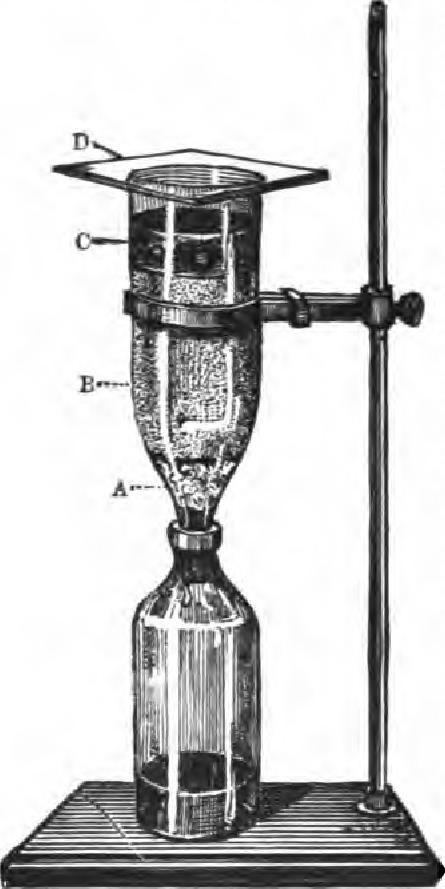
EXTRACTA ET SXTRACTA FLUIDA. 767 The 16 troy ounces of powder intended for percolation should, as soon as it is ready, be pLaced in the percolator, about one-fourth its bulk at a time; the surface should be smoothed after each addition, and then presBed as directed, for each drug. It is necessary that ihe pressure be even throughout the entire mass, otherwise the liquid will select the more porous portions, ana thus yield a defective percolation. It is best to select some fiat circular body or disk to use in pressing the powder, and for this purpose a circular stick of wood with a smooth end, in thickness about two-thirds the diameter of the inside of the percolator, answers very well, care being taken that all portions of the Har&ce of the powder are submitted alike to the pressure. By 'moderatelyy we understand the pressure of from 6 to 10 pounds; firmly^ from 15 to 20 pounds; and very firmly, the convenient pressure of one hand, not to exceed 50 pounds. Some little practice with a pair of spring balances will enable the operator to form an idea of the pressure required. Dr. £. R. Squibb, in New BemMieSy Jan., 1879, suggests *' moderately " as a pressure of 45 pounds; firmly, 60 [wunds; and hard, 75 pounds, or more. This will answer very well for largequantities, or where the pressure is exerted upon a considerable surface, as with *^both hands," thus, in reality, reducing the actual pressure upon each square inch to, or below, that given by us, whicn is intendea to apply to only 16 troy ounces of material. We are assured, from experience, that the operator will work to disadvantage if a greater pressure is employed than advised by us. Having the pow- ■ der properly packed, and the surface smooth, cut a piece of filtering paper to fit closely within the percolator, and place it upon the surface of the powder, and upon this place a few fragments of glass to retain it in position. Then add the menstruum, as directed, and cover toe percolator with a plate or disk of ground glass, and, when the percolate appears, close the orifice tightly with the cork, and proceed according to the process ^ven for making the particular extract. It must be observed that the cork is not inserted in the exit of the percolator until the percolate has appeared. When the period of maceration is over, gently twist and. slowly withdraw the cork until the slit previously cut upon its side permits the liquid to pass in drops, without running in a streiun. Bxtraota. — Extracts {solid extracts). When an infusion, decoction, or tincture is reduced to a soft, solid mass by evaporation, either spontaneous or artificial, it is termed an EbariuH. If it be prepared from a decoction or infusion it is called & ■ Watery^ or Aqueoits Extract; if from an alcoholic tincture, it forms an Alcoholic Extract; if both water and spirit are used in preparing it, it is termed a Hydro-alcoholic Extract; if ether, wine, or acetic acid be the menstruum from which it is made, it is called Ethereal, Vinmta, or Acetom Extract, according to the fluid used. The most important point in the manufacture of extracts is to employ as a solvent a liquid that will take up the medicinal constituents of a remedy, and but little, if any, of its inert portions. The constituents of plants not desirable to extract are gum, coloring matters, saccharine matter, etc., and as these are soluble in water, and are usually less soluble in alcohol, in most cases alcohol is a better medium for obtaining the active princii>les. The best solvent to abstract the medicinal virtues of plants will be that fluid in which they are the most readily dissolved: thus, resins, oils, oleoresins, etc., require alcohol, and, occasionally ether; alkaloidal principles occasionally require acidulated fluids; bitter extractive requires water; and some plants contain constituents that require two or more solvents, employed successively, the several residual extracts being mixed after they have all been thus obtained. In the preparation of an extract, the operator should previously acquaint himself with the nature of the principles contained in the drug, their solubility, their relations to heat and air, their volatility, etc., so that he may adopt the menstruum best calculated to remove the ^eatest amount of active matter, and should control the evaporation, so that this may not be injured by heat, or lost by volatilization. Prol^bly no class of remedial agents requires more care in their preparation; tatf if an extract be improperly prepared, either by employing a wrong solvent, or too much heat, it. is not to lie relied upon by the physician. In many cases the extract must be evaporated m vaew, which operates against the pharmacist, for he can not afford this expensive apparatus. On this account it is very difficult for druggists or physicians to compete in this direction with manufacturers.
758 EXTRACTA ET KXTftACTA FLCIDA. Ill ecMBe caees gl jeerin U usefii] as * put of the menstaruani, bodi asaaolTCBt aad to |»vTent snhseqnaitdrTingof the extnct. Tbe contaios thclbUowii^ directions for sncb prefmntkmB: "Wben it is dcared to pwaeoe a aolid eztnct (for instance, of gentian, taraxacum, dc) in a plastic cooditMn, anitabie tor making pille, or for other parposea. it is reaMnmcBoed that time be incorponted vith it, after it has been eTaporaled to the praper omastanoe. and while it is still warm, 10 per cent of its weight of glrcerin ^— ( U. & P.). Ordioarilr, the [rian adopted is, to obtain the joiee. or tinctnie, of the plant, gentlj heat it to coagnlate albominoas sabstaneea, fitter or stnin it, and then evaporate at a tempemture ranging between 32^^ and 98^° C. (90^ and 200° F.;, bang carrfdl not to laise it to the MMling point. A bi^ tcmpcsataxci, m well at atanosphcric action, will impair the efficieiicy of the pnpazatiaD. In forming the solution for aqwpiu ainttg, soft water, as fiee fimn foreign matters as possible, should be employed. Clean zain water, or the water fr«n some of oar lakes or riTcrs, will be found to answer quite as well as water which has been distilled. The articles to be acted upon by the fluid should be ground, but not too finely, the degree of fineness depending npcm the subetanoe used, and the resulting liquid should be obtained from them oy the process of dispLacement The evaporation should be conducted at as low a tempenture, and as quickly at the nature of the solution will admit, using a broad, shallow dish. Long cod-> tinned evaporation by beat, under exposure to the atmo«>here, is as detiimental to an extract as a boiling heat, hence the solutions sboula be procorcd in as coneentrated a form as possbible. And in those instances where difierent solutioDs are obtained, the weaker ones should be the fint crapov^cd; by this the more oonoentrated liquids will not be injured by too long an aposure to hesL When alcohol or ether is used in the prqiaiation of extracts, it will be best 'to distill these fluids, not only tor the purpose of saving them, but likewise to prevent the extracts from being impaired byatmomheric influence; a Tacunm j^paratns, however, will be supericv to ordina^ distillation, as these fluids may be evaporated at a much lower temperaturcL Hydro-alcohUie extraeU are beet made by first forming an alcoholic extract from the punt, then an aqueous extract, and oombinii^ the two while hot. thereat extrtuU are usually of a semi-^nid eoDsistenoe. Br means of Hohr's continuous displaang appaiatns, as the pcroi^ted tincture nils into the receiver, the ether is driven off to pass again tfarooi^ the articles, and thus continues until all their strength is exhausted; the vb<^ process (rf tincturiu and forming an extract being thus performed at the same time. Extracts should w kept in glass, stone, or earthenware Tessela, and be guarded as much as posible from the action of air and light, by oorering them cloeelj. The modes of preparing extracts are as follows: 1. AtmmuM ExtmrU. — Take of the lexres, root, bark, or other part of tbe plant employeo, in powder more or less fine, 1 pound; water, a sufficient quantity. Mix the leaves, or roots, etc, with half their weight of clean, soft water: in 12 hours put the whole into a displacement apparatus, and ezbaust it by adding water to it from time to time, until the liquid which passes no longer contains any of the virtues of the plant, or part of it employed. Expose this filtMed infusion to a t<?mperature of 100** C. (212° F. u then strain it, and evaporate it in the vapor-bath at a temperature not to ex<ved 48.8'* C. (120° F.>, to toe due consistence: or, the evaporation may be conducted in a vacuum apparatus. 2. Atroholie ExtracU. — Take of the leaves, root, bark, or other part of tbe plant employed, in powder more or less fine, 1 pound; alcohol (or ailuted alcobol), water, of each, a sufficient quantity. Mix toe leaves, or root, etc., with half their weight of alcohol, or enougn to tfa'moughly moisten thm: in 24 hours put the whole into a displacement apparatus, and exhaust b^ adding alcohol to il from time to time, until 4 pints of tincture have been obtained. Then add clean, soft wat4^r, and continue until the liquid which percolates causes a slight turbidness of the previously filtered liquor, as it drops into it. (The object ot adding the water toward tbe latter part of the process is to remove the alcohol absorbed by the powder; and as soon as this is affected, and the water commences to percolate, it causes a turbid condition of the filterpd alcoholic fluid immediately around the drops as they fall into it.) Place the filtered liquor in a suitable vacuum apparatus, and remove tbe alcobol, and then, if necessary, evaporate the residue in the
EZTRACrUM ACONITI. 759 Tapor>bath at a tempmton not to exceed 48.8** C. (120^ F.) to the dne consistence; or^ which ia much better, the whole process ox eTapoiation may be carried ou in a vacuum apparatus. 3. Hydro-<detmolic Edraeta. — Take of the leaves, root, bark, or other part of the plant employed, in powder more or less fine, 1 pound; alcohol, 90 percent, water, of each, a sufficient Quantity. Mix the leaves, or roots, etc., with half their weight of alcohol, or enough to thoroughly moisten themj in 24 hours put the whole into a displacement am)arattt8, and exhaust by addmg alcohol to it from time to time, until it passes off without an^ taste of the article employed. Remove the greater part oi the alcohol from this filtered tincture, and evaporate the remainder to uie proper consistence in one of the ways named in the preceding pages; that tn vaem being the best. To the pwwder in the displacement apparatus, add ^adually water, a svJgicieni muttUUy^ until the liquid which panes no longer contains any of the virtues of the nlant employed. Expose this filtwed infusion to a temperature of 100° C. gl2° F.), then strain it, and evaporate it in the vapor-bath to tne dne consistence, ix the alcoholic and aqueouB extracts thus obtained, while each is hot, and stir constantly until cold. With a few exceptions, alcoholic extracts are found to be superior to any others. Any variation from the above process, in the preparation of the following extracts, will be explained under its appropriate head. Inspissated Juices are solid extracts made by evaporating the juices of fresh plants tn vacuo. For an example see i^rocf of Taraxacum. Btnomyhs: Extract of aconUe root, Extractum aconiii radicis. PrqMUUtion. — "Aconite,in Nd. 60 powder, one thousand grammes (10006m.) [2 lbs. av., 3 oz., 120 grs.]; alcohol, a sunicient quantity. Moisten the powder with four hunored cubic centimeters (400 Cc.) [13 n3, 252 tTl] of alcohol, and pack it firmly in a cylindrical percolator; then add enough alcohol to saturate the powder and leave a stratum above it. When the liquid begins to drop from the percolator, close the lovrer orifice, and, having cloeely covered the percolator, macerate for 48 hours. Then allow the percolation to proceed, gradually adding alcohol until three thousand cubic centimeters (3000 Cc!) [101 fig, 212 HI] of tincture are obtained, oi the aconite is exhausted. Reserve the first nine hundred cubic centimeters (900 Cc.) [30 flS, 208 HI] of the percolate, evaporate the remainder in a porcelain capsule, at a temperature not exceeding 50° C. (122° F.), to one hundred cubic centimeters (100 Cc.) [3 fl^, 183111], add the reserved portion, and evaporate, at or below the above-mentioned temperature, until an extract of a pilular consistence remains" — (U. S. P.). Description, Medical Uses, and 'Dobb^q.—Ab this preparation and that formerly prepared from the leaves and still used to some extent, bear the game title, it would seem appropriate to designate this extract Extractum Aconiii Radicu. We have taken the lilwrty to name that from the leaves Exiracium Aconiii Foliorum (see below). Extract of aconite has a yellowish- brown color, and possesses the properties of the root in a powerful degree; it may be used in rhmmatiim^ netmd^j gout, acrofula, cutaneous diseases, inflammatory and f^brUe diseases^ and in all cases in which the use of aconite is admissible. When the extract is of good <]uality it causes numbness and tingling in the mouth and lips shortly after taking it. The extract prepared from the root is much more active (from 6 to 9 times stronger) than that prepared from the leaves, and should be administered in smaller doses, from ^ i grain. The British Pharmncopceia Fktractvm Acontti is the inspissated juice of the frenh leaves and tops, and ia prescribed as Exira/^ium AconiU Herbm. ExTBACTDx AcoHm FouoRUM, Extrod o/aeonitt- fraim.— Exbaost rosnelr powdered aooiiite leaves in a percolator with diluted alcohol, a sufHcient quantity. From the tincture thus made separate the alcohol, and then carefully evaporate the residue until it is of the required coneistence. Be careful not to spoil the extract by too high a temperature while evaporatmg it. The leaves should be recently dried. When the extract is prepared in large quantity a vacuum qppantufl should be need in order to save the alcohol witnoot exposure to a temperature that ■ZTUOTUU AOONin (V. B. P.)-<ZTKAOT OF AOONIIE.
780 BXTRAcrrif Acoxm fluidum-— BXTRAcrm alob. would injure the active mediciiul rirtacs of the aeoBHe laee prepantion ol Abakalir KxbaiM]. This extract of aooaite ia from A to 9 tiines weakor than the cAdal extnci «f aeonite, whieb ii prepared from the root. As both tbe latter pmantin and fltjaaoe bear the aa«e naoie,we haTc taken the Liberty to degimate that pteparea from tl^ Iwi ua aa A li mUmm AiumU FkHmim. The do0B ia from | to 1 gnunZorS tiiMaaday. wfairihaMyheMgMKdtoayM»itBW|Biiad. KXTRAOTOH ACOHITI FLmDUH (U. 8. P.>— VtVID BXTBACT OF AoonrB. St505T1Is: &iraeium amniti radkufiuidumy Fluid extnul aamite root. Pr^pantioil.—^ Aconite, ID No. 00 powder, one thoosuid gnuumesClOOOGm.) nS lbs. av., 3 OZ8., 120 gn.]; alcohol, water, each, a snffideDt qoantity to make one thousand cubic centimeters (1000 Cc.) [33 fl^, 391 ITL}. Mix seven hundred and fifty cubic centimeters (750 Cc.) [25 flj, 173 TIIJ of alcohol wiUi two hundred and fifty cubic centimeters (250 Cc.) [8 flj, 2181TIJ of water, and having moistened the powder with four hundred cubic centimeters (400 Cc.) [12 flj, 252 HI] of the mixture, pack it firmly in a cylindrical percolator; then add enough menBtroum to saturate the powder, and leare a stratum aboTe it. When the liquid begins to drop from the percolator, close the lower orifice, and having closely covered the percolator, niaeenite for 48 hours. Then allow the penxilation to proceed, gradu^ ally adding menstruum, u^ing the same proportions of alcohol and water as before, until the aconite is exhausted. Reserve the first nine hnndred cabic centimeters (900 Cc.) [30 flj, 208 Itl] of the percolate, and evaporate the remainder, in a porcelain capsule, at a temperature not exceeding 50^C. (122° F.). to a soft extract, dissolve this in the reserved portion, and add enoo^ menstraum to make the fluid extract measure one thousand cubic centimeters (10(X)Cc.) [33 fij, 391 Itl]"— (r..S.P.). Description, Medical Uses, and Dosage. — Fluid extract of aconite has a vivid red-brown color, and represents in 1 minim about 1 grain of aconite root It may be used in liniments and other local applications for the relief of rhameiie and ■neuralgic poinx. For other uses, see AeonUum. The dose of fluid eactnct <d aconite is from ^ i minim. BXTRAOTUII ALBTBIDIS.— KXTEA0T OF ALBTED. SYHONTin: Aletridin, Atetrin, Ettrarl of unkom not. Freparatioil. — Exhaust coarsely powdered tmioom root with alo(A^ proceeding in the same manner as explained for general preparation of alcoholic extracts. Hedical Uses and Dosage. — This forms a very elegant and usefol prepvation of unicorn root. It may beuRed as a tonic in cases of delnlity of the digestive oq^ns, and is also asserted valuable in vterinedifficaUies^a&prolaptmyamenorTbaa^ dysmenarrhcEOj etc. The dose is from f to 2 grains, 3 times a day. EZTRAOmC ALETBIDXS FLUIDIIM (H. F.)— VLUID SZXKAOT OF ALETBIB. Preparation. — Formulary number, 137: " From the rhixome of AUtrit farinoKL Linne (Stargrass). Process A (see F. 135). No. 60 powder. Menstruum: Diluted alcohol "~(Xat. Farm.). In our opinion this fluid extract should be made with official alcohol. Aletris depends altogether for its therapeutical value on resinous bodies. It is a favorite Eclectic remedy and usage establishes that water added to the menstruum injures the product about in proportion to the water present. Medical Vses and Dosage.— (See.ifetru). Dose, I to 00 minims. EXTBAOTOM ALOEB (U. B. P.)— EZTBAOT OF ALOBB. Synonyms: Eitractum aloes socotrinx, Extract of socotrine aloes. Preparation.— "Socotrine aloes, one hundred grammes (lOOGm.) [3ozs.av., 281 grs.]; boiling distilled water.one thousand cubiccentimetera (IO(X)Cc.) [33fl3i
EXT. ALSfTOmM CONST. FLUIDUM.— BXt. AL8T0KI.S SCHOLABIB FLITIDUM. 761 891 TV). Mix the aloea with the water in a suitable Teeael, Btirring cwLsUintlr until {ne pwticles of aloes are thoroughly dirinte^ted, and let the mixtuie stand for 12 hours; then pour off the clear liquor, strain the residue, mix the liquids, and evaporate to dryness by means of a water or steam bath " — ( U. S. P.). Description, Medical Uses, and Dosage.— The process here emplo^red is one of purification. The object sought in the larse quantity of water used is the removal of the resin, which is not, however, wholly accomplished. Therefore the finished product does not dissolve perfectly clear in water. This results partly from organic decomposition, partly from the fact that an equilibrium is not estab* lished in 12 hours, and partly because a solution of water-soluble constituents makes a solvent that can hold in solution substances insoluble in pure water. The uses are those of aloes, and the dose from 1 to 10 grains. BZTRAOTUM ALSTONIA OONSTRICTA rLnn>UH.-T£mD BXTKAOT OF ALSTONIA 00N8TBI0TA. Preparation. — Take of the inner bark of Alstonia constricta, in very jBne r)wder,.16 troy ounces; alcohol, a sufficient quantity. Moisten the powder with fluid ounces of alcohol. Cork tightly in a wide-mouth bottle, ana permit the mixture to stand an hour in a warm situation. Then introduce it into a cylindrical Sercolator, 3 inches in diameter, previously prepared for percolation, according to irections given on page 756, and press very firmly. Cover the'eurface of the powder with a circular piece of filtering paper, held in position with a few fra^enta of glass or marble, and add alcohol until the percolate appears at the exit. Then cork the exit tightly; cover the percolator, and place it in a warm situation. After 24 hours, loosen the cork, and permit the percolate to pass as fast as it will drop, without running in a stream, until 4 fluid ounces are obtained. Again close the exit, macerate 24 hours, and, in a manner like unto the preceding, draw 4 fluid ounces of percolate. Repeat the maceration, and, in like manner, draw a third portion of 4 fluid ounces. Reserve, and mix the three percolates; then continue the percolation until 8 fluid ounoM are obtained. Evaporate this latter portion until reduced to the measure of 2 fluid ounces, and mix with the reserved 12 fluid ounces. The surface of the powder must be constantly covered with alcohol from the commencement, and until the end of the percolation. Description, Medical Uses, and Dosage. — (See Alstonia constricta). Fluid extract of Alstonia constricta is of a dark yellowish-red color, odorless, and possesses the intense bitterness peculiar to the drug. When prepared according to the foregoing formula, it seems to represent very nearly the entire sensible properties ot the Dark employed, troy ounce to each fluid ounce of the finished exUact. Dose, from 6 to 40 minims. EZTRACTUIE ALSTOHUE S0HOLASI8 FLUIDUH.— FLUID EXTRAOT OF ALSTONIA SOHOLABIS. Preparation. — Take of the bark of Alstonia scholaris, in moderately fine powder, 16 troy ounces; of a menstruum of alcohol 3 parts, water 2 parts (by measure), a Bumcient quantity; moisten the powder with 8 fluid ounces of the menstruum. Cork tightly in a wide-mouth bottle, and permit the mixture to stand an hour in a warm situation. Then introduce it into a cylindrical percolator, 3 inches in diameter, previously prepared for percolation, according to directions given on page 756, and press very firmly. Cover the surface of the powder with a circular piece of filtering paper held in position with a few fragments of glass or marble, and add fresh menstruum until the percolate appears at the exit. Then cork the exit tightly; cover the percolator, and place in a warm situation. After 24 hours, loosen the cork atid permit the percolate to pass as fut as it will drop, without running in a stream, until 4 fluia ounces are obtained. Again dose tne exit, macerate 24 hours, and, in a manner like unto the preceding, draw 4 fluid ounces of percolate. Repeat the maceration, and, in like manner,drawathird portion of 4 fluid ounces. Reserve, and mi x the three percolates; then continue the percolation until 8 fluid ounces are obtained. Evaptnafe this
741 KXT. ASGKUCM EAOft.l- PLn I'VM.—KXT. ATU «KATB01.KSTK rujnicii. btter portion hdUI raliieed to Uie Msme of 3 fluid ««hh, and six with tW Rserrei 12 fluid onneM. The nu-Jbee of the |wdtj be eoosteatly corcnd with the vaenaUnnm from the ■■mmI, and vntil the tmd at the |uoei of percr^tion, Pmii if litB, Mofical Jhrn, Ofl Omc*.—:See if^iBii JoUmtX Plaid cxtnet of AijrUjnia sebcdaris ii of a radish tolor. odorieaL poaBMS a bittaiah tMte^ and ai tfaiu prepared, repwentg tctt ncarir the qaalitj d dtw cmploijadf troy oonee to each flaid oanee of the £Di*hfd exbact. Doee. 10 to 60 BahiinM BCfBACnni AMOBJOM KADWIS FLUnHIM F.)— nOD KznAor or AMoucA. SOOT. Pn^antua. — /orr-...>-y i <.>vx'. K:;^: " From the root of Angelica Arvkm SUietL, Linne 'Ang^fira;. P^<t»f A '»« F. 135. So. 60 powder. Hnmtntmm: Ak^ ol, 3 Toluiitti^i "•tfer, 2 ToIunj»-9~ — > A'll. FormX IftwWial Uica amd DoMge — rf«« ^n^wa). Dose, 10 to 60 minima EZTUOT0H AnHKHnnS.— BznAOr OF CHAKOMII& PraparatiOB.— " Take of cliamomile flower^ 1 pound (at.), oil of chamomile 15 miniras, dL-tilled water 1 gallon. Boil the chamomile with the water until the Tolume is reduced to one-half; th*;n Miain.pre^^. and filter. Evaporate the liquor by a water-bath antil the extract is of a jiuitable c^tni-istenoe for forming pills, adding the oil of chamomile at the end of the proce^ ( Br. FtuirwiJ). This is an aqo» out extract of d«ep-brown c^jlur, representing the odor and bitter taste of the flow^ era An alcoholic extract may be prepared a« follows: ExTBACTCH AsTBEMiDii Alcohoucl'H, AUohoUc extract of chamomile, — Exhaust chamomile flowers, bruised, 1 pound, with diluted alcohol a sufficient quantity, proceeding in the same manner as explained for the preparation of Almhoiie Ecdrmix, on page 758. At the clone of the process volatile oil <tf chim*»ila, 15 minims, may be thoroughly incorporated with the extract, as advised by the SrUuih Pfuirmaropaia. Medical Usea and Doia«. — Extract of chamomile is a tonic, and may be used in all cases where the crude article is indicated. It may be bene6cially com* bined with other extracts, as of scullcap, cramp-bark, black cohosh, i^lden-seal, ladiee'-sHpper, etc. The dose of the alcoholic extract is frcnn 1 to 5 grains 3 tinus a day; or the aqueous extract, 1 to 10 grains. EnRAonnc ahthemidis flu idum.— fluid EXTKAOT OF OHAHOIQLB. Preparation.— Take of chamomile flowers in powder 16 tro^ ounces, of a mixture of alcohol 3 parts, water 2 parte, a suffident quantity. Moisten; proceed according to formula of fluid extralct of Alstonia scholaris ending with the word fercoUitUm. Hedical Uses and Dosage.— This fluid extract of chamomile flowers is a tonic, and poHseRseg all the proi>ertie» of the crude article. Each fluid ounce of the extract representaa fluid ounce of the flowers; hence the dose is from 1 to 60 dropH, 3 times a day. It ma^ be advantageously combined with the fluid extracts of cimicifuga, valerian, cypripedium, Scutellaria, etc. KXTBAOTUM APn OSAVEOLENTIS FLUIDini (H. F.)— FLUID EXTBAOT OF OELERT. Preparation.— FOTmuZfzry nmnber, 139: "From the seed of Apiimi oraveoUntt lAnni (Celtry). Process A (see F.IZB). No. 60 powder. Jfctwiruum; Alcohol, 2 volnmes; water, 1 volume" — {Nai. /brm.). modieal Uses and Dosage.- (See upturn graveoiau). Dose, 10 to 30 minima
SXTRACTUM AFOCYNI.— EXTRACTUH ABSIOM KADIGIB., KZTRAOTUM APOOVHI.— EZXRAOT OF BiTTEft ROOT. 8TN0NYM: Extrnrt of Indian hemp. Preparation. — £xhau8t coarsely powdered Ind'mn.hemipiApocynuvicannabC' num), 1 pound, with alcohol, water, of each, a snfficieDt quantity, proceeding in the Bame manner as explained for the preparation of Alcoholic Extracts, on page 768, This extract, either dried or not, nas been sold and employed in therapeutics under the erroneous name of apocynin. Hedical Uses and Dosaf** — '^^i^ extract is pui^tive, and either alone or in combination with extract of leptandra, has been employed in affections of the liver t^nd ttomachj in inferm^tente, and formerly in the low stcige of typhoid feoen. It has also been employed with advantage as a diuretic and emmenagogue. The dose is from 1 to 10 grains, 2 or 8 times a day. ■ZTRAOTUH AFOOTin FLUIDnH (U. 8. P.)— iLim) IXTEAOT OF APOOnnTH. Synonym: fluid extract of Canadian hemp. Preparation. — *'Apocynum, in No. 60 powder, one thousand grammes (1000 Gm.)[21bs. av.,3 ozs., 120 grs.]; glycerin, one hundred cubic centimeters (100 Cc.) [3 fl^, 183 Ttl]; alcohol, water, each, asuflicient quantity to make one tliousand cubic centimeters (1000 Cc.) [33 33? 391 lU]. Mix the glycerin with six hundred and fifty cubic centimeters (660 Cc.) [21 fl^. 4701111 of alcohol and two hundred and fifty cubic centimeters (250 Cc.) [8 flS,218tn.] of water,and havina moistened the powder with four hundred cubic centimeters {4SX> Cc.) [13 flj, 262 mH] of the mixture, pack it firmly in a cylindrical percolator; then add enough menetruum to saturate the powder and leave a stratum above it. When the liquid b^ns to drop from the percolator, close the lower orifice, and having closely covered the percolator, macerate for 48 hours. Then allow the percolation to proceed, gradually adding, first, the remainder of the menstruum, and afterward a mixture of alcohol and water, made in the proportion of i>ix hundred and fifty cubic centimeters (650 Cc.) [21 flS, 470 HI] of alcohol to three hundred and fifty cubic centimeters (350 Cc.) [li 'i^t401 11l]of wateruntil theapocynum isexhausted. Reserve the first nine hundred cubic centimeters (900 Cc.) [30 fi^, 208 l^ll of the percolate, and evaporate the remainder at a temperature not exceeding 50° C. (122° F.), to a soft extract; dissolve this in the rraerved portion, and add enough menstruum to make the fiuid extract measure one thousand cubic centimeters (1000 Cc.) [33 fl5,391)n,]"— (K5.P.). In our opinion the glycerin has no value in this preparation, being inferior to alcohol. A better menstruum is a mixture of alcohol 3 parts, water 1 part. Hedical Uses and Dosage.— (See Apocynum). Dose, 1 to 20 minims. EXnUOTUH AKALIA BAOEHOSJE FLITIDVM (N. P.)— iLmD EZTBACT OF AKALIA RAOEUOBA. Preparatioil. — Formulary nitmher, 140: "From the root of Andia rcuxmoaa, Linn£ (Ameri^n spikenard). Process A (see F. 135). No. 60 powder. Mffnstnaan: Alcohol, 2 volumes; water, 1 volume" — {Nat. Form.). Medical Vses and Dosage.— (See Aralia raeemom). Dose, 10 to 60 minims. EXnUkOTUH ASNIOJE RADIOIS (U. S. P.)-EZTRAOT OF ABNIOA BOOT. Preparation. — " Arnica root, in No. 60 powder, one thousand grammes (1000 Gm.) [2 lb. av., 3 oz., 120 grs.]; diluted alcohol, a sufiBcient quantity. Moisten tiie powder with four hundred cubic centimeters (400 Cc.) [13 fil, 252111] of diluted alcohol, and pack it firmly in a cylindrical percolator; thrai
76i EXT. ARNICiE RADIC18 PLmDUM.— EXT. AROMATICUM FLTJIDUM. add enough diluted alcohol to eaturate the powder and leave a stratam abore it. When the liquid begins to drop from the percolator, close the lower orifice, and, having closely coveiid the percolator, macerate for 24 hours. Then allow the percolation to proceed, gradually adding diluted alcohol, until the arnica root k exhausted. Reserve the first nine hundred cnbio centimeters (900 Cc) [30 flj, 20S1Tt]of the percolate; evaporate the remainder to one hundred cubic centimeters (lOOCc.) J3 fl3, 183m],at a temperature not exceeding 50*»C.(122*'F.), mix the residue with the reserved portion, and evaporate, at or below the above mvor tioned temperature, to a pilular consistence"— (C/. S. P.). Descnption, Kedical Uses, and Do8affe.~(See Arnica). A brown extract of feeble odor and a bitter, acrid taste. Used cniefly in plasters. Doee, 3 to 5 grains. EZT&AOTUM ABNIOA RADIOIB FLUIDTIH (U. 1 P.)— VLUID EXTRACT OF AsmOA ROOT. Preparation. — "Arnica root, in No. 60 powder, one thousand grammes (1000 6m.) [2 lb. av., 3 oz., 120 grs.]; alcohol, water, each, a sufficient quantity, to make one thousana cubic centimeters (lOOO Cc.) [33 fl3> 391 W]. Mix seven hundred and fifty cubic centimeters (750 Cc.) [25 flS, 173 TTl] of alcohol with two hundred and fifty cubic centimeters (250 Cc.) [8 flj, 218 ttl] of water, and, having moiBtened the powder with four hundred cubic centimeters (400 Cc.) [13 fl^, 252 1U] of the mixture, pack it firmly in a cylindrical percolator; then add enough menstruum to saturate the powder, and leave a stratum above it. When the liquid begins to drop from the percolator, close the lower orifice, and having closely covered the percolator, macerate for 48 hours. Then allow the percolation to proceed, gradually adding menstruum, using the same proportion of alcohol and water as before, until the arnica root is exhausted. Reserve the first nine hundred cubic centimeters (900 Cc.) [30 fls, 2081113 of the percolate, and evaporate the remainder, at a temperature not exceeding 50° C. (122° F.), to a soft extract; dissolve this in the reserved portion, and add enough menstruum to make the fluid extract measure one thousand cubic centimeters (1000 Cc.) [33 fl^, 391 Ttll" —(U.S. P.). Description, Medical Uses, and Dosage.— (See Arnica). A reddish-brown fluid possessing the bitter, acrid taste of arnica root. Dose, 10 to 30 minims. Belated Preparation.— Extb actum Arnica Florum Flciduh (N. F.), Fluid extrati arnica floivers. Formulary number, 141: "From the flower heads of Ar-nica montana, UubA (Arnica). Prvcest A (see F. J35). No. 40 powder. Menttntmn: Dilated alcohol "—{Not. Forvu). EZTRAOTUH AB0HATI0nM.^&B01[iLIia EZTRAOT. Preparation.— Take of cinnamon, ginger, each, in fine powder,^ troy oonoes; cardamom, free from capsules, nutmeg, each, in fine powder, 1^ troy ounces; sugar, 9 troy ounces; alcohol of sp. gr. 0.817, a eufiicient Quantity. Mix all the powdered aromatics, put the mixture in a percolator, and gradually add alcohol until the mixture is exhausted; pour the resulting percolate over tne sugar, evaporate at a low heat until dry, agitating constantly toward the end of the process. Medical Uses and Dosage. — This forms a pleasant stimulant and carminap tive, which may be used in cases of Jlatuleitcy, in gnttrk debilUy, and to render other medicines more palatable. It answers all the purposes of the ^^Ammatir potoder" now official, and ^^AroTnatic confertion,^' formerly official in the U. S. P. The doee u from 5 to 60 grains. Added to wine it forms a very good Aromatic urine. EXTBAOTUH ABOHATIOUH FLUIDUH (V. B. P.)— ABOKAXIO FLUID EXTBACT. Preparation. — Aromatic powder, one thousand grammes (1000 Gm.) [2 lbs. av., 3 ozs., 120 grs.]; alcohol, a sufficient quantity to make one thousand cnlnc centimeters (1000 Cc.) [33 flj, 391111]. Moisten the powder with three hundred Digitized by
EXT. ASCLKPIADIS.— EXT. A8PIIX)8PERMATI8 FLUIDUM. 765 and fifty cubic centimeters (350 Cc.) [11 fij, 401 tR] of alcohol, and pack it firmly in a cyundriual percolator; then ada enough alcohol to saturate the powder and leave a stoitum above it. When the liquid begins to drop from the percolator, close the lower orifice, and, having closely covered the percolator, macerate for 48 hours. Then allow the percolation to proceed, gradually adding alcohol until the aromatic powder is exhausted. Reserve the first eight hundred and fifty cubic centimeters (850 Cc.) [28 flj, 356 111] of the percolate, and evaporate the remainder to a soft extract; dissolve this in the reserved portion, and add enough alcohol to make the fluid extract measure one thousand cubic centimeters (1000 C&) [33 flS, 391 m]. Description, Medical Uses, and Dosage.— A rich, red-brown fluid, possessing a warm taste and aromatic flavor. Used for flavoring, and, in doses of ^ to 1 fluid drachm, as a carminative. EXTUOTUH ASOLEPIADIS.— SZTBAOT OF. A80LEPIA8. Sthomym: Extract of plettrisy root. Preparation. — Exhaust coarsely powdered pleurisy root, 1 pound, with alcohol, water, of each, a sufiicient quantity, proceeding in the manner as explained for the preparation of Alcoholic Extracts on page 758 (J. King). Uedical Uses and Dosage. — Alcoholic extract of pleurisy root is expectorant, tonic, laxative, and antispasmodic. It will be found useful in chronic and acute catarrhal coughs, rheumatic affectiom, dymitery, etc. From its peculiar action upon the ligaments of the uterus, it proves highly beneficial in prolapsus, and other cfuplaceinenU of this oi^n. The dose is from 3 to 10 or 16 grains, 3 times a day. ECTBAOTUH ASOLEPIADIS IXUIDUM (0. S. P.)— FLUID EZTRAOT OF A80LEPIAB.. Synonym: Fluid extract of pleurisy root. Preparation. — "Asclepias, in No. 60 powder, one thousand ^irammes (1000 Gm.) [2 lbs. av.,3 ozs., 120 grs.l; diluted alcohol, a sufficient quantity to make one thousand cubic centimeters (1000 Cc.) [33 flS, 391 TU]. Moisten the powder with four hundred cubic centimeters (400 Cc.) [13 flS, 252111] of diluted alcohol, and pack it firmly in a cylindrical percolator; then add enough diluted alcohol to saturate the powder and leave a stratum above it. When the liquid begins to drop from the percolator close the lower orifice, and, having closely covered the percolator, macerate for 48 hours. Then allow the percolation to proceed, gradually adding diluted alcohol, until the asclepias is exhausted. Reserve the first nine hundred cubic centimeters (900 Cc.) ^30 fl3, 208 HI] of the percolate, and evaporate tiie remainder to a soft extract; dissolve this in the reserved portion, and add enough diluted alcohol to make the fluid extract measuro one thousand cubic centimeters (lOOOCcO [83 flj, 891in]"— (f^- S. P.). Descnption, Hedioal uses, and Dosage.— (See Ascl^as.) A brown- red fluid. Dose, 5 to 60 minims. EZTRAOTUH ASPIDOSPEBMATIS FLUIDUH (U. S. P.)— PLUID EXTBAOT OF ASPIDOSPEBUA. Synonym: Fluid extract of quebracho. Preparation. — "Aspidosperma, in No. 60 powder, one thousand grammes (1000 Gm.) {2 lbs. av., 3 ozs., 120 grs.]; glycerin, one hundred cubic centimeters (100 Cc.) [3 nS, 183 Tit]; alcohol, water, each, a sufficient quantity to make one thousand cubic centimeters (1000 Cc.) [33 fl3, 391 ttn. Mix the glycerin with six hundred cubic centimeters (600 Cc.) [20 flS, 138 THj of alcohol and three hundred cubic centimeters (300 Co.) [10 65, 69 ITl] of water, and, having moistened the powder with four hundred cubic centimeters (400 Co.) [13 flj, 252 ITl] of the mixture, pack it firmly in a cylindrical percolator; then add enough menstruum to saturate the powder and leave a stratum above it. When the liquid begins to drop firom like percolator, close the lower orifice, and, having closely ooverad A»
Til BXT. AUKAnn AMABI FLDID01U-KXT. HLLA. FOUO. ALCOBOUCUM. percolator, macerate for 48 hocus. Then aOow the percolation to proceed, gndnailr adding, first, the remainder of the menstniam, and then a mixtore of akobol and vmter, made in the proportion oi two hondred cubic oentametim (200 Cc.) [6 flS, 366111] of alcohol to one hondred cubic oentimeten (100 Cc. i [3 fli, 183111 OT water, until the aspiddspemia is exhausted. Beserre the first eif^t bondna enbic centimeters (SfO Cc.) [27 2o mj of the pemrfate, and evaporate the remainder at a temperature not exceeding m)*'C. (IS* F.) to a eofi extract; diftv>>e thbi in the reserrevl portion, and add enough menstruum to make the fluid extract measure one thousand cubic centimeters aOOO Cc.) [33 flj, 391 HI) "—(T. & i*;. D— cription, Medical Vam, aad Dowige.— (See AipUogperma). Dose,15to60 minims. sznuoTmi AURAarn amaki fluidum (u. s.p.)-f3unD BzTEAcr or Sitter okavcs peel. FrV^WtioiL — " Bitter orange peel, in No. 40 powder, one thooiand grammes (1000 Gm.) [2 lbs. av., 3 ozs., 120 gis.]; alcohol, water, each, a snffident quantity to make one thousand cubic centimeters (ICXK) Cc.) [33 fl^ 391 HI]. JOxsix hundred cubic centimeters (600 Cc.) [20 d^, 13S HI] of alcohol with three hondred cubic centimeters (300 Cc.)[10fl3, 69 in.]of water, and, harii^ moistened the powder with thrf* hundred and fifty cubic centimeters (350 Cc) [11 flj, 401 HI] of the mixture, puck it modoatelyin aoonical percolator; then add enoi^^ menstruum to (saturate the powder and leave a stratum above it. When the liquid begins to drop from the percolator, close the lower orifice, and, having closely cotered the percolator, macerate for 48 hours. Then allow the percolation to proceed, gradually adding menetmum, uMng the same proportions of alcohol and water as before, until the oranm peel is exhausted. Reserve the first ^ht hundred cubic centimeters (800 Cc.) [27 flS, 25 Hll of the percolate, and evaporate the remaindn at a temperature not exceeding o0*'C.(122*'F.),to a soft extract; di«dve this in the reserved portion, and acta enough menstruum to make the fluid extnct measure one thousand cubic centimeters (1000 Cc.) [33 fl5,391IU]" — (tl S.P.). Detcriptton, Medical Uses, and DoMffe.— When properly prepared from food orange peel this fluid has a yellowish-brown hue, and possesses the pleasant avor and agreeable bitterness ofthe crude drug. Used chiefly as a flavoring agmt Dose, 1 fluiadrachm. KZTBAOTUM BAPTI8U.— EZnUOT OF BAmU. Synonym: Extract of wild indigo. Prepuration. — Exhaust coarsely powdered bark of wild indigo root, 1 pound, with alcohol, water, each, a sufficient quantity, proceeding in the same manner as explained for the preparation of Alcoholic Extracts. Medical Uses and Dosa|[e.— This extract is antiseptic, with purgative aod emetic properties when taken in large doses. It is especially advantaoeons in typhoid condiiioTis of the system, in malignant uUeratioru of the nwtuh and mroat^ in searfdtina, and in all cases where there is a tendency to putrmeency or gangrene. It exerts a powerful stimulant effect on the glandular and nervous systems, and will be fonnd useful in sen^ala, t^inate hepatic torpor, etc Its Tirtues are increased by combination with extract of leptandra, resin of podophrltum or cimcifuga. The doHe is i grain, gradually increased to 1 or 2 grains, and repeated 3 times a day (J. King). EXTRAOTUM BELLADONKA FOUOBUM ALOOHOUOUM (U. 8. P.) ALOOHOLIO EZTKAOT OF BELLADONHA LEAVES. Synonym: Extractum belladonna aJ-cokolimm. (PAam,, 1880). Preparatioii. — "Belladonna leaves, in No. 60 powder, one thousand grammes (1000 Gm.) [2 lbs. av., 3 ozs., 120 grs.]; alcohol, water, each, a sufficient quantity. Mix two thousand cubic centimeters (2000 Cc.) [67 flS, 301 111] of alcohol with one thousand cubic centimeters (1000 Cc.) [33 fll, 391 ITl] of water, and, having moistened the powder with four hundred cubic centimetexs (400 Cc.) [13 flj
KXT. BKLLA. RADICIS FLtflDUH.— EXT. BKRBEBXDZS AQUIF. FLUIDVH. 747 252111] of the mixture, pack itfirmlyin acvliodrical peroolator; then add enough menstruum to saturate the powder and leave a vtratnm abore it. When we liquid b^ns to drop from the pwoolator, close the lower orifice, and, having closely covered the percolator, macerate for 48 hours. Then allow the perool^ tion to proceed, gradually adding menstruum, using the same proportions of alcohol and water as oefore, until three thousand cubic centimeters (3<K)0 Co.) [101 flj, 212 Til] of tincture are obtained, or the belladonna leaves are exhausted. Reserve the first nine hundred cubic centimeters (900 Cc.) [30 flj, 208 TTV] of the percolate, evaporate the remainder at a temperate not exceeding 50° C. (122° F), to one hundred cubic centimeters (100 Cc.) [3 flJi 183 Til], -mix the residue with the reserved portion, and evaporate at or below the above-mentioned temperature to a pilular consistence" — (U. S. P.). Description, Medical Uses, and Dosage.— This extract possesses the odor and taste of belladonna, and is greenish-brown or brownish-green in color. It is used chiefly, locally, to allay pain and to control «pa«m. Its internal use is the same as for belladonna. The dose ranges from i to i grain, 3 times a day. EXTR&OTUH BSLUDONNJB BADIOXS nUIDUM (V. 8. P.)— TLinD XZTKAOT OF BELLADOHNA BOOT. Synonym: Extractum belladonnse fiuidum (PAann., 1880). Preparation. — " Belladonna root, in No. 60 powder, one thousand grammes (1000 Gm.) [2 lbs. av., 3 ozs., 120 grs.]; alcohol, water, each a sufficient quantity to make one thousand cubic centimeters (1000 Cc.) [33 flg, 391 TH.]. Mix eight hundred cubic centimeters (8(X) Cc.) [27 flj, 25 TTl] of alcohol with two hundred cubic centimeters (200 Cc.) [6 fl^, 366 HI] of water, and, having moistened the powder with three hundred and fifty cubic centimeters (350 Cc.) [11 flSi^l IH.] of the mixture, pack it firmly in a cylindrical percolator; then add enough menstruum to saturate the powder and leave a stratum above it. When the liquid begins to drop from the percolator, dose the lower orifioe, and, having closely covered the percolator, macerate for 48 hours. Then allow the percolation to proceed, gradually adding menstruum, using the same proportions of alcohol and water as before, until the belladonna root is exhausted. Reserve the first nine hundred cubic centimeters (900 Cc.) [30 fl^, 208 Ttl] of the percolate, and evaporate the remainder at a temperature not exceeding 50° C. (122° F.), to a soft extract; dissolve this in the reserved portion, and add enough menstruum to make the fluid extract measure one thousand cubic centimeters (1(XX) Cc.) [33 flj, 39m] "—(U.S. P.). Description. Medical Uses, and Dosage. (See Belladorma.) Fluid extract of belladonna root has a reddish-brown color. The dose ranges from ^ to 2 minimsi SXT&AOTUM BEBBEBIDI8 AQUIFOLn 7LUIDUM.— FLUID BZTRAOT OF BEBBBBTB AQUIFOLnnf. Preparation. — Take of the root of Berberis aquifolium, in moderately fine powder, 16 troy ounces; of a menstruum of alcohol, 3 parts, water, 2 parts (by measure), a sufficient quantity. Moisten the powder with 6 fluid ounces of the menstruum. Cork tightly in a wide-mouthed bottle, and permit the mixture to stand an hour in a warm situation. Then introduce into a cylindrical percolator, 3 inches in diameter, previously prepared for percolation, according to directions given on page 756, ana pr^ moderately. Cover the surface of the powder with a circular piece of filtering paper, held in petition with a few fragments of glass or marble, and add fresh menstruum until the percolate api>ears at the exit. Then cork the exit tightly; cover the percolator, and place it in a warm sitnatioQ. After 24 hours, loosen the cork, and permit the percolate to pass as fast as it will drop, without running in a stream, until 4 fluid ounces are obtained. Again close the exit, macerate 24 hours, and, in a manner like unto the preceding, draw 4 fluid ounces of percolate. Repeat the maceration, and, in like manner, draw a third portion of 4 fluid ounces. Reserve and mix the 8 percolates;
768 BXT. BERBERIDI8 YULGAKlfl FLtlDnL— KXT. BBTOKL£ PLODrM. then continue the percoUtion until 8 fluid ounces mre obtained. ETapormte tfais Utter portion until redaoed to the measure of 2 fluid ounces, and mix with the reserred 12 fluid ounces. The sor&oe of the powder most be oonstantlj coTered with the menstrnum fnm the commencement, and until the end of the pToce$« of percolation. DesGriptum, Medical Ums, aad Doiage. — (See Berhais aqu^olium). Fluid extract of Berberisaquifolium isof a yellowish-red color, odorless, or nearlv bo. and very bitter to the taste, and, as Uius prepared, represents very nearly the quality of the dme employed, troy onnce to each flaid ounce of the finished extract. Doee, 5 to 20 drops. SXTR40TUH BERBERIDI8 VULGARIS FLUXDUll (H. F.)— FLUID BZTKAOT OF BKBHKET8 TtfLOABm. Frepantifm.— >brmuZarynuf?tAer, 142: " From tlw bark of the root of BfrAfrta mUgaris, Linne (Barberry). Proeen A (see ¥. 135). No. 60 powder. JUeiulruvm; Alcohol, 3 volumes; water, 2 volumes " — (XaL Fma.). Medical Ums and Doaage.— (See Berhen$ vulgaria). Dosc^ 5 to 30 minims. XXTBAOTUM SOLDO FLUIDUM.— FLUID EZTSAOX OF SOLDO. Sr NONTH: Fluid extract of Pleumus boldo. Preparation. — Take of boldo leaves, in very fine powder, 16 troy onncee; alcohol, a sufficient quantity. Moisten the boldo with 6 fluid ounces of alcohol. Cork tightly in a wide-mouth bottle, and permit the mixture to stand an hour in a warm sitnation. Then introduce it into a cylindrical percolator, 3 inches in diameter, previously prepared for percolation, according to directions given on page 756, and press very firmly. Cover the suiface of the powder with a circular piece of filtering paper, held in position with a few fragments of glas^ or marble, and add alcohol until the percolate appears at the exit Then cork the exit tightly; cover the percolator, and place it in a warm situation. After 24 hours, loosen the cork, and permit the percolate to pass as fast as it will drop, without running in a stream, until 4 fluid ounces are obtained. Again close the exit, macerate 24 hours, and in a manner like unto the preceding, draw 4 fluid ounces of r^rcolate. Repeat the maceration, and, in like manner, draw a third portion of fluid ounces. Reserve, and mix the three percolates; then continue the percolation until 8 fluid ounc^ are obtained. Evaporate this latter portion until reduced to the measure of 2 fluid ounces, and mix with the reserved 12 fluid ounces. The surface of the powder must be constantly covered with alcohol from the commencement, and until the end of the process of percolation. Deseriptioii, Medical Usei, and Doaafe.— (See Bojdo). Fluid extract of boldo is daxk-green in color, of a disiwreeable womiseed-li^ odor and taste, and as thus prepared, represents very nearly the quality of drug employed, troy ounce for each fluid ounce of the finished extract. Dose, 5 to 20 minims. EXTRIlOTUM BBTONIA FLUIDUM.— FLUID EXTBAOT OF SBTONUL Preparation. — Take of bryonia root, in moderately fine powder, 16 trov ounces; alcohol and water, each, a sufficient quantity. Moisten the bryonia with 3 fluid ounces of water, and permit the mixture to stand 1 hour in a well-corked wide-mouth bottle. Then intimately rub it with 6 fluid ounces of alcohol, and allow the mixture to macerate an hour as before. Introduce this, with moderate pressure, into a cylindrical percolator, 3 inches in diameter, that has been pieviouidyjtrepared for percolation, accoiding to directions given on page 756. Cover the sur&oe of the powder with a circular piece of filtering paper, neld in position with a few fr^^ents of glass or marble, and add a mixture of alcohol, by measure, 2 parts, until the percolate appears at the exit. Then cork the exit tightly; cover the percolator, and place it in a warm sitnation. After 24 hours, looeen the
KXTBACTCM BUOHU FLUIDUH^EXTBACTUH CALAMI FLUIDUII. 769 oork, and permit the percolate to pass as fast as it will drop, without running in a Btream, until 4 fluia ounces are obtained. Again close the exit^ macerate 24 hours, and, in a manner like unto the preceding, draw 4 fluid ounces of percolate. Repeat the maceration, and, in like manner, draw a third portion of 4 fluid ounces. Reserve, and mix the three percolates; then continue the percolation until 8 fluid ounces are obtained. Evaporate this latter until reduced to the measure of 2 fluid ounces, and mix with the reserved 12 fluid ounces. The sur^ face of the powder must be constantly covered with menstruum from the commencement, and until the end of the process of percolation. Description, Uedical Uses, and Dosage.— Fluid extract of bryonia is dark red in color, and, as thus prepared, represents very nearly the quality of the drug employed, troy ounce to each fluid ounce of the finished extract. The preliminary use of water in moistening this drug brings it to a condition which favors the nady permeation of the maistraam. (For usee, see Bryonia). Doee, 1 to 2 drops. KZT&AOTUM B0OHU TLUIDnM (V. S. P.)— FLIOD ^XTBAOT OF BnOHU. Preparation. — " Buchu, in No. 60 powder, one thousand grammes (1000 Gm.) [2 lbs. av.j 8 ozs., ISOns.]; alcohol, a sufficient (quantity to make one thousand cubic centimeters (lOCK) Cc.) [33 flS, 391 tin. Moisten the powder with four hundred cubic centimeters (400 Cc.) [13 fl^, 252 HI] of alcohol, and pack it firmly in a cylindrical percolator; then add enough alcohol to saturate the powder and leave a stratum above it. When the liquid begins to drop from the percolator, close the lower orifice, and, having closely covered the percolator, macerate for 48 hours. Then allow the percolation to proceed, gradually adding alcohol, until the buchu is exhausted. Reserve the fiirst eight hundred and fifty cubic centimeters (850 Cc.) [28 flS, 356111] of the percolate, and evaporate the remainder to a soft extract; dissolve this in the reserved portion, and add enough alcohol to make the fluid extract measure one thoastma cubic centimeters (lOOOCc.) [88 fl^* 8911TI]"— (C^. S i*). DMcription, Httdlcal Uses, and Dosage.— Fluid extract of buchu has a clear, deep-green coltnr, and the taste and odor of buchu leaves. It is a gently stimulating diuretic and may be used in ehnmic catarrh of ike bladdery gravely morbid irriUUion of the bkidder a.na urethra, and other aflbctions of the urinary organs. The dose is from 20 to 60 minims 3 times a day. Belated Prmaratton.— Extbactdh Buchu Fumnni Cohfosituh (N. F.), Compound flttid extract cf buchu. rvrnudan/ number, 144: " Bacha, rix hundred and twenty>flva Krammes 0t26 Gm.) [1 lb. av., 6 DCS., 20 gra.]; cubeb,ODe hundred and twenty-five flrammesfl^Om.) [4 on. av., 179 ^n.}; funiper, one hundred and twenty-five mjnmm (126 Qm.) [4 oes. av., 179 grs.]: ova am, one nundred ud twenty-flve grammes (126 Gm.) [4 osa. av., 179 gn.X Proem J. (eeeF.lSQ. No. 40 powder. Jf<nahttim.* Alcohol, 2 volomes; water, 1 vcuimte"— (Aid. Form.). EXTRAOTUH OALAHI FLUXDUM (17. 8. P.)— FLUID EXTUOT OF 0ALAHU8. Preparation.— Calamus, in No. 60 powder, one thousand grammes (1000 Gm.) [21b. av., 3 ozs., 120 grs.j; alcohol, a sufficieut quantitv, to make one thousand cubic centimeters (1000 Cc.) [33 flS, 391 HV]. Moisten tne powder with three hundred and fifty cubic centimeters (350 Cc.) [11 fL%, 401 HI] of alcohol, and pack it firmly in a cylindrical percolator; then add enough alcohol to saturate the powder and leave a stratum above it. When the liquid begins to drop from the percolator, close the lower orifice, and, having closely covered the percolator, macerate for 48 hours. Then allow the percoUtion to proceed, gradually adding alcohol until the calamus is exhausted. Reserve the first nine hundred cubic centimeters (900 Cc.) [30 fl^, 208 Itl) of the peroolat^ and evaporate the remainder to a soft extract; dissolve tnisintibe reserved portion, and add enough alcohol to make the -fluid extract measure one thousand cubic centimeters (1000 Co.) pa fls, 891 m) (K 8. p.).
770 SZT. CALBNI>ULA FLUIDUM.— UT. CAXBLIXa FLUIDUM. DtteriptkMi, Medical Uies, Uld Domm.— This preparation has the chaneterifltic ttofbo and odor of calamus. If made nom peded olsmiw, it is of a bfownTellow color; if from unpeeled root, it has a deeper hue. Uses same as calamui. Dose, 5 to 30 minims. KZTRAOTUK OAUNDUUl FL0IDU1I (H. T.)~-WLXnD EZTBAOT 0!F OAUnnVLA. Pr^aration. — FormuUuy number^ 145: " From the flowering herb of Oalatduia ofieinalu, Linn£ {Marigold). Proeat A (see F. 135). No. 40 powder. Jfinufnnna: Alcohol, 2 volumes; water, 1 Tolume"^iVaf. fbrm.). Medical Uies and Doeage.— (See Calendula). Dose, 2 to 20 miDim& SZTR&OTUM OALUMBJB.— EXXB40T OF OALVMBA. Synonth: Ei±ractuni c<^umbo. Preparatioii.— " Take of calumba root, cut small, 1 pound (av.); proof spirit, 4 pints (Imp.). Macerate the calumba with 2 pints of the proof spirit for 12 hours, strun and press. Macerate again with the same quantity of proof spirit, strain and press as before. Mix and filter the liquors, recover the spirit by distillation, and evaporate the residue by the heat of a water-bath until the extract is of a suitable consistence for forming pills "Y^**- Fharm.). Medical Uaes and Doiage. — (See Oahmba). Dose, 2 to 10 gndn& EXTR&OTUM OALUMBA FLUIDUM (0. 8. P.)— n>inD EZnUOT OF OALUMBA. Preparatson. — " Calumba, in No. 20 powder, one thousand grammes (1000 Gm.) [2 lbs. ST., 3 ozs., 120 gra.]; alcohol, water, each, a sufficient quantity, to make one thousand cubic centimeters (1000 Cc.) [33 fl^. 391 Til]. Mix seven oundred and fifty cubic <»ntimeters (760 Cc.) [25 fl,^, 173 tTl] oi alcohol with two hundred and fifty cubic centimeters (250 Cc.) [8 fl^ 218111] of water, and, having moistened the powder with three hundred cubic centimeters (300 Cc) [10 flS, 69111] of tbs mixture, pack it firmly in a cylindrical percolator; then add enough menstruum to saturate the powder and leave a stratum above it When the liquid begins to drop from the percolator, close the lower orifice, and, having clwely covered the percolator, macerate for 48 hours. Then allow the percolation to proceed, gradually adding menstruum, using the same proportions of alcohol and water as before, until the calumba is exhausted. Reserve the first seven hundred cubic centimeters (700 Ca) [23 fig, 321 HI] of the percolate. Distill off the alcohol from the remainder by means of a water-oath, and evaporate the residue to a soft extract, dissolve this in the reserved portion, and add enough menstruum to make the fluid extract measure one thousand cubic centimeters (1000 Cc.) \Si flS, 391 m.V—iU.S.R). Description^ Medical Uses, and Dos&ge.— (See Calumba). An intensely bitter, deep or orange-brown fluid. Dmc, 10 to 30 minims. EZTRAOTUM OAMBLUA FLUXDUM (H. F.)— FLUID XZnUOT OF OAKELLXA. Preparation. — Fbmutary vuvnber.lAG: ''From the commercial dried leaves of ChmetiiaTkea, Link (Tea). Process B (see ISS). No. 40 powder. Menstruum I: Alcohol, two hundred and fifty cubic centimeters (250Cc.)t8 flg, 218111]; water, six hundred and eighty-five cubic centimeters (685 Cc.) [23 flj, 78111]; elycerin, sixty-five cubic centimeters (65 Cc.) [2 fig, 95 HI]. Menstruum II: Alcohol, 1 volume; water, 3 volumes. Note. — It is recommended that the best quality of commercial black tea, preferably "Formosa Oolong," be employed for wis preps* ration (JVot. Fhrm.). Medical Uses and Dosage.— (See 7^) Dose, 6 to 60 minima.
EXT. CANNABIS INDICT— EXT. CANNABIS ISDICM PLUXUtH. m EXTE40TUM OAmABU TXDIOM (U. B. P.)-BTEAOT OF IHDIMI OAMHABIB. Synonym: Extract of Indian hemp. Preparation. — " Indian cannabiB, in No. 20 powder, one thousand grammes (1000 Gm.) [2 lbs, av.,3 oza., 120 gre.]; alcohol, a suflficient quantity. Moisten the powder with three hundred cubic centimeters (300 Cc.) [10 flj, 69 Til] of alcohol, and pack it firmly in a cylindrical percolator; then add eAough alcohol to saturate the powder and leave a stratum above it. When the liquid begins to drop from the percolator, close the lower orifice, and, having closely covered the percolator, macerate for 48 hours. Then allow the percolation to proceed, gradually adding alcohol, until the cannabis is exhausted. Distill off the alcohol from the tincture by means of a water-bath, and evaporate the residue in a porcelain capsule, on a water-bath, to apilular consiBtence^' — (U. 8. P.). Deacrij^tioii, Hediiial Uses, and Dosage.— This forms a dark, dull-green extract, having the well-marked odor of hemp resin, is soluble in strong alcohol, ether, chloroform, olive oil, and oil of turpentine, the latter solution depositing minute, scaly crystals on standing; almost wholly soluble in benzol; not affected by alkalies; and with cold nitric acid, sp. gr. 1.38, it is slowly acted on, evolving red fumes, being converted into an orange-red resinoid substance, about as abundant as the resin treated, and which, when washed with water and dried, resemble minute fragments of gamboge (W. Procter, Jr., Proc. Amer. Pharm. Assoc., 1864, pp. 246-7). Much of the drug, cannabis indica,iB moldy, partly decayed, and unfit for use. As a rule, this extract of cannabis is dull in color, and inferior to the extract purified according to the following method, which yields a deep-green, alcohol-soluble preparation. Uses, those of cannabis. Dose, ^ grain, increased gradually until its effects are produced. On account of the Tariability of the preparation, the dose is not definitely established. Belated Preparation.— The following ia Prof. Procter'e method of preparing PurMed extract vf Indian hemp: Extractuk Cannabis Puhificatdm, Eictrtui cjf Indian hemp, pUTtfied.^ Take of the green extract of Indian benip, imported from India, \\ troy ounces; tritorate it thoroaghly with alcohol, sp. gr. 0.820, 1} fluid oonoee; and then add to it of.the same alcohol, 9 fluid ounces. Let the whole macerate for 36 honn, filter, and, while on the filter, add more alcohol until the extract is thoroiu^ly exhanited. Evaporate the filtrate to dryness in a waterbath, at a tem{>erature not exceeut^ 65.5" C. (160* F.). The uses are the same as stated under Cannabis. This extract, being punfied,and pofwesdng greater uniformity of strength than the ordinary commercial extract, should be administered in somewhat smaller doses. For making chlorodyne, this preparation Is to be preferred to the exd^t made of the herb by the preceding process. KZTBAOTUH OAKNABIS XSmOM FLUIDUM (U. 8.P.)-Jl.inD KXnUOT OF INDIAN OAMHABIS. Synonym: Fluid extract oJ Indian hemp. PreparatiOIl. — "Indian cannabis, in No. 20 powder, one thousand grammes (1000 Gm.) p lbs. av., 3 ozs., 120 grs.]; alcohol, a sufficient quantity, to make one thousand cubic centimeters (1000 Cc.) [33 3^)391111]. Moisten the powder with three hundred cubic centimeters (300 Cc.) [10 flS, 69111] of alcohol, and pack it firmly in a cylindrical percolator; then add enough alcohol to saturate the powder and leave a stratum above it. When the liquid begins to drop from the percolator, close the lower orifice, and, having closely covered the percolator, macerate for 48 hours. Then allow the percolation to proceed, gradually adding alcohol until the Indian cannabis is exhausted. Reserve the first nine nundred cubic centimeters (900 Cc.) [30 flS, 208 TR] of the percolate. Distill off the alcohol from the remainder br means of a water-bath, and evaporate the residue, in a porcelain capsule, to a soft extract; dissolve this in the reserved portion, and add enough alconol to make the fluid extract measure one thousand cubic centimeters (1000 Cc.) [33 flS, 391 IH]"— (C^. S. P.). DeBcnption, Medical Uses, and Dosafl^e. — (See Cannahiss). A deep-green fluid. Dose, -J to 10 minims. In our opinion, a fluid extract made by dissolving a given amount of the purified extract of the preceding formula in official alcohol, is to be preferred to the for^pnng.
773 KXTRACTUM CAF8ICI FLUIDUlL—EXTRACrUH CAI7LOFHyUJn~ SZTUOTUU OAPSIOI FLUIDtrM (U. 8. P.>-J£DID EZTR&OT OF OAPSIOaM. BTNIUimi: Fluid extract of red pepper. Fimwfttioil. — "Capsicum, in No. 60 powder, one thousand Om.) [2 lbs. av., 3 ozs., 120 grs.]; alcohol, a sufficient quantity to luai- i sand cubic centimeters (1000 Cc.) [33 flj, 391 tH]. Moisten tlie p ^t.: i hundred cubic centimeters (500 Co.) [16 flj, 435 111] of alcohol, audfc i i in a cylindrical percolator; then add enough alcohol to saturate \\it:> i leave a stratum above it. When the liquid begins to drop fromit-w close the lower orifice, and, having cloeely covered the percolator, ^.\y i hours. Then allow the percolation to proceed, gradually addinir^ - i the capsicum is exhausted. Reserve the first nine hun'dred cu'r'C 1 (900 Cc.) [30 flg, 208 HI] of the pereolate, and evaporate the remai;. >: I extract; disBoIve this in the reserved portion, and add enough r - j the fluid extract measure one thonsand cubic centimeters (lC>iui..! 39im]"— (f^-^'*-)Description, Medical Uses, and Dosage.— This is a rich, browii i-^i possessing the characteristic properties of capsicum. It is likely to Drown, flocculent sediment by age, which, however, seems not to imp^-: Dose, i to 2 minims. EXTBAOTUM OASOASiB SAGRADA.— EZTK&CKff 0A80ABA aAGKASA, Synonym: Extractum rhamnt puraAtanie. Preparation.— '* Take of Cascara sagrada, in No. 40 powder, 1 p proof spirit, distilled water, of each, a sufficiency. Mix the cascaraTi-of the spirit, and macerate in a closed vessel for 48 hours; then tiaii5:r/ Golator, and when the fluid ceases to pass, continue the percoUtim*^until 3 pints of liquid have been collected, or the cascara is exhausted, l'' the percolated liquid by a water-bath until the extract has acquired i ■■ consistence*' — (Br. Phann.). Hedioal Uses and Dosai^e. — (^^RhmamwPwnkiama.) Agoodtc use in pills. Dose, 2 to 8 grains. XXTRAOTUH OAULOFHTUL— EZIRAOT OF OAULOFEnia. Stnonyu: Extract of blue mhosh. Preparation.— Exhaust coarsely powdered blue cohosh root, IS t''^! • with alcohol, water, of each, a sufficient quantity, proceeding in thewD^ as explained for the preparation of Alcoholic Extracts (see Bain of B^^ j Medical Uses and Dosage.— Alcoholic extract of blue coh»b I modic and parturient It may be advantageously combined vitfa «xt^. corea, in bilvnu et^ic^ flatulency^ and griping pains arising from the \ puigativefir7"with^eoTe8in of prickly ash bark, alcoholic extracts Scutellaria, in rhmmalic a^<!dW7W/ and with oleoresin of senecio, resin fuga, alcoholic extracts of aletris, asclepias, or high cranberry bark, in * eases. It will be found very useful in amenorrhea and dymeMffT^'>l:' with hydrochlorate of berberine an elegant remedy for d^angd (waitf aUmach, dyspepsia, eta It has also been found serviceable in oj^^ dose is from 1 to 5 grains, 3 times a day (J. King). EXTRAOTUH OAULOPHTUJ TLUIDUK (N.r.Hf" EXTRACT OF OAULOPHmiUlI. V L Preparation.- Fomuian/ number, 147: " From the rhiiome a™ Caulophyllum tkalictroides, Michaux (^Bhie cohosh). Process A (see powder. Menstruum: Alcohol, 3 volumes; water, 1 volume"— (^o'-;f'''^L Medical Uses and Dosage.— (See Oaulaph^Uwn), Dose, 6 to
BZTRACnnC CELA8TBI FLTTIDmi.— EZTBACTUM CHIBAT^ FLUIDnM. 778 XXTBAOTUH 0ELA8TBI FLUID1JH.^rLUID EXTBAGT OF OELASTBVB. Synonym: Fluid extract of false bittermoeet. Preparation. — Take of the recently dried bark of the root of false bittersweet, in fine powder, 16 troy ounces; diluted alcohol, a sufficient quantity. Moisten the powdered bark thoroughly with part of the diluted alcohol, and let it stand for 24 hours; then transfer it to a p«rcolator, and gradually add diluted alcohol until 12 fluid ounces have been obtained. Seit this aside: then add diluted alcohol until the bark is exhausted: evaporate this to 4 fluid ounces, and add it to the 12 fluid ounces first obtained, so as to make a pint of fluid extract. Medical Uses and Doaage.— This fluid extract possesses the same virtues as the bark (see Celastnu)^ in doses of from ^ fluid drachm to 1 fluid drachm, 3 times a day. EXTE&OTUH OHTMAPHn,iE FLUIDUM (U. 8. P.)— FLUID EXTRACT OF OmUAFHILA. Preparation. — "Chimaphila, in No. 30 powder, one thousand grammes (1(XX) Gm.) [2 lbs. av., 3 ozs., 120 grs.]; diluted alcohol, a sufficient quantity to make one thousand cubic centimeters (1000 Co.) [33 fl^, 391 TTl]. Moisten the powder with four hundred cubic centimeters (400 Co.) [13 flj, 252 HI] of diluted alcohol, and pack it firmly in a cylindrical percolator; then add enough diluted alcohol to saturate the powder and leave a stratum above it. When the liquid begins to drop from the percolator, close the 'lower orifice, and, having closely covered the percolator, macerate for 48 hours. Then allow the percolation to proceed, gradually adding diluted alcohol until the chimaphila is exhausted. Reserve the first seven hundred cubic centimeters (700 Cc.) [23 flS, 321 111] of the percolate, and evaporate the remainder to a soft extract; dissolve this in the reserved portion, and add enough diluted alcohol to make the fluid extract measure one thousand cubio centimeters (1000 Cc.) [33 fig, 391 Ttl] '—{U. & P.). Description, Medical Uses, and Dosage.— (See Chimaphila). A deep, brownish-green fluid of a somewhat thick consistence. It is inferior to theinfosion as a remedy. Dose, 60 minims, well diluted, 3 or 4 times a day. XXTRAOTUH OHISATJB FLUIDnH (U. S. P.)— FLUID EXTRACT OF OHIRATA. Preparation. — "Chirata, in No, 30 powder, one thousand grammes 0.000 Gm.) [2 lbs. av., 3 ozs., 120 grs.]; alcohol, water, each, a suflScient quantity to make one thousand cubic centimeters (1000 Cc.) [33 fl|,391 HI]. Mix six hundred cubic centimeters (600 Cc.) [20 fl3, 138111) of alcohol with three hundred cubic centimeters (300 Cc.^ [10 fls, 69 111] of water, and, having moistened the powder with three hundred and fifty cubic centimeters (350 Cc.) [11 flj, 401 lU] of the mixture, pack it firmly in a cylindrical percolator: then add enough menstruum to saturate the powder and leave a stratum above it. When the liquid b^ns to drop from the percolator, close the lower orifice, and, having closely covered the percolator, macerate for 48 hours. Then allow the percolation to proceed, gradually adding menstruum, using the same proportions of alcohol and water as before, until the chirata is exhausted. Reserve the first eight hundred and fifty cubic centimeters (850 Cc.) [28 fl5, 356 ITl] of the percolate. Distill oflF the alcohol from the remainder by means of a water-bath, and evaporate the residue to a soft extract; dissolve this in the reserved portion, and add enough menstruum to make the fluid extract measure one thousand cubic centimetOTS (1000 Cc.) [33 flS, 391 TTl] "—(U. S. P.). Description, Medicskl Uses, and Dosage. — This is a reddish-brown, intensely bitter fluid: Water fully extracts the virtues of chirata, but, as decomposition takes place by age, this is sought to be avoided by the addition of alcohoI> which
774 EXTRACTUU C31IICIFC0A.— EXISACTUM CtSCBOSM. does not, however, wholly prevent subeeqaent depoeition. This pejiLx so little used as to make it a camberer of the PharmaoopcEiA. Usai: chirata. Dose, 10 to 30 minims. nruoTUH omoxFUGA (v. s. p.)— nn^or of cnocnti Stnonym: ^ract of black eoKosh. I Preparation. — "Cimicifuga, in No. 60 powder, one tbounnd iniiii:-^ Gm.) [2 lbs. av.,3 (OS., 120 grsj; alcohol, a 8u£Bcient quantity. Hoi5t«iit-: der with two hundred and fifty cubic centimetera (250 Cc.) [8 tit-' alcohol, and pack it firmlv in a cylindrical percolator; then addeitci]^. to saturate the powder and leave a stratum aoove it. When theUquid ^. drop from the percolator, cloee the lower orifice, and, having closelycfT-percolator, macerate for 48 hours. Then allow the percolation to prow..: ally adding alcohol, until the cimicifuga is exhausted. Distill offti'^t from the tincture by means of awater-bath, and evaporate the reradQe,oci bath, to a pilular consistence" — (LL S. P.). DescnptioiL, Medical Uies, and Doiage.— Extract of black cohosh iblack in color, and is representative of the crude drug. It is eugge>>: menstruum containing-^ part water,wiU furnish as reliableapreparatic'D. of black cohosh possesses all thevirtues of the root, and in nervous dmi:as chorea, ejiilep»y, etc., is much superior to the resin from the root io aefficiency. It is decidedly more narcotic and antispasmodic than tbi« remake extensive and successful use of it in epilepity, chorea, delirivn ^ which I combine it with quinine), nrnmu excitabil^y t&nd manynwnWrr; Persons subject to cramps will be speedily and permanently reWed bft ployment of this extract combined with the extract of cramp bark. The: extract of black cohosh may be used in all instances where tne emplojat-' root ia indicated. The doeeiafrom ItoGorlO grains, 3 tim«sadsvJi XZtKAOTUH OIMIOZruaA FLUIDUM (U. 8. P.)-fU)D EznAOT OF OimoiFaaA. Preparation.— "Cimicifum, in No. 60 powder, one thousand %nms^ Gm.) [2 lbs. av., 3 ozs., 120 grs!j; alcohol, a sufficient quantity to make sand cubic centimeters (1000 Cc.) [33 flj, 391 TR], Moisten the powder": hundred and fifty cubic centimeters (250 Cc.) [8 flS, SlSttl] of alcohols: it firmly in a cylindrical percolator; then add enough alcohol to Esrr. powder and leave a stratum above it. When the liquid begins to droptr percolator, close ihe lower orifice, and, having closely covered the F macerate for 48 hours. Then allow the percolation to proceed, gndiuily ^ alcohol, until the cimicifuga is exhausted. Reserve the first nine buodr^ centimetera (900 Cc.) [30 f\Ji, 208 Ttl] of the percolate, and evaporate the r-der to a soft extract; dissolve this in the reserved portion, and add enc^; hoi to make the fiuid extract measure one thousand cubic centimeter • '' [33H5,39im]"— (^5.^.). Description, Medical Ums, and Dosage. — Th is preparation has a dish-brown color like laudanum, is transparent, and possesses the bittw ';'able taste of the root in a marked degree. Its flavor may be improved by ■ tion of white sugar, and a small portion of some aromatic essence at lot'^ taking it. Fluid extract of black cohosh possesses tonic, narcotic, anti^p^i^ alterative, and emmenagogue properties. It may be used with aAYanH^^ fontism, neuralgia^ acrofitla, syphitts, amenorrhceOy dymnenorrhcea^ cftorWj *" j eases in which the root is indicated. The dose is from 10 to GC minini!< EZTBAOTUU 0IN0H0N2 (0. S. P.)-1EITBA0T OF OD0B0>^ Synonym: Extract of calimya bark. Preparation.— "Cinchona, in No. 60 powder, one thousand gmjo'"" Gm.) [2 lbs. av.,3 OSS., 120 grs.]; alcohol, three thousand cubic oentimrtf*
EXTRACTUH CINCHONA FLUIDUSI.— EXTRACTT7V COCiB FLUIDUU. 776 Cc) [101 fij, 212 m]; water, one thousand cubic oentimetera (1000 Cc.) [33 flg, 891 hI]; diluted alcohol, a sufficient quantity. Mix the alcohol and water, and, having moistened the powder with three hundred and fifty cubic centimeters (360 Cc.) [11 fi3, 401 m] of the mixture, pack it firmly in a cylindrical percolator; then add enough menstruum to saturate the powd«r and leave a stratum above it. When the liquid b^ns to drop from the percolator, close the lower orifice, and, having closely covered the percolator, macerate for 46 hours. Then allow the percolation to proceed, gradually adding, first, the remainder of the menstruum, and then diluted alcohol, until four thousand cubic centimeters (4000 Cc.) [8 0,7 fi^i 122 111] of the tincture are obtained, or the cinchona is exhausted. Distill off the lUoohot from the tincture by means of a water-bath, and evaporate the reeidue, on a water-bath, to a pilular consistence" — (U,&P.). Desor^tioii, Medical Uses, and Dosage.— If the directions above given are closely followed, and too great a degree of heat avoided, a representative prepantion will result. Extract of cinchona has the bitterness of the bark, a red-brown color, and does not wholly dissolve in water. Its tendency to become tough in time may be prevented bv incorporating with it while still warm, 10 per cent of glyoerixL Its usee are those or cinchona, and the dose is from 10 to 30 grains. XXTBAOTUM OINOHONJB IXXTIDUH (U. 8. P.)— TLinD KXTBAOT OF OlNOEOHA. Synonyms: Muid extract of yellow cinchona ftorfc, Fluid eairaxt qfealaaya bark, Prepurati<m. — "Cinchona, in No. 60 powder, one thousand grammes (1000 Gm.) [2 lbs. av., 3 0Z8., 120 grs.]; glycerin, two hundred cubic centimeters (200 Cc.) [6 fl|, 366 Til]; alcohol, water, each, a sufficient quantity, to make one thousand cubic centimeters (1000 Cc.) [33 fl^, 391 IHl. Mix the glycerin with eight hundred cubic centimeters (800 Cc.) [27 flS, 251TI] of alcohol. Moisten the powder with three hundred and fifty cubic centimeters (350 Cc.) [U fl^, 4011113 of the mixture, pack it firmly in a cylindrical percolator, and pour on the remainder of the menstruum. When the liquid b^na to drop from the percolator close the lower orifice, and, having closely covered the percolator, macerate for 46 faoun. Then allow tne percolation to proceed, and, when the Illiquid in the percolator has disappMtted from the surface, gradually pour on a mixture of alcohol and water, made in the proportion of eight hundred cubic centimeters (800 Cc.) [27 flj, 25 TTl] of alcohol to two hundred cubic centimeters (200 Cc.) [6 flj, 366 111] of water, and continue the percolation until the cinchona is exhausted. Reserve the first seven hundred and fifty cubic centimeters (750 Cc.) [25 fl^, 173 ttl] of the percolate, and evaporate the remainder to a sof^ extract; dissolve this in the reserved portion, and add enough of a mixture of alcohol and water, using the same proportions as before, to make the fluid extract measure one thousand cubic centimeters (1000 Cc.) [33 flj, 391 IH]"— (f/. S. P.). Description, Medical Uses, and Dosage.— This preparation contains all the alkaloidal principles of cinchona, and has a rich deep red-brown color. It is moderately thin and translucent, and possesses the bitterness and astringency of the bark. Its properties are those of cinchona, and it may be used alone or in combination with other agents. Vsed chiefly ss a tonic in doses of ^ to 1 fluid drachm. EXTBAOTUH OOOJE FLUIDUM (U. S. P.)— FLUID EXTSAOT OF OOOA. Synonyhs: Exiraetum erythroxyU fiuidum {U. 8. P., 1880), f7uirf extrati of ety* throxylon. Preparation. — "Coca, in No. 40 powder, one thousand grammes (1000 Gm.) [2 lbs. av.,3 0Z6., 120 grs.]; diluted alcohol, a sufficient quantity, to make one thousand cubic centimeters (1000 Cc.) [33 fl^, 391 THJ. Moisten the powder with four hundred and fiftv cubic centimeters (450 Cc.) [15 flj, 104 IH] of diluted alcohd. and pack it firmly in a cylindrical percolator; then add enough diluted alcohw
776 BXT. COFFEJE VIBIDIS FLU IDUM. -EXT. OOLCHICI RAD1CI& to eatorate the powder and leave a stratum above it. When the liquid be^ns lo drop from the percolator, cloee the lower orifice, and, having closely oovend the percolator, macerate for 48 hours. Then allow the poro^stion to proceed, (padnally adding dilated alcohol, until the coca is exhausted. Reserve the first cj^t hundred cubic centimetos (800 [27 flj* 25 TTl] of the penxdat^ and evaponte the remainder to a soft exteact; dueolve tiiis in the neerved pcotion, ana add enough dilated alcohol to make the fluid extract measure one thtnisand cubic centimeters (1000 Cc.) [33 flS,39im]"— S. J*-)Descriptioii, Medical Uses, and Dosagfe. — (See Coed). Fluid extract of coca is of a deep greenish-brown or olive-brown color. It has the bitterness and antringency of the lea ves, as well as the feebly aromatic, tearlike flavor. Its odor is slight Dose, 10 to 60 minims. EXT&AOTUM OOmS VIBXDI8 TLXSTDVU (N. T.y-TLVID EXTRA.OT OF GBEEN COFFEE. Pr«MUUtion. — Formulary number, 148: "From the commercial, nnroasted seeds ofCoffea arabica, Linne (Coffee). Procem B (see F. 135). No. 20 powder. Menstruum I: Alcohol, two hundred and fifty cubic centimeters (250 Cc.) fS fla, 218111]; water, six hundred and eighty-five cubic centimeters (685 Cc.) fll, 78111]; glycerin, sixty-five cubic centimeters (65 Cc.) [2 fl5,9Stll]. Meiutruumll: Aloohol, 1 volume; water, 3 volumes. Note. — It is recommended that the best quality of either of the commercial varieties known as Java or Hocha cofBee be employed for this preparation "—{Nat. Form.). medical Uses and Dosase.--(See Caffea). Dose, 5 to 00 minims. EXTRAOTUM OOmM TOBTM FLUIDnM (H. 7.)— FLUID EXTEAOT OF BOASTED COFFEE. Preparatioil. — Formulary number, 1 49: " From the commercial roasted seeds of (hffeaarabiea, Linne (Coffee). Process B (see F.IZS). No. 20 powder. MenttruumI: Alcohol, two hundred and fifty cubic centimeters (250 Cc.) [8 fl5, 218 IHJ; water, six hundred and eighty-five cubic centimeters (685 Cc.) [23 flj, 78 TTl]; glycerin, sixty-five cubic centimeters (65 Cc.) [2 flj, 95 TTL], Mensirvumll: Alcohol, 1 volume; water, 3 volumes. Note. — See the note to the preceding" — (JVoi. FarmS). BEedioal Uses and Dosage.— (S^ Caffea). Dose, 5 to 60 minims. EZTRAOTUH COLOHIOI R&OICIB (U. 8. P.)— EXXBAOt OF OOLOHIOUlf KOOT. Stnonyms: Extraeium cnlckici acetirum ( C S. P., 1870), Acetic extract of colchinaa. Preparatioil. — "Colchicum root, in No. 60 powder, one thousand grammes (1000 Gm.) [2 lbs. av., 3 ozs., 120 gr6.1; acetic acid, three huntked and fiftv cubic centimeters (350 Cc.) [11 flS, 401 111]; water, a sufficient quantity. Hix Uie acetic acid with fifteen hundred cubic centimetera (1500 Cc.) [50 fig, 346111] of water, and, having moistened the powder with five hundred cubic centimeters (500 Cc.) [16 fl5, 435 TTl] of the mixture, pack it moderately in a cylindrical glass percolator; then add enough menstruum to saturate the powderandleaveastratum above it. When the liquid begins to drop from the percolator, close the lower orifice, and having closely covered the percolator, macerate for 48 hours. Then allow the percolation to proceed, gradually adding, first, the remainder of the menstruum, and then water, until the colcnicum root is exhausted. Evaporate the percolate in a porcelain vessel, by means of a water-bath, at a temperature not exceeding 80° C. (176" P.), to a pilular consistence "—{U. 8. P.). DesOTiptiim, Hedloal Uses, and Dosage.— This is a soft extract, bitter to the taste and brown in color. Ite solution in water is somewhat turbid. Uses those of colchicum, and employed mostly in pills. Dose, ^ to 2 grains.
EXT. COLCHICI BADXCI8 FLTTIDITH.— BZT. C0L0CYNTHIDI8. 777 SXTRAOTUH OOLOHIOI UDICI8 nUIDUll (U. S. P.)— FLUID XZnUOT OF aCHXIHIOUM ROOT. Preparation. — "Colchicum root, in No. 60 powder, one thousand grammes (1000 Gm.) [2 lbs. av.,3 120 grs.]; alcohol, water, each, a sufficient quantity to make one thousand cubic centimeters (1000 CcO [33 AS, 391111]. Mix six hundred cubic centimeters (600 Cc.) [20 flg, 138111} or alcohol with three hundred cubic centimeters (300 Cc.) [10 flj, 691111 of water, and, having moistened the powder with three hundred and fifty cubic centimeters (350 Co.) [11 flSi 401 ITLI of the mixture, pack it moderately in a cylindrical percolator; then adcf enough menstruum to saturate the powder and leave a stratum above it. When the liquid begins to drop from the percolator, close the lower orifice, and, having closely covered the percolator, macerate for 48 hours. Then allow the percolation to proceed, gradually adding menstruum, using the same proportions of alcohol and water as before, until the colchicum root is exhausted. Reserve the first eight hundred and fifty cubic centimeters (850 Cc.) [28 fl^, 856111] of the percolate, and evaporate the remainder to a soft extract; dissolve this in the reserved portion, and add enough menstruum to make the fluid extract measure one thousand cubic centimeters (1000 Cc.) [33 fl3, 391 111] ( U. 8. P.). Descriptioil. Medical UseB, and Dosage.— (See Colchicum). Fluid extract of colchicum root has a deep brownish-red color and a bitter taste. Dose, 1 to 8 minims. xxnuoTuu ooLomoi sekinis plitidum (u.s.f.)— fluid EZTKAOT OF OOLOmOUU 8E£D Preparation. — Colchicum seed, in No. 30 powder, one thousand grammes (1000 Gm.) [2 lbs. av., 3 ozs., 120 grs.]; alcohol, water, each, a sufficient quantity, to make one thousand cubic centimeters (1000 Cc.) [33 flj, 391 TCi]. Mix six hundred cubic centimeters (600 Co.) [20 fl,^, 138111] of alcohol with three hundred cubic centimeters (300 Cc.) [10 fi,^, 69111] of water, and, having moistened the powder with three hundred cubic centimeters (300 Cc.) [10 flj, ^111] of the mixture, pack it firmly in a cylindrical percolator; then add enough menstruum to saturate the' powder and leave a stratum above it. When the liquid begins to drop from the percolator, close the lower orifice, and, having closely covered the percolator, macerate for 48 hours. Then allow the percolation to proceed, gradually adding menstruum, using the same proportions of alcohol and water as before, until the colchicum seed is exhausted. Reserve the first eight hundred and fifty cubic centimeters (850 Cc.) ^28 fl.?, 356111] of the percolate, and evaporate the remainder to a soft extract: dissolve this in the reserved portion, and add enough menstruum to make the fluid extract measure one thousand cubic centimeters (1000 Cc.) [33 fl5, 391 m] "— (f^. 8. P.). Medical Uses and Dosage. — (See Colchicum). Dose, 1 to 8 minims. EZmACTUM COLOOTNTHIDIS (U. S. P.;— SZTRAOT OP OOLOUVJITU. Preparation. — "Colocynth, dried, and freed from the. seeds, one thousand grammes (1000 Gm.) [2 lbs. av., 3 ozs., 120 grs.]; diluted alcohol, a sufficient quantity. Reduce the colocynth to a coarse powder by grinding or bruising, and macerate it in thirty-five hundred cubic centimeters (3500 Cc.) [118 flj, 167 HI] of diluted alcohol for 4 days, with occasional stirring; then express strongly And strain through flannel. Pack the residue, previously broken up with the hands, firmly in a cylindrical percolator, cover it with the strainer, and gradually pour diluted alcoliol upon it until the tincture and expressed liquid, mixed together, measure five thousand cubic centimeters (5000 Cc.) [lOO, 9 flg, 33 Hll Distill off the alcohol from the mixture by means of a water-bath; evaporate the residue to dryness, and reduce the dry mass to powder. Extract of colocynth should foe kept in well-stoppered bottles"— (t/. S. P.).
778 EXT. OOLOCYNTHIDia COMPOSTTM.— EXT. OONDURAKGO FLnDCM. HediealUwsaad DoM^e. — Ueed chiefly in preparingtbe compoQDd extncL Ab water extracts a amoont of mucilaginoas and other inert material, the |»oportion of water ehonld never be greater than that aboye directed. This extract ii uzative and cathartic, according to the doae employed. Doee, from ^ to 2 grainiw XXT&ACTUll OOLOOVBTUiDBI OOIDOBITUM (U. 8. P.) COMPOinro SZTRAOT OF CtMCTVaL Preparation— "Extract of colocynth, one hundred and sixty grammee (160 6m J [5 ozs. av., 282 grs.]; purified aloes, five hundred grammes (500 Gm.; [1 lb. av., 1 oz., 279 grs.]; cardamom, in No. 60 powder, sixty grammes (60 Gm.) [2 on. av.,5l grs.j; resin of scammony, in fine powder, one hundred and forty nammee (IWGm.) [4 ozs. ar., 41 1 grs.]; soap, dried and in coarse powder, one hundred and forty grammes (140 Gm.£r4 ozs. av., 411 grs.]; alcohol, one hundred cubic centimeters (100 Cc.) [3 flS, 1631111. Heat the aloes^ contained in a suitable veseel, <m a water-bath, until it is completely melted; then add the alcohol, soap, extract ni Golocynth, and resin of scammon^, and heat the mixture at a temperature not exceraing 120** C. (248** F.), until it is perfectly homogeneous, and a Uiread taken from the mass becomes brittle when cool. Then withdraw the heat, thoroughly incorporate the cardamom with the mixture, and cover the vessel until the contents are cold. Finally, reduce the product to a fine powder. Compound extract of oolocyntb should be kept in well-stoppered bottles" — (U.S. P.). This is the standard cathartic of tradition and authority. Devised before the discovery of resiu of podophyllum, the expensive drug scammony, was introduced into it Experience seems to demonstrate that not only may it be economically replaced by this resin, hut with advantage to the effecti^'eness of the resultant extra^ Medical Uses and Dosage. — Compound extract of colocynth is an active cathartic, and may be employed in all cases where catharsis is indicated. From the difficulty with which pure scammony can be obtained in thu country, I would surest as a substitute for it in the above formula, reun of pedapkyllnni, in powder, oiie-fourih the amount of scammony resin named, and which, by no means, lessens the value or efficiency of the preparation. If a little good extract of hyoscyamus or one part of capsicum, or of oU of cloves, be added to the for^ mula, it will tend very much to prevent any griping or other unpleasant action. This compound extract may be especially used in conBtipationy torpor of the 2mr, headache^ etc., iu doses varying from 3 to 20 grains (J. King). KXT&A.OTUM OORDUKAVOO PLUIDUM.— n>UID BXTBAOT OF Ck»n>TJRAVOO. Pl^aration. — Take of condurango bark, in moderately fine powder, 16 trov ounces; of a menstruum of alcohol, 3 parts; water, 2 parts (by measure), a sufficient quantity. Moisten the condurango with 6 fluid ounces of the menstruum. Cork tightly m a wide-mouth bottle, and permit the mixture to stand an hour in a warm situation. Then introduce it into a cylindrical percolator, 3 inches in diameter, previously prepared for percolation, according to directions given on page 756, and press moderately. Cover the surface of the powder with a circular piece of filtering paper, held in position' with a few fragments of glass or marble, and add fresh menstruum until the percolate appears at the exit. Then cork the exit tightly, cover the percolator, and place it in a warm situation. After 24 hours, loosen the cork, and permit the percolate to pass as fast as it will drop, without running in a stream, until 4 fluid ouncra are obtained. Again close the exit, macerate 24 hours, and, in a manner like unto the preceding, draw 4 fluid ounces of percolate. Repeat the maceration, and, in a like manner, draw a third portion of 4 fluid ounces. Reserve and mix the 3 percolate, then continue the percolation until 8 fluid ounces are obtained. Evaporate this latter portion until reduced to the measure of 2 fluid ounces, and mix with the reserved 12 fluid ounces. The surface of the powder must be constantly covered with the menstruum from the commencement, and until the end of ue process of percolation.
EXTBACTUM OONII.— BXTRACTUM OONU FLUIDUBf. 779 DMCription, Hedieal Uses, and DoMUf*.— (See Condumngo). Fluid extract of oondurango is dark, reddish-brown in color, of an aromatic taste, slight odor, and, as thus prei>ared, represents very nearly the quality of drug employed, troy ounce to each fluid ounce of the finished extract. Dose, 10 to 30 minims. SZTRAOTUH OONII (U. 8. F.)~EznAOT OF OOIII0M. Synonyks: ExtraOum amii olcohoUevm ( V. 8. P., 1880), AUoKolic extrael of hemlock frmt. Preparation.— "Conium, in No. 40 powder, one thousand grammes (1000 Gm.) [2 lb8.av.,3 ozs., 120 gTtsA; acetic acid, twenty cubic centimeters (20 Cc.) [325 ntl; diluted alcohol, a sumcient quantity. Mix the acetic acid with nine hundred and eighty cubic centimeters (980 Cc.) [33 flS, 166111] of diluted alcohol, and, having moistened the powder with three hundred cubic centimeters ^tOOCc.) [10 fl3, 69 TH] of the mixture, pack it firmly in a cylindrical percolator. Then add enough menstruum to saturate, the powder and leave a stratum above it. When the liquid begins to drop from the percolator, close the lower orifice, and, having closely covered the percolator, macerate for 48 hours. Then allow the percolation to proceed, gradually adding diluted alcohol, until three thousand cubic centimeters (3000 Cc.) [lOt fi,?, 212111] of tincture are obtained, or until the conium is exhausted. Reserve the first nine hundred cubic centiraeterB (900 Cc.) [30 flj, 208 TH] of the percolate, and evaporate the remainder, in a porcelain capsule, at a temperature not exceeding 60° 0. (122° F.), to one hundred eabic centimeters (100 Cc.) [3 flj, 183111^, mix this with the reserved portion, and evaporate, at or below the above-mentioned temperature, to a pilular consistence"—(C/. S. P.). Desisription, Medical Usei, and DosaffS. — This extract was formerly prepared from the leaves, which gave a variable and uncertain product. As now prepared from the seeds, it is the most variable of the class of extracts. The acetic acid is added to nx the coniine, as it is thought to retard the changes which the product is liable to from heat and exposure. This extract is narcotic, and may be used in all cases where its peculiar influence is desired. Thedoee is horn § grain to 1, 2, or 3 grains, 2 or 3 times ft day. SZTBAOTUH OONII nUIDnM (U. B. P.)— FLTTID Extract op oontni. Synohyhs: FhUd extract of eonium seetiUy Fluid extract of conium fruity Extractum eonH Jructm fiuidum (U. S. P., 1870). Preparation. — " Conium, in No. 40 powder, one thousand grammes (1000 Gm.)t2 lbs, av., 3 ozs., 120 grs.]; acetic acid, twenty cubic centimeters (20 Cc.) [325 Tit]; diluted alcohol, a sufficient quantity to make one thousand cubic centimeters (1000 Cc.) [33 fl5, 391 lU]. Mix the acetic acid with nine hundred and eighty cubic centimeters (980 Cc.) [33 fla, I661tlj of diluted alcohol, and, having moistened the powder wit!i three hundred cubic centimeters {300 Cc.) [10 flj, 69 HI] of the mixture, pack it firmly in a cylindrical percolator; then add enough menstruum to saturate the powder and leave a stratum above it. When the liquid bf^ns to drop from the percolator, close the lower orifice, and, having closely covered the percolator, macerate for 48 hours. Then allow the percolation to proceed, gradually adding diluted alcohol, until the conium is exhausted. Eleserre the first nine hundred cubic centimeters (900 Cc.) [30 flj, 208 TU] of the percolate, and evaporate the remainder, in a porcelain capsule, at a temperature not exceeding 50° C. (122° F.), to a soft extract; dissolve this in the reserved portion, and add enough diluted alcohol to make the fluid extract measure one thousand cubic centimeters (1000 Cc.) (33 fl5, 39im]"— (t^- 8.P.). Description, Medical Uses, and Dosage. — (See Chnium). This process is based upon that of Prof. W. Procter, Jr. (Proc. Ainer. Pharm..4«80c., 1859, pp. 271-2; see also Amer. Disp., 15th ed., p. 993). Prof. Procter remarks that in each of the drugs (ezgot, conium, lobelia) there exists an alkaloid united with an organic
780 «XT. OONVATAARTM rLITXDTrH.— EXT. CASTAKU nUIDUlL add, as a salt which is so mutable in its nature as to be with odi ingftr. decomposed by the ebaUition of its eolation; this tendency is almost ecs: controlled by acetic acid, at a temperatnie below 65^" G. (ISO" F.),uis nnexoeptionable fluid extract is thus obtained. Flaid extract of coal.: brownieh-green color, and the characteristic odor of coniam, which Uii> by the addition of caustic potash. It contains the active propertief hemlock in a concentrated form, and may be given in doses of RomSti. minims, according to the efiects produoed. SZTRAOTim OONVALLABU FLUIDUM (n.8.P.}-ncE EZTRAOT 07 OQHTALLABU. Synonym: Fluid ertrart of lily of the valley. Preparation. — "Convallaria, in No. 60 powder, one thousand gnELi- 1 Gm.) [2 lbs.av.,3 ozs., 120 grs.]; diluted alcohol, a sufficient qQiEtiK; i one thousand cubic centimeters (1000 Cc.) [33 flg, 391 IHl Moisten tt i with four hundred cubic centimeters (400 Cc) [13 flS, 252 HI] of diinu'.i i and pack it firmly in a cylindrical pracolator; then add eaooghdilQi^^ i to saturate the powder and leave a stratum above it. When the liquid i^: i drop from the percolator, close the lower orifice, and, having closely c-if-' i percolator, macerate for 48 hours. Then allow the percolation to imcfr-.i ally adding diluted alcohol, until the convallaria is exhausted. Re^n'': eight hundred cubic centimeters (800 Cc.) [27 flS, 25ni] oftheperi^ i evaporate the remainder to a soft extract; dissolve this in theresorej; i and add enough diluted alcohol to make the fluid extract measure oce '■' i cubic centimeters (1000 Cc.) [33 flj, 391 ITl]"— (K S. P.). Uedical Uses and Dosage.— This represents the virtues of tite:: i vallaria, but the fresh rhisome is employed in Eclectic medidne. 1 to 10 minims. Related Preparation. — Extracthh Cokvallarix Flordh FLODtii(N'.F.). T | of amvallnria fiowen. — Formutwry numbrr, 150: " From the flowen of Cotmllmi fev! (LUy of the viilM. ProceM.4 (see F. 136). Ka 40 powder. Mautnmm: Vi^^^' ' {Nai. Form.). This prepaimtkm is scaicely known, and might well be droppedEZT&&OTUM 00PTX8 nUIDUH (R. r.)-ninD SXT&AOT OF OOPm. Preparation. — Fbrmulary vumher, 151: "From the rhiiome anrf p' | CoptUtnfolia,SiilishuTy (Goldthread). /Ww^ (see F. 135). No.40pof(l^ttruum: Diluted alcohol*'— (A^ai. Form.). This preparation is seldom pi*"-'' and poesesses no qualities that commend it in any way above b^dnn^ Medical Uies and Dosaffe.— (See Gapfu). Dose, 5 to 60 minim! XXTRAOTUH 0A8TA1IU FLUXDUH (U. S.?.)-nm EZTBAOT OF OASTAHSA. * Synonym: Fluid extract of chestnut leaves. Preparation.— "Castanea, in No. 30 powder, one thousand gTan"^f^ Gm.) [2 lbs. av.,3 0Z8., 120 grs.]; glycerin, one hundred cubic centinJ^^ Cc.) [3 flS, 183111]; alcohol, water, each, a sufficient quantity to make ■ sand cubic centimeters (1000 Cc.) [33 fl^, 391 HI]. Pour five thousaml > timeters (5000 Cc.) [lOO, 9 fl3,33m] of boiling water upon the powdrr.i ^ macerate for 2 hours, then express tne liquid, transfer the residue toat*^ and pour water npon it until the powder is exhausted. E'*PJ?™'p'^ liquids, on a water-bath, to two thousand cubic centimeters (2C**Jf; 301 lU], allow this to cool, and add six hundred cubic centimeters (wCt^; 138 mj of alcohol. When the insoluble matter has subsided, flejar*'^/^; liquid, filter the remainder, evaporate the united liquids to seven onj'' centimeters (700 Cc.) [23 flj, 321 HI], allow this to cool, add the giP' Pigitized by Google
EXTRACrUM CORNtrS.— EXTRACrUM CORYDALIS PLCIDUM. 781 enough alcohol to make the fluid extract meaBure one thousand cubic centimeters (1000 Co.) [33 fig, 391 m] "— S. P.). DMcnption, Medical Uses, and Dosage.— (See Castaned). This fluid extract is powerfnlly, but agreeably astringent in taste, and has a red-brown color. The boiling water readily extracts the active virtues of the leaves, and the extract is 6 nally preserved by theaddition of alcohol and ^ part of glycerin. In our opinion the infusion of the leaves, made fresh, is sup^or to this pr any other pharmaceutical preparation of chestnut leaves. Dose, ^ to 2 fluid drachms. EXTBAOTUM OOBNUS.— 1ZIRA0I OF OOBNUB. Stnontm: Extract of dogteood. Freparation. — Exhaust coarsely powdered dogwood bark with alcohol, watw, of each, a sufiGcient quantity, proceeding in the same manner as explained for the preparation of Alcoholic Extracts, on page 758. Medical Uses and Dosage. — Extract of dogwood is tonic and antiperiodic and may be successfully used as a substitute for quinine, in many cases. It will be found useful in dysjaepaia, d^ity of the stomackt and as a tonic in dropncai affectiora after the water has oeen evacuated. The dose is from 1 to 5 grains, 3 tixnes a day, EXTBAOTUM 00RNU8 FLUIDUM. — FLUID KXTBAOT OF 00BHU8. Synohtk: ftvid extract of dogviood. Preparation. — Take of dogwood bark, in coarse powder, 16 troy ounces; alcohol, 76 per cent, 4 pints; white sugar, 6 troy ounces; water, a sufiicient quantity. Moisten the bark thoroughly with alcohol and let it stand 24 hours; then transfer it to a percolator, and gradually add the rest of the alcohol, returning a little of the first that passes till it runs clear. Reserve, by itself, of the first running, 4 fluid ouncra; evaporate the remaining alcoholic tincture that comes through to 4 fluid ounces, and likewise set it aside. To the powder in the percolator add gradually cold water, a sufficient quantity, until the liquid (hat passes is but slightly impregnated with the properties of the dogwood; evaporate this latter solution to \ pint, then add the sugar, continue the evaporation until the ^yrup is reduced to 8 fluid ounces, and while warm, mix in the reserved tincture and extract, and make 1 pint of fluid extract. HecUcal Uiei and Dosage.— Fluid extract of dogwood is tonic, stimulant, and sli^tiy astringent. It may be used in all cases where tonics are indicated, and will be found beneficial in female dMiiiy^ teucorrhaOf eta The dose is from | to 2 fluid drachms. EXTBAOTUM 00ETDALI8.— SZTRAOT OF OOBTDAUB. STKomnc: Extract of turkey com. Preparation. — Exmtust coarsely powdered root of turkey corn, with alcohoL water, each, a sufficient quantity, proceeding in the same manner as explained for the preparation of Alcoholic Extracts, on ipagfi 768. McNcUcal Uses and Dosage. — This extract is tonic and alterative, and may be employed in all cases where tonics are indicatod. It is useful in all acrofulovs e^eeHons; and in syphUitie diseases, both primary and second»7^ it will be found among our most emcient agents. The dose is from 1 to 5 gruns, 3 times a day (J. Kfng). EXTBAOTUM OOBTDALIS PLUIDUM (N. F.)— FLUID EXTBAOT OF OOBTDAUB. Preparation. — Fimnulary number, 154: "From the tubers of Dicentra canor deruis, De Candolle (Turkey com). Process A (see F. 135). No. 60 powder. Menttrmm: Alcohol, 3 volumes; water, 1 volume" — (Aitf..rorm.). Medical Usw and Dosage.— (See Oorydalu),
783 «rnucnnc ooro mninnf^axiRACTux amo rvumm. KZTEAOTUH OOTO nUIDUM.— fLUID EXXMAOt OF OOTO. PrepsntiM. — Take of ooto bark, in rerj fine powder, 16 tror onnoes; eloohol, a oaffici^t quantity. Moisten the coto with 6 nvoA onnoes of aiocUioL CoA tightly in a wide-montii bottie, and permit the miztnie to stand an hoar in a warm situation. Then introduce it into a cylindrical praoolator, 3 inches in diameter, previously prepared for percolation, accordiiv to diiectiwu giTA cm page 756, and press very firmly. Corer the surface of the powder with a circular piece of filtehag paper held la position with a few fragments of glass or marble, and add alcob^ until the percolate appears at the exit. Then cork the exit tightly; cover the percolator, and place it in a warm situation. After 24 hours, loosen the cork, and permit the percolate to pass as fast as it will drop, without running in a stream, until 4 fluid ounces are obtained. Again close the exit, macerate 24 hours, and, in a manner like unto the preceding, draw 4 fluid ounces of percolate. Repeat the maceration, and, in like manner, draw a third portion of 4 fluid ounces. Reserve, and mix the three percolates; then continue the percolation until 8 fluid ounces are obtained. Evaporate this latta portion until reduced to the measure of 2 fluid ounces, and mix with the reserved 12 fluid ounces. The surface of the powder must be constantly covoed with aloohc^ fnnn the commencement, and until the end of the process of percolation. Doieripti(m, Medical Uies, and Dosace.— Fluid extract of coto is of a reddish color, possesses an aromatic odor and a not taste, followed by a numbness of the tongue, and, as thus prepared, it represents very nearly the quality of drag employed, troy ounce to each fluid ounce of the finished extract. A mixture of alcohol and water will produce a much darker fluid extract; but alcohol is Uie best solvent for the characteristic medicinal principles of the drug, and the coloring matter observed in the aqueous extract is undesirable. The addition of water to the menstruum also renders the finished extract more prone to pieciintatian. EXTRAOTUH OUBEBJE FLUIDnH (U. S. P.)— RiinD XnB1.0T OF OUBEB. PrtparatioiL— "Cubeb, in No. 60 powder, one thousand grammes (lOOOGm.) [2 lbs. av., 3 ozs., 120 grs.]; alcohol, a sufficient quantity to make one thousand cubic centimeters (1000 Cc.) [33 flj, 391 11X1- Moisten the powder with two hundred cubic centimeters (200 Cc.) [6 flS, 366 til] of alcohol, and pack it firmly in a cylindrical percolato^ then add enough alcohol to saturate the powder and leave a stratum above it. When the liquid nerans to drop from tiie percolator, close the lower orifice, and, having closely covered the percolator, macerate for 48 hours. Then allow the percolation to proceed, gradually adding alcohol, until thecnbeb is exhausted. Reserve the first nine hundred cubic centimeters (900 Cc.) [30 flj, 208 ITl] of the percolate, and evaporate the remainder to a soft extract; dissolve this in the reserved portion, and add alcohol to make the fluid extract measure one thousand cubic centimeters (1000 Cc.) [33 flS, 391 Itl] "—(a 8. P.). Description, Medical Uaes, and Dosage.— This is a translucent, dark or olive-green fluid having the taste and odor of cubeb. It contains the resin and most of the essential oil. Formerly the oleoresin, made by means of ether, according to a process of Prof. Procter (Proc. Amer. Pkarm. Aaaoc.^ 1859, pp. 272-3), was prepared and sold as fluid extract of cubeb. Fluid extract of cubeb possesses the virtues of cubeb, and may be given in the dose of from 10 to 30 minims, in water, hydro-alcoholic solution, emulsion, or in capsules, and repeated 3 times a day. XXTRAOTUH OUSSO TLUTDVV. (0. S. P.)— FLUID EXTEAOT OF K0V880. Synonths: EOractum hrayerx fiuidvm (/tern., 1880), EOradim koso fiuidum; fluid extract of bray era. Preparation. — " Eousso, in N o. 40 powder, one thousand grammes (1(XX) 6m.) £2 lbs. av., 3 ozs., 120 grs.]; alcohol, a sufficient quantity to make one thouund
EXTRACTUM OYPEIPKDII.— KXTEACTUM DIGITALIS. •788 cubic centimeters (1000 Cc.) [33 flS, 391 Ttll Moisten the powder with four hundred cubic centimeters (400 Cc.) [13 fl^, 2£>211l] of alcohol, and pack it firmly in a cylindrical percolator; then add enough alcohol to saturate the powder and leave a stratum above it. When the liquid begins to drop from the percolator, close the lower orifice, and, having closely covered the percolator, macerate for 48 hours. Then allow the percolation to proceed, gradually adding alcohol, until the kousso is exhausted. Reserve the firet nine hundred cubic centimeters (900 Cc.) [30 flS, 208 TU] of the percolate. Distill off the alcohol from the remainder by means of a water-bath, and evaporate the residue to a soft extract; dissolve tais in the reserved portion, and add alcohol to make the fluid extract measure one thousand cubic centimeters (1000 Cc.) [33 flS, 391 ITl]"— (f/. S. P.). Description, MedkaL Uses, and Dosage.— This is a dark, brown-green fluid possessing a disagreeably bitter, acrid taste. It is a remedy for tnpew&mi, but the lai^ doses necessary contain an objectionable quantity of alcohol. The dose has been stated as \ fluid drachm to 1 fluid ounce. More than i fluid ounce, should not, however, be nrescribed. EXTRACTUM OYPBIPEDn.— EZTBAOT OP OTPBIPEDIUH. Synonym: Extract of yellow ladies' slipper. Preparation. — Exhaust coarsely powdered yellow ladies'-slipper root, with alcohol, water, each, a' sufficient quantity', proceeding in the same manner aa explained for the preparation of Alcoholic Extracts, on page 758. Medical Uses ana Dosage. — This extract is tonic and antispasmodic, and may be used to fulfil all the indications of the crude root in hysteria, chorea, nervoiu headache^ and nervous irritability. It mar be, in many cases, advantageously combined with the alcoholic extract of scullcap. Its dose is from 1 to 6 grains 2 or 3 times a day. BZTBAOTUM OTFRIPEDn FLUIDUM (U. B.V.)—naiD EZTKAOT OF OTPBIPEDnnf. Preparation. — "Cypripedium, in No. 60 powder, one thousand grammes (1000 Gm.) [2 lbs. av.,3 ozs., 120 grs.]; dilutea alcohol, a sufiScient quantity to make one thousand cubic centimeters (1000 Cc.) [33 fl^, 391111]. Moisten the powder with three hundred and fifty cuW centimeters (360 Cc.) [U flg, 4011TI] of diluted alcohol, and pack it firmly in a cylindrical percolator; then add enoudh diluted alcohol to saturate the powder and leave a stratum above it. When the liquid b^ins to drop from the percolator, close the lower orifice, and, having closely covered the percolator, macerate for 48 hours. Then allow the percolation to proceed, gradually adding diluted alcohol, until the cypripedium is exhausted. Reserve the first eu;ht hundred and fifty cubic centimeters (850 Cc.) [28 fl^, 356111] of the percolate, and evE^porate the remainder to a soft extract; dissolve this in the reserved portion, and add enough alcohol to make the fluid extract measure one thousand cubic centimeters (1000 Cc.) [33 fig, 391 HI] "— ( U. S. /*.). Description, Medical Uses, and Dosage.— This is a deep, reddish-brown fluid fully representing cypripedium. Fluid extract of cypripedium is tonic, nervine, and antispasmodic, and may be beneficially employed in chorea, hysteria^ nervous headache, and all cases of nervous irritabiliiy and excitabilily. A few drops of oil of anise may be added to it to improve its flavor. The dose is from 10 to 30 minims 3 times a day. EXTBAOTUM DIGITALIB (U. 8. P.)— SXTBAOT OF DX0ITALI8. Synonyu: Extractim diqitalis akohoUcum Preparation. — "Digitalis, in No. 60 powder, one thousand grammes (1000 Gm.) [2 lbs. av., 3 ozs., 120gr8.]; alcohol, water, each, a sufficient quantity. Mix six hundred cubic centimeters (600 Cc.) [20 fl^, 138 lU] of alcohol with three hundred cubic centimeters (300 Cc.) [10 fl|, 69111] of water, and, having moistened the powder with four hundred cubic centimeters (400 Cc.) [13 flj, 252 IH] of the
784 ' EXTRACTUX DIGITALIS PLCIDUlC^EZTKACmi DIO0CORK& mixture, pack it firmly in a cylindrical percolator; then add enough menstraom to saturate the powder and leave a stratum above it. When the liquid b^ins to drop from the percolator, close the lower orifice, and, having closely covered the percolator, macerate for 48 hours. Then allow tiie percolation to proceed, gradually adding menstruum, using the same proportions of alcohol and water as Before, until three thousand cubic centimeters (3000 Co.) [101 flj, 212 lit] of tincture are obtained, or the digitalis is exhausted. Distill on the alcohol from the tincture by means of a water-bath, and evaporate the residue, on a water-bath, at a temperature not exceeding 50^ C. (122° F.) to a pilular consistence"— (C. & P.). Description. Medical Uees, and Dosage.— ^See Digitalis). This is a greenish-brown extract, and, as with oonium, an excessive heat must be avoided in its f reparation. It has not found much iavor among therapeutists. The doee is grain gradually increased to 1 grain. It should be remembered that digitalis acts slowly^ and the extract must not be pushed too rapidly. EznuoTUH DiaiTAus numuH (u. s. p.)— rmm EXTBAOT OF DIOITAUB. Prroaratioii. — " Digitalis, in No. 60 powder, one thousand grammes (lOOO GzD.) [ST lbs. av., 3 ozs., 120 gre.]i alcohol, wat^, each, a sufficient quantity to make one thousand cubic centimeters (1000 Gc.) [33 fl^ 391 IHI. Uix six hundred cubic centimeters (600 Cc.^ [20 flj, 138 til] of alcohol with three hundred cubic centimeters (300 Cc.) [10 nS, €9 til] of water, and, having moistened the powder with four hundred cubic centimeters (400Cc.) [13 fl^, 252 tU] of the mixture, pack it firmly in a cylindrical percolator; then add enough menstruum to saturate the powder and leave a stratum above it. When the liquid b^ns to drop from the percolator, close the lower orifice, and, having closely covered the percolator, macerate for 48 hours. Then allow the percolation to proceed, gradually adding menstruum, using the same proportions of alcohol and water as before, until the digitalis is exhausted. Reserve tne first eight hundred and fifty cubic centimeters (860 Cc.) [28 fij, 356 til] of the percolate, and evaporate the remainder, at a temperature not exceeding oO** C. (122** F.), to a soft extract, dissolve this in the reserved portion, and add enough menstruum to make the fluid extract measure one thousand cubic centimeters (1000 Cc.) [33 fiS, 391 tRV'— ((7. S. P.). Description^ Medical Uses* and Dosaffa. — This produces a dark, greenishbrown, or greenish-black, fluid extract, which is likely to deposit a eediment on standing. The dose is from ^ to 2 miuims. KZTBAOTUM DIOSOOBU.— EXTBACT OF DI0800BEA. Synonym: Dioecorein. Preparation. — Make a saturated tincture of the powdered root of Dioecorea villosa, and filter; add the tincture to its weight of water, and carefully distill off the alcohol; the resinoid principle will be left behind in the water, collect, drv, and pulverize it. This is the original formula as named to me by Mr. Wm. S. Merrell, for its preparation, about the time of its introduction to the profession. History and Description. — The profession is indebted to Mr. Wm. S. Merrell for the preparation and introduction of this agent; it having been first prepared by him in the winter of 1852-3. Dr. T. L. A. Greve states that the article which has been sold for some years past, and is still sold under the name of Dutseorein^ is the alcoholic extract of the root, dried and powdered (King). This statement of Dr. Greve ie In accordance with our views, and we believe that the term Dioeeorein is improper. This preparation and a few others of similar compofdtion are retained in the class of extracts which they occupied in preceding editions of this publication. (See remarks on resinoids and concentrations under Resina PodophylW). Medical Uses and Dosage.— Extract of dioscorea possesses the profKrties of the crude root in an eminent de^ee, and is undoubtedly as much a specific in hUiom eoliCf as quinine is in intermittents. In a seTcre case of bilious colic, pro*
EXTRACTUH DULCAMAB^.— EXTRACTmC tFlQMX FLTTIDUH. 785 nounced past hope by several physicians, 4 grains rubbed up with a tablespoonfal of brandy afforded prompt relief, and a repetition of the dose, in about 20 minutes A-om the time of taking the first, effected a cure. In ordinary cases, 1 or 2 grains of this extract may be administered every 5, 10, or 20 minutes, according to the urgency of the case. In flatxdence^ borborygmi, etc., it may be advantageously combined with ginger, extract of aletris, or of asclepias; in ma^y forms of uterine disease its union with resin of black cohosh, oleoresin of senecio, resin of blue cohosh, etc., will prove very useful; and it may be combined with the extract of Cornua sericea, to overcome the nausea and vomiting of preqnant females. In cramp of the stomachy ot painful spasmodic <^ectiona of the bowels^ a pill or powder composea of equal- parts of extract of dioscorea, resin of blue cohosh, ana extract of high cranberry bark, will be found a remedy of great value, as well as in after-pains: the mixture should be given in 3 or 4-grain doses, and repeated every half hour or hour. It is strictly an American remedy, of great yalue. Doee, nom 1 to 4 grains, repeated as circumstance require (J. King). EXTRAOTUH DULOAaiAU.— EZTKAOT OF DTTLOAHABA. Synonym: Earad <if bOtersweet. Preparatioii. — Exhaust the bark of the root and twigs of bittersweet, coarsely powdered, with alcohol, water, each, a sufficient quantity, proceeding in the same manner as explained for the preparation of Alcoholic Extracts, on page 758. Medical Uses and Dosage. — The extract of bittersweet possesses the active properties of the plant, and may be beneficially employed in scrofula, syphilis, aUor neovs diseases^ and wherever the plant is indicated. The dose is from 2 to 10 oi 20 grains, 3 times a day. XXTBAOTUH DULOAHABA FLUIDUH (U. B. P.)— n.un> EZTRAOT OF DXTLOAMABA. Synonym; Fluid extract of bittersw^. Preparatioii. — *' Dulcamara, in No. 60 powder, one thousand grammes (1000 Gm.) [2 lbs. av.,3 ozs., 120 grs.]; diluted alcohol, a sufficient quantity to make one thousand cubic centimeters (1000 Cc.) [33 flj, 391 ITl]. Moisten the powder with four hundred cubic centimeters (400 Cc.) [13 fl^, 262 TTl] of diluted alcohol, and pack it firmly in a cylindrical percolator; then add enough diluted alcohol to saturate the powder, and leave a stratum above it. When the liquid begins to drop from the percolator, close the lower orifice, and having closely cove»d the percolator, macerate for 48 hours. Then allow the percolation to proceed, gradually addinff diluted alcohol, until the dulcamara is exhausted. Reserve the first eight hundred cubic centimeters (800 Cc.) [27 fiS, 26 TU] of the percolate, and evaporate the remainder to a soft extract; dissolve this in the reserved portion, and add enough diluted iJcohol to make the fluid extract measure one thousand cubic centimeters (1000 Cc.) [33 flj, 391 m] "— (K S. P.). Description, Medical Uses, and Dosaffe.— (See I>u2camara). A thickish, deep-brown fluid, representing the virtues of oittersweet. Dose, 10 to 60 minims, w^ diluted with water. EZTEAOTUM mOMM FLUIDnM.— PLXm) BZTBAOT OF EPiaiBA. Synonym: F%uid extract of trailing arbutus. Preparation. — Take of tne recently dried leaves of Epigiea repens, in coarse powder, 16 troy ounces; alcohol, a sufficient quantity; diluted alcohol, a sufficient quantity. Moisten the leaves thoroughly with some of the alcohol, and let it stand for 24 hours; then transfer to a percolator, and gradually add the rest of the alcohol, returning a little of the first that passes, untu it runs clear. Reserve, by itself, of the first mnniug, 12 fluid ounces; then add. gradually a sufficient quantity of diluted alcohol, 'iintil the liquid that passes is but slightly impregnated 60
786 ■ZTKAcrrx KBGOTX^EXRACtrv EmamM nxwam. with the taste of the learcs; erapOTate this latter sidatioii to 4 flwd ouBees, then mix in the reserred tincture and make 1 pint of fluid extncL nis fliud extrtct is subject to disintegration, the pndnct being a gyliliinni peetiii-likB magma or mu«b. Medktai Uses sad Dosage. — The fluid extract of tniling arhatoa posBenes diuretic and astringent properties, and will be found superior to the fMepaiatioai of uva ursi, bucbu, etc., in ffrareL and various other disorden of the urinarj oigans. It mar likewise be used in cArmur dtarrhaa and jvanwr coHpfasNC The dose is 1 fluid diachm, 3 or 4 times a daj (J. King). KXTUOTUK EROOTA (U. 8. F).— BZTEACrr OF KBOOT. Sy50-\"YM!»; Ergotiu, Extractum hsrmo&taticum. PrraarataoiL — "Fluid extract of ergot, one hundred and fifty cubic centimeters (150 Cc.) [5 fl^, Zo mi. Evaporate the fluid extract of eigot in a porcelain capsule, by means of a water-bath, at a tempmattue not exceeding 50* C. (122° F. constantly stirring, until it is reduced to a pilular consistence** — ( L\ & P.). The Sriiish Pharmaeopctia process is based on Bcmjean's. It consists in evaporating to a syrupy consistence 4 fluid ounces of liquid ergot (prepared chiefly with water), adding 4 fluid ounces of rectified spirit, filtering, and evaporating to a Boft extract. This corresponds with Bonjeant Ergotm. Descr^itioii. Medical Uses, aad Dos«jn.— (See The r. & P. proces originated with Dr. Edward R. Squibb. The product is essentially that xnown as Ergotin. It is a jiale-brown, or reddish-brown extract, wholly soluble in dilated alcohol, insoluble in cold alcohol, and dissolves in water, with the exception of a slight residue, yielding a garnet-red solution. Dose, 3 to 20 grains. It may be given hypodennatically by dissolving 5 parts in 7 parts each of wata and glycerin, and filtering the solution. KXTRAOTIW XBOOTA nUIDini (U. 8. P.)— FLOTD EZTBAOT OF BBOOT. Preparatioii. — "Ergot, recently ground and in No. 60 powder, one thoasand grammes (1000 Gm ) [2 lbs. av., 3 ozs., 120 grsj; acetic acid twenty cubic centimeters ^20 Cc.) 1^325 la]; diluted alcohol, a sufficient quantity to make one thousand cubic centimeters (1(XX) Cc.) [33 fl^, 391 HI]. Mix the acetic acid with nice hundred and eighty cubic centimeters (980Cc.)[33 65, 66111] of dilated alcohol, and havingmoistened the powder with three hundred cubic centimeters (300 Cc) [10 fl 69Tn,] of the mixture, pack it firmly in a cylindrical percolator; ^en add enough diluted alcohol to ratunto the powder and leave a stratum above it When the liquid begins to drop from the percolator, close the lower orifice, and, having closely covered the percolator, macerato for 48 hours. Then allow the percolation to proceed, gradually adding diluted alcohol, until the eigot is exhausted. Reserve the first eight hundred and fifty cubic centimeters (wO Cc.) [28 flj, 356 ni] of the percolate, and evaporate the remainder, in a porcelain capsule, at a temperature not exceeding 50° C. (122° F.), to a soft extract; dissolve this in the reserved portion, and add enough diluted alcohol to make the fluid extract measure one thousand cubic centimeters (1000 Cc.) [33 flS,391 111]"— (f'^ S. P.). Descriptioii, Medical Uses, and Dosa^.— This process gives a clear fluid, of a dark-brown color, somewhat red, jxissessing a taste like ergot, and developing the peculiar fishy smell of trimethylamine, when liquor potassee is added to it. This process is essentially that of Prof. W. Procter, Jr., who recommended the use of an acid to fix the alkaloidal principles. Prof. Procter suggested another process wherein ether was employed, but thi.s was subsequently discarded. The fluid extract may be used as a substitute for ergot in all cases. It is pleasant to the taste, is always ready for use, requires a small dose, and acts promptly without nausea. The dose is from ^ to 4 fluid drachms. A fluid drachm is about equal to 2 doses of powdered ergot
EXT. EBIOUICTYI FLUIDUBI.— SXT. EnCALYVTI rLTTXDT7M. 787 BalftleA Pnpftrattmi.— Floid Eboot. Prof, C. S. H^lberR commends the Mlowing coatradistinction to the official fluid extract. Aa this article has proved, during aeveral yean increasing use, its superiority over the ordinary fluid extract, and clinical expenenoe Bustaioed the views held la r^rd to it on theoretical grounds, the proceas for its preparation might be of interest The powdered, parifled ergot, pienared aa above, is digested with twice its weight of water »t (150° F.). for 24 houra and expressed, the r«ndue is again macerated in warm water for 13 hours. After settling, the expressed liquids are strained and evaporated separately, when both together measure one-half as much as the ergot employed. 'Hiey are mixed and sufficient alcohol added to make the liquid of 25 per cent alcoholic strength, or one-third as much as the aqueous solution. After standing, the liquid is filtered and the gummy residue washed with so much 25 per cent alcohol as to make the filtered liquid measure three-iourtbs, or 75 per cent of the amount of the crude drug employed (volume for weight). To this glycerin is added to make the finished preparation represent the amount of crude ergot originally uded (pint for pound). As will be seen^tnispreparation contains 18 percent alct^Hd. rendering it unobjectionahle for hypodermatic use. FTaid ergot is an opalescent, amb^wwlorea liquid, possessing a peculiar musty odor. It remains pretty clear unless exposed for a long time to the light or atmosphere. It should, therefore, be kept in small, well-filled bottles in m COoU dark place " (Amer. Jour. Pharm.. 1883, p. 11 ). EZTR&OTUH EKIODICTTI FLUIDUH (U. 8. P.)— IXTJID EZTBAOT OF ERIOBIOTTOM. Synonym: Fluid extract of yerba aanta. Preparation. — *' Eriodictyon. in No. 60 powder, one thousand grammes (10(X> 6m.) [2 lbs. av., 3 <»8., 120 grs.]; alcohol, water, each, a sufficient quantity to make one thousand cubic centimeters (1000 Cc.) [33 flj, 391 IH]. Mix eight hundred cubic centimeters (800 Cc.) [27 f\^,25 til] ofalcohol with two hundred cubic centimeters (200 Cc.) [6 flj, 366 m] of water, and, having moistened the powder with four hundred cubic centimeters (4(X) Cc.) [13 fl^, 252 ITt] of the mixture, pack it firmly in a cylindrical percolator; then add enough menstruum to saturate the powuer and leave a stratum above it. When the liquid begins to drop from the percolator, close the lower ori6ce, and, having closely covered the percolator, macerate for 48 hours. Then allow the percolation to proceed^ gradually adding menstruum, using the same proportions of alcohol and water aa before, until the eriodictyon is exhausted. Reserve the first nine hundred cubic centimeters (900 Cc.) [30 flj, 208 111] of the percolate, and evaporate the remainder, at a temperature not exceeding 6<r C. (122° F.),toa8oft extract: dissolve this in the oharacteristio constituents of the drug are resinous and incompatible with water. This fiuid extract was introduced by Parke, Davis & Co., and it was through their efforts that it attained its present popularity. Description, MedicalUses, ana Dosage.— (See Eriodictvon). The menstruum here employed fully extracts the virtues of verba santa. Fluid extract of eriodictyon is dark brownish-green in color, and possesses the exact odor and taste of the plant, and, if made with alcohol 0.820, repr^ents very nearly the quality of drug employed, tnoy ounce to each fluid ounce of the finished extract. It may be used to conceal the bitter taste of quinine. The dose ranges from 10 to 60 minims. SXTRAOTVM EUCALYPTI FLUIDnM (U. S. P.)— FLUID EZXBAOT OF SUOALTPTUB. Preparation. — "Eucalyptus, in No. 40 powder, one thousand grammes (1000 Gm.) [2 lb. av., 3 ozs., 120 grs.]; alcohol, water, each, a sufficient quantity to make one thousand cubic centimeters (1000 Cc.) [33 fl^, 391 lU]. Mix seven hundred and fifty cubic centimeters (750 Cc.) [25 115,. 173 1U] of alcohol with two hundred and fifty cubic centimeters (250 Cc.) [8 flg, 218 lU] of water, and, having moistened the powder with four hundred cubic centimeters (400 Cc.) [13 fl3, 252111] of the mixture, pack it firmly in a cylindrioal peroolator; then add
788 ■ZTRACrUM EUONYML— EXTBACrUM EUPATOBIL enough menstruum to saturate the powder, and leave a stratum tborei the liquid begins to drop from the percolator, close the lower oiifiecai: closely covered the percolator, maoenie for 48 hours. Then allow the;*' to proceed, gradually adding menstruum, using the same proportiTii ■: ana water as before, until the eucalyptus is exhausted. Reseire Hi r hundred cubic centimeters (900 Cc.) [.30 flj, 208Tn.J of the percoUi^ r. rate the remainder to a soft extract; dissolve this in the reserved p-:'n.: enough menstruum to make the fluid extract measure one thousand meters (1000 Cc.) [83 flj, 391 mj"— (r. S. P.). We prefer the folloiis; " Take of eucalyptus leaves, in moderately fine powder, 16 troy ci: hoi, a sufficient quantity. Moisten the eucalyptus with 6 fluid oudch Cork tightly in a wide-mouth bottle, and permit the mixture to sUnd: i a warm situation. Then introduce It into a cylindrical percolator.3:. diameter, previously prepared for percolation, aaxtrding to directii r -: page 756, and press very firmly. Cover the surface of the powda viu piece of filtering paper, held in position with a few fh^gments of glan and add alcohol until the percolate appears at the exit. TheD ^':i' tightly; cover the percolator, and place it in a warm sitaation. After loosen the cork, and permit the percolate to pass as &£t as it vill li:: running in a stream, until 4 fluid ounces are obtained. A^in c'.-^' macerate 24 hours, and in a manner like unto the preceding, arav Zi.. of percolate. Repeat the maceration, and, in like manner, draw a is;-, of 3 fluid ounces. Lastly, mix the 3 percolates. The surface of tbe be constantly covered with alcohol from the commencement, aud u::^ of the process of percolation." I Description, Medical Uses, and Dosage.— ^See EuctUypttu). FIl.. i of eucalyptus is dark brownish-green, or green, in color, and poseeK^ | and odor of the leaves, and, as thus pre^red, represents verr neariv u I of drug employed, troy ounce to each fluid ounce of the finisihed eziiS'.' I experience this preparation should be made with alcohol. Water is ' proportion to the amount present We, therefore, supplement tbeib": I formula long established in our hands and published in the sappl«E^ I last edition of this Dispensatory. Dose, 1 to 10 minims. | EZTUOTUH EUOHTin (U. 8. P.)— axXSAOT OF KUOITK! Stnonyh: Exirat^ of wahoo. ' Praparation. — "Euonymus, in No. 80 powder, one thonsand gnx:! Gm. [2 lbs. av.. 3 ozs., 120 grs.]; alcohol, water, each, a sufficient qciisix hundred cubic centimeters (600 Cc.) f20 fl3, 138 Til] of alcohol with - '! dred cubic centimeters (300Cc.) ^lOflS, wHl] of water, and, havingmf - ■ ' powder with four hundred cubic centimeters (400 Cc.) [13 fl5, 25:!'^ ' mixture, pack it firmly in a cylindrical percolator; then add enough at ' to saturate the powder and leave a stratum above it. When the lio^ ' to drop from the percolator, close the lower orifice, and, having closely r percolator, macerate for 48 hours. Then allow the percolation toproe^! ally adding menstruum, using the same proportions of alcohol?r.'\ | before, until three thousand cubic centimeters (3000 Cc.) [101 fl^- '- tincture are obtained or the euonvmus is exhausted. Distill off the a. the tincture by means of a water-oath, and having placed the residue [ lain capsule, evaporate it, on a water-bath, to a pilular consistence"— ' Description, Medical Uflos, and Dosage.— (See Euonymus). A " ' yellowish-brown extract, the dose of which is from 1 to 6 grains. XZTB&OTUU EUPATOBn.— EZIKAOT OF XUPATOBIinL Syhomyh: Extract <if ixmeset. Proparation. — Exhaust the tope and leaves of boneaet, bruised, wit: sufficient quantity, proceeding in the same manner as explained! zation of Aqneous Extracts, on page 758.
EXT. SUPATORII FLTTIDUIL— EXT. FRANGITUB FLUIDUM. 789 Medical Uses and Dosage. — Extract of boneeet is tonic and aperient, and ' may be given with advantage in convalescence from exhausting diseases, mtermtttent fever, dytpepetay d^nlity of the digestive organic and general dmilit^. The dose ie from 1 to 10 grains 2 or 3 times a day. XXTRAOTUH EUPATOBn IXTTIDUM (U. B. P.)— FLUID EZTBAOT OF EnPATOSIUM. Synonym: Fluid extract of boneaet. Preparation. — " Eupatorium, in No. 40 powder, one thousand grammes (1000' Gm.) [2lbs. av.,3 0Z8., I grs.]; diluted alcohol, a sufficient quantity to make one thousand cubic centimeters (IQOO Cc.) [33 fl|, 391 tn.]. Moisten the fwwder with four hundred cubic centimeters (400 Cc.) [13 flS. 252111] of diluted alcohol, and pack it firmly in a cylindrical percolator; then add enough diluted alcohol to saturate the powder and leave a stratum above It. When the liquid begins to drop from the percolator close the lower orifice, and, having closely covered the percolator, macerate for 48 hours. Then allow the percolation to proceed, gradually adding diluted alcohol, until the eupatorium is exhausted. Reserve the first eight hundred cubic centimeters (800 Cc.) [27 fl3, 25 TH] of the percolate, and evaporate the remainder to a soft extract; dissolve this in the reserved portion, and add enough diluted alcohol to make the fluid extract measure one thousana cubic centimeters (1000 Cc.) [33 flj, 39im]-"— (^- S. P.). Deieription, Medical Uses, and DOMga.— (See Eupatorium). This is a dark green-brown or brownish-red liquid representative of the herb. Dose, from 10 to 60 minims. EZTRAOTUH RRBI POMATUM (N. F.)— FEBRA.TED XZTBA0T OF AFPLEfl. ^ Synonyms: Ferri malaa crudus, Crude malate of iron. Preparation. — Formulary number, 156: " Iron, in the form of fine^brieht wire, and cut, twenty grammes (20 Gm.) [309 gra.]; ripe sour apples, one thousand grammes (1000 Gm.) [2 lbs. av., 3 ozs., 120 grs.]; water, a sufficient quantity. Convert the sour apples into a homogeneous pulp bv pounding or grinding, and express the liquid portion. Then mix the latter witn the iron in an enameled or porcelain vessel, macerate for 48 hours, and then apply the heat of a water-bath nntil no more bubbles of gas are given off, adding a little water from time to time to make up any loss by evaporation. Dilute the liquid with water to make it weigh one thousand grammes (1000 Gm.) [2 lbs. av., 3 ozs., 120 gra>]i and set it aside for a few days. Then filter, and evaporate the filtrate in tne Defore-mentioned vessel, to a thick extract, which should be greenish-bUck,and should yield a clear solution with water. Note. — This preparation is inserted here with the title under which it is contained in the German Phamiacopceia, In some others it is called more correctly, Extractum pomi'Cor pomorum) ferratum" — (Nnt Form.). Medical Uses and Dosage.— The uses and doses of this preparation are similar to those of citrate of iron and other ferruginous salts prepared with the common organic acids. It is a relic of European medieval medicine EXTRACTUM FRANGULA FLUIDUM (U. B. P.)— FLUID EXTRACT OF F&AJffaULA. Preparation. — "Frangula, in No. 40 powder, one thousand grammes (1000 Gm.) [2 lbs. av., 3 ozs., 120 grs.]; alcohol, water, each a sufficient quantity to make one thousand cubic centimeters (1000 Cc.) [33 fl^, 391 TTl]. Mix five hundred cubic centimeters (500 Cc.) [16 fl3, 435'ni] of alcohol with eight hundred cubic centimeters (800 Cc.) [27 flS, 25 fll^ of water, and, having moistened the powder with three hundred and fifty cubic centimeters (350 Cc.) [11 53,401171] of the mixture, pack it firmly in a cylindrical penwlator; then add enough menstruum to saturate the powder and leave a stratum above it. When the liquid
7M EXTBACTUM FUCI FLUIDrU.— EZT&ACTUlf 0£imiU TWm. befins to diop from the percolator, close the lower orifice, and,hirj.; eorerad the percolates, macerate for 48 hours. Then allow thepotokw ceed, ipradually adding menstruum, using the same proportioiu (dili. water aa before, until the frangula is exhausted. Reserve the fiistei^t cubic centimeters (800 Cc.) [_27 3^.25111] of the percolate, and en> remainder to a soft extract; dissolve this in the reserved portioii,uida^.menstruum to make the fluid extract measnre one thousand eobieai: (1000 Cc.) [33 fl3, 391 m] (K 5. P.). DetOTntton. Medical T7se8,and T>0Bag9.—(See Frangtda). Thispr::. has a deep hrownish-red color, and to the taste is both sweetie and biikan uncertain laxative. Dose, from 10 to 30 minima EZTR&OTUM rUOI FI.0IDU1C (N. F.>— nviD EZT&AOT OF FU0U8. Preparation— ^brmu2ary number, 157: " From the thallus of Futt tr Linne (Bladder-wrack). Proceaa A (see F.ISS). No. -40 powder. Jlewtniw.i 3 volumes; water,! volume" — (Nat. Form.). Medioal Uiea and Dosage.— (See fhiau). Dose, 5 to 15 miniai. EXTSAOTUH QALANGX VIiUIDUlS.— FLinD EZTSAOT OF aALAHaAL. PrMHUratioii.— Take of salangal root in fine powder, 16 troy o^-^ hoi, a sufficient quantity. Aioisten the salai:^ with 6 fluid oonoa <: Cork tightly in a wide-mouth bottle, and permit the mixture to in a warm situation. Then introduce it into a cylindrical peieolatot.S:diameter, previously prepared for percolation, according to direct-i'-'^ on page 756, and press very firmly. Cover the surface of the powct:' drculur piece of filtering paper, held in position with a few &^:nieiiif^ marble, and add alcohol until the percolate appears at the exit Tbec exit tightly; cover the percolator, and place it in a warm situation. AftH-^ loosen the cork, and permit the percolate to pass as Sast as it will drop,'^ running in a stream, until 4 fluid ounces are obtained. Again elect macerate 24 hours, and, in a manner like unto the preceding, arair^il:^:: of percolate. Repeat toe maceration, and, in like manner, drawa third 4 fluid ounces. Reserve and mix the 3 percolates; then continue ihept' until 8 fluid ounces are obtained. Evaporate this latter portion Qotilrtc. the measure of 2 fluid ounces, and mix with the reserved 12 fluid ou:>^ surface of the powder must be constantly covered with alcohol from vmencement,and until the end of the process of percolation. DeBcription, Medical Uses, and Dosage.— Fluid extract of gs^^'^ reddish color, and possesses the exact odor and taste of the drug. It etoblack, or thick, and if such is the case with any specimen, it may be in^' the menstruum used was a mixture of alcohol and water, instead of ai<^'' hoi freely extracts all the sensible properties of galangal, and the mixtu^' or glycerin is objectionable.- (For uses, see Galaf^). Dose, 6 to 30 miO'^' EXTRAOTUH asLSEHn FLUiDnu (u. 8. P.)-run9 EXTRACT OF GELSEHIUIL FreMntion.— "Oelsemium, in No. 60 powder, one thousand ff*"^ Gm.) [2 lbs. av., 8 ozs., 120 crs.]; alcohol, a sufficient quantity to mueoc' sand cubic centimeters (1000 Cc.) ^3 flj, 391 1TI]. Moisten the pow three hundred cubic centimeters (JWX) Cc.) ri0fl3,69TTl] of alcoboi*^ it firmly rn a cylindrical percolator; then add enough alcohol to a'-/ powder and leave a stratum above it. When the liquid b^ns to drq>^ percolator, close the lower orifice, and, having closely covered the p
EXT&ACTUM GENTIANS— BZTRACTUM GENTIANS FLUIDTTM. 791 macerate for 48 hours. Then allow the percolation to proceed^ gradually adding alcohol, until the gelsemium is exhaustea. Reserve the first nme hundred cubic centimeters (900 Co.) [30 fl|, 208111] of the percolate, and evaporate the remainder to a soft extract; dissolve this in the reserved portion, and add enough alcohol to make the fluid extract measure one thousand cubic centimeters (lOiDO Cc.) [33 03,391 nr—CU. S. P.). Description, Medical Uses, and Dosage.— (See Gdsemiim.), This fluid has a deep reddish-brown color and the bitter taste and characteristic odor of gelsemium. £k;lectic physicians have no confidence in this or any other preparation made of dry gelsemium root. This, too, notwithstanding the assertions of some who claim that the alkaloid geUemine dominates ihs drug, and is identical in both the fresh and the dry root. Dose, 1 to minims. EZTKAOTUM OENTIAHA (U. S. P.)— SZTR&OT OF OEimAH. Preparation. — "Gentian, in No. 20 powder, one thousand grammes (1000 Gm.) [2 lbs. av., 8 ozs.. 120 grs.l; water, a sufficient quantity. Moisten the powder wit^ four hundred cuoic centimeters (400 Cc.) [13 flj, 252111] of water, and let it macerate for 24 hours; then pack it in a conical percolator, and gradually pour water upOn it until the infusion passes but slightly imbued with the properties of the gentian. Reduce the liquid to three-fourths of its bulk b;; boiling, and strain; then, by means of a water-oath, evaporate to a pilular consistence — {U. S. P.). Description, Medical Uses, and Dosag'e. — Extract of gentian is a tenacious, shining, dark-brown or blackish product, very bitter to taste, but pleasant in odor. The principles are extracted by cold water, while the starch and pectin remain in the powder. By subsequent boiling the albuminous matter is separated. This extract is a tonic, and may be used wherever this indication is present, either alone or in conjunction wiui other tonics. The dose is from 1 to 10 grains. EZTR&OTUH aiHTIAHJB FLUIDUM (U. 8. P.)— iLinD EZTBAOT OF aEOTIAir. Preparation. — " Gentian, in No. 30 powder,one thousand grammes (1(X)0 Gm.) [2 lbs. av., 3 ozs., 120 grs.]; diluted alcohol, a sufficient (quantity to make one thousand cubic centimeters (1000 Cc.) [33 flj, 391 HI]. Moisten the powder with three hundred and fifty cubic centimeters (360 Cc.) [11 flg, 401 HI] of diluted alcohol, and pack it firmly in a cylindrical percolator; then add enough diluted alcohol to saturate the powder and leave a stratum above it. When the liquid begins to drop from the percolator, close the lower orifice, and, having closely covered the percolator, macerate for 48 hours. Then allow the percolation to proceed, gradually adding diluted alcohol, until the gentian is exhausted. Reserve the first eight hundred cubic centimeters (800 Cc.) [27 fl^, 25 HI] of the percolate. Distill off the alcohol from the remainder by means oi a water-bath, and evaporate the residue to a soft extract: dissolve this in the reserved portion, and add enough diluted alcohol to make the fluid extract measure one thousand cubic centimeters (1000 Cc.) [33 flj, 391 m] (U. S. P.). Description, Medical Uses, and Dosage. — This extract has a dark reddishbrown color, is translucent and free from sediment, and transparent in thin strata. It possesses the taste and odor of gentian. Tonic, and may be given in doses of firom ^ to 1 fluid drachm, which represent } to 1 drachm of gentian root. It may be variously combined with other agents to meet particular indications. For instance, should an aperient tonic, with antacid properties be desired, the following form may be us»l: Take of fluid extract of gentian, 2 fluid ounces; fluid extract of rhubarb, 2 fluid drachms; bicarbonate of potassium, 1 drachm; tincture of ginger, 2 fluid drachms. Mix. One fluid drachm of this mixture will be equal to about 40 grains of ^ntian, 6 of rhubarb, and 3 of bicarbonate of potassium If a chalybeate tonic is desired, the following may be employed: Take of dtnte of iron and quinine, 1 drachm; water,6 fluid drachms; dissolTfl^
792 BXT. GESTIASM WLVlbVH €OiaoeiXVM.-MXX, OSRAHU. and add flaideztnct of geniian,2 fluid oonceo. A fluid diadim of this miztaie will represeDt about 45 gnins of gentm, and 3 gnins d citnto of inm and qoiniDe (Wm. Procter. Jr.)> Dose, 1 to 10 giaina. EXTBAOTUM GSRUUUi TLUIHUM OOHPOSITinL COMFOUHD FUIID KXTEAITT OF ttRUV Prapantiom. — Take of nntian, in ooane powder, 16 trojr onnoes; bitter orange peel, coriander seeds, of each, in coarse powder, 4 troT ounces; water, alcohol, each, a sufficient quantity. Macerate the gentian in 2| pints of wat^ Ibr 12 hours, and introduce it into a percolator; allow the infusion to pass slowly, adding water at intervals until 5 pints of the liquid have passed. Evaporate this to 10 fluid ounces. Macerate the orange peel and coriander seeds in a mixture of 8 fluid ounces of alcohol, and 4 fluid ounces of water for 12 hours; introduce them into a percolator, and add gradually a sufficient quantity of diluted alcohol to displace 12 fluid ounces of tincture. Evaporate this to 6 fluid ounces by a gentle heat, 48.8"* C. (1*20° F.\ add it to the solution of gentian while hot, and strain. When finished, the fluid extract should measure a pint (Wm. Procter, Jr.). This formula can be simplified to advantage hj mixing the powders and percolating in the usual manner. D«setiptian, Hedical Vaes, and DOMge.— The compound fluid extract of gentian is a colored, thin, syrupy liquid. In the preparation of it I should prefer prickly ash berries to the coriander, both on account of their flavor and well-known influence on mucous tissues. Tonic and carminative, and may be given in doses of from ^ to 1 fluid drachm (J. King). KXTUOTUH aEBAHn.— BZTSAOT 07 GERAHiniC. Synonym: Geraniin. Preparation and History. — This article was formerly obtained by making a saturated tincture of the root of Geranium maculatum, filtering, distilling off a part of the alcohol, adding water to the residue, and evaporating to dryness, many manufacturers have preferred to make it by evaporating an aqueous decoction of the root to dryness. Dr. T. L. A. Greve has given me the following statement: " Formerly, the dried and powdered resin of Geranium maculatum was sold und^ the name of peranttn, but was found to be nearly inert; the dried alcoholic extract was then substituted for it under the same name. By the ordinary mode of desiccating this extract, the red tannin, upon which the activity of the root principally, if not exclusively, depends, is almost wholly decomposed, and the resulting 'gmmun* is quite worthless. A very good preparation may, however, be obtained, by evaporating a saturated tincture of the root to the consistence of thin Byrup, then spreading this on glass plates with a brush, and when dry scraping off with a knife. The geraniin thus formed is in thin scales, ver^ astringent, and possesses in agreat degree, the active properties of the root." This latter is the article now used by the profession (J. King). This is especially an American remedy. It was first prepared by Mr. Wm. S. Herrell, of Cincinnati, according to the first formula given above, who introduced it to the profession under the name of Geraniin; it was a black substance, formin^ a dark-brown glistening^ powder of a faint odo^ somewhat like that of molasses, and an astringent, acidulous taste, leaving a flavor in the moutJi somewhat resembling that of good green tea. Like many other concentrated agents, the name selected for it was entirely inappropriate (see (hnankrOums). Hedical Uses and Dosage.— Extract of geranium is a powerful astringent, and, unlike tannic acid in its action, does not cause a dryness of the mucous sur&ce3 with which it comes in contact, but produces its therapeutical influence upon them with the continuance of their natural moisture. On this account and in connection with its not unpleasant taste, it may be substitiited for tannic acid in many of the diseases in which this acid is employed. It may be employed in all instances where astringents are indicated. It has been found a superior
BXTEACTUM OBRANH FLUIDUM.— KXTRACTUM GLYCYRRHIZA 793 article, both in the first and second stages of dxfsenterie diarrfueaf diarrhoea^ and cholera morbus. Equal parts of extracts of geranium and dioecorea, and remn of blue cohosh, will oe found a valuable mixture in diarrfuea and cholera moHnUf when much pain and flatulency are present; the mixture may be given in &gndn doses to an adult, every 15 or 20 minutes, or as often aa the u^noy of the case may require. Extract of geranium will be found eflScient in hemorrhages,?tematuria, metwrrhagia, leucorrhcea, gleef^ diabetes^ etc. In colUqrtative diarrhaga it answers an excellent purpose, either alone, or in combination with quinine. Externally, it may be applied to ulcers, and combined with alum and gum Arabic, it forms an excellent application to bleeding tootmds and in ^nataxia. Dose of the extract, from 1 to 5 grains or more, repeated as required; it may be given in ayrup, molasses, gruel, water, or port wine. EZTRAOTUH OIBANn FLUIDUM (U. 8. P.)— IXUID EZT&40T OF aEKANIUH. Preparation. — "Geranium, in No. 30 powder, one thousand grammes (1000 Gm.) [2 lbs. av., 3 ozs., 120 grs.]; glycerin, one hundred cubic centimeters (100 Cc.) [3 Til]; diluted alcohol, a sufficient quantity to make one thousand cubic centimeters (1000 Cc.) [33 fi^, 391 Ull Mix the glycerin with nine hundred cubic centimeters (900 Cc.) [30 fl5, 2081U]of diluted alcohol, and, having moistened the powder with three hundred and fifty cubic centimeters (350 Cc) [11 fl3, 401 HI] of the mixture, pack it firmly in a cylindrical percolator; then add enough of the menstruum to saturate the powder and leave a stratum above it. When the hquid begins to drop from the percolator, close the lower orifice, and, having closely covered the percolator, macerate for 48 hours. Then allow the percolation to proceed, gradually adding, first, the remainder of the menstruum, and ufterwards dilute alcohol, until the geranium is exhausted. Reserve the first seven hundred cubic centimeters (700 Cc.) [23 fiS> 321 Til] of the percolate, and evaporate the remainder to a soft extract; dissolve this in the reserved portion, and add enough diluted alcohol to make the fluid extract measure one thousand cubic centimeters (1000 Cc.) [33 fi5, 391 TTl]"— ((7. 5. P.). Description, Medical Uses, and Dosage. — (See Geranium). This is a deep reddish-brown fluid, with a powerfully astringent taste and but very little odor. It is subject to gelatinization in common with other preparations containing the so-oafled "rea tannates," and it is not uncommon to find the extract change to a brown magma or mush. Dose, ^ to 2 fluid drachms. EZTBAOTUM aLYOTBBHIZJI (U. B. P.)— EZTEAOT OF GLTOYBBHIZA. Sthonyh: Extract of liquorice. " The commercial extract of the root of Olycyrrhiza glabra, Linne (Nat. Ord. — Leguminosfie)"— (t^. S. P.). Source, History, and Description. — The black cylindrical sticks met with in commerce are an extract of liquorice root (Eztrnctiim Glycyrrhim), which is Erepared in some of the southern European countries; they are in the form of, ard, black cylinders, which are prepared by inspissating the decoction in copper kettles, till the mass is thick enough to become firm on cooling. Water slowly dissolves from \ to \\ of it, alcohol only about ^, and acquires an acrid taste, white the residuum is purely sweet, and entirely soluble in water. The impure extract is in slightly compressed and cylindrical sticks, about 6 inches long, and from 9 to 12 lines in diameter, being enveloped in sweet bav leaves..The best kind is dark brownish-black, smooth, shining, brittle when cola, tough and flexible when warm, very sweet and soluble in water. It should be freea fsom impurities for internal use. The U. 8. P. describes extract of glycyrrhiza: "In flattened, cylindrical rolls, from 15 to 13 Cm. ^6 to 7 inches) long, and from 15 to 30 Mm. to 1\ inch) thick; of a glossy black color. It breaks with a sharp, oonchoidal, shining iiactnre, and
794 EXT. GLYCYRRHTZaC FLUIDUM.— EXT. OLYCYRBHIZf PUSOL has a very eweet, peculiar taste. Not 1^ than 60 per cent of it shoold 1* • in cold water " — ( C7. S. P.). To purify liquorice, the crude extract b d>. water without boiling, the solution strained, and evaporated to the pr:i<^:. enoe. (See purified extract of liquorice.) If the water be boiled doriu u. fication, much of the impurity may be taken up, which is not deanbU. Ii. amonnto <tf extract of liquorice, in the form of mass extract, ue impor.ed ii country for the use of tobacconists, who employ it to sweeten pli^fcoeviif XZTUOTUM OLTOYBBHEEJI FLUIDUH (U. 8. 9,ytm XXVBAOT OF aLTOTBBHIEA. SthoMTH: Fluid extract of liqwrire root. Prroaration. — *' Glycyrrhiza, in No. 40 powder, one thousand gmLr-" Om.) [2 lbs. av., 3 ozs., 120 gra.]; ammonia water, fifty cubic oentimete! ' [1 3^,332111]; alcohol, water each, a sufficient (quantity to make om -i cubic centimeters (1000 Cc.) [33 fl3,391 HVJ. Mix the ammonia vate: hundred cubic centimeters (300 Cc.) [10 nj, 69111] of alcohol and sii:. and fifty cubic centimeters (630 Cc.) [21 flg, 470111] of water,and, haviiiEi: the powder with threehundredand fifty cubic centimeters (350 Cc.) [11^.^of tne mixture, pack it firmly in a cylindrical glass percolator; then ui^ menstruum to saturate the powder and leave a stratum above it. WkcUr begins to drop from the percolator, close the lower orifice, and hariogc!^ ered the percolator, macerate for 48 hours. Then allow the percolatuB tc}' gradually adding, first, the remainder of the menstruum, and then tnii alcohol and water, made in the proportion of three hundred cubic tft" (300 Cc.) [10 fl3,691tl]of alcohol and six hundred and fifty cubic ces (650 Cc.) [21 fl|, 470 Tfl] of water, until the glycyrrhiza is eshansted. j i the first seven hundred and fifty cubic centimeters (750 Cc.) j^SSfls-T | the percolate, and evaporate the remainder to a soft extract; dissoire tt reserved portion, and add enough of the mixture of alcohol and wattr'^ the fluid extract measure one uiousand cubic centimeters (1000 ' 391111]"— (K 5. P.). Desci^on and Uedical Uses.— (See Qlycyrrhim), Unlike the p the U. 8. P.J 1880, this fluid extract eontaina no glycerin, but eone itwhich renders the gl^c^rrhizin soluble, making the preparation evwI' j stronger. No ammonia is contained in the Liquid extract &f H^ma (i-' Otycyrrhizse Liquidum) of the British Pharmacopcna. Fluid extract of ^yr. is intended to facilitate the dispensing of extract of liquorice in covghnj^ and for concealing the bitter taste of quinine and quinine miilures, -'; other unpleasantly bitter medicines. By adding fluid extract of liquwi«l- ' to simple syrup (7 parts), a syrup of liquorice may be prepared, useful in fr raneous prescribing of quinine. It must be remembered that mixtures o: v. > and liquorice produce unsightly precipitates, which must not be filtered extract of liquorice occasionally deposits its glycyrrhizin as a brovn f^-. ] When this occurs the addition of a small amount of ammonia water rBolve it. I EZTBACTUM aLTOTBRHIZJi FUBXTM (0. 8. T.y-rm EXTRACT OF OLTOTBBHIZA. I Synonyms: ftww extract of liquorux^ Extradum glyeyrrhizse dt^ff&i'-'' liquiriliie depwratw. Preparstion. — "Glycyrrhiza, in No. 20 powder, one thousand g«iu[^' Gm.) [2 lbs. av.,3 ozs., 120 grs.]: ammonia water, one hundred and centimeters (150 Cc.) [5 fl^, 35 m]; distilled water, a sufficient qQ»Q'''I the ammonia water with three thousand cubic centimeters (3000 CcJ I 212 HI] of distilled water, and, having moistened the powder with one cubic centimeters (1000 Cc.) [33 flg, 391 TH] of the menstruum, let it ma^^' 24 hoars. Then pack it modeFately in a cylindrical glass peiccdator.s^.ally pour upon it, first, the remaindra of the menstruum, and then
KZTRACTUM GOSSTFU.— KZTBACTUM OOBSyPU BADICI8 FLUIDUM. 7d5 until the elycyrrhiza is exhauBted. LasUv, 6vsp(»ate fhe inftiBlon, by means of a watei^bath, to a pilular coDBistence" — ((/. S. P.). Description and Medical Uses.— (See Glvq/rrhiza). Thie is a brown extract, possessing a pleasant sweet taste. It mixes clear with water. The object of the ammonia is to render the glycyrrhizin soluble. Care must be taken in its prepa^ ration, l^t too ^reat a heat should imj^art to it an empyreumatic flavor. It is used as a protective demulcent and lenitive in lary7igo-i»vncho^lmonic affections, but chiefly as an adjuvant in various mixtures, and to di^nise the bitterness of quinine, with which it forms an inf^oluble compound. All mixtures of quinine and liquorice should be given in substance, never filtered. Belated Prenaiation.— Extbactdh Glycybbhibjb DapintATinc (N. F.}, Purified extract of glvearrlma. Furled extract of liquorice.— Fomadary number, 158: "Extract of glycyrrhisa, in anas: water, each, a aafficient quantity. Put a layer of well-washed rye-straw over the bottom of a keg or other anitable tall vesael. Then i>ut a nag^e layer of sticks of extract of glycyrrhiza, broken into coarse pieces, over it. Continue to put in alternate layers of straw and eietract of glycyrrhiza until the vessel is full, or the whole of the extract has been disposed of. Fill the vessel with cold water, and allow it to remain for 3 days. Then draw off the solution which has formed, by means of a faucet, or siphon, or otherwise, refill the vesael with cold water, and proceed as before. Mix the several Boluti(nu obtAinea, allow any subtended matter to subside, decant the clear solution, and strain the renuinoer without pressure. Finally evaporate the liquid on a water-bath to the consistence of a pilular extract. Note. — Pnoified extract ofjclyc3Trniza should not be confounded with the official pure extract of glycyi^ rhixa (Exlractvim Qiffcy'rrhizx Purum) ^'—{Xat. f^rm.). See above. KXTRAOTUH GOSSTPn.— EZTBAOT OF OOBOTPIUM. Synonym: Extract of cotton-root bark. Preparation. — Exhaust the recent inner bark of the root of the cotton plant, in small pieces, with water, a sufficient quantity, proceeding in the same manner as explained for the preparation of Aqueous Extracts, on page 75S. The pilular extract should be placed in small jars, and kept well covered, to prevent, as much as possible, any loss of its virtues. Unless made of the recent root it will be inert, ana even then it is a question as to whether the heat of conoentoation does not materially affect the product. Medical Uses and Dosafe.— Extract of cotton-root bark is emmenagogue and abortifacient. It will be found useful in amenorrhaa and dyamenorrhceaj combined with belladonna and quinine. The doee is from 1 to 5 or 10 grains, 8 times aday (J. King). BXTBAOTUH OOSSTPn R&DIOIS rLTJIDUH (N. P.)— rLUm EZTBAOT OF OOTTON-BOOT BAKK. Preparation. — "Cotton-root bark, in No. 30 powder, one thousand grammes (1000 Gm.) [2 lbs. av.,3 ozs., 120 grs.]: glycerin, two hundred and fifty cubic centimeters (250 Cc.) [8 fl3,218TTl1; alcohol, a sufficient quantity to make one thousand cubic centimeters (1000 Cc.) [33 flj, 391 TTl]. Mix the glycerin with seven hundred and fifty cubic centimeters (750 Cc.) [25 flj, 173 m] of alcohol, and, having moistened the powder with five hundred cubic centimeters (500 Cc.) [16 65, 435111] of the mixture, pack it firmly in a cylindrical percolator; then add enough menstruum to saturate the powder and leave a stratum above it. When the liquid bwins to drop from the percolator, close the lower orifice, and, having cloeely covered the percolator, macerate for 48 hours. Then allow the percolation to proceed, ffraduaUy adding, first, the remainder of the menstruum, and then alcohol, until the cotton-root bark is exhausted. Reserve the first seven hundred cubic centimeters (700 Cc.) [23 flj, 321 ITl] of the percolate, and evapoiate the remainder to a soft extract; dissolve this in the reserved portion, and add enough alcohol to make the fiuid extract measure one thousand cubic centimeters (1000 Cc.) [33 fl3, 391 mi "-(t/. S. P.). Description, Medical Uses, and Dosage.— (See Gossypium). This preparation is a bright-red fiuid. It should be prepared from the recently dried root bark. Dc»e, to 1 fiuid drachm. Gossypium fiuid extract is typical of those red-tannin liquids that disintegrate spontaneously. The product is a brown magma and a watery serum. No
796 KXT. OBIMSBLLS FLUIDUM.— EXT. >IS FLUIDUM. ex^Unatioa has been given for thU change, which ocean without waniiDg^ and which may aflfoct <Hil7 » few bottles in a batch. ■ZTBAOTUM QSIHDELZJK FLUIDUII (U. 8. P.)— VLUID BZTBAOT OF aBIHIiBLU. Preparation. — "Grindelia, in No. 30 powder, one thousand grammes (1000 Gm.) [2 Ibe. ar., 3 oz., 120j»«J; alcohol, a sufficient quantity to make one thousand cubic centimeters (}000 Cc.) [33 flS, 391 HIT. Moisten the powder with three hundred cubic centimeters (300 Cc.) [10 flS. ^ »il of alcohol, and pack it firmly in a cylindrical percolator; then add enough alcohol to saturate the powder and leave a stratum above it. When the liquid b^ins to drop from the percolator, close the lower orifice, and, having closely covered the percolator, macerate for 48 hours. Then allow the percolation to proceed, gradually adding alcohol until the grindelia is exhausted. Reserve the first eight hundred and fifty cubic centimeters (850 Cc.) [28 flS, 356111] of the percolate. Distill off the alcohol from the remainder by means of a water-bath, and evaporate the residue to a soft extract; dissolve this in the reserved portion, and add enough alcohol to make the fluid extract measure one thousand cubic centimeters (1000 Cc.) [33 flj, 391 WV'—iU. S. P.). Description, Medical Uses, and Doaa^e. — (See Grindelia). This well represents the virtues of grindelia, the activity of which probably depends u pon its resin and essential oil, alcohol being, thereiore, the proper menstruum. It is a dark brown-green fluid, having the characteristic odor of tiie plant, and does not mix well with water owing to the abundance of resinous material present, which Beptr rates when so treated. This fluid extract was originated by Parke, Davis & Co., of Detroit, to whom belongs the credit of its introduction, ijose, 10 to 60 minims. BXTULGTUH QVASJLSM PLTJIDUH (U. 8. P.)— FLUID EZTRAOT OF GUAItANA. Preparation. — "Guarana, in No. 80 powder, one thousand grammes (1000 Gm.) [2 lbs. av., 3 ozs., 120 grs.]; alcohol, water, each, a sufficient quantity to make one thousand cubic centimeters (1000 Cc.) [33 flg, 391 HI]. Mix seven hundred and fifty cubic centimeters (750 Cc.) [25 flg, 1731111 of alcohol with two hundred and fifty cubic centimeters (250 Cc.) [8 fl^, 218 HI] of water, and, having moistened the powder with two hundred cubic centimeters (200 Cc.) [6 flj, 366111] of the mixture, pack it firmly in a cylindrical percolator; then add enough menstruum to saturate the powder and leave a stratum above it When the liquid begins to drop from the percolator, close the lower orifice, and, having closely covered the percolator, macerate for 48 hours. Then allow the percolation to proceed, gradually adding menstruum, using the same proportions of alcohol and water as before, until the guarana is exhausted. Reserve the first eight hundred cubic centimeters (800 Cc.) [27 flj, 25 ITl] of the percolate. Distill off the alcohol from the remainder by means of a water-oath, and evaporate the residue to a soft extract; dissolve this in the reserved portion, and add enough menstruum to make the fluid extract measure one thousand cubic centimeters (1000 Cc.) [33 flj, 891 m] "-(U.S. p.). DeBcription, Medical Uses, and Dosage.— (See Guarana). This is a dark reddish-brown fluid, of an astringent bitter taste. If too little alcohol be used in the menstruum, as in former processes, a heavy precipitate falls. Glycerin, in our opinion, is desirable as a part of the menstruum, both as a solvent and as a preventive of precipitation. Dose, from 20 to 60 minims. EZTUOTUM HAKAHELIDI8 FLUIDUH (U. 8. P.)-n.inD EXTBAOT OF HAUAUEUS. Preparation.—" Hamamelis, in No. 40 powder, one thousand grammes (1000 Gm.) [2 lbs. av., 3 ozs., 120 grs.]; glycerin, one hundred cubic centimeters (100 ^^Cc.) [3 fi3,183Tn.]; alcohol, water, each a sufficient quantity. Mix the glycerin
EXTRACTUM H.EMATOXYU.— EXTRACTUM HUMUU FLUIDUM. 797 with five hundred cubic centimeters (500 Cc.) [16 11^, 435 1U] of alcohol, and eight hundred cubic centimeters (800 Cc.) [27 fli,25T]X] of water.and, having moistened the powder with three hundred and fifty cubic centimeters (350 Cc.) [11 fl^, 401 nl] of the mixture, pack it firmly in a conical percolator; then add enough menstruum to saturate the powder and leave a stratum above it. When the liquid begins to drop from the percolator, close the lower orifice, and, having closely covered the percolator, macerate for 48 hours. Then allow the percolation to proceed, gradually adding, first, the remainder of the menstruum, and then a mixture of alcohol and water, made in the proportion of five hundred cubic centimeters (500 Cc.) [16 fl3, 435 TTl] of alcohol to eight hundred cubic centimeters (800 Cc.) [27 fl3, 25 ITl] of water, until the hamamelis is exhausted. Reserve the first eight hundred and fifty cubic centimeters (850 Cc.) [28 fi^, 356 ITl] of the percolate, and evaporate the remainder to a soft extract; dissolve this in the reserved portion, and add enough menstruum to make the fluid extract measure one thousand cubic centimeters (1000 Cc.) [33 flj, 391 Til] "—(U. S. P.). Descriptioii, Medical Uses, and Dosage.— (See Hamamelis). This fluid has a deep red-brown color, and the bitter and astringent taste of witch-hazel leaves. This fluid extract fully represents the virtues of hamamelis and may be employed to fulfil the indications for that drug, particularly where the action of an astringent is desired. It should not be confounded with ^^ua Hamomefidu, which is often called extract of witch-hazel. Dose, from 10 to 30 minims. EZTBAOTUH KSHAT0X7LI (U. 8. P.)-^EZTaAOT OF HiBUATOZTLON. Synonyms: Extract of logtoood, Extractum ligni rampeehiani. Preparation. — " Hsematoxylon, rasped, one thousand grammes (1(XX) Gm.) [2 lbs. av., 3 ozs., 120 grs.]; water, ten thousand cubic centimeters (10,000 Cc.) [338 flS, 66 m]. Macerate the haematoxylon with the water for 48 hours. Then Boil (avoiding the use of metallic vessels) until one-half of the water has evaporated; strain the decoction while hot, and evaporate to dryness" — (U. S. P.). Description, Medical Uses, and Dosage.— The above process should not be carried on in an iron vrasel, on account of the astringent principle present. Extract of logwood should be a dry, non-hygroscopic, fragile, pulverulent mass, of a ruby-red color and a sweet taste, followed by astringency. Brande states that 20 pounds of the extract may be obtained from a hundred- weight of the rasped woM. The usual yield, however, is about 12 per cent. Old extract becomes very bard, frequently passing through the bowels undissolved when given in pills, and should, therefore, not be used in their preparation, but onlv in solutions. It forms a nearly clear, ruby-red solution in water. It is largely prepared where logwood is indigenous, and is much used in the arts. Extract of logwood is astringent and toni& and will be found useful in (ftarrAoM, dysenteric diarrkaa, relaxed conditions of the bowels succeeding cholera infantum, and in chronic laryngitis or bronchitis accompanied with considerable mucous expectoration. The dose is from 5 to 30 grains, 2 or 3 times a day. In 3 cases of chronic diarrhosa, with mucous, bloody, and purulent discharges of the bowels, from ulceration of the colon. Prof. A. J. Howe, M. D., succeeded in arresting the abnormal evacuations, ^hen several approved remedies had been tried in vain, by means ot a strong solution of extract of logwood. About 2 ounces of the extract were dissolved in a pint of warm water, of which, when cold, a tablespoonAil was given for a dose, repeating it e very 3 hours. EXTUOTVH HUMULI FLUXDUM (N. F.)— FLUID KXTBAOT OF HOPS. Preparation.— Jbmuiary nmiber, 160: *' From the strobiles of Humulus Luptt Iwy Linn^ (Hops). Process A (see F. 135). No. 20 powder. Metutruwn: Alcohol, 6 volumes; water, 3 volumes" — (Nai. Form.). Hedieal Umb and Dosage.— (See HwnM), Dose, 10 to 00 minims.
798 ■znAcmi HTiMUPau mnmnL-mwcnnc htosct aml Prmarttion. — Formulanf numher^ 161: "From the root of Sydran^ea ar&afVKvru, Linne (.Strti barkti. Prorra A (see F. 135). Xo. 60 powder. Mnutntmm: Alcohol, 3 volumes; water, 2 volumes"— <Arti. /brm.). fifrdigal Uses and Doiace. — (.See hydrangea). Valuable in irrUaUe amditirms of the urethra and bladder, fiv>m the presence of Mtane or tfnndj etc., mnd to dunge the character of lUAie vrine. The doee is from | to 1 fiaid dracfam. KXTUOTUM HTDRABTB. — XZIKAOT OP BmARB. Sysonym: Ezirnrf of p'tlden xal. Frc»anUi<ni. — Mix p^jwdt-red golaen-eeal root with enough dilated alcc^ol to thoroughly moUten it; in 2-1 hours put the whole into a percolator, and exhaast with diluud alcohul Distill the alcohol from this filtered tinetnre, and er^torate the rernainder to the congi^tente of an extract. Medical Uses and IKMage. — This extract poesesses all tiie tonic Tirtnes of the root, and may be used in all cases where it is indicated. In many InstenceB it will be preferable to the hrdrochlorate of berberine, on aoconnt of the inaolnbility of the latter. The dode is from 2 to 5 grains, Z times a day (J. King). UTKAOTUK HTDRA8TI8 nUiUUJI (U. 8. P.)— tLllXD EZTKAUr OF HTDKA8XIB. Preparation. — " Hydrastis, in No. €0 powder, one thousand grammes (1000 Om.) [2 1b. av., 3 ozs,, 120 grs.]; glycerin, one hundred cubic centimeters (100 Cc.) [3 1S3 ITl]; alcohol, water, each, a sufficient quantitr to make one thousand cubic centimeters (1000 Cc.) [33 fl^, 391 m]. Mix the glycerin with six hundred cubic centimeters (600 Cc.) [20 fl^, 138111] of alcohol, and three hundred cubic centimeters (300 Cc.) [10 fl^, 691tl] of water, and, having moistened the powder with three hundred cubic centimeters (30OCc.) [10 fl5, SSl'lj of the mixture pack it firmly in a cylindrical percolator; then add enough menstruum to saturate the powder and leave a stratum above it. When the liquid b^ns to drop from the percolator, close the lower orifice, and, having cloeely covered the percolator, macerate for 48 hours. Then allow the percoUtion to proceed, gradually adding, first, the remainder of the menstraum,and then a mixture of alcohol and water, made in the proportion of six hundred cubic centimeters (600 Cc) [20 flj, 138111] of alcohol to three hundred cubic centimeters (300 Cc.) [10 flj, 69111] of water, until the hydrastis is exhausted. Reserve the first eight hundred and fifty cubic centimeters (850 Cc.) [28 flg, 356111] of the percolate. Distill oflf the alcohol from the remainder by means of a water-bath, and evaporate the residue to a soft extract; dissolve this in the the reserved portion, and add enough menstruum to make the fluid extract measure one thousand cubic centimeters (lOOO Cc.) [33 fig, 391 mr'-(r. s. p.). Description, Medical Uses, and Dosage. — (See Hydnutis). This preparation has a dark brownish-yellow color, and the characteristic and bitter taste of golden seal. The glycerin has no value that we can discover, and might well be replaced with advantage by a like volume of alcohol. Dose, 10 to 60 minims. EZTSAOTUM HTOBOTAHI (U. 8. P.)— EXTaA.OT OF HYOBOTAMUS. Synonyms: Extractum hyoscynmi alcoholicumy Extract of henbane. Preparation. — "Hyoscyamus, in No. 60 powder, one thoasand grammes (1000 Gm.) [2 lbs. av.,3 ozs., 120 grs.]; alcohol, two thousand cubic centimeters (2000 CcOJ[67 flg, 301 IRl; water, one thousand cubic centimeters (1000 C^) [33 nj, 391 ItlJ; diluted alconol, a sufficient quantity. Mix the aicohol and water.
BXtBACTUlf HYOSCYAMI FLUIDTTM^EXTBACmTM lONATIJS AMARA.?9D and, having moistened the powder with four hundred cubic centimeters (400Cc.) [13 flj, 252 m] of the mixture, pack it firmly in a cylindrical percolator; then add enough menstruum to saturate the powder and leave a stratum above it. When the liquid begins to drop from the percolator, close the lower orifice, and, having closely covered the percolator, macerate for 48 hours. Then allow the percolation to proceed, gradually adding, first, the remainder of the menstruum, and then diluted alcohol, until three thousand cubic centimeters (3000 Cc.) [lOl flg, 212 HIJ of the tincture areobtained, or the hyoscyamus is exhausted Reserve the first nine hundred cubic centimeters (900 Cc.) [30 flg, 208 1111 of the percolate, and evaporate the remainder^ at a temperature not exceeding 50^ C. (122° F.), to one hundred cubic centimeten (lOOCc.) [3 flg, 183111]; mix this with the reserved portion, and evaporate, at or below the before-mentioned temperature, to a pilular consistence "—( C': S. P.). Description, Medical Uses, and Dosage— (See Hyoscyamus). This extract has a greenish-brown or olive color, with the neavy narcotic odor of henbane. Old extracts of hyoscyamus exhibit crystals, which are said to be those of potassium nitrate and sodium chloride. Even the official extract is not considered a firstclass therapeutical agent. It contains, in a measure, the medicinal virtues of the henbane, and may be administered whenever this drug is indicated. The dose is from ^ to 2 or 3 grains, 3 times a day. The smallest dose must first be given^ and the quantity graauaUy increased until the desired influence is experienced. XXTUOTUH HY080TA1U rLnXDUH (KT. 8. P.)— FLUID EZTBAOT OF RTOaOTAinra. Preparation. — *' Hyoscyamus, in No. 60 powder, one thousand grammes (1000 Gm.) [2 lbs. av., 3 ozb.,120 grs.]; alcohol, water, each, a sufficient quantity to make one thousand cubic centimeters (lOOO CcO [33 flg, 391 Till Mix two thousand cubic centimeters (20(X) Cc.) [67 flg, 301 111] of alcohol witn one thousand cubic centimeters (1000 Cc.) [33 flg, 391 111] of water, and, having moistened the powder with four hundred cubic centimeters (400 Cc.) [13 flg, 252 IH] of the mixture, pack it firmly in a cylindrical percolator^ then add enough menstraum to saturate the powder and leave a stratum above it. When the liquid begins to drop from the percolator, close the lower orifice, and, having closely covered the percolator, macerate for 48 hours. Then allow the percolation to proceed, gradually adding menstruum, using the same proportions of alcohol and water as before, until the nyoscyamua is exhausted. Reserve the first nine hundred cubic centimeters (900 Cc.) [30 flg, 208 HU of the percolate, and evaporate the remainder, at a temperature not exceeding 50^ C. (122^ F.), to a soft extract: dissolve this in the reserved portion, and add enough menstruum to make the fluid extract measure one thousand cubic centimeters (1000 Cc.) [33 flg, 391 lU] (t/. S. P.). Descriptioii, Medical Uses^ and Dosaflre.— This forms an elegant and durable preparation of hyoscyamus. In percolation the fluid should be allowed to pass ▼ery slowly, that thorough exhaustion of the leaves may take place. It has a very deep greenish-brown hue, and the narcotic odor of henbane. This extract possesses all the virtues of hyoscyamus, and may be given wherever the influence of the plant is desired. The dose is 6 minims, increased cautiously to SO minims, or untu the desired action is obtained. EXTRAOTUM lONATUK AMARS.— EZTKAOT OF IGNATIA. Synonym: Extract of St. Ignatius' bean. Preparation. — Take of St. Ignatius' beans, 1 pound, bruise them in an iron or brass mortar until reduced to small fragments or very coarse powder; moisten them with water in a covered vesael, and apply heat until the tissues of the pieces become soft, and can be bruised into a pulpy mass. Mix this mass with alcohol, 0.820, twice its bulk, and macerate in a close vessel and in a warm place for 24 hours, then place in apercolator, and add alcohol until 10 or 12 pints of tincture have been obtained. Distill off the alcohol, heat the residue in a water-bath until
800 BXTRACTUH IPBCACITANHA FLUIOUM.— EXTEACTCM 1RIDI8. reduced to the consisteace of a soft extract. About 10 per cent of a brown extract will be thus obtained, of a peculiar heavy odor, and an intensely bitter taste. Medical Uses and Dosag^.— (See Igruuia). Analogous to those of noz vomica, but probably more efficient in nervout dueasOj headaeha^ etc. The dose is about i grain, 2 or 3 times a day. It is an active and dangerous prepazation, and must oe used with care (W. Procter, Jr.). BXTUOTUM IPEOAOUANU FLUIDUM (0. 8. P.)— ILDID EXTRACT or. IPSO AC. Preparation.—" Ipecac, in No. 80 powder, one thousand grammes (lOOO 6m.) [2 lbs. av., 3 ozs., 120 grs.]; alcohol, water, each, a sufficient quantity to make one thousand cubic centimeters (1000 Cc.) [33 flj, 391111]. Hix seven hundred and fifty cubic centimeters (750 Cc.) [25 flS, 173 1111 of alcohol with two hundred and fifty cubic centimeters (250 Cc.) [8. fiS, 2181111 of water, and, having moistened the powder with three hundred and fifty cubic centimeters (350 Cc.) [11 flj, 401 liL] of the mixture, pack it firmly in a cylindrical percolator; then add enon^ menstruum to saturate the powder and leave a stratum above it. When the liquid h^ns to drop from the percolator, close the lower orifice, and, having dmely covered the percolator, macerate for 48 hours. Then allow the peioouitioB ta proceed, gradually adding menstruum, using the same proportions of alcohol and water as before, until the ipecac is exhausted. Reserve the nrst nine hundred cubic centimeters (900 Cc.) [30 n^, 208 HI] of the percolate, and evaporate the remainder, at a temperature not exceeding 50° C. (122° F.), to a soft extract: dissolve this in the reserved portion, and add enough menstruum to make the fluid extract measure one thousand cubic centimeters (1000 Cc.) [33 flj, 391 HI]"— (I'. S. P.). Deioription, Medical Uses, and D<Nia||rc-— (See Ipecacuanha). This is a thin and transparent, deep reddish-brown fluidj with the bitterish, subacrid, nauseous flavor and taste of ipecac. In the preceding revisions of the V. S. P., this fluid extract was made by a process so diflerent as to necessitate special mention. Then the oleoreeins were precipitated by water from the evaporated percolate, which was afterward alcoholated enough to preserve it. Acetic acid was also employed. By this method a fluid extract was obtained, capable of mixing with water or errup in all proportions, the product being clear. The present U. S. P. process produces a fluid that neither has the odor of acetic acid, nor is it capable of making a clear syrup by direct admixture with simple syrup (see formula for making syrup of ipecac). Dose, as expectorant, 1 to 5 minims; as an emetic, 15 to 30 minims. EZTRAOTDH IBIDI8 (U. B. P.)— iZfKAOT OF DUS. Stmonyu: Extraetof blue fag. Preparation. — *' Ins, in No. 60 powder, one thousand grammes (1000 6m.) [2 lbs. av., 3 ozs., 120 grs.]; alcohol^a sufficient quantity. Moisten the powder with four hundred cubic centimeteie (400 Cc.) [13 flj, 252 HI] of alcohol, and pack it firmly in a cylindrical percolator; then add enough alcohol to saturate the powder and leave a stratum above it. When the liquid begins to drop from the percolator, close the lower orifice, and, having closely covered the percolator, macerate for 48 hours. Then allow the percolation to proceed, gradually adding alcohol, until three thousand cubic centimeters (3(KX) Cc.) [101 fl^, 212111] of tincture are obtained, or the iris is exhausted. Distill off the alcohol from the tincture by means of a water-bath, and evaporate the residue, on a water-bath, to a pilular consistence" — (U. S. P.). Description, Medical Uses, and Dosage.— This is a dark-brown extract possessing tne odor and taste of the drug. The alcoholic extract of blue flag is a valuable cathartic and alterative. In doses of from 1 to 5 grains or more, it will be found a useful purgative in cases of obstinate con^pationPiepaHc torpor, indigeatumt amenorrhaa. etc As a laxative the dose should be smaller. In larger doses it will produce hydnu;ogue results, and may be given with advantage in ekrmic pulmonary affections, aropty, toorms, etc. In doses to fidl short of cathanriw, it
BXTBACTUM ISmiS FLUIDUH.— BXTBACTUM JALAFJB FLUIUUM. 801 becomes a valuable alterative, and will be found especially uaefiil in rheumatic diaeasesy scrofula, eypkUia, etc., and will frequently cause ptyalism. - A few grains of ginger or capsicum will prevent any harshness of action. As fui alterative, the dose is from } to 1 grain 3 times a day (J. King). EZTRAOTUH IRIDI8 FLUIDUH (U. S. V.)~-TLVm BzraAOT OF HOB. Synonym: Fluid e^ract of blue flag. PreparatioiL. — " Iris, in No. GO powder, one thousand grammes (1000 Gm.) [2 lb. av., 3 ozB., 120 grs.1; alcohol, a sufficient quantity to make one thousand cubic centimeters (1000 Cc.) [33 fl5, 391 mj. Moisten tne powder with four hundred cubic centimeters (400 Cc.) [13 flj, 252 HI] of alcohol, and pack it firmly in a cylindrical percolator; then add enough alcohol to saturate the powder and leave a stratum above it. When the liquid b^ins to drop from the percolator, close the lower orifice, and, having closely covered the percolator, macerate for 48 hours. Then allow the percolation to proceed, gradually adding alcohol until the iris is exhausted. Reserve the first nine hundred cuoic centimeters (900 Cc.) [30 flS, 208 Til) of the percolate. Distill off the alcohol from the remainder by means of a water^bath, and evaporate the remainder to a soft eztractj dissolve this in the reserved portion, and add enough alcohol to make the fluid extract measure one thousand cubic centimeters (1000 Cc.) [33 fl3,39ini]"— (C/.5. P.). Description, Medical Uses, and Dosage.— A dark red-brown fiuid. When mixed with water a copious precipitate results; even a few drops impart an opalescence to much water. This fluid extract is subject to disintegration in a similar way to that of gossypium, although the change is not as frequent. The result, when alteration occurs, is a copious brown magma, that sometimes is abundant enough to render the liquid thick like mush. Tois fluid extract holds the virtues of blue flag in a concentrated state^ and may be used in syphilis, dropsy, scrofula, and all diseases in whidi the crude article is indicated. The dose is firom a fraction of a drop to 20 drops. extrjlotum jaupa (U. a. p.)— extract or jalap. Preparation. — *' Jalap, in No. 60 powder, one thousand grammes (1000 6m.) [2 lbs. av., 3 ozs., 120 grsj; alcohol, a sufficient quantity. Moisten the powder with three hundred and fifty cubic centimeters (360 Cc.) [11 flj, 401 Itl] of alcohol, and pack it firmly in a cylindrical percolator; then add enough alcohol to saturate the powder and leave a stratum above it. When the liquid begins to drop from the percolator, close the lower orifice, and, having closely covered the percolator, macerate for 48 hours. Then allow the percolation to proceed, gradually adding alcohol until the Jalap is exhausted. Reserve the first nine hundred cubic centimeters (900 Cc.) [30 fl^, 308 THJ of the percolate. Distill off the alcohol from the remainder by means of a water-bath, and add the residue to the reserved portion, and evaporate to a pilular consistence" — {U. 8. P.). Descriiftlon, Medical uses, and Dosagv.— The use of water in the prepar ration of this extract has been abandoned, since it was learned that it extracted none of the active constituents of the drugs. Moreover, it increased the bulk by dissolving inert matter, and rendered the extract more liable to become hygroscopic, and consequently to harden. Extract of jalap is a deep-brown, tenacious extract. It is cathartic in doses of from 10 to 20 grains, but is seldom used cdone, being generally added to piUs to increase their laxative or cathartic effe<!t. eztkaotuh jalafjb fluzduh (n. f.)— fluid extbaot of jalap. PreparatiOD. — Fomwlary number, 162: "From the tuberous root of Esogi^ mum Ptuya, Bentbam Chiap). Process A (see F. 186). No. 60 powder. MBrutmum: Alcohol Am.). 61
002 KmACTUM JCGLAVD1&— EXTftACTm KEiltHna Like the prepAratioiu of other rainoa* dracs this floid cxtzact pracmitttBi oopioiuly. when mixed with water, and such mixtnies must be well Aakf aaminigtration. M«di6aiUMSMd DoMft.— (deeJUopa). Due, lO to 60 minimL BZIEAOTUM JUUAHDIB (V.8.P.)— SZSKACV or JDOAn. SrxosYii: Ejirortofhutternut. Prepantion.— "Juglans, in Vo. 30 powder, one thouaand gnmmm fl^XO Qm.) [2 lbs. av., 3 ozs., 120 gn>.]; dilated ^cohol, a nifficient qoaotitT. Moz3-'.-rr. the i»owder with four hundred cubic centimeters (400 Cc.) [13 flj, 252 IT.] o: diluted alcohol, and pack it firmly in a cylindrical percolator; then add enoc^ diluted alcohol to gaturate the powder and leave a atratnm above it. When tr.r liquid begins to drop from the percolator, clow the lower orifice, and. having closely coverefl the percolator, macerate for 48 hoars. Then allow the percoUtioi: to proceed, gradually adding diluted alcohol, until three thoosand cubic centimeters rSOOO Cc.) flOl flS, 212 Till of tincture are obtained, or the jngUns i« exhaa<!ted. I>i«<till off the alcohof from the tincture by means of a water-bath, and evaporate the rp!>idue, on awater-bath, to a pilular consistence" — (L\ S. P.j. Description, Medical Uies, and Oosage.— Diluted alcohol, as shown by B. F. Moise, Jr. {Amer. Jout. Phnrm.f 1881, p. 153), ia the beet menstruum Ua bu:temut extract. This is of a dark or reddish-brown color, a canmel-tike odor, mx. i a bitterish, somewhat astringent taste. In preparing the extract, the bark of the root should be collected between April and Jnlv, and used while fresh. It Unsed chiefly as a gentle cathartic, acting upon the bowels without dispomng them to subsequent constipation. The dose is from 10 to 30 graina IZTBAOTUH JUaLAHDIS nUIDini (H. F.>— rLOID BnUiOT OF JUaLABa Preparation. — Formulary number^ 163: "From the inner bark of the root of JuffloM einerm, Linn6 {Butternut). Procas A (see F. 135). No. 40 powder. Jfinttrwtm: Diluted alcohol"— (iVot /iwm.>.. Medical Uiea and Dosage.— (See Ju^m). Dose, 10 to 60 minima. BXTBAOTUM JUNIPKBI rLUIDUM (H. F.)— FLUID XZTBAOT JraZPSE. Preparation. — Formulary number^ 164: " From the fruit of Jimtpenu communu. linnd (Juniper). Process A (see F. 136). No. 10 powder. Mmatmtm: Diluted alcohol "—fAai. /Vm.). Medical Uses and Dosage. — (See Junipenu). Dose, 5 to 00 minims. EZTBACTUM KR*lllfBET« (U. S. P.)— EZTSAOT OF KRAMKWA Svnontn: Extract of rAo/any. Preparation. — " Krameria, in No. 40 powder, one thousand grammes (lOU) Om.) [2 lbs. av.,3 oza,, 120 grs.]; water, a sufficient quantity. Moisten the powder with tnree hundred cubic centimeters (300 Cc.) [10 fl^, 69 iH.] of water, pack it in a conical glass percolator, and gradually pour water upon it, until the infusion paHtit's but ttlightly imbued with the astringency of the krameria. Heat the liquid to the Ijoiling point, strain, and evaporate the strained liquid, by means of a waterbath, at a temperature not exceeding 70° C. (158° F.), to dryness (t^. S. P.). Description, Medical Uses, and Dosage.— Good extract of rfaatany is of a dark-red color, somewhat glossy, non-hygroscopic, faintly odorous, powerfully astringent, and almost wholfy dissolved by water. Its evaporation should be i>erfurmed quickly (or else in vacuo), as the atmosphere speedily oxidises its active
EXT. KftAHERIA FLUIDUM.— EXT. LACTUCABU FLUIDUM. 803 principlee, impairing tliein,and rendering them more or less insoluble. The bark of the root furnishes the greatest amount of extract, and that prepared with water is superior to that made with alcohol. For some purposes a soft extract is prepared by stopping the evaporation at the proper time. Much of the extract of rhatan^ found in commerce is of an inferior quality. It does not keep well, becoming brittle and hard by age, even in close containers. Extract of rhatany may be used whenever an astringent is required; in some cases it will be found preferable to any other agent of this class. The Bofb extract may be advantageously used aa a local application to ulcerSf hemorrh<nd«^ and fismres of the anus. The dose is from 6 to 20 grains. 3 or 4 times a day. EZTRAOTUM KRA1linntT« IXUmUH (U. S. P.)— FLUID EZTK&OT OF KltAMKBT*. Synonym: Fluid extract of rhatany. Preparation. — "Kramena,in No. 30 powder, one thousand grammes (1000 Gm.) [2 lbs. av., 3 ozs., 120 grs.l; glycerin, one hundred cubic centimeters (100 Cc.) [3 fli, 183 in,]; diluted alcohol, a suflficient quantity to make one thousand cubic centimeters (1000 Cc.) [33 flj, 391 ttl]. Mix the glycerin with nine hundred cubic centimeters (900 Cc.) [30 53,208111] of diluted alcohol, and, havingmoistened the powder with four hundred cubic centimeters (400 Cc.) [13 flj, 252 Til] of the mixture, pack it firmly in a cylindrical glass percolator; then add enough menstruum to saturate the powder and leave a stratum above it. When the liquid begins to drop from the percolator, close the lower orifice, and, having closely covered the percolator, macerate for 48 hours. Then allow the percolation to proceed, gradually adding, first, the remainder of the menstruum, and afterwards diluted alcohol, until the krameria is exhausted. Reserve the first seven hundred cubic centimeters (700 Cc.) [23 fI3, 321 111] of the percolate, and evaporate the remainder to a soft extract; dif^solve this in the reserved portion, and add enough diluted alcohol to make the fluid extract measure one thousand cubic centimeters (1000 Cc.) [33 fl3,39imj"— (f '. S. P.). Description, Medical Uses, and Dosage.— (See Krameria). A deep brownred, decidedly astringent fluid. It may be used where the amount of alcohol contained in the tincture is objectionable, and besides, possesses greater astringency than the latter preparation. It is prone to disintegrate, behaving like other red-tannate fluids (see fluid Extract ofOonypnan). D<we, 10 to 60 minims. BZTRAOTUH LACTUOASn FLUIDUM (N. F.)— FLUID SmUOT OP LAOTUOABIUH. Preparation. — Formulary number^ 166: " Lactucarium, in coarse powder, one hundrea grammes (100 Gm.) [3 ozs. av., 231 grsj; ether, one hundred and twentyfive cubic centimeters (125 Cc.) [4 fl3, 109111]; alcohol, water, each, a sufficient quantity. Add the lactucarium to the ether contained in a tared fla^k having the capacity of six hundred cubic centimeters (600 Cc.) [20 fl3, 138111], and let it macerate for 24 hours; then add three hundred cubic centimeters (300 Cc.) [10 flj, 69 HI] of water, and shake the mixture well. Fit a bent glass tube into the neck of the flask, and, having immersed the flask in hot water, recover the ether by distillation. When all the ether has distilled over, remove the tuhe,and, after thoroughly shaking the contents of the flask, continue the heat for \ hoar. Let the mixture cool, add one hundred grammes (100 Gm.) [3 ozs. av., 231 grs.] of alcohol, and enough water to make the whole mixture weigh five bundr^ grammes (500 Gm.) [1 lb. av., 1 oz., 279 grs.]; after maceration for 24 hours, with occasional a-zitation, express and filter the liquid. Return the dregs to the flask and macerate them with two hundred grammes (200 Gm.) [7 ozs. av.,24 grs.] of a mixture of alcohol and water made in the proportion of 1 part of alcohol to 3 parts of water; repeat the maceration 2 or 3 times, successively with fresh portions of the mixture, until the dregs are tasteless, or nearly so. Mix and filter the liquids thus ol^ned, and concentrate them, by means of a water-bath (the first ezpreraed
SOi SXTRACTTTM LAPPA.— EXTRACTUM LEONITBL liquid by itself), until the combined weight of the liquids is siz^ grammes (60 Gm.) [2 ozs. av.,51 grs-]; mix the liquids, add foiiy grammes (40 Gm.) [1 oz., t^v^ 180 grs.] of alcohol, and let the mixture cool in the evaporating vessel, stirring the mixture frequently, and during the intervals keeping the vessel well ooverea When cool, add enough alcohol to make the mixture weigh one hundred grammes (100 Gm.) [3 ozs. av., 231 grs.]; transfer the liquid to a flask, and add enough water to make the mixture measure one hundred cubic centimeters (100 Cc.} gflS, 183 HI], using the water so required to rinse the evaporating vessel. Shake e mixture occasionally, during several hours (and frequently, if a portion of the precipitate is found to be tenacious^, and, when a uniform mixture results, set it aside for 24 hours, so that any precipitate formed may subside. Decant the cle» liquid, transfer the precipitate to a 61ter, and, after thoroughly draining it into the decanted liquid, wash it with a mixture of alcohol and water made in the proportion of 3 parts of alcohol to 4 parts of water, until the washings pass tasteless. Concentrate the washings, by evaporation, to a syrupy consistenoe, mix witih the decanted liquid, and add enough of the iast-namea mixture of alcohol and water to make the wnole measure one hundred cubic centimeters (100 Cc) [3 flj, 183 TTl], Lastly, after 24 hours, having meanwhile shaken the fluid extract occasionally, filter it through paper" (Nat. fwm.). Medical Ubm and Dosa^.— (See Laehteanum), Dose, 1 to 6 grains. Belated PtSparatiMI. — Eztbactdm LAcrucje {Br.), Extraei ^ lettuce, EaAmetum kutuem viroamt Ihridaeium. The foituh offidal praparatkm is merely the inspiasitod jnioe of Xoctees •jran. FeeUy hypootic. Doee, 6 grains. EZTUOTUK LAPPA— KZXBAOT OF LAPPA. Synonym: Extract of burdock. Preparation. — Exhaust burdock root, coarsely powdered, or in pieces, with water, a sufficient quantity, proceeding in the same manner as explained for the preparation of Aqueous Extracts, onpage 758. Medical Uses and Dosage. — Kxtract of burdock is principally used as an alterative, in scrofula, ayphUis^ cutaneous affections, etc. Doee, from 5 to 20 grains, 3 times a day. EXTBAOTUM LAPPA FLUIDnM (U. 8. P.)— PLUID BZTRAOT OF LAPPA. Synonym: fluid extract of burdock. Preparation. — *' Lappa, m No. 60 nowder, one thousand grammes (lOOO Gm.) gibs, av., 3 ozs., 120 gra.]; diluted alcohol, a suflQcient quantity to make one onsand cubic centimeters (1000 Cc.) [33 flg, 391 1^1]. Moisten the powder with four hundred cubic centimeters (400 Cc.) [13 flS^ 262111] of diluted alcohol, and pack it firmly in a cylindrical percolator; then add enough diluted alcohol to saturate the powder and leave a stratum above it. When the liquid bc^ns to drop from the percolator, close the lower orifice, and, having closely covered the percolator, macerate for 48 hours. Then allow the percolation to proceed, gradoidly adding diluted alcohol, until the lappa is exhausted. Reserve the first eight hundred cubic centimeters (800 Cc.) [27 nS, 25 TU] of the percolate, and evaporate the remainder to a soft extract; dissolve this in the reserved portion, and add enough diluted alcohol to make the fluid extract measure one thousand cubic centimeters (1000 Cc.) [ZZ fl^, 391 mV'— ( U. S. P.). Description, Medical Uses, and Dosajfe.— (See Lappa). A dark brown-red fluid. Dose, ^ to 2 fluid drachms. EXTBAOTUM LEOMUBI.— EXTBAOT OF LEOHTIBIIS. Synonym: Extract of footherwort. Preparation. — Exhaust the recently dried herb of Leonurus cardiacs, in coarse powder, with idcohol, water, each,a sufficient quantity, proceeding in the same man* ner as explained for the prepaiation of Alcoholic Bztnets, on psge 768 (J. King).
EXTRACTUH LBPTANDR& 806 Hodical Uses and Dosft^. — Extract of motherwort is emmenagogue, nervine, and antiapaamodic, and may be used with advantage in all forms of disease in which the cold infusion of the herb is recommended. The dose is from 3 to 6 grains, every 2 or 4 hours. It may be advantageously combined with the extracts of asclepias, black cohosh, nerve root, cramp bark, scuUcap, etc. EZTRACTUH LEPTAND&X (U. B. P.)— EZTBAOT OF LEPTAUDBA. PreparatiMl. — "Leptandra, in No. 40 powder, one thousand grammes (1000 Gm.) [2 lbs. av., 3 ozs., 120 grs.]; alcohol, water, each, a sufficient quantity. Mix seven hundred and fifty cubic centimeters (750 Cc.) [25 flj, 173 tlV] of alcohol with two hundred and fifty cubic centimeters (250 Cc.) [8 fl^, 218111] of water, and, having moistened the powderwith fourhundred cubic centimeters (40QCc.) [13 flj, 252111] of the mixture, pack it firmly in a cylindrical percolator; then add enough menstruum to saturate the powder and leave a stratum above it. When the liquid begins to drop from the percolator, close the lower orifice, and, having closely covered the percolator, macerate for 48 hours. Then allow the percolation to proceed, gradually adding menstruum, using the same proportions of alcohol and water as before, until the leptandra is exhausted. Distill off the alcohol from tiie tincture by means of a water-bath, and evaporate the residue, on a water* bath, to a piluiar consistence" — (</. 8. P.). Detcnptioii and History. — This is a blackish-brown extract, partially dissolving in water, a deep-brown, bitter solution resulting. (For remarks concerning Lmtandrin and Extract of Leptandra, see L^)Umdra). Medical Uses and Dosage. — Extract orleptandra is a powerful cholagogue, with but slight laxative influence; except given in very Ifirge doses its cathartic powers are but very feeble. It is one of the most efficient and important agents amone those of American origin, being the only known medicine that efficiently stimulates and corrects the hepatic secretions and functional derangements of the liver, without debilitating the system by copious alvine evacuations. It may be safely and efficiently employed m the treatmentof dtarrkaeaj cholera in/an£ufn,8ome forms of dyspepsia^ typhoid fever, and all diseases connected with biliary derangements. Combined with resin of podophyllum it is a prompt and effectual remedy in epidemic d^aentery^ often effecting a permanent cure in from 12 to 18 hours; in dysentery, with irritable bowels, it may be used alone with advantage, or combined with caiuphor, as in such cases its union with resin of podophyllum is contraindicated. In inUrmiUenU it renders the action of quinine, when united with it, more certain, and prevents the liability to a return of the disease, at least for the season, and is likewise highly beneficial in infantile reniitie^xt fever, and in periodic diseases generally, of an obstinate character, in which quinine alone seems to produce little or no result. It may also be used in many other combinations with much advantage, as with hydrochlorate of berberine, or dried ox-gall, in some dyspeptic affections, jaundice, piles, etc., or with oleoresin of blue flag, extract of vild indigo, extract of poke, extract of turkey corn, resin of blue cohosh, and other active principles, in various forms of disease. Dose of extract of leptandra, from i to 6, 6, or 7 grains, every 3 or 4 hours, according to the action or effect desir^. Some practitioners neglect the use of this agent, because it does not act so powerfully as resin of podophyllum, and hence lose the influence of a very importuit remedy in functional derangements of the liver, and other organs essential to digestion. The above remarks refer to both the ordinary extract and the dried extract, heretofore known as " Leptandrin " (King). In relation to the dried extract (leptandrin) Prof, Hill observes, and which observations will apply with equal force to the ordinary extract: " This is not, strictly speaking, a cathartic. It is aperient, alterative, and tonic. Its effects on the liver are peculiar. In cases of children afflicted with mmmer complaint, where there is evidently a lack of the proper biliary secretion, but where, owing to the already irritated condition of the bowels, the ordinary medicines for arousing the liver are inadmissible, this article- seems to be the very thing needed. While it acts freely upon the liver, instead of purging, it seems
806 EXTRACrrif LEPTANDRA FLUIDUU. onlv to change the dischai^es from the light and watery or slimy condition, to a darVer and apparently bilious state, rendering them more and more oonsietent, until they become perfectly natural, without having been arrested entirel;r, or at any time aggravated. It at the same time seems to act as a tonic, restonng the tone of the etomach and increasing the strength and activity of digestion. It is a most valuable remedy in dyeptjma. " The dose is from ^ to 1 grain every 1 or 2 hours in acute cases, and from 1 to 2 grains, 3 times a day in chronic cases. It is valuable to combine with resin of podophyllum as a remedy in dyapepaia and dknmte h^Uia. "In the eptdeniw; dysCTitery, which has prevailed for the past two seasons in many parts of our country, this article haslQ«en of great service. It was oaually given with the best success after evacuating the bowels freely, with a combination of resin of podophyllum and dried extract of leptandra or rhubarb. (I have omitted the old incorrect names of leptandrin and podophyUxn^ in the original, and substituted the correct ones [King]). For this purpose, give from ^ to 1 grain every hour, gradually lengthening the intervals as the discfaar^s become darker. Though it may not be applicable in all cases of dysentery, it is doubtless one of the most useful articles in this dangerous disease.'* In cholera infantum, a disease which sometimes sets at defiance all the skill of the physician, Prof. King met with excellent saccess with the following combinaF tion: Take of dried extract of leptandra, 6 grains; quinine, 3 grains: camphor, 1^ grains; ipecacuanha, | grain. Mix and divide into 12 powders of wnich 1 may be given every 2 or 3 hours, and its use continued thus for several days. Ita action at first is to increase the alvine passages and apparently augment the disease, but in a few days the character of the evacuations changes, they become more and more normal, as well as more regular in their appearance; after which, 1 or 2 powders per day for a week, will render the cure permanent. This powder, in lai^ doses for adults, will be found very efficient in painful diarrhoM and dytenUryj as well as in severe pains depending upon intestinal irriicUion. The following has also been of advantage in cholera infatUum: Triturate together, charooid 1 drachm, with dried extract of leptandra 3 grains, and divide into 12 powders, of which 1 powder is to be given every 2 or 3 hours until the evacoationa become more natural, after which, give 1 or 2 powders a day for a few days. Extract of leptandra will be found to act with more certainty when it is given in a soluble form, as in tincture, weak solution of potassa, etc. Like hydrochlorato of berberine, and other concentrated preparations which are insoluble in water, it frequently passes through the alimentary canal unchanged, when given in uia form of powder. BZTBAOTUK LEPTAHDIUI FLUIDUH (U. S. P.)— TLUID KXTKAOT OF LEPTANDBA. PlWparation. — " Leptandra, in No. 60 powder, one thousand grammes (1000 Gm.) [2 lbs. av., 3 ozs., 120 grs.]; alcohol, water, each, a sufficient quantity to make one thousand cubic centimeters (1000 Cc.) [33 fl3. 391 HI]. Mix seven hundred and fifty cubic centimeters (750 Cc.) [26 fl3» 173 1TL1 of alcohol with two hundred and fifty cubic centimeters (250 Cc.> [8 flj, 218111] of water, and, having moistened the powder with four hundrea cubic centimeters (400 Cc.) [13 flJ,252TTl] of the mixture, pack it moderately in a cylindrical percolator; then add enough menstruum to saturate the powcfer and leave a stratum above it. When the liquid begins to drop from the percolator, close the lower orifice, and, having closely covered the percolator, macerate for 48 hours. Then allow the percolation to proceed, gradually adding menstruum, using the same proportions of alcohol and water as before until the leptandra is exhausted. Reserve tne first eight hundred cubic centimeters (800 Cc.) [27 flj, 25 Til] of the percolate, and evaporate the remainder to a soft extract; dissolve this in the reserved portion, and aad enough menstruum to make the fluid extract measure one thousand cubic centimeters (1000 Cc.) [33 flS, 391 m]"— S. P.). Deioiption, Hedieal Uset, and Dosage.— (See Leptandra). This is a dark, reddish-brown, very bitter fluid. It is laxative, cholagogue, and tonic, and may
EXTRACTUM LOBBUA FLUIOUM.— AZTBACTUM LUFUUMI. 807 be advanta^uslv subBtituted for the root ia all cases. The dose is £rom 10 to 60 mininos, 1, 2, or 8 times a day. As a luative, it is preferable to the eztraoty when dried. KZTRAOTUII LOBELUB FLUXDUM (U. 8. P.)-«inD EZTBACT or LOBELIA. Preparation.—'* Lobelia, in No. 60 powder, one thousand grammes (1000 Gm.) [2 lbs. av.,3 ozs., 120 grs.]; dilutea alcohol, a sufficient quantitv to make one thousand cubic centimeters (1000 Cc.) [33 fl3, 391 111]. Moisten the powder with three hundred and fifty cubic centimeters (350 Cc.) [1 1 fiS, 401 KTl] of diluted alcohol, and pack it firmly in a cylindrical percolator; then add enough diluted alcohol to saturate the powder and leave a stratum above it. When the liquid b^ns to drop from the percolator, close the lower orifice, and, having closely covered the percolator, macerate for 48 hours. Then allow the percolation to proceed, gradually adding diluted alcohol, until the lobelia is exhausted. Reserve the first eight hundred and fifty cubic centimeters (850 Cc.) [28 flj, 356 111] of the percolate, and evaporate the remainder, at a temperature not exceeding 50° C. (122** F.), to a soft extract; dissolve this in the reserved portion, and add enough diluted alcohol to make the fluid extract measure one thousand cubic centime* tera (1000 Cc.) [33 flj, 391 mV'— (C^. 8. PJDescription, Medical uses, and Dosaffe.— This is a dark greenish-brown fluid exhibiting the acrid and nauseating properties of lobelia. It maybe used wherever lobelia is indicated. The dose is from 6 minims to 1 fluid dnu^hm, according to the effect required, and which are equivalent to 5 grains to 1 drachm of the powder. EXTRAOTUH LOBELIA FLUIDUII OOMPOSITUIC.— OOMPOUin) FLUID EXTRACT OF LOBELIA. Preparation. — Take of recently dried bloodroot, skunk-cabbage root, and lobelia seed and leaves, each, coarsely powdered, 4 troy ounces; alcohol, diluted alcohol, each, a sufficient quantity. Moisten the powders mixed together, with sufficient alcohol, and let them stand for 24 hours; then transfer the mixture to a percolator, and gradually add alcohol, returning a little of the first that passes, until it runs clear. Reserve, by itself, of the first or strongest percolate, 12 fluid ounces; then pour diluted alcohol on the residuum in the percolator, until the liquid that comes through has verv little of the color or taste of the medicine; evaporate this latter solution to 4 fluid ounces by a heat considerablv below the boiling point, and while warm mix in the reserved tincture, and make 1 pint of fluid extract. Medical Uies and Dosage.— This fluid extract is emetic, expectorant, and antispasmodic, and may be used as a substitute for the acetated tincture of bloodroot; A fluid drachm of the extract is equivalent to about 1 drachm of the powder; the dose is from 10 to 60 minims, according to the desired effect (£. S. Wayne). SXTKAOTUM LUPULm.— EZTEACT OF LUPULIN. Preparation. — Take of commercial lupulin, 4 ounces; alcohol, 8 fluid ounces. Place the lupulin looselv in a percolator, cover with alcohol, and allow it to stand an hour. Tnen griulually add alcohol until 2 pints of filtered liquor are obtained, or the drug is practically exhausted. Distill or evaporate off the alcohol, reducing the residue to the consistence of a soft extract. The above extract contains the medicinal principles of the lupulin unimpaired, is of uniform strength, and is in a form convenient for pills. Commerdal lupulin yields about 40 grains of extract to 1 drachm of the grains. Medical Uses and Dosage. — (See LupuUnum'). This extract possesses the active properties of the hope in an eminent degree, and may be used in all caeee where inpulin is admissible. The dose is from 2 to 10 grains, 3 times a day.
SZTBACTCM LUFUUNI FLUIDDM.— RXTRACTITM MALTL KXTRAOTUH LUFULIHI FLUIDUM (U. 8. P.)— FLUID EZTBAOT or LUFUUH. Preparation.—" Lupulin, one thousand grammes (1000 Gm.) [2 lbs. st.,3 om^ 120 grs. J; alcohol, a sufficient quantity to make one thousand cubic centim^en (1000 Cc.) [33 flS, 391 Ttl]. Moisten the lupulin with two hundred cubic centimeters (200 Cc.) [6 flS, 366 till of alcohol, and pack it firmly in a cyliDdrical percolator. Then add enough alcohol to saturate the lupulin and leave a stratum above it. When the liquid begins to drop from the percolator, close the lower orifice, and, having closely covered the percolator, macerate for 48 hours. Then allow the percolation to proceed, gradusuly adding alcohol, until the lupulin is exhausted. Reserve the nrst seven hundred cubic centimeters (700 Cc.) [23 flj, 321 Til] of the percolate, and evaporate the remainder to a soft extract; dissolve this in the reserved portion, and add enough alcohol to make the fluid extract measure one thousand cubic centimeters (1000 Cc.) [33 flj, 391 HI]"— ((A Description, Medical Uses, and Dosage.— (See Lupulinum). A dark reddishbrown fluid, possessing the taste and odor of hops. Owing to its resinous nature, it can not be mixed with aqueous preparations without the presence of some emulsifying medium. Bobbins suggests that lupulin be packed unmoistened to avoid the formation of a mass which is percolated with- difficulty. This fluid extract may be used wherever lupulin is indicated; 1 fluid drachm is equivalent to 1 drachm of lupulin, so the dose can be readily proportioned. It may be advantageously combined, at times, with fluid extract of Scutellaria, wild cherry, or valerian, etc. EZTRAOTUM UALTI.— EXTRACT OF MALT. Prqraration. — Take of fresh barley malt any desired amount, water, a suflScient quantity; heat the water to a temperature of from 37.7^ to 65.5^ C. (100^ to 150° F.), and moisten the malt with a portion of it. Pack the moistened malt loosely, in a cylindrical percolator of suitable size, and then add more of the water, at the same temperature, until the percolate appears at the exit Now close the exit with a cork, and allow the whole to macerate, in a warm place, for from 3 to 6 hours. At the expiration of this time, open the exit, and allow the percolation to proceed, adding fresh supplies of heated water, until the percolate has yielded, in weight, an amount equal to twice that of the malt emplored. Lastly, evaporate at a temperature ranging from 80° to 94'* C. (about 180^ to 200" F.), with constant stirring to the consistence of a soft extract. The only full-strength, diastase-bearing extract of malt is made by means of avacuum apparatus. Description. — In the preceding process, if the operation of the percolation be Delected, or if the percolate be allowed to stand a short time previoua to evaporation, fermentation will speedily ensue, and the resulting extract will have an acid, disagreeable taste. If the temperature be permitted to rise above the boiling point of water after the extract has become somewhat concentrated, a burnt flavor will be imparted to it. The diastase is destroyed at a less temperature. Extract of malt is a translucent, reddish-brown, adhesive substance, of an agreeable, somewhat sweetish, but not positively saccharine taste. An infusion of pure malt has the correct flavor peculiar to fresh malt, and evaporation does not appreciably increase its sweetness; therefore, should any extract of malt have a decidedlv syrup-like taste, it may be suspected that some sweetish substance has been added to it, either to overcome the eflects of fermentation or to increase the consistence of the extract without the proper evaporation. Glucose appears to be peculiarly adapted for these purposes, ana, if the fermentation be not excessive, the addition of this sulwtance wiu accomplish both objects. This is, probably the only adulterant that will be found. Medical Uses and Dossm.— This article was introduced into this country from Germany, where it had been used for some time as a tonic and nutrient in anorexia, chronic bronchitis, phthisit, aathma, dyspepsia^ convalescence from exhausting maladies, and in all diseases accompanied by general debility, and impairment of the vital powers; its beneficial efifects in these diseases appear to be due
BXTRACTUM MALTI COMPOSITUM.— EXTRACTUM MALTI PLUIDUM. 809 to thft diastase and the nutritive principles entering into its composition. It forms an excellent substitute for malt liquors in those cases where even a gentle stimulant is contraindicated. At the present time our manufacturers have thrown many malt preparations upon the market into which iron, cod-liver oil, pepsin, quinine, iodides, etc., enter, and apparently without regard to the compatioilities or incompatibilities of the articles thus thrown together; and it is doubtful whether such mixtures exert as beneficial results in the diseases for which they are recommended, as would ensue were the drugs taken separately and alternately, with the malt extract. The dose of extract of malt is from 1 to 4 fluid drachma in milk, or in soup, repeatijig it 3 times a day. K^ted Prraarations.— Maltinb. This is a specialty of the Maltine Manufacturing Compuiy of New York City. It is recommended as a palatable, stable and uniform extract ot malt of hieh diastatic power, diffining from other malt extracts in containing in addition to the virtues of malte<l barley the nutritive principlen of wheat and oats. Malline Plain, ie used extensively as a digeatant, nutrient, adjunct infant food, galactagogue, and vehicle. The following maltine preparations are also in common use: (1) MaUine vrUh Cod-liver Oil; (2) Maltiue vnihPepnin ana Pavcrealin; (3) Mnltiiie vilh Ifypophmphites — lime, 8oda,iron; (4) J/afto-lVrfeiiw, containing active principles of }>r?Mi.SfiH/w; (r>) MaUiite Ferrated — iron pyrophoBpbate; (6) Malthte with Phoaphate of Jrmi, Qiiiiiia and.^itiifchnia; (7) Maltiitevnth i^>ton«8— beef; Maltine vHk Wine of Pepsin; (Vi) MaUiite vHh Coca Wine; (10) Jfaftm« wt^ Ctueara Sagrada. KXTBAOTUH HALTI OOKPOSITUH.— OOUFOUHD EZTBAOT or BEALT. Synonym: Ekdrad of malt and hops. Preparation. — To 1 part of fresh hops, ground, add 9 parts of malt (1 in 10), and make an extract in the same manner as directed for the simple extract of noAlt. The odor of the hops is not observed in this preparation owing to the subsequent evaporation, but the bitter taste remains quite distinct. There are many mixtures at present upon the market that contain a greater or lesser amount of extract of malt, but it is not in accordance with our purpose to describe them. Medical Uses and Dotage.— This preparation differs fi*om the preceding only in the presence of hops, which may impart to it a slight hypnotic influence. It may be used in the same cases, and in the same doses, as named for the extract of malt. EXTRAOTUH UALTI FLUmUH (K.r.)— FLUID EXTRACT OF UALT. Prniaration. — fbnmUary nuvibery 168: "Malt, one thousand grammes (1000 Gm.) £^lbs. av., 3 ozs., 120 grs.]; alcohol, water, each, a sufficient quantity. Reduce the malt to a coarse powder, not flner than No. 20. Moisten it with five hundred cubic centimeters (oOO Cc.) [16 flj, 435 til] of a mixture of 1 volume of alcohol and 3 volumes of water, and set it aside well covered, until it has ceased to swell. Then mix it with as much of the menstruum as it will take up without dripping, pack it uniformly, but without pressure, in a percolator, and add enough of thelsefore-mentioned menstruum to cover it. When the liquid begins to drop from the orifice, close the latter, and allow the contents to macerate during 24 hours, adding from time to time more menstruum, if necessary, to keep the malt just covered. Then remove the cork and allow the percolation to proceed untu the percolate weighs seven hundred and fifty grammes (750 Gm.) [1 lb. av., 10 028., 199 grs.]. Set this aside, well corked, until any suspended matters have been dep<^tea. Then decant the clear liouid and preserve it for use. Note. — The product thus obtained ma;^ be regarded as being practically equivar lent to the drug in the proportion of minim n>r grain, the apparent excess of dissolved matters present in the first portions of the percolate beii^ offiet by the soluble matters still remaining in the drug, when the percolation is interrupted "— (iVoi. Farm.). Description, ttedical Uses, and Dosage.—Fluid extract of malt possesses the taste of fresh mait, but is not sweet, and as prepared by the preceding process, will not ferment. It represents in each fluid ounce the soluble principles of If
810 EXT. MANOIFERA FLUIDUM.— EXT. MENISPERMI FLUIDUM. troy oances of malt. It is a thin, yellow or brownlBh-yeUow liquicL (For obm, see Maltum.) The dose Taries acooraing to the individual and enbcts d«ri2«d (am Sktraetxim Mattt). BXTBAOTTJM VLASQJWEBM nUIDUH.— VLTIID SZTRAOT OF MAVaiFERA. Preparation. — Take of the bark of Mangifera indica, in moderately fine powder, 20 troy ounces; of a menstruum of glycerin, 6 fluid ounces; water, 10 fluid ounces (by measure), a sufficient quantity. Add the powder to 64 fluid ounces of the menstruum, in a suitable vessel, and let it macerate for 24 houre, with occasional stirring. Then place it in a muslin strainer, and express; filter the expressed liquid through paper. Return the material within the muslin strainer to the vessel, add 32 fluid ounces of water, and allow this to macerate for 24 hours, when it must be expressed and filtered, as at first. Mix the two filtrates, and, by means of a water-bath, evaporate until the fluid is reduced to 13 floid ounces, when 8 fluid ounces of alcohol is to be added. Mangifera indica ia one <tf the most difficult substances we have ever attempted to extract b^ pexoolation, providing the menstruum is adapted to take up the tannates, with which the bark abounds. In such a case, the menstruum will seldom penetrate beyond an inch or so into the powder, even if it is very coarse; therefore, we prefer and employ maceration. Description, Medical Uses, and Dosage. — Fluid extract of mangifera is of a dark, ruby-red color when in thin layer, of a peculiar odor, and a sweetish (glycerin), and very astringent taste. This preparation was introduced to the medical profession by Dr. M. F. Linquist, of^New Haven, Conn. (For Dose, 15 to 60 minims. XZTRAOTUM MATIOO FLUIDUH {V. 8.P.)— TLUID EZTBAOT OF BlAnoO. Prvparation. — " Matico, in No. 40 powder, one thousand grammes (lOOOGm.) [2 lbs. av., 3 ozs., 120 grg.]; alcohol, water, each, a sufficient quantity to make one thousand cubic centimeters (1000 Cc.) [33 flj, 391 ITl]. Mix seven hundred and fifty cubic centimeters (750 Cc.) [25 flj, 173 111] of alcohol with two hundred and fifty cubic centimeters (250 Cc.) [8 flS,218TIlJ of water, and, having moistened the powder with three hundred cubic centimeters (300 Cc.J [10 flj, 69 til] of the mixture, pack it firmly in a cylindrical percolator; then add enough menstruum to saturate the powder and leave a stratum above it. When the liquid b^na to drop from the percolator, close the lower orifice, and, having closely covered the percolator, macerate for 48 hours. Then allow tne percolation to proceed, gradually adding menstruum, using the same proportions of alcohol and water as before, until the matico is exhausted. Reserve the first eight hundred and fifty cubic centimeters (850 Cc.) [28 fl.?, 356 ITl] of the percolate, and evaporate the remainder to a soft extract; dissolve this in the reserved portion, and add enough menstruum to make the fluid extract measure one thousand cubic centimeters (1000 Cc.) [33 flS, 391 n\.Y—{U. S.P.). Description, SlediciJ Uses, and Dosage.— (See Matico). This preparation well represents the virtues of matico, although in our opinion a better representative results when alcohol alone is employed, instead of a mixture of alcohol and water. It is of a greenish-black color as made by the official process, of a green color when made with alcohol only. Dose, 20 minims to 2 fluid drachms. XXTR&OTUH UENISFERBn FLUIDUH (U. 8. P.)— FLUID EXTSAOT OF MEinSPEBHUH. SmoNTHS: FlvM extract of yellow parilla. Fluid esUrad of Canadian moonseed. Preparation. — "Menispermum, in No. 60 powder, one thousand grammes (1000 Om.) [2 lbs. av., 3 ozs, 120 grs.]; alcohol, water, each, a sufficient quantity to make
EXTRACTUM MEZEREI FLTTIDUM.— BXTRACTUM MITCHBLL^. 811 one thousand cubic centimeters (1000 CcO [33 fl^, 391 Hlj. Mix six hundred cubic centimeters (600 Cc.) [20 flj, ISSIIlj of alcohol with three hundred cubic centimetm (300 Cc) flO nS}69in.] of water, and, having moistened the powder with four hundred cubic -centimeters (400 Cc.) [13 33,252111] of the mixture, pack it firmly in a cylindrical percolator; then add enough meuBtruum to saturate the powder and leave a stratum above it. When the liquid begins to drop from the percolator, close the lower orifice, and, having closely covered the percolator, macerate for 48 hours. Then allow the percolation to proceed, gradually adding menstruum, using the same proportiona of alcohol and water as before, until the menispermum is exhausted. Reserve the first nine hundred cubic centimeters (900 Cc.) [30 flj, 208 111] of the percolate, and evaporate the remainder to a soft extract; dissolve this in the reserved portion, and add enough menstruum to mf^e the fluid extract measure one thousand cubic centimetera (1000 Cc.) [33 flgj391 mi"— (t/. S. P.). Description, Hediciu Uaes, and Dosaife.— (See Meniapermum), Thia ia an unpleasantly bitter, dark, reddish-brown liquid. Dose, 15 to 60 minima. SXTBAOTUM MWZKR1CT FLUXDUH (U. 8. F.)— RiUID XZTEAOT OF MBZEBEDH. Preparation. — " Mezereum, in No. 30 powder, one thousand grammes (1000 Om.) [2 lbs. av., 3 ozs., 120 grs.]; alcohol, a sufficient quantity to make one thousand cubic centimeters (iOOO Cc.) [33 flj, 3911111 Moisten the powder with four hundred cubic centimeters (400 Cc.) [13 fl^, 252 Til] of alcohol, and pack it firmly in a cylindrical percolator; then add enough alcohol to saturate the powder and leave a stratum above it. When the liquid begins to drop from the percolator, close the lower orifice, and, having closely covered the percolator, macerate for 48 hours. Then allow the percolation to proceed, gradually adding alcohol, until the mezereum ia exhaustra. Reserve the first nine hundred cubic centimeters (900 Cc.) [30 flS, 208111] of the percolate. Distill off the alcohol from the remainder by means of a water-bath, and evaporate the residue, at a temperaturfe not exceeding 50° C. (122° F.), to a soft extract; dissolve this in the reserved portion, and add enough alcohol to make the fluid extract measure one thousand cubic centimeters (1000 Cc.) [33 flj, 391 Itl] "— ( U. S. P.). Description and Medical Uses.— This is an acrid green liquid, used chiefly to maintain a discharge from blistered parts. It is used in the preparation of Idnimentum Sinapis C^posUum. The BrUish Pharmacoptma directs an ethereal extract of mezereum used in the compound liniment of mugtard (see below). It ia Bcarcely used at all in America. Belated Preparatimui. — Extractdu Mkzbrxi.^hbreum (Br.), Ethereal extract of ma^ r«um. — Tbisis prepared eBsentiallv as follows: Freoare a strong alcoholic tincture of mezereum bark, and diatill until a mass of the consistence of a soft extract ia left behind; agitate with ether, decant the ethereal solution, distill off the ether, and convert the residue into a soft extract of the consistence of honey. ExTBAcrnM Mbzbrei Fldiduh (N. F.,U. S. P., 1880). Fluid extract of mezereum.— Formulary number, 170: " From the bark oiDaphtu Mezereum, Linne, and of other species otDaphn£{MeM^ rtam). Proeew A (see F. 136). No. 30 powder. if#ne<ru«m; Alcohol"— (Aa(. form.), BXTRAOTUM HITOHELLA.— EZTBAOT OF HITOHELLA.. Synonyh; Extract of partridge berry. Preparation. — Exhaust the recently dried herb, Mitchella repens, In coarse powder, with alcohol, water, each, a sufiicient quantity, proceeding in the same manner as explained for the preparation of Alcoholic Extracts, on page 758. Kedical uses and Dosage.— (See Mitchella). Thia extract is an invaluable preparation, and possesses the active medicinal virtues of the plant. It ia employed more especially on account of its tonic influence upon the uterus; and in diseases of this organ it may be usefully combined with extracts or resins of black cohosh, or caulophyllum, or extract of aletris, oleoresin of eenecio, etc. The doee ia from 1 to 10 grama, 3 timea a day (J. King).
813 SXTRACTUM MYRICA.— EXTKACTCM NUCIS VOMICA ■ZTRAOTUK MYBIOX.— SZXBAOT OF nsiOA. Stnohyms: Extract of bayberry barkj Myriem. Preparation. — Make a saturated tincture of bayberry bark^ filter, distill off a portion of the alcohol, and evaporate the remainder by means of a water-bath, until the mass is of an extractive cousistence. The profession is indebted to the late Dr. F. D. Hill, of this city, for first preparing ana introducing this article. The term myricin^ sometimes affixed to a dried extract of bayberry, is thus disposed of by Dr. King: "It is much to be regretted that so many of our active medicinal preparations have recived names which justly belonp to pure chemical f rinciples, notwithstanding such names were given from no improper motives, t is aW>lutely necessary that we drop these misnomers for others more in accordance with the characters of the preparations, and the sooner this is done, the sooner will we be relieved of the charge of empiricism in these matters." Medical Uies and Dosage. — This extract isastimulant and a8tringent,^d will be found a very advantageous remedy in chnmic diarrJuxa and dysentery^ in dysentery with typhoid symptoms, and m colliquative diarrhcea of phthins; in scarUUina it may be ^iven with advantf^e, while a decoction of the bark is employed as a garble; it will likewise be found a useful remedy for aphthmis a^%o tions, when given internally, and applied locally. It forms an efficient application to tender^ sponqy, bleeding gumt, and an excellent snuff for polypus, also for headache and catarrhal affections. It is likewise beneficial in jaundice^ and in combination with extracts of leptandra and apocynum, I have successfully treated several cases of this affection. In some instances of cholera, it will be serviceable, given in combination with extract of geranium. Combined with extract of leptandra, resin of podophyllum, or some other cathartic, it may be employed with benefit in the latter stages of tyjthoid fever. Dose, from 2 to 10 grains of the powder, which may be repeated as often as required (Kinj^. IZTRAOTUH NUOIB VOWOiB (U. 8.F.)— EZIBAOT OF HUZ VOHICA. Preparation. — "Nux vomica, in No. 60 powder, one thousand grammes (1000 Gm.) [2 lbs. av., 3 ozs., 120 grs.]; acetic acid, fifty cubic centimeters (50 Cc.) [1 fl5, 332 Tfl.]; alcohol, water, ether, sugar of milk, recently dried and in fine powder, each, a sufficient quantity. Mix alcohol and water in the proportion of seven hundred and fifty cubic centimeters (750 Cc.) [25 flj, 173 TTl] of alcohol to two hundred and fifty cubic centimeters (250 Cc.) [8 fl5, 218-111] of water. Mix the powder with one thousand cubic centimeters (l(XX)Cc.) [33 113,391111] of the mixture, to which the acetic acid had previously been added, and let it macerate, in a well-covered vessel, in a warm place, during 48 hours. Then pack it tightly in a cylindrical glass percolator; gradually pour menstruum upon i^ and continue the percolation until the nux vomica is practicallyexhausted. Distill ofi^ the alcohol by means of a water-bath, transfer the remainder to a tared capsule, and evaporate it until it weighs about one hundred and fifty grammes (150 Gm.) [5 0£B.av., 127 grs.]. Transfer it to a bottle of the capacity of about five hundred cubic centimeters (500 Cc.) [16 fl5, 435 TTl], and wash the capsule with about fifty cubic centimeters (50 Cc.) [I fl.^, 332 TTl] of warm water, adding the washings to the bottle and mixing the contents thoroughly. When the liquid extract is cold, add to it ^ of its volume of ether, stopper the bottle, and brin^ the extract and ether into intimate contact by gently agitating and frequently inverting the bottle, avoiding violent shaking so as to prevent the formation of an emulsion. Poor off the ethereal layer as closely as possible, and repeat this treatment with ether several times, until a few drops of the ethereal layer no longer impart a permanent, greasy stain to filtering paper. Then transfer the contents of the bottle back to the tared capsule, using a sufficient quantity of warm water for washing. Recover the ether from the united ethereal washing, add to the oily residue about fifteen cubic centimeters (15 Cc.) [243 lU] of boiling water, and then acetic acid, in drops, until the mixture has a permanent acid reaction. •Then filter it
EXTRACTTJM NUCI8 VOMICiB, 813 through a moistened 61ter,and wash the filter with a little water. Add the filtrate to the extract in the ca{»ule, evaporate until the residue weighs about two hundred grammes (200 Gra.) [7 ozs, av.,24 grs.], and allow it to become cold. Then determine its weight exactly, remove four grammes (4 Gm.) [62 grs.] of the mass, and as»ay this by the process given below, using the amounts of liquids there directed for two grammes (2 Gm.) [31 grs.] of dry extract. In another portion of five grammes (5 Gm.) [77 grs.] determine the amount of water by drying it, in a fiat-bottomed capsule, at 100'* C. (212° F.), until it ceases to lose weight. From the results thus obtained ascertain, by calculation, the amount of total alkaloids and of water contained..in the remainder of the mafiSj add to this enough welldried sugar of milk to bring the quantity of alkaloids in the finid dry extract to 15 per cent, then evaporate the mass to complete dryness, reduce it to powder, and transfer it to small, well- stoppered bottles^' — ( U. S. P.). Assay (U. S. P.) — "Extract of nux vomica, when ass&ved by the following process, should be found to contain 15 per cent of total alkaloids. Assay of Extract of Nux Vomica. — ''Extract of nux vomica, dried at 100" C. (212® F.), two grammes (2 Gm.), alcohol, ammonia water, water, chloroform, decinormal sulphuric acid (V.S.), centinormal potassium hydrate V.S., each, a sufficient quantity. Put 2 Gm. of the dried extract of nux vomica into a glass separator, add to it 20 Cc. of a previously prepared mixture of 2 volumes of alcohol, 1 volume of ammonia water (specific gravity 0.960), and 1 volume of water, ana shake the well-stoppered separator until theeztract is dissolved. Then add 20 Cc. of chloroform and agitate during 5 minute.s. Allow the chloroform to separate, remove it as far as possible, pour into the separator a few cubic centimeters of chloroform, and, without shaking, draw this off through the stopcock to wash the outlet tube. Repeat the extraction with 2 further ^rtions of chloroform of 15 Cc. each, and wash the outlet tube each time as just directed. Collect all the chloroformic solutions in a wide beaker, expose the latter to a gentle heat, on a water^bath, until the chloroform and ammonia are completely dissipated, add to the residue 10 Ca of decinormal sulphuric acid, measured with great care from a burette, stir rintly, and then add 20 Cc. of hot water. When solution has taken place, add Cc.of brazil wood T.S.,and then carefully run in centinormal potassium hydrate V.S., until a permanent pinkish color is produced by the action of a slight excess of alkali upon the brazil wood indicator. Divide the number of cubic centimeters of centinormal potassium V.S. used by 10, subtract the number found from 10 (the 10 Cc. of decinormal acid used), multiply the remainder by 0.0364 and that product by 50 (or, multiply at once by 1.^), which will give the percentage of total alkaloids in the extract of nux vomica, it being assumed that strychnine and brucine are present in equal proportion, and the above factor beine found by tokine the mean of their respective molecular weights rounded off to whole numbers a334+394]-i-2=364) "-(f/. 8. P.). A stud;^ of the foregoing formula for making the extract, shows that the use of ether is simply that of a fat remover. In our opinion, gasoline, or even benzin is its equal and is cheaper. Extract of niix vomica, as now made by the official process, has a light color^ owing to the presence of much milk susur. Descriptioii, Medical Uses, and l}osage.~(See Nux Vomica). This is an intensely bitter, yellow-brown extract, of a somewhat variable percentage of strychnine, but usually about 6 per cent Of total alkaloids the official demand is 15 per cent. It is used chiefly in pills. This extract contains the powerful properties of nux vomica, but necessarily varies in strength, as above stated, on account of the want of a uniform quantity of strychnine in the seeds. It may be employed in cases where the action of this aeent is required. It is very useful in cases of obstinate constipation^ and may be employed in tne following combination: Take extract of butternut, 2 grains; resin or podophyllum, iVgr^in; and extract of nux vomica, of a grain; mix thoroughly togetnerand form a pill, which is a dose, and ms^y be repeated 2 or 3 times daily, or until the desired effect is produced. The dose of tne above extract of nux vomica is from ^ to 2 grains, repeated 2 or 3 times a day, and carefully watching its effects. The small dose of the drug Krmits of a lower aJkaloidal standard, and the interest of manufacturers should considered whenever possible. —
814 SZTRACTUM MDCI8 VOMICA FLUIDUH^KXT&ACICX OPQ. EXTRAOTUM XUOIB YOMIOM nvmm (V. t. P.)-IUI EXXEAOT OTHUX VOmOA. PrepftratiOB. — "Nux vomica, in No. OU powder, one thooaud n: (1000 Gm.)r2 ibs. av., 3 ozs., 120 grs.]; acetic acid, fift^ cubic ceotim^r! j flflSt332Ht]; alcohol, water, each, a Bufficient qoantaty. Mix alcohol i' I in the proportion of seven hundred and fifty cubic oentioieten(750l>. 173TT11 of alcohol and two hundred and fifty cubic centimeters (25ij ( 2181111 of water. Moisten the powder with one thousand cubic oeniiiLt:': Cc.) [33 flSt 391 of the mixture, to which the acetic acid had prevK. added, and let it dimet, in a well-covered vessel, in a warm place, aarinEV Then pack it in a cylindrical glass percolator, and gradually pour menF?:.. it, until the iiux vomica is practically exhausted. Distill on the alwho. -. of a water-bath, transfer the remainder to a tared capsule, evi^wnte it: weighs about two hundred grammes (200 Gm.) [7 ozs. av., 24 gn.].aD'li becomecold. Then determinethe weight exactly, remove four graIDIC'^ [ffii^ra.] of the mass, and assay this by the process given under mm vomica (see Extractitm iVurf> Vomica), using the amounts of liquids tbe: for two grammes (2 Gm.) [31 grs.J of dry extract. From the results tfciascertain, by calculation, the amount of total alkaloids in tbe remiirik mass, and then add to the latter, first, three hundred cubic centimeters ' [10 nS, 69 ni] of alcohol, and afterward a sufficient quantity of & mii". volumes of alcohol and 1 volume of water, so that each one hondmlfa meters (100 Cc.) [3 flj, 183 ITl] of the finished fluid extract shall conUiL: five-tenths grammes (1.5 Gm.) [23 grs.] of total alkaloids" — {V.S.PDescription, Medical Uses, and Dosage.— (See iVux Vomica). Thiabout one-tenth as strong as the extract of nux vomica. A fluid extnci n: with this one may be made by dissolving the proper amount of thesi^!- ' in an hydro-alcoholic menstruum, one-fourth part of whidi is water, dn'-. minims. xxraAOTUM opn (u. 8. p.)— bztraot of orm. Preparation. — "Powdered opium, one hundred grammes (100 Gm av., 231 grs.]; sugar of milk, recently dried and in fine powder, wiW" sufficient quantity. Triturate the powdered opium in a mortar thomnp one thousand cubic centimeters (lOOO Cc.) [33 flj. 391111] of water, r*;* trituration occasionally, in the course of 12 hours, then filter throngbi ' acting, double filter, and wash the filter and residue with water. uDtil i-' ia nearly colorless. Concentrate the filtrate and washings in a tared cap-. water-bath, until the residue weighs about two hundred grammes C200(<!^ av., 24 grs.J, and allow it to become cold. Then determine the weigct transfer twelve grammes (12 Gm.) [185 grs.] of it to an Erlenmeyerflfit^ capacity of about one hundred cubic centimeters (100 Cc.) [3 flS, 183^]-^''' mine in this portion the amount of morphine by the process of a88sr^<^',. using the quantities of liquids there directed for four mimme8(4Ga.'■ of the dry extract. In another portion of five grammes ^ Gm.) ^ '. the amount of water by drying it in a fiat-bottomed capsule, at lOOH - until it ceases to lose weight. From the results thus obtained ascerW' ' lation, the amount of morphine and of water contained in tbe rema"w" extract, add to this enough well-dried sugar of milk to bring the qus'it;!;phine in the final dry extract to 18 per cent, then evaporate the whole i;^; reduce it to powder, and transfer it to small, well-stoppered vials"— (t '" ' Assay ((7. S. P.), Assay of Extract of (^um.—" Extract of opium100° C. (212" F.), four grammes (4 Gni.); ammonia water, two and i';^; cubic centimeters (2.2 Cc.); alcohol, ether, water, each, a sufficient quanti': < solve the extract of opium in 30 Cc. of water, filter the solutioa throof^^ -^ filter, and wash the filter and residue with water, until all soluble lai ^' extracted, collecting the washings separately. Evaporate in a tared csp^^ the washing to a small volume, then add the first fiitrate,a&devaponteu!^
SXTRAGTITM OPII LIQUIDUM.— EXTKACTUM PAPAVEEIS. 815 weight of 10 Gm. Rotate the concentrated Bolution about in the capsule the rings of extract are redissolved, pour the liquid into a tared Erlenmeyer having a capacity of about 100 Co., and rinse the capsule with a few drops of at a time, until the entire solution weighs 15 Gm. Then add 7 Gm. (or.) of alcohol, shake well, add 20 Gc. of ether, and shake again. Now add the wiia water from a graduated pipette or burette, stopper the flask with a sound shake it thoroughly during 10 minutes, and then set it aidde, in a modercool place, for at least 6 hours, or over night Remove the stopper carefully, and, should anv crystals adhere to it, brush into the flask. Place in a small funnel 2 rapidiy-acting filters of a diameter 'm., plainly folded, one within the other (the triple fold of the inner filter laid against the single side of the outer filter^, wet them well with ether, and t the ethereal solution as completely as possible upon the inner 61ter. Add. of ether to the contents of the flask, rotate it, and again decant the ethereal upon the inner filter. Repeat this operation with another portion of 10 Cc. ler. Then pour into the filter the liquid in the flask, in portions, in such r as to transfer the greater portion of^the crystals to the filter, and, when las passed through, transfer the remaining crystals to the filter by washing lask with several portions of water, using not more than about 10 Cc.in all. 7 the double filter to drain, then apply water to the crystals, drop by drop, they are practically free from mother^water, and afterwards wash tnem, drop op, from a pipette, with alcohol previously saturated with powdered mor\ When this lias passed through, displace the remaining alcohol by ether,; about 10 Cc.,or more, if necessary. Allow the filter to dry in a moderately 1 place at a temperature not exceeding 60" C. (140** F.), until its weight ins constant, then carefully transfer the crystals to a tared watch-glass and 1 them. The weight found, multiplied by 25, represents the amount of crysed morphine obtained from 100 Gm. of the extract" — {U.S.P.'). description, Medical Uses, and Doaage.— (See Opium). This is essentiallr rifled extract, the inert matter having oeen removed in its preparation. It Men found that many persons who can not take the crude drug without riencing many unpleasant symptoms, can take the extract without its being wed by any of these symptoms. The dose Is ^ to ^ nain. The extract may be >ined with other extracts, and may, if desirea, be dissolved in water. EXTRACTUM OFII LIQUmUM.— LIQUID EXTRACT OF OPIUM. Preparation. — The British Pharmaeopceia directs the preparation of this fluid ict of o]^ium as follows: "Take of extract of opium 1 ounce (av.), distilled r 16 fluid ounces^ rectified spirit 4 fluid ounces. Macerate the extract of m in the water for an hour, stirring irequently; then add the spirit and The product should measure 1 pint (Imp). It contains 22 grains of ict of opium, nearly, in 1 fluid ounce. Sp.gr., from 0.985 to 0.995" — \Br.Ph.). oint of non-nauseating qualities this preparation is superior to other liquid arations of opium, except the deodorized tincture of opium. This preparacontains those principles of opium soluble in water, and is preserved by the ence of the alcohol, wnich proportion, according to some pharmacists, should 3mewhat increased to give it greater stability. Medical Uses and Dosage. — Usm, same as Opium. Dose, 10 to 30 minims. EXTKAOTUH FAPAVEBI8.— ErEEAOT OF POPFT. Preparation. — "Take of poppy careules, freed from the seeds, and in No. 20 der, 1 pound (av.); rectified spirit, 2 ounces (Imp.); boiling distilled water, a iciency. Mix the poppy capsules with 2 pints of the water, and infuse for lours, stirring frequently; then pack in a percolator, and, adding more of the er, allow the liquor slowly to pass until about a gallon has been collected, or il the residue is exhausted. Evaporate the liquor by a water-bath until it is iced to a pint, and, when cold, add the spirit. Let the mixture stand for hours, then s^Hirate the clear liquor by nitration, and evaporate this by a Digitized by
S16 EXTRACTUM PARBIRA.-EXTRACTUM PHY806TIGMATI& inter>bath until the extract has aof uired a soitable connstence for forming piUa" —(Br. IVumnX This preparation u seldom employed in America. Hedioal usei and Dosage.— ''See Atpawris O^M^ Dose, 2 to 5 grains. SXTBAOTUM PABXIU.— EXZBAOT OF PABSIRA. Freparatioil. — "Take of pareira root, in No. 40 povder 1 pound (av.), boiling distilled water, a sufficiency. Digest the pareira root with a pint of the water for 24 hours, then pack in a percolator, and, adding more of the water, allow the liquor slowly to pass until about a gallon has been collected, or the pareira is exhausted. Evaporate the liquor by a water-bath until the extract has acquired a suitable consistence forpills" — (Br. Ph.). Medical Uses and Dosage.— (See Foreira). A diluted alcoholic menstmnm will, in our opinion, make a better preparation, and one freer from inert mstto'Doee, 10 to 30 grains. ■XTRAOTUM FABXIRS FLUIDini (U. S. P.V-FLUID EXTRACT OF PABBIRA. Preparation. — "Pareira, in No. 40 powder, one thousand grammes (1000 6m.) [2 lbs. av., 3 ozs., 120 grs.]; glycerin, one hundred cubic centimeters (100 Cc.) [3 fi%, 183 111]; alcohol, water, each, a sufficient quantity to make one thousand cubic centimeters (lOOO Cc.) [33 flB> 391 ITl]. Mix the glycerin with seven hundred and twenty cubic centimeters (720 Cc.) [24 fl^, 66 Hu of alcohol, and one hundred and eighty cubic centimeters (180 Cc.) [6 flj, 421TI] of water, and having moistened the powder with four hundred cubic centimeters (4(K) Cc.) [13 fl^, 262 m] of the mixture, pack it firmly in a cylindrical percolator; then add enough menstruum to saturate the powder and leave a stratum above it. When the liquid begins to drop from the percolator, close the lower orifice, and, having closely covered the percolator, macerate for 48 hours. Then allow the percolation to proceed^ gradually adding, first, the remainder of the menstruum, and aftez^ ward a mixture of alcohol and water, made in the proportion of four hundred eubic centimeters (400 Cc.) [13 fl$, 252 HI] of alcohol, to one hundred cubic centimeters (100 Cc.) [3 fiS, 183 111] of water, until the pareira is exhausted. Reserve the first eight hundred and fifty cubic centimeters (850 Cc.) [28 flS, 356 TTl] of the percolate. Distill off the alcohol from the remainder by means of a water-bath, and evaporate the residue to a soft extract; dissolve this in the reserved portion, and add enough menstruum to make the fluid extract measure one tiiousand cubic centimeters (1000 Cc.) [33 flj, 391 HI]"— (K 8. P.). Description, Medical Uses, and Dosajjfe.— (Seei\imra). This is a brown, bitter fluid. A weaker alcoholic menstruum is said to produce aa efficient a product We question the usefulness of the glycerin. Dose, 16 to 90 minims, largely diluted. BXTRAOTUM PETROBELIin RADI0I8 FLUXDUM (N. F.)— PLUID BZTRAOT OF PABBLET ROOT Preparation. — fbrmulary nunU>€r, 171: " Fiom the root of Petroadinum tativum, Hoffmann (Pterstev). i^orew A (see F. 135). No. 40 powder. Menstruuvi: Diluted alcohol" — {Nat. Pvrm.). Commercial parsley root is prone to injury by insects. Care should be exercised in the selection of the drug, and market^ round parsley root should be excluded if the whole root is to be had. Medical Uses and Dosage.— (See Petrosdimum). Dose, 10 to 60 minims. KCTRAOTUII PH780STIOMATIS (U. B. P.}— BZTRAOT OF PHTBOBTZaKA. Synonyh: Extract of caldbar bean. Preparatkm.— "Physoetigma, in No. 80 powder, one thousand grammes (1000 Gm.) [2 lbs. av., 3 ocs., 120 gn.]; alcohu, a sufficient quantity. Uoistoi
EXT. FHYTOLACCfi^SXT. FHYTOLAOOfi RADICIS FLVIDUM. 817 the powder with four hundred cubic centimeters (400 Cc) [13 flS. 252 Hll of alcohol, and pack it firmly in a cylindrical peiooiator; then add enough alcohol to saturate tne powder and leave a stratum above it. When the liquid begins to drop from the percolator, close the lower orifice, and, having closely covered the percolator, macerate for 48 hours. Then allow the percolation toproceed^ gradually adding alcohol until three thousand cubic centimeters (3000 Cc.) [101 fl^, 212 mi of tincture are obtained, or the physostigma is exhausted. JEteeerre the first nme hundred cubic centimeters (900 Cc.) [30 208111] of the percolate, and evaporate the remainder, at a temperature not exceeding 50° C. (122° F.), to one hundred cubic centimeters (100 Cc.) [3 flj, 183 111]; mix this with the reserved portion, and evaporate, at or below the before-mentioned temperature, on a water-bath, to a pilular consistence" — (U. 8. P.). Descriptioii, Medical Uses, and J>ona^t—(SeePhy9ostwma). In the prepar ration of tnis extract, the menstruum directed in the official process snould be strictly adhered to. Diluted alcohol produces a greater yield of extract, but at its allialoidal expense. Extract of physoeti^a well represents calabar bean, and is of a green-brown color. Dose, to ^ grain. BXTRAOTUH PHTTOLAOOJl.— EZTBAOT OF POKE. Prepaaration. — Exhaust the recentl^r dried leaves of poke, in coarse powder, with diluted alcohol, a sufficient quantity, proceeding in the same manner as explained for the preparation of Alcoholic Extracts, on page 758. Extract of poke prepared in this manner, is superior to that prepared in the ordinarv way with water. The leaves employed in the preparation of the extract should be gathered immediately previous to the ripening of the berries, at which period they are the most active. An extract is {prepared ^om the poke-root in the same manner. An extract formed by evaporating the expressed juice of the recent rijpe berries.is frequently employed, and has been recently highly lauded as an antifat. Medical Uses and Dosage. — These various extracts of poke are emetic and purgative in large doses; in medicinal doses they are alterative, and are espe^ciaUy neeral in typhUitiej mercurio-typhilUic, and rheumatic diaease$, and particularly in the ctUoeapK pairu mercurio-ayphUia. They lose their virtues by age, and should be fr^ly preptu«d every year. The dose is from 1 to 5 grains, or more, 3 timesaday. The inspissated juice of poke-berries (Sttccua inapisaaiua pkytolcuxte 6ace«),is frequently employed as a valuable ftgent in rAeumoftmy it is milder than the extract prepared from the root or leaves. The dose, both as an anti&tand in rheumatism, IS nom 2 to 5 grains 3 times dail^. Since, so ftr as we know, all advertised anti&t remediee are given by specialists in connection with heavy doses of cathartics, the inference is that the aahariic deserves the credit for the loss of flesh. SXTBAOTUM PHTTOLAOOA RADIOIS PLUIDUM (U.S. P.) FLUID EXTRACT OF PHTTOLAOOA ROOT. Stnontk: Fluid extract of poke-root. Preparation. — "Phytolacca root, in No. 60 powder, one thousand grammes (1000 Gm.) [2 lbs, av., 3 ozb., 120 grs.]; alcohol, water, each, a sufficient quantitv to make one thousand cubic centimeters (1000 Cc.) [33 flj, 391 1111. Mix six hunared cubic centimeters (600 Cc.) [20 fl^, 138111] of alcohol with three hundred cubic centimeters (300 Cc.) [10 fi^, 69Hl] of water, and, having moistened the powder with four hundred cubic centimeters (400 Cc.) [13 fl Si 252 HI] of the mixture, pack it firmly in a cylindrical percolator; then add enough menstruum to saturate the powder, and leave a stratum above it. When the liquid begins to drop from the percolator, close the lower orifice, and having closely covered the percolator, macerate for 48 hours. Then allow the percolation to proceed, gradually adding menstruum, using the same proportions of alcohol and water as before ontil the phytolaoca root is exhausted. Reswve the first eight hundred cubic oentimetexfl (800 Cc) [27 fiS, 26 tU] of the percolate, and evaporate the remainder, 63 _
818 RXTRACTUM PIUX^ARPI FLUIDUM. at a temperature not exceeding 60** G. (122° F.), to a 8oft extract; cUbsoIt* this in the reserved portion, and add enough menstruum to make the fluid extract measure one thousand cubic centimeters f 1000 Cc.) [33 flg, 391 m] (C^- ^■)Medical Uses lad Dosage. — As poke-root is of little value unless fresh, It is very probable that thie preparation will be of little value in then^y. Dom^ from 6 to 10 minims, 8 or 4 times a day. ■XTBAOTUK PILOOABn n.XJimJH (U. B. F.)-Jl.niD EXTRACT OF TiLOaABFUS. Stnonyh: Muid extract of jaborandi. Freparation. — "Pilocarpus, in No. 40 powder, one thousand gramnoee (luOO Om.) [2 lbs. av., 3 ozs., 120 grs.J; diluted alcohol, a sufficient cjuantity to make one thousand cubic centimeters (1000 Cc.) [33 flj, 391 lU]. Moisten the powder with three hundred and fifty cubic centimeters (350 Cc.) [11 flS, 401 HI] of diluted alcohol, and pack it firmly in a cylindrical percolator; then add enough diluted alcohol to saturate the powder and leave a stratum above it. When the liquid begins to drop from the percolator, close the lower orifice, and, having closely covered the percolator, macerate for 48 hours. Then allow the percolation to proceed, gradually adding diluted alcohol, until the pilocarpus is exhausted. Reserve the first eight hundred and fifty cubic centimeters (850 Cc.) [28 fl^ 356T111 of the percolate, and evaporate the remainder, at a temperature not exceemng 50° C. (122° F-),to a soft extract; dlBsolve this in the reserved portion, and add enough diluted alcohol to make the fluid extract measure one thousand cubic centimeters (1000 Cc.) [33 flS, 391 m] "—(U. S. P.). In our experience, a preparation to be preferred when its keeping qualities are considered, is made with official alcohol only as the menstruum. \Ve therefore introduce the following process from our Supplement, 1881: ExTRACTUM Pilocarpi Pennatifolii Pldiddm, Fluid extract of Pilocarpus jmmTuxtifolvaaf fluid extract of jaborandi. — Take of jaborandi leaves, in very fine powder, 16 troy ounces; of alcohol and acetic acid, each, a sufficient quantity. Moisten the powdered leaves with a mixture of 6 fluid ounces of alcohol and 2 fluid drachms of acetic acid. Cork tightly in a wide-mouth bottle, and permit the mixture to stand an hour in a warm situation. Then introduce it into a cylindrical percolator 3 inches in diameter, previously prepared for percolation, according to directions given on page 75Q, and press very nrml}^. Cover the surface of the powder with a circular piece of filtering paper, held in position with a few fragments of glass or marble, and add alcohol until the percolate appears at the exit. Then cork the exit tightly; cover the percolator, and place it in a warm situation. After 24 hours loosen the cork, and permit the percolate to pass as last as it will drop without running in a stream, until 4 fluid ounces are obtained. Again close the exit macerate 24 hours^nd, in a manner like unto the preceding, draw 4 fluid ounces of percolate. Repeat the maceration, and, in like manner, draw a third portion of 4 fluid ounces. Reserve and mix the three percolates; then continue the percolation until 8 fluid ounces are obtained. Evaporate this latter portion until reduced to the measure of 2 fluid ounces, and mix with the reserved 12 fluid ounces. The surface of the powder must be constantly covered with alcohol from the commencement, and until the end of the process of percolation. Descriptioii, Medical Uses, and Dosaflrs-— (See Pilocarpus). Fluid extract /of jaborandi, when prepared with alcohol and acetic acid, is dark-green in color, almost odorless, possesses the taste of the drug, and, as thus prepared, represents very nearly the quality of the drug employed, troy ounce to each fluid ounce of the finished extract. If the fluid extract be made as in the oflScial process, with mixtures of water and alcohol, the dark-colored extractive matters of the leaves are dissolved, and the extract will have a dark reddish-brown color, is more given to precipitation, but wilt not be as satisfactory as though made with alcohol, either from a pharmaceutical or a therapeutical point of view. The addition of the acetic acid favors the extraction oi the pilocarpine, and by using it in connection with alcohol, both the volatile oil ana alkaloid of the drug are dissolved. Dose, 1 to 15 minims.
BXT. PIPERIS METHY8TIC1 FLUIDUH.-EXT. PODOPHYLLI. 819 IXTRAOTUH PIPBBIB KSTHTSTIOI WLXnDJSWL-TLTnD B1TRA.0T OF FIFEB HBCHnnoxnL Preparataon. — Take of the root of Piper methysticum, in moderately fine powder, 16 troy ounces; of a menstruum of alcohol, 3 parts, water, 2 parte (by measure), a sufficient quantity. Moisten the powdered root with 6 fluid ounces of the menstruum. Cork tightly in a wide-mouth bottle, and permit the mixture to stand an hour in a warm situation. Then introduce it into a cylindrical percolator, 3 inches in diameter, previously prepared for percolation according to directions given on page 756, and press moderately. Cover the surface of the powder with a circular piece of filtering paper, held in position with a few fragments of f^UsB or marble, and add fresh menstruum untu the percolate appears at the exit. Then cork the exit tightly; cover the percolator, and place it in a warm situation. After 24 hours, loosen the cork, and permit the percolate to pass as fast as it will drop, without running in a stream, until 4 fluid ounces are obtained. Again close the exit, macerate 24 hours, and, in a manner like unto the preceding, draw 4 fluid ounces of percolate. Repeat the maceration, and, in like manner, draw a third portion of 4 fluid ounces. Reserve and mix the 3 percolates; then continue the percolation until 8 fluid ounces are obtained. Evaporate this latter portion until reduced to the measure of 2 fluid ounces, and mix with the reserved 12 fluid ounces. Thesurface of the powder must be constantly covered with menstruum from the commencement, and until the end of the pro> cess of percolation. Description, Medical Uses, and Doiage.— (See Piper viethygticuvi). Fluid extract of Piper methysticum is of a reddish-brown color, and imparts the taste of the root. It is odorless, and, as thus pretuured, represente ver^ nearly the quality of drug employed, troy ounce to each fluid ounce of the finished extract. This is our formula, introduced in the Supplement in 1881. The Ncdional fbrmtUairy practically directs the above menstruum and process. ■XTRAOTUM PLANTAGINIS GORDATA.— EZXRAOT OF FLANTAOO COKDATA. Sthon YM: Extract of toater pkaUain. Preparation. — Exhaust the recently dried root of water plantain, in coarse powder, with alcohol, water, each, a sufficient quantity, proceeding in the same manner as ex^ained for the preparation of Extractum Ilydraatia. MediciJ Usea and Dosaife. — Hydro-alcoholic extract of water plantain is astringent, and has been used with much success in Asiatic cholera, diarrkcea, and dymUery. The dose is from 1 to 10 grains, repeated every 3, 2, or 3 hours, as the ui^ncy of the case requires (Wm. 8. Merrell). EXTKAOTUH P0D0PH7LU (U. S. P.)— EXTRAOT OF PODOFHTLLUK. Synonyms: Extract oi mandrake, Extract of May apple. Preparation. — '*PoaophyIlum,in No. 60 powder, one thousand grammes (1000 Gm.) [2 lbs. av., 3 ozs., 120 grs,]; alcohol, water, each, a sufficient quantity. Mix eight hundred cubic centimeters (800 Co.) [27 fla, 25 "HI] of alcohol with two hundred cubic centimeters (200 Cc.) [6 fl^, 366 TTl] of water, and, having moistened the powder with three hundred cubic centimeters (300 Cc.) [10 fl^, 69111] of the mixture, pack it firmly in a cylindrical percolator; then add enough menstruum to saturate the powder and leave a stratum above it. When the liquid begins to drop from the percolator, close the lower orifice, and, having closely covered the percolator, macerate for 48 hours. Then allow the percolation to proceed, gradually adding menstruum, using the same proportions of alcohol and water as before, until the podophyllum is exhausted. Distill off" the alcohol from the tincture by meaiiB of a water-bath, and evaporate the residue, on a water-hath, to a pilular consistence"— (t/. S. P.).
£(20 EXT. POUOPHYLLI FLUIUUM.— EXT. POLYGOSI FLCIBCIL DescriptioiifHedical nMi,uid DoMce— This isadark-bwrc-x an altei^tive, this may be given in doeee of mm } to 2 or3 grains: ^-a; from 3 to 12 grains. It may be used as a substitnte for jalap in all • ■Spurgative is required. Aluiougb not so active as an extract m^t'l^t;. alG<»iol, it is more useful. BXTRAOTUM FODOPHTLLI FLUIDUM (XT. S.V.\~tm EZIBAOT OF PODOPHTXiLUK. Synonyms: Fluid extrart of May apple, ftuid extract of nwindmi/. Preparatioil. — " Podophyllum, in No. 60 powder, one thousand et-* ■ Gm.) [2 lbs. av., 3 ozs., 120 grs.]; alcohol, water, each, a sufficieti ■ make one thousand cubic centimeters (1000 Cc.) [33 flj, 391 Itlhundred cubic centimeters (800 Cc.) [27 fij, 25111] of alcohol wiih'n cubic centimeters (200 Ca) [6 fij, 3oiB IJl] of water, and, having ir >. powder with three hundr^ cubic centimeters (300 Cc) HO fls-tV mixture, pack it firmly in a cylindrical percolator; then ada enough r-i to saturate the powder and leave a stratum above it. When the ■ drop from the percolator, close the lower orifice, and, having ckiselTc percolator, macerate for 48 hours. Then allow the percolation topp"ally adding menstruum, usin^ the same proportions of alGob(^a::d>^' fore, until the podophyllum is exhausted. Reserve the first eight bo:. fifty cubic centimeters (850 Cc) [28 fl^. 856 til] of the peieolat«. alcohol from the remainder by means ofa water-bath, and evapontft^'::' a soft extract; dissolve this in the reserved portion, and add enou/Q^^" to make the fluid extract measure one thousand cubic oentimeitrr [33fl3,391 r(lV—(U.S.P.). Description, Medical Uses, and Dosage.— This is a deep brorm-:It is not much valued in therapy. Dose, 6 to 20 minims. ■XTRAOTUM POLTOONI.— EZTRAOT OF POLTQOnnL Stnohtm: Extmef. of voter pqaper. Preparation. — Exhaust the recently dried herb of water pepper.': powder, with water, a sufficient quantity, proceeding in the nuuuurfr for the preparation nf Aqueous Extracts, on page 758. Medical Uses and Dosage.— Extract of water pepper is gtimuli^' andemmenagogue, and is especially useful in amenornoM andcAnwirc/'" kidneys. It is devoid of the pepper taste of fi^h water pepper, which c too evanescent to withstand su^ manipulation. The dose is fromSiD8 or 4 times a day. EXTBAOTUM P0L7G0NI FLUIDUM.— RiTno EZTBAOT OF POLTOONUM. Stnonym Fluid extract of water pepper. Preparation. — Take of the recently dried leaves of water pepf' powder, 16 troy ounces; alcohol, diluted alcohol, each, a eunici*i-! Moisten the leaves thoroughly with alcohol, and let them stand foriMi: transfer them to a percolator, and gradually add alcohol, returning a 1:first that comes through, till it passes clear. Reserve, by Itself, of late, 12 fluid ounces; then gradually add a sufhcient quantity of di'.'<:'; to the residuum in the percolator, until the liquid that comee tfarc::little of the color or taste of the water pepper. Evaporate this latui' 4 fluid ounces, and, while warm, mix in uie rested tincture, and of fluid extract. Medical Uses and Dosage.— Fluid extract of water peeper poasei^; ertiee of the dry herb, and may be given whenever that drue is inaicstcd. >' oiaUy useful in iiteriiw dweosM. The dose is from 10 to 60 minima 3 oit^=.1
XXT. POLYMNl^ FLUIDUM^BXT. PBUNI VIROINIANiB VLUIDnM. 821 EZTUCTUH POLTMNUE FLUIDUM.— VLXIID EXTBAOT OF POLTMHIA. NONYMs: Fluid extract of uvedcUia, Fluid extmct of beards foot. eparation. — Take of the root of Polymnia uvedalia, in moderately fine Ty 16 troy ounces; alcohol, a Bufficient quantity. Moisten the powder with ounces of alcohol. Cork tightly in a wide-mouth bottle, and permit the [ re to stand an hour in a warm situation. Then introduce it into a cylinpercolator, 3 inches in diameter, previously prepared for percolation, accordiirections given on page 756, and presB very firmly. Cover the surface of the r with a circular piece of filtering paper, neld in position with a few fragof glass or marble, and add alcohol until the percolate appears at the exit.:ork: the exit tightly, cover the percolator, and place it in a warm situation. hours, loosen the cork, and permit the percolate to pass as fast it will without running in a stream, until 4 fluid ounces are obtained. Again close it, macerate 24 hours, and, in a manner like unto the preceding, draw 4 )unce8 of percolate. Repeat the maceration, and, in like manner, draw a portion of 4 fluid ounces. Reserve and mix the 3 percolates; then continue rcolation until 8 fluid ounces are obtained. Evaporate this latter portion 'educed to the measure of 2 fluid ounces, and mix with the reserved 12 fluid i. The surface of the powder must be constantly covered with alcohol from tmmencement, and until the end of the process of percolation, escription, Hecttcal Uses, and Dosage.— Fluid extract of Polymnia nveLs reddish-brown in color, of a disagreeable fetid odor and taste, and, as thus red, represents very nearly the quality of the drug employed, troy ounce to ^uid ounce of the finished extract. Any addition of water or glycerin to' icohol composing the menstruum, is to m avoided, as they occasion loss of us constitaeuts. (For uses, see i^fymnia). Dose, 10 to 60 minims. EZtaAOTUH PBTTNI VntGIHIANJB.— EXTBAOT OF WtLD CEEBBT. hreparation. — Take of wild cherry bark, in coarse powder, alcohol, a sufficient Aty. Moisten the bark with a pint of alcohol, let it stand 24 hours, then:er to a displacement apparatus, and gradufdly add alcohol until it [wsses off Y tasteless. Evaporate Dy a fl»ntle heat, or spontaneously; too great a degree' at will spoil the extract. Wild cherry bark yields to alcohol 22 per cent of leepj^red, oitter, astringent extract, containing amygdalin. fledical Uses and Dosage. — It has been sug^sted that this extract may idered available for extemporaneous prescriptions in the following manner, to get the sedative power of the bark associated with all its tonic qualities. Take of alcoholic extract of wild cherry bark, 2 drachms; emulsion of -, almonds, ^ pint; triturate the extract with a portion of the emulsion till Ived, and then add the remainder and mix. It should not be used for al hours after it is prepared. The dose is a tablespoonful, and it may be tened with sugar or syrup. Before administration it must be shaken, as the ilum formed by the tonnin of the extract acting on the albumen of the emulis not to be removed (W. Procter, Jr.). BZTUCTUM PBUNI VIBaiNIANJB FLVIDUM (U. S. P.)— FLUID EXTBAOT OF WILD OHEBBT. Preparation. — " Wild cherry, in No. 20 powder, one thousand grammes (1000 ) [2 lbs. av.. 3 ozs., 120 grs.]; glycerin, one hundred cubic centimeters (100 [3 fl^, 183 Til]; alcohol, water, each a sufficient quantity to make one thou. cubic centimeters (1000 Cc.) [33 fl5, 391111]. Mix the glycerin with two dred cubic centimeters (200 Cc.) [6 flSi 366 til] of water, and, having moisdthe powder with the mixture, pack it firmly in a cylindrical glass percolator,
S22 EXTRACTTM PTELK^— EXTRACTOt QUAflBLK. Ukd, having cloeely covered the percolator, macerate for 48 hours; then gradual^ add menstnium, made in the proportion of «ght hondied and fifty come eeotometers (&50Cc.) [28 flS,356ttlj of alcohol to one hundred and fifty cnMc oentimetere (150 Cc.) [5 flS, 35 IH] of water, and allow the peicolatlon to proceed until the wild cherry is exhansted. Beeerve the first eight hundred cubic oentimeteiB (SODOc.) [27 fl3,251IlJof theperoolate, and evaporate the remainder, at a temp«ar tare not exceeding 50^ C. (122*' F.), to a soft extract; diseolve this in the reserved portion, and add enough menstruum to make the fluid extract measure one tbooBand cubic centimeters (1000 Cc.) [33 fl|^391 HI]''— (f". S. P.). DeicriptioB. Medieal Uiea, sod Dom«.— (See fVuntu Vvginiana). This preparation haa been the Bubject of constant change of formula in each sacceedmg Pharmacopoeia. The present formula is thounit to be an improvement upon idf of its predecessors. However, barring its tronbleeome manipulation, the modified formula of Prof. W. Procter, Jr., has been considered bv competent judges an excellent preparation. Procter's process will be found below. This extract is a dark, wine-rea, transparent liquid, not syrupy in consistency and possessed of a bitter, hydrocyanic taste. If it be desired to make a preparation free from astringency, strips of isinglass, previously softened in water, may be added to the aqueous solution, which will remove the tannic acid. This may be used wherever wild cherry bark is indicated. One fluid drachm of it represents 30 grains of the bark, 2 fluid ounces of the infusion, or a tableapoonful of the syrup. Four fluid ounces of this fluid extract may be added to 12 fluid ounces of simple syrup to form a syrup of wild cherry bark. Dose, 10 to 60 minims. Froeter's Formida.— Furm Ernucr of Wild CnBuy. Take of wild cbenybark, 24 tray onncee; sweet altnoDds, 3 trojr ounces; pure granolated sogar, 36 troy onnnes; alcohol, 8ft Mr cent, and water, each, a sufKcient qoantity. Alacerate the powdered bark in 2 pints of aleonol forSboarB, intFodnceit into a percolator and pour on aknbol till 5 pints have pa— ad, obasrviag to regulate the passage of tne liquid by a cork or stnp-cock. Introduce the tincture into a capsole (or diBtillatory appantos, if the idcohol is to be regained ), and evajxHate it to a syrapw oonsistence; add i pint of water, and again evaporate till the alcohol is entirely removeo. B4Mit the almondH, without blancning, into a smooth paste with a little of the water, and then add sufficient to make the emotsion measure 1 ) pints, and pour it in a quart botUe previoiiBly oontainiagtbe solution of the extract of the bark, cork it securely, and agitate occasionally tor 2( hours, BO as to give ti me for the decomposition of the amwialin. "me mixture is then to be qaickly expressed and filtered into a bottle containing Uie sug^r. marked to h<M S piuta Water should be added to the dr^s, and they agidn ezpteaaed till sufficient filtered liqiaid ■ obtuned to make the fluid extract meaaure 3 pints ( W. Procter, Jr.). A superior fluid extxatl of wild cherry, may be made by freely moistening the coaise powdered bark, 16 troy onncea, and sweet almonds, beaten to a paste with just enough water, 1 } troy ooncee, with a mixtun of equal parts of glycerin and water; cover and let them macerate for 4 days; pack onifbrmly in a percolator, and gradually add of the mixture of equal parts of glycerin and water, until 11 fluid ouncea have ixfen used altogether. Then gradually add aTcofaol until enongh has passed to make the whole amount of fluid extract equal to 1 pint. It will be seen that this process is a modification of the fonnula of Prol Procter, the advantage being that the manipiH lation is more ^dmple. The dose of these extracts Is that of the oakaal preparation. SZTRAOTUH PTXLU.— flXTftAOT OF FTEUBA. Synonym: Alcoholic extract of thrubby trefoil. Preparation. — Exhaust the recently dried bark of the root of Ptelea trifoliata, in coarse i)owder, with alcohol, proceeding in the manner explained for the preparation of Alcoholic Extracts, on page 758. Medical Uses and Dosai^.— This extract is an elegant preparation, and may be used in all cases where ptelea is indicated. The addition of water to the alcohol injures the preparation. The dose is from 2 to 10 grains. nTRAOnrH QUASSUB (U. S. p.)— KZTEAOT of QVA88IA. Preparation. — "Quassia, in No. 20 powder, one thousand grammes (1000 Gm.) [2 lbs. av., 3 ozs., 120 grs.]; water, a sufficient quantity. Moisten the powder with four hundred cubic centimeters (400 Cc.) [13 flj, 252 HI] of water, pack it firmly in a conical percolator, and gradually pour water upon it until tfae mfu'
EXT. qvassijB pluidum.— ext. bhamni vvbsbiahx fluioum. 828 aion passes but sliffhtly imbued with bitterness, Bedaoe the liquid to f of ite bulk Dy boiling, ana strain; then evaporate, by means of a watnr-bath, to a piluUr oonsisteuce"— (C^.S-i*-). Dewi'lutiOB, Mddiol Uaei, and I>08age.--Thi8 is a concentrated, deepbrown or black, bitter extract, becoming dry and onunbling with age. Dom, umally with other bitter tonics, 1 to 2 grains. ■ZTUCTUH QUASSIA FLUIDnH (U. 8. P.)— IIinD EXTRAOT OF QUABBIA. Preparation.— " Quassia, in No. 60 powder, one thousand grammes (1000 Gm.) [2 lb8.av.,3 oz8.,120 grs.]; alcohol, water, each, a suflficient quantity to make one thousand cubic centimeters (1000 Cc.) [33 flS,391'ni^. Mix three hundred cubic centimeters (300 Cc.) [10 fl^, 69111] of alcohol with six hundred cubic centimeters (600 Cc.) [20 flj, 138 HI] of water, and, having moistened the powder with four hundred cubic centimeters (400 Cc.) [13 flj, 252 tH] of the mixture, pack it firmly in a cylindrical percolator; then add enough menstruum to saturate the powder and leave a stratum above it. When the liquid begins to drop from the percolator, close the lower orifice, and, having closely covered the percolator, macerate for 48 hours. Then allow the percolation to proceed, gradually adding menstruum, using the same proportionsof alcohol and water as before, until the quassia is exhausted. Reserve the first nine hundred cubic centimeters (900 Cc.) [30 flj, 208 HI] of the percolate^ and evaporate the remainder to a soft extract; mssolve this in the reserved portion, and add enough menstruum to make the fluid extract measure one thousand cubic centimeters (1000 Cc.) [88 flS, 391 HI] "—(a S. P.). Description, Medical Uses, and Dosaire.— (See Quosma). This is a brownishyellow, persistently bitter fluid. The dose is from 5 to 20 minims, well diluted with water. SZTBAOTUH QUILLAJA FLUXDUK (N. F.)— fLUlD EZTRAOT OF QUHLAJA. Preparation. — Formulary nwnber, 172: '* From the bark of QuUk^a Saponaria. Molina (Soap bark). Pwcem A (see F. 135). No. 40 powder. Jtfetwfrwttm.- Diluted lUcohoI "—(Nat. Fonii.}. Medical Uses and Dosage.— (See QuUUyd). This preparation is used mainly to produce froth in beverages. A few drops will make soda syrups foam liberally. Does, 1 to 20 minims. SXTRAOTUM RHAMNI PUB8HUMJE FLUIDUM (U. 8. P.)— TLUID EXTBAOT or BHAMNUB PUBSHZAJT A. Synonym: Fluid extract of eaacarn sngrada. Preparation. — "RhamnuB purshiana, in No. 60 powder, onethousand grammes (lOOOGm.) [2 lbs. av.,3 ozs., 120grs.'ydiluted alcohol, a sufficient quantity to make one thousand cubic centimeters (1000 Cc.) [33 fl^,391 Hll. Moisten the powder with four hundred cubic centimeters (400 Cc.) [13 flj, 2521TI] of diluted ^cohol, and pack it firmly in a cylindrical percolator; then add enough diluted alcohol to drop from the percolator close the lower orifice, and, having closely covered the percolator, macerate for 48 hours. Then allow the percolation to proceed, gradually adding diluted alcohol^ until the rhamnus purshiana is exhausted. Reserve the first eight hundred cubic centimeters (800 Cc.) [27 fl3, 25 1U] of the percolate, and evaporate the remainder to a soft extract; dissolve this in the reserved portion, and add enough diluted alcohol to make the fluid extract measure onethousand cubic centimeters (1000 Cc.) [33 fl^, 391 (^- S. P.). Description, Medical Uses, and Dosage.-^Fluid extract of Rhamnus purshiana is dark yellowish-red in color, almost odorless, of a disagreeable bitter tast^ When the liquid befrins to
824 KXT. RUAUNI PURSHIANiS FLUIDUM ASOMATlCUlL-XIT.Riu: and, as thus pre^nred, repreeents verj nearly the quality of drag eoip: > ounce to each fluid ounce of the finished extract This preptnlio&.: official for the first time, is extensively used as a remedy vakabituLr^r It was introduced through the efforts of Parke, Davis a Ca,Tbo giT'. oonspicuity and liberal advertiaements. The mtig was first meiitii^. Bundy, but the conepicuity of the fluid «Kt»ct is deaziy to be cndiv. energetic firm. Dose, 10 to 45 minima. KXTRHOTUK RHAMn FUB8HIAHA FLUID01I JJUnUBT: (H. r.)— ABOHATIO IXTriD EZZBAOI OF BHAKHUB PDUHUSL Syhomyh: Aromatic fiuidextrnrt of caaearatagrada. Preparation. — Formulary number, "Rhamnus purshiaiu,m\ der, one thousand grammes (1000 Gm.) [2 lbs. av.,3 ozs., 120 ^-]\ i. I in No. 40 powder, one hundred grammes (100 Gm.) [3 oz8.av.,^lg^J. magnesia, one hundred and twenty-five grammes (125 Gm.) t4<tts.>\-r glycerin, two hundred and fifty cubic centimeters (250 Cc.) [8 fl5,^'\' pound spirit of orange (IK S. P.), ten cubic centimeters (lOCe.) [162^; five hundred cubic centimeters (500 Cc.) [16 fl5, 435 111]; water, diln;r, (£/. S. P.), each, a sufficient quantity to make one thousand cubic p(1000 Cc.) [33 flS, 391 111]. Mix the powdered drugs and the roagnffb thousand cubic centimeters (2000 Cc.) [67 fi 3, 301111] of water, ni»ftr hours and then dry the mixture on a water-bath at a gentle beat M:i: erin and the alcohol with two hundred and fifty cubic centimeter? (i^'i 218 ttl] of water, and percolate the dried powders with this menstruuD.: by diluted alcohol, according to the directions givea under Proem B-^: Iwserve the first eight hundred and fifty cubic centimeters (330 (> 356 m] that pass, and set this aside. Continue the percolation withe: hoi to practical exhaustion, evaporate this second portion to a sdtexiri' it in the reserved portion, and add the compound spirit of orangeinK diluted alcohol to make one thousand cubic centimeters (1000 Cc.i [-w j5 of fluid extract"— (A'oi. Form.). Medical Uses and Dosage.— An agreeable aromatic laxative. I>3^ minims. Under the name of Caacara Cordial, Parke, Davis & Co. have long ffj table preparation of cascara, which enjoys the confidence of tfaow »Kaaagra, or Ca8caraAromatica,is ^liquid preparation of cascara standi, t-^ sively by physicians, made by Frederick Steams & Co., of Detroit. ^ preparations are very pleasant to the taste, being destitute of all bitwni^ SXTRAOTUH BHEI (U. S. P)— EZTBAOT OF BHOBAU Preparation.— " Rhubarb, in No. 30 powder, one thousand gnm^" Gm.) [2 lbs. av., 3 ozs., 120 grs.]; alcohol, water, each, a sufficient qM^' ' eight hundred cubic centimeters (800 Cc.) [27 flS, 25 HI] of alcohol vr. v dred cubic centimeters (200 Cc.) [6 83,366111} of water, and, hiy'm^:, the {mwder with four hundred cubic centimeters (400 Cc.) [13 flS>'^- _ ] mixture, pack it firmly in a conical percolator; then add enougli saturate the powder and leave a stratum above it. When the liqaid begi:|from the percolator, close the lower orifice, and, having dosely cowrw colator, macerate for 48 hours. Then allow the percolation to proceed, f adding menstruum, using the same proportions of alcohol and iratrr until the tincture passes nearly tasteless. Reserve the first one tiwu-*' centimeters (1000 Cc.)r33 fl3,39im]of the percolate, and setitasi^'^^ place, until it is reduced by spontaneous evaporation to five hundmJi"'^ timeters (500 Cc.) [16 flS, 435111]. Evaporate the remainder of the a porcelain vessel, by means of a water-bath, at a temperature not eice^^^(158° F.), to the consistence of syrup. Mix this with the reserved p^
KXT. RHEI PLUIDUM.— EXT. RH0I3 AROMATIC^ FLUIDUM. 825 oontinae the evaporation, at or below the before-mentioned temperature, until the mixture is reduced to ajpilular consistence" — {U. S. P.). Description, Medical Uies. and DosaffC— (See Rheum). Great care is n^uired in the preparation of this extract, aa both the tonic and pui|^tive properties of i-hubarb are very apt to become deteriorated hy the process. Only a gentle heat must be employed. The eztoact prepared by evaporation in vacuo, will be found decidedly the oeet; it poBseesee tne odor and taste of the root. Extract of rhubarb, only when well and carefully prepared, poetesses virtues similar to the drug itself, and may be given in pill form, or in solution in doses of from 5 grains to i drachm. EZTRAOTUM KHEI FLTJIDini (U. 8. P.)— FLUID EZTBAOT or BHUBABB. Preparation. — "Rhubarb, in No. 30 powder, one thousand grammes (1000 Gm.) [2 lbs. av., 3 ozs., 120 grs.]; alcohol, water^ each, a sufficient quantity to make one thousand cubic centimeters (1000 Cc.) [33 fl^, 891 T(l]. Mix eight hundred cubic centimeters (800 Cc.) J[27 11^, 25 HI] of alcohol with two hundred cubic centimeters (200 Cc.) [6 fl^i 366 Til] of water, and, having moistened the powder with four hundred cubic centimeters (400 Cc.) [13 113,2621111] of the mixture, pack it firmly in a conical percolator; then add enough of menstruum to saturate the powder and leave a stratum above it. When the liquid begins to drop from the percolator, close the lower orifice, and, having closely covered the percolator, macerate for 48 hours. Then allow the percolation to proceed, gradually adding xnenstruura, using the same proportions of alcohol and water as before, until the rhubarb is exhausted. Reserve tne first seven hundred and fifty cubic centimeters (750 Cc; [2.5 fl3, 173 Til] of the percolate, and evaporate the remainder, at a temperature not exceeding 70° C. (158°F.)»to a soft extract; dissolve this in the reserved portion, and add enough menstruum to make the fluid extract measure one thousand cubic centimeters (1000 Cc.) [33 flS, 391 111] (t/. S. P.). Description, Medical Uses, and Doaaffe. — (See Bhefum). This is a very dark red-brown liquid, possessing the charactenstio taste and odor of rhubarb. This product remains fluid for a much longer period than those formerly offidal, in which sugar, glycerin, etc., were employed. lS«cipitation is likely to occur by age. This is an efficient preparation, mirly representative of the virtues of the rhubarb, and may be administered in all cases where that drug is admissible. The dose for an adult is from i to 1 fluid drachm, which are equivalent to similar quantities of the root. When it is desired to disguise the taste, in cases where stimulants are not contraindicated, 6 or 8 fluid drachms may be added to 8 fluid ounces of the above, of a mixture composed of equal parts of tincture of pricklyash berries, tincture of ginger, and essence of sassafras. EXTRAOTUU RHOIS ABOHATICA FLUIDUH.— FLUID EZTBAOT OF BHUS ABOHATIOA. Preparation. — Take of the bark of the root of Rhus aromatica, In fine powder, 16 troy ounces; alcohol, a sufficient quantity. Moisten the powder with 6 fluid ounces of alcohol. Cork tightly in a wide-mouth bottle, and permit the mixture to stand an hour in a warm situation. Then introduce it into a cylindrical percolator, 3 inches in diameter, previously prepared for percolation according to directions given on page 756, and press very nnnly. Cover the surface of the powder with a circular piece of filtering paper, held in position with a few fragments of glass or marble, and add alcohol until the percolate appears at the exit. Then cork the exit tightly; cover the percolator, and place it in a warm eituation. After 24 hours, loosen the cork, and permit the percolate to pa^as ^t as it will drop without running in a stream, until 4 fluid ounces are obtained. Again close the exit, macerate 24 hours, and, in a manner like unto the preceding, draw 4 fluid ounces of percolate. Repeat the maceration, and, in like manner, draw a third portion of 4fluid ounces. Reserve and mix the three percolates, then continue the percolation until 8 fluid ounces are obtained. Evaporate this latter
826 BXT. KH0I8 QhABRJR FLUIDUM.— EXT. BOBA FL0IDUM. portion nntil reduced to the measure of 2 fluid ounces, and mix with the reaerred 12 fluid ounces. The surface of the powder must be coAstantly covered with alcohol from the commeacement^aiid until the end of the process of percolation. Deseriptioii, Medical Usm, and Douffe.— Flnid extract of Rhus aromatica 18 of a brownish color, and ponesees the cusagreeable* turpentine-like odor and taste of the root. It should not be made with a menstruum containing water w glycerin, as these bodies prevent the resinous constituents of the root from di^ieolving. A s prepared by the foregoing formula, the extract represents very nearly those constituents of the root soluble in alcohol, troy ounce to fluid ounce. For uses, see Rhu aromatica. Dose, 5 to 60 minims, in water, glycerin and water, or syrap. EZTKAOTUH RHOZS OLABBJE FLUIDXrU (U. S.P.)— TLTOD XXTRAOT OF RHUS OLABBA. ' BtNonyu: Fluid extract of sumaeh-berries. Pr^saratloil. — " Rhus glabra, in No. 40 powder, one thousand grammes (1000 Gm.) [2 lbs. av.,3 ozs., 120 grs.]; glycerin, one hundred cubic centimeters (100 Cc.) [3 flS, 183 nil; dilut^ alcohol, a sufficient quantity to make one thousand cubic centimeters (lOOOCe.) [33 flj, 391 111]. Mix the glycerin with nine hundred cubie centimeters (900 Cc.) [30 fl|, 208 TUj of diluted alcohol, and, having moistened the powder with three hundred and fifty cubic centimeters (350 Cc.) [11 flj, 401 of the mixture, pack it firmly in a cylindrical percolator; then add enough menstruum to saturate the powder and leave a Etratum above it. When the liquid begins to drop from the percolator, close the lower orifice, and, having closely covert the percolator, macerate for 48 hours. Then allow the percolation to proceed, gradually adding, first, the remainder of the menstruum, and afto wards diluted alcohol, until the rhus glabra is exhausted. Reserve the first eight hundred cubic centimeters (800 Cc.)X27 flj, 25 HI] of the percolate, and evaporate the remainder to a soft extract; aissolve this in the reserved portion, and add enough diluted alcohol to make the fluid extract measure one thnnnanAcohic centimeters (1000 Cc.) [33 flj, 391 TTl] "—(CI S. P.). DeBCriptioii, Medical Uses, and Dotai^e.— (See Rku8 glabra). This agent is of a dark-rea color, and has the agreeably acidulous and constringing taste ei the berries from which it is prepared. (For fluid extract of the barky see below.) Fluid extract of sumach is tonic, astringent, and antiseptic. It will be found beneficial in KTohtUiy gonorrhcea, dtarrhcea. dygentery, and in mercurial mre vunith and S(Uivar Hon. The dose is from ^ fluid drachm to 1 fluid drachm, 3 times a day. Belated Preparation. — Fluid Extract op Rhus Glabra Barx, f/uid artraci of mmack bark. Take of the recently dried bark of Rhus glabra, in coarBe powder, 16 troy onncesi alcohol, diluted alcohol, each, a euflicient quantity. Add sufficient alcohol to the bark to thoroughly moisten it, and let it macerate for 24 hours; then transfer the mixture to a perooktor, and gradually and alcohol, retnminga little of the flrat that panes, till it rans dear. Reserve by itself, of the first percolate 12 fluid ouncea. Then pour diluted alcohol on the residuum in the percolator, until the liquid that pasaea has very little of the taste of the sumach; evaporate this latter solution to 4 fluid ounces, and while warm mix in the reserved tincture and extract, and make 1 pint of fluid extract. IJafd same aa the preceding. Synonym: Fluid extract of red roue. Preparation. — "Red rose, in No. 30 powder, one thousand grammes (1000 6m.) [2 lbs. av., 3 ozb., 120 grs.]; glycerin, one hundred cubic centimeters (1(X) Cc.) [3 fl^, 183 1TL]; diluted alcohol, a suflicient quantity to make one thousand cubic centimeters (1000 Co.) [33 flj, 391 Ttl]. Mix the glycerin with nine hundred cubic centimeters (900 Cc.) [30 fls, 2081U] of diluted alcohol, and, having moistened the powder with four nundred cubic centimeters (400 Cc.) [13 flj, 2521111 of the mixture, pack it firmly in a cylindrical glass percolator; then add enough menstruum to saturate the powder and leave a stratum above it. When EXTRAOTUH ROSJE FLUIDUH (U. B. P.)— FLUID EXTRACT OF ROSE. Digitized by
BXTRACTUM RUBI FLUIDUM.— KXTRACTUM BUMICI6 FLUIDUM. 827 tiie liquid bedns to drop from the percolator, doee the lower orifice, and, having doeely covered the percolator, macerate for 48 hours. Then iJlow the percolation to proceed, eraduaUv adding, first, the remainder of the menstruum, and afterward diluted alcohol, until tne red rose is exhausted. Reserve the first seven hundred and fifty cubic centimeters (760 Cc.) [25 flS, 173111.] of the percolate, and evaporate the remainder in a porcelain capBute, at a temperature not exo^ding 50° C. (122" F.), to a soft extract; dissolve this in the reserved portion, and add enough diluted alcohol to make the fluid extract mrasure one thousand cubic oentimetere (1000 Cc.) [33 flg, 391 mi "— (C/. S. P.). Description, Hedical Uses, and Dosage.— This fluid has a deep-red color, and the odor of rose. To the taste it is pleasantly subastringent. It may be added to mouth washes and gargles, and employed to di^uise the taste of magnesium and sodium sulphates, etc. Dose, 30 minims to 2 fluid drachms SXTXLAOTUM RUBI TLUIDUII (U. 8. P.)— FLUID KZTRAOT OF RUBUS. Stnonth: Fluid extract of bUickberry bark. Preparation. — " Rubus, in No. 60 powder, one thousand grammes (1000 Gm.) [2 lbs. av., 3 ozs., 120 grs.]; glycerin, one hundred cubic centimeters (100 Cc.) [3 flj, 183 TTL]; alcohol, water each, a sufficient (quantity to make one thoueand cubic centimeters (1000 Cc.) [33 fl5, 391 tflX Mix the glycerin with six hundred cubic centimeters (600 Cc.) [20 fl5, ISStHJof alcohol and three hundred cubic centimeters (300 Cc.) [10 fls, 69 1U] of water, and, having moistened the powder with three hundred and fifty cubic centimeters (350 Cc.) [1 1 fl3, 401 HI] of the mixture, pack it firmly in a cylindrical percolator; then add enough menstruum to saturate the powder and leave a stratum above it. When the liquid begins to drop from the percolator, close the lower orifice, and, having closely covered the percolator, macerate for 48 hours. Then allow the percolation to proceed, gradually adding, first, the remainder of the menstruum, and afterwara a mixture of alcohol and water, made in the proportion of six hundred cubic centimeters (600 Cc.) [20 flj, 138111] of alcohol and three hundred cubic centimeters (SOO Cc.) [10 nj, 69 tn,] of water, until the rubus is exhausted. Reserve the first seven hundred cubic centimeters (700 Cc) [23 flS* 321 HI] of the percolate. Distill off the alcohol from the remainder by means of a water-bath, and evaporate the residue to a soft extract; dissolve this in the reserved portion, and add enough of the mixture of alcohol and water, using the last-named proportion^ to make the fluid extract measure one thousand cubic centimeters (1000 Cc.) [S3 flg, 39im]'*— (f/ s ^•■). Description, Medical Uses, and Dosage.— A strongly astringent, dark redbrown, translucent liquid. Dose, 30 minims to 2 fiuid drachms. SXTBAOTUH RUHIOIB.— XXTRAOT OF BUHBX. Synonym: Extract oj yellow dock. Preparation. — Exhaust coarsely powdered yellow dock root, with alcohol, water, each, a sufficient quantity, proceeding in the manner explained for the preparation of Alcoholic Extracts, on page 758 (E. S. Wayne). Medical Uses and Dosage. — This extract is tonic and alterative, and is efficient in scrofula and cvianeou8 diseases. It is most generally given in combination with some other alterative, as extract of poke, cimidfuga, dulcamara, corydalis, etc. The dose is from 1 to 6 grains, 3 times a day. EZTRAOTUH RUMIOIS FLUIDUM (U. 8. P.)— PLUID EZT&&OT OF BmiEZ. Synonym:- Hv,id extract of yellow dock. Preparation. — "Rumex, in No. 40 powder, one thousand i^rammes (1000 Gm.) [2 lbs. av., 3 oz., 120 grs.]; diluted alcohol, a sufiicient quantity to make one
828 EXT. SABINiE FLTTIDUM.— EXT. SANGtTINARI* FLUIDUM. thousand cubic centimeters (1000 Cc.) [33 fl3. 391 till Moisten the powder with three hundred and fifty cubic centimeters (350 Cc.) [11 flj, 401111] of diluted alcohol, and pack it firmly in a cylindrical percolator; then add enough diluted alcohol to saturate the powder and leave a stratum above it. When the liquid b^ins to drop from the percolator, close the lower orifice, and, having ckwely covered the percolator, macerate for 48 hours. Then allow tne percolation to proceed, gradually adding diluted alcohol until the rumex is exhausted. Reserve the first eight hundred cubic centimeters (800 Cc.) [27 fl^i 25 HI] of the percolate, and evaporate the remainder to a soft extract; dissolve this in the reserved portion, and add enough diluted alcohol to make the fluid extract measure one thone»nd cubic centimeters (1000 Cc.) [33 fl.?,39im]"— (L' S. P.). Descriptioii, Medical Uses, and DwAge.— (See Rumex). This dark reddishbrown fluid has a bitter and astringent taste, and well represents the crude drug. Dose, 10 to 60 minims. SXTBAOTUM SABINA FLUIDUH (U. S. P.)— FLUID EXTRACT OF SAVniE. Preparation. — " Savine, in No. 40 powder, one thousand grammes (lOOOGm.) [2 lbs. av.,3 ozs., 120 grs.]; alcohol, a sufficient {quantity to make one thousand cubic centimeters (1000 Cc.) [33 fl3, 391 TH.]. Moisten the powder with two hundred and fifty cubic centimeters (250 Cc.) [8 fl3) 218 ITl] of alcohol, and pack it firmly in a cylindrical percolator; then add enough alcohol to saturate the powder and leave a stratum above it. When the liquid begins to drop from the percolator, close the lower orifice, and, having closely covered the percwator, macerate for 4S hours. Then allow the percolation to proceed, gradually adding alcohol, until the savine is exhausted. Reserve the first nine hundred cubic centimetera (900 Cc.) [30 flS> 208 111] of the percolate, and evaporate the remainder at a temperature not exceeding 50" C. (122*' F.) to a soft extract; dissolve this in the reserved portion, and add enough alcohol to make the fluid extract measure one thousand cubic centimeters (10(X) Cc.) [33 flj, 391 HI] (f7. S. P.). Description, Medical Uses, and Dosage.— (See Sabind). This prepatation contains the active constituents of savine, and has a dark, brownish-green coicnr. It precipitates when mixed with water, Dose, 2 to 15 minims. EXTEACTUH BANaUINABUB.— EZTBAOT OF BAHOUINASZA. Synonym: Extract of bloodrooL Preparation. — Exhaust coarsely ^wdered bloodroot, with alcohol, water, each, a suflicient quantity, proceeding in the manner explained for the prepara- ' Medical Uses and Dosage. — This preparation of bloodroot is expectorant, alterative, and emmeni^gue, and may oe used with benefit in puinumary and hepatic dinease3,jaundic€t ana amenorrktm. Externally^ it forms a mild caustic, and and may be advantageously applied to indo^it ulcers andjiatuta-in-ano. It poeBee«>8 the virtues of the root. Tne dose is from |^ to 1 grain (J'. King). Synonym: Fluid extract of bloodroot. Preparation. — " Sanguinaria, in No. 60 powder, one thousand grammas (100(^ Gm.) [2 lb. av., 3 ozs., 120 grs.]; acetic acid, fifty cubic centJiiieters (50 Cc.) [1 flj, 3321TI]; alcohol, water, each, a sufficient (j[uantity to make one thousand cubic centimeters (KXX) Cc.) [33 fla, 391 HI]. Mix the alcohol and water in the proDortion of seven hundred and fifty cubic centimeters (750 Cc.) [25 fi^, 173 IVl] of alcohol, and two hundred and fifty cubic centimeters (250 Cc.) [8 flS> 218 ml of water. Moisten the powder with three hundred cubic centimeters (300 CcJ [10 flj, 69 Itl] of the mixture, to which the acetic acid had previously been addeti^ SXTBAOTUM SANOUINARIX FLUIDUM (U. S. P.)- FLUID EZTBAOT OF SANOUINAAIA.
EXT. BABSAP. FLUIDUM.— EXT. SAR8AF. FLUI1>UM COMPOSITUM. 829 and let it macerate^ in a weU*covered vessel, ia a warm place, during 48 hours. Tlien jpack it firmly iu a cylindrical percolator^ and gradually pour menstruum upon It, until the sanguinaria is exhausted. Reserve the first eight hundred and fifty cubic centimeters (850 Cc.) [28 fl^, 356111] of the percolate, and evaporate the remainder to a soft extract; dissolve this in the reserved portion, and add enough alcohol to make the fluid extract measure one thousand cubic centimeters (1000 Cc.) [33 flS, 391 m] "-(f/. S. R). Description, Medical Uses, and Doss^e. — (See Sanguinaria). This is a dee^ red fiuid with the tendency, as with all fluid preparations of bloodroot, to precipitation. The formula is improved, in this regard, by using official alcohol inst^atd of alcohol diluted with water, and that, too, without injuring the drug energy of the prodnct. It well represents the crude drug. D(M3e, from ^ to 6 minims. EZTUOTTJH 8AB8AFABILU FLUIDUH (U. B. P.)— FLUID BZTBAOT or BAKBATJfcRn.T.A. Preparation. — *'Sarsaparilla, in No. 30 powder, one thousand grammes. (1000 Gm.) [2 lbs. av., 3 ozs., 120 grs.]; alcohol, water, each, a sufficient (quantity to make one thousand cubic centimeters (1000 Cc.) [33 fl^, 391 111]. Mix three hundred cubic centimeters (300 Cc.) [10 n^, 69 HI] of alcohol with six hundred cubic centimeters (600 Cc.) [20 fii, 138 111] of water, and, having moistened the powder with four hundred cubic centimeters (400 Cc.) [13 fiSt 252 ITl] of the mixture, pack it firmly in a cylindrical percolator; then add enough menstruum to saturate the powder and leave a stratum above it. When the liquid begins to drop from the percolator, close the lower orifice, and, having closely covered the percolator, macerate for 48 hours. Then allow the percolation to proceed, gradually adding menstruum, using the same proportions of alcohol and water as before, until the sarsaparilla is exhausted. Reserve the first eight hundred cubic centimeters (800 Cc.) [27 flS) 25 IU] of the percolate, and evaporate the remainder to a soft extract; dissolve this in the reserved portion, and add enough menstruum to make the fiuid extract measure one tnousand cubic centimeters (1000 Cc.) [38 as, 391 mi ( U, S. P.). Descrintum, Medical JSaw, and Dosam.— This is a somewhat thick, opaque fluid, of a deep red-brown color, and a sweetish and persistent, sub-acrid taste. It is fast losing its popularity as a remedy. Doee, 80 to 00 minims. XXTBAOTUH 8ABSAPABILLA FLUIDnU OOHPOSITnH (U. B. P.) OOMFOUVD PLUID EZTBAOT OF gAMAPam.T.a Preparation. — "Sarsaparilla, in No. 80 powder, seven hundred and fifty grammes (750 Gm.) [1 lb. av., 10 ozs., 199 gre.]; glycyrrhiza, in No. 30 powder, one hundred and twenty grammes (120Gm.) [4 ozs. av., 102 grs.]; sassafras, in No. 30 powder, one hundred grammes (100 Gm.) [3 ozs. av., 231 grs.]; mezereum, in No. 30 powder, thirty grammes (30 Gm.) [1 oz. av.,25 grs.]; glycerin, one hundred cubic centimeters (100 Cc.) [3 flj, 183111,]; alcohol, water, a sufficient quantity to make one thousand cubic centimeters (1000 Cc.) [33 fig, 391 HIT Mix the glycerin with three hundred cubic centimeters (300 Cc.) [10 fl^, 69111] of alcohol and six hundred cubic centimeters (600 Cc.) [20 fls, 138 1U] of water, and, having moistened the mixed powders with four hundred cubic centimeters (400 Cc.) [13 flS, 252 HI] of the mixture, pack it firmly in a cylindrical percolator; then add enough menstruum to saturate the powder and leave a stratum above it. When the liquid begins to drop from the percolator, close the lower orifice, and, having closely covered the percolator, macerate for 48 hours. Then allow the percolation to proceed, gradually adding, first, the remainder of the menstruum, and afterward a mixture of alcohol and water, made in the proportion of three hundred cubic centimeters (300 Cc.) QO fl^, 69 111] of alcohol to six hundred cubic centimeters (000 Cc.) [20 flj, 138 Ttl] of water, until the powder is exhausted. Reserve the first eight hundred cubic centimeters (800 Cc.) 027 flS, 269 m] of the percolate.
830 ■XTBAOTUH 8CILLJE FLUlDVll.-SXTKACr0M 8C0PARU FLUIDUM. and evaporate the remainder to a soft extract; dissolve this in the reserved portion, and add enough of a mixture of alcohol and water, using the lasi-nanwd proportions, to make the fluid extract measure one thousand cubic centimeten (IO60 Co.) [33 flS. 391 m] "— (l: 8. PX DesmptiOtt, Medical Uses, ana Dosaffe— This preparation depends for its virtues cniefly upon the mezereum, and tne utility of the latter is even ques* tionable. It is intended to replace the compound decoction of sarsaparilla. loasmuch as the latter contains guaiacum, an active constituent, in our opinion this compound fluid extract is the less efficient of the two. This fluid ezfanu^ is repute, alterative, and may be used in acn^la and aecondary »t/phUu. The dose is a fluid drachm, which is equivalent to a drachm of the roo^ 8 or 4 times a day. XXTRAOTUH 80ILLA FLUIDUH (U. S. P.)— nnm SXTKAOT OF SQUILL. Preparation. — " Squill, in No. 20 powder, one thousand grammes (1000 Gm.) [2 lbs. av., 3 ozs., 120 grs.]; alcohol, water, each, a sufficient quantity to make one thousand cubic centimeters (1000 Cc.) [33 fl^, 391 Til]. Mix seven hundred and fifty cubic centimeters (750 Cc.) [25 fl|, 173 lUl of alcohol with two hundred and fifty cubic centimeters (250 Cc.) [8 fl^, 218 lUj of water, and, having moistened the powder with two hundred cubic centimeters (200 Cc.) [6 flj, 366 TH] of the mixture, pack it in a cylindrical percolator; then add enough menstruum to saturate the powder and leave a stratum above it. When the liquid begins to drop from the percolator, close the lower orifice, and, having closely covered the percolator, macerate for 48 hours. Then allow the percolation to proceed, gradually adding menstruum, using the same proportions of alcohol and water as before, until the squill is exhausted. Reserve the first seven hundred and fifty cubic centimeters (750 Cc.) [25 flj, 173 HI] of the percolate, and evaporate the remainder to a soft extract; dissolve this in the reserved portion, and add enough menstruum to make the fluid extract measure one thousand cubic centimeters (1000 Cc.) [33 flj. 391 mi"— (f/. S. P.). DescriptiOB, Medical Uses, and Dosagre.— (See SciUa). This preparation has a deep, clear, brown-red color, and a bitter, acrid taste. Alcohol appears to extract the active constituents, though this is best accomplished by the use of diluted acetic acid. It is also su^ested that the fluid extract be prepared half strength (Amer. Drug., 1886, p. 202). Dose, 1 to 6 minims, largely diluted with water. EXTK&0T1TH SOOPARn FLUIDUM (U. B. P.)~rLTJXD EZnULOT OF SOOPABIUB. Synonym: Fluid extract of bnxm. Preparation. — "Scoparius, in No. 60 powder, one thousand grammes (1000 Gm.)[21bs. av., 3 ozs., 120 grs.J; diluted alcohol, a sufficient quantity to make one thousand cubic centimeters (1000 Cc.) [33 flS. 391 Till Moisten the powder with three hundred and fifty cubic centimeters (350 Cc.) [11 fl3,401 ITl] of diluted alcohol, and pack firmly in a cylindrical percolator; then add enough menstruum to saturate the powder and leave a stratum above it. When the liquid b^ns to drop from the percolator, close the lower orifice, and, having closely covered the percolator, macerate for 48 hours. Then allow the percolation to proceed, gpradnally adding diluted alcohol, using the same proportions of alcohol and water as before, until the scoparius is exhausted. Reserve the first eight hundred and fifty cubic centimetera (850 Cc.) [28 flj, 356 TH] of the percolate, and evaporate the remainder to a soft extract; dissolve this in the reserved portion, and add enough menstruum to make the fiuid extract nioatture one thousand cubic centimeters (1000 Cc.) [33 fl5, 391 m] "—{U. S. P.). Description, Medical Uses, and Dosaffe. — (See Scoparius). This is a deep olive-hued liquid of the bitter taste and peculiar odor of broom. An unimi>ortant precipitate may fall. This is intended as a diuretiCj but is not so active in this respect as the infusion, and is inferior to that preparation. Dose, 15 to 60 minima
KXtRACTUM SCTTTELLARtJS^EXTRACTVH SENEGA FLVIDTTM. 8Sl KCTBAOTUM SOUTSLLABU.— EZTBAOt 07 B0UTKT.T,AKI4. Synonym: Extract of scuUcap. Preparation. — Exhaust tne recent dried herb, soallcap, in powder, with diluted alcohol^ a BufiScient quantity, proceeding in the manner explained for the preparation of Alcoholic Extracts, on page 758. Medical Uses and l)ontig9— (See Scutellaria). Extract of Bcullcap is tonic, nervine, and antispasmodic. It has been used with advantage in cases of iwrwiw excUainli^, chorea, wakefulne»>8, and restlemtess; it may be Used alone or in combination with the alcoholic extracts of cimicifuga, cypripedium, or asclepiaa. The dose is from 1 to 5 grains, 3 or 4 times a day. EXT&AOTUH SCUTELLABIA FLUIDUH (U. 8. P.)— FLUID EXTRACT OF SODTELLABIA. Synonym: Fluid extract of tcullcap. Preparation. — "Scutellaria, in No. 40 powder, one thousand grammes (1000 Om.) [2 lbs. av., 3 ozs., 120 gra.]; diluted alcohol, a sufficient t^uantitr to make one thousand cubic centimeters (1000 Cc.) [33 ili,891 tH]. Moisten the powder with, three hundred and fifty cubic centimeters (360 Cc.) [11 fl3, 401 W\ of diluted alcohol, and pack it firmly in a cylindrical percolator; then add enough diluted alcohol to saturate the powder and leave a stratum above it. When the liquid begins to drop from the percolator, close the lower orifice, and, having closely covered the percolator, macerate for 48 hours. Then allow the percolation to proceed, gradually adding diluted alcohol, until the Scutellaria ie exhausted. Reserve the first eight hundred cubic centimeters (800 Cc.) [27 flS, 251TI] of the percolate, and evaporate the remainder, at a temperature not exceeding 60" C. (122*' F.), to a soft extract; dissolve this in the reserved portion, and add enough diluted alcohol to make the fluid extract measure one thousand cubic centimeters (1000 Cc.) [33 flg 391 mi"— ((7. 8. P.). Description, Medical nses, and Dosaffe.— (See Scutellaria). This preparation has a dark green-brown color. Diluted alcohol, however, does not produce a very permanent preparation. Fluid extract of scuUcap is tonic, nervine, and antispasmodic, ano^ is a very convenient and eligible form of administering the active principles of the plant. It may be used in all cases where the herb is indicated. The dose is from ^ to 1 fluid drachm, 8 or 4 times a day (J. King). EXTKAOTUH BENSa^ FLUIDUH (U. 8. P.)— FLUID EXTKAOT OF BENEOA Synonym: Fluid extract of teneka. Preparation.—" Senega, in No. 40 powder, one thousand grammes (1000 Gm.) [2 lb. av., 3 ozs., 120 grs.]; ammonia water, fifty cubic centimeters (50 Cc.) [1 flj, 332 TTl]; alcohol, water, each, a sufficient quantity to make one thousand cubic centimeters (1000 Cc.) [33 flj, 391 HI]. Mix the ammonia water with seven hundred and fifty cubic centimeters (750 Cc.) [25 flj, 173111] of alcohol and two hundred cubic centimeters (200 Cc.) [6 flj, 366111] of water, and, having moistened the powder with four hundred and fifty cubic centimeters (450 Cc.) [15 flj, 104111] of the mixture, pack it firmly in a cylindrical glass percolator; then add enough menstruum to saturate the powder and leave a stratum above it. When tTie liquid begins to drop from the percolator, close the lower orifice, and, having closely covered the percolator, macerate for 48 hours. Then allow the percolation to proceed, gradually adding, first, the remainder of the menstruum, and then a mixture of alcohol and water, made in the proportion of seven hundred and fifty cubic centimeters r750 Cc.) [25 flj, 173111] of alcohol to two hundred and fifty cubic centimeters (250 Cc.) [8 fij, 218 HI] of water, until the senega is exhausted. Reserve the first eight hundred and fifty cubic centimeters (850 Cc.) [28 flj, 356 HI) of tiie percwate, and evaporate the remainder, in a porcelain oapaule, to
EXT.SRSX^ FLlTrDlTM.—KXT. SENNA FLUIDUH DSODORATUll. a soft extract; dissolve this in the reserved portion, and add enou^ of the lastmentioned mixture of alcohol and water to make the fluid extract measure one thousand cubic centimeters (1000 Cc.) [33 flj, 391111] "—(6' S. P.). Description, Medical Uses, and Doftagfe.— This is a rather thin, deep-brown fluid, having the acrid taste and peculiar odor of senega. Senegin is better extracted by water than by a menstruum strongly alcoholic, though when water is used pectinouB matter loads the product so that after a time gelatin ization takes place. Aa a hydro-alcoholic menstruum containing one-third water thoroughly extracts the properties of senega, and with the presence of ammonia to 'prevent gelatiuization, nie fluid keeps well, it has been suggested that the official menstruum is unnecessarily too stroxisly alcoholic. By a^e, this fluid extract is liable to precipitate a gelatinous substance (pectic acid^, which may be ledisBolved by the cautions addition of a few drops of ammonia water. Fluid extract of sen^a possesses all the properties of the root, and may be given drachm for drachm, in all cases in which the root is indicated. It may also be added to syrup, honey, and other artlGles, to form senega symp, expectorants, etc. EXTBAOTUH BENNJB rLUIDUU (U. S. P.)— FLmD XZTRA.OT OF BEHHA. Preparation. — "Senna, in No. 30 powder, one thousand grammes (1000 6m.) [2 lbs. a v., 8 ozb.,120 grs.]; diluted alcohol, a sufficient quantity to make one thousand cubic centimeters (1000 Cc.) [33 flj, 391 till. Moisten the powder with four hundred cubic centimeters (400 Cc.) [13 flj, 252 IVl] of diluted alcohoL and pack it firmly in a cylindrical percolator; then add enough diluted alcohol to saturate the powder and leave a stratum above it. When the liquid begins to drop from the percolator, close the lower orifice, and, having closely covei«d the percolator, macerate for 48 hours. Then allow the percolation to proceed, gradually adding diluted alcohol until the senna is exhausted. Reserve the first eight hundred cubic centimeters (SCO Cc.) [27 fl^, 251T1] of the percolate, and evaporate the remainder to a soft extract, dissolve this in the reserved portion, and add enough diluted alcohol to make the fluid extract measure one thousand cubic centimeters (1000 Cc.) [33 fig, 391 mi "— (t/. 8. P.). Description, Medical Uses, and Dosaife.— (See Anna). In this process, the aromatics and Hoflman's anodyne of former processes are omitted. The earlier £ reparations were also too thick and gave heavy deposits. Glycerin, added to iter processes, did not improve the product, so it is now omitted. When it is desiraole to aromatize this fluid extract, add 16 minims of oil of cloves dissolved in 1 fluid ounce of tincture of ginger to the quantity of the formula. If the senna is passed through a sieve 60 or 60 meshes to the inch, and a funnelshaped percolator be used, the first pint of tincture will contain most of the valuable portion of the senna, and by observing precautions in its evaporation, it is not injured in the process. Aa the aromatics are omitted, the fluid extract can be emploved to make other fluid extracts, tinctures, or syrups, into which senna enters. 'This forms a neat preparation of senna of a deei>-brown color and the characteristic taste and odor of the leaves. An inert precipitate often separates in large amount, and deposits upon the sides and bottom of the container. Dose, 1 to 4 fluid drachms. The purgative dose for an adult is ^ fluid ounce. EXTBAOTUH BENNJE FLUIDUH DEODORATUH (N. F.) DSOSORIZED FLUID EZTBAOT OF SENNA. Preparation. — Formulary number, 174: "Senna, in No. 60 powder, one thousand grammes (1000 Gm.) [2 lbs. av., 3 ozs., 120 grs.]; alcohol, water, each a sufficient quantity. Moisten the senna with three hundred and fifty cubic centimeters 850 Cc.) [1 1 flS, 400 in.] of alcohol, pack it firmly in a percolator, and percolate it with alcohol until it is practically exhausted by this menstruum. The alcoholic percolate thus obtained is rejected, and the alcohol may be recovered therefrom by distillation. Then take out tne moist powder, dry it, and prepare a fluid
EXT. ST JALAPS FLUIDUH.— EXT. SERPBNTARLfi FLVIDUH. 888 extract by the process and menstruum below mentioned: ProeeasACfie^ F. 186), Menstruum: Diluted alcohor' — (Nat. Form.). This preparation is intended to carry the laxative qualities of senna without the griping constituents. These are removed by the preliminary percolation by means of alcohol. Medical Uses and Dosage.— (See Smwt). Dose, 1 to 2 fluid drachms. EXTBACTmi SENNA ET JALAFA FLUIDUH.— FLUID EXTRACT OF SENITA AND JALAP Symontm: Fluid extract oJ arUibilimis physic. Prepai^tion. — Take of senna, in coarse powder, 16 troy ounces; jalap root, in coarae powder, 8 troy ounces; alcohol, a sufficient quantity; carbonate of potasBinm, 6 drachms; white sugar, 8 troy ounces; diluted alconol, a sufficient (jusntity; oil of cloves, ^ minims; oil of anise, 20 minims. Mix the senna and jalap together, and add a sufficient quantity of alcohol to thoroughly moisten them, and let the mixture stand for 24 hours; then transfer it to apercolator, and gradually add alcohol, returning a little of the first that passes till it runs clear. Reserve by itself, of the first percolate, 16 fluid ounces. Then add a sufficient quantity of diluted alcohol to the residuum in the percolator, until the liquid passes but very little impregnated with the properties of the medicine; evaporate this latter solution to 4 fluid ounces, then add the sugar, the carbonate of potaasium, the oils of cloves and anise, previously dissolved in a little alcohol, also the reserved tincture, and make 1^ pints of the fluid extract. Medical Uses and Dosage. — This is a concentrated form of the comfwund powder of jalap, and may be given with safety -in all cases where a pun;ative is required. Should any resinous matter be deposited, it must be 'dissolved in alcohol and combined with the extract; the addition of the carbonate of potassium is to enable the resinous matter deposited during evaporation, to be dissolved; also to aid in counteracting the griping property of the medicine. The dose for an adult is 1 fluid drachm, which is about equivalent to 1 drachm of the powder (J. King). EXTRAOTUM SENE0IONI8 FLUIDUM.-FLUID. EXTBAOT OF S£NEOIO. Stnontx: Fluid extract of life-root. Preparation. — Take of the recently dried herb Senecio aureus, in coarse powder, 16 troy ounces; alcohol, diluted alcohol, each a sufficient quantity. Add a sufficient quantity of the alcohol to the herb to thoroughly moisten it, and allow the mixture to macerate for 24 hours; then transfer it to a percolator, and gradually add alcohol, returning a little of the first that passes, till it runs clear. Reserve, by itself, of the first percolate, 12 fluid ounces. Then pour gradually on the residuum in the percolator, a sufficient quantity of diluted alcohol, until the liquid that passes is out slightly impregnated with the properties of the life-root herb; evaporate this latter solution to 4 fluid ounces, and while warm mix' in the reserved tincture, and make 1 pint of fluid extract. Medical Uses and Dosage.— (See iSenecio). This fluid extract possesses the medicinal virtues of the life-root, and forms a useful agent in amenorrhoia, either alone or in combination with the fluid extracts of blacE cohosh, water-pepper, etc It may likewise be used advantageously in the other difieaees in which tiie root is found efficient Ths dose is from ^ to 1 fluid drachm, 3 or 4 times a day (J. King). EXTRAOTUM SERPENTARLB FLUIDUM (U. 8. P.)— FLUID EZTBAOT OF SEBPENTABIA. Prepwration. — "Serpentaria,in No. 60 powder, one thousand grammes (1000 Gm.) [2 lbs. av., 3 ozs!, 120 grs.J; alcohol, water, each, a sufficient quantity to make one thousand cubic centimeters (1000 Cc.) [33 fl^, 391 HI]. Mix eight hundred cubic centimeters (800 Cc.) [27 flS, 25 YH] of alcohol with two hundred 68
6M EXT.SPIOSLIiB FLUIDUM^SXT. SPIGEU A FLUiDUM COMP06ITUH. cubic centimetetB (200 Cc) [6 flj, 366111] of wat^and, having moistened the powder with three hundred cubic centimeten (300 Cc.) [10 fll, 69 Tfl] of the mixture, pack it firmly in a cylindrical glass percolator; tnen add enough menstruum to saturate the powder and leave a stratum above it. When the liquid be^na to drop from the percolator, close the lower orifice, and, having closely covered the percolator, macerate for 48 hours. Then allow the percolation to proceed, gradually adding menstruum, using the same proportions of alcohol and water as before, until the serpentaria is exhausted. Keeerve the first nine hundred cubic centimeters (900 Cc.) [30 flS, 208 HI] of the percolate, and evaporate the remainder, at a temperature not exceeding 50** C. (122° F.), to a soft extract; dissolve this in the reserved portion, and add enough menstruum to make the fluid extract measure one thousand cubic centimeters (lOOO Cc.) [33 fl^, 891 m]"— (f^.-Sf./*.). iMieription, Hedical Vies, and Dosage.— CSee Serpeaiaria). This ia a thin and transparent, deep reddish-brown concentrated tincture, having the bitter taste and characteristic odor of Virginia snake-root. It fully represents the virtues of the drug. This fluid extract forms a useful tonic, which ma^ be used wh«>e the root is fulmissible. The dose is from 16 to 45 minims, 8 or 4 times a day. EZTR&OT0H SPIOELIA IXUIDUH (U. S. FO^FLIIXD EXTRACT OF BPiaELU. Preparation. — "Spigelia, in No. 60 powder, one thousand grammeB (1000 Gm.) [2 lbs. av., 8 ozs., 120 grs.]; diluted alcohol, a sufficient C[uantity to make one thousand cubic centimeters (1000 Cc.) [33 flj, 391 till. Moisten the powder with three hundred cubic centimetera (300 Cc.^ [10 fl^, ^111] of diluted ucohol, and pack it firmly in a cylindrical percolator; tnen add enongn diluted alcohol to saturate the powder and leave a stratum above it. When the liquid b^ns to drop from the percolator, close the lower orifice, and, having closely covered the percolator, macerate for 48 hours. Then allow the percolation to proceed, gradnally adding diluted alcohol^ until the spigelia is exhausted. Reserve toe first eight hundred and fifty cubic centimeters (850 Cc.) [28 fl3, 356 TUJ of the percolate, and evaporate the remainder to a soft extract; dissolve this in the reserved portion, and add enough diluted alcohol to make the fluid extract measure <me thousand cubic centimeters (1000 Cc.) [33 AS, 391 TTl]"— (C/. S. P.). Description, Medical uses, and Dosaflfe.— (See Spigdid). This ia a deepbrown translucent, concentrated tincture, possessing the taste of the crude dnu. In the original [process sugar was employed; this was supplanted, in 1870, fay ^ per cent of glycerin; at the present time both have been disoarded, the preparation having been found to keep well without them. This forms a fluid extract which may be employed in all cases where pink-root is indicated. The dose for an adult is from 2 to 4 fluid drachms; for a child 1 or 2 years of age, from 10 to 30 minims. UTRAOTUH SPIGELIA FLUIDUH 0OMP08ITUH.— OOMPOUaD FLUID EXTRACT OF SFiaELIA. Stmonyh: Fluid extract of entozoie potoder. Preparation. '—Take of pink-root^ swamp milkweed, mandrake, bitter-root, each, in fine powder, 2| trov ounces; balmony, in moderately fine powder, 5 troy ounces; alcohol, diluted alcohol, each, a sufficient quantity. Add a sufficient quantity of the alcohol to the powders to thoroughly moisten them, and allow the mixture to macerate for 24 hours; then transfer it to a percolator, and gradually add alcohol until 12 fluid ounces have ]>as8ed, which set aside. Then gradually add diluted alcohol to the residuum in the percolator, until it is euiausted; evaporate this in a water-bath, to 4 fluid ounces, and, while warm mix in the rMerved tincture, and make 1 pint of fluid extract. Medical Uses and Dosage. — This fluid extract may be used instead of the compound powder of spigelia, m doaes of from 5 to 8 drops for a child a year old, or m>m 10 to 20 drops for an adult, repeating the doee every hour until it acts
EXT. BPIQELIM ET BWVIM FLUIDUM^EXT. STILLIKOIiB. 836 freely upon the bowels, after which administer the doee 3 times a day, for several days in succession. A very pleasant preparation for worms may be nuide by adding 1 part of this fluid extract to 12 parts of simple syrup, of which the dose for a child a year old is a teaspoonful, and for an adult a tablespoon ful, to be repeated in the same manner as named in the preceding doses. This will answer especially for those children who can noi take the entozoic powder (J. King). EXTBAOTUM SFIGELIiB ET SENNJS FLUIDUH.— FLUID EZTEAOT OF SPIOEUA AND SEHHA. Preparation. — Take of coarselv-powdered pink-root, 16 ounces (av.); senna, in coarse powder, 8 ounces (av.); white sugar, 24 ounces (av.); carbonate of potassium, 1 ounce (av.); oil of caraway, oil of anise, each, ^ drachm; diluted alcohol, a sufficient quantity. Moisten the pink-root and senna with diluted alcohol, and macerate for 48 hours. Then introduce them into a percolator, and gradually add diluted alcohol until 5 pints have passed. Evaporate this in a water-bath to 20 fluid ounces, and add the carbonate of potassium, which prevents an^ resinous substance from being precipitated, and also modifies the griping action of the senna. Triturate the oils with a portion of the sugar, then with the whole of it, add this to the evaporated liquid, and dissolve the sugar by a gentle heat. The whole should measure 2 pints (W. Procter, Jr.). This fluid extract may also be prepared by mixins t(»ether fluid extract of pink-root, 5 fluid ounces; fluid extract of senna, 3 flnid onncee, diseolTine in them carbonate of potassium, 2 drachms, and oils of caraway and anise, eacn, 10 minims (W. Procter, Jr., Proc. Amer. Pharm. Aemc., 1859, p. 276). Hectical Uses and Dosage. — This fluid extract, which is an elegant preparation, is quite a pleasant mecUcine, possessing both cathartic and anthelmintic properties. An adult may take halt a fluid ounce or an ordinary tableepoonfol for a dose; and a child 2 to 4 years old, 1 fluid drachm or a teaspoonful. KZTBAOTVH STEBOULUE FLUIDUH (H. F.)-FLUID EZTEAOT OF 8TEB0UUA. BvNONYU: fhlid extract of hola (cokt). Preparation. — Fbrmdary number, 175: " From the seeds of StncvMa arumtnoto, R. Brown {Coia; Kola). Proem B (see F. 136). No. 20 powder. AfenMruum I: Alcohol, two hundred and fifty cubic centimeters (260 CTc.) [8 flS, 218 TU]; water, six hundred and eighty-five cubic centimeters (685 Co.) [23 fl3, 78 TTl]; glycerin, sixtyfive cubic centimeters (65 Cc.) [2 fl3, 95111]. Menstruum II: Alcohol, 1 volume; water, 3 volumes" — (Nat. Form.). Hedical Uses and Dotage.— (See Koia). This fluid extract does not mix well with water. The dose is from 10 to 30 minims. EXTBACTUU BTILLINaLE.— EXTRACT OF 8TILLINOIA. Synonym: Earacf of queen' s-root. Preparation. — Exhaust the recent root of stlUingia, cut into small pieces, with alcohol, water, each, a sufficient quantity, proceeding in the manner explained for the preparation of Alcoholic Extracts, on p&^e 758. Hediteal Uses and Doaaife. — (See StiUtngia). In large doses the extract of stillingia is emetic and cathartic, for which actions it is but little employed in medicine, on account of the nausea, prostration, and burning sensation at the stomach caused by it. In small doses it is a valuable alterative, peculiar to American practice, and may be efficiently used in all diseases requiring alterative remedies. It is usually given in combination with other alteratives, the virtues of which it apprears to increase. The compound syrup of stillingia is now more generally used in practice, but this extract will be found useful in cases where pills are prefeired^to fluid preparations. The dose is 1, 2, or 8 grains, 3 times a day. Digitized byGoOglC —
836 EXT STILLINOI.^ FLUIUUM.— EXT. 8TRAM0NII 8EHINI& EXTRAOTUH STILUNOLI nUIDUM (U. S. P.)— FLUID EZTBAOT OF STILLINOI^ Preparation. — **Stil1ingia, in No. 40 powder, one thousand grammes (1000 Gm.) [2 lb8.av.,3 ozs., 120 grs.]; diluted alcohol,a sufficient quantity to make one thousand cubic centimeters (1000 Cc.) [33 flj, 391 TTl]. Moisten the powder with three hundred cubic centimeters (300 Cc.) [10 flS, 69111] of diluted alcohol, and pack it firmly in a cylindrical percolator; then add enough diluted alcohol to saturate the powder and leave a stratum above it. When the liquid b^ns to drop from the percolator, close the lower orifice, imd, having closely covered the percolator, macerate for 48 hours. Then allow the percolation to proceed, gradually adding diluted alcohol, until the stillinna is exhausted. Reserve the first eight hundred and fifty cubic centimeters (SO Cc.) [28 flj, 366111] of the percolate, and evaporate the remainder to a soft extract; dissolve this in the reserved portion, and add enough diluted alcohol to make the iluid extract measure one thousand cubic centimeters (1000 Cc.) [33 fl.?, 391 m] "— (f/. S. P.). Description, Medical Usefl, and DOSAge.~(See StUlingia). A dark reddishbrown liquid, with a bitter and pungent taste. It is apt to gelatinize with age. Employed chiefly in scrofula^ ayphilis^ and skin offtx^ma. Dose, 10 to 46 minims. Belated Preparation.— The foUowing is the old formula (or FhM «2(rart gtueti'»-rott of this Diepeiuatory: Bronchial Euziel — Take of the recently gathercKl root of stiUingia, cat into small pieces, 16 troy ounces; white sugar, 8 troy ounces; oil of caraway, 1 fluid dnu;bm; diluted alcohol, a sufficient quantity. Moisten the root with diluted alcohol, and let the mixture stand for 24 hours; thee transfer it to a percolator, and continue the percolation with diluted alcohol. Reserve the first 12 fluid ounces. Then pour diluted alcohol on the residuum in the percolator, until the liauid that comes through is but slightly impregnated with the properties of the stitlingia; adn the sugar, and evaporate by a moderate heat to -t fluid ounces, then mix in the reserved tincture and the oil of caraway, and make 1 pint of fluid extract. This fluid extract jKWsesses all the active properties of the queen's root, in a concentrated form, 1 fluid drachm being equal to 1 drachm ot the root. On account of its great activity it is never used in tcroftUa, syphUUj etc., in which the more agreeable and sufficiently active and efficient compound eymp of stillingia is preferre«l. It has oeen, however, found very efficient in bnmehitii, laryngUi$, and various pidtaonary affediom. The doee is from 2 to 5 or 10 drops, to be placed upon the tongue, and allowed to pass very slowly into the Btomach. EXTBAOTUH STILUNaUE FLUIDUM G0MF08ITUH (N. V.) OoHFOUHD n.mD Exra^oT of stilunoia. Preparation.—.PbrmttZory number, 176: "Stillingia, two hundred and fifty grammes (250 Gm.) [8 ozs. av., 358 grs-J; corj^dalis (root), two hundred and fifty grammes (250 Gm.) [8 ozs. av., 358 grs.]; iris, one hundred and twenty-five frammes (125 Gm.) [4 ozs. av., 179 grs.]; sambucus, one hundred and twentyve grammes (125 Gm.) [4 ozs. av., 179 grs.]; chimaphila, one hundred and twenty-five grammes (125 Gm.) [4 ozs. av., 179 grs.]; coriander, sixty-five grammes (65 Gm.) [2 ozs. av., 128 grs.]; xanthoxyium berries, sixty grammes (60 Gm.) [2 ozs. av.,51 grs.]. Reduce the drugs tea moderately coarse (No. 40) powder, and prepare a fluid extract in the usual manner by the process and menstrua below mentioned: ProceM B (see F. 136). MeniAruum I: Alcohol, five hundred cubic centimeters (500 Co.) [16 fl3, 435 TTl]; glycerin, two hundred and fifty cubic centimeters (250 Cc.) [3 fls, 218TT1]; water, two hundred and fifty cubic centimeters (250 Cc.) [8 flS, 2181111. Menalrumn II: Diluted alcohol''— (IVn/. Form.). Medical Uses and Dosage. — Chiefly employed as an alterative in turofula, gyphilis, rkeumntismj and allied disorders. Dose, 10 to 60 minims. EXTBAOTUH STEAHOHn 8EHINI8 (U. 8. F.)— EZ11UL0T OF BTRAKONIUM SEED. Synonyms: Extractum etramonii (/%arm., 1880), Extract of stramonium. Preparation. — " Stramonium seed, in No. 60 powder, one thousand gramme-i (1000 Gm.) [2 lbs. av., 3 ozs., 120 grs]; diluted alcohol, a suflScient qoantity.
SXTRACTUM 8TRAM0NII SEMINIS FLUIDUM. 887 Hotston the powder with three hundred cubic centimetera (800 Cc.) [10 flj, 69111] of diluted alcohol, and pack it firmly in a cylindrical percolator; then add enough diluted alcohol to saturate the powder and leave a stratum above it. When the liquid begins to drop from the percolator, close the lower orifice, and, having closely covered the percolator, macerate for 48 hours. Then allow the percolation to proceed, ffradually adding diluted alcohol until three thousand cubic centimeters (3000 Cc.) [101 flj, 212TII] of tincture are obtained, or the stra* monium seed is exhausted. Reserve the nrst nine hundred cubic centimeters (900 Cc.) [30 flS, 208 ITV] of the percolate, and evaporate the remainder, at a temperature not exceeding 60° C. (122° F.), to one hundred cubic centimeters (100 Cc.) [3 flS, 183 HI]; mix this with the reserved portion, and, by means of a waterbath, evaporate, at or below the before-mentioned temperature, to a pilular consistence"—( K X P.). Description, Medical Uaes, and Dosage.— This preparation is now prepared from the seed instead of the leaves, as in the U. S. P., 1870. Below we give formula for an extract from the leaves, which we have designated Extractum Slramonii Fbliorum. Extract of stramonium seed is preferable either to an alcoholic or an aqueous extract of the leaves, or their inspissated juice. It is, in large doses, a narcotic poison; in medicinal doses it is anodyne and antispasmodic, and may be administered with benefit in ptiivful and periodic diseases, nervous excitability or irritahilityy gaatritis, ei^teritis, peritonitis^ dysmenorrhceaf rigidity of the o« uteris etc. It may also be applied externally in rheumatic and neuralgic painSy and to reduce local inflammations. The dose is from ^ to J grain, 3 times a day. Belated Preparation.— Extractum Strahonu Folioruu, Extract of itramonium leave*. ExtaaoBt recently dried atramoniam leaves, in coaree powder, in apercolator with diluted alcohol, aBuflident quantity. (If the diluted alcohol be prepared with a mixture of acetic ackl (2 parts), and water (1 part), imtead of water alone, it will form a more powerful extract). From the tincture thus made, separate the alcohol, and then carefully evaporate the residne until it is of the required consistence. Be careful not to spoil the extract by too high a temperature while evaporating. When made in large quantity, it should be in vacuo, so that too elevated a temperature may be avoided, and also tnat the alcohol may be saved (see prep^* ration Alcoholic Extracts, on page 766). KXTRAOTUM BTBAHOHn SEHINIS nUIDUH (U. B.P.) FLUID EZTKAOT OF STRAHONIUH SEED. Stnoryhs: Extractum ttramonii fluidum (_Pharm. 1880), Fluid extract of ttramontum. Preparation.—*' Stramonium seed, in No. GO powder, one thousand grammes (1000 Gm.) [2 lbs. av., 3 ozs., 120 ps.}; alcohol, water, each, a sufficient (quantity to make one thousand cubic centimeters (1000 Cc.) [33 fl|, 891 111]. Mix seven hundred and fifty cubic centimeters (750 Cc.) [25 fig, 173111] of alcohol with two hundred and fifty cubic centimeters (250 Cc.) [8 flj, 218 TH.] of water, and, havine moistened the powder with two hundred cubic centimeters (200 Cc.) [6 flj, 366 Til] of the mixture, pack it firmly in a cylindrical percolator; then add enough menstruum to saturate the powder and leave a stratum above it. When the liquid begins to drop from the percolator, close the lower orifice, and, having closely covered the percolator, macerate for 48 hours. Then allow the percolation to proceed, gradually adding menstruum, using the same proportions of alcohol and water as before, until the stramonium seed is exhausted. Reserve the first nine hundred cubic centimeters (900 Cc.) [30 fl3,208TllJ of the percolate, and evaporate the remainder, at a temperature not exceeding 50° C. (122** F)., to a soft extract; dissolve this in the reserved portion, and add enough menstruum to make the fluid extract measure one thousand cubic centimeters ( 1000 Cc.) [33 flS< mrny'—(u.s.p.). Descriptioii, Medical Uses, and Dosage.— (See Slemnumtum). This fluid has a deep-brown color, and, in our opinion, is improved if it be made with official, instead of diluted alcohol. In this case the color will be much lighter and the liquid will be less syrupy. The fixed oil of stramonium has no medicinal value, but nothing is gained by separating it from the drug by preliminary percolation with ether or benzol. lioee, } to 2 minims.
888 EXTRACTUM 8UMBUL FLUIDUM.— SXTAACTUU TASAXACI. EXTBAOTUM SUHBUL FLUIDXnL— FLUID EZT&AOT OF SUHBUL. Preparation. — Take of sumbul root, in moderately fine powder, 16 troy ounces; alcohol, a sufficient quantity. Moisten the powder with 6 fluid ounces of alcohol. Cork tightly in a wide-mouth bottle, and permit the mixture to stand an hour in a warm situation. Then introduce it into a cylindrical percolator, 3 Inches in diameter, previously prepared for percolation, according to directions given on page 756, and press very firmly. Cover the surface of the powder with a circular piece of filtering paper, held in position with a few fragments of glass or marble^ and add alcohol until the percolate appears at the exit. Then cork the exit tightlv; cover the percolator, and place it in a warm situation. After 24 hours, looBen uie cork, and permit tne percolate to pass as fast as it will drop, withoat running in a stream, until 4 fluid ounces are obtained. Again doee the exit, macerate 24 hours, and, in a manner like unto the preceding, draw 4 fluid ounces of percolate. Repeat the maceration, and, in like manner, draw a third portion of 4 fluid ounces. Reserve and mix the three percolates; then continue the percolation until S fluid ounces are obtained. Evaporate this latter portion until reduced to the measure of 2 fluid ounces, and mix with the reserved 12 fluid ounces. The surface of the powder must be constantly covered with alcohol from the commencement, and until the end of the process of percolation. Description, Hedicid Uses, and Dosage.— Fluid extract of sumbul has a dark reddish-brown color, a disagreeable ana acrid taste, and possesses the musklike odor of the root, and as thus prepared, represents very nearly the quality of drug employed, troy ounce to each fluid ounce of the finished extract. Water or glycerin are detrimental, inasmuch as either will prevent the solution of the resin of the root, and can not, in return, dissolve a single therapeutical constituent known to us, that is insoluble in alcohol. When the fluid extract ia made with mixtures of alcohol and water, it ia very much darker in color than when alcohol only is employed, but is inferior as a therapeutical agent. (For uses, see Swnbul), Dose, 10 to 60 minims. KZTBAOTUH TABAXAOI (U. 8. P.)— EZTBAOT OF TABAXAOUH. Synonym: Extract of dandelion. Preparation. — " Taraxacum, freshly gathered in autumn, a convenient quantity; water, a sufficient quantity. Slice uie taraxacum, and bruise it in a stone mortar, sprinkling water over it from time to time, until it is reduced to a pulp; then express and strain the juice, and evaporate it in a vacuum apparatus, or in a shallow porcelain dish, by means of a water-bath, to a pilular consistence. Keep the extract in a close vessel, and cover its surface with a cloth, which ought to lie moistened occasionally with a little ether or chloroform'* — ((/. S. P.). Description, Medical Ueei, and Dosage.— Dandelion root, for the above purpose, should be collected in September, October, or November. The juice procured by the above method should be evaporated in shallow vessels, by ineans of steam heat; but the best extract is obtained by evaporation in vacuo. In the process of the British Pharmacopoeia, the clear liquid obtained by expressing the crushed fresh root is directed to be neated to 100*" C. (212° F.),and maintained at that point for 10 minutes. This is a wise provision, as the albumen contained in the iuice is thereby coagulated, and may subsequently be removed by straining. In tne evaporation of this extract, too much heat or too long an exposure to the air will spoil it. When the extract is good, it is brownish, not blackish, bitter and aromatic, and not sweet. A blackish-sweet extract is more or less impaired. The extract should be renewed annually, as it loses its virtues by age and exposure. Extract of dandelion is tonic, diuretic, and aperient. It is much recommended in afftd/Uma of the liver., tplun, and kndneuty in dropeiail diseases^ etc. I have made much use of various prepeuutione of dandelion, and the effects are far from being so decided and beneficial as the testimony of writers led me to suppose; we
EXTRACTUH TARAXAa FLTTIDUH.— EXTRACTUU TRITICI FLUIDnM. 839 liave several agents vastly superior to it in medicinal efficacy, in the diseases for which it is prescribed. The dose of the extract is from 10 to 60 grains, 3 times a day (J. King). EXTBAOTUH TARAZACI TLUIDUH (U. S. P.)— n.UID EXTRACT OF TARAZAOUH. Synonth: Fluid extract of dandelion. Preptfation. — "Taraxacum, in No. 30 powder, one thousand grammes (1000 Gm.)r2 lb8.aT.,3 ozs., 120 grs.]; diluted alcohol, a sufficient ouantitr to make one thousand cubic centimeters (1000 Cc.) [33 flS, 391 W\. Moisten toe powder with three hundred cubic centimeters (300 Cc.) [10 flj, 69TTI] of diluted alcohol, and pack it firmly in a cylindrical percolator; then add enough diluted alcohol to saturate the powder and leave a stratum above it. When the liquid begins to drop from the percolator, close the lower orifice, and, having closely covered the percolator, macerate for 48 hours. Then allow the percolation to proceed, gradu* ally adding diluted alcohol, until the taraxacum is exhausted. Reserve the first eight hundred and fifty cubic centimeters (850 Cc.) [28 flj, 356111] of the percolate; distill off the alcohol from the remainder by means of a water-bath, and evaporate the residue to a soft extract; dissolve this in the reserved portion, and add enough diluted alcohol to make the fluid extract measure one thousand cubic centimeters (1000 Cc.) [33 flj, 391 TTl] (t/. S. P.). Description^ Hemcal uses, and Dosage.— This is a red-brown, bitterishsweet liquid. Fluid extract of dandelion may be administered in all cases when the influence of this drug upon the system is desired. The dose is 1 or 2 fluid drachms, 3 times a day. Some practitioners speak very highly of the therapeutical inflnence of danaelion; others, myself among the number, do not (J. King). EZTRAOTUH TRILLn rLUmUK (H. P.)— FLUID EXTRAOT OP TBILLIT7M. Preparation. — Formulary nuinber, 177: " From the rhizomes of Trillium erectvmy Linn^, and other species of TriJUiwm, {Bethroot). Process A (see F. 136). No. 40 powder. Menstruum: AlcohoLS volumes; water, 2 volumes" — (Nat.Form.). Hedieai Uses and Dotage.— (See Trilliwn). Dose, 5 to 30 minims. SXTRAOTUM TRITICI FLTnDUH (U. 8. P.)— FLUID EXTRAOT OF TBITIOUH. Synonym: Ftuid extract of couch-arass. Preparation. — "Triticum, finely cut, one thousand grammes (1000 Gm.) [2 lbs. av., 3 oz., 120 grs.]; alcohol, water, each, a sufficient quantity to make one thousand cubic centimeters (1000 Cc.) [33 flj, 391 Ttl]. Pack the triticum in a cylindrical percolator, pour boiling water upon it, and allow the jjercolation to proceed, supplying boiling water as required until the triticum is exhausted. Evaporate the percolate to seven hundred and fifty cubic centimeters (750 Co.) [25 rlj, 173111], and, having added to it two hundred and fifty cubic centimeters (250 Cc.) [8 flS, 218111] of alcohol, mix well and set it aside for 48 hours. Then niter the liquid and add to the filtrate enough of a mixture of alcohol and water, 'made in the proportion of 1 volume of alcohol to 3 volumes of water, to make the fluid extract measure one thousand cubic centimeters (10(X) Cc.) [33 nS, Z9irtir—(U. S. P). The German Pfuxrmaropceia directs that 1 part of couch-grass be digested for 6 hours in 5 parts of boiling water, filtered, and evaporated to an extractive consistence. Description, Medical Uses, and Dosage.— (See Triticum). This forms a sweet, brown extract. It is employed in some demulcent infusion for its influence upon the mucous tissues of the lungs, bowels, and genito-urinary oi^ns. It is less valuable than the decoction. Dose, 2 to 6 fluid drachms. _
840 KXTBACTt'M TUBNKBA FLUlDUM.-EXTRACnTM UV£ ZBSL. UTEAOTUll TJJBMEBM TLUIDUWL—^VSa ■ZtE&OT OF TDBm&A. Stnonyh: F^uideOraao/damiana, Preparatton. — Take of the leaves of damiana, in modentdj finep':' troy ounces; of a menstruum of alcohol, 3 parts, water, 2 parte (bjQTV sumcient quantity. Moisten the powdered leaves with 6 fluid oonceiot u struum. Cork tightly in a wide-mouth bottle, and permit the mixtir^ an hour in a warm situation. Then introduce it into a cylindrical i3 inchea in diameter, previously prepared for percolation, according to given on page 756, and press very firmly. Cover the sur&oe of the p"»: circular piece of filtering paper, held in position with a few fngmeQ'ii'. marble, and add fresh menstruum until tne percolate appears at the cork the exit tightly; cover the percolator, and place it in a warmsiluit:: 24 hours, loosen the cork, and permit the ^rcolate to pass as bst e:: r: without running in a stream, until 4 fluid ounces are obtained. X: the exit, macerate 24 hours, and, in a manner like unto the precedinf.ii'i ounces of percolate. Repeat the maceration, and, in like mannvr.cv | portion of 4 fluid ounces. Reserve and mix.tbe 3 perGolate?; then n r | percolation until 8 fluid ounces are obtained. Evaporate this Utter p r reduced to the measure of 2 fluid ounces, and mix with the re*nej - j ounces. The surface of the powder must be constantly covered withiL-: from the commencement, and until the end of the process of percob;: Description, Medical' Uses, and Dosage— (See Damiana). F. i of damiana has a fragrant, herbaceous, balm-like odor and taste, ui prepared, represents very nearly the quality of the drug employed, ir.to each fluid ounce of the finished extract. SZT&&OTUH uRTioA TLvu>xm (H. T.y^im EXTRACT OF UBTIOA. Preparation.— Jbmu/ory number^ 179: "From the root of T'^-'^ Linne (Nettle). Process A (see F. 135). No. 40 powder. Meiutrmn: Diktr. hoV— {Nat. Fmn.). Medical Uses and Dosage. — fSee IMica), This preparation is lu'-*' t^ration and precipitation, often changing to a gelatinous magma. minims. ■ZnUOTVM nVJB UBBKU.S.^.)— BXXR&OTOFimW Preparation.— '* Uva ursi, in No. 30 powder, one thousand gramiGm.) [2 lbs. av., 3 ozs., 120 grs.j; alcohol, water, each, a sufficient quant: two hundred cubic centimeters (200 Cc.) [6 fl3, 366111] of alcohol mic' dred cubic centimeters (500 Cc.) [16 flS, 435 lU] of water, and, hannp n the powder with four hundred cubic centimeters (400 Cc.) [13 1$, 2-^- ^ mixture, pack it firmly in a cylindrical glass perool^r; ihm add en Btruum to saturate the powder and leave a stratum above it. Vben ubegiiia to drop from the percolator, close the lower orifice, and, hi^i^covered the percolator, macerate for 48 hours. Then allow the pe^^ ' proceed, gradually adding menstruum, using the same proportions *>/i' ^ water as before until the uva ursi is exhausted. Reserve the first ni'-' cubic centimeters (900 Cc.) [30 fl3, 208 Til] of the percolate; evapontettrf^ der, at a temperature not exceeding 50** C. (122° F,), to one hundred cu' ■ meters (100 Cc.) [3 flS, 183 ITl]. Mix this with the reserved portion, n:--^ rate at or below the before-mentioned temperature, on a water-bath, t'^*" consistence "—(U. S. P.). Medical Uses and Dosage.— (See Vm Vni). This extiact wtv^f* capsules in doses of 10 to 60 grains. Digitized by Googld
EXT. VYM UBSI FLUIDUH.— EXT. VANILL£ FLUIDUM. 841 JEXTRAOTUH UTJE UBSI FLUIDITH (U. 8. P.)~n.UID Bznuxn OF uva uksl Ir^aratioii. — "Uva ursi, in No. dO powder, one thoasand grammes (1000 [2 lbs. av., 3 0Z8., 120 gre.]; glycerin, three hundred cubic centimeters (300 10 f1|, 69 TlX]; alcohol, water, each, a sufficient quantity to make one thoucubic centimeters (lOOO Co.) [83 flj, 3911Tn. Mix the glycerin with U\o red cubic centimeters (200 Cc.J [6 113,366111] of alcohol and five hundrul centimeters (500 Cc.) [16 113,435111] of water, and, having moistened the jr with four hundred cubic centimeters (400 Cc.) [13 flg, 252 HI] of the mix)ack it firmly in a cylindrical glfiss percolator; then add enough menstruum urate the powder and leave a stratum above it. When the liquid begins to From the percolator, close the lower orifice, and, having closely covered the [ator macerate for 48 hours. Then allow the percolation to proceed, gradudding, first, the remainder of the menstruum, and afterward a mixture of >1 and water, made in the proportion of two hundred cubic centimeters L'c.) [6 fl5, 366111] of alcohol to five hundred cubic centimeters (500 Cc) 5, 43.^ HI] of water, until the uva urai ia exhausted. Reserve the first nine red cubic centimeters (900 Cc.) [30 flj, 208111] of the percolate, and evapole remainder to a soft extract; dissolve this in the reserved portion, and add h of the mixture of alcohol and water to make the fluid extract measure lousand cubic centimeters (1000 Cc.) [33 fl5, 391 HI] (L' S. P.). tescription, Medical Uses, and Dosage.— (See Vva Ursi). This is a deepi fluid of a sweet-bitterish and astringent taste. This fluid extract may •id wherever uva ursi is indicated, in doses of a fluid drachm. It has beea very useful in irritable ronditions of the bladder^ associated with 3 to 5 fluid EXTRAOTUH VALERIANiE FLUIDUH (U. B. P.)— TLinD XXTRACT OF VALEBIAK. reparation. — "Valerian, in No. 60 powder, one thousand grammes (1000 [2 lbs. av., 3 ozs., 120 grs.]; alcohol, water, each, a sufficient quantity to make sousand cubic centimeters (1000 Cc.) [33 fl5.3911ll]. Mix seven hundred [fty cubic centimeters (750 Cc.) [25 ff^, 173 HI] of alcohol with two hunund fifty cubic centimeters (250 Cc.) [8 fl^, 218H1] of water, and, having sned the powder with three hundred cubic centimeters (800 Cc.) [10 flj, of the mixture, pack it firmly in a cylindrical percolator; then add enough Tuum to saturate the powder and leave a stratum above it. When the liquid i to drop from the percolator, close the lower orifice, and, having closely covhe percolator, macerate for 48 hours. Then allow the percolation to proceed, ally adding menstruum, using the same proportions of alcohol and water as, until the valerian is exhausted. Reserve the first eight hundred and fifty centimeters (860 Cc.) [28 flS, 856 HI] of the percolate, and evaporate the reler, at a temperature not exceeding 50* C. (122" F.),to a soft extract; dissolve I the reaervra, portion, and add enough menstruum to make the fluid extract ire one thousand cubic centimeters (1000 Cc.) [33 fl3,391 HI]"— (T'. S. P.). description, Medical Uses, and Dosage.— (See Valerian). This is a <h ep h-brown fluid, representing valerian root in odor and taste. It holds the IS of valerian in a concentrated state, and may be used when desired to 1 the influence of that agent. It may also be combined with various fluid extracts, as of cimicifuga, cypripedium, senecio, etc. The dose is 1 or 2 drachms, 8 times a day, or oftener if required. TSAOTUM VANILLX rLUIDTTM.— FLUID EXTRAOT OF VAinLLiL reparation. — Take of choice vanilla, 1 tror ounce sugar, 14 troy ounces; deod alcohol, 4 fluid ounces; diluted alcohol, water, each, a sufficient quantity, le vanilla in short transverse slices, beat it to a pulp with 2 ounces of sugar
842 EXTRACTITH VANILLA FLUIDUK. and a little alcohol, put the mixture in a small percolator, and pour gradually on, first} the alcohol, and afterward diluted alcohol, till 12 ounces of tinctoie are obtained. Add 2 ou nces of sugar to this tincture, evaporate it at 48.8^ C. (120^ F.), till reduced to 6 fluid ounces; then add the remainder of the sugar and 5 ounces of water, or as much as is sufficient to make a pint of fluid extract. Medical Uses and Dosaffe.— (See V<miUa), This extract embodies all the aroma of the beans, and is well adapted for both pharmaceutical and culinary uses. Two fluid ounces added to 2 pints of simple syrup, form an excellent syrup of vanUlOf or if a perfectly transparent syrup be deeired, 2 ounces of the fluid extract may be triturated with 2 drachms of carbonate of magnesium, to which pint of water may be added gradually; then filter, mix the liquid with another pint of water, and add 2^ pounds (troy) of sugar, dissolve with gentle heat, and strain (Wm. Procter. Jr.). In our experience, great care must be exercised in the selection of vanilla. The short beans (vanillons) are not fitted for use otiier than as tobacco flavors, and seem not to be much, if any, superior to tonka beans for that purpose. Flavoriitg Extracts and Essences.— Under the namea favoring Extracti and Etaenea, mixtiires of ethers, solutioiu of oils, and in some cases tioctures of fmite, are employed in calinary operations and in Bynips. These aie important as soda water flavon, and chiefly ffir this purpose do we introduce a few standard extracts of this description, taking the formnbe from *^^ixin and Mavoring ExtraoUi" by J. U. Lloyd. Flavoring Extract of Chocolate. — Powdered chocolate, 4 ounceii: svnip, water, of each, a aafficient amount. Rub the chocolate in a mortar, with syrup eradually added, until reduced to a cream, then add syrup enough to bring to the measure of 8 fluid ounces after which add 1 pint of water. Pour the mixture into a pan and briuK it to a brisk boil ana then allow to cool. This extract is of uncertain quality, owin^ to the variatiou in commerci^ chocolates. It is never transparent, and is likely to deposit considerable sediment. It will ferment in hot wei^er, and must either be made in small amounts or put into small bottles that are well filled and kept in a cool place. Some persons flavor extract <^ chocolate witii vanilla, but in our experience it is not always acceptable. Flavoring Extract op Coffee. — Freshly roasted Java coffee, 8 ounces; alcohol and water mixed in the proportion of alcohol 12, water 4, a sufiicient amount. Powder the cofl'ee coarsely, moisten with the mixed alcohol and water, and pack in a previously prepared, suitable percolator. Cover the powder with the menstruum (about 20 ounces), and when the percolate appears, close the exit and allow the cofiee to macerate 24 hours; then continue the percolation until 1 pint is obtained. The remarks we have made concerning the quality of choodate will apply also to coffee. The process we commend prodnces an extract that represents the coflbe very accnrately, and in our opinion the addition of symp and glycerin ia undesirable. Flavoring Extract of Ginokr. — Jamaica ginger, freshly powdered, 2 ounces; alccAola nufficient amount. Pack the powder in a percolator prepared for percolation. Cover with alcohol (using about 20 fluid ounces), and when the percolate appears, cloee the exit of the percolator, and macerate for a period of 24 hours. Then percolate slowly nntil 1 pint of the percolate ia obtained. The strength may beincreased or diminished to suit the taste of the operate, the quality desired governing in this direction. The diluted alcohol may also be replaced with alcohol. Flavoring Extsact or Ginger (.So/u6fe).— Fluid extract of ginger (U.S. P.), 4 fluid ounces; magnesium carbonate, water, alcohol, of each, a sufficient amount. Evapwate the fluid extract to 1 fluid ounce; add enough magnesium carbonate to form a creamy mixture, then water to bring to the measure of 8 fluid ounces, rubbing well together, and filter. To the filtrate add enough alcohol to make a total of 16 fluid ounces. Color, if desirable, with caramel. Some persons wish a hot, peppery taste; this is made bi^ using a few drops of tincture of capsicum. The operator can determine the necessity for this addition, and modify the extract to suit the whim of bis patrons. Flavoring Extract ov Lbuon {Oood,from the oi7). — Oil of lemon. 1 fluid ounce; alcohol, 1.5 fluid ounces. Mix thein together, and after a few days, filter if a precipitate forms. Then color to suit the taste with a little tincture of curcuma. F^avorino Extract of Lemon.— Grate off the outer rind of 4 lemons. Put this mtoa wide-mouth bottle and pour upon it a pint of alcohol, and add thereto } fluid ounce of fresh oil of lemon. Macerate, with occasional shaking, for 4 days, and filter. Color the filtrate to suit the taste with a sutiicient amount of tincture of curcama. Flavoring Extract of Nectar. — This is one of the fanciful titles that have been given to a soda water syrup that is quite popular. The following formula produces a mixture that gives general. satisfaction: Flavoring extracts, of vanilla, 3 fluid ounces; of lemon, 6 fluid ounces; of orange, 4 fluid ounces; of strawberry, 3 fluid ounces. Mix these together, and, if necessary, filter through a little carbonat-; of magnesium. Flavoring Extract op Orange ( GothI). — Add 1 fluid ounce of sweet oil of orange to 15 fluid ounces of alcohol, and color the mixture to suit the taste with tincture of curcuma modifled with a little cochineal color. The manipulator should bear in mind, in the making d flavming extract of orange, that the demand is for an extract of a dark-yellow color, whereas, in
BZTBACTUH VERATBI YUUDIS FLUIDVM. 848 maJcing an extract of lemon the demand is for an extract of a much lighter color. The Tariow shades can easily be made with different proportions ol curcuma tincture and cochineal. Flatobimq Extract or Pinxappls. — Extract of pineapple is a favorite with some persons, altboagh most people select one of the preceding flavors. It may be said that the majority prefer lemon, TanilTa, and oran^, but next, perhaps, to these comes pineapple. Extract ofpineapple is not made from the fruit, neither is it made from the oil nor a product of the ^it It is an association of ether flavors which reminds one of the odor of pineapples. The base d pineapple extract is bn^^ric ether, to which are added other Babetances to modify its hanhnesa. Flavobino ExTBACTOFPiNKAPFLaO%vnj|r).—BQtyrieether,2flaid ounces; diluted alcohol, 14 fluid ounces. Mix them together and flavor to salt tiie taste with a little tincture of carcuma, and modify with enough cochineal color to overcome the bright yellow of the curcoma. Flatobimo ExTBAcr or Rasfbxrby.— That which we have written concerning artificial flavoring extract of strawberry (see below) may be applied to the flavoringextract of raspberry. "While some formulse that we have seen are complex and demand the use of rare etheni, we have not observed that the products more nearly resemble the flavor of fresh raspberries than an extract made of cheaper ingredients. We nave not as yet found any mixture that will more than remind us of the rich fragrance of tiie ripe, red raspberry. Indeed, in the raspberry season the artificial imitations of this frait are fu* trom being satiractory, aluiongh tiiey may be used when the fruit is out of season. The formula for the extract of strawberry is usually adopted, we believe, as that of extract of raspberry, the difference being that the color is intensified in the raspberry. However, we have found the following process to give satisfaction in a commercial way, and we therefore introduce it as a formula for flavoring extract of raspberry: Fluid extract of orris root, 2 fluid ounces; acetic ether, } fluid ounce; oil of c<^ac, 10 drops; butyric ether, 5 drops; diluted alcohol, 10 fluid ounces. Mix the ingredients, color to a dark red with tincture of cochineal, and after a few days filter, if necessary. FuvoBiNo Extract OP Rosa.— Oil of rose, 20 drops; alcc^ol,4 fluid ounces; water, 12 fluid ounces: dilated alcohol, 16 fluid ounces. Dissolve the oil of rose in the dilated alcohol, and color with cochineal color to suit the taste. Flavobino Extract or Sarbapabilla.— Oil of wintergreen, i ounce; oil of sassafras, jounce; alcohol,6 fluid ounces; water, lOfluid ounces: caramel, a sufficient quuitity. Triturate the mixed oils with maffnesium carbonate, enough to form a thick cream, then with the mixed alcohol and water, and filter. To the filtrate add enough caramel to color it dark brown. This extract is designed to represent the drug neither in flavor nor in quality, but, upon the contrarr, is made up of flavors that have been adopted and affixed to the syrup or beverage sold under the name sarsaparilla. an<l is foreign altogether to the drug. It is used as a flavor for mineral water beverages and soda syrups, and u a mixture of wintergreen and saflsafras^ and its connection with sarBaparilla drug is imaginary. Flavorinq Extract or Strawberry. — Fluid extract of orris root, } fluid ounce; acetic ether, 1 fluid drachm; oilof cognac, 6 drops; alcohol,4 fluid ounces; diluted alcohol, 4 fluid onnces; water, 20 fluid ounces; coch)nealcolor,a aufiScient quantity. Mix the ingredients well tf^ther. Color to a bright strawberry-red with the cochineal color, and, after a few days, filter if necessary. Extracts of strawberry, as is well known, are made from mixtures of ethers, and, while the flavor is pFeasant, and onen reminds one of strawberry fruit, still we can not say that the artifldal flavors with which we are acquainted compare with the odor of the fresh frnit. They will answer for making syrups when the fruit is out ot season, or when a true jaice <tf the fmit can not be obtwneti, but we must aaythat we do not commend these artificial extracts as being representatives of uie fruit itselL The formulce that we present are such as will produce good trade extracts. Flavoring Extractop Wintbrqbbrn.— Oil of wintergreen, 1 fluid ounce; alcohol, 15 fluid ounces. Mix them together. This extract may be made of fresh berries, but not of the flavor strength produced by the foregoing formula. There is, perhaps, a freshness in the extract that is m^e of the berries that is wanting in the solution of the oil; but few persons, however, can procure fresh wintergreen berries. In selecting oil of wintergreen, it is to be borne in mind that the commercial oil is likely to be either oil of white birch or synthetical oil. KZTUOTUH VXUTBX VIRIDI8 FLUIDUH (U. 8. P.)--FLTJID XXTB40T OF VERATKUM VHUDE. Synonyms: Fluid extract of American hellebore, Fluid extract oj American verotrum. Preparatioil. — " Veratrum viride, in No. 60 powder, one thoueand grammes (1000 Gm.) r2 lbs. av., 3 ozs., 120 grs.]; alcohol, a suflficient quantity to make one thousand cubic centimeters (1000 Cc.) [33 flS, 391 Till. Moisten the powder with three hundred cubic centimeters (300 Cc.) [10 fl.5, 69 m] of alcohol, pack it firmly in a cylindrical percolator; then add enough alcohol to saturate the powder and leave a stratum above it. When the liquid begins to drop from the percolator, close the lower orifice, and, having closely covered the percolator, macerate for 48 hours. Then allow the percolation to proceed, gradually adding lucohol, until the Veratmm viride ia exhausted. Reserve the first nine hundred cubic centimeters
844 EXT.yBRBASCI FLUIDUM^SXT. YIBtTBia OPULI FLVIDUM. (900 Cc.) [30 flS, 208111] of the percolate, and evaporate the remaiader, at a temperature not exceeding 50** C. (1^** F ). to a soft extract; dissolve this in the reserved portion, and add enough alcohol to make the fluid extract measure one thousand cuhic centimetersTlO^ Cc.) [33 fl^, 391 HI] (U: S. FX Dotcriptioii, Medical ubm, and Dosage.— <See VmOrum). This preparation holds the alkaloids and resins of veratrum in solution, and is abont 2^ timee stronger than tincture of veratrum. Dose, to 2 minims. XXT&AOTUM VERBABOI FLUIDUH (N. T.)— fLUID EXTRACT OF VSEBASOUH. Preparation. — Formulary number, 180: " From the leaves and flowers of Verhtucum Thai>su3y Linn6 (Mullein). Process A (see F. 135). No. 20 powder. Mlair ttruum; Diluted alcohol" — {Nat. Form.). Medical Vses and Dosage.— (See Verbascum), Dose, 10 to 60 minims. EZTRAOTUM VERBENA FLUIDUM (N. F.)— FLtriD EXTRACT OF VEBBEKA. Preparation. — Fnrmulary nwm&er, 181: *' From the root of Verbena haataia. Linn^ (Vcrcahi). Process A (see F. 13/)). No. 40 powder. Men^^ium: Dilnted alcohol"-^ Aa<. Form.), Medical Uses and Dosage.— (See Verhaia). Dose, 10 to 60 minims. EXTRACTUM VIBUBNI.— EXTRACT OF YlBTTKNirH. Synonyms: Extract of high cranberry bark, Alcoholic extract of crampSarkf VSmmi-ne. Preparation. — Exhaust coarsely-powdered bark of Viburnum opulus, with ahnhol, water, of each a sufficient quantity, proceeding in the manner expkined for the preparation of Alcoholic Extracts, on page 758. Medi<»l Vses and Dosage. — (See Vihumum ojnUus). Extract of hi^h cranbenr bark is tonic and antispasinoKliG, and may be used in all ca^es in which the high cranberfy bark is indicated. In vierine diMculties it may be advantageously combined with some uterine tonic, as resins of caulophyllum or cimicifuga, oleoresin of senecio, alcoholic extract of aletris, etc. In bilious siriA. fiatulent rolic, and speumodic pains of the stomach and bowch, it will be found very efficient in combination with extract of dioscorea. The dose of it is from 1 to 10 grains, 3 times a day (J.King). EZTRAOTUM VIBUBNI OPULI FLUIDUM (U. 8. P.)— IXlTlD EXTRACT OF TIBUBNUU OFULUS. SynoK YM: Fluid edract of cramp^rk. Preparation. — "Viburnum opulus, in No. 60 powder, one thotisfuid grammes (1000 Gm.) [2 lbs. av., 3 ozs., 120 grs.]; alcohol, water, each, a sufficient quantity to make one thousand cubic centimeters (1000 Cc.) [33 fl^. 391 HI]- Mix seven hundred and fifty cubic centimeters (750 Cc.) [25 flj, 173 111] of alcohol with two hundred and fifty cubic centimeters (250 Cc.) [8 fl5, 218111] of water, and, having moistened the powder with three hundred cubic centimeters (300 Cc.) [10 fl3, 69TII] of the mixture, pack it moderately in a cylindrical percolator; then add enough menstruum to saturate the powder and leave a stratum above it. W^hen the liquid b^ns to drop from the percolator, close the lower orifice, and, having closely covered the percolator, macerate for 48 hours. Then allow the percolation to proceed, gradually adding menstruum, using the same proportions. of alcohol and water as before, until the Viburnum opulus is exhausted. Reserve the first eight hundred and fifty cubic centimeters (850 Cc.) [28 flj, 356 til] of the percolate, and evaporate the remainder to a soft extract; dissolve this in the
EXT.VIBURNI FBUMIFOLII FLUIDUM.— EXT. ZJfiiB FLTTIDUM. 846 reserved portion, and add enough menstruum to -make the fluid extract measure one thouisand cubic centimeters (1000 Cc.) [33 flg, 391 ttl] "—(U. S. P.). Description, Medical Uses, and Dosage.— (See V^mum). This is a reddish-brown fluid, having an astringent taste, and practically no odor. It is official for the first time. Doee,^ to 1 fluid drachm. EZTRAOTUH VIBUBNI PBUNITOLn ThUTDUM (V. B. P.>-A.niD EXTBAOT OF TIBUBNUM PRUmFOUUH. Synon VB4: Fluid extract of black haw hark. Preparation. — "Viburnum prunifolium, in No. 60 powder, one thousand grammes (1000 Gm.) [2 lbs. av., 3 ozs., 120 grs.]; alcohol, water, each, a sufficient quantity to make one thousand cubic centimeters (1000 Cc.) [33 fl3, 391 lU]. Mix seven hundred and fifty cubic centimeters (750 Cc.) [25 flg, ITS W\ of alcohol with two hundred and fifty cubic centimeters (250 Cc.) [8 flj, 218111] of water; and, having moistened the powder with three hundred cubic centimeters (300 Cc.) [10 flSf 69 111] of the mixture, pack it moderately in a cylindrical percolator; then add enough menstruum to saturate the powder and- leave a stratum above it. When the liquid begins to drop from the percolator close the lower orifice, and, having closely covered the percolator, macerate for 48 hours. Then allow the percolation to proceed, gradually adding menstruum, using the same proportions of alcohol and water as before until the Viburnum prunifolium is exhausted. Reserve the first eight hundred and fifty cubic centimeters (850 Cc.) [28 flj, 356111] of the percolate, and evaporate the remainder to a soft extract; dissolve this in the reserved portion, and add enough menstruum to make the fluid extract measure one thousand cubic centimeters (1000 Cc.) [33 fl^, 391 111] "—((/. S. P.). Description, Medical Vses, and Dosu^e.— This agent has a deep reddishInown color and a bitter, astringent taste. Dose, 10 to 60 minims. ■ZTBAOTUH XANTH0X7LI FLinDUH (U. 8. P.)— FLnXD BZTBAOT OF XAnTHOZYLUlL Stnontm: Fluid extract of priekly ath. Preparation. — "Xanthoxylum, in No. 40 powder, one thousand grammes (1000 Gm.) [2 lbs. av., 8 ozs., 120 m.]; alcohol, a sufficient quantity to make one thousand cubic centimeters (1000 Cc.) [33 flS, 391 til]. Moisten the powder with two hundred and fifty cubic centimeters (250 Cc.)r8flS, 218 HI] of alcohol, and pack it firmly in a cylindrical percolator; then aoti. enough alcohol to saturate the powder and leave a stratum above it. When the liquid begins to drop from the percolator, close the lower orifice, and, having closely covered the percolator, macerate for 48 hours. Then allow the percolation to proceed, gradually adding alcohol, until the xanthoxylum is exhausted. Reserve the first nine hundred cubic centimeters (900 Cc.) [30 fl^, 208 HI] of the percolate, and evaporate the remainder to a soft extract; dissolve this in the reserved portion, and add enou^ alcohol to make the fluid extract measure one thousand cubic centimeters Cc.) £33 fl3,391 mr-(C/'. 8. P.). Description, Hedical Uses, and Dosage.— (See XantAox^/um). This is a reddish-brown liquid possessing the acrid pungency of the crude drug. Fluid extract of prickly ash bark is a stimulant, tonic, alterative, and sialogogue, and may be used in all cases where the bark is indicated or desired. The dose is from 10 to 60 minims, 3 times a day (J. King.) EXT&AOTUH ZU FLUIDVM (N.F.)~FLinD SXXRIXJT OF ZSA. Synonyms: Extradum ttigmatum maydis ftuidttmy fluid extract of com eilk. Preparation.—.Fbmu^ary number^ 182: "From the stigmata of Zea Mays, Linn6 (Indiari com). Proceee A(Bee F. 135). No. 40 powder. Jimstruum: Diluted alcohol"— (iVirf. i^brm.). Medieal Vsas and Dosage.— (8ee Doee, ^ to 2 fluid drachms.
846 EXTRACTUM ZINQIBE&IS FLUIDUM.— FABIAN A. EXT&&OTUH ZINOIBEBIS FLUIDUH (U. 8. P.>— FLUID KZTRAOT OF QniaEB. Preparation. — " Ginger, in No. 40 powder, one thousand grammes (1000 Gm.) [2 lbs. av., 3 ozB., 120 grs^; alcohol, a sufficient quantitv to make one thonsand cubic centimeters (lOW) Cc.) [33 flj, 391 1111. Moisten tne powder with two hundred and fifty cubic centimeters (260 Cc.) [8 flj, 218 111] of alcohol, and pack it firml V in a cylindrical percolator; then add enough alcohol to saturate the powder and leave a stratum above it. When the liquid begins to drop from the percolator, close the lower orifice, and, having closely covered the percolator, macerate for 48 hours. Then allow the percolation to proceed, gradually adding alcohol until the singer is exhausted. Reserve the first nine hundred cubic centimeters (900 Cc.) ^ BS. 208 IR] of the percolate, and evaporate the remainder, at a temperature not exceeding 60" C. (122" F.), to a soft extract; dissolve this in the reserved portion, and add enough alcohol to make th^ fluid extract measure one thousand cubic centimeters (1000 Cc.) [33 fig, 391 IH] ( U. S. P.). Description, Medical uses, and Dosage.— (See Zingiber). This is a transparent, brownish-red fluid, exhibiting strongly the sensible 'properties of ginger. Its strength is five-fold that of the tincture. Dose, from 1 to 20 minims. FABIANA.— FABIAKA. The leaves and branches of Fabiana imbricata, Ruiz and Pavon. N(U. Ord. — Solanaces. CoBOfoN Naue: Piehi. Botanical Source. — Fabiana is a tree-like shrub which grows from 15 to 20 feet high, and has short, thick, bluish-green leaves, which are densely imbricated 114^ ^® branches. The flowers are single, terminal, white or purplish, and tubular, with the corolla madi longer than tne calyx. The fruit is a 2-celled, 2-valved capsule, enclosing sub-globular, angular seeds. History. — This tree-like shrub grows on the dry, sandy hill-tops of Chili. Though belonging to the solanaceous family, it has, when not in dIooto, the general appearance of a conifer. The tender portions of the ]Dfant are covered with a peculiar^ greenishgray resin, unaffected by water, and afibrding protection to the plant by preventing the too rapid evaporation of its moisture. The whole plant has a bluisb|l^n aspect. Its Chilian name is Pichi. The drug imparts its virtues to alcohol, the tincture yidding a heavy precipitate when added to water. Pichi wu introduced into American commerce by Parke, Davis & Co., of Detroit, Mich. DeBcription. — The larger branches abound in resin, and are covered with ash-colored bark, finely beset with minute longitudinal, elevated, and minute protruding glands, exhibiting wheu magnified, a lustrous, resinous appearance. The younger branches SVM 1 briata. branchlcts, are densely covered with the imbri° cated leaflets, which are scale-like, long, broad-ovate, sessile, entire, glaucous, and of a blue-green hue. The wood is yellow. Chemical Composition. — The results of chemical analyses of this drug are somewhat at variance with each other. Dr. Rusby, who studied the- plant at the place of its growth, believed the bitterness of the drug to be due to an alkaloid contained in its abundant resin. ' A. B. Lyons suocMded in isolating from an ethereal solution of the drug a small amount (less thiui 0.1 per cent), of a substance whose acid solution was bitter and gave the usual reactions for alkaloids. The supposed alkaloid was provisionally named f^nanine. Besides, Mr. Lyons
FABINA TRITICI. 847 found a neutral, crystfdluable, tasteless principle, insoluble in water but soluble in ether; furthermore a fluorescent body closely resembling the glucosid metdiny the characteristic constituent of horse^ihestnut; also a volatile oil and a bitter resin in great quantity, soluble in alk^ies from which solution it was precipitated by acids; it is not fluorescent, is soluble in ether and chloroform, and sparingly soluble in water and petroleum ether (Amer. Jour. Pharm., 1886, p. 65). The ethersoluble crystalline compound alluded to was analyzed by Prof. Trimble and Mr. Schroeter, and its formula ascertained to be (C,^„0)^. H. C. Loudenbeck {AToer. Jour. Pharm.y 1891, p. 434), made a complete analysis of the drug, and obtained intense blue fluorescence with ammonia water, and a rose-red fluorescence in acid solution. The author doubts the existence of an alkaloid in this drug. Action, Medical Uses, and Dosa^. — Pichi has not been extensively employed by Eclectic praetitioners. It is reputed a diuretic, tonic, and hepatic stimulant. It &vorably influences digestion, and the hepatio benefit derived from it is believed by many to be the indirect result of its eflects upon stomach digestion. Dyapepsia and jaundice have been treated with it. As a diuretic, it acts similarly to the terebinthi nates and balsams, and like them, is of no value in ^ructural renal disecue, but of benefit only in functional disorders, and particularly those of a catarrhal type. It has been successfully employed in cystic catarrh, both acute and chronic, and is said to be a popular remedy in Chili, for both hepatic and urinary ealciUi. Gonorrhoea, and prokatttis accompanying or following that complainL are said to be benefited by it. Notwithstanding its irritant character (in large dosee), and the view held that it is contraindicated in structural kidney disuse, benefit has been claimed from its use as an an ti hemorrhagic in aOnmu nuria when bleeding is associated with the latter disorder. An infusion (Si to water Oij\ is given in wineglassful doses every 4 hours; dose of the fluid extract, to 1 fluid drachm every 4 hours, in capeules or flavored emulsion. It precipitates in irater unless the latter be alkalinized. In doses of from 6 to 20 drops Prof. Webster speaks well of the fluid extract to relieve urinary irritation, dysurta, vesical ieiiesmita, and cyetUis. It is also recommended in nochsmal urinal xnconHnence, renal congestion (when no organic changes exist), and in alkalinized solution Bpedflc Indicationi and Uses.— Cystic irritation, dysuria, and vesical teneemns, all with catarrhal discharge; vesical pain with frequent urination. The sifted flour of the grain of Triticum aatmm, Ijamarck (THftcum vu^ooiv, Villars). Nat. Ord. — Qraminacefie. CoHHON Names: Common fiour. Wheat fiour. Illustratioh (of plant): Bentley and Trimen, Med, i%info,294. Botanical Source. — This plant, the common winter wheat, described as Triticum sativum, var. hyhenium, has a fibrous root, and a round, smooth, straight stem, 3 to 4 feet or more in height, the internodes being somewhat inflated. Toe leaves are lance-Hnear, veined, roughish above, with truncate and bristly stipules. The flowers are borne on a 4-cornered, imbricated, terminal spike, 2 or 3 inches in length, with a tough rachis. The spikelets are crowded, broad-ovate, about 4-flowered; the glumes ventricoae, ovate, truncate, mucronate, compressed below the apex, round and convex at the back, with a prominent nervure. The paleeeof the upper florets are somewhat bearded. The grains are loose (W. — L. — Wi.). History. — Several species of Triticum are cultivated in different countries, among which may be named the Trilirum mtivum ( TrUicwm vulgare), the species most generalljr raised in this country and Europe. It has two varieties, Tntictm seetivum, or spring wheats and Triticum hj^)ernvm, or winter wheat. Linnsaus considered these as distinct species, but botanists of the present day generally refer them to one common stock. Barley and oats have the perianth attached to the gmin, which is not the case with wheat. Wheat is supposed to be a native of Centnl Asia, in the country of the Baschkirs. The medicinal part is the seeds, It had a bitter taste and yielded an FABINA TRITIOL— WH£AT£H FLOUS. Digitized by
848 FARINA TRITICI. deprived of their husk, and ^und to a fine flour. Wheat ia subject to ravages from several parasitical fungi, viz.: (I) Sunt, mu<-6a^, or D«t>p0r-6raru2, produced by Vredo Cktriea, and giving a disgusting odor to the flour. This fungous plant is also called Tillkia Caries, infests corn grains and other grasses. {2) Smvt^duMhrand, or humt-ear, produced by Uatilago aegetum {Uredo segetum, V&tUago carbo). (3) Rust, red-rag, red-robin, or red-gum, caused by the young stale of Pucdnia graminis. (4) Mildew, produced by the more advanced growth of P. graminis. (5) Ergot, caused by the Clavicepi purpurea, and which is as powerful in its action on the uterus as ergot of rye. Two diseases of wheat are produced by parasitical animalcules, viz.: (1) Ear-cockle, purples, or pepper com, caused by a microscopic, eel-sh^ied, animalcule, called Ft&no tritid, or Anguillula trilici. (2) Whe^midge, an abortion of the grains caused by a minute, 2-winged fly called Cecidjomyia tritici (P.). Oesoiption and Chemical Oomposition.— i^r is the finely sifted, amyUceons constituent of the wheat; the broken, integumentary structures constitute bran. Good wheat fiour is very white, has a &int, peculiar odor, and is nearly tasteless. One hundred parts of air-dry wheat contain, on an average, 13.37 per cent moisture, 12.04 per cent gluten and other nitrogenous matter, 1.91 per cent fatty matter, 69.07 per cent starch, gum, dextrin, and sugar, 1.9 per cent crude fiber, and 1.71 per cent ash. These figures, recorded by J. Konig (Nahrungs und Qenusa-mitiel, 3a ed., 1893), represent the average of 1358 analyses of wheat from all parts of the ^lobe. The ash consists of silica, and phosphates of potassium, calcium, magnesium, and sodium, these bases also occurring as sulphates and chlorides. According to the same authority, the composition of wheat-bran is subject to great variation, and the average of 166 analyses ia as follows: 15.66 per cent moisture, 14.61 percent nitrogenous matter, 3.9 per cent fat, 53.6 nitrogenfree extractive matter (starch), etc., 6.7 per cent crude fiber, and 4.94 per cent ash. Bichardson and Crampton (1886) found allantoin i per cent, a quickly drying oil, wax, cane sugar, and' a sugar possessing strongly dextrogyre properties. The proportion of these constituents in wheat grains varies according to climate, soil, mode of culture, quality of manure, time of cutting, etc. The starch, which constitutes at least one-hali of wheat grains is of finer quality, and of groaiter density than that from most other sources (see Amyluvi). The nitrogenous or protein matter of wheat consists of small amounts of vegdable cdhumin (about 1.6 per cent), and predominant amounts of the proteids of gluten, \\z.: Gluten caeein (lAehi^e vegetable fibrin), insoluble in alcohol, and gluten fibrin, gliadin (glutin or vegetable g^atin) and mucedin, the latter three being soluble in tucohol of about 80 percent strength (Ritthausen). The gluten of wheat is usually assumed as the most perfect form of that principle, and is more abundant in wheat than any other grain, rendering wheat flour superior in the manufacture of bread. It is throngn the presence of gluten that flour can be made into bread. The added quantity of yeast causes vinous fermentation, with evolution of carbonic acid gas, which expands the gluten into vesicles, and gives to the baked bread its spongy character. If wheat flour be kneaded into a paste with a little water, it forms a tenacious, elastic, soft, ductile mass. This is to be washed cautiously, by kneading it under a small stream of water till ^e water no longer carries off any starch, and runs off colorlera: ghUen remains. It is of a gray color, exceedingly tenacious, ductile, and elastic, has a peculiar smell, and is nearly tasteless. On exposure to the air it slowly dries, forming a hard, brittle, slightly transparent, dark-brown substance, resembling glue, which breaks like glass, with a vitreous fracture, imbibes water, but loses its tenacity and elasticity by boiling. It decomposes rapidly in a moist atmosphere, emitting a very offensive odor. GhUen casein in its reactions exhibits some resemblance to the casein of milk. It is insoluble in pure water, soluble in alkaline water, and precipitated from this solution by acids. It is separated from the gluten of the wheat by treatment with successive portions of alcohol of definite strength, in which it is insoluble. Gluten fitrrin, mucedin, and gliadin, the constituents of gluten proper, are soluble in alcohol of 60 to 80 per cent, their separation beinf^ effected oy their difference in solubility in water. Gliaidin or vegetable gelatin is the constituent that imparts to the gluten its cohesive qualities. As r^ards the wheat flour of the markets, we prefer flour ground in the stone mill, bolted in the old style, rather than the white starch flour known as patent process flour. A more recent view of the composition of gluten is that adopted
FABINA TRinCI. 849 by Oeborne as recorded by Dr. H. W. Wiley (PrincipUa andPmctice of Agricultural Analysis, 1897, Vol. Ill, p. 436), from which the following ia an abetract: "The gluten of wheat is composed of two proteid bodies, gUadin and glutenin. Gliadin contains 17.66 per cent, and glutenin 17.49 per cent of nitrogen. Gliadin forms a sticky mass when mixed with water, and is prevented from passing into solution by the small amount of mineral salts in the fiour. It serves to bind tc^ther the other ingredients of the flour, thus rendering the dough tough and coherent. Glutenin serves to fix the gliadin, and thus to make it firm andBolid. Glutenin alone can not yield gluten in the absence of gliadin, nor gliadin without the help of glutenin. Soluble metallic salts are also necessary to the formation of gluten, and act by preventing the solution of the gliadin in water, during the process of washing out the starch. No fermentation takes place in the formation of gluten from the ingredients named. The gluten which is obtained in an impure state by the process above described, is therefore not to be regarded as existing as such in the wheat kernel or flour made therefrom, but to arise by a union of its elements by the action of water." The milky liquid produced by washing wheat flour, as above named, contains in solution gum, su^, and ve^table albumen. V<^«to&^ aZ6umm may be obtained by allowing this fluid tod^sit its starch, pouring off the supernatant liquor,and teatins it to 60° to 71.1** C. (140" to 160° F.); flakes of coagulated albumen are formed. Vegetable albumen is soluble in water, but when coagulated by heat it is insoluble; it is also insoluble in alcohol and ether. When dry it is opaque, white, gray, brown, or black, according to circumstances, and is not adhesive like gam. Bolntions of alkalies readily dissolve it. Vegetable albumen possesses nearly aU the characters of animal albumen, and is considered identical in composition with it. Wheat is now much subject to adulteration in this country by the wholesale admixture of white corn flour; the most we have to fear, however, is diseased wheat; but an examination under the microscope will at once detect parasiti<»l growths, or their spores, etc. Action and Medical Usei. — Wheat is ver^ nutritive when made into bread or cakes and baked. Toasted bread, infused in water, forms an agreeable and lightly nourishing drink for invalids, especially those sufierins from febrile or tnJiamvMtory attacks. It may be sweetened with loaf sugar, or a little molasses, and flavored, if desired, with strawberry juice, raspberry juice, lemon jiiice, etc., or the syraps of these fruits may be addeid to flavor it. Wheat flour is occasionally used to lessen the itching and burning 8e7i«atu»M produced by urUcariOf eealdaJbuma, erysipeias, etc.; rye-flour, however, is considered to act more efiSciently. It is to be dusted upon the affected parts. It cools the part, excludes the air, and absorbs any discharges present, formmg with them a crust which efiectually protects the {>art underneath. When bread is soaked in milk, boiling hot, it forms the emolient bread and milk poultice; a small quantity of sweet lard or olive oil added improves it; yeast, with or without charcoal, mixed with this, forms an excellent antiseptic poultice; ur, if powdered mustard be added, a sinapism is formed. When a bread poultice is applied to inflamed parts, the addition of a solution of borax will frequently facilitate its action. When it is desired to administer vei^ small doses of remedial agents, this may be accomplished by mixing them wiui the crumb of bread (intca panis) in pill form. But nitrate of silver, if used thus, will be converted into a cnloride, by the reaction ensuing between it and the salt in the bread. Wheat flour lightly baked, so as to acquire a pale buff tint, forms an excellent food for infants, invalids, and convalescents. It may be boileid with milk or milk and water, and lightly salted or sweetened as desired. A very useful article of diet for patients, suitable in nearly all chronic aff€ction$ has been recommended by Dr. T. J.Wright, of Cincinnati: The seeds of wheat are to be well cleansed by several washings in cold water, saving only those which sink to the bottom. Cover these with water, allow them to stand for 12 or 16 hours, then pour off the water, add some more, and boil for 2 or 4 hours, or until the spermoderm is cracked, then remove the wheat from the water. When cold it is ready for use. Small quantities only should be prepared at a time, especiallT in warm weather. This may be eaten with molasses, or sugar, the same as with boiled rice, or it may be boiled in milk or water, and be formed into a gruel, with the addition of a sufficient amount of Indian meal. It is nutrient and laxative. 64
880 VELBOm. Bran (Farfares TrtHei)^ in decoction or infusion, is sometimes employed as an emollient foot-Dath; it is also taken internally as a demulcent in catarrhal affeeHont. Its continued use causes a rdaixed condition of the howda. Bran poultices are gometimes used, warm, in abdominal injlammnttonSj «jpa«nu, etc. Bread made from unsifted flour has been found beneficial in indigatton Kadconatipation, The following forms a ffood bread for patients laboring under diabeta. Wash coarse wheat bran thorougnly with water on a sieve until the water passes through clear; dry tiiis in an oven, grind it to a fine powder, and to 7 eggs, 1 pint of milt, J pound of butter, and a little ginger, add enough of the bran flour to make a paste; divide into 7 equal parts, and bake in a quick oven, say from 20 to 25 minutes (P.)> Belated BpeeiM.— Tleia Faba, UtanA {Faba vuJgarit. Mcench), £one bean, Wbubor bemu The seeds of this plant fomlBh a floar known as Fabiha Fawm. The seeds contain 2 parta of sugar, 2 parta of fat, 36 parts of starch, 9part8of gammy matter, and 24 parts of lecnmiD. The stfuks and husks of this bean, when ciucined and digested in white wine, are diaretic; the flowers, in aqueous infusion, are reputed efficient in gravel and gmU; and the flour haa long been a domestic remedy in Europe for diarrhcea. PhamAiuvv.lgaTu,lAiiD&\ Kulrteybean; Common hean. — ^This bean furnishes a flonr, Fabina Phaseoli, whose composition does not vary greatly in proportions from that of the foregoing. The legumes are likewise diuretic, and, according to Soltsien {Arckiv.der Pharm.,18IH,p.2a), yield an alkaloid, pAawottM. Lolium Umutentum, Linn£ {Lotium arrtnte, Withering); Bearded danuf.— This plant is of interest chiefly from the foct that its fruit, or earyopsiSj is frequently found with wheat or other grains, and is reputed to possess intoxicant ana poisonous qualities. Though common in the grain fields of Europe and western Afua, it is not plentiful in this country, where it has been introduced by sowing grain containing its seed. The fruit is about i inch long, oblongovoid, usually covered with the palfe, smooth, with a convex outer and furrowed inner snrface, and of a light-brown color. Internally, the seed iswhitieh,farinaceous,and has a starchy, bitter taste, but no odor. Several attempte have been made to isolate the toxicpiinciple. The ordinary grain consUtuents are found in the fmit, a larse portion ot which (30 to fiOper cent) consists of circular, non-striated starch cells, about i the sixe ot those of wheat toxic principles of the plant, according to Ludwig and Stahl (1864), are an amomhous, bitter, acrid, yellowish glucosid, dissolving in water, ether, and alcohol, and a fixed on of an acrid character. Others believed the poisonous body to be an acid substance, while still others have ascribed its action to an oily, non-saponifiable body. Loliin, an acrid, dirty-white amorphous body, was isolated by Bley, in 1838. P. Antae (Amer. Jour. Pharm., 1891, p. 668) found what he supposed were two allcaloidal bodies, loiUne (volatile) and temtUentiiUy which were shown by Honmeister (1892) to be respectively impure ammonia and a mixture omtainug some of the narcotic principle discovered by him, to which he applied the name ImuJtne. Tuis is an amorphous alkaline bod j^, probably a pyridine derivative, and soluble in water. An amorphous alkaloid and a nHrcHenized acid were also detected by the same author. Temnline 18 poisonous (Anwr. Jour. Pkaerm.., 1802, p. 611). The symptoms produced by lolium are analogous to those of alcoholic intoxication. Horsra, sheep, and dogs are poisoned by it, while cows and hogs remain unaffected, and ducks and quail fatten upon it. Headache, diaziness, disordered vision (sometimes yellow), tinnitus aurium,pnecoTdial oppression and anxiety, lingual Saresis, vomiting, diarrhcea, increased renal action, muscular tremors, cold perspiration, and eep narcosis, sometimes proving fatal^ are the efilects upon man. Lounm has been applied asa poultice to an^patn«of an«tmi^and rAcimuiltficiAarae^ Liqoorawere once adulterated with darnel, and some even suspect its use at the present day, to add to the intoxicating qualities of some beverages. Phalaris, Canary The fruit of PhalarU eanarienm, Linn^ of the Mediterranean basin. It is much used as a food for birds, and, mixed with wheat or rye, has been groniui into flour for the use of man. Poultices are also made of it. The frnit is small (t intdi) flattened, elliptic or ovate, covered by a shining yellow-^iiTay pale«. The kernel is brownish externally, wbite internally, inodorous, and feebly bitter. The frnit {Pmetut amanerum^ or Semen cananeiuu) is composed mainly of starch. FEL BOVIB (U. B. P.)-U»Z-OALL. "The fresh bile of Bos Taurus, Linne. C^ass: Mammalia. Order: Ruminantia"— Synonyms: Fel tauri, Fel bovinum, Bilis bubula. Source and Description.— The bile of the ox, the fluid secretion of the liTer, is of variable consistence, being sometimes limpid, but more commonly viscid and ropy. It is denser than water, but mixes with this fluid in every proportion. As described by the U. S. P. it is a '* brownish-green or dark-green, somewhat viscid liquid, having a peculiar, unpleasant odor, and a disagreeable, bitter taste. Specific gravity 1.018 to 1.028 at 15^ C. (59^ F.). It is neutral, or has a faintly alkaline
FEL B0VI8. 851 reaction on litmus paper" — (U. S. P.). It is employed in the prepflintion of purified ox-gall (see Fet Bovvt Pwrifieaiwn^). Ohemical Oompositioii. — Oxgall consists of about 90 per cent of toofer, the rest being composed mainly of two classes of substances peculiar to bile, called *^gall aridt" and ^*gnU pigments." Besides, thereitre present faUy matter (palmitin, stearin, olein, soaps), mwcu«, aUnmirums and mineral matter, and traoes of urm; also the base, ckolin, and a crystallizable monatomic alcohol, named choUsterin. Choiesterin (CmH^i-OH) forms the chief ingredient of certain biliary calculi, especially those of human beings. It is also a normal constituent of the brain, the blood, of pus, the intestines, and the yolk of eggs. It also occurs in the seedembryo of many plants, although an analogous body, phytosterinj frequently takes its place therein. Choleaterin is insoluble in water, soluble in chloroform, ether, and boiling alcohol, cryptallizin^ upon cooling, and fuses at 145" C. (293° F.). It does not dissolve in diluted acids, nor does boiling with caustic alkali afFect it in the least. When cholesterin is dissolved in chloroform and an equal volume of strong sulphuric acid is added, the cholesterin solution assumes a bluish-red, or violet-red color. When placed into a porcelain dish, the color changes from blue to green and finally ydlow {Salkmcskta Test). The coloring matters of bile or gall pigments largely reside in the following: I. BiliruMn (C„H,gN,0,) is the chief coloring pnnciple -of bile, and is a red body of an acid character, and is found in appreciable quantities in gall stones in the form of a calcium compound. Usually amorphous, it may be obtained incr^rfttals from ite chloroformic solution. It is less soluble in alcohol, spaJrinsly bo in «ther, and insoluble in water. The alkali compounds of bilirubin are insoluble in chloroform, a behavior that affords a means or its isolation. The close connection of bilirubin with the hsematin obtainable from blood, has been Bu^ested. II. BUiverdin (C^Hj-N^Og), a green pigment of the bile, is formed by ozida^ tion of bilirubin, especially in alkaline solution, by mere exposure to the air. Biliverdin, as thus obtained, is soluble in alcohol and alkalies, but not in water, chloroform or ether. Acids precipitate it from its alkaline solutions. III. Bilifuscin (C„H-N,0^, Staedeler) is a brown pigment, soluble in alcohol and nearly insoluble in ether, chloroform, and water. As to other bile pigments, biliprasin, hilikumirt, and bilieyanin have been abstracted from gall stones. Qmelin'$ Test for bile pigments, which is very delicate, and may be applied to the examination of urine for these pigments, is carried out as follows: Render the BUBpected liquid faintly alkaline in a test tube, and allow a solution of nitric acid, containing a small amount of nitrous acid, to pass below this liauid. A play of colcrs will then be noticed at the line of demarKation in the following order from above downward: Qreen, blue, violet, red, and reddish-yellow. (For an explanation of the chemical processes involved in this reaction, see Hammarstin and Mandel, Text Book of I^ysiological ChemiUry^ 1893, p. 154.^ The pall acids are of 2 groups, and exist in bile in the form of sodium saltB. These acids are: " I. Gtycocholtc acid (GmH^NO,) which containB nitn^n, but no sulphur, and occurs mostly in the bile of herbivora. II. Taurocholic acid (C^H^NSO,) which, as the formula indicates, contains both nitrogen and sulphur. It is the main constituent of the solids in the bile of man and carnivora, also of oxen, sheep, and goats. Olycocholic acid (the cholic acid of Strecker and Gmelin), when boiled with excess of alkali, is split into nitrogen- free and crystallizable eholic acid (Strecker's cholcUic Oicid, C„H„Os), and glycocoll (^lyein, or amido acetic acid, CH,.NH,.GOOH), the interesting compound obtained also by the decomposition of nippuric acid and of gelatin. Glycocholic acid forms silky acicular crvstals more soluble in hot than in cold water, soluble in alcohol, sparingly soluble in ether. Its solutions have a bitter-sweetish taste. The aqueous solutions of its salts with alkalies are precipitated by solutions of heavy metals, also by the addition of an acid. Taurocholic acid ((5„H„NS0,) (choleic acid of Strecker) occurs in silky needles, readily soluble in water and alcohol, but insoluble in ether. When boiled with alkalies it readily splits into cholic acid and taurin (C,HXNH,].SO,H), or amido istethionic acid, a crystallizable substance, soluble in hot water. It haa a neutral reaction, Bince it is both a base and an acid, yet it forms salta with alkalies.
852 FE&RI ACETA8.— FERRI ARSENA8. The biU aeids gire Pettenkofer'B reaction, which takes place with both the glycocholic and the taurocholic acids, owing to their common constitaent, ehoiie aeid; yet a variety of choUo acids are known, one of these having received the name fdlie acid. Pettenkofer's reaction is executed, according to directions of the U. S. P., as follows: "A mixture of 2 drops of ox-gall and 10 Cc. of water, when treated, first, with a drop of a freshly prepared solution of 1 part of su^r in 4 parts of water, and afterward with sulphuric acid, cautiously added, until the precipitate first formed is redissolved, gradually acquires a brownish-red color, changing, successively, to carmine, purple, and violet " — (U. S. P.). Fel Bovis Purificatum (U. S. /*.), Purified ox-gall. Purified ox-bile^ Fel tauri depuratum. Preparaiion. — "Take fresh ox-gaU, three hundred cubic centimeters (300 Cc.) [10 flS, 70 m]; alcohol, one hundred cubic centimeters (100 Cc.) [3 flj, 188 tit]. Evaporate the ox-gall, in a tared porcelain capsule, on a water-bath, to about one hundred grammes (100 Gm.) [3 oz. av.,231 grs.], then add to it the alcohol, mix the whole thoroughly, and set it aside, well covered, for 3 br 4 days. Then decant the clear solution, niter the remainder, and, having mixed the liquids and distilled off the alcohol, evaporate the remainder to a pitular consistence "—((7. & P.). Description. — Purified ox-gaU is officially described as a " yellowish-green, soft solid, having a peculiar odor, and a partly sweet and partly bitter taste. Very soluble in water and in alcohol. A solution of 1 part of purified ox-gall in about 100 parts of water behaves towards su^r and sulphuric acid in the same manner as the solution mentioned under ox-gall (see Fel. Bovis). An aqueous solution of purified ox-gall should be clear, and should remain transparent upon the addition of an equal volume of alcohol (evidence of proper purification) " — (U. S. P.). Action, Medical Uses, and Dosage.— Hepatic, aperient, and tonic. The chief use of this product is for constipation, depending upon intestinal atony, tlsed in intermittents, dv8pep«ta, iorpor of the liver, mundtc«, colic, diarrhoea, dytmUry^ etc., when these depend upon a faulty secretion of bile. Five to 8 gnuns of inspissated gall neutralize the constipating and nu^otic efifects of 1 grain of opium, without injuring the sedative influence. Dose, from 1 to 10 grains. A mixture of inspissated ox-bile, 3; extract of conium, 1; soda-soap, 2; olive oil, 8; has been highly extolled as a local application to effect the resolution of hi/pertrophied organs. Bonorden found applications of bile to the eye by instillar tion, or by means of a hair pencil, 6 or 6 times a day, very beneficial in kindred conditions of the eye, as pannus, corneal opadt^y and sUiphyloma {Med. Times and Qm.,m%, p. 868). FEBBI AOETAS.— rSBBIO AOETATE. Fobmula: Fe,6C^,0,. Molbcdlar Wxioht: 464.06. Stmohym: AcitaU of iron. Preparation.— (See LUmor FmiAcetatu). Deseription. — This solution has a deepred color, and an acid ud strongly chalybeate taste. The salt can not be obtained in di^ state, and the solatiou is liable to decomposition. It is incompatible with alkalies and their carbonates, the strong acids, and vegetable astringent infusions. Action, Medicu Uses, and JDosage.— Tonic and astringent, and possesses the general medical properties of the preparations of iron. A diluted solution of it, with a few drops of creosote, will be found a valuable injection in leucorrhtFa. Dose, 6 to 20 drops, in water (see Tinctiira Ferri Acetalis). Specific Inucations and Uses.— (See Tinctara Ferri Acetcuis). FERBI AR82NAS.— IRON ARSENATE. Formula: Fe^AsOf. Molecular Wkioht: 445.18. (Asr^arded by some, it is Fkbbobo-febbxc Arsenate, 3Fe(FeO)AsO«+16H,0; molecular weight, 1086.74). Synonyms: Ferrum arsenicum. Ferrous arsenate, Arsenia^ ferronu, Preparati<m. — Dissolve sodium acetate 3 parts^and dried sodium arsenate 4 parts, in boiling distilled water 32 parts; pour this solution into another hot
FSBRI BBOHIDUM. 858 Wash the precipitate well and dry it (see Lloyd s Ckemistry of 3Udicine$). In itbio preparation of this salt the British Pharmacopma directs somttm arsenate (dried at 148.90 Q p p ferrous sulphate 20} parte, and sodiam bioarbonate 4| parts. The product is dried on a porous brick at a temperatnze not higher than 87.7* C. (100*» F.), in a warmed air chamber. Deteriptioii. — The dense white precipitate thrown down has the composition F^AeOf, but even in the process of preparation, this salt, as it dries throueh the atmoepheric oxidation, changes to various shades of green and blue, finally becoming olive or blue-green in color. It is then regarded &8 ferroso-ferric araenate (SFefFeOjAsO^.lBHjO), and very much resembles blue phosphate of iron, with which it may be confounded. It is an amorphous, tasteless, odorless powder. Water or alcohol will not dissolve it, though its solution may be effected by diluted acids. It reacts with both ferrocyanide and ferricyanide of potassium, with the former yielding a pale-blue precipitate, and with the latter, a denser, deeper blue precipitate. Its hydrochlonc acid solution should not be precipitated by barium chloride (absence of sulphates). If a small portion be boiled with a solution of caustic potash in excess, filtered, and treated with nitric acid to exact neutraliiation, solution of nitrate oi silver will give a brick-red precipitate of silver arsenate. A yellow precipitate (arsenic sulphide), is produced by treating a solution of this salt with hydrogen sulphide. Action, Hedical Uses, and Dosage.— The action of this salt is due chiefly to the arsenic, as the proportion of iron is very insignificant. Carmichael applied this agent as a caustic to cancerous ulcers in the following form: Take of arsenate together. Biett has used it in herpetic^ scrofulous^ and cancerous affections^ in doses of -jig of a grain, once or twice a day, in pill form, thus: Take of arsenate of iron 3 grains, powdered marshmallow ^ drachm, extract of hops 2 drachmsi simple syrup, a sufficient quantity; beat well together and divide into 48 pills. Dose of ferrous arsenate, i grain, 3 times a day. Formula: FeBr,. Molecular Weight: 215.40. Synonyms: Bromide of iron. FeiTwnx firoritafum. Preparation and Deecription.— Bromine combines directly with iron to form bromide of iron, represented by the above formula and molecular weight. When the two elements are placed together, the chemical reaction is violent, with evolution of heat, and large amounts of bromine are lost by evaporation. For this reason, precautions must be taken to control the reaction. Theoretically, 56 parts of iron are sufficient for 160 parts of bromine; yet^in practice, it is advisable to use a larger proportion of the former. The following process is sufficiently practical for the preparation of bromide of iron on a small scale: Into a chemical flask introduce 2 fluid ounces of distilled water and 1 troy ounce of clean, coarse iron turnings, or iron wire,.and surround the flask with ice and water: now add 4 ounce (troy) of bromine, and i^tate occasionally, until the solution has almost lost its red color; to the solution, when cold, again add a like amount of bromine, and, when the reaction is finished, add another \ ounce (troy) of bromine, and so continue successively until a total of 2 troy ounces of bromine has been used; after each addition, permit the reaction to cease, and the liquid to cool. Now warm the flask, and, when the solution has acquired a greenish color, filter quickly; wash the excess of iron and the liberated carbon (that is always present in the iron), with a little distilled water, and filter into the former solution. Transfer tiiis solution at once into a clean iron dish, placed upon a sand bath, and quickly evaporate, until a portion, removed upon a glass rod, will solidify upon cooling; then remove the dry salt, immediately, into well-stoppered bottles. When the Teaction is completed with the first portion of bromine, the solution of bromide of iron possesses the power of dissolving bromine, and consequently, the following porbons of bromine are dissolved and diluted, thus modifying the chemical action. Solution of bromide of iron absorbs oxygen with avidity, and the most triturate FEBRI BROHIDUH.— RBBOnB BBOMIDB.
854 FERKI CARBOVAS 8ACCHARATU8. rapid evaporation will not entirely prevent it. Bromide of iron is of a grayisliblack color, acquiring a rusty color upon exposure. It is used in aqueous solution preserved with Pupir (see Syrupug Fetii Bromidi). Actioiii Medical Uses, and Dosace. — Bromide of iron is an uncertain and poisonouB agent, and if employed at all internally, it should be with the greatest caution. It is highly probable that the iron furnishes but a very minute amount of any therapeutic value it may possess; and the constant tendency to deoomposition renders it an undesirable agent. It is stated to have proved efficient in $croJulmt9 and tuberrulom dimtm, in glandular enlargements, in some cutanetna affecUorUy in mtuadar hypertropkyj eiyeipefas, leucoi-rhcra, ^yermaion hati, bronchoeeU, ame»orrJicea^and even in pkthim. It is given internally in the form of syrup in doses of itol fluid drachm, and the solution also is applied locally, by means of a earners air pencil, or a feather, to the external malndies. Its virtues, if any, are undoubtedly due to the bromine present; on this account some other of the bromides that mav be safely administcn^ should be enipio)red when a bromide is indicated; ana should iron be also indicated, it can be given separately. Bromide of iron is considerably employed in the manufacture of bromide of potassium. rSBRI OABBONAS SA00HAUTU8 (U. 8. P.)— SAOGS&AAXBD FERBOnS CARBONATE. FoBHULA of Anhydrous Ferrous Carbonate: FeCO,. Molecular Weight: llfi.73. Synonyms: Saccharated Cfo^Hmate of trmi, Ferri carboruu satchanUaj Carbonae ferrostu Mcchamtua. Prepuration.— " Ferrous sulphate, fifty grammes (50 Gm.) [1 oz. av., 334 grs.]; sodium bicarbonate, thirty-five grammes (35 Gni.) [1 oz. av., 103 grs.]; sugar, in fine powder, distilled water, each, a sunicient quantity to make one liundred grammes (100 Gm.) [3 ozs. av., 231 grs.]. Difssolve the ferrous sulphate in two hundred cubic centimeters (200 Cc.) [6 flj, 366 lU] of hot distilled water, and the «odium bicarbonate in five hundred" cubic centimeters (500 Cc.) [16 flj, 435111] of distilled water at a temperature not exceeding 60** C. (122® F.),and filter the solutions separately. To the solution of sodium bicarbonate contained in a flask having a capacity of about one thousand cubic centimeters (1000 Cc) [33 flS) 391 ITL], add, gradually, the solution of ferrous sulphate, and mix thoroughly by rotating the flask. Fill up the flask with boiling distilled water, cork it loosely, and set the mixture aside. When the precipitate has subsided, draw off the clear, supernatant liquid by means of a siphon, and then fill the flask again with hot distilled water, and shake it. Again draw off the clear liquid, and repeat the washing with hot distilled water in the same manner until the decanted liquid gives not more than a slight cloudiness with barium chloride testsolution. Finalljr drain the precipitate thoroughly on a muslin strainer, transfer it to a porcelain capsule containing eighty grammes (SO Gm.) [2 oz. av., 360 grs.] of sugar, and mix intimately. Evaporate the mixture to dryness, by means of a water bath, reduce it to powder, and mix intimately with it, if necessary, enough well-dried sugar to make the final product weigh one hundred grammes (100 Gm.) [3 ozs. av.,231 grs.]. Keep the product in small, wellnstoppered botr t\eB"— (U.S. P.). The reaction involved herein takes place according to the following equation: FeS0.-|-2Na,HC0,^FeC0,+Na,S0,+C0,-f H,0. The precipitate of ferrous carbonate rapidly absorbs oxygen from the air, turns brown and gradually parts with its carbon dioxide. The sugar added to the moist carbonate is believea to envelop its (Mirticles and thus protect them from oxidation. The precautions taken in the prejiaration of Vallet''8 mtua has this point in view, inasmuch as the precipitate of ferrous carbonate is to be washed out with water containing syrup. Description. — The U. S. P. describes saccharated carbonate of iron as "a greenish-brown powder, gradually becoming oxidized by contact with air, without odor, and having at first a sweetish, afterward a slightly ferruginouSj taste. Only partially soluble in water, but completely soluble in hydrochloric aoid, with copious evmution of carbonic, add gas, forming a clear, greenish-yellow liquid'^
FERRI CHLORIDUM. 855 (_U. S. P.). Cold water dissolves the sugar and a small quantity of iron, and if the solution be heated, it becomes yellow and turbid from the separation of hydiated peroxide of iron, with evolution of carbon dioxide. Tests. — " If 1 6m. of saccharated ferrous carbonate be dtssolved in 5 Co. of hydrochloric acid, and the solution diluted with water to the measure of 50 Co., portions of this solution will afford a blue precipitate with both potassium fer* rocyanide T.S and potassium ferricyanide T.S., but should not be affected by banum chloride T.S. (absence of sulphate). If 1.16 (1.1578) Gm. of saccharated ferrous carbonate be dissolved in 10 Cc. of diluted sulphuric acid, and the solution diluted with water to about 100 Cc, it should require about 15 Ccof deoinormal potassium permanganate V.S. to impart a permanent pink tint to the liquid, corresponding to about 15 per cent of ferrous carbonate (each cubic centi* meter of the volumetric solution indicating 1 per cent of pure ferrous carbonate)"—(C^. S. P.)Action, Hedical Uses, and Dosage. — This is a useful chalybeate tonic, BU{>erior to the carbonate of iron, but not equal to Vallet's pills of carbonate of iron, in in which the metal is more completely protected from oxidation (see Pilulae Ferri Oarbonatis). The dose is from 5 to 20 grains, in pill; it renders the stools greenishblack. FSRBI OHLOBIDUH (U. 8. V.)—nBXlO OHLOBIDS. Formula: Fe.Cl«+12H,0. Molecular Weight: 539.5. Synonyms: Chloride of iron, Perchloride of irwi, Semuichloride oj iron, Ferri /wrehhridum, Ferrum murialicum oxydatuiriy Chloridum vel cnloruretumjerricum. Preparatioil. — ^" Take of Iron, in the form of fine, bright wire, and cut into small pieces^ fifteen grammes (15 Gm.) [232 grs.]; hydrochloric acid, nitric acid, distilled water, each, a suiiicient quantity. Introduce the iron wire into a flask having a capacity of about two hundred cubic centimeters (200 Cc.) [6 flj, 366 ItlJ, pour upon it fifty-four grammes (64 Gm.) [1 oz. av., gn.] of hydrochloric acid^ previously diluted with twenty-five cubic centimeters (26 Cc.) [406 ^lof distilled water, and let the mixture stand in a moderately warm place until enervescence ceases; then heat it to the boiling poinL filter it through paper, and having rinsed the flask and iron wire with a nttle hot distilled water, pass the rinsinsB throueh the filter. To the filtered liquid add twenty-eight grammes (28 Gm ) [432 grs.] of hydrochloric acid, add the mixture slowlv and gradually, in a stream, to eight grammes (8 Gm.) [124 grs.] of nitric acid, contained in a capacious porcelain vessel, and warm gentler. After effervescence ceases, apply heat, by means of a sand-bath, until the liquid is free from nitrous odor. Then test a few drops of the liquid, diluted with water, with freshly prepared potassium ferncyanide teat-solution. Should this reagent produce a blue color, add a little more nitric acid, drop by drop, as long as effervescence is observed, and evaporate off the excess. Then add five grammes (6 Gm.) [77 ^rs.] of hydrochloric acid, and enough distilled water to m^e the whole weigh sixty grammes (60 Gm.) [2 oss. av., 61 grs.], and set this aside, covered with gloss, until it forms a solid crystalline mass. Lastly, break the salt into pieces, and keep it in a glass-stoppered bottle, protected from light"— ( a S. P.). This process does not differ materially from Wittstein's, for an account of which see Kind's American Ditpenaaioryt 16tn ed., p. 1010. Metallic iron is rapidly acted on and dissolved in the above process, ferrous chloride (FeCl,), being formed in the first sta^. The hydrogen gas set free possesses a disagreeable smell, which is due to admixed hydrocarlwns originating from part of tlie carbon contained in the iron. The second stage of the process consists in the oxidation of the ferrous to ferric chloride in the presence of hydrochloric acid, by the action of the nitric acid. A sufficient amount of hydrochloric acid must be present in the liquid in order to avoid the presence of basic or oxychloride (see Teelt, below). Another method of preparing solution of ferric chloride consists in dissolving ferric oxide in hydrochloric acid. DMoription. — Ferric chloride is officially described as follows: " Orange-yellow, crystalline pieces, odorless, or having a faint odor of hydrochloric acid, and a sbvngly styptic taste. Very deliquescent in moist air. Freely and completely
856 FBRRI CHLORIDVM. soluble in water and alcohol; also in a mixture of 1 part of ether and 3 parts of alcohol. At 35.6" C. f96" F.), the salt melts, forming a reddish-brown liquid. When strongly heated, it decomposes with the loss of water and hydrochloric acid, while the anhydrous salt sublimes, leaving a residue of ferric oxide" — {U. 8. P.). Exposed to the light the salt becomes of lightw color, fpYing off a part of its chlorine and becoming ferrous chloride; tiie action of air and li^t must therefore be avoided. TaBto. — "The dilute, aqueous solution of the salt is acid to litmus paper, yields a brownish-red precipuate with ammonia water, a blue one with potassium ferrocyanide T.S., and a white one, insoluble in nitric acid, with silver nitrate T.8. If the'iron be completely precipitated from a solution of the salt bjr an excess of ammonia water, the nitrate should be colorless, and should not yield either a white or a dark-colored precipitate with hydrogen sulphide T.S. (absence of zinc or copper); nor should it leave a fixed residue on evaporation and gentle ignition (absence of salts of the fixed alkalies). On adding a clear crystal of ferrous sulphate to a cooled mixture of equal volumes of concentrated sulphuric acid and a moderately dilute solution of the salt, the crystal should not become colored brown, nor should there be a brownish-black color developed around it (absence of nitric acid). If to a dilute solution of the salt a few drops of freshly prepared potassium ferricyanide T.S., be added, a pure brown color should tte produced, without a tin^e of green or greenisb-blue (absence of ferrous salt). A 1 per cent aqueous solution of the salt, when boiled in a test-tube, should remain dear (absence of oxychloride). If 0.56 (0.5588) Gm. of the salt be dissolved in a f lass-stoppered bottle (having a capacity of about 100 Co.), in 10 Cc. of water and Cc. of nydrochloric acid, and, after the addition of 1 Gm. of potassium iodide the mixture be kept for half an hour at a temperature of 40° C. (104° F.), then cooled and mixed with a few drops of starch T.S., it should require 20 Cc. of decinormal sodium hypophosphite V.S. to discharge the blue or greenish color of the liquid (each cubic centimeter of the volumetric solution indicating 1 per cent of metallic iron) "— (C^ S. P.). Action, Medical Uses, and Dosage.— Perchloride of iron is given in solution (see Ltquor Ferri Chloridi), and is a powerful styptic. Internally, it haa been successfully administered in e^i8taxig, nejnopty8i8, hematemesis, menorrhagiaf uterine and other hemorrhageg of a passive character, and in hydrwria^ urinaj mcontinencey and catarrh of the bladder^ the dose being from 5 to 10 drops in a sufiScient quantity of water, and repeating it 2, S, or even 4 times a day. It has been used with asserted success in pharyngeal diphtheria. It has also been used in surgery, in the treatment of aneurism and tnirieoae veins; a few drops of the concentrated solution oi the perchloride is injected into the arteries or veins, under the influence of which all the blood within a distance of 2 or 3 lines is converted in a few minutes into a solid clot. Its use in aneurism has been abandoned owing to its having produced suppurative infiltration, or fatal embolism. It has not yet been determined what is tne real mode of action of this salt on the blood. According to some, it coagulates the whole of the blood and all its elements; according to others, it acts only on the fibrin, and others, again, contend that its action is confined to the albumen. A solution of the salt, as named above, is the best form of preparation, though it decomposes on standing. Perchloride of iron arrests arterial or venous hemorrhage resulting either from accident, or as a consequence of surgical operations. Hemorrhage from the bowels may be checked by an enema composed of irom 20 to 25 drops of a conoentrated solution of perchloride of iron to 7 ounces of fluid. Hemorrhage from an ahtcess may be checked hy injecting a solution composed of 10 dro^ of the concentrated solution to 7 fluid ounces ofwater. Twentv drops to 34 fluid ounces of water has been successfully used as an injection in cKronic ponorrhoea or Uucorrhoea, in weak and lymphatic subjects. As a local or external hemostatic, from 3 to 5 parts of perchloride of iron may be dissolved in 100 parts of distilled water; lint may be thoroughly moistened with this, and applied upon the seat of hemorrhage, with more or less pressure. One part of perchloride of iron to 500 parts of distilled water, and the solution sweetened and administered internally in proper doses, checks the most profuse hemorrhages in from 24 to 36 hours, and is also useful in chronic diarrhosa; without the sweetening, it is useful as an injection in uterine
FERRI CITBA8. 867 Jhodingj cholera, eolliqtustive diarrhtm^ etc. Many deaths havo been attributed to its use in strong Bolutions as a means of arresting uterine hemorrhage. Mr. J.T. Lawrence says: *" If the solid perchloride of iron be kept in a botUe, a small portion of it after a time deliquesces into a thick brown fluid^ whidh is constantlr kept in a state of supersaturation by the undeliquesced portions of the salt. This liquid, applied by means of a spun-glass brush, to a bleeding sur&ce, arrests the bleeding almost instantaneously. This mode of application is particularly valuable in applying the styptic to such cases as excision of the tormls, bleeding from the deeper-seated vessels of the gums, etc." The solution is considered enective in destroying vascular nsevi, erediU tumors, and the granulations of ingrotm nails. It has also been applied in chitblaim scrofiitotis ulcers, hospUal gangrene, sioeating feet, and rectal prolapse. Dense, eonfiuent granuUttiona within the tympanic cavity are removed with a crystal or strong solution of chloride of iron with less pain than with silver nitrate (Foltz). Jeannel proposed a j>erchloride of iron for therapeutical purposes, containing 5 molecules of oxide of iron. It is prepared with 1(X) parts of pure hydrochloric acid of sp. sr. 1.15, and 622 parts of feme hydroxide containing 75 parts of water. Dissolve Goid bv trituration in a glass mortar, and filter. It forms a limpid, deep, f;arnet-red fluia, with an astringent, but not bitter taste. It very strongly coaguates blood and albumen, and the coagulum does not become redissolved, as is the case when the official perchloride is used* it is not painful when applied to wounds; may be readily dried on plates placed in a stove heated to C. (104" F.), yielding blackisn-brown, very soluble laminte, which, when powdered, form an excellent local application for modifying wounds affected with htmp^u gangrene, abscesses of a bad character, phagedenic chancres, etc. Belated Bait. — Fbrruh Chloratuh, Ferrout chloride, Chloridum ferrotum, Ferrum munoHettm oxydtiUitum. Formula: FeCl]. Mftlfcutar weight: 126.64. Thia salt may be easily made digeetiog in a porcelain vessel iroo turaiDos (1 part), in hydrochloric acid {4 parts), the lattw having been previously diluted with diatilled water (2 parts). The mixture is to be warmed, filtered, and carefully evaporated until the bulk is reduced to the measure of that of 3 parts of the acid employed. Add a little hydrochloric acid and allow it to crvstaltize in u cool situation (Lloyd's Chem. of Med.). Ferrous chloride forms pale-green crystals, and contains 4 mol»> culee of water. In moist air it deliquesces, changing in color by oxidation gradually, from Seen to yellow. Aa stated t>efore, the first step in the preparation of ferric chloride consists in e makmg of ferrous chloride. In Germany a Uquor Ferri Chloratum is prepared. Ferrous chloride has been given in doses oi from 1 to 5 grains in that country. FERRI OITRAB (U. S. P.)— rERRIO OITKATE. Forhdla: Fe,(C,HjO^), (for anhydrous salt). Molecular Weight: 488.84. Synonyms: Citrate of irtm, Insoluble (f) citrate of iron, Ferrum eitricum ozydatom, Citra$ ferricus. Preparation. — " Take of solution of ferric citrate, a convenient quantity. Evaporate the solution on a water-bath, at a temperature not exceeding 60° C. (140° F.), to the consistence of syrup, and spread it on plates of glass, so that, when dry, the salt may he obtained in scales. Keep the product in well-stoppered •bottles, protected from light"— (f^. S. P.). Description and Tests. — "Thin, transparent, garnet-red scales, without odor, and having a slightly ferruginous taste. Slowly but completely soluble in cold water, and readily soluble in hot water, but diminishing in solubility by age. Insoluble in alcohol. When strongly heated, the salt chars, and finally leaves a residue of ferric oxide, which should not have an alkaline reaction upon litmus paper (absence of citrates or tartrates of the fixed alkalies). The aqueous solution of the salt has an acid reaction, and is not precipitated, but rendered darker in color, by ammonia water. With potassium ferrocyanide T.S. it produces a « bluish-green color or precipitate, which is increased and rendered dark-blue by the subsequent addition of hydrochloric acid (difference from iron and ammonium citrate). AVhen heated with potassium or sodium hydrate T.S., it affords a brownish-red precipitate, without evolving any vapor of ammonia. If a 10 per cent solution of the salt be deprived of its iron by boiling it with an excess of potassium or sodium hydrate T.S., and the filtrate be slightly acidulated with
868 FBRBUM DIALYSATUlf. acetic acid, a portion of the cooled liquid, mixed with a little calcium chlorida T.S., and again heated to boiling, will gradually afford a white, crystalline precipitote. Another portion of the acidulated and cooled liquid, when allowed to stand for Bome time, should not deposit a white, crystalline precipitate (absence of tartrate). If 0.56 (0.5588) Gm. of the salt be dissolved in a glass-stoppered bottle (having a capacity of about 100 Cc.) in 15 Co. of water and 2 Cc of hydro* chloric acid, with the aid of a gentle heat, and, after the addition of 1 Gm. of potassium iodide, the mixture be kepi for half an hour at a temperature of 40° C. (104* F.), then cooled, and mixed with a few drops of starch T.S., it should require about 16 Cc. of decinormal sodium hyposulphite V.S. to dischai^e the blue or neenish color of the liquid (each cubic centimeter of the volumetnc solation incuoating 1 per cent of metallic iron)" — {U. S. P.). Iron and amnionlum citrate is often sold under the name of soluble eitraU of iron. Action, Medical Uses, and Dosage.— (See Ferri et Jmmonii OtiroM). Dom, 2 to 10 grains, in aqueous solution or pill. FERKUH DIALTBATUH.— DULTSED IBOH. Syno>YM8: Liquor ferri dialymim^ Liquor ferri OTychloraii. Preparation.— The PariB Pharmaceutical Society (1876) adopted the following process: To 100 grammes (3^ fluid ounces) of solution of ferric chloride, sp. gr. 1.^0, 35 grammes (1^ fluid ounces) of ammonia water, sp. gr. 0.923 (—20.26 per <%nt) are slowly add^, with constant stirring, and as soon as a clear solution naa formed it is introduced into the dialyzer (see DicUysia below); the surrounding water, during the process of dialyzation, being frequently changed. When the contents of the dialyzer (as may oe determined by testinf^ a small portion from time to time) cease to precipitate a solution of nitrate of silver, and give no add reaction, the operation is suspended. Dr. W..H. rile recommends the addition of solution of carbonate of sodium to the solution of chloride of iron, until a small portion of the resulting precipt UAe remains undissolved, and then to proceed with the dialysis. In this case, chloride of sodium passes through the septum. We believfe the process now in general favor is to add freshly precipitatea ferric hydrate to the solution of ferrio chloride, until saturation ensues, and then dialyze the resulting liquid. In idl cases the results of the oi>eration are similar, and the solution within the dialyzer should, after the completion of the process, be brought to the proper standard by drying a given portion, and then adding distilled water in sufficient quantity to make 100 parts by weight of the solution contain & parts of the dry residue. Description and Ohemical Oompontion.— Dialyzed iron has a deep-red color, and is miscible with distilled water, glycerin, and syrup. Fixed organic acids, alkalies, and salts form with it a clear jelly. It is odorless and almcwt tasteless, merely imparting a slight rough sensation to the tongue. In composition it is a very basic oxychloride, and, as found in the market, difl*ers consiaen^ bly in constitution. It is not, as some have supposed, a neutral solution of oxide of iron. Specimens that are neutral to litmus paper, and that fail to show the presence of chlorine upon simply adding nitrate of silver to the solution of iron will, ajS Prof. Maisch has shown, give distinct precipitates, when a slight excess of ammonia water is previously added to the dialyzed iron, the mixture then filtered and the clear filtrate tested with solution of nitrate of silver. (For exhaustive articles on the subject we refer the reader to Ataer.Jour. J^mi.^ 1877-78). According to the analyses of Prof. Trimble (Amer, Jour, fftanii^ 1878, p. 61), 6 specimens of commercial dialyzed iron varied in composition from Fe,Cl«.liFe,0, to Fe,C1a.31Fe,0,. No specimen contained 5 per cent of solid matter, the highest being 4.831 per cent, the lowest 2.514 per cent. The specific gravity of 5 per cent -dialyzed iron, according to Dr. W. H. Pile, is 1.029. Mr.^. B. ShutUeworth {Canad. Pkarm. Jour., 1877), states, however, that it is l.(®4 if the evaporation of the solution tested has been conducted over an exposed water-bath, and 1.040 when the perfectly dry residue is 5 per cent. If calcined, a residue of 5 per cent indicates a solution of specific gravity 1.046. If the process of dialysis ie carried
FERRI ET AUHONII CITRAS. 859 to excesSf the resultant solution is prone to thicken. This is often observed in dialyzftd' iron where extra care has been taken that the piooees be carried to the utmost extent (see Diahtis below). Action, Medical OMS, and Dosage.— Dialyzed iron has been presented to the medical profession as a remedy devoid of any styptic, disagreeable taste, producing no heartburn, eructations, constipation, diarrhoea, or gastric disturl^nce, occasioning no blackening of the teeth, and being a ferric solution in a form cloeely resembling that of the iron in the blood. It has likewise been recommended as an antidote for poisoning by araenic^ fully as efficient as the hydrated sesquioxide of iron. Its dose is from 20 to 50 drops daily, or from 5 to 12 drops repeated 4 times a day. It may be dropped upon a lump of sugar, or be taken in a little water, wine, or coffee. This preparation has been recommended in all cases in which the administration of iron is indicated, but it has not given general satisfaction among those who have employed it; and from what has been gathered from those who have tested it as an arsenical antidote, it certainly appears to be an uncertain and unreliable remedy. Prof. Depaire, of the University of Brussels iJour. de Mkdecine de Bnixellea, 1877) considers that this agent should be ranked among the least active of ferruginous preparations. Bouchardat, of Paris, France, says: Theoretically, dialyzed iron appears to me to be the most untrustworthy of the ferruginous preparations in which the ferric oxide occurs, and for two reasons — the iron called dialyzed, does not pass through the dialyzer, it must then be illy adapted for absorption; under the influence of very small quantities of alkali, of alkaline earths, of acids, of divers substances contained in tne food, it becomes converted into an insoluble compound." Physicians in Germany frequently prescribe it as follows: Take of dialvzed iron, cinnamon water, each, 15 fluid drachms; glycerin, alcohol, each, 2^ fluid drachms; mix. The dose of this for an adult is a dessertspoonful, repeated 3 or 4 times a da}'. Each spoonful contains 2.14 grammes (33 troy grains) of dialyzed oxide of iron, or 10 centigrammes (1^ troy grains) of dry oxide of iron. Dialysis. — The name dialuu$ was applitnl, by (Traham, to the act of separating certain bodies when in solution, by taking advantage of thtt fact that some substances pass more rradilythan others through certain gelatinousbodiPB. Those most difl\iBible, either ciystallize or are closely related to crystalline classes, hence called erygtalloidt. The less diiSbsibfe prove to be those incapable of crystallucing, usually prone toaiiHuine the Kflatinous form, beins distinguished aa colloid: The principle of dialyms has, o<-(-Hsioiially, for some years, been applied in practice, as in aeparatinff arsenous anhydrid, and other metallic poisons, from liquios containing organic matter; also in the separation of the cryotallizable constituents of urine, as urea, etc. A layer of gelatin will serve as a dialyzer, but a septum of animal membrane, such as bladder, or a piece of parchment, is better adapted to the purpose. The dialyzer is generally made by tying a sheet of parchment over a wooden hoop, or over a glass or rubber cylinder, or even over the wide open end of a funnel. The liquid to be dialyaed is then placed Inside the vessel thus made, and the whole arrangement in permitted to float npon dietitled water. In case the vessel is heavy, it is better to support it in such a manner that the surface of the liquid within the dialyzer will be a little above the suriace of the snrronnding water. This is necessary to prevent an excessive inflow of water, which, in some cases, renders the liquid very dilute before dialysis has progressed to any great extent. From 9 to 14 days are generally required to complete the operation, but the process is influenced by the depth of the solution witiiin the dialyzer, the extent of surface exposed, and the quality ca the membrane employed, as well as by the attention given to a frequent change of the water hx which the dialyzer floats. The most rapid work is accomplished with a constantly changing water below, and a thin stratum of liquid above, the membrane. The pny cess of dialysis came into extensive use as a means of making aialyud iront but this preparation, in recent yean, has largely fallen into disuse. FBBBI XT AHHONn OITRAS (U. S. P.)— DtON AUB AHUONIUM OmtATE. Synonyms: Anvnwnio-feiTix: citrate^ Ammonio-dirate of tron, Cerate of iron and ammoniwn. Soluble citrate of iroH, jRfrruwi eitrirum ammonintuni^ Ferro- amnion itan ctfrimm, Ferri ammonitM'iircis. Preparation. — ** Take of solution of ferric citrate, one hundred cubic centimeters (100 Cc.) [3 fl3, IJ^TH]; ammonia water, forty cubic centimeters (40 Cc.) [1 flS. 169 ITI]. Mix the solution of ferric citrate with the ammonia water, evaporate we mixture, by means of a water-bath, at a temperature not exceeding 60 C.
860 FERRI ET AMMOyil CITRAS. (140** F.), to the consistence of syrup, and spread it on plates of glass, so that when dry, the salt may be obtained in scales. Keep the product in weU-stoppaied bottlfls, protected from light"— (a 8. P.). Ab mode by the foresoing moceaB. ammonio>ferrio citrate has the rather constant composition, Fe(C.H,OT)NH,OU (R. Rother, Amer. Jour. Pharm.. 1887, n. 170). The following process is taken from Lloyd's Chemistry of^ MediciMs: ** Diseolve the ferric oxide from 1 pint of solution of persulphate of iron (tersulphate U. S. P.), by digesting it in a porcelain dish, at a temperature of 82.2'* C. (180° F.)i with 4 ounces (av.) of citric acid, and 5 nuid ounces of solution of citrate of ammonium. (Solution of citrate of ammonium for this purpose is made oy dissolving 8 ounces (av.) of citric acid in an excess of ammonia water, and evaporating the {>roduct until it is reduced to the measure of 16 fluid ounces). When solution is complete, evaporate the product to the consistence of syrup, and dry by spreading it on plates of glass and exposing it to the temperature of from 37.7° C. to 50° C. (100° to 120° F.)." Description and Testi. — Iron and ammonium citrate is o£Scially described aa occuring in "thin, transparent, garnet-red scales, without odor, and having a saline, milalr ferruginous Uste; deliquescent in moist air. Readily and completely soluble in water, but insoluble m alcohol. When strongly heated, the salt chars, and finally leaves a residue of ferric oxide, which should not have an alkaline reaction towards litmus paper (absence of citrates or tartrates of the fixed alkalies). The aqueous solution of the salt is neutral to litmus paper. The aqueous solution is not precipitated, but rendered darker in color by ammonia water. With potassium ferrocyanide T.S., the solution does not give a blue color or ]^recipitate, unless it be acidulated with hydrochloric acid (difference from feme citrate). When heated with potassium or sodium hydrate T.S., it affords a brownish-red precipitate, and vapor of ammonia is evolved. If a 10 per cent solution of the salt be deprived of its iron by boiling it with an excess of {wtassium or sodium hydrate T.S., and the filtrate slightly acidulated with acetic acid, a portion of the cooled liquid mixed with a little adcium chloride T.S., and again heated to boiling|, will gradually deposit a white, crystalline precipitate. Another portion of the acidulated arid cooled liquid^ when allowed to stand for soine time, should not yield a white crystalline precipitate (absence of tartrate). If 0.56 (0.5588) 6m. of the salt be dissolved in a glass-stoppered bottle (having a capacity of about 100 Cc.) in 16 Cc. of water and 2 Cc. of nydrochloric acid, and, after the addition of 1 Gm. of potassium iodide, the mixture be kept for half an hour at a temperature of 40° C. (104° F.), then cooled, and mixed with a few drops of starch T.S., it should require about 16 Cc. of decinormal sodium hyposulphite V.S. to discharge the blue or greenish color of the liquid (each cubic centimeter of the volumetric solution indicating 1 per cent of metallic iron)" — (f/. 5. P.). Being more soluble than citrate of iron, this salt is the substance usually prescribed and sold under the name Citrate of iron or Soluble citrate of iron. Should it deliquesce in the air, too much ammonia has been used in its production; if sour and of acid reaction, an excess of citric acid has been employeo: and if dusty or finely divided, an excess of oxide of iron is present (Lloyd's (Mem. of Med.). Ammonia is evolved when the salt is calcined. Action, Medical Uses, and Dosage.— This salt, as well as citrate of iron, is a pleasant, ferruginous tonic, and may oe given to children in ordinary cases of debility, struma, anemia, tabes mesenterica, etc. It does not constipate, and is easily assimilated, and is therefore a good iron tonic in dyspejjsia with gastric irritability and marked anemia. The dose of either is from 4 to 10 grains in pill, or in water flavored with orange-peel, syrup, etc. The citrate is best given in the form- of pill. The ammonio-citrate is not adapted for use in pill. Specific Indicationi and Uses. — Anemia; skin pale, translucent, membranes pale, respiration accelerated; appetite morbid; patient restless and nervous. Related Oonxponnd. — Fbrri et Zikci Citras, Iron uml ziiic citrate. This preparation ia but little used. It forms in browDiBh-ffreen scales, and baa a ferruginona and idightly metallic taste. As, in addition to the citrates of iron and zinc, it contains ammonia, it is more properly an "ammonioK:itrate of iron and zinc." Used as a tonic in esses where iron is not contraindlcated, aa, in anemia, dutrea, epUepm, and other diteata oj tlte nervous tyttem The dose is from 2 to 6 graioB, 2 or 8 times a day {n. N. Draper).
FERRI ET AMMONII BULPHAfl. 861 lEBRI KT AHHOmi SULPHAS (U. S. P.)-IBON AMD AHUOBIDM SULPHATE. Formula: (NH,),Fe,(SO.),.24H,0. Molecular Weight: 962.1. Synonyms: Ammonichferric sulphatej Arrmonio-ferric oZum, Sulphas ammonico ferricua^ Ferri ammonio-m/phas, Ferrum amitumw-sutphuricum, Ferrum siUphuricim oxydatuTa ammoniatum^ Alumeri ammoniacale ferrieum^ Ferrum sulfuricum oxydaXum ammonicttam. Preparation. — The U. S. P. (1870) presents a formula for the preparation of this salt, in which it is recommended to "heat 2 pints of asolution of tersulphate of iron (see lAquor Ferri TernUj^katia) to the boiling ^int, then add to it 4} troy ounces of Bnlphate of ammonium, and when this is dissolved, to set the fluid aside to crystallize, wash the crystals quickly with verv cold water, wrap them in bibulous paper, and dry them in the open air." According to Lloyd's Cnemistry of Medicines, it is not necessary to boil the solution; a temperature of 65.5** C. (150° Fl) is sufficient. Description and Tests. — According to Rose, pure ammonio-ferric alum is white, becomiDg colored only in aqueous solution, through the formation of a basic iron salt, a change which may be prevented by acidulating the solution with sulphuric acid. As usually met with in commerce, it is of amethyst-like color. " Ferric ammonium sulphate should be kept in well-stoppered bottles ( V. S. P.). The U. S. P. describes it as occurring in " pale violet, octahedral crystals, without odor, and having an acid, sty p tic taste; efflorescent on exposure to the air. Soluble in 3 parts of water at 15° C. (59° F.), and in 0.8 part of boiling water; insoluble in alcohol When etronglv heated, the crystals fuse, lose their water of crystallization, swell up, and finally leave a pale-brown residue. The aqueous solution of the salt has a slightly acid reaction, and. yields with potassium ferrocyanide T.S. a blue precipitate, and with barium chloride T.S. a white precipitate insoluble in hydrochloric acid. With potassium or sodium hydrate T.S. it yields a brownish-red precipitate, and if the mixture be heated, vapor of ammonia is evolved. If all the iron be precipitated from a solution of the salt by treating it with an excess of potassium or sodium hydrate T.S., the resulting filtrate, when neutralized with nydrochlorio acid, and then mixed with ammonia water, should not yield a white, gelatinous precipitate (absence of aluminum). If 0.66 (0.5588) Gm. of the salt be dissolved in a glass-stoppered bottle (havine a capacity of about 100 Cc.) in 15 Cc. of water and 2 Cc. of hydrochloric acii &nd, after the addition of 1 Gm. of potassium iodide, the mixture be kept for i hour at a temperature of 40° C. (10i° F.), then cooled, and mixed with a few drops of Btarch71*.S., it should require not less than 11.6 Cc. of decinormal sodium hyposulphite V.S. to discharge the blue or greenish color of the liquid (each cubic centimeter of the volametric solution indicating 1 per cent of metallic iron)"— (C7.S.P.). Iron Alum was brought to the notice of the profession by Dr. Wm. Tyler Smith. Beside the ammonio-Jerric alum before described, there exist other iron alums, in which the ammonium is replaced by potassium or sodium or other alkali metals. The ^Umio-ferric alum (Fe,rSOj,.K,S0^.24H,0) (which is prepared exactly like ammonio-ferric alum, except tnat potassium sulphate is employed in the place of ammonium sulphate), has long been used in St. Mary's. Hospital, London, as a more powerful astringent than common alum, and not liable to produce the stimulating effects of other salts of iron. Ammonio-ferric alum possesses similar properties. Action, Hedioal Uses, and Dosage. — Dr. Wm. Tyler Smith speaks very highly of these iron alums in leucorrhoea in doses of from 3 to 10 or la grains, in infusion of columbo, or in water, repeated 3 times a day. They have also been found useful in choleraic diarrhaa, dysentery, and other disorders m which tonicity and astringency are required. They are more effective than the perchloride of iron, being at the same time less stimulating, more easily assimilated, and rarely causing any nausea or headache. Occasionally they induce slight constipation, which may be obviated by an occasional laxative, as magnesium sulphate, compound licorice powder, etc.
88B VBKBI rr AMMOVU TABTRAa. B6l>t»d FrvMrfttioa.— Fnwwo-ALDMiHic Sdlpbatb. SuMiaU <^ afumtRim aad. <pm (A1|Fe[S04]4.24H|O). This substance may be formed by diasolvliig in an excess of stUphvie add, recently precipitated ferrous carbonate and recently precipttatra alomina in each proportions as are demanded by the above formula. By evaporating the solutiwk thus fonned, if kept in a warm situation, it deposits crystalline tufts of the ferroe^nminic sulphate. It was intnduced by Sir James Murray as an astringent, styptic, and anthelmintic. For its aatringent effects it has been em[doyed in frotnef diaordfrt, nitfiU-tweaU, and Jeuoorrhaa. Hie don ia from 6 to 10 l^miuB in water. Locally iwed in rdaaed piOate and usufa, duggiik uleers, and hemorHtaga. Sticomyhs: Ammonuhferrie tartreUey Ammomo-tartrale of iron, Feni ammoniatartras, Ferrum tartaricum ammoniatum. Preparation. — The following official process ia practically based on that elaborated by Prof. Procter in 1841 {Amtr. Jour. Pharm., 1841); " Solution of ferric sulphate, one hundred cubic centimeters (100 Cc) [3 fl^, 183 Til]; tartaric acid, twenty-nine nammes (29 Gm.) [448 grsj; distiUed water, two hundred cubic centimeters (200 Cc.) [6 fl^, 366 itl]; ammonia water, water, each, a sufficient quantity. To one hundred and ten cubic centimeters (110 Cc.) [3 fl3, 345 HI] of ammonia water, previously diluted with two hundred and fifty cubic centimeters ('250 Cc.) [8 flj, 218 TU] of cold water, add, with constant stirring, the solution of ferric sulphate, previously diluted with thirteen hundred cubic centimeters (1300 Cc.) [43 flSr 460 ITL] of cold water. When the precipitate has subsided, draw off the clear, supernatant liquid by means of a siphon, then mix the precipitate intimately with about fifteen hundred cubic centimeters (16(X) Cc.) [50 fl3>34611l] of cold water, again draw off the clear liquid, and repeat the washing with water in the same manner until the decanted liquid gives not more than a slight cloudiness with barium chloride test-solution. Then transfer the ' precipitate to a wet muslin strainer, allow it to drain, and express the water as completely as possible. Dissolve one-half of the tarteric acid in the distilled water, neutndize the eolution exactl V with ammonia water, then add the other half of the tartaric acid, and dissolve it oy the application of a gentle heat. Now add the moist ferric hydrate in Buccessive portions, stirring constantly, and continue the heat, which uiould not exceed 60^ C. (14()"F.), until the hydrate is dissolved. Filter the solution while hot, evaporate it in a porcelain vessel, at or below the above-mentioned temperature, to the consistence of syrup, and spread it on plates of glass, so that, when dry, the salt may be obtained in scales. Keep the product in well-etoppesed bottles, protected from light"— (f/. 8. P.). In this process ammonium tartrate is first f(»med by neutralising one-half the tartaric acid with ammonia water, and this by the further addition of acid, becomes a bitartrate. This is then digested with freshly made ferric hvdroxide, the solution filtered, and cautiously evaporated, the douole salt being then dried and scaled. Description and Tests.— The official salt forms "thin, transparent scales, varying in color from garnet-red to reddish-brown, without odor, and having a sweetish, slightly ferruginous taste; slightly deliquescent in the air. Ver^ soluble in water; insoluble in alcohol. When strongly heated, the salt chars, emite fdmes having an odor of burning sugar, and finally leaves a residue of ferric oxide, which should not have an alkaline reaction upon litmus paper (absence of citrates or tartrates of the fixed alkalies). The aqueous solution of the salt is neutral to litmus paper, and is not precipitated, but rendered darker in color by ammonia water. With potassium ferrocyanide T.S. it does not sSoid a blue color or |necipitate, unless it be acidulated with hvdrochloric acid. When heated with potassium or sodium hydrate T.S., it yields a brownish-red precipitate, and vajwr of ammonia is evolved. If a 10 per cent solution of the s< be deprived of its iron by boiling it with an excess of potassium or sodium hydrate T.S., the filtrate, when slightly acidulated with acetic acid, will gradually deposit a white, crystalline precipitate. If 0.56 (0.5588) Gm. of the salt be dissolved in a glass-stoppered bottle (having a capacity of about 100 Cc.) in 15 Cc. of water and 2 Cc. of hydroohloiio add, and after the addition of 1 Gm. of potaasinm iodide, the mixture fae RBBI ST AHHOHn TABTBA8 (IT. 8. P.)— lEON JkMD AMKOnUM TABTKATB
FERRI ET POTA88II TABTRAS. 863 kept for half an hour at a temperature of 40" C. (104* F.), then cooled, and mixed with a few drops of starch T.S., it should require about 17 Co. of decinormid sodium hyposulphite V.3. to discharge the blue or greenish color of the liquid (each cubic centimeter of the volumetric solution indicating 1 per cent of metallic iron)"— mS. P.)Action, Medical Uses, and Doaaffe.— A mild chalybeate, containing a small proportion of iron, but having the advantage of free solubility. Dose, 5 to 30 grains. Belated Oompoimd.— Fberi et Quinine Tartras, Iron and qmnine tartrate, Ferro-tartmte of quinine. Take of crystallized tartaric acid, distilled water, each, by weight, 2 ounces; moist hydrated oxide of iron (ferric hydroxide), pure quinine, of each, » sufficient quantity. Boil the tartaric acid and the distilled water tc^ether in a giacs or porcelain vessel; as soon as the acid ia diasolved, add the iron as long as the fluid will dissolve it. Heat the mixture until the deep blood-red fluid becomea clear, and then add the quinine until the fluid ceases to dissolve it. Evaporate the solution by means of gentle heat to the consistence of thick syru|k and spread n in thin layers on glass to dry {Vroi. J. M. Sanders). This salt is much more soluble than the citrate of iron and quinine. It forms in scales of a beautifnl crimson color. It is incompatible with astringent vegetable infusions, strong acids, alkalies, and their carbonates. The ferro-tartrate of quinine is a valuable tonic, and may be used with benefit in chlorotit, amenorrhoea, d^nlity, anemia, and during the remissions or intermissions from fever; also in tcroftda, ana whenever the union of quinine with a clialybeate is indicated. The dose is fruu 3 to 6 gnUnB, 3 times a day, either in solutiw or in the form of pilL nSBRI BT POTASSn TARTBAS (U. 8. P.)— BtOH A»D POTABSIDIC TABTBATB. Stmonyub: P^Uuno^errie tartrate^ Tartarated iron, Tartarized iron, Ferro-tartrate of potaasium, Farrum tarlaratim, Ferri potasno-tartraa, Ferrum tartarizatum, Ferri-Kali tartaricum^ Tcertrtu ferrico-potaancuSy Tartras potasaw-ferriciis, Tartras Jerrieo-kalicua. Preparation. — "Solution of ferric sulphate, one hundred cubic centimeters 100 Cc.) [3 flS, 183 TU]; potassium bitartrate, thirty-eight grammes (38 Gm.) [1 o2. av., 149 grs.]; distilled water, three hundred cubic centimeters (300 Cc.) '10 flj, 69 Til]; ammonia water, water, each, a suflEicient quantity. To one hundred and ten cubic centimeters (110 Cc.) [3 flj, 345111^ of ammonia water, previously diluted with two hundred and fifty cubic centimeters (250 Cc.) [8 flj, 218 TTlJ of cold water, add, under constant stirring, the solution of ferric sulphate, previously diluted with thirteen hundred cubic centimeters (1300 Cc.) [43 flSi 460111] of cold water. When the precipitate has subsided, draw off the clear, supernatant liquid by means of a siphon, then mix the precipitate intimately with about fifteen hundred cubic centimeters (1500 Cc.) pO flj, 346111] of cold water, again draw off the clear liquid, and repeat the washing with water in the same manner until the decanted liQU^d gives not more than a slight cloudiness with bariam chloride test solution. Then transfer the precipitate to a wet muslin strainer, allow it to drain, and express the water as completely as possible. Mix the potassium bitartrate with the distilled water, in a porcelain vessel, heat the mixture, on a water-bath, to a temperature not exceeding 60** C. (140° F.), and fradually add the moist ferric hydrate, stirring constantly until it is dissolved, 'ilter the liquid while hot, and let the filtrate stand in a cool, dark place for 24 hours. Then stir it well with a porcelain or glass spatula, so that the precipitate which has formed in it may be thoroughly incorporated with the liquid. Now add, very cautiousljr, just enough ammonia water to dissolve the precipitate, evaporate the solution in a porcelain vessel, at or below the above-mentioned temperature, to the consistence of syrup, and spread it on plates of glass, so that, when dry, the salt may be obtained in scales. Keep the productin well-stoppered bottles, protected from light"— ((7. S. P.). This process very properly directs the addition of ammonia water in order to render the compound soluole, as recommended by G. H. Charles Klie (^Amer. Jour. Pharm.j 1876, p. 170). J. U. Lloyd has shown (New Remedies, 1879, p. 324) that an excess of ammonia will cause darkening of the solution and the formation of a gelatinous tarry precipitate, and that it is absolutely necessary to restrict the ammonia water to the amount necessary to redissolve the reddish precipitate. This prooeu had been used by him in a manufacturing way for several years.
864 FERBI ET QUININE CITRAS. Deioription Uld TftltS. — "Thin, transparent scales, varying in color from garnet-red to reddish-brown, without odor, and having a sweetish, sli^htlv ferm> ginous taste; slightly deliquescent in the air. Very soluble in water; insoluble in alcohol. When strongly heated, the salt chars, emits fumes having an odor resembling that of burning sugar, and finally leaves a dark-brown residue, having a strongljr alkaline reaction, and efTervescing with acids ^distinction from iron and ammonium tartrate). The aqueous solution of the salt is neutral to litmus paper, and is not precipitated, but rendered darker in color, by ammonia water. \V ith potassium ferrocyanide T.S. it does not afford a blue color or precipitate unless it. be acidulated with hydrochloric acid. When heated with potassium or sodium hydrato T.S.,it yield a brownish-red precipitate, and a slight odor of ammonia is evolved. If a 10 per cent solution of the salt be deprived of its iron by boiling it with an excess of potassium or sodium hydrate T.S., the filtrate, when slightly Acidulated with acetic acid, will gradually dejKMsit a white, crystalline precipitate. If 0,56 (0.6588) 6m. of the salt be dissolved m a glass-stoppered bottle (having a capacity of about 100 Cc.) in 15 Co. of water and 2 Cc. of nydrochloric acid, and, «nier the addition of 1 Gm. of potassium iodide, the mixture be kept for half an hour at a temperature of 40^ C. (104° r.),4^en cooled, and mixed with a few drops of starch T.S., it should require about 15 Cc. of decinormal sodium hyposulphite V.S. to discharge the blue or greenish color of the liquid (each cubic centimeter of the volumetric solution indicating 1 per cent of metallic iron)" — iU.S.P.). Of the ferric scale salts, this is one of the richest in iron. Some regard it as a double salt whose formula is Fe,(CjH,0,),-i-K,CiH.O,+ILO. Fluckiger regards its composition as C«H,OJC,+C.H,Oa(Fe,0,)+H,0 (Phami. Chemie., 1879, p. 848). Action. Mescal uses, and Dosage. — On account of its pleasant taste and lack of marked astringency, and its kindly action upon the gastro-intestinal tract, as well as the lai^e proportion of iron it contains, this is regaraed as one of the most valuable of the iron compounds. Constipation is not so likely to follow its administration as from other chalybeate preparationa. Dosei 5 to 1^ grains, in solution, before meiUs. RBRI KT QUnriNA 0ITRA8 (U. 8. F)— Dum AKD QnZHIHS OITRATE. Synonyms: Ferri et quinise citraa, Ciiraa ferrico-guinicw. Preparatioil. — "Ferric citrate, eighty-five grammes (85 Gm.) [3 ozs. av.]; quinine, dried at 100° C, (212° F.), to a constant weight, twelve grammes (12 Gm.) [185 grs.]; citric acid, three grammes (3 Gm.) [46 grsj; distilled water, a sufficient quantity to make one nundred grammes (lOO Gm.) [3 ozs. av., 231 grs.]. Dissolve the ferric citrate in one hundred and sixty cubic centimeters (160 Co) [5 fij, 197 Itll of distilled water, b^ heating on a water-bath, at a temperature not exceeding 60° C. (140° F.). To this solution add the quinine and citric acid, previously triturated with twenty cubic centimeters (20 Cc.) [325 ITll of distilled water, and stir constantly until the quinine and citric acid are dissolved. Lastly, evaporate the solution, on a water-bath, at a temperature not exceeding 60° C. (140° F.), to the consistence of syrup, and spread it on plates of glass, so that, when dry, the salt may be obtained in scales. Keep the product in well-stoppered bottles, protected from light"— (KS. P.). The process employed by the British fiiarmaa^ceia is complicated, and the salt, in consequence of the use of ammonia in its preparation, is much more soluble than that of the U. S. P. Description and Tests. — Citrate of iron and quinine varies in solubility and color (yellow-green to brown-red), according to the method of producing it. The salt of the Briiish I^imuicopaHa has a greenish, golden-yeUow hue. The official salt of the U. S. P. has never been in great demand on account of its alow solubilitv, the solvble iron and quinine citrate being preferred (seei%m et Qutntnai Citras SolwUta). The salt should not be exposed to snnlij^t. *'Tbin, transparent scales, of a reddish-brown color, without odor, and having a bitter, mildly ferruginous taste; slowly deliquescent in damp air. Slowly but completely soluble in cold water, more readily soluble in hot water, and but partially soluUe in alcohol. Its solubility is diminished by age. When strongly
FERRI ET QUININE C1TRA8 SOLVBILIS. 866 heated the ealt chars, and finally learea a residae of ferrio oxide, which should not have an alkaline reaction upon litmus paper (absence of (dtrates or tartntee of the fixed alkalies). The aqueous solution of the salt has an acid reaction. On the addition of a slight excess of ammonia water the color of the solution is deepened, and a white, curdr precipitate is produced. The filtrate irom this precipitate does not afford a blue color with potassium ferrocyanide T.S., unless it he acidulated with hydrochloric acid. Another portion of the filtrate, treated with an excess of potassium or sodium hydrate T.§., deposits a brownish-red precipitate. If a 10 per cent solution of the salt be deprived of its iron and quinine by boiling it with an exc^ of potassium or sodium hydrate T.S., and the filtrate slightly acidulated with acetic acid, a portion of the cooled liquid, mixed with a little calcium chloride T.S., and again heated to boiling^ gradually deposits a white, crystalline precipitate. Another portion of the acidulated and cooled liquid, when allowed to stand for some time, should not deposit a white, crystalline precipitate (absence of tartrate)"— (K S. P,), finiHATioN or THE QuiNiNB. — "Dissolve 1.12 (1.1176) Gm. of iron and quinine citrate in a capsule, with the aid of a gentle beat, in 20 Cc. of water. Transfer the solution, together with the rinsings of the capsule, to a separator, allow the liquid to become cold, then add 5 Gc. of ammonia water and 10 Cc. of chloroform, and shake. Allow the liquids to separate, draw off the chloroform layer, and shake the residuary liquid a second and a third time with 10 Cc of chloroform. Allow the combined chloroformic extracts to evaporate spontaneously, in a tared cai>Bule, and dry the residue at a temperature of 100® C. ^212** F.), to a constant weight. This residue should weigh not lees than 0.1288 Gm. (corresponding to at least 11.5 per cent of dried quinine), and should confbrm to the reactions and tests of quinine (see Quiniiid)^^—(U. S. P.). Estimation of the Iron. — " Heat the ac^ueous liquid, from which the quinine has been removed in the manner just described, on a water-batii, until the odor of chloroform and ammonia has aisappeared, aUow it to cool, and dilute it with water to the volume of 60 Cc. Transfer 25 Ca of the liquid to a glass-stoppered bottle (having the capacity of about 100 Co.), add 2 Cc. of favdrochloric acid and 1 Gm. of potassium iodide, and allow the mixture to stand for half an hour at a temperature of 40** C. (104^ F.). After it has been allowed to cool, and been mixed with a few drops of starch T.S., it should require about 14.6 Cc. of decinormal sodium hyposulphite V.S. to discharge the blue or groenisb color of tb« liquid (each cubic centimeter of the volumetoio solution indicating 1 per cent of metallic ironr— (K S. P.). Action, Medical Uses, and Dosage. — A valuable tonic, useful in all cases where iron and quinine are indicated, and especially in the anemia following maktrieil fever». Dose, 6 to 10 grains, in solution or pill, repeated 8 times a day. Itelated Oomponnd.— Fkrbi n QvnnKJi Cirau cvu Stbtchhina, Iron and guinine citrate xeUh rirychnvM, Ferri ft ^intnc itryehniiue^ite ctfnu. Take of citrate of iron and quinine, 490 grains; crystals of Btnchnine, dtric acid, each, 6 grains; water, 6 fluid ounces. Dissolve the citrate of iron and quinine in 4^ fluid ounces ot the water, and, having dissolved Uie strychnine and citric acid in the remaining i fluid ounce of water by boiling^ mix the tolations, evaporate to a sympy consisteDce, and spread on glass plates to dry in scideB. One grain of strychnine, 20 grains of quinine, and 79 grains of citrate of iron, are contained in each 100 grains of this preparation. The scales exactly resemble those of citrate of iron and Quinine, but have a more persistently.bitter taste. The presence of strychnine may be detected in the residue from the evaporation of the chloroformic solution of the alkaloids by the usual color tests. This may be used in all cases of nervom dehUity, anania, ddorona, dytpep$ia, torpor of liver, conaf^Ktfton, etc., in which the use of iron, quinine, and strychnine is indicated; it, tc^Uier with the one later to be described {Feni A Strychmm CUra^, is the safest if not the best, means (rf e:ddbitiDg strychidne. Five grains of tw preparation ctmtain ^ of a grain of strychnine. The dose is from 2 to 6 grains, 2 or 3 times a day. RBBI ET QUININE OITItAS 80LXTBILI8 (U. 8. F.)-«OLnBLB IKON Am) QxmnNE oitbate. Preparation.— *' Ferric citrate, eighty-five grammes (85 Gm.) [3 ozs. av.];?uinine, dried at 100** C. (212* F.), to a constant weight, twelve gnunmes (12 Gm.) l86 grs.]; citric acid, three grammes (3 Gm.) [46 grs.]; ammonia water, distiUea 55
866 FBRRI ET STItYCUMlNiK C1TSA8. water, each, a sufficient quantity to make one hundred grammes (100 Gm.) [3 ozs. av.,231 grs.]. Dissolve the ferric citrate in one hundred and sixty cubic centimeters 0.&0 Cc.) [6 fl3, 197111] of distilled water, by heating on a water-bath at & temperature not exceeding 60° C. (140° FX To this solution add the quinine and citric acid, previously triturated with twenty cubic centimeters (20 Cc.) [325 ITL] of distilled water and stir constantly until the quinine and citric acid are dissolved. Then add gradually and with constant stirring, fifty cubic centimeters (50 Cc.) [1 fi3)332Tll], or a sufficient quantity of ammonia water, bo that, after the addition of each portion of the latter, the precipitated quinine will be redissolved and the liquid acquire a greenish-yellow tint. Lastly, evaporate the solution on a water-batn, at a temperature not exceeding 60° C. (140° F.), to the consistence of syrup, and spread it on plates of glass, so that, when dry, the salt may be obtained in scales. Keep the product in well-stoppered bottles, protected " from light (C7. S. P.). This salt became official in the U. 8. P. of 1890. Description and Tests. — "Thin, transparent scales, of a greenish, goldenyellow color, without odor, and having a bitter, mildly ferruginous taste; deliquescent in damp air. Rapidly and completely soluble in cold water, but only paiti^y soluble in alcohol. When strongly heated, the salt chars, and finally leaves a residue of ferric oxide, which should not have an alkaline reaction upon litmus paper (absence of citrates or tartrates of the fixed alkalies). The aqueous solution of the salt haa a slightly acid reaction. On the addition of a slight excess of ammonia water the color of the liquid is deepened, and a white, curdy precipitate is produced. If a portion of the nitrate from this precipitate be mixed with some potassium ferrocyanide T.S., it does not afford a blue color or precipitate, unless it be acidulated with hydrochloric acid. Another portion of the filtrate, treated with an excess of potassium or sodium hydrate T.S., gives a brownishred precipitate. If*a portion of the salt be heated with potassium or sodium hydrate T.S., vapor of ammonia will be evolved. If a 10 per cent solution of the salt be deprived of its iron and quinine by boiling it with an excess of potassium or sodium hydrate T.S., and the filtrate slightly acidulated with acetic acid, a poi^ tion of the cooled liquid, mixed, with a little calcium chloride T.S., and again heated to boiling, will gradually deposit a white, crystalline precipitate. Another portion of the acidulated and cooled liquid, when allowed to stand for some time, should not ^ive a white, crystalline precipitate (absence of tartrate). Soluble iron and quinine citrate, when assayed for quinine and iron by the method desmbed under Ferri et Q^ininm Citras. should respond to the requirements for the latter"— (KS. P.). This preparation differs from the preceding in its ready solubility owing to the ammonia used in its production. It is the salt that should be used in making solutions of iron and quinine citrate. The ammonia-free salt (Fem a Quinvm Cwnu) is, however, better adapted for pills. Action, Hedieal Uses, and Dosage.— Same as for Ferri et Quinirue CUnu, which see. FEBBI ET BTBTOHNINiE 0ITRA8 (U. 8. P.)— IBON AND STBTOHNDIE OlT&ATE. Sykonym: Ferri et stryehnim citras {U. 8. P.,1870). Preparation. — " Iron and ammonium citrate, ninety-eight grammes (98 6m.) X3 ozs. av., 200 grs.l; strychnine, one gramme (1 Gm.) [15.4 grs.J; citric acid, one gramme (1 Gm!) [lo.4 grs.]; distilled water, one hundred and twenty cubic centimeters (120 Cc.) [4 flf, 281TI], to make one hundred grammes (100 Gm.) [3 ozs. av.,231 grs.J. Dissolve the iron and ammonium citrate in one hundred cubic centimeters (100 Cc.) [Z fl3, 183 HI] of distilled water, and the strychnine, together with the citric acid, in twenty cubic centimeters (20 Cc.) [325 Til] of distilled water. Mix the two solutions, evaporate the mixture by means of a water-bath, at a temperature not exceeding 60° C. (140° F.), to the consistence of a syrup, and spread it on plates of glass, so that, when dry, the salt may be obtained in scales. Keep the product in well-stoppered bottles, protected from the light" — (U. S. P.). This preparation ia merely a mixture or ammonio-fmic cibrate and strychnine dtnito. It should not be prescribed in solution, as Dr. E. R. Squibb has
FERRI FERROCYANIDUM. 867 afaovn (Ephejneris, 1888), that it rapidly decomposes, even in a few hours, throwing down a white deposit. Strychnine, to the extent of 50 per cent, was found in this sediment, hence the danger of using it in solution. If it must be used in this manner the liquid should be well shaken before taking each dose. It may be given in pill form. The salt should contain about 1 per cent of strychnine. Descriptioii. — " Thin, transparent scales, varying in color from garnet-red to yellowish-brown, without odor, and having a bitter, slightly ferruginous taste; deliquescent in damp air. Readily and completely soluble in water, but only partly soluble in alcohol. When strongly heated, the salt chars, and finally leaves a residue of ferric oxide, which should not have an alkaline reaction upon litmus paper (absence of citrates or tartrates of the fixed alkalies). The aqueous solution of the salt is slightly acid to litmus paper, and is not immediately precipitated, but rendered darker in color, by ammonia water. With potassium ferrocyanide T.S., it does not vield a blue color or precipitate, unless it be acidulated witJi hydrochloric acid. On heating it with potassium or sodium hvdrate T.S., a brownish-red precipitate is produced, and vapor of ammonia evolved. If a 10 per cent solution of the salt be deprived of its iron and strychnine by boiling it with an excess of potassium or sodium hydrate T.S., and the filtrate slightly acidulated with acetic acid, a portion of the cooled liquid mixed with a little calcium chloride T.S., and again heated to boiling, will gradually deposit a white, crystalline precipitate. Another portion of the acidulated and cooled liquid, when allowed to stand for some time, should not deposit a white, crystalline precipitate (absence of tartrate)"— (t^ 'Sr. P.). Estimation of the Strychnine. — "Dissolve 2.24 (2.2352) Gm. of iron and strychnine citrate, in a separator in 15 Cc of water, add 5 Cc. of ammonia water, and 10 Cc. of diloroform, and shake. Allow the liquids to separate, draw off the chloroform layer, and shake the residuuy liquid a second and a third time with 10 Cc. of chloroform. Allow the combined chloroformio extracts to evaporate spontaneously in a tared capsule, and dry the residue at a temperature of 100° C. (212° F.), to a constant weignt. This residue should weigh not less than 0.02 Gm. nor more than 0.0224 Gm. (corresponding to not less than 0.9 nor more than 1 per cent of strychnine), and should respond to the reactions and tests of strychnine (see Strychnina) " — ( U. 8. P.). Estimation of the Iron. — "Heat the aqueous liquid, from which the stiychnine has been removed in the manner Just described, on a water-bath, until the odor of chloroform and ammonia has disappeared, allow it to cool, and dilute it with water to the volume of 100 Cc. Transfer 25 Cc. of the liquid to a glass-stoppered bottle (having the capacity of about 100 Cc.)t &dd 2 Cc. of hydrochlonc add and 1 Om. of potassium iodide, and allow the mixture to stand for half an hour, at a tem|>erature of 40° C (104^ F.). After it has been allowed to cool, and been mixed with a lew drops of starch T.S., it should require about 16 Cc. of decinormal sodium hyposulphite V.S., to discharge the blue or greenish color of the liquid (each cubic centimeterof the volumetric solution indicating 1 per cent of the metallic iron)"— (C7.S.P.). Action, Medical Uses, and Dosage.— This preparation is useful in debility^ dyspepsia arising from atony, chlorosiSy chorea, suppressed menstruation, etc. Five grains contain ^ of a grain of strychnine. The dose is from 1 to 4 grains in pill, cautiously in<nroa8ed to 6 grains, 2 or 3 times a day. It should not be given in solution. TMSSl rSBEOOTANIDUH.— rSBBIO FEBKOOTANIDE. FoBMVLA: Fe,Cy„ = Fe, (CN)„ = Fe^ ( FeCyO, = Fe,3Fe (CN ),. Molecular Weight: 858.8. Synonyms: Prussian bltie, Paris blue, Willia'm8on''s blue, Ferrocyanide of iron, Ferrocyanuret of iron, Ferri ferrocyanuretum, Insoluble Prussian blv^j Ferrvm ferrocyanaturn, Ferrum borussiffum, Ferrum zootieum^ Carulewm 6oruwMum, C^anurvtum femeoferrimm, Ferrocyanidum ferricum. PreparaUon. — This is formed by precipitating a solution of ferrocyanide of potassium (yellow prussiate of potash, FeXIVi^s or 2FeCy,K4), with a solution of ferric sulphate or ferric chloride in excess. The U. 8. P., of 1870, directed potassium
868 PERRI HYP0PHO8PHI8. ferrocyanide, 9 troy ounces; solation of ferric sulphate, 1 pint; water, 3 pints. The potassium salt to be dissolved in 2 pints of the water, and the iron solution in 1 pint. Add the solution of the potassiam salt gradually with constant stirring, to the iron solution, filter, and wash the blue precipitate with boiling water, dry, and powder the product. The following reaction takes place: 3FeiCy,^+ 4Pe2Cl,=24KCl-f-2Fe.tFeCye)j. To free the compound from adherent potassium salt considerable washing is required. It retains about 18 molecules of H,0 when dried at a temperature near 40** C, (KM® F.), but on subjecting it to a higher heat this is gradually dissipated. color, without taste or odor. The broken surfaces of the fragments are of a beau* tiful bronze color, and the compound when triturated, yields a handsome deepblue powder. It is not dissolved by water, alcohol, ether, oils, or diluted acids. It is decomposed by the concentrated acids, with a variety of phenomena. Tlie allulies also decompose it, forming solution of ferrocyanides and a }>recipitate of ferric hydroxide. Heated in the air, it burns slowly, leaving ferric oxide and earthy matters if any are present. Oxalic and other organic acids dissolve it, forming a beautiful deep-blue solution, the solution in the former being called Waskiiig-blue, and is often known as Soluble Prussian blue (not to be confused with the True soluble Prussian blue of Berzelius, for which, see Ferric Potassium Ferrocyanide). When Prussian blue is boiled with diluted hydrochloric acid, filtered, and ammonia added to it, no precipitation of hydroxides of aluminum, lead, etc., nor blue coloration (due to copper), takes place if the drug be pure. Action, Medicsd Uses, and Doaage. — Prussian blue is tonic, sedative, and febrifuge; and was introduced as a remedy in periodic diseases, in conjunction with sulphate of quinine, by the late Prof. I. G. Jones, who used it with great success in the treatment of these diseases. He did not regard the febrile or inflammatory symptoms as contraindicating its use, provided the disease was, in the least degree, of a periodical character. It has been successfully used in mtemuttenty congestive, biliousy and typhoid fevers, especially during the remissions, and also in typhoid pneumonia; the dose ia 3 or 4 grains, combined with the same quantity of sulphate of quinine, to be repeated every 3, 4, or 5 hours, according to the nature of the case. Prussian blue has likewise been successfulljr used in diarrhasa, summer complaint of children, pertussis, dyspepski, anUpsyj hysteria, choreOy and facial neuralgia. It is now seldom employed. The dose is usually from 1 to o grains, 3 times a day. Kelated Oomponnds. — Potassiuh Ferri-fbrbocyanidb (KiFe^CiNal^Fe^.), Ferric pokusium ferroctfanide. This ia the True soluble Pnugian blw of Berzelius, and is prepared by pouring a eolation of ferric sulphate or chloride into a solution of potassium ferrocyauide in exceu, and washing the precipitate to free it from sulphate or chlonde of potaaeiam or other foreign eabatances. The salt thus made will dissolve in pure water, but not in salt solutions; hence it is precipitated from its aqueous solution by various salts. It is not used in medicine (see Lloyd's Chan, of Med.), Potassium Febho-fbrricitanidb (K,Fe,[Fe]Cvi]] ), a soluble substance identical in composition with the forcgoins, is produced when a solution of a ferrous salt is added to an exces of a solution of ferricyanide of potassium (red pmssiate of potash). Ferhicyanidum Fkhbobcm (Fe,fFeaCyis]),rumittH'« biuf, Ferrout ferricyanide. — This is the blue precipitate produced when femcyanide of potassium (red prussiate of potadi) is added to the solution of a ferrous salt. The reaction is made use of in testing in order to distinguish between/errous and /erne salts. In this connection it is probably well to briefly recapitulate the color reactions that take place between ferro- and femcyanide of potassium on the one band, and ferrous and ferric salts on the other. Ferrocyanide and ferric salt, bine precipitato (soluble Prussian blue); ferrocyanide and ferrous salt, white precipitate, tnminE blue rapidlv when exposed to the air: ferricyauide and ferrous salt, blift precii^tato (Tumbail's blue); lerricyanide and ferric salt, brown solution. rSERI HTPOFHOBPHIS (U. 8. P.)— FEKBIO HTP0PH08PHITE. Pobmula: FeJ8(PH,O0. Molecular Weight: 60rO4. Synonyus: Hypopkaephite of iron, Ferrum hypopho^hmvsum, HypopkospkU Preparation. — This preparation may be made by double decomposition between solution of ferric chloride or ferric sulphate, and solution of hypophoemade, is of a beautiful dark-blue ferricus.
FEKRI HYP0PH0SFHI8. 869 phite of sodium. If the ferric salt is free from excess of acid, the hypophosphite of iron will separate as a precipitate when the solutions are mixed, after which ifc may be washed with distilled water and then dried. Owing to a certain d^ree of Bolnbility of the salt in water, however, much is lost in the washings. It is customary in practice to \x»e ferrous hypophosphile^ as a component of the popular phar^ maceutical preparation, Syrup of the HwxmhosphUea. In this case the solution of ferrous hypophosphite is maae double decomposition between solution of hypophosphite 01 calcium and solution of ferrous sulphate (J. U. Lloyd, in Ckemiairy of Medicines). An acceptably pure ferric hypophosphite may be prepared accor<ling to Mr. F. X. Moerk, by dissolving in a flask calcium hypophosphite (30 Gm.= 1 oz. av.. 25 gra.) in distilled water (100 Cc.==3 flj, 183111). Gradually add solution of ferric chloride (49.5 Gm.=l oz. av., 326 grs.)- Agitate well as each portion is added. After allowing the mixture to stand for 3 days, frequently shaking it, filter and wash the precipitate well. This process is based upon the observation that the flocculent precipitate of ferric hypophosphite becomes crystalline upon prolon^d standing. In this condition it is less soluble in water, and can thus be conveniently washed without much loss (Amer. Jour. i%arm., 1889, p. 393). The National Formulary directa as follows: " Formulary nuimerf 183: Fsbbi Htpophosphis (N. F.), Hypopkospkite of iron, Ferric kwt^hosphite. — Iron and ammonium sulphate (17. 8. P.), in perfect crvstals, one hundred grammes (100 Gm.) [8 c«s. av., 231 grs.J; sodium hypophospnite, sixty-seven grammes (67 Gm.) [2 ozs. av., 159 grs.]; distilled water, a sumcient quantity. Dissolve the iron and ammonium sulphate in four hundred cubic centimeters (400 Cc.) [13 fi.^, 252 Til], and the sodium hypophosphite in one hundred and twenty-five cubic centimeters (125 Cc.) [4 flj, 109 ■nvj of distilled water, and, if necessary, filter each solution. Then mix them, and stir thoroughly; after a short time transfer the mixture to a close linen or muslin strainer, and wash the precipitate with distilled water, until the washings run off tasteless. Transfer the strainer to a warmj>ltice and when the contents are dry, preserve them for use. Hypophosphite of iron (ferric) may also be prepared in the following manner: "Calcium hypophosphite, one hundred grammes (100 Gm.) [3 ozs. av., 231 grs.]; solution of chloride of iron (JJ. S. P.), distilled water, of each, a sufficient quantity. Dissolve the calcium hypophosphite in twelve hundred cubic centimeters (1200 Cc.) [40 flj, 277 111] of distilled water, and filter the solution. To this add solution of chloride of iron, in small portions, stirring well each tim& and allowing the precipitate to subside before adding a fresh portion. Toward ihe end, remove a small quantity of the clear supernatant liquid, add to it some solution of chloride of iron diluted with ten times its volume of water, and observe whether any turbidity occurs either at once or after a few minutes. If it remains clear, the precipitation may be regarded as complete. Then transfer the mixture to a close linen or muslin strainer, and wash the precipitate with distilled water until the washings run off tasteless. Transfer the strainer to a warm place, and, when the contents are dry, preserve tiiem for use. Note. — Hypophosphite of iron is rendered soluble in water by mixing it with about an equal weight of potassium citrate, or some other alkali citrate. Theoretically, 100 grammes of iron and ammonium sulphate will yield 61.9 grammes, and 100 grammes of calcium hypophosphite will yield 85.3 grammes of dry hypophosphite of iron (ferric) »— (JVo*. fbrm.). DMCription and Tests.— The 17. S. P. describes hypophosphite of iron as "a white or grayish-white powder, odorless and nearly tasteless; permanent in the air. Only slightly soluble in water, more readily in the presence of hypophosphorous acid, or in a warm, concentrated solution of an alkali citrate, forming with the latter a green solution. When strongly heated in a dry test-tube, the salt evolves spontaneously inflammable hydrogen phosphide gas, and, on complete ignition, leaves a residue of ferric pyrophosphate. The salt is readily oxidized b;^ nitric acid or other oxidizing agents. If to 0.5 Gm. of the salt 5 Cc. of acetic acid be added, no efiervescence should occur (absence of carbonate), and if the mixture be subsequently heated to boiling, the filtrate, upon cooling, should afford no turbidity with ammonium oxalate T.S. (absence of calcium). If 0.5 Gm. oi the salt be boiled with 10 Cc. of potassium or sodium hydrate T.S., a reddishbrown preciintate will be produced; and if to the filtrate from the latter, slightly
870 FBRRI lODIDUM 8ACCHARATUM. acidulated with hydrochloric acid, magnesia mixture be added, and subsequently an excess of ammonia water, no crystalline precipitate should be produced (alwence of phosphate). If 1 Gm. of lerric hypophosphite be mixed with 10 Cc. of water, then 10 C& of diluted sulphuric add and 50 Cc. of decinormal potassium permanganate V.S. added, and the mixture boiled for 15 minutes, it should require not more than 3 Cc. of decinormal oxalic acid V.S. to discbarge the red color (corresponding to at least 98.1 per cent of the pure salt)" — (U. S. P.). " Ferric hypophosphite should be kept in well-stoppered bottles" — (U.S. P.). Action, Medical tTses, and Dosage. — This salt is preferably administered ill syrup, though it may be given in pill or powder. It is used in anemie ttaia associated with cerebral enfeeblement. Dose, o to 10 grains. FBBRI lODIDUM SAGGHARATUM (U. 8. P.)— SAOOHABAXED FEBBOnS IODIDE. FoBHULA (Ferrous iodide): Fel.. Molbculab Weight: 308.94. Synonyms: Ferrum iodatum Bacekaraivm^ Saceharated iodide of iron. Preparation. — "Take of iron, in the form of fine, bright wire, and cut into small pieces, six grammes (6 Gm.) [93 grs.]; reduced iron, one gramme (1 Gm.) [16.5 grs.]; iodine, seventeen grammes (17 (^m.) [262 grs.]; distilled water, sugar of milk, recently dried, each, a sufficient quantity to make one hundred grammes (100 Gm.) [3 ozs. av., 231 grs.1 Mix the iron wire, iodine, and twenty cubic cenmeters (20 Cc.) [325111] of distilled water in a flask of thin glass, shake the mixture occasionally, until the reaction ceases, and the solution has acquired a freen color and lost the smell of iodine; then filter it through a small wetted Iter into a porcelain capsule containing forty grammes (40 Gm.) [1 ox. av., 180 grs.] of sugar of milk. Rinse the flask and iron wire with a little distilled water, pass the rinsings tiiroa^h the filter into the ca{»ule, and evaporate on a waterbath, with frequent stirring, until a dry mas& remains. Transfer this quickly to a heated iron mortar, reduce it to powder, and mix it intimately, by trituration, with the reduced iron and enough sugar of milk to make the final product weigh one hundred grammes (100 Gm.) [3 ozs. av., 231 grs.]. Transfer tne powder at once to small and perfectly dry bottles, which should be securely stoppered, and kept in a cool and dark place" — (f/. S. P.). This preparation should contain 20 per cent of ferrous iodide. Iron and iodine react upon each other with the production of heat, yielding ferrous iodide (Fel,). The water merely acts as a solvent of the product, and to mitigate the violence of the reaction. Volatilization of iodine should be checked by immersion of the flask in cold water. On the other hand, should the reaction take glace too slowly toward the close of the operation, a gentle heat may be applied, ome prefer to add the ingredients fractionally, and not all at one time, as directed in the official process. To do this the water and iodine may be placed in the flask, and the iron added gradually, allowing the reaction to nearly^ complete itself before adding a fresh portion. The object in adding the reduced iron at the close of the operation is to preserve the preparation, as, if any iodine w subsequently liberated, the iron will unite with it. Description and Tests. — "A yellowish-white or grayish, very hygroscopic powder, without odor, and having a sweetish, ferruginous taste. Soluble in 7 parts of water at 15° C. (59° F.), forming a nearly clear solution, but only partial ly soluble in alcohol. When strongly heated, the compound swells up, evolves the odor of iodine and of burning sugar, and, on complete ignition, leaves a residue which should yield nothing soluble to water (absence of the salts of the fixed potassium ferricyanide T.S. a blue precipitate, if the aqueous solution be mixed with a little starch T.S., and afterward with a few drops of chlorine water, it will assume a deep-blue color. This color should not be developed in the aqueous solution by starch T.S. alone (absence of free iodine). If 1.55 (1.5447) 6m. of saceharated ferrous iodide be dissolved in about 20 Cc. of water, in a small flask, and to this solution be successivelj^ added, first, 22 Cc. of decinormal silver nitrate V.S., then 5 Cc. of diluted nitric acid and 6 Cc. of ferric ammonium sulphate T.8., alkalies). The aqueous reaction, and gives with
FERRI lODIDUM 8ACCHARATUM. 871 it should not require more than 2 Cc of decinonnal potassium sulphocjranato V.S. to produce a reddish-brown tint which persists after shaking (corresponding to about 20 per cent of pure ferrous iodide)" — {U. S. P.). Action, Medical Uses, and Dosage.— The action and uses of saccharated iodide of iron are identically those of ferrous iodide. The influence of iodide of iron upon the system resembles that caused by the ferruginous salts more than that occasioned by iodine. As a tonic it improves the appetite, invigorates the digestive organs, and blackens the al vine evacuations, diminishing their offensive odor. Sometimes it acts as a laxative, but more generally as a diuretic. It is also tonic, alterative, and emmenagogue. It has been efficiently used in seroftUa, ehlorwis, eecondary ayphilis^ amenorrMea, chronic rheamatismf chronic cutanema diseaaeSj fiuor albiia, asthenic arojay, old visceral engorgemenis, aionie dy8p^>sm, and in all cases where there is torpor in the system of nutrition, where there is paucity of red globules in the blood, and the fluid is too thin. On account of Its tendency to decomposition when exposed to the air, it should always be given in solution or syrup (see Liquor Ferri lodidi and Syrupx^s Ferri lodidt). In the anemia of scrohUa, phthisis, etc., it imparts strength, improves the appetite and digestion, and increases secretion. Here the syrup should be given with cod-liver oil. It has been given with marked success in hydrocephcdus, and in dysmenorrhcea, and in anemic scrofulous females. From 6 to 10 drops of the syrup, 8 times a day, relieves the incontinence of urine in anemic children. Iodide of iron has, however, been given in pill form, being protected from deleterious agencies by the addition of gum and eurar, or tragacanth and honey (see Amer, Jour. Pkarm.f XV., 71, and cm., 138). The li quor ferri iodidi, evaporated to a proper consistence for making pills, would probably form a better mode of administering this salt in a solid state, than when made by the above process (see Pilula Ferri Jodui-C). The dose of iodide of iron is 8 grains, gradually increased to 8 or 10 grains, 8 times a day. Ealatad Preparations.— Fbrri Iooidl-m, Rmnu iodide, lodnretum ferromm. Iodide of iron. Take of iodine, 2 onncea and 2 drachms; pure iron filings, 6 drachms; diitilled water, c»ld, 4^ fluid ounces. By a former method, the iodine was mixed with the water, and the iron filings gradually added, with constant stirring of the mixture. This was then heated until it acquire a greenish hue, filtered, and evaporated to dryneas in an iron vessel Messrs. T. and H. Smith aubeeqaently directed as follows: Put the aforementioned ingredients into a flaskj boil till the, liquid loses ite dark color, then filter it rapidly into anouier clean fiask, and, without delay, place the Aask over the flame of a gas-burner, and evaporate tiie liquid at a boiling heat. The eDollition ia allowed to proceed until the liquid passes from a p«en shade into olaek. The iodide may now be obtained either as a crystallitto hydrate, or in an amorphous anhjydrons form^ first, as a erytiaUiied hydrate (FeI,+4H,0), by dipping an irou wire or elass rod into the liquid in the flask at short intervals, till, on removing and «>oling, the iodide is found to form a drv and hard crust on the rod. When the evaporation has reached tliis point, remove the flask from the fire, and tbe fused iodide will crystallize on cooling. To obtain the anhydrom iodide, the evaporation must be carried still further. The period for bringing the application of heat to a close, may be judged of by occasionally placing a piece of osid glass over tbe mouth of the flask, and suspending the heat when moisture ceases to he condensed on the glass. A pure anhymxius, spongy, ferrous iodide will then be found in the flask, and may be removed liy breaking tbe contamer. Tbe compound should, without the least delay, be coarsely bruised in a warm, dry mortar, and then placed in small bottles and well corked (T. and H. Smith). Itxlide of iron is a dry, greenish-gray or greenish-black, crystalline mass, odorless, and of a sweetish, astringent taste, somewhat resembling iodine. Water or alcohol forms with it, when freshly made, a greenish solution having an acid reaction; in the air, on being kept, it deliquesces, forming ferric oxide and ferric iodide, and will not be wholly soluble, forminRayellow or brownsolution. Gently warmed it melts, and b/ a further action of heat, water, and air, continually evolves iodine vapors, and leaves a grayish-brown mass, consisting of ferrous iodide, ferric iodide, and ferric oxide. If the dried mass be heated to redness, all the iodine is given off, and the iron remains as oxide. As regards the keeping qualities of tliis substance, see Synipiis Ferri Iodidi. The salt is incompatihle with vegetable astringents, sodium, potassium, hydroxide, and other alkalies, licjuor calcis, metallic salts, etc. Dupasquibr's Pastb.— Considerable use has been made of Dr. Dnpasqnier's paste, or ptUs of protiodide of iron (ferrous iodide); it is prepared as follows: Take of iodine, 121 grains; iron, 242 grains; distilled water, 378 grains. Introduce the whole into a small flask, which should be plun^ied during 8 or 10 minutes in water warmed to about 75° C. (167° F.), so that no portion of the iodine shall be volatilized. Agitate the mixture frequently. At first the liquid becomes brown, but soon becomes perfectly colorless, or, at most, retains a nearly ImperceiH tible green hue. Filter rapidly, and pour the solution into an untinned iron vessel; add pure honey, 302 grains; evaporate rapidly, until a syrupy consistence is attained; then add at inte^ vals, continually agitating with an iron spatula, powder of gum tragacanth, 184 gtains. Foim
872 F£RBI LACTTAS. into a maas, and divide into 200 pilla; each pill contains about { of a ^rain of protiodide of iron, and will remain a long time unaltered. Blancard's Pills are smiilar, but are engv* coated aa soon as made. Fbbric Iodatb, lodaU of iron, lodaU of taguiozide of iron (2Fe|[10jT,iFea03.24H2Oj. — Add eolation of ferric chloride (5 fluid drachms), to water (4 fluid ounces). JPrecipitate this solutioo with another solution composed of potassium iodate (1 ounce) in water (10 fluid oancee). The precipitate is tasteless, does not attack the teeth, and has been recommended to take the place of iodide of iron. nSBBI LAOTAS (IT. S. F.)— VEBBOUS LACTATE. Formula: Fe(C,H,O0,H-3H,O. Molecular Weight: 287.34. Synonyms: Lactate of iron, LacUiaferrosus. Preparation. — The u. S. P. (1870) proceaa consiBts in digesting a solution of lactic acid (1 ounce) in distilled water (1 pint) with iron filings (J ounce) until the reaction ceases; filterinto a porcelain vessel and crystallize. Evaporate the mother liquor to one-half in an iron vessel, filter hot, and set aside to obtain additional crystals. The following process is based upon the double decomposition eoBuing between calcium lactate and ferrous sulphate: Take of calcium lactate, 12| ounces; pure crystallized ferrous sulphate, 8^ ounces; boiling water, cold distilled water, of^ each, 62^ ounces, by weight; lactic acid, a suflQcient quantity. Dissolve the lactate of calcium in the boiling water; also dissolve the sulphate of iron in the cold distilled water; then filter each of these solutions, mix them in a vessel; feebly acidulate the mixture with lactic acid, and heat in a salt-water hath, constantly stirring until the completion of the double decomposition. The sulphate of calcium formed is to be removed by filtering, and the filtrate is to be quickly reduced to one-half by evaporation in an iron vessel (or, if porcelain be used, some iron filings must be added). Filter the concentrated liquid, and, on cooling, it forms crystals of lactate of iron^ which should be washed with alcohol, and dried on bibulous pa^r (Lepage). Lactate of iron was introduced to the profession b^ G^lis and Cont£. Description.— "Pale, greenish-white crusts, consisting of small, needle-shaped crystals, having a slight, peculiar odor, and a mild, sweetish, ferruginous taAte. Slowly but completely soluble in 40 parts of water at 15^ C. (59° P.), and in 12 parts of boiling water; freely soluble in a solntion of an alkali citrate, yielding a green solution; almost insolnble in alcohol. When strongly heatecL the froths up, gives out dense, white, acrid fumes, chars, and finally leaves a brownishred residue. The aqueous solution of the salt has a greenish-yellow color, a slightly acid reaction, and gives with potassium ferricyanide T.S. a deep blue, and with potassium ferrocyanide T.S. a lignt blue precipitate" — {U. S. F). Tests. — "A 2 per cent aqueous solution of the salt should not afford with lead acetate T.S., nor, after acidulation with hydrochloric acid, with bydr^;en sulphide T.S., more than a whitish opalescence (limit or absence of sulphate, cEloride, citrate, tartrate, malate, etc., and of foreign metals). The aqueous solution, acidulated with nitric acid, shoiud not afford more than a slight opalescence with barium chloride T.S., or with silver nitrate T.S. (limit of sulphate or chloride). If 25 Cc. of the aqueous solution (1 in 50), mixed with 5 Cc. of diluted sulphuric acid, be boiled for a few minutes, tiben precipitated bv an excess of potassium or sodium hydrate T.S., the filtrate, mixed with a few arops of alkaline cupric tar^ trate V.S.,and heated to boiling, should not afford a red precipitate (absence of sugar). If a portion of the salt be triturated with strong sulphuric acid, no offensive odor should be developed (absence of butyric acid), nor should any gas be evolved (absence of carbonate), and the mixture, after standing for some time, should not assume a brown color (absence of sugar, gum, or other readily carbonizable impurities). If 1 Gm. of the salt, contained in a porcelain crucible, be moistened with nitric acid, and carefully ignited, it should leave a residue of ferric oxide weighing not less than 0.270 nor more than 0.278 Gm. This residue should not have an alkaline reaction upon litmus paper, nor yield anything solable to water (absence of foreign salts) "— (K S. P.). Action, Medical Vses, and Dosage.— Lactate of iron has been found efficient in onmta, ammorrhaea, dymenorrhcaif and other diseases in which the preparations of iron are usually of service. The dose is from 1 to 3 grains, gradually increased
FBRRI OXIDUM HYDKATUM. 878 and repeating it at periods of 3 or 4 hours. As it is not superior to other chalybeates, its costliness will probably prevent it from coming into general use. FEBRI OXIDUM HTBRATUH (U. 8. P.)— RBBIO HYDBATE. Formula: Fe,(OH),. Molecular Weight: 213.62. Synonyms: Ferric hydroxide^ Hydrated oxide of tron, Hydrated aeaqiUoxide of tnm, Moiat peroxide of iron, Ferri feroxidum. n^paration. — " Solution of ferric sulphate, one hundred cubic centimeters (100 Cc.) US, 183 ny; ammonia water^ one hundred and ten cubic centimeters (110 Cc.) [3 fl^, 345 TU]; water, a sufficient quantity. To titie ammonia water, previously diluted with two hundred and fifty cubic centimeters (260 Cc.) [8 flj, 218 m] of cold water, add, under constant stirring,.the solution of ferric sulphate, Srevioualy diluted with one thousand cubic centimeters (1000 Cc.) [33 flj, 91 Ttl] of cold water. As soon as the precipitate has subsided, draw off the clear liquid by means of a siphon, then mix the precipitate intimately with about one thousand cubic centimeters (1000 Cc.) [33 fl^, 391 W] of cold water, again draw off the clear liquid after subsidence of the precipitate, and repeat this operation, until a portion of the decanted liquid gives not more than a slight cloudiness with barium chloride test-solution. Finally transfer the precipitate to a wet muslin strainer, and, after it has drained, mix it with sufficient cold water to make the mixture weigh two hundred and fifty grammes (250 Gm.) [8 ozs. av., 358 grs.]. " When ferric hydrate is to be made in haste, for use as an antidote, the washing may be periormed more quickly, though less perfectly, by transferring the precipitate at once to a wet mnslin strainer, pressing forcibly with the hands, until no more liquid passes, and then adding enough water to make the whole weigh about two hundred and fifty grammes (250 Gm.) [8 ozB.av., 358 grs.]. Note. — " The ingredients for preparing ferric hydrate as an antidote should always be kept on nand in bottles containing, respectively, two hundred cubic centimeters (200 Cc.) [6.fl3, 366HI] of the solution of ferric sulphate, and two hundred and twenty cubic centimeters (220 Cc.) [7 fl3,21ini'l of ammonia water. Ferric hydrate, thus prepared, is a brownish-red magma, wholly soluble in hydrochloric acid without effervescence" — {U. S. P.). While the U. S. P. process directs the use of ammonia as a precipitant, that of Br. J^rm. directs solution of soda. The Ksulting preparation in the first instance is a tasteless, brown-red magma, while that of the latter is directed to be a tasteless, non-magnetic, brownish-red powder, containing but 10 per cent of moisture. Probably magnesia, which in itself has some antidotal power over arsenic, is a better precipitant than eitherammoniaorsodasolution,when the preparation is to be usea as an antidote (see next article, Ferri Oxidum Hydratum ctm Magnesia). Two precautions must be observed in regard to the U. S, P. product if the preparation is to possess antidotal properties: First — Heat should be avoided in its preparation, the product being most effective when made at the ordinary temperature. Secondly — It should be recently prepared, and the magma, when rubbed with water, should be non-granular, forming a smooth mass readily and completely soluble in both acetic and hydrochloric acids, without effervescing, otherwise it refuses to unite with arsenous acid. Ferric hydroxide {U, S. P.) unites readily with the weaker acids, and has the important property of forming an insoluble compound with arsenous acid. If dried, in consequence of the loss of a portion of its water, it becomes an oxyhydrate (Fe,0^[OH],) of a reddish color, and incapable of uniting with arsenous acid; hence it is then of no value as an antidote to that poison. It has been proposed to keep the magma under water in order to retard this change, but even then, in a little time, it loses half of its combined water and becomes changed to a brick-red ferric oxy^drate (Fe,0,.Fe,[OH],). Excessive heat or freezing produces similar results. The smaU amount of ammonium sulphate remaining in the oxide, when prepared hurriedly as before directed, in a case of poisoning, is not objectionable. When the oxide is intended for the preparation of other ferruginous compounds, as, for instance, citrate of iron, it should be washed by displacement on a cloth filter, till the washings cease to be precipitated by chloride of barium.
874 PERRI OXIDUM HYDRATUM. DescriptiOll. — Ferric hydroxide, as prepared by the above process, is a 00ft magma of a reddish-browa tint, practically odorless and tasteless, insoluble in water, but dissolving readily in hydrochloric acid, forming a golden-yellow solntion. Heated to r^ness, it loses its water, and then combines with difBcnlty with arsenous acid. Effervescence with hydrochloric acid, indicates the pretience of carbon dioxide^ when the solution in hydrochloric acid is precipitated by ammonia water and the precipitate filtered, oxalate of ammonium will cause a precipitate in the filtrate if calcium be present. If the solution in hydrochloric acid gives a blue precipitate with ferricyanide of potassium, it contains ferrous oxide; if, after dissolving it in hydrochloric acid, there is a white, gelatinous residue, soluble in caustic potash, it is silica, arising from its probably being made with potassium hydroxide containing silica instead of with ammonia. An excess of ammonia water strikes a blue color when oxide of copper is present; should the color not be clear, supersaturate with acetic acid, and add solution of fertocyanide of potassium, which causes a brownish-red precipitate if the Bmalleet trace of copper be present. Action, Medical Uses, and DoaajfC— This agent is unfitted for the aame therapeuticfd applications as the oUier iron compounds. It is, however, nniversally accepted as the antidote to be emplojred in cases of arsenical poisoning, Probor bly the ferrous arsenate acts by enveloping the particles of ado, Uius rendering them insoluble, and preventing their absorption until an emetic may be administered or the stomach pump used. It may be given freely in tablespoonfiil doeee every 5 or 10 minutes, followed by means to evacuate the stomach. Kelated Oxides.— Fsrbi Pbbozidum Hydratvm (Fe,O..H,0, or Fe|0,[OH]i). Molecular Weight: 177.60. Ferric oxykydraU, Hydrtnu pfroeeide (V^^t'vn. Femm oxydatum /uacton, Ferric kydriaim, Orydum /erricum hydraium, Rubigo, Ferrugo. This deep reddiah-brown powder is obtained by drying tiie moiat ferric hydrate (hydroxide) at a beat not above 100" C. (212**F.). It containa about 10 per cent of moisture. It should completely dissolve in diluted hydrochloric acid without effervescence. Heated to dull redness in a test tube it gives off moistare {Br. Pharm., 1867). It is scarcely soluble in acetic acid. The brown kmalUa, occnring in iiature as minerals, are composed of ferric hydroxides, Ferri OziDtJM Nigrum, £&Hsfc oxide 0/ iron (FeiO, or FeO.Fe)0)), Ferri oxidum magntticum. Magnetic oxide of iron, Ferrow-ferric oxide, Ferrum oxydatUm magnaicum, Ethiop$ martiaL Martial Ethiops, Orydum ferroaO'/emcum. — Take of sulphate of iron, 6 ounces; sulpnuric add (commercial), 2i fluid drachms; pure nitric acid, 4^ fluid dnuihms; stronger aqua ammonite, 4} fluid drachms; boiling water, Spints. (The above fluid measures are Impenal). Dissolve.half the sulphate in half the boihoK water, and gradually add the sulphanc acid; boil; add the nitric acid by degrees, boiliug the liquid after each addition briskly for a few minutes. Dissolve the rest of the sulphate in the remainder of the boiling water: mix the two solutions-thoroughly, and immediately add the ammonia in a full stream, briskly stirring the mixture at the same time. Collect the black powder on a calico-filter; wash it with water till the water is scarcely precipitated by a solution of nitrate of barium, and dry it at a temperature not exceeding 82.2^ C. { 180" F.) {Ed. ). Black oxide of iron thus prepared forms a jet-black, or grayish-black mass, with a velvety appearance, and is attracted by the magnet. It ia odorless anci tasteless, dissolves in hydrocbloric acid without effervescence and without a residue, from which yellowish solution it is prectpitate<I by ammonia. Its hydrochloric solution gives the blue coloration with both ferroand ferricyanides of potassium. It is converted by strong' heat into, red /fm'c oiid?. Thescales (ferri. s'/tiamie), which are struck from red-hot iron by the blacksmith s hammer, the ^kiop$ murtis of the old Materia Medicas, consist of chemical combinations of the lerrons oxide and ferric oxide in variable proportions. They are i>repared for medicinal use by wasjiing them, freeing them from impurities by the magnet; triturating them, and separating the fine powder by the method directe<l for making prepared chalk. It is, however, inferior ni medicinal virtue to the black oxide as prepared al>ove. Mameiiciron ore (magnetic oxide) consists of ferric and ferrous oxides in molecular proportions. This is an excellent iron tonic, is not changeable when exposed to the atmosphere and dampness, is more readily soluble in the fluids of the stomach than the se^uioxide, and produces no local irritation. Dose, 6 to 20 grains. Fkrri Oxidum Rubrum, JVrric ojrjde(FeaOj). Molecular weight: 159.68. Ferri pet oxydum, Ferri sesquiox'dum, Peroxi'le of iron, Semuiozide (tf iron, Caput morluum. Crocus tnartia mislringent. Co/coiAar.— Expose sulphate of iron to neat, until the water of crystallization is expelled. Tlien roast it by an intense nre so long as acid vapors arise. Wash the ferric oxide until the washings, when examined by litmus, appear free from acid. Lastly, dry it on bibulous paper (l>u6.). In this process the water and sulphuric acid of the crystallized, sulphate of iron are expelled; the iron is oxidized by the oxygen of the air and partly at the expense of a portion of the eul{>huric acid, which is thereby reduced to sulphurous acid. M. A.V(^1 recommends the folowing as a preferable method of preparing a red oxide ol iron or colcothar, for polishing t^asB and metals, without any previous washing. Into a eolaticm of sulphate of iroa made with boiling water and filtered, a concentrated solution of oxalic add is ponred, until the yel
FERRI OXIDUM HYDRATUM. 875 low precipitate of oxalate of iron ie uo longer formed. When the liquor has entirely cooled and ceased to deposit, the precipitate is washed on a cloth with hot water until the water ceases to acquire an add reacticm. The oxalate of iron, not yet perfectly dry, is in the next place heateiT on a plate of iron over a charcoal fire or lamp. The decomposituHi of the salt commences at about 2(M.4°C. (400° F.), and at a temperature a little hi^ertban this the red oxide of iron is formed in a very finely divided state. Red oxide of iron is an odorless and tasteless, dark, crimson-red |>owder, not magnetic, insoluble in water, diesolved, but not readily, by hydrochloric acid without any gas being evolved, and forming a golden-yellow solution, which is not changed to blue by rerricyanide of potassium unless ferrous oxide is present. It is anhydrous, and has been called Colcothar and Crocm maritt adMriiigeta. This compound exists native mainly in the form of hematite, or red hematite. It is but little employed as a medicine at the present day, but is largely consumed in the arts. Colcothar in finely divided state, is used as a polishing powder for g^ss and metals under the name poliihing rouge, or polirroth. The iron paints known as Venman, Enaliah, and Berlin redt, are chiefly composed of ferric oxide. Peroxide of iron poBseasca tonic ana somewhat styptic properties, and is used principally in sirumout and neuralgic affectiorUf in combination with extract of coninm. The dose is irom 2 to 8 grains, 3 or 4 times a day. It may also be used in the preparation of iron plaster. Styptic Powobr. — The red or ttyptic poivder ie prepared by merely submitting sulphate of iron 2 parts, and alum 1 part, to a red neat, and contmaing it until a reddish iFubstance is formed; it undoubtedly contains a portion of acid. It is powerfully astringent and styptic, and is used as an application to bUeding pilet and external hemorrkaget; it is usually applied in the form of oi utment, but may also be given internally for the same purposes. OcHRKs.— These are natural mixtures of calcareous or argillaceous earths and oxides of iron and manganese in variable proportions. They appear in commerce in powder or masses ^tone ochres). Their colors largely depend upon the quantity of iron present, and upon its d«;ree of oxidation. Occasionally heat is employed to modifv the color. The chief ochres are yeaow ochre, red ochre, brown ochre, Spanish broten, Indian red, French ochre (yellow), Boman ochre, (brown-yellow becoming purple-red when heated)^ and Oxford ochre (brownish-yellow len intense than that of Roman ocnre). Indian Kbd, Red ochre.— From isle of Orrnus, in the Persian Gulf. A purple-red pigment whose color is due to the presence of ferric oxide. Umber, Terra umbra. — Klaproth states that 100 parts of this mineral contain the following substances: Alumina (6), silica (13), manganese (20), ferric oxide (46), water (14). The commercial variety, which is called raw umber, comes from the island of Clyprus. Umber is light, fine, and dense in texture, dry, and has a rich, liglit-hrown color. When rubbed with the finger nail it assumes a gloss. Burning changes it to the beautiful and distinctive deepbrown Known asthe color oi bumtumber. Both this and raw umber are much used in painting. Ferrum Oxioatdm Saccharatdm, Ferric aaccharale, Hiucvhamted oxide of iron, Saecltarated iron. — Add gradually, with stirring, a solution of sodium carbonate (26 puts), in water (150 parts), to a mixture of solution of ferric chloride, sp. gr. 1.281 (30 parts), and water (150 parts), until complete precipitation has taken place. "Wash the siilt by repeated decantations with water, until it no longer gives evidence of chlorides, then drain the precipitate on muslin and squeeze it. Now add to the residue powdered sugar (50 parts), and solution of soda, sp. gr. 1.70 (o parts), and heat the mixture on a steam-bath to complete solution. Dry by evaporation, and powder Uiesaltand finally add enough powdered sugar to produce 100 parts, by weight, of ferric saccharate. This salt is official in the German Pbarmacopceia. It torms a red-l )Town powder; its taste is mildly ferruginous and sweet. Distilled water completely dissolves it, forming a feebly alkaline, red-brown solution. This solution^ unless hydrochloric acid be present, is unaffected by potassium ferrocyanide. Hydrochloric acid, however, causes at first a dirty-green coloration, followed by the gradual formation of a deep-blue precipitate. This compound contains about 3 per cent of iron. It enters into a syrup, also offiaal in the German Pkarmacopceia, the Syrupus Fbrri Oxydati, or Syrup of loluble ferric oxide, made by mixing equal parts of distilled water, saccharated iron, and simple syrup. This contains, therefore, iper cent of metallic iron,and is of a deep red-brown color. Upon the statement of Kohlerof Halle, saccharated oxide of iron seems to be of importance in poiamiing 6y anenoua acid (arsenic). Kohler prefers it to other antidotes for this poison. Ferri Scbcarbonas, Siibctirhouate of iron, Croau martit aperient, Crocua marti$ aperitina, Precipitated carbonate of iron. Bed oiide of iron, Setquioxide of iron, Aperitive taffron of Mars. — It is prepared by double decomposition: Take of sulphate of iron, 4 pounds; carbonate of sodium, 4 pounds and 2 ounces; boiling water, 6 gallons (Imp.). Dissolve the sulphate and carbonate separately, each in 3 gallons of water. Mix the solutions together while ^et hot, and then let the precipitate subside. Pour off the saperoatant liquor, wash the precipitate repeatedly with water, and dry it ( Lond.). This process is about the same as that of the V. S. P. of ISTO^wfaieh directed sulphate of iron, 8 ounces: sodium csrbonate, 9 ounces, and water, 8 pints. The salt is to be prepared without heat being employed. By exposure to the air during the washing and drying, the ferrous carbonate is converted into ferric oxide by the action of the oxygen ol the atmospliere, while carbon dioxide is disengaged. It usually contains a small portion of undecompoeed ferrous carbonate, and is known oy the name subcarbonate of iron, which distinguishes it from the ferric oxide of the preceding article. It should not be exposed to a red heat for the purpose of improving its red color, as it becomes changed in its character as well as in its medicinal efficacy. When dried at the temperature of the air it is mainly the oxyhydrate (FejOs.FeatOHJ^). Oommercial subcarbtmate of iron is a brownish-red powder, of a somewhat astringent taste.
876 FEBRI OXIDUM HYDRATUM CUM MAGNESIA.— FERRI PH08. S0LUBILI3. odorleae, not magnetic, and not disBoIved by water. It is Boluble in hydrochloric acid, with feeble effervescence, which solution affords a deep-blue precipitate with the ferrocyanide d potaasiam, a purplisn-black precipitate with tincture of nnt«alls, a brownish-red precipitate with the aJjalies, and a red color with aalphoc^anic or meoomc add. It also gives a bloe joi^ dpitate with ferricyanide of potassinin, thus showine the difference between this compound and ferric hydroxide. If it contain copper, that metal will be deposited on a bright rod of iron dipped into tiie above solution. After the ferric oxide haa been thrown down by ammonia from the hydrochloric solution, the supernatant liquor should give no indication oi any other metal in solution when chloride of barium, ferrocyanide of potassium, or hydrogen aulphide are added. In large doses it is apt to occasion nausea, with a heavy sensation in the epigastric region, and other dyspeptic symptoms; it also renders the stools black. It is an excellent chalybeate tonic and alterative, and haa been successfully used in chorea, Tieuralpia, chlontit, and antmia. Sometimes used in vnUrmitteni fever, when connected with an anemic condition, or where the nutritive functions are deranged. In chrmic diarrfaea and dyaaitery, nUargantnt ^ the hver arid ^Uen, epUepty, drttjay. cancer, acrqfula, and diteeuea of the urinary orgara connected with debilitv, it haa neen ■nccessinlly used. The dose is from 5 grains to 2 drachms, 3 times a day; there is, however, no necessitv for larse doses of any of the chalybeatee, as the syatsB can take up bat a small portion daily of any of the iron componnds. nBBI OXmUH HTDBATUH OUU HAaNSSU (U. 8. P.)— FEBBIO BVSBATB WITH HA01IESUL Synonyms: Arsenic antidote, Antidotum arsenici. Preparation. — " Solution of ferric Bulphate, fifty cubic centimeters (50 Co.) [1 0^, 332111]; magnesia, ten grammes (10 Gm.) [154 grs.]; water, a sufficient quantity. Mix the solution of ferric sulphate with one nunared cubic centimeters (100 Co.) [3 fl3, 183 111] of water, and keep tiie liquid in a large, well-stoppeied bottle. Rub the magnesia with cold water to a smooth and thin mixture, transfer this to a bottle capable of holding about one thousand cubic centimeters (1000 Cc.) [33 flj, S91 lU], and fill it with water to about three-fourths of its capacity. When the preparation is wanted for use, shake the magnesia mixture to a nemogeneouB, thin ma^ma, gradually add to it the iron solution, and shake them together until a uniform, smooth mixture results. Note. — "The diluted solution of ferric sulphate, and the mixture of magn^ia with water, should always be kept on hand, ready for immediate use " — ( U. S. P.). This preparation, intended as an antidote to arsenic, is a mixture of feme hydroxide, maenesiura hydroxide, and magnesium sulphate. It should be freshly prepared so that the ferric hydroxide will be in its most efficient condition, and not impaired, as is certain to be the case if the preparation be kept for a length of time. It is not necessary to separate the li^uia from this preparation, as none of the infp-edients are in any way caustic or objectionable, the magnesium sulphate present being desirable as a cathartic to carry off by the bowels such portions of the insoluble anenical compound as may not be ejected in the act of emesiSj or removed by the stomach-pump. As an exce&s of magnesia is used in preparing it, acidity is avoided. Action, Medical Uses, and Dosaffe.— Antidote to arsenical poisoning. It should be administered like the ferric hydroxide. The magnesia itself is somewhat antidotal to arsenous acid, beside acting as a cathartic. FERRI PH0SPHA8 SOLUBILIS (U. 8. P.)-«OLTraLB FEBBIO PHOSPHATE. Synonyms: Ferri phospkas of U. S. P. (1880), Solvhh phosphate of iron, Sodio-ferrie eitro-phosphate, Ferri et aodii citro-phosphas, Ferrum phosphoricum cum natrio citrico. Preparation.— " Ferric citrate, fifty grammes (60 Gm.) [1 oz. av., 334 grs.}; sodium phosphate, uneffloresced, fifty-five grammes (55 Gm.) [1 oz. av.,411 grs.]; distilled water, one hundred cubic centimeters (100 Cc.) [3 flf, 183 ItU. Dissolve the ferric citrate in the distilled water by heating on a water-bath. To this solution add the sodium phosphate, and stir constantly until it is dissolved. Evaporate the solution on a water-bath, at a temperature" not exceeding 60** C. (140° F.), to the consistence of thick s^rap, and spread it on plates of i^ass, so that, whm dry, the salt may be obtained in scales. Keep the product in dark amber-colored, well-stoppered bottles'*— (K S, P.).
FEBBI PH08PHAS 80LUBIUS. 877 This modem salt was at first cidled fhrri FhomkaXf but the Pharmacopoeial Committee of 1890 very properly designated it as Solvble ferric phogphate^ thus preventing it from being confounded with True ferric phosphate. It is a different preparation from that of former pharmacopceias and of the British Pharmacopceia, which is an amorphous, slate-blue powder, and contains at least 47 per cent of ferrous phosphate (Fe,rPO J,8H,0), together with ferric phosphate and some oxide. The present U. S. P. salt, on the other hand, is in the form of bright-green scales, and IS pTohAh\y & sodio-ferric cUro-pho^hate, the formula for which is not given. The British preparation is insoluble in water, while that of the U. S. P. is soluble. To insure the scales from turning white by age, a perfectly uneflSoresoed sodium phosphate must be employed, as directed in the above formula. DeBcription and Tests.—" Thin, bright-green, transparent Bcales, without odor, and having an acidulous, slightly saline taste. The salt is permanent in dry air when excluded from light, but 'becomes dark and discolored on exposure to light. Freely and completely soluble in water, but insoluble in alcohol. The aqueous solution of the salt has a slightly acid reaction. With potassium ferrocyanide T.S. the solution gives a blue color, but does not yield a Blue precipitate, unless it has been acidulated with hydrochloric acid. If 1 Gm. of the salt be boiled with 10 Cc. of potassium or sodium hydrate T.S.,a reddish-brown precipitate will be produced, and if the colorless filtrate from this precipitate be strongly acidulated with hydrochloric acid, then magnesia mixture added, and subsequently a slight excess of ammonia water, an abundant, white crystalline precipitate will be produced. If a portion of the filtrate from this precipitate be acidulated with acetic acid, and heated to boiling, no further precipitate should be produced (absence of pyrophosphate). If 0.56 (0.5688) Gm. of the salt be dissolved in a glass-stoppereaDottle (having a capacity of about 100 Cc.) in 15 Cc. of watw and 2 Cc. of hydrochloric acid, and, alter the addition of 1 Gm. of potassiam iodide, the mixture be kept for ^ hour at a temperature of 40" C. (104 F.), then cooled, and mixed with a few drops of starch T.S., it should require about 12 Cc. ofdecinormal sodium hyposulphite V.S. to discharge the blue or ^eenish color of the liquid (each cubic centimeter of the volametric solution indicating 1 per cent of metallic iron) "—(U. S. P.). Action, Hedicid Uses, and Doaage.— This salt has uses similiar to those enumerated below under Ferri Pho^haa. Dose, 6 to 10 grains. Ferriti phosphate is one of the special sedatives of the Schuessler system of therapy, and is used in the beginning of fdyrile and inflammatory troubles before exudations occur. It is employed by some practitioners where a persistent high temperature exists in threatened structural disease, and in those ling^ng febrile states which tend to cbronicity, or where there is great adynamia with fever (Webster). Salpingitis, pdvie cellulitis, and scleroses of uie livery all in the early stag^, are treated with this remedy and potassium chloride in alternation, to check the inflammatory process. B Fernc phosphate, 8 z trit., grains v,aqaa fljiv. Mix. Dose, teaspoonful every hour. Belated Oomponnda.— Ferri Pbosphas, Pho^haie cfxnn, IWroso-ferric phosphate, Pho»pha^ferroto-Jerricm,Ferrum phosphorieum. The Brituk Pharmacopceia directs that ferrous sulphate (3 ounces, Imp., or 60 grammea) aud phosphate of sodium (2} ounces, Imp., or 66 grammes) be each dissolved in boiling distilled water (30 ounces, or 600 cubic centimeters). Cool the solutions to between 37.8* and 64.4*C. (100° and 130*F.). Add the solution of sodium salt to the solution of iron salt, at the same time adding a little of solution of sodium bicarbonate I } ounce, Imp., or 15 grammes, in a little distilled water). Tborooghly mix the solations, filter throngh calico, wash the precipitate with hot distilled water until the filtrate gives no precipitate with barium chloride, and dry at a temperature not above 48.9^ C. (120** F.). When solutions of ordinary phosphate of sodium and sulphate of iron are bronght together, a white precipitate is formed, which, bo lon^ as the sulphate of iron is in excess, is a hydrated tribasic phosphate of iron of the composition Fe3(PO4)a+8H20. This precipitate acquires, almost directly after its formation, a bmish-gray shade which, by washing, becomes somewhat stronger. When exposed to the air the precipitate becomes, as it drtes, blue throughout. Fenoofl phosphate isabeantifnl lavender-blue, odorless and tasteless powder. When exposed to a moderate warmtii it instantly loses its blue color, becoming a greenish-gray; more stronf^y heated, the water is given on, the ferrous converted into a terric salt, and the residue becomes graynh-brown. It is not dissolved by water, but dissolves in acids. Hydro* chloric acid forms a greenish-yellow solution with it; in this solution ferriOTanide of potasriom readily detects the femras oxide by its blue precipitate, and sulphocyanide of potassiam
878 FERRI FYR0PH08PHAS S0LUBIU8. the ferric oxide, by its blood-red color. If the hydrocbloric eolation is thrown down bj excess of ammonia, the Bupematant liquid must be colorless; a Uue color would denote copper (Witt.). Phosphate of iron is a valuable chalybeate tonic. It lias been Teoommended as a remedy in cancer, to be used internally, and also applied to the diseased part; likewise to restore and invigorate the virile powers. Marked advantage has been derived from its use in /ebrUe fyeoKs. The dose is from 1 to 10 grains, 3 times a day. Dr. fiouth has met with much Bucceas in some cases of anemia and dehuity, brought on by venereal or other excesses, over-study, and depressing diseases, by the use of another preparation of phoepfaate of iron, a eu/frp/uwpAair, which he nos found better adapted for a epeedy cure than other preparations of iron. It baa likewise been of much benefit in cuBes of virile tueaknen from onanumi, or other causes. It is prepared by adding as much phosphate of iron as the metapho8]^horic acid (HPO3), ina boiling state, would take up, and allowing it to cool. The proportions will be found nearly 2 of acid to 1 of the phosphate. The solntion obtained is of a semi-transparent, ^;reenish or slaty hue, which hardens on exposure to the air for a day; but mixed with liquonce powder or flour, it can be at once made up into pills. The compound is soluble in any proi>ortion of water, and free from any nauseous, inky taste. Whether it is a gaperi>hoBphate of iron, or the mere solution of the phosphate in the acid^ remains yet to be determined. It does not gripe nor constipate, and has proved beneficial in cases 01 debility, where there is a prevalence of nervous symptoms, or a large quantity of phosphates voided by urine. Dose, 1 or 2 ^aina, 3 tinges a day — in some instances combined with an equal proportion of phosphate of quinine. Fbrri Phmphas Albus, Ferric pkotphate, White phoepkate of tron.— Formula: Fej(PO,)i 4H2O. Molecular Weight: 373.8. If solution of ferric phosphate (4 ounces) be mixed with solution of sodium acetate (1 ounce), and sodium phosphate in solution be added, ferric phosphate precipitates as a white salt. When washed anil dried at 100° C. (212° F.) a white, or yellow-white and tasteless powder results. Mineral acids (diluted), tartaric, and citric aada, aa well as alkali citrates readily dissolve it, the latter giving green solutions. Alkalies decompose it. Mile of Iboh (Lnc/ern').— This is a mixture of the freshly prepared ferric phoepbate in water, the mixture containing from I to 1.2 per cent of the salt. The following formula appeared in the first edition of the Natimal Formulary: Ferri Phosphas Effervksckns (N. F.), j^mrf«ceni p/iO»pAa(< 0/ iron.— "Phosphate of iron ( U. S. P., 1880), 40 parta; bicarbonate of sodium, 600 parts; tartaric acid, 540 parts; sugar, in very fine powder, 620 parts. Triturate the ingredients, previously well dried, to a fine, nnifOTm powder. If the compound is required in form of a ^pmnlar powder, mix it with alcohol to a soft paste, and rub tins through a No. 20 tinned-iron sieve or enamelled colander. Then dry it, and reduce it to a coarse, granular powder. Ninety (90) grains (or about a heaped teaBpaonfulj of the above compouncl represents 2 grains of phosphate of iron" — (Nat, /brm., first edxtii»i). rSRBI PTROPHOBFHAS SOLUBILIS (U. S. P.)~fiOLnBLE FEBBIO PYBOPH08PHATE. Synonyms: Ferri pyrophospkas of V. S. P. (1880), Pyrophosphate of iron with godium cerate, Sodio-ferric citro-pyrophospkale, Ferrum pyrophosphoricum cum aodio citrico^ Ferri et Bodii cUro-pyropht^haa, Pyrophoai^uig ferricua cum citrate aodico, nreparation. — "Ferric citrate, fif^ grammes (50 6m.) [1 oz.av.,334 grs.J; sodium pyrophosphate, uneffloresced, fifty grammes (50 Gm.) [1 oz. av.. 334 grs.]; distilled water, one hundred cubic centimeters (100 Co.) [3 fl^, 183 HI]. Dissolve the ferric citrate in the distilled water, by heating on a water-bath. To this solution add the sodium pyrophosphate, and stir constantly, until it is dissolved. Evaporate the solution, on a water-bath, at a temperature not exceeding 60° C. (140 F.), to the consistence of thick syrup, and spread it on plates of glass, so that, when dry, the salt may be obtained in scales. Keep the product in dark amber-colored,' well-stoppered bottles ' — (U. S. P.). Ammonium citrate was formerly used in the preparation of this compound. (For Dr. E. R. Squibb's process, employing the ammonium salt, see King's Ameri' can Dispematory, 15th ed.,p. 1028). Owing to the fact that true ferric pyrophosphate (FeXPjOJ,) is not soluble in water, the U. S. P. has wisely changed the name of this compound from Pyrophosphate of Iron to Soluble Ferric Pyrophosphate. Soluble pyrophosphate of iron is Uiooght to be composed of sodio-ferric citrate, sodio-ferric pyrophosphate, and ferric citrate in an uncombined condition. Description and Tests. — The U. S. P. describes this salt as follows: "Thin, apple-green, transparent scales, without odor, and having an acidulous, slightly saline taste. The salt is permanent in dry air, when excluded from light, but becomes dark and discolored on exposure to light. Freely and completely soluble in water, but insoluble in alcohol. The aqueous solution of the salt has a
FERRI SULPHAS. 879 slightly acid reaction. With potassium ferrocyanide T.S. it gives a blue color, but does not yield a blue precipitate, unless it has been acidulated with hydrochloric acid. If 1 Gm. of the salt be boiled with 10 Cc. of potassium or sodium hydrate T.S., a reddish-brown precipitate will- be produced, and if the colorless filtrate from this precipitate be strongly acidulated with hydrochloric acid, then magnesia mixture added, and subsequently a slight excess of ammonia water, no Precipitate should be prcxlueed (distinction from and absence of ferric phosphate), f a portion of the filtrate be acidulated with acetic acid, and heated to boiling an abundant, white, flocculent precipitate (pyrophosphate) will be produced. If 0.5ti (0.5588) Gm. of the salt be dissolved in a glass-stoppered bottle (naving a capacity of about 100 Cc.) in 10 Cc. of water, then 10 Cc. ofhjrdrochloric acid, and subsequently 40 Cc. of water added, and, after the addition of 1 Gm. of potassium iodide, the mixture be kept for i hour at a temperature of 40° 0.(104'* F.), then cooled^ and mixed with a few drops of starch T.S.,it should require about 10 Cc. of deciQormal sodium hyposulphite V.S. to discharge the blue or greenish color of the liquid (each cubic centimeter of the volumetric solution indicating 1 per cent of metallic iron) "—((/. S. P.). Action, HecUcal Uses, and Dosage.— Pyrophosphate of iron is an excellent chalybeate tonic, and may be given in all cases where iron is indicated; from its T^idv solubility it may be added advantageously to many syrups and solutions. Its dose is from 2 to 5 grains, repeated 2 or 3 times a day. It appears to thcvoughly inflaeuce the system, but without any unpl^isant or harsh action. PreparatloilS.— Strup or Pybophosphatb of Iron. This preparation may be made by dissolving 160 grains of soluble pyrophosphate of iron in 4 flaid ounces of warm water,and mixing this solution with 12 fluid ounces of simple syrup. Each tahlespoonful will contain 5 grains of the salt. Owing to the tendency to mould by age, it must be prepared fresh when wanted. Liquor Ferri Pyrophosphatis, SoliUion of ferric pyrophosphate. — Ferric pyrophosphate, 120 grains; water, 6 fluid drachma. Make an aqueous solution by means of beat, filter while still hot; mix glycerin (2 fluid drachmsj with the filtrate, and bring the product to themeaaura of 1 fluid ounce by the addition of water. This is according to Bothers method, and forms a permanent ferric pyrophosphate solation (Drug. Circular, 1886, p. 99). Related Oomponnd.— Fkrri bt EioDn Pyrdphosphas, iiatr'mmptirophosiikoriaimferratum, Sodio-ferric ^yrophonphate. This compound is prepared by dissoh'ing sodium pyrophosphate (200 parts) m water (400 parts) and adding an aqueous solution of ^rric chloride just short of the formation of a permanent precipitate. Mix the greenish solution thus formed with alcohol (1000 parts). The result is a white precipitate which formsanoD-crystaltine powder on drying, dissolving with difficulty in water. Ferric chloride added to the solution causes a i«ecipitate oi feme pyrophosphate. rSRBI SULPHAS (U. B. P.)— VEBBOUS SULPHATE. Formula: FeSO,+ 7HjO. Molecular Weight: 277.42. Synonyms: Sulphate of iroii, Sulfas ferrosus, Ferrum vitriolatum purwn^ Vitriolum martia purum. When impure, Green vitriol and Copperas. Preparation. — In a glass flask, or, on the large scale, in a leaden vessel, are mixed 6 parts of concentrated sulphuric acid with 24 parts of water, and 4 parts of pure iron (turnings or filings); the whole, frequently stirred with a porcelain or wooden spatula, is allowed to digest for 1 day; the vessel is now heated as long 88 any gas is evolved, then filtered, the hot filtrate mixed with J part of concentrated sulphuric acid, and allowed to stand 2 days in a cool spot. The crystals which have formed, are freed from the mother liquor, and spread out on paper, if possible, in the sun to dry; then kept in a well-closed bottle or stone jar. The solution yields, on concentration, a considerable portion of salt, and irom the above proportion of ingredients, 17 parts of ferrous sulphate are obtained (Wittstein). "Concentrated sulphuric acid has no action on iron in the cold, but mixed with a certain portion of water, a lively effervescence ensues, with evolution of combined carbon, at the moment of liberation, combines with hydrogen, and is given off as methane or marsh gas (CH«), imparting to the hvdrogen its unpleasant odor. If traces of phosphorus and sulphur are present, the evolved gases are Bot-free from ill-smelUng phosphide and sulphide of hydn^n." "Ferrous sulphate snould oe kept in well-fltopperea bottles" — (J/. 8. P.). separates in black flakes, while the
880 FEBRI 817LFHA& Description. — The official salt occurs in "large, pale bluisb^^wn monoclinic Srisms, without odor, and having a saline, styptic taste; efflorescent in dry air. in exposure to moist air, the crystals rapidly absorb oxygen, and become coated with brownish-yellow, basic ferric sulphate. Soluble in 1.8 parts of water at 15° C. (59° F.), and in 0.3 part of boiling water; insoluble in alcohol. When slowly heated to 115° C. (239° F.),the crystals fall to powder, and lose 38.84 per cent of their weight (6 molecules of water of crystallization) "—((/. S.P.\ A solution of sulphate of iron when exposed to the air becomes of a yellow color, and contains ferroso-ferrio salt, while a yellow basic ferric salt separates. When heated, sulphate of iron fuses in its water of crystallization, leaving upon evaporation a white powder, which heated more strongly in the air absorbs oxygen and becomes red; heated gradually to redness, it evolvM sulphuric acid, water, and sulphurous acid, while a dark crimson-red powder of pure ferric oxide remains. Tests. — Any contamination of sulphate of iron by ferric sulphate may be known by the gray or greenish-yellow color of the crystals, and chemically shown by Bulphocyanide of potassium, which renders its solution blood-red. Tne U. S. P. directs the following tests: " The aqueous solution of the salt has an acid reaction, and, even when highly diluted, gives with potassium ferricyanide T.S.a blue color, or precipitate, and with barium chloride T.S., a white precipitate insoluble in hydrochloric acid. If 1 Gm. of the salt be dissolved in about 25 Cc. of water, the solution heated to boiling, oxidized with nitric acid, and then mixed with a slight excess of ammonia water, the filtrate from the reddish^ brown precipitate should be colorless, and should not be affected by hydrogen sulphide T.S. (absence of copper, zinc, etc.). If another portion of the filtrate be evaporated to dryness, and tnen ignited, it should not leave more than a trace of residue (limit of salts of the fixed alkalies). If 1.39 (1.3871) Om. of the salt bedissolved in about 25 Cc. of water, and the solution acidulated with sulphuric acid, not less than 50 Cc. of decinormal potassium permanganate V.S. should be required to impart to the liquid a permanent pink color (each cubic centimeter of the volumetric solution indicating 2 ^r cent of crystallized ferrous sulphate) "—(U. S. P.). The impure sulphate of iron (copperas) met with in commerce should not be used in medicine. Action, Hedical Uses, and Dosage.— In small doses, sulphate of iron causRB more or less constipation, is absorbed, and acts as a tonic, astringent, and emmenaeogue; it blackens the stools. In lai^e doses, it causes pain, heat, uneasiness at the pit of the stomach, and retchings and emesis. In excemive doees, it is an irritant poison, acting chemically on the albumen and other organic constituents of the tissues. The stomach is more or less injured by a long-continued use of it. It has been used as a tonic in acroJuUi^ dysp^ma, ch and in debUiby following protracted diseases. \n.phihm» pulmonalis the following preparation has been fonnd very serviceable; it relieves cough, assists expectoration, improves the appetite and digestive functions, and invigorates the whole system: Take of commercial sulphate of iron, 6 drachms; whiskey or good Holland gin, ^ pint; mix together. The dose is -j^ fluid drachm every 2 hours. As an astringent, sulpliate of iron is given in humid ostkTna, paaaive hemorrhages^ chronic mucous catarrh, leworrhcea, gle^y diabetes^ old dysenteric affections, etc. The doee is from ^ to 6 grains in pill form. Prof. A. J. £[owe states that "a strong solution of sulphate of iron has effected cures of diabetes, and may sometimes be euccesefuUy employed in drtymes arising irom various causes. A solution holding 10 grains or the sulphate to 1 fluid ounce of water, may be given in doses of from 2 to 4 fluid drachms, repeated 3 or 4 times a day. In some instances where diuretics and hydragogue cathartics have been employed without beneficial resnlfs, the sulphate of iron has produced the happiest effects." From 1 to 10 grains of the sulphate of iron dissolved in 1 fluid ounce of boiling water has been fonnd useful as a collyrium in chronic ophthalmia, a wash (or, with lard, as an ointment) in erysipelas and some eczematotts skin diseases, and as an injection in gleet and chronic dysentery, prolapsits of the rectum, etc. Cancerous parts, particularly of the uterus, may be washed with a solution of 1 drachm of the salt to 1 pint of water. An injection of 2 grains to 1 pint of water relieves blading piles. Applied locally the solution does good service in chancroid. Sulphate of iron has been used as a disinfectant, particularly in correcting foul odors from cesspools, drains, vaults,
FERRI SULPHAS EXSICCATDa— FEBRI SULPHAS QBANULATU8. 881 «tc. It be used freely, either in substance or in solution, the products being sulphate of ammonium and hydrated sulphide of iron. Sulphate of iron becomes ehanged when in contact with the atmosphere, and which alteration may be prevents by sprinklinff the crystals of this salt with alcohol, or with sweetened water, and keeping them in wdl-closed vessels. Mr. Welbom has succeeded in preserving them by a still more simple method, viz.: by placing a small fragment of camphor in the upper part of the vessel containing the ferrous salt. Animal tissues become mummifiedwheu taken from a solution of neutral sulphate of iron (3 per cent) in which they have been immersed for some time. A weak Bolution of ferrous sulphate is one of the most effective applications tor Atupouontn^. Dose, ^ to 6 grains, or 3 x trit., 1 to 5 grains. Bpeciflic Indicatioiui and Uses.— General relaxation and languor of the system; uterine inactivity; amenrarhoea. Locally, to rhus poisoning. FERRI 8ULFHA8 SXSICOATUS (U. S. F.)-inaBD nEBOUB SVZfHATE. Forhola: Approximately, 2FeSOH-8H,0. Molbcttlar Weight: 867.28. Synonyms: Fori mlphaa exaiccata, i)ried tulphate of iron, Dried famnu etUphaU. Preparation.— "Ferrous sulphate, in coarse powder, one hundred grammes (100 6m.) [3 ozs. av.,23i ers.]. Allow the salt to effloresce at a temperature of about 40° C. (104° F.), anclthen heat it in a poroelsin dish, on a watef>bath, constantly stirring, until the product weighs from sixty-four to sixty-five grammes (64 to 65 Gm.) [2 oss. av., 113 grs., to 2 ozs. av., 128 sts.1 Lastly, reduce the residue to a fine powder, and tnmsfer it at once to penecUy dry, well-stoppered bottiee'Wt^.S./). Description. — **A grayish-white powder, slowly but completely soluble in water, and conformingapproximatelv to the reactions and tests given under Ferri ^dphas" — (^U.S.P.). The granulated sulphate is best adapted for the premration of the anhydrous salt. With extra care the salt may be heated to 280° C. (536° F.). without loss of the acid, at which point the lart molecule of water is driven off. Action, Medical Uses, and Dosage. — Same as sulphate of iron; to be used in pill form. Externally, in solution, as an astringent lotion tor indolent tUea% and as an injection in leueorrhcea and gonorrhcea of females. RRSI 8UZ.PHA8 0&ANULATU8 (U. S. P.)--GBAVTII.ATED FEBBOUS SULPHATE. FoBHDLA. FeS0«+7H,0. Molbcdlar Wbioht: 277.42. Symonyhs: Ferri mlphaa pradpitatut (i%arm., 188^, Terri sulphas grannlatat PrecipUated ferroua aulphatey Qranulated svil^kaU iron, PrecipiUO^ stUphate of iron. Preparation.— "Ferrous sulphate, one hundred grammes (100 Gm.) [S oss. av., 231 grs.]; distilled water, one hundred cubic centimeters (100 Cc.) [3 flj, 183111]; diluted sulphuric acid, five cubic centimeters (6 Cc.) [81111]; alcohol, twenty-five cubic centimeters (25 Cc.) [406111]. Dissolve the ferrous sulphate in the distilled water ^reviouslv heated to boiling, add the diluted sulphuric acid, and filter the solution while not. Evaporate the solution immediatehr in a tared porcelain capsule, on a sand-bath, until it weighs one hundred and fifty grammes (ISO Gm.) [o 028. av., 127 grs.], and then cool it quickly under constant stirring. Transfer the product to a glass funnel stopped with a plug of absorbent cotton, and when it has thoroughly drained, pour upon it the alcohol. When this also has drained, spread the crystalline powder on bibulous paper, dry it quickly in the sunlight, or in a drv room, at the ordinary temperature, and transfer it at once to perfectly dry, well-stoppered bottles"— (C/. S.F.). Description.— "Granulated ferrous sulphate is a very pale, bluish-groen, crystalline powder, which should conform in every respect to the reactions and twts given under Ferri Sulphas"— (U. S. P.). Granukted sulphate of iron does not 66
882 FSRRI SULPHIDUH. oxidize as readily as does the ordinary sulphate, and is preferred to that salt in making dried sulphate of iron, and Uso the eyrup of phosphate of iron. Amaa, Medical Uim, and Dosage.— Uses same as Ferrous 3idphateywhich see. FERKI STTLFHIDUM.— rSBBOUB BULFHIDE. Formula: FeS. Molecular Wkioht: 87.86. Synonyms: StUpkide of iroiij Salphurttxm /emwum, SulphartL of tnm, Ferri mlphuretum^ Protomlpkide of iron. Preparation. — Sulphide of iron mav be made by heating an iron rod to a full white heat in a foi^, applying a sticK of sulphur to the end of the rod, and allowing the fused globules of sulphide whicK form to fall into a deep vessel filled with water. These ghould be free of sulphur and kept in a close vessel. In this process, to be successful the iron must be raised to a full white heat; at a lower temperature the sulphur is merely fused on its sarfaoe: but if the heat be high enough, the two bodies unite with the emission of brilliant sftarks, when the lerrou8 sulphide is instantly formed, and foils in a fused and incandescent statc^ and, on being received in the water, brownish-yellow globules are obtained, having a somewhat crystalline texture (Wittstein). An inferior preparation may be obtained by mixing thoroughly together sublimed sulphur 1 part, and iron fibngs 3 parts. Heat the mixture in a covered crucible till it becomes red hot, then remove the crucible from the fire, still keeping it covered, and allow the action to go on without any further heat {Ed.). Several sulphides of iron are known, but only one used in pharmacy, viz.: the ferrous sulphide. Iron and sulphur combine at a red heat to form this sulphide. The excess of sulphur vaporizes, and, coming in contact with the air. Ignites to form sulphur dioxide (SO,). Three hundred and fifty parts of iron require 200 parts oi sulphur, but an excess of the latter is always necessanr, as, before the combination of the two is complete, a portion has been volatiuzed. When made by the second procew, the crucible must not be opened until quite cool, otherwise the mass abw)rfa« oxygen with avidity, becoming partly converted into a sulphate of iron. Description. — Sulphide of iron varies in appearance according to its mode of preparation; by the firstrnamed process it is yellowish, by the second a darkgray mass, heavy, full of blisters, of a partly metallic luster, odorless, and tasteless. Kept in a close vessel, it undergoes no change; exposed to the air, especially if moist, it oxidizes and acquires an inky taste. In diluted sulphuric or hydro* chloric acid it must, with a powerful evolution of hydrogen sulphide gas, ki^oally and almost entirely dissolve (a thorough solution must not be expected on account of the carbon in the iron), and the gas must be entirely alffiorbed by a solution of acetate of lead, else it contains free hydrogen (Wittstein). Uses. — Sulphide of iron is used in pharmacy and analytical chemistry for procuring Hydrogen Sulphide {Hydrosxdphuric acid or SuXphuretted hydrogen gat). Hydbooeit Sulphide. — Formula: HgS. Molecular Weight: 33.98. It maybe prepared aa followa: Diluted sulphuric or hydrochloric acid is added to sulphide of iron in a proper veesel, when the eulphuretUid hydrogen is disengaged aa a gas, and mav be collected over warm water, or solution of salt. The reaction is repreeented by the loUowing equation: FeS+HjSO*— HjS+FeSO,. The excess of water in the diluted acid promotes the a<-tioD by keeping in solution the salt which forma. Sulphide of hydrogen is a transparent, colorlees gas having the odor of rotten eggs and a specific gravity oi 1.178 to 1.19. It reddenia litmuB, Burns in the air with a bluish fi^e, producing sulphurous acid gaa and water, and depositing sulphur on the sides of the vessel in which it is burned. In bottles not quite full or impe^ fectly corked, its aqueous solution becomes milky, a white powder of sulphur is thrown down, and this can go on until the water contains no scent of the gas. This ts owing to the combi. nation of the atmospheric oxygen with the hydrogen, forming water. If the washing of this gas is omitted it may contain sulphuric acid, known by chloride of barium rendering it turbid. Water absorbs two or three times its volume of the gas, and acquires its ametl and a naoaeons, sweetish taste. Sulphide of hydrogen blackens white lead and solations of the salts of lead, copper, bismuth, etc. Under a pressure of 17 atmospheres at 10^ C. (60** F.), it condenser into a limpid fluid of sp. gr. Q.9, and which freezes at — 85°C. f— 122" P.), forming a white, cr^ratalline, translucent substance. When respired, even although mach dunted with air, it is highly dsleterions, and aa it is often formed where animal matters or excrements putrefy, aa in buying nnltB or doacn, it not infrequently causes the death of the wwkmen who snadenly cune
FERRI VALEBIANA8. 888 in contact with it. When air is moderately dilated with it, respiration causee immediate insensibility with depression of all the powers of life; still more dilated, it causes convulsions, and air but slightly contaminated with It, causes nausea, debility, and neadatdie. The smell of the giis ought, in all cases, to be viewed as a warning of danger. From many metallic solutions hvdn^n sulphide gas precipitates the metal in the form of sulphide. Upon the difference in tbe solubilities of these sulphides is based an analytical classification of the metals, an important subject that we can not, bawever, consider in detail. The gas isnsnally generated in ^e well-known Kipp's apparatos, bat namerons other and simpler devices have been suggested. Hydrogen sulphide, as it exists naturally in some mineral waters, is undoubtedly of value in cutaneotu ditorden, particularly those in which calcium sulphide is beneficial. The Beiweon method of rectal injection oi hydrogen solphide for the care of phtkuu proved to be injurious instead irf beneficial. FERRI VALERIANAS (U. 8. P.)— FEBRIO VALEBIANATE. Synonyms: Vidtmafvite of iron, Ferrum valerianicum. Preparation. — This compound may be made as follows: Take clean iron filings, put into a Wedgewood mortar, add gradually an equal weight of valerianic acid, and stir constantly. In an hour add distilled watery gently warm the whole in a flask and filter. The surface in contact with the air soon becomes covered with a crystalline layer of the iron valerianate; collect this on a filter, an^ expose as before, repeating the process as long as crystals are obtained (Rnspini). It is generally made, however, by acting upon solution of ferric chloride or ferric sulphate with solution of sodium valerianate. The foUowingis Wittstein's method: To a solution of 3 parts of crystallized ferric chloride in 100 parts of water, add a cold solution of sodium valerianate, made by saturating 5 parts of oily valerianic acid in 60 parts of water, with sodium carbonate, and tnen boiling the liquid to expel all the carbon dioxide. The valerianic acid drives off the carbon dioxide from the sodium carbonate, and uniting with the base, forms a neutral salt. Fifteen hundred parts of the terhydrated valerianic acid require 1790 parts of crystallized carbonate of sodium. If this neutral solution is added in sufficient quantity (as long as it causes a precipitate^, to a solution of ferric chloride, or any persalt of iron, a dark brick-red precipitate of valerianate of iron is formed, and readily soluble sulphate or chloride oisodium. Forty-five hundred parts of valerianic acid saturated with sodium carbonate require 2704 parts of crystallized ferric chloride, or 8513 parts of dry ferric sulphate. The amnity between the oxide of iron and valerianic acid is so feeble that a gentle h%at will remove most of the acid; consequently, the i)recipitation should take place only when cold. The precipitated valerianate of iron is to be washed with a little cold water, and dried^at a temperature not exceeding 20** C. (68" F.). If too much water be used, or if the washing be continued, the acid will be removed. Its composition, which is variable, depends on the processes by which it is made. Description and Tests.^This salt is officially described as " a dark brick-red, amorphous powder of somewhat varying chemical composition, having the odor of valerianic acid, and a mildly styptic taste; permanent in dry air. Insoluble in cold water, but readily soluble in alcohol. Boiling water decomposes it, setting free the valerianic acid, and leaving ferric hydrate. When slowly heated, the salt parts with its acid, without fusing, but, when rapidly heated, it fuses and ^ves off inflammable vapors having the odor of butyric acid, ana, on complete ignition, leaves a residue of ferric oxide. The stronger acids decompose the salt with the liberation of valerianic acid. If 0.56 (0.5588) Gm. of the salt be dissolved in a glass-stoppered bottle (having a capacity of about 100 Oc.) in 2 Cc. of hydrochloric acid and 15 Cc. of water, and after the addition of 1 Gm. of potassium iodide the mixture be kept for naif an hour at a temperature of 40** C. (104° F.), then cooled and mixed with a few drops of starch T.S., it should require not less than 15 nor more than 20 Cc. of decinormal sodium hyposulpnite V.S. to dischaige the blue or ^preenish color of the liquid (each cuoic centimetw of the volumetric solution indicating 1 per cent of metallic iron) " — {U. 8. P.). " Ferric valerianate should be kept in small, well-stoppered bottles, in a cool and dark place" — (U.S. P.). Valerianate of iron is not extensively employed by Eclectic practitioners.
884 FBRRUV. Aetion, Hedioal Uses, and Doaagw.— Valezianate of iron is a nerro-tonic, and will be found senrioeable in narvmumst^rden, hytteria, chorea^ ncuni^^ chhmm^ and anemic conditions with excitability or irritability of the nerrouB syBtem. The dose is 1 or 2 grains in piU form, repeated 3 or 4 times a day. FERR0H (U. S. P.)— iBOir. Stmbol: Fe. Atomic Weight: 66.88. Metallic iron in the form of fine, bricht, and non-elastic wire" — (U.S. P.). The British Fharmacopoeia directs annealed iron wire (diameter 0.005 inch) or wire nails, both to be free from oxide. Iron filings (Ferri BamaUa) were directed bythettS:P,of 1850. Sonrcei History, and Preparatton.— No metal is of more utilitr to mankind, or more abundantly dispersed throughout the globe than iron. Independently of its existence in the form of ores, it is found to a greater or less extent as a constituent of earths, minerals, and oi^anized substances. It is found in meteoric stones, and forms an essential constituent of the blood in man and many animals, and is one of those metals which, under certain circumstances, may be employed medicinally with safety and advantage to the human constitution. Iron occurs in its native state, and in combination with other sobetances forming iron ores. Its most common ores are the sulphide of iron (pyrites), the oxides, such as magnetic iron ore (F^OJ, led and brown hematite, micaceous, and clay iron ores: and the carbonate, pnospliate, euli^iarsenide, etc., of iron. A superior iron is obtained from those ores uiown as mwnetic, red hematite, or mioaceons; tiiese are found in abundance in Sweden. Spain, France, and many likewise furnish the carbonate, day iron ore, brown nematate,etc. In this country iron is procured in ku^ quantity, principally from the magnetic, micar oeous, and clay iron ores, and some of the ores, espeoially Ui<»e of the Atlantic states, are at least equal to the best ore from Sweden. As the character of the or^ differs, the modes of procurinc t^e iron from them will vary according to the kind of ore. Ores containing sulphur can not be used in the metallu^ of iron, only the oxides, carbonates (spathose ores), and day iron stones being employed. The ar^llaceous ores and the brown henutiteiB (hydrated ferric oxides) undergo a preliminary process of calcination by nuxing them with coal and burning the mixture either in open heaps, or in properly constructed roasting furnaces. The roasted iron ore thus prepared is mixed with flax and fuel, and exposed to a strong heat in a blast furnace. The flux is gai' endly Hmestona whicn separates the alumina and silica; the fasi ib charcoal, coke, or anthracite. The impurities which fuse with the flux an termed the aiag^ whidi floats above melted iron, and flows in a constant but slow stream ower the dam, on die opposite side from that where the metal is to flow. As soon as the process is perfected, the orifice through which the slag flowed is dosed, the blast stopped, and the melted iron is run into molds, formine what is known as "pig irony or cast iron." Two varieties of cast iron exist, difTering mainly in the form of the carbon present. In white cast iron the carbon exists as carbide of iron in combination; in gray cast iron most of the carbon exists free as graphite. The presence of manoanese in the ore induces the formation of whUe cast irtm (or specmar pig irtm), while silica has a tendency to produce gray eaU iron. Cast iron is used to make maUeabU iron and sleelj both containing considerably less carbon. The proportion of carbon determines their properties. To effect thp expulsion of the excess of carbon, the "pigs " undergo certain processes of rffiniy^g and pudcUingt in properly constructed furnaces, in which the carbon is craaually burnt out by a free access of air and constant agitation; phosphorus ana sulphur also disappear. Finally the iron is removed m>m the nimace, and either hammered or rolled into long flat or round pieces, forming the ordinary soft or malleable iron. Cast iron contains from 3 to 6 per cent of carbon, malleable iron only from 0.15 to 0.5 per cent, while steel stands intermediate between the two. Diminution of carbon raises the fusing point of iron. Steel can be hardened by dipping it red hot into cold water, sulraequent annealiug, often called fCTnvmny, neing required to deprive it of its Drittleness. It may be obtained by cufferent pro*
FERRUM. 885 OBBses, and is now manufactured in great quantities from pig iron by the Bessemer process, which consists in burning out the excess of carbon by means of a ciir> nut of air forced through the molten pig iron contained in a specially constrticted pear-6haj)ed vessel, called the converter. The heat of the combustion of the carbon is sufficient to maintain the metal in a molten condition. Sheet iron with a coating of tin is known as tin plate; coated with sine it is known as galvanized iron. Description and Froperti«8.— Iron has a erarish color, when pure almost silver white. Its fractnre is granular, or irregularly foliaceoos, with a metallio laster; when polished it has great brilliancy, wnich is rapidly lost jxnder exposure to moisture and air combined. Its taste is peculiar and somewhat astringent, and it emits a peculiar smell when rubbed. It has great tenacity and ductility, and considerable malleabilitv, but not so much as gold, silver, copper, etc. Ita specific gravity is 7.788, which increases by rolling or drawing. When absolutely pure, it fuses only at a very intense heat, 1800" C. (about 3wK)*' F.), while white p^ iron fuses at about llOO"* 0.(2012" F.). It is attracted by the magnet. Iron wire, having a little cotton tied to its extremity, plunged into oxygen gas ov into liquid air while the cotton is in flames, burns brilliantlv. Damp atmospher* Boon tarnishes its surface, and gradually changes it into a brown or red powder, well known under the name of rust, which is hydrated ferric oxide. Iron com* bines with oxyaem and forms two oxides, /smms oxick, proUmd^ or monoxide </ tnm (FeO), ana the/em? oxide, peroxide, or s^quioxide of iron (Fe^O,), and theaa united form the Uack oxide (FeO+Fe,0,=Fe,OJ. A feme acid, or teroxide of iron rFeO,), has likewise been described. It is not known free, and is very easily decomposed. Iron unites readily with sulphur, with iodine if moisture be present, with most of the metals, and with all the non-metallic elements, hydrogen peiw haps included. It forms salts with the acids, which are generally soluble and crystallizable. The salts of ferroue oxide, for the most part, pass into ferric oxide salts, from their absorption of oxygen. Hence, they act in some cases as reducing agents; gold is completely reduced from its solutions by sulphate ot iron (Jerroua nttpAote). FJernms oxide is influenced by the magnet. Rrrie oxide {sesquioxide, or peroxide of iron) (Fe,OJ occurs native as red hematite and specular iron ore. It is not influenced by toe magnet. For its mode of preparation see under Ferri Oxidvm Hydratim. The native magnetic oxide of iron, or black oxide (the loadatone) is a heavy, black mineral, atron^y attracting iron filings or steel. Its ibrmula is F^O,. It is formed when iron is subjected to red beat and hammered, the black scales in smith shops being an example. Iron forms 2 lines of salts, corresponding to tbe two oxides named — the higher (Jerric) and the Unoer (ferrous) salts. Ferrous salie are usually produced when iron is acted upon by diluted acids under exclusion of atmospheric oxygen. Ferric salts require for their production iu addition the intervention of a strong oxidizing agent, e. g., nitric acid as well as an additional amount of the acid whose salt is desired. Hydrated ferrous salts are bluish-green, or, if anhydrous, whitish. The oxalate is an exception, being yellow. Ferric salts are, as a rule, d[ark colored; the normal ferric salts being yellow-brown or brown if hydrated, and whitish in anhydrous state; the basic ferric salts are brown or brown-red. Hydrochlorio acid dissolves such ferric salts as refuse to dissolve in water. Tests. — " Fbsrous Salts, in slightly acid solution, produce white precipitates with ferrocyanide of potassium. This precipitate rapidly absorbs oxygen from the air and turns blue. Ferrous salts are prone to absorb oxygen from the air and pass into ferric salts, therefore the precipitate is usually of a bluish-white color from the presence of ferric suits. If the solution of a ferrous salt be mixed with a solution of ferricyanide of potassium (red prussiate of potash), a deep blue precipitate at once results, insoluble in hydrochloric acid. **Febeic Salts form blue precipitates with ferrocyanide of potassium (yfillow prussiate of potash). If the solution of ferric salt is alkaline it must be rendered acid with acetic acid, and if it contain free mineral acid, add an excess of an alkaline acetate before applying the test. Ferric salts in neutral or moderately add solution, strike a blobd-ied color with potassium sulphocyanide. This tert
886 FEBRUM. is extremely delicate. An alkaline acetate in excess prevents the reaction." Tincture of galls or solutions of tannin produce with iron salts a black precipitate of tannate of iron. Action, Medical Uaes, and Dosa^. — Iron in its metallic form has no action on the system; when swallowed in this state it becomes oxidized, apparently at the expense of the water in the stomach, for eructations take place, having a disagreeable chalybeate taste, and an odor of hydrogen. It was formerly usually given in the form of iron filings, in doses or from 5 to 10 grains. Now, when, metallic iron is desired, reduced iron, in doses of from 1 to 5 grains, is usually selected. The proper method of obtaining iron filings for medicinal purpc^es, is to lake a piece of soft, malleable, pure iron, and file it down; those obtained from the blacksmith's workshop, whether cleansed by the magnet or not, are impure and not fit for internal administration. Iron wire is generally sufficiently pure for the preparation of filings. The various ferruginous preparations are termed chalybeate tonics; most of them also possess astringent properties. When taken for some time in small doses, they nave the property of strengthening and sometimes accelerating the pulse, improving digestion, exciting ^e functions of the various organs, and augmenting the number of the red or coloring particles of the blood. When administered internally, iron probably enters tne blood, as, after its exhibition, it has been detected in the unne, milk, and blood. Whether it increases the iron of the blood, is still an unsettled question, although it renders that fluid more florid. When iron has been taken to too great an extent, it produces more or less thirst, pain in the head ur a sense, of fullness, increased heat of the body, dizziness, Iat>orious respiration, distension of the lim bs, and other manifestations of vascular excitement. The indications for the use of the preparations of iron are "debility, feebleness, and inertia of the different oi^ns of the body, atony (marked by a soft, lax, flabby condition of the solids), and defect of the red coi^ puscles of the blood — as where there is a general dofidency of this fluid (anemioy digatmia) or a watery condition of it (Ayarasmta, serous muu, leucopkUyTnatie temperament)" (P,). These indications of Pareira, perhaps, can not be improved upon at the present time. Prof. Scudder regarded the deep, solid, blue discoloration of the mucous tissues and tongue, the coloring sometime deepening to purplish, as the best indication for iron and its salts. Probably anemia is one of the oest indications for iron, especially where the supply of red corpuscles is gradually and permanently diminished. If the loss is due to hemorrhages or other debilitating effects, and the digestive function is in good operation, food would probably be more beneficial than iron; but when the digestion and assimilation are impaired, iron becomes a most important remedy. Not only does it increase the number of red discs, but causes them, when pallid and shrunken, to become florid and plump; their oxygen-carrying powers are increased and better assimilation and nutrition is the result. On the other hand, in anemia, after the proper number and condition of red discs have been attained, its further administration becomes harmful, and, while iron is an important &ctor in the treatment of this condition, it must m.0% be forgotten that it should constitute only a part of the treatment, and that proper food and hygienic measures should go hand in hand with its administrar tion. Some contend for, and it has been the custom for years to give iron in enormous doses. Inasmuch as but a very little iron can be assimilated and elaborated in the blood, it would appear that the smaller doses would be less apt to provoke gastro-intestinal irritation, thus favoring their absorption. For this reason many prefer the small and even the minute dose, for all excess over that which is elaborated is discharged in the fceces, and undoubtedly large doses harm by provoking constipation and other effects not calculated to improve digestion and assimilation. Eclectic physicians, as a rule, have favored the small d<%es. When iron is not assimilated and when provocative of gastric disordera, it does harm, and this is particularly the case in certain nervous disorders and particidarly in epilepsy. In nervous disorders, it should not be employed unless there is clearly an impoverished condition of the blood. Iron and ite oompounda are, of course, onlv palliative in structural diseases, as oanc«r, wUrstitial n^rUis^ tuberculosis, etc. Active hemorrhage, as a rule, contraindicates the use of iron. Menorrhagia,
FERRUM. 887 however, when profuse and wftterr, is benefited by it, as well as cases of scanty menses with a pale flow. In both instances the blood is lacking in red discs. Passive hemorrhages, on the contrary^ are well treated with iron salts, particularly those made astringent by their union with the acidulous radical of the mineral acids. Iron is of value in Tnalarial disorders, only in those cases in which tiie trouble has lasted long enough to induce a markea impoverishment of the blood itself. Ferrocyanide of iron, however, is thought by some to have some antidotal power over malaria. Iron is, therefore, appucable where the blood is poor in quality through a deficiency of its red corpuscles, and when associated with this there is marked debility, nervous depression, exhaustive discharges, and feeble digestion. Bearing in mind the indications, it is useful in the following disorders in which its salts have been efficiently employed: Chorea, hypertrophy of the spleen, neuralgia, tUerine debUity, scrofula, leucorrhosa, rachitis, anemic and chlorotic conditions, chronic discharges from enfe&)led and relaxed mttcous tissites, chronic paralysis, atonic dyspepsia, albuminuria, descpw/mative nephritis, diabetes, etc. The therapeutical influence of the several medicinal salts of iron are nearly the same, but where they become improved or qualified by union with other a^nts, reference wiU be made thereto under their respective captions. As a rule, in erysi'pdas the tincture of the chloride is preferred; the iodide is preferred as an alterative; the salicylate in fetid intestinal discharges; the phosphate in nervous depression; in excessive anemia the stronger preparations like tiie chloride, sulphate, and acid solution of iron; in ordinary debility the ammonio-citrate, citrate of iron and potassium, or the pyrophosphate, etc., are usually selected. When iron is in the form of ferrous oxide it is generally more active than where it is present as a ferric oxide. The preparations of iron are contraindicated in fever, acute inflammation, con* gestion of important organs, active hemorrhages, intestinal irritation, in persons subject to determinations of blood to the head, or affected with habitual constipation. The various salts and their doses will be given under their respective heads. The dose of reduced iron is from 1 to 5 grainsj of iron filings, 1 to 10 grains. Specific Indications and Uses.— Anemia, with debility, solid bluish color of the membranes and tongue; muscular relaxation. Iron Salts.— Fbrri Saucylas, Ferrous salicylate. Make solutions by dissolving ferrooa soipbate (100 parts) in boiling water (200 parts), and of sodium carbonate (110 parts) in boiling water (200 parts). Filter we separate solutions, and, when cold, mix them together. Wash the resultant precipitiMe by decantation until all the sulphate of sodium is separated. Place the ma^a in a porcelain vessel and suBpend the carbonate in water, and then dissolve it by the addition of salicylic acid, gently heating the mixture to facilitate solntioh. Filter, place on awater-bath, and dry by evaporation. This salt possesses profyerties more akin to those of salicylic acid than to iron. It is claimed to be the most efficient iron salt for hypoderdermaUc use. Internally, it has been ^ven in the fetid diarrhcea of infanis, actite rheumatism of thejoisiis, aphthx, eri^peuis, and diphtheria. It is regarded as a sedative, febnfuge, and diaphoretic. FaRRi Albchina^ Ferrio albummaie, Albuminate t^iron. — Prof. C. Lewis Diehl's process for the preparation of this compound (see Amer. Jour. Pharm., 1880, p. 177-190), is essentially as follows: Mix 10 troy ounces of egf^ albumen with its bulk of water, and make another solution of 125 minims of official ferric chloride solution diluted with 10 fluid ounces of water. Mix the solutions and filter. To the filtrate add 10 fluid ounces of saturated solution of chloride of sodium, put the resultant precipitate on a wet muslin strainer, and wash it with a mixtare of sodium chloride in satorated aqueous solution (salt, 1 part, and water, 8 parts) until but a feeble iron reaction results in the nitrate. Drain the magma dry as nearly as possible by strong pressure, and complete the drying by atmospheric exposure. Finally, powder the product. This process gives a cinnamon-brown powder, which Resolves in water, especially if the latter be made slightly acid with hydrochloric acid. Owing to the fact that a little sodium chloride is present, the otherwise tasteless albuminate has a slight taste of common table salt. This salt is preferred by many on account of its rapid absorption, as a remedy for anemia and chlorosis. It may be administered alone or in combination in pill, but the best method is to administer a freshly prepared solution of 20 to 25 or 30 grains in water. Gastric lUcer, irritative stomach (fisorclera, and the complications of the menopause, all in anemic persons, have been succeBsfuIly treated with it Fsaai BT Maqnesii Citbas, Jron and magnesium citrate. — Dissolve freshly prepared ferric hydroxide, 2 ounces, in a moderately hot solution of citric acid, 3 ounces. Then saturate the forgoing liquid with magnesium carbonate. Filter, evaporate on a water-bath to a syrupy state, dry, and scale from glass. This Bidt forms transparent, soluble, greenish-yellow scales, having a faintly acid and feebly fermc^ons taste. Alcohol and ether do not dissolve it. The dose ranges from 5 to 10 grains. Ferri m BisuuTHi CitraSj Jron and bismuth citrate.^Thia compound it not a definite salt, and ia prepared by adding feme ammonio^trate to citrate of bismath dissolved in an ammoniacal aqueous solution. It has been used in dyspcptie dismders.
888 FKBsnif. Fbbri Tamnab, Feme tannale^ Tamwte o/inm.— Ferric tannate may be produced as a Uoidi or greeniah-black precipitate by treating cold ferric solutions witii aotntion of tannin; alao^ bjr exposing to the atmosphere a mixture of tannin and a ferrous compound. The compoeitian of tannate ol iron varies somewhat according to the conditions observed in its preparation. Concentrated organic and the minerai acids decompose itj whUe boiling in water reduces it to a ferrous salt Tannate of iron possesses tonic and ai^trmgent properties. It has been need with benefit in chtorom, amenorrncea, chronic diarriuea, and in the diarrhiea accompanying some febrile daeatn, etc The doae is 2 or 3 grains made into pills, and gradually increased, so that in the course of a day SO grains may be given. Tannate of iron does not stain the teeth. Fbrbi Ojlalas, Fernm oxaiaie (FeG20«.2H,Oi.--Molecalar weight: I7f).58. The U.S. P. of 1870 prepared this salt by mixing solution of ferrous sulphate (2 ounces of salt) and oxalic acid (436 gnuns). When a solution of ferric hydroxide in aqueous oxalic acid is exposed to the action of sunlight, carbon dioxide is evolved, and the ferrous salt is precipitatea in fine lemon-colored glistening crystals (Roscoe and Schorlemmer). It is nearly tasteless, odorless and permanent, being but eparinglv soluble in water (cold or hot), but dissolving in warm diluted sulphuric acid, and ia cold hyarocfaloric acid. It is regarded by some (Hayem), as the best of the chalybeatei^ while others consider it a feeble agent The dose is from 2 to 3 grains. Fbrbi Bknzoas, Ferric bauoate (Fej[C,H,0ij,6H,0).— Molecular Weight: 945.8. Precipitate ferric sulphate solution with a strong solntion of either ammonium or sodium ben«oate. Wash the precipitate on a filter with a small portion of cold water, press the salt, and dry it This forms an almost tasteless brown-orange powder, which, when heated to 135" C. (275" F.), loses water and becomes brown The ssft is decomposed at a higher heat^, benzoic acid subliming. Alcohol and water par^Uy diawlve it, the undisscdvcd XMidue being basic ferric benzoate. This agent is employed where the action of benioic add with iron is desiied. Dose, 3 to 5 ffaixa. Fbrbi Malas, Ferrous m<xktU, Extradvmferri pomatum. — Digest for several days iron filings (3 or 4 per cent) with expressed BOur-api>Ie jaice, at an elevat^ temperature. After reaction 18 comply, filter and evaporate. A variable amount of iron is present in this preparation which isqoite popular in Europe. The GenmnPhQrmexop€eiarw)^Sas6s.Tin€turaferripamata consisting of the olackish-^reen ferrous malate 1 part, made into solution with cinnamon water (containing alcohol ^ part by weight ) 0 parts. Ferrous malate prepared as above, is, of coarse, not a definite preparation. It is mildly chalybeate, and does not color the teeth. The dose of the salt is 4 or 5 grains; of the tincture from 20 to 60 drops. FUtRi Stbaras, Siearate of iron— Is made by dissolving separately, in about three times their weight of watet^l part of Bolphate of iron, and 2 parts of hard soap, and then mixiiw the solutions; the resulting greenish precipitate is to be separated, dried, melted by a gentle neat, spread on cloth, and used likean ordinary plaster. Fbrri SucciNAS ([C< HjO^liFeiCOHl,), Succinate of iron, Succinate q/" peroxide of iron. — Take of succinate of ammonium, 1 ounce; sotution of feme sulphate, 2 ounces; distilled water, a sufficient quantity. Dilute the solution of tersalphate of iron with 8 ounces of the distilled water, and having dissolved the succinnate of ammonium in 4 ounces of the distilled water, warm the solutions and mix them t<^ether, continuing the beat moderately (not to exceed 76.6'*0. [170" F.]), until the succinate of iron is completely precipitated. Wash the precipitate with distilled w^r until the washings will no longer give a precipitate with chhmde of barium and aqua ammoniie, and keep the hydrate under water in a stoppered bottle. The ano cinate of ammonium employed hcrem is prepared as follows: Take of aqua ammonise, sp. gr. 0.960, 1 fluid ounce; succinic acid, i fluid ounce. By the aid of a gentle heat dissolve the succinic acid in the ammonia water; then evaporate the solution sufficiently (very little), and set it aude to crystallize. Froi. Vf.T.WenzeWiAmer. Jour. Pharm., 1891, p. 2721, has shown that the basic salt that is formed in the preparation of ferric succinate is insoluble in a cold solution of succinic acid or ammonium succinate, but ia ver^ soluble in ammonium citrate. He recommends Liquor Ferri et Ammonii Siiccinata, holding in solution a compound ol the ccnnposition, Fe|0.(C<H« 0.)..3(NH,),.C,H,0,. Freshljc precipitated succinate of iron has a light rose-pink color, which, on drying the salt, becomes brick-red. In the moist state it is rapidly and completely dissolved ( when dry with more difficulty), by hydrochloric acid, without effervescence, producing a yellow solution which yields a copious blue precipitate with ferrocyanide of potassium, but no precipitate with ferricyanide of potassium. It should be constantly kept in the moist state, and under water, otherwise it becomes hard and grittv. This salt of iron was introduced to the profession in 1867 (Amer. Jour. Med. Science$,-p.ol),'Dy Dr. T. H. Buckler, of Baltimore, Md.,as a remedy in biliaru caiculL To dissolve the cholesteria of which gall-stones are chiefly composed, he recommencui the use of chloroform in doses of a teaspoonml 3 times a day, after each meal, continuing its use for several days that these calculi ma^ become dissolved. In cases where there are severe paroxysms of pain, the doses should be given every hour while the pain lasts. To control the fatty or cholesteric diathesis, and thus prevent the further formation of these calculi, the hydrated succinate of iron must be used continuously for6 or 12 months, in doses of lOor 12 grains after each meal, though if considerably more be taken it will produce no nnpleasBnt results. This succinate will also be found useful for lencophleguiatic persons disposed to obeiity or to faity deaenerationa of vital structureR. Ahuonii et Ferri Chloridum, Ammmio-chioride o f iron, Ammoniated iron, i4nnRontuin cWoratum /erratum, Ferrum ammmiatum. — Mix ferric chloride (9 parts), with ammonhun chloride (32 parts), and with constant stirring, evaporate to dryness. It forms a reddish-orange, crystallfne powder, somewhat deliquescent, strongly saline, and stypUc in taste. Water aiid
FERRUM RBDUCTUM. 889 dilated alcohol dissolTe it entirely. It contains ferric chloride (Fe,G]e) 7.25 per cent. It was formerly used in doses of from 4 to 12 grains, in rickets, scrofula, amenorrhaa, epHqaty, attemia, and general debility. Its disagreeable taste is somewhat masked by synip of liqaorice. When prepared by sublimation, the yellow product is known as Floret (or£n«) mortis. FEBRUH BEDUOTVM (U. 8. F.)-BED0OED IRON. Synonyms: Ferrum redactum, Iron by hydrogen, Iron reduced by hydrogen, Powder of iron, Quevenne's iron, and Ferrt fmlvia. Prep&ratioii. — Reduced iron ie prepared by the action of hydrogen gas upon pure red-hot ferric oxide, the following reaction taking place: Fe,Oj+H,=Fe,-f3H^0. The procees is usually carried out by means of a coi&bustion furnace in an iron reduction tube (a gun-barrel). After the reduction, the current of hydrogen must be maintained until the contents of the tube are cool. The reduced iron is then to be withdrawn and preserved in a dry, stoppered bottle. For details of the process, see Br. Pharm., 1867. The U. 8. P. direct^ the employment of subcarbonate of iron in the preparation of ferric oxide, and the purification of the hydrogen gas by allowing it to pass successively through diluted solution of subacetate of lead and milk of lime. The process of the British Pharmaeopceia of 1867, directs the drying of the hydrogen. Care must also be taken that the sulphuric acid employed is free from arsenic. (For some valuable remarks on preparing iron by nydrogen, see paper by Prof. W. Procter, Jr., in Amer. Jour. Pham., Vol. XIX, p. 11, and Vol. XXVL p. 217). Deacnption and Tests. — This preparation was introduced into medicine by Quevenne, as a substitute for porphyrized iron. When of a black color it should be rejected. It oxidizes rapialy in damp air, and hence should be kept in dr^ and well closed bottles. Wnen placed on an anvil and struck with a hammer, it yields a bright shining scale. The magnet strongly attracts it. The U. S. P. desorioes reduced iron as follows: "A very fine, grayish-black, losterless powder, without odor or taste; pemuuxent in dry air. Insoluble in water or afcohoL When treated with dilated sulphuric acid, it causes the evolu^ tioQ of nearly odorless hydrogen gas, which should not affect paper moistened with lead acetate T.S. (absence of sulphide), and on applying a gentle heat, the iron should dissolve in the acid without leaving more than 1 per cent of residue. When ignited, in contact with air^ it glows and is converted into black ferrosoferric oxide. If 1 Gm. of reduced iron be shaken with 6 Cc. of water, the liquid should not change the color of litmus paper. If 0.5 Gm. of reduced iron be added to 5 Cc. of arsenic-free hydrochloric acid, and the mixture be poured upon a filter while still effervescing, 1 Cc. of the clear filtrate should, ^ter the addition of 2 Cc. of stannous chloride T.S. (see last of Reagents, Bettendorff's Test for Arsenic), together with a small piece of pure tin foil, and gentle heating, show no brown coloration within half an hour (limit of arsenic) " — (L^. S. P.). ElsTiMATioN 07 METALLIC Iboh. — " IntroduGO 0.56 (0.569) Gm. of rsduced iron into a glass-stoppered bottle, add 50 Cc. of mercuric chloride T.8., and heat the bottle, well stoppered, during one hour on a water-bath, frequently agitating. Then allow it to cool, dilute the contents with water to the volume of 100 Cc. and filter. To 10 Cc. of the filtrate, contained in a glass-stoppered bottle (having a capacity of about 100 Cc), add 10 Cc. of diluted sulphuric acid, and subsequently decinormal potassium permanganate V.S., until a permanent red color is produced. The number of cubic centimeters of the volumetric solution required, when multiplied by 10, will indicate the percentage of metallic iron. To confirm the assay, decolorize the liquid by a few drops of alcohol, then add 1 Gm. of potassium iodide, and digest for half an hour at a temperature of 40" C. (104* F.). The cooled solution, mixed with a few drops of starch T.S., should require not less than 8 Cc. of decinormal sodium hyposulphite V.S. to discharge the blue or greenish color (each cubic centimeter of'^uie volumetric solution indicating 10 per cent of metallic iron) "—(U. S. P.). According to the U. S. P. assay directions, reduced iron should contain 80 per cent of metallic iron. Yet great variations have been observed in commercial " specimens, reaching as low a limit as 18 per cent, due partly to incomplete reduction, partly to deterioration by oxidation in moist air. Mr. L. F. Kebler {Amer.
890 FICIJB. Jcmr. Pkann., 1896, p. 198), fonnd 6 commercial specimens to y&ry^ in metallic iron from about 38 tc 84 per cent. Amon^ adulterations of reduced Iron has occurred plumbago (graphite), the presence oiwhich, however, can easily be rec<^ixed by Deiug insoluble in diluted sulphuric acid. Action, Medical UseSf and Dosage.— When this powder of iron is properly prepared, and not without, it forms a valuable tonic, and is considered to oe superior to any other form of metallic iron for medicinal employment. It is without inky flavor, and is nut liable to blacken the teeth. Its tendency to oxidize, and the unpleasant eructations of hydro^n gas to which it gives rise, render it objectionable. It may be used in cklorosts^ anemia, Buid in all diseases in which there is a deficiency of red blood corpuscles. It may be used to antidote acute poisoning from the copper compounds. The dose is from 1 or 2 to 10 or 12 grains, in pill or bolus, but preferably suspended in water. Related Preparation. — Ferkcm Fulver&tum, Pulverized iron, known also as Porfhyrized iron (/Vrruin porphyritatum), and Ala^tolized iron {Ferrum aJeaAoItsafum). This is a European product, liable to be confounded with reduced iron. It is prepared bjr mechanical proceoBes (filin;;, etc.), from a good grade of cart iron, and thus necessarily contains carbon. It is denser than rednced iron, which it resembles, but it exhibits a luster (which the former lacks), uid the hvdrogen evolved from it has an unpleasant odor, that from reduced iron being inodorous. It refuses to born when touched with a flame. It dissolves in hydrochloric and aulphuric acids, leaving a smalL amount of black, undissolved substance, and should exhibit but traces of hydrogen sulphide. nous (u. 8. p.)— m. *' The fleshy receptacle of F^cta Carica," Linn^, "bearine fruit upon its inner surface"— (K^P.). Nat. Ord. — Urticaceee. Common Names and Synonyms: J%rt, F^gs; f^uctus caruxy FieuBpassa^ Caritm. Illustration: Bentley and Trimen, Mm. Hants, 228. Botanical Source. — The fig tree is usually about 10 or 12 feet in height, but in warm latitudes exceeds this by 8 or 12 feet additional. The trunk is crooked, usually about J foot in diameter, with a grayish or grayish-brown bark, and round, green, or russet branches, covered with a coarse, short down. The leaves are alternate, lai^e, rough on the upper side, coarsely downy beneath, cordate, 3 or5-lobed, or almost entire, coarsely serrated, and petioled. The flowers are green, placed upon the inside of a turbinate, fl^hy, closed receptacle, in the axils of the top leaves; male flowers, near the umbilicus, stamens 3, calyx 3-Iobed; female flowers, calyx 5-lobed, ovary 1. The receptacle or fruit is solitary, axillary, more or less pear-shaped or almost round, succulent, sweet and pleasant to the taste. The seeds are small and numerous (L. — Wo.). Histoiy and Chemical Composition.— The fig tree is believed to be a native of Persia and Asia Minor, but at present is raised in all mild latitudes. The structure of its fruit is peculiar; at first it is nothing more than a fleshy receptacle, but, as it advances to maturity, minute flowers form in a cavity which occupies the center of the mass and communicates outwardly by a small round aperture at the summit, and these flowers are succeeded by many small roundish seeds. While young, the fig abounds, like the trunk and branches, with a milky, aromatic, acrid juice, destitute of sweetness; but as it matures, sugar and mucilage are formed, and the acridity disappears. Its shape is generally turbinate or- pearshaped, of the size of an apricot, of various colors, some being whitish, others reddish or yellow, with a small pit or depression at the larger end, and of an agreeable, sweety mucilaginous taste, and, when ripe, is sweet, high-flavored, and wholesome, but if eaten to excess, occasions flatus, intestinal pains, and looseness of the bowels. Figs are generally dried in the sun, sometimes in ovens, and are packed in baskets or drums. If left until perfectly ripe they dry on the trees, and are gathered as dried figs. The Smyrna figs are best. They are more or less flattened by pressure, and are covered with saccharine granules, which, in summer, contain numerous minute insects, are of a yellowish or brownish color, and rather translucent. The Stnyma or Turkey figs are pulpy and large, while a smaller, dried variety is known as Oreek figs. Figs that retain their natural form somewhat, not having been compre«ied in packing, are known as natural figs, while
PCENIOULUM. 891 another commercial variety is known as pulled figs^ on account of having been rendered supj>le by kneading. They contain sugar of figs, 62.5; fatty matter, 0.9; extractive with chloride of calcium, 0.4; gum with phosphoric acid, 5.2; woody fiber, seeds, and water, 1.60 (P.). Starch is abundant in the unripe fig. The milky juice of the common fig tree {Fktts Cdriea) contains a digestive ferment (fiwAmer. J<mr. Pkarm., 1880, p. 628, and 1887, p. 160). De8crU)tion. — Figs are officially described as follows: "Compressed, of irregular shape, neshy, brownish, or yellowish, covered with an efBorescence of sugar; of a sweet, fruity odor, and a very sweet, mucilaginous taste. When softened in water, figs are pear-shaped, with a scar or short stalk at the haae, and a small, scaly orifice at tneapex; hollow internally; the inner surface covered withnumer^ ous yellowish, hard achenes"— (C/. S. P.). Actlcm and Medical Uses. — Figs are nutritive, emollient, demulcent, and aperient, and are used in costive habUs^ and to flavor gruels, decoctions, etc. Roasted or boiled, they may be applied as a suppurative poultice to mmrbmh^ buboeSfCarbuncleSf etc. A poiutice of dried figs and milk will remove we stench of cancerous and fetid weera (Billroth). Belated Species. — MeiembrpaTUhemunt cryttallinum, Linn6 (Not Ord. — Ficoidese); Diamond fig. Ice plant. Europe. This plant has round-ovate leaves, and whitish or reddish blossoms. The plant is covered with vesicles, which glisten in the light, and is odorless and saline to the taste. Its juices contain salts, chiefly sodium and potassium compoonda, oxalates being especially prominent It has been used in Enrope for various cystic msorders, chiefly enuretig and dyguria, dropsy, and as a demulcent in pulmonic complaintM. Dose of expresBed juice, 3iv in a day. In South Europe it is gathered to furnish alkali for glass works (Hogg). Meaembryanthemum edule, Hottentot^ a fig.— Sandy plain of Cape of Giood Hope. Fruit edible and leaves used as pickles. Juice reputed useful externally in burriB, and internally in thnuh and dysentery (Ho^. Mnembryanthtmum tripolium, Bote oj Jericko, Flou-er oj Orie.—The natives of South Africa administer the water in which the fruit has lain to iromen to facilitate easy delivery in labor (Hogg). ramouLUM (u. s. p.)— fennel. " The fruit of Fixnicvilum capillaceum, Gilibert " — ( 17. S. P.) (Fceniculum vulgare, Gfertner; Foenieulum officinale^ Allioni; Anethun Fceniculum, Linn£; Meum Feenicu/«m, Sprengel). JVai. Ord. — Umbelliferse. Common Names and Synonym: Common fennel, Fennel fruits, Fennel eeedsy Sweet fetmel, RoTuan fennel; Semen foeniculi. Illustration: Bentley and Trimen, Med. Plants, 123. Botanical Source and History. — F(eniculum capillaceuh (^FoenicvJum vjdgare), or Common fennel, is a biennial or perennial plant, with a whitish, tap-shaped root, the whole herb being smooth, and of a deep glaucous green. The stems are 3 or 4 feet high, erect, solid, round, striated, smooth, leafy, and copiously branched. The leaves are alternate and triply pinnate; the leaflets acute; thread-like, long, more or less droo(>ing; the petioles with a broad, firm, sheathing base. The flowers are in large, terminal, very broad, flat umbels, with very numerous smooth, angular, rather stout rays; partial rays much more slender, short, and very unequal. Bracts or involucres are wanting. Calyx none. Styles very short, with large, ovate, pale-yellow base. The fruit is ovate, not quite 2 lin«s long, about a line in breadth, pale, bright brown and smooth; the ridges are sharp, with but little space between each; the lateral ones being rather the broadest; they are terminated by a permanent conical disk. The Index, Kewensis considers the species Fceniculum vulgare. Miller, to represent those variously described as F. capUlaceum, F. officinale, F. dvice^ F. Panmorium, and others. Fennel is a native of Europe, growing wild upon sandy and chalky ground, and flowering in July (L,)* Fceniculum officinale, M6rat and De Lens, or Large fennel, is very much like the preceding, and the two are sometimes confounded; but its leaves are smaller, leaflets shorter, fruit paler, twice as heavy, much longer, somewhat curved, of a sweeter and more a|preeable taste (L.). It inhabits the southern parts of Europe, and is naturalized in this country. FcBNicuLUM DULCE, De Candolle, or Siioeti fennd, and sometimes confounded wiUi F. cap^aeeum, has somewhat the appearance of the latter, only it is not n
892 large, Beldom exceeding 12 inches in height, and the rays of its umbels being less in number by at least one-half; the fruit likewiee varies considerably, being narrow, oblong, 3 lines long, pale, dull brown, smooth; ridges shazpish, with a space between each for a convex line, indicating the vittce, the lateral ones rather the broadest. It inhabits the same countries as the preceding variety, and is cnlfivated for culinary purposes. At one time these plants were placed in the genus Ajieihum, Linne, but De Candolle and Gfertner removed them to the present genus on account of the dissimilarity of the seed. The seeds or mericarps of these plants possess nearly the same peculiar, afree* able spicy odor and flavor. There are 3 kinds in commerce, the Sweet fennel^ which is also known as Roman fenneij and is of a pale green color; the brown fruits are known as Germnn or SooMnjennel, while those from the uncultivated plants of France are called Bitter or WUd fennel. These species differ also in the length of their seeds, the Roman being the lou^t, and in the character of their etriations. An East Indian variety, termed Indian fennel^ is derived from F. Panmortum, De Candolle, now held to be a variety of F. capUlaceum of Gilibert. The latter is not common in American markets. Water, at 100° C. (212° F.), takes up their properties by infusion, but not so thoroughly as alcohol. Fennel Root is employed somewhat in Europe. Its taste and odor is that of fennel, though milder. Description. — " Oblong, nearly cvlindrical, slightly curved, from 4 to 8 M». (i to ^ inch) long, brownish or green isE-brown; readily separable into the 2 prominent mericarps, each with 5 light brown, obtuse ribs, 4 oil-tubce on the bac^, and 2 or 4 oil-tubes upon the flat face; odor and taste aromatic, anise-like" — (17. S. P.). Ohemical Composition. — The aromatic properties of these seeds are due to a volatile oil (see Oleum Fcen^^uli). The fruits also contain dugar, ash (about 7 per cent), and about 12 per cent of fixed oil; the root, sugar, starch, and volatile oiL Action, Medici^ Uses, and Dosage. — Carminative, stimulant, galactagogue, diuretic, and diaphoretic. Used in flatulent colic, and as a corrigent of unpleasant medicines. May be used in amenorrhoea and in suppressed lactcUion. Dose of powdered seeds, from 10 to 30 grains; infusion (grs. zl.to aqua Oss), 1 teaspoonfdl (infants) to wiueglassful (adults). ramiH a&AOVM.— TENtraBBBK. The seeds of TrigoTiella foenum gracum, Linn£. Nat. Ord. — Leguminosfe, Illustration: Bentley and Trimen, Med. PlarUSj Plate 71. Botanical Source.— The source of this drug is the cultivated plant whi<di grows to the height of 1 foot. Its stem is almost simple and bears trifmiate leaves. The leaf segments are articulated, obovate or oblong, wedge-shaped, and denticu* late. The flowers are of a light yellow hue, sessile, and solitary. The fruit is a beaked, compressed, curved l^ume, containing about 15 or 16 seeds. HiBtoiy and Description.— Fenugreek is an annual plant, native of west Asia, but is naturalized in Africa, south Europe, and India. It is cultivated for its seeds in Germany, France, Africa, and Asia. The seeds are small inch long, f inch broad, X inch thick), hard, compressed, oblique, rhombic, having an oblique groove on each flattened surface. Externally they are pale brownish-yellow and yellow internally. Their odor is to some persons decidedly disagreeable, yet aromatic. The taste is mucilaginous, bitter, and nauseous. The powder is occasionally adulterated with starcny material, which may be detected with iodine since the seeds of fenugreek are free from starch. Powdered fenugreek is usually purchased by pharmacist, owing to the difficulty of powdering the seeds. Lai^ quantities of powdered fenugreek are consumed in ^ condition powders,'* and as constituents of mixtures used in the treatment of hogs. Ohemical Oomposition. — Fenugreek seeds, as before stated, contain no starch; their constituents are a little tannin, mucila^, volatile and fixed oils, and a peculiar bitter body. Jahns found the alkaloid, trigonelline (CtH,NO,) and cntAin* (CjH»NO,), the latter base being also a constituent of certain animal secretions (see Fel Bovis).
FORMALDEHYDtrU. 893 Action, Medical XJtea, and Dosage.— The Greeks were acquainted with fenugreek, it being one of the imjportant medicineB employed by that people. The only property worth mentioning is its emolliency. A poultice (or piaster or ointment) of the powdered seeds, or a decoction, has been used on inflamed parts, and the latter has been used as a rectal and vaginal wash to soothe irniatvm or infiammatum; it has likewise been used to allay irritation of the throat and breathing passages. The decoction is prepared from 1 ounce of the seeds and 1 jpint of water. ^m«, etc., may be dressed with its bland oil. The infusion or Unctnre may be used as a tonic to improve digestion. It relieves tUerine irritcUion and acts as an emmenagogue. Regpiratory irritation is thought to be relieved by its internal use, and a sack of the ground seeds is regarded as a valuable application inehronie affections of the ^omachf boioelSf and liver (Scudder, Spec. Med.), rOBHALDXHTDUH.— rOBUAU)Ea:7DE. Formula: H.C0H=CH,0. Molecular Weight: 29.93. Synonyms: Formic aldehyde, Methyl aldehyde^ Oxym^hylene. Sooroe, History, and Preparation.— Formaldehyde is a gas, and was discovered in 1867, by Von Hoffman, who obtained it bypassing the vapor of a mixture of methylic alcohol and air over red-hot, finely-divided platinum. A useful modification of this process by Prof. 0. Loew, is described in Amer. Jour. Pharm.^ 1886, p. 440. Formaldehyde is of great imi>ortance in the physiology of vegetable life. According to Baeyer it is produced in plants from carbon dioxide and atmospheric moisture, by the action of the sun's rays in the presence of the chlorophyll of the leaves, thus: CO,-f H,0=CH,0-f-20. It then becomes the mother-substance of carbohydrates, 0. f^., starch and sugar (O. Loew's/ormoK). Baeyer dedwres formaldehyde to be the natural protector of the tender portions of the plant against bacterial invasion. Formaldehyde was introduced into medicine by Berlioz and Trillat in 1890. Its germicidal properties, however, had been established by Loew in 1888. The preparations that nave been used in medicine, and for economic purposes, are 40 per cent solutions of this gas, forms of which are known by the trade names firrmalin, formal^ etc. For disinfecting purposes, formaldehyde may be prepared conveniently by the lamp process introduced in recent years, whereby tne gas is fenerated, as in Hoffmann*s process, by incomplete combustion of methyl alcohoL n this connection it may be said that a simple and effective formaldehyde lamp is manufactured for physicians' use by Eli Lilly & Co., of Indianapolis {Amer. Jfaur. Pharm., 1897, p. 223). Description and Tests. — Solution of formaldehyde (40 per cent), as found in commerce, is a very volatile, pungent, peculiarly aromatic fluid. It has an acid reaction, due to tne presence of formic and acetic acids, and a density of 1.070. ' It hudens animal tissues, and renders gelatin insoluble, even in hot water and alkaline media. It should be kept securely stoppered. Formaldehyde, when warmed with an ammoniacal silver solution, reduces silver, which deposits a mirror on the vessel. This property is shared by aldehydes in general. A distinctive reaction which affords a means for an easy quantitative determination of fonniddehyd& consists in its combination with ammonia, hezamethyleneamine resulting. This compound, which is crystallizable, and has the composition (CH,),]S^, yields formaldehyde again upon distillation with sulphuric acid. Of the various {qualitative tests proposed for formaldehyde, 0. Hekner'a Test is sensitive and fairly characteristic. It is said to detect 1 part of formaldehyde in 200,000 parts of liquid, and is carried out as follows: To the liquid to be tested, e.g., the distillate from a sample of milk, etc., add 1 or 2 drops of a weak solution of phenol (1 drop of phenol to 1 fluid ounce of water). Into a test-tube introduce a layer of concentrated, colorless sulphuric acid. Carefully pour the suspected liquid in a layer over the sulphuric acid so that but slight admixture takes place at the surface. If formaldehyde is present it will be indicated by a ijink or vivid mmson sone. It should not give an orange-yellow or brown coloration (absence of acetic aldehyde in strongsolution). MtoMs T&A is very delicate, detecting 1 part of formaldehyde in 10,(X)0,000 parts of water. It is conducted as follows: To
894 FORMAU}EHYDUU. the liquid to be twted add a small quantity of a 60 per oent alkali solution (Bodinm or potaeainm hydroxide), followed by 1 drop of a oent solution of resorcin. Boil the mixture. If formaldehyde is present a crimson solution results. No yellow or brown coloration should result (absence of acetic aldehyde;. For other tests, as well as an interesting resum^ of the subject of formaldehyde, see F. C. J. Bird, Pharm. Jour., 1896, Vol. Ill, p. 269, or Amer. Jour. Pharm., 1896, p. 617. Action, Economic and Heucal Uses, and Dosage.— Formaldehyde is exceedingly volatile, and the vapor given off from its solutions is irritant to the nasal, faucial, and ocular mucous membranes. When concentrated it affects the cutaneous tissues similarly to phenol, leaving the surfaces rougbish, white, and after a time insensitive. Its application to the skin does not produce pain. Of its internal effects but little is Known. No ill e£fects followed the ingestion of a considerable amount of the 1 per cent solution (Rideal), and of the paraformaldehyde as large a dose as 90 grains has been administered as an intestinal antiseptic without harmful results. Owing to its action upon ammonia and ammonia bases, hydrogen sulphide, mercaptan, etc., forming odorless compounds, it has been used both in solution and vapor as an effective deodorant, the putrescent odor of decaying flesh being instantly removed by it. A very small quantity of the 10 per cent solution quickly deodorizes feces, brine, putrid meat, etc. Not only does it overcome odors, but it exhibits remarkable preservative powers. Thus the vapor from a pledget of cotton impregnated with 6 or 8 drotw of the 40 per cent solution will preserve fish, meat, etc., for several days in a well covered veeael, even in hot weather.^ Neither odor nor taste is impeurted to flesh thus preserved. Such organisms as pve rise to lactic and butyric fermentation as well as other oi^^isms producing secondary fermentation, are destroyed by formaldehyde. This can be accomplished with solutions (1 to 20,000 to 1 to 10,000) which are too weak to interfere with the development and growth of the Saccharomyces or with the production of alcohol. Tables nave been made for the use of formaldehyde solutions in varions directions, which, however, are lai^Iyas yet experimental. The generation of formaldehyde gas for pur^wees of disinsection and sterilization nas recently assumed importance.. Specially constructed lamps have been devised for the direct generation of the vapor, either from methyl alcohol or from the polymerized formaldehyde or paraformaldehyde. Rooms, cellars, vaults, libraries, hospitals, schools, furniture, drapings, surgical dressings and appliances, etc., maylw deodorized and disinfected by means of this gas. This substance has the advantage of being non-injurious to fabrics, metals, wood, and the common colors, except violet and light red. Prof. F. C. Robinson {Jour. Amer. Public Health Assoc.), states that at least a quart of methyl alcohol should foe used in disinfecting an ordinary living-room. Several hours exposure to the gas destroyed the pathogenic bacteria of typhoid fever and diphtheria, even when iolded between mattresses (Robinson). Koch's bacillus tuberoulosis and other bacteria are said to be destroyed by it, the bacillus subtilis and bacillus mesenterica being p<w8ib]e exceptions. Roux, Trillat, BoBC, Wortmann, Stahl, Aronson, and Berlioz, are among the European exp^menters who endorse formaldehyde as the leading disinfectant and antibacterial agent. In this country De Sch weinitz and Kinyoun (Public Health Reports,Yo\. XII, No. 5, 1897), have made extensive investigations. Test-cultures of bacteria have been the means used to demonstrate the active and destructive properties of the gas upon pathogenic micro-organisms. Kinyoun states it difficult to disinfect the interior of closed books, although it is claimed to be accomplished by others, and he questions its effectiveness in the interior of upholstered furniture, etc, unless very large amounts of the gas be employed. To accomplish results an exposure of at least one day is necessary, and the larger the quanMty generated the better the results. The various published reports would lead one to believe that the uses of formaldehyde for disinfecting purposes are practically without limit. This, however, proves not to be the case, for well-conducted experiments have satis&ctorilv demonstrated that it is of value chiefly as a surface duinfector, and is of doubtful utility when dee^ penetration is required (Doty, N. Y. Med. Jour,), It has also been shown that it acts best in a chamber from which the air has been exhausted. Park and Ouerard of the New York City Health Department, who made compre
PORMALDEHYDUM. 895 hensive and thorough bacteriological tests with formaldehyde, endorse it only for surfiice disinfection, and state that the c<»t of disinfection by it is not greater than when sulphur is employed (see paper by Gr. L. Taylor, Amer. Jour. Fharm., 1898jpp. 195-201). Toe germicidal power of formaldehyde is undoubtedly due to its chemical combination with albuminous and nitrogenous materials, ils bacteria are albuminoid in character and feed upon albuminoids. The penetrating properties of formaldehyde were demonstrated by Roux and Trillat by exposing to tne gas liberated in a room gelatin-coated cubes of glass, whereby the gelatin was rendered insoluble even in hot water. Though destructive to micro-organisms, formaldehyde is innocuous to the higher forms of life. Unfortunately, it has practically no effect upon bedbugs, lice, roaches, etc. Formaldehyde has been advised as a preservative 01 vegetable solutions and botanical specimens. Unless in considerable amounts, * it foals to prevent the formation of mold, as its action upon the low forms of vegetable life is not so pronoun<»d as upon bacteria. Formaldehyde is used in pnotogpraphy for hardening punx>ses. It is declared superior to absolute alcohol, chromic acid, or corrosive sublimate for hardening histol(»ical materials, as the tiasues become hard in three days, retain their cell forms, do not become brittle, and stain well. Formaldehyde has had a limited use in practical medicine. Painted upon the parts the solution gives relief and prevents extensive inflammation from the bites of gnats, mosqu^oes, and small animals. Generated in a room, the vapor is said to dnve away mosquitoes, flies, and similar pests. Washing the feet and wiping the inner soles of the shoes with the solution (2 per cent) is said to be effectual in fetid sweating of the f^t—bromidrosis. Salter, of Guy's Hospital {Brit. Med. Jour., 1896), praises it in ringworm of the scalp. It has been advised to sprinkle formaldehyde upon the clothing and bedding of those suffering from typhoidfever', while for tne purpose of disinfecting the excreta it is regarded with much iavor. In diphtheria it has been vaporized and the vapor inhaled so as to reach parts inaccessible by ordinary meribhods of making local applications. Its clinical value in this disease remains, however, to be established. Dr. Sol is-Cohen ( Thenm. Qaz.y 1897), regards it as the best agent for the local treatment of the various forms — ulcerative, infiltrative, and vegetative — of tuberculosis. He first cleanses and cocainizes the parts, after which they are thoroughl}^ rubbed with a 1 to 10 per cent solution of commercial formalin — practically equivalent to ^ to 4 per cent of formic aldehyde. Used in a properly constructed inhaler, the diluted vapor from formalin and water has been advised as useful in catarrhal respiratory affections and in the early stages of jndmonan-y tuberculmis. Whooping-cough appears to have been alleviated by the inspired vapor generated directly into the apartments of the patient or when used in uie form of spray. Solution of formaldehyde, in strength varying from 1 to 5 per cent, appears to give excellent results in gmiorrhcea, particularly in gonorrhceal vaginitis. It may be used for other infectious diseases of tlie genitalia. Prof. De Smet (Rev. Int. de Med. e£ de.Ohir.) reports 60 cases of gonorrhoea in women, in which formaldehyde gave complete satisfaction. The vulva was flrst washed with a warm 1 per cent solution, after which, by means of a speculum, he poured a 2 to 5 per cent solution into the vagina and by means of a swab, worked this into the folds of the vagina, and about the cervix uteri. Where the infection had reached the cervico-uterine cavity a 2 per cent solution was injected into it. In cases where the cervix was ulcerated a formalin-impregnated (1 per cent) tampon of cotton or gauze was placed upon the sore and allowed to remain 2 or 3 hours. In severe cases of fungous blennorrhagic endometritis the parts were first curretted. The burning of the mucous membrane produced by the 6 per cent solution is but transitory. Probably the greatest field for formaldehyde outside of its use as a general disinfectant, particularly in zymotic diacasea, will be in surgical practice. The. vaporization of iwuTwfe with it has already received the endorsement of practical men. For irrigation purposes in accidental or surgical loounds a 1 per cent solution has been found most practical. Prof. L. E. Russell (En. Med. Jour., 1898^. 296) recommends it for rendering aseptic instruments and diseased tissues. He used a full strength solution of formaldehyde to mop out the pelvic cavity after the lemoval of a large ivho-ovarian, abscess, some of the contents of which had escaped
896 FORM ALDEH YDUM. into the surrounding parts. He formerly advised it half strength for washing out pus cavities, and for packing, directed gauze wrung out of equal parte of formaldehyde and sterilized water, but further use of it leads him to oner the following: "After a more extended use of formaldehyde, I am quite satisfied that it is a remedy that will require more c-are in its use upon open wounds or in the cavities mentioned than I had been led to believe from my former experienoe. To illustrate, I have been treating a carcinoma of the recurring form, following a breast excision, and I used the pure formaldehyde hvpodermatically to check the infiltration of the carcinoma into the cutaneous and subcutaneous tissue. I found that by this method of treating the lesion it produced mummification of the skin and an escharotic condition of considerable importance. X therefore instructed the nurse to moisten pieces of gauze with the full strength formaldehyde and apply it to the skin-tissue over the region of the carcinoma. I found that, by the confinement of this gas by the gauze coverings, it produced an anssthesia of the skin, and the foimalaehyae infected the subcutaneous tissue to the depth of ^ inch, making necrotic and completelv mummifying the tissue beneath the moistened piece of gauze. I shall, thererore, have to correct the impression that I first formed of this new remedy in the treatment of ptu cavities aaa amtaminated wouiida; that is to say, it must be used greatly diluted from that which I first suggested by way of experiment in the use of this new remedy for new conditions. I now believe that we nave the ideal remedy to assail carcinomatous tissue where it would seem impossible to use the knife, or in those cases where the patient would not submit to more heroic treatment. I can readily see where this new remedy would be one of the best known in cases of carcinoma uteris in thoee conditions where the discharge had become so offensive and where the invasion the carcinoma had become so extensive that only palliative means could be resorted to. This remedy, in wounds of little contamination, should be used in the proportion of, say 1 to 20 or 50; and in those conditions where there seems to be a pyogenic membrane, it could be used in the proportion of 1 to 6 or 10. I do not know at this time just what results we should obtain in the use of this remedy if it be applied to diseased tissue and not protected by gauze, but allowed to evaporate. I am of the opinion that it coula not even act as an ^scharotic; but if used with the ^auze, covering the tissue and excluding the chances of evaporation, I believe it far excels any cancer plaster or escharotic ever presented to the profession, inasmuch as it ansesthetizes the tissue, stops almost instantly on its application the offensive odor, and penetrates deeply and speedily into the tissues exposed to its influence as above described. For irrigations and dressings with formaldehyde, I believe that the proper strength would be 1 ounce of the commercial strength to 1,000 of distillea water. Where the wound is infected, it can be increased to 6 volumes to 1,000 volumes of water" (£. M. J., 1898, p. 436). Altc^ther formaldehyde appears to have a promising future, and careful experimentation will determine its field of nsemlness. Meanwhile, let us not expect too much of it, nor should we condemn it if it does not accomplish all that we are led to expect, until thorough tests have been given it at the hands of our physicians and surgeons. Belated Preparations. — Paraforhaldbhtdb (rGH,1)0a), Paraformie aldthydt, Trioxymethylene. This ia a polymerieed form of formaldehyde, and may be obtained by warming an aqueous eolntion of this gas, whereby part of it escapes and the remainder ia tranrfonned into a solid, crystalline substance, of the above oompoeition, insoluble in water, alcohol, and ether. Its fusing point is 162^0. (305.6** F.), but it evolves vapors of formaldehyde at temperatures below lOO^U. (212° F.). It m^ be used to disinfect bandages and other dressings. Tannofobm (GHifCuHeOg],),— a ccmdensation product of fonnaldehyde and tannic acid, occurring as a light reddish-white powder. At 23(P C. (446° F-), it melts with decompoeition. Water does not dissolve it, but it is soluble in alcohol, ammonia water, and such alkaline solutions as those of soda or sodium carbonate. Tannoform is tasteless and in doses of 15 ^ins is said to be non-irritant to mucous tissues. It is employed chiefly as a siccative antiseptic in the treatment of hyperidrostt and bromidrosit, in which it is said to excel salicylic acid. It is aleo reputed useful in old wounds, vlcm, weeping erujAiom, bed-toret, ozena, tojl chancre, and diabriic pruritiM. Dr. Sziklai has recently emplOTed this compound with marked success in diarrkaea and internal catarrh (see Fharm. OtOralh., 1807, p. 776). It may be used pure and in from 20 to SO per cent triturations with starch or talcum. An ointment is sometimes preferred. Bbomalin (C«HuNt.OtH(Br), Bromethyt-formin, Hexameiliylend/dTarMneAjroTMthylaU. — White crysttiJ^e powder or colorless scales, readily sduble in water. When heated with sodiom carbonate formaldehyde Is evolTOd. In solution it has but little taste, but it ia beat
FRANCI8CEA. 897 administered in capsules or in mixtures sweetened with s^mp of orange. Kepnted in doses of 30 to 60 grains a good nerve sedative for women and children, particularly those sufferii^t from neura^ienia or epHqpty. In the latter disease it is regaitled as less powerful than potagBium or sodium bromides, bi^ ia reputed to be free from their deleterions effects. Glutol, Fotrnxdin-gaaiin.---'S\aB odorless powder is reputed a non-irritative and non-tozio antiseptic dressing for vioun^. For fresh wounds it shonld be applied freely soon after the injury, and allowed to remain on the parts until they are healed. In older injuries we are directed to change the primary dreasinK in 24 hours. It may be used upon 6tim«, in wmia, etc. rHANOXSO^A.— HAKAOA. The root and stem of FVanciscea wdfiora, Pohl (JSrun/e^na Hopeana, Benthsm), Nat. Ord. — Solanaceee. Common Namks; Mercurio-vegetal, Manaca^ Manacdn, Camgan^a^ GeraUicdca. Botanical Source. — This shrub is much branched, and'is extremely variable as regards the shape of the leaves presenting obovate, oblong, obtuse, or acute ones on the same branch. The leaves are alternate, from 1 to 3 inches long, nai^ rowing at the base, smooth, and, in texture, intermediate between coriaceous and membranaceous. The flowers are usually solitary, wjiite, blue, or violet, and terminal on the smaller brandies. Stamens 4, and ovtiry 2K!eUed, and surrounded by a fleshy ring. Stigma is coated with a glutinous, green, fungoid substance serving to retain the pollen (De C). Histoi^ and Description.— This plant is occafiionally cultivated in greenhouses. It IS a native of Uie American equatorial sections. Two kinds of manaca are found in commerce (white and red), being undoubtedly of different botanical origin, Jamaica dogwood (Pisctdia Erythrvna) is known in some sections of South America under the name manaca. Tjie leaves are sometimes employed medicinally as well as the root and stems. As found in commerce, the drug consists of both stem and root, in pieces ranging from ^ to 1 inch in uiickneB& and 6 to 8 inches in length. The wood is hard, tough, and yellowish-red in color, and Bn> rounds a narrow pith; the berk, which closely adheres to the wood, is deep-brown in color and smooth when young, but in the older ipecies the bark is rust-brown, rough, and scaly. It has a bitter taste, but no odor. Fluid extract of manaca was introduced to the American medical profeanon tiuoi^ the ^brta of Parke, Davis & Co. Chemical Oomposition. — The drug was analvzed by B. Lenardson, of Dorpat, 1884, who found the Inrk and the wood of root ana stem to contain two proximate principles, one a weak, amorphous alkaloid of bitter taste, which (previously indicated by Prof. Dragendorff) he called mamaciiM; the other fluorescent body is most prolKibly identical with gdaemic acid. Manacine is toxic in large doses, soluble in water and alcohol, but insoluble in etherand chloroform. Its solutions are prone to decomposition, a brownish resin being formed. Brandl, in 1895, found that manaeino decomposes in the presence of water at higher temperatures, a new compound, manacHne^ and a resinous and fluorescent substance resultins, the latter being identicid with tetevldin (Jahreab,der PAamt.). A complete analysis of the drujK, by John L. Brwin, is reported in the Pharmacology oj ika Newer MaieHa Mediea^ 1892, published under the auspioes of Parke, Davis & Co. AjBtion, Medical Uses, and Doaaffe. — TIob agent was introduced as a remedy for rheumaiismf the decoction having oeen so employed by the people living^ in the region of the Amazon. It was also reputed to be a remeov for syphilitic complaints, hence its name, vegetable mercury, Manaca has an influence over the nervous structures and the glands, being particularly diuretic. Painful sensations in the back and head are said to be the first effects oS the decoction, which sensations are followed by profuse diclphoresis. Moderate dcNses induce emeeis and purgation, greenish stools being passed. Crastro-intestinal effects from la^ doses may produce death, while its immoderate employment during pregnancy has occasioned abortion. Undoubtedly the agent acts in rheumatic complaints much like mezereum, guaiac, etc. It may be given in the subacute forms of rheumatism aflfecting the musdee and tendons, but is of little or no value in that form affecting the joints. Dull, heavy pains and soft skin, without fever, seem to be the symptoms indicating it. The doee of the fluid extract of manaca is from 10 to 60 minims. 67
898 FBAQAKIA. FRAaABIA.— WOOD STBAWBBBBT. The fruit, leaves, and root of Fragana veaea^ Linnd. NaU Ord. — ^Rosacece. Ck>U]ioN Nah£s: Engluh itrav^terry, Alpine atraxoberry. Wood ^mviberry. Botanical Source.— Strawberry is a perennial plant, with a creeping, knotty root The stems are trailing, with stolons often creeping several feet. The leaves are pubescent and trifoliate; the radical ones on long footrstalks; the leaflets obovate-wedge form, coarsely serrate, and subsessile; the stipules lanceolate-oblong, coheringwitn the base of the petiole. The flowers, borne on scapes, are white, one or several: the peduncles are erect or nodding. The calyx is concave, deeply 5-cleft, with ap equal number of alternate exterior segments or bracteoles; petals 5, and obcordate. Stamens numerous and small; styles deeply lateral; stigmassessile and small; ovaries numerous. The receptacle in fruit is much enlarged and conical, becoming pulp;^ and scarlet, bearinpc the minute dry achenia scattered over Its surface, in tnis species the achenia are superficial on the conical or hemispherical fruiting receptacle, not sunk in pits; in the F. Virgmiana the achenia are imbedded in the deep pito of tiie receptacle (W. — G.)* Histoiy and Ohemical Cknaposition.— This is a European species, presenting exhaustless varieties, which are extensively cultivated, flowering from April to May, and ripening its fruit in May and June. The F. Kirt^niano, Ehrhart, or wild strawberry; i**. canarfen*i8, or mountain strawberry; F. grandiftora, or pine-apple strawberrv, and the other varieties possess similar properties. The fruit of all the varieties is highly fragrant and delicious, the cultivated varieties frequently being very large. The fruit contains about equal parts of citric and malic acids, sujrar, mucila^ pectin, water, peculiar volatile aroma, woody flber, and pericarps. The root contains a glucosid called fracfariamariny not easily soluble in water, alcohol, or ether. Upon hydrolysis with acids it splits into sugar a.nd fragarin^ a red amor^ phous Bubfltance (C. E. Sohn, Dictionary of Active Principles of PkinU, 1894). Action* Medical Uses, and Doaaffe.— The fruit, used ver^ freely, has been highly spoken of in ctdculout disordert^ likewise in govU^ and the juice will dissolve the hara oonoretion called "tartor," which forms on the teeth, and without injuring them. With some, strawberries disagree, causing disordered digestion, and frequently a rash-like eruption on the surface. The grains or seed-like pericarps are indigestible, and sometimes cause irritation of the bowels. Strawberry-juice, or the syrup, added to water, forms a refreshing and useful drink for febrile patients; care being taken that the grains are removed by filtering or expressing the juice or syrup through a piece of muslin. Strawberries eaten with cream are, as a rule, injurious to dyspeptics. The leaves are slightly astringent, and have been used, in infusion, m diarrhosOy dymUeryy and inteUmal debUity; the roots are diuretic, and have been beneficially used, in infusion, in dysuria, gonorrhaeOy etc. The leaves of the wild strawberry, gathered after the ripening oi the fruit, and dried in the sun, or in heated pans, afford a greenish and slightly astringent infusion, like that of the Chinese tea, with simiuur diaphoretic, diuretic, and excitant properties. FRANaULA (U. 8. P.)— FEANOULA. " The bark of Rhamnua Frangula" Linne, "collected at least one year before being used" — (U. S. P.) (FrangiUa Alntts, Miller; Frangula vu!gari», Keichenbach). ifat. Ord. — Rhamneffi. Common Names: BiKHharn {U. S. P.^ 1S80), Alder buckthorn. Illustration: Bentlev and Trimen, Med. Pfante, 65. Botanical Source.— The alder buckthorn is a smooth shrub growing to the height of from 10 to 15 feet Its leaves are oval, obovate, or elliptic, broad, obtuse, and entire, or scarcely sinuate. The under surface is fiuntl^ downy. The flowers, which are greenish and hermaphrodite, are borne in the axils to the number of 2, 3, and 5. All the floral parts are 5 in number. The (mit is a nearlv black (first red) berry, about the size of the common pea, and contains roundeaangular (2 or 3) seeds.
FRANKENIA. 899 History and Descriptioil.— This shrub grows in wet situations throughout Europe, Siberian Asia, and the North African coast It is improperly called Blach cUder in some parts of Europe. The bark is collected from the larger branches and the young tree-trunks in the spring of the year. It should not oe used until at least a year old. The U. S. P. describes the drug as follows: "Quilled, about 1 Mm. inch) thick j outer surface grayish-brown, or blackish-brown, with numerous small, whitish, transversely-elongated lenticles; inner surface smooth, pale brownish-yellow; fracture in the outer layer short, of a purplish tint; in the inner layer fibrous and pale yellow: when masticated, coloring the saliva yellow; nearly inodorous; taste sweetish and bitter" — (U. 8. P.). It yields with cold waterayel- • low, and with hot water, a brown colored infusion. Ohexnical Oomposition. — This bark contains tannin, purgative extractive matter, an amorphous, non-purgative bitter, and an odorous, volatile principle not yet isolated. The chief constituent, however, is the glucosid/ran^^tn (Casselmann), or rhamnoxathin (C„Hx,Oe, Schwabe, and confirmed by T. E. Thorpe and A. K. Miller, 1892). Carbon disulphide extracts it from thebark, and the principle may be recrystallized from ether or alcohol (see Ptoc. Amer. Pharm. Aseoc., 1892). This body forms silky -lustrous, lemon-yellow crystals. Yellow needles are obtained by sublimation. Krangulin dyes cotton, wool, and silk. It is inodorous and tasteless, soluble in alkaline solutions (with a vivid purpl^ color), but little soluble in ether or cold alcohol, and not at all soluble in water. Upon hydrolysis with dilute acids it yields enwdin (CijHioO^) (or tri-0Ty-T\iethyUvfUhra quinone) and rhamnose (frangula sugar) (C,H„Oj) (Proc. Amer. Pharm. Assoc., 1892, p. 719). Impure frangulin was named avomin by Kubly, in 1866. Emodin from this source was Identified as such by Liebermann and Waldstein, in 1876, the n&me frangulic acid Q'rangulinic acid) having been previously affixed to it by Faust, in 1869. Both principles (frangulin and emodin) are only to be found in aged bark (Amer. Jour, Pftarw.,1888,p.5I5). Action, Medical Uses, and Dosage.— Nausea, colicky pain, and violent emeto-catharsis are the effects produced by fresh frangula bark. When dried, however, it loses some of its acridity, and then acts as a purgative only. Both the alvine and renal discharges are colored dark-yellow by it. Narcotic symptoms have been produced by eating the berries and seeds, the toxic effects having been probably produced by the jsrussic acid contained in the seeds. The decoction has been administered in dropBiea, and the same preparation as well as an ointment of the recent bark, has been used for the cure of^ itch. Its chief value^ however, is as a laxative and cathartic, being quite popular for these effects with the Germans. It resembles senna and rhubarb in action, according to some^ being harsher, but is regarded by Squibb aa milder than either. It is a remedy for chronic constipatiorij from 1 to 3 dos» of 20 minims of the fluid extract being administered in water in the course of a day. If desirable to evacuate the bowels at once, a fluid drachm may be given at bedtime. An elixir (4 parts of fluid extract to 12 parts of elixir of orange) may be given in from 1 to 2 fluid drachm doses; of the decoction ounce of bark to^ pint of water) the dose ia a tablespoonful. FRANKENIA.— YXBBA BEUMA. The plant FVankenia grandifolia. Nat. Ord. — Frankeniacese. CouHON Name: Yerbarewma. Botanical Source and Ohemical Oomposition.— This plant constitutes what is now known throughout the eastern United States as the drug "I'er&a retma." This is a small shrubby plant, with a prostrate, much-branched stem, about 6 inches long. It is a native of California, and is found in abundance in sandy localities near the coast. The leaves are opposite, entire, obovate, tapering at the base, and ending in a small, mucronate point. The flowers are sessile, between the forks of the branches, small, and of a brightrpink color. The calyx is tubular, 5-angIed, 6-toothed, and hairy externally. The petals are 5, slightly longer than the calyx, and attenuated to slender claws. The stamens are 6 or 7, and about the length of the petals. The pistil consists of a 1-celled, many-seeded
900 FRAS£RA. ovary, and 3 slender styles, united for about two-thirds of the way, and stigmatoae along the inner surface. This plant is very salty to the taste, having an astriii> sent after-taste. It contains tannin to the amount of about 6 per cent, as seen from an analysis of the plant by Carl Jnngk in Pharmacology of the Newer Materia Mediea, 1892. Yerba reuma was introduced by Dr. J. H. Bundy, of Colusa, CaL, through an article contributed to New Prqaaraiions, Vol. II, p. 2, 1878. Parke, Davis & Co., under whose auspices that journal was published, brought the fiuid extract before the medical profession, and are entitled to the credit of its introduction (see New Prenarations, 1877-78, and 1879). Action, Medical Uses, and Dosage. — This plant has been recommended as a mild astringent, having a favorable action upon diseased mucous membranes, and is serviceable in dinrrkcea, dysentery^ vaginal leucorrkoai, gonorrhaOy gleet, and catarrh. The dose of the fluid extract is from 5 to 25 minims; when diluted with water, it may be applied locally by injection or spray. FR A SKRA ■— AMEBIOAH OOLUHBO. The root of Frasera Cardinenns, Walter {Prasera WaUeri, Michaux). Nat. Ord. — Gentianacese. Common Name: American colvmbo. Botanical Source. — American columbo is an indigenous plant, with a triennial, long, fusiform, horizontal, rugose, and yellow root, and a smooth, erect, solid, cylindrical, or subquadrangular, succulent, dark-purple stem, from 4 to 9 feet in height, 1 or 2 inches in diameter at the base. The leaves are smooth, oblonglanceolate, acutish, sessile, feather-veined, entire or wavy, subcarnose, from 3 to 12 inches, by 1 to 3, in whorls of 4 to 6, rarely opposite, decreasing ia size as they approach the summit. The flowers are tetramerous, 1^ inches in diameter, y^lowish-white or greenish-yellow, with brown-purple dots, a lai^e purple pit or gland near the base bordered by a strong and even fringe. They are borne in terminal, compound, pyramidal, leafy, or bracteated, vezticillate panicles. The calyx is deepl v 4-partea, the segments being acute, and shorter than the oblong, obtusish petals: corolla wheel-shaped. Stamens 4, shorter than the corolla, and alternating with its segments; filaments subulate, anthers large, oblong, veisir tile, and yellow; ovary oblong, attenuated into a short stvle: stigma bifid and distinct; capsule or fruit oval, compressed, acuminated with the persistent 8tyl& and yellowish; and the seeds few, large, imbricated, elliptical, and wing-mai^ned (L. — G. — W.), History and Description. — This plant grows west of the Alleghanie?, on the borders of lakes and in tne rich soils m the middle and southern states, bearing flowers in June and July, which, however, together with the stems, are not devet oped until the third year, the root-leaves only, in the meantime, being visible. The part used is the root, which should be gathered in October and November of the second year of the plant, or in March and April of its third year; it is bard, fusiform, and wrinkled; as met with in commerce it is in dried, transverse slicee, with a brown epidermis slightly tinged with red, yellow cortex, and a spongy, straw-colored center. Its taste is bitter, and its properties are taken up by wine, water, or alcohol of sp.gr. 0.935. The root of this plant has been mistaken for that of calumba, but it may be determined from the latter, which, on account of the starch it contains, strikes a blue color with tincture of iodine, while the American plant undergoes no change of color. Sulphate of iron produces a blackishgreen color with an aqueous solution of the American root, but does not affect the foreign root. Tincture of galls gives a dirty-gray precipitate when added to the tincture of calumba. A transverse section of calumba shows a series of concentric circles, with diverging lines, which are absent in the American root. Sliced frasera root has been sold as American gentian. Chemical Oomposition. — American columbo has been investigated by DougIsss (Anier, Jour. PAnm.,Vo). VI, p. 177), W. R. Higginbotham (Jftwi., 1862, p. 23), and F. W. Thomas {lind., 1868, p. 309). These authors found it to contain gum, tannic acid, resin, saccharine, fatty and waxy matter, pectic acid, yellow coloring matter, and bitter extractive. Mr. Thomas obtained also some yellow acicular
FRAXINU8. 901 crystals, and established the absence of albumen, starch, and berberine. In 1873 Mr. G. W. Kennedy showed its chemical relationship to gentian-root by isolating from FraseraWalteri, by a somewhat complicated process, two principles found in gentian, viz., the bitter and neutral gentiopicrin (C„H„Oi,), soluble in alcohol and water, insoluble in ether, and gentisic acid (C,^H.oO(), yellow crystals of acid reaction, insoluble in water, soluble in alcohol and ether. John U. Lloyd, in 1880 {Amer. Joxir. Pharm., p. 71), published a simple process for the preparation of the yellow crystals, specimens of which were submitted to Mr. Kennedy (1881), and identified as the gentisic acid obtained by him. Additionally, it was found that ferrio chloride produced a deep-green coloration with these crystals. Prof. E. L. Patch, reviewing these results experimentally (see Proc. Amer. Pharm. Assoc., 1881, p. 457), concluded that Kennedy's gentisin from Praeera Walteri, was not identical with gentisin obtainable from gentian root, but was in all probability a new substance. In 1891 (Pharm. Rimdschau, p. 143), H. Trimble and J. U. Lloyd resolved the yellow cryetals into two substances differing chiefly in their melting points. Action, Heoical Uses, and Dosage.— The recent root of American columbo is said to cause purging and vomiting; but when dried it is asimple tonic, which may be used wherever mild tonics are indicated. Dr. Scudder (Spec. Med., 139), regards it a "stimulant to the circulation," and states that it "will doubtless exert the same influence upon all the vegetative functions." (M>atinate coristipcLlion has been relieved by its persistent use. Dose of the jwwder, from 20 to 00 grains; of the infusion, from 1 to 4 fluid ounces, 3 or 4 times a day; of specific irasera, 6 to 30 drops, well dilated, every 2 to 6 hours. The bark of PVaxinvA mmbucifoliaj Lamarck, and Fraxinw amerieana, Linn£ (Frcunnua acuminata, Lamarck; IVaxinua Ep^oteraj Michaux; JF^taemvs af&o. Marsh), and other species of PVaximis. Nai. Ord.—Oleacese. Common Names: I. Black ash, Elder-leaved ash; II. White ash. Botanical Source and History.— Fbaxinus sahbucifolia is a tree which attains the height of from 40 to 70 feet. The trunk is covered with a bark of a darker hue than that of the white ash, less deeply furrowed, and from 1 to 2 feet in diameter. The wood is purplish, vary touf^h and elastic, and less durable thxa the white ash. The leaves are from 9 to 16 inches in length, composed of about 7 leaflets, which are sessile, ovate-lanceolate, serrate, rugose, shining, round-oblique at the base, smooth above, and red-downy on the veins beneath. Calyx and corolla both wanting; buds of a deep-blue color. The samara is elliptical-oblong, and very obtuse at both ends. This species ^rows in swamps and moist woods in the northern states and Canada, blossoming in May. The young saplings are much employed in making hoops, and the mature trunks for baskets. The leaves when bruised exhale the odor of elder (W. — G.). Fraxinus AMERICANA of Llnnteus, or the Fraximis acuminata of Lamarck, is a large forest tree, which grows from 50 to SO feet high; it often rises more than 40 feet without a branch, and then expands into a regular summit of an equal additional height. The trunk is covered with a gray, furrowed, and cracked Imrk, and the branchlets are smooth and greenish-gray. The leaves are a foot or more in length, opposite, pinnate, consisting of about 7 leaflets, which are petiolate, oblong,shining, acuminate, entire or slightly toothed, and glaucous beneath. The flowers are whitish-green, disposed in loose panicles, the fertile ones with a calyx, the barren ones without. Corolla wanting. The calyx is small and 4-cIeft, the buds of a rust color. The samara is spatu late-linear, obtuse, with a long narrowed base. The white ash is chiefly confined to the northern states and Canada, growing in rich woods, and blooming in April and May. Its wood is light, elastic, and durable, furnishing a most excellent timber for carriage-frames, bars, hand-spikes, agricultural implements, etc, (W, — G.). Ohemical Oompositdon. — There are several species of this tree, all of which possess medicinal virtues, probably of a similar character. The bark is the part FRAIONUS.— ABE.
902 FUCUS VESICUIX)StJS. used, the properties of which are extracted by water. John M. Bradford, in 1882, found the bark of Fraxinus americana to contain, among other substances, an acid and neutral resin, sugar, and gum, and a minute quantitr of volatile oil. H. M. Edwards obtained in minute quantity a bitter alkaloid, which he believed to constitute the active principle of the drug. The presence of tannin has also been ohserved(A7ner. Jour. Fharm., 1882, p. 282, and 1883, pp. 117 and 370). Action, medical Uses, and Dosa^ffe.— Tonic and astringent. An extract of the black ash used as a plaster is very A'aluable in aalt-rheam ana other aUaneoua diseases. The infusion may be used internally as a tonic, and for all purposes where a combination of astringency with tonic inBuence is indicated. The white ash is also cathartic, and has been found beneficial in some cases of con^ipaiion, and also in dropsical affections. It may be used in the form of infusion or in bitters. The bark in white wine, is said to be efficient in curing agvi/e-cake^OT enlarged spleen. The seeds are said to prevent obesity. Dose of specific fraxinus, 10 to 60 drops. Belated Species. — Fnutinus excelsior, Linn^, Common European (uli. This species is Indigenous to Europe, and is cultivated in this country for shade and ornament A viulety ia known, F. ercelrior, vat. pendula, or Weeping (u/i. The bark of F. excelsior had considerable reputation at one time in Europe as a remedy for intermiOenU. The leaves, which are laxative and purgative, according to the quantity taken, have been nsed Bucceeisfully in gouty and arthritic rheumatic comvlaintt. The leaves contain considerable amounts of calcium malate, tannin, some free malic acid, manuit, dextrose, inoeit, gum, quercitrin, and a very aromatic volatile oil, of the compoeition CinHaoOj (Gintl and Reinitzer, ^mer. Jour. PAqttji., 1883, p. 371). The bark contains a elucosid, bitter and crystalline, known as fraxin or pamin (see ^!scuhis Hippocagtanum). Its formula is CisHuOio. Diluted acids split it into glucoae (CgHuOg) and fraxetin (GioHsOj). The fruit contains mucilage, tannin, an acrid, reainoua bod^, a bitter substance, and a green oil of a disagreeable odor (Keller). FraxinU (Mouchon's), is a putative, extract-like body, and is in all probability mannit (Husemann and Hilger, I^ntetutoffCf 1884). jFViuintu viridis, Michaux; Green am. — Used in Mexico. Lea\-eB and bark tonic; root diuretic. rUOUS VESIOULOSUS.— BLADDEBrWBAOK. The marineplant, Fucus vesiculosns, Linne. Nat. Ord. — ^F'ucoideffi. CoHUON Nahes; Bladder-torackf Sect-wrackj CSU'^weed, Kelp-ware, Blaeh4antf, Queretta marina. Illustration: Bentley and Trimen, Med. IHaiUs, 304. Botanical Source. — fSicus vesiculosus is a perennial sea-weed. Its root is a hard, flattish disk. The frond or thallus ranges from a few inches to 4 feet in length, and from 2 lines to an inch in width, is fiat, furnished with a midrib throughout its length, occasionally twisted in a spiral manner, repeatedly dichotomous, the angles of the dichotomy acute, except when a solitary vesicle happens to be placed there; the sterile branches are obtuse, and often notched at the extremity. The air-vessels vary from the size of a pea to a hazel-nut, and are placed in pairs, situated at irregular intervals in different parts of the frond; sometimes 2 or 3 pairs are arranged next to each other; and they are rarely altogether wanting. The receptacles are terminal, compressed, mostly ovate or elliptical, about ^ inch long, but varying from nearly spherical to linear-lanceolate, and from ^ inch to nearly 2 inches long; thev are mostly in pairs, but are sometimes solitary, and occasionally forked. They are filled with a clear, tasteless mucus. The whole frond is proliferous in a remarkable degree in cases of injury, throwing out numerous new shoots from the injured part (L.) ^., History, Description, and Chemical Composition.— fWt« vesieulosus, Sea-vn-ack, or Bladder fucus, is a common marine plant, growing upon the sea shores of Europe and America. Its substance is rather thick, but flexible and tough, with a dark, olivaceous, glossy-^reen color, paler at the extremities, and becoming black by drying. Its odor is strong, its taste quite disaf^reeable, and it contains cellulose, mucilage, mannit, odorous oil, coloring and hitter matters, sodium, and potassium comhined with iodine, bromine, and chlorine. The ash of this plant amounts to ahout 3 per cent; of this ash, iodine con
FUMARIA. 903 Btitutes about 0.7 per cent. On account of the iodine contained in its charcoal, known as VegeiabU ethiops (^thiops vegetabilin), it has been found beneficial in scrofulous enlargements of the glands; the plant being incinerated in a covered crucible, and the charcoal ^iven in doses of from 10 grains to 2 drachms. When burned in the open air it yields kd^}; it is used as a manure in some places, and is also fed to cattle during the winter. Probably other species of Fucus have analogous virtues. Action, Medical Uses, and Dosafi^.— M. Duchesne Duparc recommended an infusion of this plant or the extract in pill form for the purpose of lessening obesity. It requires to be used 3 or 4 weeks before this effect will be observed, which is preceded with an augmented secretion of urine, presenting a black pellicle upon its surface upon standing for a short time. Others have confirmed this statement regarding it. Later experiments by numerous good observers do not seem to indicate that sea-wrack has any power as a fat-reducer, but that the reduction which takes place in some instances is undoubtedly due to the dietary measures which are a part of the treatment. It is thought, however, to have some power of toning muscular fiber, and has been suggested to prevent fntty degeneration of the heart. It influences the kidneys, lessening renal congestion and resultant irritation, and is therefore of service in txeute desqtMnuUive vepkritis; it also relieves q/^ic irrttation and chronic infiammation of the bladder. Take of specific fucus from € to 20 drops, every 3 hours. It was at one time recommended to remove deposits and tissite hypertrophies, as well as benign and malignant tuvwrs. It is a remedy which deserves a careful investigation, especially in regard to its influence over waste and nutrition. It acts quite powerfully upon the glandular system as an alterative, and is recommend!ed for ineiistnuU djerangemenUs with weak, flabby uterine walls. Dose, of specific fucus, 6 to 30 drops. Belated Species. — The following plants are thoueht to possess similar properties, the fiiBt mentioned baving been allowed by the French Codex as a substitute for blauder-wrack: Fitcus sUiqtamu, Linn^ ( Cyatoieira ailiqvoaa, A^rdh; Halidrva ailiquoBa, Lyngbye), Fucus terratta, Linn^, Jveui iiotaru, Linn^ (Sargcumm bacctfeman, Agardh), Facta ruxUmis, JAnni [Fucodium nodoeum, Agardh^ Fucm diffiiatut contaiPB much more iodine (7 or 8 times aa much) than bladder-wwk rUUABU.— FDUTORT. The plant FuTnaria o£kinalia lAnnL NtU. Ord. — FumariacesB. Common Name: Fumitory. Illustration: Johnson^ Med. Bot. of N..<4.,Fig. 104. Botanical Sonrce. — This is an annual glaucous plant, with a sub-erect, muchbranched, spreading, leafy, angular stem, growing from 10 to 15 inches high. The leaves are mostly alternate, bipinnate, or tripinnate; the leaflets are wedge-shaped, cut into flat, lanceolate segments. The flowers are small, flesh-colored, tipped with crimson, nodding, tke pedicles becoming erect in fruit. The racemes are opposite to the leaves, stalked, erect, many-flowered, and rather lax. The bracts are lanceolate, acute, and not half the length of the pedicles, sspecially when in fruit. Petals 4, unequal, one of them with a short, rounded spur at the base. The calvx is colored, toothed, and deciduous. The fruit or nut is ovoid or globose, inaehiscent, emai^nate, l-8eeded,and valveless, and the seed crestle^s (W. — G.). History and Descripticm. — This plant is found growing in cultivated soils in Kurope and this country, bearing red flowers in June and July. The leaves, which are generally used, have no odor, but a bitterish taste, and, when fresh, furnish a large quantity of an aqueous, bitter, and inodorous juice, which possesf?es their therapeutical properties, and which is soluble in water, wine, or alcohol. Ohemical Composition. — The most prominent constituents of fumitory are an a\ka\oid furrMrine,fumaric acid, and considerable amounts of inorganic matter, especially potassium salts. Upon incineration, Fumaria officinalis leaves about 8 per cent of potassium carbonate (Husemann and Hilger, Pfianzenatoffe, 1884). Fvmarine was probably first obtained by Peschier, in 1829, and later investigated by Hannon (1852), Preuss (1866), and others. It forms colorless, monoclinio prisms, bitter in solution, soluble in alcohol, amyl alcohol, chloroform, benzene^
901 * FUHARIA. and carbon disulphide, little eoluble in water, insoluble in ether. I: i- ^ | lated to thecorydalineof Adermann (see Amer. J<mr. i%am.,1890,p oK.. | ing to Reichw a\d {Jahresb. der Pharm.,18S9y p. 406), it has the foTuiUM | More recently Battaudier obserTed its occurrence in a papaverawou- u • eium comiculatum.Y&r. pAomiceum, and a Tariety of other plantii (/ttri.,!-. i Fumaric acid (C^,[COOH1=C«H.OO, occurs in a number of difFere-ij _ in Iceland moss, and was first isolated from fumitory, in ISS^ k Pnmaric acid is obtained by heating malic acid (C^BjOj) with T&tei ^ with sulphurio acid, to 180° C. (356° I*.), whereby 1 molenileofvmi:r / It occurs in colorless prisms or stellate scales, is somewhat solable iic soluble in hot watw, m which it inmfurts an acid reaction; is al»»hV.'. hoi and ether^ and forms salts with oases mosUy solnble in water, bo: iL: are insoluble in absolute alcohol ^usemann and Hilger). Action, Hedical Uses, and Dosasfe. — It is a weak tonic, verr nit::. cutaneous diseaseSj in jauTuiicej ohstruetioru of the abdomijuil vidcera, tn"..: cases of d^ity of the digestive or^n« (E. and V.)- It is also ElighLTC^:. and aperient. Dose of the infusion, a win^lassfal every 2 or 3 Hor^: expressed Juice, ^ wineglassful, 2 or 3 times a day. Two oudccs of tbt; flowers iniused in 8 pints of Madeira wine, and taken twice a d&j in do^ 2 to 4 fluid ounces, will strengthen the stomach and imfnoTSthet]^:
GENERAL INDEX or rANY. MATERIA MEDICA, CHEMISTRY. AND PHARMACY. B. MIXTURE m belmo«ehtu«MtilMi^il09 ichatofl.100 balsam** 1 adensia 1 ra 2 1 8 tine 6 B precatoriiu 2 ithe 5 ithin 6 ithium 4 gare 4 rtthol 8 racta 7 racts 7:Llon AviceaiUB 169 ia 7 bica 7, 9 ecbu 466:UIT«nfl 9 nalopbylla 9 Tida 9 lissima 9 otica 7, 9 snantba 9 legal 7, 0 ral, var. Sitnla 9 nocarpa 9 a 7 ■ek 7 ates decambens 677 a 11 al 14 anilid 11 anilide 11 anilidaro 11 aa cupricua 626 ibromanilid 18 to-ortho-tolaid 224 rone IS, 21.oniim IS xiphenone 14 am 14 tisepticum 16 omaiicum 16 itannioum 14 ntliaridls. 17 tidiim 14 atillatum 14, 16 itltcuni 14 •eporiianhee 17 belfffi 17, 18 Jii.18 umm 16 ingiitnariw 18 ■nT:i- 18 iiylamidobenzene 11!tyl hydrate 20 i^lmethrlide 18 Achillea Agentam 20 atnta. 20 HUletelliim 19 moechata 19, 20 nana 20 nobilifl 20 Ptartnioa 20, 212 Aohillein.» 19^20 Aehilleine. 19, 20 Achilletine 20 Acid — A-phenytB-oxypropionie 906 anlc 8 abslnthie. 8 aoetic 20,22,24, 414,440 aldehyde of triebloretted 503 camphorated 24 dilated 28,24 glacial 20^ 21,24 achlUeio 19 aoonitic 19 48, 102, 106, 115, 718 adonitic 115 «rial 43 agaric 361, S62 asnricinio 362 aUanthic 132 aloetic 150, 151 alorclnlo 151 ainido>acettc 851 amido-capronlc 720 amido-isaetb ionic 851 ami<)o-succinamic 158 amido-fluccinic ' 158 ammlstearic. 595 amygdalic 180 anacaidic 196 anemonic 199 anemoninlc. 199 angelic 267, 279 anisic 210 anthemidie 618 anttmonic 218 antimonoQK 218 antirrhinic 654 arable. 10 arsenic 282 anhydrona 282 •nenloos 26 anenons 26, 282 aspartic 168 atropic 305, 340 axaieinio 78 •lotio 67 •nrlc 315 benzoic 30, 400 betui inamaric 860 betnlinic 850 betnlo-iestnic 860 (Vol. I.) A-cid, bomUe 40 boracic. 8t borio. 8S caflfelc 882 caffeo-tannic. 382, 890 cahincic 880 camphoric 416, 417, 418 eamphoricum 417 eamphraeliiic 4i7 cantharic cantharldic 420 eaproDie 31 oarbaiotic 79 cubolic 35,80^87,400 crude 86^ 80 iodized 41 BTntfaetic 86 earnonic 48 anhydrous 43 oaiminic S74 carthamio 482 oaryophyllinlc 464 catechaio 467 catech u-tannic 467 cerotic 476 cetraric 486 chelidonic 492 chelidoDinie 492 chlnovic 847 chlorhydric 86 chloronitroos 71 cholalic 851 choleic 851 cholic 851. 862 chromic 44 chrysumraic 160, 161 chrysatropic 886 chrysophanic 46 cincbomerooic 666 clnchonio 647 dncboiiinic 556 dnchotannic 547 cinnamic, 320..321, 323, 344, 859, 666, 689 citric 47 saccharated 40 oocaic SOB oocHtannic 668 oooceryllc 674 cmccinie ff74 oochenlllic 674 columbic 405 oopaivic 600 cresoUc 82, 86 ereaotlnic 86 cresylic 41 cnbebic 62^ 023 cuminic 885 wrciDoleto 635 BjaabTdilt W Digitized by Goo
u &ENSRAL INDEX. Avid, delphinie... 99 dtxtro-lartkrio 97, 9B dichloracirtio 35 digalUo 61, 9ft digiUUc 6M dimetbyl-protocstechuic. 100 dioxybeasoic 467 dioxTsalicvlic 61 dioxsraQCcinic 97 dipbosphoric, bibasio.... 76 •ebftllier. 683 eUio 72 elaidio 7S elemic 684 eqniBetic 718 enochry^nio 719 ergo tic 718^ 719, 721 er^tlnle 719 enodictyonic 728 •lythrophleic 732 •tnideae-lactic 64 stbylene-lactic 66 «thylidene-laotie 64 eaoalypdo 7S4 enonfc 737 enpbwble 744 fBlfie 862 teiio 886 foniUic 286 filiole soo^ aoi filitonnio 300 fllixolic 300 fllosmylio 300 flnorbydrie 62 formie ^279 fnuwallB. 889 frBngDlinte. 890 fnmario 486, 908.904 f Dfloo-i^aroUe. 718 gallic 61 gallotaimio. 94 gambosic 414 gelsemic 897 gentisic 901 glyoocb<Aic. 861 glyoolle 184 gamtnio. 10 nennotannio 144 hippnric 31 bomoBallcylic 86 hydriodic S2 bydrobromlc, dilated..64, 66 hydrocbloric 66, 57 orada 67 dilated 67 hydrocyanic 186, 188 diluted 59 hydn^aorio 62 hydroealphnrie 882 hypopbosphoroofl 63 diluted 63 isanemonio 199 isatropic 306, 666 isethionic 118 isobutyrio 279, 638 isocetic 635 isocinnamic 566 isolactic 64 isopentolo 99 Isopropyl'ttcetio 99 laavittntc 414 kinlo 382, 543, 647 khioTio 54? lactto 64 eoncrete 65 dilated 66 lieTo-tartario 96 lauro-stearfo 486 Uobenic 486 lieheuo4teaile 486 Uaolek) 78 Add, lycoctonic 106 malic 598, 902 mandelic 186,806 marsoflic 818 iDaiiiie....f 88 meaotartario. 98 metaFAraenio 282 meU-copairic OOO metagnmmio 10 metapectic 10 metaphospboric 77 diluted 79 monobasic 76 meta-tartaric 98 mimmotaQnic. 467 monochloraoetie 26 morie 144 morftanate 144 maiiatic 66 diluted 67 depbloglstteated 246 myrtetio 485 myronic 4SS nitric 67 crude 67 dUated 68 (aming 68 monobydmtad 67 nitrohydroehlorie 70 diluted 72 nitiomariatto 70 dilated 72 nttropbentric 79 nitropbenolic 79 nitropforic 79 BitioKMiitria 68 Bltroos, eommereial 68 oleic 72 Klycerideof 112 Ofui^le 602 ortbo^raenfo. 282 ■ orthob(n1c S8 ortbo-oxybeniolc. 81 orthopbenol-flul phonic... 40 orthopbospbtHie 76; 77 oehaic 287 oxalic 74 oxybenzoic 81 ozycopaiTic 600 Dxymuiiatic 246 oxymyrlatfe. 267 oxyNvplonic 64 oxytduic 86 palmitic, glyeerids of 112 pannlc 301 poracotoio.613 para-cumaric 151 paraloctic 65 pararoxybenairio. 151 panu-osollc 208 patB-tartario 98 peotic 451 pbenio 86 phenylrlyeolic.186 pbenyl-hyd razin-lnTulinic 223 phenylic 85 phenyl metbylpyraiol carboxylic 224 phenylo-boric 41 phosphoric 76, 77 dilated 76, 77. 78 glacial 76, 78 dtltited 79 normal 76 picric 79 piperonylic 613, 622 prDtocatechuic..467, 622, 638 prosaic 69 pteritannic 800 pyrldine-dicarboDio 566 tVoL 1.) Add, pyfotlgnMiia. SI, 23 pynHHtarfc 414 qSdnie 547 qninoline-cariKmlc 556 quinotannie 547 quinoTic 468, 547.548 raoamic. 96 rbabarberic 46 ridnoleic 7 -) rosolic......SC8 rutic 433 aalicylacetic 86 aalicytio 81 aalicyloas 81 aalicyl'salphonie 96 ■aroolsctio 64 aativic 73 sderotic 718, 7l9 aebadc 73 eoiollc 40 sphacelic 718^ 721 apbacelinic. u - - - ■ 719 stearic...86, 485 glycerideof 112 anceinic. 6 aalpbocarboUe 40 aolpbtdeic 73 bbI phonic 40 avlpbo-oleie 73 aalpbocicinio. 7S aulphoridnolde... 73 ffulphoealicylio 88 salpho-flulphonlc 88 ■alpbaric 87, 88 anhydrid... ^ 88 aromatic 91 dilated 89 faming 88 •alphoTOUS 91, SS tanna^Idlc...800 tannic 61, 91 tartaric 97 aaocharated 99 taarocbolic. 851 terephthalic 637 thlooarbonic 44S trichloracetic 84 trinitmpbenio 79 trioxybenioic 51 tropic. 305 uric. 96 valerianic. 99 valeric 90 vapor 43 veiatiic 100 viridenic 382 Adde quinoviqne 643, 548 Adds, gall 851 Addum aceticnm 20, 22 dilatum 23 glatWb 21 antMKWum 25 aaoticam 67 benzoicum 30 sublimatam 80 Iraracicum. 33 boricam. 33 borasslcam 69 camphoricum 417 carix>licum 85, 86 crudum 35 imparura 35, 36 lodatnm 41 carbonicam... 43 citri 47 dtricum 47 BBCCharatam 49 ohlOThydricom.. 66 cbloroDitroBom 70 chromicnm 44
OBN£IUL IHDEX. Ill Aeidnm cfaryM^Aiaaienin.. 40 fluorhydricum 02 formioam 49 Etllieum 51 ydriodicam S2 liydrobromicam dilutuni. M hydrocliloratum 66 hfdrochioncum S6, 57 diliitum 57 iiydrocj'anatum 68 dUutam 69 hydrotluoricum 62 bypopho«ph(»o8um dilutum 63 iodliydricuDk 52 lactitium 64 dilatum 65 limonis 47 limonorum 47 limoDum 47 metftpboapboriciim dilutorn 79 xnuriaticam 56 nitri 67 ailricum 67 dSlBtam 68 foiMliS 68 nitrohydrodiloricam 70 dildtam 72 nitroinoritiiciUB 70 dilntnm 72 nltroio-nitrlnuB 68 oleicnm 72 ortho4unido4BUcjlipacB.. 86 onmcQin 74 pbenlcom 85 pbenylicnm crysUlli**torn 35 pheoylo-boricnm 41 phenylfhcal icy Ileum 86 phoBphOTioniD 76, 77 dilatam 76, 77, 78 glaciate 76, 78 dilatam 79 picricam 79 pyrolignosum 21 fiyropliosphoric 76, 77 salicylaoeticum 86 MUcylicam 81 atearicam 86 salphoricam 87, 88 aromaticaiD 91 dilatam S9 fanuuis 88 salphnrosum 91 tannicum 94 tartaricam 97 aaccharatnm 99 trichloraceticom 24 valeriaoicam 99 Talericum 99 Acolyctine 100, 102, 106 Aconioe 100, 106 Aconite 101 American 107 ChiDoae 106 Japanese 106 Nepaul 106 AconitifolU 102 imdix 101 Aconitia 100 Aconitina 100 Aconitine 100, 102, 106, 108 Aconitinam 100 Aconltnm 101 CbioenM 106 feroi 106 Pischeri 106, 107 heterophy 1 1 um 106 JapoDwum 106 Aoonitum Lyoootoaam 102, 106 napellus 101, 106 palmatam. 106 teclinatam..106 ondnatam 106 variabile.... 101 Taleare 101 Aconn 381 Acorn-Bogar. 547 Acorua CaUmas.. 390 Acruconitine 100 Actiea alba 108, 469 rubra var. fpicata 4^ ■pioata 109 Tar. argata 110 Tar. robra.. 110 Adansonia digitate. 110 Adansonin Ill Adder's tongue 7S0 Adepe Ill bouoinataa 112 laniB bydronu..113 Adiantum 114 capillua Veneris 114 peoatum 114 Adonidtn (e) 110 Adonidodulci t 116 Adonidoquercitrin 116 Adonis eutivalia... 116 antamnalig 116 Temalia lU jBgle MarmeloB 880.Snas afer 431 JBrialacid 43.Aruga destlllata 626 jErngo 629 cri^talliBata 626 crystallixed 628 £Kaletin 748, 897 Ascutin 847 JBsculoflflaTa...117 gUbfft. lie parviflora 117 pavia 117 MthBT 117 aoetlcaa. 122 (ormioioua 123 fbrmiaoB. 123 fortlor 117 hydriodicaa 12S bydrobromicua 124 roethy 1-eth y Ucus. 123 methylicua 123 petrolei 341 pyroaceticas 13 aulpharicus 117 ^tbiopa, martia 874 TegeUbllis 903 jGtbyl bromidam. 124 iodidum 126 i£tbyleni bichloridnm 126.£thylennm cbloratum.... 126 African ammoniac 171 cubebs 624 elemi 685 lilac 317 marigold 401 pepper 434, 624 >n 452, 620 528 ele&ea 526 Macaaaar 626.Agaric, fly 363 larch 361 oak 382 purging 361 surgeon's 362 white 361 Agaricin 862 Agaridnnm 861 Agariool 861 (Vol I.) Agaricoa albas 301 cbirurgorum 302 Agaricua muacariua 363 Agathin 223 A^thotes Chinqrte 502 Agare Americana 128 Mexicana 129 pulque 129 Tirglnica 128 TiTipara. I2i) Agedoite 15s Ageiatam conyzoides. liH Agrimonia Eupatoria 12!! parviSora 130 small flowered ISO Agrimony 129 8weet-ecented.„ 130 Agoamiel 128 Aguardiente 321 Allan thus excelaa. 132 glandutoaa. 130 malabarica 132 Allan to 130 Air, filed 43 volatile 169 Aiuapar 744 Alabaster 400 Albany beech-droM 605 Albumen. vegeteUe....848. 849 Aloearoaea 168 AlobemilhiTiilgBrifl 180 Alcohol 182, 184 abaolate tS2, 133, 184 abaolatam 132^ 134 amyl 139 amylie ISe amylioam 139 benzylic *.;..320 camphyl 418 cocceryl 674 deodinstam 132. 185 deodorised 132, 135 diluted 132, 136 dilatam... 132, 136 ethyl 133 ethylic 182 meUiyl 21, 140 aetbyllcum.. - 140 pentyl 139 phenylic 35 primary amyl 139 pyroligneous 140 pyroxylilc 140 aulfuria 441 tertiary amylic 191 tTichloramidoethylir! 511 ▼ini 132 vlnic 132 wood 140 Aldehyde, cinnamic 569 formic 893 methyl 893 par&formic 896 Aldehydum trichloratum..503 Alder, black i... 140, 899 buckthorn 898 common 146 mountain 147 red 146 smooth 146 tag 146 Alder-leaved dogwood 610 Aleppi cardamoms. 446 Aletridin 760 Aletrin 700 Aletris farinosa....141, 487, 488 Algarobia glanduloaa. 9 Alhenna 144 Alisma plantago 143 Tar. Americanum 148 Alkali, fixed 169
iv OENBRAL INDEX. Alkali, marina 168 mild volatile 173 volatile 169, 173 Alkanet 143 Alkanet-red 143 Alkanna tlDctorU 143 Alkermes 575 Allanite: 484 AUantoin 84S Allium Ascalonlcam. 146 Cepa 146 Porram 146 sativara 145 Schoenopnmm 146 AUspiee 465 Allyl tribromide 146 Almond, bitter....184, 185, 187 milk of 704 sweet 186, 186 Atnus glatiDOW 147 rubra 146 serralata 146 Tiridia. 147 AlcBabjnrinica. 148 AmerioiD 128 Buiwdaiuia 148 eapnuis 148, 150 tefie 128 ferox 148 tndica 148 Lingua 148 mtoraUs 148 lucida 148 Krfollata var. vera 148 rryi 148 porificata 160 socotrina 148 spicata 148 spiked 148 vera. 148 TUlgaiil 148 Aloe-blttar.. 150 Aloes 148 Barbadoes 148, 149 bitter extractive 180 caballina 150 cape 148, 160 CuraoM 148 hepatic 148, 150 horse ISO Jaffiuabad 148. ISO Hoka 150 Natal 150 puri&ed ISO shining 150 socotrine 148. 149; 160 Zanzibar 148 Aloeein 160 Aloetin 150 Aioin 150^152 Aloinum 152 Aloleol 161 Aloxantbin 151 Alpine strawberry 898 Alpinia Cardamomum 445 Alpha-homochelidonine....492 Alpha-propyi-piperidine...593 Alsionamine 156 Alstonia bark.» 153 conatricta 153 scholaria 156 spectabilis 156 Alstonicfne 154 Alatonidlne 154 Alstonine 164, 156, 157 AltbEBB offlcinaliB 157, 340 rosea 159 taurinensis 159 Altbein 158 Alum 160 ammonia 100 Alum, ammonio*ferrie 861 ammonium 190 burnt 161, 162 cake 165 concentrated 165 curd 162 dried 161, 162 iron 861 potash 160 potassio-ferric 861 potassium. 160 slate 160 atone 109 whey 162 Alumen 160; 1<BL ammoniacale terrlenm...861 exsiocatum 161, 162 ostum 161 Alnmina 164 hjdrated 162 Alumini aoetas 164 aceto-tartraa 164 ehlMidi 164 hydrai 162 nitras 164 sulphas 165 Alaminii et ammcmii sulphas 160 et potaasii sulphas 100 Aluminium, bronze 164 Aluminum (alumlnlam)...163 acetate 164 aceto-glycerinate 164 aceto-mrtarioum 164 aceto-tartrate 164 chloride 164 hydrate 162 hydroxide 162 nitrate 164 oxide 164 sulphate 16S ■nlphocarbolate 42 Aluminum and Inm, sulphate 862 Alunlte 160 Alveloi 749 Amadou 863 Amandin 186 Amanita muscaria 963 phalloides 868, 685 Amanitine 863 Amanitin 969 Amaranth 167 Amaranthni atropnipnreus.167 caudatns 167 hypoobondrlaila 167 meumelwlicas rnbar. 167 Amareosin 826 Amarilla flna 6a Ambergris 167 Ambim grlaea 167 cinerea 167 Ambrein.t- 167 Ambrosia artemiriaefolia... 168 elatior 168 tall 168 trlfida 168 var. integrifolia. 16? American aconite 107 aloe 128 broomrape 711 columlra 404, 900 cowslip 639 cranberry 547 custard -apple 297 dittany 626 Sntian 900 Bcacnanlia 749 ivy 184 mesenon 662 Pulsatilla 200 (VoLl.) American Baflhm..4S% 620, 621 sanaparilia 'XI senna 457 spikenard 262 valerian Ai3 water-hemlock 5d5 whiskey lU wormseed 494 Amethyat, oriental. loi Amiden 193 Amido-asobeniene 207 Amidobensene 20^5 Ammi Vianaga d9J Ammonia 169 cupro-snlpliate 62K gas ie» muriate 177 nitrate 180 I^oa{diate 181 sesquicartKmate 173 sulphate 183 water 241 Ammoniac 170 African 171 cake 170 gnm 170 milk of 704 oil 171 rerin 171 Ammoniacum.. 170 Ammooiw benuMB 171 hydrochloraz. 177 mnrias..177 nitras 180 phoqtlias 181 aesqnicarbonaa 173 Ammonil azaenaa. 176 l)enzoaa 171 bromidum 172 carlxmaa 173 cfaloridnm 177 tt ferri chloridvm 888 lodidum 179 molybdaa 176 nioaa 169 pbosiAaa 181 pTcru 181 Bodii phoqAaa 182 aulphas 183 nras 176 valerianas 183 euprcHBolphaa 628 Ammonio-ferrie aliun 861 citrate 859 sulphate 861 tartrate 862 Ammonium arsenate. 176 twnzoate 171 benzoicum 171 bibotate 176 lucarbonate 176 borate 176 "bromide 172 carbamate 174. 176 carbazotate lt}3 carbonate 173 chloratum ferratum 888 chlorh y H rate 177 chloride 177 purified 177 embellicom 176 (ormfate 51 hydrochlorate 177 hydrochloratum depuratum 177 iodide 179 jodatum 179 molybdate 176 muriatic um depnratum.. 177 nibate 180
tiJliA'EBAL INDEX. Ammnniam nitimte, fuMd-.ISl nitrlcum 180 phosphate 181 phosphomolybdate 176 pbosphoricnni 181 picnte 182 aalieylate 176 sodium phosphate 182 sulphate 183 Bolpharicnm l63 arate 176 ▼alerate 183 Taleriimate 183 Amomam angiiatifoliimi...446 Cardamom am 445, 446 Cnrcuma 635 globodnm 446 grannm paradlsl.. 446 Korarima 446 mailmnm 446 Uelagneta....446 repens 445 BnonUtuni 446 zanthioidea 446 Ampelopein 184 Ampeloprfs Botrja. 184 quinaoefolla. 184 AmydaltiB common ia Tar. Amara 184 PeniM 187 Amndala amaim 184, 189 dn^s 185 Amygdalin 186,187, 188 Amjl hydrate 189 hydpide 191 hydroxide 139 nitrta 190 nitrate.! igo nitrii 18S nitaite 188 Amylather nitroaus 188 Amylane 191 hydrate 191 Amyleanin 191 hydratam 191 Amyli lodldam 195 AmyUn 198 Amyliua,..192 caniue 194 lodatDm....M 19S manlbot. 195 marantee 196 oiyza..,.194 soLani 194 tritid 194 Amyrin 684, 686 Amyria elemifem 686 Anftoazdium ocddentala,.. 19B Mlantale 196 Anaeharls Alsinostram 736 Anagallis arvenaia 197 ctarnlea 197 Analgen 499 AnalgesinCe) 229 Anchusa offlcinalia 642 tinctoria 148 Anchurin.143 Andaaaau tree.636 brasillenris. 636 Oomeaii 635 Andira anthelmintica 198 Araroba 198, 264, 526 frazifolia 264 inermis 197 retusa 198 Andirin 198 Andrographis panicolata...502 Anemone cernua 200 camphor 199 coronaria 200 igrlindrica 200 Anemone Lndorldaiia 200 nemorosa 198 Nuttalliana 200 patens 200 var. Nuttallifljia 200 Kitensla 199, 200 laatUla 199,200 ranancaloides. 200 sylveatris 200 ■nrginiaaa 200 wood 198 Anemonin 199, 201 Anemopeis califomica. 202 Anethene 203 Anethi fnictaa 203 Anethol 6, SIO Anethuin Fcenfotilvm 891 grareolens 208 Angelica Arcbangalica..99, 206 atroporpnrea. 265 garaen 226 great 26B high 266 hirsnta. 266 officlnalia 266 ponde 265 ■atlva ses tree 262 triqninata. 285 Angelicin 267 Angellm anuugoM 196 Angelln 198 ADgostora 203 Angostarln 204 bark 203 false 205 Brazilian 206 Angoillalaaoeti 16 tStld 848 Angaatarine 204, 206 Annalonine 376 Anhaloniom LewlniL 376 Anil....'. 206 Anllin 206 Anilina 206 Aniline 206, 207 black 209 blue 208 camphoimto 207 colors 207 inks. 209 red 208 (analln ) sulphata 207 yellow 207 AnilinianlphM 207 Anilinum 206 Aniae 209 ■tar...210 Aniaeed 209 Anisam 209 ▼ulgare 209 Aniaodoa loridoa 340 Aniaol 676 Annatto 144 Annotta 144 Brazilian 144 flag 144 French 144 Spanish 144 Anona triloba. 297 Antennaria arenariam 211 dioica 211 margaritacea 210 plantain ifolia 211 Anthemidine 613 Anthemidis floree 211 Anthemis arvensis 212 Co tula eiS nobills 99, 211, 212 AntbopbylU 466 Antiiracene 161 (Vol. I.) Anthrakokali 441 simple 441 sul^aretted 441 Antbrarobin 627 AntbriscoB Cerefoliam 596 ADtbnHtrobin. 627 Antidotnm arsenici 876 Antiemetic drops 436 Antifebrin 11 Antifebrinam 11 Antibydropin 431 Antikamnia 13 AnUmonial glass 218 kenoes 219 Antimonic sulphide 219 Antinonii arsenas 218 etpotassii tartraa 213 iomde 218 ozidam..216 oxysalphuretum....219, 220 potasaio-tartoaa 218 pentasulphidum SBli sulphidum 216 poriflcatum 217 sulphuretam 217 anreom 210 pneclpltatnm. 219 trfchlondom 218 Antimonium 218 cradum 217 diaphoreticom 218 ni^m 217 tartaratum 213 tartarisatum (tartarlzatum) 218 Bulphuratum 219 Antiiaonous-antimonic oxide 216, 218 Antimonooa oxide 215, 216 oxychloride 218 sulphide 218 Antimony 216 arsenate 218 ash 218 black 216, 218 bntterol 218 crocus of. 21S, 218 erode 216, 217 diaphoretic 218 flowers, of 215 flowers, Argentine 216 iodide 218 liver of 218 muriate 218 ochre 216 oil of 218 oxide 216 oxysnlpburet 220 pentasnlpbide. 219 saffron of 213 eesquichloride 218 sulphide 216, 320 amorphous precipitated......219 purified 217 golden 21d Bttipburated. 219 sulpburet, golden 220 tartarated 213 tartarized 213 trichloride 218 triaulphlde 216 pnnfied 217 teriodide 218 tercbloride 218 irioxlde 215 white 215 Antimony and potassium tartrate 213 Antinerrin 13 Antipyrin (e> 22Q
OElTKRAh INDEX. wlicylste 22S •■lor. 2M Antipjrrfnuu ^ un^jdalicum 223 Ants, red BO ▲ntiaepsin 13 AntiMptin 13 Antiaeptol 18 Antithermin 228 Aperitive sa£^nof Mara...875 Aphyllon aniflorum 711 Apis melilflM 224, 475 Apium rfnu 224 Aplopappaa diBooldeua 646 Apoatropine 335 Apocodeine 577 ApoGolchicein« 579 Apocynum ondnwemlfolinm 226, 228 cannabinum 225, 226, 228 hypericifolinm 22S ApocyDin 226, 227, 228, 229 Apocyneln 227, 229 Apodidnofaonina 546 Aponiorj^lnn hydrocbloras...•,....•..••.•>••■.228 Apomorphine bydrochlorate. 229 lulphate 231 ApoqalnamlDe. 544 Apple, bitter 585 •lephant SSI root 745 wood 331 Aqoa 281 acidi carbonicl 240. ammonite 241 ammonia fortior 241, 243 anetht 244 anisi 244 aurantii florom 244 aaranti! florum fortior....244 amygdalee amane 243 eamphoree 245 carbolisata 40 carbonica 340 oarul 246 castoni 460 chlorl 245 ehlorcrfonnt 247 cinnamomi 247 ereoaoti 247 deatUlata 231,248 exlaea 288 expalude 232 fluvialis 232 fcenicuH 248 fontana 232 fortia 07 doublo 67 single 67 bamamelidis 249 mirituoaa..............249 hedeomie 249 hydn^nii dioxidi 249 laurocerasi 253 menihte plperitie 254 viridis 254 oivalis 232 picia Uquidn 259 piraentn 259 plavialis 232 pnteana 232 regia 70, 71 ngia 70 tortior 260 rosarnm 260 roste 260 aambuci 260 lapphirina 631 Aqm MdstlTa. 280 Aqa» medicstiB 239 minerales. 233, 254 ArabU lyrata 434 Alalia califomica 262 edalifl 263 hispida 261 nnoioanlia 261 papyrifera 268 racemosa 282 spinosa 262 AialiiD 263 Aimliratln 263 Arabia 10 Arabinose 10 Aranea diadema 264 Arariba rubra.....264 Araroba 46,264 Arbol da la Cera 477 Axbntin 496, 710 Arbntus, trailing 709 Archangdioa atroparpniea. 265 hlrmta. 9SS offlclnalis 266 ■atlTa 286 Arctium Lappa 340 Areea Catacba 268, 466 nnt 268 Arecaidin* 269 Aracaine 268 Arecoline SB8 Arekane 268 Argemone mazicana 268 Ar^ntl nitras 271 dilutns 275 Cosas 27fi chloridnm 274 cyanidam 269 et potaaaii nitras 276 fodidam 270 ozidam 276 Argantio oxide » 276 Ajgentam 274 cyanatum 269 foliatom..274 lodatnm 270 nitricnm (nanm miilgatna 276 ozydatnm 276 pniifteatamL 274 Anllla 165 urmginaa 165 Argola 97 Aricabark 585 Arfeins. 544,545, 546 Arisffima ^phyllam 283 Armenian bole 166 Armoracia 277 roafeioana.....:277 satira 277 Arnica al pins 281 Chamissonia 281 Clayton ia 281 flowers 2(9 foUoaa 281 lanceolata. 281 mollis 281 montana 278 nadicanlia 261 root 279 Amicffi florea 279 radix 279 Amicin 279 Amiclna(e) 279 Amotta. 144 Arrack 134 Arrowroot 195 Portland 284 Arrow-wood, Indian 736 Araeni iodidum 281 Araanii iodidum 281 (Vol.1.) Ananias fenoatu 8BS Arsenic 25, 282 antidote 876 bromide 30 disnlpfaide 282 iodide 30, 281 oxide 282 pentoxide 283 trioxida 23 trieolphide 282 white 25 white oxide S5 yeUow snkUde 282 Araenid lodidam 281 Arsenfoom 282 albnm 25 jodatam 281 ArmUonsanhydrM 25 oztde SS trioxide 25 Arseninm 282 Araanooa.bromide 282 ehlorlda* 282 iodide 281 Arsenam 282 Jodatnm 281 Arnn 26 Ardne 282 ArtanitncycluDiDia 639 Artemisia Abrotannm 6 Abslntbinm 4, 99 Abjrasinica 6 arboacnla 6 Cbinensis 6 Dracnnculoidea 6 Dracuncnlos 6 fililolia 6 frigida 6 Indica 6 LndoTi<aana 6 Maritima, Tar. Steohmaiiniana 6 pancfflora 733 Pontica 6 trldentata 6 triflda 6 ▼nigaria 6 Arthanita 639 ArtbanitiD 639 Artichoka 6ti garden 641 Jerusalem 641 Aram Colocaaia 284 maoQlatnm 284 orixenae 284 Sieboldii 288 triphylliun 283 Arundo Ampelodeamoa 725 Arrelos 749 Asalostlda 284 Asaiabaooa 288 Asarene 287 Aaartn 287, 288 Aaarit 288 Aaarol 287 Aaaron 288' Aaarooe 288 Aaarukn camphor 288 canadenae 287 Europseum 288 Aaciepiadin 293 Aaclepiaa Comnti 29] cnrassBvica 293 flesh colored 292 gigantea 293 incamata 292 Tar. pulchra. 2S8 syriaca. 291 tuberoaa 288 Vineetoxicum 293 Asclepidin....291
GENERAL INDEX. VU Asclepin 203 Asclepion 292, 293 Asepnn 13, 2M borated (nlntloii) 297 Uquid 298 soap 297 Asepunilide 297 Aseptol 40 Ash, black 901 common European 902 elder-leaved. 901 green' 002 poison 600 weeping 002 white 600, 901 Aatiantee pepper 024 Ashy crown Dark 535 Asimlna triloba 297 Aaiminer 297 Atiirainine 298 hydrocblorate 298 Asparagin IfiS, 299, 737 Asparagus officinalis 299 Aspidln 300 Aspldiam Atbamuiicum...301 Filix-maa 299 marginale 299 rifTidnra '.. 301 Aspldosamine 302 Aspidosperma Quabraohobianco 801 AapidoBpermatlne 802 Aapldoepermine 302 Aspleninm Adiantom nigmm 116 Fllix-foemina 301 rata muraria 116 Scolopendrtnm.. 301 thelypteroidea. 301 Trichomanes 116 Anacon 744 Assam mbber 878 Astacus flnviatllifl 618 Aster segtiTos 304 cordifolins 304 heart-leaved. 804 New England 304 Novee-Angliffi 804 pnniceus 808 red-9talked 303 tortifoHuB 304 wbite-tipped 304 Asthma-weed 74fi Queensland 750 Atees 10b Atherosperma moschata 860 micrantha. 360 Atheroapermine. 860 Atis 106 Atisine 106 Ativish 106 Atropa Belladonna 331 Mandragora. 340 Atropamine 306, 335 Atropia 304 Butpbate 305 Atropina 304 AtropinsB aalioylaa 308 santonicnm 308 sulphas 306 valerianas 808 Atn^ine 304 305, 8S4, 835, 340 salicylate 808 santonate 308 snlphate 305 valerianate 308 Atropurpurine 737 Atroeln 885 Anheigine 670 Anrantiamarin 810 Aurantii amari oortnc 309 dolcia cortex 310 aores.... 8U' Aorl cyanidom 315 chlondnm 81S •t ammonit chloridnm...31S etaodiiehloridl 813 lodidum 815 oxidum 815 pulvis..815 Auric trichloride. 315 Aurin 208 Aurine 87 Aurlpigmentum 282 Anro-potassium cyanide.. -.316 Auroua iodide 315 Aarum 814 broniidum 315 foliatum 316 Australian fever-bark 152 gum 0 Aveloz 749 Avena aatlva 816 Avenie farina 316 Avenln 316 Avomin 899 Axunge Ill Azadirachta iudlca 818 Azaleine 308 Asedaracb 817 Azobenzene 207 Azo dyes 207 Azotas argenticua foma....275 Azure 80 Azurite 628 BACTTBILOBIUH FISTULA 466 Bael fruit 880 Indian 380 Bahia eaontchooc 078 powder 964 Balm, mountain 727 Balmony 493 Balaam-apple, wild 681 Balaam copaiba 609 copalva, 600 sapivl 696 gurjun 602 Lagam 002 Fera 818 Peruvian, dry 831 white 321 Tolu 833 virgin 821 Balsamito 321 Balsamo bianco 321 catolico 321 Balsamum Femvlaonm — 318 Tolntannm 322 Baneberry 109 red no white 108 Banksia abysalnica 687 Baobab 110 Baptigenln 325 Baptln 824, 325 Baptiaiaalba.... 826 tlnctorla 328 Baptlaine 324 Baptisin 324, 325, 326 Baptitozine 324, 325 Barbadoes-nut 634 Barbaloin 160 Barbarea vulgaris 433 preecox 433 Barbary gum 9 Barberry 846 Barli bromldum. 329 carbonas. 327 chloridnm 828 (Vol. L) Barii dlozldmn. 826 bydrozidum SSn iodidum 838 nitraa.....828 ■ulphas 829 Barium.....tS!J bromide 829 carbonate 827 chloride S28 dioxide 836 hydrate 327 hydroxide 327 iodide ZS& monoxide 326, 827 nitrate 828 oxide, hydrated 827 peroxide 326 sulphate 829 Bark, extract, precipitated. 497 Barm 482 Barosma betnlina 371 camphor 372 crenata 371 crenulata 371 Eckloniana 871 •erratifoUa 871 Bama camphor 418 fiuyta 327, 320 carbonica 827 water 327 Barytas 329 Bastard dittany 826 ipecacuanha 293 aaffron 462 turnip. 867 Baume Caladonian 088 Bead-tree 817 Bean, common 850 horse 860 kidney 850 trsa 460 Windsor 860 Bearded damal 860 Bear's weed. 727 Beaver 459 poison 596 Bebeerine 878 sulphate 329 Beberiee sulphas 829 Beberin» sulphas 329 Beberine 829 sulphate 329 Bedgery 667 Beech-dropa 710 Albany 606 Beer, spruce 2 Wermuth 5 Beggar'a-lice 642 Beggar-ticks, common....861 cuckold's 851 ■wamp 351 Bel..... 330 Bela 330 Beleefruotus 330 Belladonna...., 331 horn-like 333 Japanese 339 leaves 331, 332 mealy 333 root 331, 332, 333 woody 333 Belladonns foUa 831, 332 radix 881,332 Belladonnine 804, 806, 336 Bengal quince 330 Benjamin, flowers 80 Benzalcohol 320 Banzaldehyde 186 Benzanllid(e) IS Benzene. 840 Benzenom- 840
Till OBNEBAL nn>BX. Bentidain 306 BenzlD (e) S40, 841 petroleum 841 Benzinam 841 Bensoin 842 flowen?0 beUy 343 foot 343 Eiim 342 ead 343 Penang 343 Siam 343 stotax-unellini 343 Bamstn 343 Benzoinum 342 B«n«>l (e) 340 BeazopTrins 223 Benzoyl-acfttrl-wxiniiM 102 Beiuoylanilide 13 Benzoyl-ecgoniDe 566, 572 Beiuoyl*pteado-tropeine...566 672 BenioyI tilaeatoiulkaiiiin*. 33 Monine 106, 108 morphine 83 quinine 88 tropeine 88 BeuzoylTtnyldiaoetoiutlka • mme 672 Benzylic aIcoImI 320 betuoata 330 einnftmata. 820 Boual tDrmeric 686 BorSwiine. 346, 847 Berberioe 345 847.406,003,004,901 Bazbuila aqoifollnm 846 847, 849 cansdends. 346 Fendleri 347 l^nmiuea S4B n«TTOsa 847, 849 ^nnata 847, 340 npens S47, 849 TuTgMrta 345 Berbine 345, 347 BerUn red 876 Betaine 671 Batapoolcbioo-TMin 579 Beta>homoclielidonine. 492 Beta-iw-amylene 191 B«ta-naphthol-antipyrine..223 Betel nat 268 Batnlaalba 350 Alniu 147 camphor. 360 lenta 349 papyracea 860 Betalfn 860 Bhang 423 Bbel 330 Bibirine snlphata 829 BicuooUa Canadenda. 610 Bidens bipbmata 850 cemna SSI connata 851 frondosa 361 tripartita 351 Biearade orange 809 Bignonia Catalpa 460 capreolata 461 Blkh 106 Bikhma 100 Bikli 106 Bilicyanin 861 Bilifascin 851 Bilihumin 851 Bilipraain 861 Bilirubin 851 Biliabnbnla. 850 KUverdili 851 Blmjal 670 Bind-with 662 Biioh, black. 349 canoe 350 cherry 349 EoK^pean 850 mahogany 349 aweet 349 tar 350 white 360 Bird pepper 434 Bird's nflat% edible. 526 Bis 106 Bish 106, 108 Blabma 106 Biamnth, banioate. 358 carbonate 353 cerium lalieylata. 368 citrate 351 cream of 353 gallate 369 glanoe... 367 hydrated oxide 368 lactate 368 magfstery ot. 856 nitrate 8S8 normal 868 ochre 357 oxide 363 ozycarbonate 353 oxycbloride 358 oxylodide 868 oxynitroto 866 phosphate 368 aall^late 358 ■abcatbonate 858 Bubnllate. 860 anbfodide 358 sabnitrate 355 tannate 359 temitrate 858 trisnitrate. 856 Talerianate 359 white 355 oxide 356 Bismuthand am moninm citrate 352 Bismathi ammonio-citras..352 benzoaa 858 oarbonaa 863 citras 351 et ammonii citraa 352 Gillicum basicum 359 ctaa.... 358 nitraa 368 oxidum 353 hydratnm 353 oxychloridom 358 phoaphas 358 aallcylas 368 sabcarbonas 353 snlH^llas. 869 snbiodidum 858 BUbnitraa.....S6S tannes 869 raleiianaa 869 Bismuthoos nitrate 358 Bismatham 357 album 86S dtricnm 851 ammoniatum 352 hydrico-nltricum 365 oxydatum 358 puriftcatnm 858 sabcarbonicum 353 sabnitricum 355 tannicum 369 trisnitricnm 368 Biamuthyl carbooate 363 chlori^ 358 iodide 868 '""1.1 1 Bitter almond..... 184, 186, 187 apple 686 bark 168 buah 742 candy-tuft. 482 creaa 433 cucnmlier 565 fennel 892 orange 309 orange-peel 309 root 225, 228.'229 Bittersweet 667 climbing. 473 false 473 Bitterweed 168 BixaOrellaaa 144 Biiin 144 Black alder 146,689 antimony 218 ash 901 birch 34» bryonia 367 bryony 887 cherry 331 cohosh 638 draught 18 drop 18 srainB. 575 hellebore 115 lead 440 maiden hair 115 nighfr^ade. 670 puidane. 746, 747 root. 800 Sampson 971, 677 apruce 2 snakeroot 628, 629 tang 902 willow-bark.... 465 Bladder fucoa 902 wrack 902 Blatta oTientalla 431 Biasing star 141, 487 Bleaching powder 406 Blessed thistle 563 Blood orange 310 Blood-pnrifler, Myer'a 672 Blood weed 293 Blooming sptuge 744, 745 Blue aah 628 bottle 564 Blue, Bremen 628 clematia 563 oohoah 468. 469 pnm tree 733 jasmine 563 mountain 628 Paris. 867 ^mpemel 107 Prussian 867 insolable 867 soluble 868 true soluble 868 stone 680 Tumbuirs 868 Titrtol 630 washing. 868 weed 642 Williamson's. 8il7 Blnebeny 469 Blumea balaamifera 419 camphor 418 lacera 419 Boldina 360 Boldine 360 Soldo 350 Boldoa fragrans. Ssa, 300 Boldoglucin 360 Bold a 350 Boldua 350 Bole, Armenian 1^
UKA'liRAL INDEX. IX Bole, Lemnian. IS6 BnlctuB ohirorgoram 362 IsricU 361 pui|^na 361 Bolivian bark 535 Bolus alba 165 Ajm«Da 166 robrs 16S Veneta. 165 BondoQ 731 Bons 398 aih 899 black 487 cattteflab 618 eartb, 399 pbosphatfl 387 Boneset 788 purple 740 rougb 742 upland..742 Bonplandii trifoliata 20S Bookoo 871 Borate 648 Borago offlolnalis 648 Bomeen«.. 416, 419 Borneo campbor. 415, 418 oaoutohoao 678 Bomeol 416, 418 Bomyt acetate 1 Borocalcite S3 Boro'-phenol, 41 Bos Taurus 860 Boswellia Frereana.. 686 Boiuries 481 Belrs 481 elastic 481 Goulard's 481 Hunter's. 481 Piderit's wax 481 Swedianr'a wblte. 481 Bourane des floupes 731 BouTardia triphylla 677 Bovista siganteom 364 Bowdicbia nMjor Bower, ladietf 061. 662 Viixin's 661, 662 curled 563 8weet-*cented 663 upright 662 WQorl-leaTed 668 Bowman's root... £20, 744, 745 Box.Trr:.....373 Boxwood 608 Bran 848. 860 Bnndv 134 peach 187 Brasiletto 144 Brass 628 Brazil powder 264 wood 144 Brasilein 144 Brazilian angnatum 205 annotta 144 elemi 684 Bnuilin (brasilin) 144 Brayera anihelmintica. 637 Brayerin 638 Bread, Indian 364 SerBimmon 601 t. John's 457 Breast tea 159 Brigbam weed 309 Bristle-stem sarsaparilla 261 Broad-leaved dogwood 610 pepperwort 432 Bromacetanilid 13 Bromal 366 alcohol ate 366 hydrate 366 Bromalin 896 Bromaloin 150 Bremamide 866 Bromethyl-formin 896 Bromi chloriduD 366 ' Bromine 364 chloride 366 Bromoform 366 Bromol 368 Bromopyrine 228 Bromum 364 Bronze 628 aluminum 628 aluminium 164 statuary 628 Broomrape, American 711 naked; 711 ODe>flowered 711 Bmceafermginea 206 Bruclne 200 Brnnfelsia Hopeana 897 Bryoidin 684 Bryonia afrioana 370 iUm 867. 404 amerioana^ 870 black 367 dioica 367 epigtea 870 red 367 laoinlosa. 371 Bryonln 368. 371 BryoniUn 368 Bryoretin 368 Bryony 367 black....' 367 white 404 Buchu 871 intermediate 372 long 372 round 371 short 871 Buckeye, fetid 116 latge 117 Ohio 116 i«d 117 sniall-flowsTed. 117 smooth 116 sweet 117 Buckthorn 898 alder 898 Buena magntfolla 460 Bugloas 042 dyer's 148 viper's 642 Buku 871 Bulbocapnlne 611 Bunt 848 Bur-marigold 351 Burning bush 736 Buroelacbi 446 Burra Oookeroo 647 Bursets delpachlana 685 tomentosa 685 Bush honeysuckle. 661 Burntrear 848 Butter color 144 Butterfly-weed 288 Butterweed 726 Buttonbusb 474 Buttons, rouscale 376 Buttonsiiake root 729 Buttonvood 474 Butyl-chloral hydras 512 Butyl-chloral hydrate 612 Butvl-iso-sulphocyanide 433 Buxine 373 Buxus sempervirens 373 auffruticoea 373 CABBAGE, SKUNK 663 meadow 663 tree 197 Caetus fimbriatus 876 (Vol. I.) Cactus flagellifonnis 376 BrandlHorus 874 large-flowered 374 mammillaris ^76 Melocactus 376 Opontia 376 paniculatus 876 8weet4cented S74 vanilla 374 Cacur 687 Cadiuene 1 Cadmii iodidum 877 snlitbas 877 Cadmium 377 bromide 87K carbonate 878 iodide 877 iodatom 877 sulphate 877 sulphuricum 377 Cttsalpinia BrasUiensis 144 crista 144 eehinata 144 Bappan 244 Teaicarla 144 Caffea. 378 Cafifeia 885 Gafikidine 386 Cafifeina. 385 citras 388 cittsta effervescens 389 Caffeinee sodii-benzoas 389 sodii-salicylas 389 Caffeine 176| 879, 882, 385 citrate 888 citnited 388 diiodide-hydro-iodlde....389 effervescent dtrated 389 triiodide 389 sodio-bensoate 389 sodio-salicylate 389 valerianate 880 Caffeol 382 Cahinca 889 root 389 Cahlncetin 390 Cahincigenin 390 Cahlncin S&O Cainana. 890 Cainca 389 Caincetfn 390 Cajuputol 732, 733 Cake-meal 462 MbSton 620 Oaladlum acre. 284 esculentnm 284 Calamine 391 cer»U 478 Calamus 300 Calcarea ostrearum 618 Calcaria. 406 carbonica 618 Srseeipitata 393 arata. 408 hydrica 408 hypophosphorosa 395 muriatica 394 pbosphorica 397 Cfucii benzoaa (>19 bromldum 392 carbonas procipitatus 393 chloridum 394 hippuras 619 hydras 408 hypophosphis 395 hyposulpnis 619 iodaa. 397 iodidum 396 oxidum 406 oxysulphuretnm 412 phospnas 397
GENERAL INDEX. Calcii pboapbas pnecipitetus 887 Mtlicylaa 619 sulphas 898, 400 ezBiccatiia. 399 aulphis. 4U0 CaleiBhydnu 406 Caldum benzoato 619 bromide 382 carbonate, praeipitaled...393 chloratiim 394 chloride. S»4 dlthicKsarbonate 619 fluoride &2 hippurate 619 hydrate 408 hydroxide 406, 408 hypochlorite 408 hypophoaphlte 395 hy pophosph<Hrosum 395 hypomlphite 619 lodate S97 iodatum 396 iodide 396 monosulphide 410 monoxide 406 phoaphate, precipluted..397 phosphoricum 397 sulphate, native 400 dried 399 sulphide 410 crude 410 sulphite 400 si]l pho-eulphate 619 thio-sulphate 619 Calculi cancrorum.: 618 Calendula 401 arvensis 408 officinalis 401 Calendulin 402 California feTefbtub 653 Calisaya 536 bark 533, 535, MO Calla.^thiopica.. 284 Eff>'ptian 284 Calliandra Houston! 553 Catlitriche austinli 403 autumnal is. 403 heterophylla 40S verna 408 Calotropis gieantea. 298 Hamiltonir 293 procera 298 Caiumba 408 Calx 406 cblorata. 408 chlorinata 408 extincta 406 sulphurate 410 -usta 406 viva 406 Cambodia 412 Gamboge 412 Cambogia 412 Camganiba 697 Camphene 417 C'araphol 418 Camphor, anemone 199 artificial 417 aaarum 288 ball 480 baroama 372 Barus 418 Blumea 418 Borneo 416, 418 bromated 419 carbolated 419 Champaca 419 Chinese 415 d ryo balanops 418 Dutch 415 Camphor, flowenof 416 Form on 416 Japui 416 laurel 415 tree 415 Malayan 418 monobtomated.. 419 Nmi 418 saTicylated 419 Bumatra 418 tub 414, 415 Clamphora 414 beta!a 860 oarbolisata 419 monobromata 419 offlcinamm 414 phenolata 419 •al icy lata 419 Camphyl alc6h<4 418 Canada fleabane 726 pitch 1 snakeroot 287 thistle 660 Canadian hemp 225 Canariam ooramnne 684 Canary seed 850 Cancerillo. 293 Cancer-root 710, 711 Canellaalba. 421 Winterana 421 Canellin 422 Caninana 390 Canker-root 602 Canna 194 ednlia 194 starch 194 Cannabene 424 hydride 424 Cannabin.434 Bombelan'a 426 tannate 425 Cannabindine 425 Cannabinine 424 Cannabis indica. 422, 423 sativa. 422, 423 Canoe birch 350 Cantharides 427 Cantharidin 428 Canthuis strata 431 cinerea 431 marginata. 431 meuena 431 Nuttalli 431 oflBeinalis 427 vesicatoria 427 vittata 431 TUlnerata 481 Caoufchin 679 Caoutchouc 677, 743 artificial 680 Bahia 678 Borneo 678 Chittagong 678 Maranham 678 mineral 680. Para 678 Pemambuoo 678 Caoutchoucin 679 Cape gum 9 Caper 433 spurge 748 Capivi 599 Capparis.£gyptiaca 433 coriacea 433 cynophal lopbora 433 (emwinea 433 lodada 438 Bpinow '....433 Capsaicin 485 Capeella Bursa-paatoris 431 Capaicin 486 (Vol. I.) Capeicol 486 Capricam aonnum 451 onmsifonne 4S4 chlorocladum 484 cordif orme 484 Caatigiatnm.484 frntescens. 481 grossum 434 longum 434 minimum 481 Caput mortuam 874 Carabaya bark 536 Caragahen 524 Carapa guianenais 818 Touloacouna 818 Caraway 453 fmit 468 seed 453 Carbasus carbolata 41 Carbo uiimal is. 386; 437 pnrificatuB 437 oarnis 438 e ligno 438 ligni 438. OBsium 437 praparatuB. 438 vegetabilis 438 Carbon 440 amorphous 440 bisulphide 441 dioxide 48 disulphide 441 oxychloride 516 tetrachloride 444 trichloride 444 Carbonas ammonicns. 173 f erroeus saccharat ua 851 Garbonei biiulphidnm 441 disulphldnm... 441 tetrachlorldum 444 Carboneum chloratum 444 Carbonic anhydride 43 Carbonii tetrachloridom...444 Oardamine amara.438 hlrsnta. 483 pratensia 438 Cardamom 446 bastard 446 Bengal 446 Ceylon 446 Chinese 446 cluster 448 Java 446 Eoiarima 446 Urge 446 long 446 Madagascar 446 Nepal 446 round 446. Chinese 416 seeds 446, 446 varieties 446 wild 446 of Siam 44fi winged Bengal 446 xanthioid 446 Cardamoms, Aleppl 445 Madras 445 Malabar 44d Cardamomnm 445 Malabarionm 44.'> minus 445 Gardol 196 Cardoon 611 Carduua benedictus 563 marianus 447 Carica d4>decaphylla 448 Papaya 298,44a Bplnosa. 448 Cuioe 890 Cuioina 448
GENEKAL INDEX. XI Cannin antik 574 Carmine,....574, 575 Carmine-red 674 Carnahnba wax 477 Camauba wax 477 Carolina ipecac 749 Carota 450 Carotin 267, 451, 474 Carpaine 449 Carragaheen 524 Carrafceen 525 Carrageenin 625, 626 Carragtieen 524 Carralgeen 62S Carron oil 610 Carrot root 451 seeds 451 wild 460 Carttiftsena bark 636 Cartbamin 452 Cartbaoius tinctoriua..452, 620 moschatna 467 Carjrophylli aromatica 463 Caryophyllin 464 Caryophyilutn regium 465 Caryophjrllus 463 aromaticQS 463 CaruBi Carui 463 Carvi 453 Carracrol 416 Caaoa de assacoa 744 Cavcara aromatica 824 cordial 824 Cascarilla...455 bark (tree) 465 OaUsaya 636 flna amaillla 641 Caacarillfe cortex 465 Ca8carillin(e) 456 Cascinum feneatratam 404 Casein, gluten 848 Gaahew-Dut 196 oriental....196 CaaataAbnia 4 bacillariB 467 bark 567, 558 brasiliana 467 bnda 560 caryophyllala 660 Chamtecriata 458 (Annamon 567, 658 dwarf 458 Fistula 456 CTandis 467 norae 457 lignea 558 marilnndlca 467 molUs 457 moscbata 457 purging 466 tw^ 560 Caflsavinm pomlferum 195 Castanea dentata 468 pnmila 459 T«eca; 458 Tar. Americana 468 vulgaris 458 Caatella Nicholsonii 326 Castilloa elastica 678 Markbamiana 678 Caatoreum 459 Castorin 460 Castor 459 Americanna 459 Fiber 459 Catalpa bignonioidea 460 cordifolia 460 Bpecioaa 460 Syringfefolla. 460 tree 460 Cataplasm, carrot 462 Cataplasm, clttRxnl 461 cblorine 464 coninm 463 cranbeny 468 elm 464 emollient 169 hemlock 462 lobelia 463 mustard 463 poke-root 46S stramonium 464 - yeast 462 Cataplasma carbonis 461 carotie 462 communis 4^ conii 462 dauci 462 emoUiena 462 ferment! 462 Bax seed 462 lini 462 linseed;462 lobelise 463 oxycocci 463 pbytolaccie 463 rabefaciens 463 rinapis 463 Bodee chlorinata 464 stramonii 464 ulmi 461 Cataplasmata.. 461 Cataplasms 461 Cataria vulgaris 465 Catechin 467, 468 Catechol 467 Catechu 468 black 466 pale 467 pallidum 467 Catechu-red 467 Catechuretln 467 Catgut, carbolated '41 ligatures, Lister's 41 Catbartocarpus batdllua 467 brasillana 457 Fistula. 466 raoscbatus 467 Catmint 465 Catnep 46S Catnip 465 Cat's hair 760 Caulophyllin 469, 470 Caulophylllne 470 Caulophyllum tfaaliotroides 468 Caustic creeper. 749 lime 406 of Filhos, 407 Cayaponia globulosa 587 Cayaponine 587 Cayenne cinnamon 558 pepper 434 Ceanotbine 472, 473 Ceanotliiis americanus 472 azureus 473 cceruleus 473 ovalia 473 reclinatus 473 Ceanotb US-red 473 Ceara rubber 678 Cecidom yis tri tici 848 Cedar gum 10 red 10 Cedrela Australia. 10 Celandine 491 great 491 Celastrin 474 Celaatrua scandena 473 Celebes agar-agar 626 Cellnloae, starch 193 Cement, marine 680 (Vol.1.) Centanna benedlota. ••••••.ses calcitrapa.....564 cyan OB '-SM Century plaiiL 128 CephalanUin 474, 476 Cephalantbns occid6ntalIa.474 CepbaleUn 474 Cephalin 474 Cetaalbft 475 flava 475 Ceraain 10 Cerata 477 Cerate 477 blistering 479calamine 478 camphor.* 478 compound 478 cantharidee 479 extract of. 470 croton-oil 480 Goulard's 480 lard 477 lead Bubacetate 480 resin 481 roae 480 savine 481 rimple 477 aperroaceti 479 Turner's 478 Cerates 477 Ceratoni& aillqua 457 Ceratum 477 adipia 477 calaminie 478 campbone compositum...478 camphoratum 478 cantnarides 479 cetacei 479 crotonis 480 extractum cantharidia 479 labials album 470 plunibbsubaoetaa:480 resinie 481 rosatum 480 aabinie 481 saponis compositum 70i simplex 477 Cerei 481 Cereoli 481 Cereua fimbriatus 376 flagelliformis 376 grandlfloruB S74 night-bloomlHg.374 panlculatis 376 Cereviflise fermentum 482 Cerio oxide 484 Ceril bromldum 484 carbonas 484 nitraa 484 oxalas 483 Cerin 476, 720 Cerite 488, 484 Cerium 484 chloride 483 dioxide 484 oxalate 483 oxalirura 483 semiuioxide 484 Cerolein 476 Cerous oxalate 483 oxide 483, 484 viffcinianus 608 Ceroxylon andicolum 477 Cetaceum 484 Cetin 486 Cetraria ialandica 486 Cetrarin 486 Cetyl alcohol. 485 hydrate 485 palmitate 485 Cervantite 215 1
Xll GENERAL INDEX. Ceylon cinnamon 6fiS moss 628 Cheerophyllum Bativom — 596 Cbagaslgum 10 CUirunidine Chairamine 544, 646 Chalk, hard 617 precipitated 393 prepued 617 redVT. 165 soft 617 Chamfeliretin 489 Cbameelirin 469 CbameeliriaiD 141 luteum 487 Chamomila..: 211 oommon 212 com 212 dog 618 Bnsliah 211 Oennan 212 Roman ^ 211 wUd 212, 618 Champaca camphor 419 Champacol 419 Cbsraa 423 Charcoal 438 animal 487 purified 437 meat 438 willow 439 wood. 488 Cbarta cantfaaridia 490 mlmastioa 479, 490 potawil altzatii 490 Binapis 491 vencatoria 490 Cbartee 490 Cbavannesia eaculenta 878 Cfaelre cancrorum 619 Chelandine 491 Cheletytbrine 492 Chelidonine 492 Chetidonium Qlaucium 498 majas. 491 Chelldoxanthin 492 Chalone fflabim 493 Chenopodin 495 Chenopodium album 495 ambroeioides 494, 495 Tar. anChelmtnticam...491 BonuB-Henricns 495 botry« 495 quinoa 495 TuWaria 495 Chermea 575 Cherry birch 349 black 331 Jeruaatem 670 Chervil 695 Chestnut 458 Chick pes 74 Chicken-toe 604 Ghickweed, red 197 water 403 Chicory 628 Chillies 484 Chituaphfla oorymboia 495 maculata 496, 497 umbel lata 495 Chimaphilin 496 China cinerea 638 fusca 638 grisea 633 morada 563 nova 456 orange 310 pallida. 533 regis. 533 roM 159 rubra 633 Chinamine. • • • 544 Chinaaaure 643, 547 Chincapin 409 Chinese aconite 106 blistering flies 431 camphor 415 cinnamon 567, 558 date-plum 661 ■elaUn 526 uinglaw. -626 moxa 6 sumach 130 turmeric 636 Chinidin 658 Cbinioidinam 497 Chinoidln 497,642 Chlnoidina 497 Chinoidine 497 borate 498 citrate 498 hydrochloride 498 taiinate 498 Chinoidioi boras 498 citras. 4M hydrochlwBB. 49S tannas 498 Cbinoidinum 467 Ohinol 600 Chinoleine 499 Cbinolina 498 Cbinollne monohypochlorite 600 Chiootozine 634 Oiinoya-bitter 548 ChinoTin 648, 648 Chinquapin 459 Chiococca anguifugft 390 den^folia 390 raoeroosa. 388 Cbionantliin fiOl Chionanthns vlrginlcus — 600 Chirata 602 Chota 602 hill 602 purple 602 small 602 southern 502 sweet 502 Chiratin 502 Cbiratogenin 502 Chirayta 502 Chiietta 602 Chittagong caoutchouc 678 Chives 146 Chloral 603 alcoholate 611 beosaldozime 612 butylicura 512 camphorated 504, 612 camphoratum 512 cnrbamide 612 carbol 512 carbolated 512 cyanhydrate 611 cyanhydrin « 511 et camphon 612 formamide 611 formamidum 511 hydrate 603 hydrocyanate 51] hydrocyanin 611 hydrous 608 mentholated 512 Chloral and camphor 512 Chloralacetaldoxime 512 Chloralacetozlme 612 Chloralamide 511 Chloral-ammoniam 511 Chloral cenophoroxime 612 Chloralimide 512 Chloral-menthol 512 (Vol. I.) Chloralnitroao-betft naphtol 612 Chloraloln..... 160 Chloraloae 511 Chloraloximes 612 Chloral-phenol 512 Chloralam 164 formamidatum fill Chloral-urethane fill ethylated fill Chloramyl 624 Chlor-anodyne 524 Chloridum calcicum 394 Cerrosnm 857 vel chloraretum feiTicum.865 Chlorinated lime 408 Chlorine 246 available 408, 409 Cfalorocarhon 444 Chlorocodid 577 Chlorodyne BQt Chloroform 513 aalicylide 514 Chloroformum 513 purificatum 513 Chlorc^nine 184 Chlorophenol 41 Chlorphenol 41 Cblornretum ammonicum.. 177 Choke damp 43 Cholesterin...348. 861, 720. 851 Cholin 718,851 Choline 363, 391, 892 Chondodendron tomentosum 373 Chimdnu crispua 524 mamilloBus 524 Chota chirata 602 Chromic anhydride 44 Chromium tnoxide 44 ChryBarobin(e) 264. 266, 526 Chrysarobinum 628 Chrysotozin 719 Churee Chentz 110 Churrus 423 Cicer arietlnum 74 Cichorium Endivia. 528 Intybus 528 Cicuta maculata 591, 595 virosa 595, 625 Cicutaria aquatica. 595 Cicutine 592, 595 Cicu toxin 586 Cigarettes,, medicated 490 Cigar tree 460 Cimicffuga racemosa....469, 6^ Cimicifugin 529, 630. 532 Cinchainidlne 643 Cinchene 686 Cinchocerotin 548 Cincholine 644, 646 Cinchona 533, 543 amygdalifolia.535 aaperifolia. 535 auatralis. 533 bark 638 bicolorata. 3>5 bitter 548 Boliviana 536. 652 Calisaya....533,. 534. 535, 536 SS7, 538, 640, 542. 648, 519 Tar. Javanica 516 Tar. Josephiana 536, 537 var. Ledgenana 536,540, 512 caloptera 535 carabayensia. 635 caroUniana 553 coated 640 coniifolla 635 corymbosa 519 elUptlca 535 enneara 535
GKNERAL INDEX. XUl Cinchona, flaTt 5S3. 540 Slandulifera S3S irsuu 635 Howardiana. SM Humbol d tiMW 585 lanceolata 0SS lancifolia 635, S4S^ 66S Tar. oblonga 535 Lei^eriana. 549, 552 liglit Calisaya 5S2 lucumiefolia 535 macro calyx 5S5 mierantlia 535, 538 mlcrantlue 534 MatiBii 535 nitida 535,^538 nova Burinamen^...543. 548 offlcinalii. S8S, 534,535 636, 640, 641, 542, 649, 553 ovata 535 var. raflneryia 552 oratie 534 Fabudiana. 534.535 ullida 533 ^lon 535 Pavoniana 534 pedanculata 553 peruviana 535 pitayenais 535 pubeacens 535, 649 Tar. PaJIetieriana 535 purpurascena 534, 635 parporea 535 qniUed bark 540 TOBolenta 546 rubra 583, 541, 642 rnflDerriB 535 rogoea 535 rngOBce. 684 lerobicalata. 685. 562 laedrubra 533 685, 636, 638, 540, 641, 642 546, 648, 549, 563 Trianse 686 tncaJansiB 586, 663 omballalifera 535 QDcoated 640, 641 Weddelliana 534 Cinchona barks, Arlca J5S6 aihy crorrn 685 BoliTian 635 CaliBa7a.633,585, 636, 640, 652 Canibaya 535 Carthanna 635 cascariHa calisaya 686 cinchona 533 Colnmbian 535 crown 633, 535, 541 Cuenca 541 cnlisaya 536 cuprea. 648, 644 Cusco 636, 54S, 644 dru^ats' 640 false Loxa 535 flat„ 540 Caliaaya. 652 frey 535 aen 635 Jesuit's bark 536 hard yellow 540, 542 Huamatles... 535 Hnanuco 535, 541 Lima 535 Loja 541 Loxa 533, 635, 636, 511 manufacturers' 540 Maimcaibo...585, 640, 542, 648 pale 640, 641 FtrUTian 633 Palton MS Fayta 544, 545 Cinchona baika, FeniTlan..533 Pitayo 686 Poerto Cabella 642 quilled 640 ted.533, 536, 538, 640; 641, 642 Cusco 536 fraudulent 563 Peruvian SS3 Santa Ana 636 soft Columbian 636 spurious. 563 • table 540 white 644, 645 Tellow 538, UG, 636, 640 Cinclionamlne....548, 646, 647 Cincbona-red 648 insoluble 548 soluble 547 Cinchonee flavse cortex 533 pallidse cortex 533 CinclionisB sulphas 556 Cinchonlcine 544, 546 Cinchonidinse salicylas 555 anlphas 553 Cincuonidine 543 544, 545, 647, 5-18, 553 bydrobroniide 555 salicylate 555 sulphate 553 Cinchonina 555 CinchoDinn sul;^as 556 Cinchoi ine 542 643,547, 648,653,555 acid sulptwte 567 hydrochloride 667 sulphate..' 556 Cinchotannin 547 Cinchotenidine 564 Cinchotenlna 556 Cincbotine....648, 645, 656, 557 Cinoboratine 544, 645, 546 Cinene 419 Cineol 418; 782,733,734 Cinto antimonii 218 Cinnamein 8S0 Cinnamodendron cortlcosum 422 macranthnm 422 Ginnamomine 669 Cinnamomnm Burmanni...658 var.KiamlB 658,660 Camphora 414, 416 Cassia 657, 668, 659 Cnlilawan 660 inara 668 nittdum 558 Baigouicnm 559 Tamala 668 xanthoneuron 560 »ylanlcum 558, 569 Cinnamon 657 Cassia 657, 668, 659 Cayenne 658 Ceylon 558, 569 Chinese 557 chips 659 Java 668 Baigon 658, 569 Cinnamyl cinnamate 321 Cin nam yl-cocaine 566 Citraa bismathicus 361 f errico-qninlens 864 ferricus 867 Citrullus Colocynthis 585 Citrus Aurantinm 310, 311 Tar. amara 309 Bigaradia 809 dellciosa 310 dulcia 310 vulgaris.309, 311 Cissampelos Farelra 378 (VoLL) CissuB hederacea. 184 quinquefolla 184 Cirsium arrense 560 ClavelU cinnamomi 660 ClaTicepapurpurea715;726, 848 Ciematfn 661 Olemattna 662 Clematto alplna 563 angustifolia 199 blue 563 cirrhosa 562 crlsna 663 dioloa 563 Flammula., 56S intcMTifolia 199 ligustidfolU 663 manritiana. 663 Pitcberi 563 recta 661, 562 sylvestria 562 verticillaris 663 Vioma. 661, 662 viwiniana 561 ViWlba 662 Viticella 663 wild 562 Climbers 562 Climbing bittersweet. 473 staff-tree 473 Cloth, vesicating 479 Clove-bark 560 Clove fruits 455 Clove-stalks 455 CioTes. 453 Cloves, moUier. 466 pink 455 royal 465 Cluster-flowered SDOwherry.389 CIntea Eluteria 466 Clysmate 707 Clyster, aloes, compound...708 antiBpasmodic 709 cathartic 708 lobelia, compound 709 opium. 709 turpentine, omaponnd....709 ClyBteria. 707 Casters 707 Cntcus benedicfeua.668 marianus 447 Goal, aathracite 440 bituminous 440 hard 440 ■oft 440 Cobalt-glance S82 Cobalt, tin-white. 282 Cohaltio arsenide 30 oxide 80 Cobaltum S82 Coca 664 Cuzco 566 Huanuco 665 Trujillo 666 Truxillo 565 CocaiUEB hydrocbloraa 568 Cocaine 565 benzoate 672 borate 572 citrate 57l> hydrobromate 566, 672 hydrochlorate 568 muriate 568 nitrate 672 phenate 572 Cocaicine 566 Cocamine 566 Cocash 303 Coccerin 574 CocGulus palmMtis 403 Coccus cacti 673 ilicia. 576
UENBRAL INDEX. Cocoiu shieiub. iTT toztfenii 6tt Cochin tnimeric 6SS OochiDMl 678,574 HondniBB 673 bUw 673 Zacootiila 573 CochlearU ArmoncU 277 ofitcinaliB 278, 433 nuUcana 277 Cochlospermom Qoaqrplnm 9 Cockleborr. 129 Cockroach 431 Codagapala 166 CodS. 576 CodeiM 576 Codeine xdiOBptiate. 677 hydrocnlonto 577 Co^num 675 Codllnsand creatu 712 Ccenileum boruNicnm 867 OcernUffnol 616 OoOte aiabica. S78, 386 Hberica 378 Coffee 378 ImTW 878 Tmrletiot. 878 OofiUne 385 Cofnao, genuine 134 Ooboab, MMk 528 Mne 468 false MB red no white 108 Oolehioeine 679 Oolohici radix 678 ■emen 578 OOlohictne 678, 679 CMofaico-reain 679 Oolchlcum antnmnale. 677 root 678 seed 678 Oolootbar 68, 874, 879 Cold-cream, camphor 480 roM 480 OoUc-root 668, 659 Collalia esculenU 626 Collinsonia canadensis 580 CoUinBonin 582 Collodion 582 blisterfng 583 cantharidal 583 compound aalicjrlated — 584 com 584 croton oil 684 Iodized 684 iodoform 684 flexible 684 Favesi's stypUc 685 styptic 684 Collodlum 582 cantharidale 583 cantharidatum 683 flezUe. 684 hnmoBlaticum 584 iodatum 584 iodoformatum 584 salicyiicum compoai tarn..684 Btypticum.584 tftnaaturo 586 tiglil 584 veaicans 683 Colloid, styptic 684 Colloida 859 Colooa^ antiqnonun 284 macrorrhiza. 284 Colocynth pulp 686 Colocynthein 586 Colocynthin 586 Colooyntbis offlcinanun....686 061o«]nithitin 686 (MdmUo 40A OoMm 403 IllriMB 404 wood 404 Co)<^honfa HhoWhm. 686 Colorado conch jpoo*........987 flna.Stt Cotton, cbloio4arb(rf»ted..JOS wild 201 Coltsfoot. 287 Colt's-tail 726 Colamblan bark 535 Colnmbin 404 Columbine. 406 Columbo. 408 American 900 faiae 404 Comb-flower 677 Comfrey, wild 642 Common alder • 146 bean 880 beggar-ticks 351 chamomile 212 European ash 902 fennel 801 fleabaue 727 garden hollyhock 160 boTMtaU.... 713 leek... 14S mallow 159 oat 816 ^gweed. 48S potata 870 puflf-baU 624 wheat 192 Comptonia an^enifoUa. — 588 OoDtduiiramidine 544, 646 Oonch^ramine 544, 646 Conchlnamine 543, 546 Concbinine 543 Concnsconldine 544 Oononeconinfc 544, 546 Cone-flower 671 narrow4eBTed, purple.... 671 parple 671, 677 toll:... 677 Cone-disk sunflower. 677 Conessi bark 166 Conesaine 156 Condor Tine 689 Conduranfcin 589 Condurango 588 Conduransterin 589 Confeetioopii 690 roan. 590 sennse 690 composita. 691 sulphuris 591 terebintbioe. 591 Coofectioa, aromatic 764 opium 690 rose 590 senna, componnd 691 sulphur 601 turpentine 601 Confections 589 Confectiones 589 Congiutin 186 Conbydrint 502» 603 Conlclne 602, 698 Coniine S92, 693, 696, 74S benzoate 684 hydrobromate 6M hydroehlorate. 604 Cmiam leaves. 592 maculatum 200, 591 Conopholls americana 711 Cooquinamine. 543, 646 Conserve, rose. 590 jComerves. 589, 600 Confomptive's weed 727 (Vol. I.) Contraverva. SOB Convallamaretin 507 Convallamarin 597 Convallaretin 607 Ckmvallaria biflota 598 commutata 698 nujalis 596 milUflora 5S6 ]Mnf)iiatnm 598 raeeNMeik ■•• -S98 ConvalMk... 607, 698 Copaiba 660 LangsdorflU 660 Bian«»ibo 886 Para. 600 Copaifem coriacea 590 guianeosis. 500 LangadoriBi 590 offlcTnaJia 690 Copalchi-bark 303 CopemicoB cerifera 477 Copper. 627 acetate 626 Bademacher'a tinctaie..628 aceto-araeni te 628 aluminated 632 ammonia ted. 628 arsenlte 628 black oxide 6!9 blister 628 carbonate. 630 chloride 629 gambogiate 414 riaoce...627 hydroxide. 628 monoxide 820 lUtrate. 6S9 oleate 629 •zy-aoetate 629 pyrites. 627 spirit 90 snbaoetata.620 sulphate^ 8S0 verditer 626 Copperas. 879 Coptine 608 Coptis anemonaefolia. 604 asplenifolia 604 occiden talis OM Teeta 694 trifolia 603 Coral 618 Coral-root 604 CoTallin, red 206, 674 yellow aoe Corallium rubrum 618 Corallocarpus epigsea 370 Coralloiiiiza innata 604 Macrai 604 niultiflora 604 odon torh t ZK 004 Wiateriana 604 Cordial, blackberry 906 cascara. 824 Curacao 688 Cordiale rubi fmctug 006 Coriamyrtin. 007 Coriander 606 fmit 60S Coriandrum satlvnm. 606 Coriaria myrtlfolia. 607 myrtle-leaved 607 rusoifolia 607 ■annentosa. 007 Corkwood elm. 666 Com chamomile. 212 Com flower 564 Corn snakeroot 720 Com starch 102 Cmrnel, flowering 606 roond-Ieaved 610
GENERAL INDEX. XT 0«niel,Bllk7 600 Oonune 609 COTDU cerrinie nstum 6QB Ooraus cizdnate. 610 florida eOS sericea 609 Cortiutia« 719, 721 CoTonilla Boorpioidee 658 Coionill«in 658 CoroniUiD 668 Goraican moia 626 Cortex caryopbyllAtiu 560 china llUGUS. 533 ohinn oaUawra 583 zegin 5SS ruber 633 •lateriffi 456 thuris 466 Conindam 164 CorycaTine. 611 Cor/daltn 611 Corydalin* 610, 611, 904 C<»7daliB CanadwiilB 610 cara 610, 611 Cucallaria. 610 form on 610 tuberou 610 Corydioa 611 Conoo -....637 Coto 611, 613 bark 611 Coto-coto 611 Cotoin 612 Cotrledon UmblUona. 614 Gotylet 614 Cooinarin 742, 748 Cowban* 586 spotted 686 Cowrilp 648 AraericaD 688 Crab's claws, 619 eyes 618 stones — 618 Cranberrv, American.. 547 Crane willow 474 CratfeguB Oiyacapttia 347 Crawnsli 618 Crawley 004 Cream of bUmotb 363 of tartar tree 110 Creasote 614 Creasotuni 614 Creinor biamathl. 353 Creolin 42 Creosol 615 Creosotal 617 Cxeospte, birchwood 614 sulpboricinat* 73 Creosotum 617 cnrbonicum 614 Cresol.21, 87. 614. 615 Cresole 41 Cress, bitter 433 early wlnto-. 433 garden 432 Indian 433 marsh..... 433 Para 434 penny 432 rock 434 small bitter 433 swine 434 wall 434 wart 434 water 483 winter 433 CretaltBTlgata 617 pnecipltato. 393 pnepamta. 617 rubra 165 Crooettn 620 Crocin 620 OiOGoae... 620 Crocus martis adstrlngans 874, 875 apetlena 875 aperiUrus 875 of antimony 218 satiTns 619 Orossopterlne 553 CroBBopteryx tebrlfnga 553 Cross spider 264 Croton Cascarilla 455 chloral 512 hydrate 512 Eloteria. 455 Malambo 456 peendo-china 303, 456 Crowfoot, wind 198 Crown bark 638, 635, 541 Cryolite...- 62 Crystalline. 205 Crystalloids 859 Crrstals of Venus 626 OibebtB). 622 Cnbeba canlna. 624 crassipes 624 CluslT 624 'Lowons. 624 ofBcInaliB 622 WallicbU 624 Cubebln 622 Cubeb-resin 622, 623 Cubebs, false 624 Cuckolds. 361 Cuckoo-flower 483 Cuckoo-pint 284 Cucumber, bitter 585 equirting 661 wild.... 681 Cncnmia agresUs 681 osininus. 681 Colocynthis 585 Hardwickii 587 myriocarpna. 587 Mophetarum 687, 682 Pseudo-colocynthia, 68? trigonui 587 var. pubescens. 587 Cudweed. 211 Cuenca bark 641 Oulilawanbark 660 Cutiaaya. 636 Cumin 624 Cumin-aldehyd 625 Cuminol 625 Cnminum Cymlnnm 624 Cnndurango 588 Cunila mariana 625 Cupreabark. 543, 644, 563 Cupreine 643, 545 Cnpri a(»taa 626 ammonio-sulphas 628 chloridniD 629 nitraa 629 tfxidum 629 subacetas 629 sulphas 630 Cupric acetate 626 chloride 629 hydrate 629 nitrate 629 oxide 020 subaeetats 629 sulphate 630 Cuprous sulphide 627 Cupfum 627 aceticum 626 aluniinatum I'i32 ammoniatum 628 vitriolatum 630 Curacao oranges 811 (VoLL) Curare 632 Cunri 6^ Curarlne 632, 633,634 Curcaa mnltifldus 636 purgans., 634 Curcin 636 Corcama. 685 longa 635, 636 var. minor 636 rotunda 635, 636 Curcumin 636 Curlne 633 Currier's sumach 607 Curry leaves 637 powder 637 Cnraed thistle 660 Cumru 632 CuBcamidine 644, 646 (/uscamine 544, 546 Cusco bark 535, 543, 544 Cusconidine 543, 546 Cuaconine 543, 646 Cusparia bark 208 fehrifuga. 203 Cusparise cortex 203 CuBparidine 204 Cusparin 204 Cusparine 204 Custard-apple 286 American 297 CusBO 687 Cutch 466 Cut- weed 902 Cusco coca 665 Cyanine. 499 Cyanuretum ferroeo - fenicum 867 Cyclamen europieum...638, 639 hedf nefolinm 688 perMcum 639 Cyclamin 197, 639 Cyclamiretin 639 Cydonia europna 640 japonioa 641 ▼ulgarls 640 Oydonin 640 Cydonium 640 Cymene.5, 416, 62S Cymol 416,625 Cyoanchum Vincetoxicum.293 Cynara Cardnnculus 641 var. satira. 641 Scolrmus 641 Cynogl OBsine 642 Cynt^loBsum aDiplexicaule.642 Morisoni 642 officinale 641 Cyphomandrabotacea 47 Cypripedin 643 Cypripedium acaule. 644 arietinum 644 candidnm 644 parriflomm 643 pubeacens 643 speotabile 644 Cystoeeira siltquosa 90S Cytiain 279, 288 Cytisine 325 Cytistts Laburnum S25 DAGGET 360 Dalberglamisoolobium.,.264 Damasoenine 625 Damiana 645, 646 Mexiran 646 Dam mara anatiulis 688 Daphnandra repandnla 860 micrantha 360 Darnel, bearded 860 Dale-ldum 661 Chinese 661
XVI OBNERAL INDBX. DancnsCarota 4S0 David's root 388 Dead oil SS Deadly nightshade 331 Death eaman 596 Death-cap 885 Decocta 847 Decoction, aloeB,conipoQnd.648 barley 646, 648 bittersweet 648 broom 650 compound 651 cctraria 648 cinchona, red 648 yellow 648 dandelion 651 dogwood 648 elm-bark 651 Iceland mosa 648 logwood 648, 649 pipsiasewa 648 pomeRFfluate root 649 poppies 650 sarsaparilla 650 compound 6S0 seneka 648 nva nrsl 648 white oak bark 648 Zittmanri's milder 650 stronger 650 Decoctions 647 DeooctDin aloes ocHnporitnm 648 oetrarice 648 cbimaphila 648 cinchonn.flaTn 648 rubra) 648 oomuB florids 648 oortids radicia granatf....649 dalcamane 648 sranati radicis. 649 bnmatozyU 648, 649 lundei 648, 648 Ituitanionm 6S0 Papaveris 660 quercDS albss 648 mrm 650 •anaparilUa 660 oompoaltum 660 Koparii 660 composltam 661 ■anegie 648 tarazad 661 nlmi 651 QTS nrsl 648 Zittmanni fortla. 650 mitius 650 Deer's horn, bnmed 60S Debydrodimethylphenypj rasine 220 Delphinus'globlcepi 99 Dentaria bulbifera 433 diphylla 433 enncaphylla. 433 heteraphylU 438 ladnlata^ 43S maxima. 433 Depilatory, UarUn'i. 412 Dermatol 368 DesozyaliKarin 527 Deril tree of India 156 Devil's bit 487 Devil's turnip 367 Dextrin 184, 186 whits 19S Dextrinnm 195 Dextrose 194, 902 Diachylon 688 Diadem spider 264 Dialysis 860 Dlammonlnm orthophosphate 181 Diamond. 440 antbneito 440 black... 440 flg 891 DiantfauB OaryophyUn* 45S Diaptiierln 498 Diaspore 162 Diastase 132, 184 Di azo-benzene-chloride 207 Diazo conipoands 207 Di benzoyl nydrocotoin 613 Dibutyryl-pbloroglucln 300 Dicentra (^adensis 610 DichinoUndimetbylsnlphate 634 Dicincboniciue 544, 546 DiciDchonine..498,08S; 044, 546 Diconchinine 49S. 642, 646 Dicotoin 612 Dictamnos albtu 626 Dicypellium caryoptbyllatnm 660 DidelphyscancriTOra 632 Diervilla trifida 651 canadensis 651 Diethvl-Aeetal 14 DigiuOein 658 Digitaligenin 653 Digitalin 653 Digitaline amorphe 653 Digitalinuro venun 65S DiKitaliresin 663 Digitalis purpurea. 6K! tomentoaa. 662 cristallisee 653, 654 Digitaiose 653 Digitalosmin 664 Digitogenin ffiS Digitonin.... 653 Digitoxigenin 663 Digiiozin 663 Dlgitoxoae 663 DlTiomooinahmilne 644, 546 Dill-fnat, 203 Dill-fmlts 203 Dill seeds 203 Dimetbyl-ethyl carbinol....l91 Dimethyl-Ketone 13 Dimcthyl-oxyquinixine 220 Dloscamphor 372 Dioscorea viltosa 658, 659 var. glabra 658, 660 Dioacorein 660, 784 Diosmanietalhu 371 erenatal 371 crenalata 371 odorata 371 serratifoUa 372 Diosmin 372 Diosphenol 372 Diospyros EaU 661 vi^niana. 661 Dlospyroa obtnslfolia 662 embiyoptuis 6^ Dioxymechyl-anthraqninone 48 Dipentene 419 Dipheny lamina 207 IKqainfcioe 644 Diqoinidine 644, 548 Dirca paloatris 662 Dita 166 bark 166 Ditaine 1S7 DiUmine....167 Dittany.'...625 American 625 bastard 626 mountain 636 Doctor gam 8 Dodecatheon M€«dia 688 (VoL 1.) Dog chamomile 613 Dog fennel Gil Dogwood - *>» lUder-Ieaved 6Kbroad-leaved - — f-iti flowering Jamaica ■ pond 474 roand'leaved ^1" swamp f^:^ Dog's bane 22? Dog's-tooth violet T3ij Doomboom tree 9 Dorem i Ammoniacam 17" Aucberi — 171 Dorstenia Contrayerva 5S6 brasiliensiB dracena 596 Hoiistoni 6S6 opifera 596 robiutum 17J tubicina 595 Draconlinm foetidum 663 Drag(in-root 2S3 Drag -n's claw Drink, Lisbon diet 65i> Drops, antiemetic 436 Drosera inteimedi*. 665 rotimdr folia 664 Dryobalanops aromatics....41.S camphor 41^ Caniphora 416. 41S, 419 Dryopteris marginalia.. 299, 304 Filix-mas 299 Drum mine 749 Daboisia Hopwoodii 667 myopnroides 965 Dnhoirine(s) 066, 666 Dukhance 502 Dulcamara €67 Dalcamaretin 668 Dulcamarin 068 Dolcarfn....0S8 Duldt 737 Dnlse 628 Dast^brand. 848 Dateb camphor 415 liquid 136,137 Dwale 331 Dwarf-box S73 Dwarf cassia 458 elder 261 Dyer's bogloss 143 safihm 452 weed.435 Dyes, aso 207 Dysectery-weed 642 Double spnice 2 Donndake 475 EAGLE-VINE 588 Ear-cockles m Eai^4rop, white 610 Earth, bone 389 East India gum 9 Eau de flenra d'Oranger 244 Ean sedative de Baspail....260 Eau sedative, BaapiJl's 260 Ebonite..... 680 Ebor nstnm. 437 Ecballii fmctns 6Sl' Ecballin m Ecballium agreste. 681 Blaterlum 681 officinale 681 Ecboline 718, 719 Ecgonine 565 Ecbafolta 673 Eobicaontchin 157 Eohioerin 197 Echinacea angastifoUa 671
GENERAL INDEX. ZVU Kohiijaoea parpait^....071, 877 Bcbinospennum Tirginicum 642 EchiretiQ 157 Kcliitaiuine 156, 157 Kchitoin 157 Ecbiieniiie. 157 Kcliitea antidyaenterica — 156 cbryophyllata 156 Curura. 156 insignia 1S6 long! flora 156 nialnbarica 196 pubescens 156 svpbiUtica 156 EcfcitinT. 157 Belli am ▼ulfiare 642 Edible mon 526 Egg-apple 670 E|^-I>lant 670 Eiiyptiaa calla. 28i gam 9 arable tree 7 thorn 7 EInodendronniacalosDia... 10 Elapiinmyces gnuinlataa...801 Elaphrium alemlfeia 685 JacquiDiaoum 686 Elaatira 677 Elaterid 682 Elaterio 681, 682 Elaterinum 681 Etaterinm 681 albam 082 oordifoHom 681 Maltew 682 nigram 682 El»lum ahloratuin 126 Eldar, dwarf 261 pricklv 262 wild 261 Elder-leavad asb 901 El Kellab 596 Elecampane 340 Electnnries 689, 590 Electuariam aulphoriB 691 terebmthioatum 591 tfaerlaca. 590 Electuary, oompound 591 lenitive 590 senna 590 Ekmi 684 African 686 Brazilian 684 Manila 684 Maaritiua 685 Mexican 685 oriental 085 Vera Cms 085 Elephant apple 331 Elettaria uudamomum....446 major 440 repena 446, 440 Eleutliara-bark tree 465 Elixir ammonii bromidi....686 TalerianatiB €86 ammonioiD bromide 680 valerianate 188. 686 apii graTeolentis oompoaltum 688 arnmatic..091 aromaticuiu '..091 blackberry, compound...691 bismuth 686 bismutbi 686 bronchial 836 buclm 686 coini>09itani 687 compound 687 bucbuand potaadum acetate... 687 Kltxir bacbn et potaatfiacatatia 687 backlbom 689 calcii bypophosphitia 687 lactophoapbatlB 687 calcium h7pophosphite..687 lactophosphate. 687 cafTeiute 687 caffeine 687 calisaya 686, 687 detan Dated 688 ferreted 688 iron and strychnine — 688 oaliaays and iron 688 cascara sagrada. 691 catitartieam oompoaitum.687 oelery, compoand 680 chloroform, compound. -.687 cbloroformi oompoaltam.687 oinohona. 687 and Iron 088 detannated 088 iron and atrychnine....688 oinobonee 687 detannatum 088. et ferri.088 feiTi et stryohDlniB 088 coca 888 compound cathartic. 887 curaasao. 888 Doffey'a 686 erytbroxyli 688 en^iirozylon 688 ferri hypophoephitia. 688 phoapbatis 688 pboapbatis, quininBe, et atryohnluffi 688 pyroMioephatia 689 qaininn el 8trychninee.688 frangula. 689 frangulie 689 gentian 689 with tinot. of ohlorlde of irwi 689 gentians 689 cum tinctara ferri cbloridi 689 guarana 689 guaranse 680 glycyrrhiza, armnatio. ■ ■.689 flycyrrblsee anmiatieiun..689 [elmont'a 686 hypopboapbite ot iron...JQSS hypophoaphltes 600 with iron 090 bypophoapbitnm 690 cnmferro 060 iron, quinine, and atryobDine 089 liquorice, aromatic 689 lithii citratis 690 litbium citrate 600 malt and iron 690 maltiet ferri 690 Hynsicbt'a. 91,686 psregoricum 686 papain 690 pepain and biemnth OM. pepsin, bismnth and atr^cbnine 000 pepsini 690 bismnthi etstryobninie.680 et bismutbi 891 phosphate of iron 688 iron.qninineand strychnine 688 phospbori 692 phosphorus 692 potasaii acetatiaetjaniperi691 potaaaium acetate and juniper 691 {Vol. I.) Elixir proprietatia 6S6 pyrophosphate of iron 089 rhamni pursbianie 691 rhamnaa purshiana 691 rbei 091 rhubarb 091 rubi compositum 681 sacrum 685 aalutia 685 aimple 091 sodiiBaUcTiaijs 081 aodinm salicylate 092 stomacbicam 685 Tiganl'a 085 Titee 086 vitriol 01 vitrioli Mynalohtl 01 Elixiria 685 Elixirs 686 Elm, corkwood 665 Emerald, oriental 164 Emery 104 Bmettcroot 746 Emodin 46, 899 Em piastre 602 Bmplastrum aconiti........694 adbiesiTum angllcum 096 albam coctam 694, 699 ammoniaci 694 cum hydraigyro 693 amicee 094 aromaiicnm 086 belladoanee 096 compoaitam 606 cantbaridia 479 eapaici 693, 685 compositum 696 cefdialicam 697 cerati saponis 702 ceruaaie 684 compositum 098 diachylon afmplez 699 epispasUcnm 470 ferratom. 696 ferri 096 fUSCUbl 701 camphoratum 701 galbani 094 rabrum..... 694 hydra^ri. IcV itbyocollaa 888, 896 martiale 606 matriaoamphomtnm 701 fuscnm 701 menthol. 697 myricae 097 nigrum 701 noricum 701 odontalgtcnm 007 opiatum 687 opii 097 oxycroceum 694 pidB bnzgundicee OM canadenaiB. 094 can tharidatam 098 compoaitam 6' 8 plnmbi 699 iodidi.. 700 ozidum rubrnm 700 rasinee 701 compositum 701 rolwrana 606 eaponia 702 niscum 702 Bpermatia ceti 479 Tesicana 479 veaicatoriu m 479 Empleiimm aerrulatam....371 Emulsa 702 Emnldn 18^ 186 Emnlsio ammoniad 7M
XTiii EiDulBio amjgda\m 7M amygdalunm 701 cblorofonni 705 olei morrhme 705 ca m bypopboipbite — 706 ricini 706 terebinthinre 707 Bimplez 704 BmnlsioD, almond 704 •maioniac 704 any Tolatile oil 707 asafcBtida 704 castor oil...706 chloroform 705 ood-liveroil 705 Kl^oonin 706 Irish moflft. 705 quillaja 706 with h7pophoq>hite....706 oil of turpentine. 707 simple 704 Rmalrioiu 70S Anulsam ammonlad 704 amygdalffi 704 asalcetidEe 704 ^toroformi 705 Bodive, sarden 528 Aienia aloes. — 706 compodta 706 compound 708 anodynum 700 catbartfa 708 oatharttCDiD 708, 70S lobelia, compound 709 lobelia compoaita 709 magneiii flQlpbatifl 709 maxnesiam aalpbate 709 opii. 709 opium 709 MdatiTum. 700 tabacl 709 terebin thine. 709 eomposita. 709 tobaooo 700 tnrpwtim 709 compound 709 Enemas 707 Enemata. 707 Engliah chamomile... 211 red «75 strawberry 898 Ens martia. 889 Eosin aOS blue a06 yellow 208 Borine 574 Epeira diadema 264 Ephedra antlayphUltlca....309 monoetaehya. 809 TUlarls 300 Epbedrine 309 Epigtea repens. 709 Bptiobium angostifolium..711 ninutum..712 marsh 711 palustre 711 var. albidum 711 Bpine vinette 345 Bplphegus amerlcanuB 710 rfrginiana 710 Bqnisetum arrenae 713 byemale 713 leevfgatum 713 robostum 713 Brecbtites bi6racifolia..711, 713 Srgochryrin 719 ErgoeteHn 720 Bnot 715, 726, 848 diss 726 fluid 787 oats...725 GENERAL INDEX. Eiigot, rye 715 wheat 725 EiKota 715 tin 721, 724, 786 n jean's 786 Brgot&i(e). 718 E^tinine....718, 719 Eigotcetia aborttlacleiis — 715 Ericolin 710. 728 Brigeron annuom. 714, 727 canadenae.714, 726 helerophyllom 727 nilladelphlcam 727 purpureum 727 Btrigosum 727 Eriobotrya Japonica 188 Eriodietyan cmlifomlcum..727 glutinosum. 727 B^Uflum aqnatlcum. 729 ynccefoUuro 729 EryngD 729 water 720 Brythronfum amerloanum. 790 lanoeolatum 730 yellow 730 B^tbrophleine 781 Bnrthrophleum cuiueense..781 Jadiciale.. 781 Ery throziUne 665 Erytbrozylon Coca 664, 572 Tar. Bpniceanum 565 Erytbrozylon nova granatenae. 666 Esenheckia febrifnga. 206 Esenbeckine 206 Espritd'lTa 20 Essence, almonds 186 anise 732 de petit grain 810 hemlock 1 peppermint 732 spmce 2 Eesencee 732 flavoring 842 Essentia anisi 732 mentbn piperita. 732 Essen tto 732 Etbal 486 Ethane, monobromo 124 Btbene chloride 126 Ether 117 acetic 122 amyl-nitroua, 188 capmlM. 120 chloric 128, 624 concentrated 119 formic 123 selatiniied 119, 120 bydric 117 faydriodlc 126 hydrobromic 124 hydrochloric 128 monocfalorinated. 128 methyl 28S methyl-ethyl 128 methTlen-cumeth7l 124 methylic. 123 oxonic. 258 pearls. 130 petroleum 841 pyroacetlc. 13 sulphuric 117 Tinic 117 washed 119 xylotttyptic 684 Ethiops martial 874 Ethozy-cafTcine 388 Ethydene chloride 128 dichloride 128 Ethyl acetate 122 bromide 124, 12B {Vol. I.) Ethyl chloride. 13 hydroxide IS iodide 125 oxide 117 Bthylen hydrate 117 Ethylene bichloride 1^ Ethylidene chlcside....12B, 515 Ethylrnaphthalene. *f!4 Ethyl-piperidine bromiae 1'.^ Eacaine"A" *'B" -37:.' Bocalypfcene 'Vi Eucalypti eummi Tj*i Eucalypfcol. 732, 7M crude Eucalyptolen ~Si Eacalyptnsg^buln3...732, 733 (rfeoaa 73S rostrata 736 Bticheuma gelatinie. S&i spin OS am.SiK Eugenia aromatica.463 caryophyllala 433 Bogenin *M Eugraol 419, 422, 4&4. Eugenol-metfayl-ether.... Euonymiu. 737 Eoooymine 738 Euonymit 738 Euonymus americanua.737. TS^i atropnrpureos 736, 737 enropeeus 738 Enparm 7*> Bnpatorin 739 Eapatorlne 740 Enpatorinm ageratoides 742 aromatic 742 aromaticnm 742 aya-pana 74& cannabinum 742 connatnm 738 byssopifolinm 742 incaroatam 74% 743 leaool^)da.742 perfoliatam 738 purpnrenm 740 rotundlfolinm 742 sesslUfolinm„ 742 teucrifolium 742 veihenefolium 742 Tilloeum...742 Euphorbia alainteflora 748 balaamlfera 745 canarienaia 743 Cattimandoo 745 cbiliends 748 corollata 744^ 745 cremocarpna,..748 Drommondii 748 ednlis 745 gracilis 748 neliosoopta- 749 hetevodoza 748 lieterophylla 745 humistrata 748 hybemicn 745 hypericifolia 746, 747 Ipecacuanha....746, 746, 749 lata 743 lAtbyris 745, 748 maculata i4J* man;inata 740 ocellata 748 parviflora 751 pilulifera 750 piBcatoria.745 proBtrata 744 rsainifera 743, T'l.i thymifolia IVi Tirncalli 745 Enphorbinm T43
GENERAL INDEX. XIX Euphorbon 748.744,746, 740,760 Enphruia offlcinalib 751 Eupurpurin 741 Earopean birch 360 masterwort 102 Evertaatinp, moaae-ear 211 pearl-flowered life 210 pearly 210 Evodia febrlfoga 206 E\fodine 205 Ezacum, species 502 Eialgin (e) 13 Exodyne '3 Extract, acetous 767 aconite 708 leareB. 769 root 769 alcoholic 767 aletria 760 aloes 760 Bocotrlne 760 apples, ferrated 789 aqoeoas 767 arnica root.....763 aromatic 764 aselepias 76S baptlsia 766 bark, precipitated 497 bavberry bark 812 belladonna learts, aloo- ~' holic 768 bitter root. 768 bittersweet 7SS black oohoeh 774 bloodroot 82S Uoecoboeh 772 bine-flag 800 booeset 788 burdock 804 butternut 802 calabar bean 816 calisaya 774 calumba 770 caacara surada. 772 caulophyflam 772 chamomile. 762 alcoholic 762 eimlolfnga 774 cinchona 774 colocyntb 777 compound 778 Colombo 770 confnro 779 comas 781 corydalis 781 cotton-root bark. 786 cramp-barit, alcohoUo....844 cypripedinm 783 dandelion 838 digitalis 783 dioBCorea 784 dogwood 781 duToamaia 786 ergot 786 ethereal.'..757 enonyrons 788 eupatorinm 788 gentian.... 791 geranium 792 glycyrrhisa 793 pare 794 Surifled 796 ien seal 798 ffoesypii 795 hfematoxylon 797 hemlock bark 1 fruit, alcohoUc........770 benbane 796 high cranbenry bark 844 hydrasda 788 Extract, bydro^ooholio...767 hyoecyamus. 798 Indian cannabis. 771 ignatia 799 hemp 763, 771 piuifled 771 iris 800 jalap 801 mglanB 802 krameria 802 lappce 804 leonnrua 804 leptandra 805 lettuce 04 liquorice 793 liquid. 794 pure 794 purified 796 logwood 797 lupulin 807 malt 806 and hops 809 componnd 800 mandrake 819 m^-apple 819 menrenm. ethereal 811 mitchelU..: 811 motiierwort 804 myrica. 812 nnz vomica. 813 oplnm 814 Hqnidnm 815 pareira. 816 partridgeberry 811 liAyaoeugma 816 plantago cordata 810 pleurisy root 765 podophyllum 810 poke 817 polygonum 820 poppy 816 ptalea 822 quassia 8S2 gueen'a-root 835 rbatany 802 rhubarb 824 rumex 827 aangninaria 828 aenflcap 881 Scutellaria 831 shrubby trefoil, alcoboUc.822 Bt. Ignatius' bean 799 solid 767 sUllingia 836 stiamoninm 836 leaves 837 seed 836 taraxacum 838 nnlcom root 760 nra uiri 840 Tibumum 844 vinous 757 wahoo 788 water pepper 820 plantain 819 watery 767 wild cherry 821 indigo 766 witch liacel 249 yellow dock 827 ladies* slipper 788 Eztracta 757 floida 762, 768 Extracia et extraota flnida.762 Eztracta, alcoholic 768 aqueous 708 eOiereal 768 flaTOring 842 fluid 762, 768 hydro-alcoholic 758, 759 solid 762,767 (VoL L) Extraotum aconiti 769 fluidum 760 (ollorom 769 berbte 758 radicis 760 flnidum 760 aietridis. 760 fluMuio 760 aloes 760 Bocotrinee 760 alstonia constiictee fluid. nm 761 scholaris flnidum 761 angelicfe radicis fluidum..762 anthemidis 762 alcoholicum 762 fluidum 762 apii graveolentia fluidum. 762 apocyni 763 fluidum 768 araliie raoemoaie fluidum. 763 amiccB florum flnidum... 764 radicis 763 fluidum 764 aromaticum 764 fluidnm 764 aaelepiodls 766 fluidum 766 aspidospermatis fluidum..765 aurantit amari fluidum...766 bapUsiK 761 betladonnsa alcoholicum.. 766 fluidum 767 foliorum alcoholicum..766 radicis fluidum 767 berberidlB oqnifolU fluidum 767 vulgaris fluidum 768 boldo fluidum 768 brayers fluidum 782 bryooite fluidum.768 bucbu fluidum 769 com positum 769 calami fluidum 769 calendulfe fluidum 770 calumbee 770 fluidum 770 eamellie fluidum 770 cannabis indicn 771 fluidum 771 puriflcatum 771 capeici fluidum 772 cascarffi sagrada: 772 caataneee fluidum 780 caalophylli 772 fluidum 772 celastri fluidum 773 chimaphilffi fluidum 773 ebiratn fluidum.... '. 773 cimicifugee 774 fluidnm 774 cinchonae 774 fluidum 77.'> cocae fluidum. 77r) ooffete tostce fluidum 7Tf> viridis fluidum 77fi colchici aceticum 77<t radicis 770 fluidum 777 seminis flufdnm 777 colocynthidia 777 compoeitum 776 columbo 770 condnrango flutdom 778 conii 779 alcoholicum 779 flnidum 779 fructui flnidum 779 onnvatlarin fluidum 780 florum flnidnm 780 coptia fluidnm 780
XX GENERAL IITDEX. Extiwtiun ooraw. 781 fluidum 781 corjiUlia 781 floidum 781 coto fluidam 782 cubebcB fluidam 783 CU980 fluidam 78S cypripedii 783 fluidam 78S difriUlia 788 alcohollctun. 783 fluidum 784 dioscorece 784 dulcamarte. 785 fluidum 785 epigffife fluidum 785 «KOtie 786 fluidum 786 triodletyi fluidum 787 Mytfaroxyll fluldtiB 77fi eucalypti fluidum 787 •nonymi 788 •mwlorU 788 fluidum 789 ferri pomatum 789, 888 fnuffulffi fluidum 789 fud fluidum 790 gsluiga fluidum 790 gelsemii fluidum 790 gentiaDft 791 fluidum 791 oompCMitnm 792 Beranii 792 fluidum..... 798 l^ycjrrrtilzie... 798 depuratum 794, 795 fluidum 794 • Uquidum 794 purnm 794 gooiyiHi 79S ndlcii flnidum 796 grindeUie fluidum 796 KamiUB fluidum. 796 mam«lidis fluidum....796 htematoxyll 79T luemostaticnm 786 faumnli fluidum 797' hydianffen flnidnm 796 hydrastla 796 flnidnm 796 hyoacyami 796 alconolicnm 798 fluidum 799 Ifnatiee amane 799 ipecacoanhe fluidum 800 IridiB 800 fluidum 801 Jalapte 801 fluidum 801 JuKlandis 802 flnidnm 802 inniperi flnidnm 802:o8ofli!idttm. 782 krameiise 802 flnidum.80S lactncffi 804 Tiroate 804 lactucarii flnidum 803 lappte 804 fluidum 804 l«onuii 804 ieptandree 805 flui^nm 806 lieni campeachlana 797 lobellse fluidum 807 com posi turn 807 Inpulini 807 flnidum 808 maltl 808 compoaitum.. 809 flnidnm 809 Bztnetiiiit nugUma flnUum 810 matioo fluidam 810 meai^wrmi fluidum. 810 meserei flnidnm Sll setheraamu Bll mitchellK— 811 myricffi 812 nucis TomioB 812 fluidum 81-4 o^i 814 liqnidum 815' papaverU 815 pareine 816 fluidum 816 pabtMelini radicia fl aidam 816 phywwtigmatifl. 816 phytolaocc 817 ndicie fluidum 817 pilooan^ fluidum 818 jHinnatirolii fluidam 818 pipatia methyitici flaidam SIO plantaginis cordate 819. podopBylil 818 flnidnm 890 polygooi 820 fluidum 820 polymnin flnidnm.821 pomi f erratum 788 pomomm farratom 780 pnuii viiglniaMB 8X1 flnidnm 821 ptaleie 822 UTianniir,^SS fliudom.828 qnlUi^ia flnidnm. 8SS namni pnnbiaiue 77S ■ramatiieaBL 824 fliddom 823 Aal 824 fluidam 82B rhoia aroma tk« fluidua^.825 g^ane flnidum 826 roste flnidnm 83B raiA floidum. 827 rumioia 827 flnidnm 827 sabinn flnidnm 828 aanguinarjg 828 fluidum. 828 sanaparille fluidam 829 Kompoaitam. 820 aolUfe fluidam 830 aooparil flnldam„ 890 aoutallarin 831 fluidam 831 aanecionia flnidnm 833 aeuegte fluidam 881 aanme fluidum 832 daodomtnm 832 et jalapB fluidum 833 aaipentarin flnidum 833 aiwelia etoeons flaiduai.83S fluidam. 834 compodtum 834 Btarculiee fluidam 835 Btigmatum m^dis fluidum 845 atUlingie 8SS fluidum 83S compodtom 836 Btramtmii.Mff foliorum. 887 fluidam 8S7 iemlnla SSO fluidum 837 fumbnl flaidnm. 888 taisxaci 888 flaidnm...... 880 (Vol.1.) trindtuiu.Qvxms TcrtaiQ to;:. «rteniefli.r^ ■,a)imu....pn!iufo(u|^jjathoij-^i^-afff flnidag Kyebri^t- ' FalnaBine teAU piutiili syWiliei. »a&il«-biun^ ooboA ' oabi^ laifTinr ' nniuin nil " WildfiBiWmriaiH*-pfaaaeoli. tritid Farino* FaasT F»t,liyd»iB»^ Fatna ppr^ FeatfaaigiiD:^ boviBim borfi. pmilituii' " tauri dK>BIIIIiiC-" flennu, Uba OOnUDOB h&ii'Z''. Gomaa Ttt^ifn laise. ■■■■ R^lH^^lll SaxoD seads. ■waet wild bdbII FenoCTeek FeracoDitiiM BWect «ale inaideabiii S'fenjaiabnco*'* Feronia ele^E'^^ ''eniacetu. ■Ibaninis.. WDmonio^")' Mumonio-su azaenas
OENBRAL INDEX. xzi lenzoaa 888 lidum 8S3 OOM ■■cchiMta 8S4 acliarataa 854 ridum 855 m 857 nmonii oitru 859 snlphas 861 tartras 862 iamuthi oitru 887 lafpieaii oitru 887 •otasBii tATtras 868 [uinae citras 664 tuininte citru 864, 866 solubilis 866 oum acrychnina 865 trychninteque citns...866 srtras 863 ■odii citro-phoaphu...876 oitro-pyropbofpbai...878 py ropnoepbu 879 Btrychnlee citru 866 BtryrJiniDse eitiu 866 xinc»Citru 860.Tocyan idnm 867 rrocyanuretom. 887 rpophosphii. 868, 889 ^dum 871 aaccharmkam 870 £taa 873 ri-KaU-tutarienm 868 ri malu.. 888 crudus 789 xalu 888 xidum hydntom 878 cam iMgDMlA. 876 maffn«tieam 874 niKrnm 874 fUDram 874 Mrcblflrfdnm 865 peioxldnm 878 hydntam 874 peroxydam 874 phospDU 876, 877 albus 878 efferveaceiu 878 solabiUi S7« poturicHwrtiu. 868 ptiMs 889 pyropfaoiphu 878 Bolubilii 878 ramentA 884 Mlicylu 887 sesquioxidom 874 ■quaniee 874 stearas 888 snbearbaus. 875 saecinas. 888 salphss 879 exsiccata 881 exsiccatofl 881 ITsnalata 881 gnoalattu 881 nnecipitatos 881 stilpbidum 882 sal phantom 882 valerianiB.....883 tannai 888 Terric acetate 852 albuminate 887 bensoate 888 chloride 856,857 citrate 867 ferrocyanide 867 hydrate 873 with magDesia 876 hvdricam 874 hydroxide 873 hypopbostdiita 868, 869 iodate 872 oxide 874, 885 Ferric oxide, md 874 oxyhydrnte 874 phosphate 878 a(dable 876, 877 true. 877 potassium ferrocyanide...868 pyrophoaphate, soluble...878 aaocharate 875 tannate 888 Talerianate. 888 Ferricyanidam feTT0siiin...868 Ferro-ammoDium citrioain.8^ Ferrocyanidum ferricam...867 Ferroao-al nminic aalphate.. 862 FerroBo-ferric ananuk. 8B2, 853 oxide 874 phoapbate 877 Ferroua azaeoate 852 bromide 858 carbonate, aaccharatBd...854 chloride 857 ferricyanida 868 b^^hoqtblts 869 aaooharatod 870 lutttt*:872 malate 888 oxalate. 888 oxide 886 nlieylate 887 nOpbate 879,885 dried 881 grantdated 881 precipitated. 881 sulphide 882 FerroRO 874 Fermtn 884 arsenicani 852 •looholiaatam. 890 ammoniatom 888 amiiioDlo^nliAiuiciim...881 boruiloam 867 bromaium 8B8 chloratnm 867 titriottm ammoniatnin... 859 oxydalum 857 dialyeatam 858 ferrotjyanatum 867 hnK>|woBpboroeum 868 lodatom saocharatom 870 mariaticiuii oxydatum...866 oxydolatnni 867 oxydatom foscnm 874 magnetioum 874 saocharatom 876 phoBphorioom 877 oum nabrio dtrico. 876 porphy risatom 890 pnWeratom 880 {^rophoephorioum cum aodio citrioo 878 redactom 889 redoctom 889 Bolfaiicain oxydatum ammoniatom 661 BDlphuricom oxydatum ammwiatnm 861 tartaratom 883 tartaricum ammoniatom. 862 tartarizatura 863 nlerianioum 883 TitrioUttam pnrom 879 zootioom 867 Ferula alliacea 285 asafrptida 284 foetlda 284 Narthex 284 Scorodomua 284 tingitana 171 Fetidbuckeye 116 Rooeetoot 495 (Vol. I.) Fever bark. 158 Anattalian 158 Ferer-boah, Oidlfornia 058 FBTerfew 212 Fever-twig 478 Fibrin, gluten. 848 vegetable 846 Fici 890 Fiona Caiica 890. 891 indica. 678 infemaUs 684 pana. 890 religiosa 678 Fiddle^nuB 712 FI« 880 diamond 881 Hottentot's 881 Indian 376 Figs 880 dried 880 Greek 880 natural 88D pulled 881 Bmyma 880 Turkey 880 FlUx-fed 808 Flllsa auavolana 781 Fire on the raouDtain 746 Flreplant, Mexican 745 Ffmreed....711. 718 FivelMTes. 181 Fixed air 4B alkali 160 Flagannotta IM sweet..880 Flavoring easencM 848 extracts 848 extract, chocolate 84S oolite 848 ■inger..811 soluble 848 lemon 848 nectar 848 oiSDge 848 pineapple 848 raspberry 848 rou 848 aarsaparilla 848 strawberry 848 wintergreen 848 Flaabane. Canada 798 common 727 Philadelphia 727 Tarioua-leaved 727 Flcsh-oolored aeclepias 292 Flies, Cfaineee blistering....427 Spanish 427 Flindersla maculoaa, 10 Flora viridea teria 626 Floret an timonii 216 beuEoea 80 chamomilbe Bomame 211 earthami 4S8 caaaise 560 martla 880 Flour 848 common 847 rice 194 wheat 847 wbeaten 847 Flower of Crete 891 Flowering oomet 606 Flowers of anUmony 216 of Benjamin 80 of benzoin '.... 80 of camphor 416 Flow«ry>iieaded spurge 760 Fluid extract, aconite 760 root 760 aletris 700 alatonia cwutricta 761 Digitized by
GENERAL INDEX. Fluid extract, alstonla scholariB.761 American hellebora 813 veratrum 843 angelica root 762 antibiliouii phyilc 833 apooynum 763 alalia nuseniOM. 763 arnica flowers 764 root 764 aromatic 764 ascleptas 765 aBploosperma 765 bear's foot 821 berberia aqalfolinm 767 vulKaris 768 belladonna root 767 Utter orange peel 766 bittersweet 785 blackberry bark 827 black-haw bark 845 blood root 828 bUe flag 801 boldo 768 boneset 789 brayera 782 broom 830 bryonia 768 buchu 769 compound 769 btudock 804 calamua 769 calendula 770 callsaya bark 775 calumba 770 camellia 770 Canadian hemp 763 moonseed 810 capsicum 772 eaaoaia sagrada 823 aromatic 824 castanea 780 canlophyllum 772 cslastros 773 celery 762 chamomUe 762 chestnut leaves 780 chimaphila 773 chirata.....773 etmicifuga 774 cinchona 775 oooa 775 cola 835 colchicum, acetic 776 root 776, n7 seed 777 condarango 778 ooniam 779 frnit 779 seeds 779 oonvallarla. 780 flowers 780 coptls 780 corn silk 845 comus 781 corydalia 781 coto ■. 782 cotton-root bark 795 couch-grass 839 cramp- bark 844 cubeb 782 cypripedium 783 damiana 840 dandelion 839 digitalis 784 dogwood 781 dulcamara 785 entozolo powder 834 epigfea 785 ergot 786 eriodictyon 787 Fluid ex tract, orylliraxylon 775 eucalyptus. 787 eupatoriam 789 false bittezBweet. 773 franguia 789 Incus 790 galangal 790 gelseminni x 790 gentian 791 compound 793 geranium 79S ginger. 8« glycyrrhlza 79t green coSee 776 grindelia. 796 guarana 796 EwnameliB 796 hops 797 hydrangea 798 faydrastis 798 hyoscyamua. 799 Indian cannabis 771 hemp 771 ipecac 800 ab<H!aodl 818 alap. 801 uglans 802 uniper 802 tola 885 kouflso 782 krameria. 808 lactucarium 803 lappa 804 leptandra 806 life-root 833 lily of the valley 780 lobelia 807 compound 807 ' Inpulin 808 malt 809 mandrake 820 mangifera. 810 matico 810 may-apple.....820 menispermnm 810 mezereum 811 nnx vomica 814 pareira. 816 parsley root, 816 peumns bolao 768 Phytolacca root 817 pilocarpus 818 pennatifolins 818 piper methysticam 819 pleurisy root 765 podophyllum 820 poke-root 817 polygonum 820 polymnia 821 prickly ash 846 quassia 823 quebracho 765 queen's root 836 quillaja 823 red pepper 772 redroee 826 rhamnna purshlana 823 aromatic 824 rhatanv 803 rhubarb 825 rhoa aromatica 825 glabra 826 bark 826 roasted coftee. 776 rose 826 rubus 827 rumex 827 sanguinaria 828 uarsapariila 829 compoaitum 829 (Vol. I.) Jlnid extract, saTine 828 scoparins. 830 scnllcap, 831 aentellaria 331 senecio. 833 een^ 831 sen^ 831 senna 832 senna and jalap 833 deodorised 832 serpentaria 833 spigelia 831 ^ compound 834 and senna. 835 squiU 830 sterculia. 835 stiUingia 836 compound 836 ■tnmonlnm. 837 eeed. 837 sumach bark 826 ■umach-berriea 826 snmbnl 838 taraxacnm 839 trailing arbutos 785 triUlum 839 triticnm 839 turkey-com 781 tumera 840 mtica 810 are ursi 8U UTedalia 821 Talerian 811 vanilla 841 veratrum viride 813 verbascum 811 verbena 844 viburnum opulua 844 pmnifolinm 845 water-pepper 820 wild cherry 821, 822 xanthoxylnm 845 yellow dock 827 cinchona bark 775 parllla 810 verba santa 787 « zea 845 [Fluor-apar 62 t Fluorescein 308 Flux weed..745,747 Fly agaric 365 potato 131 Spanish 131 Folia, aconiti lOS annuitii 309 Poenlcnlum capiltaceum 891, 882 dnlce 891 oflSdnale 891 Panmorium 891 vulgare 801 FGBnum gnecum 892 Foetid hellebore QtS Formal 88$ Formaldehyde 893 Formaldehydum 893 Framalin 893 Formalln^Iatin 897 Formica rufa 50, 431 Formosa camphor 415 Formoae: 693 Fouquieria splendens 177 Foxglove 652 purple 652 Fragaria canadenais 898 grandi flora 898 vesca 888 virgin iana 898 Fragariamatin 898 Fragarin 898 Franciscea nniflora. 897
Fxaiutnla AInni 898 TulgariB 898 FranguliD 899 Frankenla graodiflora 809 Fiasen CaroHnenaifl 900 Walteri 404. 900 Fraxetin,..902 Fraxin 902 Fraxinella, white 626 Fraxitiit 902 Fraxmus acuminate. 901 albs 901 Americana 901 Epiptera 901 excelsior 902 var. pendiila 902 aambucifolla 901 Tiridis 902 French annotta.144 marigold 401 saffron 619 Fringe- tree 500 Froctua auntntii 309 canarienais 850 cannftbis 423 caricie 890 cassiae fistulee 456 silybi 447 Fucodium nodtaum 903 Fucus amylacena 626 bladder 902 criBpua 624 digits tus 908 Helminthocorton 526 natana 903 nodoBus....903 serratuB 903 dllquoaas 903 Tesiculosua 902 Fuh-ling 364 Fnligo ligni 440 splendens 440 Fultgokali 441 Puller'a earth 165 Fiimaria offlcinalii 903 Fumarine 903 Fumitory 903 Ftiiigus chinirgorum..862, 864 muscariua 363 Fnchsin 208 Fuchsine 207 Furfures tritici 850 Furfurol 21 Fusel oil 138 oils 133 GADOLINITE 484 Galipea febrifaga 203 Cmparia 203 officinalis 203 Galipidine 201 Galipirie 20i Gambeer 467 Ganibier 467 Gambir 467 Gamboge 412 cake 413 Ceylon 413 lake 413 pipe 413 Ganja 423 Ganjah 423 Garcinia Cambogia 413 elliptica.. 413 Hanburil 412, 413 Mangostans 330 Morella 413 var. pedicellata....412, 413 piccoria.413 Garden angelica 286 artichoke 041 OEKEBAL INDEX. Garden cms 482 endive 628 marigold 401 nasturtium 433 night-shade 670 peppergraes 432 spidier. 261 spurge ^...746, 747, 748 tulip 699 Gardenia fiorida ffil graodiflora 620, 621 radicans 621 Garlic 145 Garrya Fremonti 553 Garryine 553 Gas, ammonia. 169 carbonic acid 43 hydrochloric acid 67 laughing. 181 olefiant 126 phosgene 516 sulphuretted hydrogen...882 sylvestre 43 Gasteria Lingua 148 Gatinaia Sainton 619 Oaultfaeria prdGumbeD8..81, 82 Gaultherin 350 Gauze, carbollzad 41 Gedda gum 8 Qeofftoyti inermis 197 Jamaican sia 197 retusa 196 vermifaga 198 Gelantbe creme 697 Gelanthum 696 Gelatina lichenis iBlandica..487 Qelatina lichenis islandica saccharate sicca 487 Gelatin, Cbineae 626 Japanese 526 vegetable 848 Gelidlnm cartllaglneam....62e comeam 626 Geloae 626 GeloBine 528 Oentiana 602 Chliayta 602 'Gentian, American.. 900 Gentiopicrin 901 Georgia bark 553 Geraniin 792 Geranium, feather 496 Geratacaca 897 German chamomile 212 fennel 802 tinder 362 Giant pufT-ball 364 Solomon's seal 598 Gibbsite 162 Gisirtina acicniaris 525 Helminthocorton 526 maroillosa 524 pistillata 525 Gin, Holland 134 Ginger, Indian 287 wild 287 Girello 611 Glacialin 35 GUucine 493 Glaucium comicnlatum 493 var. phoeniceam 904 luteum 493 Glauco- picrlne 493 Gleditscliia ferox 309 triacanthos 309 Gleditscbine 309 Gliadin 848, 819 Globe flower 474 Gloiopeltis tenaz 626 Glucose 002 Glne, liquid 70 (Vol. I.) GIne, marine.! ■.680 Gluten 848 casein 848 Glntenin 848 Glutln 84& Glutol. 897 Glycerin trioleate 72 Glycerite, biamntii nitrate..358 Glycin 851 GlycocoU 851 Glycozone 253 Glycyrrhizs glabra 793 Glycyrrhizin 3 ' Gnaphalinm dioicum 211 var. plantaginifolium..211 margaritaceun) 210 plantaginenm 211 plantaginifolium 211 polycephalum 211 Goa powder 264 Gold. 314 bromide 316 chloride 316 cyanide 315 hydroxide. 315 iodide 316 moss 314 powdered 315 pulverized 315 Gold and sodium chloride..812 Gold-ammonium ohloride>.316 Gold-lesf 316 Gold-thread 602 Golden sulphur 219, 220 Gollindrinera 748 Gromme d'acajou 196 Gonolobus Cundnrango....688 Good King Henry 49S Goontch 3 Gooeefoot, fetid 496 Gorakhmundl 647 Gotterbaum 180 Gowik Chentz 110 Grain oil 139 oils 133 Grains, black 373 of Paradise 446 silver 678 Grsna Paradlsi 446 aylveatra 674 Granilla. 674 Granolose, starch — 193 Grape, false 184 mountain 346 Oregon 346 Graphite 440 Gravel plant 709 Gravel-root 740 Gravel-weed 661, 709, 740 Great angelica. 265 celandine 492 hairy willow herb 712 ragweed 168 Solomon's seal 698 willow herb 711 Greek figs 890 Green ash 902 Bremen 628 Bninawick 628 emerald 628 mineral 628, 620 mitis 628 mountain 628 Paris 628 Scheele'a 628 Schweinfurt 628 vilriol 879 Greenockite 377 Grey bark 535 Groata 315 prepared 315
XZIV OKNEKAL INDEX. (Tonnd holly 495 laarel 709 t^uachftinaca 634 Quachamacine 634 Guaco 743 Ouaiaeol 21, 467, 614, 615 Ousnine 176 Ouano 74, 176 Guaranlno 386 Guasa 423 Guinea grains 446 pepper 434, 624 Oum acacia 7 ammoniac 170 arable 7 Aastralian 9 Barbary 9 Benjamin 842 bentoln 342 cape 9 eeSor 10 dMgaal 10 doctor 9 ISast India 9 Bgyptian 9 elaauc 677 «nphorUnm 74S Gtodda. 8 Hashabl 7 heniloek 1 SSSa!!!!!'.;"!!!!!!!!!!! 9 Jiddah S Kauri 583 Kordofan 8 leopard tree 10 maguer 129 mezqmt 9 mezquite 9 mimoea 7 Mogador 9 Horocco 9 muckeet 9 muMuit. 9 red 736 Savakin 9 Senegal 8 Bennaar. 9 8ennari 9. Suakin 9 Talca 9 TMYm 9 Turic 8 Turkey 8 wattle 9 vhite Sennaar 8 Ottmmi arabloam 7 elaaticnm 677 eleral 684 mimosse T Gnmmigatt 413 Guminl'TeBiiDa ammoniacum 170 gutti 412 Qnnj 3 Gunia 8 Ganjab 428 GurajiaplM 446 Gurgonfe 3 Gnrjun Dalwn 602 Gctta garaba. 412 Outti 412 Onvacine 269 Oynandropeis pentaphylla..433 Oypeum 400 dried 399 flbroui. 400 HABHAL-HABASHI 446 Habilla de Ban Ignaclo..744 Hseraostatic, pBgliari's 344 Bagenia atqminiea 637 Ha&y Solomon's seal 598 HakkiH 284 Hslidrys sUiquosa 903 Ualymenia edulis 526 palmatns 526 Hamamelis, distillate of 249 distilled 249 Hancomia speciosa 678 Hardback 580 Hardwickia plnnata. 602 Hard yellow bark 640, 542 Hartshorn 178 Hart's-tongne 301 Hart's truffle 364 Hashab 7 Hasbabi el Jesin 9 gam 7 Haabtscin 425 Hasbisb 423 ^ahsbasbin 423 Hay saffron 620 Haslewort 288 Heal-all 680 Hearlrleaved aster 304 Heavy eartb 827 spar 337, 8S8 Heoradendron oambogioides 413 Hedge vine 562 He^lbabasbee 448 HeU 448 Hellanthin 308 Heliantbus tiiberoeas 641 Heliotropium euTopnum...641 Hellebor.*, bUck 115 CalM 116 fretid 663 Heileborufl nicer 115 trif<illn!i 602 Helm nthooortOD 636 Helunias 141 bullata 489 dioica 487, 488 latra 487 Helopeltts Antonii 538 Hematite 875 red 875 Hematites, brown 874 Hemlock 1, 692 gum 1 poison 592 spotted 592 sprace 1 Hemp, Canadian. 225 Indian 226, 228, 229. 422 Queensland 159 Hempseed 423 Hemp-weed 742 round-leared. 742 white Indian 292 wild 168 Henna 144 Hepar antimonil 218 calcia -.410 snlphuris calcareum 410 Heptane 342, 743 Herb Christopher 109 Herba botryosmexlcann...496 cataria 465 cochletiriGe 433 nasturtii prat^nsis 433 nepetse.. 460 HercuW clnb 262 Hesperetin 310 Heaperidin 309, 311, 312 Heteromeles arbntifolia....188 Hevea brasillencds. 678 discolor 678 guyanensis 677 Hexaohlorethane 444 (Vol. I.) HexametbTleneletram 1 n e bromeuiylate 896 Hezane 342 Hibiscus Abelmoechtu 159 esculentis 159 Moscfaeutoa 159 palustris 159 Roea-Sinensis 159 Sabdarifla 159 virginicuH 159 High angelica 2S5 Higb-mallow 159 Hill chirata 502 colocynth of India 587 Hing 885 Hingra 285 Hippo 745 Hippocras 447 Hippomane Mancinella 744 Hirundo esculenta 626 Hive-bee 224 Hofmann's violet 208 anodyne liquor 134 Hogggnm 9 HoFt-brc«d 638 Hoff-weed 168 H^arrbena africana 186 antidysenterica 156 Holland fdn 134 Holly, ground 496 HolU>hock, common gaidan 159 Holy thtsUe. 663 Homatropine S0& Hombnrg's p<rrophorn8 161 Homocincbonicine 644, 546 Homociiichonidiiie.543, 646, 653 Homodnchonine 543, 645 Homoqninine 543, 545, 647 Honduras cochineal 673 Honey, eucalyptus. 736 watw.l 128 Honey-bee 224 Honeysuckle, bush 651 Horebound, wild 742 Horn poppy 4S6 Hor. e-balm.'....580 Horse bean 850 cane 168 cassia 457 Horseradish 277 Horse-tail 718 common 7IS Horse weed 168, 580, T2G Hottentot's fig 891 Hound's tongue 611 Huamalies bark 535 Huannco bark '..535, 541 Coca 565 Huile de copau 599 Hura braailiensis 744 crepitans. 744 Harin 744 Hydrastis caoadenris 849 Hydrobryoretin 368 Hydrocarotin 451 Hydrochiyt^mide 151 Hydrocinchonidine — 543, 515 Hydioolnchonine 543 645, 656, 557 Hydrocotoin 613 Hydroconchinine 545 Hydro^laterin 682. Hydrogen acetate 20 ammonium carbonate 174, 176 arsenide 282 aisenlnietted 26, 282 bromide 54 chloride 56 dioxide 249 fluoride (a
QENERAL INDEX. Hydrogen iodide 52 Qionozide. 231 peroxide 249 anlphate S7 sulphide 882 Hydroquintdine 54S, 646 Hydroqiiinine MS, 645 Hyoecy amine 066 Hydroxylamine hydrochloride 627 HTdrozone 263 Hygrine 666 HyKrophila spinoea 647 Hyoscine 305, 335, S40 Hyoscyamine 306, 336, 340 Hvoacyuniu niger S35 &copolia 840 Hypnal 5X1 Hypnone 14 liquid 14 Hypophospbis calcicus 395 ferriciu 868 Hypoquebracfaf ne 802 TBERIS AMARA 432 i Ice, camphor. 478. 460 plant 801 Iceland lichen 486 mesa 486 Idea Iclcariba 686 Ictodes fcetidoa 663 Illleiam Anlaatam 210 Imperatoria Ostmthium.... 102 Iniua gum 9 India-rabber 677 Tnloanind 679 Indian arrow-vood.736 bael SSO bean-tree 460 bread 364 eannabia 422 «om 192 cnse 433 fennel 892 fig 376 Kinger 287 hemp 225, 228, 422 mallows 168 Ulae 817 llqaoriee. 2 opobalsamnm 321 persimmon tree 662 physic 745 qmnce 830 sage 73S turnip 283 Indigo, prairie.326 Indigo-weed 323 Indigo, wild 323 lujections. 707 Ink, indelible 273 red 575 stamping..... 209 Inkomankomo 801 Ink^i, aniline 209 indelible 209 Inoait 654, 902 Inula Helcnium 340 Inulin.279, 628, 739 lodacetanilid 13 lodantifebrin 13 lodantipyrin 223 lodiduni cadmicum 377 lodina rhombifolia 303 lodopyrin (e) 223 lodaretumammonicum 179 amyli 195 arseniosum 281 ferroBom 871 Ipeca 746 Ipecac 745 Ipecac, Carolina 749 spui){e 749 white 749 wild 746,749 Ipecacuanha 745 American 750 bastard 293 spni^ 745 Irish moss 624 whiskies 134 Iron 884 acetate 862 albuminate 887 alcoholized. 890 alum.861 ammoniated 888 ammonio-cbloride 888 ammonl<M!tlrate 869 ammonio-tartrate 862 arsenate 862 black oxide 874,885 bromide 863 by hydrogen 889 carbonate, precipitated...675 aaocbarated 854 cast 884 chloride 8SS titrate 867. 860 insoluble 867 solabie..: 868.859,860 dialyzed 868, 659 ferrocyanide 867 ferrocyaniuet 867 filings 884 gambogiate 414 gray cast 884 fiydrated oxide. 878 eeaquiozide. 878 hydrooa pntnlda 874 hypophoeplilte 868, 860 iodate 872 ofaesquiozide 872 iodide 871 saccharated 870 lactate 872 magnetic oxide. 874, 885 malate, crude 789 malleable 884 milk of 878 moist peroxide 873 monoxide 885 nitroso-Bulphide 616 oxide, red 875 sacimuated 876 perchloride 855 peroxide 874, 866 phoapliate 877 effervescent 878 aolnble 876 white 878 pig 884 porphyriied 890 powder 869 protosalpliide. 882 protoxide 885 pulverized 890 pyrophosphate, with sodium citrate 878 Quevenne's 889 reduced 889 by hyclnwen 889 saccharated K76 sesquichloride 855 sesquioxlde 874, 875, 885 specular pig. 884 stearate.688subcarbonate 875 succinate 888 of peroxide 688 sulphate. 879, 686 dried 881 (Vol. I.) Iron sulphate, granulated... 881 precipitated..881 sulphide 883 anlpburet 882 Buperphoephate 878 taunate 888 tartarized 86S tartrated 863 teroxide 886 ralerianate 883 white cast. 884 IrOD and ammtminm citrate 859 sulphate 861 tartrate 862 and bismuth citrate 887 and magnesium citrate...887 and potassium tartrate...663 and quinine citrate 864 soluble 664, 666 with stryclinine 865 and Qoinine tartrate 868 and strychnine citrate — 866 and sine, ammonio-citrate 660 and sine citrate 660 Isatropyl-cocaine 566 Uiptnga 660 Unglan, Chineae 626 Japanese 626 Isls nobilis 618 lacHunyl nitrite 188 lacdieaperidin 810 Isoliebuiin 4S7 Isopenten* 191 Isopnm 679 iTa ao Irain 20 iTaol 20 iTory-blaok 487 Ivy, American 184 JACK-IN-THE-PULPIT...288 Jaen bark 535 Jaflha moea 526 Jamaica 159 Cabbage tree 197 dogwood 897 Jamaiclne 198 Japaconine 106, 108 Japaconitine 106, 108 ' Japan camphor 416, 416 quince 641 wax 477 Japanese aconite 106 belladonna. 888 gelatin 526 Isinglass 626 persimmon 061 potatoes. 284 Jaracatia 448 Jasmine, blue 563 Jateorbiza palmata.408 Jatropha Curcas. 634 elastica 677 macrorhiza 635 multlfi^a. 636 Java cinnamon afiA tea. 497 turmeric 636 Javanlne 644, 646 Jelly, Iceland moos 487 leaf 169 Jequiritl S Jequiritin 3 Jequirity 2 Jerubeba 670 Jerubeljine 670 Jerusalem artichoke 641 cherry 670 oak 494, 495 Jesuit's bark 536
XXVI GENERAL INDEX. Jetoline ^....209 Jicama 6S5 Jiddab ^um 8 Joannena principis 635 Joe-pie 740 Joe Pye weed 740 Juices, inapianted. 7S0 Justice's weed 742 KALrMB 404 Kali kutki 156 Kaolin 165 Kao-pen 267 Karit 587 Karvi-turai 587 Kasagra 624 Katliira 9 Kauri gum 583 Kelline 595 Kelp 903 Kelp- wan. 902 Keith 171 Kennes 579 miueral 219, 220 minerale 219 Khaya sen^cateiuia 318 KickxiA Africaua 678 Kidnev bean 850 Kina au Rio Nuuez 475 Kinartest 638 Kinnikinnik 609 Kiuone. 382, 547 Kinovlc-bitter 548 Kinovin 643, 547, 548 Knob-root 580 Knob-weed 580 Koenigin 637 Kooaein 638 Kooso 637 red 638 Kooso-CBels 637 Korarima 446 Kordofau gam 8 Kosin 638 KosBO 637 Kottttkkaraudai 647 Kouain 638 KouBsin 638 Kousso 637 KrystaUmehl 334 Krystallaand 334 Kunch 3 Kurcbicine 156 Kus'o 637 Kyanol 204 LABL'RXUM 325 Lac ammonfaci 704 asaftetidse 704 tern 878 Lactfls ferromis 872 Laolide 65 Ladies' bower 661, 662 mantle 130 Ladies' -slipper 643 low. 644 raiii'3-head 644 showy 644 stnair white 644 stem less 644 white-Sowered 644 yellow 643 Lagam balsam 602 Lakea 163 Lalo 110 Lamb's quarter 495 Lampblack 440 Landolphia florida 678 fummifera. 678:irkii..... 678 owariensia 678 Landolphia Petersiana. 678 Lanolin 113 mlph orated 114 Laplaes cancrormn 618 Lapilli cancrorum 618 Lapis divinoa. 632 inf emails 275 nitratus.... 275 lazuli 164 smiridis 164 amyria 164 I^ppB. 840 Larch agaric 361 Lard Ill benzoinated. 112 bog's Ill oil 112 prepared Ill Jjirge buckeye 117 fennel 881 flowering spurge 744, 746 spotted spurge 745, 747 Laserpitla. 267 Laserpitinm latifoUum 267 laughing gas 181 Laurel camphor 415 Laurus Campbora 414, 415 Cinnamom um 558 Cubeba 624 Lavements 707 lAWsonia alba 144 Lazulite 164 Lead, black 440 gamboeiate 414 Leather flower 563 Leatherwood 662 Leek, common 146 Legumiii 316 Lemon, essential salts 75 salt of 76 Leon Lin 470 Lloyd's 470, 472 Leontice tbaiictroides 468 Leopard tree 10 gum 10 Leopard's bane 278 LepiiUn 432 Lepidium cam peat re 432 Iberis 4S2 intsrmedium 432 latifoltum 432 ruderale 432 satiTum 432 Tirg^nicnm 432 LetheoD 120 Leucin 720 Leucoline. 498,499 Leuootin 613 Leviaticum ofBcinale. 267 Lichen, Iceland 486 islandicoe 486 starch 486 Lichenin 486 Lichenoid 487 Life everlasting, plantain... 211 Ligatures, Lister's catgut... 41 Light oils 341 Lignite 440 Ligulin 267 Ligusticura acteeifoUum 2C7 lilicinnm 267 Levisticnm 267 ainense 267 Lilac, African 317 Indian 317 Persian 317 Lilium convallium 596 Lily, May 596 of the valley 596 Lima bark 635 Lime 406 (Vol. I.) Lime, air'Slflked 406 bisulphite 401 bone phosphate 397 brown acetate 22 burned «*> caustic 44)6 chloride «)8 chlorinated 406 dithiocarbonate 619 gray acetate.... 22 bydiate 406, 40k iiypophoaphite, 396 iddkte. 3W iodide 396 milk of 406 native friable carbonate..617 orer-buTDt poor 406 precipitated phosphate.. quick 406 alaked 406,408 sulphite 400 sulphurated 410 saperpfaoaphate 399 Liinalve. 480 red 480 white 4»<o Liquid glue Liquor acidi araenosi 3l* ammoniacal Ift:^ ammonite 241 arseni et hydrargyii iodldi 30 arsanlcd cblotidL 3>'* barU chloridi S2> bismuth 352 calcii chloridi 395 ferri chloratum 8.=>7 dialysatna..85S et ammonii saccinatia.. 88t* oxychlorate 8S8 pyrophoBphatis 8Ty Honman's anodyne 134 Hollandicus. potassii aisenitls. 3ii Liquorice, Indian '2 wild 2, 2(tl Lisbon diet drink 6.'i<) Litliospermom pulohmm..642 tinctoria 14S Liver of antimony. 218 Lizard's tail....203 Uipta SM Loadstone 885 Lojabark 641 Loliin 850 Loliine 850 Lolium arvense 850 temnlentam 850 London paste 407 IxK^uat 188 liOtio ammoniacalis camphorata 260 Lovage 267 Love-apple. 67'> Loverine 561, a^2 Lovely bleeding 167 Low ladies' -slipper 644 mallow 159 Lozabark 533, 535, 636, 641 Loxopterygine.'. 3t>3 Loxoptery^um Lorentsii..303 Luban matf...6?.') meyeti ^"^^ Lnffii acatangulavar.aman.d^'^T echinata. 687 operonlata 6rtT Luna cornea 274 Lunar caustic 27.^ Lungwort 642 Viiginiao 642
GENERAL INDEX. xxvii Iiuteolin 433 Lycaeonine 106 LycacoDitine 106 Ijycine 670 Ijycium Afrum 670 barbarum 670 umbrosum 670 vulgare 670 Lycoctonine. 1 06 Lycoperdon Bovlsta....361, 524 cerrinnm 364 Rieanteum 364 Bolidum 361 Tuber... 364 Lycoperslcum escnlentum..670 Ly peria crocea 620 Lysol 41 Lytta Gigas 431 vesicatoria 427 MACH.ERIUM PERTILE.303 Madura aurantiaca 144 Macrotin 529, 530 Ifacrotyn 529,630 Hacrotys 529 SCad-dog weed. 143 Hadras cardamomi. 445 turmeric 635 Magenta. 208 Magisterium bumnthi 355 MaKQcy 128 gum 129 Ifagnolia seeds. 625 If^ogany biroh 349 tree S18 Mahonia 348 aquifotium 346 pin Data 349 Maidenhair 114 black 116 fern 114 white: 115 Maize 192 Maiun 423 Malabar cardamoms 445 Malachite 627 green 208 Malambo-bark 456 Malayan camphor 418 Male-fern 299 Mallow, oommon 159 high 169 Indian 159 leares 159 low 159 round 159 Midouetia iiitida 634 Maltese elaterium 682 orange 310 Maltine 809 ferrated 809 plain 809 withcascara sagrada 809 coca wine 809 ood-Iiver oil 809 hypophoaphites.. 809 pancreatin and pepsin.. 808 peptones 809 phosphate of iron, quinine and Bti7cbnia...809 wine of pepsin 808 Malto-dextrfn 194 Malto-yerbine 809 Maltose 194 Malva neglecta. 159 rotundifolia., — 159 sylvestria 159 vulgaris 159 Mamseiro 448 Mamao 448 Mammillaria simplex S76 Manaca 897 red 897 white 897 Manacan 897 Manaceioe 897 Manacine 897 Manchineel 744 Mancinellin 744 Mancona bark 731 Manconlne 732 Mandraeora 340 auturanatis 340 officinalis 340 Temalis 340 Mandragorine. 340 Mandrake 340 MangOBteen 340 Manuiot Olaziovii 678 Manila elemi 684 Maunane 662 Mannit 720, 737, 902 Hannitan 547 Mannite 102, 568 Mannoae 662 Manaanillo 749 Maiacaibo bark 535 540, 542, 643 copaiba 600 Marabam oaontchouo 678 Hardarin orange..'^ 310 Hargarin 112 Marginal shield-fern 299 Msrgoea bark 318 Mai^orine S18 Mari«M>1d 401 African 401 French, 401 garden 401 Marine alkali 168 Marking-nut 186 Marsdenia Condurango 588 Marali epilobium 711 Marsh-mallow 157, 340 Marsh rose hibiscas 1.59 Martial Ethiops 874 Maruta Cotola 212, 613 foetida 613 Marygold 401 Mary thistle 447 Massoy-bark 558, 560 Masterwort 'ina European 102 Mastocarpus mamillosus....524 Mata 743 Mata-peroo SHH Matonia Cardamomum 445 ' Matricaria Chanunnilla 212' Parlhenium 416 Matrimony vine 670 Mauritius elemi 68.5 MauwiQ bark 658 Msuwinam 658 May-flower 709 May lily 596 weed 212, 613 Meadow fern 688 cabbage 663 saffron 677 seabisfa 303 MedicagD root. 340 saUvB 3M Meeths 502 MHaconite 629 Melanthigenin 625 Melanthln 625 Melegoeta pepper 446 Melia Azedarach 317 Azadirachta 318 dnbia 318 Melocactus communis 376 Meloe Tesicatorius 427 (Vol. I.) Menispermum palmatum..404 Mercnzealine 749 Mercurialis annua...' 749 perennis 749 Mercurio-vegetal 897 Mercury, vegetable 897 Mertensia viivinica 642 Mesembryantnemom crystallinum 881 edule 881 trlpolium 891 Metachloral 603 Meta-cresol 41 Metft-kreeol 574 Metal, bell 628 gun 628 white 628 Wood's 358 Metho8in(e) 220 Methoxylmethane 123 Methozine 220 Metliyl-eesculin 340 Methyl-arecaidine. 268 Methyl-benxene 823 Methyl-benzoyl-«qp>nIne...665 Methyl-con iine 592, 683 Methyl-creoeol 614 Metby 1-eth y l-bensene 684 Methyl-ethyl-ozide 123 Hethyl-engecol 287 Metby I-sanguinarine. 492 Methyl-tetra oxyanthraqninone ISl Methyl-theobromine...389, 886 Methyl-ty rosin 198 Methylacetanilid 13 Methylal 124 Mfethylamine, acetate 21 Methylanthraoene ISl Methylene blue 209 hydrate 123 Methyl morphine S75 orange 208 oxide 123 violet 208 Methy loxy chinizin 220 Metl 128 Meum Fceniculnm 891 Mexican damiaua 645 elemi 685 Are-plant 745 tea 495 Mezcal 128 Mezereon, American 662 Mezquit gum 8 Mezqui te gum 8 Microcosniic salt 182 Midge, wheat -...MS Mignonette 433 Migranin 224 Mikania Guaco. 742 Bcandens 742 Mildew 848 Milfoil ■ 18 miisk 20 Milk plant 749 purslane 744, 74.5, 747 snake 744 thistle 447 of almond 7<»4 of ammoniac 701 of asafoetida 7<4 of iron 87."i of lime 41 T. Milkweed 229, 291. 74.> common 2!)1 y swamp 292 Mimosa arabica 7 Catechu 466 Senegal 7 Mineral giMn 629
XXVlll GENERAL INDEX. Mineral spirit 43 Miniak-laeun 6ri2 MiflbtuM bit4er Mispickel '2S>, '282 Miitnra ammoniaci 70i atDjrgdAlee 701 anfoetidte 704 chlorofonni 705 Mtthridato mustanl 432 Mitbridatnm SeO MiUBBted caustic 275 MixtUTS, A. C.E. 131 almond 704 ammoniacQm 704 aiaftetida \ 704 chloroforiD 705 Hope's 69 Mocassin flower, yellow — 648 Mogadorgum 9 Momeea. 42S Momordica bnehu 684 Elateriuni» 681 Monkey bread tree 110 Monkshood 101 Monobroman tipyrin 223 Monobromo etnane 124 MMObrotnphenylaoetMilde IS Monochlonmtipyrlne 511 Monochlorphenol 41 Monomethylamine 749 Monotropa pTOcera 606 Mooeewood 663 Moradelne 553 Mondtn 553 Morocco gum 9 Mr)ronobea ooecinea. 10 Mormon tea 309 Morphine 260 r methyl 57S Morung elachi 446 MoBchatlne 20 Moei 486 Moss, Ceylon 526 Corrican 526 dried saoehamted Iceland 487 edtble 526 Kid 815 eland 486 Irish 624 Jaffha 528 Moaea 486 Mountain alder 147 balm 727 dltteny 625 grape 846 mahogany 349 pink 709 msh 309 m» 6 strmwberry 898 Mouse ear 304 everlas'ing. 211 Virginia 642 Mouth-root 602 Moza 6 Cliinese 6 Moxaa 491 Muoedin 848 Mucilage, gum arable 10 Muckeet gam 9 Mucor mucedo 1.5 Mudar-bark 203 Mujiwort 6 western 6 Mnira-Puama 647 Mundi 647 Murmuria 047 Murr&ya exotica 637 KfBnigii 637 Mumyfn 637 Mas. 486 MuscacellaiiB IS Moscse Hiqianice 427 MuBcale, buttons 376 Muscarine 363 MuacnloB venenoeus 634 MuskmUfoil 30 Maeqnaah lOOt. 505 Hnsquitgnm 9 Muaael 634 Mustard, mlthridate. 432 MntMepal..182 MycodttinaaoBtt. 19 oeieTisfsB. 15 Mycoee "30 MylabarU Ufaaeiata. 431 cichorii 431 Innate 431 phalerata 431 MyoctonlD& 106 Myoaotia virginica. 642 Myriea aapleDlfoUa. 588 Comptonia........ 68S Jalapensis 477 Myricin 476, 812 Hyricyl palmitate 476 Myriocarpln 587 Mvriatin 574 Mynirin S78, 432 Mjrro^rmum balsamiferum 323 of Sonaonate S18 Pareirse 318 Toluiferam 823 MyxDxocarpin 321 Myrozylon Pareine 318 319, 821 Klicellatom 821 mifemm 321 ¥unctatnm. 328 olnifera 319, 323 Myrtus carnmhyllatoa 408 Myaiotoxina. 684 NAKED BROOMKAPBl...711 Napaconitine 103 N-Methyl-lMnsoyltetramethyl-g- oxypiperidin-carbonic acid-methylest«r..573 Napelline 100; 103, 106 Naphtha aoetl.. 122 crude, S41 solvent 841 ▼itrioli 117 wood 21, 140 Naphthalene SO Naphthol snlpbfvUnnate.... 73 Naphthopyrine 223 Nard, wild. 288 Narrow-leaved purple con»flower. 671 Narthez aaafcetida. 284 Nasr^nt wintergreen IS Nasturtium, garden 483 officinale. 43S pelnstre 433 NatAloin 160, 161 Nativequinine of Anatralia.153 Natriufu pyrophoqihoricura ferratiim 879 Nanclea Oamblr 467 Navel orange 310 Navelwort 614 Necklace weed 108 Nectandra Rodimi 373 Nectandrine 329 Nepal ine 106 Nepaul aconite 106 Nepeta Cafaria 466 Tar. cltriodora 465 Nerlum antidysentericum..l56 Nerre-root 643 (Vol. I.) New England aster New Jeraey tea. 4"2 Ngal 41» camphor 4!" Npnoo Nieara^pia wood... 144 Nicotine Nigella damaaoena^ satira ^1,1 Nigeilin:.- «25 Nigeer head NiKht«b«de, black <:u dMdIy S31 garden 670 woody „ yellow-flowered Nun bark 31^ tree <tf India 313 Nitraa argenticns fosos 375 Nitrobenzene 341 Nitrobensol 341 Nitrogen hydnte. 67 monoxide 181 Nitro^ylchloride 71 Nitrous oxide ISI Nitrum flammans Noah's ark 643 Nopal 573 Nueee Barbadenses.........634 calharticse Amerioanie_..S4 Nutmeg dower 625 OAK, JERUSALEM 494 Oak of Jerusalem 495 Oat 315 Oatmeal 316 Ochre, antimony 215 bismuth. 357 brown French 875 Indian red Oiford fi75 red 875 Boman...875 Spanish brown 875 yellow 875 OcotiUa wax. 477 Octane 743 Ocuba wax 477 Ocoli cancrorum 619 Ocnlina virginea 618 (EsTpum lis Ohio buckeye 116 Oidium abort! faciena. 715 OU, ammoniac.171 biber almonds 186 Borneo camphor 419 calUooonab 318 camphor. 419 oaontcbouc 679 capsicum, ethereal 437 Carroo 510 oom-spirit 13B crab 318 dead 35 elemi 684 fatty, of ergot 1\% Formosa camphor. 419 fusel 139 grain 139 liemlock„ 1 kundah 318 lard 112 meadow-sweet M Mexican lignaloes mustard, volatile 433 neat's foot 399 neroli 310 of antimony IM peach IS? Fern balMun 321
GENERAL INDEX. XXIX Oil, pine-needle 1 potato-spirit 139 red 72 akotoDica 733 scurvy ^rass 433 Simabolee 637 spermaceti 485 spruce ^ 1 Btar aiiisa ~ 210 Sumatran camphor. 419 vitriol 87 commercial 88 Nordhausen 88 wormwood 6 OHa, fusel 133 grain 183 liKht 341 Ointment, arthanita. 639 basilicoD 481 glycerin of lead mbacetate 480 Gondret'a ammoniacal.... 243 resin 4S1 ■aTlD 481 Old man 6 Old man's beard 000, 562 gray beard 500 OleBantgas 126 Olein 112 Olelte 78 Oleoresina, Hardwlckia 602 Oleoresin, asclepias 201 Oleum abisinthii 5 arnvgdalie expreaBom 186 anthemidia 211 badiana 210 betulinum 350 bubolnm 390 cam phone 419 oarul 458 copaibie 600 erechtitifl 714 muscoTitum 350 ruaci 360 One-flowered broomrape....711 Onion 146 Onosma eehioldes 144 Ooda 603 Ophelia anftustifolla 602 Chirata 502 densifolia 502 el^ans 502 multiflora 602 pulcbella 502 Opobalsamnm, Indian 321 Opopanax Chironlum 171 (^untia cochiniUlfera 573 vulgaris 376 Orobanche virglniaiia 710 Orange III 208 3P 208 Poirrier's 208 berries 309 Bigarade 309 bitter 309 blood 810 China 810 Curacao 311 flowers 811 Maltese 810 mandarin 310 navel 310 Osage 144 peel, bitter 309 Portugal 310 Seville 900 St Michael's 310 swallow-wort 288 sweet 310 Orangettes 309, 311 Orchidocarpum arietlnam..297 Ore, magnetic iron 874 Oregon grape 346 Orellana 144 OrelliD 144 Orleana 144 Orexin 500 hydrochloride 499 Oriental amethyst 164 cashew-nut 106 elemi 685 emerald 164 topas 164 Orobanche americana...... 711 uni flora 711 Orpinient 25, 282 red 282 Orsein 398 Orthite 484 Ortlio-amido-toluene 206 Ortho-cresol 41 Ortho-dimethyl benzene 429 Ortho-dioxybenzene 622 Ortho-oxycymol 416 Ortho • oxvetbvlana -moQObenzoyl-amldoqalnollne.488 Ortho- xylene 429 Orthosiphon stamineua 497 Orthoaiphonin 497 Omngurabla 66S Oryzasattva 194 Os 398 aepiee 618 nstum 399 Osage orange. 144 Osha root 267 Osier, red 609 Oitrea edDlis. 618 Otoliths 617 Ourari 682 Ovis Aries US Ozalas cerious. 483 Ox-bile, purified 852 Ox-gall 860 purified 862 Oxidum argeDtionm 276 Ox-tongue 642 Oxyacantbine 845, 847, 849 Oxycamphor 417 Oxychiuaseptol 499 Oxydum antimonicum 215 bismuthicnm 353 calcieum 406 ferricum hydratnm 874 f erroso-ferncnm 874 Btibicum 215 Oxy-ethyl*nietiiyl-tetia hydmpyridlna 805 Oxyleucotin 613 Oxymethylene 893 Oxyneurine 671 Oxytjninaaeptol 499 Oyner-sheU, prepaxed 61S Ozone 253 PACHYHA COOOS 864 FROnln.208 Painted leaf. 745 P»lebark 641 barks 540 Perovian bark 533 Palionraadensiflora 611 FalmiUn 112 Palton bark 585 Fanbotano bark 553 Pannum 301 Papain 448, 44a Papal cross spider 264 Papaw 207, 448 true 298 Papaya vulgaris 448 Papayotin 440 (VoL I.; Paper, asthma. 490 blistering 400 cantharides 490 mustard 491 potaasinm nitrate 490 rice 264 saltpetre 490 turmeric 637 Papers, medicated 490 Pappooee-root 468, 460 I^ra-amido-toluene 206 Farabuxine 373 Farabnxinidine 373 Paracaoutchono 678 cnvs 434 copaiba 000 rubber 677 I'araconiine 598 Paracotoin 612, 613 Fara-coto bark. 611, 612 Pata-creaol 41 Paraformaldehyde 694, 896 Fara-methyl - int^yl - b e n lene 625 Ruanumobroinaoatanilid... IS Faramono - bromphenylaoe tamide 13 I^xylene 748 Pareira brava, common false -. 878 tmc, 878 Paricine 544. 546 Paris white 617 Farmelia parietlna 46 Parsley, spotted S95 Paruiip turnip 867 water 595 Parbidm-pea 458 Faaque newer 20O Paste, waenical, Ronaselot'a 29 Dnpasquier's. 871 London 407 Ronsselot's arsenical 29 starch 198 Vienna 407 Pastel pendls 617 PasUnadne 696 Paviin 902 Pawpaw 297, 448 Payta hark 544, 545 Paytamine 644, 545 Faytine 544, 545 Pea, chick 74 partridge 458 sensitive 458 Peach wood 144 tree 187 Pear, prickly 876 Pearl-nowered life everlaating 210 Pearl white 858 Pearly everlaadng 210 Pectase 51 Pectin 451 Pectoae 451 Pedflerr. 667 Peheca. 746 Felosine 373 Fenang benzoin 343 Pencil flower. 470 Pencils, pastel 617 Fenlcilliumglauctun 10 PennyoresB 482 Pennywort. 614 Pental 191 Pentana 842 Pentene 191 Fepita de San Ignaolo 744 Pepper, African 434, 624 Ashantee 624 bird 434
XXX GKN£ItAI. I.VUEX. Fapper-bnnd 648 F^per, Csyenna 434 corn 848 OaiDca 484, 624 MelegueU 446 pod 434 red 434 WestAfrioMl black 624 Feppei^gnM 432 garden 432 wild 432 Pepperwort 433 broad-lwred 432 Parnambnco oaoatohoac...678 wood 144 Persan Ulao S17 Fenica Tnlgaris 187 Penlinmon 661 Japanese 661 tree, Indian 662 Peru balum 318, S21 tree 318 PeruTlon bark 533 PemvlD 320 Petit srainB. eaaeDcede 310 Fetrolenni benslD 341 ether 341 Fettymorrel 262 Peacedanam gnveolenB,...203 Peumiis Boldus 359, 360 Phalaris canarienBfi 650 Phalli n 363 Phaseolus valgaiia 850 Pheasant's eye 115 Phellsndren* 367. 419 Pfaenamid 205 Phenazon (e) 220 PhenaEoixum 220 Phenerythen 37 PhenoMly] 41 Plwnol 21« 86, 86 camphor 419 camphorated 419 di methylated 151 iodatum. ■ ■ ■ > 41 iodized 41 hydrate SS liquefied 40 Phenolid 13 ^enolphtaldn 208 Phenolum natrlo inli^ioriclnlcam 78 Phenopyrine 22S Phenylscetaniide 11 Phenylamine 206 FbenylbenEamid(e) IS Phenyldih ydrochinasol in hydrochlorate 489 PhenyldihydroquinaEoline hydrocnloridc 499 Phenylmethyl-ketone 14 Phen7ldiinethylpyra»>lon..220 Phenylene brown 207 Philadelphia fleabana 727 Hilopo! 21, 614 Plilorol-eBtor 279 Pbloroglucln 414, 467, 728 Phoszene gas 615!'l)!isphaB ammonlcui 181 I'boaphas-ferroBo-ferricufl...677 Fhotoxylon 583 Phthaleinea 208 Physeter macTOoephalns.... 167 484 Physic, Dow's 71 white liqaid 71 Physic-nut 624 PhyBoatigmaTenenoaam....3S7 348 Phytosterin 267, 346, 851 Hcae 746 Plcea canadensiB 1 Pichi 646 Pieraconitine 100 Picradonldin IIS Picro-orodn 629 Picroglycion 668 Ficropyrine 223 Picrorrliiza Kurroa 156 Picrosclerotine 718, 719 Pigweed, common 486 Pigments, gall 851 Pill, Plummer'salterative..220 PiU-bearing spurge....746, 760 Pills, AaiaUe 30 Blancbard'e 873 Pilzatropin 363 Pimenta 466 Pimpernel, blue 1ST red 197 scarlet 197 Kmpinelia anisam 209 magna 268 Baxifrasa 268 PimpinelTtn 268 PincKneya pnbens 653 Pine, Pnnoe's. 496 Pine-applo strawberry 886 Pine-drops 605 Pinene 1, 286, 288, 419 Pinus canadensis 1 Kennedy's concentrated extract 1 Kennedy's white 1 Piper Afzelii 624 aniaatum 624 Piper betle leavei 268 Piper caninnm 624 Clusii 624 crasaipes 624 Cubeba 622 Lowong 624 Melegaeta 446 libedoides 624 Piperine 624 Pipsiasewa 496 PlsoldiaBrTthrina.- 887 Pita 128 Pitayo bark 536 Pitch, Canada 1 Pitchery 667 Fitohiri. 667 PItnrle. 667 Pitnrine 067 Pitury 667 Plantain Hfeererlaaling'....211 water 148 master 400 aconite 694 adhesive. 701 and strengthening 701 ammoniac 684 with mercury 693 arnica 694 aromatic 695 baybemr 697 belladonna. 695 compound 695 blistering 479 breast. 700 brown soap 702 Burgundy pitch 698 camphorated cantharidal.479 brown 701 mother 701 Canada pitch 694 canthandal pitch 688 capetci 695 capilcDm, compound 696 chalybeate 696 f»mmon strengtheoing..696 oonrt m, 696 (Vol. 1 > Plaster, diachylon. 699 galbanum 694 wdideof lead TOO iron 696 irritating 698 isinglass 696 land 400 lead 699 Uthane ■'. 689 Mahy^e 99* menthol 697 mercurial 698 Nuremburg TOO opium 887 red oxide oC lead 700 resin 701 compound 701 aeaniloth 686 soap 702 cerate 702 spice....695 sticking 701 strengthening 096 tar, a>mponnd 6P8 universal 700 warm 698 warming 698 white lead 694 of Paris 399 Plasters 692 porous.....098 Pleurisy rooL 288 Plumbago. 440 Podalyna tinctoria 323 Pod pepper 434 Poeie Urk 156 Poffonobns feMfngua 553 Poinsetta 74S Poison ash SCO hemlock 693 parsley 682 Polanisia graveolens 433 Folecat-weed 663 Polirroth 875 Polychroit. 620,621 Polygoaatam biflomm 608 oommntatum 668 giganteum 608 multifloTum.598 officinale 598 P<dypodiiuu Filix-maa 299 inoannm 301 Polyponu fomentarins 988 igniariui 362 <MBcinBlis 961 pinfcola 962, 96S PolyaolTe 73 Ponchishuiz 293 Pond d(^wood 474 Po(H- man's weatheivglass...197 Poppy, hom 483 prickly.- 268 Porcelain rlay 165 Porcelia triloba 297 Porpbyrine 154 Portland arrowroot 284 sago 284 Portugal orange 110 Polassa cum calce 407 Potasaio-ferric tartrate 863 Potassium, acid oxalate 75 binoxalate 74, 75 ganibogiate 414 lerri-lerrocyanide 868 Cerro-ferricyanide 866 ferro- tartrate 643 oleate 73 Potato 668 common 670 FotatoMrch. 194 Potatoes, Japuieae 281
Pothos foetlda 663 Poultice, alum 46B bread 464 carrot 462 charcoal -..461 chlorinated loda 464 chlorine 464 cranberry 463 elm 464 flaxseed 4IBZ hemlock 4ffi! Indian meal 464 linaeed 462 lobelia 463 molaseea 464 mustard 463 Phytolacca 463 poke root 463 potato 465 ■lippery-elm 464 itramonium 464 yeast 462 FDultioes 461 Pourretia lannginooa 10 Pdwder, aromatic 764 asepein and sodium bicarbonate. 297 Bahia 264 bleaching 406 Brazil 264 Curry 637 Qoa 264 of Algaroth 216 oliron 889 red 876 ringworm 264 styptic 875 Vienna 407 Pox plant 749 Prairie indiffo 32S senna 458 Premna taltensis. 284 Prickly ash, southern 262 elder. 262 pear.376 poppy 269 Pnde of China 317. of India 317 Pride-weed 728 Prince's feather 167 pine 495 Proof-spirit 135 Prophetin 882 Propylamine 718 Prosoptiia dulcis 9 juliflora 9 Protoquinamicine 544, 646 Protopine 492 Frunua Amygdalns 185 Tar. Amara 184 vor. fragilis 185 Pseudaconlne 100, 106 Pseudaconitine 100, 106 Pseud o-oodeine 577 Pseado-conhydrine....692, 693 Pseudo-curcumiD 636 Psendo-byoscyamine 666 Pseudotropine 306, 566 Pterospora Andromedea....605 Puccinia gramlDia. 848 Puerto Cabella bark 542 PufTball 364 common 524 giant 364 Puharee 602 Fulmonaria oflQcinalis. 642 vii^nica 642 Pulque 128 distilled 128 PolsatlUa, Ameriean 200 NuttalliuM 200 GENERAL INDEX. PuWls Balis Carolini factitii eflbrveacens 268 Kissingensis factitii fffervescens 268 ^mpatbeticuB 631 Tichyani factitii efiferrescens 259 Vichyanl factitii effervescens cum lithlo 259 Piimez 166 Pnmey 165 Pumice stone 166 Purge root 746 Purging agaric 361 cassia 456 Purging-nat 634 Purple angelica 286 booeset 740 cone-flower 671, 677 chiraU 502 foxglove 661 Purples 848 Purslane, black. 746, 747 milk..744. 746,747 Puya lanuginosa 10 Pyoktanin 208 auream 208 blue 208 cceruleum 208 yellow 208 Pyrazole 223 Pyrethrum Parthenium....212 416 Pyretin 440 Pyrites, arsenical 25 Pyrooatechin 467, 622 Pyrocatecbol 21 Pyrogall»l fi2 Pyrogallfmyrine 223 I^rola chloranttaa.:... 497 elliptica 497 rotandifolia. 497 Mcnnda 407 nmbellata. 496 Pyrophorus, Hombeig's 161 Pyrophoepbaa ferriciis cum atratesodico 878 Pyrrhopine 462 PyrusCydonia 640 japonfca 641 QUEENSLAND ASTHMAWEED... 760 hemp 109 ueen of the meadow 740 uebrachamine 302 Quebrachine 302 Quebrachit 301 Quebracho 301 Colorado 303 flojo 303 Quercitin." 467, 468 Quercitrin 211, 902 Quercus coccifera 575 laBitanica,Tar.infeotoria. 94 marina 902 Quequiri 3 Quicklime 406 Quinamia 544 Quinamicine 544, 546 Quinamidia. 546 Quinamidine 643, 544, 548 Quinamine 643, 644, 647 Quina moradft 653 Quince, Bengal 330 Indian 380 Japan 641 Qoince-Bced 040 QuiDicine 544, 646 Qulnidine 642 543, M4, 547, 648 (Vol. I.) xxxi ainidin, 563 uinlne 642, 543, 647, 648 amorphous 497, 642 ferro-tartrate 863 Quinoa, red 496 Quinoidina 467 Quinoidlne 497, 642 ainoidin 407 uinoline 408, 5;')6 hydrochlorate. 499 salicylate 4]i9 tartrate 499 Quinoiie 382, 547 Quino-quino 323 uinovin 643, 548 nlnqulna Africaine 475 RADIX ABRI 3 aoonitl... 101 gentianee albce 267 Ragged lady 625 Ragweed ItiS great 168 Baiz pretta 390 Bam's-head ladies'^slipper..644 Ranunculus acer 199 reptaiis 199 aceleratos 199 Ratanhin 198 Ratti 3 Rattleroot 528, 629 Rattlesnake violet 730 Rattlesnake's master...128, 729 Battleweed 528, 629 Bealfor 25, 282 Rectified spirita 132 Red alder 146 ant 431 baneberry 110 bark 835, 633, 641 barks 540 Berlin; 87S bryonia 367 buckeye 117 cedar 10 chickweed 197 cinchona 538, 542 bark 536 cockscomb 167 cohosh 110 corallin 674 Cusco bark 535 English 876 hfl^ 293 kooso 638 oU 72 pepper 434 pimpernel 197 qainoa 496 red Peruvian 583 sorrel 109 Venetian 875 Red-gum 736,848 Red-o6ier 609 Red-rag 848 Bed-robin.848 Red- root 472 Red-stalked aster. 303 Reddle 165 Redwood tree 318 Reniijia pedunculata. 653 Purdieana 545, 546, 553 Renealmia Cardamomum..445 Reseda odorata 433 luteola 433 Resin, ammoniac 171 cubebs 622, 623 of aloes 150 of clmicifoga. 530 Resina elemi 684 Reslno-amara lOO
xxxu OEKERAL INDEX. Resinous yellow of wall lich«a8 «6 Basorcy lalgin - 223 Retene 21 Rhamtiofle 899 Rhamnoxanthin 899 RbatDDiii Fnngula 898 Rhaphidophora vitienaiB — 284 RhaiDB 46 Rbeumatic-weed 304 Rheomatiani-root 658 Rheuinlne 46 Rhizoma panntE 301 Rhubarb 46 yellow 46 Rhofl Coriaria 94,607 Metopium 10 saccedaneum 477 ToxicodeDdron 184 Ribes lacuaire 468 Rice 194 floor 194 pKpw 264 tree 268 atarch 194 RiehardiaMthiopica 2M Rlofa-leaf. m Rlehweed 168, 680 Ringworm powder 264 Rochelia WrglDiatia 642 Rock oreaa. 4M Boban(a}tree 818 Roman chamomile 211 feanel 891, 892 wormwood A 168 BoMiiiliiie 207 Roaa-bay TU Boae-oofored ailkweed 292 Roaein 208 Boae of Jericho 891 Boae- willow...609 Roaocyanin 6S6 Roa 8olU 064 Ronge 88 p^isbing 875 Roagh boneset 74S Roand-leaved cornel... 610 dogwood 610 hemp- weed 742 Ronnd mallow ISO Royal water 71 Robber, Aaaam 67S Oaam «78 India 677 Para 677 Ttilcanized Indian 679 Rabigo 874 Rabrica fabrilis 16S Ruby 164 Rndbeckia lacinlata 677 purpurea 671, 677 Raizia fragrana 360 Rum 184 Ruafa, mountain 309 Monring 713 Ruat 848 Rutin 433 Rye 725 l>r«ad 726 ergot 715 smut 716 spurred 715 SABZr 423 Saccharomycea cere visis- 132,482,894 Safflor yellow 452 Bafflower..... 362 6affi»n 619 African 452 Amarioan 452, 620, 621 Saffron, baatard 462 cake 620 dyeHa 452 false 452 French 619 Oatlnaia. 619 hay fflO mradow 577 Bpanish Alicante 619 Valencia '..619 SaflVoa-bittar 620 Safrol 419 Sage brush 6 Indian 738 mountain 6 SaKo 196 Portland. 284 Sal ammoniac 177 Glauber's secrete 183 Titriolic 183 ammoniacnm 177 ammonium aecretum Glauberi 183 Can^inum factitinm 258 eesentiali tartarl 97 Kisaingenae factitinm....WS sedatiTum Hombergi 33 Vichyannm faetillam....259 Tolatlle 173 siccnok. 173 Salaiolon. 228 fialbtomaUde. 18 Balidn. 400 Salic^-aldab yde 460 Balicnrlaldehyd* alpha-methyIpfaeD]rt-4iTaraKme. JSSS Salicyl-4)romaniUde 13 Salicyl faydmret. 81 Balicylide-cbloroionu 514 SalipyiaioliHi 223 Sallpytina... 228 Balix nigra 466 Balol anlphorielBate.. 73 Bait, artlfieial Oarlabad 258 Kiaaingen,.258 Vichy 259 eflRnrrescent artlftdal Kiaaingen!S8 powder of artificial Carlsbad 208 Kiasingen 258 Vichy 269 with Htbfum 269 granular effBrreacant artificial CarUbad 258 Kisaingen 259 Vichy 259 jri&jithlum 260 mioitwnainio 188 of lemon 75 of Borrel 75 Preston's 173 Sehlippe'B. 220 aedatire of Htmibeig. 33 smelling. 173, 176 aplrlt 66 volatile 173 Salt-rheum weed 4^ SalTB, black 700 green.....697 red Up 480 white lip 480 Samadera indica 205 Bambocua nigra 90 Samfen wocxf 1....144 Sampson snake-root 304 Sand-box tree 744 Sangotnarlne 260^ 482, 488 Santa Ana bark... fiS5 Santonin 6 Saponin 197,470^680 (VoLL) Sappan wood 141 Sapphire 164 Baprol 42 Saroooephalus esculentus...475 Sa^assum baccifermm (XC Sanaparilla, American 261 bristle^tom 261 false -«1 wild 261, 5*3 Sassafras gsesianum 5&t tree SGi> Saaaoline 83 Sassy bark. 731 Satin-«par 400 Satween 266 Sanrarus cemuos.203 SaTakin gum 9 Savannah flower 658 Saxibage, small hornet 2es SaxoQ fenneL 89-J Scabions 726 Scandix Careftolium 505 Scarlet-berry 667 Scarlet pinipemel 197 Schmi^el 164 Sehbt, alnminooB. Mi Sclererythrin 718 SclerocTyatallin 7lA Scleroderma grannlatoa....3B1 Scleiojodin 'ih Scleromuoin 71S SclcTOtinm davis 715 Bclerozanthin 71S Soolopendrinm ofBcinanim.801 Scopouunine. 835, 340 Set^oleine 34» Sot^eines 840 Soopolia atn^ides. 33.> camiolica 335, S39, ^■ Japonioa 338, SV' Soopoletin 340 Set^line 340 Soorodosma foatida 284 Scouring rush 713 Scurvy grass 278, 433 yellow 433 Sea aalt, s[diit 56 Bea-wraok 902 Secale osraale 715, 720 BecaUn 715 Secaline 721 Secalintoxine 719, 720 Selenita 400 Semecarpoa Anaoardlnm...196 Semen, abri 3 arees 268 canuiensis. 860 cardni mariae. 447 ost^mtie mlnoria 748 flon»iB 634 foeniculi 891 Semina ricini majoria ti34 Ssnebiera didyma 434 Senecio hieracifolius- 713 Bene^ gum 8 Senna, American 457 prairie 45A wUd 457 Sennaar gum 9 white 8 Sennari gum 9 Sentitive pea. 458 Sepia offltanalia 618 Sericnm anglienm 686 Seriocarpus tortifolioa. 304 BevfUe onmge 809 Shallot 14G Bfaavft«iMS lis Shdlflower. 498 KMi^MTd'a pane 431 ^ront 431
zzziii Shield fern, margiiial 2W Shot bosh 261 Sfaowv ladie^-slippir. 644 Slam benzoin 843 Hida Abntilon ',..1B» floribunda. 169 liiombifoUa UO Siddhi 428 Sienoa, bnmt 166 nw 166 Sierra salvia. 6 SUk, vegetable: 298 Klkwwia. 291 loaMxilofed 293 swamp. 292 Silky corneL 600 Silver. 274 am monio-chloride 276 Berthollet'a falmlliati]ig..276 <diloride 674 cochineal 573 cyanide 269 Oerman 628 grains 573 horn 274 iodide -....270 leaf 274 nitrate 271 diluted 276 fused 27S molded 27S oxide 276 refined. 274 wire- 874 Silverand potasslnm nitrate -....170 Silybnm marlanum 447 Sinspism.465 Knapismu 468 Sipeerin S2S Siphonia elastica. 677 Sipirine 829 Sirop de capillaire. 114 Sieymbrium Nastnitlnm...488 Sinm angnstifuliDm 606 latifolfum..696 lineare 606 nodlflomm 596 sisaram 606 •^klrret. 606 Skunk bush 668 oabbage 668 weed 668 Slevcwtia orieotalls 502 Small bitter cress 433 bamet saxifrage. 268 chirata. 602 fennel flower. 625 flowered agrimony 130 buckeye 117 spikenard 261 white ladies' -slipper 644 Smaller Solomon's seal....60S Smalt SO Smalts 80 Smelling salt. 173 salts 176 Smlladna racemosa 698 Smoke wood 662 Smooth alder 146 buckeye 116 Solomon's seal 698 Smut 848 pye 716 Smut-balls 848 Smyrna flgs 890 SnAehead 493 Snake milk 744 Sni^eroot, black 628 Canada 287 corn 7S9 Saakaroot, Sampson 804 white 742 Snakeweed 367, 746, 760 Snake's milk 745 Sneezewort. 20. 212 Snowball, wild 472 Snowbeny 880 cl aster-flowered 889 Snowdrop tree 600 yellow 780 Snow-on-the-mountaln 749 Soap, asepsin 297 hiird..r. 78 ■oft 73 Socaloin UO, 161 Soda water 240 Sodio-citro-phospbate..876,877 Sodio-citn>-pyrophospfaate..878 Sodio-ferrio pyraphoq^te.879 Sodium oresotate 86 oleate 73 sulphorioinoleato 78 Soffloni 88 Soft Colombian baric 636 Solaneine 670 Solanidine. 668, 670 Solanine 668, 670 Solan um baociferam 670 Dulcamara 64, 667 esculentam 670 Jaogoinil 670 Lycopersicnm. 670 lulimgana 670 nigrum 668, 670 panicnUtnm 670 FsendoHsapilciim 670 toberoaom. 668, 670 Tligislanam 670 xanthooarpum 670 SokMDon'a leaL 80S giant 696 Siai 598 se 606 hairr 608 ■mauer 698 smooth 698 spiked 596 true 696 Solatiosolventlimlnaialis.. 80 6olQtioQ, ammonia.-.341 ammonium citrate 860 arsenical 80 bo rated asepsin 287 Clemens' 80 Dedaf s (ammonlgm valerianaie) 188 De Valangin' 80 Donovan's. 80 Esbach's. 80 ferric-py rophosphate 879 Fowler's 80 hydronen dioxide 249 peroxide 249 Person's arsenical 30 Bolntol 42 Solveol 42 SoWine 73 Somnal 511 Sont 7 Soot 440 wood 440 Sophora ttnctoria 323 Sophorine 325 Sorbua Cydonia 640 Sorrel, red 160 salt of. 76 Sour gourd tree 110 Southern chirata 502 prickly aeh 262 wood 6 Sow-bread- 688 (VoLI.) Soymida febrifuga. 318 Soial 42 Spanish, annotta. 144 Alicintesafflrou 618 flies.. 427 needles 350 white.. 617 Bparadrap 693 ^>aradnipum adhnsivum..006 capsici 606 Spaigaociu 286 fi^MigiD 280 Spasmotin 719 mecies ad infusnm veotf>rale 160 emollient 16B emoUientes 160 pectoral 160 pectoratee 166 Sperm whale 167 SpermacetL 484 Spermoedia Glavus 715 Sphacelotoxin 719, 720 ^hnrococcus oompressua..526 crispus. 634 Helmintbocorton 626 lichenoides 626 mamillosUB 624 ^ihceranthns indious.......647 Eileen wort 116 ^yider, croes 264 garden 264 papal cross 264 weo of diadem 264 Spignit 262 Spiked Solomon's seal 696 Bidkenard 262 American 862 Oalifomia 862 false 606 ■mall 261 Spilantbes oleraoMt 484 ^ndle tree 786 Spinsa nlmaria 8S Spirit, anta. 60 chloroform 681 copper 80 methylated 141 mineral 48 nitre 07 fTOot 186 pyroacetlo. 18 pyrollgnaouB. 140 pyronlle.....140 cruos 140 rectified 183 TolaUle 48 wine 132 Si^fc of magnanimity 49 salt 66 sea salt 66 Spirits, hartshorn 169 Spirltns aoettcus eethereus..l23 fermicarum 50, 431 formyli terchloridi EZi ■itri actdns 67 pyroaoeticus IS l^iozylicus rectlficatns..140 recti ficatus. 132 Spodium 437 ^>ongio-piliDa 461 Spoon wort 438 Spotted oowbane 696 hemlock 692 parsley 596 ■purge. 748 tree 10 water-hemlock 696 wintenreen 497 Bwrooe. b^ack 8 doable 8
xxxiv Spniee, hemlock.... 1 Spunk. 362 Spur. 715 spurge 749 blooming 745 CBper 748 flomry-lieHded 750 mden 74B, 747, 748 ipecac 749 ipecacaanha 745 large flowering 744, 745 spotted 745, 747 pilf-bearing 745,760 spotted 748 Sparred rye 715 Squaw-root 468 ^ 628,529,711 Squaw-wead SOS Squirrel-corn 610 Squirting cucumber 681 Ssant 7 St. John's brMd 457 StMary'a thistle 447 St. Michael a oranga SIO Staff- tree 473 Slaff-vine 473 Stagger weed 610 Btaiagiiiitis camb<^oidea..413 Steatina 478 Steatitu 478 Steatinam 478 Star anise 210 flower. 304 tbiatla.... 564 Starch.. 192 canns 191 corn 192 iodide 195 iodized 196 paste 193 potato * 194 rice 194 wheat. 194 Statgraas ■ 141, 488 Starwort 141, 487, 488 drooping. 487 water 403 Stearin 112 Steel 884 Stemless ladles'^Hpper 644 Htenocarplne 309 Stibium 218 oxydatum 216 Stibulte. 217, 218 Stfckwort 129 Stilbeiie 320 Stimmi 217 Stirpa Cinchonee Callsayee 634, 686 micranth» 534, 535 officinalis 534, 535 ovate 534, 535 rugosie 534, 535 Stonemint.626 Stone-root 680 Strawberry, Alpine 898 bush 738 English 898 mountain (<t>8 pine apple 808 wild 898 •wood 898 Strycimos Castelnni 632 Castelneeiana. 632 Crevanzii 632 Guhleri 632 Ntix vomica 206 toxifera 632, 633 Stylophorine 492 Stylopliorum diphyllum...492 StylusaQtbes aUtior 472 GENERAL INDEX. Styptic colloid 584 Kgliari'e 344 Styracin 321 Styrax Benzoin 342 Styrol 344 Suakin gum 9 Subazotas blamalhicos 355 Snbcarbonas biamathicua..353 Subnitnu biamuthicos 355 Suooory, 528 wild 528 Suocna iiuplasataspbytolaecee baocffi 817 Iiqutritiae deporatns. 794 Sucnpira. 323 Suffioni 38 Sugar, frangula 89B kinOTio 547 Suint 113 Sulfas ferrosuB 879 Sulfuie de calcium 412 Sulfuretum stihtcum 217 Sulphas ammonlco ferricus.861 ammoniens 183 cadmicus 377 Sulphomorphid 231 Salphophenol 40 Sulphur autatum 219 anttmooii 220 dioxide 91 golden 219, 220 stibiatom aurantiacam...220 Solphuretnm ferrosom 882 Sulphuric anhydrid 88 Sulphurous anhydride... 91, 92 Sumach, Chinese 130 Currier's 607 Sumatra benzoin 343 camphor 418 Sundew 864 roan d-leaved 664 Sunflower, oonoMiisk 677 red 677 SDrseon'i agario. 362 Sutinamine 198 Sub scrofa Ill Bus umber berries 670 Swallowwort. 748 orange 288 white 299 Swamp beagar-ticka 351 doKwoooT. 609 milkweed 292 rilkweed 292 Bwamp^Ulow herb....711, 712 Sweatweed 159 Sweet almraidB. 186, 186 birch 849 bnckeya 117 chirata. 502 fennel 891, 892 fern 688 flag 390 orange 310 scented agrimony ISO Sweetwood tree 465 Swertia Chirata 602 Swletenia febrifuga 318 Mahogoni 318 Swine cress 434 Symplocarpus fcetidus. 663 Synaptase 186 Syringa persica 317 Syringe tree 677 Syrup, calcium phosphate..397 hy pophosph ites 869 liquorice 794 pyroptiospliate of iron 879 soluble ferric oside 876 Syrupus calcii plioephas 398 Syrupus ferri ozydati 876 tVoLL) TJafllN 638 Taffetas adboaiTtim 606 blistering 479 Tag alder 146 T^teserecta 401 patula 401 Taia. fifif Talca gum 9 Talba gum d Tall ambroeta cone-flower 677 Tamos oommunis 86i Tang-Kwei 263 Tannas blsmathicaa. 338 Tannin SI, W Tanninam M Tannoform 866 Tapioca 195 Tar, bird) 35^; Taracanln: 431 Taro 284 Tarragon 6 Tartar, crude fl7 emetic 215 Tartarus ematicaa. 213 Tartraa ferrico-kaiicus. 863 ferrioo-potassicus 863 potasaio-ferricus. 863 Taurin 851 l^yuya root. 370 Tea bug. 53?» Java 497 Mexican 496 Mormon 309 New Jersey 472 whorehouse 309 Tecoma Tadicans 461 Teli 7S1 Telletia Cariea 848 Tellicherry bark 156 Temulentine B60 Temuline 850 Terra alba 166 di sienna. ]65 Japonica 406,467 lemnia 165 ponderosa 327 TripoliUna 165 mnDra 875 Terrm si gillita 165 Terpenes 416 Terpin hydrate 445 Test, Betteudorff's. 27 Pleitmann's 27 Hehnei's 893 Lebhlns' SS?. Marsh's..... 26 Reinsch's 26 Teetmpnepuata 618 TetanoKsannabene. 424 Tetrachlor>metfaane 444 Tetradymit 357 Tetrahydro - B-naphthylamine 300 Tetramethyl thionin chloride 209 Tetterwort 491 Tballochlor 486 Thea sinensis 385 Theine 385 Theobromine 176 Theriara 590 Thilanin 114 Thilanine lit Thtmhlaweed 200, 677 Thiophen 311 Thii>sinBmin 278 Thistle, blessed 663 Canada 660 curaed 560 holy 563
GENERAL INDEX. zxxv Thistle, Mary 447 milk 447 St. Mwy'8. 447 star 564 Tfataspi arvenM 432 Buisa-paatoris 431 campeatris 4S2 Thorn-apple 947 Tburn, E^ptian 7 Thoronghwort 738 Thousand leaf 19 Thridacium 804 Thymo-hydro' quinone-di* methyl-ether 270 Tincal S3 Tinctura ambro 168 apis melHAcse 224 aromatlca aclda 91 capaid ooncentrata 437 chlnoidlni 498 cupri acetl Bademacheri...626 ferri pomata 888 formlcarum 431 pimpinella 268 Tinetiirs, aloes, comnoand.685 apis 224 chinoidine 498 gentian, compoand 685 Huzham's 042 opiutii, camphorated 685 pimpinella 268 Bademaohu-'s (copper acetate) 626 rhnbarb and aloes 685 senna, compoand 685 turmeric 637 Tlnctnrea, oonoentrated....752 •BKntid 752 saturated 752 Tinder 362 Gennan 362 TipatiM. 303 TiS. 604 Titbymalus Lathyris 748 Tolene 322 Tolu balsam 322 tree 322 Toluene 323, 341, 684 Toluidene 206 Tolulfera Balaam urn...818, 323 var. Baillon 318 Pareirw 318 Peroirera 321 punctata 323 Toluol 323 Tolypyrin 223 Tolypyrinnm aalicy latum..223 Tolysal 223 Tomato 670de Upas 47 Tonga 284 Tongine 284 Tongue-crass 432 Toot-po&on 607 Toothache bush (tree) 262 Tooth-pick plant 696 Toothwort 433 Topaz, oriental 164 Torulaaceti 16 cerevisita 11^ 482 To-sai-sbin 288 TOQchwood 362 Tous lesMds 194 Toxireain 653 Toyon 188 Trailing artintns 709 Traveller's Ivy 561 Joy 562 Tree, AndMsau 635 angelica 262 bean 460 Tree, blue^um 783 cabbage 197 camphor laurel 415 cascarilla bark 455 catalpa. 460 cigar 460 cream of tartar 110 doomboom 9 Egyptian gum aiabic 7 eleutherapbark 465 fringe 500 Indian bean 460 persimmon 662 Jamaica cabbage 197 leopard 10 maitoganT 318 monkey-bread.-. 110 peach 187 Fem balsam 318 redwood 318 rice paper 263 rofaun(a). S18 eand-box 744 Bsasafras 860 snowdrop 600 sour gourd. 110 spindle 736 spotted 10 sti^..... 473 climbing. 473 8weat-wo(M 455 syringe 677 Tipa 308 Tolu balsam 322 tootbadie 262 white wood 421 wild cinnamon 421 of Heaven 130 Trianosperma flcifolia. 870 Tribromhydrin 146 Tribromomethane 366 Tribromophenol 366 Tribulus lanuginosuB 647 Tilchloracetylozvdhvdni t.. 503 Trichloraldehyd (e) 503 Tricliloraldehyde hydrate..503 Trie li 1 oraldehyd - ptieny 1-dimethylpyrazolon 511 Trichlorbutyl-aldehyde....612 Trichlormethyl - hydrocar bonozyd 503 Trichlorphenol 41 Trietbylphosphine 442 Trehalose 720 Trigonella f cenum greecum.892 Trigonelline 892 Trimethylamine 881 614, 718,749 Trimethylene 191 Trimethyl xanthine 386 Trinitrophenol 79 Triolein 72 Trioxy-methyl -anthra-qnl none 46, 899 Trioxymetbylene 896 Triphenylmethane 207 Tripoli 165 Triticum sestiTam. 847 Trompatilla 677 hybemum 847 sativum 194, 847 var. bybernum S47 vulgare 192, 104,847 Tropa-cocaine 672 Tropeeolin D 208 Tropeeolum majns 433 minus 433 Tropeinea 306, 566 Tropidine 306 Tropine 805 True cardauiomum majus..446 IVoL U True St^omon's ssal 586 wild yam 659 Truffle 864 hart's 864 Trujillococa 665 Trumpet creeper 461 flower 461 Trurapet^weed 740 Truxilloooca.. 566 Tsbuking • 6 Tsuga canadensis 1 Taber cibariam 964 root 288 Tnckaiioe 864 Tulip, garden 509 Tulipa Gesneriana 590 Tulipine 600 Turio gum 8 Turkey-oom <nO Turkey figs 880 gum 8 Tnrkey-pea, wild 010 Tormeric 686 Bengal 686 Chinese 6H Cochin 686 Java 685 long 686, 686 Madims. 685 Krand 6S6, 686 Tormerol 686 Turn era aphrodislaca 646 diffhsa, var. aphrodisioi a.645 microphylla 645, 6«6 Turnip, DMtard 867 devil's 887 Indian I8S parsnip 367 Tnrtlebloom 48B TnrUehead 486 TuBBol 2S8 Typhonlun Brownll SSi ULBXINIE m UltmmoriDe 161 TTltraquInlne 643, 546 TTlvina acetl 15 TTmbel 648 Umbelliferon 171, 286 Umber 875 burnt 875 raw 875 Umbilicus pendnlinus 614 Umschlag 234 Uncaria acids 468 Gambler 468, 467 Uncomocomo 301 XTnguentum camphoratum.478 glycerini plamol aubacetatie 480 reolnn 481 sabinn 481 TInicom 488 false 488 Unicorn-root 141, 487 false 141,487 Upland boneset 742 Ural 511 Uralium 511 Uroeola elastica 678 eaoalenta 678 Urea 861 Uredo Caries 848 segetum 848 Urechites sobraecta.. -..668 UrachiUn... 668 Ureohi toxin 658 Urostigma elastic* 678 Vogeill.... 678 XIraon 710 UrtiM dkrioa 06
XXIVl GBNEBAL INDKZ. Urtica oralis^ 60 Uvacn 744 Uttitafco carbo 848 Besetum MS Utees 106 UvarU triloba. 297 VAGNERA RACBMOBA.606 Valencia saffron 619 Valentinite 216 Talerene 191, 418, 419 Valerian, American 643 Valeriana officinalis 99 Valerianas bismuthiciu — 359 Valerianiu ammonicoi 183 Vanillin 823, 344, 4S6, 636 Vanillona 842 Vapor, acid 43 Various- leaved fleaban* — 727 Vegetable etbiopa 903 jelly 451 mercury 897.aiik 298 ViAvetleat 169 Yraetian red 166, 87S Venns, crystals of 626 Vera Cnueltml 685 Vaidixrifl. 629 cn^llied 626 TiMlter bine 628 Kreen 628 Vamin 720 VesicatlDf cloth. 479 Taanvioe 207 Vibrio triUd 848 Vlbamine 844 Viburnum opalmL 99 VidaFaba 800 Vienna paste 407 £>wdep 407 cetoxicum c^loinale....268 Vincetoxln 293.689 Vin^ar 14 anoseptic 10 aromatic 16 Henry's 24 bloodroot 18 British malt 14 eantharides 17 distilled 14, U •els 16 French wins 14 ipecacuanha 17 lobelia. 17, 18 mother 16 opinm... 18 pyioHgneons SH radical. 21 rectified wood 21 sangninaria 18 sqoill 18 Vinenrs 11 medicated 11 VineUne 346, 347 Vinum camphoratam 419 Violet-bloom 687 Violet, doa:*s-tooth 780 Violet, Hofflnann's 208 meUiyl 208 nttlesnaks......780 Violet-wood 9 Viper's bngloss. 642 Virgin balsam. 321 Virgin's bower...661, 562 corled S68 sweet-scented.668 ttprigbt 662 wnori-leaved 668 Virginia creeper. 184 mouse-ear 642 Viiiililan lungwwt 642 Virideaerls ea» Visnagin 606 Visnagol 606 Vitis bederaoea 184 quinquefolia. 184 Vitriol, anirooniacal 188 blue 680 calcined 87 elixir 91 green 87, 879 oil 87 Vitriolum martis purum...879 Vitrnm antimonii 218 Volatile alkali 169^173 mild 178 air 169 salt 173 spirit 43 Vulcanite 680 WAHOO 736 Wake-robin 283 Wakhma 106 Wall cress 4S4 Wart cress 484 Wash, white 408 Washmg-blae. 888 Water 281 ammonia 241 BDiSB 244 •rCifioi^ Beltwr 240 barley 849 baryta........... 827 bitter alm<md 248 camphor 245 caraway 246 carbolized 40 obary-laarel 268 chlorine 246 ohltm^orm 247 <dnnam<m 247 oreoeote 247. 617 dm 244 distilled 231, 248 doable orange-flower 244 •Ider-flower 200 eryngo 729 fennel 248 hamamelis 249 bard 281 hcmer 128 lake.: 288 marsh 2S2 medicinal 281 mineral 281. 240 orange-flower 810 onnge flowers 244 oxygenated 249 parsnip 695 pennyroyal 249 psppermlnt 264 phenol 40 pimento 250 plantain 143 qnadraple orange-flows-.244 ndn 282 river 282 rose 260 stronger. 200 reyal 71 sea. 257 sedstive. 260 simple orange flower 244 snow 232 soda 240 soft 381 spurmint 264 s]Hlng 2S2 stronf^r ammonia 243 orange flower 344 tar SW (VoLL) Water, triple orange flower.au rose 200 well 232 witch-haxel 2« Water<:hickweed 40S Water-hemlook 595 American 595 spotted 595 Water sUr-wori; 403 Waters, acidolons 256, 257 alkaline 256. 2SH calcic 257 carbonated 256 chalybeate 255 ferrnginoas 255 medicated 239 mineral 254 pargatiTe. 266. 258 saline. 256, 267 silicions 256,258 salpfaur 256, 257 aalphnretted. 255 l^ermal 257, 258 Wattle gum 9 Wax. black 485 Camababa 477 Camauba. 477 insect white (of China)...477 Japan 477 OootUla 477 Ocuba 477 white 476 yellow 475 waxen oharms 4Si Waxwork 478 W^ of diadem spider. 284 Weeping asb 902 Weld 433 Welter's bitter 79 West African black pppp«>.eZ4 Western mngwort 6 Wheat, common 192 midge 84S Wheat-starch 194 Whiskies, Irish 184 White agaric 361 ash 500, 901 baneberry 106 beads 108 biieb 360 bryony 404 dnchona baifc 644, 545 cohosh 108 ear-drop 610 flowered ladies' -slipper...644 fnxinelU 626 Indian hemp. 292 i|)ecae 749 liquid physic 71 maidenbmr 115 metal 628 anakeroot 74S Bwallow-wort 298 Tine 562 wash 408 White-beaded old man 200 White-tipped aster 804 White- weed 727 White wood tree 421 Whiting 617 WhoRhonse tea. 909 Wickop 711 Wickopy 662 Wick up 711 Wigsndia califiHnica. 7Z7 Wild balsam-apple 681 Wild carrot 460 chamomile 212, 613 cinnamon tiee 421 clematis 662 oomfvsjr... • 611
CtENERAL INDEX. zxzvu Wildootton. 291 encumber 681 elder.* 261 fennel 892 ginger 287 bemp 168 borehoand 742 indigo 323 ipecac 745, 749 llqnorice 2, 261 nard 288 pepper-graaB 432 aarsapariUa 261, 563 aenna 467 anowbaU 472 strawberry 886 succory 628 turkey-pea. 610 Tine 662 wood Tine 184 yam 668,669 Willow, orane. 474 red 609 rose 609 Willow-herb 711 great. 711 great hairy 712 swamp 711 Willughbeia eduli? 678 Wind crowfoot. 198 flower 198, 200 root 288 Windsor bean 860 Wine, aromatic 764 camphor 419 cashew 196 spirit of 132 Wintera 422 Wintarsna OaneUa 421 Wintorgreen 496 nascent 13 spotted 497 Wintar-pink..709 Winter's bark ^ Witch-hazel, distilled 2W Witherite 327 Wolfsbane 101 Wood alcohol 140 anemone, 198 apple 881 Wood, Braril 144 Woodbine 184 Wood-flower 200 Wood naphtha 21, 140 Bouthem 6 Btrawberrf 888 Tine, wild. 184 Tiolet 9 Woody nightshade 687 Wool tat, nydroos 113 Woorara 632 Wooraii 632 Wormaeed 6, 494 American 4d4 Wormwood 4 Boraon 6, 168 Wort 482 Wourali 632 Wrightis antidysenterica...166 Wrightine 166 XANTHIN. 474 Xanthine 176 Xylenol 161,614,615 XyloidiD 194 YAM, WILD 668, 669 false. 660 Tam,iraewlld.... 669 Yarrow 19 Yeast..... 482 beer 482 bottom 482 brewers' 482 dry 482 lower 482 patent 482 top 482 amxr 482 Vienna 482 Yellow hark. 635, 640 barka 640 cinchona 688, 686 erythronium 780 Tellow-dowered nightshade 668 Yellow, King's. 282 ladiea'-aUppar 648 moccssin newer 648 rocket 488 scurrv grass. 488 snowdrop 780 Yellow-seed. 432 Yerba manaa SOU reuma 880 santa 727 ZACCATILLA COCHINEAL 678 Zanaloln IBl Zea Mays 192 ZerechUt 6 Zinc Btearate 87 Zuh 171 Zj^adenus TennHHiu 00S
1
Digitized by \ Google
This the Libi Btemped Afln by reta Mm A FlM book should be re •ary on or before tht below. B of ftve oentB a day i irin^ At,, twrirrwut. ihA \....; 10 rotom promptly. turned to ) last date a inourred specified V jAi'^^ 3 fc' /';:;)/ DEC 0"7 2006