HistoryRoomOVERSIZERS 164. M62a 1887 c.l v.l WVMH American medicinal plants;: an ill / Millspaugh, 3 0802 000031432 6 This book mi taken from th( building.
Digitized by tine Internet Arciiive in 2009 witii funding from Lyrasis IVIembers and Sloan Foundation
AMERICAN MEDICINAL PLANTS; AN Illustrated and Descriptive Guide ro m iiEPiiai mm m\i is 11 An I rriiiA CPi Theiu History, Frkpakation, Ciiemistk\, anh PhVSIi ILOGIt A1, El'IKCl S. m CHARLES F. MILLSPAUGH, M:.p. ILLUSTRATED BY THE AUTHOR. BOERICKE & TAFEL. NEW YORK: PHlI.ADEI.l'HIA: 145 GRAND STREET. iOli ARCH STREET.
Copyright, 1887, by BoERlCKE & Tafel. CAXTON PRESS OF SHEKMAN A CO., PHILADEI-PIIIA.
TO John Hill Millspaugh, Artist, Mv BEi.dVED Father, To Whom I am Inukhtkh i ok Whatever I mav Possess OF Ar'1 in Dkawino and Coloring. THE PLATES Are Gratekl;m.v Dedicated. IX) Timothy ¥. Allen, A.M., iM.D., My Honored Professor and Preceptor, the text of this work Is Respectfully Inscribed.
PROSPECTUS. The American plants now proven and incorporated in the Homceopathic Materia Medica, have become not only numerous, but of great promise as therapeutic agents; and the fact that the greater part of them are not officinal in the United States Pharmacopeia, has led the author to place them before his profession, in such a manner that their distinguishing characteristics may become known to all who wish to thoroughly understand the agents they use in the cure of diseased conditions. Most of these plants grow within the daily ride of country practitioners and should be well known to them, in order that they may make fresh tinctures for their own use, when necessary to avoid delay. The author has in every case drawn and colored the plants represented in this work, by his ozvn hand, from the specimens as they stood in the soil; making mathematically accurate drawings, and avoiding the misrepresentations of wilted individuals, or too highly colored fancy pictures. The work contains one hundred and eighty colored illustrations, and complete text, of all the proven plants indigenous and naturalized in the United States; arranged generically according to the numerical order of the plates. A glossary of botanical terms, and complete inde.x, together with a carefully arranged bibliography, are given in the appendix.
P R E F A C E In preparing tor the use ol students of our materia medica, this systematic account of American proven plants, I have inchided only such as may be found in that district of North America in which most of the Homoeopathic physicians reside. That many of the plants here described are not purely American is evident, yet all of them are true representatives of the tinctures used in the provings noted: such plants as the Chinese Ailanhis: the Asiatic yEscidus Hippocastanuni: the European Ejipliorbia Lathyns and many others, have received much of their value from provings of individuals growing here. Of the plants represented, i 28 are truly indigenous; 23 are fully naturalized; 22 are escapes from gardens; 6 are cultivated; and one only Is too rare to be of much value to the pharmacist. As regards their location, i 1 7 are generally common throughout the northern portion of the United States; 27 abound in the Eastern and Atlantic States only; 14 in the Northern States only; 6 in the Southern States: S in the central belt; i only to be found west of the Mississippi; and 7 are local. The work has occupied over five years in its publication, and the order in which the plates are numbered gives no idea of time when the plant itself was gathered and its text written. This was determined by m)- ability to locate the plant. It will be necessary to remember this, as many plants have been proven, and much more discovered concerning those represented since the work began, and the individuals were described. Each plant and its accompanying text should be looked upon as an article by itself written in the light of the time; the author has, however, as fully as was in his power, searched all important references at his command, and hopes that he has left out nothing that would increase the value of the work in the light in which it is written. The following explanation ot the arrangement and objects of the work is deemed necessary to its completeness: First, the natural order under which the genus falls is given in prominent type, and, should the order be a large one, the tribe then follows to give a better idea of its place; then the genus is mentioned in black-face type, together with the name of the scientist who formed it; to the genus, wherever possible, is appended a foot-note, showing the derivation of the name; and, lastly, in this department, is given the old, or sexual, arrangement according to Linnseus. All of this is considered essential, as it is conceded that plants ol like botanical, and therefore chemical, nature, have a similar action, yiving- a class of what we may term generic symptoms, though each has its special {specific) symptoms tliat characterize it. It is for this reason that the plants here treated of are arranged as above; for, if alphabetically arranged, the work would have lost at least onehalf its value.
VUl PREFACE. The most prominent type gives in display the name of the remedy, i. e., the name under which the plant was proven, and which characterizes it to us as Homoeopathists; this is followed by the most generally accepted vulgarism. The synonymy which follows has become necessary, as most species, unfortunately, have received more than one name, resulting mostly from two cau.^es: first, that of different views held concerning the limits of the genera and species; and, second, from an unavoidable ignorance in the discoverer, in a given locality, of the previous discovery of the plant in another. The descriptive binominal system, invented by Linnceus in 1753, is the earliest date any such names can have, though many plants had been quite fully described before that time. It becomes, therefore, quite a necessity in all botanical works that full mention of aliases should be made, to render reference to earlier writers satisfactory. I have made as full a department as was possible, in the limit of time allowed in writing the articles, of the common names, considering them very essential in a work of this kind, for many physicians, in their country practice, will meet hundreds of patients who will tell them of some plant they have been using in the case before his arrival, and it is sometimes necessary that he should know what species has been made use of. In describing the plants, I have condensed even at a great sacrifice of grammatical construction, using botanical terms freely, but not unreservedly; where several species of a genijs occur in sequence, the genus is separately described to avoid repetition, and under the first genus of any order the natural order itself is described in brief. Under the description of each order I have taken pains to mention all the proven plants belonging to it, and then mentioning the prevailing qualities of all the important medicinal plants outside of our provings, that the student may become acquainted with the qualities prevailing in the class of drugs under which the species considered falls..Slight mention is then made of edible and economic species by way of a further understanding of the class. In the ne.xt rubric, the first paragraph is given to the origin of the plant, its geographical distribution here, its favorite locations and time of fiowering; this is followed by a concise history of the species, especially that much as may be of interest in the light of our use of it; this is completed by a mention of the various preparations in use in general Pharmacopceias. In the preparation of the tinctures, I have innovated but little, and that only where considered absolutely essential, holding to the text of the American Homoeopathic Pharmacopoeia in nearly all cases. The description of the physical properties is,' however, original, and I hope will prove of value, as, I am sorry to say, the preparations of all our pharmacies do not agree in strength; any tincture varying markedly from the appearances here given should be looked upon with suspicion. In compiling the rubric relating to the chemical nature of the plants, great pains have been taken to arrive at the solubility and frequency, as well as the nature and stability of the principles; of course, to one man very little time can be spared for work in organic analyses of any stated number of species,
PREFACE. ix but little, therefore, that is original investigation will be found here; much comparative and differentiating study has, however, been spent upon this subject, and all brought up to the date of the article. There is something, nevertheless, very much against conclusiveness regarding organic analyses, as it would seem that the more a given species is analyzed the greater is the number of constituents found, savoring much of artificial re-arrangement of atoms. Under the head of physiological action, only cases of actual toxic effects are, as a rule, noted, as the work should in no wise be looked upon as a symptomatolog)^ its scope being pharmacological only. Observations upon the sphere of action and organs involved, are studiously omitted, except under such drugs as have caused death and yielded opportunities for post-mortem examinations. The original intention in regard to drawing the plates from the plants as they stood in the soil, has, in the majority of cases, been rigidly adhered to; but so little spare time is allotted to the general practitioner, that many long trips into other States than his own cannot be taken, and thus the aid of experienced botanists was called in. All the plates, however, have been executed from fresh, living individuals, gathered with especial reference to typical features, propitious soils, and natural locations. Tlie drawings are all made to a mechanical scale, and, unless otherwise stated, are natural size; the coloring I have bent every endeavor to have natural, without regard to artistic beauty or pleasing fancy; some may be criticised as being too brilliant, others not brilliant enough. Suffice it to say, however, that natural color and texture cannot be exactly reproduced, nor is lithography a perfect art. In conclusion, I offer my thanks to many who have kindly contributed to whatever success this work may attain. To the many authors from whose books, pamphlets, and articles I have drawn, I must generalize my obligation, hoping that personal references in the text will in all cases be found satisfactory. To Professor Asa Gray, who, in disinterested kindness, allowed me the unreserved use of his many most valuable works on our American Flora, my special consideration is due. To the following botanists who willingly lent their aid in procuring many species not growing near my locations, I can but generally acknowledge: Mr. J. H. Sears, Salem, Mass.; Dr. T. F. Lucy, Elmira, N. Y.; Mr. F. V. Coville, Ithaca, N. Y.; Mr. C. H. Gross, Landisville, N. J.; Mr. J. A. Shafer, Pittsburgh, Pa.; Miss Mary C, Cuthbert, Augusta, Ga.; Messrs. J. U. and C. G. Lloyd, Cincinnati, O.; Mr. Jan^es Galen, Rawlinsville, Pa.; Miss M. C. Reynolds, St. Augustine, Fla.; Dr. Thos. M. Wood, Wilmington, N. C.; Rev.. E. \'. Campbell, St. Cloud, Minn.; and Mr, A. B. Seymour, Champaign, 111. C. F. MiLLSPAUGH. March I. 1SS7.
REMEDIES. Abies Canadensis, 164 nigra, 163 Absinthium, 88 Actoea alba, 10 racemosa, 1 1 ^Escnhis glabra, 44 Hippocastanum, 43 ^thusa Cynapium, 65 Agrostemma Githago, 31 Ailantus, 35 Aletris, 172 Ambrosia artemisiaefolia, 82 Ampelopsis, 40 Anagallis, 108 Angelica atropurpurea, 64 Anthemis nobilis, 84 Apocynum andros?emifolium, 132 cannabinum, 133 Aralia quinquefolia, 70 racemosa, 69 Argemone, 20 Artemisia vulgaris, 87 Arum dracontium, 168 triphyllum, 167 Asclepias cornuli, 134 tuberosa, 135 Asimina triloba, 13 Baptisia, 52 Benzoin, 145 Berberinum, 92 BerberiSj 15 Bursa-Pastoris, 25 Caltha, 7 Cannabis sativa, 154 Carya alba, 157 Castanea vesca, 158 Catalpa, 109 Caulophyllura, 16 Celtis, 152 Cephalanthus, 76 Chelidonium, 21 Clielone glabra, 113 Chenopodium antheliiiinticum, 140 Chimaphila, 104 Chionanthus, 136 Cichorium, 93 Cicuta maculata, 67 Cimicifuga, 1 1 Cistus, 28 Collinsonia, 119 Conium, 68 Convolvulus, 1 23 Cornus circinata, 72 florida, 71 sericea, 73 Cypripedium pubescens, 170 Dioscorea, 174 Dirca pahistris, 146 Drosera, 29 Dulcamara, 124 EpigEea, loi Epilobium, 59 Equisetum, 179^ Erechthites, 90 Erigeron, 80 Eryngium, 62Euonymus atropurpureus, 42 Eupatorium perfoliatum, 79 purpureum, 78 Euphorbia corollata, 148 hypericifolia, 147 Ipecacuanha, 149 Lathyris, 1-50 Euphrasia, 115 Fagopyrum, 142 Fragaria, 55 Fraxinus, 137 Gaultheria, 102 Gelsemium, 130 Genista, 46 Geranium maculatum, 32 Geum rivale, 54 Ginseng, 70 Gnaphalium, 89 • Gymnocladus, 53 Haraamelis, 58 Hedeoma, 118 Helianthemum Canadense, 28 Helianthus, 83 Helleborus viridis, 8 Helonias, 177 Hepatica, 2 Hydrastis, 9 Hydrophyllum, 122 Hyoscyamus, 126 Hypericum, 30 Inula, 81 Iris versicolor, i 73 Jacea, 27 Juglans cinerea, 156 Juniperus Virginiana, 166 Kalmia, 103 Lachnanthes, 171 Lactuca, 96 Lamium, 121 1-apathum, 144 Lappa, 92 Leptandra, 114 Lilium superbum, 178 Linaria, in Lobelia cardinalis, 97 inflata, 99 syphilitica, 98 Lupulus, 155 Lycopodium, 180 Lycopus, 117 Magnolia glauca, 12 Melilotus, 49 Menispermum,. 14 Mentha piperita, 116' Menyanthes, 129 Millefolium,- 85 Mitchella, 77 Monotropa, 105 Myrica, 160 NabaJus,. 94 Nymphsea, 18 Oenothera, 60 Opuntia, 61 Ostrya, 159 Pastinaca, 63 Penthorum, 57 Phaseolus, 5 i Phytolacca, 139
xu REMEDIES. Plantago, 107 Podophyllum, 17 Polygonum, 141 Populus, 162 Pothos, 169 Prinos, 106 Ptelea, 34 Pulsatilla Nuttalliana, i Pyrus, 56 Ranunculus acris, 6 bulbosus, 5 repens, 4 sceleratus, 3 Raphanus, 26 Rhamnus catharticus, 41 Rhus aromatica, 39 glabra, 36 radicans, 38 Toxicodendron, 38 Rhus venenata, 37 Robinia, 50 Rumex, 143 Salix purpurea, 161 Sambucus Canadensis, 75 Sanguinaria, 22 Sarracenia, 19 Scrophularia, 112 Scutellaria, 120 Senecio, 91 Senega, 45 Serpentaria, 138 Sinapis alba, 23 nigra, 24 Solanum nigrum, 125 Spigelia Marilandica, 131 Stillingia, 151 Stramoniiun, 129 Symplocarpus, 169 Tabacum, 128 Tanacetum, 86 Taraxacum, 95 Thaspium aureum, 66 Thlaspi Bursa-Pastoris, 25 Thuja, 165 Trifolium, 47 repens, 48 Trillium, 175 pendulum, 1 75. Triosteum, 74 Urtica Urens, 153 TJva-ursi, 100 Veratrum viride, 176 Verbascum, no Viola tricolor, 27 Xanthoxylum, 33 Zizia, 66
NATURAL ARRANGEMENT OF THE PLANTS INCLUDED IN THIS WORK. Dicotyledonous Ph.enogams. RANUNCULACE^. Aneiiwnece. Anemone patens, var Nuttalliana, i Anemone triloba, 2 RanunciilecE. Ranunculus sceleratus, 3 repens, 4 bulbosus, 5 acris, 6 Hellebori)iea. Caltha palustris, 7 Helleborus viridis, 8 Cimicifugece. Hydrastis Canadensis, 9 ActDsa alba, 10 Cimicifuga racemosa, 11 MAGNOLIACE.(E. Magnolia glauca, 1 2 ANONACEiE. Asimina triloba, 13 MENISPERMACEiE. Menispermum Canadense, 14 BERBERIDACEiE. Berberis vulgaris, 15 Caulophyllum thalictroides, 16 Podophyllum peltatum, 17 NYMPHACE^. Nymphaea odorata, 18 SARRACENIACEiE. Sarracenia purpurea, 19 PAPAVERACEiE. Argemone Mexicana, 20 Chelidonium majus, 21 Sanguinaria Canadensis, 22 CRUCIFER^. BrassicecR. Brassica alba, 23 nigra, 24 Lepidinciz. Capsella Bursa-pastoris, 25 Raphanece. Raphanus Raphanistrum, 26 VIOLACE^. Viola tricolor, 27 CISTACE-(E. Helianthemum Canadense, 28 DROSERACE^. Drosera rotundifolia, 29 HYPERICACE^. Hypericum perforatum, 30 CARYOPHYLLACE^. Lychnis Githago, 31 GERANIACEiE. Geranium maculatum, 32 RUTACE^. Xanthoxylum Americanum, 33 Ptelea trifoliata, 34 SIMARUBACEiE. Ailantus glandulosus, 35 ANACARDIACEyE. Rhus glabra, 36 venenata, 37 Toxicodendron, 38 aromatica, 39 VITACE^. Ampelopsis quinquefolia, 40 RHAMNACE.(E. Rharnnus catharticus, 41 CELASTRACE^. Euonymus atropurpureus, 42 SAPINDACE^. ^sculus Hippocastanum, 43 glabra, 44 POLYGALACEiE. Polygala Senega, 45 LEGUMINOSiE. Goiistex. Genista tinctoria, 46 TrifoliecE. Trifoliuni pratense, 47 repens, 48 Melilotus officinalis, 49 alba, 49 Galegece. Robinia Pseudacacia, 50
.XIV NATURAL ARRANGEMENT OF THE PLANTS. Phaseolea. Phaseolus vulgaris, 5 1 Sophordr. Baptisia tinctoria, 52 CiFsalpinea. Gymnocladus Canadensis, 53 ROSACEA. DryadeiB. Geum rivale, 54 Fragaria vesca, 55 FomecB. Pirns Americana, 56 CRASSULACEyE. Penthorum sedoides, 57 HAMAMELACE^. Hamamelis Virginica, 58 ONAGRACE.^. Epilobium palustre, var. lineare. 59 Qinotliera biennis, 60 CACTACE^. 0[mntia vulgaris, 61 UMBELLIFER.(E. Eryngium yuccaefolium, 62 Pastinaca sativa, 63 Archangelica atropurpurea, 64 ^tiiusa cynapium, 65 Thaspium aureum, 66 Cicuta maculata, 67 Conium marulatum, 6S ARALIACE.(E. Aralia racemosa, 69 quinquefolia, 70 CORNACEiE. Cornus florida, 71 circinata, 72 sericea, 73 CAPRIFOLIACEiE. Loiiicercd'. Triosteum perfuliatmn, 74 SambitceiC. Sambncus Canadensis, 75 RUBIACE^ffi. Ciiichoiica:. Cephalanthus occidentalis, 76 Mitchella repens, 77 COMPOSIT^E. TUBUL1FL0R.15. Eupatoriacea. Eupatoriuni purpureum, 78 perfoliatuni, 79 Asterpidea. Erigeron Canadense, So Inula Helenium, 81 Senecionidea. Ambrosia artemisisefolia, 82 Helianthus annuus, 83 Anthemis nobilis, 84 Achillea Millefolium, 85 Tanacetum vulgare, 86 Artemisia vulgaris, 87 absinthium, 88 Gnaphalium ]jolycephalum, 89 Erechthites hieracifolia, 90 Senecio aureus, 91 Cxnarca:. Lappa officinalis, 92 LIGULIFLOR/E. Cichorium Intybus, 93 Prenanthes serpentaria, 94 Taraxacum Dens-leonis, 95 Lactuca Canadensis, 96 LOBELIACE.(E. Lobelia cardinalis, 97 syphilitica, 98 inflata, 99 ERICACEAE. Ericincie. Arctostaphylos Uva ursi, 100 Epigfea repens, loi Gaultheria procumbens, 102 Kalmia latifolia, 103 Pyrolca. Chimaphila umbellata, 104 Monofropde. Monotropa uniflora, 105 AQUIFOLIACEiE. Ilex verticillata, 106 PLANTAGINACE^. Plantago major, 107 PRIMULACEiE. Anagallis arvensis, 108 BIGNONIACEiE. Catalpa bignonioides, 109 SCROPHULARIACE.<E. Verbose ccc. Verbascum Thapsus, no Aiifirrkiiiece. Linaria vulgaris, 1 1 1 Chelonea. Scrophularia nodosa, 112 Clielone glabra, 1 13 Veronicea. Veronica Virginica, 1 14 Eiiplu-asiece. Euphrasia officinalis, 115 LABIAT.E. Satiiriea. Mentha piperita, ti6 Lycopus Virgin icus, 1 1 7 Hedeoma pulegioides, 118 Collinsonia Canadensis, 119 Stachydeic. Scutellaria lateriflora, 120 Lamium album, 121 HYDROPHYLLACEiE. Hydrophyllum Virgin icum. 122 CONVOLVULACE-(E. Convolvulus arvensis, 123 SOLANACEiE. Solanum Dulcamara, 124 nigrum, 125 Hyoscyamus niger, 126 Djtura Stramonium, 127 Nicotiana Tabacum, 12S GENTIANACE>(E. Menyanthes trifoliata, 129
NATURAL ARRANGEMENT OF THE PLANTS. XV LOGANIACEiE. Gelsemium sempervirens, 130 Spigelia Marilandica, 131 APOCYNACE.E. Apocynum androsffitnifolium, 132 Apocynum cannabinum, 133 ASCLEPIADACE^. Asclepias cornuti, 134 tuberosa, 135 OLEACEiE. Chionanthus Virginica, 136 Fraxinus Americana, 137 ARISTOLOCHIACE^. Aristolochia Serpentaria, 138 PHYTOLACCACEiE. Phytolacca decandra, 139 CHENOPODIACEiE. Chenopodium album, var. anthelminticum, 1 40 POLYGONACE^. Polygonum acre, 141 Fagopyrum esculentum, 142 Rumex crispus, 143 obtusifolius, 144 LAURACEvE, Lindera Benzoin. 145 THYMELEACEiE. Dirca palusfris, 146 EUPHORBIACE>(E. AppeiuiiculatcB. Euphorbia hypericifolia, 147 corollata, 148 Exappendiculatce. Ipecacuanha, 149 Lathyris, 150 Stillingia sylvatica, 151 URTICACE^. Ulmacea. ' Celtis occidentalis, 152 UrlicecE. LTrtica urens, 153 CanimbinecB. Cannabis sativa, 154 Humulus Lupulus, 155 JUGLANDACE^. Juglans cinerea, 156 Carya alba, 157 CUPULIFER^. Castanea vesca, var. Americana, 158 Ostrya Virginica, 159 MYRICACE^. Myrica cerifera, 160 SALICACEiE. Salix purpurea, i6t Populus treniuloidcs, 162 CONIFERS. AbietineLe. Abies nigra, 163 Canadensis, 164 Cupressinea. Thuja occidentalis, 165 Juniperus Virginiana, 166 MONOCOTYLEDONOUS PhtENOGAMS. ARACE^. Arisaema triphyllum, 167 dracontium, 168 Symplocarpus fcetidus, 169 ORCHIDACEiE. Cypripedium pubescens, 1 70 H-(EMORODACE^E. Lachnanthes tinctoria, 171 Aletris farinosa, 172 IRIDACE.^. Iris versicolor, 1 73 DIOSCOREACEiE. Dioscorea villosa, 174 LILIACE-(E. TrilUdea. Trillium erectum, 175 var. album, 175 Melanthiccc. Veratrum viride, 176 Chamrelirium luteum, 177 Liliece. Lilium superbum, 178 AcROGENOus Cryptogams. EQUISETACE^. Equisetum hyemale, 179 LYCOPODIACEiE. Lycopodium clavatum, iSo
PLATES I TO i66. SERIES PHv^NOGAMIA. Plants producing true flowers and seeds. CLASS DICOTYLEDONS Plants with stems composed of bark, wood, and pith; netted veined leaves; and a pair or more of opposite or whorled seed-leaves (cotyledons). [T.i precede plate I.]
$ 6 ^.g:-' nm^: ■"--5? ^in.adnatdel.etpinxt ANEMONE PaTENS, var. NUTTALLIANA.Gray.
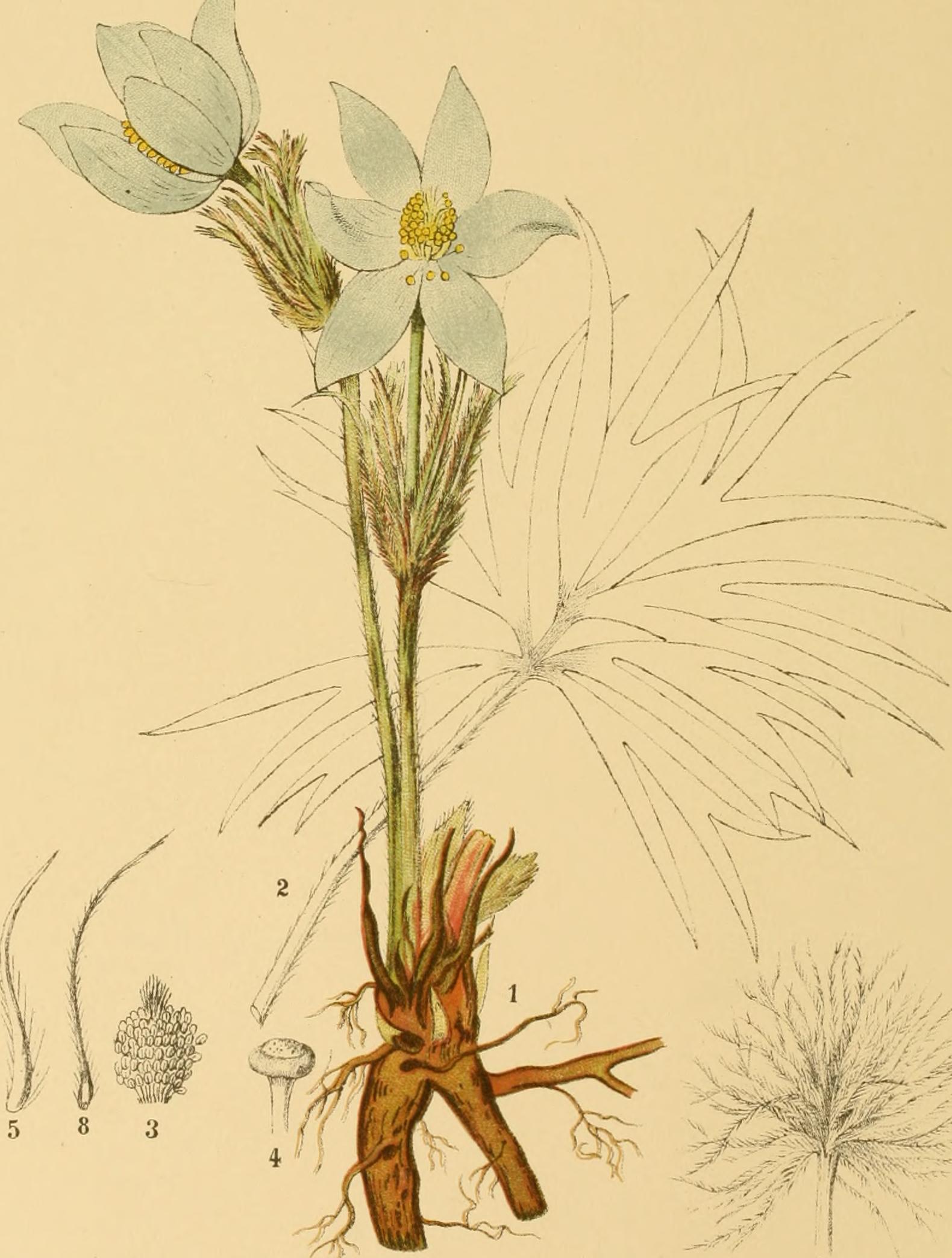
N. ORD-RANUNCULACE^. GENUS. — ANEMONE,* LINN. SEX. SYST.— POLYANDRIA POLYGNIA. PULSATILLA NUTTALLIANA, PASQUE FLOWER. SYN. — ANEMONE PATENS, VAR. NUTTALLIANA, GRAY; ANEMONE NUTTALLIANA, D. C.; ANEMONE LUDOVICIANA, NUTT.; ANEMONE PLAVESCBNS, ZUCC.; CL^EMATIS HIRSUTISSIMA, POIR; PULSATILLA PATENS, GRAY; PULSATILLA PATENS VAR.; WOLFGANGIANA, TRAUVT; PULSATILLA NUTTALLIANA, GRAY. COM. NAMES. — PASQUE FLOWER (CROCUS, MAY FLOWER, PRAIRIE FLOWER, AMERICAN PULSATILLA, HARTSHORN PLANT, GOSLINWEED). A TINCTURE OF THE WHOLE FRESH PLANT, ANEMONE PATENS, VAR. NUTTAl.LIANA, GRAY. Description. — This beautiful prairie flower grows to a height of from 4 to lo inches, from a branched perennial rooL Stem erect and hairy, encircled near the flower by a many-cleft, silky-haired involucre, composed of numerous linnear, acute lobes, which form the true stem-leaves. Leaves upon long hairy petioles, rising more or less erect from the rootstock; they are ternately divided, the lateral divisions sessile and deeply 2-cleft, the central stalked and 3-cleft; all the segments deeply incised into narrow, linnear, acute lobes, smooth above and hairy beneath. Inflorescence a conspicuous, terminal, villous, light purplish-blue flower, fully developed and fertilized before the appearance of the true leaves. Sepals generally 5, at first incumbent, then spreading, answering to petals in appearance; villous upon their outer surface. Petals wanting, or replaced by minute glandular bodies, resembling abortive stamens. Stamens innumerable, in a dense circlet surrounding the pistils; filaments slender; anthers extrose, 2-celled; pollen with three longitudinal, deep sulci. Pistils numerous, in a dense cluster, separate, hairy; style long and slender, with a somewhat recurved summit; stigma indefinate. Fruit a plumose head, similar to that of Clematis; carpels i -seeded, with long feathery tails, composed of the lengthened, persistent, hairy styles. Seeds suspended. Ranunculacese. — This natural order is composed of herbs and woody climbers. * Ai-t/io;, aminos, tlie wind. So named upon the supposition that the flowers of this genus only opened when the wind was blowing.
1-2 Its genera are various, but easily distinguishable by the acrid juice prevailing to a greater or lesser extent in all species, and by the disconnection of the parts of its flowers. The tribes vary gready in regard to the sepci'.s; in some they are wanting, and replaced by petal-like organs; in others, very fugacious; while in one only, in this country, are they present in the mature flower. The stamens are numerous, furnished with short anthers. The fruit varies from a dry pod to a fleshy berry; the ovules are anatropous, so distinguished by the dorsal rhaphe when suspended; the seeds have a minute embryo, invested with fleshy albumenThe leaves are usually palmately, and generally ternately, divided, and are destitute of stipules. This family of plants, many of which are poisonous, contains, beside those treated of in this work, the following species of special interest to us: Clematis ereeta, Helleborus iiiger, Delphiniiini Staph isagria, Aconituni iiapellus, eanimai-nm, ferox, and lyeoetomwu and Paofiia officinalis. History and Habitat.— The American pasque flower is found in abundance upon the prairies from Wisconsin northward, and westward to the Rocky Mountains, flowering from March to April. Lieberg says'"'"' that in Eastern Dakota this plant attains a luxuriance of growth never met with farther east, and that it wholly disappears west of the Missouri. Its habit of being in flower about Eastertide gave it the principal distinguishing name, "Pasque flower;" its peculiar effect upon the nose and eyes when crushed between the fingers gave it another, but local, appellation, "Hartshorn plant;"f and the silky-hariness of the involucre and newly-appearing leaves caused the children in localities to term it " Goslin weed." The U. S. Ph. allows the use of this species under the drug Pulsatilla, with or in place of Herba Pulsatilla nigricantis. PART USED AND PREPARATION.— The whole, fresh, flowering plant is chopped and pounded to a pulp and weighed. Then two parts by weight of alcohol are taken, the pulp mixed thoroughly with one-sixth part of it, and the rest of the alcohol added. After thorough mixture the whole is allowed to stand eight days in a well-stoppered bottle. The tincture thus prepared, after straining and filtering, should have a light seal-brown color by transmitted light, an acrid astringent taste, and a decidedly acid reaction. CHEMICAL CONSTITUENTS.— I am unable to find any data upon this species. It is said to have been found similar to its European relative, Ajiemone Pulsatilla, which, together vi'xth Anenione nemorosa and prateiisis (Eu.), contains: Anemonin, Cj-Hj,,0„. — This body forms in colorless, klinorhombic prisms, from an aqueous distillate of the herb when the volatile oil is present. When dry it has a sharp and burning taste and neutral reaction. It softens at 150° (302.0° P.), and soon decomposes; it dissolves in hot water and alcohol, slightly also in cold. Anemonic Acid, Cj.Hj^O.. — This amorphous, white powder separates from the aqueous distillate together with the above and under the same circumstances. * Bot. Gaz., 1884, p. 104. t ''''"■"'. 18S4, p. 77.
1-3 It is a tasteless acid, insoluble in water, alcohol, ether, oils, and dilute acids, but enters into combination with alkalies. (Wittstein.) Oil of Anemone.— This acrid yellow oil separates from the aqueous infusion of the plant, and, owing to the presence of the water, soon breaks down into the bodies mentioned above. PHYSIOLOGICAL ACTION.— The following represents the general action of the tincture when taken in moderate doses, as reported by Drs. Burk, Duncan, and Wesselhoeft: Profuse lacrymation, with smarting and burning of the eyes, mouth, and throat, followed by mucoid discharges; sharp pains about the stomach and bowels, with rumbling of flatus; pressure in the region of the stomach as from a weight; frequent urging to urinate, with an increased secretion; a tickling in the throat and constant inclination to cough; rheumatic pains, especially in the thighs, with erysipeloid eruptions, especially about the limbs; heat and feverishness, with great debility. The action of this drug will be seen to be very like that of Herba Pidsatlllcc nigricantis, differing mostly in a less intense action. Description of Plate i. I. Whole plant, from St. Cloud, Minn.,* April 24th, 1S84. 2. Full-grown leaf in outline. 3. Sexual organs. 4. Receptacle. 5. Pistil (enlarged). 6. Stamen (enlarged). 7. Pollen X 380. 8. Ripe carpel. 9. Fruit. * One of a number of typical living plants, sent me, with their natural soil intact, by Rev. E. V. Campbell, through who^e kindness 1 also procured the full-grown leaf and ripe fruit.
2. Oj.TU.ailnatdel.etpiiixt Anemone Hepatica, Unn.
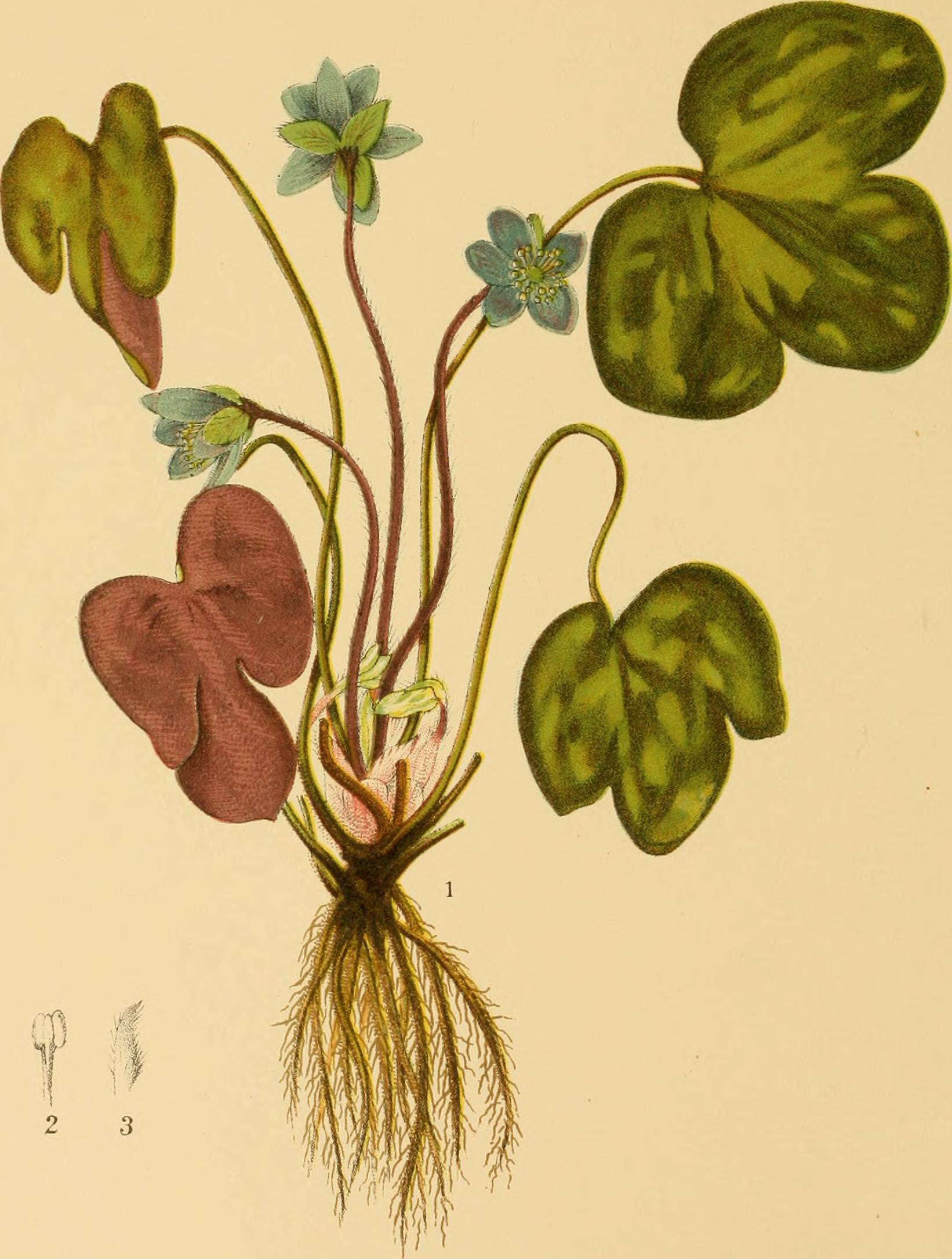
N. ORD. RANUNCULACE^. Tribe.-ANEMONE/E. GENUS. — A N E M O N E, LINN. SEX. SYST.— POLYANDRIA POLYGYNIA. HEPATICA. LIVER-LEAF. SYN.— ANEMONE HEPATICA, LINN.; HEPATICA TRILOBA, CHAIX.; HEPATICA TRILOBA, VAR. AMERICANA, D. C.; HEPATICA TRILOBA, VAR. OBTUSA, PURSH.; HEPATICA AMERICANA, KER. COM. NAMES. — LIVER -LEAF, HEPATICA,* ROUND -LOBED HEPATICA, LIVER-WORT.t LIVER-WEED, TREFOIL, HERB TRINITY, KIDNEYWORT; (PR.) HEPATIQUE; (GER.), EDELLEBBRE. A TINCTURE OF TBI:; FRESH LEAVES OF ANEMONE HEPATICA, LINN. Description.— This dwarf herb, so eagerly sought after as one of our earhest spring flowers, grows from radical scaly buds amid the thick, leathery leaves of the previous year's growth. Root fibrous, perennial. Steifi none. Leaves evergreen, all radical on long, slender petioles; light green and hairy when young; dark olive-green above and purplish beneath, when old, and while the plant is in blossom; they are cordate in general outline, 3-lobed, the lobes ovate, obtuse. Liflorescencc solitary, terminal, on long, hairy scapes, circinate, then erect. Involucre simple, composed of three entire, obtuse, hairy, persistent leaves, somewhat resembling a calyx, from its close proximity to the flower. Calyx composed of from 6 to 9 ovate, obtuse, petaloid sepals, varying in color from pure white to a deep purplish-blue with white borders; these latter, I have noticed, are always destitute of stamens. \ S'tainens numerous, hypogynous; jilanienls long, slender, and smooth; rt;///i^;'j- short, 2 -celled. /'/j-^/Zf 1 2 to 20, hairy; ovary x-c^^A; ovules one in each cell, suspended, anatropous; style single, short, pointed; stigma a stigmatose marginal line, extending down the inner side of the style. Achenia loosely aggregated in a globose head, ovate-oblong, hairy, tipped with the short persistent style; seed filling the whole cell to which it conforms. History and Habitat. — Hepatica is a native of the colder portions of the North Temperate Zone, growing in rich, open woods as far as the limit of trees. In North America it grows from Minnesota, Iowa and Missouri, east and northeast to the Atlantic; flowering, in some seasons, as early as March, and continuing in flower until May. This plant was placed in the genus Anemone by * Errariirdf, (^fl///J<;j, affecting the liver; or, 'iji-ap, c^ar, the liver, from a fancied resemblance of the leaves to that organ, or their action upon it. f The proper liverwort is Marchiintia polymoi'pha^ a cryptogamous plant [Afitscales) of the order Hepaticets. X Author in Bull. Ton: Club, 1884, p. 55.
2-2 Linnaeus, from whence it has received several removals, until finally it has been returned to its original place among its congeners. The Liver-leaf has held a place among medicinal plants from ancient times until the present. It is now falling into disuse on account of its mild properties, forming as it does simply a slightly astringent, mucilaginous infusion. It was used in haemoptysis, coughs, and other lung affections, as well as in all diseases of the liver, and in hemorrhoids; in the latter troubles its exhibition must have met with no very flattering success. As a pectoral it may be taken in the form of an infusion, hot or cold, in almost any amount, as its virtues are not of a powerful or disturbing nature. Hepatica has been dismissed from the U. S. Ph., and is simply mentioned in the Eclectic Materia Medica. PART USED AND PREPARATION. -The full-grown leaves of the year are chopped and pounded to a pulp and weighed. Then two parts by weight of alcohol are taken, the pulp thoroughly mixed with one-sixth part of it, and the rest of the alcohol added. After stirring the whole well it is poured into a wellstoppered bottle and allowed to stand eight days in a dark, cool place. The tincture, separated by straining and filtering, should have a very light greenishorange color by transmitted light, a slightly astringent taste, and an acid reaction. CHEMICAL CONSTITUENTS.-The only bodies found in this plant are tannin, in small amount, sugar, and mucilage. No special analysis has been made to determine an active principle. PHYSIOLOGICAL ACTION.— As far as known, Hepatica has very little action upon the system. A farther proving may develop some symptoms in the direction of a slight irritative cough with expectoration. Description of Plate 2. I. Whole plant, Binghamton, N. Y., April 27th, 1884. 2. Stamen (enlarged). 3. Pistil (enlargedj. =4-=
^m.ad nafdel.etpinxf Ranunculus ScELERATUs,Linn.
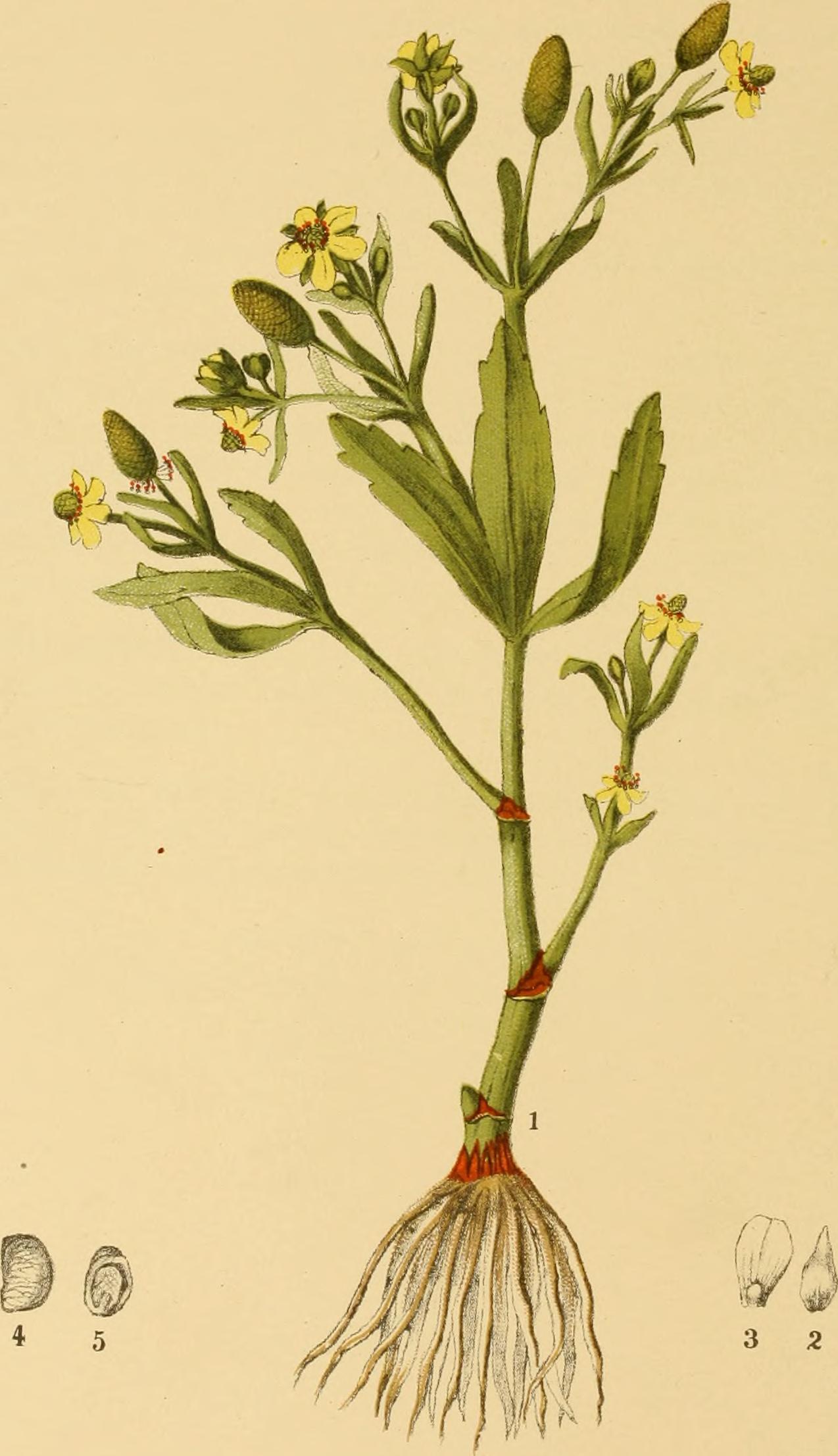
N. ORD-RANUNCULACE^. Thbe.-RANUNCULE/E. GENUS.— RANUNCULUS,* LINN. SEX. SYST.— POLYANDRIA POLYGYNIA. RANUNCULUS SCELERATUS. C URSED CR 0 W'FO 0 T. SYN.— RANUNCULUS SCELERATUS, LINN. COM. NAMES. — CURSED CROWFOOT, CELERY-LEAVED CROWFOOT, MARSH CROWFOOT; (FR.) RANONCULE; (GER.) SCHARF HAHNENFUSS. A TINCTURE OF THE WHOLE PL.A.NT RANUNCULUS SCELERATUS, LINN. Description. — This smooth perennial herb grows to a height of about i foot. Stem erect, glabrous, thick, succulent, hollow, and branching; juice acrid and blistering. Leaves thickish, the upper sessile or nearly so, the lobes oblong-linear and nearly entire; stem-leaves 3-lobed, rounded; root-leaves 3-parted, but not to the base, the lobes obtusely cut and toothed; petioles of the lower leaves long, and sheathing at their dilated bases. Flotvers small, pale-yellow; sepals reflexed; petals scarcely exceeding the sepals. Fruit an oblong, cylindrical head; carpels numerous, barely mucronate. Ranunculus. — This large genus contains, in North America, 53 species and;}^2, varieties, characterized as follows: Root annual or perennial. Leaves mostly radical, those of the stems alternate and situated at the base of the branches, variously lobed, cut, or dissected, seldom entire. Liflorescence solitary or sometimes corymbed; flowers yellow, rarely white. Sepals 5, rarely only 3, not appendaged, deciduous, and imbricated in the bud. Petals 5, or often more, flat, with a little pit, pore, gland, or nectariferous scale at the base inside. Stamens numerous; filaments filiform. Style short, subulate. Fi'tiit a cylindrical or rounded head, composed of numerous carpels; achcnia mosdy flattened and pointed by the remains of the style; seeds solitary, erect, rarely suspended. History and Habitat. — The Cursed Crowfoot is indigenous to Europe and North America; with us it appears as if introduced. It grows in marshy tracts and wet ditches, and blossoms from June to August. The general and medical history of the species is generic, they having been used indiscriminately, R. sceleratus, however, being considered the most poisonous, its juice possessing remarkable caustic power, quickly raising a blister wherever * Litin for a little frog, referring to its habitat.
3-2 applied, and a dose of two drops sometimes excitino- fatal inflammation along the whole alimentary tract. This genus was known to the ancient physicians as BpaTpa;^(0)' [Brati-acltiott). Hippocrates, Paukis ^gineta, and Dioscorides spoke of various species, the latter using them as external applications for the removal of psora, leprous nails, steotomatous and other tumors, as well as fomentations to chilblains, and in toothache. Galen, Paulus, and the physicians of Arabia, all speak highly of the plants as powerful escharotics; and the Bedouins use them as rubefacients. Gerarde says: "There be divers sorts or kinds of these pernitious herbes comprehended under the name of Ranunculus or Crowfoote, whereof most are very dangerous to be taken into the body, and therefore they require a very exquisite moderation, with a most exact and due manner of tempering; not any of them are to be taken alone by themselves, because they are of a most violent force, and therefore have the great nede of correction. The knowledge of these plants is as necessarle to the phisition as of other herbes, to the end they may shun the same, as Scribonius Largus saith, and not take them ignorantly, or also if necessitie at any time require that they may use them, and that with some deliberation and special choice and with their proper correctives. ¥ov these dangerous simples are likewise many times of themselves beneficial and oftentimes profitable; for some of them are not so dangerous but that they may in some sort and oftentimes in fit and due season profit and do good." In regard to the acrid properties of the plants, he further says: " Cunning beggars do use to stampe the leaves and lay it unto their legs and amies, which causeth such filthy ulcers as we daily see (among such wicked vagabondes), to moove the people the more to pittie." Van Swieten, Tissot, and others mention a curious practice, formerly prevailing in several countries of Europe, of applying Ranunculus to the wrists and fingers for the cure of intermittent fevers. This practice we noted only a few days since, when called to see a child of a new-settled German family in our city; the little one's wrists were bound up in the leaves and branches of R. acris; it was suffering with an attack of lobar pneumonia. In former practice the plants were used, in view of external stimulation, in rheumatism (especially sciatic), hip disease, hemicrania, and in local spasmodic and fi.xed pains; in asthma, icterus, dysuria, and pneumonia. Withering, in speaking of R. flanimula, says: " It is an instantaneous emetic, as if Nature had furnished an antidote to poisons from among poisons of its own tribe; and it is to be preferred to almost any other vomit in promoting the instantaneous expulsion of deleterious substances from the stomach." Many species of this genus are used as pot-herbs, as the process ot boiling throws off the volatile acrid principle and renders them inert, though some cases are reported where this happy result failed, and serious symptoms supervened. In Northern Persia the young tubers, leaves, stems, and blossoms of R. cdulis, Boiss, are brought into market and sold as a pot-herb; the Swedish peasantry use R.Jicaria, Linn.; and the shepherds of Wallachia, R. scelcratus, Linn.-' * Lewis Sturtevant, M.D., in Bot. Gaz., vii, 316.
3-3 Ranunculus is among the articles dropped from the U. S. Ph. at the last revision. PART USED AND PREPARATION.— The fresh herb, gathered when in fruit, but still green and untouched by frost, is chopped and pounded to a pulp and weighed. Then two parts by weight of alcohol are taken, the pulp thoroughly mixed with one-sixth part of it, and the rest of the alcohol added. After having stirred the whole well, it is poured into a well-stoppered bottle, and allowed to stand eight days in a dark, cool place. The tincture is then separated by straining and filtering. Thus prepared it has a clear reddish-orange color by transmitted light; an acrid odor and taste; and an acid reaction. CHEMICAL CONSTITUENTS.— We consider here the genus as a whole, taking this species as a chemical type. Anemonol, or Oil of Raniciiciilus. — Mr. O. L. Erdmann* found this to be the acrid principle of this species, and extracted it as a golden-yellow volatile body, decomposing by age into anemoiiin and ancmonic acid, both of which are as described on pages 1-2 and 1-3, and Anemoninic Acid. — When boiled with an excess of baryta water, anemonin decomposes, forming, among other bodies, red flakes of anemoninate of barium (Ltiwig and Weidman). Prof Frehling, who afterward examined into the subject, says, " this acid cannot be formed from anemonin by simply assumption with water." "I" PHYSIOLOGICAL ACTION. — According to Basiner,+ the oil of Ranunculus acts, in warm-blooded animals, as an acrid narcotic, producing, in small doses, stupor and slow respiration; in larger doses, also, paralysis of the posterior and anterior extremities, and, before death, convulsions ot the whole body. The acrid action is shown by a corrosive gastritis and by hypersemia of the kidneys, more particularly their cortical substance. Anemonin causes similar symptoms, but is followed by no convulsions, nor does it irritate sufficiently to corrode the organs, as in the oil. Krapf states § that a small portion of a leaf or flower of R. sceleratus, or two drops of the juice, excited acute pain in the stomach, and a sense of inflammation of the throat; when he chewed the most succulent leaves, the salivary glands were strongly stimulated; his tongue was excoriated and cracked; his teeth smarted, and his cornea became tender and bloody. || A man, at Bevay, France, swallowed a glassful of the juice, which had been kept lor some time; he was seized in four hours with violent colic and vomiting, and died the second day.^ * Am. JoJir. Phar., 1S59, p. 440. t Drugs and Med. of N. A., i, 6S. X Die Vergift mil Ranunkelol, Antiiioiiin, etc., in.•/«/. your. Pluir., 1882, 130. \ Exp. de Nonnutl. Ramin. Ven. Qua/. II Orfila, Tax. Gen., i, 754. \ Jour, dc Chim. Mid., 1S36, 273.
4. A,^ S^ y A' / { s i ^ \ ^ \ \ \ "■^^^ > -^ / / ffiltl.adnat.Metpinxt. / y^ff^ ~~^^\o:a / / / //?2 ^^7V^ Ranunculus Repens, unr
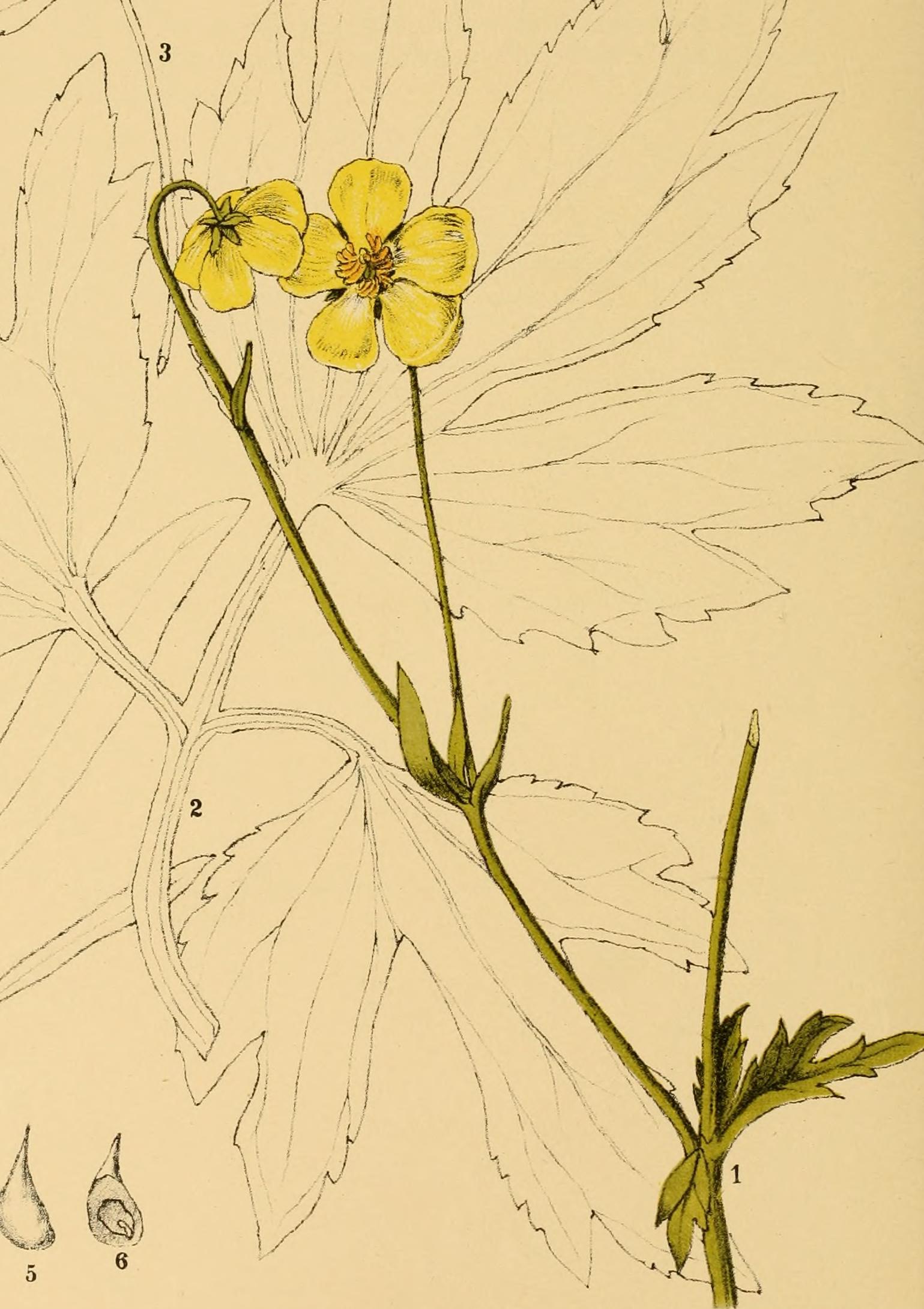
N. ORD. RANUNCULACE.^. 4 Thbe.-RANUNCULE/E. GENUS.— RANUNCULUS, LINN. SEX.- SYST.— POLYANDRI.'\ POLVGVNI.V. RANUNCULUS REPENS. CREEPIJVG BUTTERCUPS. SYN. — RANUNCULUS REPENS, LINN.; R. PROSTRATUS, TOMENTOSUS, AND LANUGINOSUS, VAR. j, POIR.; R. INTBRMEDIU3, BATON; R. CLINTONII, BECK. COM. NAMES.— CREEPING BUTTERCUPS OR CROWFOOT; (PR.) RANONCULE; (GER.) HAHNENFUSS. A TINCTURE OF THE WHOLE PLANT RANUNCULUS REPENS, LINN. Description. — This extremely variable, low, hairy or glabrous herb, extends to from I to 4 feet. Sietiis at first upright then ascending, some forming long runners in summer. Leaves 3-divided to the base: lea/Icis a\\ petiolulate, or at least the terminal one, broadly cuneate or ovate, usually 3-cleft or parted and variously cut. Peduncles furrowed. Calyx spreading. Petals obovate, bright yellow, much longer than the sepals. Fruit a globular head of numerous carpels; achenia flat, strongly margined, and furnished with a stout, straight beak. History and Habitat. — The Creeping Buttercups are indigenous to North America, where they habit moist or shady places, ditches and wet meadows, from Georgia northward and westward; flowering from May to August. In woods that tend to dryness the plant is erect and shows no tendency to spread much by runners; but in low, wet ditches along swamp lands its growth is often prodigious. This species is one of the lesser in acridity, and its medical uses have been simply generical, it being generally used only when the more powerful species could not be procured; its history, therefore, will be covered by R. sccleratus, 3. PART USED AND PREPARATION. — The whole fresh herb, gathered at its fullest growth in October, is chopped and pounded to a pulp, enclosed in a piece of new linen and pressed. The juice is then mingled, by brisk agitation, with an equal part by weight of alcohol, and allowed to stand eight days in a dark, cool place. The tincture formed by filtration should have a brownish-green color by transmitted light, a slightly acrid taste, and an acid reaction.
4-i PHYSIOLOGICAL ACTION. — The provings of this species are not yet sufficiently developed to distinguish its action from that of the preceding. Description of Plate 4. I. End of a flowering stem, Ithaca, N. Y., June 24th, 1885. 2, 3 and 4. Leaf forms. 5. Carpel. 6. Section of a carpel. (5 and 6 enlarged.)
(^m.a ad nat.del.et pinxt. Ranunculus BuLB6sus,Linn
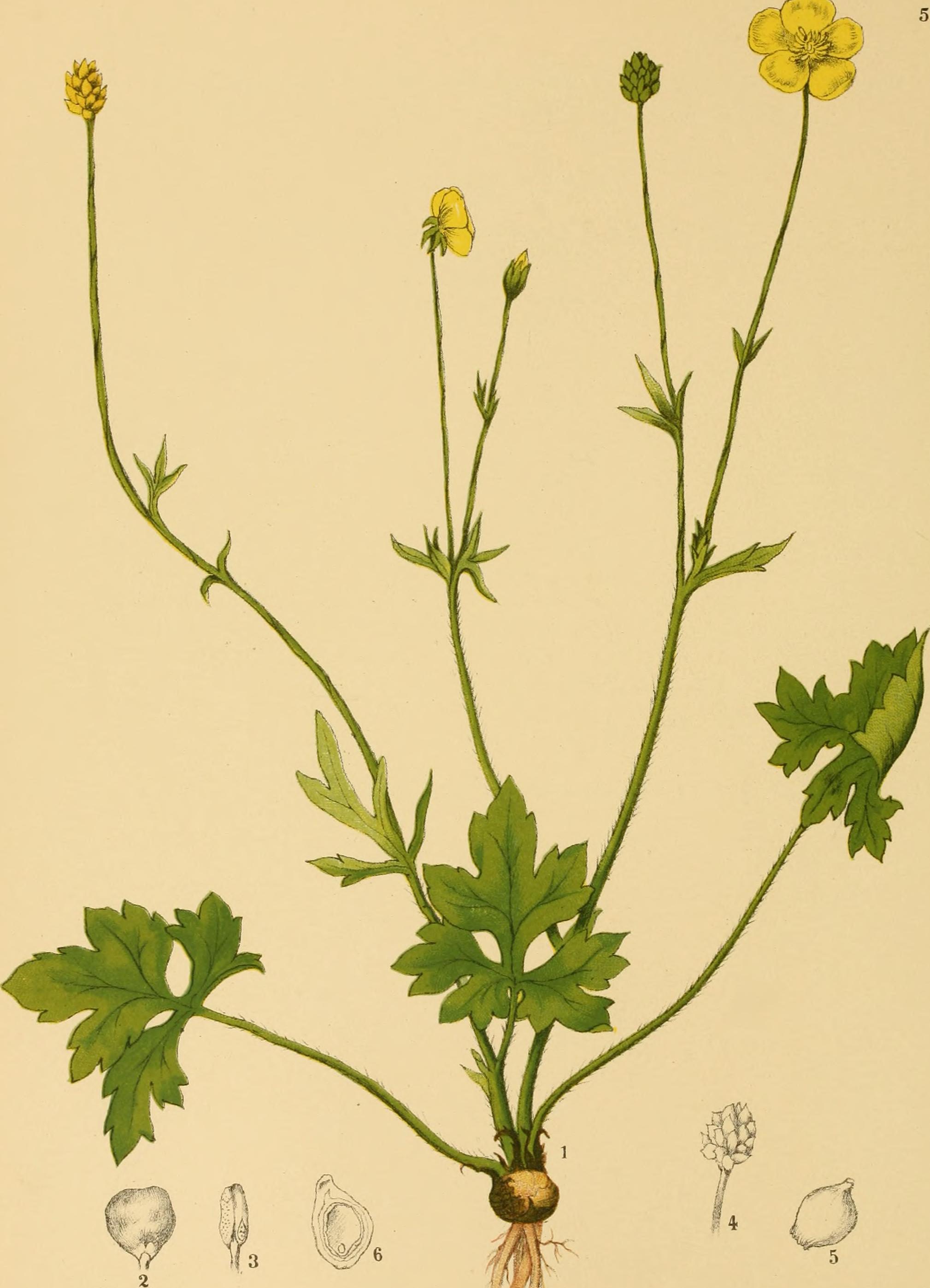
N. ORD -RANUNCULACE^. Tribe.-RANUNCULE/E. GENUS.— RANUNCULUS, LINN. SEX. SYST.— POLYANDRIA POLYGYAMIA. RANUNCULUS BULBOSUS. BULBOUS BUTTERCUPS. SYN.— RANUNCULUS BULBOSUS, LINN. COM. NAMES.— BULBOUS CROWFOOT OR BUTTERCUPS, BUTTER-FLOWER, KING'S CUPS, GOLD CUPS, ST. ANTHONY'S TURNIP OR RAPE; (GER.) KNOLLINGER HAHNENFUSS. A TINCTURE OF THE WHOLE FRESH PLANT RANUNCULUS BULBOSUS, LINN. Description. — This erect, hairy herb grows to a height of about i foot Sterns many, volute, villous, from a bulbous, onion-like base. Leaves all ternately divided to the very base, especially noticeable in the radical ones, all appearing more or less pinnate; leaflets short, cuneate, cleft and toothed, the lateral sessile, the terminal stalked, all 3-parted. Peduncles furrowed. Petals 5 or more, round, cuneate at the base, bright glossy yellow, much longer than the calyx. Calyx reflexed. Fruit in a globular head; achenia ovoid, flattish, and tipped with a very short beak. Read description of Ranunculus, under R. sceleratuSr 3. History and Habitat. — Bulbous Crowfoot is an immigrant from Europe, now pretty thoroughly established along the Atlantic coast, in some places being an actual pest in meadows and pastures; it has not extended far inward, but seems decidedly prone so to do. It blossoms northward from May to July. This species, being one of the more acrid of the genus, and of frequent occurrence in the East, has been used, like R. scelcrattts,-&.s a local irritant where vesication seemed necessary; its use was often prolonged to ulceration, from which severe cases of gangrene sometimes resulted.* This was the officinal species of the U. S. Ph., now dismissed. PART USED AND PREPARATION. — The whole fresh plant while in flower in the month of June, is treated as in the preceding species. The resulting tincture has a clear, light yellow color by transmitted light, a slighdy sweetish then acrid taste, and a strongly acid reaction. CHEMICAL CONSTITUENTS. — So far no analysis has been made of this species to determine (should such exist) a specific principle that might differ from the general constituents of the acrid Ranunculi as given under R. sceleratus, 3. * The general uses of the Ranunculi will be found under R. sceleratus, 3, where special mention is made of the various species.
5-2 PHYSIOLOGICAL ACTION. — R. bulbosus has a peculiarly powerful irritant action upon the skin, whether applied locally or internally. Murray states* that a slice of the fresh root (bulb?) placed in contact with the palmar surface of a fincrer brought on pain in two minutes; when taken off, the skin was found without sio-ns of extra circulation or irritation, and the itching and heat passed away; in two hours it nevertheless returned again, and in ten hours a serous blister had formed, followed by a bad ulcer, which proved very difficult to heal. Early English practitioners used the bulb to produce vesication when a "lastino- blister" was judged necessary, but were very chary of prescribing the drug internally, so great was their dread of its properties. Four persons who partook of the bulbs, boiled in a chicken-broth, suffered from violent burning in the hypogastric region, great anxiety about the region of the heart, pressure at the pit of the stomach, with painful soreness of that organ when pressed. A lady who applied the bruised plant to the chest as a counter-irritant, became ill-humored, fretful, cross and disposed to quarrel, and suffered from soreness and smarting of the eyelashes some time before its action was felt at the region nearest the application. Violent attacks of epilepsy are recorded as having been induced by this plant; a sailor who inhaled the fumes of the burning plant was attacked with this disease for the first time in his life; it returned again in two weeks, passed into cachexia, nodous gout, headache, and terminated in death.-jThe specific symptoms caused by this drug, so carefully collated by Prof. Allen,| show a decided irritant action upon the brain and spinal cord, as well as the mucous membranes generally. Description of Plate 5. I. Whole plant, Salem, Mass., June 25th, 1885. 2. Petal. 3. Anther. 4. Fruit. 5. Achenium. 6. Longitudinal section of achenium. (3, 5 and 6 enlarged.) * App. Med., iii, 87. t Stapf, Add. to Mat. Med. Fiira, I. c. % Encyc. Pure Mat. Med., viii, 257-269.
(BlU.adnat.del.ef pinxt. Ranunculus Acris unn.
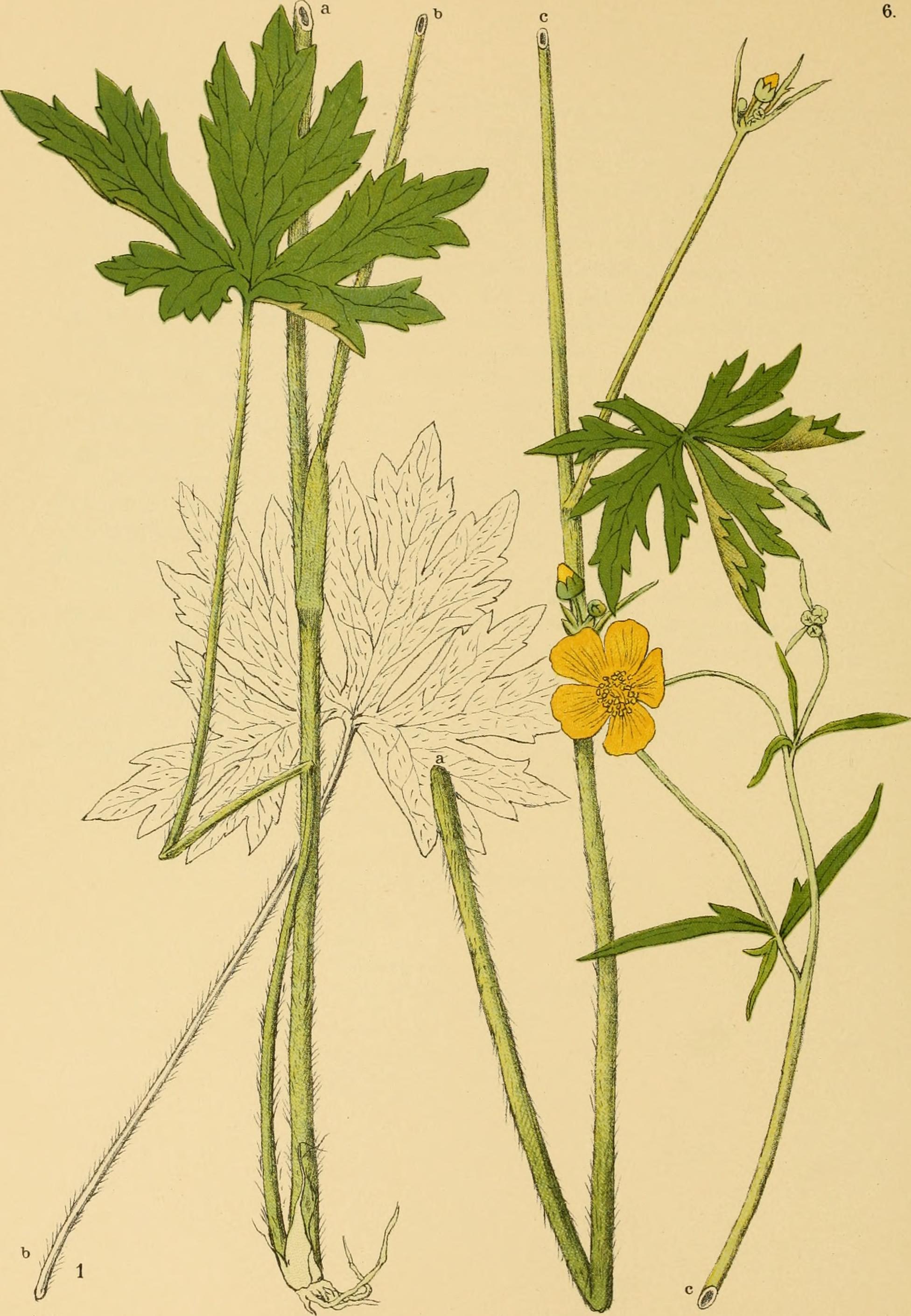
N. ORD -RANUNCULACE^. 6 GENUS— RANUNCULUS, LINN. SEX. SYST.— POLYANDRIA POLYGYNIA. RANUNCULUS ACRIS. TALL BUTTERCUPS. SYN.— RANUNCULUS ACRIS, LINN.; RANUNCULUS PRATBNSIS ERECTUS ACRIS, GBRARDE. COM. NAMES.— TALL BUTTERCUPS OR CROWFOOT, UPRIGHT BUTTERCUPS OR CROWFOOT, ACRID BUTTERCUPS, BLISTBRWBED, YELLOW PILE-WEED, BUR- WORT, MEADOWBLOOM; (FR.) RENONCULB ACRE; (GER.) SCHARFHAHBNFUSS. A TINCTURE OF THE WHOLE FRESH PLANT, RANUNCULUS ACRIS, LINN. Description. — This erect, perennial herb attains a height of from 2 to 3 feet. Root fibrous, from a sHghtly tiiber-Hke crown. Stem subcyHndrical, hollow, hairy, and branching above. Leaves 3-divided, the divisions all sessile, 3-parted, and clothed with more or less rimd hairs; seo-menis of the lower leaves cut into Iano ' o ceolate, closely-crowded lobes; of the upper linear, and sometimes entire; petioles of the radicle and lower stem leaves long and hairy, upper cauline leaves sometimes sessile, hiflorescejice axillary and terminal; flowers nearly as large as those of R. bulbosus (5), but not so deep a yellow. Calyx spreading, villous, much shorter than the corolla. Petals obovate, bright yellow. Filaments short; anthers incurved. Fruit a. globular head; carpels numerous, lenticular and smooth; beak short and recurved. Read description of the genus, under Ranunculus sceleratus, 3; and the natural order, under Pulsatilla Nuttalliana, i. History and Habitat. — This species of the genus has become quite widely distributed in this country since its introduction from Europe. It flowers from June until August. This plant, when past its flowering season, is often mistaken for Geranium maculatum, 32,* both on account of its vulgar name, crowfoot, and from a similarity in the foliage. The medical and general history, and the chemistry and action, of the different species of Ranunculus are generic rather than specific. I give a digest under R. sceleratus, 3. PART USED AND PREPARATION.— The whole fresh herb, gathered in October, should be chopped and pounded to a pulp and pressed out in a piece * Williams and Partridge, Bost. Med. and Surg. Jour., March, 1838.
6-2 of new linen. The juice is then, by rapid succussion, mixed with an equal part by weight of alcohol, and allowed to stand eight days, in a well-stoppered bottle, in a dark, cool place. The tincture, separated by filtration, has a brownish-orange color by transmitted light, a biting, then astringent taste, and an acid reaction. Description of Plate 6. I. a, b, and c. Whole plant, Ithaca, N. Y., June zd, 1880.
,-^ ^ra. r^^.. ad naf.del.et pinxt. CaLTHA PaLUSTRIS, Linn.
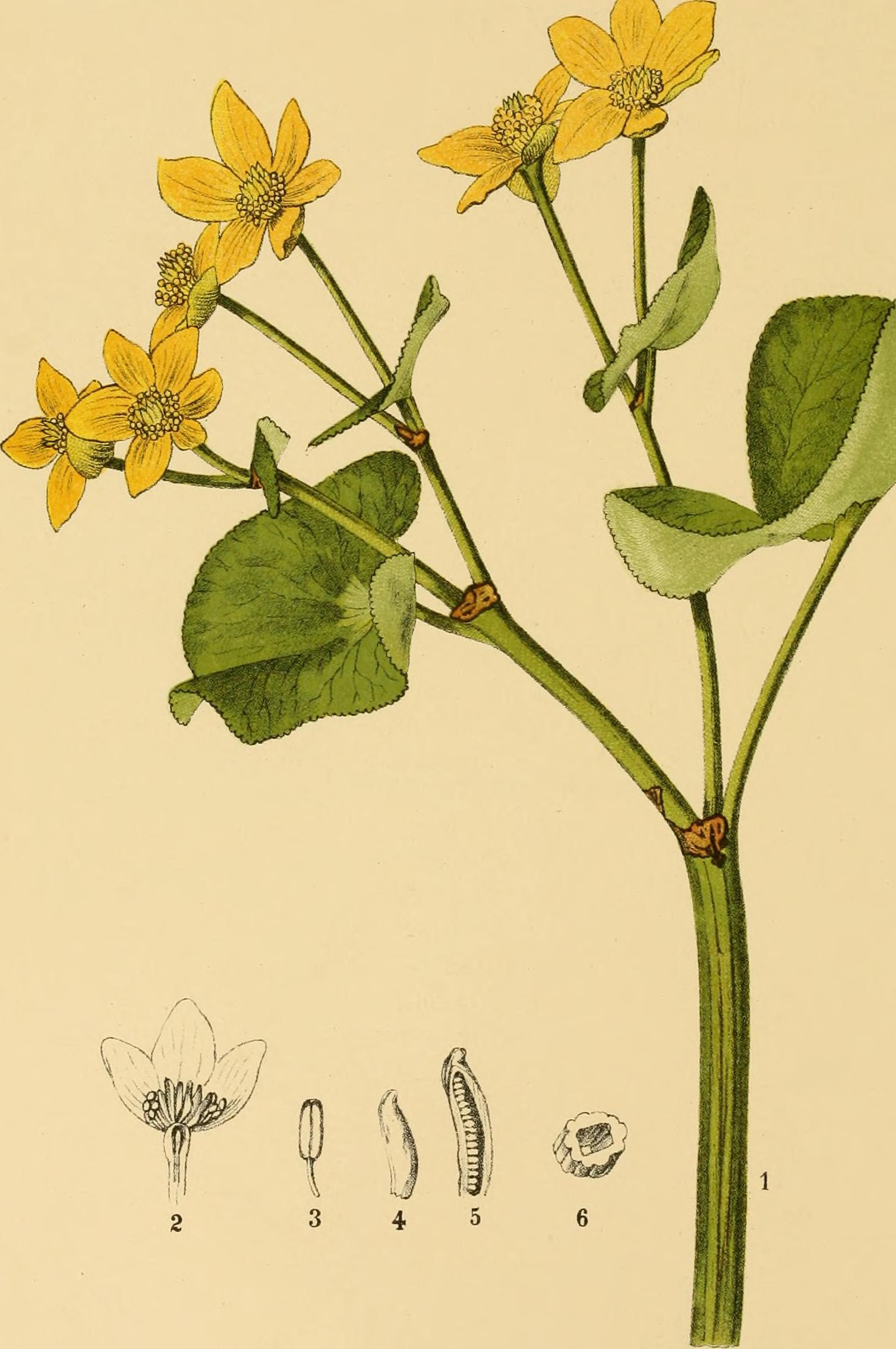
N. ORD.-RANUNCULACE^. 7 GENUS. — C ALT HA, =" LINN. SEX. SYST.— POLYANDRIA I'OLYGYNIA. CALTHA. MARSH MARIGOLD. SYN.-CALTHA PALUSTRIS,t LINN.; CALTHA ARTICA, R. BR. COM. NAMES— MARSH MARIGOLD,! COWSLIPS,? COW'S LIPS, MEADOWBOUTS, WATBRBOUTS, COLT'S FOOT,|l MARE-BLEBS OR -BLOBS.H AMERICAN COWSLIPS,** PALSY-WORT, WATER DRAGON; (GER.) SUMPF RINGELBLUME. A TINCTURE OF THE WHOLE FLOWERING PL.\NT CALTHA PALUSTRIS, LINN. Description. — This glabrous, perennial herb, grows to a height of from 6 to 12 inches. Root a bundle of coarse and closely fasciculated fibers. Siem erect, somewhat quadrilateral, furrowed, hollow, thick, and juicy, branched above. Leaves alternate, large, orbicular, cordate, or reniform, finely crenate or entire; petioles of the radical leaves long, those of the cauline about equal in length to the width of the leaf; stipules quite large, withering after the expansion of the leaf, which they cover in the bud. Liflorcsceiice corymbose; flowers large and regular. Sepals 56, petaloid, broadly ovate, imbricate in sestivation. Petals wanting. Stamens numerous; filaments about the length of the anthers; anthers large, innate, and extrorse. Pistils 5-10; styles nearly or quite absent; stigmas forming blunt, recurved, mucronations to the ovaries. Fritit a spreading whorl; follicles latterly compressed; seeds numerous, oblong, purplish, furnished with a prominent raphe, and arranged in a double series. Read description of the Order under Pulsatilla Nuttalliana, 1. History and Habitat. — The marsh-marigold is indigenous to the northern portions of Europe, Asia, and America; growing on low, wet meadows, bogs, and the banks of spring-fed rivulets; flowering in the United States from April to May. * K(iXa5o,-, halathos^ a clialice, the golden calyx resembling that utensil. ■[■ Care should he taken not to confound this plant with Calta palttstris^ Liiin, on account of the similarity in the names; it bears no resemblance whatever to Calla; the habitats are the same. J I have known American physicians who claimed th,at they made their tincture of Calendula from flowers gathered in their own neighborhoods (Caltha); this error arose from tlie common name of calendula being marigold. Calendula officinalis, Linn., belongs to the Composite, and does not grow wild in this country. The corn-marigold belongs to the genus Chrysanthemum (Composita;); the fig-mirigold to M:sembryanthemum ('^\.i'^e.\VLa\-)-OM\\\tVL\tiE]; the French and African marigolds to Tagetes (Compositje), and the bur-marigold to Bidens (Compositas). \ Cowslips are properly species of the primrose family (PrimulaceEe). II Colt's foot is only applicable to Tussilago Farfaia, Linn. (CompositDe). \ Mare, marsh; blebs, bladders, more properly blisters. ** The true American cowslip is Dodecatheon Meadia, Linn. (Primulacese).
The plant is extensively gathered in early spring, and cooked for " greens," making one of our most excellent pot-herbs; the pickled flower-buds are mentioned as a fine substitute for capers. The fresh plant is very acrid, so much so that cattle will not eat of it. Rafinesque asserts that cattle browsing upon it die in consequence of an inflammation of the stomach. The medical history of this herb is very sparse, and of no consequence; it has been used in cough syrups, which would, without doubt, have been fully as efficacious without it. PART USED AND PREPARATION.— The fresh herb, gathered when flowering, is chopped and pounded to a pulp, enclosed in a piece of new linen, and pressed. The expressed juice is then, by brisk succussion, mingled with an equal part by weight of alcohol. This mixture is allowed to stand eight days in a dark, cool place. The tincture, separated from the above mass by filtration, has a clear, orangebrown color by transmitted light, a sweet, then somewhat acrid taste, and a neutral reaction. CHEMICAL CONSTITUENTS.— The acridity so noticeable in the fresh herb entirely disappears on the application of heat; this property is considered by Lloyd to resemble, or be identical with, acrid oil of ranunculus,'"' though his attempt to extract this oil and anemonin, from a distillate of the fresh plant, was unsuccessful. Tannin is present in appreciable quantity, the tincture responding quickly to the tests with acetate of lead and chloride of iron. PHYSIOLOGICAL ACTION. — We have a scanty proving of this drug detailed in the Encyclopedia of Pure Materia Medica; insufficient, however, to afford an insight to its real action. Description of Plate 7. I. End of branch, from Binghamton, N. Y., May nth, 1884. 2. Section of flower. 3. Stamen (enlarged). 4. Achenium (enlarged). 5. Section of ovary (enlarged). 6. Section of stem. * See under Ranunculus sceleratus, 3.
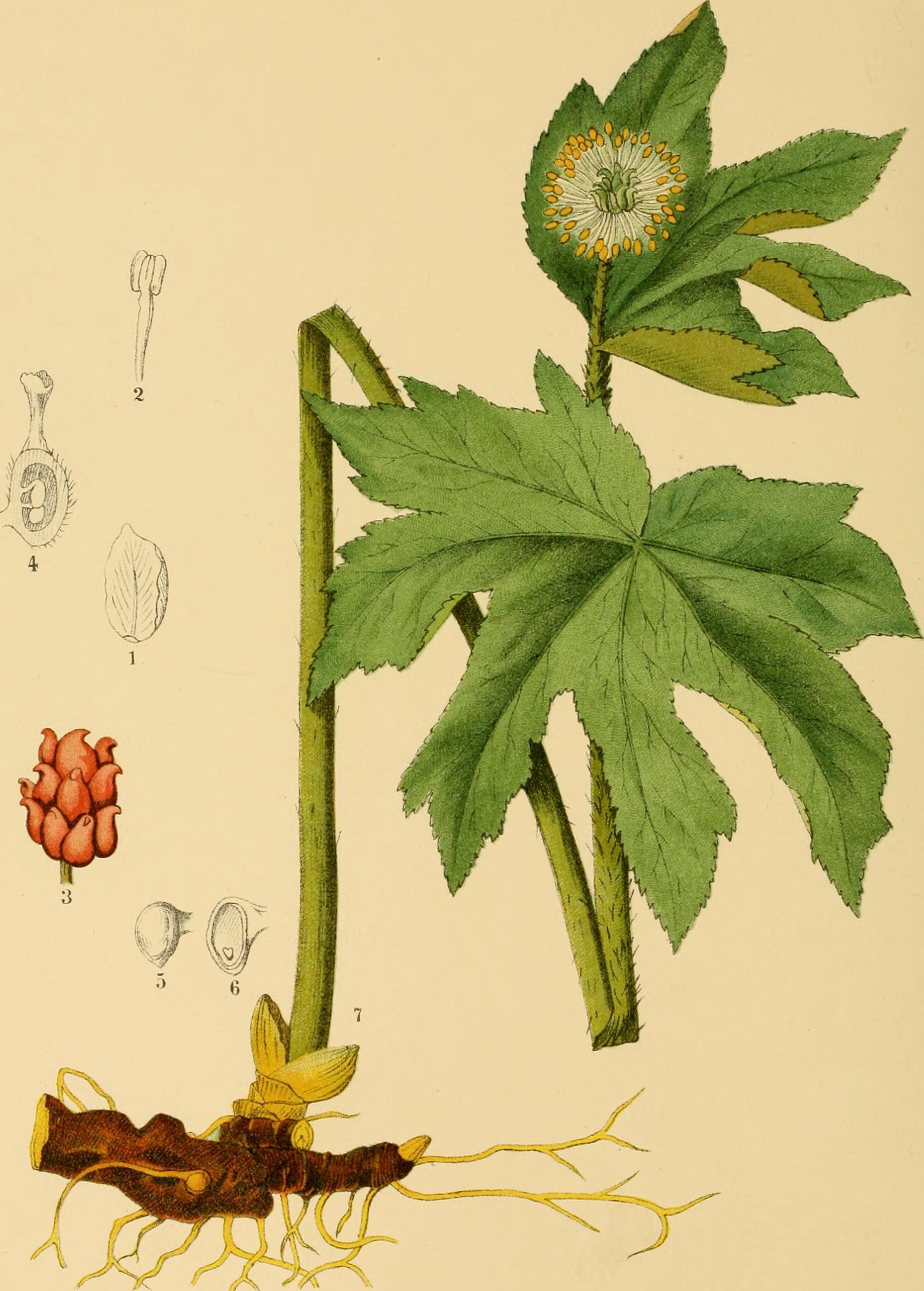
InatdeI.etpinxl. ^EL^lfi'ORUS Vi RID IS, Linn. \^y
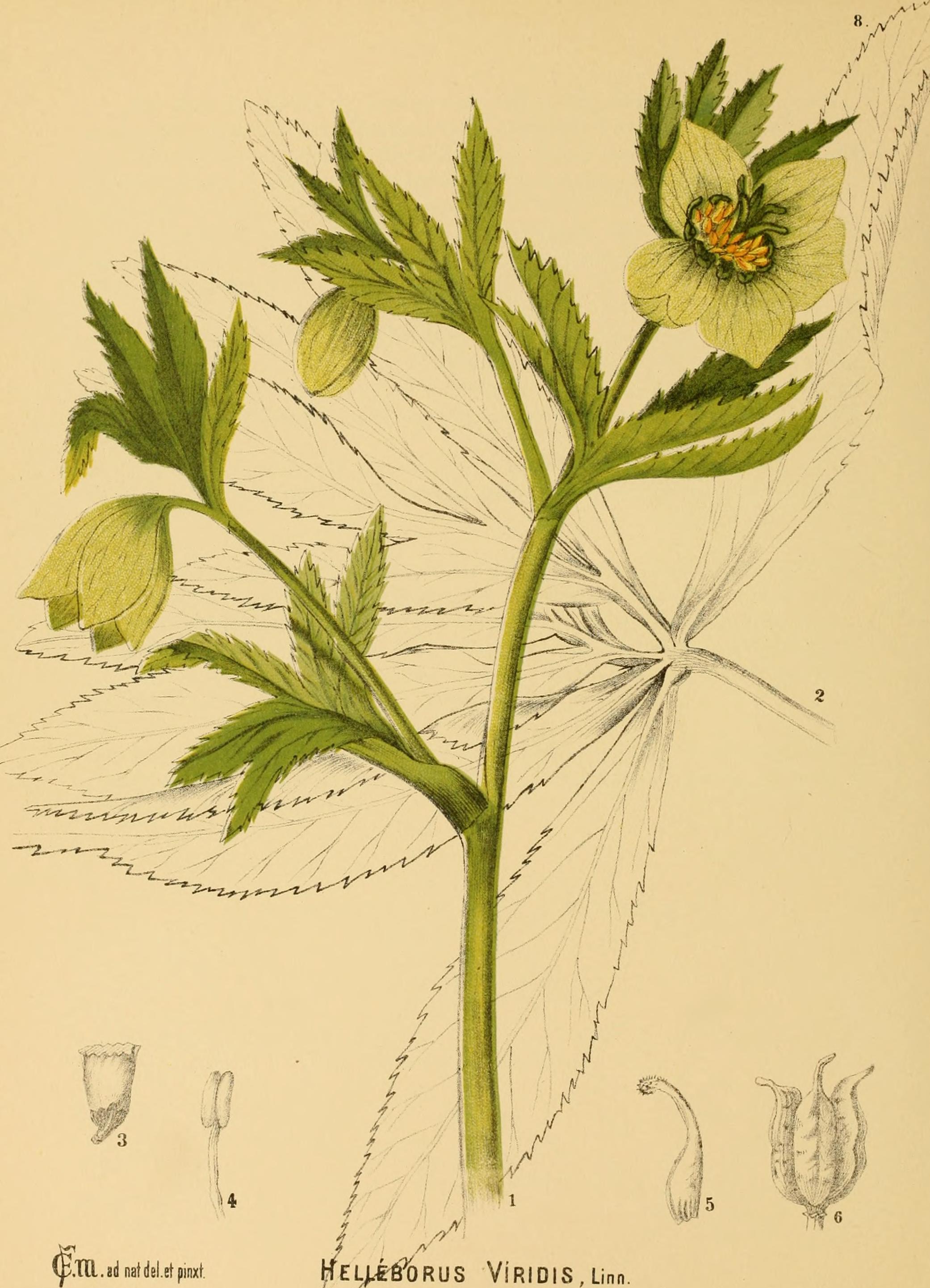
N. ORD-RANUNCULACE^. 8 Tribe.-HELLEBORINE/E. GENUS.— HE LLEBORUS,* LINN. SEX. SYST.— POLYGAMI.-V POI.VGNIA. HELLEBORUS VIRIDIS. GREEA'' HELLEBOBE. SYN.-HELLEBORUS VIRIDIS, LINN. COM. NAMES. — GREEN HELLEBORE; (PR.) ELLBBORE VERT; (GBR.) GRUNE NIBSSWURZ. A TINCTURE OF THE ROOT OF HELLEBORU.S VIRIDIS, LINN. Description. — This perennial herb usually attains a growth of from i to 2 feet. Rhizome thick and woody. Stem smooth, usually a little inclined to branch above. Leaves alternate, compound, the leaflets sharply serrate; those of the stem nearly sessile and palmately parted; those of the root glabrous, long petioled and pedately divided into from 7 to 15 lanceolate, acute lobes. hiflorescence on axillary, solitary, nodding, sometimes geminate peduncles; floioers regular, an inch or more in diameter. Calyx persistent; sepals 5, roundishovate, veiny, petaloid, imbricated in the bud. Petals 8 to 10, very small, cyathiform, irregularly 2-lipped, all shorter than the stamens. Stamens indefinite. Pistils 2, to 10, sessile; stigmas orbicular. Fjniit a cluster of sessile, coriaceous pods, all cohering at their bases; seeds numerous. History and Habitat. — This European immigrant is now pretty thoroughly naturalized on Long Island and in a few counties of Eastern Pennsylvania, where it grows in the opens, and flowers in April. On account of its general rarity, this species has had but litde use in medicine, its place being supplied by either H.niger or H. fetidus; it is, however, much more active than either of these species, and ranks next in energy to H. orientalis, which is considered the most highly poisonous species of the genus. Green Hellebore has, however, been somewhat used as a drastic and hydragogue cathartic in dropsies; an emmenagogue in amenorrhoea; a vermifuge in children afflicted with lumbricoids; as a nervine in mania and melancholia; and an anti-spasmodic in epilepsy. Its principal field, however, has been in veterinary medication, for animals afflicted with lice or lumbrici For die reason given above, the root is no longer officinal in the pharmacopoeias. *E\rri', hehin, to injuie; ^o/)«, bora, food.
8-2 PART USED AND PREPARATION. — The fresh root, gathered when the leaves are about to fall, but before the first frost, is treated as directed under Hydrastis.* The resulting tincture has a deep brownish-orange color by transmitted light; an odor somewhat resembling that of Bourbon whisky; an acrid, bitter taste, prickling the tongue and causing salivation; and an acid reaction. CHEMICAL CONSTITUENTS. — The chemistry of the Hellebores is generic rather than specific, the species differing, so far as known, only in the quantity of the principles contained. Helleborin,t C.,. Hj.,0,.. — This glucoside was isolated by Marme and A. Husemann (1S64) from the green, fatty matter e.xtracted by boiling alcohol from an aqueous e.xtract of the root. It resulted as shining, colorless, concentric needles, tasteless when dry, but acrid and burning in alcoholic solution. Helleborin proves a highly narcotic, powerful poison, more abundant in viridis than in niger; it is insoluble in water, soluble in hot alcohol, and fuses and carbonizes above 250° (482° F.). When boiled with zinc chloride, Helleborin breaks down into sugar and Helleborcsin as follows: Helleborin. Water. Glucose. Helleboresin. C3„H,,0, + (H,0), = C„H,p„ + C3„H3,0,. Helleborein, Q^H^^Oj.. — This slightly acid glucoside was also isolated by Marme and Husemann, as translucent, warty masses of microscopic needles, which quickly defloresce and are very hygroscopic; they are of a sweetish taste, and are readily soluble in water, less so in alcohol, and insoluble in ether. Helleborein is a narcotic poison, more abundant in nigcr than viridis; its aqueous solution dries to a yellowish resin, which becomes straw-color at 160° (320° F.),and conglutinates; at 220°-230° (428°-446° F.) it becomes brown and pasty; and at 280° (536° F.) it chars. When boiled with a dilute mineral acid, it breaks down into sugar and Hclleboretin, as follows: Helleborein. Glucose. Helleboretin. c,oH,Aa= (QH,A).+ c,,H,AHelleboretin, Ci^H^gOs- is strangely wanting in physiological effect, considering its source; it has a violet color and no crystalline form. Helleboric Acid. — This body is so far considered, if not identical, at least isomeric with aconilic and cquisctic acids. PHYSIOLOGICAL ACTION. — According to the experiments of Von Schroff, with from 2 to 4 grains of the alcoholic extract of the root, this species causes: roaring in the ears; violent sneezing; burning in the mouth, and profuse salivation; o-urgling in the abdomen; profuse liquid stools, accompanied by violent * Page 9-2. f Bastic (1852) discovered a bitter, crystalline body in the roots of Hellebore, to which lie gave this name. It l>roved, however, to be chemically indififerent.
8-3 cohc, great tenesmus, nausea, and inclination to vomit; frequent passages of pale urine; decreased heart's action; soporific condition: and a sensation o"l" heat over the whole body. The action of the Hellebores in general should be consulted in connection with this species. Descripiiox of Plate 8. I. Top of plant, from Sellersville, Pa., April 20th, 1S84. 2. A mature lower leaf. 3. Petal. 4. Stamen. 5. Pistil. 6. Fruiting carpel. (4-6 enlarged.)
U/.TR.aiinatiJel.etpinxt Hydrastis Canadensis, Linn.
N. ORD -RANUNCULACE^. 9 Tribe-CIMICIFUGE/E. GENUS— HYDRASTIS,* LINN. SEX. SYST.— POLYANDRIA POLYGYXIA. HYDRASTIS. GOLDEJY-SEAL. SYN.-HTDRASTI3 CANADENSIS, LINN.; WARNERIA CANADENSIS, MILL. COM. NAMES.— GOLDEN-SEAL, ORANGE-ROOT, YELLOW-ROOT, YELLOWPUCCOON, GROUND-RASPBERRY, WILD CURCUMA, TURMERICROOT, INDIAN DYE, INDIAN TURMERIC; (PR.) HYDRASTIS; (GER.) CANADISCHE, GELBWURZEL. A TINCTURE OF THE FRESH ROOT OF HYDR.\STIS C.\N.\DENSIS, LINN. Description.— This low perennial herb, now becoming quite rare in this State (N. Y.), grows from 6 to lo inches high, its leaves and fruit niuch resembling those of the raspberry. Rhizome thick, sarcous, oblong, irregular and knotted, having a yellowish-brown, thin bark, and a bright-yellow interior; rootlets numerous, scattered, coriaceous fibres. Stem simple, subcylindrical, thick, erect and very hairy, surrounded, at its point of issuance from the rootstalk, by several oblong, sheathing, scaphoid, greenish-yellow, leafy bracts. Leaves 2, alternate, near the summit of the plant, orbicular-cordate at the base, palmately five- to seven-lobed, the lobes doubly serrate, acute, veiny; attaining, when full grown during the fruiting season, a width of from 4 to 10 inches. The root sometimes puts off an accessory or root-leaf which answers to the characteristics of the stem-leaves, with the one exception, that it is petiolate while they are sessile. PediDule about i inch long; inflorescence — when fully expanded — a single, greenish-white, apetalous, asepalous flower. Sepals 3, pale-rose color, caducous. Petals none. Stamens numerous; filaments linear or linear-spatulate; antJicrs oval, innate. Pistils numerous, twelve or more in a dense head; ovaiy i -celled, one- to two-ovuled; styles short; sti^qma flattened and dilated, one- to two-lipped. Frtiit a succulent, globose berry, compounded of many miniature one- to two-seeded drupes; appearing like an enlarged red- raspberry. Seeas inversely egg-shaped, nearly black and glossy; embryo basal, very small; albumen sarcoid and oily. A description of the natural order may be found under Pulsatilla Nuttalliana, i, * Derivation not positive, (?j CJup, waUr; ipij, (o act; its juice being very active.
9-2 History and Habitat.— Hydrastis is indigenous to Canada and the United States, east of the Mississippi, and but quite rare east of the Alleghany Mountains; in the southeastern portion of the country it grows only upon the mountains. It seeks the rich soil of shady woods, and moist places at the edge of wooded lands, flowering from April to May, and fruiting in July. The American aborigines valued the root highly as a tonic, stomachic, and application to sore eyes and general ulcerations, as well as a yellow dye for their clothing and implements of warfare. The officinal preparations in the U. S. Ph. are: Extractum Hydrastis Flnidtim^ and Tinctura Hydrastis. The Eclectic: Dccocttan Hydrastis, Extractum Hydrastis Hydro-alcoliolician, Tinctura Hydrastis Composita, Lotio Hydrastis Composita^ Tinctura Hydrastis and Vinum Hydrastis Compositiini. PARTS USED AND PREPARATION.— The fresh root, gathered as the plant is budding to blossom, or in the iall, is chopped and pounded to a pulp and weighed. Then two parts by weight of alcohol are taken, the pulp thoroughly mixed with one-sixth part of it, and the rest of the alcohol added. After stirring the whole well, it is poured into a well-stoppered bottle, and allowed to remain eight days in a dark, cool place. The tincture is then poured off, strained and filtered, and presents the following physical properties: a reddish-orange color, by transmitted light, staining everything with which it comes in contact, a deep yellow color; a persistent bitter, then burning taste; no distinguishing odor, and a slightly acid reaction. Berberinum. — The pure alkaloid Berberlna, one part to ten, or ninety-nine sugar of milk, and triturated. CHEMICAL CONSTITUENTS.— Berberlna {vide Berberls, 15). Dr. Mahla of Chicago proved this alkaloid identical with that obtained from Berberis (Am. Jour. Phar., Vol. xxxv., p. 433). Hydrastia, C.,„ H.,3 NO5, an alkaloid discovered by A. B. Durand (Am. Jour. Phar., Vol. xxili., p. 13), has been referred to by many writers upon Phyto-chemistry, as pure-white crystals, but J. U. Lloyd (Am. Jour. Phar., Vol. 11., p. 16) determines that it cannot be extracted pure, but Is always so intimately associated with a yellow substance that when viewed in quantity It shows easily the Impurity. He decides that this yellowishness Is not due to berberlna. The crystals when viewed separately are in the form of brilliant, yellowish-white, glossy, quadrangular prisms, becoming opaque when dry. Hydrastia fuses at 135° (275° F.),and decomposes at higher temperatures; it Is slightly soluble in cold alcohol, readily In hot, from which it is deposited on cooling in the crystalline form above described; the taste Is not bitter, but somewhat nauseous and acrid. Xanthopuccina, a third alkaloid, was determined by Herm. Lerchen (Am. Jour. Phar., Vol. 1., p. 470) in the menstruum, after the extraction of berberlna and hydrastia; a yellow color is the only property given. Hydrastis contains, beside the above-mentioned bodies, a green fixed oil of a disagreeable odor and taste; a little volatile oil, to which the odor of the root Is
9-3 due; a black, resinous substance (Lloyd); albumen, sugar, starch, a fatty resin and lo per cent, of mineral matters (Herm. Lerchen). PHYSIOLOGICAL ACTION— When taken in large doses hydrastis causes a train of symptoms due to a hyper-secretion of the mucous membranes. If persisted in, it causes severe ulceration of any surface it may touch; and a catarrhal inflammation of mucous surfaces, followed by extreme dryness and fission. It causes also a catarrhal inflammation of the mucous linings of the hepatic ducts and gall-bladder — showing in an icteric hue of the skin — and a similar condition of the bladder, catarrhal cystitis. Description of Plate 9. 1. Sepal (somewhat enlarged). 2. Stamen " " 3. Fruit. 4. Pistil (soniewl'iat enlarged). 5-6. Seed. 7. Whole plant from Newfield, N. Y., May;o, 1S80.
nrrp^'rrrrT^r-rcgi 10. GTn..a{lnat.(Jel.et pinxt. ACT/tA SPICATA Linn..' =.;arJafc-v**gv JMiWciiBttjwr
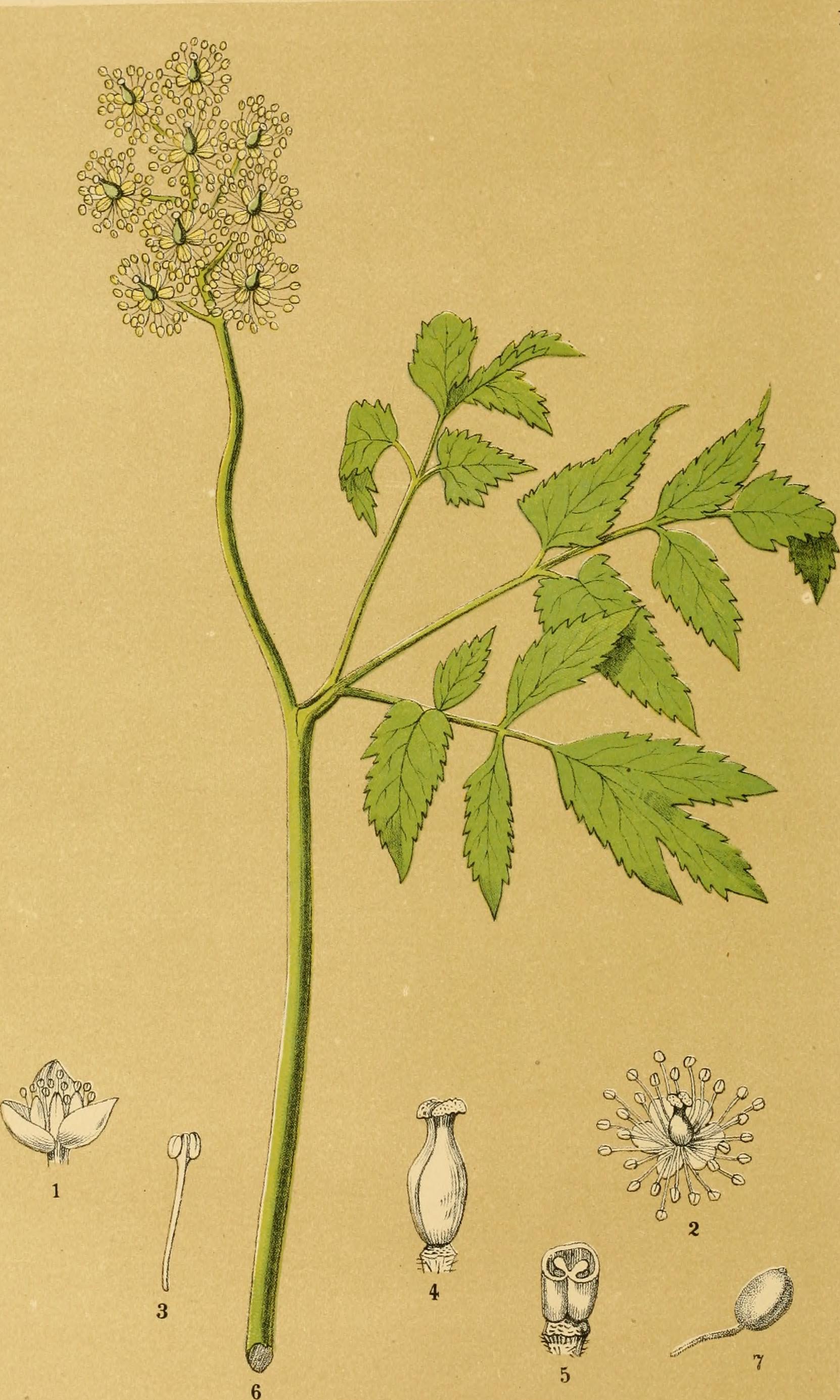
N. ORD -RANUNCULACE^. 10 Tribe.-CIMICIFUGE^. GENUS.— ACT/EA,* LINN. SEX. SYST.— POLYANDRIA MONOGYNIA. ACT^A ALBA. WHITE BAJVEBERR Y. SYN.— ACT^A ALBA, BIGEL; ACT^A SPICATA, VAR. ALBA, MICHX.; ACT^A PACHYPODA, ELL.; ACT^A AMERICANA, VAR. a, PURSH.; ACT.^A BRACHYPETALA, VAR. a, DC. COM. NAMES.— WHITE BANEBERRY, WHITE COHOSH, AMERICAN HERB CHRISTOPHER, TOAD ROOT; (FR.) HERBE DE STE. CHRISTOPHB BLANC; (GER.) WEISSES CHRISTOPHSKRAUT. A TINCTURE OF THE FRESH ROOT OF ACT^A ALBA, BIGEL. Description. — This delicate-flowered perennial grows to a height of 2 feet and sometimes slightly over. Root somewhat similar to that of cimicifuga, but neither as odorous, dark in color, nor as large. Sient erect, nearly smooth. Leaves large, 2-3-ternately decompound; leaflets ovate, acutely cleft, and dentate or incisely serrate. Inflorescence a short, terminal ovate-oblong, simple raceme; flowers creamy-white, sometimes by abortion declinous; pedicles becoming pink, and thickened in fruit, until they are equal in size to the common peduncle. Sepals 4 to 5 petaloid, early deciduous. Petals 3 to 9, small, slender and spatulate, their tips either truncate or emarginate, their bases converted into short claws. The petals of this species appear like metamorphosed stamens {staminidia). Stamens numerous; filaments white, slender; anthers innate, introrse. Pistil simple, solitary, with a sulcus at the insertion of the parietal placenta; stigma sessile, 2-lobed. Fruit a cluster of bluish-white, many-seeded berries or carpels; seeds smooth, compressed, and horizontal. History and Habitat. — The white cohosh is a common herb in our rocky woods, especially southward and westward. It flowers in May and ripens its pretty china-like fruit in October. This species, together with Actcea rubra (red cohosh), has received the attention of many writers upon medical botany. The two species vary principally in the color of the berries and thickness of the pedicles; probably slightly only in their properties and action. They are, however, widely different from Actcea racemosa, our Cimicifuga, and should under no circumstances be confounded with that drug. Just how much our species of Actaea differ from the European Actcea spicata, Linn., still remains to be proven. This much we know, that the American species are much milder in their properties. * A.KTf\, akte, elder, from a resemblance in the foliage.
10-2 The white cohosh hardly deserves a place here, as the European baneberry will without doubt cover its entire action and more beside; it will, however, often be found useful in many forms of reflex uterine headache, some types of chronic fleeting rheumatism, congestion, in the female especially, and reflex uterine gastralgia. Rafinesque says the roots are repellant, nervine, and used for debility in Canada. PART USED AND PREPARATION.— The whole fresh plant, while the fruit is ripening, should be chopped and pounded to a pulp and weighed. Then two parts by weight of alcohol are to be taken, the pulp thoroughly mixed with onesixth part of it, and the rest of the alcohol added. After mixing well, pour the whole into a well-stoppered bottle, and allow it to stand eight days in a dark, cool place. The tincture is then separated by decanting, straining and filtering. Description of Plate io. ACT/EA SPICATA. var. ALBA." 1. Flower, showing calyx. 2. Expanded flower oi Actcea rubra. 3. Stamen (enlarged). 4. Pistil (enlarged). 5. Horizontal section of ovary (enlarged). 6. Top of plant, Ithaca, N. Y., May loth, 1880. * The Plate is wrongly titled Actaa spicata.
(Eltl.adnat.del.et pinxt. ClMICIFUCA RaCEMOSA, Ell.!
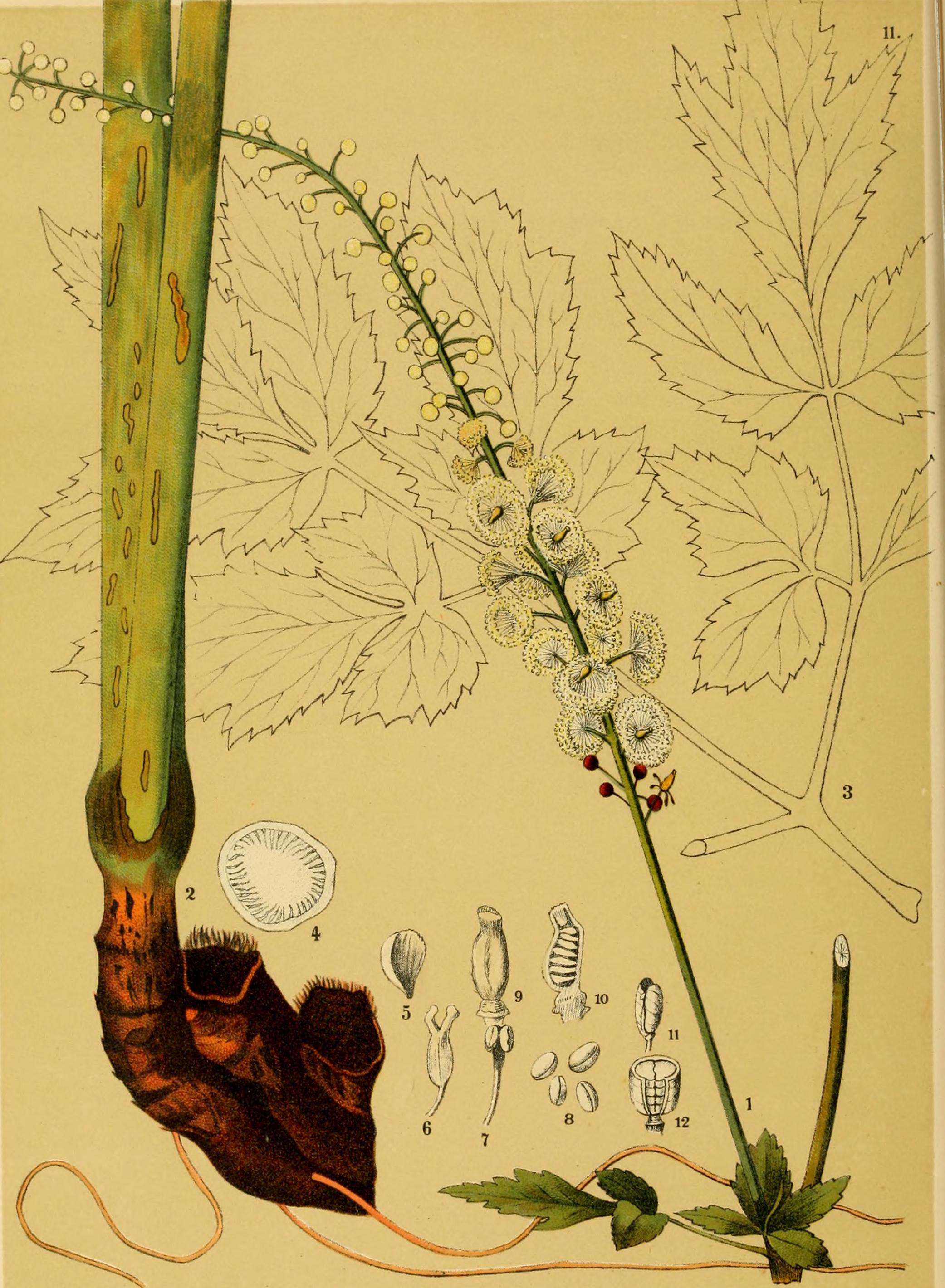
N. ORD.-RANUNCULACE^. 11 Tribe.-CIMICIFUGE/E. GENUS.-CIMICIFUGA,* LINN. SEX. SVST.— POLYANDRIA MONOGVNIA. CIMICIFUGA. BLACK COHOSH. SYN.— CIMICIFUGA RACEMOSA, ELL.; C. SBRPENTARIA, PURSH.; ACT^A RACEMOSA, LINN.; A. ORTHOSTACHYA, AND GYROSTACHYA, WEND.; A. MONOGYNIA, "WALT.; MACROTRYS ACT^OIDES, RAF.; M. SERPENTARIA, AND RACEMOSA, EATON; BOTROPHIS SERPENTARIA, RAF.; B. ACT^OIDES, FISCH AND MEY.; CHRYSTOPHORlANA CANADENSE RACEMOSA, PLUCK. COM. NAMES.— BLACK COHOSH, BLACK SNAKE-ROOT.t RICH WEED.J SQUAW-ROOT,? RATTLE-WEED, RATTLE-ROOT, RATTLESNAKE ROOT,!| BUGBANB; (FR.) ACTEE A GRAPPE; (GER.) SWARZE COHOSCH, TRAUBENFORMIGES CHRISTOPHSKRAUT. A TINCTURE OF THE FRESH ROOT OF CIMICIFUGA RACEMOSA, LINN. Description. — This tall, graceful, and showy perennial grows to a height ot from 3 to 8 feet. Rootstock thick, blackish, successively knotted and fringe-ringed, whitish-yellow internally, with a ring of cuneiform wood-bundles pointing inward; rootlets long, simple, and uniform, a section under a lens shows the cuneiformbundles arranged like a cross. Stem smooth, angular, or turrowed. Leaves alternate, tri-ternately divided, the lowermost almost radical, very large and ample, the - petiole at its base almost as large as the stem; leaflets various on the same petiole, simple, bifid, and trifid, all ovate-oblong, cut serrate. Inflorescence of very long, simple, or compound, virgate, inclined, upper-axillary or terminal racemes; flowers scattered, foetid, creamy-white. Sepals 4-5, petal-like, scaphoid, early deciduous. Petals [Staviinodia) 1-8, very small, long clawed, and 2-horned or forked; apices antherose. Stavicns numerous; filaments slender, club-shaped, creamy-white; anthers innate, introrse, yellow. Pistil solitary, simple; ovary ovoid, sessile; style short; stigma simple, inclined to be lateral, the centre somewhat cylindrically depressed. Frnit numerous, dry, ovoid or globose, dehiscent carpels, arranged upon a raceme from i to 3 feet in length, and retaining each its stigma in the form of an oblique beak; seeds semi-discoid, smooth, horizontal, and compressed. History and Habitat. — This indigenous plant is comparatively common all * Cimex^ a hw^^fitgo^ I drive away. A Siljerian species being used as a vermifuge. f The black snake-root is Safiititla Canadensis (Umbellifera?). If written blaclt-snake root the name miglit be applied, but does not apply. J Two other plants are known by this name, viz.: Collittsonia Canadensis (Labiata:), and Pilea putiiila (Urticacere). \ The true squaw root is Conopholis (Orobanche) Americana (Orobanchacese). II This name properly belongs to many species of Nabalus (Composite).
il-2 over the eastern half of the United States and in Canada, growing in rich, open woods, and along the edges of fields, but especially noticeable on newly cleared hill-sides. When woods in its favorite localities are at all dense, the plant will be found only in the borders. Black cohosh was a favorite remedy among all tribes of the aborigines, being largely used by them in rheumatism, disorders of menstruation, and slow parturition. It was also used as a remedy against the bites of venomous snakes, with what success history does not relate, but we can easily judge. The plant was first made known by Pluckenet in 1696; Colden recommended its use in 174J, and Dr. S. Garden in 1823. In England its use began in i860.* Its uses at this time were confined to chorea, rheumatism, dropsy, hysteria, and affections of the lungs. In regard to chorea. Dr. G. B. Wood statesf that he administered the drug in a case, which rapidly recovered under its use after the failure of purgatives and metallic tonics. In convulsions occurring periodically, connected with uterine disorder. Dr. Wood also derived the happiest effects from its use. In inflammatory rheumatism Dr. N. F. Johnson used the remedy with "the best results, the disease disappearing in from 2 to 10 days"; he says, "the more acute the disease the more prompt and decided will be the action of the drug."J Dr. A. Clapp§ used the drug in " chronic facial erysipelas, with satisfactory results." Dr. Williams says:|| "Indians and quacks recommend its use in rheumatism," etc.; he then recommends it himself! The statement of Dr. Wheeler^ that some eminent physicians thought it to be a good substitute for Secale cornutum in parturition, relaxing the parts and thereby rendering labor short and easy, is one that should have received much attention. In all the above uses except mayhap those concerning the lungs, we have proven its application trustworthy. Its usefulness in phthisis when given in proper dosage is simply to palliate the cough through its action upon the nerve centres. It will be found in most cases to act with far more constant success in females than in males, as its action upon the female economy is marked and distinctive. The officinal preparations in the U. S. Ph. are: Extractinn Cimicifuga; Fhiidum, and Tinctiwa Chnicifugce. In the Eclectic Materia Medica: Decoctuin CiviicifugcB; Extracluni Cimidfuges Alcoholicwn and Fluidum; Resina Cimicificgce; Ttnctura Chnicif7ig(s; Tinchira Cimicijiigcs Coinposita /** Tinctura Colcliici Coniposita,-\^ and Enema Civiicifuga Coniposila.XX PART USED AND PREPARATION. — The fresh root should be treated as in the preceding species. The resulting tincture is almost opaque; in thin layers it has a deep olive-green color by transmitted light; it retains the peculiar odor of the root; its taste is at first peculiar, soon becoming very acrid and bitter, and its reaction acid. CHEMICAL CONSTITUENTS. — Cimicifugin or Macrotin, the so-called resinoid. * Fluck. & Han., Pliarmacographia, p. i6. f Dunglison's New Jiem., p. 145. X Clapp, Cat., Am. Med. Ass'n, 1852, p. 725. \ Op. et loc. cit. II Kept. Indiir. Med Bot. Mass., Am. Med. Ass'n, 1S49, p. 914. ^f Bost. Med. and Surg. Jottr., Sept., 1839, p. 65 ** Cimicifuga, Sanguinaria, ami Phyti)lacca. ff Colchicum and Ciniicifuga. W Cimicifuga and Geranium maculatum.
11-3 is not strictly speaking a chemical derivative, being simply a precipitate of whatever principles in the root are not soluble in water. An alkaloid has, however, been determined by T. E. Conard,* and corroborated by M. S. Falck.-j- to which the above name might be, but has not been, applied. This alkaloid is a neutral crystalline body, having an intensely acrid taste, and is soluble in alcohol, chloroform, and ether, slightly also in water. It has been determined also in the " resinoid." A resin soluble in alcohol and ether, another soluble in alcohol only; fatty and waxy matters, volatile oil having the odor of the root, green and brown coloring matters, gum, uncrystallizable sugar, tannic acid, extractive, and other plant constituents have also been determined.^ PHYSIOLOGICAL ACTION. — Cimicifuga acts as a severe irritant to the nerve centres in general, and causes through its action upon the vaso-motor sj'stem cerebral, cerebro-spinal and pelvic congestion, followed by inflammatory action, especially upon the nerves themselves. The chorea-like spasmodic action following the exhibition of the drug is of two types, one having apparently a rheumatic basis, the other uterine; the latter is most common, as the choreas curable by this drug will be found aggravated or originating at the age of puberty or during menstruation. It causes rheumatic pains resembling those of torticollis, lumbago, and especially pleurodynia, sympathetic angina pectoris, and rheumatoid gout. The drug seems also to cause irritation of the uterus directly, especially when this irritation is rheumatoid in its character, and in consequence the individual under the effects of the drug will present symptoms of epileptiform or hysterical spasms, restlessness and jactitation of muscles, dysmenorrhoea or amenorrhoea, cephalalgia, infra-mammary pain, etc., as the case may be. In pregnancy it often causes abortion, and in labor will stimulate the uterus and cause rapid, painless expansion of the parts. According to Dr. Chapman it produces free nausea, with abundant expectoration, followed by nervous trembling, vertigo, and remarkable slowness of the pulse. Description ok Plate ii. 1. Part of the summit of a plant showing one of the smaller racemes, Binghamton, N.Y., July 19th, 1884. 2. Lower portion of stem, with a part of the root showing the remains of the growth of the two previous seasons. 3. Portion of one of the smaller leaves. 4. Section of the root. 5. \ sepal (somewhat enlarged). 6. A staminodium (enlarged). 7. Stamen (enlarged). 8. Pollen X 300. 9. Pistil (enlarged). 10. Section of pistil (enlarged). 11. Fruit. 12. Section of capsule showing seeds. *.-7w. j^oiir. Pilar., 1871, p. 151. t Period, tit., 1884. p. 459. X Tilghman, Jour. Phil. Coll. Phar., 1834, p. 20; J. S. Jones, Am. Jour. Pilar., 1843, p. I; G. H. Davis, period, cit., 1861, p. 391; E. C. Jones, Proi. Am. Phar. Ass'ii, 1S65, p. 186; T. E. Conard, arl. cit. sup.: M. S. Falck. vrt. cit. sup.
12. ^m.ad W2 natdel.etpinxt. ^ Magnolia GLAucA,Linn..iv^rttv J
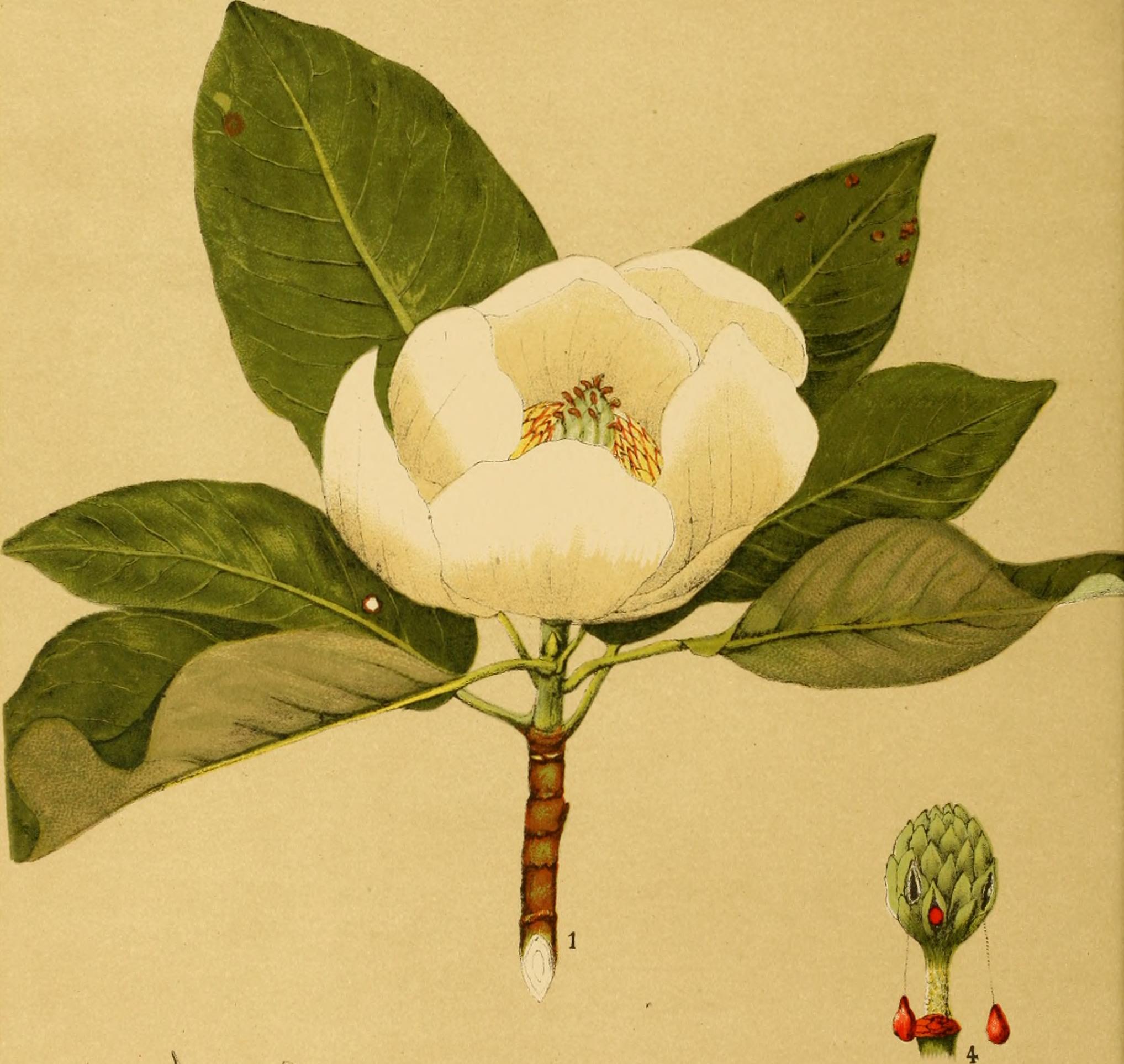
N. ORD. MAGNOLIACE^. i2 GENUS.— M A G N O L I A,* LINN. SEX. SYST.— POLYANDRIA POLVGYNIA. MAGNOLIA GLAUCA SWEET BAY. SYN.— MAGNOLIA GLAUCA, LINN; M. VIBGINICA, a GLAUCA, LINN.; M. PRAGRANS, SALISB.; M. LONQIPOLIA, S"WBET. COM. NAMES. — SMALL, LAUREL, OR SWEET MAGNOLIA; SWEET, OR WHITE BAY; CASTOR, OR BEAVER WOOD; ELK OR INDIAN BARK; SWAMP SASSAFRAS, OR LAUREL; BEAVER TREE, BREWSTER; (PR.) LE MAGNOLIER GLAUQUE; (GER.) MAGNOLIE. A TINCTURE OF THE FRESH FLOWERS OF MAGNOLIA GLAUCA, LINN. Description. — This beautiful swamp shrub usually grows to a height of from 4 to 20 feet.f Bark smooth, whitish. Btids conical, silky; leaves all scattered, oblong, oval, or ovate-lanceolate, obtuse, thickish, shining green above and bluishwhite beneath, evergreen southward, deciduous northward. Inflorescence solitary and terminal; floiuers globular, white, very fragrant. Sepals 3, oblong, scaphoid. Petals 6 to 9, erect, broadly ovate, and narrowed at the base. Stamens numerous, imbricated; filaments short; anthers long, adnate, introrse. Pistils coherent in a mass aggregated upon the elongated torus. Fruit oblong, conical, small, and rather ligneous; carpels many, dehiscing by a longitudinal dorsal suture; seeds I to 2 in each carpel, baccate, vermilion, hanging from the bursted carpels by an extenuate thread composed of spiral vessels; endocai'p bony. Magnoliacese. — This small but magnificent family of trees and shrubs, represented in North America by 4 genera and 1 1 species, is characterized by having: the buds covered by membranous stipules; leaves alternate, coriaceous, pinnately veined, entire, and punctate with minute pellucid dots. Flowers single, large, polypetalous, the calyx and corolla colored alike, in aestivation generally imbricate in 3 or more rows of 3, all deciduous. Stamens numerous, hypogynous; filaments short; anthers long, adnate, introrse. Pistils many, coherent, generally closely packed together over the prolonged receptacle; styles short or none; stigmas simple. Fruit a fleshy, or dry cone, composed of many coherent carpels. Seeds I to 2 in each carpel, anatropous; albumen fleshy; embryo minute, basal. * In honor of Professor Magnol, a botanist of the 17th century, at Montpellier. f Mr. Britton observed, in Manahawken Swamp, Ocean Co., N. J.,an individual with a diameter of trunk of 32.25 inches, whose rings sliowed a growth of 150 years.
^2-2 The only other proven drug of this order is the Asiatic Star-anise {Illicunn anisatum, Linn.), an aromatic and carminative, often substituted in general practice for the true Aniseed, the fruit of an umbelliferous plant. The South American Winter's Bark, from Wintera aroniatica, Murr., is used in Brazil as an aromatic tonic, especially though in colic. The North American Illicimn fioridamuii, Ellis, is reputed to have an action similar to that of aromatic tonics in general; and the Tulip Tree {Liriodendron Ttilipifera, Linn.) yields a bark that is at once bitter and aromatic, much valued as a stimulating tonic and diaphoretic in intermittents and chronic rheumatism; it should be proven. The Javanese Aroviadciidron clcgans has a native reputation as a carminative, stomachic, and antihysteric; and the wood of Manglietia glaiica is supposed to be antiputrefactive, therefore it is used by the inhabitants of the island for the manufacture of coffins. Several other genera furnish aromatic and bitter tonic barks, many of which are used by the natives of the countries in which they grow. History and Habitat. — The Sweet Magnolia is indigenous to North America, from Cape Ann and Long Island southward. At first it keeps to the seaboard, but gradually extends inland the farther south it is found. It grows in swamps, and expands its fragrant flowers from May (southward) to June and August. The use of the fresh bark, cones, and seeds of this species, together with those of M. grandiflora, acuminata, tripetala, and macrophylla, has descended to the laity and general practitioner from the Aborigines, who employed a warm decoction of the bark and cones extensively against rheumatism, and a cold infusion as an antiperiodic. The fresh bark has long been considered as a bitter, aromatic tonic, febrifuge, diaphoretic, antiperiodic and gentle laxative, in acute coryzas, bronchial catarrhs, chronic rheumatism, dyspepsia, remittent and intermittent fevers and typhoid states, being deemed contraindicated, however, if inflammation be present. The odor of the cut flowers, especially at night in a close room, is very penetrating, unpleasant, and to some insupportable, causing, in susceptible persons, a great oppression of the chest and vertigo. Dr. Wm. Barton " imputed to the odor the power of increasing the pain of inflammatory gout, and occasioning an exacerbation of a diurnal fever."* It is thoroughly believed in the South that a growth of magnolias in stagnant waters renders them pure and prevents the generation of malarial poisons. The bark is still officinal in the U. S. Ph. PART USED AND PREPARATION.— The fresh flowers are chopped and pounded to a pulp and weighed. Then two parts by weight of alcohol are taken, the pulp thoroughly mixed with one-sixth part of it, and the rest of the alcohol added. After stirring the whole well, it is poured into a well-stoppered vial and allowed to stand eight days in a dark, cool place. The tincture thus prepared should, after filtration, have a deep brownish-red color by transmitted light, a perfume much like the wilted flowers, an acrid and bitter taste, and an acid reaction. * W. p. C. Barton, Med. Bot. loc. cit.
d2-3 CHEMICAL CONSTITUENTS.— The flowers have not been examined; they probably, however, contain a volatile oil at least. The bark of M. gra7idijlora was examined by Dr. Procter,* who found a volatile oil. resin, and a crystalline principle resembling lii-iodcndrinc. Magnolin. — This bitter principle was extracted from the fruit of M. umbrella by Wallace Procter, 1872, as acicular crystals, having a bitter taste. They are insoluble in water, soluble in alcohol and chloroform, melt at 8o°-82° (176°179.6° F.), and emit white vapors at 125° (257° F.), which condense in oily drops, consisting partly of the original principle and of resin. (Wittstein.) PHYSIOLOGICAL ACTION.— The effects of the odor of the flowers, as reported by Drs. Barton. S. A. Jones,f and T. F. Allen, J are: Great uneasiness and oppression of the chest, with an inability to expand the lungs, a feeling as if having swallowed a large bolus of unmasticated food which distressed the stomach, and a tendency to fainting. Showing thus a dilation of the vascular system so commonly following the insufflation of strongly odorous flowers in susceptible persons. Magnolia certainly deserves a careful proving of the fresh bark and flowers; the floicers alone can hardly add to our medicamentse while we have Cactus grandiflorus. Description of Plate 12. I. End of a flowering branch, Landisville, N. J., July 3d, 1885. 2. Stamen. 3. Section of a carpel. 4. Fruit. (2 and 3 enlarged.) * Am. Jour. Phar., 1842, p. 89. f Am. Horn. Obs., June, 1875. J Ehcvc. Pure Mat. Med., vi., 142.
15. ^m. sd naldei.etpinxt. AsiiviiNA Triloba, Dunai.
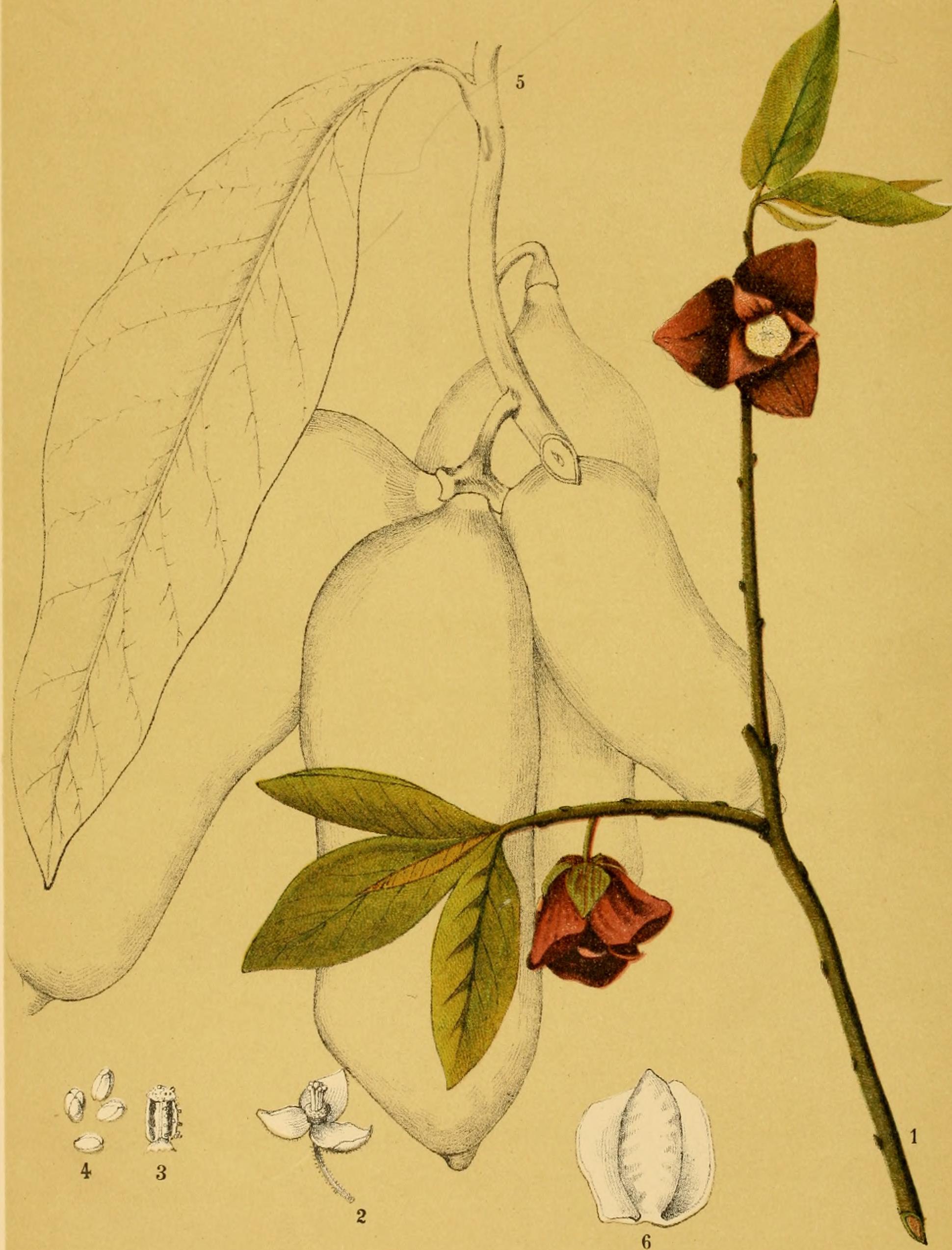
N. ORD -ANONACE^. 13 GENUS.— AS I M I N A,* ADANS. SEX. SYST.— POLYANDRIA POLYGYNIA. ASIMINA TRILOBA. PA WPA W\ SYN.-ASIMINA TRILOBA, DUNAL.; ASIMINA CAMPANIPLORA, SPACH.; ANNONA TRILOBA, LINN.; ORCHIDOCARPUM ARIBTINUM, MICHX.; PORCELIA TRILOBA, PERS.; UVARIA TRILOBA, TORR. AND GRAY. COM. NAMES.— PAWPAW, PAPAW,+ AMERICAN CUSTARD-APPLE; (PR.) ASIMINIER; (GER.) DREILAPPIGB ASIMINB. A TINCTURE OF THE RIPE SEEDS OF ASIMINA TRILOBA, DUNAL. Description. — This curious-fruited tree attains a height of from lo to 30 feet, with about the same diameter of fohage. Bark smooth, grayish. Leaves long, thin, and membraneous, entire, oblong-lanceolate, acute or acuminate, and are covered with a rusty-hairiness upon the nether surface when first expanding, but soon become entirely glabrous, hifloresccnce solitary in the axils of the previous year's leaves; jioivers dull purple, appearing with, or just before, the leaves. Sepals 3, ovate, much shorter than the petals. Petals 6, spreading, veiny, rounded-ovate, their upper third more or less recurved; they are arranged in two rows, the outer larger, all enlarging after anthesis. Stamens indefinite, arranged in a globular head, thus concealing the ovaries and styles. Pistils few, their stigmas projecting beyond the stamens than which they are longer. Fruits 1-4, developed from each flower, they are oblong, rounded, pulpy, several-seeded, and resemble in shape the shorter red bananas. Seeds oval, horizontal, flattish-compressed, and surrounded by a fleshy aril. Anonaceae. — This chiefly tropical order consists of trees or shrubs having naked buds and aromatic or fetid bark. Leaves alternate, entire, pinnate-veined, and usually punctate; stipules wanting. ^^.f/'/ew//<?« valvular; y?i9Z£'^;-.5' large, dull colored. Sepals 3, often connected at the base. Petals 6, thick, arranged in two rows. Torus rounded, hypogynous; stamens numerous or indefinite; filaments very short, sometimes just perceptible; anthers adnate, extrorse; connectivum fleshy, somewhat quadrangular, often nectariferous. Pistils numerous, crowded, and sometimes coherent, especially in fruit; styles short or wanting; stigmas simple, capitellate. Fruit fleshy or pulpy; seeds anatropous, one or more in each ovary; testa brittle; embryo basal, minute; albumen hard, ruminated. * Asiminier, the name applied by the French Colonists. f This name more properly applies to the West Indian Carica Papaya (Papayacea?).
13-2 The plants of this family are not generally considered medicinal, but Blume states that many species of the genera Uvaria, Unona, and Zylopia are employed in Java, but require caution, as they often cause vertigo, hemorrhage, and sometimes abortion in pregnant states.* The South American Fnitta dc Barro [Xy/opia longifolia) is termed by Humboldt a valuable fruit, for use as a febrifuge, along the river Orinoco. Fiper yEthiopicum is the seed of HabzeliaAithiopica; another species of the same genus (//. aromatica) being used by the natives of Guiana as a spice. The Jamaica nutmeg [Monodora myristica) is said to be similar to, but not so pungent as, the nutmeg of commerce [Myristica moschatd). Jamaica bitterwood [Xylopia glabra) is considered tonic and stimulant.f To the arts this order furnishes Jamaica Lancewood {Gttatteria virgata), useful on account of its lightness and elasticity, in the manufacture of coaches, fishing-rods, and bows. Succulent fruits are yielded by Anncna Cherimolia (Cherimoyer), and Anona squamosa (Custard-apple). History and Habitat. — The common pawpaw is indigenous to the central belt of the United States from Western New York to the Mississippi and southward. It locates along streams where the soil is rich and frosts late. This small tree is a native, especially of the Ohio valley, where it flowers from March to May, according to the season. It is grown in a protected place in Central Park, New York City, but is not hardy north of Cincinnati. The fruit, when ripe, is soft, sweet, and insipid, having a taste somev.'hat between that of the May-apple and the banana, tending to the former. It was greatly prized by the aborigines, — who eagerly sought anything edible in the vegetable world — and now is occasionally exposed for sale in city markets. When green they have a very unpleasant odor, and are only fit to eat after having been touched by frost, when they turn from yellowish-green to black, and become internally of the color and consistence of custard. J It is claimed that they improve gready in size, taste, and succulency upon cultivation. Three other species: A. grandiflora, A. pannflo^^a, and A. pygmcea complete the genus north of Mexico. The former uses of this plant in medicine are of little or no importance. A tincture of the seed proves emetic; the bark being bitter has been considered tonic and stimulant. The chemical properties and physiological action have never been — to my knowledge — determined. PART USED AND PREPARATION. — The coarsely powdered, fresh, ripe seeds are covered with five parts by weight of alcohol, and allowed to remain eight days in a well-stoppered bottle in a dark, cool place. The tincture thus prepared is filtered off. It has a clear, pale, canary color by transmitted light; an astringent straw-like taste; an odor somewhat like that of the red raspberry, and a slight acidity. All that is known of the medicinal power of this drug is a proving by Dr. * Lindley, Flor. Med., p. 29. f Idem, pp. 27-8. J Whence the name " American Custard-apple,"
i3-3 Eisenboeg.* A preparation from the seeds, bark, and green fruit might prove of more utiHty, and possess greater power of action. Description of Plate 13. I. End of a flowering branch (Sveral blossoms missing) from North Bend, Ohio, May 15th, 1884. 2. Calyx and torus, after removal of the stamens. 3. A stamen (enlarged). 4. Pollen X 250. 5. Fruit and full-grown leaf. 6. Seed and opened aril. Drawn from living specimens received from Ohio through the kindness of Mr. R. H. Warder, son of the late Dr. John A. Warder, President of the American Forestry Association, 1881. * Allen, Ency. Pure Mat. Med., Vol. i, p. 498-9.
^1 1^ -ad naf. del. efpinxt. MENISPfRMUM CANADtNSE.lin,
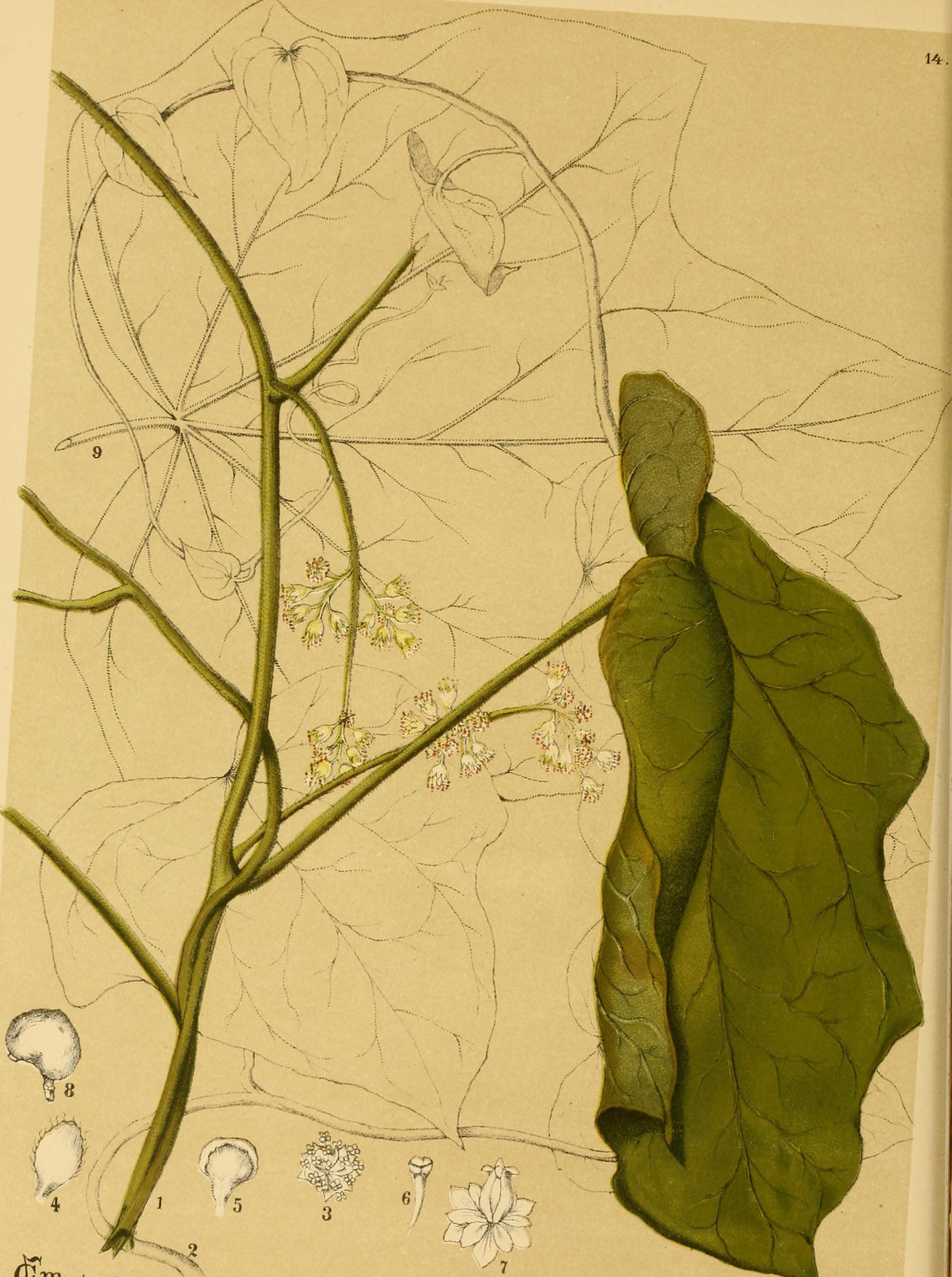
N. ORD-MENISPERMACE^. 14 GENUS.— MEN IS PER MUM,* LINN. SEX. SY.ST.— DKECIA POLYANDRIA. MENISPERMUM YELLOW PARI L LA. SYN.— MENISPERMUM CANADENSE, LINN.; M. ANGULATUM, MCBN.; M. SMILACINUM, D. C.; CISSAMPELOS SMILACINA, LINN. COM. NAMES.— YELLO'W PARILLA, CANADIAN MOONSEED, TEXAS OR YELLOW SARSAPARILLA, MAPLE VINE. A 'JUNCTURE OF THE FRESH ROOT OF MENISPERMUM CANADENSE, L. Description. — This perennial climber reaches a length of from 8 to 15 feet. Root cylindrical, long, yellow; stem slender. Leaves ample, peltate, with the insertion of the petiole near the base, 3 to 7 lobed or angled; lobes obtuse or more or less acute; venation palmate, the veins pubescent below; petioles about the length of the leaves. Inflorescence in long, supra-axillary compound racemes or panicles. Sepals 4 to 8, obovate-oblong, arranged in a double series. Petals 6 to 8, small, somewhat cuneate, fleshy, with a thickened free margin. Stamens i 2 to 20 (in the sterile flowers), as long as the petals; filaments hardly thickened at the summit; anthers innate, 4-celled. Pistils 2 to 4 (in the fertile flowers), raised upon a short, common torus, usually perfecting but two drupes; stigmas flattened. Frnit a globose-reniform, black, and stipitate drupe, furnished with a bloom, and retaining the mark of the stigma; nutlet more or less lunate, wrinkled and grooved, laterally flattened; embryo slender,.horseshoe-shaped; cotyledons filiform. Menispermaceae. — This goodly-sized family of tropical or sub-tropical, woody climbers, is represented in North America by but 3 genera and 6 species. Leaves alternate, palmate or peltate; stipules none. Inflorescence in axillary racemes or panicles; flozocrs small, monoecious, dioecious or polygamous; (estivation imbricate. Sepals arranged in two or more rows, deciduous. Petals usually equal in number to the sepals, hypogynous. Stamens monadelphous or separate, equal in number to the petals and opposite them, or from 2 to 4 times as many, adnate or innate, composed of 4 horizontal ovoid lobes arranged tip to base, and opening longitudinally (apparendy horizontal. See Fig. 6). Pistils 3 to 6; ovaries several, united or separate, nearly straight; stigmas apical but looking downward in fruit on account of the incurving of the ripening ovaries. Fruit a i -celled drupe; seeds i in each cell; embryo large, long and curved, surrounded by the albumen; albumen scanty. Our only proven plant of this order, beside Menispermum, is the Indian Cocculus Indicus [Anamirta paniculata. Cole), a narcotico-poison, used by the * Miii'^, mene, muon; ciripfia^ speriiia, seed; the seed Iieing lunate in shape.
14-2 natives to stupefy fish, and supposedly in this country and Europe to give bitterness to malt liquors. Many other species are used in medicine, of vi^hich the following hold a more or less permanent place; The Brazilian Pareira brava, the roots of Chonodrodendron tomcntosum, R. et P., a tonic and diuretic, considered almost specific in its action upon the mucous membranes of the genito-urinary tract; the Indian Gulancha {Tinospora cordi/olia, Miers.), a valuable tonic, antiperiodic and diuretic; the African Columbo [Jateorhiza Coliiiuba, Miers.), a bitter stomachic and mild tonic, often used with good effect in vomiting of pregnancy and atonic dyspepsia; the West-Indian False Pareira brava {Cissampelos Fareira, Linn.), more often used than the true article for the purposes mentioned. The root of the Crayor and Senegal Cocculus Bakis, Guill., is used by the natives in the treatment of their intermittents and m urethral discharges; the root of the Cochin-China C. fibraurea, 1 ). C, is used like the former, and also in various liver aftections; C. cincrascens and A. platyphyllus, St. Hil., command the same attention by the Brazilians; while the Javanese use C. crispus, D. C, which is powerfully bitter, in like troubles. Cocciilns acumiiiaius, D. C, is considered alexiteric in Brazil. The Malabar and Ceylon Clypea Bnrnianrii, W. and A., is employed, according to Lindley, in intermittents and hepatic disturbances, as well as a remedy against dysentery and hemorrhoids. Cissampelos ovalifolia, D. C, in Brazil, and Abuta nifcsceiis, Aubl., in Guayana are used, like most of the members of this order, as a remedy in intermittents and obstruction of the liver. History and Habitat. — The Canadian Moonseed is indigenous to North America, where it is quite common on the banks of streams from Canada southward to the Carolinas and westward to the Mississippi. Our first knowledge of this plant as a remedy was undoubtedly handed down from the Aborigines, who are said by Rafinesque to have used the root in scrofulo-.is; the early settlers also found it useful as a diuretic in strangury in horses. Its employment generally by early practitioners has been very similar to that of Sarsaparilla, /. c, in mercurial, syphilitic, scrofulous and rheumatic diatheses; also as a laxative and tonic in general debility, atonic dyspepsia and kindred disorders; and as a remedy in pleural adhesions and inflammation of the alimentative mucous membranes. Menispermum was admitted to the U. S. Ph. at the last revision, the rhizome and roodets being now officinal. In the Eclectic Materia Medica its preparations are: Decoctum Mejuspertm, Me7iispein)iui, and as a component of Synipits Riunecis Composiitcs* PART USED AND PREPARATION.— The fresh root is chopped and pounded to a pulp and weighed. Then two parts by weight of alcohol are taken, the pulp thoroughly mi.xed with one si.xth part of it and the rest of the alcohol added. Alter stirring the whole well, pour it into a wcdl-stoppered botde and let it stand eight days in a dark, cool place. * Vellowdock root; False-bittersweet, root bark; American ivy bark; Figwoit; and Moonseed root.
14-3 The tincture, separated from this mass by filtration, is opaque; in thin layers it has a deep madder-lake color by transmitted light; a bitterish odor; an acid, bitter and astringent taste; and acid reaction. CHEMICAL CONSTITUENTS.— Berberina. Prof. J. M. Maisch, who first investigated this root,'^' found a small quantity of this alkaloid, the nature of which is detailed in the next drug, page 15-2. He also found a second alkaloid, which was afterward named Menispermine.t — A white, amorphous, tasteless alkaloid, insoluble in water, slightly soluble in alcohol, ether and chloroform. Menispine.t — This second specific alkaloid, determined by Barber in his analysis, differs in solubility and tests from both oxycantliim\ and meiiispcrinine. It resulted as a whitish, amorphous, very bitter powder, slighdy soluble in water, ether and chloroform, and very soluble in absolute alcohol. Tincture of iodine o-ives a dark-red precipitate with this body, and with menisperminc, a yellow precipitate. Menispermo-tannic Acid.|| — This specific tannin gives a dark-green color with ferric chloride. Two yellowish resins, one soluble in ether, and the general constituents of plants, were also determined. PHYSIOLOGICAL ACTION. — Prof E. M. Hale's experiments with from 35 drops upward of a tincture of the root, and various doses of the "resinoid" meiiispermine, resulted as follows: Temporal and occipital headache, with stretching and yawning, and fullness of the head; swollen tongue; salivation; dryness of the buccal mucous membranes and of the throat; nausea; thirst; colic; rectal tenesmus; scanty, high-colored urine; aching of the extremities; itching of the skin; restlessness and troubled sleep. Excessive doses cause an increase in the rate and volume of the pulse,.and excessive vomiting and purging. The action of the drug is that of an irritant to the nerves governing the alimentary tract, resulting in increased secretions from the mucous membranes. Description of Plate 14. I. Part of male flowering stem, Ithaca, N. Y., June 24th, 1S85. 2. End of stem. J. Staminate flower. 4. Sepal. 5. Petal. 6. Stamen. 7. Female flower. 8. Carpel. 9. Outline of a leaf. (3-8 enlarged.) * Am. Jour. P/iar., 1S63, 303. t H. L. Barber, Am. Jour. Pkar., 1884, 401. X Name proposed by Prof. Maisch, Ibid. \ See page 15-2. || Barber, Ibid.
.TU.adnatdel.etpinxh B^RBERis Vulgaris, Linn.
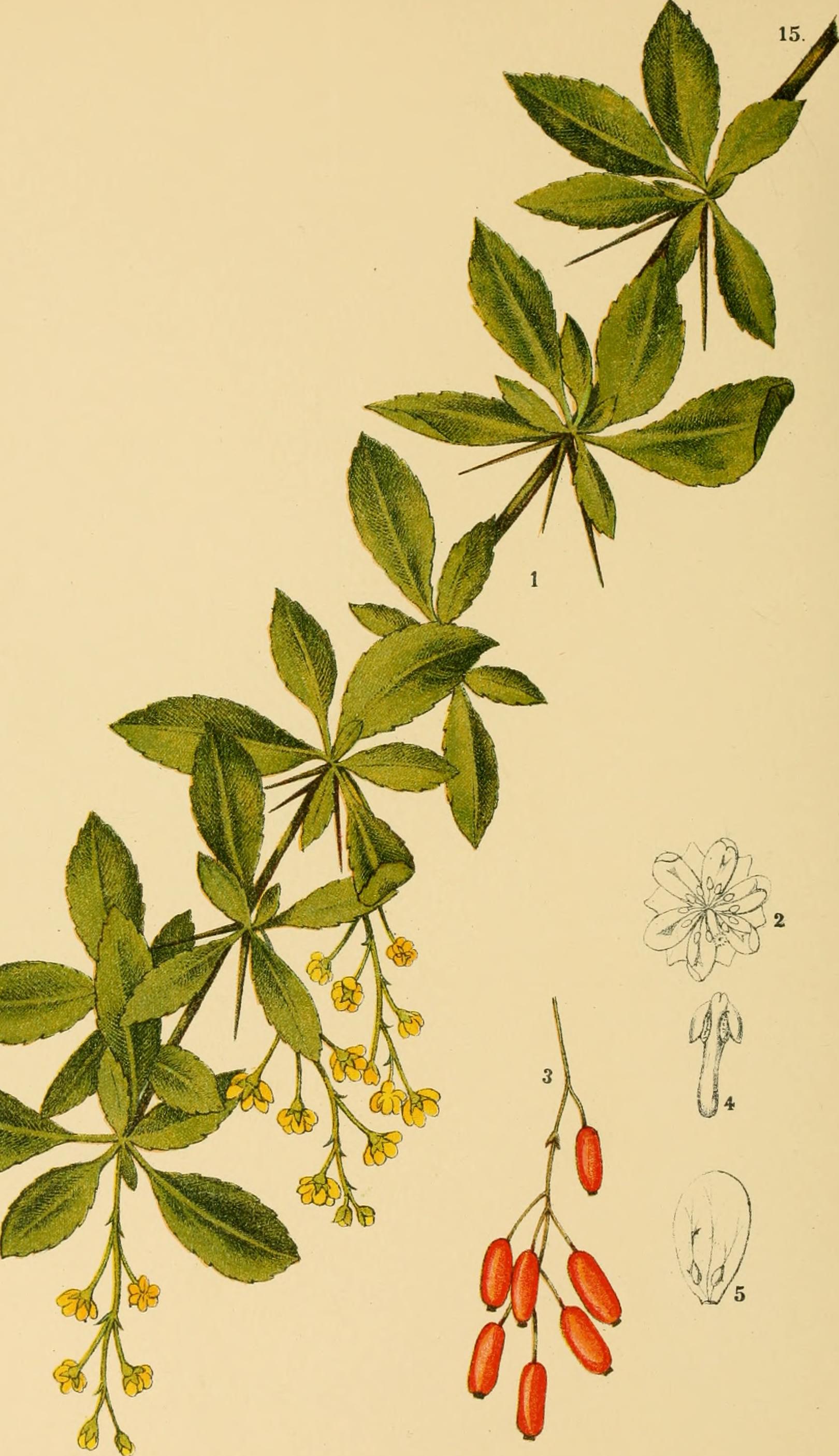
N. ORD.-BERBERIDACE^. 45 GENUS.— BERBER! S,* LINN. SEX. SVST.— HEXANDRI.\ MONOGYNIA. B E R B E R I S. BARBERR Y. SYN.— BEREERIS VULGARIS, LINN.; BERBERIS VULGARIS, VAR. CANADENSIS, TORR., SPINA ACIDA; BERBERIS DUMETORUM, RAIL COM. NAMES.— COMMON BARBERRY, BERBERRY; (FR.) EPINE-VINETTE; (GER.) SAURDORN. A TINCTURE OF THE FRESH ROOT BARK OF BERBERIS VULGARIS, LINN. Description. — This attractive bushy shrub grows to a lieight of from 3 to 8 feet; the stem-wood, inner-bark and pith are yellow. Leaves inversely egg-shaped, short-petioled, closely serrate, and bristly-toothed. Occurring either singly or in a dense fascicle above the spines, they are of a cold-green color and very acid; spines triple, branched or sometimes simple, minutely maculate and surrounded by the rosette of leaves, hiflorcscence long, drooping, many-flowered racemes, of pale yellow flowers. Bracilets 2 to 6, situate about the base of the calyx. Sepals 6, deciduous, rounded, the outer three smaller. Petals 6, entire, obovate, concave, with two minute, oblong, deeper-colored glandular spots at the base, inside and above the short claw. Stamens 6, their filaments ligulate, blunt, opposite the petals, but shorter and attached to their bases; anthers adnate. Pistil about the length of the stamens; ovary more or less inflated-cylindrical; style rarely present, very short; stigma short, flattened, sessile or nearly so. Fruit ■& one- to nine-seeded, oblong, scarlet, sour berry, evenly depressed in the median diameter; seeels erect on a short stalk rising from the base of the cell, oblong, with a crust-like integument. Berberidaceae.— Shrubs or herbs with alternate leaves and perfect flowers. Sepals 3 to 9, deciduous, often colored and furnished with a calyculus of petal-like scales, all together with the petals imbricate in two or more rows in sestivation (Jeffersonia with a single row), /'c/^'/j- as many as the sepals.,S'/rtw^;/.s' hypogynous, equal in number to the petals and opposite them (Podophyllum twice as many); filaments short; antJier dextrorse, opening (except Podophyllum) by two valves or hinged lids at the top. Pistil only one, ovary simple, solitary; style short or wanting;.s'/'/V;;/^ flattened. Frziit a capsule or berry with either a few seeds at the top or bottom of the cell, or many, situated along the whole extent of the ventral ridge; all anatropous, and furnished with albumen; embryo small (Berberis excepted). * From Amyrberis, Arcibic for the fruit.
15-2 History and Habitat.— Berberis was well known to the ancients as a medicine, a dietetic for the sick, and a dye. As a drug it was steeped in beer and given to patients suffering from jaundice, as well as to check hemorrhages; as a food preparation for the sick, the berries were made into a confection, and used as a refrigerant in fevers and burning gastric ailments; those not sick used the bruised leaves in a manner similar to sorrel as a sauce for meats; as a dye, the roots were steeped with strong ash-lye, and used to give the hair a yellow color. The same preparation is now sometimes used to dye wool, while by using alum, in place of the ash-lye, it makes a good as well as a beautiful dye for linen fabrics. A jelly made of the berries is still used in lieu of tamarinds as a pleasant refrigerant, as so also is a confection. Its popular use as a remedy — barberry bark and cider — was held in all forms of abdominal inflammation, but especially those accompanied with hepatic derangement and jaundice. Berberis vulgaris is indigenous to Great Britain and other parts of Europe, and is becoming quite thoroughly naturalized here, especially in the Eastern States, blossoming from May to June. It is cultivated in many parts of the country as an ornamental bush, on account of its beautiful berries. Our own species, B. Canadensis, Pursh., is a shrub about tlirce feet hi<^/i, with less bristly teeth to the leaves, a few-tlowered raceme, petals notched at the apex, and oz'al berries. In Berberis proper, upon the summer shoots may be seen a perfect instance of gradation, in all forms, from the leaf as described above, to a fully-developed spine, a fine instance of vegetable morphology. The leaves of the barberry are at times, especially in Europe, infested with a peculiar blight; Aecidium Berberidis (Microspheria Berberidis; Lysiphe Berberides) a member of the coniomycetous fungi; order, uredinei. It consists in its full-grown condition of little cups filled with a reddish or brownish powder (spores), formed by a bulging upward and bursting of the epidermis of the leaf, by the parasite developed within. This blight caused much fear at one time in Europe, upon the supposition that it was communicated to grain, which however was very probably false. Berberis, like many other excellent remedies, has been dismissed this year (1S82) from the U. S. Ph. In the Eclectic Materica Medica it is still retained, though not in an officinal preparation. PART USED AND PREPARATION.— The fresh bark of the root. This is coarsely powdered and weighed. Then after adding two parts by weight of alcohol the whole is put into a well-stoppered bottle and allowed to stand eight days in a dark, cool place, shaking the contents twice a day; the tincture is then strained and filtered. Thus prepared, it has a deep orange-brown color by transmitted light; and stains the neck of the bottle yellow. It has an extremely bitter taste, and a slight acid reaction. CHEMICAL CONSTITUENTS.— Berberin, Q^ H^, NO,. This alkaloid was first discovered In 1824, in the bark of Geoffroya inermis,* two years afterward in the bark of Xanthoxylumclava Herculis,-}- in 1851 in the root of Hydrastis Canadensis, I and in 1835 '" t'^e bark of Berberis vulgaris;§ yet, it is only lately *Jamaicin. -f- Xanthropicrit. J llydrastin. | Berberin.
15-3 that its true properties were recognized. It exists in a number of other plants, among which of particular interest to us are Coptis trifoliata, Caulophyllum, and Xanthorrhiza. Berberin crystallizes in fine yellow needles of a strong and persistent bitter taste, losing water at ioo° (2i2°F.), and fusing at 120° (248°F.) to a reddish-brown resinoid, decomposing at higher heat. Berberin is soluble in water and alcohol. Oxyacanthin,* C., H^„ N, 0„ (Berbina, Vinetina). This bitter alkaloid exists together with the berberin in the root. It is a non-crystallizable, white, electric powder, but will form in needles upon the addition of ether or alcohol; it turns yellow by exposure in sunlight, has an alkaline reaction, loses 3. [3 per cent, weight upon exposure to 100° (2i2°F.), fuses at 139° (282°. 2 P.), and like berberin decomposes upon subjection to higher temperatures. It is soluble in both water and alcohol, though not freely. {^Et supra Wittstein.) The acidity of the leaves and fruit is due to the presence of oxalic acid. PHYSIOLOGICAL ACTION.— Berberis in moderate doses produces feverishness, inflammation of the mucous membranes from the throat to the intestines, and dysentery. It causes also a high degree of inflammation of the kidneys with hematuria. It seems to act with much force upon the venous system, causing pelvic engorgements and hemorrhoids. Its use in early medicine was purely symptomatic. The action as above given refers to man; upon animals no such effects appear to follow, even though experiments were made with the alkaloid Berberin. Description of Plate 15. I. End of branch in flower, with old leaves, Salem, Mass., June 4, 1S80. 2. Flower (enlarged). 3. Fruit. 4. Stamen ("enlarged). 5. Petal (enlarged, showing glands). * Cralegus oxyacatitha contains an alkaloid by this name.
16. (^Ta.adnat.del.etpinxt CaULOPHYLLUM THAUCTROIdES, Mich)
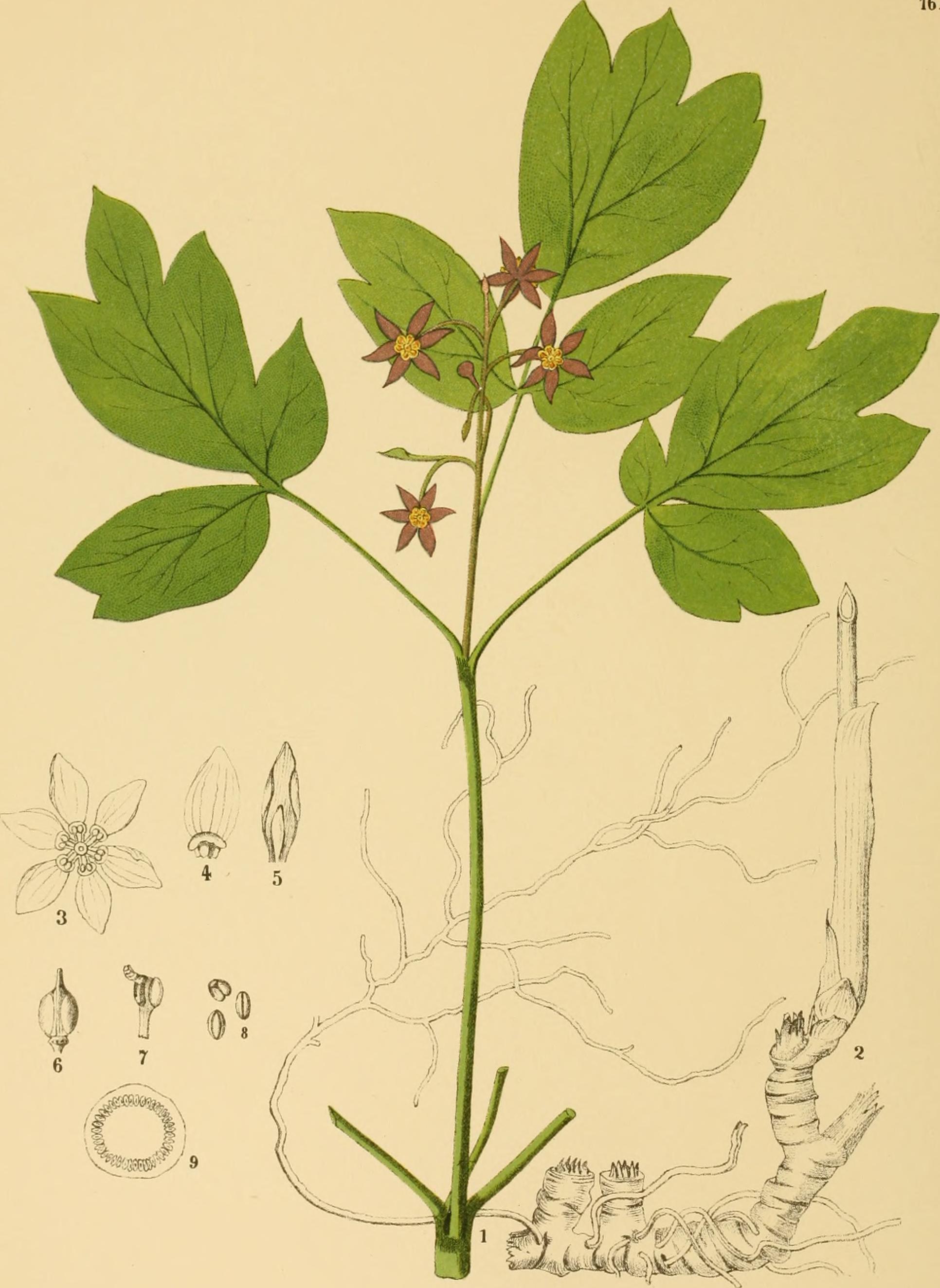
N. ORD -BERBERIDACE^. 16 GENUS.— C AULOPHYLLUM,* MICHX. SEX. SYST.— HEX.\NDRIA MONOGYNIA, CAULOPHYLLUM. BLUE COHOSH. SYN.— CAULOPHYLLUM THALICTROIDES, MICHX.; LEONTICE THALICTROIDES, LINN.; LEONTOPETALON THALICTROIDES, HILL. COM. NAMES.— BLUE COHOSH, PAPPOOSE-ROOT, SQUAW-ROOT,! BLUB BERRY,! BLUE GINSENG, YELLOW GINSENG; (FR.) COHOCHE BLEU; (GER.) BLAU COHOSCH. A TINCTURE OF THE FRESH ROOT OF CAULOPHYLLUM THALICTROIDES, MICHX. Description. — This erect, perennial herb, attains a growth of from i to 2'^ feet. Root horizontal or contorted, wrinkled and branched, showing many upright nodules, bearing at their summits the scars of previous stems, and giving off numerous cylindrical, branching" rootlets from the older portions. Stem simple, glaucous when young, smooth when old, arising from several imbricate, membraneous scales. Leaves large, triternately decompound, the upper much smaller and biternate (pi. 16, fig. i); leaflets 2 to 3 lobed, obtusely wedge-shape at the base; petioles blending with the stem in such a manner as to render their junction almost obscure. Inflorescence a loose raceme or panicle; peduncle arising from the base of the upper leaf; floivers purplish or yellowish-green. Sepals 6, oval-oblong, with 3 small bractlets at the base. Petals 6, gland-like, with a short claw and a somewhat reniform or hooded body, the whole much smaller than the sepals, at the base of which they are inserted. Stamens 6, overlaying, and about the same length as the petals; ajithers oblong, 2-celled, the cells opening by uplifting valves. Pistils gibbous; ovary resembling the anthers in form, 2-celled; style short, apical; stigma minute, unilateral. Fruit a 2-seeded pod; epicarp thin, papyraceous, bursting and withering before fertilization is complete, leaving the naked seeds to farther develop upon their erect, thick funiculi; pericarp fleshy, deep blue; albtmicn corneous; embryo minute, apical. Read description of the natural order, under Berberis, 15. History and Habitat. — The Blue Cohosh is indigenous to the United States, growing abundantly in moist, rich woods, from Canada southward to Kentucky * KnnXiif, kaulos, a stem; and '^iV^av, phyllon, a leaf, the stem resembling the petiole of a large leaf. f The true squaw-root is Conofholis Americana, Wall. (Orobanchacese). J This vulgarism properly belongs to several species of Vacciniiini (Ericaceas).
16-2 and the Carolinas. It blossoms from April to May, before the full development of the leaves. The berries are mawkish, insipid, and without special flavor. The seeds are said to resemble coffee when roasted. The aborigines found in Caulophyllum their most valuable parturient; an infusion of the root, drank as tea, for a week or two preceding confinement, rendering delivery rapid and comparatively painless. They also used the root as a remedy for rheumatism, dropsy, uterine inflammation, and colic (Raf.). These uses have been proven reliable by all methods of practice since. The root is officinal in the U. S. Ph. The preparations in the Eclectic Materia Medica are: Exlractiim Caidopliylli AlcohoUcum, Resina CmdophylU, and Tinctnra Ccmlophylli Composita^-PART USED AND PREPARATION.— The fresh root, gathered in early spring, should be chopped and pounded to a pulp and weighed. Then two parts by weight of alcohol are taken, the pulp mixed thoroughly with one-sixth part of it, and the rest of the alcohol added. After stirring the whole well, and pouring it into a well-stoppered botde, allow it to stand at least eight days in a dark, cool place. The tincture, obtained from the above mass by filtration, should have a deep orange-red color, by transmitted light, a taste at first sharp and penetrating, then sweetish, an acid reaction, and should foam largely on succussion. CHEMICAL CONSTITUENTS.— 5«/wz?>z. This body was discovered in the roots of Caulophyllum by Prof. Mayer. A. E. Ebertf corroborates the discovery, and adds the presence of two resins, one soluble in alcohol and ether, the other not soluble in ether. Caulophyllin. — The mass sold under this name is a mixture of the resins, extracted by simply pouring the pardy-evaporated alcoholic tincture into water. Ebert determined also gum, starch, and a greenish-yellow coloring-matter, beside the general plant constituents. PHYSIOLOGICAL ACTION.— The dust of the powdered root is extremely irritating to the mucous membranes with which it comes in contact, so much so that the Lloyds say,J " workmen dislike to handle it, some even preferring capsicum." This irritation follows the administration of the drug throughout the body, but especially upon the female generative organs. It also exhibits the power of causing contractions of both voluntary and involuntary muscular fibres, the latter showing in the gravid uterus especially; here it does not cause the long-lasting contracdons of ergot, but intermittent and more successful ones. Its spasmodic action on general muscles is somewhat chorea-like. Caulophyllum also causes many forms of constant pains in the small joints, as well as fleeting rheumatic pains in the extremities. There is hardly an American remedy in our Materia * Caulophyllum,.Secale, Polygonum, and Oil of Sabina. t Am. Jour. P/tai-., 1 864, p. 203. X " Berberhlacea;' C. G. and J. U. Lloyd, 1878.
16-3 Medica that needs, and probably merits, a more thorough proving, upon females especially, than Caulophyllum; and the sooner it is done, the better able will we be to cope with many of our most obstinate uterine cases. Description of Plate i6. 1. Summit of flowering plant, Ithaca, N. Y., April i8th, 1880. 2. Root, rootlet, sheathing scales, and stem. 3. Flower (enlarged). 4..\n enlarged sepal, showing the gland-like petal (enlarged). 5. Under surface of sepal, showing bract (enlarged). 6. Pistil (enlarged). 7. Stamen (enlarged), showing open anther-cell. 8. Pollen X 200 (3 views). 9. Section of the root.
17. ^m. ailnaidei.etpinxl. Podophyllum Peltatum, Linn.
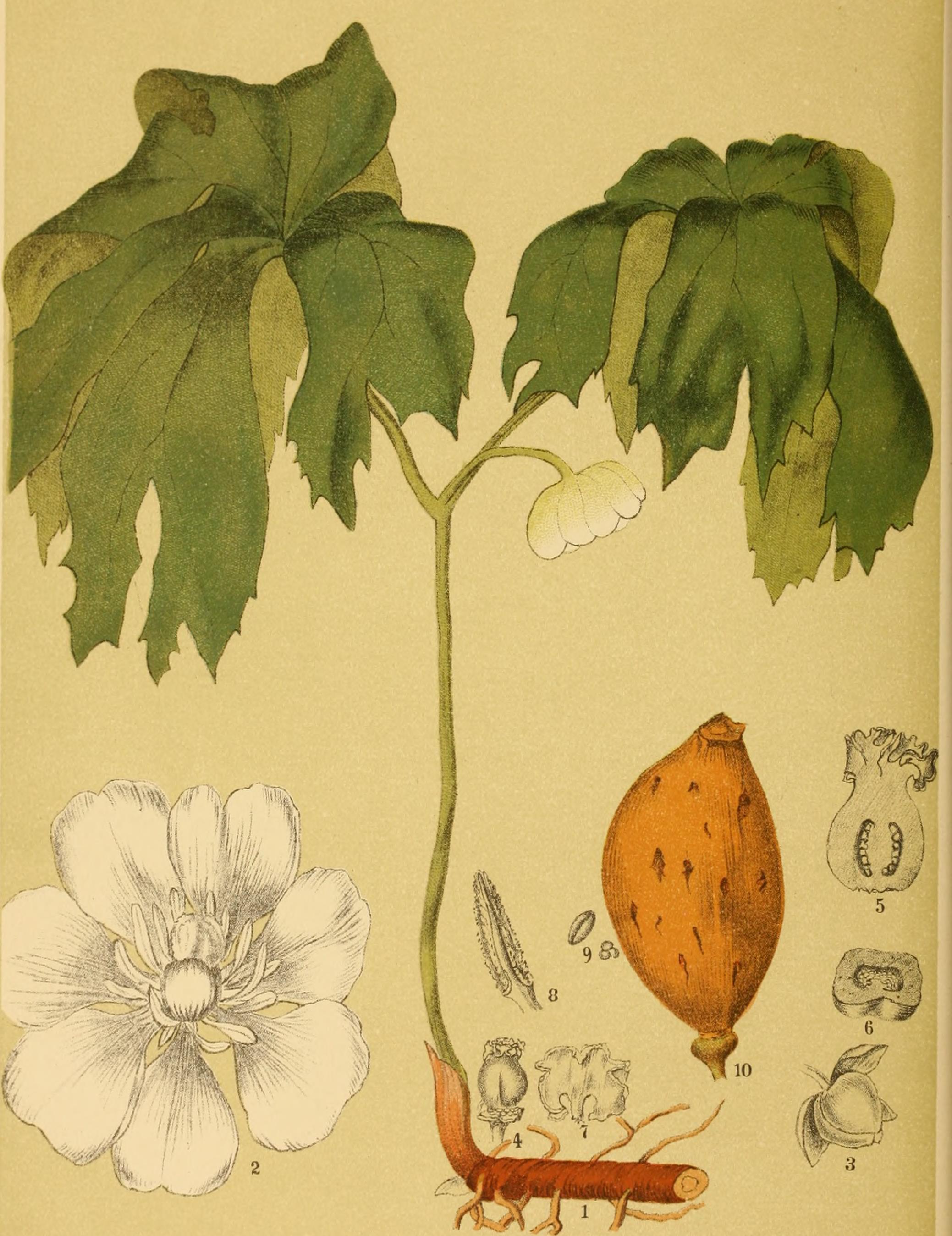
N. ORD.--BERBERIDACE^. 17 GENUS— PODOPHYLLUM,* LINN. SEX. SVST.— POLVANDRIA MONOGVNIA. PODOPHYLLUM. MA Y-APPLE. SYN.— PODOPHYLLUM PELTATUM, LINN.; ANAPODOPHYLLUM CANADBNSE, CATESBY; ACONITIFOLIUS HUMILIS, Etc., MENTZ. COM. NAMES.— MAY-APPLE, INDIAN-APPLE, HOG-APPLE, WILD LEMON, DUCK'S FOOT, WILD JALAP, PEC A, RACCOON -BERRY, MANDRAKE;! (PR.) PODOPHYLLE; (GER.) PUSSBLATT, SCHILDBLATTIGER ENTENFUSS. A TINCTURE OF THE FRESH ROOT OF PODOPHYLLUM PELTATUM, LINN. Description.— This well-known plant grows to a height of from 8 to i8 inches. Root perennial, horizontal, extending several feet; the annual growths are from I to 3 inches in length, distinguishable by the scars of previous stems; they are cylindrical, from ]/^ to yi inches in diameter, and give off a few, nearly simple, fibrous rootlets. Steins single, simple, erect, and rounded, the flowerless ones surmounted by a single 7 to 9 lobed leaf, round in its general outline, peltate in the centre, and somewhat resembling an umbrella; the flowering stems generally bifurcated at the summit, thus bearing two leaves, with a flower, at the bifurcation. Leaves of the flowering stems 2, somewhat one-sided and deeply lobed, the lobes variously incised and toothed; drooping at the edges, and strongly marked by the prominent roundish ribs below. Iiijioresccnce a single, drooping, pedunculated flower, generally in the fork of the stem, but sometimes varying greatly in its location. J Calyx during the prefloral stage, with three fugacious green bractlets at its base; sepals 6, breaking off from the peduncle as the bud expands, never appearing upon the flower except when, by accident, one of them clings to and deforms a petal. Petals either 6 or 9, obovate, creamy-white, and fleshy. Stamens generally 12 to 18, twice as many as the petals; ^laments short; anthers large, flattened, opening extrorsely by a single longitudinal line, thus forming what might be termed two lateral valves, hinged upon the inner surface; pollen shaped like grains of rice, and furnished with three comparatively deep sulci. Pistil simple; ovary more or less ovoid, i -celled; ovules many, situated in many rows upon a broad, lateral placenta, extending the whole length of the cell; style not manifest; stigma more or less peltate-globose, composed of a number of fleshy lobes * Wo\<<;, pons, a foot; il/iyyo-<^ phyllon, a leaf. I'robably fiom a supposed likeness of the leaf to the webbed foot of some aquatic bird. ■)• The true mandrake is Atropa tnandragora; habitat, south of Europe, X See article by Foerste, Bull. Ton: Club, 1SS4. p. 63.
17-2 closely set, each resembling a half meat of the hickory-nut. Fruit an egg-shaped, yellow edible berry, i to 2 inches long, irregularly blotched, and retaining the withered stigma, or is marked by its scar; seeds enclosed within a copious, pulpy arillus; embryo minute, situated at the base of the fleshy albumen. History and Habitat. — The May-apple is indigenous throughout the United States, growing profusely upon wet meadows and in damp, open woods; it flowers in May, and fruits in August. The apples, when fully ripe, are gathered, especially by children, who seem to relish their sweet, mawkish taste. I have also seen them exposed for sale in markets, though catharsis often follows indulgence in them, and, to susceptible persons, it is often quite severe. The fruit tastes somewhat like that of the paw-paw [Asiiuiiia triloba), and is much esteemed by the aborigines. The odor of the flowers is nauseous; I am always forcibly reminded of a bad case of ozsena when inhaling their perfume (?). The foliage and stems, when appearing in spring, have been used for a potherb, and in some cases with fatal results. Only one species of Podophyllum is recognized in this country, although Rafinesque has mentioned two others, together with ten named varieties. There is, however, one other species of this genus growing in the mountains of Nepaul, the Podophylluvi luxandnim. This plant constitutes one of the principal remedies used by the American aborigines, by whom it is especially valued on account of its cathartic action. Their use of the drug as an anthelmintic seems to be successful only as far as purging is concerned; specifically, it has no anthelmintic power. The use of podophyllum as a component of cathartic pills is very general. The officinal preparations of the U. S. Ph. are: Abstractuin Podophylli, Extractuni Podop/iyili, Extractum Podophylli Fluidiun, and Rcsina Podophylli; the Eclectic: Decocttmi Podophylli, Tincttira Podophylli and Podophylli?:, and as a component of Emplastriiin Picis Cov:posit2iin, PihilcE Aloes Composite, Tinelura Corydalis Com p., Pihdce Baptisice Cofufosit^c, FihilcE Copaibce Composites, Pilules Fern Composites, Pilules Leptandriui Composites, Pilules PodopJiyllini Composites, Pulvis Leptandriui Compositus, and Pulvis Podophyllini Compositus. PART USED AND PREPARATION.-The fresh root should be procured after the fruiting season, and chopped and pounded to a pulp and weighed. Then take two parts by weight of alcohol, mi.x the pulp thoroughly with onesixth part of it, and add the rest. After stirring the whole well pour it into a well-stoppered bottle, and allow it to stand at least eight days in a dark, cool place. The tincture, separated by straining and filtering, should have a brownishorange color by transmitted light, a bitter, acrid taste, and an acid reaction. CHEMICAL CONSTITUENTS.-From many careful examinations and assays of the root of this plant, F. B. Power ='■ and Prof Maischf claim the absence of any alkaloid, their observations in this respect being corroborated by Podwissotzki, whose exhaustive analyses of the resin J are largely drawn from here. • 1877f Am. your. Phar., 1879, p. 580. \ Ariliiv. fi'tr experimentelU Pathohgie tind Pharinacognosie, v. xiii, I and 2, iSSo; and Pharm. ZeitschH/t fiir Russland, Nos. 44-50. 1881. F. B. Power, in Ant. Jour. Phar., 1S82, p. 102.
17-3 Podophyllin.— A resin mass, first observed and used by Prof. John King (1835). This resin is prepared substantially as follows: The root is exhausted with alcohol by percolation, and the alcohol evaporated from the percolate until it is of a syrupy consistence; this is warmed, and poured into many times its bulk of cold water constantly agitated, and allowed to stand for twenty-four hours, when the resin will be precipitated; this precipitate should be washed by decantation, straining and pressing, and dried at a temperature of about 80° F.; greater heat renders it darker, and the addition of alum to the water gives it a deep yellow color. Podophyllin prepared as above is of a blanched yellowish-gray color, slightly soluble in water, partly in ether, and boils at 124° (255° F.). The yield of the resin is about eighty-four pounds to the ton; highest in the month of April, lowest in July.* Podophyllin contains, according to Podwissotzki: Picropodophyllin, C„HgO, + H.fi. — This body purifies into colorless, silky, delicate crystals, soluble in strong alcohol, choloroform, and ether, insoluble in water, and low-per cent, alcohol, and melts at from 200 to 210° (392 to 410° F.). Picropodophyllin, when in solution, possesses a very bitter taste, and the action of podophyllin intensified. Podophyllotoxin, CuHj^O,,. — A bitter amorphous substance, soluble in dilute alcohol and hot water, precipitating from the latter, on cooling, in fine flakes. Its medical properties are very similar to picropodophyllin, and its availability greater, as it is more soluble. Picropodophyllinic Acid.— This resinous acid is notable from the fact that it holds in solution the active principle of podophyllin, crystalline picropodophyllin. In its pure form, or as nearly pure as traces of picropodophyllin will allow, it is in the form of hornlike granules, readily soluble in alcohol, chloroform, and edier. Podophylloquercetin, CjgHgO^. — This body, having none of the emetic or cathartic properties of podophyllin, is soluble in alcohol and ether; from the latter it crystallizes in short yellowish needles, having a metallic lustre. By exposure to air it takes on a greenish color. It melts at 247 to 250° (476.6 to 482° F.). It is to this body that the investigator claims is due the griping pains produced by podophyllin. Podophyllinic Acid.— This principle results as a brown amorphous resinous body, soluble in alcohol and ether, insoluble in water, and having no action upon the animal organism. Fatty oils and extractive matters were also determined. The claims as to the presence of berberin and saponin have been entirely refuted, as before mentioned. PHYSIOLOGICAL ACTION. -The force of podophyllum seems to be almost entirely expended upon the lining membrane of the almentary canal. Whatever * Biddle, Am. Jour. Phar., 1879, p. 544.
17-4 action noted upon those organs, and the glands in connection with this tract, is, so far as known, reflex and sympathetic. On Animals. — Among other experiments with this drug upon animals, those of Dr. Anstie seem to be the most characteristic. He found, resulting from his many applications of an alcoholic solution to the peritoneal cavity direct, that no local inflammation arose, although an intense hyperajmia occurred in the duodenum especially, and the whole of the small intestine, even going so far as to cause a breaking down of the tissues and resulting ulceration, causing discharges of glairy mucus streaked with blood; this hypersemia ceased usually at the ileocaical valve. Post morfcm the mucous-membranes were found inflamed and covered with bloody mucus. Other observers noted that retching, salivation, and emesis, followed by purging, colic, and intense tenesmus, with low pulse, and rapid exhaustion followed the administration of the drug. On Man.— Here the same action takes place, but extends to the rectum with sufficient intensity to cause prolapsus and hemhorrhoids. The first effect of the drug is an excitation of salivary and biliary secretions, followed by torpor and icterus. The symptoms of disturbance caused by the drug in doses varying from /^ to ^ grains of " podophyllin," and in persons working in the dust of the dried root, are substantially as follows: Inflammation of the eyes, soreness and pustulation of the nose; salivation and white-coated tongue; extreme nausea, followed by vomiting; severe pains in the transverse colon and abdomen, followed by an urgent call to stool; thin, offensive, copious stools; weak pulse, prostration, drowsiness, and cold extremities. Description of Plate 17. I. Whole plant, once reduced, Newfield, N. Y., May 20th, 1S80. 2. Flower. 3. Bud, showing sepals. 4. Pistil. 5. Pistil in section (enlarged). 6. Pistil in horizontal section (enlarged). 7. One of the lobes of the stigma (enlarged). 8. Anther (enlarged). 9. Pollen; side and end views x 200. 10. Fruit.
18. f lll.adnat.del.etpinxt. NYMPHAa ODORATA,Ait.
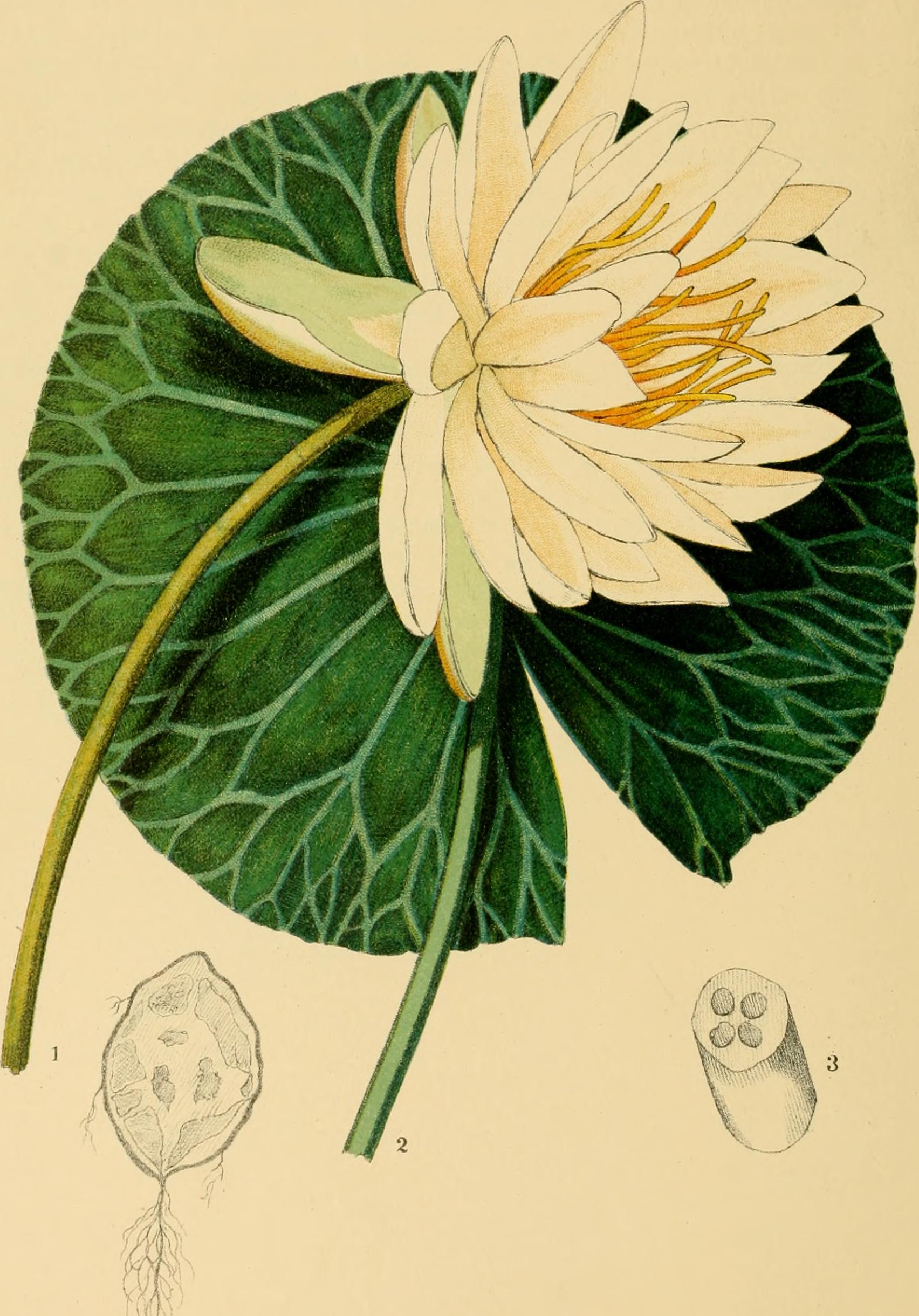
N. ORD -NYMPHACE^. 18 Tribe.-NYMPHE/E. GENUS.— NYMPH /E A,* TOURN. SEX. SYST.— POLYANDRIA MONOGYNIA. NYMPH^A. S\^'EET WATER LILY. SYN.-NYMPH^A ODORATA, AIT.; NYMPH^A ALBA, MICHX.; CASTALIA PUDICA, SALISB. COM. NAMES.— SWEET-SCENTED WATER LILY, WATER NYMPH, WATER LILY, LARGE WHITE WATER LILY, WHITE POND LILY. A TINCTURE OF THE FRESH ROOT OF NYMPH^A ODOR.\TA, AIT. Description. ^This beautiful perennial aquatic herb, grows to the surface of the water from a thick submerged horizontal rootstock. The stem is absent, the flowers growing on long peduncles, and the leaves on separate petioles, all round, smooth, and furnished with four equal, central canals. Stipules deltoid or nearly renniform, emarginate, closely appressed to the rootstalk at the base of the petiole; /caves always floating, orbicular, with one deep cuneiform fissure passing from the circumference to the centre at the juncture of the leaf with its petiole, thus making it more or less heart-shaped; smooth and shining dark green above, wine color beneath, plainly marked with the interlacing veins; margin entire. Inflorescence solitary, axillary; flowers large, white, showy and fragrant, often being nearly six inches in diameter when fully expanded. Sep.ils four, elliptical, scaphoid, nearly free, persistent, bright green on the outer surface, greenishwhite internally. Petals numerous, arranged imbricately upon the fleshy ovary, the outer rows large, the inner smaller, all obtuse. Stamens indefinite, arranged like the petals upon the surface of the ovary about the centre of the flower; Jilanients of the outer rows petaloid, the inner more or less ligulate; anthers with adnate, introrse cells. Ovary large, globular, depressed, eighteen- to twenty-fourcelled; ovtiles anatropous, borne upon the sides of the ovary, none being upon the ventral suture; style none; stigma compound, peltate, marked by as many rays as there are cells to the ovary, these rays projecting beyond the general surface, thus forming a fringe of recurved, sterile, stigmatose appendages. Fruit a depressed, globular, fleshy body, retaining the stigma and marked plainly by the scars of the fallen petals and stamens, decaying; dehiscence none; seeds oblong, stipitate, shorter than the enveloping, sac-like false coat; embryo situated in the albumen, close to the hilum; radicle very minute; cotyledons large and thick, enveloping a well-formed plumule. * The nime is given on account of its situation being similar to tiie supposed habit of fabled water nymphs.
18-2 Nymphaceae. — This beautiful family of aquatic plants, whose species have been themes for poets, and designs for ancient sculptors, is tropical or subtropical in its most general habitat. Its prominent species are: Victoria regia, a native of tropical South America, named in honor of Queen Victoria. Its magnificent flowers are rose-white, and often measure nearly two feet in diameter, while that of its leaves often reaches five feet. Nymphcca lotus, a native of Egypt and Nubia, with white flowers. The seeds of this plant are eaten by the natives, but do not form the lotus of the /otits-eaters* NympJicea alba. This European species differs but slightly from our N. odorata. This order contains In the United States the following genera: Brasenia, Cabomba, Ncliumbiiiiu, Niipliar and Nymphcea. History and Habitat.— This, our most beautiful northern flower, frequents ponds and still-flowing streams in the Eastern United States, especially near the coast, flowering from [une to August. There are many varieties, due mostly to color and mode of growth, some being blue, others pink or rose-color; but the true N. odorata is pure white or creamy. The stems of the flowers and leaves vary in length according to the depth of the water. The flowers form one of the most typical illustrations of plant metamorphosis; the petals are but colored sepals, the stamens but anther-tipped petals, the stigmas but changed stamens, and all gradually merging into each other in easily distinguishable stages. After ripening, the fruits, now becoming spongy and water-soaked, sink to the mud, where they decay and allow the' escape of the seeds. The flowers open as the sun rises, and are usually fully expanded at about eight o'clock; after that time they again gradually close, being entirely shut during the heat of the afternoon and at night. In the very centre of the disk-like compound stigma, is a small, glutinous protuberance, called by many botanists a nectary or honey-gland. I am inclined to term this the true stigma, on account of the well-known fact that pollen grains need moisture to enable them to burst their outer coat and allow the escape of the fertilizing tubes. This glandular body is always moist, while the stigmatose disk is dry, and rejects water as freely as does the upper surface of the leaves. Our species are often said to be much inferior to the European in beauty; but, as their purity of color and exquisite fragrance far excel that of Nymphcea alba, it fully deserves to rank as superior in all respects. Rafinesque states that in Canada the fresh leaves are boiled and eaten as "greens," that the fresh roots are used as a part substitute for soap, and that the juice of the roots, mingled with that of lemons, is used to remove freckles and pimples from the face. The roots, in decoction, were much esteemed by Indian squaws as an internal remedy, and injection or wash for the worst forms of leucorrhoea, its properties in this direction being due to its great astringency. The macerated root was also used as an application in the form of a poultice to suppurating glands; its styptic properties were also fully known and utilized. * This plant is mentioned under Genista tinctoria, 46.
18-3 The roots have been used for dyeing fabrics deep brown, the goods thus dyed retaining their color admirably. Nymphsea has no place in the U. S. Ph.; in the Eclectic Materia Medica it is officinal as Cataplasnia N^vinphcr and Infusum Nvmphcp. PART USED AND PREPARATION.— The fresh root, gathered in the fall, is chopped and pounded to a pulp and weighed. Then two parts by weight ot alcohol are taken, the pulp thoroughly mixed with one-sixth part of it, and the rest of the alcohol added. After stirring the whole well, it is poured into a wellstoppered bottle and allowed to stand for eight days in a dark, cool place. The tincture, separated by straining and filtering, presents the following physical properties: A deep wine-red color by transmitted light, a sherry-like odor, a slightly bitter, astringent taste, and a very strong acid reaction. CHEMICAL CONSTITUENTS. -The bitter acrid principle of Nympha;a odorata has not been isolated. According to Bigelow, the roots contain tannin, gallic acid, and mucilage. It is quite likely that the constituents are similar, if not the same, as those of the European species, N. alba, the roots of which, according to Griining,* contain: Tanno-nymphcsin, Cj^FL^Oss ■ NympJicso-phlohaphene, C^H^gO,,^; and Nympliaa-tannic acid, C-uH-^Ojg, a brown red, transparent mass, yielding easily a pale yellow powder. This is the true special tannin, to which the great astringency of the root Is due. PHYSIOLOGICAL ACTION.— 1 can find no accounts of poisonings with this plant, nor experiments in this direction. In the provers who took large doses of the tincture, a marked dryness of the fauces was experienced, followed by painful deglutition; pain in the hypogastric region, with loose evacuations; venereal excitement, and involuntary passage of the urine. Description of Plate i8. I. A small flower, from a pond near New Milford, Pa., July 17th, 1883. 2. A medium-size leaf. 3. Section of a peduncle, showing air cavities or canals. 4. Root. * Arch. d. Pilar., 3, xvii., p. 736; Ant. your. Phar., 1883, p. 96.
.ad naf.dei.ef pinxt. Sarracehia Purpurea, Linn
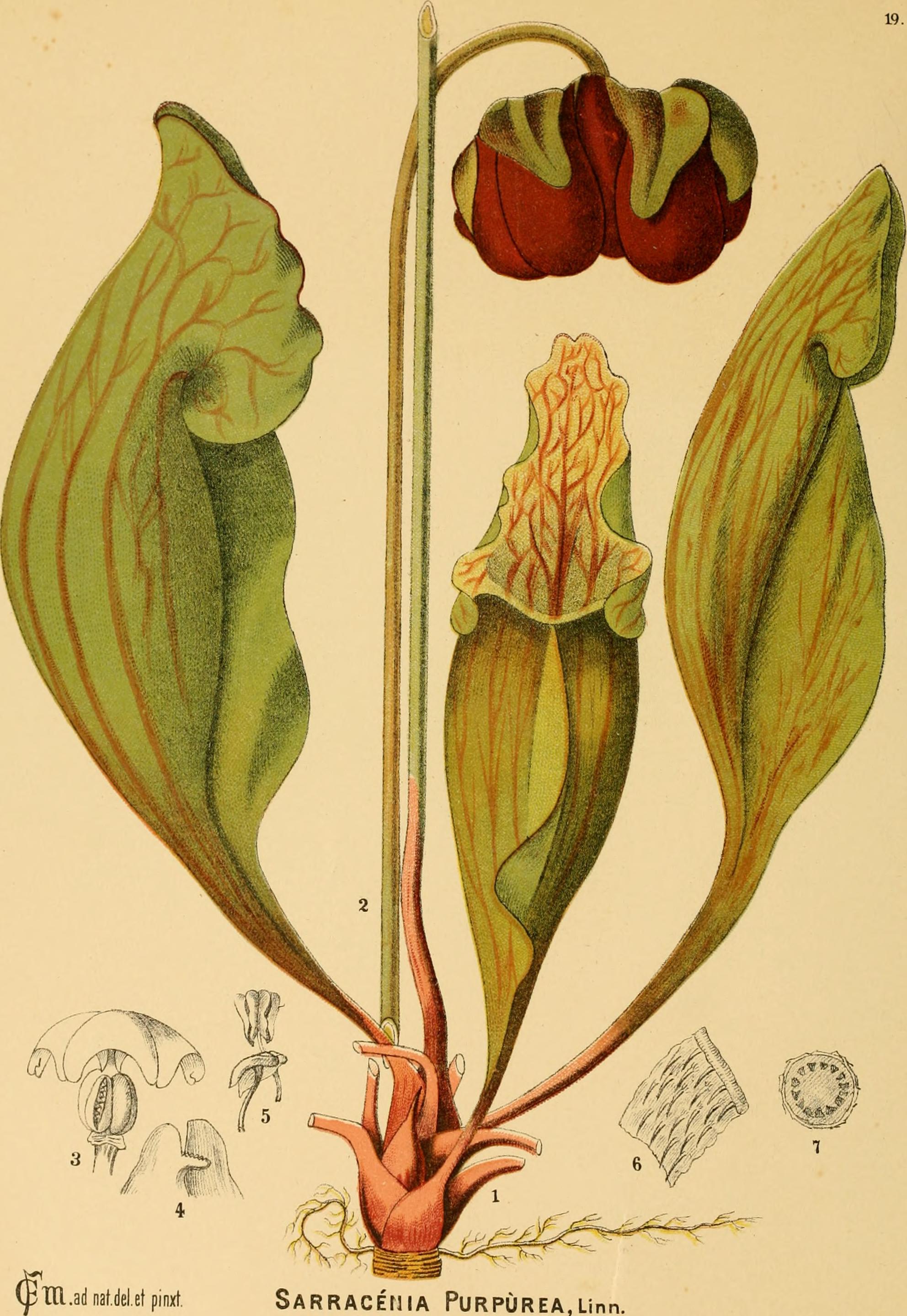
N. ORD -SARRACENIACE.E. 19 GENUS.— S ARRACENIA,* TOURN. SEX. SYST.— PENTANDRIA MONOGYNIA. SARRACENIA. PITCHER-PLAJVT. SYN.— SARRACENIA PURPUREA, LINN.; SARAZINA GIBBOSA, RAF. COM. NAMES.— PITCHER-PLANT, HUNTSMAN'S CUP, WATER-CUP, EVE'S CUPS, SIDE-SADDLE FLOWER, FLY-CATCHER. A TINCTURE OF THE FRESH ROOT OF SARRACENIA PURPURE.A, LINN. Description. — This peculiar bog perennial is characterized as follows: Root somewhat ligneous, yellowish, furnished widi numerous yellowish-brown fibrous rootlets; stetn none; leaves {asa'dia) all radical, pitcher-shaped, and composed of four parts: the petiole about one-third the whole length, slender, dilated at the base and somewhat equitant; tube ovate, narrowing to the petiole, and longitudinally marked with reddish veins; Jiood auriculate-cordate, wavy, covered in the throat with numerous stiff sharp, curved bristles pointing downward; iving broad, laterally undulate, passing along the median line of the upper surface of the tube, from the base of the hood to the petiole. These ascidia, usually six in number, lie dorsally prostrate upon the sphagnum in which the plant usually grows, the open mouths of the tubes looking upward toward the nodding flower and forming about the scape a rosette of gaping wells half filled with water, and having a path represented by the free margin of the wings leading to each.f Lijiorescence a single large reddish purple flower, terminal and nodding upon a long smooth and naked scape. Sepals 5, colored, persistent, 3-bracted at their base. Petals 5, obovate or somewhat fiddle-shaped, caducous, incurved over the style. Stamens numerous, hypogynous. Ovary globose, 5-celled; style greenish-yellow, composed of a short erect shaft, and an umbrella-like expanded extremity consisting of 5 petaloid segments rayed at their approximations, each ray ending in a short nipple-like projection, which constitutes the stigma. Fniit a granular 5-celled and valved capsule; placentce axial, many seeded; seeds anatropous; embryo small, basal; albimien fleshy. Sarraceniaceae. — This family of bog plants is characterized as follows: Root perennial; leaves all radical, purplish or yellowish-green, more or less inflated tubular, the true blade represented by a hood or lamina surrounding the throat of the tube. Flowers single {Exc. Heliamphora) nodding at the summit of a long, * In honor of Dr. Sarrazin of Quebec, who sent the plant to Tournefort. f In the plate most of the leaves have been cut off, and those remaining have been constrained to take such positions as would best show their various characters within the small scope of the paper.
19-4 in regard to the use of the drug in this disease: " On the Mistassini side my attention was particularly attracted to the Sarracenia purpurea, of which the root furnishes the greatest remedy known for that dreadful scourge, small-pox. I may mention that, to my personal knowledge, this precious root not only saved my brother's life, but its use also appears to wholly obviate the unsightly pitting common to the disease; if it is extracted and dried at the proper season. Indeed, I have known many cases which were considered hopeless by medical men, but were cured by the Sarracenia purpurea; even Indians, with whom the dread malady so often proves fatal, finding it an absolute specific." The root is also recommended in cases where there is a torpidity of the organs of the alimentary tract, and of the kidneys. There are no officinal preparations outside of the Homoeopathic tincture. PART USED AND PREPARATION.— The fresh root gathered after the fruiting season, or the whole fresh plant when budding to blossom and before the leaves are fully expanded, should be chopped and pounded to a pulp and weighed. Then two parts by weight of alcohol taken, the mass mixed thoroughly with onesixth part of it and the rest of the alcohol added. After thorough stirring, the whole should be poured into a well-stoppered bottle, and allowed to stand eight days in a dark, cool place. The tincture separated from the above by filtration, has a deep reddish-brown color by transmitted light; its taste is at first somewhat sourish, then bitter and slightly astringent, and its reaction strongly acid. CHEMICAL CONSTITUENTS.— ^</;'r«r^«/;^ This bitter alkaloidal body was discovered by Martin. Hetet* isolated it as white handsome prisms and octahedra, soluble in water and alcohol. Its salts with acids are soluble, and that with sulphuric forms beautiful bitter needles. Hetet claims that this alkaloid is identical with veratria, both in its properties and reactions. Acrylic Acid. — QH^O,^. This volatile body was discovered in the plant by Bj'drklund and Dragendorf. It is a limpid liquid, possessing a sour pungent smell and boiling at 142^ (287°. 6 F.). Its vapor is irritating, attacking the mucous membranes of the nose and eyes violently, and causing severe inflammation. Sarracenic Acid. — This body constitutes the yellow coloring matter predominant in the older plants. Its characteristics are uninvestigated. Besides these, the plant contains a pulverizable tanno resin, and a bitter, aromatic extractive, soluble in water and alcohol. PHYSIOLOGICAL ACTION.— Dr. Porcher found in his experiments with 180 grains of the root, that it caused diuresis, moderate catharsis, and gastric excitation, as well as an increased and irregular heart's action, and congestion of the head; and remarks as follows: "These symptoms distinctly point to the parts of * Rep. de Pilar., S79, p. 109.
19-5 the system influenced by the drug — the gastric filaments of the ganglionic or organic system of nerves. This produced an increased action of the circulating system, and drove the blood to the head; it also increased the peristaltic action of the whole alimentary canal, and promoted the renal and other glandular secretions, without any apparent effect upon the nerves of animal life." Dr. Cigliano,* in his experiments, says the drug produces " eruptions similar to crusta lactea; on the forehead and hands papular eruptions, changing to vesicular with the depression, as in small-pox, lasting from seven to eight days." This last again corroborates the aborigine's use of the drug, and adds one more proof to the many that are tending to reveal the fact that our American native practice was essentially correct. Description of Plate 19. I and 2. Whole plant, with a number of the leaves removed, and those remaining brought into constrained positions to better show their characters within the limit of the sheet. From Spruce Pond, Smithsfields, N. Y., June i8th, 1884. 2. Scape and flower. 3. Pistil. 4. Stigma. 5. Stamens. 6. A portion of the hood, showing hairs. 7. Section of the root. (4-6 enlarged.) * // Dinamico, 1871; translated in Am. Observer, 1871, p. 467, Dr. Lilienthal. \
20. (i/.'ni.aiJnatdel.atpinxt. Argemone Mexican a, Linn.
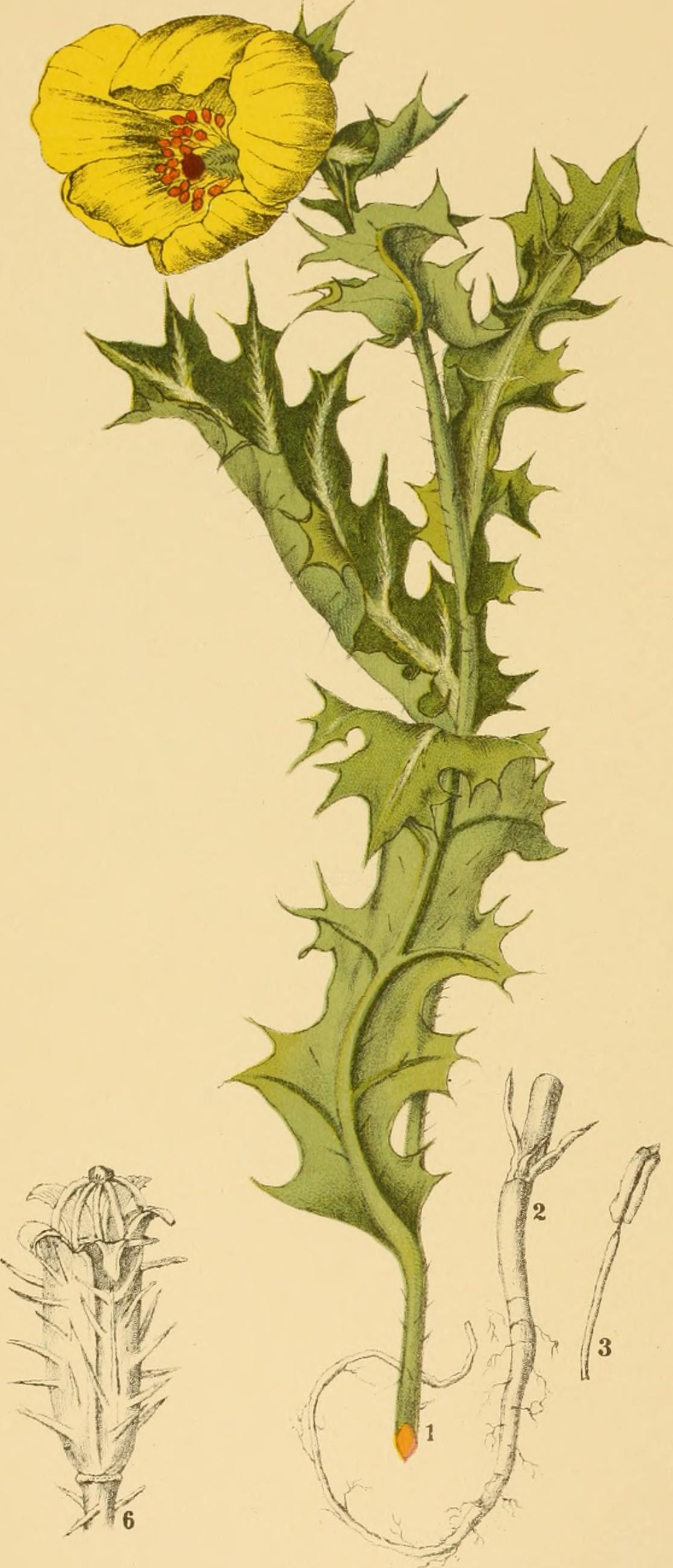
N. ORD -PAPAVERACE/E. 20 GENUS,— ARGEMON I SEX. SYST.— rULYAXlJRIA MOXOGVNIA. GENUS,— ARGEMON E,* LINN. ARGEMONE. PRICKLY POPPY. SYN.— ARGEMONE MEXICANA, LINN. COM. NAMES.— PRICKLY POPPY, DEVIL'S PIG, MEXICAN POPPY, THORN APPLE, t YELLOW THISTLE, t THORN POPPY; (MEX. i CHICALOTE; (FR.) ARGE'MONE; (GER.) STACHELMOHN. A TINCTURE OF THE WHOLE PLANT ARGEMONE MEXICANA, L. Description. — This annual weedy herb, grows to a height of from i to 3 feet. Rooi long, subcylindrical; sfcin erect, branching, prickly-bristled, and furnished, as the rest of the plant, with a gamboge-yellow milky juice. Leaves sessile, broadly lanceolate in general outline, sinuate lobed, spiny toothed, and blotched or striped with white along the principal veins, hiflorescence solitary in the axils of the upper leaves, and terminal; buds erect, pedunculate \ floivcrs large, yellow, or rarely white. Sepals 2 to 3, roundish, acuminate, often prickly, very fugacious. Petals 4 to 6, i. e., twice as many as the sepals, roundish, more or less crumpled in the bud. Stamens indefinitely numerous; filaments filiform, greatly attenuated at the apex; anthers large, innate. Ovary strictly i -celled; style almost none; stigmas 3 to 6, stellate-radiate, purple, velvety on the receptive surface; lobes reflexed. Fruit an oblong-ovate, prickly pod, opening by 3 to 6 valves at the apex, leaving a skeleton of from 3 to 6 filiform placentae in the shape of the original pod; seeds globular, crested, and pitted. PapaveracesB. — This principally European family of herbs, noted for their milky, and generally colored, narcotic or acrid juice, is represented in North America by 15 genera, 23 species, and 7 recognized varieties. The order is further characterized as follows: Leaves alternate, exstipulate. Pedtuiclcs i -flowered; fioivers regular, the parts in twos or muliples of two. Sepals 2, very rarely 3, fugacious Petals 4 to i 2, early deciduous, rarely absent, imbricated in the bud. Sta/ncns numerous, rarely as few as 16, distinct, hypogynous; anthers 2-celled, innate, introrse. Ovary i -celled, with two or more parietal placentae. Fruit a dry, I- rarely few or many-celled pod. Seeds numerous, anatropous; embryo minute, basal; albumen fleshy or oily. * 'ApyE(/o, argema, cataract; as the juice was supposed to cure that disease. f Applicable only to Datura Siramoniuin (Solanacese.) \ The true Yellow Thistle is Cirsutnt horriduhiitt (Composite.)
20-2 The only remedy in our Materia Medica derived from this order, beside the three here represented, is Opium, the inspissated juice obtained lay incising the unripe capsules of the South European and Asiatic White Poppy [Papaver sovinifcnun, Linn.); our other remedies, Papaverinum and Morphinum, being also derived from the same substance; the only other remedy used in general medicine being the petals of the Red Poppy {Papaver Rhccas, Linn.); they have a slightly narcotic action, but are as yet principally used as a coloring-matter lor pharmaceutical preparations. History and Habitat. — The Prickly Poppy is indigenous to tropical and subtropical America, from whence it has become scattered even as far north as Virginia, and escaped from cultivation in many places still further north. It grows with us in waste places and blossoms from April to July. The use of the oil of the seeds, the leaves, and the petals of this species has been quite prominent among the natives of all tropical countries in which the plant grows. Among the ancient Greeks the juice was supposed curative of cataract and of opacities of the cornea. The oil of the seeds is spoken of as being as active as that of Croton tiglium.* Lindley says that in India the juice is employed in chronic ophthalmia and in primary syphilis; and the infusion in strangury from blisters (of cantharis?); he also states that the seeds are narcotic, and are smoked with tobacco. In Mexico the plant is still held in the pharmacopoeia, the juice being recommended, mixed with water, for skin diseases, and for incipient opacities, the flowers as a pectoral and narcotic.^ In Java the juice is said to be employed as a caustic in chancres. In the West Indies the plant is administered as a substitute for Ipecacuanha. The juice when inspissated resembles, in its physical properties, gamboge. As a whole the plant has generally been conceded to be anodyne, detersive, resolutive, hypnotic, diuretic, diaphoretic, ophthalmic, anti-icteric, and a hydragogue cathartic; and, according to Rafinesque, appearing to unite the properties of Opium, Gamboge, and Celandine. PART USED AND PREPARATION. — The whole fresh plant, gathered while in blossom, is chopped and pounded to a pulp and weighed. Then two parts by weight of alcohol are taken, the pulp thoroughly mixed with one-sixth part of it and the rest of the alcohol added. After stirring the whole well, it is poured into a well-stoppered bottle, and allowed to stand eight days in a dark, cool place. The tincture, separated from the above mass by pressure and filtration, has a brownish yellow color by transmitted light, no distinguishing odor or taste, and an acid reaction. The plant, from its history, deserves at our hands a most thorough proving, and should by all means receive it; for a new proving the tincture should be made while the plant is in fruit, and just before the capsules are ripe. CHEMICAL CONSTITUENTS. -Morphia, C,-H,„NO,.— There is considerable doubt that this alkaloid exists in this species, although Charbonnier^ reports its presence from his analysis of the carpels and leaves. * your, de Pharm., xiv, 73. f Maisch, in Avt. Jour. Pharm., 1885, 506. J Jour, de Pkarm., 1868.
20-3 Oil of Argemone. — This fat oil, obtained by pressure from the seeds, is reported by Wittstein, but upon whose authority we are unable to ascertain. He describes it as, light yellow, still liquid at 5° (41° F.), of a slightly nauseous odor and raw taste, drying, dissolves in 5 to 6 times its volume of alcohol, and is easily saponified. PHYSIOLOGICAL ACTION. — This is as yet unknown, but certainly deserves prolonged experimentation. Description of Plate 20. I. Upper part of plant, Salem, Mass., July 31, 1885. 2. Root. 3. Stamens. 4. Pistil. 5. Horizontal section of ovary. 6. Fruit. (3-5 enlarged.) =■4-=
21. f TU.adnat.del.tt pinxt. ChELIDONIUM MAjUS.Linn.
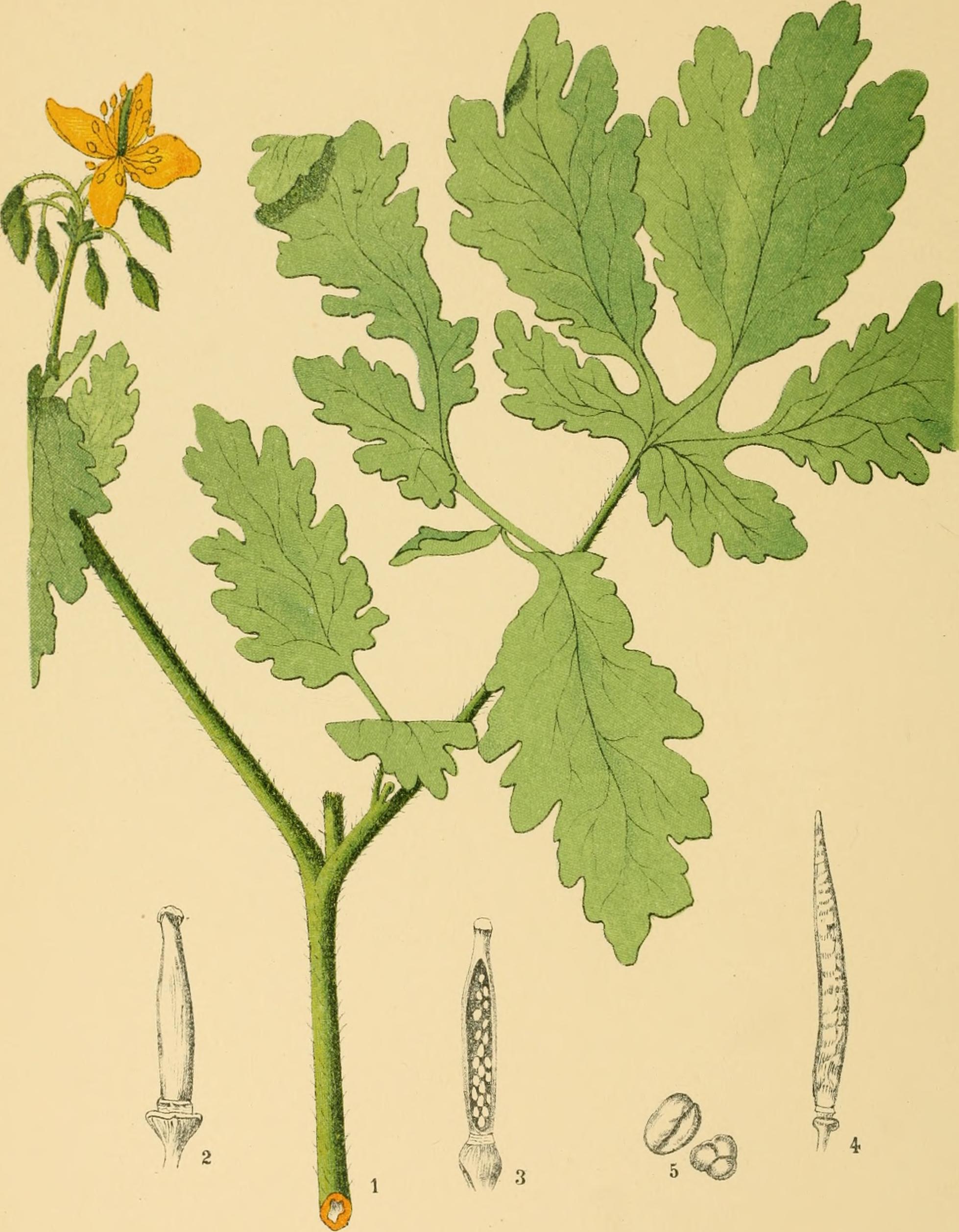
N. ORD -PAPAVERACEyE. 2l GENUS.— C HELIDONIUM,* LINN. SEX. SVST.— POLVANDRIA MONOGYNIA. CHELIDONIUM. CELAJYDIJVE. SYN.-CHELIDONIUM MAJUS, LINN. COM. NAMES. — COMMON CELANDINE, TETTERWORT; (FR.) HERBE A L'HIRONDELLE; (GER.) SCHOLLKRAUT. A TINCTURE OF THE FRESH PLANT CHELIDONIUM MAJUS, LINN. Description.— This upriy;ht, widely branching, perennial herb, grows to a height of from i to i feet from a fusiform root. Stem upright, cylindrical and branching, somewhat hairy and very brittle. Leaves alternate, petiolate, large, pale-green and glaucous, lyrate pinnatifid, with a crenately cut or lobed border, the terminal lobe obovate-cuneate. Inflorescence, pedunculated, somewhat umbellate, axillary clusters, with nodding buds and medium-sized fiowers, the sepals, petals and stamens of which are early deciduous. Peduncles 2 to 4 inches long, bearing from 3 to '& pedicels i inch in length, and involucrate at their base. Sepals 2. Corolla cruciform; petals 4. Slamens 16 to 24. >S/)'/^ merely present; slioma 2-lobed. Fruit a linear, slender pod, about i inch in length, somewhat swelled at intervals, the two valves opening upward from the base to the apex; seeds rounded, reniform, with a glandular ridge at the hilum, and a crustaceous, blackish-brown testa, marked with more or less regular, hexagonal reticulations. A description of the Papaveraceae will be found under Argemone Mexicana, 20. History and Habitat.— Celandine grows all over Germany and France, in waste places, on old walls, along roadways, and about dwellings; it is pretty well naturalized in the United States, but so far it is not found at any orreat distance from dwellings, flowering from early in May until October. A fine gambooe-yellow, acrid juice, pervades the plant, root, stem and leaves; this fact led those who practised upon the doctrine of signatures, to employ the drug in hepatic disorders, from its resemblance to bile in color. It proved one of the hits of that practice. The U. S. Ph. still mentions Chelidonium, but not officinally; it will probably be thrown aside at the next revision as worthless, totideni verbis. In the Eclectic Materia Medica it is officinal as Decoctum Chelidonii. PART USED AND PREPARATION.-The fresh plant, gathered in Spring, is chopped and pounded to a pulp, enclosed In a piece of new linen and subjected * xA^i^v, swallota. Its flowers appearing with the arrival of that bird; or, it was said that when the eyes of youn^ swallows became, through injury or otherwise, affected with a white film, the parents gathered and applied the juice of this plant, rapidly curing the trouble.
21-2 to pressure, the fresh juice is then by brisk succussion mingled with an equal part by weight of alcohol. This mixture is allowed to stand eight days in a dark, cool place, then filtered. The tincture thus formed is of a brownish-orange color by transmitted light, having an odor quite like that of tincture of apis mellifica, an acrid, bitter taste, and strong acid reaction. CHEMICAL CONSTITUENTS.- C/^^'/cvj///;-///, Cj, H^, NO,. This alkaloid is identical with Sanguinarina, vide 22. Chelidonin, Cj^ H^. N^ O3 + Aq. This alkaloid exists particularly in the root. When pure it has the following properdes: colorless, glassy, tabular, bitter crystals, losing water at 100° (212° F.), fusing at 130° (266° F.), and decomposing at higher heats; it is insoluble in water, slowly soluble in alcohol, and forms colorless salts. Chelidoxanthin. A bitter principle existing in all parts of the plant, crystallizing in short, friable, yellow needles, which are very slowly soluble in both water and alcohol. Chelidonic Acid.— Q H (CO, OH)3. A tribasic acid occurring together with the other acids in all parts of the plant. It crystallizes in small colorless needles, which carbonize by heat, and are soluble both in water and alcohol. Malic Acid. — Is also present in the plant, vide Pyrus Americana, 56. Citric Acid. — Herr Haitinger determines (Monatsch., Ch. ii., p. 485) that notable quantities are contained in this plant. Vide lit supra. PHYSIOLOGICAL ACTION.— The principal action of Chelidonium seems to be that of causing congestion of the lungs and liver, especially the latter; it is also an excessive irritant, and has a narcotic action upon the nervous system. The lungs of animals poisoned by this drug have been found, post-mortem, to be highly engorged, and in some cases hepatized. The liver under its action becomes the seat of much pain, soreness and tenderness; the bowels move rapidly and freely, with thin, bright-yellow, pasty evacuations; the urine becomes bright-yellow, and even stains the linen dark-yellow. It irritates the respiratory nerves, causing a tickling, like dust, in the trachea and bronchi, with violent spasmodic coughing, followed by dyspnoea and oppression of the chest. Sensations of indolence, sleepiness and languor are persistent. Its action upon the skin is that of vesication. Description of Plate 21. I. A portion of the upper part of a blossoming plant from Ithaca, N. Y., May loth, iSSo. 2. Pistil (enlarged). 3. Section of the ovary (enlarged). 4. Fruit. 5- Pollen X 380
22. ^. ill 4 (■ I::> ad nat del et piiixt. Sanguinaria Canadensis. Linr
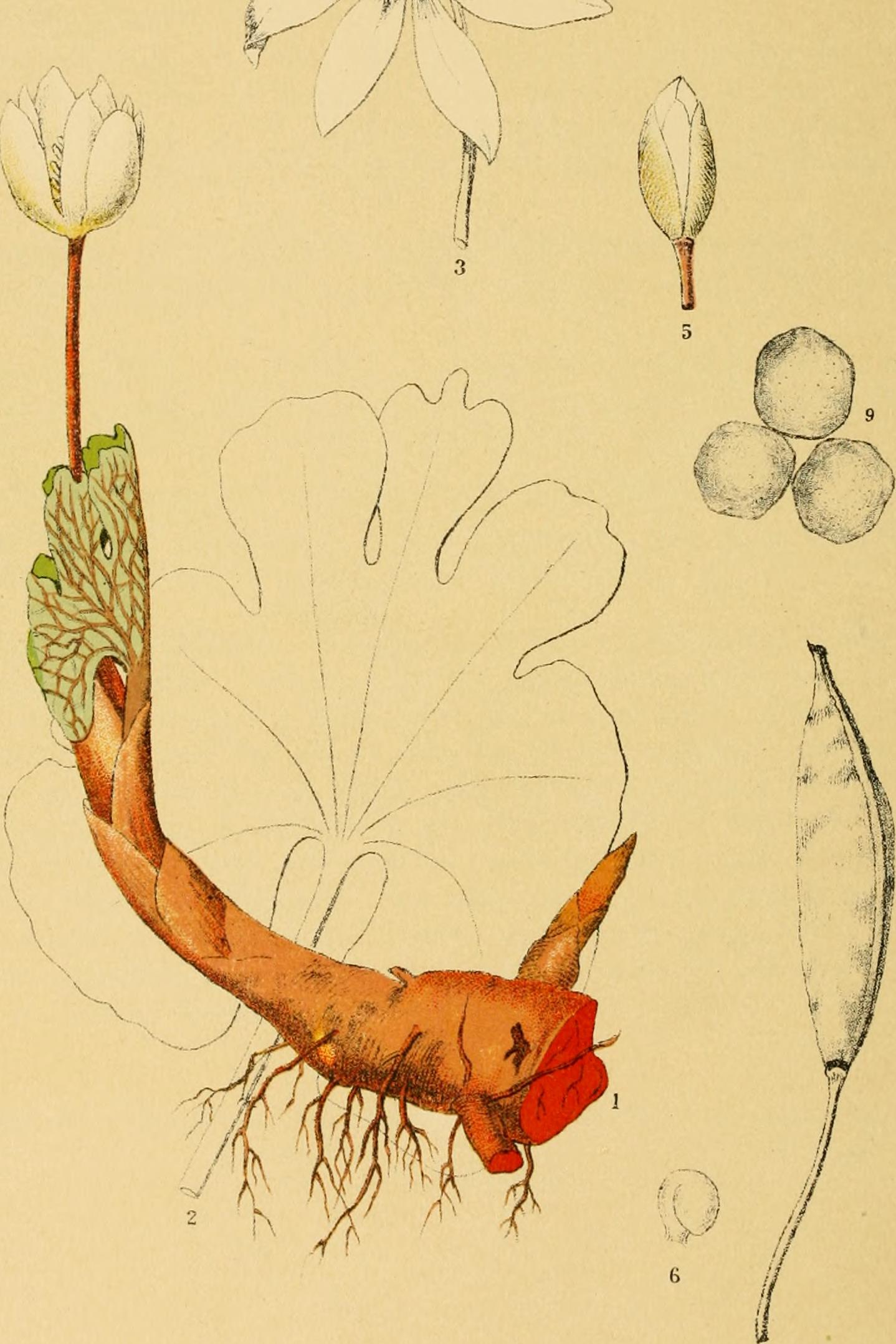
N. ORD.-PAPAVERACE^. 22 GENUS.— SANGUINARIA,* DILL. SEX. SYST.-POI.YANDRIA.MONOGYNIA. SANGUINARIA. BLOODROOT. SYN.-SANGUINARIA CANADENSIS, L. SANGUINARIA MINOR, DILL. COM. NAMES.-BLOODROOT, RED PUCCOON, PUCCOON, TETTERWORT, REDROOT, PAUSON, TURMERIC, INDIAN PAINT, (PR.) SANGUINAIRE, (GER.) BLUTWURZBL. TINCTURE OF THE FRESH ROOT OF SANGUINARIA CANADENSIS, L. Description. — This low, erect, perennial plant, dots with its creamy white flowers our open woods and bottom lands in early spring-, the most beautiful harbinger of its season. It arises by a naked scape enveloped by its leaf to a height of from 3 to 6 inches. Root horizontal, extending from 2 to 4 inches, with a diameter of from one-quarter to three-quarters of an inch, slightly branched, cylindrical, giving off especially from the under side, numerous tender rootlets, and somewhat annulate by the scars of previous membraneous sheathing scales which enveloped the scape and petiole. When fresh it is brownish red externally, and, upon breaking or cutting, it shows minute points of bright red juice, which rapidly "coalesce and cover the entire wounded surface. When dry similar red dots appear upon the fracture, the root becomes longitudinally wrinkled, the section showing a bark of about one-twelfth the whole diameter, a very slight cambium line and a granular white centre. The stem is a simple, smooth, naked scape, terminated by a single flower, from one to one and a half Inches in diameter. The leaf, which does not reach its full expansion until the flower has fallen, is palmately seven- to nine-lobed, with an equal number of reddish ribs, from which (especially noticeable upon the under surface) extend a perfect network of veins; it has a heart-shaped base, and obtuse lobes; the upper surface is light green, the under whitish, glaucous. Sepals 2, caducous, forming the ephemeral ealyx. Petals ^-12, spatulate, not crumpled. The stamens, generally 24, unequal and about one-half the length of the petals, arranged more or less distinctly in two rows. Anthers innate, introrse, dehiscent. Pollen grains globular, more or less six-sided by compression, of a beautiful golden-yellow color. Ovary i -celled, with 2 parietal placentae. Style short, thick, rounded. Stigma thick, glandularly pubescent, 2-grooved. Pod oblong, sharp-pointed, turgid, opening by two uplifting valves, allowing the escape of the numerous anatropous, sometimes crested seeds. Embryo minute, situated at the base of the sarcous, oily albumen. * Sanguis, blood. From the color of the juice.
22-2 History and Habitat.— This is the onlj' species of the genus, although Rafinesque has described six varieties. It is found, as the specific name denotes, in Canada, and in all parts of the United States except southward to Florida, and westward to Mexico and Oregon, the sea-coasts, and high mountains. It grows in rich open woods, or on bottom lands along shaded streams, flowering from March, in early springs, until May, fruiting in June. For many years it his been used by the aborigines of this country for painting their faces, clothing and implements of warfare, and by the laity as a domestic remedy in gastric troubles, compounded with podophyllum and kali tartaricum. Applied to a denuded surface it is quite a powerful escharotic. The root is still officinal in the U. S. Ph. as Acctwn SanguinaricB, Tinctura Sano-7iinarice, Radix Sauoriiinarice, and Exlrachini Sanouinaria. In the Eclectic materia medica this drug and its derivatives have a prominent place, especially in compounds with Lobelia; sanguinaria not having emetic properties. It takes a part in the following preparations: Pilidcr Taraxaci Composites; Pulvis Ipecarnan/ur Conipositus; Pulvis Lobelics ConiposiUis; Piilvis Myricce Composiius; Tmctiira Lobelia Covtfosila; Tinctura Viburnii CotJtposita; and Sangiiinarin, a so-called alka-resinoid principle, which is often confused by both prescriber and pharmacist with the true alkaloid sanguinarina. PART USED, AND PREPARATION.— The fresh root, gathered when the seeds are ripe, is chopped and pounded to a pulp and weighed. Then two parts by weight of alcohol are taken, and after thoroughly mixing the pulp with onesixth part of it the rest of the alcohol is added. After having stirred the whole, pour it into a well-stoppered bottle and let it stand eight days in a dark, cool place. The tincture is then separated by decanting, straining, and filtering. Thus prepared it is, by transmitted light, of a deep orange-red color, slightly bitter and acid, and has a strong acid reaction to litmus. CHEMICAL CONSTITUENTS.— Sanguinarina,* C^,, H,, NO,. This alkaloid crystallizes from alcohol in warty or needle-like masses, very acrid to the taste, toxic, and when pulverized and insufflated causes violent sneezing; these masses are soluble in ether or alcohol, insoluble or nearly so in water. The various salts of this body are of a red color, and give orange-colored aqueous solutions. Puccina has been claimed to be another alkaloid principle of this plant, remaining in the menstruum after the precipitation of sanguinarina by sulphuric acid; but Hopp determined this body to be a sulphatic salt of sanguinarina. Porphyroxin has been determined as a third alkaloid, so named from its supposed identity with Merck's opium principle porphyroxin, a mixture which owes its color reaction to Hesse's rhoeadine. (Maisch.) It exists as tabular or linear, while and tasteless crystals. Acid. The acid of sanguinaria is not fully determined, though it would prove doubtless to be chelidonic acid (vide Chelidonium). This alk.iloid is identical with Chelerythrine, from C.'.eliclonium m.ijiis, vide, 21.
22-3 Gum, Lignin, an Orange-colored Resin, Albumen, and a Saccharine matter have also been determined. PHYSIOLOGICAL ACTION.— Sanguinaria in toxic doses causes a train of symptoms showing it to be an irritant; it causes nausea, vomiting, sensations of burning in the mucous membranes whenever it comes in contact with them, faintness, vertigo, and insensibility. It reduces the heart's action and muscular strength, and depresses the nerve force, central and peripheral. Death has occurred from overdoses, after the following sequence of symptoms: violent vomiting, followed by terrible thirst and great burning in the stomach and intestines, accompanied by soreness over the region of those organs; heaviness of the upper chest with difficult breathing; dilation of the pupils; great muscular prostration; faintness and coldness of the surface, showing that death follows from cardiac paralysis. (Allen, Ency. Pure Mat. Med., viii., p. 481, et seq.) Description of Plate 22. I. Whole plant, Chemung, N. Y., May jd, iSSo. 2. Expanded leaf. 3. Expanded flower. 4. Pistil (enlarged). 5. Bud, showing sepals. 6. Seed (enlarged 1. 7. Pod. 8. Stamen (enlarged), o. Pollen grains x 380. =-^=
23 iTU.adnat.deI.et pinxt. siNAPis Alba, Linn.
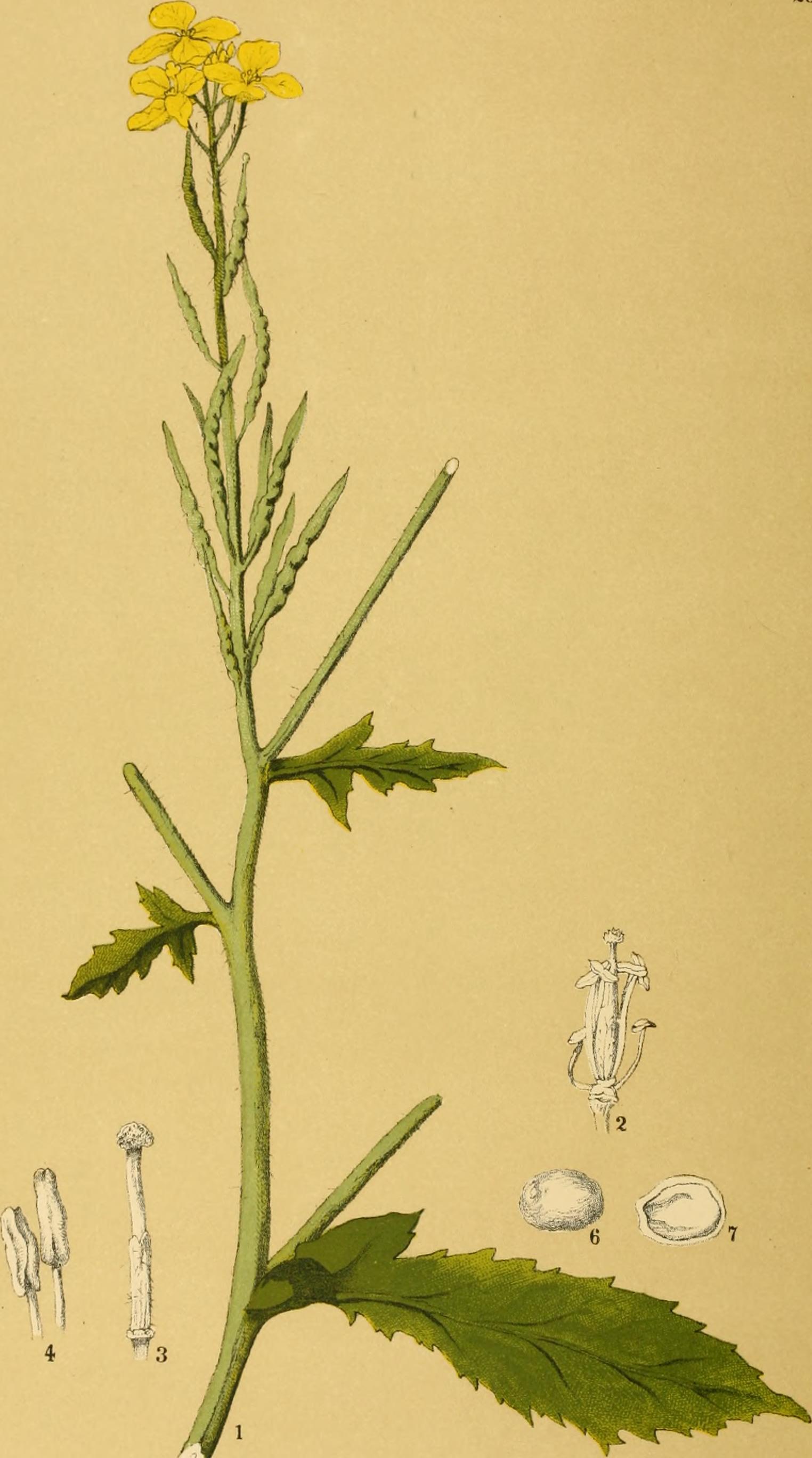
N. ORD-CRUCIFER^. 23 Tribe.-BRASSICE/E. GENUS. — SIN A PIS, TOURN. SEX. SYST.— TETR.A.DYNAMI.A. SILIQUO.SA. SINAPIS ALBA. WUilTE MUSTARD. SYN.— BRASSICA ALBA, HOOK, f.; SINAPIS ALBA, LINN.; LEUCOSINAPIS ALBA, SPACH. COM. NAMES.— WHITE OR YELLOW MUSTARD;* (PR-) MOUTARDE BLANC; (GER.) WEISSER SENP. A TINCTURE OF THE RIPE SEEDS OF SINAPIS ALBA, LINN. Description. — This coarse, hairy annual, usually grows to a height of about 2 feet. Stem erect; branches few, ascending, all parts covered with bristling reflexed hairs. Leaves all petioled and pinnatifid, the lowest having a large terminal lobe and the divisions cutting down to the midrib. Floivers about twice as large as those of.S". nigra; sepals 4, narrowly oblong, spreading; petals 4, spreading, alternate with the sepals, and consisting of a narrow claw and an orbiculate blade. Stamens 6, hypogynous, tetradynamous, the two having shorter filaments beinsf lateral and inserted lower down than the others, the four with longer filaments situated in pairs from before backward and accompanied by a quite large gland to each pair. Pistil slightly exceeding the stamens; ovary hairy; style nearly terete, persistent; stigma bi-labiate. Fruit a linear, bristly, ascending silique; valves short, furnished with 3 prominent veins; pedicels spreading; beak sword-shaped, i -seeded, about half the length of the pod. Seeds globular, paleyellowish, I to 6 in each pod; cotyledons incumbent, conduplicate, narrow, and plane. Cruciferae. — This large family of pungent and often acrid herbs is represented in North America by 42 genera, containing in all 275 species and 50 recognized varieties. The order is characterized as follows: Leaves alternate; stipules none. Inflorescence in terminal racemes or corymbs; floivers cruciform, tetradynamous. Sepals 4, deciduous; petals 4, hypogynous, regular, placed opposite each other in pairs. Stamens 6, rarely 4 or 2, when 6, then two are inserted lower down than the rest and furnished with shorter filaments. Fruit a 2-celled silicle, loment, silique or necument. Seeds campylotropous; e//ib/yo large; albiinien none; cotyledons incumbent o ||, acumbent o ^, or conduplicate o)), being straight in one genus only. * The name mustard is modernized from musttim ardens, hot must; as wine-must is often mixed with the seedmeal in the manufacture of table mustard.
23-2 Only three other plants of this order are proven and find place in our Materia Medica, viz.: The seeds of the European bitter Candytuft {Iberis amara, Linn.), extolled as a remedy for cardiac hypertrophy, but needing further corroborative proving; the Buenos Ayres Pepperwort {Lcpidium Bonariense, D. C), used in Brazil much as arnica is among the laity here; and the British Rape or Cole Seed (Brassica napus, Linn.). Many species, however, find a place in domestic practice, principal among which are: The South European Scurvy Grass {Cochlearia officinalis, Linn.), long known and used as an anti-scorbutic; C. armor acia, Linn., our common horseradish, is much used as a counter-irritant, diuretic, diaphoretic, and stimulant; the dried flowers of the Cuckoo Flower [Cardamine pratensis, Linn.) have been recommended for the cure of epilepsy in children; and the seeds of the Oriental Arabis Chinensis are considered by the natives stomachic, and are said to cause abortion in pregnant women. Many species afford vegetables of value as foods, or, more properly, relishes, notably the Cresses, of which the following European species are most used: The Common Water Cress [Nastiirtiiim ojficinalc, R. Br.); Winter Cress [Barbarea vulgaris, R. Br.); Belleisle Cress {B. precox, R. Br.); and the Common Cress [Lcpidium sativufu, Linn.). The edible Pepperwort of New Zealand [L. oleraceunt) is greatly valued, as also ai'e the Chinese Mustard {Sinapis Chinensis, Linn.), and the British Sea Kale [Crambc niaritiinia, Linn.). The most useful species, however, for relishes, and nourishment as well, are the Turnip {Brassica Rapa, Linn.), and the Cabbage {B. oleracea, Linn.), with its numerous varieties by cultivation, prominent among which stands the Cauliflower as var. Botrytis, Dec. History and Habitat. — White Mustard has as yet hardly become naturalized in this country from its European and Oriental haunts, but has escaped from cultivation here in many places, and grows the life of what is commonly known as a roadside weed. The previous uses of the seeds of this plant are intimately connected with those of S, nigra, as they are usually mixed in the preparation of Sinapis or mustard flour, which is used as an emetic, diuretic, stomachic, and gastro-intestinal stimulant; and externally applied, wet with vinegar, as a rubefacient and vesicant. The power of vesication resides in the oil to a high degree. The unground seeds of this species have held a high place in former practice as a remedy in atonic dyspepsia, and various kindred complaints where there appeared to be a torpid state of the alimentary tract, as they were known to increase peristaltic activity; but the exhibition of the seeds proved dangerous, as they are liable to become impacted in the bowel and set up a fatal inflammation. The seeds, though mentioned, have no officinal preparation in the U. S. Ph.; in the Eclectic Materia Medica their use is as Cataplasma Sinapis. PART USED AND PREPARATION.— The ripe seeds, prepared as noted under the next (Sinapis Nigra, p. 24-2), yield a tincture having a light, clear orange color by transmitted light; a sinapic odor and taste, biting and burning the tongue; and an acid reaction.
23-3 CHEMICAL CONSTITUENTS.—.S///rt/^/;/, Cj^H^N^Sp^g, or Sidpho-sinapisin. This peculiar compound body, determined by Hill, may be obtained from the seedcake, after removal of the fat oil, by boiling the cake in alcohol. Sinalbin results as clear, colorless, united, acicular crystals, fusing at 130° (266° F.), soluble in water and slightly in alcohol. In the presence of water and myrosin, this body breaks down into its components as follows: Sinalbin ^ Sulplio-cvanate Aciinol — Sulphate of Sinapine ^ Sugar. C3,H„N,S,0,„ = QH.NSO + C,,H,,NS03 + QH,^,. The first of these resultants is proven to be the vesicating principle of the seed, though it does not pre-exist in them while dry. Sinapine, CjgHj3NOj. — This volatile alkaloid too readily decomposes to be isolated except as a sulpho-cyanide; when heated with baryta water it breaks down as follows: Sinapine. Waler. Sina|jic Acid Choline.* Q,H,3NO, + (H,0), = Q,H,,0, + QH,,NO, Oil of Mustard (mixed). — This yellow, fixed, fat oil, obtainable by pressure from the seed-meal, has a sp. gr. of.917-.920, thickens at -12° (10.4° F.), is not drying, and contains glyceroles of Erucic,-|- SinapoleicJ and Behenic Acids. § This oil is used largely to adulterate olive oil, as it has a great power of resisting rancidity. Myrosin. — This emulsion-like body is obtained from the seeds of this species by treating them with water, evaporating the menstruum at 40° (104° F.) to a syrup, and precipitating with alcohol. The precipitate, dried by gentle heat, results as impure myrosin, which has not yet been isolated from the albumen that is intimately mixed with it. PHYSIOLOGICAL ACTION.— The essential oil of mustard (Sinalbin?) is a virulent, irritant poison, causing, when ingested, severe burning, followed by increased heart's action, and, if pushed to extremes, loss of sensibility, paralysis, stupor, rigors, and death. When applied to the skin it causes almost immediate vesication, followed by deep ulceration hard to heal. The symptoms caused by small repeated doses of the ground seeds are, in abstract: Salivation, with yellowcoated tongue; burning and scraping in the throat, followed by a sense of constriction; thirst; nausea and vomiting; painful flatulence; burning and crawling in the rectum; copious pasty stools; dark-colored urine; creeping chills, and inclination to sweat. Description of Plate 23. I. End of flowering branch, Salem, Mass., July iSth, 1S85. 2. Essential organs. 3. Pistil. 4. Anthers. 5. Silique. 6. Seed. 7. Longitudinal section of seed. (2-7 enlarged.) * Am. Join: Pluv., 1SS3. 551. f Or Brassic (C^H,./^). J C^^^f)^.
24 (flll.adnat.ileletpinxt. SiNAPIS NIGRA, Linn.
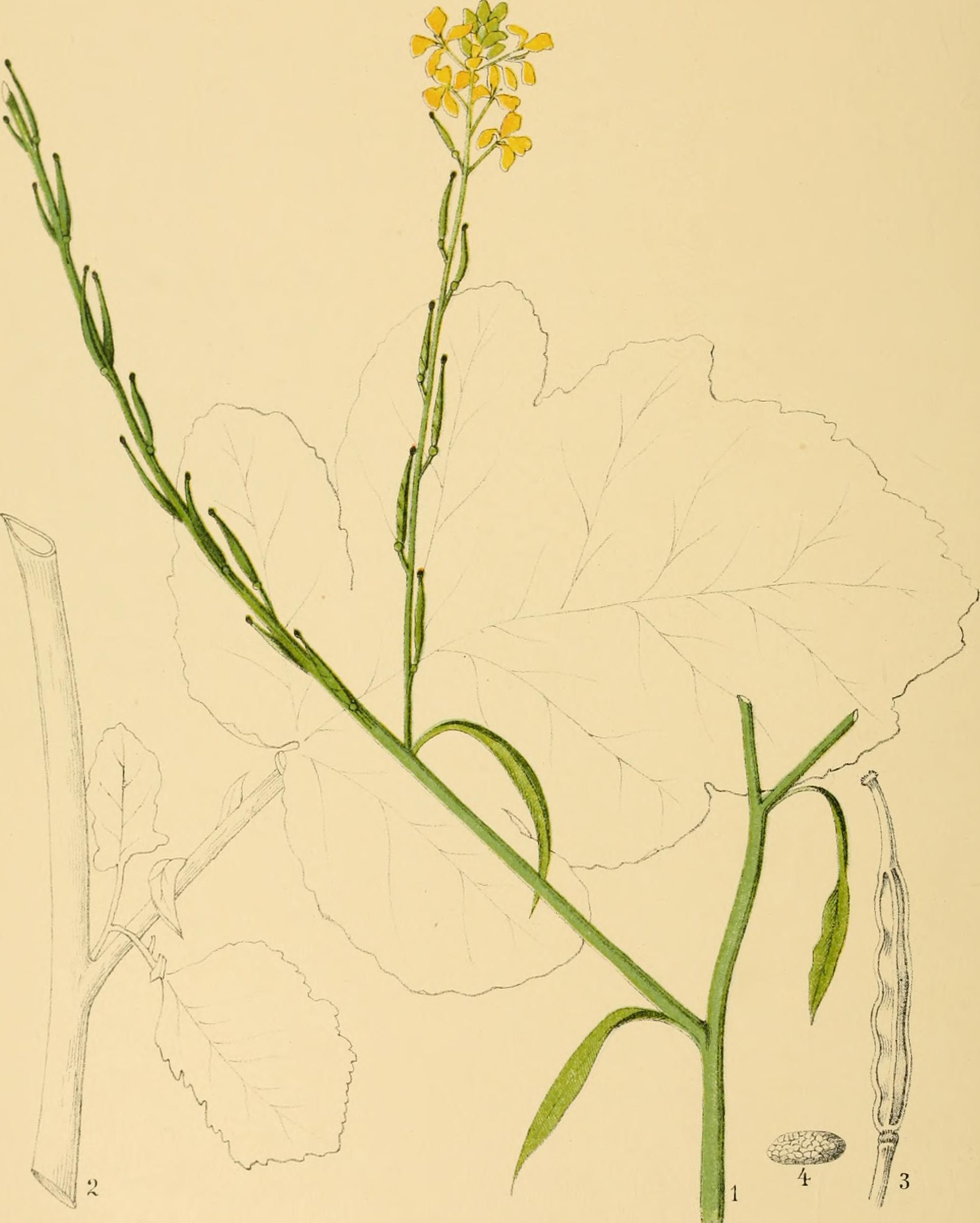
N. ORD.-CRUCIFER^. 24 Tribe.-BRASSICE/E. GENUS. — S I N A P I S,* TOURN. SEX. SYST.— TETRADYNAMIA SILIQUO.SA. SINAPIS NIGRA. BLACK MUSTARD. SYN— SINAPIS NIGRA, LINN.; BRASSICA NIGRA, BOISS.; BRASSIGA SINAPIOIDES, ROTH, COM, NAMES.— BLACK MUSTARD, BROWN OR RED MUSTARD; (FR.) MOUrARDB NOIRS; (GSR.) SOHWARZ SSNP. A TINCTURE OF THE RIPE SEEDS OF SINAPIS NIGRA, LINN. Dsscription. — This useful plant has become a troublesome weed in many parts of North America, growing from 3 to 6 feet high. The rooi is fusiform, thin and branching. The stein generally erect, smooth and numerously branched; the lower leaves are either lyrate or lobed, the terminal lobe large, rough, and harsh to the touch, with two or more small lateral divisions or lobes at its base, the stem leaves are entire, lanceolate and smooth. The injiorescenee is a dense head at first, extending as the fruits form into an elongated raceme, which continues flowering at its top until frost checks the growth. The pods are smooth, about one-quarter inch long, upon appressed pedicels, and closely set to the elongated axis of the inflorescence, they are 4-angled, erect, and surmounted by the 4-angled, stout, persistent style. Va/ves 2, each i -nerved. Seeds a, to 6 in each cell, they are spherical, or somewhat oval, of a dark reddish-brown color, 25 of them in line would about equal an inch, and 50 would generally weigh i grain. The pitted reticulation of the outer coat is coarser, while the seeds themselves are smaller and more pungent than S. alba. A description of the order and genus is incorporated in the description of Sinapis alba, 23. History and Habitat.— Black Mustard is found wild over the whole extent of Europe, excepting its most northern latitudes, as well as the central part of Asia and in Northern Africa. It is quite extensively cultivated in Italy, Germany, and England, and fully naturalized in both North and South America, flowering in temperate regions from June to September. It was well known to the ancients as a medicinal agent, but not as a condiment until somewhat more modern times. The seeds, when ground, form a greenish-yellow powder, inodorous when dry, * SiVairi, sinapi, turnip. Brasiica or Sinapis cam/eslris.
24-2 penetrating when moist, with at first a bitter, then extremely pungent taste, bhstering the tongue. The seeds should be of a bright reddish-brown color, free from gray coating, this ashy film being the effect of dampness during the ripening, and a great detriment to the value and properties of the seed. The fresh plants, soon after their appearance, while the leaves are yet young and tender, are used by the laity in many parts of this country as a pot-herb ("greens"). This relish is termed at that stage of its growth, sau-vy-grass, though the true Scurvy-grass is Sinapis arvcnsis {Brassica Siiiapislnnn). The use of Sinapis nigra in the U. S. Ph. is simply as Cha)-ta Swapis. In the Eclectic Materia Medica the use is the same, and both employ the volatile oil in Linitnenlum Sinapis Coniposiluni. PART USED AND PREPARATION.— The ripe seeds are coarsely powdered and covered with five parts by weight of alcohol, poured into a well-stoppered botde, and allowed to stand eight days in a dark, cool place, being shaken twice a day. The tincture is separated by decanting, straining and filtering. Thus prepared, it has a clear, greenish-yellow color by transmitted or reflected liaht, a sweetish, biting taste, afterward somewhat burning, and is neutral to litmus paper. CHEMICAL CONSTITUENTS.— Sinapisin; this body exists (Simon) as an unsaponifiable fat, in the seeds of black mustard, from which it may be obtained by percolating the powdered seeds with alcohol of 94 per cent., evaporating the percolate, treating the residue with ether, again evaporating, treating with alcohol of 90 per cent, and filtering through animal charcoal. The impure crystals thus cralned are to be dissolved in ether, from which they deposit on evaporation as snowy scales,.soluble in alcohol, ether and oils. (Wittstein.) Sinigrin,— C,„HjgKNS., Ojg, ox: potasso-myronic n'<r-/c/, is the principle peculiar to this species, from which it may be obtained as silky, needle-like crystals, soluble in alcohol and water. When acted upon by myrosin it breaks down, forming mustard oil, glucose, and KHSO^. An analysis of three samples of black mustard farina, made by A. R. Leeds* and E, Everhart, reported in the Journal of the American Chemical Society, 1 88 1, p. 130, gave the following averages, each sample differing but very slightly from the others: Moisture,..... 6.833 Myronate of potash (sinigrin)..646 Sulphocyanide of sinapine (sinalbin), II. 123 Myrosin, 28.483 Mustard oil, 29.208 Ash, 3757 Cellulose (by difference), 19.950 100. For a full description oi crude acid, sinapoleic acid, myrosin, and fai-oil, which exist alike in both S. alba and S. nigra, see 23.
PHYSIOLOGICAL ACTION— So far as I can determine, no specific toxic sj-mptoms have been noted; under S. alba I have given the general action of mustard without differentiation. Description of Plate 24. I. End of a branch in fruit and flower, Binghamton, N. Y., July 5, 1883. 2. Outline of one of the lower leaves. 3. Fruit (enlarged). 4. Pollen grains x 3S0.
zo. ^.m.ad natdeletpinxt CaPSELLA BURSA-PASTORIS, Moenchr'
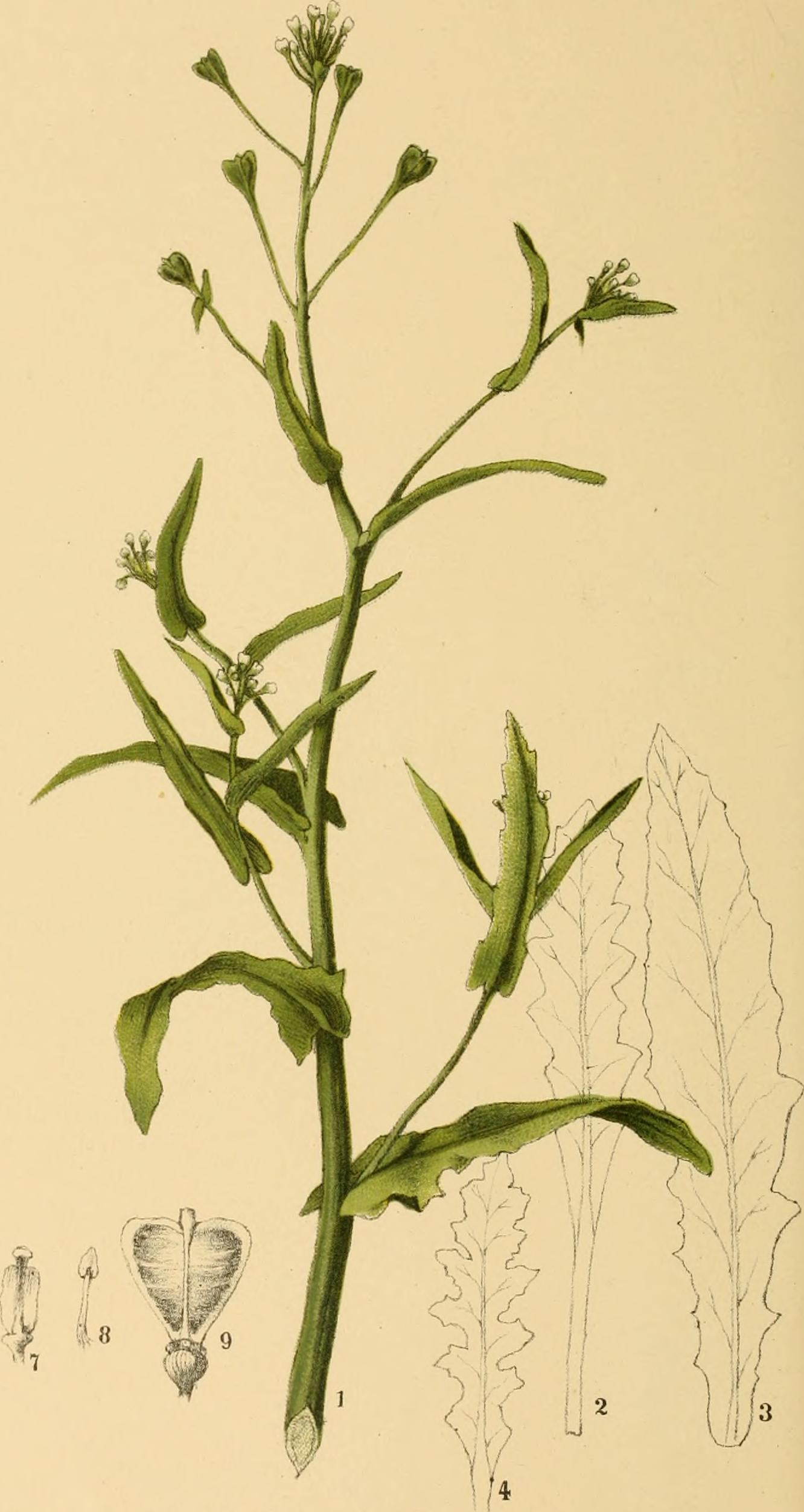
N. ORD -CRUCIFER^. 25 Tribe.-LEPIDINE/E AND THLASPIDE/E. GENUS.— CAPSELLA,* VENT. SEX. SYST.— TETR.\DYNAMIA. BURSA-PASTORIS. SHEPlfERD'S PURSE. SYN.— CAPSELLA BURSA-PASTORIS, MCEN.; THLASPI BURSA-PASTORIS, LINN. COM. NAMES.— SHEPHERD'S PURSE; (FR.) BOURSE DE PASTEUR; (GBR.) HIRTENTASCHLBIN. A TINCTURE OF THE WHOLE PLANT CAPSELLA BURSA-PASTORIS, MCEN. Description. — This intrusive little annual grows to a height of from 6 to i8 inches. Rooi tap-shaped. Stem erect, simple, or branching at the summit, smooth or sometimes pubescent. Leaves mostly rosulate at the root, pinnatifid or pinnatifidly toothed; stem leaves sessile and partly clasping, more or less sagittate, toothed or in some cases entire, especially those at the base of the racemes. Inflorescence apparently a dense cluster at the summit of the stem, but as fruiting advances showing a racemose arrangement; flowers minute, white; pedicels long, especially in fruit. Sepals ovate, long-pointed, and having inserted about their middle a filamentous appendage. Petals spatulate. Anthers sagittate. Style short; stigma capitate. Silicle obcordate triangular, flattened contrary to the septum; valves 2, scaphoid, wingless. Seeds numerous; cotyledons plane, incumbent. Read description of Cruciferse under Sinapis alba, 23. History and Habitat. — This European immigrant has become too thoroughly a nuisance as a weed about the cultivated lands of this country from Florida northvirard and westward, where it flowers from earliest spring to September. This plant was formerly classed with the genus Thlaspi, from which it was removed on account of its wingless valves. The Shepherd's Purse has been used in English domestic practice from early times, as an astringent in diarrhoea; it was much used in decoction with milk to check active purgings in calves. Later its value here was much doubted, and other properties accorded it, especially those of a stimulating astringent and diuretic. It has been employed in fresh decoction in hematuria, hemorrhoids, diarrhoea and dysentery, and locally as a vulnerary in ecchymosis and as an application in rheumatic affections. The juice on cotton, inserted in the nostrils, was often used to check hemorrhage in epistaxis. * FroTi capsula, a pod. f I use the specific name, which should always distinguish this plant in medicine, to avoid confusion in synonyms.
25-2 PART USED AND PREPARATION.— The fresh plant, gathered when the rtowering season is about half completed and the fruits rapidly formino-, is chopped and poundeil to a pulp and weighed. Then two-thirds by weight of alcohol is taken, the pulp thoroughly mixed with the spirit and the whole pressed out in a piece of new linen. The tincture thus prepared has, after filtration, an orangebrown color by transmitted light, a peculiar odor, resembling decayed vegetation, a pungent taste, too like its odor, and an acid reaction. CHEMICAL CONSTITUENTS.— Several partial analyses have been made of this plant, but none have resulted in the separation and determination of a peculiar principle. The general constituents of plants, and a volatile oil said to be identical with oil of mustard, as well as a fixed oil, have been determined., Climcal C/ses.—ln the absence of provings of this drug, it has been found curative in various uterine hemorrhages, especially those with which uterine cramp and colic are associated; also in various passive hemorrhages from mucous surfaces.* A thorough proving is greatly to be desired. Description of Plate 25. I. Whole of young plant above the radicle leaves, Binghamton, N. Y., May 24th, iSS". 2, 3, 4. Forms of radicle leaves. 5. Flower. 6. Petal. 7. Pistil. 8. Stamen. 9. Silicle. 10. Open silicle, showing seeds. See Hale, AVtu A'em, p. 62 c.
^lU-adnatdeletpinxt. RaPHANUS RaPHANI'STRUM, Linn.
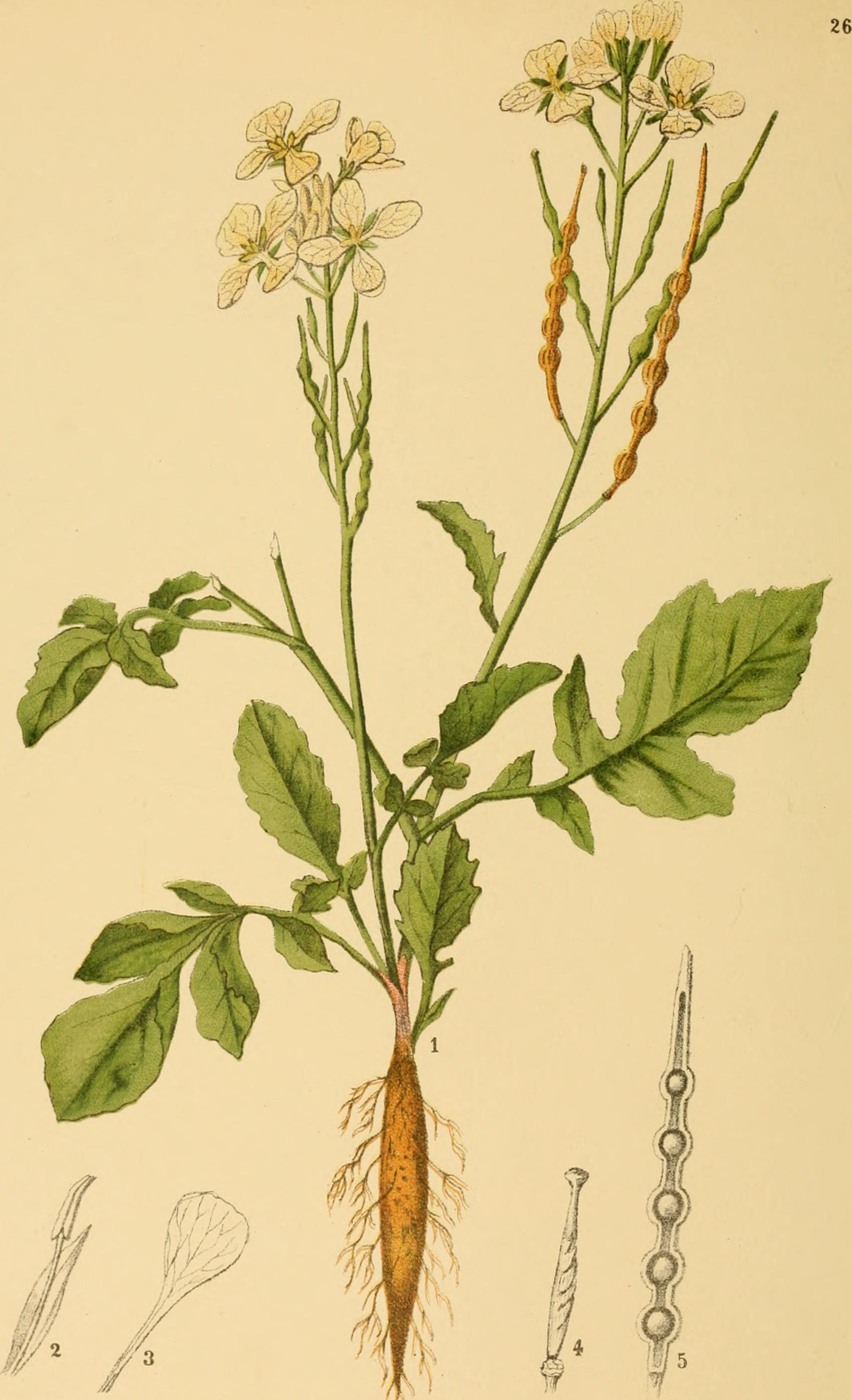
N. ORD-CRUCIFER^. 26 Tribe.-RAPHANE/E. GENUS.— RAPHANUS,* LINN. SEX. SYST.— TETRADVNAMIA SILIQUOSA. RAPHANUS. RADISH. SYN.-RAPHANUS RAPHANISTRUM, LINN. COM. NAMES.-WILD RADISH, JOINTED CHARLOCK, CHARLOCK; (PR. RAIFOOT, COMMUNE; (GER.) WILDE RETTIG. A TINCTURE OF THE FRESH ROOT OF RAPHANUS RHAPHANISTRUM, LINN. Description. — This rapid-growing- annual or biennial herb usually attains a height of from i to 2 feet. Root tap-shaped; stem erect, glaucous, sparino-ly bristly, and much branched below. Leaves lyrate, petiolate or sessile, dentate, and rough, the terminal lobe oval or obovate. Calyx erect, somewhat 2-saccate at the base. Petals at first yellow and veiny, becoming purplish or whitish with ao-e, obovate and unguiculate. Stamens distinct toothless. Style long; stigma capitate. Pod linear-oblong, terete upward, longer than the style, 2-jointed, indehiscent, and valveless; the upper joint markedly necklace-form by strong contractions between the seeds; the lower joint often seedless and stalk-like. Seeds 3 to 8, laro-e and spherical; cotyledons conduplicate and incumbent. History and Habitat. — The Wild Radish grows profusely over the fields of Great Britain and Europe, and has become a troublesome weed in New Eno-land, New York, New Jersey, and Pennsylvania, from whence it is spreading westward. It blossoms in July and fruits in September. The cultivated forms, R. sativus, Linn., and its varieties, niger (Black Spanish), oblongus (Long Radish), and rotiindus (Globose Radish), supposed to be of Chinese origin, are well-known salad roots; all of them have contributed more or less to our provings. \'ery litde and unpronounced use has been made'in medicine of these forms, or of the wild plant. The seeds have proved emetic, and the root diuretic and laxative. PART USED AND PREPARATION.— The fresh, perfect roots, gathered when full formed, at about the time of flowering, are chopped and pounded to a pulp and weighed. Then two parts by weight of alcohol are taken, the pulp thoroughly mixed with one sixth part of it, and the rest of the alcohol added. * 'P(i, ra, quickly; daifi^, phaino, to appear; from its rapid germination.
26-2 After thoroughly stirring the whole, it is poured into a well-stoppered botde, and allowed to stand eight days in a dark, cool place, shaking twice a day. The tincture, after straining and filtering, has a clear yellow color by transmitted light; an offensive odor, something like that of boiling cabbage; a similar miserable taste: and an acid reaction. PHYSIOLOGICAL ACTION. — The effects noted in people who have eaten too freely of radishes, and in others who took large quantities of the tincture, were substantially as follows: Mental excitement, followed by depression and anxiety; confusion and vertigo with cephallagia; stuffiness of the nostrils; paleness of the face; bitter taste in the mouth: constriction of the oesophagus; violent thirst; nausea with violent pressure in the stomach; great distention of the abdomen, which became hard and tense, though painless, and no flatulence escaped; numerous liquid diarrhoeic stools; great desire to urinate, with greatly augmented quantity; great sexual excitement in women, coming on in paroxysms of great violence; lancinating pains in the chest; violent palpitation of the heart; attacks of hysteria; emaciation; itching of the skin; restlessness; and chilliness followed by inclination to sweat. Description of Plate 26. I. Whole plant, Jamaica, L. I., July 29th, 1886. 2. A sepal and stamen. 3. Petal. 4. Pistil. 5. A ripe pod. 6. A section of a pod. (2-4 and 6 enlarged.)
27. /^. & 6 I ■9< (p!m. ad natdel.et pinxt VioLA Tricolor, Linn.
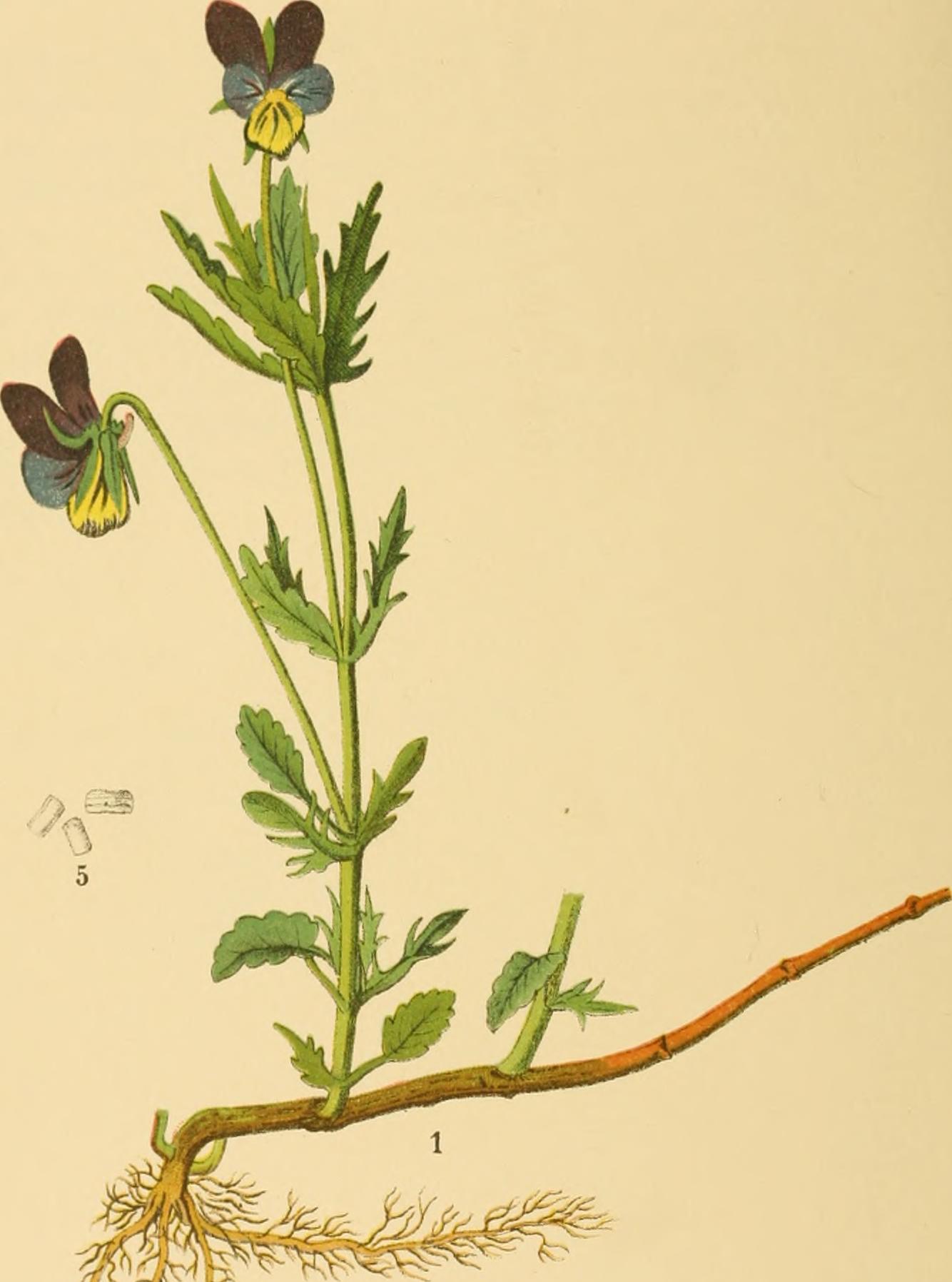
N. ORD -VIOLACE^. 27 GENUS.— V I O L A,* LINN. SEX.,SYST.— PENTANDRIA MONOGVNIA. VIOLA TRICOLOR (JACEA) IVILD PAJfSY SYN.-VIOLA TRICOLOR, LINN.; VIOLA BICOLOR, PURSH; VIOLA TENELLA, MUHL.; VIOLA ARVENSIS, ELL.; JACEA TRICOLOR, SIVE TRINITATIS, ETC., J. BAUH. COM. NAMES.-PANSY, PANSIE, PANSBY, HEART'S-EASE, THREE COLORED VIOLET, TRINITY VIOLET, FIELD PANSY, WILD PANSY; (PR.) PENSBE; (GER.) STIEFMUTTERCHEN-KRAUT, FRBISAMKRAUT.' A TINCTURE OF THE WHOLE FRESH PLANT VIOLA TRICOLOR, LINN. Description. — This beautiful little plant, belonging to- the leafy-stemmed violets, springs from an annual, biennial, or short-lived perennial, fusiform root. S/e?]t 3 to 8 inches high, angled, at first creeping, then erect, simple or branched, and leafy throughout; 5/'//?^/^.5- very large, herbaceous, lyrate-pinnatifid. IriJIorescciice sevevaX smallish flowers on a terminal and axillary peduncle. Calyx with short auricles. Corolla with an obtuse, thick spur; petals short clawed. Ovary partly concealed in the concave receptacle; style somewhat conical, narrowing toward the ovary; stigma cup-shaped. Capsule smooth; seeds oblong. Description. — Violace^e and Viola. — The plants under this natural order and genus are low, caulescent or acaulescent, those with stems springing from annual or perennial roots, those without stems from scaly root-stocks. The leaves are alternate and petiolate, with leaf-like persistent stipndes. In the stemless violets the scapes are axillary, solitary, and furnished with two bracts at the base. Inflorescence a single, more or less irregular flo^wer upon the incurved summit of the scape or peduncle; many species having also radical apetalous or cryptopetalous, fertile summer flowers. Calyx herbaceous, persistent; sepals 5, often auriculate at the base, the odd one superior. Corolla irregular; petals 5, somewhat unequal, hypogynous, alternate with the sepals, the superior one — which becomes inferior by the inversion of the scape — is saccate or spurred at the base, the two lower petals with an appendage at the base concealed in the spur. Stamens 5, hypooynous upon a ring-like or concave torus, alternate with the petals, closely surrounding the ovary, and are sometimes slightly coherent into a ring or tube; filaiucnis very short and broad, projecting beyond the anther into a little persistent wino- or tip, or sometimes obsolete. The two lower filaments, when present, are furnished * Derivation Latin, obscure. f Herring's Condensed Materia Medica.
27-2 each with a little projection, concealed in the sac or spur of the lower petal; anthers adnate, 2-cellecl, the cells somewhat separated at the base, opening by a longitudinal introrse slit. Ovary sessile, ovoid, one-celled, with three parietal placentae; style terminal, various, usually declined; stigma various. Fniit an ovoid, crustaceous or papyraceous, ^ valved, loculicidal capsule; seeds many, horizontal, and furnished with a distinct wart-like excrescence at the hilum, raphe apparent; albumen fleshy; embryo straight, situated in the axis. This description essentially includes the two genera lonidum {solca) and I'iola of the northern United States; in the tropics many plants of this order are shrubby. The genus lonidum contains the Brazilian Poaya da Praja {loniduD! Ipccacuauha, A. de St. H.; /. Ilubu, H B K.; Viola Itubu, Aubl.; Pombalia Itubu, D C.); the Poaya do campo {lonidum Poaya); the Chimborazian Cuichunchulli (lonidum microphyllum, H B K.) noted as a supposed specific for the " mal de San Lazaro " or Elephantiasis tuberculata; and the Chilian purgative Maytensillo {lonidum parviflorum. Linn.), the roots of which arc stated by Lindley to bear in appearance and properties a great similarity to Ipecacuanha. History and Habitat. — The wild pansy has become naturalized in this country from Europe, growing here in dry, sandy soils, from New York westward to Illinois and southward, blossoming northward from April until the summer months. The varieties of this plant in cultivation are innumerable, affording some of the most beautiful of our garden-plants; the principal changes in cultivation are in the size and colors of the flowers, varying, as they now do, from pure white to silver, gold, bronze, and jet-black, with admixtures in immense variety. The use of the pansy in medicine dates far back in ancient medication, the first real experimentation with the plant is. that of Starck in i 776, who wrote " De crusta lactea infantum ejusdemgue remedis dissertatio, etc.," in that year; the provings substantiate this use of the plant and show it to be useful in other forms of impetigo. Its use in some forms of burrowing ulcers, tinea capitis and scabies is also sanctioned by the provings. The plant is mentioned in the U. S. Ph. and the Eclectic Materia Medica. Part Used and Preparation. — Tlie whole plant, gathered while in flower, should be chopped and pounded to a pulp and weighed; then two parts by weight of alcohol taken, the pulp thoroughly mixed with one-sixth part of it, and the rest of the alcohol added. The whole should be well mixed, poured into a well-stoppered bottle, and allowed to stand at least eight days in a dark, cool place. The tincture, separated by filtering, should have an orange-brown color by transmitted light, a cucumber-like odor, rich, sweet taste, and strong acid reaction. CHEMICAL CONSTITUENTS.— r/t;////;* this acrid, bitter principle, bearing in its properties a close resemblance to emctia,-\ was extracted by Boullay from Viola adorala; it is found also in Viola tricolor and var. drvensis as well as in * Violia, Violine. | Alkaloid of Cep/,a;lis Ipecacuanha.
27-3 I'ioUi pcdata. According- to Wittstein it is a pale yellow, bitter powder, fusible, and inflammable at greater heat; it dissolves slightly in water and alcohol, and is insoluble in ether. Violaqueritrin, Q.^H^.^O^^. This coloring-matter was discovered by Karl Mandelin* in viola tricolor var. arvaisis; it forms a yellow crystalline mass, easily soluble in alkalies, and hot water, crystallizing from the latter on cooling. f OH Salicylic Acid, QH^ -^ ^q tt This acid, so far in its history, has been but rarely extracted under its own form from plants; the flowers of Spirca tdviaria alone yielding it.f Karl Mandelin, however, who has made careful analyses of viola tricolor, extracts the acid pure. He reports in his " Inaugural Dissertation" (Dorpat, 1881) a proportion of from.043 per cent, in cultivated plants, to.107 per cent, in var. arvensis. He finds it in all parts of the fresh plant, and principally in the roots, stems and leaves. Pectin, or vegetable jelly, Q^H^gO^g (H^O)^. From the fact that a mixture of one part of the juice of this plant with ten parts water, will form a jelly-like mass, the presence of the above body or a very strong mucilage seems proven. This property has given various uses to Viola as an expectorant, emollient, and infusion for coughs and bronchial affections. Sugar, both crystallizable and uncrystallizable, salts of potassium, tartrate of magnesium, and other general constituents of plants have been determined. PHYSIOLOGICAL ACTION.— The emetic effect of some of the violets, due to the presence of violin, has been noted to some extent in this species. The most characteristic symptom of its action is an offensive odor of the urine, like that of the cat. The pains caused by this drug are of a stitching character, while its action seems spent almost entirely upon the skin, and the male sexual organs. On the skin it causes burning, stinging, and itching, followed by breaking down of the tissues into either squamous spots, or any grade of incrusted eruptions; the eruption pours out a thin yellow fluid. Boils, impetigo, especially crustea lactea, ichorous and burrowing ulcers, and zoster followed the exhibition of generous doses of this drug. On the genital organs of the male the prepuce becomes swollen, with stitching and burning pains in the glans and scrotum, the testicle becomes indurated, and venereal ulcers form; stitchings are frequent in the urethra, followed by urging to urinate with profuse discharge. Description of Plate 27. I. Whole plant from Binghamton, N. Y., May 13, 1884. 2. Bud showing sepals. 3. Pistil (enlarged). 4. Discharged anther (enlarged). 5. Pollen X 380. P/iar. Zeit. fitr Russhind, 18S3, pp. 329-334. Am. Jojtr. Pilar., 1SS3, p. 470. f Lowig.
28..ad nat.dei.et pinxt. HeLIANTHEMUM CANADENSE,Michx.
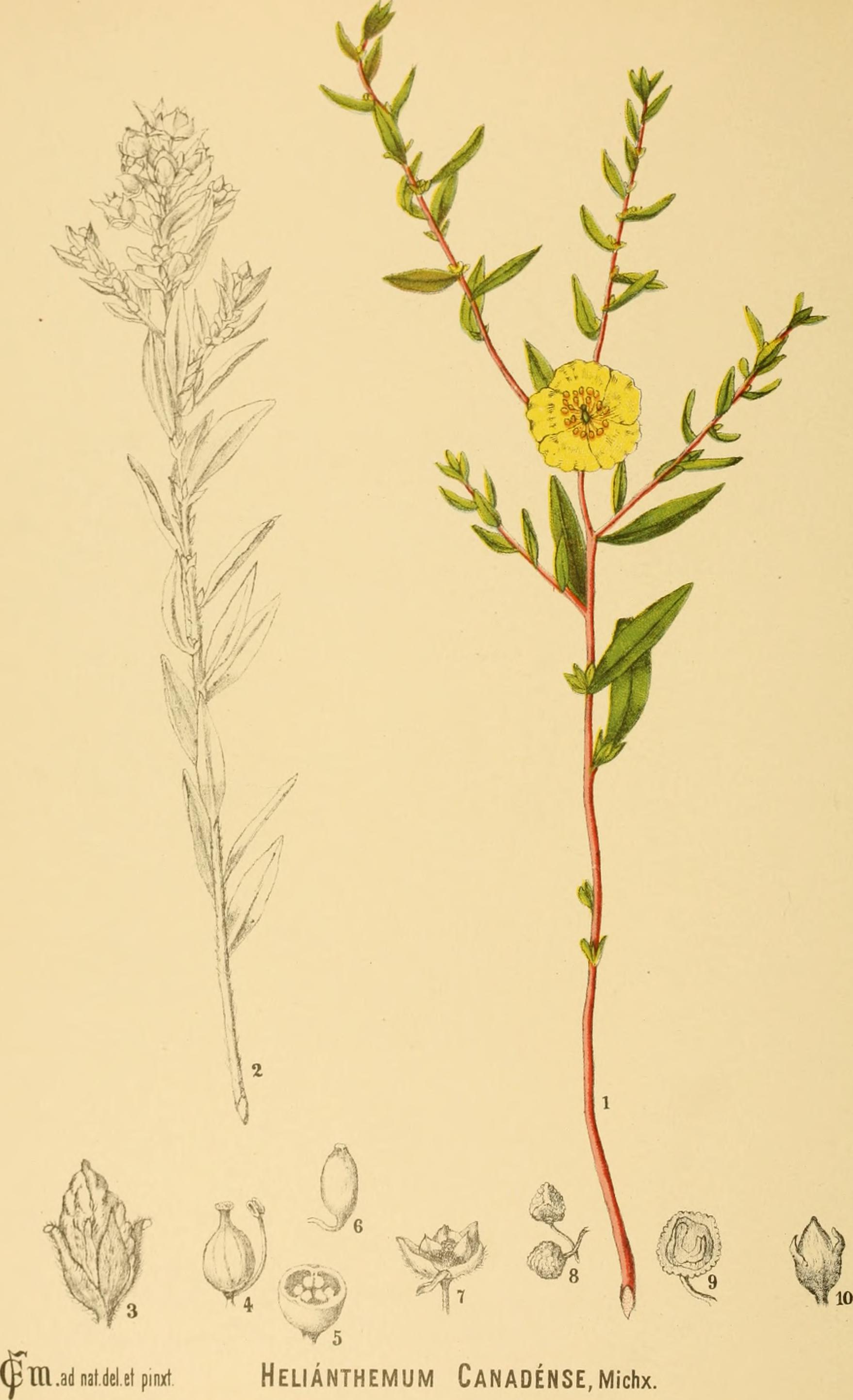
N. ORD -CISTACE^. 28 GENUS.— HELIANTHEMUM,* TOURN. SEX. SYST.— POLYANDRIA MOXOGYNIA. CISTUS. HOCK ROSE. SYN. — HELIANTHEMUM CANADENSE, MICHX.; H. RAMULIFLORUM, MICHX.; H. ROSMARINIFOLIUM, PURSH.; H. CORYMBOSUM, PURSH.; CISTUS CANADENSIS, LINN.; C. RAMULIFLORUM, POIR.; LECHEA MAJOR, LINN; HETERAMERIS CANADENSIS, SPACH.; H. MICHAUXII, SPACH. COM. NAMES. — ROCK ROSE,t FROST -WORT, FROST -PLANT. FROSTWEED, HOLLY ROSE; iPR.) HELIANTHEME DU CANADA; (GER.) CANADISCHES SONNENROSCHEN. A TINCTURE OF THE WHOLE PLANT HELIANTHEMUM CANADENSE, MICHX. Description. — This peculiar plant grows to a height of from 6 to 1 2 inches. Slcm at first simple, erect or ascending, somewhat hairy; pubescence stellate and fasciculate. Leaves sessile or nearly so, oblong lanceolate. Flo7vers of two sorts, both diurnal; Primary form: few or solitary, large, pedunculate; calyx hairy pubescent; petals 5, obovate, fugacious, crumpled in the bud, erosely marginate; stamens indefinitely numerous; pod ovate, shining, many-seeded; Secondary form: numerous, small, sessile, axillary, solitary or few-clustered upon short leafy branches; sepals 5, the outer pair sometimes wanting; petals very small or absent; stamens 3 to 10; pod minute, hoary, 3- few-seeded. Style columnar or absent; stigma capitate, 3-lobed, fimbriolate. Fruit -a. i -celled, 3-valved capsule. 5',?£?rt!' somewhat triangular; testa rough; embryo incurved in the form of a hook or ring. There are two very distinct forms of this species, differentiable as follows: Early Flowering Form {Y\g. \). Stems upright, branching, bright crimson, nearly glaucous. Leaves ovate-lanceolate, light green. Primary flowers axillary solitary. Secondary flower-buds minute. Capsule of primary flowers nearly twice as large j Capsule of primary flowers smaller. as the later form. 1 Later Flowering Form (Fig. 2). Stem upright, less branched, purplish, covered with a downy pubescence. Leaves dark green. Primary flowers terminal clustered. Secondary flowers numerous, larger. Cistacese. — This small family of low shrubs or herbs is represented in North America by 3 genera and 17 species; its members are characterized as follows: * HXio,-, helioSy the sun; avUnov, anthemoii, a flo\vei« f The true Rock Rose is C. Creticus, Linn., a native of Syria.
28-2 Leaves simple, mostly entire, the lower often opposite, the upper alternate; stipules absent. Flozccrs regular. Calyx persistent; sepals 5, the two outer often smaller, bract-like, or absent, the three inner twisted in the bud. Petals 3 to 5, twisted in an opposite direction to the sepals, fugacious. Stamens distinct, mosdy indefinite, hypogynous; filaments slender; anthers short, innate. Ovules few or many, stipitate, and furnished with an apical orifice; style small or wanting. Fruit a i -celled capsule; valves 3 to 5, each with a dissepiment attached to its median line and placental at the axis. Seeds mosdy orthotropous; embryo long and slender, straightish or curved; albumen mealy. The only other plant of this order used in medicine is the European Rock Rose (Cistus Creticus, Linn.), from which the natural e.xudation, a gum resin called Ladanum, has been much esteemed as a stimulant, especially to mucous membranes, and as an emmenagogue. C. Ladaniferous, Linn., C. Ledon, Lam., and C. Latirif otitis, Linn., are said to yield the same substance. History and Habitat. — Frost-wort is indigenous to North America, where it ranges from Maine to Wisconsin and thence southward; it habits sandy soils, and flowers from April to August. In early winter the bark near the root fissures, and spicules of ice project from the rents; this fact gave the plant its vulgarisms. Frost-wort, etc. This plant has been long held in repute as a remedy for scrofula and for many disorders arising in persons of strumous diatheses, especially, however those diseases in such persons which have seemed to need an astringent, tonic, or alterative, such as diarrhoea, aphthous ulcerations, ulcers, ophthalmia, syphilis, and the like. The preparation of the Eclectic Materia Medica is Decoctuni Helianthemi. PART USED AND PREPARATION. — The whole fresh flowering plant is chopped and pounded to a pulp and weighed. Then two parts by weight of alcohol are taken, the pulp thoroughly mixed with one-sixth part of it, and the rest of the alcohol added. After stirring the whole well, it is poured into a well-stoppered bottle, and allowed to stand eight days in a dark, cool place. The tincture, separated from the mass by pressing and filtering, has a beautiful crimson color by transmitted light; an odor resembling that of damp clover hay; a sourish, bitterish, and astringent taste, and an acid reaction. CHEMICAL CONSTITUENTS.— No analysis of this species has, to our knowledge, bc(.'n made; the tincture, however, would indicate a bitter principle, and probably tannin. PHYSIOLOGICAL ACTION.— When taken in large doses the decoction causes nausea and vomiting. Small doses persisted in cause the following train of symptoms: Headache; pressure and stitches in the eyes; swelling and discharge in the internal ear, and of the salivary and cervical glands; swelling of the inner nose, and sneezing; soreness, dryness, and rawness of the tongue, mouth.
28-3 and throat; abdominal flatulence; diarrhoea; swelling and hardness of the mammae; pains in the chest; articular drawing and tearing pains; itching vesicular eruption; chilliness, heat and restlessness, with thirst and trembline durino- the fever. Description of Plate 28. 1. Early flowering form, with primary flower, June istli, 1885. 2. Late flowering form, August ist, 1885, Salem, Mass. 3. Primary flower-bud. 4. Pistil and stamen. 5. Horizontal section of ovary. 6. Ovule. 7. Open fruit. 8. Seeds..9. Section of seed. ID. Secondary bud. (3-6 and 8-10 enlarged.)
29, ^ f;,^P.?^; 1 ' ^m.ail nstdel.etpinxl. DROSERA ROTUNDIFOLIA.Linn.
N. ORD -DROSERACE^. 29 GENUS.— D ROSE RA,* LINN. SEX. SYST.— PENTANDRIA PENTAGYNIA. DROSERA. SUNDEW. SYN.— DROSERA ROTUNDIPOLIA, L.; RORBLLA ROTUNDIFOLIA, AND ROS SOLIS POL. ROTUND. RAIL COM. NAMES.— ROUND -LEAVED SUNDEW, RED-ROT, MOOR GRASS, YOUTH ROOT; (FR.) DROSE'rE A FEUILLBS RONDES, ROSEB DU SOLEIL; (GER.) RUNDBLATTRIGER SONNENTHAU. A TINCTURE OF THE WHOLE FRESH PLANT, DROSERA ROTUNDIFOLIA, L. Description. — This low, stemless, perennial herb is characterized as follows: Leaves orbicular, tufted, the upper surface covered with red, glandular, setose hairs, each bearing a pellucid globule of glutinous fluid at its apex; petioles long, hairy, and spreading; stipules replaced by a fringy tuft of hairs. Scapes naked, i to 3 from each root; inflorescence a terminal, unilateral, at first circinate then nodding raceme which becomes gradually erect as the buds expand and fruits ripen; thus each flower as it opens appears terminal. Flowers 5 to lo, white, diurnal, opening only in sunshine, the parts sometimes in sixes. Petals oblong, styles generally 3, deeply forked; stigmas 6, situated upon the inner face of the club shaped apex of each fork. Pod globular, 3-valved; seeds numerous, fusiform, arranged in 2 to 5 rows along the placentiferous median line of each valve, testa loose, arilliform and chaffy. DroseracesB The members of this small family of bog plants are known mainly by their being mosdy clothed with gland-bearing hairs. Leaves clustered at the base of the scape, or alternate, petiolate, circinate in the bud. Flowers hypogynous; calyx composed of 5 equal and persistent sepals; corolla of 5 equal and regular, marcescent petals, convolute in the bud. Statnens equaling in number the petals and alternate with them; anthers innate, extrorse. Styles 3 to 5 generally distinct, undivided, bifurcated or two-lobed, at the apex. Fruit z. i -celled 3 to 5-valved, loculicidal capsule; placenta thick at the base of the pod, or merely a line on each valve; seeds numerous, anatropous; albimicn sarcous or cartilaginous; embryo basal, minute. The species under consideration is the only one used in medicine. The North Carolinian fly-trap {Diotiea nmscipula, Ellis) has furnished material for the study of carnivority in plants; the sundew has also been experimented upon in this * Jpoo-tpiSt, droseros, dewy; in allusion to the appearance of the leaves.
29-2 re<rarcl, but as yet the results are far from proving it carnivorous per se, though the plants allowed insects as "food" appear to Hourish better and ripen more seeds than those deprived of that nourishment.* History and Habitat.—The sundew grows in dense sphagnum or sandy swamps in England and America. Its range here extends from Florida northward, most common north, where it blossoms in June and July. The previous uses of this plant in medicine have been but slight; it was supposed in the sixteenth century to be curative of consumption; of this quality, however, Gerarde says: " The later physitians have thought this herbe to be a rare and singular remedie for all those that be in a consumption of the lungs, and especially the distilled water thereof; for, as the best doth keep and hold fast the moisture and the dew, and so fast that the extreme heate of the sun cannot consume and waste away the same; so, likewise, men thought that herewith the naturale and heate in men's bodies is preserved and cherished. But the use thereof doth otherwise teach, and reason showeth the contrarie; for, seeing it is an extreme biting herbe, and that the distilled water is not altogether without this biting qualitie, it cannot be taken with safetie: for it hath also been observed that they have sooner perished that used the distilled water hereof, than those that abstained from it and have followed the right and ordinary course of diet." Geoffroi assertsf that its infusion is a valuable pectoral, useful in pulmonary ulceration and in asthma. Rafinesque saysj the juice is used " to destroy warts and corns; with milk, for freckles and sunburns. It makes milk solid, but sour like bonyclabber, liked in Sweden. Deemed pectoral in South America, a sirup used in asthma." Many medical writers, among them Schenck and Valentin, recommend its use in "different kinds" of coughs, arising from bronchial attacks, phthisis, and other diseases of the lungs. A fit summary of all this practice may be found in Hahnemann's observations. " Drosera is one of the most powerful medicinal agents in our country. It was formerly used externally, but without success, in cutaneous affections, and it seems to have been taken with greater advantage internally. Modern practitioners who, according to custom, have tried only large doses, have not ventured upon giving it internally, fearing to kill their patients, and have therefore rejected it." No preparations of Drosera are officinal either in the U. S. Ph. or Eclectic Materia Medica. PART USED AND PREPARATION.— The entire fresh plant gathered in July should be chopped and pounded to a pulp, enclosed in a piece of new linen and pressed out. The juice should then be added to an equal part by weight of alcohol, thoroughly mixed and allowed to stand eight days in a well-stoppered bottle in a dark, cool place. The tincture separated from the above mass by * BCisgen, Jour. Cheni. Soc, 1884, p. 917. A more extended discussion of this subject will be found under Sarracenia, 19. t Mer. el de L. Diet, de M. Med., II., p. 699. X Med. Flora, II., p. 217.
29-3 filtration should be opaque, and present in thin layers a reddish-brown color, have an acrid, astringent taste, and an acid reaction. CHEMICAL CONSTITUENTS Alizarin, Cj.HgO/- (CjoH^Og + H^O or Cj^HjgOJ.f This dioxyanthroquinone coloring matter was first discovered in Madder root {Rubia tinctoria), as a glucoside J It crystallizes from its solution in alcohol in long, lustrous, translucent, yellowish-red, neutral and bitter prisms, containing three molecules of water, which it loses at ioo°-i20° (2i2°-248° F.). It sublimates at 215° (419° F.), in brilliant red needles that are only slightly soluble in water, but fully in alcohol and ether. (Wittstein.) The plant is acrid and corrosive, but the principle to which this property is due has not, as far as I can determine, been investigated. Rafinesque states that the glutinous secretion of the leaf hairs is acid; this may be a similar body to that which renders the water in the leaves of the pitcher-plant acid.§ PHYSIOLOGICAL ACTION. — Drosera has long been deemed poisonous to animals, especially sheep; in the latter its action was mostly supposed to be upon the mucous membrane of the intestinal tract. Dr. Curie slowly poisoned three cats with daily doses of the drug;|| the post-mortem examination with the microscope revealed the pleural surface of both lungs studded with true tubercle. In one cat the mesenteric glands were much enlarged; in another the submaxillary glands, with the solitary glands of the colon and Peyer's patches. Burdach states that In man the juice produces shuddering, sense of constriction at the chest, rawness in the throat, cough, haemoptysis, pain in the bowels, diarrhoea, sweat, and diminished secretion of urine. The cough caused by this drug arises from a tickling in the larynx; it is spasmodic in its nature and causes vomiting if the stomach contains food. Drosera asserts altogether a peculiar action upon the lungs and, in fact, the whole respiratory tract, thus leading us to value it deservingly in pertussis, bronchial irritation and even phthisis, where in fact it gives many a patient a restful night and more peaceful day when the disease is too far advanced for still greater benefit. Description of Plate 29. I. Whole plant from Spruce Pond, N. Y., July 21st, 18S4. 2. Stamen. 3. Pistil. 4. Leaf hair. (2-4 enlarged.) * Grieb et Lieb. f Schunek. % Rubianic acid. \ Sarracenia purpurea, 19. II French Acad. Sci., British Jour. Horn., xx., 39.
30. 1 "^ (ElU.aiinat.del.et pinxt. h Hypericum Perforatum, Unr West Vireinia Universitv Libraril
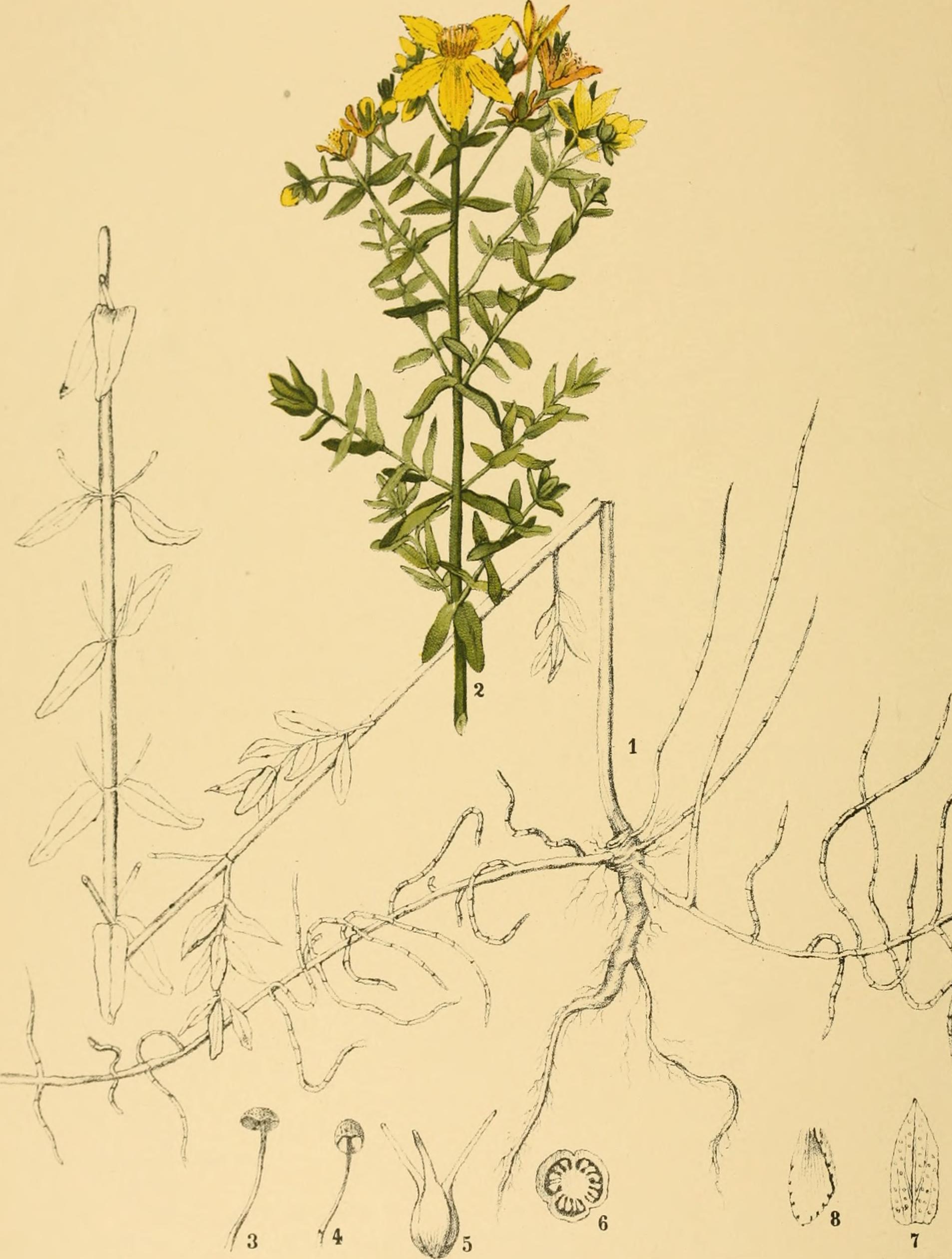
N. ORD-HYPERICACE^. 30 GENUS.— HYPERICUM,* LINN..SEX. SY.ST.— POLV.A.DELPlII.-'i POLV.WDRIA. HYPERICUM. ST. jobjY's wort. SYN. — HYPERICUM PERFORATUM, LINN.; H. VULGARB, BAUH.; H. PSEUDOPERFORATUM, BERTOL. COM. NAMES. — ST. JOHN'S WORT, GOD'S WONDER PLANT, DEVIL'S SCOURGE, WITCHES' HERB; (PR.) HBRBE ST. JEAN. CHASSB DIABLE, MILLE-PERTUIS; iGER.) JOHANNISKRAUT, HARTHEU, HEXENKRAUT. A TINCTURE OF THE WHOLE PLANT HYPERICUM PERFORATUM, LINN. Description. — This rapidly-spreading perennial grows to a height ot a loot or more. SLi?i erect, somewhat two-edged, much branched at the summit and producing many long runners from its base. Leaves elliptical to linear oblong, obtuse, and punctate with numerous scattered pellucid dots. Infloi^cscence in a dense, terminal, leafy cyme; floweis numerous, deep yellow. Calyx erect; sepals lanceolate, acute. Petals twice as long as the sepals, black-dotted along the edges, margins unequal. Stamens numerous, in 3 to 5 clusters; filaments filiform; anthers blackdotted. Styles 3-divergent. Fruit a globose-ovoid capsule, 3-celled by the meeting of the placentee in the axis; seeds pitted. Hypericaceae. — This family of herbs or shrubs is represented in North America by 3 genera, containing in all 39 species and 6 varieties. Leaves opposite, entire, dotted; stipnlcs.non&. hifloresccnce cymose; flozvers regular, hypogynous. Sepals 5, nearly equal, sometimes united at the base, persistent, and imbricated in the bud. Petals 5, alternate with the sepals, deciduous, oblique, convolute or imbricated in the bud. Stamens mostly numerous, united or clustered, and not furnished with interposed glands; anthers introrse, fixed by the middle. Ovules anatropous; styles 2 to 5, persistent; stigmas hardly evident, capitate. Fruit a i- to 5-celled pod; dehiscence septicidal; valves 2 to 5. Seeds numerous, usually cylindrical; embryo straight; albumen none; tcgmcn fleshy. The only plants of this order used in general medicine are: The Isle of France Hypericum lanceolatum, which is considered specific for syphilis by the natives; the Brazilian H. connntum, used as an astringent in sore throat; H. laxiusculum, considered alexiteric; and some Russian species, which are vaunted as cures for hydrophobia. The European Androsmtium officinale, AH., is vulnerary; and the Guiana J'lsuia Guiancnsis, Pers., yields a purgative juice, greatly resembling gram bo we. * The ancient name, of unknown derivation.
30-2 History and Habitat. — Tliis European immigrant has become so thoroughly naturalized with us as to become a very troublesome weed upon our farm-lands, where its rapid and rank growth render it difficult to exterminate and very exhausting to the soil. It flowers in July and August, and fruits a little later. Hypericum is mentioned by some of the earliest writers upon Materia Medica as a febrifuge and anthelmintic. Paul of ^gina speaks of it as an emmenagogue, and as being desiccative and diuretic: also as a vulnerary. Galen, Dioscorides and others recommend its use as above. Gerarde says, in his Hcrhall: " S. John's Wort, with his (lowers and seed boyled and drunken, provoketh urine, and is right good against stone in the bladder, and stoppeth the laske. The leaves, flowers, and seeds stamped, and put into a glass with oyle olive, and set in the hot sunne for certain weeks together, and then strained from these herbes, and the like quantity of new put in, and sunned in like manner, doth make an oyle of the colour of blood, which is a most precious remedy for deep wounds and those that are thorow the body, for sinews that are pricked, or any wound with a venomed weapon." The popular and empirical uses of this plant were various, depending in great part upon its balsamic odor and property. Among the more superstitious peasantry of Middle Europe the most astonishing virtues were assigned to the herb; it became in fact with them a fuga dcB^nonutn, and was gathered under this idea, especially on St. John's Day. It was also supposed to be useful in mania, h)'steria, and hypochondriasis. Later on, especially in Eclectic practice, it became noted as a diuretic, astringent, nervine, and anti-hemorrhagic, but is thrown aside by the so-called "regulars," whose latest author (our contemporary. Dr. Johnson) says:'-' "In scientific medicine it has become obsolete long ago. One author of comparatively recent date considers 'the saturated tincture nearly as valuable as that of arnica for bruises, etc' As tincture of arnica, however, apart from the alcohol which it contains, is of doubtful efficacy in these cases, the above statement does not tend to inspire faith in St. John's Wort." This, my reader, is one of the deductions of "scientific medicine." The great use of Hypericum in wounds where the nerves are involved to any extent is the rightful discovery of the true science of medicine. Dr. Franklin, who had ample field to test it during the war, says: " Lacerated wounds of parts rich in nerves yield nicely to this drug." Many cases of injury to the cranium and spinal column are reported benefited by its use; and every homoeopathic physician of at least three months' practice can attest to its merits. It is to the nervous system what arnica is to the muscular. Hypericum is no longer officinal in the pharmacopoeias. In the Eclectic Materia Medica its preparation is Iii/iisitiu Hyperici. PART USED AND PREPARATION.— The fresh blossoming plant is chopped and pounded to a pulp and weighed. Then two parts by weight of alcohol are taken, the pulp mixed thoroughly with one-sixth part of it, and the rest of the alcohol added. After having stirred the whole well, pour it into a closely-stoppered bottle, and let it stand eight days in a dark, cool place. * Med. Bot. of North America, Wood's Library, Dec, 1884.
30-3 The tincture, separated from this mass by filtration, should have a deep crimson color, almost opaque; an odor resembling that of port wine; a slightly astringent vinous taste; and an acid reaction. CHEMICAL CONSITUENTS. — C%7«;/ Hypcrici. This body is a product of the apparently black dots upon the petals and fruits. It gives a beautiful red color to alcohol and essential oils. This oil is doubtless one of the active principles of the plant. A resin, acrid and slightly bitter, however, is one of the most active, if not the active, principle. The Tilden analysis'"' yields a " Bitter principle," which does not appear as a result in the analyses of Blairf or Buchner. Tannin, and the usual plant constituents, have also been determined. PHYSIOLOGICAL ACTION.— The compiled results of the ingestion of this drug are in substance as follows: Mental depression and exhaustion; vertigo and confusion of the head with pain, heat, and throbbing; dilation of the pupils; nausea; profuse urination; dry, hacking cough; increased heart's action; numbness, weakness, and trembling of the legs; tearing pains in the upper extremities; great weakness and prostration; fuzzy feeling of the hands; restless sleep; shiverings and coldness of the body followed by dry heat. Description of Plate 30. I and 2. Whole plant, Binghamton, N. Y., July 7th, 18S5. 3 and 4. Stamens. 5. Pistil. 6. Section of ovary. 7. Leaf. 8. Petal. (3-6 enlarged.) * Jour. Mat. Med., N. S., i, 232. t ■<*'«■ Jou7: Pkar., xi, 23.
^ "^"%.Hl.ail natdel.etpinxt. AGRQSTEMMA GlTHAGO,Linn.
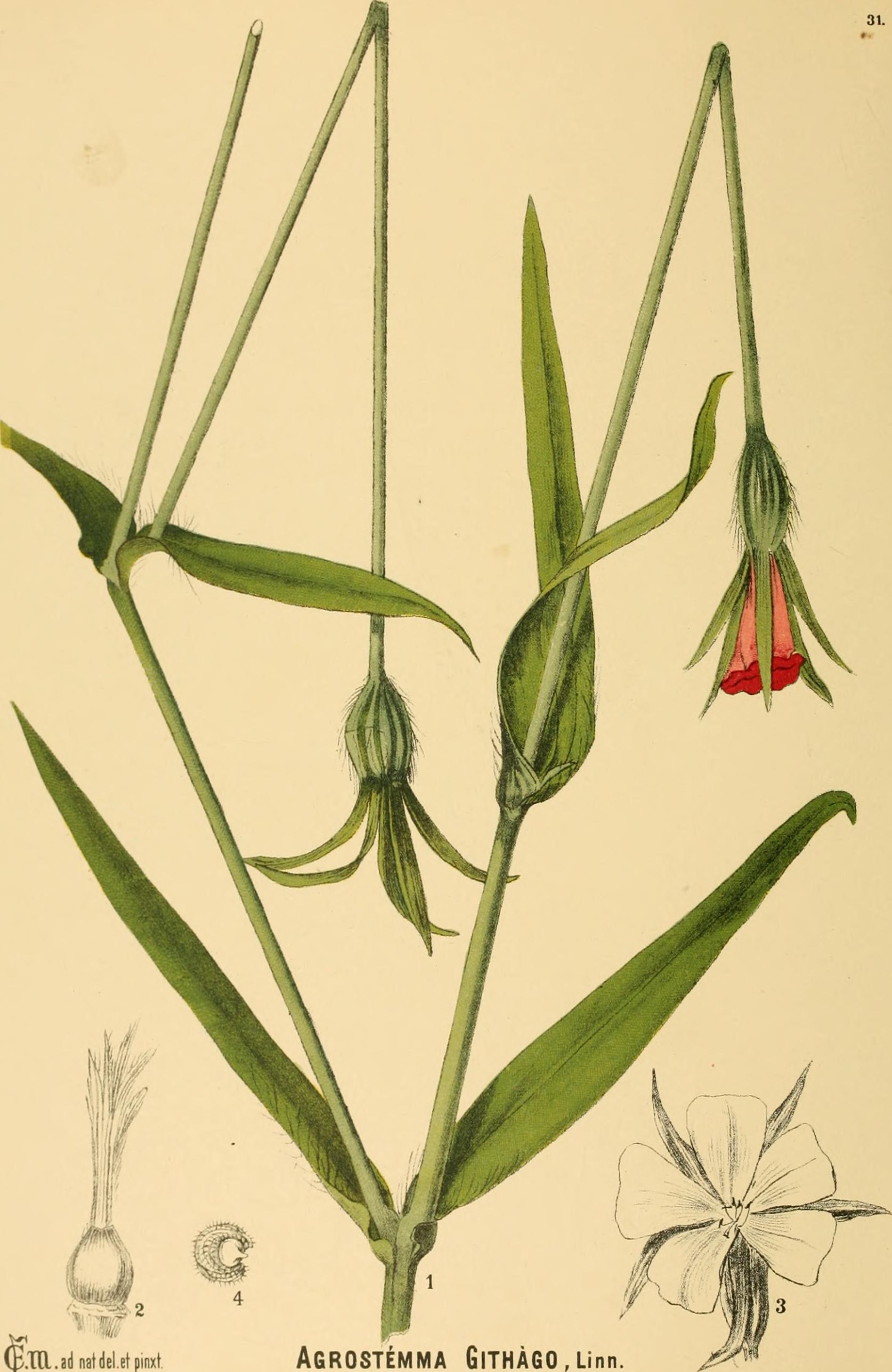
N. ORD.-CARYOPHYLLACE.^. 31 Tribe -SI LENE/E. GENUS— LYCHNIS.* TOURN. SEX. SYST.— DECANDRIA PENTAGYNIA. AGROSTEMMA GITHAGO. CORJV COCKLE. SYN.— LYCHNIS GITHAGO, LAM.; AGROSTEMMA GITHAGO.t LINN. COM. NAMES.— CORN COCKLE, COCKLE OR COCKEL, ROSE CAMPION; (FR.) LA NIELLB DBS BLES, L'lVRAIE; (GER.) GEMEINE RADE, KORN RADE. A TINCTURE OF THE RIPE SEEDS OF LYCHNIS GITHAGO, LAM. Description. — This softly pubescent annual, a pernicious emigrant, grows to a height of from i to 3 feet. Stem erect, dichotomous; leaves linear-lanceolate, acute, covered with a whitish cottony down; stipules none; pubescence consisting of long appressed cilia. Inflorescence solitary, axillary and terminal, long-peduncled flowers. Calyx cylindrical-campanulate, pubescent, and naked as regards bracts; lobes 5, linear-lanceolate, foliaceous, deciduous. Petals obovate, emarginate, crownless, slender-clawed, shorter than the lobes of the calyx. Stamens 10. Ovary stipeless; styles 5, or rarely 4. Frzdt a i-celled coriacious capsule, opening by 8 or 10 teeth; seeds numerous, velvety black, reniform, muricately roughened in longitudinal concentric curved lines from the hilum. CaryophyllacesB. — Stems usually enlarged at the nodes; leaves opposite, entire, often united at the base, the upper sometimes alternate. Flowers symmetrical, 4- to 5-merous; sepals 4 to 5, distinct or cohering, persistent, continuous with the peduncle; petals 4 to 5 or none, hypogynous or perigynous, the latter clawless, the former unguiculate, inserted upon the peduncle of the ovary, they are sometimes deeply notched, sometimes simply emarginate, and in a few species split through their whole length. Stamens not more than twice the number of the petals, in many species equal in number with the sepals and opposite them; filaments subulate, sometimes monadelphous at the base, inserted with the petals upon the peduncle of the ovary; anthers versatile or innate, introrse, 2-celled, opening longitudinally. Ovary generally gynophorous, composed of from 2 to 5 confluent carpels; styles 2 to 5, rarely one by cohesion, filiform, stigmatic down the inner * Kixvo<;, lychnos, a lamp; from the use of the cottony substance on the leaves of some spices in lieu of wicks. f Git ox git h, the name of certain blacl; aromatic grains, which were employed by the Romans in cookery. These grains are the seeds of the European fennel flower (^Nigclla sativa, Linn.); and bear little resemblance to those of the cockle except in size and color.
31-2 face. Fruit a coriaceous capsule, 2- to 5-valved and -celled, or more commonly I -celled by the wasting away of the dissepiments; placenta central and generally free; dehiscence loculicidal, or more commonly terminal by the splitting of the apex into twice as many teeth as there are styles. Seeds generally indefinite, inserted upon, and clustered about, the base of the central placenta, amphitropous or campylotropous; embryo external to the albumen and generally coiled around it, or in Dianthus nearly straight; allmmen farinaceous. The usefulness of this family of more or less mild plants lies mosdy in the principle sapojiin found in many of its species, but especially prominent in two, viz.: the European soapvvort {Saponaria officinalis, Linn.), and the Spanish fleshyleaved Gypsophila {Gypsophila Strnthiiim, Linn.). This substance is detergent and often used alone and in the composition of soap. The plants in which this principle exists are deemed nearly equal to Sarsaparilla as cleansers of the blood in syphilis and similar affections when the skin is involved; parillin, the active principle of sarsaparilla, being similar in its properties to saponin. Several species of the genus Sileiic are considered to be anthelmintics, some measure of success having followed the use of the Fire pink {Silene I'irginiaca, Linn.).* Many species of pinks {Diatithns) were formerly used and esteemed as astringents and sudorifics, and one species, Diatithus plumarius, useful in epilepsy, but all have fallen into disuse, their petals now only being utilized as a coloring matter for ointments and perfumes. History and Habitat. — The cockle was introduced into this country with grain from Europe, and is very seldom to be found growing elsewhere than in a field of wheat. It blossoms and ripens its seed in good season for the harvest, thus mixing well with the grain. The seeds are so small that they are only with difficulty separated, and when left and ground with the wheat render the resulting flour dark-colored, unwholesome, bitter, and in some cases poisonous, as will be noted hereafter. PART USED AND PREPARATION.— The ripe, dried seeds are broken into a coarse powder and weighed. Then five parts by weight of alcohol are poured upon the powder, and the whole allowed to stand eight days in a well-stoppered bottle, in a dark, cool place, shaking thoroughly twice a day. The tincture separated from this mass by filtration should be of a clear, light bistre color by transmitted light; its odor is strangely similar to the taste of the sweet acorn; its taste like its odor, and also somewhat acrid; and its reaction strongly acid. CHEMICAL CONSTITUENTS. — ^^r^^/^;«m«. — I am unable to find the authority for this body, which Wittstein says is an "alkaloid alleged to exist in the seeds of Lychnis Githago. It is obtained by extracting with alcohol of 40 per cent, containing acetic acid, and by precipitating with calcined magnesia. The precipitate to be treated with alcohol and left to crystallize. It results as yellowish-white. * Barton Collections, vol. i, p. 39.
31-3 minute scales, fusible by heat and slowly soluble in water. It has a perceptibly alkaline reaction and yields crystallizable salts with acids." Githagin. — Specific saponin, described under Aesculus Hippocastanum, page 43-4. PHYSIOLOGICAL ACTION.— The seeds of the cockle are said to be frequently allowed to adulterate the cheaper grades of flour in France, being intentionally ground with the wheat. Two 500 gram. (14^ oz.) lots of wheat flour, containing respectively 30 and 45 per cent, of these seeds, administered to two calves, caused severe cramps in the stomach within an hour, followed by diarrhoea, and finally death. Ducks and geese will eat of the seeds, but suffer death as above, and show post-mortem severe inflammation of the bowels.* In feeding my chickens "wheat screenings " I have often noted that they always carefully avoid the cockle seeds; not even the young chicks will pick up a single seed. The following symptoms are noted by Dr. Allen;-f- they were observed from eating bread made of flour contaminated by cockle seed: Coma, in some cases; vertigo; headache with a sensation of heat and burning rising into the vertex; mouth hot and dry; nausea, sour and bitter vomiting; burning, extending along the oesophagus, from the stomach into the throat; cutting pains in the stomach; diarrhoea, with tenesmus and burning in the bowels and rectum; pulse at first small and rapid, then tense, hard, and slower; hot skin; tearing along the spine with impaired locomotion, and difficulty in maintaining an erect position. These symptoms class the seeds among the cerebro-spinal irritants. Description of Plate 31. 1. End of a flowering branch, Ithaca, N. Y., June 13th, 1880. 2. Pistil. 3. Flower. 4. Seed, X 25. (2 and 3 enlarged.) * Am. Jour. Phar., 1879, p. 129; from Arch.d. Pharm., 1S79, p. 87. t Ency. Pure Mat. Med., vol. i, p. 132.
32. ^.m.adnatdel et pinxt. Geranium Maculatum Unn.
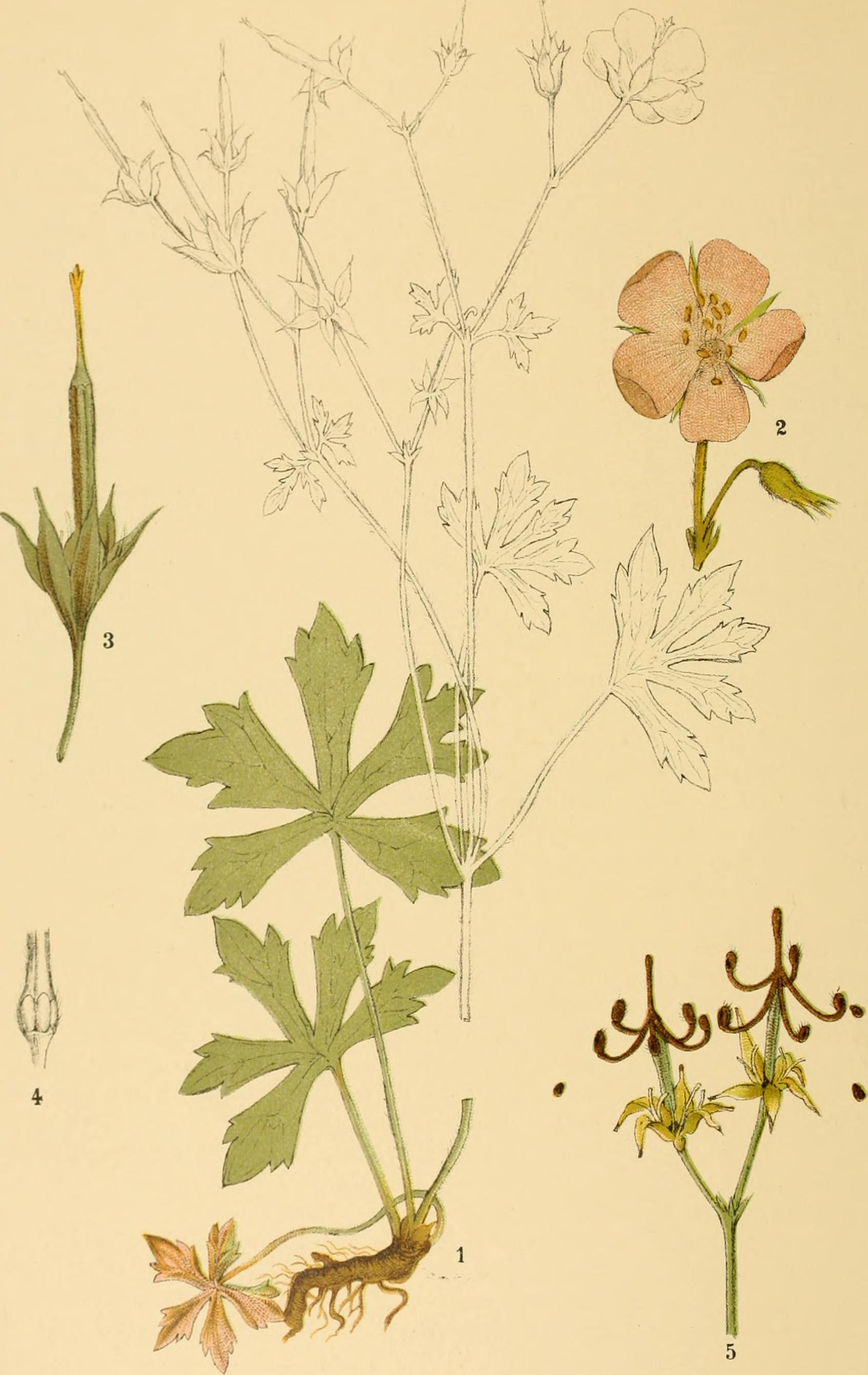
N. ORD-GERANIACE^. 32 GENUS.— G E R A N I U M,* LINN. SEX. SYST.— MONADELPHIA DECANDRIA. GERANIUM MACULATUM. WILD GERAJVIUM. SYN.-GBRANIUM MACULATUM, LINN. COM. NAMES.— WILD GERANIUM OR CRANBSBILL, SPOTTED GERANIUM OR CRANESBILL, CROWFOOT.t ALUM-ROOT, TORMENTIL, STORKBILL; (FR.) BEC DB GRUB; (GER.) GEFLBCKTER STORCHSNABEL. A TINCTURE OF THE FRESH AUTUMNAL ROOT OF GERANIUM MACULATUM, LINN. Description. — This erect perennial, hairy herb, grows to a height of from one to one and a half feet. Roof somewhat woody. Stem erect, hairy, forking. Leaves of two kinds; those from the root, long petioled, those of the stem, opposite; all generally 5-parted, the cuneate divisions lobed and cut at the end, hairy. The leaves when old become somewhat blotched with whitish-green, whence the specific name. Sdpu/cs lanceolate. Inflorescence a terminal open panicle; pedicels about one inch long, from one to two sometimes three flowered; jiowers large and showy. Sepals equal, cuspidate, persistent, villous. Petals equal, entire, bearded upon the claw. Stamens 10, unequal, the longer 5 alternate with the petals, and furnished each with a basal gland \ filaments slightly hairy at the base; anthers perfect on all the filaments. Style terminal, persistent, smooth inside. (This is noticeable in the fruit after their cleavage from the axis.) S:eds minutely reticulate. GERANIACE.ffl. — This order, having a position between Zygophyllacece and Rutaccce, is characterized by generally strong-scented herbs or shrubs, having astringent roots; leaves palmately veined and usually lobed; fiowers symmetrical. (Exc. Impaticns and Tropa^ohim.) Calyx of 5 persistent sepals, imbricated in the bud; corolla of 5 petals, furnished with claws, mostly convolute in the bud; stamens 10, in two rows, the outer often sterile; filaments broad and united at the base; styles 5, connected about an axis; sligmas 5, separate; ovary 5-carpeled, each carpel containing from i to 2 seeds, the carpels opening by the curling back of the drying persistent styles; seeds destitute of albumen. (Exc. Oxalis.) Cotyledons convolute, and plicate with each other. This is one of those orders that are often broken up into smaller ones then recombined, in botanical history. It contains in the more northern United States the following genera: Erodiiim, Flcerkea, Geranium, Impatiens, Limnanthes, and Oxalis. There are two particularly interesting genera besides the above, viz., Pelargonitim, to which belong our cultivated geraniums, introduced from the Cape * Tipa-'Oi, geraiws, a crane; the styles bearing resemblance to a crane's bill, ■j- More applicable from usage to the Kamiticitli^.
32-2 of Good Hope, and TropcEolum, containing the garden nasturtium. Of this order our only proven plants arc the one under consideration and Oxalis stricta, Linn.* History and Habitat. — The wild geranium grows luxuriandy in our open woods and new clearings, flowering from April to July. The American Aborigines value the root of this plant as an astringent in looseness of the bowels, and exhaustive discharges of all kinds; it was thus brought forward by Golden, Goellen, and Shoepf, and recommended as a remedy in the second stages of dysentery and cholera infantum, cynanche tonsillaris, oral aphthae, passive hemorrhage, leucorrhoea, etc., in fact the uses of a decoction of the root have been great wherever an astringent or styptic seemed to be required. Geranium root is officinal in the U. S. Ph. as Extractum Geranii Fhiidum, and in the Eclectic Materia Medica as Exlradum Geranii. PART USED AND PREPARATION. — The fresh root, gathered in autumn, is chopped and pounded to a pulp and weighed. Then two parts by weight of alcohol are taken, the pulp mixed thoroughly with one-sixth part of it, and the rest of the alcohol added. After having stirred the whole well, it should be poured into a well-stoppered bottle, and allowed to stand eight days in a dark, cool place. The tincture prepared from this mass by filtration, should have a deep reddishbrown color by transmitted light, a bweet and astringent taste, and a strong acid reaction. This tincture becomes muddy on long standing, but does not deposit; at least mine has not yet done so, although it has been made over three years.-jCHEMICAL CONSTITUENTS.— An analysis by Dr. Bigelow in 1833 corroborated Staples' determination ot tannin in quite large percentage, and gallic acid. The gallic acid in his hands differed somewhat from that body as extracted from galls. Messrs. Tilden (1863)! determined beside the above: ht'o resins, one soluble in alcohol, the other in ether; an oleo-resin soluble in ether; gum, pectin, starch, sugar, and the usual plant constituents. Dr. Staples (i829)§ detected, beside the above, a "peculiar crystalline principle," which does not seem, so far, to have been analysed or even corroborated. PHYSIOLOGICAL ACTION. — In moderate doses Geranium causes constipation, attended with but fruitless attempts at evacuation; some pain in the stomach and bowels, and tenesmus when a stool is gained; stool odorless. Its action will be seen to so far differ but slightly, if at all, from that of Acidtivi Tanniciun, which should be studied in this connection. Description of Plate 32. I. Whole plant (once reduced), with a portion of the stem removed: Pamrapo, N. J., May 21st, 1879. 2. Flower. 3. Pistil and calyx. 4. Ovary. 5. P>uit (once reduced). * Author's proving. See Trans. Horn. Med. Soc. State N. K, Vol. XIX, 1SS4, p. I j6. t A better method of preparing the tincture, should be by using dilute alcohol. X.Am. Jour. P/,ar., 1863, p. 22. J Jour. Phil. Col. J'/iar., i, p. 171.
AO/ ^lU.adnatdeletpinxt XaNTHOXYLUM AmERICANUM, Mi
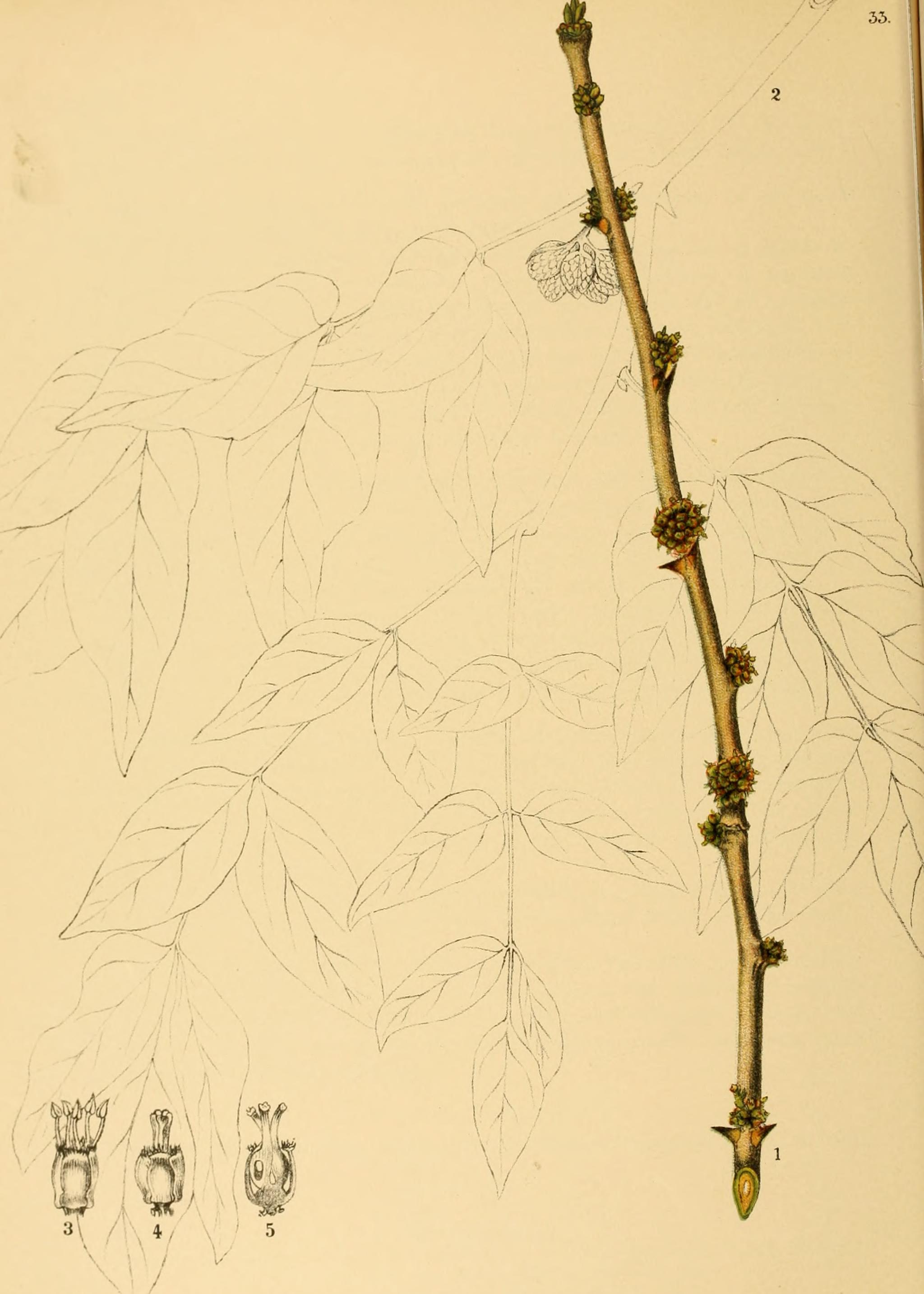
N. ORD-RUTACE^. 33 GENUS.— XA NTH ox YLUM,* GOLDEN. SEX. SYST.— DIOECIA PENTANDRIA. XANTHOXYLUM. PRICKLY ASH. SYN. — XANTHOXYLUM AMERICANUM, MILL.; X. CLAVA-HERCULIS, LAM. (Not LINN.); X. FRAXINEUM, AND MITE, WILLD.; X. FRAXINIFOLIUM, MARSH. (Not WALT.); X. RAMIFLORUM, MICHX.; X. TRICARPUM, HOOK. (Not MICHX. ); THYLAX FRAXINEUM, RAF. COM. NAMES.— NORTHERN PRICKLY ASH.t TOOTHACHE TREE, PELLITORY,t YELLOW WOOD,? SUTERBERRY, ANGELICA TREE; || (FR.) FRENB E'PINEAUX; (GBR.) ZAHNWEHOLZ. A TINGTURE OF THE FRESH BARK OF XANTHOXYLUM AMERICANUM, MILL. Description. — This well-known shrub grows to a height of from 3 to 8 feet, with a like spread of banches. Bark grayish, smooth, white maculate, and slightly warty; branches alternate, beset with short, triangular, sharp prickles, similar to those of the rose bush, and generally arranged in pairs beneath the axils of the younger branches; leaves alternate, pinnately compound; leaflets 4 to 5 pairs and an odd one, ovate-oblong, acute, entire or glandularly serrate, nearly sessile, the under surface downy when young; petiole often prickly on the upper side. Inflorescence sessile umbellate clusters axillary to the yet undeveloped branchlets; flowers yellowish-green, polygamo-dioecious, appearing before the leaves; perfect flowers with 3 pistils, sterile flozoers with rudimentary, abortive, gland-like ov2ir\es, fertile flowers with 5 fruiting pistils. Calyx none. Petals 5, oblong, blunt, with a glandularly fibrillate border and somewhat inflated base. Stamens 5, exserted, alternate with the petals and inserted upon the torus; anthers innate, sagittate, 4celled. Pistils 3 or 5; styles exserted, slender, somewhat intertwined, connivant, or sometimes united at the apex; stigmas capitate or obtuse. Ovaries distinct icelled. Fruit reddish-green, short-stalked, fleshy, pitted, 2-valved pods; seeds oval, blackish, one to each pod, suspended. Rutaceae. — A large family of herbs, shrubs and trees inhabiting chiefly the Southern hemisphere. Leaves simple or compund, pellucid-dotted and rich in a pungent or bitter and aromatic oil; stipules none. Flowers by abortion dicecious * Saxflii;, xanthos, yellow; \i\civ, xylon, wood. f The Southern Prickly Ash is X Carolinianuni, Lam. \ The true Pellitories are the African Anacyclus pyreihrum, D. C. (Composita;), and various European and the American species of the genus Parielaria (Urticacea:). \ The true yellow-wnod with us is Cladrastiis tinitoyiat Raf. ( Leguminosje). II The true Angelica tree, so often confounded with the prickly ash from its slightly similar effects, is Aralia spiuosa, Linn. (Araliaceos).
33-2 or polygamous, usually regular and hypogynous; calyx of 3 to 5 sepals, or wanting; petals 3 to 5, convolutely inbricated in the bud. Stamens as many as the sepals and alternate with them, twice as many, or rarely numerous; filaments arising from the base of the gynophore. Pistils 2 to 5, separate or combined into a compound ovary of as many cells, gynophorus or raised on a glandular torus: styles generally united or cohering, even when the ovaries are separate. Fruit mosdy capsular, sometimes drupaceous, and baccate; seeds few, anatropous and pendulus; testa smooth, shiny, or crustaceous; embryo large, curved or straight; albumen sarcous, generally enclosing the embryo; cotyledons oval, flat. This large order now contains, beside the typical Rutacese, the formerly separate families Xantho.xylaceas and Aurantiacea;, including thus many valuable medicinal plants and pleasant fruits, among them are the following more or less prominent: The Central American Carony or Angustura bark [Galipea Cusparea, St. Hil, Angustura vera), of which we have an e.xcellent proving; the European Rue {Ruta graveolcns, Linn.), also prominent in our Materia Medica; the famed Buchu of the Cape of Good Hope [Barosma crenulata. Hook.), and the lesser species B. betulina, B. & W., and B. serratifolia, Willd., of the same country; the powerful diaphoretic Jaborandi {Pilocarpus pettnatifolius, Lam.; the following febrifuges: ihtt '&ra.z\V[2.n Evodiafebrifuga, Ticorea jasmini/olia,and T./ebnfuga,2i\\ oi St. Hil.; and the European Bastard Dittany [Dietamnus /raxiiiella,'L\nn.). Next our attention is broucrht to the Auranticcce, the latest addition to the order, where we find the following well-known fruits: the Bitter or Saville Orange {Citrus Vulgaris, Risso.), supposed to be the original of the Sweet or China Orange {Citrus Aurantium, Linn.), which cannot be said to be ever found in a really wild state; the source of the Oil of Bergamot {Citrus Bergamina, Risso.), supposed to be either a variety of the orange, or lemon, or a hybrid; the Citron {Citrus Medica, Risso.), its wild state growing in the mountainous northern district of India; the Limes {Citrus acida, Roxb., C. Lumina, and C. Limetta, Risso.); and finally the Indian astringent Bael {Aegle Mannelos, Correa, Cratceva Marmelos, Linn.) the ripe fruit of which is known as the Bengal Quince, and said to be made into a laxative preserve, or a pleasant refrigerant drink. Lasdy, the former Xa7ittioxylacece yield us beside Ptelea and Xanthoxylum treated of here, the following stimulants: the Chinese Xanthoxylum Avicenne, D. C, supposed to be a general antidote for all poisons by the natives; the West Indian X. Clava-Herculis, Linn.; the Bengalese X. Alatwn, Roxb.; and the Japanese X. piperita, D. C.; the astringent tonics Brucea Sumatrana, Roxb., and the Abyssinian B. antidysenterica. Mill., the Indian Toddalia aculeata, Pers., and the African sub-astringent Lopezroot T. lanceolata. Lam.). History and Habitat. — The northern prickly ash is common in localities only, throughout the northern portion of the Eastern United States, where it flowers in April and May, before the appearance of the leaves. Three other species are found in the South United States, viz.: X. Clava-Herculis, Linn. {X. Carolinianuni, Lam.); X. Ca7'ibceum, Lam. {X. Floridanum, Nutt.); and X. Pterota, H.B.K. Xanthoxylum was an article of American aboriginal medicine called Hantola;
33-3 the Western tribes used principally the bark of the root in decoction, for colics, gonorrhoea, and rheumatism; chewed for aching teeth; and made into a poultice with bears grease and applied to ulcers and sores.* From personal experience one day in the woods while botanizing, I found that, upon chewing the bark for relief of toothache, speedy mitigation of the pain followed, though the sensation of the acrid bark was nearly or fully as unpleasant as the ache, and so painful finally in itself that I abandoned its use, only to have the toothache return when the irritation of the bark had left the mucous membranes. A decoction of the bark is diaphoretic and excites secretion generally. Its action upon the salivary glands causes in time almost as full ptyalism as mercury. Its speedy relief of rheumatism is said to occur only when it causes free perspiration; for this disease a pint a day is taken of a decoction of one ounce of the bark boiled in a quart of water. It is a powerful stimulant to healing wounds or indolent ulcerations. Dr. King, who introduced the use of this drug in Cincinnati in 1849, both in the treatment of tympanitis, distention of the bowels during peritonitis, and in Asiatic cholera, says:f "In tympanitis one half to one drachm of the tincture may be given per oris, in a little sweetened water, and repeated hourly, and the same amount used as an enema. The action is usually prompt and permanent. In Asiatic cholera, during 1849 ^"*J 1S50. it was much employed by our (Eclectic) physicians in Cincinnati, and with great success; it acted like electricity, so sudden and diffusive was its influence over the system. In typhus fever, typhoid pneumonia, and typhoid conditions generally, I am compelled to say that I consider the tincture of prickly-ash berries superior to any other form of medication. I have known cases of typhoid pneumonia in which the patients were so low that all prospect of recovery was despaired of, to be so immediately benefited that the patients who, a few minutes before, were unable to notice anything around them, would reply to questions, and manifest considerable attention, and ultimately recover." Prickly ash is officinal in the U. S. Ph., as Extractum Xanthoxyli Fhiidum; and in the Eclectic Materia Medica its preparations are: Enema Xanthoxyli; Extractum Xanthoxyli Fluidum; Oleoresina Xanthoxyli; Tinctura Xantlioxyli; Tinctura Laricis Composita.\ PART USED AND PREPARATION. — The fresh bark, together with that of the root, is ground to a pulp, covered in a well-stoppered bottle with two parts by weight of alcohol, and allowed to stand eight days in a dark, cool place, being shaken twice a day. The tincture separated from this mass by filtration has a clear, yellowishgreen color by transmitted light; it retains the peculiar odor and taste of the bark, and exhibits an acid reaction. CHEMICAL CONSTITUENTS.—.Yrtw/Z/^^.tyzV^. This body, extracted by Dr. Staples from the bark, and so named, has been determined to be berbcrin.\ * Rafinesque, Aled. Flora. 2, p. 115. t College Jour., March, 1856; quoted by Miller in 'Ike Jour, of Mat. Mai., Vol. Ill, N. S., 1S61, 9. X Tamarac bark. Juniper berries, Prickly Ash bark, Wild Cherry bark, Seneca Snake-root, Tansy, Whiskey, Molasses, and Hydro-alcoholic Extract of Podophyllum. \ See under Berberis, p. 16-2.
33-4 Oil of XaniJwxylum — probably also containing resin and extractive — is a dark brown, aromatic, warm, pungent, turbid body, found in about 25 per cent, in the berries by W. S. Merrell. An etherial oil of the bark is obtainable, answering to the above; it is, though, simply an extract containing all the principles in the bark. \'olatile oil and resin have also been determined. This plant has not been carefully analyzed. Some idea of its probable constituents other than the above might be gained from those of XantJioxyhim piperitiini, which contains: Xanthoxylen or Xanthoxylene, Cj^, Hj„, is the colorless watery liquid part of the volatile oil. It has a pleasant aromatic odor, and great refracting power; it boils at 162° (324° F.). Xatilhoxylin, C,,„ H,_>^ Oj. This crj'stallizable product of the volatile oil which may be extracted after the oil is freed from Xanthoxylene by distillation at 130° (266° F.). It crystallizes in large, colorless, silky, neutral, aromatic, klinorhombic forms, soluble in alcohol and ether. The crystals fuse at 80° (176° F.), and volatilize at higher temperatures undecomposed {et supra, JJ'i/fsfein.) PHYSIOLOGICAL ACTION.— Although we have a quite full proving of this drug by Dr. C. Cullis,* it is hardly sufficient to determine its physiological sphere of action. The drug proves, however, at least a stimulant of mucous surfaces and attendant secretory glands by an irritant action upon the nerves. Its action, taken all in all, appears quite like that of Mezereum. Description of Plate 33. I. End of a flowering branch, Binghamton, N. Y., May 8th, 1884. 2. End of fruiting branch. 3. Sterile flower. 4-5. Fertile flowers. 5. Longitudinal section of a tri-pistillate flower. (2-5 enlarged.) * Allen, Ency. Pure. Mat. Med., X, p. 169.
(Ein.adnaf.iielet pinxt PtELEA TRIFOLIATA.Linn.
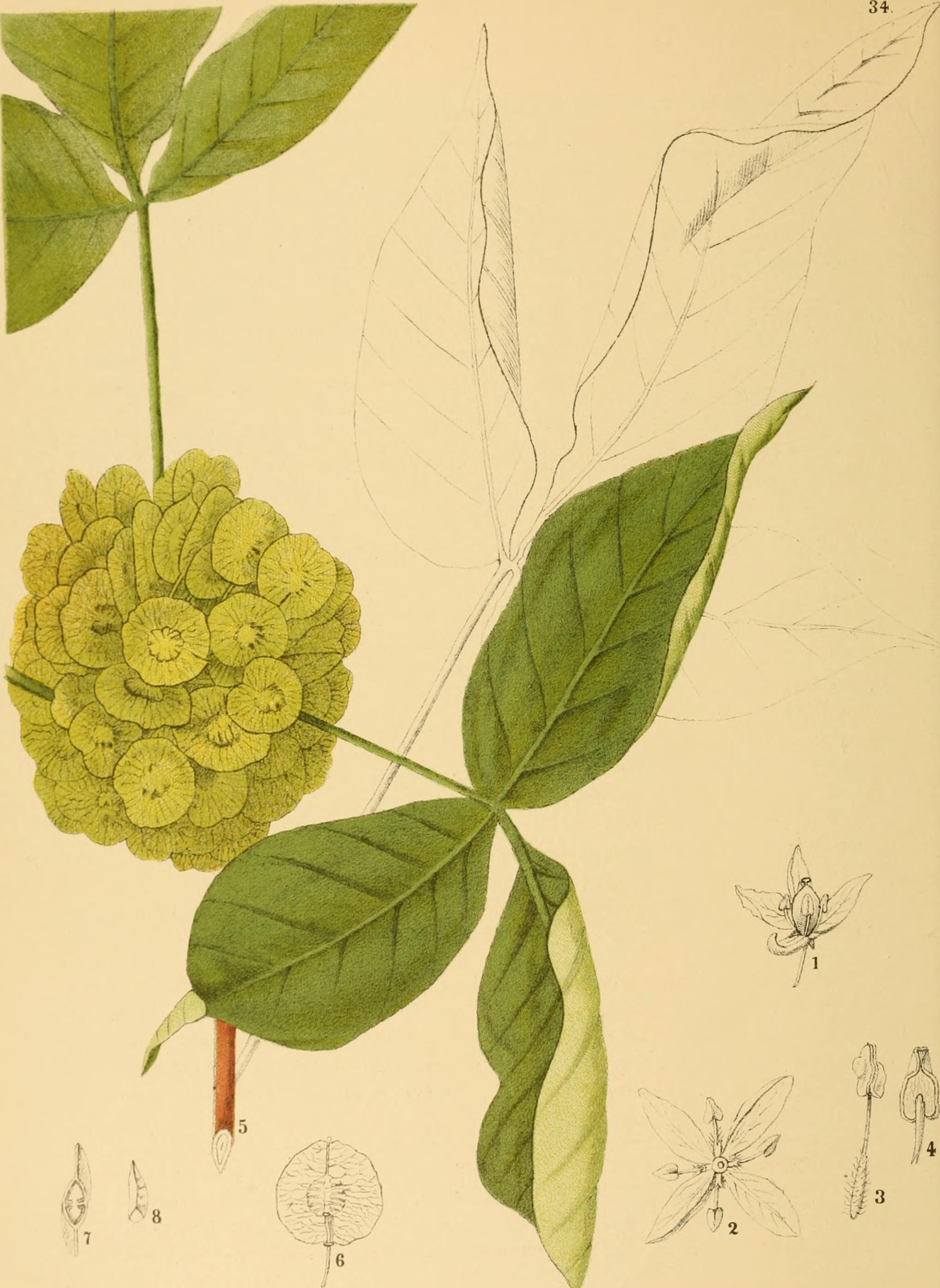
N. ORD-RUTACE^. 34 GENUS— PTE LEA,* LINN. SEX. SYST.— TETRANDRI.A MONOGVNIA. PTELEA. WAFER ASH. SYN.— PTELEA TRIFOLIATA, LINN.; P. VITICIFOLIA, SALISB.; AMYRIS ELEMIFOLIA, LINN. COM. NAMES.— WAFER ASH, SHRUBBY TREFOIL, TREE TREFOIL, HOP TREE, STINKING ASH, "WINGSBED, SWAMP DOGWOOD, PICKAWAY(FR.) ORME DB SAMAIRE A TROIS PEUILLES; (GER.) DRIBLATTRIGE LEDERBAUM. A TINCTURE OF THE B.\RK OF PTELEA TRIFOLIATA, LINN. Description. — This peculiar slirub attains a growth of from 6 to 8 feet. Leaves trifoliate, long petioled; leaflets sessile or very slightly petiolulate, ovate, pointed, dark shining green above, pale and somewhat downy beneath, the terminal more or less wedge-shaped and contracted at the base, all more or less crenulate. Inflorescence in compound lateral and terminal cymes; flozuers numerous, greenish-white, polygamous, their odor disagreeable. Sepals 3 to 5, usually 4, somewhat deltoid, much shorter than the petals. Petals 3 to 5, usually 4, spreading, imbricated in the bud. Stamens as many as the petals and alternate with them; filaments in the sterile flowers long, dilated, and hairy at the base; shorter than the ovary in the fertile; anthers larger, present in both kinds of flowers, but sterile in the female. Ovary 2-celled; style short or wanting; stigma capitate, 2-lobed. Fruit a large, dense, globular cluster of nearly orbicular, 2-seeded, membranaceous, reticulate-veined samaras; seed somewhat triangularly compressed. History and Habitat. — The Wafer Ash is indigenous to North America, ranging from Pennsylvania westward to Wisconsin and southward to Florida and Texas. It grows in moist, shady places, on the borders of woods, and among rocks, flowering in June at the northern range. The plant was sent to England for cultivation in 1704 by Bannister, but, being lost there, Catesby reinforced their gardens from Carolina twenty years later. Rafinesque first introduced the plant in American medical literature in his work on Medical Botany, 1830, speaking of the leaves as vulnerary and vermifuge. Schoepf gives the same in substance; and Merat and De Lens speak of the fruit as aromatic and bitter, and an affirmed substitute for hops. Howard speaks of the bark of the root as an excellent stimulant, expectorant tonic; especially useful * IIt-iim, ptao, to fly: the Greek name of the elm, alluding to the winged fruits.
34-2 in agues. Jones* speaks of the plant as "a pure unirritating tonic" in cold intusion, especially adapted to convalescence after debilitating fevers. Following these, its use became general, especially in Eclectic practice, for a variety of troubles, especially asthma, phthisis, glandular degeneration in general, syphilis, scrofula, chronic diarrhoea, epilepsy, dyspepsia, intermittent fever, and chronic rheumatism. The Eclectic preparations are: Exti-aclum Pte/ca- Hydro-alcoholicuni; bifjisum Ptelece; and Ptelca; Olco-resinecc. PART USED AND PREPARATION. — The fresh bark, gathered after the fruit is ripe, but before the leaves begin to fade, is treated as in the preceding drug. The tincture, separated by pressure and filtration, has a brownish orange color by transmitted light; a bitter odor; an extremely bitter taste; and an acid reaction. CHEMICAL CONSTITUENTS.— The analysis of G. M. Smyserf resulted in the determination of albumen, bitter extractive, tannic and gallic acids, a brittle, tasteless resin, and a soft acrid resin. According to Justin Speer,J the root-bark contains a crystalline yellow coloring-matter, oleo-resin, and berberina,% but no tannin. PHYSIOLOGICAL ACTION.— In Dr. E. M. Hale's provings of this drug upon a number of observers, who took from 30 to 500 drops of the tincture, and from I grain to a scruple of " Ptelein," the following disturbances occurred: Mental depression and confusion; frontal headache, vertigo; contraction of the pupil; aural pains with swelling of the lymphatics; tongue sore, yellow-coated; ptyalism; voracious appetite; nausea, with pressure in the stomach as of a stone; griping colic; great urging followed by copious diarrhoeic stools; urine increased; heart's action increased; general resdessness and prostration, followed by chilliness and fever. Description of Plate 34. 1. Female flower. 2. Male flower. 3. Stamen. 4. Anther. 5. Fruiting branch. Samara. Section of fruit. 8. Seed. (1-4 and 7-8 enlarged.) 6. 7* Eclectic Practice. t Am. Jour. Phar., 1862. J Ibid., 1867. See p. 15-2.
^m.ad natdei.etpinxt. AlLANTHUS GLANDUL6SUS,Desf. i I
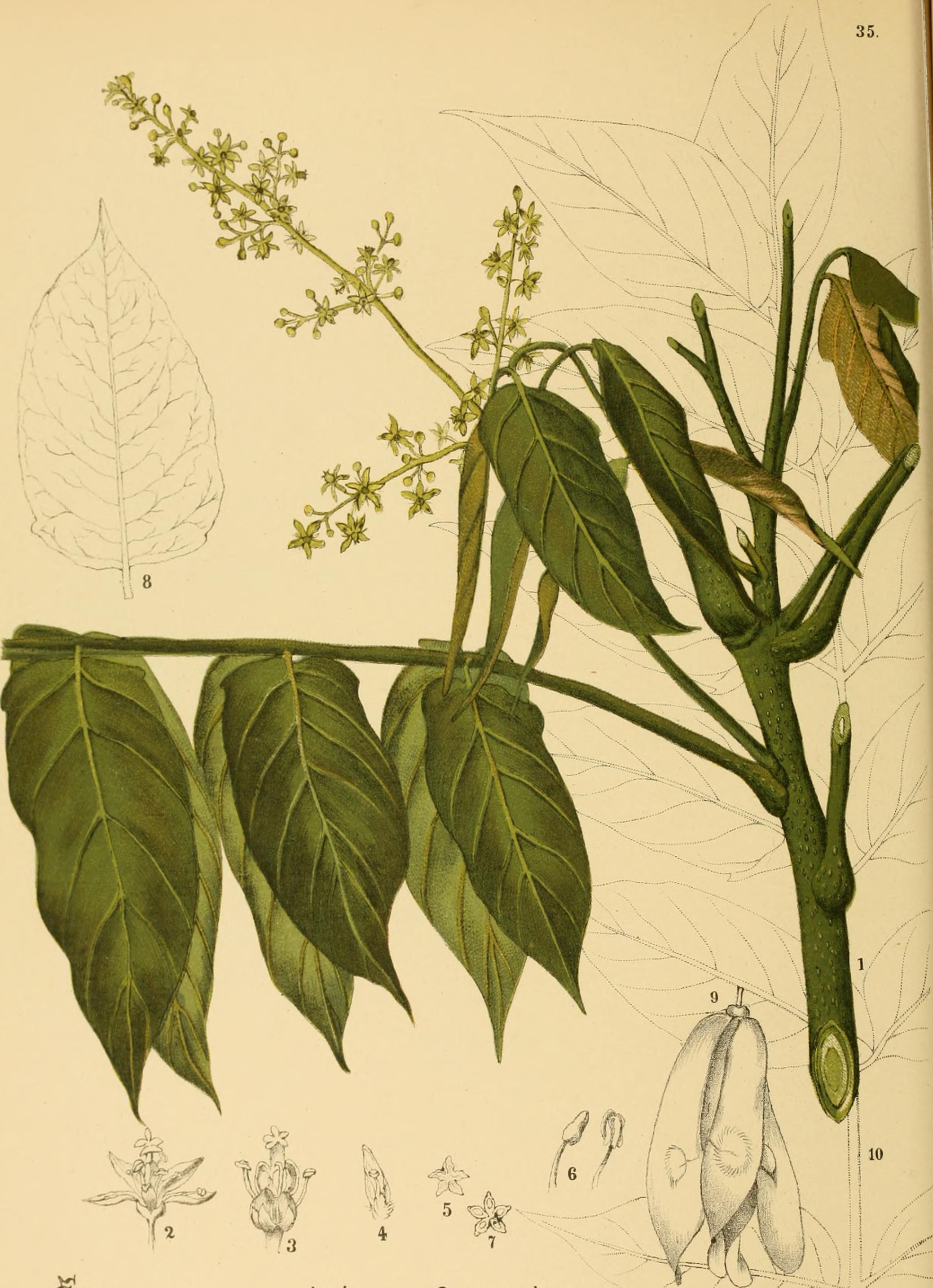
N. ORD -SIMARUBACE^. 35 Thbe.-SIMARUBE/E. GENUS.— A I LA NTH US,* DP:SF. SEX. SYST.— MONCECI.\ POLVGAMIA. AILANTUS. TBEE OF HEAYEM SYN.— AILANTHUS GLANDULOSUS, DESF. COM. NAMES.— TREE OF HEAVEN. CHINESE AILANTHUS, TILLOW TREE, CHINESE SUMACH; (PR.) AILANTE, VERNIS DES JAPON;t (GER.) GOTTERBAUM. A TINCTURE OF THE FRESH BARK.'\ND FLOWERS OF AILANTHUS GLANDULOSUS, DESF. Description. — This beautiful tree, which so much resembles an overgrown staghorn sumach, grows in this country to a height of from 30 to 60 feet. Stem erect, columnar, much branched; n'ood hard, heavy and glossy, like satin. Leaves long, odd pinnately compound; petioles i to 2 feet long; leaflets oblong, pointed, with two blunt teeth at the base, rendering them somewhat hastate; teeth glandular upon the under surface. Inflorescciice in large terminal thyrsoid panicles; flozvcrs greenish, dioeciously-polygamous. Calyx 5-toothed. Petals 5, inserted under an hypogynous disk. Stainens 10; filaments inflated and hairy at the base; anthers 2-celled. Ovary 5-lobed; style columnar; stigma capitate, radiately 5-lobed. Frnit composed of from 2 to 5 long, thin, somewhat twisted, linear-oblong, veiny, I -celled, I -seeded samaras. Simarubaceae. — This small family of mostly tropical trees and shrubs, is represented in North America by 7 genera of i species each. The characteristics of the order are as follows: Bark bitter. Leaves alternate, pinnately-compound; stipules none. Flowers hermaphrodite or unisexual. Calyx persistent; sepals \ to 5. Corolla deciduous, twisted in aestivation; petals 4 to 5, hypogynous. Stamens as many or twice as many as the petals; filaments inserted upon an hypogynous disk. Ovary composed of 4 to 5 lobes; ovules suspended, i in each cell; style various. Carpels 2-valved, as many as the petals, capsular or keyed; sejds pendulous; albumen none; cotyledons thick; radicle short, superior. The only proven plants of this order, excepting the one under consideration, are: the tropical-American Cedron {Simaba Cedron, Planch), and the SouthAmerican Quassia or Dysentery-bark [Simaroiiba amara, Aubl.), the bark of which was once a noted remedy in dysentery. * The name should be spelled, Ailantus, being derived from a Moluccian species called Ailanto. f Also used to designate Rhus vernix.
35-2 The other more or less prominent medical plants are: the West-Indian Jamaica Quassia or Bitter Ash {Picrana excclsa, Lindl.), noted for its extreme and lasting bitter wood, so largely used in commerce for the manufacture of Quassia-cups, the water from which is useful as a stomachic tonic, anthelmintic, and antiperiodic; the Brazilian Simarouba versicolor, St. Hil., noted as being so bitter that insects will not attack the wood; and the Indian Nima qiiassioidcs, Hamilt., employed as a bitter tonic in the North of India. History and Habitat. — This large tree, that has caused more newspaper comment than any other now planted in this country, is a native of China, and is included in this work as an American remedy because it is from the naturalized tree that our |)rovings were made. The Ailanthus tree was introduced into England in the year 1751, and thrived well; about the year 1800 it was brought to this country, and soon grew in public favor as an ornamental tree for lawns, walks and streets; later on it became in greater demand on account of its supposed property of absorbing from the atmosphere malarial poisons; under this new idea the tree became a great favorite in cities and large towns, especially as its growth was rapid and its beautiful foliage pleasing. The occurrence, however, of several severe epidemics, especially in the larger cities, set people thinking — might not this tree, which so fully absorbs poison, also throw off toxic effluvia? may it not store up the noxious gases and again set them forth in the flowering season? Certainly the staminate flowers smell bad enough to lay any disease to their emanations. A war upon the trees followed, both wordy and actual, which almost banished them from the country. The feeling, however, died a natural death, and to-day many fine trees abound, especially in the larger eastern cities. Another vote for its preservation lay in the fact that the tree afforded material for a silkworm {Attacjis Cynthia, Drury), which has been successfully acclimated in this country by Dr. Stewardson and Mr. Morris. The cost of production of silk from their culture is said to be about one-fourth that of mulberry silk, beside, the product is tough and stronger than any other fabric made; it is said that the Chinese wear garments of this material through several grenerations of constant use. The bark of the tree was experimented with in France about the year 1859, and found to be emetic, cathartic and anthelmintic. The bark has been employed by. Roberts and others, both dried and fresh, as a remedy for dysentery and diarrhoea, and as an injection in gonorrhoea and leucorrhcea; an alcoholic extract was found by Prof. Hetet* efficacious in the removal of tapeworm, though the prostrating nausea caused by the draught renders it disagreeable. The tincture has been used in doses of from five to sixty drops in palpitation of the heart, asthma and epilepsy. PART USED AND PREPARATION.— Equal parts of the" fresh shoots, leaves and blossoms, and the young bark, are chopped and pounded to a pulp and weighed. Then two parts by weight of alcohol are taken, the pulp mixed thor* Jour. <ic Chine Med., Dec, 1859.
35-3 OLig-hly with one-sixth part of it, and the rest of the alcohol added. After stirring the whole well, and pouring it into a well-stoppered bottle, it is allowed to stand eight days in a dark, cool place. The tincture is then separated by decanting, straining and filtering; it has a deep orange-brown color by transmitted light; a strongly vinous odor; a mawkish taste; and an acid reaction. CHEMICAL CONSTITUENTS.— Several analyses of the bark have been made, all of which agree with the latest one by Mr. F". H. Davis.* He determined the presence of fixed and volatile oil, resin, wax, sugar, tannin, gum, starch, and oxalic acid; but failed, as had the others, to detect the presence of alkaloids or glycosides. PHYSIOLOGICAL ACTION. — Ailanthus causes nausea, vomiting, great relaxation of the muscles, and death-like sickness, very similar to that produced by tobacco-smoking in beginners. According to M. Hetet, the purgative property resides in the resin, while the volatile oil gives rise to the prostrating and other ill effects produced in some persons by the emanations from the fiowers. The characteristic symptoms produced by Ailanthus are: vertigo and dizziness, severe headache, purulent discharges from the mucous membranes of the nose and eyes, dilated pupils with photophobia, pale, sickly, bilious countenance, irritation of the throat, loss of appetite, tenderness in the stomach and abdomen, looseness of the bowels, suppressed urine, oppression of breathing, languor and lassitude. Description of Plate 35. I. End ofa flowering branch, several leaves and thyrsi removed, Binghamton, N. Y., June 30th, 1SS5. 2. Flower. 3. Calyx and pistil. 4. Petal and stamen. 5. Stigma. 6. Stamens. 7. Section of ovary. 8. A leaflet. 9. Fruit. 10. Full leaf in outline. (2-7 enlarged.) * Am. Jour. Phar., 1S85, 600.
56 (E.TU.adnatdel.etpinxt Rhus Glabra, Linn.
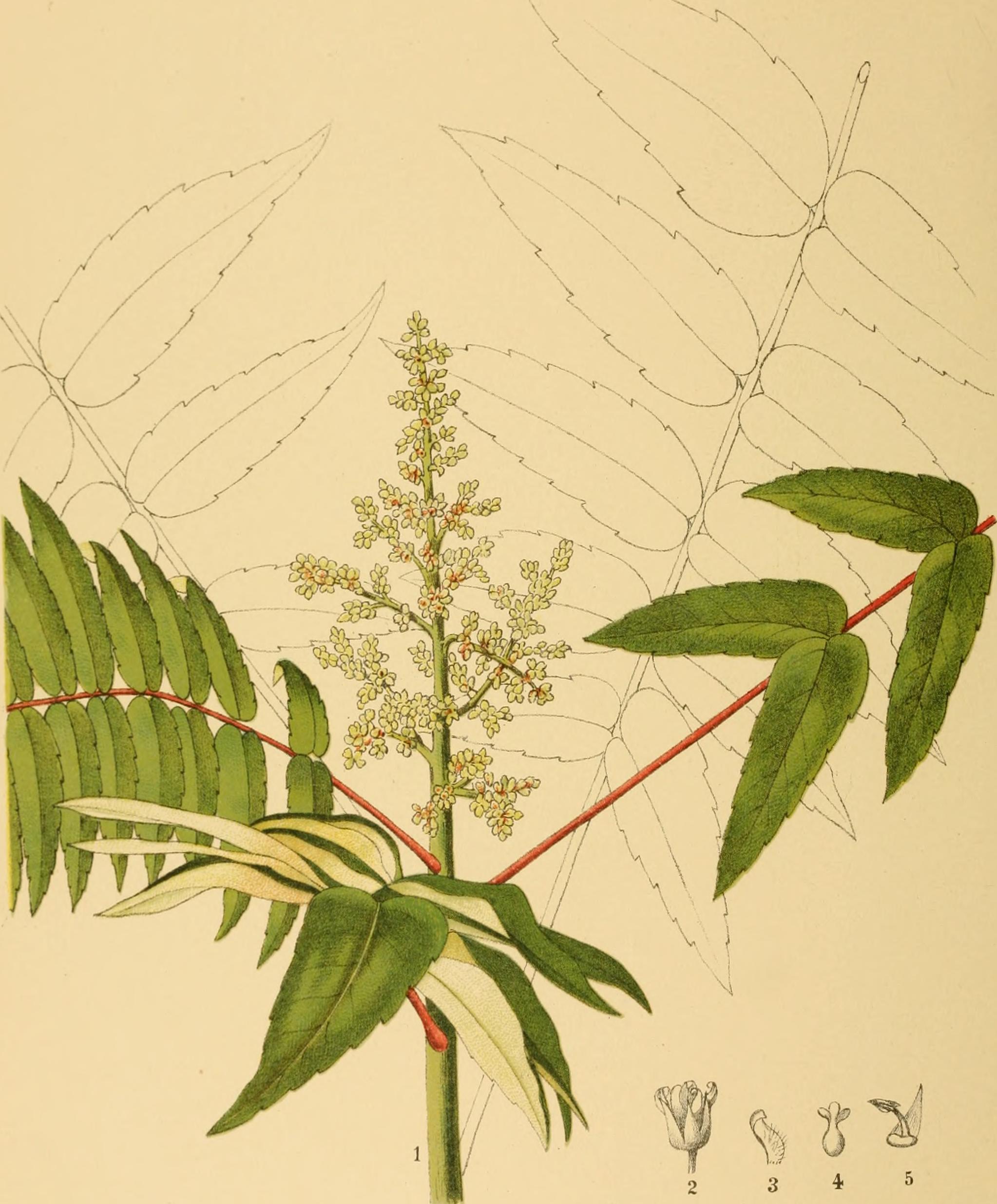
N. ORD -ANACARDIACE^. 36 Section-SUMAC* D. C. GENUS.— RHUS, LINN..SEX. SYST.— PENTANDRIA TRIGVNIA. RHUS GLABRA. SMO OTH S UMA CH. SYN.— RHUS GLABRA, LINN.; R. ELBGANS, AIT.; R. VIRGINICUM, CATESB.; R. CAROLINIANUM, MILL. COM. NAMES.— SMOOTH SUMACH OR SUMAC; SHUMAKE; (PR.) SUMAC; (GER.) SUMACH. A TINCTURE OF THE FRESH BARK OF RHUS GLABRA, LINN. Description. — This smooth shrub usually attains a growth of from 5 to 15 feet in height. Branches somewhat straggling. Leaves odd-pinnate; petioles crimson, 12 to 18 inches long; lea/lets 12 to 30, lanceolate-oblong, acutely serrate, pointed, and whitened beneath. Inflorescence dense, terminal, thyrsoid panicles; floivers perfect, polygamous. Sepals lanceolate, or more or less triangular, very acute, nearly as long as the petals. Petals incurved at the apex. Hypogynous disk almost entire, its lobes, however, separating when a sepal is detached from the calyx, bringing away with it a stamen and petal; lobe somewhat reniform. Fruit globular, clothed with acid, velvety, crimson hairs; stone smooth. Rhus. — This genus is widely distributed, and contains numerous species characterized in general as follows: Leaves usually compound. Floiaers polygamous or dioecious, greenish-white or yellowish-green; sepals 5, small, united at the base, generally persistent; petals 5, ovate, spreading, slightly hairy within. Stanmis 5, alternate with the petals; filaments inserted with the petals underneath the lobes of a chrome-yellow hypogynous disk, situated at the base of the sepals. Styles 3, short, generally united into one, sometimes distinct; stigmas 3, capitate. Fruit consisting of many small, indehiscent, dry, drupes; stone or nutlet osseous; seed suspended from the apex of a funiculus that arises from the base, and extends to the apex of the cell; cotyledons foliaceous. Many other species of Rhus are used beside those embodied in this work; among which are the following: The Japanese R. vernix affords the finest of the black lacquers, so extensively used in China and Japan for coating household articles, etc. This species in its toxic action is said to greatly simulate R. vejicnata, of this country. The South European R. coriaria, and R. cotinus, are extensively used in tanning the finer grades of morocco leather; the seeds of the former * An alteration of the Ar.ibic simaij (Forsk.). f The ancient Greek and Latin name (Celtic Rhudil., red).
36-2 species are said to be used at Aleppo to provoke an appetite, and in Turkey generally, in the manufacture of vinegar. Inferior grades of the inimitable black lacquer, made from R. vcniix, are furnished by R. Javaiiica, R. Sinetise, and R. succedancum. Our southern R. pumila, Michx., has been variously considered; some writers claiminir it to be entirely innocuous, others judge it to be the most poisonous of the North American species, claiming that it will show its effects upon those who are not susceptible to the influences of R. toxicodendro7i. The Floridian and West Indian R. nic/opium produces a substance called Doctor's Gum, which is said to be emetis and purgative; and the Chinese R. BucJii-amela, Roxb., certain galls used in Germany for the manufacture of tannic and gallic acids, and pyrogallol. Anacardiaceae. — This large, chiefly tropical family, consists of mostly poisonous trees or shrubs, having a resinous or milky, acrid juice, which turns black or blackish in drying. Leaves alternate, usually compound, and devoid of dots; stipules none. Inflorescenee usually in axillary or terminal, erect panicles; flowers small, regular, often polygamous; (estivation imbricate, rarely valvate. Sepals 3, or 5, usually distinct, but sometimes more or less united at the base, and persistent. Petals as many as the sepals, and inserted beneath an hypogynous disk, lining the base of the calyx. Stamens as many as the petals and alternate with them; filaJiients distinct. Ovary ovoid; styles 3, distinct or combined; stigmas 3, decidedly distinct, /v'?/// drupaceous, indehiscent, i-celled; seed borne upon a curved stalk arising from the base of the cell; testa membranaceous; embryo more or less curved; albnmen nox\&. The following plants of this family figure more or less prominently in our Materia Medica: The Indian Cashew-nut [Anaeardinm orientate, Seniecarpiis Anacardium, Linn.); the fruit of this tree is also called the marking-nut, and is almost universally used for stamping linen. The Cuban guao {Comocladia dentata, Jacq.), which is said by the natives (and corroborated by others) to cause the death of any who sleep beneath its shades; this is especially true of individuals of plethoric habit. The New Zealand Karaka or Kopi-tree {Coryno-carpits Icevigatns, Foster); and the Mexican and Peruvian Schinus, a product of SeJmnis molle, Linn., used by the natives for healing tumors and reducing inflammation, especially of the eye. Other members used in medicine and the arts are: The Brazilian SeJiinus ara^ira, Linn., which is said to exude an effluvia that causes swellings to appear in those who remain for a few hours beneath it. (Note S. molle above.) The Tropic American Anacardium occidentale, Linn., is used as a vermifuge, and the juice is said to be efficient in the removal of warts, corns, and vegetative growths; the nuts, however, are edible, either raw or boiled. The Mediterranean Lentisk or Mastic Tree {Pistacia Lentiscus, Linn.) yields Gum Mastich, a concretion highly valued by the Turks as a masticatory for sweetening the breath and hardening the gums. This product is useful also, for a temporary filling in carious teeth, easing the pain therein. Pistacia terebinthus, Linn., yields the famous Chian Turpentine; while the European P.vera furnishes the Pistachio nuts of the confectioner; the Cochin China P. oleosa, a valuable oil; and the African P. Atlantica, an Arabian article of food.
36-3 The Indian Mango {Mangifera Indica, Linn.) yields a luscious fruit which holds the place in that country, that the peach does in this. The Malabar Holigarna longifolia, Roxb., and Stagmaria verniciflua. Jack., of the Indian archipelago, furnish to the Chinese two of their famous black lacquers. It is said that the resin of the last named species is noxious and acrid, and that it is unsafe to remain lone under the branches of the tree. History and Habitat. — Rhus glabra is one of our least nocuous species. It grows in rocky or barren soil, common throughout North America, flowering northward in June and July. An infusion of the berries of this species is said to furnish an unequalled black dye for wool. The berries, when dried, form an article of trade in Canada, known as sacacomi, this, when smoked as a substitute for tobacco, is said to antidote the habit; the Western Indians make a preparation of equal parts of the roots, leaves, and of tobacco, which they smoke under the name of Khiikah^' A cold infusion of the berries is often used as a cooling drink in fevers; it is also claimed to be of benefit in diabetes and strangury. The bark of the root is claimed to form an antiseptic dressing for ulcers and open wounds; while an infusion of the same is considered an excellent astringent for use in aphthous and mercurial sore mouths, diarrhoea, dysentery, gonorrhoea, and leucorrhoea, and to be anti-syphilitic. I have known the juice of the root to remove warts, I have also known these strange growths to disappear from the use of various innocuous "charms," such as a neighbor's potato surreptitiously obtained, rubbed upon the growths and cast over the left shoulder without noting its fall, etc., etc. Smooth Sumac is officinal in the U. S. Ph., as: Extractum Rhois Glabra. In the Eclectic Materia Medica the preparations are: Dccoctniu RJuts Glabri, and Extractuin RJuts Fliiiditm. PART USED AND PREPARATION. — The fresh bark, including that of the root, gathered when the plant is mature, should be chopped and pounded to a pulp and weighed. Then two parts by weight of alcohol are taken, the pulp well mixed with one-sixth part of it, and the rest of the alcohol added. After stirring the whole well, it should be poured into a well-stoppered bottle, and allowed to stand for eight days in a dark, cool place. The tincture, separated from the mass by filtration, should exhibit a beautiful, very deep crimson color by transmitted light. Its taste should be at first sour, then astringent, leaving a sensation upon the tongue very like that of alum; its odor sour-vinous; and its reaction strongly acid. CHEMICAL CONSTITUENTS.— c;(?//(V.?;/;//V acid, Cj,Hj„0,,. This pure tannin of nut-galls also exists in the leaves and bark of the plant. It is an amorphous, porous, resinous, friable mass, freely soluble in water, less so in alcohol, and insoluble in pure ether. * Rafinesque, Med. Flor., ii., 257.
.36-4 Calcium Bimalate.— This salt is found clinging- to the hairs of the fruit as a concretion exuded from them; when soaked off the fruits are no longer sour. Oil of Rhus.— rhis waxy oil may be extracted from the seeds of this and other species of the genus. It will acquire a tallow-like consistence on standing, and can be made into 'candles, which burn brilliandy, but emit a very annoying pungent smoke. Resin, oleo-resin, sugar, starch, coloring matter, and gum, have also been determined.* PHYSIOLOGICAL ACTION. — Rhus glabra caused in one individual, in doses of from ^,o to i 20 drops of the tincture, headache, dryness and heat of the nostrils, with heniorrhage, ulceration of the mouth, loss of appetite, with painful distress in the stomach and bowels, followed by diarrhoea, scanty secretion of urine, great weariness and fatigue, loss of flesh, heat and dryness of the skin, followed by copious sweat during sleep.f One symptom was also developed in this case that I desire to comment upon, viz.: " Dreams of flying through the air." During the summer of 1879, while botanizing near Bergen Point, N. J., I came into a swarm of furious mosquitoes; quickly cutdng a large branch from a sumach bush at hand, 1 used it vigorously to fight off the pests. Several fine specimens of Bapdsia tinctoria grew at hand, and while studying them I kept the sumach branch in constant motion, perspiring freely during the dme. On leaving the spot I cut a cane from the same shrub, and also ate of the refreshing berries. For three successive nights following this occurrence I flew (!) over the city of New York with a graceful and delicious motion that I would give several years of my life to experience in reality. Ouery: Did I absorb from my perspiring hands sufficient juice of the bark to produce the effect of the drug, or was it from the berries I held in my mouth? 1 nodced no other symptoms, and never before or since enjoyed a like dream. Description of Plate 36. I. End of flowering branch, Waverly, N. Y., July 4th, 1884. 2. Flower. 3. Petal. 4. Pistil. 5. Stamen, lobe of disk, and sepal. (2-5 enlarged.) * Am. your. P/iar., N. S., i., 56; ibid., XXV., 193; Tilden, your. Mat. Med., N. S., i., 195; Pro,.-. Royal Society, 1862, 402. t Dr. Marshall in Hale's New Rem., 2d ed., S72.
(plU.adnat.deI.ef pinxt. Rhus Venenata, dc.
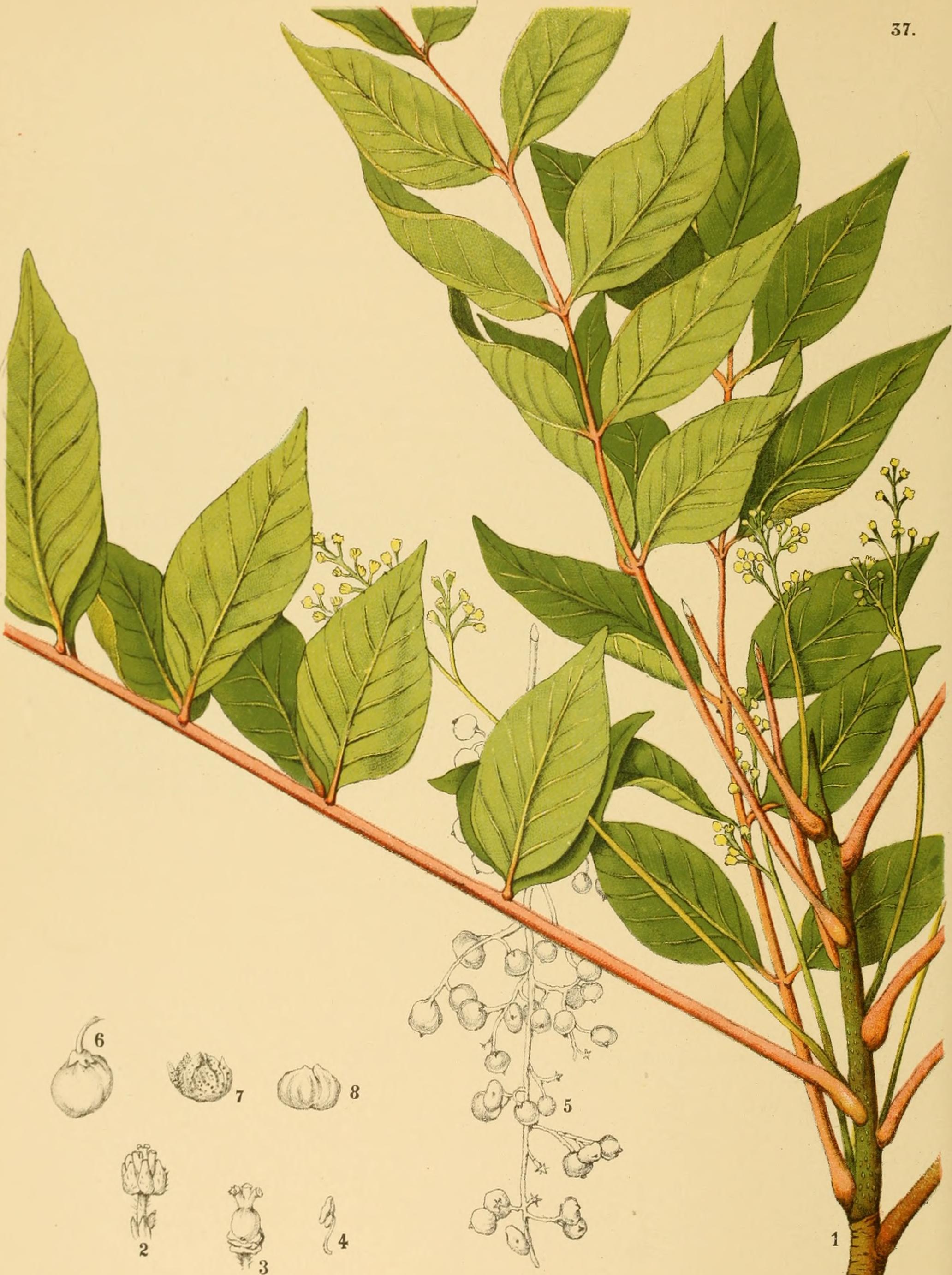
N. ORD.-ANACARDIACE.^. 37 GENUS.— RHUS, LINN. SEX. SYST.— PENTANDRIA TRIGVNIA. RHUS VENENATA. FOISO.Y SUMACH. SYN.— RHUS VENENATA, D. C. COM. NAMES.— POISON OR SWAMP SUMACH, POISON ELDER, POISON OR SWAMP DOGWOOD, POISON ASH, POISON TREE, POISON WOOD. A TINCTURE OF THE BARK OF RHUS VENENATA, D. C. Description. — This too common swamp shrub grows to a height of from 6 to 30 feet. Stem erect, branching at the top; bi-anchcs smooth or nearly so, sometimes verrucose. Leaves odd pinnately compound; petiole brilhant red or purpHsh; leaflets 7 to 13, smooth, ovate-lanceolate, acute, entire. Inflorescence loose, slender, erect panicles, in the axils of the uppermost leaves; floioers polygamous, greenishwhite; pedicels pubescent. Calyx persistent. 7^r?^/V a persistent, drooping, thyrsoid receme of globular, smooth, grayish-white berries, about the size oi a small pea; testa thin, papyraceous, loose and shining; mUlet oblong, flattened, longitudinally striate by deep sulci; inner coat soft, membranaceous, incised; cotyledons somewhat thick and fleshy. History and Habitat. — The Poison Sumach is indigenous to North America, ranging from Florida to Mississippi and northward to Canada. It habits swampy ground, and blossoms in June at the north. This most poisonous of our northern species has at times been confounded and considered identical with the Japanese R. vernix, L.; how near the resemblance may be I have had no opportunity to judge; however, we, as Homceopathists, should not confound them, as climatic difference may cause varying properties, and R. vernix may yet be proven. The poisonous nature of this species has precluded its use in domestic and previous practices; the principal effort concerning it has been attempts by farmers and others toward its extermination; very few persons, however, who understand the plant will even approach its vicinity unless compelled by circumstances to do so. Like the R. vernix of Japan, the wounded bark in spring and autumn exudes a thick, whitish, opaque and viscid fluid, having a penetrating smell, which on exposure soon changes to a deep black. On boiling the juice in water long enough to evaporate the volatile oil, and applying the resulting fluid to any substance, it forms a glossy-black permanent coating; thus making a varnish of value which might be used in lieu of the famous Japanese varnish which they utilize so extensively upon their fans, boxes, and household utensils and furniture.
37-2 It is a well-known fact that this species will prove poisonous to many persons who are unaffected b)- R. toxicodendron, and, like it, even the emanations of the shrub are virulent to many, while others may handle, and even chew it, with impunity. PART USED AND PREPARATION. — The fresh bark, stemlets and leaves are treated as in the preceding^ species. The resulting tincture is opaque in even small quantity; in thin layers it has a deep red color; its taste is bitter and astringfent; and its reaction acid. CHEMICAL CONSTITUENTS. — An examination of the juice by Dr. Bigelow* is the only analysis so far made; this shows no active principle. An examination of the chemistry of R. toxicodendron, page 38-3, would not be out of place here. PHYSIOLOGICAL ACTION. — Many opportunities are offered for study under this rubric, on account of the numerous cases of poisoning, both on record and often occurring in country practice. The general effects are usually ushered in within a day of the exposure, commencing with a general flush of the skin, accompanied by intolerable itching and more or less tumefaction, especially at first of the hands and face; this continues until an erysipelatous condition apparently ensues. A more livid appearance follows, with great burning, followed by groupings of watery vesicles, which soon coalesce; this is followed by pustules forming of the watery vesicles, which finally discharge and form yellow crusts, which later on become brown and disgusting in appearance. Great heat and swelling have meantime progressed until the face is often unrecognizable; this condition is about four or rive days at its height before resolution commences. Marks are often left, and sometimes the crusts remain chronic on some portion of the exposed parts for long periods. One case in my practice had resisted all the efforts of physicians for over thirty years; then yielded in about thirty days to a high potency of the drug itself at my hands. Several cases of poisoning came under my observation here some four years ago in several young men employed in a boot factory as finishers. Their duty was to dress the new boots with a black varnish applied with a sponge by the right hand, while the left hand and arm was thrust into the boot. All suffered from a scabby eruption about the left biceps and right hand and wrist, while the fingers of the right were cracked, sore, inflamed and painful. Upon first observing the cases I judged some poison must be used in the varnish, and so informed them; to me Rhus seemed to be that substance. While on a train, a month or so later, I overheard two manufacturers of boots, who sat before me, talking of their trade; when, on passing a swampy spot, one pointed out of the car window at some R. venenata, and exclaimed, " That is the stuff we use." These cases all yielded finely to idem high. The specific action of the drug, collated from various cases, is as follows: Sadness and gloomy forebodings; vertigo; dull, heavy headache; smarting and burning of the eyes, with dimness of vision; redness and swelling of the face; Am. Med. Sot., I, 4c 2.
37-3 tongue red, especially at the tip, swollen and cracked; difficult deglutition; profuse watery stools; burning of the urethra; hoarseness and dryness of the larnyx; increased heart's action; trembling of the limbs; bruised and paralyzed feeling in the legs, with aching and weakness; tired, weak, and prostrated generally; almost all forms of skin trouble, from simple redness and burning to vesicles, cracks, pustules and complete destruction; restlessness, chilliness and heat, with great dryness but no subsequent sweat; — all of which show the poison to be of a highly irritative nature. Description of Plate 37. I. End of flowering branch, Ithaca, N. Y., June 24th, 1S85. 2. Flower. 3. Pistil. 4. Stamen. 5. Fruiting thyrsus. 6. Fruit. 7. Fruit, with outer coat removed. 8. Nutlet. (2-4 and 6-8 enlarged.)
38.:x:> nat.dei.et pinxt Rhus Toxicodendron, Linn.
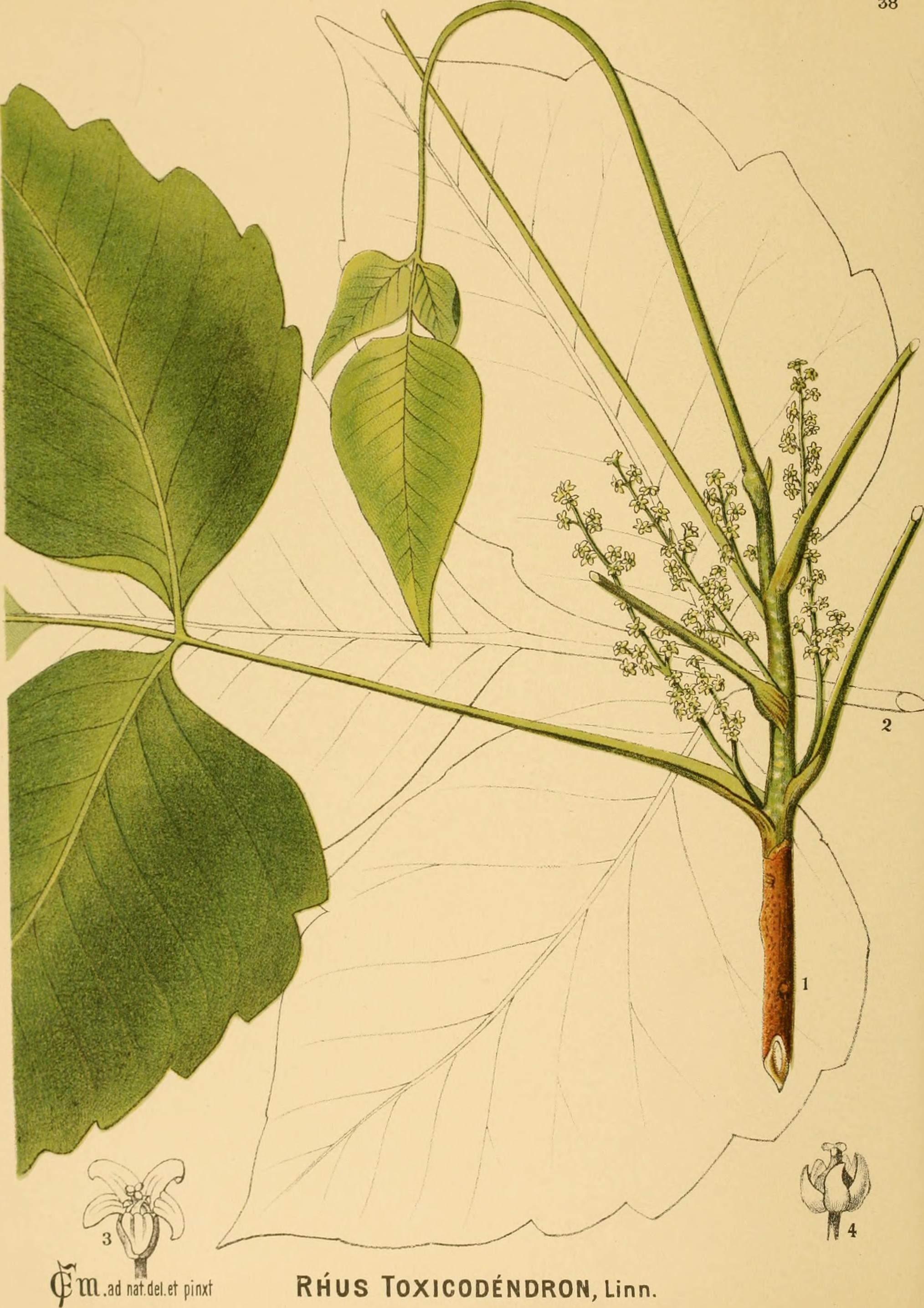
N. ORD.-ANACARDIACE^. 38 Sect.-WXICODENDRON. TOURN. GENUS.— RHUS, SEX. SYST.— PENTANDRIA TRIGVNIA. RHUS TOXICODENDRON. POISOJT IVY. SYN.— RHUS TOXICODENDRON, LINN.; R. TOXICODENDRON, VAR. QUERCIFOLIUM, MICHX.; R, VERRUCOSA, SCHEELE; R. TOXICARIUM, AND HUMILB, SALISB.; R. RADIO ANS, VAR. TOXICODENDRON, PERS.; TOXICODENDRON PUBESCENS, MILL. COM. NAMES.— POISON IVY, THREE-LEAVED IVY, POISON OAK, POISON VINE, MERCURY; (FR.) SUMAC VENENEUX, ARBRE A POISON; (GER.) GIFTSUMACH. A TINCTURE OF THE FRESH LEAVES OF RHUS TOXICODENDRON, LINN. Description. — This decumbent or more or less erect shrub, grows to a height of from 2 to 4 feet, or more, according to whether Rlnis j-adicans is distinct from this species or not. Root reddish, branching. Leaves 3-foHate, thin; leaflets rhombic-ovate, acute, rather downy beneath; they are entire when young (see plate), but when full grown become variously dentate, crenate, sinuate, or cut-lobed. The lateral leaflets are unequal at the base, and sessile, the terminal one larger and situated at the end of a prolongation of the common petiole. Inflorescence loose, slender, axillary, racemose panicles. Floivers polygamous. Fruit glabrous, globose, pale brown; nutlet somewhat gibbous, striate, and tuberculate. History and Habitat. — The Poison Ivy grows in thickets and low grounds, quite common in North America, flowering in June. Rhus toxicodendron was introduced into England as a plant in 1640; but was not used as a medicine until 1798, when Du Fresnoy, a physician at Valenciennes, had brought to his notice a young man who had been cured of an herpetic eruption [dartre) on his wrist, of six years' standing, on being accidentally poisoned by this plant. He thereupon commenced the use of this plant in the treatment of obstinate herpetic eruptions, and in palsy; many cases of each yielding nicely to the drug.''' Since Du Fresnoy's success, the plant has rapidly gained a place in general practice, meeting some success in the treatment of paralysis, rheumatism, amaurosis, and various forms of chronic and obstinate eruptive diseases. The milky juice of this species is used as an indelible ink for marking linen, and as an ingredient of liquid dressings or varnishes for finishing boots and shoes. * Des caracth'is^ du tiailement, et de la cure des dntres, etc., par F usage du Rhus radicans.
38-2 I an certain, however, that Rhus venenata is more extensively used for the latter purpose, as will be seen from my experiences detailed under that drug. The fresh leaves are officinal in the U. S. Ph.; in the Eclectic Materia Medicas the preparation advised is Tinctnra Rhus Toxicodendron. PART USED AND PREPARATION.— On account of the care necessary in the preparation of our medicamentae. it is an absolute necessity that we should know, without a chance for doubt, the exact plant that we use, after proving. I have therefore, especially in this case, carefully examined into the relationship existing between R. Toxicodendron and its so-called variety radicans. The only differences acknowledged by authors are as follows: R. toxicodendron, L. Stem erect. Height of growth 2 to 4 feet. Stem devoid of rootlets. Leaves trifoliate. Leaflets variously toothed or crenate, smooth above and slightly pubescent underneath. R. radicans, L.* Stem more or less tortuous. Height 4 to 30 feet or more. Stem profusely studded with dark-colored rootlets, by which it clings to its chosen support. Same. Leaflets entire, or slightly dentate, smooth both sides. During the present season I have carefully examined a great number of individuals in this and adjoining coundes, and conclude, as the result of my observations, that an individual commencing its growth as toxicodendron may become radicans if proper support is reached. I found in several places along the Chenango River, both forms growing from the same root. At the entrance of a ravine near Glenwood Cemetery, upon the outskirts of this city, is the plant from which the accompanying plate was made; this individual is radicans in its mode of growth (climbing about 9 feet into a young elm tree), but it bore no roodets, being supported merely by the shoots of the elm; its foliage answers exacdy to toxicodendron. One large plant, on the bank of the Susquehanna River, below the usual high-water mark, has all the characters of radicans except the rootlets, and grows in a trailing manner along the bank; passing in its growth four excellent supports: /. e., two sturdy elms, one sycamore, and a large stump surrounded by bushes. It is said that the two forms differ in their place of growth, toxicodendron choosing open places and radicans shady spots; it however follows as a necessity that if toxicodendron is radicans when it climbs, radicans is in the shade because of its support. Many other far more competent observers than myself have doubted the verity of the distinctions in these forms: among them are Michaux and Pursh, who considered them merely localisms, and Bigelow states: " among the plants which grow around Boston, I have frequently observed individual shoots from the same stock, having the characters of both varieties. I have also observed that young plants of R. radicans frequently do not put out rooting fibers until they are * Rhus Toxicodendron, var. radicans, Toxrey; Toxicodendron z'ii/^'iire,'Sl\\\.; Ji/ius Toxicodendron, var. a vul^'are, Michx.; H/ius scandens, Salisbury. I
38-3 several years old, and that they seem, in this respect, to be considerably influenced by the contiguity of supporting objects." My tinctures of both forms are exactly alike in physical properties; portions of each yielded the same amount of solid extract per ounce, after evaporation; and as far as I can determine, they are identical. The bulk of our guiding symptoms are compiled from cases of poisoning, where the form causing the effect Is not identified. I then. In the light of all this, would suggest that our tincture be made as follows: Take equal parts by weight of fresh leaves of each form, gathered on a cloudy, sultry day, just before the flowers are developed, chop and pound them to a pulp, and weigh, treating the resulting mass as in the preceding species. The resulting tincture should have a dark brown color by transmitted light, and will give off no characteristic odor; It will have a biting and astringent taste, and a strong acid reaction. CHEMICAL CONSTITUENTS.— i^/«^?V««72?V Acid, C^^W^JC)^.^. This specific tannin of Rhus is a yellowish- green, gummy mass, having a slightly bitter and astringent taste and an acid reaction (Wittstein). Toxicodendric Acid. — This peculiar, poisonous, volatile principle, was Isolated from this plant by Prof. Malsch.* He describes it as resembling both formic and acetic acids In some of its reactions, but distinguishable In its failure to produce a red color with neutral ferric salts. PHYSIOLOGICAL ACTION.— The toxic action of this species Is one difticult to explain. The first noticeable peculiarity Is its choice of victims, many persons being entirely devoid of response to Its Influences, many others peculiarly susceptible. Out of ten men employed to " clear out a twelve-acre lot that was completely filled with poison vine, cat briers, and brambles, the poison vine greatly predominating," four only escaped poisoning. "At first there was a lively fight between the poison vine and the men, and it looked as If the former would get the better of it; for most of the men soon began to show signs of being tired, and at the end of the fourth day six of the men were flat on their backs, too sick for anything." f I remember one Illustration. When a lad, while In bathing with five others, we all ran a race, stark naked, through the underbrush near by, passing in and out through a clump of what was afterward found to be poison ivy; two of the party were taken ill the next day and soon developed quite serious symptoms of poisoning; all the others. Including myself, escaped. Another peculiarity Is that In many cases it is not necessary to even touch the plant to be severely poisoned. While playing croquet one sultry day in June, with a young lady cousin, she struck her ball with sufficient force to cause It to roll underneath a clump of poison ivy that grew at a short distance from the edge of the lawn. She, knowing her susceptibility to the poison, carefully reached under the vine and extracted the ball without touching even a leaf. During the evening * Proc. Am. Phar. Assoc, 1S65, 166. f Pnral New Yorker, quoted in daily press, original not accessiljle.
38-4 of the same clay, her face began to itch and burn, and in the night it swelled to such extent that the eyes were not only closed, but the lashes even were lost to view in the swollen countenance. Nearly two weeks elapsed before the symptoms caused by this exposure entirely subsided. A third peculiarity is that the plant is more poisonous during the night, or at any time in June and July when the sun is not shining upon it. Absence of sunlight, together with dampness, seems to favor the exhalation of the volatile principle {Toxicodendric Acid) contained in the leaves. Of this Porcher says r'= "An acrimonious vapor, combined with carbu retted hydrogen, exhales from a growing plant of the poison oak during the night. It can be collected in a jar, and is capable of inflaming and blistering the skin of persons of excitable constitution, who plunge their arms into it." The symptoms caused by this plant are: First, redness and swelling of the affected part, with intolerable itching and burning, followed by vertigo, weariness, and a sort of intoxication. Infiltration of the face and eyes, and agglutination of the lids after sleep; great restlessness, pain, thirst, and fever. The surface of the skin, after a time, becomes studded with confluent bullae where the cellular tissue is loose, then a dermatitis follows resembling erysipelas; this may spread rapidly and finally communicate to the mucous membranes. This is followed by swelling of the mouth and throat, cough, nausea, and vomiting. Rheumatoid pains develop about the joints, and a painful stiffness asserts itself in the lumbar region, while the legs and arms become numb. Confusion of mind and delirium may then set in, during which the patient may become so ill-humored, restless, and anxious, that he will jump out of bed. The concomitant symptoms are inflammation of the eyes, dilation of the pupil, weakness of vision, and sometimes dilopia; frequent epistaxis; brown coated tongue, with a triangular red tip; swelling of the parotid glands, with difficult deglutition; griping in the abdomen; diarrhoea; profuse urination; oppression of the chest; rapid pulse; great weakness, weariness, and prostration; soreness of the muscles, worse while at rest, and passing off when exercising; sleepiness; and chilliness, followed by fever and copious sweat. There are almost as many antidotes recommended for Rhus tox. poisoning as for the bite of the ratdesnake. Prominent, however, among the applications are: alkaline lotions, especially carbolate of soda, alum-curd, and hyposulphite of soda, keeping the skin constandy moist with the agent in solution; meanwhile administering Bryonia, Belladonna, Apis, Grindelia robusta, or Verbena urticifolia. Description of Plate 38. I. End of flowering branch, Binghamton, N. Y., June 27th, 1884. 2. Outline of leaf. 3. Flower. 4. Calyx and pistil. (3 and 4 enlarged.) Resoic. Soiilh. Fields and Forests, 202.
3.9. ^■.in. ad nat.del.et pinxt. 1 8 Rhus Aromatica, Ait.
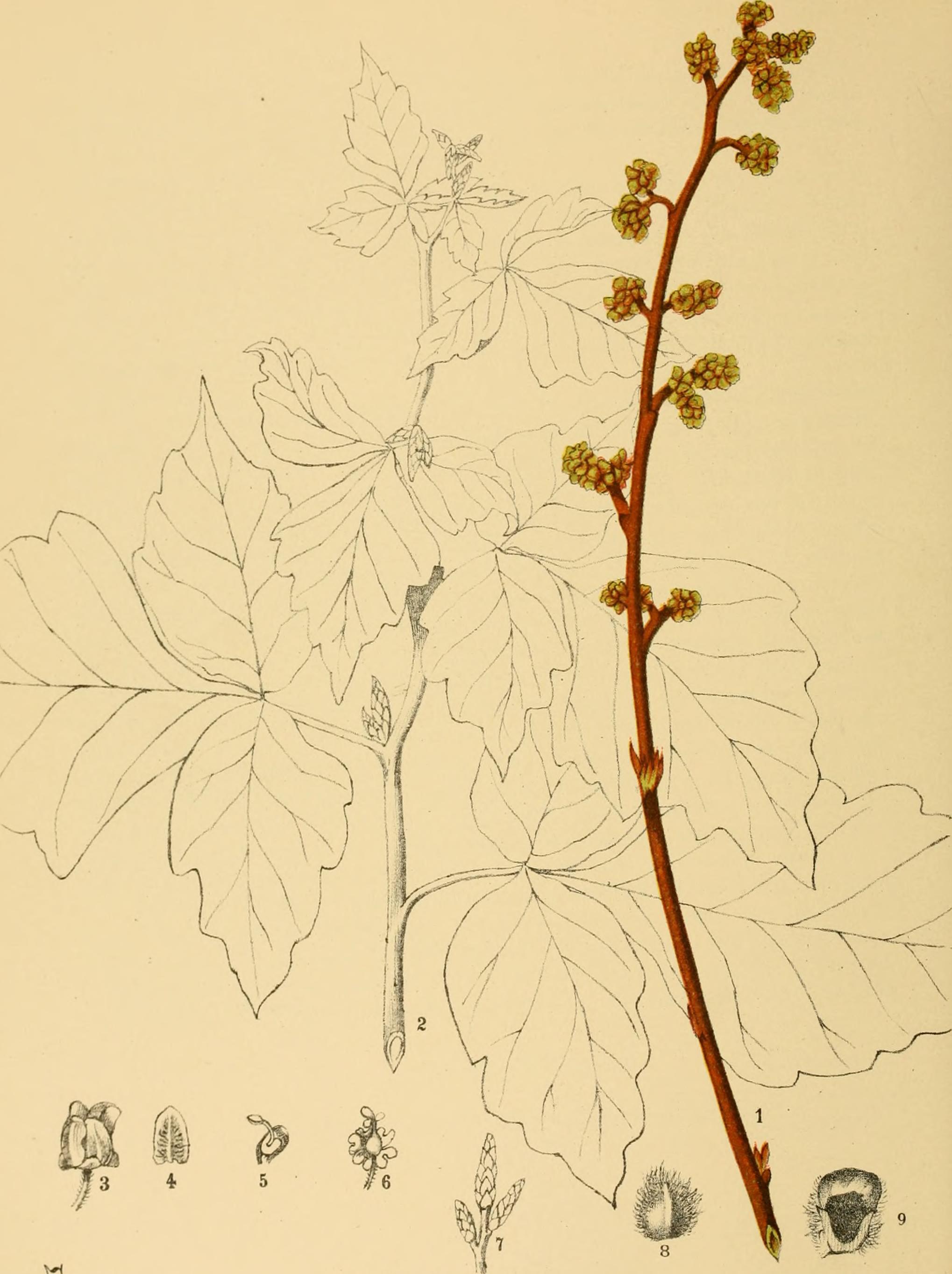
N. ORD -ANACARDIACE^. 39 Senes.-LOBAD/UM. RAF. GENUS.— RHUS. SEX. SYST.— PENTANDRIA TRIGYNIA. RHUS AROMATICA. fragra:n't sumach. SYN.— RHUS AROMATICA, AIT.; RHUS CANADENSIS, MARSH.; RHUS SUAVEOLENS, AIT.; BETULA TRIPHYLLA, THUN.; TURPINIA PUBESCENS, AND GLABRA, AND LOBADIUM AROMATICUM, RAF. COM. NAMES.— FRAGRANT, OR SWEET-SCENTED SUMACH, STINK BUSH, SKUNK BUSH. A TINCTURE OF THE FRESH ROOT BARK OF RHUS AROMATICA, AIT. Description. — This straggling but very pretty bush usually grows to a height of about 4 feet. Leaves 3-foliate, slightly sweet-scented; leaflets rhombic-ovate, prominently ribbed, crenate or cut-toothed; the middle leaflet broadly cuneate at the base, and narrowing gradually to its insertion at the end of the common petiole; all sessile, and coriaceous when old. Inflorescence single or clustered, scaly bracted, catkin-like spikes; scales reddish, and furnished with copious hairs upon the border; flowers polygamo-dioecious, prefolial. Hypogynous dtsk 5-parted, large; lobes strongly reniform, the hilum of each almost entirely surrounding the base of the filament inserted under it. Fruit similar to that of Rhus glabi-a, but somewhat flattened; millet smooth, depressed. History and Habitat This least poisonous of all our indigenous species of Rhus, is common in dry, rocky soils, where it flowers in April or May, before the appearance of the leaves. It is the finest species to cultivate, its dense foliage becoming still more so, and the leaves enlarging and varying beautifully. It was introduced into England as an ornamental shrub in 1759. The previous medical uses of the berries were the same as those of R. glabra. This fruit is termed the squaw-berry, because the Indian women gather large quantities, which are dried and used for food. The berries are excessively sour, but very much used while fresh during the summer months; when macerated they make a pleasant drink. The wood is very tough, far more so than the willow, and is used by the Indians in Utah, Arizona, Southern California, and New Mexico for making into baskets. This wood exhales a peculiar odor, which is always recognizable about the camps of these Indians, and never leaves articles made from it.* * Dr. Edward Palmer in Am. Nat., 1S7S, 597.
39-2 PART USED AND PREPARATION. — The fresh bark of the root is treated as in the preceding species. The tincture obtained is the most transparent and hghtest in color of all the species of Rhus here mentioned. It has a beautiful, clear, crimson color by transmitted light; a decidedly terebinthic odor; very astringent taste, and strong acid reaction. CHEMICAL CONSTITUENTS. — Volatile Oil. This body has, when first distilled, the disgusdng odor of bed-bugs; but when treated with ether and evaporated, it acquires a pleasant aroma after having been exposed to the air for twenty-four hours. Beside the above, Mr. H. W. Harper* determined the presence of gallotannin, resin, acid resin, fixed oil, and a red coloring matter. Description of Plate 39. 1. A flowering branch, from Lowmansville, N. Y., May 14th, 1884. 2. End of late summer branch, showing the inflorescence preparing for the next season. 3. Flower. 4. Petal. 5. Stamen and lobe of disk. 6. Pistil and hypogynous disk. 7. Dormant inflorescence. 8. Scale of same, outer face. 9. Scale of same, inner face. (3-9 enlarged.) * Am. Jour. Phar., 1881, 212.
40. r\^ (Bm.jd nat.del.et pinxt. AM QUINQUEFOUA.Michx.
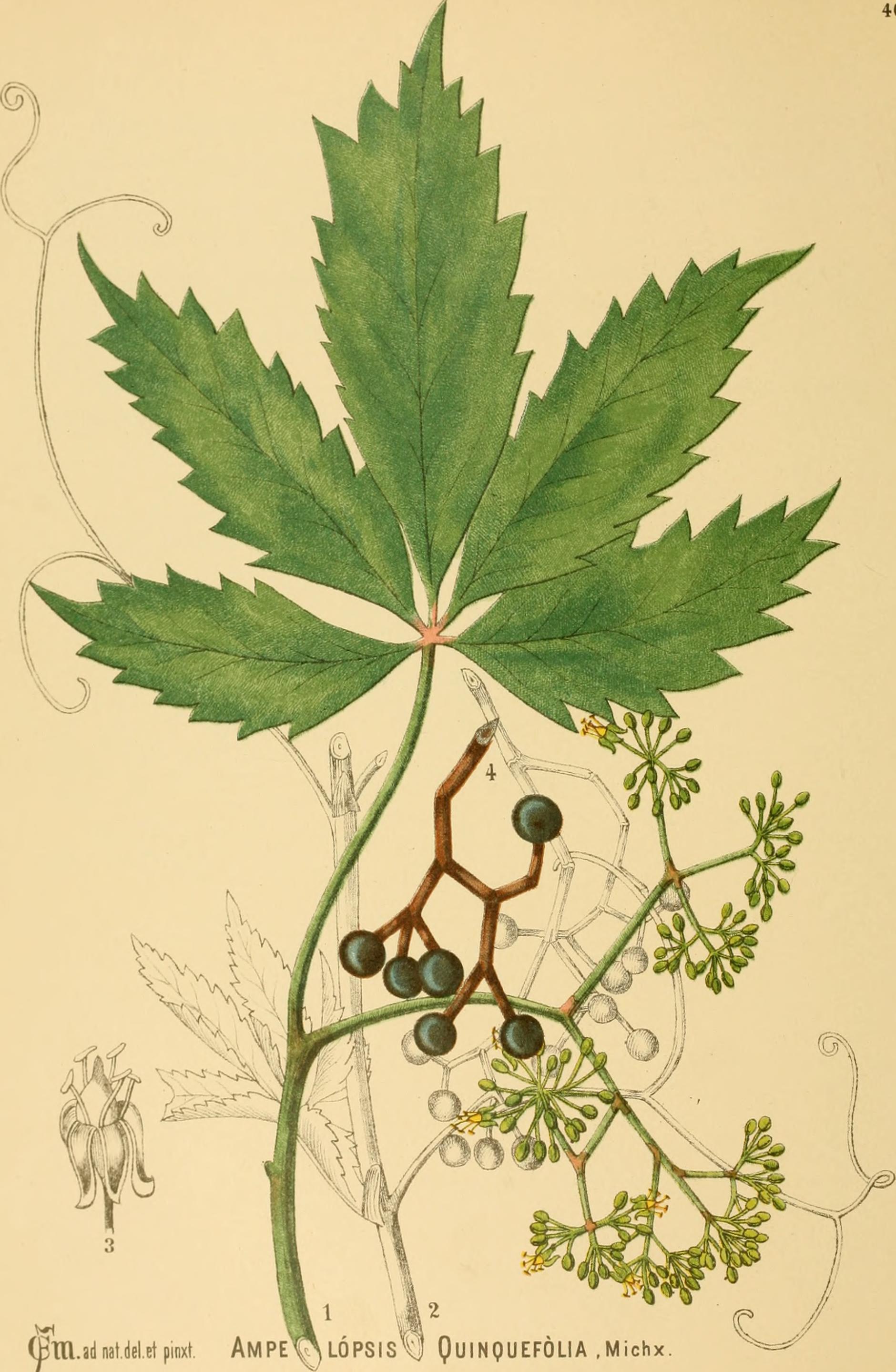
N. ORD -VITACE^. 40 GENUS.— AMPELOPSIS,* MICHX. SEX. SY.ST.-PENTANDRIA MONOGYNIA. AMPELOPSIS. VIRGINIAN CREEPER. SYN.-AMPELOPSIS QUINQUEFOLIA, MICHX., AMPELOPSIS HEDERACEA, DC, VITIS QUINQUEFOLIA, LAM., VITIS HEDERACEA,"WILLD., HEDERA QUINQUEFOLIA, LINN., CISSUS HEDERACEA, PERS. COM. NAMES.-VIRGINIAN CREEPER, AMERICAN IVY, WOODBINE, FIVE-LEAVES, FALSE GRAPE, WILD WOOD-VINE. A TINCTURE OF THE FRESH SHOOTS AND B.\RK OF AMPELOPSIS QUINQUEFOLIA, MICHX. Description. — This common vine is familiar to all residents of the Northern United States, being often planted as a porch screen on account of its rapid growth, its beautiful shade and the magnificence of its autumnal coloring. The stem is extensively climbing, reaching out in all directions, and fastening itself by the disk-like appendages of the tendrils to anything that will give it support, thus sometimes reaching a great height. Leaves long petioled, digitate, smooth, with five oblong-lanceolate coarsely serrate leaflets. Flower clusters cyme-like, the pedicels angularly jointed and somewhat umbellate. Floiocrs small, and perfect. Calyx entire, crenate, or slightly 5-toothed. Petals 5, at first seemingly united, then becoming distinct, concave and thick, expanding and reflexing before they fall. Disk none. Stamens 5; filaments slender; anthers large, oblong introrse. Ovary somewhat lobed at the base, conical, 5-angled, 2-celled; style short or wanting; stigma small and simple, or slightly 2-lobed. Ovules 2 in each cell of the ovary and erect, anatropous from its base. /v7«'/ a dark purplish blue berry when ripe, about the size of a pea. Seeds bony, with a minute embryo at the base. History and Habitat.— This woody climber haunts low moist grounds, well supplied with trees or bushes, often making the bodies of elm trees grandly picturesque by its dense green covering of their trunks, or hanging in festoons from blasted trees, and covering rocks and stumps with its dense verdure, it renders beautiful everything it clings to, while after the first frosts its vividly brilliant coloring makes one of the most striking points in an autumn landscape. It opens its yellowish green flowers, few at a time, in July; the berries being ripe in October. The Virginian Creeper is dreaded by many, in its wild state, when * (i/i7rc\o; a I'ine, and o./,((, appemaiicc.
40-2 witliout support, from its often being taken for poison ivy, to wlilch, however, it bears no resemblance, except perhaps in this mode of growth. This indigenous vine is being cultivated in Europe much as the European ivy is here, for adorning walls. Ampelopsis is not mentioned in the U. S. Ph.; in the Eclectic Materia Medica its preparations are Dccoctum ampelopsis, and Iiifusuni ampelopsis. PART USED AND PREPARATION. — The fresh young shoots and bark are chopped and pounded to a pulp and weighed. Then two parts by weight of alcohol are taken, and having mi.xed the pulp well with one-sixlh part of it, the rest of the alcohol is added. The whole is then stirred, poured into a wellstoppered bottle and allowed to stand eight days in a dark, cool place. Having separated the tincture by decanting, straining, and filtering, it presents by transmitted light a slighdy brownish-red color; is of a decided sour, astringent taste and has a strong acid reaction. CHEMICAL CONSTITUENTS.— P)v-(;ra/tY/^z>/,* C„ H, O,, determined by Gorup-Besanez in small quantity in the green leaves. This body crystallizes in scpiare prisms readily soluble in water and alcohol. Cisso-Tannic Acid, C,„ Hj^ 0^, determined by Wittstein in the autumnal colored leaves as the pigment of the red coloration; it is liquid at ordinary tem[)eratures, and has an astringent, bitter taste. In this acid as a sediment is another body termed by this author insoluble or ehangcd cisso-iamiic acid (CgH^gOj.,), insoluble in water, soluble in alcohol. It exists when dry as a dense dark-brown, brittle, shining mass, having a bitter, acrid taste. The leaves when oreen contain also free tartaric acid and its salts, with o sodium and potassium. Glycollic Acid, C, H^ 0.„ and Calcium glycollate (C^ H^ 0.j), Ca, exist in the ripe berries. (Schorlemmer.) PHYSIOLOGICAL ACTION. -Little or nothing is known of the action of this drug upon man. Mr. Bernay, however, in Pharm. Jour, and Trans., vol. vii. 1876, p. So, reports that two children, aged respectively two and a half and five years, after chewing the leaves and swallowing the juice were quickly seized with vomiting and purging, with tenesmus; then collapse, sweating, and faint pulse; followed by deep sleep for two hours, from which a return of the vomiting and purging aroused them. The pupils were dilated and remained somewhat so four hours after the commencement of the attack. Description of Plate 40. I. Flowering spray, from Ithaca, N. Y., June 17, iSSo. 2. Branch showing tendrils. 3. Flower (enlarged). 4. Berries. * Oxyphenic.'^cid.
.V^c /' /
41. f lU.adnat.del.et pinxt. RhAMNUS CATHARTICUS.Linn.
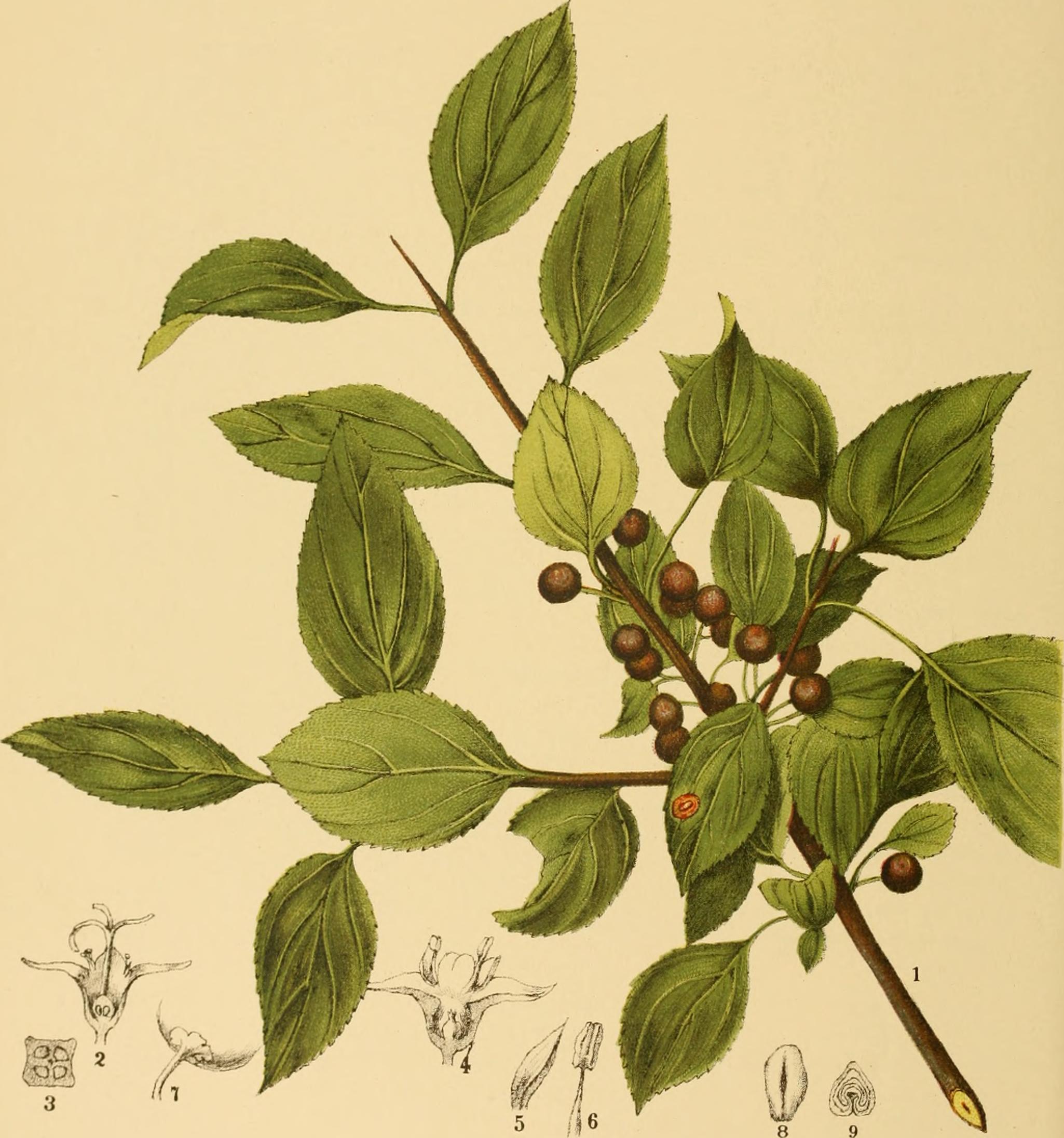
N. ORD -RHAMNACE^. 41 GENUS.— RHAMNUS,* TOURN. SEX. SYST.— PENTANDRIA MONOGYNIA. RHAMNUS CATHARTICUS. BUCKTHORJV. SYN.— RHAMNUS CATHARTICUS, LINN.; R. SOLUTIVUS, GER.; CERVISPINA CATHARTICA, MCENCH. COM. NAMES.— PURGING BUCKTHORN; (PR.) NERPRUN, BOURQUBPINpl; (GER.) WEGDORN, KRBUZDORN. A TINCTURE OF THE RIPE BERRIES OF RHAMNUS CATHARTICUS, LINN. Description. — This dense-spreading shrub or small tree attains a growth of from 6 to 12 feet. Ste?n erect; bark grayish; brmichlets numerous, tipped with a sharp spine. Leaves somewhat opposite or sometimes more or less tufted, oval, acuminate, and minutely denticulate-serrate; veins prominent beneath, and arched in a direction parallel to the margin. Inflorescence in axillary clusters; flowers minute, greenish-yellow, polygamous or dioecious, the sterile ones with ovate sepals and petals and an abortive ovary. Calyx urceolate, 4 to 5 cleft, persistent; lobes lanceolate; torus thin, lining the tube. Petals 4 to 5 small, linear-oblong; claivs short. Stamens short, mostly 4, rudimentary in the fertile flowers; f laments surrounded by the corolla. Ovary free, 2 to 4 celled, not enclosed in the torus; styles 2 to 4 distinct or more or less united; stio^nias 4, somewhat club-shaped or ligulate. Fruit an ovoid, berry-like drupe; nutlets 3 to 4, seed-like, cartilaginous; seeds grooved on the back and rounded at the sides, a horizontal section resembling the face of a horse's hoof; cotyledojis leaf-like, the edges revolute. Rhamnacese. — A small family of shrubs or small trees, often with thorny branchlets. Leaves mostly alternate, simple; stipules small or obsolete. Inflorescence various; flowers small and regular (sometimes apetalous, or, by abortion, dioecious or polygamous); in aestivation the sepals are valvate and the petals convolute. Petals clawed, concave, inserted into the edge of a fleshy disk lining the short tube of the calyx. Stamens 4 or 5, perigynous, as many as the sepals and alternate with them. Ovary 2 to 5 celled; ovules solitary, anatropous; styles more * From the Celtic rain, branching.
41-2 or less united; stigmas 2 to 5, simple, and usually distinct. Fruit a capsule, drupe, or berry; seeds erect, one in each cell; axil none; embryo large; cotyledons broad; albumen sparing and fleshy. This family furnishes us with only one other proven plant, viz.: the European Black Alder (Rhamnus frangula, Linn.), the bark of which is a mild but certain purgative, useful in habitual constipation. Amon^'- the other plants of the order useful to medicine, we find the French Berry, a purgative fruit yielded by Rhamnus ir.fectorius, Linn. The fruit of the Indian ZizypJms cenophila, Mill., is eaten by the natives, who consider the bark a fine vulnerar)'. The East Indian Z. Jtijuba, Lam., and the Persian Z. vjilgaris yield a mucilaginous juice from which is made the famous Jujube Paste, esteemed for the manufacture of a pleasant pectoral lozenge, called by the French Pate'de Jujube; the Arabian Z. lotus yields a berry known as the Lote; this is supposed to be the true Lotus of the Lotophagi. It is found on the eastern as well as the western extremity of the African desert, and is described by Mr. Park as small farinaceous berries, of a yellow color and delicious taste. The natives, he says, convert them into a sort of bread, by exposing them some days to the sun, and afterwards pounding them gendy in a wooden mortar until the farinaceous part is separated from the stone. The meal is then mixed with a little water, and formed into cakes, which, when dried in the sun, resemble in color and taste the sweetest gingerbread. The roots of the North American Berchemia volubilis, De C, are claimed to be a useful remedy in cachexias and an antisyphilitic. The twigs of the New Jersey Tea [Ceanothus Amej'icamis, Linn.) are very useful on account of their mild astringency as an injection in gonorrhoea, gleet, and leucorrhoea; this plant is now being proven for a place in our Materia Medica. The Mexican Ceanothus azurea, Desf., is considered a powerful febrifuge; while the Senegal C. discolor is a useful astringent in dysentery. Hoveiiia dulcis, Don., enlarges its peduncles in fruit to such extent, and they become so sweet and succulent, that the Japanese consider them a rare delicacy; they are said to greatly resemble in taste a Bergamot pear. History and Habitat. — The Purging Buckthorn is indigenous to Europe and Northern Asia, from whence it was introduced into this country as a hedge-plant; it has escaped in many places in New York and New England, where it flowers from April to May, according to the season. The medical history of this plant extends back to a period dating from before the Norman Conquest; it was then called Waythorn or Hartsthorn. In the 13th century Welsh physicians prescribed the juice in honey as a mild aperient drink. In.Spain it is referred to as early as 1305; and it is then noted by all writers on medical plants during the i 6th century. Buckthorn first appeared in the London Pharmacopoeia in 1650; it has also held a place in the Pharmacopoeia of the United States, but its space is now held by R.frangula. The Purging Buckthorn has now fallen into disuse on account of the violence of its action and the resulting severe irritation of the bowels.
41-3 The principal uses now are those of economy, the juice of the fresh berries giving a saffron-colored dye, and that of the bark a beautiful yellow. A fine green pigment for water-coloring is made by the French from the ripe berries mixed with alum; this color, called Vert de Vessie, or sap-green, has been used as the principle for most of the foliage of the plates in this work. PART USED AND PREPARATION.— The fresh, ripe berries are pounded to a pulp, sufficient to separate them from the nutlets, and weighed. Then two parts by weight of alcohol are taken, the pulp thoroughly mixed with one-sixth part of it, and the rest of the alcohol added. The whole is then poured into a well-stoppered botde, and allowed to stand eight days in a dark, cool place, being shaken twice a day. The tincture, separated from this mass by pressing and filtering, is opaque; in thin layers it exhibits an orange-red color by transmitted light; and a taste at once acid and astringent. CHEMICAL CONSTITUENTS.— /?//«;«;wfaMfl7'//;/.=== A bitter, brittle, yellowish, amorphous substance, soluble in water and alcohol, not soluble in ether; when fused it passes into a thick, yellow oil. Rhamnin, f Cj^Hj^O^ + (H,0)2.t — This glucoside, discovered in the berries by a Pontoise pharmacist named Fleury, in 1840, was isolated, named, and further studied by Lefort.§ Rhamnin, when pure, forms minute, yellow, translucent tables, scarcely soluble in cold water, soluble in hot alcohol, and breaks down as in the next body. Rhamnegine, Q^Hg^Oj^. — This second glucoside of Lefort is in all respects, except solubility, identical in its physical and chemical properties with the preceding. When decomposed by heating with a dilute mineral acid, it breaks down into a crystallizable sugar, isomeric with mannite and rhaiiuiciin, C^^-^ff)^. Rhamnotannic Acid. — This tannin-like body, obtained in the separation of rhamnin, results as a greenish-yellowish, amorphous, friable, bitter mass, soluble in alcohol and insoluble in water. PHYSIOLOGICAL ACTION. — The purgation following the ingestion of the ripe fruit of Rhamnus catharticus is, in almost every instance, accompanied by considerable thirst, dryness of the mouth and throat, and severe griping pains in the abdomen. A case is reported 1| of the effects of eating the berries by a lad; the symptoms were as follows: Eyes glistening and injected; lips trembling; a simulation of trismus; the abdomen became hard and distended; colic; diarrhoea; respiration short and anxious; pulse variable; the skin was at one time warm, at another cold; the boy was unable to rise, could not walk, and seemed to * Cathartin. f Rhamneitne (Gallatly, 1858); Chrysorhamnine (Scluitzeberger and Bertiche, 1865). X CigH^Pio (Schutzenberger). ^ Jour, de PJuir., 1866, p. 420. || Leopold, Casl>. Woch., 1850.
41-4 endeavor to press the head against the wall. The symptoms all showed a high state of irritation of the alimentary tract. Description of Plate 41. I. End of a fruiting branch, Ithaca, N. Y., July 17th, 1S85. 2. Female flower. 3. Section of ovary. 4. Male flower. 5. Petal. 6. Stamen. 7. The persistent calyx-tube. 8. Nutlet. 9. Horizontal section of the nutlet. (2-9 enlarged.)
42. ^m.ad latdel.etpinxt EUONYMUS ATROPURPUREUS.Jacq
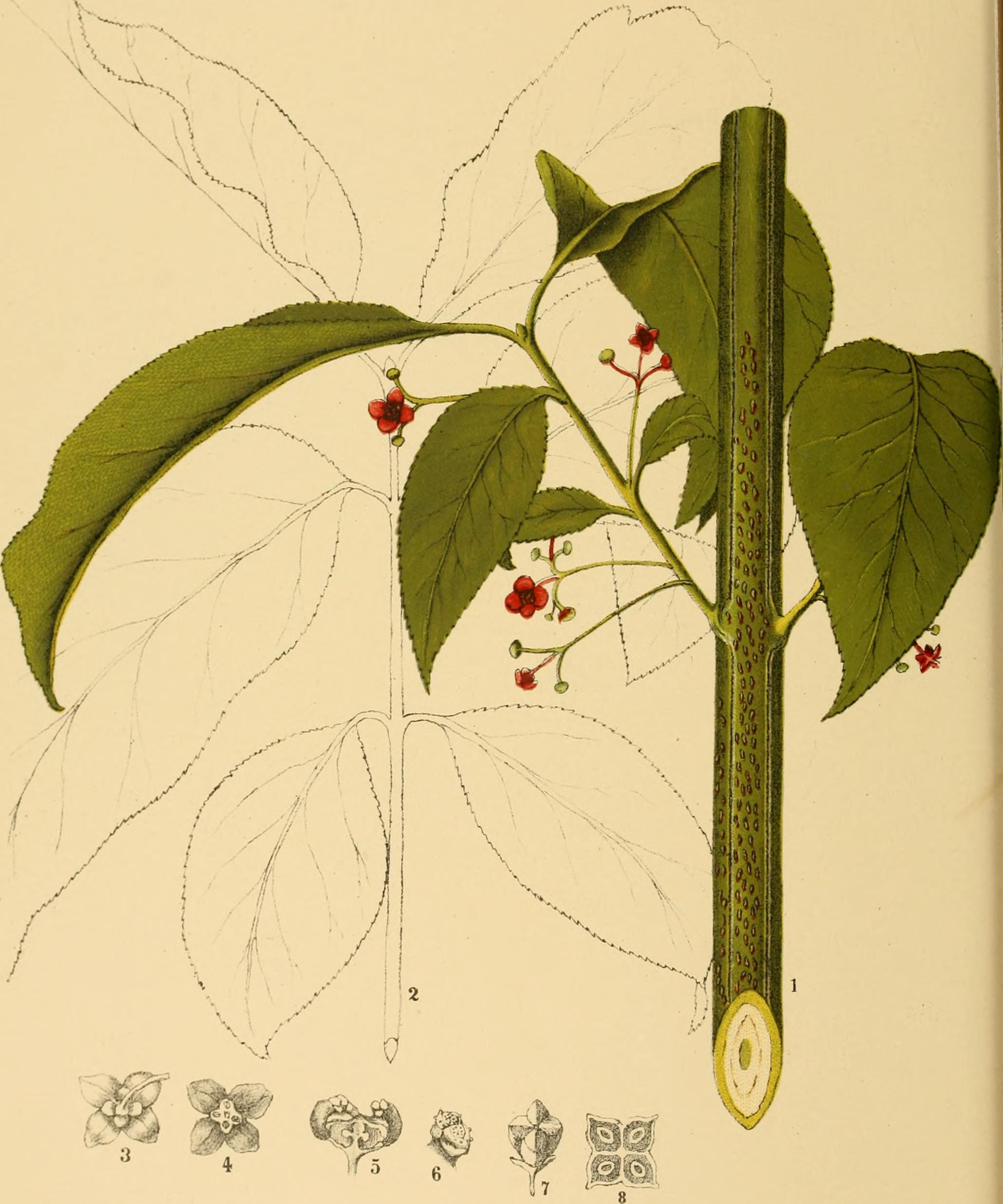
N. ORD -CELASTRACE^.. 42 Tribe.-EUONYME/E. GENUS.— EUONYMUS,* TOURN. SEX. SYST.— PENTANDRIA MONOGVNIA. EUONYMUS ATROPURPUREUS. WA-A-noo. SYN.— EUONYMUS ATROPURPUREUS, JACQ.; E. CAROLINIENSIS, AND LATIFOLIUS, MARSH. COM. NAMES.— WAHOO, WAHOON, BURNING BUSH, SPINDLE-TREE, INDIAN ARROW-"WOOD; (FR.) PUSAIN, OU BONNET DE PRETRE; (GER.) SPINDELBAUM. A TINCTURE OF THE FRESH BARK OF EUONYMUS ATROPURPUREUS, JACQ. Description. — This low shrub seldom attains, out of cultivation, a height of over I o feet, varying usually from 6 to lo. 5^'^w erect; branches straight, appearing more or less terete by having 4 double, white, linear ridges upon its surface, bark blotched with white verrucosa spots between the ridges. Leaves opposite, thin, petioled; oval-oblong, acute at the base, and pointed; wrtr^vw finely serrate; midrib prominent. Inflorescence loose, few-flowered, divaricate cymes, terminating long, lateral and axillary, drooping peduncles, ranged along the young shoots of the season; floivers perfect, their parts in fours. Calyx short and flat; sepals orbicular, spreading, united at the base. Petals broadly ovate, somewhat acute, spreading. Stamens mounted upon the angles of a flat, somewhat quadrilateral disk, which is more or less united with the ovary and covers its superior surface; fllamettts merely mamma-like processes of the disk; anthers appearing sessile, 2-celIed, opening by a broad transverse chink upon their upper faces, and furnished with a broad dorsal connective. Style simply a central projection of the disk; stigma hardly evident. iv-zwV a smooth deeply four lobed and celled, loculicidal capsule; cells 2 to 3 seeded; seeds elliptical, ashy, enveloped by a red aril. Celastraceae. — Shrubs with simple, opposite or alternate leaves; stipu'es minute caducous. Flowers small and regular; cestivation imbricate. Calyx 4 to 5 lobed, persistent. Petals plane, as many as the sepals, and inserted by a broad base underneath the disk. Stamens as many as the petals and alternate with them, inserted upon a disk which fills the calyx cup and is sometimes more or less * Euoi/o/o/, Euonyme, the molher of the Furies; or t", eu, well; o"";"', onoma, naineil; alluding to the poisonous effects of the plant upon cattle.
42-2 united with the ovary. Ovary free from the calyx; ovnles anatropous, erect or pendulous; styles united into one. Fruit a 2 to 5 celled capsule; seeds arilled, one or few to each cell, cnibyro large, cotyledons faliaceous; albumen sarcous, thin, or sometimes absent. The only proven plant of this order is the European Spindle Tree {Euonymns Europcvus, Linn. ), the properties of which are very similar to, if not identical with, the species under consideration. The following plants of the family are more or less useful, viz.: The common Bittersweet, or, better, Staff Vine {Cclastrzis scandens), so often confounded, by the laity, with Dulcamara, has orange-colored fruit; has been largely used in domestic practice, as an alterative, diuretic and cholagogue in various diseases where it seemed necessary to "cleanse the blood." It was considered without equal for the removal of hepatic obstruction. The Indian C. paniculatus is considered stimulant. The branches of the Chilian Mayte?ius Cliilensis are used in decoction by the natives as a wash for the swellings produced in those who have rested in the shade of the Lithri Tree.* The root-bark of the Indian Elceodendron Roxbicrghii is used by the natives, in decoction, for the reduction of almost any kind of swelling; and the African Catha edulis is claimed to be used by the Arabs as an anti-somnolent and intoxicant. Almost all the species of this small order are used in their native countries to subdue inflammation. History and Habitat. — The Wahoo grows in moist, open woods, or along rivers from Western New York to Wisconsin, and southward. It flowers at the north in June and ripens its beautiful fruit in October. It is the fiery appearence of the fruiting bush after the leaves have fallen, and the capsules bursted, and especially when contrasted with a snow background, that gives it an appearance eminently fitting the name often applied, the Burning Bush. Especially of late Wahoo has attracted much attention in medical circles as a laxative tonic, alterative, and depurant in torpidity of the liver; also as a remedy for derangement of the stomach and in secondary syphilis, and an expectorant in colds, coughs and asthma. It needs, however, more thorough proving to determine its sphere of usefulness. Mr. Hardyman, of Cardiff, statesf that he has used Euonymin in 2 grain doses at bedtime, and finds it of much value in hepatic obstruction, needing, however, a saline purge to complete its usefulness. When used in this way I should much prefer the seeds of the plant to salts to procure the cathartic action. The oil of the seeds has been used both in this country and Europe to destroy lice {Pediculus Capitis, Vestimenti, and Pubis). The officinal preparation in the U. S. Ph. is Extractimi Euotiymi. PART USED AND PREPARATION.— The fresh bark of the twigs and root, of the wild plant, is chopped and pounded to a pulp and weighed. Then two parts by weight of alcohol are taken, and after thoroughly mixing the pulp with one-sixth part of it, the rest of the alcohol is added. After having stirred the whole well, pour it into a well-stoppered bottle, and let it stand eight days in a dark, cool place. * Lilhrea cntislicn {Lauriis caiislica), LauracejE. f The practitioner in New Rem., 1880, So.
42-3 The tincture separated from the mass by pressing and filtering, has a clear lemon-yellow color by transmitted light. It has an acrid and bitter taste, no specific odor, and an acid reaction. CHEMICAL CONSTITUENTS.— ir«^/y/w/«. On treating the tincture with chloroform, a dark substance is obtained which partly dissolves in ether as a beautiful yellow resin. The insoluble portion dissolved in alcohol, and the resin precipitated by plumbic acetate, the menstruum after filtration and evaporation yields a neutral, amorphous, bitter body soluble in alcohol and sparingly in water.* Euonic Acid. — This acid crystallizes in acicular forms, and is precipitable from its solutions by plumbic subacetate (Wenzel). Resins, gum, sugar, a crystallizable bitter principle, asparagin, tartaric, citric, and malic acids were also extracted. PHYSIOLOGICAL ACTION.— In large doses the Wahoo acts as a drastic purge attended by griping and followed by prostration; the discharges being seromucoid with an admixture of bile. It promotes the biliary functions and intestinal secretions, increasing capillary circulation generally. The symptoms noted are: deathly nausea; vertigo; excessive tormina; prostration and cold sweat. Profuse and violent evacuation of the bowels, accompanied by much flatulence and colic.f Description of Plate 42. I. Portion of a flowering branch, Cincinnati, O., June 17th, 1885. 2. End of branch. 3. Flower showing calyx. 4. Face of flower. 5. Section of flower. 6. Stamen. 7. Fruit. 8 Horizontal section of ovary. (3-8 enlarged.) * Wenzel in Am. Jotir. Phar., 1862, 312. t Hale, New Remedies, 293.
^SCULUS HlPPOCAOTANUM.Linn.
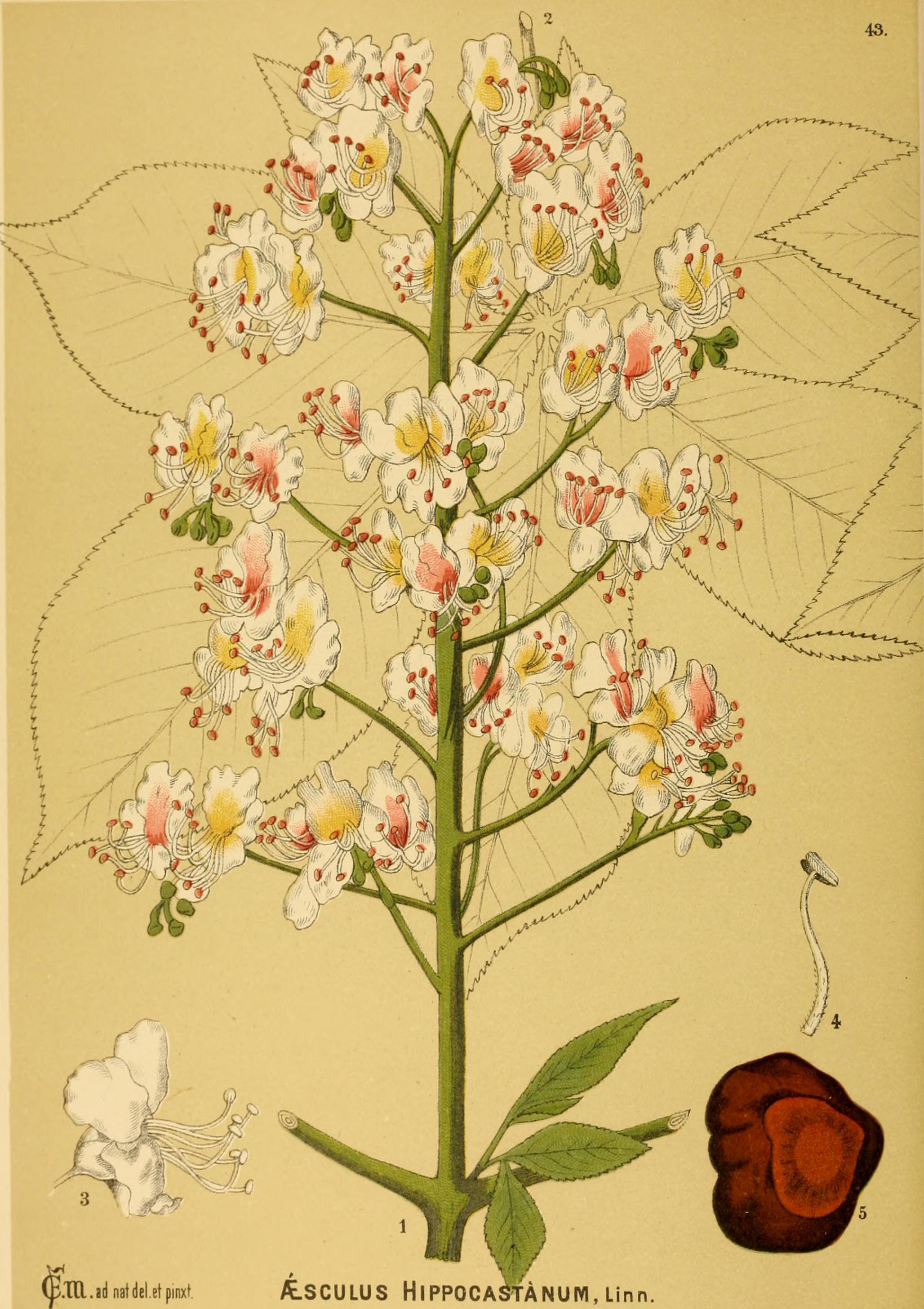
N. ORD.-SAPINDACE^. 43 Jribe.-HIPPOCASTANE/E. GENUS— AESCULUS,* LINN. SEX. SYST. — HEPTANDRIA MONOGYNIA. AESCULUS HIPPOCASTANUM. HORSE CHESTJVUT. SYN.— AESCULUS HIPPOCASTANUM, LINN.; CASTANEA FOLIO MULTIFIDO, BAUH.; CASTANEA EQUINA, GER.; CASTANEA PA VINA. COM. NAMES.— COMMON HORSE CHESTNUT,! ASIATIC HORSE CHESTNUT, BUCKEYE;t (PR.) MARRONNIER D'INDE; (GBR.) ROSSKASTANIE. A TINCTURE OF THE FRESH, RIPE, HULLED NUT OF AESCULUS HIPPOCASTANUM, LINN. Description. — This stately, umbrageous tree usually attains a growth of about 60 feet in height, and 50 feet in diameter of foliage. Trunk erect; ovate, and smooth-barked when young; oval, tending to quadrilateral, when old; bark of the full grown tree greyish, rough, and fissured; timer bark smooth, greenishwhite, tough, fibrous, astringent, and bitter; wood light, not durable. Leaves opposite, digitately 7-lobed; leaflets 7, obovate, with a cuneate base, acute tip, and doubly-serrate margin; straight-feather-veined, early deciduous. Inflorescence dense, pyramidal, upright, hyacinthine thyrsi, terminal upon the shoots of the season; flowers many, often polygamous, the greater proportion of them sterile; pedicels articulated. Ca/yx tubular or bell-shaped, oblique or inflated at the base; limb 5lobed. Corolla spreading, white, spotted with purple and yellow; petals 4-5, usually 5, more or less unequal, nearly hypogynous, clawed and undulate margined. Stamens 6-8, usually 7, declined; filaments unequal, awl-shaped, long and slender; anthers oval, 2-celled. Ovary ov^X.^, stipitate, 3- celled; style i, filiform; stigma acute; ovides 2 in each cell. Frtdt a roundish, echinate, 3-celled, 3-valved capsule, splitting into 3 dissepiments, disclosing 1-2 full formed, somewhat hemispherical nuts, and sometimes an aborted third; seed a large amylaceous nut, having a dense shining testa marked with a large roundish hilum; cotyledons thick, sarcous, cohering; radicle conical, curved. SapindacesB. — This large and variable order is chiefly tropical, especially the * An ancient Latin name. The Aesculus of the Romans was a kind of oak. t Horses are said to eat greedily of the fruit, and the Arabs to use the powdered nuts in the food of their horses when affected with pulmon.iry disorders; hence the vulgarism. J From a resemblance of the nut to the eye of that animal. This name is more applicable to the American species.
43-4 CHEMICAL CONSTITUENTS.— ^^J^«/V«, Q H^^ O13 + H,0. This aromatic gliicositle exists in the bark of many trees of the genera Pavia and Aescuhis. It crystallizes in fine, snowy needles and globules, which lose their water of crystallization and fuse at 160° (320° F.), decomposing at higher temperatures. They are soluble in both hot and cold water and in alcohol, their solutions exhibiting a fine liffht-blue fluorescence. Boiling with dilute mineral acids decomposes this body into glucose and Acsciiletiu, C.J Hp O,, another glucoside, which also exists in a free state in the bark. This body is only sparingly soluble in water, and crystallizes in bitter needles, which break down under the action of boiling potash into formic, oxalic, and protocatechinic acids. PaviiiK C, H,„ 0,„. This glucoside is considered identical with fraxin, and will be found described under Fraxinus Americana, 137. Oil of Aesculus. This oil is readily obtained from the nuts of this species by etherial extraction. It results as a beautiful yellow liquid, congealing at 1° (33.8° F.), and becoming solid at -5° (23° F.). Qnercitriii, Q^ W^ O,. This coloring matter of quercitron, occurs in the testa of the nut,* and in the flowers. Aesculet'mic add is one of the resultants of a still farther decomposition taking place in glucose and aesculetin when they are decomposition products of the action of baryta water upon aesculin. Aescinic acid* This amorphous body is a decomposition product of aphrodaescin when boiled with liquor potassa. Argyraescin. This acrid, amorphous glucoside was discovered by Rochelder in 1862 as a constituent of the seed. It is soluble in alcohol and water; a watery solution forming a soapy foam on agitation. This body together with Aphrodaescifi* another acrid, amorphous principle, having the same properties of solubility and saponification, and breaking down under the action of a concentrated mineral acid into sugar and aesagenin* so markedly resemble saponin that a question arises as to whether they are specific principles, or are to be considered together as Saponin, C32 H^^ Ojg. This peculiar glucoside, existing in the roots of Saponaria officinalis, many species of Lychnis,^ Polygala Senega,^ Gypsophila Sirut/mim,\ Lucuma glycyphl(ea,\\ Monninia polystachya^ Quillaja Saponaria** and many other plants, including ferns; has, before the observation of Rochelder, been accounted a principle of the nuts of this plant. It is a white, amorphous, sternutatory powder, having at first a sweetish, then a pungent and lastingly acrid taste. It is readily soluble in water, the solution frothing like that of soap on agitation, and is resolved under the action of concentrated hydrochloric acid into an amorphous sugar and sapogcnin. Although our tincture is made of the nuclei of the nuts only, still it would seem as if the bitterness, astringency, and acrimony present, were due to all or nearly all of the above constituents found in the bark. » Rochelder. f Gitliagin. + Senegin, Polygalin. \ Strulliiin. I| Monesin. \ Monninin. ** Quillajin
43-5 PHYSIOLOGICAL ACTION.— We have no accessible accounts of poisonings by this drug-, still the provings, being made with goodly sized doses of the tincture, are sufficient to give us an in:?ight into the physiological action. Aesculus hippocastanum causes inflammation of the mucous membranes of the respiratory and digestive tracts, and especially of the rectum; this is shown in the following list of symptoms: Dryness, heat, burning and swelling of the mucous membranes of the nose, larynx, and trachea, with a subsequent copious catarrhal discharge; the same symptoms prevail in the mouth and oesophagus, followed by profuse ptyalism and mucous discharge; the tongue becomes coated with a thick white or yellow fur, and feels as it scalded; the throat becomes congested, raw, and burning, followed by a sense of constriction, and renders deglutition painful and difficult. Constant burning in the stomach and epigastrium, followed by nausea, retching, and violent vomiting, with great tenderness and colic throughout the abdomen, are markedly present. Severe dryness, burning, and soreness of the rectum, with prolapse, and sufficient inflammation of the hemorrhoidal veins to result in purple tumors, indicate the severity of the action of the drug in this locality. Ineffectual efforts at stool, with great urging, and constant severe pain in the lumbar region, extending to the hips and sacrum, are constant symptoms of the drug. Its action upon the liver and portal system is marked by severe congestion, and attendant burning, constrictive pains and deep soreness. The provings, however, fail to substantiate its previous use in intermittent fever and neuralgia; its febrile symptoms being only slight, and its pains, other than those referable to the alimentary tract, slight and not characteristic of nerve irritation. Description of Plate 43. I. End of flowering branch from Ithaca, N. Y., June 4, 1880. 2. A medium-size leaf 3. Flower. 4. Stamen. 5. Nut. (3 and 4 slightly enlarged.)
44. Ae. Hippocastanum A'e. flava. ^.TU.aiinatdel.elpiiixt A'esculus Glabra,Willd.
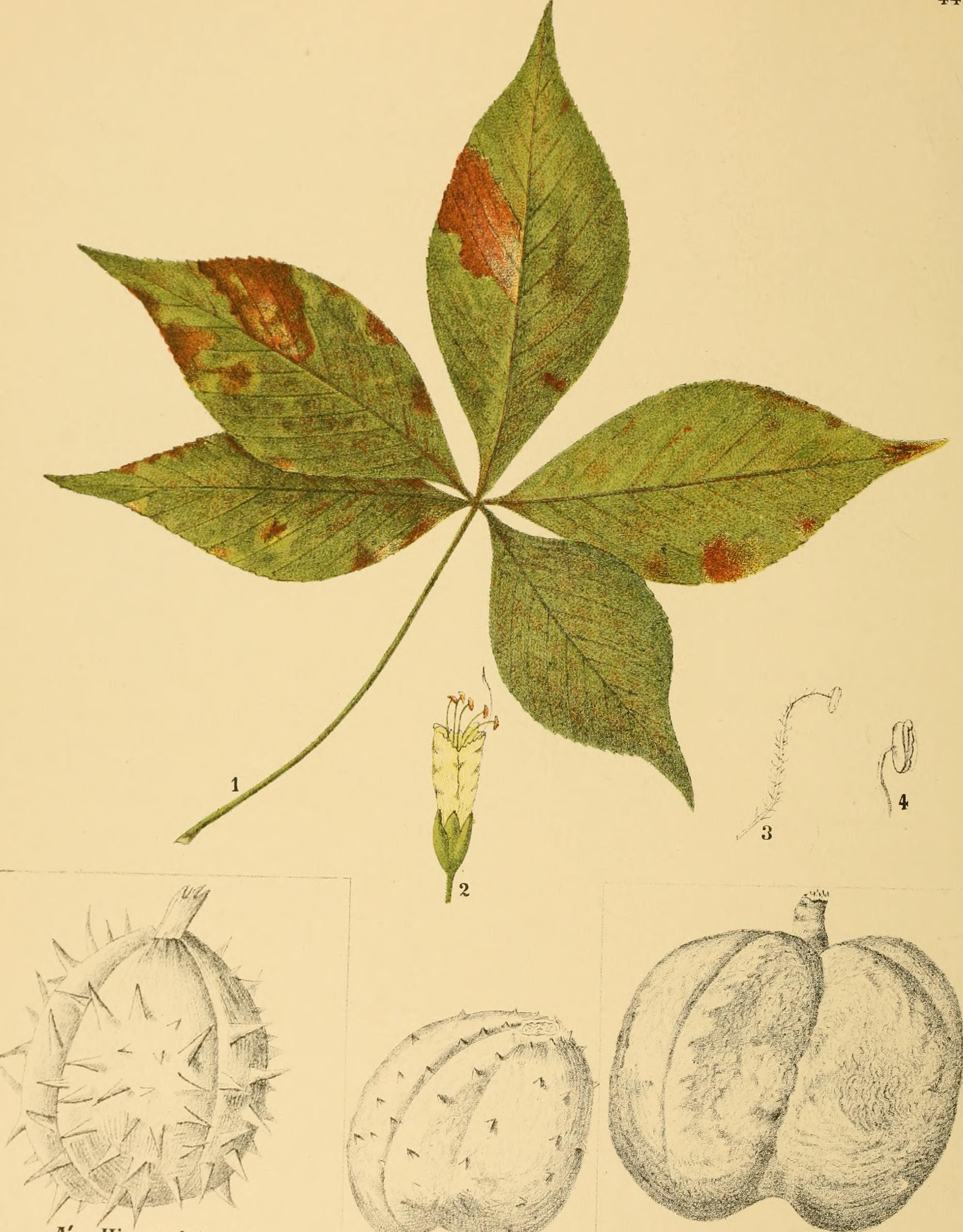
N. ORD -SAPINDACE.C 44 Tribe.-HIPPOCASTANE/E. GENUS— /ESCULUS. SEX. SVST.— HEPTANDRIA MONOGYNIA. ^SCULUS GLABRA. BUCKEYE. SYN.— ^SCULUS GLABRA AND PALLIDA,WILLD.; JE^. ECHINATA, MUHL.; M. OHIOENSIS AND MACROSTACHYA, MICHX.; PA VIA GLABRA AND PALLIDA, SPACH.; P. ALBA, POIR.; P. MACROSTACHYA, LOIS.; MACROTHYRSUS DISCOLOR, SPACH. COM. NAMES. — OHIO BUCKEYE, FETID BUCKEYE, SMOOTH HORSECHESTNUT. A TINCTURE OF THE FRESH NUT OF.^SCULUS GLABRA, WILLD. Description. — This species differs from the preceding in the following particulars: Bark exhaling a very unpleasant odor, similar to that of the flowers of the preceding. Leaf small, smooth; leaflets 5, ovate-lanceolate, acute, and finely serrate. Inflorescence smaller and more cymose; flowers small, pale yellow, narrowly tubular-campanulate, polygamous. Petals only 4, upright, not reflexed. Stamens curved, not declined; filamoits filiform, long-hairy. Friiit echinulate with very short pyramidal points. History and Habitat. — The Buckeye is indigenous to the United States, where it ranges from Western Pennsylvania and Virginia to Michigan, Indiana, and Kentucky; it habits the rich alluvial soil along the bottom-lands of the Ohio River and the streams feeding it, and blossoms in June. The previous uses of this species are almost identical with those of ^. Hippocastanum, though not so extensive, as its qualities are more toxic, and were, on that account, dreaded. PART USED AND PREPARATION.— The fresh-hulled nut is treated as in the preceding species. The resulting tincture has a clear amber color by transmitted light; a honey-like odor; a slightly bitter and pungent taste; and an acid reaction. /Esculus glabra should be more thoroughly proven, as its symptoms cover a larger therapeutic field than its congener. The tincture for this further proving should include the nut-shells and bark as well as the kernels; a larger scope would undoubtedly be covered by such a preparation.
44-2 CHEMICAL CONSTITUENTS. — So far as we are able to ascertain, no special analysis of this species has been made that determines its individuality; we can therefore do no better than refer to the preceding species. PHYSIOLOGICAL ACTION. — The principal proving of this remedy is that recorded by Prof E. M. Hale,* who claims its sphere of action to be an irritant of the cerebro-spinal system and the alimentary tract. The symptoms prominent in his record are: Confusion of mind, vertigo, stupefaction and coma; dimness of vision; thickness of speech; nausea and vomiting; eyes fi.xed and expressionless; paresis of the tongue; tympanitic distension of the stomach with cramp-like pains; constipation, with hard knotty stools; lameness and weakness of the lumbar region; and spasms and convulsions, followed by wryneck, episthotonos and paralysis. Description of Plate 44.! 1. A leaf. 2. Flower. 3. Stamen. 4. Anther. 5. Fruit. (2-4 enlarged.) * New Remedies, 1S77, p. 19 (Symptomatology). f The fruits of.^. Hippocastanum and flava are added for comparison.
45. ■^vaM^ ^TU.adnat.del.etpinxt P0LY6ALA Senega, Linn.
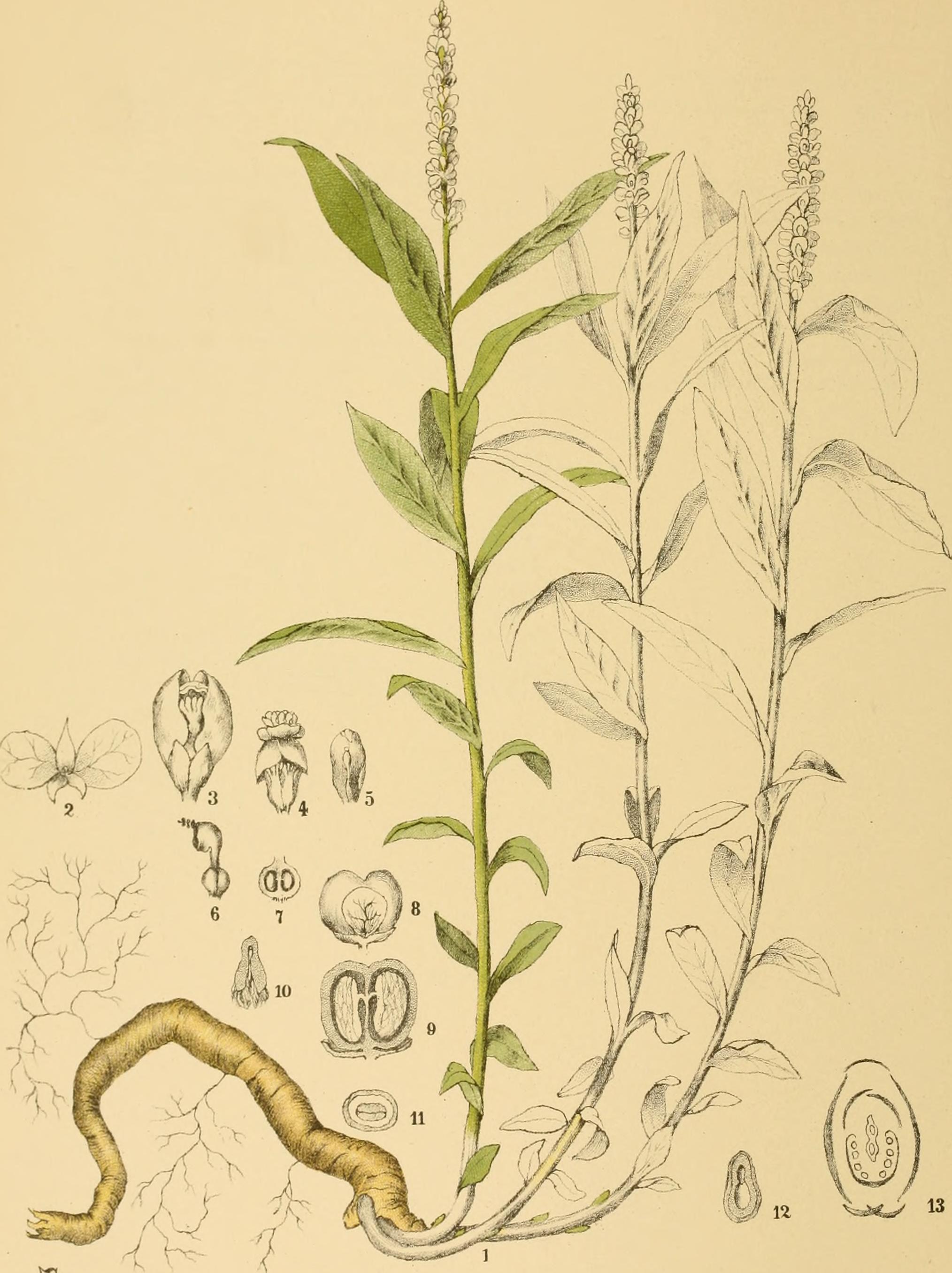
N. ORD-POLYGALACE^. 45 GENUS. — POLYGALA,* TOURN. SEX. SYST.— DI.\DELPHIA OCTANDRIA. SENEGA. SEJyECA SJYAKEROOT. SYN.— POLY GALA SENEGA, LINN.; P. VIRGINIAN A, LEM.; PLANTULA MARILANDICA, RAIL; SENEGA OFFICINALIS, SPAGH. COM. NAMES. — SENEGA, SENEKA, OR SENEGA SNAKEROOT, MILKWORT, MOUNTAIN FLAX; (PR.) POLYGALE DE VIRGINIE; (GBR.) SENEGAWURZEL. A TINCTURE OF THE DRIED ROOT OF POLYGALA SENEGA, LINN. Description. — Rootstock thick, hard, knotty, and sometimes sHghtly branched. Stems several, simple, tough and wiry, from 6 to 12 inches high. Leaves alternate, sessile, lanceolate or oblong-lanceolate, acute at both ends; margins rough; stipules none. Injioreseence a solitary, loose, terminal spike; flowers small, greenish-white, almost sessile, and very irregular. Calyx persistent; sepals 5, arranged in two sets as.to form; the outer set, composed of 3, are small, acute, lanceolate, and greenish; the inner set, of 2, are large, broad, orbicular, concave, slightly veiny bodies, called alcE, enclosing the petals. Petals 3, hypogynous, connected and united with the stamen-tube; the middle or lower one keel-shaped, and short-crested along the back; the two lateral oblong, blunt, and veiny. Stan?eiis 8, enclosed by the lower petal; filaments united below into two bundles of 4 each; anther's small, i-celled, and opening by a pore at the apex. Ovary laterally compressed, 2 -celled by a transverse partition; ovules anatropous, pendulous, one in each cell. Style large, inflated, and curved above, greatly resembling in form a pipe thrust into the summit of the ovary; stigma a fringe-like appendage to the upper margin of the bowl-like enlargement of the style. Friiit a small, 2-celled capsule, flattened contrary to the partition, and partly enclosed by the persistent calyx; dehiscence loculicldal. Seeds black, hairy, with a white caruncle extending the length of the seed; embryo straight, axial; albttmett scanty. Polygalacese. — This small family is represented in North America by 3 genera, comprising 45 species, of which 40 belong to the typical genus Polygala. This natural order is characterized as follows: Herbs or shrubby plants having roots furnished with a bitter, milky juice. Leaves mostly alternate and entire; stipules absent. Floioers very irregular, hypogynous, and pseudopapilionaceous; calyx consisting of 5 very irregular sepals, the odd one superior (Exc. Krameria). * Xi.o\i;, polus, much; yi\a, gala, milk; as some species were supposed to increase this secretion.
45-2 Stamens 4 to 8, monadelphous or diadelphous; anthers innate, i -celled, opening at the top by a pore or chink. Style curved and hooded. Fruit a 2-celled and 2-seeded capsule. The only remedy furnished to our Materia Medica by this order, beside Senega, is the Peruvian or Red Ratanhia {Krameria triandra, R. et Pav.), for which many other species are often substituted in general medicine, viz.: the Mexican and Brazilian Savanilla or Violet Ratanhia (A'. I.xina, Linn.); the Para or Brown Rhatany (A', aroentca, Mart.); the North American A', lanccolata, Torn; the Texan A', sccnndijiora, D. C; and the Chilian K. cistoidca, Hook. The genus Polygala furnishes many plants noted as tonics, alexiterics, cathartics, and dia])horetics, notable amongst them being the North American P. sanquinca, L.; the European P. amara, L., and rubella, Muhl.; the Austrian P. chanio'bnxns, L.; the British P. vulgaris, L.; and the Nepaul P. crotalarioides, D. C. The Brazilian P. Poaya, L., is strongly emetic when fresh, and is considered scarcely inferior in its action to Ipecacuanha; while the Javanese F. venenosa, Juss., is so dreaded as a virulent poison that the natives refuse to touch it. The East Indian Soulamea ainara, D. C, is a valuable febrifuge, used with marked success in pleurisy and Asiatic cholera; and Bardicra diversifolia is considered an energetic diuretic and sudorific. The Peruvian astringents, termed by the natives Zallhoy, derived from Monninia polystachia, pctrocarpa, and salicifolia, R. et Pav., are excellent antidysenteries, and, on account of the saponin-like body, momiiiiin, contained in them, are also used as detergents and dentifrices. History and Habitat. — Senega Snakeroot is indigenous to North America, growing in rocky soils, from New England northwest to the Saskatchewan River and thence southward. It flowers in May and June. About the year 1735, John Tennent, a Scotch physician, noted that the Seneca Indians obtained excellent effects from a certain plant, as a remedy for the bite of the rattlesnake; after considerable painstaking and much bribing, he was shown the roots and given to understand that what is now known to be Seneca Snakeroot was the agent used. Noting, then, that the symptoms of the bite were similar in some respects to those of pleurisy and the latter stages of peripneumonia, he conceived the idea of using this root also in those diseases. His success was such that he wrote to Dr. Mead, of London, the results of his experiments.* His episde was printed at Edinburgh in 1738, and the new drug favorably received throughout Europe, and cultivated in England in 1739. The action of Seneka was claimed to be that of a stimulating expectorant, thus claiming usage in the latter stages of croup, pneumonia, humid asthma in the aged, etc.; also, when pushed to diuresis and diaphoresis, it was found valuable in rheumatism, anasarca from renal troubles, amenorrhea, dysmenorrhoea, and kindred complaints. Among the German physicians Seneka received praise in the treatment of ophthalmia after the inflammatory period had passed; and was claimed by Dr. Ammon to prevent the formation of cataract, and promote the formation of pus in hypopyon. The use of Seneka against * Tennent, Episl. to Dr. Richard Mead concerning the Epidemical Diseases of Virginia, etc.
45-3 the poisonous effects of rattlesnake bites, and those of rabid animals (Barton), is not warranted by the results so far gained, at least in civilized practice. Seneka is officinal in the U. S. Phar. as: Abstrachun Seneece, Extractum Seneg(e Fhiidum, Syrupus Senegce, and Synipus Scillcs Compositns!^- In the Eclectic Materia Medica the preparations are: Infusorum Seitegce and Tinctiira Laricis Coniposita:\ PART USED AND PREPARATION— The dried root, gathered when the leaves are dead, and before the first frost, is coarsely powdered and covered with five parts by weight of alcohol, poured into a well-stoppered bottle, and allowed to stand eight days in a dark, moderately warm place, being shaken twice a day. The tincture, separated from this mass by decanting and filtering, has a clear, slightly brownish, orange color by transmitted light, an odor greatly resembling sweet cider, at first an aromatic then bitterish and chokingly acrid taste, and an acid reaction. After tasting the tincture or chewing the rootlets, a very peculiar sensation of acridity and enlargement is felt at the root of the tongue, which, once recognized, will always mentally associate itself with this plant. CHEMICAL CONSTITUENTS.— /'tf/j/.,^rt//V AcidX Q^H^.O^i. This peculiar body, existing principally in the roodets, was discovered by M. Peschier, and more thoroughly studied, fifteen years later, by Ouevenne,§ who isolated it as a white, odorless, acrid, amorphous powder. This acid has not yet been proven to be characteristically different from the general characters of various specific forms of sai>onin, though it has been carefully studied by many organic chemists, among whom are Gehlin, Procter, Dulong, Bucholz, Bolley, Christophsohn, Schneider, Fentulle, Folchi and others. The stubbornness of this body in resisting the action of solvents and reagents without changing form completely renders it, like trilline, very difficult to comprehend. Polygalic acid, when superheated upon platinum foil, bursts into a bright flame and leaves no residue; it dissolves thoroughly in hot water, and remains in solution; it dissolves also in boiling absolute alcohol, but deposits again on cooling; on evaporating its watery solution without stirring, it is deposited in greenish scales. This acid forms a frothing, saponaceous solution in boiling water; breaks down under the action of dilute mineral acids into sapogcnin and amorphous sugar; and has prominent acridity and sternutatory power; — all of which prompted Gehlin to give it the name of Sencgin}\ Christophsohn, Bolley, Schneider, and Bucholz regard the acid as identical with Saponin. The physiological action of Senega would also tend to prove at least a similarity between this acid and Saponin. Virgineic Acid. — This still doubtful bodj exists, according to Ouevenne, in the fixed oil of the root. * Squills, Seneka, Tartar Emetic, and Calcium Phosphate. f Tamarac bark, Juniper berries, Prickly Ash bark, Wild Cherry bark, Seneca Snakeroot, Tansy, and Podophyllum. JSenegin; Polygalin. \ Jour, de Phar., 1836, 449. II Berlin Jahrsbuch, 1804, 112.
45-4 Polygalin. — The body termed thus by Peschier is now deemed to be simply the volatile oil of Diilong* and other analysts. Isolusin. — A doubtful bitter principle isolated by Peschier; and Oil of Senega.T — A bitter, rancid, disagreeable, reddish-brown body, having the consistency of syrup, and an acid reaction. PHYSIOLOGICAL ACTION. — In doses of from lo minims of the tincture to a scruple of the powdered root, Seneka causes: anxiousness, with heaviness and dullness of the head and vertigo; aching and weakness of the eyes, with lachrymation, pressure in the ball, flickerings, dazzling vision, and contracted pupils; sneezing; pytalisni; inflammation of the fauces and oesophagus, with constriction; thirst and anorexia; nausea; mucous vomiting; burning in the stomach; cutting colic; copious, thin, watery stools; profuse urination, with burning, scalding, and sticking pains along the urethra, and frothing urine; roughness and irritation of the larynx, with orgasm of blood to the chest, accompanied by constriction, aching, soreness, and oppression; general debility; restless sleep; and profuse diaphoresis. From these symptoms, it will be noted that Seneka acts quite similarly to Saponin, causing, like it, a paresis of the muscles of the respiratory tract, the terminal filaments of the vagus, inhibitory centres, accelerator nerves, and the vasomotor system in general, resulting in capillary congestions, followed by rapid exosmosis. Description of Plate 45. 1. Whole plant, Ithaca, N. Y., June 7th, 1885. 2. The calyx from below. 3. The face of a flower. 4. Middle petal, showing the crest, hood, and stamens. 5. Petal and stamen. 6. Pistil. 7. Section of ovary. 8. Capsule. 9. Section of same. 10. Seed, showing caruncle. II and 12. Sections of same. 13. Plan of flower. (2-13 enlarged.) * Jour. Ji Phnr., 1837, 567. f Not Seneca Oil.
?7P/ 46. -J) 5^' ^. 1/ / (b.TU.ad natdei.etpinxl. GENISTA TlNCT6RIA,Linn.
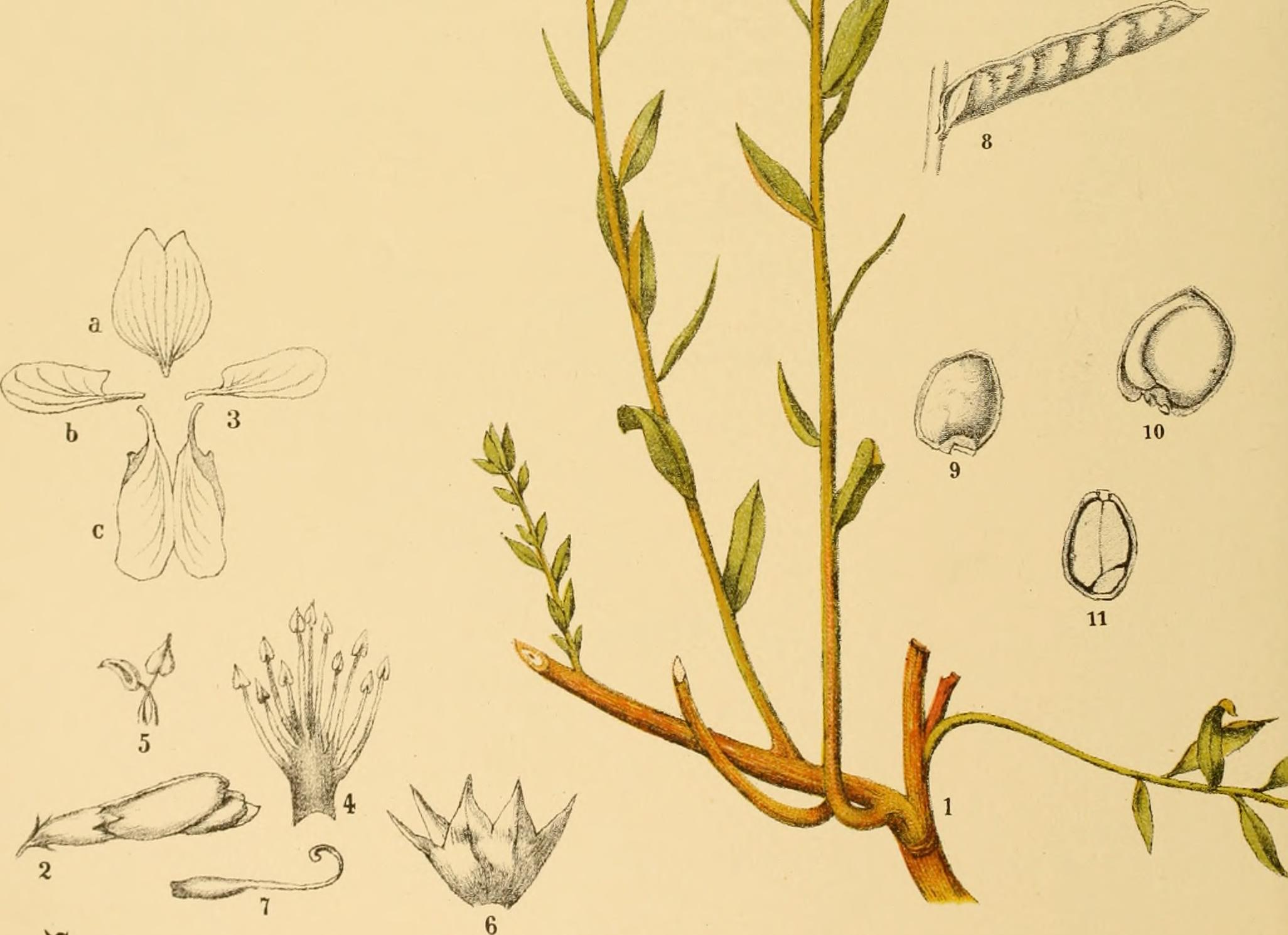
N. ORD -LEGUMINOS^. 46 Thbe.-GENISTE/E. GENUS.— GENISTA,* LINN. SEX. SYST.— MONADELPHIA DECANDRIA. GENISTA. DYER'S BROOM. SYN.— GENISTA TINCTORIA, LINN. COM. NAMES.— DYER'S BROOM, GREENWOOD, DYER'S GREEN-WEED, WOAD- OR WOOD-WAXEN, WHIN; (PR.) GENET DBS TEINTUIERS; (GER.) FARBEGINSTER. A TINCTURE OF THE WHOLE FRESH PLANT GENISTA TINCTORIA, LINN. Description. — This thornless, perennial, shrubby plant grows to a height of a foot or more. Stem erect; bi'anches numerous, terete-angled, the younger ones erect. Leaves alternate, simple, lanceolate, nearly smooth, and sessile, hifloresceiice a terminal spiked raceme; Jiowers yellow, nearly sessile, bracted. Calyx 2-lipped, the upper 2-parted, the lower 3-toothed; lobes 5, acute, pointed. Corolla perigynous, papilionaceous; petals 5, as follows: vexillum or standard straight, oblong-oval, spreading, superior to and partly enclosing the other petals; alee or wings 2, oblique, spatulate with a straight claw, and exterior to the two lower petals; carina or keel oblong, straight, deflexed, claws curved, composed of two connivant petals coherent by their anterior edges and enclosing the essential organs; eestivation imbricate. Stamens 10, monadelphous; filaments inserted with the petals upon the base of the calyx; sheath entire; anthers of two forms, the alternate ones shorter. Ovary i -celled. Pod flat, continuous, smooth. Seeds several; cotyledons large, sarcous; radicle incurved. Leguminosas. — This immense family of herbs, shrubs, and trees, growing in every part of the world, from the equator to the frigid zones, is represented in North America alone by 78 genera, having, in all, 791 species and 122 recognized varieties. The general features of this order are: Leaves alternate, usually compound, mostly entire; stiprdes present. Flowers papilionaceous or regular, hypogynous. Sepals 5, more or less combined, with the odd sepal inferior in its relation to the bract. Petals 5, the odd one superior, /. c., next the axis of inflorescence. Stamens 5, 10, or many; filaments monadelphous, diadelphous, or in rare instances distinct. Pistil single, simple, and free; oi>ary solitary and simple, free from the calyx. Fruit a legume; seeds various; albumen mostly wanting. To give the materia-medicist a better idea of phyto-grouping, I shall mention * Celtic sren, a small bush.
46-2 somewhat extensively the numerous medical and ceconomical products furnished by this magnificent family, though to specify all would fill a volume, extending as they do from some of our most esculent vegetables through almost all the necessities of man to many narcotico-acrid poisons. The species proven and established as curative agents in the Homoeopathic Materia Medica, are, beside the eight represented in this work: Copiava, the oleoresin of Copaifera multijtiga, Hayne, and many other South American species of the genus, prominent among which are: C. officinalis, Linn.; C. bijuga, Hayne; C. Laiigsdorfii, Desf; C. coriacea. Mart.; and C. Guianensis, Desf.; the Cochin-China Dcrris pinimta, Linn.; the irritating Cowitch gathered from the pods of DolicJios {Miiatna) piiriens, Linn., which grows in both the East and West Indies; the Central American Logwood, the heart of Hcsmatoxylon Campccliianum, Linn.; the Brazilian Barba de boi, called by Mure Hedysarum ildefonsianuin, but more probably, from his description, the H. lagocepJialum of Link.; Indigo or Indigotin, a blue coloring-matter extracted from different species of the genus Indigo/era, growing in India, Africa, and South America, principally, however, from Indigo/era tinctoria, Linn., /. a)iil, Linn., and /. argentea, Linn.; an inferior quality of this substance is also obtainable from Isalis tinctoria (Cruciferse); Polygonum tinctoriiim (Polygonaceae); Ncriwn tinctornvi (Apocynaceae); Baptisia tinctoria; Tephrosia apollinea; and several minor plants; Laburnum, a South European poisonous tree, Cyticus Laburnum, Linn.; Lathyrus, the European Chickling vetch, Lathyrus sativus, Linn.; Mim.; the Brazilian Mimosa humilis, Willd.; the powerful Calabar Bean, the state poison of Old Calabar, in Western Africa, P/iysostig7na venenosiun, Balf.; Jamaica Dogwood {Piscidia crythrina, Linn.), which produced in Mr. Hamilton such sudden and powerful sleep that the glass from which a drachm of the tincture had been taken remained for twelve hours in his hand;* the Alexandrian Senna, the well-known anthelmintic, consisting of the dried leaves of Cassia obovata, Coll., C. acutifolia, Del., and C lanceolata, Lam.; Tongo, the Tonka Bean, the odorous fruit of the Guianian Dipteryx [Coumarouna) odorata, Willd.; the Californian Astragalus Menziesii, Gray; the Guianian Erythrophlceum Guinense, G. Don; and the Brazilian Cabbage Tree Geoffroya {^Andira') vermifuga. Mart. In the pharmacopoeias of the United States, Great Britain, Germany, India, etc., and in general secondary lists we find more or less prominent the following members of this order: The European Broom {Cytisns, Genista, scoparius, Link), a renowned diuretic, emetic, and purgative, which has long enjoyed a popular reputation in dropsical affections, though contraindicated in all acute renal troubles; it contains a body of the tannic-acid group, termed scoparin (C,jH2.,0,q) to which its diuretic qualities are due, and an oily, narcotico-poisonous, volatile alkaloid, sparteine (Cj.HjgN), which resembles, chemically, nicotia and conia in having no oxygen. The Oriental Fenugreek {Trigonella Foenum-grcecum, Linn.), whose fatty seeds are largely used in veterinary practice, mostly as a vehicle for drugs. The common Liquorice, a product of several varieties of Glycyrrhiza glabra, Linn., growing along both shores of the Mediterranean and in Asia, can hardly be classed as a medicine, but rather as an adjunct to prescriptions. The Bengal Kino or Dhak, * Pharm. Jour., 1 845, p. 76.
46-3 the inspissated juice of the Indian Butea frondosa, Koenig, is considered to be a o-ood substitute for the officinal Kino; the seeds form a Mohammedan vermifuge of considerable repute. Kino, noted as an astringent application to indolent ulcers, and internally as a remedy in diarrhoea and pyrosis, is the inspissated juice of two species of the genus Ptcrocarpiis, as follows: Malabar Kino, from P. marstipinm, D.C., African Kino, from P. c7-inaccHS, Poir.; other kinos are used, produced by plants outside of this family. Balsam of Peru, a well-known astringent, used to check excessive discharges from mucous surfaces, as in leucorrhoea, gonorrhoea, and gleet, and internally in asthma and bronchitis as an expectorant, is the resinous exudation of the Central American Toluifera Pereira, Baill. Balsam of Tolu is the resinous exudation of the South American Toluifera balsaimnn, Linn.; it forms one of the most useful stimulant expectorants, and components of cough-candies, of the day; the tropical Bonduc Seeds, the fruit of Ccesalpinia Bonducclla, Roxb., are used in India as a tonic and antiperiodic in general debility and intermittent fevers. The Cassias used, other than those previously mentioned, are: the Asiatic Indian Laburnum {Cassia Fistula, Linn.), a noted purgative or mild laxative, according as the dose is large or small; the American Wild Senna {Cassia Marilandica, Linn.), a cathartic, whose action often causes severe griping; and Tinnivelly Senna {Cassia aiignstifolia, Vahl.), which is considered a safe and brisk purgative. The active principle of the sennas (cathartic acid) seems to be eliminated by digestion, and to pass into mother's milk in an active state, as babes are often purposely or accidentally purged by the nurse's use of senna leaves. The well-known laxative refrigerants, East and West Indian and Egyptian Tamarinds, are the fruits of Tamarindus Indica, Linn. Cutch or Catechu, a product of the Indian Acacia Catechu, Willd., is used, like " pale catechu," as an astringent, useful in chronic dysentery and diarrhoea, as well as in speaker's aphonia and passive hemorrhages. The root of the Mediterranean Authyilis Hcrmannicr, Linn., is a powerful diuretic; and A. vulneraria, Linn., is an excellent styptic. The seeds of the Indian Psoralia corylifolia, Linn., are considered stomachic and deobstruent. The root of the East and West Indian Clitoria ternatea, Linn., is emetic; while that of the Circassian Pueraria tubcrosa, D.C, is employed by the natives to reduce swellings of joints; and that of the New Zealand Tephrosia purpurea, Pers., is tonic and antidyspeptic. The bark of the Indian Agati grandiflora, Desv., is a powerfully bitter tonic. The leaves of the South European Bladder Senna {Colutca ar/wrcscens, Linn ), are purgative, and used as an adulteration of senna; while those of Coronilla Evierus, Linn., and C varia, Linn., have a similar property, the latter being considered also diuretic and even poisonous. The leaves of the European Arthrolobium scorpioidcs, D.C, are vesicant; and the roots of the Indian Ormocarpim sen7ioides, D.C, tonic' and stimulant. The leaves of the East Indian Phaseolus trilobus. Willd., are considered by Hindoo practitioners to be sedative, antibilious, and tonic. The Guadeloupe Dragon's Blood, an exudation of Pterocarpus Draco, Linn., was once used as a substitute for the true commercial article,* as an astringent in dysentery. Rumph states that the roots of the Molucca Ccesalpinia Nuga, Ait., are useful in * Resina Draconis, from Calamus Draco, Willd. (Palm^e); another subslitute for which was claimed in the exudation of the Canary Island Drcaana Draco, Linn. (Liliaceje).
46-4 calculous and kidney complaints. The root of the East Indian Flower Fence {Poinciana pidchen-ima, Linn.), is claimed by Schomburgh to be an acrid poison, and the leaves and flowers as having been used in decoction as a successful remedy against the fevers of Tortcola; while Macfadyen claims them to be a powerful emmenagogue, even to abortion. Jatahy, the resin of the Jamaica liymenaa Coiirbaril, Linn., is employed, according to Martius, as a remedy for obstinate coughs and incipient phthisis with hematic sputa; while Gum Animi, from the same species, is employed like a pastile for fumigation in asthma. Lignaloes, a fragrant product of disease in the Cochin-China Eaglewood, Ala'xylon Agallochum. Lour., is said by Loureiro to be an astringent useful in preventing vomiting and easing diarrhoea; its perfume is also claimed to be useful against paralysis and vertigo. Two astringents — the first acrid and the second diuretic — are found in the West Indian Mimosa fragifolia, Linn., and M. Unguis, Linn. The Javanese Eucliresta Horsfieldii is esteemed by the natives as an antidote to poisons of any description. The roots of the North American Turkey pea [Tephrosia Virginiana, Pers.) are purgative, and were greatly esteemed by the Aborigines as an anthelmintic; and the roots of the Chinese Robinia amara are powerfully bitter and astringent; while R. Jlava, of the same country, is used as a febrifuge. This glance at a few of the medicinal plants of the order shows a general stimulant, tonic, and astringent line of action to prevail. Many virulent poisons are found in this order, principal among which are: The seeds of the European Bitter Vetch [Vicia ervilia, Willd.) are said by M. Virey to be poisonous, and cause a weakness of the limbs when eaten mixed with ilour, in bread, and to cause horses to become almost paralytic; Christison claims that flour containing the ground seeds of LatJiyrus Cicera, Linn., is also poisonous. The roots of the East Indian Pliaseohis radiaius, Linn., are said by Royle to be a narcotic-poison. The powdered bark of Robinia macula/a is used in Cam peachy as a poison for rodents. The violet seeds of the European Anagyris fostida, Linn., are said to have poisonous properties similar to those of laburnum. The branchlets of the Jamaica Tephrosia toxicaria, Pers., are used by the natives to stupefy fish; this poison is said to act immediately, and to somewhat resemble digitalis in its effects. The blue flowers of the West Indian Sabinea florida, D.C., are considered poisonous — a property probably due to their indigo. Many valuable gums are produced either as natural exudations, as a result of insect depredations, or are intimately held in the wood-cells of many species. Principal among them are: the Gum Arabics, derived as follows: Kordofan or White Sennaar Gum, as well as Senegal Gum, are produced by Acacia Setiegal^ Willd.; Suakin or Talha Gum, by A. sienocarpa, Hoch., and A. Scyn/, var. Fistula; Morocco or Brown Barbary Gum, supposedly by A. Arabica, Willd.; Cape Gum, by A. horrida, Willd.; East India Gum, by A. Arabica and other species; Australian Gum, by various species, principally A. pycant/ia, Benth.; and Red Gum, by the Senegal A. Adaiisonii, Guill. Gum Sassa is a product of the Abyssinian Acacia Sassa, Willd. The Oriental Tragacanth, of varied utility, is produced by Astragalus giimmifcr, Labi. Among the many food-products, our attention is first called to the beans and pease— the first of which will be found described under Phaseolus vulgaris, page
46-5 51, et scq.; our common garden pea is derived from Pisum sativiiiii, Linn., whose native country is extremely doubtful. The Asiatic Lentil, the seed of Lens esculenta, Moen., is well known as a food; and it was for an indigestible mess of these that Esau is said to have sold his birthright to his brother Jacob. It is the opinion of many writers on Egyptology that the Camel'sThorn {Alhagi Mau7-onim,'\owrx\ ), which exudes a sweet substance that may be gathered by merely shaking the branches, was the manna that is said to have nourished the children of Israel while in the wilderness. The unripe seeds of the common European Lathyrus Ap/iaca, while still young and tender, are claimed to be a useful substitute for our garden pease; yet, according to Lindley, they are narcotic when ripe, and if eaten then produce excessive headache; Dutch Mice, the tuberous roots of the same species, are amylaceous, and eaten in Holland. The fruit of the Caspian I'icia Faba, Linn., is eaten young, as in the last-mentioned species, but the roots are a narcotic poison, johannisbrod, so greatly esteemed in Germany, is the pulp of the fruit of the Syrian Ceratoiiia Siiiqua, Linn.* The tropical oil, ground, or peanut, the fruit of Arachis hypogcea, Linn. — which so strangely ripens under the ground after flowering at some distance above it — furnishes an oil not inferior to that from the olive, which is used largely to adulterate table oils. The fruits are too well known as an article of commerce to need description. The " cake," formed after pressing out the oil from the nuts, is very digestible, and should be more extensively used as a flesh-forming food for cattle. Among the many food-products of the North American Indians derived from this order we find: the Prairie Potato or Bread-root {Psoralen esculenta), greatly esteemed by the Sioux, who use this root extensively under the name of tip-sinnnh. It is of a sweetish, turnip-like taste, is often cut in thin slices and dried for winter use, and when pulverized forms a light, starchy flour; it is very palatable, however prepared. Another so-called wild potato, or ground-nut of the Sioux — the true poinmede-tcrre of the French — is afforded by Apios tuberosa, and is largely used as an article of diet. Bur Clover [Medicago lupulina) produces an abundance of seed, much relished by the Indians. The Indian pop-pea, the fruit of several species of the genus Asiragabis, is highly valued, when boiled, by the Indians of the Western Territories. The Screw bean [Strombocarpus pnbescefts), although insipid until quite dry, is no sooner ripe than it becomes very sweet and palatable, and is considered a superb article of diet by the Indians along the Colorado River, who collect with assiduity all they can store for winter use. When ground it is made into sun-baked bread, like the next. The fruit of the Mesquite {Prosopsis jiili flora) is an important article of food for many Indian tribes; the pods, with their seeds, are pounded into a coarse meal, mixed into doughy cakes with water, and baked in the sun, after which they keep for long periods. This bread-cake is very sweet and nutritious.-jMany leguminose plants afford excellent dyes, principal among which are indigo and logwood, both of which have been mentioned; further than these we * Johanniskraut is Hypericum perforatum (Hypericaceoe), and Johanniswurzel, ////.v Mas (Filices). t J- A. Dodge, ill U. S. Agric. Rept., 1870, pp. 404-428.
46-6 have: The Indian Red Saunders in the wood of Pteroca7-piis santalinus, Linn., valued in India as a red dye for silks and odier fabrics; Brazil Wood {C(rsalpina cchinala, Lam.) affords a red dye; Braziletto Wood, from C. Braziliensis; Sappan Wood, from C. Sappan, and Camwood, from Baphia nitida, are all wellknown dyes. The fibres of die Spanish Broom {SpaiHium jimcejim), whose seeds are emetic and purgative, are used in.Southern Europe for cordage, and also for the manufacture of gunny-bags. The Prayer Bead, the seed of the Indian Liquorice {Abrus prccaioi'ius, Linn.) is a beautiful little scarlet oval with a black spot. These seeds are used by the Hindoos as a standard of weight called Rati, and are celebrated as havinor been used to determine the value of the great Koh-i-noor diamond; they are also used in the manufacture of rosaries. Valuable timbers, elegant perfumes, fine balsams, brilliant varnishes, and numerous articles of commerce, difficult to classify, are products of this most varied order. History and Habitat. — Genista is indigenous to Northern Asia and Europe, but has become thoroughly naturalized in eastern New York and lower New England, especially, however, in Essex County, Massachusetts, where it has become an actual pest on dry, sandy hillsides, which it renders positively yellow, in June and July, with its profusion of flowers. Though once vaunted in Russia as a prophylactic in hydrophobia, this plant has nearly dropped out of medical thought. Its leaves and seeds are mildly purgative, its seeds alone often emetic, and the whole plant sometimes diuretic. Ray says that after cows have browsed upon this plant their milk becomes bitter — a property communicated also to butter and cheese if made from such milk. As its common names denote. Genista is one of the many leguminose plants yielding dyes. The flowers, and indeed the whole plant, yield a clear, greenishyellow coloring-matter, that, in conjuncdon with Woad {Isatis tinctona — Cruciferae), gave fine results in the dyeing of wool green. PART USED AND PREPARATION.— The whole plant, while in flower, is chopped and pounded to a pulp and weighed. Then two parts by weight of alcohol are taken, the pulp thoroughly mixed with one-sixth part of it, and the rest ol the alcohol added. The whole is then placed in a bottle, tighdy corked, and allowed to stand eight days in a dark, cool place. The tincture, separated from this mass by filtration, has a deep reddishorange color by transmitted light; a strong herbaceous odor; an astringent taste; and an acid reaction. CHEMICAL CONSTITUENTS.— No analysis of this species has, so far, resulted in the isolation of its active principle, the general constituents of plants and a volatile oil only being separated. PHYSIOLOGICAL ACTION.— Our provings of Genista by Dr. E. B. Gushing are the only data obtainable, so far, for the determinadon of its action. These
46-7 experiments failed to prove the plant capable of acting as an emetic, purgative, or diuretic; still, they cannot be pronounced as conclusive. Description of Plate 46. 1. A branch, with two flowering branchlets, Salem, Mass., June 25th, 1885. 2. Flower. 3. Elements of the corolla — a, standard; d, wings; f, keel, laid open. 4. Stamens.* 5. Anthers. 6. Calyx, opened. 7. Pistil. 8. Fruit. 9. Seed. 10. Longitudinal section of seed. 11. Horizontal section of same. (2-7 and 9-1 1 enlarged.) * By some inexplicable error, this figure contains n stamen-;, instead of lo, as should be.
47. ^ Tn..a(lnat.i)el.et pinxt. TrIFOUUM PfiATENSE.Linn.
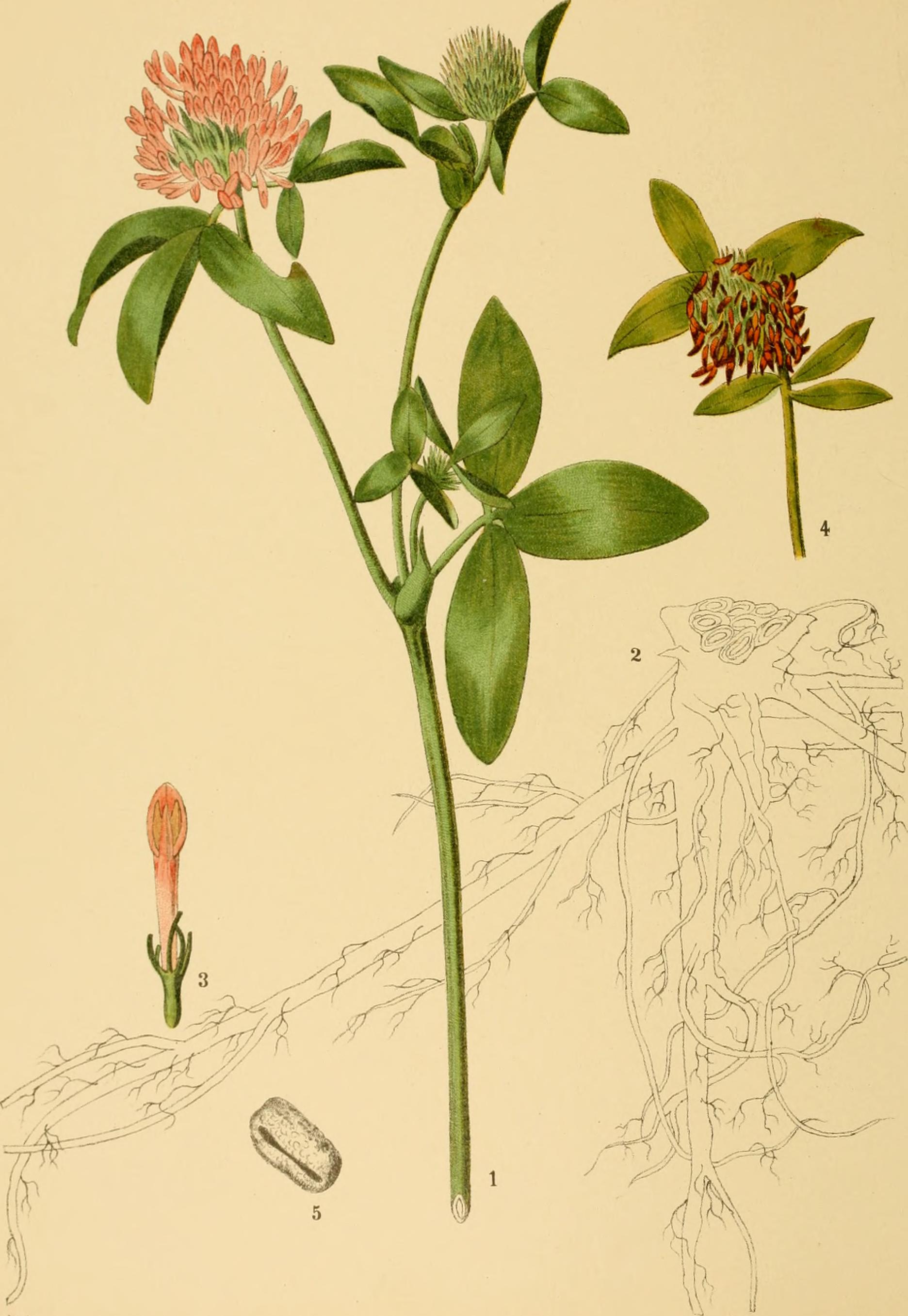
N. ORD.-LEGUMINOS^. 47 Tnbe.-TRIFOLIE/E. GENUS. -TRI FOLIUM,* LINN. SEX. SYST.— DIADELPHIA DECANDRIA. TRI FOLIUM. RED CLOVER. SYN.— TRIFOLIUM PRATENSE, LINN. COM. NAMES.— COMMON RED CLOVER; (FR.) TREFLE; (GER.) ACKBRKLEB. A TINCTURE OF THE FLOWER-HEADS OF TRIFOLIUM PRATENSE, L. Description.— This largely-cultivated biennial, or short-lived perennial plant, attains a height of from i to 3 feet. The root is large, diffusely branched, and gives rise to many stems. Stems ascending, stout and slightly hairy. Stipules broadly lanceolate, clasping at the base and surmounted by an awl-shaped tip; leaves three-foliate, on long petioles; leaflets oval or obovate, sometimes retuse or even emarginate, with a nearly entire edge, and marked with a whitish-green y^-shaped spot on the central portion of the upper surface. Infloi'esccnce a dense, ovoid head of bracted, sessile flowers. Calyx not distinctly hairy, but having a bearded zone in the throat; teeth setiform, the lowermost longer than the others, which are equal. Corolla extended-tubular, about twice the length of the calyx, withering soon after expansion; petals more or less coherent with one another. L'gmncs dry, scarious, containing each a single seed; seed somewhat kidneyshaped. TRIFOLIUM.— This genus comprises leguminose herbs growing in tufts or diffusely spreading, and characterized as follows: Leaves palmately or sometimes pinnately three-foliate, rarely more; leaflets usually minutely toothed, rarely entire; stipules scarious, coherent with the petioles. Liflorescetice dense heads or spikes, or sometimes, when the flowers are few, umbellike. Calyx persistent, tubular or somewhat bell-shaped, five-cleft or toothed; teeth awl shaped. Corolla five-cleft, withering or persistent, monopetalous at the base; vexillnm longer than the alse, and generally than the keel. Stamens rendered more or less diadelphous by the tenth filament, the tube usually free from the corolla; when united with it, it is through the mediumship of the claws of the ala; and keel. Ovary two- to sixseeded; style filiform. Fruit a small, scarious legume, containing from one to two or sometimes three to six seeds; dehiscence none, or, if present, it takes * Tres, three; folium, a leaf.
47-2 place at the suture and extends through the calyx. A description of the natural order may be found under Genista tinctoria, 46. History and Habitat. — Red clover has become extensively naturalized here since its introduction from Europe, escaping to unused fields, along roadsides, and even to open woods, beautifying all with its close, red, sweet-scented heads, which appear from May to August. As hay, clover is highly valuable, either alone or mixed with succulent grasses. Its nutritive ratio is lower by nearly onehalf than that of timothy {^Phleum pi-alcnsc), yet ruminants seem to eat of it more greedily and with a fuller sign of satisfaction. Porcher says that, in Ireland, when food is scarce, the powdered flowers are mixed with bread, and esteemed wholesome and nutritious. As a green manure for field fertilization, and an element of importance in rotation of crops it is also greatly prized, on account of its large percentage of potash, lime, and phosphoric acid. Its former use in medicine has been as a component of a salve, or extract, for all kinds of indolent sores and ulcers, to which it proves peculiarly soothing. A strong infusion is often used in half-ounce doses, to suspend the spasm of whooping-cough. Trifolium is not officinal either in the U. S. Ph. or Eclectic Materia Medica. PART USED AND PREPARATION.— The fresh blossoms are pounded to a pulp and weighed. Then two parts by weight of alcohol are taken, the pulp thoroughly mixed with one-sixth part of it and the rest of the alcohol added. After having stirred the whole well, allow it to stand at least eight days in a dark, cool place. The tincture thus formed, after decanting, straining and filtering, should have a light, clear, orange-brown color by transmitted light, a slightly astringent, haylike taste, and a decided acid reaction. CHEMICAL CONSTITUENTS. -The only assay of the flower-heads that I have been able to find is one by Grazel, reported in the Proceedings of the Cal. Phar. Soc., 1883, p. 49. He found, beside the usual constituents of vegetable matter, an acid, an extractive, tannin, and a resinoid principle soluble in ether, giving a a green color when dissolved in liquor ammonia, and a yellow color in liquor potassa. PHYSIOLOGICAL ACTION.-With the exception of the following effects, noted by Dr. i". C. Duncan, little or nothing is known of the action of this plant: Excessive dryness of the throat and fauces, causing a severe, hacking, irritative cough, a feeling of congestion of the lungs, dry, cosdve passages from the bowels, and a copious flow of pale yellow urine. Description of Plate 47. I. Upper part of stern, Bergen, N. J., June 13th, 1S79. 2. Outline of root. 3. Flower (enlarged). 4. Fruiting head. 5. Pollen, X 380.
48. (E.TH.aiinatdel.etpinxt. TRIFOLIUM REPENS.Linn.
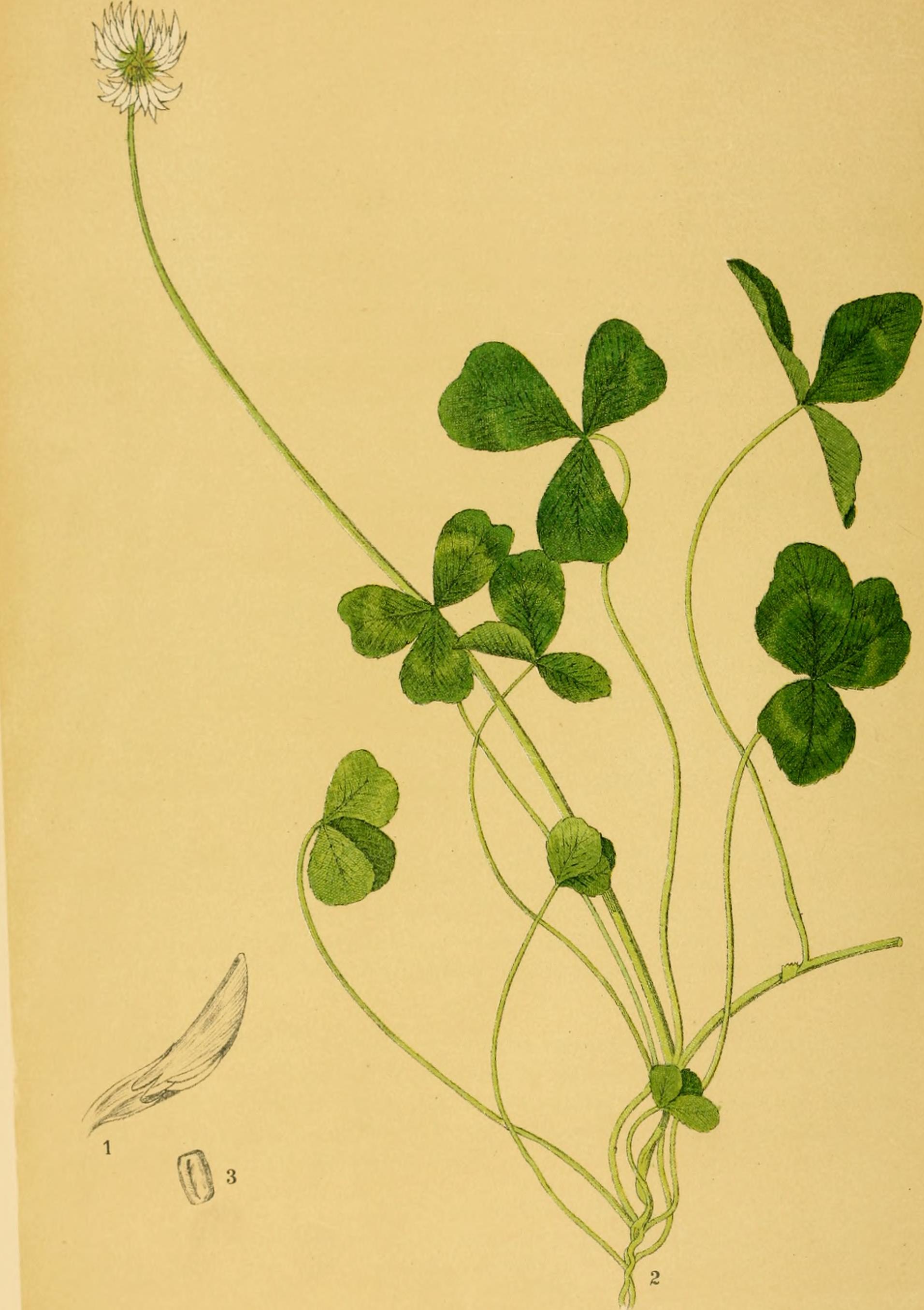
N. ORD.-LEGUMINOS^. 48 Tribe.-TRIFOLIE/E. GENUS.— TRIPOLI UM, LINN. SEX. SVST.— DIADELPHIA DECANDRIA. TRIFOLIUM REPENS. IVfflTE CLOVER. SYN.— TRIFOLIUM REPENS, LINN. COM. NAMES.-WHITE CLOVER; (PR.) TREFLB BLANC; (GBR.) WIESEN KLEE. A TINCTURE OF THE FRESH BLOSSOMS OF TRIFOLIUM REPENS, LINN. Description.— This prostrate perennial herb has no positive size, the sieni is slender, spreading and creeping, pale and glabrous throughout. Petioles very long and slender; leaflets obovate, obovate-emarginate or obcordate, the edges very minutely toothed, the caret-shaped grayish spot upon the upper surface pale and indistinct; stipules nearly linear-lanceolate, scarious and pointed. Peduncles glabrous, longer than the petioles, hiflorescence axillary, consisting of small, open, more or less flattened globose heads. Calyx much shorter than the corolla; teeth shorter than the tube, awl-shaped and of unequal sizes. Corolla white, larger in proportion to the size of the head than the preceding. Fi'uit a 4-seeded legume. (Read also the generic description under T. pratense, 47.) History and Habitat.— This species is doubtless indigenous, at least to the northern portion of America, from which it has spread southward and westward, over fields, roadsides and open woods, blossoming earlier than the preceding, and changing from a creamy-white to a dull-rose and finally a rusty-brown color. As hay the white clover is far inferior to the red, especially in the warmer climates where the cattle refuse to eat of it altogether, probably on account of its action upon the salivary glands. This species is not mentioned in the U. S. Ph., nor is it spoken of in the Eclectic Materia Medica. PART USED AND PREPARATION.— The fresh flower-heads prepared as in T. pratense, afford a tincture of a clear chestnut-brown color by transmitted light, of less astringency, greater acidity, and a more penetrating taste. CHEMICAL CONSTITUENTS —Although without doubt this species will prove of greater use in medicine than the preceding, I can find no data upon its specific chemistry.
48-2 PHYSIOLOGICAL ACTION.— Dr. T. C. Duncan notes the following symptoms in seven persons who partook of the pounded fresh flower-heads: A sensation of fulness and congestion of the salivary glands, with pain, which in one individual amounted to mump-like pains in the parotids; this was quickly followed in all by a copious flow of saliva. A similar effect has been noted in the south upon all stock that ate of the plant. A further and critical examination into the chemistry and action of this species is greatly to be desired. Description of Plate 48. I. Flower (enlarged). 2. Whole plant fiom a stony pasture, Ithaca, N. Y., June 3d, 18S0. 3. Pollen X 380.
49. (ElU.adnat.iiel.et pinxt. Melilotus Officinalis, wiiid.
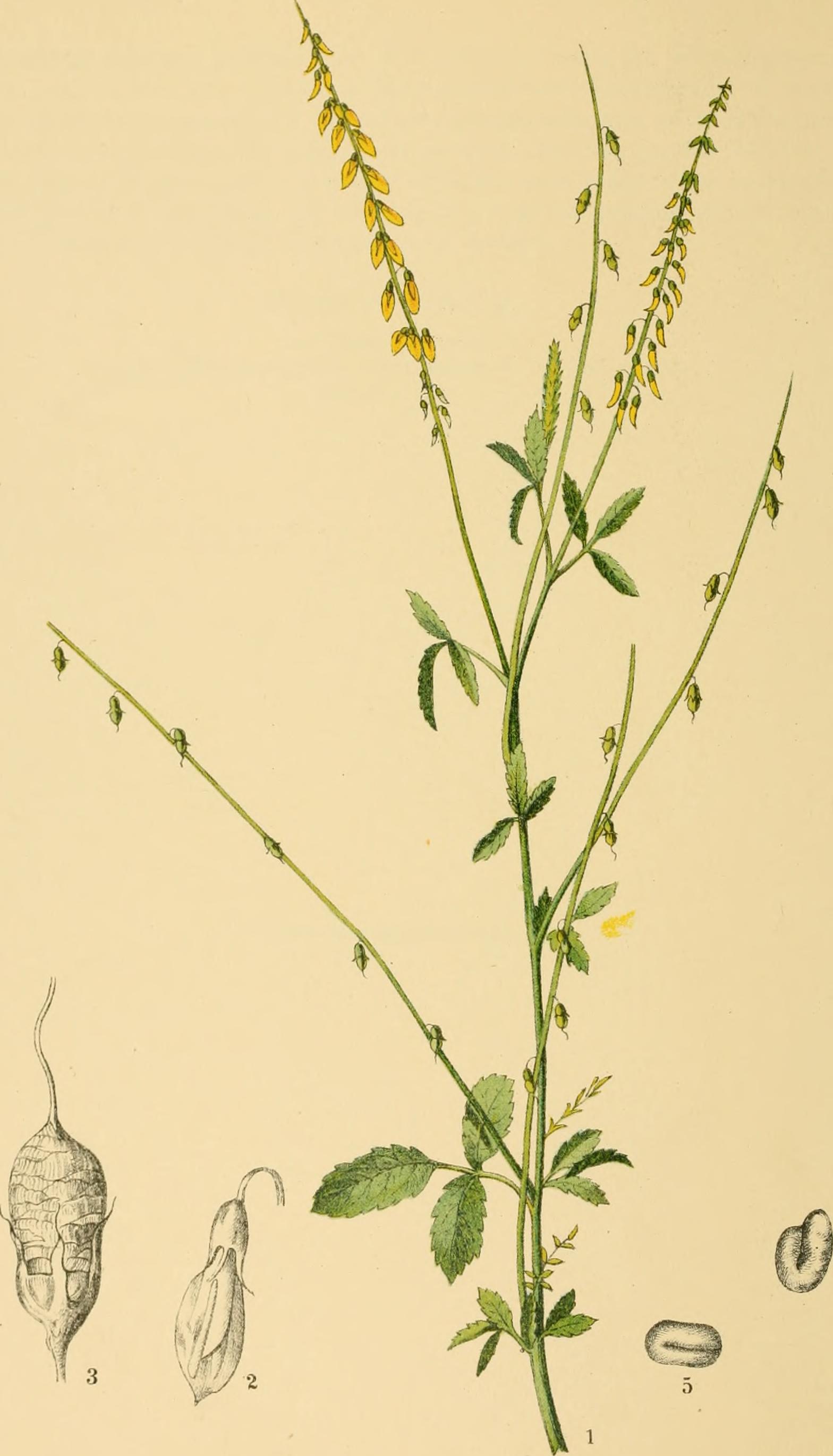
I N. ORD-LEGUMINOSyE. 49 Tribe.-TRIFOUE/E. GENUS.— M ELI LOTUS,* TOURN. SEX. SYST.— DI.\DEI.PHIA DECANDRIA. MELILOTUS. SWEET CLOVER. MELILOTUS OFFICINALIS, WILLD. SYN.— MELILOTUS VULGARIS, EATON, TRIFOLIUM OFFICINALE, LINN. COM. NAMES.— SWEET CLOVER, YELLOW MELILOT,. YELLOW SWEET CLOVER, MELILOT; (,FR.) MELILOT; (GBR.) STEINKLEE, MELILOTENKLEE. MELILOTUS ALBA, LAM. SYN.— MELILOTUS LEUCANTHA, KOCH, MELILOTUS OFFICINALIS, PURSH, MELILOTUS OFFICINALIS, VAR. ALBA., NUTT. COM. NAMES.— SWEET CLOVER,, WHITE MELILOT, MELILOT. A TINCTURE OF THE FRESH FLOWERS OF M. OFFICINALIS AND M. ALBA.f Description.— Melilotus officinalis.— This sweet-scented European plant has now become quite thoroughly naturalized here, growing either as an annual or perennial herb. Stem with its spreading branches 2 to 4 feet high. Leaves alternate, pinnately 3-divided. Leaflets obovate-oblong,, obtuse, sharply and widely serrate, from one-half to i inch long. Racemes axillary, spiked, from 2 to 3 inches long while flowering. Flcnvers small, yellow, about one-quarter of an inch long when iully expanded. Calyx persistent, with 5 unequal pointed teeth. Corolla more than twice the length of the calyx, deciduous, Petals: vexillum ovate, acute, slightly longer than the wings; alee induplicate; carina completely united, cohering to, and looking backward between, the alae, entirely free from the stamen tube. Stamens 10, diadelphous, inserted with the corolla; anthers uniform; pollen grains more or less abruptly cylindrical, resembling Trifolium, but much smaller and more uniform. Ovary free, i -celled, containing i or 2 amphitropous ovules; style filiform, terminal. Pod (legume) about one-sixth of an inch in length, pyriform in the cup of the withered calyx, inflated or gibbous, coriaceous, transversely wrinkled, scarcely dehiscent and tipped with the persistent style. * jii\,/ioney, XwriSs, a le^uminose plant, so called. f The "Amer. Horn. Phar." orders separate tinctures to be made. The provings were made of a tincture of both M. oiBcinalis and M. alba combined. The German Pharmacopoeia recognizes only M. officinalis (Yellow Melilot).
49-2 Melilotus alba.— This biennial species Is taller and more widely branched than the preceding, the flowers are smaller, white, and more densely crowded, the vexlllum is comparatively longer and the leaflets nnicronate-truncate. For a full description of the Leguminosse, vide Genista tinctoria, 46. History and Habitat.— Melilot, especially the white species, Is found In many places In the Eastern States and New York, flowering from June to August, and growing In stony, waste places, generally along river-banks, though sometimes in cultivated ground, where It has become naturalized from Europe. Its sweet-scented flowers have be(m variously used as flavoring for many products, notably Gruyere cheese, snuff and smoking tobacco, in Europe it has been often used In the food of catde to whet their appetites; it is also claimed that when packed with furs and clothing it protects the articles from moths, besides giving them a pleasant odor before wearing. The odor of Melilot is due to an aromatic compound cumaric anhydride, which when first observed was supposed to be benzoic acid; its Identity was proven some years after by Guillemette; it also occurs in faham-leaves, sweet bed-straw {Gallitnn irijiornin), tonka-beans {Dipterix odorata), sweet woodruff [Aspcrula odoi-ala), and sweet-scented vernal grass {^Anihoxanthinn odorahim). The flowers of the Melllots have been extensively used by the laity, boiled with lard, as a salve for ulcers, open indolent sores and broken breasts with much success. Melilotus Is nefther officinal In the U. S. Ph., nor the Eclectic Materia Medica. PART USED AND PREPARATION.-The fresh flowers are pounded to a pulp and weighed. Then two parts by weight of alcohol are taken, the pulp mixed thoroughly with one-sixth part of it and the rest of the alcohol added. After having stirred the whole well and poured it Into a well-stoppered bottle, it is allowed to stand eight days In a dark, cool place. The tincture separated by decanting, straining, and filtering, is by transmitted light of a clear reddish brown color, It has a vanilla-like odor, a bitterish taste very similar to that imparted to the palate by chewing tea leaves, and a decided acid reaction. CHEMICAL CONSTITUENTS.-Cumarin, or Cumaric Anhydride, C„ H^ O,, Is found combined with either of the acids; It Is sparingly soluble in cold water, more freely in alcohol and boiling water, and crystallizes in large transparent, fragrant prisms, melting at 67° (152.6° F.) and boiling at 291° (556.0° F.). Melilotic Acid, or Hydrocumaric Acid.— C, H^^ O^, crystallizes from water in large, pointed prisms, melting at 82° (179.6° F.). On fusing with potash it yields acetic and salicylic acids. Hydrocumaric Acid. Potash. Acelic Acid. Salicylic Arid. Pot.ash C.H^O^ -f 5HKO = CH^O, + CH,,,03 -f HKO^^. Cumaric Acid.— C,, H^ O,, occurs together with the preceding; it cr\stalllzes from water in long needles, melting at 195° (383.0° F.). (Schorlemmer.)
I 49-3 PHYSIOLOGICAL ACTION.-What slight action Melilotus has upon the system is without doubt due to tlie principle cumarin, which in quite large doses causes nausea, vomiting, vertigo, and great depression, with sleepiness, confusion, severe pain in the head, depression of the heart's action and cold extremities. Description of Plate 45. I. A branch from Binghamton, N. Y., July 25, 1882. 2. Flower (enlarged). 3. Pod (enlarged). 4. Seed (enlarged). 5. Pollen X 3S0.
50. ^ ' ' 7 ^.TU.ad natdeUtpinxt ROBINIA PSEUDACACIA, Linn.
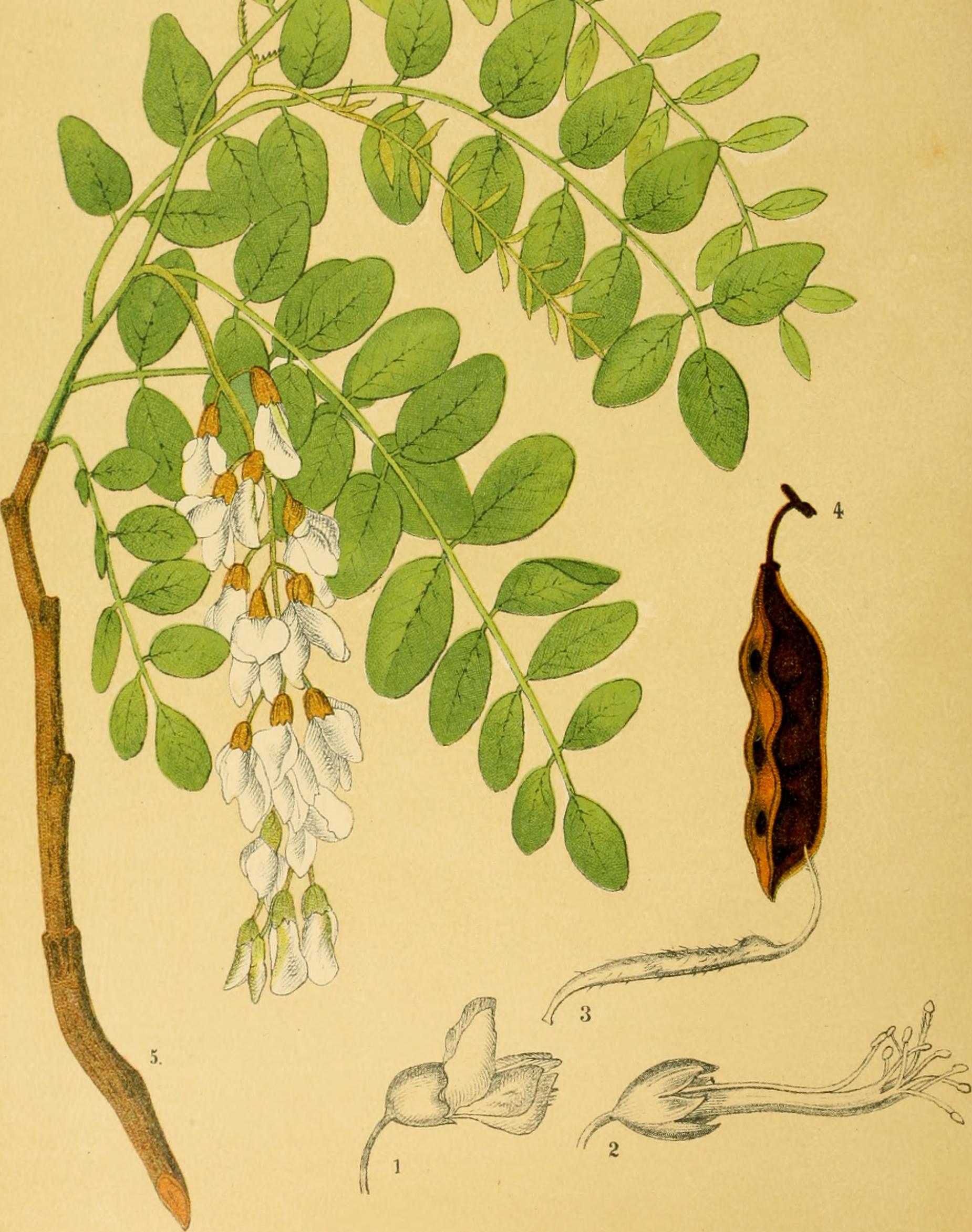
N. ORD.-LEGUMINOSyE. 50 Tribe.-GALEGE/E. GENUS. — ROBINIA,* LINN. SEX, S^ST,— UIADELFIIIA DECANDKIA. ROBIN I A. FALSE ACACIA. SYN.— ROBINIA PSEUD - ACACIA, LINN.; PSEUD ACACIA ODORATA, MOBNCH. COM. NAMBS.-COMMON LOCUST, YELLOW LOCU*ST, TREENAIL, BLACK LOCUST; (PR.) ROBINIER; (GER.) PALSCHB ACACIEN. A 'I'lNCTURE OF THE FRESH BARK OF YOUNG TWIGS, ROBINI.\ PSEUD-ACACIA. Description.— This commonly cultivated, ornamental tree, grows to a height of from 50 to 80 feet, attaining its greatest height only in the southern parts of the United States. The sieiii is erect, straight, deliquescent, from i to 4 feet in diameter and covered with a dark, rough bark; ivood yellow, much valued for its lightness, hardness and durability. Branches naked, spinous when young, the spines taking the place of stipules. Leaves odd-pinnate, the base of the stalks forming sheaths about the developing buds of the next season; leaflets in from cS to 12 pairs of ovate or oblong, stipellate, nearly sessile, smooth blades. Inflorescence axillary; ot showy, drooping, slender, loose racemes; of white or creamy, fragrant flowers. Calyx short, more or less campanulate, five-toothed or cut and slightly two-lipped by the coherence of the two upper teeth. Corolla paplllionaceous; standard large, rounded and reflexed, slightly longer than the zvings, and obtuse keel. Stamens diadelphous, nine-and-one. Style bearded along the inner side. Fniit a nearly sessile, smooth, linear, fiat pod, from 2 to 3 inches long, onecelled and four- to eight-seeded, at lenoth with two thin valves. Seeds small, dark brown, somewhat renniform, but the hilum is small and so near one end that their form is more like the body of a retort; testa smooth; radicle incurved; cotyledons leafy. P'or description of the N. Ord. Leguminosae, vide Genista tinctoria, 46. History and Habitat. — This tree is indigenous to the central and southern belts of the United States, and so fully cultivated in the northern parts, that it now grows there spontaneously, blossoming in May and June. The inner bark of the roots, stem, and inner coating of the pods is sweet and mucilaginous. The seeds, upon pressure, yield a large quantity of oil. They are quite acrid, but lose this quality upon boiling; they then furnish a pleasant, nutritious article of food, much esteemed by the aborigines. The yellow locust should take first rank among ornamental trees to be planted by settlers in the West, not only on * John Robin, herbalist to Henry IV.
c s 50-2 account of its beautiful foliage and fragrant flowers (points of great use for shade and honey), but also for its invaluable wood. Locust is well known for its great duralMlity, even when thoroughly exposed, and is thus exceedingly valuable for fence-posts, railroad ties and supports for structures generally. Robinia is not mendoned in the V. S. Ph. It has a place, but is not officinal, in the Kclectic Materia Medica. PART USED AND PREPARATION.— The fresh bark of the young twigs is hopped and pounded to a pulp and weighed. Then two parts by weight of alcohol are taken, the pulp mixed thoroughly with one-sixth part of it and the rest of the alcohol added. After having stirred the whole well it is poured into a welltoppered botde and allowed to stand eight days in a dark, cool place. The dncture is then separated by straining and filtering. Thus prepared, it has a beautiful, clear, reddish-orange color by transmitted light, a dry, sweedsh taste peculiar to the inner bark, and a decided acid reacdon. CHEMICAL CONSTITUENTS.— Robinin, C,-,H.,„0,,+Aq. This aromatic glucoside bears ^reat resemblance to quercetin, yielding as products of decomposition this body, and peculiar sugars. (Schorlemmer.) Robinin is found principally in the flowers; it forms fine, satiny, yellow needles, neutral and tasteless, losing water at ioo° (212° F.), and fusing at 195° (383° F.). It is soluble in both water and alcohol. Robinic acid. This body was discovered in the roots by Reinsch, but afterwards doubted. Prof. Hlasiwetz [Chem. Gas., Aug. 15, 1855), i" his examination of the root, decided that the above body was Asparagine; he obtained some two and a half ounces of this substance from thirty pounds of the root. The body answers to the following properties: Large, hard, refractive, octohedral crystals, colorless and constant upon recrystallization, and having a mawkish taste; they fuse when heated, giving off an ammoniacal odor. Tannin, and the usual plant constituents, have also been determined. PHYSIOLOGICAL ACTION.— Robinia causes extreme nausea, profuse acid vomidno-s, fluid eructadons and purging. These symptoms followed eadng of the bark.?Dr. A. R. Ball.) Dr..Shaw {Med. Times and Gazette, vol. i., p. 570) gives the following effects noticed in a child who had eaten of the seeds: Inability to hold the head upright, nausea and attempts to vomit, with a tendency to syncope, when in an upright position; voice, respiration and heart's action feeble, as from exhaustion; a painful, paralydc condition of the extremities, which became shrunken on the fifth day. All the symptoms seemed like those produced by a long-continued diarrhuea, though in this case purging was not present. Descrii'tion of Plaie 50. 1. Flower (somewhat enlarged). 2..Stamens. },. Pistil. 4. Fruit. 5. Knd of young branch in flower, Ithaca, N. Y., May 24th, tS8o.
N. ORD -LEGUMINOS^. 5^ Tribe.-PHASEOLE/E. GENUS.— PH AS EOLUS,* LINN. SEX. SYST.— DIADELPHIA DECANDRIA. PHASEOLUS COMMOJ^ BEAJ^. SYN.— PHASEOLUS VULGARIS, LINN. COM. NAMES.-KIDNBY BEAN, WHITE BEAN, POLE BEAN, STRING BEAN; (FR.) HARICOT; (GBR.) SCHMINKBOHNE. A TINCTURE OF THE DRIED SEEDS OF PHASEOLUS VULGARIS, LINN. Description. — This common cultivated annual herb grows to various heights, according to its form and the method of cultivation. Stejtt twining and twisted, or short and erect in the bushy forms. Leaves pinnately trifoliate; leaflets large, ovate, pointed, entire. Inflorescence in solitary axillary racemes, the peduncle stout and shorter than the leaves. Calyx campanulate; teeth 5, unequal, the three lower ones larger, cuneate, acute, the two upper merely apparent. Corolla papilionaceous; keel circinate and somewhat spirally twisted; vexilhim entire or nearly so, notched at the apex; ales pear-shaped, each furnished with a long claw and short incurved appendage. Stamens diadelphous; filaments circinate, dilated at the base. Ovary stipitate, hairy; style long, circinate, with a hairy margin; stigma pointed, hairy. Fruit a continuous, pendent, compressed, loculicidal, more or less falcate pod, polyspermous, and with cellular partitions between the seeds; seeds more or less reniform, cylindrical, or compressed; Iiilum small, oval-oblong, naked; cotyledons thick; radicle incurved. History and Habitat. — The Common Bean, so extensively cultivated as an esculent, was formerly supposed to have been introduced here from India, but Prof Gray claims it a native plant, as the fruit and seeds were found in the tombs of ancient Peruvians at Anqon, along with other purely native vegetables; it is, however, probable that the plant is not indigenous north of Mexico. The Bean has been cultivated by the natives from remote aboriginal times, many varieties having become valuable to them then (as they are to us now) as a potage, both while green, legume and all, and the seeds alone when ripe and dried. No previous medical use is discoverable. * From the Latin p/iaseuis, a little boat, tlie pod beinj; somewhat scaphoid.
51-2 PART USED AND PREPARATION. — The ripe dried seeds are pounded to a pulp and macerated for eight days in twice their weight of strong alcohol, being shaken twice a day, and kept in closely-stoppered bottles in a dark, cool place. The tincture, separated from this mass by filtration, has a disgusting fecal odor, a clear but slightly yellowish color, and a neutral reaction. CHEMICAL CONSTITUENTS.— Le£umin, or Vegetable Casein. This albuminoid, or proteid body, containing both N and S, is found in many seeds of the Leguminosae, from which it may be separated by triturating them, after soakina in warm water and pressing the pulp through a sieve. The liquid deposits starch on standing, and the casein-like body may be precipitated from the liquor by acetic acid. Phaseolin. — This peculiar amorphous body is obtained by extracting the seeds with alcohol, and treating the extract with ether to remove the sugar. Phaseolin produces a volatile oil, of very disgusting fecal odor, by decomposition. Inosite/^ or animal galactose, existing in the muscles of the heart and lungs, as well as in the parenchyma of the liver and kidneys, is also found in the seeds of this and other Leguminosae. The following analyses of Beans by Einhoff and Braconnot;}: show the general constituents: Einhof. Braconnot. Skins, 288 7. Starchy fibrous matter, 425 Starch 1380 42.34 Animo-veg. matter and starch, y^p e,6 Extractive, j,i Albumen and animo-veg. matter, 52 Mucilage, ^44 Loss and water, 21 2-1 Legumin, 18,q Pectic acid, legumin and starch, i.cq Fatty matter, -q Pulp skeleton, _q Uncrystallizable sugar, _20 Earthy salts, j qq 3840 100.00 PHYSIOLOGICAL ACTION.— The only accounts of the ill effects produced by eating raw beans are those of Dr. Demeures§ and William Dale, Esq.;|| the latter I exclude here, as the beans were mildewed, and the severity of the symptoms, together with their character, appear to me to be due to the fungus. The symptoms produced in the first case were: Severe frontal headache accompanied by pain, soreness, and itching of the eyeball; eyeball painful to touch; pain in the epigastrium when touched, and hernia-like pain at right inguinal ring. Beans, * See p. 95-3. J y^„^ ^^ i^ ^^^-^f. g^ii^ J gg^ _ ^ JJ2 t Gehien's Jour., vi, 545. || £^1. Med. Jour., 1864, 471. X Ann. de Chiin. ct Phys., xxxiv, S5.
51-3 when cooked, produce a well-known flatulency, which symptom I have also noted from a dose of about five drops of the tincture. The seeds certainly deserve a thorough proving, especially so if the symptoms recorded by Dale could be verified. Description of Plate 51. 1. Summit of plant, Binghamton, N. Y., July 27th, 18S6. 2. Flower. 3. Calyx and standard. 4. Ala. 5. Keel and calyx. 6. Stamen. 7. Pistil. 8. Stigma. (3-8 enlarged.)
52. (jjlll.adnat.del.etpinxl. Baptisia Tinct6ria,r.Bp.
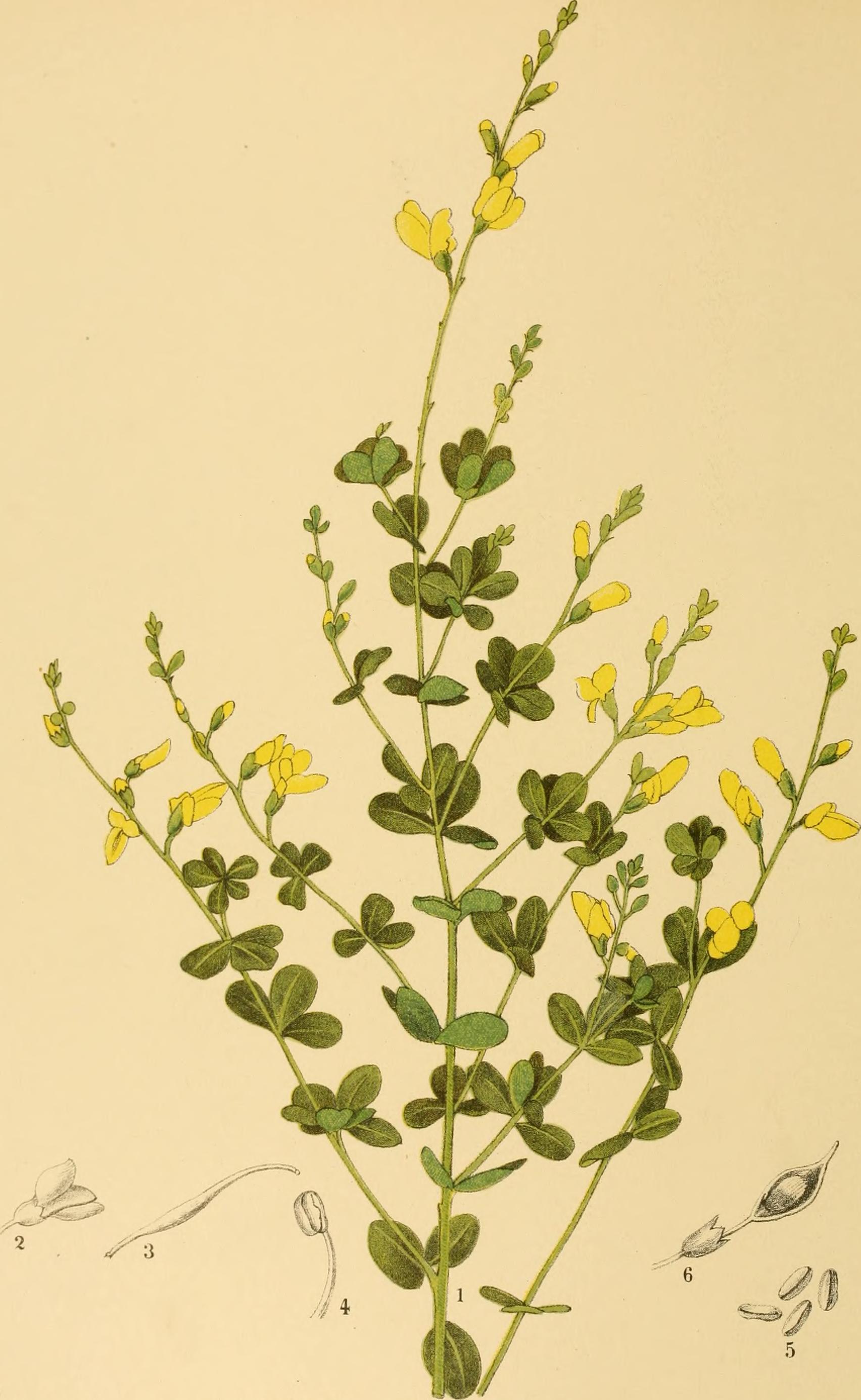
N. ORD -LEGUMINOS^. 52 Thbe.-SOFHORE/E ET PODALYRIE/E. GENUS.— BAPTISIA,* VENT. SEX. SYST.— DECANDRIA MONOGYNIA. BAPTISIA. WILD IJfBIGO. SYN.-BAPTISIA TINCTORIA, R. BR.; SOPHORA TINCTORIA, LINN.; PODALYRIA TINCTORIA, MICHX. COM. NAMES.— WILD INDIGO, FALSE INDIGO, INDIGO WEED, YELLOW WILD INDIGO, DYER'S BAPTISIA, HORSEFLY WEED, RATTLE BUSH. YELLOW BROOM, CLOVER BROOM; (FR.) INDIGO SAUVAGE, INDIGO TREFLE; (GER.) BAPTISIB. A TINCTURE OF THE FRESH ROOT OF BAPTISIA TINCTORIA, R.BR. Description. — This slender, glaucous, perennial, bushy-branching herb, grows to a height of from 2 to 3 feet. Root large, irregular, ligneous, light yellowishbrown internally, blackish externally; rootlets numerous and lighter in color. Leaves palmately 3-foliate, sessile or nearly so, becoming like all other portions of the plant — even the yellow flowers — black, when dry; leaflets 3^ to ^ inch long, rounded or cuneate-obovate, dark bluish-green with a light green stripe on the midrib; stipules and bracts minute, caducous. Infloi'cscoice short, loose, fewflowered racemes, terminal upon the branches; flowers canary-yellow, about as long as the leaflets. Calyx cup-shaped; limb 4-toothed, the upper tooth double, therefore broader than the rest. Corolla: standard about the length of the wings, or slightly shorter, emarginate, and reflexed laterally; keel somewhat incurved, the two petals composing it nearly separate, straight; wings oblong, straight. Stamens 10, distinct; anthers alike and uniform. Ovary stipitate; style curved, dilated below; stigma minute. Fruit ^.n oval, centrally inflated, mucronate legume, stalked in the persistent cup of the calyx; stipe nearly twice the length of the calyx-cup. Seeds many, ovoid, cinnamon-brown; hihim small, rounded; embryo straight or incurved. Read description of Leguminosse under Genista tinctoria, 46. History and Habitat. — Wild Indigo is indigenous to the Canadas and the United States. It grows as far south as Florida and west to the Mississippi, plentifully however only near the coast, where it delights in the dry, sandy soils. * iSairr/fo), Baptize, I dye. Some species yielding an inferior indigo dye.
52-2 As regards New York State: I have noted in traveling upon the N. Y. & Erie R. R.. that it ceased entirely at Narrowsburg, 122 miles from New York City.* I have not met with the plant in Chenango, Broome, Tioga nor Tompkins Counties, and Dr. Lucy fails to find it in Chemung; this is probably due to the rich loam of these localities. Dr. Barton says.-f "It promiscuously inhabits a variety of situations, though almost always in a dry soil, in every State of the Union." It flowers in the Northern States from June to August. The young shoots of this plant resemble, in form and general appearance, those of asparagus, and are used, especially in New England, in lieu of that herb for a pottage. As a d)e, it is no longer used, being far inferior to Indigofera and its employment unnecessary. The most important previous use of the plant as a drug, was as an "antiseptic " dressing for gangrenous wounds, especially in such cases as were accompanied by a low form of fever; and in decoction in putrid fevers generally. Dr. Thatcher says: J "its employment has been extended in a few instances to Typhus or putrid fever, with such good effect as to encourage further trials. In the form of fomentation or cataplasm it has proved eminently beneficial when applied to phagedenic and gangrenous ulcers; especially if the decoction be administered internally at the same time " (italics ours). Dr. Comstock says:§ " I would observe that it is used in cases of mortification, in fevers supposed to be putrid, and inclining to putrescency, and in general where antiseptics are indicated." Our provings thoroughly corroborate, and our practice substantiates the above use of the drug. Any physician, of whatever school of practice, who fails to use this remedy in Typhoid alone where it is so often indicated, allows many an opportunity to save a life to escape him. The National Dispensatory|| contains under this drug the following, written, we feel compelled to say, in willful ignorance: "Nothing has recently been added to the knowledge possessed many years ago respecting this medicinal plant." The U. S. Pharmacopoeia gives no officinal preparation; this in the full light of our excellent success with the drug, and our vasdy lower percentage of death in Typhoid. The preparations of the Eclectic Materia Medica are: Extraclimi Baptisice Alcoholicum; Unguentum Baptisice, and Pilules Baptisice Compositce^ PART USED AND PREPARATION.— The fresh root with its bark is chopped and pounded to a pulp and weighed. Then two parts by weight of alcohol are taken, the pulp mixed thoroughly with one-sixth part of it and the rest of the alcohol added. After stirring the whole well, it is poured into a well-stoppered bottle and allowed to stand eight days in a dark, cool place. The tincture separated from this mass by filtration is opaque, in thin layers it presents a deep brownish-red color by transmitted light; it has no distinguishing * Author in Bull. Torrey Club, vol. xi, 1884, p. 133. t Veg. Mat. Med., vol. ii, p. 56. X Thatcher's Dispensatory, p. 361, (juoted in Barton's Veg. Mat. MeJ., pp. 58-59, vol. ii. \ "Letter to Mr. Weems," in />;■. Mat. Mel. Barton, vol. ii, p. 58. II 1879, P- 267. \ Leptandria, Potlophyllin, Sanguinaria and Baptisia.
52-3 odor, a peculiar bitter and astringent taste, imparts to the tongue on first application a cold sensation quite similar to that of sulphate of soda (Glauber's Salt), and has an acid reaction. CHEMICAL CONSTITUENTS.— An analysis of the root was made by Dr. Greene,* U. S. N., for the express purpose of obtaining the alkaloid, the previous analyses by Smedley.f and Warner,J resulting in alkaloidal salts only. Dr. Greene succeeded in obtaining pale yellow crystals of various forms, some being perfect octahedra. This purified alkaloid was found to be soluble in water, alcohol, and ether, other physical and chemical properties are as yet unknown. A whitish yellow resin was also determined in his analysis, whether or not it is the same as one isolated by Smedley is not stated. PHYSIOLOGICAL ACTION.— The symptoms of disturbance in the system following the ingestion of doses varying from i to 200 drops of the tincture of the root, 30 grs. of the powder, and 4 to 14 grs. of " Baptisin" in different individuals are marked, and correspond to those of Typhoid or disintegrating forms of fever. They are substantially as follows:§ mentally gloomy, low-spirited, indisposed to think followed by inability, dullness, and stupidity. Vertigo. Dull, heavy headache with weakness and weariness of body, and tendency to delirium. Soreness and lameness of the eyeballs, with hot. Hushed face. Tongue coated white, yellow or yellowish-brown. Loss of appetite, nausea, and burning in the stomach. Dull pains in the region of the liver, especially at the site of the gall-bladder. Face sallow, with burning cheeks. Constant pain and aching in the abdomen, followed by marked distention, and soreness on pressure. Soft, dark, mucous stools, followed by constipation. Urine dark red. Difficult breathing with oppression of the chest. Pulse at first accelerated and full, then low and faint. Aching, stiffness, and soreness of back and extremities. Chills general, followed by fever, restlessness, weakness and great prostration. No sweat. Dr. Hughes says:|| " Baptisia is capable of exciting true primary /j7r.t7a in the human subject. This is no slight thing, for there are very (ew other drugs to which we can ascribe such power. And this pyrexia is exceedingly like that of the early stages of Typhoid. We have no evidence that Baptisia affects Peyer's patches as they are affected in Typhoid, nor even that it acts upon them at all as Arsenic and Iodine, and perhaps Mercury and Turpentine do. But it is certain that it produces congestion and catarrh of the intestinal mucous membrane with abdominal tenderness, distention, and diarrhoea." Still, as the specific condition of inflammation of the patches of Peyer does not appear until the second or perhaps third stage, our remedy properly used has done its work ere this and is not then required, nor will any other be, such condition not following, having been thwarted. * ^»i. your. Phnr., 1879, p. 577. t Idem, 1862, p. 310. X Idem, 1871, p. 251. I Allen, Eftcy. Pure Mai. Med., vol. ii, pp. 31-39II Phariiiacodynamics, p. 162.
52-4 The only post-mortem examination that has come to my notice is that of a cat under Dr. Burt's experiments. In this animal the large and small intestines were found greatly congested, and filled with mucus and blood. Description of Plate 52. I. End of flowering branch, Pamrapo, N. J., July 6th, 1879. 2. Flower. 3. Pistil. 4. Stamen. 5. Pollen, X 250. 6. Pod. (3 and 4 enlarged.) =^^
^m.adnatdeletpinxt GYMNOCLADUS CANADENSIS, Lam
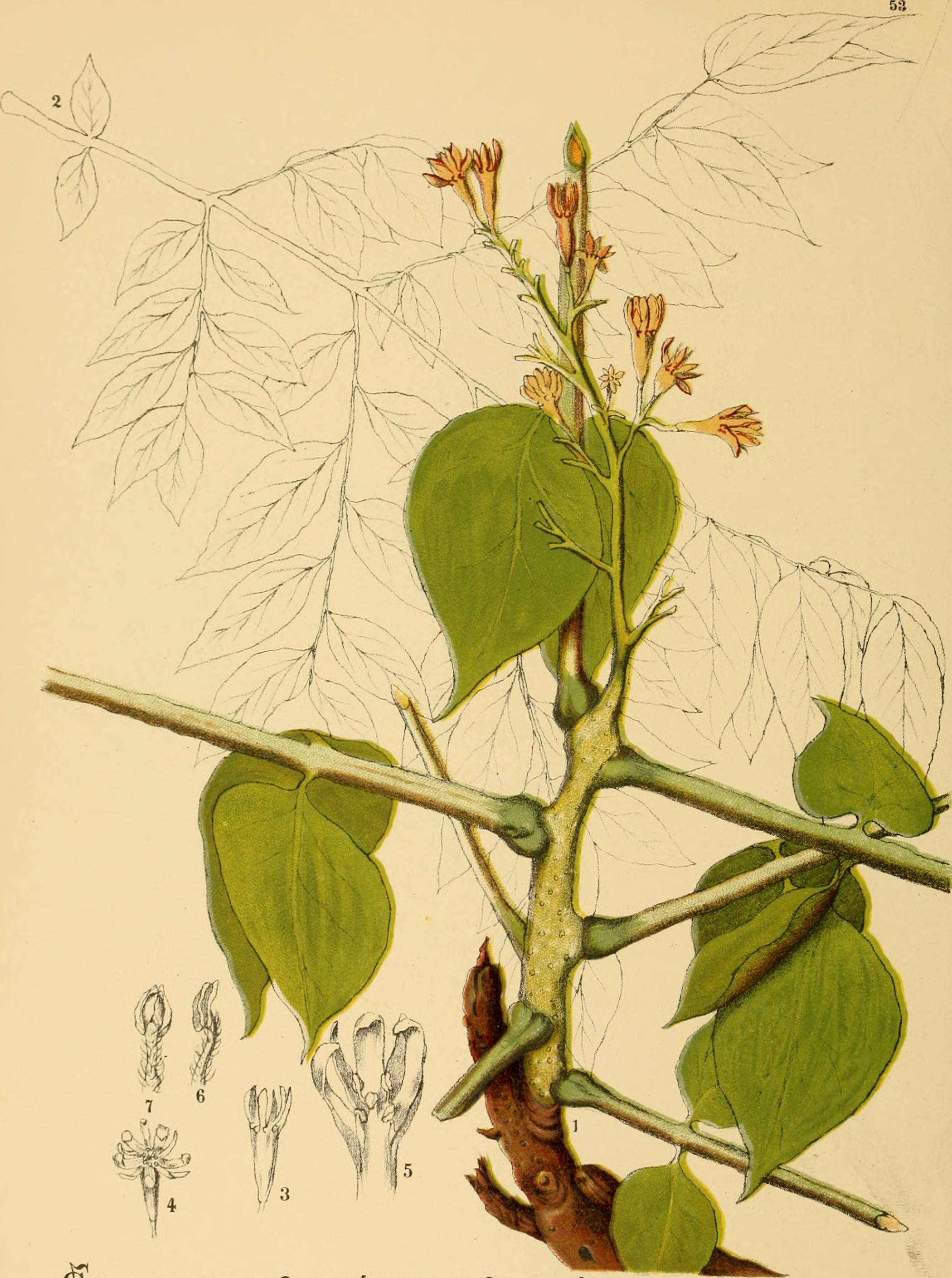
N. ORD.-LEGUMINOS^. 53 S. ORD.-C/ESALPINIE/E. GENUS— G YMNOCLADUS,* LAM. SEX. SYST.-DICECIA DECANDRIA. GYMNOCLADUS. COFFEE TREE. SYN.— GYMNOCLADUS CANADENSIS, LAM.; GUILANDICA DIOICA, LINN. COM. NAMES.— KENTUCKY COFFEE TREE, AMERICAN COFFEE BEAN, KENTUCKY MAHOGANY, NICKAR TREE, BONDUE, CHICOT. A TINCTURE OF THE FRESH FRUIT PULP OF GYMNOCLADUS CANADENSIS, LAM. Description. — This peculiar tree, when mature, reaches a height of from 50 to 60 feet. Trunk erect; bark extremely rough, and curiously broken transversely; branches few, thornless, when young cane-like, and in winter so destitute of anything looking like a bud that the whole tree appears as if dead. Leaves bi-pinnate, 2 to 3 feet long, bearing a pair of opposite leaflets near the base, and from 4 to 7 larger, odd-pinnate accessory leaf-stalks, each of which (upon the younger branches) is composed of from 6 to 8 pairs of leaflets, so that each leaf may bear from forty-eight to one hundred and seventy-four leaflets. These leaves develop late and fall early. Leaflets alternate, vertical, ovate-lanceolate, taperpointed and entire, the lower pair upon the base of the petiole almost cordate, larger and more pointed; stipides none. Lnfloi'escence terminal compound racemes or thyrsi; floivers dioecious, pedicillate; (estivation imbricate. Calyx elongatedtubular below; limb 5-cleft; lobes lanceolate, equal. Corolla not papilionaceous; petals oblong, equal, inserted upon the summit of the calyx-tube. Stainens 10. included, inserted with the petals; filaments distinct, short, and bearded; anthers sagittate, versatile, introrse, 2-celled, opening longitudinally. Style single. Ovules anatropous. Fruit an oblong, flattened pod, 6 to 10 inches long and about i inch broad, pulpy inside; seeds 2 to 4, flattish, hard, somewhat ovoid, about one-half an inch broad, and of a dark olive color; embryo straight. History and Habitat. — The Kentucky Coffee Tree grows in rich woods, along rivers and lakes, from Western New York and Pennsylvania, to Illinois and southwestward, where it flowers in June. The previous uses of this plant in medicine are grounded upon its peculiar action on nerve-centres. A decoction of the leaves and fruit pulp has been found useful in locomotor ataxia, reflex troubles incident upon masturbation, laryngeal * Fii/ii'iS;, gymnos, nalved; kXiiiSo;, klaJos, branch, from the liarren and dead appearance of the tree in winter.
53-2 coughs dependent upon a chronic irritation of the mucous membranes of the air-passages, puerperal peritonitis, erysipelas, and typhoid forms of fever. To the arts it furnishes a hard wood, something like mahogany, with a fine grain, suitable for cabinet-work; it weighs 40 lbs. 7 oz. per cubic foot, and has a sp. gr. of 647. The seeds are said to have been used by the early setders of Central United States as a substitute for coffee, and the leaves as a purgative and insecticide. Concerning the use of Gymnocladus as a fiy-poison, a Virginia correspondent of The American Agriculturist says: "Back of our house here, and overhanging the piazza, is a very large coffee-tree. Though this locality is infested, like Egypt, with a plague of flies, we have never suffered any serious annoyance from them. One year this tree was nearly stripped of its leaves by a cloud of potato-flies (the blistering fly), and we feared that the tree would die from the complete defoliation. In three days the ground beneath was black with a carpet of corpses, and the tree put out new leaves, and still flourishes. For ten years we have used the bruised leaves, sprinkled with molasses water, as a flypoison. It attracts swarms of the noisome insects, and is sure death to them." Gymnocladus is officinal in none ot the Pharmacopoeias. PART USED AND PREPARATION.— The fresh, green pulp of the unripe seed-pods is to be crushed and prepared as in the preceding drug. The tincture, after filtering from the mass, has a clear orange color by transmitted light; is gummy upon the fingers; and of a familiarly characteristic odor, resembling that of the pulp. CHEMICAL CONSTITUENTS.— ^1■//.^7•;/d^ C.^H^^N^O. This alkaloid, found in the seeds of Cytisits LabnrniiuK is said to e.xist also in the leaves and fruit pulp of this tree. Extracted from Laburnum, it crystallizes in radiate, colorless, deliquescent forms, having a caustic and bitter taste, and an alkaline, reaction, neutralizing acids completely. It sublimes without decomposition by the careful application of heat. PHYSIOLOGICAL ACTION. — Gymnocladus causes vertigo with a sensation of fullness ot the head; burning of the eyes; sneezing; salivation; nausea with burning of the stomach; desire to urinate; increased sexual desire; pains in the limbs, numbness of the body, sleepiness, and coldness. Description of Plate 53. (. End of a sterile branch, Ithaca, N. Y., June 17th, 1885. 2. A small leaf, four times reduced. 3 and 4. Sterile flowers. 5. Sterile flower in section. 6 and 7. Stamens, posterior and lateral views. (5, 6 and 7 enlarged.)
(Elll.adnat.iiel.et pinxt GEUM RlVALE,Linn.
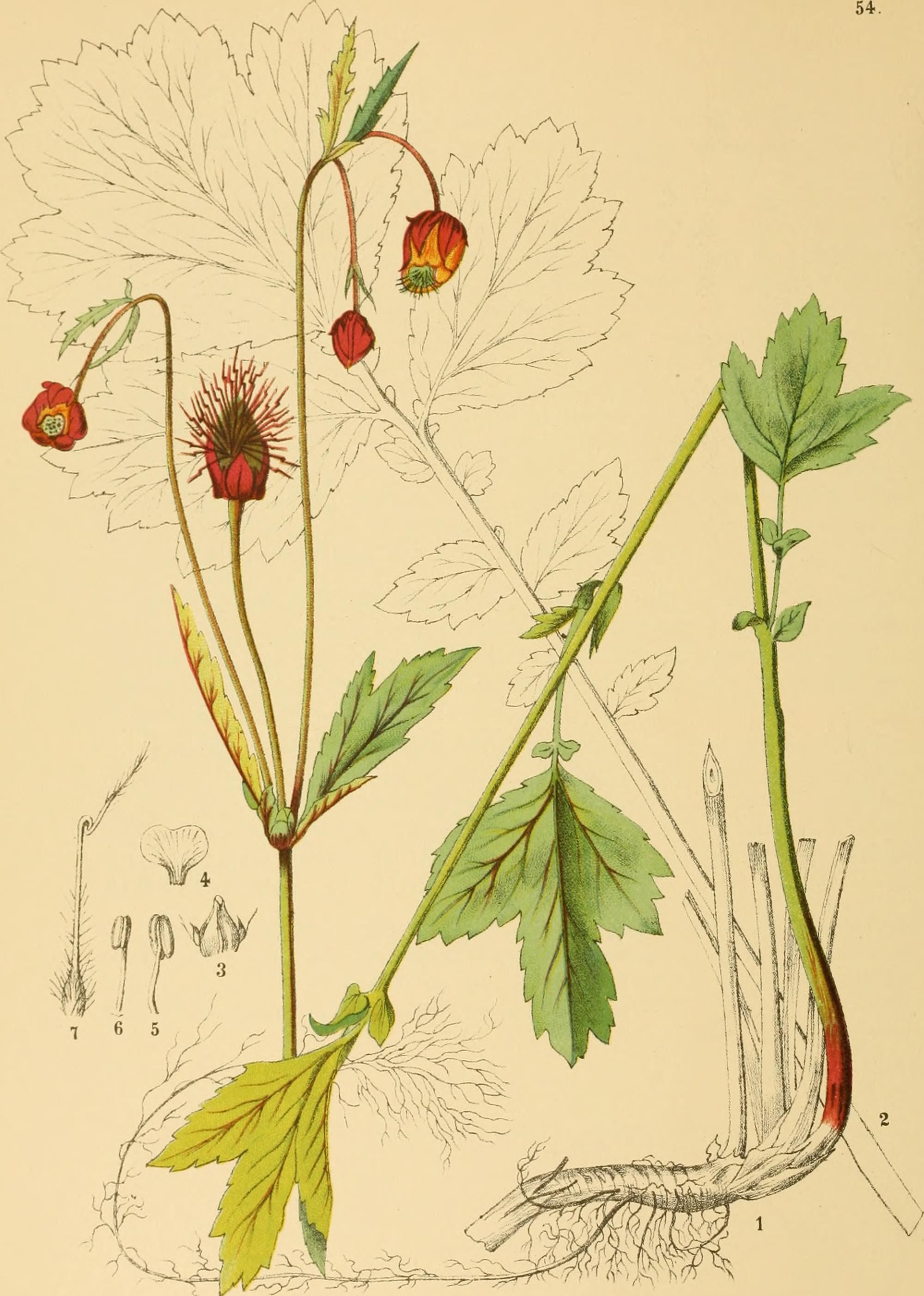
N. ORD.-ROSACE^. 54 GENUS.— G E U M,* LINN. SEX. SYST.— ICOSANDRIA POLYGVNIA. GEUM RIVALE. WATER AVEJ^S. SYN.— GEUM RIVALE, LINN. COM. NAMES.— PURPLE OR WATER AVENS, CHOCOLATE-ROOT; (PR.) BENOITE AQUATIQUB; (GER.) SUMPFNELKENWURZEL. A TINCTURE OF THE WHOLE PLANT, GEUM RIVALE, LINN. Description. — This beautiful perennial plant, distinguished on account of its hibiscus-like petals, grows to a height of from one to two feet. Root creeping, ligneous, giving off numerous fibrous rootlets. Stem simple or nearly so, hairy. Leaves of two kinds; those from the root on long deeply grooved petioles, lyrate and irregularly pinnate; those of the stem few, nearly sessile, more or less lyrate below and 3-lobed above, serrate, pointed; stipules ovate, incised. Inflorescence terminal on long, sometimes branched, peduncles i^^z^/rri- ^^w\ large and handsome, nodding on bracted pedicels. Calyx erect, concave below, 5-lobed, with 5 alternating bractlets in the sinuses. Petals 5, erect, retuse, dilated obovate, contracted into a claw at the base. Stamens numerous, inserted into a stipitate disk in the cup of the calyx; antlicrs introrse, opening by a longitudinal slit or pore. Pistils many; ovary hairy; styles long, with flexed tips. Fruit a dense, hairy, conical head, situated upon an erect stalk arising from the cup of the calyx; seeds oval, bearded, the epicarp retaining the persistent style, which is now hispid below and plumose above the angular flexion of the style. Rosaceae. — This grand natural order is represented in North America by 35 genera, 213 species, and 92 varieties, aside from innumerable cultivated specimens. The general characters of the order are: Plants consisting of trees, shrubs and herbs, and furnishing our most valuable fruits. Leaves alternate; stipules generally present though sometimes early deciduous. Flowers regular, handsome. Calyx of 5 to 8 sepals united to form the calyx-tube; in some species with a second set as bractlets, outside of, and alternate with, the sepals. Petals as many as the sepals, and inserted with the stamens upon a thin disk that lines the calyx-tube. Stamens very numerous, perigynous; filaments slender. Pistils one or many, * Tcva, geuo; a pleasant flavor, one of the species having aromatic roots.
54-2 either distinct in or upon a receptacle, or combined in the calyx-tube. Fniit either an achenium, a follicle, a drupe, or a pome. Seeds single, or a few in each ovary; a'.b2imcn wanting; cotyledons large and thick; embryo straight. Beside the useful and edible fruits — almonds, peaches, prunes, plums, and cherries {Amygdalecr); crab-apples, apples, quinces, pears, etc. {Pomca); and strawberries, raspberries, thimble-berries, antl blackberries {Rosaccee); — we have many useful medicinal plants among the species in this order. Bitter almonds {Amygdahts covimunis, Z., I var. amara, DC); sweet almonds {Amygdahts comiminis, L., 2var. diilcis, DC); wild cherry bark {Primus Virginiana, Miller); cherry-laurel {Prunus Laurocerastis, L.); kousso {Brayera cinthelminiica, Kzinlh.); peaches {Amygdalus Pcrsica, Pnimcs Persica); and the three'mentioned in this work. The genera Potentilla, Spirca, and Gillenia, will in time also be proven to be of benefit in the treatment of disease. History and Habitat. — This indigenous inhabitant of bogs and springy meadows, orrows from the New England States and Pennsylvania westward to Wisconsin and northward, flowering in May. Geum at one time gained great renown as " Indian Chocolate;" it was given in decoction prepared with sugar and milk, for dysentery, chronic diarrhcea, colics, debility, dyspepsia, and most ailments of the digestive tract; it was also used as a styptic in uterine hemorrhage, leucorrhcea, and hemoptysis, and as a febrifuge. (Rafinesque.) Though Geum has been dismissed from the U. S. Ph., it still retains a place in the Eclectic Materia Medica. PART USED AND PREPARATION. — The whole plant, gathered before blossoming in the spring, is chopped and pounded to a pulp and weighed. Then two parts by weight of alcohol are taken, the pulp mixed thoroughly with one-sixth part of it, and the rest of the alcohol added. After having stirred the whole well, pour it into a well-stoppered botUe, and let it stand eight days in a dark, cool place. The tincture, separated by straining and filtering, should have a deep orange-brown color by transmitted light, a slightly astringent taste, and an acid reaction. CHEMICAL CONSTITUENTS.— An analysis of Avens by Buchner, proves it to be very similar to the Pluropean Getan urbamim; which, botanically, differs but slighdy from the species under consideration. All the qualities of both species are given up freely to both water and alcohol. Volatile Oil of Geum. — A greenish-yellow, acid, butyraceous oil, having an odor like cloves. This body may be readily obtained by distillation of the roots in water. (Wittstein.) The Water Avens contains also a resin, an acid, bitter extractive, tannin, gum, and other general plant constituents. PHYSIOLOGICAL ACTION.— The action of this species has not yet been
54-3 determined. A short proving by the late Dr. Herring gave as symptoms: severe jerking, tearing pains, hke electric shocks, shooting from deep within the abdomen to the end of the urethra, coming on after eating. Description of Plate 54. I. Part of flowering and fruiting plant, from Lowmansville, N. Y., May 30th, 1884. 2. Root leaf. 3. Sepal, showing bracts. 4. Petal. 5. Stamen (enlarged), outer view. 6. Stamen (enlarged), inner view, with open cell. 7. Achenium (enlarged). =-»=
65. (ETn..a(lnaf.()el.et pinxt FrAGARIA VESCA,Linn.
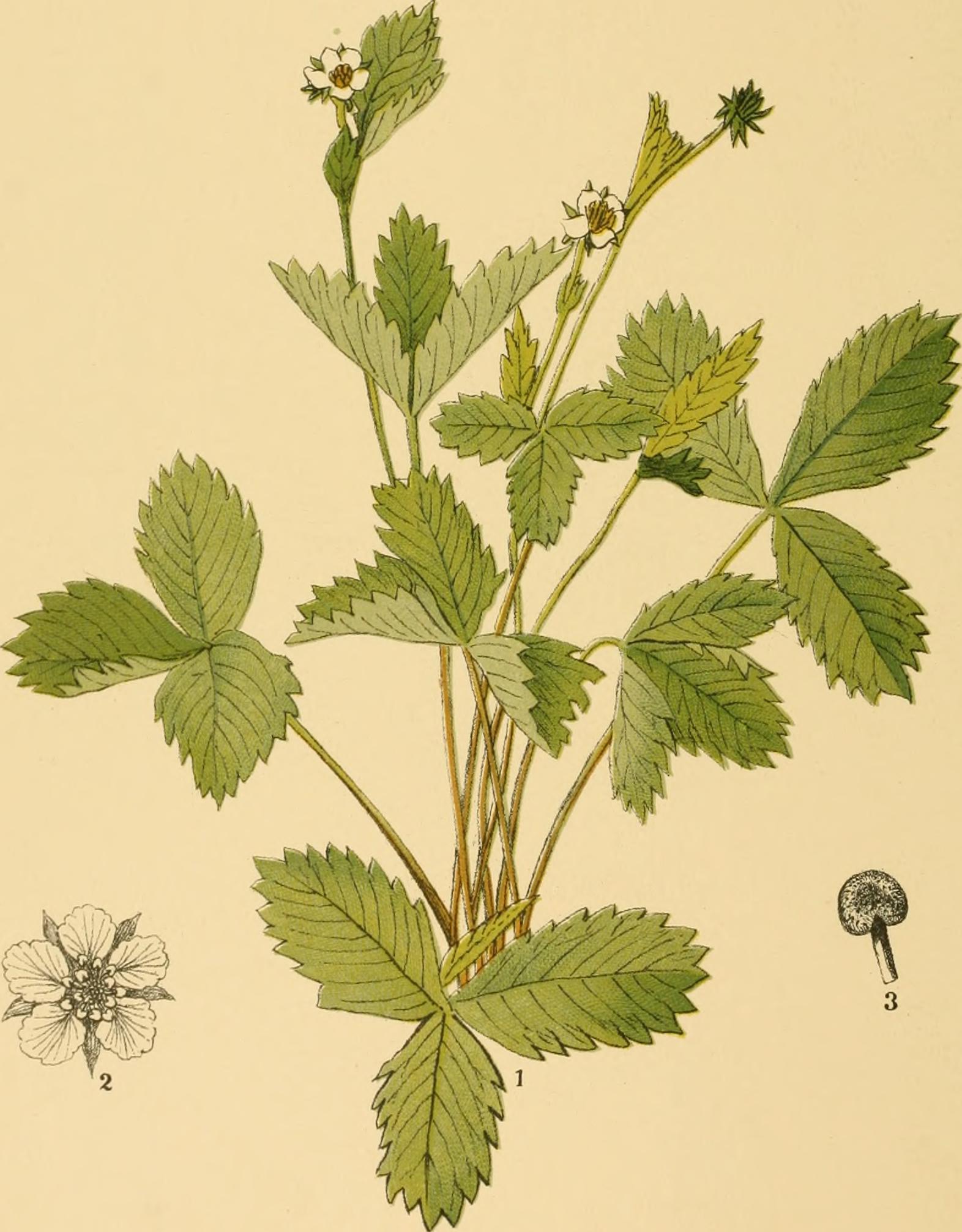
N. ORD.-ROSACE/E. 55 Tribe.~DRYADE/E. GENUS.— FRAG ARIA,* TOURN. SEX. SYST.— ICOSANDRIA POLYGYNIA. FRAGARIA. WILD STB A WBERR Y. SYN.— FRAGARIA VESCA. LINN. COM. NAMES.— "WILD, FIELD,! OR WOOD STRAWBERRY; (PR.) LE PRAISIER; (GER.) ERDBEERB. A TINCTURE OF THE FRESH RIPE FRUIT OF FRAGARIA VESCA, LINN. Description. — Root perennial, horizontal, knotty; stolons creeping along the ground and rooting at the end, sending therefrom young plants, following in due time the same process; stem none. Leaves mostly radical, ternately compound, hairy; stipules adherent to the base of the petioles of the radical leaves; leaflets sessile or nearly so, cuneate-obovate, coarsely serrate, and so strongly veined as to appear plicate; petioles much longer than the leaves. Inflorescence loose leafy cymes, upon long naked scapes; leaves of the cymes small; ^/'z)!i«/« lanceolateoblong, acute; pedicels erect or droo'p'mg; flowers ^N\\li&. Calyx concave at the base and furnished with 5 intermediate bracteoles alternate with its lobes; the whole remaining spread or reflexed in fruit; lobes acute. Petals 5, obtuse, somewhat crenate edged. Stame7is small, indefinite. Styles deeply lateral. Fruit consisting of the greatly enlarged and now pulpy and scarlet globular receptacle; achenia dry, scattered upon the surface of the fruit, not sunk in pits. History and Habitat. — The Wild Strawberry grows on dry and rocky banks, where it is common throughout the North Temperate Zone in Europe, Asia, and America. With us it is thoroughly indigenous North, flowering in May and June and fruiting in July and August. This species, together with F. llrginica — which is more common, grows in richer soil, and has the achenia sunk in pits upon the surface of the receptacle — form our delicious wild strawberries. The other North American species of Fragaria are F. Virginica var. Illinoensis, Gray, supposed to be the original of the " Boston Pine " and " Hovey's Seedling; " and var. glauca, Watson; F. Californica, C.&S.; F. Chilensis, Duch.; and var. Scoideri, Hook; and F. Indica, Andr., an adventive form. The F. Virginica, Ehr., is supposed to * From the Latin fragratis, odorous, on account of the aroma of the fruit, f More properly applicable to the F. Virginica.
56-2 be the original of the beautiful scarlet Virginia strawberry. Rafinesque judged that about one hundred varieties existed, but contented himself with naming only seven of F. vesca, of which, however, none are recognized by botanists to-day. The previous medical uses of Fragaria were few; the berries were ordered to be freely eaten of in various calcareous disorders. Many early writers considered the fruit as beneficial in gouty affections; Linnaeus extols their efficacy in preventing paroxysms of gout in his own case; and Rosseau claims that he was always relieved of a calcareous affliction by eating freely of them. The root in infusion has been used in England for dysuria and gonorrhoea. The dried leaves (Strawberry Tea) yield a slighdy astringent infusion used in domestic practice as an excitant, and as an astringent in diarrhoea and dysentery. PART USED AND PREPARATION.— The fresh, ripe berries, dealt with as in the preceding drug, yield an opaque tincture, having, when in thin layers, a deep brownish-carmine color by transmitted light. This tincture has a very astringent, somewhat vinous taste, the odor of the berries, and a strong acid reaction. CHEMICAL CONSTITUENTS.— The fruit contains cisso-tanic,* malic, and citric acids; sugar, mucilage, an"d a peculiar volatile aromatic body uninvestigated. PHYSIOLOGICAL ACTION. — It is a patent fact that many people with' delicate stomach find it almost impossible to eat strawberries and cream — especially early in the season — without suffering from symptoms of disordered digestion; the symptoms often culminating in quite severe attacks. A case in my practice several years ago, while a small-pox scare was prevalent in this city, gave nearly all the symptoms of the toxic effect of the fruit. A young lady, closely veiled, called hastily upon me early one morning, and when seated, withdrew her veil, and in a frightened manner desired to know if she had small-pox. Her face was swollen, bluish-red, and covered with a fine petechial eruption, which she said covered her whole body, but especially her face and trunk. She complained of feeling at times somewhat faint, slighdy nauseated, and generally swollen, but especially in the epigastric region and abdomen; her speech was somewhat difficult, and examination showed a swollen tongue. I laughingly ventured asking her — although it was winter — where she had found strawberries, whereupon she asked me, in astonishment, how I knew she had been eatinsr the fruit, adding- that a friend in Florida sent her about two quarts, among other fruit, and that she and a lady friend had eaten them all the night before, on retiring. As the symptoms had apparently reached their height, I told her the cause, and advised that she eat nothing for twenty-four hours, giving no remedy, that I might watch the pure symptoms. In the afternoon of the same day the skin was hot and swollen, the patient thirsty and resdess, and little sleep was gained that night; the next day the eruption began to fade, the appetite returned, and restlessness ceased. On the third day exfoliation * See under Ampelopsis quinquefolia. p. 40-2.
55-3 began and was very profuse, the skin appearing quite similar to tlie condition existing after a severe attack of scarlatina. The young lady who shared her fruit exhibited no symptoms whatever. Description of Plate 55. I. Whole plant, from Ithaca, N. Y., May 8th, 18S0. 2. A flower. 3. Stamen. (2 and 3 enlarged.)
56. ^m. ad nat.dei.et pinxt PJRus Americana, DC.
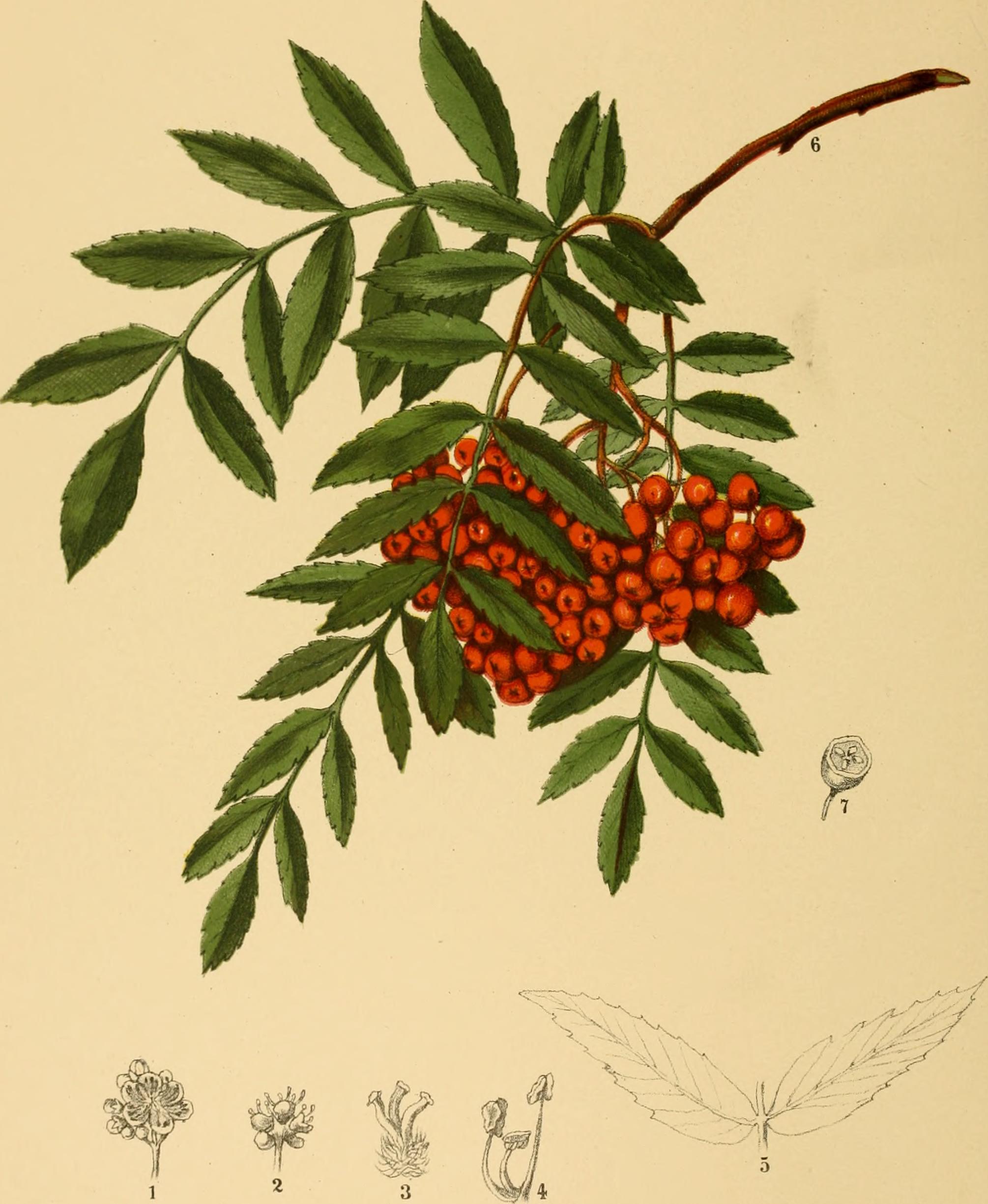
N. ORD.-ROSACE^. 55 5. Ord.-POME^. GENUS.— PI RUS,* LINN. SEX..SYST.— POLYANDRIA TRIGYNIA. I PIRUS. JMERICAJY MOUJyTAIJy ASH. SYN.-PIRUS (PYRUS) AMERICANA, D. C; P. ACUPARIA, MEYER; SORBUS AMERICANA, WILLD.; S. ACUPARIA, VAR. AMERICANA, MICHX.; S. HUMIFUSA, RAF. COM. NAMES.— AMERICAN MOUNTAIN ASH, AMERICAN SERVICE TREE; (PR.) SORBIS; (GER.) VOGELBEBREN. A TINCTURE OF THE FRESH BARK OF PIRUS AMERICANA, D. C. Description. — Tliis nearly smooth tree grows to a height of from 10 to 35 feet. Bark somewhat resembling the cherry. Leaf-buds pointed, glabrous and glutinous; leaves compound, odd-pinnate; leaflets 13 to 15, lanceolate, taperpointed, sharply serrate with pointed teeth, bright and shining green above, not pale below; teetli mucronate. Inflorescence in large, flattish, compound, terminal cymes. Calyx with an urn-shaped tube; limb 5-cleft. Petals roundish obovate. Stamens numerous. Styles 3, separate. Fruit a bright-scarlet, globose, baccate pome about the size of a pea; seeds two in each cell; testa cartilaginous. History and Habitat. — This beautiful mountain tree is indigenous from Maine to Pennsylvania, westward to Michigan, and southward along the Alleghany Mountains. In the north it also habits swampy spots, and flowers in June. The large clusters of brilliant red berries of this species and the P. aciiparia of Europe, which hanof lonof after the leaves have fallen, make the trees fine lawn ornaments. The close botanical and chemical relation of the American and European species render them so closely allied that many botanists consider them identical, and the chemistry of the bark, so far as distinguished, is so much like that of the wild cherry {Cerastis serotina, D. C.) that its medical uses have been substitutive. The previous use of the bark in medicine has been as a tonic in fevers of * The classical name of the Pear tree.
56-2 supposed malarial types, where it was often substituted for cinchona. The berries were used as an antiscorbutic. PART USED AND PREPARATION. — The fresh bark is chopped and pounded to a pulp and weighed. Then two parts by weight of alcohol are taken, the pulp thoroughly mixed with one-sixth part of it, and the rest of the alcohol added. After stirring the whole well, it is poured into a well-stoppered bottle and allowed to stand eight days in a dark, cool place. The tincture, separated from the above mass by filtration, has a reddishbrown color by transmitted light, a bitter taste, and an acid reaction. CHEMICAL CONSTITUENTS.— So far as I am able to ascertain, no analysis of the bark of this species has been made to determine its specific principles; a glance, however, at the chemistry of the European species may be of benefit. Sorbus (Pirus) acuparia. Amygdalin, C.,f,H.,7N0jj. — This glucoside occurs in the bark, buds, flowers and kernels of many rosaceous plants; it separates as pearly scales, which crystallize from water as transparent prisms, having the formula C2(,H2-NOjj(H20)3. Amygdalin loses Its water of crystallization at 120° (248° F.), liquefies at 200° (392° F.), and caramelizes and decomposes at higher temperatures; it is soluble in water and alcohol, but not in ether. Under the action of dilute acids it splits up as follows: ^,. Benzaldehyde Amygdalin. Water. ^' ^^y'^""- or Oil of Glucose. ^"'^- Bitter Almonds. Q„H,,NO,, + (H,0), = CNH + QH,0 -f (QH,A)r Sorbin, QH,.>0^, is the grlucose found in the berries; it forms in large, sweet crystals, which melt at 110° (230° F.). Sorbic and Parasorbic Acid, QHjjO^, two isomeric acids of the acrylic group, are also found in the berries of this species. Citric Acid, C|,H^O-. — This widely-distributed body occurs, together with malic acid, in the fruits of both species. Citric acid crystallizes in rectorhombic, glassy forms, readily soluble in water, alcohol and ether, and having a pure and pleasant acid taste. These crystals become white when exposed to the air, lose two molecules of water at 100° (212° F.), fuse at 150° (302° F.), and decompose with a specific empyreumatic odor at higher temperatures. Malic Acid, QH^O.. — This acid is found in the berries as they begin to ripen. It is obtained from its aqueous solution in small, colorless, deliquescent prisms, having a strong but pleasant acid taste. PHYSIOLOGICAL ACTION.— The tincture produced, in Dr. Gatchell and others under his observation,'-' a set of symptoms showing an irritation of the * Am. Horn. Obs., 1878, p. 520.
I 56-3 alimentary mucous membranes, and reflex nervous irritation. It also caused arthritic disturbances and symptoms of chill, heat, and perspiration. Description of Plate 56. I. A portion of a cyme, Binghamton, May 28th, li 2. A flower, showing perianth. 3. A pistil. 4. Stamens. 5. Two leaflets. 6. A branch in fruit. 7. Section of fruit. (3, 4 and 7 enlarged.)
57. (E.Ttl.jdnaidel.eipinxt PENTHORUM SEDOiDF.S, Linn.
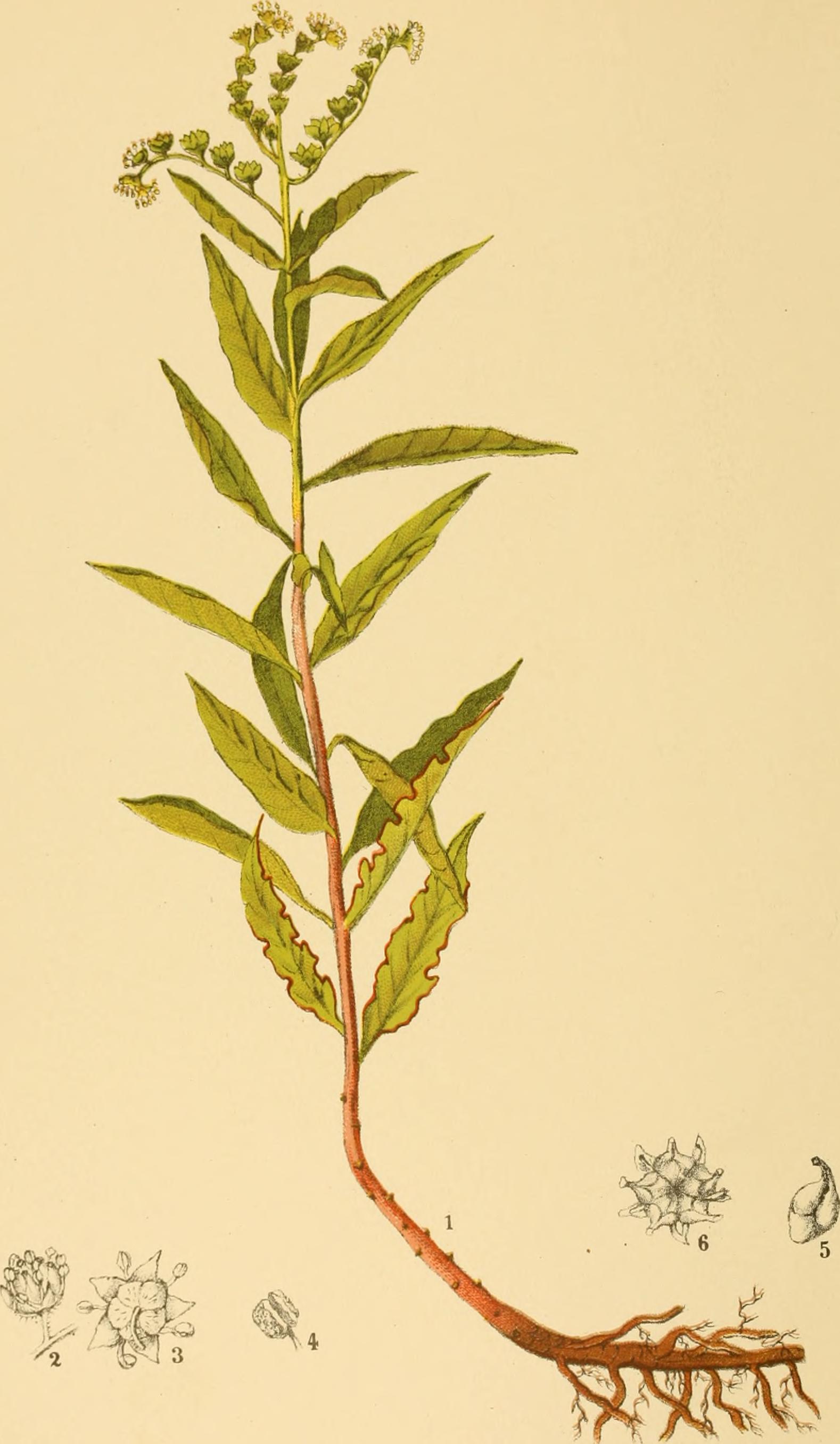
N. ORD -CRASSULACE^. 57 GENUS.— P E N T H O R U M,* GRONO V. SEX. SYST.— DECANDRIA PENTAGVNIA. PENTHORUM DITCH STOJVE CROP. SYN.— PENTHORUM SBDOIDES, LINN. COM. NAMES.— DITCH OR VIRGINIA STONE CROP. A TINCTURE OF THE WHOLE PLANT PENTHORUM SEDOIDES, LINN. Description. — This homely perennial grows to a height of from 8 to 12 inches. Stem erect, somewhat angled, simple or somewhat branched; leaves scattered, nearly sessile, lanceolate, acute at both ends, and sharply serrate. Inflorescence a loose terminal cyme of revolute spikes; floivcrs yellowish-green, arranged along the upper surface of the branches of the cyme; pedicels glandularly pubescent. Calyx pubescent below; sepals 5, cuneate, acute. Petals rarely present. Stamens 10 \ fllaments smooth; anthers 2-celled, opening longitudinally. Pistils ^, umted below; styles short, forming beaks in fruit; stigmas small, capitate. Fruit a 5angled, -horned, and -celled capsule, opening by the falling off of the beaks; ca?'pels many seeded; seeds ellipitical, pointed. CrassulaceEe. — This family of mostly succulent herbs is represented in North America* by 6 genera, 47 species, and 2 varieties. leaves mosdy sessile; stipules none. Inflorescence cymose or racemose; floi^rs perfectly symmetrical. Calyx mostly monosepalous and free from the ovaries; sepals 3 to 20, persistent, and united at the base. Corolla sometimes monopetalous, sometimes wanting; petals if present imbricated in the bud and inserted with the stamens. Stamens distinct, equal to, or twice as many as, the sepals, inserted upon the base of the calyx. Pistils distinct (exc. Penthorum), minutely scaled at the base, pyuit a cluster of follicles opening along the inner suture (exc. Penthorum). Seeds numerous, anatropous; embryo straight; albumen thin. This order yields but few medicinal plants, and those of little prominence. The common European Houseleek {Seiiipervivum tectorum, Linn.), whose leaves are cooling and astringent; the Orpine {Sedum Telephium, Linn.), whose leaves, boiled with milk, have been used by the laity as a remedy in diarrhoea; and the Stone Crop {S. acre, Linn.) — whose apparently dechlorophylled leaves make a fitting cover for the old ruins which afford the plant a habitat throughout Europe — is acrid, and has been recommended in cancerous troubles and epilepsy. — {Doctrine of Sigtiatures?) * nti/rt, pente, five; Spo?, oros, a rule; from the floral symmetry.
57-2 History and Habitat. — Penthorum is an indigenous ditch-weed, common in all localities in the United States, where it flowers from June to September. It has always held a place in domestic practice as an astringent in diarrhoea and dysentery. Drs. Briggs* and Scudder brought it to the notice of practitioners as a remedy, both topic and internal, for irritation of the mucous membranes and various forms of subacute inflammation of the same, as in pharyngitis, vaginitis, tonsillitis, etc. PART USED AND PREPARATION. — The whole fresh plant is to be chopped and pounded to a pulp and weighed. Then two parts by weight of alcohol are taken, the pulp mixed thoroughly with one-sixth part of it, and the rest of the alcohol added. After stirring the whole well, pour it into a well-stoppered bottle, and allow it to stand eight days in a dark, cool place, shaking often. The tincture, separated from this mass by filtration, has a brilliant reddishorange color by transmitted light; no special odor; an astringent taste; and an acid reaction. CHEMICAL CONSTITUENTS.— An analysis by the Lloyd brothers failed to yield a peculiar principle, or even a volatile oil. A peculiar tannin was, however, determined, which first turns blue then precipitates black from its alcoholic solution with ferrous, and deep green with ferric sulphate. PHYSIOLOGICAL ACTION. — Penthorum, according to Dr. Morrow's experiments, causes many symptoms simulating a coryza: rawness of throat and tongue; increased appetite followed by nausea; burning in the rectum; loose stools followed by constipation; increased urine; cough, and constriction of the chest. Description of Plate 57. T. Whole plant, Binghamton, N. Y., July 30th, 1885. 2. Flower. 3. View of calyx. 4. Anther. 5. Carpel. 6. Fruit. (2-6 enlarged.) * Ec. Med. your., 1875, 479
ffiXU.adnat.del.et pinxt. HaMAMELIS ViRGInICA, Linn.
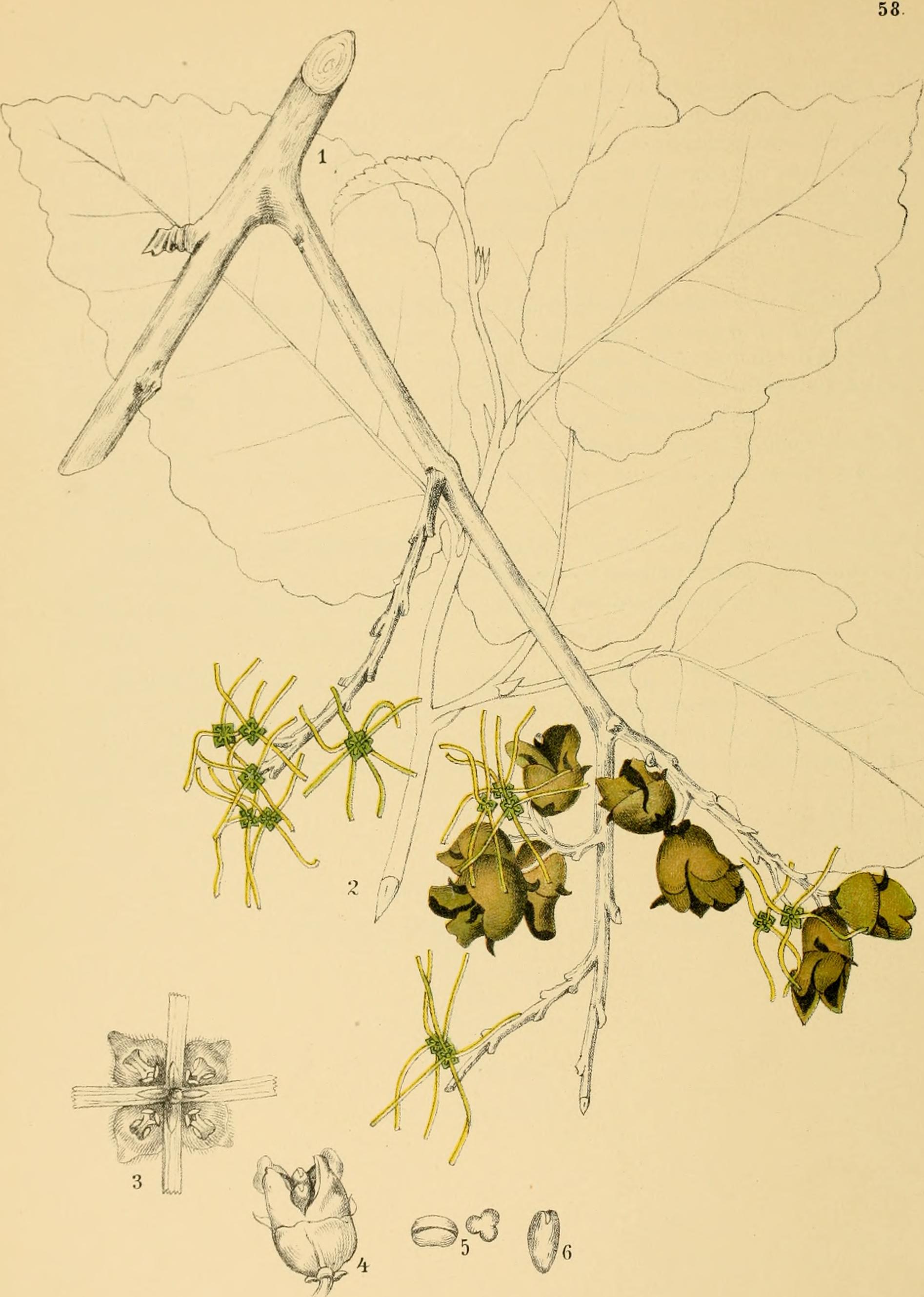
N. ORD -HAMAMELACEyE. 5b Tribe.-HAMAMtLE/E. GENUS. — HAM AM ELI S,* LINN. SEX. SYST.— TETRANDRIA DIGYNIA. HAMAMELIS. WITCH HAZEL. SYN.-HAMAMELIS VIRaiNICA, LINN., HAMAMELIS MACROPHYLLA, PURSH, HAMAMELIS DIOICA, "WALT., HAMAMELIS CORYLIFOLIA, MCENCH. COM. NAMES.— WITCH HAZEL, SNAPPING-HAZELNUT, WATER-SEEKER, WINTER-BLOOM, SPOTTED ALDER. A TINCTURE OF THE FRESH TWIGS AND BARK OF HAMAMELIS VIRGINICA, LINN. Description.— This strange shrub, whose flowers do not open until its leaves fall, grows to a height of from 5 to 1 5 feet. The stem is usually single, sometimes as large as 4 inches in diameter at the base. Dai'k smooth, brown. Branches numerous, long, flexuous and forking. Leaves 3 to 5 inches long, cordate-ovate or oval, with sinuate edges and straight veins, downy stellate-pubescent when young, but becoming smooth with age. Petioles -ahowX^ one-half an inch long. Iitvolucfe 3-leaved, scale-like, pubescent, on a short peduncle. Floivers many, axillary, several in a cluster or head. Calyx persistent, of 4 broadly-ovate, hairy, recurved divisions, with 2 or 3 little bracts at the base. Corolla of 4 long, strapshaped, yellow petals, which soon wither and curl. Stamens 8, four are fertile, four sterile; sterile stamens scale-like, truncate, opposite the petals; fertile stamens shorter, curving inward toward the pistil; Jilanicnts short; anther adnate, introrse, 2-celled, the cells rather widely separated, opening laterally by uplifted valves. Pcllen, grains ellipsoid, with 3 evenly separated deep sulci. Ovaries 2, united below. Styles 2, short. Capsule roundish ovoid, hard and leathery, the lower half with the persistent calyx and bracts, the upper smooth. Dehiscence loculicidal from the apex, during which the exocarp cleaves from the endocarp, which contains the seeds, and soon bursts, disclosing 2 cells, black and shining within, each with a single seed. Nutlets stony, oblong, narrow, deep glossy black, except the dull white tip. Embryo long, straight. Albumen litde or none. History and Habitat.— This plant, about which was formerly draped, by those versed in the occult arts, a veil of deep mystery, and whose forked branches were used as a divining-rod while searching for water and ores, grows profusely in the damp woods of Canada and the United States, flowering in October and ripening its fruit in the following summer. * 'u-iii, like to, C7X";, an apple tree. Some plants bear a slight resemblance to small wild apple trees.
58-2 The many varied uses of a watery infusion of Witch-hazel bark were fully known to the aborigines, whose knowledge of our medicinal flora has been strangely correct as since proven. Its use in haemorrhages, congestions, inflammations and haemorrhoids is now generally known through the medium of an aqueous distillate of the bark. The U. S. Ph. (1882) has wisely added Hamamelis to their medicaments, officinal as Extraclum Hamamehdts Fluidum. In the Eclectic Materia Medica the officinal preparation is Dccocluni Hamamelis. PART USED AND PREPARATION. -The bark of the young twigs and roots is chopped and pounded to a pulp and weighed, then two parts by weight of alcohol are taken, the pulp mixed with one -sixth part of it, and the rest of the alcohol added; after having stirred the whole well, pour it into a well-stoppered botde, and let it stand eight days in a dark, cool place. The tincture, separated by decanting, straining and filtering is by transmitted light of a deep yellowishbrown color. It has a sweetish, slightly astringent taste, an acid reaction, and a peculiar odor, which, once noticed, will always disdnguish it. CHEMICAL CONSTITUENTS.— No analysis of this plant has been made to determine its principles except as far as tannin is concerned; this body was found in small percentage. Water seems, nevertheless, to extract all or nearly all of its virtues. The active body, however, must be more or less volatile, as preparations of the plant, made without using proper care in regard to this feature, have not the action usually sought for. It is also a fact that the bark of the root alone is not sufficiently medicinal, and that the curative property of the tincture does not lie entirely in the tannin. PHYSIOLOGICAL ACTION.— Hamamelis, according to Dr. H. C. Preston, who first attempted the study of its acdon, causes a determination of venous blood to the head, chest, abdomen and pelvis. Its action would seem to be, not upon the circulation itself, but upon the coats of the veins, causing a relaxation, with consequent engorgement and exosmosis, this action in many cases proceeding to actual rupture of the vessels. The symptoms pointing to the above conclusion are produced as follows: V^ertigo, venous epistaxis, preceded by severe pressure both in the os frontis and superior nares, relieved by the hsemorrhage; nausea and vomiting, pain and tenderness of the abdomen, with flatulence and diarrhoeic passages from the bowels; pulsations in the rectum synchronous with the pulse; much lumbar pain, with weakness of the lower limbs and general lassitude. The action of hamamelis upon the heart and circulation in general is not marked in these experiments. Description of Plate 58. I. End of flowering branch, Binghamton, N. Y., October 23d, 1S81. 2. Leaves added in June. 3. Flower (enlarged), the petals broken off. 4. Fruit. 5. Pollen grains, side and end view, x 380. 6. Nutlet.
N. ORD-ONAGRACE^. 59 GENUS.— EPILOBIU SEX. SVST.— OCTANDRIA MONOGVXIA. GENUS.— EPILOBIU M,=i^ LINN. EPILOBIUM. WILLOW-HERB. SYN.-EPILOBIUM PALUSTRB, VAR. LINBARE, GRAY; E. PALUSTRB, GRAY; B.ROSMARINIFOLIUM, PURSH.; B. LINBARE, MUHL.; E. PALUSTRB, VAR. ALBESCENS, RICH.; B. PALUSTRB, VAR. ALBIFLORUM, LBHM.; E. OLIGANTHUM, MICHX., P.; E. TENELLUM DENSUM, LEPTOPHYLLUM, AND CILIATUM, RAF.; B. ANGUSTISSIMUM, WILLD. (GREENLAND); E. PUBBSCENS, PRESL.; E. SQUAMATUM, NUTT. COM. NAMES.— SWAMP "WILLOW-HERB, NARROW-LEAVED WILLOWHERB, MARSH EPILOBIUM, SWAMP WILLOW, WICKOP; (FR.) HERBS DB ST. ANTOINE; (GBR.) ANTONSKRAUT. A TINCTURE OF THE WHOLE PLANT EPILOBIUM PALUSTRE. VAR. LINEARE, GRAY. Description. — This slender, perennial herb usually attains a growth of from 6 inches to 2 feet. Stem erect, roundish, terete, minutely hoary, pubescent, and branchy above. Leaves nearly sessile, narrowly lanceolate or linear, acute, attenuate at the base, and with more or less revolute margins; the upper alternate; the lower opposite, entire, or denticulate. Infloresce^ice in a terminal corymb; floiccrbiids nodding; floi^'ers minute, rose-colored. Calyx-tube not prolonged beyond the ovary; limb 4-cleft, deciduous. Petals 4, erect, mosdy notched at the end, and about twice the length of the calyx. Stamens 8, erect; anthers short. Style erect, included; stigma clavate, nearly entire. Fruit an elongated, linear, hoary, somewhat quadrangular, loculicidal pod; seeds numerous, bearing a tuft of long hairs upon the apex. Onagraceas. — This innocent order of mostly perennial herbs, represented in North America by 15 genera, 155 species, and numerous varieties, is characterized as follows: Floioers 4-merous (sometimes 2, 3, 5, or 6-merous), perfect, and symmetrical. Calyx with its tube adhering to the ovary; lobes valvate in the bud or obsolete. Petals convolute in the bud, sometimes absent. Stamens as many, or twice as many, as the petals or calyx-lobes; filaments inserted at the summit of the calyx-tube; pollen with its grains often connected by cobwebby threads. Style single, slender; stigma 2- to 4-lobed or capitate. Fruit capsular or baccate; seeds small, anatropous; albumen wanting. * 'i;-\, €/>!, upon; Xo/3o,-, lobos, a pod; as the flowers seem to be.
59-2 History and Habitat. — The Swamp Willow-Herb is indigenous to North America, where it extends from the mountains of North Carolina, and from Southern Illinois, northward to the Arctic Circle. It habits high sphagnum swamps, and flowers in July and August. Epilobium has proven itself a mild tonic and astringent, quite useful in slight types of diarrhcea and dysentery attended, with colic, cramps in the stomach, and light typhoid abdominal symptoms. In irritation of the intestinal canal, followed by diarrhoea and some tympanitis, it has often proved quite beneficial in the hands of our Eclectic physicians. PART USED AND PREPARATION- — The whole fresh plant, while in flower, should be chopped and pounded to a pulp and weighed; then two parts by weight of alcohol taken, the pulp thoroughly mixed with one-sixth part of it, and the rest of the alcohol added. Pour the whole into a well-stoppered bottle, and allow it to stand eight days in a dark, cool place, shaking twice a day. The tincture, prepared from this mass by decanting, pressing, and filtering, should have a light yellowish-brown color by transmitted light: a smooth, then astringent taste, and an acid reaction. CHEMICAL CONSTITUENTS.— No analysis of this plant has so far been made. It contains, however, tannin and gallic acid, beside the usual plant constituents. PHYSIOLOGICAL ACTION.— The experiments of Dr. Wright, who took from one-half to one ounce of the tincture, caused some symptoms that must have been due to so large a "drink." Outside of the symptoms that we are prone to lay to the alcohol, the following also occurred: Salivation; loose stools; red urine; and chills, followed by feverishness and general aching throughout the body. A proving with the tincture prepared as here directed, should be made. Description oi' Plate 59. I. A small plant from AiJiialathin, N. Y., July 26th. 1SS6. 2. A flower. 3. Petal. 4. Stamen?. 5. Pistil. 6. Pod. 7. Sted. (2-5 and 7 enlarged.)
60..TR.aiinatdcI.eipinxt. CEnothera Biennis Linn
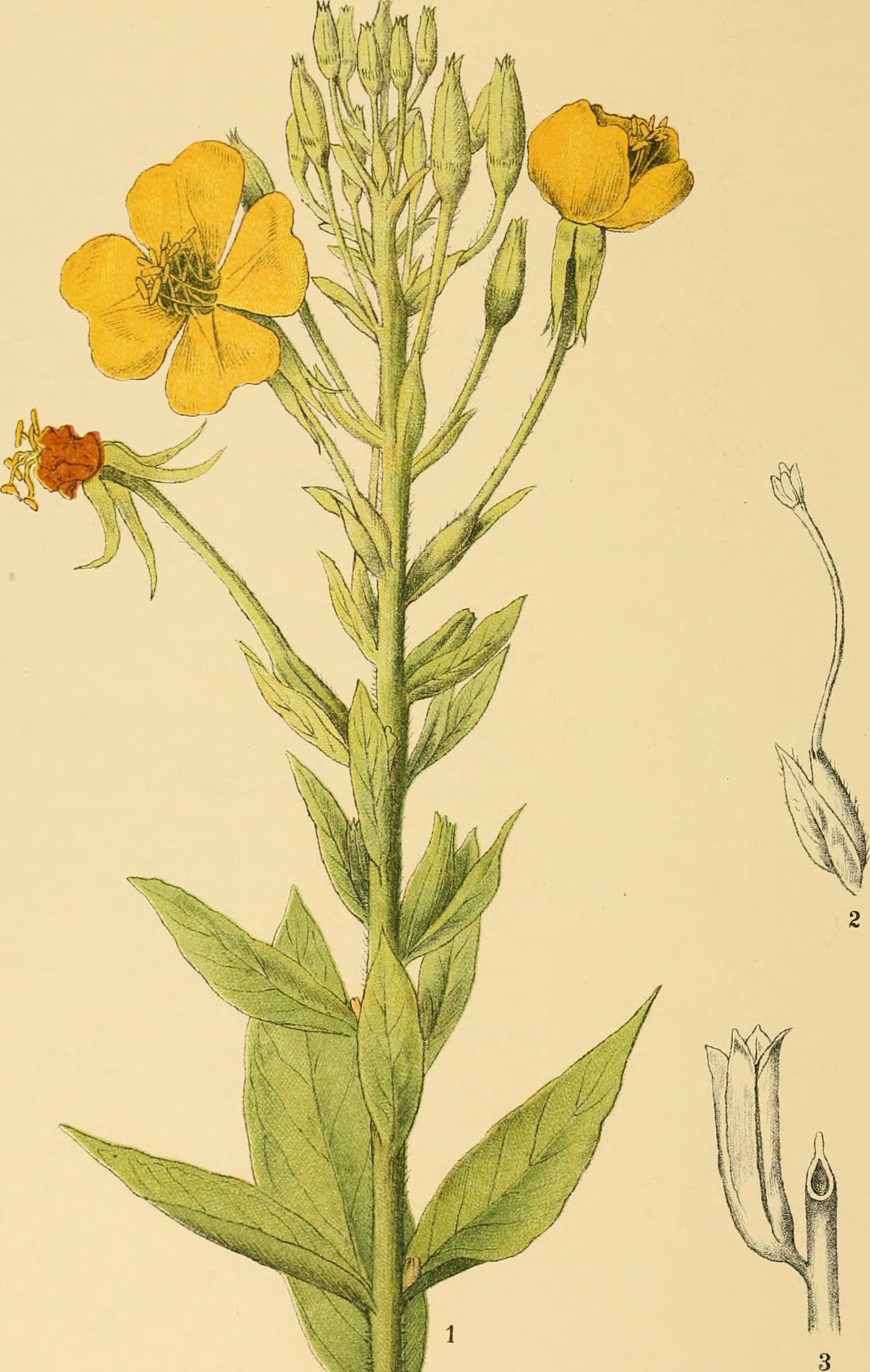
N. ORD-ONAGRACE^. 60 GENUS.— CEN OTHER SEX. SYST.— OCTANDRIA MONUGYNIA. GENUS.— (EN OTH ERA,* LINN. OENOTHERA E VEJ^IJyG PRIME OSE. SYN.— CENOTHERA BIENNIS, LINN.; CENOTHERA PARVIFLORA, LINN.; CENOTHERA GAUROIDES, HORNEM; ONAGRA BIENNIS, SCOP.; ONAGRA VULGARIS, AND GHRYSANTHA, SPACH. COM. NAMES.— COMMON EVENING PRIMROSE, NIGHT WILLOW-HERB, SCABBISH, TREE PRIMROSE, CURE-ALL; (FR.) ONAGRE; (GER.) NACHTKERZ. A TINCTURE OF THE WHOLE, FRESH, NEWLY BLOSSOMING PLANT, CENOTHERA BIENNIS, LINN. Description. — This nocturnal annual, or biennial plant, attains a growth of from 2 to 4 feet. Root conical; bark thin, yellowish, or brownish. The roots of the first year are fleshy and succulent, in the second they become fibrous and woody. Leaves alternate, 2-6 inches long, ovate-lanceolate, acute, very minutely toothed, and pubescent; the cauline sessile, those near the root contracted into a petiole. Inflorescence a terminal, foliaceous spike, lengthening greatly as the flowers develop and the fruit matures; floxoers odorous, light-yellow, ephemeral. Calyx-tube cylindrical, caducous, prolonged quite a distance beyond the ovary, being more than twice as long as its lobes; linib of 4 long, reflexed lobes. Petals 4, obcordate, not clawed, withering and becoming orange-brown after a night's expansion. Stamens 8, nearly equal, shorter than, and both opposite and alternate with, the petals; filaments slender, sometimes curved; anthers linear, versatile. Ovary ovate; style terminal, long, cylindrical, exserted; stigmas a group of 4 linear, diverging lobes. Fncit a 4-valved, many-seeded follicle; follicle oblong, sessile, tapering above; seeds naked. Read description of the order under Epilobium palustre, 59. History and Habitat. — The Evening Primrose is common in the United States, growing in fields and waste places generally, and flowering from July to September. It varies gready in its growth, aftbrding at least 5 distinct varieties, viz., var. a grandiflora, a large-flowered form; var. (3 miiricata, with rough, brisdy stem and pods; var. y canescens; var. h hirsiUissima, a particularly hairy form; * Theophrastus describes a plant whose dried root caught the odor of wine. Hence he called it o^ot, oinos, wine; 9<P<i, thera, catch. (Barton.) Or taking 9.f!?a to mean a hunt or chase, it is alleged that the meaning is applicable to the belief that it was the root of this plant, or one of its botanical relatives, that was eaten to provoke an appetite for wine. This genus is a large and varied one, containing 57 species, and n varieties, in North America alone.
60-2 and var. e cniciata, having small, linear petals, shorter than the stamens. The flowers open fully, after sundown, and remain so until the sun is well up in the morning, then wither and fall. Much has been written concerning the property inherent in the petals of many species of this genus, of emitting a " phosphorescence " at night, the flowers being distinguishable at a goodly distance beyond non-refractory objects by their whitish luminosity. In regard to this phosphorescence a word or two is in place. That the petals do emit light on a dark night is not fanciful; still it is not due to a property of giving out spontaneous light (phosphorescence), but to a process of storing up sunlight during the day, and retaining it at night — a property identical with that exhibited by licpar siilpliuris calcarca, and the sulphides of barium and strontium.''' The young roots of the evening primrose are said to be edible and pleasant, either pickled or boiled, having "a nutty taste, quite similar to that of rampion {CajHpanuia rapuiiciilus), and are used in Germany and some parts of France, either stewed or raw, in salads, like celery." (Porcher.) Lindley states, that the young mucilaginous twigs are used in the same way. About the only previous use of this plant in medicine was a strong decoction of the dried herb as an e.xternal application in infantile eruptions, and as a general vulnerary. Dr. Winterburn-j- states it to be a curative in spasmodic asthma, pertussis, gastric irritation, irritable bladder, and chronic exhaustive diarrhoeas. PART USED AND PREPARATION. — The whole fresh plant, as it is coming into bloom, is chopped and pounded to a pulp and weighed. Then two parts by weight of alcohol are taken, the pulp mixed thoroughly with one-sixth part of it, and the rest of the alcohol added. After having stirred the whole, it is poured 'nto a well-stoppered bottle, and allowed to stand eight days in a dark, cool place. The tincture, obtained from this mass by filtration, should have a clear reddish-orange color by transmitted light, an odor similar to that of wet hay, a taste at first mucilaginous, then astringent and bitter, and an acid reaction. CHEMICAL CONSTITUENTS. — ffi";z^//;^;7«. This body, claimed as a principle by Chicoisneau, is evidently an extract, which probably contains all of the principles of the plant except the acrid body, which is dissipated by heat. It has not yet been analyzed, but would doubtless show a resin, a bitter principle, and a special acid. Mucilage is present in large percentage. Potassium nitrate, K N O3. — Crystals of this salt are readily extracted from an alcoholic tincture of the root. J PHYSIOLOGICAL ACTION.— The brain symptoms following a dose of 60 drops of the fluid extract of CKnothera in a woman of 40, as chronicled by Dr. Nute,§ are very interesting, and should stimulate a desire for a fuller proving. » Calcined oyster shells emit stored sunlight, on account of the sulphide of calcium in their composition. This fac, is largely utilized in the manufacture of luminous clock-faces, match-safes, door-plates, and the like. These objects, when placed in the sunlifjht during the day, are visible at night. t "The Evening I'limrose," a paper read before the Ilh. Slate Horn. Soc'y. Am. Homoaofalh, 1SS3, p. 317. X Claussen, Am. Jour. Pha,:, 1884, p. 365. ^ U. S. Med. and Surg- Jouni., vol. i.v, p. 395.
60-3 This individual experienced extreme vertigo, inability to sit or stand erect, semiunconsciousness, loss of muscular power, numbness and peripheral prickling, rigors, occasional muscular cramps in the abdomen and extremities, and great exhaustion. These symptoms were followed by a free movement of the bowels, and a copious discharge of urine. Dr. Winterburn* judges that the drug has a special action upon the pneumogastric nerve, and, reBexly, an irritative action upon its pulmonary and laryngeal branches. Description of Plate 6o. I. Top of flowering plant; Chemung, N. Y., Sept. 4th, 1879. 2. Pistil. 3. Fruit. * U. S. Med. and Surg, yourti., vol. ix, p. 395.
61. 0 ^m.ad o 0 v; naldel.Btpinxt Opuntia Vulgaris, miii. Vi\ \ -i \ /2
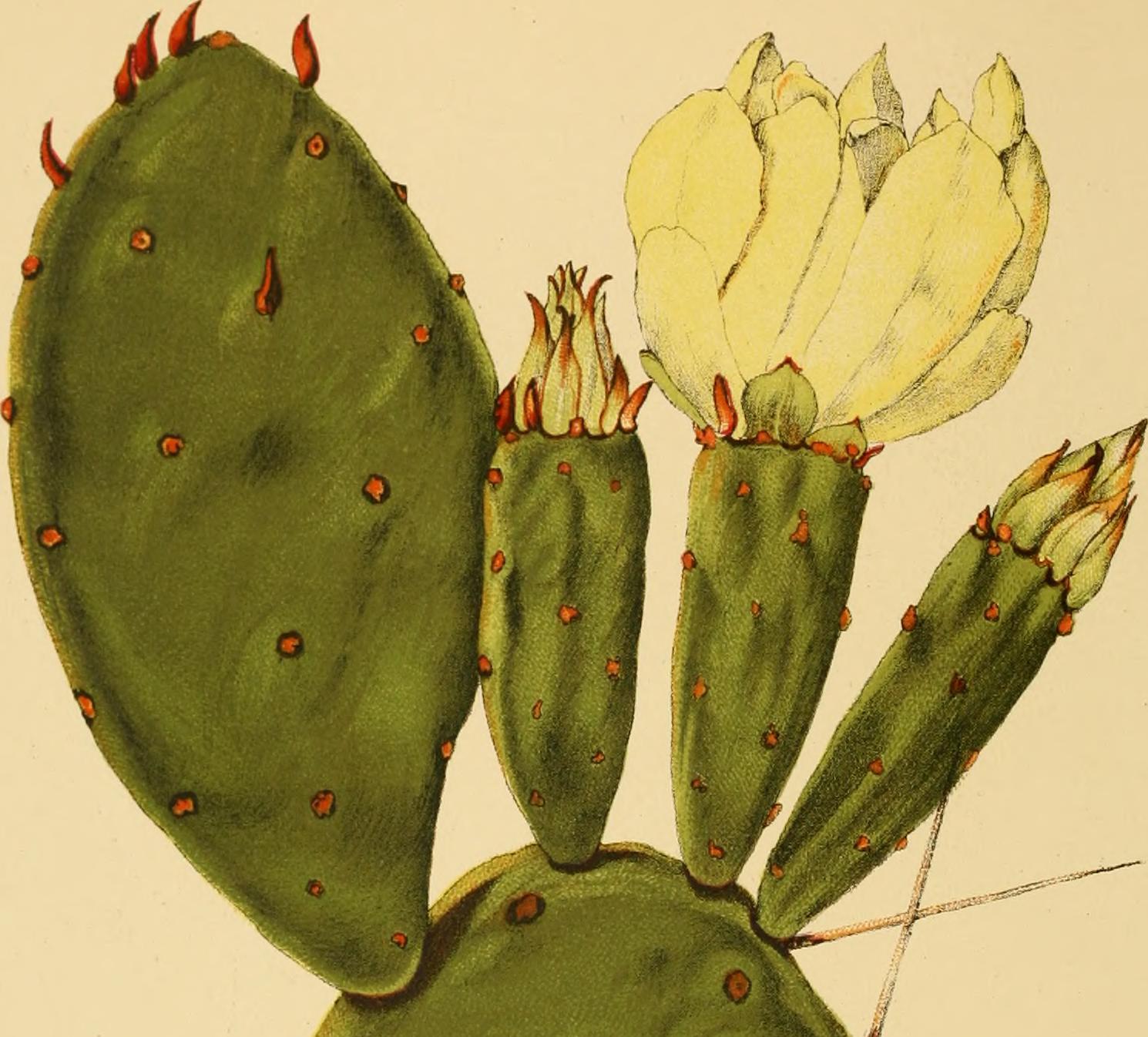
N. ORD.-CACTACE/E. 61 GENUS.— OPUNTIA,* TOURN. SEX. SYST.— ICOSANDRIA MONOGYNIA. OPUNTIA. PRICKLY PEAR. SYN.-OPUNTIA VULQARIS, MILL.; O. ITALICA, TEN.; O. HUMIFUSUS, AND O. MARITIMA AND HUMIFUSA, RAF.; O. INTERMEDIA, SALM.; CACTUS OPUNTIA, LINN. COM. NAMES.— PRICKLY PEAR, INDIAN FIG. A TINCTURE OF THE FRESH FLOWERS AND GREEN OVARIES OF OPUNTIA VULGARIS, LINN. Description. — This curious, low, pale, prostrate, spreading plant is characterized as follows: Branches (?) more or less assurgent; Joints flat, broadly ovate, the younger ones leafy, the older prickly; leaves minute ovate-subulate, appressed, deciduous, arranged spirally about the joints; axils more or less bristly with numerous short, barbed prickles; spines rarely present, when found they are whitish in the north and yellowish southward, and vary from two-thirds to one and onequarter inches long. Inflorescence consisting of a few sessile, solitary flowers along the apical ridge of the joints; flozuers large, sulphur-yellow, not ephemeral; perianth not united into a prolonged tube, but regular and spreading. Sepals ovatelanceolate, tapering to a point. Petals ample, the inner roundish. Stamens numerous, shorter than the larger petal; filaments glabrous; anthers linear, versatile. Ovary i -celled, obovate; style cylindrical, narrowed at the base; stigmas about 6, in two sets, clavate. Fruit an obovoid, nearly smooth, crimson, pulpy and edible berry, having a deep depression at the apex showing the scars of the perianth. Seeds numerous, flattish-reniform, with a rounded ridge extending over the arch opposite the hilum; embryo curved around the thin albumen; cotyledons large, becomincf foliaceous. Cactacese. — This large and peculiar family of thick and fleshy plants is represented in North America by 5 genera, containing in all 142 species and 39 recognized varieties. Its characteristics are as follows: Stems globular or columnar and angled, composed of numerous compressed joints. Leaves usually absent or represented by spines, thorns or bristles. Flowers solitary, sessile. Sepals and petals similar and evolute, numerous and imbricated in several rows, all adherent to the ovary. Stamens numerous; filaments long and slender, inserted into a ring formed by the union of the sepals and petals. Styles united into one; stigmas numerous. Fruit a berry; seeds numerous, campylotropous, finally becoming separate from the placentae and loose in the pulp; placentce several, parietal; albumen scanty. * A Theophrastian name for some species growing in the country of the Opuntiani, whose chief city was Opus, near Phocis.
61-2 The proven plants of this order are: the Jamaican Cactus grandifio7-iis, Linn.; the beautiful Night-blooming Cereus, whose ephemeral flowers are remarkable for their exceeding size and fragrance; Cereus Bonplandii, Parm.; and C serpcntinns, Haw. No other species are used in medicine, though many furnish both food and drink to those compelled to pass over the barren wastes which this order mosdy habits, the pulpy fruits and succulent joints, deprived of their coat of mail, being acid and aqueous to a high degree. Mr. J. R. Dodge* speaks as follows of the species used by the American Aborigines: " Echinocactus Wislizeni. — A section of the stem is often employed as a cooking vessel. The seeds are small and black, but, when parched and pulverized, make good gruel and even bread. The pulp of the fruit is rather sour, and not much eaten. Travellers in passing- through the cactus wastes often resort to this plant to quench their thirst, its interior containing- a soft, white, watery substance, of slightly acid taste, which is rather pleasant when chewed. It is a common sight to see on each side of the road these plants with a large perforation made by the thirsty traveller. An Indian, when travelling, and wishing to make a meal, selects a large plant, three feet or more long and two in diameter, cuts it down and hollows it out so as to form a trough; into this he throws the soft portions of the pulpy substance which surrounds the central woody axis, and adds meat, roots, seeds, meal, fruits, or any edible thing on hand; water is added, and the whole mixed together; stones are then highly heated and dropped into the mixture, and, as they cool, are taken out, licked clean, reheated, and returned to the cooking vessel, undl the mixture is thoroughly boiled. This is a favorite dish with the Yabapais and Apaches of Arizona. The Papajo Indians pare off the rind and thorns of large plants of this species of cactus, letting it remain several days to bleed, when the pulp is pared down to the woody axis, cut up into suitable pieces, and boiled in syrup of the Cereus giganteus or Cereus Tliurbtri. If a kind of sugar which is made by the Mexicans is attainable, it is employed instead of the syrup, thus forming a good preserve. These pieces, when taken out of the liquid and dried, are as good as candied citron, which they much resemble in taste and substance. "Prickly pear [Oputiiia Engelmani, O. vulgaris, O. Camanchica, O. Rafinesquii, O. occidentalis). — The fruit of these species of cactus is much eaten by all the Indians of New Mexico, Arizona, California and Utah, under the common Spanish name of tunas, great quantides being dried for use in the winter. These plants grow in arid desert localities which produce nothing better; they are large and of a bright red to purple color; of a rather pleasant, sweet, sornewhat acid taste, and have thin skins and rather large seeds, which are discarded. The skin is studded with bunches of very fine downy spines, which the Indians brush off with a bunch of grass. The Apaches use wooden tongs to gather the fruit, to prevent being scratched by these spines or the thorns of the plant. The Pawnees and Papajoes dry the unripe fruit of the Opuntia for future use, to be cooked with meat and other substances. The fresh unripe fruit is often boiled in water from ten to twelve hours, until soft, when it becomes like apple-sauce; then, being allowed to ferment a litde, it becomes stimuladncj and nutriuous. Some Indians roast the leaves of the Opuntia in hot ashes, and, when cooked, the outer skin, * U. S. Agric. Repts., 1870, 417-41S.
61-3 with the thorns, is easily removed, leaving a slimy, sweet, succulent substance, which is eaten. Hunger and destitution frequently compel Indians and white men to live for many days on this food. A yellowish white gum often oozes out of the leaves of the Opuntia, which is also eaten." History and Habitat. — This species is indigenous to the sandy fields of the Adantic and Pacific seaboards, as well as the arid lands of the southwestern portion of North America; it is also found in Europe. It habits rocky places and dry sands, where it flowers in June and July at the north. The fruit is edible and at the same time a pleasant diuretic, though it renders the urine a bloody tinge; the taste is acid and cool, much resembling the Pomegranate. Rafinesque states* that the split joints make a good emollient application for acute rheumadsm, and, when baked, for chronic ulcers, gout, and recent wounds; the juice and gummy exudadon, he says, is used in gravel. Dr. Porcher saysf he is informed that a decoction of the joints is mucilaginous, and much used in Alabama as a demulcent drink in pulmonic and pleuritic affections. MeratJ claims that the cut joints are discutient. PART USED AND PREPARATION.— The fresh flowers and green ovaries are chopped and pounded to a pulp and weighed. Then two parts by weight of alcohol are taken, the pulp thoroughly mixed with one-sixth part of it and the rest of the alcohol added. The whole is then poured into a well-stoppered vial, and allowed to stand eight days in a dark, cool place. The tincture, separated from this mass by filtration, should have a slighdy opaque straw-color by transmitted light; a slight odor of the flowers; a bitterish and astringent taste; and an acid reaction. CHEMICAL CONSTITUENTS.— An analysis of the fruit was made by Mr. W. W. Licrht.ij and resulted in the determination of: Tartaric acid, C,H,,0,,; citric acid mucilage, and coloring-matter. In the seeds a fixed oil, a fat acid, albumen, starch and glucose were found, but no glucoside nor alkaloid. PHYSIOLOGICAL ACTION. — According to the experiments made by Drs. Burdick,|| Kunze and Fitch,^ with doses varying from a small portion to a drachm of the tincture, the effects are as follows: Mental disturbances; acute pain in the globe of the eye; epistaxis; nausea in both stomach and bowels as if diarrhoea would set in; urging to stool; urine red, increased; coldness; and various pains, principally about the joints. Description of Plate 6i. 1. Two joints in flower and leaf, Salem, Mass., July 3d, 18S5. 2. Section of flower, stamens and floral envelope removed. 3. Stamen. 4. Stigma. 5. Fruit. 6. Seeds. (3, 4 and 6 enlarged.) * Med. Flora, 2, 243. t l^fsoiirc. South. Fields and Forests, 66. % Diet. Univ. de Mat. Med., vi, II. I Am. Jour. Phar., 1SS4, 3. || N. A. Jour, of Horn., 1874 48. \ Trans. Ee. Med. Soc, 1S75.
I ^.m.adnatdelefpinxt. ERYNGIUM YuCOtFOLIUM, Michx.
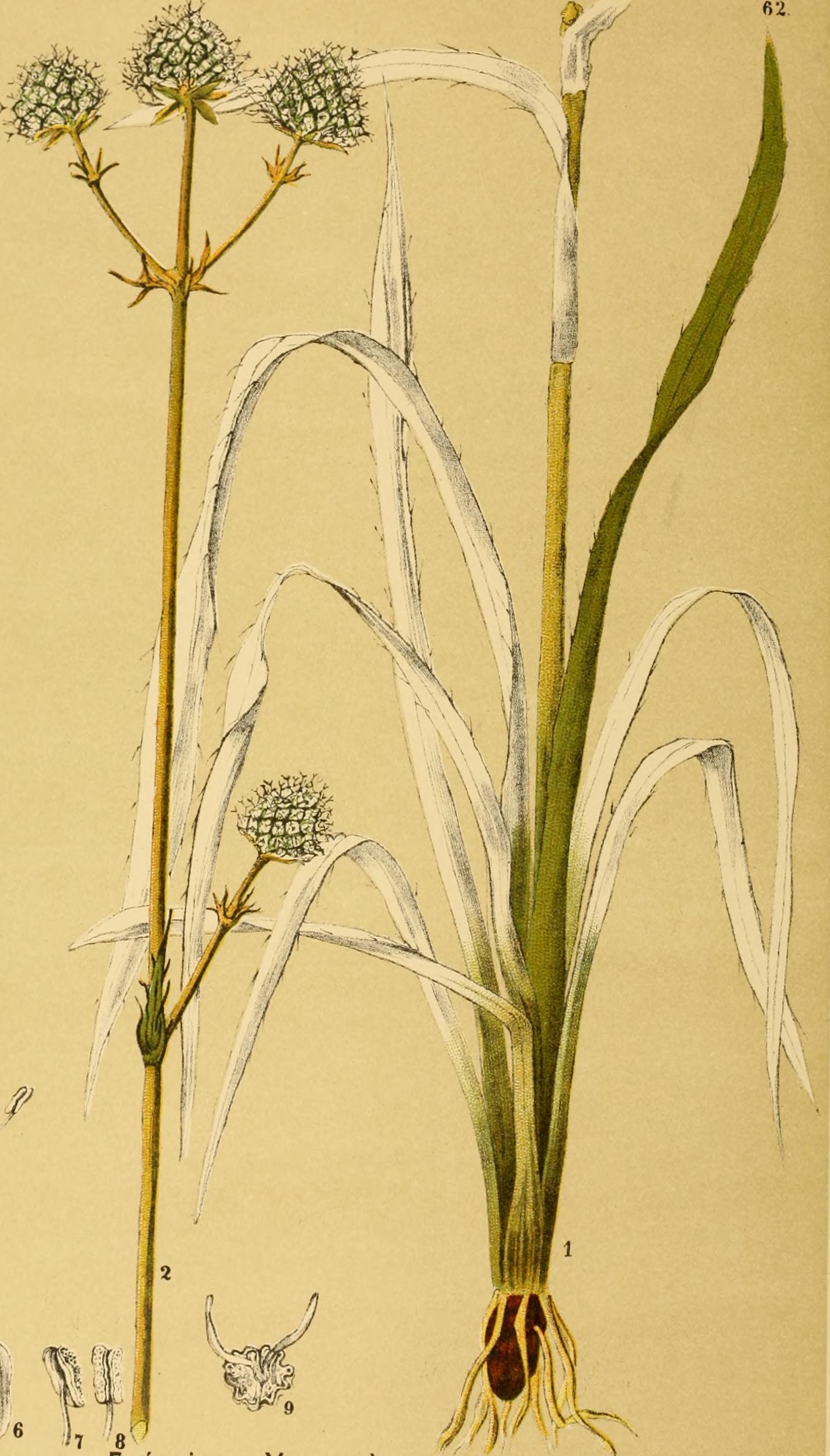
N. ORD-UMBELLIFER^. 62 GENUS.— ERYNGIUM,* TOURN. SEX. SYST.— PENTANDRIA DIGVNIA. ERYNGIUM. butto:n' sj^akeroot. SYN.— ERYNGIUM YUCC^FOLIUM, MICHX.; E. AQUATICUM, LINN. (IN PART). COM. NAMES.— BUTTON SNAKBROOT, RATTLESNAKE MASTER, ERYNGO, CORN SNAKEROOT; (FR.) PANICANT D'EAU; (GER.) WASSERMANNSTREU. A TINCTURE OF THE ROOT OF ERYNGIUM YUCCEFOLIUM, MICHX.f Description. — This peculiar, sedge-like perennial grows to a height of from r to 6 feet. S/cm smooth, erect, and grooved. Leaves linear, six inches to two feet long, and one-half to one inch wide, taper-pointed, coriaceous, rigid, parallelveined, gramineous, and remotely bristly-fringed upon the margins. Injioj^esceiue in a terminal compound umbel, each peduncle bearing a compact head; heads broadly ovate; bracts entire, paleaceous, not spinous; flowers inconspicuous, white, all fertile, closely sessile; leaves of the invohicels mostly entire, and shorter than the heads. C«/ia- 5 -toothed; tcetli persistent, /t'/a/j connivent, oblong, emarginate. Styles filiform. Fruit top-shaped, covered with little scales or tubercles, having no ribs and scarcely any vittre, the inner face of each mericarp flat or nearly so. Umbelliferse. — This large and very natural order, of herbs, represented in North America by 50 genera and 187 species, is characterized as follows: Stems usually hollow and striate. Leaves alternate, mostly compound; petioles sheathing or expanding at the base. Lnfloresccnce in terminal, compound umbels, often subtended by a whorl of bracts (involucre), usually also subtending the umbellets {involucel); flowers small, in many genera dichogamous. Calyx adherent to the whole face of the ovary: iiiub minute, entire or 5-toothed. Petals 5, usually inflexed at the point, imbricate or valvate in aestivation. Stamens 5, alternate with the petals, and inserted with them upon the disk. Ovary 2-carpelled, surmounted by the fleshy disk that bears the petals and stamens; ovules 2, anatropous; styles 2, distinct, or united at their thickened bases; stigmas simple. Fruit a cremocarp, consisting of 2 coherent achenia {mericarps) which separate along the middle interval [commissui-e), and are usually suspended from the summit of a slender * 'Epoyeiv, eryi;ein, to belch, from carminative properties. t A mucli better name than E. aquaticum, Linn., as the plant never is truly aquatic with us.
62-2 prolongation of the axis [carpophore]; fnericarps marked lengthwise by 5 primary ribs, and often with 5 secondary intermediate, in the interstices or intervals between these ribs are commonly lodged few or many oil-tubes [vittce), which are longitudinal canals in the substance of the fruit, containing aromatic oil. Seeds suspended from the summit of the mericarp; embryo minute; albumen hard. The flowers in this order are so minute, and so nearly alike in all genera, that the differentiation is usually, in great part, based upon the cremocarps. Besides the seven species treated of in this work, we have provings of the following plants: The Persian Ammoniacum [Dorema Ammoniaciim,'Don.), a fetid, stimulating, discutient gum-resin; the European Celery {Apiiim gravcolens, Linn.), which, though an acrid poison when growing in wet places, is a delightful salad when cultivated; the Thibetan Asafoetida [Narthex AsafaHida, Falc), a fetid, stimulant, and antispasmodic gum-resin; the Central European Athamantha [Peuccdajium Oreoselinuvi, Moench), an aromatic and powerful stimulant; the North European and Asiatic Water Hemlock [Ciciila virosa, Linn.), a dangerous, acrid, narcotic poison; the European Sea Holly [Eryngmm maritimitrn, Linn.), a sweet, aromatic, tonic and diuretic; the Italian Giant Fennel [Ferida glanca, Linn.), a stimulating antihysteric; the Mediterranean Fennel Seed {Fuenicuhiiii officinale, Allioni.),an aromatic stimulant and carminative; the European and North Asiatic Cow-Parsnip, Branca Ursina {Heracleiim Sphondylium,]J\nn.), an acrid vesicant; the subtropical Indian Pennywort [Hydrocotyle Asiatica, Linn.), noted as a remedy for leprosy, ichthyosis, and rheumatism; the European Masterwort [httperatoria ostruthium, Linn.), a febrifuge, antiperiodic, and masticatory in toothache; the European Hemlock Dropwort [G£nantJie crocata, Linn.), a narcotico-acrid poison of great virulence; the Sardinian Parsley {Petrosclinum sativum, Hoff.), a noted diuretic pot-herb; the European Water Dropwort [Pkellandniim aqiiaticum, Linn.), which partakes of the poisonous nature of CEnanthe, but is less dangerous; the Levantine Bibernell or Burnet Saxifrage {Pimpinella Saxifraga, Linn.), an astringent, masticatory, also used to remove freckles; the Central Asiatic Sumbul {Fertda Suuibul, Hook., f), a Russian "specific" for cholera, that failed and was afterward used as an antihysteric, and remedy for hypersecretive mucous membranes; the Northern Europe and Asiatic Caraway {Carum Carui, Linn.), a wellknown aromatic stimulant and condiment; and lastly, the European Water Parsnip [Slum laiifolium, Linn.), an acrid, narcotic poison. Many other species are used in general medicine.* The European Turbith {Laserpitium latifolium, Jacq.), yields an acrid, bitter, caustic, and violently purgative gum-resin. The European genus Anthriscus, yields two species, A. sylvestris, Hoff., and A. vulgaris, Pers., that are acrid, narcotic poisons; while A. Cerefolium, Hoff., is an agreeable pot-herb, called Chervil. The South Russian Cachrys odontalgica. Pall, is, as its name denotes, a remedy for aching carious teeth. The Indian and Levantine Fructus Ptychotis [Carum Ajowan, Bend.), is carminative, and the oil antiseptic. The European and Levantine genus Pim* Concerning this order it is noteworthy, that those which grow near water are generally acrid, narcotic poisons, while those seeking dry soils are little else than carminative.
62-3 pinella yields the well known Anise (/'. Anisuni), an aromatic stimulant and carminative, as well as P. dissecta, Retz., and P. magna, Linn., which have properties similar to those of P. Saxifraga, mentioned above. The genus Ferula, which includes Narthex, yields the following substances, beside Sumbul and Asafcetida mentioned above: African Gum Ammoniacum from P. tinp-i(ana,'\Jmv\.\ Persian Galbanum is produced by P. Galbanifiua, and P. rubricaidis, Boiss.; it saction is considered to be intermediate between asafoetida and ammoniacum. Asafoetida is also produced by P. Scorodosrna, Bentl., and P. alliacca, Bois. {P. Asafirtida, Linn., cannot be decided upon. It was founded upon Kaempfer's descriptions and fragmentary specimens, neither of which are conclusive. — Bentley). The European genus, Peucedamim, contains, beside Athamantha, the following medicinal species: Sulphur-wort {P. officinale, Linn.), reputed diuretic and antispasmodic; Marsh Parsley {P. pahistre, Moen.), a famous Courland remedy for epilepsy; and Dill {P. graveolens, Hiern.), a stimulant and carminative. The European and Asiatic Coriander {Coriandrum sativum, Linn.), is an aromatic stimulant and carminative; the Levantine Cumin [Cumiuum Cymi)ium, Linn.), a stimulant, carminative, and discutient. The European genus, Daucus, yields the common Carrot (Z?. Carrota, Linn.), whose seeds are diuretic, and root a well known esculent; while the Sicilian D. gummifer. Lam., and Corsican D. Gingiduni, Linn., are supposed to yield the Bdellium of the old Pharmacopoeias.* Opoponax is a fetid deobstruent, and antispasmodic gum-resin, produced by the juice of Pastinaca Opoponax, Linn. The Alpine Lovage {Ligusticum levisticum, Linn.), is carminative, stimulant, diuretic, and emmenagogue. The root of the European Astrantia major, Linn., is acrid and purgative. The European Eringo [Pryngium campestre, Linn.), is considered by Boerhaave, the first of aperient, diuretic roots. It has been also recommended in gonorrhoea, hepatic and intestinal obstructions, and suppression of the menses, and considered aphrodisiac; its scope is considered larger than that of the Sea Holly mentioned above. The Italian Bracala [Angelica nemorosa, Ten.), furnishes the Neapolitans with a remedy for the itch. Samphire, a saline aromatic, is the product of Crithuui maritimum, Linn. Alexanders are the aromatic fruits of the European Smyrnium Olusatrum, Linn., formerly used instead of celery. Asa Dulcis — in contradistinction to Asa Fetida — which enjoyed the highest reputation among the ancients, as an antispasmodic, emetic, deobstruent, and diuretic,j- is yielded by Phapsia garganica, Linn., or the nearly allied P. sylphium; the resin of the root is said to be fully as active and thorough a vesicant as croton oil; it deserves a careful proving. Numerous other species have held a place in medicine, and deserve mention, but the above list covers their action. Beside the edible species already mendoned, carrots, parsnips, celery, and chervil, many other plants of this order are eaten. Prangos fabidaria, Lindl, is suggested by Royle to be the Lvl^iov of the Greeks, mentioned by Alexander's * India Bdellium is referred to Bahamodendron mukul, and African Bdellium to B. Africanum, Am. (Burseracea;). f This was the Laser cyrenaicum of Cyrene, a drug in high reputation among the ancients for its medical uses; it had miraculous powers assigned to it, such as neutralizing the effects of poison, curing envenomed wounds, restoring sight to the blind, and youth to the aged. So great was its reputation that the princes of Cyrene caused it to be struck on the reverse of their coins; and the Cyrenian doctors were reckoned among the most eminent in the world. Its value was estimated by its weight in gold. — Lindley.
62-4 historians as a highly nutritious food for cattle, and even man, of heating and fattening qualities. The American Aborigines use several species, prominent among which Mr. Dodge* mentions the following: "Dill {Peuccdaiium graveolens, Wats.), called by the Snakes and Shoshone Indians Yampah. — This spindle-shaped root grows in low, timbered bottoms, and is esteemed as the best of its kind when used for food. It is analogous to the parsnip, and is an article of commerce among the Indians. The seeds are used to Havor soup." " Podosciadium Californicum, Gray. — The tubers of this species form one of the dainty dishes of the Oregon Indians. They are black, but when boiled like potatoes they burst open lengthwise, showing a snowy-white farinaceous substance, which has a sweet, cream-like taste, with a slight parsley flavor. It is an excellent root, the cultivation of which might prove useful among the whites." " Kouse root [Peucedanum ambigmaii, Nutt.). — The root of this plant is dug in April or May when in bloom. It grows on hills and mountains which are so poor that grass will not grow upon them. When fresh it is like the parsnip in taste, and as it dies becomes brittle and very white, with an agreeable taste of mild celery. It is easily reduced to flour. When its brown epidermis is removed, innumerable small dots are revealed. Both the roots and the flour will keep several months. It is sometimes called bread or biscuit root by travelers, and Kouse root by the Indians of Oregon and Idaho. The Canadians know it by the name of Racine blanc. Alter the bread has been made a short time, its taste is not unlike that of stale biscuits. When the roots have been pounded fine, the flour is pressed into flat cakes, one foot wide, three feet long, and from a quarter to half an inch thick, of an oblong rectangular form, with a hole in the middle by which they are fastened on the saddles when traveling. The cakes have a ribbed appearance, caused by being laid on sticks stretched over the tent fires, for the purpose of smoke-drying or baking the bread. When broken up the bread has a coarse, granulated appearance, especially when not ground very fine, and is very insipid." History and Habitat.— Eryngium Yucciefolium is indigenous to North America, where it ranges from New Jersey to Wisconsin and southward. It habits damp or dry prairies and pine barrens, and blossoms in July and August. This species was valued highly by the Aborigines as an alexiteric, and, combined with Iris versicolor, as a febrifuge and diuretic; since their time it has come into use by first the laity, then the physician, as a stimulant, diaphoretic, sialogogue, expectorant, diuretic, and alterative. A decoction of the root has been found useful in dropsy, nephritic and calculous disorders; chronic laryngitis and bronchitis; irritation of the urethra, vaginal, uterine, and cystic mucous membranes; gonorrhoea, gleet, and leucorrhoea; mucoid diarrhoea; local inflammations of the mucous membranes; exhaustion from sexual depletion with loss of erectile power, seminal emissions, and orchitis. By some physicians it has been preferred to Seneka snakeroot for its sphere, and by others it has been considered fully equal to Contrayerva. The powdered root is said to make a fine escharotic * U. S. Agric. Rep; 1S70, ]ip. 405-7.
62-5 application to fungoid growths and indolent ulcerations, preventing gangrene, and stimulating them to resolution. The plant is not officinal in the U. S. Ph.; in the Eclectic Dispensatory the preparation recommended is Decoctum Eryngii. PART USED AND PREPARATION. — The fresh root, gathered after the fruits are fully ripe, is chopped and pounded to a pulp and weighed. Then two parts by weight of alcohol are taken, the pulp mixed thoroughly with one-sixth part of it, and the rest of the alcohol added. After having stirred the whole well, pour it into a well-stoppered bottle, and allow it to stand for eight days in a dark, cool place. The tincture, separated by decanting, straining, and filtering, has a clear reddish-orange color by transmitted light; an odor much like that of an old chest that has been shut up with oil-cloth for some time; a bitterish, acrid, and terebinthic taste; and an acid reaction. It leaves a sensation deep in the throat, much like that following Senega. CHEMIOAL CONSTITUENTS. — This root yields its properties to both water and alcohol, and probably contains an acrid, volatile oil, a bitter principle, and sugar. No analysis has been made of the root; the tincture, however, shows the presence of a small amount of resin. PHYSIOLOGICAL ACTION. — According to the experiments of Drs. C. H. McClelland, C. H. Coggswells, and W. G. Jones, Eryngium causes, in doses of from 5 to 150 drops of the tincture: Depression of spirits; vertigo and headache; irritation of the palpebral mucous membrane, followed by purulent discharges; inflammation of the eustachian tube, followed by a discharge of fetid pus; a similar condition of the nasal and pharyngeal mucous membranes; nausea and burning in the stomach; colic; constipation, with tenesmus; frequent desire to urinate, with a decrease in quantity daily passed; stinging, burning sensation in the urethra, severe pain in left testicle, depression of sexual desire, followed by excitation, lewd dreams, pollutions, and discharges of prostatic fluid; a sensation of dyspnoea, and constriction of the throat;* and slight increase in the heart's action. Description of Plate 62. I and 2. Whole plant, from St. Augustine, Fla., Aug. 2d, 1886. 3. Flower. 4. Calyx and styles. 5 and 6. Petals. 7 and 8. Stamens. 9. Fruit. (3-9 enlarged.) * This symptom followed my tasting the tincture for the above description, and became, in half an hour, so strong as to be decidedly uncomfortable. — C. F. M.
63.:">/V' |!m. adnatdei.etpinxt PASTINACA SATIVA, Linn
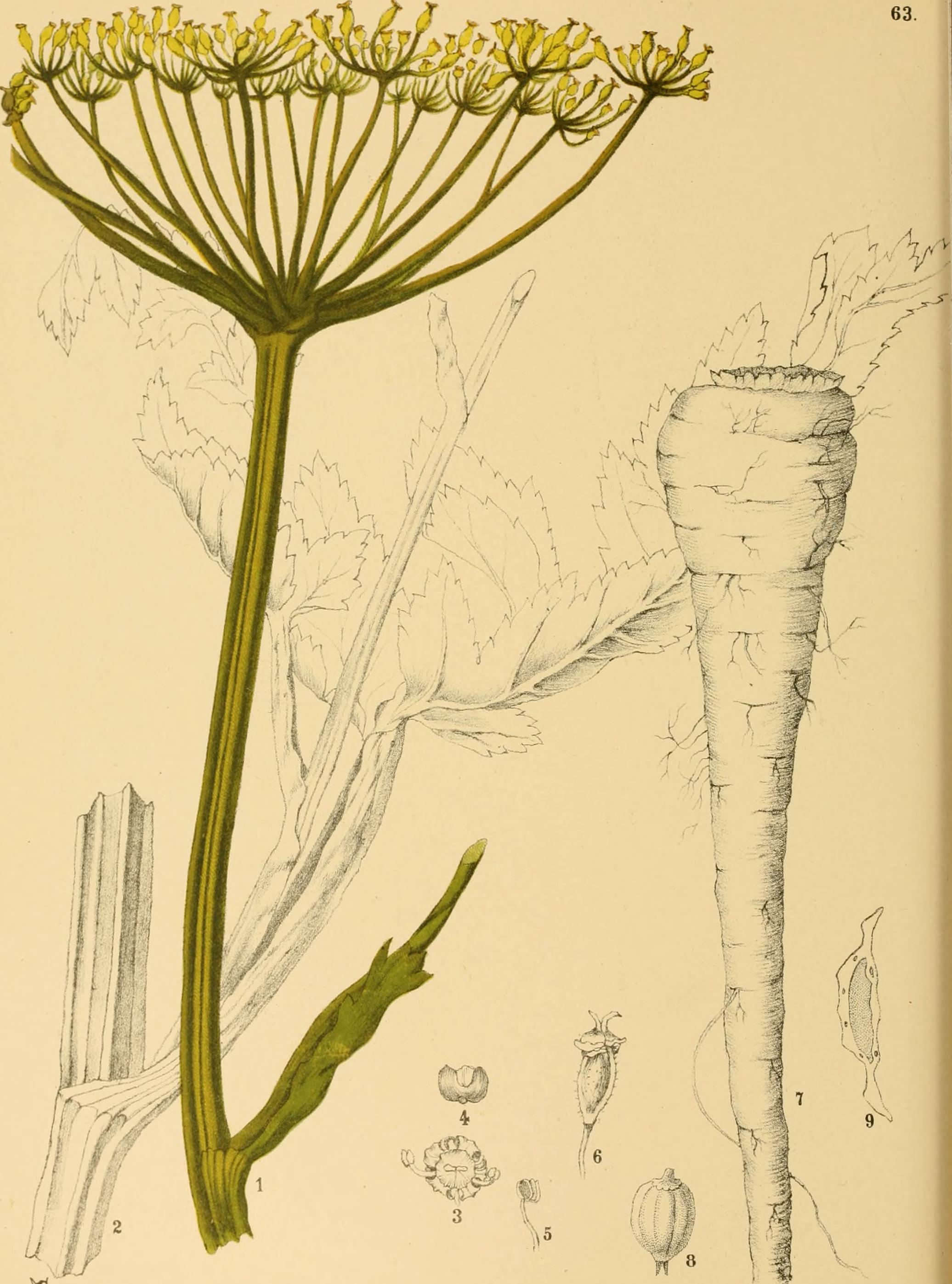
N. ORD-UMBELLIFER/E. 63 GENUS.— PASTINACA,* TOURN. SEX. SVST.— PENTANDRIA DIGVNIA. PASTINACA. PARSJflP. SYN.— PASTINACA SATIVA, LINN. COM. NAMES.— GARDEN PARSNIP OR PARSNBP; (PR.) PANAIS POTAGER(GER.) PASTINAKB. A TINCTURE OF THE FRESH ROOT OF PASTINACA SATIVA, LINN. Description. — This usually cultivated biennial herb grows to a height of from 3 to 6 feet. Root conical, long and slender, fleshy and succulent. Sfe?n smooth, deeply and plentifully grooved. Leaves pinnately compounded of 3 to 8 pairs of shining leaflets; lcaflctso\2X^ or oblong, obtuse cut-toothed or coarsely serrate, the terminal 3-lobed, all somewhat pubescent beneath; /^//<?/£'j sheathed. Umbels large and flat; involucre and involucels small or absent; f!o:i>crs 2^ perfect, none radiant. Calyx-teeth obsolete. Petals yellow, roundish, entire, involute; point broad and retuse. Fricit oval, flat, with a thin, single-winged margin; carpels minutely 5-ribbed, 3 of which are dorsal and equidistant, 2 lateral and at or near the margin; vittcc as long as the carpel, i in each sulcus, 2 in the commissure; albumen flat. History and Habitat. — The Parsnip is a well-known culinary root, introduced into this country from Europe. It has now run wild in fields and waysides throughout the central and eastern parts of the United States, where it flowers from July to October. The root is succulent, nutritious, sweet and in its cultivated state very pleasant to many, but when wild or in its second year's growth, it is rank and acrid poisonous, causing emesis and inflammation of the alimentary tract, followed by flatulent colic and diuresis. The seeds have been used in agues, with what curative action I cannot state. In the north of Ireland a kind of beer is made by brewing the roots with hops; a good wine is also made in some places from them; and by distillation a sort of rum is produced similar to that of the sorghum product. PART USED AND PREPARATION. — The roots of the second year's growth, or those of wild individuals, are prepared and macerated as in the previous plant. The resulting tincture is almost colorless, being but slightly tinged with yellow; is very gummy, has a peculiar honey-like odor, a sweet taste, and an acid reaction. * Paslus, nourishmem.
63-2 CHEMIOAL CONSTITUENTS. — No analysis has yet been made to determine an active principle. Sugar abounds in the root, also starch and a gummy extractive. PHYSIOLOGICAL ACTION. — Several cases of poisoning are recorded from the use of the wild or old roots. The symptoms following their ingestion are: Illusions of sight, dilated pupils, vertigo, difficult breathing, weak, slow pulse, and quiet delirium dependent upon the visions. In Dr. Pupcke's cases, where seven children ate of the cooked wild roots,* "all labored under 'delirium tremens,' they were in constant motion, talked incessantly, without knowing what they said, and fancied they saw objects which had no existence; they fought with each other, and occasionally had attacks of convulsive laughter; they rejected everything that was offered them, and were obliged to be restrained by force." All the symptoms of the drug point to severe gastric irritation, with reflex action upon the brain and spinal cord. Description of Plate 63. I. Summit of a wild individual in young fruit, Binghamton, N. Y., June 26th, 1885. 2. Part of stem. 3. Face of flower. 4. Petal. 5. Stamen. 6. Ripe pistil. 7. Root. 8. Seed. 9. Section of a carpel. (3-6 and 8-9 enlarged.) * Pharm. Jour., 1S48, 184.
U4.ad nat.del.et ArCHANGELICA AtROPURPUREA,Hoffm.
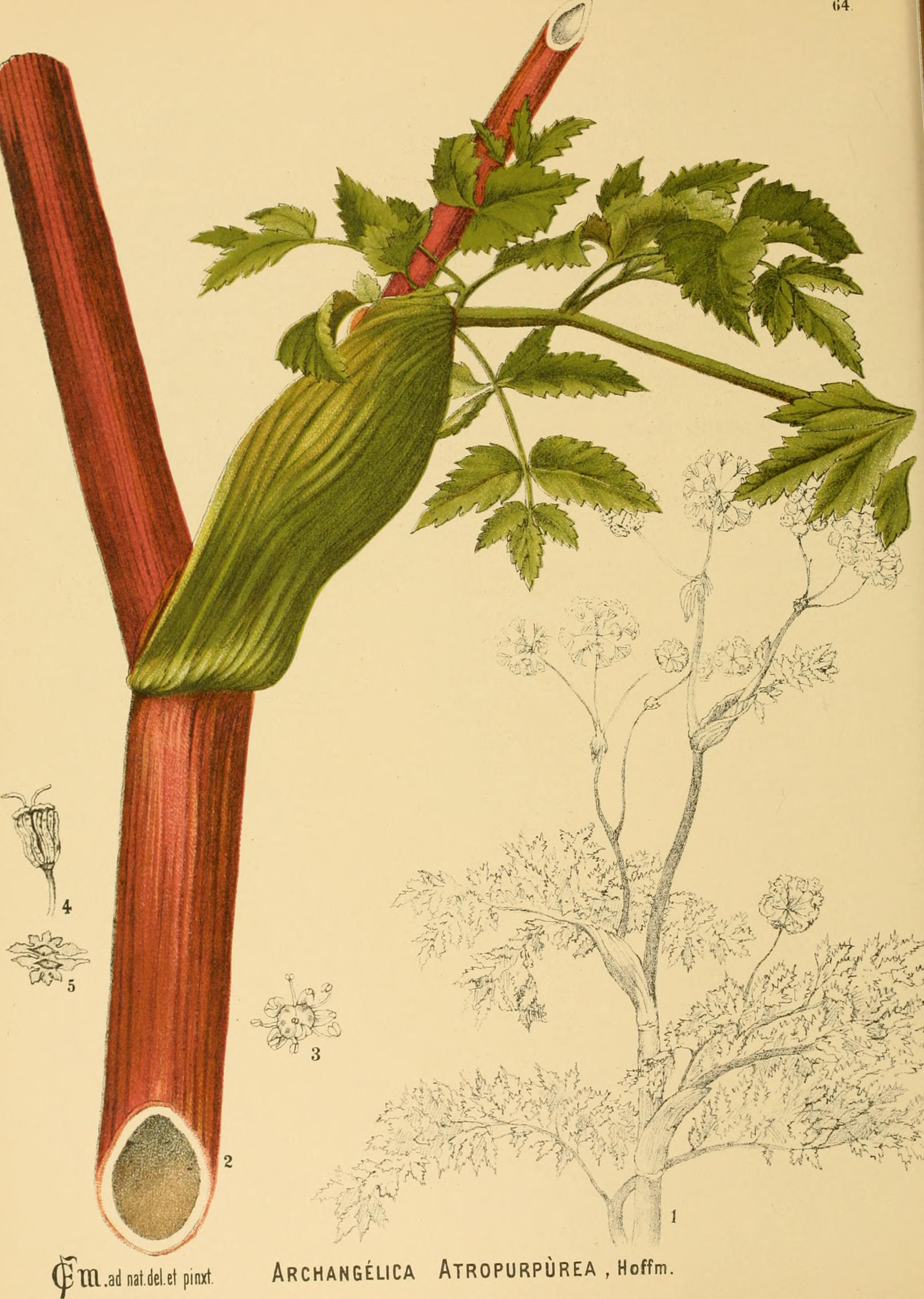
N. ORD. UMBELLIFER/E. 64 GENUS.— A RCHANGELICA,* HOFFM. SEX. SYST.— PENTANDRIA DIGVNIA. ANGELICA ATROPURPUREA. GREAT AJYCELICA. SYN.-ARCHANGELICA ATROPURPUREA, HOFP.; ANGELICA ATROPURPUREA, LINN.; A. TRIQUINATA, MX.; IMPERATORIA LUCID A, NUTT. COM. NAMES.-COMMON ANG-ELICA,t HIGH ANGELICA. MASTERWORT.t (GBR.) PURPURFARBIGE ANGELICA. A TINCTURE OF THE WHOLE PLANT ARCHANGELICA ATROPURPUREA, HOFF. Description. — This strong-scented, perennial herb grows to a height of from 4 to 6 feet. Root somewhat conical. Stem very stout, smooth, dark-purple, and hollow. Leaves 2 to 3 ternately-compound; leaflets 5 to 7 pinnate, ovate, sharply cut-serrate, acute, and pale beneath, the three terminal ones often confluent and somewhat decurrent at the base. Inflorescence a globular compound umbel. /;/vohccre little or none; involiicels of very short, subulate leaflets. Calyx with very short teeth. Petals ovate, entire, with the sharp tips infle.xed. Fruit smooth; carpels somewhat compressed, furnished with 3 rather prominent dorsal ribs, and the two lateral ones prolonged into marginal wings; I'ittce not on the pericarp, but surrounding the seed and adherent to its surface; seed convex upon the back and flattish upon the face, very loose in the pericarp. Read description of the order under 62. History and Habitat. — The Great Angelica is indigenous to North America, from Pennsylvania and Wisconsin northward, where it habits low grounds along streams, and flowers in June. When fresh the roots are poisonous, and are said to have been used for suicidal purposes by the Canadian Indians; when dried, however, they lose this quality, and are then considered carminative, diuretic, emmenagogue and stimulant. The dried root was often used, especially in combination with other and better-known diuretics, in anasarca and various diseases of the urinary organs; and alone in flatulent colic and suppressed menstruation. Dr. Schell claims § that * This name alluded to its supposed high angelic properties. f The common Garden Angelica is A. archangflica. X The true Masterwort is the European Impcratoria ostruthium, Linn.; the Cow Parsnip, IleracUum lanatitni, Linn., is often wrongly called by this name. \ I-am. Guide lo Health, 1856, corroborated in Ant. Jour. Horn. Mat. Med., i. 272.
64-2 doses of 15 to 20 grains of the dried root will cause a disgust for all spirituous liquors. The stems were often made into a candied preserve in some sections of the country — a practice now nearly extinct. Its uses, all in all, have been greatly similar to those of the Garden Angelica {^Angelica officinalis, Hoff; A. archangelica, Linn.). PART USED AND PREPARATION.— The whole plant, when in seed, is chopped and pounded to a pulp, and treated as in the preceding species. The tincture, after filtration, has a clear greenish-orange color, a somewhat terebinthic odor, a sweetish taste, and neutral reaction. CHEMICAL CONSTITUENTS. — This plant has not been specifically examined for the determination of its principles. Its oils, however, may be, in all probability, compared with those of Angelica arcJiangclica. PHYSIOLOGICAL ACTION.— Uninvestigated. Description of Plate 64.. Whole plant 9 times reduced, Binghamton, N. Y., July 6th, 1885. 2. Portion of upper stalk, showing petiole. 3. Flower (petals removed). 4. Pistil. 5. Horizontal section of fruit. (3-5 enlarged. )
65. f -^: VX TU.adnat.del.et pinxt. /LTHUSA CYNAPIUM, Linn. r ^»i^
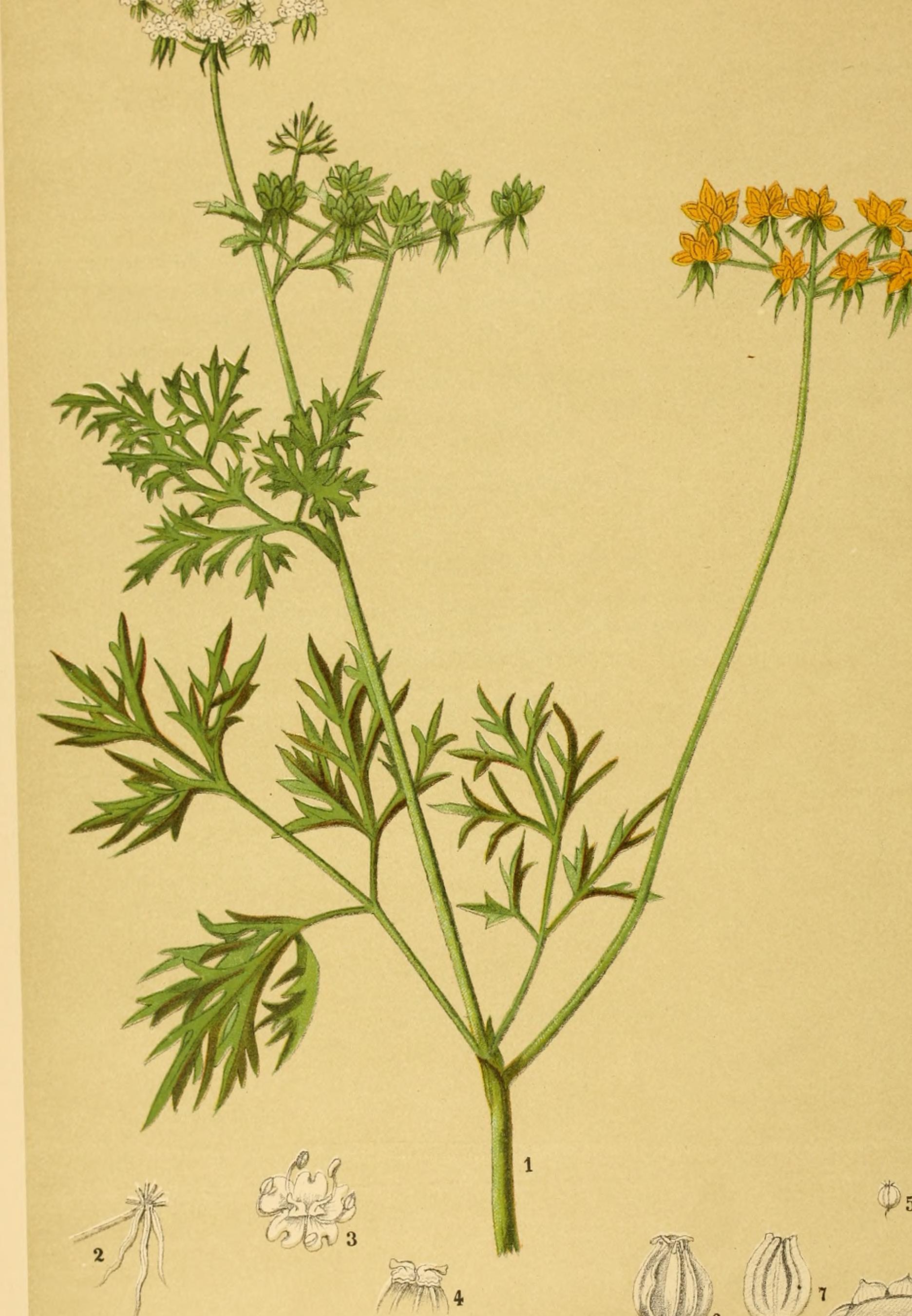
N. ORD -UMBELLIFER/E. 65 GENUS.— /E THUS A,* LINN. SEX. SYST.— PENTANDRIA DIGYNIA. ^THUSA FOOL'S PARSLEY. SYN.— ^THUSA CYNAPIUM, LINN.; CICUTARIA TENUIFOLIA, RAIL; C. FATUA, LOB.; CORIANDRUM CYNAPIUM, CRANTZ. COM. NAMES.— FOOL'S PARSLEY, DOG'S PARSLEY, DOG POISON, GARDEN HEMLOCK, LESSER HEMLOCK, SMALL HEMLOCK; (FR.) LA PETITE CIQUB; GER.) KLEINER SCHEILING, HUNDSPETERSILIE. A TINCTURE OF THE WHOLE PLANT.■ETHUSA CYNAPIUM, LINN. Description.— This fetid annual herb attains a growth of from 8 inches to 2 feet. Skm erect, unspotted, striate, and fistulous. Leaves dark green, 2-3-ternately compound, many cleft; divisions pinnate, wedge-lanceolate, obtuse. Umbels terminal and opposite the petioles; rays very unequal; involii-cre none; invohicels one-sided, 3-leaved, the leaves erect while the buds are immature, but become long, narrow, and pendent when in full flower and fruit. Floivcrs white; calyx teeth obsolete; petals obovate, appearing emarginate, or even obcordate, by the inflexion of the tip. Fniit ovate- globose, not much if at all flattened either way; carpophore 2-parted;?ucricarps, each with 5 thick, sharply-keeled ridges; vittcs, single in the deep intervals, and 2 in the commissure at its base. History and Habitat. — The Fool's Parsley is indigenous to Europe and Siberia, from whence it has been introduced into this country where it now grows, still sparingly, along roadsides and waste places about culdvated grounds, in New England, and from there to Pennsylvania, flowering in July and August. On account of the many cases of poisoning by the inadvertent use of this herb for parsley, from which it is easily distinguishable,-]- very little use has been made of it by physicians. By the early writers it is so often confounded with Conium, that it is very difficult to trace its history. The first author to characterize it was Hermolaus Barbaras, who called it Cictita terrestris minor e; it is also mentioned by Matthiolus, Jonston, Jungius, Miiller, and others, all speaking of its peculiar effects when eaten. Its action has been generally considered like that of Conium, but milder, and its principal, if not its only use, was in some forms of obstinate cutaneous disorders. It is not mentioned in the U. S. Ph., nor is it found in the Eclectic Dispensatory. * KlBiaaa, aitliusso, to Set on fire; in reference to the.acrid taste of the plant. t.Ethusa has much darker-green foliage than Parsley, a nauseous smell, white flowers, and the leaf-sections are much more acute.
65-2 PART USED AND PREPARATION. — The whole fresh plant, when in flower and fruit, is treated as directed under Eryngium (62). The resulting tincture has a clear, orange-brown color by transmitted light; a fetid, disagreeable odor; an acrid taste; and an acid reaction. CHEMICAL CONSTITUENTS. — Cyiiapin. This alkaloid was discovered by Ficinus, who describes it as crystallizing in prisms that are soluble both in alcohol and water, but not in ether, and as having an alkaline reaction, and forming a crystallizable salt with sulphuric acid.* Walz describes an alkaloid, resulting as a volatile oily liquid, in which he is upheld by the experiments of Bernhart,-j- who succeeded in isolating a like substance, which he describes as having a strong alkaline reaction, an exceedingly penetrating, offensive odor, and as being soluble in alcohol. The body seems, as yet, to have received no further investigation. PHYSIOLOGICAL ACTION. — The following excerpt, from one of the prominent botanical journals.^ being of late date, serves to introduce this rubric: "'Foots Parsley' not Poisonous. — For several centuries the plant ^lEt/nisa Cynapitim, L., has been the object of suspicion, and classed among poisons by botanists and toxicological writers. But now Dr. John Harley, of England, comes forward and presents a vindication of what he calls 'an innocent and harmless plant.' In the St. Thomas' Hospital Reports, he relates a number of facts to prove the correctness of his conclusions. The juices of the plant, from the root as well as from the leaves, were obtained by expression just before flowering, and also after the plants had reached maturity and set fruit. Being thus provided with a supply of material, representing the active properties of the plant, he exhausted it upon four patients, — one a little girl, four years old, who took the extract in quantities ranging from 2 drachms to 2 ounces; himself, who took it in quantities ranging from 2 to 4 fluid ounces; and two other adults, who were the subjects of spasmodic wry-neck. These two took one or other of the juices, in doses ranging from I to 8 fluid ounces. Effects were anxiously looked for, but absolutely none followed in any of the cases. Dr. Harley therefore feels compelled to assert that.P.tlmsa Cynapinm of Sussex, Essex, Kent, Surrey, and Hertfordshire, is not only absolutely free from the noxious properties attributed to it, but that it is pleasant to sight, smell, and taste, and, in the absence of the more fragrant and succulent plants, might well be used as a pot-herb or salad. He is satisfied, further, that his conclusions are independent both of locality and season, and that the only influence which these conditions have on Fool's Parsley, as on hemlock [Conmvi maadahim), is to increase or diminish its succulency. Dr. Harley, some years ago, made some observations on the last-mentioned plant, and came to the same conclusion in regard to its innocuous nature that he has concerning that of the.Ethusa. In connection with this, it may be stated that Coniuvi maadatum, in northern latitudes — Russia for example — is eaten with impunity, although precaution is taken to first boil it in several waters. This subject of the harmlessness, under certain conditions, of plants reputed to be poisonous, recalls to mind the * Wittslein. f Arch, de Pha,:, i8So, 117 {Am. Jour. Phar., 1880, 204^. % Bull. Tory. Club, 1881, 9.
65-3 statement of Linnaeus, in his Flora Lapponica, that the Norlanders prepare from the leaves of Aco7iitum Napellus a broth, which they eat without any injurious effects resulting therefrom." The following cases of poisoning by the drug, serve, however, to show its action upon the system: " A boy, six years of age, having eaten some of this herb, by mistake for Parsley, at 4 o'clock in the afternoon, commenced immediately to cry out in great pain, and complained of great cramps in the stomach. Whilst taking him home the whole body became excessively swollen, and of a livid hue; the respiration became difficult and short, and he died toward midnight. Another child was poisoned in the same manner, but he was fortunate enough to vomit up the herb. This, however, did not prevent many symptoms manifesting themselves; he talked wildly, and in his delirium he thought he saw numbers of dogs and cats." — [Orjiia, vol. ii, p. 324.) " Gmelin has related the case of a child who died in eight hours, in consequence of having eaten the /Ethusa. The symptoms were spasmodic pains in the stomach; swelling of the belly; lividity of the skin; and difficult breathing." —{Oiris., p. 365.) " A woman gave two of her children soup, in which some of this was boiled. They were both seized with severe pain in the abdomen, and next morning there was perfect unconsciousness; the lower jaw was spasmodically fixed; abdomen tumid; vomiting of a bloody mucus, and constant diarrhoea; cold extremities; convulsions; and death in twenty-four hours. Post-mortem appearance: redness of the lining-membrane of the oesophagus, and slight vascular congestion of slomach and duodenum." — [Medic, yakrbttch.) "Another child, who had eaten the bulbs by mistake for young turnips, was suddenly seized with pain in the abdomen, followed by nausea, without vomiting; could not swallow; vacuity; inability to answer questions; lower jaw fixed; insensibility and death an hour after the commencement of the symptoms." — (Med. Times, August 23, 1845.) "A healthy, strong man, about thirty-five years of age, a publican,, ate a handful of Fool's Parsley, with nearly the same quantity of young lettuce, about I o'clock p. M.; in about ten minutes he was affected with a pain in the stomach and bowels, attended with a rumbling. He walked out in the fields, but was seized with such languor, weariness, and weakness, that he supported himself with difficulty. He was much troubled with giddiness in the head; his vision was confused, and sometimes objects appeared double. At 7 o'clock he got an emetic, which brought up, he supposes, all the Fool's Parsley, but none of the lettuce; this relieved him of the unpleasant symptoms in the stomach, but the other sensations continued, and he passed a restless night. Next day he had much pain in his head and eyes, which last were inflamed and bloodshot. He had different circumscribed swellings in his face, which were painful and inflamed, but they were transient, and flew from place to place. On the Saturday his eyes were highly inflamed, painful, and entirely closed by the surrounding inflammation. He was
65-4 bled, which gave him much relief in his face and eyes. From this time until the Monday, he continued to get better, but had, even then, pain, heat, and inflammation of the eyes, with oedematous swelling of the cheeks; his remaining symptoms went off gradually." — {Lozi'e.) Riviere relates that a person died after taking this plant. " His tongue was black; a brownish serosity was found in the stomach; the liver was hard, of a yellow color; the spleen livid; but the body was not at all emphysematous." The symptoms of poisoning by this drug show, according to Schulze, that its chief action is upon the medulla spinalis. On Animals. — Seven ounces of the juice of the leaves were given to a strong dog, and the oesophagus tied. Twenty minutes thereafter the dog became sick; in half an hour it did not seem to affect him much, when suddenly he stretched out his limbs and lay upon his stomach; in a few minutes he tried to arouse himself, but his efforts were in vain. The muscles of the limbs, particularly of the posterior, refused to obey the will, but the organs of sense exercised their functions; the pupils were scarcely dilated; the pulsations of the heart were slow and strong. This state lasted a quarter of an hour, and then the extremities were agitated by convulsive movements; the animal threw himself from one side to the other, his senses began to be enfeebled, and the oesophagus and fauces were spasmodically contracted. This state of stupor increased, and the animal died an hour after taking the poison. On opening the body the heart was found to be contracted, and the left ventricle contained fluid and black blood; the lungs were a little less crepitant than natural. The stomach was found full of the poison, but there was no alteration of the digestive canal.* Description of Plate 65. 1. End of flowering plant. 2. Bract of the involucel. 3. Flower. 4. Stigmas. 5. Fruit. 6. Dorsal view of a mericarp. 7. Commissural view of same. 8. Section of same. (2, 4, and 6 enlarged.) Orfi/o, vol. ii, 323.
(pm.adnatdeletpinxt ThASPIUM AUREUM Var APTERUM, Gray.
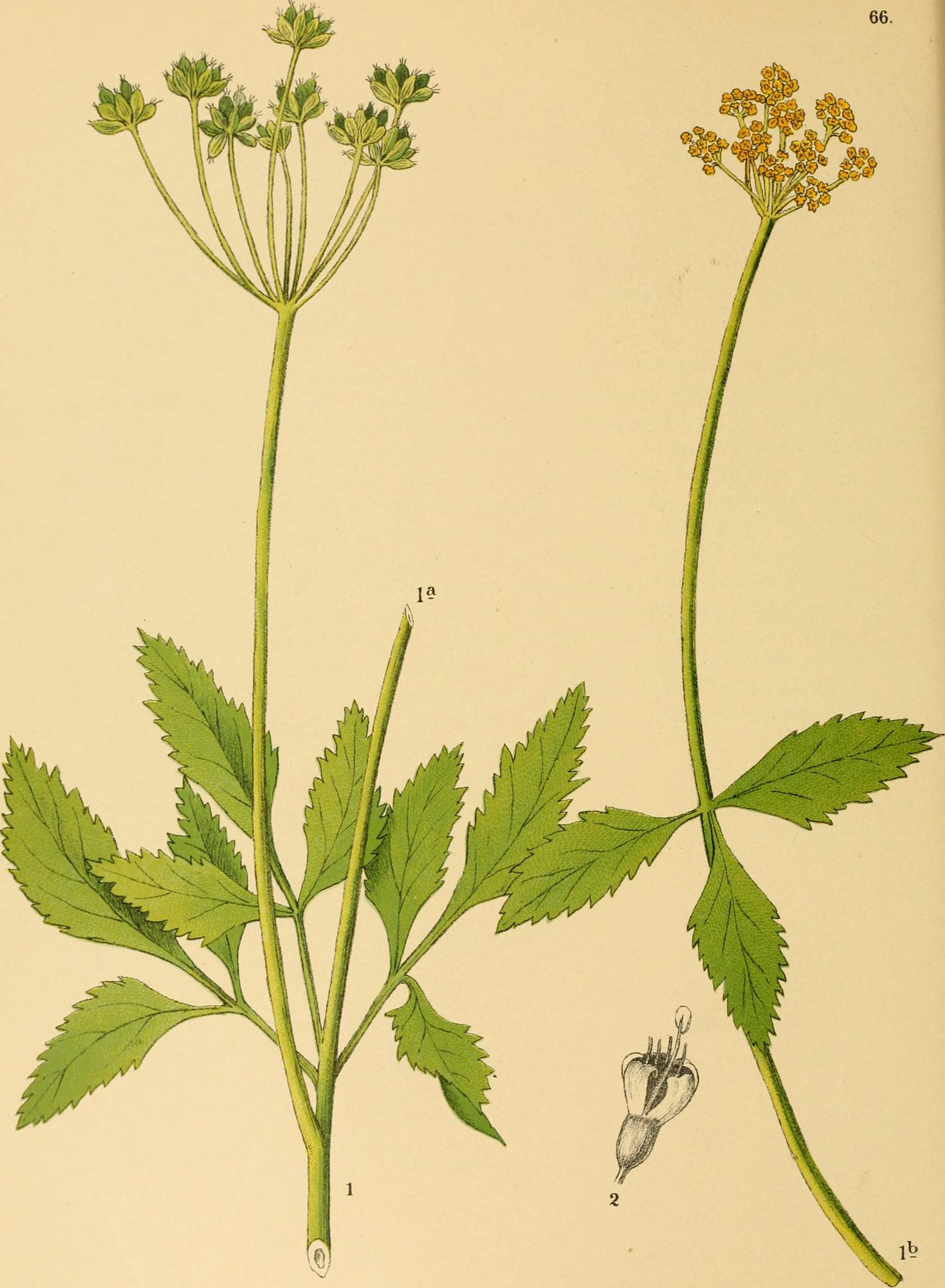
N. ORD -UMBELLIFER^. 66 GENUS.— TH AS PI U SEX. SYST.— PENTANDRIA DIGVNIA. GENUS.— TH ASPIUM,* NUTT. Z I Z I A.' MEADOW PARSJyiPS. SYN.— THASPIUM AUREUM, NUTT.; ZIZIA AURBA, KOCH.; SMYRNIUM AURBUM, LINN.; SMYRNIUM LUTEUM, MUHL.; SMYRNIUM ACUMINATUM, SMITH; SISSON TRIFOLATUM, MICHX.; SISSON AUREUS, SPRENG. COM. NAMES.— MEADOW PARSNIP, GOLDEN MEADOW PARSNEP, GOLDEN ALEXANDERS, ROUNDHEART; (GER.) GOLDEN PASTINAKE. A TINCTURE OF THE WHOLE PL.A.NT THASPIUM AUREUM, NUTT. Description. — This erect, perennial herb attains a height of from i to 3 feet. Roof tap-shaped, 2 to 4 inches long hy yi to ^ of an inch in diameter, yellow internally. Leaves i- to 2-ternately parted or divided; loiuer leaves on long petioles, sometimes simple or more or less cordate; upper leaves sessile or nearly so; leaflets.\ to 2 inches long, oblong-lanceolate, cut serrate, the bases elongated cuneate. Inflorescence axial or terminal compound umbels, on long, naked peduncles; invohicr-e inconspicuous or absent; pedicels 10 to 20 elongating in fruit; involucels minute, few-leaved; floivers deep, orange-yellow. Calyx teeth obscure. Petals oblong, terminated by an inflexed tip. Fruit oval-oblong, somewhat flattened or laterally contracted; ridges lo-winged; transverse section orbicular; vittce solitary in each sulcus, and 2 in the commissure. Read description of the natural order, under Eryngium, 62. History and Habitat. — The Meadow Parsnip is quite a common indigenous plant on the moist banks of streams, and in open, wet woods, where it flowers in June and July. I find no mention of this plant in medical literature. The genus is spoken of by Rafinesque| as vulnerary, antisyphilitic, and sudorific. PART USED AND PREPARATION. — The whole fresh plant (the prover used only the root) is chopped and pounded to a pulp and weighed. Then two parts by weight of alcohol are taken, the pulp mixed thoroughly with one-sixth part of it, and the rest of the alcohol added. After having stirred the whole well, pour it into a well-stoppered bottle, and allow it to stand eight days in a dark, cool place. * A play upon the genus Thapsia, named from the Isle of Thapsiis. ■j- I have retained the name under which the plant was proven. See second synonym. X Med. Bot., vol. ii, p. 267.
66-2 The tincture, separated from this mass by straining and filtering, should have a deep brownish-orange color by transmitted light, no distinguishing odor, a slightly bitter taste, and strong acid reaction. It leaves a numb, furry sensation upon the tongue, something like the impression left by tincture of aconite. PHYSIOLOGICAL ACTION. — The Meadow Parsnip appears to uphold the general action of the Umbelliferae, and act specifically in a similar manner to yCthusa. The symptoms of those proving the drug under the direction of Dr. E. E. Marcy are those of a nerve irritant. The only report of a toxic quantity being taken is that by Judge Gray of a young lady who ate a large root. In this case violent vomiting followed immediately, ejecting the root in time to ward off any farther action.* Description of Plate 66. f t. la to il>, upper part of plant, Ithaca, N. Y., June 3d, 18S0. 2. Flower (enlarged). * Marcy, in Ency. Pure Mai. Med., vol. x, p. 634. t This Plate has been tilled Thaspitim aureum, var. apertum: hut the seed, the c«i!y characteristic of var. aperltwi, having been omitted, it reverts to its proper title — i. e., Thaspium aureum, Nutt. Shortly after taking note of the physical properties of the tincture here recorded, — during which I made many futile atttmpts to detect a characteristic odor and taste, and took proliably about 10 minims, — the tongue felt fuzzy and numb. This sensation was followed by a feeling as if the tongue had been sc.tlded with hot tea; my eyes began to water and smart; I ceased writing, and threw myself upon my lounge (12 M.); my face then began to feel suffused with blood and soon became hot, especially the cheeks and forehead; drowsiness followed, and I fell into a distressingly dreamy sleep, lasting an hour. When I awoke (1.30 P. M.) all symptoms had passed away except the scalded sensation of the tongue, which lasted fully an hour longer.
«7. ^m. id nat del.et pinxt. 3 CiCUTA MACULATA.Linn 41
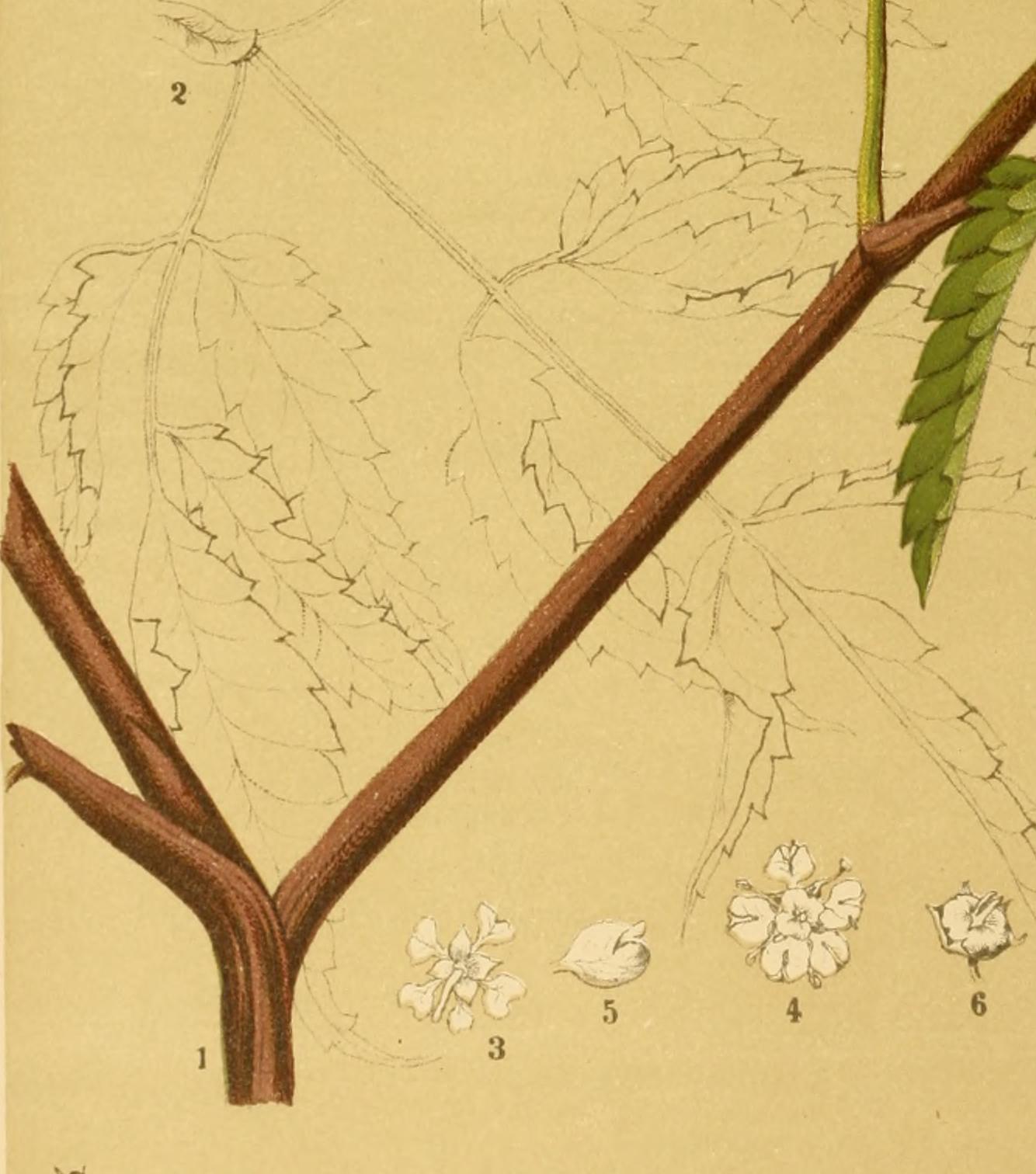
N. ORD -UMBELLIFER^. 67 GENUS.— CICUTA,* LINN. SEX. SYST.— PENTANDKIA DIGYNIA. CICUTA MACULATA. WATER HEMLOCK. SYN.— CICUTA MACULATA, LINN.; CICUTARIA MACULATA, LAM.; SIUM DOUGLASII, (?) D. C. COM. NAMES.— AMERICAN "WATER HEMLOCK, SNAKE"W"EED, BEAVER POISON, MUSQUASH ROOT, SPOTTED COWBANE, DEATH OP MAN, CHILDREN'S BANE; (PR.) CIQUE D'AMERIQUE; (GER.) AMERIKANISCHER WASSERSCHIBRLING. A TINCTURE OF THE FRESH ROOTS OF CICUTA MACULATA, LINN. Description. — This poisonous marsh perennial attains a growth of from 3 to 6 feet. Root a fascicle of several oblong, thick and fleshy tubers. Stem stout and smooth, fistulate, streaked with purple {not maculate), or when growing in open places deep purple, and in shady situations wholly green. Leaves bi-ternately compound, the lower on long petioles; leaflets oblong-lanceolate, pointed, and sometimes lobed; margins mucronately coarse-serrate, the veins ending in the notches. Lnjloi'escence in long peduncled, axillary umbels; involucre few leaved or wanting; involucels 5 to 6 leaved; leaflets linear; flotvers white. Calyx minutely 5-toothed; teeth acute. Petals obcordate, with an inflexed, pointed tip. Fruit aromatic, almost globular, geminate, and a little contracted at the sides. Carpels with 5 strong, flattish ribs, the lateral ones marginal; vittce large, single in the intervals, double in the commissure; seeds terete. Read description of the order under Eryngium, 62. History and Habitat. — The Water Hemlock is indigenous to the United States from Florida and Mississippi northward, where it grows in wet places, and flowers in June and July. Cicuta had, until the publication of Dr. Bigelow's work,f been considered more as a poison than a drug, a few practitioners only using very small doses as a substitute for conium, and some of the laity, litde knowing its toxic properties, as a gargle in sore throat. Rafinesque claims that its roots were eaten by such Indians as were tired of life and desired a speedy demise. Later the powdered leaves were employed to a limited extent to alleviate the pain of scirrhus cancers. Cicuta plays no part in any system of medicine except the homoeopathic. * The ancient Latin name, in reference to the hollow stems of this genus, the name Cicuta designating the hollow joints of reeds from which pipes were made, f Am. Med. BoL, Boston, 1817.
67-2 The specific name luaciilata is badly chosen, as the stems, as far as I have observed, are never spotted, nor do I find any record of such a marking having been noticed; Dr. Bigelow modestly offers the ndsa^ fasciculata, which is true of the roots, and should be adopted, being much less like that of conium. Great similarity is said to exist between this species and the European C. virosa. Not having had an opportunity to examine the latter, I am at present unable to differentiate between them. According to descriptions, C. virosa has not a fasciculate root, and its umbels are larger in every way and much denser. PART USED AND PREPARATION.— The fresh roots, chopped and pounded to a pulp, are treated as in the preceding drug. The resulting tincture has a clear yellowish-amber color by transmitted light, the peculiar odor of the fresh root, a sweetish taste, and an acid reaction. CHEMICAL CONSTITUENTS. — Dr. Bigelow's examination of the root is the only attempt so far made toward an analysis; he procured a volatile oil and a yellow, inflammable resin. Mr. J. E. Young succeeded in obtaining a volatile alkaloid from the fruits, which he regarded as identical with conia. A glance, however, at the chemistry of C. vii^osa will not be out of place here: Cicutina. — This volatile alkaloid found in all parts of the plant by Wittstein, Polex, and others, remains as yet very imperfectly investigated; it is simply mentioned by Wittstein as having been obtained in an aqueous solution. Oil of Cumin. — This compound of several hydrocarbons, first obtained from the fruit of Ciwn)iiiin cyviiniiin, Linn., is proven by Trapp to be identical with the oil of this species. Two of the hydrocarbons are identified as follows: Cicuten, C,„H,|, (Van Ankum), boils at 166*= (330.8° F.), is dextrogyrate, sp. gr. at 18° (64.4° F.), 0.87038, and is soluble in alcohol, ether, and chloroform; Cymol, CjijHj^, a colorless oil of great refractory power and the odor of lemons, having a sp. gr. at /5° (59° F.) of 0.86, and a boiling point at 172° (341.6° F.). Cicutoxin. — This amorphous, resinous body, in all probability identical with that found by Bigelow in the root-juice of C. inaciilata, was isolated and named by Trojanowski. PHYSIOLOGICAL ACTION. — Many cases of poisoning from the root of this ■species have been reported, all showing, by the symptoms, that cicuta produces great hypersemia of the brain and spinal cord. The following case, reported by letter to Dr. Bigelow by Dr. R. Hazeltine (1818),* gives all the symptoms noted by observers in other cases: A boy had eaten of certain tuberous roots, gathered in a recently-ploughed field, supposing them to be artichokes, but which were identified as the roots of Cicuta maculata. His first symptom was a pain in the bowels urging him to an ineffectual attempt at stool, after which he vomited about a teacupful of what appeared to be the * Bigelow, Am. Med. Bot., vcl. iii., iSl.
67-3 recently-masticated root, and immediately fell back into convulsions which lasted off and on continuously until his death. The doctor found him in a profuse sweat and "convulsive agitations, consisdng of tremors, violent contractions and distortions, with alternate and imperfect relaxations of the whole muscular system, astonishing mobility of the eyeballs and eyelids, with widely-dilated pupils, stridor dentium, trismus, frothing at the mouth and nose, mixed with blood, and occasionally violent and genuine epilepsy." The convulsive agitations were so powerful and incessant, that the doctor " could not examine the pulse with sufficient constancy to ascertain its character." At the post-mortem no inflammation was observed, the stomach was fully distended with flatus, and contained "about three gills of a muciform and greenish fluid, such as had flowed from the mouth; this mass assumed a dark screen color on standing." Description of Plate 67. I. Part of flowering branch, Binghamton, N. Y., July 2d, 1885. 2. Leaf. 3. Flower, showing calyx. 4. Face of flower. 5. Petal. 6. Pistil and calyx. 7. Stamens. (3-7 enlarged.)
■4^ ^^lU.adnat.del.et pinxt CONiUM M AC U LATUM, Linn.
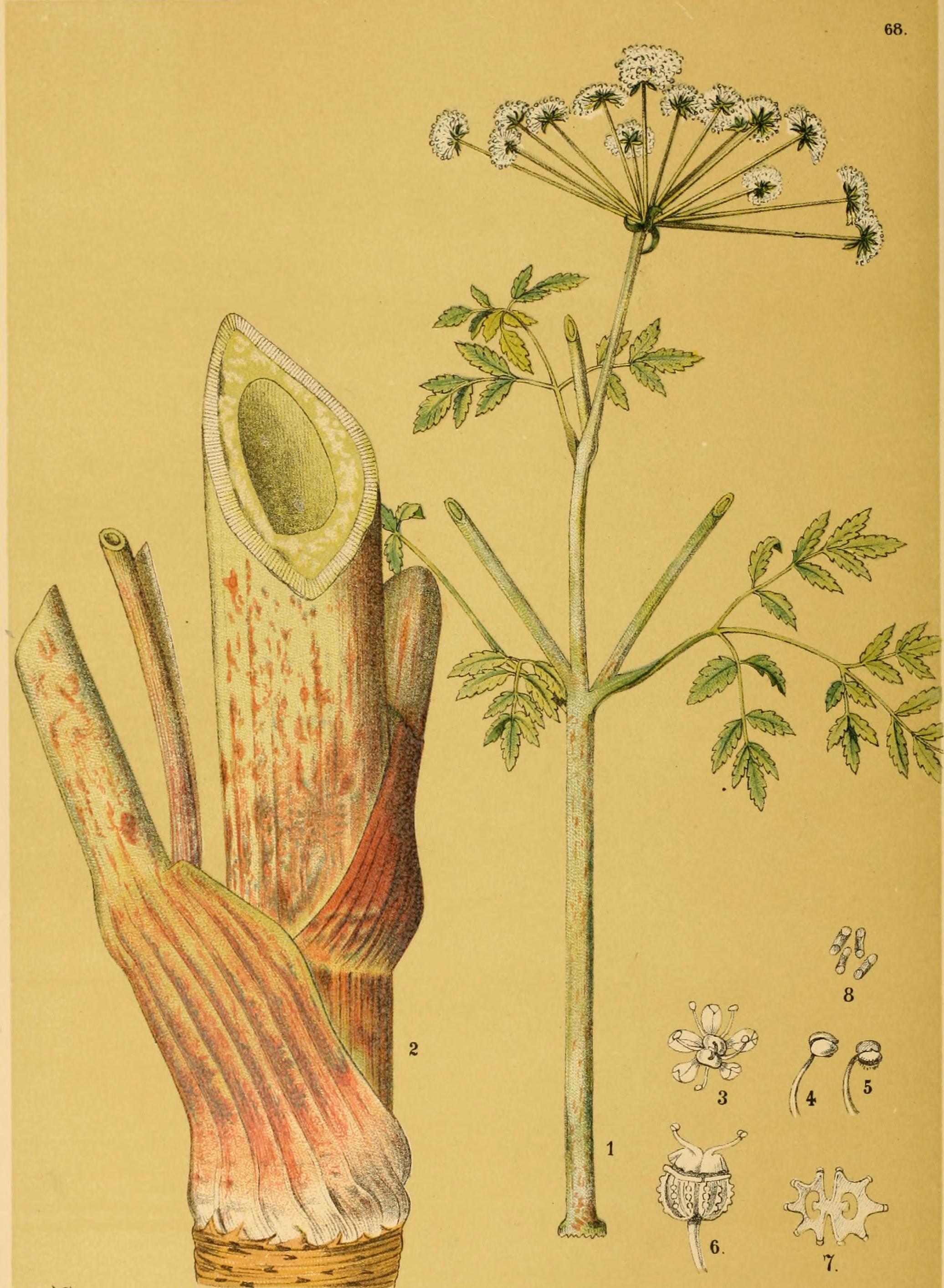
N. ORD -UMBELLIFER^. 6a GENUS.— CON I UM,* LINN. SEX. SYST.— PENTANDRIA DIGYNIA. CONIUM. POISO.ir HEMLOCK. SYN.— CONIUM MACULATUM, LINN.; C. MAJOR, BAUH.; CORIANDRUM CIGUTA, CRANTZ.; C. MACULATUM. ROTH.; CICUTA MACULATA, LAM. (not Linn.); C. VULGARIS MAJOR, PARK.; CICUTARIA VULGARIS, CLUS. COM. NAMES.— WILD OR POISON HEMLOCK, STINK-WEED, t SPOTTED POISON PARSLEY, HERB-BENNBT; (FR.) GRAND CIQUB, CIQUE ORDINAIRE; (GER.) SCHIERLING. A TINCTURE OF THE FRESH PLANT, EXCLUDING THE ROOT, OF CONIUM MACULATUM, L. Description. — This large, unsavory, biennial herb, grows to a height varying from 2 to 6 feet. Rooi fusiform, sometimes forked. Stem erect, hollow, smooth, and striate, stout below, corymbosely branching above, the whole dotted and splashed with crimson beneath the white, pulverent, easily detached coating that pervades the whole plant except the leaves and flowers. Leaves generally large, decompound, somewhat deltoid in outline; common petioles with broad striate sheathing bases; segments lanceolate pinnatifid; lobes bright green, acute and regularly serrate. Inflorescence terminal, flat-topped, compound umbels; involucre about 3-leaved; leaves lanceolate, acuminate, deflexed; involucels about 5-leaved, shorter than the umbellets, and situated to the outside of them; leaves lanceolate; rays numerous, straight; flowers small, white. Petals obtuse or somewhat obcordate, the apices incurved. Calyx teeth obsolete, the limb forming a thickened crowning ring in fruit. Stamens but slightly longer than the petals; anthers white. Fruit orate, turgid, laterally flattened, the crown retaining the divergent styles, each of which, together with its dilated base, greatly resembles the depicted headgear of the mediaeval court jester. Carpels with 5 prominent, nearly equal, papillose ribs, the lateral ones marginal; vittce none; seed with its inner face marked by a deep and narrow longitudinal sulcus. History and Habitat. — Conium is indigenous to Europe and Asia. It, however, has become thoroughly naturalized in this country, where it grows in waste places, usually by river-sides. It blossoms during July and August. * KJi'tioK, koneion; from (Jio,-, konos, a top, judged by Hooker to be so named on account of the whirling vertigo caused by the poison. f A name more commonly applied to Datura Stramonium.
68-2 The history of this fetid, poisonous plant, dates back to about the fifth century before Christ. From the careful observations of many pharmacographists and historians, there seems little doubt that the Grecian State potion used at Athens as a mode of execution of those condemned to death by the tribunal of Areopagus, was principally, if not wholly, composed of the fresh juice of the leaves and green seeds of this plant. It is the xuveiov which destroyed Thermanes, one of the thirty, Phocion, and Socrates, whose disciple he had been. Plato, in describing the potion, does not give it a specific name, nor mention its source, but terms the potion (papfiaxov, which means any strong drug, and not necessarily a poisonous one. In the writings of Eratosthenes also, it appears that the words xirsiv xidveiov mean to drink poison, and yMvsiov TtencMora, having drunk poison. yElian states that Cean old men, who, when they had become useless to the State, and tired of the infirmities of life, invited each other to a banquet, after which they drank xuveiov and died together. Although none of these accounts give the derivation of the potion, and notwithstanding the fact that Dioscorides' description of the plant is too general to distinguish the umbelliferous species he refers to, yet there are important reasons why we should feel perfectly satisfied that the Grecian xcoi'siov was the Conium of our materia medica: first, Sibthorp says* that Conium grows plentifully between Athens and Magara, and that no other plant of near so violent qualities grows in Greece; secondly, Cicicta virosa — supposed, by those who doubt Conium being the origin of the potion, to be the xi^veior — does not grow in Greece. The cicuta of later writers, is a Latin name, applied by the Romans to any and all poisonous umbelliferae, and even to other widely separate toxic plants; this term was unknown to the Greeks; thirdly. Dr. J. H. Bennett's case of poisoning by Conium gave symptoms almost identical with those given in the description of the death of Socrates; fourthly, later provings of Conium on man and animals, all point to it as being answerable to the symptoms mentioned. Cicuta causes convulsions even to opisthotonos, and sudden stiffness and immobility of the limbs; while Conium causes creeping muscular paralysis, with mayhap slight trembling, but no spasm; lastly, the words of the man who prepared the potion: " We only bruise as much as is barely sufificient for the purpose," would seem to indicate a simple; a man who spoke so clearly and definitely would hardly have used the word " bruise " had opium been added to the preparation, as some of the upholders of Cicuta claim, in trying to explain why spasms did not occur in this case. The first use of Conium in medicine is that of Dioscorides, who used it as a collyrium mixed with wine, and as a cataplasm in herpes and erysipelas. Pliny states f that the leaves keep down all tumors; and Anaxilaus claims that by anointing the mammae they ceased to grow. Avicenna| praised it as an agent for the cure of tumors of the breasts. It remained, however, for Baron Storck (1760) to introduce Conium into more general use; he found it effectual in curing scirrhus, ulcers, cancer, and many other chronic forms of disease. Bayle§ collected from various sources 46 cases of cancerous disease cured, and 26 ameliorated by the use of this drug. Conium has been recommended in jaundice, tic-douloureux, * Prod. Flor. Gr.,\,\'&T. f yW. //«/., b. xxvi, c. 16. % Lib.\\,(ib2. I Bib. Theinf.,m,(i\%.
68-3 syphilitic affections, enlargement of glands, especially those of a scrofulous nature, as a sedative in mania, chorea, epilepsy, laryngismus stridulus, pertussis, and various forms of nervous diseases. Like all other drugs used by the dominant school of medicine then and now, many physicians failed to get any effect whatsoever from this drug in the diseases specified by Storck and others; so frequent were the failures that most careful and protracted experiments in gathering, curing, preserving, and preparing the drug were resorted to, analyses were made, essays written, and finally serious doubts expressed as to Baron Storck's cases;* without once a thought that it might be adaptability to his cases, and not pharmaceutical preparation that caused the drug to cure. It is well known to us as homceopathists that Baron Sttirck had a " peculiar notion " as to the adaptability of drugs to diseased conditions, a notion very like the law that guides us to-day.f I can personally testify to the cure of one well-marked case of mammary scirrhus, by Conium. The case is as follows: Mrs. B complained to me of having experienced, for some months past, sharp stitching pains in the left mamma, extending thence in all directions, but especially through to the shoulder-blade, and upward and outward into the axilla; these stitches would awaken her at night, causing her sleep to be interfered with seriously. On examining the breast I found the nipple retracted and surrounded by a hard nodular lump, just movable, and about the area of a silver dollar. Her mother died of " a cancer of the breast " several years before. I prescribed Conium in a potency, one dose per diem. Within six weeks the subjective symptoms entirely passed away, four months after, the "tumor" was much softer and the nipple less cupped. The remedy was then stopped, and upon examining her to-day (nearly four years after the first dose), I find no vestige of the growth whatever, the mamma appearing entirely normal. Concerning the root of this virulent plant, Lepage | corroborates the assertion of Orfila, that the amount of alkaloid therein is very small; this accounts for the following experiences: Ray relates § that Mr. Petiver ate half an ounce, and Mr. Healy four ounces without experiencing any remarkable effect. Curtis says: || " Mr. Alicorn assures me that he has tried this (eating the roots) in every season of the year, and in most parts of our island, without feeling any material difference; and Mr. T. Lane informs me that he also, cautiously, made some experiments of the like kind, without any inconvenience; after many successive trials, he had some of the larger roots boiled, and found them as agreeable eating at dinner with meat as carrots, which they somewhat resembled;" Mr. Steven, a Russian botanist, states that the Russian peasants eat it with impunity, and concludes that the colder the climate the less poisonous is the root. Pliny says: T[ "as for the stems and * Woodville says {Med. Bot., i, io8):".... Nay, it never succeeded so well as when under his own direction or confined to the neighborhood in which he resided, and to ihe practice of those physicians with whom he lived in habits of intimacy and friendship. [A base imputation, unworthy of the author.— c. F. M.] The general inefficiency of Hemlock experienced in this country, induced physicians at first to suppose that this plant, in the environs of Vienna and Berlin, differed widely from ouis, and this being so stated to Dr. Storck he sent a quantity of the extract, prepared by himself, to London, but this proved equally unsuccessful, and to differ in no respect from the English extract." t Note also Baron Storck's use of Stramonium, as cited under that drug. % Jour. Pliar. et Chim., 1S85, 10. \ Phil. Trans., xix, 634. || Flor. Londhunsis. \ Nat. Hist., b. 26, c. xii.
68-4 stalks, many there be who do eat it, both green and also boiled or stewed between two platters." Notwithstanding all this, many children have been poisoned from eating the roots. Conium is officinal in the U. S. Ph., as Abstractiim Conii; Extractiun Conii Alcoholicum; Extractum Conii Fbiidjim, and Tinchira Conii. In the Eclectic Materia Medica the preparations are: Extractum Conii Alcoholicum; Unguentum Conii and Emplastruni Belladonnce Composifum* PART USED AND PREPARATION. — The entire fresh plant, with the exception of the root, should be gathered while the fruits are yet green, and prepared as in the preceding drug. The resulting tincture should have a clear madder color by transmitted light, and give an odor somewhat similar to that ot the bruised leaves, a taste at first sweetish, then similar to the odor, and an acid reaction. CHEMICAL CONSTITUENTS.— r^;z/rt,t C3H15N. This volatile alkaloid was discovered by Giseke in the leaves and fruit of this plant; Geiger, however, was first to purify it. Conia is a limpid, colorless, oily liquid, having the specific gravity of.89, and boiling at i63.°5 (328.°3 F.). It possesses a nauseous and sharp taste, and a disagreeable odor. It is soluble in cold water, in which solution it becomes turbid on the application of heat. Methylconine, C^Hj^NCHg. This alkaloid is also sometimes present in conium. It bears great resemblance to conia. Conydrine.t CgH^ON. A crystalline alkaloid melting at i20.°6 (249° F.), and boiling at 225° (437° F.). Paraconine, C^Hj-N. This fourth alkaloid, isomeric with conia, differs from it only in being atertiary base devoid of rotary power. Paraconine is liquid, and boils at i6o°-i70° (320°-338° F.). {Ut siip)-a, Schorlemmer.) Oil of Conium, C^Hj^N^O. A pale, yellow oil extracted from the seeds. This oil is also formed when nitrogen trioxide is passed into conia and the resulting liquid decomposed by water. Conic Acid. — This body, yet uninvestigated, exists in all parts of the plant and holds in solution the alkaloids present. PHYSIOLOGICAL ACTION.— No more fitting introduction to the action of this virulent spinal irritant could be written than the description, in Plato's "Phsedo," of the death of Socrates: "And Crito, hearing this, gave the sign to the boy who stood near; and the boy departing, after some time returned, bringing with him the man who was to administer the poison, who brought it ready bruised in a cup. And Socrates, beholding the man, said: ' Good friend, come hither; you are experienced in these affairs — what is to be done?' 'Nothing,' replied the man, 'only when you have drank the poison you are to walk about until a heaviness takes * Rosin, Belladonn,!, Conium, and Iodine. f Conine, Conicina, Conein, Coniin, Conicin. X Conydrina, Conhydria, Conhydrin.
68-5 place in your legs; then lie down— this is all you have to do.' At the same time he presented the cup. Socrates received it from him with great calmness, without fear or change of countenance, and regarding the man with his usual stern aspect, he asked: ' What say you of this potion? Is it lawful to sprinkle any portion of it on the earth, as a libation, or not?' ' We only bruise,' said the man, ' as much as is barely sufficient for the purpose.' ' I understand you,' said Socrates; ' but it is certainly lawful and proper to pray the gods that my departure from hence may be prosperous and happy, which I indeed beseech them to grant.' So saying, he carried the cup to his mouth, and drank it with great promptness and facility. "Thus far most of us had been able to refrain from weeping. But when we saw that he was drinking, and actually had drank the poison, we could no longer restrain our tears. And from me they broke forth with such violence that 1 covered my face and deplored my wretchedness. I did not weep for his fate so much as for the loss of a friend and benefactor, which I was about to sustain. But Crito, unable to restrain his tears, now broke forth in loud lamentations, which infected all who were present, except Socrates. But he observing us, exclaimed, 'What is it you do, my excellent friends? I have sent away the women that they might not betray such weakness. I have heard that it is our duty to die cheerfully, and with expressions of joy and praise. Be silent, therefore, and let your fortitude be seen.' At this address we blushed, and suppressed our tears. But Socrates, after walking about, now told us that his legs were beginning to grow heavy, and immediately lay down, for so he had been ordered. At the same time the man who had given him the poison examined his feet and legs, touching them at intervals. At length he pressed violently upon his foot, and asked if he felt it. To which Socrates replied that he did not. The man then pressed his legs and so on, showing us that he was becoming cold and stiff. And Socrates, feeling it himself, assured us that when the effects had ascended to his heart, he should be gone. And now the middle of his body growing cold, he threw aside his clothes, and spoke for the last time: ' Crito, we owe the sacrifice of a cock to ^sculapius. Discharge this, and neglect it not.' 'It shall be done,' said Crito; 'have you anything else to say?' He made no reply, but a moment after moved, and his eyes became fixed. And Crito, seeing this, closed his eyelids and mouth." Another case very similar to this was met with by Dr. J. H. Bennett.* A man ate a large quantity of Hemlock plant by mistake for parsley; soon afterwards there was a loss of power in the lower extremities, but he apparendy suffered no pain. In walking he staggered as if he was drunk; at length his limbs refused to support him, and he fell. On being raised, his legs dragged after him, or when his arms were lifted they fell like inert masses, and remained immovable; there was perfect paralysis of the upper and lower extremities within two hours after he had taken the poison. There was a loss of power of deglutition, and a partial paralysis of sensation, but no convulsions, only slight occasional motions of the left leg; the pupils were fixed. Three hours after eating the hemlock the respiratory movements had ceased. Death took place in three and one-quarter hours. It * Med. and Surs. Jour. Edin., 1845, 169.
68-6 was evidently caused by gradual asphyxia from paralysis of the muscles of respiration, but the intellect was perfecdy clear until shordy before death. The sequence of symptoms would seem to show in all of the many cases of poisoning by this plant that the drug acts primarily upon the spinal cord, causing a paralysis first of the anterior then posterior branches, and that from below upward until the medulla is reached. On Animals. — Linnaeus states that sheep will eat of the leaves, but horses and goats refuse them. Ray says that the thrush will feed upon the seeds, even when grain is plenty. Orfila* found that the powder and extract were generally harmless when given to animals, but that the juice or leaves of the fresh plant produced the most violent symptoms and death. Moiroudf gave a decoction of four ounces of the dried plant to a horse which had eaten three and a half pounds of the plant without effect. It caused dejection, stupor, dilation of the pupils, trembling, spasmodic trembling of muscles, grinding of teeth and copious sweats. It would seem, from experiments upon animals, that Conium is more poisonous to carnivora than to graminivora. Post-mortem. — In Dr. Bennett's case, there was slight serous effusion beneath the arachnoid membrane. The substance of the brain was soft on section; there were numerous bloody points, but the organ was otherwise healthy. The lungs were engorged with dark-red fluid blood; the heart was soft and flabby. The mucous coat of the stomach, that contained a green, pultaceous mass of the herb, was much congested, especially at the cardiac extremity; here there were numerous extravasations of dark blood below the epithelium, over a space about the size of the hand. The intestines presented patches of congestion on the mucous coat. The blood throughout the body was fluid and of a dark color. Description of Plate 68. I. Top of a flowering branch divested of three of its umbels, Binghamlon, N. Y., June 29th, 1S84. 2. Stalk at the root. 3. Flower. 4 and 5. Stamens. 6. Young fruit. 7. Section of ovary. 8. Pollen, X 250. (3-6 enlarged.) * Tox. Gen., ii, 309. | Pharm. Vet., 359.
^m. ad natdei.etpinxt. ARALIA RaCEMOSA Linn.
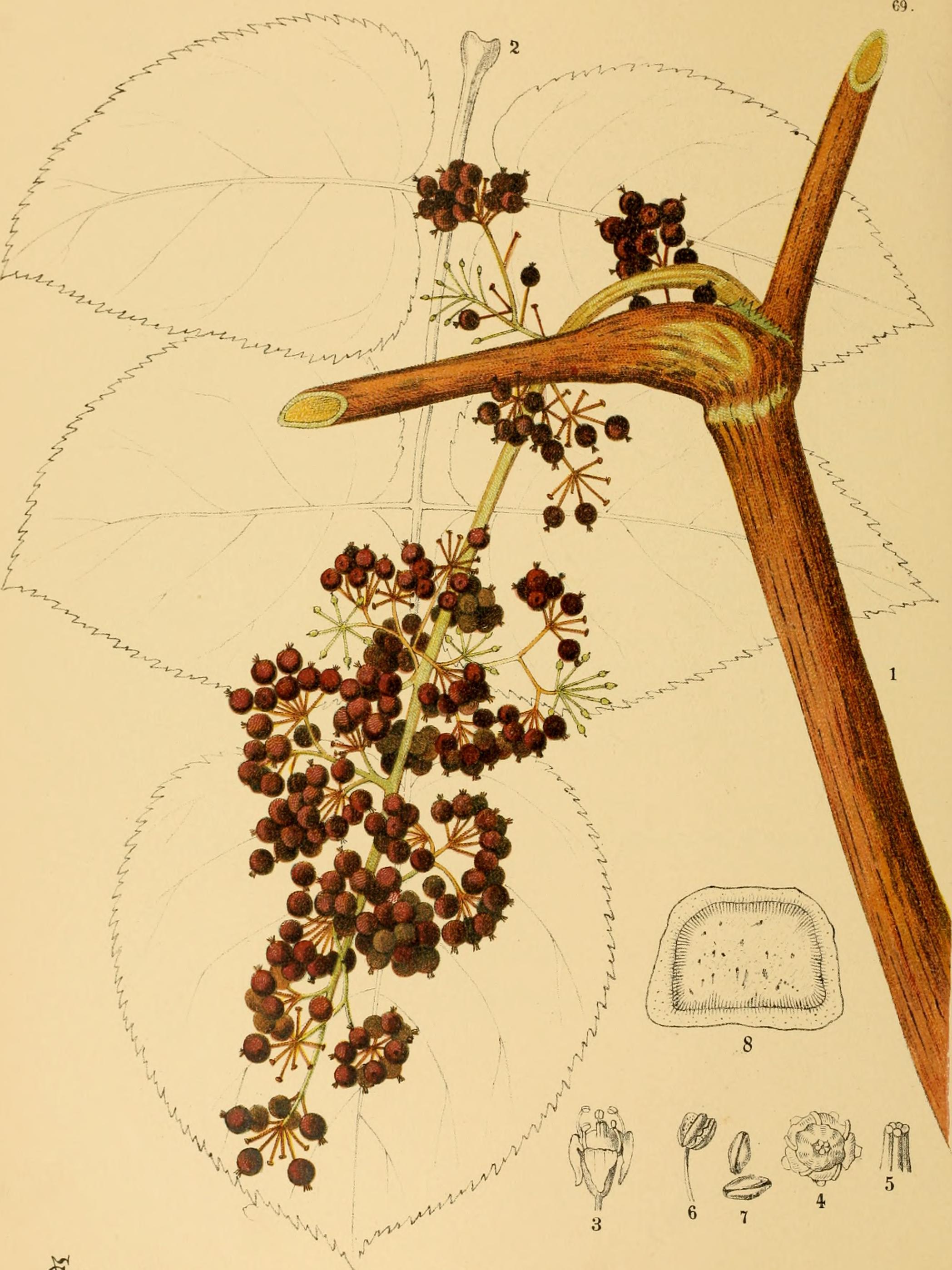
N. ORD -ARALIACE^. 69 GENUS.— A RA LI A,* TOURN. SEX. SYST.-PENTANDRIA PENTAGYNIA. ARALIA RACEMOSA. SPIKEJ^ARD. SYN.— ARALIA RACEMOSA, LINN. COM. NAMES.-SPIKENARD, AMERICAN SPIKENARD, PETTYMORREL, LIFE-OF-MAN, PIGEON-WEED; (PR.) NARD D'AMERIQUE; (GER.) AMBRIK ANISCHER ARALIB. A TINCTURE OF THE FRESH ROOT OF AR.\LI.\ RACEMOSA, LINN. Description. — This aromatic perennial attains a growtli of from 2 to 5 feet.f Root large, thick, spicy-aromatic; bark thick, whitish internally. Stein ligneously herbaceous, smooth, bifurcating, much branched, and devoid of prickles. Leaves very large, odd-pinnately compound; leaflets ovate-cordate, doubly-serrate, acuminate, slightly downy; stipules wanting, or represented by a serrate stipular membrane at the bifurcation of the branches and sometimes at the bases of the petioles. Inflorescence numerous axillary, compound, racemose panicles, or thyrsi. Flowers monceciously polygamous or perfect. Calyx coherent with the ovary; teeth 5, short, projecting upward between the petals. Petals 5, epigynous, obovate acute, reflexed-spreading, caducous. Statnens 5, epigynous, situated opposite the calyx teeth; filaments slender; anthers 2-celled, opening longitudinally. Ovary globular, 5-celled, somewhat lo-ridged; ovules anatropous, suspended, i in each cell; styles 5, closely clustered, sometimes united at the base, or in the sterile flowers entirely united; stigmas capitellate, or simply a stigmatic surface to the apex of each style. Friiit globular, aromatic, baccate drupes, retaining the persistent and now divaricate styles; embryo minute. AraliaceaB. — Many characters of this natural order are identical with the preceding (Umbelliferse), its distinguishing points are: Herbs, shrubs, or trees. Leaves sometimes simple but mostly compound or decompound. Inflorescence panicled or racemose umbels; ^otw/'j in our species more or less polygamous. Calyx: limb very short or wanting. Petals 5, not inflexed. Stamens 5. Fruit a berry or drupe with usually more than two cells; carpels not separating; albumen generally sarcous. This family affords, beside the two species represented here, the following plants used in medicine and the arts: The common Ivy {Hedcra Helix), at one time held in great repute as a preventive of drunkenness and antidote to the * Derivation unknown. f J. F. James mentions a plant 7 to S feet high, with leaves 3 feet long, and fruit 15 to 18 inches, in Bol. Gaz 1882, p. 122.
69-2 effects of "heady" wines; its blackish, gummy resin is used as a constituent of some varnishes (Griffith); the Amboyian Hedera umbellifcra [Aralia umbellifera, Lam.) yields a powerfully aromatic camphoraceous resin; and the Ceylon H. tcrebiiithacca one resembling turpentine. The American aromatic tonics False Sarsaparilla [Aralia nudicaulis) and the Angelica tree {A. spinosa) have just been dismissed from the Pharmacopoeia of the United States. Among the edible plants of this family are the Chinese Diatnorphantus edulis, Gunnera scabra, and G. maa-ocephala. The useful species of Panax are noted under the next drug. History and Habitat. — Spikenard is indigenous to Canada, and the United States southward to the mountains of South Carolina and westward to the Rockies. It grows along the rocky but rich banks of well shaded streams, and flowers in July. Concerning the previous use of this species, which was not so extensive as that of A. spinosa, nudicaulis, and hispida, Rafinesque says:"^ " A. racemosa is used by the Indians as carminative, pectoral and antiseptic, in coughs, pains in the breast (chest), and mortification; the root with horse-radish is made in poultice for the feet in general dropsy. The juice of the berries and oil of the seeds is said to cure earache and deafness, poured in the ears." Culpepper says:f "It is good to provoke urine, and cureth the pains of the stone in the reins and kidneys." In domestic practice it has been made into a composite syrup with the root of Inula helenium, and used as a remedy in chronic coughs, asthma, and rheumatism; a tincture of the root and fruit has also been used as a stomachic. No preparation of this plant is now officinal in the U. S. Ph. or Eclectic Materia Medica. PART USED AND PREPARATION. — The fresh root, the part used is large and thick, the bark is about /g inch in thickness, white internally and shows on section, many yellow resin cells, it readily peels off the ligneous layer surrounding the main bulk of the root. The central portion is somewhat dense, dotted with scattered bundles of woody fibre and surrounded by a ligneous sheath,'g inch thick. The tincture is prepared by chopping and pounding the root to a pulp, macerating it for eight days in two parts by weight of alcohol and filtering. It results as a clear, slightly brownish-orange liquid by transmitted light, having the peculiar, somewhat terebinthic odor of the root, a bitter astringent taste, and an acid reaction. CHEMICAL CONSTITUENTS.— No analysis of this plant has been published as far as I can determine. The analysis of A. spinosa, by Holden,J Elkins,§ and Lilly,|| will give us some idea of the probable nature of the phytochemistry of this species. * Med. Flor., vol. 2, p. 175. J Am. Jour. Phar., 1 880, p. 390. II Period, cit., 1882, p. 433. t Complete Herbal, London, \ Idem, p. 402. 1819.
69-3 Araliin. — This saponin-\\V& glucoside was discovered by Holden and purified by Lilly. It results as a slightly acrid, inodorous, whitish powder; soluble in water, insoluble in cold, strong alcohol, ether, and chloroform. Its watery solution yields a dense, persistent froth on agitation. It precipitates whiter from its solution in boiling alcohol when cold. Boiled with very dilute hydrochloric acid, it breaks down into glucose and Araliretin (Holden), a white, insoluble, tasteless and odorless, amorphous product. Alkaloid. — Elkin announced an alkaloid principle separable as a yellowish, amorphous, semi-transparent, bitter mass, soluble in water and ether, and answering to Mayer's test. Lilly failed to procure this precipitable body, but isolated a " bitter principle " having all its characteristics except that it was crystalline. Oil of Aralia (Elkins, Lilly). — An aromatic, somewhatc amphoraceous, acid body, having the characteristic odor of the root. An acrid resin, soluble in alcohol and ether, insoluble in water;*-]- tannin;* glucose;-j-J pictin;fj gum;f fat;* and starch,fj were also determined. PHYSIOLOGICAL ACTION.— The only account of the action of this drug that we have, is a proving by Dr. Sam'l A. Jones, of Ann Arbor, § in whom a dose of lo drops of the tincture caused a severe asthmatic fit, characterized by dry, wheezing respiration; obstructed inspiration; a sense of impending suffocation and inability to lie down during the attack; profuse night sweat during sleep; nausea; prostration; and difiicult expulsion of small, soft stool, accompanied by the abdominal sense of oncoming diarrhoea. I have had the pleasure of seeing drop doses of the tincture promptly relieve a similar case, in my own practice, in a half hour, and exert a beneficial effect in warding off recurring attacks. Description of Plate 6g. I. Portion of a fruiting stem, Binghamton, N. Y., Oct. 12, 1882. 2. A leaf, half natural size. 3. A flower. 4. Bird's-eye view of flower after removal of tiie anthers. 5. Styles. 6. Stamen. 7. Pollen X 300. 8. Section of the root. (3-6 enlarged.) * Holden, he. at. f Elkins,!oc. cit. % Lilly, loc. dl. \ Hale's New ReiruJies, p. 53.
<J2 GlU.aiinat.deI.ef pinxt. ArALIA QuINQUEFOLIA, Gray.
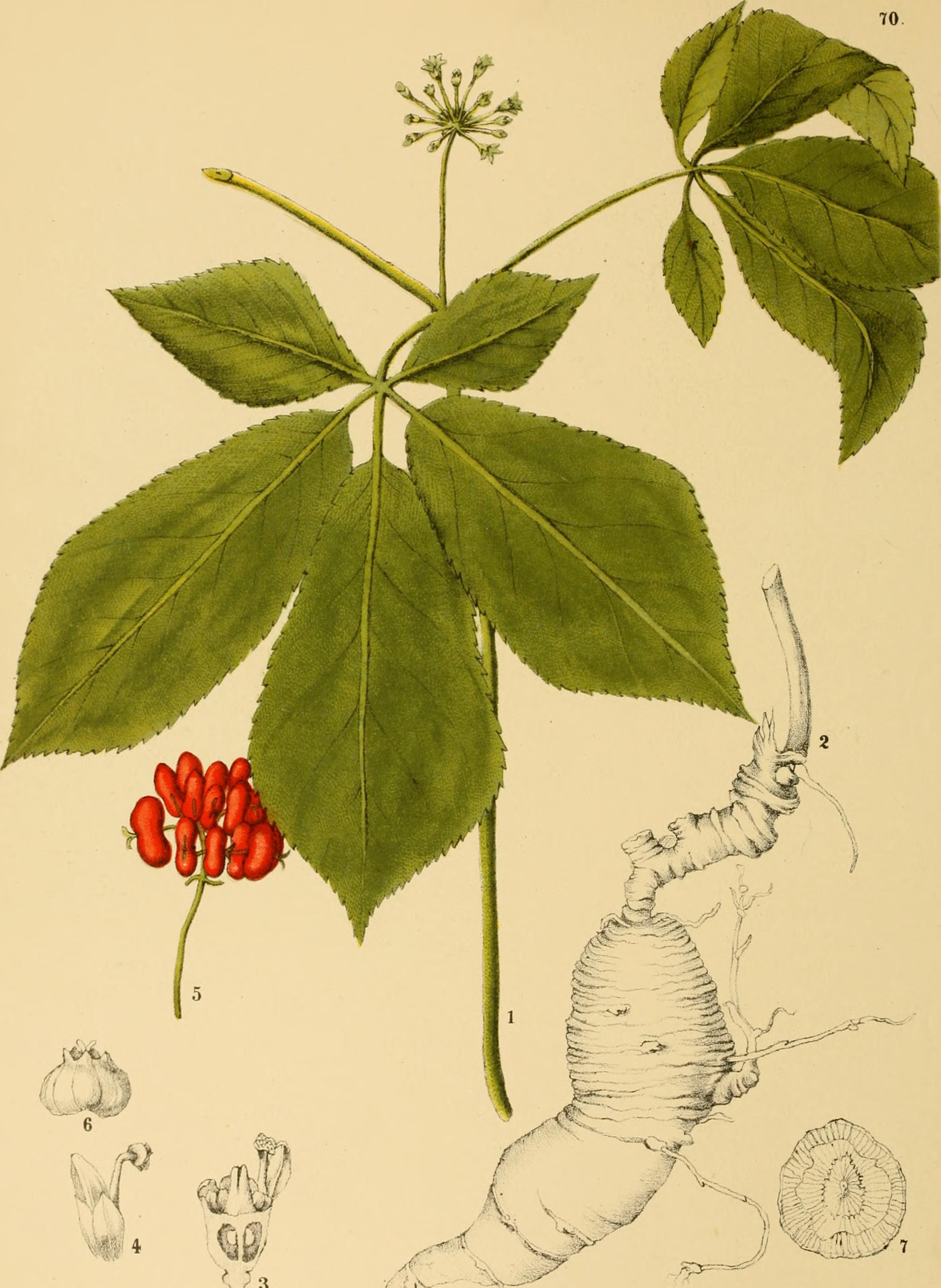
N. ORD -ARALIACE^. 70 GENUS.— ARALIA. SEX. SYST.— PENTANDRI.\ DIGYNIA. GINSENG. JIJV-CHEJV. SYN.— ARALIA QUINQUBFOLIA, GRAY; A. CANADENSIS, TOURN.; PANAX QUINQUBFOLIUM, LINN.; P. AMBRICANUM. RAP.; AURBLIANA CANADENSIS, LAFIT; GINSENG QUINQUBFOLIUM, WOOD; GIN-SENG CHINBNSIBUS, JARTOUX. COM. NAMES.-GINSBNG, TARTAR-ROOT, FIVE-FINGER, RED BERRY, MAN'S HEALTH; (FR.) GINSENG D'AMBRIQUE; (GBR.) KRAFTWURZEL. A TINCTURE OF THE DRY ROOT OF ARALIA QUINQUEFOLIA, GRAY. Description. — This herbaceous perennial grows to a height of about i foot. Root large, sometimes forked, but generally consisting of a fleshy, somewhat fusiform body, from the larger end of which is given off an irregular, cylindrical, knotty portion, narrower at its abrupt juncture with the main root, and showing the scars of previous stem-growths. Both parts are transversely wrinkled, closely above and sparsely below. Stetn simple, erect; leaves 3, palmately 5-divided; leaflets obovate, thin, serrate, and pointed, in two sets, 3 large and 2 small, all long petioled. Inflorescence a single terminal, naked, peduncled umbel; flowers few, dioeciously-polygamous. Calyx-limb very short, obscurely 5-toothed; teeth triangular acute. Petals 5, spreading, ovate-oblong. Styles 2 to 3, erect or spreading. Stamens 5. Frtiit a cluster of bright-red, 2-celled, more or less reniform, fleshy berries, each retaining its calyx-limb and styles; endocarp thin. This portion of the genus Aralia is the genus Panax* of Linnaeus. It has many characters, which have given rise to opportunities for forming distinct genera from its species, though its close resemblance to the Aralias serves to hold it there. History and Habitat. — The American Ginseng grows in the rich, cool woods of central and northern North America, where it flowers in July. There is great similarity in the American and Chinese individuals of this species, but the place of growth or mode of drying seems to more or less affect the properties of the roots, especially if the accounts of the usefulness of the Oriental product can be credited. Father Jartoux, who spent much time, and had special privileges accorded him in the study of this plant, remarks, that so high is it held in esteem by the natives of China that the physicians have written volumes upon its virtues, and deem it a necessity in all their best prescriptions, ascribing » na»,/fl«, all; am;, akos, a remedy; as the Chinese and Tartar species were considered panaceas.
70-2 to it medicinal properties of inestimable value, and a remedial agency In fatigue and the infirmities of old age. So great is the plant esteemed in China that the Emperor monopolizes the right of gathering its roots. The preparation of the best roots for the Chinese market is a process which renders them yellow, semi-transparent, and of a horny appearance; this condition is gained by first plunging them in hot water, brushing until thoroughly scoured, and steaming over boiling millet seed. The root thus prepared is chewed by the sick to recover health, and by the healthy to increase their vitality; it is said that it removes both mental and bodily fatigue, cures pulmonary complaints, dissolves humors, and prolongs life to a ripe old acre, — for all of which the root has often brought in the markets ten times its weight in silver. Father Jartoux* finally became so satisfied that the use of the root verified all that was said of its virtues, that he, in his own case, adds testimony as to its relief of fatigue and increase of vitality. Those roots that are bifurcated are held by the natives to be the most powerful; It was to this kind — which they considered to resemble the human form — that they gave the name yin-chen, like a mail. Strange as it may seem, the American Indian name of the plant, garmitoquen, means the same. The plant Is becoming rare in this country, and in fact wherever It is found, on account of the value It brings in the markets. In 1718 the Jesuits of Canada began shipping the roots to China; in 1748 they sold at a dollar a pound here and nearly five in China; afterward the price fluctuated greatly on account of a dislike in China of our product; and finally Its gathering has nearly ceased, though fine sun-dried roots will now bring nearly a dollar per pound at New York. Panax was dismissed from the U. S. Ph. at the last revision, and Is simply mentioned in the Eclectic Materia Medica. PART USED AND PREPARATION. — The genuine Chinese or the American root, dried and coarsely powdered, is covered with five times Its weight of alcohol, and allowed to stand eight days, in a well-stoppered bottle. In a dark, cool place, being shaken twice a day. The tincture, poured off and filtered, has a clear, lightlemon color by transmitted light, an odor like the root, a taste at first bitter then dulcamarous, and an acid reaction. CHEMICAL CONSTITUENTS.-Panaquilon, C,,H,,0,,— This peculiar body, having a taste much like glycyrrhizin but more amarous, may be extracted from the root. It results as an amorphous, yellowish powder, soluble in water and alcohol, but not in ether, and preclpitable by tannin. It breaks down under the action of sulphuric acid, which, in extracting three molecules of water, causes it to give off carbonic dioxide and yield a new body as follows: Panaquilon. Tanacon. Q,H,A = CO, -f- (H,0)3 + C„H,,0,. PHYSIOLOGICAL ACTION. — Ginseng causes vertigo, dryness of the mucous membranes of the mouth and throat. Increased appetite, accumulation of flatus * Phil. Trans., 2S, 239.
70-3 with tension of the abdomen, diarrhoea, decreased secretion of urine, sexual excitement, oppression of the chest and a dry cough, increased heart's action and irregular pulse, weakness and weariness of the limbs, increased general strength, followed by weakness and prostration, somnolence, and much chilliness. Description of Plate 70. I and 2. Whole plant, Pittsburgh, Pa., June 2Sth, 18S5 3. Section of flower. 4. Part of calyx, a petal and stamen. 5 and 6. Fruit. 7. Section of rhizome. (3, 4, and 6 enlarged.)
^IH.adnat.del.et pinxt. CoRNus Florida, Linn. 1
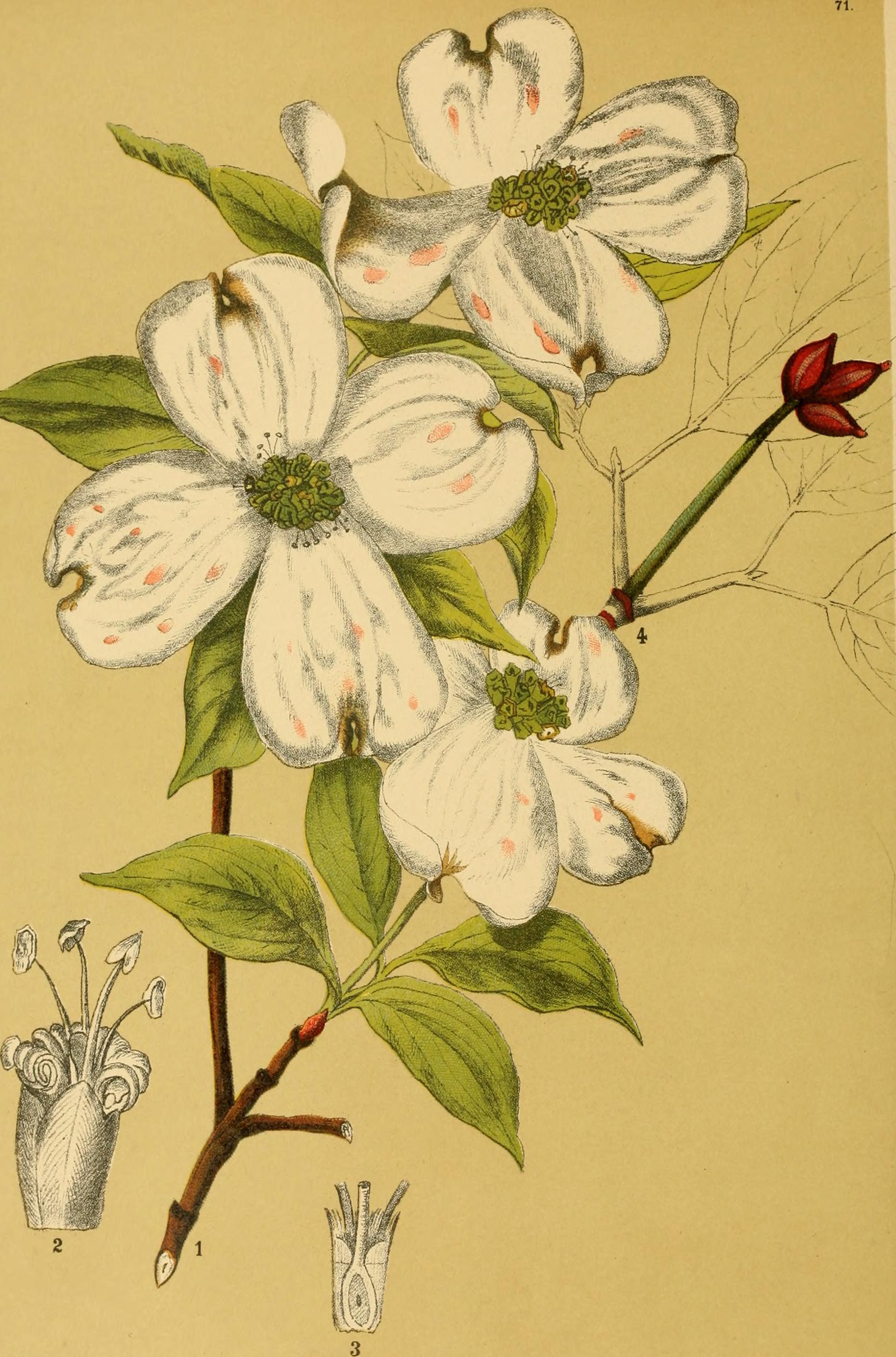
N. ORD.-CORNACE^. ' 71 GENUS — C O R N U S,* TOURN. SEX. SYST.— TETRANDRIA MONOGYNIA. CORNUS FLORIDA. FLOWEBJXG BOG WO OB. SYN.— CORNUS FLORIDA, LINN.; BBNTHAMIDIA FLORIDA, SPACE. COM. NAMES.— FLOWERING DOGWOOD, DOG TREE, BOX TREE, NEW ENGLAND BOXWOOD, CORNEL, BITTER REDBERRY; (FR.) CORNUILLIER AGRANDES FLEURS; (GER.) GROSSBLUTHIGE CORNEL. A TLN'CTURE OF THE FRESH BARK OF CORNUS FLORIDA, LINN. Description. — This small but beautiful forest tree, grows to a height of from ] o to 30 feet; its form is usually somewhat bent, scraggy, and loosely branched; but if transplanted when young to open places, it grows into a beautiful full, umbrella-like tree, with an immense spread of branches. Bark greyish, cracked into small, more or less rectangular pieces; that of the branches is smooth, red, and shows strongly the scars of previous leaves. Inflorescence terminal, peduncled, involucrate, greenish heads; uivoliicre white and showy; lobes 4, petaloid, obcordate or furnished with deep notches, having a discolored and thickened margin. Floiuers perfect, appearing with the leaves; calyx tubular; lobes 4, minute, triangular and somewhat obtuse; petals 4, oblong, obtuse, spreading, but at length recurved in such a manner as to cause each flower, when magnified, to bear great resemblance to a plain Ionic capital. Stamens 4, erect; filaments slender and filiform; antJiers oval, versatile, 2-celled. Style erect, slender, clavate, shorter than the stamens; stigtna terminal, obtuse. Fruit a few oval, red drupes, containing each a 2-celled and 2-seeded nutlet. CornacesB. — This small order is composed of shrubs or trees (rarely herbs) having the following characters: Leaves mostly opposite, rarely alternate; stipules none. Inflorescence cymose, or (in two species of Cornus) capitate and subtended by a showy, white involucre; floivers perfect or polygamous. Calyx tubular and coherent with the ovary; limb minute, 4-toothed. /I'/'a/.s- valvate in the bud, equal in number to the calyx teeth or sometimes wanting. Stamefis as many as the petals and alternate with them; in the perfect flowers they are borne on the margin of an epigynous disk; filaments usually ascending, sometimes erect. Ovary i to 2-celled; ovules one in each cell, anatropous, hanging from the apex of its cell; styles united into one. Fruit a i to 2-seeded drupe; seeds oval; testa coriaceous; albumen sarcous; embryo axial, nearly the length of the albumen; cotyledofis foliaceous. * Cornu, a horn, alluding to the density of the wood.
' 71-2 This family is represented by only two genera, Cornus and Nyssa, the latter having dioecious and partly apet^lous flowers. Beside the three species treated of in this work, the following are useful: The European and Asiatic Cornellian Cherry {Cornus mas, Linn.), the fruits of which were formerly fermented as a beverage, and are now used in Turkey in the concoction of a kind of sherbet; and the North European Liis-a-clirasis (C succica, Linn.), the berries of which are claimed by the Highlanders to have the power of enormously increasing the appetite. The berries of the Red Osier Dogwood (C slolonifera, Michx.; C. sangiiinca, Linn.), are claimed by Murion* to yield about one-third their weight of a pure, limpid oil, resembling olive, and fit for table use or for burning. History and Habitat. — The flowering dogwood is common in the deep woods of North America from the 43° north latitude southward, eastward, and westward; it is especially common in the South, where it extends from Florida westward to the Mississippi. Its principal central localities are the States of New Jersey, Pennsylvania, Maryland, and Virginia, where it flowers in May, generally from the 15th to the 2 2d, and fruits in September. A peculiar feature in the blossoming of this species is the great regularity in time of appearance of its short-lived blossoms; so characteristic is this diat the Indians always planted their corn when the blossoms appeared. Notwithstanding the small diameter of the trunk of the dogwood, its wood is nevertheless quite valuable, on account of its great density and susceptibility of polish. It has been used for every purpose generally filled by the European Boxwood, such as engravers' blocks, cog-wheels, forks, spoons, rules, etc., etc. The twigs have long been used as a dendfrice; of this use Barton says: f "The young branches stripped of their bark, and rubbed with their ends against the teeth, render them extremely white. The Creole negroes, who inhabit Norfolk, in Virginia, in great numbers, are in constant practice of using dogwood twigs in cleansing their teeth; the striking whiteness of these, which I have frequendy observed, is a proof of the efficacy of this practice. The application of the juice of these twigs to the gums, is also useful in preserving them hard and sound." The bark of the root afforded the aborigines a scarlet pigment. The previous medicinal use of dogwood bark dates from the discovery of this country, as it was then used by the Indians, who called the tree Mon-ha-can-ni-niinschi, or Hat-ta-iva-no-niin-scJii by the Delawares. The bark has proven tonic, astringent, and slighdy stimulating; being a stomachic tonic and anti-periodic, said to possess an acdon very like tliat of Peruvian bark, and differing from the latter only in quantity of action. Eberle states:j: that 35 grains equal 30 grains of cinchona bark, and Barton says,§ " It may be asserted with entire safety, that as yet there has not been discovered within the limits of the United States any vegetable so effectually to answer the purpose of Peruvian bark in the management of intermittent fever as Cornus Jlorida." The dose of the dried and powdered jfoiir. de P/iann., lo, f Med. Bot., i., 55. + Therapeutics, i., 304. \ Colleclions.
71-3 bark is placed at from 20 to 30 grains, and caution is necessary against its being too fresh, as it then disagrees seriously with the stomach and bowels. The bark is also considered a tonic, stimulant, and antiseptic poultice for indolent ulcers, phlegmonous erysipelas, and anthra.x. The officinal preparation of the U. S. Ph. is Extractum Conms Fluidnm; in the Eclectic Materia Medica the preparations are: Dccochim Cormis Florida:, Extractum Cormis Floridcs, Extractum Cornus Floridcs Fluiduvi, and Pilules Quinics Composites.*' PART USED AND PREPARATION.— The fresh bark, especially that of the root, is to be chopped and pounded to a pulp and weighed. Then two parts by weight of alcohol are taken, the pulp thoroughly mixed with one-sixth part of it, and the rest of the alcohol added. After having stirred the whole well, pour it into a well-stoppered bottle and allow it to remain eight days in a dark, cool place. The tincture separated from this mass by filtration, presents a magnificent, clear, crimson color by transmitted light. It has a vinous odor, a sharply astringent cinnamon like taste, and a strongly acid reaction. CHEMICAL CONSTITUENTS.— Or/z/r Acid. This acid was discovered by Carpenter (1830), who judged it alkaloidal and gave it the name Corniii. Geigerf (1S36) investigated the principle and determined it to be a crystalline acid; his observations were corroborated by FreyJ (1879). It crystallizes in nearly white, silky forms, very bitter and soluble in alcohol and water. The crystals deliquesce when exposed to the air, and when subjected to heat upon platinum foil they melt readily, become black, and finally burst into a flame and burn without residue. Oil of Cornus. — The ripe berries, when boiled and pressed, are said to yield a limpid oil; this body is uninvestigated. Tannic,'''^' and gallic acid,^-" a neutral resin crystallizing in shining needles,^""'' gum,'^* extractive,' "^° fatty matter," oil," wax,'- red coloring matter,- ^■'^ cornic acid,'-^^' and a bitter principle,' have been determined. PHYSIOLOGICAL ACTION. — The fresh bark in doses of from 20 to 40 grains causes increased action of the heart, heat of the skin, and severe pain in the bowels. The American Indian, true to the principle that seems to have guided him in the use of all medicines, used the bark for fever and colic. The symptoms so far developed in proving are: sensations of fullness of the head with headache; nausea and vomiting; violent pain in the bowels with purging; and increased bodily temperature, followed by hot sweat.'' Dr. Chas. A. Lee sums up the action of the drug as follows: ' " The physiological effects of Cornus bark are: increased frequency of pulse, exalted temperature, diaphoresis, sensation of fullness or pains in the * Sulphate of Quinia, extract of Cornus florida, Tartaric acid, and alcoholic extract of Cimicifuga. f M. Geiger, Ann. der Pharm., XIV., 206. X Am. Jour. Phar., 1879, 390. 1 Walker, Inaiig. Diss. '' Cockburn, Am. your. Phar., 1835, 1 14. ^ Tilden, Jour..Mat. Mid., i., N. S., 294. * Geiger, 1. c. ^ Frey, 1. c. ^ Hale, New Rem., 242. ' The Jour, of Mat. Med., 1. c.
71-4 head, and, if the dose be too large, gastric derangement. Of these the most strongly marked are the increased temperature of the skin, and the general perspiration. Some experimenters have observed a constant tendency to sleep, which has continued for several hours. This does not indicate any specific narcotic properties, but is the result of the cerebral fullness. Whether the remote effects are owing to sympathy, propagated from the gastic centre, or are the direct effects of the introduction of the active principles into the blood, is not certainly known; although the latter is most probable, since the cold infusion or the alcoholic extract produces the same effects. But whatever doubt' there may be in regard to its true mode of operation, it is very evident that the bark has properties calculated to invigorate the vital forces, and the organic nervous energy, without unduly stimulating the circulating system." / Description of Plate 71. 1. End of a flowering branch, Newfield, N. Y., May 15th, 1880. 2. Flower. 3. Section of calyx and ovary. 4. Fruiting branch. (2 and 3 enlarged.) =-h=
ia. -■Tt^^Ww Vy~ ^. ^ r^r-^r \ I r -r. r iv- ^^^\ K^'^w^ >K^ -jtr^TL■"■«!*SSia, /. ffi.Ul.adnatdel.etpinxt •r ^.4 C6RNUS CiRCINATA, L'Her.
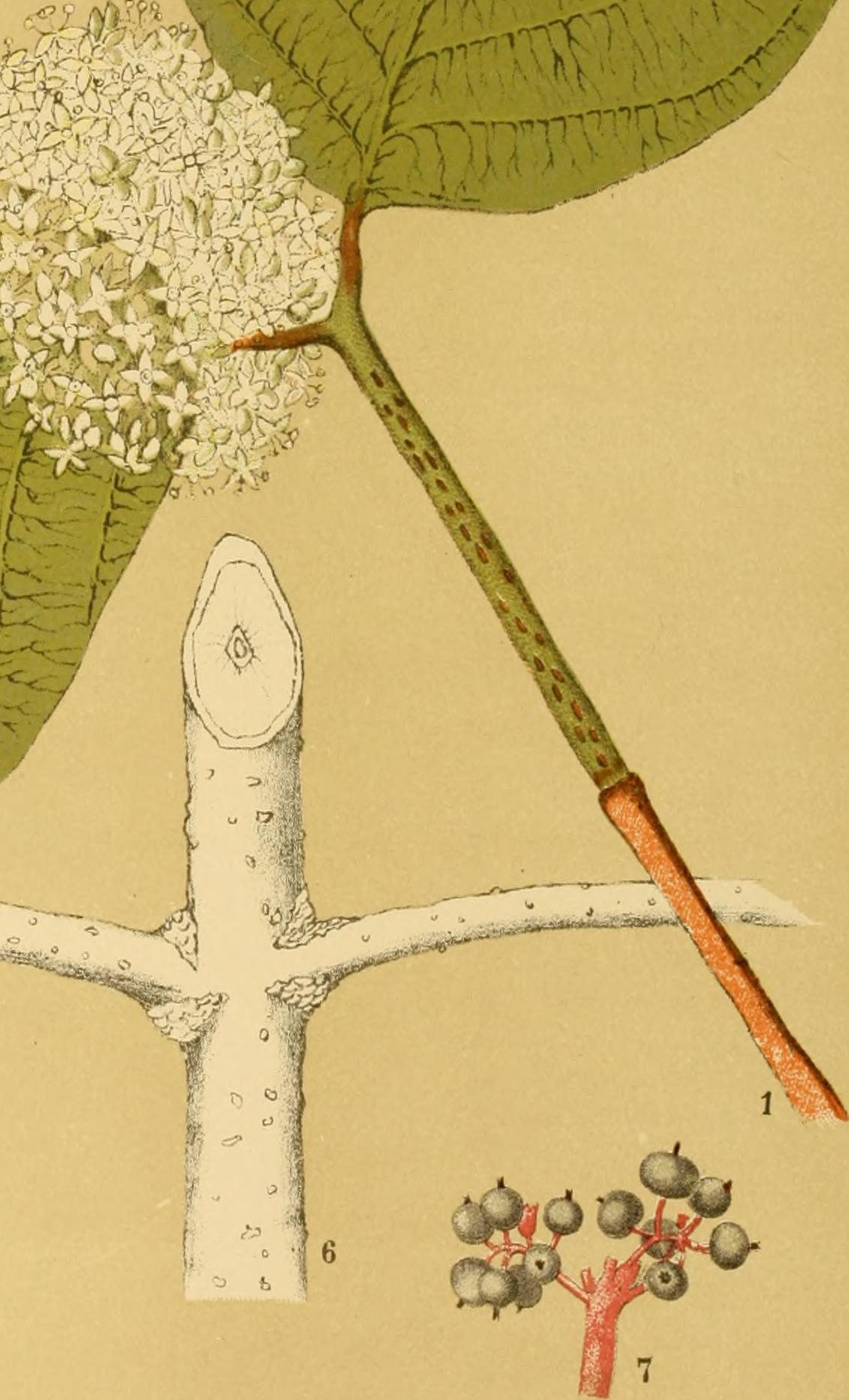
N. ORD-CORNACE.E. 72 GENUS.— CORNUS. SEX. SYST.— TETRANDRIA MONOGYNIA.. CORNUS CIRCINATA. ROUJ^D LEAVED DOGWOOD. SYN.— CORNUS CIRCINATA, L'HER.; C. RUGOSA, LAM.; C. TOMBNTULOSA, MICHX. COM. NAMES.— ROUND LEAVED CORNEL OR DOGWOOD, ALDER DOGWOOD, PENNSYLVANIA DOGWOOD, GREEN OSIER, SWAMP SASSAFRAS; (FR.) CORNOUILE A FEUILLES RONDIE; (GER.) RUNDBLATTERIGE CORNEL. A TINCTURE OF THE FRESH BARK OF CORNUS CIRCINATA, L'HER. Description. — This shrubby species grows from 6 to lo feet high. S/e?n erect; bai-k greyish, verrucose; byanches green, opposite, straight, and slender — the younger ones bright green splashed with red, those of the previous year somewhat crimson and more or less warty. Leaves all opposite, round-oval, acuminate, woolly beneath, larger than those of any other species; ribs and veins prominent below and correspondingly indented above. Infiorescciice terminal, in open, more or less flat, spreading cymes; floix'ers white. Calyx tcetli very short. Petals ovate-lanceolate, at length spreading. Stamens longer than the petals. Style about two-thirds the length of the stamens; stigni-a capitate. Fruit an incomplete cyme of spherical, light blue drupes, each hollowed at the insertion of the pedicel and where it retains the remains of the persistent style. History and Habitat. — The Round Leaved Dogwood grows in copses where the soil is rich, beino" indigenous from Canada to the Carolinas, and west to the Mississippi; flowering in the north in June. The medicinal use of this species is far less extensive than the last, preceding. The Drs. Ives claim * that the bark is tonic, and astringent to a far greater degree than any other species of the genus, and that it resembles Cinchona lancefolia (Pale Bark) in its action. It has proven, in their hands, an e.xcellent remedy for chronic dyspepsia {sie'\ and diarrhoea. An ounce of the bark will yield in the neighborhood of 150 grains of a very strongly-bitter extract; far greater in quantity, and more bitter than that of C. florida. Cornus circinata was dismissed from the U. S. Ph. at the last revision. PART USED AND PREPARATION. — The fresh bark is gathered and treated as in the preceding species. * Dr. A. W. Ives, N. Y. Kep., 1822; Dr. E. Ives, Trans. Am. Med. Assoc it, iii, 312.
72-2 The tincture resulting is clear, and of a slightly brownish-orange color. Its odor is very like that of Rhubarb; its taste sharply astringent and bitter, and its reaction acid. CHEMICAL CONSTITUENTS.— G7r;«;^ Tliis acid differs from that of C. florida only in the fact that it remains associated with tannin in spite of most careful re-crystallization, and other means of purification.'*' The other constituents mentioned in the preceding species are all, without doubt, duplicated in this. Gibson isolated sugar, coloring-matter, coriiiu and tannin. PHYSIOLOGICAL ACTION. — Here again great similarity exists between the species. C. circinata causes drowsiness and depression of spirits; congestion of the head; nausea and faintness; flatulency; copious bilious stools and urine, with yellowness of the sclera, face and hands; coldness of the extremties; itching, red rash, upon the whole surface, especially the trunk, with flashes of heat and chill, followed by perspiration. Description of Plate 72. I. End of a flowering branch, Binghamton, N. Y., June i6th, 1885. 2. Flower. 3 and 4. Stamens. 5. Stigma. 6. Portion of the stem, showing mode of branching. 7. Part of a fruiting cyme. 8. Seed. (2^5, and 8 enlarged.) * Robert Gibson, Jr., Am. Jour. Phar., iSSo, 433.
73. (BTO..a(inat,ilel.etpinxl, C6RNUS SERICEA.Linn
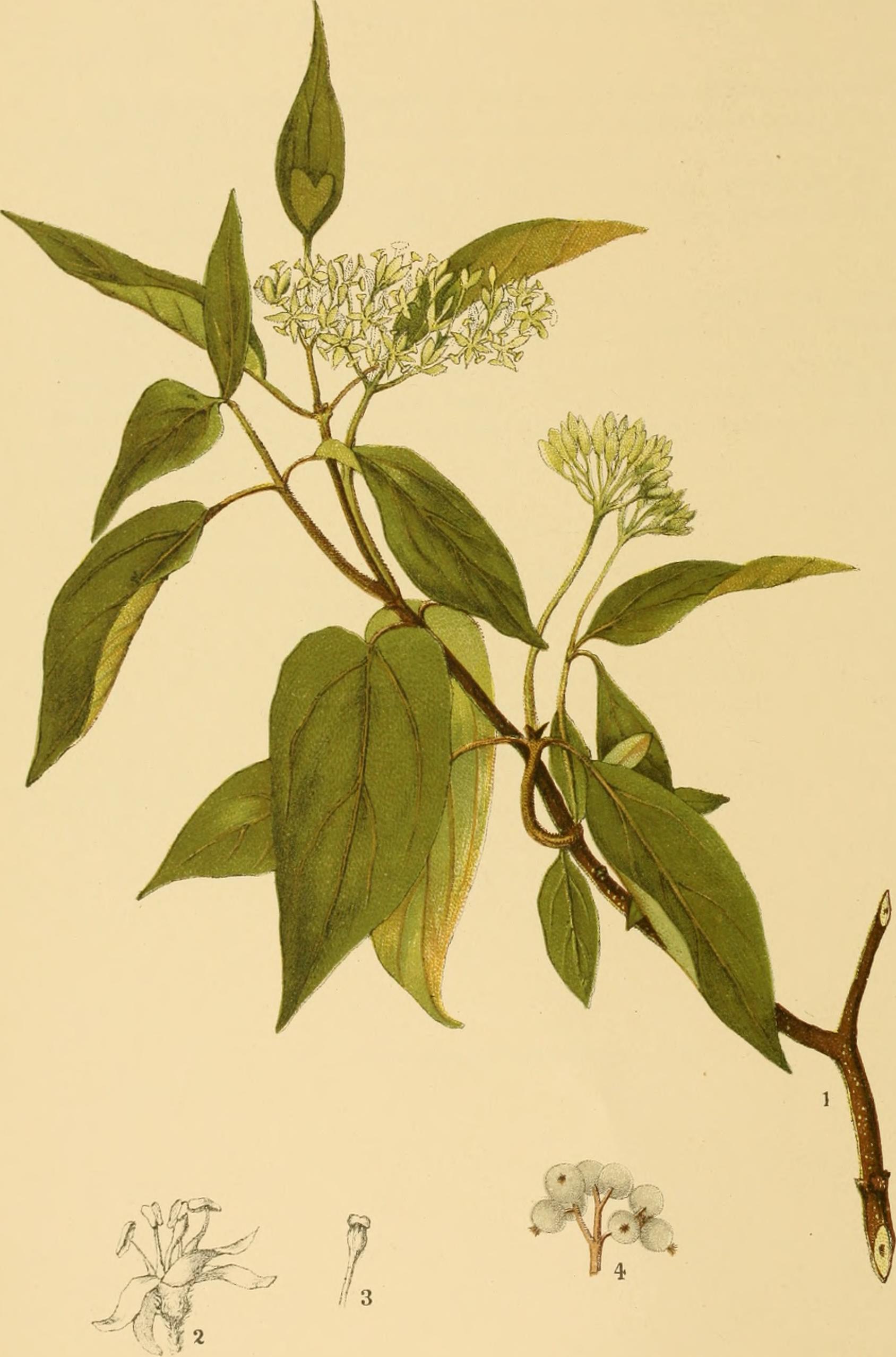
N. ORD. CORNACE^. 73 GENUS.— CORN us, TOURN. SEX. SYST.— TETRANDRIA MONOGYNIA. CORNUS SERICEA. SILKY DOGWOOD. SYN. — CORNUS SERICEA, LINN.; C. AMOMUM, DU ROI; C. CYANOCARPUS, MOEN.; C. LANUGINOSA, MICHX.; C. OBLIQUA, RAP. COM. NAMES.*— SWAMP OR FEMALE DOGWOOD, SILKY OR BLUEBERRY CORNEL, KINNIKINNIK; (FR.) CORNOUILLB SOYEUX; (GER.) SUMPFCORNEL. A TINCTURE OF THE FRESH BARK OF CORNUS SERICEA, LINN. Description. — This water-loving shrub grows to a height of from 6 to i 2 feet. Branches spreading, dark-purpHsh (not brilliant red); branchlets silky-downy. Leaves narrowly ovate or elliptical, pointed, smooth above, silky-downy below and often rusty-hairy upon the ribs. Inflorescence a flat, close, woolly-pubescent, long-peduncled cyme; flinucrs creamy-white. Calyx teeth lanceolate, conspicuous. Petals lanceolate-oblong, obtuse. Stigma thick, capitate. Fruit pale blue, globose. Read description of Cornaceae, p. 71. History and Habitat. — The Swamp Dogwood is indigenous to North America, from Florida to Mississippi and thence northward, where it grows in wet places, generally in company with Cephalanthus and Viburnum dentatum. It flowers northward in June, and ripens its azure fruit in September. The use of this species in general medicine has mostly been as a substitute for C. florida, than which it is less bitter, while being more astringent. The Cree Indians of Hudson's Bay call the plant Milawapamulc, and use the bark in decoction as an emetic in coughs and fevers. They also smoke the scrapings of the wood, and make a black dye from the bark by boiling it with iron rust.f A favorite tobacco mixture of the North American Indians, called Kinnikinnik, is composed of scrapings of the wood of this species, mixed with tobacco in the proportion of about one to four. A good scarlet dye is made by boiling the roodets with water. PART USED AND PREPARATION. — The fresh bark, including that of the root, is treated like that of the first-mentioned species; the resulting tincture has * The names Red Willow, Red O^ier, Red Rod, and Rose Willow, are often given to this species, but they should only designate C. stolonifera, Michx. f E. M. Holmes in Am. Jour. Phar., 18S4, 617.
73-2 a beautiful madder color by transmitted light, an odor greatly like that of sugarcane when the juices are slightly soured, an extremely astringent and bitterish taste, and an acid reaction. CHEMICAL CONSTITUENTS. — At present we can only call attention again to this rubric under C. florida. The bitterness, however, of this species is less than its congener, while its astringency is greater. ft PHYSIOLOGICAL ACTION. — This species seems to act stronger upon the heart than C. florida, and to cause more cerebral congestion. Description of Plate 73. I. End of a flowering branch, Binghamton, N. Y., June 20th, 1885. 2. Flower. 3. Stigma. 4. Fruit. (2 and 3 enlarged.) =-*<=
Tt. ^m.adnatdeletp,n^ TRIOSTEUM PERFOLIATUM, Linn.
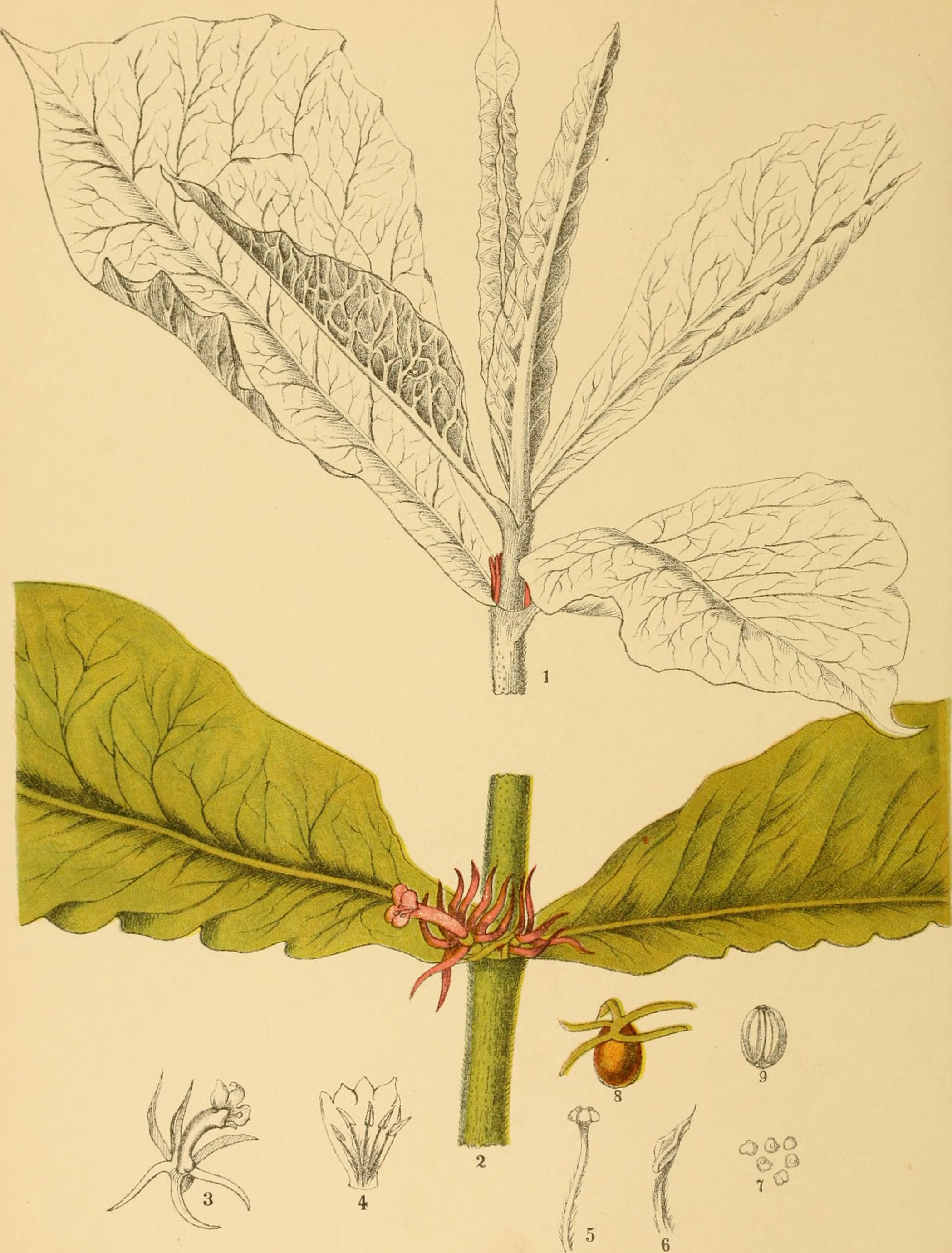
N. ORD -CAPRIFOLIACE/E. 74 Tribe.-LONICERE/E. GENUS.— TRIO ST EUM,* LINN. SEX. SYST.— PENTANDRIA MONOGYNIA. TRIOSTEUM. FEVER-WORT. SYN.— TRIOSTEUM PERFOLIATUM, LINN.; TRIOSTEUM MAJUS, MICHX. COM. NAMES.— PEVBR-'WORT, OR ROOT; HORSE-GENTIAN, OR GINSENG; WHITE GINSENG; TINKER WEED, OR DR. TINKER'S WEED; BASTARD, FALSE, OR, WILD IPECAC; t WILD COFFEE; SWEET-BITTER; CINQUE; (FR.) TRIOSTE; (GER.) DREISTEIN. A TINCTURE OF THE FRESH ROOT OF TRIOSTEUM PERFOLIATUM, LINN. Description. — This coarse, leafy, perennial herb, grows to a height of from i to 4 feet. Root thick and sarcous, sub-divided into several horizontal sections; stefn simple, hollow, glandularly pubescent; leaves opposite, ample, ovate-spatulate, sinuate, acuminate, abruptly narrowed and connate or almost perfoliate at the base, prominently reticulate veined and downy pubescent upon the under surface, and hairy above. Inflorescence, axillary whorls at the middle of the stem; flowers I to 6, dull or reddish purple, sessile. Bracts linear; calyx persistent; lobes linear-lanceolate, foliaceous. Corolla elongated cylindro-tubular, curved, gibbous at the base, scarcely longer than the calyx lobes, viscidly pubescent; limb more or less equally 5-lobed. Stamens 5, inserted upon the tube of the corolla; filaments hairy; anthers sagittate. Ovary generally 5-celled, each cell i-ovuled; ovules suspended; style filiform, hairy; stigma 3 to 5-lobed. Fruit drupaceous, dry, orange-colored; nutlets 3-angled and 3-ribbed, i -seeded; endocarp osst,OMS, testa membranaceous. Caprifoliaceae. — A large family of shrubs and a few perennial herbs. Leaves opposite and destitute of stipules when normal. Flowers generally 5-merous, regular, or sometimes in the corolla irregular, hermaphrodite; calyx adnate to the ovary; corolla with its lobes imbricate in aestivation. Stamens as many as the lobes of the corolla, alternate with them, and inserted upon its tube. (Exc. Adoxa and Linnaea.) Ovary 2 to 5- or, by abortion, i -celled; ovules anatropous, when only one then suspended and inverted; raphe dorsal. Embryo small in the axis of the fleshy albumen. The following remedies belonging to this family are of special interest to us * Tptrt, treis, three; i^Aov, osteon, a bone; the fruit having three nutlets, shortened from Triosteospennum, Dill. t Aiiplied also to many species of Euphorbia, and to Gilknnia trifoliata, Moench. (Rosacea;.)
74-2 beside the two under consideration: the European Moschatel [Adoxa MoschatelHiia, Linn.), also found in Arctic America and sparsely in the Rocky Mountains; the European Elder [Sambuncs nigra, Linn.), a native also of Asia and Northern Africa; and the European Fly Woodbine {Lonicei-a Xylosteum, Linn.). Two American species were proven too late for representation in this work, they are the Snowberry {Symphoricarpus racemusiis, Michx.), a valuable remedy in vomiting pregnancy, as many suffering ladies have testified in my practice; and the High Cranberry {I'lbnrnwn opuhi^s, Linn.), now proving valuable in many forms of uterine affections and puerperal diseases. Outside of our Materia Medica the order contains: The Dwarf Elder {Satnbucus ebuhis, Linn.), probably the most active of that genus; and the Bush Honeysuckle [Dicroilla trijida, Mcench). History and Habitat. — The feverwort is Indigenous to North America from Canada southward and westward to Alabama, growing on open woodlands in limestone soils; not really plentiful in any locality. It blossoms in June, and ripens its characteristically arranged fruit in September. It was in all probability the Southern species T. augustifo'ium, Linn., that was principally used as an emetic in earlier days, and this Is doubtless the plant sent to Pluckenet as Dr. Tinker s Weed, and gravely commented on by Foiret as follows:* " Se's racines et celles de I'espece pr^c^dente passent pour emetiques; le docteur Tinker est le premier qui les a mises en usage, et qui a fait donner a cette plante par plusieurs habitans de I'Amerique septentrional le d' Iicrbe sauvage du docteur Tinker!' Triosteum is stated by Rafinesque to have been one of the aboriginal medicamentae, called Sincky. A decoction is said to have been used by the Cherokee Indians In the cure of fevers (Porcher). The bark of the root has long been esteemed as an emetic and smoothly-acting cathartic, the former in doses of from 40 to 60 grains, the latter in half that amount; its cathartic action was claimed to be fully as sure as jalap. Dr. J. Kneeland calls attention to this plant as an application to painful swellings, regarding which he says ■:\ " My attention was first called to it by a gentleman of observation and intelligence, who derived his knowledge of Its value Indirectly from the Onondaga Indians. So strongly did he back his claims with facts on cases of whitlow or felon, successfully treated, that I applied the bruised root, moistened, to the first well-marked case of onychia or felon which came to me for treatment. The young man upon whose hand it was, had not slept much for two nights. The whole hand was much swollen; the middle finger, tense and throbbing, was the centre from which the pain and swelling extended. It had been poulticed and thoroughly soaked in weak lye for three days, and still grew worse. We applied the T'iosteiim, and nothing else. After six hours' application he slept; the throbbing and tensive pain gradually diminished after the first application; in two days' time the swelling disappeared from the forearm and hand; In four days the finger affected, the whole palm, and the centre of the dorsum of the hand peeled, and complete resolution took place, no * Bigelow,.-////. Mel. Bo/., i, p. 90. f ^O'- '''■< The Jour, of M,it. Alfd., Vol. I., N. S., 1859, 240.
74-3 pus having formed. In another case, wherein it was tried, only two applications were required to relieve the pain and throbbing, and complete resolution followed." Dr. Mulenberg says* that the dried and toasted berries of this plant were considered by some of the Germans of Lancaster County, Pa., an excellent substitute for coffee when prepared in the same way; having great respect for German taste I tried an infusion, but came to the conclusion that it was not the Lancaster County Germans' taste that I held in reeard. Triosteum is one of the drugs dismissed from the U. S. Ph., at the last revision. PART USED AND PREPARATION.— The fresh root, gathered in Autumn, is chopped and pounded to a pulp and weighed. Then two parts by weii^lu of alcohol are taken, the pulp mixed well with one-sixth part of it, and the rest of the alcohol added. After first stirring, the whole is poured into a well-stoppered botde, and allowed to stand eight days in a dark, cool place. The tincture thus formed after filtration has a beautiful, clear, reddish-orano-e color by transmitted light, a bitterish odor and taste, and an acid reaction. CHEMICAL CONSTITUENTS.— The only analysis thus far made of the root is that by Dr. John Randall, communicated to the Linnsean Society of New England. His conclusions were that no pure resin exists in the plant, nor did he determine a volatile oil or free acid. The leaves under his manipulation yielded the most extract, and the root more than the stems. The sensible qualities of the root, however, he found to be essentially different from those of the herb. Water yields a greater quantity of extract than alcohol. PHYSIOLOGICAL ACTION.— In Dr. Williamson's proving of the drug the prominent effects were: Nausea; vomiting; copious watery stools apparently proceeding from the small intestines, accompanied by stiffness of the lower extremities and cramps in the calves; aching in the bones; coldness and stiffness of the feet, and general perspiration. f Description of Plate 74. 1. Top of plant, Binghamton, N. Y., June 15th, 18S4. 2. A portion of the middle of the flowering plant. 3. A flower. 4. Opened corolla. 5. Pistil. 6. Stamen. 7. Pollen, X 200. 8. Fruit. 9. Seeds. (3-6, 8 and 9, enlarged.) * Barton, Med. Bot., i, p. 63. f Allen, Emy. Pure Mat. Med., 10, p. 25.
75. ^m.adnat.del.etpinxt. SaMBUCUS CANADENSIS, Linn.
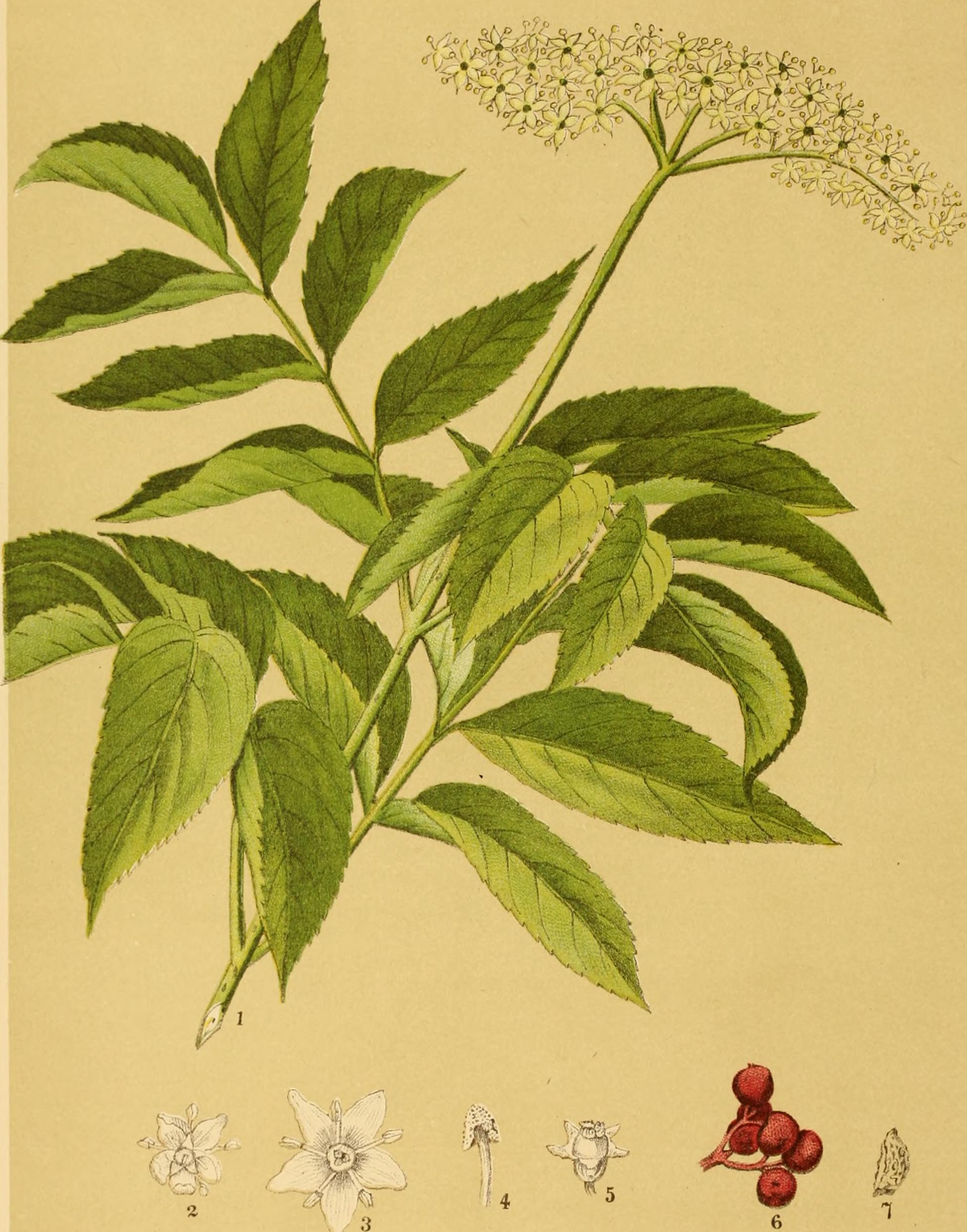
N. ORD-CAPRIFOLIACE^. 75 Tribe.-SAMBUCE/E. GENUS.— SAM BUCUS,* TOURN. SEX. SYST.— PENTANDRIA TRIGYNIA. SAMBUCUS CANADENSIS. ELDER. SYN.— SAMBUCUS CANADENSIS, LINN.; S. NIGRA, MARSH (NOT LINN.); S. HUMILIS, RAP.; S. GLAUCA, GRAY {NOT NUTT.). COM. NAMES.— ELDER BUSH, ELDER BERRY; (PR.) SUREAU DU CANADA; (GR.) CANADISCHE HOLLUNDER. A TINCTURE OF THE BUDS, FLOWERS, SHOOTS, AND LEAVES OF SAMBUCUS CANADENSIS, LINN. Description. — This common, glabrous, suffrutescent perennial, usually attains a growth of from 6 to 10 feet. Stems somewhat ligneous, hollow, pithy, generally dying down to the ground, or persistent for a few years; dark verrucose; pith dense and bright white after the first year. Leaves compound, imparipinnate; stipules rare; leaflets 5 to 11, mostly 7, petiolulate, from ovate-oval to oblonglanceolate, serrate, acuminate, the lower sometimes with a lateral lobe; stipels not uncommonly present, narrowly linear, and tipped with a callous gland, hiflorescencc terminal, broad, flat, or depressed, 5-rayed, compound cymes; floivers small, creamy-white, and sickishly odorous. Calyx minute, 5-lobed; lobes somewhat deltoid, acute. Corolla rotate, or somewhat urceolate; limb broadly spreading; lobes 5, obtuse. Stamens 5, alternate with the lobes of the corolla, and attached to the base of its tube. Stigmas 3; styles capitate. Fruit a baccate, sweet and juicy, dark-purple drupe, never red, but later becoming black; bloom slight. Nutlets 3, small, i -seeded, punctate-rugulose; 5'^frt' suspended; testa membranaceous. History and. Habitat. — This species is indigenous to North America, where it extends from New Brunswick westward to Saskatchewan, southward to Florida and Texas, and to the mountains of Colorado, Utah, and Arizona. It grows in rich alluvial soils, blossoming in July and fruiting in September. Our species is not sufficiendy distinct from the European 6". nigra, Linn., from which it differs only in being less woody, and having more loose cymes, larger flowers and more compound leaves. The bracteate inflorescence, considered specific, does not seem to be a constant feature. The American species was introduced into England in 1761. * v.i/.guiti, sambuke, an ancient musical instriimant, said to liave been made of the wood.
75-2 The pith of the Elder has many offices to fill in the arts and manufactures; the berries make a really pleasant wine; and, among the poorer class of people (it must be more from necessity than choice), they are made into pies, like the huckleberry. In domestic medicine this plant forms almost a pharmacy in itself, and has been used substantially as follows: A decoction of the flowers and leaves, or an ointment containing them, was used as an application to large wounds to prevent deleterious consequences from flies; the leaf-buds proved themselves a violent and unsafe cathartic; the flowers, in a warm infusion are stimulant, excitant, and sudorific; in cold, diuretic, alterative, and laxative (Elderblow Tea); they were also employed, in ointment, as a discutient; the inner bark is a severe hydrogogue cathartic, emetic, deobstruent, and alterative, valuable in intestinal obstruction and anasarca; the berries proved aperient, diuretic, diaphoretic, and cathardc, valuable in rheumatic gout, scrofula, and syphilis — the juice making a cooling, laxative drink. In pharmacy the leaves have been used to impart a clear green tint to oils, etc. [0/eu7n Viride, Ungueiitum Smnbuci foiiontin), and the flowers for perfumes. Sambucus Canadensis {/lores) are officinal in the U. S. Ph.; in the Eclectic Materia Medica the preparations are: Aqua Sambitci, Syriipus Sarsaparillcc Conipositus^^' Unguentum Sambuci, and Vinum Sanibuci.-\ PART USED AND PREPARATION. — Equal parts of the fresh flower-buds, flowers, young twigs, and leaves are taken, and treated as in the preceding drug (p. 74-3). The resulting tincture has a clear orange-brown color by transmitted light; it retains the sweetish odor and taste of the flowers; and has an acid reaction. CHEMICAL CONSTITUENTS.— r/7;//;7//V Add. This body, identical with valerianic acid, J was proven to exist in the bark of this species by C. G. Traub,§ who suSleeded in obtaining- its characteristic odor, and valerianate of zinc after the addition of the sulphate of that metal. Oil 0/ Sambucus. — This volatile body, found in the flowers of S. nigra, was proven by Traub to also exist in the bark of this species. It is described as a thin, light-yellow body, having the odor of the flowers, a bitter, burning, afterward cooling taste; becoming of a butter-like consistence, and solidifying at 0° (32° F.) to a crystalline mass. Tannin, sucrar, fat, resin, and a colorin^-niatter were also determined. PHYSIOLOGICAL ACTION. — Dr. Ubelacker's experiments with from 20 to 50 drops ot the tincture gave the following symptoms of physical disturbance: Drawing in the head, with anxious dread; flushed and blotched face; dryness * See p. 92-2, foot-note to Syrupus A>-aliie Composiitis, as the syrup is now called, j- This so-called Hydragogiie Tiitcttire contains Elder-bark, Parsley-root, and Sherry. tSeep. 155-3. j) Am. Jour. P/iar., 1881, 392.
75-3 and sensation of swelling of the mucous membranes of the mouth, pharynx, larynx, and trachea; frequent and profuse flow of clear urine; heaviness and constriction of the chest; palpitation of the heart; pulse rose to loo, and remained until perspiration ensued; sharp, darting rheumatic pains in the hands and feet; exhaustion and profuse perspiration, which relieved all the symptoms. Description of Plate 75. I. End of flowering branch, Binghamton, N. Y., July 20th, 18S5. 2. Flower, showing calyx. 3. Face of flower. 4. Stamen. 5. Pistil. 6. A portion of fruiting cyme. 7. Seed. (2-5 and 7 enlarged.)
76. ^m.adnayeletpinxt GEPHALANTHUS OCCIDENTALIS, Linn.
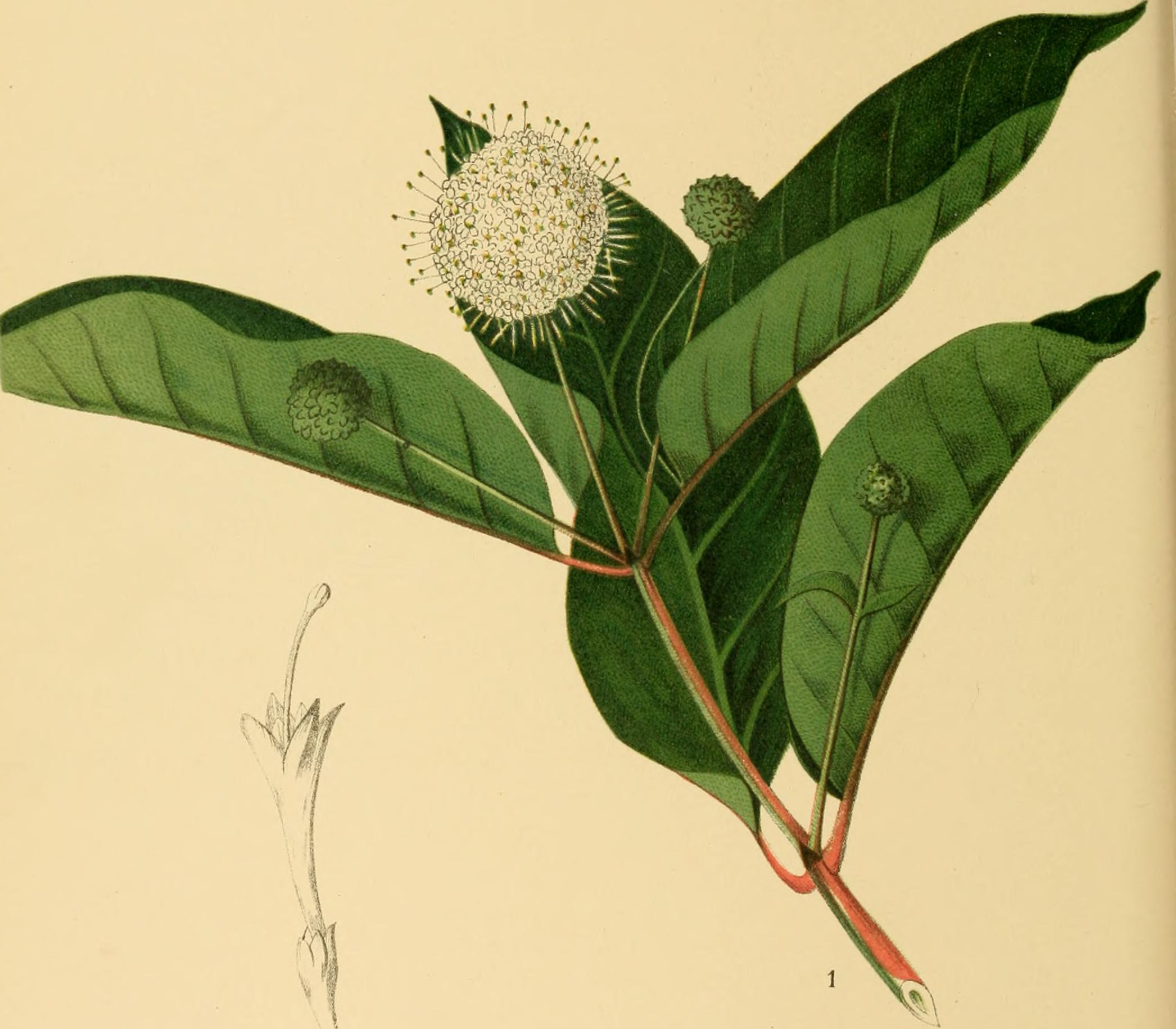
N. ORD -RUBIACE^. 76 THUS,* LINN. SEX. SYST.— TETRANDRIA MONOGVNIA. GENUS.— CEPH A LA NTH US,* LINN. CEPHALANTHUS. BUT TOM BUSH. SYN.— CEPHALANTHUS OCCIDENTALIS, LINN. COM. NAMES.— BUTTON BUSH, BUTTON-WOOD,t CRANE WILLOW PONDDOGWOOD, SNOWBALL,! GLOBE FLOWER;^^ (FR.) BOIS DE PLOMB CBPHALANTHE D'AMERIQUE; (GER.) KNOPFBUSCH, AMERIKANISCHB WEISS3ALL. A TINCTURE OF THE FRESH B.\RK OF CEPHALANTHUS OCCIDENTALIS, LINN. Description. — This smooth or pubescent || shrub attains a growth of from 5 to 15 feet. Stan diffusely branching; bark smooth and reddish on the branchlets, rough and yellowish on the stems; branches opposite. Leaves large, opposite, and ternate, both arrangements often appearing upon the same branch, petiolate, ovate, or ovate-lanceolate, pointed, dark-green, and smooth; slipiilcs intermediate, ovate, sometimes toothed. Inflorescence dense, axillary and terminal, globular heads; peduncles longer than the diameter of the heads;' floivers creamy-white, sessile upon a globose, hirsute receptacle. Calyx tube inversely pyramidal; limb 4-toothed. Gi/W/rt slender, tubular, or funnel-form; margin \-\.oo\\\(t^\ teeth &r(tct, imbricate in aestivation. Stamens 4, hardly exserted. Style filiform, greatly exserted; stigma capitate, globose. Fruit small, dry, pyriform, 2 to 4 celled, cleaving from the base to form 2 to 4 i -seeded divisions; seeds pendulous, crowned with acork-like arillus; embryo straight in the axis; albumen somewhat cartilaginous; cotyledons leaf-like. Rubiaceae. — This large and important order has but few representatives in North America, but yields many valuable drugs in the hotter climates. It is characterized as follows: Herbs or shrubs. Leaves opposite, entire, or sometimes whorled and astipulate; stipules intermediate and connective. Calyx coherent with the ovary. Corolla regular, tubular. Stamens as many as the lobes of the corolla, and inserted upon its tube. Ovary 2 to 4 celled. Seeds anatropous or amphitropous. The important medicinal plants of this family are: The cinchonas or Peruvian barks, i.e., pale bark (^Cinchona officinalis, Linn.), Calisaj-a bark {Cinchona Calisaya, Wedd.), red bark {Cinchona succiruba, Pav.), Columbian bark [Cinchona * Kt'|)iiXij, kephaU, a head; oi/9o;, anthos, a flower. + The true button- wood is the sycamore, a large tree growing along rivers (Platanus occidentalis, Linn.). X The true snowball is Symplwricarpus raitmosus, Mich. (Caprifoliacea;}. \ The true globe flower is TrolUus laxus, Salisb. (Ranunculace.-e]. II Var. pubescens, Kaf.
76-2 cordifolia, Micl.), lancifolia bark {Cinchona lancifolia, 3hiL), crown bark {Cinchona coiidatninca, D. C. var. crispa and var. Chahuai-j^Jiei a), gray bark {Cinchona miC7'antha, Rii.et Pav.), ■a.nd many minor species; Gambier, or pallid catechu {Uiicaria Gambier, i'?<?,r.), coffee {Coffea Arabica, Linni), ipecacuanha {Ccphcelis IpccacnanJia, A. Rick.), Cainca {Chiococca racemosa, Linn ), madder {Rnbia tinctoria, Li7m.), bitter bark {Pinckncya pubens, Mich), cleavers {Gallium aparinc, Linn) and others of minor import. History and Habitat. — The button bush is indigenous to the United States and Canadas, growing as far south as Florida and Louisiana, and west to Missouri. It habits the borders of wet places, and flowers from July to August. The (lowers of cephalanthus, especially those of the more southern individuals, are pleasantly odorous, the perfume being likened to that of jessamine. Rafinesque mentions several varieties of this species, the only one apparently deserving special designation being var. niacrophylla, Raf., distinguishable by having larger leaves, and an hirsute corolla; he stations this plant in Louisiana. The medical history of Cephalanthus is not important; it has been used with accredited success in intermittent and remittent fevers, obstinate coughs (Elliott), palsy, various venereal disorders (Merat), and in general as a tonic, laxative, and diuretic. PART USED AND PREPARATION. — The fresh bark of the stem, brandies, and root* is chopped and pounded to a pulp and weighed. Then two parts by weight of alcohol are taken, the pulp thoroughly mixed with one-sixth part of it, and the rest of the alcohol added. After having stirred the whole well, pour it into a well-stoppered botde, and let it stand eight days in a dark, cool place. The tincture, separated from the above mass by filtration, has a light, clear, orange-brown color, by transmitted light, a bitter, astringent taste, and an acid reaction. CHEMICAL CONSTITUENTS.— An analysis of the bark by E. M. Hattanf yielded: An uncrystallizable bitter principle, soluble in both water and alcohol. A fluorescent body, forming apicular crystals, soluble in water and alcohol. Two resins (uninvestigated), and tannin. PHYSIOLOGICAL ACTION.— We have a proving of this drug by Dr. E. D. VVright,J but it is not complete enough to give us an idea of the action. It would seem, from the close resemblance and botanical relation of this plant to the cinchonas, that a more thorough proving might develop in it a very useful addition to our remedies. Description of Plate 76. I. End of flowering branch, Binghamton, N. Y., June iSth, 1883. 2. Flower (enlarged). * The bark of the root apparently contains the greatest proportion of the bitter principle of the plant. t Am. Jour. P/iar., 1874, p. 357. J Am. Ilom. Obs., 1S75, P- T?.
f X r^" m i 30 TJ m CO ha
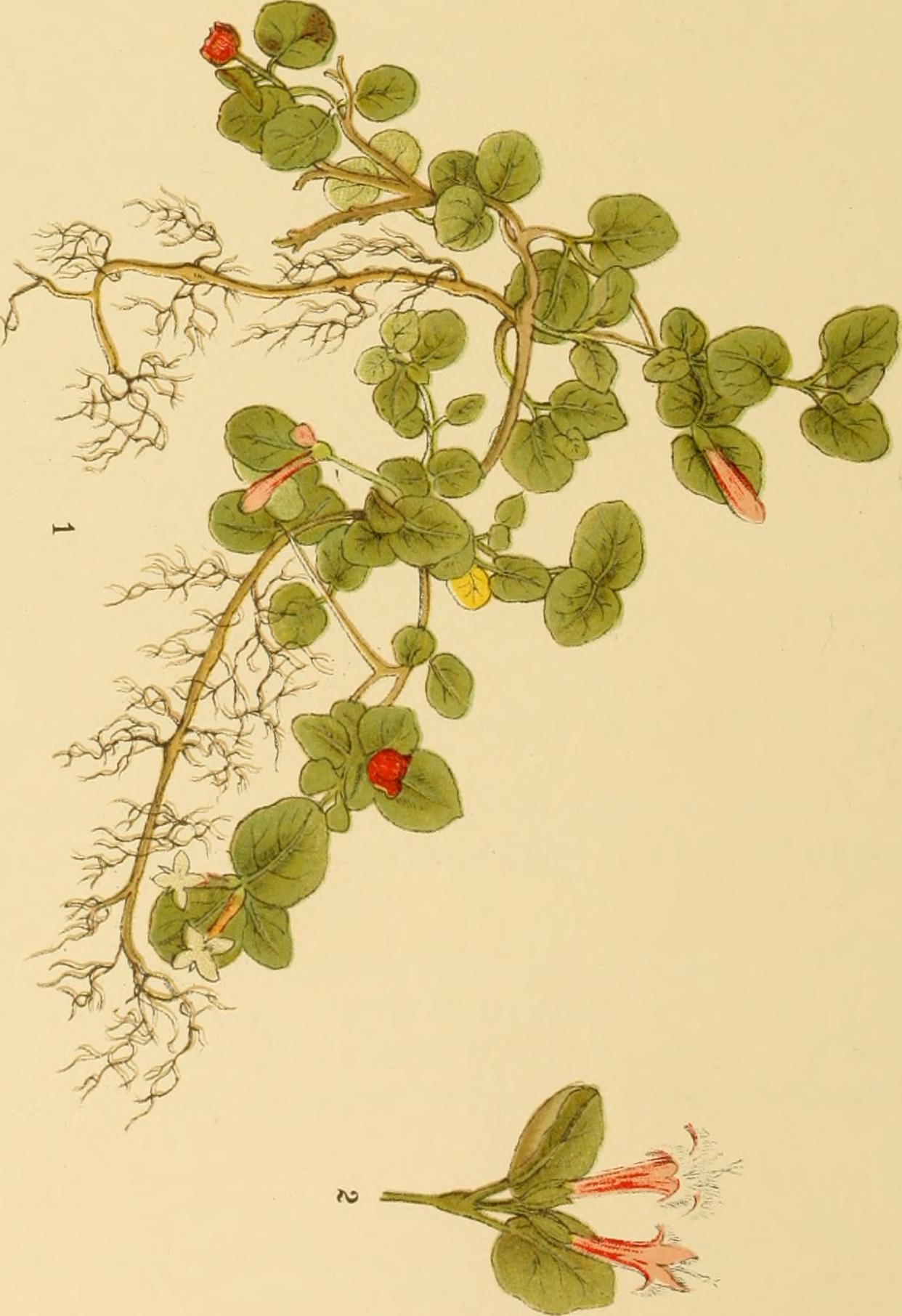
N. ORD.-RUBIACE^. 77 GENUS.— MITCH ELLA,* LINN. SEX. SYST.— TETRANDRIA MONOGYNIA. MITCHELLA. PAR TRID GE-BERR Y. SYN. — MITCHELLA REPBNS, LINN.; MITCHELLA UNDULATA. S. & Z • SYRINGA BACCIFERA, ETC., PLUK. COM. NAME S.-PARTRIDGE -BERRY, SQUAW-BERRY, SQUAW- VINE, TWOEYED CHEQUER-BERRY, REEFING CHECKER-BERRY, WINTERCLOVER, DEER-BERRY. A TINCTURE OF THE WHOLE FRESH PLANT, MITCHELLA REPENS, LINN. Description. — This pretty little plant, creeping about in the moss at the foot of our forest trees and decayed stumps, attains a growth of from 6 to 14 inches. Root cylindrical, branched, horizontal, and noduled at the insertion of the tufted, opposite rootlets. Stem glabrous, branching widely, and rooting at each axilla. Leaves orbicular-cordate or oval and subcordate, sometimes havino- a whitish line over the o midrib; dark, evergreen, slender, petioled; stipules minute, somewhat triangular awl-shaped. Inflorescence terminal; flowers in pairs with united ovaries, sometimes solitary and double (fig. 3); the flowers on one plant may have included stamens and an exserted style, while another show an included style and exserted stamens. This fact has led Mr. Thos. Meehanf to consider the species dioecious. The first form, he alleges, to be that of the female; the last, the male plant. As far as my observation extends, I have as yet been unable to discover a plant that bore no fruit, and all parts examined appear to be fully developed internally as well as externally. Peduncle short, or, in the double form, almost wanting. Calyx 4-toothed. Corolla slender, funnel-form; limb 4-lobed; lobes spreading or reflexed, densely clothed with white hairs upon the upper face and in the throat and tube of the corolla. Stamens 4; filaments inserted upon the corolla; anthers oblong. Style single filiform; stigmas 4, linear. Fruit a fleshy, edible, globose, baccate, double drupe, retaining the persistent teeth of both calices, and remaining fresh on the plant all winter; nutlets 8 (4 to each ovary), small, seedlike, and bony. Read description of the order, under Cephalanthus, 76. History and Habitat. — The Partridge-berry is indigenous to North America, from the Canadas to the extreme southern limits of the United States, and has been found in Mexico and Japan. It grows in moist woods, especially those abounding in evergreens. It flowers in July. * In commemoration of Dr. John Mitchell, an early and excellent American botanist. t Am. your. Phar., 1 868, p. 554.
77-2 Mitchella is one of the many plants used by the American Aborigines as a parturient, frequent doses of a decoction being taken during the few weeks just preceding confinement. It has also been found to be a valuable diuretic and astringent, and to have an especial affinity to various forms of uterine difficulties. The plant is not mentioned in the U. S. Ph. In the Eclectic Materia Medica its preparations are: Extrachim MitchdlcB and Syrnptis Mitchcllcc Composilus:^ PART USED AND PREPARATION. — The whole fresh plant is chopped and pounded to a pulp and weighed. Then two parts by weight of alcohol are taken, the pulp well mixed with one-sixth part of it, and the rest of the alcohol added. After a thorough mixture, the whole is poured into a well-stoppered botde, and allowed to stand eight days in a dark, cool place. The tincture, separated by filtering the mass, should have a deep orange-red color by transmitted light, an odor between that of Scotch snuff and oil of wintergreen, an astringent taste, and an acid reaction. CHEMICAL CONSTITUENTS. — No analysis has been made, as far as I can determine, of this plant. The tincture, made as above, contains a large percentage of tannin, and a resin precipitable by water. PHYSIOLOGICAL ACTION. — The symptoms, as recorded by Drs. F. C. Duncan and P. H. Hale,-|- show that Mitchella causes a general congestion, with dryness and burning of the mucous membranes of the alimentary tract. The clinical results would seem to show a tonic action upon involuntary muscular fibres. The drug merits more extended proving. Description of Plate 77. I. Whole plant (somewhat reduced); Pamrapo, N. J., June 8th, 1879. 2. A pair of flowers (somewhat enlarged). 3. A double flower (somewhat enlarged). * Mitchella, Helomias, Viburnum op., and Caulophyllum. f Allen, Ency. Pure Mat. Med., vol. vi, j). 373.
78. ^ (p^m.adnatdeletpinxt EUPATORIUM PURPUREUM, Linn
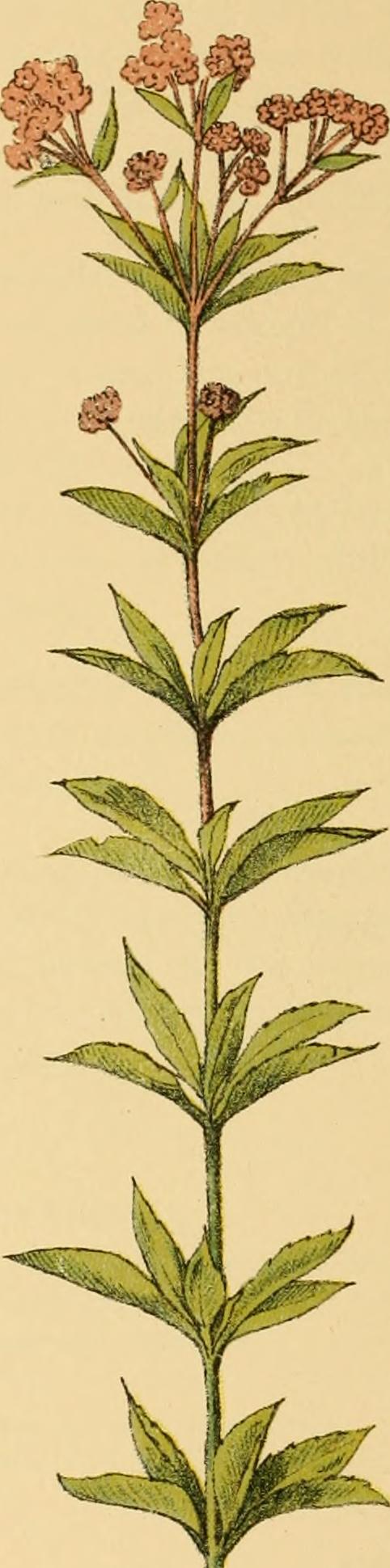
N. ORD-COMPOSIT^. 78 Tribe.-EUPATORIACE/E. GENUS.— EUPATORIUM,* TOURN. SEX. SYST.— SYNGENESIA.EQU.\LIS. EUPATORIUM PURPUREUM. PURPLE BOJVESET. SYN.-EUPATORroM PURPUREUM, TRIPOLIATUM, AND MACULATUM LINN.; E. VERTICILLATUM, MUHL.; E. TERNIPOLIUM, ELL. COM. NAMES.— PURPLE BONESET, THOROUGH-WORT, OR HEMP-WEED • JOE-PYE,t OR JOPI-WEED; TRUMPET- WEED; QUEEN OF THE MEADOW;: GRAVEL-ROOT; (GER.) PURPURPARBENBR WASSERHANF. A TINCTURE OF THE FRESH ROOT OF EUPATORIUM PURPUREUM, L. Description. — This common herb varies greatly in form and foliage, the type being very tall and graceful. Siejn rigidly erect, 6 to i 2 feet high,§ stout, simple, and either hollow or furnished with an incomplete pith; it is punctate in lines and purple above the nodes, or often covered with elongated spots {E. maculata, Linn.). Leaves verticillate, mostly in fives, nearly destitute of resinous punctae, oblonglanceolate, acutish or acuminate, coarsely serrate, roughish and reticulate-veiny; petioles distinct or merely represented by the contracted bases of the leaves. Inflorescence a terminal, dense, compound corymb; heads very numerous, 5 to lo-flowered. Involucre flesh-colored, cylindrical; bracts thin, membranaceous, somewhat scarious when dry, and faindy 3-striate, obtuse; they are closely imbricated in three rows, the exterior successively shorter. Receptacle flat, not hirsute. Style bulbous at the base, much exserted. Achenia smooth, glandular. Eupatorium. — This vast genus contains in North America alone 39 species and 16 distinct varieties; other species are found in South America, Asia, Africa, and Europe. It is composed mostly of perennial herbs, but contains a few annuals, and shrubs in warmer regions. Leaves mostly opposite and simple, resinous and bitter, rarely alternate, whorled, or divided. Heads small, homogamous, discoid, and corymbosely-cymose or paniculate, rarely solitary; involucre cylindrical or somewhat campanulate; scales numerous, purple, blue, or white, never really yellow, though sometimes ochroleucous. Floivcrs hermaphrodite and homochromous; corolla tubular and regular, 5-toothed; anthers included, not caudate; receptacle naked and flat. Style cylindraceous, branched, the branches exserted, more or less thickened upward and very minutely pubescent. Pappns a single * Mithiidates Eupator, king of Pontus, who was first to use the plant as a remedy. f An Indian by this name cured typhus in New England, with this plant, by powerful sweating. \ The Queen of the Meadow is more properly Spiraa salici/olia, Linn. (Rosacea?). § The individual represented in the plate was nearly lo feet high, growing in an open, rich field.
78-2 series of slender but somewhat stiff and rough capillary bristles. Achenia 5-angled, not striate. The species of this genus used in medicine are, beside the two under consideration, the American E. aromaticuni, Linn., sessilifolium, Linn., tencrifoliiim, Willd., and ageratoides, Linn., all considered tonic, diaphoretic, and antiperiodic, the latter being the supposed cause of the " trembles " in cattle; E. rottindifoliimi, Linn., a palliative in consumption; the Texan niata [E. incaniatitm, Walt.) is said to be diuretic, and is used for flavoring tobacco; while E. fceiiiculceum, Willd., leiicolepsis, T. & G., and hyssopi/oHtim, Linn., are considered to be antidotes to the poisonous bites of reptiles and stings of Insects. The European E. camiabinum, Linn., is diuretic, emetic, and purgative; the South American E. ghitivosiim Is one of the sources of the substance known as Matico; * the Jamaican E. nen<osiiin Is regarded as an almost certain cure for cholera, typhus, typhoid, and small-po.x; while the Brazilian aya-pana {E. ayapana. Vent.) is an aromatic tonic and febrifuge, and Is considered a sure remedy — If timely used — for antidoting the effects of the bites of poisonous reptiles and Insects; this last is said to be the most powerful species of the genus, and as such, it should be carefully proven. Compositse. — This immense and purely natural order, consists of herbs, and rarely shrubs and trees; it comprises one-tenth of all known ph^enogamous plants, and one-eighth of those of North America, where it has 237 genera and 1610 species, of which 1551 are indigenous. Its members are easily distinguished as such, even by general observation; but many of the genera and species require close and careful study for their identification. Since this work was begun, and too late for revision. Prof. Asa Gray's almost phenomenal volume.-j- including this order, appeared. In his careful and laborious revision of the order many changes were instituted In the arrangement and names of the tribes and genera, making the following table necessary to an understanding of the order as It stands at present: Nbw Arrangement. This Work. Old Arrangement. New Arrangement. This Work. Old Arrangement. Tribe. Genus. Tribe. Tribe. Genus Tribe. Eupatoriacese. 78, 79. Eupatoriuni. (Same.) Anthemidece. 87, 88. Artemisia. Senecionidea;. Asteroitleae. 80. Erigeron. " Senecionidece. 90. Ei-echthites. (Same.) Inuloideae. 89. Graphalium. SenecionideiE. " 91. Senecio. " (C 81. Inula. Asteroidea?. Cynaroidea;. 92. Arctium. Cynareae (Lappa). Helianthoideae. 82. Ambrosia. SenecionideEe. Cichoriacse. 93. Cichorium. (Same.) ^ 83Helianthus. " " 94. Prenanthes. " (Nribaliis). Anthemideie. 84. 85. Anthemis. Achillea. „ " 95. Taraxacum. 96. Lactucca. „ n 86. Tancetum. " * The officinal matico, however, is derived from Piper angusli/o/ium, R. & P. (Pii_eracea;). f Synop. Flora of N. A.
78-3 Description.* — " Floiuers in an involucrate head on a simple receptacle, 5-merous, or sometimes 4-merous; with lobes of the epigynous corolla valvate in the bud; stamens?ls, many as corolla lobes and alternate with them, inserted on the tube; anthers connate into a tube (syngenesious); style in all fertile flowers 2-cleft or lobed at the summit and bearing introrse-marginal stigmas; ovary i-celled, a single anatropous ovule erect from the base, becoming an exalbuminous seed with a straight embryo, the inferior radicle shorter and narrower than the cotyledons; the fruit an akene. Tube of the calyx wholly adnate to the ovary; its limb none, or absolute, or developed into a cup or teeth, scales, awns, or capillary brisdes. Corolla with nerves running to the sinuses, then forking and bordering the lobes, rarely as many intermediate nerves. Anthers commonly with sterile tip or appendage; the cells introrse, discharging the pollen within the tube; this forced out by the lengthening of the style, which in hermaphrodite and male flowers is commonly hairy-tipped or appendaged. Follen-o-rains g\oho?,ft, echinulate, sometimes smooth, in CiCHORiACE.'E 12-sided. Leaves v2Lr\ou?,; no true stipules. Development of the flowers in the head centripetal; of the heads when clustered or associated, more or less centrifugal, /. e., heads disposed to be cymose. Juice watery, in some resinous, in the last tribe milky. " Heads homoganiims ^\\.(tx\ all its flowers are alike in sex; heterogamous when unlike (generally marginal flowers female or neutral, and central hermaphrodite or by abortion male); aitdrogynous when of male and female flowers; monoecious or dia'cious when the flowers of separate sexes are in different heads, either on same or different plants; radiate when there are enlarged ligulate flowers in the margin; wholly ligulate when all the flowers have ligulate corollas, discoid when there are no enlarged marginal corollas. When these exist they are sometimes called the ray; the other flowers collectively occupy the disk. The head (compound flower of early botanists), in Latin capitnluni, is also named anthodium. Its involucre (periclinium of authors) is formed of separate or somedmes connate reduced leaves, /. e., bracts {squamcF or scales); the innermost of these bracts subtend the outermost or lowest flowers. The axis within or above these is the receptacle {clinanthimn), which varies from plane to conical or oblong, or even cylindrical or subulate. When the receptacle bears flowers only it is naked, although the surface may be alveolate, foveolate or merely areolate, according as the insertion of the ovaries or akenes is surrounded or circumscribed by honeycomb-like or lesser elevations, or, when these project into brisdes, slender teeth or shreds, it \-s, Jimbrillate; it is paleaceous when the disk flowers are subtended by bracts; these usually chaff-like, therefore called palea;, chaff, or simply bracts of the receptacle. In place of calyx-limb there is more commonly a circle of epigynous bristles, hairs or awns; the pappus, a name extended to the calyx-limb of whatever form or texture; its parts are brisdes, awns, palae, teeth, etc., according to shape and texture. Corollas either all tubular (usually enlarging above the insertion of the stamens into the throat, and 4 to 5-lobed at summit, mosdy regular), or the marginal ones strapshaped, /. e., ligulate, the elongated limb {ligule) being explanate, and 3 to 5-toothed * I use Prof. Gray's full description of the order from the volume above referred lo, Vol. I., pt. 2, 48.
78-4 at the apex. Such are always female or neutral, or, when all the flowers of the head have ligulate corollas, then hermaphrodite. Anthers with basal auricles either rounded or acute, or sometimes produced into tails {cmidaie). Branches of the style in female flowers and in some hermaphrodite ones margined with stigma, i.e., stigmatic lines, quite to the tip; in most hermaphrodite flowers these lines shorter, occupying the lower portion, or ending at the appendage or hairy tip." The largest subdivision or series of this order is the Tubuliflor^, wherein the hermaphrodite flowers have tubular and regular flowers. The Labiatiflor.e have corollas of all, or only of the hermaphrodite flowers, bilabiate. The Liguliflor^ have all flowers hermaphrodite and all corollas ligulate. Beside the 19 medicinal species treated of in this work, and those spoken of under the description of the genus Eupatorium, we have provings of the following: Wyethia ( Wyethia, Helenoides, Nutt.); the New Zeyland Pitka-puka {Brachyglottis repens, Forsk.); the Arctic American Grindelia {^Grindelia squarrosa, Dunal.); the European Mountain Arnica [Artiica montana, Linn.); the Spanish Pellitory [Pyrethnmi Pariiethium, Linn.); the European Coltsfoot {Tussilago Farfara, Linn.); and the Italian Sweet-scented Coltsfoot {T. fragrans, Linn.); the European Daisy {Bellis perennis, Linn.); the South European Marigold [Ca/etidicla officinalis, Linn.); the Blessed Thistle [Cardtms Benedichis, Linn.; Centaurea Tagana, Willd.); Chamomilla, the German Chamomile {Mat?'icaria Chamomilla, Linn.); and Cina, the European Wormseed ^Artemisia Citia, Berg.; A. santonica, Linn., Artemisia Contra.).* Outside of our materia medica many valuable, and secondary, drugs are used; prominent among them we And: the American Daisy-fleabane [Erigeron heteropliylluni, Muhl.), a reputed remedy for gravel, hydrothorax, and gout; and E. PhiladelpJiiciim, Linn., a powerful emmenagogue. The German V^\X.oxy {^Anacyclus officittarum, H.D.B.), a powerful irritant, sialagogue and stimulant. The East Indian Veronia ajtthelmintica, Willd., is considered a most powerful vermifuge; the Indian Elephaiitopus scaber, Linn., is used on the coast of Malabar in dysuria; the Mexican Xoxonitztal or Yoloxiltic [Piqiceria b'ina'via, Cav.) is said to be a valuable antiperiodic. Many species of Liatris are considered powerful diuretics, especially L. sqiiarrosa, Willd., and L. odoratissima, Willd. The Brazilian Coracoa de Jesu {Mikania officinalis. Mart.) is claimed to be an excellent stomachic-tonic; and the South American M. Guaco, H. & B., and the Brazilian Erva da Cobra {M. opifera. Mart.), are considered efficacious antidotes to the bites of the cobra de capello, and those of malignant insects. The common European Fleabane {Pulicaria dysentenca, Gaertn.) is said to have once cured the Russian army of dysentery. Two species of Bidens, viz.: the European B. tripartita, Linn., and the Carolinian B. Chrytsanthcmoides, Michx., together with the South American Spilanthes oleracca, Jacq. {Bidens fervida. Lam.), produce acrid and copious salivation. The Mayweed, Maruta cotula, D.C.), so common almost generally throughout the North Temperate Zone, is fetid and blistering, and causes copious vomiting and * Bentley and Trimen, in their work on " Medicinal Plants,'' consider that the true source of Santonine is from tlie Russian and Asiatic Artemisia paucijlora, Weber {A. Cina, WiUk., not Berg.).
78-5 diaphoresis; it should be proven. The Egyptian and Palestine Baboiiny or Zeysoiim [SanloHna fragrantisshna, Forsk.) is substituted in Cairo for chamomile, and used in eye affections. The Chinese and Japanese Artemisia Indica, Wiild., is said to be a powerful deobstruent and antispasmodic. The East Indian Eini/a sonchifera, D.C., is used in India as a febrifuge. Thus throughout the order almost every genus has its useful species, especially in their native localities. Among the edible vegetables afforded by the order, we find the Jerusalem Artichoke {Helianthus tuberosum, Linn.);* the European salsify {Tragopogon porrifolius, Linn.); Endive and Chiccory, mentioned under Cichoriam Intybus, 93; and Lettuce [Lactuca sativa, Linn.). History and Habitat. — Eupatorium purpureum is indigenous to North America. Its northern ran^e extends from New Brunswick to Saskatchewan; thence it grows southward to Florida and westward to New Mexico, Utah, and British Columbia. It grows in rich, low grounds, where it blossoms throughout the summer months. The previous use of the purple flowered boneset was very similar to that of its congener, E. perfoliatum. It, however, has proven especially valuable as a diuretic and stimulant, as well as an astringent tonic. It proves useful in dropsy, strangury, gravel, hematuria, gout and rheumatism; seeming to exert a special influence upon chronic renal and cystic trouble, especially when there is an excess of uric acid present (King). The preparations of the Eclectic Materia Medica are: Decoctum Eupatorii Furpurei; Infusiim Eupatorii Purpurei, and Infusum Epigece Composita.-\ PART USED AND PREPARATION.— The fresh root should be chopped and pounded to a pulp and weighed. Then two parts by weight of alcohol are taken, the pulp thoroughly mixed with one-sixth part of it, and the rest of the alcohol added. After having stirred the whole well, pour it into a well-stoppered bottle, and allow it to stand eight days in a dark, cool place. The tincture separated from this mass by filtration has a clear, orange color by transmitted light. It is slighdy bitter and astringent, has a somewhat terebinthic odor, and an acid reaction. CHEMICAL CONSTITUENTS.— No specific analysis to determine a special principle has been made of this plant. The chemistry of E. perfoliatum is probably applicable more or less to this species. Eupurpurin.— This so called oleoresin was precipitated from a tincture of the root by Merrell. The body is thrown down when the alcoholic tincture is poured into twice its volume of water and the alcohol is filtered off. It results as a thick, * The true artichokes, however, are, the succulent receptacle of the South European Cynaria Scolymus, Linn., and Cardoons, i. e., the leafstalks of C. caruuciilus. f Epigjea, Eupatorium purpureum, Aralia hispiJa, and Althea officinalis.
78-6 dark greenish-brown mass, having a nauseous taste, and exhibiting, as far as known, the full action of the root. It contains all those principles of the root not soluble in water. PHYSIOLOGICAL ACTION.— Eupatorium purpureum — in doses of from lo to 60 drops of the tincture — causes increased secretion of the glands of the mouth; nausea; crampy pains in the stomach and bowels; aching or cutting pains in the bladder with a sensation of fullness and soreness, and a constant desire to void urine, with scanty discharge; increased heart's action; and a general feeling all through the system of languor, soreness, faintness, and weakness, with yawning and intense desire to sleep.* Description of Plate 78. 1. Whole plant, 15 times reduced, Chemung, N. Y., September 10th, 1879. 2. One of the smaller branches of the corymb. * Mrs. Dresser's experience with the drug. Hale, JVe-ir Rinn., I. c.
79. ^m.adnatdcl.etpinxr EUPATORIUM PeRFOLIATUM, Linn.
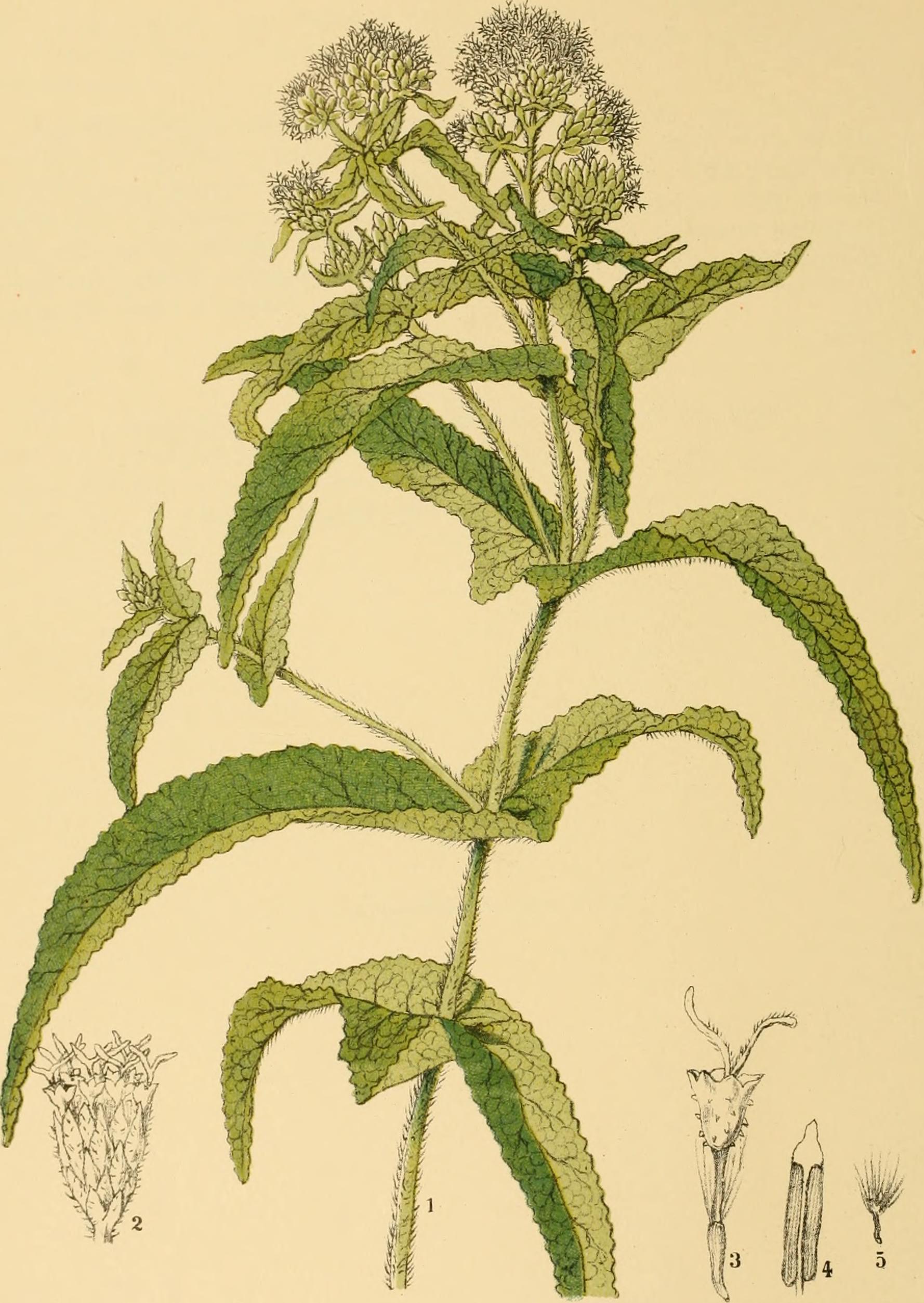
N. ORD -COMPOSITE. 79 Tribe.-EUPATORIACE/E. GENUS.— E UPATORIUM.* SEX. SVST.— SYNGENESIA.EQU.ALIS. EUPATORIUM PERFOLIATUM. BOJVESET. SYN.— EUPATORIUM PERFOLIATUM, LINN.; E. CONNATUM, MICHX.; B. SALVI^FOLIUM, SIMS; B. VIRGINIANUM, PLUK. COM. NAMES.— BONESET, THOROUHWORT, AGUE-WEED, VEGETABLE ANTIMONY, INDIAN SAGE, PEVERWORT,* CROSSWORT, SWEATING WEED, THOROUGH- W AX; t (FR.) EUPATORIE PERFOLIEE, HERBS PARPAITE, HERBE A FIEVRB; (GER.) DURCHWAGHSENER WASSERHANF. A TINCTURE OF THE WHOLE FRESH PLANT, EUPATORIUM PERFOLIATUM, L. Description. — This familiar plant grows to a height of from 2 to 4 feet. Stem stout, cylindrical, or somewhat terete, fastigiately branched above, and villouspubescent throughout; leaves connate perfoliate, divaricate, narrowly lanceolate and acuminate; they are prominently one-ribbed, rugose, copiously studded with resinous dots, finely and closely crenulate-serrate, dark and shining green above and soft-pubescent or almost cottony beneath. Inflorescence a dense, somewhat convex, compound, capitate, corymbose cyme; heads small, very numerous; bracts narrowly-lanceolate, hairy, and furnished with slightly scarious, acutish tips; floivers mostly 10; corolla tubular-campanulate; teeth broadly triangular. Akenes small glandular, oblong-linear, smooth, and bluntly 5-angled; pappus shorter than the corolla. The description of Eupato7'uim as given under the preceding drug should be read in connection with this. History and Habitat. — Boneset is a common plant, indigenous to North America, where it ranges from New Brunswick to Dakota in the North, to Florida and Louisiana in the South. It grows in marshy places on the borders of lakes, ponds, and streams, where it blossoms from July to September. There is probably no plant in American domestic practice that has more extensive or frequent use than this. The attic, or woodshed, of almost every country farm-house, has its bunches of the dried herb hanging tops downward from the rafters during the whole year, ready for immediate use should some member * The true Feverwort with us is Triostetim perfoliatttm (Caprifoliaceai). f The true Thoroughwa.x is Biipkiirttm rotunJifoliuin, Linn. (UmbelliferiE).
79-2 of the family, or that of a neighbor, be taken with a cold. How many children have winced when the maternal edict: "drink this boneset; it'll do you good," has been issued; and how many old men have craned their necks to allow the nauseous draught to the quicker pass the palate! The use of a hot infusion of the tops and leaves to produce diaphoresis, was handed down to the early settlers of this country by the Aborigines, who called it by a name that is equivalent to ague-weed. It was first introduced, as a plant, into England in 1699; but was not used in medical practice, even in this country, until about the year 1800, but it now has a place in every work on Medical Botany which treats of North American plants. Eupatorlum perfoliatum is diaphoretic only when given in generous doses of the hot infusion; a cold decoction is claimed to be tonic and stimulant in moderately small, laxative in medium, and emetic in large doses. It is also said to be antidyspeptic and anti-rheumatic. It is prominently adapted to cure a disease peculiar to the South, known as break-bone fever (Dengue), and it is without doubt from this property that the name boneset was derived. This herb has also been found to be curative in intermittent fever, bilious fever, bilious colic, typhus, and typhoid conditions, influenza, catarrhal fever, rheumatism, lake fever, yellow fever, and remittent types of fevers in general. Many of the earlier works allude to this species as being diuretic, and therefore of great use in dropsy; this is evidently an error of substitution, the previously described drug being the species used. Dr. Barton, who had made this species one in general use in his practice, observes as follows: "The late Samuel C. Hopkins, M.D., who resided in the village of Woodbury, N. J., and had an extensive practice in a range of fifteen or twenty miles of a populous tract of country, in which, from the low and marshy nature of the soil — exposure of many of the inhabitants holding fisheries, to the water and other pernicious causes — intermittent and typhus fevers were very prevalent, and the latter particularly malignant. The Doctor was among those partial to the sweating plan of treating this fever, and his unusual success in a multitude of cases for five or six years in succession, is strongly in favor of that mode of practice. The boneset was the medicine used in producing this effect. He prescribed it freely in warm and cold decoction, but preferred the warm. He assured me that in many instances his sole reliance was upon this plant, which was occasionally so varied in its manner of exhibition as to produce emesis, and frequently was intentionally pushed to such extent as to excite free purging. Its diaphoretic effect, however, he deemed it indispensable to ensure, and therefore preferred in general giving it warm." * My friend. Dr. Henry S. Sloan, of this city, relates his personal experience with this drug as follows: When a young man, living in the central part of this State, he was attacked with intermittent fever, which lasted off and on for three years. Being of a bilious temperament, he grew at length sallow, emaciated, and hardly able to get about. As he sat one day, resting by the side of the road, an old lady of his acquaintance told him to go home and have some thoroughwort * Barton, Med. Bot., ii, 136.
79-3 " fixed," and it would certainly cure him. (He had been given, during the years he suffered, quinine, cinchonine, bark and all its known derivatives, as well as cholagogues, and every other substance then known to the regular practitioner, without effect; the attacks coming on latterly twice a day.) On reaching home, with the aid of the fences and buildings along the way, he received a tablespoonful of a decoction of boneset evaporated until it was about the consistency of syrup, and immediately went to bed. He had hardly lain down when insensibility and stupor came on, passing into deep sleep. On awaking in the morning, he felt decidedly better, and from that moment improved rapidly without farther medication, gaining flesh and strength daily. No attack returned for twenty years, when a short one was brought on by lying down in a marsh while hunting. From my own experience, as well as what I have learned from others, I feel confident that as an " antiperiodic " this drug will be indicated much more frequently in the United States than quinine, and exhibit its peculiar action in a curative manner, not palliadve as is most common in the latter substance when exhibited ex patria. I have observed that boneset acts more surely in intermittent fever, when the disease was contracted near its habitat, /. c, by streams, ponds, and lakes in the United States east of the 85° west longitude, and north of the 32° north latitude. It may be stated that this is true of most plants used in medicine, and probably accounts for many failures of foreign drugs in domestic diseases: witness Conium, Cinchona, etc., etc.* The officinal preparation in the U. S. Ph., is Extractum Eupatorii Eliddtim. In the Eclectic Materia Medica the following preparations are recommended: Extractum Eupatorii, Infusum Eupatorii, and PilulcB Aloes Compositcc. PART USED AND PREPARATION. — The whole fresh plant, gathered just as it is coming into fiower, is prepared as in the preceding drug. The resulting tincture is opaque; in thin layers it exhibits a deep, slighdy orange-brown color by transmitted light. It has a nauseous, penetrating, bitter, and astringent taste, and imparts a sensation to the tongue very similar to that of ginger; it retains the peculiar odor of the plant, and has an acid reaction. CHEMICAL CONSTITUENTS. — Eiipatorine. — This glucoside was extracted from a percolate of the dried tops and leaves of this plant by G. Latin f it was also appreciated in most of the analyses referred to below, but was not isolated, being spoken of as a bitter principle only. Eupatorine is described as a slighdy acid, amorphous body, soluble in alcohol and boiling water, yielding a red precipitate when boiled with sulphuric acid, and a white precipitate with the cold acid. Its farther physical and chemical properties are as yet undetermined. Bitter extracdve;^-"" Tannin;i -==* ^ '= Volatile oil;^^^" Free acid;- Gallic acid;^ Resin r"" Gum;-^^" Sugar;i^' and a bitter principle, -'* "^ '^ ' have also been * This refers only to drugs exhibited for their physiological or toxic action. 1 Bigelow, Am. Med. Bot., i, 35. ^ Anderson, Iiiitug. Thesis. ^ Peterson, Am. Jour. Phar., 1S51, 206. * V,'KV\ty[ ibid., 1S54, 459. 5 Latin, ibid., iSSo, 392. " Parsons, 1859, Rep. to U. S. Com. of Agrie. ' Tilden's Analysis, your, of Mat. Med., ii, N. S. 243.
79-4 determined. The last-named substance is spoken of by some observers as being resinous, others as resinoid, and again as crystallizable. I judge it to have been in all the Eupatorine of Latin, either mixed with some part of the other constituents, or more or less pure. PHYSIOLOGICAL ACTION. — The symptoms shown by those who have partaken of large doses of an infusion of the tops and leaves, show that this drug causes at first an irritation of the vaso-motor system, followed by a relaxed condition of the capillaries, and an increase of the heart's action, again- followed by severe congestion and higher temperature. The symptoms are: Faintness, with loss of consciousness, ending in lethargic sleep; pain, soreness, and throbbing in head; soreness of eyeballs, with sharp pains and photophobia; buzzing in the ears; catarrhal influenza; face red or sallow, and sickly in appearance; tongue white cottony coated; thirst especially preceding the stage of chill; vomiting, especially as the chill passes off; violent colic pains in the upper abdomen; urine darkcolored and scanty, with frequent micturition; oppression of the chest with difficult breathing; stiffness, soreness and deep aching in the limbs, the long bones especially, feel as if pounded or broken; sleepiness, with yawning and stretching, from which the patient awakes with a severe headache; skin bathed in copious sweat. The soreness and deep pains of Eupatorium are most general, and the skin feels numb and as if it would cleave from the bones. The adaptability of this drug to various forms of disease of paludal origin can readily be understood. Description of Plate 79. I. Summit of stem, from Greenville, N. J., July 26th, 1879. 2. Flower-head. 3. Floweret. 4. Anther. 5. Fruit. (2-4 enlarged.)
80. '.TU.adnatdel.etpinxt. ERJGERON CANADENSE, Linn.
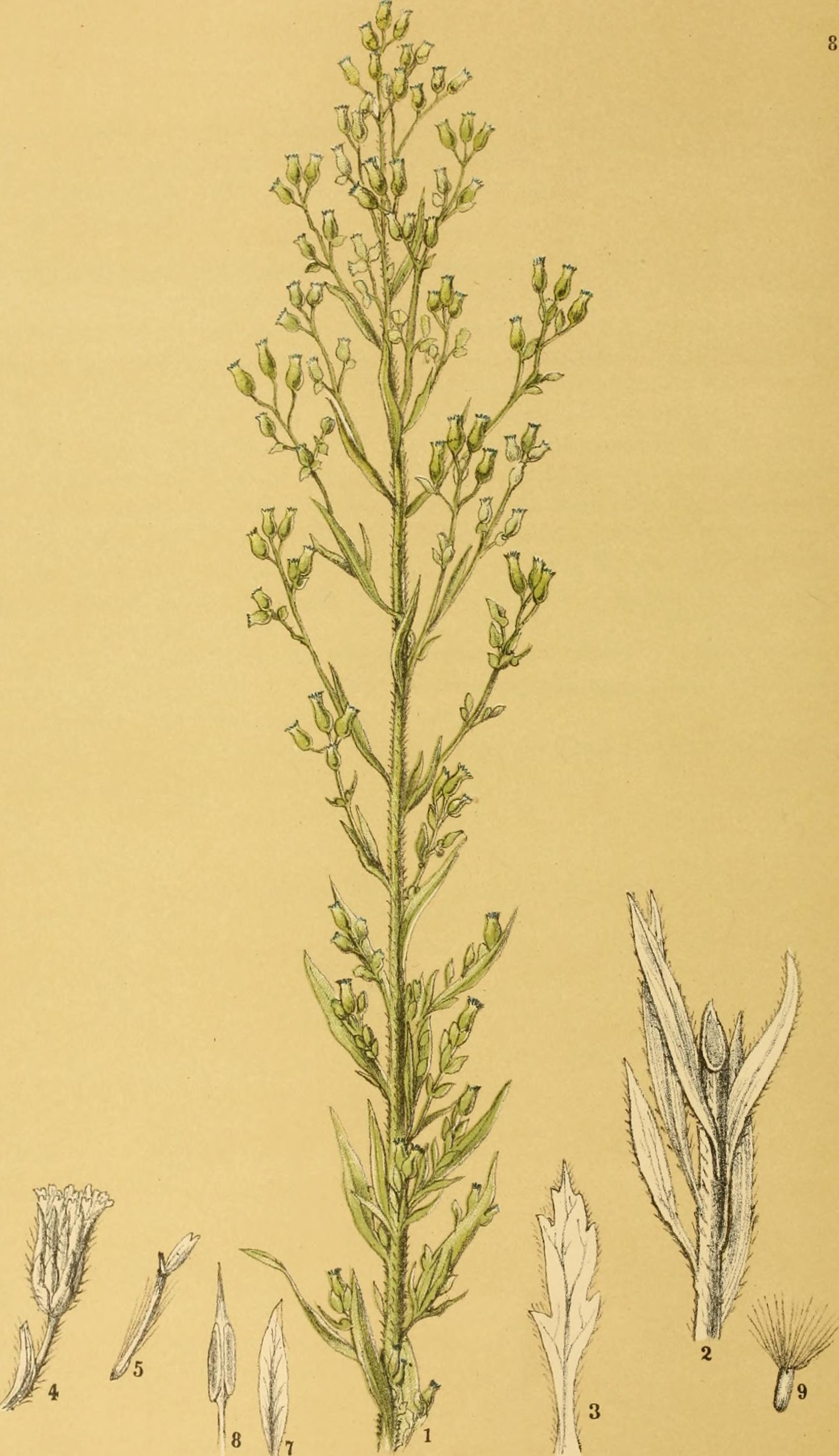
N. ORD.-COMPOSITyE. 80 Tribe.-ASTEROIDE/E. GENUS.— E RIG E RON,* LINN. SEX. SVST.— SVNGEXESIA SIPERFLUA. ERIGERON CAJVADA FLEABAJSTE. SYN.-ERIGERON CANADENSB, LINN.; E. PANICULATUS, LAM.; E. PUSILLUS, NUTT.; E. STRICTUM, D. C.; SENECIO CILIATUS, WALT. COM. NAMES. — CANADA FLEABANE, HORSE-WEED, BUTTER- WEED, COLT'S TAIL, PRIDE--WEED, SCABIOUS; (FR.) ERIGERON DE CANADA' tGER.) CANADISCHES BERUFKRAUT. A TINCTURE OF THE WHOLE PLANT, ERIGERON CANADENSE, LINN. Description. — This common annual herb grows to a height of from i to 4 feet, according to the soil. Stem strict, striate, varying from sparselyhispid to almost glabrous; branches mosdy superior, short, slender, ascending. Leaves all sessile, alternate, and more or less ciliate-hispid; the lower often somewhat spatulate, 3-nerved, and sparingly incised; upper leaves linear-lanceolate acute at each end. Inflorescence in a more or less dense terminal panicle; heads very small, cylindrical, many flowered, and radiate; \[\&face flat or hemispherical; peduncles and pedicels short; involucre almost glabrous; scales linear-lanceolate, nearly equal, little imbricated, all reflexed in fruit; receptacle flat or convex, naked, and pitted. Ray florets white, fertile, crowded in a single row, a little exserted and surpassing the branches of the style; tube, elongated-cylindrical; ligule very short, ascending, 2-toothed. Disk florets bisexual; corolla tubular, mostly 4toothed; filanients very short, filiform; anthers cylindrical, half exserted, not tailed, the connective prolonged at the apex; style short, branched; stionias spreading. Achenia oblong, flattened, usually pubescent, 2-nerved; pappus simple, a single row of capillary bristles. History and Habitat. — Erigeron is indigenous to the eastern and central belt of North America, where it Is common in dry soils, Irom Canada to Texas; from thence southward, through South America, as far as Argentine Republic. In part to recompense Europe for the miserable dock weeds she has sent us, we have returned her this species, which has now spread through Asia to the sea. It is also introduced in South Africa, Australia, and many of the Pacific islands. It flowers, with us, in July and August, maturing its profusion of parachute-like seeds in autumn. * H/i, Er, spring; yifin, geron, an old man; on acco.int of the ho.ary appearance of >ome vernal species.
80-2 The applicability of a decoction of this herb to many forms of diarrhoea was well known to the Aborigines, and is now used in that disease by the Cree Indians of Hudson Bay. It was introduced in the practice at the New York Almshouse, in 1872, by Dr. Gilbert Smith, for a type of diarrhoea that often prevailed there, and met with very great success. The decoction has proven tonic, stimulant, astringent and diuretic, and been found useful in dropsies and many forms of urinary disorders, both renal and cystic, — such as gravel, diabetes, dysury, strangury, and urethritis; E. Iieterophyllum, and Philadelphicum have, however, greater power than Canadense in this direction. The oil of the plant is acrid, and, though not astringent, is, nevertheless, an e.xtraordinary styptic; it was introduced by Eclectic practice, and is an efficient agent in the treatment of hemorrhoids, passive hemorrhage, diarrhoea, dysentery, hemoptysis,* hematemesis, hematuria, and menorrhagia; as well as an e.xcellent palliative in the treatment of sore throat, with swelling of the glands, boils, tumors, rheumatism and gonorrhcea. The dose of the oil is from four to six drops in water, repeated not oftener than every hour, if much is to be required. The officinal preparation of the U. S. Ph., is Oletim Erigerontis; in the Eclectic Dispensatory, Oleum Erigci'onfis and Infusuni Erigerontis. PART USED AND PREPARATION. — The whole fresh plant, gathered during its flowering season, is treated as in the two preceding species. The resulting tincture has a clear, brownish-orange color by transmitted light; a somewhat aromatic odor; a slightly bitter and astringent taste; and an acid reaction. CHEMICAL CONSTITUENTS. — No analysis of the plant has yet been made that individualizes the bitter principle first separated by De Puy,f who also determined, in this species, gallic and tannic acids, and an essential oil, and proved that all the qualities of the herb were extracted by cold water or alcohol. Oil of Erigeroii Canadense. — This body may be extracted by distilling the fresh herb with water. It results as a colorless or pale yellow liquid, gradually becoming darker and thicker by age or exposure, and having an aromatic, persistent odor, an acrid taste, and a neutral reaction. It boils at 178° (352.4° P.); has a sp. gr. of from.845 to.850, and is readily soluble in water or alcohol. This oil * In the autumn of 1883, I was called hastily to attend Miss X. I found her sitting upon the floor, her arm resting upon a chair and her heail bending over a common-size foot balh tub, and every few moments a large quantity of bright red blood would gurglingly issue from her mouth. She had been spitting such quantities for over three-quarters of an hour, and the tub was over half-filled with foamy blood, and, I judge, a large quantity of saliva. I immediately mixed about a drachm of tincture of Erigeron in half a goblet of water, and gave her two leaspoonfuls of the mixture every five minutes, while getting the history of the case. She had been subject to these hemorrhages, which did not occur at the menstrual epoch, for some months past, though they were much less in quantity than the present one. Her family history was consumptive and hemorrhagic, and her physical strength always below medium. The hemorrhage now being arrested {after the second dose) leaving her terribly exsanguinated, I had her removed to her bed, and put her on light liquid food in large quantities. This treatment was followed by Erigeron in a potency for a month, one dose nightly, upon which her strength improved; and, up to the last time I saw her, three years after, no subsequent hemorrhage occurred Her menstrual flux, which had been much too copious and early, was also corrected; and her general health, as she expresses, a thousand times better than at any time since her monthlies commenced. t Iiiq. into Bol. His'., Chem. Prop., and Md. Qiial. Erig. Can., 1815.
80-3 contains less oxygen than that obtainable from li. Iietcrophyllunt, and consists mainly of a terpene (Cj„Hj,,), which, after distillation over sodium, boils at 176° (348.8° F.), and has a sp. gr. of.8464 at 18° (64.4° F.).* PHYSIOLOGICAL ACTION. — The symptoms arising during the experiments of Dr. W. H. Burt,-]- were mainly as follows: Cephallagia; smarting of the eyes; roughness of the pharynx; soreness of the throat; abdominal distress, and colic; increased urine; aching of back and extremities; and prostration. Description of Plate So. 1. Inflorescence, Binghamton, N. Y., Aug. iStli, 1886. 2. A portion of the mid-stem. 3. Lower leaf. 4. Flower-head. 5. Ray-floret. 6. Disk-floret. 7. Scale of the involucre. 8. Stamen. 9. Fruit. (4-9 enlarged.) * Am. Jour. Phar., 1883, 372 (BenchU, 1882, 2854). t.-im. Horn. Obs., 1S66, p. 357.
xvs\\iy^w. 81. (|m. ad natJel et pinxt Inula Helenium. Linn,
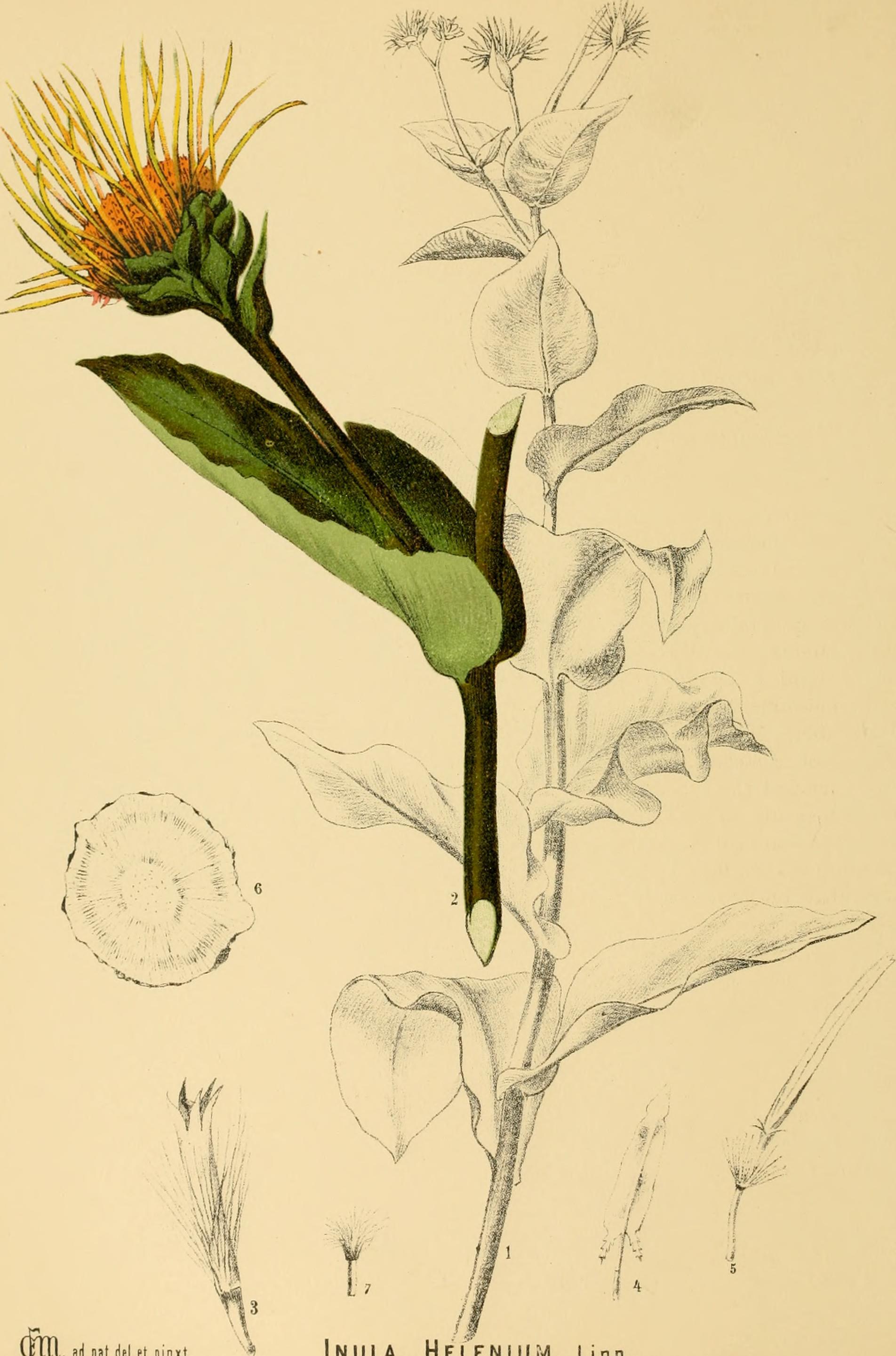
N. ORD -COMPOSITE. SI Tribe.-ASTEROIDE/E. GENUS. — INULA,* LINN..SEX..SYST.-SYNGENESIA, POLYGAMIA SUPERFLUA. INULA. ELECAMPANE.^ SYN.-INULA HELENIUM, Lx. CORVISARTIA HBLENIUM, MERAT. COM. NAMES.-ELECAMPANE, SCABWORT. (GER.) ALANT, (FE.) AUNEB. TINCTURE OF THE FRESH ROOT OF INULA HELENIUM, Z. Description.— This strikinglybeautiful perennial attains a height of from 3 to 6 feet. Root thick, mucilaginous, more or less tap-shaped, about 6 inches long, and I to 2 inches thick in the largest part, havinga curled furrowcommencing about an inch from the stem end, and running nearly to the tip; somewhat branching, the branches generally longer than the main root, but not so thick. The bark is rough, laminated or flakey, showing upon section a thickness of from one-sixteenth to one-eighth of an inch. The inner portion is radiate with numerous bundles of fibers, and dotted generally with yellowish resin-cells. S/e?n erect, stout, rounded, downy above, branching? near the top. Leaves alternate, large, sometimes reachinoa length of 18 inches and a breadth of from 4 to 6 inches; those near the root are ovate, petioled, the others sessile partly clasping; all green above, and whitish downy beneath. Peduncles of the flower-heads are given off from the axils of the upper leaves, they are long, thick, sometimes furnished with a pair of small leaves midway in their length; such are the so-called branches, and bear usually more than one flower-head on separate pedicles. Liivohicrc dense, woolly, the outer scales broadly ovate, sometimes leaf-like, the inner becoming at length linear. Floiver-hcads large, solitary or corymbose, all at or near the summit of the plant; the somewhat convex, naked, flat receptacles measuring about i inch in diameter. The heads are many-flowered, the ray-florets numerous and arranged generally in a single series, pistillate, but often infertile; the rays ligulate, unequally three-notched at the tip, and generally clasping the pistil forming a tube. Dlskflorets many, tubular, perfect, the tube 5-toothed or lobed. Stamens five, inserted on the corolla, their Anthers syngenesious, with two serrate tails at the base. Ovary oblong; Style 2-cleft at the apex. Achcnia terete or 4-sided, the sides smooth; pappus simple, composed of bristly hairs. A general description of the Compositae will be found under Eupaiorium purpureum. * Inula, a Latin classical name for this plant, probably a contraction of the w oid IIi:lenium, i\ij,oj, which was applied to the same species. Mediasval, Enula. f (Vnte-Linnx'an name Enui.a Campana, from which Elecampane.
81-2 History and Habitat.— Inula was one of the most famous of ancient medicines, and continued in vogue in the old school until very recent times. It owed the reputation it gained to its stimulant qualities. As far back as the Hippocratic writino-s, it is stated to be a stimulant to tlie brain, the stomach, the kidneys, and the uterus. This plant is a native of Southern England, now thoroughly naturalized in Europe and our country. It grows here spontaneously in the Northern States, in damp places along road-sides, the borders of gardens and about the ruins of old buildings. It flowers in July and August, and is a strikingly beautiful plant, reminding one forcibly of its near relative, the sunflower. Inula is simply mentioned in the U. S. Ph. The Eclectic officinal preparations are: Decoctum Hclenii, and Exiyachim Helcnii AlcoJiolic7im. Inula is also one of the components of Syriiptis Aralics Compositus. PART USED AND PREPARATION.— The fresh roots gathered in autumn (those of the second year's growth in preference, as the older ones are too woody) are chopped and pounded to a pulp and weighed. Then two parts by weight of alcohol are taken, and having mixed the pulp thoroughly with one-sixth part of it, the rest of the alcohol is added; after having stirred the whole well, and poured it into a well-stoppered bottle, it is allowed to stand eight days in a dark, cool place. The tincture is then separated by decanting, straining and filtering. Thus prepared it is, by transmitted light, of a clear amber color, has a decided bitter and astringent taste, and an acid reaction to litmus. CHEMICAL CONSTITUENTS.— Inulin,=^ QHjqO,. This amylose principle is found in the plants of many genera of the order Compositae; but as it occurs in orreater percentage in this genus, I describe it here. It will be noticed that this substance has the same composition as starch, still, though it takes the place of that body in the roots of this order of plants, it acts in many ways entirely different; for instance, it dissolves readily in hot water, but forms a clear solution, not an opaline pasty mass, its reaction with a solution of iodine gives a brown, not a blue colon It does not form in the plant as granular shell-like bodies as does starch, but is in solution in the plant juice. Inulin maybe thrown down from its watery solution by alcohol, forming thus globular masses of white needle-like crystals, called in the dried plant " Sphaero-crystals." Upon boiling this substance with a dilute acid, it is rapidly converted into levulose, but not at lower temperature. It is considered by Kiliani to be an anhydride of levulose. Elecampane Camphor, formerly 'called Helinin, was given the composition C,,. H.,, O,. Kallen succeeded in resolving it into two crystallizable bodies which he describes as follows: Helinin, C,., H^ O, a principle devoid of odor or taste, crystallizing in needles and fusing at 230° P., and Alant-Camphor (Inulol, Inulciid, Elecampane-camphor), C,,, Hj^ O, not supposed to be a pure substance; it has an odor and taste resembling peppermint, and fuses at 147.2° F. (iS"/ ^/^r^, Wittstein.) *.Alanlin, Menyanthiii, Elecamjin, Dalilin, Datiscin.
81-3 Synanthrose, C,, H,„ 0,^. — This saccharose body occurs according to Schorlemmer in the tubers of Inula and other Composite. It is a non-crystalline powder, light, deliquescent, and having no sweet taste. Inulic Acid.— Exists in larger quantities than inulol; it is pro])ably the anhydride of some acid peculiar to this plant. Resin.— A brown, bitter, nauseous acrid body, aromatic when warm, soluble in alcohol and ether; wax, gum, salts of K, Ca, and Mg, and a trace of volatile oil have also been determined. PHYSIOLOGICAL ACTION. — Inula has been held to be a stimulant to the secretory organs, but the effects produced — according to Fischer-' — in those who partook of the juice of the root, show the opposite effect! His schema of prominent symptoms is as follows: Confusion of the head, with nausea and vertigo on stooping; burning of the eyeballs; dryness of the mouth and throat; increased peristaltic action of the intestines, with griping or tensive pain; dragging in the rectum and female genitalia; much urging to urinate, with scanty results; severe pain in the lumbar region, with sleeplessness and coldness. The more minute action of the drug seems to fully carry out the above, which shows Inula to be anything but diaphoretic, diuretic, or expectorant in a physiological sense. Description of Plate 8i. I. Whole plant five times reduced, from Waverly, N. Y., August nth, iS8o. 2. Flower-head. 3. Disk flower (enlarged). 4. Stamen (enlarged). 5. Ray-floret (enlarged). 6. Section of the root. 7. Seed. * Vide Allen, " Encyc. Mat. Med.," Vol. V, p. 113.
82. >J\/.Hl.ailnatdel.etpinxi Ambrosia Artemisiaefolia, Linn.
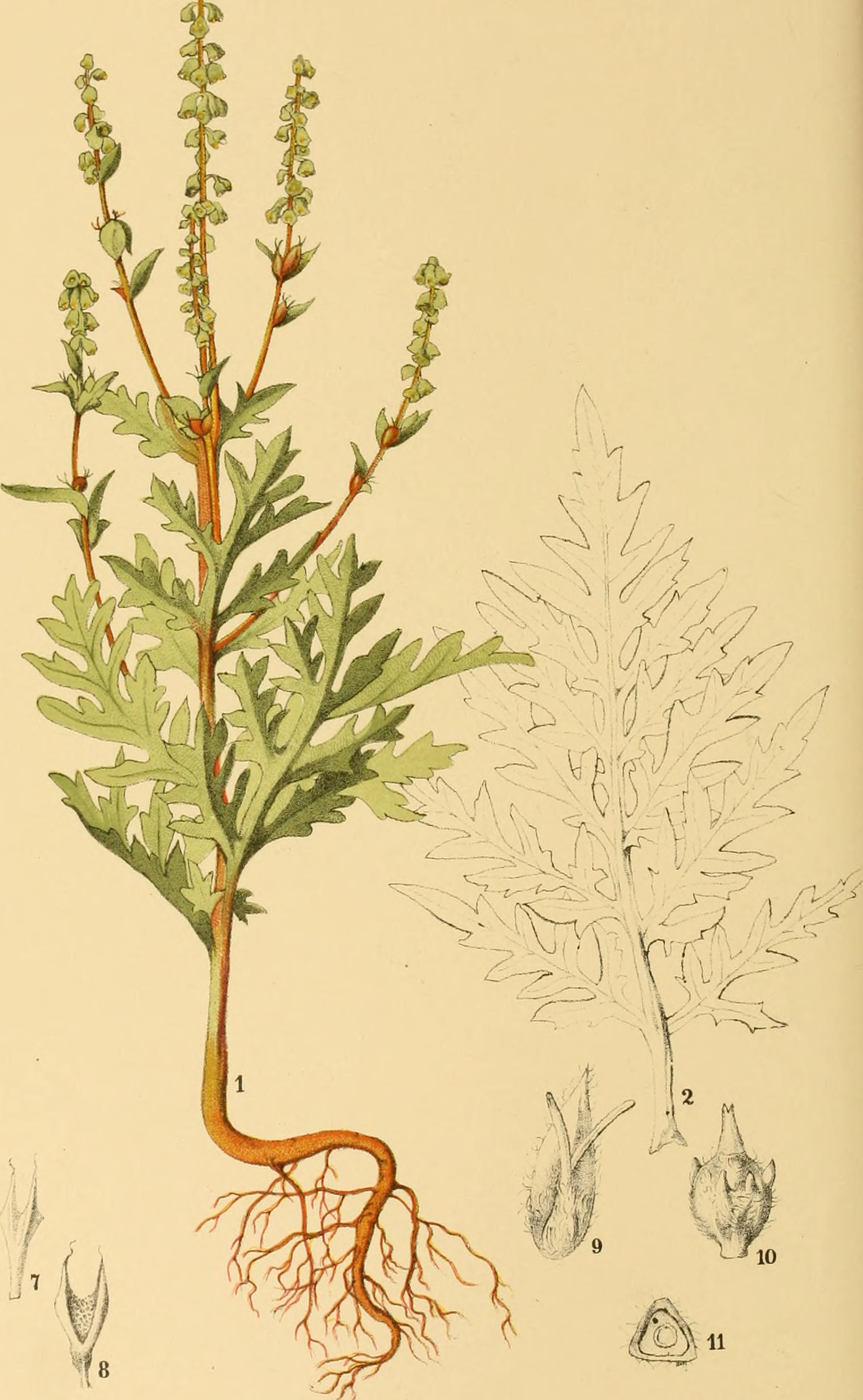
N. ORD.-COMPOSIT^. 82 Tribe.-SENEGIONIDE/E. GENUS. — AMBROSIA,* TOURN. SEX. SYST.— MONCECIA PENTANDRIA. AMBROSIA ARTEMISI^FOLIA. RAG -WEED. SYN.— AMBROSIA ARTIMISI^POLIA, LINN.; A. ELATIOR, LINN.; A. ABSYNTHIFOLIA AND PANICULATA, MICHX.; A. HBTEROPHYLLA, MUHL.; IVA MONOPHYLLA, "WALT. COM. NAMES.— RAG-WEED, ROMAN WORMWOOD, CARROT-WEED, WILD OR BASTARD WORMWOOD, HOG -WEED, CONOT-WEED, BITTERWEED; (PR.) AMBROSIE; (GER.) TRAUBENKRAUT. A TINCTURE OF THE WHOLE HERB AMBROSIA ARTEMISI.^FOLIA, LINN. • Description. — This annual, pubescent or hirsute weedy-herb, attains a growth of from I to 3 feet. Stem erect, at first simple, then paniculately branched. Leaves opposite and alternate, thinnish, bipinnatifid, or pinnatifidly parted, those of the inflorescence often entire, all smooth above and pale or hoary beneath; divisions irregularly pinnatifid or entire. Floiccrs unisexual on the same plant. Stei'ilc heads numerous, gamophyllous, arranged in centripetal, racemose spikes, all more or less recurved-pedicelled and not subtended by bracts; involiicj-e truncate, saucer-shape or campanulate, not costate but indistinctly radiate veined; border irregularly 4 to 6 toothed; corolla obconical, the border 5-toothed; stamens 5 \ filaments short; anthers deltoid, slightly united, their short appendages inflexed; abortive style columnar, the apex dilated and penicillate, strongly exserted. Fertile heads I to 3, apetalous, glomerate in the axils of the upper leaves and below the male spikes; involncre open, nutlet-like; corolla reduced to a ring around the base of the style; style bilamellar, exserted. Akcnes turgid-ovoid, triangularly compressed, short-beaked, and crowned with from 4 to 6 short teeth or spines; pappus wanting. History and Habitat. — This too-common, truly American weed, is indigenous from Nova Scoiia to Saskatchewan, Washington Territory, and southward to Brazil. It habits waste fields, roadsides, and dry places, and blossoms from the latter part of July to October. The former uses of this plant were but slight, its principal use being as an antiseptic emollient fomentation; its bitterness caused its use in Maryland as a substitute for quinine, but not successfully. J A. Zabriskie, of Closter, N. J., • 'Afifipoiria, amlirosia, the food of the gods; the gods know why!
82-2 claims it to be a successful application to the poisonous effects of Rhus if rubbed upon the inflamed parts until they are discolored by its juice.* Being very astringent, it has also been used to check discharges from mucous surfaces, such as mercurial ptyalism, leucorrhoea, gonorrhoea, and especially in septic forms of diarrhoea, dysentery, and enteritis. It lays some claim also to being stimulant and tonic, and is recognized in the Mexican Pharmacopceia as an emmenagogue, febrifuge, and anthelmintic. Of late years much attention has been called to the species of this genus, especially this and A. trifida, as being, through their pollen, the cause of hay fever, many people affected with this troublesome disorder laying the charge direct; certain it is that when the pollenation of the plant is begun the disorder generally commences in those subject to it, and only ceases when the plants are out of flower, unless the patient is able to sojourn to mountain heights out of the limit of their growth. We have had the pleasure of curing two patients of this disease, both of whom had asthmatic symptoms at the height of the trouble, with drop doses of the tincture tres in dies. PART USED AND PREPARATION. — The whole fresh plant, when in the height of its sexual season, should be carefully gathered to retain all the pollen possible, and macerated for fourteen days in twice its weight of absolute alcohol, being kept in a dark, cool place, well corked, and shaken twice a day. The tincture thus prepared should, after pressing, straining, and filtering, have a clear orange-red color by transmitted light; an odor like chocolate; a similar taste, followed by bitterness; and an acid reaction. CHEMICAL CONSTITUENTS. — This plant has not yet been investigated as to its specific chemical nature; Tannin, and an essential oil, itself uninvestigated, being all we possess of knowledge in this direction. PHYSIOLOGICAL ACTION. — Ambrosia appears to have a decided irritant action upon mucous membranes, not only by its pollen directly applied, but also upon its ingestion in infusion and tincture. The plant certainly deserves thorough and extended experimentation. Description of Plate 82. I. Whole young plant, Binghaniton, N. Y., Aug. 15th, 1S86. 2. A leaf. 3. Male involucre. 4. Face of same, showing sterile flowers. 5. Sterile flower. 6. Sterile style. 7. Stamen. 8. Anther. g. Female flower. 10. Fruit. 11. Horizontal section of akene. (3-11 enlarged. ) * New Hem., 1879, 239.
83. HeLIANTHUS ANNUUS. Linn.
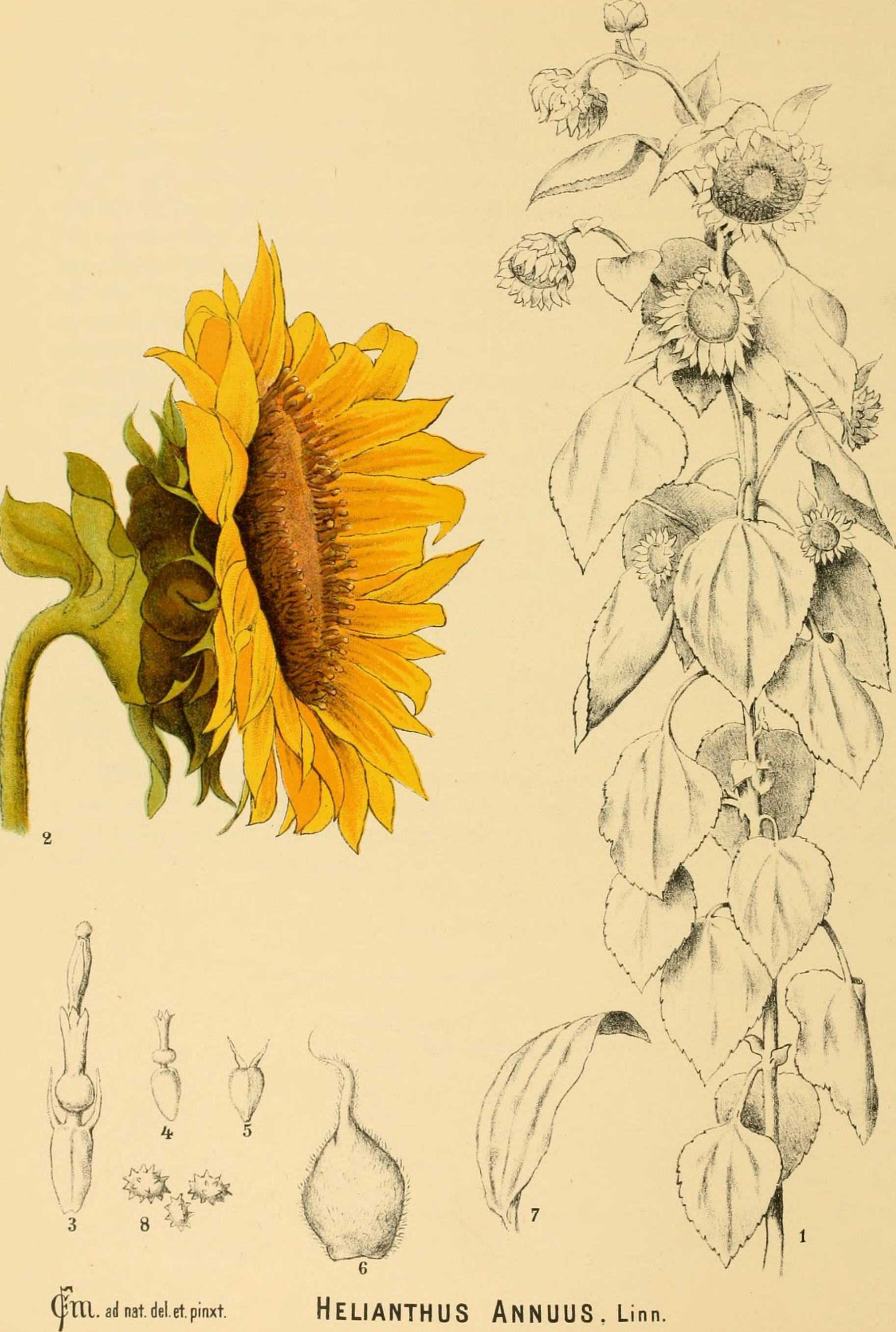
N. ORD.-COMPOSIT^. 83 Tribe.-SENECIONIDE/E. GENUS.— H ELIANTHUS,* IJNN. SEX SYST.-SVNGENESIA FRUSTRANEA. HELIANTHUS. SUNFLOWER. SYN.-HELIANTHUS ANNUUS, LINN. COM. NAMES.— SUNFLOWER; (QEB.) SONNENBLUMB; (FR.) LE TOURNESOL. TIi\C rURE OF THE RIPE ACHENIA OF HELIANTHUS ANNUUS, LINN. Description. — This commonly cultivated plant, springing from an annual root, attains a height of from 3 to 18 or more feet, and bears numerous large flowerheads on long peduncles. Stem erect, rounded and rough, bearing opposite leaves below and alternate ones above. Z^ai'^^ petioled, broadly ovate or heartshaped, from 5 to 10 inches long, and 4 to 8 inches broad, rough and conspicuously 3-ribbed. Pcdujuies long, gradually thickening into a funnel-form base at the involucre. Involucre composed of ovate aristate, hirsute scales, imbricated in several rows. Floiver-Jicads many, nodding, bearing innumerable ray and many disk florets; they range from 6 to 12 inches in diameter with a flat or convex disk. Ray-florets numerous, ligulate and neutral. Disk-florets, all perfect and fertile, with short 5-lobed tubes, decemneurate. Pollen grains ovate, beset with numerous rows of spines. Ovary i -celled; style invested with stiff hairs; stigma 2branched, with subulate appendages. Achenia ovate-oblong or cuneilorm, somewhat quadrangularly compressed, without margins, each achenium bearing 2 earlike chaffy scales, sometimes accompanied by an accessory pair, all of which fall away when the seed is ripe. A description of the natural order will be found under Eupatorium purpureum. History and Habitat. — The sunflower is one of the natives of tropical America, that has become popular in cultivation in many countries, both on account of its beautiful flowers, whose bright chrome rays, in their many modes of curline and reflexinof in a circle about the handsome seal-brown disk, render it attractive as a garden ornament, as well as the many uses to which the seeds are put. From points where it is cultivated it often spreads about in many places by spontaneous growth, blossoming from July until August. The white central pith of the stalk contains nitre; this fact has led to its use as a diuretic, and recommended it also as a form of moxa. The leaves, when carefully cared for and * I'lXio;, the sun, a-'Bii, a flower.
83-2 successfully dried, have been used as a substitute for tobacco in cigars, the flavor of which is said to greatly resemble that of mild Spanish tobacco. The seeds have been extensively used for fattening poultry; fowls eat of these greedily on account of their oily nature. How much a fact it may be that a growth of this plant about a dwelling protects the inhabitants against malarial influences is not yet proven, though strongly asserted by many. An infusion of the stems is claimed to be anti-malarial, and with some forms will probably prove such. A further proving of the tincture is gready needed, as it would doubtless show an adaptability in this direction. Helianthus has no place in the U. S. Ph. In the Eclectic Materia Medica the infusion of the seeds is used as a mild expectorant, and the expressed oil as a diuretic. PART USED AND PREPARATION.— The ripe seeds. The seeds when ripe are of a dark purplish color, more or less 4-sided and 4-angled by compression; they are about half an inch in length by one-eighth in breadth. The husk is whitish internally and the kernel sweet, oily and edible. The tincture is made by coarsely powdering the ripe seeds, covering the mass with five parts by weight of dilute alcohol, and allowing it to remain at least eight days in a wellcorked bottle, in a dark, cool place, being shaken twice a day. The tincture is then decanted, strained and filtered. Thus prepared it is by transmitted light a very pale straw-color, has no characteristic taste, and has an acid reaction to litmus-paper. CHEMICAL CONSTITUENTS.— The analysis of this plant by VVittstein, in 1879, was made exclusive of the seeds, and has therefore no interest to us. The fruit contains by his analysis from twelve to twenty-four per cent, of fixed oil, having a light straw-color, mild taste, and watery consistence, its specific gravity being.926°. It becomes turbid at ordinary temperatures and solidifies at — 16°. Helianthic Acid. — C. H,, O^, in the form of a slightly colored powder, has been extracted from the kernels; it is soluble both in water and alcohol. PHYSIOLOGICAL ACTION.— Very little or nothing is known of the physiological action ol this plant, which would necessarily be slight. It causes dryness of the mucous membranes of the mouth, throat, and fauces, excites vomiting, heat and redness of the skin, and some slioht inflammation of the cuticle. A thorough proving of the wJiole plant is greatly to be desired, as without doubt another remedy would be found in it to add to our excellent list for intermittents. Description of Plate 83. I. Whole plant, seven times reduced, from a cultivated specimen. Binghamton, N. Y., Sept 8, 1S82. 2. Flower head. 3. Floweret (enlarged). 4. Young seed. 5. Mature seed. 6. Scale of involucre. 7. Ray. 8. Pollen grain x 200.
84. ■^.Tll.ad natdei.etpinxt, AnTHEMIS NOBILIS.Linn Wt 11
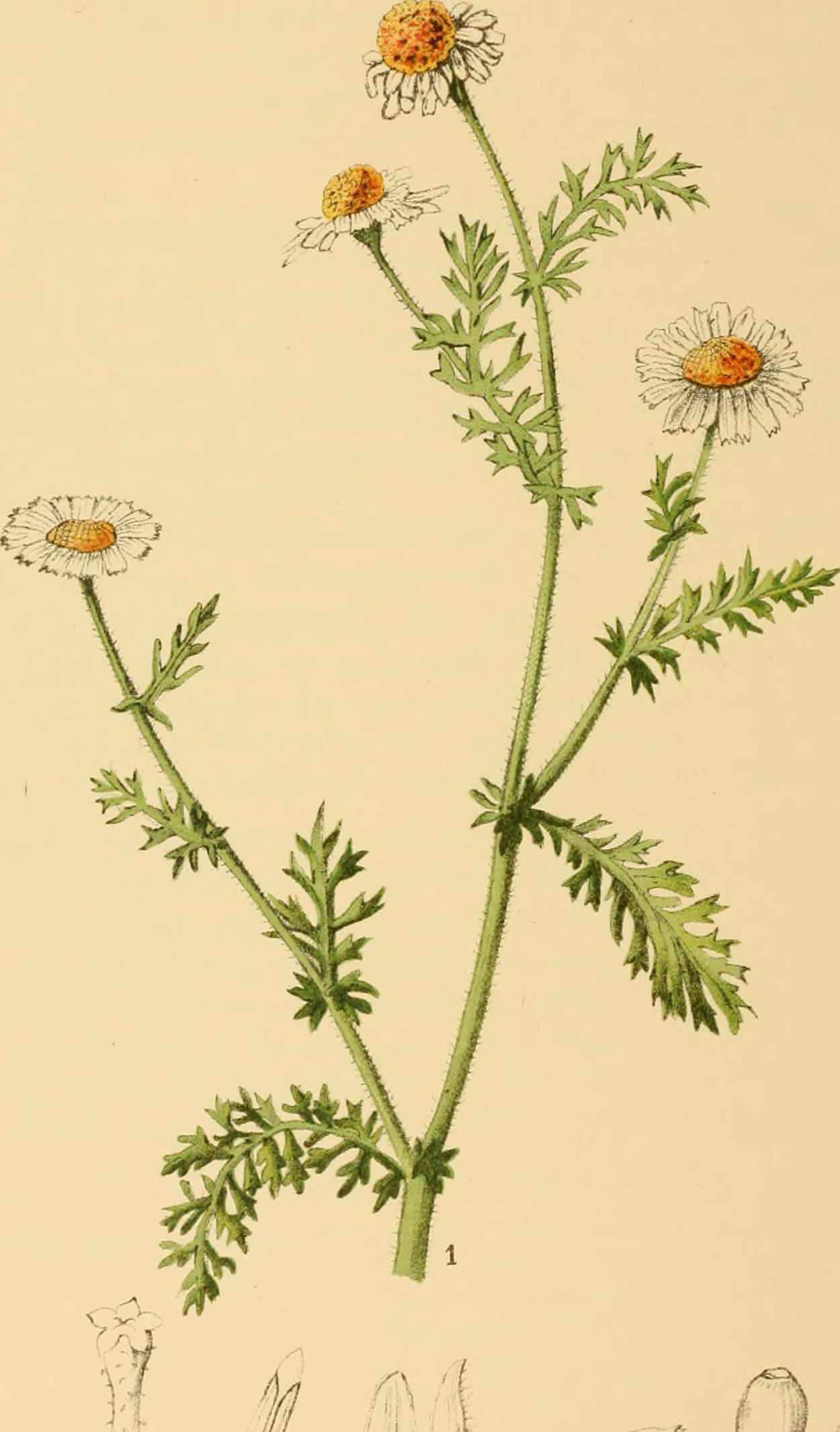
N. ORD. -COMPOSITE. 84 Tribe-SENECIONIDE/E. GENUS.— A NTH EM IS,* LINN. SEX. SVST.—.SYNGENE.Sr.\ SUPERFLL'.A.. ANTHEMIS NOBILIS. ROM AM CHAMOMILE. SYN.— ANTHEMIS NOBILIS, LINN.; A. AUREA, D. C; CHAMOMILLA NOBILIS, GODR.; CHAM^MELUM NOBILE, ALL.; ORMENIS NOBILIS GAY. COM. NAMES.— TRUE CHAMOMILE, GARDEN CHAMOMILE,! CORN PEVERPEWt; (FR.) CHAMOMILE ROMAINE; (GER.i ROMISCHE KAMILLEN. A TINCTURE OF THE WHOLE PL.\NT ANTHEMIS NOBILIS, LINN. Description — This low, aromatic perennial, seldom rises to any o-reat heio-ht above the ground. Stems smooth or slightly pubescent, the sterile creepincr, the fertile somewhat ascending; branches numerous, hairy. Leaves alternate, sessile, pinnately bi- or tri-ternately compound, and dissected into filiform segments. Heads heterogamous, many-fiowered, and rather large, terminal and solitary upon the branches; pcdtincles long, pubescent; involucre hemispherical, consisting of 2 or 3 rows of comparatively small, imbricated bracts, the outer successively shorter; receptacle oblong, with blunt, chaffy bracts subtending most of the florets. Diskflorets numerous, yellow, bi-sexual; corolla tubular, slightly gibbous below, enlarged above to bell-shaped, and having a few oil glands upon its surface; limb 5-lobed; stamens 5; anthers tailless at the base; style slender, bifurcated. Ray-florets 15 to 20, white, fertile; ligiiles 3-toothed at the apex; style-branches stigmatic at their truncate, penicillate extremities. Akenes terete, glabrous, marked by 3 indistinct ridges upon their inner faces, the truncate summit naked; pappus none, the persistent base of the corolla, however, appearing like a coronal body of that nature. History and Habitat. — This European immigrant has, as yet, spread but little in this country, it being only occasionally found spontaneous near gardens, where it blossoms in July and August. On account of many species being nearly related to this one, and the ancient descriptions of so meagre a type, the history of this plant, which has, without doubt, been used as long as any other, is not traceable with any chance of correctness. In later times, however, it has been regarded important, by both physicians and the laity, and judged more active than Chamomilla, which it greatly resembles * "AKflr/zif, anthemis, a Greek name for some allied plant. f Our Chamomilla is Matricaria Chamomilla, Linn. \ Garden Feverfew is Matricaria Partheniiim.
84-2 in its action. As a stomachic tonic and carminative, it has been found useful in atonic dyspepsia, gastro-intestinal irritation, intermittent and typhoid fevers, and coHc, and is claimed to be an effectual preventive of incubus. A warm infusion acts as a prompt emetic, emptying the stomach without enervating the system. Fomentations of the steamed leaves make a kindly application in local pains, neuralgic, podagric, uterine, or abdominal. Hot infusions are sudorific and emmenagogue, but are very apt to cause profuse diarrhoea. The oil of the plant is considered anti-spasmodic, useful in hysteric complaints; stimulant, and antiflatulent; and is often combined with purgative pills, to prevent griping. The flower-heads are official in the U. S. Ph.; in the Eclectic Dispensatory the preparations are: Extractuni Anthcmidis, Extraction Anthctnidis Fhiidiitn, Infusum Anthemidis, and Olciim Anthcmidis; it is also a component of I'imtiu Symphytii Com po si in in. * PART USED AND PREPARATION. — The fresh-flowering plant is treated as directed for the root of Inula.f The tincture resulting has a light, brownishorange color by transmitted light; the pleasant, aromatic odor of the bruised plant; a taste at first sourish and pine-apple-like, then bitter; and acid reaction. CHEMICAL CONSTITUENTS. — From various analyses, this herb has been found to contain a volatile and fixed oil, a resin, tannin, and a bitter principle judged by Fliickiger to be a glucoside. Oil of Anthemis. — This volatile body has a bluish or greenish tint, becoming brownish or yellowish by age. It has a specific gravity of about 0.91, is composed principally of the angelates and valerates of butyl and amyl, and yields the following bodies: Angelicaldehyde, C.Hj,0, and a hydrocarbon, Cj„Hj,,, having a lemonaceous odor, and boiling at 175° (347° F.). Angelic ^Icid, C^H^O,,. — According to the analysis of Fittig, this body, first discovered in Angelica Arcliangelica, exists in the oil of Anthemis, of which it constitutes nearly 30 per cent. It crystalizes in large, colorless prisms, having a peculiar aromatic odor, and an acid and burning taste. The crystals melt at 45° (113° F.), boil at 191° (375.8° F.), and are soluble in both water and alcohol. By heating this body, with hydriodic acid and phosphorus, to 200° (392° F.), it is converted into valerianic acid. Tiglic Acid, C.HgO,. — This isomer of the above, and of Methylcrotonic Acid, was discovered In Croton Oil. It exists, according to E. Schmidt, in company with the above; and it is more than possible that it is identical with it, its boiling point and that of its ethyl-ether being the same. (Fliick. and Han.,.Schorlemmer and Wittstein.) * Comfrey Root, Solomon's Seal, Helonias Root, Chamomile Flowers, Colombo Root, Gentian Root, Cardamom Seeds, Sassafras Bark, and Sherry Wine, t Page 81-2.
84-3 PHYSIOLOGICAL ACTION.— According to the experiments made with the tincture by Dr. Berridge, Anthemis causes the following symptoms of disturbance: Pain and fullness in the head, lachrymation, rawness of the throat, a feeling of warmth in the stomach and desire for food, followed by qualmishness and nausea; some abdominal pain, freeness of the bowels, increased urine; higher heart's action, lassitude, and a eeneral feeling of chilliness. Description of Plate 84. I. End of a fertile branch, from an esca]ied garden plant. 2. Ray-floret. 3. Disk-floret. 4. Stamen. 5. Scales of receptacle. 6. Stigmas. 7. Acheniurn. 8 and 9. Longitudinal section of akene. (3-9 enlarged.)
I
85. (^m..ad natdei.et pinxt. Achillea MiLLEF6LiuM,Linn.
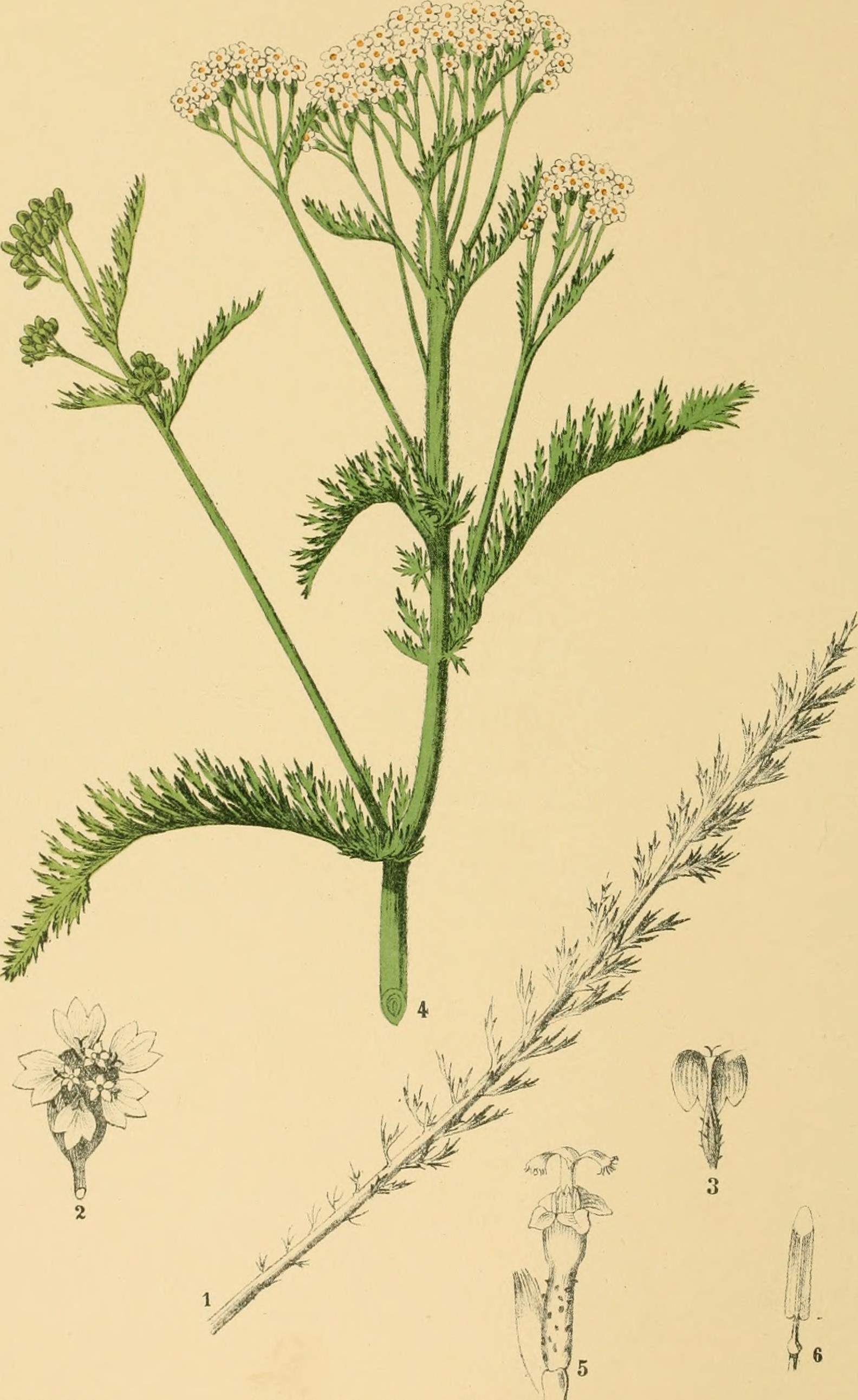
N. ORD-COMPOSIT^. 85 Tribe.-SENECIONIDE/E. GENUS.— ACHILLEA,* LINN. SEX, SYST.— SVNGENESIA SUPERFLUA. MILLEFOLIUM. YARRO^]\ SYN.— ACHILLEA, MILLEFOLIUM, LINN. ACHILLEA SETACEA, "W. & KIT. COM. NAMES.— COMMON YARROW, MILFOIL, NOSEBLEED; (FR.) MILLEFEUILLE; (GR.) SCHAFGARBE, SCHAFRIPPE. A TINCTURE OF THE FRESH PLANT ACHILLEA MILLEFOLIUM, LINN. Description. — This very common roadside herb rises to a height of from 6 to 20 inches, from a slender, creeping, perennial root, which, beside a multitude of filiform rootlets, gives off several long, reddish stolons. The siein is simple or nearly so, erect, slightly grooved and roughly hairy. Leaves alternate; those from near the root wide-petioled, 2 to 6 inches long; those of the stem proper, shorter, sessile or nearly so, and all in their general outline more or less lanceolate oblong, twice pinnately parted, the divisions linear, crowded and 3 to 5 cleft. Peduncles 3 or more; pedicels many, forming small, crowded, flat-topped corymbs at the summit of the plant. Heads many-flowered, radiate. Involucre, of 2 to 3 imbricated rows of ovoid-oblong scales, with a prominent midrib and brownish, scarious edges. Rays 4 or 5, pistillate, with a short, obovate, reflexed limb, more or less 3-lobed. Disk- florets 8 to 12, bisexual. Calyx limb obsolete. Corolla tubular, the summit slightly inflated, 5-lobed, the lobes revolute, acute. Slamens 5, inserted upon the tube, and rising slightly above the face of the corolla. Anthers adnate, without tails at the base. Style long, upright, slender, risine above the anthers. Stiovta 2-cleft, the divisions recurved and fringed at their tips. Receptacle small, usually flat and chaffy. Achenia oblong, flattened by compression, shining and slightly margined. Pappus none. For a description of the natural order see Eupatorium purpureum, 78. History and Habitat.— Yarrow is an abundant weed in old, dry pastures, along roadsides and in fields in the northern parts of America, extending in this country, as well as in Western Asia and Europe, high in the colder latitudes. It came to us from Europe, being now fully naturalized. The white or sometimes pink flower-heads blossom all summer. Among the Pah-Ute Indians, according to Dr. Edward Palmer, this plant is much used in decoction for weak and disordered stomachs. Linnaeus says, that for a time the Swedes used Yarrow in lieu of hops in the manufacture of beer, and claimed the beer thus brewed to be a greater intoxicant. Millefolium has been dismissed from the U. S. Ph. In the Eclectic practice it is used in an infusion, tincture, or the essential oil. * The virtues of this genus are said to have been discovered by Achilles.
85-2 PART USED AKD PREPARATION- — The whole fresh plant should be o-athered when flowering begins, excluding all old and woody stems, and chopped and pounded to a pulp; then in a new piece of linen press out thoroughly all the juice and mix it by brisk succussion with an equal part by weight of alcohol. Allow the mixture to stand eight days in a dark, cool place, then filter. The tincture thus prepared should be by transmitted light of a clear reddish-orange color; its odor peculiar, resembling that of malt yeast, pungent and agreeable, like the fresh plant; to the taste acrid and slightly bitter, and shows an acid reaction to test papers. CHEMICAL CONSTITUENTS.— ^,r/^///^m Cj^ H^^ N^ O^. The body formerly designated by this name was a mixed alcoholic extract of no definite character, containinci- all of the unvolatilized principles of the plant; from this mass the true alkaloid was isolated by Von Planta and its composition, as above, determined. Achillein has no definite crystalline form; it is soluble in water, alcohol and ether, and has a bitter taste. Oil of Achillea.— This oil is readily obtained by aqueous distillation of the plant; that from the flowers and green parts of the herb has a beautiful dark blue color and a specific gravity 0.92; that from the achenia is greenish-white, while from the root it is either colorless or slightly yellow. The oil from the green parts, if cold. Is of a butter-like consistence, strongly odorous, and with a taste similar to that of the herb itself Achilleic Acid. — A strongly acid, odorless, liquid body, with a density of 1.0148 when fully concentrated, crystallizing in colorless quadrilateral prisms, soluble in water. {Etsupra, Wittstein.) The plant contains beside the above principles tannin and a resinoid body uninvestigated. It is considered by Griffith that the plant as naturalized in the Northern United States is more active in its properties than its European progenitors. PHYSIOLOGICAL ACTION.— Yarrow seems to have a decided action upon the bloodvessels, especially in the pelvis. It has been proven to be of great utility in controlling h:emorrh2ges, especially of the pelvic viscera, where haemorrhage is caused by it. Its common European name, Nosebleed, was given from the fact that the early writers claimed haemorrhage of the nose followed placing its leaves in the nostrils; this may have been either due to its direct irritation, or the use of Achillea ptarmica, its leaves being very sharply serrate and appressedtoothed. Millefolium causes burning and raw sensations of the membranes with which it comes in contact, considerable pain in the gastric and abdominal regions, with diarrhoea and enuresis. Descriptiom of Plate S5. 1. Leaf from near the root. 2. Flower-head (enlarged). 3. Ray-floret (enlarged). 4. Top of plant from South Waverly, N. Y., June Sth, 18S0. 5. Disk floret and bract (enlarged). 6. Stamens (enlarged).
86. i Uy.IQ..3(lnatdel.etpinxf Tanacetum Vulgare.
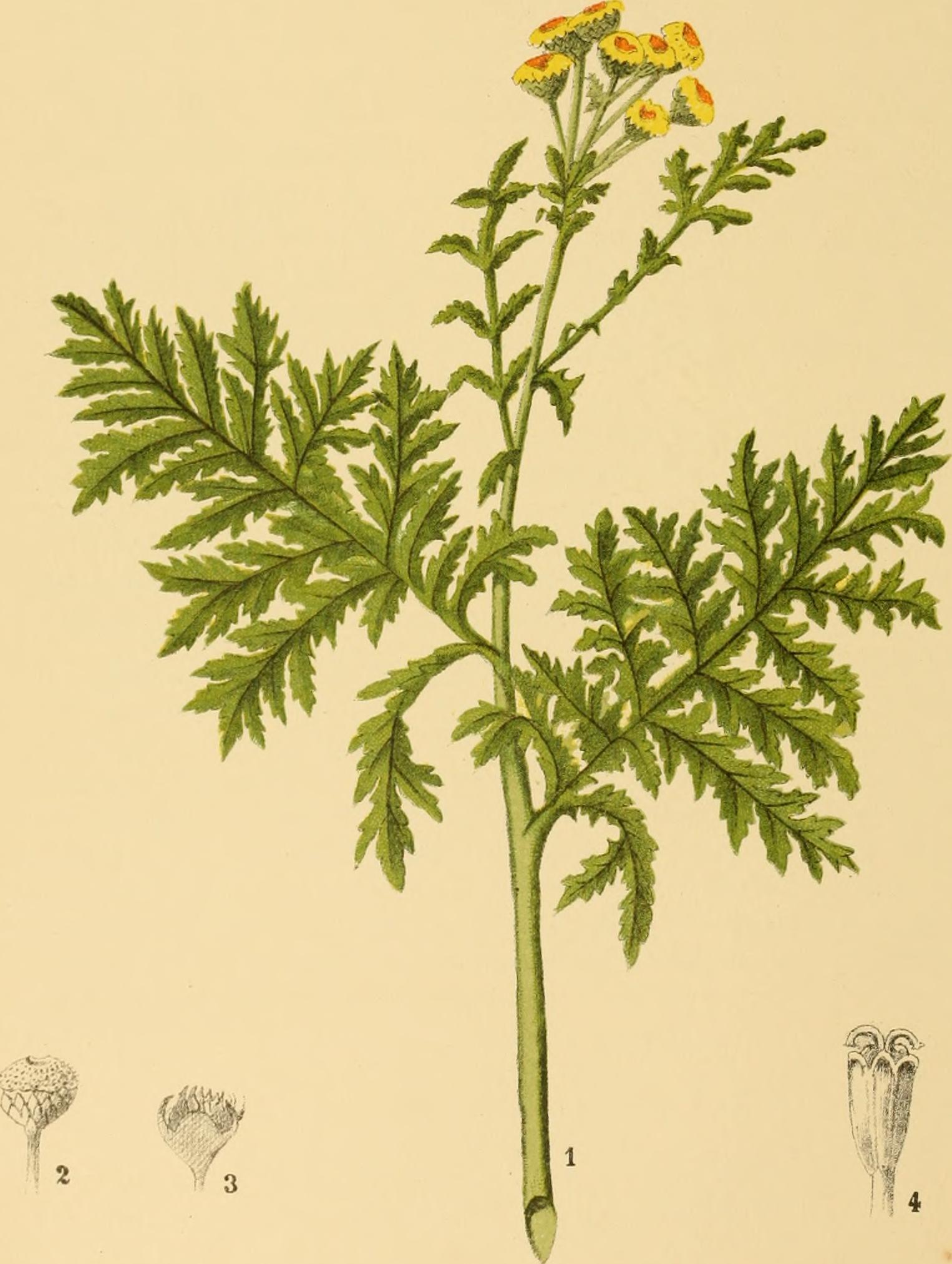
N. ORD.-COMPOSIT^. 86 Tribe-SENECIONIDE/E. GENUS. — TAN ACETUM,* LINN. SEX. SYST.— PDI.VG.A.MI.X SUi'KRFI.UA. TANACETUM TAJYSY. SYN.— TANACETUM VULGARE, LINN. COM. NAMES.-TANSY OR TANSEY; (PR.i TANAISIE; (GBR.) RAINFARN. A TINCTURE OF THE LEAVES AND FLOWERS OF TANACETUM VULGARE, LLNN. Description.— This robust, acrid-aromatic perennial, grows to a height of from 2 to 3 feet. SfeiN erect, glabrous or somewhat pubescent, leafy to the summit. Leaves alternate, 2 to 3 pinnately dissected, glandularly dotted; divisions very numerous, confluent, decurrent, incisely-serrate, with many small lobes interposed along the common petiole; teeth cuspidate, acuminate. Infloi-escence capitate, in dense, terminal, corymbiform cymes; heads numerous, depressed-hemispherical, heterogamous; involuci'e composed of several imbricated rows of dry, minute scales; floivcrs all fertile, the corollas sprinkled with resinous clots. Marginal florets terete, pistillate; rays inconspicuous, oblique, 3 - toothed. Disk florets densely crowded, perfect; corolla twhvXdir; border 5-toothed; ««/'//i?r.j- tailless, with broad, obtuse tips. Style deciduous, the branches truncate with obscure, conical tips. Pappus a coroniform, dentately 5-lobed border. Akenes 5-ribbed, witli a large epigynous disk. History and Habitat. — This common European plant has escaped from gardens in many places in this country, especially, however, in the more eastern States, where it flowers from July to October. Tansy has been used in medicine, especially as a carminative tonic, since the middle ages, its use at the present time being almost entirely laic and among country folk. Bergiusf recommended a cold infusion of the tops as a tonic in convalescence from exhausting diseases, dyspepsia, jaundice and periodic fevers. A warm infusion has been found to be antihysteric, antiflatulent, carminative and stimulant, and largely used in amenorrhoea, dysmenorrhoea and abdominal cramps. Dr. Clark spoke highly of its relief of gout.J Hoffman recommended the seeds in 10 to 40 grain doses as an anthelmintic not inferior to cina, for which action the leaves are often applied to the abdomen as a fomentation. Dr. Clapp speaks of * Altered from Mavmia, a/hanasia, not dying; the name of a genus of Compositae having the nature of an " everlasting" plant. t Mat. Med., 664. % Assays Phys. et /J/., J, s-fS
86-2 the infusion as being almost narcotic, soothing nervous restlessness and often producing quiet sleep.* The hot infusion has also been considered diuretic and diaphoretic, and found useful in dropsy. A fomentation of the leaves is often used with salutary effect in swellings, tumors, local inflammations and dysmenorrhoea. The oil, in doses of from lo drops to a drachm or more, is one of the most frequently-used abortives by ignorant people — a practice at all times serious and often dangerous; even if desisted in, after one or more attempts, the development of the fcEtus is very liable to be interefered with; hemorrhage also often occurs — not so dangerous generally as that following the use of nutmegs, but very often serious. The leaves and tops are officinal in the U. S. Ph., — in the Eclectic Materia Medica the preparation relied upon is Infusum Tanaccti: it is also a component of Tiiiitura Lands Coniposita.'^ PART USED AND PREPARATION. — Equal parts of the fresh leaves and blossoms are to be treated as directed under Inula (page 81-2). The resulting tincture, after filtration, should have a clear greenish-orange color by transmitted light; it should retain the peculiar odor and taste of the plant to a high degree; and show an acid reaction. CHEMICAL CONSTITUENTS.— Oil of Tansy. This peculiar yellow, or greenish-yellow volatile oil, possesses fully the odor and taste of the plant; it is lighter than water, its sp.gr. being 0.952; it is soluble in alcohol, and will deposit a camphor on standing. Tatiacctin, Cj,Hj,,Oj._t — This bitter, amorphous principle is found principally in the flowers; it is soluble both in alcohol and water — most readily, however, in the latter. Tajiacciniiitannic Acid, QjEI^^O^j. — This specific tannin has also been isolated by Leppig; § of its characteristics I am unacquainted. Leppig § also found in this species: a resin and gallic, citric, malic, oxalic and meta-arabinic acids. PHYSIOLOGICAL ACTION.— Many serious, and not a few fatal, cases of poisoning, by oil of tansy, are reported, among which the following will show the sphere of toxic action held by this drug: A young woman had been in the habit of using tansy tea, macie from the herb, at nearly every menstrual period, for difficult menstruation... On this occasion about two and a half drachms of the oil was poured into half an ordinary tin cupful of water; this, with the exception of a small portion of the water containing about one-half drachm of the oil, was taken at one dose. Convulsions were almost at once produced, and when Dr. Bailey was sent for the patient was unconscious, foaming at the moutli, and in * Catalogue, 800. t See foot-note, p. 33-3. t O. Leppig, C/iem. Zeilung, 1862, 328 \Ain. Jour. Phar., 1885, 28S). S Ibid,
86-3 violent tonic spasms, with dilated pupils, frequent and feeble pulse. Constant kneading on the stomach had produced partial emesis, and then ipecac, mustard, and large draughts of hot water, emptied the stomach. Two drachms of magnesia were then given, and a full dose of acetate of morphine; consciousness then returned, no unfavorable symptoms followed, and, after thirty-six hours, without additional medication she was entirely restored.* A married woman aged 28, accustomed to taking 5-drop doses without inconvenience, took from 15 to 20 drops. Shortly after, she complained of dizziness, agonizing pain in the head and burning in the stomach; a sense of cold numbness crept over her limbs, increasing until it amounted almost to paralysis; convulsions followed, during which she vomited twice, freely, and finally uttered a shriek and fell senseless to the floor. She continued in this comatose condition for over an hour, when, on again vomiting, she recovered consciousness.f A woman took half an ounce of the oil; the most violent, rigid kind of clonic spasms occurred once in about twelve minutes, coming on generally and instantly, and continuing about one minute. They were attended with slight, if any motion of the arms; it might be called a trembling. The arms were peculiarly atfected, and invariably in the same way; they were thrown out forward of, and at right angles with, the body; the hands at the wrists bent at right angles, with the fore-arm supinated, the points of the fingers nearly in contact, the fingers straight and slightly bent at the metatarsophalangeal joints. The muscles of respiration were strongly affected during each paroxysm; air was forced from the chest slowly but steadily, and made a slight hissing noise as it escaped from between the patient's lips. During the intermission of spasm, the muscles were perfectly flexible, and the transition seemed very sudden. The jaws were the only exception to this rule; they were, for the first hour and a quarter, rigidly closed, and were with difficulty opened, but after that were subjected to the same action as the rest of the body— when the spasms were on they were rigid; when off, they were relaxed. After the patient grew weaker, the spasms were more frequent, but had about the same severity and length. Death ensued in two hours.+ A young woman took two tablespoonfuls of the oil to procure abortion, after which, those who saw her related, that she suffered from symptoms much resemblino- apoplexy. Two weeks afterward, the vaginal walls of the labia were found inflamed to such extent that one of them resulted in an enormous abscess; the sclerotic coat of the eye was also so congested that it had a dark purple, glassy appearance, and was so badly swollen that the cornea seemed to be depressed.§ A o-irl ao-ed 21 years, took 11 drachms of the oil to produce an abortion. *-* -111 Total unconsciousness soon followed; at intervals of 5 or 10 minutes the body was convulsed by strong spasms, in which the head was thrown back, the respiration suspended, the arms raised and kept rigidly extended, and the fingers contracted. After this state of rigidity had continued for about half a minute, it was * Dr. W. W. Bailey, in the S/. Louis Courier of Medicine, April, 1S85. t A. D. Binkerd, M.D., Med. and Surg. Rep., 1870, 5S8. X C. T. Hildredth, M.D., Med. Mag., 1834 {Am. J. of Med. Sci., 1S35, 256). \ E. M. Hale, M.D., West. Horn. Obs., 1869, 345.
86-4 usually succeeded by tremulous motion often sufficient to shake the room, together with very faint and very imperfect attempts at inspiration. The whole interval, from the commencement of the convulsion to the first full inspiration, varied from a minute to a minute and a half Respiration was hurried, labored, stertorous, and obstructed by an abundance of frothy mucus, which filled the air passages and was blown from between the lips in expiration; the breath had a strong odor of Tansy. Occasionally the tongue was wounded by the teeth, and the saliva slightly tinged with blood. Immediately after a convulsion the countenance was very pallid and livid, from the suspension of respiration, and the pulse, which, during the spasm, was quite forcible, full and rapid, was now exceedingly reduced in strength and frequency. The pulse and color then gradually returned, until the next spasm came on. It was very common, a few seconds after the termination of a convulsion, for the head to be drawn slowly backward, and the eyelids at the same time stretched wide open, at which times the eyes were very brilliant; pupils of equal size, widely dilated, and immovable; and the sclerotics injected. A little inward strabismus was noticeable, of the right eye, as was, also, occasionally slow, lateral, rolling motion of the eye-balls. The mouth and nose were at times drawn a litde to the right side. In the intervals of the convulsions, the limbs were mostly relaxed, but the jaws remained clenched. The skin was warm, but not remarkable as to moisture. The victim died in three hours and a half.'-' Oil Ani)im/s.—\}r. Ely Van DeWarker records cases of the action of the oil upon dogs. In one case two drachms were given, causing salivation, vomiting, dilation of the pupils, muscular twitchings, followed by clonic spasms, and a cataleptic condition from which the animal recovered. Recovery also followed a half ounce after the same class of symptoms, but, however, on repeating the dose, the already poisoned animal was plunged into a long and fatal convulsion Postmortem examination disclosed the cerebral veins and spinal cord itself highly congested, and serous effusions had taken place in the pia mater. The lungs were found to be engorged, the left heart empty, and the right distended with dark, liquid blood. Congestion of the kidneys had also taken place, and the bladder was found contracted.-}" The safe maximum dose of the oil is indeterminable, a few drops only sometimes proving serious. The symptoms occurring in a number of cases of poisoning and experiments, were substantially as follows: Mental confusion, loss of consciousness; vertigo, with cephalalgia; at first contraction, then wide dilation, of the pupils, staring, immovable eye-balls; ringing in the ears; face congested; roughness of the mouth and throat, difficult deglutition; eructations, nausea, free vomiting, and burning of the stomach; sharp colic pains in the abdomen; diarrhoea; constant desire to urinate — urine at first suppressed, then profuse; respiration hurried and laborious; pulse at first high, then very low and irregular; numbness of * J. C. Dalton, Jr., M.D., Am. your. Med. Sci., 1852, p. 136. f T/ie Delection of Criminal Alwrlion.
86-5 the extremities; tonic and clonic spasms, and nervous tremblings; drowsiness and cold sweat. Death appears to ensue from paralysis of the heart ami lungs. Description of Pl.ate 86. I. Summit of an escaped plant, Binghamton, N. Y.. [uly 21st, 1S86. 2. A flower-head. 3. A flower-head, longitudinal section. 4. A floret. 5. Anther. (4 and 5 enlarged.)
87. ^ ^m.ad natdel.etpinxt. Artemisia Vulgaris, Unn.
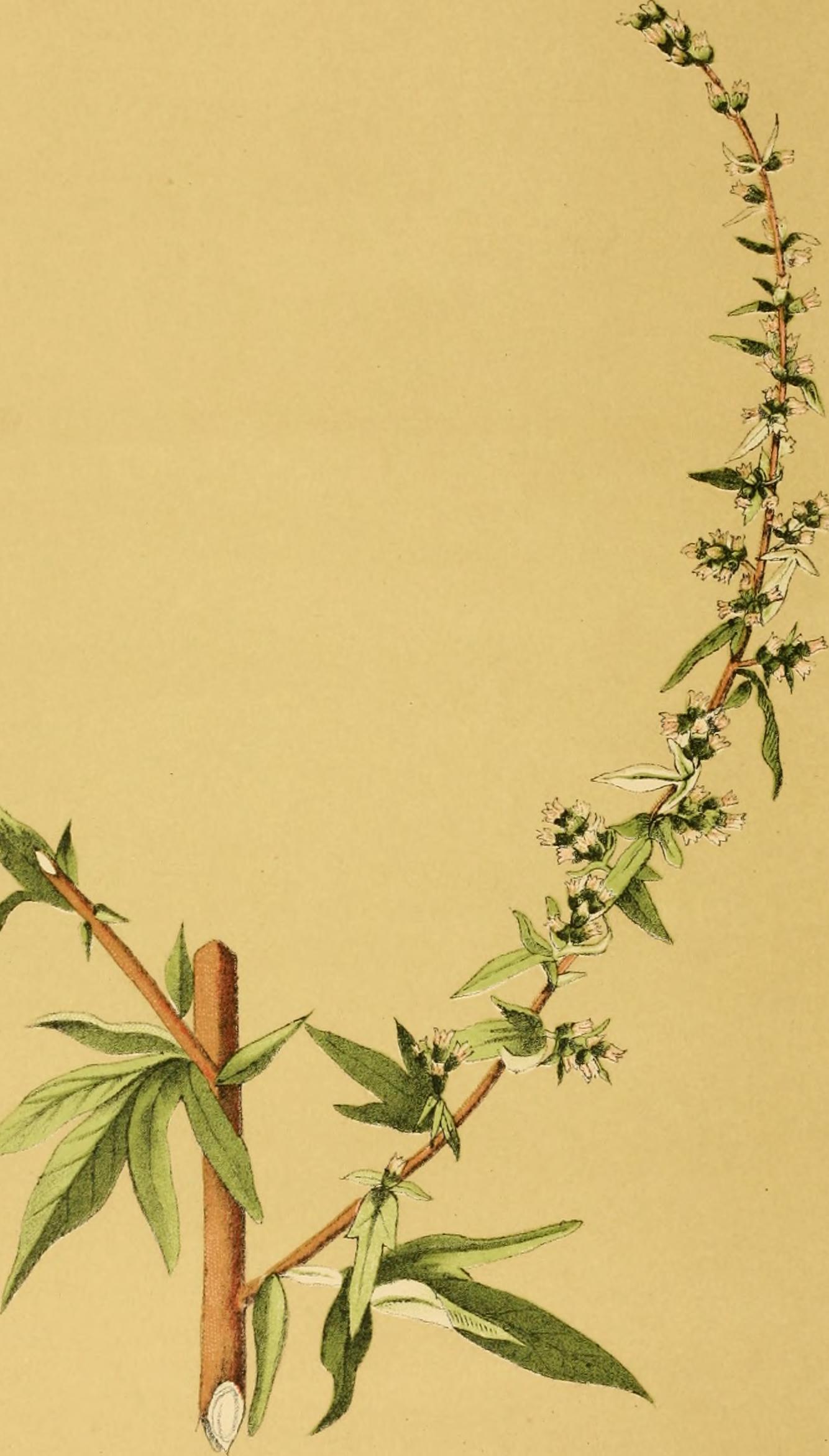
N. ORD.-COMPOSIT^. 87 Tribe-SENEGIONIDE/E. GENUS. — A RT E M I S I A. SEX. SYST.— SVNGEXESIA SUPERFLUA. ARTEMISIA VULGARIS. MUGWORT. SYN.— ARTEMISIA VULGARIS, LINN.; A. HETEROPHYLLUS, NUTT • A INDICA CANADENSIS. BESS. COM. NAMES.— MUGWORT; (FR.) COURONNE DE ST. JEAN; (GER ) BIFUSS. A TINCTURE OF THE ROOT OF ARTEMISIA VULGARIS, LINN. Description. — This perennial herb grows to a height of from 2 to 3 feet. Stem erect, furrowed, paniculately branched. Leaves mostly glabrous and green above, white-woolly beneath and on the branches, the lower laciniate, the median pinnatifid, the upper lanceolate to linear; divisions often cut-lobed or linearlanceolate. Inflorescence glomerate, in open, leafy panicles; heads numerous, small, ovoid, heterogamous; floivers all fertile; involucj-e mostly oblong, campanulate; bracts scarious, sparingly arachnoid, but mostly glabrate. Corolla smooth. Receptacle naked. Otherwise agreeing in minutiae of florets and sexual organs with the following species, p. 88. History and Habitat. — The Common Mugwort is an immigrant from Europe in most of its situations here, but is considered apparently indigenous at Hudson's Bay by Prof. Gray. It is naturalized in Canada and the Atlantic States, where it frequents old fields and gardens, roadsides, and waste places, and flowers from September till October. Hippocrates very frequently mentions Artemisia as of use in promoting uterine evacuations. Dioscorides and Galen used it as a fomentation for amenorrhoea and hysteria — a practice then in vogue among the women of China. German physicians have urged the drug in epilepsy, but it has nevertheless fallen entirely into disrepute, being now very seldom, if ever, used in any disease. That torturous, barbaric practice, the use of the Moxa, is closely related to this plant, as it was one of the substances, in connection with A. Chinensis, used in the manufacture of that pastile. The Mexican Pharmacopoeia is now, we believe, the only one recognizing this drug.
87-2 PART USED AND PREPARATION.— The fresh root is chopped and pounded to a pulp and weighed. Then two parts by weight of alcohol are taken, the pulp thoroughly mixed with one-sixth part of it, and the rest of the alcohol added. After thorough succussion, the whole is poured into a well-stoppered bottle, and allowed to stand eight days in a dark, cool place. The tincture thus prepared should, after straining and filtering, have a deep yellowish-brown color by transmitted light; a characteristic, uncomparable odor — that of the bruised leaves; an aromatic, slightly bitter taste; and an acid reaction. CHEMICAL CONSTITUENTS.— No analysis has, as far as we are able to ascertain, been made of this plant since Baierus found that by fermentation, distillation, and mixture with water, a fragrant sapid liquor was obtained, with a thin fragrant oil upon the surface. PHYSIOLOGICAL ACTION. — Mugwort is said to cause increase of epileptic spasms; irritation of the nervous system; profuse sweat, having a fetid, cadaverous odor, resembling garlic; violent contractions of the uterus; labor-like pains; prolapsus and rupture of the uterus; miscarriage; metrorrhagia; and increase of lochial discharges.'-' Description of Plate 87. I. A portion of a panicle, from Salem, Mass., August loth, 1885. * Noak and Tiink>
IF^ ^ra.adnatdeletpinxt ArTEMI'SIA ABSINTHIUM, Linn.
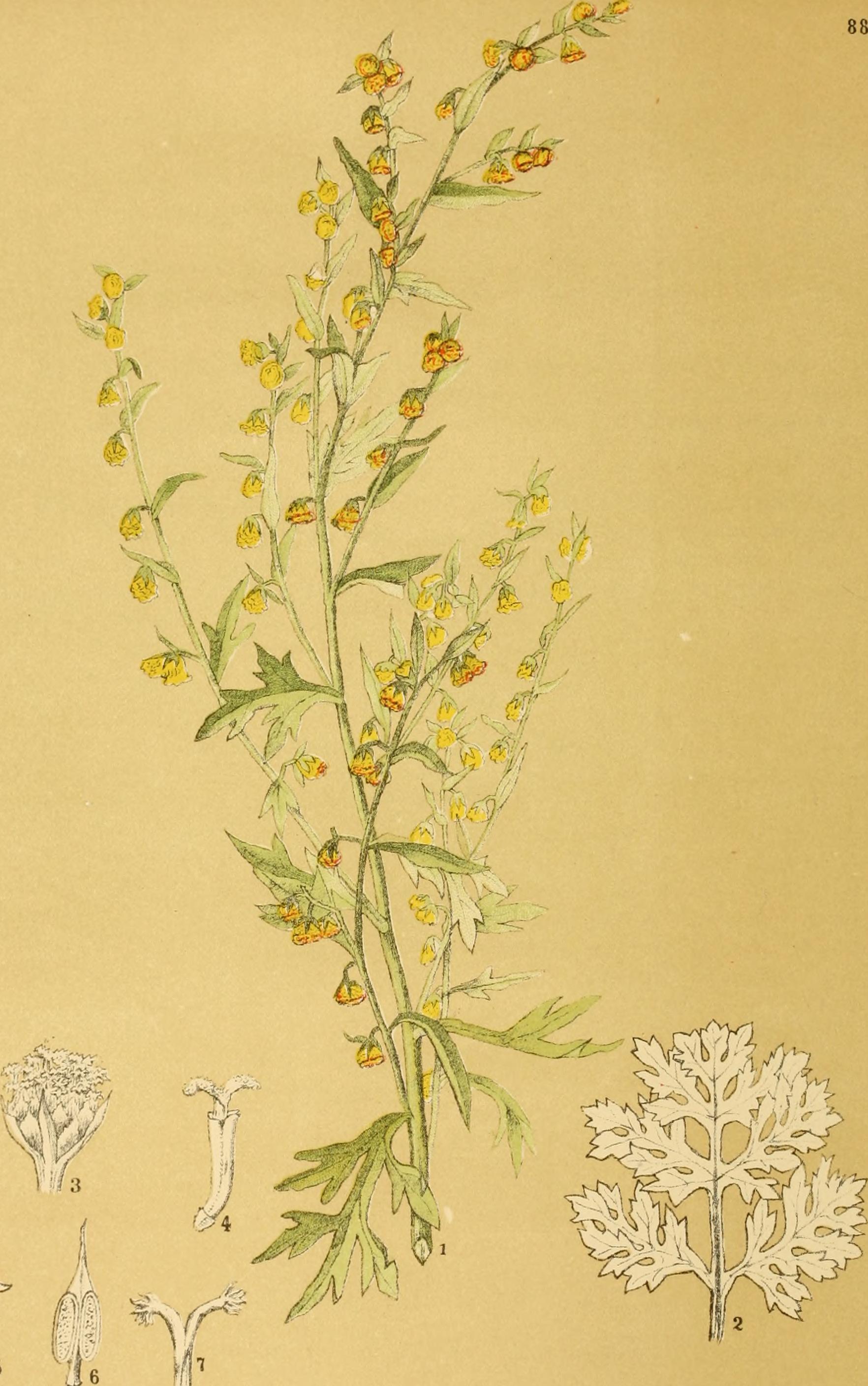
N. ORD-COMPOSIT^. 88 Tribe-SENECIONIDE^. GENUS.— ARTEMISIA,* LINN. SEX..SYST.— POLVGAMIA SUPERFLUA. absinthium; WORMWOOD. SYN.-ARTEMISIA ABSINTHIUM, LINN.; ABSINTHIUM VULGARE PARK • A. OFFICINALE, LAM. COM. NAMES.— WORMWOOD; (FR.) ABSINTHE; (GER.) WERMUTH. A TINCTURE OF THE LEAVES AND FLOWERS OF ARTEMISIA ABSINTHIUM, LINN. Description. — This bitter, aromatic, frutescent perennial, attains a growth of 2 to 4 feet. Stem stiff, almost ligneous at the base and paniculately branched; branches of two kinds, some fertile, others barren. Leaves alternate, 2 to 3 pinnately parted, finely pubescent with close silky hairs, the uppermost lanceolate, entire; leaflets oblong or lanceolate, obtuse and entire, sparingly toothed or incised, hiflorescence in long, leafy panicles; heads numerous, small, heterogamous, on slender nodding pedicles; involucre canescent; bracts of two kinds, i to 2 loose, narrow, herbaceous ones, and several that are roundish and scarious; florets many, all discoid, the central hermaphrodite, the marginal pistillate. Corollas tubular glabrous; limb nearly entire in the marginal florets, 5-toothed, and spreading in the central. Style 2-cleft, in the marginal florets bilamellar, with the inner surfaces stigmatic, in the central bifurcated with only the tips stigmatose, fringed or fimbriate. Anthers tipped with an acuminate appendage, not inflexed. Receptacle flattish, beset with long woolly hairs; akenes obovoid or oblong; pappus none. History and Habitat. — This European synonym of bitterness has escaped from gardens in many places in North America, especially, however, in Nova Scotia, New England, and at Moose Factory, Hudson's Bay. It blossoms with us from the latter part of July to October. Wormwood has been used in medicine from ancient times. Dioscorides and Pliny considered it to be a stomachic tonic, and anthelmintic. Boerhaave, Linnaeus, Haller, and all of the earlier writers speak of its good effects in many disorders, such as, intermittents, hypochondriasis, gout, scurvy, calculus, and hepatic and splenic obstructions. Bergius, in recounting its virtues, says it is " antiputredinosa, antacida, anthelmintica, resolens, tonica, et stomachia." The famous " Port* Artemisia, the Greek Diana, goddess of chastity, as the plant was thought to bring on early puberty. Pliny says the name is in honor of Artemisia, queen of Mausolus, king of Caria. t "At^u'Sioi', apsinthioii, the classical name of many species of the genus.
88-2 land powder," once noted for its efficacy in gout, had this drug as its principal ingredient. A decoction has ever been found a most excellent application for wounds, bruises, and sprains, relieving the pain nicely in most cases; every reader will recall "wormwood and vinegar" in this connection. Latterly it has been found diuretic, discutient, and antispasmodic in epilepsy. The bitterness of the herb is communicated to the milk of cows who may browse upon it, and also to mothers' milk if the drug be taken. Brewers are said to add the fruits to their hops to make the beer more heady; and rectifiers also to their spirits. Absinthe forms one of the favorite drinks for those who love stimulating beverages; it is compounded of various aromatics as follows: Green anise (Pimpinella anisi),.Star anise (Illicum anisatum), Large absinth (Artemisia absinthium). Small absinth (Artemisia pontica), Coriander (Coriandum sativum), and Hyssop (Hyssopus officinalis); these are distilled together until the distillate comes over reddish, then the following herbs and products are steeped in the distillate to color and flavor it: Peppermint (Mentha piperita), Balm (Melissa officinalis), Citron peel (Citrus medicus), and Liquorice root (Glycyrrhiza glabra). The leaves and tops of the plant are recognized in the U. S. Ph., and the officinal preparation is Vinum Aromaticum* It is officinal in the Eclectic Materia Medica as Ahsinthine and Infnstim Ahsynthii. PART USED AND PREPARATION.— The fresh young leaves and the blossoms are treated as in the preceding species. The resulting tincture is opaque; in thin layers it has a beautiful crimson color; its odor is terebinthic and pleasant; its taste extremely and penetratingly bitter; and its reaction acid. CHEMICAL CONSTITUENTS.— ] 'olatile Oil of Wormwood. This oil, isomeric with camphor, consists principally of absinthol, Cj|,HjgO. It is dark green, acrid, and bitter, retains the odor of the plant, boils at 205° (401° F.), has a sp. gr. of 0.973, ^id 's soluble to almost any extent in alcohol. Absinthin, C,yH.,gO^. — This bitter principle when first extracted forms in yellow globules, which soon crystallize and become a bitter, neutral, inodorous, friable powder, fusing at 120° (248° F.) to 125° (257° F.). It is soluble in alcohol, slighdy also in water, and forms no sugar on decomposing with a mineral acid. Succinic Acid,f CjHpO^. — This acid, together with citric and malic acids, exists in the leaves and fruit of the plant, from which it may be isolated in inodorous, moderately acid, klinorhombic prisms, that fuse at 180° (356° F.), boil at 235° (455° F.), and are soluble in alcohol and twenty-five parts water. Potassium Chloride, KCl. — This salt has been determined in the plant.J from which it may be isolated in yellowish cubes and octahedrons. * One part each of Lavender, Origanum, Peppermint, Rosemary, Sage, and Wornnvood. +.'Vbsynthic Acid of Braconnot. X Kunsmidler, Ann. d,- Chiiii., vi, 35, from the ash; Claassen, Am. Jour. Sci., 18S2, 323, from the extract.
88-3 Braconnot also determined a green and a bitter resin, albumen, starch, a tasteless nitrogenized body, a bitter nitrogenized body, and nitre* PHYSIOLOGICAL ACTION.— A druggist's clerk took about half an ounce of the oil; he was found on the floor perfecdy insensible, convulsed, and foaming at the mouth; shortly afterward the convulsions ceased, the patient remained insensible with the jaws locked, pupils dilated, pulse weak, and stomach retchino-. After causing free emesis and applying stimulants the man recovered, but could not remember how or when he had taken the drug. According to Dr. Legrand, the effects prominent in absinthe drinkers are: Derangement of the dig-estive oro-ans. intense thirst, restlessness, vertigo, tingling in the ears, and illusions of sight and hearing. These are followed by tremblings in the arms, hands, and legs, numbness of the extremities, loss of muscular power, delirium, loss of intellect, general paralysis, and death. Dr. Magnan, who had a great number of absinthe drinkers under his care, and who performed many experiments with the liquor upon animals, states that peculiar epileptic attacks result, which he has called "absinthe epilepsy." -jPost-Mortcin. — Great conoestion of the cerbro-spinal vessels, of the meninges of the brain, extreme hyperaemia of the medulla oblongata, injection of the vessels of the cord, with suffusion of the cord itself. The stomach, endocardium, and pericardium show small ecchymoses.J Description of Plate 8?. I. End of a flowering branch, escaped at Binghamton, N. Y., Aug. loth, 18S5. 2. A lower leaf. 3. Flower head. 4. Marginal floret. 5. Central floret. 6. Anther. 7. Style of central floret. (3-7 enlarged.) * Thomson, Organic Vhevi., 1838, 864. f Et supra, Taylor On Poisons, 1885, 652. { Joitr. of Physiological Med., 9, 525; in Allen, Ency. Mat. Med., loc. cit.
89.,--\ m 7 3 ^Tll.adnal.del.et pinxt.,'6 Gnaphauum Polycephalum, Michx.
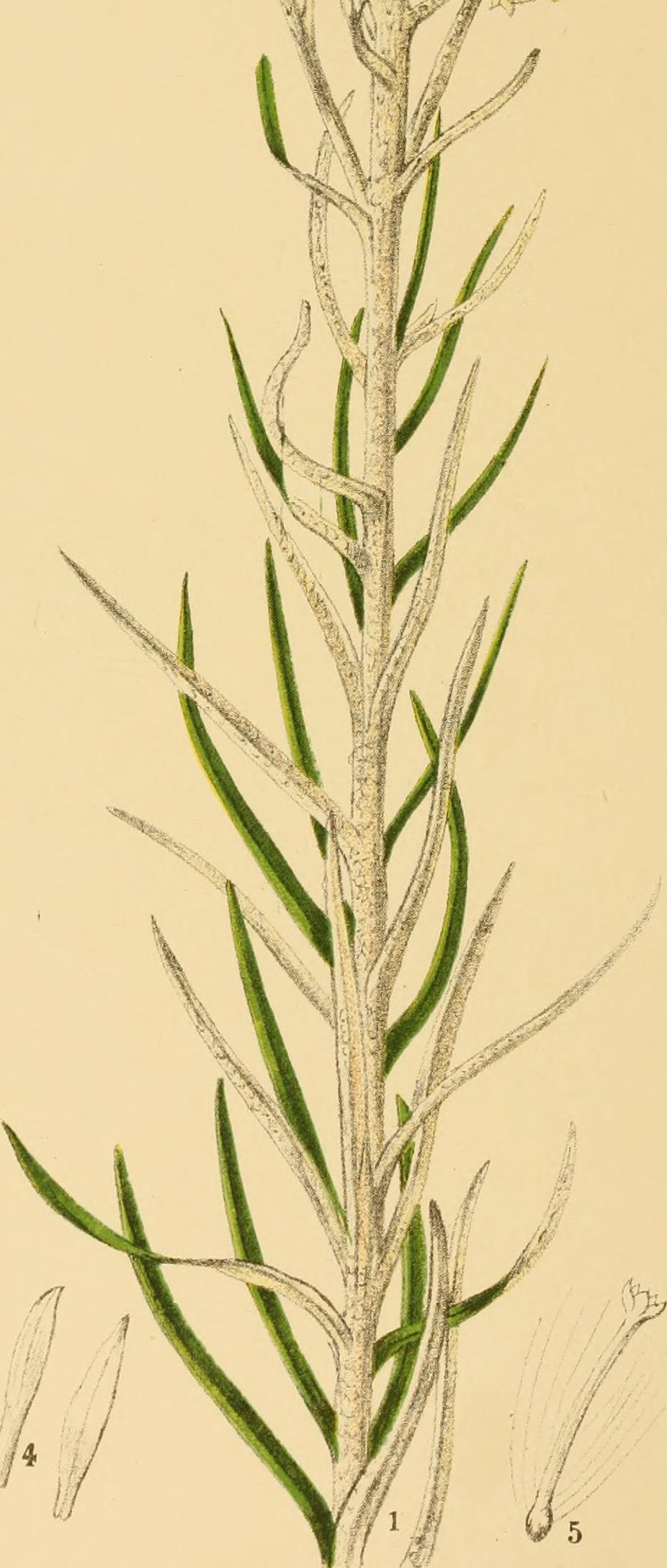
N. ORD-COMPOSIT^. 89 Tribe.-SENECIONIDE/E. GENUS— GNAPHALIUM,* LINN. SEX. SVST.—.SVNGENESIA SUPERFLL'A. GNAPHALIUM. E]-EHLASTIJyG. SYN. — GNAPHALIUM POLYCEPHALUM, MICHX.; G. OBTUSIPOLIUM, LINN.; G. CONOIDEUM, LAM. COM. NAMES. — FRAGRANT EVERLASTING, LIFE EVERLASTING, OLD FIELD BALSAM, WHITE BALSAM, INDIAN POSEY, GAT FOOT, SILVER LEAP, NONE-SO-PRETTY; (PR.i IMMORTELLE, LE COTONNIERE; (GER.) IMMERSCHON RUHKRAUT. A TINCTURE OF THE WHOLE PL.\NT GNAPHALIUM POLYCEPHALUM, MICHX. Description. — This persistent, annual lierb, usually grows to a height of from I to 3 feet. Stem erect, terete, and floccose-woolly; branches numerous at the summit, either glabrous or minutely viscid-pubescent when the wool is off. Leaves alternate, closely serrate or slightly amplexicaul, but never decurrent, somewhat aromatic, thinnish, all lanceolate or linear, narrowed at the base, and mucronately acute or acuminate at the tip, soon bare and green, or viscid-puberulent above; margins entire, often finely undulate. Inflorescence in terminal -paniculate, or cymose, glomerules; heads numerous, ovate-conoidal before expansion, then obovate, all discoid and heterogamous; involucre woolly only at the base; bracts oblong, obtuse, thin, dull white, becoming somewhat rusty-colored, pluriseriallyimbricate, without tips or appendages; receptacle flat, chaffiess, and bracdess. Flozc'crs fertile throuehout, arrans^ed in several rows; corona filiform-tubular, shorter than the style; anthers with slender tails. Hermaplirodite Jlowers, very few; styles two-cleft, the branches mostly truncate. Akcucs terete, lighdy 3- to 4nerved, smooth and glabrous; pappus a single row of scabrous, capillary brisdes, each free at the base and falling separately. History and Habitat. — This species is indigenous to North America, where it ranges from Florida and Texas northward to Canada and Wisconsin. It grows upon old fields and in quite open, dry woods, and blossoms from July to October. The Everlastings formed a part of aboriginal medication, and from there they descended to the white setders, who, in conjunction with the more or less botanic physicians, used them about as follows: The herb, as a masdcatory, has always been a popular remedy, on account of its astringent properdes, in ulceration of the JL — ■ * Vva.l,a\ov,gnapha!oii, a lock of wool; from the floccose appearance of any torn or broken end.
89-2 mouth and fauces, and for quinsy, A hot decoction proves pectoral and somewhat anodyne, as well as sudorific in early stages of fevers. A cold infusion has been much used in diarrhoea, dysentery, and hemorrhage of the bowels, and is somewhat vermifugal; it is also recommended in leucorrhoea. The fresh juice is considered anti-venereal. Hot fomentations of the herb have been used like Arnica, fur sprains and bruises, and form a good vulnerary for painful tumors and unhealthy ulcers. The dried fiowers are recommended as a quieting filling for the pillows of consumptives. Of Antennaria plantaginifolia, Hook. (Gnaphalium plantaginifolium, Linn.), Rafinesque says: "For a small fee, the Indians, who call this plant Sinjachu,yN'\A allow themselves to be bitten by a rattlesnake, and immediately cure themselves with this herb." Gnaphalium is not officinal in the U. S. Ph.; in the Eclectic Dispensatory, the preparation recommended is: Infiisnm Criiaplialii. PART USED AND PREPARATION. — The whole fresh plant, gathered when the flowers are still young, should be treated as directed for the root of Inula.* The resulting tincture should have a brownish-orange color by transmitted light; a pleasant, slightly balsamic odor; a taste at first aromatic, then bitter; and an acid reaction. CHEMICAL CONSTITUENTS. — No analysis to determine the character of the bitter principle has been made. The herb contains a little resin, a volatile oil, a bitter principle, and tannin; and yields all its sensible qualities to both water and alcohol. PHYSIOLOGICAL ACTION. — The symptoms following the ingestion of from 15 drops to a half ounce of the tincture, at the hands of Dr. Woodbury,f were essentially as follows: Slight abdominal griping, vomiting and purging; profuse diarrhoea, dark-colored offensive passages. Experiments with small doses of the triturated dry flowers and leaves, at the hands of Dr. Banks,J corroborated the above symptoms, though the result was less severe, and gave the following symptoms beside: Giddiness, especially on rising; dull, heavy expression of countenance; diminished appetite; rumbling of flatus, increased urine; sexual excitement: intense sciatic pain; weakness, and languor. Description of Plate 89. 1. Summit of plant, Binghamton, N. Y., Aug. loth, 18S6. 2. A leaf (from a plant gathered by Chapman in Florida). 3. Outer Outer ] Inner ) scale of involucre. 4- " 5. Floret. 6. Stigmas. 7. Seed. (3-7 enlarged.) I'age Kl-2. t 'J'rniis. Mass. Ilom. Soc. % N. A. Jour. Horn., 7, 3S3.
90. /r i-~.M\ \^P' J ^ ft 13. 7 -7 y v (p.Tll.ailnafdel.Btpinxt ErECHTHItES HlERACIF5LIA,Rat.
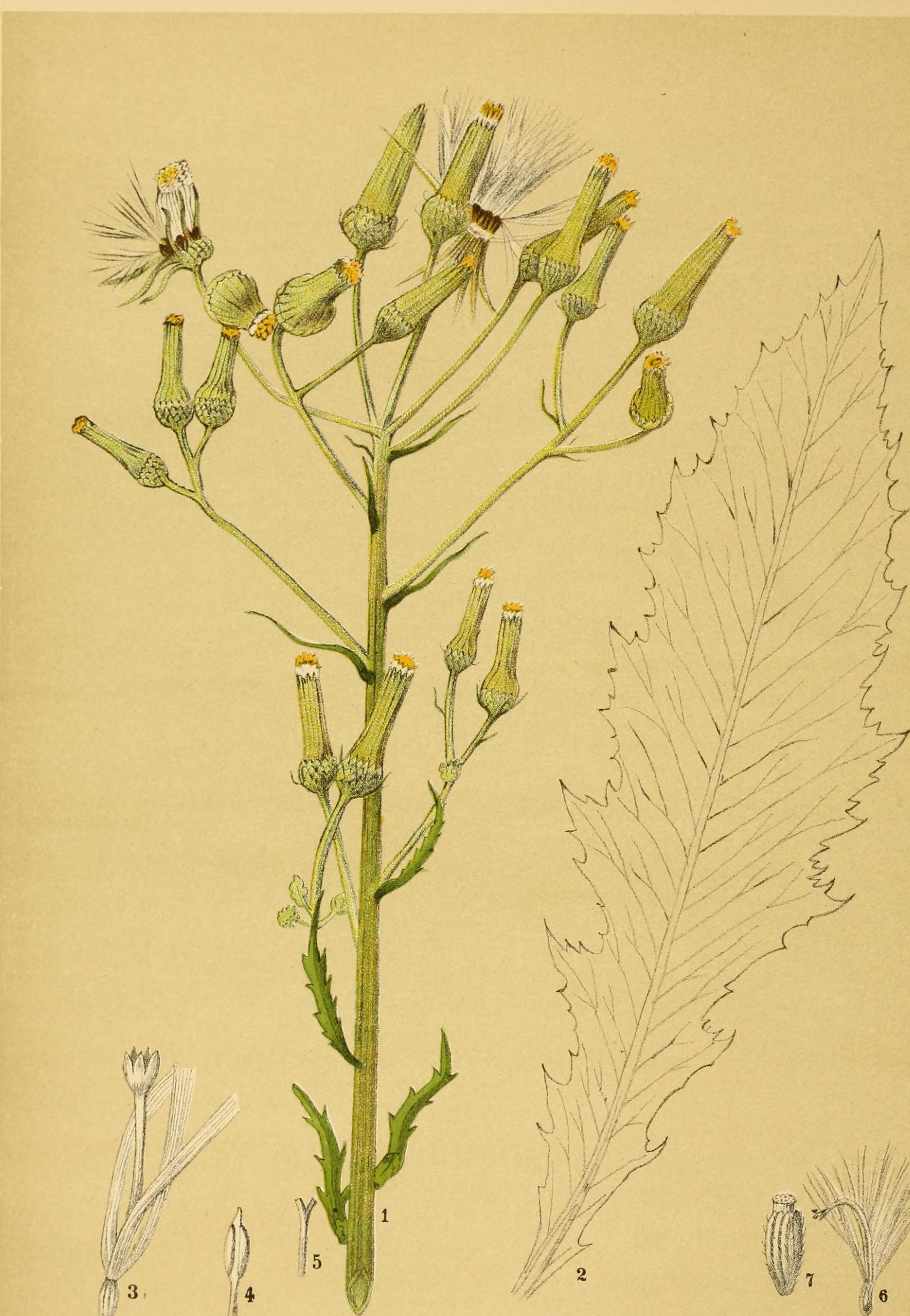
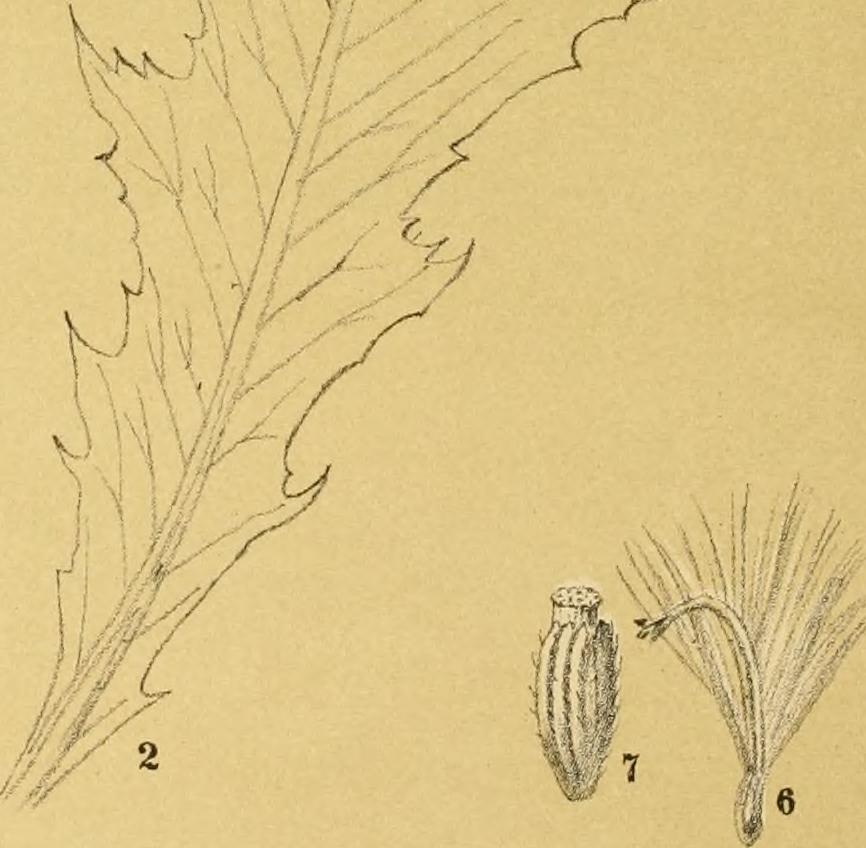
I N. ORD. -COMPOSITE. 90 Thbe.-SENECIOI\IIDE/E. GENUS.— ERECHTHITES,* RAF..SE.X. SVST.-.SYNGENESIA SUPERFLl'A. ERECHTHITES. FIRE WEED. SYN.-BRBCHTHITES HIERACIFOLIA, PREALTA, AND BLONGATA, RAF ■ SENECIO HIERACIFOLIUS, LINN.; CINERARIA CANADENSIS, WALT.' COM. NAMES.-FIRBWBED; (FR.) HERBB DB FBU; (GER.) PBUERKRAUT. A TLVCTURE OF THE WHOLE PLANT ERECHTHITES HIERACIFOLIA, RAF. Description. — This rank, glabrous, or slightly hairy annual, usually grows from I to 7 feet high. Stem stout, erect, virgate, sulcate, and leafy to the top. Leaves alternate, sessile, tender, and thin, all narrowly or broadly lanceolate and acute; margins sharply denticulate or somewhat pinnately incised; bases of the upper leaves somewhat auriculate and partly clasping. Inflorescence in a loose, terminal, corymbose panicle; heads about one half inch long, cylindraceous, heterogamous, and discoid; involncre a single row of erect, linear, acute scales; bracteoles few, setaceous; fl.oivers numerous, white, or ochroleucous, the outer female, the inner hermaphrodite. Corollas ^W slender and tubular. Female florets: corollatube filiform, the limb slightly dilated, and 2- 4-toothed. Hei-maphrodite flowers: corolla-tube filiform, the limb short, cyathiform, 4- 5-lobed. Antliers tailless. Stylebranches narrow, tipped with a conical pubescence. Receptacle flat and naked. Pappus white and copious; bristles soft, fine, and elongated. Akenes oblong, somewhat striate, tapering at the end. History and Habitat. — This coarse, homely, indigenous weed ranges from Newfoundland and Canada southward to South America; it grows in moist, open woods, upon enriched soil, and blossoms in July and September. Its vulgarism, Fireweed, is given it on account of its seeking newly-burned fallows, there growing in its greatest luxuriance. The whole plant is succulent, bitter, and somewhat acrid, and has been used by the laity principally as an emetic, alterative, cathartic, acrid tonic, and astringent, in various forms of eczema, muco-sanguineous diarrhoea, and hemorrhages. The oil, as well as the herb itself, has been found highly serviceable in piles and dysentery. In the Eclectic Dispensatory, the preparations recommended for use are: CUeum Erechthiti and Iiifusum Erechthiti. * Derived from the ancient name of some troublesome groumlsel.
90-2 PART USED AND PREPARATION.— The whole fresh, flowering plant is treated as recommended for tlie next drug/-' The resulting tincture has a clear, beautiful, reddish-orange color by transmitted light; a sourish odor, resembling that of claret wine; a taste at first sourish, then astringent and bitter; and an acid reaction. CHEMICAL CONSTITUENTS. — In all probability, the principal virtues of the plant reside in its peculiar volatile oil, though no analysis to determine other bodies has been made. Oil of Erechthites. — This fluid, transparent, yellowish oil, is obtained by distilling the plant with water. It has a strong, fetid, peculiar, slightly aromatic odor, and a bitterish, burning taste. Its sp. gr. is 0.927. It is soluble in both alcohol and ether. According to Beilstein, and Wiegand,t it consists, almost exclusively, of terpenes, boiling between 175° and 310° F. (79.5°-! 54.4°). PHYSIOLOGICAL ACTION. — The symptoms of disturbance caused by doses of from 12 to 200 drops of the tincture, at the hands of T. J. Merryman,J were in substance as follows: Uneasiness approaching nausea; griping in the bowels, followed by three copious, yellow, mushy, fecal stools, followed again by constipation; increased flow of urine, containing a large amount of mucus; stimulation of the genital organs, followed by erections; and pains in the extremities. DESCRirrioN' of Plate 90. I. Summit of plant, Binghamtoii, N. Y., Aug. 27111, 1886. 2. A middle leaf. 3. A floret. 4. Stamen. 5. Stigmas. 6. Fruit. 7. Akene. (3-7 enlarged.) * Senecio, page 91-2. t Berich/e, 1SS2, 2S54;,1m. Jour. Phar., iSSj, 372. + E. M. Hale, Trans, ftoin. Med. Soc, A'. )'., 1S6S, 78.
91 ^m.ad natdel.etpinxt Senecio Aureus Linn.
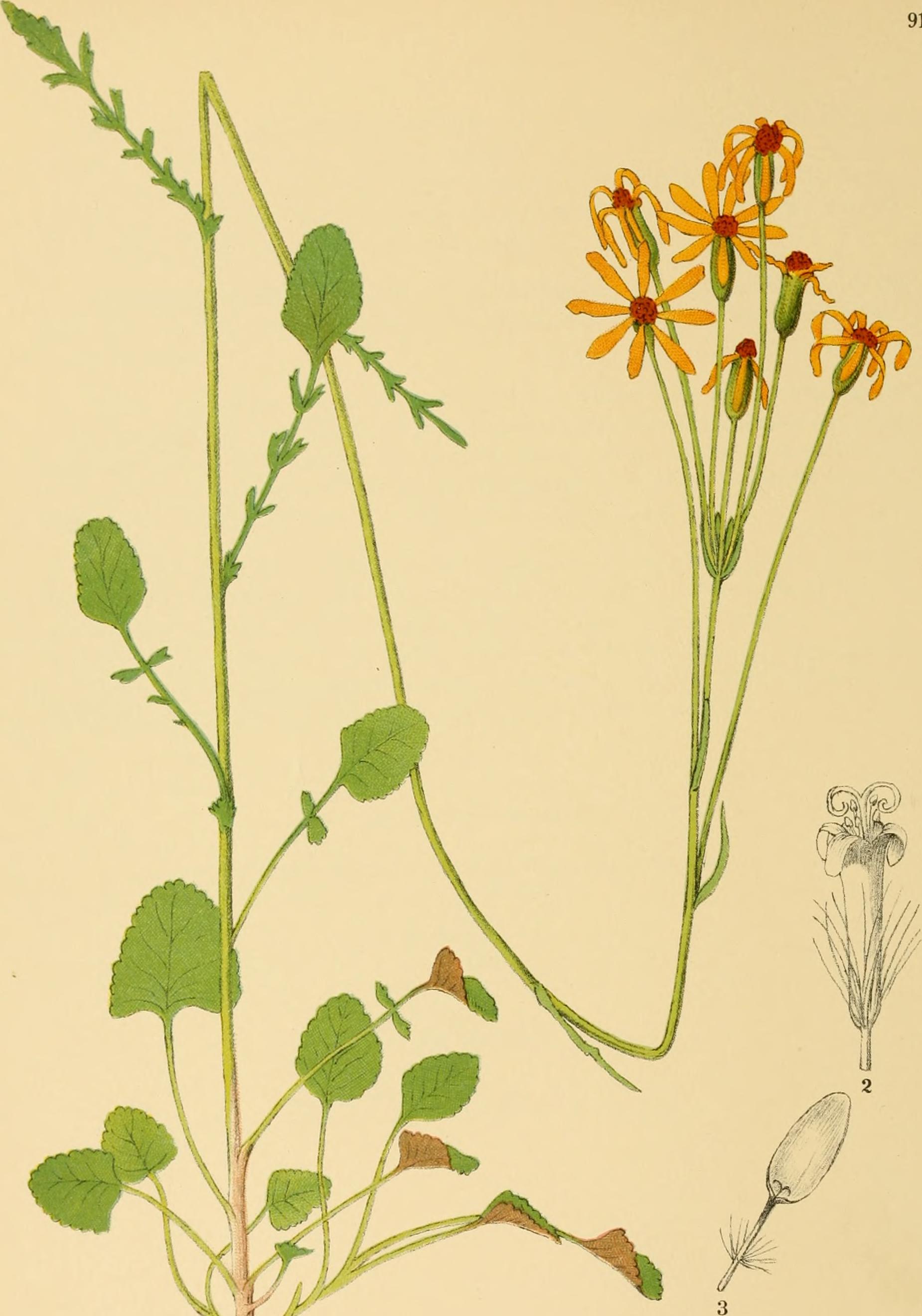
N. ORD. COMPOSIT/E. gi Tribe-SENECIONIDE^. GENUS— SEN EClO,* LINN. SEX. SYST.-SVNGENESIA SUPERFLUA. S E N E C I O. G OLDEjy RA G WOR T. SYN.— SENECIO AUREUS, LINN.; SENECIO GRACILIS, PURSH.; SENECIO FASTIGIATUS, ELL. COM. NAMES.— GOLDEN RAGWORT, GROUNDSEL, SQUAW- WEED, LIFEROOT, FALSE VALERIAN, GOLDEN SENECIO, FEMALE REGULATOR, FIREWEED.t UNKUM; (FR.) SENEgON; (GER.) GOLDENES KREUZKRAUT. A TINCTURE OF THE ENTIRE, FRESH, FLOWERING PLANT, SENECIO.\UREUS, LINN. Description. — This early spring perennial, usually attains a growth of about I or 2 feet. /?f(?^ small, thin, horizontal;;'(3i:?//(?A- numerous, slender. ^S/cv// usually free of woolliness at the flowering season, ftoccose woolly when young. Leaves alternate; radical leaves on long, slender petioles, blade mostly rounded and undivided, base somewhat truncate or almost cordate, niargiii crenate, under surface pinkish-purple; cauline leaves, lowermost similar to the root-leaves with the addition of 2 or 3 lobelets opposite along the petiole, blade subcordate, crenate, pinkish beneath; middle leaves lyrately divided and passing gradually to laciniatepinnatifid, bases semi-auriculate, clasping; superior Icaz'es linear-lanceolate, linear, sessile, and lastly bracteolate. Inflorescence numerous superior-axillary and finally corymbose, long-peduncled, ray-bearing heads; heads radiate, many-flowered; receptacle flat and naked. Ray florets 8-12, conspicuous, ovoid, pistillate. Disk florets numerous, perfect, tubular; corolla 5-lobed; lobes revolute, obtuse. Involucre of a few lanceolate scales arranged in a single row; pappus of many, soft, capillary bristles. Anthers tailless. Style bifurcated; stigmas recurved. Akenes quite glabrous or only microscopically hairy on the angles, neither rostrate nor winged. Read description of the order, under Eupatorium purpureum, 78. History and Habitat. — The Golden Ragwort is common everywhere, the primary form mostly in swampy spots and on the wet borders of streams. It flowers from May until June. Like many another of our partially-proven plants, the medical history is very superficial. Senecio has been found useful in Aboriginal medicine as an anii* The old Latin name for the plant, from senex, an old man, on account of the hoary pappus. This large and widely-dibtributed genus contains in Xorth America 57 species and 15 varieties, all but 3 of which are indigenous; of the varieties, 6 belong to 5. aiiieus. f The true fireweed is F.rechlkites hieracifoHa, Raf. (90).
91-2 hemorrhagic, abortivant and vuhierary. Later it has been recommended as a substitute for ergot, as an excellent drug to control pulmonary hemorrhage, generally as a diuretic, pectoral, diaphoretic, tonic, and a substance to be thought of in various forms of uterine trouble. The plant has no place in the U. S. Ph. The officinal preparations in the Eclectic Materia Medica are: Decoclum Senecii, Extractum Senecii Fhcidn7n, and Senecii Oleo-resince. PART USED AND PREPARATION. — The entire, fresh, flowering plant, is chopped and pounded to a pulp and weighed. Then two parts by weight of alcohol are taken, the pulp mixed thoroughly with one-sixth part of it, and the rest of the alcohol added. After having stirred the whole, pour it into a well-stoppered bottle, and let it stand eight days in a dark, cool place. The tincture, separated from this mass by filtration, has a brownish-orange color by transmitted light, the peculiar odor of the bruised herb, a sweetish then slighdy bitter taste, and a strong acid reaction. CHEMICAL CONSTITUENTS. — Senccin, an arbitrary oleo-resin, of unknown constitution. No analysis of the plant has been made, as far as I can determine. Upon adding the tincture to water a decided deposit of resin takes place, and tincture of iron shows the presence of tannin, even in a mixture of four drops of the drug-tincture in a drachm of alcohol. PHYSIOLOGICAL ACTION. — We have several provings of this drug, but its action is not determinable from them. Description of Plate 91. I. Whole plant, Ithaca, N. Y., May 24th, 1880. 2. Disk floret (enlarged). 3. Ray floret (enlarged).
.^^"ti^ 92.MJ4;#'/A ^m.a(lnat(lel.etpinxt. LaPPA OFFICINALIS,var. MaJOR, Gray.
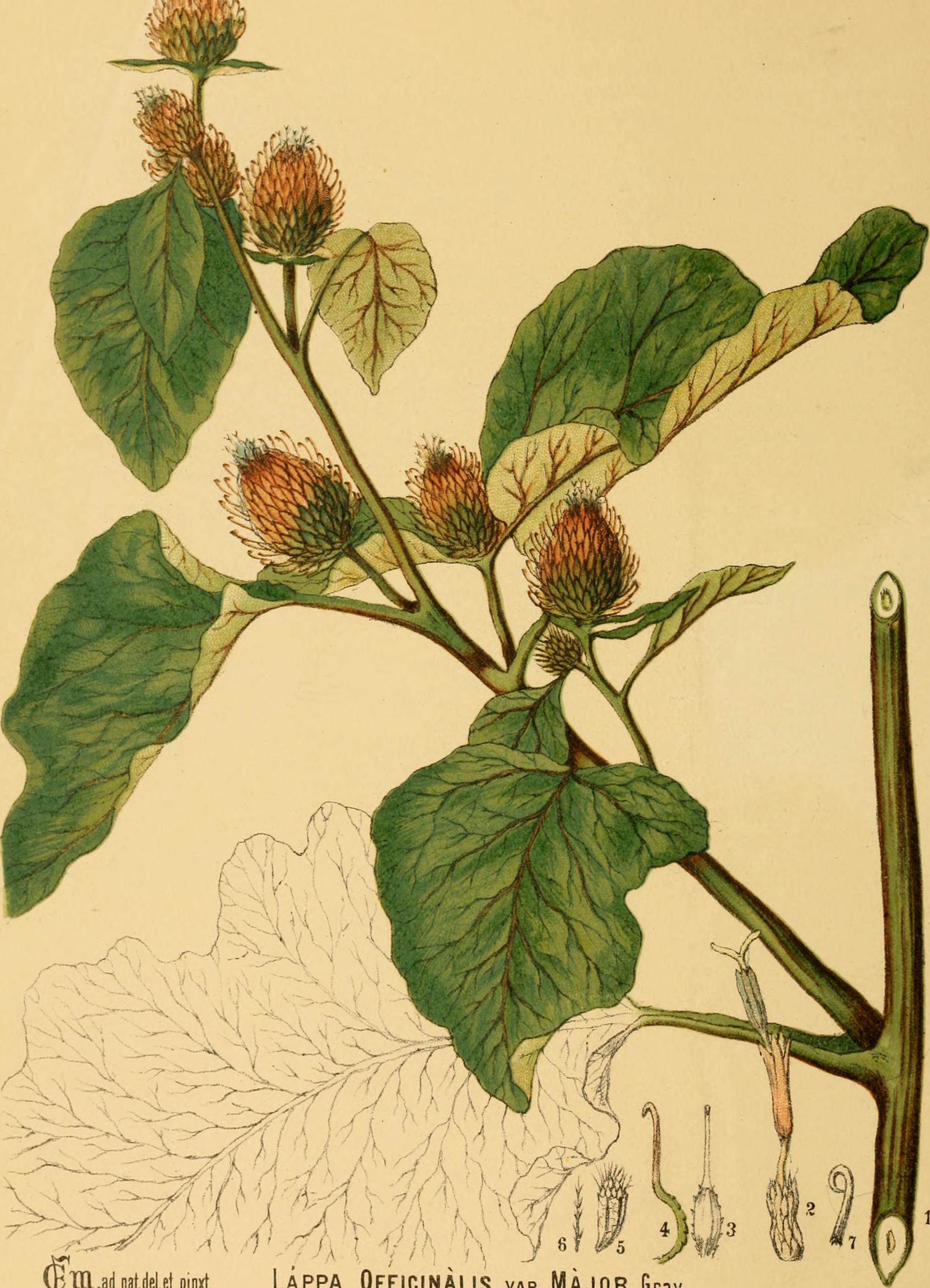
N. ORD -COMPOSITE. 92 Tribe.-CYNARODE/E. GENUS.— ARCTIUM,* LINN. SEX. SVST.—.SYNGENESIA POLVGAMIA ^QUALIS. lappa; BURDOCK. SYN.— ARCTIUM LAPPA, LINN.; A. MAJUS, SCHK.; LAPPA OFFICINALIS, ALLIONI; L. MAJOR, G^RTN.; L. OFFICINALIS, VAR. MAJOR, GRAYBARDANA MAJOR, GER. COM. NAMES.— COMMON BURDOCK, CLOTBUR; X BAT WEED; (FR.) GLOUTERON, BARDANE; (GER.) KLETTE. A TINCTURE OF THE FRESH ROOT OF ARCTIUM LAPPA, LINN. Description. — This coarse, rank, biennial emigrant, grows to a height of about 3 or 5 feet. Root deep, sub-cyHndrical, ahnost black externally and white within. S(c7ii stout; branches numerous, widely spreading. Leaves alternate, ample, orbicular-cordate, unarmed; green and smooth above, whitish cottony beneath, all marked with prominent, crimson veins; petioles stout, those of the lower leaves deeply channelled upon the upper side. Infioresceiice somewhat cymose or clustered; heads many flowered, homogamous, tubulifloral, hermaphrodite; invohia'e globular, strongly imbricate; bracts all spreading, coriaceous, and nearly smooth, divided into three portions from below upward, viz.: base dilated appressed, with a ridge marking its outer median line, the edges somewhat serrated; an'sta long, slender and smooth, the apex coverted into a strongly incurved hook of a horny consistence, sharp and transparent. Corolla pink, equally or somewhat unequally five-cleft; lobes long, narrow, and acute. Stamens exserted, united by their anthers (except the tips) into a purple tube enclosing the style; filaments smooth, distinct; anthers tailed at the base and furnished with an elongated, connate, cartilaginous apex. Style long, filiform, thickened at the apex where it bifurcates into partly distinct, slender, smooth branches without appendages, and stigmatic to the apex on the inner side. Receptacle flat or convex, densely setose. Akenes somewhat bony, inversely pyramidal, transversely wrinkled, and attached by the very end of the pointed base; pappus composed of numerous, short, rigid, barbellate bristles, which are finally separately deciduous. * 'Apitro,-, nrktos (Celtic arth), a bear, from a fancied resemblance in the rough, shaggy, fruiting heads, t Aiiprfi', labein, to lay hold of, Celtic llap, a hand, signifying the tenacious hold the burr t.akes upon fabrics and the coats of animals. Ray says (Hist., 232; Syn., 196), Lappa dici potest vel am m Xafinv prehendere vel ).arreiv lambere. J The clotburs are properly species of XtjiilJiiiim.
92-2 History and Habitat. — This common weed is indigenous to Europe and Asia, growing there as here — about roadsides and dvvelHngs. Since its introduction into this country it has spread rapidly westward, its seeds being numerous and readily carried about by both man and animals. It flowers from June to October. The herb is so rank that man, the jackass, and caterpillar are the only animals that will eat of it. The young stems, stripped of their rind, may be eaten raw or boiled, as a salad with oil, or a potage with vinegar. (Withering.) The previous uses of this plant have been a decoction of the root in pulmonary catarrh, rheumatism, gout; and a depurant in scrofula, scurvy, venereal eruptions, lepra, and kindred aftections, in which it is even now considered better in many cases than sarsaparilla. It is also diuretic. The powdered seeds have been used as a diuretic, and application for the cure of styes. Woodville says* that he " never had an opportunity of observing the effects of the root, except as a diuretic, and in this way we have known it succeed in two dropsical cases, where other powerful medicines had been ineffectually used; and as it neither e.xcites nausea or increases irritation, it may occasionally deserve a trial where more active remedies are improper." The root is officinal in the U. S. Ph.; in the Eclectic Materia Medica the following preparations are given: Infusum Arctii; Exiractiun Arctii; and Syriipus Araiice Conipositus:\ PART USED AND PREPARATION.— The fresh root gathered in Autumn, before the frost has touched the plant deeply, should be chopped and pounded to a pulp and weighed. Then two parts by weight of alcohol are taken, the pulp well mixed with one-sixth part of it, and the rest of the alcohol added. After the whole has been thoroughly stirred, pour it into a well-stoppered bottle and allow it to stand eight days in a dark, cool place. The tincture, separated from this mass by filtration, should be clear and transparent. It should have a slighly brownish-orange color by transmitted light, and an acid reaction. This tincture gives no odor or taste by which it may be identified. CHEMICAL CONSTITUENTS.— Z«///;/f.— This peculiar bitter principle was discovered by Messrs. Trimble and Macfarland.J and judged by them an alkaloid, as it answered to several of the alkaloid tests. It is described as an amorphous, intensely bitter body, with a faintly alkaline reaction. Its solubility and peculiar physical properties are as yet uninvestigated; it cannot, however, be soluble in cold alcohol to any great extent, as our tincture does not show its presence, at least to the taste. Oil of Lappa. § — This fixed oil exists in the seeds in the proportion of 15.4 per cent. It is yellow, bland, not soluble in cold alcohol, and has a sp. gr. of.930. * Med. Bol., i, 34. f Containing Aralia Spinosa and nud'uaulis (root), Sassafras (root bark), Runiex crispus (root), Burdock (root), Sambucus (flowers), Guaiacum (wood), and Iris (root). X Am. Jour. Phar., 1885, p. 127. g Ibid.
92-3 Imilin* tannin, a gummy extractive, nitrate of potash,t a resin soluble in water, and another in alcohol, have been determined. PHYSIOLOGICAL ACTION. — The only symptom of importance so far recorded from the action of this drug, is an increased secretion of milky urine, with frequent desire and copious discharges. Descrtption of Plate 92. I. A flowering branch, Binghamton, N. Y., August ist, 1884. 2. Floweret. 3 and 4. Bract. 5. Seed. 6. Bristle of Pappus. 7. A thoroughly dried horn. (2-7 enlarged.) * See under Inula Helenium, Si. f Loudon s.iys that the mature green herb, when burnt, wiU yield fully one-third its quantity of a pure, white, all<.-»line salt equal to the best potash.
93. f Ttl.adnat.delet pinxt. ClCHORlUM iNTYBUS.Linn.
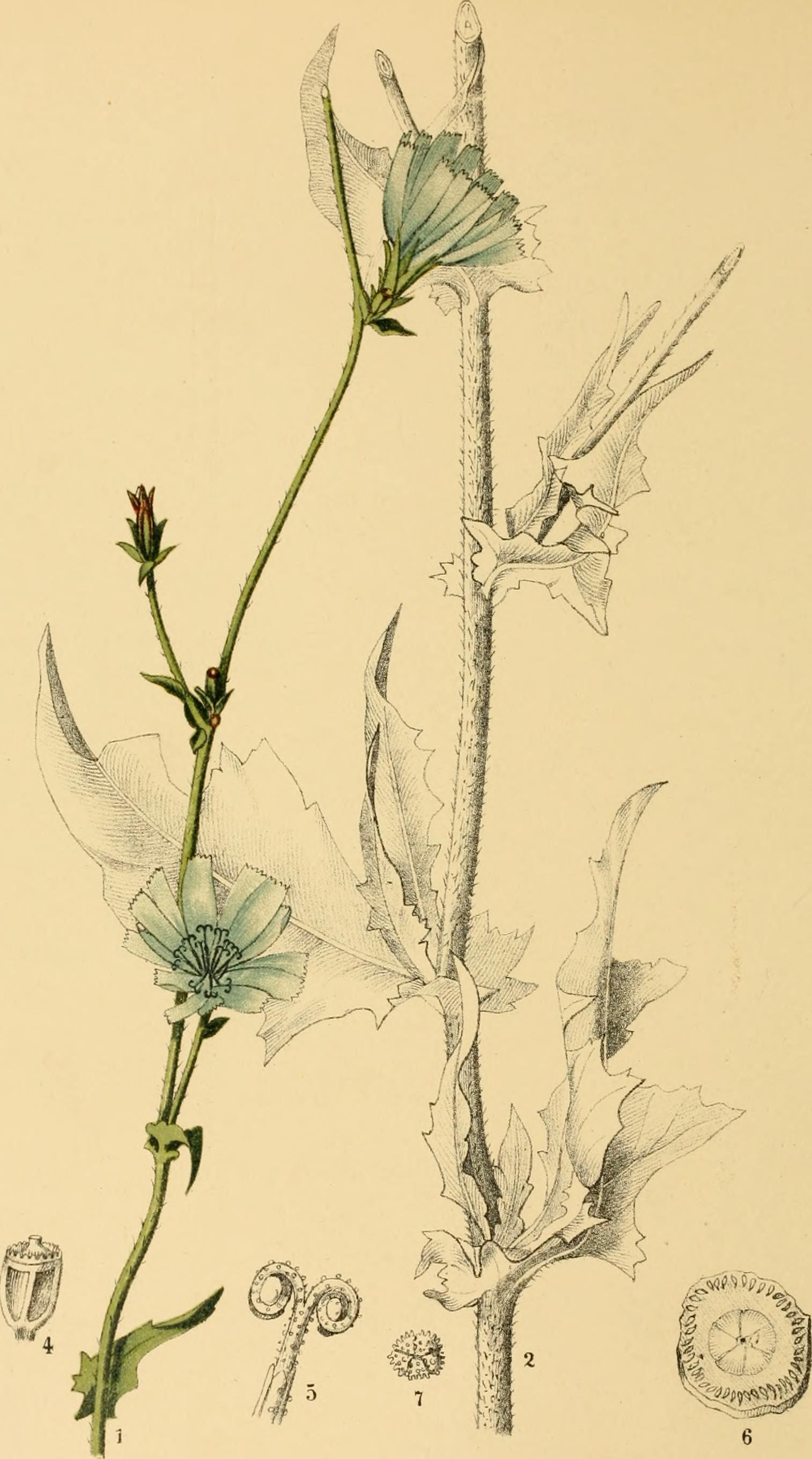
N. ORD -COMPOSITE. 93 S. ORD.-UGULIFLORA. GENUS. — C I C H O R I U M,* TOURN. SEX. SVST,-SYNGENESIA POLVGAMIA.EQUALIS. CICHORIUM. CHICCOE. Y. SYN. — CICHORIUM INTYBUS, LINN.; CICHORIUM SYLVESTRE SIVE OPFIC. BAUH. COM. NAMES.— WILD OR BLUE SUCCORY OR CHICCORY, WILD ENDIVE; (PR.) CHICOREB SAUVAGE; (GBR.) CICHORIE, WEGEWART. A TINCTURE OF THE FRESH r60T OF CICHORIUM INTYBUS, L. Description. — This partially naturalized, branching, perennial herb, grows to a height of from 2 to 4 feet. Root deep, more or less fusiform, woody, branching, and surcharged with milky juice. Stetn bristly, hairy; brajuhes r'\gid and stout; leaves alternate, those from the root runcinate, the lower stem leaves oblong-lanceolate, dentate, and partly clasping, those on the branches varying from auriculate-lanceolate to mere bracts. Inflo)-cscence axillary and terminal heads; heads 2 or 3 sessile, several-flowered, homogamous, or single and raised upon a hollow peduncle. Involucre double, the outer row composed of 5 short, spreading scales; the inner of 8 or 10. Flowerets all ligulate and perfect; ligules 5-toothed. bright blue, becoming pinkish, then whitish, as the day advances. Stamens: filanicnts white, slender, and unconnected; anthers deep blue. Stigmas 2, circinate, dark blue. Akcnes turbinate, striate, angular, and glabrous; pappus composed of numerous short, chaffy scales, forming a sort of crown. History and Habitat. — This European emigrant grows chiefly near the eastern coast, from whence it is spreading somewhat inland. It flowers throughout the months of July, August, and September. Its blossoms present a beautiful sight in early morning or on cloudy days, but fade and wither during bright sunshine. The principal previous use of this plant has been that of the root as an adulteration of, or substitute for, coffee. This use, it appears, originated with the Egyptians and Arabians, who also used the bleached leaves as a salad, the boiled or baked roots as pottage, and made a flour for bread from them when dried. Endive {Cichorhim Endivia), so much used in many countries as salad, was at one time thought to be merely a cultivated state of this species. The specific names Endivia and Intybus both appear to spring from the same Arabic word designating the herb, hcndibeh. As regards the use of chiccory, Dickens says in his " Household Words: " " The great demand for chiccory has led to its very extensive cultivation in this country; considerable sums of money have been * The Latinized Arabian name Chickouryeh.
93-2 expended on the kilns and machinery required to prepare it for the marlcets, and a large amount of capital is profitably employed upon this branch of English agriculture.... The bleached leaves are sometimes used as a substitute for endive, and are commonly sold as an early salad in the Netherlands. If the roots, after being taken up, be packed in sand in a dark cellar, with their crowns exposed, they will push out shoots, and provide through the winter a very delicate blanched salad, known in France as Barbe de Capiicin. When chiccory is to be used for coffee the roots are partly dried, cut into thin slices, roasted and ground. The ground chiccory thus made is used by many poor upon the continent as a substitute for coffee by itself. It has not, of course, the true coffee flavor, but it makes a rich and wholesome vegetable infusion of a dark color, with a bitterish, sweet taste, which would probably be preferred by a rude palate to the comparatively thin and weak, and at the same time not very palatable infusion of pure coffee of the second and third quality. By the combination of a little chiccory with coffee the flavor of the coffee is not destroyed, but there is added to the infusion a richness of flavor and a depth of color — a body — which renders it to many people much more welcome as a beverage than pure coffee purchased at the same price." In times of scarcity chiccory certainly would make a better substitute than many other substances used, as, for instance, during the war of the Rebellion, when — especially in the South — beans, peas, rye, sweet potatoes, corn, cotton seed, pea-nuts, etc., were utilized. The medical history of chiccory is of little value to us. A free use of the root and leaves produces, according to Lewis, a mild catharsis, rendering aid in jaundice and obstruction of the bowels. It has also been used as a diuretic and detergent in travel, and a refrigerant in hectic fevers and ag-ues.* PART USED AND PREPARATION.—The fresh root, gathered while the plant is budding to blossom, is to be treated as in preceding drug. The resulting tincture has a clear orange color by transmitted light, an acid bitter taste, and acid reaction. CHEMICAL CONSTITUENTS.— The activity of the plant, without doubt, lies wholly in its milk-juice, which has not yet been investigated. PHYSIOLOGICAL ACTION.—We have no record of toxical effects of Cichorium; its disturbance of the system is very slight, and that appears to be wholly confined to a slight increase of glandular secretions. Description of Plate 93. 1. Part of a flowering branch, Binghamton, N. Y.,t Sept. loth, 1SS4. 2. A portion of the main stem. 3. Floweret. 4. Akene. 5. Stigma. 6. Section of the root. 7. Pollen grain, x 150. (3-6 enlarged.) * Rafinesque, Med. Bol., II, p. 206. f Where it has escaped to the streets in many localities.
A 94. (p^m.adnat.deletpinxt. PrENANTHES SeRPENTARIA, Pupsh.
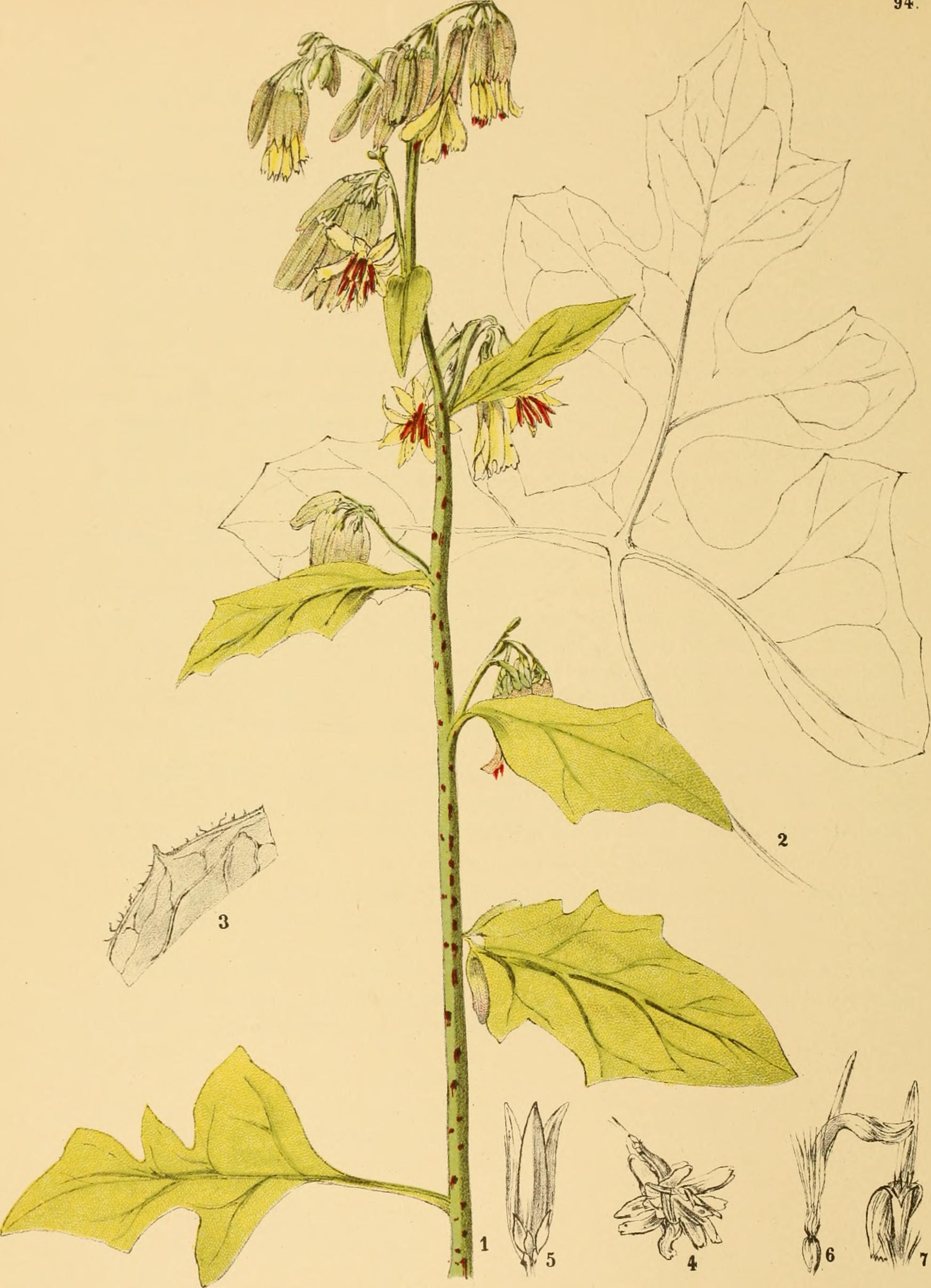
N. ORD -COMPOSITE. 94 Tribe.-CICHORIACE/E. GENUS— P RENANTHES, '^ VAILL. SEX. SYST.-SVXGEXKSIA.EOUALTS. NAB ALUS. BATTLESJV'AKE ROOT. SYN.— PRENANTHES SERPENTARIA, PURSH.; P. ALBA, VAR. SBRPENTARIA, TORR.; P. GLAUCA, RAF.; NABALUS ALBUS, VAR. SERPENTARIUS, GRAY; NABALUS SERPENTARIUS, HOOK.; N. TRILOBATUS, CASS, AND D. C; N. FRAZERI, D. C; N. GLAUCUS, RAP.; HARPALYCE SERPENTARIA, DON.; BSOPON GLAUCUM, RAF. COM. NAMES.— RATTLESNAKE ROOT, WHITE LETTUCE, LION'S FOOT, GALL-OF-THE-EARTH, DEWITT SNAKEROOT, DROP FLO^VER, CANCER WEED; (FR.) LAITUE BLANC, PIED D'LEON; (GER.i WEISSER LATTICH, A TINCTURE OF THi: WHOLE PL.-\NT PREN.'\NTHES SERPENTARIA, PURSH. Description. — This variable perennial herb, grow.s to a height of from 1 to 3 feet. Roof very bitter, fusiform, thickened or more or less tuberous; stem stout, upright, glabrous or a little hirsute, sometimes purple-spotted or splashed. Leaves alternate, diversely variable, dilated, often decurrent upon the petiole, rather thin and pale beneath; deeply sinuate-pinuatified, or 3-parted, and the terminal lobe 3-cleft; the margin a litde rough-ciliate; the cauline nearly all long, slender, petioled; the upper more or less lanceolate; the lower and radical truncate, cordate, or hastate at the base. Inflorcscoicc corymbosely thyrsoid-paniculate; heads drooping, mostly glomerate at the summit of ascending or spreading tloral-branchlets or peduncles, 8 to 1 2 flowered; invohicrc cylindrical, green, rarely purplishtinged; scales 5 to 14, in a single row, with a few small bracdets at their base; receptacle naked. Floi^'crs all perfect, pendulous, purplish, greenish-white or ochroleucous; corolla ligulate; style long and slender; stigmas much exserted. Akcncs linear-oblong or terete, truncated, and finely serrate; pappus sordid, strawcolor, or whitish,-]- composed of rough capillary brisdes. History and Habitat. — This botanically difficult species, assumes, in its mode of growth and shape of leaf, all the forms from P. alba to P. altissima, including two varieties {nana and harbata); hardly two plants in any one district being found with constant characters except, mayhap, those of the glomerules and pappus. Thus, now, P. serpentaria includes in itself what were once considered * npijuif, /«««, drooping; a"*;, anthe, flower. t As a shade of color cannot be absolutely kept through several thousand copies in lithography, some of the plates may not represent the pappus correctly.
94-2 to be 17 distinct species and varieties; and affords an interminable held of work for a botanist of Rafinesquian tendencies. The Rattlesnake Root is indigenous to North America, where it ranges from New Brunswick and Canada, to Florida, being especially abundant northward. It habits the sterile soil of open grounds and hilly wood-borders, and blossoms in August and September. As Gall-of-the-Earth, it has been known in domestic practice from an early date, and is said to be an excellent antidote to the bite of the rattlesnake and other poisonous serpents, — one who searches through the domestic literature of medicinal plants, wonders why the bite of snakes ever has a chance to prove fatal. — As an alexiteric, the milky juice of the plant is recommended to be taken internally, while the leaves, steeped in water, are to be frequently applied to the wound; or a decoction of the root is taken. A decoction of the root has been found useful in dysentery, anemic diarrhoea, and as a stomachic tonic. Prenanthes is officinal in none of the pharmacopceias. PART USED AND PREPARATION.— The whole plant, gathered during the flowering season, is treated as directed under Lappa.* The resulting tincture has a beautiful deep-orange color by transmitted light; an odor similar to that of the root; a bitter, astringent taste; and an acid reaction. CHEMICAL CONSTITUENTS.— No analysis of this species has been made to determine a specific principle. An analysis of the root of P. alba — too nearly allied to this species — by Neri. B. Williams,t showed the presence of resins, tannin, extractive, gum, and waxy matters. Description of Pl.^te 94. I. Inflorescence, Binghamton, N. Y., Aug. 2^\h, 1S86. 2. A lower leaf. 3. A portion of leafmargin. -|. Flower. 5. Involucral scales. 6 and 7. Floret. (3-7 enlarged.) * I'.ige 92-2. t Thesis, Am. Jour. Pliar., 1886, 117.
95. ^' ^m.adnaiilel.etpinxt. TARAXACUM DENS - LeCNIS, Desf
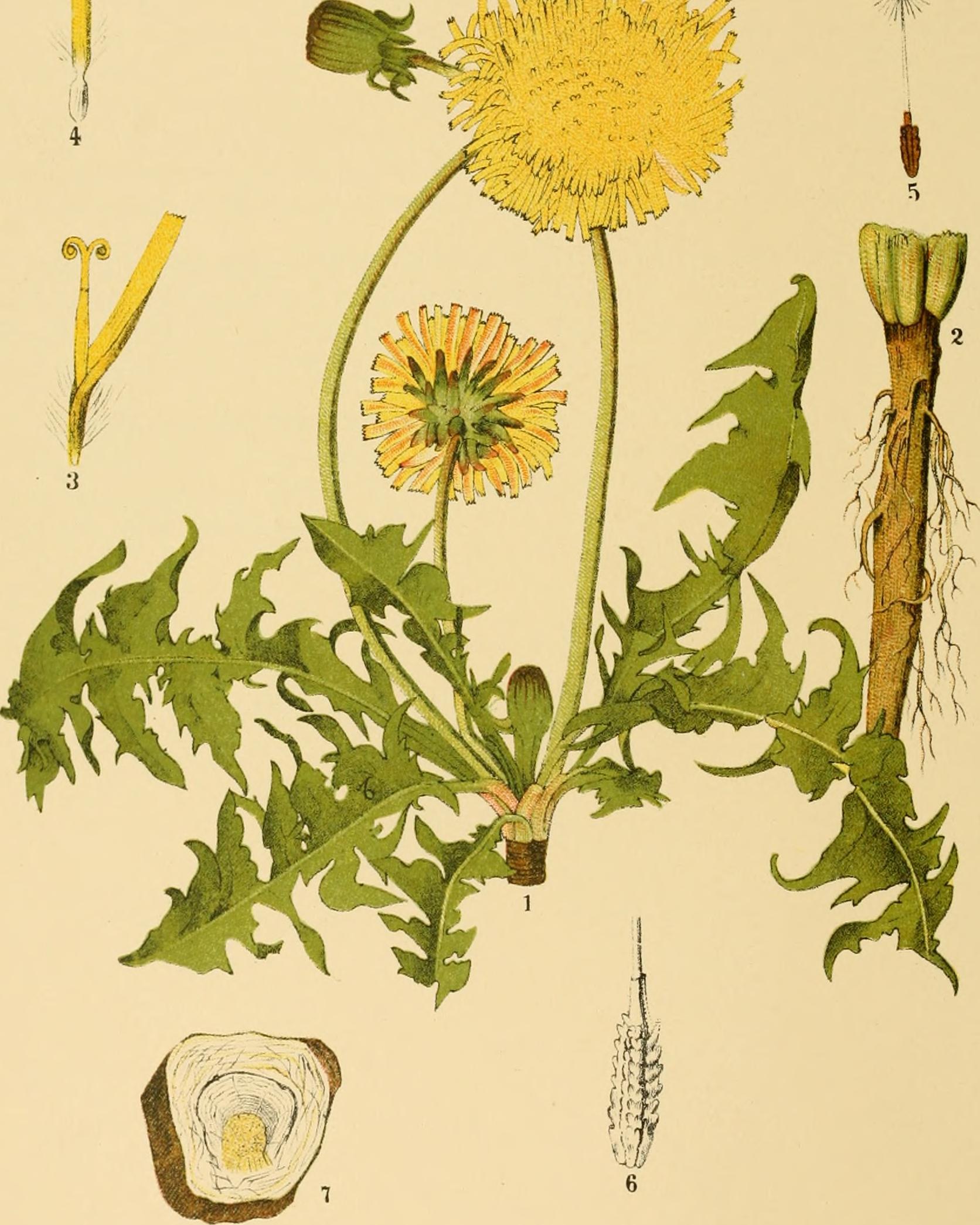
N. ORD. COMPOSITE. 95 Tribe-CICHORACE/E. GENUS.— TARAXACUM,* HALLER. SEX. SYST.— SYNGENESIA POLYGAMIA.ILOUALIS. TARAXACUM. DAJVDELIOJV. SYN.-TARAXACUM DENS-LEONIS, DESF.; TARAXACUM OFFICINALIS, WEBER; TARAXACUM VULGARE, SCHR.; LEONTODONt TARAXACUM, LINN.; LEONTODON DENS-LEONIS, LAM.; LEONTODON VULGARE, LAM.; LEONTODON OFFICINALIS, WITH.; DENS-LEONIS RAIL; HEDYPNOIS TARAXACUM, SCOP. COM. NAMES.— DANDELION,! PUFF-BALL;| (ENG.) PISSABED; (FR.) DENT DB LION, PISSENLIT COMMUNE; (GER.) LOWENZAHN, PFAFPBNROHRLBIN. A TINCTURE OF THE FRESH ROOT OF TARAXACUM DENS-LEONIS, DESF. Description. — This vernal, tufted, perennial herb, springs from a vertical tapshaped j-oot, furnished with numerous short, thickened rootlets. Leaves radical, varying from spatulate to lanceolate, pinnatifid, runcinate, or irregularly dentate. Inflorescence several many-flowered heads, each raised upon a scape that elongates during and after anthesis; scape slender, naked, cylindrical, fistulous, 6 to 18 inches long in fruit. Involucre double, the outer portion composed of numerous short scales; the inner of a single row of linear, erect scales. Receptacle naked. Akenes terete, oblong, ribbed; ribs roughened by numerous, ascending tubercles; apex abruptly conical or pyramidal, prolonged into a slender, filiform beak; pappus borne upon the summit of the beak, and composed of copious, soft, white, capillary bristles. Read description of the order, under Eupatorium purpureum, 78. History and Habitat. — The Dandelion is a native of Greece, or, at least, of Europe and Asia Minor, and has become by introduction a common herb in fields, pastures, lawns and open grounds everywhere in this country, where it blossoms in early spring and fruits in the summer. The growth of this plant furnishes an instance of a beautifully provisional Nature. During the expansion of the flower, the outer scales of the involucre reflex, after anthesis the inner row contracts until it covers the forming pappus; then while the fruit is maturing the beaks gradually extend by growth and raise the pappus, until finally the inner involucre * Tapicnai, tarosso, to disorder, in allusion to its action upon the system. f A£oi/, lean, lion; o(iriof, odous, a tooth; from a supposed likeness of the leaf incisions to a lion's tooth. % Americanized from (Fr.) Dent de lion. I On account of the separability of the akenes from the receptacle. The true puff-ball is Lycoperdon Bovista.
95-2 in turn reflexes, disclosing the fruit as a beautiful, white, globular, feathery head, exposing upon its coronate receptacle the ripe seeds ready to be dissipated and wafted to new fields by the first summer zephyr that passes by. Tufts of this plant are eagerly gathered by the poor, in early spring, and cooked, furnishing thus an excellent and palatable pot-herb; they are also in many localities bleached like, and used in lieu of, endive,* as a salad. The leaves are eaten raw or cooked by the Digger and Apache Indians, who value them so highly that they scour the country for many days' journeys in search of sufficient to appease their appetites. So great is their love for the plant, that the quantity consumed by a single individual exceeds belief.f In many parts of Europe, especially in Germany, the dried roots "are roasted and substituted for coffee by the poorer inhabitants, who find that an infusion prepared in this way can hardly be distinguished from that of the coffee berry." J Taraxacum has been used in medicine from ancient times; it is one of thpse drugs, overrated, derogated, extirpated, and reinstated time and again by writers upon pharmacology, from Theophrastus' at^jdxy; and xi;(^opio}' to the present day. It has been considered as a mild detergent, aperient, and diuretic; Bergius recommends it in hepatic obstruction, hypochondriasis, and icterus; and many authors give it repute in dropsy, pulmonic tuberculosis, various skin disorders, gastric derangements, biliary calculi, incipient visceral scirrhus, etc., etc. Children often play with the scapes at making chains, bracelets and " curls." The curls are formed as follows: A split is started in four directions at the smaller end of a scape, into which the tongue is deftly and gradually inserted, causing a slow separation into sections that curl backward, revolutely, being kept up to their form by the tongue, when the scape is curled to the end it is drawn several times through the operator's mouth and partially uncurled into graceful ringlets. In its manufacture a child usually gets full benefit of the milky, bitter juice, and, if susceptible, verifies the common name of the plant as applied in England:... quasi Icctiminga et uj-tnana hcrba dicHiir — plus lo/ii dcrivat in vesicant qudm pueruli retinendo sunt, praseriim inter dormiendum, ebque tunc inipmdentes ct inviti slragula per7ningunt.\ Taraxacum is officinal in the U. S. Ph., its preparations being: Extractuni Taraxaci and Extractuni Taraxaci Fluidiim. The same preparations are officinal in Eclectic pharmacopoeias, also Decoctum Taraxaci, and Pilules Taraxaci Composites. \^ PART USED AND PREPARATION.— The fresh root, gathered in March, July or November, is chopped and pounded to a pulp and pressed out in a piece of new linen. The expressed juice is then, by brisk agitation, mingled with an equal part by weight of alcohol. This mixture is allowed to stand eight days in a dark, cool place. The tincture, separated from the above mass by filtration, should have a light orange color by transmitted light, a bitter, somewhat acrid taste, and an acid reaction. * Cichorium endiva. J Murray, App. Med., p. 107. t Dodge, U. S. Agric. Kep., 1870, p. 423. § Rail Hist. PL, p. 244. II Sanguinaria, Pudophyllin, Taraxacum, and Mentha viridis.
95-3 CHEMICAL CONSTITUENTS.— 7rtra;ir«««. This body, when extracted from the roots or milky juice, forms in a bitter amorphous mass, soluble in alcohol, ether, and water. It was discovered by Polex in 1839, and named by Kromayer, who corroborated the discovery in 1861. Taraxacerin, Q H^^ O. — (Kromayer, 1861). This crystalline principle is said to resemble laclucerht* It is soluble in alcohol, but not in water. Levulin, Cg H^^ O^. — (Dragendorf). This amylose principle has the same composition as inulin,-\ but differs in that it is soluble in water and devoid of rotary power. Inosite, Cg Hj2 Og (H2 0)2. — (Marme, 1864). This hydride of glucose was determined in the leaves and scapes, but not in the root. It forms transparent rhombic crystals, losing their water of crystallization when exposed to the air. It is soluble in water, the solution having a sweet taste. Leontodoniuin\ is simply, or in great part, the inspissated juice of the plant, and in a measure the principles en masse. Manniie, Cg H, (O H)g, has been proven by Messrs. T. and H. Smith (1849) to be present only after a sort of fermentation had taken place in the juice. § This is probably the change that takes place to a greater or less extent, when the roots are undergoing the winter changes. Taraxacum also contains, according to many assayists,|| caoutchouc, resin, gum, mucilage, free acid, sugar, wax, and the usual plant constituents. PHYSIOLOGICAL ACTION.— Although this plant has received the attention of scientists of all nations from remote times, still I know of no attempt having been made to determine its toxic action. The symptoms caused by repeated doses are, in general: mental excitement, vertigo and headache, blotchy white coated tongue, nausea and colic; frequent urination; general sticking or stitching pains; sleepiness, chilliness and sweating. These symptoms point to a peculiar action upon the liver, causing inaction of that organ. Its action upon the skin in causing an exanthem seems to be dependent greatly upon the amount of gastric irritation. Description of Plate 95. T. Whole plant, Bergen, N. J., May 14th, 1879. 2. Root. 3. Ray floret (enlarged). 4. Disk floret (enlarged). 5. Fruit. 6. Seed (enlarged). 7. Section of root (enlarged). * See Lactuca, 96. t See Inula, 81. J Kromayer, 1861. § Et supra, Fliick. & Han., Pharmacographia, in part. II Sprengel, Frickhinger, Squire, Poles, John, Overbrook, T. and H. Smith, Dragendorf, Kromayer, Marme, and Widemann.
(p.Tll.ailnafdel.etpJnxt. Lactuca Canadensis, unn.
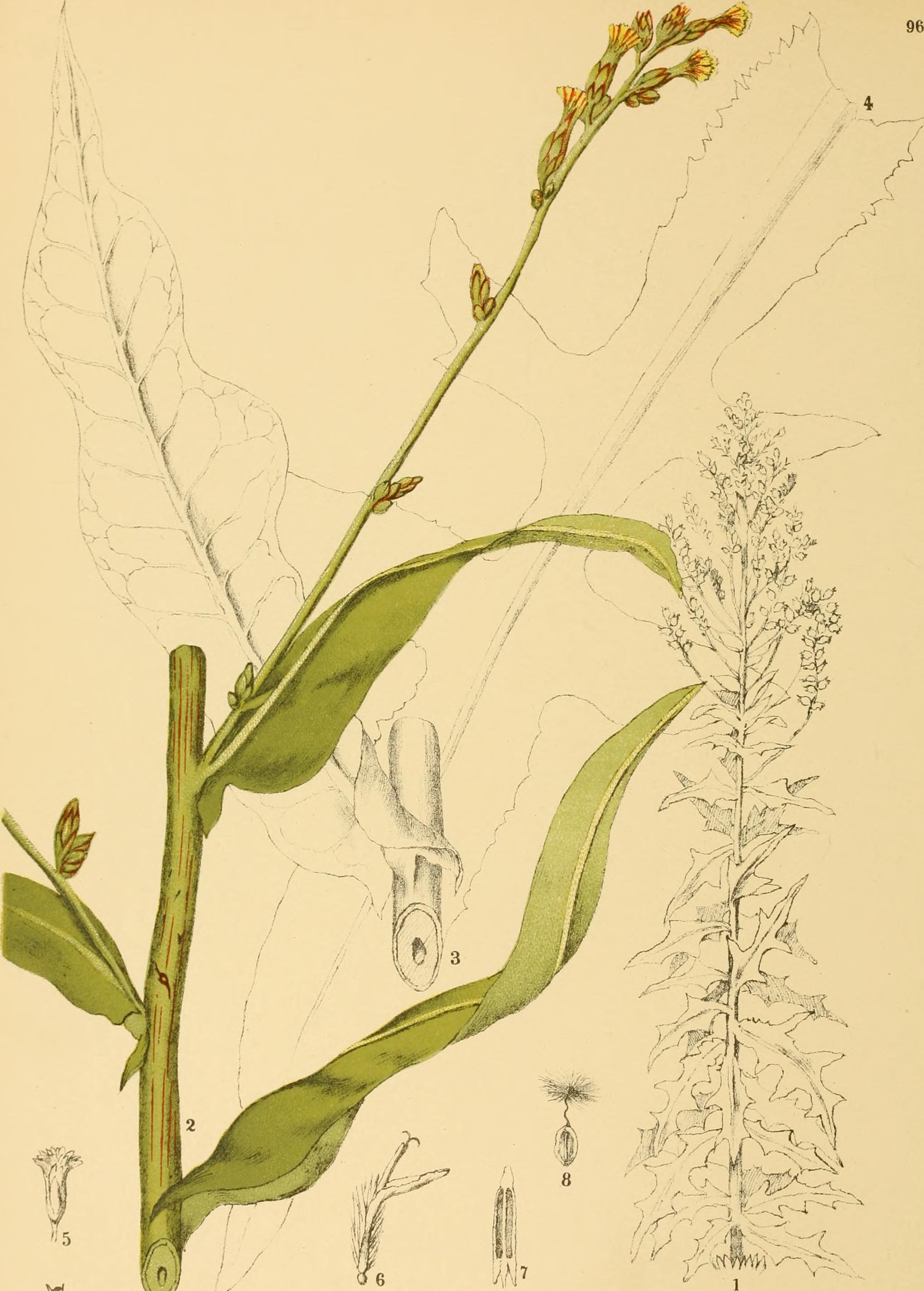
N. ORD -COMPOSITE. 96 Tribe.-CICHORIACE/E. GENUS. — LACTUCA,* TOURN. SEX. SYST.— SVNGENESI.A..EQUALIS. LACTUCA. LETTUCE. SYN.— LACTUCA CANADENSIS, LINN.; L. ELONGATA, MUHL. (TYPEi; L. ELONGATA, VAR. LONGIFOLIA. T. & G.; L. CAROLINIANA, WALT.; L. LONGIFOLIA, MICHX.; GALATHENIUM ELONGATUM, NUTT. • SONCHUS PALLIDUS, WILLD. COM. NAMES.— WILD LETTUCE, FIRE-WBED,t TRUMPET-WEED.J; [FR.) LAITUE DU CANADA; (GER.) CANADISCHE LATTICE. A TINCTURE OF THE WHOLE PLANT, OF VARIOUS SPECIES, INCLUDING THIS. Description. — This glabrous, glaucescent biennial, grows to a height of from 4 to 9 feet. Stem erect, very leafy to the top, and copiously supplied with milky juice. Leaves alternate, mostly sinuate, pinnatifid below, lanceolate and entire above, all partly clasping by a sagittate base, and pale beneath; midrib naked, or rarely with a few sparse bristles; margins entire or sparingly dentate, especially near the base; terminal lobe elongated. Iiifloresccnee in a terminal, narrow, elongated, leafless panicle; heads 12- to 20-flowered; fioicers pale yellow, all perfect: iin<oliicre a half-inch or less high, cylindraceous, irregularly calyculate, and slightly imbricated in two rows. Corolla ligulate in all the flowers of the head; tube hairy; ligules obscurely, if at all, notched at the apex. Receptacle naked. Akenes blackish, broadly oval, flat, wingless, rather longer than the beak, obscurely scabrous-rugulose, and lightly i -nerved in the middle of each face; beak filiform, abrupt at the base, and expanded at the apex; pappus of soft, silvery-white hairs, on the dilated apex of the beak. History and Habitat. — Wild Lettuce is indigenous to North America, where it extends from Nova Scotia and Canada to Saskatchewan, and southward to Upper Georgia. It habits rich moist grounds along the borders of fields, thickets^ and roads, where it blossoms in July and August. This species has been used in early practice as an anodyne, diaphoretic, laxative, and diuretic, in many diseases, principally, however, in hypochondria, satyriasis, nymphomania, phthisis pulmonalis, ascites, anasarca, and nervous complaints in g-eneral. o * Latin, lac, milk; on account of the milky juice. t Many plants have been given this name in different localities, on account of their growing particularly on newlyburned fallows, Encclithites hieracifolius, Senecio aureus, Hieraciuiii Canadense, and this, t This name also designates Kiif^atoriitru purpureutn.
96-2 Lactucariiim, or Lettuce Opium, being ot the same nature, no matter from what species it is obtained, consists of the inspissated milky juice of various species of Lactuca. The yield varies greatly with the species; g'reatest in L. z'ii-osa, and diminishing as follows: L. scariola, L. altissima, L. Canadensis, L. sativa. Dr. Coxe, of Philadelphia, was the first to call the attention of the profession to this substance as a substitute for commercial opium;* his reasoning and experiments were based upon the product of Z. sativa. Although Lettuce has been considered narcotic from ancient times, still it is but slightly soporific, and hardly deserves a tithe of the reputation writers have made for it. Lactucarium from L. virosa is still officinal in the U. S. Phar., but will, without doubt, be dropped at the next revision. PART USED AND PREPARATION. — The whole fresh plant, just as the blossoms open, is chopped and pounded to a pulp and weighed. Then two parts by weight of alcohol are taken, the pulp thoroughly mixed with one-sixth part of it, and the rest of the alcohol added. After stirring the whole well, it is poured into a well-stoppered bottle, and allowed to stand eight days in a dark, cool place. The tincture formed thus, after straining and filtering, has a deep orange-red color by transmitted light; the odor of canned tomatoes; a slightly bitter and astringent taste; and an acid reaction. CHEMICA.L CONSTITUENTS. — Lactucarium, or Thridace, as noted above, represents in itself all the active principles of the plant, being a mixture of different organic and about ten per cent, inorganic bodies. It is not fully soluble in any vehicle, and merely softens on the application of heat. Subjected to analysis, it yields: Lactucerin.f Cj,jH.,„0..|; — This compound body composes nearly half the whole weight ot Lactucarium. It forms in slender, colorless, microscopic, odorless and tasteless acicular crystals, insoluble in water, soluble in boiling alcohol and cold ether, and melting at 232° (449.6° F.). Lactucin, C,jHj„03(H.,0). — This body, which proves not to be a glucoside, gives to Lactucarium its intensely bitter taste. It forms, when purified, white, bitter, pearly scales, insoluble in ether, soluble in alcohol and in hot water. Lactucic Acid. — This very acid body, isolated by Pfaf and Ludwig, results as an amor]jhous light yellow or brownish mass, only crystallizing after long standing. Lactucopicrin, C,jH|,^O^j. — This bitter amorphous substance seems to be formed by the oxidation o'i Lactucin. It is soluble in alcohol and water. Beside the above, Lactucarium also contains a yellowish-red tasteless resin; a greenish-red acrid resin; caoutchouc; gum; oxalic, citric, malic, and succinic acids; sugar; mannite; asparagin; and a voladle oil. * Trans. Am. Phiiosoph. Socy., 1799,387. f I^actiicon, 1 Fliickiger, C,,II,,0: P'ranchiniont, CisH^eO.
96-3 PHYSIOLOGICAL ACTION. — Lactucarium, in large doses, causes: Delirium; confusion of the brain, vertigo, and headache; dimness of vision; salivation; difficult deglutition; nausea and vomiting, and retraction of the epigastric region, with a sensation of tightness; distension of the abdomen, with flatulence; urging to stool followed by diarrhoea; increased secretion of urine; spasmodic cough, oppressed respiration, and tightness of the chest; reduction of the pulse ten to twelve or more beats; unsteady gait; great sleepiness; and chills and heat, followed by profuse perspiration. Description of Plate 96. I. Whole plant, eighteen times reduced, Binghamton, N. Y., July 26th, i! 2. A portion of the panicle. 3. An upper leaf. 4. Outline of a lower leaf. 5. Flower-head. 6. A floret. 7. Anther. 8. Fruit. (6 and 7 enlarged.)
97. (pin.adnat.del.et pinxt. Lobelia Cardinalis, Linn.
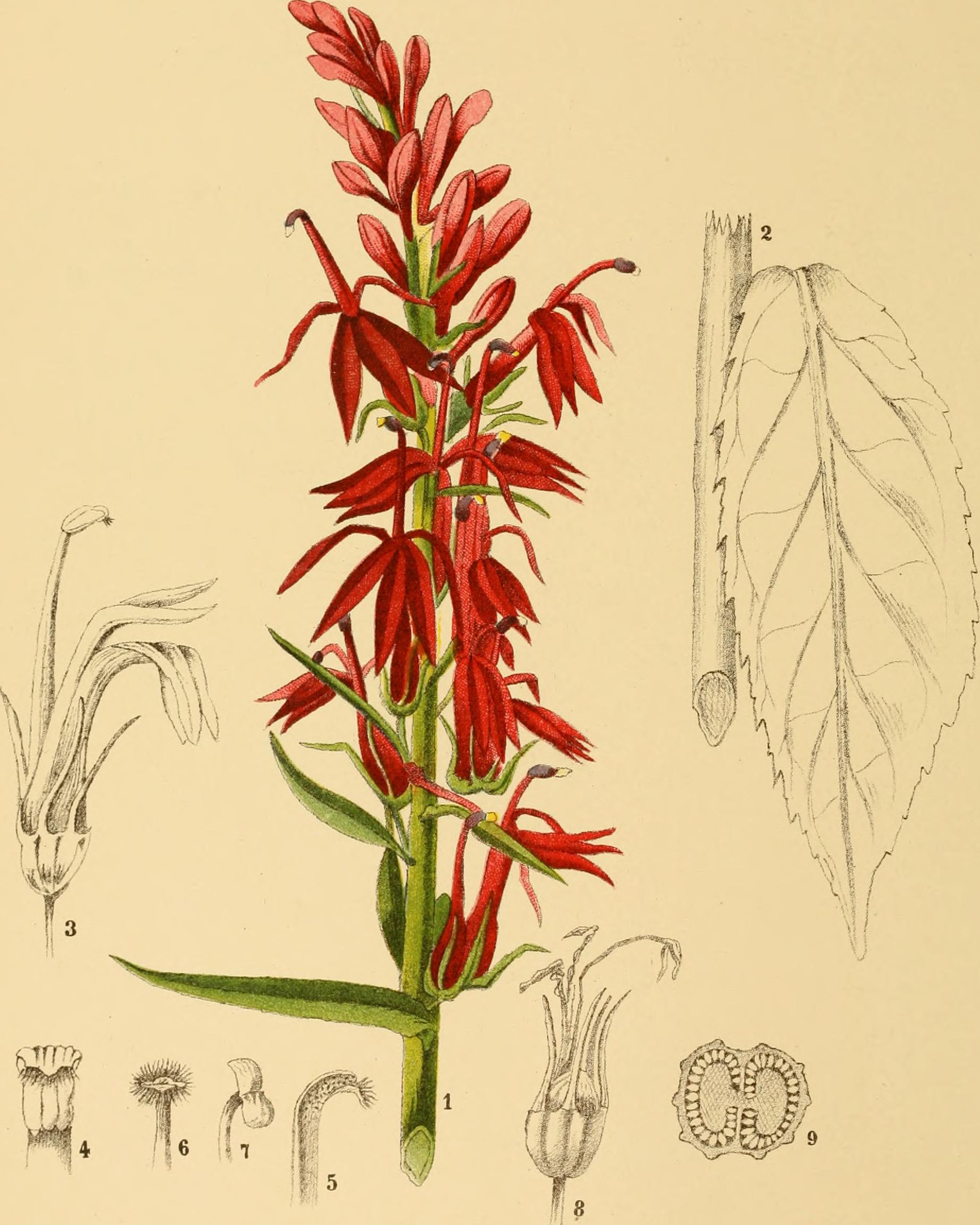
N. ORD-LOBELIACE^. 97 Tribe.-LOBELIE/E. GENUS.— LOBELIA,* LINN. SEX. SYST.— PENTANDRI.\ MONOGYNIA. LOBELIA CARDINALIS. CARDINAL FLOWER. SYN.— LOBELIA CARDINALIS, LINN.; L. COCCINEA, STOKES; TRACHELIUM AMERICANUM, PARK. COM. NAMES.— CARDINAL FLOWER, SCARLET OR RED LOBELIA, HIGHBELIA; (PR.) LOBELIE CARDINALE; (GER.) ROTHE KARDINALS BLUME. A TINCTURE OF THE WHOLE PLANT LOBELIA CARDINALIS, LINN. Description. — This showy perennial grows to a height of from 2 to 4 feet. Stem minutely pubescent or glabrous, commonly simple. Leaves oblong-ovate, to oblong-lanceolate, tapering at both ends, sessile, and irregularly serrate or serrulate. Lnfloresccnce a dense, terminal, more or less one-sided virgate raceme; floivers large and showy, intense red, or rose-color, sometimes pure white; pedicels erect or ascending; bracts of the upper portion linear-lanceolate, of the lower, leafy. Calyx smooth; tube short, hemispherical, much shorter than the lobes; lobes linear-subulate. Corolla-\ gamopetalous, tubular; tnbc about i inch long,, straight; limb bilabiate; tipper lip 2-parted to the base, the cleft extending down to the calyx, the lobes erect, linear-lanceolate; loioer lip 3-cleft, spreading plane or slightly recurved, the segments oblong-lanceolate. Stamens free from the tube of the corolla, monadelphous almost to the base, exserted through the cleft in the corolla tube, which they again enter between the two upper lobes; filaments red;. anthers syngenesious, curved, blue, the two larger ones naked at the tip, the other three ciliate. Capsule hemispherical, thin-walled, 2-celled, and loculicidally 2-valved at the summit. Seeds numerous, oblong, rugulose-tuberculate, similar to those of L. injlata. Lobeliaceee. — This large family, closely related to Campanula cecs, is represented in North America, by 7 genera and 31 species, characterized in general as follows: Herbs (when not Tropical) with acrid, milky juice. Leaves alternate, simple; stipules none. Lnfloresccnce racemose; flozvers 5-merous, perfect. Calyx adnate to the ovary; limb divided down to the ovary, or entire; lobes persistent when present. Corolla regular and perigynous, inserted with the stamsns just where the calyx leaves the ovary; limb disposed to become bilabiate; lobes 3, valvate in * Dedicated to M.ithias de L'Obel, a Flemish herbalist, Botanist to James I. f In describing this organ, I adopt the position it stands in while flowering. See Lobeliacea.
97-2 the bud, or in some cases induplicate, commonly deeper cleft or completely split down between two of the lobes (this cleft is generally upon the lower face of the corolla when the bud is young, but becomes superior, by a twisting of the pedicel, during its maturation). Stamens 5, epigynous, as many as the lobes of the corolla and alternate with them, usually both monadelphous and syngenesious; filaments generally free from the corolla, but not invariably so; anthers 2-celled, introrsely dehiscent, firmly united around the top of the style. Ovary wholly inferior, or sometimes half free, 2-celled, with the placentse projecting from the axis (sometimes I -celled with 2 parietal placentae); ovules anatropous;.f^i'/^ filiform, entire; stigma commonly 2-lobed, and girt with a ring of more or less rigid hairs, at first included, then exserted.* Fruit capsular and loculicidal, or baccate and indehiscent; seeds indefinitely numerous; embryo small or narrow, straight and axial; albumen copious, fleshy. Many species of this order are acrid, narcotic poisons, only a few being, so far, used in medicine, among which the West Indian Rcbenta Cavallos [Hippobroma longifolia, Don.) is noted for its poisonous properties. If taken internally it speedily brings on hypercatharsis, while the juice, if touching the mucous membrane, quickly causes acute inflammation; and Tupa Fenillaei, Don., is said to bring on nausea in one simply smelling of its flowers. The three species described in this work are, however, all that are much used. History and Habitat. — The Cardinal Flower is indigenous to North America, from New Brunswick to Saskatchewan, southward east of the Mississippi to Florida, and southwest to the borders of Texas. It rears its magnificent spike of gorgeous flowers along the muddy banks of streams, during the early autumn months. It was introduced into Great Britain from Virginia, on account of its beauty, in 1629. Shcepf mentions the use of the root of this species, by the Cherokee Indians, for syphilis; and Dr. Barton speaks of their successful use of it as an anthelmintic By some early physicians it was considered fully equal to Spigelia Marilandica, in this direction. This species is, however, seldom used now, L. inflata taking its place entirely. It is considered, however, to possess marked anthelmintic, nervine, and antispasmodic properties. PART USED AND PREPARATION.— The whole fresh plant, gathered when coming into blossom, is treated as in the next species. The resulting tincture has a clear yellowish-brown color by transmitted light; a sweetish, herbaceous odor and taste; and an acid reaction. CHEMICAL CONSTITUENTS.— No special examination of this plant having been made, we can do no better at present than to refer to the chemistry of L. inflata, page 99-3. * See pp. 98-98-2.
97-3 Description of Plate 97. Top of a flowering plant, Binghamton, N. Y., Aug. lolh, 18S6. 2. A middle leaf. 3. Flower. 4. Stamens. 5. Section of the stamen-tube. 6. Stigma. 7. Open stigma. 8. Fruit. 9. Section of the ovary. (4-9 enlarged.)
f ^m.ad natdei.etpinxl. Lobelia Syphilitica, Linn. 98
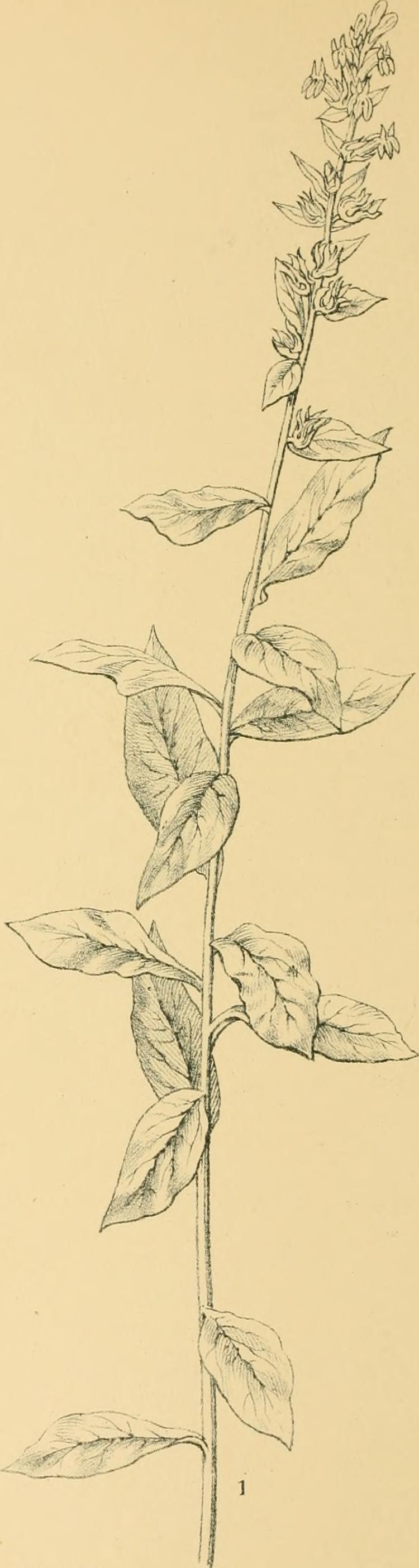
N. ORD-LOBELIACE^. 98 GENUS.— LOBELIA, LINN. SEX. SYST.— PENTANDRIA MONOGVNIA. LOBELIA SYPHILFTICA; GREA T BL UE LOBELIA. SYN.— LOBELIA SYPHILITICA, LINN.; LOBELIA CCERULEA? LOBELIA GLANDULOSA, LINDL.; LOBELIA REPLEXA, STOKES. COM. NAMES. — GREAT LOBELIA, BLUE LOBELIA, BLUE CARDINAL FLOWER; (PR.) LOBELIE SYPHILITIQUE; (GER.) GEMEINE LOBELIE. A TINCTURE OF THE WHOLE FRESH PL.^NT, LOBELIA SYPHILITICA, LINN. Description. — This erect, perennial herb, attains a growth of from i to 3 feet, its conspicuous racemes being generally from one-third to one-quarter the length of the whole plant. Stem simple, leafy to the base of the raceme, and somewhat hairy, especially upon its angles. Leaves sessile, ovate-lanceolate, irregularly denticulate-serrate, acute at the base, from 2 to 6 inches long, and about i inch wide; thin, and more or less appressed hairy. Inflorescence supra-a.xillary, composed of a long, at first leafy, then morphologically bracted, dense spike or raceme; pedicels shorter than the bracts; floivers light blue, nearly i inch long extending beyond the leafy bracts. Calyx five-cleft, hirsute, shorter than the tube of the corolla, with reflexed, conspicuous, two-cleft auricles at the sinuses; tube hemispherical, short; lobes one-half the length of the corolla. Corolla with a straight, sub-cylindrical tube, more or less two-lipped, having a deep fissure at the superior margin; upper lip of two erect, slighdy diverging lobes; lower lip spreading and three-lobed by incision. Fruit a globose pod, free above, but enclosed by the loose, persistent calyx; two-celled, opening at the apex; seeds many. For a description of the Natural Order, see Lobelia cardinalis, 97. History and Habitat.— The great blue lobelia habits the borders of marshy places and wet spots in pasture lands and meadows, pretty generally throughout the United States, to which it is indigenous; flowering from July to September. In some localities it is called Jiigh belia, in unconscious pun upon its lowlier but more frequendy-used companion, L. inflata, or low belia, as they term it. The lobelias furnish one of the best e.xamples of the system of cross-fertilization in plants. The stamens, especially their anthers, grow into a tube, enclosing the stigma, and apparendy making self-fertilization positive. A closer study, however, reveals the following conclusive points: The stigma is two-lobed, the recep* Dr. Hale, in his " New Remedies," treats of this drug as Lobelia coerulea. Dr. Allen remarks that— as there are a number of blue lobelias, and beside this the true carulca grows at the Cape of Good Hope, and may yet be provensyphilitka should always designate this drug.
98-2 tion surfaces — in the earlier stages of growth and while enclosed in the anther tube — are tightly pressed together and fringed with close, bristly hairs, all together resembling the mouth of a full-bearded man, with lips compressed. The tube of anthers opens by a pore at the tip and discharges the ripened pollen directly through this pore when it is irritated by the back of any insect that may creep into the throat of the corolla after nectar. As the pollen is discharged, the stigma, by elongation of the style, presses forward, keeping up the discharge by acting as a swab, until the cell is completely empty; then, as it projects beyond the pore, the compressed lips open and roll back, standing ready to collect the pollen from the back of some insect that has been on a visit to a neighboring plant. The former uses of this plant were the same as those of L. inflata, than which it is less active. The natives of North America are said to have held this plant a secret in the cure of syphilis, until it was purchased from them by Sir William Johnson, who took a quantity to Europe, and introduced it as a drug of great repute in that disease. European physicians, however, failed to cure with it, and finally cast it aside, though Linnaeus, thinking it justified its Indian reputation, gave the species its distinctive name, sypJiilitica. The cause of failure may be the fact that the aborigines did not trust to the plant alone, but always used it in combination with may-apple roots {Podopliylhiin pcltatnm), the bark of the wild cherry [Pnciins VivQinica), and dusted the ulcers with the powdered bark of New Jersey tea [Ccnothns Americaiuts). Another chance of failure lay in the volatility of its active principle, as the dried herb was used. It is not officinal in the U. S. Ph., nor in the Eclectic Materia Medica. PART USED AND PREPARATION. -The whole fresh plant is chopped and pounded to a pulp and weighed. Then two parts by weight of alcohol are taken, the pulp thoroughly mixed with one-sixth part of it and the rest of the alcohol added. The whole, after thorough mixture, is poured into a well-stoppered bottle and allowed to stand eight days in a dark, cool place. The tincture is then separated by straining and filtering. Thus prepared, it has a beautiful, clear, lightbrown color by transmitted light, a slightly bitter taste and tingling sensation upon the tongue, and a strong acid reaction. CHEMICAL CONSTITUENTS.-The chemical properties of this plant will probably be found to differ from those of L. inflata only in quantity. An analysis by M. Boissel resulted in the separation of fatty and butyraceous matters, mucilage, sugar, earthy salts, and a volatile bitter principle. PHYSIOLOGICAL ACTION.-No data upon this is obtainable. We will do well, perhaps, to again consult L. inflata, which, in virulence of action, is the type of the ofenus in the Northern States. & Description of Plate 98. I. Whole plant, once reduced; from Chemung, N. Y., September 9th, 1879. 2. Apex of raceme. 3. Flower (somewhat enlarged). 4. Fruit. 5. Pollen, with end view x 380.
99.in.aii natdei.etpinxi Lobelia Inflata, Linn.
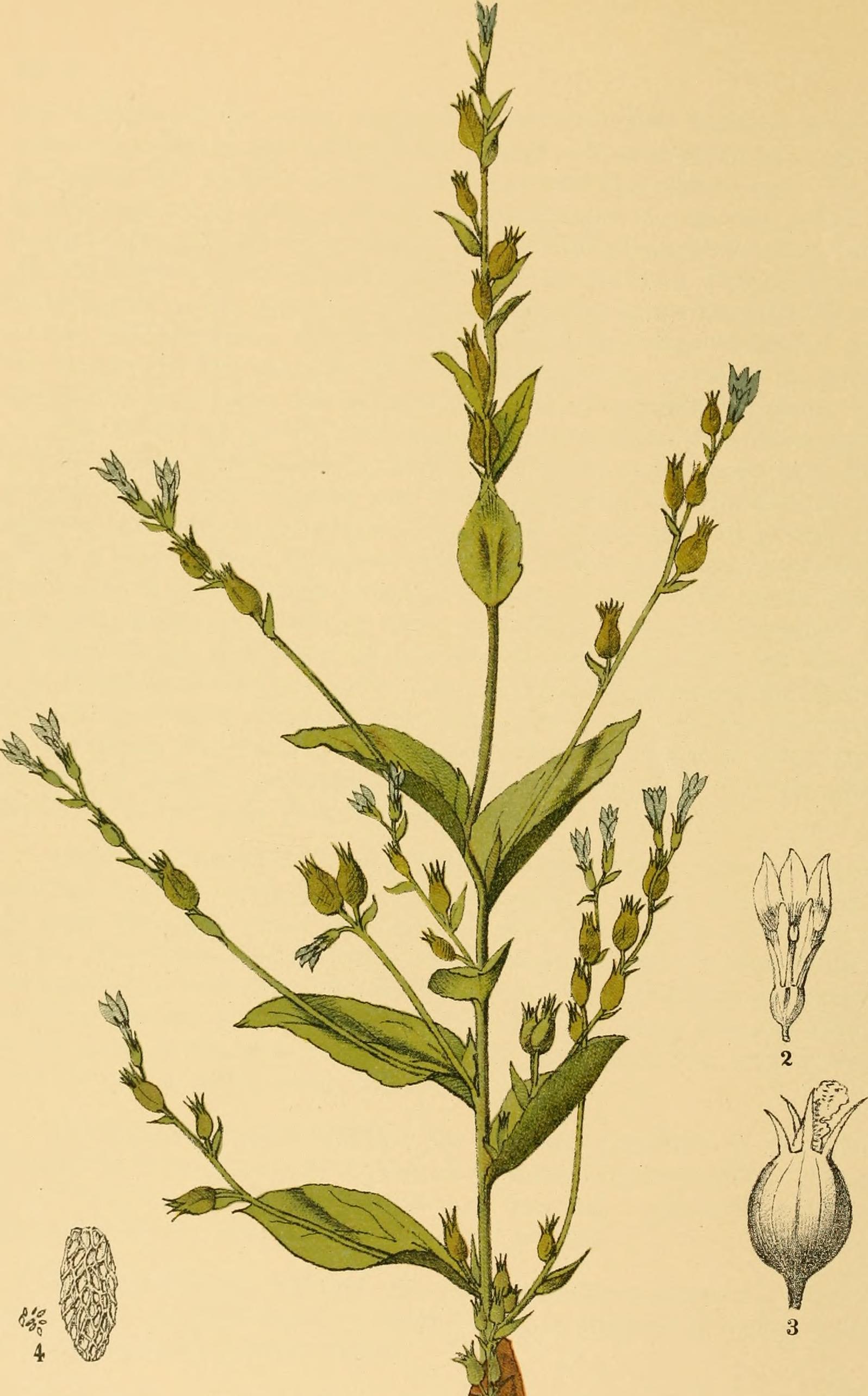
N. ORD.-LOBELIACE^. Tribe.-LOBELIE/E. GENUS.— LOBELIA, LINN. SEX. SYST.— PENTANDRIA MONOGYNIA. 99 LOBELIA INFLATA. IJ^niAJV TOBACCO. SYN.— LOBELIA INFLATA, LINN.; RAPUNTIUM INFLATUM, MILL. COM. NAMES.— WILD OR INDIAN TOBACCO, EYE-BRIGHT,* BLADDER POD,t EMETIC ROOT OR WEED, PUKE WEED, ASTHMA WEED; (PR ) LOBBLIE ENFLBE; (GBR.) LOBELIE. A TINCTURE OF THE WHOLE FRESH HERB LOBELIA INFLATA, L. Description. — This well-known milky, acrid, biennial or annual herb, varies greatly in its growth, generally, however, its height is from 8 inches to 2 feet.J Rooi slender, yellowish-white; sie77t erect, somewhat angled, lined or winged, leafy, paniculately branched, especially above, and divergently hirsute, principally below; leaves sessile, veiny, acute, and irregularly or obtusely toothed; they vary from ovate or oblong below to foliaceous or even subulate bracts above, longer than the pedicels. Inflorescence loose, terminal, spike-like racemes; jlowci-s small, inconspicuous, irregular. Calyx persistent lo-veined, not auriculate nor appendaged in the sinuses; lobes linear-subulate, nearly as long as the corolla, and springing from a decided ring involving the throat of the tube. Corolla marcescent, about two lines long, pale blue externally, somewhat violet within; lobes 5, the two upper lanceolate, erect, the three lower ovate, acute, and projecting. Stamens 5, epigynous, projecting with the style (which they enclose) through the complete slit in the upper median line of the corolla tube. Capsule 2-celled, oval, glabrous, much inflated, longitudinally lo-nerved and roughened between the nerves by transverse rugee, they greatly exceed their pedicels in length; seeds numerous, oblong, rough, of a brilliant brown color and reticulated with honey-yellow intermixed lines; placentcz central. A description of the genus is incorporated in that of Lobelia Cardinalis, 97. History and Habitat. — Indian Tobacco is common in dry open fields from Hudson's Bay westward to Saskatchewan and southward to Georgia and the Mississippi, where it flowers from July to October. Linnaeus first noticed this * The true eye-bright is Euphrasia officinalis, L. (Scrophulariacea:). •j- The true bladder-pod is Vesicaria Shoriii, T. &= G. (Crttci/erea:). t I met many individuals this season {1S85), scarcely 3 inches high, simple stemmed, and in full flower and fruit. I judge this depauperate form to be the var. simplex of Rafinesque.
99-2 species in the Transactions of the Upsal Academy in 1741.^ It was introduced into England in 1S59, and noticed medically by Schoepf in 17S7, his observations being mostly founded upon the use of the plant by the American aborigines as an emetic, and application for " sore eyes." It afterward became in frequent use by Botanic physicians, and in 181 3 was more or less prominently brought before the medical profession by the Rev. D. Cutler, as a valuable remedy in asthma. Its use was not carried into England until 1829. The name Indian Tobacco might have arisen either from the peculiar tobaccolike sensation imparted to the tongue and stomach on chewing the leaves, or from the fact that the American Indians often smoked the dried leaves to produce the effect of the drug. Lobelia has been recommended and used in the Botanic practice particularly, either alone or compounded with other drugs, for almost every disease known, and has proven curative in some cases, palliative in more, useless in many, and a deadly poison in more cases than one. Its action, as will be seen farther on, is, as in all narcotics, principally upon the brain, thus making it anything but a desirable emetic, as which it is most frequently used. From the power it exhibits to relax the whole system, it has been found very valuable in spasms, tetanus, croup, strangulated hernia, whooping cough, and even hydrophobia. Samuel Thomson claims to have discovered the virtues of the plant, though without doubt his first ideas of its emetic property were gathered from the Indians. He went so far as to claim it curative in all disorders, giving it with such a reckless hand that he fatally poisoned one of his patients, a certain Ezra Lovett, for which he was arrested on the charge of murder, escaping punishment because said Lovett was foolish enough to take the prescription of a man who claimed to carry such potent (?) drugs as '' well-my-gristle' and " rani-cais." Lobelia Inflata is officinal in the U. S. Ph., as: Acetuni Lobelias; Extractum Lobelice Fluidzim; and Tinctura Lobelice; and in the Eclectic Materia Medica as above, and as: Caiaplasma Lobeliie et Ulnms;^ Ene7iia Lobelia: Composita;^ Extractum Lobekce Fluidum Co7nposituin /* Linimentiwt Stillingics Composilum;^ Lotio Lobelice Composita;'^ Oleum Lobelice; Pilulce Aloes Composiice p Pulvis Lobelice Compo situs;* Tinctura Hydrastis Compositce;^ TinctJira Lobelice Composita /^'^ Tinctiira Lobelice et Capsici,•" Tinctura Sanguinarice Acetata Composita;'Tinctura Sanguinarice Composita, and Tinctura Viburni Composita}'^ PART USED AND PREPARATION.— The whole plant gathered in September, or when the last flowers are developing and the lower capsules are ripe, • Trans. Upsal, 1741, t. I, p. 43. J Lobelia, Elm, and Lye. » Tinctura Lobelioe et Capsici gss, water gss. « Lobelia, SUunk-cabbage, and Sanguinaria. 5 Oils of Stillingia, Cajepul, and Lobelia. « Bayberry bark, Lobelia leaves and seeds, and Yellow Dockroot. ' Boneset, Mandrake, Ginseng, Aloes, Soap, Gamboge, and Capsicum and Lobelia seeds. 8 Lobelia, Blood-root, Skunk-cabbage, Ipecac, and Capsicum. ' Hydrastis and Lobelia. 10 Lobelia, Wild Ginger {Asaruin CanaJense?), Blood-root, Skunk cabbage, and Pleurisy-root. " Lobelia, Capsicum, and Skunk-cabbage root. 12 Blood-root, Lobelia, Skunk-cabbage root, and Vinegar. High Cranberry bark, Lobelia seed, Blood-root, Skunk-cabbage seed. Capsicum, and Stramonium seed.
99-3 should be treated as in the preceding species. The resulting tincture should be of a clear reddish-orange color by transmitted light, and have a very acrid penetrating tobacco-like taste, a peculiar characteristic odor, and an acid reaction. CHEMICAL CONSTITUENTS.— Z^^^//«a.i This alkaloidal body was discovered by Calhoun,'^ though Procter was first to isolate it.' Basdc,* working without a previous knowledge of its discovery, also isolated the principle. Lobelina exists after separation, especially when carefully sealed, as an oily, yellowish fluid having a decided alkaline reaction, this is especially noticeable in its watery solution. Its taste is acro-pungent, very like that of nicotia. It exhibits, even in very small doses, the poisonous action of the herb. It is somewhat volatile, decomposing and losing its acridity at a temperature above ioo° (212° F.) either alone or in the presence of dilute acids or caustic alkalies. It is soluble in water, alcohol, and ether. Lobelina neutralizes acids, and except with acetic, forms crystallizable salts, more soluble in water than the alkaloid itself Lobelacrin. — This glucoside (?) was discovered by Pereira '' and corroborated by Enders." Lewes (1878), who made a thorough analysis of this drug, suggests that this body may be Lobcliatc of Lobelina, a salt of lobelina formed by the free acid in the plant itself. Lobelacrin, according to Enders, exists as acrid, brownish, verrucose tufts, decomposing rapidly in water at 100° (212° F.), and resolving under the action of acids or alkalies into sugar and Lobelic Acid. — This acid is crystallizable, non-volatile, soluble in water, alcohol, and ether, and yields an insoluble plumbic and soluble baric salt. Lobelianin. — This body, so named by its discoverer, Pereira, is now considered to be the volatile oil, Lobcliin, a compound body isolated by Reinsch, and now considered indefinite. Oil of Lobelia. — This oil may be extracted from the seeds, which, when bruised between heated rollers, generally yield about 30 per cent. According to Procter its specific gravity is 0.940, and its drying quality and consistence quite similar to that of linseed oil. Dr. John King states' that the oil possesses all the medicinal qualities of the seed. Beside the foregoing, caoutchouc,' « " extracdve,* "' resin,"'"" and fat,Miave been determined. PHYSIOLOGICAL ACTION.— Thanks to much reckless prescribing by many so-called Botanic physicians, and to murderous intent; as well as to experimentation and careful provings, the action of this drug is pretty thoroughly known. Lobelia 1 Lobelin, Lobeline. ' >"'■«• P'"'- C'^"- PI""-'"; jOO3 Am. Jour. Phai:, 1838, p. 98; and farther ibid., 1S71, p. I; and 1851, p. 456. * 1850. Ibid., 1851, p. 270. ^ Mat. Med., Vol. 2, part 2, p. 12. 6 1871, in an analysis made for the authors of the Pharmacographia, 1. c, p. 400. ' Am. Disp., 18S0, p. 492- ' Bigelow, Am. Med. BoL, 1817, Vol. i, p. 1799 Reinsch. '» Pereira, /. c. " Procter, /. c.
99-4 in large doses is a decided narcotic poison, producing- effects on animals generally, bearing great similitude to somewhat smaller doses of tobacco; and lobclina in like manner to nicotia. Its principal sphere of action seems to be upon the pneumogastric nerve, and it is to the organs supplied by this nerve that its toxic symptoms are mainly due, and its " physiological " cures of pertussis, spasmodic asthma, croup and gastralgia gained. Its second action in importance is that of causino- aeneral muscular relaxation, and under this it records its cures of strangulated hernia (by enemata), tetanic spasms, convulsions, hysteria, and, mayhap, hydrophobia. Its third action is upon mucous surfaces and secretory glands, increasing their secretions. The prominent symptoms of its action are: great dejection, exhaustion, and mental depression, even to insensibility and loss of consciousness; nausea and vertigo; contraction of the pupil; profuse clammy salivation; dryness and prickling in the throat; pressure in the oesophagus with a sensation of vermicular motion, most strongly, however, in the larynx and epigastrium; sensation as of a lump in the throat; incessant and violent nausea, with pain, heat, and oppression of the respiratory tract; vomiting, followed by great prostration; violent and painful cardiac constriction; griping and drawing abdominal pains; increased urine, easily decomposing and depositing much uric acid; violent racking paroxysmal cough with ropy expectoration; small, irregular, slow pulse; general weakness and oppression, more marked in the thorax; violent spasmodic pains, with paralytic feeling, especially in the left arm; weariness of the limbs, with cramps in the gastrocnemii; and sensation of chill and fever. Death is usually preceded by insensibility and convulsions. Post-mortem. — The stomach is found congested and filled with fluid, and the brain engorged with blood. Description of Plate 99. 1. Whole plant, Chemung, N. Y., September 9th, 1S79. 2. Flower. 3. Fruit. 4. Seed natural size and magnified 100 diam. (2-3 enlarged.)
100 natdel.etpinxt. ARCTOSTAphYLOS UVA-URSI,Spreng. 13 O h. L^ 11 14 6y/i5
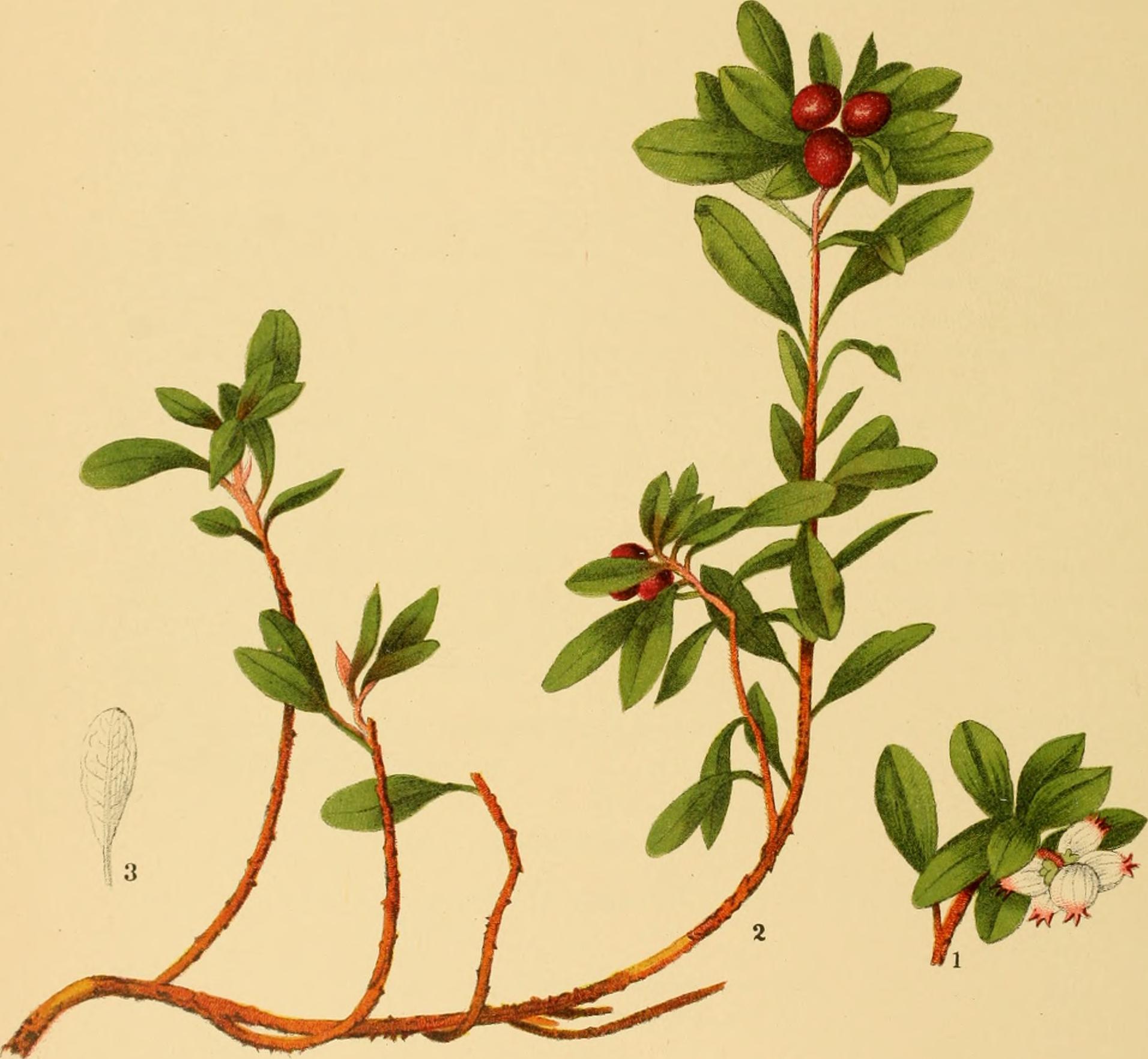
N. ORD-ERICACE^. ^00 Tnbe.-ERIGINE/E. GENUS. — ARCTOSTAPH YLOS,* ADANS. SEX. SV.ST.— DECANDRIA MONOGVNIA. UVA-URSI. BEARBERRY. SYN.-ARCTOSTAPHYLOS UVA-URSI, SPRBNG.; A. OFFICINALIS, WILLD.; ARBUTUS UVA-URSI, LINN,; DAPHNIDOSTAPHYLIS FBNDLERIANa! KLOT. COM. NAMES. -BEARBERRY, MOUNTAIN BOX, RED BERRY, UPLAND CRANBERRY, BEAR'S GRAPE, RED-BERRIED TRAILING ARBUTUS WHORTLEBERRY,! HETH, UNIVERSE; (FR.) BUSSEROLLB, RAISIN D'OURS; (GBR.) BARBNTRAUBE. A TINCTURE OF THE LE.WES OF ARCTO.STAPHYLOS UVA-URSI. Description. — This peculiar boreal shrub is seldom erect except that it throws its young shoots upward for from 3 to 8 inches. Stems numerous, depressed or trailing; branches \3.nou?,, the sterile from 2 to 3 feet long and compactly leafy, the fertile shorter; hark mahogany color, scaling off in irregular patches; roots thick, ligneous, and creeping. Leaves alternate, coriaceous, thick, shining, and evergreen, turning mahogany color when aged, those of the erect branchlets more or less vertical, all oblong spatulate, entire, retuse, and tapering to a short-petioled base. Injlorescence in few-flowered, terminal clusters or racemes; bracts and bracleoles persistent, finally becoming rigid; flozvers pale, rose-colored, drooping. Calyx reddish, persistent, free from the ovary; lobes 5, roundish. Corolla urceolate, pellucid at the base, deciduous; tube inflated, hairy inside, hypogynous; lobes 5, short acute, recurved. Stamens 10, included; aiitlicrs. large, upright, introrse, the cells opening by terminal pores and appendaged upon the dorsal surface by 2 reflexed awns. Ovary 4 to 10 celled; ovules solitary in each cell. Fruit a glabrous, depressed-globose berry or drupe, about the size of a pea; pulp mealy and insipid; nutlets 5, when the fruit is baccate, or united firmly into a 5-several celled stone when drupaceous; whether distinct or coherent, the nutlets are bony and i -nerved upon the dorsal surface. Ericaceae. — This chiefly boreal family is represented in North America by 34 genera, 135 species, and 32 recognized varieties, thus producing half the ericaceous genera of the globe, but only one-eighth of the total number of species. The order is characterized as follows: The growth comprises trees, shrubs, and * 'Ap«ro{, arktos, a bear; ora^uXS, staphyle, a grape or berrj'. f Generally applied to species of Vaccinium, especially V. Vilis Idcea, Linn.
100-2 some perennial herbs, all having alternate, simple, and undivided leaves, and no stipules. FloiMVS symmetrical, 4- to 5-merous, perfect; calyx imbricated or valvate in the bud. Corolla gamopetalous, or not rarely 4- to 5-petalous, regular or irregular, hvpooynous except in Vaccinecs, imbricated or convolute in the bud. Stamens free from the corolla or nearly so, as many or twice as many as its lobes; filaments distinct; anthers introrse or becoming introrsely inverted, 2-celled, usually opening by pores or chinks, and generally awned or somehow appendaged; pollen usually composed of 4 united grains. Ovary \- to lo-celled; placetitcs a.xial, e.xcept in Monotropece; ovules solitary or numerous, anatropous; style single; st/o->na entire or merely lobed, except in Cletlira, where it is 3-cleft. I^rult capsular, baccate, or drupaceous; embryo small or minute; albumen fleshy; cotyledons small or undeveloped. Our only proven species of this order, except the si.x represented in this work, are: The European, Asiatic, and British-American Labrador Tea {Ledum Palustre,\Jmn.)\ and the Russian intoxicant and anti-rheumatic Yellow Rosebay [Rhododendron chrysanthet7tum, Linn.). Other medicinal species are: The American Rosebay {Rhododendron maxi;;/?^w, Willd.), an astringent, and by some accounted narcotic and poisonous; the Swiss R.ferrugiueum, Linn., an antiarthritic; and the Persian R. ponticuni, Linn., supposed to be one of the plants whose nectar renders the honey of Trebisond poisonous — an influence also said to be contributed to by Azalea pontica, Linn., of this order. The North American Alpine Azalea {Loiseleuria procumbens, Desv.) is, like all of the order, astringent; and Marsh Tea {Ledum latifolmm, Ait), used in dysentery, diarrhtx-a, tertian ague, and in some places to render beer heady, though it is said to bring on delirium. The fruit of the.Strawberry Tree of the Levant {Arbutus Uncdo, Linn.), when made into wine, is said to be narcotic — a property also ascribed to the wine of Whortleberries ( Vaccinhcm ulignosjim, Linn.), which is very into.xicating. The leaves of the European and North American Andromeda polifolia, Linn., are an acrid and dangerous narcotic, and are said to kill sheep if browsed upon. Many species of the order furnish our tables with fine refreshing berries, viz.: The Blue Berry {Gaylussacia frondosa, T. & G.); the Huckleberry {G. resinosa, T. & G.); the Blue Huckleberries {Vaccinium Pennsylvanicuni, Lam., vacillans, Solander, and corymbosiim, Linn.); and the Cranberries ( Vaccinium macrocarpon, Ait., and P'. Oxycoccus, Linn.); the latter are also refrigerant, and a fine palliative dressing for acute erysipelas. Among the Western Aborigines the Manzanita, the fruit of Arctostaphylos tometitosa, Dougl., is extensively eaten in a fresh or dried state. When dried it is husky but sweet, and is often ground and made into sun-baked bread, or, mi.xed with corn-meal and cactus syrup, fermented and drank; the cranberry and blue huckleberry are also prized; while the smoke-dried fruits of J'acciniuni inyrtillus, and V. stamineum, Linn., are largely stored for winter food. t> History and Habitat. — The Bearberry is indigenous to North America, where it extends from New Jersey, Pennsylvania, Wisconsin, and Northern California,
Blade, oblanceolate to oblong, never spatulately narrowed, as in Vitis Idrea; reticiilately broadveined beneath, not dotted. 100-3 northward to the Arctic Circle. In Europe it extends northward from Northwestern Ireland, Yorkshire, and Central Russia; in Asia also northward from Lower Siberia and Kamtschatka, its northerly range includes Iceland and Greenland. Its choice of growth is barren, but healthy ground, among rocks, where it flowers in May. The principal substitutive leaves for the Uva-Ursi of commerce are those of I'acciuium litis Idara, Linn., of which Mr. J. H. Sears says:* "This is the plant that the Shakers gather instead of the Uva-Ursi; they go 40 or 50 miles for it when Uva-Ursi is abundant in their own ground. Uva-Ursi is common at Groton, Mass.; still the Shakers of that vicinity go to Danvers, where there is a small patch of Vitis Idaa, which they gather instead." Comparing the leaves of specimens sent by Mr. Sears, I find the following distinction: Uva-Ursi. Vitis lD.t:A. Bearberry. Cowberry. Blade, narrowly oblanceolate, seldom, if e\er, tending toward oblong; very distinctly blarkdotted and narrow-veined beneath. The character of the leaves being toward the apex crenate and distinctly revolute,t 's "ot '"*' all constant, nor is it distinctive. Uva-Ursi is an ancient astringent, though used but little until the 13th century by the "physicians of Myddfai." Clusius described the plant, in 1601, as the "Aprroj' ara^v'kri of Galen, useful as an hemostatic; it was not much used, however, until about the middle of the eighteenth century, when it began to prove, in the hands of De Haen and Gerhard, an excellent remedy in nephritic disorders. It was admitted to the London Pharmacopceia in 1 763. From this time it came into more or less general use as an astringent tonic and diuretic in various diseases, particularly, however, in dysuria, chronic vesical catarrh, cystitis with or without ulceration, calculous disorders, and kindred affections, as well as in irritations of the genital tracts, such as gleet, gonorrhoea, leucorrhoea, blenorrhoea, etc. In all these disorders, however, it proved itself simply palliative in most cases, and many times fell into disuse. Dr. Bourin, of Oxford, recommended it highly in [jjnhisis, but it only abated the hectic fever from reduction of the heart's action. In late years it has been called attention to as a uterine excitant, very useful in prolonged parturition from atony; it is claimed that it is fully as sure as Secale, while the contractions resulting are more prolonged, while less painful, and dangerous to the child. The general dose in nephritic complaints has been: of the powdered leaves, ■3ij to 5j, and of the decoction, cock. mag. ij to iv, qiiatcr in die; and in parturition, grs. XV, in infusion, a cupful every hour, one, or at most two doses, being fully sufficient. The American Aborigines smoke the dried leaves with tobacco, making a mixture called Sagack-homi in Canada, and Kinikiiiik among the Western tribes; this is the Larb of the Western hunters. * In a letter from Peabody Academy of Science to the author. ■)■ Bentley anil Tiimen, Med. PI., 163.
400-4 The leaves of Uva-Ursi are officinal in the V. S. Ph., as well as Exti-actiuii Uva-Ursi Fluidimi; in Eclectic practice the preparation is Decoctum Uva-Ursi. PART USED AND PREPARATION. — The fresh leaves, particularly those of the sterile branches, gathered in September or October, are to be chopped and pounded to a pulp and weighed. Then take two-thirds' part by weight of dilute alcohol, add to it the pulp with constant agitation, and strain the whole through a piece of new linen. The grainy menstruum thus obtained should be allowed to stand eight days, in a well-stoppered bottle, in a dark, cool place, before filtering. The tincture obtained by filtration should be opaque, and have, in thin layers, a deep blackish-brown color by transmitted light; its odor should be heavily herbaceous and slightly terebinthic; its taste extremely astringent and slightly bitter; and its reaction acid. CHEMICAL CONSTITUENTS. — According to many observers, especially Prof. Murray and Dr. J. S. Mitchell, water is the best menstruum with which to extract the principles of this plant. The large amount of tannin contained in the leaves causes them to be extensively gathered in Iceland, Sweden, and Russia for tannine fine grades of leather. \Arbutose^'^ — Treat the mixture of several successive decoctions of the coarsely-powdered leaves of Uva-Ursi with subacetate of lead, thereby precipitating the tannin and extractive matters. Decolorize the liquid with sulphydric acid, and evaporate quickly. This process decomposes a certain quantity of arbutin and a sticky crystalline mass is produced (Arbutose), containing 55 per cent. arbutin, 35 per cent, glucose, and 10 per cent, water. After drying this body in air as far as possible, and treating it with charcoal, followed by successive quantities of alcohol and distilled water, crystallized arbutin may be obtained.] Arbutin/|- C^jH^^Oj^.J — This glucoside, in an impure state, was first determined by Hughes,§ and called by him Ursin: Kawalier, however, in 1S53, isolated the body in a pure state, and gave it the name it now bears. Arbutin crystallizes in handsome, white, shining, radiate forms, odorless, bitter, and neutral; they lose water at 100° (212° F.), fuse at 160° (338° F.), are soluble in water, slightly soluble in alcohol, and insoluble in ether. By heating the crystals with peroxide of manganese they are resolved as follows: Arbutin. Kinone. Formic Acid. Water. C.,H,Pj, = 4C,Hp, + CHA + 4H,0. Kiiione\\ Cj-H^Oj. — This very volatile body readily sublimes in brilliant goldenyellow acicular crystals, possessing a suffocating smell. They are slightly soluble in cold, freely soluble in hot, water, in alcohol, and in ether. * Lewin, Pharm. Jour., 3, xiv, 4yo. ^ J. C. C. Hughes, in Am. Jour. P/iar., 1S47, 90. t Kawalier, CjjH^G,,. Slrecker, C,jH||.C),. \\ Qiihionc. J Hlasiwetz and Habcrmnnii.
100-5 Arbutin, during Its passage through the body, undergoes the following change/'' which is also brought about outside the body by the action of emulsin, or by boiling with dilute sulphuric acid: Arbutin. Water. Glucose. Mydrokinoiie. Metliyl-hydrokinone. Q5H3A4 + 2H,0 = C«H,A + QH,(OH), + QH,(OH.OCH3). Hy dr okiiione, ■\ C^^O.^. — This dioxybenzene forms in colorless rhombic prisms, melting at 169°-! 72° (336.2°-34i.6° F.), and subliming, partly decomposed, at higher temperatures. In the mother-liquor, after the crystallization of Arbutin, the following substances are found: Ericolin, Cj^H-gO.,^. — This amorphous, very bitter glucoside results as a yellowish-brown mass, softening at 100° (212° F.), and resolving, under the action of dilute sulphuric acid, as follows: Ericolin. Water. Glucose. Ericinol. Q,H,Ai + 4H,0 = 4QH.A + C,„H,„0. Ericinol, C^^^f), is a yellowish, or nearly colorless resinifying oil, having a peculiar odor.J It also exists free in the volatile oils of many Ericaceae; that from Ledum having a blue-green color, a disagreeable odor, a burning and bitter taste, and boils at 240°-250° (464°-482° F.). On boiling it with hydrated lime it yields a hydrocarbon of the composition C2gHj|,.§ Urson, C,,jH3,0,.|| — This colorless, tasteless, crystalline body melts at 198°200° (388.4°-392° F.), sublimes at higher temperatures without visible change. Is Insoluble in water, and slighdy soluble in alcohol and ether.§ Gallic, or Tnoxybenzoic, Acid, C.H^O.lOH),— This acid occurs in a free state In this and many other plants, and. In combination with tannic acid, in numberless others; it dissolves in 100 parts of cold water, from which It crystallizes in fine, silky needles, slighdy acid and astringent. Gallic acid gives a deep blue color with ferric salts, melts at 200° (392° F.), and resolves at 210° (410° F.), as follows: ^,,,.,., Carbonic I'yrogallic Gallic Acid. Dioxide. Acid. CMp.iOW), = CO, + QH,,p,. Tannin.— TKxs glucoside Is generally considered to have the composition C Hj„0,, which prove's it an anhydride of gallic acid, and its true name Digallic Acid'«[[ 'The difficulty of obtaining tannin pure renders Its composition, however, somewhat doubtful; when as pure as possible it results as a porous, greenishyellow friable mass, freely soluble in water, less so in alcohol, and msoluble in ether ' The tannic acids, so called, are a group of bodies widely diffused through the vegetable kingdom, the species containing them usually lending a portion ol * M von Me^ng, Arch./, d. ^csam. Physiol. 1877, 276. I Wittstein. ' \\ Tromrasdorf. t Arctuvin, Quinhydrone, Hydroquinone, Hydrochinone. Gallic Acid. Water. Tann.ru + Gmehn, Cheiu., xvi, 2S. v • 1. 0/.
100-6 their name to specify the body as found in them — ( G7//i:r- tannic Acid, Qjiiuotannic Acid, Calec/i!i-t2Lnn\c Acid, A7wc-tannic Acid, etc.). With gelatine, these tannins form an insoluble compound; and with ferric chloride they yield bluishblack or green precipitates. They combine readily with animal skin, giving it the property of resisting putrefaction, which forms part of the process called tanning. Resin, gum, pyrocatechin,* extractive matters, and the usual plant constituents, are also found.f PHYSIOLOGICAL ACTION. — Should we prescribe on the palliative principle, and at the same time believe in disinfection by killing germs, I could hardly point to a drug more adapted to diseases of the kidneys, bladder, and urethra than arbutin, which is changed in the renal tract to hydrokinone, a sort of phenol, which is in itself a eermicide, the arbutin being more or less innocuous and at the same time a diuretic; it has, however, caused an eruption of the skin. J Uva-UrsI itself causes vomiting and purging, involuntary passage, bloody and green urine, and reduces the heart's action; further than this little Is known of Its direct effects. Description of Plate ioo. 1. End of a flowering branch. 2. Fruiting branch, Salem, Mass., Nov. 22, 1886. 3. Leaf, under surface. 4. Flower. 5. Longitudinal section of flower. 6. Pistil. 7. Stamen, front and side view. 8. Drupe. 9. Pyrenje consolidated into a stone. 10. Transverse section of a p)'rena. 12. Longitudinal section of a seed. 13. Horizontal section of a seed. 14. Section of ovary. 15. Separate pyrena. (4-15 enlarged.) * See page 40-2. t Further bibliography in t'.iis departmsnt: Grays Elemiitts; Gmeliii, C/iem., xv, 419, \vi, 2S; Pilar, your., 3, V, 401;.4)11. Jour. PJ:ar., xxvii, 334; 1S7J, 197; 1886, 385; 1S85, 139; Cheni. Gaz., 1S53, 61; Wittste'n, Org. Conslil. Plants; Schorlemmer, Chcm. Carh. Comp. \ Lewin, ibid.
101. VpTn.ad nat.dei.el pinxt EpIGAA REPENS,Linn.
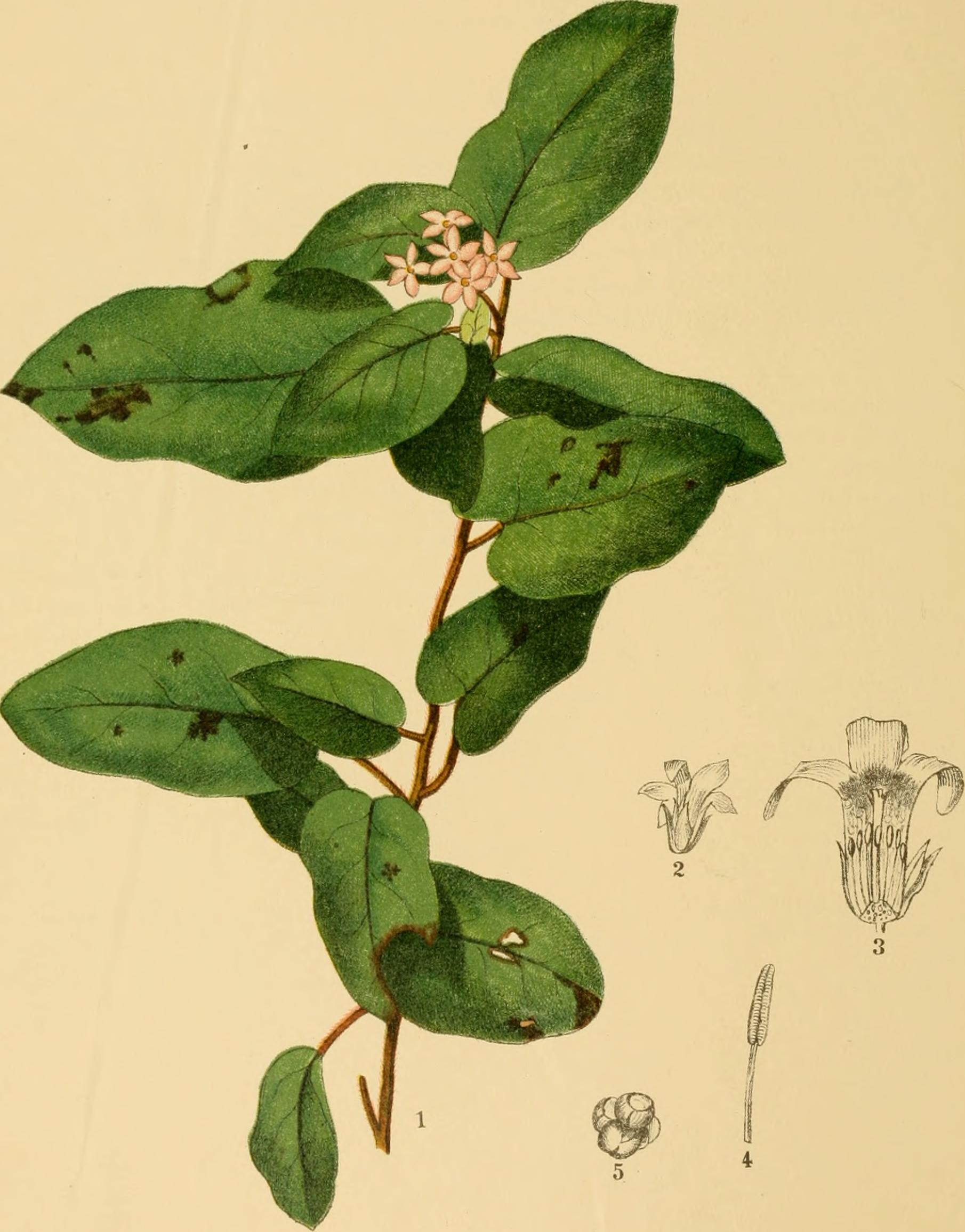
N. ORD -ERICACE^. 101 Tribe.-ANDROMEDE/E. GENUS.— E PI G /EA,* LINN. SEX. SYST.— DECANDRIA MONOGYNI.\. EPIG^A. TRAILIJVG ARBUTUS. SYN.— EPIG^A REPBNS, LINN. COM. JSTAMES.— TRAILING ARBUTUS, MAY FLOWER, GRAVEL PLANT, GRAVEL WEED, GROUND LAUREL, MOUNTAIN PINK, WINTER PINK. A TINCTURE OF THE FRESH PLANT EPIG^A REPENS, LINN. Description.— This fragrant spring flower, blossoming amid the verdure of its previous year's growth, is prostrate or trailing* from a mass of perennial, red-brown, fibrous 7'oots thickly beset with a tangle of rootlets; the sfein is rounded and conspicuously hairy, the bark and hairs having a rusty color. Leaves alternate, evergreen, reticulate, ovate-cordate and entire, from i to 2 inches long, and relatively one-half as wide, the edges and under surface rusty hairy. Inflorescence apical or axillary; the flowers spring from dry, scaly bracts, and have a delicate pink, a deep rose-color, or are in some cases white, and emit a fragrant, spicy aroma. Sepals 5, dry, nearly separate, ovate-lanceolate, acute. Corolla monopetalous, salver-form, with 5 ovate, spreading lobes, the tube hairy inside. Slameiis 10, shorter than the corolla; fi laments hairy at the base; antJiers linear, opening longitudinally; pollen of compound grains as in the preceding, but smaller. Ovary globular, depressed, 5-celled, many-seeded; style slender, forming a zone about the minutely 5-lobed stigma. Capsule 5-lobed, 5-celled, 5-angled, many-seeded, inclosed in the persistent calyx; placenta' large, 2-celled; seeds ovate., History and Habitat.— Upon rich, damp, mossy banks throughout the central part of North America east of the Mississippi, under the shade and protection of low pines and hemlocks, in the early sunny days of spring, sometimes even peeping from under a snow-bank, appear the sweet-scented flowers of this muchsought-after little plant; so closely do the prostrate spreading stems cling to and mincrle with the mosses, to which they in their rusty hairiness bear great similitude, that one of its common names in some localities is iMoss Beauty. Epigaea flowers until May, and ripens its fruit in July. It is stated that in lithic acid gravel, and some forms of nephritis, cystitis and vesical catarrh, its use has often been of greater benefit than uva-ursi or buchu. * fjrt, upon, yi, the earth.
101-2 Epigsea has no place in the U. S. Ph. In the Eclectic Materia Medica its officinal preparations are ExtracUim Epigca Fluiduiii, and Infusion Epigca; it is also the principal component oi Iii/itsiini Epigcce Composiiiitn, together with Eupatorium purpureum, Aralia hispida, and Radix althaea officinalis, this being one of their much-used diuretics. PART USED AND PREPARATION.— The fresh leaves, or the whole plant gathered when budding to blossom, being chopped and pounded to a pulp and weighed, two parts by weight of alcohol are taken, the pulp mi.xed with one-sixth part of it, and the rest of the alcohol added. After thorough succussion the whole is poured into a well-stoppered bottle and allowed to stand for eight days in a dark, cool place. The tincture is then decanted, strained and filtered. Thus prepared it is opaque, showing in thin layers a deep brown-color; it has a pleasant woody taste, is slightly astringent, and ot a decided acid reaction. CHEMICAL CONSTITUENTS.— The three glucosides, icrson, ericolin, and arbutiii (vide Uva-ursi, loo). Formic acid and a body having properties similar to gallic acid have been determined in this plant. Tannic Acid. — The amount of this body existing in epigsea is given by Bowman as 3.5 per cent. Ericinol.— Cj^ H^gO, a pale-yellow, aromatic oil, is also present. PHYSIOLOGICAL ACTION.— Epigaea, so far as is determined at present, shows no important symptoms of physiological disturbance of the system. The provings are scanty; the only one so far published was made upon myself, and may be found in the "Hom. Physician," Oct., 1881, vol. i. No. 10, pp. 486-9. Description of Plate ioi. I. Flowering branch, from Waverly, N. Y., April 3, 1880. • 2. Flower showing calyx (enlarged). 3. Section of flower (enlarged). 4. Stamen (enlarged). 5. Pollen grains x 380. =^-=
102.?^ 111.ad naidelit pinxt. GAULTHERIA PrOCUMBENS, Linn.
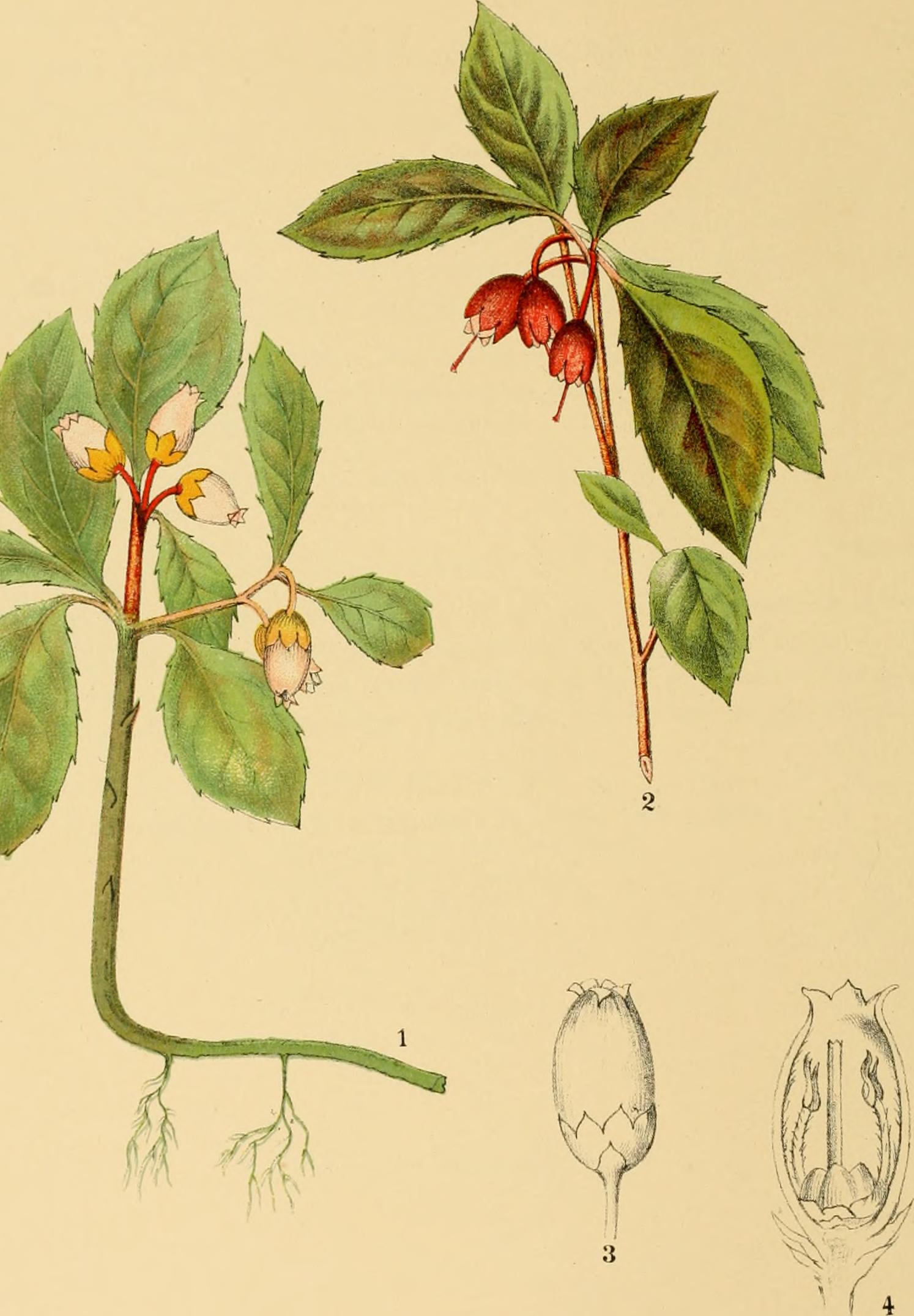
N. ORD -ERICACE^. 402 Tribe.-ANDROMEDE/E. GENUS— GAULTHERIA,* KALM. SEX. SYST.— DECANDRIA MONOGYNIA. GAULTHERIA. WIjYTEPMREEJ^. SYN.- GAULTHERIA PROCUMBENS, LINN.; GAULTHERIA HUMILIS SALISB.; GAUTIERA REPENS, RAP. COM. NAMES. — CREEPING WINTERGREBN, CHECKER BERRY, PARTRIDGE BERRY, BOX BERRY, SPICE BERRY, TEA BERRY, MOUNTAIN TBA.f JERSEY TEA, GROUND HOLLY. AROMATIC WINTERGREEN, GROUSE BERRY, DEW BERRY, RED BERRY, HILL BERRY; (PR.) THE du CANADA; (GER.) BERGTHEE. A TINCTURE OF THE FRESH LEAVES OF GAULTHERIA PROCUMBENS, LIN.V. Description.— This well-known perenmal, spicy-aromatic evergreen grows, in its upright height, from 3 to 5 inches, the true siem creeping, generally below the surface, and resembling a root. The flowering branches upright, stem-like, naked below and leafy at the top. Leaves alternate, upon very short petioles, obovate or oval, with a wedge-shaped base and very finely serrate edges; thick, smooth and shining. Inflorescence axillary; Jioiuers usually single, sometimes more, upon nodding, two-bracted pedicels from the base of the upper petioles. Calyx fivelobed. Corolla inflated-cylindrical or pear-shaped, hairy within, with five small revolute teeth. Stamens ten, included within the tube of the corolla; filaments flat, hairy, curving toward the style; anthers X'S.xg^, introrse, two-celled, with two awns at the apex of each cell, opening by a terminal pore. Ovary smooth, fivelobed, five-celled, depressed, situated upon an hypogynous disk; placenta axillary; style simple, cylindrical, thick, longer than the stamens; sti>^7na blunt, apparently entire, but in reality faintly marked into five lobes. Frnit a depressed, five-lobed, -celled and -valved, many-seeded pod, invested, when ripe, by the now thickened and fleshy calyx, thus forming a globose, bright red, edible berry, having a depression at its apex, surrounded by crenations formed of the thickened calyx teeth. Seeds situated upon the axis, minute, very irregularly shaped, the average being rounded-triangular, with concave or convex surfaces; testa light-yellow, with fine hexagonal reticulations. A description of the Ericaceae will be found under UvaUrsi, 100. * Dedicated to Dr. Gaultier of Quebec. The orthography of whose name, after passing througli liotanical works as "Gaulthier" and " Gautier," was finally settled by the records of Quebec, searched by Prof Bninet, as "Gaullicr." (Gray.) + The leaves of this plant formed one of the substitutes for Thea Chinensis during the Revolulionary War.
102n History and Habitat.— The wintergreen is indigenous to the eastern portion of the United States, orowinor from Maine to South Carohna, and westward to Central Kentucky, especially among the mountains in the shade of pines, flowering in July. The strange fruit hangs, and retains its bright color, until the next spring, then rots upon the pedicels or drops to the ground, thus allowing the escape of the seeds. The com.mon names given to Gmdlhcria prociuubcus, Chiniapliiia iimbcllata, and Mitchclla rcpcns are very confusing, being interchanged in different secdons of the country. The berries when fresh, and the young leaves, are very pleasant to the palate, being esteemed highly by many, and forming an article for sale by hucksters in some localities. They form, especially among the mountains of Pennsylvania, together with those of Mi/chclla, the principal food of partridges, grouse and deer, in the late autumn months. Distillation of the oil of wintergreen, for use as a flavoring e.xtract — to which its principal commercial value is due — is confined to men of limited means, in those districts where its growth is most abundant. The apparatus used is simple and movable, being shifted as the supply of leaves gives out. It consists usually of a copper whiskey-still. This is placed near some rivulet with a sufficient fall to keep the cooler filled. It is entirely invested by brick, with the exception of the cap, filled with leaves covered with water, and heated by an open fire beneath. The volatile oil, together with the steam, passes through the condensing worm into the receiver, which is kept filled with water. The oil is collected by a separating funnel, placed in the bottom of the receiver, and the water used over and again to economize the product. The average yield is ten pounds from a ton of the leaves; greater in dry seasons. Most of the so-called oil of wintergreen is made from young birch trees {Belula Icntcc), in a similar manner to the process described above. Mr. G. W. Kennedy decides''' that there is but little variance between the oil of wintergreen and that of birch. This, as far as he determined after many tests, consists only in a slight difference in the boiling point. Gaultheria is only mentioned in the U. S. Ph., no officinal preparation being given. In the Eclectic Materia Medica it meets with the same lack of popularity. PART USED AND PREPARATION. -The fresh leaves, gathered in summer, are chopped and pounded to a pulp and weighed. Then two parts by weight of alcohol are taken, the pulp thoroughly mixed with one-sixth part of it and the rest of the alcohol added. The whole is then poured into a well-stoppered bottle and allowed to remain for eight days in a dark, cool place. The tincture is then separated by straining and filtering. Thus prepared, it is of a deep brownish red color by transmitting light through thin layers, or black and opaque when in quantity. It retains the pleasant odor of the plant. The taste peculiar to the plant is covered at first by its great astringency, but gradually becomes apparent as the natural condition of the tongue returns. Its acidity is marked. CHEMICAL CONSTITUENTS. -The general constituents of this plant are the same as those described under Uva-Ursi, loo, viz., arbutin, urson, ericolln and tannin. * Am. your. Phar., 1882, p. 49.
102-3 Oil of Gaultheria. This body is a mixture of the volatile oil of the plant, salicylate of methyl, gaultherilene and gaultheric acid, forming the heaviest of the known essential oils, its sp. gr. being i.i 73. Unless purified by macerating in animal charcoal, it has a reddish color, and boils at 200° (392° F.). Gaultherilene, C^^Hj,.. This hydrocarbon is one of the constituents of the mixed oil. Gaultheric acid. Methyl-salicylic acid, C,.H, -| ' •• This methvl-ether of ■ ' 1 CO,H. ^ salicylic acid, is obtained from the oil of wintergreen through the agency of an alkali. It crystallizes in plates, melting at 98.5° (209.3° F-)- ^^ is isomeric with the next, from which it differs by being a strong acid. f OH Salicylate of methyl, C,.H^. r-rii-r '^^'^ body constitutes the principal part of the compound oil distilling over after the passage of the volatile body when the temperature is raised to 222° (431.6° F.). It exists as an oily liquid, possessing a very pleasant penetradng odor and a sweet, aromatic, refreshing taste (Schorlemmer, Wittstein.) All of the above constituents are soluble in alcohol. PHYSIOLOGICAL ACTION. -The following digest of the action of Gaultheria is from Ur. T. J. Gallaher )i\Icd. Ex., 8, 347) and Drs. W. E. Townsend and Hooker {Rcc. Boston Sac. Med. Imp.)., the first from an overdose of the oil, the last from large amounts of the essence: Stupidity, swelling of the tongue and very active inflammation of the stomach, attended with a highly morbid desire for food, with a painful tenderness in the epigastric region and violent retching and vomiting whenever anything entered the stomach; slow, laborious breathing, with loud respiration, but no stertor; hot skin, high pulse and restlessness. Description of Plate 102. I. A branch in flower, from Binghamton, N. Y., July 21st, 1882. 2. A fruiting branch in October. 3. Flower (enlarged). 4. Flower (section enlarged).
^■■:<> ■■■ WSfL I
^m.ad natdei.etpinxt. KALMIA LaTIFOLIA, Linn
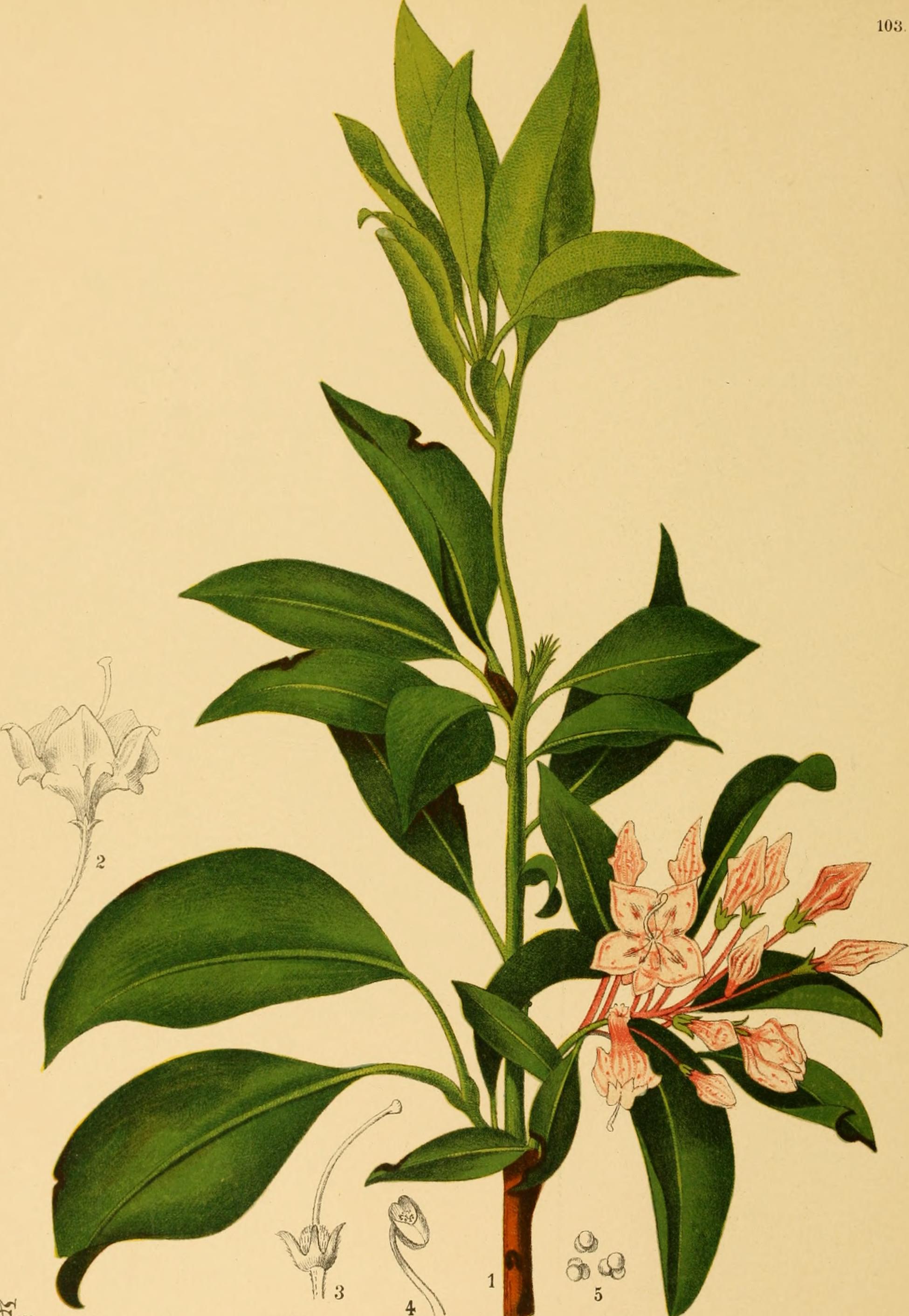
N. ORD. ERICACE/E. ^03 Tribe.-RHODORE/E. GENUS.— K A LM I A,* LINN. SEX..SYST.— DECANDRIA MONOGYNIA. KALMIA. MOVMTAIX LAUREL. SYN.-KALMIA LATIPOLIA, LINN.; CISTUS CHAM^RHODODENDROS ETC., PLUK.; LEDUM FLORIBUS BULLATIS, ETC., TRBW. COM. NAMBS.-MOUNTAIN LAUREL, AMERICAN LAUREL, CALICO-BUSH SPOONWOOD, BIG IVY, ROSE LAUREL, ROUND-LEAVED LAUREl' SHEEP-LAURBL,t LAMB-KILL,t WICKE; (PR.) GRANDE KALMIE ' (GER.) gross KALMIE. A TINCTURE OF THE FRESH LEAVES OF KALMIA LATIFOLIA, LINN. Description.— This beautiful evergreen shrub attains a height of from 4 to 10 or more feet. Stem smooth; branches more or less terete, irregular, and tortuous. Leaves more or less scattered but tending to alternation, they are thick, coriaceous, glabrous, dark and shining green both sides; in form they are elliptical or ovate-lanceolate, acute at both ends and entire. Inflorescence simple or clustered, naked, umbel-like corymbs, terminal upon the branchlets; pedicels long, arising from leaf-like bracts; flcnvers clammy-pubescent. Calyx rotate, persistent, somewhat smaller than the fruit; limb 5-parted; teeth deltoid. Corolla somewhat hypocrateriform, infundibular, or campanulate; furnished with 10 mammae, into the internal depressions of which the anthers are held until irritated; tube short li7nb 5-lobed; lobes semi-ovate, acute. Stame'ns 10; filaments smooth, filiform anthers 2-celled, each opening by a large apical pore or chink. Ovary globose style terminal, filiform; stigma capitate. Fruit a globose, 5-celled, pubescent, coriaceous capsule; seeds many, oblong; testa thin and somewhat loose. History and. Habitat.— The laurel bush is indigenous to North America, growing from Canada and Maine southward and westward to Ohio, and on the mountains as far as Florida. Its large clusters of beautiful flowers, embosomed in the rich, dark green foliage so characteristic of the plant, is one of the most attractive points of beauty of our mountain woods in May and June. In southern Pennsylvania, on the Alleghanies, this shrub often attains the dimensions of a small tree, sometimes reaching as high as 30 feet. The wood when dry is hard and dense, somewhat like that of the box [Buxus], and is used for the manufacture of household implements, such as ladles, spoons, forks, etc.; for the handles of small tools, and for cog-wheels and the like. * Peter Kalm, a Swedish botanist and a pupil of Linnaeus. f More properly names applied to K. angtistifolia.
^03-2 The previous uses of this plant in medicine were of a very hmitecl character. A decoction was used in domestic practice for various forms of tinea capitis, psora and herpes; also in secondary syphilis. It has been recommended in inflammatory fevers as a cardiac depressor; its astringency was utilized also by the application of the drusf in diarrhceas and hemorrhao-es of the bowels. Kalmia is not officinal in the U. S. Ph.; in the Eclectic Materia Medica its preparations are: Decoctum Kalmice; Tinctura Kalmice; and Syriipus Phytolaccce Compositns* PART USED AND PREPARATION.— The fresh leaves, gathered while the plant is in blossom, are treated as in the preceding species. The tincture thus prepared is opaque; in thin layers it has a deep brownish-orange color; it retains the peculiar odor of the bruised leaves, has an e.xtremely astringent and somewhat bitter taste, leaves a slightly scalded sensation upon the tongue, and has a strong acid reaction. CHEMICAL CONSTITUENTS.— A special active principle has not as yet been determined in this plant. The analyses of Bigelow,f Bullock.J and Kennedy,§ resulted in the determination oi Arbictin,\\ tannic acid.fj resin,-|-J fat, J gum,-}-J wax,J an acid body uninvestigated,! extractive,! yellow coloring matter,J a mannite,J and the usual plant constituents. PHYSIOLOGICAL ACTION.— Laurel leaves have always been deemed poisonous, especially by the Indians and the laity. Their action upon sheep, especially lambs, has given two of its vernacular names, Shcep-laicrel and lamb-kill. Catesby says -^ " deer feed upon its green leaves with impunity; yet when cattle and sheep, by severe winters deprived of better food, feed on the leaves of this plant, a great many of them die annually." And Kalm gives the following:** "The leaves are poison to some animals, and food for others; experience has taught the people, that when sheep eat of these leaves, they either die immediately, or fall very sick, and recover with great difficulty. The young and more tender sheep are killed by a small portion, but the older ones can bear a stronger dose. Yet this food will also prove mortal to them if they eat too much of it. The same noxious effect it shows in regard to calves,... they fall very sick, swell, foam at the mouth and can hardly stand. The sheep are most exposed to be tempted with these leaves in winter,... being greedy of all greens; especially if snow still lies upon the ground. Horses, oxen, and cows, which have eaten them, have likewise been very ill after the meal." He farther adds that these leaves form a winter food for stajjs, and if killed durine the time of feedincf and the entrails given to dogs to eat, they " become quite stupid, and, as it were, intoxicated, and often fall so sick that they seem to be at the point of death; but the people who have eaten the venison have not felt the least inconvenience." Dr. Bigelow states, as do other observers, that it is a common belief that the flesh * Phytolacca, Ampelopsis, Cimicifuga, and Kalmia. J Am. your. Phar., 1848, p. 264. 11 Kennedy (see Uva Ursi, 100). ** Travels in North Aiiieriia, vol. I, p. 335. t Am. Med. Bot.,vol. I, p. 136. \ Am. Jour. Phar., 1875. \ op. cif., p. 137.
103-3 of the Partridge, after feeding upon the leaves and fruits, becomes of itself poisonous; this Wilson the ornithologist denies on trial, though other observers declare it a fact. Dr. Bigelow judges that the illness caused in animals is due to the indigestibility of the plant; other authors think that those persons made ill by eating the flesh of the partridge under the circumstances mentioned, are made so from a decomposed state of the meat. Beck* appears to deem the flesh poisonous from eating the berries as above. From the experience of nearly all persons who have experimented upon themselves with a tincture or decoction of the leaves, it is obvious that the effects produced on cattle after grazing on the leaves, and on persons eating of " poisoned " partridges, are due to the plant itself, not to indigestion or putrefaction. Dr. BIgelow's later observations,f agree in toto with our provings. He gives the following as its action: "The flesh of the bird impairs the functions of the brain and acts directly as a sedative poison, secondarily affecting the digestive and circulatory organs." The symptoms arising in those proving the drug are: Vertigo and headache; almost complete loss of sight; pale, somewhat livid countenance; salivation and difficult deglutition; thirst, nausea and vomiting, with oppression and pressure in the region of the stomach; difficult respiration with great palpitation and fluttering of the heart, followed by an irregular, feeble, and slow pulse; weakness, weariness and pains in the limbs; coldness of the surface and great prostration. Description of Plate 103. I. End of flowering branch, Waverly, N. Y., June 15th, 1S80. 2. Flower. 3. Pistil. 4. Stanien. 5. Pollen X 200. (3 and 4 enlarged). Kalmia Angustifolia, Linn., seems from the experience of others to be the most poisonous species, its habitat is the same as that of K. latifolia. It may be the confusion of species that causes so much doubt upon the questions of toxicology. It is statedj that a few drops of a saturated tincture of the plant caused the death of a ratdesnake when poured upon it. We cannot be certain that our preparations and those of the provers were made from K. latifolia alone; therefore I append a differentiation for future reference in experimentation, judging that a thorouo-h revision and re-proving of the two species separately, would be vastly important to us. KALMIA. K. LATIFOLIA. (Calicobush, Mountain Laurel.) Height 4 to 30 feet. Leaves alternate or scattered, ovate-lanceolate or elliptical, acute, bright, rich green both sides. Inflorescence terminal, clammy, pubescent; /fo7wrj pink to nearly white. Fruit a depressed glandular capsule. K. ANGUSTIFOLIA. (Sheep-laurel, Lambkill.) Height 2 to 4 feet. Leaves opposite or in whorls of three, narrowly oblong, obtuse, light green above, pale to whitish beneath. Inflorescence lateral, slightly glandular; flo-wers red, and nearly two-thirds smaller. Fruit a depressed smooth capsule, upon a recurved pedicel. * Medical Jurisprttdence, p. 864. t Nearly 40 years after the publication of his Am. Med. Bot., quoted above. + Hy Dr. Barton.
104. ffilll.ad nat.del.et pinxt. '-?' Chimaphila Umbellata, Nutt.
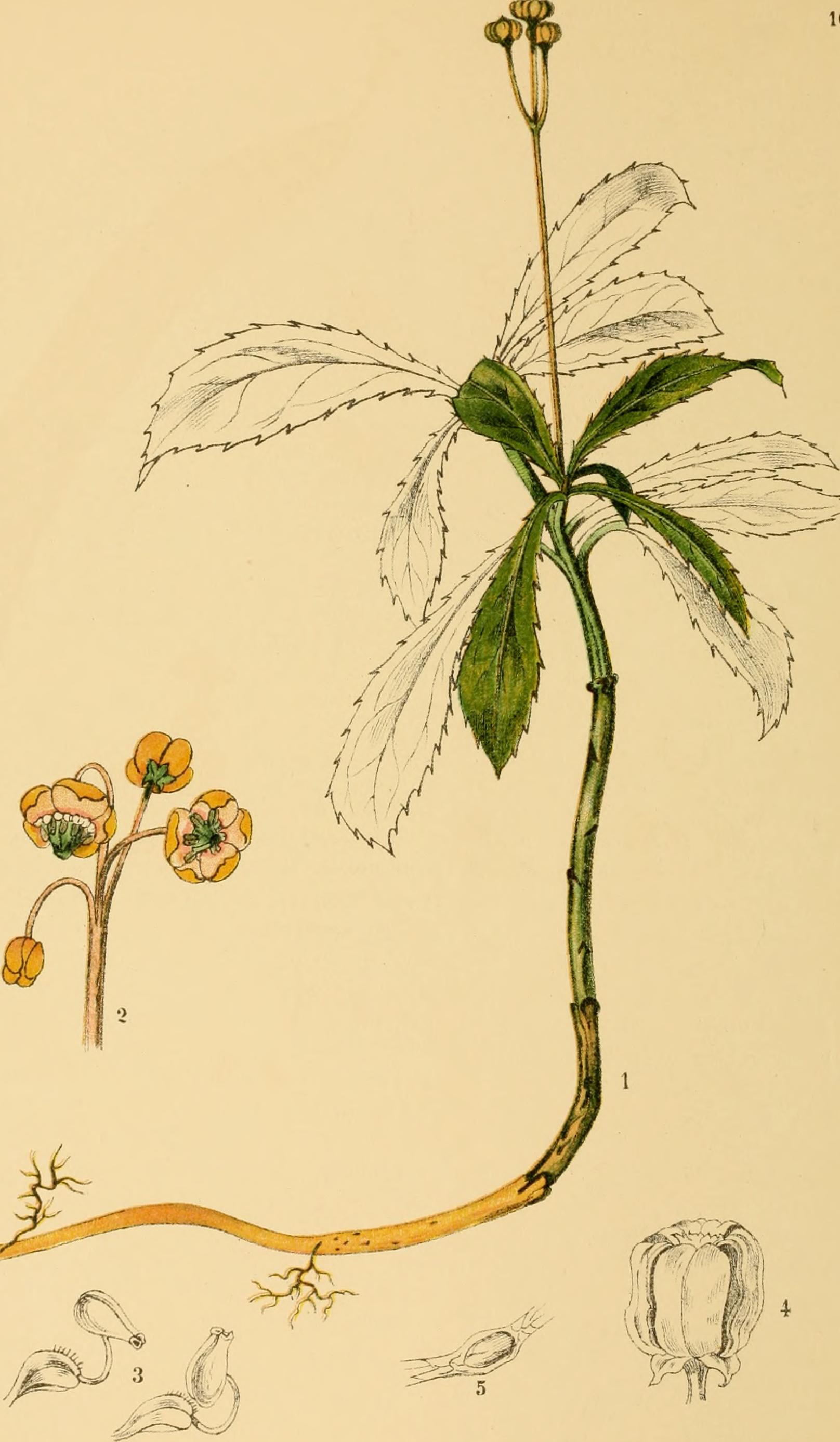
N. ORD.-ERICACE^. ^q,^ 5. ORD.-PYROLE/E. GENUS.— CHIMA PHI LA,* PURSH. SEX. SVST.-DECAXDRIA MONOGYNIA C H I M A P H I L A. PIPSISSEJVA. SYN.-^CHIMAPHILA UMBELLATA, NUTT., CHIMAPHILA CORYMBOSA, PURSH., PYROLA UMBELLATA, LINN., PYROLA FRUCTICANS, PARKINSON. COM. NAMES.-PIPSISSEWA, WINTERGREEN, PRINCE'S PINE, BITTER WINTERGREEN, GROUND HOLLY; (FR.) PYROLE OMBELLEE; (GER.) DOLDENBLUTHIGES HARNKRAUT, ODER WINTERGRUN. A TINCTURE OF THE FRESH TLANT CHIMAPHILA, EITHER UMBELLATA OR MACULA TA, OR BOTH, AS THE PROVINGS HAVE BEEN MADE WITHOUT DISCRIMINATION. Description.— This small, slightly woody, nearly herbaceous evergreen perennial, springs from a long, cylindrical, creeping, yellowish roof, about oneeighth to one-quarter of an inch in diameter, giving off numerous fine rootlets, and sending up many branches, which terminate in leafy and flowerin^T stems alternately. Sicin simple, or sometimes branched at the base, 3 to 6 inches high before the flowering season. Leaves mosdy in several imperfect whorls, or sometimes scattered about the upper portion of the stem; they are dark o-reen above, paler below, thick, shining, wedge-lanceolate, acute at the base, sharply saw-toothed, amaculate, short-petioled, and from one and a half to two inches long, by one-quarter to one-half an inch broad. Peduncle from 3 to 6 inclies long, erect, smooth, terminating in from 4 to 7 pedicels covered with a very fine down, nodding in flower, erect in fruit, and forming a loose umbel or corjmb. Calyx much smaller than the corolla; sepals five, blunt, persistent, slighdy hairy. Corolla oi 'nvG pelals rounded, concave and spreading. Sla?iicns ten, free, inserted under the pistil; filaments at first convex, obovate, fleshy, then concave, filiform and hairy; (?;///^:v'jr large, extrorse in the bud but becoming inverted in flower, more or less conspicuously 2-horned, 4-celled, and opening by two pores; pollen grains white, compounded of four more or less globose granules. Ovaries 5, connected about a fleshy receptacle in such a manner as to form a depressed globose mass, surrounded at its base by a glandular zone; ovules many, small, anatropous; style very short, rounded and wedge-shaped, the ape.x entering into the summit of the substance between the ovaries; sti<^m.i broad, convex, discoid, faintly marked by * X'ti"', winter, i^ikia, lo love.
104-2 5 crenations. Pod depressed-globose. 5-lobed, 5-celled and 5-valved, loculicidal from the apex downward; seeds innumerable, minute. Chimaphila Maculata, Pursh.— This species differs from the foregoing as follows: Peduncles from i to 5 flowered. Leaves ovate-lanceolate, obtuse at the base, the ed^^es widely toothed, their upper surface white-maculate. A description of the natural order will be found under Arctostaphylos Uva-ursi. History and Habitat.— This hardy litde plant seeks the deep shaded portion of woodlands, where it flourishes best in the loamy formations of rotted leaves. It abounds throughout the central portion of North America, the forests of Siberia and the Northern countries of Europe. It blossoms here in June and July, fruiting in September. It is used among the aborigines of this country as a tonic and diuretic, as well as for rheumatic and scrofulous disorders, and latterly as an application to scrofulous and other open sores. Chimaphila is still retained in the U. S. Ph. as Extractiim Clnmaphilce Fluidiim. In the Eclectic Materia Medica its officinal preparation is Decoctnvi CIdinaphilce; it is also a component of Syrupus Stillingice Compositus. PART USED, AND PREPARATION.— The fresh plants while in flower are chopped and pounded to a pulp and weighed. Then two parts by weight of alcohol are taken, the pulp mixed thoroughly with one-sixth part of it. and the rest of the alcohol added. After stirring the whole well it is poured into a wellstoppered bottle and allowed to stand eight days in a dark, cool place. The tincture is then decanted, strained and filtered. Thus formed it is opaque; thin layers have a deep, rich, reddish-brown color; it is decidedly bitter, slightly astringent, and has an acid reaction to litmus. CHEMICAL CONSTITUENTS.— The chemistry of this plant corresponds with that of Arctostaphylos Uva-ursi (vide Uva-ursi, plate 100), differing probably little except in also containing the following principle, determined by Fairbank: Chimaphilin.— On the aqueous distillation of the stems in a retort, a deposit of o-olden-yellow, odorless, tasteless crystals takes place upon the neck, the chemical nature of which has not yet been determined; their physical features are: a slight solubility in water, and a free solution in alcohol. The percentage of tannin in this plant is somewhat less than in Uva-ursi. PHYSIOLOGICAL ACTION.— Here again Uva-ursi should be consulted. Chimaphila does not cause nausea and vomiting to the extent of Uva-ursi, while its diuretic action is greater. Its physiological action as such is undetermined. Description of Plate 104. 1. Whole plant in fruit. 2. Flowering stem, Binghamton, N. Y., June 26, 1S83. 3. Stamen (enlarged). 4. Fruit (enlarged). 5. Seed (enlarged).
J>^. m. v: ^lU.aiinat.del.et pinxt. MONOTROPA UNIFLORA^Linn.
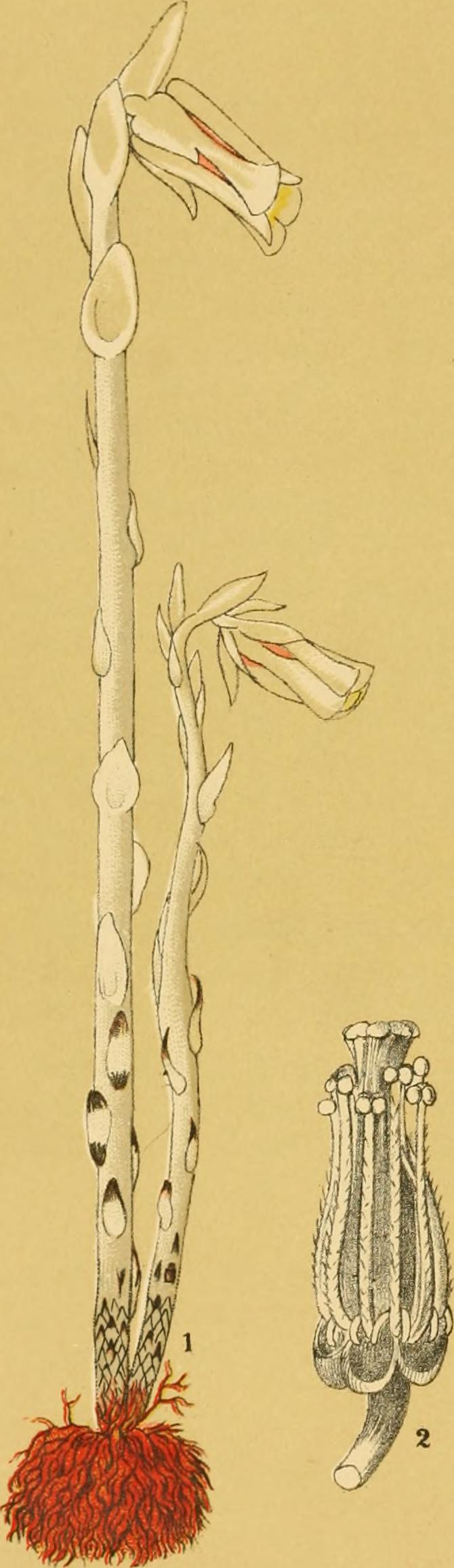
N. ORD -ERICACE^. ^05 S. ORD.~MONOTROPE/E. GENUS.— MONOTROPA,* LINN. SEX. SYST.— DECANDRIA MONOGYNIA. MONOTROPA. IJVBIAJV PIPE. SYN.- MONOTROPA UNIFLORA, LINN.; MONOTROPA MORISONIANA MICHX.; MONOTROPA MORISONI, PBRS. COM. NAMES. — INDIAN PIPE, TOBACCO PIPE, PIPE PLANT, CORPSE PLANT, ICE PLANT, BIRD'S NEST,t NEST PLANT, FIT-ROOT, CONVULSION-ROOT, OVA-OVA; (GER.) EINBLUTHIGE MONOTROPA. A TINCTURE OF THE WHOLE FRESH PLANT MONOTROPA UNIFLORA, L. Description. — This strange waxy or bluish-white, fleshy, inodorous, semi-parasitic herb, grows from 2 to 8 inches high. Rootlets very numerous, forming a ball of densely-matted fibres. Stems several from each clump of rootlets, simple, subcylindrical and smooth. Leaves, none; their place supplied below by numerous small triangular scales, which gradually enlarge and become ovate-spatulate foliaceous bracts toward the summit of the stem, where they pass into the infiorescence, composed of a single, terminal, declined flower, which becomes horizontal, then inclined as it performs its life-work, and rigidly erect in fruit. Flmuer slighdy pubescent, entirely devoid of color except where the yellow anthers and fleshcolored pistil are disclosed. Sepals replaced by 2 to 5 bracteolate, irregular, lanceolate, caducous bodies; petals 5, erect, gouge-shaped, saccate at the base, marcescent. Stamens 10, shorter than the petals, each alternating at the base with a short, recurved, nipple-like process of the base of the ovary; filavtetits awlshaped, pubescent; anthers horizontal, reniform, becoming one-celled and opening by transverse chinks; pollen simple, showing i to 2 translucent depressed spots.J Style columnar, short and thick; stigma naked, discoid, obtusely 5-angled, with a funnel-form depression in the centre. Fruit an erect, ovoid, 8- to lo-grooved, 4- to 5-celled loculicidal pod; placentce large and sarcous; seeds very numerous, minute, subulate; testa loose, cellular, translucent. A description of the Ericaceae will be found under Uva Ursi 100. History and Habitat. — The Indian pipe grows in deep, rich, shady woods — especially those in which the beech abounds — from Florida to Mississippi, and thence northward, flowering in July in the North and from August to September in the South. This curious herb well deserves its name oi corpse plaiit, so like is it to * MoVo; monos; Tpoiro^^ iropos; one turn, from the facing of the flower. + More applicable to Dauciis carota, on account of the resemblance of the fruiting umbels to that structure. t The pollen of Monotropa uniflora bears a striking resemblance in this regard to that of Pendicularis Canadensis.
105-2 the general bluish waxy appearance of the dead; then, too, it is cool and clammy to the touch, and rapidly decomposes and turns black even when carefully handled. The whole plant when wounded — especially, however, the floral envelope — emits a clear glutinous fluid. Attempts to preserve it in alcohol turn it a bluish-black, and tinge the preservative a deep reddish-violet hue, while the drying process turns it jet-black, leaving very litde semblance to its natural appearance. The medical history of the plant begins with its use by the American Aborigines as an application in " sore eyes;" they valued a mixture of the juice with water highly as a soothing and often curative measure. Of this property Dr. Kunze* says in corroboration: " This is a drug very highly recommendedf for overcoming nervous irritability, epilepsy, chorea, etc., when used in large doses — inwardly, of course — and for ophthalmic as well as other inflammations of delicate mucous surfaces outwardly applied, either in its fresh state or the preserved juice. I have myself used it very much in ordinary cases of inflamed eyes, both chronic and acute, and have never seen, or even before heard any evil effects following the most indiscriminate use.| Have applied it to the eyes of infants when only three days old, in Ophthalmia puruletita infantum, as well as in old age in every variety of so-called constitutions, and even where not successfully employed no ill effects have ever been observed thereafter." He farther on describes an incidental cure which is of interest botanically and medically: " Fourteen years ago — it was in the early part of July — I went woodcock-shooting with two friends, near Hackensack, N. J., and while taking some luncheon in a beech grove along the course of Saddle River, I found a large patch of ground literally covered with Monotropa tcnijiora in full bloom; it covered a space some five feet wide by nine feet long, a beautiful sight of snow-white stems and nodding flowers. Being in need of some just then, I proceeded to fill my game-bag, and to the question, what it was used for, answered: ' Good for sore eyes; ' little thinking that the party addressed was suffering from a chronic inflammation of the eye-lids, the edges of which had a very fiery-red appearance. No sooner said than he proceeded to take in his game-bag a supply also, and he made very good use of it, as I ascertained afterwards. His inflamed lids were entirely cured in four weeks' time, and he has had no further trouble since, by applying the fresh juice of the stems he obtained while it lasted." Dr. King mentions the drug§ as " tonic, nervine, sedative and antispasmodic." The former uses of the herb in spasms of children, epileptiform and chorea-like, gave it the popular names so characterizing it. Dr. Stewart claimed that the dried herb was an excellent substitute for opium, " easing pain, comforting the stomach, and causing sleep." In spasmodic affections the usual dose is a teaspoonful of the dried root in powder; to this is often added the appropriate dose of valerian. No mention is made of this drug in the U. S. Ph., and no officinal preparation appears in the Eclectic Materia Medica. * Bot. Gaz., 1878, Vol. iii. No. 6, pp 53, 54. f In King's Am. Disp., and Howard's Botanic Medicine. \ This clause he uses in discussing Mr. A. H. Young's case of poisoning, which I shall quote under the proper rubric. \ American Dispensatory, 1880, p. 530. (
105-3 PART USED AND PREPARATION.— The whole fresh flowering plant is treated as in the preceding drug. The resultant tincture has a brilliant orage-red color by transmitted light, a bitterish odor, a decidedly sweet taste, and a slightly acid reaction. CHEMICAL CONSTITUENTS.— No analysis of this plant has, as far as I am able to determine, been made. The European species, also found here, Monotropa hypopitys, a tawny, many-flowered form, yields a volatile oil and Salicylate of Methyl* PHYSIOLOGICAL ACTION— The only account of poisoning by this plant is that of Mr. A. H. Young.-]- This case was discussed by Dr. R. E. Kunze, as before mentioned, who was of the opinion that in the gathering the young lady handled Rhus toxicodendron; Mr. Young then again consulted the patientj and found that she was not susceptible to Rhus poison, and farther, that she had not personally gathered the plant, but met with her ill-fortune while examining it at home. As Mr. Young had the identical plant in his herbarium, he searched for roodets of Rhus tox. cHnging to the plant, but found none, and states it as his conviction that the case, though standing alone, is veritable. He says: "During the month of September a young lady brought me a plant which she said had poisoned her, and she desired its name. With some surprise, and perhaps I should have had none after considering its fostering food and close resemblance to the Fungi, I found the plant to be Monotropa imiflora. The circumstances of the case are as follows: The young lady while examining the plant, accidentally crushed the stem, and some of the juice was driven upon her lips. The mucous portions which were somewhat chapped became very much irritated, and began to inflame and swell considerably, while in two or three places upon the epidermal skin of the lip small ulcerous sores were formed. The effect remained some four or five days and then gradually healed. The whole effect was very much like a mild case of poisoning with Rhus toxicodendron:' As we have no proving of this drug, we cannot as yet corroborate this case; there is, however, no plant in our country that promises so good results from provings. Description of Plate 105. 1. Whole plant, Binghamton, N. Y., July 21st, 1884. 2. Flower with petals removed. 3. Petal. 4 and 5. Anthers. 6. Pollen, X 300. 7. Pistil. 8. Bird's-eye view of stigma. 9. Longitudinal section of pistil. ' (2-9 enlarged.) * See Gaultheria, p. 102-3. t £<>'■ Gaz., 1878, Vol. iii, No. i, p. 37. t fi'd-, No. 9, p. 79
I 106. ^m.aij ^ 1 ' « • '■ /'i/H.— ^ natdei.etpinxt. Ilex VeRTICILLATA, Gray.
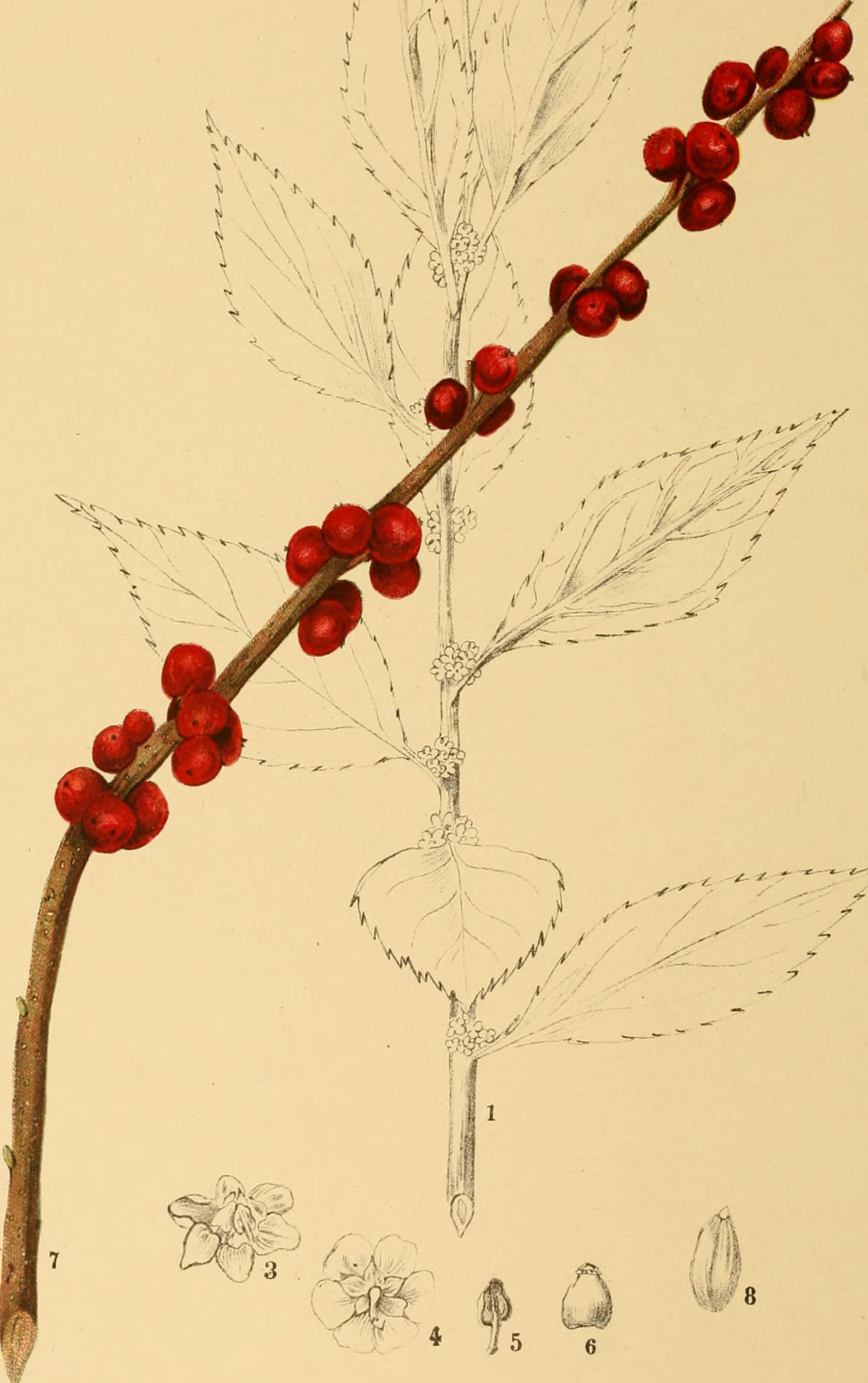
N. ORD.-AQUIFOLIACE^. 106 GENUS.— ILEX,* LINN. SEX..SY.ST.— HE.X.'KNDRIA MOXOGYNI.-X. PRINOS BLACK ALDER. SYN.— ILEX VERTICILLATA, GRAY; PRINOS VERTICILLATUS, LINN.; P. GRONOVII, MICHX.; P. CONFERTUS, MCEN. COM. NAMES.— BLACK ALDER, FEVER BUSH, WINTERBERRY, VIRGINIAN WINTERBERRY^ (PR. i APALACHINE A FEUILLES DE PRUNIER; (GBR.) VIRGINISCHE WINTERBEERE. A TINCTURE OF THE BARK AND FRUIT OF ILEX VERTICILLA'l'A, GRAY. Description. — This upright or ascending, much-branched shrub, usually attains a growth of from 4 to 8 feet. Leaves thin and deciduous, not spiny, in form obovate, oval, or cuneate-lanceolate, acute at the ape.x and base, uncinately serrate, and downy upon the veins underneath; petioles about one-quarter the length of the blade. Inflorescence dioecious; floz^'ers all short peduncled, white, appearing with the leaves. Sterile flowers in small axillary umbels; calyx-lobes ciliate; petals mostly 4 to 6; stamens 6 to 7; ovary abortive. Fertile flowers aggregated or solitary; petals mosdy 5 to 8; ovary conical, about 6-celled; stigma 4- to 6-lobed. Frnit a globose, bright vermilion berry, about the size of a large pea, crowded upon the branches so as to appear whorled; nutlets about 6, smooth and even, or dorsally furrowed or ridged. Embryo minute, nearly globose. Aquifoliaceae. — This small order, to which Prinos is but lighdy wedded, and represented in North America by but 2 genera and 14 species, is characterized as follows: Shrubs or trees with their leaves simple, mosdy alternate, and generally coriaceous and evergreen. Floivers small, axillary, 4- to 8-merous, white or greenish, often polygamous by abortion. Calyx minute, free from the ovary, 4- to 9-toothed. Stamens as many as the divisions of the corolla and alternate with them, the filaments attached to their very base; anthers adnate, opening lengthwise. Corolla hypogynous, rotate, or almost or quite 4- to 8-parted, imbricated in the bud. Ovary 4- to 8-celled; ovules anatropous; stigmas 4 to 8 or united into i, nearly sessile. Fruit a baccate 4- to 8-seeded drupe; seeds solitary in each cell, suspended; embryo minute; albumen fleshy. Our only other proven species in this order is the South American Mate, or Paraguay Tea {Ilex Paraguayensis, St. Hil.), the leaves of which are used like Chinese tea, and are considered slighdy nervine, diaphoretic, and diuretic. In * The ancient nan^e of the holly oak.
106-2 general medicine the following species are more or less useful: The English Holly \llcx aqiiifoliniu, Linn.), and the American co-species, /. opaca, Ait., have been considered nearly equal to Peruvian Bark in intermittent fevers and jaundice. The Cassena of the American aborigines, /. Cassette, Linn., and /. Da/ioon, Walt., are emetic, and enter into the ceremonies of the natives as holy plants, which the males only were allowed to use as purifiers of the body. The Carthaginian Myginda Uragoga, Swartz., is said to be a most powerful diuretic. The juice and leaves of the Indian Monetia Bai'leroides, Linn., are considered by Hindoo doctors to be anti-catarrhal and anti-asthmatic; and the unripe fruit of the Brazilian I/ex niacojuoua, Linn., are so rich in tannin as to be used as a substitute for galls. History and Habitat. — The Black Alder is common in thickets at the margins of pools and marshy places, from western Florida northward; during its flowerincj- season, in April and INIay, it is hardly distinguishable, to those who are not well acquainted with it, from the surrounding bush; but when the autumnal frosts have deprived all vegetation of its leaves, then the fruiting plant stands out like a fiamino- spot in the dreary waste, striking, even to the most careless observer, in its beauty. This is another of the growing list of plants handed down to us by the aborigines, who used the bark both internally and externally as a tonic, astringent, and antiseptic, and is probably as well known to domestic practice as any indigenous shrub. In intermittent fever it has often proved as generally applicable as Peruvian Bark, and in such low typhoid forms associated with diarrhoea, and in later stages, where ulceration and hemorrhage are present, it is a very valuable agent. In general debilitated conditions of the system after long fevers, and where the body is depleted by exhausting discharges, it is also very useful, as well as in gangrenous affections and jaundice. Certain forms of chronic herpetic eruptions and ulcers are also benefited by its use as an external application. The berries are purgative anci vermifuge, forming one of the pleasantest adjuvants in children's remedies, for the expulsion of lumbrici. Shoepf first noted the plant as having the above field of utility, and also mentioned its usefulness in anasarca. The bark is officinal in the U. S. Ph.; in the Eclectic Dispensatory the preparation recommended is Decochiin Prinos. PART USED AND PREPARATION.— The fresh bark and fruit, gathered before the first autumnal trost, are chopped and pounded to a pulp and weighed. Then two parts by weight of alcohol are taken, the pulp thoroughly mixed with one-sixth part of it, and the rest of the alcohol added. The whole is then poured into a well-stoppered bottle, and allowed to stand eight days in a dark, cool place, being shaken thoroughly twice each day. After decanting, straining, and filtering, the resulting tincture has a greenish-brown color by transmitted light; an herbaceous odor; a bitter taste, and an acid reaction. CHEMICAL CONSTITUENTS. — Beside a bitter principle, the nature of which has not yet been determined, this species contains about 4.8 per cent, tannin; a
106-3 resin soluble in alcohol, another insoluble in alcohol; coloring-matter; albumen; crum, and suear.* PHYSIOLOGICAL ACTION.— Fhe berries caused nausea, vomiting, and purging, in two children who ate of them, but whom I had no further chance to watch. In a case reportedf of the effects attending the ingestion of about twentyfive berries, the following symptoms supervened: Sensation of nausea in the stomach not amounting to real sickness nor interfering with the appetite; vomiting of bile without retching; profuse evacuation of the bowels, consisting of their natural contents, diluted with an immense quantity of greenish liquid, attended with no pain or uneasiness; another similar but less profuse evacuation followed in about half an hour, after which the patient felt remarkably well, but as though he had lost ten or twelve pounds in weight. Following this, his appetite and digestion seemed much better than usual. Description of Plate io6. 1. End of a flowering branch, Binghamton, N. Y., May 5th, 18S6. 2. Under side of leaf-margin. 3. Flower. 4. Calyx. 5. Stamen. 6. Pistil. 7. Fruiting branch. 8. Nutlet. (2-6 and S enlarged.) * Tiklen analysis, Jfour. Ma!. Med., vol. i, N. S., 329. f ^o^'- ^'^- ""•' S'lr^- Jour., 1833, 3S3.
107. ^m. adnatdel.etpinxt Plantago Major, Linn.
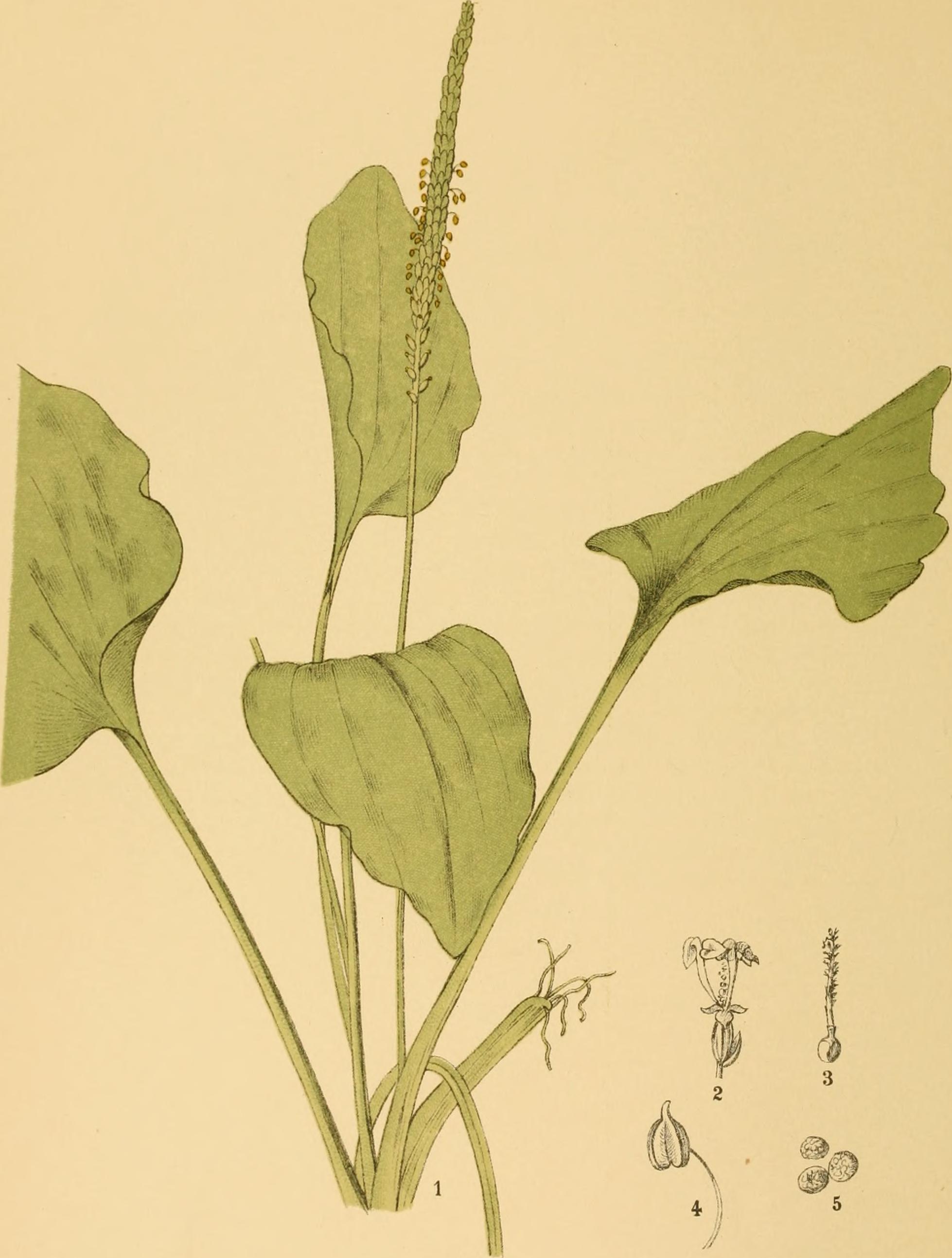
N. ORD -PLANTAGINACE^. 107 GENUS.— PLANTAGO,* LINN. SEX. SYST.— TETRANDRIA MONOGYNIA. PLANTAGO. SYN.— PLANTAGO MAJOR, LINN.; PLANTA GO VULGARIS, GBR.; Apviylux^am, DIOSCOR. COM. NAMES.— PLANTAIN, BROAD-LEAVED PLANTAIN, RIB-GRASS, RIBWORT, WAY-BREAD (WAY-BRED); (PR.) PLANTAIN ORDINAIRE; (GER.) GROSSER WEGETRITT. A TINCTURE OF THE WHOLE FRESH PLANT, PLANTAGO MAJOR, L. Description. — This cosmopolitan immigrant varies greatly in its growth, some individuals only attaining a height of 2 inches, others 18. Root perennial, fasciculate. Leaves all radical, broad, ovate, ovate-cordate or oblong, sometimes slightly toothed, 5 to 7-ribbed; petioles deeply channelled, smooth or slightly hairy. Injloresccnce i to several long and slender, bracted, densely floral, sub-cylindrical spikes, each raised upon a naked scape; floivers all alike and perfect. Sepals 4, imbricated, persistent, membranaceous, and margined. Cot^olla whitish, thin, marcescent; lobes reflexed after flowering. Stamens 4, rarely 2, much exserted; filaincnts long filiform, lengthening suddenly when the anther is ripe; antJiers 2-celled, early deciduous. Pistil dichogamous, i.e., protruding from the flower tube before the anthers are ripe;f ovary 2-celled; stigma more or less unilateral, fringed. Fruit a 2 to i6-seeded pyxis, opening by a complete transverse fissure, the top falling off like a cap, and the thin partition escaping with the seeds; seeds somewhat fusiform; albumen sarcous; embryo straight, enclosed. PLANTAGINACE.^. — This small anomalous family of low acaulescent herbs is principally represented by the genus Plantago. Its members are characterized by having: Leaves 2^ radical and ribbed. Flowers spiked upon a simple scape; calyx 4-cleft, persistent; corolla tubular or hypocrateriform, scarious and veinless. Stamens 4, inserted upon the tube of the corolla alternate with its lobes; filaments persistent, long and weak. Ovary 2-celled; ovtiles amphitropous; style single, lono", and stiematose. Fniit a membranaceous pyxis; dehiscence circumscissile; seeds i to several in each cell; embryo large, mostly straight; albianen sarcous. The mucilaginous principle of the seeds of Plantago renders them somewhat valuable in medicine. The Indian plantain Plantago Isphagida {P. /(lecnmbcns, Forsk) furnishes seeds from which a mucilaginous drink is prepared and used as an emollient; this species is mentioned in the native Materia Medica. The seeds of * The ancient Latin name. t ^ help in cross-fertilization.
107-2 the European and Barbarian P. Psyiiiuvi, the Hungarian P. arenana, and the South European P. Cyiiops, are spoken of by Lindley as a good substitute for linseed and marsh-mallows. The leaves and roots of the common rib-grass P. lanceolata are considered expectorant and vulnerary; the Scottish Highlanders attach great value to this plant as a healing application to fresh wounds. History and Habitat. — The common plantain grows in rich, moist soils, in Europe, India, and America, where it is considered truly indigenous north of Lake Superior. It flowers throughout the summer months, fruiting as it flowers. It is said that the American Indians gave this plant the name of "White Man's Foot," in allusion to its method of introduction, and its trait of accompanying the civilizer and literally growing in his footsteps. This character also gave rise to the vulgarism " way-bred." The previous medical uses of plantain are chiefly those of a general vulnerary and demulcent; thus it became in great demand in the coughs attending various pulmonary and bronchial diseases as well as an application to recent wounds and chronic sores. The seeds were used in the former instance, the leaves in the latter. A decoction of the roots was recommended by Bergius in tertian intermittents, one ounce to four being taken when the chill came on. An infusion of the seeds in milk has been much used by the laity to check various hemorrhages from mucous surfaces, diarrhoea, dysentery, and leucorrhcea. The fibrous strings in the petioles have been extolled* as an almost certain cure for aching carious teeth, if placed in the ear on the affected side. It is said that these fibres turn black if the pain is relieved, but remain green if not. Boerhaave says that in his own experience he has found that plantain leaves placed upon the feet will ease the pain and fatigue engendered by long walks. Plantain has also been highly praised as an antidote to the effects of bites of venomous reptiles and insects; it is stated by Duncan-j- to be one of the principal ingredients in the remedy of the negro Caesar, for the discovery of which he received a large reward from the Assembly of South Carolina. To complete this review of the uses of this herb no better expression could be used than that of M^rat:J " En fin, on a port^ la racine des plantains en amulet pour guerir on pr^venir une multitude des maladies." PART USED AND PREPARATION.— The fresh plant, gathered when coming into flower, is chopped and pounded to a pulp and weighed. Then two parts by weight of alcohol are taken, the pulp mixed thoroughly with one-tentlj part of it, and the rest of the alcohol added. After having stirred the whole, pour it into a well-stoppered bottle, and let it stand eight days in a dark, cool place. The tincture separated from this mass by filtration is opaque, in thin layers it has a deep reddish-brown color by transmitted light. It retains the peculiar odor of the plant, has a sourish astringent taste and an acid reaction. CHEMICAL CONSTITUENTS.— J/?^«7a^^^.— This substance exists plentifully in the seeds of all species, from which it may be extracted by water, and pre* Dr. Reutlinger to Dr. E. M. H.ile, New Rem., p. 500. | New Edinburgh Dispensatory. X Diet, de M. Med., Supplement, 1846, p. 567.
407-3 cipitated from its watery solution (impure) by alcohol. Dry pure mucilage is a yellowish, tough, opaque body, swelling upon the addition of water, and finally dissolving into a ropy mass. The vegetable mucilages vary in their behavior toward reagents according to the plant from which they are extracted; they all, however, break down under the action of dilute sulphuric acid, first into gum, then sugar. The whole plant has not been analyzed. PHYSIOLOGICAL ACTION. — The principal symptoms caused by this drug are, according to Dr. F. Humphreys: headache; excessive digging, boring pain in carious teeth; severe dryness of the fauces and pharynx; colic; urging to urinate, with copious discharges; looseness of the bowels; weakness and oppression of the chest; restless sleep; and a strong fever, with a high pulse which finally becomes weak and intermittent. Description of Plate 107. 1. Whole plant once reduced, Bergen, N. J., July iSth, 1879. 2. Flower. 3. Pistil. 4. Stamen. 5. Pollen, X 250. (2-4 enlarged.) =•4-=
108. 4 '\-.rt(^wmM N|2 ^ (BXll.adnat.deI.et pinxt. AnAGALLIS ArVENSIS, Linn.
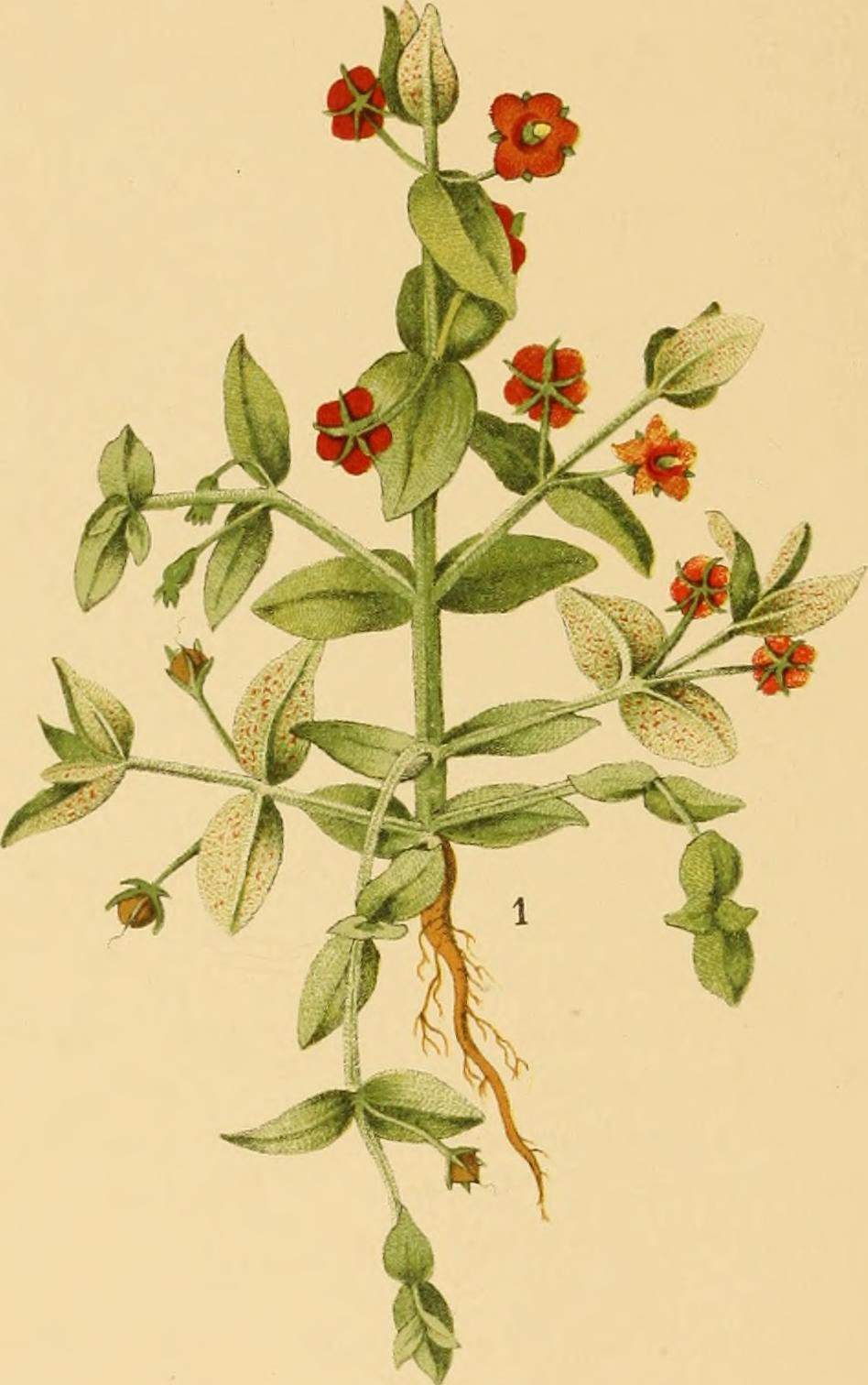
N. ORD -PRIMULACE^. Tribe.-PRIMULE/E. GENUS. — ANAGALLIS,* TOURN. SEX. SVST.-PENTANDRIA MONOGYNIA. 108 ANAGALLIS. PIMPERJVEL. SYN.— ANAGALLIS ARVENSIS, LINN. COM. NAMES.— COMMON SCARLET OR RED PIMPERNEL, POOR MAN'S WEATHER-GLASS, RED CHICKWEED; (GER.) HUHNERDARN- (FR.i MOURON. A TINCTURE OF THE WHOLE PLANT ANAGALLIS ARVENSIS, LINN. Description. — This low, spreading or prostrate annual herb, grows from 6 to 20 inches in length. Stem square, glabrous, branching; leaves opposite, entire, ovate, and sessile, dotted upon the under surface. Infiorescoice axillary; Jiowers ranging on different plants from scarlet to white through the shades of blue and purple; pedimc/cs ^Wiornx, longer than the leaves, i -flowered, bractless. Calyx 5-parted; lobes lanceolate-subulate; margins rough. Corolla rotate, 5-parted, longer than the calyx; tube little or none; lobes broad, obovate, obtuse, fringed with stipitate glands. Stamens 5, inserted upon the base of the covoWdi; Jilai?/e?its purple, bearded; anthers broadly oblong. Ovary free from the calyx; ovnlcs amphitropous. Fruit a globular, membranaceous, circumcissile capsule or pyxis; seeds many, somewhat trianeular; testa rouoh with minute veruccae. Primulaceae. — This small family of herbs is represented in North America by 12 genera, comprising 38 species and 15 varieties; it is characterized as follows: Leaves simple, alternate, opposite, or whorled. Floi^<ers regular, symmetrical, and perfect; perianth hypogynous. Calyx persistent. Corolla rotate, hypocrateriform, or campanulate. Stamens of the same number as the lobes of the corolla and opposite them; filaments inserted upon the tube of the corolla; anthers introrse. Ovary i-celled, free from the calyx; style columnar, undivided; stigma undivided; ovules sessile on a free central placenta. Seeds numerous; albtimen copious, fleshy; embryo straight, small. The only other plant of this order in our Materia Medica is the European Sow-Bread {Cyclamen Europ(Zum, Linn.). In general and household practice the flowers of the European Cowslip {Primula offici7ialis, Jacq.) have been used as a sedative, and placed in wine to render it soporific. * 'Ai/aycXcito, anagelao, to laugh; from its supposed quality of causing hilariousness.
108-2 History and Habitat. — The Pimpernel is naturalized in this country from Europe, and has established itself along both the Atlantic and Pacific coasts in dry, sandy soil, where it blossoms from June to August. Anagallis formerly held a place in the pharmacopceias of Great Britain as a detergent, vulnerary, and cephalic; and was much prized by the ancients in gout, gravel, convulsions, and the plague. Gelin and many others considered it highly anti-hydrophobic, and reported many cures of this dire malady by its use, f:ven after dangerous symptoms supervened. The plant also enjoyed much reputation at one time as an anti-epileptic, sudorific, and diuretic in dropsy; it has, however, entirely passed out of the minds of general practitioners. Pliny and Dioscorides thought highly of the Pimpernel in the removal of intestinal and hepatic obstructions; and it was, most probably, from the happier condition of the mind following such action, that the latter called the plant di'dye/^du. PART USED AND PREPARATION. — The whole fresh, flowering plant (the scarlet-flowered form) is chopped and pounded to a pulp, enclosed in a piece of new linen, and subjected to pressure. The expressed juice is then briskly agitated with an equal weight of alcohol, and allowed to stand eight days in a dark, cool place. The tincture, prepared by filtering the above mass, has a slight olivaceous color by transmitted light; a sweetish somewhat nauseous herbaceous odor; a nutty and slightly astringent taste; and an acid reaction. CHEMICAL CONSTITUENTS.— 0'r/^?w/;^, C,„H,Pi,. This glucoside forms in small white crystals, or in an amorphous, lustreless, friable mass; it is very acrid, has a rancid taste, and a neutral reaction. Cyclamin is not volatile, is soluble in water and alcohol, but not in ether. Its aqueous solution is quite saponaceous. This glucoside breaks down under the action of mineral acids as follows: & Cyclamin. Glucose. Cyclamiretin. Water. PHYSIOLOGICAL ACTION. — The whole plant is acrid and poisonous, as the following experiment of Orfila shows: " At eight o'clock in the morning, three drachms of the extract of pimpernel, dissolved in an ounce and a half of water, were introduced into the stomach of a robust dog. At half-past twelve he had a motion. At six in the evening he was dejected. At eleven sensibility appeared diminished. The next morning at six he was lying upon the side, and appeared to be dead; he might be displaced like an inert mass of matter. He expired half an hour later. The mucous membrane of the stomach was slightly inflamed; the interior of the rectum was of a bright color; the ventricles of the heart were distended with black coagulated blood; the lungs presented several livid spots, and their texture was preternaturally dense. Two drachms of the same extract, applied to the cellular texture of a dog's thigh, produced death in twelve hours: and the heart and lungs presented the same appearances as in the other." The following symptoms, recorded by Schreter, show the character of its action upon man: Lively mood with extra mental vigor;
108-3 stitching headache with sticking pains in the eyeballs; dryness of the throat; tickling, prickling along the urethra, causing desire for coition; prickling in the chest; general drawing rheumatic pains; sleeplessness; trembling and shivering; and trembling of the heart. Description of Plate io8. I. Whole plant, Salem, Mass., July 25th, 1875. 2. Fruit. 3. Same, showing dehiscence. 4. Seed. ( 2-4 enlarged.)
^Xn.adnat.del.etpinxt. CaTALPA BlGNONIoiDES,Walt.
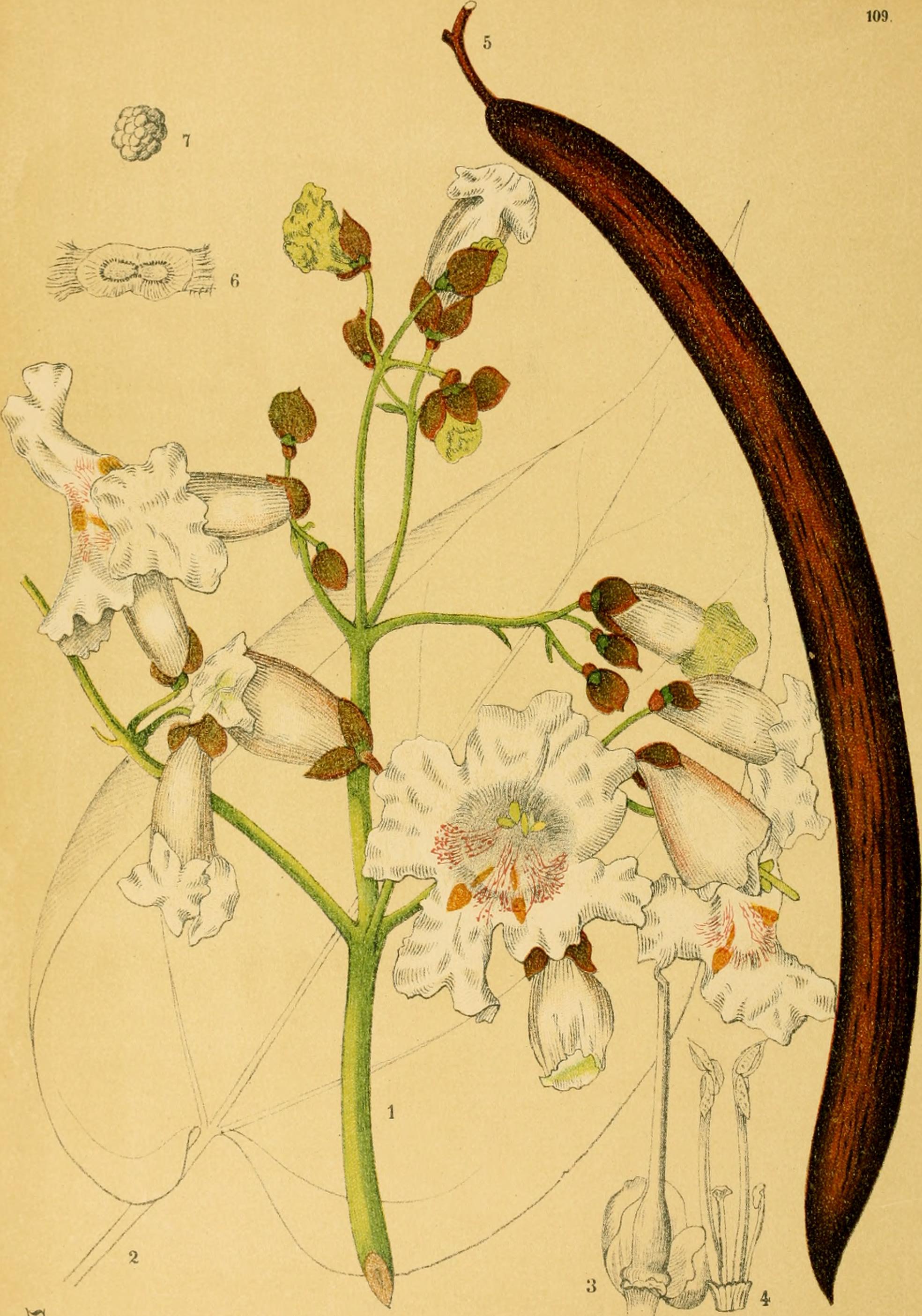
N. ORD-BIGNONIACE/E. ' 109 GENUS. — C ATA LPA,* SCOP. WALT. SEX. SVST.— DIANDRIA MOXOGVNIA. CAT A LP A. IjYdiajy beak. SYN.-CATALPA BIGNONIOIDES, WALT.; BIGNONIA CATALPA, LINN.; CATALPA SYRING^POLIA, SIMS.; CATALPA CORDIFOLIA, DUHAM. COM. NAMES.— CATALPA, INDIAN BEAN, BEANTREE. A TINCTURE OF EQUAL PARTS OF THE FRESH INNER BARK AND LEAVES OF CATALPA BIGNONIOIDES, WALT. Description.— This magnificent umbrageous tree, beautiful in blossom, picturesque in fruit, attains a height of from 20 to 40 feet, its short trunk and spreading branches making it one of our finest shade trees, noted for the persistence of its fruit, the pods often hanging until new ones are formed. The stun is deliquescent, and has a fine gray corrugated bark, more or less glossy and warty; the wood commercially has but little value, though it is light, fine-textured, and capable of taking a fine polish. The branches are large and very irregular in their mode of growth. Leaves large, opposite or in whorls of three, long-petioled, simple, entire, heart-shaped and pointed; they are smooth above and downy beneath, especially upon the midrib. Infloi'escence open, compound, showy panicles, of large, striking flowers, upon the ends of the branches. Calyx deeply 2-lipped or 2-parted, the segments being ovate, scaphoid, and blunt-poinied. Corolla monopetalous, campanulate, inflated, deciduous; the repand five-lobed, divergent border, irregular and 2-lipped. Stamens sometimes didynamous with a rudimentary fifth, but more frequently with only one fertile pair; filaments incurved, as long as the tube of the corolla and inserted upon it; anthers with two diverging cells; pelle^i-gra'ms compounded of many globular bodies all united in the form of a globe. Pistil compound; <?:'«;;;;/ 2-celled, free, upon a fleshy discoid base; stjle single; sttj^mti capitate, or consisting of two lips or plates. Fruit a. woody, subcylindrical, slender pod, from 4 to 12 inches long, pendulous and persistent, 2-celled, the septum contrary to the valves; seeds numerous, densely packed and superimposed, flattened by compression, membraneous, with fringe-tipped alse; embryo flat, albumefi none. History and Habitat.— Catalpa, like all the other genera of this order of plants, is tropical; its most northern range is Kentucky, where it grows in many places spontaneously, flowering in July, and fruiting in October. It is cultivated in many places in the Middle and Eastern States, attaining a full growth and ap* The Indian name.
i09-2 parently as healthy and perfect as In its own climate. Its uses as a drug have been but slight, its provings as yet show nothing of great importance, a mild cathartic action being the only result of large doses of a decoction of the inner bark. It has been used as an anthelmintic. Catalpa has no place in the U. S. Ph., nor Eclectic Materia Medica. PART USED AND PREPARATION.— The fresh inner bark and leaves are chopped and pounded to a pulp and weighed. Then two parts by weight of alcohol are taken, the pulp thoroughly mi.xed with one-si.xth part of it, and the rest of the alcohol added. After stirring the whole well, and pouring it into a well-stoppered bottle, it is allowed to stand eight days in a dark, cool place. The tincture is then separated by decanting, straining and filtering. Thus prepared, it has a clear orange-brown color by transmitted light, a bitter astringent taste and an acid reaction. CHEMICAL CONSTITUENTS.— The bark of this plant contains an amorphous bitter principle, the chemistry of which has not been determined; it has a nauseous taste, and is soluble in alcohol. Beside this, sugar and tannin are present in small amount. The plant seems to impart all its properties to hot water and to alcohol. PHYSIOLOGICAL ACTION.— Unknown. It has been said that it is dangerous to long inhale the odor of the tree, which however is false, at least in this locality the emanations cause no symptoms whatever. Description of Plate 109. I. Panicle from a specimen in DeWitt Park, Ithaca, N. Y., June 12, 1880. 2. Medium-size leaf. 3. Pistil (enlarged). 4. Stamens (enlarged). 5. Medium-size fruit. 6. Seed. 7. Pollen X 380.
PROSPECTUS. The American plants now proven, and incorporated in the Homoeopathic Materia Medica, have become not only numerous, but of great promise as therapeutic agents; and the fact that the greater part of them are not officinal in the United States Pharmacopoeia, has led the author to place them before his profession, in such a manner that their distinguishing characteristics may become known to all who wish to thoroughly understand the agents they use in the cure of diseased conditions. Most of these plants grow within the daily ride of country practitioners, and should be well known to them. In order that they may make fresh tinctures for their own use, when necessary to avoid delay. The author has in every case drawn and colored the plants represented in this work, by Jiis own hand, from the specimens as they stood in the soil; making mathematically accurate drawings, and avoiding the misrepresentations of wilted individuals, or too highly colored fancy pictures. The work will contain one hundred and eighty colored illustrations, and complete text, of all the proven plants Indigenous and naturalized in the United States; arranged generically when bound according to the numerical order of the plates. The preface, a glossary of botanical terms, and complete Index, together with a carefully arranged bibliography, will be given with the last part. BlNGllAMTON, N. Y., June, 1884.
CAXTON PRESS OF SHERMAN 1 CO., PHILADELPHIA.
AMERICAN MEDICINAL PLANTS; AN Illustrated and Descriptive Guide TO m ilRICAi PLANTS USSfi AS HOiiPATilC HEIEBIES Their History, Preparation, Chemistry, and Physiological Effects. BY CHARLES F. MILLSPAUGH, M.D. THE WORK IS ILLUSTRATED FROM DRAWINGS OF EACH PLANT IN SITU, BY THE AUTHOR. BOERICKE & TAFEL. NEW YORK: PHILADELPHIA: 145 GRAND STREET. iOU ARCH STREET.
^. ad nat del ef pinxt ApOCYNUM ANDROS/tMIFOUUM, Linn.
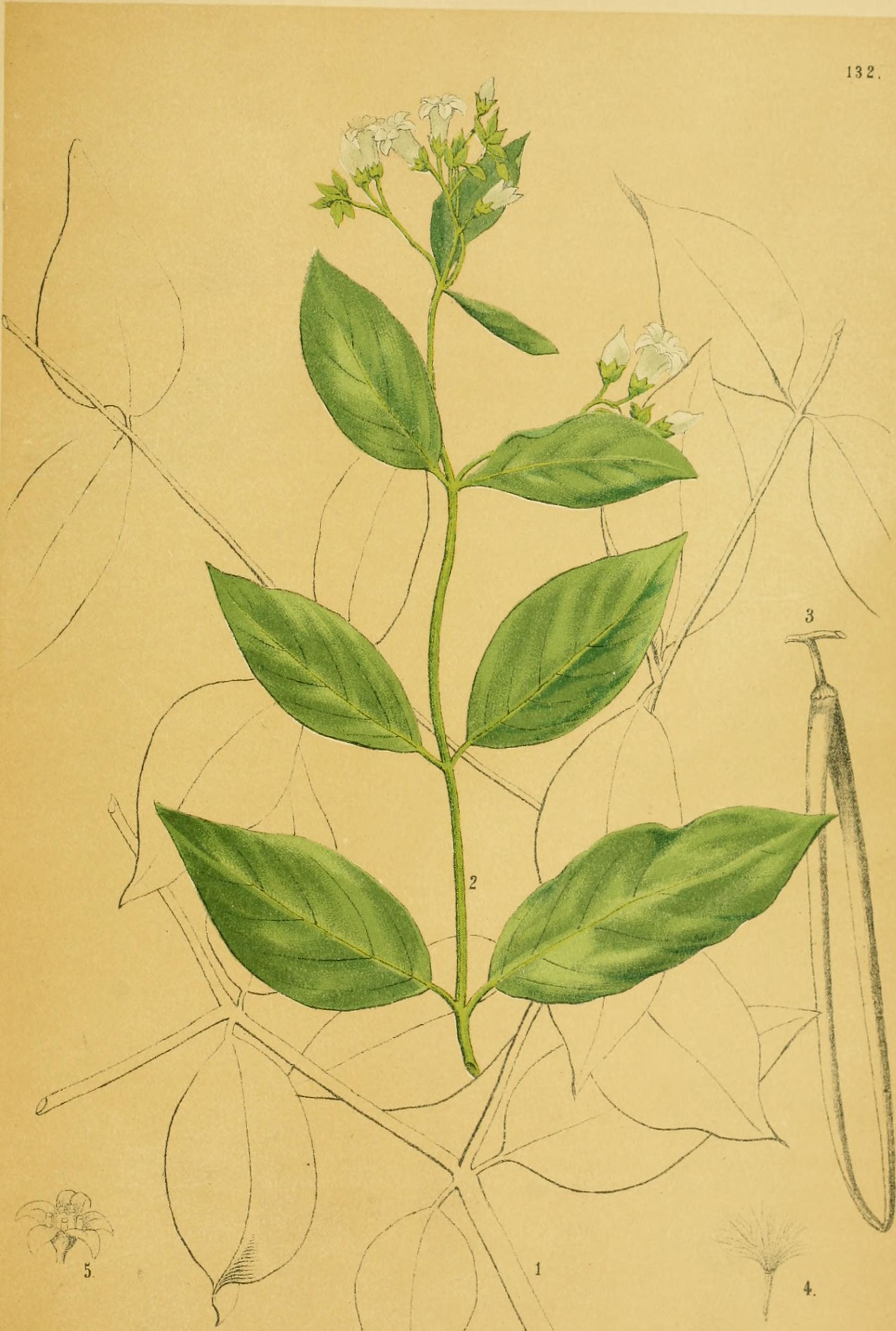
■■--l ■'■i* 9