Foundations of Practice · The Conjure Compass Institute
Solomon Without Dependency
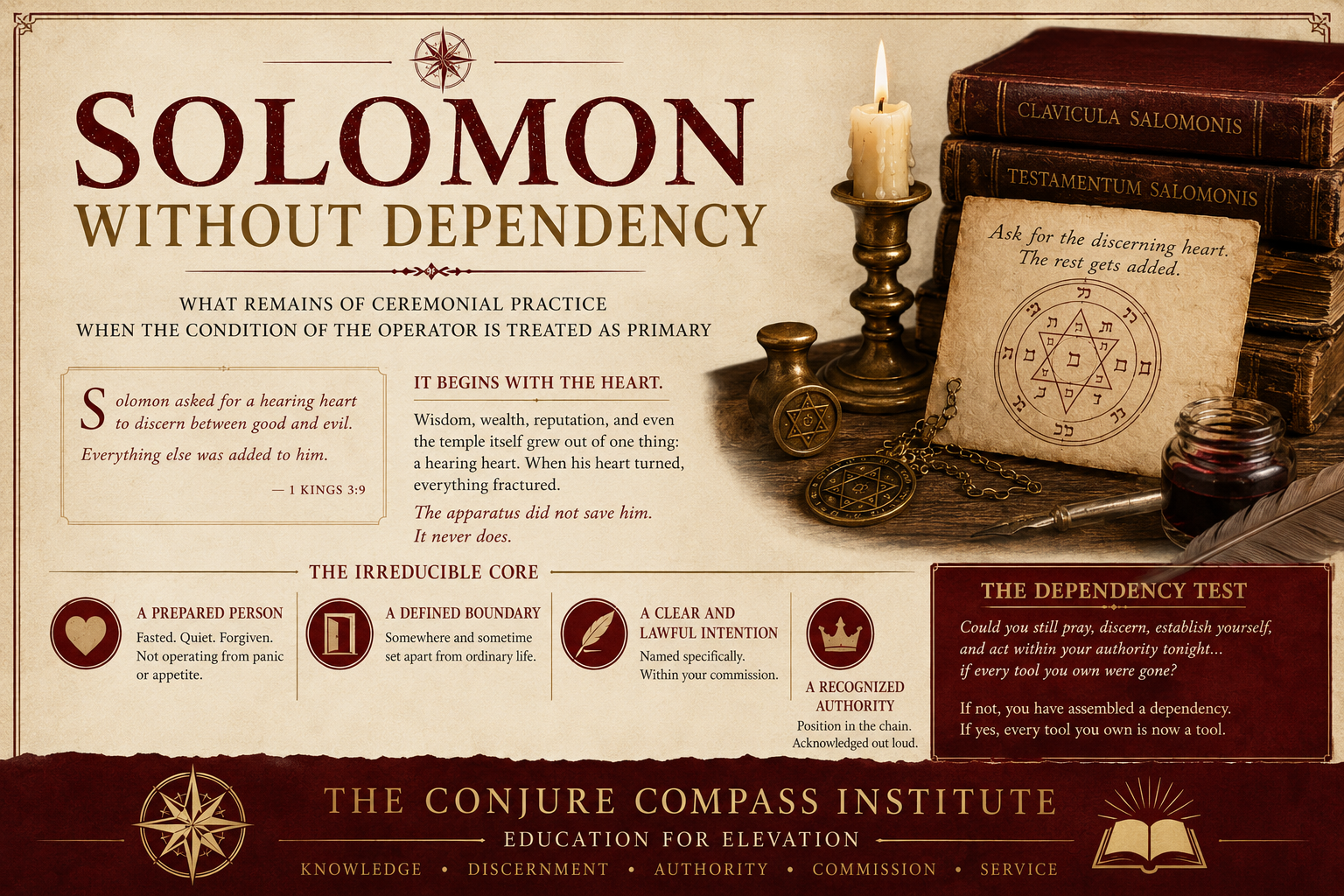
### What remains of ceremonial practice when the condition of the operator is treated as primary
There are two Solomons, and almost every argument about this subject fails because it confuses them.
There is the Solomon of Kings — a young man who inherits a throne he does not feel equal to, asks for one thing, receives it, builds a temple, accumulates enormously, and ends the story with a warning attached to his name.
And there is the Solomon of the ceremonial tradition — the figure to whom keys, seals, pentacles, and tables of spirits were later attributed, assembled across centuries by practitioners who built him out of what the biblical and post-biblical material said about his wisdom, his authority, his temple, and his favor with God.
The second Solomon is not a fraud. He is a reception — what later readers made of the first one, and reception is how traditions actually work. Our own tradition is a reception too.
But hold the two side by side, because the gap between them is where this letter lives.
The Solomon whose name sits on those books is never once shown in the biblical record performing a rite of that kind. What he is shown doing is asking for something interior — and everything external grows out of that request.
So: if you removed the apparatus, what would be left?
Let us find out by subtraction.
What he actually asked for
Read the request closely, because the usual translation smooths over the interesting part.
> Give therefore thy servant an understanding heart to judge thy people, that I may discern between good and bad. > > — 1 Kings 3:9
The Hebrew is לֵב שֹׁמֵעַ — lev shomeaʿ, and it reads more literally as a hearing heart. A listening heart.
Sit with that. He did not ask for processing power. He asked for receptivity — the capacity to take in what is actually there before ruling on it. The wisdom Solomon becomes famous for begins as a request to hear well.
And notice the sequence that follows. Hearing produces discernment. Discernment produces judgment. Judgment produces reputation, wealth, building, administration, and finally the temple itself.
The whole external edifice grows outward from an interior condition. That is the architecture of the story, and it is the reason his name was worth attaching to a magical tradition in the first place.
The method
For each element we will ask four questions in order, and we will keep them separate, because collapsing them is how people end up claiming the grimoires said what they personally believe:
What do the texts require? → What function does it serve? → What do we retain? → Why do we retain it?
Remove the hierarchy of spirits
What the texts require: catalogues — the offices, the ranks, the seals of each, the names pronounced correctly, the conditions of approach.
What function it serves: a map. It converts a vague sense of unseen presence into something specific enough to be addressed, refused, or bounded. Specificity is genuinely useful and the tradition is not foolish for wanting it.
What we retain: the soberness. The recognition that you are not alone in the room and that not everything present is friendly.
Why: because in our framework, an authority operating under commission does not negotiate with what it has been given jurisdiction over, and does not go looking for conversations it was never sent to have. We keep the awareness and decline the catalogue.
Say plainly what that is: a choice, not a discovery. The Solomonic texts assume a practitioner who summons and treats. We are describing a different posture and we are not going to pretend the books agree with us. The curiosity that drives most people into those catalogues is, in our experience, the thing that gets them hurt.
Remove the seals and characters
What the texts require: figures drawn to specification — the correct ink, the correct surface, the correct hour, sometimes materials of a specified purity.
What function it serves: three things at once. The figure commits intention to a surface. It marks the work as set apart from ordinary writing. And in many of the systems, the correctness of the construction is itself part of the operation — not a nicety, but a working component.
What we retain: the act of committing intention to a surface, in your own hand. A seal is a signature. It says I have decided, in a form that outlasts the mood in which you decided it.
Why: see the box below, because this is where our position departs most sharply from the texts and it should be labeled.
> ### ✎ MY READING — EXACTNESS IS NOT AUTHORITY > > Our framework. Weigh it. > > In our teaching, technical precision supports attention, memory, symbolism, and the marking-off of sacred from ordinary. Those are real functions and precision serves them well. > > But precision cannot substitute for the condition of the operator. We would rather teach someone why a figure is being made than train them to fear that one imperfect line has invalidated their standing. > > Be clear about what that is. Several historical ceremonial systems would disagree with us outright — for them, correct construction is the operation, and an error is not a matter of confidence but of efficacy. > > We are not reporting a finding. We are teaching a philosophy in conversation with those texts, and you should know which one you are being handed.
Remove the circle
What the texts require: a drawn boundary, names at the quarters, consecration, and a prohibition against leaving it while the work is open.
What function it serves: more than one thing, and the popular teaching usually flattens it to a single purpose.
The circle does protect — that function is explicit in the material and we are not going to erase it to make a rhetorical point. It also consecrates, marking ground as set apart. It establishes authority, naming under whom the operator stands. And it defines position — it says who is inside it.
What we retain: the boundary, in some form. It may be a room, an hour, a threshold, a chalk line, a habit.
Why: because of the fourth function. Inside a defined boundary you are not the person with the mortgage and the temper. You are the one under commission. The circle does more than keep danger at a distance — it declares the operator's position. Some line must separate ordinary time from working time, or nothing in your practice will ever be distinguishable from your moods.
Remove the purifications
What the texts require: fasting, abstinence, washing, days or weeks of preparation before the operation begins. In the Solomonic material this is not a preface — the instructions for preparing the operator often run longer than the instructions for the operation.
What function it serves: it changes the person who will be doing the work.
What we retain: all of it.
Why: because this is the load-bearing wall, and it is the part every modern seeker wants to skip in favor of the interesting material.
We will not claim that every tradition everywhere agrees — that is broader than we can defend and broader than we need. What we will say is this: across a wide range of ceremonial and religious traditions, preparation of the practitioner appears again and again, and the Solomonic texts are unusually insistent about it. That insistence is data. The texts were not casual about the condition of the operator. They treated preparation as part of the operation itself.
Verdict: once the rest is gone, this does not merely remain. It becomes the practice.
What is left standing
Run the subtraction all the way down and four things remain.
A prepared person. Fasted, quiet, forgiven and forgiving, not acting from panic or appetite. Solomon's hearing heart.
A defined boundary. Somewhere and sometime set apart from the rest of your life.
A clear and lawful intention. Named specifically, and within your commission — not a grab at what belongs to someone else's will.
A recognized authority. Position in the chain, acknowledged aloud, before anything is asked or commanded.
That is the irreducible core. Everything else in every book on the subject is scaffolding around those four — which does not make the scaffolding worthless. Scaffolding is how buildings get built. It becomes a problem only when the worker mistakes it for the structure and cannot work at all when a pole is missing.
> ### ⟳ READ IT AGAIN — KINGS BRACKETS HIM WITH HIS HEART > > Read the beginning and the end of Solomon's story together, and notice that the narrator has already drawn the line for you. > > 1 Kings 3:9 — he asks for a hearing heart. Everything follows from it. > > 1 Kings 4 through 10 — wisdom, wealth, administration, international reputation, the temple. The greatest accumulation of legitimate spiritual apparatus in the entire biblical record. > > 1 Kings 11:4 — his heart was not perfect with the LORD his God. > > And then 11:9, which is the verse that closes the bracket: > > the LORD was angry with Solomon, because his heart was turned from the LORD God of Israel, which had appeared unto him twice. > > The narrator points backward, deliberately, to the night in chapter 3. > > You do not have to argue that the story is bracketed by the heart. The text brackets it itself. > > One more thing worth noticing: Deuteronomy 17 warns the future king not to multiply horses, wives, or gold. Kings shows Solomon multiplying all three. His decline is not a failure of equipment. It is an accumulation problem.
What "dependency" actually means
Here is where the original version of this letter was too shallow, and the correction matters.
The easy reading of the title is: can I work without my tools?
The harder reading — and the one Solomon's story actually poses — is:
Can I possess tools without letting them replace the interior work that made me capable of using them wisely?
Solomon is the case study precisely because he ends up with everything a person could mistake for evidence of spiritual power. Knowledge. Resources. Architecture. Reputation. Authority. International standing. Sacred space. He has the temple. If apparatus could hold a person, his would have.
And Kings still asks us to look at his heart.
Which gives us the sharper formulation:
A perfect pentacle in the hands of a person acting from terror. The correct planetary hour, and a divided heart. A flawless circle, and an uncontrolled appetite. The right divine names, and unresolved rage. A beautiful altar, and no discernment.
None of those are failures of equipment.
The dependency test, corrected
The old version of this test asked whether you could do your most serious work tonight in a bare room with nothing but your voice. That question is unfair and it proves less than it seems to. Some operations are tool-dependent by design. Being unable to perform a particular ceremonial rite in a hospital room proves nothing about your spiritual condition.
So ask the better question:
If everything were taken from you tonight — could you still pray, discern, establish yourself, and act within your authority?
And then the real diagnostic, which is about belief rather than capability:
Does losing the apparatus make you feel you have lost access? Identity? Discernment? Your relationship with God?
If the honest answer is yes to any of those, the apparatus has been carrying something it was never built to carry — and it will fail you precisely when circumstance strips you down.
If the answer is no, then every tool you own is genuinely a tool, and you may use as many as you like with a free conscience. The elaborate practice of a person who does not need it is a beautiful thing.
> ### ⚖ BUT DOES THIS HOLD? > > One: this smuggles in a bias toward interiority. Privileging the operator's inner state over embodied, material form is itself a particular theological inheritance — one with a long Protestant history — and presenting it as the neutral core of "what really matters" is not neutral at all. > > The answer: granted, and worth watching. We hold it anyway, but as a position, not as a discovery. Traditions that locate efficacy in correct performance are not making a childish mistake; they are making a different claim about where power sits. Know which claim you have adopted and why. > > Two: the ancestral argument can romanticize deprivation. Our people worked with dirt, water, and memorized scripture because they were forbidden apparatus — not because they had discovered that apparatus was unnecessary. Treating an imposed minimalism as proof of a spiritual principle takes something that was done to them and calls it their philosophy. > > The answer: this is the sharpest objection here and we accept it. What the record shows is that the work was possible under those conditions. It does not show that those conditions were preferable, and nobody should be told to strip their practice as a way of honoring people who were stripped by force. > > Three: subtraction favors what survives subtraction. A method that asks what remains when you remove things will always end up privileging the abstract over the particular, because particulars are what removal removes. > > The answer: true, and it is why the four-question frame matters. What the text requires is asked first, and answered on the text's terms, before we say what we keep.
The practice: strip and rebuild
Six weeks. Do it honestly.
Weeks one and two — bare. Keep your ordinary schedule of practice and remove every object from it. Voice, water, your own two hands. Note precisely what you miss and why. You are looking for the difference between this helped me focus and I feel unsafe without it. Only one of those is a tool.
Weeks three and four — foundation. Add back only preparation. Fast a day a week if your body permits it. Settle your grievances. Sleep. Guard your speech. Add no objects. Most seekers find more change in these two weeks than in the previous two years.
Weeks five and six — deliberate return. Add back one item at a time, and for each, say aloud what job it does. Anything you cannot justify in a sentence stays in the drawer.
You will end with a practice of the same shape and an entirely different foundation under it — and you will know, not believe, that nothing on your table is holding you up.
And then do it again in three years. Which brings us to the last thing.
The complication that keeps this from being simple
Solomon received the hearing heart.
And his heart still turned.
That is the detail that prevents this teaching from becoming a formula, and it is the most important sentence in this letter. Internal alignment is not achieved once and then possessed. The man who asked better than anyone has ever asked, and received exactly what he asked for, drifted anyway — slowly, across decades, through accumulation and accommodation rather than through any dramatic fall.
So understand what the purification material is actually for.
Preparation is not admission into the practice. Preparation is the practice.
It is not a gate you pass through once on your way to the interesting material. It is the thing itself, repeated for as long as you intend to work — because the drift is constant, and it runs in the same direction for everyone.
The last word on Solomon
He asked for a hearing heart.
He built a temple. He accumulated wealth. He became renowned for wisdom across the known world. The architecture was magnificent.
And when Kings finally explains his decline, it returns to the place where his story began:
his heart.
The text does not say Solomon lacked apparatus. He had more of it than any figure in scripture.
It says his heart turned.
That is the warning buried inside the very figure upon whom an entire ceremonial tradition would later be built. And perhaps the irony is that the tradition preserved part of that warning — in its long demands for purification, confession, prayer, fasting, and the worthiness of the operator — even while later practitioners could become preoccupied with the apparatus surrounding it.
A magnificent temple cannot compensate for a divided operator.
Use the seal. Draw the circle. Burn the incense. Keep the hour. Learn the names. Study the books.
But know what each thing is doing.
And know who you are when none of it is there.
Ask for the hearing heart.
Everything else is equipment.
Reflections