Practice & Maintenance · The Conjure Compass Institute
Reading the Crossroads
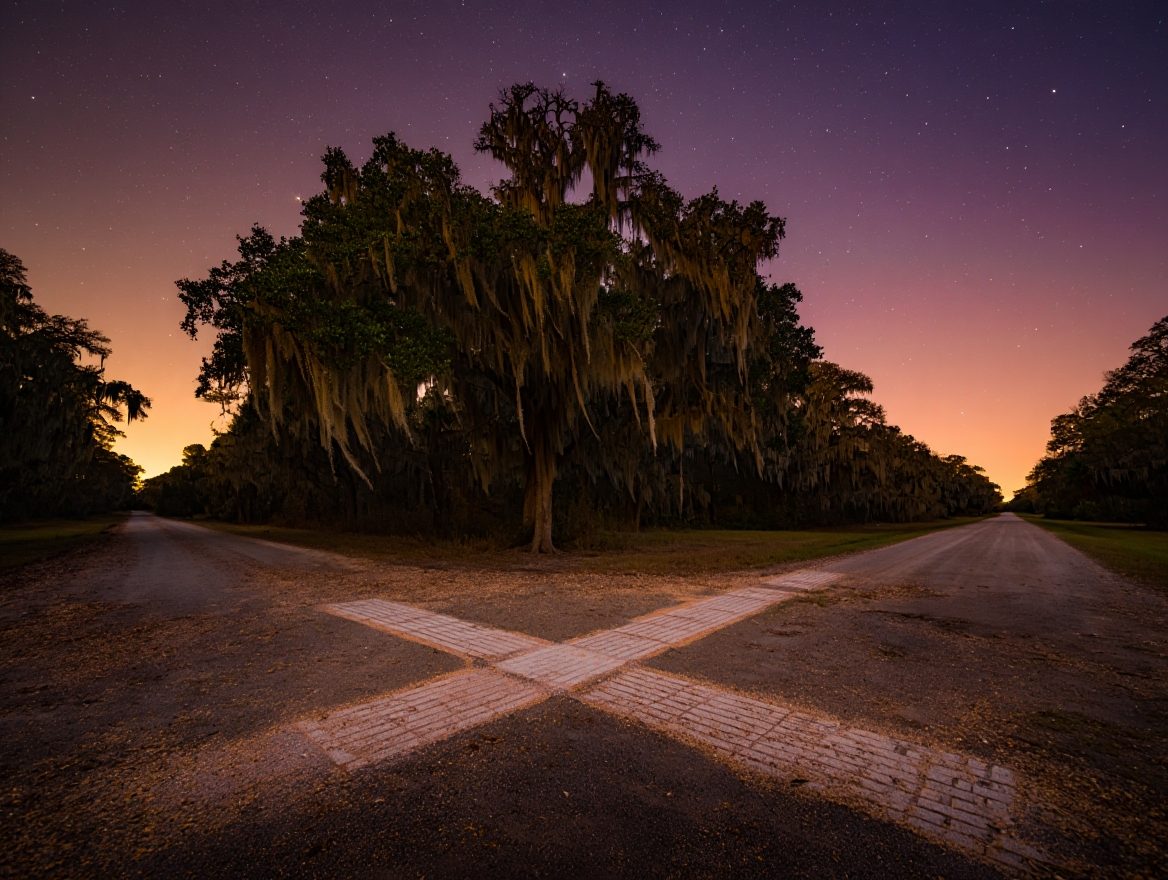
When most folks hear the word crossroads, they picture a lonely dirt road somewhere after dark. They think about old stories, blues songs, and things whispered that nobody says too loudly in church.
My grandmother thought about crossroads differently. To her, a crossroads was not only a place.
It was a moment.
She never said those words. I learned it by watching how she lived. She knew there were seasons when you waited and seasons when waiting became another way of saying no. She knew there were doors you walked through once and never walked back out the same person. She knew life had turning points long before I was old enough to recognize them.
Moment
Most of us spend our lives trying to avoid crossroads. We pray for certainty. We ask for signs. We hope somebody else will make the decision for us. But sooner or later every one of us comes to a place where there are two roads and no voice from the sky telling us which one to take.
That is a crossroads.
It might be leaving a job. It might be forgiving somebody who never apologized. It might be deciding whether to stay in a marriage. It might be answering a call you have spent years pretending not to hear.
Crossroads are ordinary until you realize your life will not be the same after you leave them.
Recognition
My grandmother had a saying for anybody who wanted an answer before they had done their thinking.
You already know.
I hated hearing that. I wanted certainty. I wanted somebody wiser than me to tell me exactly what to do.
Most of the time she was right.
Underneath all my questions was an answer I did not want, because it was the harder road. But that is the thing about crossroads. The difficult road is not always the right one. The easy road is not always the wrong one. The work is learning the difference.
People ask me how they know when they are standing at a crossroads. I tell them to stop looking for signs in the sky and start paying attention to what has been happening in their own life.
What conversation keeps coming back? What decision refuses to leave you alone? What truth have you been arguing with for months? What door keeps opening after you have tried to close it?
Life whispers before it starts shouting. The crossroads usually does too.
Waiting
That is why not every decision has to be rushed. Some roads need time. Some answers arrive after a season of prayer. Some things become clear only after you stop trying to force them.
Waiting is not weakness. Running from the decision is.
Leaving
And there is another thing my grandmother taught me. Every road asks you to leave something behind.
You cannot become who you are meant to be while carrying every version of yourself that came before. Some habits have to stay at the crossroads. Some fears have to stay there too. Sometimes it is pride. Sometimes it is resentment. Sometimes it is the life you imagined, so the life waiting for you has room to arrive.
That is not only a figure of speech.
At the Crossroads
In Southern rootwork, the crossroads has another purpose. It is a place where work begins, where work ends, and where one condition is set down before another is taken up.
My grandmother taught me that you did not carry everything back home with you. Some things belonged to the crossroads.
When a piece of work had done its job, what remained — ashes, wax, bath water, other remnants — was taken away from the house. The crossroads became the place where that work ended. You left it there because its purpose had been fulfilled. Then you turned toward home and kept walking.
You did not stand there wondering whether it worked. You did not look back to see what had happened.
That was part of the lesson.
Once the work is finished, let it be finished.
The Teacher
The older folks also told stories about musicians, gamblers, dancers, and speakers who went to the crossroads seeking mastery. They went more than once. They waited with patience. In many versions, a stranger appeared, borrowed the instrument or the tool, showed its proper use, and handed it back changed.
Whether you hear that as folklore, as spiritual teaching, or as both, the lesson holds. Mastery was not handed over in a single night, and it was not given to anyone unwilling to return.
Today many people connect every crossroads tradition to Papa Legba, because that name has traveled widely through books, films, and the internet. I honor the traditions that venerate Legba and other gatekeepers, and those traditions deserve to be understood on their own terms, by the people who carry them.
The hoodoo I inherited in Alabama spoke differently. The elders simply said the crossroads, and spoke of the teacher some called the Big Black Man, or the Rider. They did not use those names carelessly. They did not spend much time explaining them either. Some things were understood through practice rather than argument.
Awake
People often ask me where the crossroads are. I tell them they have probably already stood at several this year.
At a hospital bedside. Across a kitchen table. In the driveway before walking into work. Beside a fresh grave. Holding a newborn child.
Those are crossroads too. Not because of where they happened. Because of who you became after you walked away.
My grandmother never taught me to fear the crossroads. She taught me to pay attention when I arrived at one. There is a difference. One keeps you frozen. The other keeps you awake.
That is what reading the crossroads means. It is learning to recognize the moments that ask something of you, before they become the stories you tell about your life.
The crossroads is not waiting somewhere down a dirt road.
More often than not, it is waiting for you at your own front door.
Reflections