Foundations of Practice · The Conjure Compass Institute
How Does Your Gift Move?
### FOUNDATIONS OF PRACTICE, PART II — Locating what you were given within the six functions
A woman came up after a class and said, I think my gift is healing.
Fair enough. But watch what happened when we asked what she actually does.
She takes people who are drowning in shame about something that happened to them, and she explains what happened to them. She gives it language. She corrects the destructive account they were handed. And then, six months later, they are different people.
That is real healing. It did not arrive through anything most churches would call a healing ministry. It arrived through teaching.
This is the correction Part I could not make on its own. Recognizing what you were given is the foundation — but a gift by itself is nearly useless information, because the same effect can be produced through half a dozen entirely different routes, and until you know which route is yours, you will keep trying to do your work through somebody else's channel.
Three things that are not the same thing
Almost all the confusion in this subject comes from collapsing three separate questions into one.
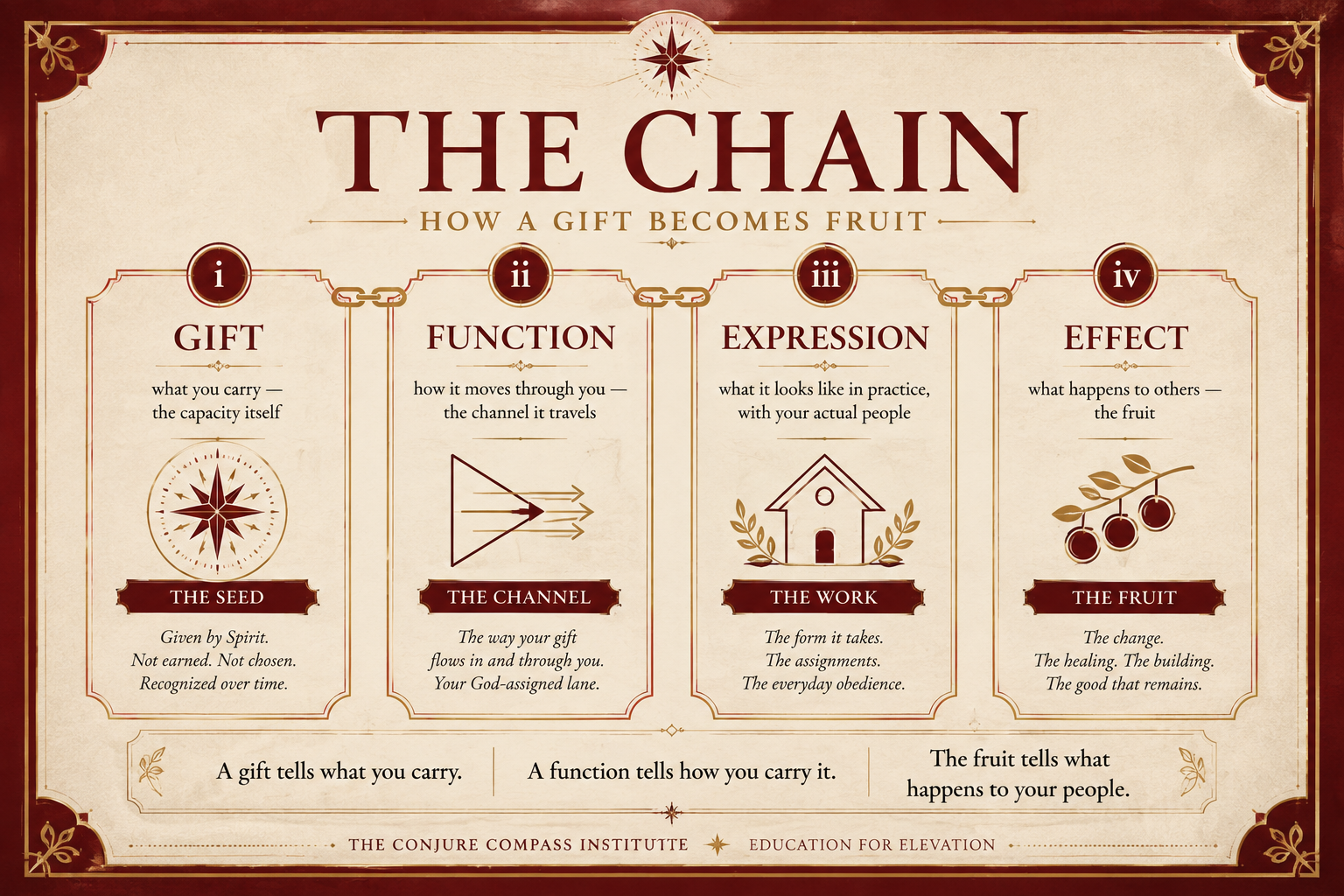
GIFT — what you carry. The capacity itself.
FUNCTION — how it moves through you. The channel it habitually travels.
EXPRESSION — what that looks like in practice, in your actual life, with your actual people.
EFFECT — what happens to others as a result. The fruit.
Read it as a chain: gift → function → expression → effect.
Now the point that reorganizes everything: healing is at the far end of that chain, not the near end. So is comfort. So is courage, clarity, belonging, and relief. Those are effects, and effects are reachable from many different starting points.
Someone heals by explaining. Someone heals by naming what nobody would say out loud. Someone heals by sitting still and not fixing anything. Someone heals by building the thing that should have existed twenty years ago. Someone heals by showing up with groceries.
If you have been looking for your gift among the effects, you have been looking at the wrong end of the chain.
> ### ⟳ READ IT AGAIN — WHERE THESE SIX COME FROM > > Part I argued that the biblical gift lists do not function as a single fixed taxonomy — that Romans 12, the two lists in 1 Corinthians 12, Ephesians 4, and 1 Peter 4 overlap without matching, and that none claims completeness. > > We are not going to turn around now and hand you six categories as though scripture issued them. So here is the honest accounting. > > Ephesians 4 names apostles, prophets, evangelists, and pastors and teachers — which is four or five functions depending on whether that last pair is one group or two, a question the Greek genuinely leaves open and translators have split on for centuries. > > Our sixth, serving, is not in that verse at all. We have brought it in from Romans 12 and 1 Peter 4, where serving stands as a category in its own right — because leaving it out produces a model in which the people who actually hold communities together do not appear. > > So: the six are ours, assembled from scripture but not dictated by it. They are a navigation framework, not a divine personality test. If a seventh would serve you better, add it. > > That admission is not a weakness in the tool. It is the difference between a map and a verdict.
Before you read the six
These are functions, not titles. In some movements this material got turned into an office structure, and men began calling themselves Apostle and Prophet — which converted a description of how someone serves into a rank that could not be questioned. That is exactly the collapse we have written about elsewhere: a gift is not an office, and apostolic is an adjective describing how your work moves, not a chair you sit in.
Most people are a blend. You will likely find one dominant function, one secondary, and traces of others. That is normal. A single-function person is rarer than the framework implies.
And it can shift across a life. What was true of you at twenty-five may not hold at fifty. Seasons change the channel.
ONE — THE BUILDER (apostolic)
What it is. You see what is missing and you make it exist. Systems, structures, containers, new ground. You are less interested in tending what is there than in establishing what is not.
What healing looks like here. Repairing broken systems. Creating places where people can finally flourish because the conditions were fixed. Much suffering is structural, and a builder heals by changing what people are standing in rather than by treating them one at a time.
Locating questions: - When you enter a situation, do you see people first or do you see the arrangement? - Have you started things — groups, businesses, ministries, households — that outlasted your involvement? - Do you get restless once something is running well? - What have you built that other people's gifts now operate inside of? - When something is broken, is your instinct to comfort the person or to fix the mechanism that keeps hurting them?
The distortion. Empire. Structures that quietly serve the builder rather than the people in them, and cannot survive the builder's absence — which is the tell that it was never really built. Also the restlessness that abandons the thing it started as soon as it requires ordinary maintenance, and constant new construction used to avoid the intimacy that staying would require.
The tell: ask whether anything you built still runs without you. If nothing does, you have been building monuments.
TWO — THE SEER (prophetic)
What it is. You perceive what has not yet been named. Patterns, dynamics, the thing everyone senses and no one will say.
What healing looks like here. Naming the actual problem brings relief that nothing else can. People who have been told for years that they were imagining it come back to life when someone finally says the true sentence out loud. Revelation itself heals.
Locating questions: - What do you notice before other people have language for it? - What have you said that was unwelcome at the time and recognized later? - Do people describe conversations with you as clarifying or as unsettling — and does that change after a few weeks? - When has naming the real problem brought somebody relief? - Can you separate what you actually perceived from the interpretation you placed on it?
The distortion. Suspicion wearing the clothes of discernment. Seeing shifts into assuming; pattern recognition runs without brakes and starts generating patterns that are not there. Then there is the use of revelation as leverage — God showed me something about you — which is unfalsifiable by design and one of the most reliable engines of spiritual abuse in existence.
Also worth naming plainly: hypervigilance produces genuine accuracy about a room, and it is not the same thing as this function. If your seeing runs constantly and never rests, that is worth examining with someone trained for it.
The tell: can you say I perceived X and I interpreted it as Y, and I might be wrong about Y? A seer who cannot separate those two has become dangerous.
THREE — THE MESSENGER (evangelistic)
What it is. You reach people outside the existing structure and you make another future imaginable to them. You carry things across boundaries.
What healing looks like here. Hope is a medicine. People trapped in a foreclosed story — this is all there is, this is all I am — are healed by someone who can make an alternative feel real enough to move toward.
Locating questions: - Do you find yourself talking to people the group has written off? - Can you explain what you love to someone who has no context for it, without condescending? - Are you more energized by the room's edges than its center? - Who has taken a step toward something better after talking with you? - Do you cross lines of class, race, language, or belief without much effort?
The distortion. Urgency as coercion. Manufactured crisis, pressure dressed as care, the warmth that arrives fast and cools the moment a decision is made — what people who have survived it call love-bombing. And the counting: when people become conversions, numbers, or wins, the function has turned on the very people it was given for.
The tell: ask what happens to your interest in someone six months after they say yes. If it drops, you were recruiting.
FOUR — THE KEEPER (pastoral)
What it is. You tend. Grief, transition, the vulnerable, the ones nobody else has time for. You know how to stay.
What healing looks like here. Restoration of belonging. Accompaniment through what cannot be fixed. Enormous amounts of human suffering require no solution at all — only that somebody remain present and not flinch.
Locating questions: - Who brings you things they are not ready to tell anyone else? - What kinds of people feel safe around you before you have done anything? - Can you stay present when there is nothing to fix? - What happens to people in the months after you have cared for them? - What particular wound does your presence seem especially equipped to tend? - Do people leave you more themselves, or more attached to you?
The distortion. Dependency. Care that quietly makes the cared-for smaller, so that the keeper remains necessary. Rescuing rather than tending. And the other failure, which is the more sympathetic one: absorbing everyone's pain until there is nothing left, calling the collapse faithfulness, and teaching everyone around you that love means self-erasure.
The tell: the line between tending and rescuing is whether the person is becoming more capable. Check at the twelve-month mark, not the twelve-day mark.
FIVE — THE INTERPRETER (teaching)
What it is. You take what is confused and make it understandable. You give people language for their own experience.
What healing looks like here. Confusion is its own injury, and a false explanation is a worse one. When someone finally understands why a thing happened, shame frequently loses its grip — not because they were comforted, but because they were corrected. This is the woman from the opening of this letter.
Locating questions: - Do people leave conversations with you understanding something they could not understand before? - Do people bring you their confusion specifically? - When you learn something, is your instinct to keep studying it or to immediately figure out how to explain it? - What do you repeatedly translate into language other people can use? - Has understanding ever released somebody near you from shame, fear, or superstition? - Have you watched behavior change because a person finally understood the reason?
The distortion. Needing to be right. Correction as a form of control — the constant small adjustments that keep everyone slightly off balance and reliant on your reading. Certainty inflated past the evidence. And the subtler one: teaching that makes people dependent on your interpretation rather than able to interpret for themselves, which is the exact opposite of the function.
The tell: do your students eventually disagree with you well? If nobody you taught ever outgrows you, you were not teaching.
SIX — THE WORKER (serving)
What it is. You meet material need. You make provision tangible. You create safety through practical action while other people are still discussing it.
What healing looks like here. A great deal of despair is logistical. Rent, food, transportation, childcare, a functioning stove, somebody who showed up with a truck. The worker heals by removing the actual weight, and this function is chronically undervalued by everyone except the people it has rescued.
Locating questions: - When something goes wrong, are you moving before the meeting ends? - What would collapse in your household, church, or circle if you stopped for a month? - Do you notice needs that never get spoken — the empty fridge, the broken step? - Is your instinct in a crisis to say something or to do something? - Who is materially better off because of work of yours that nobody saw?
The distortion. Self-erasure. Buying belonging with labor, because being useful feels safer than being known. Then the resentment that accumulates in silence and finally arrives all at once, aimed at people who never knew a bill was running. And martyrdom — service performed so that its cost will be noticed, which is a request dressed as a gift.
The tell: can you let somebody serve you without deflecting? If not, this may be less a function than a strategy.
> ### ✎ MY READING — THE SENTENCE YOU SHOULD BE ABLE TO WRITE > > Our framework. Weigh it. > > The goal of this chapter is not for you to finish able to say "my gift is healing." That sentence contains almost no usable information. > > The goal is a sentence more like this: > > > Healing keeps showing up around me, but it travels mainly through teaching and through keeping. People bring me confusion and shame. I help them understand what happened, give it language, and then stay with them while they rebuild. My seeing shows up occasionally — I can spot the hidden pattern — but that is not where most of my evidence sits, and when I lead with it I tend to be wrong. > > That person now knows what to say yes to, what to decline, what to build a practice around, and where their failure mode lives. > > Or the other common outcome, which is a genuine surprise: > > > I always assumed I was pastoral, because everyone brings me their problems. But when I audited it honestly, they are not coming for comfort. They come because I can see what is structurally wrong and know what needs building. My care is real. My dominant function may be builder, and I have been exhausting myself trying to be a keeper. > > A gift tells us what you carry. A function tells us how you carry it. The fruit tells us what happens to your people when you do. > > All three, or you have a label rather than a location.
> ### ⚖ BUT DOES THIS HOLD? > > One: six categories will flatten somebody. Any typology does. People will read themselves into a box and then perform it, which is precisely the harm the gift inventories did. > > The answer: use the questions, not the labels. If you finish able to describe what happens around you in your own words, the framework did its job and you can discard the vocabulary. If you finish with a badge, throw the whole thing out. > > Two: the "apostolic/prophetic" language carries real baggage. In some movements it became a title structure that placed men beyond correction and did serious damage. > > The answer: which is why we lead with Builder, Seer, Messenger, Keeper, Interpreter, Worker. Plain words are harder to inflate into a rank. If the traditional terms are unusable for you because of what was done with them, drop them entirely — nothing in the tool depends on them. > > Three: the effects are being claimed too broadly. Calling all of this "healing" risks implying that teaching or presence substitutes for medical or psychological care. > > The answer: it does not, and we will not pretend otherwise. Restoration of understanding, belonging, hope, and material stability are real and they are not treatment. When somebody needs a physician or a trained therapist, the most healing thing any function on this list can do is say so plainly and help them get there. > > Four: this favors people with visible histories — those with communities, platforms, and years of evidence. > > The answer: granted, same as in Part I. If you are early, hold your reading loosely and write so far at the end of every sentence.
The practice: the mapping
Two sessions, a week apart. Written.
Session one — the raw evidence. Take the list you built in Part I: every time in ten years somebody came to you unprompted. Go through it item by item and mark which function was actually operating — not which one you would prefer, which one occurred. Tally them.
Then look at the effects. For each item, write what changed for that person afterward. This column is where healing will show up, and it will show up under functions you were not expecting.
Session two — the reading. With the tally in front of you, write out:
1. Dominant function — where the most evidence sits. 2. Secondary — the clear runner-up. 3. Occasional — present but thin. Note it, and note that leading with it is probably a mistake. 4. Your characteristic effect — the thing that keeps happening to people around you, in one phrase. 5. Your distortion — from the tell attached to your dominant function. Write the honest answer, not the flattering one. 6. Then the sentence. Gift, function, effect, and failure mode, in your own words, in under a hundred words.
Carry that sentence for a season. Test it. Let somebody who has watched you for years read it and tell you where it is wrong.
Why this is the second foundation and not the first
Because a person who knows what they carry but not how it moves will spend years trying to do their work through a channel that was never theirs — teaching when they should be building, keeping when they should be naming, serving when what the room actually needs is someone to say the true sentence out loud.
That person is not lacking faith, tools, or effort. They are misrouted, and misrouting is invisible from the inside. It looks like failure of will.
Find the channel. Then the plainest possible practice starts producing things you cannot account for.
Reflections